“One of the main advantages of the Rosary is that it enables us to unite with our vocal prayer, meditation on the principal Mysteries of our faith. During each decade we should meditate briefly on one of these Mysteries. In this way, our faith will be enlivened and we shall be roused to imitate, in our lives, the example of Jesus and Mary.
The Rosary is composed of the Church’s most beautiful prayers – the Our Father, which Jesus Himself taught us to say when addressiug our heavenly Father and the Hail Mary, which consists of the Angel’s greeting to the Blessed Virgin when he came to announce to her, that she was to be the Mother of God, of the inspired words of St Elizabeth on the occasion of the Visitation and of the moving plea for mercy, both now and at the hour of our death, which the Church places upon the lips of her sinful children (composed and proposed by St Peter Canisius 1521-1597) Doctor of the Church). Each decade concludes with the short hymn of praise in honour of the Blessed Trinity: Glory be to the Father and to the Son and to the Holy Ghost, as it was in the beginning, is now and ever shall be, world without end, amen. This prayer, expresses the two principal Mysteries of our faith, namely, the Unity and Trinity of God and, in an indirect fashion, the Incarnation of the Second Divine Person.
If we think of all this when we are fervently reciting the Holy Rosary, it will prove to be a treasury of grace.”
Quote/s of the Day – 1 October – “Month of the Most Holy Rosary”
“The Rosary is a treasure of graces.”
Pope Paul V (1550-1621)
“The Rosary is the most powerful weapon to touch the Heart of Jesus, Our Redeemer, who loves His Mother.”
St Louis Marie Grignion de Montfort (1673-1716)
Praise of the Rosary From a sermon of St Francisco Coll
“… Oh Rosary! You are a book, brief yes but that teaches the holiest and most sacred of our Religion. You are an ark, that conceals a very rich treasure worthy of all men seeking it with great eagerness. You are a gift from Heaven, that you reveal to us the elements of religion, the principles, the motives and the practice of all the virtues, you light us in charity and love towards that God Who so deigned to do and suffer for us. You wake up the drowsy, enflame the lukewarm, you push the lazy, you embrace the righteous, you convert sinners, you reduce or confuse heretics, you frighten the devil, you tremble to hell or, to put it better, you are a devotion that includes and contains all the devotions.”
St Francisco Coll y Guitart OP (1812-1875) “The Apostle of Modern Times”
“There is no surer means of calling down God’s blessing upon the family, than the daily recitation of the Rosary.”
Ven Servant of God Pope Pius XII (1876-1958)
“The Rosary is the best therapy for these distraught, unhappy, fearful and frustrated souls, precisely because it involves, the simultaneous use of three powers – the physical, the vocal and the spiritual and in that order.”
One Minute Reflection – 1 October – “Month of the Most Holy Rosary” – Readings: Baruch 1: 15-22; Psalms79: 1b-5, 8-9; Luke 10: 13-16 and the Memorial of St Bavo of Ghent (c 589–654
“He who hears you, hears me and he who rejects you, rejects me and he who rejects me, rejects him who sent me” – Luke 10:16
REFLECTION – “Consider the great authority He gave the holy Apostles, how He declared them praiseworthy,and how He decorated them with the highest honours. “He who hears you,” He says, “hears me and he that rejects you, rejects me and he who rejects me, rejects him who sent me.” O what great honour! What incomparable dignities! O what a gift worthy of God! Although men, the children of earth, He clothes them with a godlike glory. He entrusts His Words to them, that they, who resist anything, or venture to reject them, may be condemned. When they are rejected, He assures them that He Himself suffers this. Then again, He shows that the guilt of this wickedness, as being committed against Himself, rises up to God the Father. See with the eyes of the mind, how vast a height He raises the sin committed by men in rejecting the saints! What a wall He builds around them! How great security he contrives for them! He makes them such as must be feared and in every way plainly provides for their being uninjured!” – St Cyril of Alexandria (376-444)Known as ‘The Pillar o Faith,” Archbishop of Alexandria, Father and Doctor of the Incarnation)(Commentary on Luke, Homily 63)
PRAYER – God, our Father, Your promised Your Kingdom to the little ones and the humble of heart. Give us grace to walk confidently in the way of St Bavo of Ghent, so that helped by their prayers, we may see Your eternal glory. Through Christ our Lord, in the unity of the Holy Spirit, one God forever, amen.
Our Morning Offering – 1 October – The Memorial of St Romanos the Melodist (c 490-c 556) Deacon, Hymnographer, Poet, Writer.
Rescue Our Life, Lord By St Romanos the Melodist (c 490-c 556)
We implore You, O All-Holy, Long-Suffering, Life and Restoration, Source of goodness, look down from Heaven and visit all those who ever trust in You; rescue our life, Lord, from all constraint and affliction and, in the faith of Truth, guide us all, at the prayers of Your Immaculate Mother of God and Virgin, Save Your world and those in the world and spare us all, You Who, for us, became Man without change, only Lover of mankind. Amen
Saint of the Day – 1 October – Saint Bavo of Ghent (c 589–654) Married. Widower, Soldier, Monk and Hermit, Penitent. Born in c 589 at Brabant, Liege, Belgium as Allowin and died on 1 October 654 at Saint Bavo’s Abbey of natural causes. Patronages – the Cities of Ghent, Zellik and Lauwe in Belgium, City of Haarlem, Netherlands, Diocese of Amsterdam, Netherlands, the Netherlands, of falcons and falconry. Also known as – Allowin, Bavone of Ghent.
The Roman Martyrology states of him today: “In Ghent in Flanders, in present-day Belgium, Saint Bavo, a Monk, who was a disciple of Saint Amand. He abandoned the world, distributed his goods to the poor and retired to the Monastery he founded in this place.“
Saint Bavo with falcon and sword, by Geertgen tot Sint Jans, late 15th century
Bavo was born into a family of high social rank. His father was Pippin of Landen, the Mayor of the Palace and his mother, Itta of Metz.
A wild, young aristocrat of Brabant, he contracted a beneficial marriage to the daughter of the Merovingian Count Adilone and had a daughter named Agletrude. At that time, he was a soldier who led an undisciplined and disorderly life.
The young wife died, it is not known how and Bavo, deeply struck by the misfortune, interrupted his dissolute life and suffered a moral crisis, which was the starting point of his conversion.
He went to St Amand who was preaching to the still pagan populations of the Ghent region. On returning to his house he distributed his wealth to the poor, and then received the tonsure from Amand. He entered the Monastery of Ganda as a Monk., This Monastery had been founded by St Amando and was later renamed in Bavo’s honour.
He became a disciple of the missionary St Amand and followed him on his apostolic wanderings in Flanders and France. On one occasion, Bavo met a man whom he had sold into slavery years before. Wishing to atone for his earlier deed, Bavo had the man lead him by a chain to the town jail as penance and reparation for the sins of his past life.
After some time he returned to Ganda, where he had a small cell built in the hollow of a large tree and led a reclusive and ascetic life for three years.
But privations and sacrifices quickly weakened him, dying around 654. His body was buried in the Monastery of Ganda.
St Bavo by Rembrandt
At present, his relics rest partly in the Cathedral of Ghent, which too is dedicated to St Bavo and partly in the Benedictine Abbey of Nesle-la-Reposte, the place where the Monks who fled from Ganda had taken refuge, to escape the Norman invasions, around 882- 883.
St Bavo saves Haarlem
The most popular scene is the moment of his conversion, which has many legends attached to it. Because he is so often shown with a falcon, he came to be considered the patron saint of falconry. In medieval Ghent, taxes were paid on Bavo’s feast day, and it is for this reason, that he is often shown holding a purse or money bag.
The Conversion of St Bavo by Peter Paul Rubens
The City of Bamberg in Belgium is named after him, with Bamberg meaning “Mount of Bavo.” Several Churches are dedicated to him, including: Saint Bavo Cathedral, in Ghent which is most famous for housing the breath-taking Ghent Altarpiece by Jan van Eyck completed in 1432, see video below; Sint-Bavokerk and Cathedral of Saint Bavo, both in Haarlem; Sint-Bavokerk in Heemstede, Lauwe, and Zellik; Saint Bavo Church and School, in Mishawaka, Indiana; Sint-Bavokerk in Wilrijk.. His picture is also part of the Coat of Arms of the Antwerp Suburb Wilrijk.
Madonna di Valverde, / Our Lady of Valverde di Rezzato, Italy (1399 and 1711) – 1 October:
The Sanctuary of the Madonna di Valverde, belonging to the Parish of San Giovanni Battista di Rezzato Diocese of Brescia, is located in Valverde, at the foot of the Botticino and Serle hills. The Sanctuary was born in the places of the apparitions of 1399, the only one in history where both the Madonna and her Divine Son, Jesus Christ, the Saviour aooeared with His Mother and the second Marian Apparition of 1711.
For over six centuries the Sanctuary of the Madonna di Valverde has been a destination of pilgrimages from all over the north of Italy and is, above al,l in the heart of the community of Rezzato – Virle, which every year, on the Feast of St Anna on 26 July, recalls, with a solemn historical procession, the miracle of the apparitions.
In 1399, more than six hundred years ago, during the ploughing work in a field near Valverde, the oxen pulling the plough stopped and bent their knees. A man in a red robe and a blue mantle (Christ) appeared to the worker who guided them and ordered him to throw the three loaves that he kept in his saddlebag into the nearby pond. The peasant got ready to obey the order but was held back by the Apparition of the Madonna who advised him to return to beg the Lord, to revoke the order just given. If the three loaves had touched the waters of the lake, three scourges would have been unleashed (famine, plague and war) with which Christ intended to punish men for their impiety. Jesus, by the insistence of tHis Holy Mother, consented to the peasant’s plea and agreed that only one of the loaves need be thrown into the water and, therefore, only the scourge of the epidemic would spread throughout the area. Our Lady recommended to the peasant to announce to everyone, what he had seen with his own eyes, exhorting men to repent and to approach faith and the Sacraments again.
A Chapel was first built near the lake, then, in the early seventeenth century, a large and beautifully decorated Sanctuary followed.
St Thérèse of Lisieux/St Thérèse of the Child Jesus and the Holy Face/The Little Flower OCD (1873 – 1897) Virgin, Carmelite Nun, Doctor of the Church (Memorial) She was Canonised by Pope Pius XI on 17 May 1925. The same Pope proclaimed her Universal Patron of the Missions, alongside Saint Francis Xavier, on 14 December 1927. Up until 1969 her Memorial was celebrated on 3 October. Biography: https://anastpaul.com/2018/10/01/saint-of-the-day-st-therese-of-lisieux-o-c-d-1873-1897-doctor-of-the-church/
St Aizan of Abyssinia St Albaud of Toul Bl Andrew Sushinda Bl Antoni Rewera St Aretas of Rome St Bavo of Ghent (c 589–654) Married. Widower, Monk and Hermit. Bl Cecilia Eusepi Bl Christopher Buxton St Crescens of Tomi St Dodo Bl Dominic of Villanova Bl Edward James St Evagrius of Tomi St Fidharleus Bl Gaspar Fisogiro St Gregory the Illuminator St John Kukuzelis Bl John Robinson
St Maxima of Lisbon Bl Nikita Budka St Piaton of Tournai St Priscus of Tomi Bl Ralph Crockett Bl Robert Widmerpool Bl Robert Wilcox
St Romanos the Melodist (c 490-c 556) Deacon, Hymnographer, Poet, Writer. He is said to have composed more than 1,000 hymns celebrating various festivals of the ecclesiastical year, the lives of the saints and other sacred subjects, some 60 to 80 of which survive. Wonderful Saint Romanos! https://anastpaul.com/2020/10/01/saint-of-the-day-1-october-st-romanos-the-melodios-c-490-c-556/
St Sazan of Abyssinia St Verissimus of Lisbon St Virila St Wasnulf — Martyred in the Spanish Civil War: • Blessed Carmelo Juan Pérez Rodríguez • Blessed Higinio Mata Díez • Blessed Juan Mata Díez • Blessed Álvaro Sanjuán Canet • Blessed Florencia Caerols Martínez
Novena to Our Lady of the Rosary – Day Three – 30 September
Day Three – We Pray for the Priesthood and Consecrated Life and our personal intention:
To Our most holy Mother. To you do we pray first with heartfelt thanks for those who have said YES to the Father. Help them to trust in you and your Son, Jesus, in all the challenges that they face. Teach them patience in all things and to accept all that happens and when it happens, in God’s time. We join them in total consecration to you. Reclaim us all as you own and mould us in all ways necessary to conform to God’s will. We love you, Mother Mary, Help us all!
Daily Prayer along with our Daily Rosary:
My dearest Mother Mary, behold me, your child, in prayer at your feet. Accept this Holy Rosary, which I offer you in accordance with your requests at Fatima, as a proof of my tender love for you, for the intentions of the Sacred Heart of Jesus, in atonement for the offenses committed against your Immaculate Heart and for this special favour which I earnestly request in my Rosary Novena: ………………………….. (Mention your request).
I beg you to present my petition to your Divine Son. If you will pray for me, I cannot be refused. I know, dearest Mother, that you want me to seek God’s holy Will concerning my request. If what I ask for should not be granted, pray that I may receive that which will be of greater benefit to my soul.
I offer you this spiritual Bouquet of Roses because I love you. I put all my confidence in you, since your prayers before God are most powerful. For the greater glory of God and for the sake of Jesus, your loving Son, hear and grant my prayer. Sweet Heart of Mary, be my salvation.
Our Lady of the Rosary, pray for our Holy Mother Church and for our country.
Sweet Heart of Jesus, be my love.
Sweet Heart of Mary, at the hour of my death, lead me home.
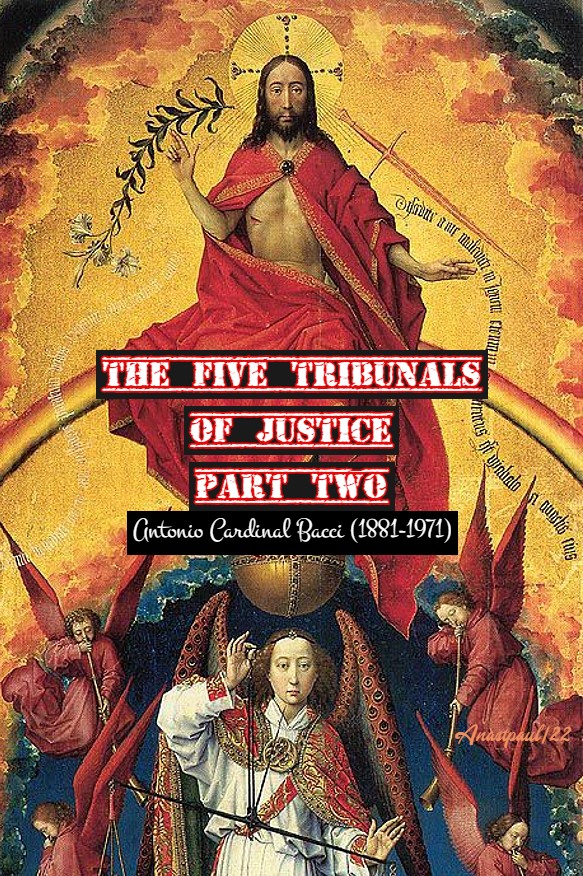
Thought for the Day – 30 September – Meditations with Antonio Cardinal Bacci (1881-1971)
The Death of the Just
Consider now the death of the just man. Through his dying tears, he also will see the world slipping away from him. But, one thing will remain to comfort him, namely, the memory of his good actions, of the virtues he acquired, of his fervent prayers and of his voluntary mortifications. Above all, there will remain his great love of God, for Whom he has lived, worked and drawn breath. In that moment, this love will even increase the flaming desire consuming his poor, frail body, to be united to God. He will be able to say, as some of the Saints have said – “I never thought it would be so sweet to die.” With St Louis, he will be able top say: “I am going joyfully to meet my God.” He will be able to exclaim with St Charles: “I long for my body to be dissolved, so that I may be with Christ!” (Phil 1:23)
In the sight of God, the death of the good man is a very precious thing. “Precious in the eyes of the Lord, is the death of His faithful ones” (Ps 115:6)
One Minute Reflection – 30 September – Readings: Nehemiah 8: 1-12; Psalm 19: 8-11; Luke 10: 1-12 – The Memorial of St Jerome (347-419) Father and Doctor
“Like lambs among wolves”– Luke 10:3
REFLECTION – “As He sent out disciples into His harvest – which had, in truth, been sown by the Father’s Word but, which required to be worked over, cultivated and carefully tended, if the birds were not to ravage the seed – Jesus said to them: “Behold, I send you out like lambs among wolves”. … The Good Shepherd could not but fear wolves in His flock – these disciples were sent to spread grace abroad, not to become a prey. But the Good Shepherd’s care prevented the wolves from doing anything against the lambs He sends out. He sends them that Isaiah’s prophecy might be fulfilled: “The wolf and the lamb shall graze alike” (Is 65:25) … And besides, were not the disciples who were sent out ordered not even to carry a staff? …
What our humble Lord laid down, His disciples also accomplished by practising humility. For He sends them out to broadcast the faith, not by force but by their teaching; not by exerting force of will but by exalting the doctrine of humility. And He thought it good to link patience to humility since, according to Peter’s testimony: “When he was insulted, he returned no insult; when he suffered, he did not threaten” (1 Pt 2:23).
This amounts to saying: “Be imitators of Me – let go of your thirst for revenge; respond to the blows of pride, not by returning evil for evil but, with the patience that forgives. No-one should perform on their own account, what they reprehend in others, gentleness confronts the arrogant with far greater strength.” – St Ambrose (340-397) Bishop of Milan Father and Doctor of the Church (Commentary on St Luke’s Gospel, 7, 45.59).
PRAYER – Almighty, ever-living God, You endowed Saint Jerome with a deep reverence and understanding of Holy Scripture, which he loved with all his heart. Sustain us evermore with Your word and teach us by their precepts. Help us to follow each word which Jesus, Your Son, our Redeemer, uttered that we may find therein the source of life. May the prayers of St Jerome assist us in our love and faithfulness. We ask this through Jesus our Lord, with the Holy Spirit, one God forever, Amen.
Our Morning Offering – 30 September – The last day of the Month of the Seven Sorrows of the Mother Mary
My Sorrowful Mother, Help Me to Bear My Crosses By St Alphonsus Liguori (1696-1787) Doctor of the Church
My sorrowful Mother, by the merit of that grief which you felt at seeing your beloved Jesus led to death, obtain for me the grace to bear with patience, those crosses which God sends me. I will be fortunate if I also shall know how to accompany you with my cross until death. You and Jesus, both innocent, have borne a heavy cross and shall I, a sinner who has merited hell, refuse mine? Immaculate Virgin, I hope you will help me to bear my crosses with patience. Amen
Saint of the Day – 30 September – St Honorius of Canterbury (Died 653) The Fifth Successor of St Augustine as Archbishop of Canterbury, Confessor, Missionary. Born at Rome, Italy and died in 653 at Canterbury, England of natural causes. Also known as Honoratus.
From St Bede we gather that he was a Roman Monk, a disciple of St. Gregory the Great and probably a Benedictine Monk. He either accompanied St.Augustine in 596 or was one of the second band of Missionaries sent by Pope Gregory in 601.
As a member of that apostolic company, he must have led that life of fervent piety, which, we are told, had so much effect in converting the inhabitants of Kent. When Honorius’s predecessor, Justus died, St Paulinus of York, fresh from the conversion of Northumbria, was the only English Bishop left to Consecrate him.
From two letters of Pope Honorius I, preserved in the writings of St Bede, it appears that Honorius and his Consecrator, in applying to Rome, asked that, in order to avoid the delays and uncertainties then involved in a journey to Italy, whenever the occupant of one of the metropolitan Sees should die, the survivor should have power to Consecrate the successor, a request which the Pope granted and sent a pallium.
The chief act of Honorius’s episcopate was the mission of St. Felix, whom he consecrated and sent to convert the East Angles, an expedition which was crowned with complete success. He administered his own Diocese with great zeal and energy. The Pope’s letter to him shows that his life was spent in the vigorous exercise of the duties of his office and in the faithful observance of the rule of his master, St. Gregory the Great. On the overthrow of the flourishing Kingdom and Church of Northumbria by Cadwalla of Wales and Penda of Mercia in 633, he received St Paulinus and appointed him to the vacant See of Rochester. On the death of Paulinus in 644, Honorius Consecrated Ithamar, a native of Kent, as his successor. And some years later, he Consecrated a deacon of Mercia, Thomas, to succeed Felix in East Anglia,and in or about 652 Beretgils or Boniface, a native of Kent, to succeed Thomas. The following year, 653, our Saint himself died and was buried with his predecessors in the Church of Saints Peter and Paul, founded by Saint Augustine.
Nostra Signora di Loreto di Forno / Our Lady of Loreto of Forno, Alpi Graie, Italy (1629) – 30 September:
At the beginning of the Vallone di Sea, at about 1340 metres above sea level, in the Forno di Groscavallo hamlet, stands the Sanctuary dedicated to the Madonna di Loreto, built around 1630, after the apparition occurred to Pietro Garino, a native of Forno. In those times, the region was tormented by the wars fought by Carlo Emanuele of Savoy against the neighbouring states; by the increasingly high taxes that weighed on the poor people, by hunger and the plague.
It was customary for devotees to go annually to the Chapel of the Virgin on Rocciamelone. On that occasion, Pietro Garino found the small pictures, which are still preserved in the Church, depicting the Madonna of Loreto and San Carlo Borromeo, leaning against the facade of the Chapel. They were in bad shape. Pietro took them with him to have them restored and promised himself to bring them back to the Chapel the following year, keeping them in the meantime at his home in Forno. Twice the pictures eluded his custody – the first time he found them right up there, at the mouth of the Vallone di Sea, where he had gone to collect leaves for the litter intended for livestock. On that occasion he had an apparition – the Virgin appeared to him between two women and promised him to stop the plague that claimed victims among the population of the plain. Brought home by Pietro, the paintings again disappeared from his home and were found in the same place as the apparition – it was a precise indication of the Virgin’s desire to see a Chapel built in that place. A Chapel was built at the spot of the apparition, of which the remains have recently been found. The current building dates back to the second half of the 1700s; it is the work of Luigi Baretta; internally it has elements of considerable artistic and historical interest. The marvelous Altar by Prinotto, a masterpiece of eighteenth-century cabinet-making; the baroque reliquary, in which the pictures are kept; hundreds of ex-votos, including some of considerable value. Historically, a Madonna with black features did not appear but the Sanctuary is known as such, as the faces of the Madonna and the Child she holds in her arms are ebony. The current Statue is the work of Raimondo Santifaller, from Ortisei and replaces the original one from the 18th century, stolen in 1977.
To access the Sanctuary it is necessary to climb the 440 steps that must be taken to reach the small square where the Sanctuary stands and which, pilgrims climb on their knees and in prayer.
The Sanctuary is open from July to September and Our Lady is celebrated annually on the Feast of the Assumption (16 August), the Nativity of Mary (8 September) and the Apparition of the Virgin Mary (30 September). The video below shows this beautiful Sanctuary very clearly.
St Antoninus of Piacenza St Castus of Piacenza St Colman of Clontibret St Desiderius of Piacenza St Enghenedl of Anglesey St Eusebia of Marseilles Bl Frederick Albert
St Honorius of Canterbury (Died 653) Archbishop of Canterbury St Ismidone of Die Bl Jean-Nicolas Cordier St Laurus St Leopardus the Slave Bl Ludwik Gietyngier St Midan of Anglesey St Simon of Crépy St Ursus the Theban St Victor the Theban — Martyrs of Valsery Abbey: An unknown number of Premonstratensian monks at the Abbey of Notre-Dame de Valsery, Picardie, France who were martyred by Calvinists. They were martyred in 1567 at Valsery, Pircardy, France.
Novena to Our Lady of the Rosary – Day Two – 29 September
Day Two – We pray for the Persecuted Church and our personal intention:
The joy of the Spirit, which was in the heart of Jesus and Mary, is ours in the experience of sincere prayer.
We pray for the gift of the Holy Spirit for the leaders of the Church and all the baptised, that we may walk faithfully the way of Jesus Christ.
We pray for a deep devotion to Mary, the Mother of Jesus and in our prayer to her know that we are primarily opening our hearts to the God of love.
We pray for those who are oppressed by war and poverty,that they may take courage from God who loves us constantly and unconditionally. Let us pray to the Lord.
Daily Prayer along with our Daily Rosary:
My dearest Mother Mary, behold me, your child, in prayer at your feet. Accept this Holy Rosary, which I offer you in accordance with your requests at Fatima, as a proof of my tender love for you, for the intentions of the Sacred Heart of Jesus, in atonement for the offenses committed against your Immaculate Heart and for this special favour which I earnestly request in my Rosary Novena: ………………………….. (Mention your request).
I beg you to present my petition to your Divine Son. If you will pray for me, I cannot be refused. I know, dearest Mother, that you want me to seek God’s holy Will concerning my request. If what I ask for should not be granted, pray that I may receive that which will be of greater benefit to my soul.
I offer you this spiritual Bouquet of Roses because I love you. I put all my confidence in you, since your prayers before God are most powerful. For the greater glory of God and for the sake of Jesus, your loving Son, hear and grant my prayer. Sweet Heart of Mary, be my salvation.
Our Lady of the Rosary, pray for our Holy Mother Church and for our country.
Sweet Heart of Jesus, be my love.
Sweet Heart of Mary, at the hour of my death, lead me home.
Thought for the Day – 29 September – Meditations with Antonio Cardinal Bacci (1881-1971)
The Death of the Sinner
“The Sinner must also die. For him death is really terrible. Imagine him lying on his deathbed, instinctively aware, that his life is over. The past will rise up to reproach him, a past full of sin and of ingratitude towards his Creator and Redeemer. The plans which he has centred around profit, ambition and honour, will have vanished like smoke. His friends, will have either deserted him, or will be at hand, to utter useless words, which will have no power to comfort him. Now he must stand alone, alone before God!
What will happen, at that moment? Perhaps, despair will overcome his soul, as it overcame the soul of Judas? Perhaps, the innumerable graces which he has despised, will tip the balance of Divine Justice towards the abyss of damnation? Or, will a final ray of mercy pierce his tired mind, burning with remorse, so that, with it’s last throb, his poor heart will torn towards God and implore His pardon? Who can say? It is certain, however, that of the two thieves dying beside the Cross of our Redeemer, only one heard Him say: “This day, you will be with me in Paradise!” The other, remained obdurate in his sin. It is the height of stupidity, to wait to be converted, at the hour of death!”
Quote/s of the Day – 29 September – Feast of the Dedication of St Michael the Archangel
“Michael is the Breath of the Redeemer’s Spirit, Who at the end of the World, will combat and destroy the antichrist, as he did Lucifer in the beginning.”
St Thomas Aquinas (1225-1274) Doctor Angelicus Doctor Communis
“Among the Angels in Heaven none surpasses St Michael in Glory …”
“St Michael has the honourable office of presenting to Jesus Christ the Judge, all the souls that depart out of this world in the grace of God.”
St Alphonsus Maria De Liguori (1696-1787) Most Zealous Doctor
One Minute Reflection – 29 September – Feast of the Dedication of St Michael the Archangel, Readings: Daniel 7: 9-10, 13-14 or Apocalpyse 12: 7-12a; Psalm 138: 1-5; John 1: 47-51
“Then war broke out in heaven; Michael and his angels battled against the dragon. The dragon and it’s angels fought back …” … Apocalypse 12:7
REFLECTION – “That angels exist is attested by many pages of Holy Scripture … You should be aware that the word “angel” denotes a function rather than a nature. Those holy spirits of heaven have indeed always been spirits. They can only be called angels when they deliver some message. Moreover, those who deliver messages of lesser importance, are called angels and those who proclaim messages of supreme importance, are called Archangels. Hence it is, that not just any angel was sent to the Virgin Mary but that Gabriel the Archangel was sent – it was right that the proper one for this role should be of the highest rank of angels, since he was to announce the greatest news of all. …
Whenever a mighty deed is in question, Michael is assigned, so that by his actions and name, which means “Who is like God?”, it may be made known that no-one can do what God can do. So, in the case of our ancient enemy, who, in his pride wanted to be like God when he said: ‘I will ascend to heaven;,above the stars of God, I will set my throne on high; I will make myself like the Most High’ (Is 14:13): when he is shown to be condemned to eternal punishment at the end of the world, he is described, as about to do battle with Michael, as Saint John says : ‘War broke out with Michael the Archangel. The Dragon and its angels fought back but they did not prevail and it was thrown down to earth’ (cf. Rv 12:7-9).
Gabriel was sent to Mary, for Gabriel means ‘Strength of God‘. He came to announce Him who deigned to be lowly so as to wage war on the spiritual powers of the air. He who came as God of power and, as One strong in battle (Ps 24[23]:8) was to be announced by Gabriel, the strength of God. Finally, Raphael is interpreted as ‘Healing of God‘, since he wiped away the shadows of blindness from Tobias when he touched his eyes to cure him. The one who is sent to cure, was indeed worthy of the name .’Healing of God .”- St Gregory the Great (540-604) – Pope, Father and Doctor of the Church (Homilies on the Gospel, 34, 8-9).
PRAYER – Dear and Holy God, let us offer You all our daily struggles against sin and evil. Grant us the strength to resist all forms of idolatry, to seek only You and never to allow the material goods of this world to seduce us. Sustain us ever more with Your word and help us to find in it, the source of life. Grant that the angels who always minister to You in heaven may defend us during our life on earth and protect us from evil. Grant this, through our Lord Jesus Christ, Your Son, in union with the Holy Spirit, one God forever and ever. Amen
Our Morning Offering – 29 September – Feast of the Dedication of St Michael
The St Michael Prayer
St Michael, the Archangel, defend us in battle; Be our safeguard against the wickedness and snares of the devil. May God rebuke him, we humbly pray, And do thou, O prince of the heavenly hosts, By the power of God, Cast into hell, Satan and all evil spirits Who prowl throughout the world seeking the ruin of souls. Amen.
You will know or even recall ,that when the Mass was only in Latin (1570-1969) after the High Mass, known in those days as the Summa (Latin for: The Greatest) the St Michael prayer was recited. This St Michael prayer was placed at the end of the Mass by Pope Leo XIII (1878-1903) in the 1890’s as a result of a vision he saw concerning the dire state of the world in the 20th century! The Church has always prayed to St Michael for protection against the evils of the devil. Michael’s name means “Who is like God.” In Latin: “Quis ut Deus.” He can be found in the Book of The Prophet Daniel (Old Testament) Dn. 10:13; Dn. 10:21; Dn 12:1. In the New Testament he can be found in the Book of Revelation 12:7-9; Epistle of St Jude 1:9 and the Letter of St. Paul to Thessalonians (4:16). St Thomas Aquinas (1214-1274) writes of him: “Michael is the Breath of the Redeemer’s Spirit, Who at the end of the World will combat and destroy the antichrist, as he did Lucifer in the beginning.” St Michael is invoked in sickness and most especially at the hour of our death, when Satan makes his last and fiercest attack on our soul, seeking with cunning, craft, fears and despair to drag us into Hell with him. Please, let us all restore St Michael to our hearts and pray to him for protection each day, after Holy Mass and after the Holy Rosary.
Saint of the Day – 29 September – Feast of the Dedication of St Michael the Archangel
By St Alphonsus Maria De Liguori (1696-1787)
Among the Angels in heaven, none surpasses St Michael in glory and according to St Basil and others, there is none that equals him and with good reason because St Michael was chosen to subdue the pride of Lucifer and of all the rebel angels and, to expel them from heaven.
Christian, if thou lovest this Archangel, who has such great love for men, rejoice at the glory which he enjoys in heaven and beseech him, that, as he is the protector of the whole Church and of all the faithful, he will be thy special protector with God, Who loves him so much,and who rejoices in beholding one, who is so faithful to Him and so zealous for His honour, so much glorified by all.
In the Mass for the dead, the Church prays: “Let the standard bearer, St Michael, bring them into the holy light.” The learned explain this prayer and say, that St. Michael has the honourable office of presenting to Jesus Christ the Judge, all the souls that depart out of this world in the grace of God. Protect me, therefore, O holy Archangel and by your protection, enable my soul to become worthy of being presented, by your hands on the day of my death, ornamented with divine grace, before my Judge Jesus Christ.
Again, the Holy Church prays to St. Michael in the name of all the faithful, to defend us from the assaults of the wicked enemy at the hour of our death, that we may not be conquered and lose our souls: “Holy St Michael, the Archangel, defend us in battle, that we may not be lost at the dreadful judgement.“
O holy Archangel, the devil has many weapons to employ against me at the hour of my death; these weapons are my sins, by which he will then endeavour to throw me into despair; he is also preparing furious assaults of temptations to cause me then to fall again into sin. You, who conquered him and expelled him from heaven, conquer him again for me and drive him far away from me at the hour of my death; I beseech you to grant this my prayer, for the love of that God, Who so much loves you and whom you so much love. O Mary, Queen of heaven, procure for me the assistance of St Michael at the hour of my death. Amen!
St Michael as the Angel of death – Evelyn de Morgan
THIS festival has been kept with great solemnity on the 29th of September ever since the Fifth Century and was certainly initially celebrated in Apulia in 493. The Dedication of the famous Church of St Michael on Mount Gargano, in Italy, gave occasion to the institution of this feast in the West, which is hence called in the Martyrologies of St Jerome, St Bede and others, ‘The Dedication of St Michael.’ About the Apparition of St Michael at Mount Gargano in 492: https://anastpaul.com/2018/05/08/saint-of-the-day-8-may-apparition-of-michael-the-archangel-at-monte-gargano-italy-492/
The Apparition of St Michael at Gargano
The Dedication of the Church at Gargano
The Dedication of St Michael’s Church in Rome, which was performed by Pope Boniface IV. in 610 and that of several other Churches in the West, in honour of this Archangel, were also performed on this same day.
The name Michaelmas comes from a shortening of “Michael’s Mass,” in the same style as Christmas (Christ’s Mass) and Candlemas (Candle Mass, the Mass where traditionally the candles to be used throughout the year would be blessed). During the Middle Ages, Michaelmas was celebrated as a Holy Day of Obligation but this tradition was abolished in the 18th century.
The Church gives to St Michael four offices:
To fight against Satan.
To rescue the souls of the faithful from the power of the enemy, especially at the hour of death.
To be the champion of God’s people, the Jews in the Old Law, the Christians in the New Testament; therefore, he is the Patron of the Church and of the Orders of Knights during the Middle Age
To call away from earth and bring men’s souls to judgement.
Madonna di Tirano / Our Lady of Tirano, Sondrio, Lombardy, Italy (1504) – 29 September:
The Sanctuary of the Madonna of Tirano stands on the Swiss-Italian border, where the Virgin appeared to Mario Omodei on 29 September 1504, promising an end to the plague which was decimating the region, if a Church in her honour would be built, on the spot outside the City walls. The epidemic subsided and the townspeople placed the first stone of the Sanctuary on 25 March 1505.
Because of its crossroads location, it has always drawn pilgrims from throughout Europe.
The Virgin’s Statue was part of a silver-clad grouping executed by woodcarver G Angelo Mayno around 1520. Napoleonic raiders stripped off the precious metal and destroyed the other Statues.
In 1946 Pope Pius XII proclaimed the Blessed Virgin of Tirano “special heavenly Patron of all Europe.”
Bl Alericus St Anno of Eichstätt St Casdoe of Persia St Catholdus of Eichstätt
St Dadas of Persia St Diethardus of Eichstätt St Fraternus of Auxerre St Gabdelas of Persia St Grimoaldus of Pontecorvo St Gudelia St Guillermo Courtet
St Miguel de Aozaraza St Quiriacus of Palestine St Rene Goupil St Rhipsime Bl Richard Rolle St Sapor of Persia St Theodota of Thrace St Vicente Shiwozuka de la Cruz — Martyrs of Thrace – 3 saints: Three Christian men murdered in Thrace for their faith. They are – Eutychius, Heracleas and Plautus.
Martyred in the Spanish Civil War: • Blessed Antonio Arribas Hortigüela • Blessed Antonio Martínez López • Blessed Dario Hernández Morató • Blessed Francesc de Paula Castelló Aleu • Blessed Francisco Edreira Mosquera • Blessed José Villanova Tormo • Blessed Pau Bori Puig • Blessed Vicente Sales Genovés • Blessed Virgilio Edreira Mosquera
Thought for the Day – 28 September – Meditations with Antonio Cardinal Bacci (1881-1971)
Goodness and Christian Courtesy
“St Francis de Sales was a model of gentleness and Chrisitan courtesy. He had every regard and respecct of his neighbour because he saw God in everyone and everyone in God.
He had the ability to listen to everybody with great patience and kindness, without ever showing any sign of tiredness or boredom, even when he was dealing with unpleasant people or when he was busy with far more important matters. He maintained his equilibrium and self-control, even after many hours of work and of difficult consultations. He was always prepared, moreover, to listen to the troubles of the poor.
Even when insulted and reviled, he displayed perfect serenity and calm. It was a result of this, that, with the helo of God, he made innumerable converts.
“Always be as gentle as you can,.” he was accustomed to advise “and remember that you will catch more flies with a spoon of honey than with a barrel of vinegar. If you must err, let it be on the side of gentleness ….” “Be humble,.” he wrote again “and you will be gentle. Humility makes the heart kind towards the perfect and the imperfect; towards the former through veneration, towards the latter through compassion.” (Letter 51).
How much we have to learn from the serenity and courtesy of this Saint – for, it is not without reason that he is known as “the Gentleman Saint” and an even greater title “the Gentle Christ of Geneva!.”
Novena to Our Lady of the Rosary – Day One – 28 September
Day One – We pray for the Holy Church and our personal intention:
To Mary, Mother of God and our Mother, who sees how the Catholic Faith is assailed by the devil and the world, To Thy protection, we entrust ourselves . Kindly offer to Thy Divine Son our resolutions and obtain from Him the graces necessary for us to keep them unto the end. Amen
Daily Prayer along with our Daily Rosary:
My dearest Mother Mary, behold me, your child, in prayer at your feet. Accept this Holy Rosary, which I offer you, as a proof of my tender love for you, for the intentions of the Sacred Heart of Jesus, in atonement for the offences committed against your Immaculate Heart and for this special favour which I earnestly request in my Rosary Novena: ………………………….. (Mention your request).
I beg you to present my petition to your Divine Son. If you will pray for me, I cannot be refused. I know, dearest Mother, that you want me to seek God’s holy Will concerning my request. If what I ask for should not be granted, pray that I may receive that which will be of greater benefit to my soul.
I offer you this spiritual Bouquet of Roses because I love you. I put all my confidence in you, since your prayers before God are most powerful. For the greater glory of God and for the sake of Jesus, your loving Son, hear and grant my prayer. Sweet Heart of Mary, be my salvation.
Our Lady of the Rosary, pray for our Holy Mother Church and for our country.
Sweet Heart of Jesus, be my love.
Sweet Heart of Mary, at the hour of my death, lead me home.
Quote/s of the Day – 28 September – The Memorial of St Wenceslaus (907-935) King of Bohemia, Martyr
Good King Wenceslaus
Good King Wenceslaus looked out, on the Feast of Stephen, When the snow lay round about, deep and crisp and even; Brightly shone the moon that night, t ho’ the frost was cruel, When a poor man came in sight, gath’ring winter fuel.
“Hither, page and stand by me, if thou know’st it, telling, Yonder peasant, who is he? Where and what his dwelling?” “Sire, he lives a good league hence, underneath the mountain; Right against the forest fence, by Saint Agnes’ fountain.”
“Bring me flesh and bring me wine, bring me pine logs hither, Thou and I will see him dine, when we bear them thither.” Page and Monarch, forth they went, forth they went together; Through the rude wind’s wild lament and the bitter weather.
“Sire, the night is darker now and the wind blow stronger; Fails my heart, I know not how, I can go no longer.” “Mark my footsteps, my good page. Tread thou in them boldly Thou shalt find the winter’s rage, freeze thy blood less coldly.”
In his master’s steps he trod, where the snow lay dinted; Heat was in the very sod which the saint had printed. Therefore, Christian men, be sure, wealth or rank possessing, Ye who now will bless the poor, shall yourselves find blessing.
One Minute Reflection – 28 September – “Month of the Seven Sorrows of Mary” Readings: Zechariah 8: 20-23; Psalm 87: 1b-7; Luke 9: 51-56
“… On the way they entered a Samaritan village … but they would not welcome him because the destination of his journey, was Jerusalem.” . – Luke 9:53
REFLECTION – “It says, “When the days drew near for him to be received up, he set his face to go to Jerusalem.” This means, that after He would endure His saving Passion for us, the time would come when He should ascend to heaven and dwell with God the Father, so He determined to go to Jerusalem. This is, I think, the meaning of his “set his face.”
It would be false to affirm, that our Saviour did not know what was about to happen because He knows all things. He knew, of course, that the Samaritans would not receive His messengers. There can be no doubt of this. Why then did He command them to go before Him? It was His custom to benefit diligently, the holy Apostles in every possible way and because of this, it was His practice, sometimes to test them…. On this occasion, He also tested them. He knew that the Samaritans would not receive those who went forward to announce that He would stay with them. He still permitted them to go, that this again might be a way of benefiting the holy Apostles.
What was the purpose of this occurrence? He was going up to Jerusalem, as the time of His passion was already drawing near. He was about to endure the scorn of the Jews. He was about to be destroyed by the scribes and Pharisees and to suffer those things that they inflicted upon Him when they went to accomplish all of violence and wicked boldness. He did not want them to be offended when they saw Him suffering. He also wanted them to be patient and not to complain greatly, although people would treat them rudely. He, so to speak, made the Samaritans’ hatred a preparatory exercise in the matter. They had not received the messengers.
For their benefit, He rebuked the disciples and gently restrained the sharpness of their wrath, not permitting them to grumble violently against those who sinned. He rather persuaded them to be patient and to cherish a mind that is unmovable by anything like this.” – St Cyril of Alexandria (376-444) Known as ‘THE PILLAR OF FAITH” Archbishop of Alexandria, Father and Doctor Incarnationis (Doctor of the Incarnation) (Commentary on Luke, Homily 56)
PRAYER – O God of love, You sent Your beloved Son to the world to proclaim the Good News of Salvation, to heal every illness and to cure all infirmity of body and soul. Help us to continue the mission of the merciful Christ in the service towards our neighbour, preaching the Gospel and offering our help in whatever way we can. May the example of Your saints, teach us how to love and serve You. Through their intercession, grant us the grace to go forth in love. We ask this through Jesus Christ our Lord, with the Holy Spirit, one God forever, amen.
Our Morning Offering – 28 September – – “Month of the Seven Sorrows of Mary”
Steer the Ship of My Life, Lord By St Basil the Great (329-379) Father & Doctor of the Church
Steer the ship of my life, Lord, to Your quiet harbour, where I can be safe from the storms of sin and conflict. Show me the course I should take. Renew in me the gift of discernment, so that I can see the right direction in which I should go. And give me the strength and the courage to choose the right course, even when the sea is rough and the waves are high, knowing that, through enduring hardship and danger, in Your Name we shall find comfort and peace. Amen
Saint of the Day – 28 September – Blessed Francesco Piani of Caldarola OFM (1424-1507) Franciscan Friar, renowned Preacher and Peacemaker, a collaborator in the fight against usury by the institution of the “Mount of Piety,” (a type of pawn shop), social activist and protector of the struggling rural communties. Born in 1424 in Caldarola, Macerata, Italy and died on 12 September 1507 in the Franciscan convent in Colfano, Italy of natural causes, aged 77.
Blessed Bernardine of Feltre OFM (1439-1494), propagator and Founder of the “Monti di Pietà, Mount of Piety” and whose Feast Day we celebrate today too, had as collaborator Blessed Francesco of Caldarola.
Francesco came from the Marche, a region with a predominantly agricultural economy, and was, therefore, well aware of the miseries of the rural workers forced to go into debt and become slaves of usurers and dedicated his life to them.
Francisco was also a very fervent preacher, who knew how to quell the frequent quarrels in the countries of his land, divided by violent struggles, between ambitious factions and powerful families.
The secret of the peace Preacher’s success was simple – talk to the people by day and spend the night in prayer.
The establishment of the apostolate brotherhood of Santa Maria del Monte was also due to Blessed Francesco, the image below is of this Title of the Blessed Virgin Mother and perhaps one of the devotees is our Blessed.
The Blessed died on 12 September 1507 at the age of 77 in the Convent of Colfano, where he had spent most of his religious life.
After he died, numerous miracles were reported by his intercession and his cult is documented since 1511.
Blessed Francesco Piani precedes the Caldarolese Renaissance. While the closure of the Middle Ages can be attributed to him, we think that the opening of social care can also be entrusted to him. His fundamental works are born from the Franciscan lineage to which he belonged which, in him in Caldarola, was strengthened with three creations that were partly lost in future centuries and partly changed – the Compagnia di Santa Maria, an apostolate brotherhood of disciplines from which they derive the others, the hospital and the pawnshop. All the works of great sociality to be framed in the context of the faith and poverty of his time.
Monte di Pietà Offices in Rome today
Preacher and Peacemaker, he was Beatified by Pope Urban VII in 1634 – his cult was reaffirmed on 1 September 1843 by Pope Gregory XVI.. Perhaps without his work, which gave social consistency to the community, Caldarola would not have generated its own renaissance.
Nuestra Señora del Fresno / Our Lady of Fresno, Grado, Asturias, Spain (9th Century) – 8 and 28 September:
Copy of the original image
The Sanctuary of the Virgen del Fresno is one of the most visited Sanctuaries in the central area of Asturias despite the difficulty of its access. The Sanctuary is located on the Camino de Santiago hence it’s popularity dating from the 9th Century when pilgrims stopped to rest in the hostel provided. They were known as “the Novenarios” as, during their rest, they prayed the St Michael Novena before his Feast Day on 29 September.
In honour of the Virgen del Fresno two festivals are held, one on 8 September and the other 28 of the same month preceded by a Novena that has traditionally started at four in the afternoon.
The current image dates from 1975, since the original was lost in the looting it suffered in 1936. It is made of cedar from Lebanon, made in Madrid. She is dressed and holds the Child in her arms and the Rosary between her fingers. She remain above her Altar and another processional image accompanies the Novena.
Bl Aaron of Auxerre St Alodius of Auxerre St Annemond of Lyons St Bardomianus
Blessed Bernardine of Feltre OFM (1439-1494) Franciscan Priest and Friar, Missionary Preacher, Poet, peace-maker, Civil protestor against the practice of usury, defender of the poor. He was a true ‘child prodigy’ – by the time he was 12 he was fluent in Latin and at the age of 15 he composed a poem and read it in the Town Square to celebrate a local peace treaty. He is remembered most especially, in connection with the “Monti di Pietà” “Mount of Piety” of which he was the reorganiser and, in a certain sense, the Founder, together with the Blessed Michele Carcano. Biography: https://anastpaul.com/2020/09/28/saint-of-the-day-28-september-blessed-bernardine-of-feltre-ofm-1439-1494/
St Chariton of Palestine Bl Christian Franco St Conval of Strathclyde St Eucarpus St Eustochium St Exuperius of Toulouse St Faustus of Riez Blessed Francesco Piani of Caldarola OFM (1424-1507) Francisan Friar St John of Dukla St Laurence of North Africa St Lioba of Bischofsheim
St Solomon of Genoa St Stacteus St Tetta of Wimborne Bl Thiemo St Willigod of Moyenmoutier St Zama of Bologna — Augustinian Martyrs of Japan: The first Augustinian Missionaries arrived in Japan in 1602 and met with immediate success; many were brought to the faith; many of them became Augustinians; and many of them were martyred in the periodic persecutions of Christians. This memorial commemorates all of them, whether they have a sanctioned Cause for Canonisation or not. They include: • Blessed Bartolomé Gutiérrez Rodríguez • Blessed Ferdinand Ayala • Blessed Francisco Terrero de Ortega Pérez • Blessed Ioannes Mukuno Chozaburo • Blessed Laurentius Kaida Hachizo • Blessed Mancius Yukimoto Ichizaemon • Blessed Martín Lumbreras Peralta • Blessed Melchor Sánchez Pérez • Blessed Michaël Ichinose Sukezaemon • Blessed Pedro de Zúñiga • Blessed Petrus Sawaguchi Kuhyoe • Blessed Thomas Jihyoe of Saint Augustine • Blessed Thomas Terai Kahyoe • Blessed Vicente Simões de Carvalho • Saint Magdalena of Nagasaki
Martyrs of Antioch – 37 saints: A group of 30 soldiers and 7 civilians who were murdered together for their faith. The names that have come down to us are – Alexander, Alphinus, Heliodorus, Mark, Neon, Nicon and Zosumus. c 303 at Antioch, Pisidia (in modern Turkey).
Martyrs of China – 120 saints: A common memorial for the hundreds of the faithful, lay and clergy, who have died for their faith in the last couple of centuries in China.
Martyred in the Spanish Civil War: • Blessed Amalia Abad Casasempere de Maestre • Blessed Francesc Xavier Ponsa Casallach • Blessed Josep Casas Juliá • Blessed Josep Casas Ros • Blessed Josep Tarrats Comaposada • Blessed María Fenollosa Alcaina
Thought for the Day – 27 September – Meditations with Antonio Cardinal Bacci (1881-1971)
The Power of God’s Love in the Christian Life
“Everyday, in the lives of the Saints, was a continual act of love of God. This was how they became holy. They loved God intensely all the time. They loved Him above all things. Everything which they thought, desired or did, was directed to Him. Their entire lives were consecrated to Him. We should all desire to be holy, if we do, we must love God with our whole heart, strength and will. Not until then, will every action of ours become meritorious. Holiness is born of the love of God. Without the love of God, everything is futile and useless; our conversation is so much idle chatter; our desires are empty dreams which excite us for a while and then dissolve like bubbles of soap; our actions are unprofitable and our enterprises are not aimed at a true objective; our achievements can inflate us for a time but they will leave us disillusioned at the hour of death. The love of God is necessary for us. He alone is entirely worthy of our affection. Other loves are passing but, this love is eternal. Other loves confuse and trouble us but, the love of God gives us peace of soul. Other loves weaken and vanish with time but, the love of God is the source of all holiness in this life and of eternal happiness in the next. Why, then, do we not forget our worldly preoccupations? Let us give our hearts to God forever and we shall be in possession of the one true happiness which never fades.”
Announcing a Novena to Our Lady of the Rosary Begins 28 September The Memorial of Our Lady of the Rosary is on 7 October.
Please join me in praying a Novena in honour of Our Lady of the Rosary for the nine days preceding her Feast on 7 October and, of course, October is the Month of the Holy Rosary.
This Feast was instituted to commemorate the victory of Christianity over the forces of Islam at the battle of Lepanto on 7 October 1571. The victory was brought about through the recitation of the Rosary. In thanksgiving for another victory over the same foes in Hungary in 1715, the Feast was extended to the entire Church. In the course of centuries the Rosary has been a source of abundant blessings. In her apparitions at Lourdes, France, in 1858 and again at Fatima, Portugal, in 1917, Mary urged Catholics to pray the Rosary daily in order to bring about the conversion of sinners and a lasting world peace. Resolve to say your Rosary every day. Besides being a beautiful tribute of love and filial piety, to your Heavenly Mother, it will be your support and joy in life and your consolation at the hour of death.
Quote/s of the Day – 27 September – 27 September – “Month of the Seven Sorrows of Mary” – St Vincent de Paul (1581-1660)
“The Church teaches us, that mercy belongs to God. Let us implore Him, to bestow on us the spirit of mercy and compassion, so that we are filled with it and may never lose it. Only consider how much we ourselves, are in need of mercy.”
“Humility and charity are the two master-chords – one, the lowest; the other, the highest; all the others are dependent on them. Therefore, it is necessary, above all, to maintain ourselves in these two virtues, for observe well, that the preservation of the whole edifice depends on the foundation and the roof!”
“Humility is nothing but truth and pride is nothing but lying!” …
You must be logged in to post a comment.