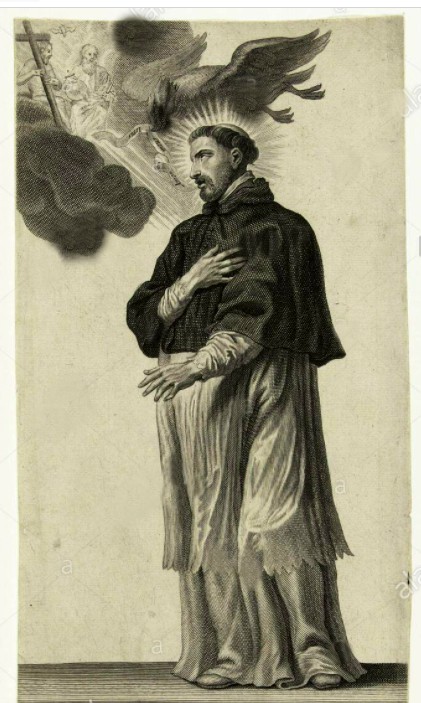
Quote/s of the Day – 10 October – The Memorial of St Francis Borgia SJ (1510-1572)
“This death … has already levelled his bow to strike me. Is it not prudent to prevent its stroke, by dying now to the world, that at my death, I may live to God?”
“O sensual, base, miserable and blind life! is it possible, that men should be such strangers to their own happiness, such enemies to themselves, to be fond of thy false enjoyments and for their sake, to deprive themselves of those that are pure, permanent and solid?!”
One Minute Reflection – 10 October – “Month of the Most Holy Rosary” – Readings: Wisdom 7:7-11, Psalms 90:12-13,14-15, 16-17, Hebrews 4:12-13, Mark 10:17-30
“You lack one thing – go, sell what you have and give to the poor and you will have treasure in heaven and come, follow me.”…Mark 10:21
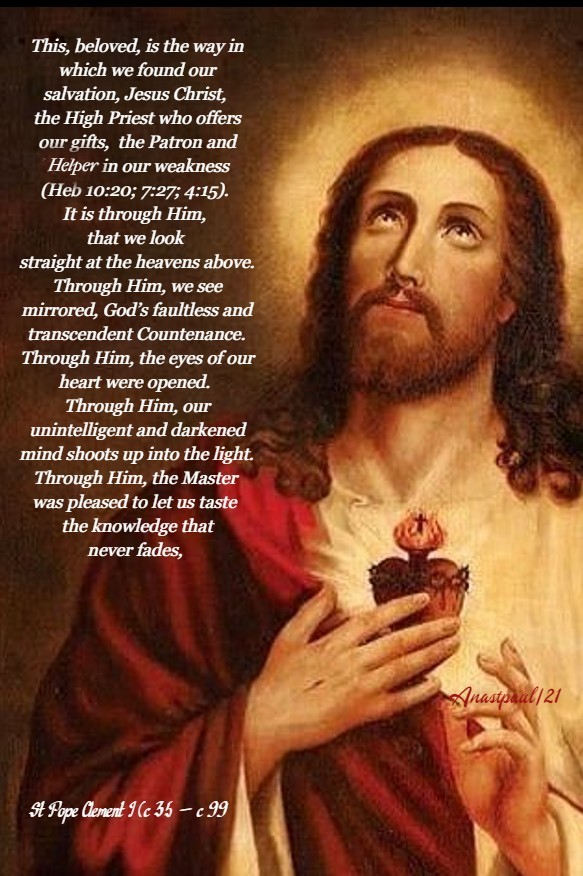
REFLECTION – “This, beloved, is the way in which we found our salvation, Jesus Christ, the High Priest who offers our gifts, the patron and helper in our weakness (Heb 10:20; 7:27; 4:15). It is through Him, that we look straight at the heavens above. Through Him, we see mirrored, God’s faultless and transcendent countenance. Through Him, the eyes of our heart were opened. Through Him, our unintelligent and darkened mind shoots up into the light. Through Him, the Master was pleased to let us taste the knowledge that never fades, He who is “the radiance of His splendour, who towers as much above the angels, as the title He has inherited, is superior to theirs” (He 1:3-4) (…)
Let us take our body. The head is nothing without the feet and the feet are nothing without the head. The smallest organs of our body are necessary and valuable to the whole body, in fact, all parts conspire and yield the same obedience, toward maintaining the whole of the body (cf.1 Co 12:12f.). Therefore, let the whole of our body be maintained in Christ Jesus and let each submit to their neighbour’s rights in the measure determined by the special gift bestowed on them. Let the strong care for the weak and the weak respect the strong; let the rich support the poor and the poor render thanks to God for giving them the means of supplying their needs; let the wise show their wisdom, not in words but in active help; the humble must not testify to themselves but leave it to another to testify in their behalf. Those who are continent must not boast, knowing that it is another who confers on them the ability to remain continent.
Let us, therefore, reflect brethren, of what clay we were made, what and who we were when we entered the world, out of what grave and darkness, our Maker and Creator has brought us into the world, where He has prepared His benefits before our birth. Since, then, we owe all these blessings to Him, we are obliged to thank Him in every way.” … St Pope Clement I (c 35 – c 99) – Pope from c 90 to c 99 – Letter to the Corinthians, § 36-38
PRAYER – Almighty God and Father, you sent St Francis Borgia to be Your witnesses and to bring Your Church to all for the salvation of souls. Sustain us by their prayers that by our lives we may lead all to You through Holy Mother Church. Through Jesus Christ our Lord, Who lives and reigns with You and the Holy Spirit, God forever and ever, amen.
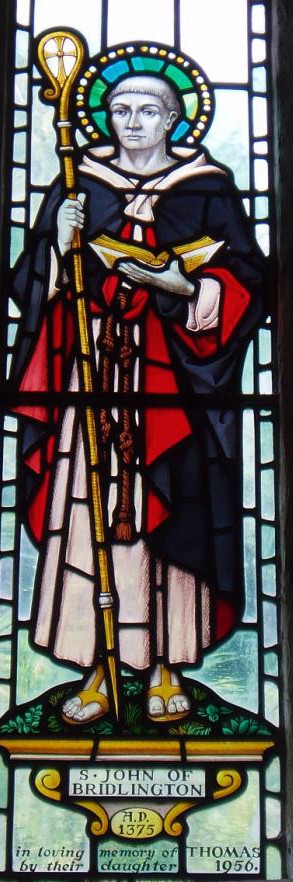
Saint of the Day – 10 October – Saint John of Bridlington OSA (1319-1379) Priest, Prior, miracle-worker. In his lifetime he enjoyed a reputation for great holiness and for miraculous powers. John was commended for the integrity of his life, his scholarship , his humility and his quiet generosity. Born in 1319 at Thwing (near Bridlington), Yorkshire, England and died on 10 October 1379 of natural causes. Also known as – John Thwing, John of Thwing, John Twenge, John Thwing of Bridlington. Additional Memorial – 9 October among the Augustinian Canons Regular, 21 October on some calendars.
The Roman Martyrology states: “In Bridlington in England, St John, a Priest, who, Prior of the Monastery of the Canons Regular of St Augustine, shone with prayer, austerity and meekness.“
Born in 1320 in the village of Thwing on the Yorkshire Wolds, about nine miles west of Bridlington, he was of the Yorkshire family Twenge, which during the English Reformation would supply two Roman Catholic Priest-martyrs and was also instrumental in establishing the Institute of the Blessed Virgin Mary at Bar Convent, York.
John was educated at a school in the village from the age of five, completing his studies at Oxford University. He then entered the Augustinian Canons Regular community of Bridlington Priory. He carried out his duties with humility and diligence, and was in turn Novice Master, almsgiver, preacher and sub-prior. He became Canon of the Priory in 1346 and was eventually elected Prior in 1356. John initially declined out of humility but after being re-elected, probably in 1361, he took on the duties of Prior in January 1362. He served as Prior for 17 years before his death on 10 October 1379.
In his lifetime he enjoyed a reputation for great holiness and for miraculous powers. On one occasion he changed water into wine. On another, five seamen from Hartlepool in danger of shipwreck called upon God in the name of His servant, John of Bridlington, whereupon the Prior himself appeared to them in his Canonical habit and brought them safely to shore. The men left their vessel at the harbour and walked to the Monastery where they thanked John in person for saving their lives.
“The Vision of William Staunton,” recounts William’s visit to St Patrick’s Purgatory where he sees both purgatory and the earthly paradise and is conducted through the otherworld by St John of Bridlington and St Ive.
After his death from natural causes, the fame of the miracles brought by his intercession, spread rapidly through the land. Alexander Neville, Archbishop of York, charged his suffragans and others, to take evidence with a view to his Canonisation. Richard le Scrope, Archbishop of York, assisted by the Bishops of Durham and Carlisle, officiated at a solemn translation of his body on 11 March 1401. Pope, Boniface IX, shortly afterwards Canonised him. The Canonisation had been lost but the original Bull was unearthed in the Vatican archives by T A Twemlow, who was engaged in research work there for the British government.
At the English Reformation, Henry VIII was asked to spare the magnificent Shrine of the Saint but it was destroyed in 1537. The nave of the Church, restored in 1857, is all that now remains of Bridlington Priory.
Twentieth Sunday after Pentecost Twenty-eighth Sunday in Ordinary Time
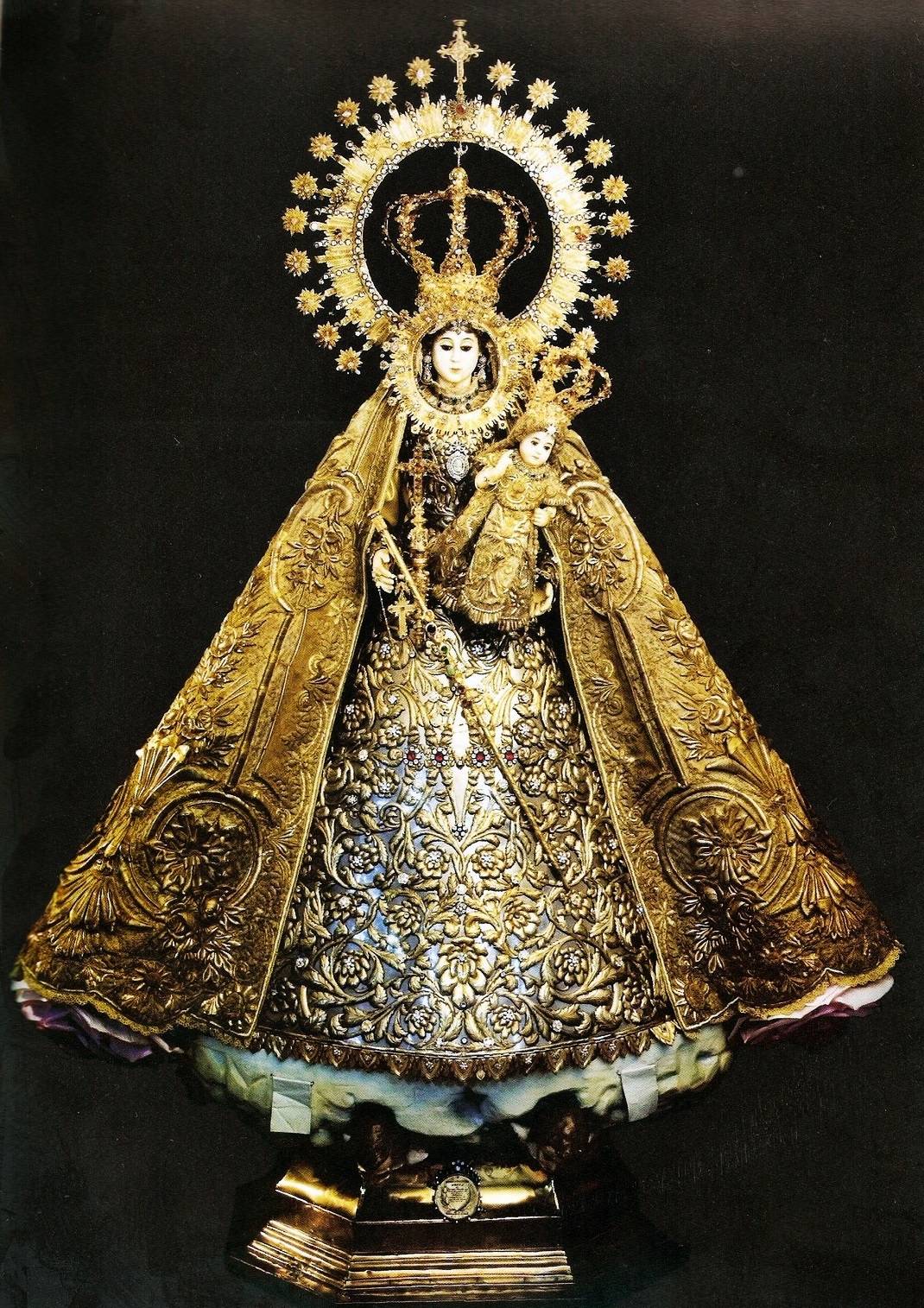
La Naval de Manila / Our Lady of the Most Holy Rosary , Quezon City, Philippines (1593) – Second Sunday of October: Also known as Nuestra Señora del Santísimo Rosario / The Grand Lady of the Philippines.
In 1593, the Governor General of the Philippines commissioned a Statue of Our Lady of the Rosary for the Dominican Church in Manila. A un-named Chinese sculptor carved the hardwood body and ivory hands and face, which has Asian features. About 4’8″ tall, the image is dressed in cloth of gold, with a crown and a halo of 24 stars and adorned with precious donated jewels. Our Lady holds the Child Jesus with her left hand and a Rosary with her right. The title “La Naval” refers to Our Lady’s help in the naval battles of Lepanto in 1571 and Manila in 1646, when a small Catholic fleet repeatedly repelled Dutch invaders. The Catholic Church in Manila first celebrated the feast of “La Naval” on 8 October 1646. Pope Pius X’s Apostolic Delegate crowned the Statue on 5 October 1907. Pope Pius XII also sent an Apostolic Letter on the occasion of the tricentenary of the Battle of La Naval de Manila on 31 July 1946. The Japanese bombing of 27 December 1941 destroyed the Church of Santo Domingo in Manila’s old walled city. Hidden for safekeeping, the holy Statue moved in 1954 to its present location in the Santo Domingo Shrine in Quezon City.
In 1646, naval forces of the Dutch Republic made several repeated attempts to conquer the Philippines in a bid to control trade in Asia. The combined Spanish and Filipino forces who fought, requested the intercession of the Virgin through the Statue prior to battle. They were urged to place themselves under the protection of Our Lady of the Rosary and to pray the Rosary repeatedly. They went on to rebuff the continued attacks by the superior Dutch fleet, engaging in five major battles at sea and losing only fifteen members of the Spanish Navy. After the Dutch retreat, in fulfillment of their vow, the survivors walked barefoot to the Shrine in gratitude to the Virgin. Later, on 9 April 1662, the Cathedral chapter of the Archdiocese of Manila declared the naval victory a miraculous event owed to the intercession of the Virgin Mary, declaring:
“Granted by the Sovereign Lord through the intercession of the Most Holy Virgin and devotion to her Rosary, that the miracles be celebrated, preached and held in festivities and to be recounted amongst the miracles wrought by the Lady of the Rosary, for the greater devotion of the faithful to Our Most Blessed Virgin Mary and Her Holy Rosary.“
St Cassius St Cerbonius of Populonia St Cerbonius of Verona St Clarus of Nantes Bl Demestrius of Albania Bl Edward Detkens St Eulampia St Eulampius St Florentius the Martyr St Fulk of Fontenelle St Gereon St Gundisalvus Bl Hugh of Macon St John of Bridlington OSA (1319-1379) Priest, Prior of the Monastery of the Canons Regular of St Augustine. Bl Leon Wetmanski St Maharsapor the Persian St Malo the Martyr St Patrician St Paulinus of Capua
Bl Pedro de Alcantara de Forton de Cascajares St Pinytus of Crete Bl Pontius de Barellis St Tanca St Teodechilde St Victor of Xanten
Martyrs of Ceuta – 7 beati: A group of seven Franciscan Friars Minor missionaries to Muslims in the Ceuta area of modern Morocco. Initially treated as madmen, within three weeks they were ordered to convert to Islam and when they would not they were first abused in the streets, then arrested, tortured and executed. • Angelo • Daniele di Calabria • Donnolo • Hugolinus • Leone • Nicola • Samuele They were beheaded in 1227 in Mauritania Tingitana (Ceuta, Morocco). Local Christians secreted the bodies away and gave them proper burial in Ceuta. They were Beatified in 1516 by Pope Leo X.
Our Morning Offering – 9 October – Mary’s Saturday
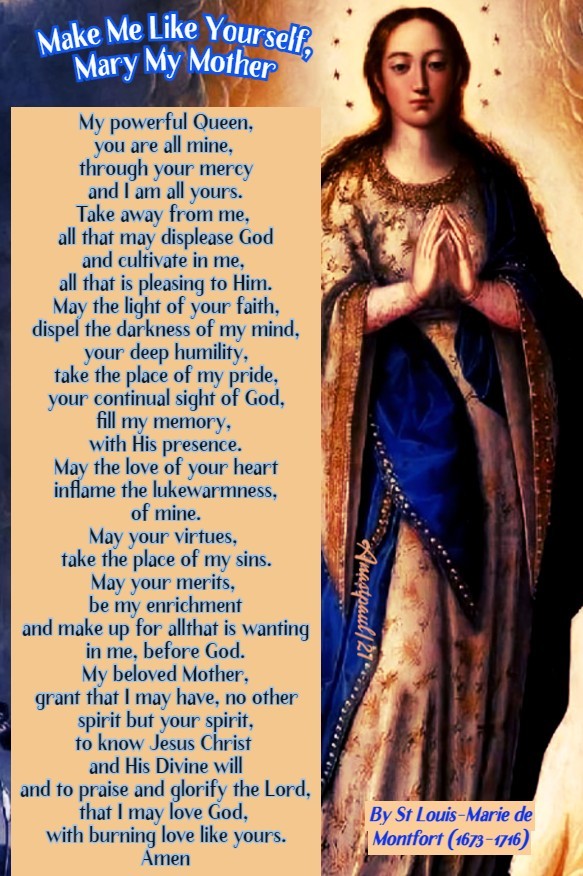
Make Me Like Yourself, Mary My Mother By St Louis-Marie de Montfort (1673-1716)
My powerful Queen, you are all mine, through your mercy and I am all yours. Take away from me, all that may displease God and cultivate in me, all that is pleasing to Him. May the light of your faith, dispel the darkness of my mind, your deep humility, take the place of my pride, your continual sight of God, fill my memory, with His presence. May the love of your heart inflame the lukewarmness, of mine. May your virtues, take the place of my sins. May your merits, be my enrichment and make up for allthat is wanting in me, before God. My beloved Mother, grant that I may have, no other spirit but your spirit, to know Jesus Christ and His Divine will and to praise and glorify the Lord, that I may love God, with burning love like yours. Amen
Thought for the Day – 9 October – Meditations with Antonio Cardinal Bacci (1881-1971)
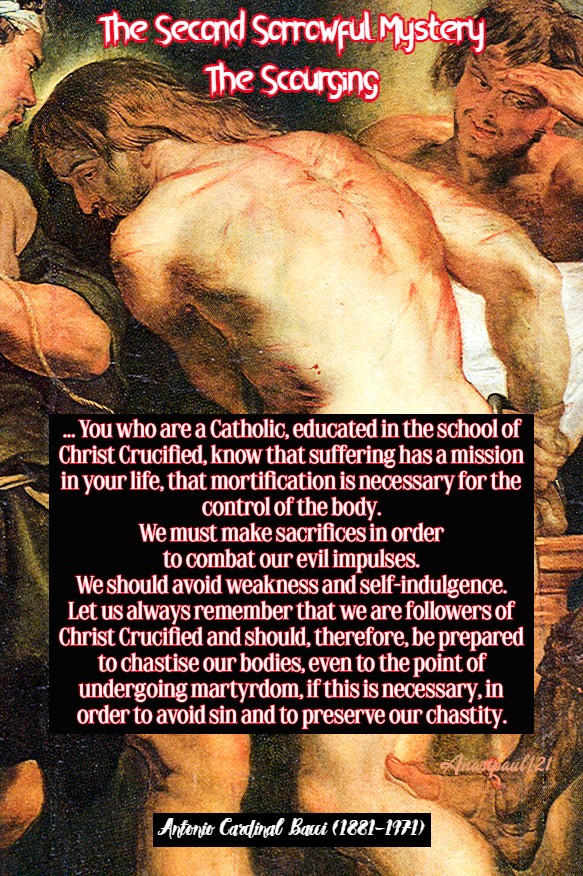
“Month of the Holy Rosary” The Second Sorrowful Mystery The Scourging
“The Saints voluntarily imposed on themselves flogging and other severe penances, which would make us shudder in modern times, in order to control their bodily impulses and to expiate, along with Jesus, the sins of their fellowmen. Today, the pleasure-loving world cries out against such barbaric folly and extravagance. But you who are a Catholic, educated in the school of Christ Crucified, know that suffering has a mission in your life, that mortification is necessary for the control of the body.
We must make sacrifices in order to combat our evil impulses. We should avoid weakness and self-indulgence. Let us always remember that we are followers of Christ Crucified and should, therefore, be prepared to chastise our bodies, even to the point of undergoing martyrdom, if this is necessary, in order to avoid sin and to preserve our chastity.”
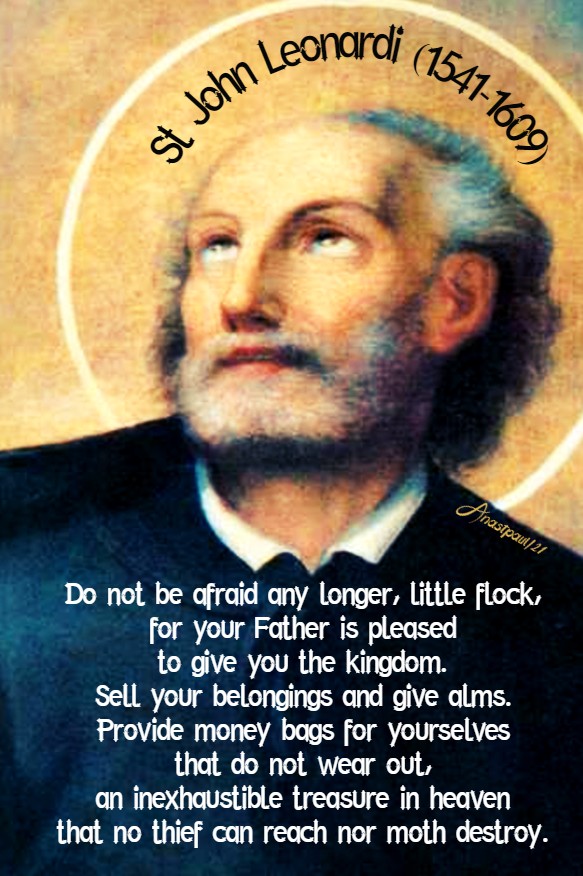
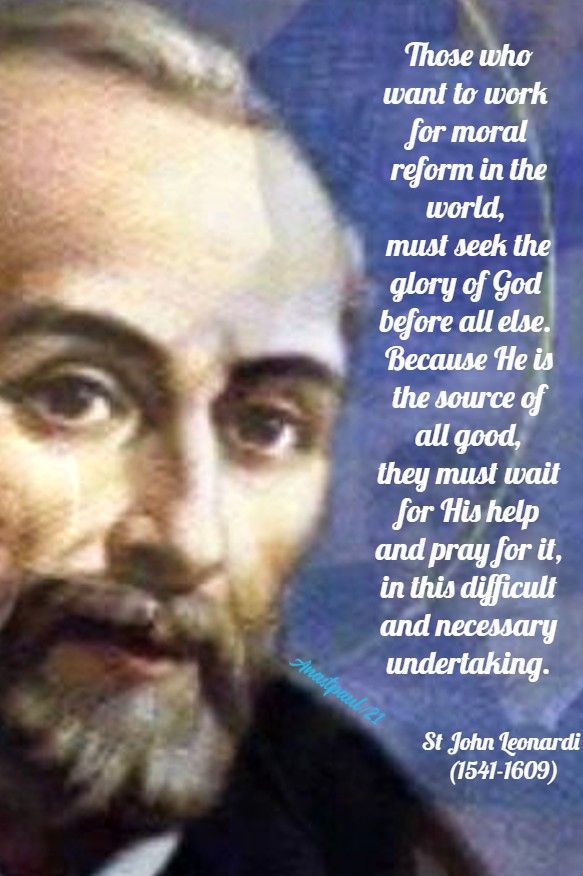
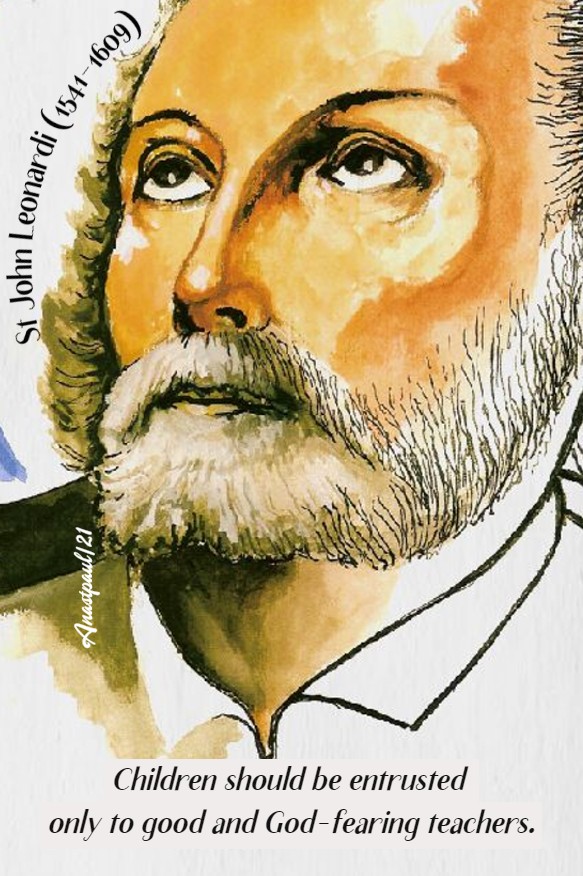
Quote/s of the Day – 9 October – The Memorial of St Louis Bertrand OP (1526-1581) “Apostle of South America”, St John Leonardi OMD (1541-1609), Founder of the Clerks Regular of the Mother of God and St John Henry Newman C.Orat (1801-1890)
“Do not be afraid any longer, little flock, for your Father is pleased to give you the kingdom. Sell your belongings and give alms. Provide money bags for yourselves that do not wear out, an inexhaustible treasure in heaven that no thief can reach nor moth destroy.”
“Those who want to work for moral reform in the world, must seek the glory of God before all else. Because He is the source of all good, they must wait for His help and pray for it, in this difficult and necessary undertaking.”
“Children should be entrusted only to good and God-fearing teachers.”
One Minute Reflection – 9 October – “Month of the Holy Rosary” – Readings: : Joel 4: 12-21; Psalm 97: 1-2, 5-6, 11-12; Luke 11: 27-28
“He replied, “Rather, blessed are those who hear the word of God and observe it.” – Luke 11:28
REFLECTION – “Mary was more blessed in accepting the faith of Christ than in conceiving the flesh of Christ. To someone who said, “Blessed is the womb that bore you,” He replied, “Rather, blessed are they who hear the word of God and keep it.” Finally, for His brothers, His relatives according to the flesh, who did not believe in Him, of what advantage was that relationship? Even her maternal relationship would have done Mary no good unless she had borne Christ, more happily in her heart, than in her flesh.” – St Augustine (354-430) Father & Doctor of Grace (Holy Virginity, 3).
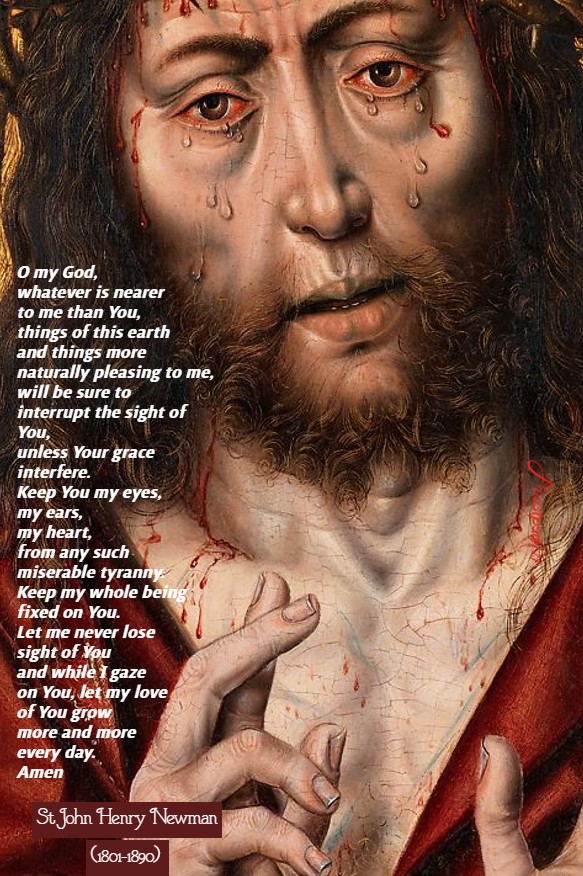
PRAYER – “O my God, whatever is nearer to me than You, things of this earth and things more naturally pleasing to me, will be sure to interrupt the sight of You, unless Your grace interfere. Keep You my eyes, my ears, my heart, from any such miserable tyranny. Keep my whole being fixed on You. Let me never lose sight of You and while I gaze on You, let my love of You grow more and more every day.” … St John Henry Newman (1801-1890) May we run the race in obedience and love of the Will of our God, always seeking Your Face in those who are the leastg. Through Christ our Lord, with the Holy Spirit, God forever, amen.
Saint of the Day – 9 October – Saint Donnino of Città di Castello (Died 610) Lay Hermit Also known as – Donino. Patronages – of Città di Castello together with Saint Flordio and Saint Amanzio, against arthritis, epilepsy, against rabid dog attacks
The Roman Martyrology states: “In Città di Castello in Umbria, St. Donnino, a hermit.”
Donnino collaborated with the Bishop Florido and the Priest Amanzio in the reconstruction of Città di Castello (then Castrum Felicitatis) after the destruction suffered during the Greek-Gothic war.
Hagiographies written of him in the 17th and 18th centuries recall his devotion and zeal. On the death of Bishop Florido (599 or 600) and of St Amanzio, shortly after, Donnino abandoned public life to retire to live in the hermitic solitude at the Rubbiano locality. He then moved to a second hermitage, closer to Città di Castello, today called Villa San Donino. Here he lived on wild herbs and spent his time in prayer and in the company of a dog. The saintly hermit died on 9 October 610.
During the years of the Donnino’s life the news of his presence, his holiness and spiritual gifts spread rapidly and large crowds began to visit him. Donino became their spiritual guide and an intercessor with God.
His body is now preserved inside an urn placed in the Church of Saint Donnino. Another place linked to the memory of this Saint is near Rubbiano, where there are some boulders and a miraculous spring where pilgrims pray for cures especially from arthritis and epilepsy.
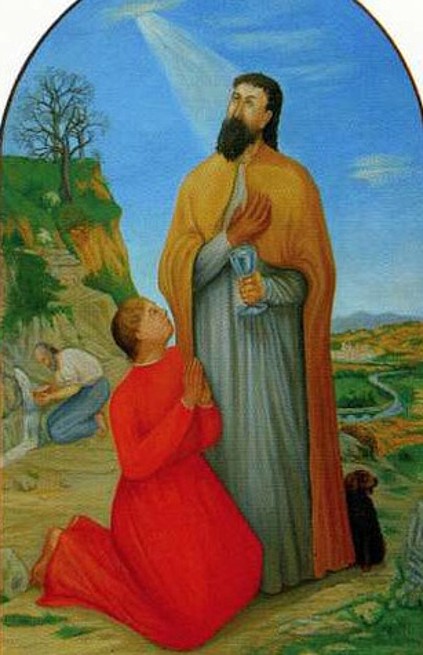
Although a layman, Donino was in the past depicted with priestly vestments and the chalice and next to a small dog. The oldest representation is contained in the embossed and chiselled silver frontal donated by Pope Celestine II to the Cathedral of Città di Castello in 1144, where Donino is depicted together with the Saints Florido and Amanzio. His relics were subjected to canonical recognition in the years 1543, 1791 and 1869.
St John Leonardi (1541-1609) (Optional Memorial) Priest, Founder of the Clerks Regular of the Mother of God of Lucca, wherein he assumed the name of “Giovanni of the Mother of God”, Confessor, Reformer, Apostle of the Holy Eucharist and Eucharistic Adoration, Marian devotee. Biography here: https://anastpaul.wordpress.com/2017/10/09/saint-of-the-day-9-october-st-john-leonardi-1541-1609/
Bl Aaron of Cracow St Abraham the Patriarch St Alfanus of Salerno St Andronicus of Antioch St Athanasia of Antioch Bl Bernard of Rodez St Demetrius of Alexandria St Deusdedit of Montecassino St Domninus St Dorotheus of Alexandria St Donnino of Città di Castello (Died 610) Lay Hermit St Eleutherius St Geminus St Gislenus St Goswin Bl Gunther
St Publia St Rusticus St Sabinus of the Lavedan St Valerius — Martyrs of the Spanish Civil War – Martyrs of Astoria – (9 saints): Also known as Martyrs of Turon: A group of Brothers of the Christian Schools and a Passionist priest martyred in the persecutions during the Spanish Civil War. They are – • Aniceto Adolfo • Augusto Andrés • Benito de Jesús • Benjamín Julián • Cirilo Bertrán • Inocencio de la Immaculada • Julián Alfredo • Marciano José • Victoriano Pío They were martyred on 9 October 1934 in Turón, Spain and Canonised on 21 November 1999 by St Pope John Paul II. — Martyrs of Laodicea – (3 saints): Three Christians martyred together in Laodicea, but no other information about them has survived but their names – Didymus, Diodorus and Diomedes. They were martyred in Laodicea, Syria.
Thought for the Day – 8 October – Meditations with Antonio Cardinal Bacci (1881-1971)
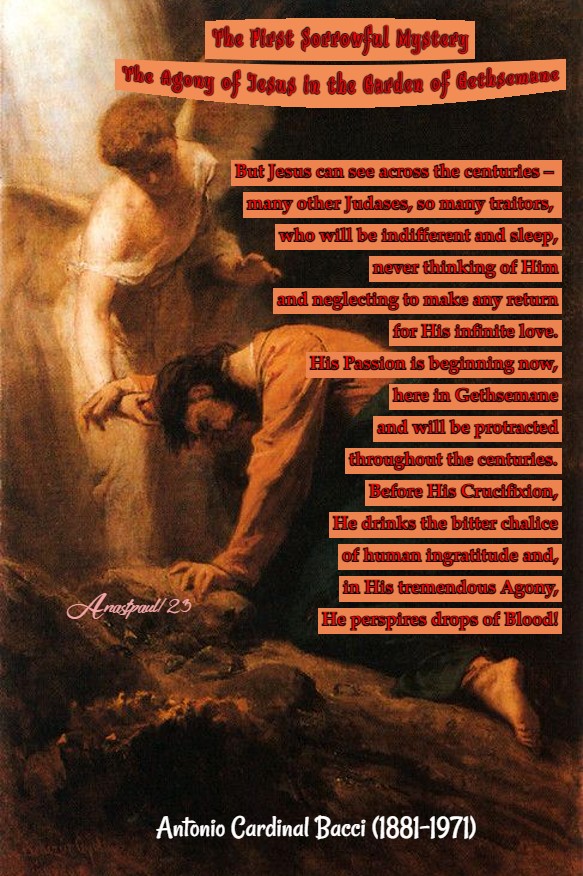
“Month of the Holy Rosary” The First Sorrowful Mystery The Agony of Jesus in the Garden of Gethsemane
“Let us pay particular attention to the scene in Gethsemane. Jesus is lying prostrate on the ground. He has given everything for sinful humanity. He has given His heavenly teaching, His miracles and His mercy. Even more, He has given Himself in the Blessed Eucharist, which He has instituted in the form of food and drink, to sustain men on their earthly journey.
Now, He lies prostrate in prayer. Near Him, are His Apostles who, already forgetful of the immense favours which they have received, are asleep!
Not far away, there is another Apostle, Judas, who has sold his Master for thirty pieces of silver, as a slave would be sold and is about to deliver Him to His executioners. But Jesus can see across the centuries – many other Judases, so many traitors, who will be indifferent and sleep, never thinking of Him and neglecting to make any return for His infinite love. His Passion is beginning now, here in Gethsemane and will be protracted throughout the centuries. Before His Crucifixion, He drinks the bitter chalice of human ingratitude and, in His tremendous Agony, He perspire drops of Blood.”
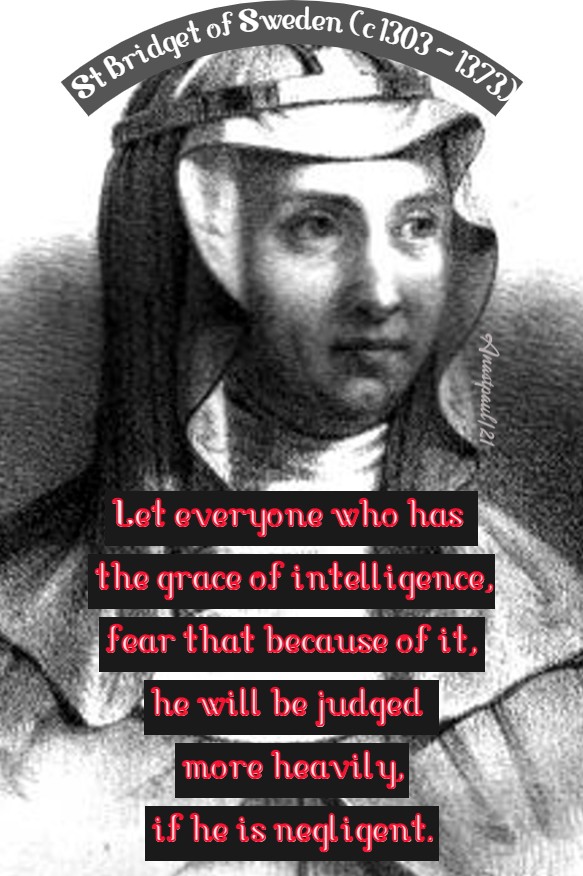
Quote/s of the Day – 8 October– The Memorial of St Bridget of Sweden (c 1303 – 1373)
“O Lord, make haste and illumine the night. Say to my soul that nothing happens without You permitting it and that nothing of what You permit, is without comfort.”
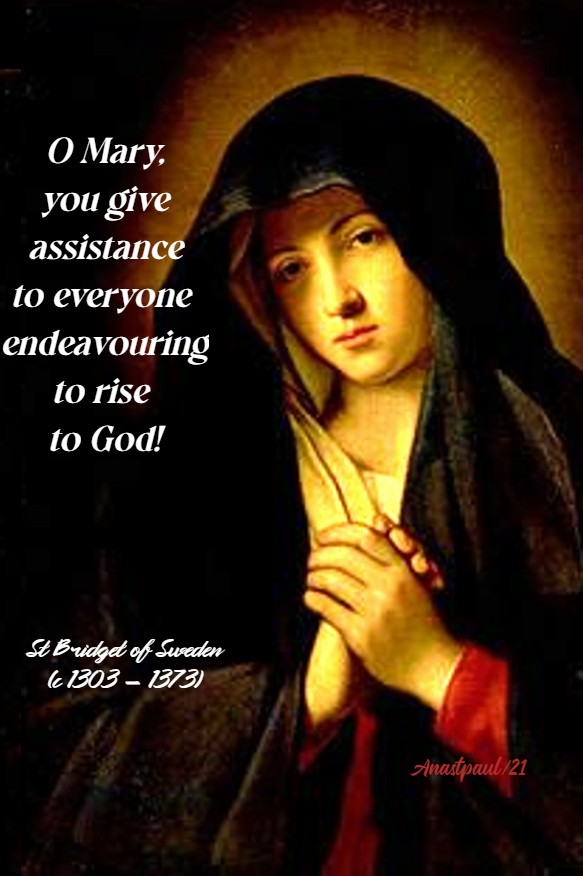
“O Mary, you give assistance to everyone endeavouring to rise to God!”
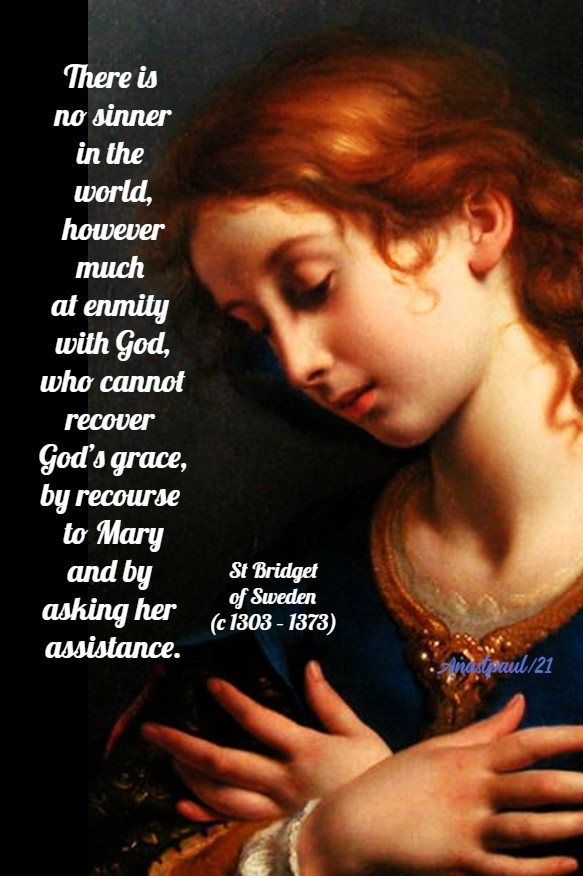
“There is no sinner in the world, however much at enmity with God, who cannot recover God’s grace, by recourse to Mary and by asking her assistance.”
“Let everyone who has the grace of intelligence, fear that because of it, he will be judged more heavily, if he is negligent.”
One Minute Reflection – – 8 October – “Month of the Holy Rosary” – Readings: Joel 1: 13-15; 2: 1-2; Psalm 9: 2-3, 6 & 8-9; Luke 11: 15-26
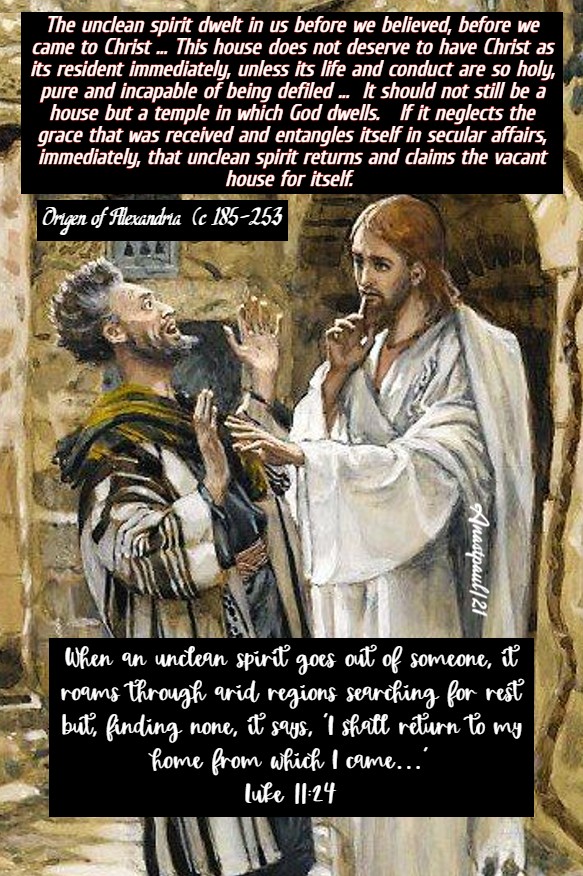
“When an unclean spirit goes out of someone, it roams through arid regions searching for rest but, finding none, it says, ‘I shall return to my home from which I came…” – Luke 11:24
REFLECTION – “The unclean spirit dwelt in us before we believed, before we came to Christ when our soul was still committing fornication against God and was with its lovers, the demons. Afterward it said, “I will return to my first husband,” and came to Christ, who “created” it from the beginning “in his image.” Necessarily the adulterous spirit gave up his place when it saw the legitimate husband.
Christ received us and our house has been “cleansed” from its former sins. It has been “furnished” with the furnishing of the Sacraments of the faithful, that they who have been initiated know. This house does not deserve to have Christ as its resident immediately, unless its life and conduct are so holy, pure and incapable of being defiled, that it deserves to be the “temple of God.” It should not still be a house but a temple in which God dwells. If it neglects the grace that was received and entangles itself in secular affairs, immediately, that unclean spirit returns and claims the vacant house for itself. “It brings with it seven other spirits more wicked,” so that it may not be able again to be expelled “and the last state of that kind of person is worse than the first.” It would be more tolerable that the soul would not have returned to its first husband once it became a prostitute, than having gone back after confession to her husband, to have become an adulteress again. There is no “fellowship,” as the Apostle says, “between the temple of God and idols,” no “agreement between Christ and Belial.” – Origen of Alexandria (c 185-253) Priest, Theologian, Exegist, Writer, Apologist, Father (Homilies on Exodus, 8)
PRAYER – Lord God and Father, who entrusted the earth to men and each to the other, grant us the grace this day, to see Your Face. Grant us the grace to work faithfully for Your glory, for the salvation of our souls through the light of faith and by the grace which You have given us. We beg the grace of Your love and mercy and the light of love You send with Your Holy Spirit. May the prayers of Mary our Holy Mother, keep us ever in her guiding care. We make our prayer through Christ our Lord, with the Holy Spirit, one God forever and ever, amen.
Our Morning Offering – 8 October – “Month of the Holy Rosary”
Cast Upon Us a Look of Mercy By Blessed Pope Pius IX (1792-1878)
O Jesus! Cast upon us a look of mercy, turn Your Face towards each of us as You did to Veronica, not that we may see it, with our bodily eyes, for this we do not deserve but turn Your Face towards our hearts, so that, remembering You, we may ever draw from this Fountain of Strength, the vigour necessary to sustain us, in the combats of life. Amen
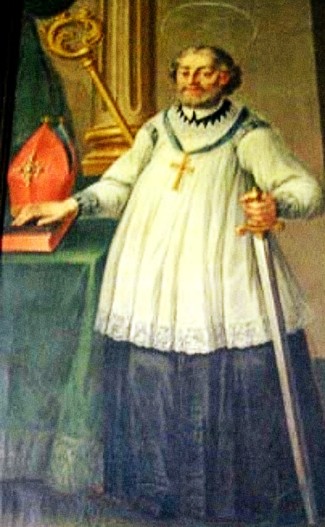
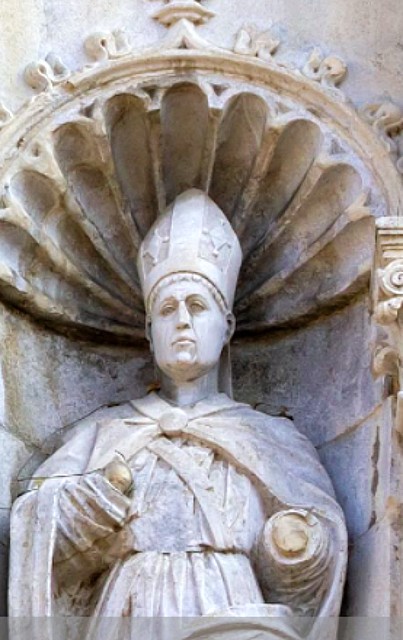
Saint of the Day – 8 October – Saint Felix of Como (Died 390) the first Bishop of Como. Felix was a friend of Saint Ambrose, who praised him for his missionary activity and Ordained him a Priest in 379 and Consecrated him as Bishop in 386. St Ambrose sent him to evangelise the City of Como, as a testimony to the great missionary drive of the Church of Milan. When St Bassianus of Lodi (c 320 – 413 – feast day 10 June) built a Church dedicated to the Apostles at Lodi, he Consecrated it in the presence of Saints Ambrose and Felix. St Felix is honoured as a zealous shepherd of souls. Additional Memorials – 31 August in Milan and 14 July on some calendars.
The Roman Martyrology states: “In Como, St Felix, Bishop, who, Ordained by St Ambrose of Milan, was the first to rule the Church of this City.”
The first document that presents Felix, is a letter from St Ambrose of Milan, from which it is noted that the recent evangelisation work of the first Bishop, Felix, although it had led to the conversion of many people, required the indispensable and constant collaboration of some co-operators: “I know well that you do not lack work in the vineyard of the Lord, especially because there are few workers with you, who can help us but, this lament is old and too well known to us: the Hand of God, however, has not shortened; He will help you in your need and will send you new workers to harvest the grain of the Lord. I thank the Lord very much, He, Who favoured you in the conversion of these souls and cordially congratulate you, hearing how many of these citizens of Como have already accepted the Catholic faith.”
From the full text of the letter, which is undated, it appears that Felix enjoyed the familiarity and paternal predilection of Saint Ambrose, who had conferred on him the Episcopal Consecration on Sunday 1 November, almost certainly in 386 and had sent him to the Consecration of the Basilica of the Apostles built by St Bassianus in Lodi, Bishop of that City, who longed for the presence of the Bishop of Como.
In another letter, of exquisitely familiar and friendly tone, commonly ascribed to the year 387, Ambrose thanks Felix for the gift of a basket of truffles but also complains that he visits him too rarely.
According to an ancient tradition, Felix would have erected the first Church of Como on the open slope of the Baradello hill, in honour of the Saints Carpoforo and fellow martyrs and in it buried their bodies.
Tradition has handed down 8 October as the date of Felix’s death, also his feast day. He was buried in the primitive Church of San Carpoforo and subsequently in the enlarged Basilica of the same name, until, in 1932, his body was transferred to the new Parish Church of San Brigida, where his cult is still alive and placed under the main Altar.
A very unclear picture but it seems to be the Shrine of St Felix in the Church of St Brigid in Como
Notre-Dame du Bon Remède / Our Lady of Good Remedy, France (1197) – 8 October:
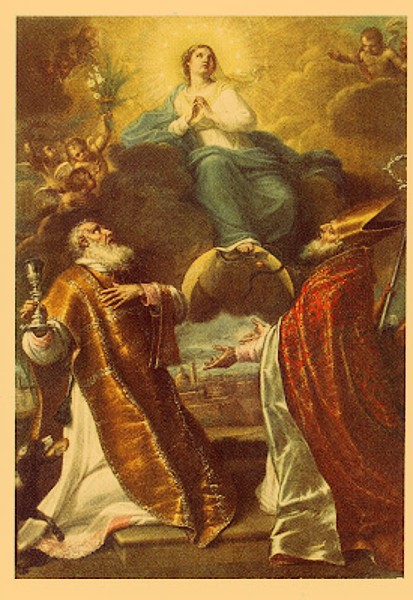
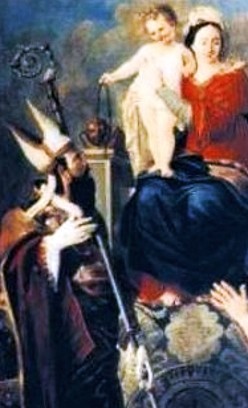
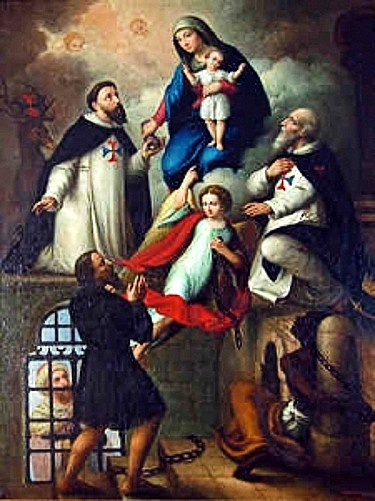
In 1197, a Sorbonne Doctor of Theology and newly Ordained Priest, Jean de Matha, while saying his first Holy Mass, saw a vision of an Angel with a red and blue cross on his chest and his hands resting on the heads of two captives. The following year, St Jean founded a religious order dedicated to the redemption of Christians held as slaves by Moslems — the Hospitaler Order of the Most Holy Trinity and of Captives, commonly called the Trinitarians. On their habit, Jean placed the Cross he had seen on the Angel,and, as their Patron, he gave them Notre-Dame du Bon Remède, a popular devotion in his Provençal homeland. Now devoted largely to education and evangelisation, for three centuries they raised funds and travelled from Europe into Africa to buy thousands of captives’ freedom with Our Lady’s help. A painting (right) in the Trinitarian Motherhouse of Cerfroid in northern France, shows Our Lady of Good Remedy giving a bag of money to St Jean/John of Matha, while a grateful freedman and St Felix of Valois, look on. The Order celebrates her feast day 8 October.
800 years ago Christians were being captured and sold into slavery by the thousands, and nobody knew what to do about it. Then, in the year 1198, a man had an idea. St. John of Matha founded the Trinitarians to go to the slave markets, buy the Christian slaves and set them free. To carry out this plan, the Trinitarians needed large amounts of money. So, they placed their fund-raising efforts under the patronage of Mary. They were so successful that, over the centuries, the Trinitarians were able to free thousands and thousands of people and to return them safely home. In gratitude for her miraculous assistance, St. John of Matha honoured Mary with the title of “Our Lady of Good Remedy.” Devotion to Mary under this ancient title is widely known in Europe and Latin America and the Church celebrates her feast day on 8 October. Our Lady of Good Remedy is often depicted as the Virgin Mary handing a bag of money to St. John of Matha. When in need – for whatever reason but especially where you have had difficulty obtaining help – invoke the aid of Our Lady of Good Remedy and you will surely experience the power of her intercession.
St Amor of Aquitaine St Artemon of Laodicia St Badilo St Benedicta of Laon St Benedicta of Origny-sur-Oise St Evodius of Rouen St Felix of Como (Died 390) Bishop St Gratus of Chalons
Thought for the Day – 7 October – Meditations with Antonio Cardinal Bacci (1881-1971)
“Month of the Holy Rosary” The Fifth Joyful Mystery The Finding of Jesus in the Temple
“To search for Jesus is the principal obligation of the soul, to find Him, is the highest happiness! If we are without Jesus, our minds are in darkness and scared with false ideas. Separated from Him, our hearts are filled with remorse, emptiness and yearning. Only when Jesus is with us, have life and death any meaning. Then we can set our journey towards the unfading star of Christian hope.
When Jesus promised to give us His Flesh to eat and His Blood to drink, He saw that His listeners were going away, scandalised. “Do you also wish to go away?” He asked His Apostles. “Lord,” replied St Peter, “to whom shall we go? Thou hast wprds of everlasting life” (Jn 6:69).”
Quote/s of the Day – 7 October – “Month of the Holy Rosary” – Memorial of Our Lady of the Holy Rosary/Our Lady of Victory
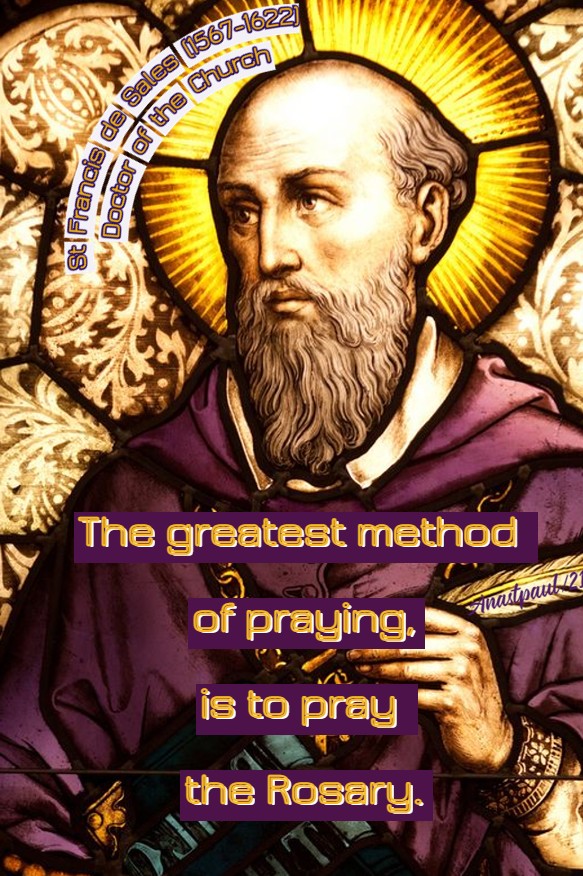
“The greatest method of praying, is to pray the Rosary.”
St Francis de Sales (1567-1622) Doctor of the Church
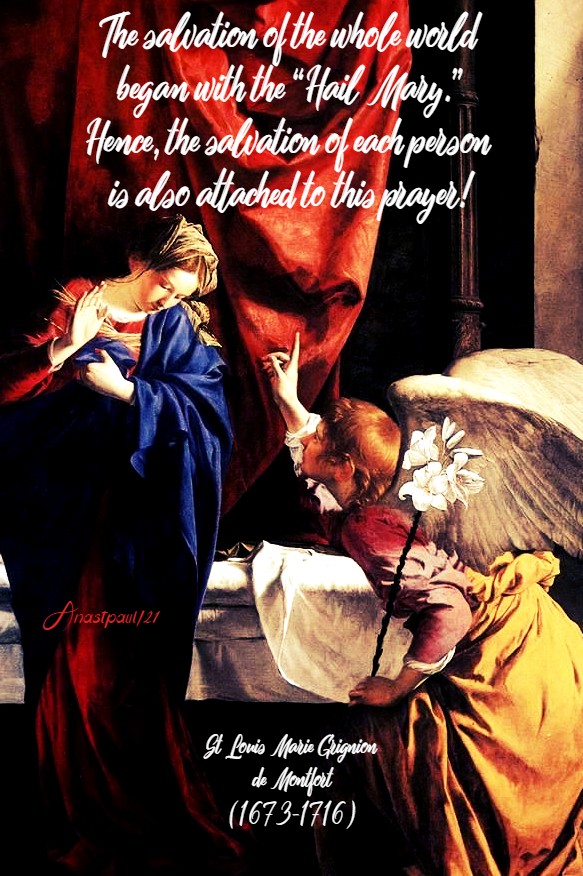
“The salvation of the whole world began with the “Hail Mary.” Hence, the salvation of each person is also attached to this prayer.”
St Louis Marie Grignion de Montfort (1673-1716)
“Those who say the Rosary daily and wear the Brown Scapular and who do a little more, will go straight to Heaven.”
St Alphonsus Ligouri (1696-1787) Doctor of the Church
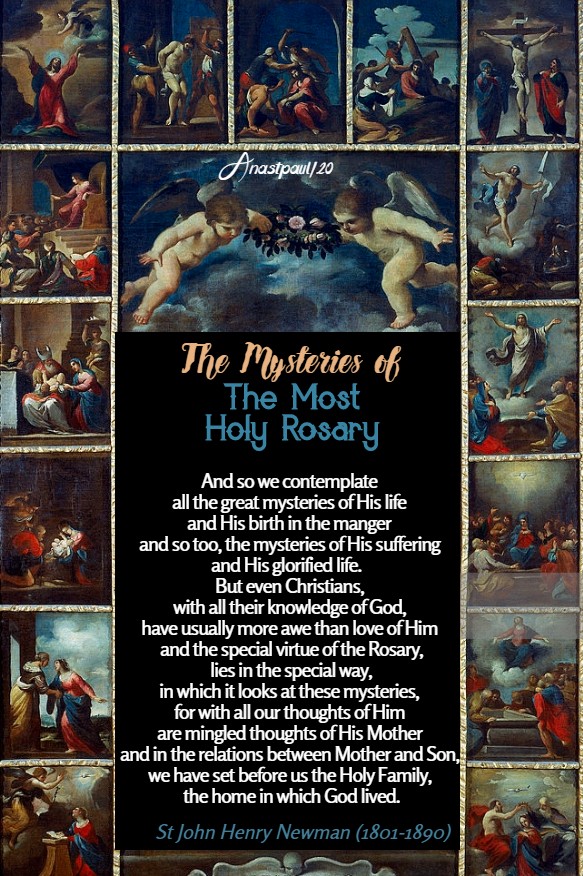
“And so we contemplate all the great mysteries of His life and His birth in the manger and so too, the mysteries of His suffering and His glorified life. But even Christians, with all their knowledge of God, have usually more awe than love of Him and the special virtue of the Rosary, lies in the special way, in which it looks at these mysteries, for with all our thoughts of Him are mingled thoughts of His Mother and in the relations between Mother and Son, we have set before us the Holy Family, the home in which God lived.”
St John Henry Newman (1801-1890)
“If our age in its pride laughs at and rejects Our Lady’s Rosary, a countless legion of the most saintly men of every age and of every condition, have not only held it most dear and have most piously recited it but, have also used it at all times, as a most powerful weapon to overcome the devil, to preserve the purity of their lives, to acquire virtue more zealously, in a word, to promote peace among men.”
Pope Pius XI (1857-1939)
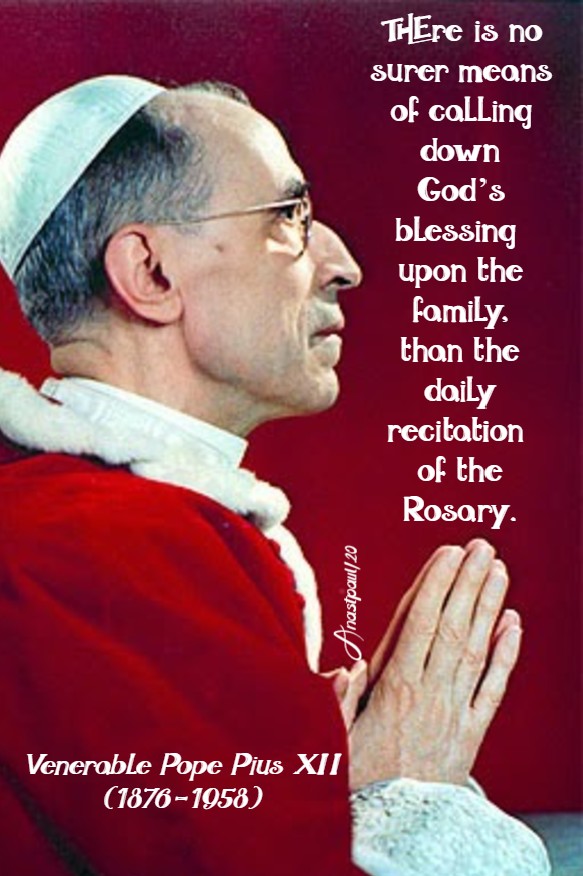
“There is no surer means of calling down God’s blessing upon the family, than the daily recitation of the Rosary.”
One Minute Reflection – 7 October – “Month of the Holy Rosary” – Readings: Malachi 3: 13-20b; Psalm 1: 1-4 and 6; Luke 11: 5-13
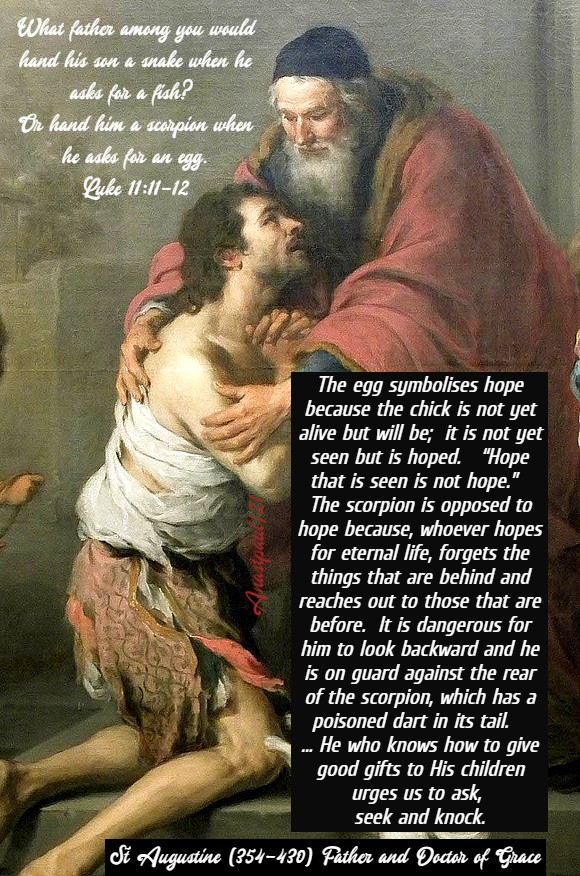
“Which father among you would hand his son a snake when he asks for a fish? Or hand him a scorpion when he asks for an egg?” – Luke 11:11-12
REFLECTION – “Of those three things that the Apostle commends, faith is either signified by the fish because of the water of Baptism, or because it remains unharmed by the waves of this world. The Serpent is opposed to it, because it craftily and deceitfully persuaded man not to believe in God. The egg symbolises hope because the chick is not yet alive but will be; it is not yet seen but is hoped. “Hope that is seen is not hope.” The scorpion is opposed to hope because, whoever hopes for eternal life, forgets the things that are behind and reaches out to those that are before. It is dangerous for him to look backward and he is on guard against the rear of the scorpion, which has a poisoned dart in its tail. Bread symbolises love because “the greatest of these is love” and among foods, bread certainly surpasses all others in value. The stone is opposed to it because the stonehearted cast out love. It may be that these gifts signify something more appropriate, yet He who knows how to give good gifts to His children urges us to ask, seek and knock.” – St Augustine (354-430) Father and Doctor of Grace (Letter 130)
PRAYER – Lord God and Father, who entrusted the earth to men and each to the other, grant us the grace this day, to see Your Face in our neighbour and to seek all who need our help. Grant us the grace to work faithfully for Your glory, for the salvation of our souls through the light of faith You have given us. We beg the grace of Your love and mercy and the light of love You send with Your Holy Spirit. May the prayers of Mary our Holy Mother, keep us ever in her guiding care. We make our prayer through Christ our Lord, with the Holy Spirit, one God forever and ever, amen.
Our Morning Offering – 7 October – “Month of the Holy Rosary” – Memorial of Our Lady of the Holy Rosary and of Victory
Through Thee, to Us, our Saviour Came To Our Lady of the Rosary By St Amadeus of Lausanne O.Cist (1108-1159)
Through thee, to us, our Saviour came, Through thee, to Him, we fain would go. Our lives are marred by wrong and shame, Yet, confidence in thee we know. The friendship thou dost give to all Who love thy name, shall ever be Assurance thou wilt hear our call, Sweet Lady of the Rosary!
Thou art our Strength upon the way, Our Morning Star, to cheer and guide; Our Beacon Light to show the day, And lead us to the Saviour’s Side; A Comforter in ev’ry pain We find, O Mother blest, in thee, And seek we, never, thee in vain, Fair Lady of the Rosary!
Thy praises, Mary, we would sing, And all our faculties employ, That unto thee our hearts might bring A glory-crown of love and joy. Bless thou each humble effort made In thy regard and grant that we, May by thy influence be swayed, Our Lady of the Rosary!
Saint of the Day – 7 October – Saint Augustus of Bourges (Died c 560) Priest and Abbot. He was miraculously cured of paralysis, with which he bas born, by the intercession of St Martin of Tours. Died in c 560 of natural causes. Also known as – Augustus of San Sinforiano, Augosto of….
The Roman Martyrolog states of him today: “Near Bourges in Aquitaine, France, Saint Augustus, Priest and Abbot, who had his hands and feet so contracted that he could not support himself except with his knees and elbows. He was healed through the intercession of St Martin of Tours. He gathered around himself some Monks and waited intently on prayer.”
Augustus was French, and lived in Bourges in the sixth century. His life and illness is known to us, with sufficient accuracy, from the pages of writers and above all from the artwork, which latter we have no access too online. In fact, St Gregory of Tours says that he was was paralysed from birth, in the feet and hands. To move, he dragged himself painfully on his elbows and knees.
But the infirmity of his limbs did not discourage him, nor hardened his heart and soul, which remained healthy and whole, as a Christian rich in devotion and goodwill.
Aided by the alms of the faithful, Augustus set out to build a Church dedicated to the great French Bishop, St Martin of Tours. In fact, he managed to accomplish this undertaking, which seemed so much superior to his strength.
When the construction of the Church was completed in Bourges, he had some precious relics of the titular saint brought there.
It is said that precisely because of the miraculous powers of these relics, the cripple, who had not surrendered to his infirmity, gained the use of his limbs. But he did not take the opportunity to leave but instead, Augustus stayed at the Church he had built, in a small monastic community. According to some hagiographic sources, he also had a mystical vision in which he learned of the location of the burial place of Saint Ursinus, the first Bishop of Bourges.
If as an infirm he had overcome the impairments of his shrunken body, healed, he knew how to subjugate the vigorous body. He refused his legs to vain movements, his hands to unworthy pursuits. He stood still and quiet, in prayer and penance.
The Bishop of the City Ordained Augustus as a Priest and also appointed him Abbot of the Monastery of St Sinforian and Augustus,, without abandoning his penitent Monks, wisely governed from there, both one and the other community. And in this task he died holy, it is believed around 560, in circumstances that we do not know.
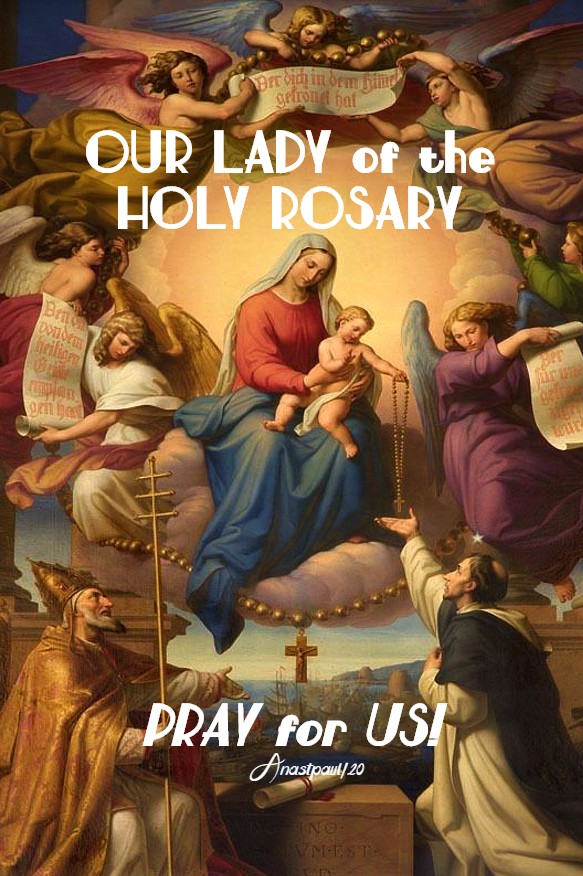
Our Lady of the Holy Rosary/Our Lady of Victory – (Commemorating the Victory of Lepanto – 1571 [Mandatory Memorial):
On Sunday 7 October 1571 the combined Christian fleets under Don John of Austria achieved a significant naval victory over the Turks in the Straits of Lepanto. Thousands of Christians were liberated, the Turkish fleet was destroyed and they suffered their first great defeat at sea. In gratitude to God and Our Lady, Pope Saint Pius V ordered an annual commemoration to be made of Our Lady of Victory. In 1573 Pope Gregory XIII transferred the feast to the first Sunday of October with the title Feast of the Most Holy Rosary since the victory was won through invocation of Our Lady of the Rosary. In 1716 Pope Clement XII extended the feast to the whole Latin Rite calendar, assigning it to the first Sunday in October. Saint Pope Pius X changed the date to 7 October in 1913. In 1969 Pope Paul VI changed the name of the feast to Our Lady of the Holy Rosary.
St Adalgis of Novara (Died c 850) Bishop St Apuleius of Capua St Augustus of Bourges (Died c 560) Priest and Abbot St Canog ap Brychan St Dubtach of Armagh St Gerold of Cologne St Helanus
St Martin Cid Bl Matthew Carreri St Osith St Palladius of Saintes St Quarto of Capua St Rigaldo
Martyrs of Arima: Eight lay people Japan who were martyred together in the persecutions of Christianity in Japan: • Blessed Hadrianus Takahashi Mondo • Blessed Ioanna Takahashi • Blessed Leo Hayashida Sukeemon • Blessed Martha Hayashida • Blessed Magdalena Hayashida • Blessed Didacus Hayashida • Blessed Leo Takedomi Kan’Emon • Blessed Paulus Takedomi Dan’Emon They were martyred on 7 October 1613 in Arima, Hyogo, Japan and Beatified on 24 November 2008 by Pope Benedict XVI.
Mercedarian Nuns of Seville: Five Mercedarian nuns at the monastery of the Assumption in Seville, Spain noted for their piety – Sisters Agnese, Bianca, Caterina, Maddalena and Marianna.
Martyred in the Spanish Civil War • Blessed José Llosá Balaguer
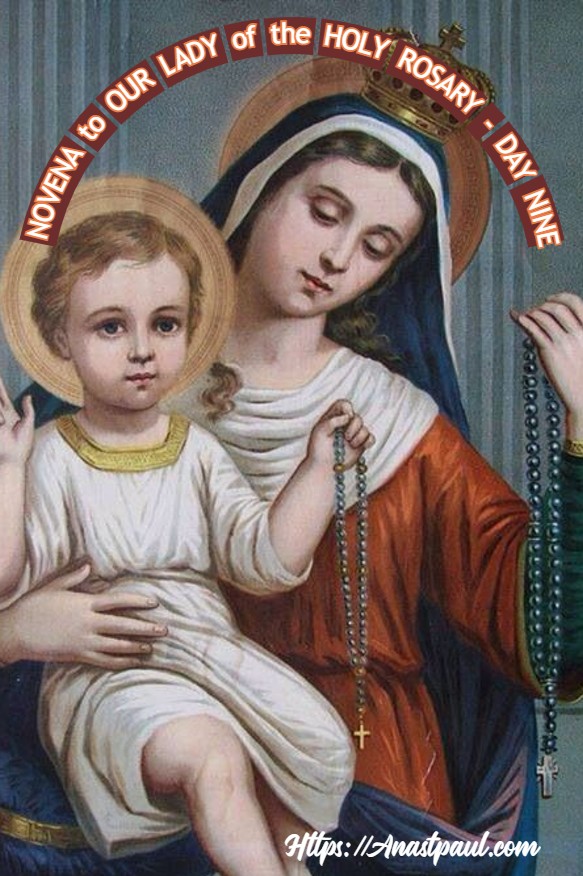
Novena to Our Lady of the Rosary – Day Nine – 6 October
Day Nine: We Pray for the Grace of Wisdom and for our private intentions
At the end of this journey of prayer together, Let us today, turn to Our Divine Father and pray, so that we may be granted the gift of wisdom and discernment, to enable us to Understand, Distinguish, Separate and Decide between the good and evil. We pray for the ability to make the right judgement for and about others, as well as for ourselves, according to God’s Will. Amen
Daily Prayer along with our Daily Rosary:
My dearest Mother Mary, behold me, your child, in prayer at your feet. Accept this Holy Rosary, which I offer you in accordance with your requests at Fatima, as a proof of my tender love for you, for the intentions of the Sacred Heart of Jesus, in atonement for the offenses committed against your Immaculate Heart and for this special favour which I earnestly request in my Rosary Novena: ………………………….. (Mention your request).
I beg you to present my petition to your Divine Son. If you will pray for me, I cannot be refused. I know, dearest Mother, that you want me to seek God’s holy Will concerning my request. If what I ask for should not be granted, pray that I may receive that which will be of greater benefit to my soul.
I offer you this spiritual Bouquet of Roses because I love you. I put all my confidence in you, since your prayers before God are most powerful. For the greater glory of God and for the sake of Jesus, your loving Son, hear and grant my prayer. Sweet Heart of Mary, be my salvation.
Our Lady of the Rosary, pray for our Holy Mother Church and for our country.
Sweet Heart of Jesus, be my love.
Sweet Heart of Mary, at the hour of my death, lead me home.
Thought for the Day – 6 October – Meditations with Antonio Cardinal Bacci (1881-1971)
“Month of the Holy Rosary” The Fourth Joyful Mystery The Purification of Our Lady and The Presentation of the Child Jesus in the Temple
“Then Joseph and Mary carried the Infant Jesus to the Temple to offer Him to God and to buy Him back as their first-born Son, with the price paid by the poor, namely, with a pair of turtle-doves or two young pigeons. Let us reflect on this new act of humility on the part of the Holy Family. In spite of the supreme dignity which had been accorded them, they submitted quietly to the law which bound those in poverty and in sin. We, who are so fond of money and of ostentation, have much to learn from this scene. Jesus, the God-Man, is purchased back as a sinner for two for two young pigeons. Mary, the Immaculate Virgin and Mother and Joseph, the holiest and noblest of men, make themselves subject to the law of sin. We can derive from this, lessons in humility and in detachment from the goods of this world.”
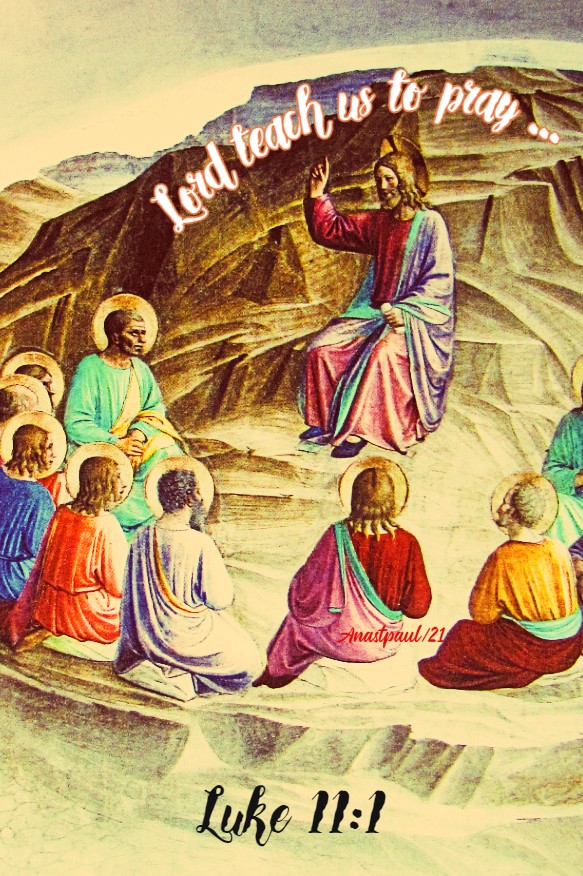
Quote/s of the Day – 6 October – “Month of the Holy Rosary” – Readings: Jonah 4: 1-11; Psalm 86: 3–6, 9-10; Luke 11: 1-4
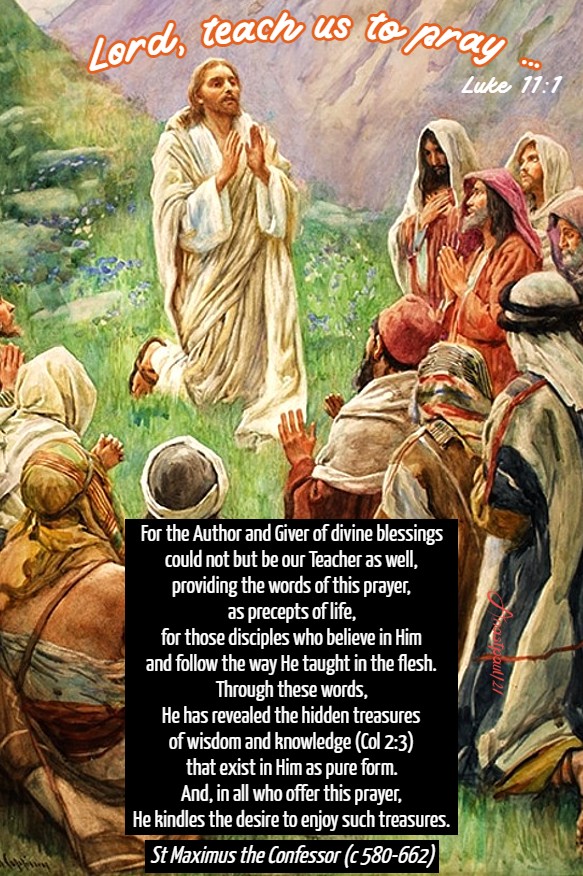
“Lord, teach us to pray …”
Luke 11:1
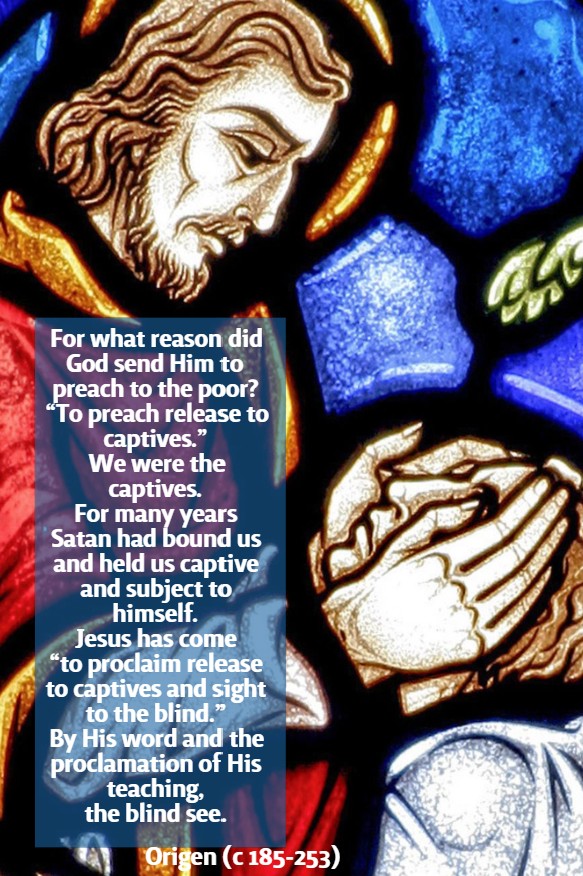
“For what reason did God send Him to preach to the poor? “To preach release to captives.” We were the captives. For many years Satan had bound us and held us captive and subject to himself. Jesus has come “to proclaim release to captives and sight to the blind.” By His word and the proclamation of His teaching, the blind see.”
Origen (c 185-253)
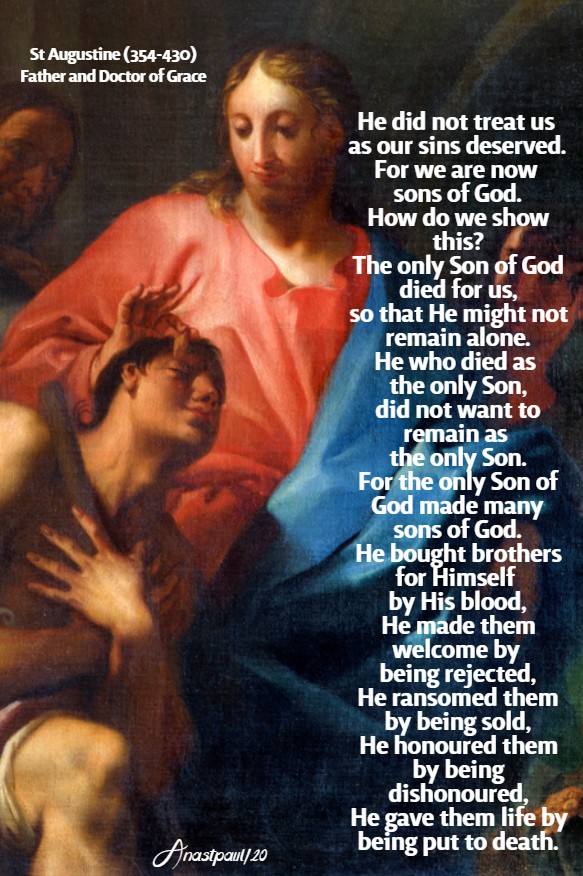
“He did not treat us as our sins deserved. For we are now sons of God. How do we show this? The only Son of God died for us, so that He might not remain alone. He who died as the only Son, did not want to remain as the only Son. For the only Son of God made many sons of God. He bought brothers for Himself by His blood, He made them welcome by being rejected, He ransomed them by being sold, He honoured them by being dishonoured, He gave them life by being put to death.”
St Augustine (354-430) Bishop, Great Western Father and Doctor of Grace
“For the Author and Giver of divine blessings could not but be our Teacher as well, providing the words of this prayer, as precepts of life, for those disciples who believe in Him and follow the way He taught in the flesh. Through these words, He has revealed the hidden treasures of wisdom and knowledge (Col 2:3) that exist in Him as pure form. And, in all who offer this prayer, He kindles the desire to enjoy such treasures.”
St Maximus the Confessor (c 580-662) Monk and Theologian
Interpretation of the Lord’s Prayer
“Prayer is nothing other than union with God. … This union of God with his little creature is something beautiful. It is a happiness that we cannot understand. We had deserved not to pray but God, in His goodness, allows us to speak to Him. Our prayer is incense, which He receives with tremendous pleasure.”
St John-Marie Vianney (1786-1859)
(Catechism on Prayer]
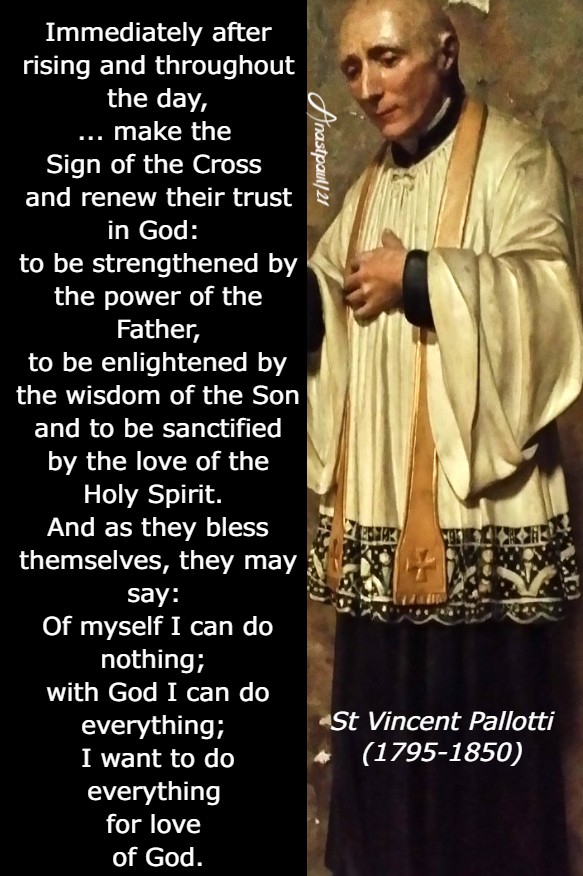
“Immediately after rising and throughout the day, all make the Sign of the Cross and renew their trust in God: to be strengthened by the power of the Father, to be enlightened by the wisdom of the Son and to be sanctified by the love of the Holy Spirit. And as they bless themselves, they may say: Of myself I can do nothing, with God I can do everything, I want to do everything for love of God.”
One Minute Reflection – 6 October – “Month of the Holy Rosary” – Readings: Jonah 4: 1-11; Psalm 86: 3–6, 9-10; Luke 11: 1-4
“He was praying in a certain place and when he had finished, one of his disciples said to him, “Lord, teach us to pray just as John taught his disciples.” – Luke 11:1
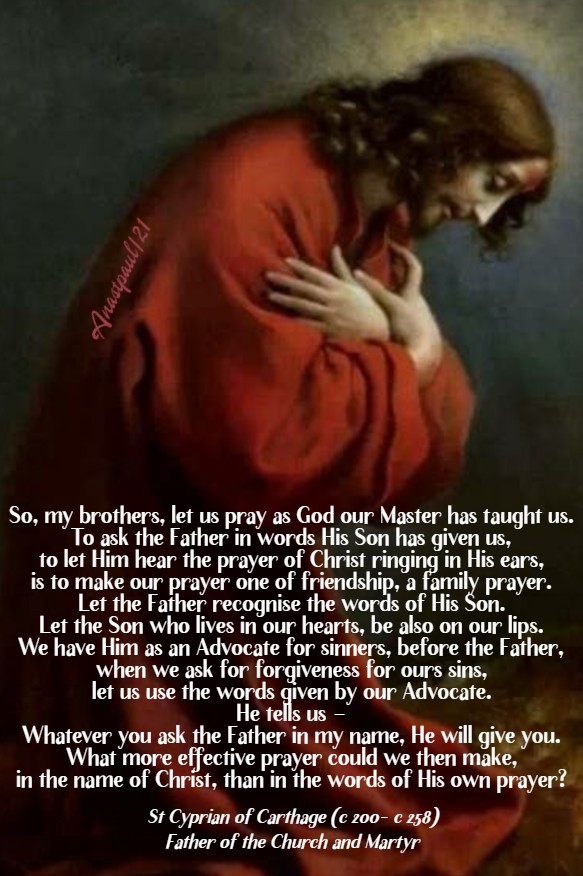
REFLECTION – “So, my brothers, let us pray as God our master has taught us. To ask the Father in words His Son has given us, to let Him hear the prayer of Christ ringing in His ears, is to make our prayer one of friendship, a family prayer. Let the Father recognise the words of His Son. Let the Son who lives in our hearts, be also on our lips. We have Him as an Advocate for sinners, before the Father, when we ask for forgiveness for ours sins, let us use the words given by our Advocate. He tells us – whatever you ask the Father in my name, He will give you. What more effective prayer could we then make, in the name of Christ, than in the words of His own prayer?” – St Cyprian of Carthage (c 200- c 258) – Bishop, Father of the Church and Martyr (An excerpt from his “On the Lord’s Prayer”)
PRAYER – Our Father who art in heaven, Hallowed be Thy name. Teach us Almighty Father to pray, fill us with the love of Your Spirit and guide us always by the Word and Trust of our lives. With the Blessed Mother of God and of the Holy Rosary, we kneel in love and adoration. May her prayers lead us to heaven. Amen
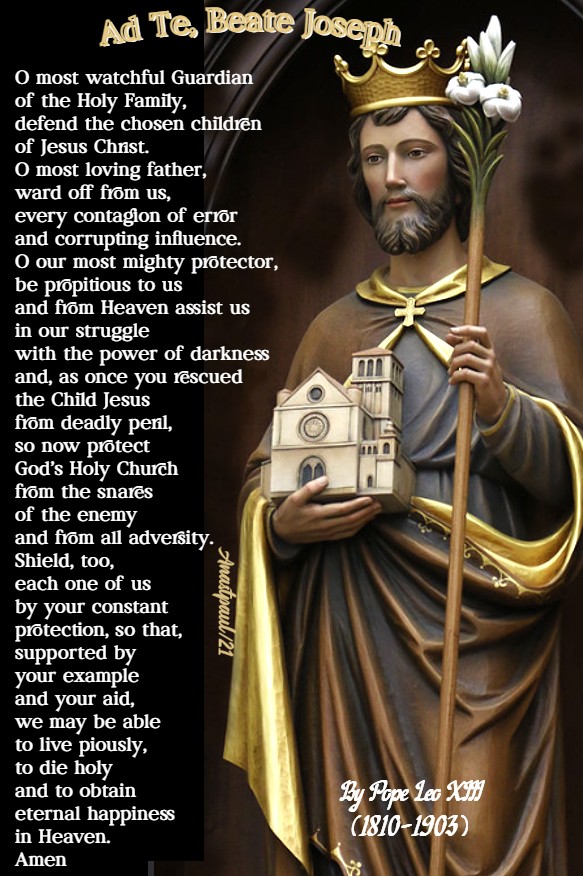
Our Morning Offering – 6 October – Ad Te, Beate Joseph
In Catholic Time, Wednesdays are traditionally St Joseph’s day. Saint Joseph is known as the Prince and chief Patron of the Church. As the earthly Father of Jesus, he had a special role in protecting, providing for and instructing Jesus during His earthly life. Now that Christ is ascended into Heaven, St Joseph continues his fatherly guardianship of Christ’s body, the Church. He is a very powerful help to all of us.
Ad Te, Beate Joseph To Thee, O Blessed Joseph By Pope Leo XIII (1810-1903)
O most watchful Guardian of the Holy Family, defend the chosen children of Jesus Christ. O most loving father, ward off from us, every contagion of error and corrupting influence. O our most mighty protector, be propitious to us and from heaven assist us in our struggle with the power of darkness and, as once you rescued the Child Jesus from deadly peril, so now protect God’s Holy Church from the snares of the enemy and from all adversity. Shield, too, each one of us by your constant protection, so that, supported by your example and your aid, we may be able to live piously, to die holy and to obtain eternal happiness in Heaven. Amen
Pope Leo asked that this prayer be added to the end of the Holy Rosary during the Month of October.
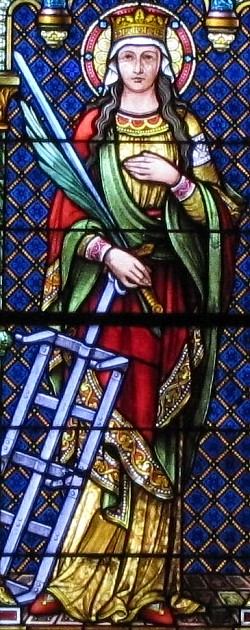
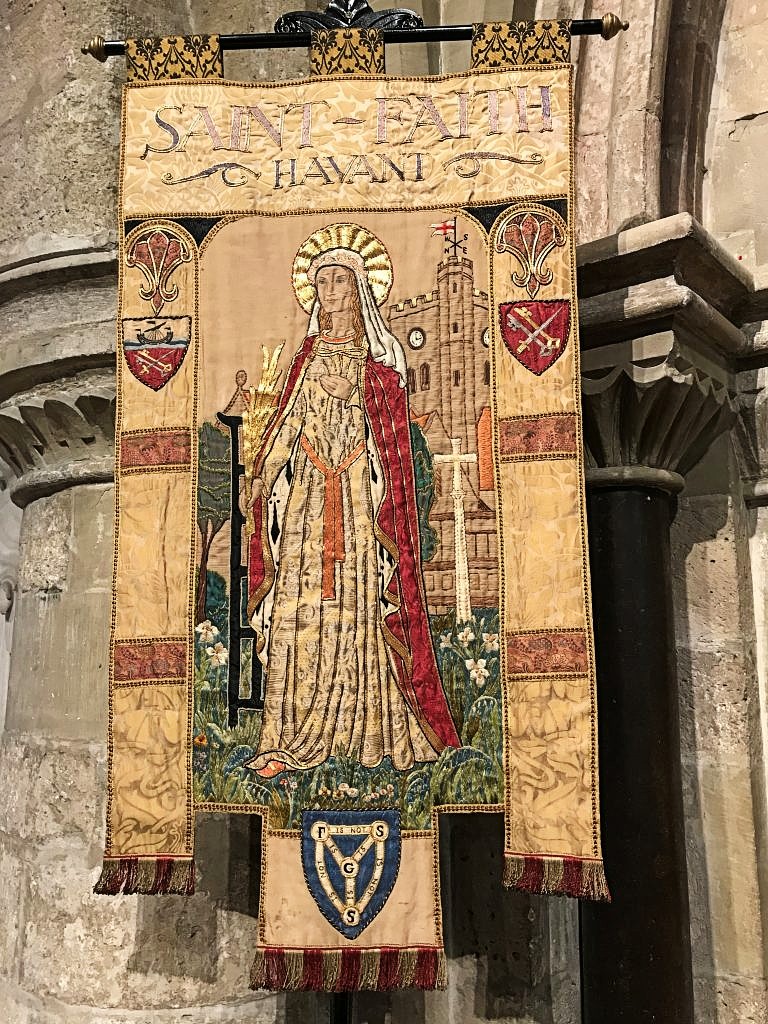
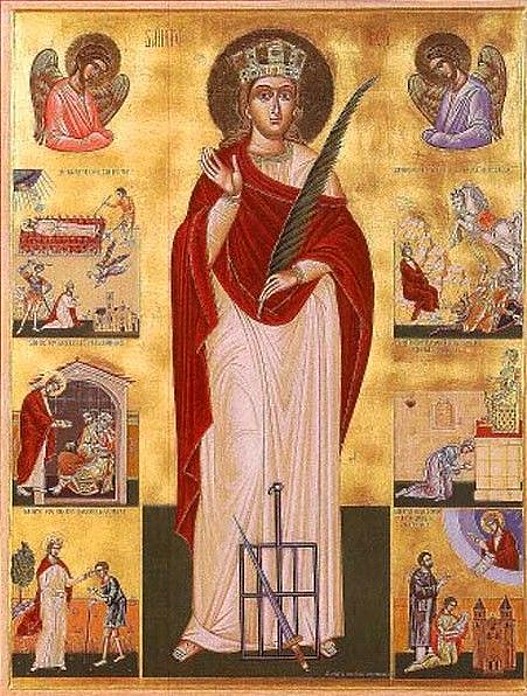
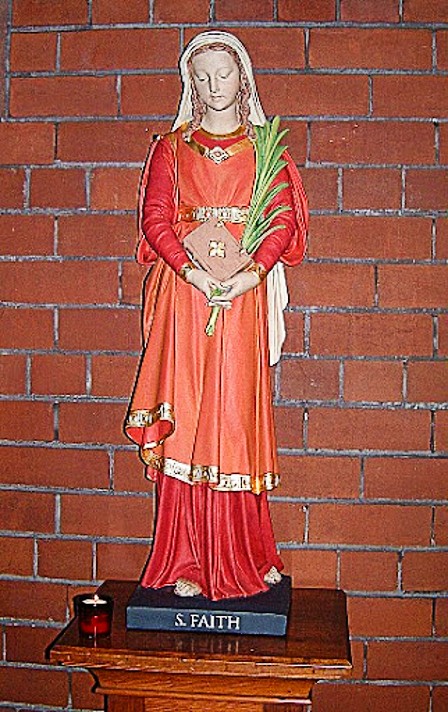
Saint of the Day – 6 October – Saint Faith of Agen (Died 3-4th Century) Virgin Martyr, Confessor. Born at Agen, Aquitaine, (modern France) and died by being cooked on a brazier, then beheaded. Also known as – Fides, Foi, Foy, Fe, Faith of Conques. Patronages – eye diseases and blindness, Pilgrims, prisoners. soldiers. Our little Faith today must not be was confused with the three legendary sisters known as Faith, Hope and Charity., Virgin Martyrs of the 2nd Century whose feast day is 1 August.
The Roman Martyrologgy states: “ At Agen, in France, the birthday of St Faith, Virgin and Martyr whose example encouraged the blessed Caprasius so much, that he happily terminated his combat by Martyrdom.“
Faith was a beautiful 12-year-old girl living in Agen, Aquitaine, France, during the reign of Diocletian and Maximian. Her parents, wealthy pagans, left her rearing to a nurse, who happened to be Christian. Growing up in a beautiful, mosaic-encrusted villa, Faith had everything the world could offer and her future looked bright, except for one thing – she had accepted her nurse’s Christian faith.
To understand why this was a problem, we must understand Emperor Diocletian. He had announced, on assuming office, his intention to revive morality within the realm, since immorality was sapping Roman virtue and, therefore, the Empire’s viability and strength. He also believed that a revival of the traditional Roman gods was key, because an empire united in its religious praxis would be stronger. This was not a problem for most pagans in most places because gods were gods, even if their names varied by region. This was obviously not the case for Christians, however.
Diocletian launched a persecution designed to force everyone to the same cult. Dacian, Prefect of the Province in which Faith lived, came to Agen to observe his subjects’ loyalty—that is, to see if they were being good pagans and, if not, to kill them.
While many Christians were terrified but Faith voluntarily surrendered to the authorities. Imagine how frightened she must have been. She likely prayed for strength and for the words to convert her persecutors. Dacian probably had some nervousness too. After all, putting a twelve-year-old girl on trial would be a touchy situation, especially for a capital crime. Who wants to execute a child? Better to get her to apostatise but how? During the trial Faith gave a brave, remarkable defense of Christianity. Fine, Dacian told her, keep your beliefs. Just sacrifice to the goddess Diana in the town’s temple.
Faith refused and Dacian lost patience with the girl. He ordered her bound to a brazen bed and roasted. Pitch was thrown on the fire to make its flames flare and burn her legs. This happened in public, so that the crowds could witness the fate awaiting Christians.
Medieval depiction of Faith’s Martyrdom.
The problem for Dacian was that little Faith refused to cooperate. She cried, yes but she did not scream or beg for mercy. After a miraculous rainstorm extinguished the flames, Dacian had her beheaded. Seeing all this, the mob was moved, not to contempt for Christianity but to pity for Faith. Their only contempt was for Dacian, the child executioner. They wondered what god of theirs could give a mere maiden such strength. Realising the answer was “None,” many converted on the spot. In turn, most of these received martyrdom days later.
After her death St Faith developed a reputation as something of a practical joker. If someone was stingy with a donation left for her Shrine’s upkeep, small misfortunes might befall them. For instance, a dying woman promised S. Faith she would will her most precious ring to the Abbey. Afterward her husband—possibly for its sentimental value, or maybe the thing had cost him a good deal of money—thought better of his wife’s last pledge. He instead used the ring as his second wife’s wedding band. Shortly the ring finger of the new wife swelled so much that it became unbearably painful. The couple beat a hasty path to the Shrine. There, when the lady blew her nose, the ring flew off her hand with such force that it left a crack in the flooring.
On another occasion, Faith’s prayers restored sight to a man named Guibert, whose eyes had been torn from their sockets. Wanting to keep the recipient of so great a miracle close, the Monks who cared for St Faith’s Shrine gave him the job of selling candles. It seems Guibert was a good businessman and soon became quite rich. But as so often happens, when success came, devotion to Our Lord went. St Faith reproached Guibert for his ingratitude. She had prayed Jesus would restore his sight, and this is how Guibert repaid her? So Guibert lost sight in one eye. This happened repeatedly: He would mend his ways, gain his eyes, grow successful again, fall into sin, lose the eye, and so on.
The Monks would parade Faith’s relics around the Monastery grounds. With the greatest pomp, they processed while holding candles and they sang all day. By evening they were exhausted and famished. Once when many people had prayed, the intercession of St Faith wrought many miracles. With each miracle the Monks would sing a Te Deum. At the end of the day, the Monks sat down under a tree to have a picnic but each time they were about to sink their teeth into their meager food, someone would cry, “A miracle!” and the Monks would have to get up and sing again.
Thirty-eight churches in England alone are named after St Faith. There are many more in northern Spain and southern France and her fame spread to the Americas via the conquistadors. Indeed, at least four Cities in the United States are named after her, including Santa Fe, New Mexico. And in Brazil alone 22 Cities bear her name.
Except for what she said in court, St. Faith never preached. She never wrote an epistle. Her preaching and writing were her actions. The bravery and resolve of this young maiden astounded the crowds. Perceiving something special about the God she worshiped, they converted. And she was just a child. God makes up for what we lack.
Holy Spirit, through Your ineffable gifts, draw us to constant conversion. Renew our hearts. Let our actions preach eloquent sermons that draw people to Christ, far better than our poor words could do. Help us to love You, Holy Father, to do everything for You, and to remain firm in that love, no matter the hardships we encounter, so that, with St Faith, we may wear an eternal crown in Heaven. (Partially excerpted from “Saint Who?: – 39 Holy Unknowns” by Brian O’Neel).
In the fifth century, Dulcitius, Bishop of Agen, ordered the construction of a Basilica dedicated to her, later restored in the 8th century and enlarged in the 15th but sadly demolished in 1892 for urban development – horrible
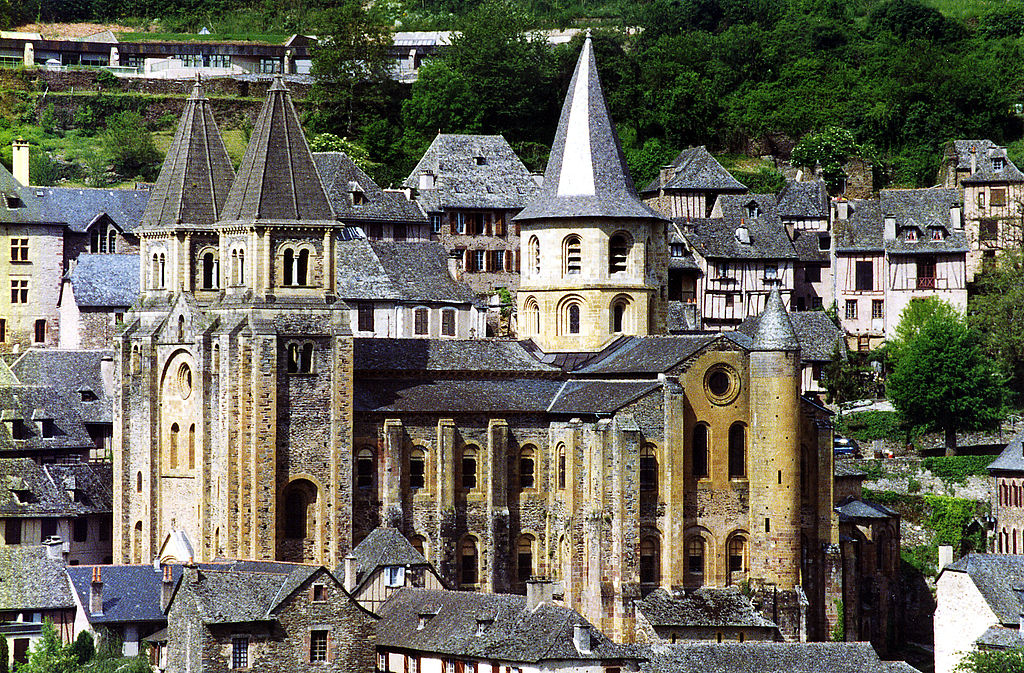
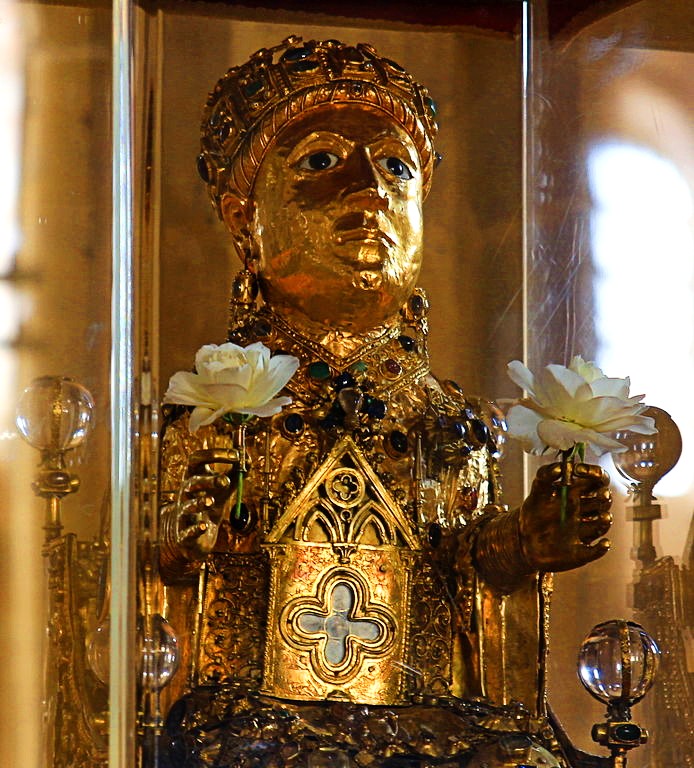
Contrary to all custom, however, the centre of the cult of Faith was not the Basilica but the Church of Conques-enRouergue, where in the 9th Century. some of her relics had been transported, see the Reliquary below. Here there was also a Monastery, which, due to being on the road frequented by pilgrims Compostella, became in turn, famous and a pilgrimage destination in its own right. The cult of Faith thus spread throughout Europe and then also in America, where numerous cities and churches were dedicated to her. Among the most important are the Conches Abbey in Normandy and the Church of Sélestat, in Alsace.
Ninth Century Reliquary of Saint Faith at Conques.
St Alberta of Agen Bl Artaldo of Belley St Aurea of Boves St Ceollach St Epiphania St Erotis St Faith of Agen (Died 3-4th Century) Virgin Martyr St Francis Trung Von Tran Bl François Hunot Bl Isidore of Saint Joseph St Iwi St John Xenos Bl Juan de Prunera St Magnus of Orderzo
St Pardulf St Renato of Sorrento St Romanus of Auxerre St Sagar of Laodicea — Martyrs of Capua – 4 saints: A group of martyrs who were either killed in Capua, Italy, or that’s where their relics were first enshrined. We now know nothing but their names – Aemilius, Castus, Marcellus and Saturninus.
Martyrs of Kyoto – 52 beati: Fifty-two Japanese lay people, some single, some married, some parents, some children, who were martyred together during one of the government sponsored persecutions of Christians.
Martyrs of Trier: Commemorates the large number of martyrs who died in Trier, Germany in the persecutions of Diocletian. 287 in Trier, Germany.


























You must be logged in to post a comment.