Thought for the Day – 22 July – Meditations with Antonio Cardinal Bacci (1881-1971)
Progress in the Love of God
“The entire Christian system is based on the love of God. This, is “the greatest and first commandment” (Mt 22:38) of Jesus, from which the second commandment, to love our neighbour, naturally flows. A man who does not observe this first commandment is not a Christian, whereas a man who endeavours to increase, everyday, his love for God, is a saint. There are may grades of ascent in this love but, the basic step is indicated in the words of our Divine Master: “He who has my commandments and keeps them, he is is who loves me” (Jn 14:15,21).
The love of God should not consist of an empty and ineffective sentimentality but, should comprise a sincere determinations to please God by carrying out His will, without reserve and by becoming more closely united to Him, by the help of His holy grace. Progress in the love of God is divided by the masters of the spiritual lfe into three stages: (1) the period of purification; (2) the period of illuminations and; (3) the period of union with God. We may have advanced no farther than the first stage because there is still so much to be purified in our souls. Nevertheless, let us ask God’s grace, to help us to begin this work immediately!”
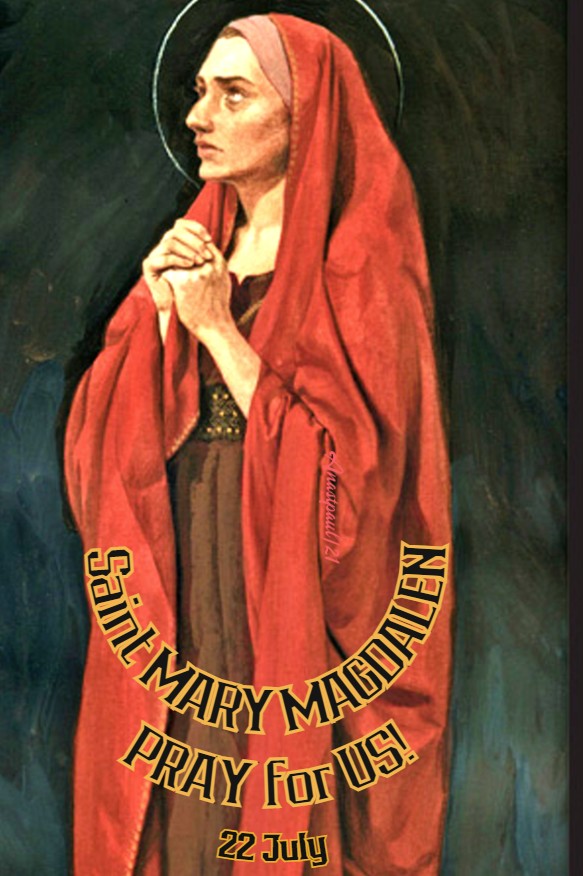
Quote/s of the Day – 22 July –“Month of the Most Precious Blood” – Feast of St Mary of Magdala -– Readings: Song of Solomon 3:1-4, Psalm 63:2-6, 8-9, John 20:1-2, 11-18
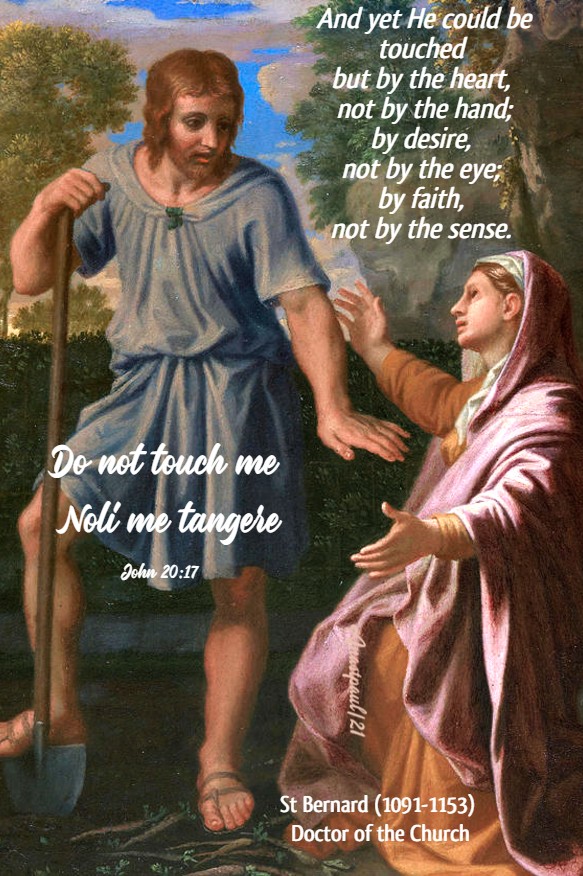
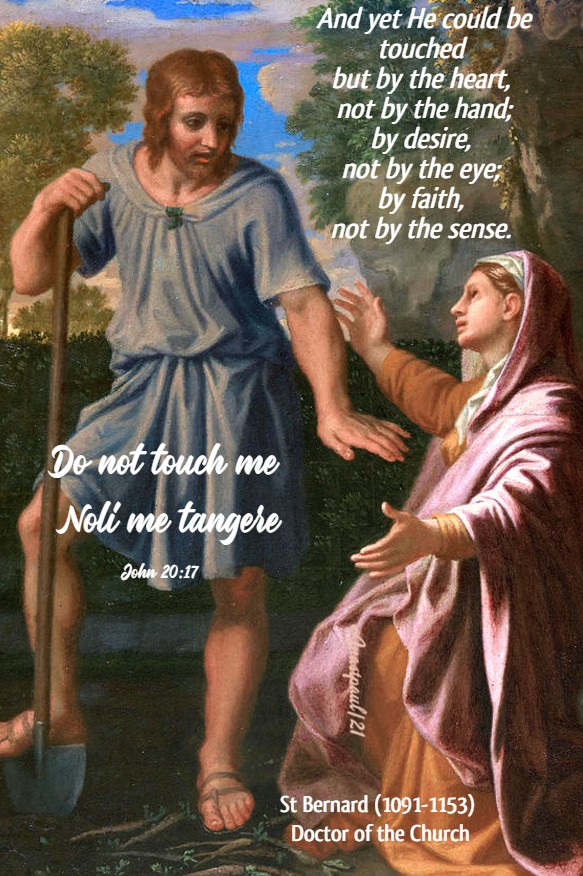
“Do not touch me ” “Noli me tangere”
John 20:17
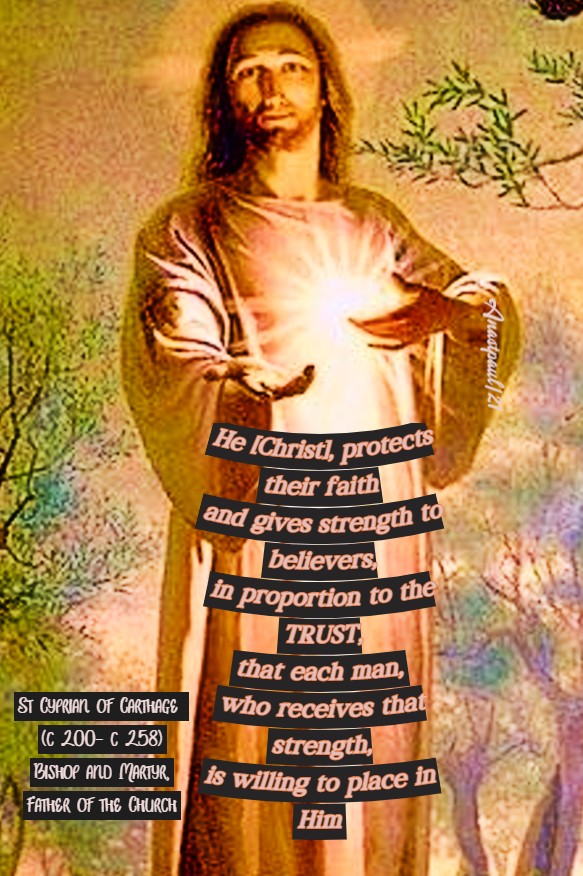
“He [Christ], protects their faith and gives strength to believers, in proportion to the TRUST, that each man, who receives that strength, is willing to place in Him.”
St Cyprian of Carthage (c 200- c 258) Bishop and Martyr, Father of the Church
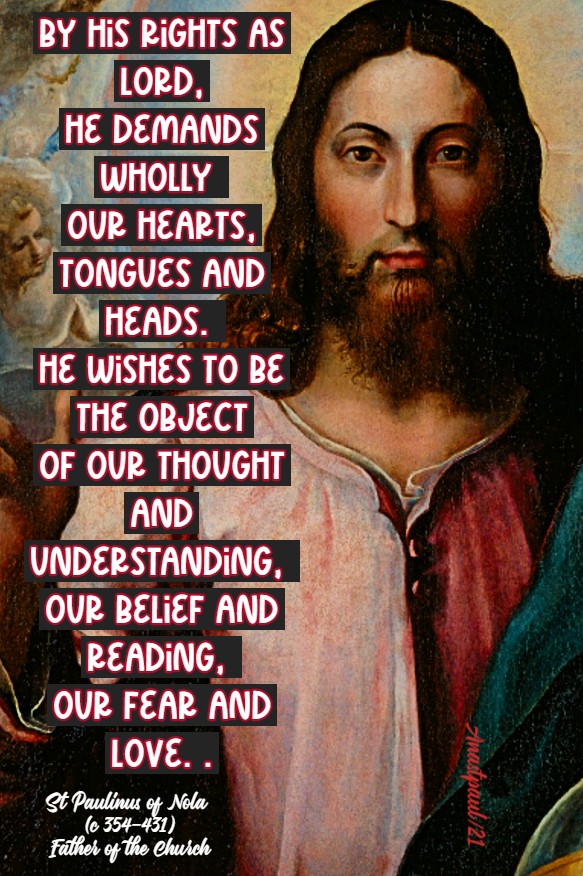
“By His rights as Lord, He demands wholly our hearts, tongues and heads. He wishes to be the object of our thought and understanding, our belief and reading, our fear and love. . . ”
St Paulinus of Nola (c 354-431) Father of the Church
Above Poem 10, from The Poems of St. Paulinus of Nola,
“And yet He could be touched but by the heart, not by the hand; by desire, not by the eye; by faith, not by the sense. …”
St Bernard (1091-1153) Doctor of the Church
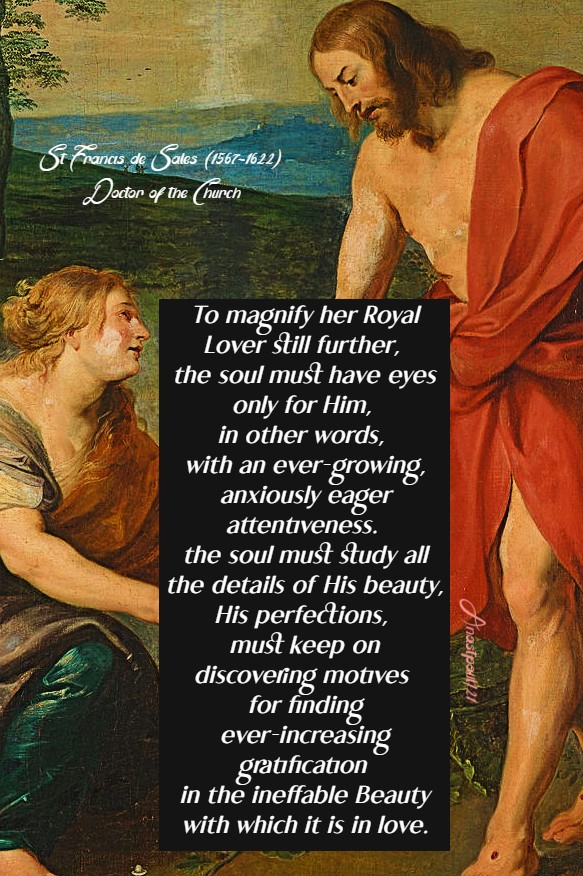
“To magnify her Royal Lover still further, the soul must have eyes only for Him, in other words, with an ever-growing, anxiously eager attentiveness. the soul must study all the details of His beauty, His perfections, must keep on discovering motives for finding ever-increasing gratification in the ineffable Beauty with which it is in love.”
St Francis de Sales (1567-1622) Doctor of the Church
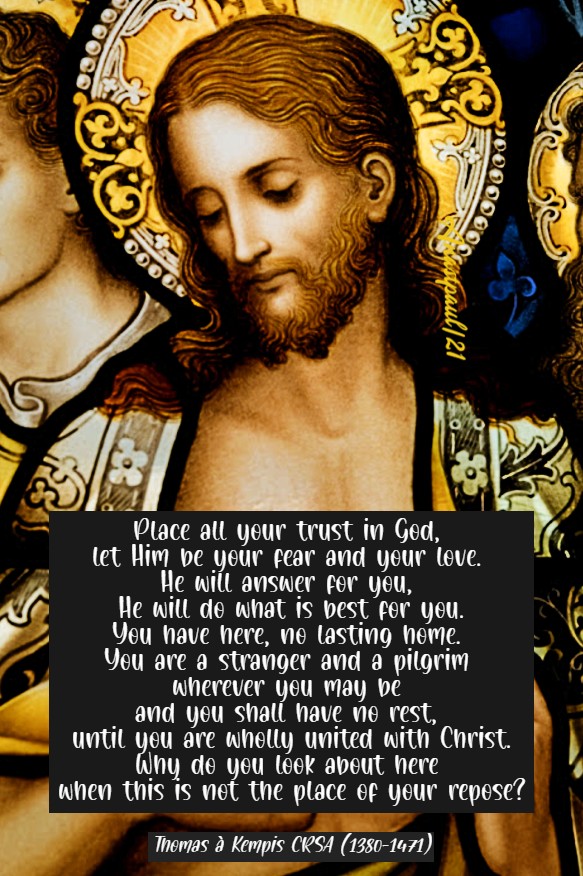
“Place all your trust in God, let Him be your fear and your love. He will answer for you, He will do what is best for you. You have here no lasting home. You are a stranger and a pilgrim wherever you may be and you shall have no rest, until you are wholly united with Christ. Why do you look about here when this is not the place of your repose?”
Thomas à Kempis CRSA (1380-1471)
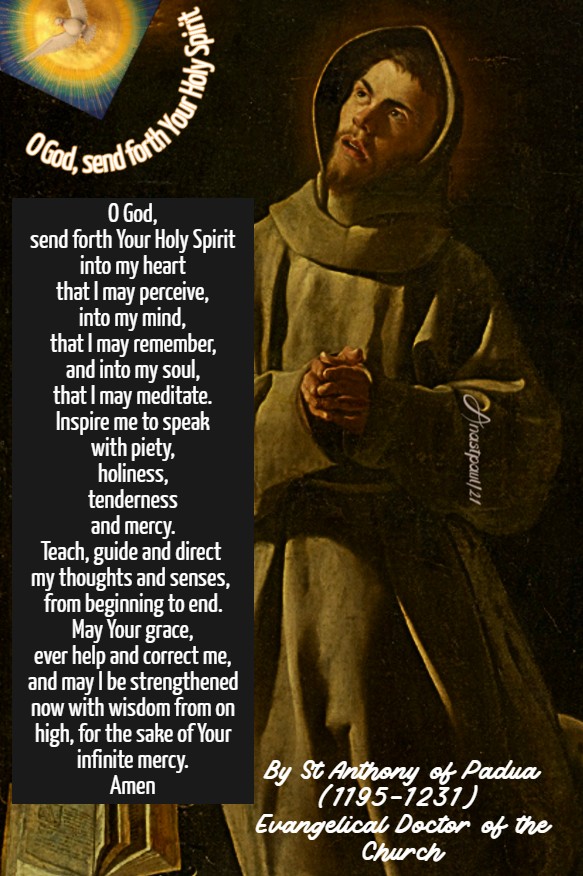
O God, send forth Your Holy Spirit By St Anthony of Padua (1195-1231) Doctor of the Church
O God, send forth Your Holy Spirit into my heart that I may perceive, into my mind, that I may remember, and into my soul, that I may meditate. Inspire me to speak with piety, holiness, tenderness and mercy. Teach, guide and direct my thoughts and senses, from beginning to end. May Your grace, ever help and correct me, and may I be strengthened now with wisdom from on high, for the sake of Your infinite mercy. Amen
St Anthony of Padua (1195-1231) Evangelical Doctor of the Church
One Minute Reflection – 22 July –“Month of the Most Precious Blood” – Feast of St Mary of Magdala – Readings: Song of Solomon 3:1-4, Psalm 63:2-6, 8-9, John 20:1-2, 11-18
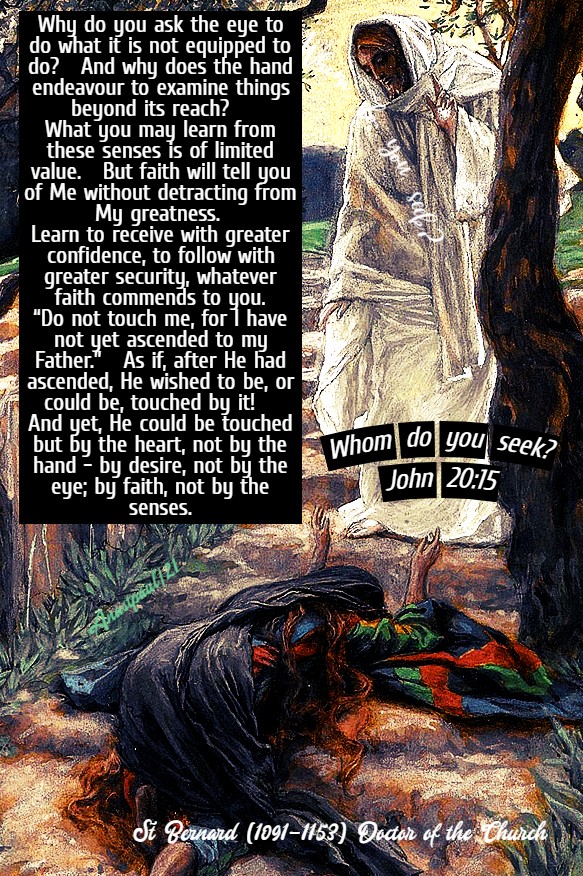
“Whom do you seek?” – John 20:15
REFLECTION – “Only the hearing that catches the Word possesses the truth … “Do not touch me,” says the Lord. He meant: – depend no longer on this fallible sense, put your trust in the Word, get used to faith. Faith cannot be deceived. With the power to understand invisible truths, faith does not know the poverty of the senses; it transcends even the limits of human reason, the capacity of nature, the bounds of experience. Why do you ask the eye to do what it is not equipped to do? And why does the hand endeavour to examine things beyond its reach? What you may learn from these senses is of limited value. But faith will tell you of Me without detracting from My greatness. Learn to receive with greater confidence, to follow with greater security, whatever faith commends to you.
“Do not touch me, for I have not yet ascended to my Father.” As if, after He had ascended, He wished to be, or could be, touched by it! And yet, He could be touched but by the heart, not by the hand – by desire, not by the eye; by faith, not by the senses. “Why do you want to touch Me now?” He says … “Do you not remember that, while I was still Mortal, the eyes of the disciples could not endure, for a short space, the glory of My Transfigured Body that was destined to die? I still accommodate Myself to your senses by bearing this form of a servant (Phil 2:7) which you are accustomed to seeing. But this glory of Mine is too wonderful for you … Defer your judgement, therefore, … With its fuller comprehension, faith will define it more worthily and more surely … They, therefore, will touch Me worthily, who will accept Me as being seated with the Father (Mk 16:19; Ps 110[109]:1), no longer in lowly guise but in My own flesh, transformed with heaven’s beauty. Why wish to touch what is ugly? Have patience, that you may touch Me in My Beauty.” – St Bernard (1091-1153) – Cistercian Monk and Doctor of the Church – Sermons on the Song of Songs, no. 28, 9-10
PRAYER – Almighty, ever-living God, Your only-begotten Son, Jesus Christ made Mary of Magdala the first herald of Easter joy. Grant that, following her example and helped by her prayers, we may, in this life, proclaim the living Christ and come to see Him reigning with You in glory. Through our Lord Jesus Christ, in unity with the Holy Spirit, one God forever and ever, amen.
Our Morning Offering – 22 July – “Month of the Most Precious Blood”
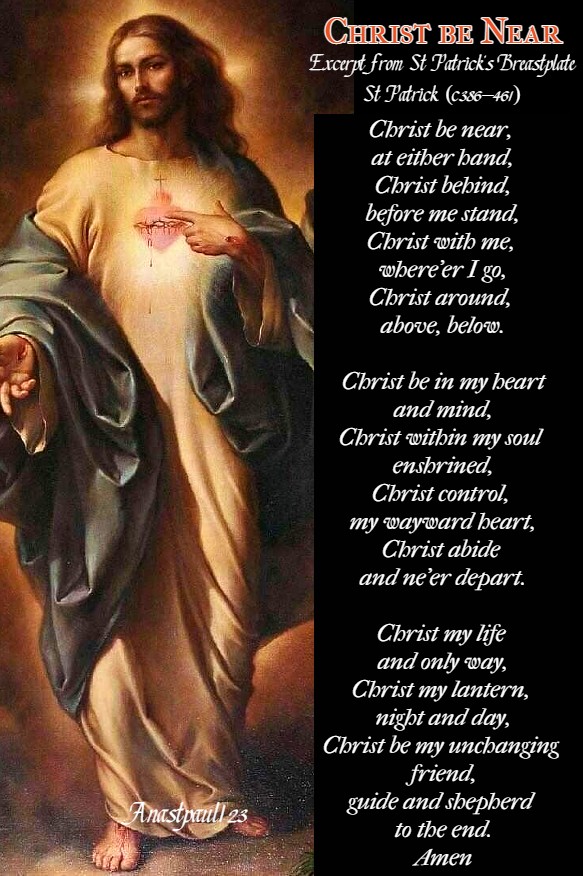
Excerpt from St Patrick’s Breastplate Christ be Near St Patrick (c 386 – 461)
Christ be near, at either hand, Christ behind, before me stand, Christ with me, where’er I go, Christ around, above, below.
Christ be in my heart and mind, Christ within my soul enshrined, Christ control, my wayward heart, Christ abide and ne’er depart.
Christ my life and only way, Christ my lantern, night and day, Christ be my unchanging friend, guide and shepherd to the end.
We have this prayer and his own story in one of the authentic writings of Patrick – his Confessio, which is above all, an act of homage to God for having called Patrick, unworthy sinner, to the apostolate.
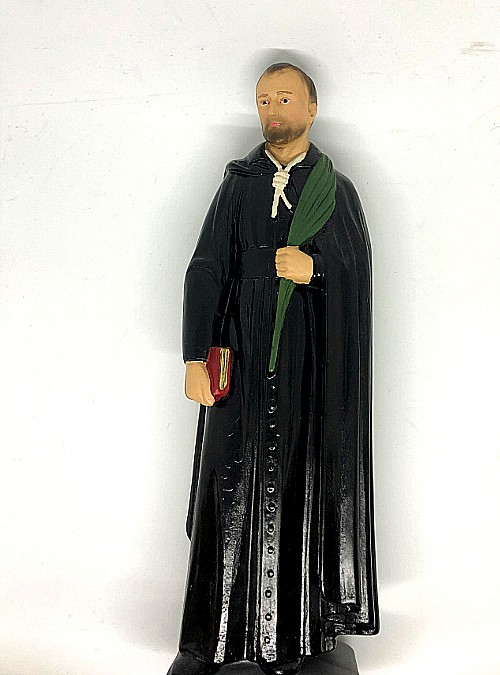
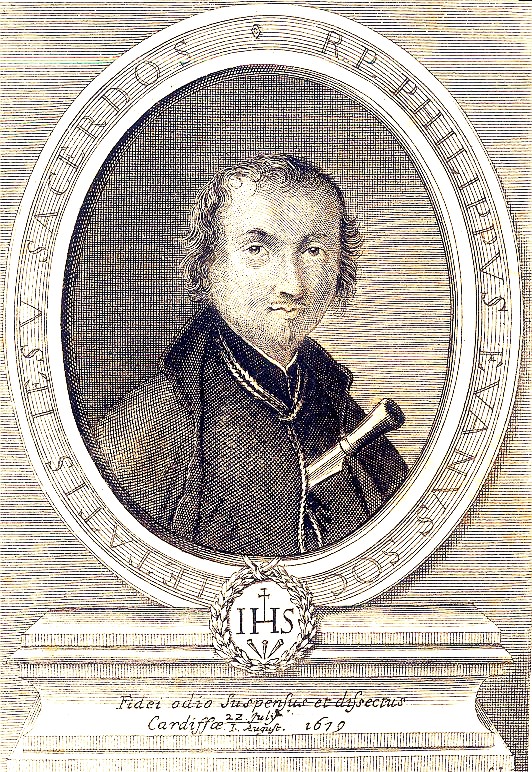
Saint of the Day – 22 July – Saint Philip Evans SJ (1645-1679) Priest ,Martyr, Missionary, Confessor. Born in 1645 in Monmouth, Monmouthshire, Wales and died by being hanged, drawn and quartered 22 July 1679 on Gallows Field in Cardiff, Wales, aged 34 years. Additional Memorial – 25 October as one of the Forty Martyrs of England and Wales,
Philip was born in Wales and studied at the English college at Saint-Omer in Flanders, where he entered the Jesuits and continued his studies. After he was Ordained in 1675, he was missioned back to South Wales where he served four years before he was arrested. During that time he became known for his zeal and charity and was fearless in caring for the Catholics entrusted to him.
He refused to leave Wales when persecution of Catholics increased after the Titus Oates plot of September 1678 falsely accused Jesuits of planning to assassinate King Charles II. The government normally offered a reward of 50 pounds for the arrest of a Jesuit but the local Welsh Magistrate, a staunch Calvinist, offered an additional 200 pounds for the arrest of Father Evans. Despite the threat, he continued serving as the chaplain of Christopher Turberville in Glamorgan, where the constables arrested him after he refused to take the oaths of allegiance and supremacy, which recognised the King as supreme in all religious matters.
For the first three weeks of captivity, Fr Philip remained in solitary confinement in an underground cell. Then he was brought up to the regular prison where he joined Fr John Lloyd, a Diocesan Priest. They waited five months before going to trial on 3 May 1679 because the prosecution could not find witnesses to testify that they were indeed Priests. Eventually a woman and her daughter said that they had received the Sacraments from the Jesuit, which was true. Evans was found guilty of high treason and sentenced to be hanged, drawn and quartered but the execution was deferred until 22 July when the sheriff took both Priests to Gallows Field, outside Cardiff.
Philip is the only one of the many Priests to be Martyred in England and Wales who learned of his execution date while playing tennis. A prisoner in Cardiff Castle, he was allowed to exercise. While he was engaged in a tennis match, he received the news that he would be murdered the next day. Elated by the news, he asked if he could finish the match but was not permitted to do so. Instead, he took up a harp back in his prison cell and sang praise to God for calling him to be a Martyr.
When he mounted the ladder at the gallows, he said: “This is the best pulpit a man can have to preach in, therefore, I can not forbear to tell you again that I die for God and religion’s sake.” At the time of his Martyrdom, Father Evans was 34 years old and had been a Jesuit for 14 years.
The only Marian Feast I can find for today seems to be unverified, in other words, I can find absolutely no references online relating to this invisible Shrine.
St Baudry of Montfaucon St Claudius Marius Victorinus of Saussaye St Cyril of Antioch St Dabius Bl Jacques Lombardie St John Lloyd St Joseph of Palestine St Lewine St Lucia Wang Wangzhi
St Maria Wang Lishi St Meneleus of Ménat St Movean of Inis-Coosery St Pancharius of Besancon Bl Paolo de Lara St Philip Evans SJ (1645-1679) Priest Martyr St Plato of Ancyra St Syntyche of Philippi St Theophilus of Cyprus
Martyrs of Marula/Massylis: – 3 saints: Three Christians martyred together. We know nothing else about them but the names – Ajabosus, Andrew and Elian. They were martyred in Massylis (Marula), Numidia (in modern Algeria).
Martyrs of Massilitani: A group of Christians martyred together in northern Africa. Saint Augustine of Hippo wrote about them.
Martyred in the Spanish Civil War: Bl Jaime María Carretero Rojas Bl Joaquin Rodríguez Bueno Bl José María Mateos Carballido Bl Juan Durán Cintas Bl Ramón María Pérez Sous
Thought for the Day – 21 July – Meditations with Antonio Cardinal Bacci (1881-1971)
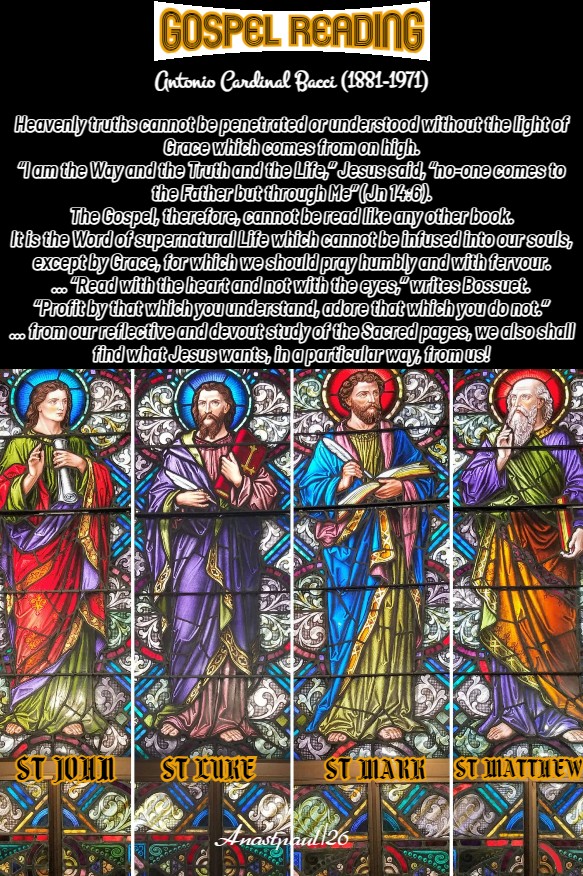
Gospel Reading
“It is not enough to read and to meditate on the Gospel. We should do so with the correct dispossition, which are three in number. In the first place, we should read the Gospel with the recollection of one who prays, “Prayer must often interrupt reading,” says St Bonaventure. Now and again, while we are reading, we should lift our minds to God and ask Him to enlighten us and to inspire us, towards greater fervour.
Heavenly truths cannot be penetrated or understood without the light of Grace which comes from on high. “I am the Way and the Truth and the Life,” Jesus said, “no-one comes to the Father but through Me” (Jn 14:6). The Gospel, therefore, cannot be read like any other book. It is the Word of supernatural Life which cannot be infused into our souls, except by Grace, for which we should pray humbly and with fervour.
In the second place, we should read slowly and reflectively. “Read with the heart and not with the eyes,” writes Bossuet. “Profit by that which you understand, adore that which you do not”
In the Gospel, there is always something which is applicable to ourselves and to the particular circumstances in which we find ourselves. The Saints found there, their own particular road to sanctity, to which they had been called; from our reflective and devout study of the Sacred pages, we also shall find what Jesus wants, in a particular way, from us!”
Quote/s of the Day – 21 July – “Month of the Most Precious Blood” and the Memorial of St Lawrence of Brindisi OFM Cap (1559-1619) Doctor of the Church
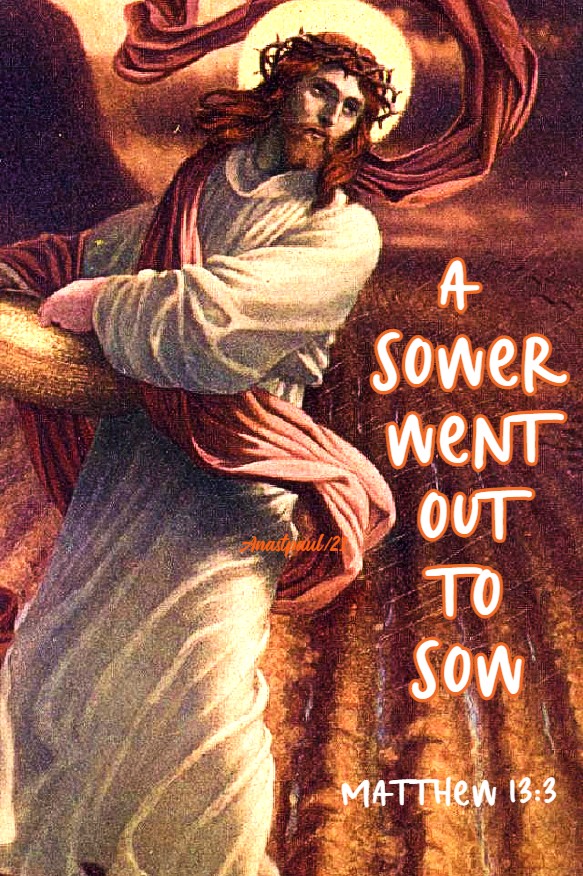
“A sower went out to sow”
Matthew 13:3
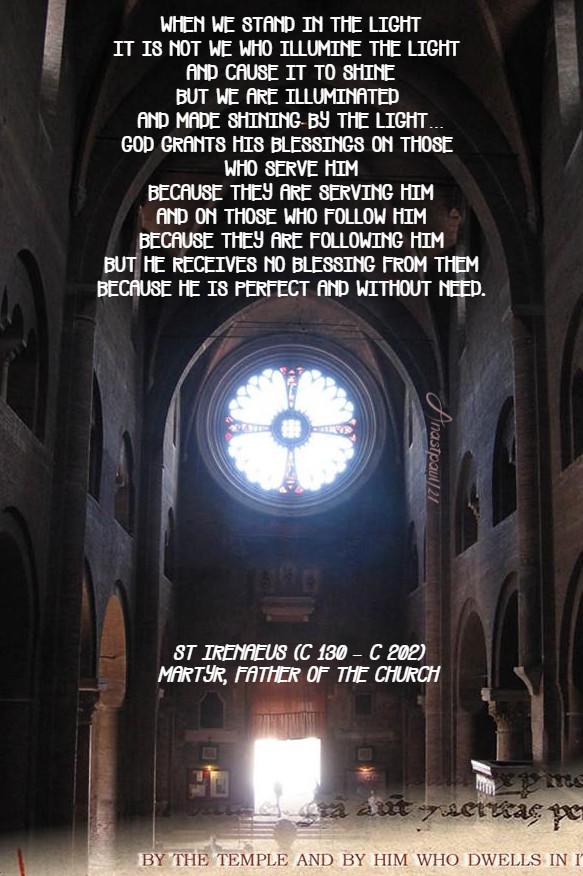
“When we stand in the light it is not we who illumine the light and cause it to shine but we are illuminated and made shining by the light… God grants His blessings on those who serve Him because they are serving Him and on those who follow Him because they are following Him but He receives no blessing from them because He is perfect and without need.”
St Irenaeus (c 130 – c 202) Bishop & Martyr, Father of the Church
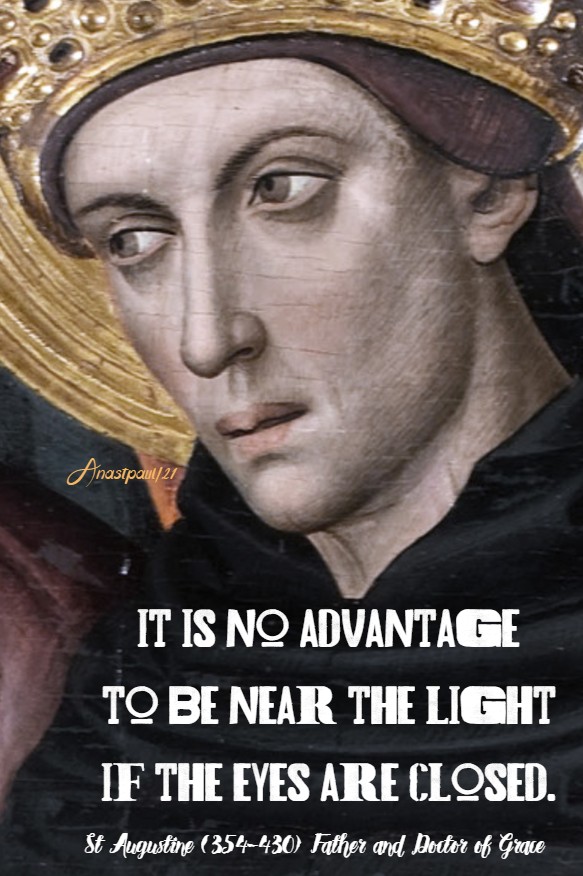
“It is no advantage to be near the light, if the eyes are closed.”
St Augustine (354-430) Father and Doctor of Grace
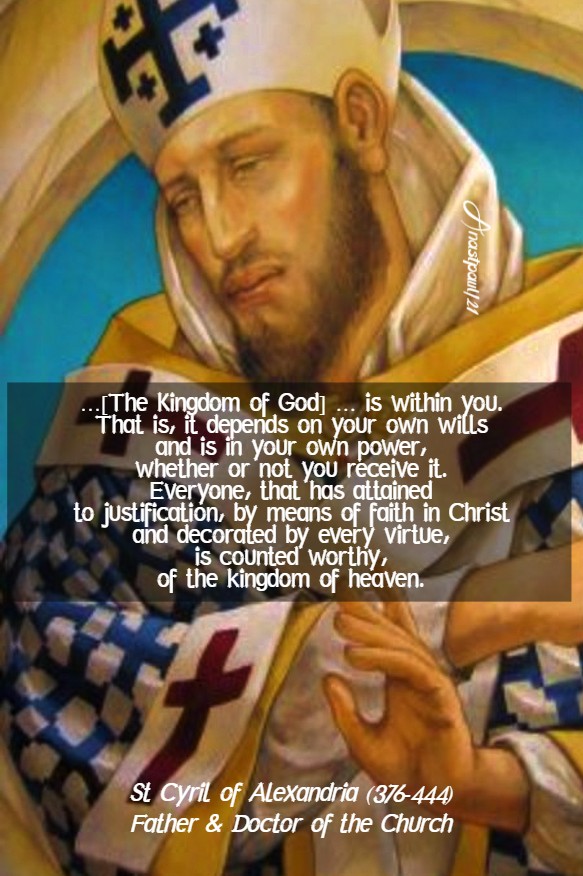
“… [The Kingdom of God] … is within you. That is, it depends on your own wills and is in your own power, whether or not you receive it. Everyone, that has attained to justification, by means of faith in Christ and decorated by every virtue, is counted worthy, of the kingdom of heaven.”
St Cyril of Alexandria (376-444) Father and Doctor of the Church
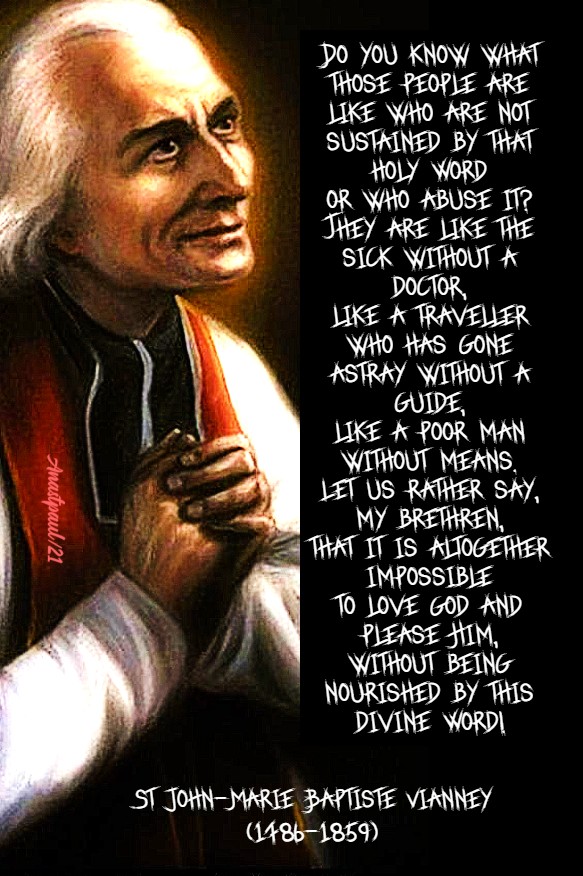
“Do you know what those people are like who are not sustained by that holy Word or who abuse it? They are like the sick without a doctor, like a traveller who has gone astray without a guide, like a poor man without means. Let us rather say, my brethren, that it is altogether impossible to love God and please Him, without being nourished by this divine Word!”
St John-Marie Baptiste Vianney (1786-1859)
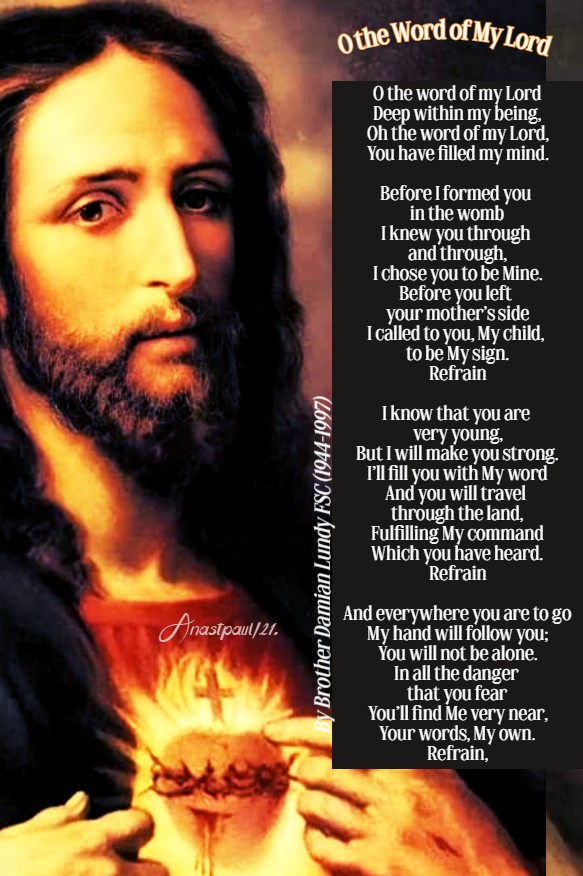
O the Word of My Lord Song of a Young Prophet By Brother Damian Lundy FSC (1944-1997)
O the word of my Lord Deep within my being, Oh the word of my Lord, You have filled my mind.
Before I formed you in the womb I knew you through and through, I chose you to be Mine. Before you left your mother’s side I called to you, My child, to be My sign. Refrain
I know that you are very young, But I will make you strong. I’ll fill you with My word And you will travel through the land, Fulfilling My command Which you have heard. Refrain
And everywhere you are to go My hand will follow you; You will not be alone. In all the danger that you fear You’ll find Me very near, Your words, My own. Refrain,
This hymn, based on Jeremiah 1, was composed by English Brother and teacher Brother Damian Lundy of the De La Salle Order. It is sometimes referred to as “Song of a Young Prophet.”
One Minute Reflection – 21 July – “Month of the Most Precious Blood” – Readings:Exodus 16: 1-5, 9-15; Psalms 78: 18-19, 23-24, 25-26, 27-28; Matthew 13: 1-9
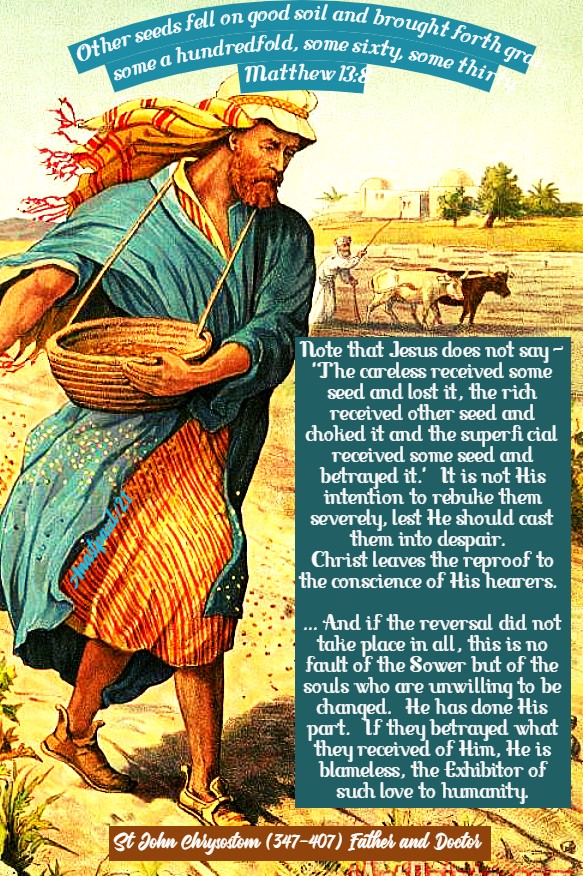
“Other seeds fell on good soil and brought forth grain, some a hundredfold, some sixty, some thirty.” – Matthew 13:8
REFLECTION – “Note that Jesus does not say – ‘The careless received some seed and lost it, the rich received other seed and choked it and the superficial received some seed and betrayed it.‘ It is not His intention to rebuke them severely, lest He should cast them into despair. Christ leaves the reproof to the conscience of His hearers. Remember also, in the parable of the net that much was gathered which was unprofitable. But He speaks this parable as if to anoint His disciples and to teach them, that they are not to be despondent ,even though those lost may be more than those who receive the word. It was with this same ease that the Lord Himself continued to sow, even He who fully foreknew the outcomes.
But why would it be reasonable to sow among thorns or on rocks or on the pathway? With regard to the seeds and the earth it cannot sound very reasonable. But in the case of human souls and their instructions, it is praiseworthy and greatly to be honoured. For the farmer might be laughed at for doing this, since it is impossible for a rock to bear fruit. It is not likely that the path will become anything but a path or the thorns anything but thorns. But with respect to the rational soul, this is not so predictable. For here there is such a thing as the rock changing and becoming rich land. Here it is possible, that the wayside might no longer be trampled upon or lie open to all who pass by but that it may become a fertile field. In the case of the soul, the thorns may be destroyed and the seed enjoy full security. For had it been impossible, this sower would not have sown. And if the reversal did not take place in all, this is no fault of the Sower but of the souls who are unwilling to be changed. He has done His part. If they betrayed what they received of Him, He is blameless, the Exhibitor of such love to humanity.
But mark this carefully: there is more than one road to destruction. There are differing ones and wide apart from one another. For they who are like the wayside are the coarse-minded and indifferent and careless but those on the rock – such as fail from willed weakness only.” – St John Chrysostom (347-407) Father and Doctor – The Gospel of Matthew: Homily,44
PRAYER – Holy, almighty God, You sent Your prophets and then Your only Son to teach us and lead us to eternal life. Remember Lord, Your solemn covenant, renewed and consecrated by the blood of the Lamb, so that Your people may obtain forgiveness for their sins and a continued growth in grace. Send us Your Spirit, to enlighten our hearts and minds and grow in love for You and the Word made flesh. Guide us in our understanding and living, by the Words of the Word. Holy Mother Mary intercede for us, that we may merit to be co-heirs of His Kingdom. Who lives and reigns with You in the unity of the Holy Spirit, one God, forever, amen.
Our Morning Offering – 21 July – “Month of the Most Precious Blood”
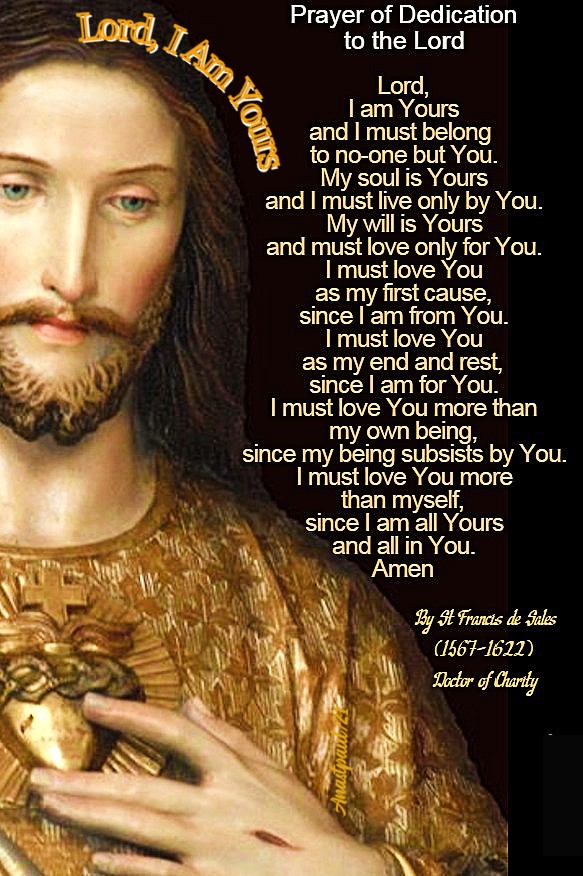
Lord, I Am Yours Prayer of Dedication to the Lord By St Francis de Sales (1567-1622) Doctor of Charity
Lord, I am Yours and I must belong to no-one but You. My soul is Yours and I must live only by You. My will is Yours and must love only for You. I must love You as my first cause, since I am from You. I must love You as my end and rest, since I am for You. I must love You more than my own being, since my being subsists by You. I must love You more than myself, since I am all Yours and all in You. Amen
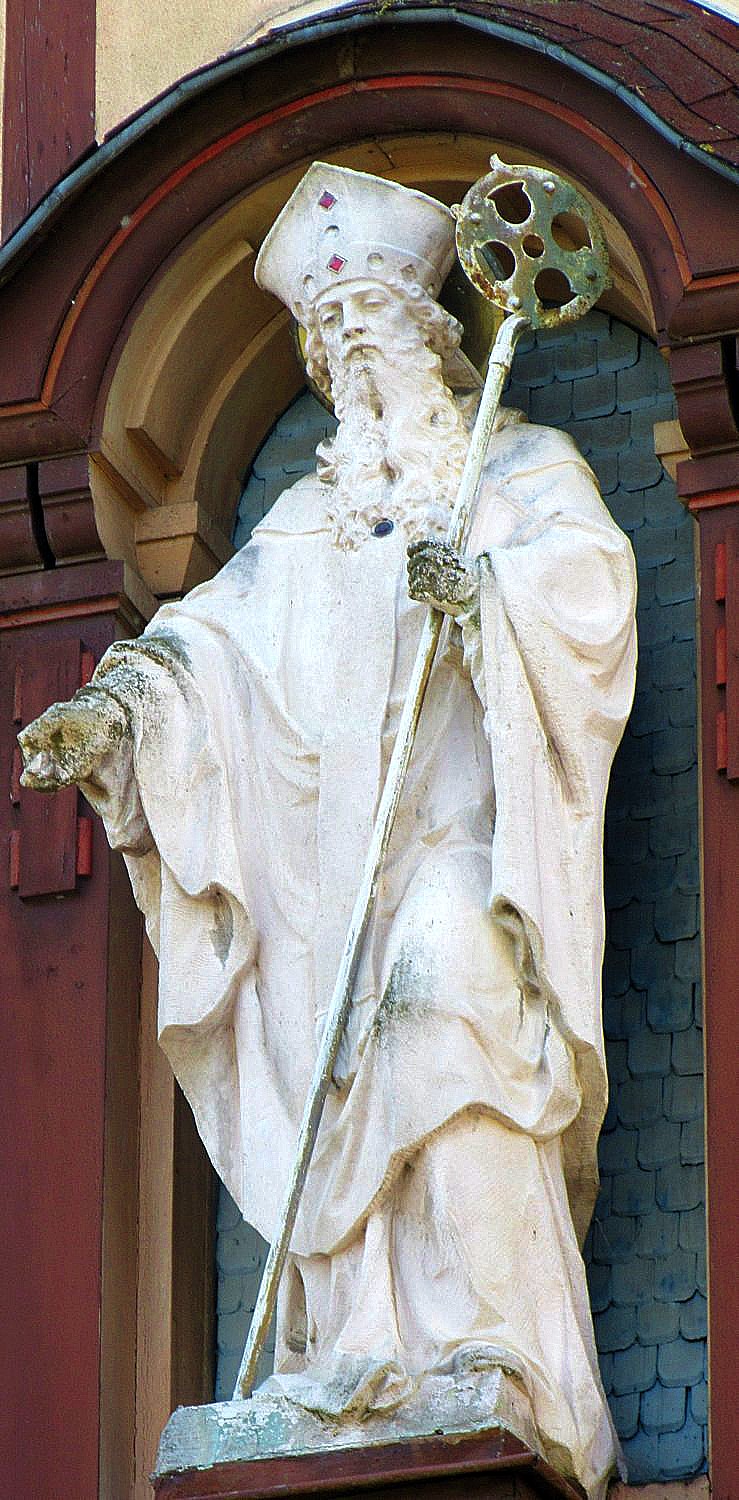
Saint of the Day – 21 July – Saint Arbogast of Strasbourg (Died 678) Bishop of Strasbour, Missionary, Monk, Hermit, Confessor, miracle-worker. Born as Arascach (Irish) in the 7th century in Ireland and died in 678 in Strasbourg of natural causes. Patronage – St Arbogast is the Principal Patron of the Diocese and City of Strasbourg. T he Roman Martyrology states: “At Strasbourg, St Arbogastus, a Bishop, renowned for miracles.”
We have very little historical information of his life, other than that he came to Francie, lived as a Hermit quickly gathering a reputation for wisdom and holiness. He was then appointed Bishop of Strasbourg and is venerated as the saint who brought Christianity to the Alsace. Because of this, the Christian name “Arbogast” became especially popular in the region. His origin is generally believed to be Ireland,
According to the vita, a 10th-century hagiographical account of his life, Arbogast found a warm friend in the King Dagobert II of Austrasia, who reigned between 673-679. On Dagobert’s accession, Arbogast was appointed Bishop of Strasbourg and was famed for sanctity and miracles.
Still according to the vita, Arbogast brought back to life Dagobert’s son, Siegebert, who had been killed by a fall from his horse. Siegebert had been boar hunting with his father’s huntsmen in forests and became separated from the others. He encountered a boar and his startled horse reared, throwing him and trampling him while his foot was caught in his stirrup. His companions found him and took him home, where he died the next day. King Dagobert summoned Arbogast,and the holy man prayed to Mary, Mother of God – as she had carried the life of the entire world, would she not intercede for the life of this one boy? Siegebert stood up in his burial shroud. When the King offered Bishop Arbogast money in reward, he declined, suggesting instead, that land be donated to build a Cathedral at Strasbourg..
St Arbogast’s prayers raise King Dagobert’s son to life
His life as a Hermit in the forest of Haguenau is the domain of legend. But what is true is that the great Bishop Arbogast, installed throughout his territory, Monasteries intended to shine the light of the Gospel in the pagan countryside: – let us mention the Abbey of Surbourg, in the forest of ‘Haguenau and, near Strasbourg, an Abbey which will later bear the name of our saintly Bishop.
Knowing that “it is the Lord who builds up the city,” he put his hope in the prayers of his Monks. Arbogast himself had a great devotion to Saint Martin of Tours, to whom he dedicated, the Monastery of Surbourg.
For six years, he was thus the Good Shepherd of his Church, filled with divine Wisdom, holy virility and fatherly goodness. He spoke the Word of God in the power of the Holy Spirit. Thus his Church experienced a true Christian renewal, he himself deserved to enter into the joy of his Lord as a good and faithful servant and to receive from Christ, the Prince of Shepherds, the incorruptible crown of glory (En.).
According to the vita, he died in 678. His body was buried in the City cemetery and near his grave stood a Chapel, which he had dedicated to Saint Michael. Later, his relics were transferred in part to the Saint-Arbogast Monastery, near Strasbourg, where, his memory is celebrated every year as a Monk and Bishop of great holiness and miracles..
St Arbogast appears on the Coat of Arms of Batzendorf and today, on his Feast, a special Mass, granted by the Holy Father, is celebrated in his honour.
Strasbourg Cathedral`
Collect: O God, you wanted Blessed Arbogast, Your confessor and Pontiff, to become wholeheartedly, he model of his flock; grant us to realise, under his protection in our deeds, what he taught by the word of his mouth.
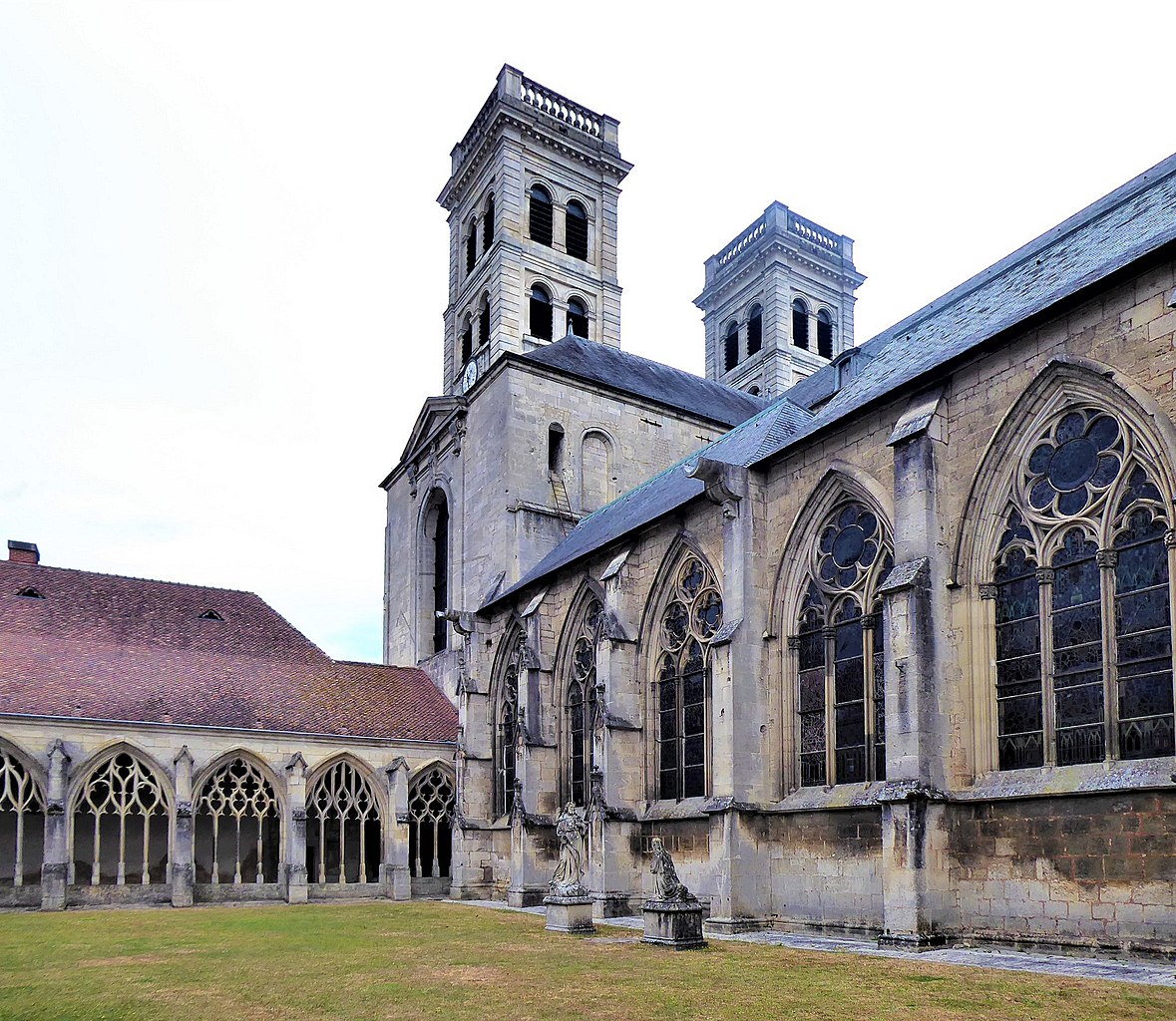
Notre-Dame-de-Verdun / Our Lady of Verdun, Lorraine , France (5th Century) – 21 July:
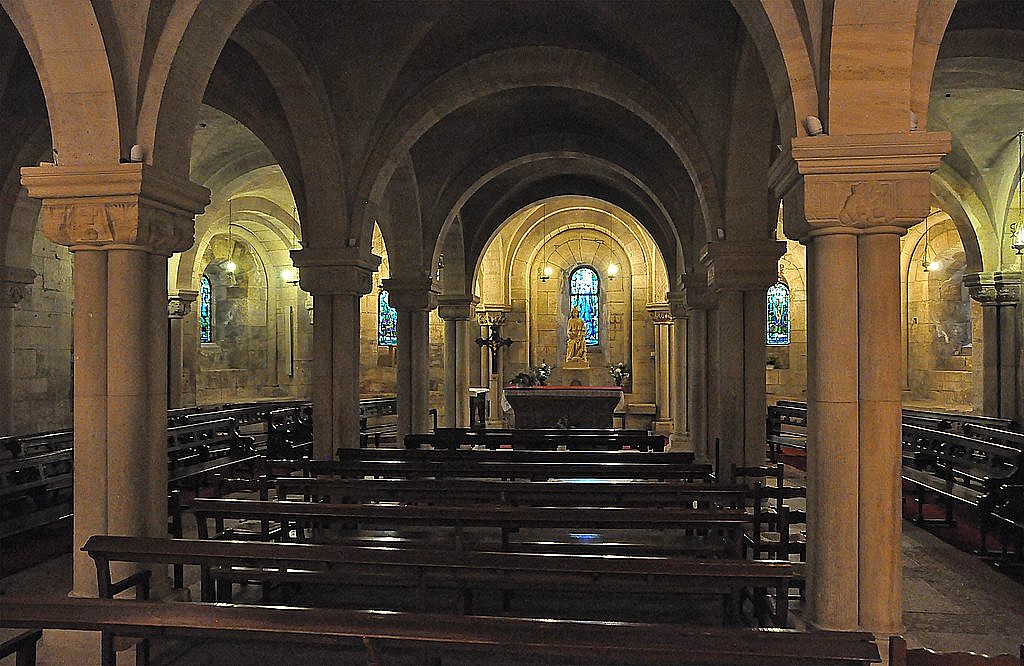
The present Cathedral of Notre-Dame-de -erdun is both a Cathedral and a national monument of France. It has a long and ancient history. It was in about the year 330 when Saint Sanctinus, a disciple of Saint Denis, converted the City of Verdun to the True Faith and later ,made it an Episcopal City when he became its first Bishop. He built a Church there in honour of Saints Peter and Paul. In the year 457 Saint Pulchrone, built the first Church located at the site where Our Lady of Verdun is presently located. The fifth Bishop of Verdun, Saint Pulchrone, built the Church inside the walls of the City on ancient Roman ruins. This Church was actually named to honour of the Blessed Virgin Mary as Mother of God, a title that had recently been confirmed at the Councils of Ephesus and Chalcedon. It was at the Council of Ephesus in 431 that Mary was formally affirmed to be Theotokos, “God-bearer,” or “the one who gives birth to God.” At Chalcedon, the nature of Christ was formally defined, teaching that He was God and man, “one and the same Christ, Son, Lord, Only-begotten, known in two natures, without confusion, without change, without division, without separation.” With this definition Mary was shown to be the Mother of God and not just of Our Lord in His human nature. The Church and Our Lady of Verdun was celebrated for numerous miracles. In the year 990, Bishop Heimon built a new Cathedral to Our Lady of Verdun, and in the 12th century a choir and two portals were added. In 997, the Emperor Otto III conferred on this Bishop Heimon, or Haymon, the title of Count, making him and his successors Episcopal Counts. The Cathedral was consecrated by Pope Eugene III in 1147. In the 14th century the flat wooden ceiling was replaced with a vaulted ceiling and side-Chapels were added to the nave. Another side Chapel, dedicated to the Blessed Virgin of the Assumption, was built in the 16th century. In 1755 the roof and towers were hit by lightning, which set them both on fire, which did significant damage to the Church. In 1760 the Church was repaired and rebuilt in the Neo-Classical style.
The Cathedral was once again severely damaged in World War I, as it was hit by artillery rounds in the Battle of Verdun, which destroyed the towers. The crypt was rediscovered during the renovation that went on until the year 1936 and a re-inauguration took place in 1935. The millennial celebration of the Cathedral took place in 1990. The Arbennes family were the Counts of Verdun, and Godfrey of Bouillon was a member of that family. Godfrey gave up his right to the title before leaving on the First Crusade.
St Lawrence of Brindisi OFM Cap (1559-1619) Doctor of the Church (Optional Memorial) St Lawrence is known as the “Franciscan Renaissance Man” – he was a Religious member of the Franciscan Friars Minor Capuchin, a Priest, Theologian, Vicar General of the Franciscans, Language scholar, Apologist of immense and calm resources, Humanist, Philosopher, Biblicist, Preacher, Missionary, Professor, International Administrator, Confidant of Popes, Emperors, Kings and Princes, Diplomatic envoy, Army Chaplain, Military Strategist and Morale builder, Polemicist, Prolific writer. Biography: https://anastpaul.com/2018/07/21/saint-of-the-day-21-july-st-lawrence-of-brindisi-ofm-cap-1559-1619-doctor-of-the-church-the-franciscan-renaissance-man/
Bl Agrícola Rodríguez García de Los Huertos St Alberic Crescitelli
St Arbogast of Strasbourg (Died c 678) Bishop St Barhadbescialas St Benignus of Moyenmoutier Bl Claudius of Avignon St Claudius of Troyes St Corona of Marceille Bl Cristóbal López de Valladolid Orea Bl Daniel Molini St Daniel the Prophet St Eleutherius of Marseille St Eternus of Evreaux Bl Gabriel Pergaud St Iosephus Wang Yumei St John of Edessa St John of Moyenmoutier Bl Juan de Las Varillas Bl Juan de Zambrana St Jucundinus of Troyes St Julia of Troyes St Justus of Troyes Bl Parthenius of Thessaly St Praxides of Rome St Simeon Salus
St Wastrada St Zoticus of Comana — Martyrs of Africa – 6 saints: Six Christians who were martyred together. We know no other details about them but the names – Emilian, Hugal, Motanus, Saphus, Stercorius and Victor. They were martyred in an unknown location in Africa, date unknown.
Thought for the Day – 20 July– Meditations with Antonio Cardinal Bacci (1881-1971)
The Surest Way to Avoid Sin
“The surest way of never offending God, is to love Him. If we love God sincerely, it will be impossible for us to offend Him. “Love,” says St Paul, “is the fulfilment of the Law,” (Rom 13:10) and charity “is the bond of perfection” (Col 3:14). If all our actions are inspired by the love of God, it will not matter how insignificant they are, for they will be pleasing to Him and will gain merit for ourselves. Then it will be impossible for us to sin.
If most of our actions, on the other hand, are dictated by an inordinate attachment to creatures and to ourselves, they will certainly not lead us to God. Our hearts need love and cannot live without it. But whom shall we love if we do not love God, Who is our Creator and Redeemer? We shall find love or a moment in beauty, in goodness and in pleasure but, it will soon pass away and leave us with empty hearts. God is our highest good and only He can fully satisfy our hearts. But He wishes us to belong completely to Himself.
Our hearts are too tiny to be divided between God and creatures. We must belong entirely to God. If we love Him sincerely, all created things will form a ladder, which will help us to ascent to Him. Let us love God and remain united to Him in all our actions. Then sin will never find it’s way into our souls.”
Quote/s of the Day – 20 July – “Month of the Most Precious Blood” – Readings: Exodus 14: 21 – 15: 1; Exodus 15: 8-9, 10 and 12, 17; Matthew 12: 46-50
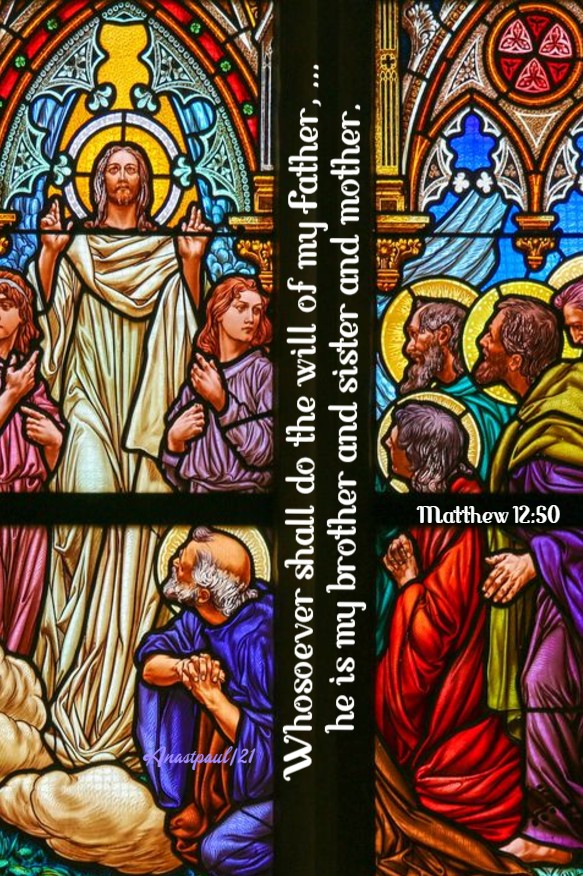
“Whosoever shall do the will of my Father, … he is my brother and sister and mother.”
Matthew 12:50
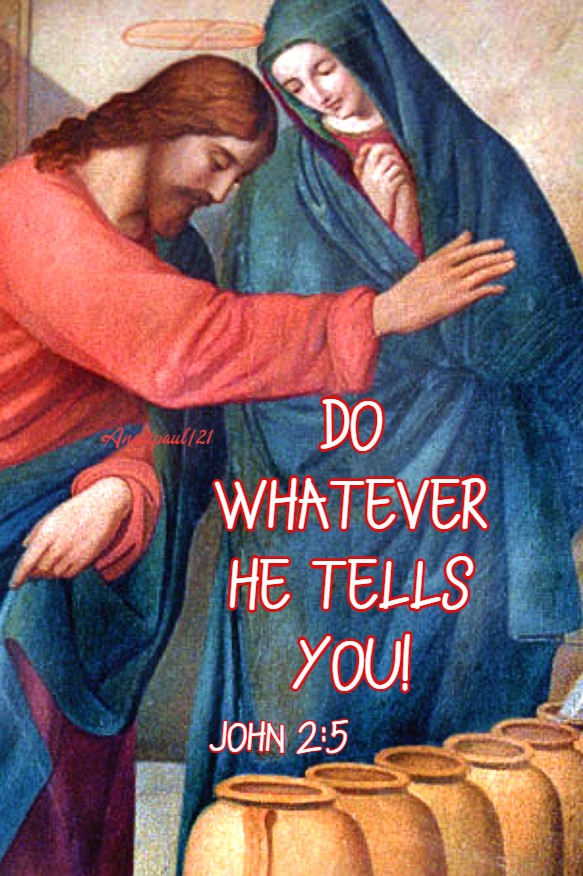
“Do whatever he tells you.”
John 2:5
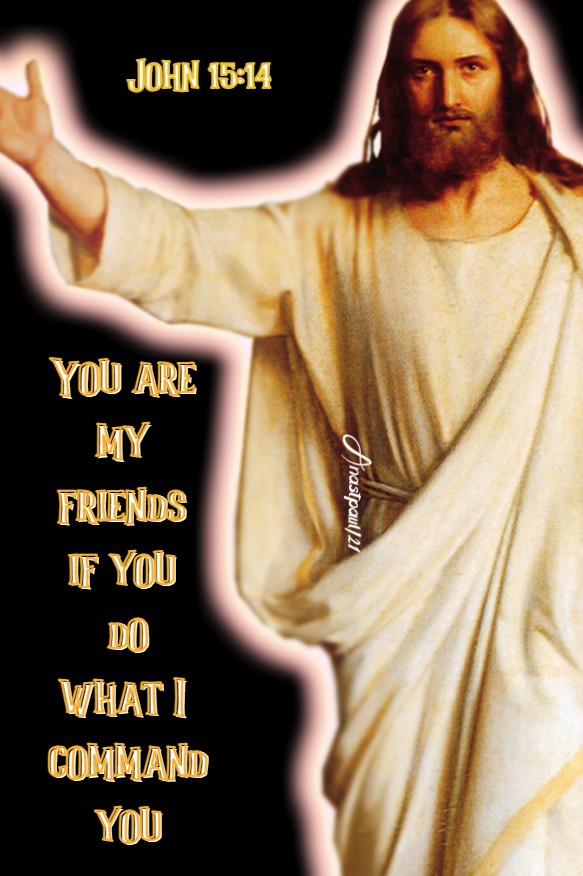
“You are my friends, if you do the things that I command you.”
John 15:14
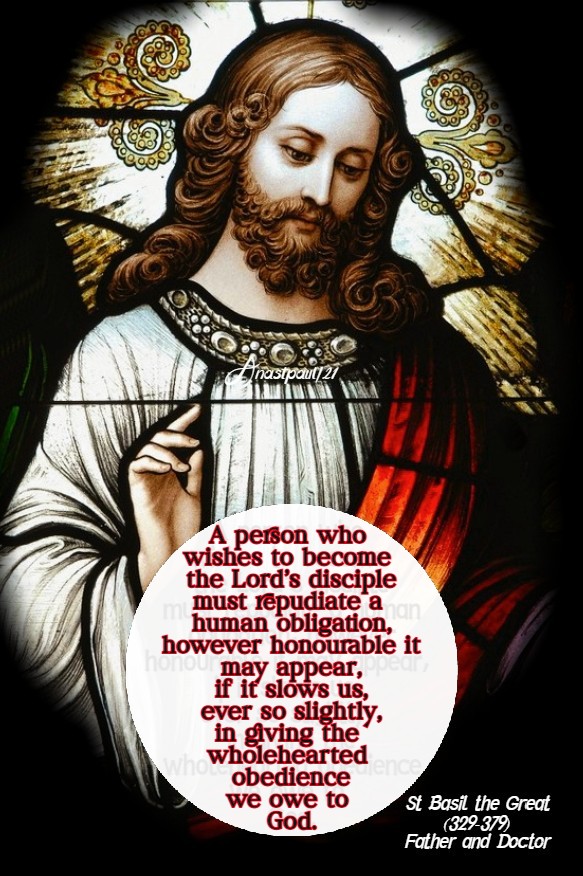
“A person who wishes to become the Lord’s disciple must repudiate a human obligation, however honourable it may appear, if it slows us, ever so slightly, in giving the wholehearted obedience we owe to God.”
St Basil the Great (329-379) Father and Doctor of the Church
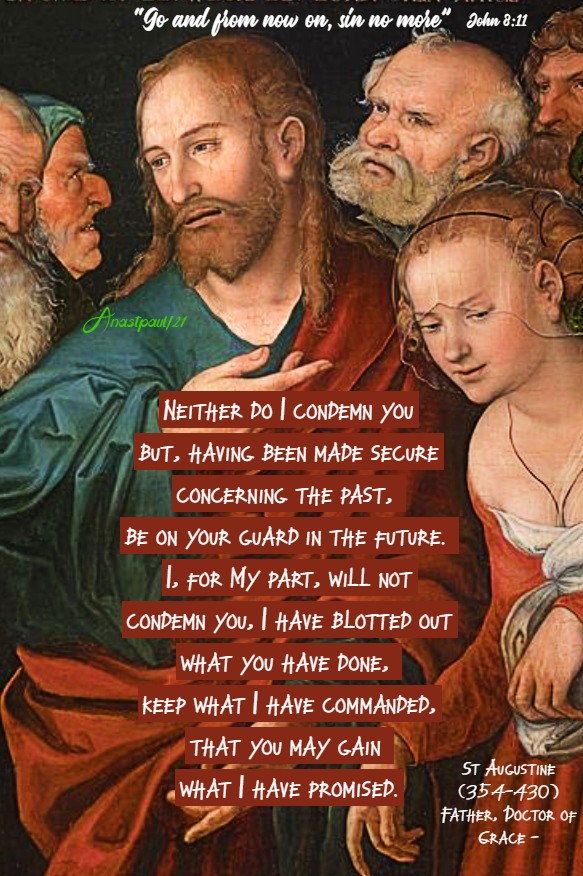
“Neither do I condemn you but, having been made secure concerning the past, be on your guard in the future. I, for My part, will not condemn you, I have blotted out what you have done; keep what I have commanded, that you may gain what I have promised.”
St Augustine (354-430) Father & Doctor of Grace
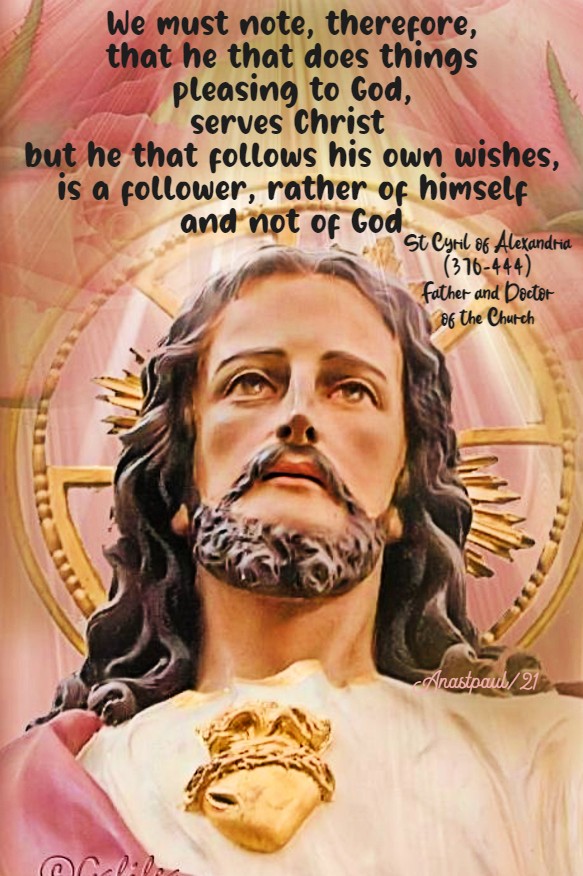
“We must note, therefore, that he that does things pleasing to God, serves Christ but he that follows his own wishes, is a follower, rather of himself and not of God.”
One Minute Reflection – 20 July – “Month of the Most Precious Blood” – Readings: Exodus 14: 21 – 15: 1; Exodus 15: 8-9, 10 and 12, 17; Matthew 12: 46-50
“And pointing to his disciples, he said, “Behold my mother and my brothers!” – Matthew 12:49.
REFLECTION – “.“His Mother is the whole Church, since it is she, who, by God’s grace, gives birth to Christ’s members, that is to say, those who are faithful to Him. Again, His Mother is every holy soul who does the Father’s will and whose fruitful charity is made known in those, to whom she gives birth for Him, “until he has been formed in them” (cf Gal 4:19)…St Augustine (354-430) Father & Doctor” – St Augustine (354-430) Bishop of Hippo, Father and Doctor of Grace of the Church – Sermon 72
PRAYER – Almighty Father, You made us Your children, You called us from all ages and You formed us by Holy Mother Church. Grant, we pray, that by Your grace, we may be ever faithful to her and be guided by Your Holy Spirit of love. O God may YourMother and ours and Your holy Angels and Saints intercede for us that, being made imitators of the Lord’s Passion, we may merit to be co-heirs of His Kingdom. Who lives and reigns with You in the unity of the Holy Spirit, one God, forever, amen.
Our Morning Offering – 20 July – “Month of the Most Precious Blood”
Our Lord, King of all! By St Albert the Great (1200-1280) Doctor of the Church
We pray to You, O Lord, who are the supreme Truth, and all truth is from You. We beseech You, O Lord, who are the highest Wisdom, and all the wise depend on You for their wisdom. You are the supreme Joy, and all who are happy owe it to You. You are the Light of minds and all receive their understanding from You. We love, we love You above all. We seek You, we follow You, and we are ready to serve You. We desire to dwell under Your power for You are the King of all. Amen.
Saint of the Day – 20 July – Saint Joseph Barsabbas the Just (1st Century) Disciple of Jesus, Martyr Bishop. Also known as – Justus, Barsabbas, Joseph Basassas, Joseph of Barsabas, Joseph the Just.
The Roman Martyrology states today: “The birthday of the blessed Joseph, surnamed the Just, whom the Apostles selected with the blessed Matthias, for the Apostleshop in the place of the traitor, Judas. The lot having fallen upon Matthias, Joseph, notwithstanding, continued to preach and advance in virtue and after having sustained from the Jews, many persecutions for the Faith of Christ, happoily ended his life in Judea.”
“Wherefore, of these men who have companied with us all the time that the Lord Jesus came in and went out among us; beginning from the baptism of John, until the day wherein he was taken up from us, one of these must be made a witness with us of his resurrection. And they appointed two, Joseph, called Barsabas, who was surnamed Justus,and Matthias. And praying, they said: Thou, Lord, who knowest the heart of all men, shew whether of these two thou hast chosen, to take the place of this ministry and apostleship, from which Judas hath, by transgression fallen, that he might go to his own place. And they gave them lots and the lot fell upon Matthias and he was numbered with the eleven apostles.” ― Acts 1:21 – 26 D-R
St John Chrysostom writes, “The other candidate (Joseph) was not annoyed, for the apostolic writers would not have concealed failings of their own, seeing they have told of the very chief Apostles, that on other occasions had indignation and not only once but again and again.”
It clear that Joseph Barsabbas (also called “Justus”) must have spent much time with the Apostles and witnessed many of the wondrous events in the life of Jesus. Further identification of Joseph is uncertain. In Christian tradition he is numbered among the Seventy disciples mentioned in Luke 10:1–24, although the biblical text mentions no names. “After these things the Lord appointed other seventy also and sent them two and two before his face into every city and place, whither he himself would come.” (10:1)
Very little is known about Joseph Barsabbas outside of the apostle selection by lots. Tradition believes that he went to Eleutheropolis (about 25 miles from Jerusalem) where he became Bishop Justus of Eleutheropolis. The town was renamed over the centuries. Its original Aramaic name Beth Gabra, translates as the “house of the mighty one.” The Romans gave it the Greek name, Eleutheropolis, meaning “City of the Free.”
Rev Alban Butler says – “After the dispersion of the disciples he preached the gospel to many nations and among other miracles, drank poison without receiving any hurt, as Papias and from him ,Eusebius, testify. This saint, from his extraordinary piety, was surnamed the Just.“
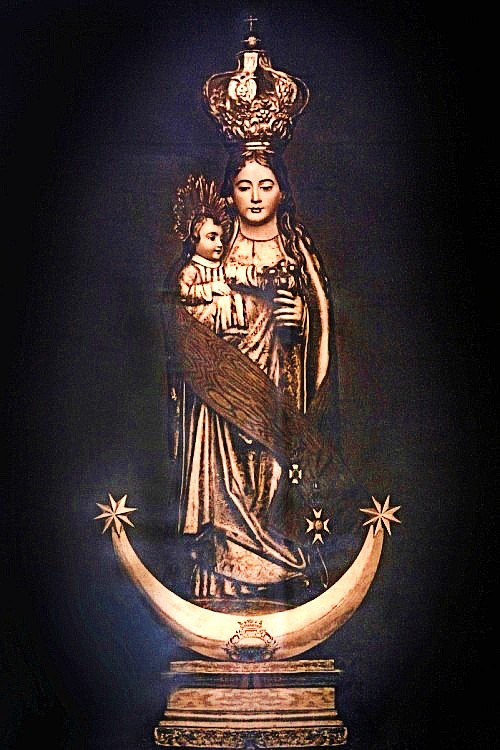
Nuestra Señora de Zocueca / Our Lady of Zocueca, Bailén, Jaén, Andalucía, Spain (1808 – 20 July:
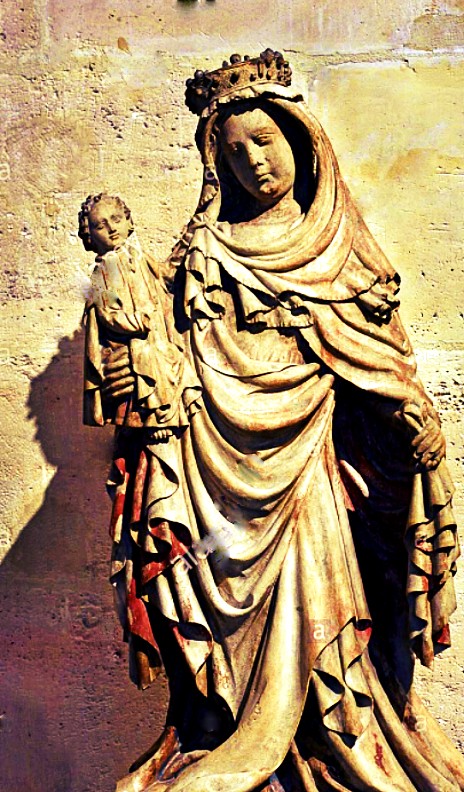
Around 1150, Mozarabic Christians built a rudimentary Chapel near the Rumblar River, the Guadalquivir tribuitary that waters this region in southern Spain, at a place called Zocueca. When Alfonso VII reconquered the area in 1155, people gave thanks to the Virgin at the Shrine. In the 1400s it was was rebuilt, and from this period the graceful, standing Gothic Statue of the Mother and Child seems to date, although tradition holds it to be older than the first Chapel.
During the cholera epidemic of 1681, the people vowed to hold an annual feast in honour of the Virgin, preceded by a day of fasting, if she would save them. The promise has been kept on 5 August ever since. The Chapel was re-decorated in Baroque style in the 1700s.
In 1808, people again thanked the Virgin of Zocueca for her help during the Battle of Bailén, the first Spanish victory against Napoleon. Annually since 1810, the municipality commemorates the battle with a series of civil, patriotic, and religious events from 17-22 July, reaching their greatest splendour on the 20th, when the Patroness, the Virgin of Zocueca, goes through the City streets in procession. Another event in her honour, the romería or pilgrimage, takes place on the last Sunday in September in thanks for her help in ending a plague of locusts which threatened the region’s crops in the late 1800s. Men carry the Statue, bristling with decorations, on their shoulders from its usual home in the Church of the Incarnation in Bailén, to the Sanctuary four miles distant, where overnight vigil is kept before a sunrise Mass. In 1925, the Virgin of Zocueca was proclaimed “Captain General” and her Statue given a military sash. After the Statue burned in the Civil War, religious sculptor Jose Maria Alcacer made a replica, blessed on 5 August1954.
Bl Anne Cartier St Ansegisus St Aurelius of Carthage St Cassian of Saint Saba St Chi Zhuze St Elijah the Prophet
St Elswith
Blessed Gregory Lopez (1542-1596) “The Mystery Man” – Hermit, Spiritual Advisor, Writer. Around 1585, word of a “Mystery Man” began to leak into Mexico City, a strange hermit who lived out in the lonely valley of Guesteca, who walked miles to go to Mass, lived totally subject to “Lady Poverty” and had travelled from the Shrine of Our Lady of Guadalupe in Spain (which dates from 712), to her Shrine in Mexico (which dates from 1531). Biography: https://anastpaul.com/2018/07/20/saint-of-the-day-20-july-blessed-gregory-lopez-1542-1596/
St Joseph Barsabbas the Just (1st Century) Disciple of Jesus, Bishop, Martyr
St José María Díaz Sanjurjo St Joseph Barsabas
Blessed Luigi Novarese (1914-1984) Priest, Apostle of the Sick, Co-Founder. Blessed Luigi with Sr Psorulla, founded the Apostolate of the Suffering as well as the Silent Workers of the Cross. He also established the Marian Priest League and the Brothers and Sisters of the Sick. He built several homes for those who were ill and disabled. Blessed Luigi’s life: https://anastpaul.com/2020/07/20/saint-of-the-day-20-july-blessed-luigi-novarese-1914-1984/
St Maria Fu Guilin St Mère St Paul of Saint Zoilus St Rorice of Limoges St Severa of Oehren St Severa of Saint Gemma St Wulmar
Martyrs of Corinth – 22 saints: 22 Christians who were martyred together. We know nothing else about them but the names – • Appia • Calorus • Cassius • Celsus • Cyriacus • Donatus • Emilis • Felix • Fructus • Magnus • Maximus • Nestita • Partinus • Pasterus • Paul • Romanus • Spretus • Tertius • Theodolus • Ueratia • Valerian • Victor. They were martyred in Corinth, Greece.
Martyrs of Damascus – 16 saints: 16 Christians who were martyred together. We know the names of six of then, but no details about any of them – Cassia, Julian, Macrobius, Maximus, Paul and Sabinus. They were martyred in Damascus, Syria, date unknown.
Martyrs of Seoul – 8 saints: Eight lay native Koreans in various states of life who were murdered together for their faith. • Anna Kim Chang-gum • Ioannes Baptista Yi Kwang-nyol • Lucia Kim Nusia • Magdalena Yi Yong-hui • Maria Won Kwi-im • Martha Kim Song-im • Rosa Kim No-sa • Theresia Yi Mae-im They were martyred on 20 July 1839 at the Small West Gate, Seoul, South Korea and Canonised on 6 May 1984 by St Pope John Paul.
Martyrs of Zhaojia – 3 saints: Married lay woman and her two daughters in the apostolic vicariate of Southeastern Zhili, China. During the persecutions of the Boxer Rebellion, the three of them hid in a well to avoid being raped. They were found, dragged out, and killed for being Christian. Martyrs. They were – Maria Zhao Guoshi (mother), Maria Zhao and Rosa Zhao (sisters). They were martyred in late July 1900 in Zhaojia, Wuqiao, Hebei, China.
Martyrs of Zhujiahe – 4 saints: Two Jesuit missionary priests and two local lay people who supported their work who were martyred together in the Boxer Rebellion during and immediately after Mass. • Léon-Ignace Mangin • Maria Zhu Wushi • Paul Denn • Petrus Zhu Rixin They were martyred on 20 July 1900 in church in Zhujiahe, Jingxian, Hebei, China and Canonised on 1 October 2000 by St Pope John Paul.
Martyred in the Spanish Civil War: • Blessed Abraham Furones y Furones • Blessed Antoni Bosch Verdura • Blessed Francisca Aldea y Araujo • Blessed Jacinto García Riesco • Blessed Joan Páfila Monllaó • Blessed Josep Tristany Pujol • Blessed Matías Cardona-Meseguer • Blessed Rita Josefa Pujalte y Sánchez • Blessed Vicente López y López
Thought for the Day – 19 JuLy – Meditations with Antonio Cardinal Bacci (1881-1971)
Falling into Sin
“When we realise that we have fallen, what should we do about it? We must avoid two extremes and opposing kinds of reaction – hardness of heart and an excessive anxiety, which may lead to discouragement and loss of confidence in God’s infinite mercy.
Above all, we must avoid hardness of heart and that accompanying state of indifference which causes us to become immersed in sin. Let us hope that we shall never foolishly boost: “I have sinned and what has befallen me? for the Lord bides His time. Of forgiveness, be not over-confident, adding sin upon sin ” (Ecclus 5:4-5). When we see that we have fallen into sin, let us cry out at once, like the prodigal son: “ I will get up and go to my Father” (Lk 15:19). How unfortunate I am, if I have lost the friendship of God! But God is an infinitely merciful Father and I must throw myself into His arms and implore His forgiveness. When we have sinned, a good Confession will give us God’s forgiveness and peace of soul. Let us go to Him humbly and penitently, trusting that He will give us the kiss of peace.”
Quote/s of the Day – 19 July – “Month of the Most Precious Blood” – Readings: Exodus 14: 5-18; Exodus 15: 1bc-2, 3-4, 5-6; Matthew 12: 38-42 and the Memorial of St Arsenius s the Great (c 354-c 449)
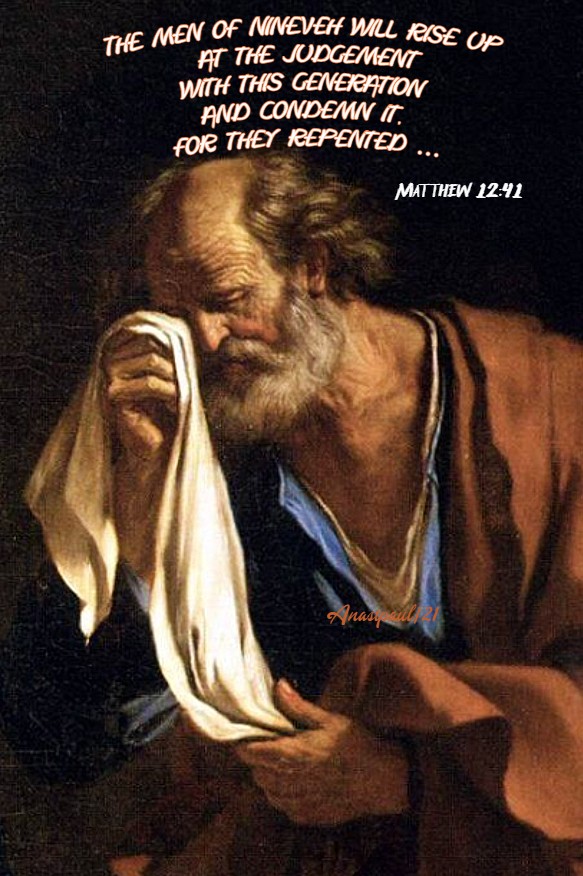
“The men of Nineveh will rise up at the judgement with this generation and condemn it, for they repented …”
Matthew 12:41
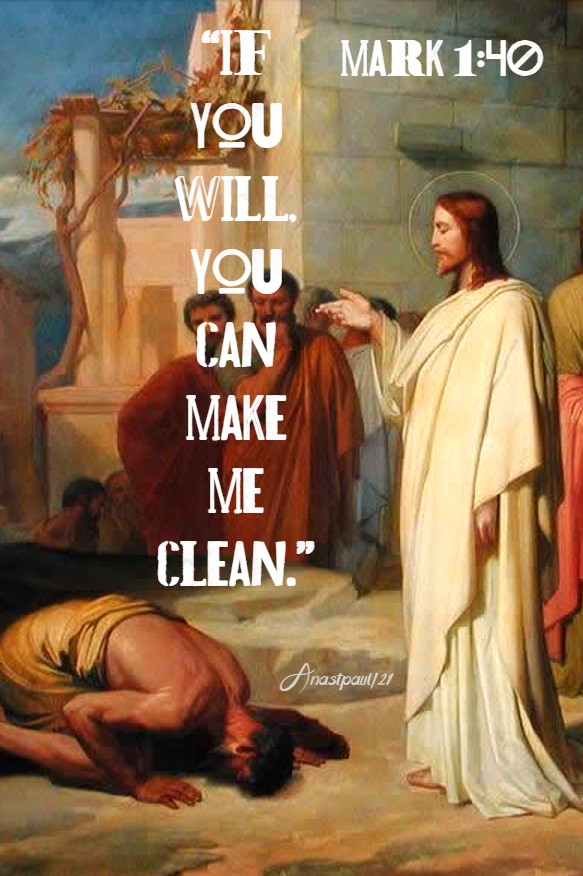
“If you will, you can make me clean.”
Mark 1:40
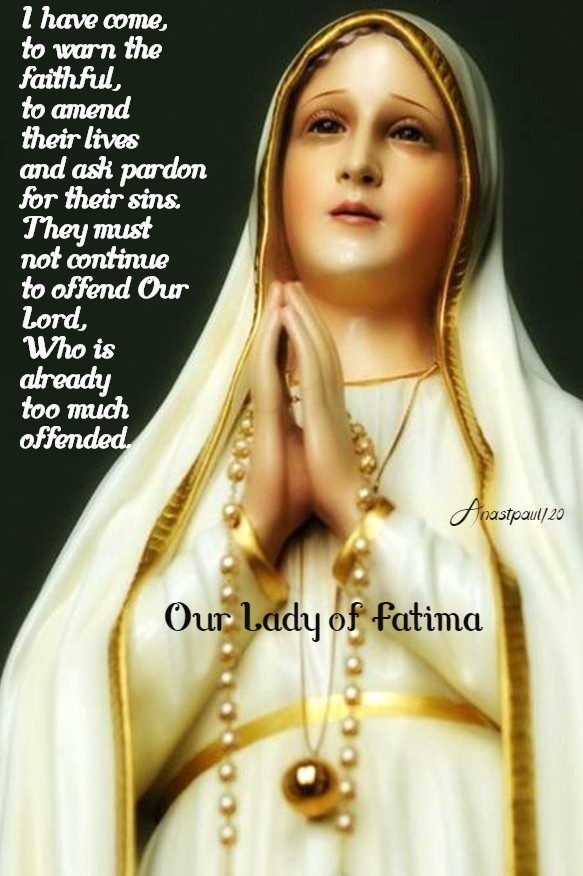
“I have come, to warn the faithful, to amend their lives and ask pardon for their sins. They must not continue to offend Our Lord, Who is already too much offended.”
Our Lady of Fatima 1917
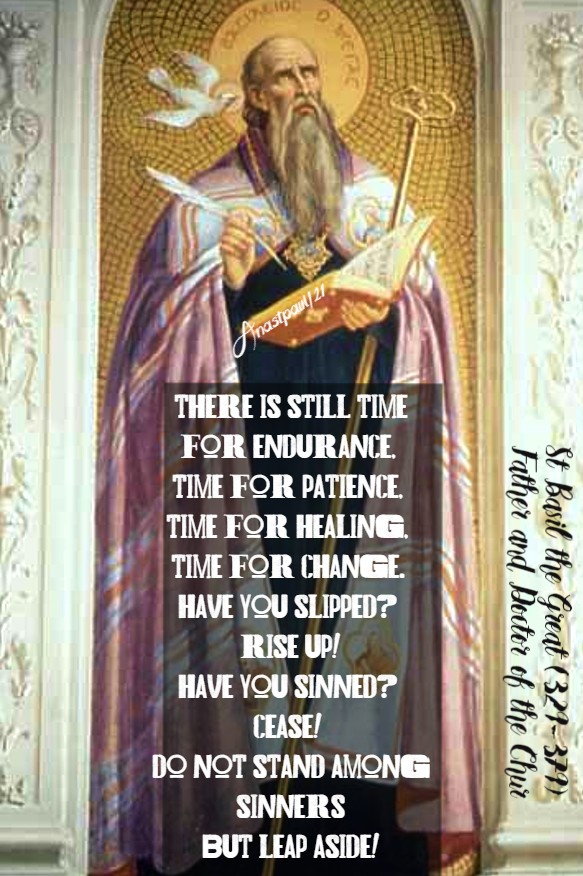
There is still time for endurance, time for patience, time for healing, time for change. Have you slipped? Rise up! Have you sinned? Cease! Do not stand among sinners but leap aside!”
St Basil the Great (329-379) Father and Doctor of the Church
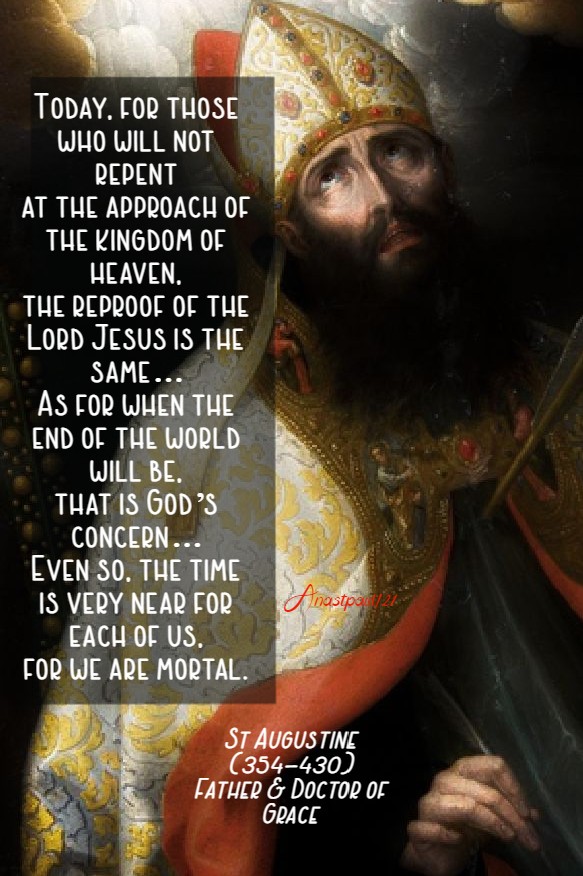
“Today, for those who will not repent at the approach of the kingdom of heaven, the reproof of the Lord Jesus is the same… As for when the end of the world will be, that is God’s concern… Even so, the time is very near for each of us, for we are mortal.”
St Augustine (354-430) Father & Doctor of Grace
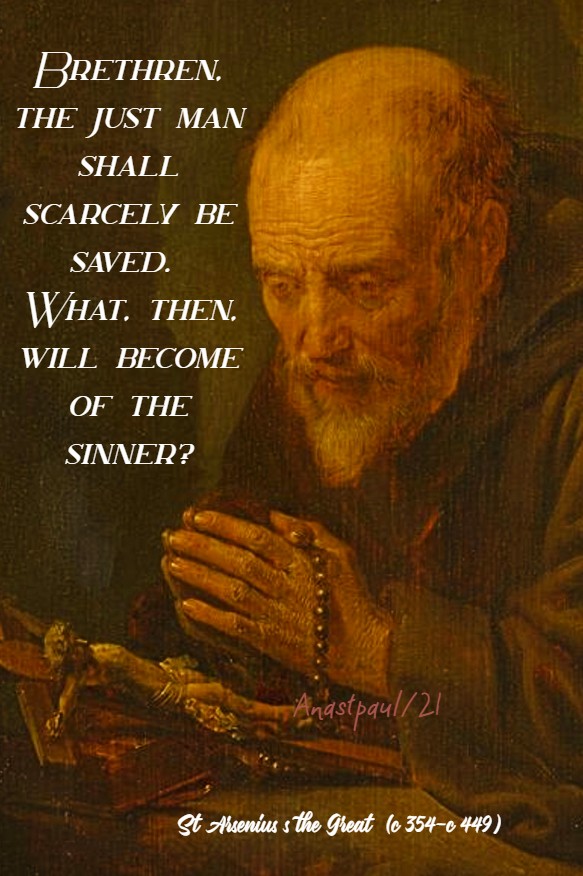
“Brethren, the just man shall scarcely be saved. What, then, will become of the sinner?”
One Minute Reflection – 19 July – “Month of the Most Precious Blood” – Readings: Exodus 14: 5-18; Exodus 15: 1bc-2, 3-4, 5-6; Matthew 12: 38-42
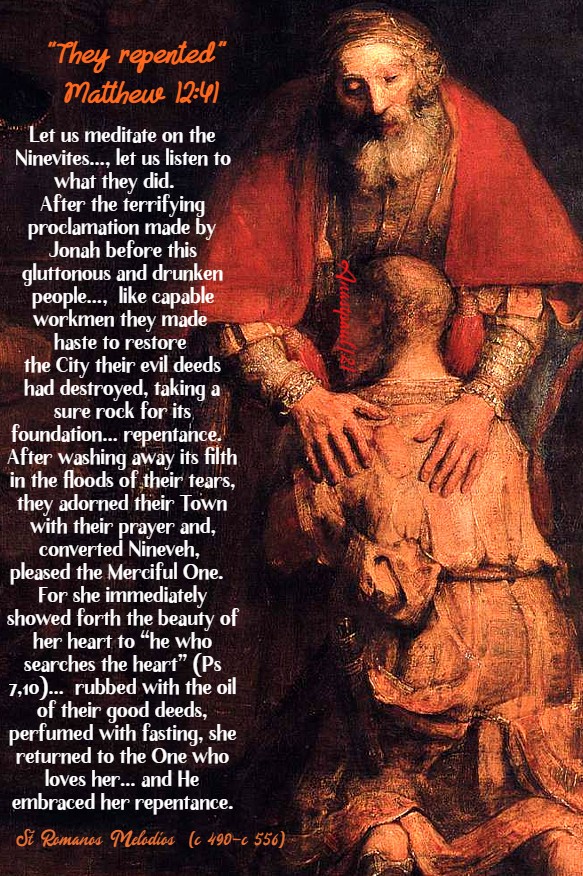
“They repented” – Matthew 12:41
REFLECTION – “Let us meditate on the Ninevites…, let us listen to what they did. After the terrifying proclamation made by Jonah before this gluttonous and drunken people…, like capable workmen they made hast to restore the City their evil deeds had destroyed, taking a sure rock for its foundation…: repentance. After washing away its filth in the floods of their tears, they adorned their Town with their prayer and, converted Nineveh, pleased the Merciful One. For she immediately showed forth the beauty of her heart to “he who searches the heart” (Ps 7,10)… rubbed with the oil of their good deeds, perfumed with fasting, she returned to the One who loves her… and He embraced her repentance. Its king, a wise man,… prepared animals and flocks as if to bring them along in dowry, saying: “O God, my Saviour, I offer everything to You, only reconcile, bring back in grace, she who prostituted herself and betrayed… Your purity, for see how, in her love, she offers her repentance to You like a gift… If I, the sovereign king, have sinned then strike me alone and take pity on all these others. But if we have all fallen short, hear the voices of all… May Your help come upon us and all fear will be dissolved. Nothing will frighten us if You receive what we are offering You – our repentance… Rebellious Nineveh throws herself at Your feet and I, a miserable king and Your wretched servant, I sit down in ashes since I am unworthy of my throne (Joh 3,6). Because I have scorned the crown, I throw dust on my head. Because I am not worthy of my purple, I have put on sackcloth and burst into lamentation. Therefore, do not despise me, cast a glance upon us, O my Saviour, and accept our repentance.” Son of the One God, O only God, those who love You, wish to carry out Your Will; protect them in Your mercy… As in former days You took pity on the Ninevites… so today, release from judgement those who sing to You and grant me forgiveness in return for my confession… Since I have no works worthy of Your glory, at least save me, my Saviour, for my words of contrition – You Who love repentance.” – St Romanos Melodios (c 490-c 556) Monk, Poet, Hymnist – Hymn « Nineveh » § 4-17; SC 99
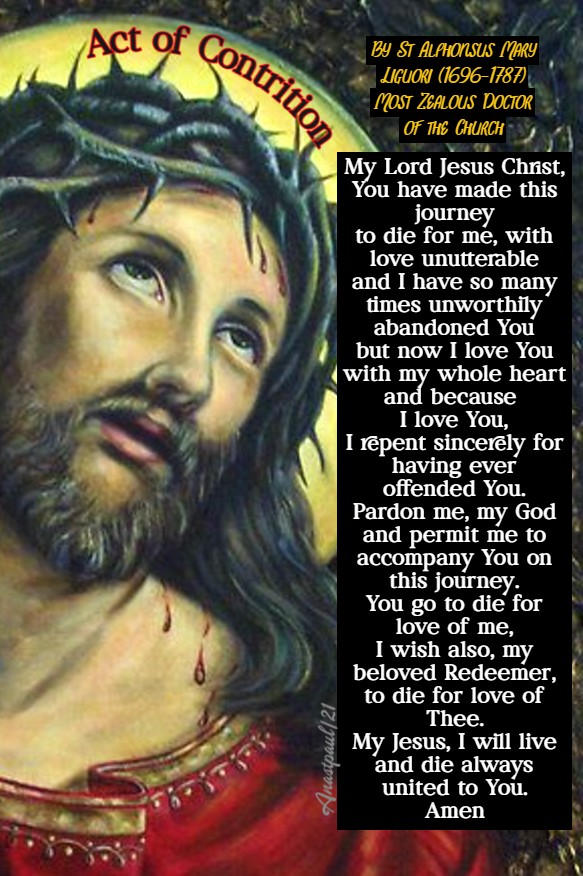
PRAYER – My Lord Jesus Christ, You have made this journey to die for me, with love unutterable and I have so many times unworthily abandoned You but now I love You with my whole heart and because I love You, I repent sincerely for having ever offended You. Pardon me, my God and permit me to accompany You on this journey. You go to die for love of me, I wish also, my beloved Redeemer, to die for love of Thee. My Jesus, I will live and die always united to You.” Amen – By St Alphonsus Mary Liguori (1696-1787) Most Zealous Doctor of the Church
Our Morning Offering – 19 July – “Month of the Most Precious Blood”
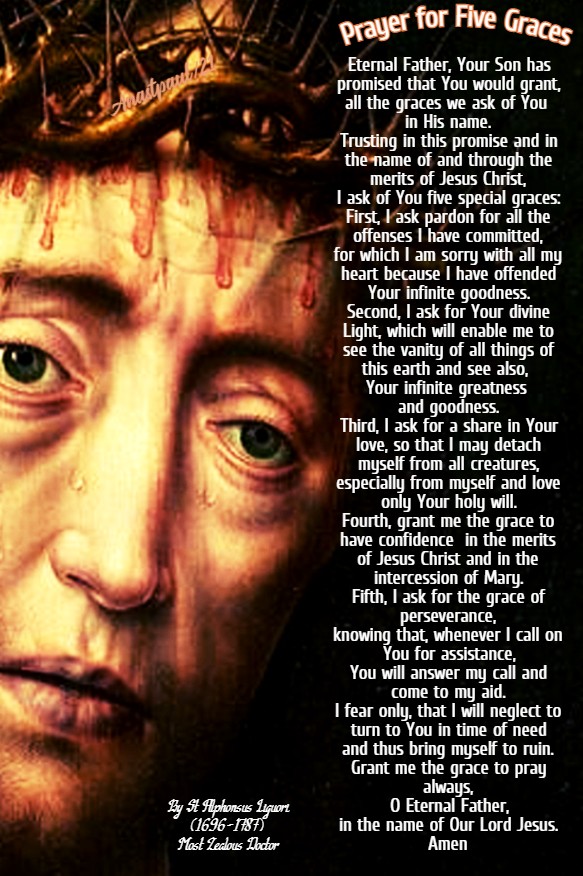
Prayer for Five Graces By St Alphonsus Liguori (1696-1787) Most Zealous Doctor
Eternal Father, Your Son has promised that You would grant, all the graces we ask of You in His name. Trusting in this promise and in the name of and through the merits of Jesus Christ, I ask of You five special graces: First, I ask pardon for all the offenses I have committed, for which I am sorry with all my heart because I have offended Your infinite goodness. Second, I ask for Your divine Light, which will enable me to see the vanity of all things of this earth and see also, Your infinite greatness and goodness. Third, I ask for a share in Your love, so that I may detach myself from all creatures, especially from myself and love only Your holy will. Fourth, grant me the grace to have confidence in the merits of Jesus Christ and in the intercession of Mary. Fifth, I ask for the grace of perseverance, knowing that, whenever I call on You for assistance, You will answer my call and come to my aid. I fear only, that I will neglect to turn to You in time of need and thus bring myself to ruin. Grant me the grace to pray always, O Eternal Father, in the name of Our Lord Jesus. Amen.
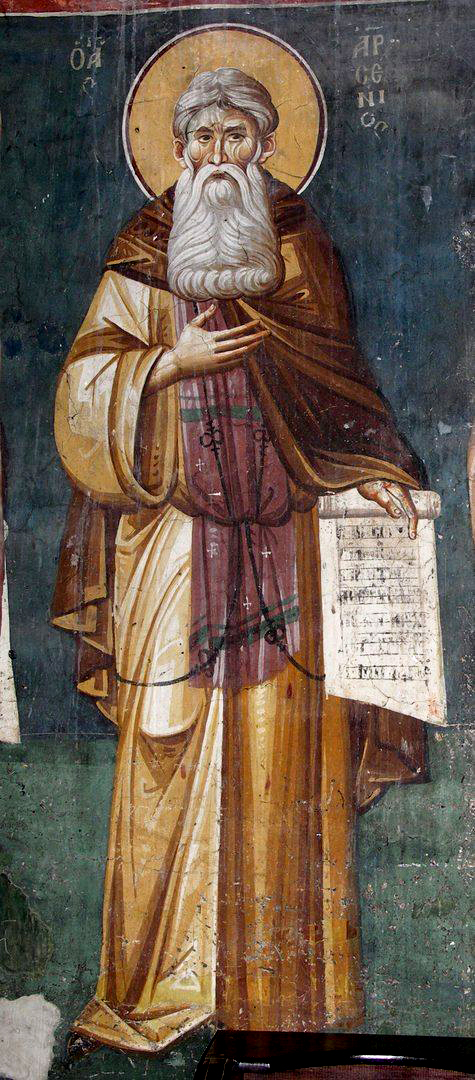
Saint of the Day – 19 July – Saint Arsenius the Great (c 354-c 449) Deacon, Hermit, Ascetic, theologian, writer. Born in s 354 in Rome and died in c 449 at Troë near Memphis, Egypt of natural causes. Arsenius one of the most highly regarded of the Desert Fathers, whose teachings were greatly influential on the development of asceticism and the contemplative life. His contemporaries so admired him as to surname him “the Great”. Also known as – Arsenius the Roman, Arsenius the Deacon.
The Roman Martyrology states of him today: “At Scete, a mountain in Eqypt, St Arsenius, a Deacon of the Roman Church, in the time of Theodosius, he retired into a wilderness, where, endowed with every virtue and shedding continual tears, he yielded his soul to God.”
Arsenius was born in Rome to a Christian, Roman senatorial family. After his parents died, his sister Afrositty was admitted to a community of virgins,and he gave all their riches to the poor, and lived an ascetic life. Arsenius became famous for his virtue and wisdom. Emperor Theodosius the Great, having requested the Emperor Gratian and Pope Damasus to find him in the West a tutor for his son Arcadius, decided on Arsenius, a man well read in Greek literature, a member of a noble Roman family and a Deacon. Upon receving the request to become the tutor of young Arcadius, he left and reached Constantinople in 383 and continued as tutor in the imperial family for eleven years, during the last three of which he also had charge of his pupil’s brother ,Honorius.
Coming one day to see his children at their studies, Theodosius found them sitting while Arsenius talked to them standing. This he would not tolerate and he ordered the teacher to sit while the pupils stood.
Upon his arrival at Court, Arsenius had been given a splendid establishment, and probably because the Emperor so desired, he lived a very great lifestyle but all the time felt a growing inclination to renounce the world. After praying for a long time to be enlightened as to what he should do, he heard a voice saying “Arsenius, flee the company of men and thou shalt be saved.” Thereupon he embarked secretly for Alexandria and hastening to the desert of Scetis, asked to be admitted among the solitaries who dwelt there.
St John the Dwarf, to whose cell he was conducted, though previously warned of the quality of his visitor, took no notice of him and left him standing by himself while he invited the rest to sit down at table. When the John was half finished with his meal, he threw down some bread before Arsenius, bidding him, with an air of indifference, to eat if he would. Arsenius meekly picked up the bread and ate, sitting on the ground. Satisfied with this proof of humility, St.John kept him under his direction. The new solitary was from the beginning most exemplary, yet unwittingly retained some of his old habits, such as sitting cross-legged or laying one foot over the other. Noticing this, the Abbot requested someone to imitate Arsenius’s posture at the next gathering of the brethren and upon his doing so, forthwith rebuked him publicly. Arsenius took the overt hint and corrected himself.
During the fifty-five years of his solitary life he was always the most meanly clad of all, thus punishing himself for his former seeming vanity in the world. In like manner, to atone for having used perfumes at Court, he never changed the water in which he moistened the palm leaves of which he made mats but only poured in fresh water upon it as it wasted, thus letting it become of bad odour.
Even while engaged in manual labour, he never relaxed in his application to prayer . At all times copious tears of devotion fell from his eyes. But what distinguished him the most ,was his disinclination to all that might interrupt his union with God. When, after a long period of searching, his place of retreat was discovered, he not only refused to return to Court and act as adviser to his former pupil the Emperor Arcadius but he would not even be his almoner to the poor and the Monasteries of the neighbourhood. He invariably denied himself to visitors, no matter what their rank and condition and left to his disciples the care of entertaining them.
His contemporaries so greatly admired him that they gave him the surname “the Great.” A biography of Arsenius was written by Theodore the Studite (750–826). Two of his writings are still extant – a guideline for monastic life titled “Instruction and Advice” and a commentary on the Gospel of Luke titled “On the Temptation of the Law.” Apart from this, many sayings attributed to St Arsenius are contained in a collection of quotations of the Saints in the Orthodoz tradition.
Saint Arsenius was a man who lived in solitude and silence, as evidenced by an adage of his: “Many times I spoke and as a result felt sorry but I never regretted my silence.”
Nuestra Señora del Milagro / Our Lady of the Miracle, Lima, Peru (1630) – 19 July and 27 November:
The Franciscan Friars who accompanied the Conquest to Peru hung an image of the Immaculate Conception over the door of their first Church in Lima. On missionary journeys around the region, they would take the image, “La Misionera,” with them. They were in Cusco, the Inca capital, on 23 May 1536 when, during the rebellion of Manco Inca against the two-year Spanish regime, natives trapped many Spaniards in a hut and set fire to the straw roof. La Misionera was seen by all to leave her place inside and to appear above the burning building together with Santiago (St.James the Greater). The fire ceased and all were saved. In honoUr of this event, the Spanish built the Church of the Triumph, now an adjunct of the Cusco Cathedral. Back in Lima, after the Franciscans surrounded the little Chapel with a big Monastery complex, the image over the door was gradually forgotten. By the 1600s, it had one regular devotee, a poor woman. One day she heard the Virgin speak: “You alone, daughter, among all the people here, visit me and pray to me. One day I will repay you.” After the woman told saintly Brother Juan Gomez, he often remarked, “Lima does not recognise the great good it has in this miraculous image, but soon it will know.”
On 27 November 1630, when most of the people of Lima were attending a bullfight in the main plaza, a violent earthquake struck the City. All were terrified, for it seemed certain that they would perish. But those near the Franciscan Church saw the image of Our Lady turn in the direction of the Blessed Sacrament, with her hands held in suppliant gesture. Abruptly, the earthquake stopped.
Several hours later, at vespers that evening, while the populace was leaving the Church, the image, in full view of all present, returned to its original position, when the Marian hymn Tota Pulchra was intoned. This painting shows the Virgin kneeling in prayer, with her arms crossed upon her breast, presumably interceding for Lima.
Now called “Our Lady of the Miracle,” the image was given a magnificent new Church. In 1835, the church burned down. Only the image remained intact. On J19 une 1953, the Papal Nuncio crowned the miraculous image The feast of Our Lady of the Miracle is on 27 November the anniversary of the 1630 earthquake and today the Crowning is honoured each year.
St Ambrose Autpertus Bl Antonio of Valladolid St Aurea of Cordoba St Arsenius the Great (c 354-c 449) Deacon, Hermit, Desert Father. Bl Bernhard of Rodez St Daria of Constantinople St Epaphras of Colosse St Felix of Verona
St Macrina the Younger (c 327-379) Virgin, Ascetic. With charm and grace, St Macrina ruled the roost in a family of saints. St Basil the Elder and St Emmelia, her parents, had ten children including the younger St Basil the Great (329-379) Father and Doctor of the Church, St Gregory of Nyssa (c 335–C 395) Father of the Church and St Peter of Sebaste Bishop (c 340–391). As the eldest child, Macrina exercised a formative influence on her more famous brothers and even on her mother. Her Life: https://anastpaul.com/2019/07/19/saint-of-the-day-19-july-saint-macrina-the-younger-c-327-379/
St Martin of Trier St Michael the Sabaitè Bl Pascasio of Lyon
St Romain of Ryazan St Pope Symachus St Vicente Cecilia Gallardo — Martyrs of Meros – 3 saints: Three Christians tortured and martyred together in the persecutions of emperor Julian the Apostate and governor Almachio. We know nothing else about them but the names – Macedoniuis, Tatian and Theodule. They were burned to death on an iron grill in Meros, Phrygia (in modern Turkey).
Martyrs of China: 3 Beati Elisabeth Qin Bianshi Elisabeth Ioannes Baptista Zhu Wurui Simon Qin Chunfu
Thought for the Day – 18 July – Meditations with Antonio Cardinal Bacci (1881-1971)
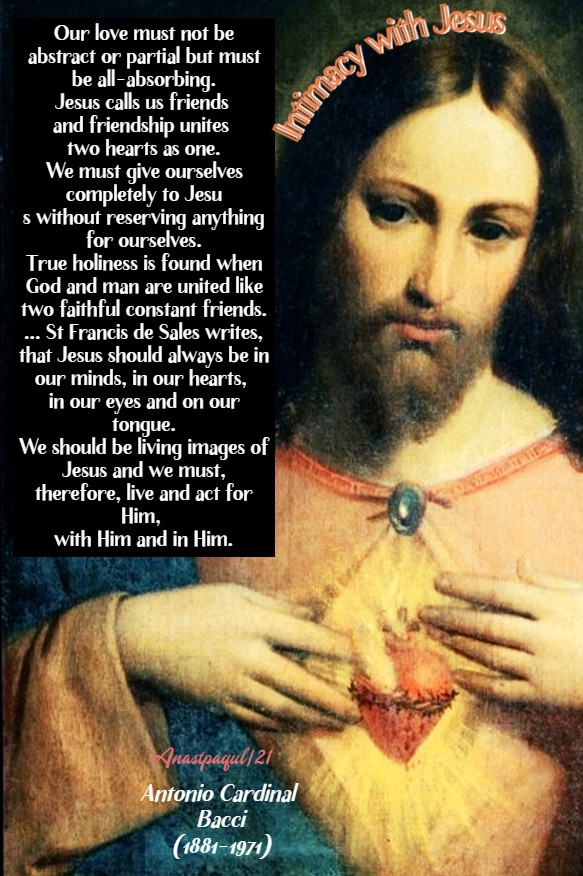
Intimacy with Jesus
“The union of love which should exist between Jesus and ourselves, is modelled on the mysterious union between Jesus and His Heavenly Father.
(1) This intimacy between ourselves and Jesus should be, first of all, in the mind. Our thoughts will be good when we think like God and with the mind of Jesus, “Who is the true light that enlightens every man who comes into the world” (Jn 1:9). If we stray away from that light, darkness overwhelms us, even as it pervaded the earth during the agony of Jesus Christ. Our intelligence is a ray of light which comes from God, we should take care not to allow this ray to be separated from its divine source. This heavenly ray always shone on the faces of the saints because they were clean of heart and close to God. That is how we should all be.
(2) In the second place, we should be united intimately with Jesus in our sentiments. “Have this mind in you which was also in Jesus Christ” (Phil 2:5) says St Paul. Our love must not be abstract or partial but must be all-absorbing. Jesus calls us friends and friendship unites two hearts as one. We must give ourselves completely to Jesus without reserving anything for ourselves. True holiness is found when God and man are united like two faithful constant friends.
(3) In the third place, there must be intimacy in action. It is not possible for a man who truly loves God to do anything which would offend Him. Jesus compares the love which we should have for Him with the love which He has for His Heavenly Father, so we should model our lives continuously on the life of Jesus. Jesus must work in us, as He did in St Paul and all the Saints.
St Francis de Sales writes, that Jesus should always be in our minds, in our hearts, in our eyes and on our tongue. We should be living images of Jesus and we must, therefore, live and act for Him, with Him and in Him.”
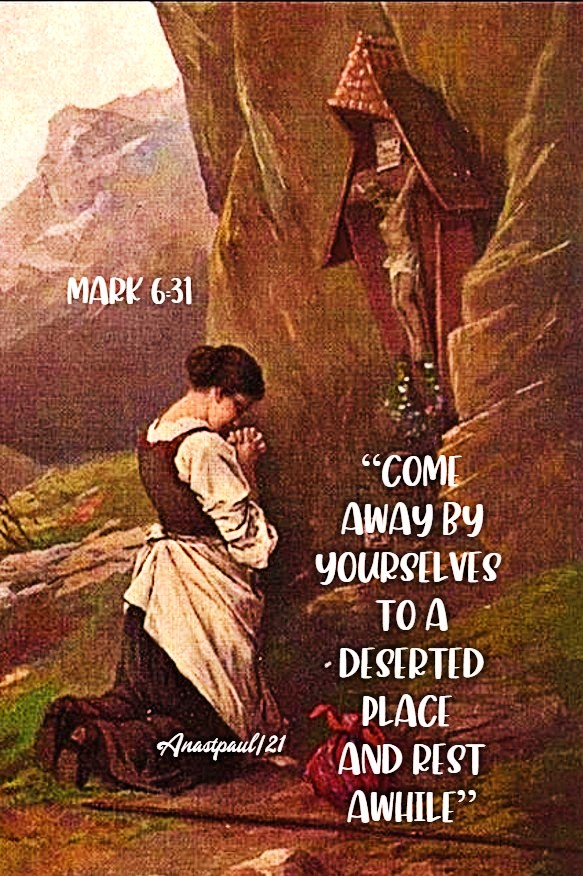
Quote/s of the Day – 18 July – “Month of the Most Precious Blood” – Readings: Jeremiah 23: 1-6; Psalms 23: 1-3, 3-4, 5, 6 (1); Ephesians 2: 13-18 Gospel: Mark 6: 30-34
“Come away by yourselves , o a deserted place and rest awhile”
Mark 6:31
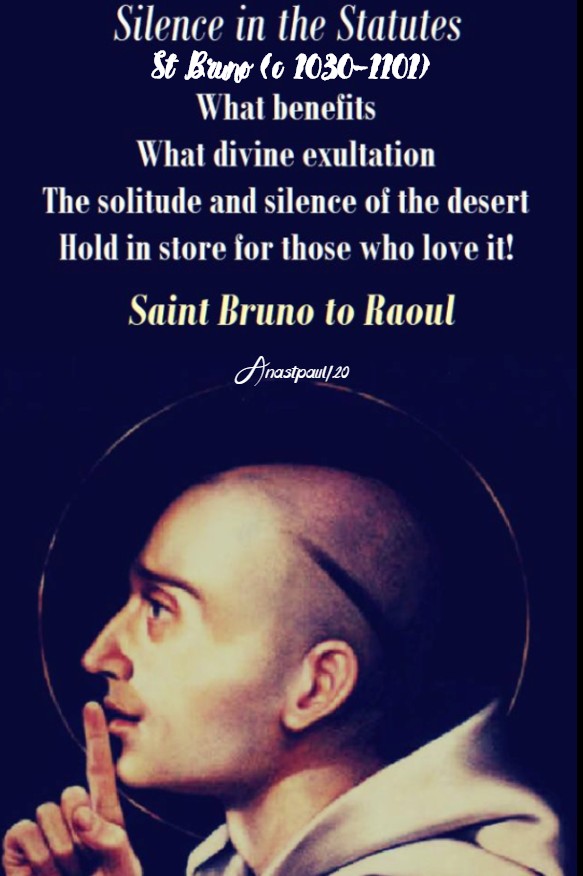
“What benefits What divine exultation The solitude and silence of the desert Hold in store for those who love it!”
St Bruno (c 1030-1101)
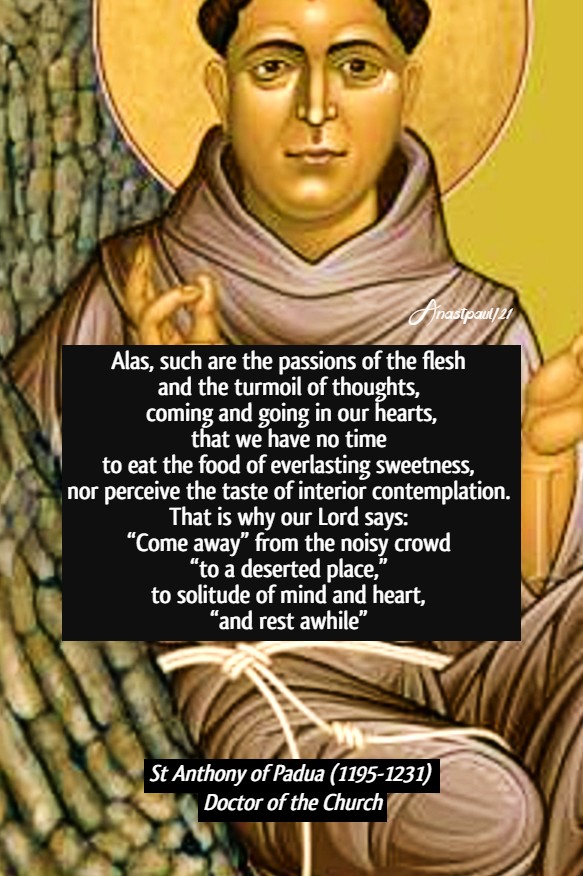
“Alas, such are the passions of the flesh and the turmoil of thoughts, coming and going in our hearts, that we have no time to eat the food of everlasting sweetness, nor perceive the taste of interior contemplation. That is why our Lord says: “Come away” from the noisy crowd “to a deserted place,” to solitude of mind and heart, “and rest awhile.”
St Anthony of Padua (1195-1231) Doctor of the Church
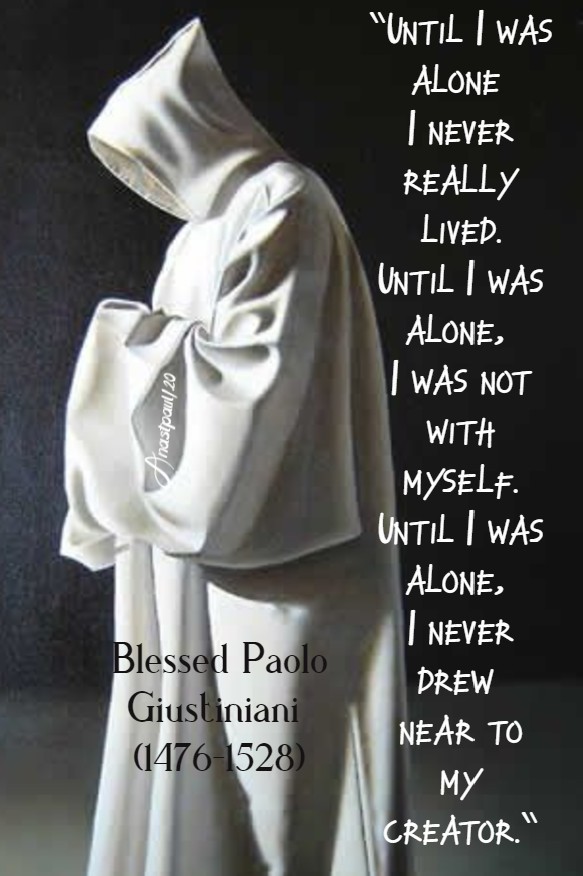
“Until I was alone I never really lived. Until I was alone, I was not with myself. Until I was alone, I never drew near to my creator.”
Bl Paolo Giustiniani (1476-1528)
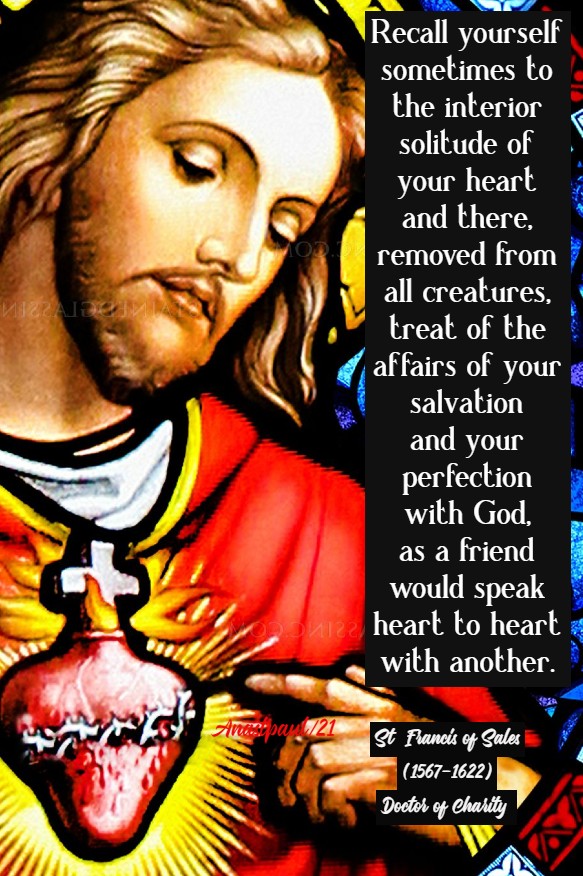
“Recall yourself sometimes to the interior solitude of your heart and there, removed from all creatures, treat of the affairs of your salvation and your perfection with God, as a friend would speak heart to heart with another.”
St Francis of Sales (1567-1622) Doctor of Charity
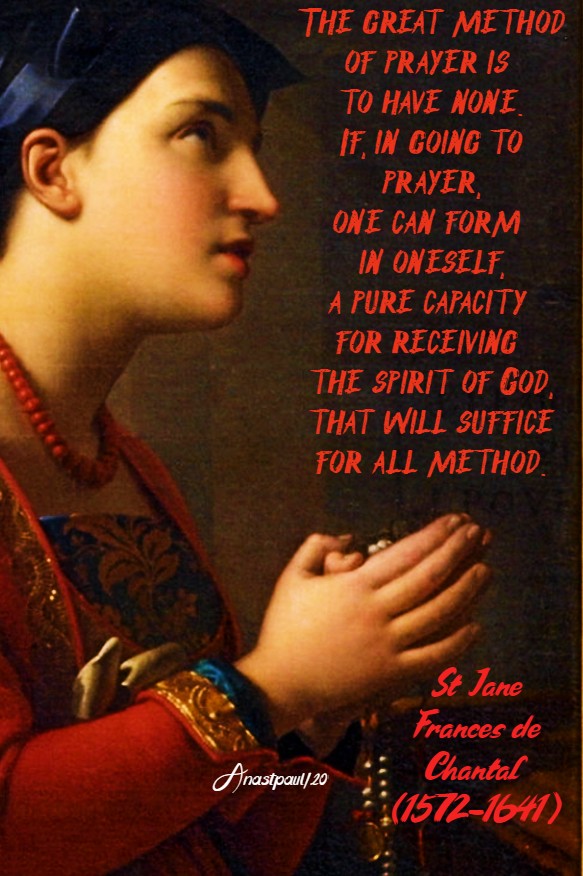
“The great method of prayer is to have none. If, in going to prayer, one can form in oneself, a pure capacity for receiving the spirit of God, that will suffice for all method.”
One Minute Reflection – 18 July – “Month of the Most Precious Blood” – Readings: Jeremiah 23: 1-6; Psalms 23: 1-3, 3-4, 5, 6 (1); Ephesians 2: 13-18 Gospel: Mark 6: 30-34
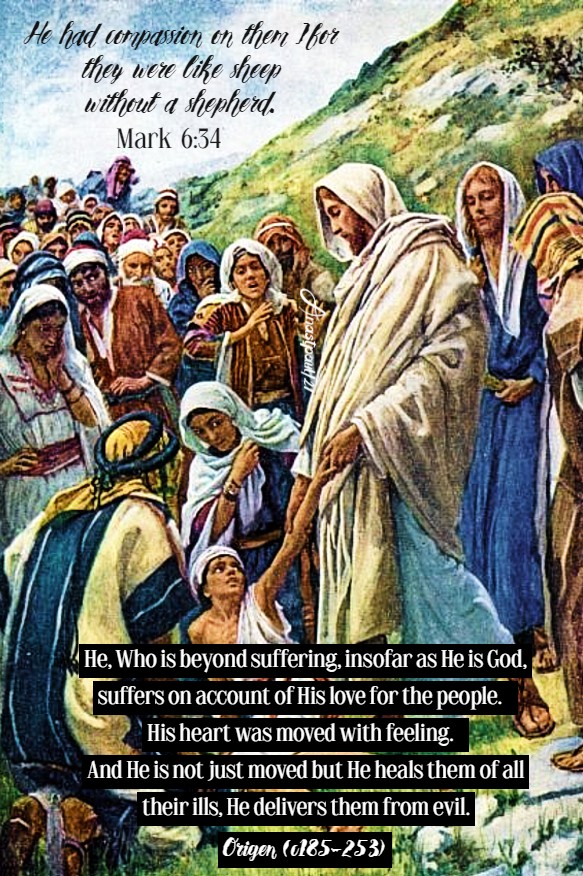
“He had compassion on them for they were like sheep without a shepherd… ” – Mark 6:34
REFLECTION – “Jesus, God’s Word, was in Judaea. Following the news of the prophet John the Baptist’s murder, He went by boat – symbol of His body – to a desert place apart. In this desert place Jesus was “apart” because His word was set aside there and His teaching went against the customs and traditions of the Gentiles. But then the crowds from the Gentile territories, hearing that He, Who is the Word of God, had come to dwell in their desert…, came to follow Him, leaving their towns behind, that is to say, each of them abandoning the superstitious customs of their native land and adhering to Christ’s law… Jesus had come out to meet them since they were unable to come to Him, mingling with “those outside” (Mk 4,11) He led them within.
This crowd of those outside, that He went to meet, is very great. Shedding the light of His Presence upon it, He looked round at it and, seeing what sort of people were surrounding Him, he found them even more worthy of compassion. He, Who is beyond suffering, insofar as He is God, suffers on account of His love for the people. His heart was moved with feeling. And He is not just moved but He heals them of all their ills, He delivers them from evil.” – Origen (c185-253), Priest, Theologian, Exegist, Writer, Apologist, Father – Commentary on St. Matthew, 10,23
PRAYER – Be gracious, Lord, to us who serve You and in Your kindness increase Your gifts of grace within us, so that fervent in faith, hope and love, we may be ever on the watch and persevere in doing what You command. Guard, protect and inspire our own Shepherds, our Priests who serve Your people, keep them faithful, loyal and prayerful. May our Mother, the most Holy and Pure Blessed Virgin Mary, keep our Priests and all of us at her side. Through our Lord Jesus Christ, one God with Holy Spirit, forever and ever, amen.
Our Morning Offering – 18 July – “Month of the Most Precious Blood”
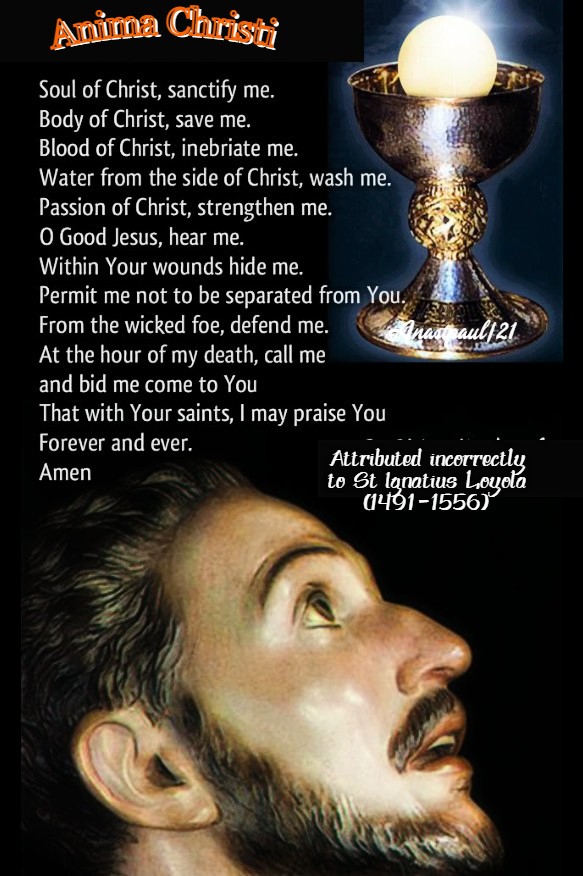
Anima Christi
Soul of Christ, sanctify me Body of Christ, save me Blood of Christ, inebriate me Water from the side of Christ, wash me Passion of Christ, strengthen me Good Jesus, hear me Within Your wounds, shelter me from turning away, keep me From the evil one, protect me At the hour of my death, call me Into Your presence lead me to praise You with all Your saints Forever and ever, Amen
For many years the Anima Christi was popularly believed to have been composed by Saint Ignatius Loyola (1491-1556) , as he puts it at the beginning of his Spiritual Exercises and often refers to it. In the first edition of the Spiritual Exercises Ignatius merely mentions it, evidently supposing that the reader would know it. In later editions, it was printed in full. It was by assuming that everything in the book was written by Ignatius that it came to be looked upon as his composition. On this account the prayer is sometimes referred to as the Aspirations of St. Ignatius Loyola and so my image shows St Ignatius at prayer.
However, the prayer actually dates to the early fourteenth century and was possibly written by Pope John XXII but its authorship remains uncertain. It has been found in a number of prayer books printed during the youth of Ignatius and is in manuscripts which were written a hundred years before his birth. The English hymnologist James Mearns found it in a manuscript of the British Museum which dates to about 1370. In the library of Avignon there is preserved a prayer book of Cardinal Pierre de Luxembourg (died 1387), which contains the prayer in practically the same form as we have it today. It has also been found inscribed on one of the gates of the Alcázar of Seville, which dates back to the time of Pedro the Cruel (1350–1369).
The invocations in the prayer have rich associations with Catholic concepts that relate to the Eucharist (Body and Blood of Christ), Baptism (water) and the Passion of Jesus (Precious Blood and Holy Wounds).
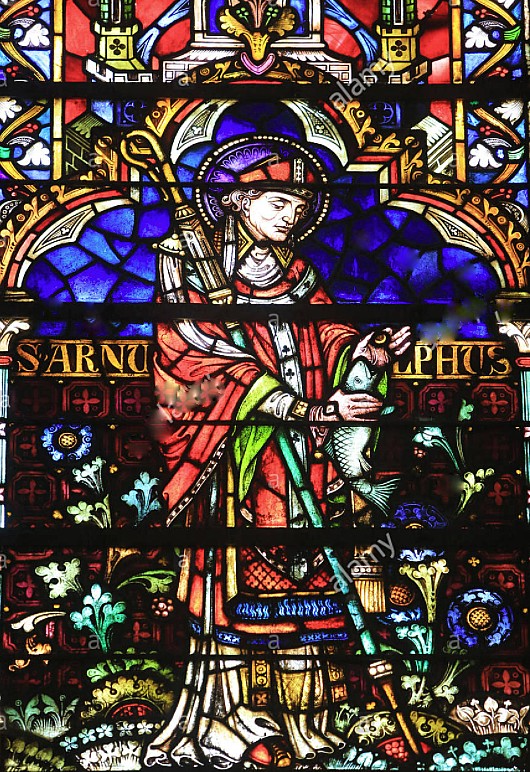
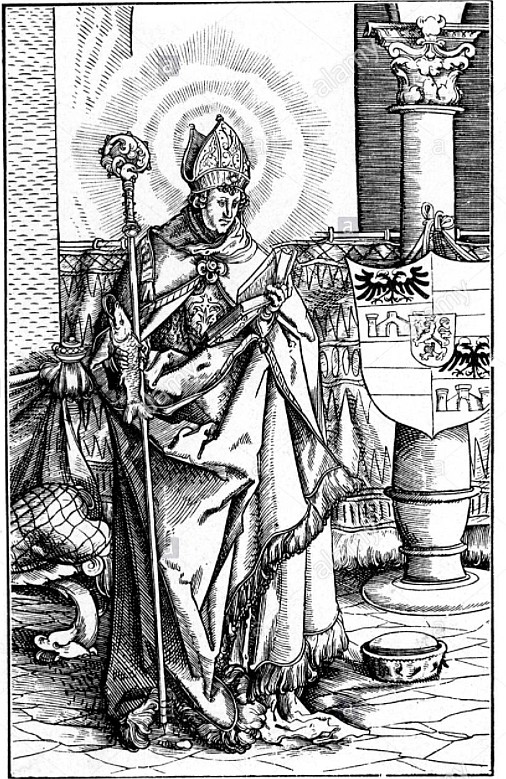
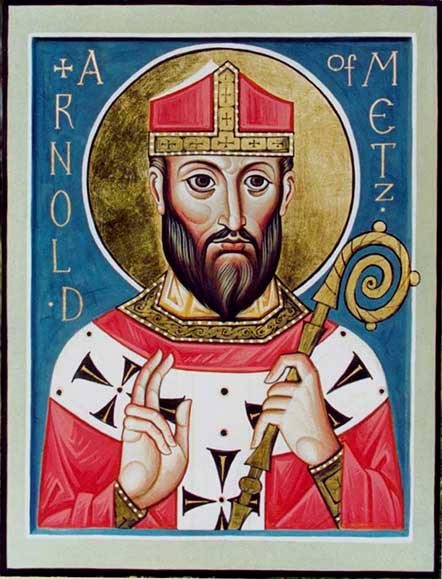
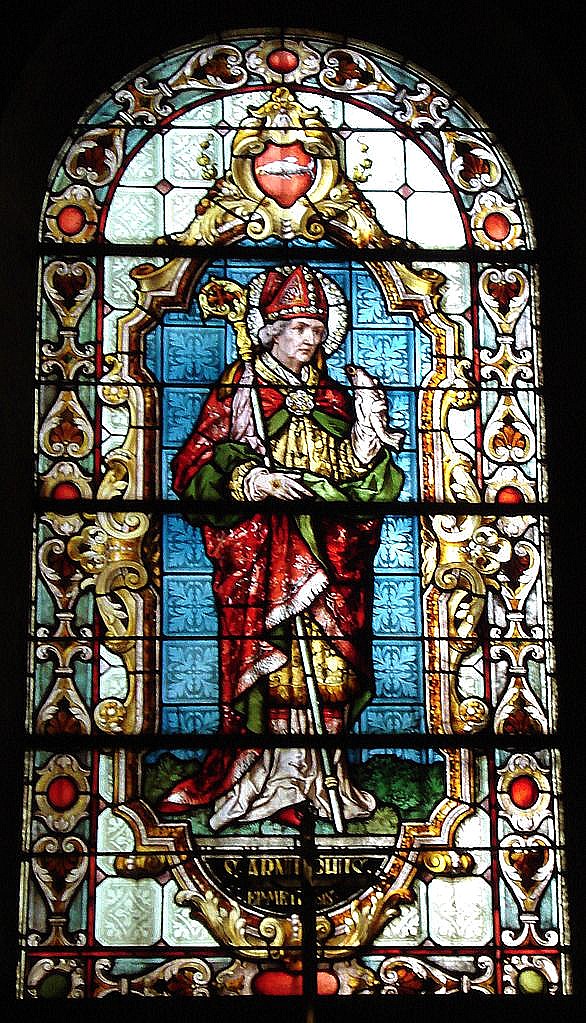
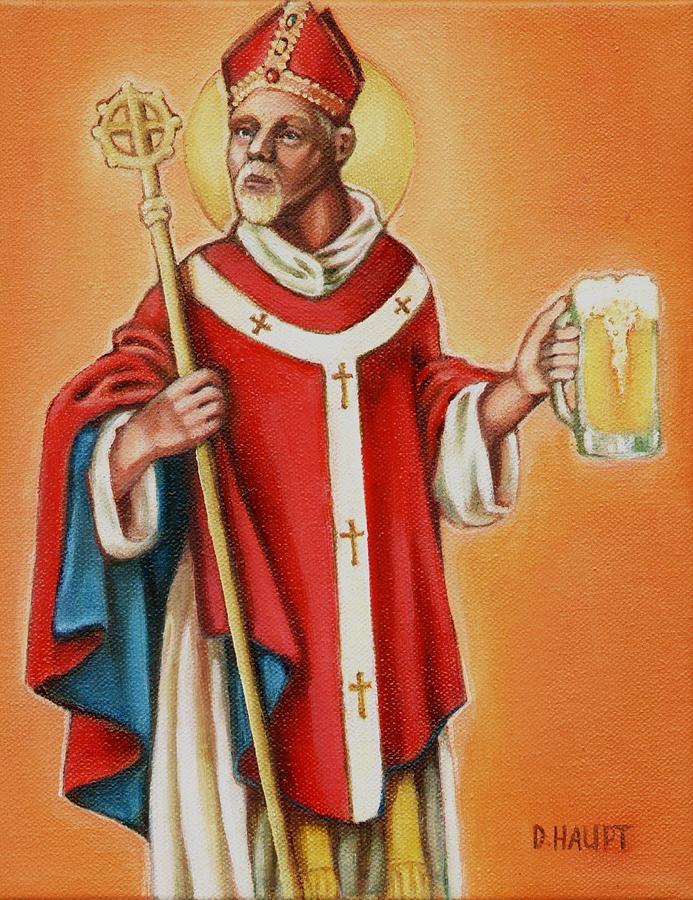
Saint of the Day – 18 July – Saint Arnulf of Metz (c 580-640) Bishop of Metz, France, Monk, miracle-worker, widower and father. Born in c 580 at Lay-Saint-Christophe, France and died in c 640 near Remiremont , France. Also known as – Arnold, Arnoul. Patronage – of Brewers.
The Roman Martyrology states of him today: “At Metz in France, St Arnulf, a Bishop illustrious for holiness and the gift of miracles. He chose an eremitical life and ended his blessed career in peace.”
Arnulf’s parents belonged to a distinguished Frankish family and lived in the eastern section of the kingdom founded by Clovis.
In the school where Arnulf was placed as a boy, he excelled through his talent and his good behaviour. According to the custom of the age, he was sent in due time to the Court of Theodebert II, King of Austrasia (595-612), to be initiated in the various branches of the government. Under the guidance of Gundulf, the Mayor of the Palace, he soon became so proficient that he was placed on the regular list of Royal Officers and among the first of the King’s ministers. He distinguished himself both as a military commander as well as in the civil administration and at one time, he had six distinct Provinces under his care.
In due course, Arnulf was married to a Frankish woman of noble lineage, by whom he had two sons – Anseghisel and Clodulf. While Arnulf was enjoying worldly emoluments and honours, he did not forget higher and spiritual things. His thoughts often dwelt on monasteries and with his friend Romaricus, also an Officer of the Court, he planned to make a pilgrimage to the Abbey of Lérins, evidently for the purpose of devoting his life to God.
However, in the meantime, the Episcopal See of Metz became vacant. Arnulf was universally designated as a worthy candidate for the office and he was Consecrated Bishop of that See around 611, before this he had become a widower. In his new position he set the example of a virtuous life to his community and attended to matters of ecclesiastical government. In 625 he took part in a Council held by the Frankish Bishops at Reims. With all these different activities, Arnulf still retained his station at the Court of the King, and played a prominent role in the national life of his people.
In 613, after the death of Theodebert, he, with Pepin of Landen and other nobles, called on Clothaire II, King of Neustria with a view to friendship. When, in 625, the realm of Austrasia was entrusted to the late King’s son Dagobert, Arnulf became, not only the tutor but also the chief minister, of the young King. At the time of the estrangement between the two Kings, (Clothaire II and Dagobert) in 625 Arnulf, with other Bishops and nobles, tried to bring about a reconciliation. Arnulf now dreaded the responsibilities of the episcopal office, and grew weary of Court life.
About the year 626 he obtained the appointment of a successor to the Episcopal See of Metz and he and his friend, Romaricus withdrew to a solitary place in the mountains of the Vosges. There he lived in communion with God until his death.
His remains, interred by Romaricus, were transferred about a year afterwards, by Bishop Goeric, to the Basilica of the Holy Apostles in Metz.
Miracles of St Arnulf: Arnulf was tormented by the violence that surrounded him and feared that he had played a role in the wars and murders that plagued the ruling families. Obsessed by these sins, Arnulf went to a bridge over the Moselle river. There he took off his Bishop’s ring and threw it into the river, praying to God to give him a sign of absolution by returning the ring to him. Many penitent years later, a fisherman brought to the Bishop’s kitchen a fish in the stomach of which was found the Bishop’s ring. Arnulf repaid the sign of God by immediately retiring as Bishop and becoming a hermit for the remainder of his life.
At the moment Arnulf resigned as Bishop, a fire broke out in the cellars of the Royal Palace and threatened to spread throughout the City of Metz. Arnulf, full of courage and feeling unity with the townspeople, stood before the fire and said, “If God wants me to be consumed, I am in His hands.” He then made the Sign of the Cross, at which point, the fire immediately abated.
It was July 642 and very hot, when the Parishioners of Metz, went to Remiremont to recover the remains of their former Bishop. They had little to drink and the terrain was inhospitable. At the point when the exhausted procession was about to leave Champigneulles, one of the Parishioners, Duc Notto, prayed “By his powerful intercession the Blessed Arnold will bring us what we lack.” Immediately, the small remnant of beer at the bottom of a pot multiplied, in such amounts, that the pilgrims’ thirst was quenched and they had enough to enjoy the next evening when they arrived in Metz. For this reason he is known as the Patron Saint of Brewers.
Notre-Dame-de-Bonne Délivrance /Our Lady of Good Deliverance (14th Century): 18 July Since the 1000s, the Church of Saint-Etienne-des-Grès in the old Latin Quarter of Paris had a chapel to Our Lady of Good Deliverance, where, across the centuries, pilgrims sought the Virgin’s help in their of sufferings. During the Wars of Religion and counter-Reformation, her Confraternity had 12,000 members, including the King and Queen of France. About: https://anastpaul.com/2020/07/18/saint-of-the-day-18-july-our-lady-of-good-deliverance/
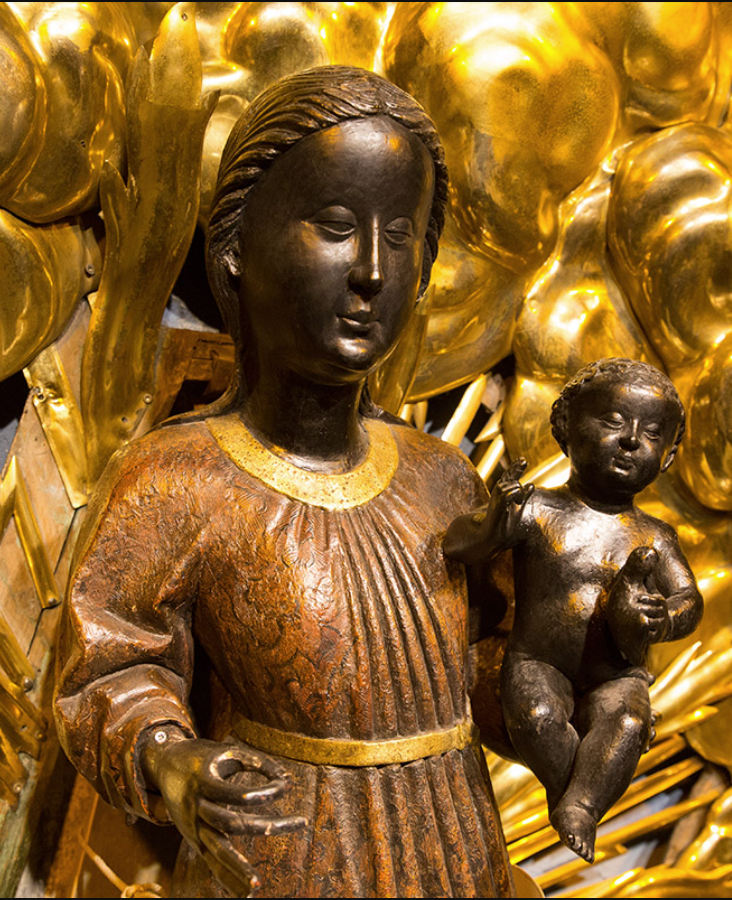
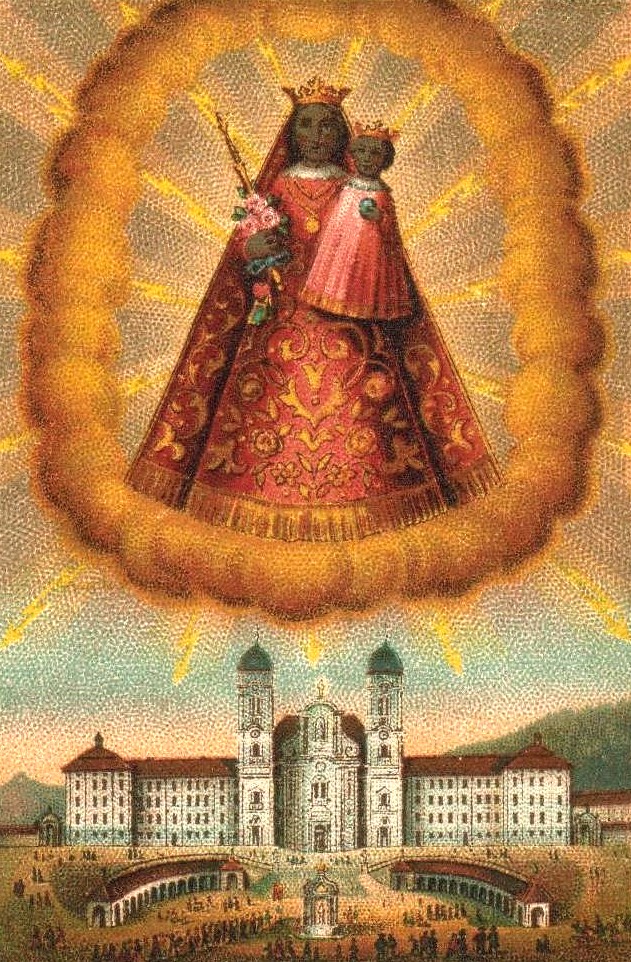
Schwarzen Madonna / Black Madonna of Einsiedeln, Schwyz, Switzerland (853) – First Sunday after Our Lady of Mount Carmel:
“Einsiedeln” means “hermitage.” It was the home of St Meinrad (c 797–861) Martyr, a Benedictine Monk who retreated to this place in the pine woods to live in solitude, with a pair of tame crows for company. Abbess Hildegarde of Zurich gave him a Statue of the Madonna for the forest Chapel built in 853, which soon became a place of pilgrimage. In 863, hoping to get his stash of pilgrim donations, two thieves murdered the Saint, who was living in poverty. The crows alerted people, who found and buried the body and executed the killers. St Meinrad’s life here: https://anastpaul.com/2021/01/21/saint-of-the-day-21-january-saint-meinrad-of-einsiedeln-osb-c-797-861-martyr/
In 948, Benedictines built a Church on the site of St Meinrad’s hermitage. On 14 September, the night before Bishop Conrad was to bless the new Church, he dreamed that Jesus Himself was blessing it. In the morning, when he began the ceremony, everyone heard a voice say, “Stop, for the Church has been Consecrated divinely.” In 1028 the first of five fires destroyed everything but the Chapel containing the Statue. These miracles increased popular devotion to the Shrine, which was repeatedly rebuilt.
Although tradition holds the present Statue to be the original, it is unlike any that remain from the Ottonian period. Carved of dark wood, the graceful, sweet-faced Madonna, her right knee slightly bent, stands a little over three feet tall, holding the Divine Child in her left arm. This is a typical late Gothic work of the mid-1400s, possibly installed after the third fire in 1465. Displayed before a great aureole of golden rays,the Statue has worn elaborate vestments in colours matching those of Priests for each liturgical season. The Feast of Our Lady of Einsiedeln is 16 July but is usually celebrated on the Sunday following. Even greater pilgrimages occur on 14 September in honour of the Church’s miraculous Consecration.
St Aemilian of Dorostorium St Alanus of Sassovivo St Alfons Tracki Blessed Angeline of Marsciano Bl Arnold of Amiens St Arnold of Arnoldsweiler St Arnoul the Martyr St Arnulf of Metz (c 580-640) Bishop St Athanasius of Clysma Bl Bernard de Arenis Bl Bertha de Marbais
St Goneri of Treguier St Gundenis of Carthage Bl Herveus Bl Jean-Baptiste de Bruxelles St Marina of Ourense St Maternus of Milan St Minnborinus St Pambo of the Nitrian Desert St Philastrius of Brescia St Rufillus of Forlimpopoli St Scariberga of Yvelines
St Theneva St Theodosia of Constantinople — Martyrs of Silistria – 7 saints: Seven Christians who were martyred together. No details about them have survived but the names – Bassus, Donata, Justus, Marinus, Maximus, Paulus and Secunda. They were martyred in Silistria (Durostorum), Moesia (in modern Bulgaria), date unknown.
Martyrs of Tivoli – 8 saints: A widow, Symphorosa and her seven sons ( Crescens, Eugene, Julian, Justin, Nemesius, Primitivus and Stracteus) martyred in Tivoli, Italy in the 2nd-century persecutions of Hadrian.





















You must be logged in to post a comment.