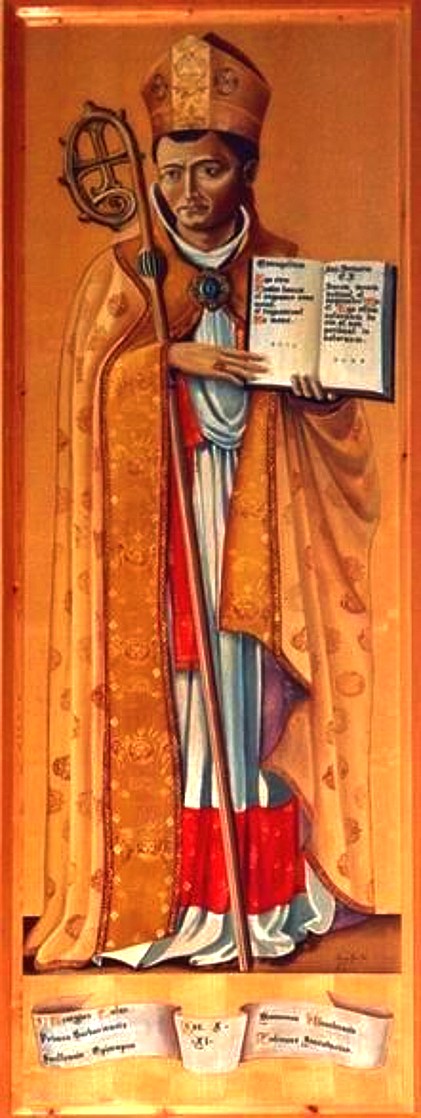
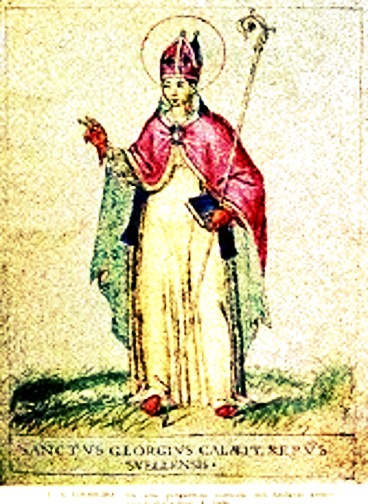
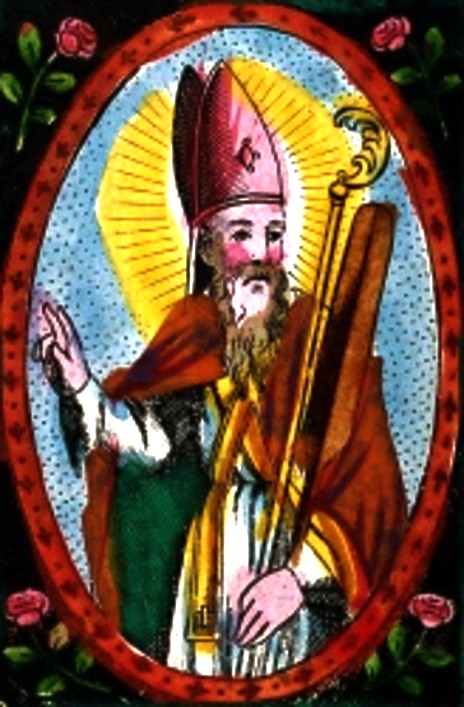
Saint of the Day – 23 April – Saint Giorgio di Suelli (Died 1117) Bishop, Apostle of the poor, Miracle-worker. Born in the 11th century Cagliari, Italy and died on 23 April 1117 at Suelli, Italy of natural causes. Patronages – against famine, of te Diocese of Lanusei, Italy, Suelli, Italy. He is also known as George of Suelli.
The Roman Martyrology states: “In Suelli in Sardinia, commemoration of St George, Bishop.”
According to his ancient biography, the only reliable source, Giorgio was born in the 11th century in Cagliari, Italy. His mothers had been childless, it was late in her life and she was visited in a dream by an angel who foretold the birth. His parents Lucifer and Vivenzia, were serfs of a certain Greek but virtuous and God-fearing man.
Already as a child, Giorgio proved to be penitent and full of virtue. He studied Latin and Greek, which ,at that time, was of great importance and consideration and at the age of 22, he was appointed Bishop of Suelli.
For the Diocese he was a true shepherd, a lover of the poor whom he helped and of whom he had a list. He was devoted to prayer and fasting and lived a life of penitence and poverty.
The Lord gratified him with the gift of miracles some mentioned include the resurrected a boy in Lotzorai and the cure of a blind man in Urzulei. It is not clear how long he ruled the Diocese but he died on 23 April 1117 and was buried in his Cathedral.
The Bisopric of Suelli (south-eastern Sardinia) appears in documents for the first time at the beginning of the 11th century; the cult of George was already widespread at least from the beginning of the thirteenth century. This is confirmed by the Office in his honour, the Churches dedicated to him in Suelli, Lotzorai, Urzulei, Perfugas, Ossi, Anela, Bitti and the Chapels in Tortolì and Girasole.
In Cagliari in 1601, the Bishop Lasso Sedeno, transformed, into a Church, a house in the district of Stampace, considered to be the birthplace of the holy Bishop, Giorgio and also established the annual feast on 23 April. A Canon opposed this honour, as he considered the existence and life of Giorgio to be untrue,claiming instead, that it he the same St George Martyr also remembered today.
To clarify the situation, the Bishop’s successor, Msgr Desquivel had historical research carried out, the results of which, were sent to Rome to the Sacred Congregation of Rites. In 1609 Pope Paul V definitively confirmed the cult of George, Bishop of Suelli and Canonised him.
His mitre is kept in the Cathedral of Cagliari where he is buried and the faithful venerate him there. He is invoked against famine.
Martyrs of Africa: A group of Christians murdered for their faith in northern Africa. Little information has survived but their names. The ones we know are – Catulinus, Chorus, Faustinus, Felicis, Felix, Nabors, Plenus, Salunus, Saturninus, Silvius, Solutus, Theodora, Theodorus, Theon, Ursus, Valerius, Venustus, Victorinus, Victurus, Vitalis.
Thought for the Day – 22 April – Meditations with Antonio Cardinal Bacci (1881-1971)
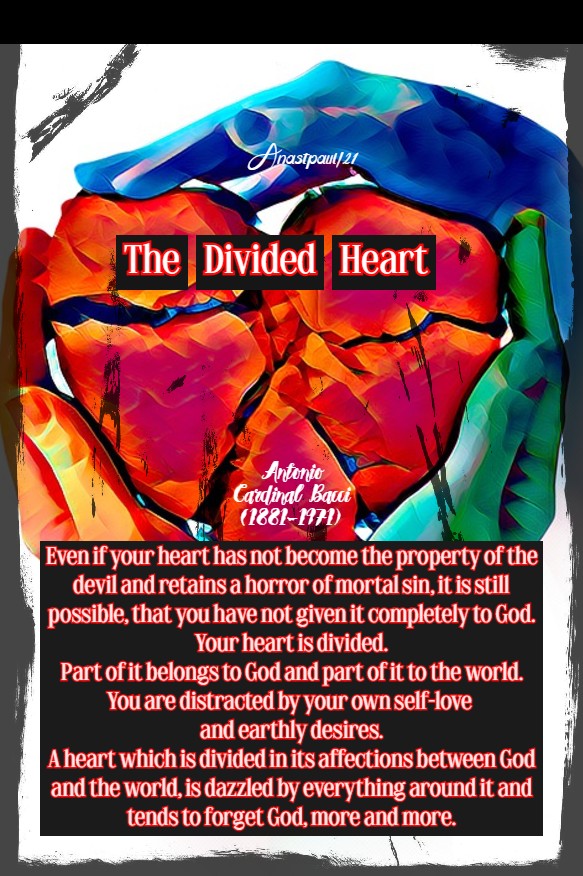
The Divided Heart
“Even if your heart has not become the property of the devil and retains a horror of mortal sin, it is still possible, that you have not given it completely to God. Your heart is divided. Part of it belongs to God and part of it to the world. You are distracted by your own self-love and earthly desires. A heart which is divided in its affections between God and the world, is dazzled by everything around it and tends to forget God, more and more.
We protest that we belong entirely to God but, in practice, we are so absorbed by work, ambition and pleasure, that we neglect God.
A man who is torn between love of God and love of the world is like Cain who, unlike Abel, did not offer God, the best part of his flock but kept this for himself and offered God whatever he had rejected. God was pleased with Abel’s sacrifice but had no regard for that of Cain, who finally became a murderer and was cursed by his Creator.
Do we offer God the leavings of life while we keep the best part of it for our selves? Do we think of ourselves nearly all the time and give very little thought to God? This is not the way in which God has dealt with us. Not only has He created us but, He loves us with an everlasting love. He came down to earth and lived as our fellow man. He redeemed us by His Precious Blood and gave Himself to us as our food!
Why are we not willing to give ourselves to Him forever in return? Gratitude demands that we should do so. God, moeover, is our supreme and only good.
Quote/s of the Day – 22 April – Thursday of the Third Week of Easter, Readings: Acts 8:26-40, Responsorial Psalm 66(65):8-9.16-17.20, John 6:44-51
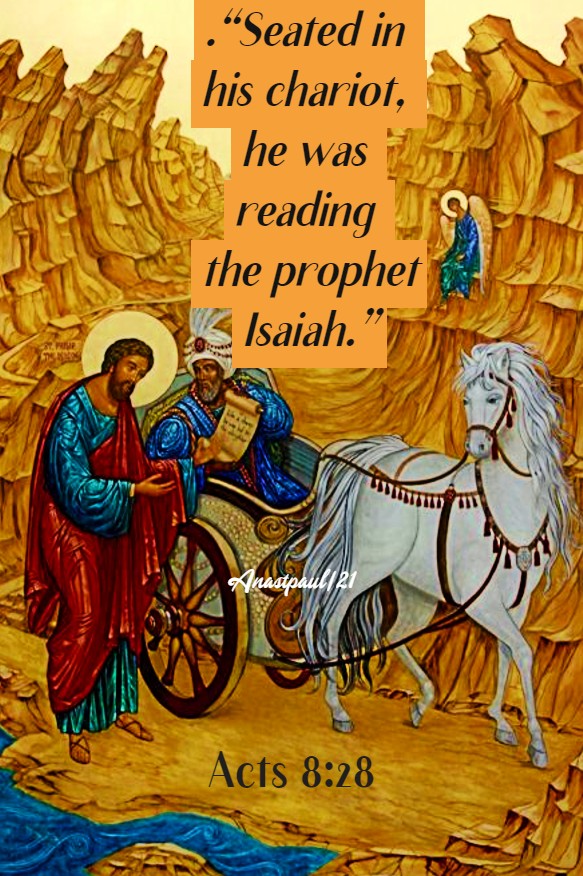
“Seated in his chariot, he was reading the prophet Isaiah.”
Acts 8:28
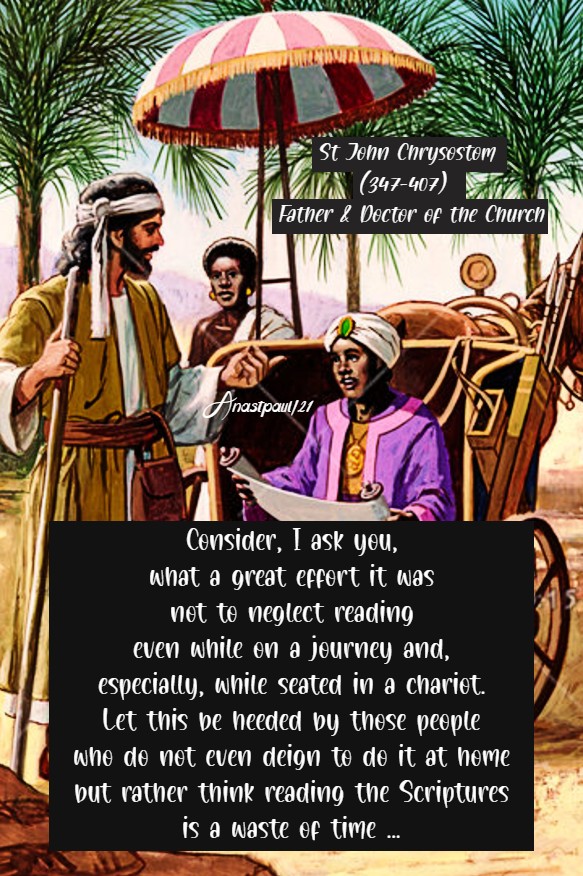
“Consider, I ask you, what a great effort it was not to neglect reading even while on a journey and, especially, while seated in a chariot. Let this be heeded by those people who do not even deign to do it at home but rather think reading the Scriptures is a waste of time …”
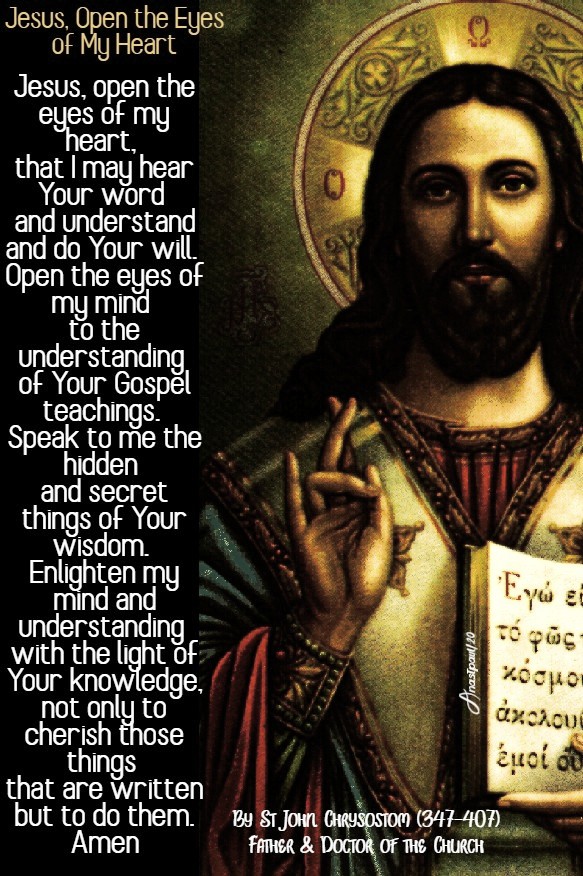
“Jesus, open the eyes of my heart, that I may hear Your word and understand and do Your will. Open the eyes of my mind to the understanding of Your Gospel teachings. Speak to me the hidden and secret things of Your wisdom. Enlighten my mind and understanding with the light of Your knowledge, not only to cherish those things that are written but to do them. Amen”
St John Chrysostom (347-407) Father & Doctor of the Church
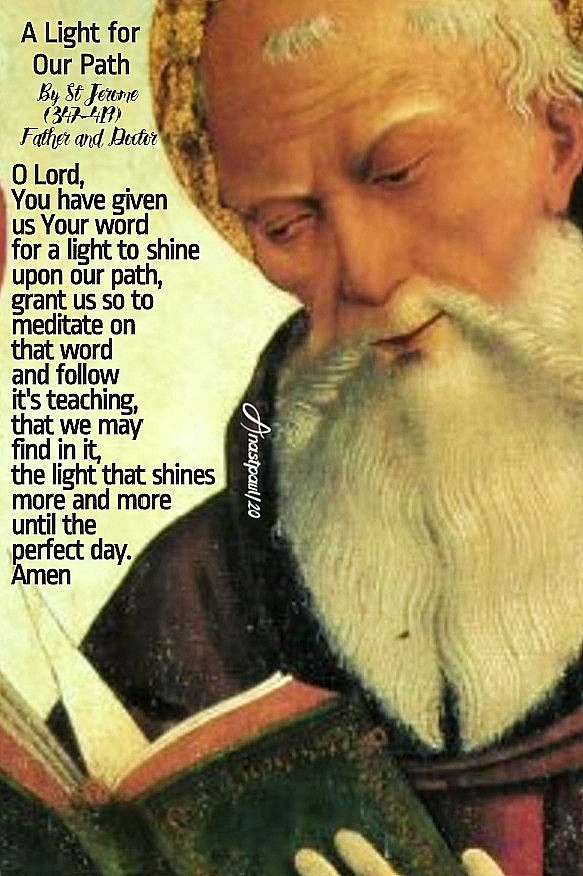
O Lord, You have given us Your word for a light to shine upon our path, grant us so to meditate on that word and follow its teaching, that we may find in it, the light that shines more and more until the perfect day. Amen
One Minute Reflection – 22 April – Thursday of the Third Week of Easter, Readings: Acts 8:26-40, Responsorial Psalm 66(65):8-9.16-17.20, John 6:44-51
“The bread that I will give, is my flesh for the life of the world.” – John 6:51
REFLECTION – “They are wholly mistaken who reject God’s plan for His creation, deny the salvation of the flesh and scoff at the idea of its regeneration, asserting that it cannot put on an imperishable nature. If the flesh is not saved, then the Lord did not redeem us with His Blood, the Chalice of the Eucharist is not a share in His Blood and the Bread which we break is not a share in His Body (1Cor 10,16). For… the human substance, which the Word of God truly became, redeems us with His Blood…
Since we are His members (1Cor 6,15) and are nourished by His creation… He declared, that the Chalice of His creation is His own Blood, from which He augments our own blood and He affirmed, that the Bread of His creation is His own Body from which He gives growth to our being.
So, when the mixed chalice and the baked loaf receive the word of God and when the Eucharistic elements become the Body and Blood of Christ, which brings growth and sustenance to our bodily frame, how can it be maintained that our flesh is incapable of receiving God’s gift of eternal life?
For our flesh feeds on the Lord’s Body and Blood and is His member. So Saint Paul writes: “We are members of his body, of his flesh and of his bones” (Eph 5,30; Gn 2,23). He is not speaking about some spiritual and invisible man…: he is speaking of the anatomy of a real man, consisting of flesh, nerves and bones. It is this that is nourished by His Chalice, the Chalice of His Blood and gains growth from the Bread which is His Body… In the same way, our bodies are nourished by the after being buried in the earth and… rise again in due season, when the word of God confers resurrection upon them “for the glory of God the Father” (Phil 2,11).” – St Irenaeus of Lyons (130-202) Bishop, Theologian and Martyr Against the heresies, V, 2, 2
PRAYER – Almighty, ever-living God, in Your Word, You shed the light of Your glory on the peoples who are living in the shadow of death. By Your Word, You teach us all things and ‘draw’ us in the way of hope and love. For Your Word is Truth and Your Word became flesh and filled our world with the Sun of Justice, Your Son, He who is the Sun and the Truth. May our steps be guided by His Mother, Our Blessed Lady, as we follow in the footsteps of Your Word and be a protection in our trials by the Bread of Life. Through Christ, our Lord Jesus, with You in union with the Holy Spirit, now and forever, amen.
Acts 8: 26-40 26 Now an angel of the Lord spoke to Philip, saying: Arise, go towards the south, to the way that goeth down from Jerusalem into Gaza:=, this is desert. 27 And rising up, he went. And behold a man of Ethiopia, an eunuch, of great authority under Candace the Queen of the Ethiopians, who had charge over all her treasures, had come to Jerusalem to adore. 28 And he was returning, sitting in his chariot, and reading Isaias the prophet. 29 And the Spirit said to Philip: Go near and join thyself to this chariot. 30 And Philip running thither, heard him reading the prophet Isaias. And he said: Thinkest thou that thou understand what thou readest? 31 Who said: And how can I, unless some man shew me? And he desired Philip that he would come up and sit with him. 32 And the place of the scripture which he was reading was this: He was led as a sheep to the slaughter and like a lamb without voice before his shearer, so openeth he not his mouth. 33 In humility his judgEment was taken away. His generation who shall declare, for his life shall be taken from the earth? 34 And the eunuch answering Philip, said: I beseech thee, of whom doth the prophet speak this? of himself, or of some other man? 35 Then Philip, opening his mouth and beginning at this scripture, preached unto him Jesus. 36 And as they went on their way, they came to a certain water and the eunuch said: See, here is water, what doth hinder me from being baptised? 37 And Philip said: If thou believe with all thy heart, thou may. And he answering, said: I believe that Jesus Christ is the Son of God. 38 And he commanded the chariot to stand still; and they went down into the water, both Philip and the eunuch:and he baptised him. 39 And when they were come up out of the water, the Spirit of the Lord took away Philip and the eunuch saw him no more. And he went on his way rejoicing. 40 But Philip was found in Azotus and passing through, he preached the gospel to all the cities, till he came to Caesarea.
Gospel: John 6: 44-51 44 No man can come to me, except the Father, who has sent me, draw him and I will raise him up in the last day. 45 It is written in the prophets: And they shall all be taught of God. Everyone that has heard of the Father and has learned, cometh to me. 46 Not that any man has seen the Father but he who is of God, he has seen the Father. 47 Amen, amen I say unto you: He that believes in me, hath everlasting life. 48 I am the bread of life. 49 Your fathers did eat manna in the desert and are dead. 50 This is the bread which comes down from heaven, that if any man eat of it, he may not die. 51 I am the living bread which came down from heaven. If any man eat of this bread, he shall live forever and the bread that I will give, is my flesh, for the life of the world.
Our Morning Offering – 22 April – Thursay of the Third Week of Easter
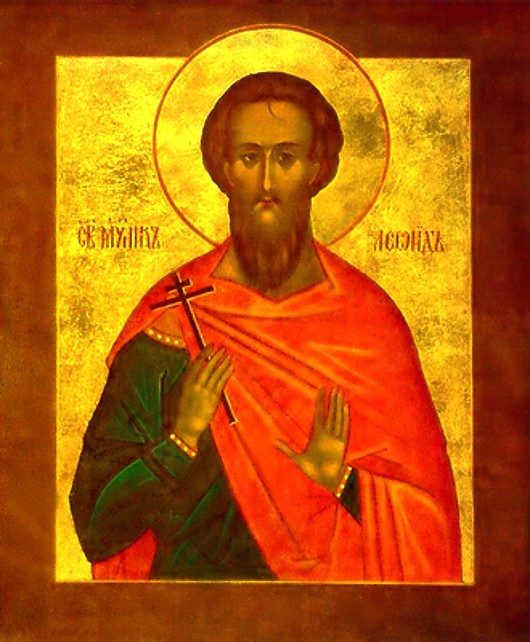
As today is the Memorial of St Leonides, Martyr for Christ, Origen’s Father, let us pray his son’s words:
May the Lord Jesus Touch Our Eyes By Origen (c 185-253) Father of the Church
May the Lord Jesus touch our eyes, as He did those of the blind. Then we shall begin to see in visible things those which are invisible. May He open our eyes to gaze, not on present realities but on the blessings to come. May He open the eyes of our heart, to contemplate God in Spirit, through Jesus Christ the Lord, to Whom belong, all power and glory, through all eternity. Amen
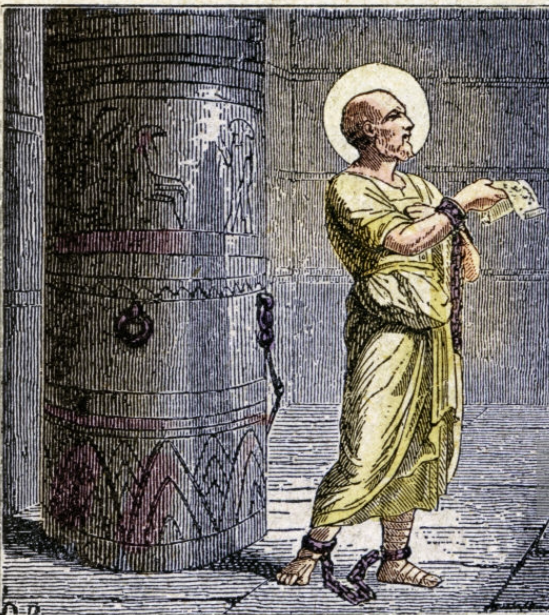
Saint of the Day – 22 April – Saint Leonides Adamantius of Alexandria (Died 202) Martyr – Layman – Father of Origen (Adamantius), Husband and Father, Philosopher, Rhetorician, a great scholar. Died by beheading in 202 at Alexandria, Egypt. Patronage – large families. Also known as Leonidas.
The Emperor Severus, in the year 202, during the tenth of his reign, raised a bloody persecution, which filled the whole empire with martyrs but especially in Egypt. One renowned Martyr, whose triumph ennobled and edified the City of Alexandria, was Leonides, father of the great Origen who sadly later fell into heresy..
Leonides was a Christian philosopher learned in both the profane and sacred sciences. He had seven sons whom he raised with abundant care. The eldest son, Origen, took after his father with a love for learning and piety. Leonides loved his children with paternal affection, seeing each as a temple of the Holy Spirit.
When the persecution raged at Alexandria under Lætus, the Governor of Egypt, Leonides was cast into prison. Origen, who was then only seventeen, burned with fearless zeal for the Gospel but was spared martyrdom for some divine design which he could discern at the time.
Cautioned and impelled by his mother toward temperance and courage, rather than recklessness, Origen cared for his family and his mother’s well-being. He then wrote to his father in very moving terms, strongly exhorting him to look on the crown that was offered him with courage and joy, adding this clause, “Take heed, sir, that for our sakes you do not change your mind.”
Leonides was accordingly beheaded for the faith in 202. His estates and goods were confiscated and his widow was left with seven children to maintain in the poorest condition imaginable. Divine Providence was both her comfort and support andthe Lord worked great signs through her family and children. The extant works of Origen inspired Christian Science and formed Christian thought and doctrine ever since and still does.
The Roman Martyrology for oday states: ” At Alexandria, the birthday of the holy and learned Martyr, Saint Leonides, who suffered under Severus.”
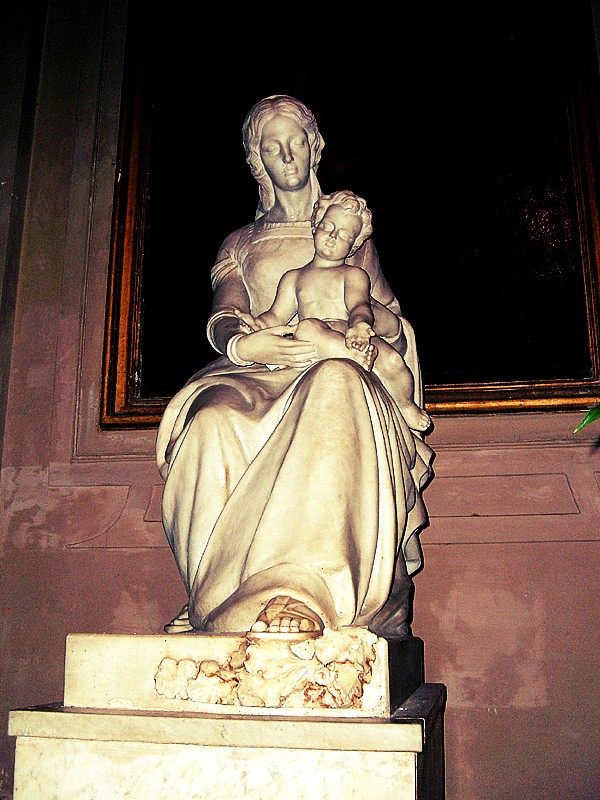
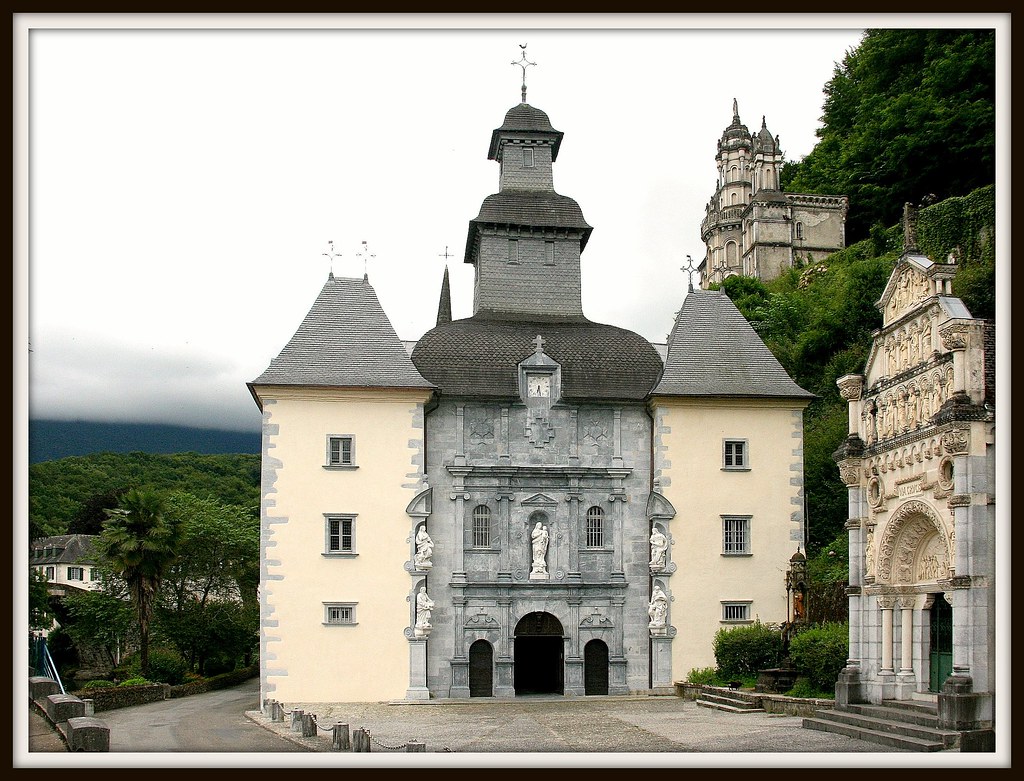
Notre-Dames de Betharam / Our Lady of Betharam, France (1503) – 22 April:
The Abbot Orsini wrote: “Our Lady of Betharam, in the Diocese of Lescar, in the Province of Bearn. This image was found, in the year 1503, by some shepherds, who, seeing an extraordinary light on the spot where the High Altar of the Chapel now stands, came up to it and found there, an image of Our Lady, for which they had a Chapel built immediately.”
More commonly known as the Sanctuary of Betharram, it is located only 15 kilometers from the more famous Marian Shrine at Lourdes. It used to be a very popular pilgrimage destination, as according to Saint Vincent de Paul, Betharram was once the second most popular place of pilgrimage in France. The river Gave, beside which the Shrine is located, is the same river whose waters flow past Lourdes.
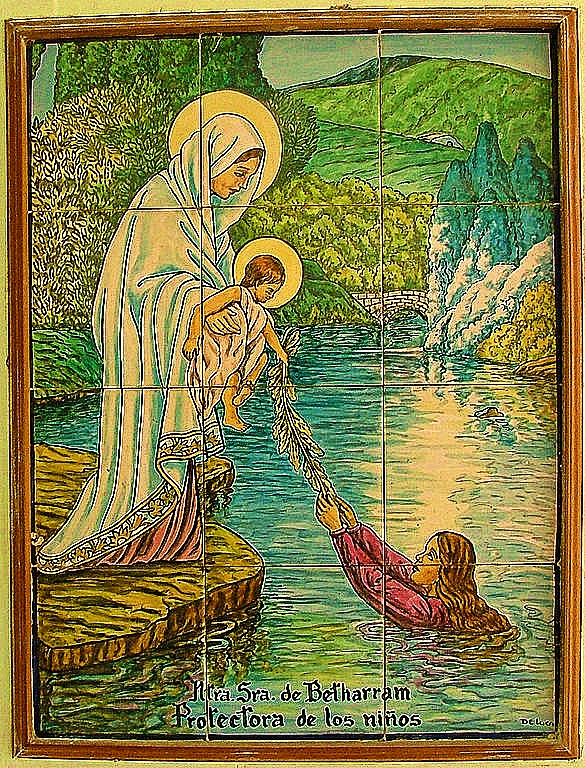
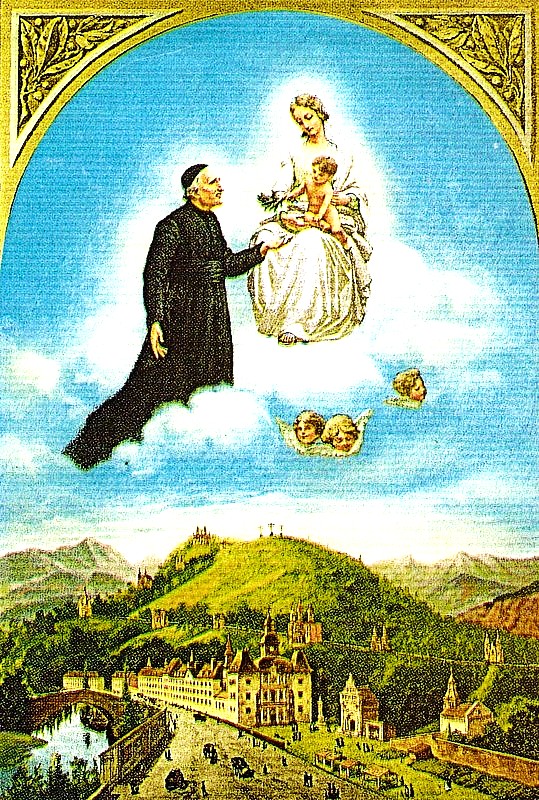
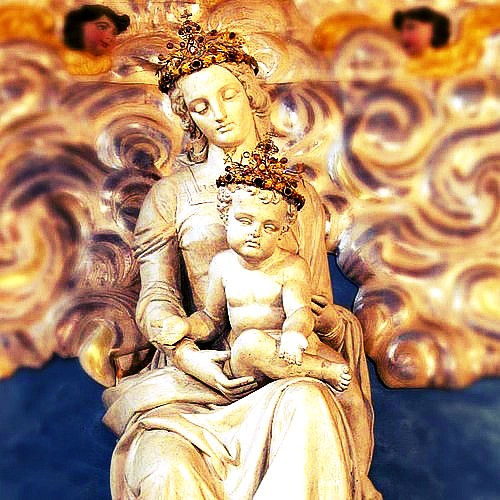
The Shrine of Our Lady of Betharam is famous for may miracles but three have reached international fame. According to tradition, one day in 1503 there were some shepherds leading their flocks along the bank of the river Gave when they suddenly observed an extremely bright light coming from the rocks. When they drew nearer, they found a beautiful Statue of the Blessed Virgin. Learning of the incident, the people in the nearby village of Lestelle, decided to construct a Chapel to house the Statue. Due to space limitations, the Chapel was initially planned for the opposite bank from where the Statue had been found. Once the Statue was placed there, however, they found that it would always return on its own, to the other side of the river ,where it had originally been found. The faithful then understood that the Blessed Virgin desired that the Chapel should be built where the Statue had been found and so it happened. The next miracles occurred in the year 1616 when some peasants from the village of Montaut were returning home from the fields at the end of the day. A storm suddenly developed, with fierce winds that threatened Betharram. In fact, the labourers saw that there was a cyclone in the storm that beat against the great wooden Cross that had been erected on the top of the hill. The Cross fell but then was encircled by a radiant aura of dazzling light before raising itself to its former position. The third miracle is the one after which the Shrine is named. Apparently a young girl fell head first into the Gave when trying to pluck a flower along the bank. The water runs fast and deep in this area and the girl was on the verge of drowning, when she cried aloud to Our Lady of Betharam of the nearby Shrine. The Blessed Virgin appeared standing on the bank holding the Divine Infant, who held a branch which He extended to rescue the girl. She offered a golden branch to the Shrine as an ex-voto offering. A beautiful branch is ‘Betharram’ in the local dialect and has became the name of the Shrine.
There were many other miracles, as at one point between the years 1620 and 1642, there were 82 documented miracles involving the blind who received their sight, the paralysed who regained the use of the limbs and those instantly cured of cancer, among other miracles.
The Chapel of Our Lady at Betharam
Saint Bernadette Soubirous frequently visited the Shrine of Betharram. In fact, the rosary beads that Bernadette used when praying with the Blessed Virgin during the first apparition at Lourdes had come from the Betharram Shrine and the priest to whom she was sent after the apparitions, was Saint Michel Garicoïts (1797-1863) the Priest of Betharram. He it was who alone believed Bernadette’s accounts of the apparitions at Lourdes. He was Canonised in 1947. About St Michel Garicoits here: https://anastpaul.com/2019/05/14/saint-of-the-day-14-may-saint-michel-garicoits-1797-1863/
St Michel Garicoits
The Cross that the winds could not destroy was finally destroyed by the folly of man during the French Revolution. The property was unlawfully confiscated and the Chaplains expelled. Saint Pope Pius X was known to be devoted to Our Lady of Betharam. He offered her two magnificent golden crowns made up of branches woven together. The prayer accompanying the inscription stated: “May the Son and His Mother accept our gifts and by appeasing our hopes and desires, may they keep for us, one day, the crown of glory which none can tarnish.”
Martyrs of Persia: Bishops, priests, deacons and laity who were martyred in Persia and celebrated together. Several of them have their stories related in the Acta of Saints Abdon and Sennen. • Abdiesus the Deacon • Abrosimus • Aceptismas of Hnaita • Aithilahas of Persia • Azadanes the Deacon • Azades the Eunuch • Bicor • Chrysotelus of Persia • Helimenas of Persia • James of Persia • Joseph of Persia • Lucas of Persia • Mareas • Milles of Persia • Mucius of Persia • Parmenius of Persia • Tarbula of Persia
Thought for the Day – 21 April – Meditations with Antonio Cardinal Bacci (1881-1971)
The Dignity and Responsibility of Being a Christian
“It is a great dignity to be a Christian. By Baptism, we become sons of God, heirs to Heaven, temples of the Holy Spirit and members of the Mystical Body of Jesus, which is the Church. God’s grace raises us to the supernatural order and makes us, as St Paul expresses it, sharers in the divine nature. By the Sacrament of Confirmation, the Holy Spirit fortifies our faith and gives us the strength to resist the temptations of the devil and to fight like loyal soldiers, for the triumph in ourselves and in others, of the Kingdom of Jesus Christ. The Sacrament of Penance, is our plank of salvation in the shipwreck of sin.
Although, we are all wretched sinners, by this give of the divine mercy, we can recover our lost innocence and return to the grace and friendship of God. Moreover, in order to prevent us from falling back into sin, Jesus give us Himself in the Blessed Eucharist, which is called, by St Thomas Aquinas, the greatest miracle of His infinite love (Opusculum 56, Officium de festo Corporis Christi, lectures 1-4).
But this is not all. If it is our vocation for form a family, God consecrates our union at the altar and gives us the graces necessary, to sanctify it, so that it may produce a good Christian family. If God has called us, on the other hand, to become spiritual fathers of the souls redeemed by His Precious Blood, He raises us to this high dignity, by the Sacrament of Holy Orders. Finally, when we shall have come to the end of our mortal lives, the Priest will be still by our side, to wash away, by the Sacrament of Extreme Unction, the last traces of sin and to comfort us in our passage to eternity. The whole life of a Christian, is a chain of favours which accompany him, from the cradle to the grave. We should be grateful to God for the goodness with which He has treated us and continues to treat us. We should co-operate generously with His gifts by recognising the lofty honour it is, to be a Christian and by living in accordance with this dignity.”
Quote/s of the Day – 21 April – Wednesday of the Third Week of Easter, Readings: Acts 8:1-8, Psalm 66:1-7, John 6:35-40 and the Memorial of St Conrad of Parzham OFM Cap. (1818-1894)
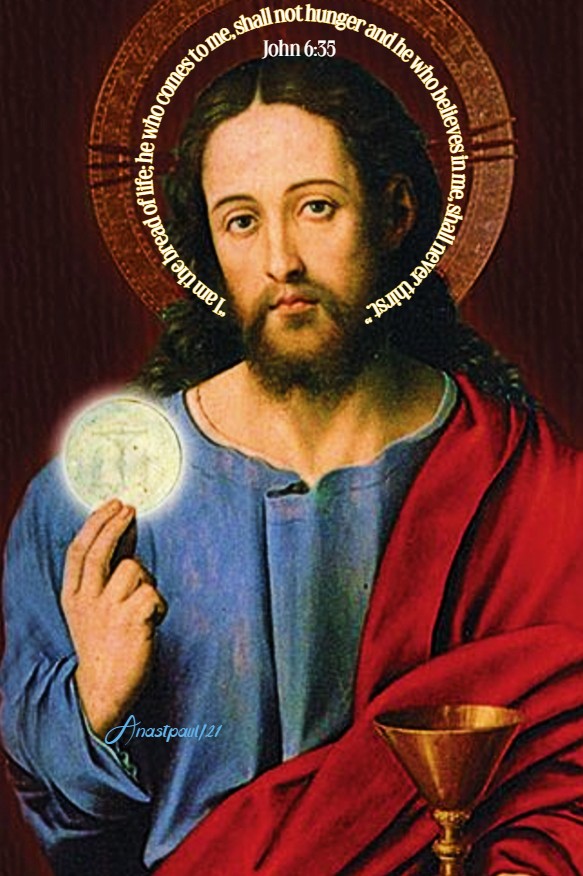
“I am the bread of life; he who comes to me, shall not hunger and he who believes in me, shall never thirst.”
John 6:35
“May Jesus be known, loved and adored by all and be, in every moment, the receiver of thanksgiving, in the most holy and most divine Sacrament.”
Bl Mary Magdalene of the Incarnation (1770-1824)
Prayer of Adoration and Repentance/Night Prayer By St Conrad of Parzham (1818-1894)
I have come to spend a few moments with You, O Jesus and in spirit I prostrate myself in the dust before Your Holy Tabernacle to adore You, my Lord and God, in deepest humility. Once more, a day has come to its close, dear Jesus, another day which brings me nearer to the grave and my beloved heavenly home. Once more, O Jesus, my heart longs for You, the true Bread of Life, which contains all sweetness and relish. O my Jesus, mercifully grant me pardon for the faults and ingratitude of this day and come to me, to refresh my poor heart which longs for You. As the heart pants for the waters, as the parched earth longs for the dew of heaven, even so does my poor heart long for You, You Fount of Life. I love You, O Jesus, I hope in You, I love You and out of love for You, I regret sincerely all my sins. May Your peace and Your benediction be mine, now and always and for all eternity. Amen
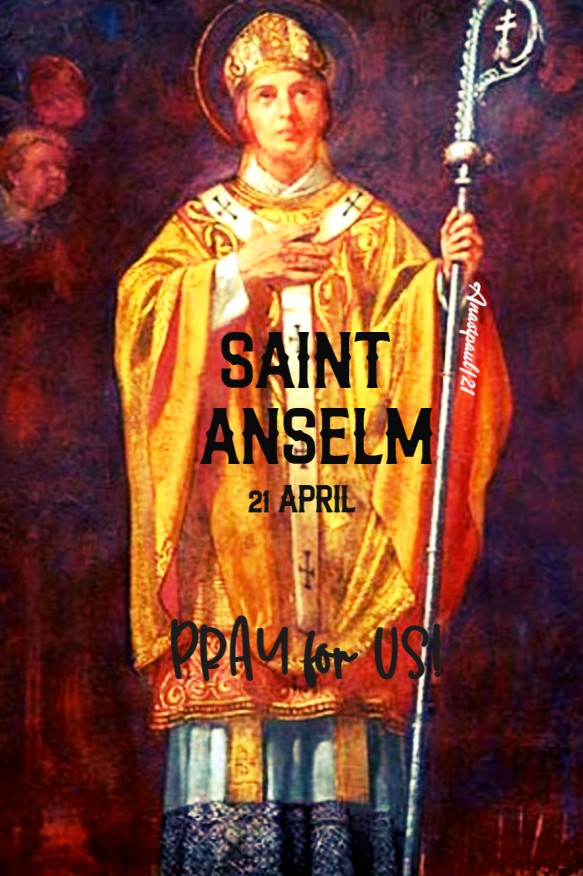
One Minute Reflection – 21 April – Wednesday of the Third Week of Easter, Readings: Acts 8:1-8, Psalm 66:1-7, John 6:35-40 and the Memorial of St Anselm (1033-1109) Doctor of the Church
“I am the bread of life” John 6:35
REFLECTION – “When Christ Himself has said of the bread: “This is my body” who could waver? And when He asserts that “This is my blood” who could be in doubt? Once, in Cana of Galilee, Jesus changed water into wine – which is akin to blood. So who could now refuse to believe it, if He transforms wine into blood? He wrought this amazing miracle when invited to an earthly marriage, so how could anyone refuse to acknowledge that He might grant the happiness of His own Body and Blood, to “the friends of the Bridegroom,” (Mt 9,15)?
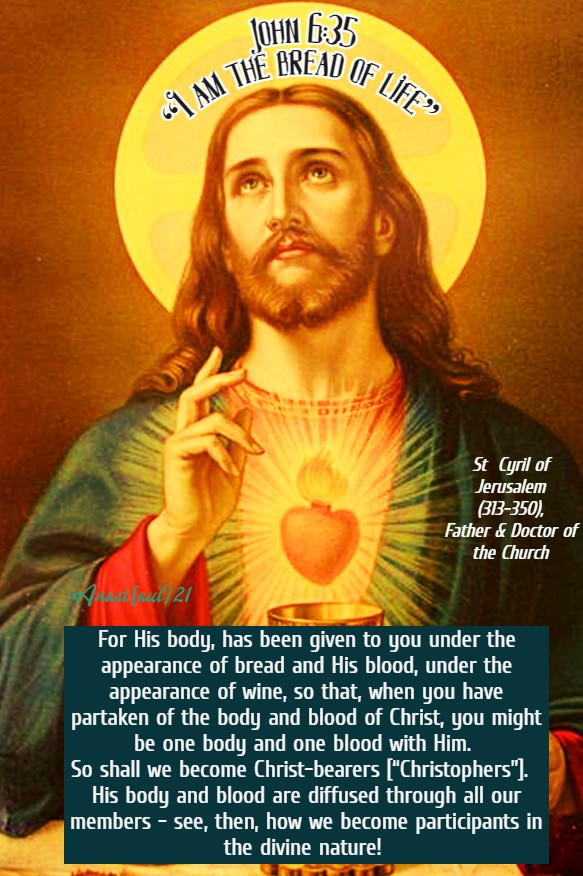
For His body, has been given to you under the appearance of bread and His blood, under the appearance of wine, so that, when you have partaken of the body and blood of Christ, you might be one body and one blood with Him. So shall we become Christ-bearers [“Christophers”]. His body and blood are diffused through all our members – see, then, how we become participants in the divine nature! Formerly, when He was talking to the Jews, Christ said: “Unless you eat my flesh and drink my blood, you do not have life in you” (Jn 6,53. If the bread and wine only seem to be purely natural substances to you, don’t stop at that… If your senses lead you astray, let your faith reassure you.
So when you draw near to receive him do not do so without respect, holding out the palms of your hands with your fingers spread apart. But since the King is about to rest in your right hand, make a Throne for Him with your left. Receive the Body of Christ in the hollow of your hand and answer: Amen!” – St Cyril of Jerusalem (313-350) Bishop of Jerusalem, Father & Doctor of the Church – Catechetical Lectures to the Newly Baptised, 22
PRAYER – Holy almighty God, in Your wisdom You created us and by Your providence You rule and feed us with the bread of life, Your Divine Son Penetrate our inmost being with Your holy light, so that our way of life may always be one of faithful service, as we follow Your Son, who leads us to eternal life. May the prayers of Mary our Mother and St AAnselm, help us to shine Your light on our neighbour. Through Christ our Lord, with the Holy Spirit, God forever, amen.
Acts 8: 1b-8 1 There was raised a great persecution against the church which was at Jerusalem and they were all dispersed through the countries of Jude, and Samaria, except the apostles. 2 And devout men took order for Stephen’s funeral, and made great mourning over him. 3 But Saul made havock of the church, entering in from house to house and dragging away men and women, committed them to prison. 4 They. therefore. that were dispersed, went about preaching the word of God. 5 And Philip going down to the City of Samaria, preached Christ unto them. 6 And the people with one accord were attentive to those things which were said by Philip, hearing and seeingthe miracles which he did. 7 For many of them who had unclean spirits, crying with a loud voice, went out. 8 And many, taken with the palsy and that were lame, were healed.
Gospel: John 6: 35-40 35 And Jesus said to them: I am the bread of life,-he that comes to me, shall not hunger and he that believeth in me, shall never thirst. 36 But I said unto you, that you also have seen me and you believe not. 37 All that the Father gives to me, shall come to me; and him that comes to me, I will not cast out. 38 Because I came down from heaven, not to do my own will but the will of him that sent me. 39 Now this is the will of the Father who sent me, that of all that he hath given me, I should lose nothing but should raise it up agaiin, the last day. 40 And this is the will of my Father that sent me, that everyone who sees the Son and believes in him, may have life everlasting and I will raise him up on the last day.
Our Morning Offering – 21 April – Wednesday of the Third Week of Easter +2021 and the Memorial of St Anselm OSB (1033-1109) Doctor of the Church
The Joy of My Lord By St Anselm (1033-1109) Doctor of the Church
I beseech You, O my God, that I may know You, love You, and rejoice in You. If in this life, I cannot do these things fully, grant that I may, at the least, progress in them, from day to day. Advance in me the knowledge of You now, that in the life to come, it may be complete. Increase in me the love of You here, that there, it may be made full. O God of truth. I pray, that I may obtain that which You promise, that my joy may be complete. And in the meantime, let my mind meditate on it, let my soul hunger after it and my whole being long for it, till at last, I enter into the joy of my Lord, Who is God, blessed forever. Amen
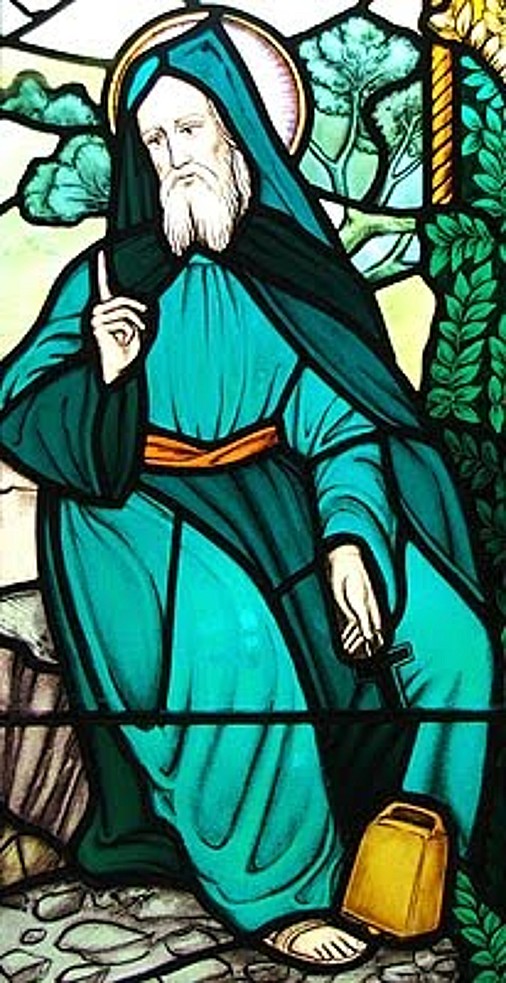
Saint of the Day – 21 April – Saint Beuno Gasulsych (c 545-c 640) Monk, Abbpt, miracle-worker Born in c 545 at Powis-land, Wales and died in c 640 at Clynnog Fawr, Wales of natural causes, Also known as – Beunor Gasulsych, Benno Gasulsych, Bennow Gasulsych. Patronages – diseased cattle, sick animals, sick children.
Beuno is said to have been born in the kingdom of Powys and educated at Bangor. As a Monk, he worked in North Wales – the many dedications to him in Gwynedd, Clwyd and the island of Anglesey reflect either Monasteries founded by him, or by his disciples.
He had a reputation of being relentless with hardened sinners but compassionate to those in distress.
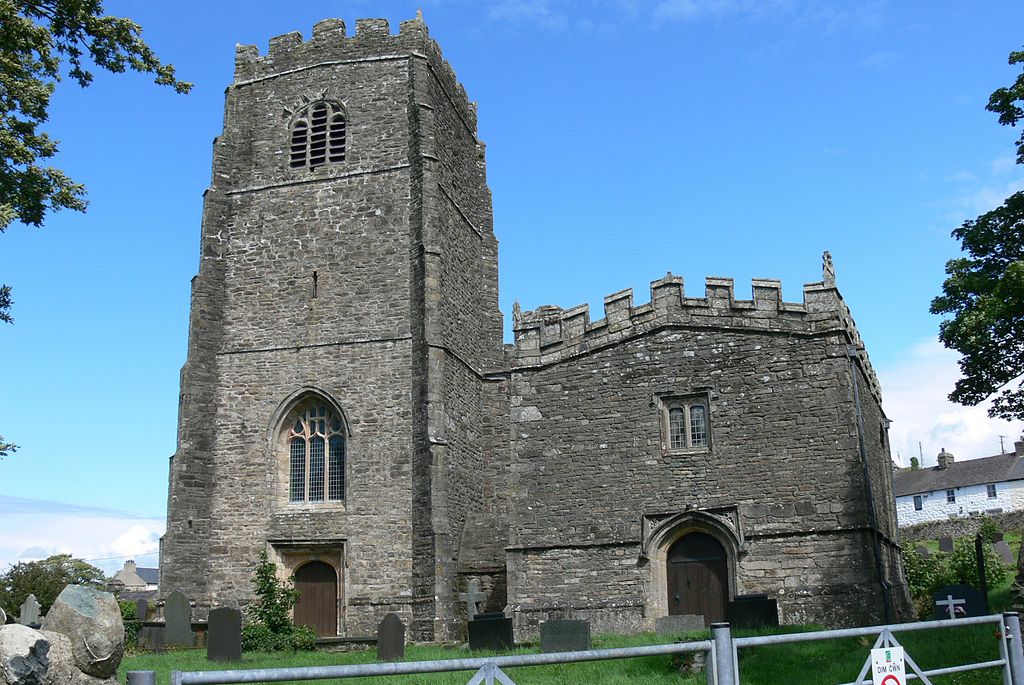
He is especially associated with the township of Clynnog Fawr in the Llyn peninsula, where he Beunos Church died and was buried and where many miracles took place at his Tomb.
Beuno was credited with raising seven people from the dead, including his niece, the virgin St Winefride and his disciple and cousin, St Aelhaiarn. He was said to have had a “wondrous vision” prior to his death.
Eleven Churches bear Saint Beuno’s name, including one in his Monastery at Clynnog Fawr and one in Culbone on the Somerset coast. Although his establishment at Clynnog is destroyed, his Grave and Chapel survive.
St Beuno’s Church (left) and Chapel (right) at Clynnog
At Tremeirchion near St Asaph in Clwyd is the Jesuit retreat house of St Beuno’s which specialises in Ignatian spirituality and thirty day retreats. Formerly a theological College, the Poet Gerard Manley Hopkins spent three years (1874-7) here as a theology student and it was here, that he wrote some of his best poetry: God’s Grandeur and The Wreck of the Deutschland.
Institution of the Confraternity of the Immaculate conception, Toledo, Spain (1484) – The Conceptionists (1506) – 21 April:
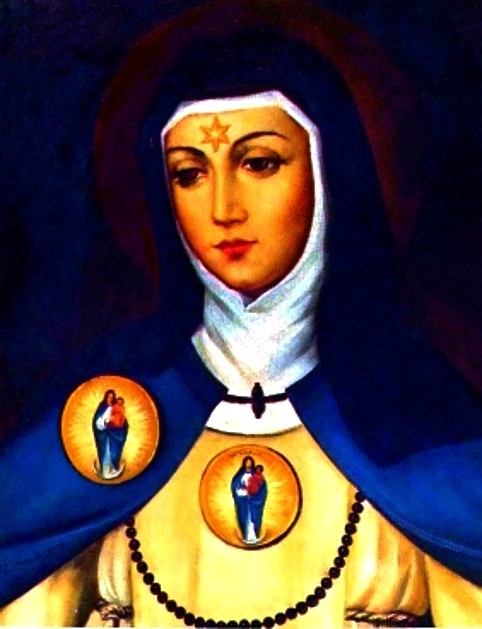
St Beatrice da Silva
The Order of the Immaculate Conception, also known as the Conceptionists, was founded in 1484 at Toledo, Spain, by Saint Beatrice da Silva. OIC (c 1424-1492) A contemplative religious order of Nuns, for some years they followed the Poor Clare’s Rule but in 1511, were recognised as a separate religious order, taking a new Rule and the name of the Order of Immaculate Conception. Saint Beatrice da Silva was a Portuguese noblewoman and sister of the Franciscan Friar, Blessed Amadeus of Portugal. Her great beauty aroused the jealousy of the Queen, her cousin, for which she was cast into prison. It was while she was in prison that the Blessed Virgin Mary appeared to her, telling her that she wanted her to found a new Order of Nuns in her honour. In 1484, Beatrice, with twelve companions, established themselves in a Monastery in Toledo (now the Monastery of the Order of the Immaculate Conception) set apart for them by Queen Isabel. A few years earlier the Blessed Virgin had shown, in a vision, Saint Beatrice da Silva that she should wear a habit consisting of a white tunic and scapular with a light blue mantle. This was the origin of the Order of the Immaculate Conception, also known as the Conceptionist Poor Clare’s. In 1489, by permission of Pope Innocent VIII, the Nuns adopted the Cistercian Rule, bound themselves to the daily recitation of the Divine Office of the Immaculate Conception and were placed under obedience to the Ordinary of the Diocese. In 1501, Pope Alexander VI united this community with the Benedictine community of San Pedro de las Duenas, under the Rule of St Clare, but in 1511 Pope Julius II gave it a Rule of its own and put them under the protection of General Minister of Friars Minor and for this reason. the Nuns are called Franciscan Conceptionists. Special constitutions were drawn up for the Order in 1516 by Cardinal Francis Quiñones. It was the foundress, Beatrice da Silva, who chose the habit: white, with a white scapular and blue mantle. A second Monastery was founded in 1507 at Torrigo, from which, in turn, were established seven others. The congregation soon spread through Portugal, Spain, Italy, France; Spain’s colony of New Spain (Mexico), starting in 1540 and as well as in Portugal’s colony of Brazil.
St Crotates of Nicomedia St Cyprian of Brescia St Felix of Alexandria St Fortunatus of Alexandria St Frodulphus St Isacius of Nicomedia Bl John Saziari St Maelrubba of Applecross St Román Adame Rosales (1859-1927) Priest and Martyr of the Cristero War His Life and Death: https://anastpaul.com/2020/04/21/saint-of-the-day-21-april-saint-roman-adame-rosales-1859-1927-priest-and-martyr/ St Silvius of Alexandria St Simeon of Ctesiphon St Vitalis of Alexandria Bl Vitaliy Bayrak Bl Wolbodó of Liège
Thought for the Day – 20 April – Meditations with Antonio Cardinal Bacci (1881-1971)
Frequent Confession and Communion
“The purifying and reforming action of frequent Confession is completed by the practice of receiving Communion, as frequently as possible.
Sacramental Confession gives us the grace of God, while Holy Communion gives us the Author of that grace, Jesus Christ, living and really present, Who comes to dwell in our poor hearts. How can anybody who goes frequently to Confession and Communion sin? How can any man cast himself once more into the clutches of the devil after experiencing the heavenly consolation of the Eucharist?
Do not protest that we are not worthy to go to Holy Communion frequently… It is true that we are not worthy but, we have a great need of this divine nourishment. If we wait until we are worthy, we shall never approach the Sacred Banquet but, if we realise our need of Jesus, we shall want to receive Him everyday. This was the practice of the early Christians, who were persevering in prayer and in the ‘Breaking of Bread’ that is, in receiving Holy Communion. From the divine Eucharist, they gained the courage to endure martyrdom. A good life is a slow martyrdom – we, who must be virtuous, have a continual need of Holy Communion, the food of the strong!”
Quote/s of the Day – 20 April – Tuesday of the Third Week of Easter, Readings: Acts 7:51–8:1, Psalm 31:3-4, 6-8, 17, 21, John 6:30-35
“My dear souls, let us recognise, I pray you, Christ’s infinite charity towards us in the institution of this Sacrament of the Eucharist. In order that our love be a spiritual love, He wills a new heart, a new love, a new spirit for us. It is not with a carnal heart but with a spiritual one, that Christ has loved us with a gratuitous love, a supreme and most ardent love, by way of pure grace and charity. Ah! One needs to love Him back with one’s whole, whole, whole, living, living, living and true, true, true heart!!”
St Lawrence of Brindisi(1559-1619) Apostolic Doctor of the Church
“What does Jesus Christ do in the Eucharist?
It is God, who, as our Saviour, offers Himself each day for us to His Father’s justice.
If you are in difficulties and sorrows, He will comfort and relieve you. If you are sick, He will either cure you or give you strength to suffer, so as to merit Heaven. If the devil, the world and the flesh are making war upon you, He will give you the weapons with which to fight, to resist and to win the victory. If you are poor, he will enrich you with all sorts of riches for time and for eternity. Let us open the door of His Sacred and Adorable Heart and be wrapped about for an instant, by the flames of His love and we shall see, what a God who loves us, can do. O my God, who shall be able to comprehend?”
St Jean Marie Baptiste Vianney (1786-1859)
Sweet Sacrament, We Thee Adore
I see upon the Altar placed The Victim of the greatest love. Let all the earth below adore and join the heavenly choirs above: Sweet Sacrament, we Thee adore, Oh! make us love Thee more and more.
Jesus! dear Shepherd of the flock, that crowds in love, about Thy feet, Our voices yearn to praise Thee, Lord and joyfully Thy presence greet: Sweet Sacrament, we Thee adore, Oh! make us love Thee more and more.
O Precious Blood of Jesus, cleanse my soul from every stain! Most pure Heart of Jesus, purify me! Most humble Heart of Jesus, teach me Thy humility! Sweet Heart of Jesus, communicate to me Thy gentleness and patience! Most merciful Heart of Jesus, have mercy on me! Most loving Heart of Jesus, inflame my heart with love of Thee! Amen
One Minute Reflection – 20 April – Tuesday of the Third Week of Easter, Readings: Acts 7:51–8:1, Psalm 31:3-4, 6-8, 17, 21, John 6:30-35
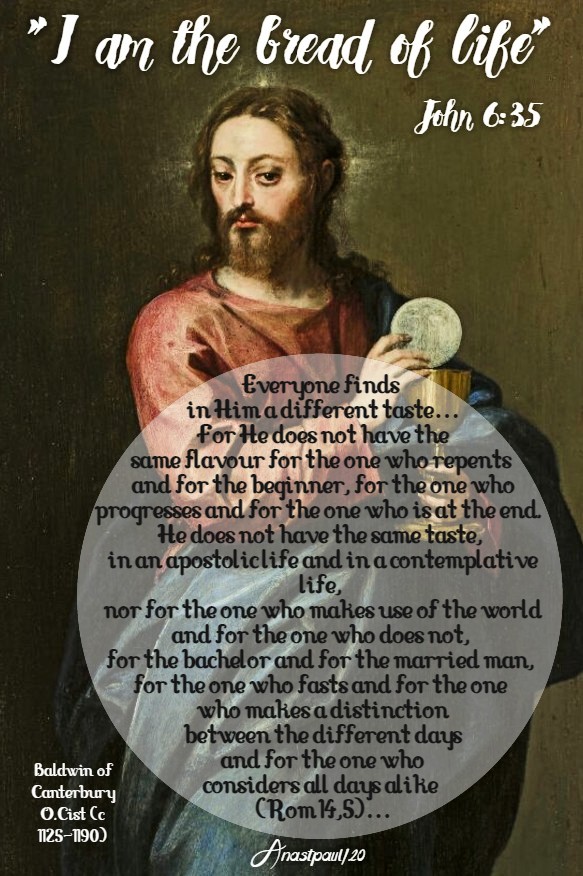
“I am the bread of life, whoever comes to me shall not hunger and whoever believes in me shall never thirst.” … John 6:35
REFLECTION – “God, – Whose nature is goodness, Whose substance is love and Whose whole life is benevolence – sent His own Son into the world, the bread of angels, “because of the great love he had for us” (Eph 2,4), because He wanted to show us the meekness of His nature and the affection He has for His children. “For God so loved the world that he gave his only Son” (Jn 3,16).
This is the real bread that the Lord sent from heaven so that we may eat it…; this is what God, in His goodness, has prepared for the poor (Ps 67,9s). For Christ, who came down form heaven for all men and to the level of each one, attracts everything to Himself through His inexpressible goodness; He does not reject anybody and He receives all men who wish to repent. He gives all those who receive Him, the most delicious taste. He is the only one who can fulfill all our desires… and, He adapts Himself in different ways, to one and the other, according to the tendencies, the desires and the appetites of each one…
Everyone finds in Him a different taste… For He does not have the same flavour for the one who repents and for the beginner, for the one who progresses and for the one who is at the end. He does not have the same taste, in an apostolic life and in a contemplative life, nor for the one who makes use of the world and for the one who does not, for the bachelor and for the married man, for the one who fasts and for the one who makes a distinction between the different days and for the one who considers all days alike (Rom 14,5)…
This bread has a sweet taste because it delivers one from all worries, it heals sicknesses, it eases trials, it assists one’s efforts and strengthens one’s hopes…Those who have tasted it hunger for it, those who hunger, will be satisfied.” – Baldwin of Canterbury O.Cist (c 1125-1190) Cistercian Abbot, then Bishop – The Sacrament of the Altar III, 2
PRAYER – Almighty Father, to whom this world, with all it’s goodness and beauty belongs, give us grace joyfully to begin this day in Your name and to fill it with the active love for You and our neighbour. By the food You give us, to sustain us on this journey, we are brought to holiness in Your Son, our Lord Jesus the Christ, whom You gave to us as our food. May the Mother of Your Son and our mother, lead us to You and be a succour on our way. Through Christ our Lord, with the Holy Spirit, God now and forever, amen.
Acts 7: 51 -60 51 You stiffnecked and uncircumcised in heart and ears, you always resist the Holy Ghost, as your fathers did, so do you also. 52 Which of the prophets have not your fathers persecuted? And they have slain them who foretold of the coming of the Just One; of whom you have been now the betrayers and murderers: 53 Who have received the law by the disposition of angels,and have not kept it. 54 Now hearing these things, they were cut to the heart, and they gnashed with their teeth at him. 55 But he, being full of the Holy Ghost, looking up steadfastly to heaven, saw the glory of God, and Jesus standing on the right hand of God. 56 And he said: Behold, I see the heavens opened, and the Son of man standing on the right hand of God. 57 And they crying out with a loud voice, stopped their ears and with one accord ran violently upon him. 58 And casting him forth without the city, they stoned him and the witnesses laid down their garments at the feet of a young man, whose name was Saul. 59 And they stoned Stephen, invoking and saying: Lord Jesus, receive my spirit. 60 And falling on his knees, he cried with a loud voice, saying: Lord, lay not this sin to their charge. And when he had said this, he fell asleep in the Lord. And Saul was consenting to his death.
Gospel: John 6: 30-35 30 They said, therefore, to him: What sign, therefore, dost thou shew, that we may see, and may believe thee? What dost thou work? 31 Our fathers did eat manna in the desert, as it is written: He gave them bread from heaven to eat. 32 Then Jesus said to them: Amen, amen I say to you,Moses gave you not bread from heaven but my Father giveth you the true bread from heaven. 33 For the bread of God is that which comes down from heaven and gives life to the world. 34 They saidthereforeunto him: Lord, give us always this bread. 35 And Jesus said to them: I am the bread of life, he that comes to me, shall not hunger and he that believes in me, shall never thirst.
Our Morning Offering – 20 April – Tuesday of the Third Week of Easter
Jesus, the Very Thought of Thee! By St Bernard of Clairvaux (1090-1153) Mellifluous Doctor
Jesus, the very thought of Thee With sweetness fills the breast! Yet sweeter far Thy face to see And in Thy presence rest. No voice can sing, no heart can frame, Nor can the memory find, A sweeter sound than Jesus’ name, The Saviour of mankind. O hope of every contrite heart! O joy of all the meek! To those who fall, how kind Thou art! How good to those who seek! But what to those who find? Ah! this nor tongue, nor pen can show The love of Jesus, what it is, None but His loved ones know. Jesus! our only hope be Thou, As Thou our prize shall be; In Thee be all our glory now And through eternity. Amen
Saint of the Day – Blessed Simon Rinalducci OSA (Died 1322) Priest and Friar of the Order of the Hermits of St Augustine, noted for his theological studies, Prior of several houses, renowned Preader, Miracle-worker. Blessed Simon was a model of humility and obedience, even in the face of great trials and obvious injustices. Born in the latter 13th Century in Todi, Italy and died on 20 April 1322 at the Monastery of Saint James the Greater in Bologna, Italy of natural causes. Also known as Simon Rinalducci of Todi and Simon of Todi.
Simon Rinalducci was born in Todi (Perugia), Italy, in the second half of the thirteenth century and joined the Augustinian Order about 1280. He devoted himself particularly to the study of theology and was engaged in the ministry of preaching with great success. He was also Prior Provincial of the Province of Umbria, as well as, Prior of several Monasteries. At the General Chapter held at Rimini in 1318, he was the object of serious but unjust charges by some of his fellow religious, due to jealousy. The great historian and recorder of events, Blessed Jordan of Saxony, recalls this episode in his book “Life of the Brethren’:
“There was a man in our Order of great holiness and greatly revered, Brother Simon of Todi. He was a lector and was Prior of many houses, as well as Prior Provincial. At a chapter meeting at which I was present, though he himself was not, some serious accusations were made against him by certain rivals of his, before the Prior General.
The accusations were accepted at face value and as a result he had to suffer many troubles and some very insulting reproaches. Nonetheless, he knew that by your endurance you will save your soul and so, he patiently endured all the heavy charges brought against him, for the sake of Him who suffered insult and terrors for us.
At length he was appointed as preacher in Bologna on account of his very pleasant manner of speaking and there, he provided the people with abundant instruction by his teaching and with very beneficial guidance, by the example of his life. In the course of a public sermon he predicted his death before it occurred and had a happy departure from this life.”
He also was distinguished in the Diocese by many miracles. In May 1311, the Bishop of Terni gave the Augustinians of his See a Church in the Diocese chiefly at the request of and in appreciation for, Simon, whom he held as his very dear friend.
Simon died at Bologna in the Monastery of Saint James the Greater on 20 April 1322 and here his remains are venerated. The memory of Simon is celebrated by the Augustinian Family on 20 April.
Simon was Beatified on 19 March 1833 by Pope Gregory XVI (cultus confirmed).
The Abbot Orsini wrote: “This Church was built on the spot where the castle stood, which those of the house of Scheir voluntarily ceded to Our Lady, except Arnaud, who, in punishment of his obstinacy, was accidentally drowned in a neighbouring lake.”
Arnaud Schier is remembered as being the odd son of the Bavarian House of Schier. Sullen and disgruntled, he angrily left the dining hall before the meal was finished. It would prove to be his last meal. His parents had decided to give up their castle, which Arnaud had hoped would be his heritage, for the honour of the Blessed Virgin Mary. He did not favour the idea of giving the castle to the Virgin and no-one had even thought to ask him his opinion. Slamming the door, he wandered into the darkness of night alone, caring little if anyone should overhear his repeated objections. The more he thought about it, the angrier he became. Why did the family wish to give up the ancestral home? And for a Shrine to Our Lady at that! Arnaud wanted no more of this continued discussion on the subject. On he walked, oblivious of where, nursing his grievance against the Mother of God. He was last seen by a servant waiving his hands in the air and bemoaning his loss, wondering what he should do. Arnaud had forgotten that his chief concern should have been to seek after perfection. Children will usually imitate their parents after initially watching them and then conversing with them. Parents who are a fine Christian example, such as Arnaud’s parents, should have had children who would also seek to imitate their Divine Master. The surest route is with the help of God’s grace but also, through the intercession of His Most Holy Mother.
I could find no other information about Our Lady of Schier, Germany. If you have any knowledge of this Church, please forward it to me to have it added to this website. Thank you!
Thought for the Day – 19 April – Meditations with Antonio Cardinal Bacci (1881-1971)
Faith and Charity
“Faith is a wonderful thing. As has been said, it is a supernatural gift from God, which we should keep alive by prayer. Faith alone is not enough, however. It is the foundation, on which we must build the structure of our Christian life. It is especially necessary for it to be united to the flame of charity. “Without love,” says St Augustine, “there is only the faith, which the devil has” (De Caritate 10) because, as St James explains, “the devil also believes and trembles” (Js 2:19). We, however, should believe and love. We must combine faith with charity towards God and towards our neighbour. Our faith should be active. As St Paul says, it should work under the influence of charity (Gal 5:6). Without charity and good works, faith is a lifeless thing.
If we really believe, we should love God above all things, even more than we love ourselves and, we should be ready to make any sacrifice for Him, even the sacrifice of our lives.
Faith should induce us to think constantly of God and charity should urge us to do everytig for His sake, rather than for any lesser purpose. If we lack this kind of charity, we cannot claim to be sincere Christians.”
Quote/s of the Day – 19 April – Monday of the Third Week of Easter, Readings: First: Acts 6: 8-15, Psalm: Psalms 119: 23-24, 26-27, 29-30, Gospel: John 6: 22-29
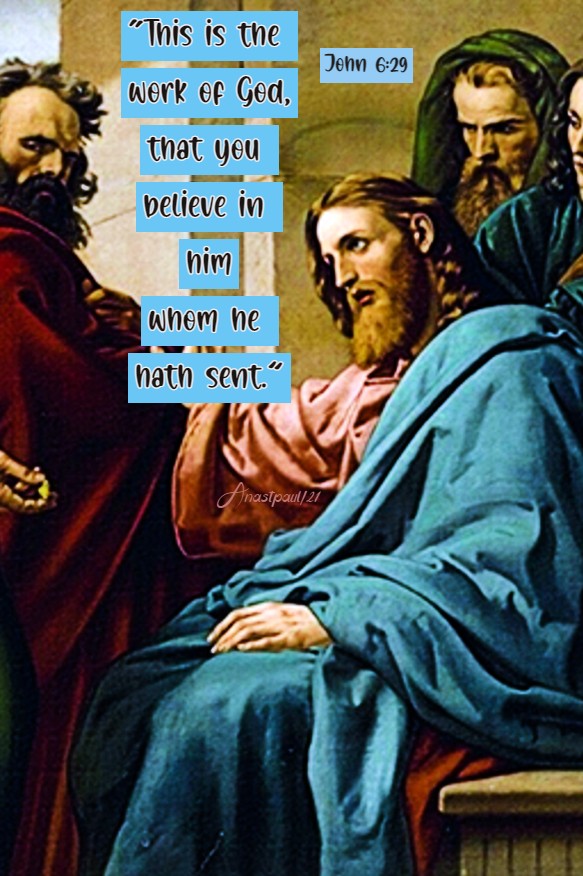
“This is the work of God, that you believe in him whom he hath sent.”
John 6:29
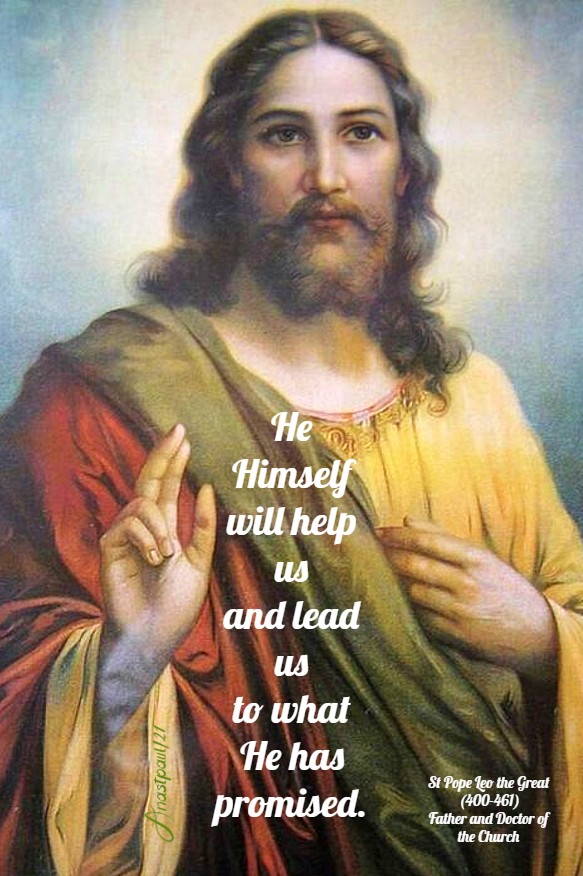
“He Himself will help us and lead us to what He has promised.”
St Pope Leo the Great (400-461) Father and Doctor of the Church
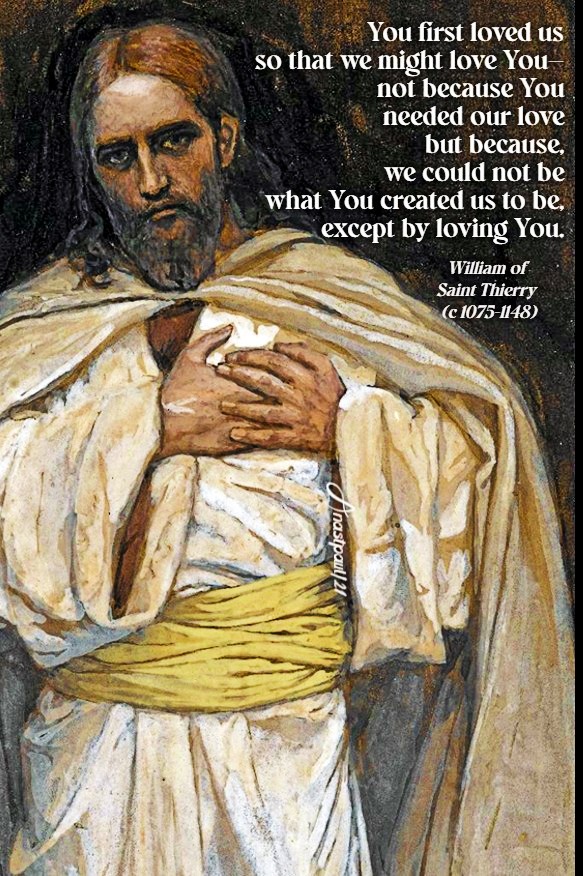
“You first loved us so that we might love You— not because You needed our love but because, we could not be what You created us to be, except by loving You.”
William of Saint Thierry (c 1075-1148)
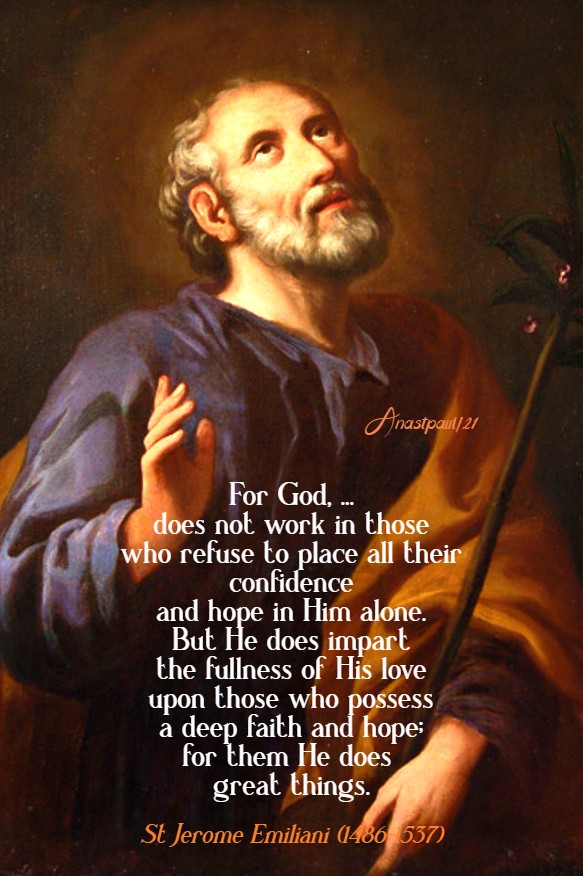
“For God, … does not work in those who refuse to place all their confidence and hope in Him alone. But He does impart the fullness of His love upon those who possess a deep faith and hope; for them He does great things.”
St Jerome Emiliani (1486-1537)
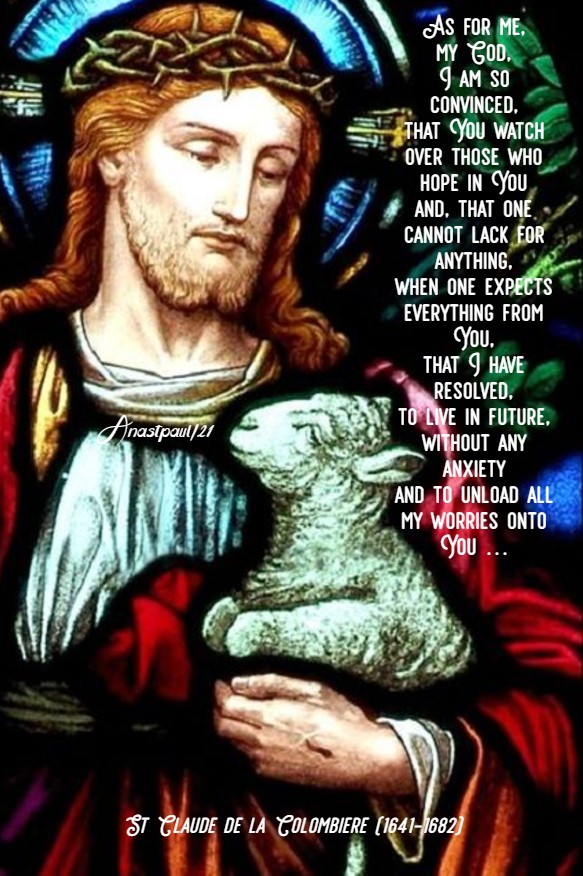
“As for me, my God, I am so convinced, that You watch over those who hope in You and, that one cannot lack for anything, when one expects everything from You, that I have resolved, to live in future, without any anxiety and to unload all my worries onto You …”
St Claude de la Colombiere (1641-1682)
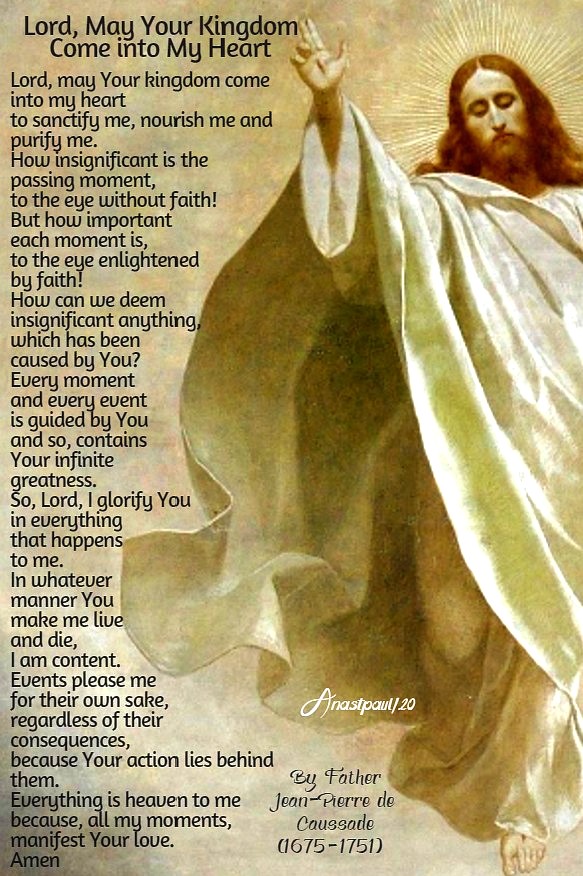
Lord, May Your kingdom Come Into My Heart By Fr Jean Pierre de Caussade (1675-1751)
Lord, may Your kingdom come into my heart to sanctify me, nourish me and purify me. How insignificant is the passing moment, to the eye without faith! But how important each moment is, to the eye enlightened by faith! How can we deem insignificant anything which has been caused by You? Every moment and every event is guided by You and so contains Your infinite greatness. So, Lord, I glorify You in everything that happens to me. In whatever manner You make me live and die, I am content. Events please me for their own sake, regardless of their consequences because Your action lies behind them. Everything is heaven to me because all my moments, manifest Your love. Amen
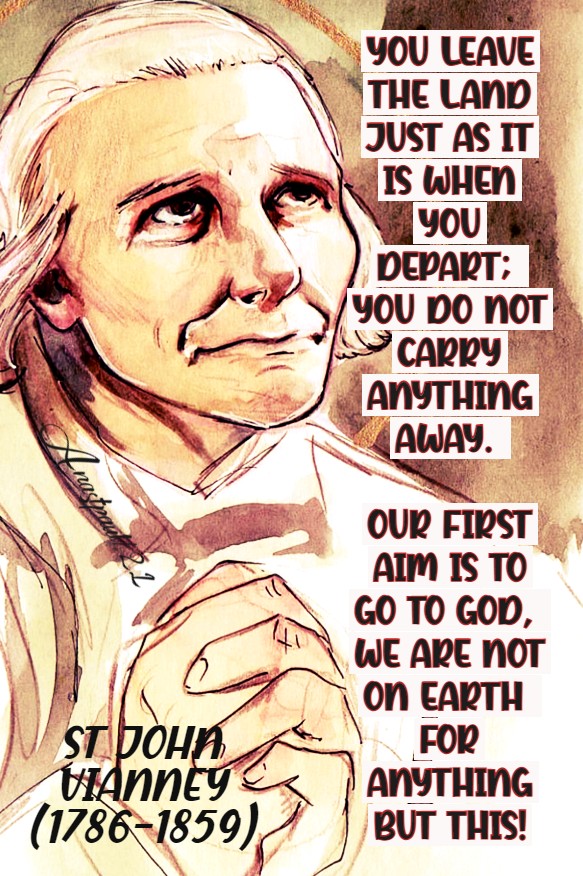
“You leave the land just as it is when you depart; you do not carry anything away. Our first aim is to go to God, we are not on earth for anything but this!”
One Minute Reflection – 19 April – Monday of the Third Week of Easter, Readings: First: Acts 6: 8-15, Psalm: Psalms 119: 23-24, 26-27, 29-30, Gospel: John 6: 22-29 and the Memorial of Bl Conrad of Ascoli OFM (1234-1289)
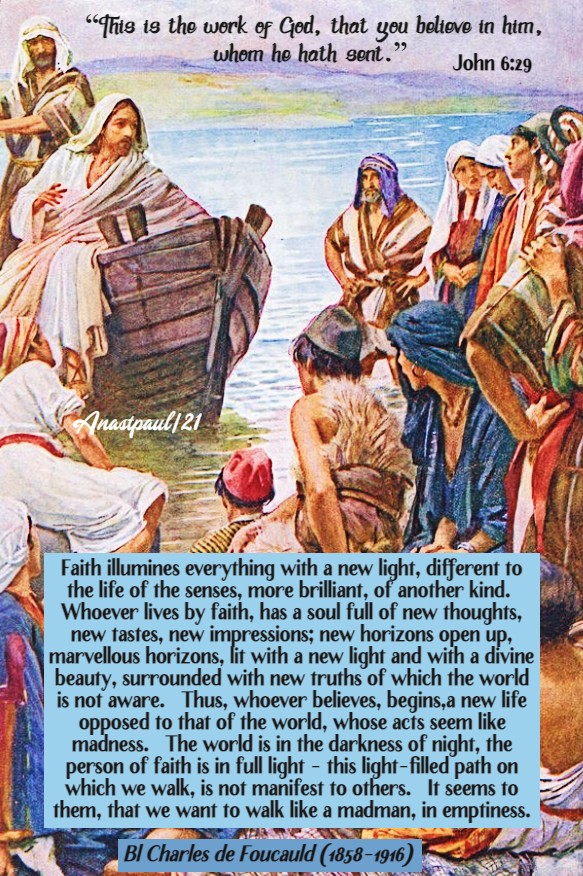
“This is the work of God, that you believe in him, whom he hath sent.” – John 6:29
REFLECTION – “The senses are full of curiosity – faith is content to know nothing, it… longs to pass its life motionless before the Tabernacle. The senses love riches and honour – faith holds them in horror… “Blessed are the poor” (Mt 5,3). She adores the poverty and lowliness with which Jesus covered His life, as though with a garment, that He never cast off… The senses take fright at that which they call danger, at all that might mean pain or death – but faith is afraid of nothing, it knows nothing can happen to it but what is the will of God: “I have counted every hair of your head” (Mt 10,30) and whatever God wishes, will always be for its good. “All that happens is for the good of my elect” (Rm 8,28). Thus in everything that may happen, sorrow or joy, health or sickness, life or death, it is content and fears nothing. The senses are anxious about the future and ask how we shall live tomorrow but faith feels no anxiety…
Thus faith illumines everything with a new light, different to the life of the senses, more brilliant, of another kind. Whoever lives by faith, has a soul full of new thoughts, new tastes, new impressions; new horizons open up, marvellous horizons, lit with a new light and with a divine beauty, surrounded with new truths of which the world is not aware. Thus, whoever believes, begins a new life opposed to that of the world, whose acts seem like madness. The world is in the darkness of night, the person of faith is in full light – this light-filled path on which we walk, is not manifest to others. It seems to them, that we want to walk like a madman, in emptiness.” – Blessed Charles de Foucauld (1858-1916) Hermit and Missionary in the Sahara – Retreat Notes, Nazareth, Nov. 1897
PRAYER – King of heaven and earth, Lord God, rule over our hearts and bodies this day. Sanctify us and guide our every thought, word and deed, according to the commandments of Your law, so that now and forever, Your grace may free and save us. Let us walk in Your ways and be your lights and thus, by our lives, help others to follow You. Grant that the prayers of our blessed Mother, the Mother of Jesus Your Son and Blessed Conrad of Ascoli, who always lived for You alone, may help us, as we work through each day to reach our heavenly home. Through Jesus the Lord, with the Holy Spirit, God now and forever, amen.
Acts 6: 8-15 8 And Stephen, full of grace and fortitude, did great wonders and signs among the people. 9 Now there arosesome of that which is called the synagogue of the Libertines, and of the Cyrenians and of the Alexandrians and of them that were of Cilicia and Asia, disputing with Stephen. 0 And they were not able to resist the wisdom and the spirit that spoke. 11 Then they suborned men to say, they had heard him speak words of blasphemy against Moses and against God. 12 And they stirred up the people, and the ancients and the scribes and running together, they took him and brought him to the council. 13 And they set up false witnesses, who said: This man ceaseth not to speak words against the holy place and the law. 14 For we have heard him say, that this Jesus of Nazareth shall destroy this place and shall change the traditions which Moses delivered unto us. 15 And all that sat in the council, looking on him, saw his face as if it had been the face of an angel.
Gospel: John 6: 22-29 22 The next day, the multitude that stood on the other side of the sea, saw that there was no other ship there but one and that Jesus had not entered into the ship with his disciples but, that his disciples were gone away alone. 23 But other ships came in from Tiberias, nigh unto the place where they had eaten the bread, the Lord giving thanks. 24 When herefore he multitude saw that Jesus was not there, nor his disciples, they took shipping and came to Capharnaum, seeking for Jesus. 25 And when they had found him, on the other side of the sea, they said to him: Rabbi, when camest thou hither? 26 Jesus answered them and said: Amen, amen I say to you, you seek me, not because you have seen miracles but because you did eat of the loaves and were filled. 27 Labour not for the meat which perisheth but for that which endures unto life everlasting, which the Son of man will give you. For him hath God, the Father, sealed. 28 They said, therefore, unto him: What shall we do, that we may work the works of God? 29 Jesus answered and said to them: This is the work of God, that you believe in him whom he hath sent.
Our Morning Offering – 19 April – Monday of the Third Week of Easter
Your Will Alone By St Thomas Aquinas (1225-1274) Angelic Doctor of the Church
Oversee, O my God, my life, that I may do what You ask of me; allow me to see and permit me to do whatever is fitting and profitable to my soul. Lead me not, O Lord my God, into excessive wealth or want, lest I put my trust in riches, or despair in misery. Let me take no joy or sorrow, save in what would lead me to You or from You. Let me delight only in pleasing You and fear only displeasing You. O Lord, let all passing things seem worthless to me and let everything eternal, become my treasure. May I despise any joy apart from You and seek nothing that is without You. Make carrying the burdens for You my relaxation, O Lord and rest without You, itself a burden. Amen
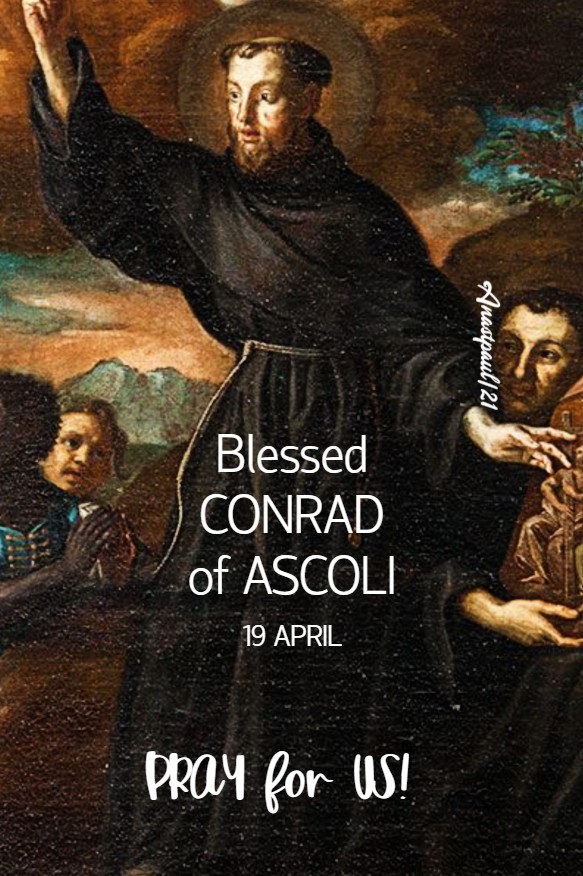
Saint of the Day – 19 April – Blessed Conrad of Ascoli OFM (1234-1289) Franciscan Friar Missionary, Evangeliser, Penitent, zealous Preacher, Cardinal-elect. Blessed Conrad had a great devotion to the Most Holy Trinity and the Blessed Virgin Mary. Born in 1234 in Ascoli, Italy and died on 19 April 1289 as in Ascoli of natural causes aged 55.
At Ascoli in the district of Ancona, Conrad was born of the noble Migliano family in the year 1234. It was marvellous how the small child practised mortifications and self-denial in all things as saints would do. It is recorded, that even as an infant he took his mother’s milk only once on fast days. It was discovered that even as a small boy he possessed the gift of prophecy. Sometimes, for instance, he would go on his knees before a companion named Jerome and he always tendered him great respect. When he was asked for the reason, he said: “I have seen the keys of heaven in his hands.” Jerome later became a Pope, known to us as Nicholas IV.
The two companions formed an intimate friendship. They vied with each other in their application to study but still more, in the practice of virtue. Together with Girolamo (Jerome) Masci, he became a Franciscan Friar in the Convent of Ascoli. United by a close friendship, Corrado and Girolamo devoted themselves with ardour to the piety and austerity of the Franciscan life, following the narrow path of Christian perfection.
From Ascoli they were both sent to Assisi and then to Perugia to complete their studies. They earned the title of “readers” of sacred knowledge and then from Perugia to Rome, where they taught theology and fruitfully preached the Word of God to the people.
Wisdom and humility, austerity of life and zeal for the salvation of souls are the personality traits of the young Corrado. A very humble man, he shunned any reason for personal prestige by living as a true friar minor.
From his friend Girolamo, who became General of the Franciscan Order, he obtained permission to leave for Africa to announce the Word of salvation. At the cost of great efforts and pilgrimages he evangelised Libya and Cyrenaica. In preaching, he always adapted, with due discernment, his speeches to the intelligence of his listeners. God blessed the simplicity of the religious scholar. His word went straight to the hearts of the listeners.
The privileged object of his proclamation was the adorable mystery of the Most Holy Trinity: it drew everyone to worship God. He accompanied the proclamation of the Word with a harsh and penitent lifestyle. He was strict with himself and indulgent with others. He tenderly loved the Mother of the Lord and the memory and meditation of the Lord Jesus, Crucified love, never fell from his mind.
Pope Nicholas III sent Fra Girolamo Masci as legate to the King of France to induce him to more peaceful sentiments, he wanted Brother Corrado as his companion who, reluctantly, had to leave Africa. When Fra Girolamo saw this close friend arrive in Paris covered in a very poor dress and barefoot, moved by compassion and veneration, he exclaimed “This man is more than Jonah!”.
Once the peace between France and Spain was restored, the two friars returned to Rome, where, in 1278, Fra Girolamo was awarded the dignity of Cardinal. Conrad, after two years of preaching and residing in Rome, was sent to Paris to teach theology, proving himself to be an eminent teacher.
In 1288 Girolamo Masci ascended the Papal throne with the name of Nicholas IV; he called Brother Conrad to him to avail himself of his enlightened advice. To the rumours of his imminent Cardinalate that spread in the Parisian environment, he replied, in his farewell address, exhorting everyone to love above all the Christian virtue of humility and concealment.
Exhausted by the long and uncomfortable journey, he died in Ascoli on 19 April 1289. Nicholas IV deeply mourned and, confirming the intention he had had, to make him a Cardinal, ordered a solemn mausoleum to be erected on his tomb. His remains, buried in the primitive convent, were then transferred in May 1371 to the Church of San Francesco.
Among the Christian virtues practised by Blessed Corrado, a characteristic was that of penance. He wore a very crude habit, walked barefoot, rested for only a few hours on a hard table, fasted on bread and water four days a week.
He had placed the Holy Trinity at the soul of his apostolate, thanks to which, he obtained miracles of all kinds.
Credited legends had flourished, while he was still alive, around his holiness. The popular cult, attributed to him from time immemorial in the Marche and in the various Families of the Minoritic Order, was approved by Pope Pius VI on 30 August 1783.
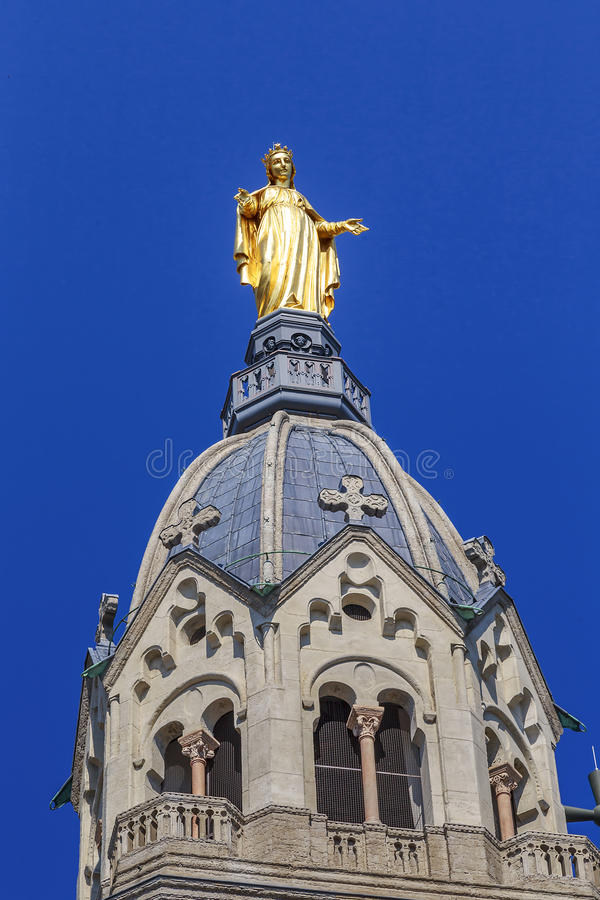
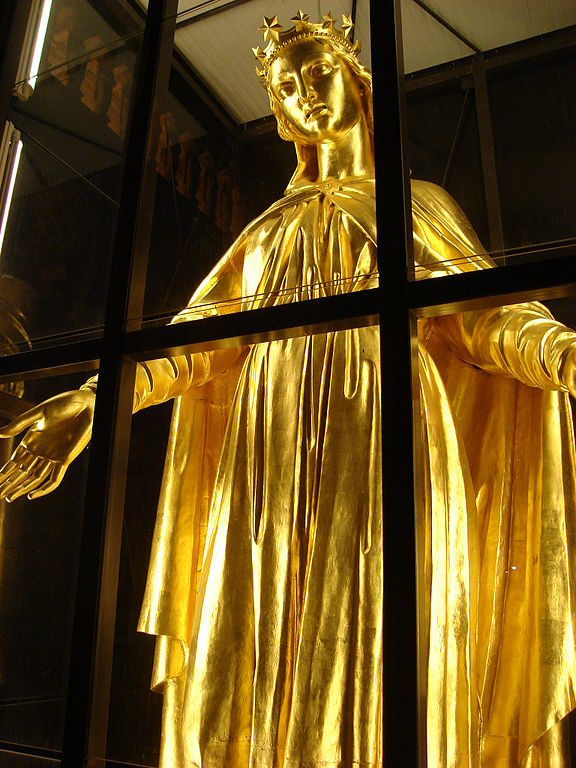
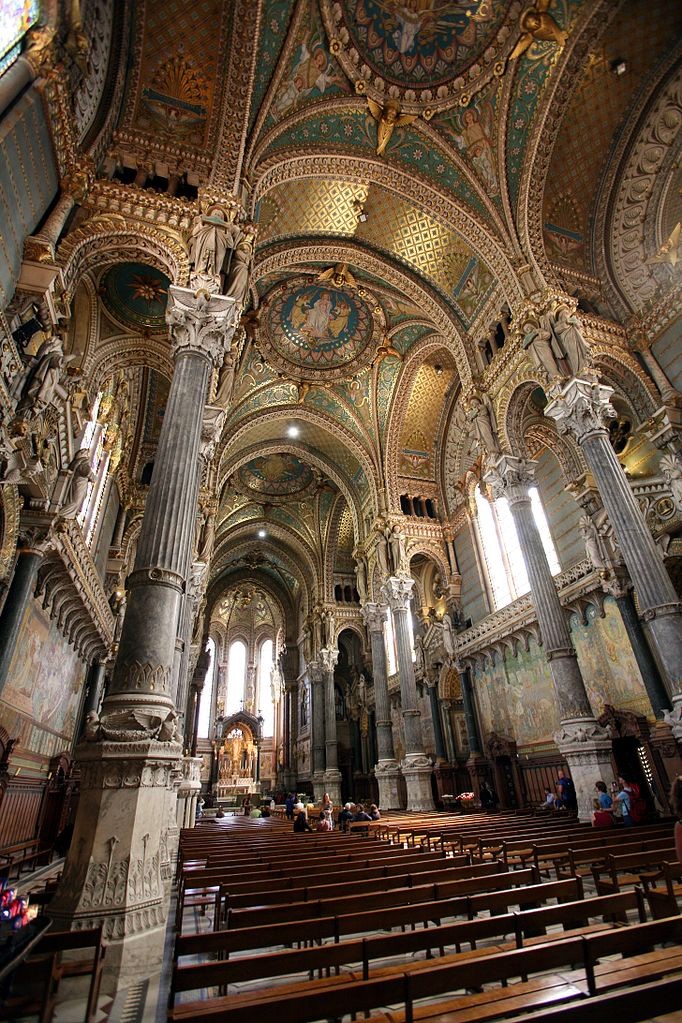
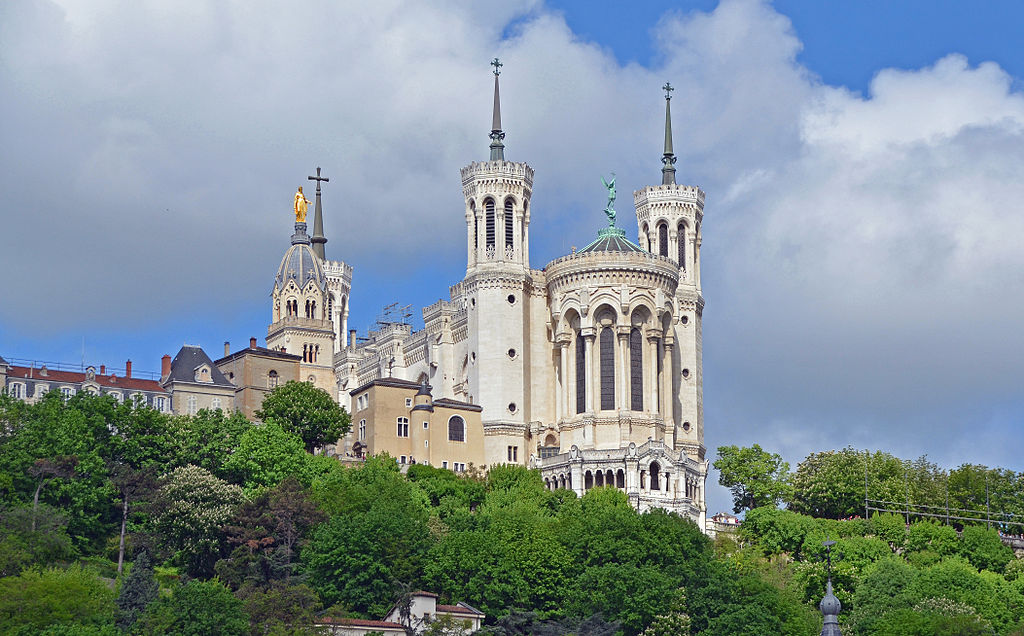
Notre-Dame de Fourvière Basilica / Our Lady of Lyons, France (1643) – 19 April:
In about the year 150 Saint Pothinus, the Apostle of Gaul and first Bishop of Lyon, is said to have enshrined a picture of Our Lady in an underground chapel which is now beneath the Church of Saint Nazaire, or Nizier, in Lyons where many Christians suffered death in the Old Forum on the Hill of Blood. According to tradition, there was once a temple to Attis on the site, whose followers precipitated a persecution against the Christians in about the year 177. Later, in the 5th century, a Basilica was built on the site and the remains of many Christian martyrs from that persecution were buried there, as well as the Bishops of Lyon. The Church takes its name from Nicetius of Lyon, who was the 28th Bishop there in the 6th century, due to the numerous miracles that occurred there after his burial. In 1168 the Canons of the Cathedral started building a larger Church over the Shrine. In thanksgiving for the cure of his son by this Saint, King Louis VII of France made a pilgrimage to Lyons, where he had an ex-veto tablet set up before the Shrine of Our Lady. In 1466 King Louis XI founded a daily Mass in perpetuity, to be followed always by the Salve Regina, solemnly sung. In the year 1638, King Louis XIII consecrated France to the Blessed Virgin Mary. Already, vast pilgrimages came to seek Mary’s aid, especially in time of famine and plague.
In 1643, the bubonic plague swept across Europe. The people of Lyon dedicated their city to Our Lady and consecrated themselves to Our Lady of Fourviere, pledging to make a solemn procession on 8 September of each year in thanksgiving for the end of the epidemic. Instantly, all traces of the plague vanished and, until 1792, twenty-five Masses were said daily in thanksgiving. The annual procession continues even to this day, with the participation of the Mayor of Lyons or one of his representatives. On that day, the people make a present to the Virgin of a seven-pound candle and a gold coin.
During the years of the French Revolution the Sanctuary was profaned and the Church used as a warehouse. Sometimes pilgrims would still come to visit the Shrine at night under peril of their lives. In 1805, Pope Pius VII himself presided at the opening or re-opening of the Shrine. Shortly before the battle of Waterloo, the Shrine was threatened with destruction when Napoleon wanted the hillside fortified. The Marshall was given the order to demolish the Shrine but he refused to do so. Because the City was spared many vicissitudes during the revolutions of 1830 and 1848, the people of Lyons decided to show their gratitude by adding a tall Tower to the Church surmounted by a great bronze figure of Our Lady. The inauguration of the renovated Church and Tower was scheduled for 8 September 1852 but the date was moved to 8 December because of heavy flooding. Even then, the festivities and fireworks planned for the celebration had to be cancelled due to heavy rains. The citizens of Lyons, undismayed, put lanterns on their windowsills as a sign of their devotion. This episode is the origin of the street illuminations now observed on 8 December and has become part of the annual tradition. On this day, the faithful put candles or lanterns in their windows and make the pilgrimage up the hill to the Basilica by candlelight or flashlight, called the Fête des Lumieres, or the “festival of lights.” The Virgin is also credited with saving the City from a Cholera epidemic in 1832 and from Prussian invasion in 1870. During the Franco-Prussian War, Prussian forces, having taken Paris, were progressing south toward Lyon. Their pause and inexplicable retreat were attributed by the Church to the intercession of the Virgin Mary. After the Franco-Prussian war of 1870, a vast Basilica to Our Lady was built next to the old Shrine, which remained almost untouched. The crypt of Saint Pothinus, under the choir of the Church of St. Nazaire, was completely destroyed in 1884.
St Alphege of Winchester (c 953–1012) ArchBishop and Martyr
St Martha of Persia Bl Ramon Llach-Candell St Rufus of Melitene St Vincent of Collioure — Martyrs of Carthage – 17 saints: A group of Christians martyred in the persecutions of Decius. We know little more than the names – Aristo, Basso, Credula, Donato, Ereda, Eremio, Fermo, Fortunata, Fortunio, Frutto, Julia, Mappalicus, Martial, Paul, Venusto, Victorinus and Victor. Died in the year 250 in prison in Carthage, North Africa (modern Tunis, Tunisia).
Thought for the Day – 18 April – Meditations with Antonio Cardinal Bacci (1881-1971)
A Life of Fervour
“To pray is to love,” wrote St Augustine. The man who loves God, prays continually and with fervour, whereas the man who has little love for his Creator, prays rarely and apathetically. Prayer does not consist primarily in verbal expression but in the elevation of the mind to God in adoration, thanksgiving, propitiation and supplication. Love should be the inspiration of our communication with God, for where there is no love, there can be no prayer.
Jesus tells us that we “must always pray and not lose heart” (Lk 18:1). We may be working, talking, eating or sleeping but, whatever we are doing, the love of God, can transform it into a prayer. This is so, if we are engaged in our work but have offered it to God in advance. If we are in trouble, our sufferings will be pleasing to God. If we are walking about, everything will speak to us of God and cause us to make acts of gratitude and of love. We shall have dealings with men of the world but they will perceive and appreciate, that we are spiritually united to God. We shall sleep because sleep is necessary but, what appears to be hours of fruitless inactivity, will be dedicated to our Creator. Fervour in prayer and in action, should be the constant ideal of the good Christian, because, it makes his entire life pleasing to God.”
Quote/s of the Day – 18 April – The Third Suday of Easter, Readings: First: Acts 3: 13-15, 17-19,salm: Psalms 4: 2, 4, 7-8, 9 (7a), Second: First John 2: 1-5a Gospel: Luke 24: 35-48
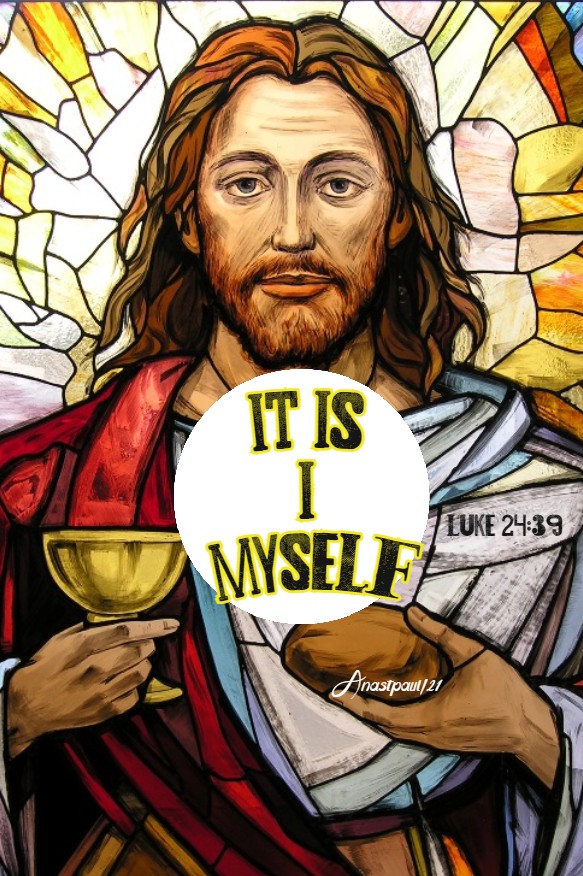
“It is I, Myself.”
Luke 24:39
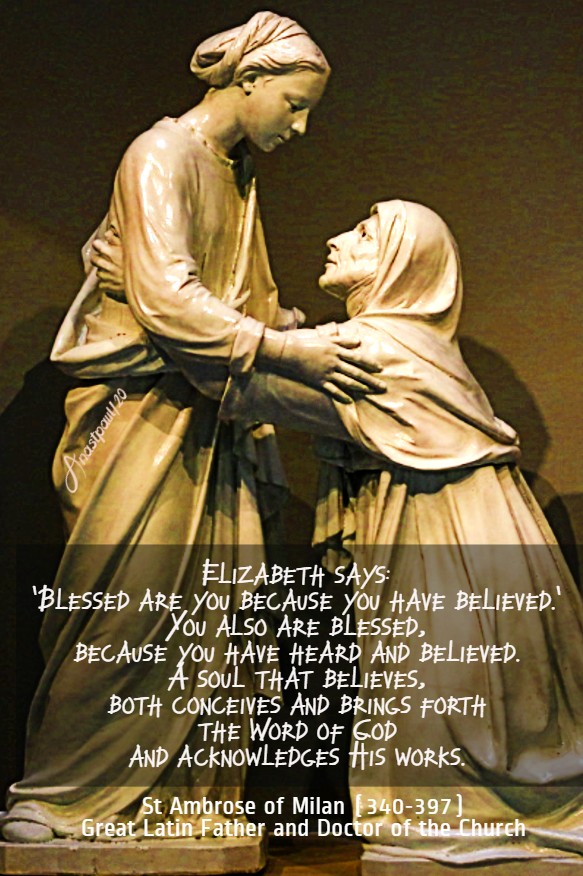
“Elizabeth says: ‘Blessed are you because you have believed.’ You also are blessed, because you have heard and believed. A soul that believes, both conceives and brings forth the Word of God and acknowledges His works.”
St Ambrose of Milan (340-397) Great Latin Father and Doctor of the Church
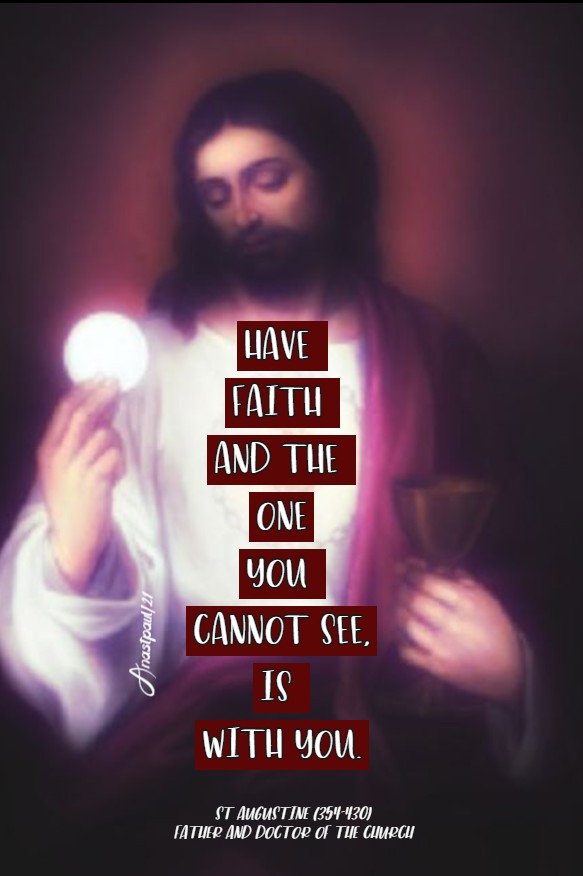
“Have faith and the One you cannot see, is with you.”
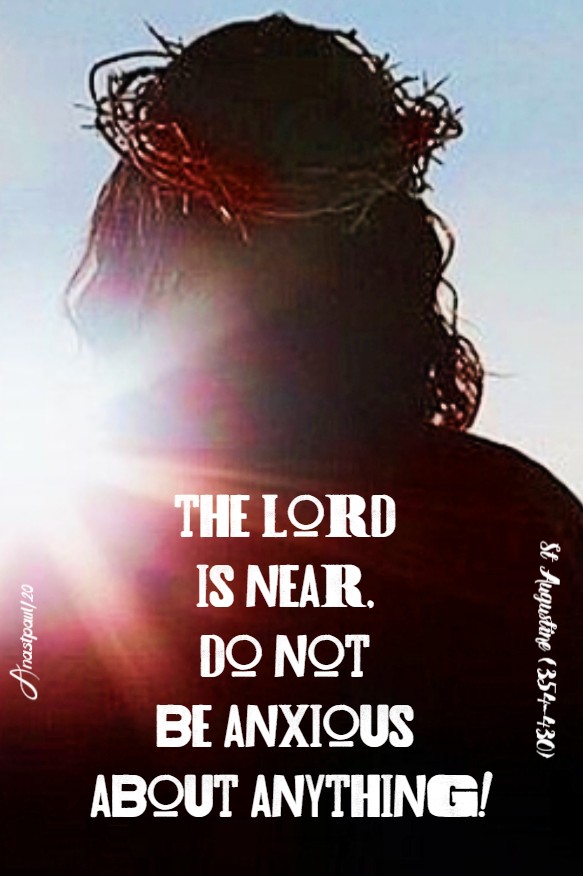
“The Lord is near do not be anxious about anything.”
St Augustine (354-430) Father and Doctor of the Church
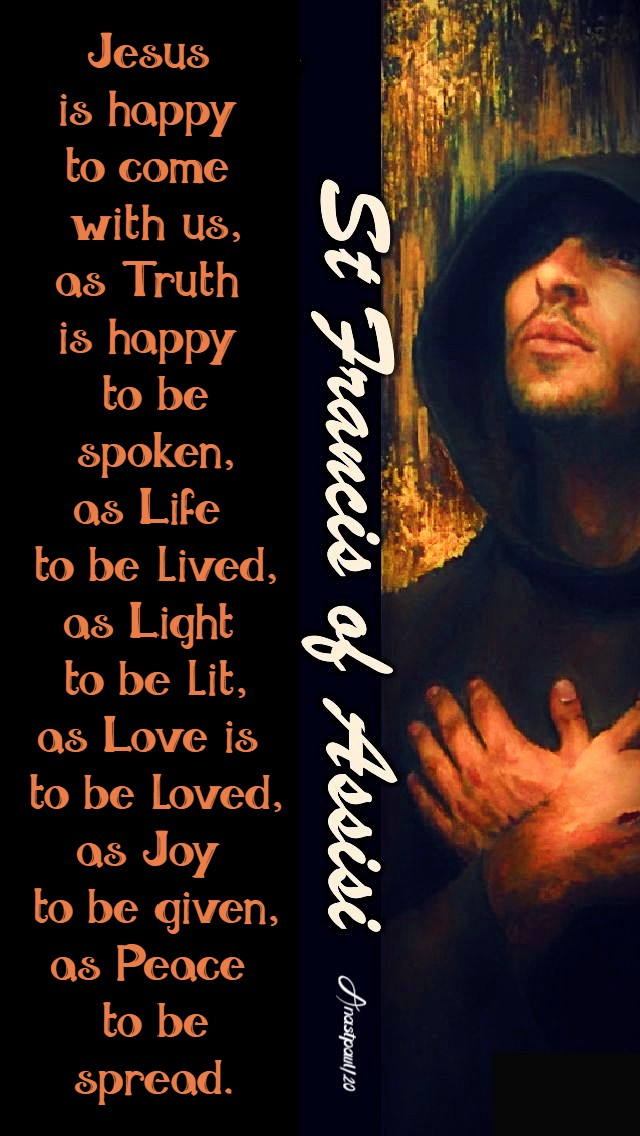
“Jesus is happy to come with us, as Truth is happy to be spoken, as Life to be lived, as Light to be lit, as Love is to be loved, as Joy to be given, as Peace to be spread.”
St Francis of Assisi (1181/2–1226)
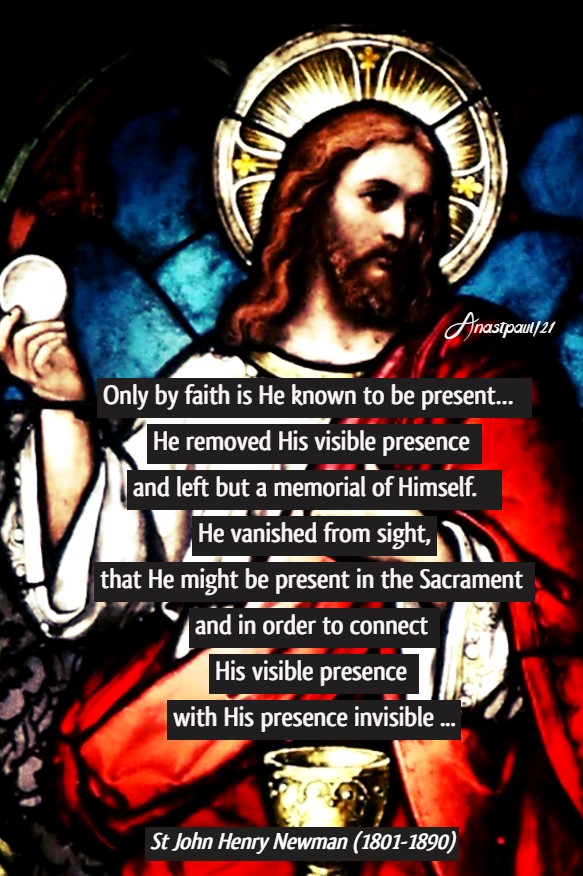
“Only by faith is He known to be present… He removed His visible presence and left but a memorial of Himself. He vanished from sight, that He might be present in the Sacrament and in order to connect His visible presence with His presence invisible … ”
One Minute Reflection – 18 April – The Third Suday of Easter, Readings: First: Acts 3: 13-15, 17-19,salm: Psalms 4: 2, 4, 7-8, 9 (7a), Second: First John 2: 1-5a Gospel: Luke 24: 35-48
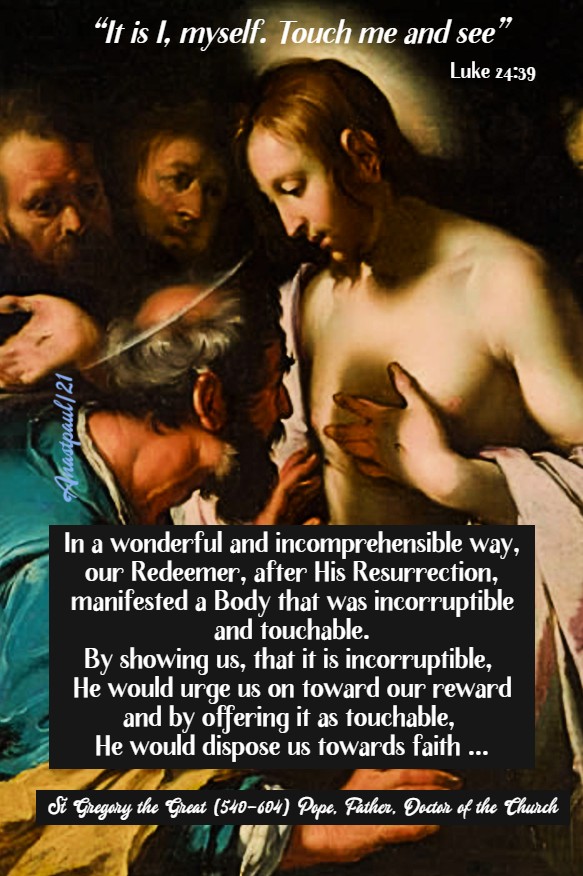
“It is I, myself. Touch me and see” – Luke 24:39
REFLECTION – “How was the Lord’s body, which could come in to the disciples through closed doors after the Resurrection, a real one? We must be certain that if a divine work is understood by reason it is not wonderful, nor does our faith have any merit, when human reason provides a proof. We have to consider these works of our Redeemer, which can in no way be understood of themselves, in the light of other works of His, so that His more miraculous deeds, may provoke faith in the miraculous. For the Lord’s Body, which made its entrance to the disciples through closed doors, was the same as that, which issued before the eyes of men from the Virgin’s closed womb at his birth. Is it surprising if He who was now going to live forever, made His entrance through closed doors after His Resurrection, Who on His coming in order to die, made His appearance from the unopened womb of the Virgin?
But because the faith of those who beheld it, wavered concerning the Body they could see, He showed them at once, His Hands and His Side, offering them the Body which He brought in through the closed doors to touch. … Now, it cannot be otherwise then, that what is touched is corruptible and what is not corruptible cannot be touched. But, in a wonderful and incomprehensible way, our Redeemer, after His Resurrection, manifested a Body that was incorruptible and touchable. By showing us that it is incorruptible, He would urge us on toward our reward, and by offering it as touchable, He would dispose us towards faith, He manifested Himself as both incorruptible and touchable to truly show us, that His Body after His Resurrection, was of the same nature as ours but of a different sort of glory. Alleluia!” – St Gregory the Great (540-604) Pope, Father, Doctor of the Church – Homilies on the Gospels, no.26
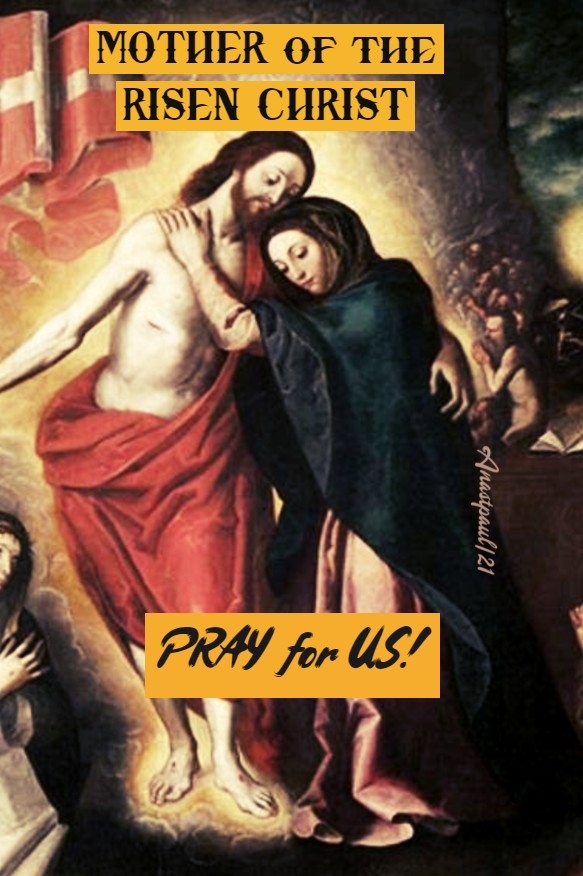
PRAYER – Lord God, grant Your people constant joy in the renewed vigour of their souls. They rejoice because You have restored them to the glory of Your adopted children, let them look forward gladly to the certain hope of the resurrection. May the prayers of our Blessed Mother, be our succour amidst the storms of this mortal life. We make our prayer through our Resurrected Christ, with the Holy Spirit, one God forever, amen, alleluia!
Acts 3: 13-15, 17-19 13 The God of Abraham and the God of Isaac and the God of Jacob, the God of our fathers, hath glorified his Son Jesus, whom you indeed delivered up and denied before the face of Pilate, when he judged he should be released. 14 But you denied the Holy One and the Just and desired a murderer to be granted unto you. 15 But the author of life you killed, whom God hath raised from the dead, of which we are witnesses 17 And now, brethren, I know that you did it through ignorance, as did also your rulers. 18 But those things which God before had shewed by the mouth of all the prophets, that his Christ should suffer, he hath so fulfilled. 19 Be penitent, therefore, and be converted, that your sins may be blotted out.
First John 2: 1-5a 1 My little children, these things I write to you, that you may not sin. But if any man sin, we have an advocate with the Father, Jesus Christ the just: 2 And he is the propitiation for our sins and not for ours only but also for those of the whole world. 3 And by this we know that we have known him, if we keep his commandments. 4 He who saith that he knoweth him and keepeth not his commandments, is a liar and the truth is not in him. 5 But he that keepeth his word, in him in very deed the charity of God is perfected.
Gospel: Luke 24: 35-48 35 And they told what things were done in the way and how they knew him in the breaking of the bread. 36 Now whilst they were speaking these things, Jesus stood in the midst of them and saith to them: Peace be to you. it is I, fear not. 37 But they being troubled and frightened, supposed that they saw a spirit. 38 And he said to them: Why are you troubled and why do thoughts arise in your hearts? 39 See my hands and feet, that it is I myself; touch and se -: for a spirit hath not flesh and bones, as you see me to have. 40 And when he had said this, he shewed them his hands and feet. 41 But while they yet believed not and wondered for joy, he said: Have you any thing to eat? 44 And he said to them: These are the words which I spoke to you, while I was yet with you, that all things must needs be fulfilled, which are written in the law of Moses and in the prophets and in the psalms, concerning me. 45 Then he opened their understanding, that they might understand the scriptures. 46 And he said to them: Thus it is written and thus it behoved Christ to suffer, and to rise again from the dead, the third day: 47 And that penance and remission of sins should be preached in his name, unto all nations, beginning at Jerusalem. 48 And you are witnesses of these things. 42 And they offered him a piece of a broiled fish and a honeycomb. 43 And when he had eaten before them, taking the remains, he gave to them.
Our Morning Offering – 18 April – The Third Suday of Easter
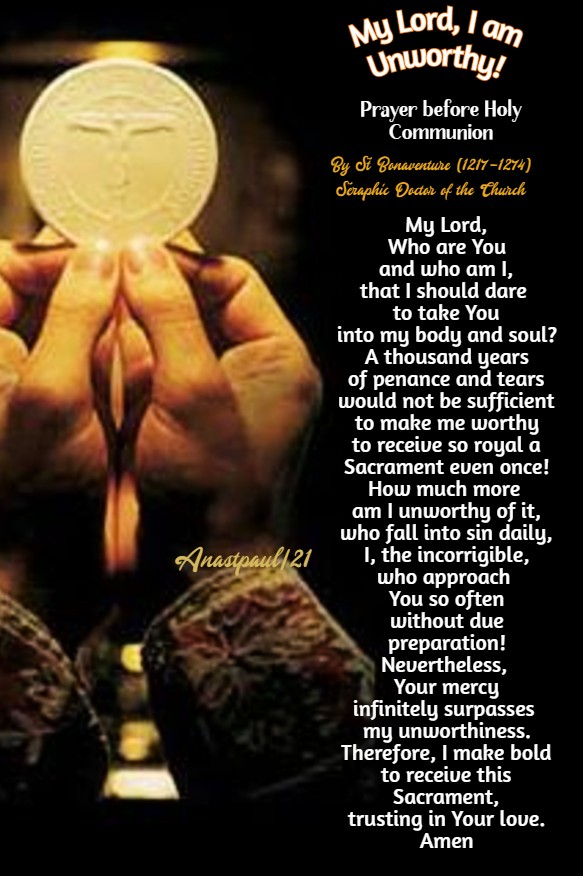
My Lord, I am Unworthy! Prayer before Holy Communion By St Bonaventure (1217-1274) Seraphic Doctor of the Church
My Lord, Who are You and who am I, that I should dare to take You into my body and soul? A thousand years of penance and tears would not be sufficient to make me worthy to receive so royal a Sacrament even once! How much more am I unworthy of it, who fall into sin daily, I, the incorrigible, who approach You so often without due preparation! Nevertheless, Your mercy infinitely surpasses my unworthiness. Therefore, I make bold to receive this Sacrament, trusting in Your love. Amen














You must be logged in to post a comment.