Quote/s of the Day – 28 February – The Second Sunday of Lent, Readings: Genesis 22:1-2, 9, 10-13, 15-18, Psalms 116:10, 15, 16-17, 18-19, Romans 8:31-34, Mark 9:2-10
Transfiguration
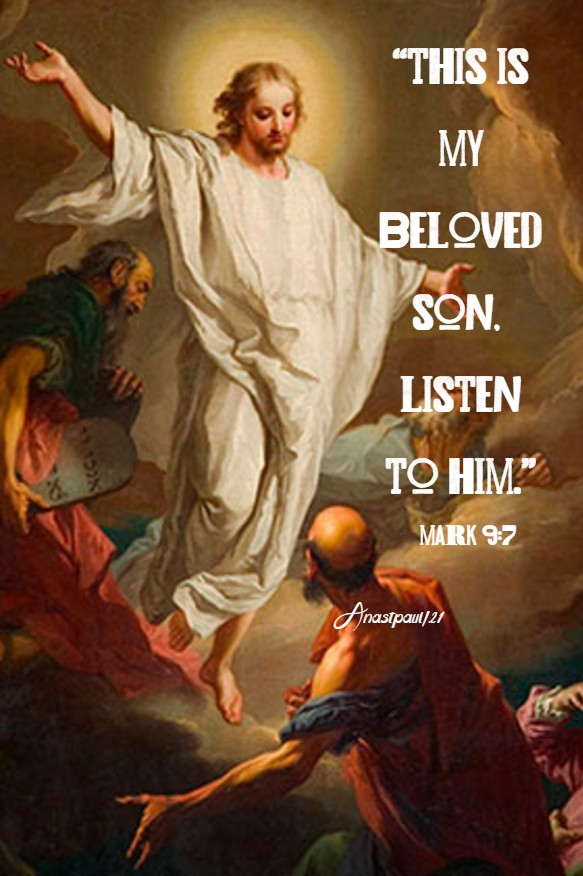
“And a cloud overshadowed them and a voice came out of the cloud, “This is my beloved Son; listen to him.”
Mark 9:7
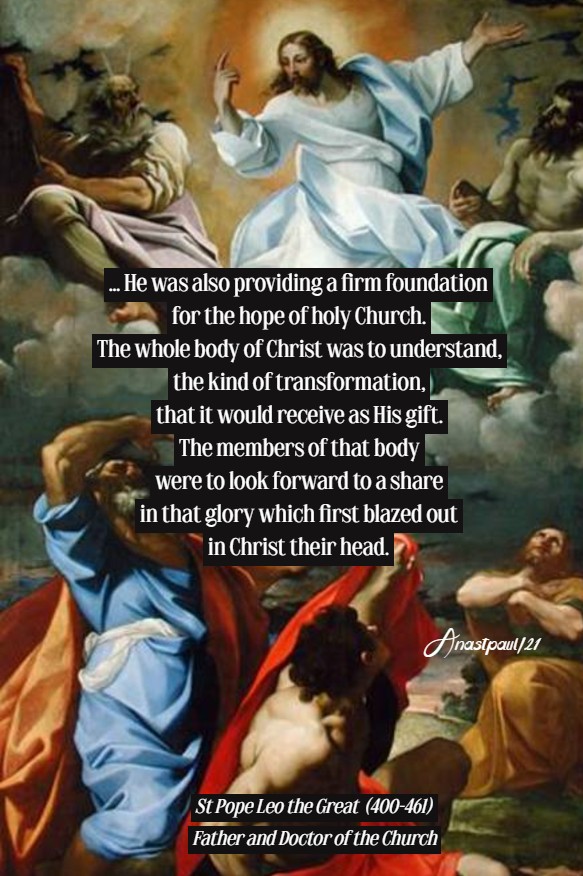
“… He was also providing a firm foundation for the hope of holy Church. The whole body of Christ was to understand, the kind of transformation, that it would receive as His gift. The members of that body were to look forward to a share in that glory which first blazed out in Christ their head.”
St Pope Leo the Great (400-461) Father and Doctor of the Church
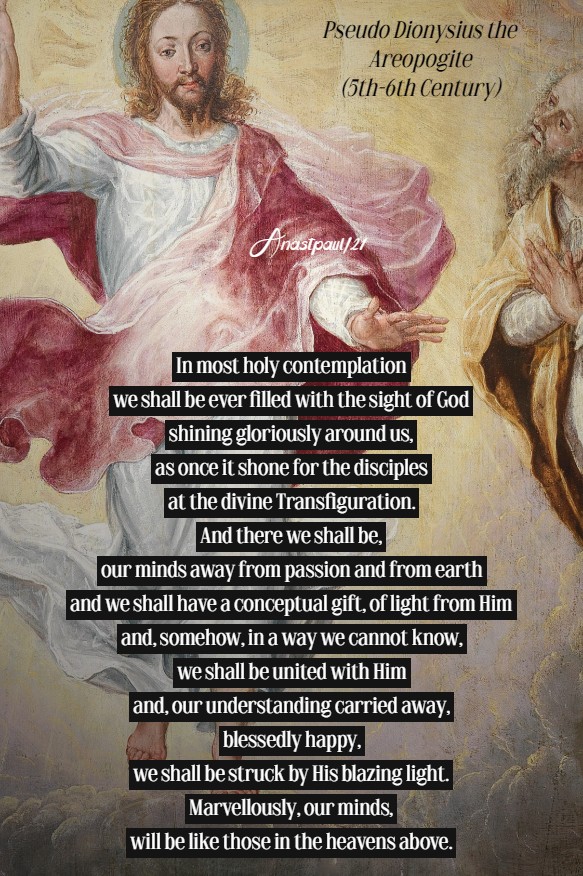
“In most holy contemplation we shall be ever filled with the sight of God shining gloriously around us, as once it shone for the disciples at the divine Transfiguration. And there we shall be, our minds away from passion and from earth and we shall have a conceptual gift, of light from Him and, somehow, in a way we cannot know, we shall be united with Him and, our understanding carried away, blessedly happy, we shall be struck by His blazing light. Marvellously, our minds, will be like those in the heavens above.”
Pseudo Dionysius the Areopogite (5th-6th Century) (The Divine Names, 1)
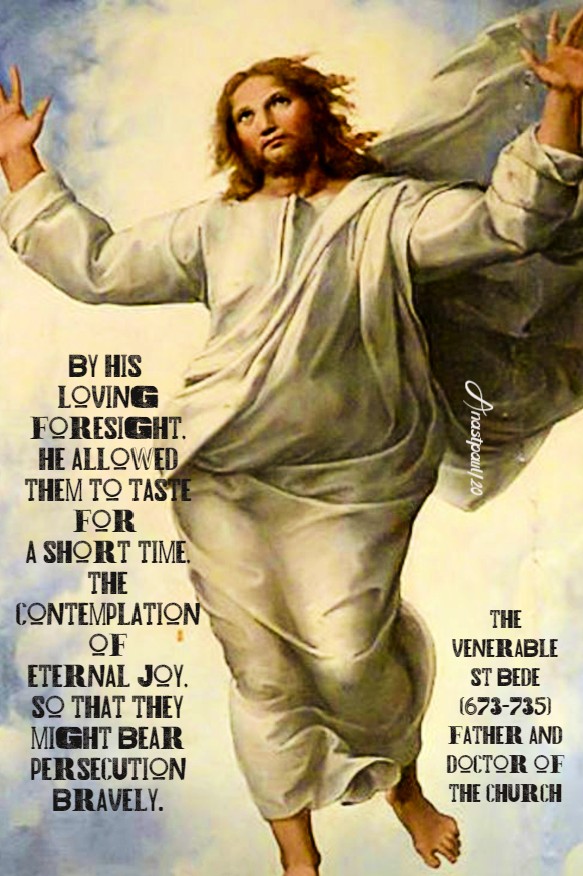
“By His loving foresight, He allowed them to taste for a short time, the contemplation of eternal joy, so that they might bear persecution bravely.”
The Venerable St Bede (673-735) Father and Doctor of the Church
“At His Transfiguration Christ showed His disciples, the splendour of His beauty, to which He will shape and colour those who are His: ‘He will reform our lowness configured to the body of his glory.’”
St Thomas Aquinas (1225 – 1274) Doctor of the Church
“He was transfigured before them and his clothes became dazzling white” – Mark 9:2-3
REFLECTION – “Three persons were chosen to climb the mountain, two to appear with the Lord … Peter, who received the keys of the Kingdom of heaven, was one of those who climbed up and John, to whom was entrusted the Mother of Jesus and James, who would be the first to be elevated to the Episcopal dignity. Then Moses and Elijah, the Law and the prophets, appeared together with the Word … Let us, too, climb the mountain, let us beg the Word of God to appear to us in His “splendour and beauty,” to “be strong, go forth in majesty and reign” (Ps 45[44]:4). …
For if you do not ascend to the peak of a higher knowledge, Wisdom will not appear to you, understanding of the mysteries will not make itself known. The splendour and beauty to be found in the Word of God will not appear to you but God’s Word will seem like a body “without grace or beauty” (Is 53:2). He will seem to you like a man of suffering, “accustomed to infirmity” (v. 3) and like a word born of man, covered with the veil of the letter and not shining with the power of the Spirit (cf. 2 Cor 3:6-17). …
His clothing takes one appearance at the foot of the mountain, another at the top. It might be said that the garments of the Word are Scripture’s words that, so to speak, clothe the divine thoughts. And just as He appeared to Peter, James and John under another aspect, His garment dazzling white, so the meaning of the divine Scriptures is already explained in your mind’s eye. Thus the divine words become like snow “such as no one on earth could bleach them” …
Then followed a cloud, that hid them under its shadow. This shadow is the divine Spirit, which does not cover over men’s hearts but brings to light, what lies hidden … You see, perfect faith is knowledge of the Son of God, not just for beginners but for the perfect and even for the inhabitants of heaven.” – St Ambrose (340-397) Bishop of Milan, Father and Doctor of the Church – Commentary on Saint Luke’s Gospel, VII9 f.
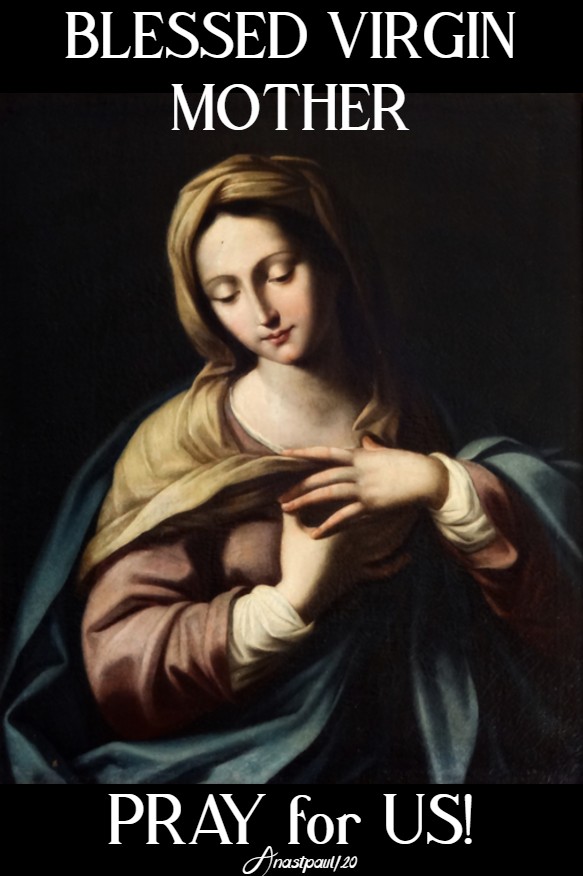
PRAYER – God our Father, You bid us listen to Your Son, the well-beloved. Nourish our heats on Your Word, purify the eyes of our mind and fill us with joy, at the vision of Your glory. May our Blessed Virgin Mother Mary accompan us and intercede for us as we strive to purify our lives. Through Christ our Lord, with the Holy Spirit, God forever, amen.
Our Morning Offering – 28 February – The Second Sunday of Lent
My Lord, I am Unworthy! Prayer before Holy Communion By St Bonaventure (1217-1274) Doctor of the Church
My Lord, Who are You and who am I, that I should dare to take You into my body and soul? A thousand years of penance and tears would not be sufficient to make me worthy to receive so royal a Sacrament even once! How much more am I unworthy of it, who fall into sin daily, I, the incorrigible, who approach You so often without due preparation! Nevertheless, Your mercy infinitely surpasses my unworthiness. Therefore, I make bold to receive this Sacrament, trusting in Your love. Amen
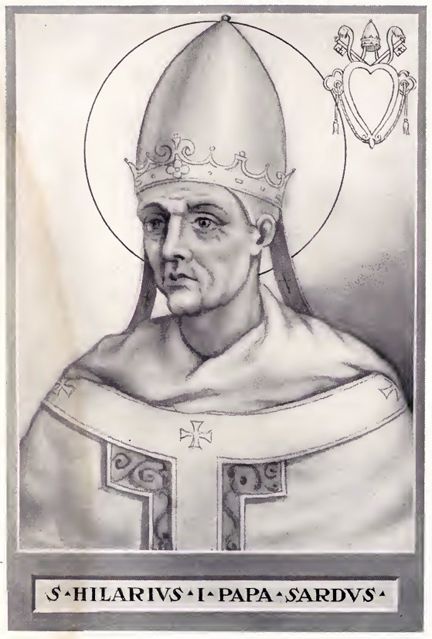
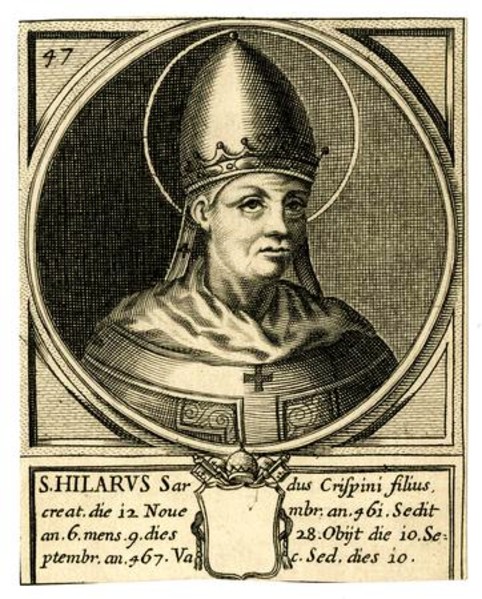
Saint of the Day – 28 February – Saint Pope Hilary (Died 468) Deacon then Pope, Papal aide to St Pope Leo the Great, Papal Legate, Reformer of Episcopal discipline, builder of Churches, libraries, Chapels and public works. Born in Sardinia and died on 28 February 468 in Rome of natural causes.
Hilary was the Sardinian Archdeacon of Rom, and was elected Bishop of Rome, the Pope on 17 November 461. As the Archdeacon under St Pope Leo I (the Great), he manifested immense strength in protecting the rights of the Roman See. As Pope, he continued the policies of his predecessor, Leo. He continued to strengthen Papal control over Episcopal discipline. Some of his Encyclicals were in the interests of increased discipline. A synod was to be convened yearly by the Bishop of Arles but all important matters were to be submitted to the Apostolic See. No Bishop could leave his Diocese without written permission from his Archbishop. Church property could no longer be sold, until a synod had examined the cause of the sale.
Pope Hilary gave decisions to the Churches of Spain, which sometimes tended to operate outside the Papal orbit. Before the death of Nundinarius, Bishop of Barcelona, he expressed a wish that Irenaeus might be chosen his successor, and he himself, had made Irenaeus Bishop of another See. The request was granted, and the Synod of Tarragona confirmed the nomination of Irenaeus, after which the Bishops sought the Pope’s approval. Elections and installations of new Bishops were done without his approval, making it necessary for him to exercise Episcopal Discipline. The Roman Synod of 19 November 465 was held at the Basilica of Santa Maria Maggiore, which settled the matter. It is the oldest Roman Synod whose original records have survived.
In Rome, Pope Hilary worked hard to counter the new Emperor’s 467 edict of toleration for schismatic sects. On one of the Emperor’s visits to St Peter’s Basilica, the Pope openly called him to account for his conduct, exhorting him by the grave of St Peter, to promise that he would not allow schismatic assemblies in Rome. St Hilary erected several Churches and other buildings in Rome, which he was praised for in the Liber Pontificalis. He erected two Oratories in the Baptistery of the Lateran, one in honour of St John the Baptist, the other of St John the Apostle. He also erected a Chapel of the Holy Cross in the Baptistery, Convents, Two Public Baths and Libraries near the Basilica of St Lawrence, in which he was buried.
St Abercius Bl Antonia of Florence St Augustus Chapdelaine St Caerealis St Caerealis of Alexandria St Cyra of Beroea Bl Daniel Brottier St Ermine St Gaius of Alexandria St Pope Hilary/Hilarius (Died 468) Pope from 461-468 St Justus the Potter St Llibio St Macarius the Potter St Maidoc St Marana of Beroea St Oswald of Worcester St Proterius of Alexandria St Pupulus of Alexandria St Romanus of Condat St Ruellinus of Treguier St Rufinus the Potter St Serapion of Alexandria St Sillan of Bangor Blessed Stanislaw Antoni Trojanowski OFM Conv. (1908-1942) Martyr and Religious His Life and Death: https://anastpaul.com/2018/02/28/saint-of-the-day-28-february-blessed-stanislaw-antoni-trojanowski-1908-1942-martyr/ St Theophilus the Potter Bl Villana de’Botti
Martyrs of Alexandria – A number of clerics and layman who died as martyrs of charity for ministering to the sick during a plague that ravaged Alexandria, Egypt in 261.
Martyrs of Unzen – 16 lay people martyred together in one of the periodic anti-Christian persecutions in imperial Japan – They were martyred on 28 February 1627 in Unzen, Japan and Beatified on 24 November 2008 by Pope Benedict XVI. • Alexius Sugi Shohachi • Damianus Ichiyata • Dionisius Saeki Zenka • Gaspar Kizaemon • Gaspar Nagai Sohan • Ioannes Araki Kanshichi • Ioannes Heisaku • Ioannes Kisaki Kyuhachi • Leo Nakajima Sokan • Ludovicus Saeki Kizo • Ludovicus Shinzaburo • Maria Mine • Paulus Nakajima • Paulus Uchibori Sakuemon • Thomas Kondo Hyoemon • Thomas Uzumi Shingoro
Thought for the Day – 27 February– Meditations with Antonio Cardinal Bacci (1881-1971)
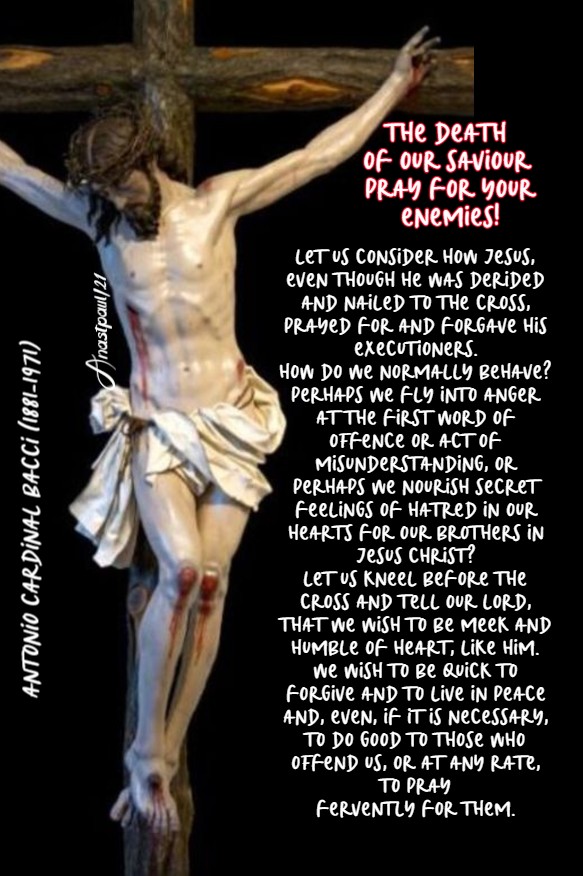
The Death of our Saviour – Pray for your Enemies!
“In the midst of His sufferings, Jesus forgets Himself and pray for His executioners. “Father,” He pleaded, “forgive them, for they do not know what they are doing” (Lk 23:34). Who were these people who crucified Him? We know well that they were not only the Jews but all of us. The prophet Isaiah, had foretold this. “He was wounded for our iniquities, he was bruised for our sins … He was offered because it was his own will…” (Is 53:5-7). We are all the crucifiers of Jesus. Therefore, He willed to suffer and to die for all of us and when He was hanging on the Cross, He begged for forgiveness for us all. This should incite us to trust in God and to do repentance for our sins. We should be sorry for our sins because, they were the real cause of the voluntary death of Jesus. We should have confidence in Him, because, He prayed for us and forgave us when He was dying on the Cross and is ready to pardon us again, as long as we are sincerely repentant.
Let us consider how Jesus, even though He was derided and nailed to the Cross, prayed for and forgave His executioners. How do we normally behave? Perhaps we fly into anger at the first word of offence or act of misunderstanding, or perhaps we nourish secret feelings of hatred in our hearts for our brothers in Jesus Christ? Let us kneel before the Cross and tell Our Lord, that we wish to be meek and humble of heart, like Him. We wish to be quick to forgive and to live in peace and, even, if it is necessary, to do good to those who offend us, or at any rate, to pray fervently for them.”
Day Eleven of our Lenten Journey – 27 February – Saturday of the First week of Lent, Readings: Deuteronomy 26:16-19, Psalms 119:1-2, 4-5,7-8, Matthew 5:43-48
Imitating Christ with Thomas à Kempis (1380-1471)
In You is the source of life and in Your Light Lord, we see light Psalm 35(36)
“But I say to you, love your enemies” – Matthew 5:44
BE NOT troubled about those who are with you or against you but take care, that God be with you in everything you do. Keep your conscience clear and God will protect you, for the malice of man cannot harm one whom God wishes to help. If you know how to suffer in silence, you will undoubtedly experience God’s help. He knows when and how to deliver you, therefore, place yourself in His hands, for it is a divine prerogative to help men and free them from all distress.
It is often good for us to have others know our faults and rebuke them, for it gives us greater humility. When a man humbles himself because of his faults, he easily placates those about him and readily appeases those who are angry with him.
It is the humble man whom God protects and liberates; it is the humble whom He loves and consoles. To the humble, He turns and upon them bestows great grace, that after their humiliation, He may raise them up to glory. He reveals His secrets to the humble and with kind invitation, bids them come to Him. Thus, the humble man enjoys peace in the midst of many vexations because his trust is in God, not in the world. Hence, you must not think that you have made any progress until you look upon yourself as inferior to all others. (Book 2 Ch 2)
Quote/s of the Day – 27 February – The Memorial of St Gregory of Narek (950-1003) Father & Doctor of the Church and St Gabriel Francis Possenti of Our Lady of Sorrows CP (1838-1862)
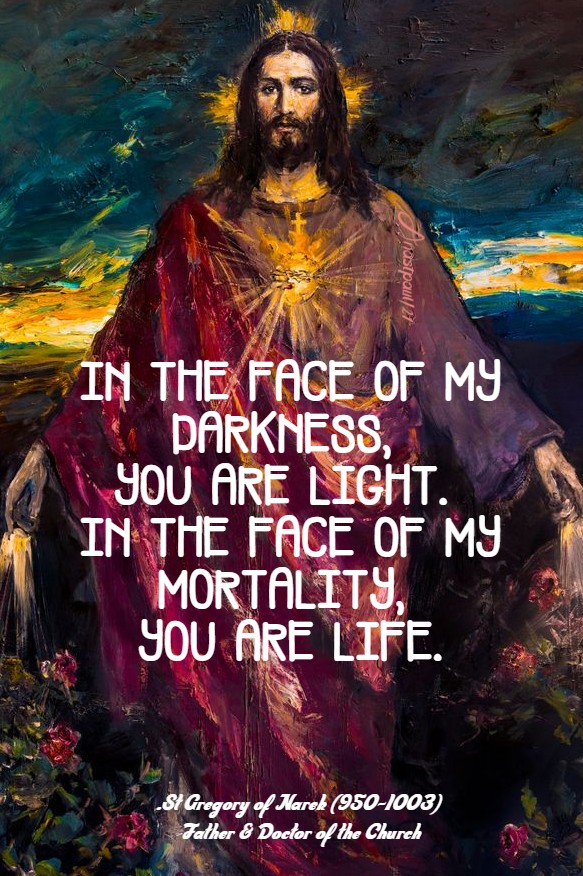
“In the face of my darkness, You are light. In the face of my mortality, You are life.”
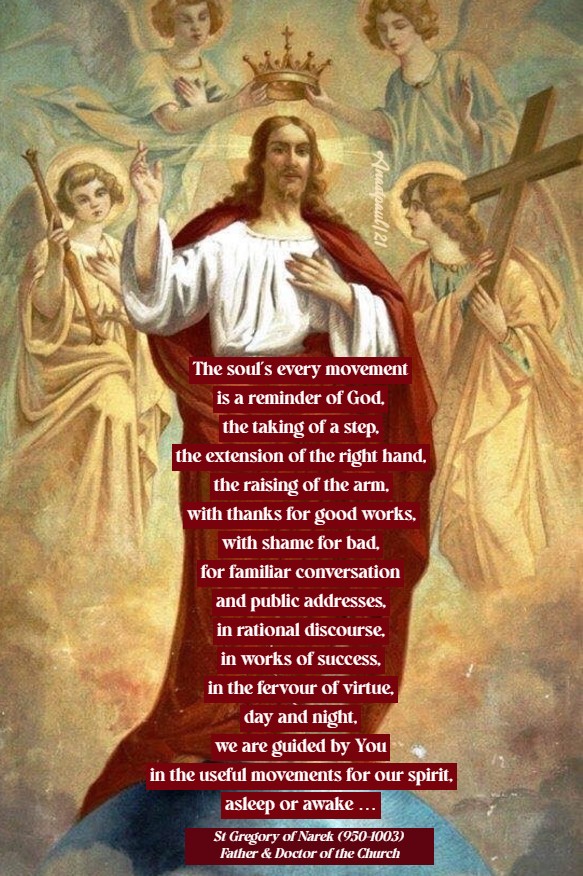
“The soul’s every movement is a reminder of God, the taking of a step, the extension of the right hand, the raising of the arm, with thanks for good works, with shame for bad, for familiar conversation and public addresses, in rational discourse, in works of success, in the fervour of virtue, day and night, we are guided by You in the useful movements for our spirit, asleep or awake … ”
Assist me by the wings of your prayers, O you who are called the Mother of the living, so that on my exit from this valley of tears I may be able to advance without torment, to the dwelling of life that has been prepared for us to lighten the end of a life burdened by my iniquity.
Healer of the sorrows of Eve, change my day of anguish into a feast of gladness. Be my Advocate, ask and supplicate. For as I believe in your inexpressible purity, so do I also believe in the good reception that is given to your word.
O you who are blessed among women, help me with your tears for I am in danger. Bend the knee to obtain my reconciliation, O Mother of God.
Be solicitous for me for I am miserable, O Tabernacle of the Most High. Hold out your hand to me as I fall, O heavenly Temple.
Glorify your Son in you, may He be pleased to operate Divinely in me the miracle of forgiveness and mercy. Handmaid and Mother of God, may your honour be exalted by me and may my salvation be manifested, through you. Amen.
St Gregory of Narek (950-1003) Father & Doctor of the Church
“I will attempt, day by day, to break my will into pieces. I want to do God’s Holy Will, not my own”
“Do not bestow your love on the world!”
“Love Mary!… She is loveable, faithful, constant. She will never let herself be outdone in love but will ever remain supreme. If you are in danger, she will hasten to free you. If you are troubled, she will console you. If you are sick, she will bring you relief. If you are in need, she will help you. She does not look to see what kind of person you have been. She simply comes to a heart that wants to love her. She comes quickly and opens her merciful heart to you, embraces you and consoles and serves you. She will even be at hand, to accompany you on the trip to eternity.”
(From a letter to his brother).
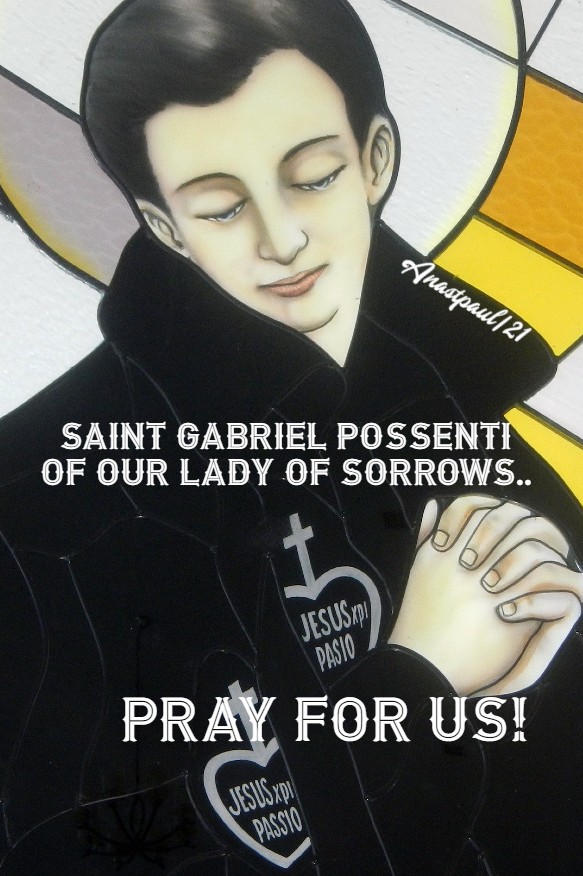
St Gabriel Francis Possenti of Our Lady of Sorrows (1838-1862)
One Minute Reflection – 27 February – Saturday of the First week of Lent, Readings:Deuteronomy 26:16-19, Psalms 119:1-2, 4-5,7-8, Matthew 5:43-48 and The Memorial of St Gabriel Francis Possenti of Our Lady of Sorrows (1838-1862)
“But I say to you, love your enemies” – Matthew 5:44
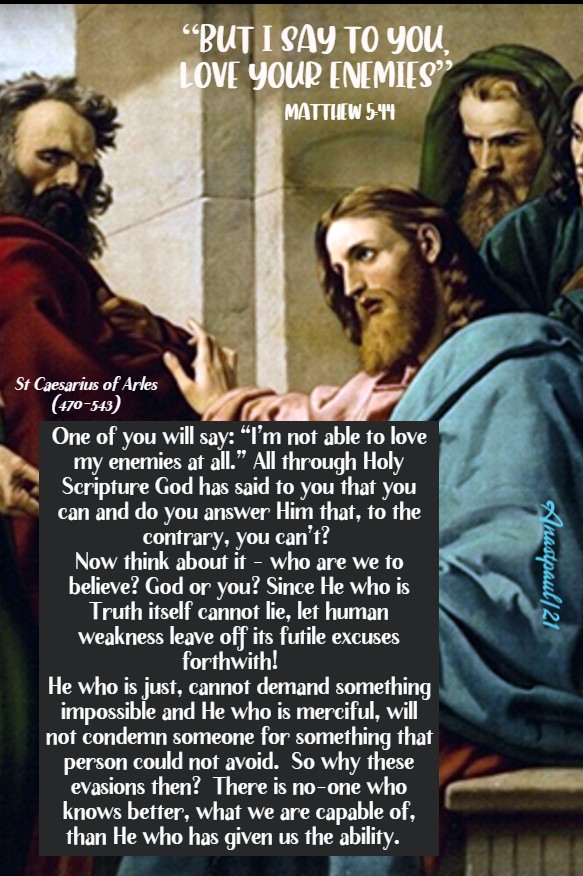
REFLECTION – “One of you will say: “I’m not able to love my enemies at all.” All through Holy Scripture God has said to you that you can and do you answer Him that, to the contrary, you can’t? Now think about it – who are we to believe? God or you? Since He who is Truth itself cannot lie, let human weakness leave off its futile excuses forthwith! He who is just, cannot demand something impossible and He who is merciful, will not condemn someone for something that person could not avoid. So why these evasions then? There is no-one who knows better, what we are capable of, than He who has given us the ability. Such numbers of men, women, children, tender young girls, have borne flames, fire, sword and the wild beasts for Christ’s sake, without flinching and we, do we say that we cannot bear the insults of unintelligent persons?…
Indeed, if only the good are to be loved, what are we to say of the action of our God, of whom it is written: “God so loved the world that he gave his only Son?”(Jn 3,16). For what good deeds are they, that the world had done, for God to love it so? Christ our Lord, found us all to be not only evil but even dead, on account of original sin and yet… “he loved us and handed himself over for us” (Eph 5,2). In so acting He loved even those who did not love Him, as the Apostle Paul also says: “Christ died for the guilty” (Rm 5,6). And in his inexpressible mercy, He gave this example to all humankind, saying: “Learn from me, for I am gentle and humble of heart” (Mt 11,29).” – St Caesarius of Arles (470-543) Bishop and Monk – Sermons to the people, no 37
PRAYER – Almighty God, to whom this world, with all it’s goodness and beauty belongs, give us grace joyfully, to begin this day for Christ Your Son, in Him and with Him and to fill it, with an active love for all Your children, even those who may not like or who do us harm. Help us to love as You do, so that we may become like You. St Gabriel Posenti, you who spread your charity abundantly in your short life and continue to do so now from Heaven, pray for us. Through Christ our Lord, with the Holy Spirit, one God, forever, amen.
Our Morning Offering – 27 February – Saturday of the First week of Lent, the Memorial of St Gabriel Francis Possenti of Our Lady of Sorrows (1838-1862) and a Marian Saturday
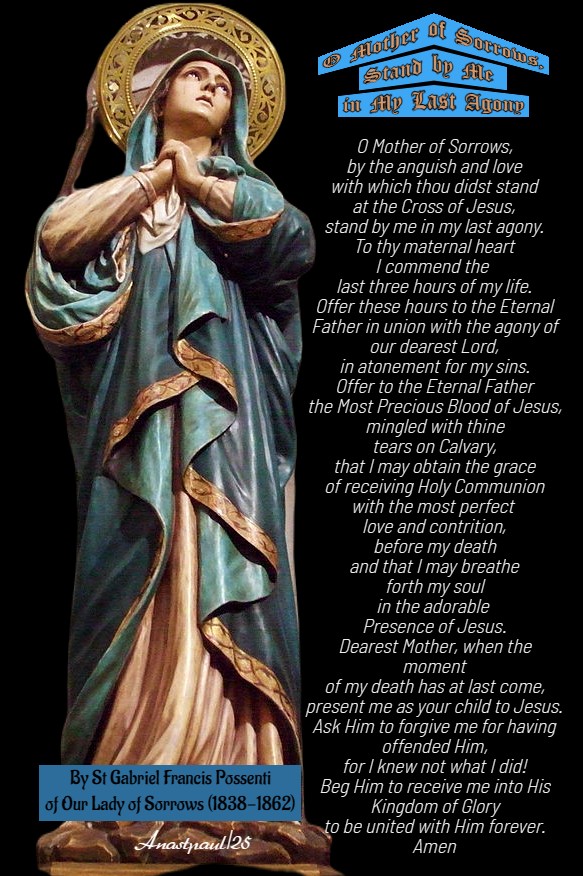
O Mother of Sorrows, Stand by Me in My Last Agony By St Gabriel Francis Possenti of Our Lady of Sorrows (1838-1862)
O Mother of Sorrows, by the anguish and love with which thou didst stand at the Cross of Jesus, stand by me in my last agony. To thy maternal heart I commend the last three hours of my life. Offer these hours to the Eternal Father in union with the agony of our dearest Lord, in atonement for my sins. Offer to the Eternal Father the Most Precious Blood of Jesus, mingled with your tears on Calvary, that I may obtain the grace of receiving Holy Communion with the most perfect love and contrition, before my death and that I may breathe forth my soul in the adorable Presence of Jesus. Dearest Mother, when the moment of my death has at last come, present me as your child to Jesus. Ask Him to forgive me for having offended Him, for I knew not what I did! Beg Him to receive me into His Kingdom of Glory to be united with Him forever. Amen
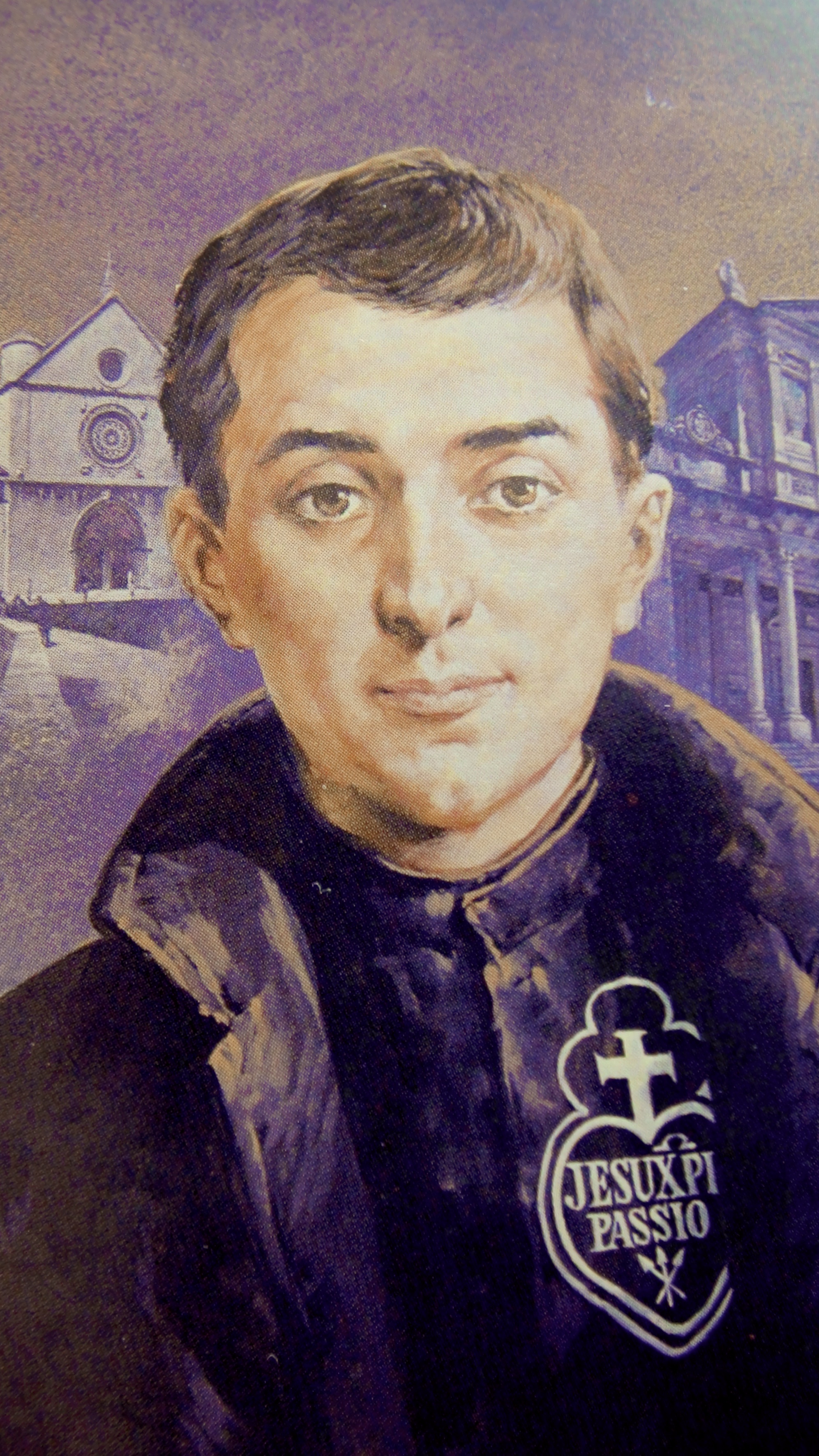
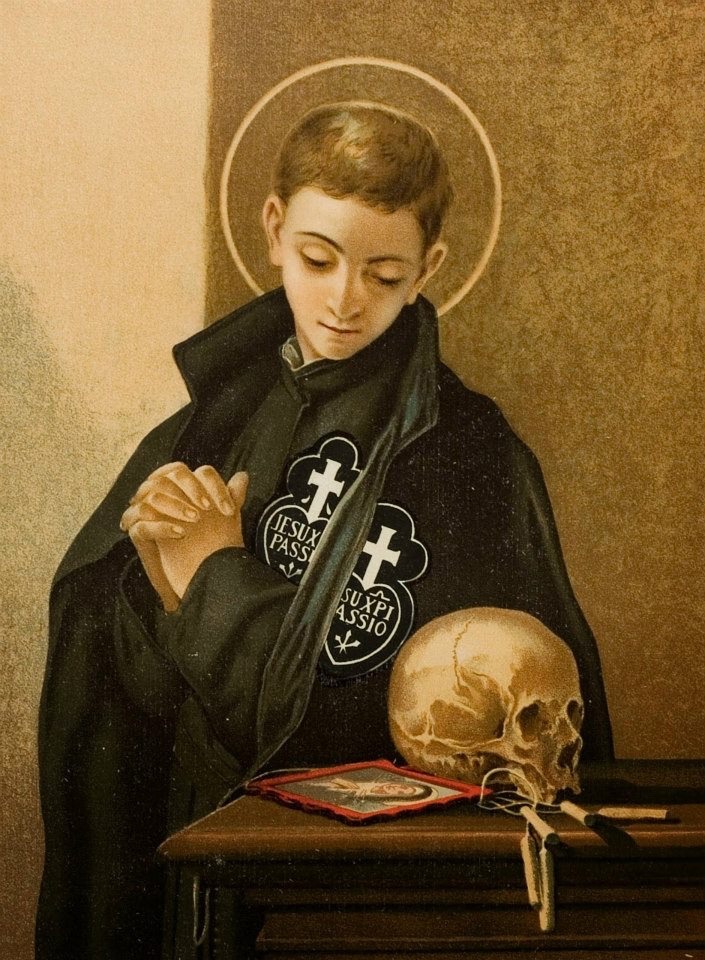
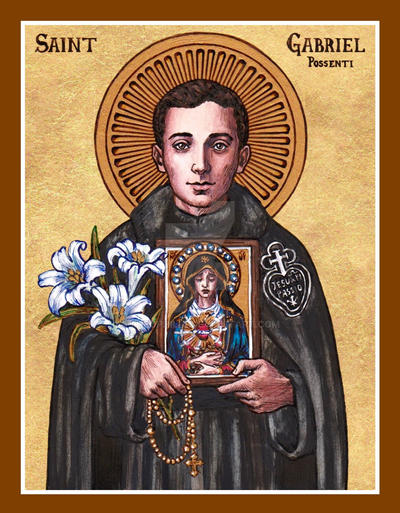
Saint of the Day – 27 February – St Gabriel of Our Lady of Sorrows CP (1838-1862) Passionist Religious and student preparing for the Priesthood. Born as Francisco Giuseppe Vincenzo Possenti on 1 March 1838 at Assisi, Italy and died on 27 February 1862, just before his 24th birthday, at Abruzzi, Italy of tuberculosis. Gabriel was known for his great devotion to the Sorrows of the Virgin Mary. He is also known as Francesco Possenti, Francis Possenti, Gabriel of the Blessed Virgin, Gabriel of the Sorrowful Mother, Gabriel Possenti, Gabriel Marie Possenti, Gabriele dell’Addolorata. Patronages – Students, youth, seminarians, novices, clerics, Catholic Action, Abruzzi, Italy.
Francisco Possenti was born in Assisi on 1 March 1838, the eleventh child of thirteen children, to Sante Possenti and Agnes Frisciotti. The family were then resident in the town of Assisi where Sante worked for the local government. Francisco was Baptised on the day of his birth, in the same font in which Saint Francis of Assisi and St Clare had been Baptised and he was named after St Francis.
The first year of his life was spent away from his family with a nursing woman who cared for him because his mother was unable. In 1841 Sante, his father, moved the family to Spoleto where he was appointed Magistrate. In that same year, the youngest Possenti child died at just six months old; Francis’ nine-year old sister, Adele, soon followed. Just days later, his heartbroken mother was too called to eternal life. Francis had lost his mother at just 4 years old.
Tragedy continued to plague the family during his youth. In 1846 Francis’ brother, Paul, was killed in the Italian war with Austria. Another brother, Lawrence, later took his own life. Such events, however, did not rob Francis of his spirit and cheerfulness. During his formative years, Francis attended the school of the Christian brothers and then the Jesuit college in Spoleto. He was lively, intelligent and popular at school. At sixteen, he suffered a life-threatening illness. Praying for a cure, Francis promised to become a religious. With recovery, however, Francis quickly forgot his promise. But God’s call would not be denied and Francis soon turned his heart to the Congregation of the Passionists.
Sante Possenti was less than pleased with his teenage son’s decision. Determined to show Francis the joys of a secular life of theatre and society parties, Sante continued to hope Francis would find pleasure in a social life. But the young man was not to be dissuaded. Immediately after completion of his schooling, accompanied by his brother Aloysius, a Dominican friar, Francis set out for the novitiate of the Passionists at Morrovalle. During their journey they visited several relatives who had been enlisted by Sante to encourage Francis to return to Spoleto but this was to no avail. He arrived at the novitiate on 19 September1856. In the novitiate, he cultivated a great love for Christ Crucified.
Francis received the Passionist habit on 21 September 1856, which that year, was the Feast of the Sorrowful Mother. He was given the name: Gabriel of the Sorrowful Mother. Gabriel proved an excellent student and his excellence in academic life was only outdone by the great progress he was making in his spiritual life. At the same time Gabriel began to display the first symptoms of tuberculosis. The news did not worry Gabriel who was, in fact, joyful; he had prayed for a slow death so as to be able to prepare himself spiritually. Throughout his illness he remained cheerful and kept up all his usual practices. He was a source of great edification and inspiration to his fellow students, who later, would seek to spend time with him at his deathbed. Gabriel had proved himself an exemplary religious and a perfect follower of the Passionist Rule, being especially devoted to the Virgin Mary. A year later he took his vows. His monastic life preparing for the Priesthood, made Gabriel a secluded, non-public figure. His writings reflect his close relationship with God and His mother.
These were difficult and tumultuous times in Italy. The new Italian government issued decrees closing religious Orders in certain Provinces of the Papal States. The new Passionist province of Pieta, to which Gabriel belonged, was in the centre of this chaos. By 1860, the Passionists had ceased apostolic work due to the growing threats surrounding the community. During this period, various Italian Provinces were overrun by soldiers, who robbed and terrorised the towns with little mercy.
The people of Isola would always remember him as “their Gabriel.” Struck with tuberculosis at the age of 23, Gabriel died on 27 February 1862, before his Ordination to the Priesthood. His fidelity to prayer, joyfulness of spirit and habitual mortifications, stand out in his otherwise ordinary life. Pope Benedict XV Canonised Gabriel on13 May 1920 and declared him a patron of Catholic youth. His patronage is also invoked by the Church for students, seminarians, novices and clerics. Thousands of divine favours are attributed to his intercession with Christ Crucified and the Sorrowful Mother Mary.
4.0.1
Gabriel was buried o the day of his death. His companion in the novitiate, Blessed Bernard Mary of Jesus (1831-1911), exclaimed:
“Tears come to my eyes and I am filled with shame for having been so far from the virtues which he attained, in such a short time.”
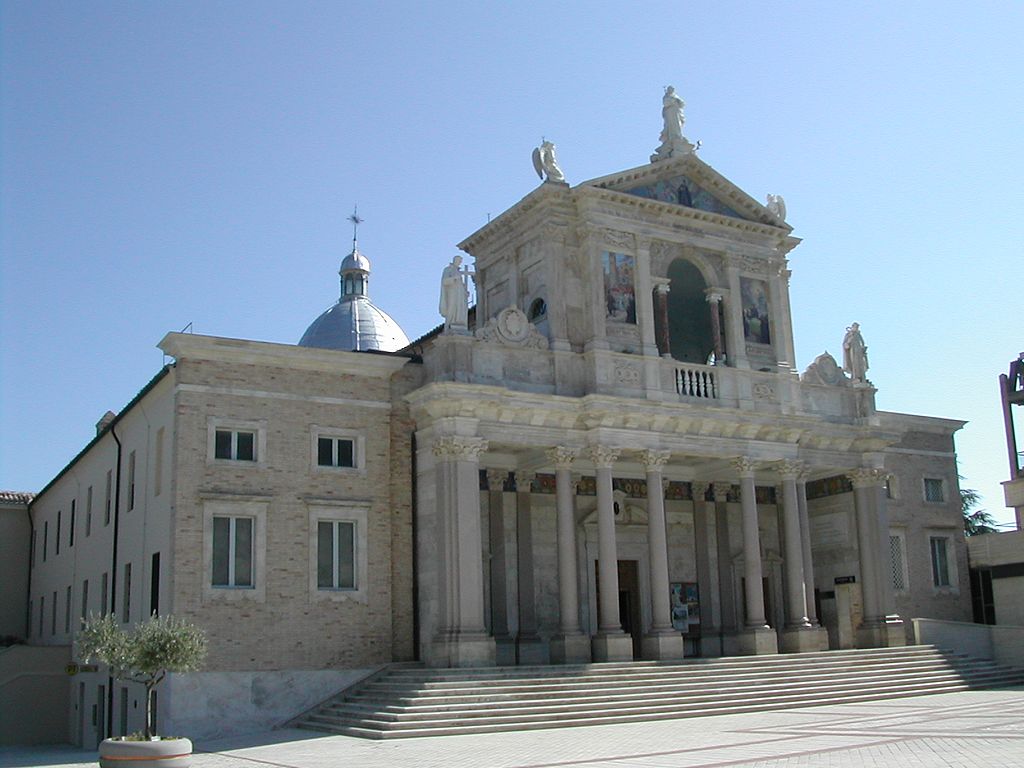
Millions of pilgrims visit St Gabriel’s Shrine in Isola del Gran Sasso d’Italia near Teramo each year, to venerate St Gabriel at his burial place and to visit the monastic house in which he lived out his final years. There is an ongoing tradition every March, when thousands of high school students, from the Abruzzo and the Marche regions of Italy, visit his Tomb 100 days before their expected graduation day and pray to him in order to achieve success in their final examinisations. Every two years, from mid-July to the beginning of October, the Italian Staurós ONLUS foundation hosts at St Gabriel’s Sanctuar,y a celebrated exposition of contemporary religious arts. With an average of 2 million visitors per year, this is one of the 15 most visited Sanctuaries in the world.
St Gabriel’s Shrine is in Isola del Gran Sasso d’Italia
Many miracles have been attributed to the Saint’s intercession; Saint Gemma Galgani proclaimed, that it was St Gabriel, who had cured her of a dangerous illness and led her to a Passionist vocation.
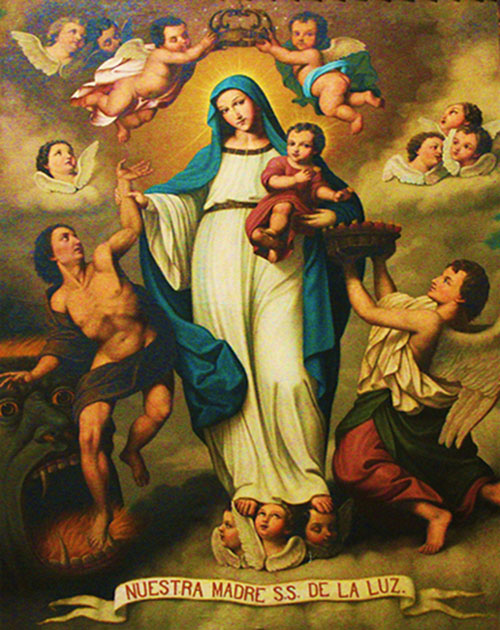
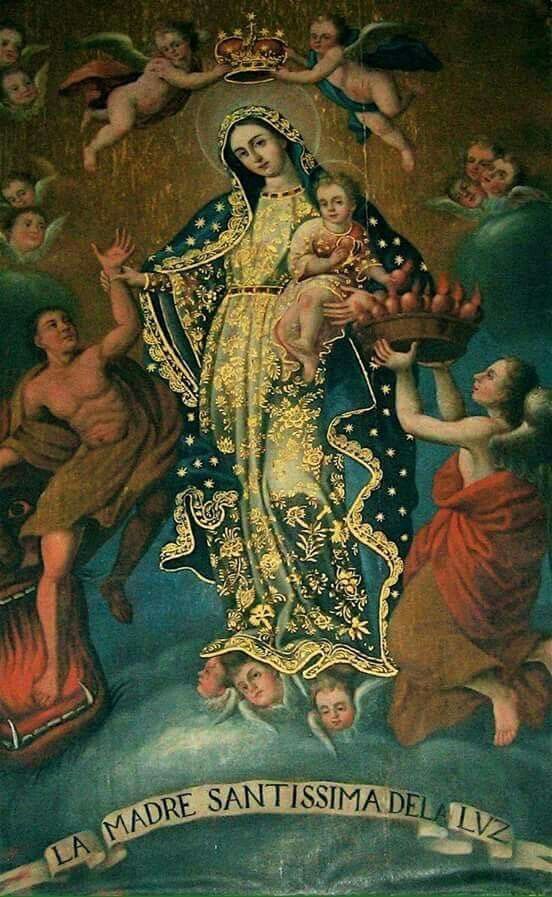
Nostra Signora della Luce / Our Lady of Light, Palermo, Italy, (18th Century) – 27 February:
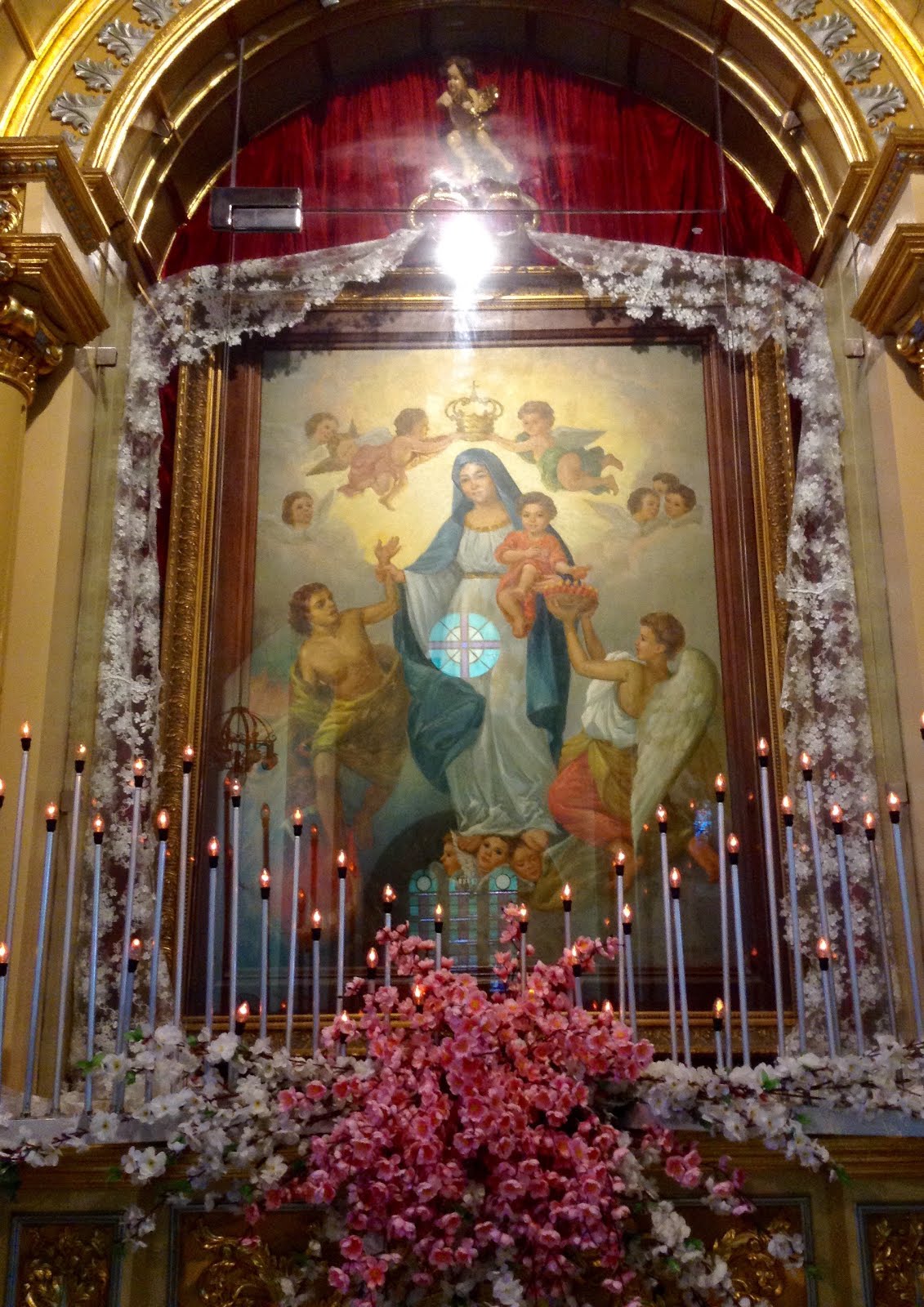
Early in the 18th century, a Jesuit, Father John Genovesi, lived in Palermo, Italy. At the beginning of his missionary career, he placed the souls over which he would have charge, under the protection of the Blessed Mother, deciding to take with him, to each of his missions, an image of Mary. Not knowing which image of Our Lady to use, he consulted a pious visionary telling her to ask Our Lady what she desired. One day as this lady knelt in prayer, she beheld approaching her, the Queen of Heaven, surrounded by pomp, majesty and glory, surpassing anything else she had ever beheld in any of her visions. A torrent of light was shed from the body of the Virgin which was so clear, that in comparison with it, the sun seemed obscure. Yet, these rays were not painful to the sigh; but seemed rather, directed to the heart, which they instantly penetrated and filled with sweetness. A group of Seraphs hovering in the air were suspended over their Empress and held a triple crown. The virginal body was clothed in a flowing robe, whiter than the snow and more brilliant than the sun. A belt inlaid with precious stones encircled Mary’s beautiful form and from her graceful shoulders, hung a mantle of azure hue. Countless angels surrounded their Queen but, what most enchanted the contemplative soul, was the untold sweetness and grace and benignity shown in the motherly face of Mary. She radiated clemency and love. Our Lady told the pious woman, that she wished to be represented as she was now under the title of Most Holy Mother of Light, repeating the words three times. The Jesuit hired labourers to begin the work on the picture of Our Lady of Light, however, neither the pious lady, nor the priest, were able to direct it and the result was that after completion, it did not answer Our Lady’s orders. Our Lady directed the woman to look at the image and seeing the mistake, she again betook herself to prayer and asked Mary to help her. Mary appeared again, commanding the woman to supervise the work, giving directions, while Mary would aid in an invisible manner. Pleased by the finished work, Mary appeared over it and blessed it with the Sign of the Cross. This wonderful treasure is now in the City of Mexico in the Cathedral of Leon, formerly known as the Jesuit Church. The back of the picture bears the authenticity and four signatures, including that of Father Genovesi, SJ. The painting was transferred from Palermo, Sicily in 1702 and placed on the Altar in Leon in 1732. The people of Leon have an innate devotion and great tenderness toward the Mother of God. In 1849 they solemnly promised before the picture to make Our Lady of Light the patroness of Leon. This promise was confirmed by Pope Pius IX; Leo XIII authenticated the crowning of the image of Our Lady of Light in 1902.
St Abundius of Rome St Alexander of Rome St Alnoth St Anne Line St Antigonus of Rome St Baldomerus of Saint Just St Basilios of Constantinople St Comgan St Emmanuel of Cremona St Fortunatus of Rome St Gabriel of Our Lady of Sorrows/Gabriel Possenti CP (1838-1862) Passionist Religious
St Herefrith of Lindsey St Honorina St John of Gorze Bl Josep Tous Soler St Luke of Messina Bl Maria Caridad Brader Bl Mark Barkworth St Procopius of Decapolis Bl Roger Filcock St Thalilaeus Bl William Richardson — Martyrs of Alexandria: – Besas of Alexandria Cronion Eunus Julian of Alexandria
Thought for the Day – 26 February – Meditations with Antonio Cardinal Bacci (1881-1971)
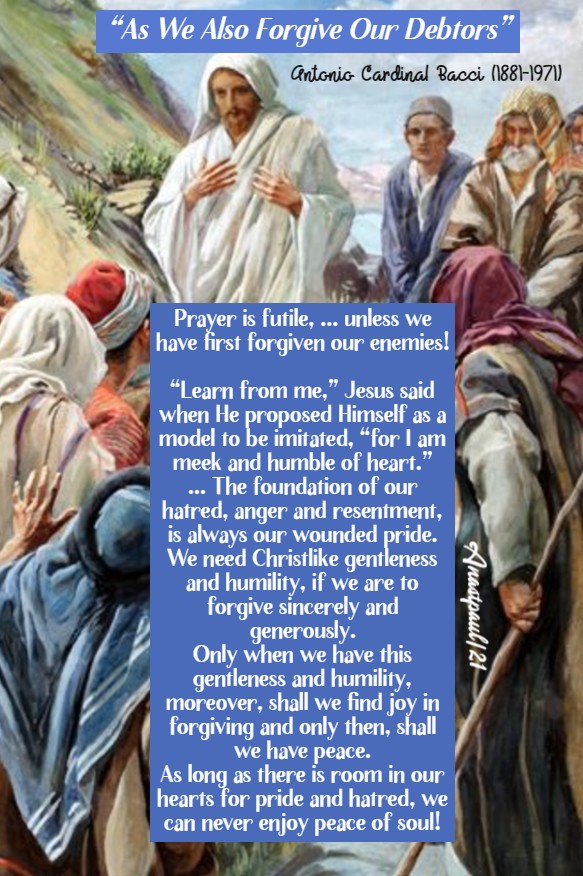
“As We Also Forgive Our Debtors”
“If thou art offering thy gift at the altar,” Jesus tells us “and thou remember that thy brother has anything against thee, leave thy gift before the altar and go first to be reconciled to thy borhter and then come and offer thy gift” (Mt 5:23-24). Prayer is futile, therefore, unless we have first forgiven our enemies!
“Learn from me,” Jesus said when He proposed Himself as a model to be imitated, “for I am meek and humble of heart.” Then He added, “you will find rest for your souls” (Cf Mt 11:29). The foundation of our hatred, anger and resentment, is always our wounded pride. We need Christlike gentleness and humility, if we are to forgive sincerely and generously. Only when we have this gentleness and humility, moreover, shall we find joy in forgiving and only then, shall we have peace. As long as there is room in our hearts for pride and hatred, we can never enjoy peace of soul!”
Day Ten of our Lenten Journey – 26 February – – Friday of the First week of Lent, Readings: Ezekiel 18:21-28, Psalms 130:1-2, 3-4, 5-7, 7-8, Matthew 5:20-26
Imitating Christ with Thomas à Kempis (1380-1471)
In You is the source of life and in Your Light Lord, we see light Psalm 35(36)
“Go first and be reconciled with your brother” – Matthew 5:24
First keep peace with yourself, then you will be able to bring peace to others. A peaceful man does more good than a learned man. Whereas a passionate man turns even good to evil and is quick to believe evil, the peaceful man, being good himself, turns all things to good. The man who is at perfect ease is never suspicious but the disturbed and discontented spirit, is upset by many a suspicion. He neither rests himself nor permits others to do so. He often says what ought not to be said and leaves undone what ought to be done. He is concerned with the duties of others but neglects his own.
Direct your zeal, therefore, first upon yourself; then you may with justice exercise it upon those about you.
You are well versed in colouring your own actions with excuses which you will not accept from others, though it would be more just to accuse yourself and excuse your brother.
If you wish men to bear with you, you must bear with them. Behold, how far you are from true charity and humility which does not know how to be angry with anyone, or to be indignant save only against self! It is no great thing to associate with the good and gentle, for such association is naturally pleasing. Everyone enjoys a peaceful life and prefers persons of congenial habits.
But to be able to live at peace with harsh and perverse men, or with the undisciplined and those who irritate us, is a great grace, a praiseworthy and manly thing. Some people live at peace with themselves and with their fellow men but others are never at peace with themselves nor do they bring it to anyone else. These latter are a burden to everyone, but they are more of a burden to themselves. A few, finally, live at peace with themselves and try to restore it to others.
Now, all our peace in this miserable life is found in humbly enduring suffering rather than in being free from it. He who knows best how to suffer will enjoy the greater peace because he is the conqueror of himself, the master of the world, a friend of Christ and an heir of heaven. (Book 2 Ch 3)
Quote/s of the Day – 26 February – Friday of the First Week of Lent, Readings: Ezekiel 18:21-28, Psalms 130:1-2, 3-4, 5-7, 7-8, Matthew 5:20-26
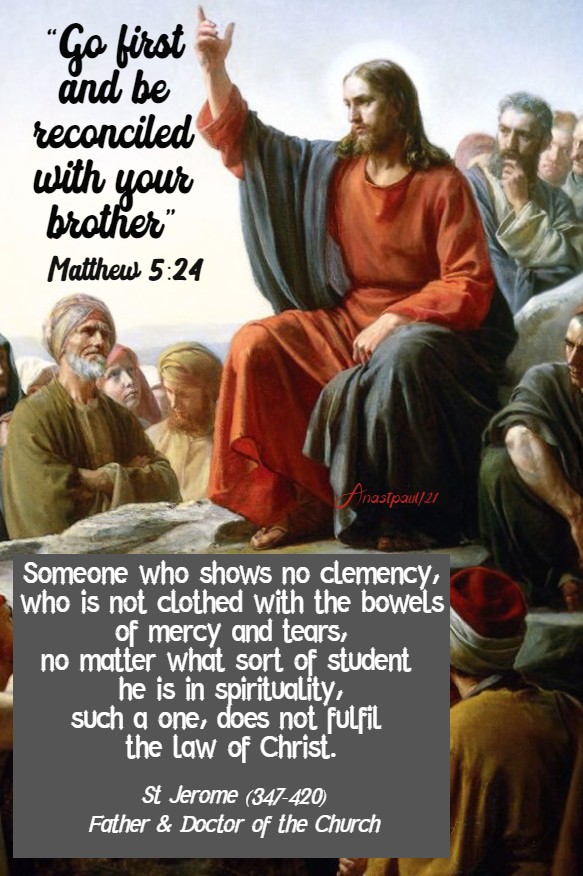
“Go first and be reconciled with your brother”
Matthew 5:24
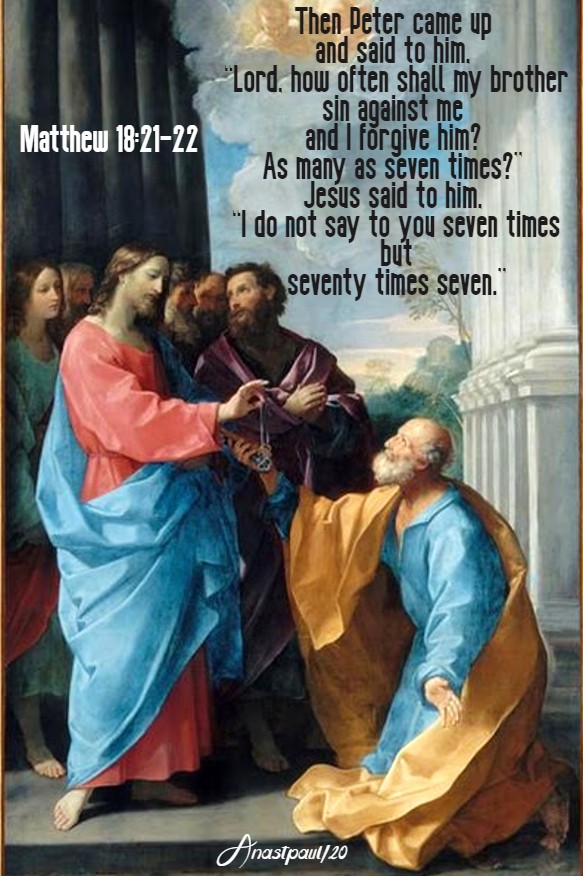
“Then Peter came up and said to him, “Lord, how often shall my brother sin against me and I forgive him? As many as seven times?” Jesus said to him, “I do not say to you seven times but seventy times seven.”
Matthew 18:21-22
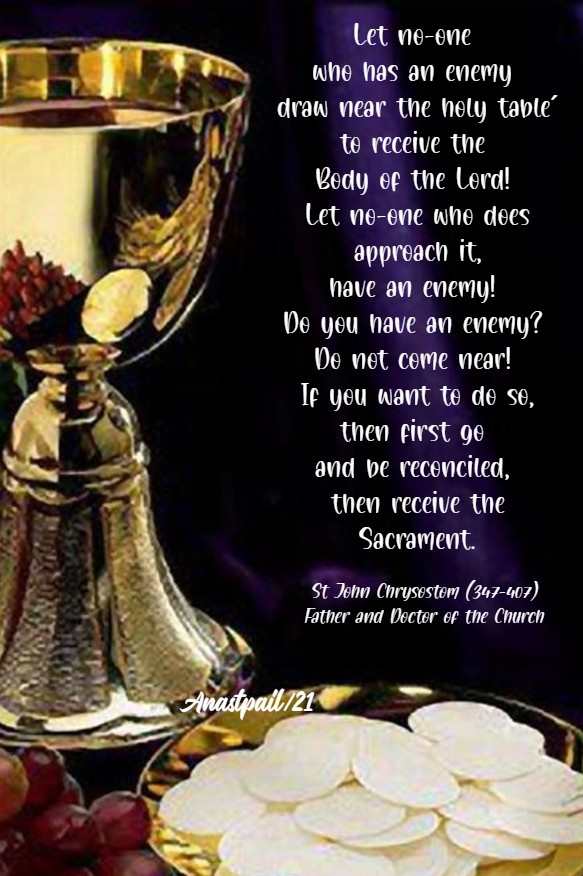
“This is what I proclaim, what I testify, what I cry out with a resounding voice: Let no-one who has an enemy, draw near the holy table, to receive the Body of the Lord! Let no-one who does approach it, have an enemy! Do you have an enemy? Do not come near! If you want to do so, then first go and be reconciled, then receive the Sacrament.”
St John Chrysostom (347-407) Father and Doctor of the Church
“Someone who shows no clemency, who is not clothed with the bowels of mercy and tears, no matter what sort of student he is in spirituality, such a one does not fulfil the law of Christ.”
St Jerome (347-420) Father & Doctor of the Church
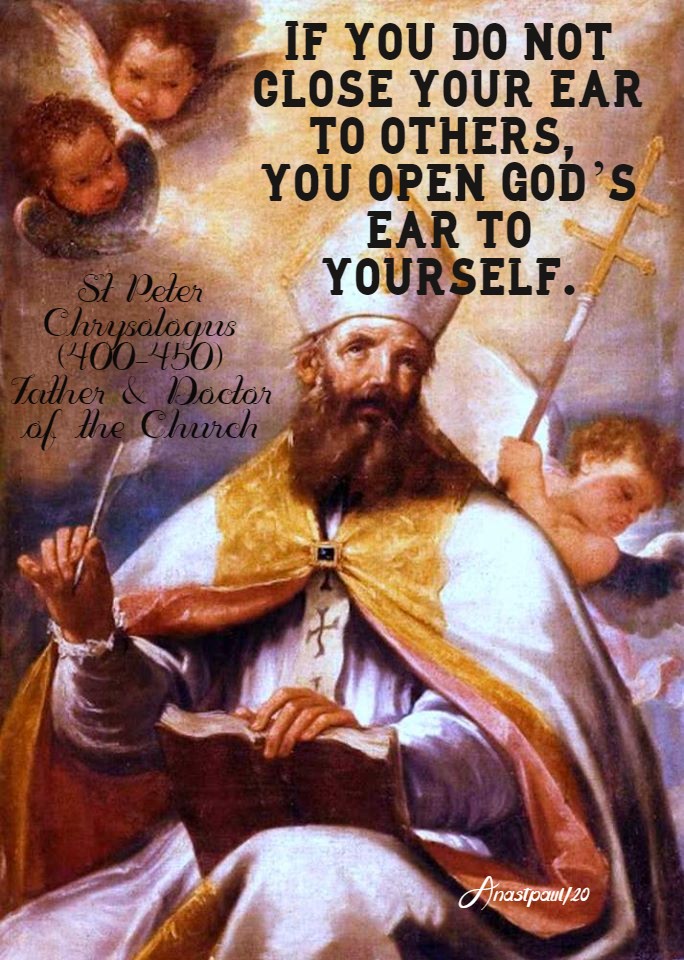
“If you do not close your ear to others, you open God’s ear to yourself.”
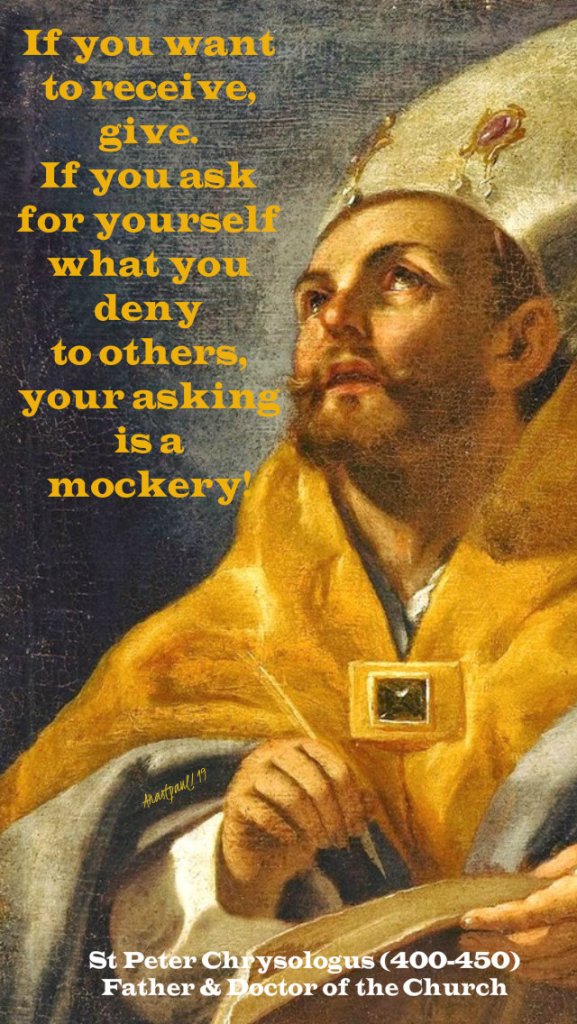
“If you want God to know that you are hungry, know that another is hungry. If you hope for mercy, show mercy. If you look for kindness, show kindness. If you want to receive, give. If you ask for yourself what you deny to others, your asking is a mockery.”
St Peter Chrysologus (400-450) Father & Doctor of the Church
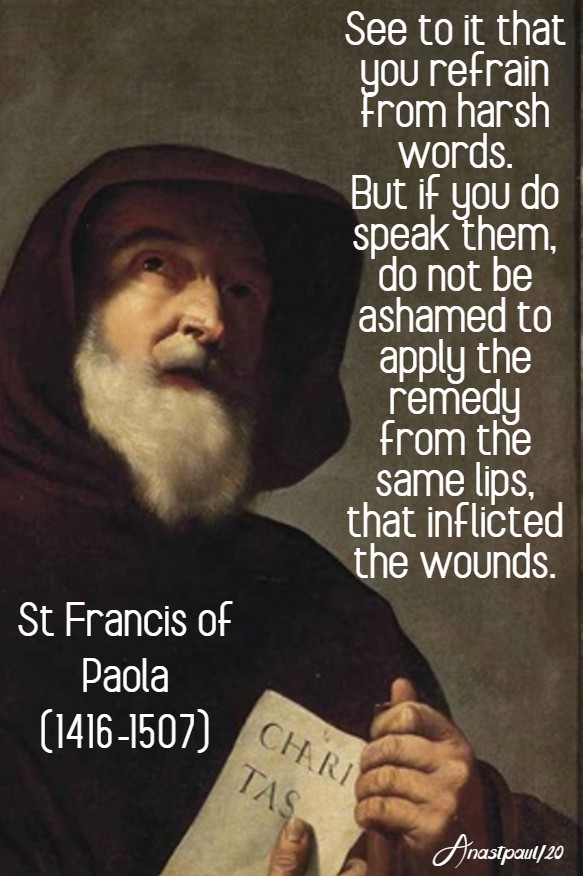
“See to it that you refrain from harsh words. But if you do speak them, do not be ashamed to apply the remedy from the same lips, that inflicted the wounds.”
St Francis of Paola OM (1416-1507)
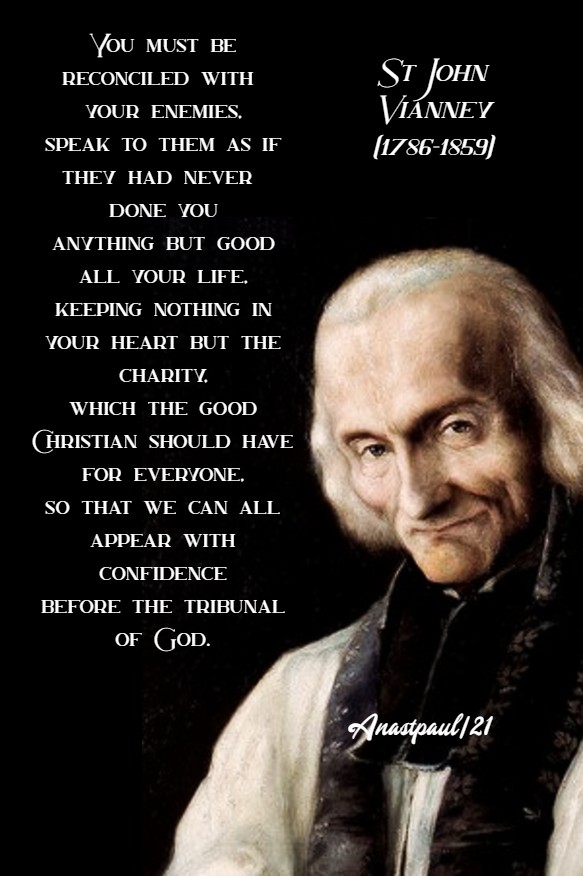
“You must be reconciled with your enemies, speak to them as if they had never done you anything but good all your life, keeping nothing in your heart but the charity, which the good Christian should have for everyone, so that we can all appear with confidence before the tribunal of God.”
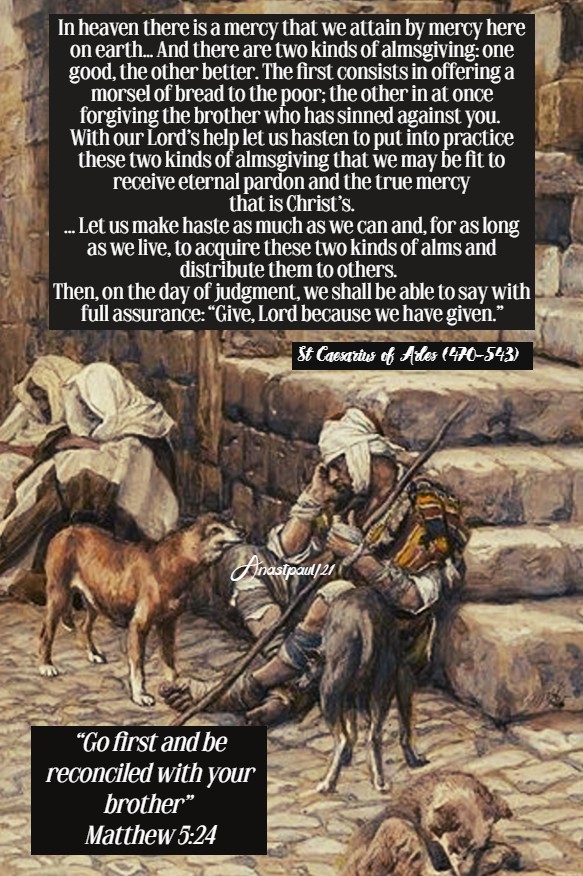
“Go first and be reconciled with your brother” – Matthew 5:24
REFLECTION – “In heaven there is a mercy that we attain by mercy here on earth… And there are two kinds of almsgiving: one good, the other better. The first consists in offering a morsel of bread to the poor; the other in at once forgiving the brother who has sinned against you. With our Lord’s help let us hasten to put into practice these two kinds of almsgiving that we may be fit to receive eternal pardon and the true mercy that is Christ’s. For He Himself has said: “If you forgive others their transgressions, your heavenly Father will forgive you. But if you will not forgive others, neither will your Father forgive your transgressions” (Mt 6,14-15). And elsewhere the Holy Spirit cries aloud: “Should a man nourish anger against his fellows and expect healing from the Lord? Should a man refuse mercy to his fellows yet seek God’s pardon for his own sins?” (Sir 28,3-4)…
Let us make haste as much as we can and, for as long as we live, to acquire these two kinds of alms and distribute them to others. Then, on the day of judgement, we shall be able to say with full assurance: “Give, Lord, because we have given.” – St Caesarius of Arles (470-543) Bishop and Monk – Sermons to the people no.25
PRAYER – Lord God, true light and creator of light, grant that faithfully following the instructions of Your Son and pondering all that is holy, we may ever live in the splendour of Your presence. By the gifts of the Holy Spirit, may we always be light to our neighbour. Mary, Mother of Love and our loving mother, by your prayers, may we grow in charity and love. We make our prayer through Christ, our Lord amen.
Our Morning Offering – 26 February – Friday of the First Week of Lent
Prayer for the Grace of Patient Suffering By Thomas à Kempis (1380-1471)
O Lord Jesus, make possible to me by grace, what is difficult by nature. You know well how little I can bear and how easily I am upset by a little adversity. Therefore, I beseech You, that hereafter, any trouble or adversity may be loved and desired by me for Your Name, for it is very good and profitable to my soul, to suffer and be afflicted for You. Amen
Saint of the Day – 26 February – Saint Victor the Hermit (Died 6th Century) Priest, Monk, Hermit, miracle-worker. Born in the 6th century at Troyes, France and died in the 6th-century at Saturniac (modern Saint-Vittre), Diocese of Troyes, France of natural causes. Patronage – Arcis-sur-Aube, France. Also known as Victor of Arcis, Vittre, Vitre.
Victor was born in Troyes, Champagne, France, of noble parents. He was educated under strict discipline in learning and piety. He was one of those rare creatures that was a saint from his cradle. In his youth, prayer, fasting and alms-giving were his chief delights.
After embracing the Priesthood, the love of heavenly contemplation was so alluring, that he preferred retirement to the care of souls and he dwelt as a hermit for many years in the region around Montiramy. This appears to have been God’s will for him. He lived in continual communion with God and God glorified him by many miracles but the greatest appears to be the powerful example of his life.
Saint Victor died at Saturniac, now called Saint-Vittre, in the Diocese of Troyes. ACchurch was built over his tomb but in 837 his relics were translated to the neighbouring Monastery of Montier-Ramoy, or Montirame.
Victor’s feast was celebrated by the Benedictines of Montiramy at whose request Saint Bernard wrote two pious panegyrics about Victor.
Saint Bernard wrote of him: “Now placed in heaven, he beholds God clearly, revealed to him, swallowed up in joy but not forgetting us. It is not the land of oblivion in which Victor dwells. Heaven does not harden or straiten hearts but makes them more tender and compassionate; it does not distract minds, nor alienate them from us; it does not diminish but it increases affection and charity; it augments bowels of pity. The angels, although they behold the face of their Father, visit, run and continually assist us and shall they now forget u,s who were once among us and who once suffered themselves, what they see us at present labour under? No! ‘I know the just expect me till you render to me my reward.'”
“Victor is not like that cup-bearer of Pharaoh, who could forget his fellow-captive. He has not so put on the stole of glory himself, as to lay aside his pity, or the remembrance of our misery” (Sermon, 2)
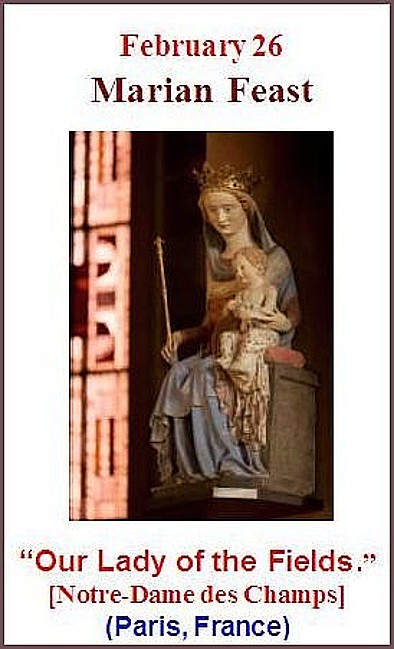
Notre-Dame des Champs / Our Lady of the Fields, Paris, France, consecrated by St Denis (250) – 26 February:
The title of Our Lady of the Fields, or Notre-Dame des Champ and the devotion to Mary as such, takes us back to the earliest days of Catholic life in France. Our Lady des Champs, at Paris, was dedicated in ancient times to Ceres. Saint Denis, to whom we owe a great deal of our traditional devotion to Mary, was the first Bishop of Paris. According to tradition he drove the demons from the Temple of Ceres, the pagan goddess of agriculture and placed therein, an image of the Madonna modelled after Saint Luke’s famous painting. The Temple was henceforth dedicated to the Blessed Virgin, whom Parisians have honoured for centuries under the title of Our Lady of the Fields. It is said that a picture of the Blessed Virgin is still to be seen there, on a small stone, a foot square, which was made after that which Saint Denis brought to France.
This house, which is a Benedictine priory, was afterwards occupied by the Carmelites, who were received there in the year 604 and founded by Catherine, Princess of Longueville. It was the first occupied by those nuns in France; the mother Ann of Jesus, the companion of Saint Teresa, was its first superior. If the Blessed Virgin were a goddess she would be a very human goddess – simple and approachable, forgetful of her privileges and of her beauty. Her constant humility adds to her charm. Saint Denis knew this well. He found her so gloriously beautiful that he gave to her the place in the temple – and in the hearts of the people – formerly held by the pagan goddess. “I am the Flower of the Fields,” the Holy Ghost has the Blessed Virgin say. A flower of the fields has a simple beauty that charms us even more because it blossoms by itself without care or cultivation. Our Saviour Himself marvelled at such a flower and of it He spoke these words of praise that have been repeated through the centuries: “See how the lilies of the field grow; they neither toil nor spin, yet I say to you that not even Solomon in all his glory was arrayed like one of these.” But lilies soon fade and roses are hardly open, before they begin to shed their petals before the wind. The beauty of Mary is less perishable; it remains ever fresh and unchanged in the valley of our exile.
Bl Adalbert of Tegernsee St Agricola of Nevers St Alexander of Alexandria St Andrew of Florence St Dionysius of Augsburg St Faustinian of Bologna St Felix St Fortunatus St Irene St Isabelle of France Bl Ottokar of Tegernsee St Paula Montal Fornés of Saint Joseph of Calasanz (1799-1889) Biography: https://anastpaul.com/2018/02/26/saint-of-the-day-26-february-st-paula-montal-fornes-de-san-jose-de-calasanz-1799-1889/ Bl Piedad de la Cruz Ortiz St Porphyrius of Gaza Bl Robert Drury St Victor the Hermit (Died 6th Century) Priest
Thought for the Day – 25 February – Meditations with Antonio Cardinal Bacci (1881-1971)
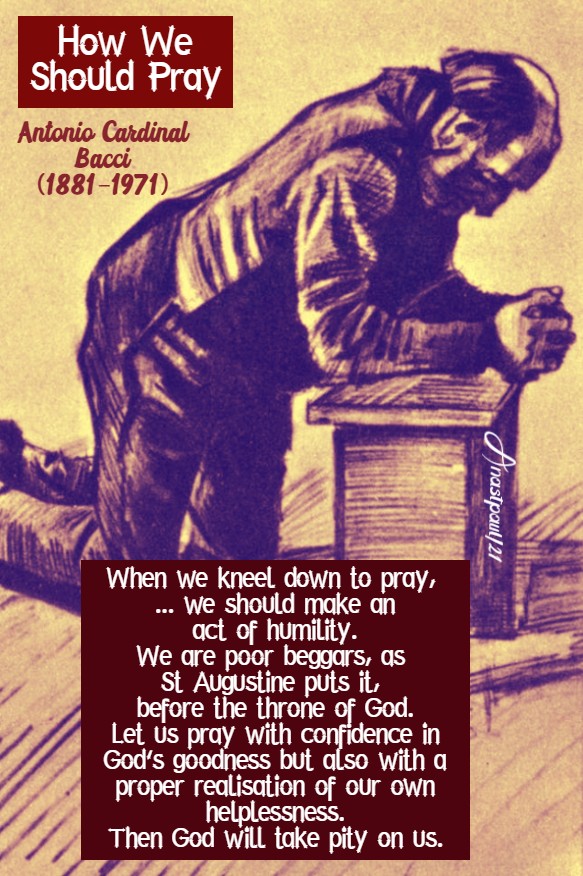
How We Should Pray
“We must pray with deep humility. Once again we find, that the Man-God Jesus, has given us an example. In Gethsemane He fell prostate on the ground and begged that, if it were possible, the bitter chalice might be taken away from Him. Immediately he added. with full submission to the will of His Heavenly Father – “Yet, not my will but thine be done” (Lk 22:42). Let us remember, moreover, the parable of the Pharisee and the publican. The former appeared to be full of virtue but he was proud and was rejected. The latter, recognised in all humility, that he was a poor sinner and he was exalted. “Everyone who exalts himself shall be humbled and he who humbles himself shall be exalted” (Lk 14:11). “God resists the proud but gives grace to the humble” (Js 4:6). “The prayer of the lowly pierces the clouds; it does not rest, until t reaches its goal” (Ecclus 35:17).
When we kneel down to pray, therefore, we should make an act of humility. We are poor beggars, as St Augustine puts it, before the throne of God. Let us pray with confidence in God’s goodness but also with a proper realisation of our own helplessness. Then God will take pity on us.
Day Nine of our Lenten Journey – 25 February – Thursday of the First week of Lent, Readings: Esther C:12, 14-16, 23-25, Psalms 138:1-2,2-3, 7-8, Matthew 7:7-12
Imitating Christ with Thomas à Kempis (1380-1471)
In You is the source of life and in Your Light Lord, we see light Psalm 35(36)
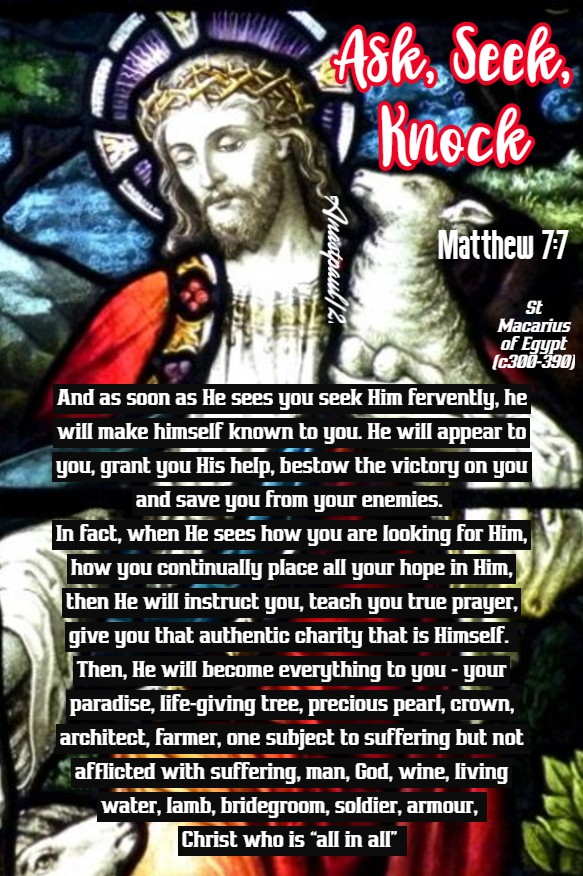
“Ask and it will be given you, seek and you will find, knock and it will be opened to you.” – Matthew 7:7
When Jesus is near, all is well and nothing seems difficult. When He is absent, all is hard. When Jesus does not speak within, all other comfort is empty. But if He says only a word, it brings great consolation.
[…] How dry and hard you are without Jesus! How foolish and vain if you desire anything but Him! Is it not a greater loss than losing the whole world? For what, without Jesus, can the world give you? Life without Him is a relentless hell but living with Him is a sweet paradise. If Jesus be with you, no enemy can harm you.
He who finds Jesus finds a rare treasure, indeed, a good above every good, whereas he who loses Him, loses more than the whole world. The man who lives without Jesus is the poorest of the poor, whereas no-one is so rich, as the man who lives in His grace.
It is a great art to know how to converse with Jesus and great wisdom to know how to keep Him. Be humble and peaceful and Jesus will be with you. Be devout and calm and He will remain with you.
[…] You cannot live well without a friend and if Jesus be not your friend above all else, you will be very sad and desolate. Thus, you are acting foolishly if you trust or rejoice in any other. Choose the opposition of the whole world, rather than offend Jesus. Of all those who are dear to you, let Him be your special love. Let all things be loved for the sake of Jesus but Jesus, for His own sake.
[…] Never wish that anyone’s affection be centred in you, nor let yourself be taken up with the love of anyone but let Jesus be in you and in every good man. Be pure and free within, unentangled with any creature. You must bring to God a clean and open heart if you wish to attend and see how sweet the Lord is.
Truly you will never attain this happiness, unless His grace prepares you and draws you on, so that you may forsake all things to be united with Him alone. When the grace of God comes to a man, he can do all things, but when it leaves him, he becomes poor and weak, abandoned, as it were, to affliction.
Yet, in this condition he should not become dejected or despair. On the contrary, he should calmly await the will of God and bear whatever befalls him, in praise of Jesus Christ. For after winter comes summer, after night, the day and after the storm, a great calm. (Book 2 Ch 8:1-5)
Quote/s of the Day – 25 February – Thursday of the First week of Lent, Readings: Esther C:12, 14-16, 23-25, Psalms 138:1-2,2-3, 7-8, Matthew 7:7-12
“Ask and it will be given you, seek and you will find, knock and it will be opened to you.”
Matthew 7:7
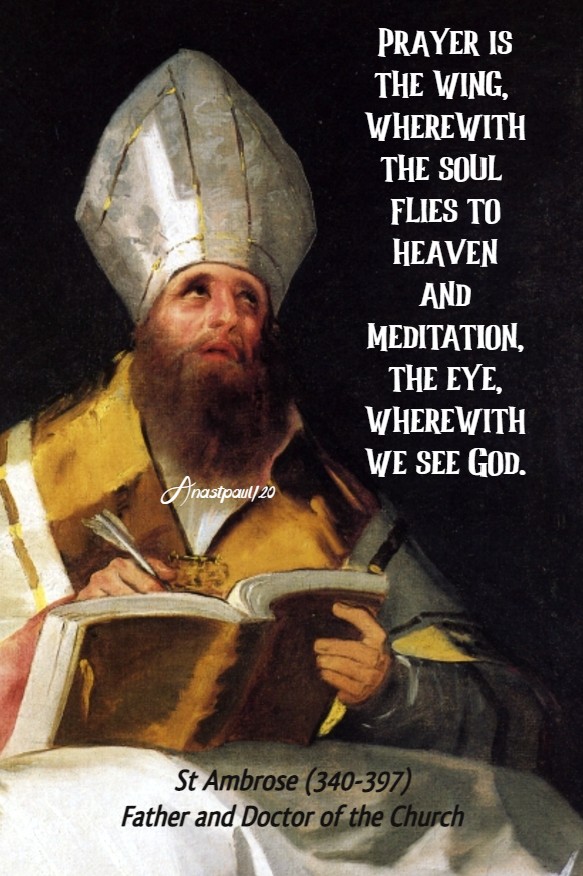
“Prayer is the wing, wherewith the soul flies to heaven and meditation, the eye, wherewith we see God.”
St Ambrose (340-397) Father and Doctor of the Church
“Ask with tears, seek with obedience, knock with patience.”
St John Climacus (c 525-606) Father of the Church
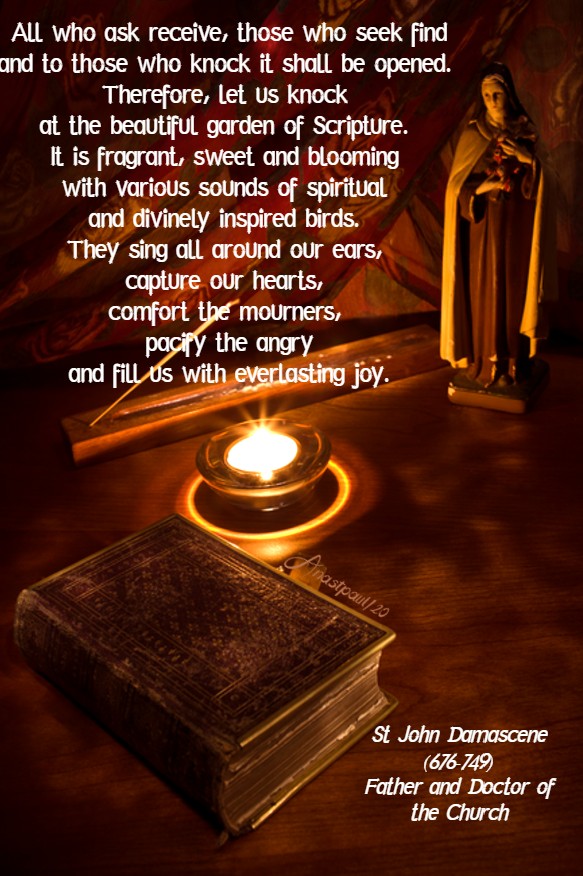
“All who ask receive, those who seek find and to those who knock it shall be opened. Therefore, let us knock at the beautiful garden of Scripture. It is fragrant, sweet and blooming with various sounds of spiritual and divinely inspired birds. They sing all around our ears, capture our hearts, comfort the mourners, pacify the angry and fill us with everlasting joy.”
St John Damascene (676-749) Father and Doctor of the Church
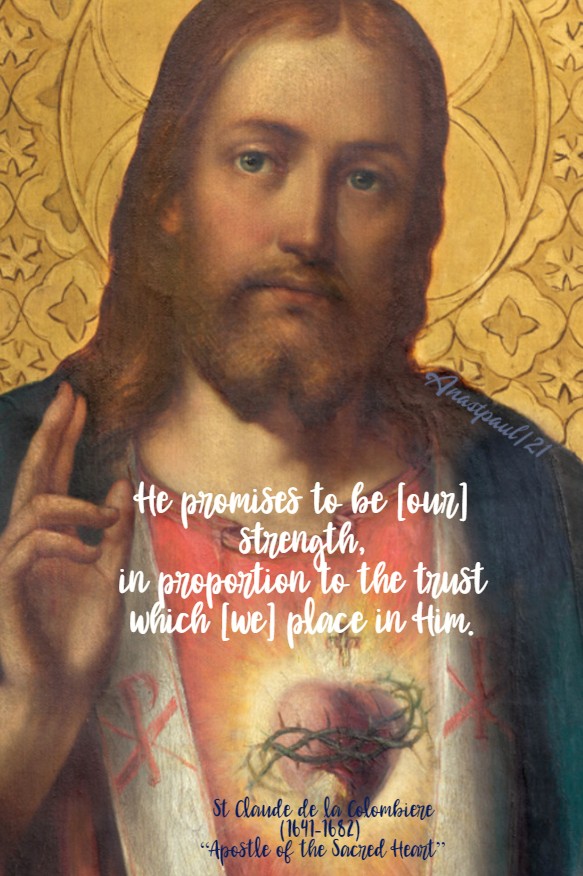
“He promises to be [our] strength, in proportion to the trust which [we] place in Him.”
St Claude de la Colombiere (1641-1682) “Apostle of the Sacred Heart”
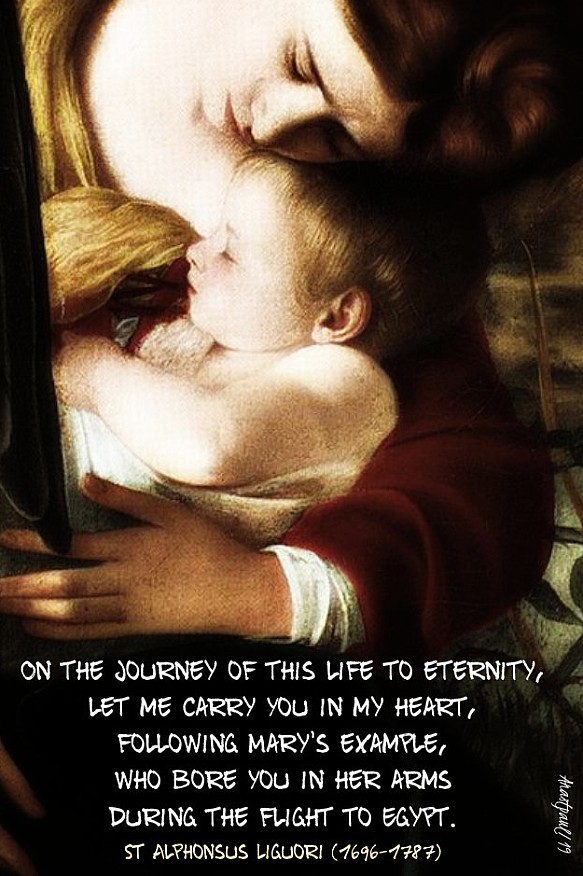
“On the journey of this life to eternity, let me carry You in my heart, following Mary’s example, who bore You in her arms, during the flight to Egypt.”
St Alphonsus Maria de Liguori (1696-1787) Bishop and Doctor of the Church
One Minute Reflection – 25 February – Thursday of the First week of Lent, Readings: Esther C:12, 14-16, 23-25, Psalms 138:1-2,2-3, 7-8, Matthew 7:7-12 and the Memorial of Blessed Sebastian of Aparicio OFM (1502-1600) “The Angel of Mexico”
“Ask and it will be given you, seek and you will find, knock and it will be opened to you.” – Matthew 7:7
REFLECTION – “Try hard to please the Lord, pay Him unwearying attention within yourself, seek for Him with the aid of your thoughts, keep a check on your will and its decisions, control them so they are constantly directed towards Him. Then you will see how He draws near you and makes His dwelling within you… He stands there, taking note of your reasoning, thoughts, reflexions, examining how you are seeking Him, whether it is with all your soul or whether sluggishly and carelessly. And as soon as He sees you seek Him fervently, he will make himself known to you. He will appear to you, grant you His help, bestow the victory on you and save you from your enemies. In fact, when He sees how you are looking for Him, how you continually place all your hope in Him, then He will instruct you, teach you true prayer, give you that authentic charity that is Himself. Then, He will become everything to you: your paradise, life-giving tree, precious pearl, crown, architect, farmer, one subject to suffering but not afflicted with suffering, man, God, wine, living water, lamb, bridegroom, soldier, armour, Christ who is “all in all” (1Cor 15,28).
Just as a child cannot feed or take care of itself but can only look at its mother and cry until she takes pity and gives it her attention, so believing soul,s always hope in Christ and attribute to Him, all righteousness. As the shoot withers if it is separated from the vine (Jn 15,6) so does someone who wants to become faultless apart from Christ. Just as “someone is a thief and robber who does not enter the sheepfold through the gate but climbs over elsewhere” (Jn 10,1), so it is with someone, who wants to become just, without Him who justifies.” – St Macarius of Egypt (c 300-390) Monk – Spiritual Homilies no 30, 3-4
PRAYER –May We Love Only YouBy St Columban (543-615) Loving Saviour, be pleased to show Yourself to us who knock, so that in knowing You, we may love only You, love You alone, desire You alone, contemplate only You, day and night and always think of You. Inspire in us the depth of love that is fitting for You to receive as God. So may Your love pervade our whole being, possess us completely and fill all our senses, that we may know no other love but love for You, Who are everlasting. May our love be so great, that the many waters of sky, land and sea cannot extinguish it in us – many waters could not extinguish love. May this saying be fulfilled in us also, at least in part, by Your gift, Jesus Christ, our Lord, to whom be glory forever and ever. Amen
Our Morning Offering – 25 February – Thursday of the First week of Lent
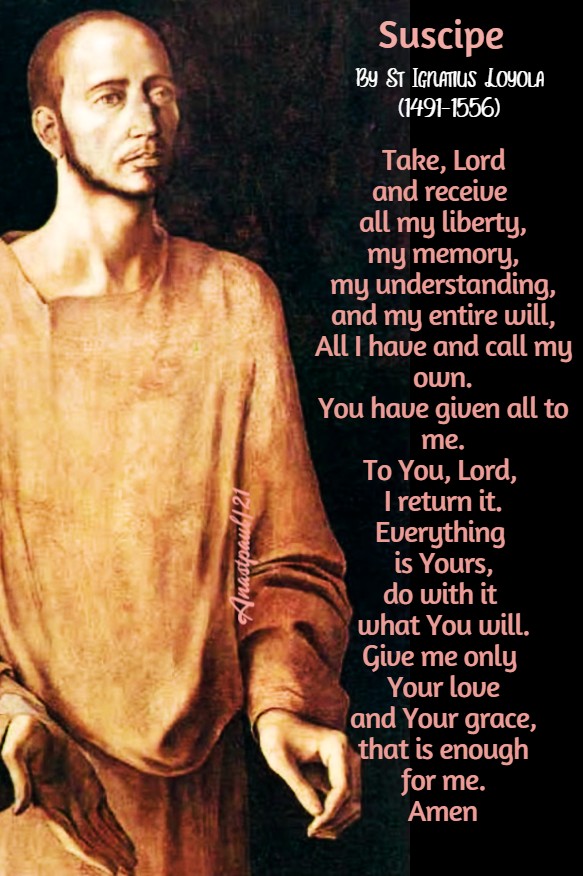
Suscipe By St Ignatius Loyola (1491-1556)
Take, Lord and receive all my liberty, my memory, my understanding, and my entire will, All I have and call my own. You have given all to me. To You, Lord, I return it. Everything is Yours, do with it what You will. Give me only Your love and Your grace, that is enough for me. Amen
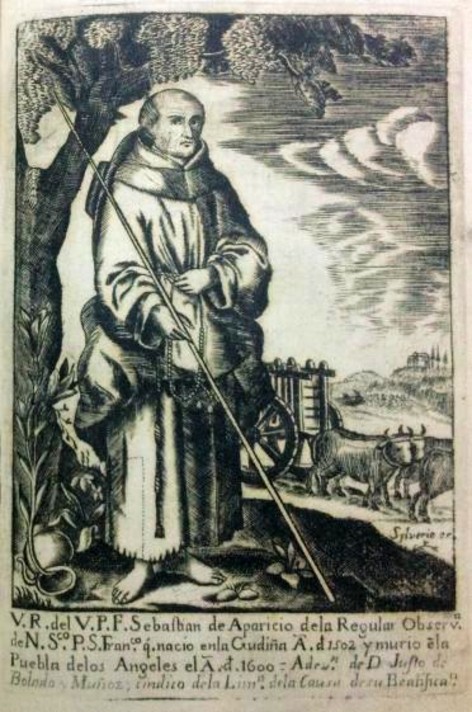
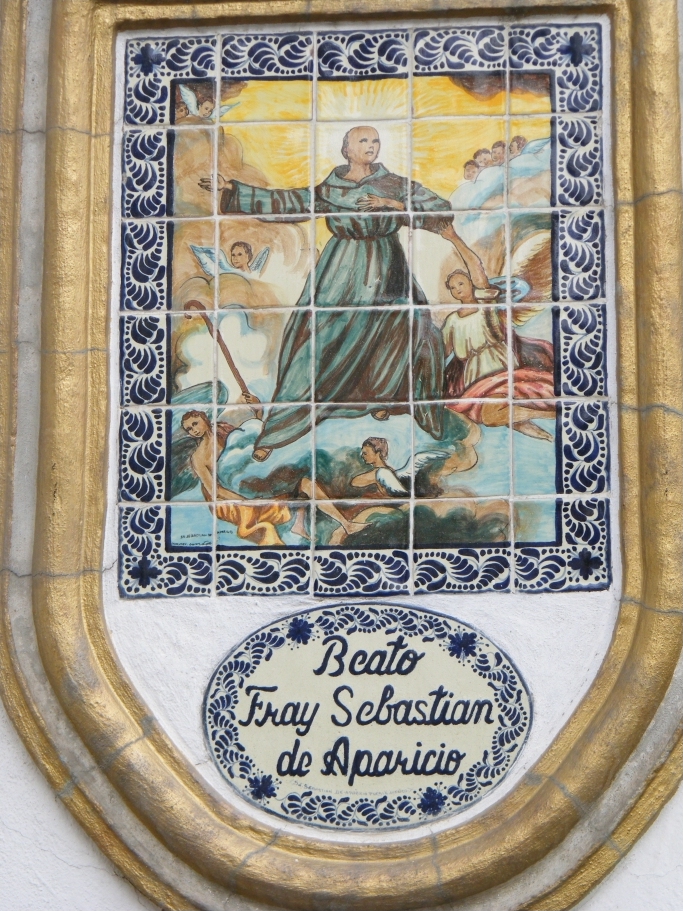
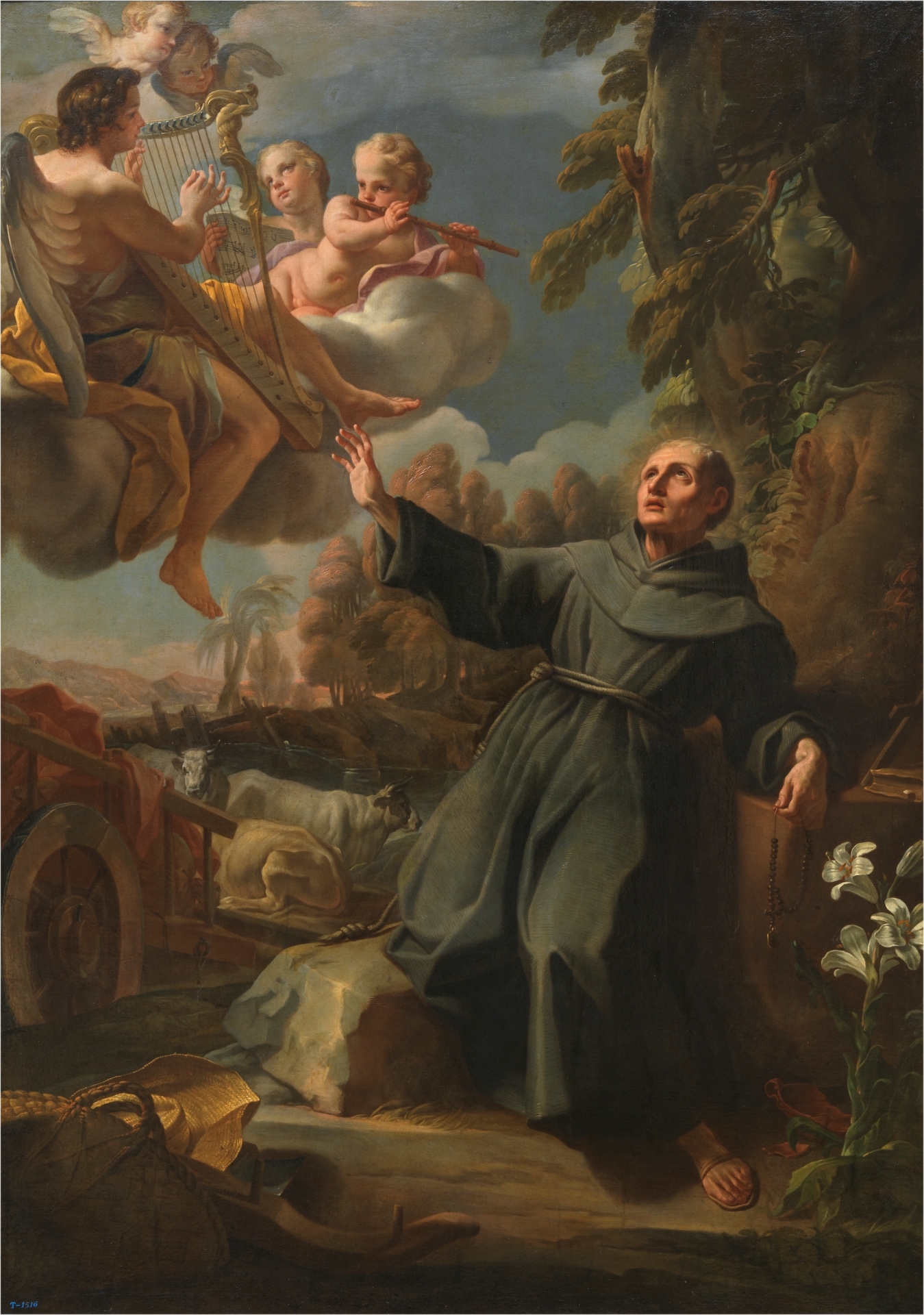
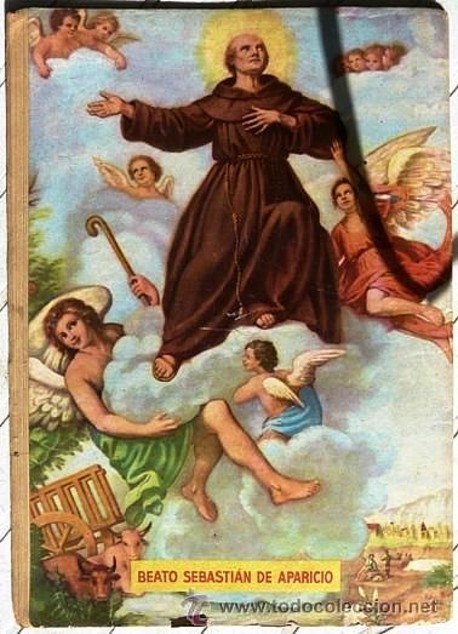
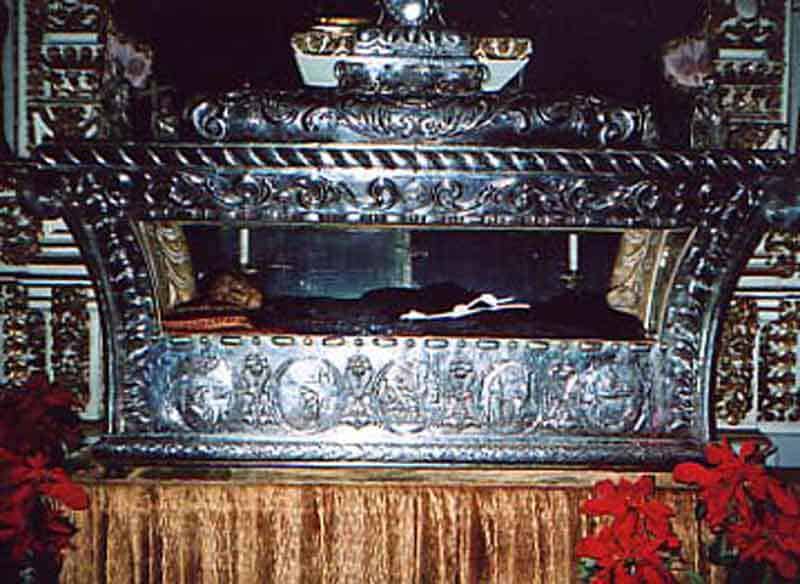
Saint of the Day – 25 February – Blessed Sebastian of Aparicio OFM (1502-1600) “The Angel of Mexico,” Franciscan Lay brother, Confessor, Ascetic, apostle of the poor, builder of roads and bridges in Mexico and thus is honoured as the Founder of the transport and road system in Mexico. Born as Sebastiano de Aparicio y del Pardo on 20 January 1502 in La Gudiña, Orense, Spain and died on 25 February 1600 of natural causes, aged 98. Sebastian was a Spanish colonist in Mexico shortly after its conquest by Spain, who after a lifetime as a rancher and road builder, entered the Order of Friars Minor as a lay brother. He spent the next 26 years of his long life, as a beggar for the Order and died with a great reputation for holiness. Patronages – motorists, travellers, road builders and the Transport industry in Mexico. His body is incorrupt.
Sebastian was born in Spain into a peasant family in 1502,. He was a good looking young man with a reserved personality that attracted the interest of quite a few women. He was deeply religious and changed employment several times, before the age of 30, to avoid the temptations opened to him. He worked as a household servant and as a hired field hand.
Despite his illiteracy, he had absorbed the discourse on how to lead a pious and holy life that he could emulate models in hagiographic texts. According to his own account, his life was saved in a miraculous way during an outbreak of the bubonic plague in his town in 1514. Forced to isolate him from the community, his parents built a hidden shelter for him in the woods, where they left him. While lying there helpless, due to his illness, a she-wolf found the hiding spot and, poking her head into his hiding spot, sniffed and then bit and licked an infected site on his body, before running off. He began to heal from that moment.
At the age of 31, Sebastian left Spain for Mexico. He settled in the town of Puebla de los Angeles where he took employment as a field hand. However, he soon noticed a business opportunity for Puebla was an important crossroads and he noted, that the goods transported, were carried on the backs of pack animals or on the backs of the native people.
At first, Sebastian made and sold wheeled carts for the transport of goods. He then expanded into the improvement and building of roads and bridges to improve transport for goods and people. He was responsible for the building of a 460 mile road from Mexico City to Zacatecas, which took 10 years to build and was of enormous benefit to the local economy.
By the age of 50, Sebastian was a wealthy man. He lived very simply and gave his earnings to others, he bought food for the poor, made loans that he never reclaimed to poor farmers too proud to accept charity, he paid the dowries for poor brides and gave free training to Indians in skills that would assist them in earning a living. In addition, people brought him their problems and he had a reputation for his wisdom.
Sebastian became known as “The Angel of Mexico.” He retired at the age of 50 to a hacienda to raise cattle. He married at age 60 at the request of his bride’s parents. His bride was a poor girl and he agreed to the match, on condition that the couple lived as brother and sister, which they did. His wife died and he married again on the same condition. When he was 70, Sebastian’s second wife died and he himself contracted a serious illness.
Upon recovering, he decided to give everything he had to the poor and became a lay Franciscan brother. He undertook many responsibilities, including cook, sacristan, gardener and porter. He was then assigned to the large community of friars in the city of Puebla, at that time consisting of about 100 friars, most of whom, were doing their studies or were retired or recovering from illness. He was appointed to be the quaestor of the community, the one assigned to travel throughout the local community, seeking food and alms for the upkeep of the friars and those who came to them for help. The builder of Mexico’s highway system had become a beggar on it. Despite his advanced age, he felt the vigour needed for the task. This formerly rich man, loved his job and was loved by his fellow Franciscans, the townspeople and the poor that the Brothers helped. He also loved–and was loved–by animals, even the most stubborn mules and oxen would obey the Blessed, much like Saint Francis.
Though he had long suffered from a hernia, Aparicio marked his 98th birthday on the road, apparently in good health. On the following 20 February, he developed what was to be his final illness, as the hernia became entangled. He began to feel pain and nausea and, upon arrival at the friary, was immediately sent to the infirmary. It was the first time he had slept in a bed in 25 years. As his condition worsened, he became unable to swallow. His only regret was that, due to this, he was unable to receive Holy Communion. As he lay dying, he was consoled by the friars’ fulfilling his request that they bring the Blessed Sacrament to his cell.
On the evening of 25 February, Aparicio asked to be laid on the ground to meet his death, in imitation of St. Francis. He soon died in the arms of a fellow Galician, Friar Juan de San Buenaventura, with his last word being “Jesus.” When his body lay in state, the crowds that gathered were large and the miracles wrought were so numerous, that he could not be buried for several days. His habit had to be replaced repeatedly, as mourners would snip a piece of it off to keep as the relic of a saint.
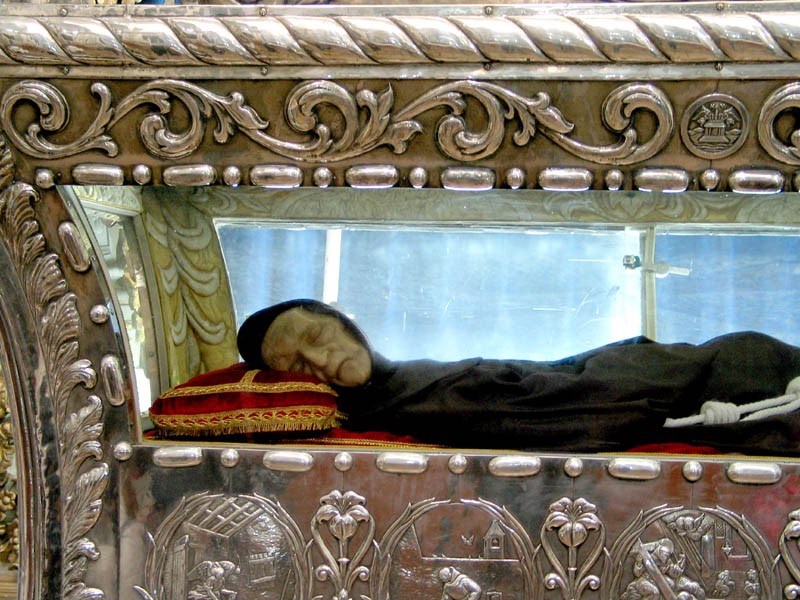
The Blessed’s remains were never buried but at the request of the local people, exposed in a prominent place for veneration. His body, although darkened, has remained incorrupt and can be viewed in the Church of Saint Francis in Puebla.
Nearly 1,000 miracles were reported at his intercession, even before his death and such claims continue to this day. Pope Pius VI Beatified him on 17 May 1789.
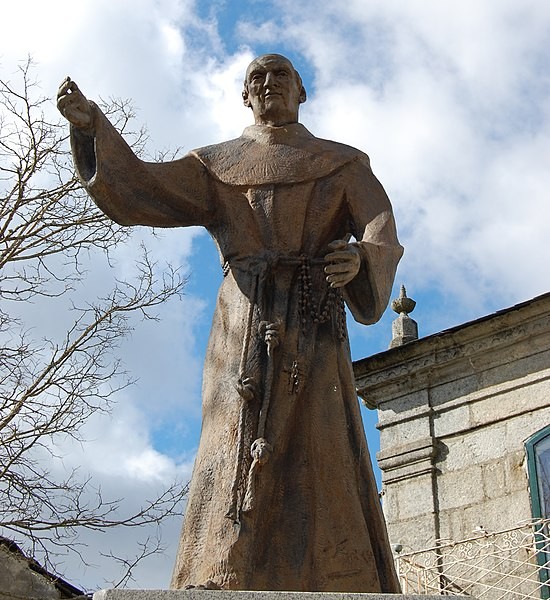
A statue of the Blessed Sebastian outside the Franciscan Church of Puebla where his incorrupt body is preserved for veneration.
Notre-Dame-de-Grande-Puissance / Our Lady of Great Power, Quebec, Canada, (1673) – 25 February:
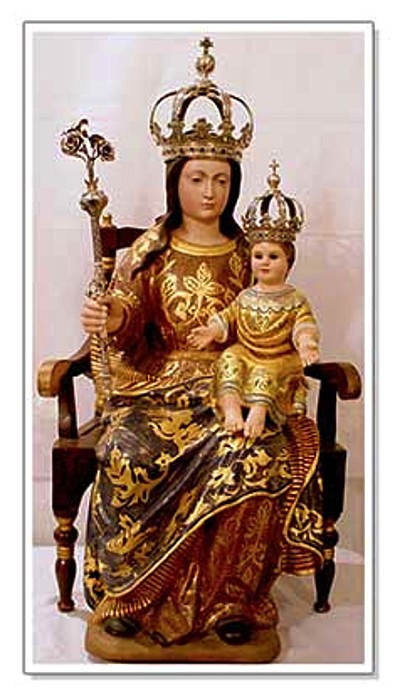
Our Lady of Great Power is little known in America, unless among the pupils of the Ursulines in Quebec. Generations of these, however, have dwelt within the walls of the Old Monastery during two centuries and more, since the arrival of the statue in the last years of the 17th century. In the annals of the Ursulines of the Sacred Heart at Perigueux, France, where the statue was solemnly crowned, we find the origin of the devotion. The devotion to Our Lady of Great Power began in the monastery of Issoudun. There a holy Ursuline nun, Mother Saint Peter, was inspired during her prayer to invoke Our Lady under this title. She spoke of her inspiration to her Sisters and her Superiors. The devotion was adopted with enthusiasm and very soon it was decided, that a statue be sculptured and a Chapel built, dedicated to Our Lady of Great Power; she would henceforth be chosen, as first and principal Superior of the Monastery. The feast of the dedication took place 25 February 1673 and was celebrated with great pomp, as the chronicle testifies:
“After High Mass two ecclesiastics carried the statue to the entry of the monastery where the nuns, in solemn procession, received it. It was placed on a richly decorated litter and, to the chanting of hymns, psalms and canticles, it was brought to the prepared Chapel. When the same statue was raised on its pedestal, the Superior laid the keys of the monastery, the seals and constitutions at Our Lady’s feet, begging her, in the name of the community, to accept the gift of all hearts and of the entire monastery and to allow them, to look on her as their Superior forever. Each rendered homage while hymns and canticles of thanksgiving were sung in Mary’s honour.”
Ever after, when a Superior was elected, the ceremony was renewed and is still renewed in each Ursuline community every year on a principal feast of the Blessed Virgin; though homage is rendered only every three years, after the election or nomination of Superiors. The statue of Our Lady of Great Power was carried off and profaned during the dark days of the French Revolution. It was found and returned to the monastery at Perigueux and the devotion continued fervently until 1892, when the Bishop of Perigueux, in the name of the Soverign Pontiff, placed a richly jewelled crown on the head of the Mother and the Child and ratified the numberless and signal favours obtained through Our Lady of Great Power. Through the Ursulines in Quebec, the devotion soon spread through the New World. Before the Altar in Quebec hangs the famous votive light promised to be kept burning as a token of thanks for favours granted to Mother Saint Agatha (Madeleine de Repentigny). Relatives and descendants of this holy nun have kept the lamp burning. One relative, Miss Anthon, had a new lamp made, an artistic gem, the work of the celebrated ecclesiastical goldsmith Calliat of Lyon, France.
St Adelelmo of Engelberg St Aldetrudis St Ananias of Phoenicia Bl Avertano of Lucca St Caesarius of Nanzianzen St Callistus Caravario Bl Ciriaco Maria Sancha Hervas Bl Didacus Yuki Ryosetsu St Domenico Lentini St Donatus the Martyr Saint Felix III, Pope St Gerland the Bishop St Gothard the Hermit St Herena the Martyr St Justus the Martyr St Laurentius Bai Xiaoman St Luigi Versiglia Blessed Maria Adeodata Pisani (1806-1855) Biography: https://anastpaul.com/2018/02/25/saint-of-the-day-25-february-blessed-maria-adeodata-pisani-osb-1806-1855/ St Nestor of Side St Riginos Bl Robert of Arbrissel Blessed Sebastian of Aparicio OFM (1502-1600) Franciscan Lay Brother St Tharasius St Toribio Romo González St Victor of Saint Gall St Walburga — Martyrs of Egypt – A group of Christian men who were exiled to Egypt for their faith and were eventually martyred for their faith in the persecutions of Numerian. We know little more than their names: Claudianus Dioscurus Nicephorus Papias Serapion Victor Victorinus
Thought for the Day – 24 February – Meditations with Antonio Cardinal Bacci (1881-1971)
Carelessness
“Some people think that they are good Christians because they avoid committing grave sin and more or less, fulfil their duties. They do not entirely omit their prayers but, they are content to recite them listlessly.
They go to Mass on days of obligation but, they are afraid of arriving too early and so, they are usually a little late. Once Mass is over, they leave the Church, as if they had been set on fire. During Mass, they are cold and distracted. They are like candlesticks without candles – their minds are absent, their hearts are mute.
In regard to their work or other obligations, any excuse suffices to escape or to leave a job half-done. It is useless to expect from them, anything like fervour in prayer, attention to duty, or a spirit of sacrifice in the performance of good works.
Such people are only half-Christians. They do not wish to serve Satan but, they lack the generosity ad the strength of will to become true sons of God. Do you belong to this category? If your carelessness derives from a lack of appreciation of divine things and of your duty in life, you can hardly avoid grave fault. If it comes from laziness, tepidity or lack of mortification, there is no doubt but that you are close to mortal sin! Anyone who is negligent, not only disgusts men but he is an object of loathing to God also and is running the risk of being abandoned by Him. We should examine ourselves seriously and, if we discover this indifference in ourselves, we should shake off our lethargy and make good resolutions to love God more and to serve Him with greater fidelity and diligence. We should be ready, no matter how great the sacrifice, to avoid every imperfection and sin. Any offence against God can lead us nearer to eternal damnation!”
Day Eight of our Lenten Journey – 24 February – – Wednesday of the First week of Lent, Readings: Jonah 3:1-10,Psalms 51:3-4, 12-13, 18-19, Luke 11:29-32
Imitating Christ with Thomas à Kempis (1380-1471)
In You is the source of life and in Your Light Lord, we see light Psalm 35(36)
“This generation is an evil generation. It seeks for a sign but no sign will be given to it, except the sign of Jonah.” – Luke 11:29
IN ALL things consider the e,d; how you shall stand before the strict Judge from Whom nothing is hidden and Who will pronounce judgement in all justice, accepting neither bribes nor excuses. And you, miserable and wretched sinner, who fear even the countenance of an angry man, what answer will you make to the God Who knows all your sins? Why do you not provide for yourself against the day of judgement when no man can be excused or defended by another because each, will have enough to do, to answer for himself? In this life your work is profitable, your tears acceptable, your sighs audible, your sorrow satisfying and purifying.
The patient man goes through a great and salutary purgatory when he grieves more over the malice of one who harms him than for his own injury; when he prays readily for his enemies and forgives offenses from his heart; when he does not hesitate to ask pardon of others; when he is more easily moved to pity than to anger; when he does frequent violence to himself and tries to bring the body into complete subjection to the spirit.
It is better to atone for sin now and to cut away vices than to keep them for purgation in the hereafter. In truth, we deceive ourselves by our ill-advised love of the flesh. What will that fire feed upon but our sins? The more we spare ourselves now and the more we satisfy the flesh, the harder will the reckoning be and the more we keep for the burning.
For a man will be more grievously punished in the things in which he has sinned. There the lazy will be driven with burning prongs and gluttons tormented with unspeakable hunger and thirst; the wanton and lust-loving will be bathed in burning pitch and foul brimstone; the envious will howl in their grief like mad dogs.
Every vice will have its own proper punishment. The proud will be faced with every confusion and the avaricious pinched with the most abject want. One hour of suffering there, will be more bitter, than a hundred years of the most severe penance here. In this life men sometimes rest from work and enjoy the comfort of friends, but the damned have no rest or consolation.
You must, therefore, take care and repent of your sins now so that on the day of judgement you may rest secure with the blessed. For on that day, the just will stand firm against those who tortured and oppressed them and he, who now submits humbly to the judgement of men, will arise to pass judgement upon them. The poor and humble will have great confidence, while the proud will be struck with fear. He who learned to be a fool in this world and to be scorned for Christ, will then appear to have been wise. (Book 1 Ch 24:1-4)
Quote/s of the Day – 24 February – Wednesday of the First week of Lent, Readings: Jonah 3:1-10,Psalms 51:3-4, 12-13, 18-19, Luke 11:29-32
“The sign of Jonah”
Luke 11:29
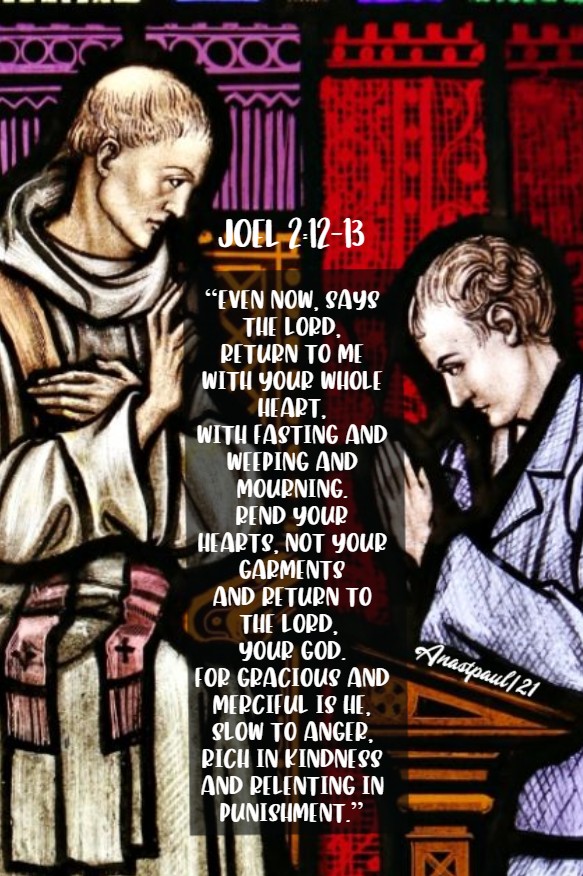
“Even now, says the LORD, return to me with your whole heart, with fasting and weeping and mourning. Rend your hearts, not your garments and return to the LORD, your God. For gracious and merciful is he, slow to anger, rich in kindness and relenting in punishment.”
Joel 2:12-13
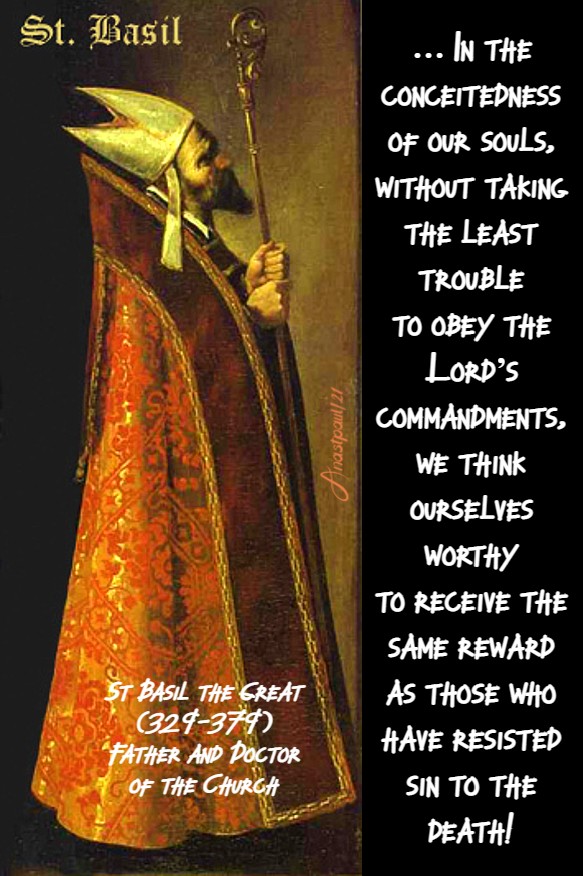
“… In the conceitedness of our souls, without taking the least trouble to obey the Lord’s commandments, we think ourselves worthy to receive the same reward as those who have resisted sin to the death!”
St Basil the Great (329-379) Father and Doctor of the Church
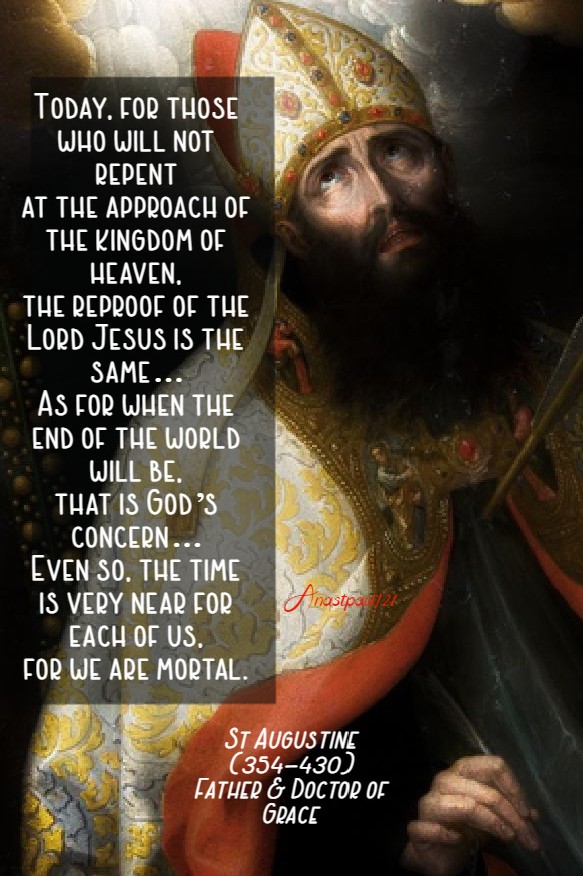
“Today, for those who will not repent at the approach of the kingdom of heaven, the reproof of the Lord Jesus is the same… As for when the end of the world will be, that is God’s concern… Even so, the time is very near for each of us, for we are mortal.”
St Augustine (354-430) Father & Doctor of Grace
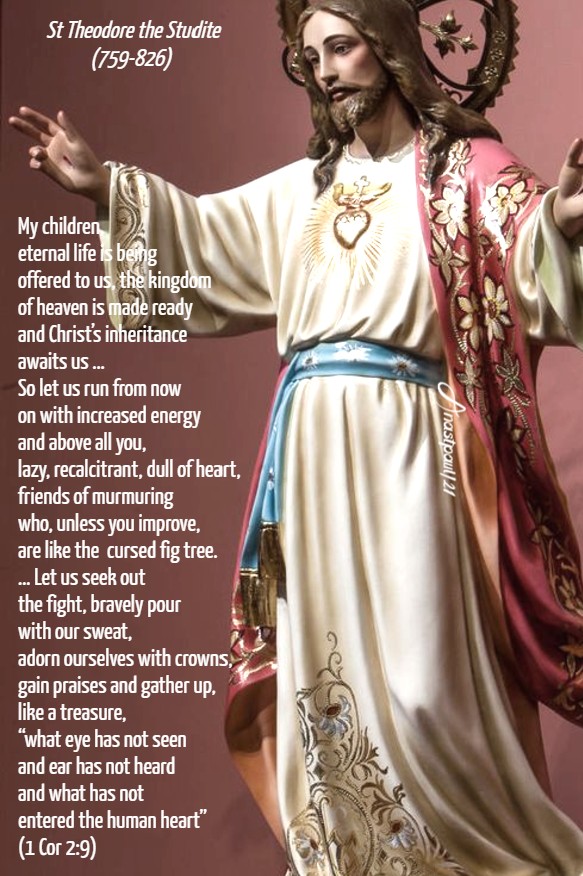
“My children, eternal life is being offered to us, the kingdom of heaven is made ready and Christ’s inheritance awaits us … So let us run from now on with increased energy and above all you, lazy, recalcitrant, dull of heart, friends of murmuring who, unless you improve, are like the cursed fig tree. … Let us seek out the fight, bravely pour with our sweat, adorn ourselves with crowns, gain praises and gather up, like a treasure, “what eye has not seen and ear has not heard and what has not entered the human heart” (1 Cor 2:9).
St Theodore the Studite (759-826)
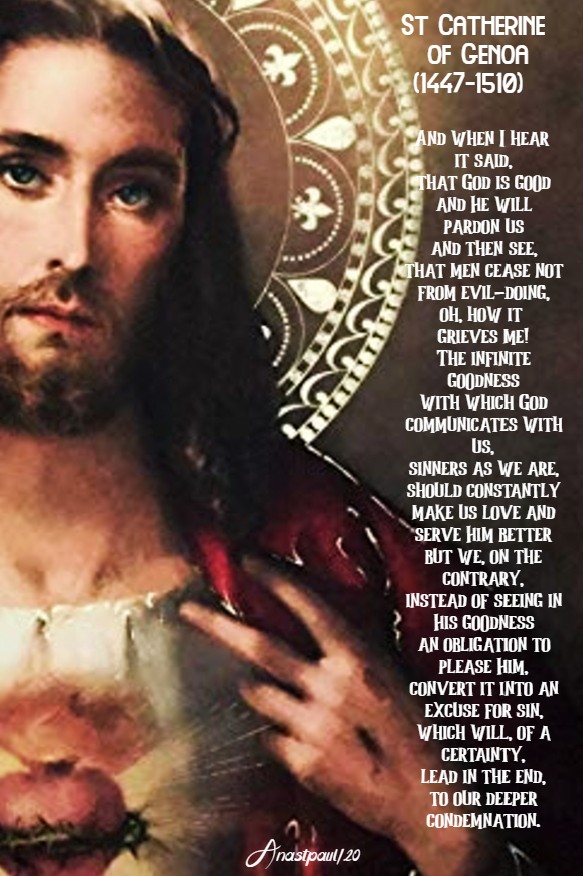
“And when I hear it said, that God is good and He will pardon us and then see, that men cease not from evil-doing, oh, how it grieves me! The infinite goodness with which God communicates with us, sinners as we are, should constantly make us love and serve Him better but we, on the contrary, instead of seeing in His goodness an obligation to please Him, convert it into an excuse for sin, which will, of a certainty, lead in the end, to our deeper condemnation.”
REFLECTION – “God showed patience in the face of man’s weakness because He saw beforehand, the victory He would eventually give him, through His Word. For, when “power was made perfect in weakness” (2 Cor 12:9), the Word caused God’s goodness and tremendous power, to be made manifest. Indeed, it was the same with man, as it was with the prophet Jonah. God permitted Jonah to be swallowed by a sea-monster, not to make him altogether vanish away and die but, so that when he had been vomited out by the monster, he would become more subject to God and would give all the more glory to Him who had given him this unexpected deliverance. It was, too, to lead the Ninevites to firm repentance and to convert them to Him, Who would deliver them from death, amazed as they were by the sign accomplished in Jonah … In the same way, God permitted man to be swallowed by that great monster, the author of disobedience, not so that he should altogether vanish away and die but because God, had prepared beforehand, the salvation fulfilled by His Word by means of the “sign of Jonah.” This salvation has been prepared, for those who have the same feelings for God as Jonah did and, who confess Him in the same words: “I am the servant of the Lord and I worship the Lord, the God of heaven, who made the sea and the dry land” (Jon 1:9). God desired that man, by receiving an unanticipated salvation from Him, would rise from the dead and worship God, saying with Jonah: “Out of my distress I called to the Lord; from the midst of the nether world he heard my voice” (Jon 2:2). God desired, too, that man would always remain faithful in giving Him worship and unceasing thanks for the salvation he has received from Him.” – St Irenaeus (130-208) Bishop of Lyons, Martyr, Theologian – Against the heresies III, 20, 1
PRAYER – “Dear Lord! It is just when I am in the world that I have most need of You because You know it is full of snares that the devil has set for me. You must hold my hand, dear Lord, if You will not abandon me. A little of the world is not bad for me; it is even good, for it teaches me how small it is and I feel the greater happiness when I come back to You. But that I may surely do so, You must only loose Your hold a little, that it may not try me too far, You must not entirely leave hold. Do You see dear Lord? I wish to clasp Your hand – do not refuse me!”(I Wish to Clasp Your Hand – Do Not Refuse Me! – Prayer of Eugene de Ferronays) Mary, Health of the Sick, pray for us!






















You must be logged in to post a comment.