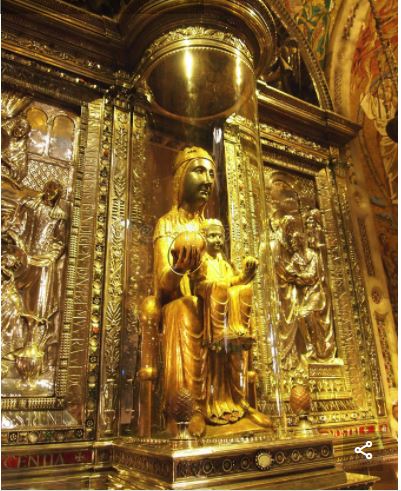
Our Lady of Montserrat: (718) Our Lady is venerated under the invocation of the Virgin of Montserrat or “Rosa d’abril” – because of the Virolai hymn sung to her – at the Santa Maria de Montserrat monastery in the Montserrat mountain in Catalonia, Spain.
It is one of the black Madonnas of Europe, hence its familiar Catalan name, la Moreneta (“The little dark-skinned one”).
Believed by some to have been carved in Jerusalem in the early days of the Church. Legend has it that the Benedictine monks could not move the statue to construct their Monastery, choosing to instead build around it.
On 11 September 1844, Pope Leo XIII declared the Virgin of Montserrat, Patroness of Catalonia, Spain.
St Adelelmus of Le Mans
St Asicus of Elphin
St Castor of Tarsus
St Enoder
St Floribert of Liege
Bl Hosanna of Cattaro Bl Jakov Varingez OFM (c 1400–1496) His Life:
St John of Kathara
St Joseph Outhay Phongphumi
St Laurensô Nguyen Van Huong
St Liberalis of Treviso
St Maughold Blessed Nicolas Roland (1642-1678)
St Noël Tenaud
Bl Peter Armengol
St Pollio of Cybalae
St Simeon of Jerusalem
St Stephen of Tarsus
St Tertullian of Bologna
St Theophilus of Brescia
St Winewald of Beverley St Zita of Lucca (1212-1272) Biography: https://anastpaul.wordpress.com/2017/04/27/saint-of-the-day-27-april-st-zita-of-lucca/
—
Martyrs of Nicomedia: A group of Christians murdered together for their faith. In most cases all we have are their names – Dioscurus, Evanthia, Felicia, Felix, Germana, Germelina, Johannes, Julius, Laetissima, Nikeforus, Papias, Serapion and Victorinus. They died at Nicomedia, Bithynia, Asia Minor (modern Izmit, Turkey).
Thought for the Day – 26 April – Meditations with Antonio Cardinal Bacci (1881-1971)
The Only Remedy for All Our Ills
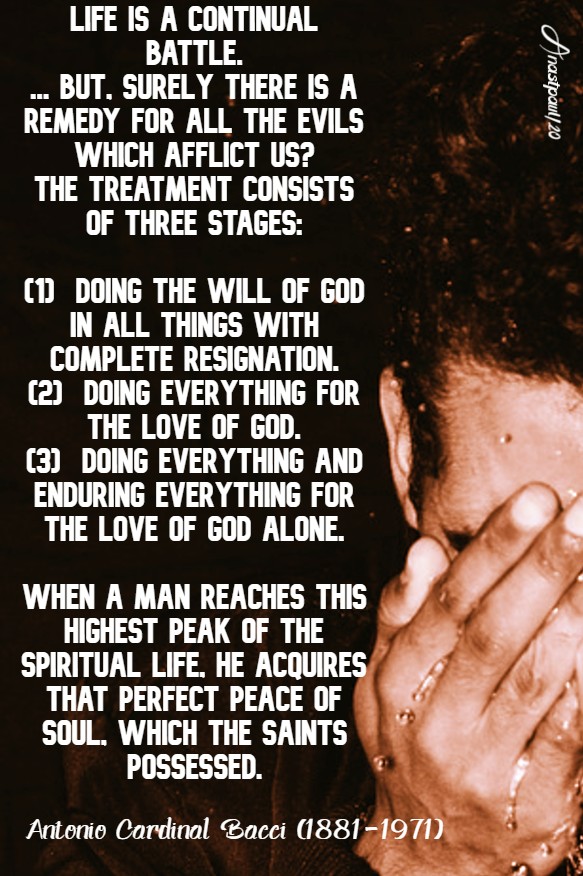
“Life is a continual battle. “Is not man’s life on earth a drudgery?” (Job 7:1).
If we consider, only the material aspect of this battle, we are all among the vanquished.
Admittedly, there is some joy and some victory.
But, our pleasures are as short-lived as the flowers of the field, they are soon “withered and dried up like grass” (Cf Ps 101:5).
Our conquests are also very insignificant; they can inflate us for a while but they do not last long and cannot satisfy us.
After death, only our triumphs in virtue will persist.
Moreover, whereas the joys of this life are few and fleeting, the physical and moral sufferings, are innumerable.
Sometimes, they are so heavy and overwhelming, that they cause us to despair.
But, surely there is a remedy for all the evils which afflict us?
God is infinitely good and He has permitted suffering.
Will He not give us the means of enduring it and the medicine to cure it?
In fact, Our Lord, has given us a remedy for all our ills, even for the most distressing.
It is a bitter medicine but, it will heal anyone who has the courage to swallow it and, it will give him perfect peace of soul.
The treatment consists of three stages:
(1) Doing the will of God in all things with complete resignation.
(2) Doing everything for the love of God.
(3) Doing everything and enduring everything for the love of God alone.
When a man reaches this highest peak of the spiritual life, he acquires that perfect peace of soul, which the Saints possessed.”
Quote/s of the Day – 26 April – Third Sunday of Easter
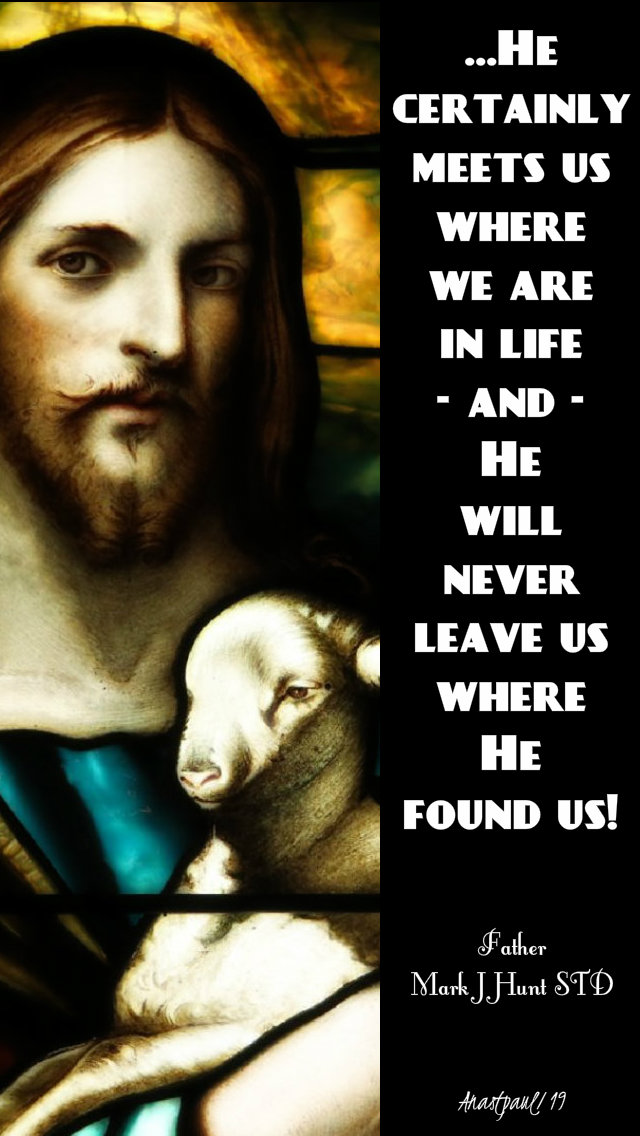
“…He certainly meets us where we are in life – and – He will never leave us where He found us!”
Fr Mark J Hunt STD
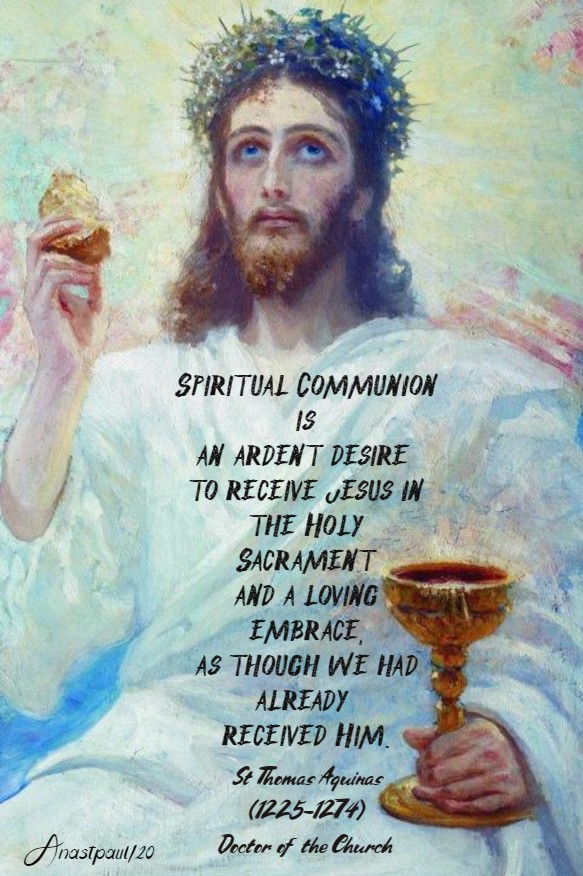
“Spiritual Communion is an ardent desire to receive Jesus in the Holy Sacrament and a loving embrace, as though we had already received Him.”
St Thomas Aquinas (1225-1274)
Doctor of the Church
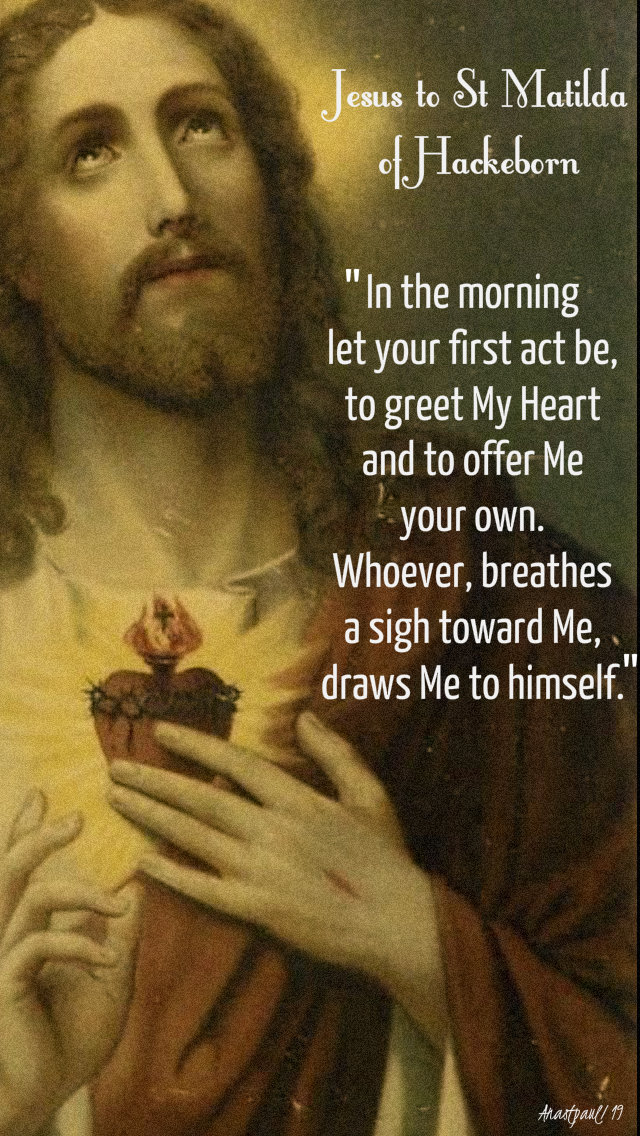
“In the morning let your first act be to greet My Heart and to offer Me your own. Whoever, breathes a sigh toward Me, draws Me to himself.”
Jesus to St Matilda/Mechtilde of Hackeborn
(c 1241-1298)
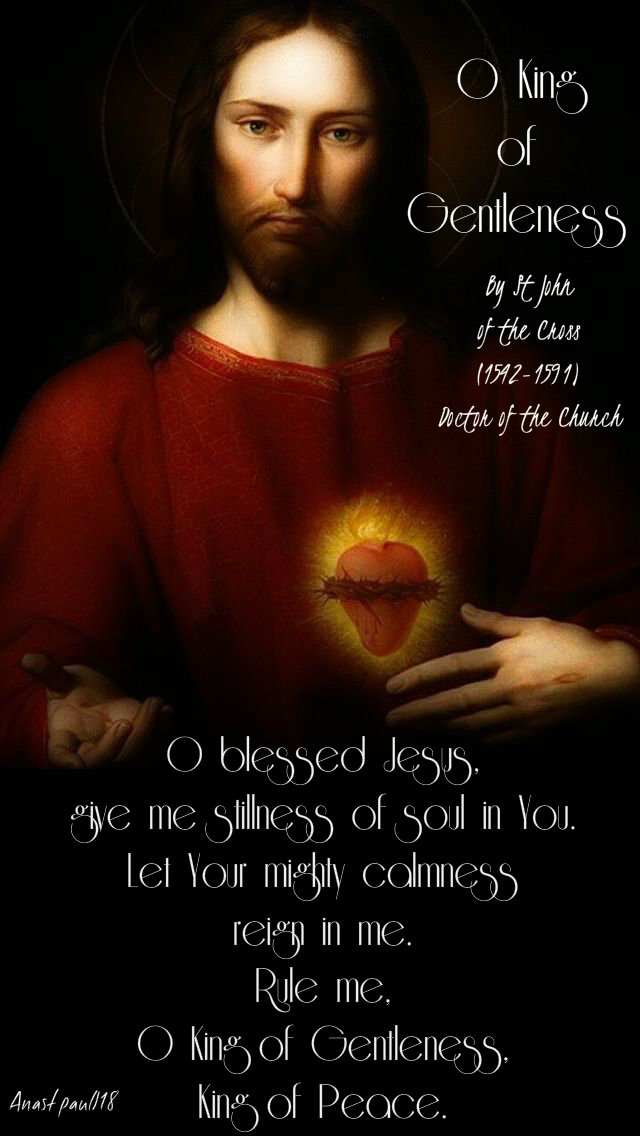
“O blessed Jesus, give me stillness of soul in You. Let Your mighty calmness reign in me. Rule me, O King of Gentleness, King of Peace.”
St John of the Cross (1542-1591)
Doctor of the Church
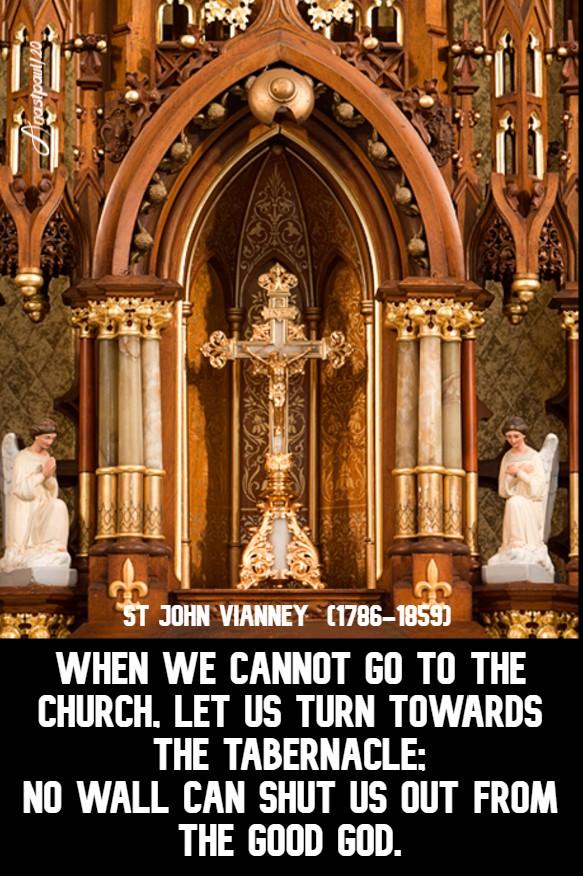
“There are some who make a spiritual communion everyday … If we are deprived of Sacramental Communion, let us replace it, as far as we can, by spiritual communion, which we can make every moment; for we ought to have always, a burning desire to receive the good God. Communion is to the soul, like blowing a fire that is beginning to go out but that has still plenty of hot embers; we blow and the fire burns again. After the reception of the Sacraments, when we feel ourselves slacken in the love of God, let us have recourse at once, to spiritual communion. When we cannot go to the church, let us turn towards the tabernacle; no wall can shut us out from the good God.”
St John Vianney (1786-1859)
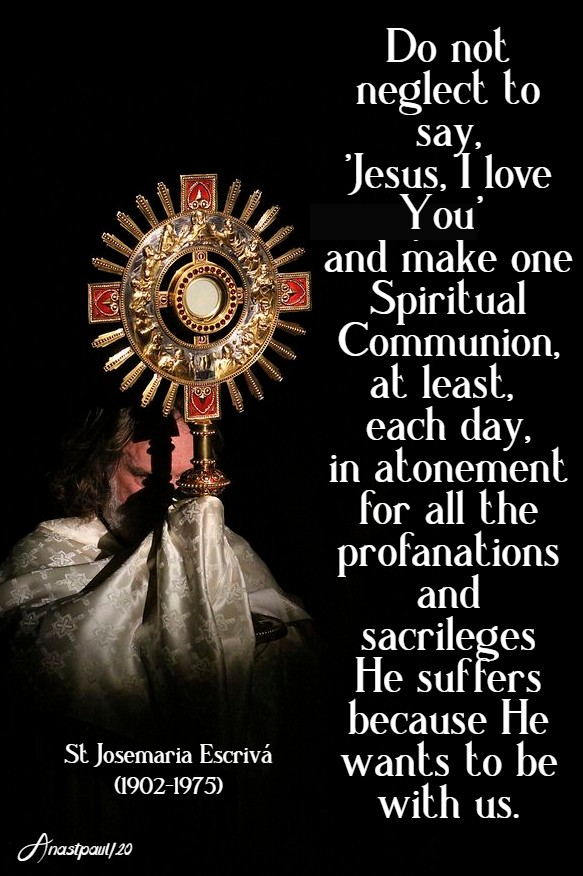
“Do not neglect to say, ‘Jesus, I love You’ and make one Spiritual Communion, at least, each day, in atonement for all the profanations and sacrileges He suffers because He wants to be with us.”
St Josemaria Escrivá (1902-1975)
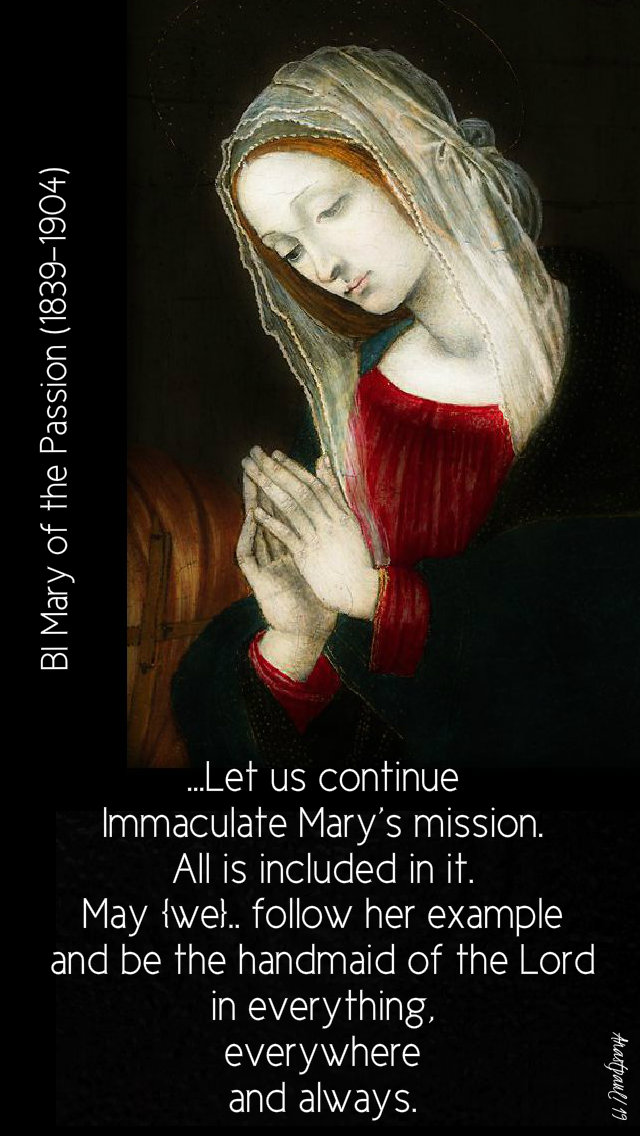
“…Let us continue Immaculate Mary’s mission. All is included in it. May [we].. follow her example and be the handmaid of the Lord in everything, everywhere and always.”
One Minute Reflection – 26 April – Third Sunday of Easter, Readings: Acts 2:14, 22-33, Psalm 16:1-2, 5, 7-11, 1 Peter 1:17-21, Luke 24:13-35 and the Memorial of St Rafael Arnáiz Barón (1911-1938)
“Stay with us” … Luke 24:29
REFLECTION – “My brethren, when was it that the Lord made Himself recognised? When He broke the bread. So we ourselves are convinced, too, that when we break the bread we recognise the Lord. If He hadn’t wanted to be recognised until that moment, it was for our sakes, we, who were not to see Him in the flesh but who were yet to eat Him in the flesh. So you who believe in Him, whoever you are, you who do not bear the name of Christian in vain, who do not come casually into church, who hear the word of God in fear and hope – for you the broken bread will be a consolation. Our Lord’s absence is not a real absence. Trust, be faithful and He is with you even if you do not see Him.
When the Lord hailed them, the disciples had no faith. They did not believe in His Resurrection, they did not even hope that He might be raised. They had lost faith, they had lost hope. They were dead men walking alongside a living one, they were walking, dead, with life. Life was walking with them but, in their hearts, life was not as yet renewed.
And do you long for life? Imitate the disciples and you will recognise the Lord. They offered hospitality, our Lord seemed determined to proceed on His way but they held Him back … You too, then, keep hold of the stranger if you wish to recognise your Saviour … Learn where to look for the Lord, where to possess Him, where to recognise Him – in breaking bread with Him!” … St Augustine (354-430), Bishop of Hippo, Father and Doctor of the Church
PRAYER – Lord God, grant Your people constant joy in the renewed vigour of their souls. They rejoice because You have restored them to the glory of Your adopted children, let them look forward gladly to the certain hope of the resurrection. May the prayers of our Blessed Mother, Our Lady of Good Counsel, be of assistance to us amidst the storms of this mortal life. We make our prayer through our Resurrected Christ, with the Holy Spirit, one God forever, amen, alleluia!
Our Morning Offering – 26 April – Third Sunday of Easter, Year A
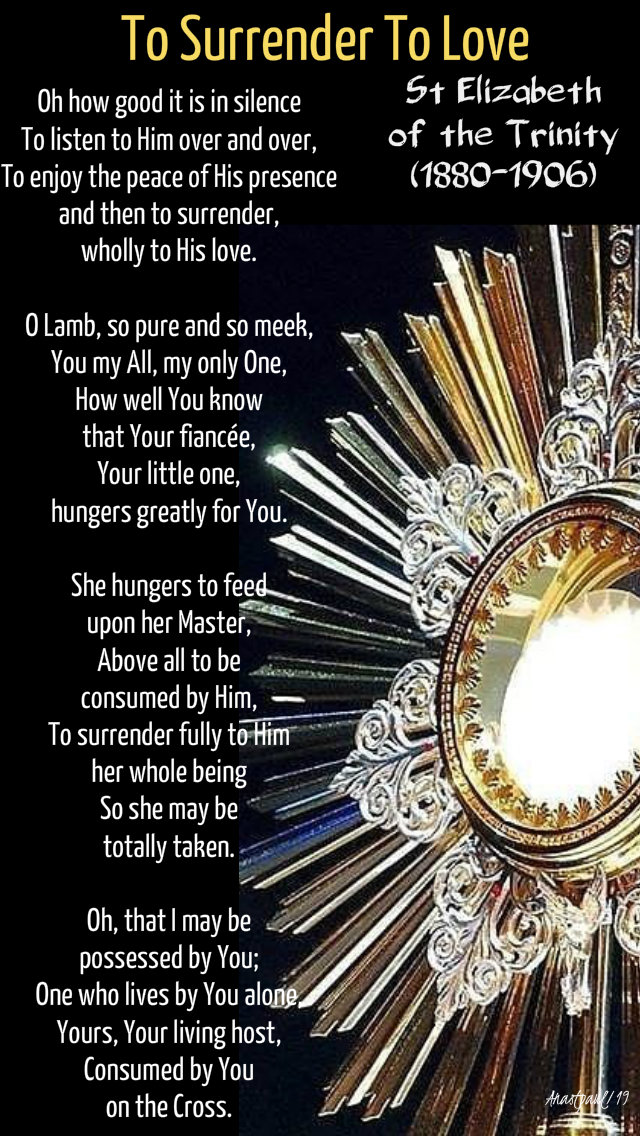
Most of us are still deprived of Holy Mass and the Holy Eucharist but this practice of making an Spiritual Communion, has been especially used by Christians in times of persecution, such as during the era of state atheism in the Eastern Bloc, as well as in times of plagues, such as now, during the current 2019–20 coronavirus pandemic, when we are unable to receive the Eucharist on the Lord’s Day.
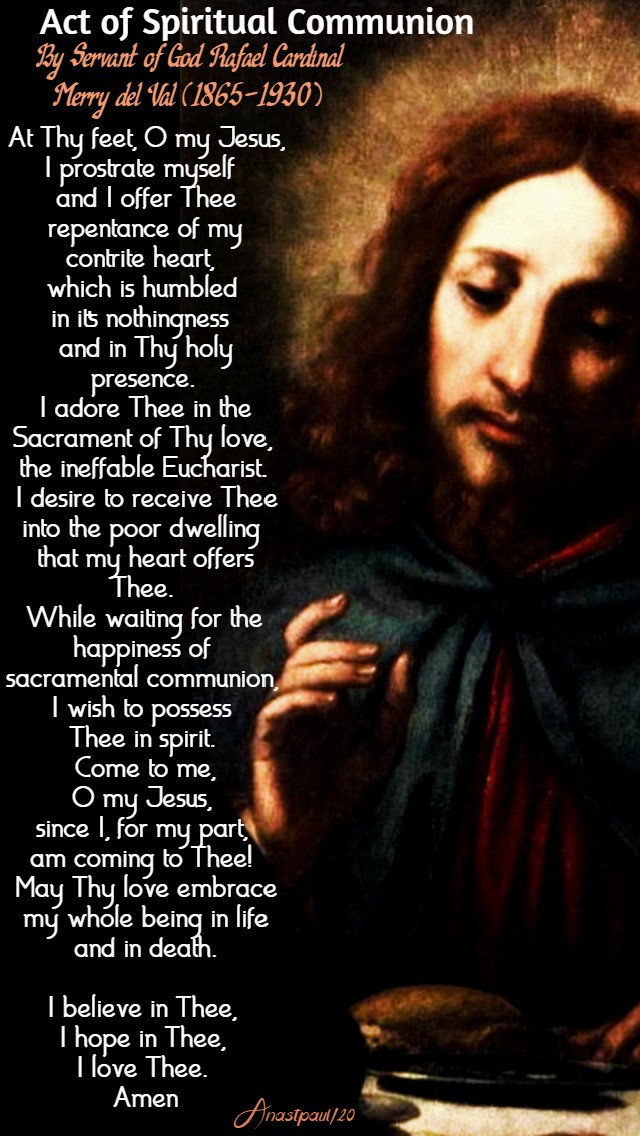
Act of Spiritual Communion By Servant of God Rafael Cardinal Merry del Val (1865-1930)
At Thy feet, O my Jesus,
I prostrate myself
and I offer Thee repentance of my contrite heart,
which is humbled in it’s nothingness
and in Thy holy presence.
I adore Thee in the Sacrament of Thy love,
the ineffable Eucharist.
I desire to receive Thee into the poor dwelling
that my heart offers Thee.
While waiting for the happiness of sacramental communion,
I wish to possess Thee in spirit.
Come to me, O my Jesus,
since I, for my part, am coming to Thee!
May Thy love embrace my whole being in life and in death.
I believe in Thee,
I hope in Thee,
I love Thee.
Amen
Let us remember the words of St Pope John Paul in his Encyclical, Ecclesia de Eucharistia:
In the Eucharist, “unlike any other Sacrament, the mystery [of communion] is so perfect that it brings us to the heights of every good thing – Here is the ultimate goal of every human desire, because here we attain God and God joins Himself to us in the most perfect union.” Precisely for this reason it is good to cultivate in our hearts a constant desire for the sacrament of the Eucharist. This was the origin of the practice of “Spiritual Communion,” which has happily been established in the Church for centuries and recommended by Saints who were masters of the spiritual life. St Teresa of Jesus (1515-1582) Doctor of Prayer, wrote: “When you do not receive Communion and you do not attend Mass, you can make a Spiritual Communion, which is a most beneficial practice; by it the love of God will be greatly impressed on you”[The Way of Perfection, Ch. 35.].1.
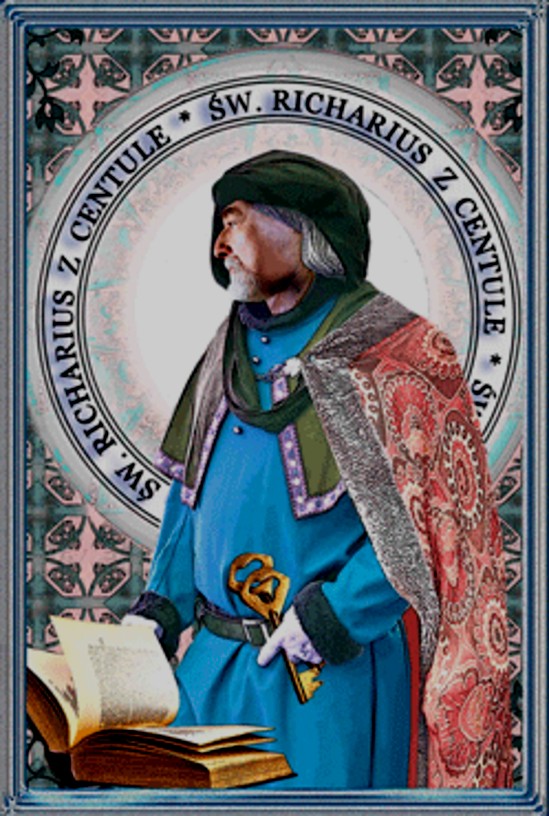
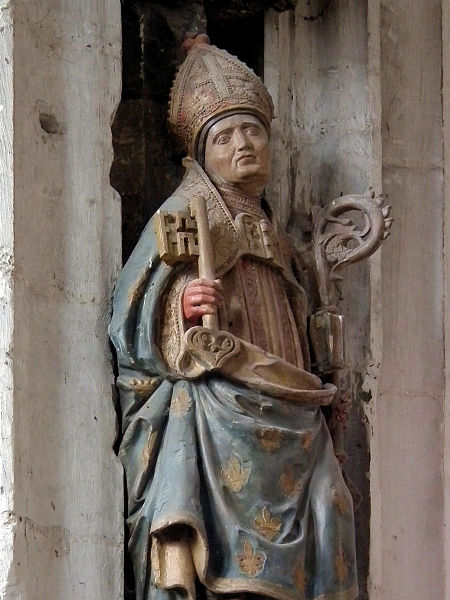
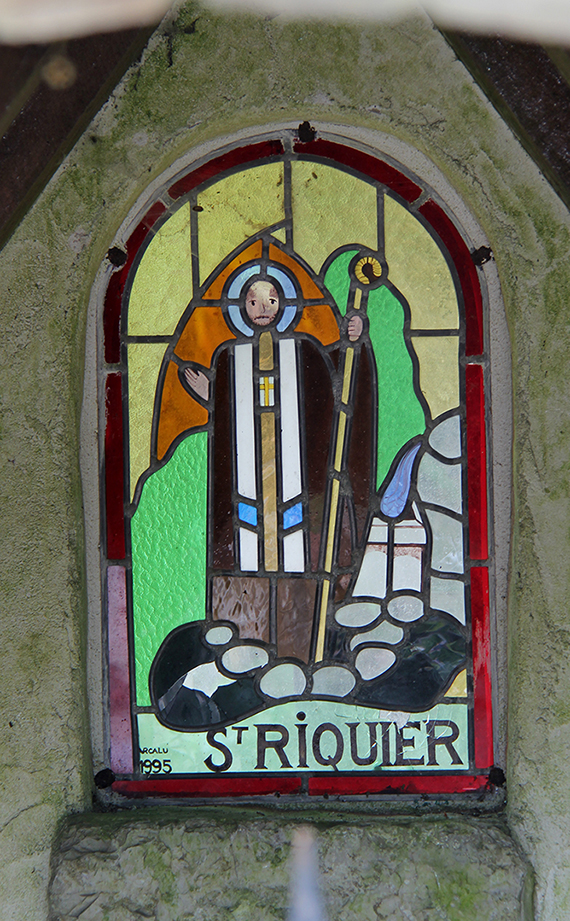
Saint of the Day – 26 April – St Richarius of Celles (c 560-645) Priest, founder of Monasteries, spiritual adviser, apostle of the poor, the sick and prisoners and finally, a Hermit – born at Centula, France and died on 26 April 645 at Foret-Moutier, France of natural causes. In France he is known as St Riquier. Patronages – the cities of Saint-Riquier, Centula and Saint-Riquier-en-Rivière in France.
Richarius was born a pagan in the late 6th century in the county of Ponthieu near Amiens in Picardy in the north-west of France. According to the vita written by St Alcuin, Richarius gave shelter to two Welsh missionaries, Caidocus and Frechorius, who were treated with great hostility by the local people who blamed the strangers for crop failure. Because he “welcomed God in the persons of the travellers… this was why he was granted God’s mercy.”
Richarius converted to Christianity under their influence. After his conversion, he fasted on barley bread mixed with ashes and drank only water. He was ordained a Priest and travelled to England, preaching the Gospel and curing the sick. Travelling by donkey rather than horse, he read the psalter as he rode.
In 638, after some years in England, Richarius returned home and founded a Monastery in his hometown in Ponthieu that was named Centule (or Centula, alteration of Latin Centum Turres – hundred towers). This monastery practised according to the Rule of Saint Columbanus.
A city developed around this Monastery, also named Centule. In the Middle Ages it was renamed to Saint-Riquier. Nowadays it has some 1200 inhabitants, who still refer to themselves as Centulois. The Frankish king Dagobert I once came to visit the Monastery, and Richarius offered the king advice. He was frank and clear in his speech to the king, speaking without fear or flattery and the king thereafter, became a benefactor of the Monastery. Others also gave generously to Richarius’s Monastery and he was able to use the money to help lepers and the poor and to ransom prisoners held by England.
Richarius eventually founded a second Monastery called Forest-Montier. He made a shelter in the forest of Crécy, fifteen miles from his Monastery. He lived there as a hermit with his disciple Sigobart. On 26 April 645, he bid farewell to Sigobart and died.
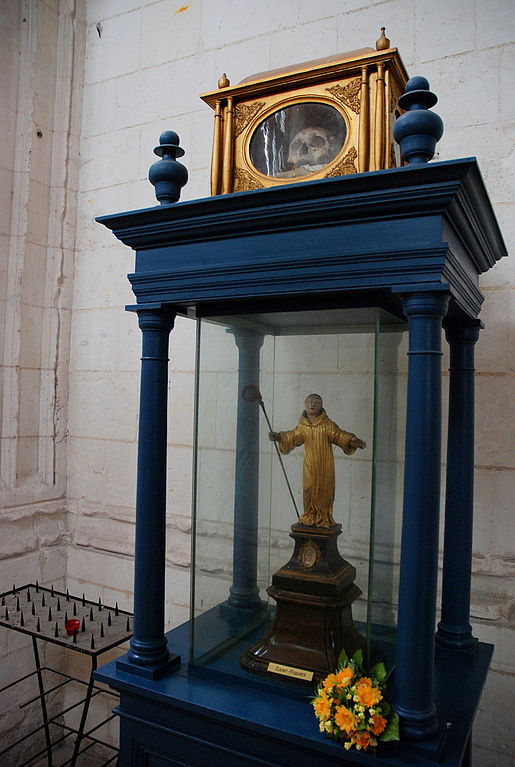
His relics were first put in a coffin made of an oak trunk and then translated to the Abbey of Centula. One hundred and fifty years later, Charlemagne built a golden shrine to enclose the relics and had the Saint-Riquier Gospels made for the shrine. In 950 Count Arnulf I transferred the bones to Montreuil, then to the Abbey of Saint Bertin in today’s St-Omer. In 980, Hugo Capet returned them to St-Riquier. Above the tomb of Richarius, an Abbey was built, which was later named after him, as was the city.
Relics of Saint Richarius, kept in the Abbey Church of St Riquier
Aside from Saint-Riquier, the city of Saint-Riquier-en-Rivière in Normandy bears his name and there is one church in England St Ricarius Church, Aberford, a town the saint is supposed to have visited in 630.
Bl Alda of Siena
St Antoninus of Rome
St Basileus of Amasea
St Clarence of Venice
St Claudius of Rome St Pope Cletus (c 25-c 89) 3rd Bishop of Rome and Martyr Biography: https://anastpaul.wordpress.com/2017/04/26/saint-of-the-day-26-april-st-pope-cletus/
St Cyrinus of Rome
St Exuerantia of Troyes
Bl Gregory of Besians
Bl Juli Junyer Padern
St Lucidius of Verona
St Pope Marcellinus (Died 304) Martyr
Thought for the Day – 25 April – Meditations with Antonio Cardinal Bacci (1881-1971)
Word and Example
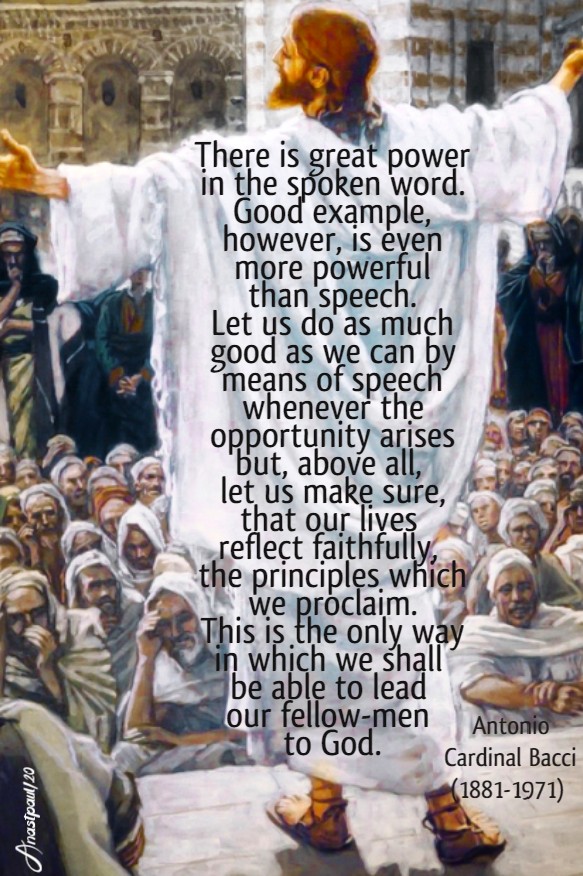
“There is great power in the spoken word. It can act like a ray of light upon the mind of a man groping about in the darkness of error. It can present a moving appeal to a sinner, to return to God. It can comfort the soul in affliction and in loneliness. Good example, however, is even more powerful than speech. At times, it can be irresistible. A man can remain deaf to good advice but, it is difficult for him, to remain unaffected by the virtuous behaviour and spirit of sacrifice of someone, who is trying to lead him towards goodness. The sermons of the Saints, were effective, not only because they were inspired by love for God and for souls but, also, because they were reinforced by the holiness of the preachers. St Augustine was converted by the pleadings and prayers of St Monica but, apart from the grace of God, it was the example of his mother’s sanctity, which made her exhortations so convincing. It was as much by the example of his untiring zeal, as by the simplicity of his sermons, that the Cure d’Ars converted thousands upon thousands of people. St Francis de Sales would never have converted so many heretics, if his apostolic personality had not possessed such a quality of supernatural attractiveness. Let us do as much good as we can by means of speech whenever the opportunity arises but, above all, let us make sure, that our lives reflect faithfully, the principles which we proclaim. This is the only way in which we shall be able to lead our fellow-men to God.”
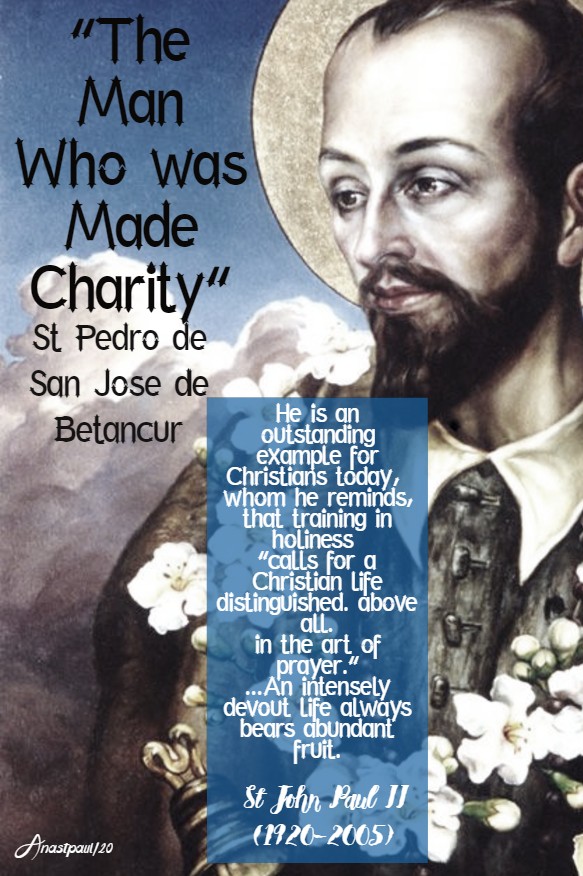
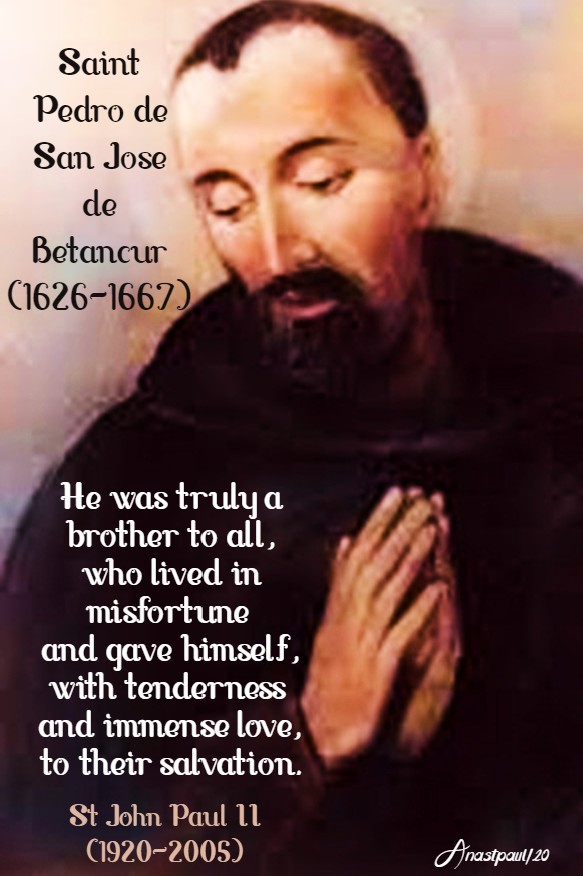
Quote/s of the Day – 25 April – the Memorial St Pedro de San Jose de Betancur OFB (1626-1667) “St Francis of Assisi of the Americas” – “The Man Who was Made Charity”
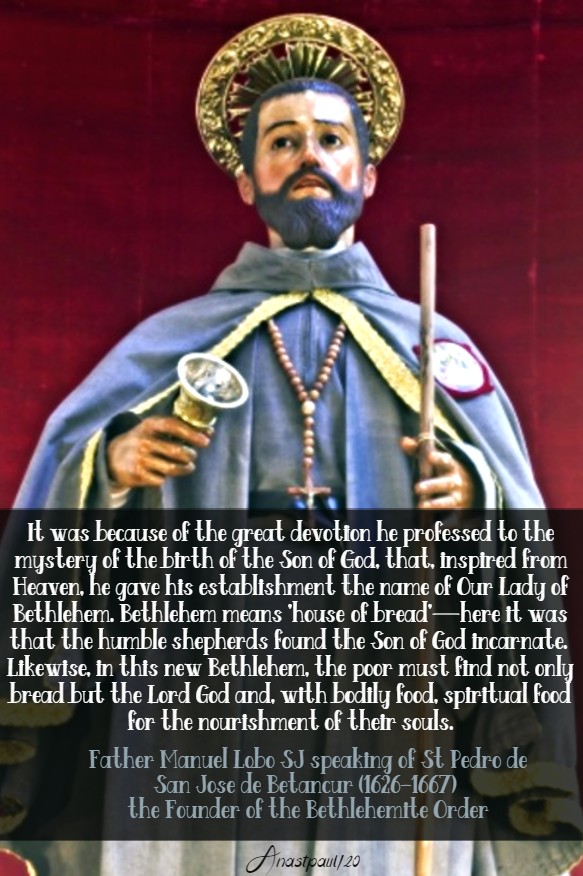
Father Manuel Lobo, a Jesuit who was Brother Pedro de Betancur’s spiritual director for fifteen years, wrote:
“It was because of the great devotion he professed to the mystery of the birth of the Son of God, that, inspired from Heaven, he gave his establishment the name of Our Lady of Bethlehem. Bethlehem means ‘house of bread’—here it was that the humble shepherds found the Son of God incarnate. Likewise, in this new Bethlehem, the poor must find not only bread but the Lord God and, with bodily food, spiritual food for the nourishment of their souls.”
Father Manuel Lobo
“Already in the land of his birth, as in every phase of his life, Brother Pedro was a deeply prayerful man, especially here where, at the hermitage of Calvary, he diligently sought God’s will at every moment.
Thus, he is an outstanding example for Christians today, whom he reminds, that training in holiness “calls for a Christian life distinguished above all in the art of prayer” (Novo millennio ineunte, 32). I, therefore, renew my exhortation to all the Christian communities of Guatemala and other countries, to be authentic schools of prayer where all activity is centred on prayer. An intensely devout life always bears abundant fruit.
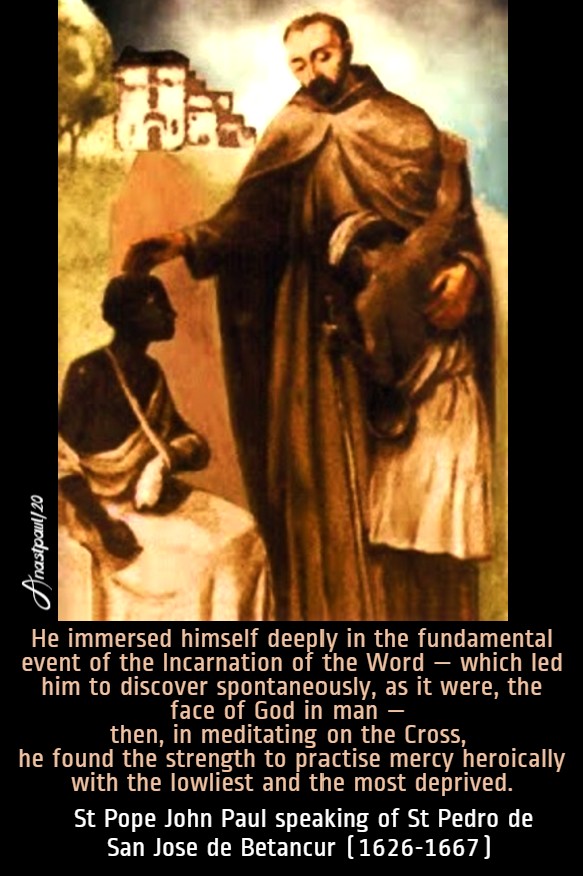
Brother Pedro modelled his spirituality in this way, particularly in contemplation of the mysteries of Bethlehem and of the Cross. If, in the birth and childhood of Jesus, he immersed himself deeply in the fundamental event of the Incarnation of the Word — which led him to discover spontaneously, as it were, the face of God in man — then, in meditating on the Cross, he found the strength to practise mercy heroically with the lowliest and the most deprived.
… Pedro de Betancurt was distinguished precisely by the humble spirit and austere life with which he practised mercy. The Apostle Paul’s recommendation went straight to his servant’s heart: “Whatever your task, work heartily, as serving the Lord and not men” (Col 3:23). Thus he was truly a brother to all, who lived in misfortune and gave himself with tenderness and immense love, to their salvation. In this way, throughout his life, his deeds showed his dedication to the sick at the little hospital of Our Lady of Bethlehem, the cradle of the Bethlehemite Order.
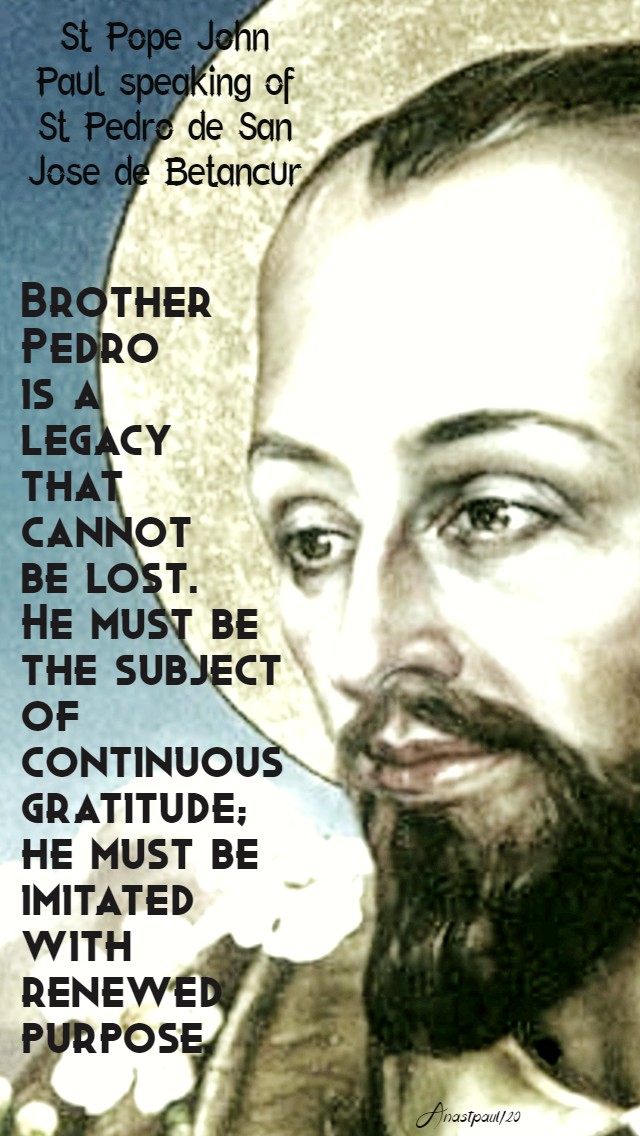
Brother Pedro is a legacy that cannot be lost. He must be the subject of continuous gratitude; he must be imitated with renewed purpose. This legacy must inspire among Christians and among all citizens, the desire to transform the human community into a large family, where social, political and economic relations are worthy of man and within which, the dignity of the person is promoted through effective recognition of his inalienable rights.
I would like to conclude by recalling that devotion to the Most Blessed Virgin was always present in Brother Pedro’s life of piety and mercy. May she also guide us so that, illuminated by the examples of ‘the man who was made charity,’ as Pedro de Betancur is known, we might come to her Son Jesus!”
St John Paul II (1920-2005)
Canonisation Homily
Guatemala City, Tuesday 30 July 2002
One Minute Reflection – 25 April – Saturday of the Second Week of Easter, Readings: 1 Peter 5:5-14, Psalm 89(88):2-3,6-7,16-17, Mark 16:15-20 and the Memorial of St Mark the Evangelist and St Pedro de San Jose de Betancur OFB (1626-1667) “St Francis of Assisi of the Americas”
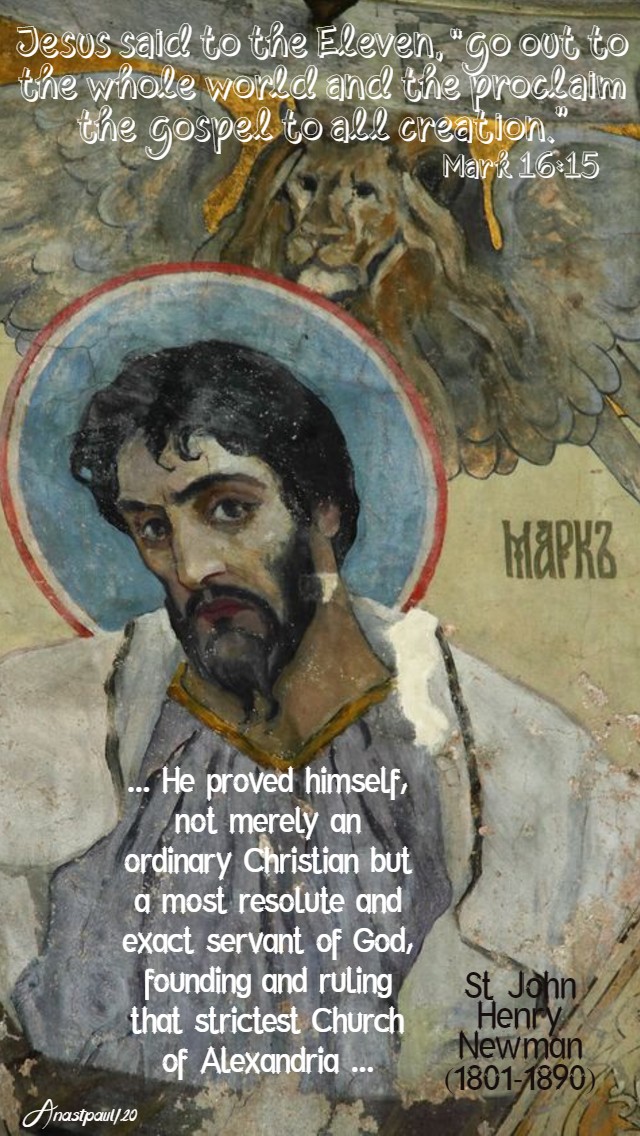
Jesus said to the Eleven, “go out to the whole world and the proclaim the gospel to all creation.”…Mark 16:15
REFLECTION – “Lift up the hands which hang down and the feeble knees” (Heb 12:12; Is 35:3). The chief points of Saint Mark’s history are these—first, that he was … taken with Saint Barnabus and Saint Paul on their first apostolic journey; next, that after a short time he deserted them and returned to Jerusalem (Acts 15:38); then, that after an interval, he was Saint Peter’s assistant at Rome (1 Pt 5:13) and composed his Gospel there principally from the accounts which he received from that Apostle; lastly, that he was sent by Peter to Alexandria, in Egypt, …. here he proved himself, not merely an ordinary Christian but a most resolute and exact servant of God, founding and ruling that strictest Church of Alexandria … And the instrument of this change was, as it appears the influence of Saint Peter, a fit restorer of a timid and backsliding disciple.
The encouragement which we drive from these circumstances in St Mark’s history is, that the feeblest among us, may, through God’s grace become strong.
And the warning to be drawn from it is, to distrust ourselves and again, not to despise weak brethren, or to despair of them but to bear their burdens and help them forward if so be, we may restore them.” …
The history of Moses supplies us with an instance of a proud and rash spirit, tamed down to an extreme gentleness of deportment … “the meekest of men on earth “ (Nb 12:3). St Mark’s history affords a specimen of the other and still rarer change, from timidity to boldness. … St Mark’s change, therefore, may be considered even more astonishing in its nature, than that of Moses. “By faith,” he was “out of weakness made strong,” (cf. Heb 11:34).” … St John Henry Newman (1801-1890) PPS, vol 2, no 16
PRAYER – Almighty God, You chose the Evangelist St Mark and ennobled him with grace, to preach the Gospel. Let his teaching so improve our lives and his prayers so support us, that we may walk faithfully in his footsteps, which are the footsteps of Christ our Lord. We beg too for the intercession of St Pedro de San Jose de Betancur (1626-1667), Your faithful servant. Through Jesus Christ our Lord, in union with the Holy Spirit, one God forever, amen.
Our Morning Offering – 25 April – Saturday of the Second Week of Easter
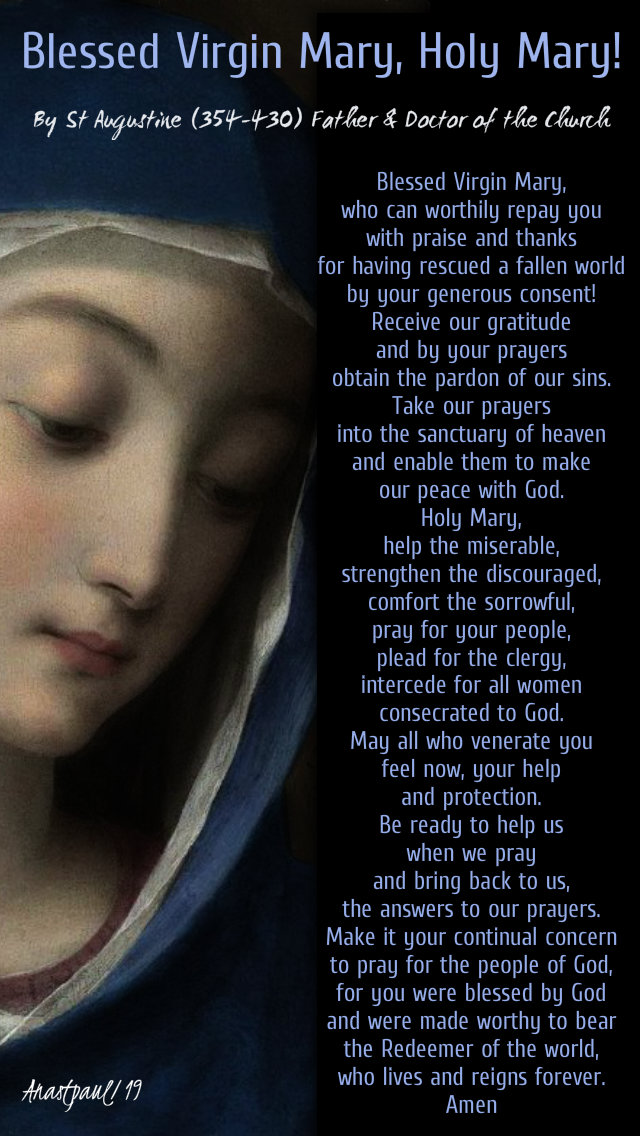
Blessed Virgin Mary, Holy Mary! By St Augustine (354-430) Father & Doctor of the Church
Blessed Virgin Mary,
who can worthily repay you
with praise and thanks
for having rescued a fallen world
by your generous consent!
Receive our gratitude and by your prayers
obtain the pardon of our sins.
Take our prayers into the sanctuary of heaven
and enable them to make our peace with God.
Holy Mary,
help the miserable,
strengthen the discouraged,
comfort the sorrowful,
pray for your people,
plead for the clergy,
intercede for all women consecrated to God.
May all who venerate you feel now, your help and protection.
Be ready to help us when we pray
and bring back to us, the answers to our prayers.
Make it your continual concern to pray for the people of God,
for you were blessed by God and were made worthy to bear
the Redeemer of the world,
who lives and reigns forever.
Amen
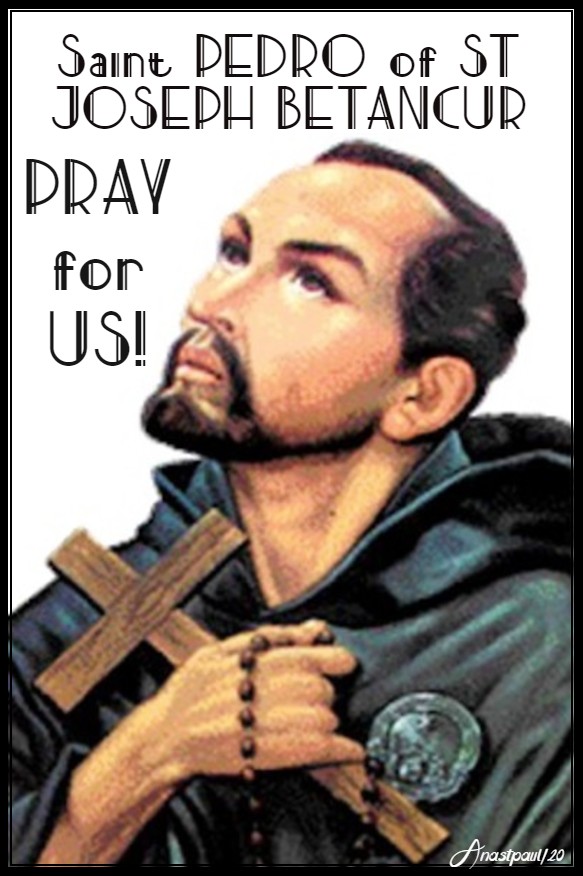
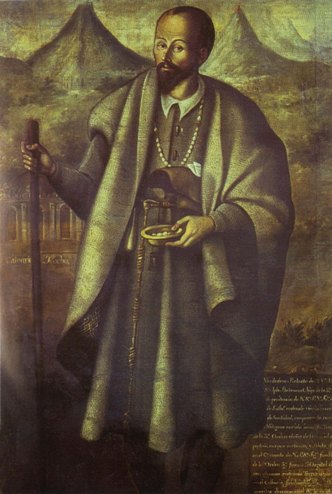
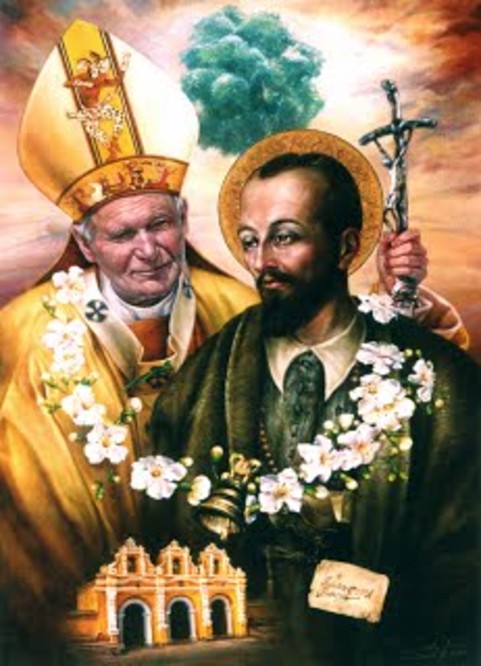
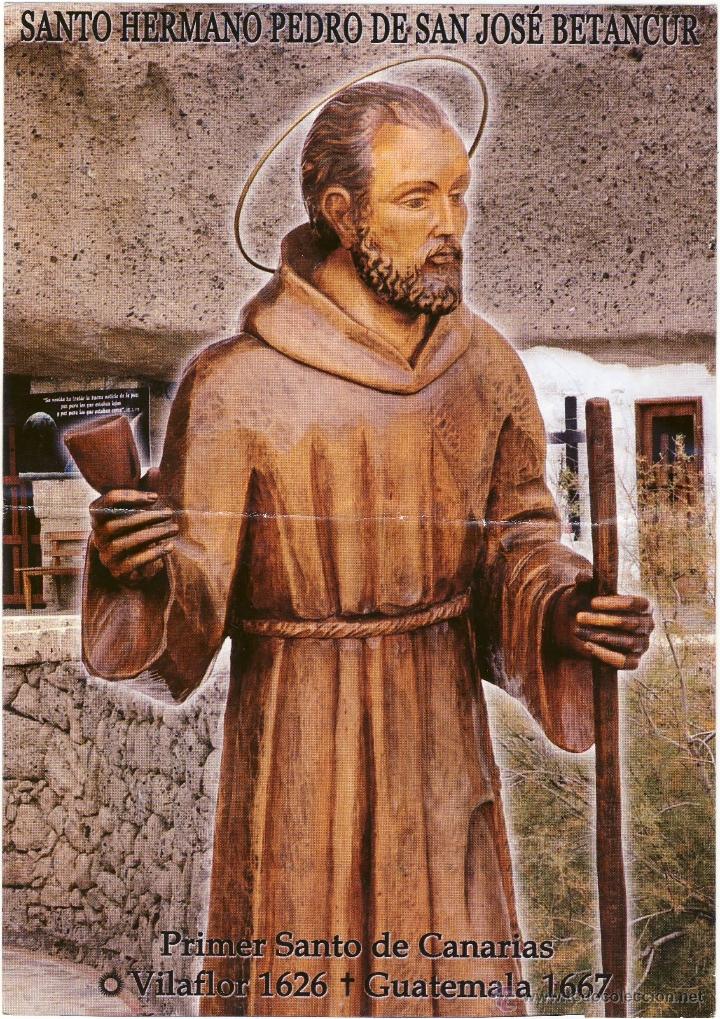
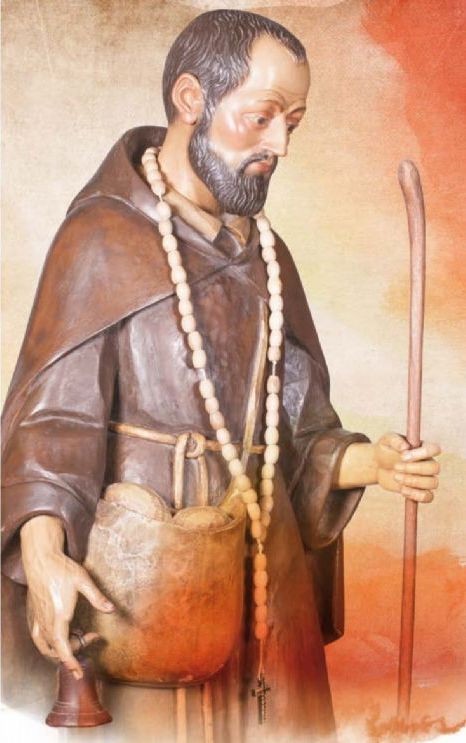
Saint of the Day – 25 April – Saint Pedro de San Jose de Betancur OFB (1626-1667) called “St Francis of Assisi of the Americas” and “Apostle of Guatemala,” Religious Tertiary of the Franciscan Order and Founder of the Order of Our Lady of Bethlehem “the Bethlemites” – which belongs to the Franciscan community,” Missionary, Apostle of Mercy, of the sick, of the poor, prisoners, Catechist – born as Pedro de Betancur y Gonzáles, on 16 May 1619 at Villaflores, Tenerife Island, Canary Islands, Spain and died on 25 April 1667 at Guatemala City, Guatemala of natural causes, just before his 48th birthday. Patronages – Canary Islands, Guatemala, Central America, Catechists of Guatemala, Honorary Mayor of Municipalities in the south of Tenerife and Honorary Mayor of Antigua Guatemala, of the homeless. Although his Feast is today, it is sometimes moved to the 24 April to accommodate the Feast of St Mark on the 25th. In Tenerife his memory is celebrated on 29 June. He is also known under the names of Santo Hermano Pedro ( Saint Brother Peter ) and San Pedro de Vilaflor ( Saint Peter of Vilaflor ) Peter de Betancurt.
St Pedro de Betancur was born on 19 March 1626 at Chasna de Vilaflor on Tenerife in the Canary Islands. He died on 25 April 1667 in Guatemala City, Guatemala. His life, marked by a heroic holiness, is a shining testimony of faithfulness to the Gospel. Pedro was a descendant of Juan de Betancurt, one of the Norman conquerors of the Canary Islands. His immediate family, he was one of the five children, however, was very poor and he started work as the shepherd of the small family flock. His parents raised him soundly in the faith and his contact with nature nurtured his deeply contemplative soul. As a young boy, Pedro learned to see God in everything around him.
When Pedro heard about the miserable living conditions of the people of the “West Indies” (present-day America), he felt called to take the Christian message to this land. In 1650 when he was 23 years old, he left for Guatemala where a relative had already gone to become secretary of the Governor General. His funds ran out in Havana so Pedro had to pay for his passage from that point, by working on a ship which docked at Honduras from where he walked to Guatemala City.
Pedro was now so poor that he had to stand in line for his daily bread at the Franciscan friary and it was here, that he met Friar Fernando Espino, a famous missionary, who befriended him and remained his lifelong counsellor. He found Pedro a job in a local textile factory. In 1653 Pedro realised his ambition to enter the local Jesuit college in the hope of becoming a priest. He showed little aptitude for study, however, which led him to withdraw. Here Providence once again helped him as he met Fr Manuel Lobo, SJ, who became his confessor. After holding the position of Sacristan for a while in a church dedicated to the Blessed Virgin, he rented a house in a suburb of the city called Calvary and there taught reading and Catechism to poor children.
Friar Fernando invited Pedro to join the Franciscan Order as a lay brother but Pedro felt that God wanted him to remain in the world and in 1655, he joined the Third Order of St Francis. From then on, Pedro dedicated his time to alleviating the sufferings of the less fortunate in the midst of inexpressible toil and difficulty. He became the Apostle to African-American slaves, the Indios subjected to inhuman labour, the emigrants and abandoned children, with ever-expanding generosity and deep humility, in total abandonment to God’s will. Inspired by the charity of Christ, he became everything to everyone . In 1658 Pedro was given a hut which he converted into a hospital for the poor who had been discharged from the city hospital but still needed to convalesce.
It was called “Our Lady of Bethlehem.” He also founded a hostel for the homeless, a school for poor and abandoned children and an oratory. Pedro received help for these foundations from both the civil and religious authorities. He begged for alms to endow the Masses celebrated by poor priests and also endowed Masses, to be celebrated in the early hours, so that the poor might not miss Mass.
He had small chapels erected in the poor sectors, where instruction was also given to children. Prisoners also excited Pedro’s compassion. Every Thursday he begged for them through the city and visited them in their cells. Every year, on 18 August, he would gather the children and sing the Seven Joys of the Franciscan Rosary in honour of the Blessed Mother, a custom still continued today in Guatemala. The neglected souls in purgatory were also the objects of his solicitude. He would travel the streets at night, ringing a bell and recommending these souls to be prayed for.
He was joined by men and women, who became the Bethlemite Brothers and the Bethlemite Sisters and formulated a Rule that included the active apostolate of working with the poor, the sick and the less fortunate, based on a life rich in prayer, fasting and penance. The Bethlemite Congregation was thus established.
Pedro died on 25 April 1667, at 47 years of age exhausted by labour and penance. At the request of the Capuchin Friars he was buried in their church in Antigua, Guatemala, where, ever since, his remains are held in veneration.
The resting place of St Pedro in the Franciscan Church in Antigua,Guatemala
St Pedro’s Shrine in Tenerife, in the Sanctuary of the Santo Hermano Pedro, which is built on his birthplace in Vilaflor.
Throughout his life, the Child of Bethlehem was the focus of Pedro’s spiritual meditation. He was always able to see in the poor the face of “the Child Jesus,” and to serve them devoutly. He is known as the “St Francis of the Americas.” … Vatican.va
Pedro is considered the great evangelist of the Guatemala. His dedication to the social problems of his time are comparable to that effected, centuries later, by St Mother Teresa in Calcutta, serving the most vulnerable and needy.
He is credited with introducing to the Americas, the Christmas Eve Novena ‘posadas’ procession, in which people representing Mary and Joseph, seek a night’s lodging from their neighbours. The custom soon spread to Mexico and other Central American countries.
Pedro was known to work miracles also, including healing the sick. Among other facets of his life, his defence of the Immaculate Conception stands out – two centuries before the declaration of the Dogma. His great devotion to prayer for the Souls in Purgatory and the penance he practised, for the sins of the world.
St Pedro de Betancur was distinguished by the humble spirit and austere life with which he practised mercy. He was Beatified on 22 June 1980, at St Peter’s Basilica, Vatican City by St Pope John Paul II and Canonised on 30 July 2002, in Guatemala City, Guatemala by St Pope John Paul II.
During his homily at the Canonisation St John Paul called Pedro the “first Tenerifean and Guatemalan saint” and he “… personifies “a heritage which must not be lost; we should always be thankful for it and we should renew our resolve to imitate it”
St Heribaldus of Auxerre
St Hermogenes of Syracuse
Bl José Trinidad Rangel y Montaño
St Kebius
St Macaille
St Macedonius
St Mario Borzaga
St Pasicrate of Mesia
St Paul Thoj Xyooj St Pedro de San Jose Betancur/ St Peter of St Joseph de Betancurt OFB (1626-1667) “St Francis of Assisi of the Americas”
St Phaebadius of Agen
St Philo of Antioch
St Robert of Syracuse
Bl Robert Anderton
Stefano of Antioch
St Valenzio of Mesia
Bl William Marsden
—
Martyrs of Yeoju – 3 saints: Three Christian laymen martyred together in the apostolic vicariate of Korea. 25 April 1801 in Yeoju, Gyeonggi-do, South Korea
They were Beatified15 August 2014 by Pope Francis
• Ioannes Won Gyeong-do
• Marcellinus Choe Chang-ju
• Martinus Yi Jung-bae
Thought for the Day – 24 April – Meditations with Antonio Cardinal Bacci (1881-1971)
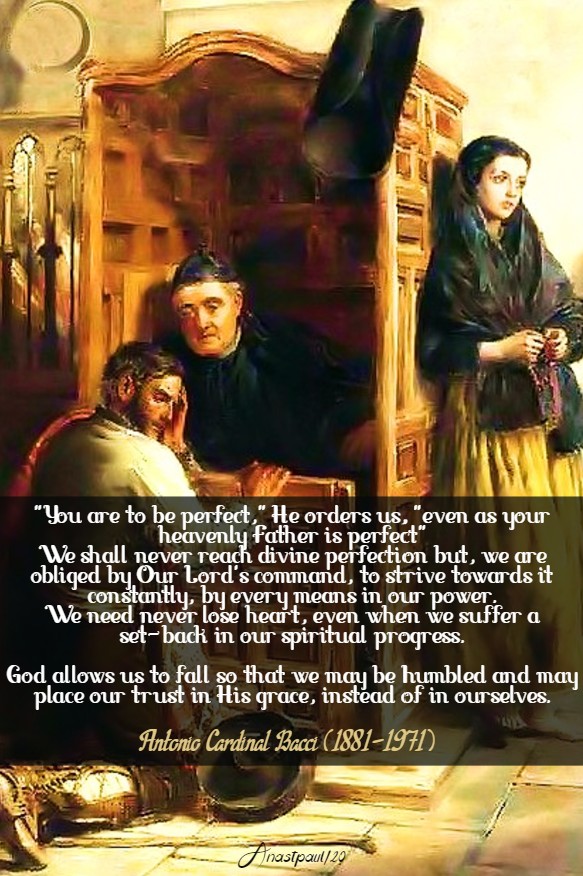
The Three Grades of Perfection – Introduction
“God’s great commandment could create in us a sense of confusion and fear. “You are to be perfect,” He orders us, “even as your heavenly Father is perfect” (Mt 5:48). Is it possible for weak creatures like us, to achieve the perfection of God Himself? At first sight, this commandment seems quite impossible but, it is possible for us to act upon it with the grace of God. We must understand it properly, in any case. We shall never reach divine perfection but, we are obliged by Our Lord’s command, to strive towards it constantly, by every means in our power. Perfection should be our most ardent desire and, not merely a theoretical ideal but a practical aim. This practical intention can inspire our entire life, in such a way, that it will become a continual assent towards sanctity and towards God. We need never lose heart, even when we suffer a set-back in our spiritual progress. God allows us to fall so that we may be humbled and may place our trust in His grace, instead of in ourselves.“
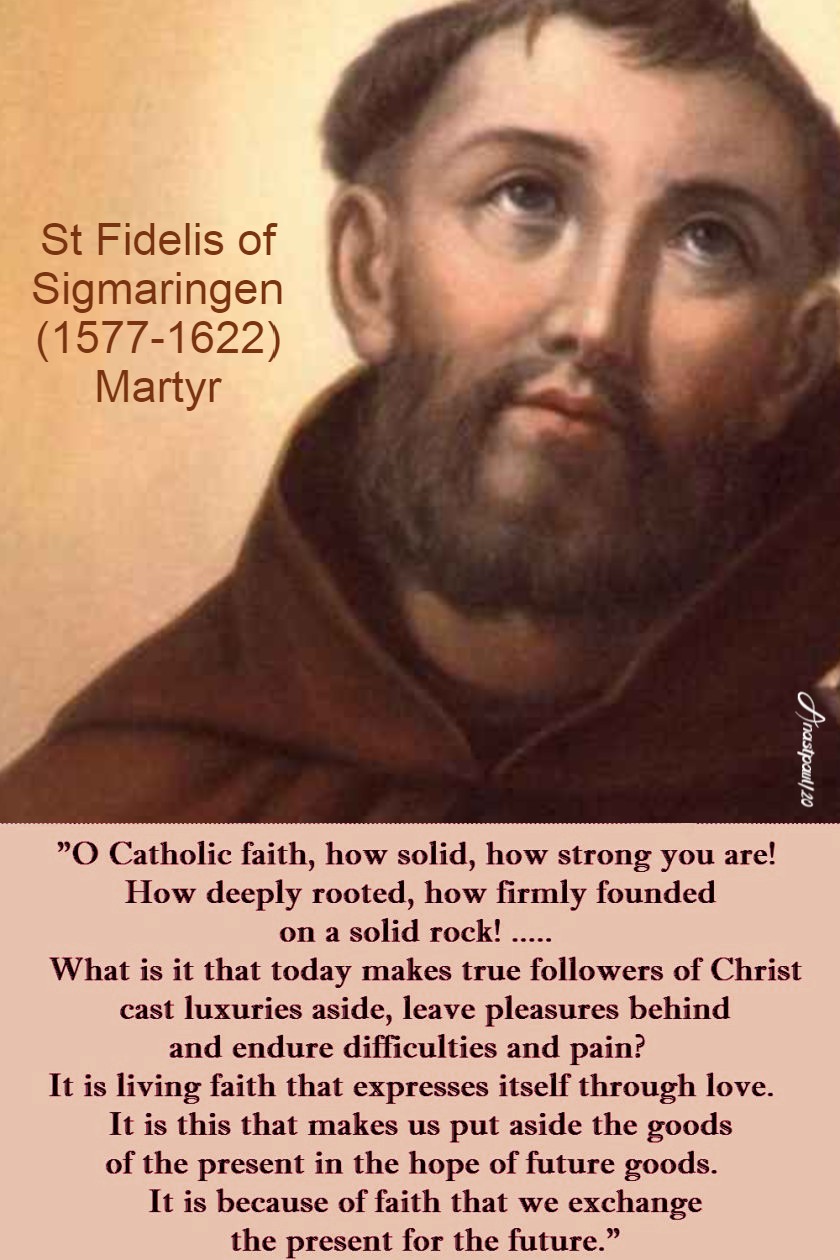
Quote/s of the Day – 24 April – Friday of the Second week of Easter and the Memorial of St Fidelis of Sigmaringen OFM.Cap (1577-1622) and St Mary Euphrasia Pelletier (1796-1868)
“O Catholic faith, how solid, how strong you are! How deeply rooted, how firmly founded on a solid rock! Heaven and earth will pass away but you can never pass away. From the beginning the world opposed you but you mightily triumphed over everything. This is the victory that overcomes the world, our faith. It has subjected powerful kings to the rule of Christ, it has bound nations to His service. What made the holy apostles and martyrs endure fierce agony and bitter torments, except faith and especially faith in the Resurrection? What is it that today makes true followers of Christ cast luxuries aside, leave pleasures behind and endure difficulties and pain? It is living faith that expresses itself through love. It is this, that makes us put aside the goods of the present in the hope of future goods. It is because of faith, that we exchange the present for the future.”
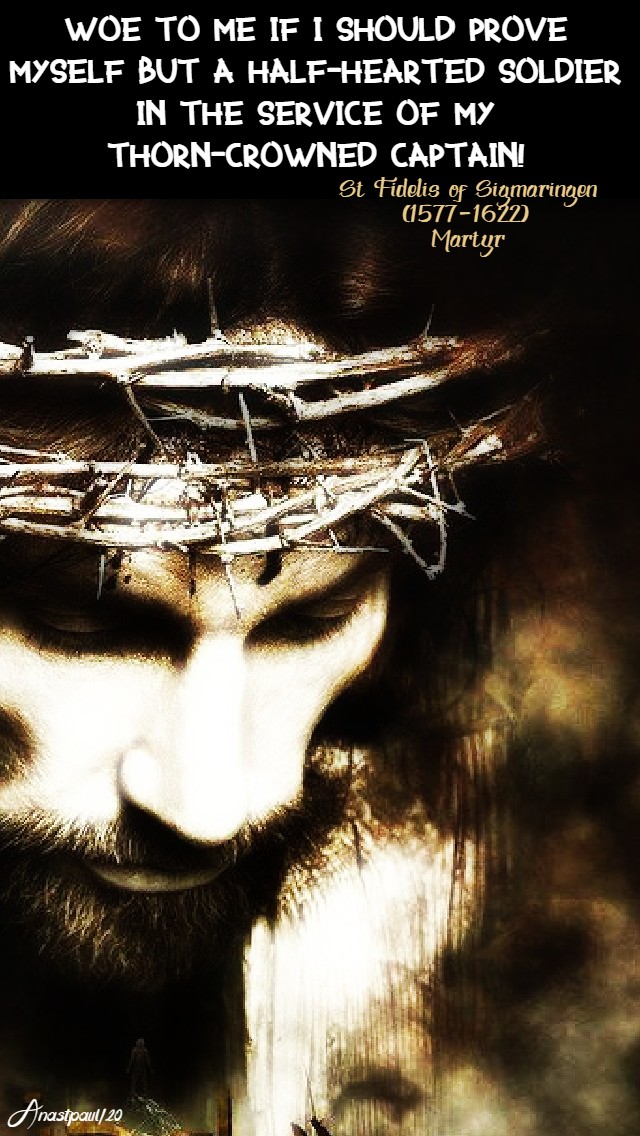
“Woe to me if I should prove myself but a half-hearted soldier in the service of my thorn-crowned Captain.”
St Fidelis of Sigmaringen (1577-1622)
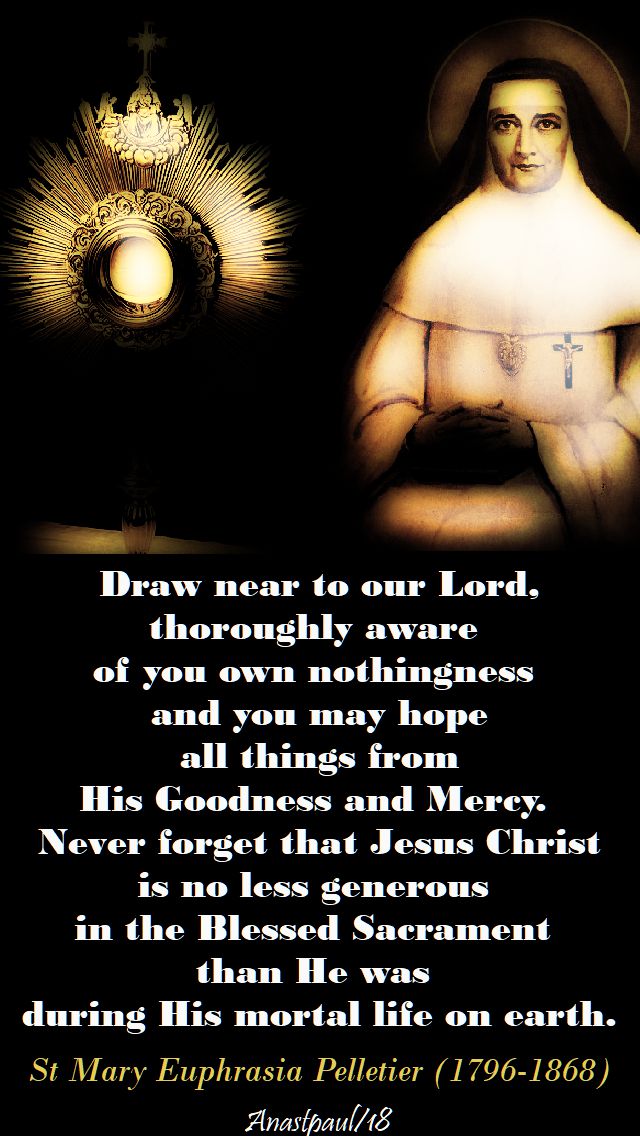
“Draw near to our Lord, thoroughly aware of you own nothingness and you may hope all things from His Goodness and Mercy. Never forget that Jesus Christ is no less generous in the Blessed Sacrament than He was during His mortal life on earth.”
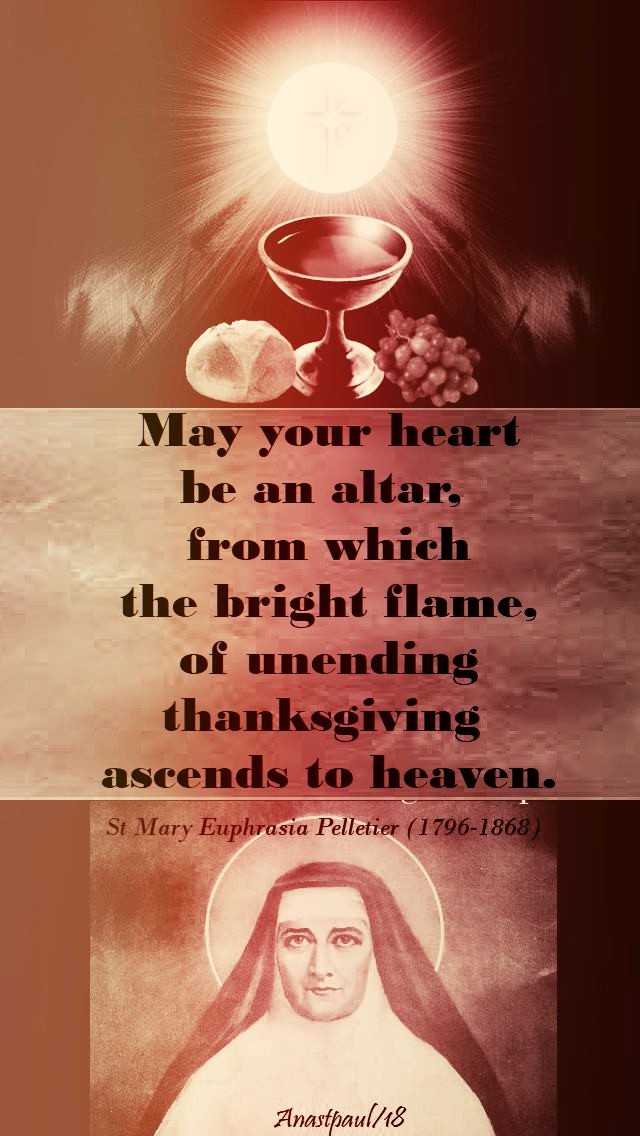
“May your heart be an altar, from which the bright flame, of unending thanksgiving ascends to heaven.”
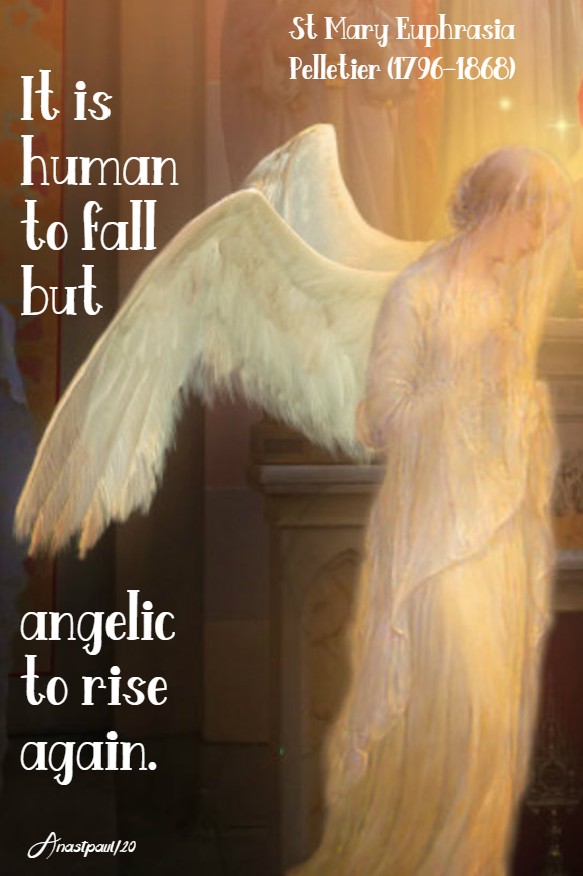
“It is human to fall but angelic to rise again.”
St Mary Euphrasia Pelletier (1796-1868)
“To the end of the longest life, you are still a beginner. What Christ asks of you is not sinlessness but diligence …. You cannot be profitable to Him, even with the longest life; you can show faith and love in an hour!”
Our Morning Offering – 24 April – Friday of the Second week of Easter
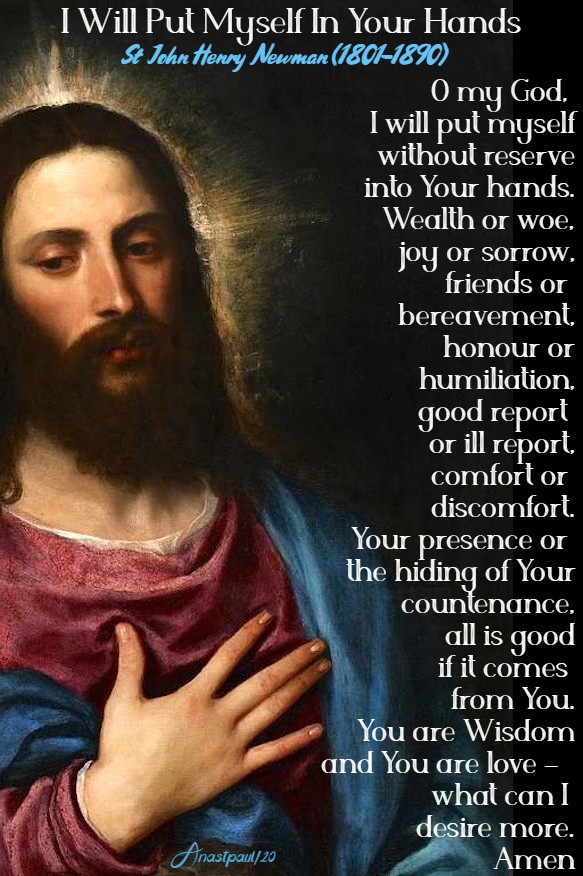
I Will Put Myself In Your Hands By St John Henry Newman (1801-1890)
O my God, I will put myself
without reserve into Your hands.
Wealth or woe,
joy or sorrow,
friends or bereavement,
honour or humiliation,
good report or ill report,
comfort or discomfort.
Your presence or the
hiding of Your countenance,
all is good
if it comes from You.
You are Wisdom
and You are love –
what can I desire more.
Amen
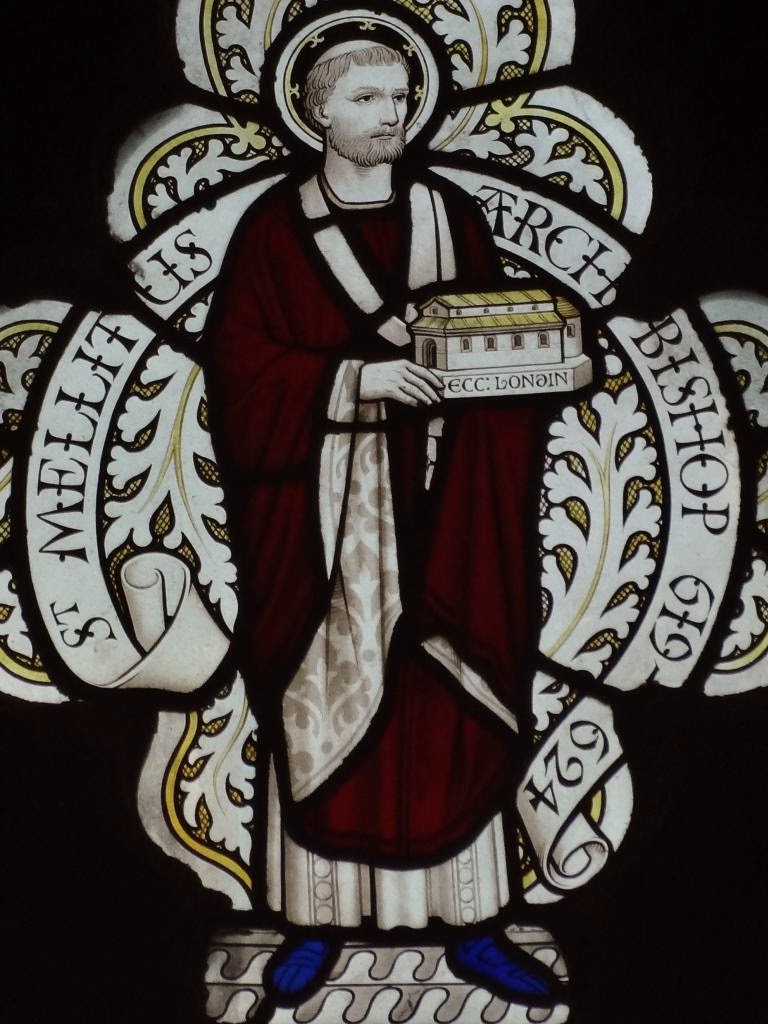
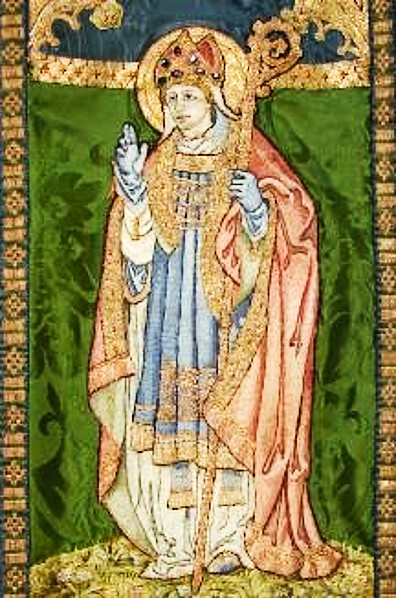
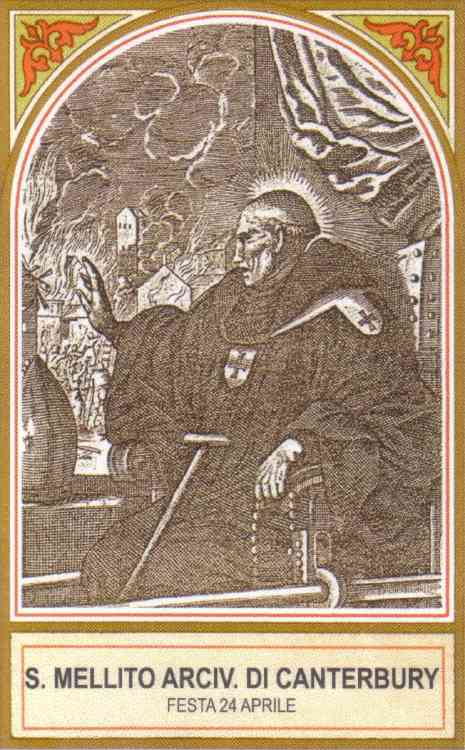
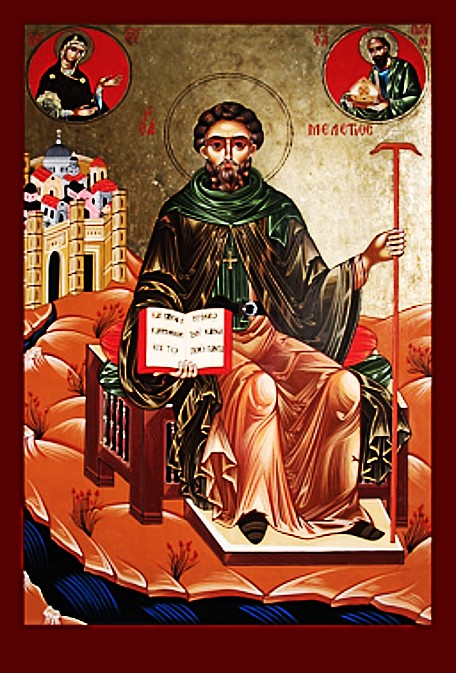
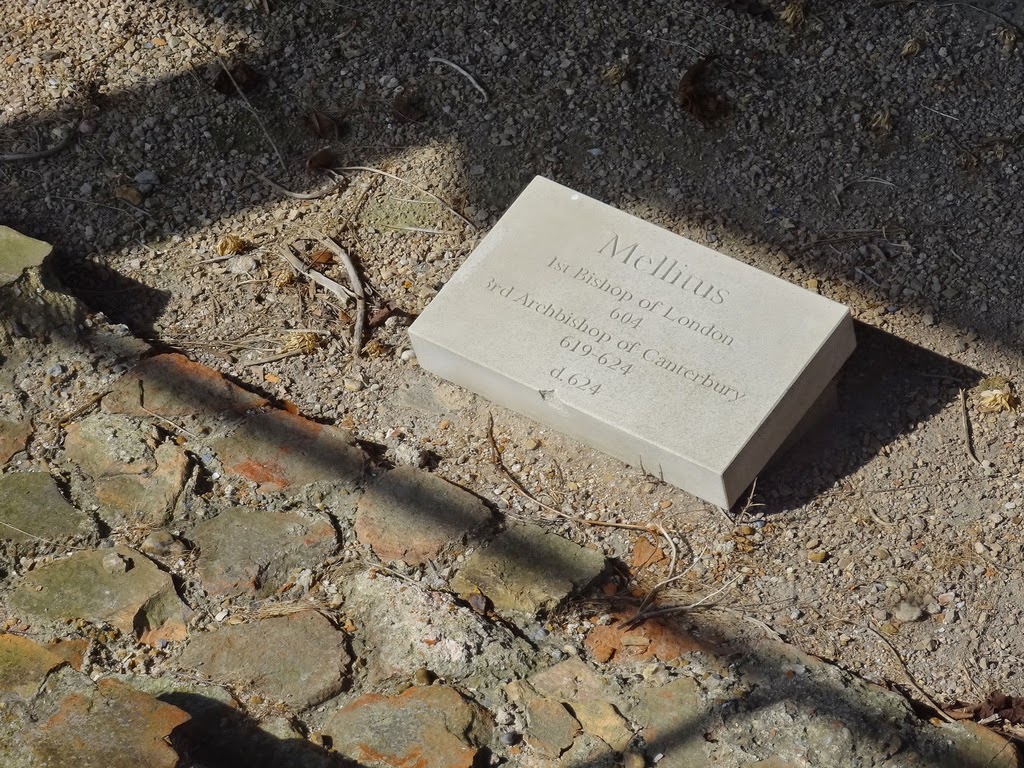
Saint of the Day – 24 April – Saint Mellitus of Canterbury (Died 624) Bishop of London and the Third Archbishop of Canterbury, Missionary – of noble birth it is believed he was born in Italy and died on 24 April 624 of natural causes. Patronage – against gout (he suffered from it and pilgrims to Canterbury who had it were directed to his tomb).
Mellitus arrived in England in 601, as part of the second wave of missionaries sent by Pope Gregory to support St Augustine (died c 604), the first Archbishop of Canterbury in his attempt to convert the Anglo-Saxons. With him came St Justus and St Paulinus. Mellitus seems to have been the most senior of the party, since he is the addressee of the famous papal letter in which Gregory told the missionaries not to destroy the Anglo-Saxons’ pagan temples, customs and sacrifices but to replace them.
Thanks to Bede, we have a detailed account of Mellitus’ activities once he arrived in Kent and of the many trials and tribulations of the new church.
“In the year of our Lord 604, Augustine, Archbishop of Britain, consecrated two bishops, Mellitus and Justus. Mellitus was appointed to preach in the province of the East Saxons, which is separated from Kent by the river Thames and bounded on the east by the sea. Its capital is the city of London, which stands on the banks of the Thames and is a trading centre for many nations who visit it by land and sea. At this time Sabert, Ethelbert’s nephew through his sister Ricula, ruled the province under the suzerainty of Ethelbert, who, as already stated, governed all the English peoples as far north as the Humber. When this province too had received the faith through the preaching of Mellitus, King Ethelbert built a church dedicated to the holy Apostle Paul in the city of London, which he appointed as the episcopal see of Mellitus and his successors.”
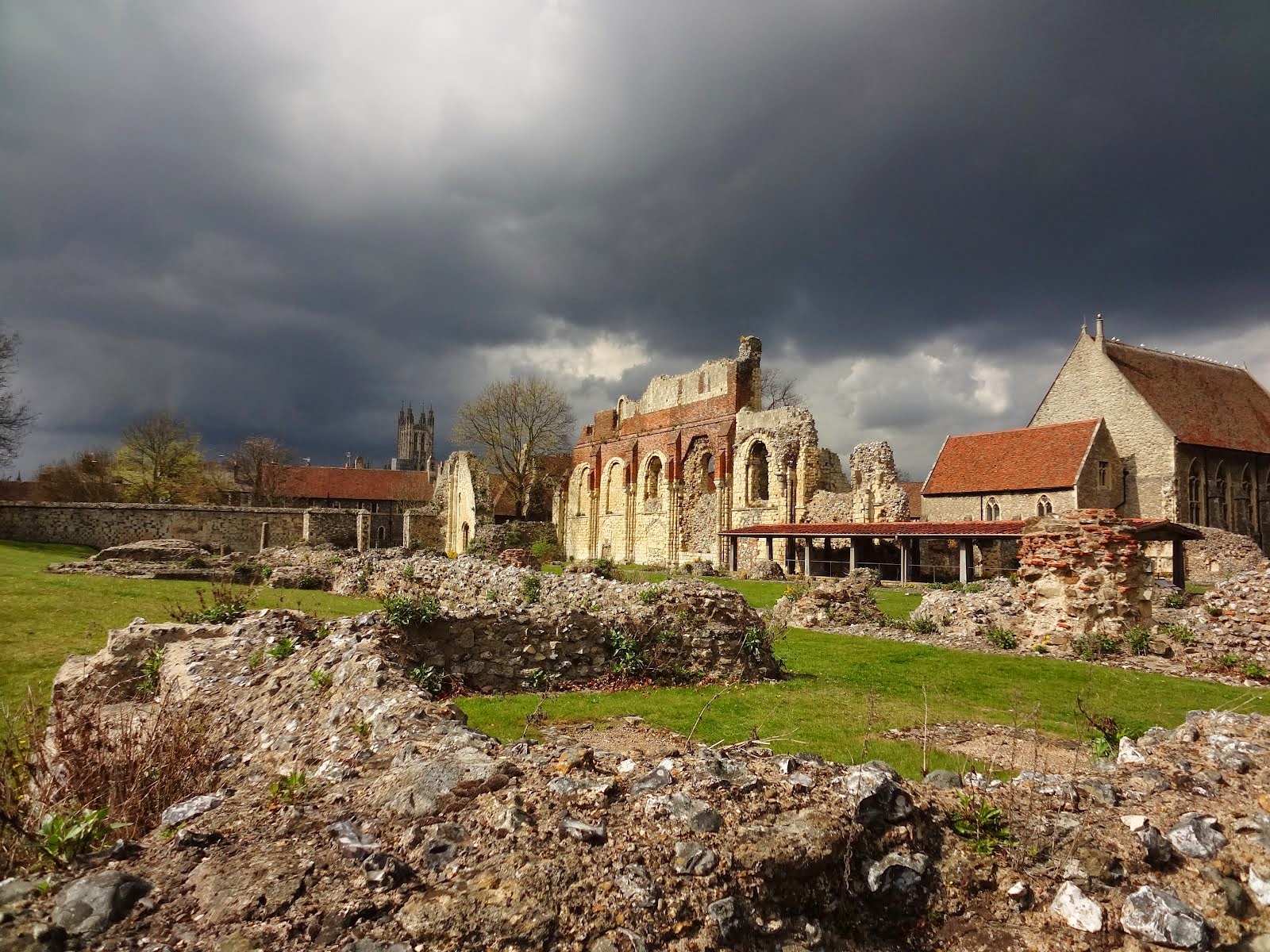
So far, so good for the new church, with Augustine established in Canterbury, Mellitus in London and Justus in Rochester. The church founded for Mellitus has since been rebuilt many times over, of course but it still bears the name by which its first bishop knew it: St Paul’s. St Augustine died in 604 and was buried at what is now St Augustine’s Abbey in Canterbury.
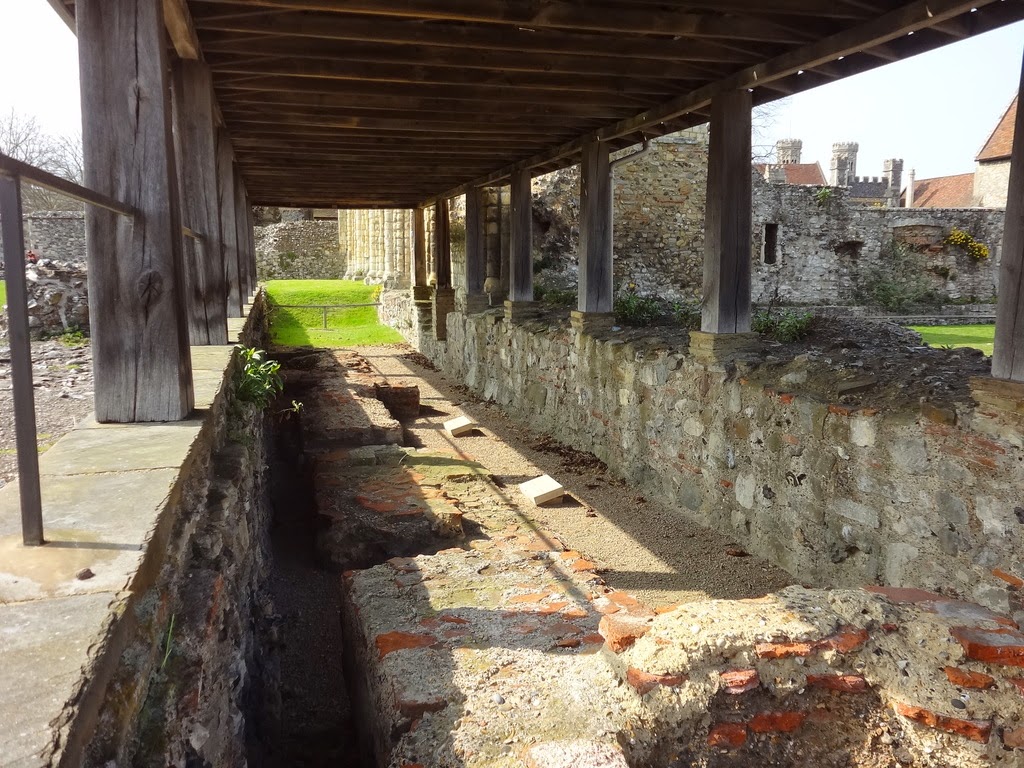
The ruins of St Augustine’s today
“… The death of the Christian King Sabert of the East Saxons aggravated the upheaval; for when he departed for the heavenly kingdom he left three sons, all pagans, to inherit his earthly kingdom. These were quick to profess idolatry, which they had pretended to abandon during the lifetime of their father and encouraged the people to return to the old gods. It is told that when they saw Bishop Mellitus offering solemn Mass in church, they said with barbarous presumption: “Why do you not offer us the white bread which you used to give to our father Saba (for so they used to call him), while you continue to give it to the people in church?” The Bishop answered, “If you will be washed in the waters of salvation as your father was, you may share in the consecrated bread, as he did but, so long as you reject the water of life, you are quite unfit to receive the Bread of Life.” They retorted, “We refuse to enter that font and see no need for it but we want to be strengthened with this bread.” The bishop then carefully and repeatedly explained that this was forbidden and that no-one was admitted to receive the most holy communion without the most holy cleansing of baptism. At last, they grew very angry, and said, “If you will not oblige us by granting such an easy request, you shall no longer remain in our kingdom.” And they drove him into exile and ordered all his followers to leave their borders.
After his expulsion, Mellitus came to Kent to consult with his fellow-Bishops Laurence and Justus on the best course of action and, they decided, it would be better for all of them to return to their own country and serve God in freedom, rather than to remain impotently among heathens who had rejected the faith Mellitus and Justus left first and settled in Gaul to await the outcome of events. But the kings who had driven out the herald of truth did not remain long unpunished for their worship of demons, for they and their army fell in battle against the West Saxons. Nevertheless, the fate of the instigators did not cause their people to abandon their evil practices, or to return to the simple faith and love to be found in Christ alone.”
This was a tipping-point for the new church and could have been the end of Augustine’s mission – but for a miraculous dream:
“On the very night before Laurence too was to follow Mellitus and Justus from Britain, he ordered his bed to be placed in the church of the blessed Apostles, Peter and Paul, of which we have spoken several times. Here, after long and fervent prayers for the sadly afflicted church, he lay down and fell asleep. At dead of night, blessed Peter, Prince of the Apostles, appeared to him and set about him for a long time with a heavy scourge, demanding with apostolic sternness why he was abandoning the flock entrusted to his care and to which of the shepherds, he would commit Christ’s sheep left among the wolves when he fled. “Have you forgotten my example?” asked Peter. “For the sake of the little ones whom Christ entrusted to me as proof of his love, I suffered chains, blows, imprisonment and pain. Finally, I endured death, the death of crucifixion, at the hands of unbelievers and enemies of Christ, so that at last I might be crowned with him.” Deeply moved by the words and scourging of blessed Peter, Christ’s servant Laurence sought audience with the king [Eadbald] early next morning and removing his garment, showed him the marks of the lash. The king was astounded and enquired who had dared to scourge so eminent a man and when he learned that it was for his own salvation that the Archbishop had suffered so severely, at the hands of Christ’s own Apostle, he was greatly alarmed. He renounced idolatry, gave up his unlawful wife, accepted the Christian faith, and was baptised, henceforward promoting the welfare of the church with every means at his disposal.”
The king also sent to Gaul and recalled Mellitus and Justus, giving them free permission to return and set their churches in order, so, the year after they left, they returned. Justus came back to his own city of Rochester but the people of London preferred their own idolatrous priests and refused to accept Mellitus as Bishop. And since the king’s authority in the realm was not so effective as that of his father, he was powerless to restore the Bishop to his see against the refusal and resistance of the pagans.
Bede makes it clear that the new church could do nothing without the support of the king and that where the king’s authority stopped, there was nothing the Bishops could do. Laurence died in 619 and was buried near Augustine and Mellitus, unable to return to London, succeeded him as Archbishop of Canterbury. Bede tells us:
“Although Mellitus became crippled with the gout, his sound and ardent mind overcame his troublesome infirmity, ever reaching above earthly things to those that are heavenly in love and devotion. Noble by birth, he was even nobler in mind.
I record one among many instances of his virtue. One day the city of Canterbury was set on fire through carelessness and the spreading flames threatened to destroy it. Water failed to extinguish the fir, and already a considerable area of the city was destroyed. As the raging flames were sweeping rapidly towards his residence, the Bishop, trusting in the help of God where man’s help had failed, ordered himself to be carried into the path of its leaping and darting advance. In the place where the flames were pressing most fiercel,y stood the church of the Four Crowned Martyrs. Hither, the Bishop was borne by his attendants and here by his prayers this infirm man averted the danger which all the efforts of strong men had been powerless to check. For the southerly wind, which had been spreading the flames throughout the city, suddenly veered to the north, thus saving the places that lay in their path, then it dropped altogether, so that the fires burned out and died. Thus Mellitus, the man of God, afire with love for Him, because it had been his practice by constant prayers and teaching, to fend off storms of spiritual evil from himself and his people, was deservedly empowered to save them from material winds and flames.”
St Bede concludes:
“Having ruled the church for five years, Mellitus likewise departed to the heavenly kingdom in the reign of King Eadbald and was laid to rest with his predecessors in the same monastery church of the holy Apostle Peter on the twenty-fourth day of April, in the year of our Lord 624.”
That is, he was buried at what later became known as St Augustine’s Abbey, where his two predecessors and King Ethelbert were also buried.
These brick foundations above (protected by a modern canopy) are believed to be the only visible remains of Augustine’s original church. This was where the tombs of Augustine, Laurence, Mellitus and Justus stood until the end of the eleventh century, when the Norman rebuilding of the monastery meant that their bodies had to be moved. By this time, all were regarded as the abbey’s saints (along with St Mildred of Thanet) and the translation of their bodies into the new Norman church in September 1091 was a splendid occasion, it was commemorated by a series of Lives of the early Archbishops, composed by Goscelin, which were recorded in several beautiful manuscripts.
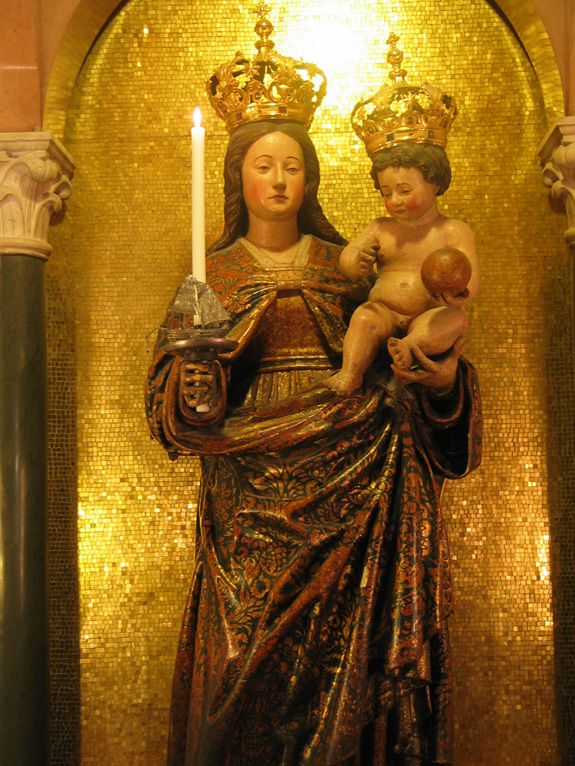
Our Lady of Bonaria: Devotion to the Blessed Virgin Mary in the form of a statue of Mary and the Christ Child that was washed up at a Mercedarian monastery near Cagliari, Italy on 25 April 1370, apparently from a shipwreck the night before. Legend says that the locals tried to open the crate it was in, but only one of the Mercedarian monks could get the it open. Patron of Sardinia, Italy.
Our Lady of Luján in Buenos Aires: Virgin of Luján, Patroness of Argentina, Uruguay and Paraguay. 16th-century icon of the Virgin Mary. Tradition holds that a settler ordered the terracotta image of the Immaculate Conception in 1630 because he intended to create a shrine in her honour to help reinvigorate the Catholic faith in Santiago del Estero, his region. After embarking from the port of Buenos Aires, the caravan carrying the image stopped at the residence of Don Rosendo Oramas, located in the present town of Zelaya. When the caravan wanted to resume the journey, the oxen refused to move. Once the crate containing the image was removed, the animals started to move again. Given the evidence of a miracle, people believed the Virgin wished to remain there. The image was venerated in a primitive chapel for 40 years. Then the image was acquired by Ana de Matos and carried to Luján, where it currently resides.
St Mary of Cleophas St Mary Salome Mother of St James the Greater and St John, the Apostles of Christ. St Mary has 2 Catholic universal Memorials – the 2nd is on 22 October – here is a post on that date: https://anastpaul.com/2019/10/22/saint-of-the-day-22-october-saint-mary-salome-first-century-disciple-of-jesus/ St Mellitus of Canterbury (Died 624)
St Neon of Lydda
St Sabas the Goth of Rome
St Tiberio of Pinerolo
St William Firmatus
—
Mercedarian Martyrs of Paris: No info yet.
Thought for the Day – 23 April – Meditations with Antonio Cardinal Bacci (1881-1971)
Faith and Charity
“Faith is a gift from God (Summa Theologiae, II-II, q 45). We should, therefore, ask for it in our prayers. Faith cannot enter into a proud soul, because, “God resists the proud but gives grace to the humble” (Js 4:6; 1 Peter 5:5). If a man does not pray, his faith grows weaker and he may lose it altogether. Faith must be nourished continually by grace, which is obtained through prayer. A man who is in a state of mortal sin, loses his faith, ‘especially if he is a slave to impurity, because, only the clean of heart can see God’ (Cf Mt 5:8). St Thomas Aquinas knew what he was talking about when he said, that “faith is the foundation of the entire spiritual edifice of the Christian life” (Summa Theologiae III, q 73, a 3). It is faith, nourished by grace, which raises us to the supernatural level, where everything which we do, say or think, becomes meritorious in the sight of God. “My just one lives by faith” (Heb 10:38). The keener and stronger our faith is, the firmer is the foundation of our spiritual life and the more numerous are our good works. This is not to say, that faith excludes all study and investigation. In fact, the more lively is our faith, the more earnest will be our desire to understand better the terms in which our faith is expressed and to explore the intimate connection, between divine revelation and human knowledge. Study of this kind, will prove, a refreshing experience because, it will bring us to the threshold of the contemplation of eternal truth. Reason is not humiliated but ennobled by the light of revelation, which raises it to a higher plane.”
Quote/s of the Day – 23 April – Thursday of the Second Week of Easter, Readings: Acts 5:27-33, Psalm 34:2, 9, 17-20, John 3:31-36
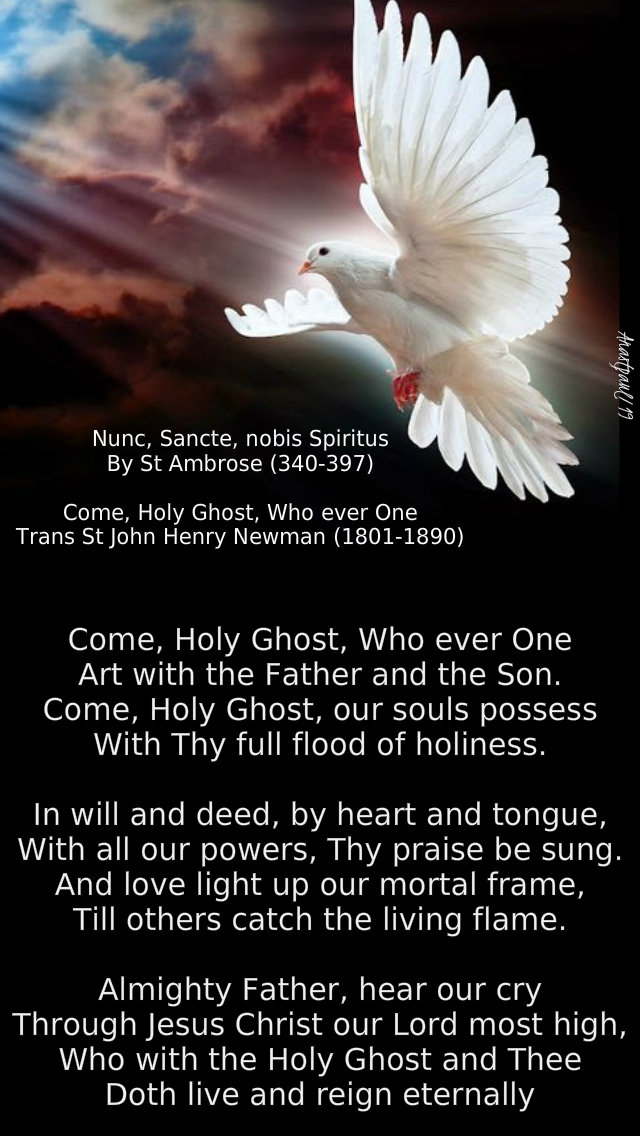
Nunc, Sancte, nobis Spiritus By St Ambrose (340-397) Come, Holy Ghost, Who ever One Trans St John Henry Newman (1801-1890) Trans 1836
Come, Holy Ghost, Who ever One Art with the Father and the Son. Come, Holy Ghost, our souls possess With Thy full flood of holiness.
In will and deed, by heart and tongue, With all our powers, Thy praise be sung. And love light up our mortal frame, Till others catch the living flame.
Almighty Father, hear our cry Through Jesus Christ our Lord most high, Who with the Holy Ghost and Thee Doth live and reign eternally
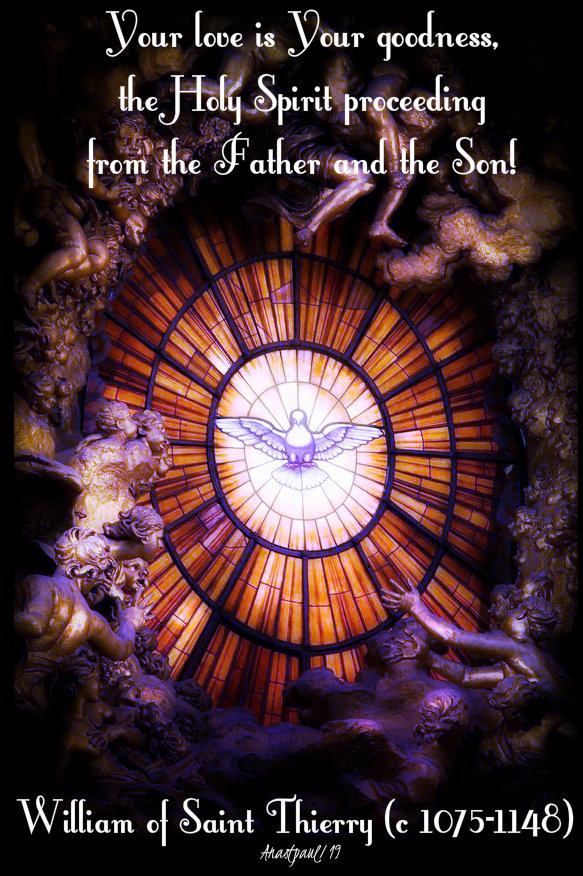
“Your love is Your goodness – the Holy Spirit proceeding from the Father and the Son! “
William of Saint Thierry (c 1075-1148)
Abbot
“I do, therefore, pray and beseech you, to cast away all confidence in your own powers, in human wisdom and reputation and keep all your hopes and thoughts continually, fixed on God alone. If you do this, then I shall consider that you are sufficiently armed and prepared against all the troubles which may beset you, either in the mind or in the body.”
St Francis Xavier (1506-1552)
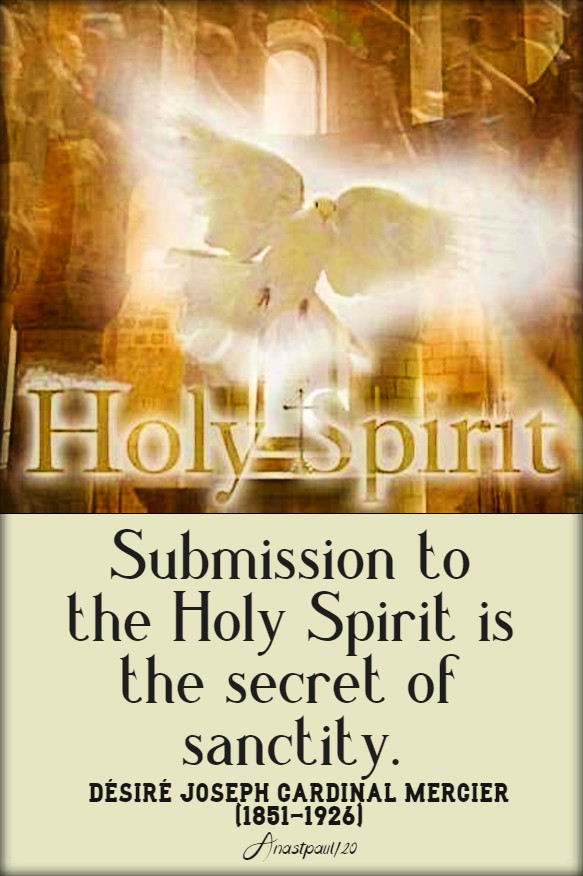
“I am going to reveal to you the secret of sanctity and happiness. Every day for five minutes control your imagination and close your eyes to the things of sense and your ears to all the noises of the world, in order to enter into yourself. Then, in the sanctity of your baptised soul (which is the temple of the Holy Spirit), speak to that Divine Spirit, saying to Him:
O Holy Spirit, Soul of My Soul
O Holy Spirit, Soul of my soul, I adore You! Enlighten me, guide me, strengthen me, console me. Tell me what I should do, give me Your orders. I promise to submit myself to all that You desire of me and to accept, all that You permit to happen to me. Just make me know Your Will. Amen
If you do this, your life will flow along happily, serenely and full of consolation, even in the midst of trials. Grace will be proportioned to the trial, giving you strength to carry it and you will arrive at the Gate of Paradise, laden with merit. This submission to the Holy Spirit is the secret of sanctity.”
By Désiré Joseph Cardinal Mercier (1851-1926)
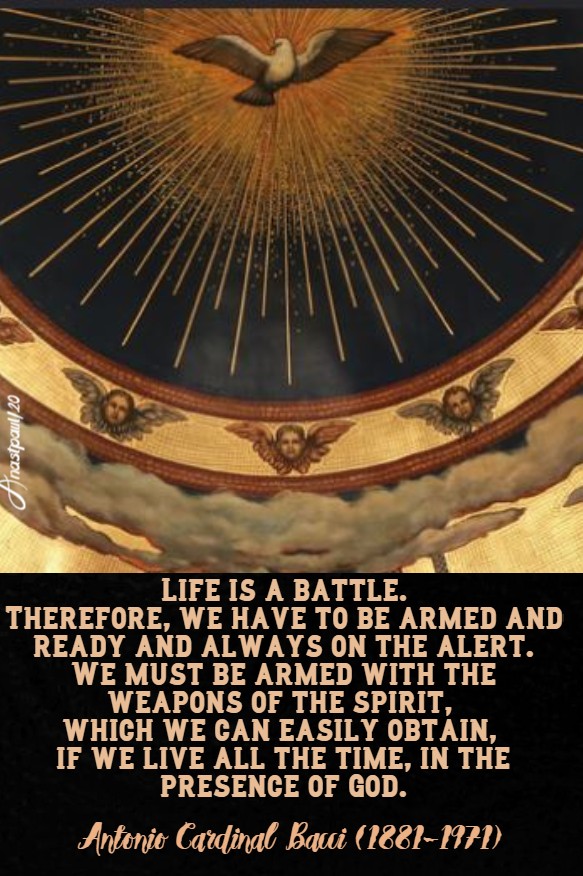
“Life is a battle. Therefore, we have to be armed and ready and always on the alert (Job 7:1) We must be armed with the weapons of the spirit, which we can easily obtain, if we live all the time, in the presence of God.”
Antonio Cardinal Bacci (1881-1971)
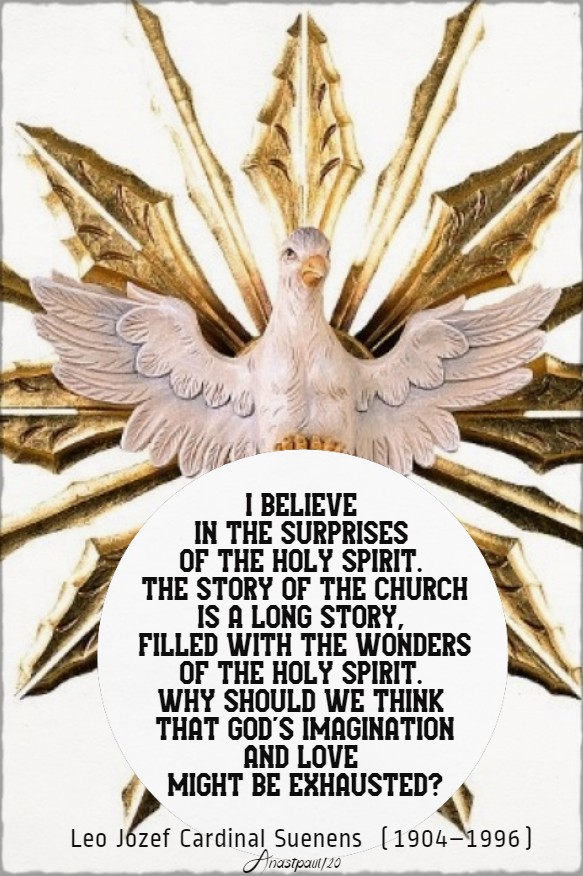
“I believe in the surprises of the Holy Spirit. The story of the Church is a long story, filled with the wonders of the Holy Spirit. Why should we think that God’s imagination and love might be exhausted?”
One Minute Reflection – 23 April – Thursday of the Second Week of Easter, Readings: Acts 5:27-33, Psalm 34:2, 9, 17-20, John 3:31-36
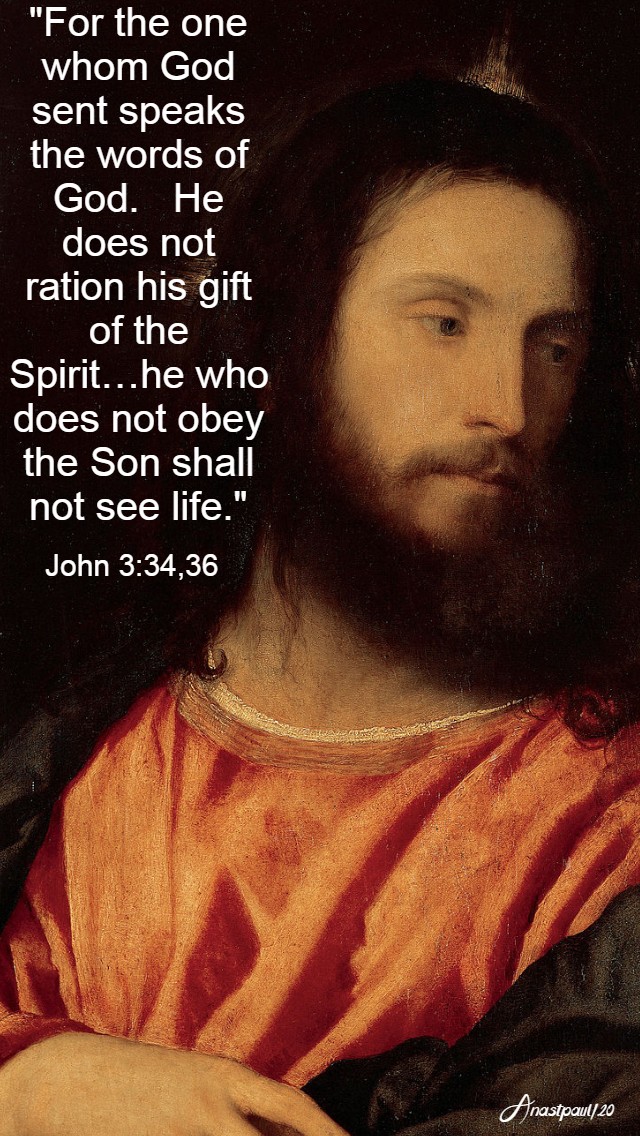
“For the one whom God sent speaks the words of God. He does not ration his gift of the Spirit…he who does not obey the Son shall not see life.” … John 3:34,36
REFLECTION – “How can someone with little or no faith be made to realise that an ant grows wings, a caterpillar turns into a butterfly and many other strange and unexpected things happen in nature, so that in this way he shakes off the sickness of unbelief and despair, himself acquires wings and buds in spiritual knowledge like a tree? “I am He,” God says, “who makes the dry tree flourish; I give life to dry bones” (cf. Ezek 17:24; 37:1-14). (…)
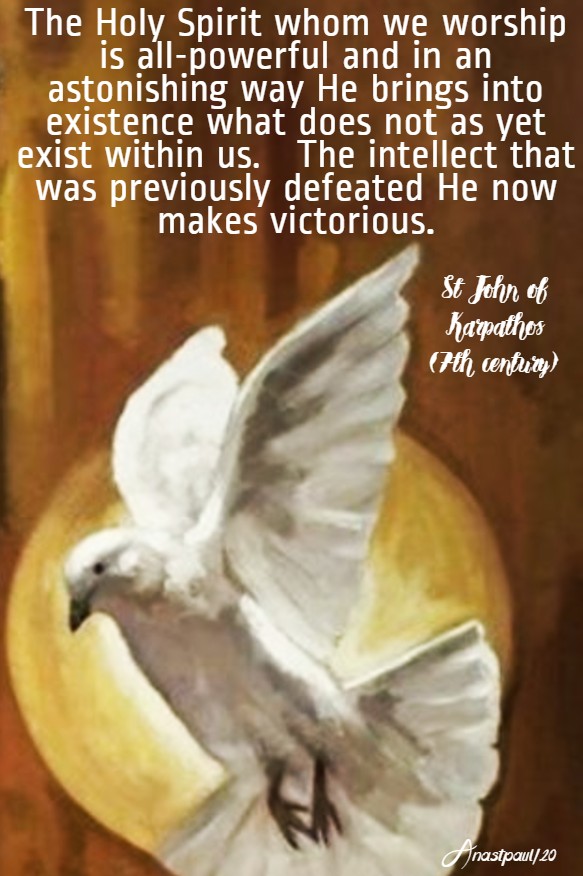
Sometimes our soul grows despondent at the huge swarm of its sins and temptations, and says: “Our hope is gone and we are lost” (Ezek 37:11 LXX). Yet God, who does not despair of our salvation, says to us: “You shall live, and you shall know that I am the Lord” (Ezek 37:6). To the soul that doubts how it can ever give birth to Christ through great acts of holiness, these words are said: “The Holy Spirit shall come upon you” (Lk 1:35). Where the Holy Spirit is present do not expect anymore the sequence and laws of nature and habit. The Holy Spirit whom we worship is all-powerful and in an astonishing way He brings into existence what does not as yet exist within us. The intellect that was previously defeated He now makes victorious.
For the Paraclete, who in compassion comes upon us from above, “is higher than all” (Jn 3:31) and He raises us above all natural impulses.” … St John of Karpathos (VII century) Bishop, Monk
PRAYER – Lord God, whose name is holy and whose mercy is proclaimed in every generation, send forth Your Spirit into our hearts and grant that, faithfully pondering on all that is holy, we may ever live in the splendour of Your presence. Listen we beseech You, to the prayers we request from the Blessed Virgin Mary and all Your Angels and Saints, that we may ever entreat the Holy Spirit to grant us His light. We make our prayer through Christ, Your Son our Lord and Saviour, with the Holy Spirit, one God forever amen.
Our Morning Offering – 23 April – Thursday of the Second Week of Easter
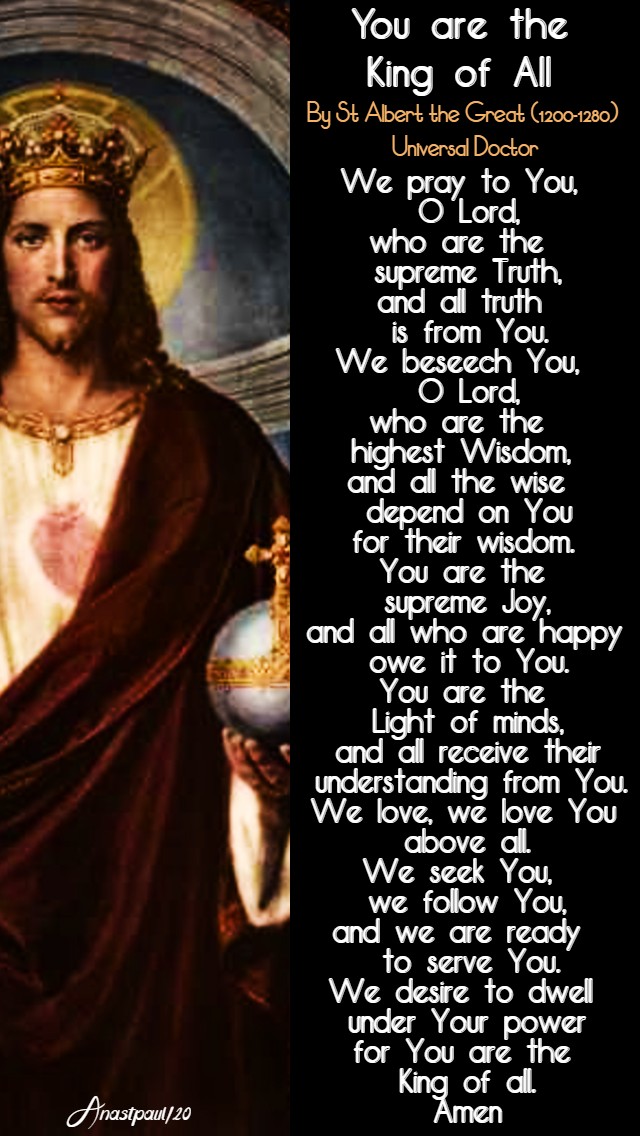
You are the King of All By St Albert the Great (1200-1280) Universal Doctor
We pray to You, O Lord,
who are the supreme Truth,
and all truth is from You.
We beseech You, O Lord,
who are the highest Wisdom,
and all the wise depend on You
for their wisdom.
You are the supreme Joy,
and all who are happy owe it to You.
You are the Light of minds,
and all receive their understanding from You.
We love, we love You above all.
We seek You, we follow You,
and we are ready to serve You.
We desire to dwell under Your power
for You are the King of all.
Amen
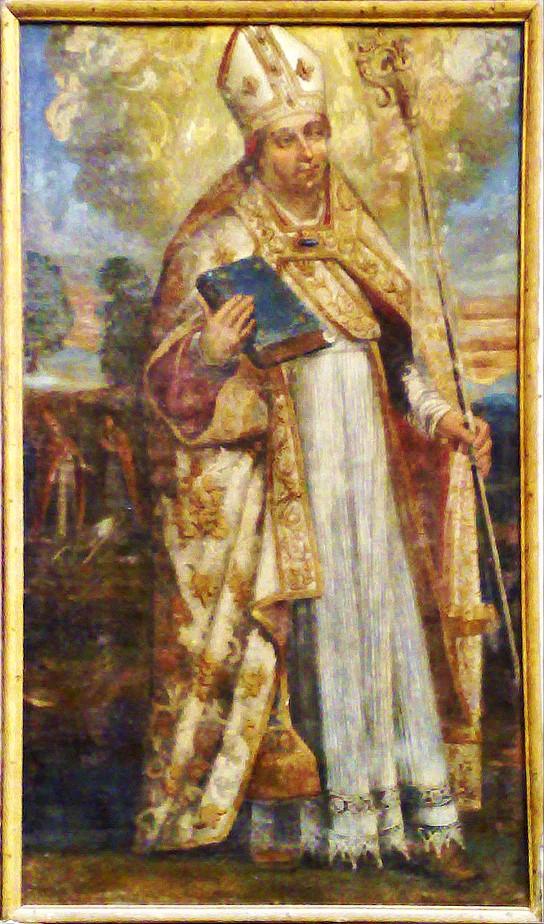
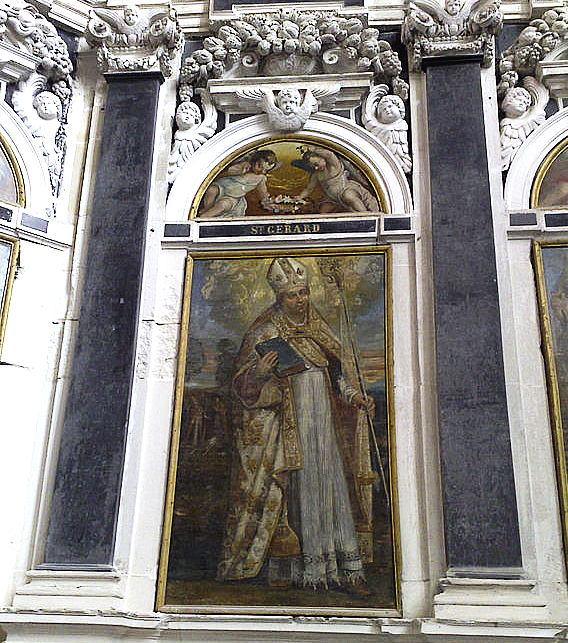
Saint of the Day – 23 April – Saint Gerard of Toul (c 935–994) Bishop of Toul, France, from 963- his death in 994 – born in c 935 at Cologne, Germany and died on 23 April 994 in Toul, France, of natural causes. Patronages – Toul and Gérardmer, France.
Gerard was born circa 935 in Cologne to the nobles Ingranne and Emma and was known for his piousness and he was educated in Cologne. It is believed that he entered the priesthood after lightning struck his mother and killed her, which he believed to be divine judgement for his sins. However, he had been a pious youth and it is thought that his sins could not have been very serious ones. Upon his Ordination he became the Canon for the Cologne Cathedral.
It was at this time that Toul had great independence under its Bishops and Gerard himself, proved to be a successful and a respected leader, after he was appointed as the Bishop of Toul (3 March 963) and consecrated (the following 19 March in Trier). The Archbishop of Cologne, St Bruno the Great, the brother of Otto I, Holy Roman Emperor, on behalf of Pope John XII – appointed him to the Toul Diocese.
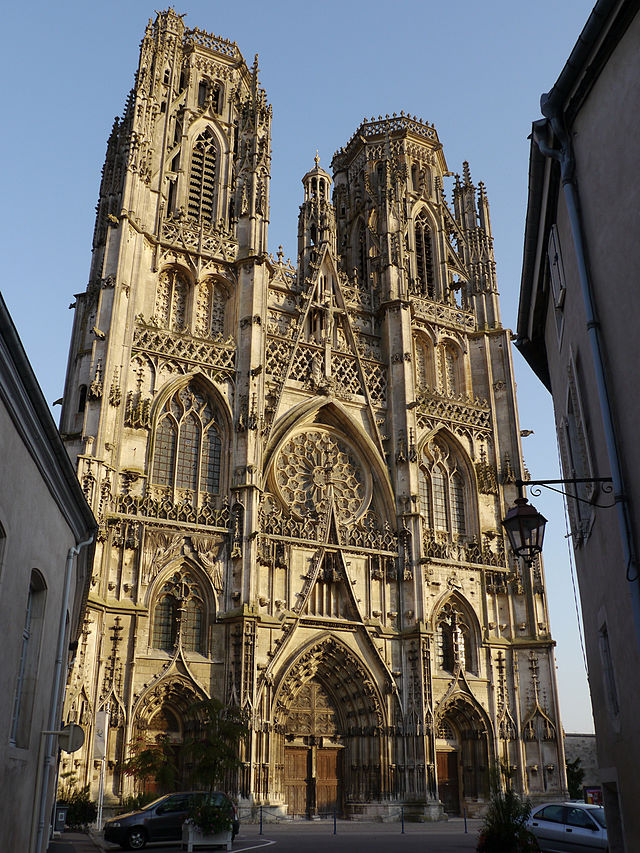
As Bishop, he established religious schools in the Diocese and he invited European scholars, to teach at the schools. He rebuilt churches and the notable example to this is the Toul Cathedral which he himself consecrated in 981. Gerard also founded a convent for nuns. His great humility led him to avoid meeting with Emperor Otto II, who desired to have the Bishop close to him as an adviser.
Toul Cathedral
The “Vita Sancti Gerardi” states that he had the relics of both Saint Mansuetus and Saint Aprus – earlier Bishops of the Diocese – brought and placed in the church of Saint John the Baptist. He is said to have come up with the use of “herb Gerald” (goutweed) which was used in the Middle Ages to treat gout. Gerard also fought against secular political intervention in ecclesial matters and invited Monks from Ireland to come to his schools to teach. His personal devotions were centred on the study of Sacred Scripture and the lives and teachings of the saints.
He died during the night on 23 April 994 and was interred in the Diocesan Cathedral of Toul in the choir loft. His reputation for holiness was evident in his life and miracles at his tomb, were recorded after his death. Pope Leo IX – a successor as Bishop of Toul and later Pope – Canonised him on 21 October 1050 in Rome.
St Achilleus of Vienne
Bl Adalbert III of Salzburg
St Felix of Vienne
St Fortunatus of Vienna
St George of San Giorio
St Gerard of Orchimont St Gerard of Toul (c 935–994)
Bl Giles of Assisi
Bl Giles of Saumur
Bl Giorgio di Suelli
Bl Helen del Cavalanti
St Ibar of Meath
Bl Maria Gabriela Sagheddu
St Marolus of Milan
St Pusinna of Champagne Bl Teresa Maria of the Cross (1846–1910) Her Story: https://anastpaul.com/2019/04/23/saint-of-the-day-23-april-blessed-teresa-maria-of-the-cross-ocd-1846-1910/
—
Martyrs of Africa: A group of Christians murdered for their faith in northern Africa. Little information has survived but their names. The ones we know are – Catulinus, Chorus, Faustinus, Felicis, Felix, Nabors, Plenus, Salunus, Saturninus, Silvius, Solutus, Theodora, Theodorus, Theon, Ursus, Valerius, Venustus, Victorinus, Victurus, Vitalis
Thought for the Day – 22 April – Meditations with Antonio Cardinal Bacci (1881-1971)
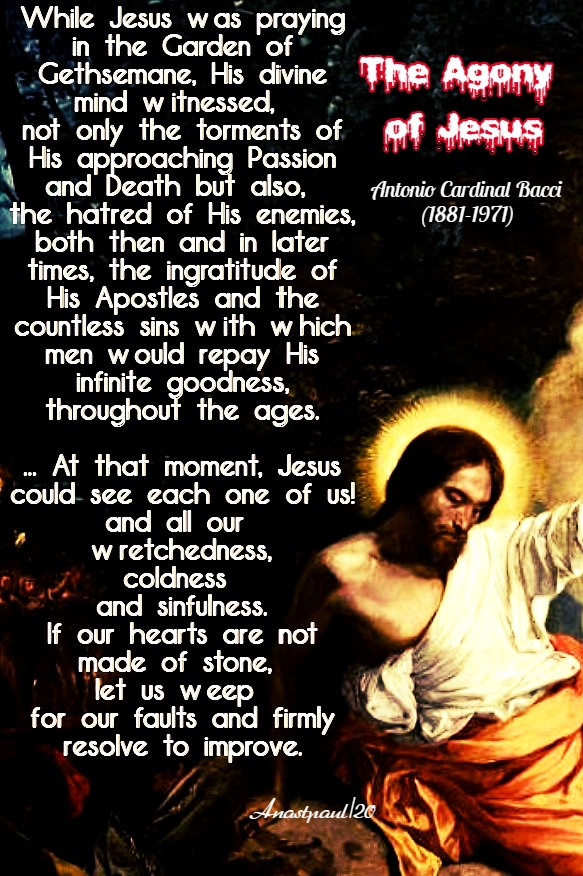
The Agony of Jesus
“While Jesus was praying in the Garden of Gethsemane, His divine mind witnessed, not only the torments of His approaching Passion and Death but also, the hatred of His enemies, both then and in later times, the ingratitude of His Apostles and the countless sins with which men would repay His infinite goodness, throughout the ages. He realised, that He would be a sign of contradiction for many. Some would hate Him, others would desecrate His Precious Blood and His Immaculate Body. Many, forgetful of the Redemption, would commit sin after sin, while others would receive special graces and would return only coldness and indifference in exchange for such great love. Faced with this gloomy scene, Jesus was utterly dejected and was overcome by a mysterious rending agony, which caused Him to perspire blood. “He began to feel dread and to be exceedingly troubled” (Mk 14:33). “And falling into an agony, he prayed the more earnestly. And his sweat became as drops of blood running down upon the ground” (lk 22:43-44). At that moment, Jesus could see each one of us! and all our wretchedness, coldness and sinfulness. If our hearts are not made of stone, let us weep for our faults and firmly resolve to improve.”
Quote of the Day – 22 April – Wednesday of the Second Week of Easter
The Course of Truth
By St John Henry Newman (1801-1890)
“Him God raised up the third day and showed Him openly, not to all the people but unto witnesses chosen before of God.”
WHEN royal Truth, released from mortal throes, Burst His brief slumber and triumphant rose, Ill had the Holiest sued A patron multitude, Or courted Tetrarch’s eye, or claim’d to rule By the world’s winning grace, or proofs from learned school.
But, robing Him in viewless air, He told His secret to a few of meanest mould; They in their turn imparted The gift of men pure-hearted, While the brute many heard His mysteries high, As some strange fearful tongue, and crouch’d, they knew not why.
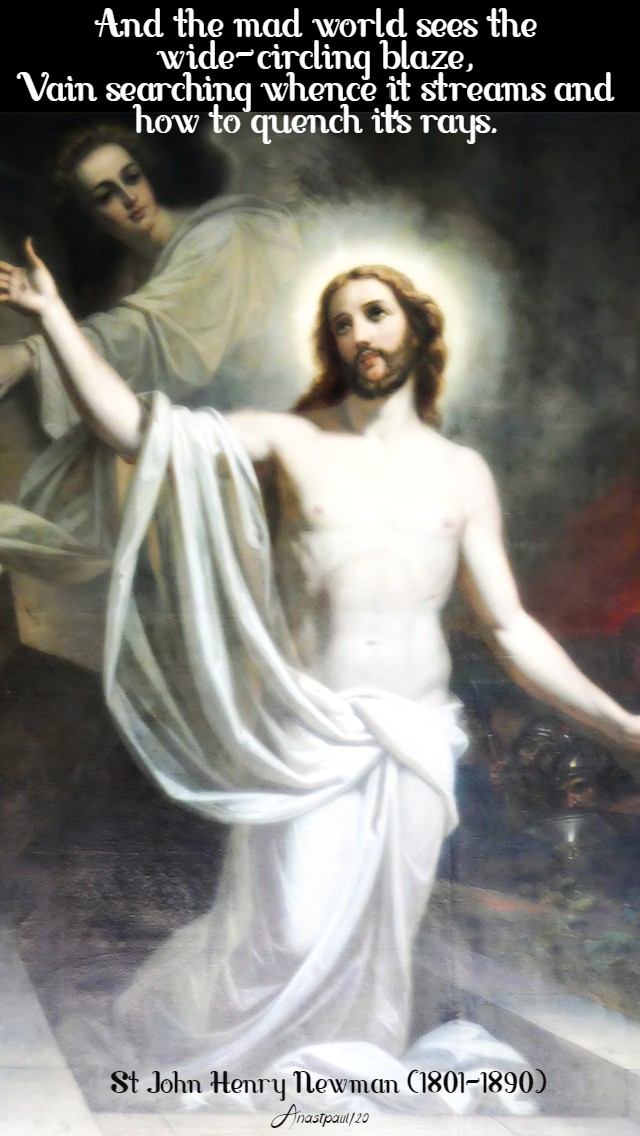
Still is the might of Truth, as it has been, Lodged in the few, obey’d and yet unseen. Rear’d on lone heights and rare, His saints their watch-flame bear, And the mad world sees the wide-circling blaze, Vain searching whence it streams and how to quench it’s rays.
One Minute Reflection – 22 April – Wednesday of the Second Week of Easter, Readings: Acts 5:17-26, Psalm 34:2-9, John 3:16-21
“But he who does what is true comes to the light, that it may be clearly seen that his deeds have been wrought in God.”…John 3:21
REFLECTION – “In the evening, when the Bishop is present, the deacon carries in the lamp. And standing in the midst of all the faithful who are there, he will offer thanksgiving. First of all he says the greeting: “The Lord be with you” and the people respond: “And with your spirit.” – Then he says “Let us give thanks to the Lord” and they reply: “It is right and just. To Him be the greatness and supremacy together with the glory”… Then he will pray thus, saying: “We give you thanks, Lord, through your Son Jesus Christ our Lord, through whom You enlighten us by revealing the light that never dims. Since day is spent and we have now reached evening, filled with the light of the day You created for our joy and since, through Your grace, we do not now lack the light of evening, we praise and glorify You through Your Son, Jesus Christ our Lord, through Whom, to You, be glory and power and honour, with the Holy Spirit, now and forever and through all ages. Amen.” And everyone will say: “Amen.”
In this way, after the meal, all will stand in prayer. The children say psalms as also the virgins.”… St Hippolytus of Rome (c 170– c 235) Priest and Martyr – Apostolic Tradition, 25
PRAYER – Shed your clear light on our hearts, Lord, so that walking continually in the way of Your commandments, we may never be deceived or misled. Your ways are not our ways, teach us to willingly agree to them, for You know which way we should go. Help us to say “yes” always to Your plan and to render ourselves as a sacrament of Your divine love to all we meet. Fill us with the grace to be your tools to bring glory to Your kingdom. May the prayers of your Angels and Saints and Your Blessed Mother and ours, bring us strength. Through Our Lord Jesus Christ with You, in the union of the Holy Spirit, one God forever, amen.
Our Morning Offering – 22 April – Wednesday of the Second Week of Easter
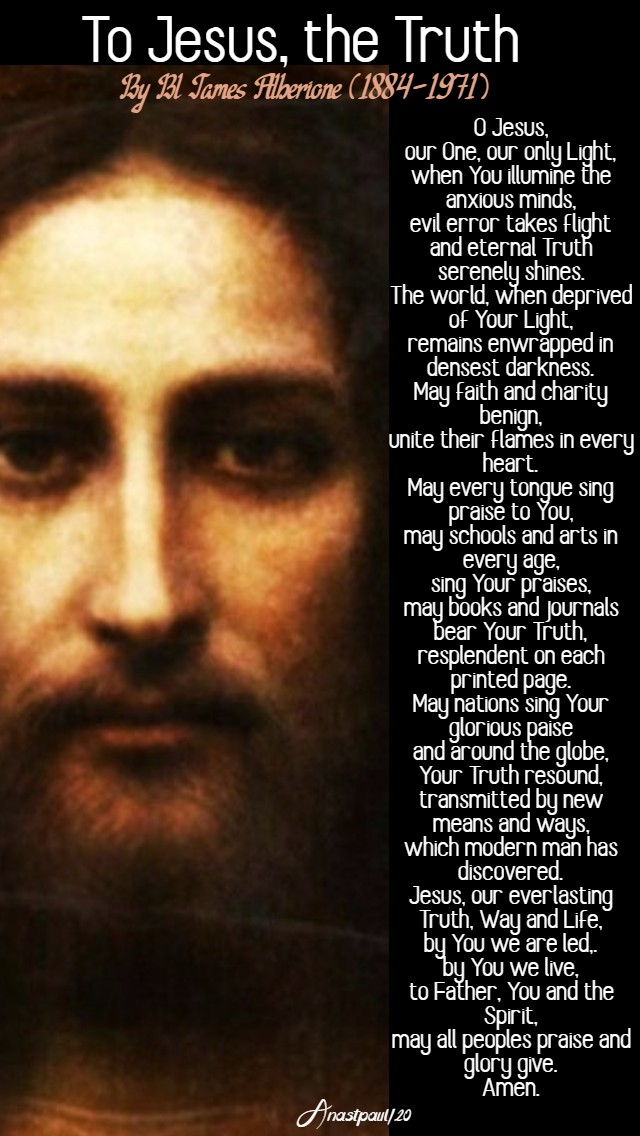
To Jesus, the Truth By Blessed James Alberione (1884-1971)
O Jesus,
our One, our only Light,
when You illumine the anxious minds,
evil error takes flight
and eternal Truth serenely shines.
The world, when deprived of Your Light,
remains enwrapped in densest darkness.
May faith and charity benign,
unite their flames in every heart.
May every tongue sing praise to You,
may schools and arts in every age,
sing Your praises,
may books and journals bear Your Truth,
resplendent on each printed page.
May nations sing Your glorious paise
and around the globe,
Your Truth resound,
transmitted by new means and ways,
which modern man has discovered.
Jesus, our everlasting Truth, Way and Life,
by You we are led,.
by You we live,
to Father, You and the Spirit,
may all peoples praise and glory give.
Amen.
Blessed Fr James Alberione (1884-1971) the Founder of the Pauline Family, composed various Prayers to Jesus Master, The Way, the Truth and the Life, specifically directed to honour Jesus, the Master – to sanctify the whole person, mind, will and heart. These prayers are prayed by his Orders every day.
Saint of the Day – 22 April – Blessed Francis of Fabriano OFM (1251-1322) Priest of the Order of the Friars Minor, Theologian, Spiritual Writer, renowned Preacher – born as Francesco Venimbeni on 2 September 1251 in Fabriano, Ancona, Italy and died on 22 April 1322 of natural causes, aged 70. Patronage – of Fabriano.
Francis was born in the year 1251 in the city of Fabriano. His father was a physician in that city and highly esteemed, not only because of his medical ability but still more, because of his love for the poor and afflicted and his sincere piety. Daily, little Francis recited the Divine Office and he was proficient in Latin before he was ten. To the great joy of his parents, Francis gave evidence of the finest talents, an alert understanding, and a meek and devout temperament.
As a boy Blessed Francis of Fabriano had a very serious illness which brought him to death’s door. Then the pious mother vowed to make a pilgrimage to the grave of St Francis of Assisi and at once, the illness took a turn for the better.
In Assisi the venerable Brother Angelo, one of the first associates of St Francis, saw the lovely boy and foretold to the mother, that he would later be his companion in the order. In consequence, Francis won the commitment and love of his parents more and more.
The boy’s desire for learning and his great progress were especially pleasing to his father. When he had reached his seventeenth year, he experienced a strong impulse to consecrate himself to God in the Order of St Francis and his pious parents gave their consent.
In 1267, he completed his humanities and philosophical studies before Francis entered the Franciscan convent at Fabriano and there, under the excellent direction of Father Gratian, later minister general of the entire order, Blessed Francis of Fabriano was instructed in all the conventual virtues. He applied himself to theological studies and purchased – with his father’s own funds – a handsome scale of books and other publications for the convent. He loved to call it the “best workshop in the convent” and its catalogue contains works of the Church Fathers as well as mathematicians and preachers. There was also works of theological and biblical commentators. Mark of Lisbon OFM (died 1622) Franciscan Historian and the Bishop of Porto in Portugal, dubbed the friar as a “most learned man and renowned preacher.”
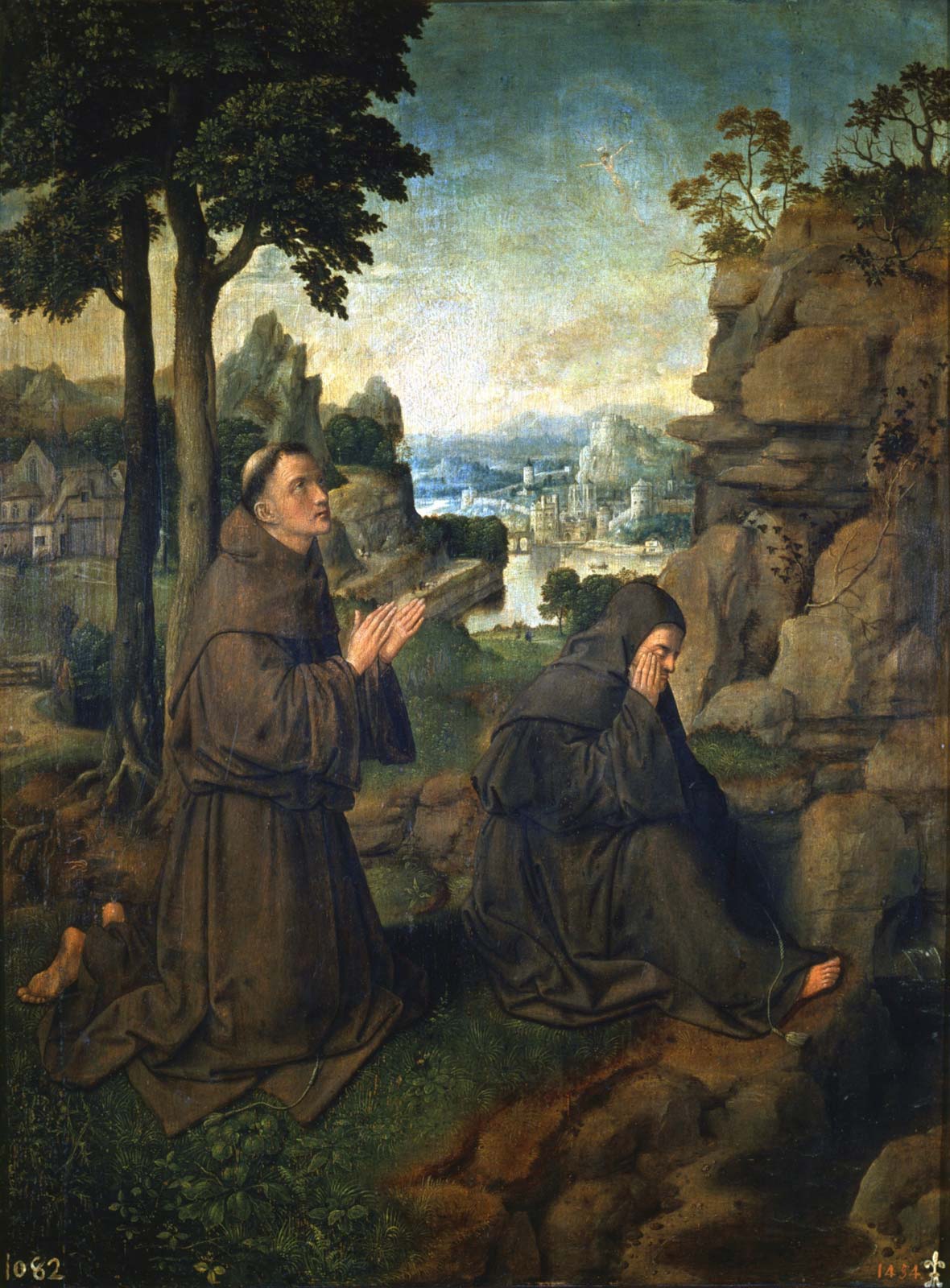
In order to gain the Portiuncula indulgence he went to Assisi and there, he heard from the trusted companion of St Francis, Brother Leo, who was still living, how this popular indulgence had been given and also how the Stigmata had been bestowed. Concerning both these facts Francis later wrote a book, which still serves as evidence.
The Stigmata of St Francis
Blessed Francis died on 22 April 1322 and had predicted the date of his own death. He is buried in Fabriano.
The Beatification for the late friar was celebrated on 1 April 1755 after Pope Pius VI approved the late friar’s “cultus.”






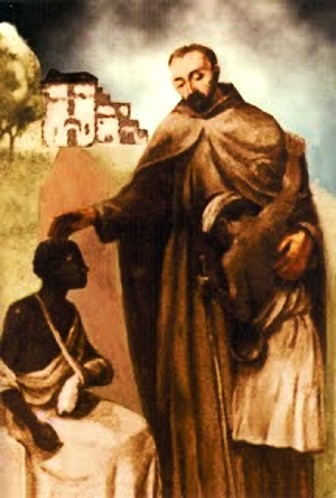 After holding the position of Sacristan for a while in a church dedicated to the Blessed Virgin, he rented a house in a suburb of the city called Calvary and there taught reading and Catechism to poor children.





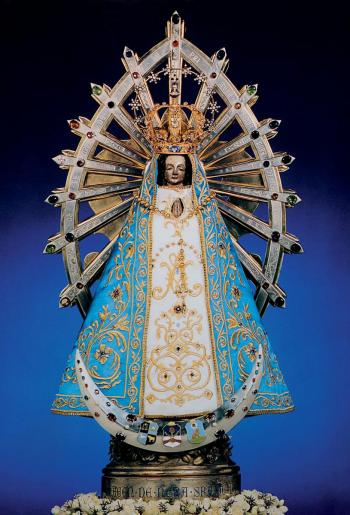 Virgin of Luján, Patroness of Argentina, Uruguay and Paraguay. 16th-century icon of the Virgin Mary. Tradition holds that a settler ordered the terracotta image of the Immaculate Conception in 1630 because he intended to create a shrine in her honour to help reinvigorate the Catholic faith in Santiago del Estero, his region. After embarking from the port of Buenos Aires, the caravan carrying the image stopped at the residence of Don Rosendo Oramas, located in the present town of Zelaya. When the caravan wanted to resume the journey, the oxen refused to move. Once the crate containing the image was removed, the animals started to move again. Given the evidence of a miracle, people believed the Virgin wished to remain there. The image was venerated in a primitive chapel for 40 years. Then the image was acquired by Ana de Matos and carried to Luján, where it currently resides.







You must be logged in to post a comment.