Quote of the Day – 16 August – Friday of the Nineteenth week in Ordinary Time, Year C and The Memorial of St Stephen of Hungary (c 975- 1038)
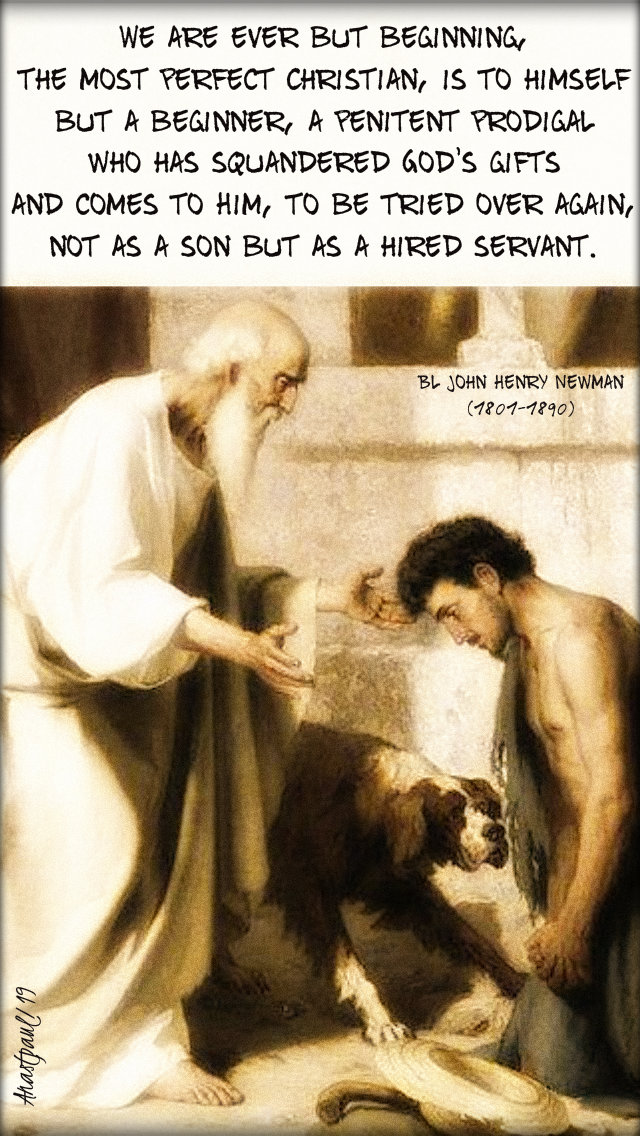
“We are ever but beginning, the most perfect Christian, is to himself but a beginner, a penitent prodigal who has squandered God’s gifts and comes to Him, to be tried over again, not as a son but as a hired servant.”
One Minute Reflection – 16 August – Friday of the Nineteenth week in Ordinary Time, Year C, Gospel: Matthew 19:3–12 and The Memorial of St Stephen of Hungary (c 975- 1038)
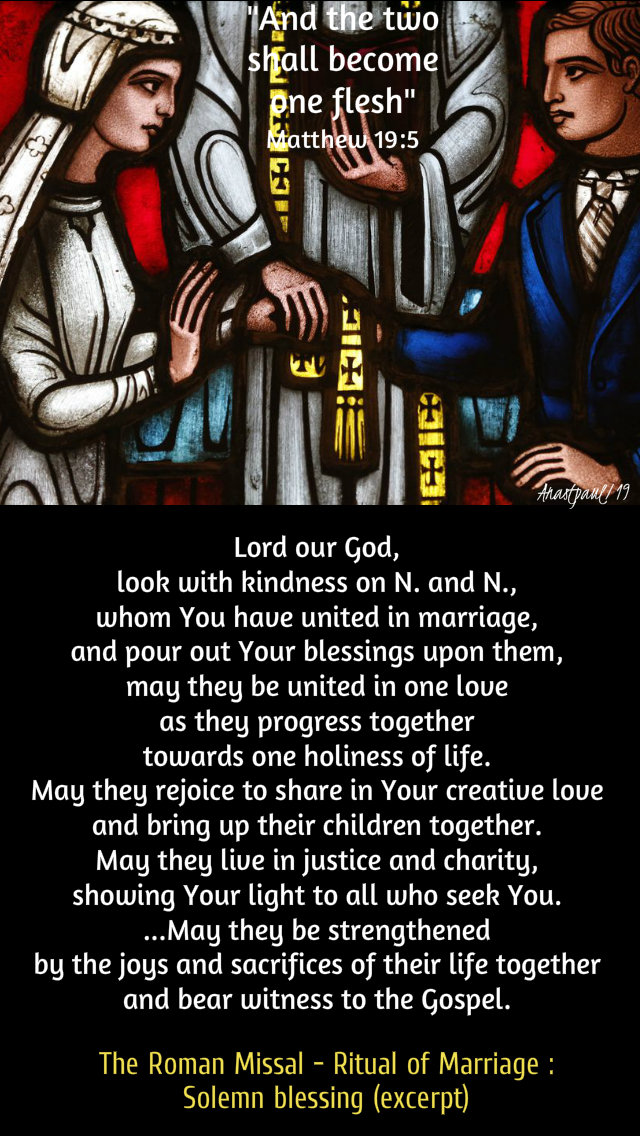
‘And the two shall become one flesh’ … Matthew 19:5
REFLECTION – “Lord our God,
look with kindness on N. and N.,
whom You have united in marriage,
and pour out Your blessings upon them,
may they be united in one love
as they progress together
towards one holiness of life.
May they rejoice to share in Your creative love
and bring up their children together.
May they live in justice and charity,
showing Your light to all who seek You.
May their household be ever open to the service of their brothers and sisters
and may they be always ready to answer to their needs.
May they be strengthened by the joys and sacrifices of their life together
and bear witness to the Gospel.
May they have a long life together, without misfortune or sickness
and may the work of both be blessed.
May they see their children grow up in peace
and enjoy the support of a happy family.
May they come at last, with all those who have gone before them,
to the dwelling where their love will last eternally.
N. and N. and all you who are present here,
may God the all-powerful bless you,
the Father, the Son and the Holy Spirit.” … The Roman Missal – Ritual of Marriage : Solemn blessing
PRAYER – Almighty Father, let Your light so penetrate our hearts and minds, that walking by Your commandments, we may always follow You, our teacher and our guide. Grant that the prayers of St Stephen of Hungary may continue to defend us, as he did in the world. Through Jesus our Lord, with the Holy Spirit, one God forever, amen.
Our Morning Offering – 16 August – Friday of the Nineteenth week in Ordinary Time, Year C
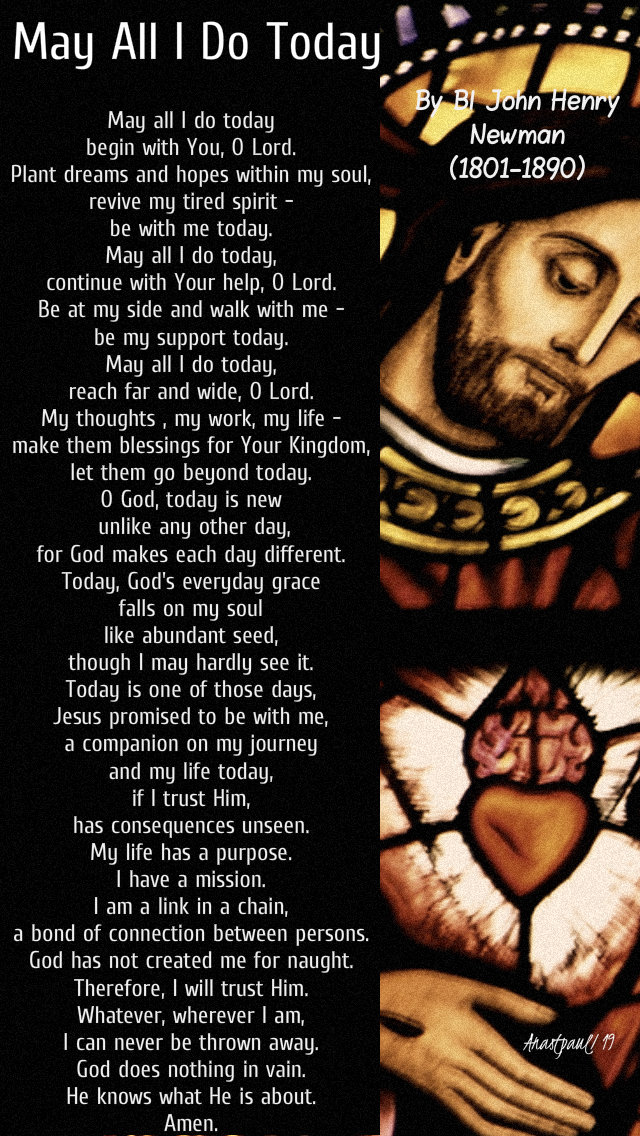
May All I Do Today By Bl John Henry Newman (1801-1890)
May all I do today begin with You, O Lord.
Plant dreams and hopes within my soul,
revive my tired spirit – be with me today.
May all I do today, continue with Your help, O Lord.
Be at my side and walk with me – be my support today.
May all I do today, reach far and wide, O Lord.
My thoughts , my work, my life –
make them blessings for Your Kingdom,
let them go beyond today.
O God, today is new unlike any other day,
for God makes each day different.
Today, God’s everyday grace falls on my soul
like abundant seed, though I may hardly see it.
Today is one of those days, Jesus promised to be with me,
a companion on my journey
and my life today,
if I trust Him, has consequences unseen.
My life has a purpose.
I have a mission.
I am a link in a chain,
a bond of connection between persons.
God has not created me for naught.
Therefore, I will trust Him.
Whatever, wherever I am,
I can never be thrown away.
God does nothing in vain.
He knows what He is about.
Amen.
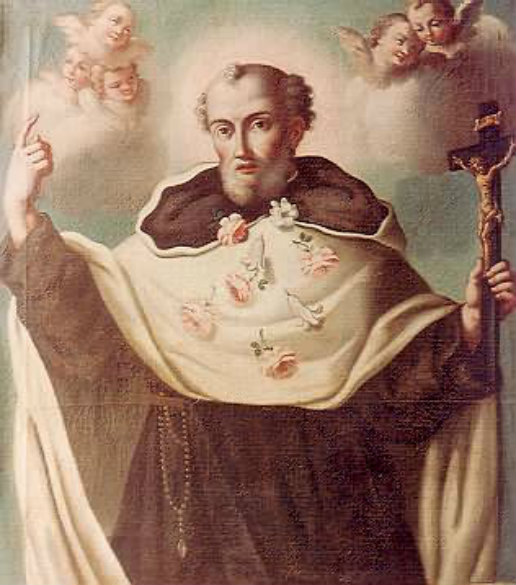
Saint of the Day – 16 August – Blessed Angelo Agostini Mazzinghi O. Carm (1385-1438) was an Italian Priest and a professed member of the Carmelite order. He was a noted preacher, prior and reformer, teacher of theology and was known for his pious devotion to the Holy Eucharist, the Blessed Virgin Mary and the Carmelite Rule of Life and to the profession of the Gospel. Patronage – Preachers.
Angelo Agostini Mazzinghi was born in Florence in 1385 to Augustin Mazzinghi.
He entered the Carmelite order in 1413 and after he made his solemn profession was ordained to the priesthood. He began to teach theological studies in both Florence and Frascati (in Rome) and was also a preacher in the former. He was the first member of the reformed observance of Our Lady of the Wood and was made as the prior of several of the Carmelite houses. He launched the reform of the convent of Santa Maria delle Salve and was appointed as the convent’s Prior from 1419 until 1430 and then once again in 1437.
Mazzinghi preached a series of Lenten retreats in Florence from 1431 and was to preach his final retreat in 1436 before he retired to a Carmelite convent. On one particular occasion of preaching – according to fellow Carmelite Nicholas Calciuri – who was a witness of the miracle, roses and lilies poured from Angelo’s mouth, which two angels wove into a crown for the latter.
Angelo was known for his humble and pious demeanour as well as for his ardent devotion to both the Holy Eucharist and to the Blessed Virgin Mary.
Before his death he retired to a Carmelite house where he spent the remainder of his life in contemplation and meditation. Bl Angelo died on 17 August 1438 in Florence at the age of 53. He was buried in Santa Maria del Carmine but his relics were moved to the Banacacci Chapel in 1739 and moved to the main altar in 1930 in what was the final transferral of his remains.
Pope Clement XIII approved his cultus and Beatified Blessed Angelo on 7 March 1761.
Bl Angelo Agostini Mazzinghi O.Carm. (1385-1438)
St Armagillus of Brittany
St Arsacius of Nicomedia
St Frambaldo
Bl Iacobus Bunzo Gengoro
Bl Jean-Baptiste Menestrel
Bl John of Saint Martha
Bl Laurence Loricatus
Bl Magdalena Kiyota Bokusai
Bl Maria Gengoro
Bl Ralph de la Futaye St Roch (1295-1327) “Pilgrim”
The story of St Roch here: https://anastpaul.wordpress.com/2017/08/16/saint-of-the-day-16-august-st-roch/
St Serena
Bl Simon Kiyota Bokusai
Bl Thomas Gengoro
St Titus the Deacon
—
Martyrs of Palestine – 33 saints: Thirty-three Christians martyred in Palestine; they are commemorated in old martyrologies, but the date and exact location have been lost.
Martyred in the Spanish Civil War:
Bl Amadeu Monje Altés
Bl Antonio María Rodríguez Blanco
Bl José María Sanchís Mompó
Bl Laurentí Basil Matas
Bl Plácido García Gilabert
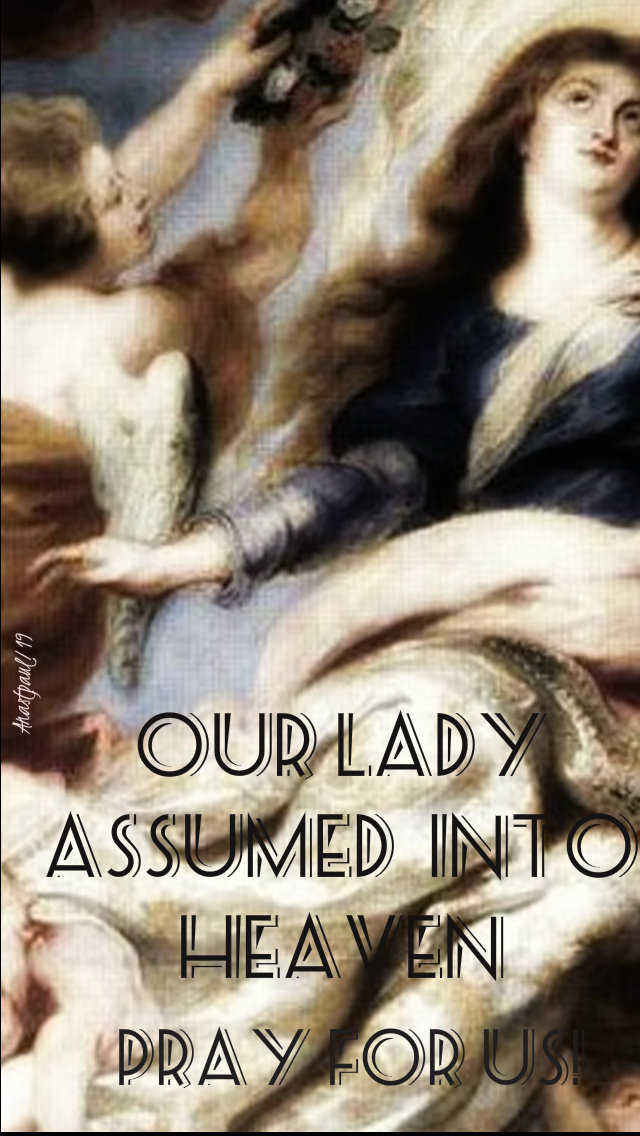
Thought for the Day – 15 August – Solemnity of the Assumption of the Blessed Virgin Mary into Heaven
You have Borne for us the Clothing of Immortality
Saint John Damascene (675-749)
Priest and Father and Doctor of the Church
An excerpt from his Homily 9 – On the Dormition of the Blessed Virgin Mary
“Once indeed God ejected the mortals and first parents of the human race from the paradise of Eden, when they had drunk deeply, from the wine of disobedience and had become so affected by the hangover of sin, through the intoxication of that transgression, which led to the sleepiness of the mind’s eye. Now, however, shall not paradise receive her who repelled the onslaught of all sin, producing the seed of obedience to God and Father and bringing forth life, for all races of mortal men? How can death devour this truly blessed woman, who gave birth to the whole person of the Word of God through union with God? How can hell receive her? When Christ, who is the way and the truth, said Where I am, there will my servant be also, why would there not be a dwelling for His own mother with Him with an even greater justification? It is well said that precious in the sight of the Lord God of Hosts, is the death of His saints but even more precious, is the passing of the Mother of God from this life.
Then Adam and Eve, the founders of our race, exclaimed with a loud voice in great rejoicing: “Blessed are you, O daughter, who bore for us the penalties of the commands that had been broken. When you had gained a mortal body from us, you gave birth to a covering of immortality for us. You repaid us so that it might be well with us, since you received birth from our loins. From beyond the grave you have called us back to our ancient seat, we closed paradise for ourselves but you made open the way of the tree of life. Through our actions, sadness came forth from happiness, through you even more joyful things have returned from sorrow. In what possible way could you be acceptable to death, O Immaculate one? You are the bridge of life and the ladder to heaven, you are a boat over the sea of death reaching to immortality.”
But the woman herself, as she did not shrink from the truth, said: “Into Your hands, my Son, I commend my spirit. Receive this soul which is dear to You, which You have preserved free from any sin. I hand over my body, not to the earth but to You. Take me to Yourself, that where You are, You, the child of my womb, so there I also may be Your companion. I am hastening to You, who have often come to me on this side of that long distance.”
When she had said this, she heard in reply: “Come to my rest, my blessed Mother, arise, come, my beloved, most blessed among all women. Behold, the winter is ended. You are all fair, my beloved and there is no spot of stain found in you, the odour of your ointments are more precious than all other aromas.”
++++++++++
There is an invocation in a Litany to Our Lord in which we ask: ut ad celestia desideria erigas, te rogamus, audi nos – that our souls be raised to the desire for celestial things, we pray Thee, hear us. This invocation should be the conclusion of our meditation on the Assumption of Our Lady. We should ask, that we may love the celestial happiness of Our Lady, to give her glory and that we may one day be with her in Paradise. We should also love and meditate on her joys, as a way to accept with peace and resignation the sorrows and sufferings God sends us, so that we might prove our love for Him.
Quote of the Day – 15 August – Solemnity of the Assumption of the Blessed Virgin Mary into Heaven
“In the bodily and spiritual glory which she possesses in heaven, the Mother of Jesus, continues in this present world as the image and first flowering of the Church, as she is to be perfected in the world to come. Likewise, Mary shines forth on earth, until the day of the Lord shall come (cf 2 Peter 3:10), as a sign of certain hope and comfort for the pilgrim People of God.”
Lumen Gentium
Dogmatic Constitution on the Church #68.
“While she lived on this earth she could only be close to a few people. Being in God, who is close to us, actually, “within” all of us, Mary shares in this closeness of God. Being in God and with God, she is close to each one of us, knows our hearts, can hear our prayers, can help us with her motherly kindness and has been given to us, as the Lord said, precisely as a “mother” to whom we can turn at every moment.”
Pope Benedict XVI
“As soon as we apprehend by faith, the great fundamental truth, that Mary is the Mother of God, other wonderful truths follow in its train and one of these, is that, she was exempt from the ordinary lot of mortals, which is not only to die but to become earth to earth, ashes to ashes, dust to dust.”
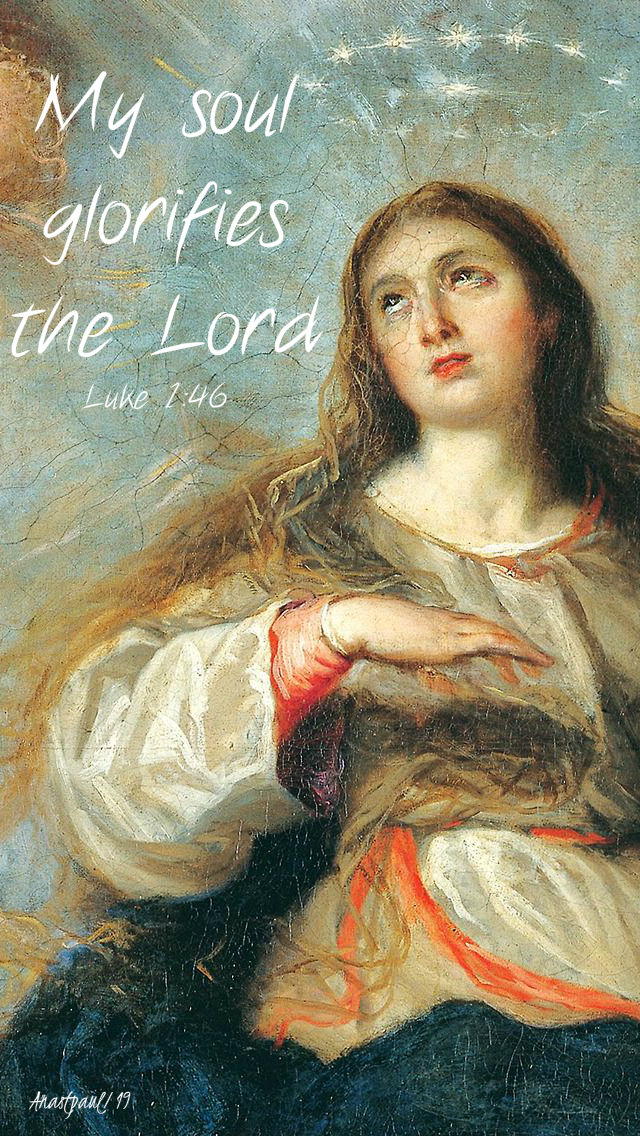
One Minute Reflection – 15 August – Solemnity of the Assumption of the Blessed Virgin Mary into Heaven, Gospel: Luke 1:39–56
My soul glorifies the Lord ... Luke 1:46
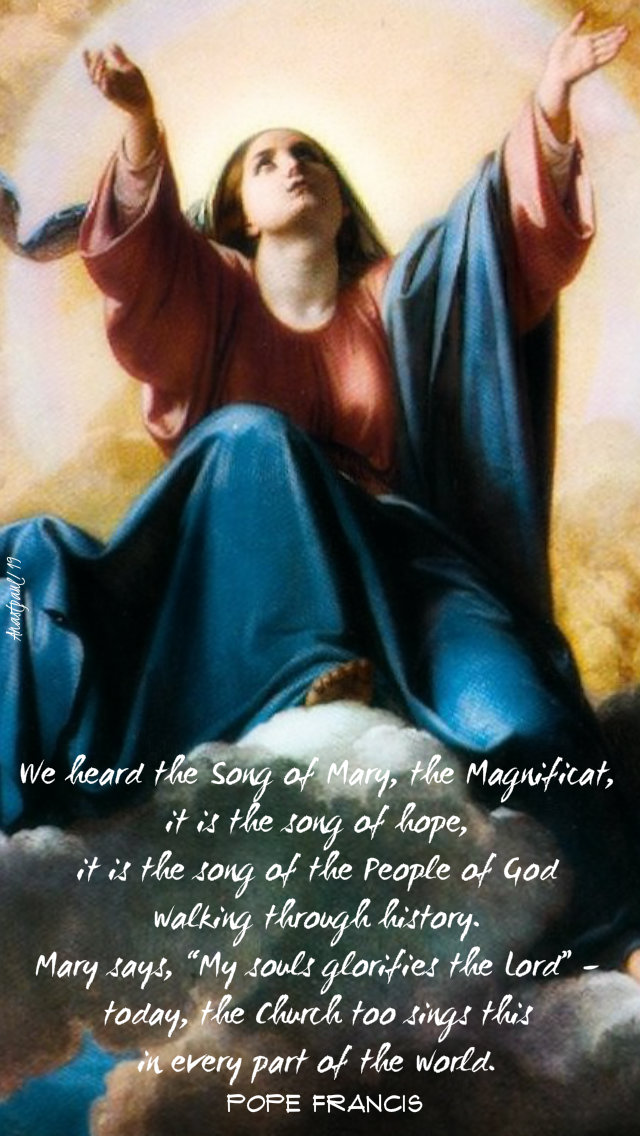
REFLECTION – “We heard the Song of Mary, the Magnificat – it is the song of hope, it is the song of the People of God walking through history. It is the song many saints, men and women, some famous and very many others unknown to us but known to God, mums, dads, catechists, missionaries, priests, sisters, young people, even children and grandparents – these have faced the struggle of life while carrying in their heart the hope of the little and the humble. Mary says, “My souls glorifies the Lord” – today, the Church too sings this in every part of the world.” … Pope Francis (Holy Mass on the Solemnity of the Assumption of the Blessed Virgin Mary, 15 August 2013)
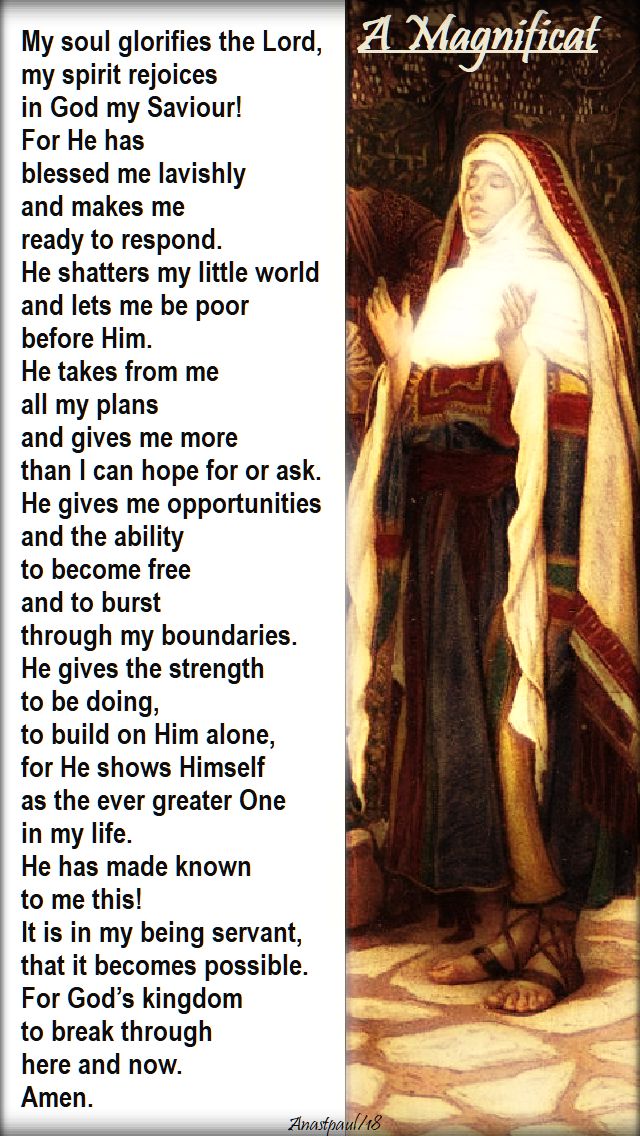
PRAYER – My soul glorifies the Lord,
my spirit rejoices in God my Saviour!
For He has blessed me lavishly
and makes me ready to respond.
He shatters my little world
and lets me be poor before Him.
He takes from me all my plans
and gives me more than I can hope for or ask.
He gives me opportunities
and the ability to become free
and to burst through my boundaries.
He gives the strength to be doing,
to build on Him alone,
for He shows Himself
as the ever greater One in my life.
He has made known to me this!
It is in my being servant that it becomes possible.
For God’s kingdom to break through
here and now.
Amen. A Magnificat Translated from the German by Olga Warnke of the Institute of the Blessed Virgin Mary
Our Morning Offering – 15 August – Solemnity of the Assumption of the Blessed Virgin Mary into Heaven
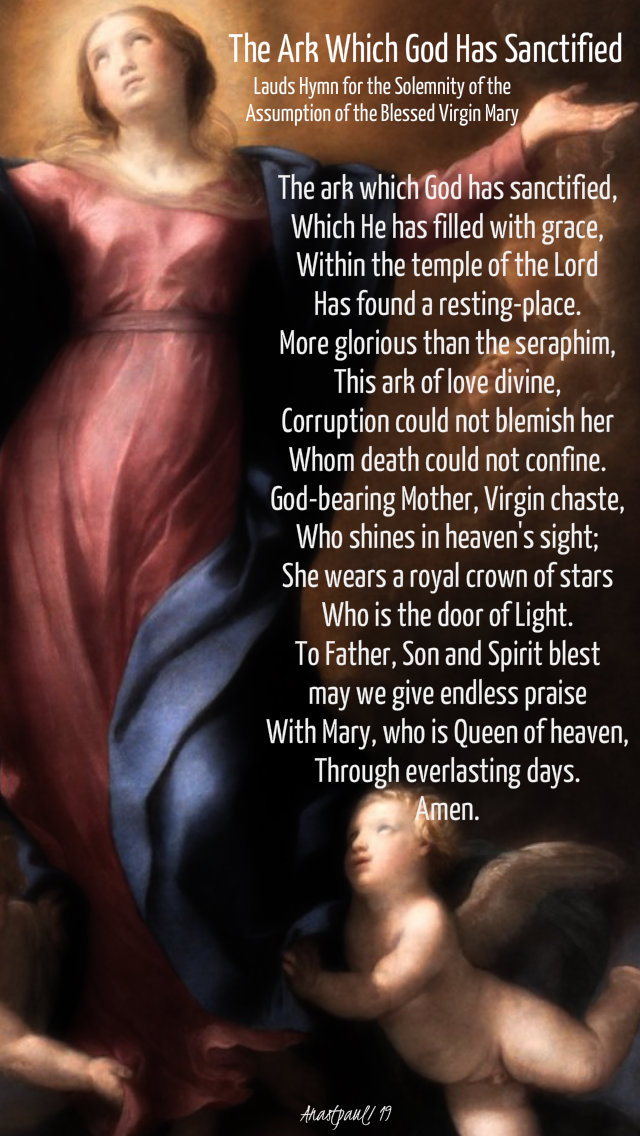
The Ark Which God Has Sanctified
The ark which God has sanctified,
Which He has filled with grace,
Within the temple of the Lord
Has found a resting-place.
More glorious than the seraphim,
This ark of love divine,
Corruption could not blemish her
Whom death could not confine.
God-bearing Mother, Virgin chaste,
Who shines in heaven’s sight;
She wears a royal crown of stars
Who is the door of Light.
To Father, Son and Spirit blest
may we give endless praise
With Mary, who is Queen of heaven,
Through everlasting days.
Amen.
The Ark Which God Has Sanctified is written by the Benedictine Nuns of Stanbrook Abbey. In the Divine Office (1974) it is sung with Morning Prayer on 15 August, the Solemnity of the Assumption of the Blessed Virgin Mary. It is set to the 1836 tune – St Peter (Reinagle) by Alexander Robert Reinagle (1799-1877).
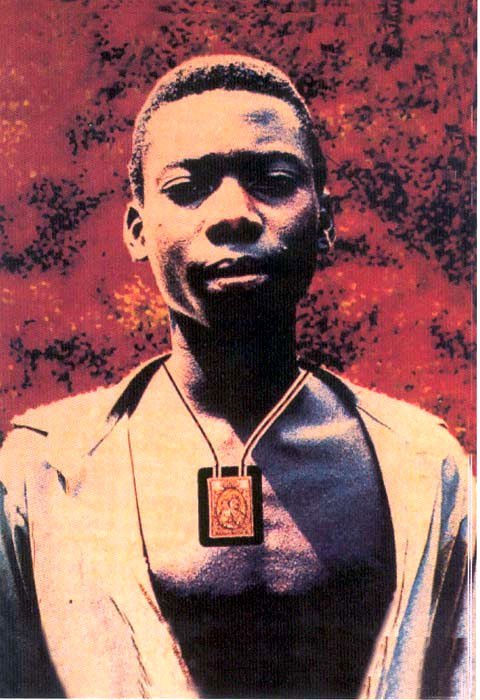
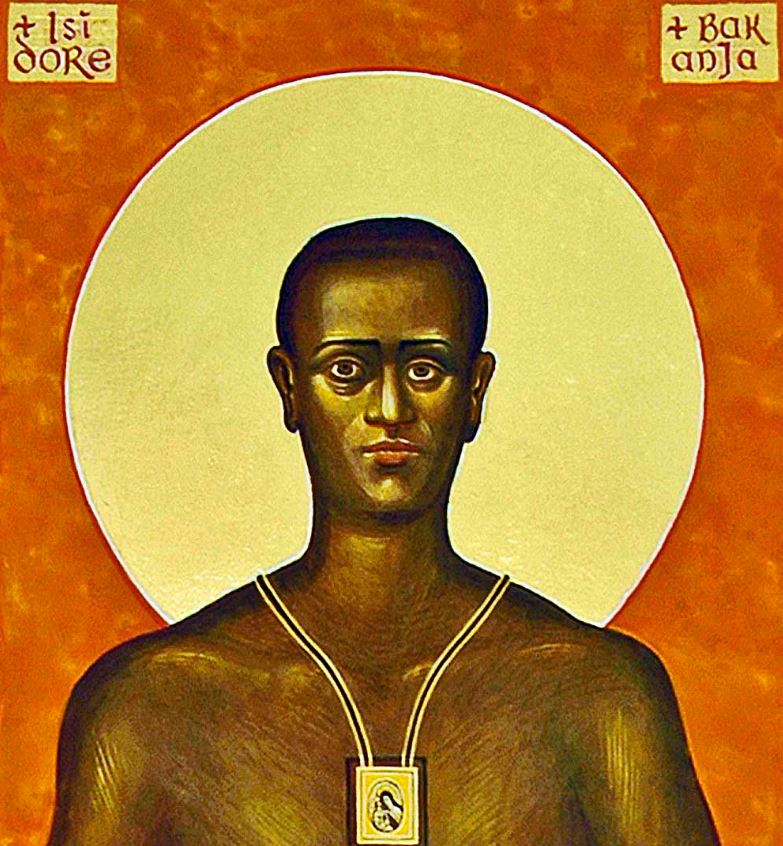
Saint of the Day – 15 August – Blessed Isidore Bakanja (c 1887-1909) Martyr, Layman, Evangelist, Marian devotee especially of the Holy Rosary and Our Lady of Mount Carmel. Born in c 1887 at northeast Republic of the Congo and died on 15 August 1909 in Busira, équateur, Democratic Republic of Congo.
Isidore Bakanja was born around 1887 in Bokendela in Belgian Congo and was evangelised by Belgian Trappist missionaries, receiving the Sacrament of Baptism at 18. He was a mild and honest young man who faithfully adhered to everything the missionaries taught him. He carried a Rosary with him wherever he went and always wore “Mary’s Habit” (the Brown Scapular) underneath his clothing.
He was zealous in his faith and shared it with whomever would listen. While he was not an official catechist, this did not stop his desire to spread the Gospel to all of creation.
He eventually left his village and moved to a larger city where there were more Catholics. Bakanja sought work from a Belgian company and quickly discovered that they hated Catholicism as much as they despised the native African people. He asked permission to go home and was immediately refused.
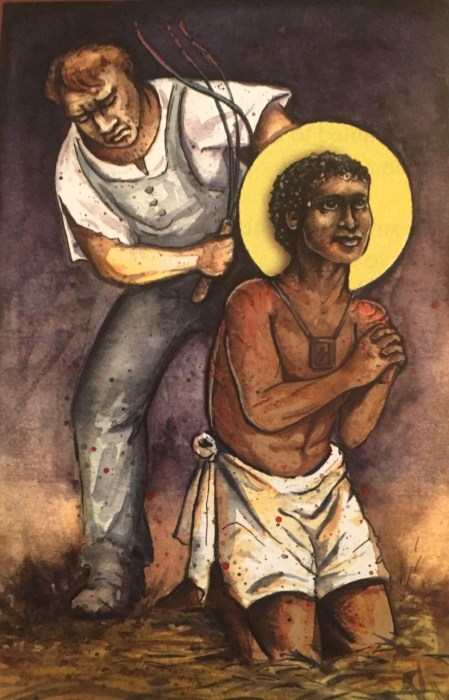
One of the agents especially did not like that Bakanja always tried to preach to his fellow workers. He said, “You’ll have the whole village praying and no one will want to work.” The agent demanded that Bakanja throw away his scapular and when he refused to do so, the agent had him flogged.
The agent flogged him not once but twice and during the second flogging used a whip with nails at the end of it. Bakanja received over 100 blows and it left him nearly dead. However, since an inspector was due to arrive the agent sent Bakanja away. He was barely able to walk and hid himself by the side of the road until he saw the inspector.
Horrified, the inspector later wrote about what he saw that day, “I saw a man come from the forest with his back torn apart by deep, festering, malodorous wounds, covered with filth, assaulted by flies.” The inspector prevented the agent from killing Bakanja but it was too late.
He survived for another six months but in total agony, praying each day and offering his suffering to God. Bakanja told the missionaries who came to give him the Last Rites that he already forgave his attacker, promising prayers for his soul, “Certainly I shall pray for him. When I am in heaven, I shall pray for him very much.”
He died on 15 August 1909 with a rosary in his hand and wearing the Brown Scapular.
St Pope John Paul II Beatified him on 24 April 1994 and during his Beatification homily, he said:
“In an Africa that is sorely tried by ethnic strife, your shining example is an encouragement to harmony and reconciliation among the children of the same heavenly Father. You showed brotherly love to all, without distinction of race or social class, you earned the esteem and respect of your companions, many of whom were not Christians. Thus you show us the necessary way of dialogue among men.”
Blessed Isidore, Martyr of the Holy Rosary and the Brown Scapular, Pray for Africa, pray for us all!
Solemnity of the Assumption of the Blessed Virgin Mary (in the US, however, in most countries of Africa, the Solemnity will celebrated on the Sunday following the 15th). The feast celebrates the assumption of the body of the Blessed Virgin Mary into heaven upon her death. According to Pope Benedict XIV, it is a probable opinion, which it is impious to deny, though not an article of faith but has since in 1950 has been raised to a DOGMA of the Faith. The origin of the feast day is not known but it was celebrated in Palestine before the year 500. It is a holy day of obligation, its vigil being a fast day, in many English-speaking countries. Among the many masters who have painted the subject of the Assumption are Fra Angelico, Ghirlandajo, Rubens, Del Sarto and Titian.
Patronages: Acadians, Cajuns, Cistercian Order, Cistercians, fish dealers, fish-mongers, French air crews, harness makers, France, Guatemala, India, Jamaica, Malta, Paraguay, Slovakia, east Africa (region of east Africa which includes diverse countries, proclaimed on 15 March 1952 by Pope Pius XII) South Africa (this is not a region but a country) and the Assumption is, therefore, the Patronal Feast of the Country of South Africa – proclaimed on 15 March 1952 by Pope Pius XII), 24 dioceses, 38 cities.
St Alipius of Tagaste
Bl Alfred of Hildesheim
Bl Agustín Hurtado Soler
St Arduinus of Rimini
Bl Claudio Granzotto
Bl George Halley Bl Isidore Bakanja (c 1887-1909) Martyr
St Napoleon of Alexandria
Bl Pio Alberto del Corona St Simplician (c 320-c 401) Bishop and Successor of St Ambrose (340-397) Doctor of the Church in the Archdiocese of Milan. Details of the life of St Simplician here:https://anastpaul.wordpress.com/2017/08/15/saint-of-the-day-15-august-st-simplician-of-milan/ St Tarcisius (3rd century) Martyr About St Tarcisius:
Martyrs of Nicomedia – 3 saints: Three Christians martyred together. No details survive but the names – Eutychian, Philip and Straton. They were martyred in Nicomedia, Bithynia (in modern Turkey).
Martyred in the Mexican Revolution: 4 Saints –
St David Roldán Lara
St Luis Batiz Sainz
St Manuel Moralez
St Salvador Lara Puente
Martyred in the Spanish Civil War: Thousands of people were murdered in the anti-Catholic persecutions of the Spanish Civil War from 1934 to 1939.
• Blessed Agustì Ibarra Angüela
• Blessed Carmelo Sastre y Sastre
• Blessed Clemente Vea Balaguer
• Blessed Francisco Míguez Fernández
• Blessed Ildefonso Alberto Flos
• Blessed Jaume Bonet Nadal
• Blessed Joan Ceró Cedó
• Blessed Josep Santonja Pinsach
• Blessed Juan Francisco Barahona Martín
• Blessed Juan Mesonero Huerta
• Blessed Luis Ros Ezcurra
• Blessed Manuel Formigo Giráldez
• Blessed Miguel Alberto Flos
• Blessed Sebastià Balcells Tonijuan
• Blessed Severiano Montes Fernández
Thought for the Day – 14 August – Memorial of Saint Maximilian Mary Kolbe OFM Conv (1894 -1941) “Martyr of Charity”
Apostolic Zeal for the Salvation and Sanctification of Souls
An excerpt from the Letters of Saint Maximilian Kolbe
“The burning zeal for God’s glory that motivates you fills my heart with joy. It is sad for us to see in our own time that indifferentism in its many forms is spreading like an epidemic not only among the laity but also among religious. But God is worthy of glory beyond measure and, therefore, it is of absolute and supreme importance, to seek that glory with all the power of our feeble resources. Since we are mere creatures we can never return to Him all that is His due.
The most resplendent manifestation of God’s glory is the salvation of souls, whom Christ redeemed by shedding His blood. To work for the salvation and sanctification of as many souls as possible, therefore, is the preeminent purpose of the apostolic life. Let me, then, say a few words that may show the way toward achieving God’s glory and the sanctification of many souls.
God, who is all-knowing and all-wise, knows best what we should do to increase His glory. Through hHs representatives on earth, He continually reveals His will to us, thus it is obedience and obedience alone, that is the sure sign to us of the divine will. A superior may, it is true, make a mistake but it is impossible for us to be mistaken in obeying a superior’s command. The only exception to this rule is the case of a superior commanding something, that in even the slightest way, would contravene God’s law. Such a superior would not be conveying God’s will.
God alone is infinitely wise, holy, merciful, our Lord, Creator and Father; He is beginning and end, wisdom and power and love, He is all. Everything other than God, has value to the degree, that it is referred to Him, the maker of all and our own redeemer, the final end of all things. It is He who, declaring His adorable will to us through His representatives on earth, draws us to Himself and whose plan is, to draw others to Himself through us and to join us all to Himself in an ever-deepening love.
Look, then, at the high dignity that by God’s mercy belongs to our state in life. Obedience raises us beyond the limits of our littleness and puts us in harmony with God’s will. In boundless wisdom and care, His will guides us to act rightly. Holding fast to that will, which no creature can thwart, we are filled with unsurpassable strength.
Obedience is the one and the only way of wisdom and prudence, for us to offer glory to God . If there were another, Christ would certainly have shown it to us by word and example. Scripture, however, summed up His entire life at Nazareth in the words: He was subject to them, Scripture set obedience as the theme of the rest of His life, repeatedly declaring that He came into the world, to do His Father’s will.
Let us love our loving Father with all our hearts. Let our obedience increase that love, above all, when it requires us to surrender our own will. Jesus Christ crucified is our sublime guide toward growth in God’s love.
We will learn this lesson more quickly through the Immaculate Virgin, whom God has made the dispenser of His mercy. It is beyond all doubt, that Mary’s will represents to us, the will of God Himself. By dedicating ourselves to her, we become in her hands, instruments of God’s mercy even as she was such an instrument in God’s hands. We should let ourselves be guided and led by Mary and rest quiet and secure in her hands. She will watch out for us, provide for us, answer our needs of body and spirit, she will dissolve all our difficulties and worries.”
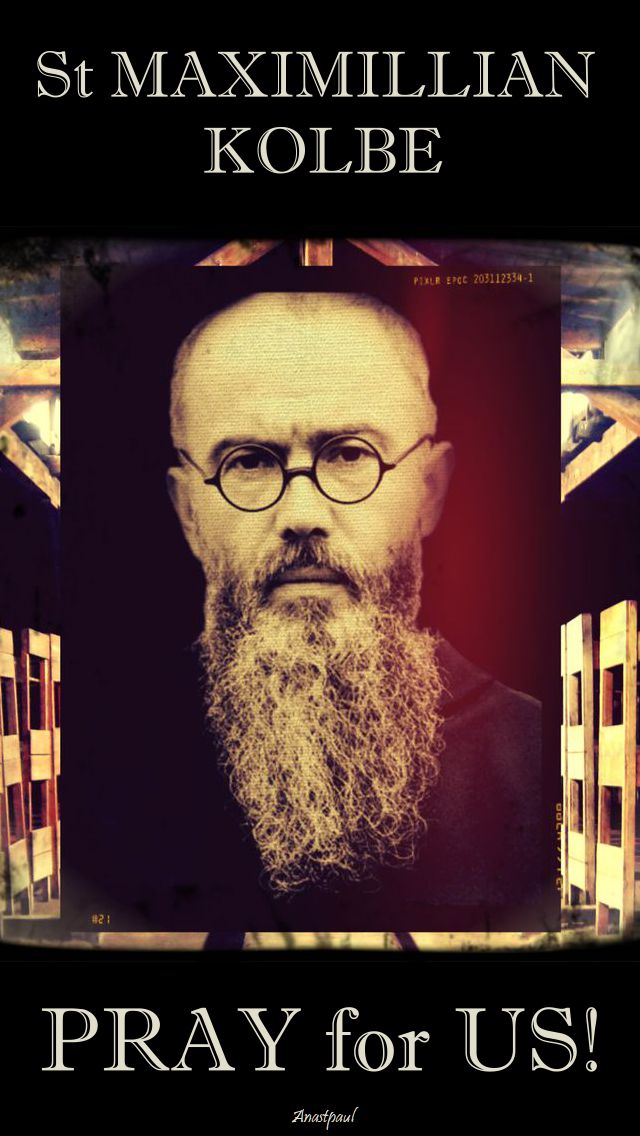
Quote/s of the Day – 14 August – The Memorial of St Maximillian Kolbe OFM Conv (1894 -1941) “Martyr of Charity”
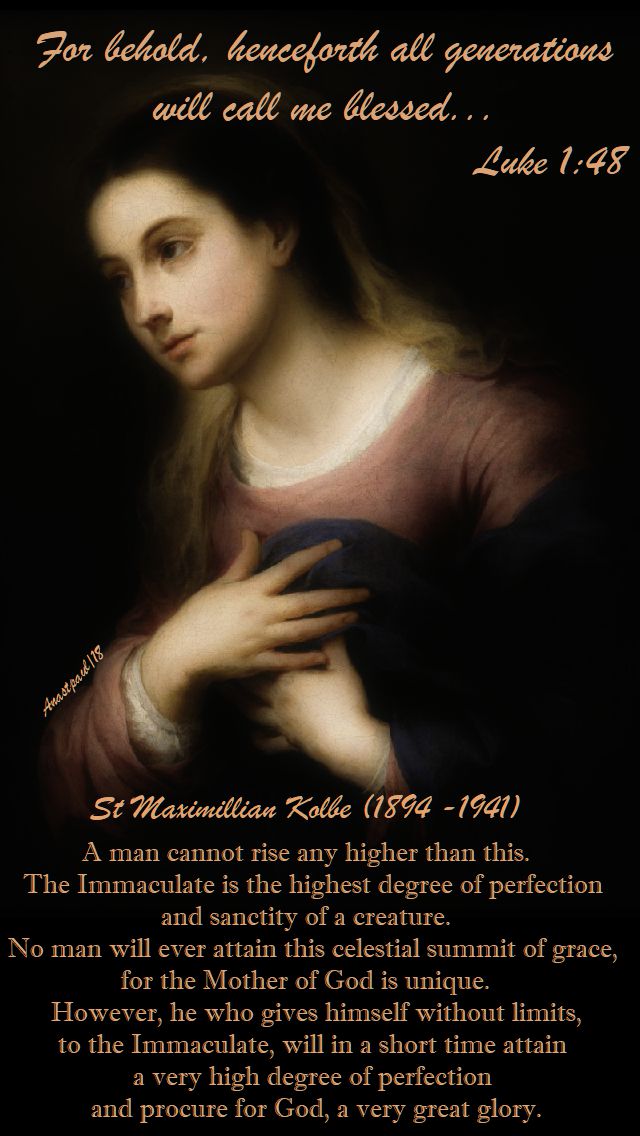
“A man cannot rise any higher than this. The Immaculate is the highest degree of perfection and sanctity of a creature. No man will ever attain this celestial summit of grace, for the Mother of God is unique. However, he who gives himself without limits, to the Immaculate, will in a short time, attain a very high degree of perfection and procure for God, a very great glory.”
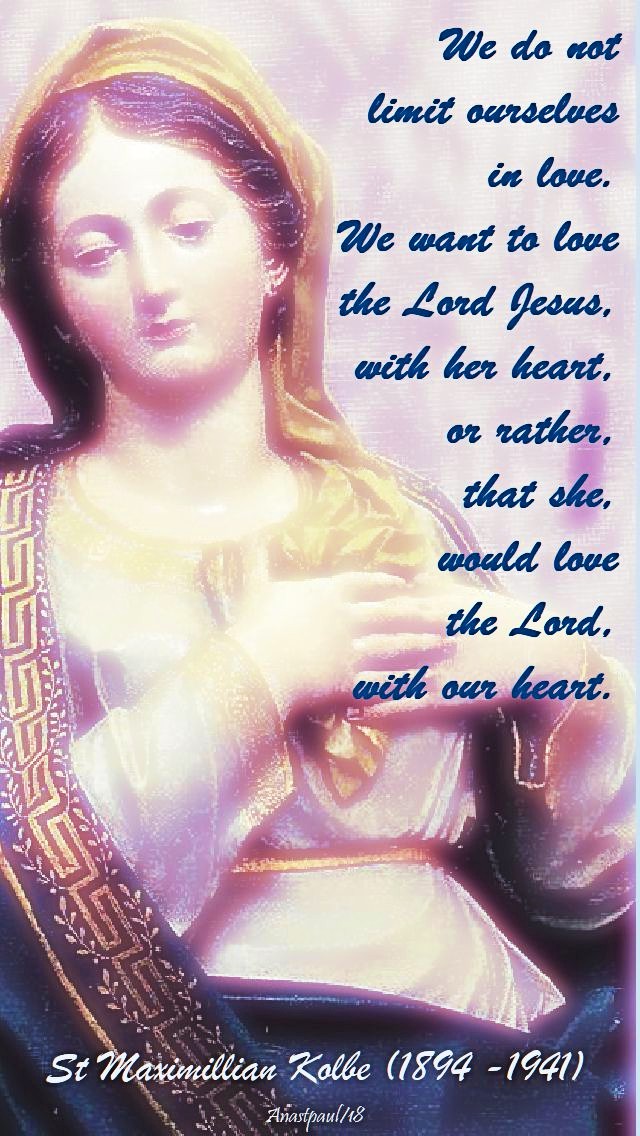
“We do not limit ourselves in love. We want to love the Lord Jesus, with her heart, or rather, that she would love the Lord, with our heart.”
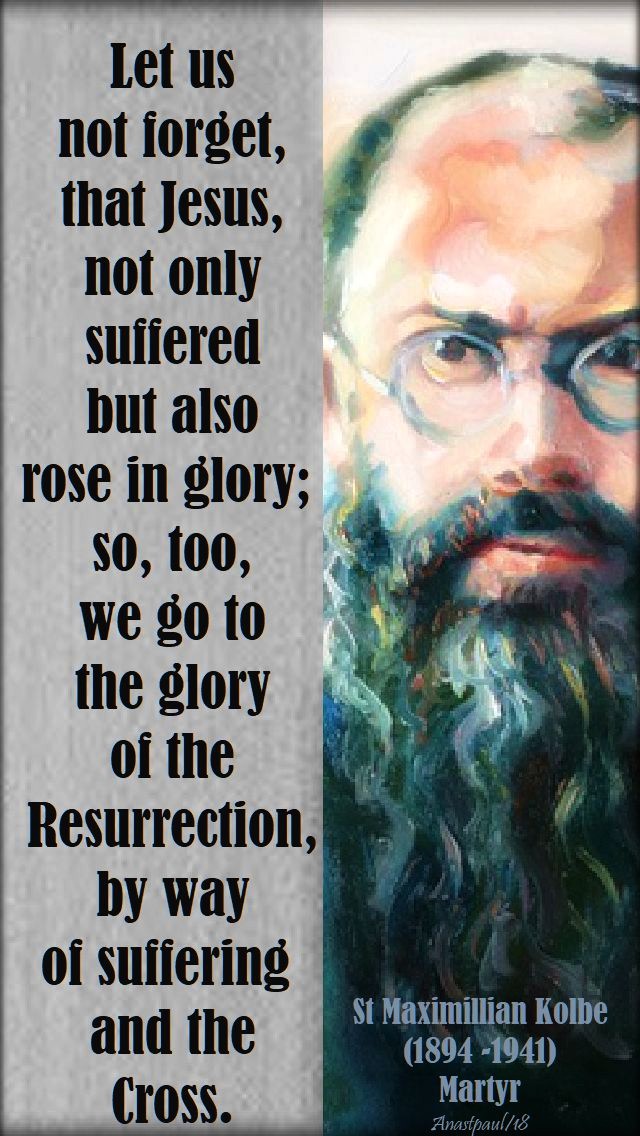
“Let us not forget, that Jesus not only suffered but also rose in glory; so, too, we go to the glory of the Resurrection, by way of suffering and the Cross.”
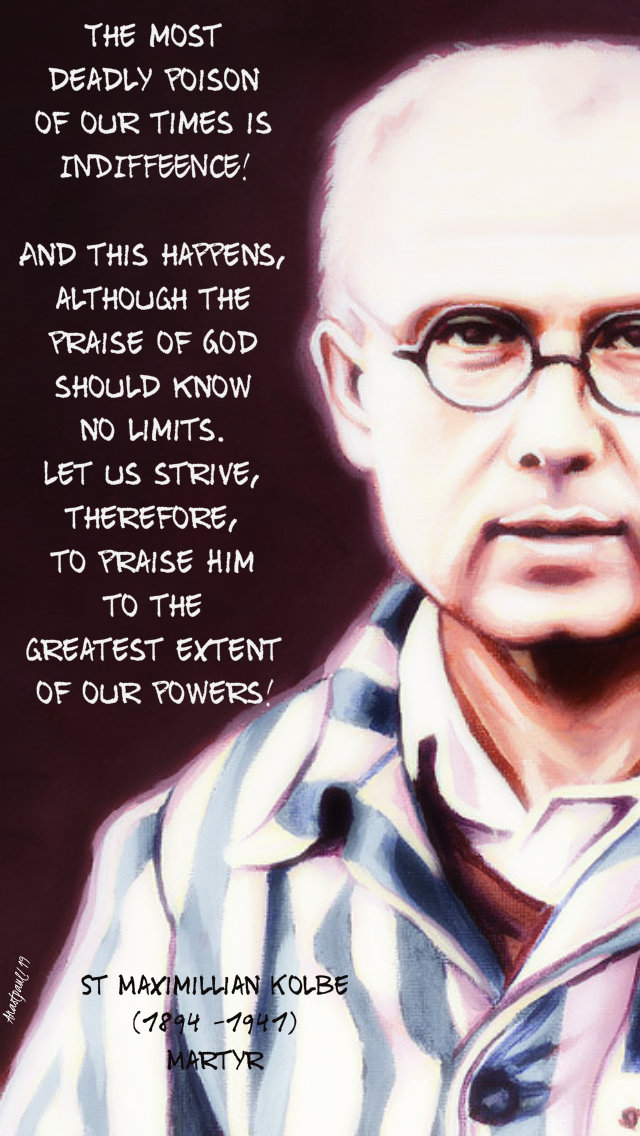
“The most deadly poison of our times is indifference. And this happens, although the praise of God should know no limits. Let us strive, therefore, to praise Him to the greatest extent of our powers!”
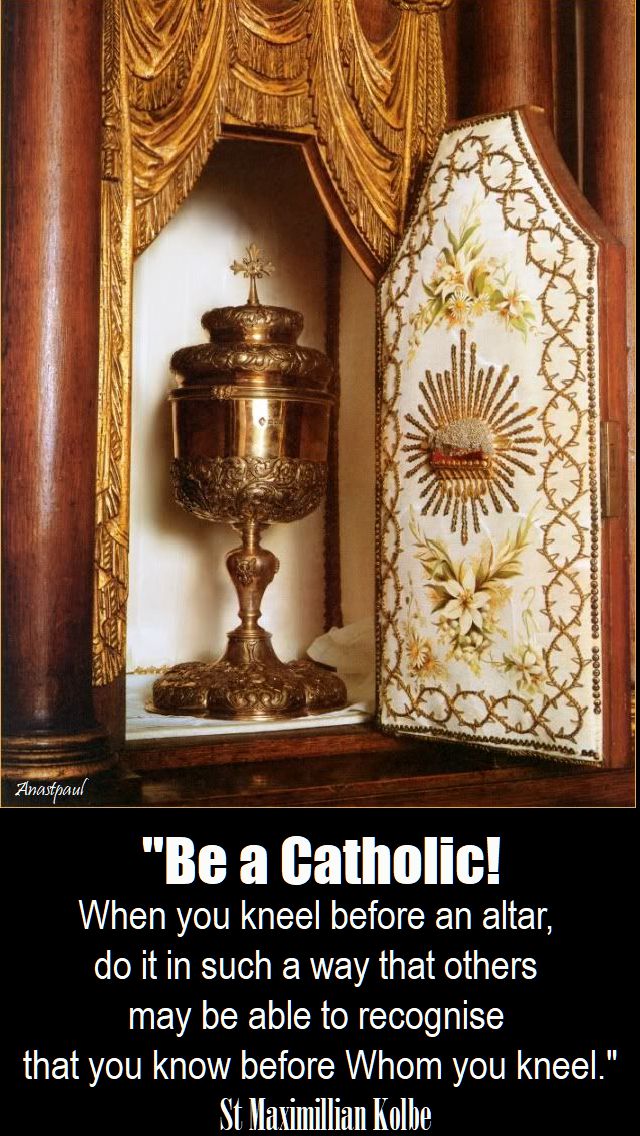
“Be a Catholic! When you kneel before an altar, do it in such a way that others may be able to recognise that you know before Whom you kneel.”
One Minute Reflection – 14 August – Wednesday of the Nineteenth week in Ordinary Time Year C, Gospel: Matthew 18:15–20 and the Memorial of St Maximillian Kolbe OFM Conv (1894 -1941) “Martyr of Charity”
“For where two or three are gathered in my name, there am I in the midst of them.” … Matthew 18:20
REFLECTION – “The Lord said: “If two of you agree on earth about anything for which they are to pray, it shall be granted to them by my heavenly Father. For where two or three are gathered together in my name, there am I in the midst of them.”
These words prove that much is given not to the mere number but to the unanimity of those who pray. “If two of you agree on earth,” He says, putting unanimity and peaceful concord first, teaching us to agree firmly and loyally. But how can one man agree with another when he disagrees with the body of the Church itself, with the whole brotherhood?… The Lord’s words were spoken about His own Church and addressed to members of the Church. If they are agreed, if, as He commanded but two or three are gathered together and pray with one mind, then, although they are but two or three, they can obtain from the divine majesty what they ask.
“Where two or three are gathered, I (he said) am with them.” That means, of course, with the single-hearted and peaceable, with those who fear God and keep His command-ments. With these, though but two or three, He declared His presence, as He was present also with the Three Children in the fiery furnace and, because they continued single-hearted and of one mind, refreshed them with the breath of dew as the flames surrounded them (Dn 3,50); or as He was present with the two apostles in prison, because they were single-hearted and of one mind and Himself opened the prison gates (Acts 25,25)… So when Christ lays down with authority: “Where two or three are gathered, I am with them,” He is not separating men from the Church which He founded and created. But He rebukes the faithless for their discord and with His own voice commends peace to the faithful.” … Saint Cyprian of Carthage, (c 200- c 258) Bishop and Martyr, Father of the Church – On the Unity of the Church
PRAYER – My Lord and my God, You who are the fruit of Mary’s blessed womb and the most Divine Son of our Father, grant that we may always have recourse to You, through her who bore You and through Your Holy Church. Grant that she may help and comfort us me and lead us to You. Mary, Holy and loving Mother of God, pray for us all. Grant O Lord, that through the intercession of St Maximillian, we may entrust ourselves to You through Your and our blessed Mother, amen.
Our Morning Offering – 14 August – The Memorial of St Maximillian Kolbe OFM Conv (1894 -1941) “Martyr of Charity”
Daily Consecration Renewal to the Immaculata By St Maximillian Kolbe
Immaculata,
Queen and Mother of the Church,
I renew my consecration to you for this day
and for always, so that you might use me
for the coming of the Kingdom of Jesus
in the whole world.
To this end, I offer you all my prayers,
actions and sacrifices of this day.
Amen
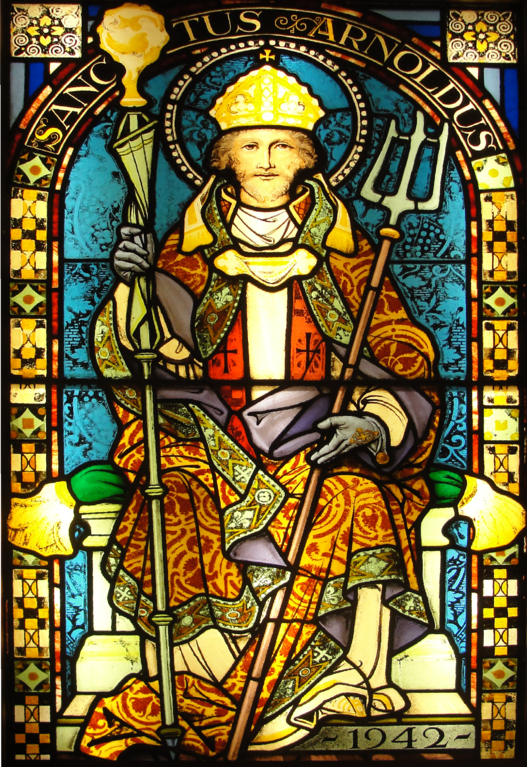
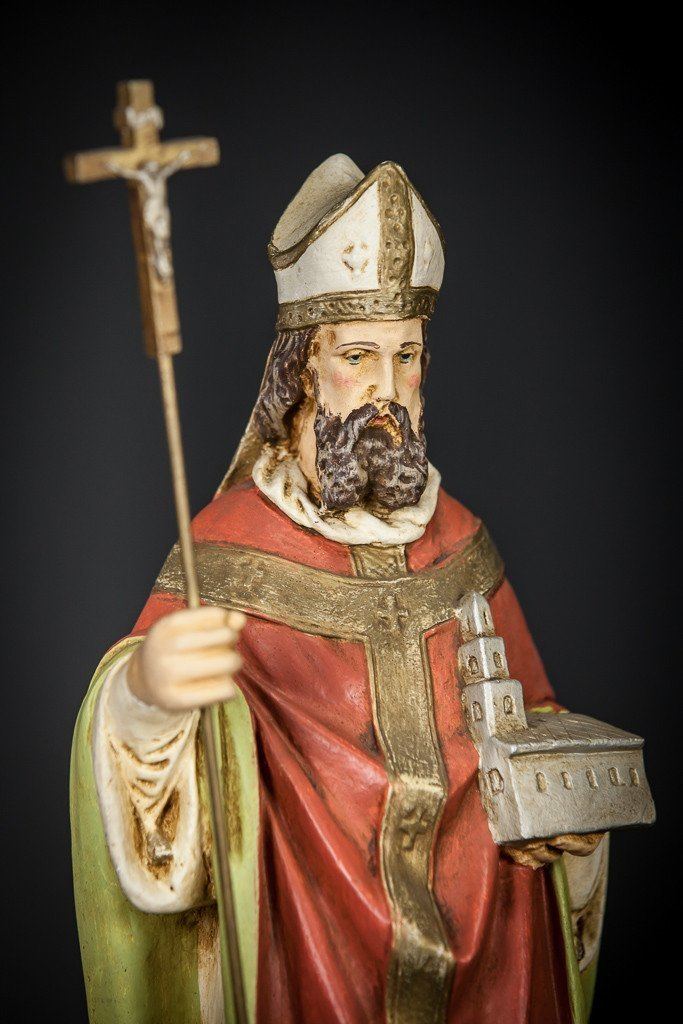
Saint of the Day – 14 August – Saint Arnold of Soissons (1040-1087) Bishop, Monk, Abbot- born Arnoul in 1040 at Flanders, Belgium and died in 1087 at the monastery at Oudenburg, diocese of Bruges, Flanders, Belgium of natural causes. Also known as Arnulf of Oudenburg. Patronages – brewers, hop pickers, miller, music, to find lost articles.
St Arnold, born in Brabant, the son of a certain Fulbertus was first a career soldier before settling at the Benedictine St Medard’s Abbey, Soissons, France. He spent his first three years as a hermit but later rose to be abbot of the monastery. His hagiography states that he tried to refuse this honour and flee but was forced by a wolf to return. He then became a priest and in 1080, Bishop of Soissons, another honour that he sought to avoid. When his see was occupied by another bishop, rather than fighting, he took the opportunity to retire from public life, founding the Abbey of St Peter in Oudenburg.
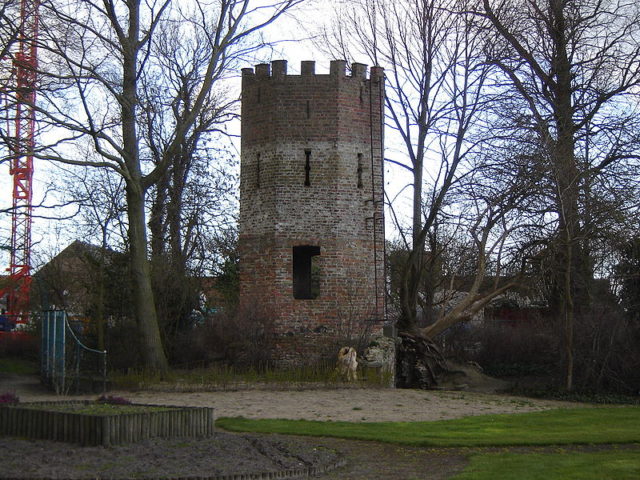
Ruins of the Abbey in Oudenburg.
As abbot in Oudenburg, Arnold brewed beer, as essential in medieval life as water. He encouraged local peasants to drink beer, instead of water, due to its “gift of health.” During the process of brewing, the water was boiled and thus, unknown to all, freed of pathogens, making the beer safer to drink. The beer normally consumed at breakfast and during the day at this time in Europe was called small beer, having a very low alcohol content and containing spent yeast. It is likely that people in the local area normally consumed small beer from the monastery, or made their own small beer at the instructions of Arnold and his fellow monks. During one outbreak of sickness, Arnold advised the local people to avoid consuming water, in favour of beer, which advice effectively saved lives.
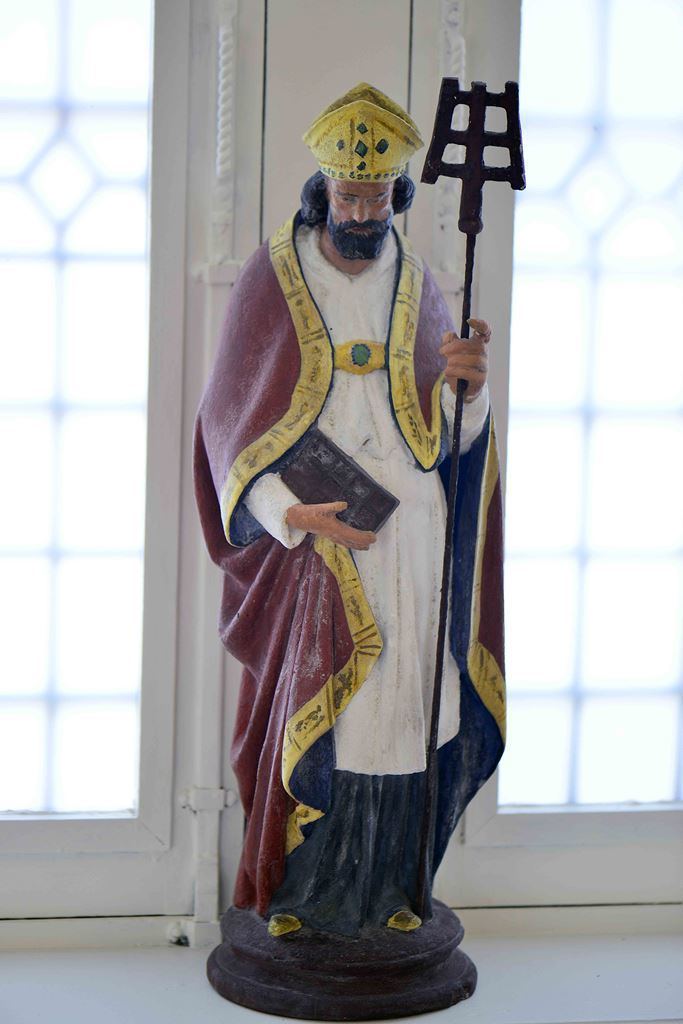
One miracle tale says, at the time of an epidemic, rather than stand by while the local people fell ill from drinking water, Arnold had them consume his monastery brews. Because of this, many people in his church survived the plague. The same happened with the outbreak of cholera, only this time, the epidemic was all around Belgium and Europe except in Oudenburg. Nobody in the town got sick. There are many depictions of St Arnold with a mashing rake in his hand, to identify him. He is honoured in July with a parade in Brussels on the “Day of Beer.”
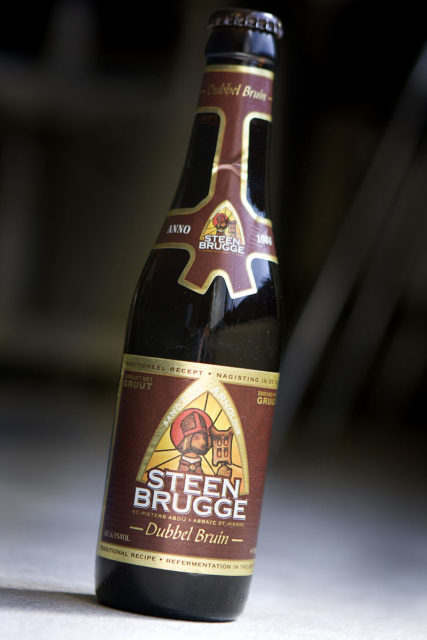
Steenbrugge Dubbel Bruin with the picture St Arnulf
Miracles that were reported at his tomb were investigated and approved by a council at Beauvais in 1121. St Arnold’s relics were translated to the church of Saint Peter, Oudenburg in 1131.
Bl Aimo Taparelli
St Antony Primaldo St Arnold/Arnulf of Soissons (1040-1087)
St Athanasia of Timia
St Callistus of Todi
St Demetrius of Africa
St Domingo Ibáñez de Erquicia
St Eberhard of Einsiedeln
St Eusebius of Palestine
St Eusebius of Rome
St Fachanan of Ross
St Francisco Shoyemon
Bl Juliana Puricelli
St Marcellus of Apamea
Bl Sanctes Brancasino
St Ursicius of Nicomedia
St Werenfridus
__
Martyred in the Spanish Civil War: 11 Beati
• Blessed Ángel de la Red Pérez
• Blessed Antonio María Martín Povea
• Blessed Basilio González Herrero
• Blessed Ezequiél Prieto Otero
• Blessed Joaquín Frade Eiras
• Blessed Jocund Bonet Mercadé
• Blessed José García Librán
• Blessed Ricardo Atanes Castro
• Blessed Segundo Pérez Arias
• Blessed Vicente Rubiols Castelló
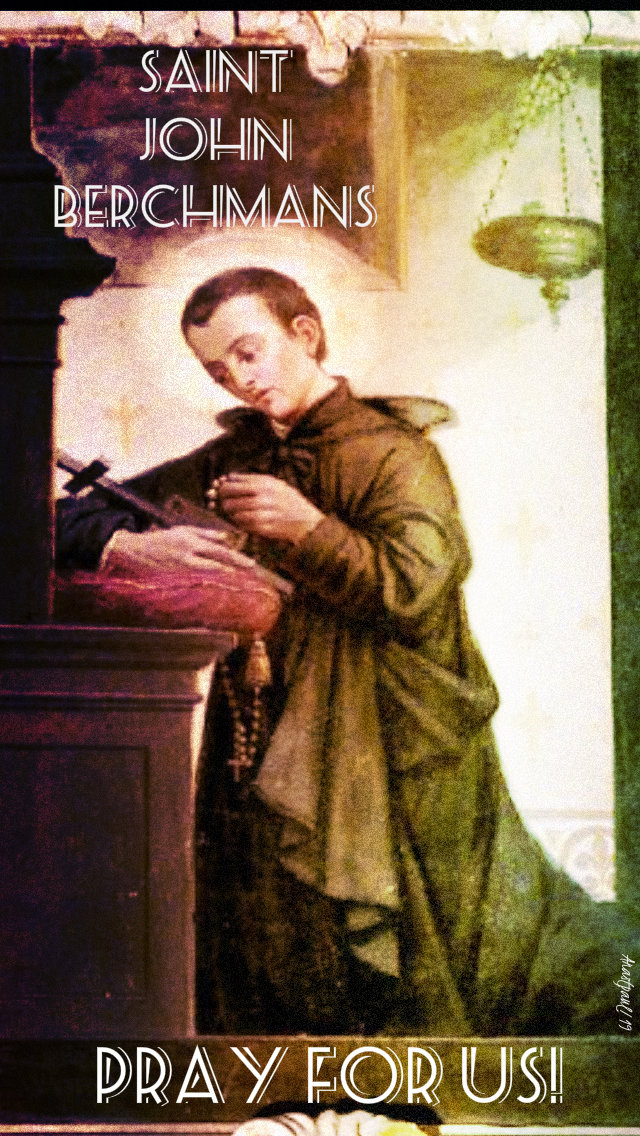
Thought for the Day – 13 August – Tuesday of the Nineteenth week in Ordinary Time, Year C and the Memorial of St John Berchmans SJ (1599-1621)
The fierce, passionate “muscular” Christianity of John Berchmans seems unreal, even horrifying to many of today’s Catholics brought up on soft-focus posters, self-affirming books and the belief that Christian love means primarily kindness – but let us not be deceived. It seems we have 3 ‘handles’ ‘don’t judge’, God is love and God is merciful – He will understand. All true but it doesn’t leave us free to live, as if we have no responsibility and no commandments and rules, which we MUST obey to gather those amazing graces of God’s love and mercy and judgement. We need to walk the narrow road, preferably barefoot, to excel in holiness and fulfil our mission, ‘to love God, to serve God and to live with Him forever in heaven.’ Holy Mother Church guides and leads us and best of all, our Lord Jesus Christ walks with us, before us, behind us, in us and He is barefoot too!
The seventeenth century was a cruel time all round, with no punches pulled and no anaesthetics. But Catholics, like John, had the hardest feet imaginable and besides fortitude (“guts”) and self-sacrifice, they excelled in virtues that the 21st century West ignores or treats almost as a joke, such as humble obedience, temperance, diligence and chastity.
Hence St John’s value to us as a guide today lies in his youthful, clear vision in areas where our own times have gaping blind spots.
Let us go forward, barefoot and become the Saints we are called to be!
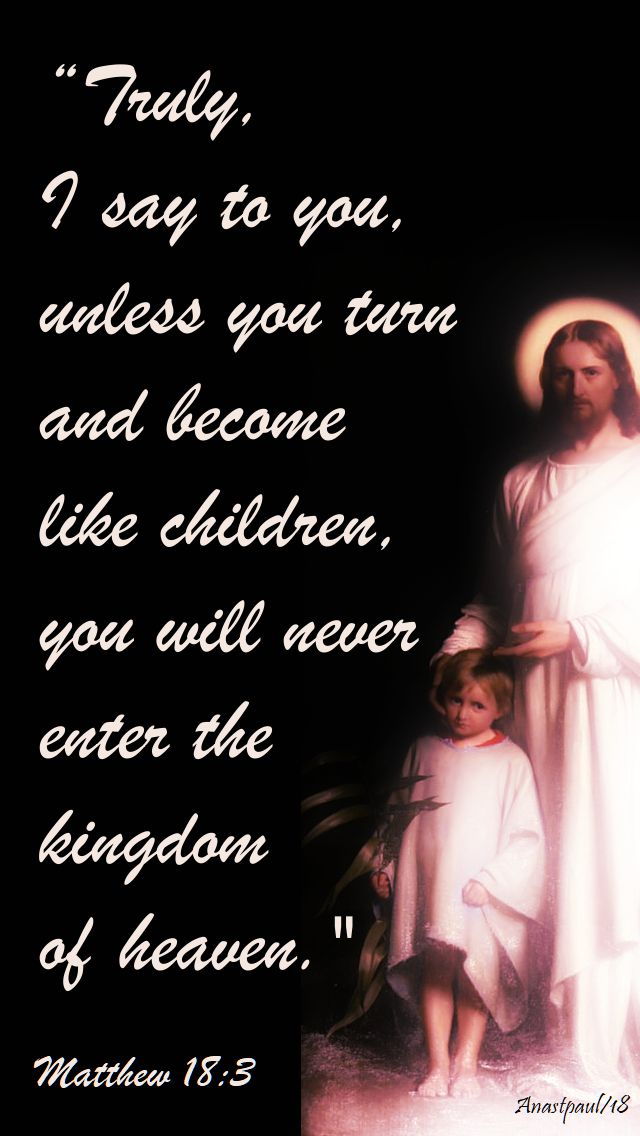
One Minute Reflection – 13 August – Tuesday of the Nineteenth week in Ordinary Time, Year C, Gospel: Matthew 18:1-5, 10, 12-14 and the Memorial of St John Berchmans SJ (1599-1621)
“Truly, I say to you, unless you turn and become like children, you will never enter the kingdom of heaven.”…Matthew 18:3
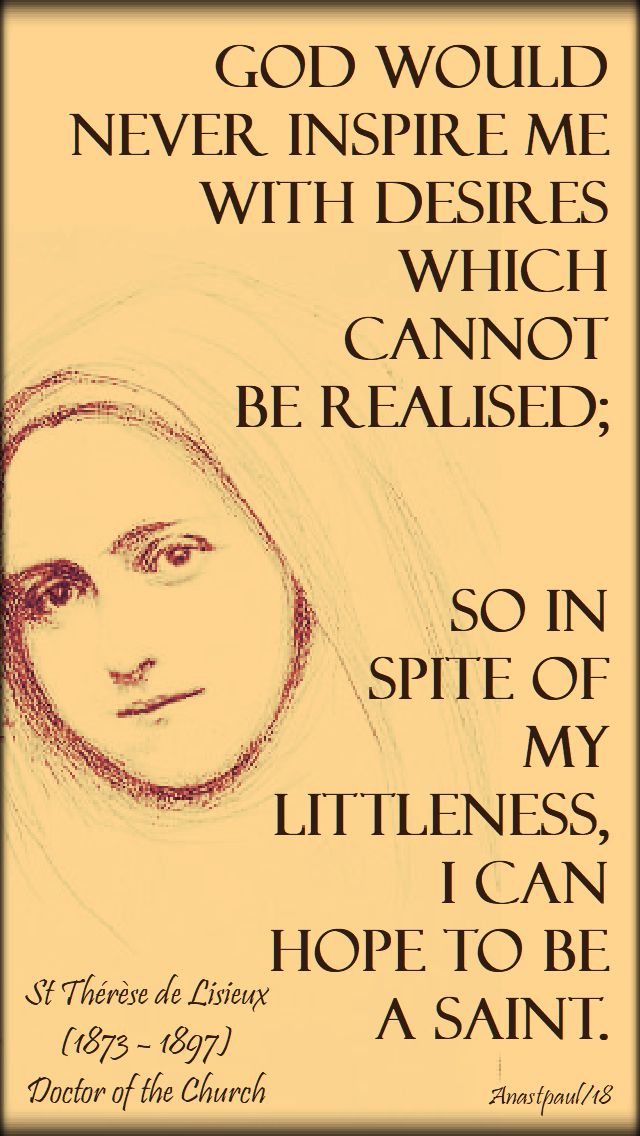
REFLECTION – “God would never inspire me with desires which cannot be realised, so in spite of my littleness, I can hope to be a saint.”…St Thérèse de Lisieux (1873-1897) Doctor of the Church
PRAYER – God, our Father, Your promised Your Kingdom to the little ones and the humble of heart. Let us ask St John Berchmans to give us some of his great attention to the little things in life being so important in the eyes of God. Lord God, grant us grace to walk confidently in the way of St John Berchmans, so that helped by his prayers, we may see Your eternal glory. Through Christ our Lord, in the unity of the Holy Spirit, one God forever, amen.
Our Morning Offering – 13 August – Tuesday of the Nineteenth week in Ordinary Time, Year C and the Memorial of St John Berchmans (1599-1621)
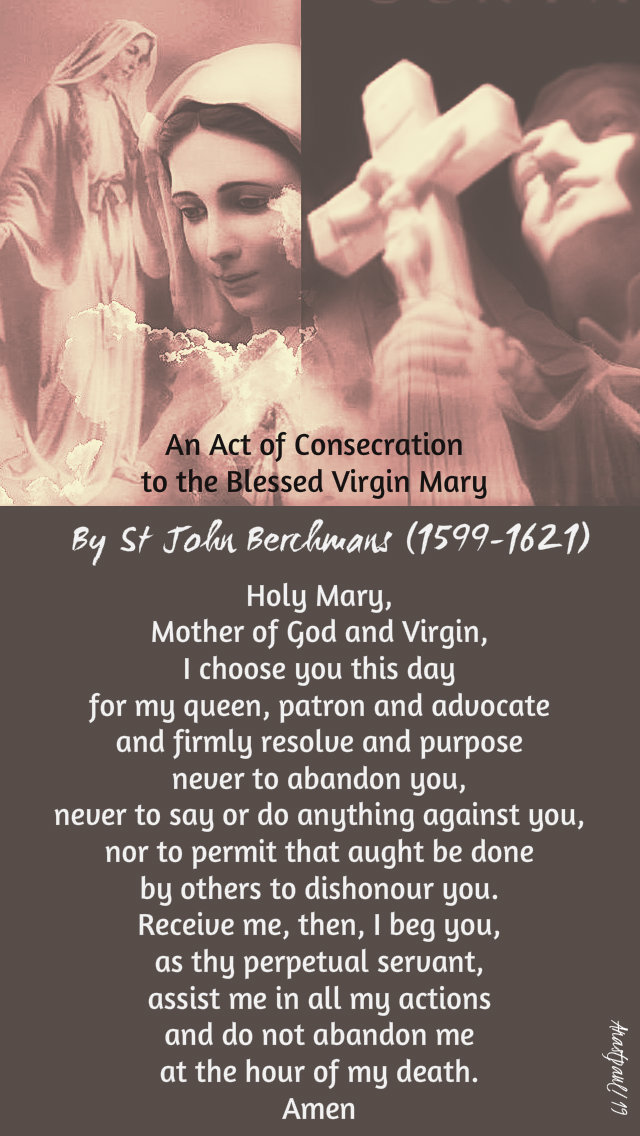
An Act of Consecration to the Blessed Virgin Mary By St John Berchmans (1599-1621)
Holy Mary,
Mother of God and Virgin,
I choose you this day
for my queen, patron and advocate
and firmly resolve and purpose
never to abandon you,
never to say or do anything against you,
nor to permit that aught be done
by others to dishonour you.
Receive me, then, I beg you,
as thy perpetual servant,
assist me in all my actions
and do not abandon me
at the hour of my death.
Amen
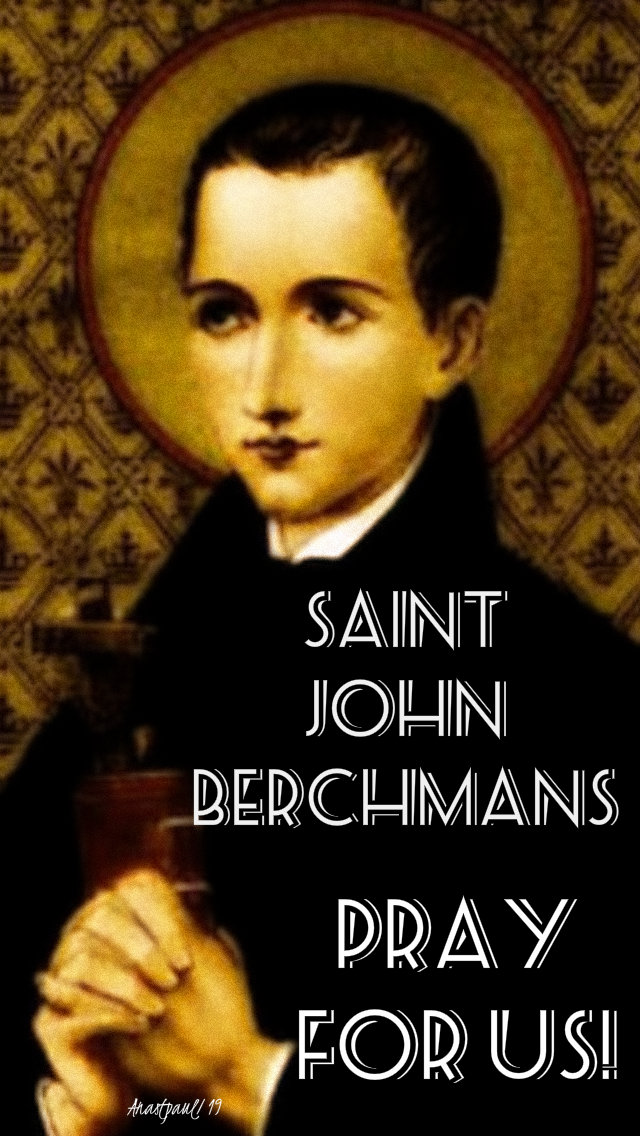
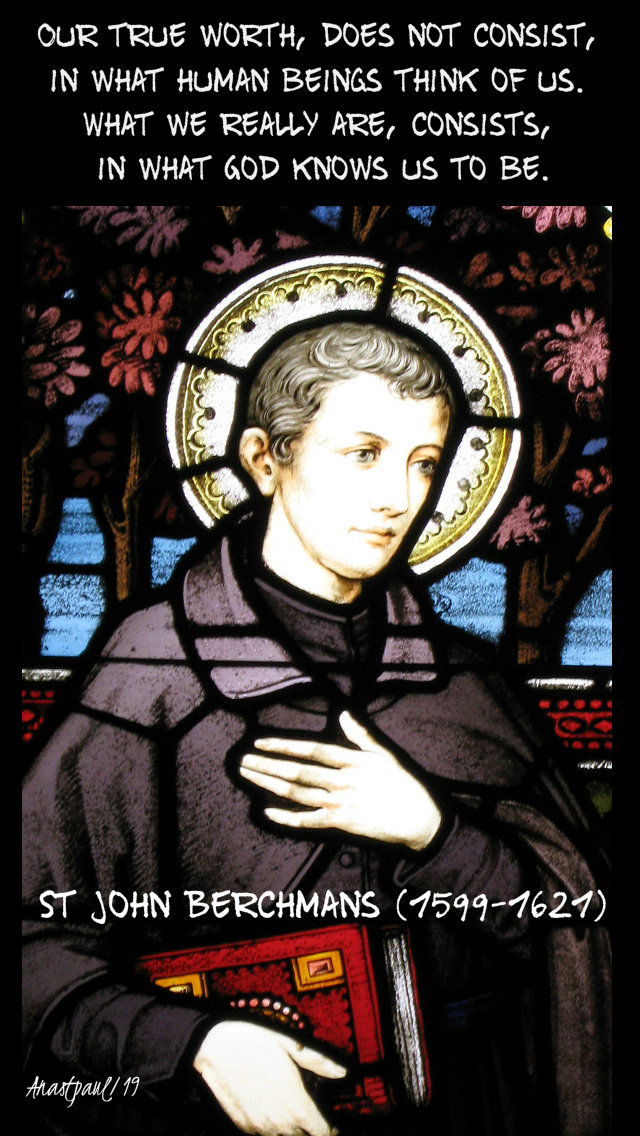
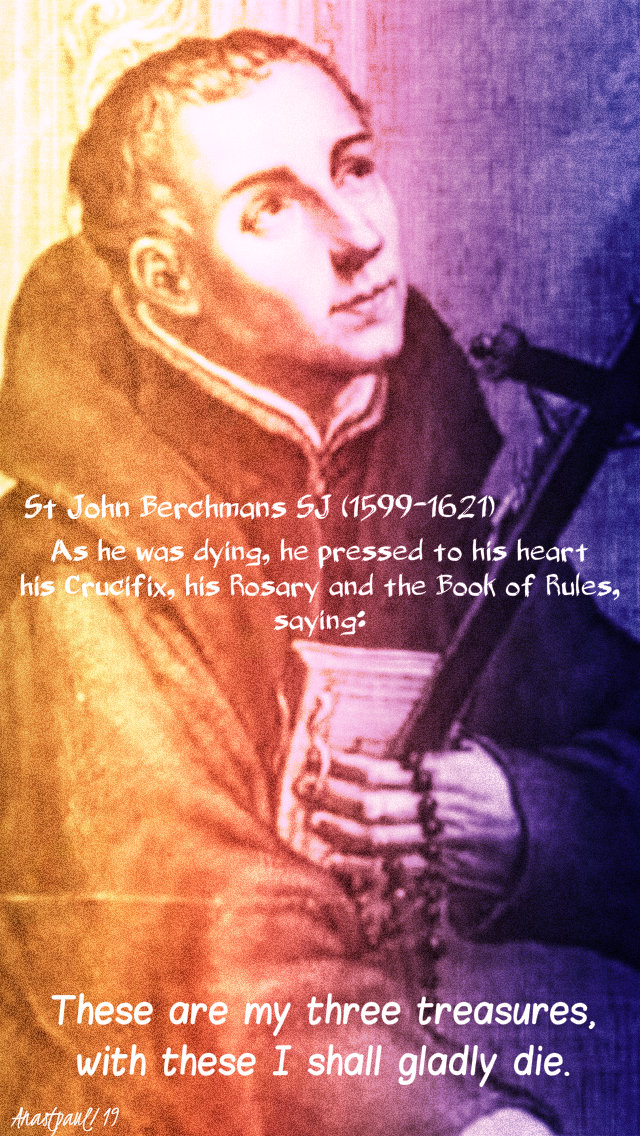
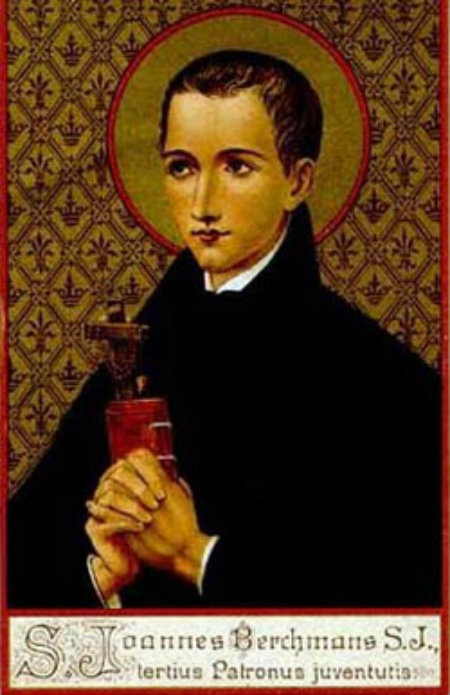
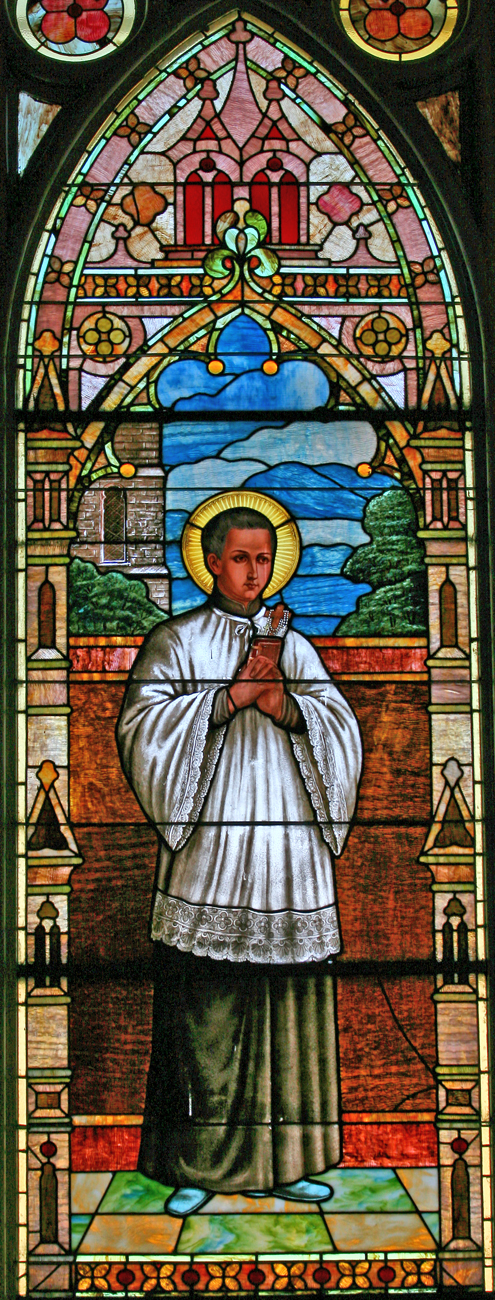
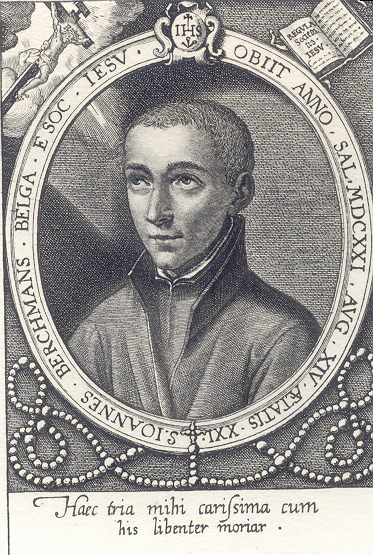
Saint of the Day – 13 August – Saint John Berchmans SJ (1599-1621) Jesuit Novice – born Jan Berchmans on 13 March 1599 at Driest, Brabant, Belgium and died on 13 August 1621 at Rome, Italy of natural causes. Patronages – Altar Servers, Jesuit novices and students. He had a special devotion to God’s Mother and to him is owed the Little Rosary of the Immaculate Conception.
Born in 1599 in Diest, a town of northern Belgium near Brussels and Louvain, this angelic young Saint was the oldest of five children. Two of his three brothers became priests and his father, after the death of John’s mother when he was eleven years old, entered religion and became a Canon of Saint Sulpice.
John was a brilliant student from his most tender years, manifesting also a piety which far exceeded the ordinary. Beginning at the age of seven, he studied for three years at the local communal school with an excellent professor. And then his father, wanting to protect the sacerdotal vocation already evident in his son, confided him to a Canon of Diest who lodged students aspiring to the ecclesiastical vocation. After three years in that residence, the family’s financial situation had declined owing to the long illness of the mother and John was told he would have to return and learn a trade. He pleaded to be allowed to continue his studies. And his aunts, who were nuns, found a solution through their chaplain, he proposed to take John into his service and lodge him.
Saint John was ordinarily first in his classes at the large school, a sort of minor seminary, even when he had to double his efforts in order to rejoin his fellow students, all of excellent talent, who sometimes had preceded him for a year or more in an assigned discipline. He often questioned his Superiors as to what was the most perfect thing to say or do in the various circumstances in which he found himself. Such was the humility which caused the young to advance without ceasing on the road to heaven. Later he continued his studies at Malines, also not distant from Diest, under the tutelage of another ecclesiastic, who assigned to him the supervision of three young boys of a noble family. In all that John did he sought perfection and he never encountered anything but the highest favour for his services, wherever he was placed.
He found his vocation through his acquaintance with the Jesuits of that city and manifested his determination to pursue his course, although his father and family opposed it for a time. It had been decided that he would continue his studies at the Jesuit novitiate of Malines, with about 70 other novices. With another young aspirant, he was waiting in the parlour to be introduced, when he saw in the garden a coadjutor Brother turning over the ground in the garden. He proposed to his companion to go and help him, saying: Could we begin our religious life better than with an act of humility and charity? And with no hesitation, both went to offer their assistance. How many young persons in that situation would have thought of such an offer? This incident reveals the profound charity and interior peace which characterised this young religious at all times.
As a novice he taught catechism to the children in the regions around Malines. He made his instructions so lively and interesting that the country folk preferred his lessons to the ordinary sermons. The children became attached to him and in a troop would conduct him back to the novitiate, where he distributed holy pictures, medals and rosaries to them. At the end of his novitiate in 1619 he was destined to go to Rome to begin serious application to philosophy but his superiors decided to send him home for a few days first. A shock awaited him at the train station of Malines, where he was expecting to meet his father, he had died a week earlier. John was given time to take the dispositions necessary to provide for the younger brothers and sister. When he departed, it was apparently with a premonition that he would perhaps never see them again, for he said in a letter to the Canon of Diest with whom he had dwelt, to tell the younger ones for him – “Increase in piety, in fear of God and in knowledge. Adieu.”
With a fellow novice he began the two months’ journey on foot to Rome, by way of Paris, Lyons and Loreto, where the two assisted at the Christmas Midnight Mass. Both of these two young Jesuits would die within three years’ time, his companion in a matter of several months. John had time during these three years to give unceasing proofs of his already perfected sanctity, nothing that he did was left to chance but entrusted to the intercession of his Heavenly Mother, to whom his devotion continued to increase day by day.
He made an extraordinary effort during an intense heat wave in the summer of 1621, participating splendidly in a debate, which took place at a certain distance from the Jesuit residence, despite the fact he did not feel well. Two days later he was felled by a fever, which continued implacably to mine his already slight resistance, and he died in August of that year, after one week of illness. The story of his last days is touching indeed, in a residence of several hundred priests and students, there was none who did not follow with anxiety and compassion the progress of his illness. When the infirmarian told his patient that he should probably receive Communion the next morning — an exception to the rule prescribing it for Sundays only, in those times — John said, In Viaticum? and received a sad affirmative answer. He himself was transported with joy and embraced the Brother, the latter broke into tears. A priest who knew John well went to him the next morning and asked him if there was anything troubling or saddening him and John replied, Absolutely nothing.
He asked that his mattress be placed on the floor and knelt to receive his Lord, when the Father Rector pronounced the words of the Ritual – Receive, Brother, in viaticum, the Body of Our Lord Jesus Christ, all in attendance wept. Their angelic, ever joyous and affectionate young novice was called to leave them, no clearer tribute than their tears could have been offered to the reality of his sanctity, his participation in the effusive goodness of the divine nature.
Devotion to his memory spread rapidly in Belgium, already in 1624 twelve engraving establishments of Anvers had published his portrait. He was Canonised in 1888 by Pope Leo XIII, at the same time as two other Jesuits who lived during the first century of that Society’s existence, so fruitful in sanctity — Peter Claver and Alphonsus Rodriguez. … (Saint Jean Berchmans, by Hippolyte Delehaye, SJ (J. Gabalda – Paris, 1922)
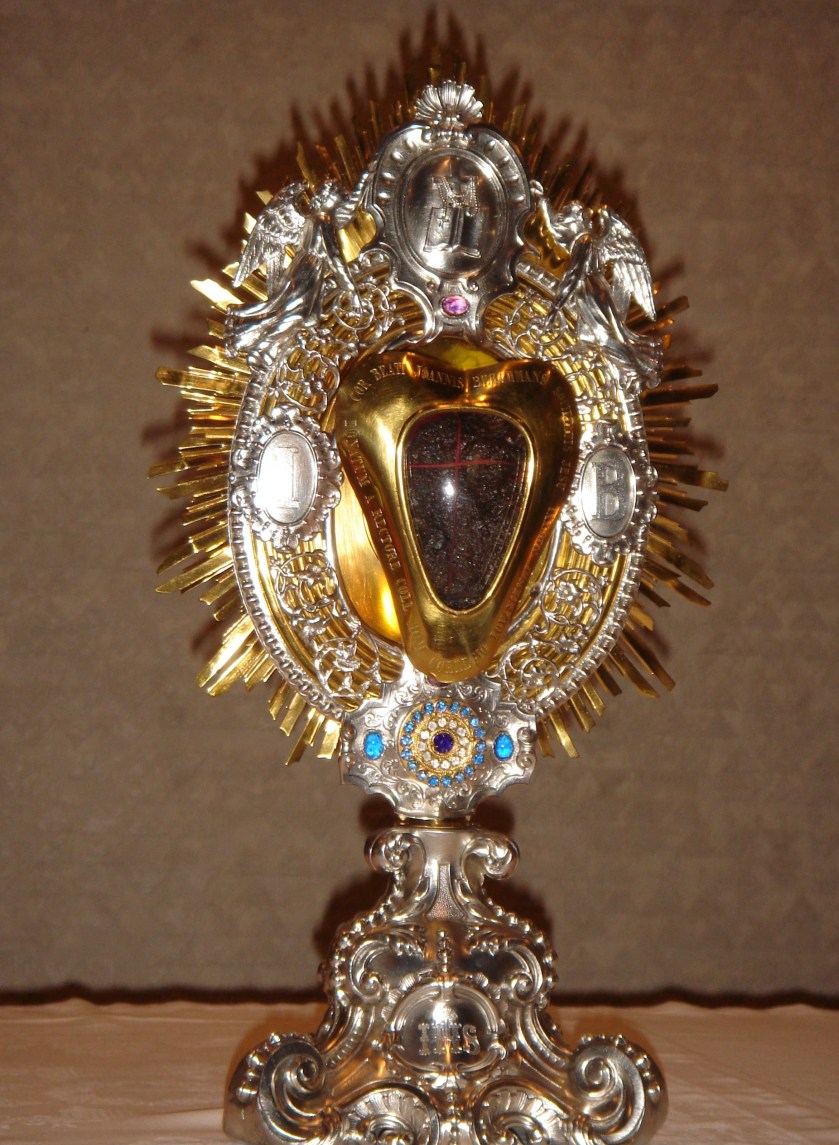
St John Berchman’s Heart
At the time of Berchmans’s death, his heart was returned to his homeland in Belgium where it is kept in a silver reliquary on a side altar in the church at Leuven (Louvain).
Our Lady, Refuge of Sinners/Refugium Peccatorum: St John Damascene calls Mary a city of refuge to all who flee to Her.
Blessed Antonio Baldinucci SJ (1665-1717) had a particular devotion to the Refugium Peccatorum image of Virgin Mary in the Church of the Gesu (Frascati) in Italy and commissioned a copy which he considered miraculous and carried it with him in his travels. The Jesuits spread copies of the image of the Madonna of Refuge in Mexico by the 19th century and it began to be depicted in missions there, often with clouds surrounding the lower portion of the image of the Virgin Mary holding the Child Jesus.
The term “Refugium peccatorum” is also used other works of Roman Catholic Marian art. For instance, there is a marble statue representing the Virgin Mary, on the grand staircase of the old municipal palace in Venice, Italy. The name came from the fact that the convicts were allowed to stop in front of the Virgin Mary’s statue to pray for their soul on the way to the scaffold.
The traditional feast day of Our Lady, Refuge of Sinners is today, 13 August.
St Anastasius the Monk
St Anastasius the Priest
St Benildus
St Cassian of Imola
St Cassian of Todi
St Concordia
St Conn O’Rourke
Bl Gertrude of Altenberg
St Helen of Burgos
St Herulph of Langres
Bl Jakob Gapp
Bl John of Alvernia St John Berchmans SJ (1599-1621)
St Junian of Mairé
St Ludolph Bl Marco d’Aviano/Mark of Aviano OFM Cap (1631-1699) Biography: https://anastpaul.com/2018/08/13/saint-of-the-day-13-august-blessed-mark-of-aviano-ofm-cap-1631-1699/
St Maximus the Confessor
St Nerses Glaietsi
St Patrick O’Healy
Bl Pierre Gabilhaud
St Radegund
St Radegunde
St Wigbert of Fritzlar
Bl William Freeman
—
Martyred in the Spanish Civil War:
• Blessed Francesc Castells Areny
• Blessed Inocencio García Díez
• Blessed José Bonet Nadal
• Blessed José Boher y Foix
• Blessed José Juan Perot y Juanmarti
• Blessed Jose Tàpies y Sirvant
• Blessed Josep Alsina Casas
• Blessed Luciano Hernández Ramírez
• Blessed Maria de Puiggraciós Badia Flaquer
• Blessed Mateo Despóns Tena
• Blessed Modesto García Martí
• Blessed Pascual Araguàs y Guàrdia
• Blessed Pedro Martret y Molet
• Blessed Silvestre Arnau y Pascuet
Martyred Claretians of Barbastro – 51 beati:
• Blessed Agustín Viela Ezcurdia
• Blessed Alfons Miquel Garriga
• Blessed Alfons Sorribes Teixidó
• Blessed Antolín Calvo y Calvo
• Blessed Antoni Dalmau Rosich
• Blessed Atanasio Vidaurreta Labra
• Blessed Eduardo Ripoll Diego
• Blessed Esteve Casadevall Puig
• Blessed Eusebi Maria Codina Millà
• Blessed Felipe de Jesús Munárriz Azcona
• Blessed Francesc Roura Farró
• Blessed Francisco Castán Meseguer
• Blessed Gregorio Chirivas Lacamba
• Blessed Hilario Llorente Martín
• Blessed Jaume Falgarona Vilanova
• Blessed Joan Baixeras Berenguer
• Blessed Joan Codinachs Tuneu
• Blessed José Amorós Hernández
• Blessed José Blasco Juan
• Blessed José Figuero Beltrán
• Blessed José Pavón Bueno
• Blessed Josep Maria Badía Mateu
• Blessed Josep Ormo Seró
• Blessed Josep Ros Florensa
• Blessed Juan Díaz Nosti
• Blessed Juan Echarri Vique
• Blessed Juan Sánchez Munárriz
• Blessed Leoncio Pérez Ramos
• Blessed Lluís Escalé Binefa
• Blessed Lluís Lladó Teixidor
• Blessed Lluís Masferrer Vila
• Blessed Manuel Buil Lalueza
• Blessed Manuel Martínez Jarauta
• Blessed Manuel Torras Sais
• Blessed Miquel Masip González
• Blessed Nicasio Sierra Ucar
• Blessed Pedro García Bernal
• Blessed Pere Cunill Padrós
• Blessed Rafael Briega Morales
• Blessed Ramon Illa Salvia
• Blessed Ramon Novich Rabionet
• Blessed Salvador Pigem Serra
• Blessed Sebastià Riera Coromina
• Blessed Sebastián Calvo Martínez
• Blessed Secundino Ortega García
• Blessed Teodoro Ruiz de Larrinaga García
• Blessed Tomàs Capdevila Miró
• Blessed Wenceslau Clarís Vilaregut
They were martyred on 2 August through 18 August 1936 in Barbastro, Huesca, Spain and Beatified on 25 October 1992 by Pope John Paul II.
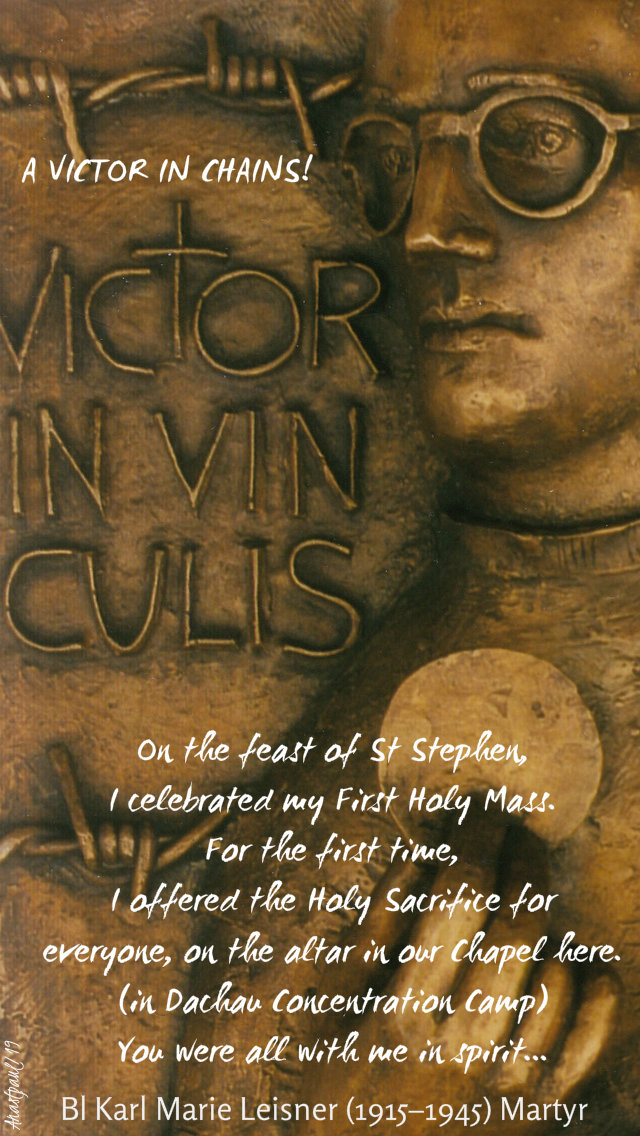
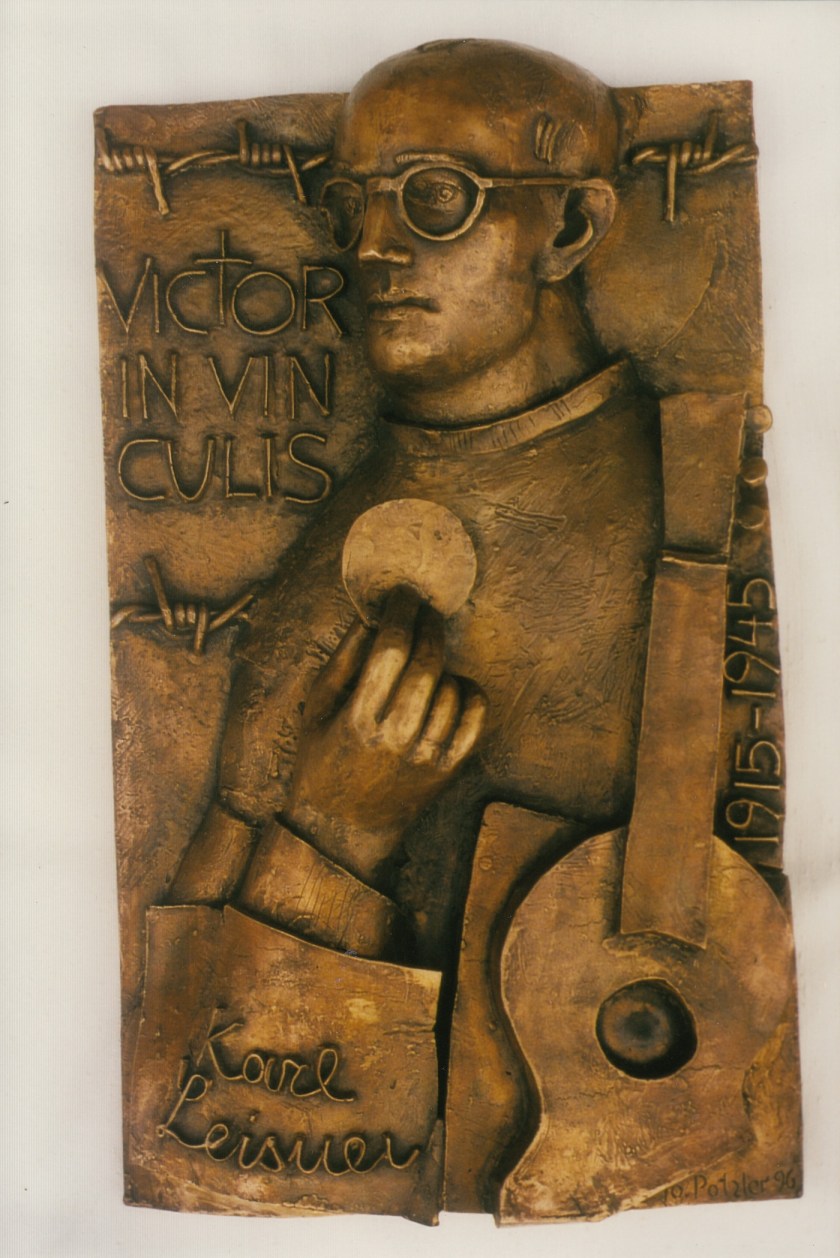
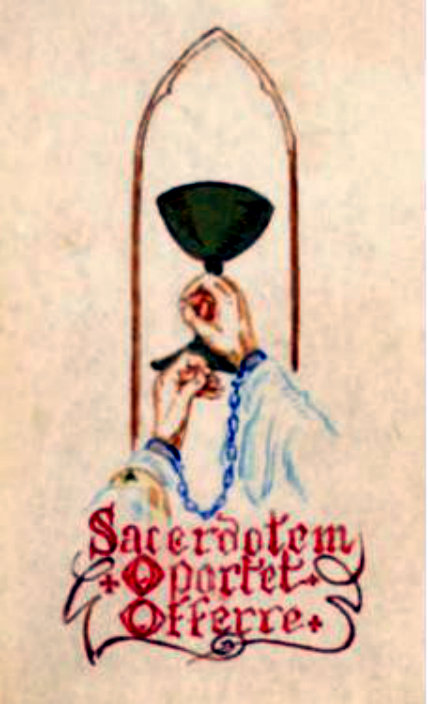
Thought for the Day – 12 August – The Memorial of Blessed Karl Marie Leisner (1915–1945) Priest, Martyr – Ordained in Dachau Concentration Camp – A VICTOR IN CHAINS! VICTOR IN VINCULIS
An unimaginable event took place that Sunday morning, 17 December 1944, in Camp 26 of the Dachau concentration camp—Karl Leisner, the prisoner who was always smiling, who for five years had been the consoling angel to his fellow sufferers, was ordained a priest of Jesus Christ. Seriously ill, he was near exhaustion. On the cross he received priestly anointing. His beautiful eyes —calmed, matured by suffering, consumed by fever—proclaimed the undying joy of Christ Jesus. He had but nine months to live…
The angel of comfort
The «infirmary» was a death ward, where, in indescribably cramped quarters and a poignant despair, men confronted death. The gasping and dry coughs of the tuberculosis patients continued night and day. Karl took refuge in the Sacred Heart of Jesus through prayer and supplication. He drew his peace and the strength to smile from Holy Communion, which was brought to him regularly in secret. As soon as he was able to get out of bed, he went from one bed to the next, dispensing words of encouragement and consolation, brightening hearts with his beautiful smile. He was soon known as the angel of comfort and the sick came to confide their distress to him. Under his pillow, he always hid a box of consecrated Hosts which he distributed, as a deacon, to his brothers in the Faith. His presence was particularly comforting to deported Russians, whom death was wiping out in great numbers. Thanks to the rudiments he had been able to learn of their language, more than one heard for the first time of Jesus’ agony and of the Good News of the Father who loves us and waits for us. «The Lord does not demand of His disciples a compromise with the world but a profession of faith that is prepared for the sacrifice of oneself. Karl Leisner made this profession, not only with his words but also with his life and death. In a world which had become inhuman, he acknowledged Christ who alone is the Way, the Truth and the Life» (John Paul II, homily for Beatification).
As a sick prisoner, Karl was counted among the «useless mouths.» In October 1942, he appeared on the list of inmates who should be exterminated in the gas chambers. Two priests succeeded in getting his name crossed off the list. «Each day, I offer myself to the Blessed Virgin, my Mother,» he wrote. «She has led me marvellously during three years of captivity.» At the beginning of 1943, there was a typhus outbreak in Dachau, which claimed some 6,000 victims. Karl escaped the epidemic, because the tuberculosis ward was isolated from the rest of the camp. On 4 June he wrote to a friend, «Looking back, I am very thankful to the Lord and to His Blessed Mother. If I listened to the pettiness of the human heart, I would like to hope for a speedy return to see you again. But the Lord knows what’s best.»In the complete distress of his situation, he expressed an heroic thought – he thanked God for having configured him to the Passion of His Son by means of these trials.
Unthinkable, but true!
On 6 September 1944, a convoy of French deportees arrived at Dachau, among whom was French Bishop Gabriel Piguet. Soon a rumour circulated among the prisoners—«Why doesn’t the bishop ordain Karl a priest?» On his bed of suffering, Karl protested, «Ordained at Dachau? Unthinkable! And besides, my parish has a right to my first Mass!»But the idea slowly gained ground and, on 23 September the sick young man asked for the necessary authorisation in a letter to his own bishop. At the end of 1944, the Third Reich was losing ground to Allied advances. the SS’s surveillance of the mail was relaxed. A 20-year-old woman guaranteed, at the risk of her life, the connection between the prisoners and the outside world. At the beginning of December 1944, Karl received a letter written by one of his sisters, bearing in the middle of the text these words, in someone else’s handwriting: «I authorise the ceremonies requested provided that they are done validly and that there remain of them definite proof.» This was followed by the signature of Blessed Bishop von Galen, whom Pius XII would not delay in making a cardinal.
From that point on, the clandestine ordination was prepared under great secrecy. Thanks to the complicity of numerous inmates, a brass episcopal ring was prepared, as were a crosier carved out of oak, a mitre made out of silk and pearls and vestments made from purple fabric. Gaudete Sunday, 17 December finally arrived. The bishop was dressed in pontifical vestments. Karl, strengthened by an injection of caffeine, donned the white alb and the deacon’s stole. He carried on his left arm the folded chasuble and in his right hand, a lit candle. Indeed, such was the planning that nothing was left out, down to the last detail. Red cheeks gave away the fever that was devouring the sick man. The emotion of three hundred witnesses, with whom the 2,300 other priests at the camp were united, was indescribable. During the ceremony, a Jewish prisoner played the violin outside, to divert the guards’ attention. At the end of the Mass, Bishop Piguet and Karl gathered around a breakfast prepared by the group of Protestant ministers. What complicity and ingenuity were needed to prepare this spread – white tablecloth, porcelain service, coffee and cake… «Karl Leisner’s priestly ordination was a big event for the group of Protestant ministers,» wrote their senior member, Dr Ernst Wilm.
Back among the tuberculosis patients, Karl continued his way of the cross. On 26 December he was able to celebrate his first Mass. He wrote, «After more than five years of prayer and waiting, days filled with very great happiness… That God could, through the intercession of Our Lady, answer our prayers in so gracious and unique a manner, I still cannot grasp.»While his tuberculosis reached its final stage, the new priest testified to total abandonment to Divine Providence.
On 29 June 1945, Karl received a visit from his father and mother. All three were overcome: «We are together!» On 25 July Karl was able to celebrate a second Mass. That day, he ended his spiritual journal with these words: «Also bless, O Most High, my enemies.» He had eight days to live. He told his mother, «Mother, I have to tell you something—but don’t be sad. I know that I am going to die soon but I am happy.»The evening of 8 August, his three sisters arrived. What a joy to be able to chat at length with them! Finally, on 12 August he began his death agony and expired peacefully to join the choir of holy angels in Heaven.
In proclaiming him Blessed on 23 June 1996, Pope John Paul II offered him as an example: «Karl Leisner encourages us to remain on the way that is Christ. We must not grow weary, even if sometimes this way seems dark and demands sacrifice. Let us beware of false prophets who want to show us other ways. Christ is the way which leads to life. All other ways are detours or wrong paths.»
Blessed Karl Marie Leisner (1915–1945) Priest, Martyr, Pray for Us!
Quote/s of the Day – 12 August – The Memorial of Blessed Karl Marie Leisner (1915–1945) Priest, Martyr – Ordained in Dachau Concentration Camp
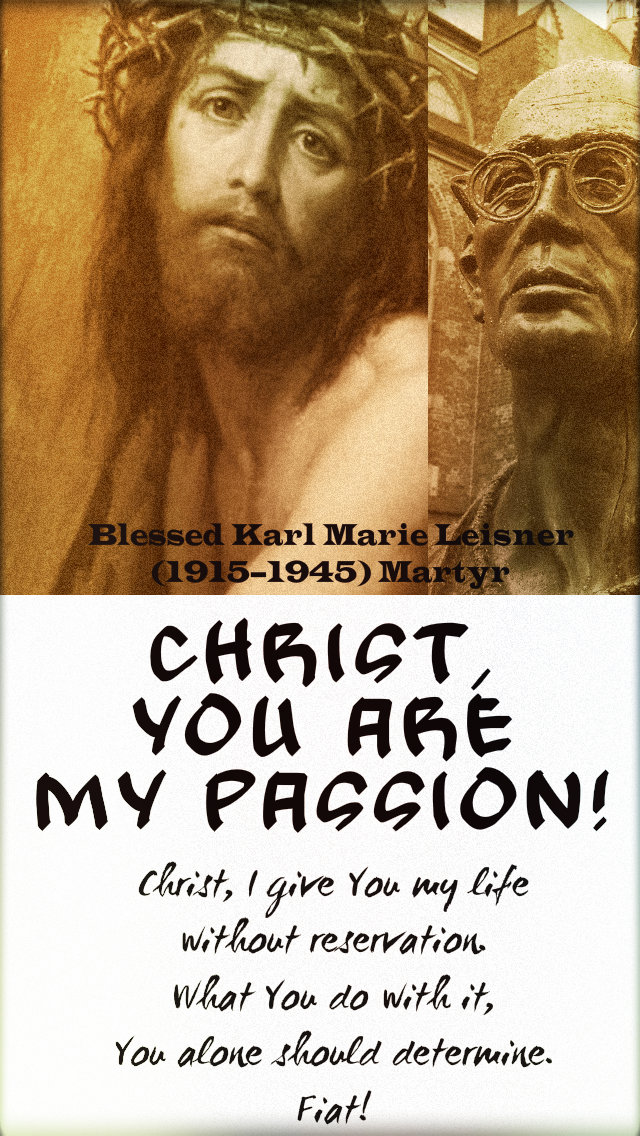
“Christ, You are my passion!”
“Christ, I give You my life without reservation. What You do with it, You alone should determine. Fiat!”
22 November 1939
“God, I thank You for the days of this burdensome disease and yet again for the days spent unfree and imprisoned. Everything has its meaning. You only want what is extremely good for me. With my whole heart, I pray for all who are not well disposed toward me and ask You to forgive them.”
11 November 1939
“The days of exterior captivity are magnificent days of becoming interiorly free for God, who alone is the shelter and stronghold of freedom… “
17 November 1939
“On the feast of St Stephen, I celebrated my First Holy Mass. For the first time, I offered the Holy Sacrifice for everyone, on the altar in our Chapel here. You were all with me in spirit…”
30 December 1944
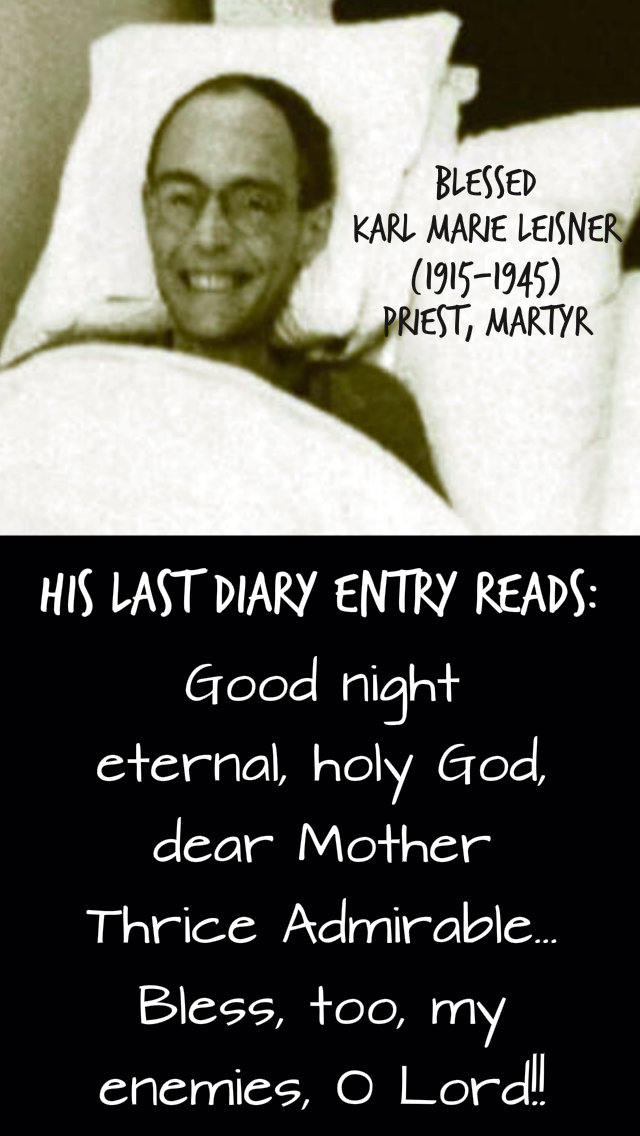
His last diary entry reads: Good night eternal, holy God, dear Mother Thrice Admirable… Bless, too, my enemies, O Lord!!
25 July 1945 (he died on 12 August 1945)
Blessed Karl Marie Leisner (1915–1945) Priest, Martyr, Pray for Us!
One Minute Reflection – 12 August – Monday of the Nineteenth Week in Ordinary Time, Year C, Gospel: Matthew 17:22–27 and the Memorial of Blessed Karl Marie Leisner (1915–1945) Priest, Martyr
“Does not your teacher pay the tax?” … Matthew 17:22
REFLECTION – “Since Christ reconciled the world to God, He Himself certainly did not need reconciliation. For what sin of His own was He to make propitiation, when He knew no sin? When the Jews were asking for the didrachma, which according to law was given for sin, He said to Peter: “Simon, from whom do kings of the earth take toll or tribute? From their sons or from others?” Peter answered: “From others.” Jesus said to him: “Then the sons are free. However, not to give offence to them, go to the sea and cast a hook and take the first fish that comes up and when you open its mouth, you will find a shekel, take that and give it to them for me and for yourself.”
He is pointing out that He is not obliged to propitiation for sins on His own behalf, because He is not a slave of sin but, as Son of God, free from all fault. For the Son sets free, it is the slave who is guilty. So He was free from all sin and gives no price of redemption for His own soul – the price of His blood was more than sufficient to redeem all the sins of the world. Justly then He sets others free, owing nothing for Himself.
Furthermore, not only does Christ owe no price of redemption for Himself or propitiation for sin but, if you take the case of anyone, it can be understood that no individuals owes propitiation for themselves, since Christ is the propitiation of all and Himself the redemption of all.” …Saint Ambrose (340-397) Father & Doctor – Commentary on Ps 48, 14-15 ; CSEL 64, 368-370 (trans. Breviary, Week 20, Saturday)
PRAYER – Almighty God and Father, by Your grace, we are made one in mind and heart. Give us a love for what You command and a longing for what You promise, so that, amid this world’s changes, our hearts may be set on the world of lasting joy. Grant, we pray that by the prayers of Blessed Karl Marie Leisner, we will be made always faithful. Through Him, with Him and in Him, in the union of the Holy Spirit, one God forever, amen.
Our Morning Offering – 12 August – Monday of the Nineteenth week in Ordinary Time, Year C and the Memorial of Blessed Karl Marie Leisner (1915–1945) Priest, Martyr
Thank You, Jesus By Cardinal Nicholas Cusa (1401-1464)
Thank You, Jesus,
for bringing me this far.
In Your light, I see the light of my life.
Your teaching is brief and to the point,
You persuade us to trust in God,
You command us to love one another.
You promise everything,
to those who obey Your teaching,
You ask nothing too hard for a believer,
nothing a lover can refuse.
Your promises to Your disciples are true,
nothing but the truth.
Even more, You promise us Yourself,
the perfection of all
that can be made perfect.
Amen
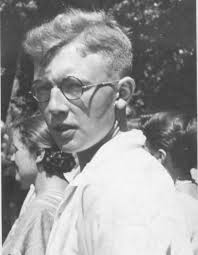
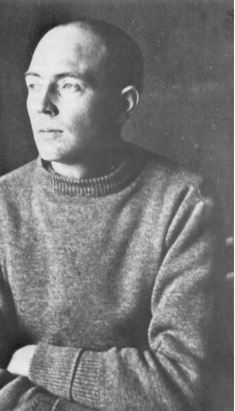
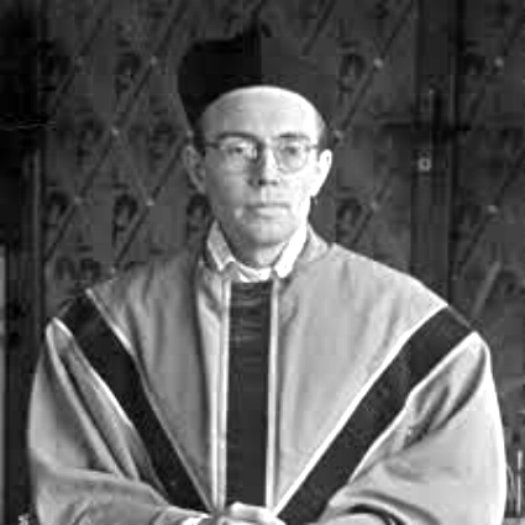
Saint of the Day – 12 August – Blessed Karl Marie Leisner (1915–1945) Priest, Martyr, Marian devotee – born on 28 February 1915 at Rees, North Rhine-Westphalia, Germany and died on 12 August 1945 at Planneg, Bavaria, Germany of tuberculosis. Blessed Karl was interned in the Dachau concentration camp. He died of tuberculosis shortly after being liberated by the Allied forces. He has been declared a Martyr and was Beatified by St Pope John Paul II on 23 June 1996.
There was a priest, Blessed Karl Leisner, who heard his call to the priesthood during a Schoenstatt Retreat. The Apostolic Movement of Schoenstatt is an apostolate of the Roman Catholic Church, a Marian movement founded in Germany in 1914 by a Pallottine priest, Fr Joseph Kentenich (1885-1968). Members of the Schoenstatt were formed for a renewal in the Catholic Church. Fr Kentenich had been assigned the pastoral care of students living in Schoenstatt. He prepared the students to entrust their lives to Mary and to establish a chapel which would become a home where they could obtain the grace of welcome, interior transformation and a fruitful apostolate. In 1964, the group received formal approval.
Blessed Karl Leisner is a prime example of what dedication to Mary can do. He was the first of five children born to Wilhelm Leisner and his wife, Amalie, on 28 February 1915. Karl was born in Rees/Niederrhein, Germany, near the border with the Netherlands. On 3 March he was baptised in Assumption Catholic Church in Rees with the name Karl Marie since his mother had a great devotion to Mary.
When Karl was six years old the family moved to Kleve — about 20 miles southwest of Rees — so that his father could take a position as a civil servant. Karl continued attending school until he finished. Karl’s spiritual and doctrinal formation continued in the security of his family home. After he received the Sacrament of Confirmation on 20 July 1927, he began keeping a spiritual diary. The entries reveal what a great love he had for Christ, how his soul yearned for Christ!
Aged 17
At the age of 17 he wrote, “My whole life must be more deeply bound to God, connected with God, given to God it does not have to be but I want it to be so, humbly I ask, seek, make efforts and thereafter strive for it.”
As a youth he became an altar server and joined the local Catholic Youth Group. These groups combined prayer and study with recreational activities, including cycling, hiking and camping. Being a member of the group, his leadership skills quickly became evident. It was not long before he became the leader . At the time that he assumed the headship of the group, Hitler’s minions were recruiting young men to join the Nazis. To avoid the problem with the Nazis, Karl would organise camping trips to Holland and Belgium. During these trips, he and the boys would hike miles with camping equipment on their backs and Karl would play the bugle to keep them on schedule.
His singular devotion to Mary deepened when a friend invited Karl to attend a 5 day Easter workshop and retreat from in April 1933. The retreat was held at the Marian Pilgrimage Place of Schoenstatt in Vallendar, Germany, about 140 miles south of Rees.
He continued his regular education and when he finished high school he immediately made plans to enter the seminary — nearly 600 miles southeast of Kleve near the Austrian border. In 1934 Karl went to Munich where he entered the seminary.
Once again he was assigned the leadership role of the Diocesan Youth Leader by Blessed Clemens August von Galen (1878-1946), the bishop of Munster (read about Blessed von Galen “The Lion of Munster” and is fight against the Nazis here: https://anastpaul.com/2019/03/22/saint-of-the-day-22-march-blessed-clemens-august-count-von-galen-1878-1946/). As his formation continued, he faced the question of his vocation – To have a family or to become a priest? He knew well the high calling of the priesthood: “It’s beautiful to become a priest but difficult, almost too difficult and only those called by God’s great grace should become one.” Recognising this lofty vocation and the realisation that God might be calling him, he still considered the joys of becoming a father and having a family, “The beauty of family life — of having and raising my own children, such thoughts touch me deeply during my evening reflections. . . . But also the great heroism of the priesthood sets me aglow! I am secure in God’s hand, come what may.” Did he know what was coming?
As his seminary studies continued, he reached a spiritual crisis concerning his true vocation. Quickly he returned to the Schoenstatt shrine where he had received such comfort. For two days he prayed and meditated in silence before the image of Mother Thrice Admirable, seeking enlightenment about God’s will and strength to carry it out.
His tepidity left him as this time of prayerful surrender and once again stimulated his desire to be a holy and active priest in serving the King of Kings. On the Feast of the Annunciation, 25 Marc 1939, Karl was ordained a deacon in the Cathedral of Muenster. Sadly, just three months later his preparation for Ordination had to be postponed because Karl had been diagnosed with tuberculosis.
Disappointed, Karl once again journeyed to Schoenstatt before going to the Lung Sanatorium in St Blasien in the Black Forest, near the Swiss and French borders. Once again Karl spent time in prayer — surrendering his entire will to Mary and begging her to help him become healthy again. If he would not be a good priest, then he asked her to let him die before being ordained. He placed all his trust in her.
The Nazis continued their suppression of religion and arrested more and more men, women and children. They considered them enemies of the state. As they tightened their stranglehold, the Nazis came to the sanatorium to arrest Karl. For three years they had been tracking his movements and activities. Because fellow patients reported him for speaking against Hitler, the Gestapo arrested him for “protective custody.” The Gestapo took him to Freiburg just north of the Black Forest. Then he was transferred to Mannheim for three weeks before they shipped him to the concentration camp in Sachsenhausen, near Berlin. Less than a year later on 13 December 1940 they took him to Dachau. Here he joined many other priests.
His tuberculosis worsened in the deplorable conditions of ill-treatment and hunger. Yet these hardships only increased his love of God and his devotion to Mary. Karl became a source of encouragement to his fellow prisoners. Fathers Heinz Dresback and Hermann Richarz testified that Karl had “a rock-solid trust in God.”
After persevering for four years in Dachau, Karl received a special gift. Another prisoner, Bishop Gabriel Piguet from France, ordained Karl a priest on 17 December 1944, Gaudete Sunday. The newly ordained priest only celebrated a single Mass and was so ill that he had to postpone his first Mass for over a week Nine days after his Ordination he celebrated that first Mass on the Feast of St Stephen the Martyr. Four months later the camp was liberated by the Allies but by that time his health had been destroyed. He died on 12 August 1945 surrounded by family and friends. He was Beatified by St Pope John Paul II on 23 June 1996.
Blessed Karl’s body was taken to Kleve and buried in a local cemetery on 20 August 1945. His remains were exhumed and re-interred in the crypt of the Cathedral of Xanten in 1966.
Throughout his life, the few but intense times of personal encounter with Our Lady in the Original Shrine in Schoenstatt remained the decisive milestones for Karl Leisner on his path of calling. “Christ, my passion”– led by this ideal, he worked in the diocesan youth and wrestled his way to a decision for a celibate life as a priest. In the Dachau concentration camp he founded, together with Josef Fischer, the first Schoenstatt group in Dachau, which had to end its meetings in the 1942 starvation year. From 1943 Karl Leisner belonged to the group “Victor in vinculis Mariae” (Victor in the Shackles of Mary) and thus to the circle of Schoenstaetters around the founder Josef Kentenich. From the ideal and the fraternity of this group, Karl Leisner drew the strength to accept his fate, which was burdened by the tuberculosis of the lung as well as the difficult conditions in the concentration camp, as the will of God and to offer his life as a martyr.
Karl Leisner, German stamp (2015) Inscription: Bless also, o Most High, my enemies.
Dear Blessed Fr Karl, as Europe and the world are once again besieged by evil forces, pray that we Christians will continue with confidence and surrender to God. Amen.
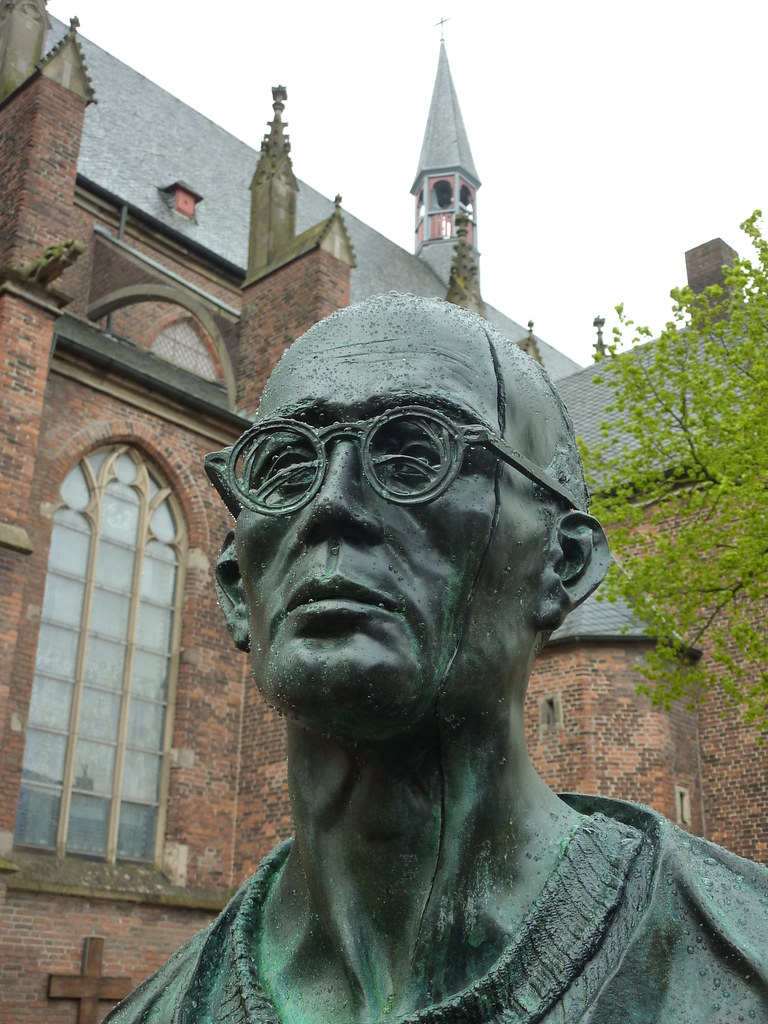
Sculpture of Karl Leisner in front of the Stiftungskirche, Kleve where his remains are enshrined.
St Jambert of Canterbury
Bl Józef Stepniak
Bl Józef Straszewski
St Julian of Syria Bl Karl Leisner (1915–1945) Martyr
St Macarius of Syria
St Merewenna
St Micae Nguyen Huy My
St Murtagh of Killala
St Photinus of Marmora
Bl Pierre Jarrige de la Morélie de Puyredon
St Porcarius of Lerins
St Simplicio of Vercelli
St Ust
—
Martyrs of Augsburg – 4 saints: The mother, Hilaria, and three friends of of Saint Afra of Augsburg. While visiting the tomb of Saint Afra who were seized by the authorities and martyred when they visited Afra’s tomb – Digna, Eunomia, Euprepia and Hilaria. They were burned alive c 304.
Martyrs of Rome – 5 saints: A group of Christians martyred together in the persecutions of Diocletian. We know little more than their names – Crescentian, Juliana, Largio, Nimmia and Quiriacus.
• c.304 in Rome, Italy
• buried on the Ostian Way outside Rome.
Martyred in the Spanish Civil War:
• Blessed Antoni Perulles Estivill
• Blessed Atilano Dionisio Argüeso González
• Blessed Carles Barrufet Tost
• Buenaventura García-Paredes Pallasá
• Carles Barrufet Tost
• Blessed Domingo Sánchez Lázaro
• Enrique María Gómez Jiménez
• Félix Pérez Portela
• Blessed Gabriel Albiol Plou
• Blessed José Jordán Blecua
• Blessed Josep Nadal Guiu
• Blessed Juana Pérez Abascal
• Manuel Basulto Jiménez
• Blessed Manuel Borràs Ferré
• Blessed Pau Figuerola Rovira
• Blessed Pedro José Cano Cebrían
• Perfecto Del Río Páramo
• Blessed Ramona Cao Fernández
• Blessed Vittoria Diaz y Bustos de Molina
and these below:
Martyrs of Barbastro – 6 beati: Six Claretian brothers and priests who were martyred together in the persecutions of the Spanish Civil War.
• Gregorio Chirivas Lacamba
• José Pavón Bueno
• Nicasio Sierra Ucar
• Pere Cunill Padrós
• Sebastián Calvo Martínez
• Wenceslau Clarís Vilaregut
They were martyred on 12 August 1936 in Barbastro, Huesca, Spain and Beatified on 25 October 1992 by Pope John Paul II.
Martyrs of La Torre de Fontaubella – 4 beati: Four parish priests who were murdered together in the persecutions of the Spanish Civil War.
• Antoni Nogués Martí
• Joan Rofes Sancho
• Josep Maria Sancho Toda
• Ramon Martí Amenós
They were martyred on 12 August 1936 in La Torre de Fontaubella, Tarragona, Spain and Beatified on 13 October 2013 by Pope Francis. Their beatification celebrated in Tarragona, Spain.
Martyrs of Puerta de Hierro – 5 beati: Five nun in the Archdiocese of Madrid, Spain, all members of the Daughters of Charity of Saint Vincent de Paul, and all martyred together in the Spanish Civil War.
• Estefanía Saldaña Mayoral
• María Asunción Mayoral Peña
• María Dolores Barroso Villaseñor
• María Severina Díaz-Pardo Gauna
• Melchora Adoración Cortés Bueno
They were martyred on 12 August 1936 in Puerta de Hierro, Aravaca, Madrid, Spain and Beatified on
27 October 2013 by Pope Benedict XVI.
Thought for the Day – 11 August – Nineteenth Sunday in Ordinary Time, Year C, Gospel: Luke 12:32–48 and the Memorial of St Clare of Assisi (1194-1253)
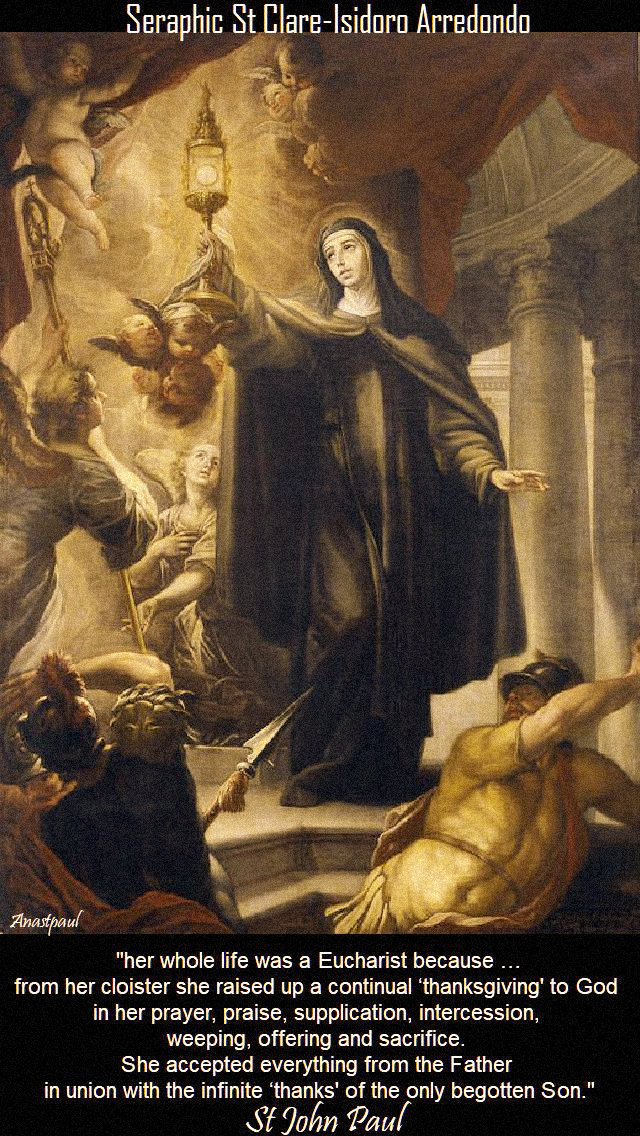
St Pope John Paul II said of Saint Clare – “her whole life was a Eucharist because … from her cloister she raised up a continual ‘thanksgiving’ to God in her prayer, praise, supplication, intercession, weeping, offering and sacrifice.
She accepted everything from the Father in union with the infinite ‘thanks’ of the only begotten Son.”
St Pope John Paul II (1920-2005)
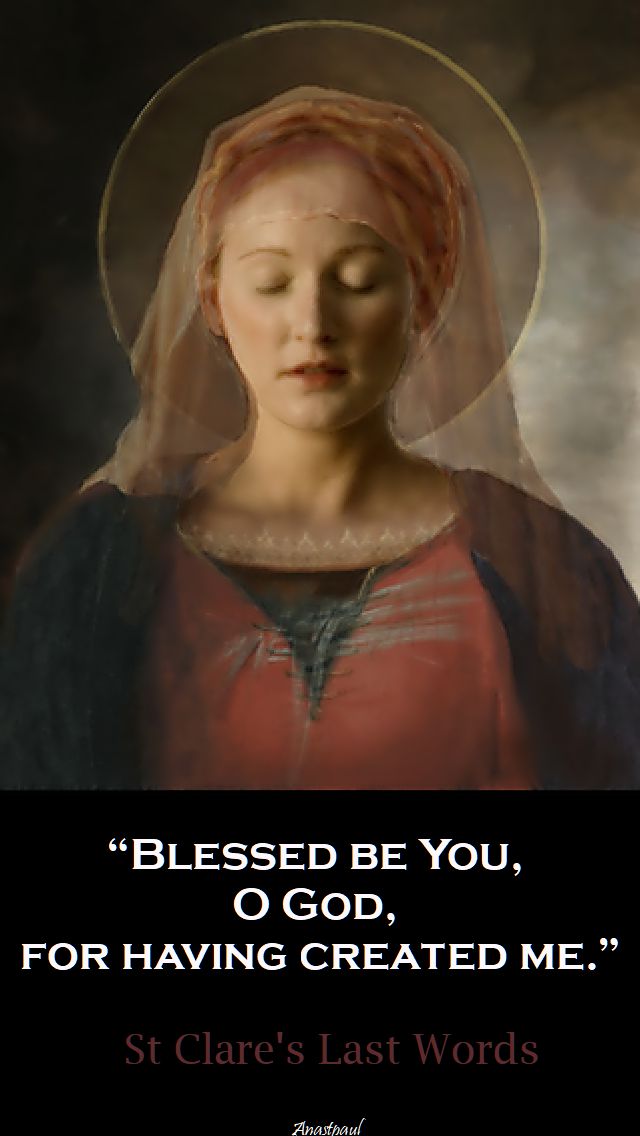
“ Blessed be You, O God, for having created me. ”
St Clare’s Last Words
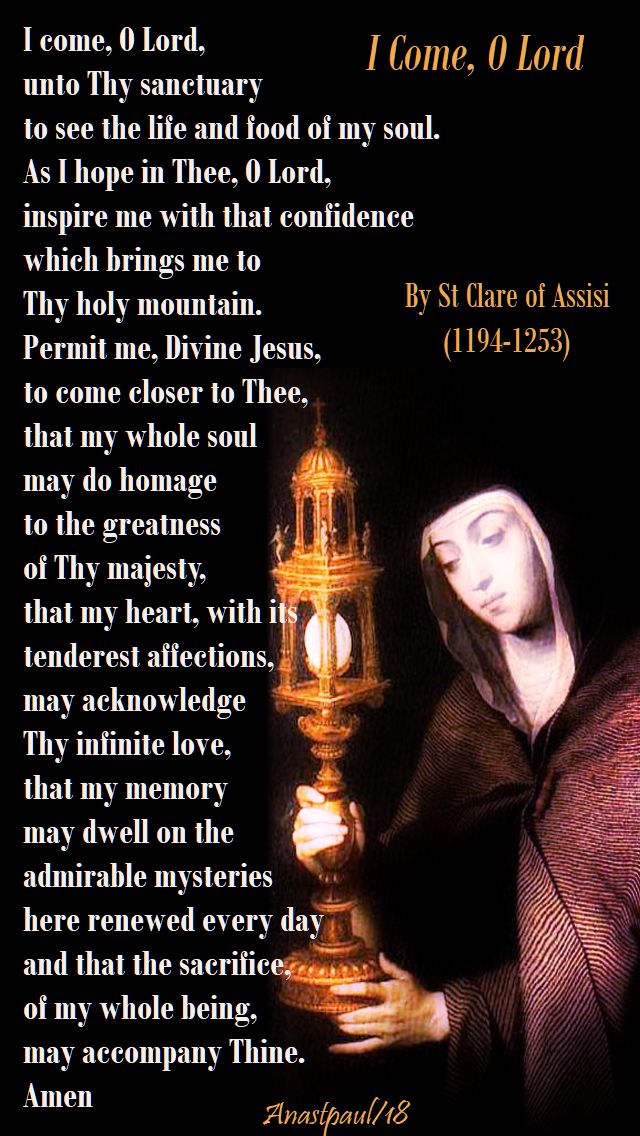
I Come, O Lord By St Clare of Assisi (1194-1253)
I come, O Lord,
unto Thy sanctuary
to see the life and food of my soul.
As I hope in Thee, O Lord,
inspire me with that confidence
which brings me to Thy holy mountain.
Permit me, Divine Jesus,
to come closer to Thee,
that my whole soul may do homage
to the greatness of Thy majesty,
that my heart,
with its tenderest affections,
may acknowledge Thy infinite love,
that my memory may dwell
on the admirable mysteries
here renewed every day
and that the sacrifice,
of my whole being,
may accompany Thine.
Amen








 With another young aspirant, he was waiting in the parlour to be introduced, when he saw in the garden a coadjutor Brother turning over the ground in the garden. He proposed to his companion to go and help him, saying: Could we begin our religious life better than with an act of humility and charity? And with no hesitation, both went to offer their assistance. How many young persons in that situation would have thought of such an offer? This incident reveals the profound charity and interior peace which characterised this young religious at all times.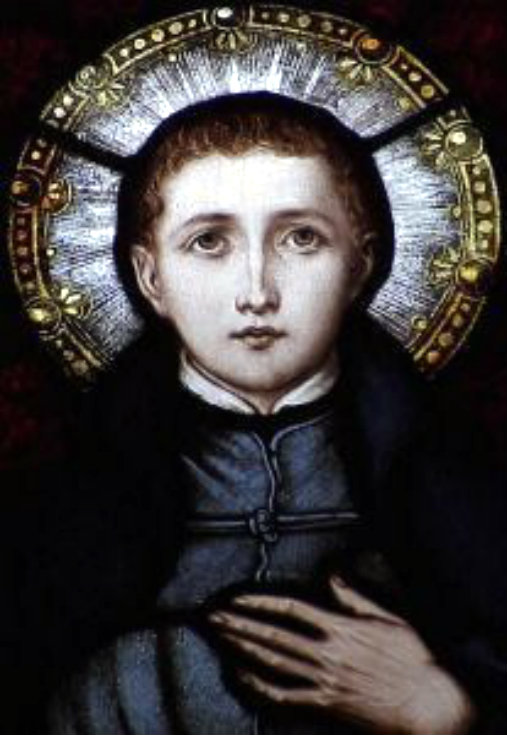
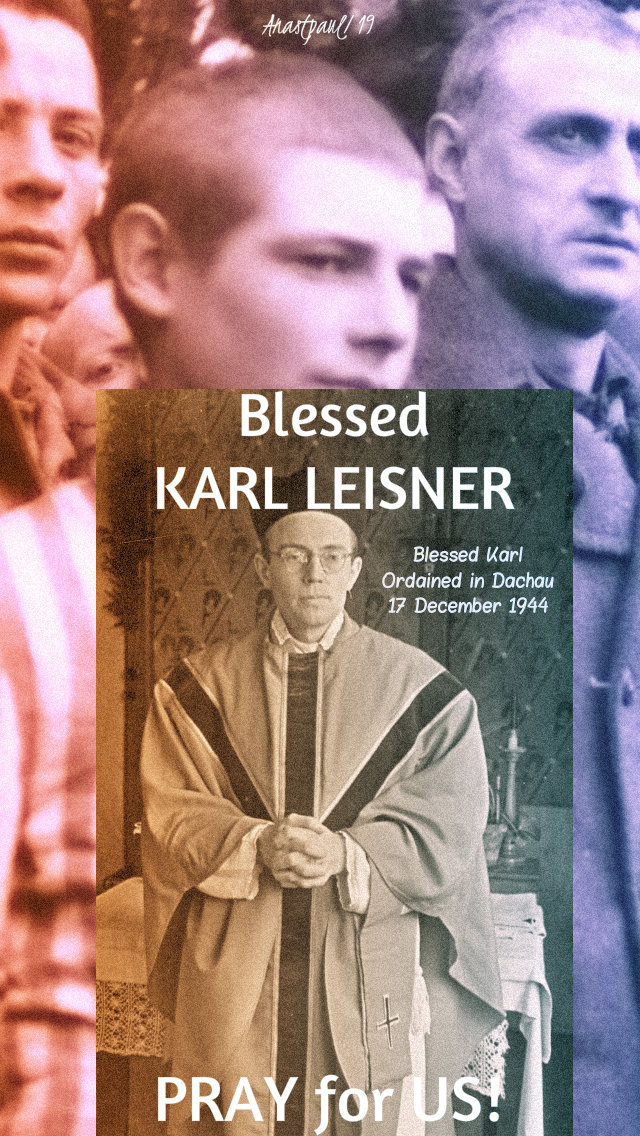


 The newly ordained priest only celebrated a single Mass and was so ill that he had to postpone his first Mass for over a week Nine days after his Ordination he celebrated that first Mass on the Feast of St Stephen the Martyr.
  Four months later the camp was liberated by the Allies but by that time his health had been destroyed. He died on 12 August 1945 surrounded by family and friends. He was Beatified by St Pope John Paul II on 23 June 1996.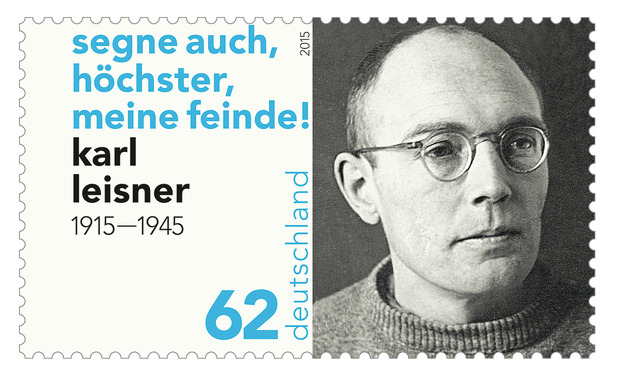
 AnaStpaul
You must be logged in to post a comment.