One Minute Reflection – 29 July – Monday of the Seventeenth Week of Ordinary Time, Year C and the Memorial of St Martha, Gospel: John 11:19–27
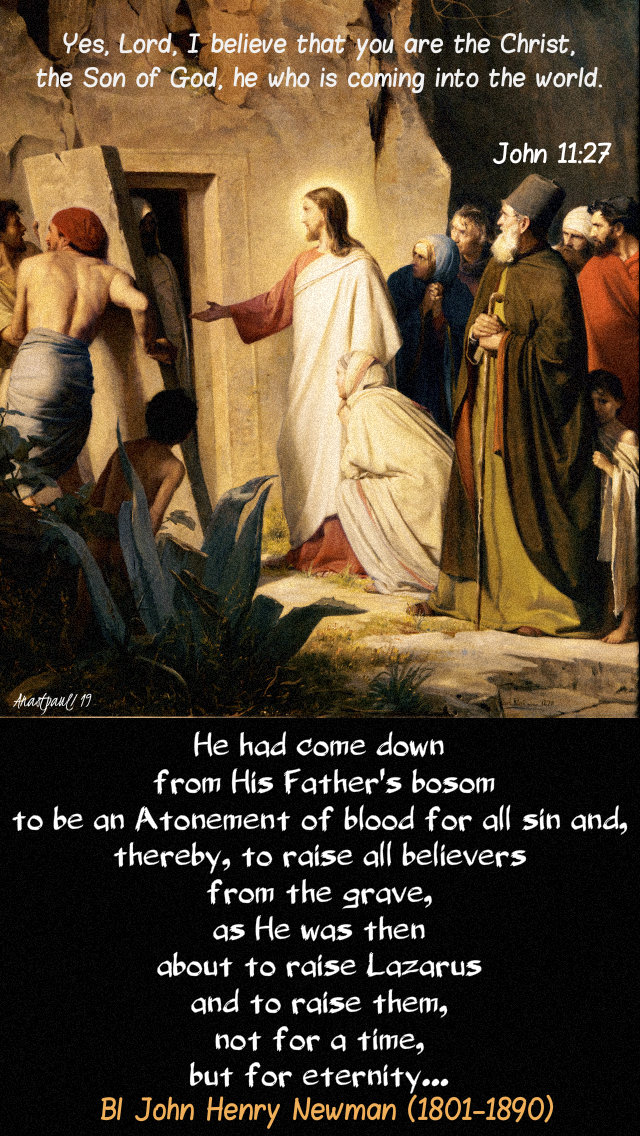
“Yes, Lord, I believe that you are the Christ, the Son of God, he who is coming into the world.” … John 11:27
REFLECTION – “Christ went to raise Lazarus and the fame of that miracle was the immediate cause of His seizure and crucifixion (Jn 11,46)… He felt that Lazarus was wakening to life at His own sacrifice, that He was descending into the grave which Lazarus left. He felt that Lazarus was to live and He to die, the appearance of things was to be reversed, the feast was to be kept in Martha’s house (Jn 12,1f.) but the last passover of sorrow remained for Him. And Jesus knew that this reverse was altogether voluntary with Him. He had come down from His Father’s bosom to be an Atonement of blood for all sin and, thereby, to raise all believers from the grave, as He was then about to raise Lazarus and to raise them, not for a time, but for eternity…
Contemplating then the fullness of His purpose, while now going about a single act of mercy, He said to Martha, “I am the Resurrection and the Life: he that believes in Me, though he were dead, yet shall he live and whosoever lives and believes in Me, shall never die.” Let us take to ourselves these comfortable thoughts, both in the contemplation of our own death, or upon the death of our friends. Wherever faith in Christ is, there is Christ Himself. He said to Martha, “Believe thou this?”Wherever there is a heart to answer, “Lord, I believe,” there Christ is present. There our Lord vouchsafes to stand, though unseen—whether over the bed of death or over the grave, whether we ourselves are sinking, or those who are dear to us. Blessed be his name! nothing can rob us of this consolation, we will be as certain, through His grace, that He is standing over us in love, as though we saw Him. We will not, after our experience of Lazarus’s history, doubt an instant that He is thoughtful about us and that he stands at our side.” … Blessed John Henry Newman (1801-1890) Cardinal, founder of the Oratory in England, theologian – Sermon “ The Tears of Christ at the Grave of Lazarus ” PPS, vol. 3, no.10
PRAYER – Almighty ever-living God, Your Son graciously came as a guest to the home of St Martha and was the friend of her family. Martha in her sorrow was moved to declare her total faith in Him, grant we pray, that in our trials and sorrows, we too may prove our love for You. By her prayers give us grace to serve Christ faithfully in our brethren and bring us to Your home in heaven. We make our prayer through Christ our Lord, in union with the Holy Spirit, amen.
Our Morning Offering – 29 July – Monday of the Seventeenth Week of Ordinary Time, Year C and the Memorial of St Martha
Lord God Look Down upon Us! (A Prayer for Workers) By Pope Francis
Lord God look down upon us!
Look at this city, this island.
Look upon our families.
Lord, You were not without a job,
You were a carpenter,
You were happy.
Lord, we have no work.
The idols want to rob us of our dignity.
The unjust systems want to rob us of hope.
Lord, do not leave us on our own.
Help us to help each other;
so that we forget our selfishness a little
and feel in our heart the “we”,
the we of a people
who want to keep on going.
Lord Jesus, You were never out of work,
give us work and teach us to fight for work
and bless us all.
In the name of the Father,
of the Son and of the Holy Spirit”.
Amen
*Prayer to the Lord at the conclusion of the meeting with workers (Cagliari, 22 September 2013)
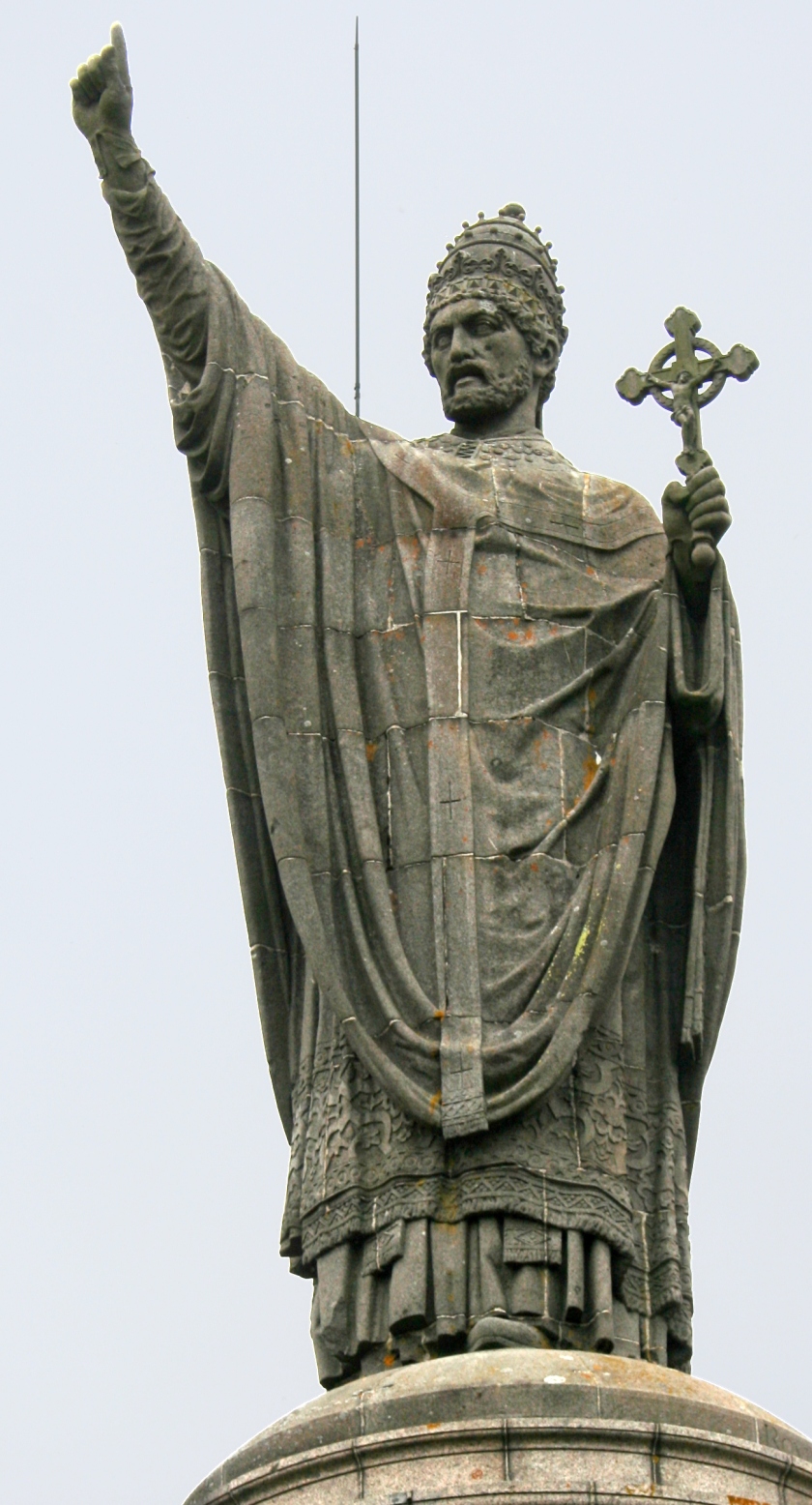
Saint of the Day – 29 July – Blessed Pope Urban II (c 1035-1099) Bishop, Pope, Abbot, Confessor – born Odo of Châtillon or Otho de Lagery, was Pope from 12 March 1088 to his death in 1099. Born at Lagery, France and died on 29 July 1099 in Rome, Italy of natural causes.
Urban II was a native of France. He was a descendant of a noble family in Châtillon-sur-Marne. Reims was the nearby cathedral school that Urban, at that time Eudes, began his studies at 1050, under St Bruno O.Cart. (c 1030 -1101), afterwards founder of the Carthusians. Otho later became canon and archdeacon at Reims.
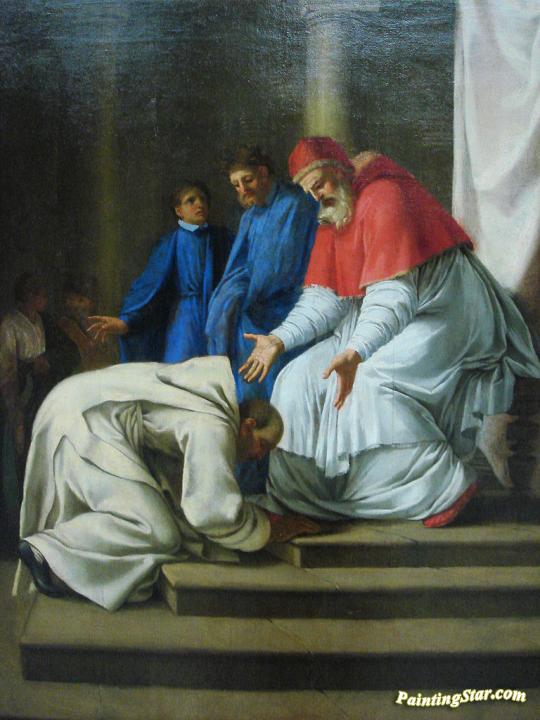
About 1070 he retired to Cluny and was professed there under the abbot St Hugh. After holding the office of prior, he was sent by St Hugh to Rome as one of the monks asked for by Gregory VII. Otho was of great assistance to Gregory in the difficult task of reforming the Church. (2 images below are St Bruno with Pope Urban).
On 12 March, 1088, he was unanimously elected Bishop of Rome, taking the title of Urban II. His first act was to proclaim his election to the world and to exhort the princes and bishops who had been loyal to Gregory to continue in their allegiance. Urban declared his intention of following the policy and example of his great predecessor – “all that he rejected, I reject, what he condemned I condemn, what he loved I embrace, what he considered as Catholic, I confirm and approve”.
Due to issue with the Normans, Urban was unable to stay in Rome. He went to Sicily instead and Southern Italy. There was also an antipope in Rome. Eventually, the troops of pope and antipope met in a desperate encounter which lasted three days, with Urban’s troops winning and Urban returned to Rome. Urban was again expelled from Rome by Emperor Henry IV. For three years he was compelled to wander in exile about southern Italy. He spent the time holding councils and improving the character of ecclesiastical discipline.
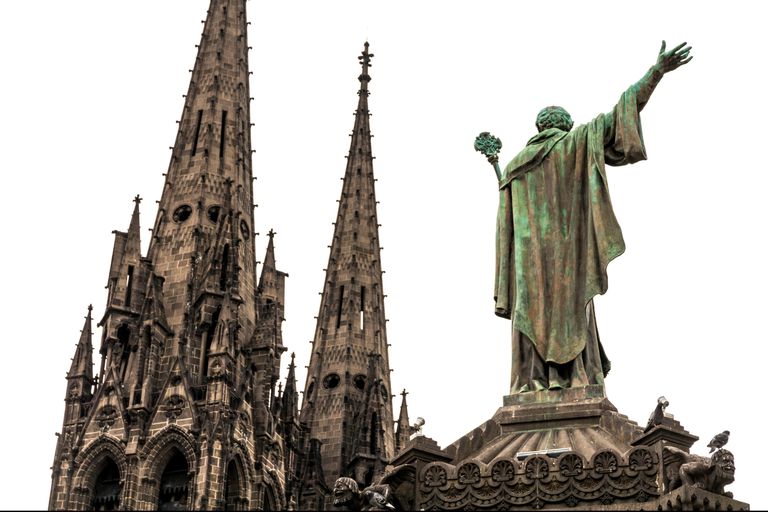
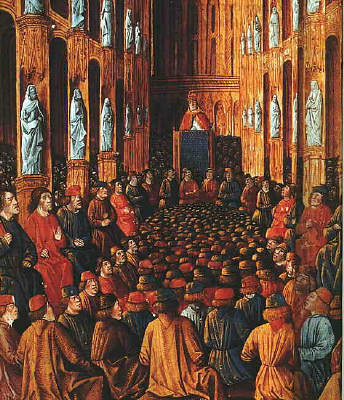
Urban also started dealing with a Crusade request during a council held at Piacenza. The Eastern Emperor, Alexius I, had sent an embassy to the pope asking for help against the Seljuk Turks who were a serious menace to the Empire of Constantinople. Urban succeeded in inducing many of those present to promise to help Alexius but no definite step was taken till a few months later, when he summoned the most famous of his councils, that at Clermont in Auvergne. The council met in November, 1095 – thirteen archbishops, two hundred and twenty-five bishops and over ninety abbots answered the pope’s summons. The synod met in the Church of Notre-Dame du Port and began by reiterating the Gregorian Decrees against simony, investiture and clerical marriage.
Thousands of nobles and knights had met together for the council. It was decided that an army of horse and foot should march to rescue Jerusalem and the Churches of Asia from the Saracens. A plenary indulgence was granted to all who should undertake the journey pro sola devotione and further to help the movement, the Truce of God was extended and the property of those who had taken the cross was to be looked upon as sacred.
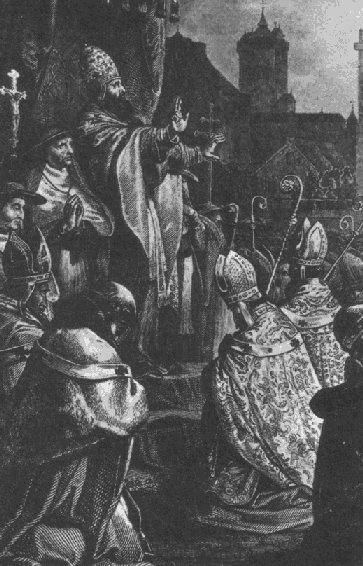
Coming forth from the church the pope addressed the immense multitude. He used his wonderful gifts of eloquence to the utmost, depicting the captivity of the Sacred City where Christ had suffered and died
– “Let them turn their weapons dripping with the blood of their brothers against the enemy of the Christian Faith. Let them, oppressors of orphans and widows, murderers and violators of churches, robbers of the property of others, vultures drawn by the scent of battle, let them hasten, if they love their souls, under their captain Christ to the rescue of Sion.”
In October, 1098, the pope held a council at Bari with the intention of reconciling the Greeks and Latins on the question of the filioque “and from the Son”. One hundred and eighty bishops attended, amongst whom was St Anselm of Canterbury (1033-1109) Doctor of the Church. The close of November saw the pope again in Rome; it was his final return to the city. Here he held his last council in April, 1099. Once more he raised his eloquent voice on behalf of the Crusades and many responded to his call. On 15 July, 1099, Jerusalem fell before the attack of the crusaders but Urban did not live to hear the news.
He died in the house of Pierleone which had so often given him shelter. His remains could not be buried in the Lateran because of the antipope’s followers who were still in the city but were conveyed to the crypt of St Peter’s where they were interred close to the tomb of Adrian I. Guibert of Nogent asserts that miracles were wrought at the tomb of Urban, who appears as a saint in many of the Martyrologies. Thus there seems to have been a cult of Urban II from the time of his death, though the feast (29 July) has never been extended to the Universal Church.
Amongst the figures painted in the apse of the oratory built by Calixtus II in the Lateran Palace is that of Urban II with the words sanctus Urbanus secundus beneath it. The head is crowned by a square nimbus and the pope is represented at the feet of Our Lady. The formal act of Beatification did not take place till the pontificate of Leo XIII. The cause was introduced by Mgr Langenieux, Archbishop of Reims, in 1878 and after it had gone through the various stages the decision was given by Leo XIII on 14 July 1881.
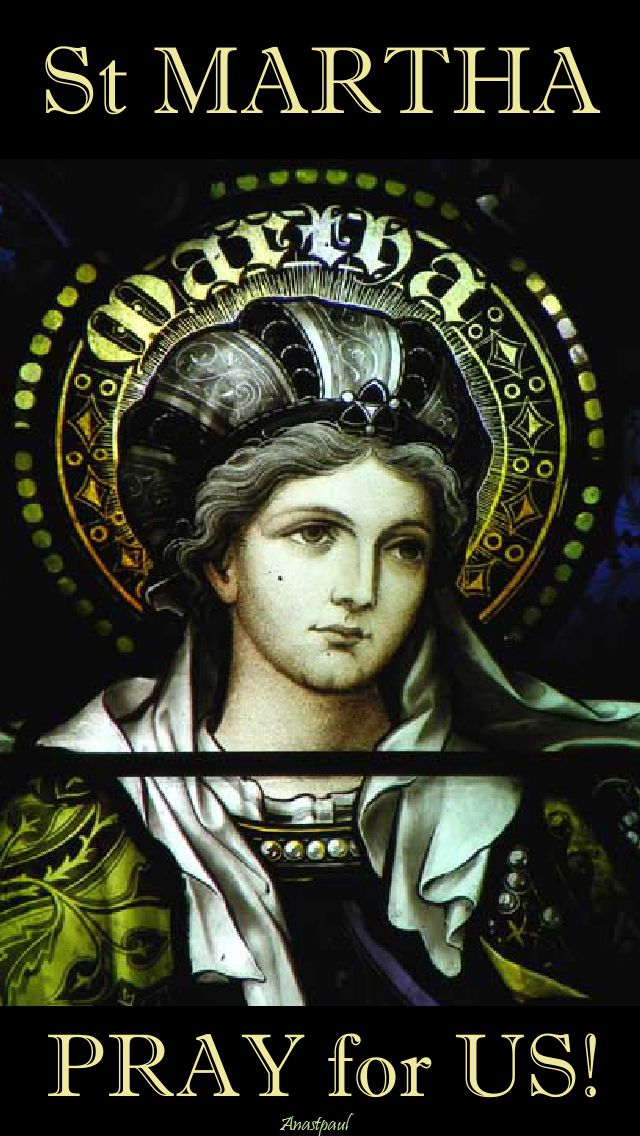
St Martha (Memorial) – Sister of Saint Lazarus and Saint Mary of Bethany. Friend of Jesus and hostess to Him in her house. May have been part of an early mission to France. St Martha: https://anastpaul.com/2018/07/29/saint-of-the-day-29-july-st-martha-virgin-1st-century/ More on St Martha here: https://anastpaul.wordpress.com/2017/07/29/saint-of-the-day-29-july-st-martha/
Chirsk-Pskov Icon of the Mother of God:
The Chirsk (Pskov) Icon of the Mother of God was initially in the Chirsk village church of the Pskov diocese. In a time of a deadly pestilence, tears flowed from the eyes of the Chirsk Icon of the Mother of God. This was reported to authorities in the city of Pskov. Priests and devout men carried the wonder-working icon to Pskov. A procession was held to honour the icon, which was placed in the cathedral church of the Holy Trinity.
On the reverse of the icon are depicted the Holy Apostle and Evangelist Luke and St Theodosius of the Kiev Caves.
St Antony
St Beatrix of Rome
Bl Beatrix of Valfleury
St Callinicus of Paphlagonia
Bl Charles-Antoine-Nicolas Ancel
St Faustinus of Rome
St Faustinus of Spello
St Felix of Rome
St John Baptist Luo Tingyin
St John the Soldier
Bl José Calasanz Marqués
St Joseph Zhang
St Kilian of Inishcaltra
St Lek Sirdani
Bl Luis Bertran
St Lupus of Troyes
Bl Mancius of the Cross
St Martha Wang
St Olaf II
St Olaus of Sweden
St Paulus Chen Changpin
Bl Petrus of Saint Mary
St Pjetër Çuni
St Prosper of Orleans
St Rufo of Rome
St Seraphina
St Serapia of Syria
St Simplicius of Rome
St Sulian Bl Pope Urban II (c 1035-1099)
St William of Saint Brieuc
—
Four Anonymous Martyrs
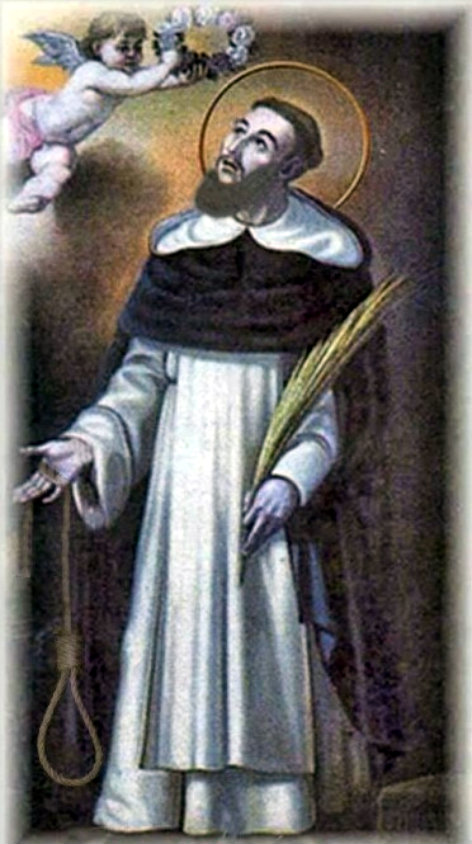
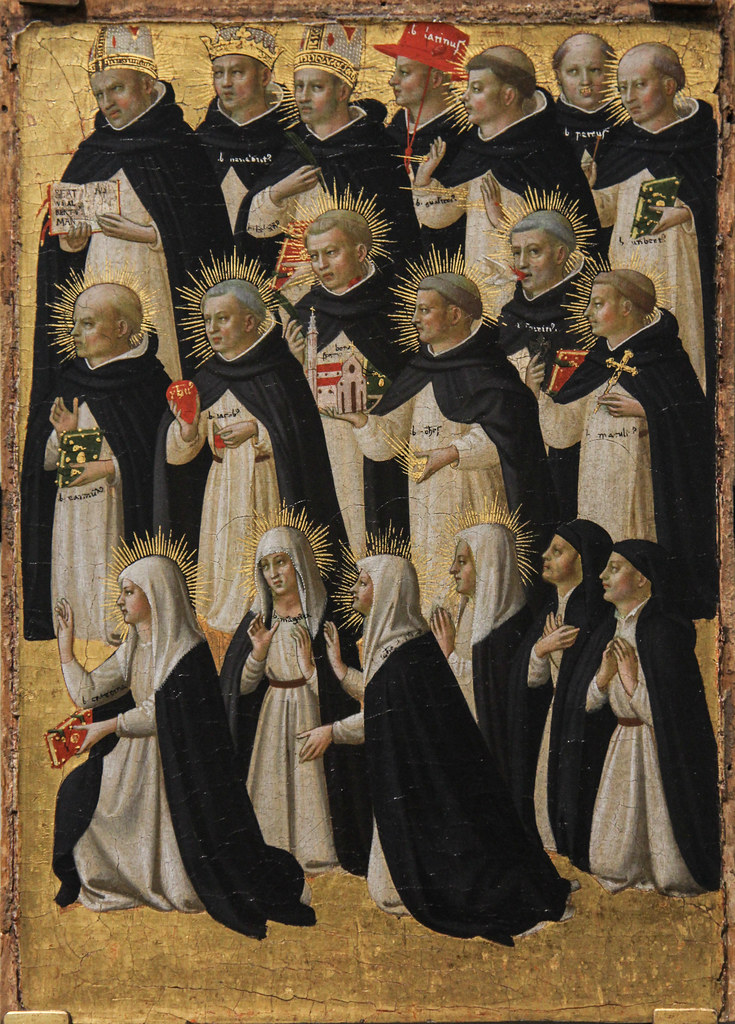
Martyrs of Calanda – 8 beati: A group of Dominican priests and friars who were martyred over the course of a day in the same town by the same group of anti-Christian forces in the Spanish Civil War.
• Antonio Manuel López Couceiro
• Felicísimo Díez González
• Gumersindo Soto Barros
• Lamberto María de Navascués de Juan
• Lucio Martínez Mancebo
• Matías Manuel Albert Ginés
• Saturio Rey Robles
• Tirso Manrique Melero
They were martyred on 29 July 1936 in Calanda, Teruel, Spain and Beatified on 11 March 2001 by St Pope John Paul II.
Martyrs of Lleida – 12 beati: Carmelites of the Ancient Observance novices, friars and priests who were all martyred together in the Spanish Civil War.
• Àngel Prat Hostench
• Eliseo Maneus Besalduch
• Gabriel Escoto Ruiz
• Ginés Garre Egea
• Joan Maria Puigmitjà Rubió
• Joan Prat Colldecarrera
• Josep Solé Rovira
• Lluis Fontdecava Quiroga
• Manuel Serrano Buj
• Miquel Soler Sala
• Pere Dorca Coromina
• Pere Ferrer Marín
They were martyred on 29 July 1936 in Clot dels Aubens, Cervera, Lleida, Spain and Beatified on 28 October 2007 by Pope Benedict XVI.
Martyred in the Spanish Civil War: Thousands of people were murdered in the anti-Catholic persecutions of the Spanish Civil War from 1934 to 1939.
• Blessed Bartolomé Rodríguez Soria
Martyrs of Rome – 23 saints
Eugene
Flora the Martyr
Lucilla
Theodore
Thought for the Day – 28 July – Seventeenth Sunday in Ordinary Time, Year C, Gospel: Luke 11:1–13 and the Memorial of St Pedro Poveda (1874-1936) Martyr
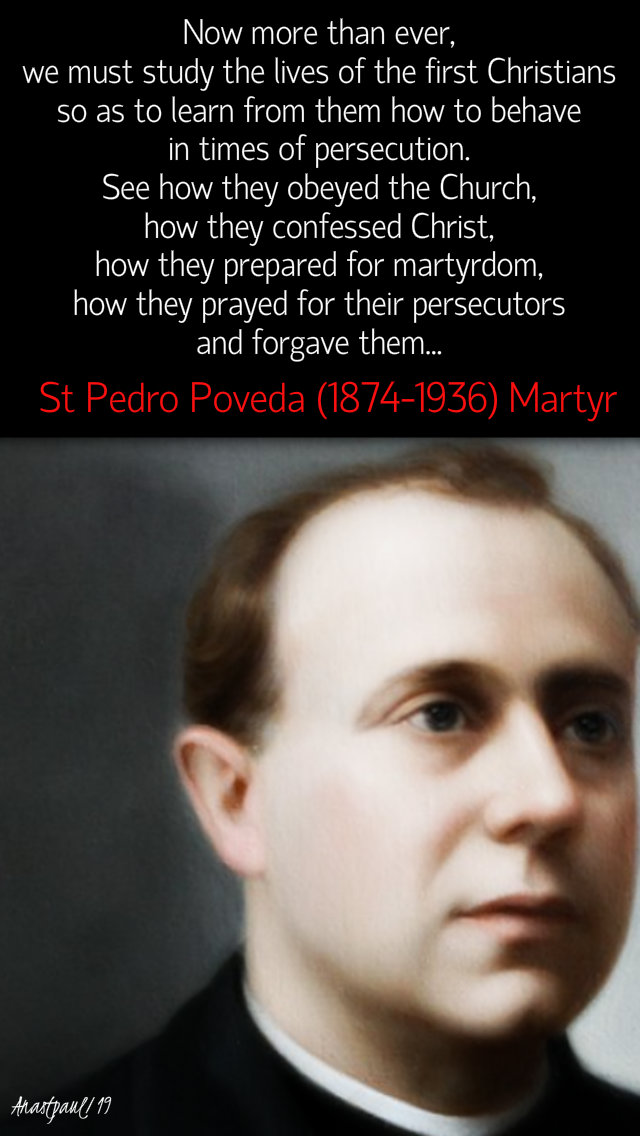
“The men of God and the women of God are unmistakable. They do not stand out because they are brilliant, or dazzling, or for their human strength but because of their wholesome fruit,” wrote Saint Pedro Poveda in a letter in 1925. These words may describe his life. He was a weaver of dreams because he was able to dream, design projects and even achieve some dreams through his trust in Divine Providence.
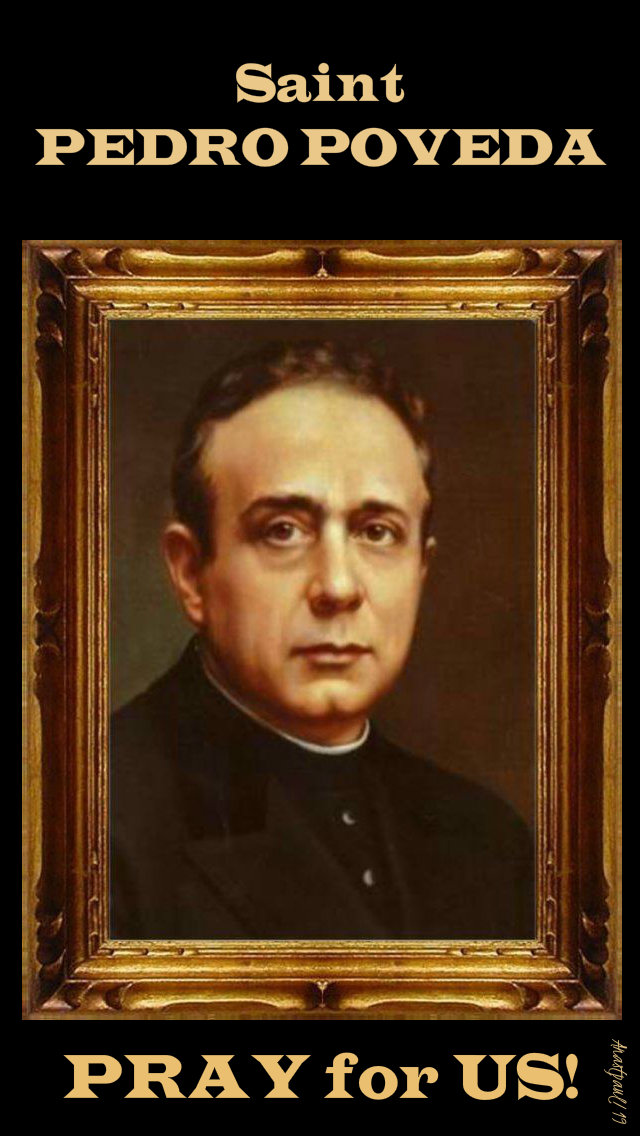
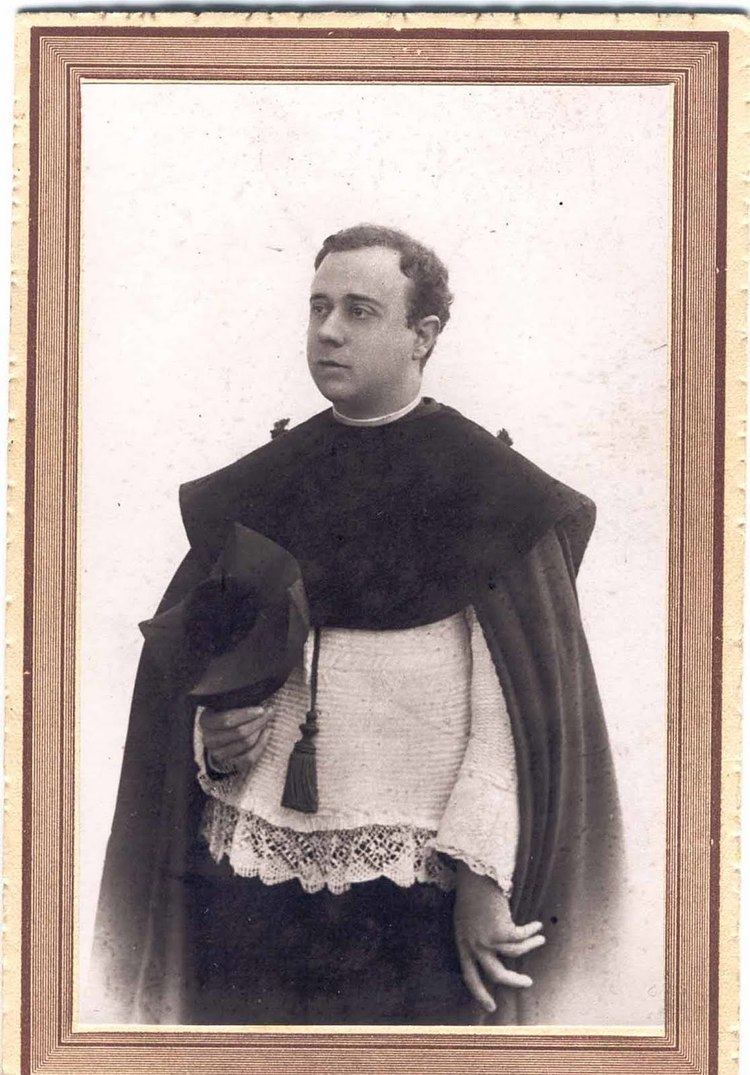
Saint Pedro Poveda, priest, educator, founder of the Teresian Association, active in over 30 countries now and martyr was born in Linares, Spain, on 3 December 1874. He died on 28 July 1936 at the beginning of the Spanish Civil War. He witnessed to his Christian faith and to his priesthood until his last moment. He was Canonised by St Pope John Paul II on 4 May 2003.
“My belief, my faith, is not wavering
but firm and unshakeable
and that is why I speak out.”
St Pedro Poveda, 1920.
PRAYER THROUGH THE INTERCESSION OF SAINT PEDRO POVEDA
Lord, our God,
you have given Saint Pedro Poveda,
Founder of the Teresian Association,
the grace of promoting
the evangelising action of Christians,
through education and culture,
and of giving his life in martyrdom
as a priest of Jesus Christ:
we ask that, like him, we may know
how to participate faithfully
in the mission of the Church
through the witnessing of our Christian life
and the generous surrender
to the announcement of Your Kingdom.
We pray that through his intercession,
you may grant us the favour we wish to receive.
………………………. (make your petition)
Through Jesus Christ, our Lord.
Amen
His remains are venerated in the chapel that bears his name at the Cultural and Spirituality Center, Santa Maria de Los Negrales.
Quote/s of the Day – 28 July – The Memorial of St Pedro Poveda (1874-1936) Martyr
“Lord, may I think, what you want me to think. May I desire, what you want me to desire. May I speak, as you want me to speak. May I work, as you want me to work.”
When the Civil War broke out, he was identified as an enemy by those who wished to dechristianse the schools. A few days before his death he wrote:
“Now more than ever, we must study the lives of the first Christians so as to learn from them, how to behave in times of persecution. See how they obeyed the Church, how they confessed Christ, how they prepared for martyrdom, how they prayed for their persecutors and forgave them…”
Sunday Reflection – 28 July – Seventeenth Sunday in Ordinary Time, Year C, Gospel: Luke 11:1–13
Become the bread of Christ
St Bernard (1090-1153) Doctor of the Church
Saint Bernard teaches that it is not enough for us to take and eat the Bread from Heaven. We must also offer ourselves to be eaten. Holy Communion is a wondrous exchange in which we become the bread of Christ. Listen to Saint Bernard:
“My penitence, my salvation are His food. I myself am His food. I am chewed. as I am reproved by Him; I am swallowed by Him. as I am taught; I am digested by Him. as I am changed; I am assimilated. as I am transformed; I am made one with Him, as I am conformed to Him. He feeds upon us and is fed by us, that we may be the more loosely bound to Him.”
Saint Bernard, ever the poet, uses images of eating and assimilation to describe how Christ unites us to Himself. Our Lord becomes our food that we might become His. We need the language of poets and preachers in our approach to the Eucharist.
Saint Bernard says, “Christ eats me that He may have me in Himself and Christ, in turn, is eaten by me, that He may be in me and the bond between us, will be strong and the union complete.”
What awaits you in Holy Communion exceeds all that you can desire. Eat, then and offer yourself to be eaten. Receive the Bread of God and become the bread of God.
One Minute Reflection – 28 July – Seventeenth Sunday in Ordinary Time, Year C, Gospel: Luke 11:1–13 and the Memorial of St Pedro Poveda (1874-1936) Martyr
“For everyone who asks, receives and he who seeks, finds and to him who knocks, it will be opened.” … Luke 11:10
REFLECTION – “The attitude of prayer is one and the same for all but there are many kinds of prayer and many different prayers. Some converse with God as with a friend and master, interceding with praise and petition not for themselves but for others. Some strive for more (spiritual) riches and glory and for confidence in prayer. Others ask for complete deliverance from their adversary. Some beg to receive some kind of rank, others for complete forgiveness of debts. Some ask to be released from prison, others for remission of accusations.
Before all else, let us list sincere thanksgiving, first on our prayer-card. On the second line we should put confession and heartfelt contrition of soul. Then let us present our petition to the King of all. This is the best way of praying.” … St John Climacus (c 575-c.650) The Ladder of Divine Ascent 28, 6-7
PRAYER – All-powerful and ever-living God, splendour of true light and never-ending day, chase away the night of sin and fill our minds with the glory of Your coming. Take away our heart of stone and give us a heart of flesh, help us in our battle with sin and the devil. By our prayers, Your holy sacraments and the strength of the Holy Spirit, may we be ever vigilant of the evil one. By our baptism in Your Son, we are Your children, grant us Your protection. Listen, to the prayers of Saint Pedro Poveda, as we ask for his intercession, through Christ our Lord, with the Holy Spirit, God for all eternity, amen.
Our Morning Offering – 28 July – Seventeenth Sunday in Ordinary Time, Year C
Make Your Dwelling in Me By St John Damascene (675-749) Father & Doctor of the Church
Hold dominion over my heart, O Lord!
Keep it as Your inheritance.
Make Your dwelling in me,
along with the Father and the Holy Spirit.
Widen in me
the cords of Your tabernacle,
even the operations
of Your Most Holy Spirit.
For You are my God
and I will praise You,
together with the Eternal Father
and your quickening Spirit,
now, henceforth and forever.
Amen
Saint of the Day – 28 July – Saint Pedro Poveda Castroverde (1874-1936) (aged 61) Priest and Martyr, Founder of the Teresian Association, Teacher, apostle of charity and prayer, promoter of the woman’s role in society especially via Christian female education – born on 3 December 1874 at Linares, Jaen, Spain and died by firing squad on 28 July 1936 at Madrid, Spain.
Pedro Poveda was born on 3 December 1874 in Linares, Spain, to a solidly Christian family. From early childhood he felt called to become a priest and in 1889 he entered the diocesan seminary in Jaén. Because of financial difficulties, he transferred to the Diocese of Guadix, Grenada, where the Bishop had offered him a scholarship . He was ordained a priest on 17 April 1897.
After ordination Fr Poveda taught in the seminary and served the diocese in many other ways. In 1900 he completed a licentiate in theology at Seville and later began an apostolate among the “cave-dwellers”, those who lived in dugouts in the hills outside of Guadix. Here he built a school for children and workshops for adults that provided professional training and Christian formation. He was misunderstood, however, and had to leave this special ministry.
So Fr Poveda headed for the solitude of Covadonga, in the mountains of northern Spain, where, in 1906, he was appointed canon of the Basilica of Covadonga in Asturias, where the Blessed Virgin is venerated under this title.
In Covadonga, he devoted much time to prayer and reflected particularly on the problem of education in Spain. He understood that the Lord was inviting him to open new paths in the Church and in the society of his time . He began to published articles and pamphlets on the question of the professional formation of teachers and was also in contact with other persons who felt the need for the presence and action of Christians in society.
The opposition between faith and science was becoming more and more evident in the culture of his day, which carried with it a de-Christianisation of the public education system. Fr Poveda, after his apostolic experience in Guadix and his years of reflection and prayer in Covadonga, understood better the need to provide Christian formation for teachers who work in the State school system. He believed that a solid faith and professional qualifications were both needed to keep the Gospel message alive.
In 1911 he opened the St Teresa of Avila Academy as a residence for students and the starting point of the Teresian Association, dedicated to the spiritual and pastoral formation of teachers. The following year he joined the Apostolic Union of Secular Priests and started new pedagogical centres and some periodicals.
To further his work Fr Poveda moved to Jaén, where he taught in the seminary, served as spiritual director of Los Operarios Catechetical Centre and worked at the Teacher Training College. In 1914 he opened Spain’s first university residence for women in Madrid.
Meanwhile, the Teresian Association continued to develop, spreading to various groups and areas and leading to its ecclesiastical and civil approval in Jaén. Fr Poveda offered the Teresian Association as a new path of Christian life and evangelisation created with- and for- lay persons, forming them to be witnesses of the Gospel, according to his expression: “To believe firmly and to keep silent is not possible”. He wanted the adherents to be ready to give their lives for the faith and in fact, expressed the same desire himself.
In 1921 Fr Poveda moved to Madrid and was appointed a chaplain of the Royal Palace. A year later he was named a member of the Central Board against illiteracy but most of his time was devoted to the Teresian Association, which received papal approval in 1924. Although he did not direct the Association, as its founder, he worked to consolidate and promote the various dimensions of its mission as it spread to Chile and later to Italy (1934).
It was during the religious persecution in Spain that Fr Poveda would be called to the martyrdom he so desired. At dawn on 28 July 1936, when told by his persecutors to identify himself, he said, “I am a priest of Christ”. He died a martyr for the faith and was Beatified on 10 October 1993 and Canonised on 4 May 2003 by St Pope John Paul II…Vatican.va
Father Poveda was deeply aware of both the need for education in his country, and for qualified teachers to provide it. He also saw this as an important role for women. In 1911 Pedro founded 1911 the St Teresa of Avila Academy in Oviedo for those ladies studying to become teachers. He named it after St Teresa of Avila, a woman of learning, a doctor of the Church and a teacher of prayer. He named his organisation the Teresian Association. Its aim is to invite men and women to work for a social and human transformation, in accordance with Gospel values, from the platform of their own professions, especially those related to the fields of education and culture. The early members of the Association were women involved in all levels of education, from elementary to the provision of higher education for women. Additional academies were established in many other cities of Spain. This association has schools around the world, including Brazil, Ireland, Philippines, India and in most South American capitals.
The Teresian Headquartes in Madrid
In 1914 he opened Spain’s first university residence for women in Madrid. Residences for women were opened in those places that have a university.
In 1924, Pope Pius XI approved the Teresian Association as a “pious union of the faithful” and later spread to Chile and Italy. In 1951 the Teresian Association was granted the status of Secular Institute. On 10th July 1990, St Pope John Paul II approved that it reverts back to its original identity as being an Association of the Faithful. The Teresian Association is registered in the Vatican’s Dicastery for Laity, Family and Life of the Holy See. It is active in thirty countries. Its objective is the human promotion of individuals and the transformation of unjust structures by means of an education and culture imparted from a Christian perspective.
A film was made of his life in 2016.
“St Pedro Poveda, grasping the importance of the role of education in society, undertook an important humanitarian and educational task among the marginalised and the needy. He was … a teacher of the Christian life and of the relationship between faith and knowledge, convinced that Christians must bring essential values and commitment to building a world that is more just and mutually supportive. His life ended with the crown of martyrdom.”… Homily of St Pope John Paul II on the occasion of his Apostolic Journey to Spain, 4 May 2003
St Acacius of Miletus St Alphonsa of the Immaculae Conception/India FCC (1910-1946) About St Alphonsa: https://anastpaul.com/2017/07/28/saint-of-the-day-28-july-st-alphonsa-of-the-immaculate-conception/
St Arduinus of Trepino
St Botwid of Sudermannland
St Camelian of Troyes
St Celsus of Rome
Bl Christodoulos
Bl Davíd Carlos-Marañon
St Eustathius of Galatia
St Irene of Cappadocia
Bl John Soreth
St José Caselles-Moncho
Bl José Melchór García-Sampedro Suárez
Bl Josep Castell-Camps
St Longinus of Satala
St Lucidius of Aquara
St Lyutius
Bl Manuel Segura-López
St Nazarius of Rome St Pedro Poveda Castroverde (1874-1936) Priest and Martyr
He is the first US-born Priest and Martyr to be Beatified (on 23 September 2017) and the second person to be Beatified on US soil following the 2014 Beatification of New Jersey-born nun, Blessed Miriam Teresa Demjanovich S.C. (1901-1927).
His First Feast Day today, 28 July 2018
St Pope Victor I
—
Martyrs of Laodicea – 8 saints
Martyrs of Thebaid: A large but unspecified number of Christians who were imprisoned, tortured and murdered together in the persecutions of Decius and Valerian. 3rd century Thebes, Egypt.
Martyred in the Spanish Civil War – Thousands of people were murdered in the anti-Catholic persecutions of the Spanish Civil War from 1934 to 1939.
Martyrs of Fernán Caballero – 14 beati: Fourteen Claretian clerics who were martyred together in the Spanish Civil War. – 28 July 1936 in Fernán Caballero, Ciudad Real, Spain. They were Beatified on 13 October 2013 by Pope Francis.
Bl Antolín Astorga Díez
Bl Enrique Serra Chorro
Bl Gregorio Charlez Ribera
Bl Joan Ayats Plantalech
Bl Joan Bover Teixidor
Bl Joan Costa Canal
Bl José Aurelio Calleja de Hierro
Bl José Gutiérrez Arranz
Bl Josep Camí y Camí
Bl Josep Martí Coll
Bl Lluis Casanovas Vila
Bl Lorenzo Arribas Palacio
Bl Manuel Collellmir Sentíes
Bl Miguel Léibar Garay
Bl Narcís Felíu Costa
Bl Pedro Alonso Fernández
Bl Pelagi Ayats Vergés
Bl Pere Vilar Espona
Bl Primitivo Sandín Miñambres
Bl Ramon Gros Ballbé
Bl Vicente Toledano Valenciano
Thought for of the Day – 27 July – Saturday of the Sixteenth week in Ordinary Time, Year C, Gospel: 13:24-30
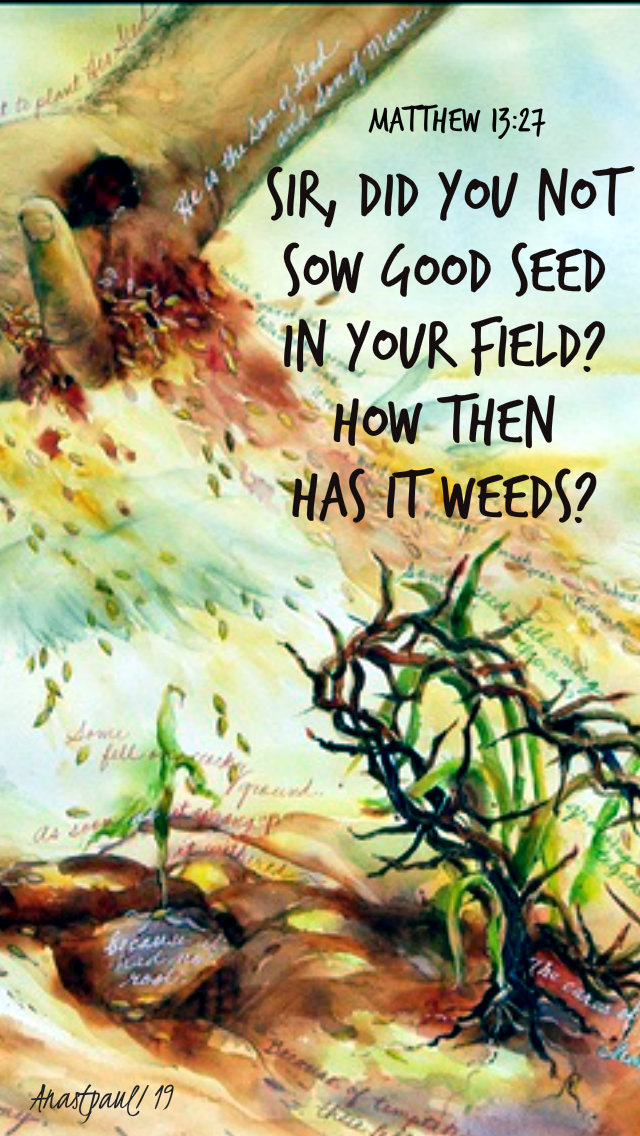
“The kingdom of heaven may be compared, to a man who sowed good seed in his field but, while men were sleeping, his enemy came and sowed weeds among the wheat and went away. So when the plants came up and bore grain, then the weeds appeared also. And the servants of the householder came and said to him, ‘Sir, did you not sow good seed in your field? How then has it weeds?’”… Matthew 13:24-27
The field owner’s attitude is that of hope, grounded in the certainty, that evil does not have the first nor the last word.
And it is thanks to this patient hope of God, that the same weed, which is the malicious heart with so many sins, in the end can become good grain.
But be careful – evangelical patience is not indifference to evil, one must not confuse good and evil!
In facing weeds in the world, the Lord’s disciple is called to imitate the patience of God, to nourish hope, with the support of indestructible trust, in the final victory of good, that is, of God.
Quote/s of the Day – 27 July – Saturday of the Sixteenth week in Ordinary Time, Year C, Gospel: 13:24-30
“Speaking of: Temptation”
‘Sir, did you not sow good seed in your field? How then has it weeds?’
Matthew 13:27
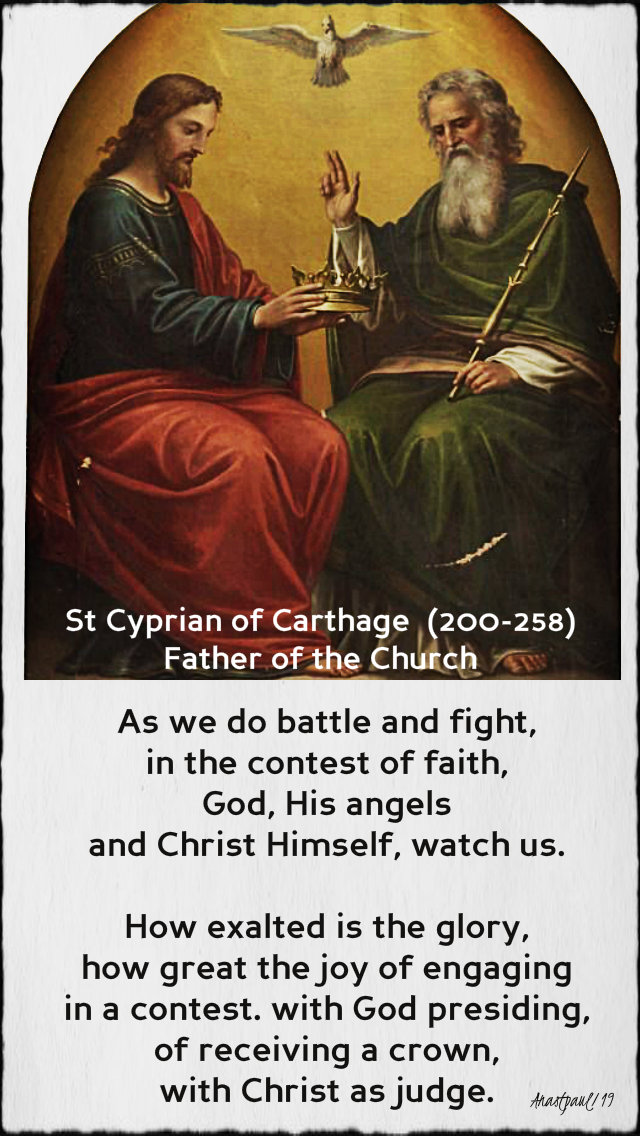
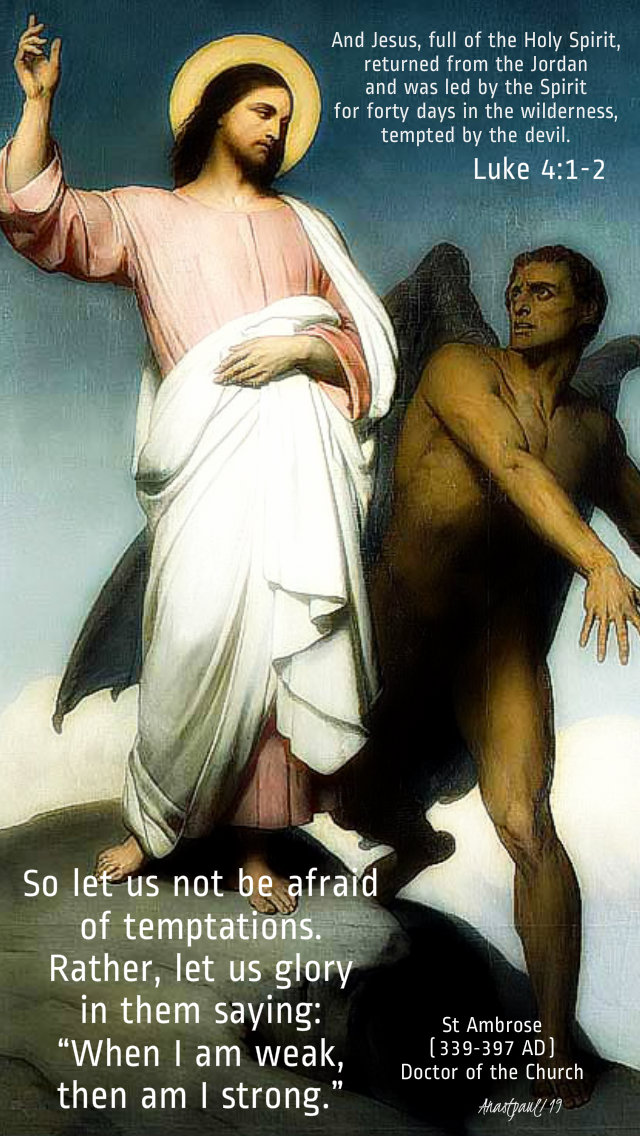
“As we do battle and fight, in the contest of faith, God, His angels and Christ Himself, watch us. How exalted is the glory, how great the joy of engaging in a contest with God presiding, of receiving a crown, with Christ as judge.”
St Cyprian of Carthage (200-258)
Bishop, Martyr, Father of the Church
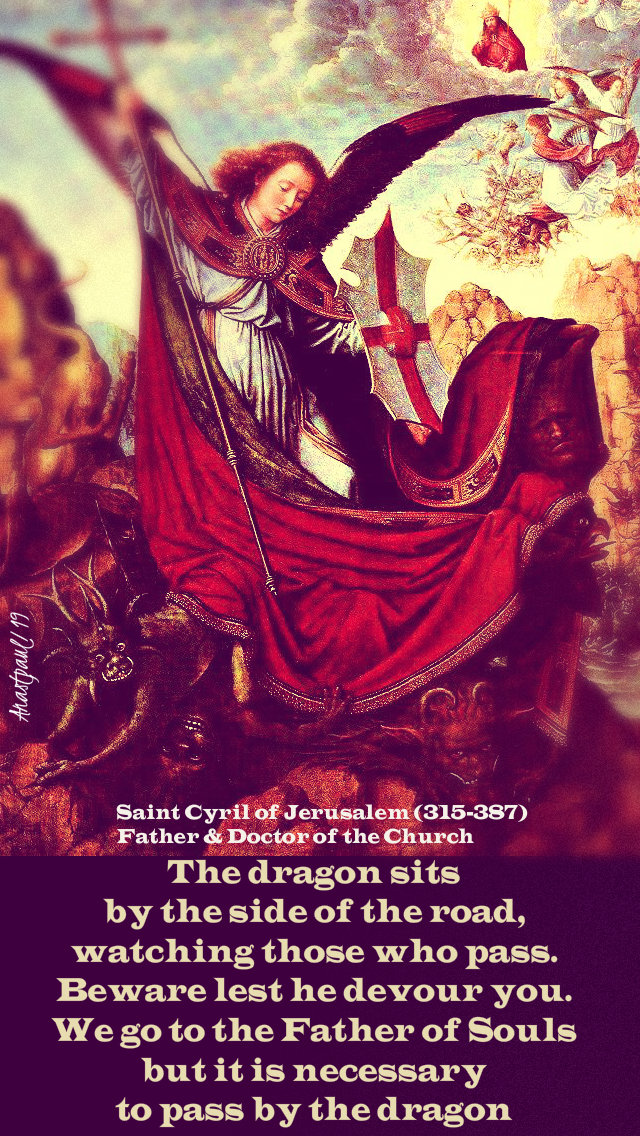
“The dragon sits by the side of the road, watching those who pass. Beware lest he devour you. We go to the Father of Souls but it is necessary to pass by the dragon.”
Saint Cyril of Jerusalem (315-387)
Father & Doctor of the Church
“So let us not be afraid of temptations. Rather, let us glory in them saying: “When I am weak, then am I strong.” [2 Cor. 12:10]”
St Ambrose (339-397 AD)
Doctor of the Church
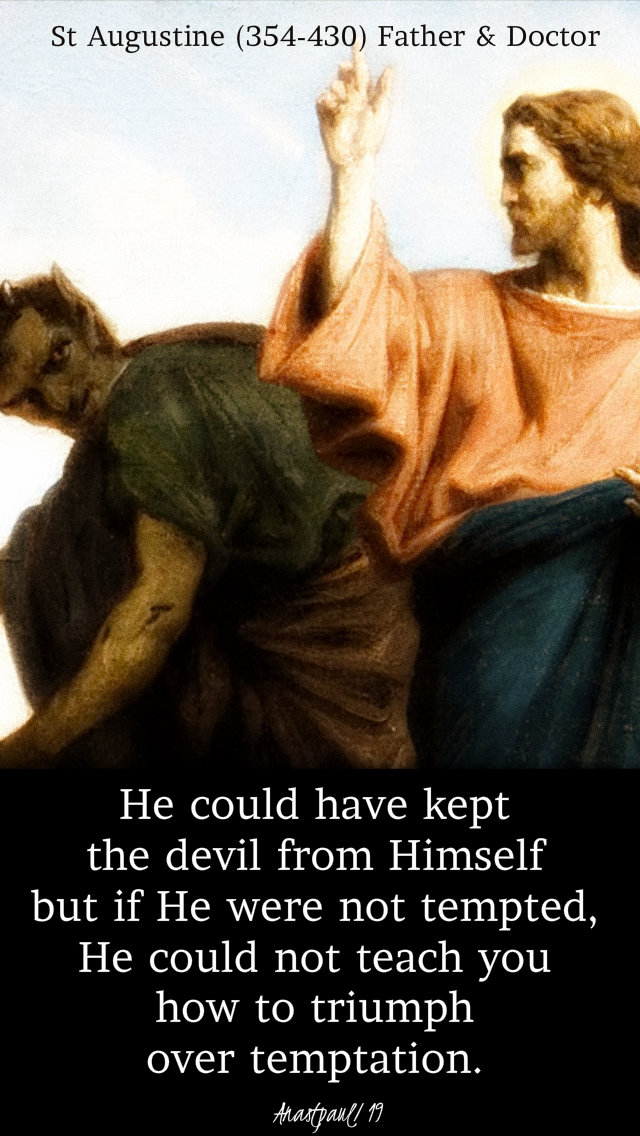
“He could have kept the devil from Himself but if He were not tempted, He could not teach you how to triumph over temptation.”
Saint Augustine (354-430)
Bishop and Great Western Father
and Doctor of the Church
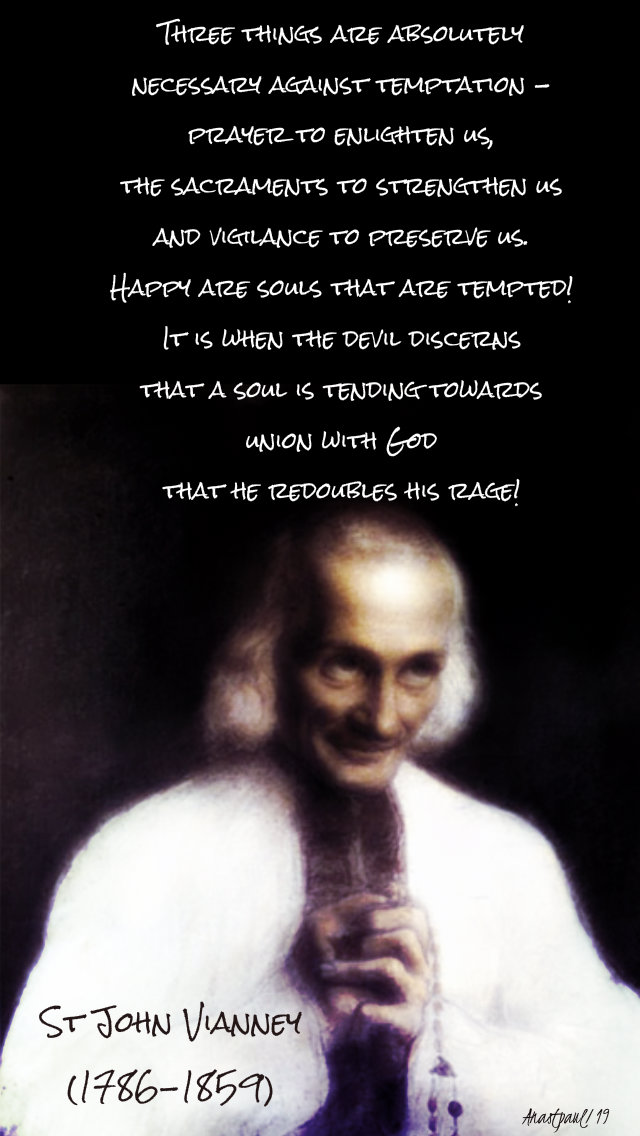
“Three things are absolutely necessary against temptation – prayer to enlighten us, the sacraments to strengthen us and vigilance to preserve us. Happy are souls that are tempted! It is when the devil discerns that a soul is tending towards union with God that he redoubles his rage!”
St John Marie Vianney (1786-1859)
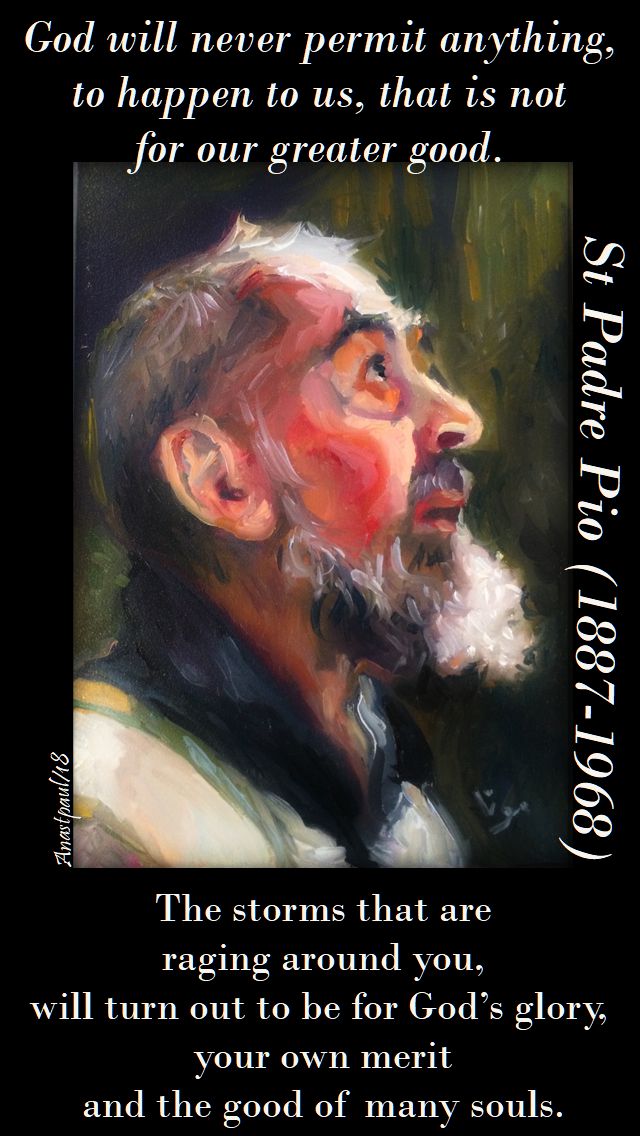
“God will never permit anything, to happen to us, that is not for our greater good.”
“The storms that are raging around you, will turn out to be for God’s glory, your own merit and the good of many souls.”
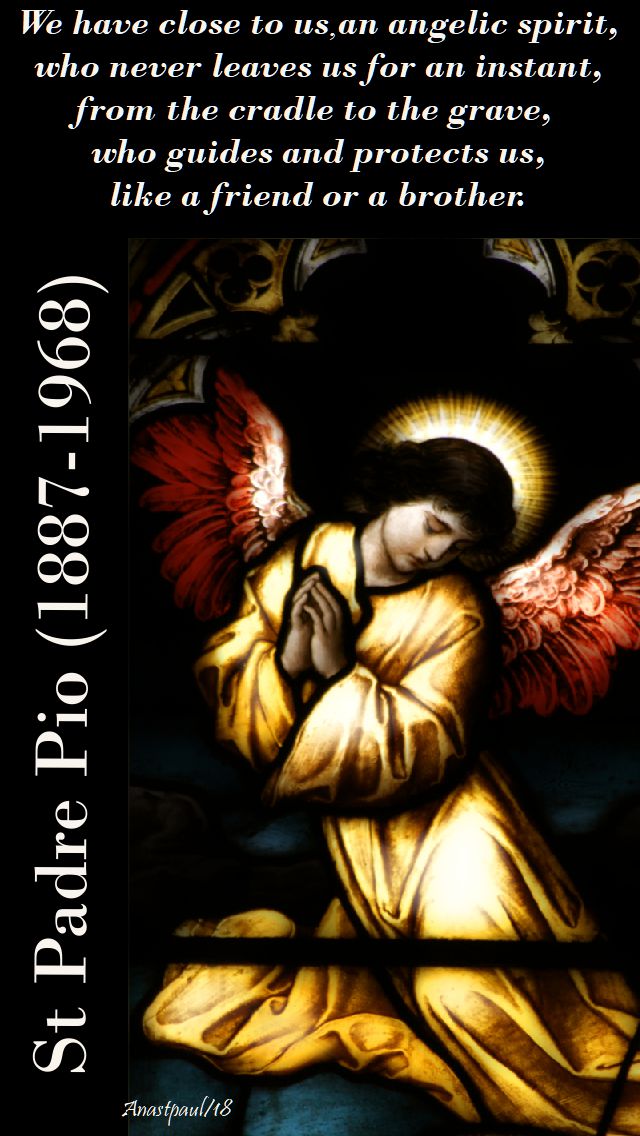
“We have close to us, an angelic spirit, who never leaves us for an instant, from the cradle to the grave, who guides and protects us, like a friend or a brother.”
One Minute Reflection – 27 July – Saturday of the Sixteenth week in Ordinary Time, Year C, Gospel: 13:24-30
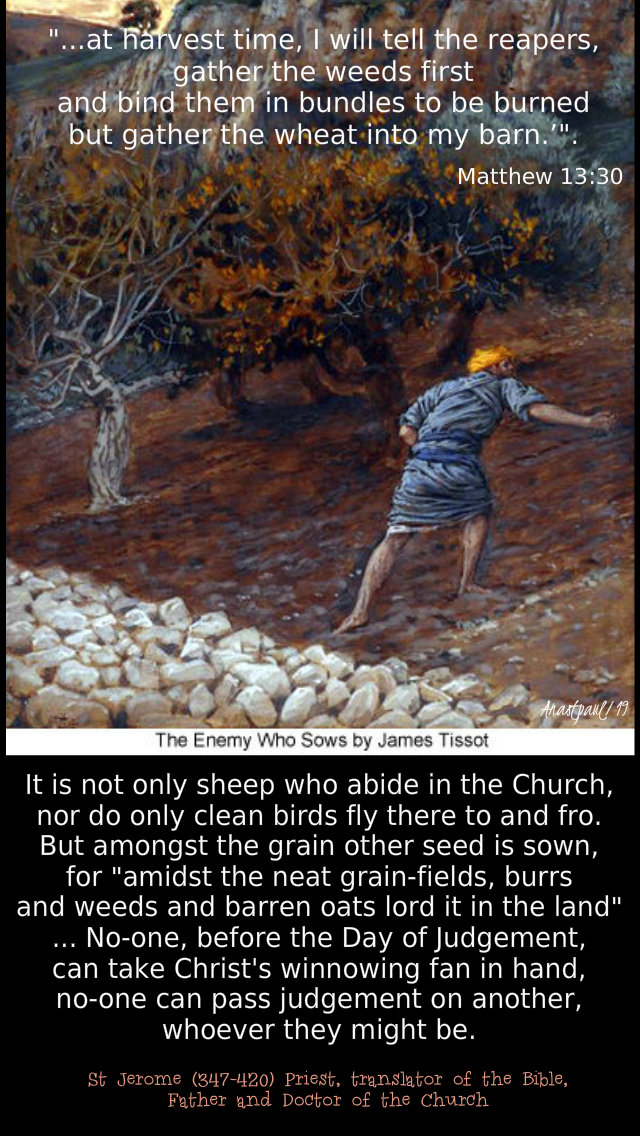
“Let both grow together until the harvest and at harvest time, I will tell the reapers, gather the weeds first and bind them in bundles to be burned but gather the wheat into my barn.’”… Matthew 13:30
REFLECTION – “It is not only sheep who abide in the Church, nor do only clean birds fly there to and fro. But amongst the grain other seed is sown, for “amidst the neat grain-fields, burrs and weeds and barren oats lord it in the land” (Virgil’s Georgics). What is the farmhand to do? Root up the darnel? In that case the whole harvest is destroyed along with it!
Every day the farmer diligently drives away the birds by making a noise or by frightening them with scarecrows (…) Nevertheless he suffers from the raids of nimble roes or the wantonness of wild asses, on the one hand, voles convey the grain to their underground barns, on the other, ants in a moving column ravage the crop. This is how things are! No-one who has land is free from care.
While the householder slept, the enemy sowed tares, when the servants hastened to go and root them up, the Master prevented them, reserving for Himself the separation of wheat and chaff. (…) No-one, before the Day of Judgement, can take Christ’s winnowing fan in hand, no-one can pass judgement on another, whoever they might be.”… St Jerome (347-420) Priest, translator of the Bible, Father and Doctor of the Church – The dialogue against the Luciferians (SC 473, p 179-180)
PRAYER – All-powerful and ever-living God, splendour of true light and never-ending day, chase away the night of sin and fill our minds with the glory of Your coming. Take away our heart of stone and give us a heart of flesh, help us in our battle with sin and the devil. By our prayers, Your holy sacraments and the strength of the Holy Spirit, may we be ever vigilant of the evil one. Grant we pray, that the Blessed Virgin’s prayers, may protect us from all dangers. We make our prayer through Christ, our Lord with the Holy Spirit, one God forever, amen.
Our Morning Offering – 27 July – Saturday of the Sixteenth week in Ordinary Time, Year C – a “Marian Saturday”
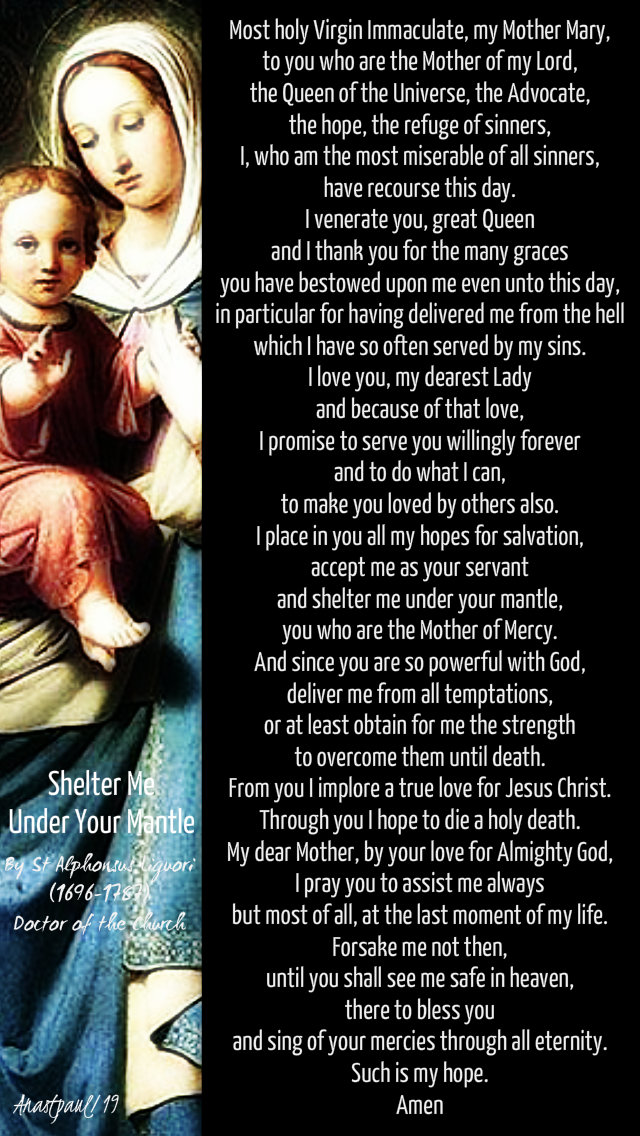
Shelter Me Under Your Mantle By St Alphonsus Liguori (1696-1787) Doctor of the Church
Most holy Virgin Immaculate, my Mother Mary,
to you who are the Mother of my Lord,
the Queen of the Universe, the Advocate,
the hope, the refuge of sinners,
I, who am the most miserable of all sinners,
have recourse this day.
I venerate you, great Queen
and I thank you for the many graces
you have bestowed upon me even unto this day,
in particular for having delivered me from the hell
which I have so often served by my sins.
I love you, my dearest Lady
and because of that love,
I promise to serve you willingly forever
and to do what I can,
to make you loved by others also.
I place in you all my hopes for salvation,
accept me as your servant
and shelter me under your mantle,
you who are the Mother of Mercy.
And since you are so powerful with God,
deliver me from all temptations,
or at least obtain for me the strength
to overcome them until death.
From you I implore a true love for Jesus Christ.
Through you I hope to die a holy death.
My dear Mother, by your love for Almighty God,
I pray you to assist me always
but most of all, at the last moment of my life.
Forsake me not then,
until you shall see me safe in heaven,
there to bless you
and sing of your mercies through all eternity.
Such is my hope.
Amen
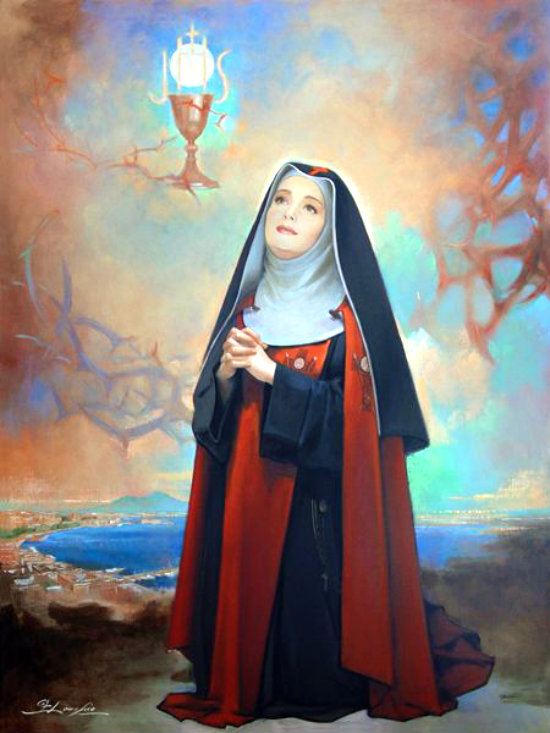
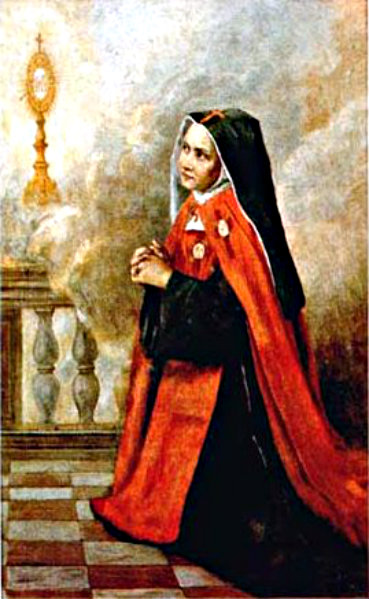
Saint of the Day – 27 July – Blessed Maria of the Passion of Our Lord Jesus Christ (1866-1912) – Virgin, Religious Sister of the Institute of the Sisters Crucified Adorers of the Eucharist – born on 23 September 1866 in Barra, Naples, Italy as Maria Grazia Tarallo and died on 27 July 1912 at Giorgio a Cremano, Naples, Italy of natural causes. Patronages – the Crucified Sisters Adorers of the Holy Eucharist and against demonic possessions.
Maria Grazia Tarallo was born on 23 September 1866 in Barra, Naples, Italy, to Leopoldo Tarallo and Concetta Borriello. She was baptised the following day in the Ave Gratia Plena Parish in Barra. Growing up, she received a solid Christian and human formation in her family.
A child “called” by God while still young, Maria Grazia made a private vow of virginity at age five in front of a statue of the Blessed Mother.
When she was just 7 she made her First Communion and at the age of 10 she received the Sacrament of Confirmation.
Maria Grazia’s life was especially directed toward Christian perfection and total consecration to God.
When she was 22 she wished to enter the convent but her father opposed her desire as he wanted her to marry. However, the young man who proposed to her, died before they could marry, thus leaving her free to enter the convent.
On 1 June 1891 she entered the Monastery of the Sisters Crucified Adorers of the Eucharist, in Barra, founded by the Servant of God Maria Pia Notari who was a witness to the virtuous and holy life of Maria Grazia and to whom she gave the name “Sr Maria of the Passion”.
Sr Maria lived her vocation of love for Christ’s Passion, the Eucharist and Our Lady of Sorrows to the full. She was known to say: “My name is Sr Maria of the Passion and I must resemble the Master”.
As a nun, she was given different responsibilities, from that of Novice Mistress and as spiritual guide of her Sisters, to that of kitchen and laundry service and porter.
She was always exemplary and edifying in her life of charity and prayer and was admired by everyone in her community.
Sr Maria’s desire to be a victim soul for sinners was summed up by her in this way: “I want to be holy, loving Jesus in the Eucharist, suffering with Christ Crucified and seeing Christ in my brothers and sisters”.
Sr Maria of the Passion died on 27 July 1912 in Barra, leaving to her Sisters the following testimony: “I exhort you to holy perseverance according to the Rule, readiness in obedience and especially daily Adoration of Jesus in the Blessed Sacrament. Love Jesus in the Eucharist, never leave Him alone, do not anger Him, do not disappoint Him”….Vatican.va
She was Beatified on 14 May 2006 by Pope Benedict XVI.
St Ecclesius of Ravenna
Bl Felipe Hernández Martínez
St Felix of Cordoba
St Galactorio of Lescar
St George of Cordoba
St Hermippus
St Hermocrates
St Hermolaus
Bl Jaime Ortiz Alzueta
Bl Joaquín Vilanova Camallonga
Bl José María Ruiz Cano
St Juliana of Mataró
St Lillian of Cordoba
Bl Lucy Bufalari
St Luican Bl Maria Grazia Tarallo/Bl Maria of the Passion of Our Lord Jesus Christ (1866-1912)
Bl Rudolf Aquaviva S.J.
Bl Robert Sutton
St Semproniana of Mataró
St Sergius of Bisceglia
Bl William Davies
Bl Zacarías Abadía Buesa
Martyrs of Nicomedia – 3 saints: Three Christians martyred together. The only other information to survive are their names – Felix, Jucunda and Julia. Nicomedia, Asia Minor.
Seven Sleepers of Ephesus: A group of seven young Christian men who hid in a cave in hopes of avoiding the persecution of Decius in the year 250. Found and arrested, they were ordered by the pro-consul in Ephesus to renounce their faith; they refused and were sentenced to die. Legend says that they were walled up in their hiding cave, guarded by the dog Al Rakim; when the cave wall was breached in 479 – they all woke up!
It is likely that the youths were tortured to death in various ways and buried in the cave. The resurrection story confusion came from the phrase “went to sleep in the Lord” which was used to describe the death of Christians and 479 is when their relics were discovered. Their names were Constantinus, Dionysius, Joannes, Malchus, Martinianus, Maximianus and Serapion. They were martyred in 250 in Ephesus (in modern Turkey); tradition says that they were walled up in a cave to suffocate but other records indicate that they were tortured to death in various ways. Their relics discovered in 479 and translated to Marseilles, France and enshrined in a large stone coffin.
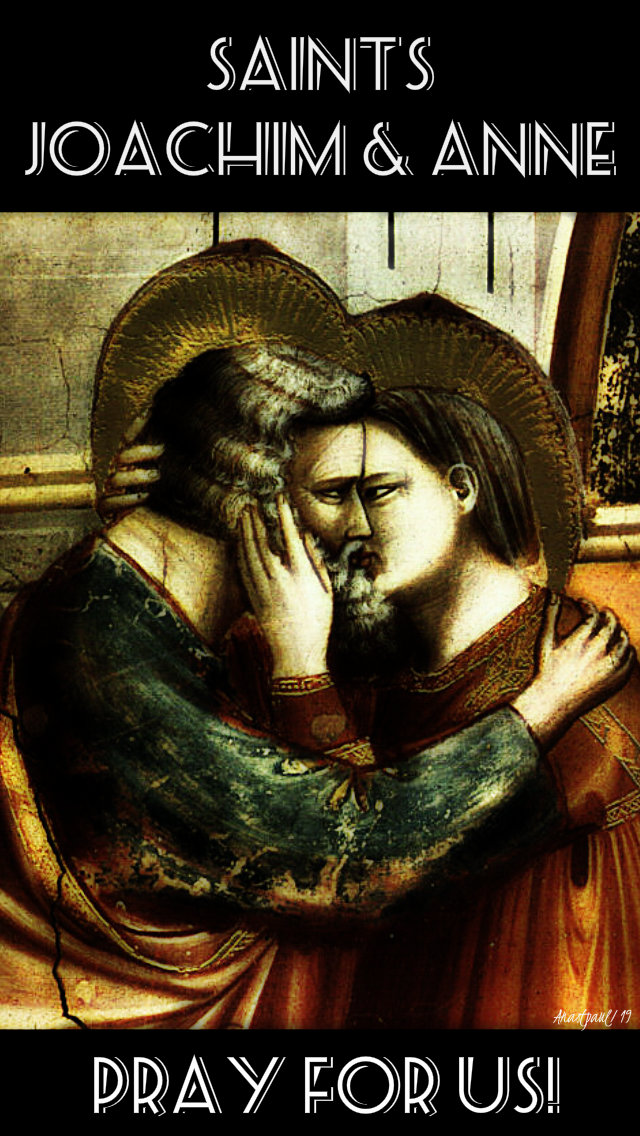
Thought for the Day – 26 July – The Memorial of Sts Joachim and Anne, Parents of the Blessed Virgin Mary and Grandparents of Jesus
In the Scriptures, Matthew and Luke furnish a legal family history of Jesus, tracing ancestry to show that Jesus is the culmination of great promises. Not only is his mother’s family neglected, we also know nothing factual about them except that they existed. Even the names Joachim and Anne come from a legendary source written more than a century after Jesus died.
The heroism and holiness of these people, however, is inferred from the whole family atmosphere around Mary in the Scriptures. Whether we rely on the legends about Mary’s childhood or make guesses from the information in the Bible, we see in her a fulfilment of many generations of prayerful persons, herself steeped in the religious traditions of her people.
The strong character of Mary in making decisions, her continuous practice of prayer, her devotion to the laws of her faith, her steadiness at moments of crisis and her devotion to her relatives—all indicate a close-knit, loving family that looked forward to the next generation even while retaining the best of the past.
Joachim and Anne—whether these are their real names or not—represent that entire quiet series of generations who faithfully perform their duties, practice their faith and establish an atmosphere for the coming of the Messiah but remain obscure.
This is the “feast of grandparents.” It reminds grandparents of their responsibility to establish a tone for generations to come – they must make the traditions live and offer them as a promise to little children. But the feast has a message for the younger generation as well. It reminds the young that older people’s greater perspective, depth of experience and appreciation of life’s profound rhythms, are all part of a wisdom not to be taken lightly or ignored.
Prayer for Grandparents
By Pope Benedict XVI
Lord Jesus,
You were born of the Virgin Mary,
the daughter of Saints Joachim and Anne.
Look with love on grandparents the world over.
Protect them!
They are a source of enrichment
for families, for the Church and for all of society.
Support them!
As they grow older,
may they continue to be for their families
strong pillars of Gospel faith,
guardian of noble domestic ideals,
living treasuries of sound religious traditions.
Make them teachers of wisdom and courage,
that they may pass on, to future generations the fruits
of their mature human and spiritual experience.
Lord Jesus,
help families and society
to value the presence and roles of grandparents.
May they never be ignored or excluded,
but always encounter respect and love.
Help them to live serenely and to feel welcomed
in all the years of life which You give them.
Mary, Mother of all the living,
keep grandparents constantly in your care,
accompany them on their earthly pilgrimage,
and by your prayers, grant that all families
may one day be reunited in our heavenly homeland,
where you await all humanity
for the great embrace of live without end.
Amen!
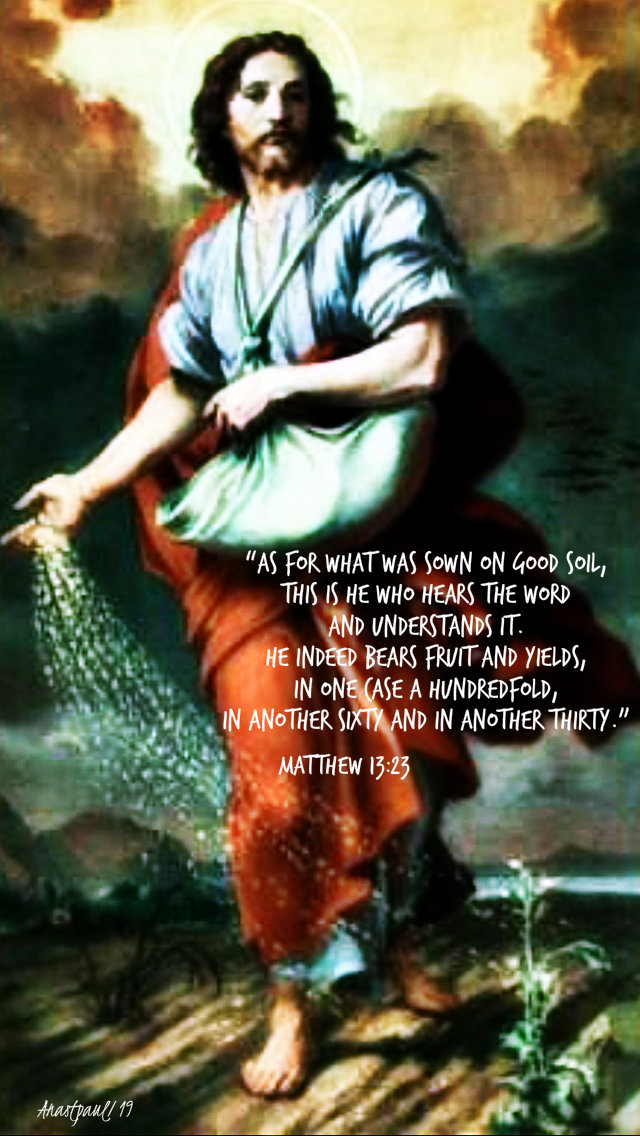
Quote/s of the Day – 26 July – Friday of the Sixteenth week in Ordinary Time, Year C – Today’s Gospel: Matthew 13:18–23 – “The Parable of the Sower”
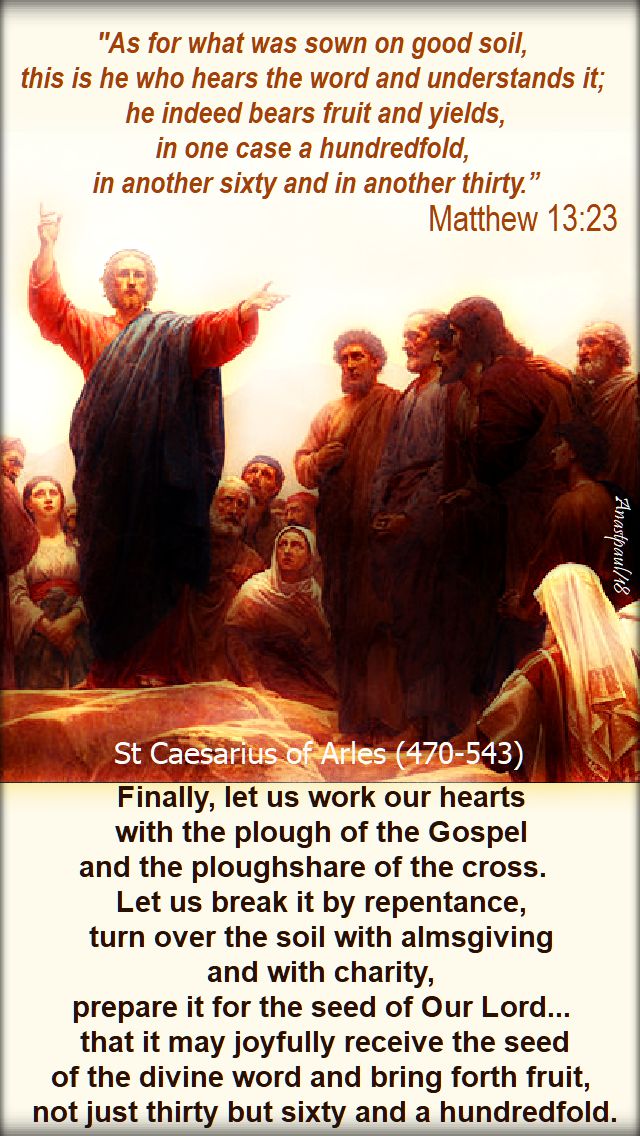
“As for what was sown on good soil, this is he who hears the word and understands it. he indeed bears fruit and yields, in one case a hundredfold, in another sixty and in another thirty.”
Matthew 13:23
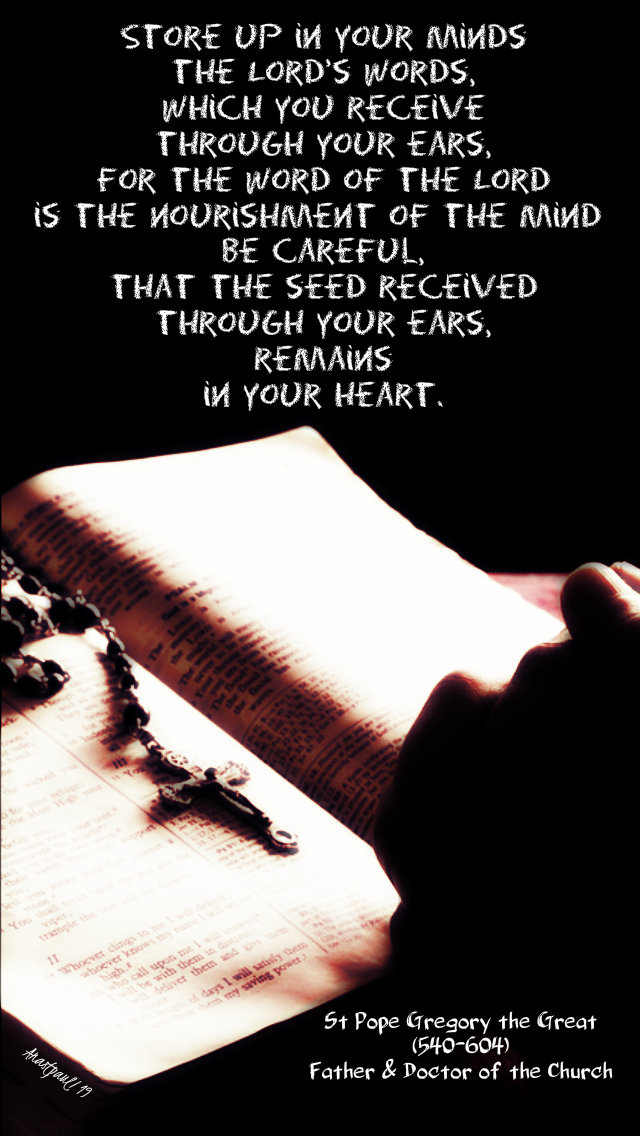
“Store up in your minds, the Lord’s words which you receive, through your ears, for the Word of the Lord, is the nourishment of the mind … Be careful, that the seed received through your ears, remains in your heart.”
Saint Pope Gregory the Great (540-604)
Father & Doctor of the Church
Forty Gospel Homilies
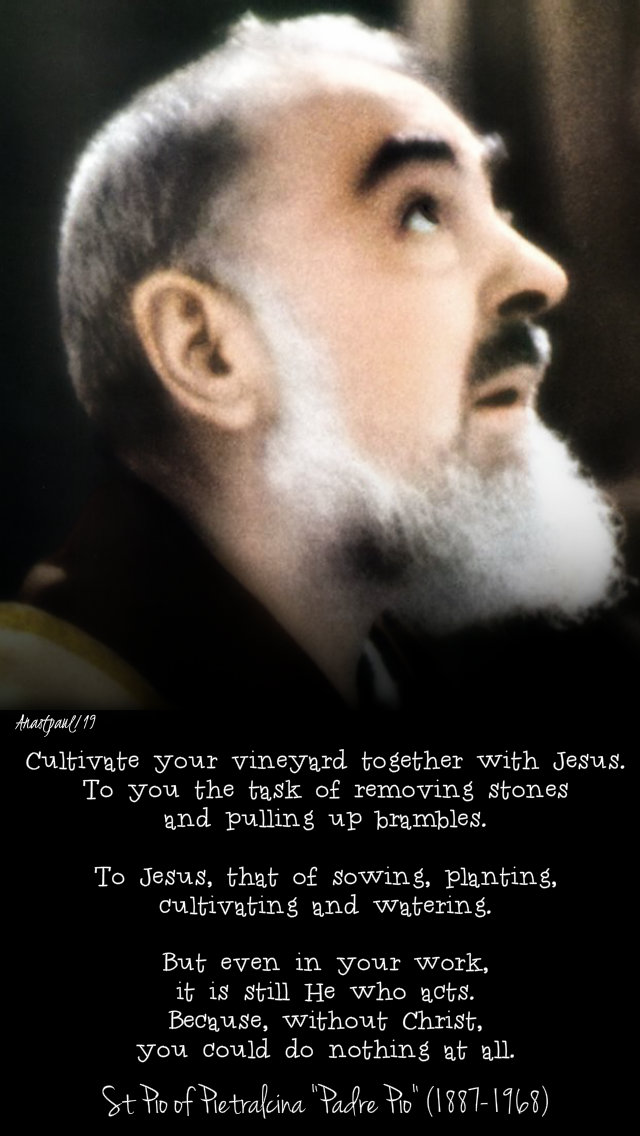
“Cultivate your vineyard together with Jesus. To you the task of removing stones and pulling up brambles. To Jesus, that of sowing, planting, cultivating and watering. But even in your work, it is still He who acts. Because, without Christ, you could do nothing at all.”
One Minute Reflection – 26 July – Friday of the Sixteenth week in Ordinary Time, Year C – Today’s Gospel: Matthew 13:18–23 and the Memorial of Sts Joachim and Anne
“As for what was sown on good soil, this is he who hears the word and understands it; he indeed bears fruit and yields, in one case a hundredfold, in another sixty and in another thirty.”…Matthew 13:23
REFLECTION – “Indeed, you all know how land is cultivated. First of all you pull out the weeds and throw away the stones, then you work the ground itself. You do it again a second time, a third time and finally… you sow. Oh, let it be like this in our souls! First of all let us uproot the weeds, that is to say our evil thoughts, then take out the stones, in other words, all our malice and obstinacy. Finally, let us work our hearts with the plough of the Gospel and the ploughshare of the cross. Let us break it by repentance, turn over the soil with almsgiving and with charity, prepare it for the seed of Our Lord… that it may joyfully receive the seed of the divine word and bring forth fruit, not just thirty but sixty and a hundredfold.”...St Caesarius of Arles (470-543) Monk & Bishop (Sermons to the people, no.6 passim ; SC 175)
PRAYER – O Lord, God of our Fathers, who bestowed on Saints Joachim and Anne this grace, that of them should be born the Mother of Your incarnate Son, grant, through the prayers of both, that we may work hard to deserve the grace You send us and thus attain the salvation You have promised to Your people. Through our Lord Jesus Christ, Your Son, who lives and reigns with You in the unity of the Holy Spirit, one God, forever and ever. Sts Joachim and Anne, pray for us! Amen
Saint of the Day – 26 July – Blessed Robert Nutter OP (c 1557-1600) Martyr – Dominican Religious Priest – Born in c 1557 at Burnley Lanes, Lancashire, England and was martyred by being hanged on 26 July 1600 at Lancaster, England.
Throughout the religious upheavals following the English Reformation the vast majority of English Catholics, many of whom lived in Lancashire, remained staunchly loyal to the throne.
Nutter was born at Burnley, Lancashire. He entered Brasenose College, Oxford in 1564 or 1565 and, with his brother John Nutter, also a Catholic martyr, became a student of the English College, Reims. He was ordained at Soissons, on 21 December 1581 along with Venerable William Dean and George Haydock.
Returning to England, he was committed to the Tower of London, along with his brother, also a priest, on 2 February 1584. He remained in the pit forty-seven days, wearing irons for forty-three days and twice was subjected to the tortures of “the scavenger’s daughter”. On 10 November 1584, he was again consigned to the pit. Robert witnessed his older brother’s execution before being released. The authorities hoped that he might inadvertently lead them to Catholic safe houses. He was again arrested and transported to France on 21 January 1585, with twenty other priests and one layman, aboard the Mary Martin of Colchester, from Tower Wharf.
Landing at Boulogne, 2 February, he revisited Rome in July but, returned then to England as escort to newly ordained priests. When the party was brought ashore at Gravesend, Nutter gave his name as Rowley but was recognised and on 30 November 1585 again committed to prison in London, this time to Newgate Prison.
In 1587 he was removed to the Marshalsea Prison and thence, in 1590, was sent to Wisbech Castle, Cambridgeshire. While in prison he joined the Dominican Order.
There, in 1597, he signed a petition to Father Henry Garnet in favour of having a Jesuit superior but, on 8 November 1598, he and his fellow martyr, Edward Thwing, with others, besought the Pope to institute an archpriest. On 10 March 1600, the keeper having left the gate unlocked, Nutter and his companions made their escape. Some were never recaptured but those who headed south were taken and Nutter was sent to Lancaster, where he was executed on 26 July 1600.
Robert Nutter was beatified by Pope John Paul II in 1987. It was said of Blessed Robert Nutter that, “He was a man of a strong body but of a stronger soul, who rather despised and conquered death.”
Prayer
Almighty, ever-living God,
You gave Your martyrs Robert Nutter
and his companions grace
to lay down their lives for Christ.
Help our weakness too,
give us the strength to live for You,
even as they did not shrink
from dying for Your sake.
We ask this through our Lord Jesus Christ, Your Son,
who lives and reigns with you and the Holy Spirit,
one God, forever and ever.
Amen
John Nutter, Blessed Robert’s Brother
John Nutter attended St John’s College, Cambridge. In 1578 the English College at Douai relocated temporarily to Rheims. John and his brother Robert arrived there in August the following year. John was ordained at Laon in September 1582 and left for Yorkshire in November . However, gale winds blew toward the Suffolk coast. John Nutter had contracted an illness before sailing and as it grew worse, he ferried ashore at Dunwich. The ship was subsequently driven on a sandbank and men of the town searched it for anything salvageable. A bundle of Catholic books were found. The ill Nutter was questioned at the inn where he had been taken and acknowledged that he was a priest. He was arrested and taken to the Marshalsea. He remained there a year before being tried and condemned and shortly thereafter executed at Tyburn, along with James Fenn, George Haydock, Thomas Hemerford, and John Munden.
Bl Andrew the Catechist
St Austindus of Auch
St Bartholomea Capitanio
St Benigno of Malcestine
Bl Camilla Gentili
St Charus of Malcestine
Bl Edward Thwing
Bl Élisabeth-Thérèse de Consolin
St Erastus
Bl Évangéliste of Verona
St Exuperia the Martyr
Bl George Swallowell
St Gérontios
Bl Giuseppina Maria de Micheli
St Gothalm
St Hyacinth
Bl Jacques Netsetov
Bl John Ingram
St Joris
Bl Marcel-Gaucher Labiche de Reignefort
Bl Marie-Claire du Bac
Bl Marie-Madeleine Justamond
Bl Marie-Marguerite Bonnet
St Olympius the Tribune
St Parasceva of Rome
St Pastor of Rome
Bl Pérégrin of Verona
Bl Pierre-Joseph le Groing de la Romagère Bl Robert Nutter OP (c 1557-1600) Martyr
St Simeon of Padolirone
St Symphronius the Slave
St Theodulus the Martyr St Titus Brandsma OCD (1881-1942) Martyr of the Faith Biography: https://anastpaul.com/2018/07/26/saint-of-the-day-27-july-blessed-titus-brandsma-o-c-d-1881-1942-martyr-of-the-faith/
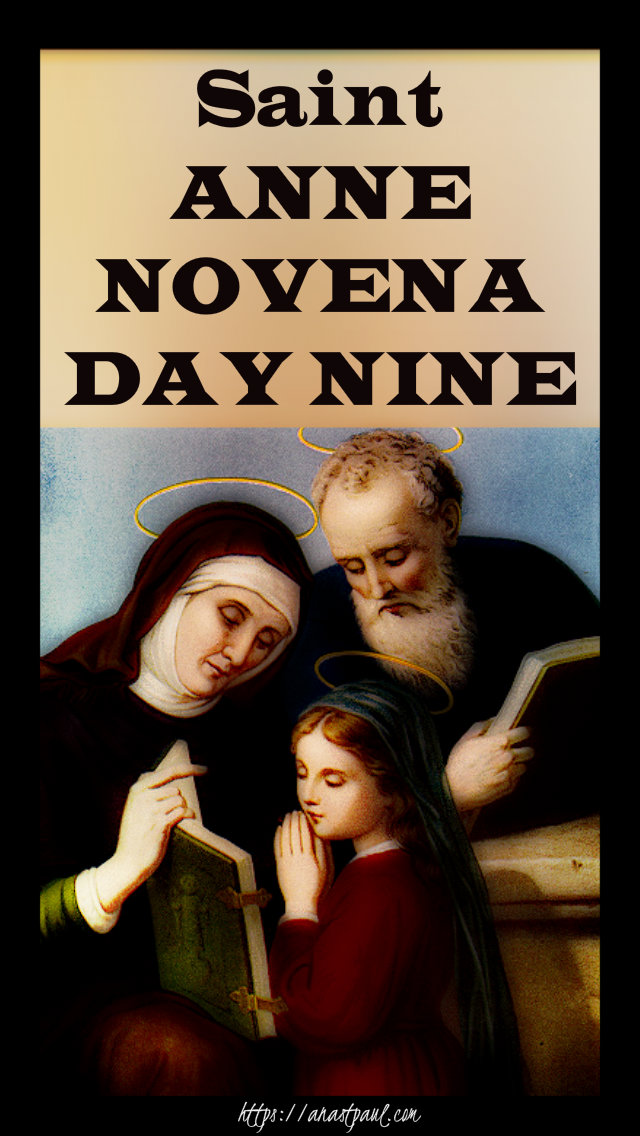
All her life Anne lived in the obscure town of Nazareth. All her days were spent in a tiny house, a home of common people.
Her ancestors might have lived in the royal palaces of David and of his descendants. It was Anne’s destiny to know no palaces, to be content with a cottage that was made beautiful chiefly by the love that filled it. But Anne was great. A thousand, thousand churches are built to her name.
A thousand schools and hospitals are erected under her patronage.
Pilgrims by the millions pour every year into her shrines, kneeling before her altars and begging her to remember them to God.
Unknown in her own day, she is now known across the world.
Having lived during her lifetime in a little cottage, she is now honoured by great buildings of the world. From her mansion in heaven she looks down to see once more how the buildings that bear her name shelter the Son of God, house the shrines of Mary, His Mother and serve for the peace and strength of God’s sons and daughters of every generation.
To her who was honoured on earth and is enthroned in heaven we pray:
Daily Prayer:
O glorious St Anne,
you are filled with compassion
for those who invoke you
and with love for those who suffer!
Heavily burdened with the weight of my troubles,
I cast myself at your feet and humbly beg of you
to take the present intention
which I recommend to you in your special care.
…………………(make your intention)
Please recommend it to your daughter,
the Blessed Virgin Mary
and place it before the throne of Jesus,
so that He may bring it to a happy issue.
Continue to intercede for me until my request is granted.
But, above all, obtain for me the grace, one day,
to see my God face to face
and with you and Mary and all the saints,
to praise and bless Him for all eternity.
Amen
Our Father . . . Hail Mary . . . Glory Be . . .
O Jesus, Holy Mary, St Anne, help me now and at the hour of my death.
Good St Anne, intercede for me.
NINTH DAY:
Good St Anne,
I have reached the end of this novena in your honour.
I have asked and ask again.
Good mother, let not your kind ear grow weary of my prayers,
though I repeat them so often.
Bounteous Lady,
implore for me from divine Providence
all the help I need through life.
May your generous hand bestow on me
the material means to satisfy my own needs
and to alleviate the plight of the poor.
Good St Anne,
fortify me by the sacraments of the Church
at the hour of my death.
Admit me into the company of the blessed
in the kingdom of heaven,
where I may praise and thank the adorable Trinity,
your grandson Christ Jesus,
your glorious daughter Mary
and yourself, dear St Anne,
through endless ages.
Amen
Thought for the Day – 25 July – Memorial of St Christopher (died C 251) Martyr
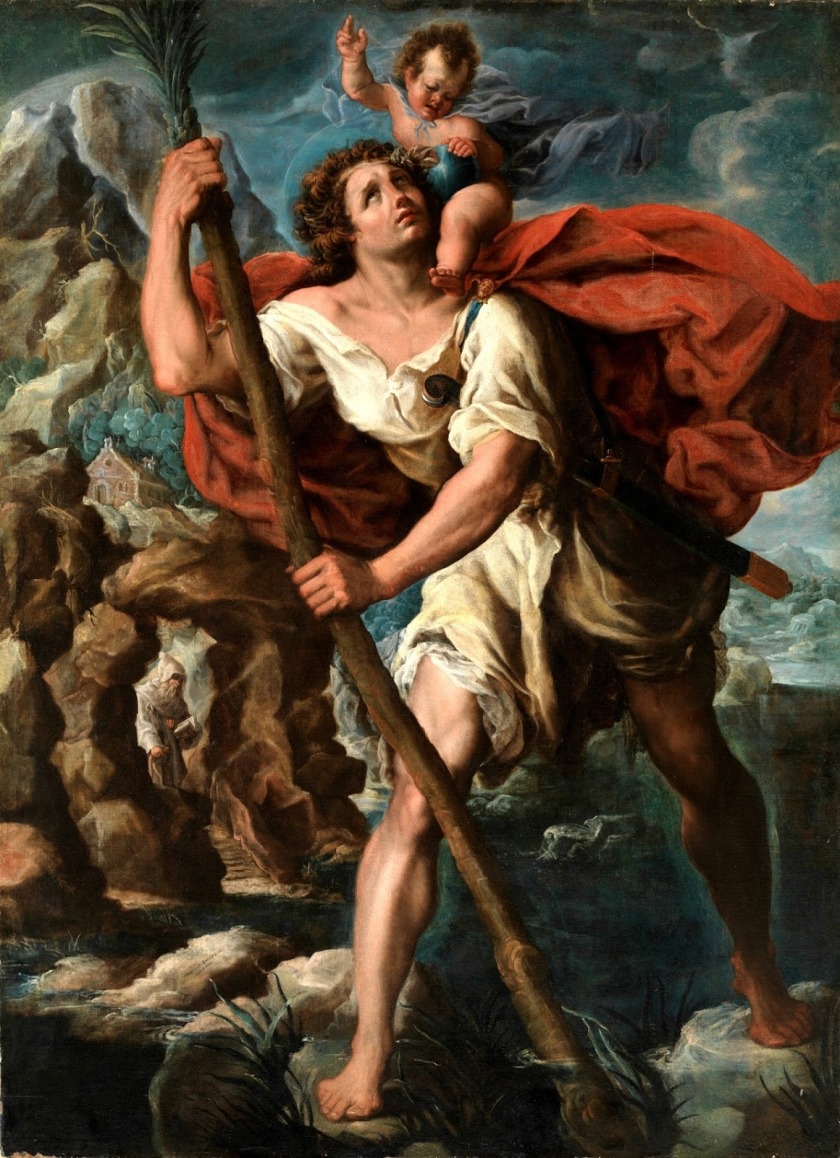
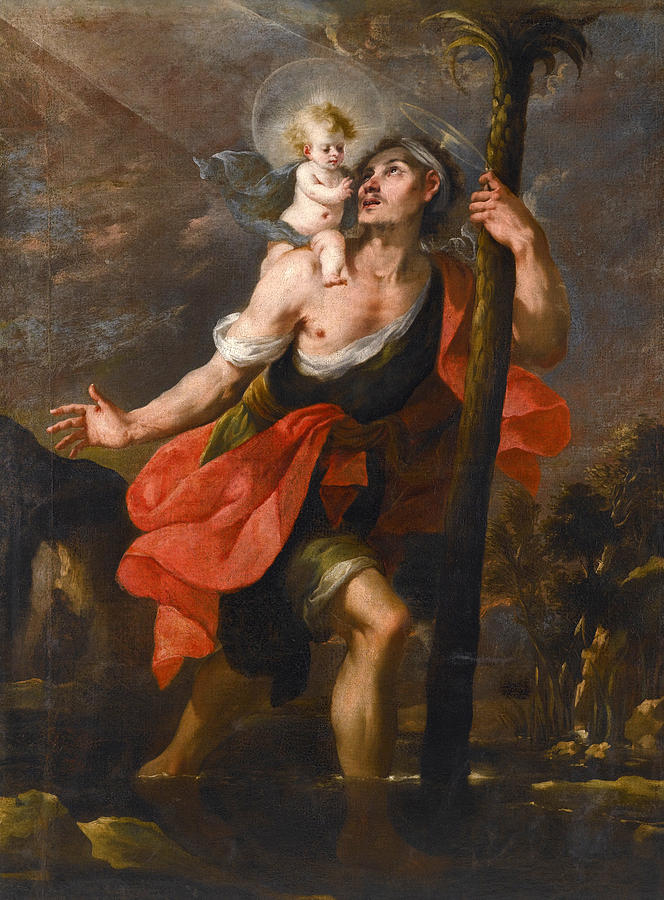
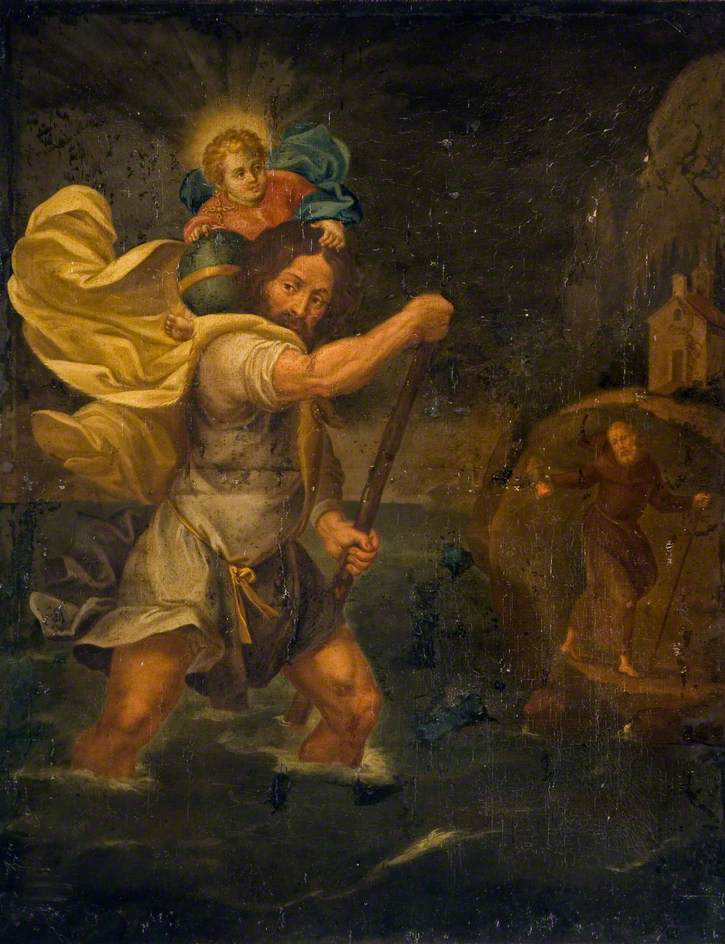
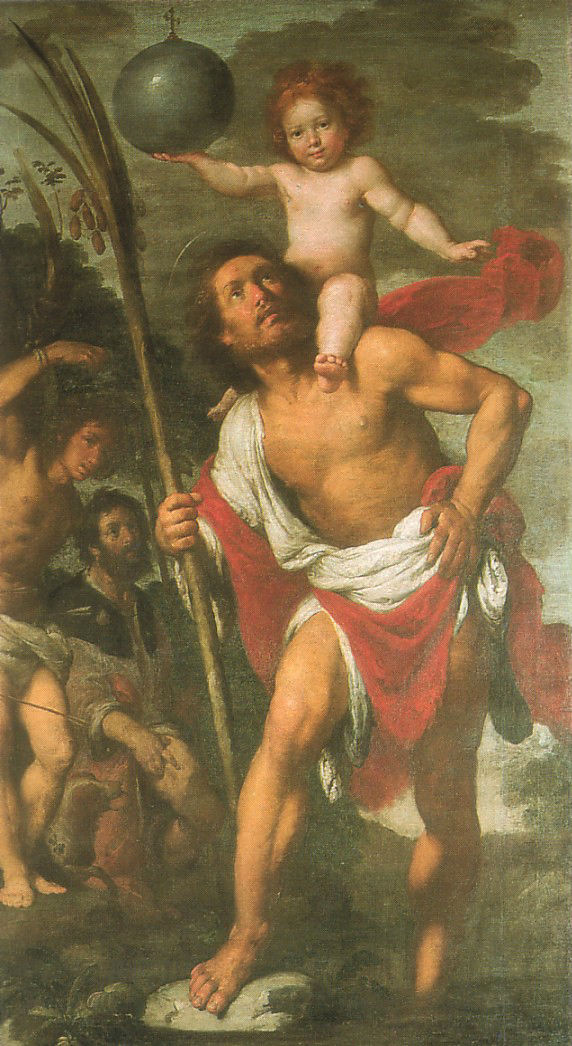
There is a beloved saint whose image can be found inside of cars, on the walls of churches and around the necks of safety-seeking travellers. His most prevalent image is that of a tall, formidable man who wades across an unruly river. Wooden staff firmly in hand, his face is often strained, looking upward to the sweet-faced child resting on his oversized shoulders.
He is referenced in literature: “A Cristofre on his breast of silver shene…,” Chaucer wrote in The Canterbury Tales and in film, such as 2005’s Crash in which a habitual car thief uses his trusty Saint Christopher medal as a good-luck charm.
Saint Christopher—patron of travellers, protector against toothaches, hailstorms and sudden death—is one of the most endearing for Catholics. His life and story, bordering somewhere between legend and legitimacy, is a complex, faith-affirming exercise in service, grace and love.
A picture of Saint Christopher was found in a monastery on Mount Sinai dating from the time of Justinian (527-565). His image was cast on coins in Württemberg and Bohemia and his statues could be found on bridges, imparting safety to their many travellers.
Christopher’s woodcarvings and paintings were hung on the walls of many European churches, often accompanied by the inscription, “Whoever shall behold the image of Saint Christopher shall not faint or fall on that day.”
Further proof of his early popularity, Saint Christopher was included as someone invoked against an assortment of hardships. He was also chosen as the patron of Baden, Brunswick and Mecklenburg and is one of the efficacious saints, The Fourteen Holy Helpers.
And that popularity never wavered. Even somewhat recently, organisations such as “The Christophers,” founded by Father John Keller, M.M. in 1945, are named after him. The Christophers’ purpose is to encourage all individuals to celebrate “their abilities and use them to raise the standards in all phases of human endeavour.” It’s a fitting principle.
Despite Saint Christopher’s long-lasting influence, aspects of his life are shrouded in myth and in legend. But his popularity, regardless of overwhelming uncertainty, is unmistakable. We love him and trust in his intercession!
Christopher has proven his resilience, growing in popularity over the centuries and withstanding suspicious historians who have questioned his validity.
For many, Saint Christopher reminds us that, in our own way, we carry Christ on our shoulders and in our hearts, across mighty rivers.
These mighty rivers of our lives!
St Christopher, Pray for us!
Partially Excerpted – Christopher Heffron, St Anthony Messenger
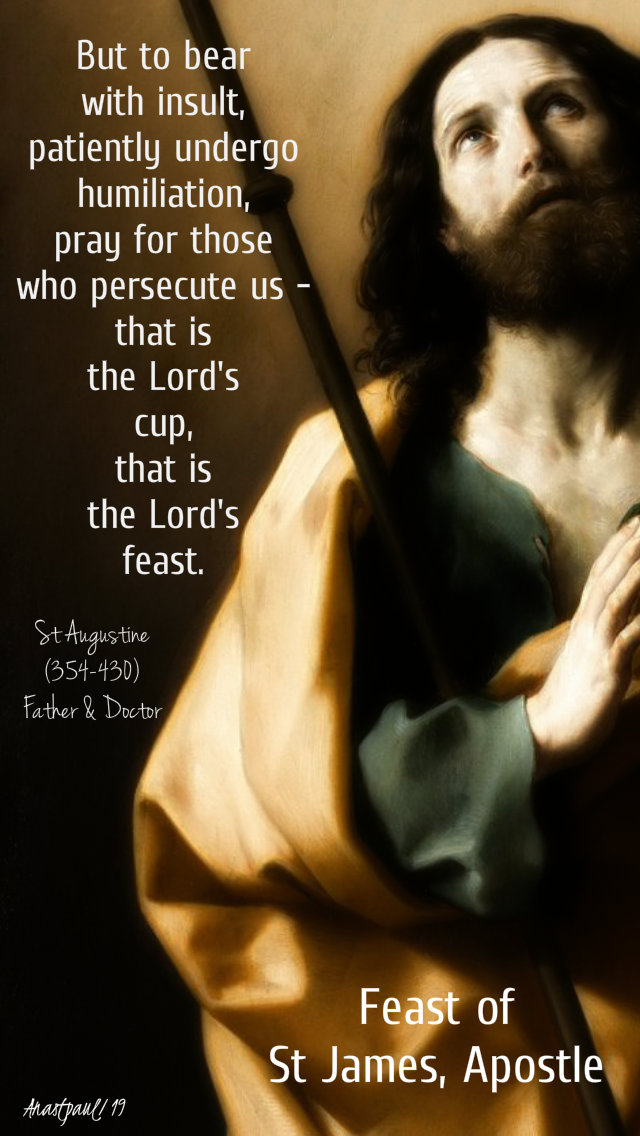
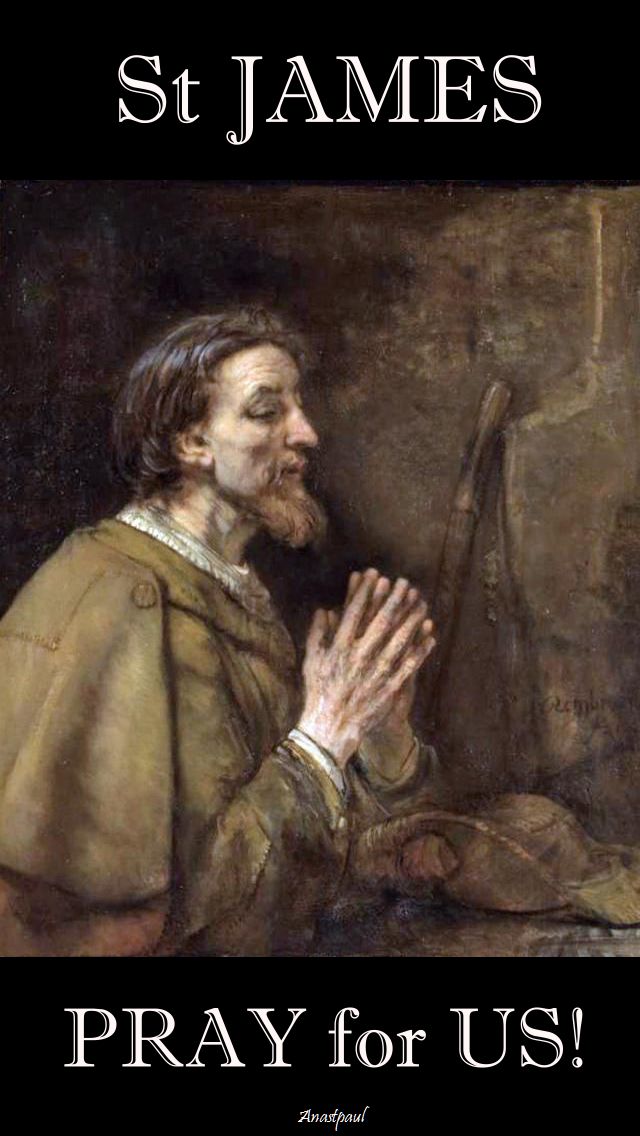
Quote of the Day – 25 July – Feast of St James, Apostle
“…we can learn much from St James – promptness in accepting the Lord’s call even when He asks us to leave the “boat” of our human securities, enthusiasm in following Him on the paths that He indicates to us over and above any deceptive presumption of our own, readiness to witness to Him with courage, if necessary to the point of making the supreme sacrifice of life.
Thus James the Greater stands before us as an eloquent example of generous adherence to Christ. He, who initially had requested, through his mother, to be seated with his brother next to the Master in His Kingdom, was precisely the first to drink the chalice of the passion and to share martyrdom with the Apostles.
And, in the end, summarising everything, we can say that the journey, not only exterior but above all interior, from the mount of the Transfiguration to the mount of the Agony, symbolises the entire pilgrimage of Christian life, among the persecutions of the world and the consolations of God, as the Second Vatican Council says. In following Jesus, like St James, we know that even in difficulties we are on the right path.”
One Minute Reflection – 25 July – Feast of St James, Apostle, Gospel: Matthew 20:20–28
Jesus said in reply, “You do not know what you are asking. Can you drink the cup that I am going to drink?” They said to him, “We can.”……Matthew 20:28
REFLECTION – “Christ laid down His life for us, so we ought to lay down our lives for our brothers” (1Jn 3,16)… Jesus said to Peter: “When you were younger, you used to dress yourself and go where you wanted but when you grow old … someone else will dress you and lead you where you do not want to go…” (Jn 21,18). It was the Cross, the Passion, He promised him. “Go even so far as to pasture my sheep, suffer for my sheep.” This is what a good bishop is to be like. If he is not, he is no bishop…
Now listen to this other testimony. Two of His disciples, the brothers John and James who were sons of Zebedee, were ambitious for the first place without consideration for the others… Our Lord answered them: “You do not know what you are asking”, for he added: “Can you drink the cup that I am going to drink?” What cup is this if not that… of the Passion?… And they, forgetting their weakness, immediately said: “We can”. Then He said to them: “My cup you will indeed drink. But to sit at my right or at my left is not mine to give but is for those for whom it has been prepared by my Father”… In this way He gave proof of His humility for, in fact, everything the Father prepares is prepared, too, for the Son… He came in humility – He, the Creator, was created amongst us, He made us but He was made for us. God before time began, man in time, He delivered man from time. This great physician has come to heal our cancer… by His example, He has come to heal pride itself.
This is what we must give our attention to, in the Lord – let us consider His humility, drink the cup of His humility, clasp Him, contemplate Him. How easy it is to have elevated thoughts, easy to take pleasure in honours, easy to give one’s ear to flatterers and people who praise us. But to bear with insult, patiently undergo humiliation, pray for those who persecute us (Mt 5,39.44) – that is the Lord’s cup, that is the Lord’s feast.“… Saint Augustine (354-430) FathEr & Doctor of the Church – Sermon for the ordination of a bishop, Guelferbytanus no.32
PRAYER – Almighty ever-living God, who consecrated the first fruits of Your Apostles by the blood of Saint James, grant, we pray, that Your Church may be strengthened by his confession of faith and constantly sustained by his protection. Through our Lord Jesus Christ, your Son, who lives and reigns with you in the unity of the Holy Spirit, one God, forever and ever. St James the Greater, Apostle of Christ, Pray for us! Amen
Our Morning Offering – 25 July – The Memorial of St Christopher (died c 251)
The Christopher Prayer
Father, grant that we may be,
bearers of Christ Jesus, Your Son.
Allow us to fill with Your light
the world around us.
Strengthen us by Your Holy Spirit
to carry out our mission
of living and following
the path of Jesus, our Lord.
Help us to understand,
that by Your grace
our gifts are Your blessings,
to be shared with others.
Fill us with Your Spirit of love
to give glory to You
in loving all
and preaching by our love.
Nourish in us the desire
to go forth
as the bearers of Your Son
fearless and gentle,
loving and merciful.
Make us true Christ bearers,
that in seeing us
only He is visible.
Amen
Saint of the Day – 25 July – Saint Christopher (Died c 251) Martyr and “Christ-Bearer” – Born at Canaan as Offero and Martyred in the reign of the 3rd-century Roman Emperor Decius (reigned 249–251) – Additional Memorials – 9 March (Greek calendar), 9 May (some Eastern calendars), 16 November (Cuba), 10 July (some areas of Spain). Also known as Christobal, Christoval, Cristobal, Kester, Kitt, Kitts, Offero. Patronages – against bad dreams, epileptics; against epilepsy, against floods, against hailstorms, against lightning, against pestilence, against storms, against sudden death, against toothache, Air Forces, archers, motorists, bachelors,bookbinders, bus drivers, taxi drivers, civil aeronautics, fruit dealers, fullers, gardener, of a holy death, truck drivers, mariners, sailors, market carriers, mountain climbers, porters, relief from pestilence, transportation, transportation workers, travellers, travellers in the mountains, Saint Christopher’s Island, Saint Kitts, 13 cities.
He was a man of many names, Offero being one of them. Born in the third century in Asia Minor, son of a king, he would grow to be a restless young man of considerable size. The early years of his life were spent in search of riches, of purpose, of a cause worthy of his allegiance.
As the story goes, a young Offero, looking for the strongest and boldest ruler to follow, briefly courted Satan. When his new master cowered in fear at a holy cross on the side of a road, Offero abandoned Satan, choosing light over darkness. During this period of transition, a holy hermit awakened the restless wanderer to Christianity, schooling and baptising him. From then on, Offero pledged his life to Christ and vowed to serve God’s people along the banks of an untamed river. So he built a hut and set up camp with a new purpose—to be a boatman to the world.
His popularity was solidified when a small child once approached him, wanting safe passage across the water. He hoisted the boy on his shoulders and, with his trusty staff, began the journey. As the river deepened, the child began to grow heavier. Waters quickly rising, the precious cargo continued to weigh the giant down. As he reached the banks of the river, Offero said, “Child, thou hast put me in great peril, thou weighest almost as if I had all the world upon me – I might bear no greater burden.”
“Christopher,”the little boy responded, “thou hast not only borne all the world upon thee but thou hast borne Him that created and made all the world, upon thy shoulders.”
The child instructed Christopher (meaning “Christbearer”) to cross the river again and plant his staff in the ground, telling the ferryman that life would spring forth. To Christopher’s astonishment, by morning his staff had taken root—bright flowers and fruit grew from it.
The rest of Christopher’s life is even sketchier in detail. One legend states that many in the immediate area converted to Christianity based on his encounter, which drew unwanted attention. In Lycia—present-day Turkey—under Emperor Decius, he was imprisoned, shot with arrows, burned and then beheaded around 251.
St Christopher and St Peter
Though the life of this mighty martyr was later questioned by historians, Saint Christopher’s story and his worldwide appeal have proven invulnerable. Amen and alleluia, glory be to God!
St James the Greater (Feast) – Son of Zebedee and Salome, brother of Saint John the Apostle. He is called “the Greater” simply because he became an Apostle before Saint James the Lesser.
St Cugat del Valles
Bl Darío Acosta Zurita
St Ebrulfus
St Euphrasia
St Fagildo of Santiago
St Felix of Furcona
St Florentius of Furcona
St Glodesind of Metz
St Magnericus of Trier
Bl Michel-Louis Brulard
Bl Mieczyslawa Kowalska
St Mordeyren
St Nissen of Wexford
St Olympiad of Constantinople
St Paul of Palestine
Bl Pietro Corradini of Mogliano
St Theodemir of Cordoba
—
Martyrs of Caesarea – 3 saints: Three Christians martyred together in the pesecutions of emperor Maximilian and governor Firmilian – Paul, Tea and Valentina. 309 in Caesarea, Palestine.
Martyrs of Cuncolim – 20 saints: On 15 July 1583 the group met at the church of Orlim, and hiked to Cuncolim to erect a cross and choose land for a new church. Local anti-Christian pagans, seeing the unarmed Christians, gathered their weapons and marched on them. One of the parishioners, a Portuguese emigre named Gonçalo Rodrigues, carried a firearm, but Father Alphonsus Pacheco stopped him from using it. The pagans then fell upon them, and killed them all without mercy. They were –
• Alphonsus Pacheco
• Alphonsus the altar boy
• Anthony Francis
• Dominic of Cuncolim
• Francis Aranha
• Francis Rodrigues
• Gonçalo Rodrigues
• Paul da Costa
• Peter Berno
• Rudolph Acquaviva
• ten other native Christian converts whose names have not come down to us
They were martyred on Monday 25 July 1583 at the village of Cuncolim, district of Salcete, territory of Goa, India. Beatified on 30 April 1893 by Pope Leo XIII.
Martyrs of Motril – 5 beati: Four priests and a brother, all members of the Augustinian Recollects, who were martyred together in the Spanish Civil War:
• Deogracias Palacios del Río
• José Rada Royo
• José Ricardo Díez Rodríguez
• Julián Benigno Moreno y Moreno
• León Inchausti Minteguía
They were shot on 25 July 1936 in Motril, Granada, Spain and Beatified on 7 March 1999 by Pope John Paul II.
Martyrs of Toledo – 4 beati: Four brothers and a priest, all members of the Hospitallers of Saint John of God, and all martyred together in the Spanish Civil War.
• Carlos Rubio álvarez
• Eloy Francisco Felipe Delgado Pastor
• Jerónimo Ochoa Urdangarín
• Primo Martínez De San Vicente Castillo
25 July 1936 in Talavera de la Reina, Toledo, Spain. They were Beatified on 25 October 1992 by Pope John Paul II.
Martyrs of Urda – 3 beati: Three members of the Passionists who were martyred together in the Spanish Civil War.
• Benito Solana Ruiz
• Felix Ugalde Irurzun
• Pedro Largo Redondo
They were shot on 25 July 1936 in Urdá, Toledo, Spain and Beatified on 1 October 1989 by Pope John Paul II.





















You must be logged in to post a comment.