St John Bosco is the Patron of Christian apprentices, editors, publishers, schoolchildren, young people, magicians, juvenile delinquents. Choose ALL young people or your own children. Or simply Pray the 9 days for your own intention.
1st Day – 22 January – Love for Jesus in the Blessed Sacrament
O Saint John Bosco,
you loved Jesus in the Blessed Sacrament
and zealously promoted this devotion
by encouraging participation in the Holy Eucharist,
reception of Holy Communion and daily visits
to Our Lord in the Tabernacle.
Pray for us that, inspired by your example,
we may grow in this love,
so that we may end our days strengthened
and comforted by the Heavenly Food of
the Most Holy Eucharist.
Through your intercession
may God grant me the following grace
……………….………………….
[mention your intention]
so that together with others
I may assist in bringing all, especially the young,
to the love of Christ in the Eucharist, amen.
Novena to St Paul in preparation for the Feast of The Conversion of St Paul on 25 January
Day Seven – 22 January
“Make no mistake, my brothers, if anyone joins a schismatic he will not inherit God’s Kingdom. If anyone walks in the way of heresy, he is out of sympathy with the Passion. Be careful, then, to observe a single Eucharist. For there is one flesh of our Lord, Jesus Christ and one cup of His blood that makes us one and one altar, just as there is one bishop along with the presbytery and the deacons, my fellow slaves. In that way whatever you do is in line with God’s will.”………………St Ignatius of Antioch
LET US PRAY:
Glorious St Paul,
your conversion is a powerful witness to the world
that God loves us and does not give up on us,
no matter how far we stray.
Help me to cling to Christ in the Blessed Sacrament
help me to fully participate at every Holy Mass
help me to understand, that this IS He
who showed us the way
gave us the light to follow it in Holy Mother Church
who is His bride and shows us the only truth.
May every circumstante of my life be an occasion
to change my way of thinking,
to renounce self-will and
to surrender myself to the wisdom and tenderness of Jesus Christ
who is acting to make me His saint.
Pray that I may love God’s will and providence for me.
In this confidence, I entrust to you, St Paul,
these, my intentions
……………………………..
(mention your request)
Novena to St Francis de Sales
Day EIGHT – 22 January
“One of the greatest proofs of love that Jesus displayed on the cross was putting up with the imperfections of His neighbour. There He showed us that He has a heart that loves us tenderly and watches over us kindly. He even showed His love for those who put Him to death. In those dire moments the Saviour expressed thoughts of love even for his executioners, pardoning them in the very act of sinning! How petty-minded we are when we cannot bring ourselves to forget some injury received, even after a long time! Whoever sincerely, pardons another, calls down abundant blessings and perfectly imitates Christ.” (St Francis de Sales Spiritual Treatises IV; O. VI, pp. 65-66)
O blessed Francis de Sales,
who on earth did excel in a life of virtue,
especially in the love of God and neighbour,
I earnestly ask you to take me under your compassionate care and protection.
Obtain for me conversion of mind and heart.
Grant that all people, especially
………..……………………..
(names of those whom you wish to include)
may experience the depth of God’s redeeming and healing love.
Teach me to fix my eyes on the things of heaven
even as I walk each day with my feet planted firmly on the earth.
Help me, through the practice of virtue and the pursuit of devotion,
to avoid anything that would otherwise cause me to stumble
in my attempt to follow Christ and to be an instrument of the Holy Spirit.
Encouraged by your prayers and example,
help me to live fully my sacred dignity with the hope of experiencing my sacred destiny: eternal life with God. Receive also this particular need or concern that I now lift up in prayer
….………………………………
(mention your particular need).
O God, for the salvation of all,
You desired that St Francis de Sales—
preacher, missionary, confessor, bishop and founder—
should befriend many along the road to salvation.
Mercifully grant that we,
infused with the humility and gentleness of his charity,
guided by his wisdom and sharing in his spirit may experience eternal life.
Thought for the Day – 22 January – The Memorial of St Vncent of Saragossa (Died 304) Martyr
The martyrs are heroic examples of what God’s power can do.
It is humanly impossible, we realise, for someone to go through tortures such as Vincent had and remain faithful. But it is equally true that by human power alone, no-one can remain faithful, even without torture or suffering.
God does not come to our rescue at isolated, “special” moments. God is supporting the super-cruisers as well as children’s toy boats.
Quote/s of the Day – 22 January – The Memorial of St Vincent Pallotti SAC (1795-1850)
“How great is the dignity of the priesthood! What a dignity, what a dignity!… To be a priest! What does that mean? O God, my God, I do not understand it! What does it mean to present the holy, bloodless sacrifice and to administer the sacraments!” (Written to St Gaspar del Bufalo (1786-1837), just before being ordained, the founder of the Society for the Precious Blood, with whom Vincenzo contracted a deep spiritual friendship.)
Before his First Holy Mass
“Not the intellect but God Not the will but God Not the heart but God Not taste but God Not touch but God Not food and drink but God Not clothing but God Not tranquillity but God Not the worldly goods but God. Not riches but God. Not honours but God. Not distinction but God. Not dignities but God. Not advancement but God. God in all God always.”
“You must be holy in the way that God asks you to be holy. God does not ask you to be a Trappist monk or a hermit. He wills, that you sanctify the world and your everyday life.”
One Minute Reflection – 22 January – Tuesday of the Second week in Ordinary Time, Gospel: Mark 2:23–28 and the Memorial of St Vncent of Saragossa (Died 304) Martyr
“…so the Son of man is lord even of the sabbath.”...Mark 2:28
REFLECTION – “From the first, the law of the Sabbath conferred many and great benefits; for instance, it made the Jews gentle and humane towards those of their own household, it taught them God the Creator’s providence and wisdom… hen God gave the law for the Sabbath He said… that He would have them refrain from evil works only when he said: “You must do no work, except for what is necessary for life” (Ex 12:16 LXX). And in the temple, too, everything continued with more diligence than ever. Thus even by means of the very shadow, He was secretly opening the full light of truth (cf. Col 2:17).
Did Christ then do away with so highly profitable a thing? Far from it; He greatly enhanced it. For it was unnecessary… that we should learn from it, that God made all things or that we should be made kind by it, who are called to imitate God’s own love. For He says: “Be merciful, as your heavenly Father is merciful”(Lk 6:36). It was no longer necessary to fix a day of festival for those who are commanded to keep a feast all their life long. For: “Let us keep the feast,” Saint Paul writes, “not with old leaven, neither with leaven of malice and wickedness but with the unleavened bread of sincerity and truth” (1Cor 5:8)… So now, why is any sabbath required for Christians who are always keeping the feast and whose conversation is in heaven? Yes, my brethren, let us celebrate that continual, heavenly sabbath.”…St John Chrysostom (c 345-407) Father & Doctor
PRAYER – True Light of the world, Lord Jesus Christ, as You enlighten all men for their salvation, give us the grace, we pray, to herald Your coming by preparing the ways of justice and of peace. We walk in faith and by Your Light as St Vincent, fearless of men to the end and trusting only in Your grace, inspires us to follow. Grant that his prayers may assist us on our path. Who live and reign with the Father and the Holy Spirit, God forever, amen.
Our Morning Offering – 22 January – The Memorial of St Vincent of Saragossa (Died 304) – Deacon and Martyr – The Protomartyr of Spain
Prayer of St Vincent of Saragossa (Died 304)
Everlasting God,
to whom all hidden things
are revealed,
who sent into the world
Your Only Begotten Son,
our Lord Jesus Christ,
conceived through the Holy Spirit,
born of the Virgin Mary,
that He might take on Himself
the punishment of our sins
and by His resurrection,
snatch us from the gates of hell,
grant to our hearts
such steadfastness of faith
that confessing Christ, Your Son,
we may not perish
but may be joined to Him
in the confession
of Your Holy Name.
Amen
St Anastasius the Persian
St Antonio della Chiesa
Bl Bernard of Vienne
St Blaesilla of Rome
St Brithwald of Ramsbury
St Caterina Volpicelli
St Dominic of Sora
Bl Esteve Santacana Armengol
St Francis Gil de Frederich de Sans
Bl Giuseppe Nascimbeni
St Guadentius of Novara
Bl Ladislao Batthyany-Strattmann
Bl Laura Vicuna
Bl Maria Mancini
St Mateo Alonso de Leciñana St Valerius of Saragossa (Died 315)
St Vincent Pallotti
Bl Walter of Himmerode Bl William Joseph Chaminade SM (1761-1850)
Bl William Patenson
—
Martyrs of Puigcerda:
Orontius
St Victor
St Vincent
Saint of the Day – 22 January – St Vincent of Saragossa (Died 304) Deacon – Protomartyr of Spain – Archdeacon, Preacher, assistant to St Valerius of Saragossa (Died 315), who was his Bishop and whose Memorial is also today, – also known as Vincent Martyr, Vincent of Zaragoza, Vincent the Deacon, Vincent Tourante, Vincent of Aragon, Vincent of Huesca.Patronages – Lisbon, Valencia, Valencia, Vicenza (Italy), Sao Vicente, vinegar makers, vintners, wine growers and the Order of the Deacons of the Diocese of Bergamo (Italy).
The earliest account of Vincent’s martyrdom is in a carmen (lyric poem) written by the poet Prudentius, who wrote a series of lyric poems, Peristephanon (“Crowns of Martyrdom“), on Hispanic and Roman martyrs.
He was born at Huesca, near Saragossa, Spain sometime during the latter part of the 3rd century; it is believed his father was Eutricius (Euthicius) and his mother was Enola, a native of Osca. Vincent spent most of his life in the city of Saragossa, where he was educated and ordained to the diaconate by Bishop Valerius of Saragossa, who commissioned Vincent to preach throughout the diocese. Because Valerius suffered from a speech impediment, Vincent acted as his spokesman.
The ordination of St Vincent by St Valerius
When the Roman Emperor Diocletian began persecuting Christians in Spain, both were brought before the Roman governor, Dacian in Valencia. Vincent and his bishop Valerius were confined to the prison of Valencia. Though he was finally offered release if he would consign Scripture to the fire, Vincent refused. Speaking on behalf of his bishop, he informed the judge that they were ready to suffer everything for their faith and that they could pay no heed either to threats or promises.
His outspoken manner so angered the governor that Vincent was inflicted every sort of torture on him. He was stretched on the rack and his flesh torn with iron hooks. Then his wounds were rubbed with salt and he was burned alive upon a red-hot gridiron. Finally, he was cast into prison and laid on a floor scattered with broken pottery, where he died. During his martyrdom he preserved such peace and tranquillity that it astonished his jailer, who repented from his sins and was converted. Vincent’s dead body was thrown into the sea in a sack but was later recovered by the Christians and his veneration immediately spread throughout the Church. The aged bishop Valerius was exiled.
The story that Vincent was tortured on a gridiron is perhaps adapted from the martyrdom of another son of Huesca, Saint Lawrence— Vincent, like many early martyrs in the early hagiographic literature, succeeded in converting his jailer.
According to legend, after being martyred, ravens protected St Vincent’s body from being devoured by vultures, until his followers could recover the body. His body was taken to what is now known as Cape St Vincent; a shrine was erected over his grave, which continued to be guarded by flocks of ravens. In the time of Muslim rule in the Iberian Peninsula, the Arab geographer Al-Idrisi noted this constant guard by ravens, for which the place was named by him كنيسة الغراب “Kanīsah al-Ghurāb” (Church of the Raven). King Afonso I of Portugal (1139–1185) had the body of the saint exhumed in 1173 and brought it by ship to the Lisbon Cathedral. This transfer of the relics is depicted on the coat of arms of Lisbon.
Coat of Arms of Lisbon depicting the translation of the relics of St Vincent
Though Vincent’s tomb in Valencia became the earliest centre of his cult, he was also honoured at his birthplace and his reputation spread from Saragossa.
A church was built in honour of Vincent, by the Catholic bishops of Iberia, when they succeeded in converting King Reccared and his nobles to Trinitarian Christianity. When the Moors came in 711, the church was razed and its materials incorporated in the Mezquita, the “Great Mosque” of Cordova.
The Cape Verde island of São Vicente, a former Portuguese colony, was named in St Vincent’s honour because it was discovered on 22 January, St Vincent’s feast day, in 1462.
Vincent’s left arm is on display as a relic in Valencia Cathedral, located near the extensive Carrer de Sant Vicent Mártir (Saint Vincent the Martyr Street).
Novena to St Paul in preparation for the Feast of The Conversion of St Paul on 25 January
Day SIX – 21 January
Various daily acts cause our conversion and ultimately our sanctification to grow: examining our conscience and admitting our faults; undertaking works of penance and reconciliation; receiving the correction others give us with an open and humble heart; reaching out to the poor; standing up for what is right and just; accepting the suffering and persecution that come our way; desiring to better our life (see CCC1435).
LET US PRAY:
Glorious St Paul,
your conversion is a powerful witness to the world
that God loves us and does not give up on us,
no matter how far we stray.
Help me to live a life of ongoing conversion.
True conversion means converting my life to the
design of God, the plan He has for me right now.
Pray for me, that I may be filled with passion
for the evangelisation of all those around me,
that my life may be a beacon of the light of Christ.
May the witness of my life inspire other sinners to conversion.
May faith move me to believe that God can
and will change the things in me that seem impossible to rectify.
In this confidence, I entrust to you, St Paul,
these, my intentions
…………………………..
(mention your request)
Novena to St Francis de Sales Day SEVEN – 21 January
“Our intellect is ordinarily full of ideas, opinions and considerations suggested by self-love. This is the root of many conflicts within the soul, putting before us all sorts of reasons dictated by human prudence to justify our pretensions. People who make use of this false prudence, instead of enlightening their intellect, obscure it. They reject advice given to them and let those reasons prevail in their minds which support their own opinions, even wrong ones. Make use of the virtue of prudence because it is good but make good use of it. Employ it only rarely, with simplicity and solely for the glory of God.” (St Francis de Sales – Sermons 30; O. IX, pp. 297-298)
O blessed Francis de Sales,
who on earth did excel in a life of virtue,
especially in the love of God and neighbour,
I earnestly ask you to take me under your compassionate care and protection.
Obtain for me conversion of mind and heart.
Grant that all people, especially
……………………………..
(names of those whom you wish to include)
may experience the depth of God’s redeeming and healing love.
Teach me to fix my eyes on the things of heaven
even as I walk each day with my feet planted firmly on the earth.
Help me, through the practice of virtue and the pursuit of devotion,
to avoid anything that would otherwise cause me to stumble
in my attempt to follow Christ and to be an instrument of the Holy Spirit.
Encouraged by your prayers and example,
help me to live fully my sacred dignity with the hope of experiencing my sacred destiny:
eternal life with God.
Receive also this particular need or concern that I now lift up in prayer.
………………………………………
(mention your particular need).
O God, for the salvation of all, You desired that St. Francis de Sales—
preacher, missionary, confessor, bishop and founder—
should befriend many along the road to salvation.
Mercifully grant that we,
infused with the humility and gentleness of his charity,
guided by his wisdom and sharing in his spirit may experience eternal life.
“There are two books, prose writings, that Robert Southwell wrote that are worth reading. They are of course written in 16th century English but, powerful, written to encourage his fellow Catholics to remain firm in their faith. The one is called ‘Mary Magdalene’s Funeral Tears’. And the other one is called ‘Epistle of Comfort‘. We would probably call it a letter of encouragement.
His poetry – we don’t know exactly when he began to write but it must have been very young because he wrote a great deal of which we have the record and by now the English speaking world knows Robert Southwell. His two outstanding poems are ‘The Burning Babe’ and ‘The Virgin Mary to Christ On The Cross.’”
The Burning Babe, by St Robert Southwell SJ (1561-1595) Martyr
As I in hoary winter’s night stood shivering in the snow, Surprised I was with sudden heat which made my heart to glow; And lifting up a fearful eye to view what fire was near, A pretty babe all burning bright did in the air appear; Who, scorchëd with excessive heat, such floods of tears did shed As though his floods should quench his flames which with his tears were fed. Alas, quoth he, but newly born in fiery heats I fry, Yet none approach to warm their hearts or feel my fire but I! My faultless breast the furnace is, the fuel wounding thorns, Love is the fire, and sighs the smoke, the ashes shame and scorns; The fuel justice layeth on, and mercy blows the coals, The metal in this furnace wrought are men’s defiled souls, For which, as now on fire I am to work them to their good, So will I melt into a bath to wash them in my blood. With this he vanished out of sight and swiftly shrunk away, And straight I called unto mind that it was Christmas day.
It’s not surprising, it’s one of the great poems of the English language.
Quote/s of the Day – 21 January – The Memorial of St Agnes (c 291- c 304) Virgin and Martyr
Speaking of: Martyrdom
“For me to live is Christ and to die, is gain.”
St Paul – Philippians 1:21
“Christ made my soul beautiful with the jewels of grace and virtue. I belong to Him whom the angels serve.”
St Agnes (c 291- c 304) Virgin and Martyr
“She is too young to know of death, yet is ready to face it.”
“One victim but a twin martyrdom, to modesty and religion. Agnes preserved her virginity and gained a martyr’s crown. “
From an essay ‘On Virgins’ by
Saint Ambrose (340-397) Father & Doctor of the Church
“…As we are under great obligations to Jesus, for His Passion endured for our love, so also are we under great obligations to Mary, for the martyrdom which she voluntarily suffered, for our salvation, in the death of her Son”.
St Bonaventure (1217-1274) Doctor of the Church
“Nothing can happen to me that God doesn’t want. And all that He wants, no matter how bad it may appear to us, is really for the best.”
St Thomas More (1478-1535) Martyr
“I do not much dread the tortures, as I look forward to the crown.”
St Robert Southwell S.J. (1561-1595) Martyr
“The tyrant dies and his rule is over, the martyr dies and his rule begins.”
Søren Kierkegaard (1813-1855) The Journals of Kierkegaard
One Minute Reflection – 21 January – Monday of the Second week in Ordinary Time – Today’s Gospel: Mark 2:18–22 and The Memorial of St Agnes (c 291- c 304) Virgin and Martyr
“As long as they have the bridegroom with them, they cannot fast.”…Mark 2: 19b
REFLECTION – “Lord, I invite you to a wedding banquet in songs. In Cana, there was not enough wine to express our praise. You, the guest who filled the jars with good wine, fill my mouth with your praise!
The wine at Cana is symbol of our praise because those who drank of it marvelled. At that wedding banquet which was not your own, You, the truly righteous, filled six jars to overflowing with delicious wine. So at the banquet to which I am inviting You, You can fill the ears of a multitude with Your sweetness.
In times past You were invited to the wedding feasts of others. Here now is Your own banquet; it is chaste and beautiful. May it give joy to Your people! May your songs delight Your guests, may my zither accompany Your song!
Our soul is Your betrothed, our body is Your bridal chamber, our senses and our thoughts are the guests. If for You, one single person is a wedding banquet, how great will be the banquet, for the whole Church!”…St Ephrem (c 306-373) Father & Doctor of the Church
PRAYER – Almighty Lord, God and Father, protect us by Your power throughout the course of this day, even as You have enabled us to begin it. Let our every thought, word and deed rejoice and strive always to please the love of our souls. For we, Your people, are the bride of Your Son, who came to betroth us to Himself. Grant that by the prayers of one so young, who lived each moment for Him, we may be brought to perfection with You in our final home. St Agnes, pray for us! We make our prayer through Jesus, our Lord, in union with the Holy Spirit, God forever, amen.
Our Morning Offering – 21 January – Monday of the Second week in Ordinary Time – Today’s Gospel: Mark 2:18–22
“And no one puts new wine into old wineskins; if he does, the wine will burst the skins, and the wine is lost, and so are the skins; but new wine is for fresh skins.”…Mark 2:22
Complete Us, O Lord Jesus Christ By St Anselm (1033-1109) Doctor of the Church
O Lord Jesus Christ,
our redemption and our salvation,
we praise You and give You thanks.
Though we are unworthy
of Your benefits,
and cannot offer to You
the devotion You deserve,
let Your loving-kindness
complete whatever our weakness tries to do.
Before You, O Lord,
we lay all our desires,
and whatever our heart rightly wishes,
it is because of Your gift.
Help us love You as You command.
Do not let Your gift be unfruitful in us.
Complete what You have begun,
give what You have made us desire,
convert our lukewarmness
into fervent love of You;
for the glory of Your holy name.
Amen
Saint of the Day – 21 January – St Agnes (c 291- c 304), Virgin and Martyr
“A new kind of martyrdom!” exclaimed St Ambrose (340-397) , bishop of Milan. The assembly cheered and applauded. He was celebrating St Agnes because she was a virgin, a martyr—and a child. She was executed at Rome in 304 during the Emperor Diocletian’s vicious persecution. Here are Ambrose’s observations on her death:
“Today is the birthday of a virgin, let us imitate her purity. It is the birthday of a martyr,let us offer ourselves in sacrifice. It is the birthday of Saint Agnes, who is said to have suffered martyrdom at the age of twelve. The cruelty that did not spare her youth shows all the more clearly the power of faith in finding one so young to bear it witness.
There was little or no room in that small body for a wound. Though she could scarcely receive the blow, she could rise superior to it. Girls of her age cannot bear even their parents’ frowns and, pricked by a needle, weep as for a serious wound. Yet she shows no fear of the blood-stained hands of her executioners. She stands undaunted by heavy, clanking chains. She offers her whole body to be put to the sword by fierce soldiers. She is too young to know of death, yet is ready to face it. Dragged against her will to the altars, she stretches out her hands to the Lord in the midst of the flames, making the triumphant sign of Christ the victor on the altars of sacrilege. She puts her neck and hands in iron chains, but no chain can hold fast her tiny limbs.
A new kind of martyrdom! Too young to be punished, yet old enough for a martyr’s crown; unfitted for the contest, yet effortless in victory, she shows herself a master in valour despite the handicap of youth. As a bride she would not be hastening to join her husband with the same joy she shows as a virgin on her way to punishment, crowned not with flowers but with holiness of life, adorned not with braided hair but with Christ himself.
In the midst of tears, she sheds no tears herself. The crowds marvel at her recklessness in throwing away her life untasted, as if she had already lived life to the full. All are amazed that one not yet of legal age can give her testimony to God. So she succeeds in convincing others of her testimony about God, though her testimony in human affairs could not yet be accepted. What is beyond the power of nature, they argue, must come from its creator.
What menaces there were from the executioner, to frighten her; what promises made, to win her over; what influential people desired her in marriage! She answered: “To hope that any other will please me does wrong to my Spouse. I will be His who first chose me for Himself. Executioner, why do you delay? If eyes that I do not want can desire this body, then let it perish.” She stood still, she prayed, she offered her neck.
You could see fear in the eyes of the executioner, as if he were the one condemned, his right hand trembled, his face grew pale as he saw the girl’s peril, while she had no fear for herself. One victim, but a twin martyrdom, to modesty and to religion – Agnes preserved her virginity and gained a martyr’s crown.”
Exasperated and egged on by her first accuser, the governor ordered her execution. Agnes was taken to the Stadium of Domitian, where she courageously faced a nervous soldier who hacked her to death with his sword.
Over the centuries the little virgin martyr became one of the most popular saints in Christian history.
St Agnes’s death was “a new kind of martyrdom!” She taught us adults the meaning of valour while she was still a child. Agnes hurried to the place of her execution more joyfully than a bride goes to her wedding. And she was adorned not with plaited hair, but with Christ Himself.
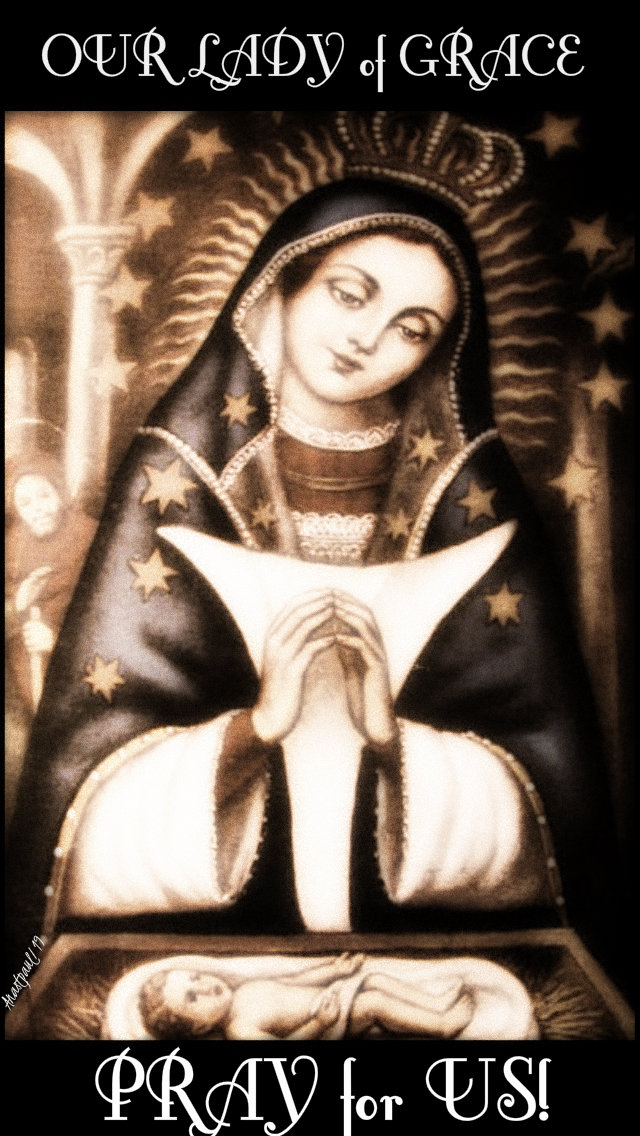
Our Lady of Altagracia – 21 January – Also known as: Our Lady of Grace – Our Lady of High Grace – Protector and Queen of the hearts of the Dominicans – Tatica from Higuey – Virgen de la Altagracia – Virgin of Altagracia.
A portrait of the Virgin Mary in a Nativity scene. It is 13 inches (33 centimeters) wide by 18 inches (45 centimeters) high and is painted on cloth. It is a primitive work of the Spanish school, painted c 1500. The Spanish brothers Alfonso and Antonio Trejo, two of the first European settlers on Santo Domingo, brought the portrait to the island some time prior to 1502 and eventually donated it to the parish church at Higuey. It’s first shrine was finished in 1572 and in 1971 it was moved to its present Basilica. The image was crowned on 15 August 1922 during the pontificate of Pius XI. Due to its age, centuries of handling by the faithful and exposure to candle smoke, it was in sad shape, and was restored in 1978. On 25 January 1979 St Pope John Paul II crowned the image with a gold and silver tiara, his gift to the Virgin. It’s frame is made of gold, enamel and precious stones and was constructed by an unknown 18th century artisan.
The Dominicans see the image as exemplifying Our Lady watching over the island and the growth of Christianity there. The feast day is marked by services, all-night vigils, singing, dancing and festivals in many of the towns.
Legend says that the pious daughter of a rich merchant asked her father to bring her a portrait of Our Lady of Altagracia from Santo Domingo, but no one had heard of that title. The merchant, staying overnight at a friend’s house in Higuey, described his problem as they sat outdoors after dinner. An old man with a long beard, who just happened to be passing by, pulled a rolled up painting from his cloak, gave it to the merchant and said, “This is what you are looking for.” It was the Virgin of Altagracia. They gave the old man a place to stay for the night but by dawn he was gone, not to be seen again. The merchant placed the image on their mantle, but it repeatedly disappeared only to be found outside and the family finally returned it to the church.
St Agnes of Aislinger
St Alban Bartholomew Roe
St Anastasius of Constantinople
St Aquila of Trebizond
St Brigid of Kilbride
St Candidus of Trebizond
Bl Edward Stransham
St Epiphanius of Pavia
St Eugenius of Trebizond
Bl Franciscus Bang
St Gunthildis of Biblisheim
Bl Ines de Beniganim
St John Yi Yun-on
St Lawdog
St Maccallin of Waulsort
St Meinrad of Einsiedeln
St Nicholas Woodfen
St Patroclus of Troyes
St Publius of Malta
Bl Thomas Reynolds
St Valerian of Trebizond
St Vimin of Holywood
St Zacharias the Angelic
—
Blessed Martyrs of Laval – 19 beati: Fifteen men and four women who were martyred in Laval, France by anti-Catholic French Revolutionaries.
• Blessed André Duliou
• Blessed Augustin-Emmanuel Philippot
• Blessed François Duchesne
• Blessed François Migoret-Lamberdière
• Blessed Françoise Mézière
• Blessed Françoise Tréhet
• Blessed Jacques André
• Blessed Jacques Burin
• Blessed Jean-Baptiste Triquerie
• Blessed Jean-Marie Gallot
• Blessed Jeanne Veron
• Blessed John Baptist Turpin du Cormier
• Blessed Joseph Pellé
• Blessed Julien Moulé
• Blessed Julien-François Morin
• Blessed Louis Gastineau
• Blessed Marie Lhuilier
• Blessed Pierre Thomas
• Blessed René-Louis Ambroise
The were born in French and they were martyred on several dates in 1794 in Laval, Mayenne, France. They were beatified on 19 June 1955 by Pope Pius XII at Rome, Italy.
Martyrs of Rome – 30 saints: Thirty Christian soldiers executed together in the persecutions of Diocletian. They were martyred in 304 in Rome, Italy.
Martyrs of Tarragona: Augurius, Eulogius, Fructuosus
Novena to St Paul in preparation for the Feast of The Conversion of St Paul on 25 January
Day FIVE – 20 January
“Conversion to Christ,” says Pope Benedict XVI, “ultimately means this: to exit the illusion of self-sufficiency in order to discover and accept one’s own need – the need of others and of God, the need of His forgiveness and His friendship.”
LET US PRAY:
Glorious St Paul,
your conversion is a powerful witness to the world
that God loves us and does not give up on us,
no matter how far we stray.
May every circumstante of my life be an occasion
to change my way of thinking,
to renounce self-will and
to surrender myself to the wisdom and tenderness of Jesus Christ
who is acting to make me His saint.
Pray that I may love God’s will and providence for me.
In this confidence, I entrust to you, St Paul,
these, my intentions
………………………………
(mention your request)
Novena to St Francis de Sales Day SIX – 20 January
“Do not pay any attention to the kind of work you do but rather to the honour that it brings to God, even though it may seem quite trivial. Desire only to do the Divine Will, following Divine Providence, which is the disposition of Divine Wisdom. In a word, if your works are pleasing to God and recognised as such, that is all that matters. Work hard every day at increasing your purity of heart, which consists in appraising things and weighing them in the balance of God’s will.” (St Francis de Sales Letters 280; O. XIII, p. 53)
O blessed Francis de Sales,
who on earth did excel in a life of virtue,
especially in the love of God and neighbour,
I earnestly ask you to take me under your compassionate care and protection.
Obtain for me conversion of mind and heart.
Grant that all people, especially
………………..…………….
(names of those whom you wish to include)
may experience the depth of God’s redeeming and healing love.
Teach me to fix my eyes on the things of heaven even as I walk each day
with my feet planted firmly on the earth.
Help me, through the practice of virtue and the pursuit of devotion,
to avoid anything that would otherwise cause me to stumble in my attempt to follow Christ and to be an instrument of the Holy Spirit.
Encouraged by your prayers and example,
help me to live fully my sacred dignity with the hope of experiencing my sacred destiny:
eternal life with God.
Receive also this particular need or concern that I now lift up in prayer.
…………………….(mention your particular need)
O God, for the salvation of all, you desired that St Francis de Sales—
preacher, missionary, confessor, bishop and founder—
should befriend many along the road to salvation.
Mercifully grant that we, infused with the humility and gentleness of his charity,
guided by his wisdom and sharing in his spirit may experience eternal life.
Thought for the Day – 20 January – The Memorial of St Pope Fabian (c 200 – c 250) Martyr
St Cyprian of Carthage (c 200- c 258) Bishop and Martyr, Father of the Church, here writes of the martyrdom of St Fabian who had been elected bishop of the Church of Rome in 236. In 250, at the beginning of the persecution of the Emperor Decius, Pope Fabian was captured, martyred and buried in the catacombs, in cemetery of Saint Callistus. St Cyprian himself was arrested in Carthage a few years later and also won the crown of martyrdom.
When St Cyprian had learnt of Pope Fabian’s death, he sent this letter to the presbyters and deacons of Rome:
LETTER OF CYPRIAN “When the report of the departure of the excellent man, my colleague, was still uncertain among us, my beloved brethren and I was wavering doubtfully in my opinion on the matter, I received a letter sent to me from you by Crementius the sub-deacon, in which I was fully informed of his glorious end and I rejoiced greatly, that the integrity of his administration had been matched, by the nobility of his end.
I greatly congratulate you that you honour his memory with so public and illustrious a testimony, through which you have made known to me not only the memory of your bishop, which confers glory upon you but also an example of faith and strength, that I should follow.
For just as the fall of a bishop tends to bring about the ruinous fall of his followers, so it is a useful and helpful thing when, by the firmness of his faith, a bishop becomes manifest to his brethren as an object of imitation.”
LETTER OF THE CHURCH OF ROME Before receiving the above letter, the Church of Rome wrote to Cyprian, bearing witness to its steadfastness in persecution:
“The church stands in faith, even though some have been driven to fall by sheer terror, whether because they were people of some eminence or that, when they were seized, they were overwhelmed by the fear of man. We did not abandon these people, although they were separated from us but exhort them and exhort them still, to repent, so that they may somehow receive pardon from Him, who is able to pardon them and so that they should not, by being deserted by us, become worse.
So you see, brethren, that you ought to do the same, so that even those who have fallen may be brought to their senses by your exhortation and confess, if they are seized once more and so make amends for their former sin. You have other duties too, which we have added here. For example, if anyone who has fallen into this temptation begins to be taken with sickness and repents of what he has done and desires communion, it must be granted to them in any case.
And if you have widows or bedridden people who cannot maintain themselves, or people who are in prison or otherwise excluded from their own dwellings, they must always have someone to minister to them. Moreover, catechumens who are taken ill should not be disappointed in their hopes but should also be given help.
The brethren who are in chains greet you, as do the elders and the whole Church, which also, with the deepest anxiety, keeps watch over all who call on the Lord. And we too ask that you in your turn should remember us.”
The above is an excerpt from a letter from Saint Cyprian to the Roman Church (Ep. 9, 1 et 8, 2-3: CSEL 3, 488-489, 487-488) on the occasion of the martyrdom of Pope Fabian. It is used in the Roman Office of Readings for the memorial of Sts Fabian on January 20, the same day on which St Sebastian is honoured.
St Pope Fabian, Pray for Us!
St Sebastian, Pray for Us!
Sunday Reflection – 20 January – Second Sunday in Ordinary Time, Year C
“…Let him first strive to cleanse his conscience”
St Caesarius of Arles (470-542) Bishop of Arles, Father of the Church
And so, dearly beloved brethren, let us each examine his conscience and when he sees that he has been wounded by some sin, let him first strive to cleanse his conscience by prayer, fasting, almsgiving and so dare to approach the Eucharist. If he recognises his guilt and is reluctant to approach the holy altar, he will be quickly pardoned by the Divine Mercy, “for whoever exalts himself will be humbled and whoever humbles himself will be exalted” (Mt 23:12). If then, as I have said, a man conscious of his sins, humbly decides to stay away from the altar until he reforms his life, he will not be afraid of being completely excluded from the eternal banquet of heaven.
I ask you then, brethren, to pay careful attention. If no-one dares approach an influential man’s table in tattered, soiled garments, how much more should one refrain in reverance and humility from the banquet of the Eternal King, that is, from the altar of the Lord, if one is smitten with poisonous envy, or anger, or is full of rage and fury? For it is written, “Go first and be reconciled to your brother and then come and offer your gift” (Mt 5:24). And again, “Friend, how did you come in here without a wedding garment?” And when he kept silent, that man said to the attendants, ‘bind his hands and feet and cast him forth into the darkness outside, where there will be weeping and gnashing of teeth,” (Mt 22:12,13). The same sentence awaits the man who dares present himself at the wedding feast, that is at the Lord’s table, if he is guilty of drunkenness, or adultery, or retains hatred in his heart.
St Caesarius of Arles (470-542) Bishop of Arles, was the foremost ecclesiastic of his generation in Merovingian Gaul. Caesarius is considered to be of the last generation of church leaders of Gaul that worked to promote large-scale ascetic elements into the Western Christian tradition. Caesarius was a “popular preacher of great fervour and enduring influence”. Among those who exercised the greatest influence on Caesarius were Augustine of Hippo, Julianus Pomerius and John Cassian.
Quote/s of the Day – 20 January – The Memorial of St Pope Fabian (c 200 – c 250) and St Sebastian (Died c 288) – Martyrs for Christ
What will separate us from the love of Christ? Will anguish, or distress, or persecution, or famine, or nakedness, or peril, or the sword? …No, in all these things we conquer overwhelmingly through him who loved us. For I am convinced that neither death, nor life, nor angels, nor principalities, nor present things, nor future things, nor powers, nor height, nor depth, nor any other creature will be able to separate us from the love of God in Christ Jesus our Lord.
Romans 8:35,37-39
“Long live Christ the King!” “Viva Cristo Rey!”
Blessed Miguel Pro, Martyr (1891-1927) (Last words addressed to his executioners)
“From the very beginning of the life of the Church, Christians have always believed that the blood of martyrs is a seed for Christians, as Tertullian said. Today too, in a dramatic way, the blood of a great number of Christian martyrs continues to be shed on the field of the world,with the certain hope that will bear fruit in a rich harvest of holiness, justice, reconciliation and love of God. But we must remember that one is not born a martyr.
Archbishop Romero remarked, ‘We must be willing to die for our faith, even if the Lord does not grant us this honour. … Giving life does not only mean being assassinated; giving life, having the spirit of martyrdom, means offering it in silence, in prayer, in the honest fulfilment of one’s duty; in this silence of everyday life, giving life a little at a time.’”
One Minute Reflection – 20 January – Second Sunday in Ordinary Time, Year C – The first sign of Mercy: Cana – John 2:1–11
This, the first of his signs, Jesus did at Cana in Galilee and manifested his glory; and his disciples believed in him....John 2:11
REFLECTION – “The miracle by which our Lord Jesus Christ changed water into wine is not at all astonishing to those who know that God is its author. Indeed, it is exactly the same thing which produced wine in those six jars on that wedding day … and which renews this transformation in the vines each year. That which the servants poured into the jars was changed into wine by the action of the Lord; in the same way the rain that falls from the clouds is changed into wine through the same action of the Lord. And yet we do not wonder at it because it is repeated every year; custom has caused astonishment to disappear. Yet it is far more worthy of our attention than what took place in the jars filled with water.
Indeed, who is there who dreams of considering the work of God who directs and governs the whole world? Isn’t that person then seized with astonishment and as it were crushed beneath the weight of these miracles? If they consider the power enclosed within a single seed of the first species to come, they will discover a great reality there that astounds the observer. But people, otherwise occupied, have become insensible to the works of God, which would daily provide motives for praising the Creator. This is why God reserves to Himself the work of certain unusual wonders, so as to awaken them from their sleepiness and lead them to praise Him.”…St Augustine (354-430)
PRAYER – Almighty God, ruler and creator of all things in heaven and on earth, listen favourably to the prayer of Your people. Open our eyes that we may see, open our ears that we may hear, open our hearts that we may love Your glory, manifest around us in all the great deeds of Your Word. Grant us love and peace in our day and may the prayers of Your Saints and Martyrs, lead us home to You. St Pope Fabian and St Sebastian pray for us! We make our prayer through Your Son Jesus Christ with the Holy Spirit, one God forever, amen.
Our Morning Offering – 20 January – Second Sunday in Ordinary Time, Year C
My God and My All By St Alphonsus Liguori (1696-1787) Doctor of the Church (From “The Practice of the Love of Jesus Christ”)
My God and my all
I wish to seek no other good but You,
who are infinite goodness.
You, who take such good care of me,
make me have no other care,
except to please You.
Grant that all my thoughts
may always be,
in pleasing You always.
Drive far from me,
every occasion, that distracts me,
from Your love…
I love You,
infinite goodness,
I love You,
my delight.
O Word, Incarnate,
I love You more than myself…
I want nothing from You
but Yourself.
Amen
Saint of the Day – 20 January – St Pope Fabian (c 200 – c 250) Martyr, Peacemaker, Evangeliser, Confessor, Administrator and Reformer, Apostle of Charity – the Bishop of Rome from 10 January 236 to his death in 250, succeeding Anterus. He is famous for the miraculous nature of his election, in which a dove is said to have descended on his head to mark him as the Holy Spirit’s unexpected choice to become the next pope. He was succeeded by Cornelius.
According to the Liber Pontificalis, Fabian was a noble Roman by birth and his father’s name was Fabius. Nothing more is known about his background. The legend concerning the circumstances of his election is preserved by the fourth-century writer Eusebius of Caesarea (Church History, VI. 29).
After the short reign of Pope Anterus, Fabian had come to Rome from the countryside when the new papal election began. “Although present,” says Eusebius, Fabian “was in the mind of none.” While the names of several illustrious and noble churchmen were being considered over the course of thirteen days, a dove suddenly descended upon the head of Fabian. To the assembled electors, this strange sight recalled the gospel scene of the descent of the Holy Spirit on Jesus at the time of his baptism by John the Baptist. The congregation took this as a sign that he was marked out for this dignity and Fabian was at once proclaimed bishop by acclamation.
During Fabian’s reign of 14 years, there was a lull in the storm of persecution which had resulted in the exile of both Anterus’ predecessor Pontian and the antipope (and later saint) Hippolytus. Fabian had enough influence at court to effect the return of the bodies of both of these martyrs from Sardinia, where they had died at hard labour in the mines. The report that he baptised the emperor Philip the Arab and his son, however, is probably a legend, although he did seem to enjoy some connections at court, since the bodies of Pontian and Hippolytus could not have been exhumed without the emperor’s approval.
According to the sixth-century historian Gregory of Tours, Fabian sent out the “apostles to the Gauls” to Christianise Gaul in A.D. 245. Fabian sent seven bishops from Rome to Gaul to preach the Gospel. He also condemned Privatus, the originator of a new heresy in Africa.
The Liber Pontificalis says that Fabian divided the Christian communities of Rome into seven districts, each supervised by a deacon. Eusebius (VI §43) adds that he appointed seven subdeacons to help collect the acta of the martyrs—the reports of the court proceedings on the occasion of their trials. There is also a tradition that he instituted the four minor clerical orders – porter, lector, exorcist and acolyte.
His deeds are thus described in the Liber Pontificalis: “He divided the regiones into deaconships and made seven sub-deaconships which seven secretaries oversaw, so that they brought together the deeds of the martyrs faithfully made whole and he brought forth many works in the cemeteries.”
The Liberian Catalogue of the popes also reports that Fabian initiated considerable work on the catacombs, where honoured Christians were buried and where he also caused the body of Pope Pontian to be entombed at the catacomb of Saint Callixtus.
With the advent of Emperor Decius, the Roman government’s tolerant policy toward Christianity temporarily ended. Decius ordered leading Christians to demonstrate their loyalty to Rome by offering incense to the cult images of deities which represented the Roman state. This was unacceptable to many Christians, who, while no longer holding most of the laws of the Old Testament to apply to them, took the commandment against idolatry with deadly seriousness. Fabian was thus one of the earliest victims of Decius, dying as a martyr on 20 January 250, at the beginning of the Decian persecution, probably in prison rather than by execution.
Fabian was buried in the catacomb of Callixtus in Rome. The Greek inscription on his tomb has survived, and bears the words: Fabian, Bishop, Martyr.
His remains were later re-interred at San Sebastian’s Outside the Walls, (appropriately, for these two Martyrs share today as their Memorial) by Pope Clement XI where the Albani Chapel is dedicated in his honour.
St Ascla of Antinoe
Bl Basil Anthony Marie Moreau
St Basilides the Senator
St Bassus the Senator
Bl Benedict Ricasoli
Bl Bernardo of Poncelli
Bl Cyprian Michael Iwene Tansi
St Daniel of Cambron
Bl Didier of Thérouanne
St Eusebius the Senator
St Eustochia Calafato
St Euthymius the Great
St Eutyches the Senator
Fechin of Fobhar
Bl Francesco Paoli
St Henry of Uppsalla
Bl Jeroni Fábregas Camí
St Maria Cristina dell’Immacolata Concezione
St Molagga of Fermoy
St Neophytus of Nicaea
St Stephen Min Kuk-ka
St Wulfsin
Novena to St Paul in preparation for the Feast of The Conversion of St Paul on 25 January
Day FOUR – 19 January
For St John Paul, conversion means returning to God “through evaluating earthly realities in the unfailing light of His truth.” The proof of St Paul’s conversion is his profession: “For me to live is Christ” (Phil 1:21). Conversion is a conversion to the will and design of God: “It is no longer I who live but Christ who lives in me” (Gal 2:20).
Let us Pray:
Glorious St Paul,
your conversion is a powerful witness to the world
that God loves us and does not give up on us,
no matter how far we stray.
Help me to live a life of ongoing conversion.
True conversion means converting my life to the
design of God, the plan He has for me right now.
Pray that I will love God’s will and providence for me.
May I learn to truly surrender myself to wisdom and tenderness of God.
In this confidence, I entrust to you, St Paul,
these, my intentions ………………..
(mention your request)
Novena to St Francis de Sales Day FIVE – 19 January
“This poor life is only a journey to the happy life to come. We must not be angry with one another on the way but rather, we must march on as a band of brothers and sisters united in meekness, peace and love. I state absolutely and make no exception: do not be angry at all if that is possible. Do not accept any pretext whatever for opening your heart’s door to anger. Saint James tells us positively and without reservation,” … a man’s anger does not fulfil God’s justice.” [St Francis de Sales Jas 1:20] (INT. Part III, Ch. 8; O. III, p. 162)
O blessed Francis de Sales, who on earth did excel in a life of virtue,
especially in the love of God and neighbour,
I earnestly ask you to take me under your compassionate care and protection.
Obtain for me conversion of mind and heart.
Grant that all people, especially
…………………………..
(names of those whom you wish to include)
may experience the depth of God’s redeeming and healing love.
Teach me to fix my eyes on the things of heaven
even as I walk each day with my feet planted firmly on the earth.
Help me, through the practice of virtue and the pursuit of devotion,
to avoid anything that would otherwise
cause me to stumble in my attempt
to follow Christ and to be an instrument of the Holy Spirit.
Encouraged by your prayers and example,
help me to live fully my sacred dignity
with the hope of experiencing my sacred destiny:
eternal life with God.
Receive also this particular need or concern that I now lift up in prayer.
…………………………….
(mention your particular need).
O God, for the salvation of all,
You desired that St Francis de Sales—
preacher, missionary, confessor, bishop and founder—
should befriend many along the road to salvation.
Mercifully grant that we,
infused with the humility and gentleness of his charity,
guided by his wisdom and sharing in his spirit may experience eternal life.
Thought for the day – 19 January – The Memorial of Blessed Marcelo Spínola y Maestre, Cardinal-Priest (1835-1906)
Blessed Marcelo was a pious man, of intense prayer and mortification, extremely sensitive to the needs and suffering of his faithful and an untiring apostle. Homes, workers’ societies, centres where food was given to those who needed it, orphanages, night schools, creation of the faculty of theology of Seville, etc., were all part of his mark. He toured all the dioceses in which he exercised his ministry, travelling on a mule, he fought against the attempt to displace the teaching of religion from public centres as a senator from Granada, consoled the afflicted and took the gospel to every corner, preaching and confessing.
And at the centre of the heart of Blessed Marcelo was the Holy Eucharist. He wrote:
“The masterpiece of Jesus Christ’s love for humanity is the Eucharist. The Eucharist is within our reach. We can all get close to Christ the guest and talk with Him and perceive the warmth of His word. The word! How it inflames the spirits! How will the word of Christ inflame them! We can all get to the altar when He immolates Himself and shouts at us: Look how much I have loved and loved you! And we can all sit at His table and eat the bread and drink the intoxicating wine of charity. “
Quote of the Day – 19 January 2019 – Saturday of the First week in Ordinary Time – Gospel: Mark 2:13–17
“For everything in the life of Jesus, the Incarnate Word, is full of signification. Christ, if I may thus express myself, is the great sacrament of the New Law… each of Our Lord’s mysteries ought to be for us, an object of contemplation. His mysteries ought also to be, as it were, sacraments producing within us, according to the measure of our faith and love, their own special grace. And this is true of each of the states of Jesus, of each of His actions. For if Christ is always the Son of God, if in all that He says and does He first of all glorifies His Father, neither does He ever separate us from the thought of Him. To each of His mysteries, He attaches a grace, which is to help us to reproduce within ourselves, His divine features, in order to make us like unto Him.”
You must be logged in to post a comment.