Sunday Reflection – 4 November – Thirty First Sunday in Ordinary Time, Year B
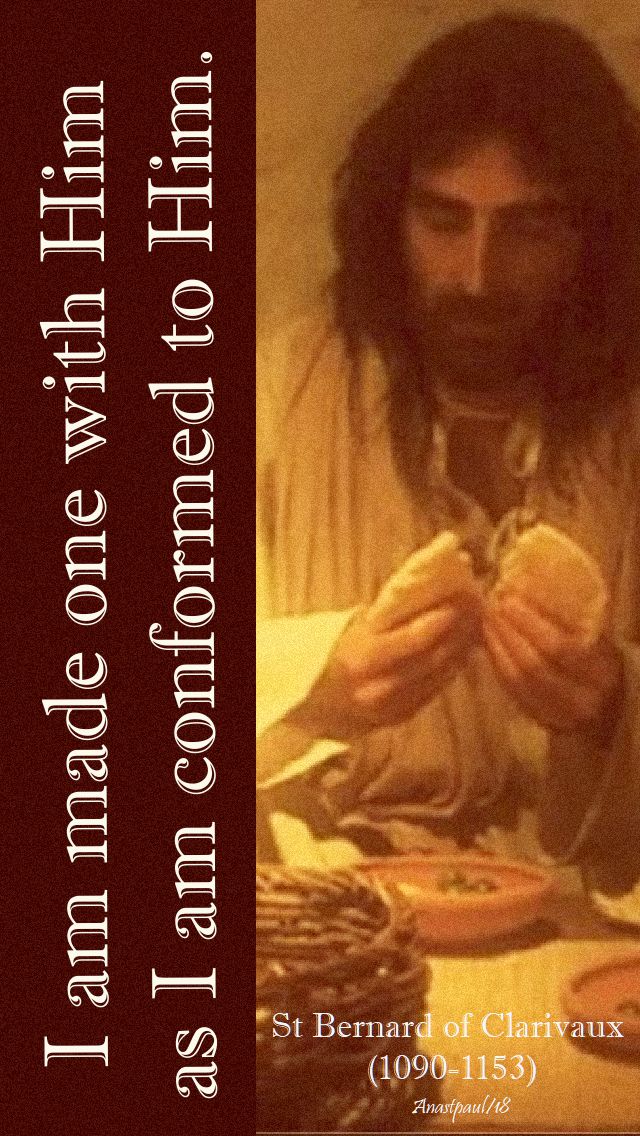
“I am made one with Him, as I am conformed to Him.” St Bernard of Clairvaux (1090-1153) Doctor of the Church
Saint Bernard teaches, that it is not enough for us to take and eat the Bread from Heaven. We must also offer ourselves to be eaten. Holy Communion is a wondrous exchange in which we become the bread of Christ. Listen to Saint Bernard:
“My penitence, my salvation are His food.
I myself am His food.
I am chewed as I am reproved by Him;
I am swallowed by Him as I am taught;
I am digested by Him as I am changed;
I am assimilated as I am transformed;
I am made one with Him, as I am conformed to Him.
He feeds upon us and is fed by us
that we may be the more loosely bound to Him.”
Saint Bernard, ever the poet, uses images of eating and assimilation to describe how Christ unites us to Himself. Our Lord becomes our food that we might become His. We need the language of poets and preachers in our approach to the Eucharist.
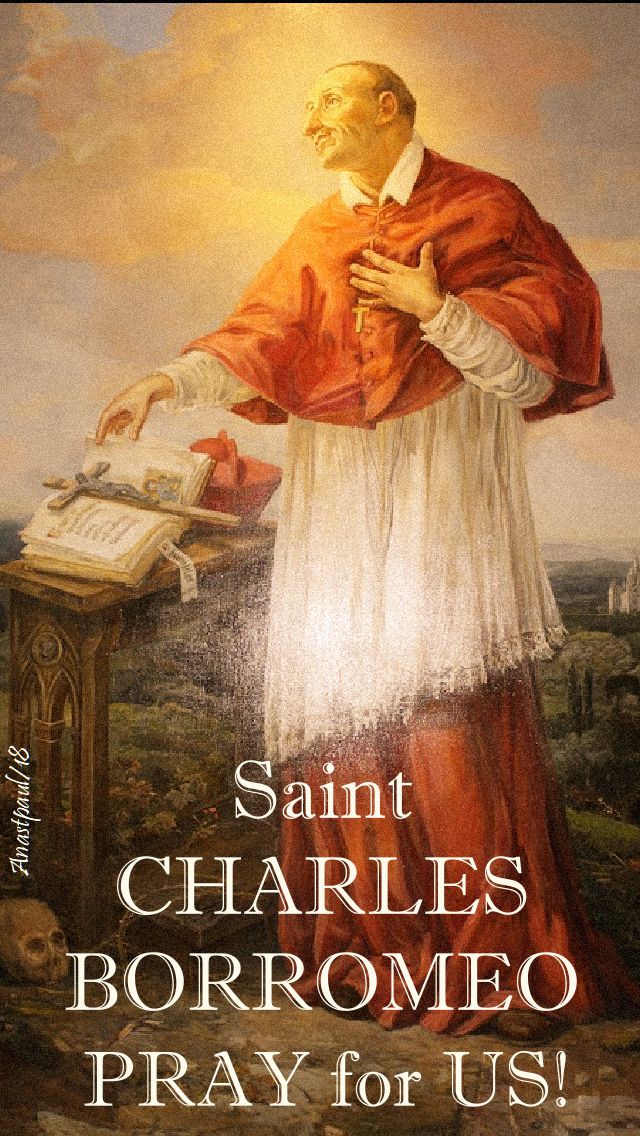
Thought for the Day – 4 November – The Memorial of St Charles Borromeo (1538-1584)
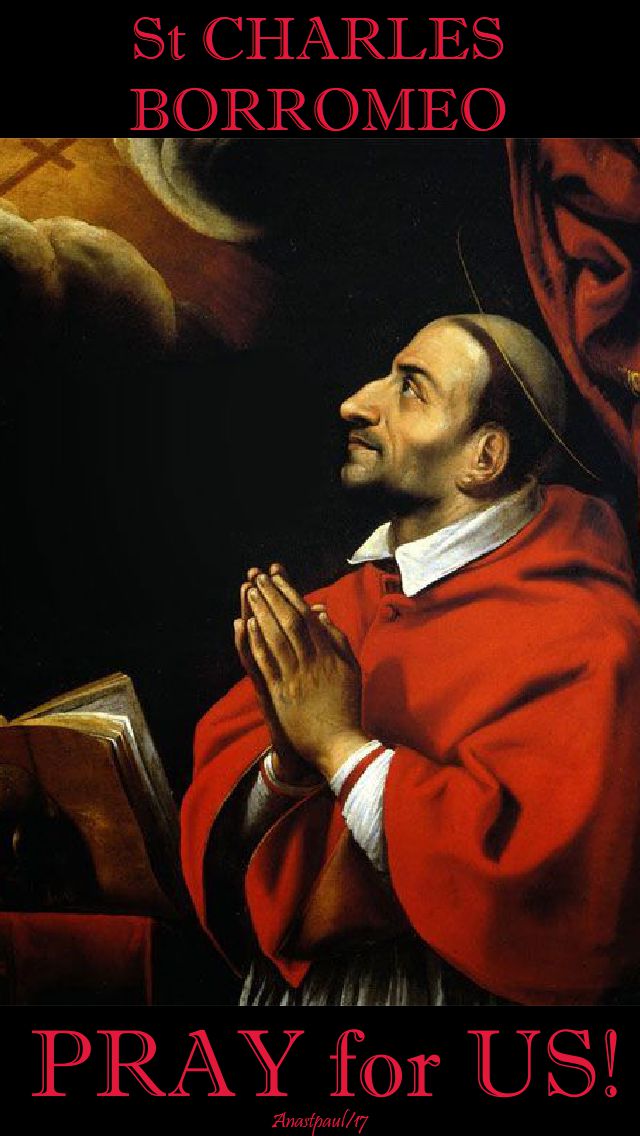
Working behind the scenes, Saint Charles deserves the credit for keeping the Council of Trent in session when at several points it was on the verge of breaking up. Borromeo encouraged the pope to renew the Council in 1562, after it had been suspended for 10 years. He took upon himself the task of the entire correspondence during the final phase. Because of his work at the Council, Borromeo was unable to take up residence in Milan until the Council concluded.
Eventually, Borromeo was allowed to devote his time to the Archdiocese of Milan, where the religious and moral picture was far from bright. The reform needed in every phase of Catholic life among both clergy and laity was initiated at a provincial council of all the bishops under him. Specific regulations were drawn up for bishops and other clergy. If the people were to be converted to a better life, Borromeo had to be the first to give a good example and renew their apostolic spirit
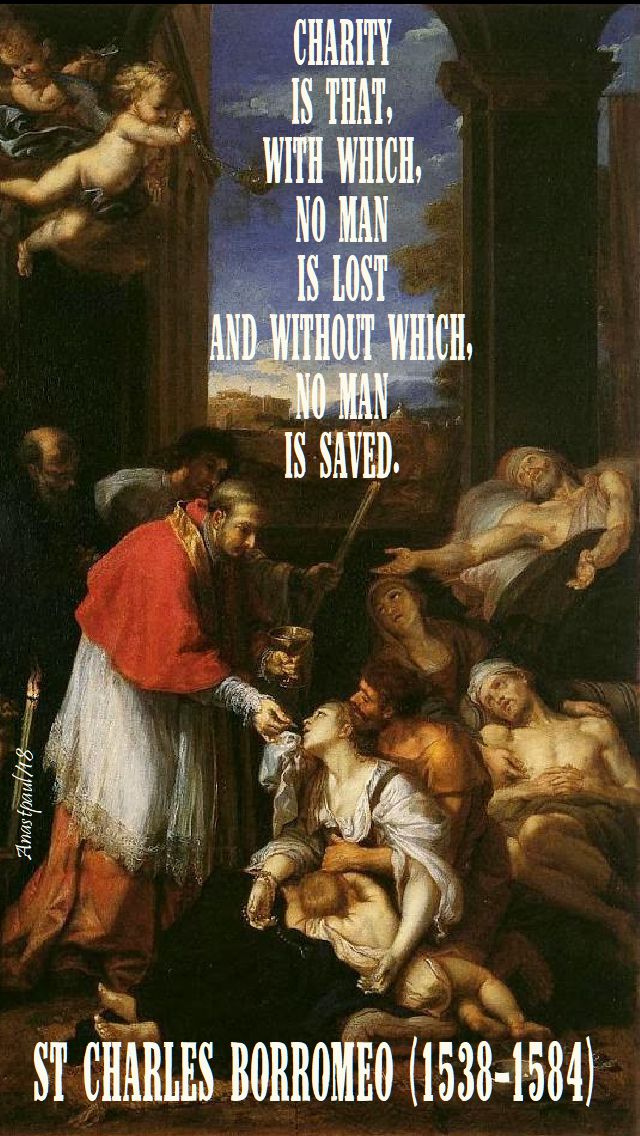
Charles took the initiative in giving a good example. He allotted most of his income to charity, forbade himself all luxury and imposed severe penances upon himself. He sacrificed wealth, high honours, esteem and influence to become poor. During the plague and famine of 1576, Borromeo tried to feed 60,000 to 70,000 people daily. To do this he borrowed large sums of money that required years to repay. Whereas the civil authorities fled at the height of the plague, he stayed in the city, where he ministered to the sick and the dying, helping those in want.
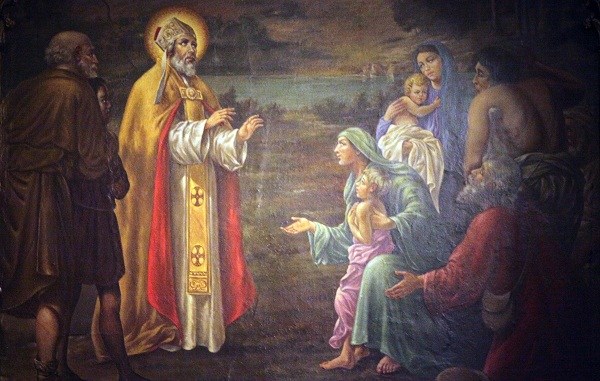
Saint Charles Borromeo made his own the words of Christ: “…I was hungry and you gave me food, I was thirsty and you gave me drink, a stranger and you welcomed me, naked and you clothed me, ill and you cared for me, in prison and you visited me” (Matthew 25:35-36). Borromeo saw Christ in his neighbour, and knew that charity done for the least of his flock was charity done for Christ.
Quote/s of the Day – 4 November – The Memorial of St Charles Borromeo (1538-1584)
“Charity is that, with which no man is lost and without which, no man is saved.”
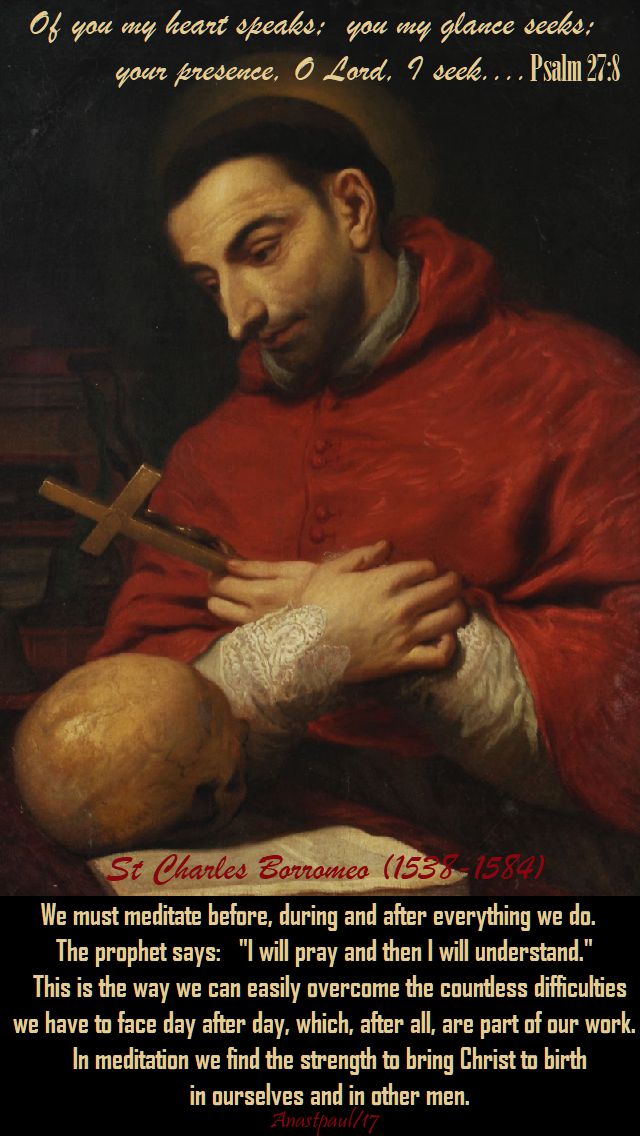
“We must meditate before, during and after everything we do. The prophet says: “I will pray and then I will understand.” This is the way we can easily overcome the countless difficulties we have to face day after day, which, after all, are part of our work. In meditation we find the strength, to bring Christ to birth in ourselves and in other men.”
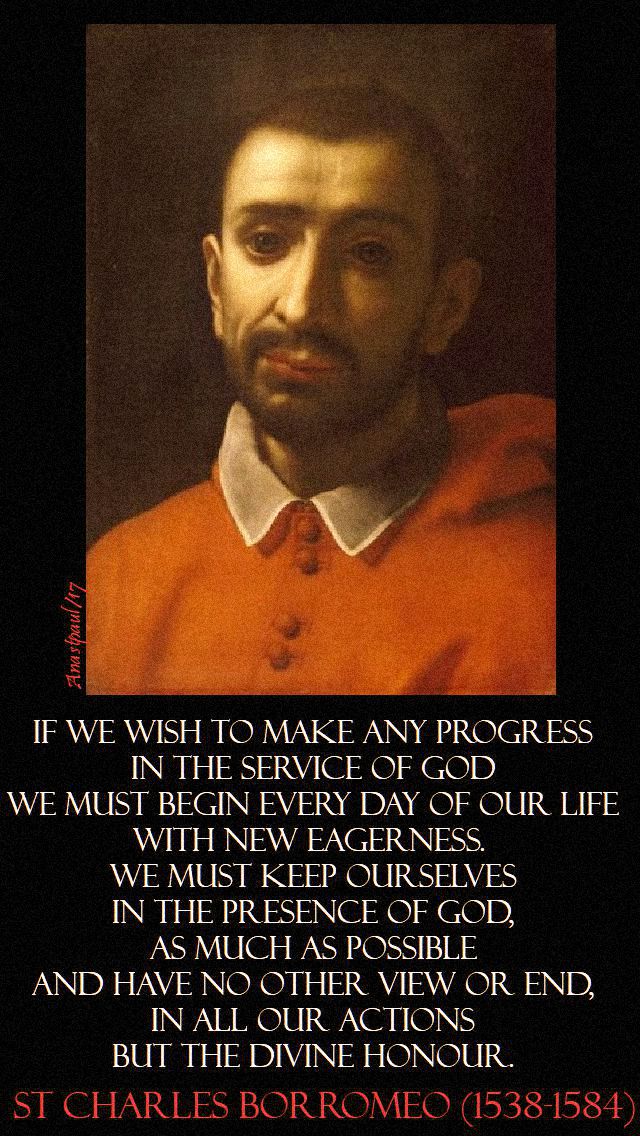
“If we wish to make any progress in the service of God, we must begin every day of our life with new eagerness. We must keep ourselves in the presence of God, as much as possible and have no other view or end, in all our actions but the divine honour.”
One Minute Reflection – 4 November – Today’s Gospel: Mark 12:28b-34 -Thirty First Sunday in Ordinary Time, Year B and the Memorial of St Charles Borromeo (1538-1584) and St Felix of Valois (1127-1212)
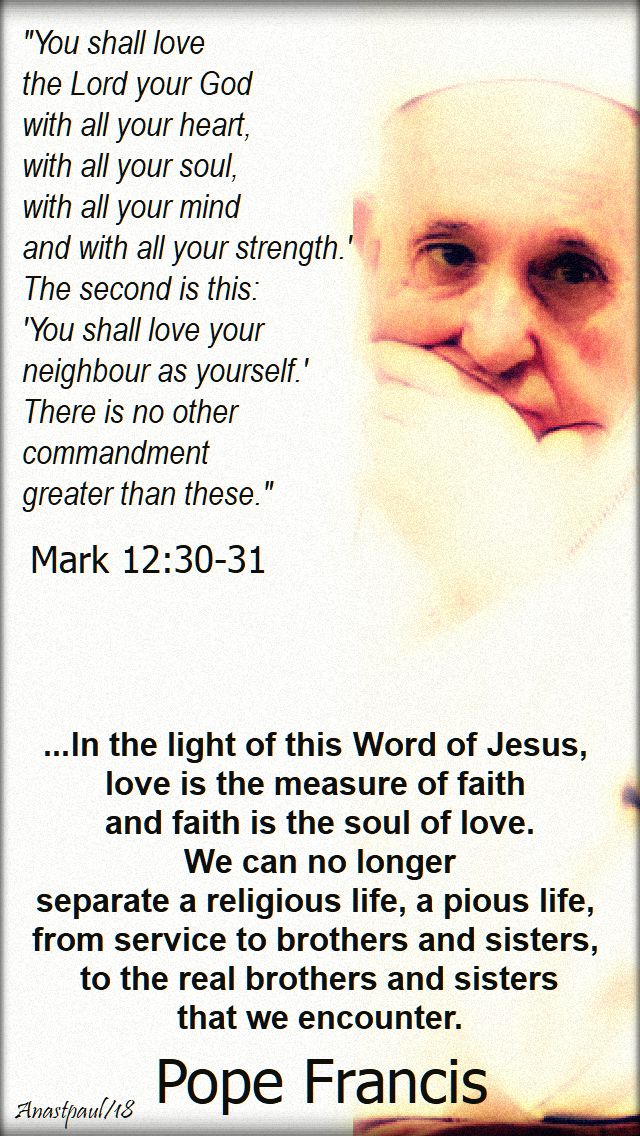
“You shall love the Lord your God with all your heart, with all your soul, with all your mind and with all your strength.’ The second is this: ‘You shall love your neighbour as yourself.’ There is no other commandment greater than these.”...Mark 12:30-31
REFLECTION – “You cannot love God without loving your neighbour and you cannot love your neighbour without loving God. In effect, the visible sign a Christian can show, in order to witness to his love for God to the world and to others, to his family, is the love he bears for his brothers, is the love of his people. The Commandment to love God and neighbour is the first, not because it is at the top of the list of Commandments. Jesus does not place it at the pinnacle but at the centre, because it is from the heart that everything must go out and to which everything must return and refer.
In the Old Testament, the requirement to be holy, in the image of God who is holy, included the duty to care for the most vulnerable people, such as the stranger, the orphan and the widow (cf. Ex 22:20-26). Jesus brings this Covenant law to fulfilment, He who unites in Himself, in His flesh, divinity and humanity, a single mystery of love.
Now, in the light of this Word of Jesus, love is the measure of faith and faith is the soul of love. We can no longer separate a religious life, a pious life, from service to brothers and sisters, to the real brothers and sisters that we encounter.”…Pope Francis – Angelus, 26 October 2014)
PRAYER – God power and mercy, by whose grace, Your people give You praise and worthy service, help us to see Your face in our neighbour. To love them all as we love You. Save us from faltering on our way and grant us the joys You have promised . St Felix of Valois and St Charles Borromeo kindly assist our journey by your prayers. Through Jesus our Lord, with the Holy Spirit, one God forever, amen.
Our Morning Offering – 4 November – Thirty First Sunday in Ordinary Time, Year B – The Memorial of St Charles Borromeo (1538-1584)
Prayer Before Holy Communion Veni Domine Jesu! By Fr Henry Augustus Rawes OSC (1826 – 1885) Oblate of St Charles (1940 Prayer Book)
O Jesus, hidden God, I cry to You,
O Jesus, hidden Light, I turn to You,
O Jesus, hidden love, I run to You,
with all the strength I have, I worship You,
with all the love I have, I cling to You,
with all my soul, I long to be with You
and fear no more to fail, or fall from You.
O Jesus, never-ending love, Who seeks me,
You who die for longing love of me,
King, in all Your beauty, come to me,
white-robed, blood-sprinkled Jesus, come to me
and go no more, dear Lord, away from me.
O sweetest Jesus, bring me home to You,
free me, dearest God, from all but You.
From all the chains that keep me back from You,
call me, most powerful love, I’ll follow You,
You are my all and I love only You.
O hidden love, who now is loving me,
O wounded love, who once was dead to me,
O patient love, who wearies not of me,
O bear with me, till I am lost in You,
O bear with me, till I am found in You,
amen.
(Fr Henry Augustus Rawes (11 December 1826 – 24 April 1885) was a Catholic hymn writer and preacher. Born at Easington, near Durham, England, he was educated at Trinity College, Cambridge and entered the Anglican ministry in 1853. Converted to Catholicism in 1856. One of the original members of the Oblates of Saint Charles Borromeo (1538-1584), whose feast day it is today. Ordained a priest in 1857. He was Superior of the Oblate congregation from 1880 until his death. Founded the Society of Servants of the Holy Ghost. Translated the treatises of Saint Thomas Aquinas on the Blessed Sacrament and the Lord’s Prayer. He wrote several books of devotion and sermons and many hymns, noted for poetic beauty. He died at Brighton.)
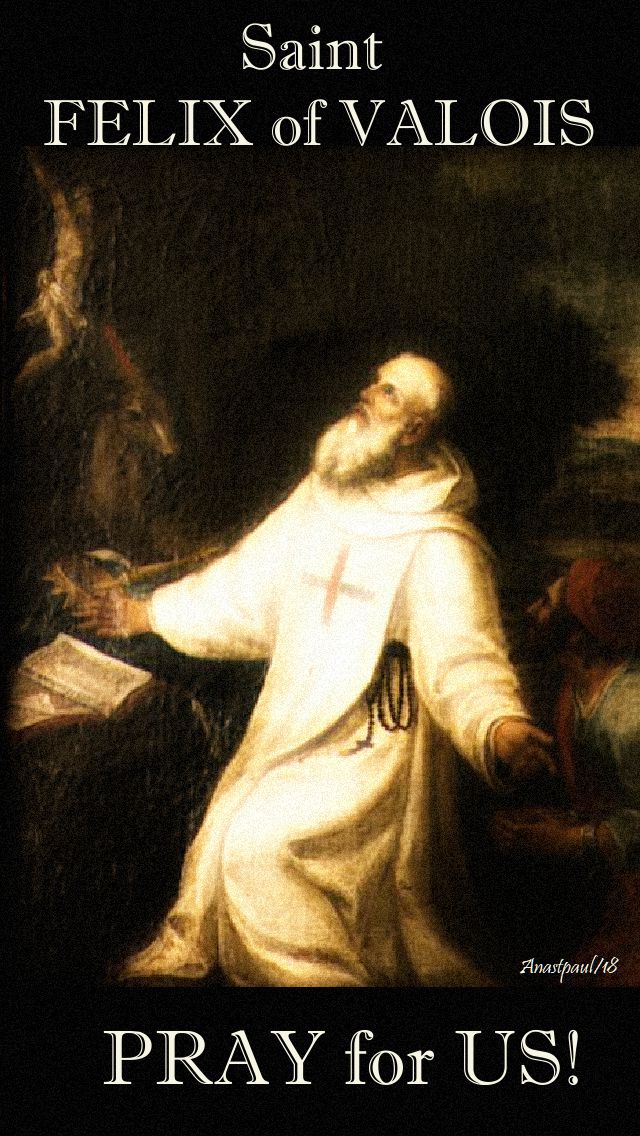
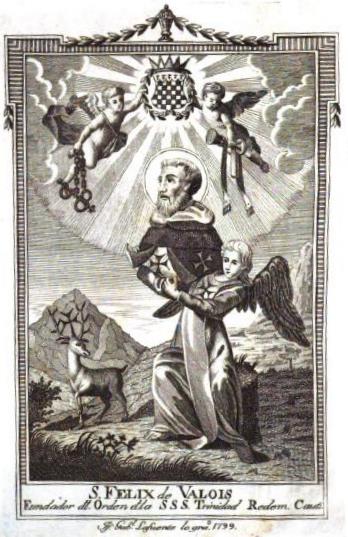
Saint of the Day – 4 November – St Felix of Valois (1127-1212) – Priest, Hermit and Co-Founder of the Trinitarians. He was born in April 1127 in the province of Valois, France as Hugh and died on 4 November 1212 at the Cerfroi monastery, Picardy, France of natural causes.
St Felix was son of the Count of Valois. His mother throughout his youth, did all she could to cultivate in him, a spirit of charity. The unjust divorce between his parents matured a long-formed resolution of leaving the world and, confiding his mother to her pious brother, Thibault, Count of Champagne, he took the Cistercian habit at Clairvaux.
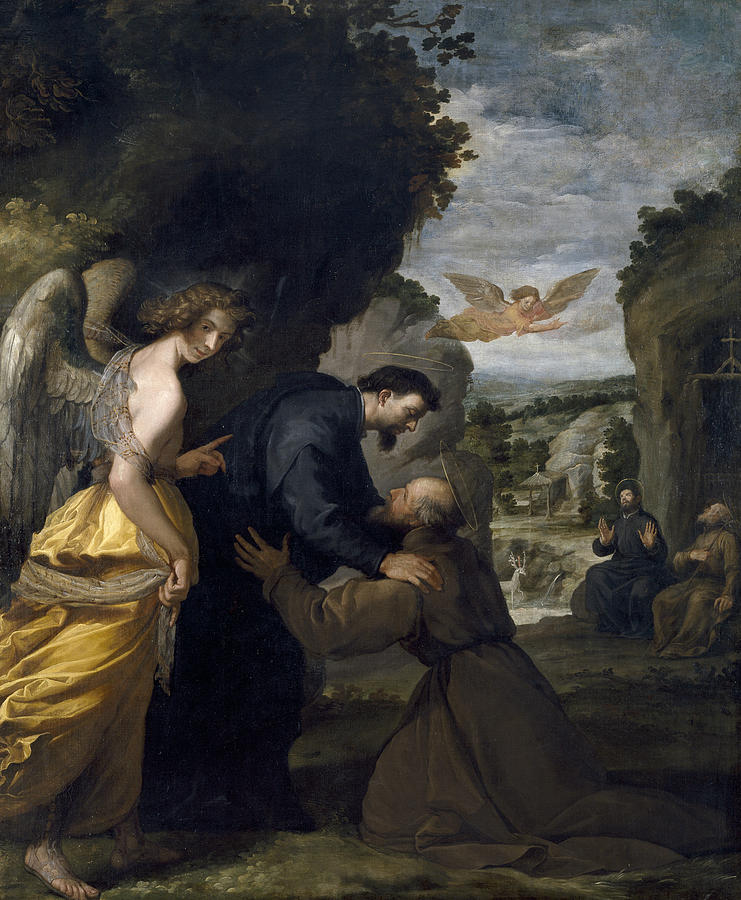
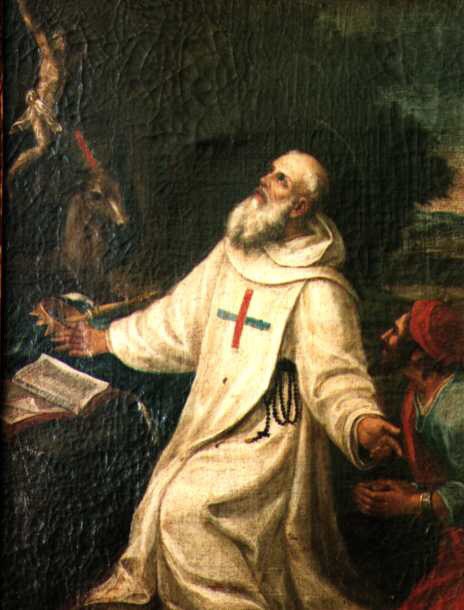
His rare virtues drew on him such admiration that, with St Bernard’s consent, he fled to Italy, where he led an austere life with an aged hermit. At this time he was ordained priest and his old counsellor having died, he returned to France and for many years lived as a solitary at Cerfroid. Here God inspired him with the desire of founding an Order for the redemption of Christian captives and moved St John of Matha (1160-1213), a young nobleman, a native of Provence and doctor of divinity, who was lately ordained priest, having heard of the holy hermit of Cerfroid, sought him out and put himself under his direction. St John proposed to him the project of founding an order for the redemption of captives. Felix, though seventy years of age, readily agreed as it conincided with his similar wish. Together they drew up the rules of the Order of the Holy Trinity.
Meeting of St John and St Felix by Vincenzo Carducci
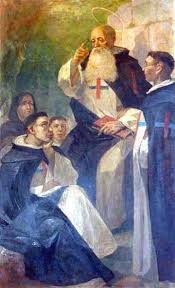
Many disciples gathered round them and, seeing that the time had come for further action, the two Saints made a pilgrimage to Rome to obtain the confirmation of the Order from Innocent III. Their prayer was granted and the last fifteen years of Felix’s long life were spent in organising and developing his rapidly increasing foundations. When Felix returned to France to establish the order, he was received with great enthusiasm and King Philip Augustus authorised the institute in France and fostered it by benefactions.
Margaret of Blois granted the order 20 acres (81,000 m2) of the wood where Felix had built his first hermitage and on almost the same spot he erected the famous Monastery of Cerfroid, the mother-house of the institute. Within forty years the order possessed six hundred monasteries in every part of Europe. St John was obliged to go to Rome to found a house of the order, the church of which, Santa Maria in Navicella, still stands on the Caelian Hill. St Felix remained in France to look after the interests of the congregation. He founded a house in Paris attached to the church of St Maturinus, which afterwards became famous under Robert Guguin, master general of the order.
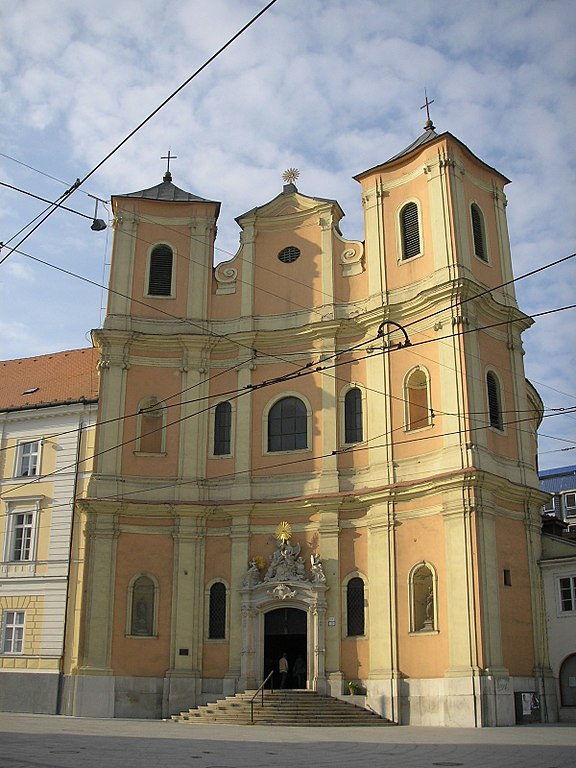
Trinitarian Church in Bratislava
St Felix died amongst his fellow Trinitarians at their motherhouse in Cerfroid on 4 November 1212.
Although no bull of his Canonisation is extant, it is the tradition of his institute that he was canonised by Pope Urban IV on 1 May 1262. His feast was kept in the Diocese of Meaux as early as the year 1215. On 21 October 1666, Pope Alexander VII confirmed his status as a saint because of his immemorial cult. In 1679 St Felix’s feast was transferred to 20 November by Pope Innocent XI, when it was placed in the General Roman Calendar because, since 1613, 4 November was the feast day of Saint Charles Borromeo. In 1969, his feast was restored to 4 November, his dies natalis.
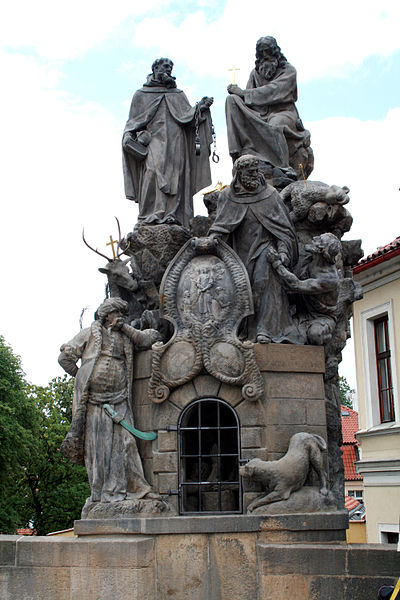
Statues of Felix of Valois and John of Matha. Charles Bridge, Prague.
St Agricola of Bologna
St Amandus of Avignon
St Amandus of Rodez
St Birstan
St Clarus the Hermit
St Clether
St Emeric of Hungary
St Felix of Valois (1127 – 1212) Trinitarian Founder
Bl Frances d’Amboise
St Gerard de Bazonches
St Gregory of Burtscheid
Bl Helen Enselmini
Bl Henry of Zweifalten
St Hermas of Myra
Bl Joan Antoni Burró Mas
St Joannicus of Mount Olympus
St John Zedazneli
St Modesta of Trier
St Nicander of Lycia
St Patrobas
St Perpète
St Philologus
St Pierius
St Proculus of Autun
Bl Teresa Manganiello
St Vitalis of Bologna
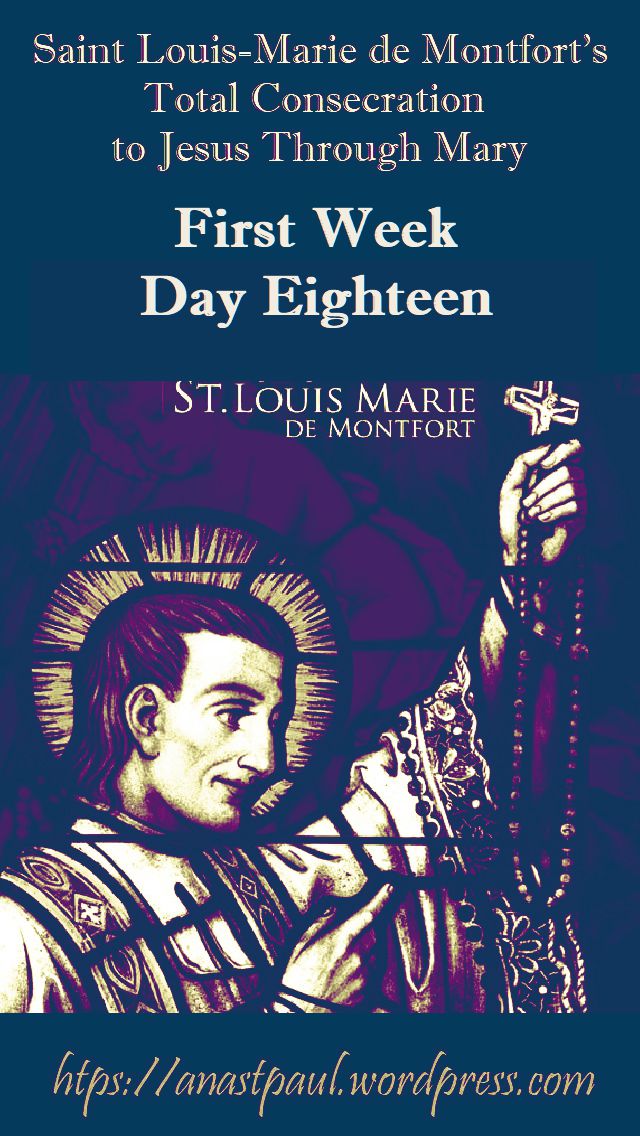
Saint Louis-Marie de Montfort’s Total Consecration to Jesus Through Mary – First Week – Day Eighteen – 3 November
Readings and Prayers
First Week Theme for the Week: Knowledge Of Self
Day 18 of 33
Luke 17:1-10
On Leading Others Astray: And he said to his disciples: ‘It is impossible that scandals should not come, but woe to him through whom they come. It were better for him, that a millstone were hanged about his neck and he cast into the sea, than that he should scandalise one of these little ones.’ On Brotherly Correction: ‘Take heed to yourselves. If your brother sin against you, reprove him: and if he do penance, forgive him. And if he sin against you seven times in a day and seven times in a day be converted unto you, saying, I repent, forgive him.’ The Power of Faith : And the apostles said to the Lord: Increase our faith. And the Lord said: ‘If you had faith like to a grain of mustard seed, you might say to this mulberry tree, Be you rooted up and be you transplanted into the sea and it would obey you. ‘ Humble Service: But which of you having a servant ploughing, or feeding cattle, will say to him, when he is come from the field: Immediately go, sit down to meat: And will not rather say to him: Make ready my supper and gird yourself and serve me, whilst I eat and drink and afterwards you shalt eat and drink? Does he thank that servant, for doing the things which he commanded him? I think not. So you also, when you shall have done all these things that are commanded you, say: We are unprofitable servants; we have done that which we ought to do.’
Imitation of Christ, by Thomas á Kempis: Book 3, Chapter 47 That All Grievous Things Are to Be Endured For the Sake of Eternal Life
My son, be not wearied out by the labours which you have undertaken for My sake, nor let tribulation cast you down ever at all but let My promise strengthen and comfort you under every circumstance. I am well able to reward you, above all measure and degree. You shall not long toil here, nor always be oppressed with griefs. Wait a little while, and you shall see a speedy end of your evils.
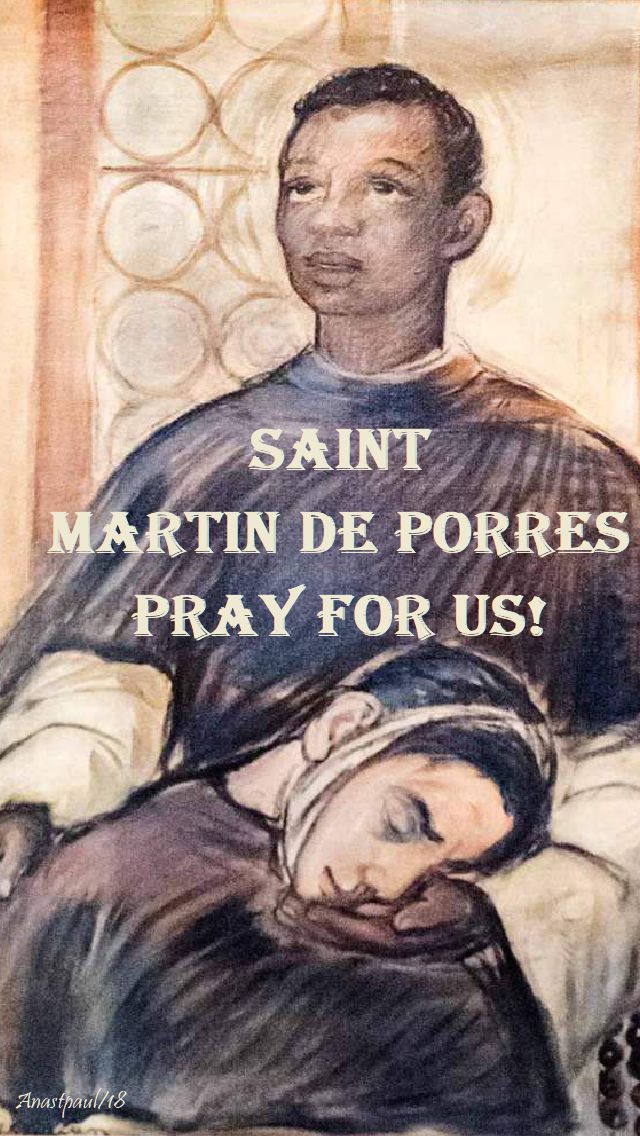
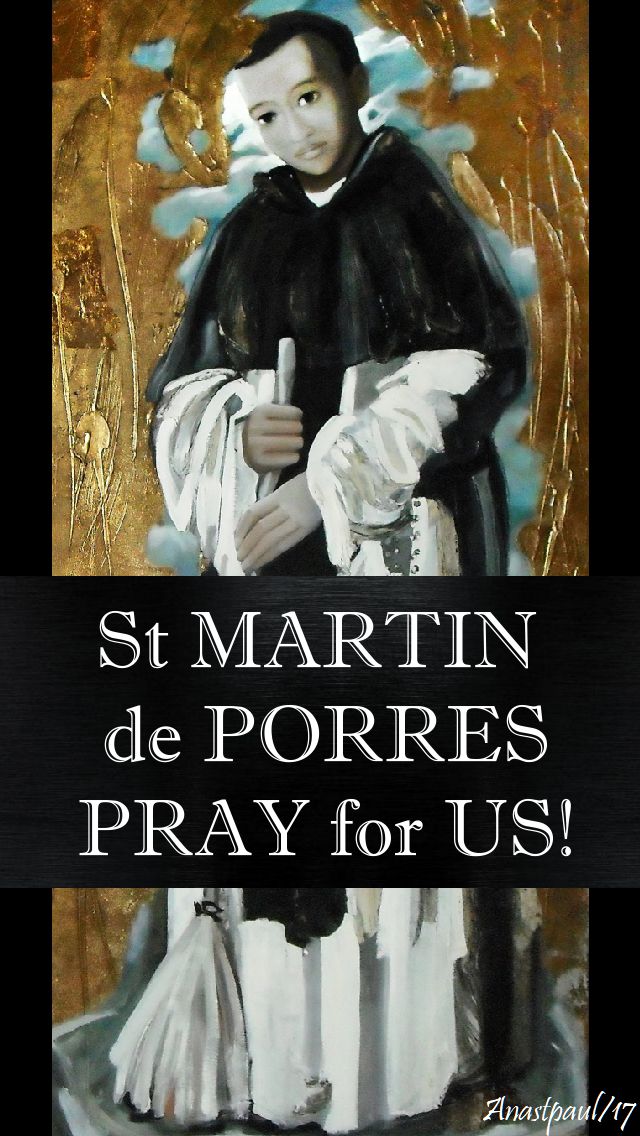
Thought for the Day – 3 November – The Memorial of St Martin de Porres OP (1579-1639)
In normal times, Saint Martin succeeded with his alms to feed 160 poor persons every day and distributed a remarkable sum of money every week to the indigent — the latter phenomenon hard to explain by ordinary calculations. To Saint Martin the city of Lima owed a famous residence founded for orphans and abandoned children, where they were formed in piety for a creative Christian life. This lay Brother had always wanted to be a missionary but never left his native city; yet even during his lifetime he was seen elsewhere, in regions as far distant as Africa, China, Algeria, Japan. An African slave who had been in irons said he had known Martin when he came to relieve and console many like himself, telling them of heaven. When later the same slave saw him in Peru, he was very happy to meet him again and asked him if he had had a good voyage, only later did he learn that Saint Martin had never left Lima. A merchant from Lima was in Mexico and fell ill, he said aloud: Oh, Brother Martin, if only you were here to care for me..! and immediately saw him enter his room. And again, this man did not know until later that he had never been in Mexico.
When he died in 1639, Saint Martin was known to the entire city of Lima, word of his miracles had made him known as a Saint to every resident of the region. After his death, the miracles and graces received when he was invoked multiplied in such profusion that his body was exhumed after 25 years and found intact and exhaling a fine fragrance.
Letters to Rome pleaded for his Beatification the decree affirming the heroism of his virtues was issued in 1763 by Clement XIII, Gregory XVI beatified him in 1836 and in 1962 St Pope John XXIII Canonised him.
The poor and the sick will never fail to find in him a friend having great power over the Heart of God.
Quote/s of the Day – 3 November – The Memorial of St Martin de Porres (1579-1639)
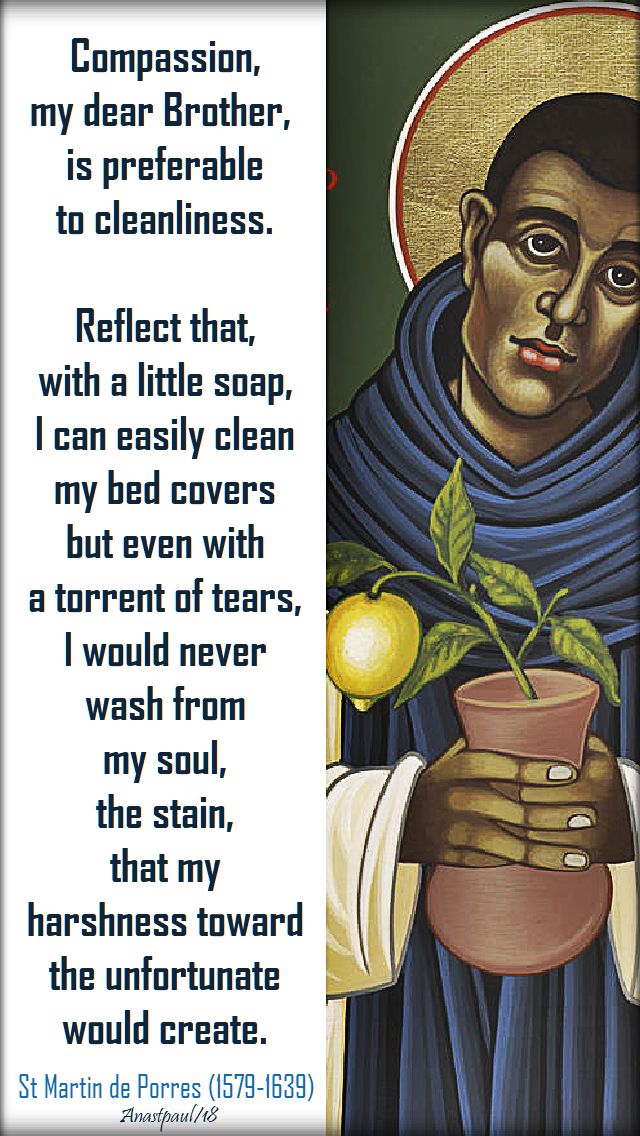
“Compassion, my dear Brother, is preferable to cleanliness. Reflect that with a little soap, I can easily clean my bed covers but even with a torrent of tears, I would never wash from my soul, the stain, that my harshness toward the unfortunate would create.”
“Everything, even sweeping, scraping vegetables, weeding a garden and waiting on the sick, could be a prayer, if it were offered to God.”
One Minute Reflection – 3 November – Today’s Gospel: Luke 14:1, 7-11 – Saturday of the Thirtieth week in Ordinary Time, Year B and The Memorial of St Martin de Porres (1579-1639)
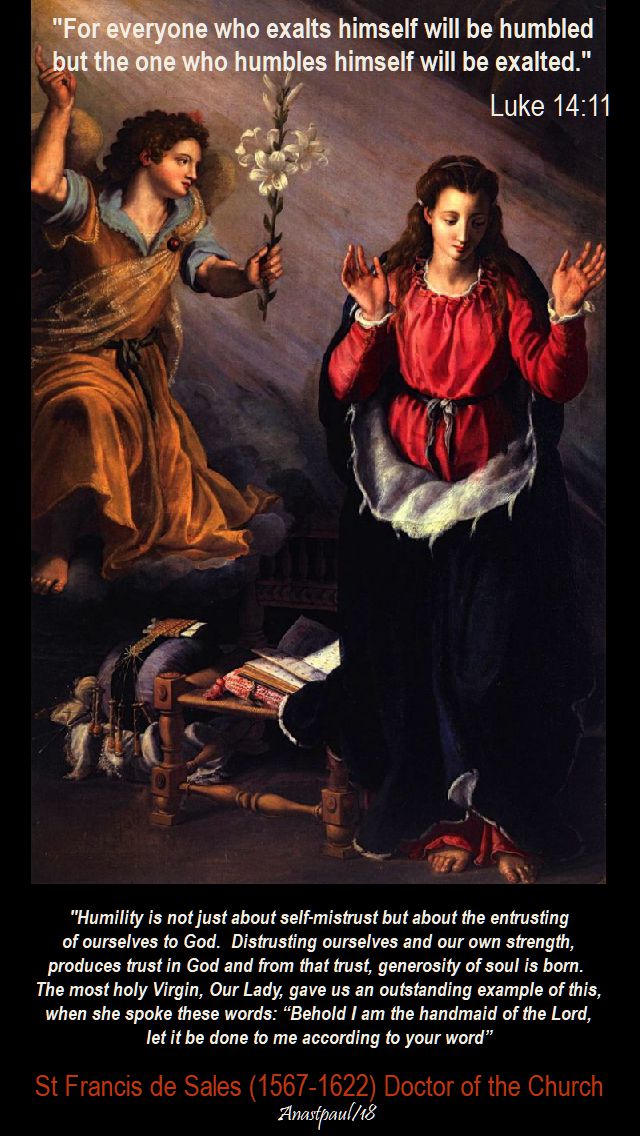
“For everyone who exalts himself will be humbled but the one who humbles himself will be exalted.”…Luke 14:11
REFLECTION – “Humility is not just about self-mistrust but about the entrusting of ourselves to God. Distrusting ourselves and our own strength produces trust in God and from that trust generosity of soul is born.
The most holy Virgin, Our Lady, gave us an outstanding example of this when she spoke these words: “Behold I am the handmaid of the Lord, let it be done to me according to your word” (Lk 1:38). When she said she was the handmaid of the Lord she was performing the greatest act of humility it is possible to do and all the more so in that she was contradicting the praise given her by the angel – that she would be mother of God, that the child to be born from her womb would be called Son of the Most High, a greater dignity than any we might imagine – I say, she opposed her lowliness and unworthiness to all these praises and greatness by saying that she was the handmaid of the Lord. Yet note how, no sooner had she rendered her duty to humility than she practised outstanding generosity by saying: “May it be to me according to your word”.
What she wanted to say was: It is true I am in no way capable of this grace if one is to consider what I am of myself but insofar as what is good in me comes from God and what you say to me is His own most holy will, I believe it may happen and will happen. And so, without the least hesitation, she said: “Let it be done to me according to your word”… St Francis de Sales (1567-1622) Doctor of the Church
PRAYER – Lord Jesus, help us to appreciate and live Your spiritual values and give them the first place in our hearts. Grant that we may always seek them first and remain forever united with You. Send Your Spirit with his gifts and blessings and may the Mother of all Virtue, assist us in our need. Help us to follow the path of humility St Martin so splendidly showed us, that we may obtain from You, as he did, a place in Your Kingdom. St Martin de Porres, pray for us, amen.
Our Morning Offering – 3 November – Saturday of the Thirtieth week in Ordinary Time, Year B
Most Holy Mary By St Francis de Sales (1567-1622) Doctor of the Church
Most Holy Mary, Virgin Mother of God,
I am unworthy to be your servant.
Yet moved by your motherly care for me
and longing to serve you,
I choose you this day to be my Queen,
my Advocate and my Mother.
I firmly resolve ever
to be devoted to you
and to do what I can to encourage others
to be devoted to you.
My loving Mother,
through the Precious Blood of your Son shed for me,
I beg you to receive me
as your servant forever.
Aid me in my actions
and beg for me, the grace
never by thought, word, or deed
to be displeasing in your sight
and that of your most holy Son.
Remember me, dearest Mother,
and do not abandon me at the hour of death.
Amen
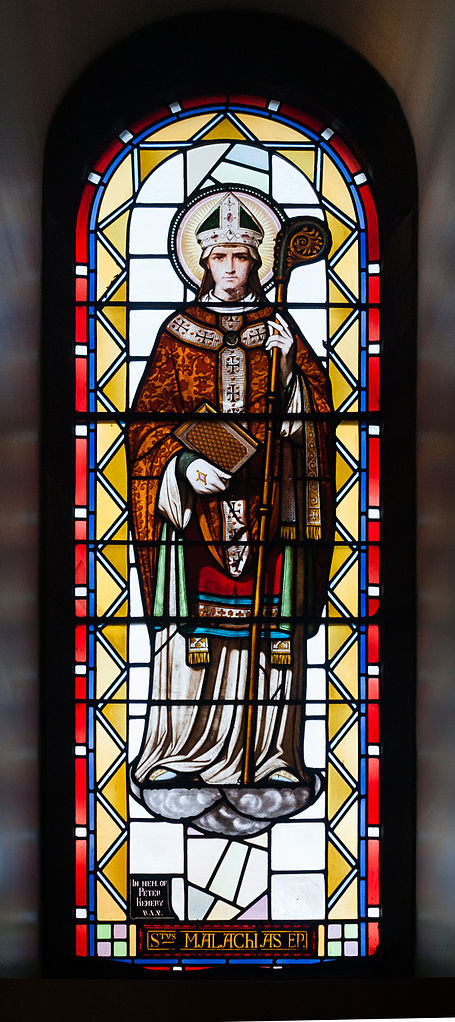
Saint of the Day – 3 November – St Malachy O’More/ of Armagh (1094 – 1148) Bishop, Abbot, Confessor, Reformer, Miracle-Worker – Primate of Ireland – born in 1094 at Armagh, Ireland and died on 2 November 1148 at Clairvaux Abbey, France of natural causes. Patronages – Armagh, Ireland, archdiocese of, Down and Connor, Ireland, diocese of and Ireland. St Malachy was an Irish saint and Archbishop of Armagh, to whom were attributed several miracles and an alleged vision of 112 Popes later attributed to the apocryphal (i.e. of doubtful authenticity) Prophecy of the Popes. It is now believed by scholars that this document was a forgery created by Cardinal Girolamo Simoncelli. Saint Malachy was the first native born Irish saint to be Canonised. His brother was Gilla Críst Ua Morgair who later became Bishop Christian of Clogher from 1126 to 1138.
Born in the late eleventh century of a princely family, in the archiepiscopal city of Armagh, Saint Malachy was raised in the fear and love of God. He seemed to have the virtues of maturity hidden under the appearances of childhood. Praises did not inflate him and reproaches did not sadden him. He had a horror of idleness and a command from his preceptors was always like a law for him. He would often separate from his companions to converse in prayer with God. When he was still a young man, he made himself the disciple of a holy hermit who had established a little cell near the cathedral church of Armagh. The archbishop of Armagh made him a deacon of his church and when at the age of twenty-five he was ordained a priest, commanded him to preach the Gospel and catechise his people. He uprooted vices and corrected abuses and the archdiocese derived great profit from his ministry.
An episode from the life of Saint Malachy teaches us several truths concerning purgatory. He had a sister who was very worldly and whom he found indifferent to his efforts to lead her to reflect on the reason for her existence and her last ends. He learned one day that she had died after having manifested regret for her sins and he offered a Mass for her soul but he did not think of continuing this practice. After thirty days he heard in a dream that she was standing outside the church and had not eaten for one month. He began again to pray for her and then in a dream beheld her clothed in a black robe, near the door of the church but unable to enter. He continued his suffrages and on a third occasion saw her in a robe which was more or less white, having entered the church but unable to approach the altar. The last time he saw her she was within the church, clothed in white and near the altar, in the company of the just. We learn from this how serious our indifference and lack of love for God are, that our prayers are efficacious in relieving our dear ones and that it is ordinarily a little at a time that souls are delivered from the bonds of their sins and negligence.
Saint Malachy brought about several miracles and manifested great devotion and zeal in the reconstruction and re-establishment of a monastery whose nine hundred religious had been massacred by pirates, these facts led to his being consecrated Bishop of Connor, a small see whose inhabitants were Christian in name but pagan in practice. The venerable pastor taught the people with patience and warned them with gentleness. He endured many insults and outrages but finally the hardened hearts were softened and began to listen to his voice and instructions. He remained in this see until a hostile king and his army decimated the city of Connor. At that time, the Archbishop of Armagh was nearing death and named him to succeed him in this metropolitan see, overriding his humility and protestations of insufficient virtue and competence.
Again he had a great deal to suffer in the exercise of his new charge. The see of Armagh, by a longstanding abuse, had been held somewhat like a throne by one single family and it required on the part of the Saint no little tact and firmness to calm the dissensions caused by his election. Ecclesiastical discipline had been forgotten and depraved morals everywhere had virtually annihilated faith and piety. The good bishop who had named Saint Malachy had laboured to correct the abuses and hoped his virtuous successor might better succeed in the same post. Nonetheless, two years passed before Malachy could even enter into the city as its archbishop – troops were levied against his entry by the pretender to the same title. Saint Malachy had accepted the office on the condition that he assume the charge only after the death or flight of the false bishop, for he did not want to cause a war and the death of those whose salvation he desired to procure. The pretender and his cousin, with several others of the same lineage, were struck down soon afterwards by the hand of God and their exemplary chastisements gave great credit to the Saint and enabled him to make ordinances to countermand the disorders. He divided the diocese and left the larger portion, that of Connor, to a colleague, a very holy man worthy of the charge. He retired to the other part, the new see of Down. There he convoked synods, renewed ancient ordinances and made appropriate ones, everywhere he intimidated sinners and implanted religion and piety.
We must not neglect to mention the famous prophecy of Saint Malachy, in which he assigns to every Pope of the future a motto describing each pontificate, from his own day until the last Pope he mentions, whom he calls Petrus Romanus — Peter the Roman. After the motto attributed to the present Vicar of Jesus Christ (in the year 2000), De Labore Solis, only one, De Gloria Olivae — From the glory of the Olive Tree — separates us from Peter II. The prophecy, which begins with Celestine II (1143-1144), was discovered in 1590 and includes one hundred and eleven mottos. Many a motto has been shown to have a striking exactitude in the description of its subject and his pontificate. Many interpreters have laboured to prove the prophecy’s accuracy, however, as stated above, these ‘prophecies’ now appear to be total forgeries and fiction, though why they were written can only be left to the imagination. Most scholars consider the document a 16th-century elaborate hoax. James Weiss, a professor of church history at Boston College, has stated: “It is widely thought … given who the author was and his relationship, [that the prophecies] were published to establish the case for election of one particular cardinal.” Thomas Groome, chair of the Department of Religious Education and Pastoral Ministry at Boston College, has a similar notion: “For myself – and even as a native Irishman – the ‘Prophecies of St Malachy’ are a grand old fun tale that have about as much reliability as the morning horoscope”. Thomas J Reese, SJ, of Georgetown University, had only this to say: “St Malachy’s prophecy is nonsense.”
Saint Malachy twice made a pilgrimage to Rome to consult Christ’s Vicar, the first time returning as a Papal Legate for all of Ireland, amid the joy of his people. The second time, however, he was bound for a happier home – he was taken ill in France at the monastery of Clairvaux, where his great friend and biographer, Saint Bernard, was Abbot. He died there in the monastery where he would gladly have lived, at the age of fifty-four, on the 2nd of November, 1148. Saint Bernard, in his Life of Saint Malachy, narrates many of his miracles, one of which he himself brought about, when he touched the paralysed arm of a young boy to that of the mortal remains of the bishop, while he was laid out in his coffin at Clairvaux. It was instantly cured.
St Malachy was Canonised on 6 July 1190 by Pope Clement III.
St Acepsimas
St Acheric of Vosges
Bl Alphais of Cudot
Bl Berardo dei Marsi
Bl Berchtold of Engelberg
St Caesarius
St Cecilio Manrique Arnáiz
St Clydog
St Cristiolus
St Domnus of Vienne
St Elerius
St Englatius
St Florus of Lodeve
St Francisco Colom González
St Gaudiosus of Tarazona
St Germanus
St Guenhael
St Hermengaudius of Urgell
St Hilary of Viterbo
St Hubert of Liege
Bl Ida of Toggenburg
St José Llorach Bretó
St José Ruiz de la Torre
St Libertine of Agrigento
Bl Lorenzo Moreno Nicolás
St Malachy O’More (1094 – 1148)
St Papulus
St Pierre-François Néron
St Pirmin
St Quartus
St Rumwold of Buckingham
St Sylvia of Rome
St Theophilus
St Valentine of Viterbo
St Valentinian
St Vitalis
St William of Vosges
St Winifred of Wales
St Wulganus
Innumerable Martyrs of Saragossa: A large group of Christians martyred in Zaragoza, Spain by Dacian during the persecutions of Diocletian. Dacian ordered all Christians of the city into exile under pain of death; when they were assembled to leave, Dacian ordered imperial soldiers to massacre the lot of them. They were martyred in 304.
Martyred in the Spanish Civil War:
• Blessed Cecilio Manrique Arnáiz
• Blessed Francisco Colom González
• Blessed José Llorach Bretó
• Blessed José Ruiz de la Torre
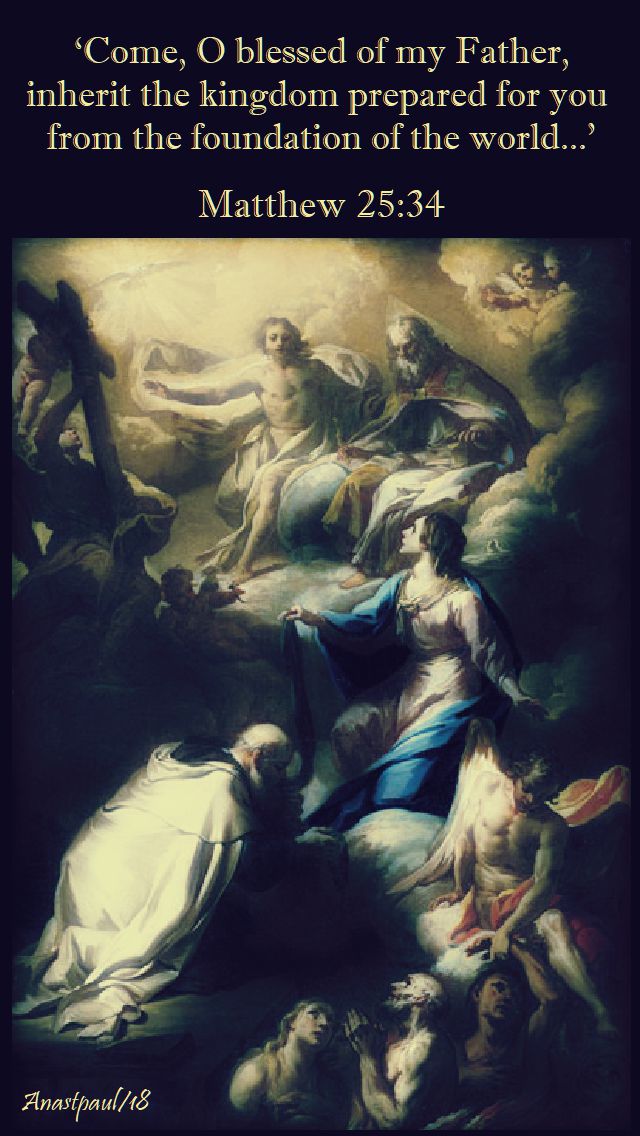
One Minute Reflection – 2 November – Today’s Gospel: Matthew 25:31–46- The Commemoration of All the Faithful Departed (All Souls)
‘Come, O blessed of my Father, inherit the kingdom prepared for you from the foundation of the world…’…Matthew 25:34
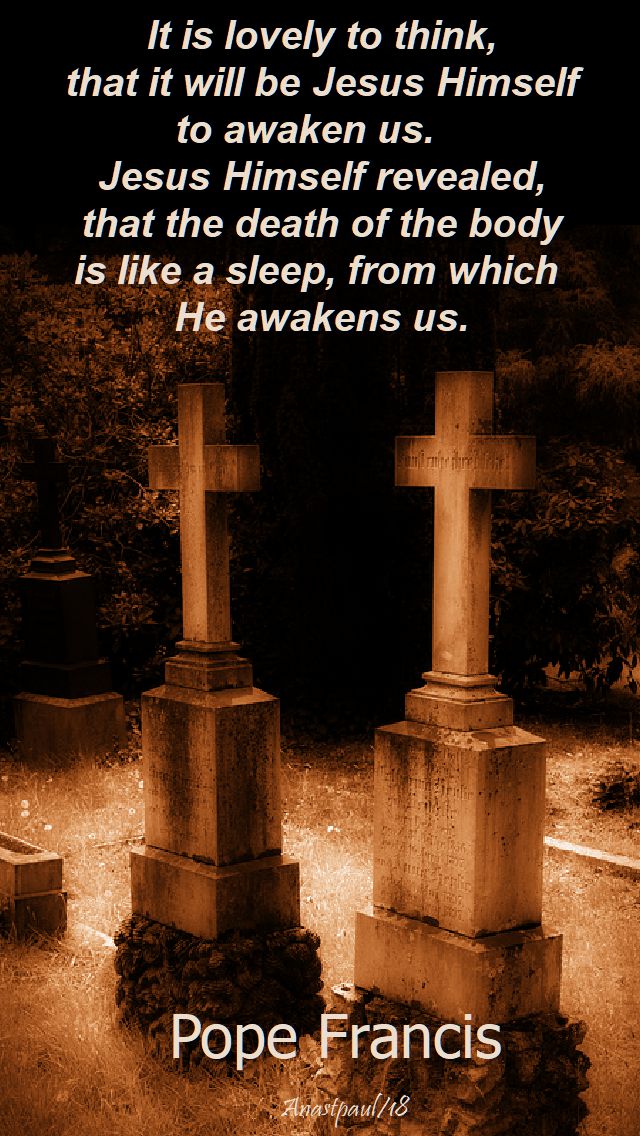
REFLECTION – “Yesterday and today, many have been visiting cemeteries, which, as the word itself implies, is the “place of rest”, as we wait for the final awakening. It is lovely to think, that it will be Jesus Himself to awaken us. Jesus Himself revealed, that the death of the body is like a sleep from which He awakens us. But today we are called to remember everyone, even those who no one remembers. We remember the victims of war and violence, the many “little ones” of the world, crushed by hunger and poverty, we remember the anonymous who rest in the communal ossuary. We remember our brothers and sisters killed because they were Christian and those who sacrificed their lives to serve others.
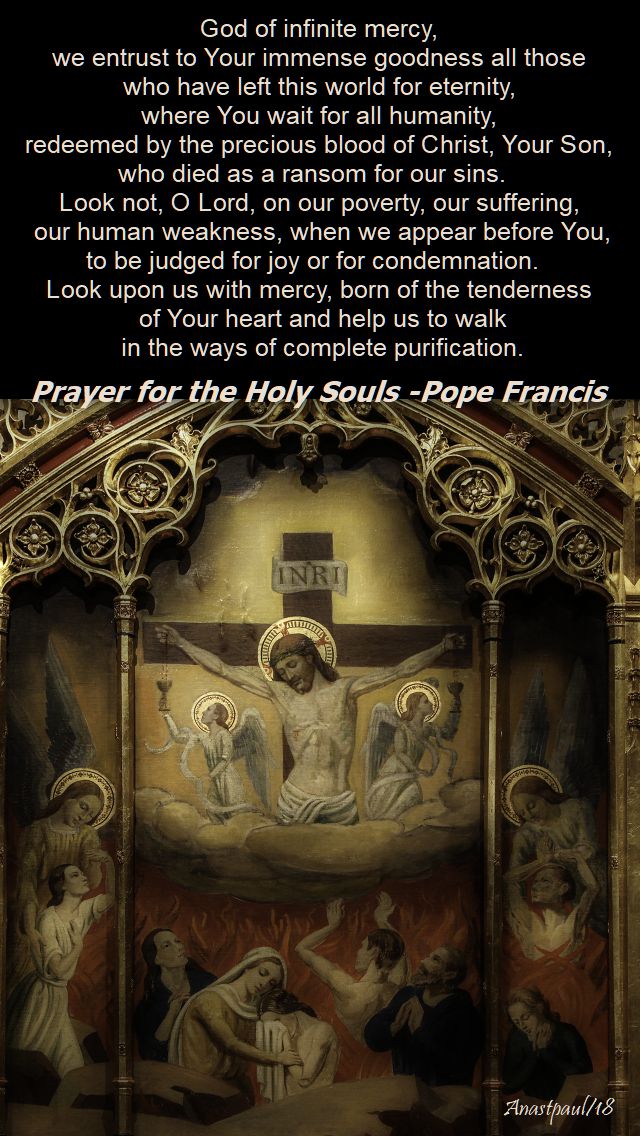
PRAYER – Let us raise this prayer to God: “God of infinite mercy, we entrust to Your immense goodness all those who have left this world for eternity, where You wait for all humanity, redeemed by the precious blood of Christ Your Son, who died as a ransom for our sins. Look not, O Lord, on our poverty, our suffering, our human weakness, when we appear before You to be judged for joy or for condemnation. Look upon us with mercy, born of the tenderness of Your heart and help us to walk in the ways of complete purification.”…Pope Francis – Angelus, 2 November 2014
Saint Louis-Marie de Montfort’s Total Consecration to Jesus Through Mary – First Week – Day Seventeen – 2 November
Readings and Prayers
First Week Theme for the Week: Knowledge Of Self
Day 17 of 33
From True Devotion To the Blessed Virgin Mary, No. 228
Of Judgement and the Punishment of Sinners! In all things look to the end and how you will stand before that strict Judge (Heb. 10:31) to whom nothing is hidden, who is not appeased with gifts, nor admits excuses but will judge according to right. O wretched and foolish sinner, who sometimes are in terror at the countenance of an angry man, what answer will you make to God who knows all your wickedness (Job 9:2)! Why do you not provide for yourself (Luke 16:9) against the day of judgement, when no man can be excused or defended by another but everyone shall be a sufficient burden for himself!
Luke 16:1-8 The Crafty Steward
And he said also to his disciples: There was a certain rich man who had a steward and the same was accused unto him, that he had wasted his goods. And he called him and said to him: How is it that I hear this of you? give an account of your stewardship, for now you cannot be steward any longer. And the steward said within himself: What shall I do, because my lord takes away from me the stewardship? To dig I am not able, to beg I am ashamed. I know what I will do, that when I shall be removed from the stewardship, they may receive me into their houses. Therefore, calling together every one of his lord’s debtors, he said to the first: How much do you owe my lord? But he said: A hundred barrels of oil. And he said to him: Take your bill and sit down quickly and write fifty. Then he said to another: And how much do you owe? Who said: A hundred quarters of wheat. He said to him: Take your bill and write eighty. And the lord commended the unjust steward, forasmuch as he had done wisely, for the children of this world are wiser in their generation than the children of light.
Thought for the Day – 2 November – The Commemoration of All the Faithful Departed (All Souls)
St Ambrose (340-397) Father & Doctor of the Church
And Jesus wept. So the Jews said, “See how he loved him.”...John 11:35-36
Why do I pray for you, O my brother, who loved me so much and have been carried off from me… ? For I have not lost my relationship to you, rather it has been completely changed in my regard. Up to now, it was inseparable from the body but now, it is indissoluble from feeling. ,,You remain with me and will remain so always… Paul the apostle calls me back and places a sort of brake on my sadness with these words: “We do not want you to be unaware about those who have fallen asleep, so that you may not grieve like the rest who have no hope” (1Thes 4:13)…
But not all weeping is a sign of lack of faith or of weakness. Natural sorrow is one thing, the sadness of unbelief is another… Sorrow is not alone in having its grief and prayer bathes our bed with tears according to the prophet (Ps 6:7). When the patriarchs were enslaved, their people wept bitterly for themselves, as well. Thus tears are signs of affection and not incitements to sorrow. I confess that I have wept but the Lord also wept (Jn 11:35). He wept for someone not of his own kin, I for a brother. He wept for all men in one man – as for me, I will weep for you, my brother, in every man.
Christ wept with the feeling that is ours, not His own, for divinity has no tears… He wept in that man who was “sorrowful even to death” (Mt 26:38); He wept in him who was crucified, who died, who was buried; He wept in that man… who was born of the Virgin.
The Commemoration of All the Faithful Departed (All Souls)
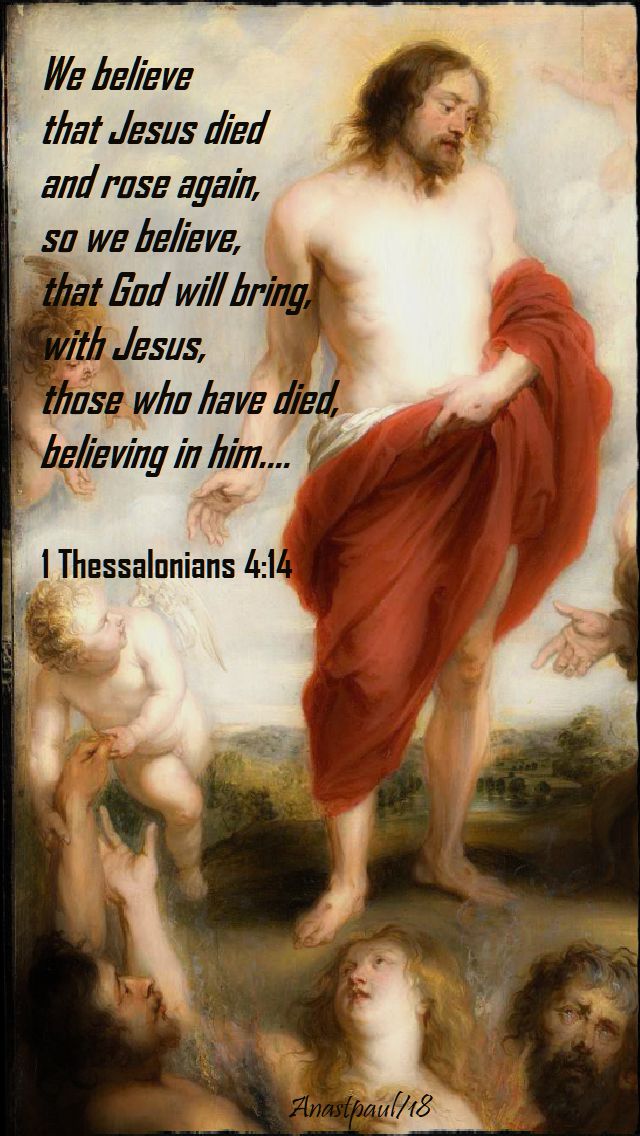
We believe that Jesus died and rose again, so we believe, that God will bring with Jesus, those who have died, believing in him.…
1 Thessalonians 4:14
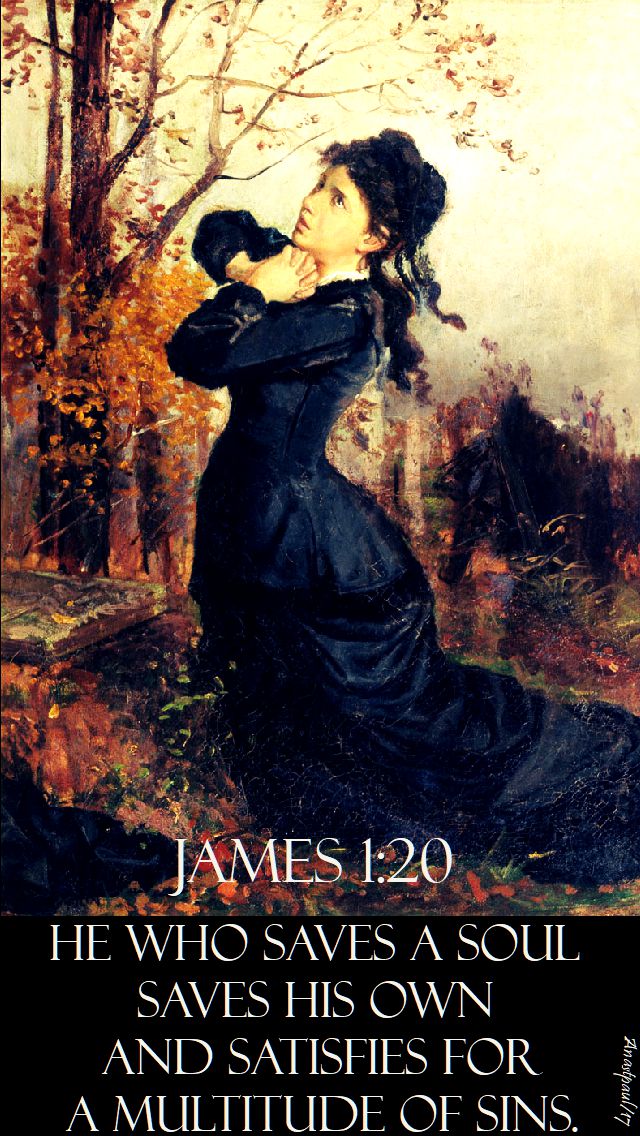
“He who saves a soul, saves his own and satisfies for a multitude of sins.”
James 1:20
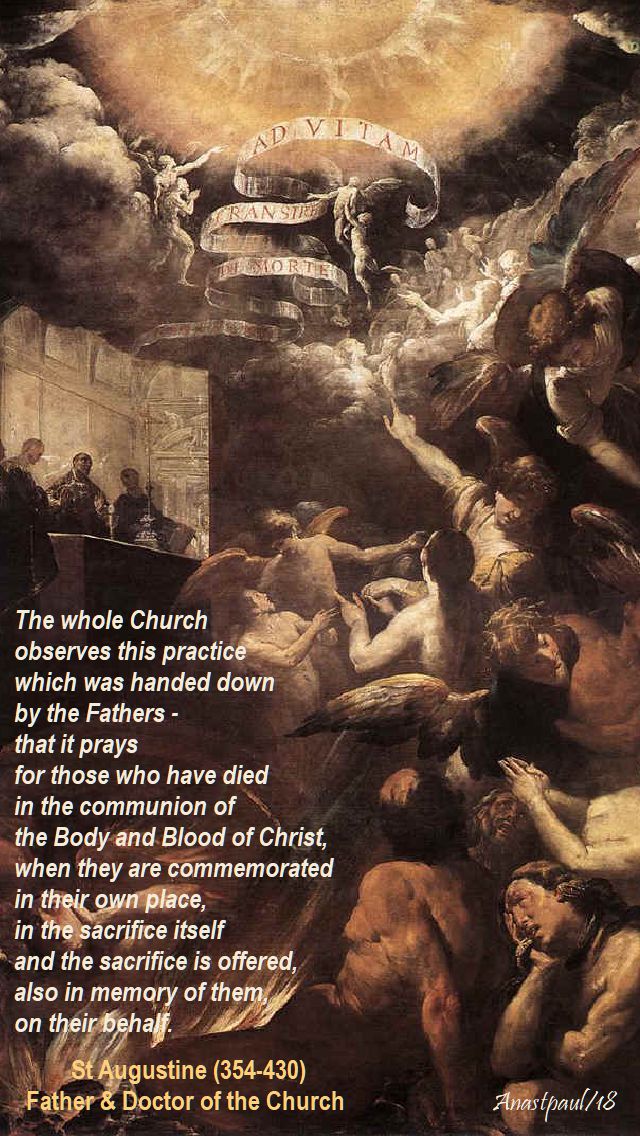
“The whole Church observes this practice which was handed down by the Fathers – that it prays for those who have died in the communion of the Body and Blood of Christ, when they are commemorated in their own place in the sacrifice itself and the sacrifice is offered, also in memory of them, on their behalf.”
St Augustine (354-430) Father & Doctor of the Church
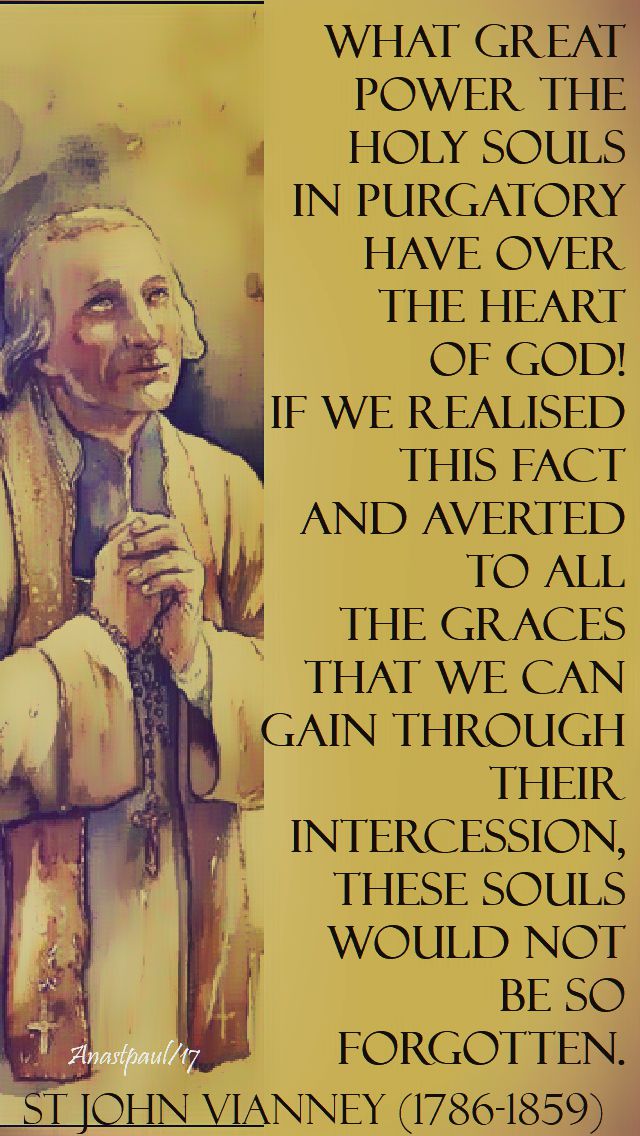
“What great power the holy souls in purgatory have over the heart of God! If we realised this fact and averted to all the graces that we can gain through their intercession, these souls would not be so forgotten.”
St John Vianney (1786-1859)
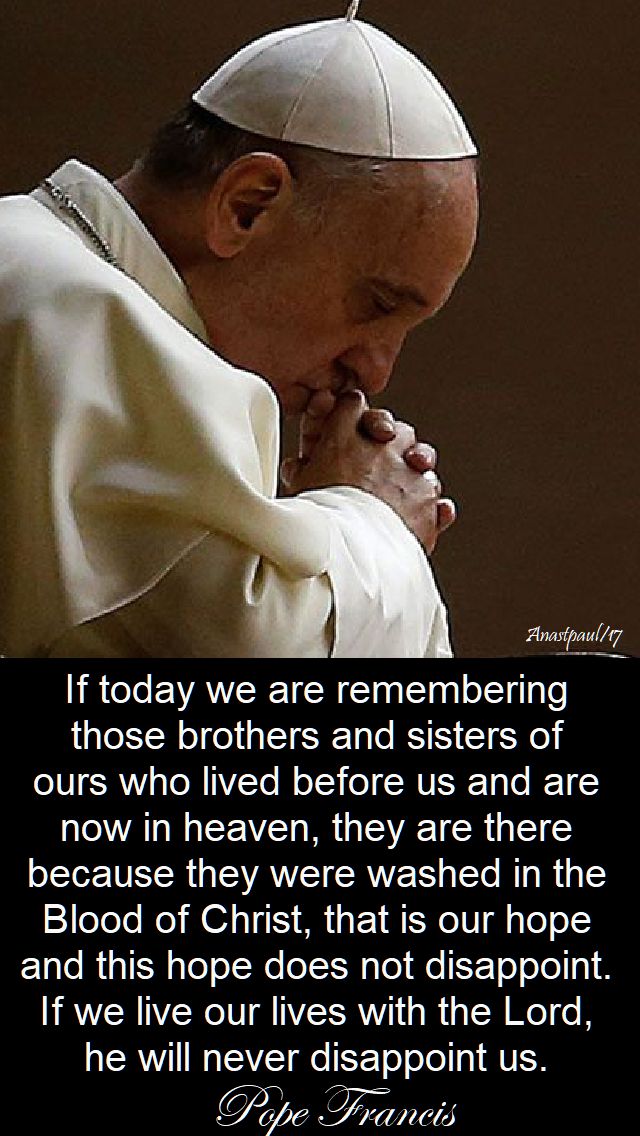
“If today we are remembering these brothers and sisters of ours who lived before us and are now in heaven, they are there because they were washed in the Blood of Christ, that is our hope and this hope does not disappoint. If we live our lives with the Lord, He will never disappoint us.”
Our Morning Offering – 2 November – The Commemoration of All the Holy Souls in Purgatory
Daily Prayer for the Holy Souls
Immortal God, holy Lord,
Father and Protector of all You have created,
we raise our hearts to You today for those
who have passed out of this mortal life.
In Your loving mercy, Father of all,
be pleased to receive them
in Your heavenly company,
and forgive the failings and faults
they may have done from human frailty.
Your only Son, Christ, our Saviour,
suffered so cruelly that
He might deliver them from the second death.
By His merits may they share in the glory
of His victory over sin and death.
For all the faithful who have died we pray
but in particular for those dear to us,
parents, relatives and friends.
nor do we forget all who did good for us while on earth,
who helped us by their prayers, sacrifice and example.
We pray also for any who may have done us harm,
and stand in special need of Your forgiveness.
May the merits and prayers of our Virgin Mother, Mary
and those of all the Angels and Saints,
speak for us and assist them now.
This we ask in through Jesus Christ, our Lord,
with the Holy Spirit, God forever
amen.
The Commemoration of All the Holy Souls in Purgatory – 2 November
The Church teaches us that the souls of the just who have left this world with traces of venial sin remain for a time in a place of expiation, where they suffer whatever punishment may be due to their offenses. Even if pardon has been obtained for our sins, satisfaction must be made to God, our Creator, in this world or in the next, for His sanctity has been, as it were, insulted by the self-will of one of His ignoble creatures. The more noble the person offended, the more serious the offence, even according to human laws.
It is a dogma of our faith that the suffering souls are relieved by the intercession of the Saints in heaven and by the prayers of the faithful upon earth. To pray for the dead is therefore an act of charity and of piety, certainly obligatory for a Christian who professes to have charity in his heart. We read in Holy Scripture: It is a holy and wholesome thought to pray for the dead, that they may be loosed from their sins. (II Maccabees 12:46)
When towards the close of the tenth century, Our Lord inspired Saint Odilo, (c 962-1049) Abbot of Cluny, to establish in his Benedictine Order a general commemoration of all the faithful departed, the practice was soon afterwards adopted by the entire Western Church and has been continued unceasingly to our day.
Let us always bear in mind the departed who have died in the love of God and offer up our prayers and sacrifices to help expiate for them. By showing this mercy to the suffering souls in purgatory, we gain for ourselves very devoted friends, who will in their turn pray for us. We shall then be entitled to be treated with mercy at our departure from this world and to share more abundantly in the suffrages of the Church, continually offered for all who have fallen asleep in Christ.
When we offer satisfaction to God in this life for our offences, there is merit attached to our penances. There is no longer any merit in purgatory – others must provide . Let us reflect well that if we do not ourselves repair our sins and faults, we place our burden on other, is that what we want?
All Souls Day (Commemoration): Feast in commemoration of the faithful departed in Purgatory. Abbot Odilo of Cluny instituted it in the monasteries of his congregation in 998, other religious orders took up the observance and it was adopted by various dioceses and gradually by the whole Church. The Office of the Dead must be recited by the clergy on this day and Pope Benedict XV granted to all priests the privilege of saying three Masses of requiem –
• one for the souls in Purgatory
• one for the intention of the Holy Father
• one for the priest’s
If the feast should fall on Sunday it is kept on 3 November.
Patronage: Monselice, Italy
Details here: https://anastpaul.wordpress.com/2017/11/02/the-commemoration-of-all-the-holy-souls-in-purgatory-2-november/
St Ambrose of Agaune
St Ambrose of Agaune
St Amicus of Fonte Avellana
St Amicus of Rambone
St Baya of Scotland
St Domninus of Grenoble
St Erc of Slane
St Eustochium of Tarsus
St George of Vienne
Bl John Bodey
St Jorandus of Kergrist
St Justus of Trieste
Bl Luigi Campidello
St Marcian of Chalcis
Bl Margaret of Lorraine
St Mateo López y López
St Maura of Scotland
St Theodotus of Laodicea
St Victorinus of Pettau
St Willebald of Bavaria
—
Martyrs of Isfahan – 5+ saints: Acindynus, Pegasius and Anempodistus were Persian priests who were imprisoned, tortured, interrogated and martyred in the persecutions of king Sapor II of Persia; he considered any Christian to be a Roman spy and anti-Persian. The three were brought back to life, miraculously healed, freed from their chains and began preaching Christianity, miraculously healing Sapor II in the process. This defiance enraged Sapor so much that he ordered them executed again; they were thrown into a cauldron of molten lead, but walked out unharmed. This miracle brought one of the torturers, Aphthonius, to convert; he was immediately martyred. Other attempts were made to kill them, and they emerged each time unharmed. Senator Elpidiphorus led a group speaking in favour of the Christians for their courage and faith; he was immediately executed. In the end the original three Christians were burned to death. Martyrs all – Acindynus, Anempodistus, Aphthonius, Elpidephorus and Pegasius.
They were born in Persia and Died:
• c.350 in Isfahan, Persia
• relics transferred to Constantinople and enshrined in a church dedicated to them
• some relics taken to France in 1204 during the 4th Crusade
• relics in France were lost when hidden from anti-Christian forces in the French Revolution
• relics in France re-discovered in 1892 in Grozon.
Martyrs of Sebaste – 10 saints: A group of ten soldiers in the imperial Roman army of Emperor Licinius Licinianus who were executed together for refusing to burn incense as a sacrifice to the emperor. The only details that have survived are five of their names – Agapius, Cartherius, Eudoxius, Styriacus and Tobias. They were burned at the stake in 315 in Sebaste (in modern Turkey).
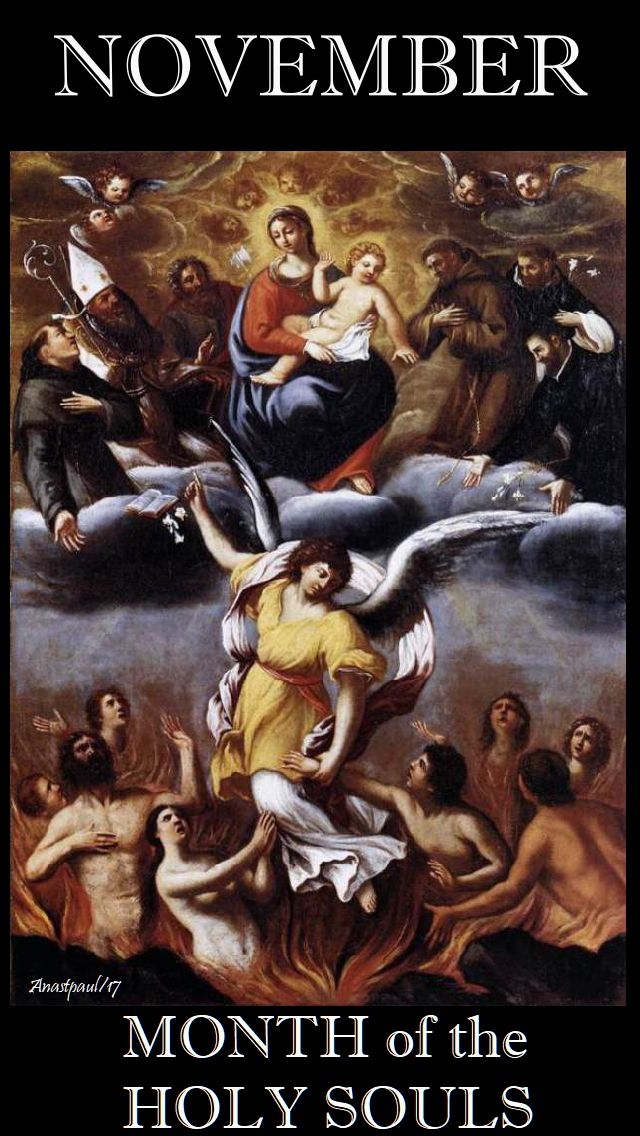
Catholic Devotion for the Month of November – The Holy Souls/The Faithful Departed
It is therefore a holy and wholesome thought to pray for the dead, that they may be loosed from sins.”–2 Maccabees 12:46
The Holy Souls are those who have died in the state of grace but who are not yet free from all punishment due to their unforgiven venial sins and all other sins already forgiven for which satisfaction is still to be made. They are certain of entering Heaven but first they must suffer in Purgatory. The Holy Souls cannot help themselves because for them the night has come, when no man can work (John 9:4). It is our great privilege that we can shorten their time of separation from God by our prayers, good works and, especially, the Holy Sacrifice of the Mass.
The doctrine of Purgatory gives to Catholics comfort and joy. They feel the black gulf of death is bridged across and they are still knit together to those near and dear to them in the bonds of love and sympathy. The sting of death and the sharpness of its sorrow, is mitigated by the thought, that they are still bound to these departed, by the golden chain of prayer. Whilst they are able to pray for us, they cannot pray for themselves.
The Council of Trent told us “That there is a Purgatory and that the souls there detained are assisted by the most acceptable sacrifice of the altar.”
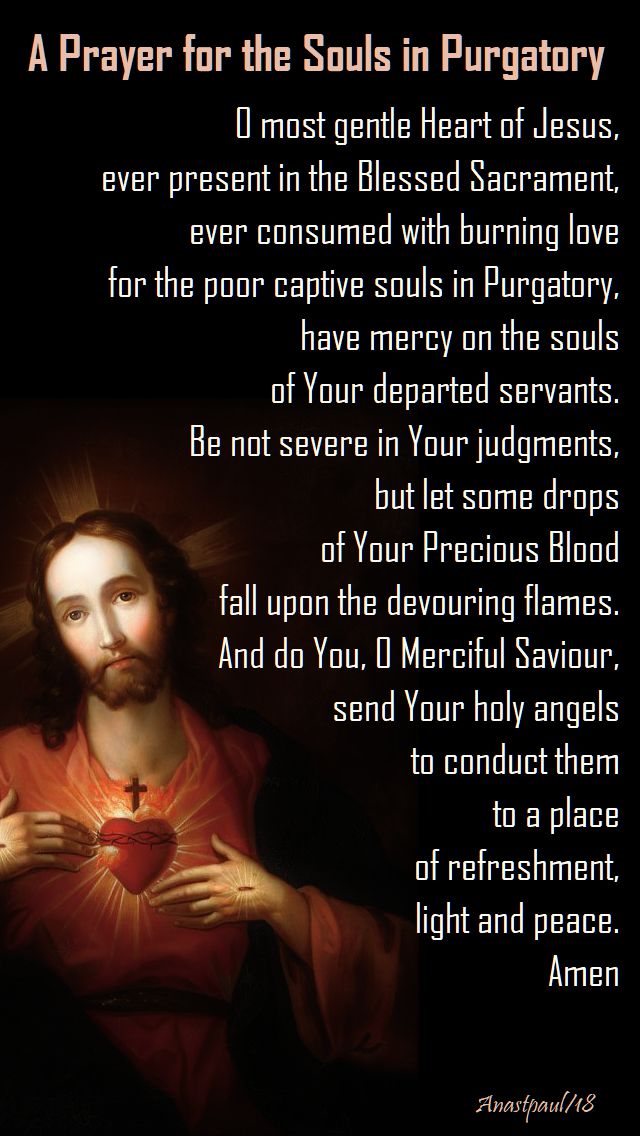
A Prayer for the Souls in Purgatory
O most gentle Heart of Jesus, ever present in the Blessed Sacrament, ever consumed with burning love for the poor captive souls in Purgatory, have mercy on the souls of Your departed servants. Be not severe in Your judgments, but let some drops of Your Precious Blood fall upon the devouring flames. And do You, O Merciful Saviour, send Your holy angels to conduct them to a place of refreshment, light and peace. Amen
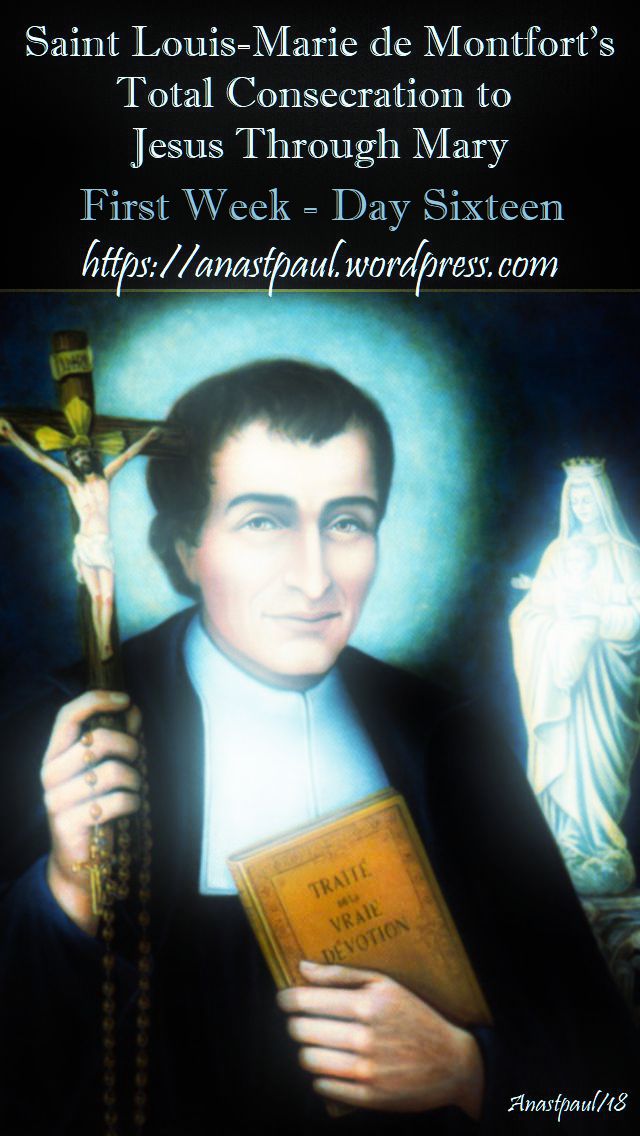
Saint Louis-Marie de Montfort’s Total Consecration to Jesus Through Mary – First Week – Day Sixteen – 3 November
Readings and Prayers
First Week Theme for the Week: Knowledge Of Self
Day 16 of 33
From True Devotion To the Blessed Virgin Mary, No. 228 Preparatory Exercises
During the first week they should offer up all their prayers and acts of devotion to acquire knowledge of themselves and sorrow for their sins. Let them perform all their actions in a spirit of humility. With this end in view they may, if they wish, meditate on what I have said concerning our corrupted nature and consider themselves during six days of the week as nothing but sails, slugs, toads, swine, snakes and goats.
Or else they may meditate on the following three considerations of St Bernard: “Remember what you were – corrupted seed; what you are – a body destined for decay; what you will be -food for worms.”
They will ask our Lord and the Holy Spirit to enlighten them saying, “Lord, that I may see,” or “Lord, let me know myself,” or the “Come, Holy Spirit”.
Every day they should say the Litany of the Holy Spirit, with the prayer that follows, as indicated in the first part of this work.
They will turn to our Blessed Lady and beg her to obtain for them that great grace which is the foundation of all others, the grace of self-knowledge. For this intention, they will say each day the Ave Maris Stella and the Litany of the Blessed Virgin.
Imitation of Christ, by Thomas á Kempis: Book 2, Chapter 5 Of Self-consideration
We cannot trust overmuch to ourselves (Jer. 17:5), because grace oftentimes is wanting to us and understanding also. Little light is there in us and this we quickly lose by our negligence. Oftentimes too, we perceive not our inward blindness how great it is. Oftentimes, we do evil and excuse it worse (Psalm 141:4). We are sometimes moved with passion and we think it zeal. We reprehend small things in others and pass over our own greater matters (Matt. 7:5). Quickly enough, we feel and weigh, what we suffer at the hands of others but we mind not how much others suffer from us. He, that well and rightly considers his own works, will find little cause to judge hardly of another.
Thought for the Day – 1 November – The Solemnity of All the Saints
By Blessed John Henry Newman (1801-1890)
“Very various are the Saints, their very variety is a token of God’s workmanship but however various and whatever was their special line of duty, they have been heroes in it – they have attained such noble self-command, they have so crucified the flesh, they have so renounced the world, they are so meek, so gentle, so tender-hearted, so merciful, so sweet, so cheerful, so full of prayer, so diligent, so forgetful of injuries, they have sustained such great and continued pains, they have persevered in such vast labours, they have made such valiant confessions, they have wrought such abundant miracles, they have been blessed with such strange successes, that they have been the means of setting up a standard before us of truth, of magnanimity, of holiness, of love. They are not always our examples, we are not always bound to follow them – not more than we are bound to obey literally, some of our Lord’s precepts, such as turning the cheek or giving away the coat – not more than we can follow the course of the sun, moon or stars in the heavens; but, though not always our examples, they are always our standard of right and good; they are raised up to be monuments and lessons, they remind us of God, they introduce us into the unseen world, they teach us what Christ loves, they track out for us the way which leads heavenwards.”
Quote/s of the Day – 1 November – The Solemnity of All the Saints
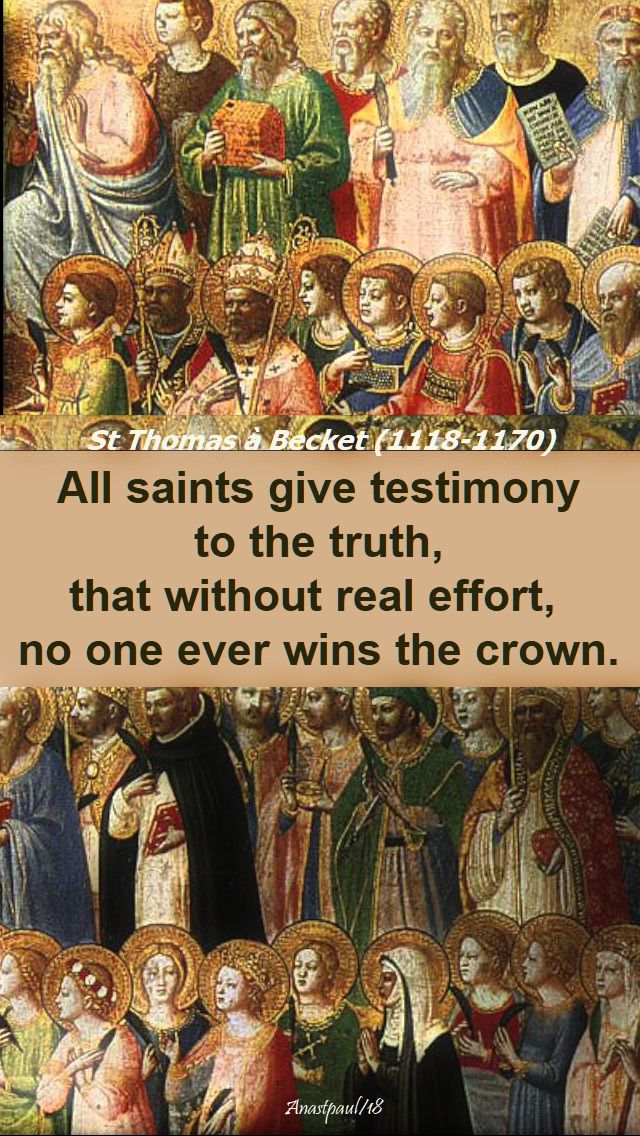
“All saints give testimony to the truth, that without real effort, no one ever wins the crown.”
St Thomas à Becket (1118-1170)
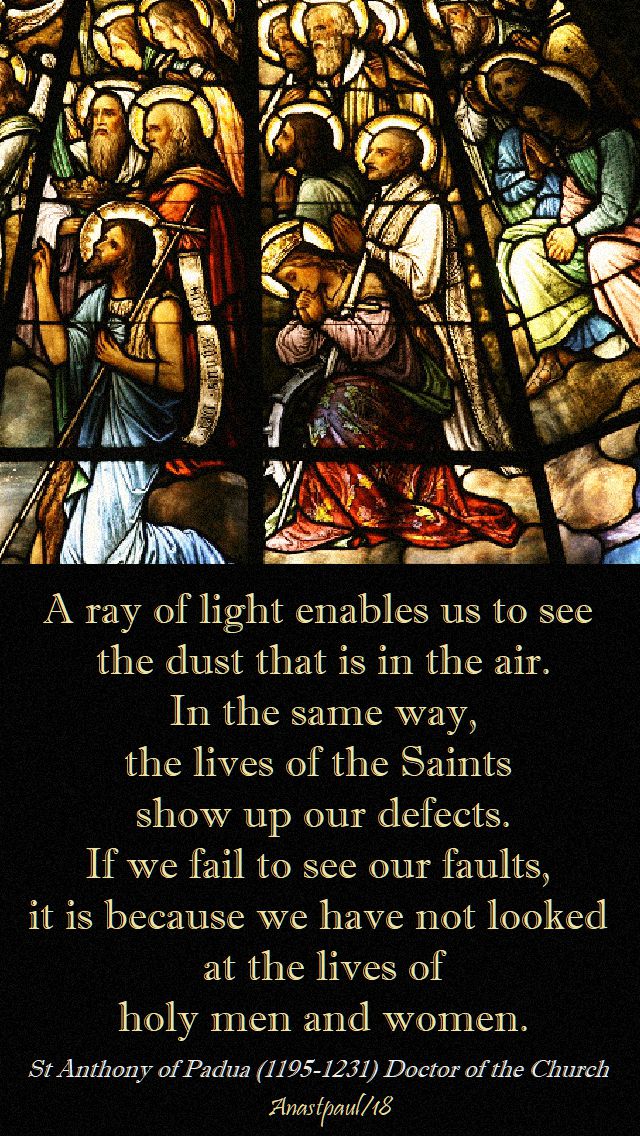
“A ray of light enables us to see the dust that is in the air. In the same way, the lives of the Saints show up our defects. If we fail to see our faults, it is because we have not looked at the lives of holy men and women.”
St Anthony of Padua (1195-1231) Doctor of the Church
“God creates out of nothing. Wonderful you say. Yes, to be sure but He does. what is still more wonderful, He makes saints out of sinners.”
Soren Kierkegaard (1813-1855)
“In heaven, we shall not meet with indifferent glances, because all the elect will discover that they owe to each other, the graces that merited the crown for them.”
St Thérèse of the Child Jesus (1873-1897) Doctor of the Church
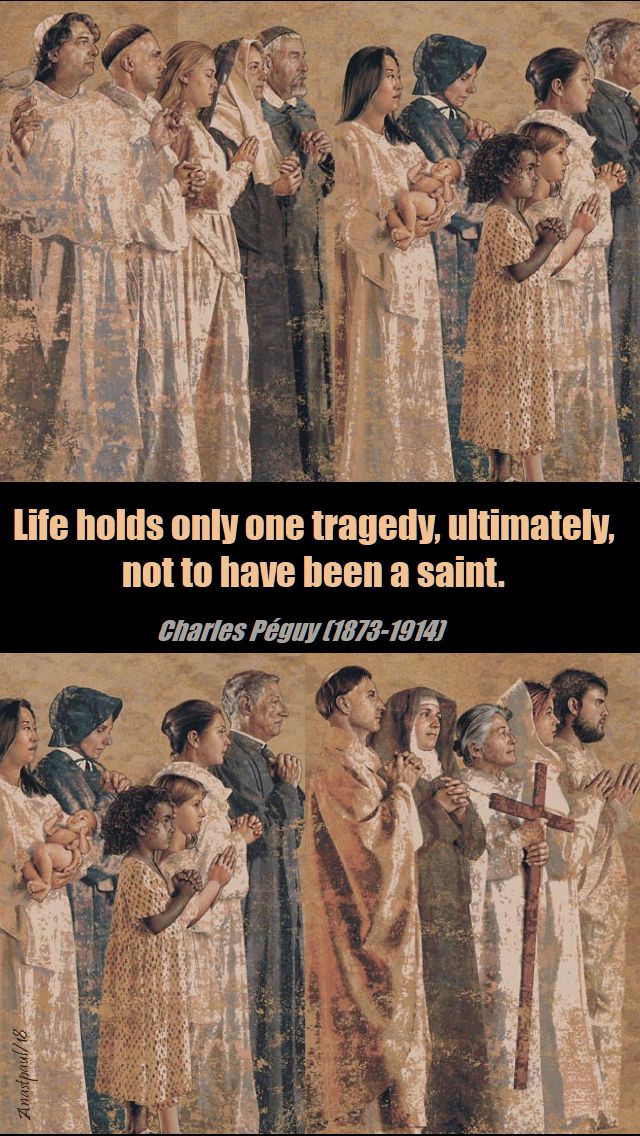
“Life holds only one tragedy, ultimately, not to have been a saint.”
Charles Péguy (1873-1914)
“A saint takes his hands off the steering wheel of his life and lets God steer.”
Our Morning Offering – 1 November – The Solemnity of All the Saints
10th Century Catholic Prayer in Praise of the Saints
How shining and splendid are Your gifts, O Lord
which You give us for our eternal well-being
Your glory shines radiantly in Your saints, O God
In the honour and noble victory of the Martyrs.
The white-robed company follow You,
bright with their abundant faith;
They scorned the wicked words
of those with this world’s power.
For You they sustained
fierce beatings, chains and torments,
they were drained by cruel punishments.
They bore their holy witness to You
who were grounded deep within their hearts;
they were sustained by patience and constancy.
Endowed with Your everlasting grace,
may we rejoice forever
with the Martyrs in our bright fatherland.
O Christ, in Your goodness,
grant to us
the gracious heavenly realms of eternal life.
Amen
The Church day by day gives special veneration to the holy men and women who have helped to establish it by their blood, develop it by their labours, or edify it by their virtues. But, in addition to those whom the Church honours by special designation or has inscribed in her calendar, how many martyrs are there whose names are not recorded! How many humble virgins and holy penitents! How many unknown anchorites and monks, Christian fathers and mothers, young children snatched away in their innocence! How many courageous Christians, whose merits are known only to God and His heavenly court!
Should we forget those who remember us in their intercession? Are not some among them our ancestors? members of our immediate family? our friends and fellow-Christians, with whom we have lived in daily companionship?
In fact, all of Heaven is but one family — Our Lord’s, as He Himself said: Who is My mother and who are My brethren? And stretching forth His hand towards His disciples, He said, Behold My mother and My brethren! For whoever does the Will of My Father in heaven, is My brother and sister and mother.
Today we have the opportunity to thank God, if at other times we forget, for their aid and their love. And today we adore Him with them, for the grace which raised them to their present joy. The Church requires this homage of us, by making this day a holy day of obligation for all.
Our place, too, is awaiting us in this home of eternal light, peace and love, if we persevere to the end in the fulfilment of God’s holy Will.
More information here: https://anastpaul.wordpress.com/2017/11/01/1-november-the-feast-of-all-the-saints/
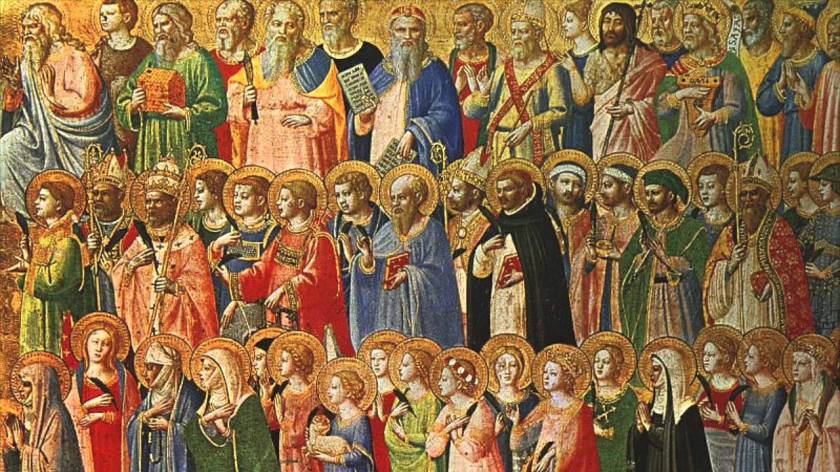
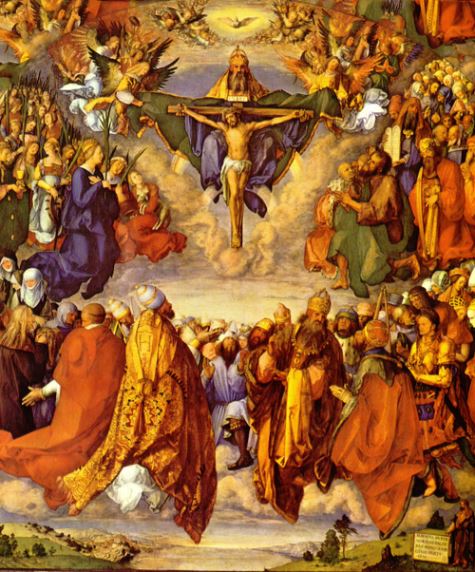
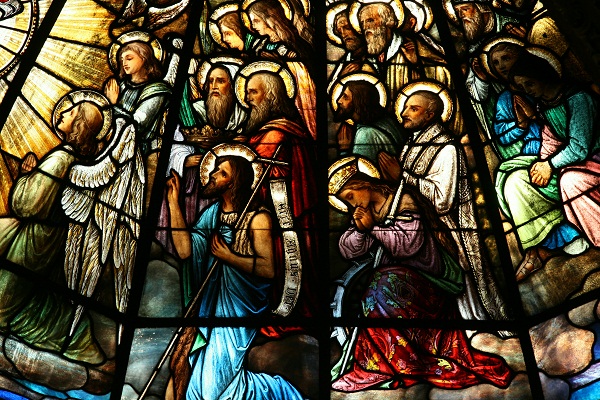
All Saints Day (Solemnity): (a Holy Day of Obligation) Instituted to honour all the saints, known and unknown. It owes its origin in the Western Church to the dedication of the Roman Pantheon in honour of the Blessed Virgin Mary and all the martyrs by Pope Saint Boniface IV in 609, the anniversary of which was celebrated at Rome on 13 May. Pope Saint Gregory III consecrated a chapel in the Vatican basilica in honour of All Saints, designating 1 November as their feast. Pope Gregory IV extended its observance to the whole Church. It has a vigil and octave and is a holy day of obligation – the eve is popularly celebrated as Hallowe’en. Patronage – Arzignano, Italy.
St Amabilis of Auvergne
St Austremonius
St Benignus of Dijon
St Cadfan
St Caesarius of Africa
St Caesarius of Damascus
St Ceitho
St Cledwyn of Wales
Bl Clemens Kyuemon
St Cyrenia of Tarsus
St Dacius of Damascus
St Deborah the Prophetess
St Dingad
Bl Dionysius Fugixima
St Floribert of Ghent
St Gal of Clermont
St Genesius of Lyon
St Germanus of Montfort
St Harold the King
St James of Persia
St Jerome Hermosilla
St John of Persia
St Julian of Africa
St Juliana of Tarsus
St Lluís Estruch Vives
St Marcel of Paris
St Mary the Slave
St Mathurin
St Meigan
St Nichole
St Nuño de Santa Maria Alvares Pereira
St Pabiali of Wales
St Pere Josep Almató Ribera Auras
St Peter Absalon
Bl Peter Paul Navarra
Bl Petrus Onizuka Sadayu
St Rachel the Matriarch
St Ruth the Matriarch
St Salaun of Leseven
St Severinus of Tivoli
Bl Teodor Jurij Romza
St Valentin Faustino Berri Ochoa
St Vigor of Bayeux
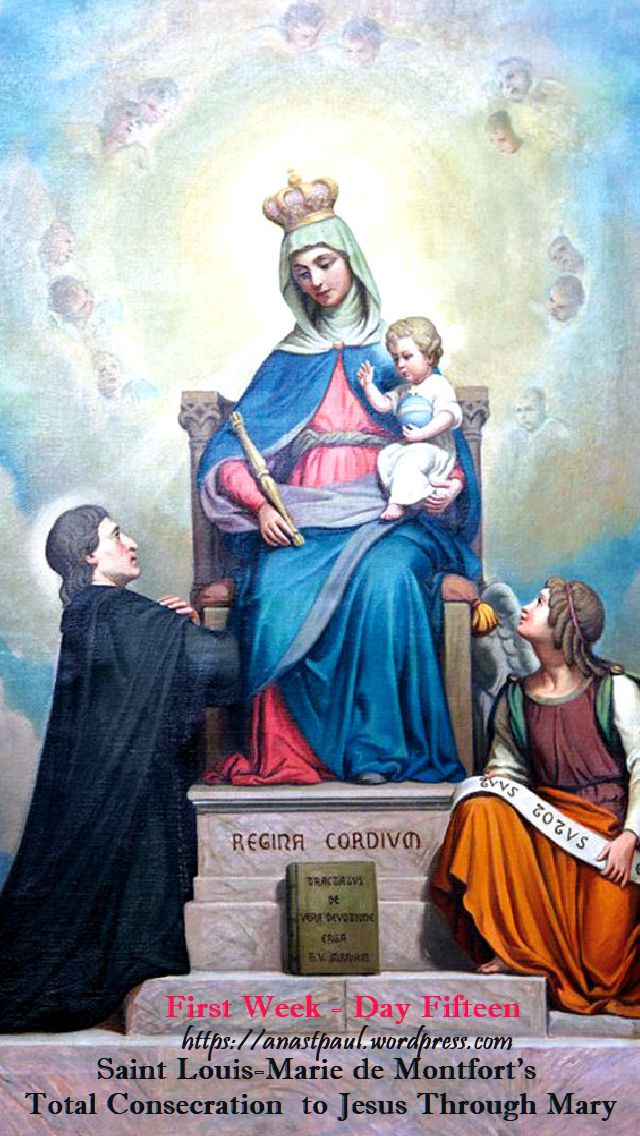
Saint Louis-Marie de Montfort’s Total Consecration to Jesus Through Mary – First Week – Day Fifteen – 31 October
Readings and Prayers
First Week Theme for the Week: Knowledge Of Self
Day 15 of 33
Luke 13:1-5 Examples inviting Repentance
And there were present, at that very time, some that told him of the Galileans, whose blood Pilate had mingled with their sacrifices. And he answering, said to them: “Think you that these Galileans were sinners above all the men of Galilee, because they suffered such things? No, I say to you but unless you shall do penance, you shall all likewise perish. Or those eighteen upon whom the tower fell in Siloe and slew them, think you, that they also were debtors above all the men that dwelt in Jerusalem? No, I say to you but except you do penance, you shall all likewise perish.
True Devotion to the Blessed Virgin Mary, Nos. 81 and 82 – We Need Mary in order to Die to Ourselves
Secondly, in order to empty ourselves of self, we must die daily to ourselves. This involves our renouncing what the powers of the soul and the senses of the body incline us to do. We must see as if we did not see, hear as if we did not hear and use the things of this world as if we did not use them. This is what St Paul calls “dying daily”. Unless the grain of wheat falls to the ground and dies, it remains only a single grain and does not bear any good fruit.
If we do not die to self and if our holiest devotions do not lead us to this necessary and fruitful death, we shall not bear fruit of any worth and our devotions will cease to be profitable. All our good works will be tainted by self-love and self-will so that our greatest sacrifices and our best actions will be unacceptable to God. Consequently when we come to die. we shall find ourselves devoid of virtue and merit and discover that we do not possess even one spark of that pure love. which God shares only with those who have died to themselves and whose life is hidden with Jesus Christ in him.
Thirdly, we must choose among all the devotions to the Blessed Virgin the one which will lead us more surely to this dying to self. This devotion will be the best and the most sanctifying for us.











 AnaStpaul
You must be logged in to post a comment.