Posted in DOCTORS of the Church, franciscan OFM, MORNING Prayers, SAINT of the DAY

Our Morning Offering – 10 August – Feast of St Lawrence, Martyr (died 258)

Our Morning Offering – 10 August – Feast of St Lawrence, Martyr (died 258)

O Love Eternal
By St Francis De Sales OFM Cap (1567-1622) Doctor of the Church

O love eternal,
my soul needs
and chooses You eternally!
Ah, come Holy Spirit,
and inflame our hearts with Your love!
To love – or to die!
To die – and to love!
To die to all other love
in order to live in Jesus’ love,
so that we may not die eternally.
But that we may live in Your eternal love,
O Saviour of our souls,
we eternally sing,
“Live, Jesus!
Jesus, I love!
Live, Jesus, whom I love!
Jesus, I love,
Jesus who lives and reigns
forever and ever.
Ameno love eternal - st francis de sales - 10 aug 2018

Posted in franciscan OFM, SAINT of the DAY

Saint of the Day – Blessed Amadeus of Portugal O.F.M. (1420–1482)

Saint of the Day – Blessed Amadeus of Portugal O.F.M. (1420–1482) Religious, Reformer, Miracle-Worker and Confessor – he was a Portuguese nobleman who became first a monk, then left that life to become a friar of the Franciscan Order.   He is also known as Amadeus Menez de Silva, Amedeus…., João de Menezes da Silva, João Mendes de Silva, Peter John Silva Meneses.   Later he became a reformer of that Order, which led to his founding of a distinct branch of the Friars Minor that was named after him, later suppressed by the Pope in order to unite them into one great family of Friars Minor Observants (1568).   Born in 1420 in Morocco as João de Menezes da Silva and died on 10 August 1482 in Milan, Italy of natural causes.   Patronage – against fever (water from a spring at his monastery was reported to heal fever patients).

Beato_Amadeo_da_Silva

Blessed Amadeus began his religious life in the Hieronnymite monastery of Notre-Dame de Guadalupe (Spain), where he spent about ten years.   Desirous of joining the Franciscans, he went to Italy, where after some delay he was received into the order and, living in various convents, chiefly at Milan, attracted attention by his virtue and miracles.

Under the protection of the Archbishop of Milan, he established the convent of Notre-Dame de la Paix (1469) which became the centre of a Franciscan reform.   The minister general of the order Francesco della Rovere, later pope under the name of Sixtus IV, extended his protection to him.   Other foundations were made in Italy, among them one in Rome.

Supernatural favours obtained through his intercession aided in the spread of his cult, he was known as ‘blessed’ long before his death.   He composed a yet published treatise entitled “De revelationibus et prophetiis”, two copies of which are mentioned by Nicholas Antonio.   The work of another Amadeus, “Homilies on the Blessed Virgin”, has been erroneously attributed to him.

The convents he founded continued after his death to form a distinct branch of the Franciscans, the friars were called the Amadeans or Amadists and they had twenty-eight houses in Italy, the chief one, Saint Peter de Montorio, in Rome.    Pope Innocent VIII gave them the convent of Saint Genesto near Cartagena in Spain (1493).   The successors of Blessed Amadeus, preserved his foundation in its original spirit until Saint Pius V suppressed it along with similar branches of the Franciscan Order and united them into one great family of Friars Minor Observants in 1568.

Blessed Amadeus’ remains are interred under the high altar of his monastery in Milan.

Posted in SAINT of the DAY

Memorials of the Saints – 10 August

St Lawrence (Died 258) Martyr (Feast)
A very comprehensive post on St Lawrence here: https://anastpaul.wordpress.com/2017/08/10/saint-of-the-day-feast-of-st-lawrence-of-rome-martyr/


St Agathonica of Carthage
St Agilberta of Jouarre
Bl Amadeus of Portugal O.F.M. (1420–1482)
St Aredius of Lyon
St Asteria of Bergamo
Bl Augustine Ota
St Bassa of Carthage
St Bessus
St Bettelin
St Blane
Bl Claude-Joseph Jouffret de Bonnefont
St Deusdedit the Cobbler
Bl Edward Grzymala
Bl Franciszek Drzewiecki
Bl Francois François
St Gerontius
Bl Hugh of Montaigu
Bl Lazare Tiersot
St Paula of Carthage
St Thiento of Wessobrunn

Martyrs of Alexandria – 260+ saints: A large number of Christians who died in Alexandria, Egypt between 260 and 267 in the persecutions of Decius and Valerian, whose names have not come down to us and who are commemorated together.

Martyrs of Rome – 165 saints: Group of 165 Christians martyred in the persecutions of Aurelian. 274 in Rome, Italy.

Martyred in the Spanish Civil War:
• Blessed Antonio González Penín
• Blessed José Toledo Pellicer
• Blessed José Xavier Gorosterratzu Jaunarena
• Blessed Juan Martorell Soria
• Blessed Victoriano Calvo Lozano

Posted in CARMELITES, MORNING Prayers, QUOTES on LOVE, QUOTES on SUFFERING, SAINT of the DAY

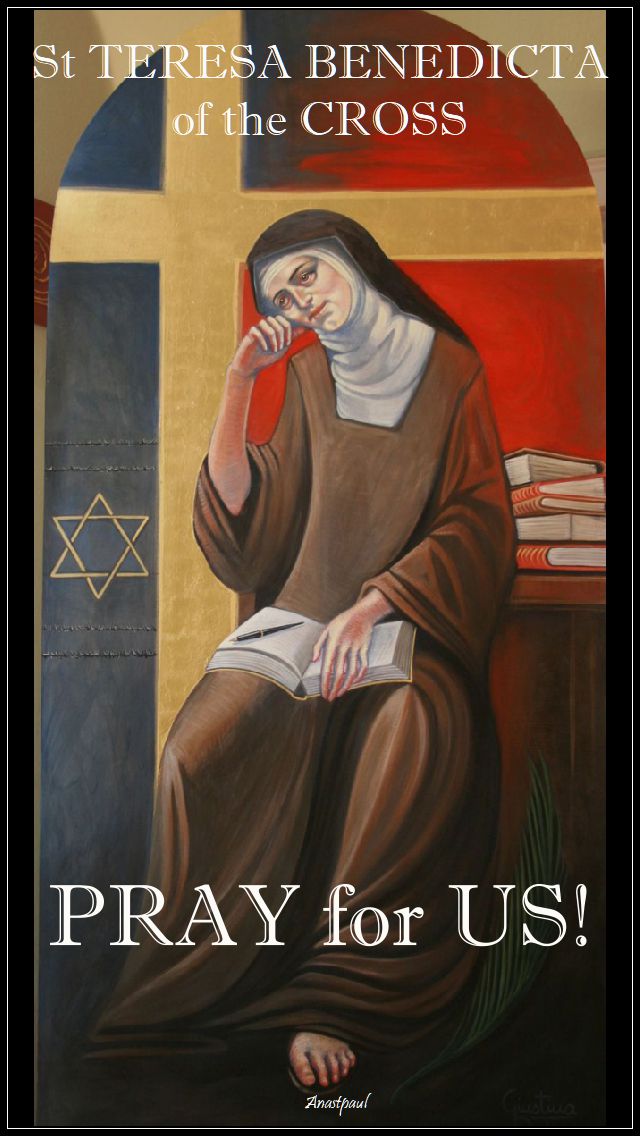
Thought for the Day – 9 August – The Memorial of St Teresa Benedicta of the Cross (1891-1942) Martyr

Thought for the Day – 9 August – The Memorial of St Teresa Benedicta of the Cross (1891-1942) Martyr

“A Lesson in Love”

Her name reflects her beloved spiritual sister and fellow Carmelite, Teresa of Ávila and her fate of sharing in the Cross of Christ in a very tangible, visible way. Edith, now Teresa Benedicta of the Cross, viewed her own life as a sacrificial offering to God for her people. In 1939, she offered her life to God for all those she loved:  for the Church, for the Carmelite Order, for the Jewish people, for her family, and for “the deliverance of Germany and peace throughout the world.”   Rather than give in to despair, darkness and hopelessness, Edith offered her own life and sufferings to God for others—even for those who murdered her.   She saw herself as her brothers’ keeper and asked Our Lord to accept her life for theirs.

A Jewish businessman from Cologne, Julius Markan, who had been put in charge of the prisoners at Westerbork Camp, remembers how she cared for those around her as they faced death. He wrote:

“Amongst the prisoners who were brought in on the 5th of August, Sister Benedicta stood out on account of her calmness and composure.   The distress in the barracks and the stir caused by the new arrivals were indescribable. Sister Benedicta was just like an angel, going around amongst the women, comforting them, helping them and calming them.   Many of the mothers were near to distraction, they had not bothered about their children the whole day long but just sat brooding in dumb despair.   Sister Benedicta took care of the little children, washed them and combed them, attending to their feeding and other needs.   During the whole of her stay there, she washed and cleaned for people, following one act of charity with another, until everyone wondered at her goodness.”

Another person who met her on the way to her death, Dr. Wielek, recalled a conversation he had with her in Westerbork just before she was transferred to Auschwitz:

“In one conversation she said to me: ‘The world is made up of opposites but in the end nothing remains of these contrasts.   What only remains is great love. How is it possible for it to be otherwise?’”

Indeed in this world, we do experience such opposites,good and evil, joy and suffering, life and death. “What only remains is great love.”   Edith’s final conviction teaches us how to suffer, how to offer ourselves and how to embrace a world so seemingly full of violations against the human person.   Edith shows how to live as a balm for these wounds in the world—and how such a life lived for Christ will ultimately heal it.
(Angela Micali Stout)

St Teresa Benedicta of the Cross, Pray for us!st-teresa-benedicta-pray-for-us-2-9 aug 2017

Posted in CARMELITES, MORNING Prayers, QUOTES of the SAINTS, QUOTES on CHARITY, QUOTES on COURAGE, QUOTES on DIVINE PROVIDENCE, QUOTES on FAITH, QUOTES on PEACE, QUOTES on PRAYER, QUOTES on the CROSS of CHRIST, SAINT of the DAY

Quote/s of the Day – 9 August – The Memorial of St Teresa Benedicta of the Cross (1891-1942) Martyr

Quote/s of the Day – 9 August – The Memorial of St Teresa Benedicta of the Cross (1891-1942) Martyr

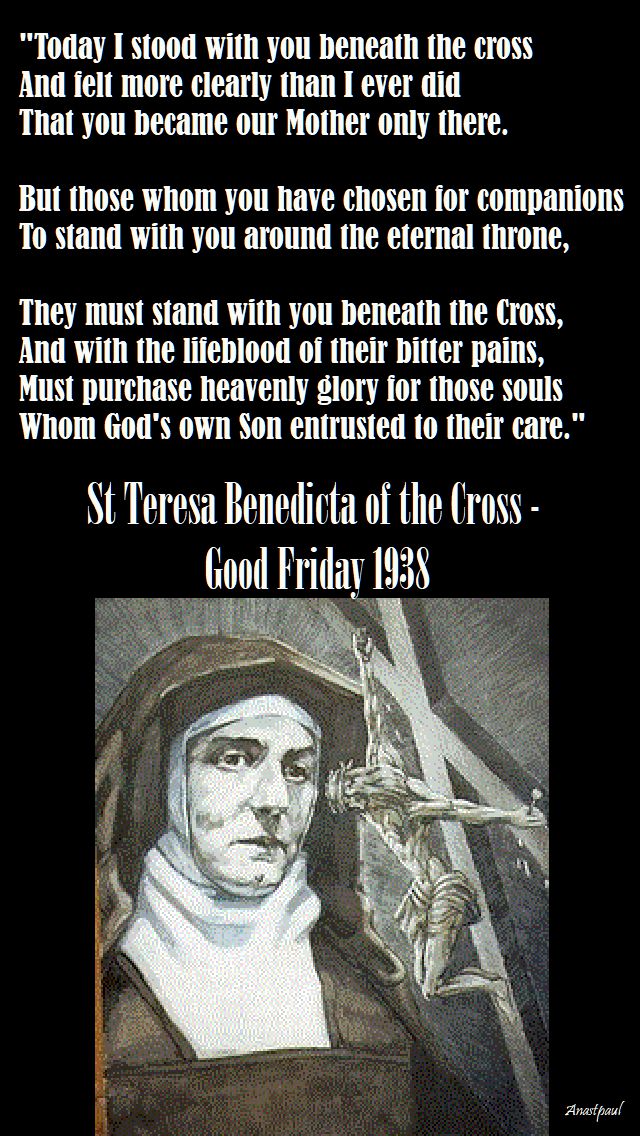
“Today I stood with you beneath the cross
And felt more clearly than I ever did
That you became our Mother only there.

But those whom you have chosen for companions
To stand with you around the eternal throne,

They must stand with you beneath the Cross,
And with the lifeblood of their bitter pains,
Must purchase heavenly glory for those souls
Whom God’s own Son entrusted to their care.”

St Teresa Benedicta of the Cross – Good Friday 1938today-i-stood-with-you-beneath-the-cross-st-teresa-benedicta-9 aug 2017

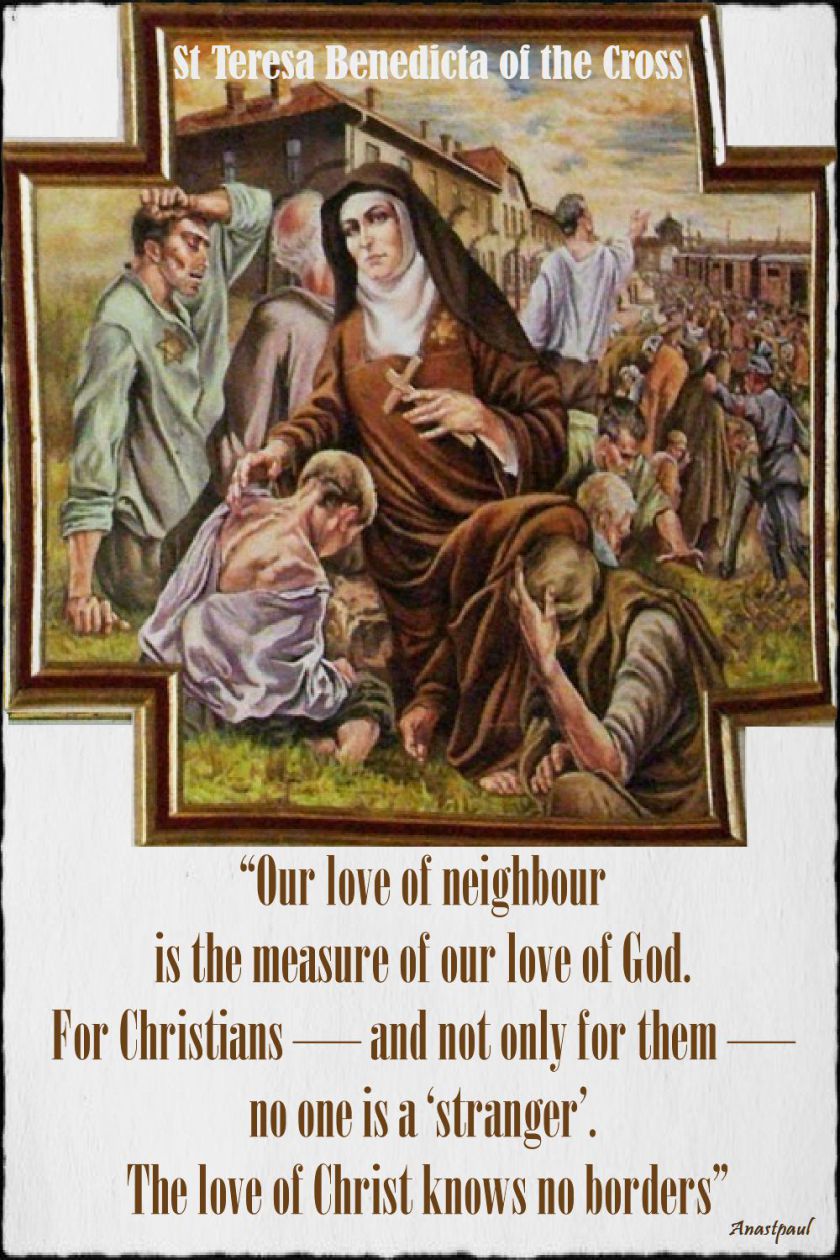
“Our love of neighbour is the measure of our love of God.
For Christians — and not only for them —
no one is a ‘stranger’.
The love of Christ knows no borders”our-love-of-neighbour-is-the-measure-of-our-love-of-god-st-teresa-benedicta-9 aug 2017

“God is there in these moments of rest
and can give us, in a single instant, exactly what we need.
Then the rest of the day can take its course,
under the same effort and strain, perhaps, but in peace.
And when night comes and you look back over the day
and see how fragmentary everything has been
and how much you planned that has gone undone
and all the reasons you have, to be embarrassed and ashamed:
just take everything, exactly as it is,
put it in God’s hands and leave it with Him.
Then you will be able to rest in Him – really rest –
and start the next day, as a new life.”just take everything - st teresa benedicta of the cross - 9 aug 2018

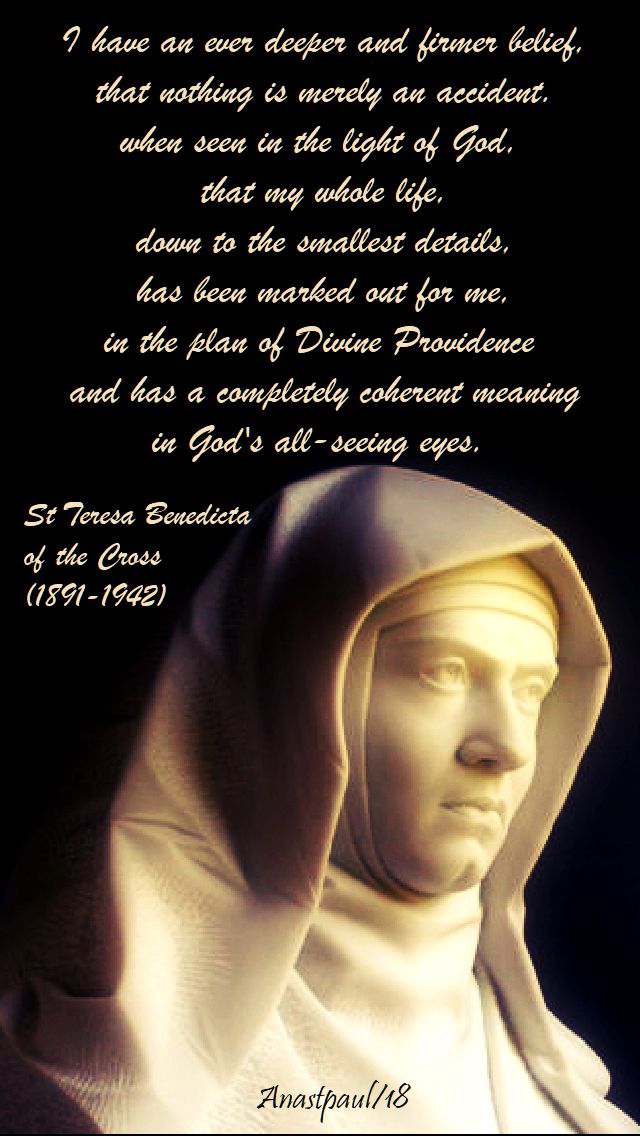
“Whatever did not fit in with my plan, did lie within the plan of God.
I have an ever deeper and firmer belief,
that nothing is merely an accident.
when seen in the light of God, that my whole life,
down to the smallest details,
has been marked out for me,
in the plan of Divine Providence
and has a completely coherent meaning in God’s all-seeing eyes.
And so I am beginning to rejoice,
in the light of glory, wherein this meaning, will be unveiled to me.”i have an ever deeper and firmer belief - st teresa benedicta of the cross - 9 aug 2018

“Every true prayer, is a prayer of the Church,
by means of that prayer, the Church prays,
since it is the Holy Spirit, living in the Church,
Who in every single soul, ‘prays in us with unspeakable groanings’.”every true prayer - st teresa benedicta of the cross - 9 aug 2018

“Since Mary is the prototype of pure womanhood,
the imitation of Mary, must be the goal of girls’ education.”

St Teresa Benedicta of the Cross (1891-1942) since mary is the prototype - st teresa benedicta of the cross - 9 aug 2018

Posted in CARMELITES, MORNING Prayers, QUOTES on SIN, SAINT of the DAY, The WORD

One Minute Reflection – 9 August – Today’s Gospel: Matthew 16:13–23

One Minute Reflection – 9 August – Thursday of the Eighteenth week in Ordinary Time, Year B – Today’s Gospel:  Matthew 16:13–23 and the Memorial of St Teresa Benedicta of the Cross (1891-1942) Martyr

“Whatever you bind on earth shall be bound in heaven and whatever you loose on earth shall be loosed in heaven.“…Matthew 16:19whatever you bind on earth - matthew 16 -19

REFLECTION – “Sin is before all else, an offence against God, a rupture of communion with Him.   At the same time it damages communion with the Church.   For this reason, conversion entails, both God’s forgiveness and reconciliation with the Church, which are expressed and accomplished liturgically, by the sacrament of Penance and Reconciliation.

Only God forgives sin (Mk 2,7).   Since He is the Son of God, Jesus says of Himself, “The Son of man has authority on earth to forgive sins” (Mk 2,10) and exercises this divine power:  “Your sins are forgiven” (v.5; Lk 7,48).   Further, by virtue of His divine authority He gives this power to men to exercise in His name (Jn 20,21).   Christ has willed that in her prayer and life and action, His whole Church should be the sign and instrument of the forgiveness and reconciliation that He acquired for us at the price of His blood.   But He entrusted the exercise of the power of absolution, to the apostolic ministry, which He charged with the “ministry of reconciliation” (2Cor 5,18).   The apostle is sent out “on behalf of Christ” with “God making his appeal” through him and pleading: ”  Be reconciled to God” (v.20).

During His public life, Jesus not only forgave sins but also made plain the effect of this forgiveness, He reintegrated forgiven sinners, into the community of the People of God from which sin had alienated or even excluded them.   A remarkable sign of this is the fact that Jesus receives sinners at His table (Mk 2,16), a gesture that expresses in an astonishing way, both God’s forgiveness and the return to the bosom of the People of God (cf. Lk 15; 19,9).”…Catechism of the Catholic Church – § 1440-1443ccc 1440 - sin is before all else, an offence against god - 9 aug 2018

PRAYER – Lord our God, the Light and Creator of Light, grant that faithfully pondering on all that is holy, we may ever live in the splendour of Your presence.   By the help and intercession of St Teresa Benedicta, You may never permit us to separate ourselves from You and thus we may come, to completion in You, Through Jesus Christ with the Holy Spirit, one God forever, amen.st-teresa-benedicta-pray-for-us-9 aug 2017

Posted in CARMELITES, MORNING Prayers, PRAYERS of the SAINTS, SAINT of the DAY, The TRANSFIGURATION, Uncategorized

Our Morning Offering – 9 August – The Memorial of St Teresa Benedicta of the Cross (1891-1942) Martyr

Our Morning Offering – 9 August – The Memorial of St Teresa Benedicta of the Cross (1891-1942) Martyr

I Do Not See Very Far Ahead
By St Teresa Benedicta of the Cross (1891-1942)

O my God,
fill my soul with holy joy,
courage and strength to serve You.
Enkindle Your love in me
and then walk with me
along the next stretch of road before me.
I do not see very far ahead
but when I have arrived
where the horizon now closes down,
a new prospect will open before me
and I shall be met with peace.
How wondrous are the marvels of Your love,
we are amazed,
we stammer and grow dumb,
for word and spirit fail us.
Ameni do not see very far ahead - st teresa benedicta of the cross - 9 aug 2018

Posted in CARMELITES, SAINT of the DAY, VATICAN Resources

Saint of the Day – 9 August – St Teresa Benedicta of the Cross/Edith Stein (1891-1942)

Saint of the Day – 9 August – St Teresa Benedicta of the Cross/Edith Stein (1891-1942) Nun, Discalced Carmelite, Martyr.   Below is a lengthy biography from the Vatican, it’s worth reading.

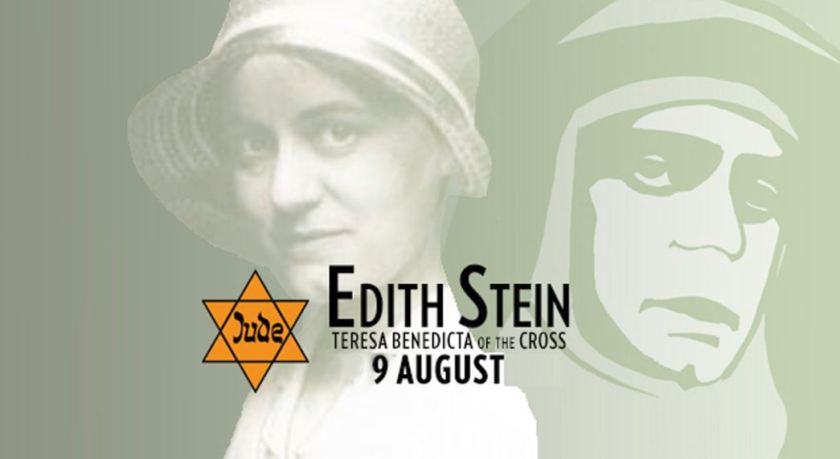
“We bow down before the testimony of the life and death of Edith Stein, an outstanding daughter of Israel and at the same time a daughter of the Carmelite Order, Sister Teresa Benedicta of the Cross, a personality who united within her rich life a dramatic synthesis of our century.   It was the synthesis of a history full of deep wounds that are still hurting … and also the synthesis of the full truth about man.   All this came together in a single heart that remained restless and unfulfilled until it finally found rest in God.”   These were the words of Pope John Paul II when he beatified Edith Stein in Cologne on 1 May 1987.
EDITH STEYN - SNIP

Edith Stein was born in Breslau on 12 October 1891, the youngest of 11, as her family were celebrating Yom Kippur, that most important Jewish festival, the Feast of Atonement.   “More than anything else, this helped make the youngest child very precious to her mother.”   Being born on this day was like a foreshadowing to Edith, a future Carmelite nun.   Edith’s father, who ran a timber business, died when she had only just turned two.   Her mother, a very devout, hard-working, strong-willed and truly wonderful woman, now had to fend for herself and to look after the family and their large business.   However, she did not succeed in keeping up a living faith in her children.   Edith lost her faith in God. “I consciously decided, of my own volition, to give up praying,” she said.

In 1911 she passed her school-leaving exam with flying colours and enrolled at the University of Breslau to study German and history, though this was a mere “bread-and-butter” choice.   Her real interest was in philosophy and in women’s issues.   She became a member of the Prussian Society for Women’s Franchise.   “When I was at school and during my first years at university,” she wrote later, “I was a radical suffragette.   Then I lost interest in the whole issue.  Now I am looking for purely pragmatic solutions.”st teresa benedicta info

In 1913, Edith Stein transferred to Gottingen University, to study under the mentorship of Edmund Husserl.   She became his pupil and teaching assistant and he later tutored her for a doctorate.   At the time, anyone who was interested in philosophy was fascinated by Husserl’s new view of reality, whereby the world as we perceive it does not merely exist in a Kantian way, in our subjective perception.   His pupils saw his philosophy as a return to objects:  “back to things”.   Husserl’s phenomenology unwittingly led many of his pupils to the Christian faith.   In Gottingen Edith Stein also met the philosopher Max Scheler, who directed her attention to Roman Catholicism.   Nevertheless, she did not neglect her “bread-and-butter” studies and passed her degree with distinction in January 1915, though she did not follow it up with teacher training.

“I no longer have a life of my own,” she wrote at the beginning of the First World War, having done a nursing course and gone to serve in an Austrian field hospital.   This was a hard time for her, during which she looked after the sick in the typhus ward, worked in an operating theatre and saw young people die.   When the hospital was dissolved, in 1916, she followed Husserl as his assistant to the German city of Freiburg, where she passed her doctorate summa cum laude (with the utmost distinction) in 1917, after writing a thesis on “The Problem of Empathy.”

During this period she went to Frankfurt Cathedral and saw a woman with a shopping basket going in to kneel for a brief prayer.   “This was something totally new to me.   In the synagogues and Protestant churches I had visited people simply went to the services. Here, however, I saw someone coming straight from the busy marketplace into this empty church, as if she was going to have an intimate conversation.  It was something I never forgot.”   Towards the end of her dissertation she wrote:   “There have been people who believed that a sudden change had occurred within them and that this was a result of God’s grace.”   How could she come to such a conclusion?   Edith Stein had been good friends with Husserl’s Göttingen assistant, Adolf Reinach and his wife.   When Reinach fell in Flanders in November 1917, Edith went to Göttingen to visit his widow.   The Reinachs had converted to Protestantism.   Edith felt uneasy about meeting the young widow at first but was surprised when she actually met with a woman of faith.   “This was my first encounter with the Cross and the divine power it imparts to those who bear it … it was the moment when my unbelief collapsed and Christ began to shine his light on me – Christ in the mystery of the Cross.”

Later, she wrote:   “Things were in God’s plan which I had not planned at all. I am coming to the living faith and conviction that – from God’s point of view – there is no chance and that the whole of my life, down to every detail, has been mapped out in God’s divine providence and makes complete and perfect sense in God’s all-seeing eyes.”

In Autumn 1918 Edith Stein gave up her job as Husserl’s teaching assistant.   She wanted to work independently.   It was not until 1930 that she saw Husserl again after her conversion and she shared with him about her faith, as she would have liked him to become a Christian, too.   Then she wrote down the amazing words: “Every time I feel my powerlessness and inability to influence people directly, I become more keenly aware of the necessity of my own holocaust.”

Edith Stein wanted to obtain a professorship, a goal that was impossible for a woman at the time.   Husserl wrote the following reference:  “Should academic careers be opened up to ladies, then I can recommend her whole-heartedly and as my first choice for admission to a professorship.”   Later, she was refused a professorship on account of her Jewishness.

Back in Breslau, Edith Stein began to write articles about the philosophical foundation of psychology.   However, she also read the New Testament, Kierkegaard and Ignatius of Loyola’s Spiritual Exercises.   She felt that one could not just read a book like that but had to put it into practice.   In the summer of 1921. she spent several weeks in Bergzabern (in the Palatinate) on the country estate of Hedwig Conrad-Martius, another pupil of Husserl’s.   Hedwig had converted to Protestantism with her husband.   One evening Edith picked up an autobiography of St Teresa of Avila and read this book all night. “When I had finished the book, I said to myself: This is the truth.”   Later, looking back on her life, she wrote:  “My longing for truth was a single prayer.”young st teresa
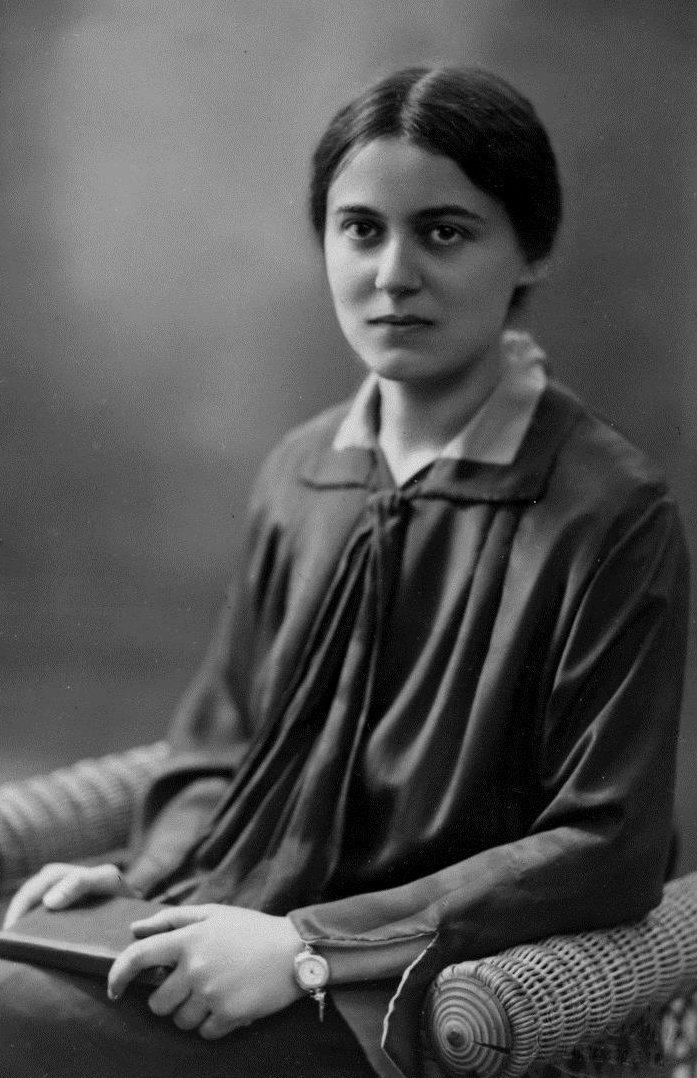
On 1 January 1922 Edith Stein was baptised.   It was the Feast of the Circumcision of Jesus, when Jesus entered into the covenant of Abraham.   Edith Stein stood by the baptismal font, wearing Hedwig Conrad-Martius’ white wedding cloak.   “I had given up practising my Jewish religion when I was a 14-year-old girl and did not begin to feel Jewish again until I had returned to God.”   From this moment on she was continually aware that she belonged to Christ not only spiritually but also through her blood.   At the Feast of the Purification of Mary – another day with an Old Testament reference – she was confirmed by the Bishop of Speyer in his private chapel.   After her conversion she went straight to Breslau:   “Mother,” she said, “I am a Catholic.”   The two women cried. Hedwig Conrad Martius wrote:  “Behold, two Israelites indeed, in whom is no deceit!” (cf. John 1:47).

Immediately after her conversion she wanted to join a Carmelite convent.   However, her spiritual mentors, Vicar-General Schwind of Speyer and Erich Przywara SJ, stopped her from doing so.   Until Easter 1931 she held a position teaching German and history at the Dominican Sisters’ school and teacher training college of St Magdalen’s Convent in Speyer.   At the same time she was encouraged by Arch-Abbot Raphael Walzer of Beuron Abbey to accept extensive speaking engagements, mainly on women’s issues.   “During the time immediately before and quite some time after my conversion I … thought that leading a religious life meant giving up all earthly things and having one’s mind fixed on divine things only.   Gradually, however, I learnt that other things are expected of us in this world…   I even believe that the deeper someone is drawn to God, the more He has to `get beyond himself’ in this sense, that is, go into the world and carry divine life into it.”

She worked enormously hard, translating the letters and diaries of Cardinal Newman from his pre-Catholic period as well as Thomas Aquinas’ Quaestiones Disputatae de Veritate.   The latter was a very free translation, for the sake of dialogue with modern philosophy.   Erich Przywara also encouraged her to write her own philosophical works. She learnt that it was possible to “pursue scholarship as a service to God… It was not until I had understood this that I seriously began to approach academic work again.”   To gain strength for her life and work, she frequently went to the Benedictine Monastery of Beuron, to celebrate the great festivals of the Church year.

In 1931 Edith Stein left the convent school in Speyer and devoted herself to working for a professorship again, this time in Breslau and Freiburg, though her endeavours were in vain.   It was then that she wrote Potency and Act, a study of the central concepts developed by Thomas Aquinas.   Later, at the Carmelite Convent in Cologne, she rewrote this study to produce her main philosophical and theological oeuvre, Finite and Eternal Being.   By then, however, it was no longer possible to print the book.   In 1932 she accepted a lectureship position at the Roman Catholic division of the German Institute for Educational Studies at the University of Munster, where she developed her anthropology.   She successfully combined scholarship and faith in her work and her teaching, seeking to be a “tool of the Lord” in everything she taught. “If anyone comes to me, I want to lead them to Him.”

In 1933 darkness broke out over Germany.   “I had heard of severe measures against Jews before.   But now it dawned on me that God had laid his hand heavily on His people and that the destiny of these people would also be mine.”   The Aryan Law of the Nazis made it impossible for Edith Stein to continue teaching.   “If I can’t go on here, then there are no longer any opportunities for me in Germany,” she wrote; “I had become a stranger in the world.”   The Arch-Abbot of Beuron, Walzer, now no longer stopped her from entering a Carmelite convent.   While in Speyer, she had already taken a vow of poverty, chastity and obedience.   In 1933 she met with the prioress of the Carmelite Convent in Cologne.   “Human activities cannot help us but only the suffering of Christ.   It is my desire to share in it.”st teresa benedicta icon
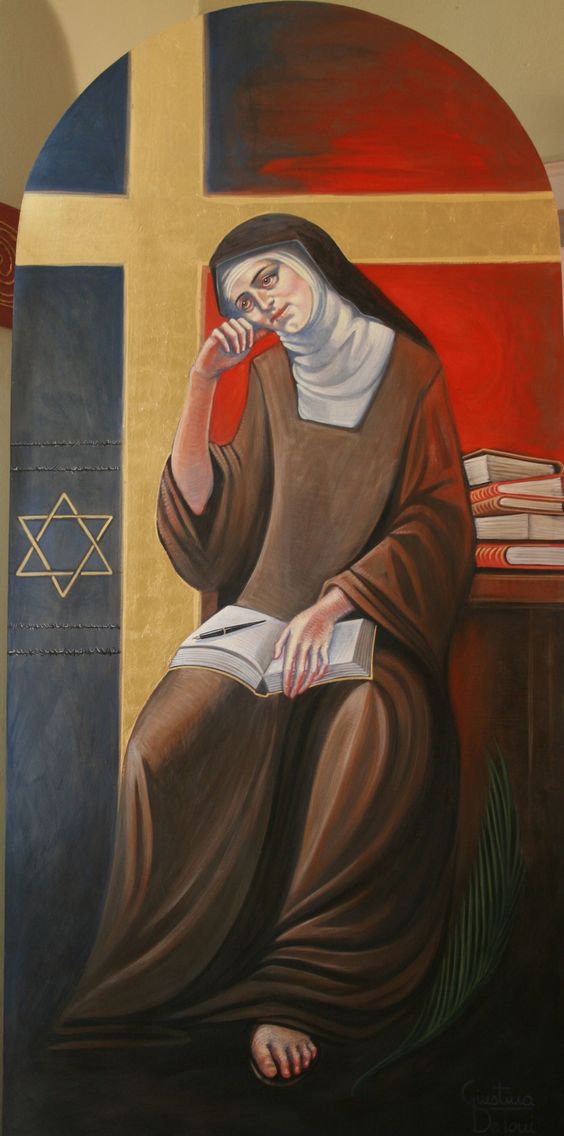
Edith Stein went to Breslau for the last time, to say good-bye to her mother and her family.   Her last day at home was her birthday, 12 October, which was also the last day of the Feast of Tabernacles.   Edith went to the synagogue with her mother.   It was a hard day for the two women.   “Why did you get to know it [Christianity]?” her mother asked, “I don’t want to say anything against Him.   He may have been a very good person.   But why did He make Himself God?” Edith’s mother cried.   The following day Edith was on the train to Cologne.   “I did not feel any passionate joy.   What I had just experienced was too terrible.   But I felt a profound peace – in the safe haven of God’s will.”   From now on she wrote to her mother every week, though she never received any replies.   Instead, her sister Rosa sent her news from Breslau.

Edith joined the Carmelite Convent of Cologne on 14 October and her investiture took place on 15 April, 1934.   The mass was celebrated by the Arch-Abbot of Beuron.   Edith Stein was now known as Sister Teresia Benedicta a Cruce – Teresa, Blessed of the Cross. In 1938 she wrote:  “I understood the cross as the destiny of God’s people, which was beginning to be apparent at the time (1933).   I felt that those who understood the Cross of Christ should take it upon themselves on everybody’s beha  lf. Of course, I know better now what it means to be wedded to the Lord in the sign of the cross.   However, one can never comprehend it, because it is a mystery.”   On 21 April 1935 she took her temporary vows.   On 14 September 1936, the renewal of her vows coincided with her mother’s death in Breslau.   “My mother held on to her faith to the last moment.   But as her faith and her firm trust in her God … were the last thing that was still alive in the throes of her death, I am confident that she will have met a very merciful judge and that she is now my most faithful helper, so that I can reach the goal as well.”   When she made her eternal profession on 21 April 1938, she had the words of St John of the Cross printed on her devotional picture:   “Henceforth my only vocation is to love.”   Her final work was to be devoted to this author.St Teresa Benedicta of the Cross-lg
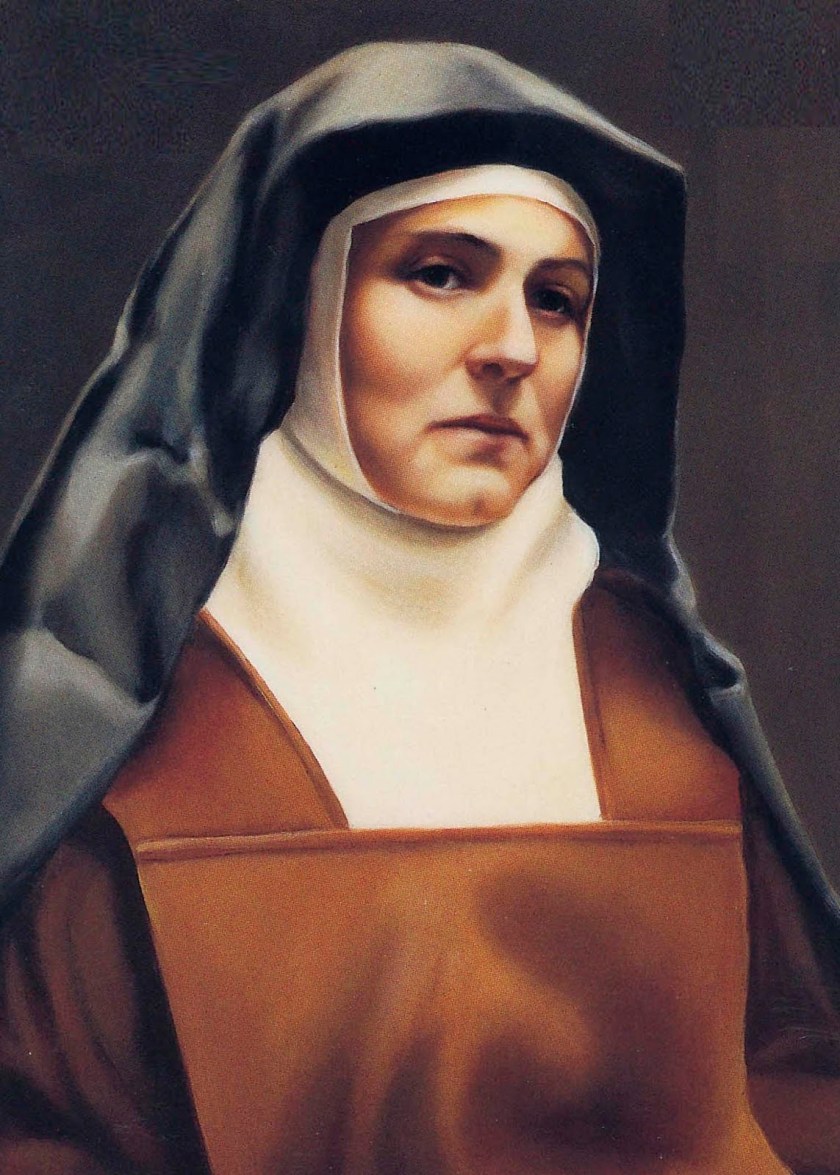
Edith Stein’s entry into the Carmelite Order was not escapism.   “Those who join the Carmelite Order are not lost to their near and dear ones but have been won for them, because it is our vocation to intercede to God for everyone.”   In particular, she interceded to God for her people:   “I keep thinking of Queen Esther who was taken away from her people precisely because God wanted her to plead with the king on behalf of her nation.   I am a very poor and powerless little Esther but the King who has chosen me is infinitely great and merciful.   This is great comfort.” (31 October 1938)

On 9 November 1938 the anti-Semitism of the Nazis became apparent to the whole world.   Synagogues were burnt and the Jewish people were subjected to terror.   The prioress of the Carmelite Convent in Cologne did her utmost to take Sister Teresia Benedicta a Cruce abroad.   On New Year’s Eve 1938 she was smuggled across the border into the Netherlands, to the Carmelite Convent in Echt in the Province of Limburg.   This is where she wrote her will on 9 June 1939:  “Even now I accept the death that God has prepared for me in complete submission and with joy as being his most holy will for me. I ask the Lord to accept my life and my death … so that the Lord will be accepted by His people and that His Kingdom may come in glory, for the salvation of Germany and the peace of the world.”st teresa benedicta artwork
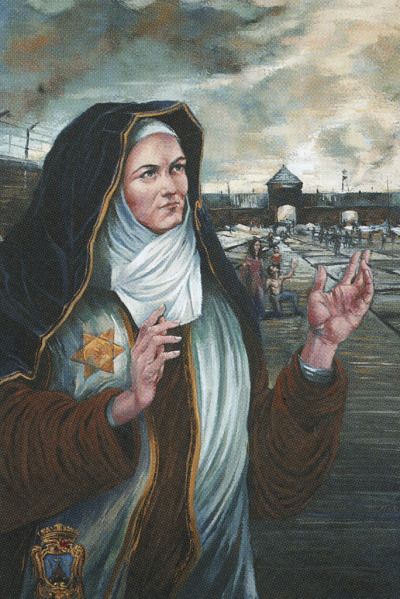
While in the Cologne convent, Edith Stein had been given permission to start her academic studies again.   Among other things, she wrote about “The Life of a Jewish Family” (that is, her own family): “I simply want to report what I experienced as part of Jewish humanity,” she said, pointing out that “we who grew up in Judaism have a duty to bear witness … to the young generation who are brought up in racial hatred from early childhood.”

In Echt, Edith Stein hurriedly completed her study of “The Church’s Teacher of Mysticism and the Father of the Carmelites, John of the Cross, on the Occasion of the 400th Anniversary of His Birth, 1542-1942.”   In 1941 she wrote to a friend, who was also a member of her order:  “One can only gain a scientia crucis (knowledge of the cross) if one has thoroughly experienced the cross.   I have been convinced of this from the first moment onwards and have said with all my heart:   ‘Ave, Crux, Spes unica’ (I welcome you, Cross, our only hope).”   Her study on S. John of the Cross is entitled: “Kreuzeswissenschaft” (The Science of the Cross).

Edith Stein was arrested by the Gestapo on 2 August 1942, while she was in the chapel with the other sisters.   She was to report within five minutes, together with her sister Rosa, who had also converted and was serving at the Echt Convent.   Her last words to be heard in Echt were addressed to Rosa:  “Come, we are going for our people.”   Together with many other Jewish Christians, the two women were taken to a transit camp in Amersfoort and then to Westerbork.   This was an act of retaliation against the letter of protest written by the Dutch Roman Catholic Bishops against the pogroms and deportations of Jews.   Edith commented, “I never knew that people could be like this, neither did I know that my brothers and sisters would have to suffer like this. … I pray for them every hour.   Will God hear my prayers?   He will certainly hear them in their distress.”   Prof. Jan Nota, who was greatly attached to her, wrote later:  “She is a witness to God’s presence in a world where God is absent.”st teresa benedicta art

On 7 August, early in the morning, 987 Jews were deported to Auschwitz.  It was probably on 9 August that Sister Teresia Benedicta a Cruce, her sister and many other of her people were gassed.
When Edith Stein was beatified in Cologne on 1 May 1987, the Church honoured “a daughter of Israel”, as Pope John Paul II put it, who, as a Catholic during Nazi persecution, remained faithful to the crucified Lord Jesus Christ and, as a Jew, to her people in loving faithfulness.”   St John Paul II canonised her in 1998 and proclaimed her a co-patroness of Europe the next year.Edith-Stein_0
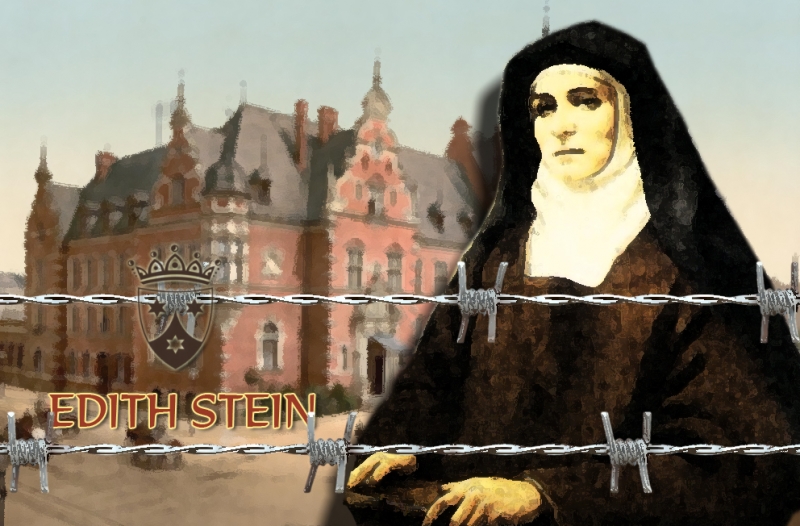
More here:  https://anastpaul.wordpress.com/2017/08/09/saint-of-the-day-9-august-st-teresa-benedicta-of-the-cross-ocd/

Posted in CARMELITES, SAINT of the DAY

Memorials of the Saints -9 August

St Teresa Benedicta of the Cross OCD (1891-1942)Martyr, Co-Patron of Europe  (Optional Memorial)
https://anastpaul.wordpress.com/2017/08/09/saint-of-the-day-9-august-st-teresa-benedicta-of-the-cross-ocd/

St Amor of Franche-Comté
St Autor of Metz
St Bandaridus of Soissons
St Bonifacia Rodriguez Castro
St Candida Maria de Jesus Cipitria y Barriola
St Claude Richard
St Domitian of Châlons
Bl Falco the Hermit
St Firmus of Verona
Bl John Norton
Bl John of Salerno
Bl John Talbot
St Marcellian of Civitavecchia
Bl Michal Tomaszek
St Nathy
St Numidicus of Carthage
St Phelim
Bl Richard Bere
St Romanus Ostiarius
St Rusticus of Sirmium
St Rusticus of Verona
St Secundian of Civitavecchia
St Stephen of Burgos
Bl Thomas Palaser
St Verian of Civitavecchia
Bl Zbigniew Adam Strzalkowski

Martyrs of Civitavecchia: Three Christians martyred together in the persecutions of Decius. We know little more than the names – Marcellian, Secundian and Verian. 250 near Civitavecchia, Italy.

Martyrs of Constantinople: 10 saints: A group of ten Christians who were arrested, tortured and executed for defending an icon of Christ in defiance of orders from Emperor Leo the Isaurian. We know the names of three, but nothing else about them – Julian, Marcian and Mary. They were beheaded in Constantinople.

Martyred in the Spanish Civil War:
Martyred Colombians of Barcelona: – 7 beati: Additional Memorial – 30 July as one of the Martyred Hospitallers of Spain
A group of Colombian members of the Hospitallers of Saint John of God who worked together in Spain, and who were martyred together in the Spanish Civil War.
• Blessed Alfonso Antonio Ramírez Salazar
• Blessed Gabriel Maya Gutiérrez
• Blessed José Velázquez Peláez
• Blessed Luis Ayala Niño
• Blessed Luis Modesto Páez Perdomo
• Blessed Ramón Ramírez Zuluoga
• Blessed Rubén de Jesús López Aguilar
They were martyred on 9 August 1936 in Barcelona, Spain and Beatified on 25 October 1992 by Pope John Paul II.
Martyred in the Spanish Civil War:
Bl Antonio Mateo Salamero
Bl Faustino Oteiza Segura
Bl Florentín Felipe Naya
Bl Florentino Asensio Barroso
Bl Francisco López-Gasco Fernández-Largo
Bl Guillermo Plaza Hernández
Bl Joan Vallés Anguera
Bl José María Garrigues Hernández
Bl Josep Figuera Rey
Bl Josep Maria Aragones Mateu
Bl Julián Pozo Ruiz de Samaniego
Bl Mateo Molinos Coloma
Bl Narcís Sitjà Basté

Posted in MORNING Prayers, PAPAL SERMONS, SAINT of the DAY

Second Thoughts for the Day – 8 August – The Memorial of St Mary of the Cross MacKillop (1842-1909)

Second Thoughts for the Day – 8 August – The Memorial of St Mary of the Cross MacKillop (1842-1909)

“In the vastness of the Australian continent, Blessed Mary MacKillop was not daunted by the great desert, the immense expanses of the outback, nor by the spiritual “wilderness” which affected so many of her fellow citizens.   Rather, she boldly prepared the way of the Lord, in the most trying situations.   With gentleness, courage and compassion, she was a herald of the Good News among the isolated “battlers” and the urban slum-dwellers.   Mother Mary of the Cross knew that behind the ignorance, misery and suffering which she encountered there were people, men and women, young and old, yearning for God and his righteousness.   She knew, because she was a true child of her time and place:  the daughter of immigrants who had to struggle at all times to build a life for themselves in their new surroundings.

Her story reminds us of the need to welcome people, to reach out to the lonely, the bereft, the disadvantaged.   To strive for the kingdom of God and His righteousness, means to strive to see Christ in the stranger, to meet Him in them and to help them to meet Him in each one of us!”

– Pope Benedict XVI on the Beatification of St Mary of the Cross MacKillop (Thursday 19 January 1005), whose prayers we request!st mary of the cross mackillop pray for us 8 aug 2018-no 4.

Posted in DOMINICAN OP, MORNING Prayers, SAINT of the DAY

Thought for the Day – 8 August – The Memorial of St Dominic (1170-1221)

Thought for the Day – 8 August – The Memorial of St Dominic (1170-1221)

St Dominic possessed such great integrity and was so strongly motivated by divine love, that without a doubt he proved to be a bearer of honour and grace.   And since a joyful heart animates the face, he displayed the peaceful composure of a spiritual man in the kindness he manifested outwardly and by the cheerfulness of his countenance. Wherever he went he showed himself in word and deed to be a man of the Gospel.

During the day no one was more community-minded or pleasant toward his brothers and associates.   During the night hours no one was more persistent in every kind of vigil and supplication.   He seldom spoke unless it was with God, that is, in prayer, or about God and in this matter, he instructed his brothers.   Frequently he made a special personal petition that God would deign to grant him genuine charity in caring for and obtaining the salvation of men.   For he believed that only then would he be truly a member of Christ, when he had given himself totally for the salvation of men, just as the Lord Jesus, the Saviour of all, had offered Himself completely for our salvation.   So, for this work, after a lengthy period of careful and provident planning, he founded the Orders of Friars Preachers.

In his conversations and letters he often urged the brothers of the Order to study constantly the Old and New Testaments.   He always carried with him the gospel according to Matthew and the epistles of Paul and so well did he study them that he almost knew them from memory.

Two or three times he was chosen bishop but he always refused, preferring to live with his brothers in poverty.

Of him Pope Gregory IX declared: “I knew him as a steadfast follower of the apostolic way of life.   There is no doubt that he is in heaven, sharing in the glory of the apostles themselves.”
– from various writings on the history of the Order of Preachers

St Dominic, Pray for us!st-dominic-pray-for-us-2.-8 aug 2017

Posted in DOMINICAN OP, MORNING Prayers, QUOTES of the SAINTS, QUOTES on CHARITY, QUOTES on DIVINE PROVIDENCE, QUOTES on EVANGELISATION, QUOTES on FAITH, QUOTES on HUMILITY, QUOTES on LOVE, QUOTES on MERCY, QUOTES on PERSEVERANCE, QUOTES on SUFFERING, QUOTES on TRUST and complete CONFIDENCE in GOD, SAINT of the DAY

Quote/s of the Day – 8 August – The Memorials of St Dominic (1170-1221) and St Mary of the Cross MacKillop (1842-1909)

Quote/s of the Day – 8 August – The Memorials of St Dominic (1170-1221)

and St Mary of the Cross MacKillop (1842-1909)

“We must sow
the seed,
not hoard it.”we must sow the seed not hoard it - st dominic - 8 aug 2018.jpg

“Heretics are to be converted by an example of humility
and other virtues far more readily, than by any external
display or verbal battles.
So let us arm ourselves with
devout prayers and set off showing signs of genuine humility
and go barefooted to combat Goliath.”heretics-st-dominic-8 aug 2017

“A man who governs his passions is master of his world.
We must either command them or be enslaved by them.
It is better to be a hammer than an anvil.”

St Dominic (1170-1221)a-man-who-governs-his-passions-st-dominic-8 aug 2017

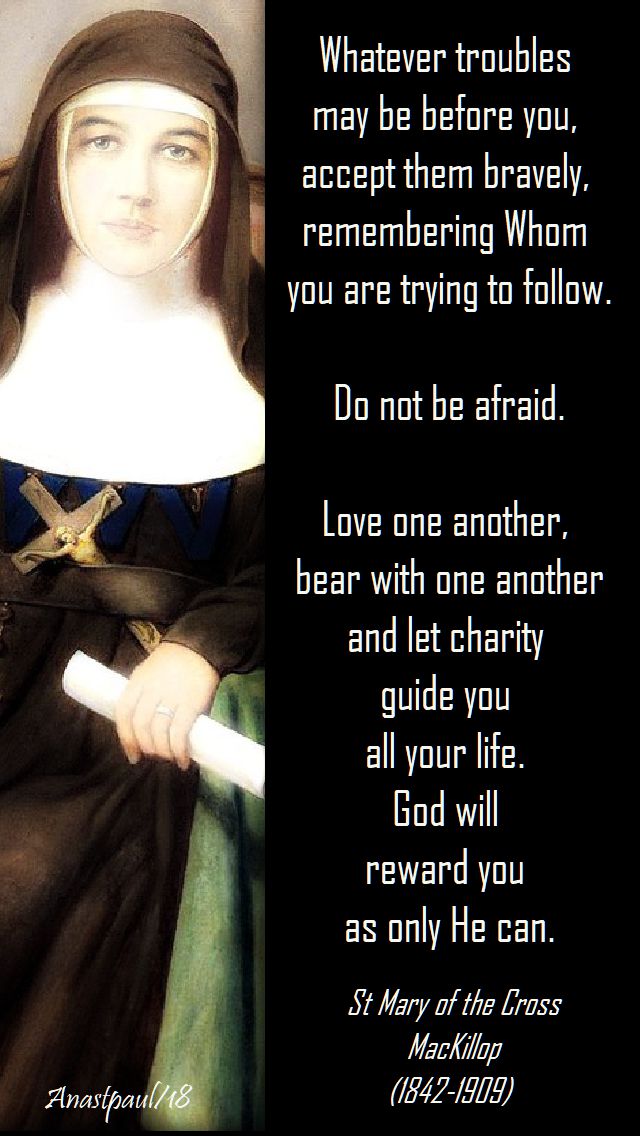
“Whatever troubles may be before you,
accept them bravely,
remembering Whom you are trying to follow.
Do not be afraid.
Love one another, bear with one another
and let charity guide you all your life.
God will reward you as only He can.”

St Mary of the Cross MacKillop (1842-1909)whatever troubles may be - st mary of the cross - 8 aug 2018

Posted in DOMINICAN OP, MORNING Prayers, PAPAL SERMONS, QUOTES on FAITH, SAINT of the DAY, The WORD

One Minute Reflection – 8 August – Today’s Gospel: Matthew 15:21–28

One Minute Reflection – 8 August – Wednesday of the Eighteenth week in Ordinary Time, Year B – Today’s Gospel: Matthew 15:21–28 and The Memorials of St Dominic (1170-1221) and St Mary of the Cross MacKillop (1842-1909)

Then Jesus answered her, “O woman, great is your faith!   Be it done for you as you desire.” And her daughter was healed instantly...Matthew 15:28

REFLECTION – “Jesus points to this humble woman as a model of unwavering faith.   Her persistence in beseeching Christ’s intervention is incentive for us not to become discouraged, not to despair when we are burdened by life’s difficult trials.   The Lord does not turn away in the face of our needs and, if at times, He seems insensitive to our requests for help, it is in order to put to the test and to strengthen, our faith.   We must continue to cry out like this woman:  “Lord, help me! Lord, help me!”.  In this way, with perseverance and courage.   This is the courage needed in prayer.   He can help us to find our way, when we have lost the compass of our journey; when the road no longer seems flat but rough and arduous; when it is hard to be faithful to our commitments.

It is important to nourish our faith every day, by carefully listening to the Word of God, with the celebration of the Sacraments, with personal prayer as a “cry” to Him — “Lord, help me!” — and with concrete acts of charity toward our neighbour.”…Pope Francis – Angelus, 20 August 2017matthew 15 38 - o woman great is your faith - the lord does not turn away - pope francis - 8 aug 2018

PRAYER – Lord God, You gave St Dominic and St Mary of the Cross Mackillop, to the Church in their days, as lessons in total love, charity and zeal.   We pray that they may help us in our times, by their merits, their inspiration, their words and their prayers. Through Jesus Christ our Lord, in the unity of the Holy Spirit, one God forever, amen.st-dominic-pray-for-us.8 aug 2017.pgst mary of the cross mackillop pray for us 8 aug 2018

Posted in DOMINICAN OP, MORNING Prayers, PRAYERS of the SAINTS, SAINT of the DAY

Our Morning Offering – 8 August – The Memorial of St Dominic (1170-1221)

Our Morning Offering – 8 August – The Memorial of St Dominic (1170-1221)

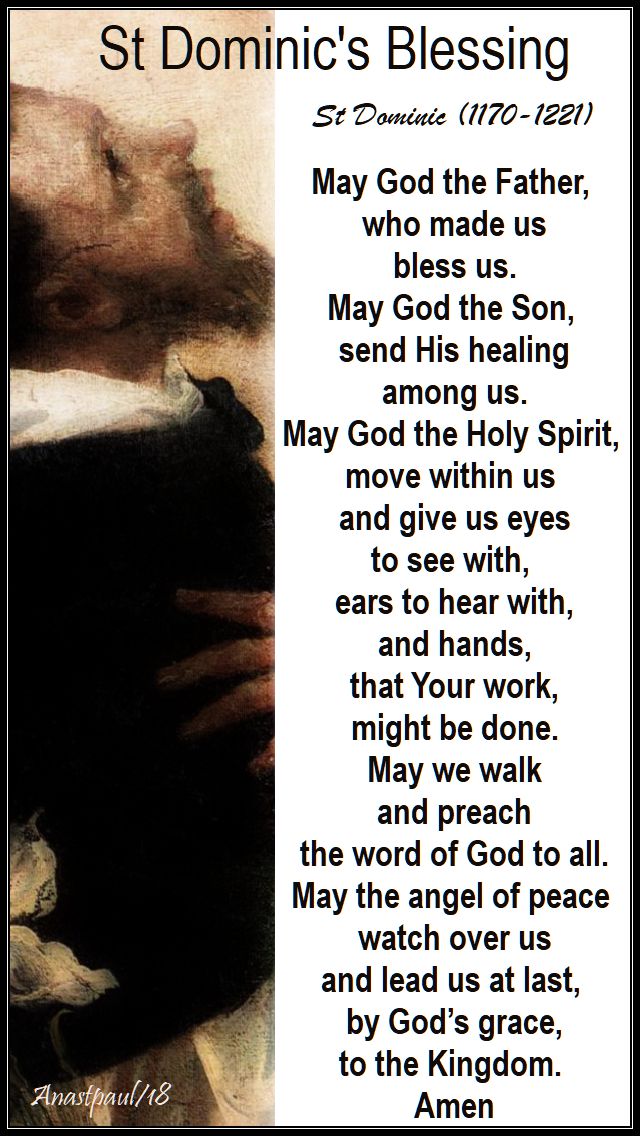
St Dominic’s Blessing

May God the Father,
who made us, bless us.
May God the Son,
send His healing among us.
May God the Holy Spirit,
move within us
and give us eyes to see with,
ears to hear with,
and hands, that Your work,
might be done.
May we walk and preach
the word of God to all.
May the angel of peace
watch over us
and lead us at last,
by God’s grace,
to the Kingdom.
Amenmay god the father - st dominic's blessing - 8 aug 2018

Posted in SAINT of the DAY

Saint of the Day – 8 August – St Mary of the Cross (1842-1909)

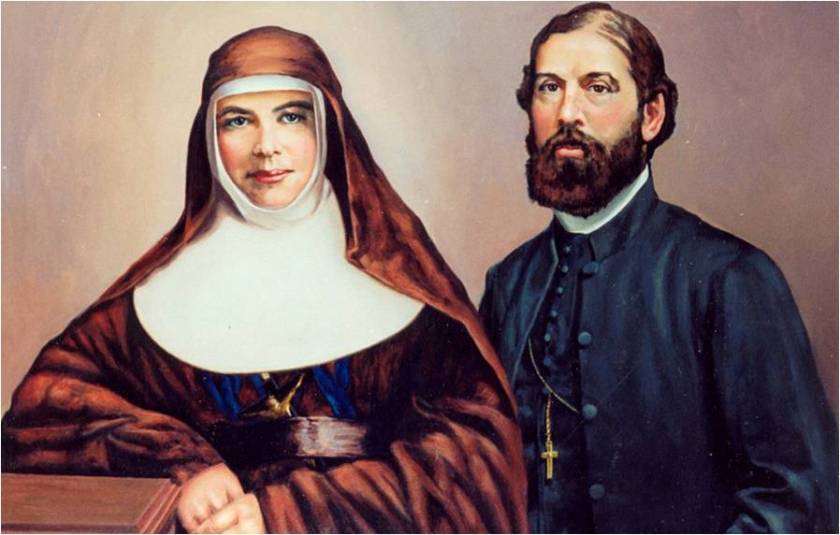
Saint of the Day – 8 August – St Mary of the Cross (1842-1909)  Also known as St Mary Mackillop – Virgin, Religious Sister and Founder of the Sisters of St Joseph of the Sacred Heart (the Josephites), together with Fr Julian Tenison Woods. a congregation of religious sisters that established a number of schools and welfare institutions throughout Australia and New Zealand, with an emphasis on education for the rural poor.   She was born on 15 January 1842 at Fitzroy, Melbourne, Australia as Maria Ellen MacKillop and died on • 8 August 1909 at Sydney, Australia following a stroke.   Patronages – Australia, Brisbane, Knights of the Southern Cross.St Doninic Finalst mary of the cross mackillop

Mary of the Cross MacKillop was born on 15 January 1842 in Melbourne, Australia. Conditions in the mid-nineteenth century were still appallingly primitive.   Poverty was rife especially in country areas, religious discrimination was widespread, the plight of the aboriginal people was deplorable, unemployment was common-place and communication was difficult in the extreme.   Travel over any distance was for the fearless and tough.

 st mary child
Many of the first settlers were of convict origin with little education and many were descendants of Irish Catholics much discriminated against because of their religion and place of origin.   The Church had few priests to serve its people who were scattered around rural areas and, as a rule, experiencing poverty.
Mary was the first of eight children of Scottish immigrants, Alexander MacKillop and Flora MacDonald.   These Catholic parents imbued their children with a great love of their faith.   The family was poor, the father often without work because he dabbled in business and politics.   Mary, in her teens, was called upon to assist the family finances by finding employment.
At a young age, Mary had increasingly felt the call to live as a religious sister but she still had the obligation to care for her family.   While working as a governess in Penola, she met Father Julian Tenison Woods who was parish priest of a large part of South East, South Australia.   At that period of Australian history, schools, medical care and any form of social services were lacking, especially for the poor.   The Catholic rural poor were especially disadvantaged.   Blessed Mary’s dream of a free education for such children corresponded with the dream of Father Woods.   He became her mentor and spiritual director and encouraged her vocation.   Together, they developed a plan for a congregation of sisters who would work wherever there was a need but especially in rural areas.   They would live in small convents or in whatever style of dwelling that the local people had.   It was a courageous plan.

Mary-McKillop
In January 1866 the plan was put into action.   Mary and her two sisters began teaching in Penola, South Australia, in a stable refurbished by her brother.   With the encouragement and mentoring of Father Woods, the Congregation of the Sisters of Saint Joseph of the Sacred Heart was born.   On the advice of Father Woods, Mary moved to the main South Australian city of Adelaide.   On 15 August 1867 Mary and her companions professed the three vows of poverty, chastity and obedience.   Mary took the name Sister Mary of the Cross.   She was joined by other young women, who responded to needs in rural areas where they provided, without payment, elementary teaching in religion and secular subjects to poor children who, otherwise had no hope of education.st Mary-and-julian-Perthville

Soon afterwards Mary’s charitable heart opened to the destitute and elderly who were friendless and abandoned in a harsh society without any social welfare.   By 1869 there were sixty sisters working in schools, orphanages and refuges for women.
Father Woods and Blessed Mary envisaged the sisters being governed centrally by one superior and being free to go wherever there was a need anywhere in the colonies.   In a short time, therefore, the sisters could be found in the other colonies and in New Zealand.

A complex set of circumstances led to the Bishop of Adelaide, who was once her friend and benefactor, excommunicating Mary in 1871 for supposed disobedience.   Mary accepted the excommunication and the dismissal of many of her sisters with serenity and peace.   The Bishop revoked the sentence before his death less than six months later. Mary returned to her work and the majority of the sisters, who had been sent away, returned to the Institute.     They were dark days.

Mary was advised to go to Rome to seek the help of Pope Pius IX.   Crucial for the institute was the concept of central government, which would enable her to send the sisters anywhere there was a need, rather than be confined to a particular diocese.   While in Rome, Mary did not receive final approval for the institute—this came in 1888—but she did receive encouragement from many and especially from her three meetings with Pope Pius IX.   She returned to Australia with support for central government. -mary-mackillop - mary-the-cross

Back in Australia, further problems arose and Mary was ordered to leave Adelaide for Sydney where, in 1885 she was deposed as Mother General.   It was not until 1899 that the sisters were free to elect her as their Mother General, an office she held until her death.   She accepted these harsh changes and still retained respect for the bishops and priesthood and encouraged her sisters to do the same.   Mary was untiring in her zeal for the poor.   One of her favourite sayings was, “Never see a need without doing something about it.”

Her devotion to the Sacred Heart, the Blessed Sacrament and Saint Joseph impelled her to love God and His people.   Her attention to the will of God enabled her to accept the joys as well as the difficulties that beset her so frequently.   She wrote, “The will of God is to me a very dear book and I never tire of reading it.” st_mary_mackillop2_edc0bc8a8a609fd5dfd89717b5489d88

Throughout her life Mary suffered from ill health and was often confined to bed with severe and debilitating headaches.   But she used her illness to come closer to God.   While visiting New Zealand when she was sixty years old she suffered a stroke.   Her right side was impaired but she learned to write with her left hand and continued in the office of Superior General and even made several visitations to faraway convents.st mary of the cross mackillop - mono

By 1905 deterioration was becoming evident and for the next years she suffered heroically and kept a cheerful, pleasant outlook on life, always speaking of God’s Will.  In 1909 her condition worsened and she died peacefully on 8 Augus 1909.
Her last days were ones of sadness for those who were gathered around her. Cardinal Moran said when he left her, “I have this day attended the death-bed of a saint… Her death will bring many blessings.”   One thousand sisters then in the Institute mourned her death. Mary’s remains were removed to the Memorial Chapel at the Motherhouse in North Sydney, NSW, Australia.

Three popes, Paul VI, John Paul II and Benedict XVI, have prayed at her tomb as have thousands of pilgrims annually from all over the world. 

The lasting memory many sisters had of Mary was her kindness.   It was not just the kindness reflected in all the works for which she had been responsible, nor the kindness of an isolated, aloof person but the kindness which St Paul describes in his first letter to the Corinthians:   Love is patient and kind; it is never jealous; love is never boastful or conceited; it is never rude or selfish; it does not take offence and is not resentful. Love… delights in the truth; it is always ready to excuse, to trust, to hope, to endure whatever comes.  (1 Cor.13: 4-7). 

During his visit to Sydney for World Youth Day in July 2008, Pope Benedict XVI, in speaking of Mary MacKillop, said “I know that her perseverance in the face of adversity, her plea for justice on behalf of those unfairly treated and her practical example of holiness have become a source of inspiration for all Australians”.   The Holy Father spoke again, quoting Mary MacKillop, “Believe in the whisperings of God to your heart.   Believe in Him.   Believe in the power of the Spirit of love”.   Mary was so immersed in the presence of her God that she was well placed to hear His whisperings throughout her life. shrine st mary

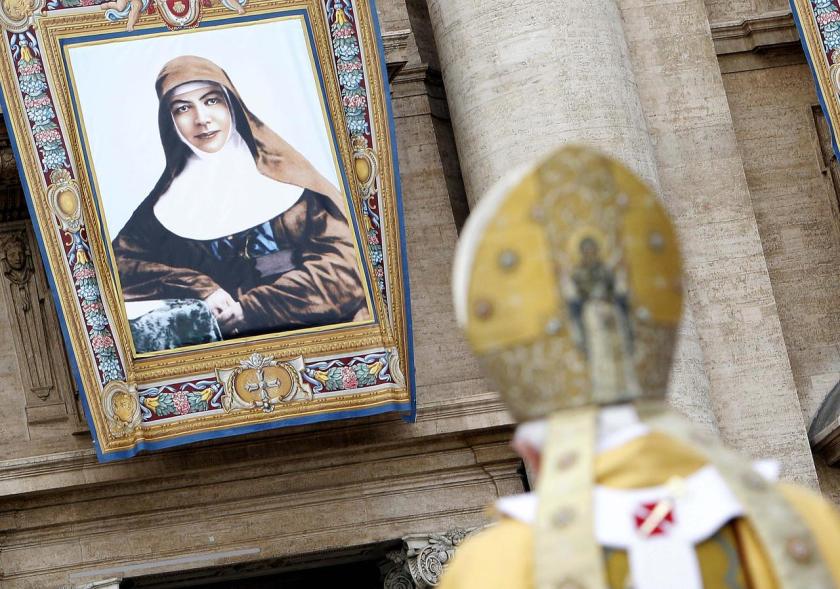
St Mary of the Cross was Canonised on 17 October 2010 by Pope Benedict XVI and is the first native-born Australian Saint.st pope canonisationst mary canonisation 2

Posted in DOMINICAN OP, SAINT of the DAY

Saints of the Day – 8 August

St Dominic de Guzman O.P. (1170-1221) (Memorial) – All about him here: https://anastpaul.wordpress.com/2017/08/08/saint-of-the-day-8-august-st-dominic-de-guzman-founder-of-the-dominican-order-of-preachers/

St Aemilian of Cyzicus
St Altman of Passau
St Cyriacus the Martyr
St Eleutherius of Constantinople
St Ellidius
St Famianus of Compostela
St Gedeon of Besancon
St Hormisdas of Persia
Bl John Felton
Bl John Fingley
St Largus
St Leobald of Fleury
St Leonidas of Constantinople
St Marinus of Anzarba
St Mary of the Cross/ Mary MacKillop (1842-1909) – the first Australian born Saint

St Mummolus of Fleury
St Myron the Wonder Worker
St Paulus Ge Tingzhu
St Rathard of Diessen
St Severus of Vienne
St Sigrada
St Smaragdus
St Ternatius of Besançon
St Ultan of Crayke
Bl William of Castellammare di Stabia
Bl Wlodzimierz Laskowski

Martyrs of Albano – 4 saints: Four Christians who were martyred together, and about we today know little more than their names – Carpóforo, Secondo, Severiano and Vittorino. They were martyred in Albano, Italy – their remains are interred in the San Senator cemetery, on the Appian Way, 15 miles from Rome, Italy.

Martyrs of Rome – 5 saints: Five Christians martyred together; we know nothing else about them but the names – Ciriaco, Crescenziano, Giuliana, Memmia and Smaragdus. They were martyred at the 7 mile marker, on the Via Ostia, Rome, Italy.

Martyred in the Spanish Civil War – Martyrs of El Saler – 5 beati: Five nuns, all members of the Sisters of the Pious Schools, all teachers, and all martyred together in the Spanish Civil War.
• Antonia Riba Mestres
• Maria Baldillou Bullit
• María Luisa Girón Romera
• Nazaria Gómez Lezaun
• Pascuala Gallén Martí
They were martyred on 8 August 1936 in El Saler, Valencia, Spain and Beatified on 11 March 2001 by Pope John Paul II.

Martyred in the Spanish Civil War:
Bl Antero Mateo Garcia
Bl Antonio Silvestre Moya
Bl Cruz Laplana Laguna
Bl Fernando Español Berdie
Bl Leoncio López Ramos
Bl Manuel Aranda Espejo
Bl Mariano Pina Turón
Bl Pedro Álvarez Pérez

Posted in CONTEMPLATIVE Prayer, QUOTES of the SAINTS, QUOTES on PRAYER

Contemplative Prayer – Listening to the Catechism, Part One

Contemplative Prayer – Listening to the Catechism, Part One

2709   What is contemplative prayer?
St Teresa answers: “Contemplative prayer [oracion mental] in my opinion is nothing else than a close sharing between friends;  it means taking time frequently to be alone with Him who we know loves us.”   Contemplative prayer seeks Him “whom my soul loves.”
It is Jesus and in Him, the Father. We seek Him, because to desire Him is always the beginning of love and we seek Him in that pure faith which causes us to be born of Him and to live in Him.
In this inner prayer we can still meditate but our attention is fixed on the Lord Himself.

2710   The choice of the time and duration of the prayer arises from a determined will, revealing the secrets of the heart.
One does not undertake contemplative prayer only when one has the time:  one makes time for the Lord, with the firm determination not to give up, no matter what trials and dryness one may encounter.
One cannot always meditate but one can always enter into inner prayer, independently of the conditions of health, work, or emotional state.
The heart is the place of this quest and encounter, in poverty and in faith.

2711   Entering into contemplative prayer is like entering into the Eucharistic liturgy: we “gather up:” the heart, recollect our whole being under the prompting of the Holy Spirit, abide in the dwelling place of the Lord which we are, awaken our faith in order to enter into the presence of Him who awaits us.
We let our masks fall and turn our hearts back to the Lord who loves us, so as to hand ourselves over to Him as an offering to be purified and transformed.

Christ be in my heart and mind,
Christ within my soul enshrined;
Christ control, my wayward heart;
Christ abide and ne’er depart.


contemplative prayer - ccc part one - 7 august 2018 - christ be in my heart and mind

Posted in MORNING Prayers, SAINT of the DAY

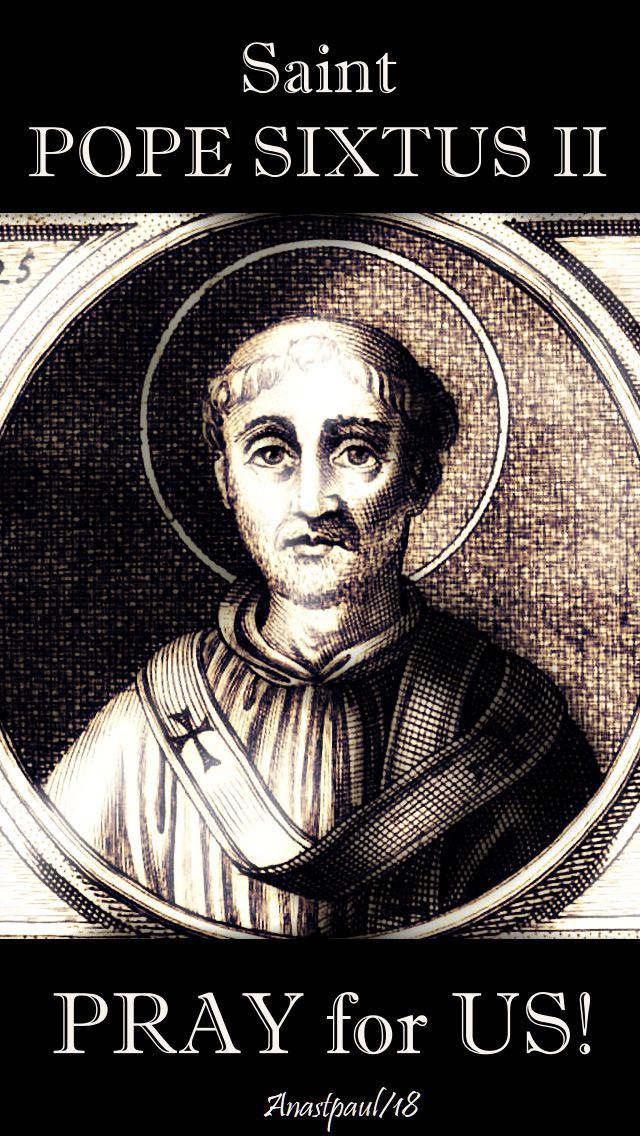
Thought for the Day – 7 August – the Memorial of St Pope Sixtus II (Died 258) Martyr

Thought for the Day – 7 August – the Memorial of St Pope Sixtus II (Died 258) Martyr

On 6 August 258, Sixtus was presiding over a clandestine liturgy in the cemetery of Praetextatus when Roman officials burst in and captured the pontiff and four deacons. An epitaph placed on Sixtus’ tomb a century later by St Pope Damasus I (305-384) recounts the scene:

“At the time when the sword pierced the bowels of the Mother, I, buried here, taught as Pastor the Word of God;   when suddenly the soldiers rushed in and dragged me from the chair.   

The faithful offered their necks to the sword but as soon as the Pastor saw the ones who wished to rob him of the palm (of martyrdom) he was the first to offer himself and his own head, not tolerating that the (pagan) frenzy should harm the others.

Christ, who gives recompense, made manifest the Pastor’s merit, preserving unharmed the flock.”

St Pope Damasus I (305-384)

The Holy Father, embodying our Lord’s command in John 15:13, willingly laid down his very life for his friends, the flock he was called to protect at all costs.   Such a gesture is especially poignant for us as we navigate an increasingly hostile Western society.

The story of Sixtus II and his holy companions should not only stir within us a zeal for our own faith but should teach us the value of staying hope-filled amidst a fallen world. Hope, we ought to remember, isn’t simply bland optimism, but is rather, as Archbishop Charles Chaput put it recently, “Having confidence that the future is in God’s hands.”

Who are we beholden to in this life and just how serious are we about defending them with our own lives?   More to it, when the going gets particularly tough, are we hopeful in our prayer that we’ll have the courage to persevere?   Do we recognise that the Lord is the Divine Ruler of all things and thus will help us through those moments when the situation is bleakest?   Even especially when things look the worst?   (excerpt – Matthew Sewell NC Register)

St Pope Sixtus II, Pray for us!st pope sixtus II pray for us no 2 - 7 aug 2018

Posted in MORNING Prayers, QUOTES of the SAINTS, QUOTES on FAITH, QUOTES on HUMILITY, QUOTES on OBEDIENCE, QUOTES on SANCTITY, SAINT of the DAY, The HOLY EUCHARIST / The HOLY MASS

Quote/s of the Day – 7 August – The Memorial of St Cajetan (1480-1547)

Quote/s of the Day – 7 August – The Memorial of St Cajetan (1480-1547)

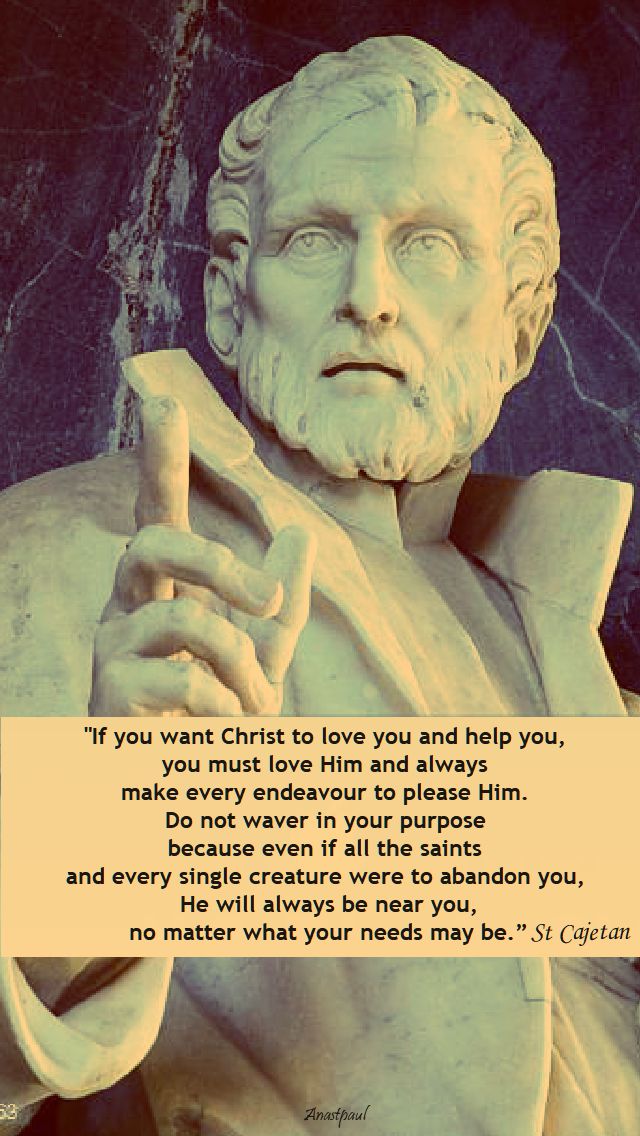
“If you want Christ to love you
and help you, you must love Him
and always make every endeavour to please Him.
Do not waver in your purpose
because even if all the saints
and every single creature were to abandon you,
He will always be near you,
no matter what your needs may be.”if-you-want-christ-to-help-you-st-cajetan-7 aug 2017

“Do not receive Christ in the Blessed Sacrament
so that you may use Him as you judge best
but give yourself to Him
and let Him receive you in this Sacrament,
so that He Himself, God your Saviour,
may do to you and through you, whatever He wills.”

St Cajetan (1480-1547)do not receive christ in the blessed sacrament - st cajetan - 7 august 2018

Posted in MORNING Prayers, PAPAL SERMONS, QUOTES on FAITH, QUOTES on PRAYER, SAINT of the DAY, The WORD

One Minute Reflection – 7 August – Today’s Gospel: Matthew 14:22–36

One Minute Reflection – 7 August – Tuesday of the Eighteenth week in Ordinary Time, Year B – Today’s Gospel: Matthew 14:22–36

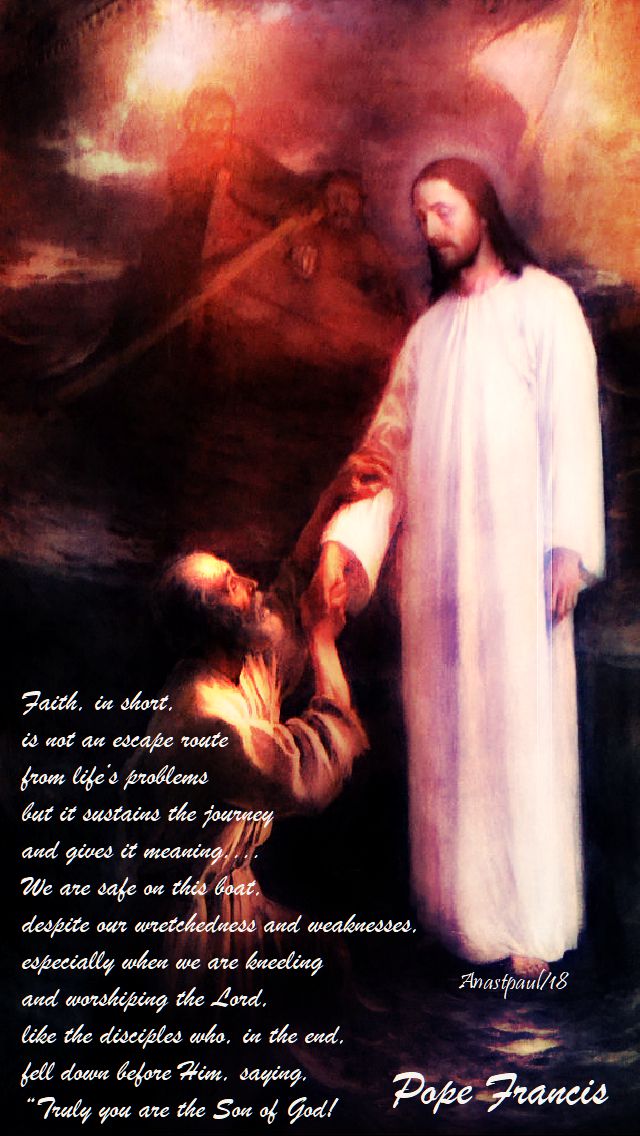
Jesus immediately reached out his hand and caught him, saying to him, “O man of little faith, why did you doubt?”   And when they got into the boat, the wind ceased.   And those in the boat worshipped him, saying, “Truly you are the Son of God.”…Matthew 14:31-33jesus immediately reached out his hand - matthew 14 31-33 - 7 aug 2018

REFLECTION – “Today’s Gospel reminds us that faith in the Lord and in His Word does not open a way for us where everything is easy and calm, it does not rescue us from life’s storms.   Faith gives us the assurance of a Presence, the presence of Jesus who encourages us to overcome the existential tempests, the certainty of a hand that grabs hold of us so as to help us face the difficulties, pointing the way for us even when it is dark.

Faith, in short, is not an escape route from life’s problems but it sustains the journey and gives it meaning.   This episode offers a wonderful image of the reality of the Church throughout the ages – a boat that, as she makes the crossing, must also weather contrary winds and storms which threaten to capsize her.   What saves her are not the courage and qualities of her men, the guarantee against shipwreck is faith in Christ and in his Word.   This is the guarantee, faith in Jesus and in His Word.   We are safe on this boat, despite our wretchedness and weaknesses, especially when we are kneeling and worshipping the Lord, like the disciples who, in the end, fell down before Him, saying, “Truly you are the Son of God!”...Pope Francis – Angelus, 13 August 2017faith in short is not an escape route - pope francis - 7 aug 2018

PRAYER – Almighty God, by the power of the Holy Spirit, You enabled St Pope Sixtus II and his companions to lay down their lives for Your Word and to bear witness to Jesus, never fearing as they were tossed around in the tempest but always trusting in Your saving grace.   Give us a ready and true faith, the courage to profess it and to hold tightly to the hand of Your Son in all of life’s storms.   May the prayers of St Pope Sixtus, his companions and St Cajetan, fill us with strength.   We make our prayer through Christ, our Lord, with the Holy Spirit, one God forever, amen.st pope sixtus II - pray for us - 7 aug 2018st-cajetan-pray-for-us.7 aug 2017


Posted in MORNING Prayers, PRAYERS of the SAINTS, SAINT of the DAY

Our Morning Offering – 6 August – The Memorial of St Cajetan (1480-1547)

Our Morning Offering – 6 August – The Memorial of St Cajetan (1480-1547)

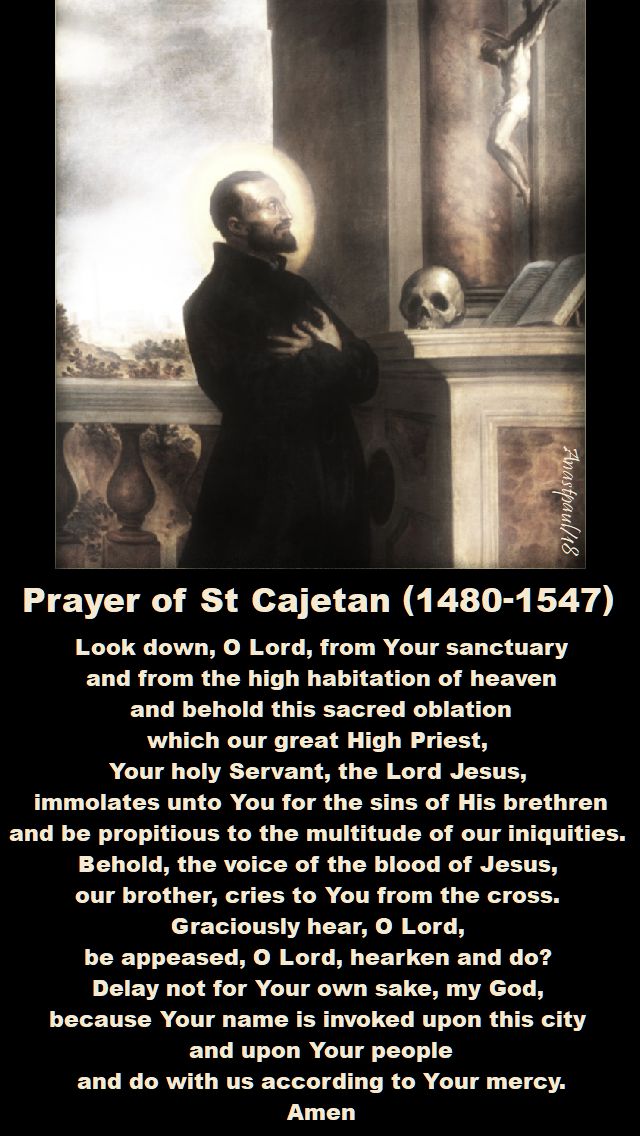
Look down, O Lord
Prayer of St Cajetan (1480-1547)

Look down, O Lord, from Your sanctuary
and from the high habitation of heaven
and behold this sacred oblation
which our great High Priest,
Your holy Servant, the Lord Jesus,
immolates unto You for the sins of His brethren
and be propitious to the multitude of our iniquities.
Behold, the voice of the blood of Jesus,
our brother, cries to You from the cross.
Graciously hear, O Lord,
be appeased, O Lord, hearken and do?
Delay not for Your own sake, my God,
because Your name is invoked upon this city
and upon Your people
and do with us according to Your mercy.
Amenlook down o lord - prayer of st cajetan - 7 aug 2018

Posted in SAINT of the DAY

Saint of the Day – 7 August – St Pope Sixtus II Martyr

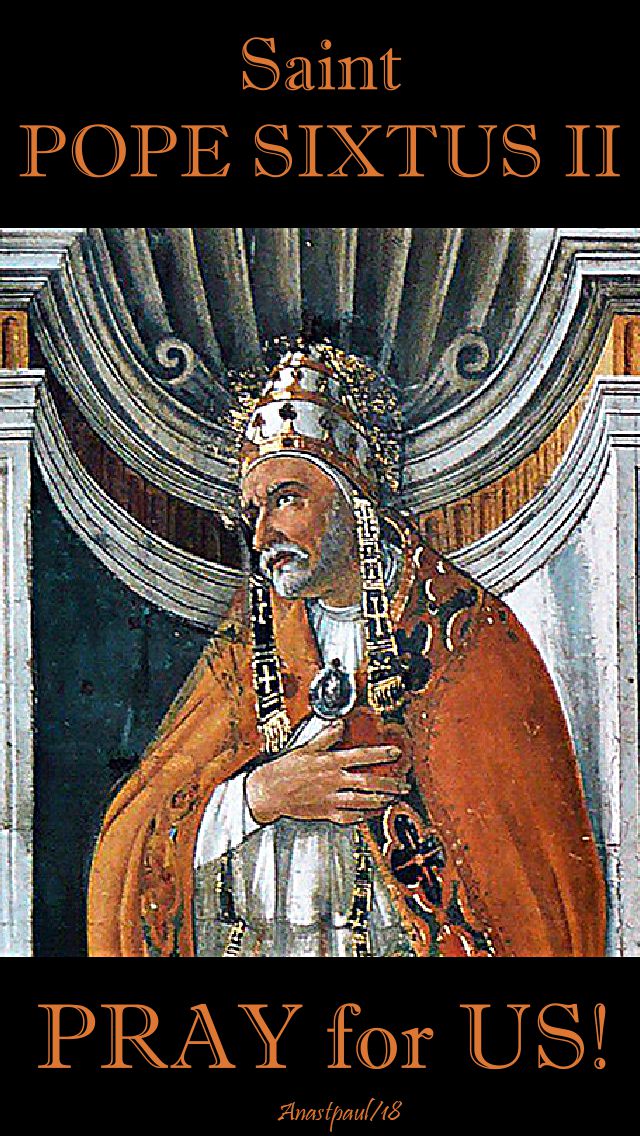
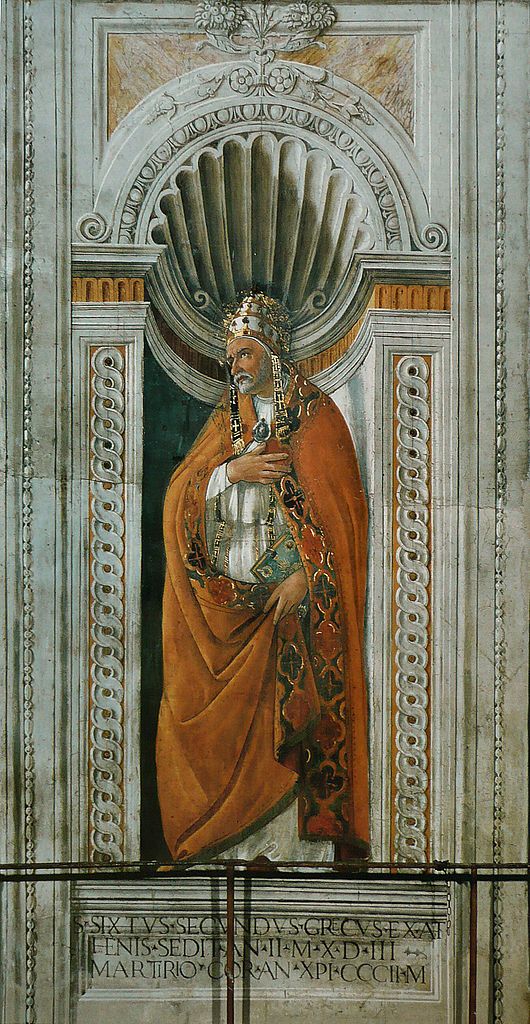
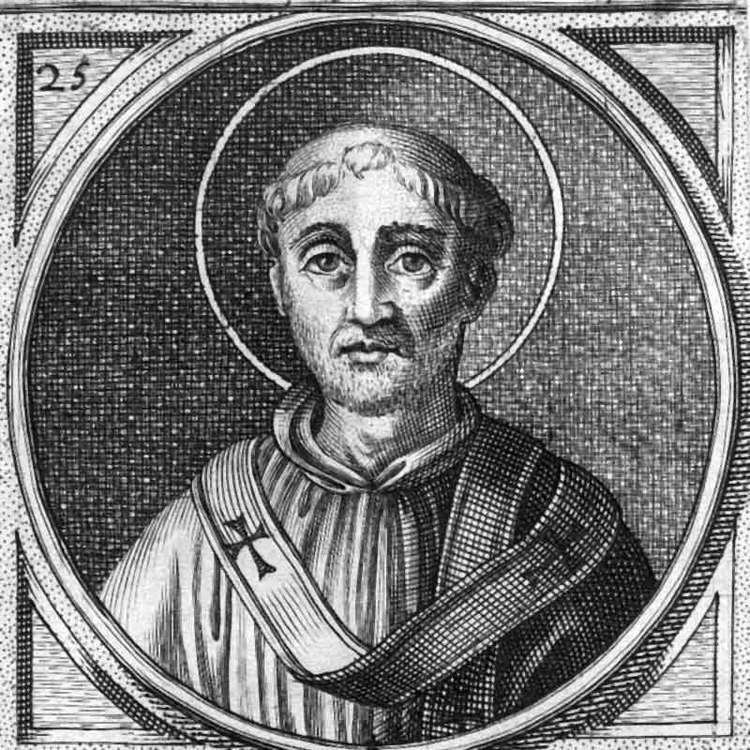
Saint of the Day – 7 August – St Pope Sixtus II Martyr was the Bishop of Rome from 31 August 257 until his death on 6 August 258.   He was martyred along with seven deacons, including St Lawrence of Rome during the persecutions of Christianity by Emperor Valerian.   This is the St Sixtus who is commemorated in the Eucharistic Prayer.

530px-Sandro_Botticelli_-_Sixte_II

Even as the storm of persecution created by Emperor Valerian raged against the Church, the papal throne was not vacant.   Sixtus, a Greek, was elected to succeed Stephen.   The emperor’s decrees had ordered the Christians to take part in state religious ceremonies and forbade them to assemble in cemeteries.   For nearly a year Sixtus managed to evade the authorities before he was gloriously martyred.pope-sixtus-ii-d5dfa3a0-606a-44e4-9d83-97aa13c6a1b-resize-750

Valerian issued his second edict ordering the execution of Christian bishops, priests and deacons.   Sixtus had taken to holding services in the private cemetery of Praetextatus because it was not watched as closely by the authorities as was the cemetery of Calixtus. But in early August of 258, while Sixtus was seated on his episcopal chair and surrounded by the brethren, the soldiers broke in arresting Sixtus and four deacons who were in attendance.   After a formal judgement, Sixtus was led back to the very place where he had been arrested, to face execution.   His chief deacon St Lawrence, upon hearing the news, hastened to his side, desiring to die with his bishop.   Sixtus consoled his deacon by telling him that he would follow in three days with even greater glory.   The soldiers then placed Sixtus in his chair and swiftly beheaded him.   True to the great pope’s words, Lawrence was arrested three days later and executed the same day.   The remains of Sixtus were transferred by the Christian faithful to the Papal Crypt in the neighbouring cemetery of St Callistus.   Behind his tomb was enshrined the bloodstained chair on which he had been beheaded.

Posted in SAINT of the DAY

Memorials of the Saints – 7 August

St Pope Sixtus II (Died 258) Martyr (Optional Memorial)
St Cajetan (1480-1547) (Optional Memorial)
https://anastpaul.wordpress.com/2017/08/07/saint-of-the-day-7-august-st-cajetan-founder-of-the-theatine-order-the-father-of-providence/

St Afra of Augsburg
Bl Agathangelus Nourry
St Albert of Sicily
Bl Cassian Vaz Lopez-Neto
St Claudia of Rome
St Donat
St Donatian of Chalons-sur-Marne
St Donatus of Arezzo
St Donatus of Besancon
Bl Edmund Bojanowski
Bl Edward Bamber
St Faustus of Milan
St Hilarinus of Ostia
St Hyperechios
Bl John Woodcock
Bl Jordan Forzatei
St Julian of Rome
St Miguel de la Mora
Bl Nicholas Postgate
St Peter of Rome
Bl Thomas Whitaker
St Victricius of Rouen

Martyred Deacons of Rome – 6 saints: A group of deacons who were martyred with Pope Saint Sixtus II. We know nothing about them but their names and their deaths – Agapitus, Felicissimus, Januarius, Magnus, Stephen and Vincent. They were
beheaded on 6 August 258 in a cemetery on the Appian Way, Rome, Italy.

Martyrs of Como – 6 saints: A group of Christian soldiers in the imperial Roman army. Martyred in the persecutions of Maximian. We know little else but the names – Carpophorus, Cassius, Exanthus, Licinius, Secundus and Severinus. c.295 on the north side of Lake Como, near Samolaco, Italy. Their relics in the church of San Carpoforo, Como, Italy.

Martyred in the Spanish Civil War: 10 Beati
Dalmacio Bellota Perez
Diodorus Hernando Lopez
Francisco Gargallo Gascón
Joan Baptista Urgell Coma
Luis Villanueva Montoya
María del Carmen Zaragoza y Zaragoza
María Rosa Adrover Martí
Rafaél Severiano Rodríguez Navarro
Tomás Carbonell Miquel
Isabel Remiñán Carracedo

Posted in MARIAN PRAYERS, MORNING Prayers, PAPAL SERMONS, SAINT of the DAY, The TRANSFIGURATION

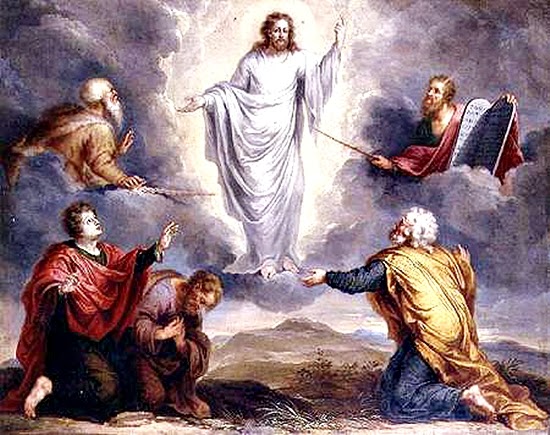
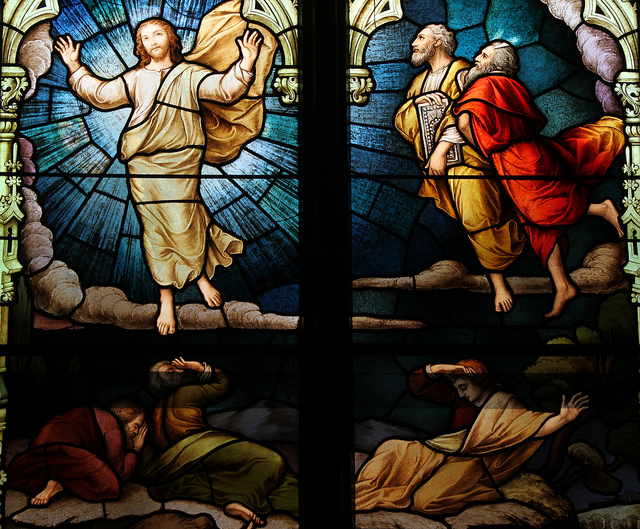
Thought for the Day – 6 August – Feast of the Transfiguration of the Lord – Today’s Gospel: Mark 9:2–10

Thought for the Day – 6 August – Feast of the Transfiguration of the Lord – Today’s Gospel: Mark 9:2–10

This invitation from the Father is very important. We, the disciples o  f Jesus, are called to be people who listen to His voice and take His words seriously.   To listen to Jesus, we must be close to Him, to follow Him, like the crowd in the Gospel who chase Him through the streets of Palestine.

Jesus did not have a teaching post or a fixed pulpit, He was an itinerant teacher, who proposed His teachings, teachings given to Him by the Father, along the streets, covering distances that were not always predictable or easy.   Follow Jesus in order to listen to Him.   But also let us listen to Jesus in His written Word, in the Gospel.   I pose a question to you: do you read a passage of the Gospel everyday?   Yes, no… yes, no… half of the time … some yes, some no.   It is important!   Do you read the Gospel?   It is so good;  it is a good thing to have a small book of the Gospel, a little one and to carry in our pocket or in our purse and read a little passage in whatever moment presents itself during the day.   In any given moment of the day I take the Gospel from my pocket and I read something, a short passage. Jesus is there and He speaks to us in the Gospel!   Ponder this. It’s not difficult, nor is it necessary to have all four books: one of the Gospels, a small one, with us.   Let the Gospel be with us always, because it is the Word of Jesus in order for us to be able to listen to Him.

From the event of the Transfiguration I would like to take two significant elements that can be summed up in two words:  ascent and descent.   We all need to go apart, to ascend the mountain in a space of silence, to find ourselves and better perceive the voice of the Lord.   This we do in prayer.   But we cannot stay there!   Encounter with God in prayer inspires us anew to “descend the mountain” and return to the plain where we meet many brothers weighed down by fatigue, sickness, injustice, ignorance, poverty both material and spiritual.   To these brothers in difficulty, we are called to bear the fruit of that experience with God, by sharing the grace we have received.
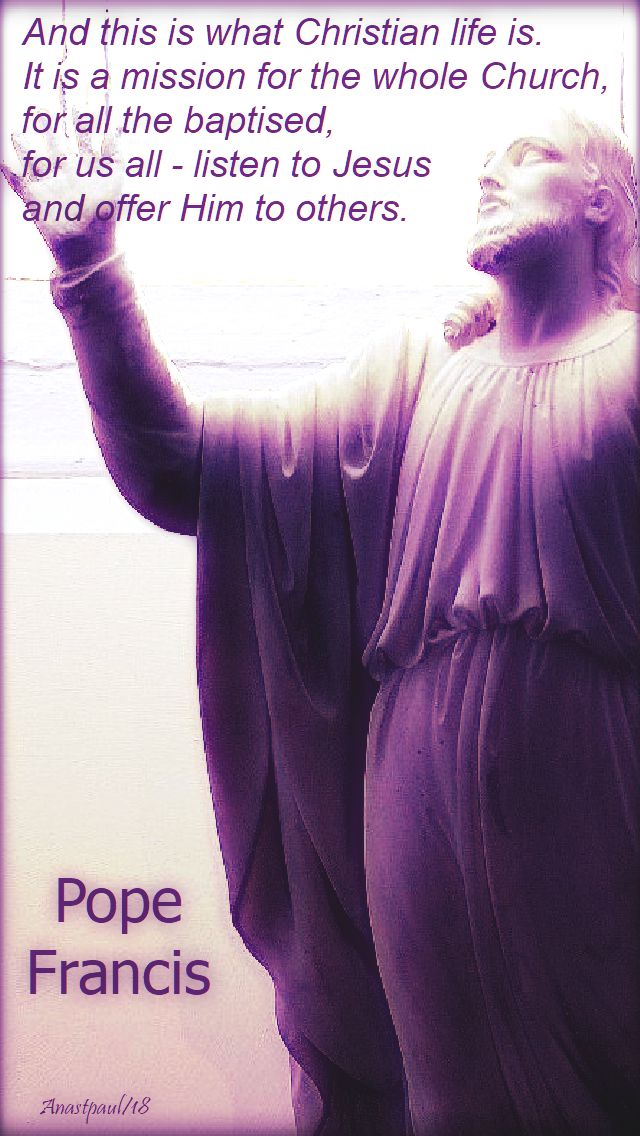
And this is curious.   When we hear the Word of Jesus, when we listen to the Word of Jesus and carry it in our heart, this Word grows.   Do you know how it grows?   By giving it to the other!   The Word of Christ grows in us when we proclaim it, when we give it to others!   And this is what Christian life is.   It is a mission for the whole Church, for all the baptised, for us all – listen to Jesus and offer Him to others.
Do not forget!   this week listen to Jesus!   And think about the matter of the Gospel, will you?   Will you do this?   Then next Sunday you tell me if you have done this, that you have a little book of the Gospel in your pocket or in your purse to read in little stages throughout the day.and this is what the christian life is listen to jesus and offer him to others - transfiguration 2 - 6 aug 2018

And now let us turn to our Mother Mary and entrust ourselves to her guidance in pursuing with faith and generosity this path of …., learning a little more how to “ascend” with prayer and listen to Jesus and to “descend” with brotherly love, proclaiming Jesus.

Pope Francis -16 March 2014blessed virgin mary - pray for us - 25 may 2018

Posted in FATHERS of the Church, FEASTS and SOLEMNITIES, MORNING Prayers, QUOTES of the SAINTS, SAINT of the DAY, The TRANSFIGURATION

Quote of the Day – 6 August – Feast of the Transfiguration of the Lord – Today’s Gospel: Mark 9:2–10

Quote of the Day – 6 August – Feast of the Transfiguration of the Lord – Today’s Gospel: Mark 9:2–10

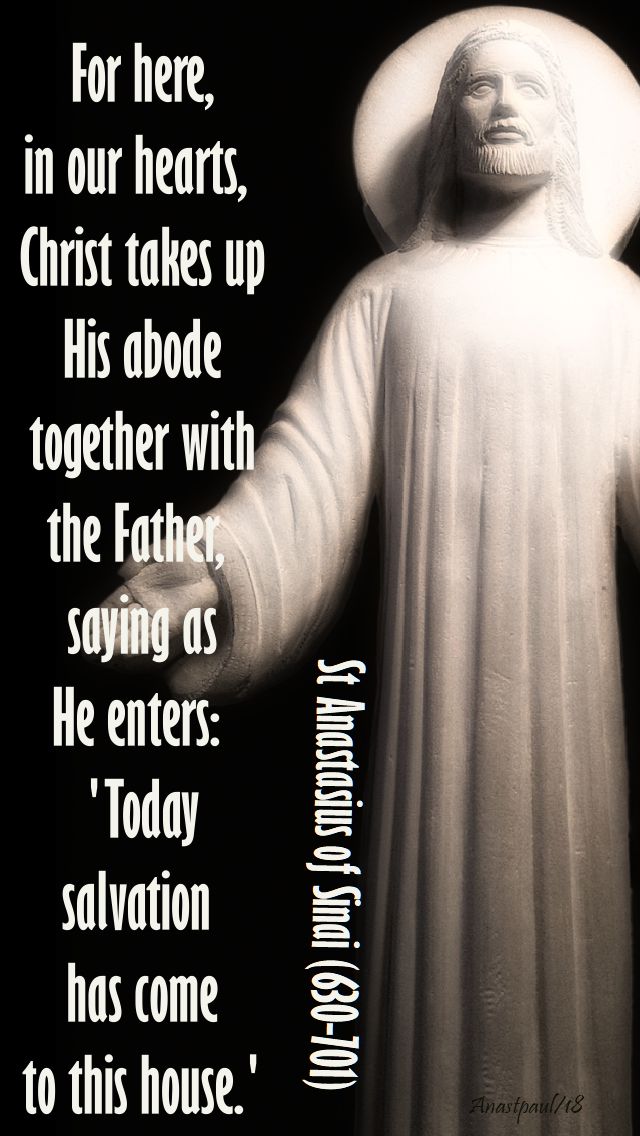
It is indeed good to be here, as you have said, Peter.   It is good to be with Jesus and to remain here for ever. What greater hap  piness or higher honour could we have than to be with God, to be made like Him and to live in His light?

Therefore, since each of us possesses God in his heart and is being transformed into His divine image, we also should cry out with joy:
It is good for us to be here – here where all things shine with divine radiance, where there is joy and gladness and exultation; where there is nothing in our hearts but peace, serenity and stillness;  where God is seen.
For here, in our hearts, Christ takes up His abode together with the Father, saying as He enters:  Today salvation has come to this house.

With Christ, our hearts receive all the wealth of His eternal blessings and there where they are stored up for us in Him, we see reflected as in a mirror both the first fruits and the whole of the world to come.

St Anastasius of Sinai (630-701)

for here, christ takes up his abode - transfiguration homily - st anastasius of sinai - 6 aug 2018

Posted in BREVIARY Prayers, FEASTS and SOLEMNITIES, MORNING Prayers, PAPAL SERMONS, SAINT of the DAY, The TRANSFIGURATION, The WORD

One Minute Reflection 6 August – Feast of the Transfiguration of the Lord – Today’s Gospel: Mark 9:2–10

One Minute Reflection 6 August – Feast of the Transfiguration of the Lord – Today’s Gospel: Mark 9:2–10

And a cloud overshadowed them, and a voice came out of the cloud, “This is my beloved Son; listen to him.”...Mark 9:7this is my beloved son listen to him mark 9 7 - 6 aug 2018

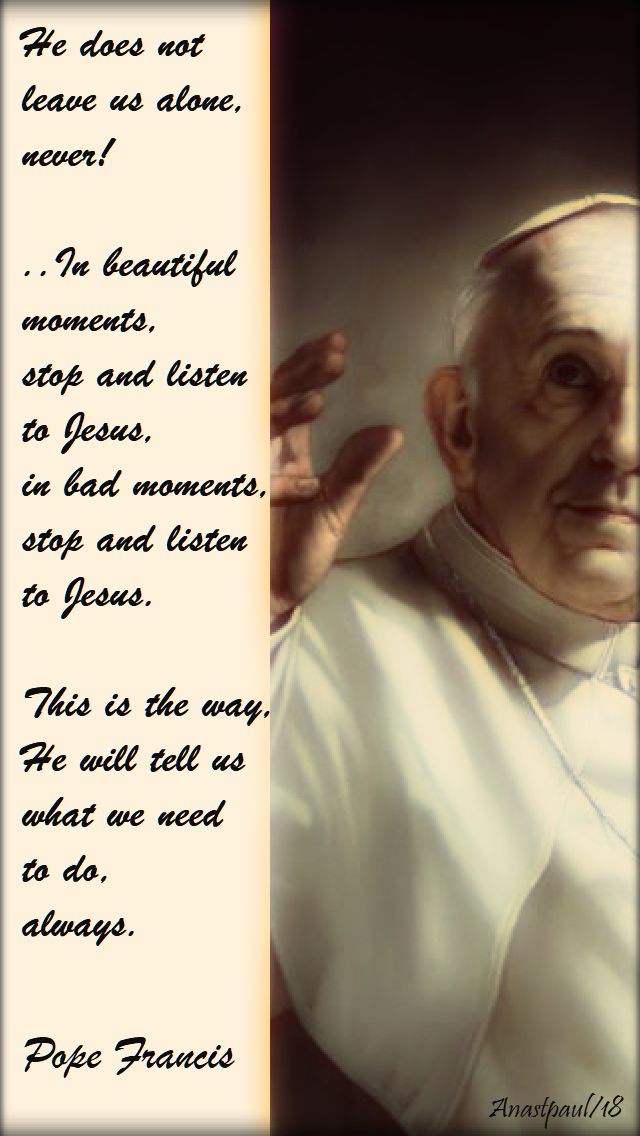
REFLECTION – …”And the path of Jesus is another, Jesus triumphs through humiliation, the humiliation of the cross.   But, as this would be a scandal for them, Jesus lets them see what will come next, what is after cross, what awaits us, all of us.   This glory and this heaven.   And this is very beautiful, very beautiful because Jesus and this feels good, always prepares us for the test.   In one way or another but this is the message.   It always prepares us.   It gives us the strength to go on in moments of trial and to win with its strength.   Jesus does not leave us alone in the trials of life, He always prepares us, He helps us as He prepares these (the disciples) with the vision of His glory.   And so they remembered this moment, to bear the weight of the humiliation.   And this is the first thing that the church teaches, that Jesus always prepares us and rehearses with us.   He does not leave us alone, never!
“This is my beloved son.   Listen to him.” This is the message which the Father gives to the Apostles, the message of Jesus prepares them to see His glory, the message of the Father is “Listen to him.”   There is no moment in life which cannot be fully lived by listening to Jesus.   In beautiful moments, stop and listen to Jesus, in bad moments, stop and listen to Jesus.   This is the way, He will tell us what we need to do, always.”…Pope Francis 25 February 2018he does not leave us alone never - pope francis - transfiguration homily feb 2018 - 6 aug 2018

PRAYER – Father, at the Transfiguration in glory of Your only-begotten Son, You confirmed the mysteries of faith by the witness to Jesus of the prophets Moses and Elijah. You foreshadowed what we shall be when You bring our sonship to its perfection.   Grant that by listening to the voice of Jesus, we may become heirs with Him, who lives and reigns with You and the Holy Spirit, God forever and may Mary, our tender and caring Mother, help us to be bright rays of the saving light of her Son Jesus. Amenmary beloved mother-pray for us all

Posted in BREVIARY Prayers, CATHOLIC-PRAYERS OF THE CHURCH, FEASTS and SOLEMNITIES, HYMNS, MORNING Prayers, SAINT of the DAY, The TRANSFIGURATION

Our Morning Offering – 6 August – Feast of the Transfiguration of the Lord

Our Morning Offering – 6 August – Feast of the Transfiguration of the Lord

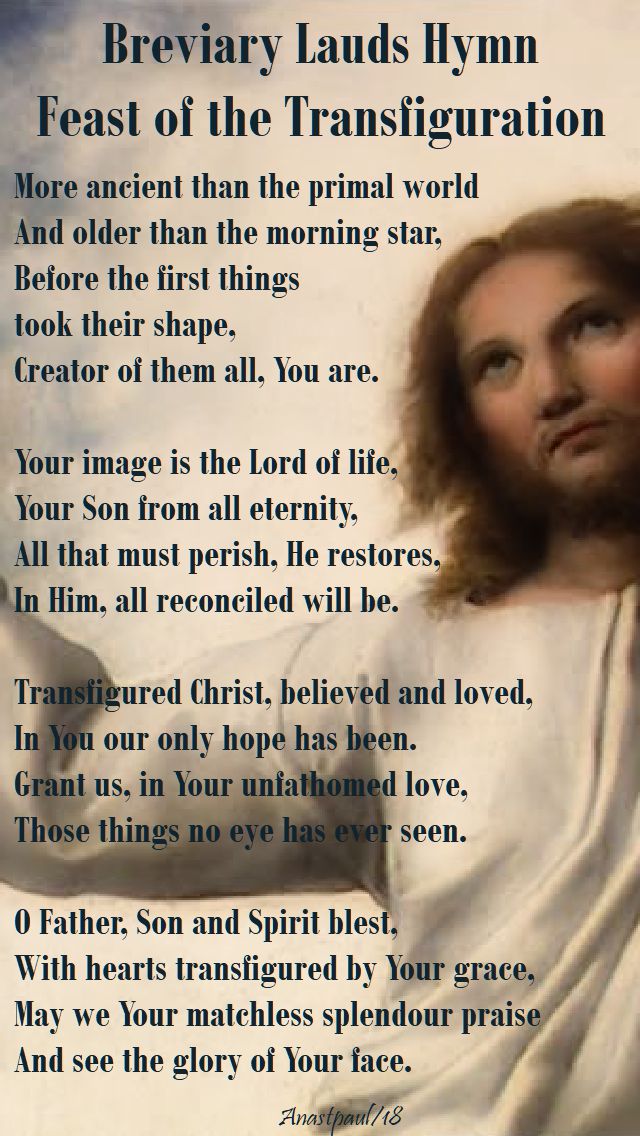
Breviary Lauds Hymn
Feast of the Transfiguration

More ancient than the primal world
And older than the morning star,
Before the first things took their shape,
Creator of them all, You are.

Your image is the Lord of life,
Your Son from all eternity,
All that must perish, He restores,
In Him, all reconciled will be.

Transfigured Christ, believed and loved,
In You our only hope has been.
Grant us, in Your unfathomed love,
Those things no eye has ever seen.

O Father, Son and Spirit blest,
With hearts transfigured by Your grace,
May we Your matchless splendour praise
And see the glory of Your face.breviary lauds hymn for the transfiguration - 6 august 2018

Posted in MORNING Prayers, ON the SAINTS, PAPAL SERMONS, QUOTES of the SAINTS, SAINT of the DAY, The TRANSFIGURATION

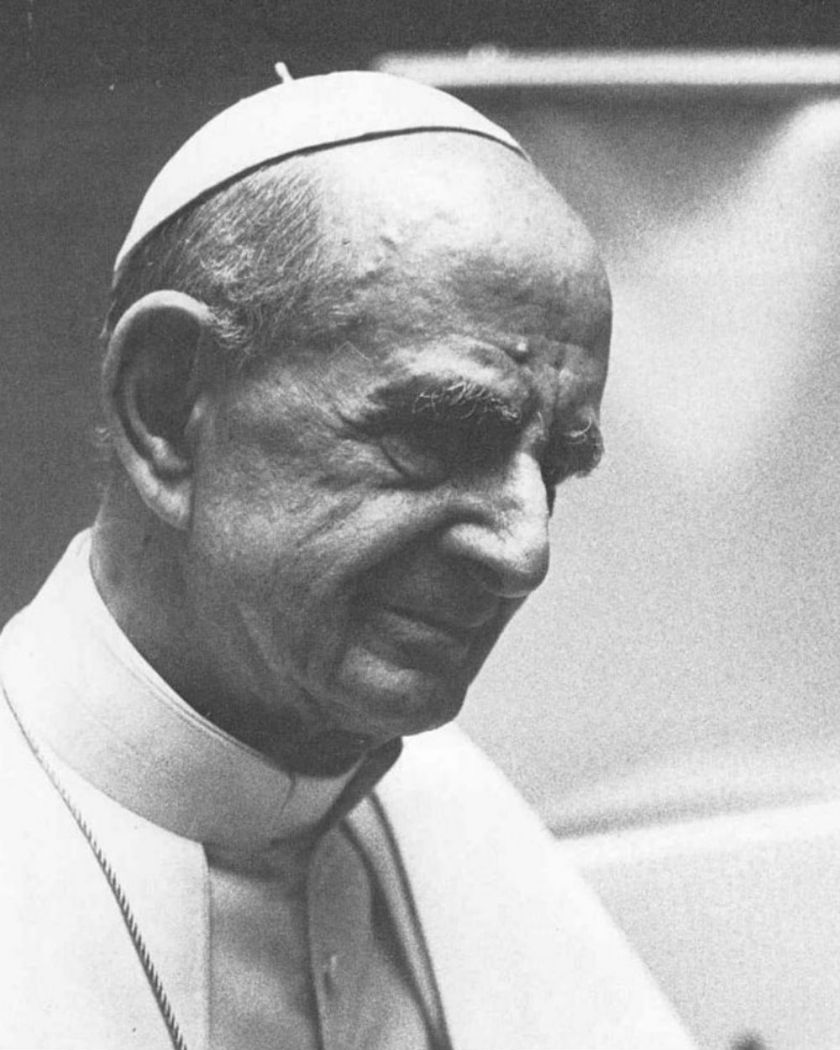
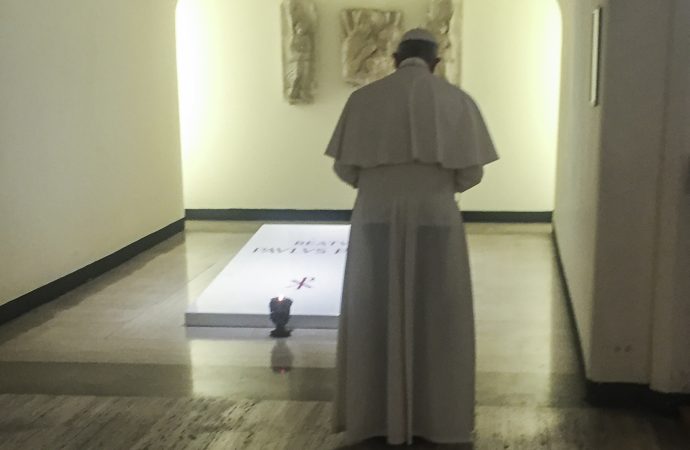
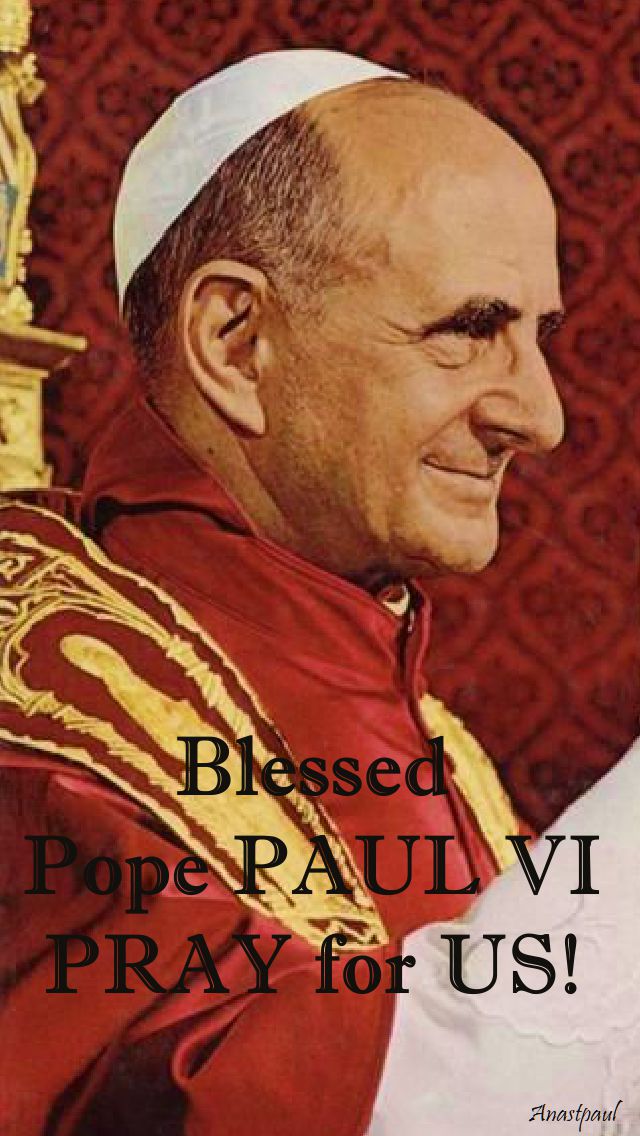
6 August, Feast of the Transfiguration of the Lord and the 40th Anniversary of the Death of Blessed Pope Paul VI (1897-1978)

6 August, Feast of the Transfiguration of the Lord

and the 40th Anniversary of the Death of Blessed Pope Paul VI (1897-1978) – Feast Day 26 September

Sunday 6 August 2000 – St Pope John Paul on the 22nd Anniversary of the death of Blessed Paul VI

“We are preparing to celebrate Holy Mass on the feast of the Transfiguration of the Lord, cherishing in our hearts the ever-living memory of the Servant of God Paul VI, 22 years after his “going forth” to eternity.

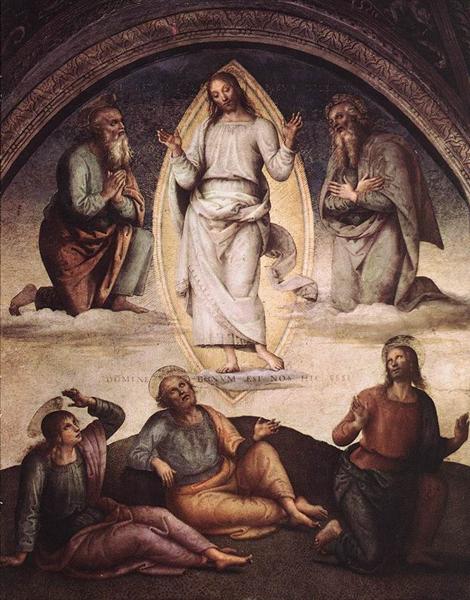
Today’s liturgy invites us to turn our gaze to the face of the Son of God who, as the Synoptics unanimously attest, is transfigured on the mountain before Peter, James and John, while the Father’s voice proclaims from the cloud:  “This is my beloved Son; listen to him” (Mk 9: 7).   St Peter will recall the event with emotion, saying: “We were eyewitnesses of his majesty” (2 Pt 1: 16).

In our era, pervaded by the so-called “image culture”, the desire to be able fill one’s eyes with the figure of the divine Master becomes more intense but it is appropriate to recall his words:  “Blessed are those who have not seen and yet believe” (Jn 20: 29).   It was precisely with his eyes of faith fixed on the adorable face of Christ, true man and true God, that the revered and unforgettable Paul VI lived.   Contemplating him with burning and impassioned love, he said:  “Christ is beauty, human and divine beauty, the beauty of reality, of truth, of life” (General Audience, 13 January 1971).   And he added: “The figure of Christ presents, over and above the charm of his merciful gentleness, an aspect which is grave and strong, formidable, if you like, when dealing with cowardice, hypocrisy, injustice and cruelty but never lacking a sovereign aura of love”   (General Audience, 27 January 1971).Paulo_VI

As we approach the altar with grateful hearts, praying for the blessed soul of this great Pontiff, we also wish, like him and like the disciples, to turn our gaze to the radiant face of the Son of God to be illumined by it.   Let us ask God, through the intercession of Mary, Teacher of faith and contemplation, to enable us to receive within us, the light that shines brightly on the face of Christ, so that we may reflect its image on everyone we meet.”SP-PAOLO-VI-1-690x450

“Forty years ago, Blessed Paul VI was living his last hours on earth.   In fact, he died on the evening of 6 August 1978,” Francis recounted.   “We remember him with so much veneration and gratitude while awaiting his Canonisation next October 14.   From Heaven, may he intercede for the Church, which he so loved and for peace in the world.   We all greet with applause this great Pope of modernity!”...Pope Francis 5 August 2018 .

Blessed Pope Paul VI, Pray for us!

blessed pope paul vi - pray for us.2

Posted in FEASTS and SOLEMNITIES, SAINT of the DAY, The TRANSFIGURATION

Feast of the Transfiguration of the Lord – 6 August – Today’s Gospel: Mark 9:2-10

Feast of the Transfiguration of the Lord – 6 August – Today’s Gospel:  Mark 9:2-10

All three Synoptic Gospels tell the story of the Transfiguration (Matthew 17:1-8; Mark 9:2-9; Luke 9:28-36).   With remarkable agreement, all three place the event shortly after Peter’s confession of faith that Jesus is the Messiah and Jesus’ first prediction of his passion and death.   Peter’s eagerness to erect tents or booths on the spot suggests it occurred during the week-long Jewish Feast of Booths in the fall.Tullow_Church_of_the_Most_Holy_Rosary_South_Transept_Window_Mysteries_of_Light_and_Pope_John_Paul_II_Detail_Transfiguration_2013_09_06

According to Scripture scholars, in spite of the texts’ agreement it is difficult to reconstruct the disciples’ experience, because the Gospels draw heavily on Old Testament descriptions of the Sinai encounter with God and prophetic visions of the Son of Man.   Certainly Peter, James and John had a glimpse of Jesus’ divinity strong enough to strike fear into their hearts.   Such an experience defies description, so they drew on familiar religious language to describe it.   And certainly, Jesus warned them, that His glory and His suffering were to be inextricably connected—a theme John highlights throughout his Gospel.Transfiguration

Tradition names Mount Tabor as the site of the revelation.   A church first raised there in the fourth century was dedicated on 6 August.   A feast in honour of the Transfiguration was celebrated in the Eastern Church from about that time.   Western observance began in some localities about the eighth century.the-transfiguration.Pietro Perugino

On 22 July 1456, Crusaders defeated the Turks at Belgrade.   News of the victory reached Rome on 6 August and Pope Callistus III placed the feast on the Roman calendar the following year.

One of the Transfiguration accounts is read on the second Sunday of Lent each year, proclaiming Christ’s divinity to the Elect and baptised alike.   The Gospel for the first Sunday of Lent, by contrast, is the story of the temptation in the desert—affirmation of Jesus’ humanity.

More here:  https://anastpaul.wordpress.com/2017/08/06/august-6-the-feast-of-the-transfiguration-of-the-lord/transfiguration 2transfiguration in art

Posted in FEASTS and SOLEMNITIES, SAINT of the DAY

Feast of the Transfiguration of Our Lord and Memorials of the Saints – 6 August

Transfiguration of Our Lord (Feast)
https://anastpaul.wordpress.com/2017/08/06/august-6-the-feast-of-the-transfiguration-of-the-lord/
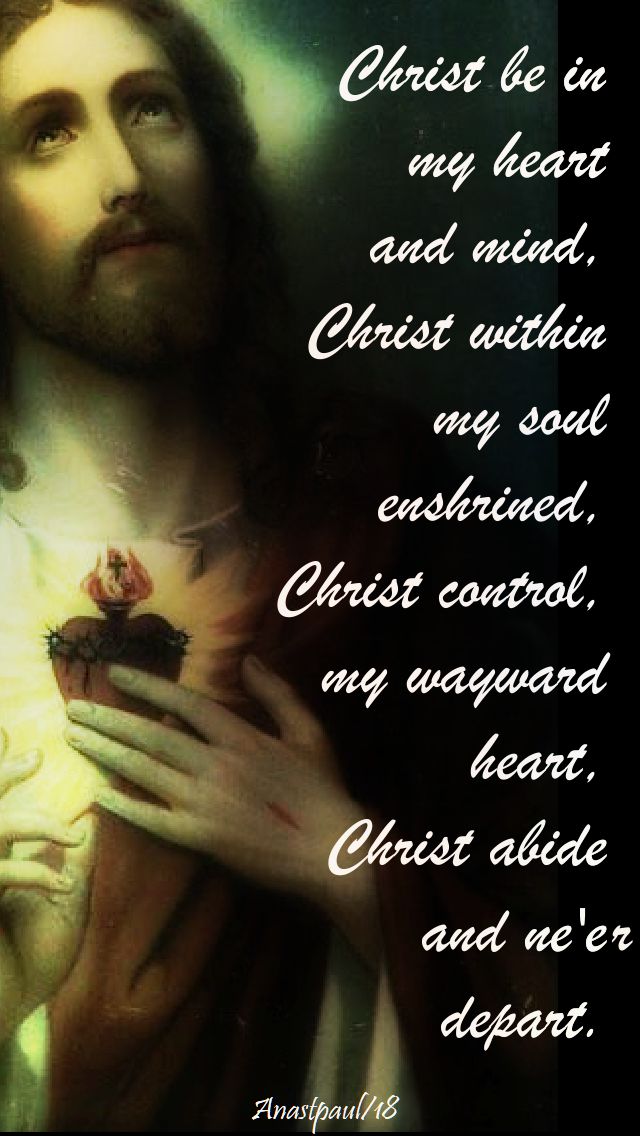
Bl Gezelin of Schlebusch
St Gislain of Luxemburg
St Glisente of Brescia
Bl Goderanno
Bl Guillermo Sanz
St Hardulf of Breedon
St Pope Hormisdas
St James the Syrian
St Justus of Alcala
Bl Maria Francesca Rubatto
Bl Octavian of Savona
St Pastor of Alcala
St Stephen of Cardeña
Bl Tadeusz Dulny
Bl William of Altavilla

Martyrs of Cardeña: Two hundred Benedictine monks at the Saint Peter of Cardegna monastery, Burgos, Spain who were martyred in the 8th century by invading Saracens. They were buried by local Christians in a nearby churchyard in Burgos, Spain and Beatified in 1603 by Pope Clement VIII (cultus confirmed).

Martyred in the Spanish Civil War: 10 Beati
• Blessed Alejandro Casare Menéndez
• Blessed Andrés Soto Carrera
• Blessed Antoni Serra Hortal
• Blessed Carlos López Vidal
• Blessed Francesc Vives Antich
• Blessed José González Ramos Campos
• Blessed José María Recalde Magúregui
• Blessed Juan Silverio Pérez Ruano
• Blessed Pau Bertrán Mercadé
• Blessed Saturnino Ortega Montealegre