Posted in franciscan OFM, HOLY WEEK, MORNING Prayers, QUOTES of the SAINTS, The HOLY CROSS, The PASSION

Quote of the Day – 26 March 2018 – Monday of Holy week

Quote of the Day – 26 March 2018 – Monday of Holy week

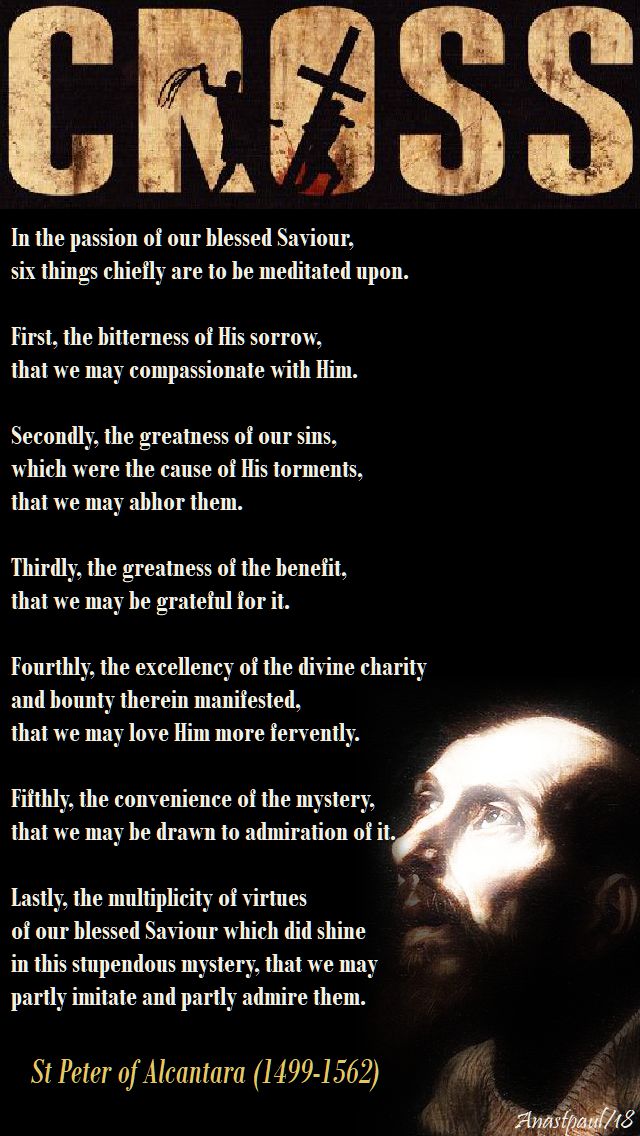
“In the passion of our blessed Saviour,
six things chiefly are to be meditated upon.

First, the bitterness of His sorrow,
that we may compassionate with Him.

Secondly, the greatness of our sins,
which were the cause of His torments,
that we may abhor them.

Thirdly, the greatness of the benefit,
that we may be grateful for it.

Fourthly, the excellency of the divine charity
and bounty therein manifested,
that we may love Him more fervently.

Fifthly, the convenience of the mystery,
that we may be drawn to admiration of it.

Lastly, the multiplicity of virtues
of our blessed Saviour which did shine
in this stupendous mystery, that we may
partly imitate and partly admire them.”

St Peter of Alcantara (1499-1562)in the passion of our blessed saviour, six things - st peter of alcantara - 26 march 2018

Posted in HOLY WEEK, MORNING Prayers, QUOTES of the SAINTS, QUOTES on CONVERSION, QUOTES on REPENTANCE, QUOTES on SANCTITY, QUOTES on SIN, QUOTES on SUFFERING, SAINT of the DAY, The HOLY CROSS, The PASSION

One Minute Reflection – 26 March 2018 – Monday of Holy week and the Memorial of St Braulio (590-651)

One Minute Reflection – 26 March 2018 – Monday of Holy week and the Memorial of St Braulio (590-651)

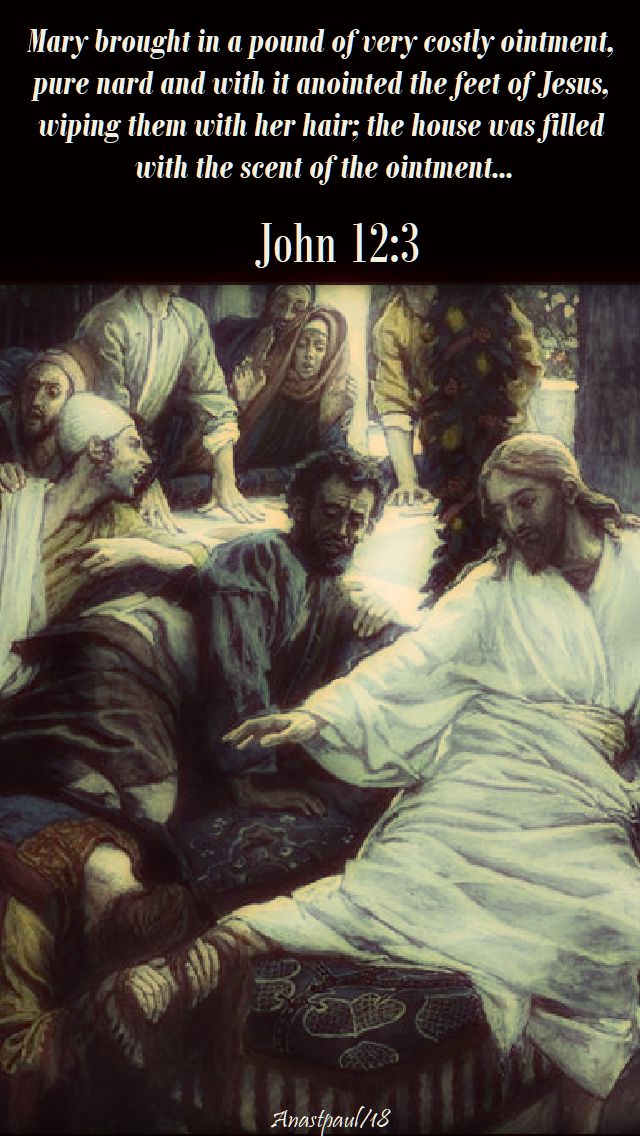
Mary brought in a pound of very costly ointment, pure nard, and with it anointed the feet of Jesus, wiping them with her hair; the house was filled with the scent of the ointment…John 12:3

john 12 3

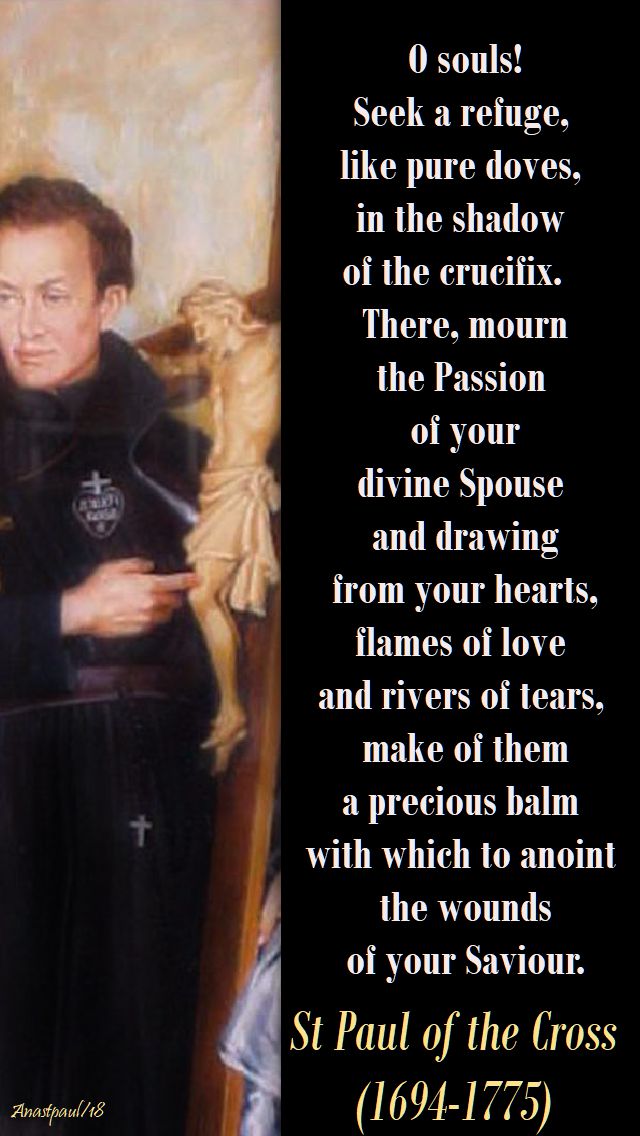
REFLECTION – “O souls! Seek a refuge, like pure doves, in the shadow of the crucifix. There, mourn the Passion of your divine Spouse and drawing from your hearts flames of love and rivers of tears, make of them a precious balm with which to anoint the wounds of your Saviour.”…St Paul of the Cross (1694-1775)o souls, seek a refuge - st paul of the cross - 26 march 2018

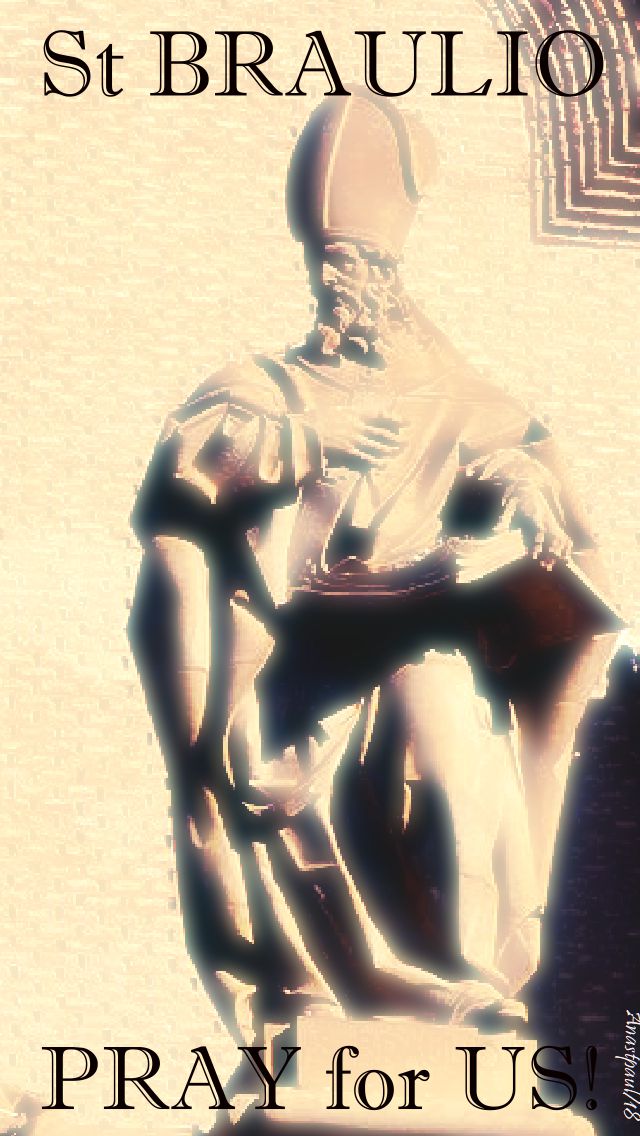
PRAYER – Almighty God, grant that we who are constantly betrayed by our own weakness, may draw the breath of new life from the passion and death of Your only-begotten Son.   St Braulio, you who worked so zealously to assist those in weakness, both in body and soul, please pray for us too.   Through our Lord and Saviour, who suffered and died for us, in unity with the Holy Spirit, one God forever, amen.st braulio - pray for us - 26 march 2018

Posted in HOLY WEEK, MORNING Prayers, PRAYERS of the SAINTS

Our Morning Offering – 26 March 2018 – Monday of Holy week

Our Morning Offering – 26 March 2018 – Monday of Holy week

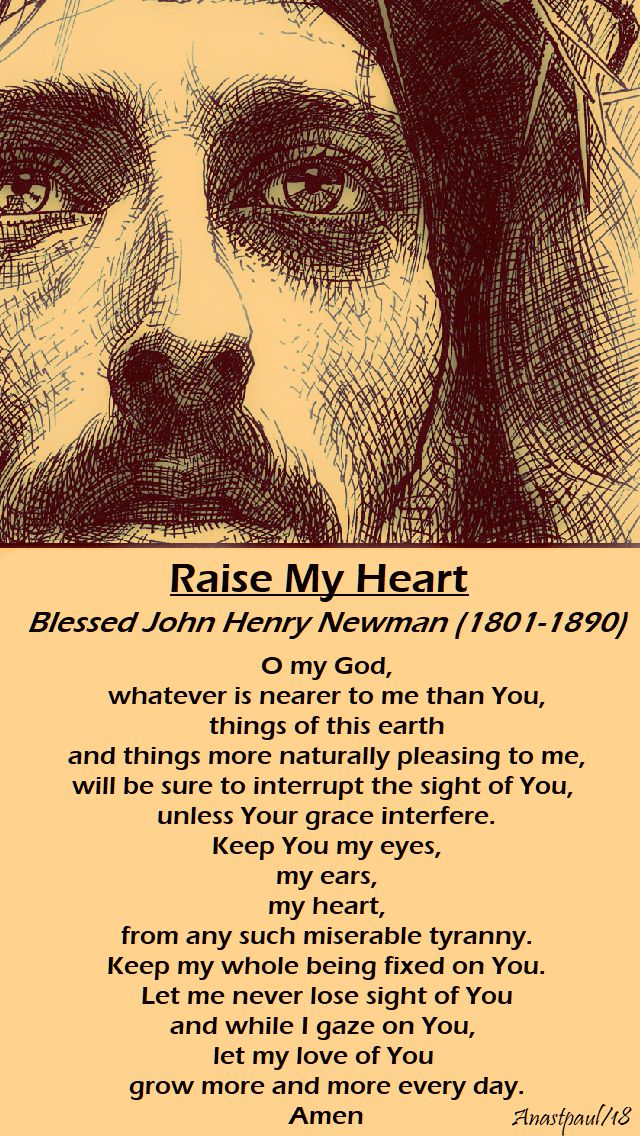
Raise My Heart
Blessed John Henry Newman (1801-1890)

O my God,
whatever is nearer to me than You,
things of this earth
and things more naturally pleasing to me,
will be sure to interrupt the sight of You,
unless Your grace interfere.
Keep You my eyes,
my ears,
my heart,
from any such miserable tyranny.
Keep my whole being fixed on You.
Let me never lose sight of You
and while I gaze on You,
let my love of You
grow more and more every day.
Amenraise my heart - bl john henry newman - 26 march - mon of holy week - o my god whatever is nearer

Posted in DOCTORS of the Church, SAINT of the DAY

Saint of the Day – 26 March – Braulio (590-651)

Saint of the Day – 26 March – Braulio (590-651) –  (also known as Saint Braulius) – Bishop of Saragossa, Monk, Confessor, Reformer, Scholar, Advisor, Writer, eloquent Preacher, Apostle of Charity.   Saint Braulio was friend and disciple to Saint Isidore of Seville (560-636) Doctor of the Church (feast celebrated 4 April) and a prolific writer of letters, hymns, martyrologies, hagiographies and history.   He fought against heresy and provided both strength and encouragement in the faith to his congregation.

St Isidore recognised the young nobleman Braulio as an outstanding graduate of his college at Seville in Spain and took him under his wing.   He made Braulio his colleague, a peer to whom he submitted his books for editing.   Isidore ordained him and appointed him bishop of Saragossa in 631.

St Braulio maintained the pattern of life he had learned earlier as a monk.   He lived simply, dressed in rough clothes, ate sparingly and gave alms generously.   He collaborated with Isidore in completing the conversion of the Visigoths from Arianism and in renewing church order in Spain.

Forty-four of Braulio’s letters that have survived give us a good picture of the saint and his ministry.  He counselled priests on liturgical and pastoral questions.   Sometimes he discussed complex theological matters like the resurrection of the body.   Often he consoled relatives and friends on the death of loved ones.   In his most famous letter he defended the Spanish bishops to Pope Honorius I, who had accused them of laxity. Braulio’s sense of humour bursts forth in letters requesting manuscripts, teasing friends who failed to visit and lightly reprimanding an arrogant young priest who was to succeed him.

Braulio is remembered as an eloquent preacher.   We can almost hear the power of his voice in this letter to his brother Frominian, who wanted to resign his office as abbot:

I am shocked that you are so upset by all these routine scandals that you prefer to spend your life in silence rather than to stay in the duties entrusted to you.   Where will your blessed perseverance be if your patience fails?  Remember the apostle who said: “All who want to live piously in Christ Jesus will suffer persecution” (see 2 Timothy 3:12).   Endurance exists not only in confessing the name of Christ by sword and fire and various punishments.   But differences in customs, insults of the disobedient and barbs of wicked tongues and various temptations are also included in this kind of persecution.   There is not a single occupation that is without its dangers…Who will guard against wolves if the shepherd does not watch?   Or who will drive away the robber if the watchman sleeps?   You must stick by the work entrusted to you and the task you have undertaken.   You must hate the sins, not the people.   Even though tribulation brings us more than we can endure, let us not be afraid as if we were resisting with our own strength.   We must pray with the apostle that God give us “the way out with the temptation” (see 1 Corinthians 10–13)…

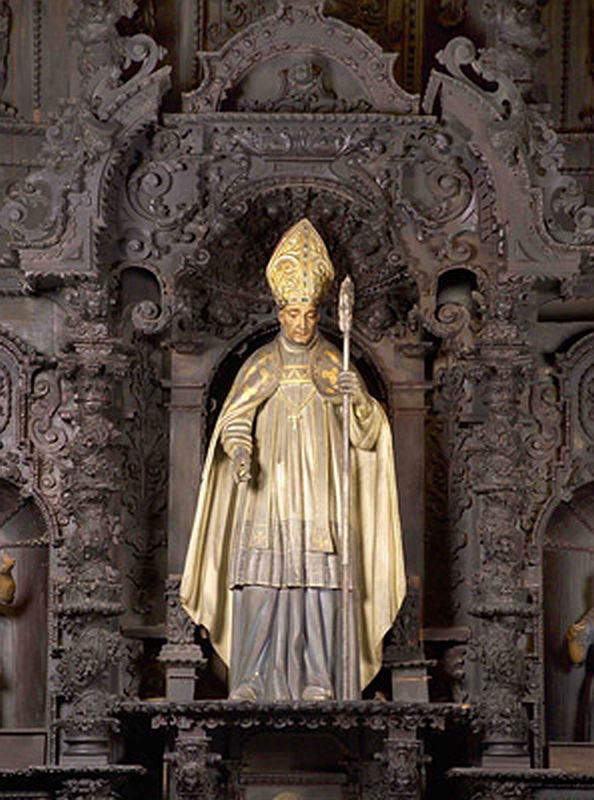
He prepared a list of the works of St Isidore and reportedly completed some of his master’s unfinished works.   St Braulio went partially blind in 650 and died in the same year.  He was buried in what is now the church of Nuestra Señora del Pilar in Saragossa. He was succeeded as bishop of Zaragoza by Taius (Taio), who had been his pupil. Later his remains were translated to La Seo Cathedral, Saragossa – images and statue below.

Posted in SAINT of the DAY

Memorials of the Saints 26 March

St Basil the Younger
St Bathus
St Bercharius
St Braulio (590-651)
St Castulus of Rome
St Eutychius of Alexandria
St Felicitas of Padua
St Felix of Trier
St Garbhan
St Govan
St Ludger of Utrecht
Bl Maddalena Caterina Morano
St Maxima the Martyr
St Mochelloc of Kilmallock
St Montanus the Martyr
St Peter of Sebaste
St Sabino of Anatolia
St Sincheall of Killeigh
St Wereka

Martyrs of Rome – 5 saints: A group of Christians martyred together. The only details to survive are the names – Cassian, Jovinus, Marcian, Peter and Thecla. Rome, Italy, date unknown.

Posted in DOCTORS of the Church, FATHERS of the Church, FEASTS and SOLEMNITIES, HOLY WEEK, LENT, MORNING Prayers, QUOTES of the SAINTS, QUOTES on SANCTITY, SUNDAY REFLECTIONS

Sunday Reflection – 25 March 2018 – Palm Sunday

Sunday Reflection – 25 March 2018 – Palm Sunday

LET US SING TO THE LORD A SONG OF LOVE
St Augustine (354-430) Father & Doctor of the Church

Sing to the Lord a new song;  His praise is in the assembly of the saints.   We are urged to sing a new song to the Lord, as new men who have learned a new song.   A song is a thing of joy, more profoundly, it is a thing of love.   Anyone, therefore, who has learned to love the new life has learned to sing a new song and the new song reminds us of our new life.   The new man, the new song, the new covenant, all belong to the one kingdom of God and so the new man will sing a new song and will belong to the new covenant.

There is not one who does not love something but the question is, what to love.   The psalms do not tell us not to love but to choose the object of our love.   But how can we choose unless we are first chosen?   We cannot love unless someone has loved us first. Listen to the apostle John:  We love him, because he first loved us.   The source of man’s love for God can only be found in the fact that God loved him first.   He has given us Himself as the object of our love and He has also given us its source.   What this source is you may learn more clearly from the apostle Paul who tells us:  The love of God has been poured into our hearts.   This love is not something we generate ourselves;  it comes to us through the Holy Spirit who has been given to us.

Since we have such an assurance, then, let us love God with the love He has given us.   As John tells us more fully:  God is love and whoever dwells in love dwells in God and God in him.   It is not enough to say:  Love is from God.   Which of us would dare to pronounce the words of Scripture:  God is love?   He alone could say it who knew what it was to have God dwelling within him.   God offers us a short route to the possession of Himself.   He cries out:  Love me and you will have me for you would be unable to love me if you did not possess me already.

My dear brothers and sons, fruit of the true faith and holy seed of heaven, all you who have been born again in Christ and whose life is from above, listen to me, or rather, listen to the Holy Spirit saying through me:   Sing to the Lord a new song.   Look, you tell me, I am singing.   Yes indeed, you are singing, you are singing clearly, I can hear you. But make sure that your life does not contradict your words.   Sing with your voices, your hearts, your lips and your lives:   Sing to the Lord a new song’.

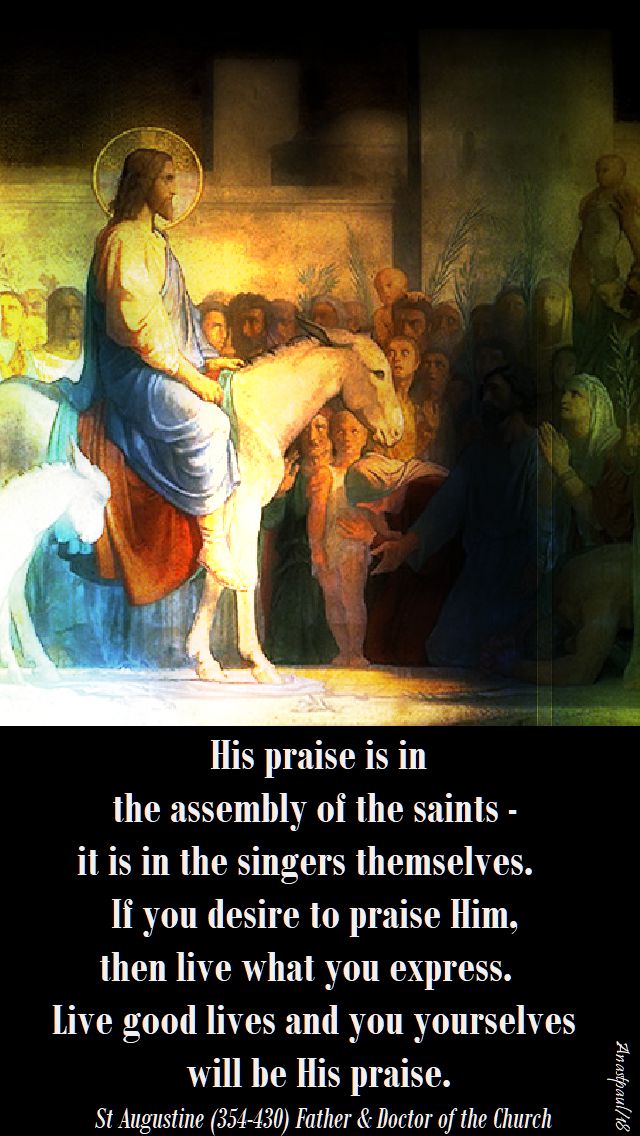
Now it is your unquestioned desire to sing of Him whom you love but you ask me how to sing His praises.   You have heard the words:  Sing to the Lord a new song and you wish to know what praises to sing.   The answer is:   His praise is in the assembly of the saints – it is in the singers themselves.   If you desire to praise Him, then live what you express.   Live good lives and you yourselves will be His praise.his praise is in the assembly of saints - st augustine - 25 march 2018 palm sunday

Posted in DOCTORS of the Church, FEASTS and SOLEMNITIES, HOLY WEEK, LENT, MORNING Prayers, PRAYERS of the CHURCH

Our Morning Offering – 25 March 2018 – Palm Sunday

Our Morning Offering – 25 March 2018 – Palm Sunday

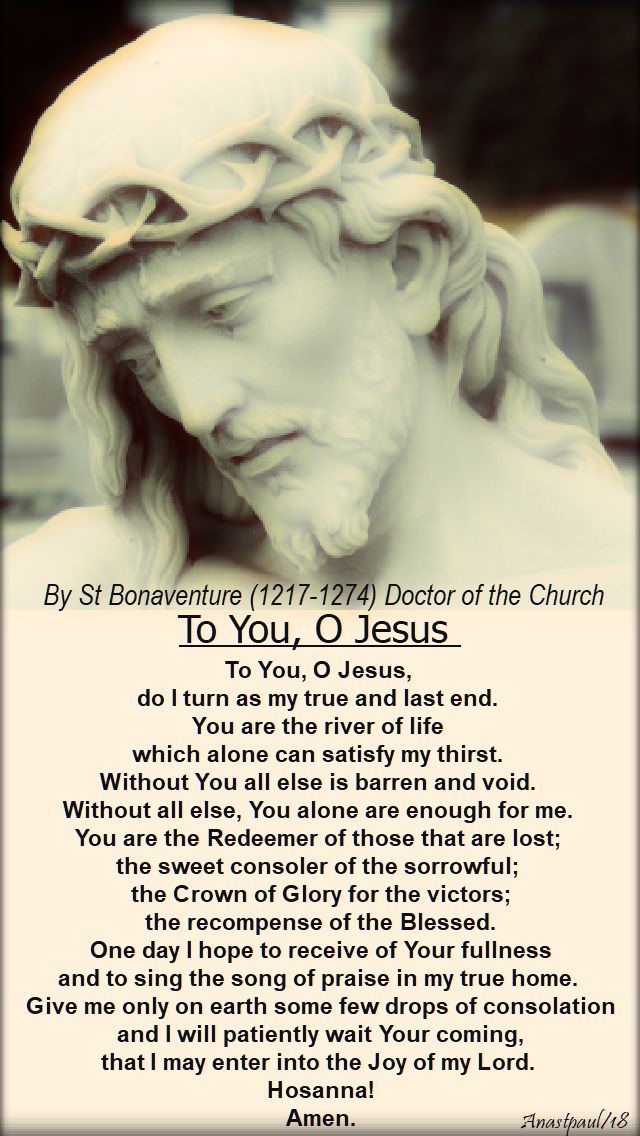
To You, O Jesus
By St Bonaventure (1217-1274) Doctor of the Church

To You, O Jesus,
do I turn as my true and last end.
You are the river of life
which alone can satisfy my thirst.
Without You all else is barren and void.
Without all else, You alone are enough for me.
You are the Redeemer of those that are lost;
the sweet consoler of the sorrowful;
the Crown of Glory for the victors;
the recompense of the Blessed.
One day I hope to receive of Your fullness
and to sing the song of praise in my true home.
Give me only on earth some few drops of consolation
and I will patiently wait Your coming,
that I may enter into the Joy of my Lord.
Hosanna!
Amen.to you, o Jesus - by st bonaventure - palm sunday - 25 march 2018

Posted in FATHERS of the Church, HOLY WEEK, LENT, MORNING Prayers

Palm or Passion Sunday – 25 March 2018

Palm or Passion Sunday – 25 March 2018

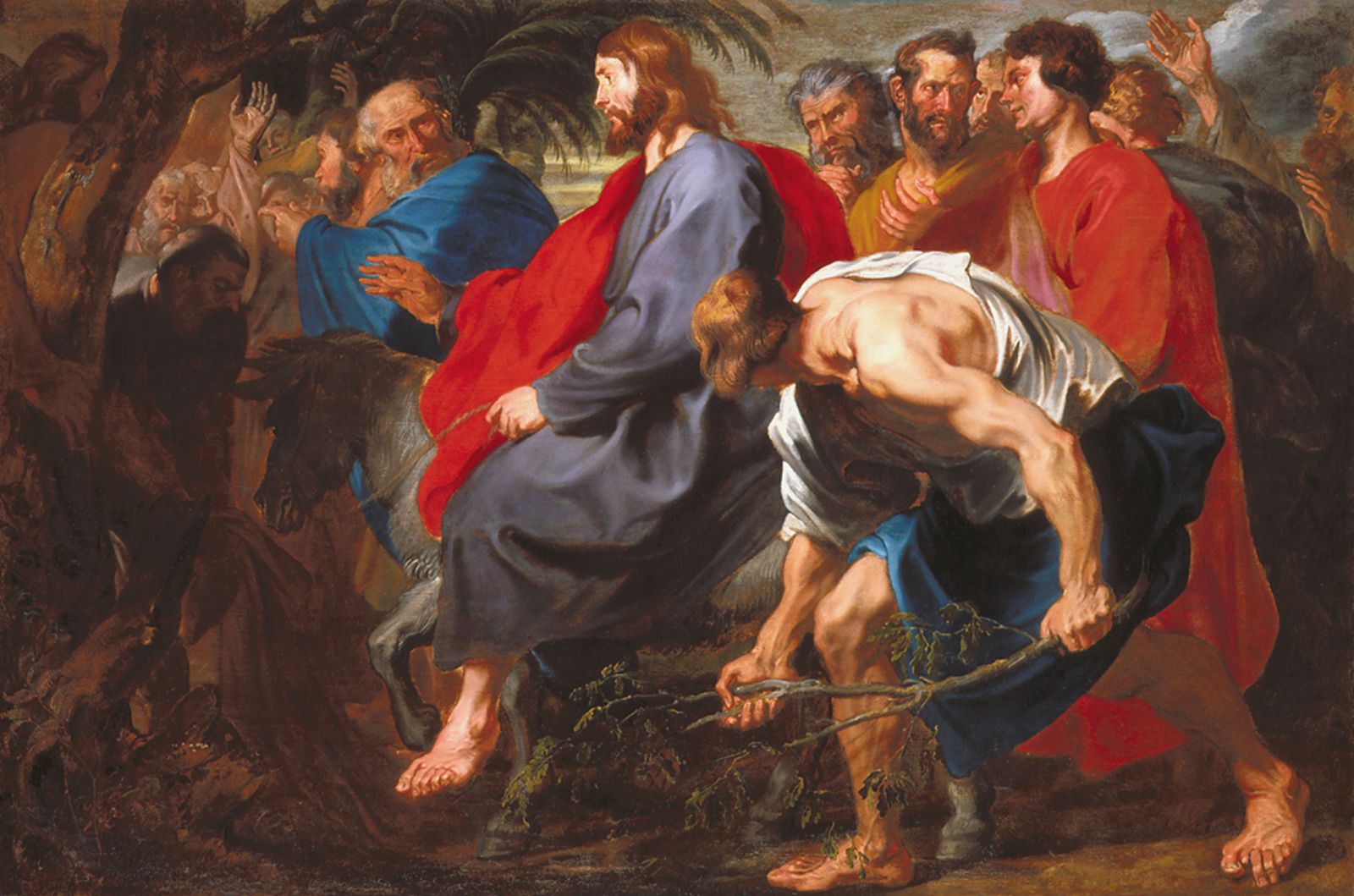
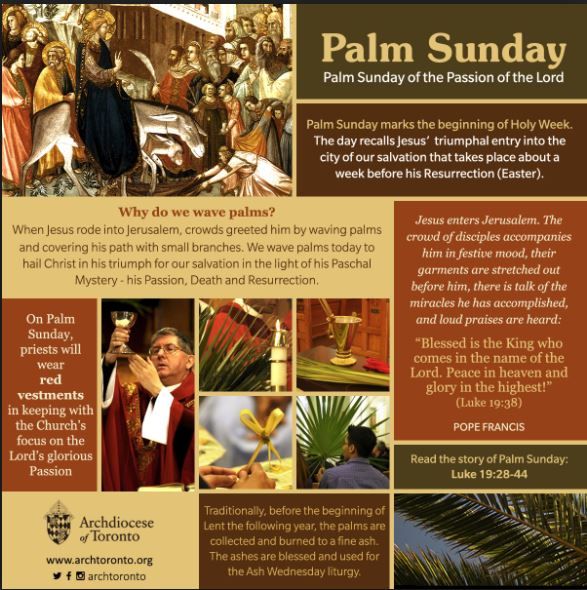
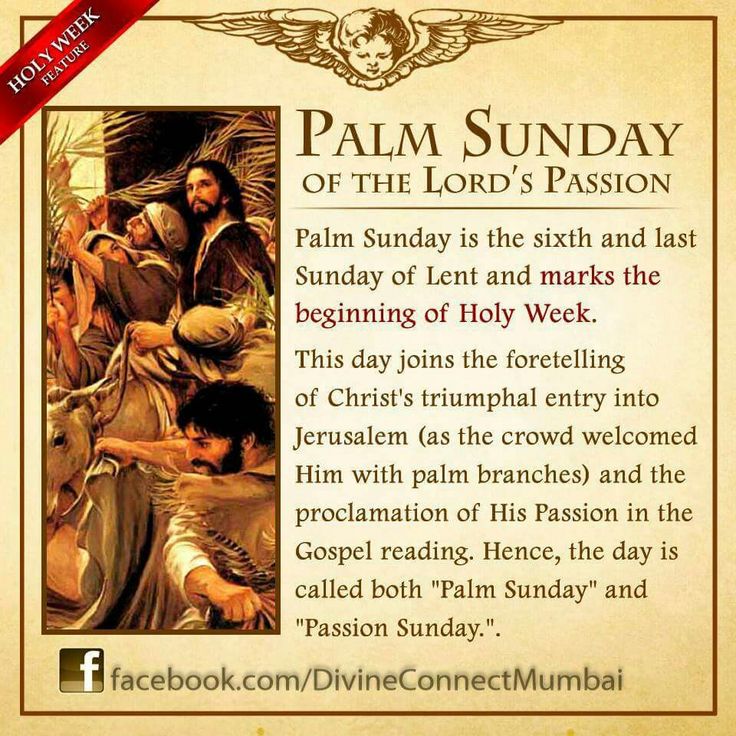
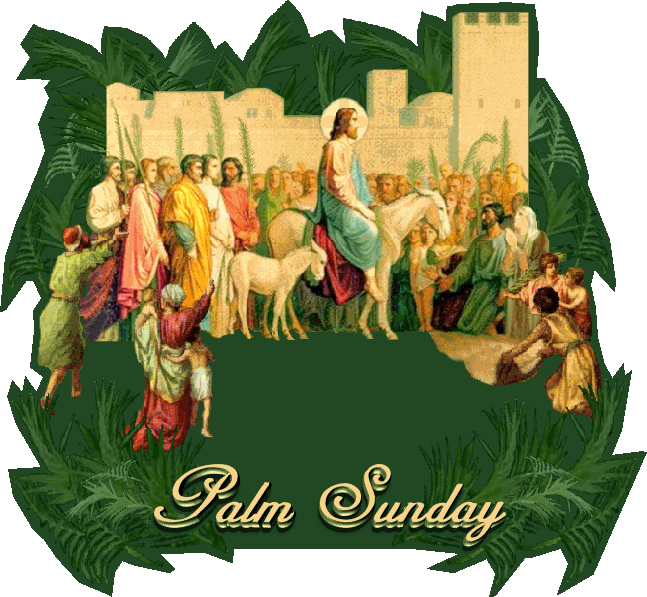
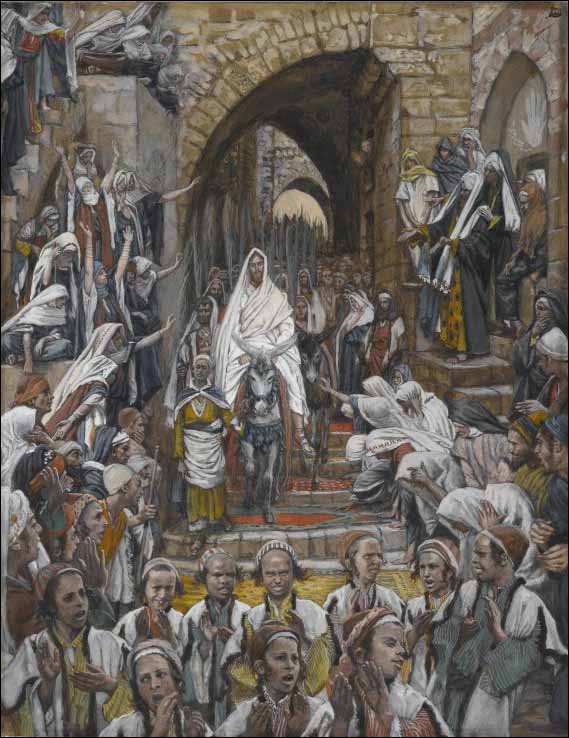
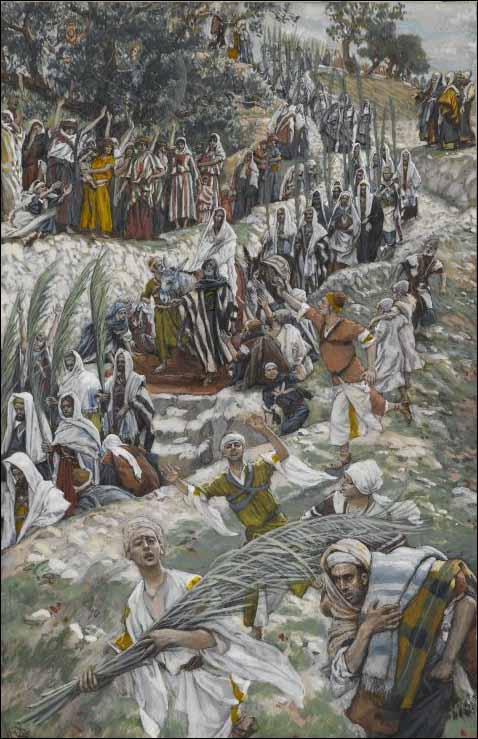
Today we commemorate Christ’s entry into Jerusalem for the completion of the Paschal Mystery.   In the old calendar before Vatican II, the Church celebrated Passion Sunday two Sundays before Easter and then Palm Sunday was the beginning of Holy Week.   The Church has combined the two to reinforce the solemnity of Holy Week.Entry into Jerusalem Van Dyck

palm sunday

The Palm Sunday procession is formed of Christians who, in the “fullness of faith,” make their own the gesture of the Jews and endow it with its full significance.   Following the Jews’ example we proclaim Christ as a Victor… Hosanna to the Son of David!   Blessed is He who comes in the Name of the Lord.   But by our faith we know, as they did not, all that His triumph stands for.   He is the Messiah, the Son of David and the Son of God.   He is the sign of contradiction, acclaimed by some and reviled by others.   Sent into this world to wrest us from sin and the power of Satan, He underwent His Passion, the punishment for our sins but issues forth triumphant from the tomb, the victor over death, making our peace with God and taking us with Him into the kingdom of His Father in heaven.palm sunday.info

Homily of St Andrew of Crete (650-740)

Palm Sunday marks the entry of Jesus into Jerusalem.   But he entered in humility, not in pomp and power.   To humble ourselves and make our souls the garments that we spread before him, this is the greeting he desires says St Andrew of Crete (650-740), one of the Early Church Fathers – his Memorial is 4 July.

Let us go together to meet Christ on the Mount of Olives.   Today he returns from Bethany and proceeds of his own free will toward his holy and blessed passion, to consummate the mystery of our salvation.   He who came down from heaven to raise us from the depths of sin, to raise us with himself, we are told in Scripture, above every sovereignty, authority and power and every other name that can be named, now comes of his own free will to make his journey to Jerusalem.   He comes without pomp or ostentation.   As the psalmist says:   He will not dispute or raise his voice to make it heard in the streets. He will be meek and humble, and he will make his entry in simplicity.

Let us run to accompany him as he hastens toward his passion and imitate those who met him then, not by covering his path with garments, olive branches or palms, but by doing all we can to prostrate ourselves before him by being humble and by trying to live as he would wish.   Then we shall be able to receive the Word at His coming and God, whom no limits can contain, will be within us.

In His humility Christ entered the dark regions of our fallen world and He is glad that He became so humble for our sake, glad that He came and lived among us and shared in our nature in order to raise us up again to Himself.   And even though we are told that He has now ascended above the highest heavens – the proof, surely, of His power and godhead – His love for man will never rest until He has raised our earthbound nature from glory to glory and made it one with his own in heaven.

So let us spread before His feet, not garments or soulless olive branches, which delight the eye for a few hours and then wither but ourselves, clothed in His grace, or rather, clothed completely in Him.   We who have been baptised into Christ must ourselves be the garments that we spread before Him.   Now that the crimson stains of our sins have been washed away in the saving waters of baptism and we have become white as pure wool, let us present the conqueror of death, not with mere branches of palms but with the real rewards of His victory.   Let our souls take the place of the welcoming branches as we join today in the children’s holy song: Blessed is he who comes in the name of the Lord. Blessed is the king of Israel.

This Lenten or Holy Week reading on the entry of Jesus into Jerusalem in humility is an excerpt from a Palm Sunday sermon (Oratio 9 in ramos palmarum: PG 97, 990-994) by Andrew of Crete, a bishop and Early Church Father who died in 740 AD.   It is used in the Roman Catholic Office of Readings for Palm Sunday with the accompanying biblical reading of Hebrews 10:1-18.

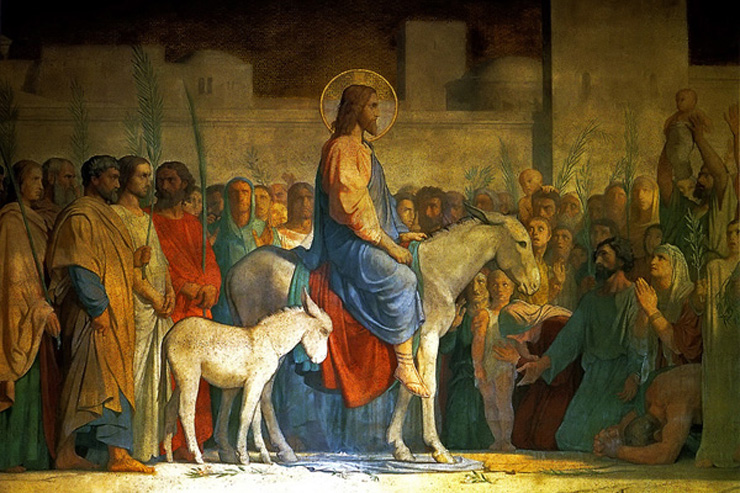
Christ's Entry into Jerusalem by Hippolyte Flandrin c. 1842
PALM title image final g
palm sunday by james tissot no 1
james tissot - palm sunday

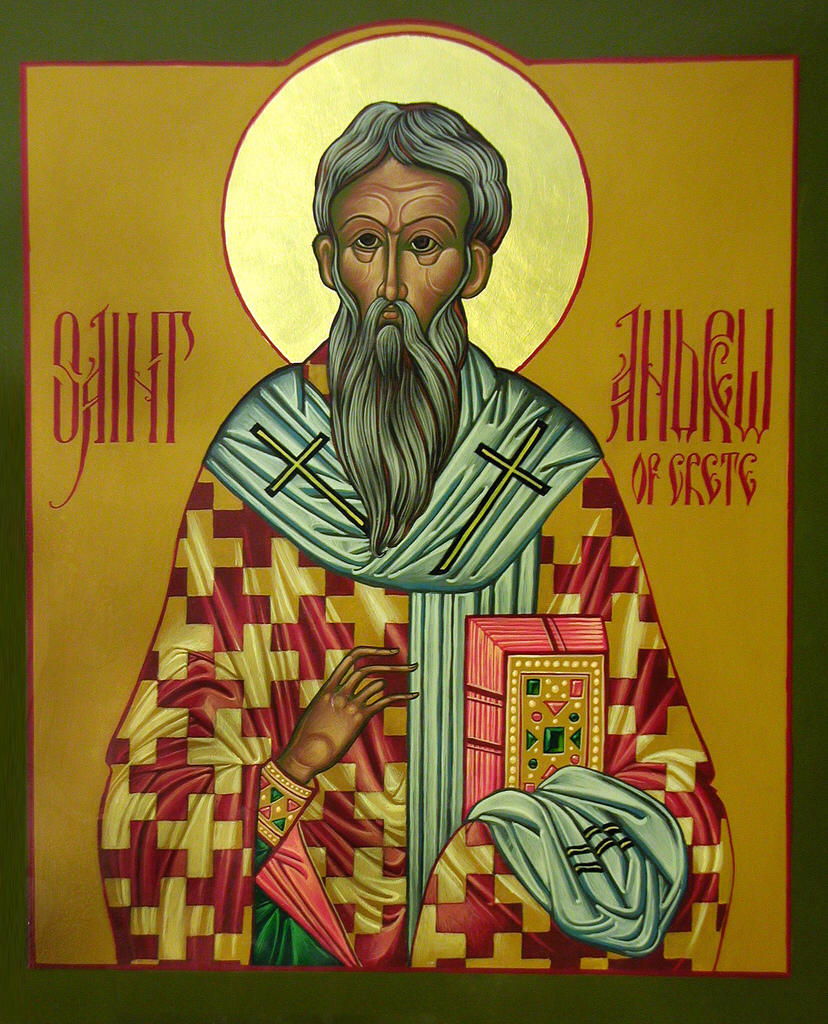
St Andrew of Crete
St Andrew of Crete (c. 660-740) was born around 660 AD in Damascus and eventually entered monastic life at Mar Saba.   He later served at the Church of the Holy Sepulchre in Jerusalem and was ordained a deacon at the great cathedral of Constantinople and mother Church of Eastern Christendom, Hagia Sophia, around 685.   Always exhibiting great pastoral solicitude for orphans, widows, and the aged, Saint Andrew spent his last days as Archbishop of Gortyna on Crete, a position to which he was elevated in 692. Attributed by many with the invention of the canon as a style of religious writing, his works display not only great rhetorical skill but an incomparable depth of theological understanding.   He is considered one of the great spiritual writers on the theme of repentance and his Great Canon, prayed during Lent in the Eastern Churches of Byzantine tradition, stands as a great testimony to man’s repentant cry to God, our merciful Father.  Saint Andrew of Crete is numbered among those great Christian writers known as the Early Church Fathers or “Fathers of the Church.”st andrew of crete

Posted in QUOTES of the SAINTS, SAINT of the DAY

Saint of the Day – 25 March – Blessed Emilian Kovch (1884-1944) Martyr

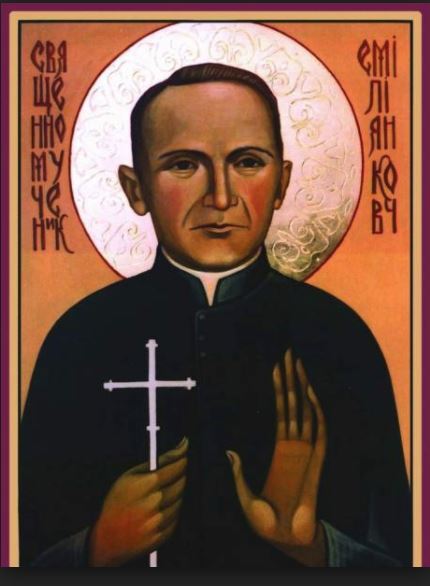
Saint of the Day – 25 March – Blessed Emilian Kovch (1884-1944) Martyr and Priest, Husband and Father – born (born Оmelyan) on 20 August 1884 near Kosiv, Ivano-Frankivs’ka oblast, Ukraine – gassed and burned on 25 March 1944 in the ovens of the Nazi death camp at Majdanek, Lubelskie, Poland.   Beatified on 27 June 2001 by St Pope John Paul II at Ukraine.
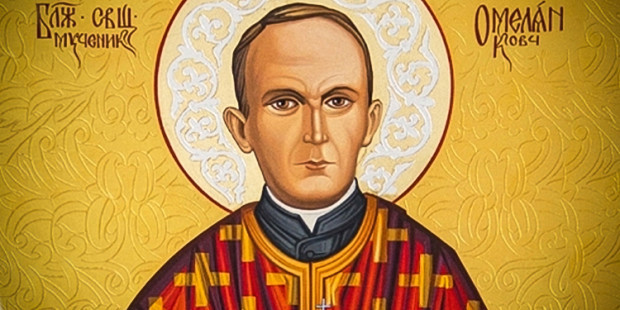
web3-blessed-emilian-kolvich-icon-nashastudiya-cc-via-wikipedia

Emilian Kovch, was born in The Ukraine on 20 August 1894, in Kosmach near Kosiv.   His, was a family that had produced several priests.   His father, was Father Gregory Kowcz, a Greek Catholic parish priest.   Blessed Emilian completed school in Lviv and then from 1905 to 1911, he studied theology in Rome.   In 1911 he married Maria-Anna Dobrzynska, and the next year he was ordained a priest.

There was a war between Poland and the Ukraine, which was a multi-sided war that saw seven different nations take the battlefield.   In this war, Father Emilian served as a military chaplain from 1919-1921.   He had said at the time, “I know that the soldier on the front line feels better when he sees the doctor and the priest also there . . You know, lads, that I am consecrated, and a bullet doesn’t take a consecrated man easily.”   He was captured, held prisoner briefly and then released and appointed parish priest at Peremyslany, a small town 30 miles from Lviv.
His activity then was devoted to parish life.   He cared for the spiritual, material and physical needs of his parishioners.  He organised Eucharistic congresses, bought shoes and books for poor children, supported local cooperative movements and the Ukrainian independence movement.  This brought him attention from the local Polish administration, who searched his house over 40 times.   He was fined and imprisoned in a monastery.   He and his wife had six children of their own and many times gave shelter to orphans as well.

Father Emilian’s support of independence for Ukraine did not mean that he had animosity towards the Polish people.   After the Molotov-Ribbentrop pact of 1939 and Stalin’s invasion of the west Ukraine and eastern Poland, he severely scolded some of his parishioners for looting Polish homes and he prevented further thefts.   He said to them, “I thought that I had taught you to be good parishioners..now I am ashamed of you before God.”
Father Emilian organised help for Polish widows and orphans.   In the first two years of Soviet occupation, the secret police murdered or deported over 300,000 persons from west Ukraine.   In 1941 mass arrests were carried out in Peremyslany, including Father Emilian and two of his daughter’s.   Miraculously, they escaped just as the Nazi invaders reached their town, but, as Father Emilian Kowcz celebrated his first Mass back in his parish, the news arrived that all of the other prisoners had been killed by the retreating communists.

Many of the Ukrainian people hoped that Hitler would liberate them from the Bolshevik oppressors and grant them some measure of independence, but, those hopes were short lived.   Father Emilian urged the young people to not become involved in criminal deeds and to resist the urging of anti-semitism by the Nazi’s and their newly formed police force under Nazi control.   He never ceased to condemn publicly the deeds of the Nazi Fascist regime, which treated the Slavs as sub-human and began deporting them to German factories and labour camps.
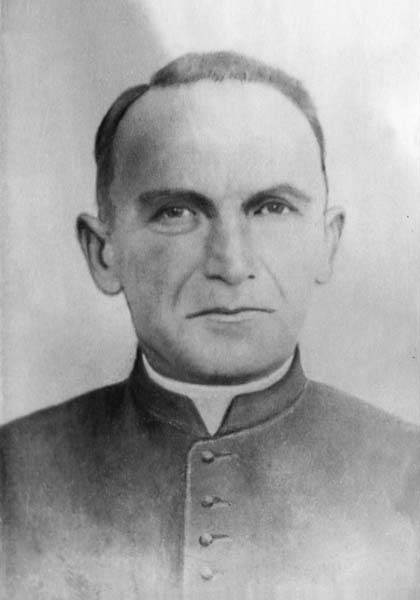
BL EMILIAN KOVCH - 25 MARCH
The treatment of the Jews became a very serious matter.   A detachment of the SS drove some Jews into a local Synagogue and began throwing firebombs inside with the intention of burning them alive. Somehow made aware by some Jews of what was taking place, Father Emilian, along with some of his parishioners, rushed to the Synagogue and blocked the doors preventing the Nazi’s from throwing more firebombs inside.   Fluent in German, Father Emilian shouted at the Nazi’s to go away and by another miracle, they did.   Father Emilian and the parishioners then went into the already burning building, and saved as many as possible.

The Jews were the majority of the population of Peremyslany and any attempt to save Jewish lives en masse from the Nazi’s was impossible.   Some of the Jewish population came to Father Emilian asking for baptism, in the hope that would save them from Nazi extermination and he catechised and baptised them, at first individually.   As the Nazi persecution became more intense, a group representing 1,000 Jews came to Father Emilian asking for baptism.   Father Emilian then consulted Archbishop Andrei Sheptytsky (who was sheltering over 1,000 Jews himself) as to what action to take.   As time was getting short, on his return, Father Emilian then administered a short catechesis and mass baptism.
This was entirely against Nazi law but, Father Emilian ignored their warnings and further, after the closing of the ghetto, he applied to the Nazi’s for permission to enter the ghetto to baptise any who desired it.   The records indicate that the newly baptised Jews formed their own Christian community even within the ghetto.   Father Emilian even wrote a letter to Adolph Hitler denouncing the Nazi crimes!
The Nazi’s could not allow such activity to go unpunished and so in December 1942, Father Emilian Kowcz was arrested, imprisoned, and interrogated by the Gestapo. During interrogation, Father Emilian admitted to baptising Jews and refused to sign a document saying he would not do so in the future, even if it was contrary to Nazi law. The record of this interrogation still exists and says in part:
Officer: “Did you know that it is prohibited to baptize Jews?”
Fr. Kovch: “I didn’t know anything.”
Officer: “Do you now know it?”
Fr. Kovch: “Yes.”
Officer: “Will you continue to do it?”
Fr. Kovch: “Of course.”
 
Unable to get compliance from Father Emilian, the Gestapo sent him to Majdanek concentration camp in Lublin.   There, Blessed Father Emilian Kowcz brought comfort to his fellow prisoners, no matter what their race, no matter what their faith.   He saw his situation as a mission and a Gift from God, as well as a responsibility to be fulfilled.   He would celebrate the Liturgy in a corner of the barracks.   When his daughters and other family members attempted to secure his release he wrote these words to them:
I thank God for His goodness to me.   Apart from heaven, this is the one place where I wish to remain.   Here we are all equal: Poles, Jews, Ukrainians, Russians, Latvians and Estonians.   Of all these here I am the only priest. I cannot even imagine how it would be here without me.   Here I see God, who is the same for us all, regardless of our religious distinctions.   Perhaps our churches are different, but the same great and Almighty God rules over us all.   When I celebrate the Divine Liturgy, they all join in prayer. . .
 
They die in different ways, and I help them to cross over this little bridge into eternity. Is this not a blessing?   Isn’t this the greatest crown which God could have placed upon my head? It is indeed. I thank God a thousand times a day for sending me here. I do not ask him for anything else.   Do not worry, and do not lose faith at what I share. Instead, rejoice with me.
 
Pray for those who created this concentration camp and this system. They are the only ones who need prayers . . May God have mercy upon them.”
 
Father Emilian’s health began to deteriorate and after Christmas 1943, he became seriously ill from stomach problems he couldn’t hide.   He was sent to the camp “hospital” where it was well known by his fellow prisoners that healing treatment was extremely rare and that the Nazi “doctors” helped speed death along by injection or starvation.   Father Emilian was last seen by his fellow prisoners in the spring but, afterwards, they did not know what became of him.   It was not until 1972 that his daughters managed to obtain his death certificate, where the records indicate that he died of infection and inflammation to his right leg that blocked circulation.   Some records also indicate that he was gassed and burned in the ovens of the Majdanek concentration camp.   Father Emilian Kowcz died on 25 March 1944.
On the night before his death, he wrote the following to his family:
I understand that you are trying to get me released.   But I beg you not to do this. Yesterday they killed fifty people.   If I am not here, who will help them to get through these sufferings?   They would go on their way to eternity with all their sins and in the depths of unbelief, which would take them to hell.   But now they go to death with their heads held aloft, leaving all their sins behind them.   And so they pass over to the eternal city.”
 
Blessed Father Emilian Kovch through his example of faith and courage, showed all what Love of Christ, Faith in Christ, and Hope in Christ is and how that love, faith, and hope is to all people, no matter who they are, or what their station in life.
On 9 September 1999, Blessed Emilian Kovch was recognised as a Righteous Ukrainian by the Jewish Council of Ukraine.

BL EMILIAN KOVCH - 25 MARCH - SNIP
Posted in DOGMA, FEASTS and SOLEMNITIES, HOLY WEEK, MARIAN TITLES, SAINT of the DAY

25 March 2018, Palm Sunday, the Solemnity of the Annunciation and Memorials of the Saints

Palm Sunday (2018)

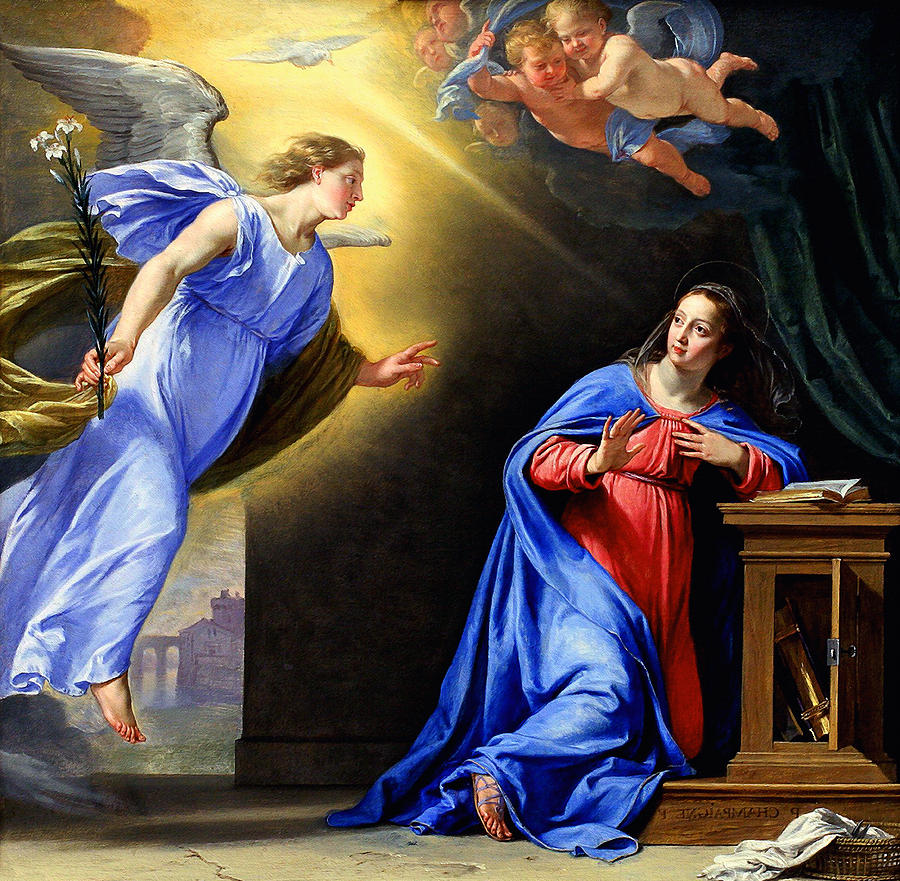
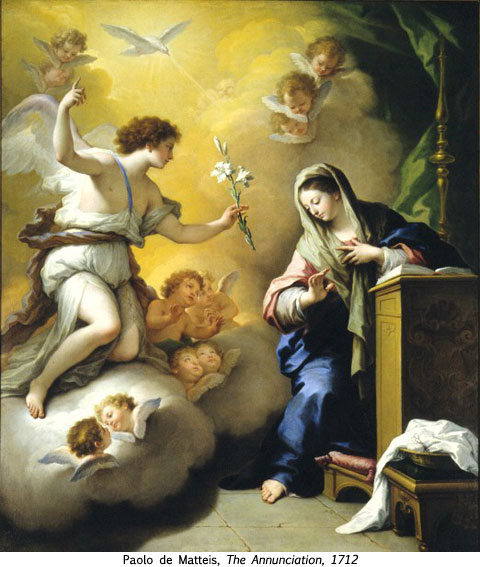
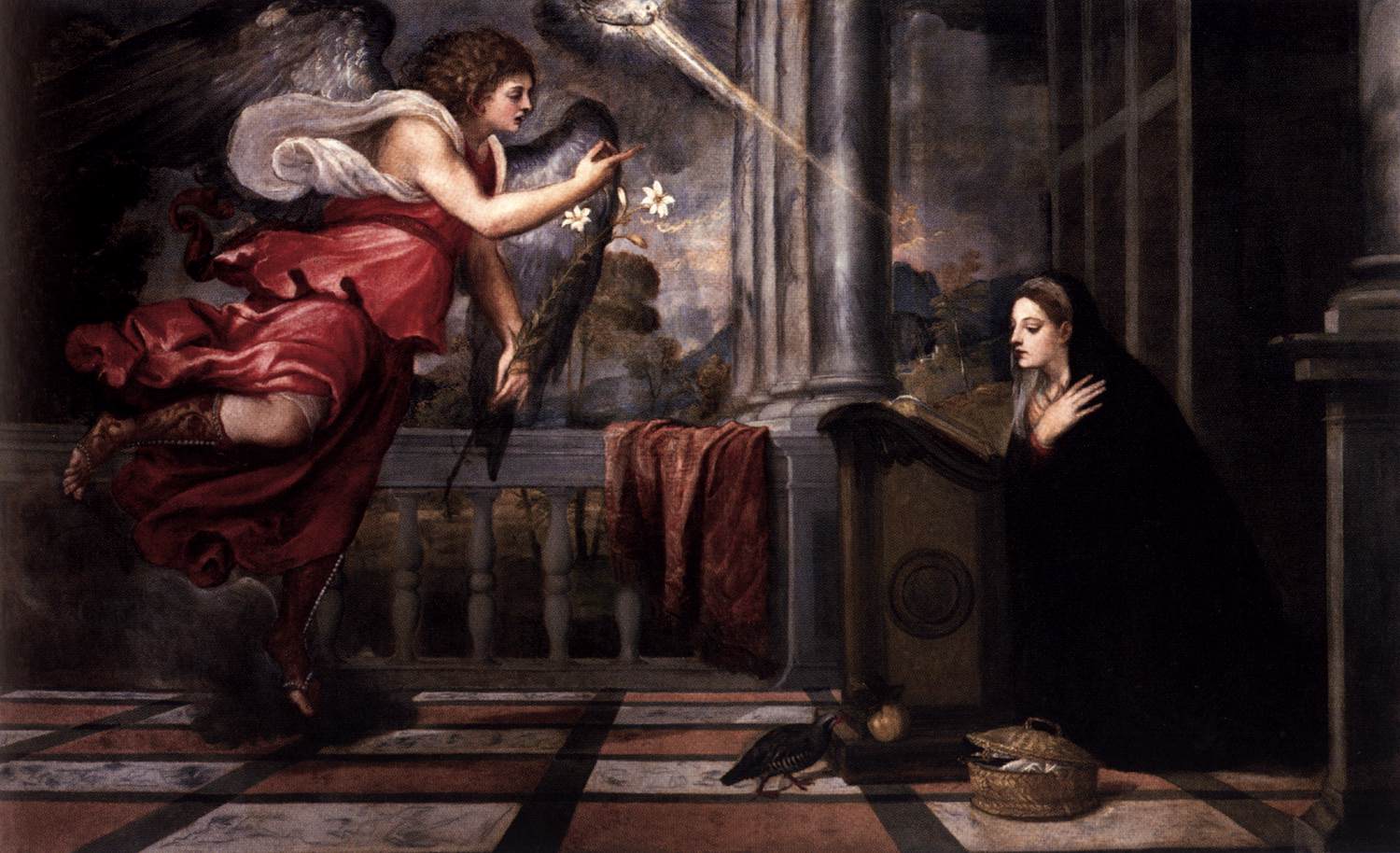
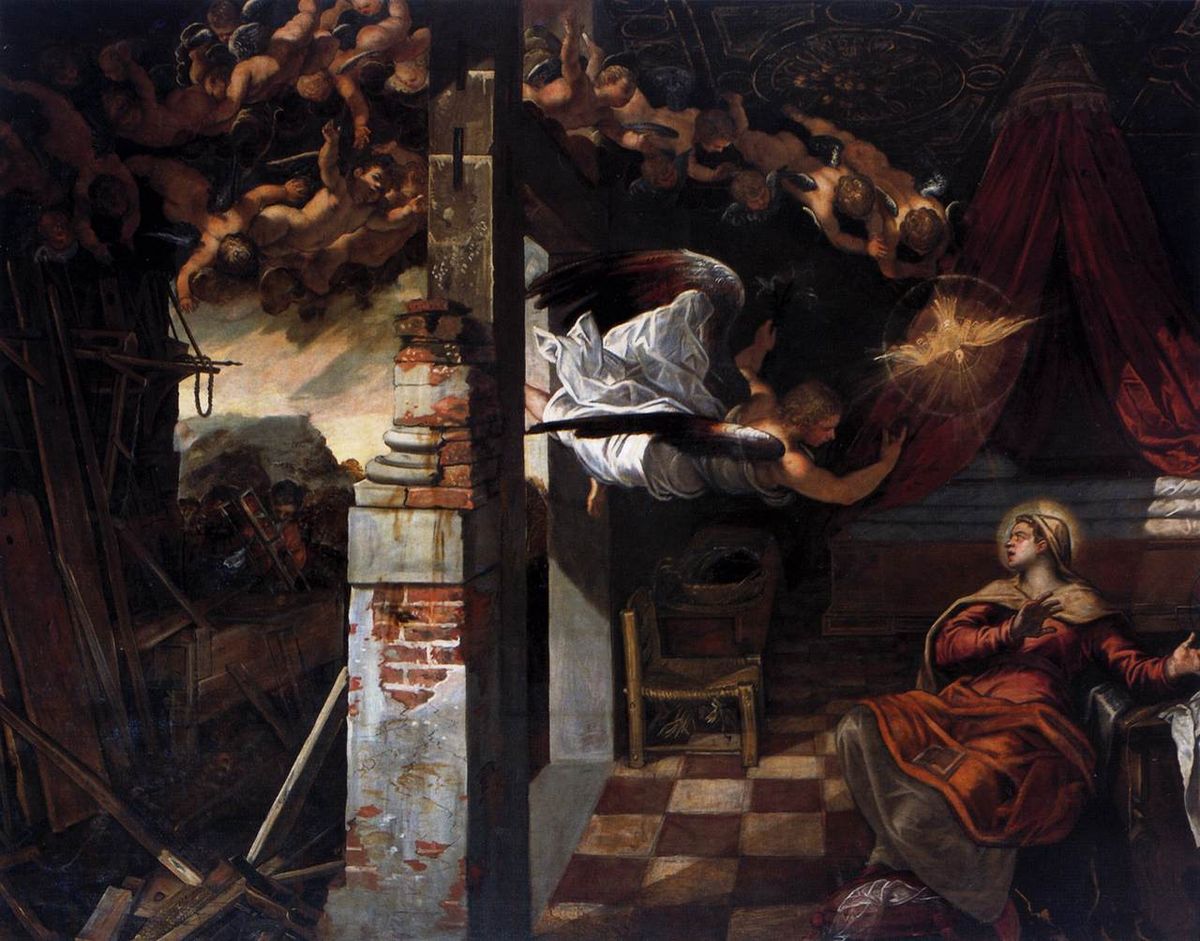
Annunciation of the Blessed Virgin Mary (Solemnity): The Annunciation to the Blessed Virgin Mary by Gabriel the Archangel that she was to be the Mother of God (Luke 1), the Word being made flesh through the power of the Holy Spirit.   The feast probably originated about the time of the Council of Ephesus, c 431 and is first mentioned in the Sacramentary of Pope Gelasius (died 496).   The Annunciation is represented in art by many masters, among them Fra Angelico, Hubert Van Eyck, Jan Van Eyck, Philippe de Champaigne (1 and 2 below), Ghirlandajo, Holbein the Elder, Lippi, Pinturicchio, Titian (2nd last below), Tintoretto (last below) and Del Sarto.Annunciation_Philippe de Champaigneannunciation-philippe-de-champaignethe annunciation - paolo de matteis 1712the-annunciation1200px-Zwiastowanie_Tintoretta

Our Lady of Betania:   Actually the name Betania means Bethany in Spanish. It was originally given this name by Maria Esperanza and was the site of their farm, in Venezuela.   Apparitions of the Blessed Virgin Mary were reported and eventually a small chapel was built here and the faithful began to gather, especially on Feast Days but throughout the year.

St Alfwold of Sherborne
St Barontius of Pistoia
St Desiderius of Pistoia
St Dismas
St Dula the Slave
Bl Emilian Kovch
Bl Everard of Nellenburg
Bl Herman of Zahringen
St Hermenland
St Humbert of Pelagius
Bl James Bird
Bl Josaphata Mykhailyna Hordashevska
St Kennocha of Fife
St Lucia Filippini
St Margaret Clitherow
Bl Margaretha Flesch
St Mariam Sultaneh Danil Ghattas
St Matrona of Barcelona
St Matrona of Thessaloniki
St Mona of Milan
St Ndre Zadeja
Bl Pawel Januszewski
St Pelagius of Laodicea
Bl Placido Riccardi
St Procopius
St Quirinus of Rome
Bl Tommaso of Costacciaro

262 Martyrs of Rome: A group 262 Christians martyred together in Rome. We know nothing else about them, not even their names.

Posted in MORNING Prayers, QUOTES of the SAINTS, QUOTES on CHARITY, QUOTES on JUSTICE, QUOTES on PEACE, QUOTES on SANCTITY, QUOTES on SUFFERING, SAINT of the DAY

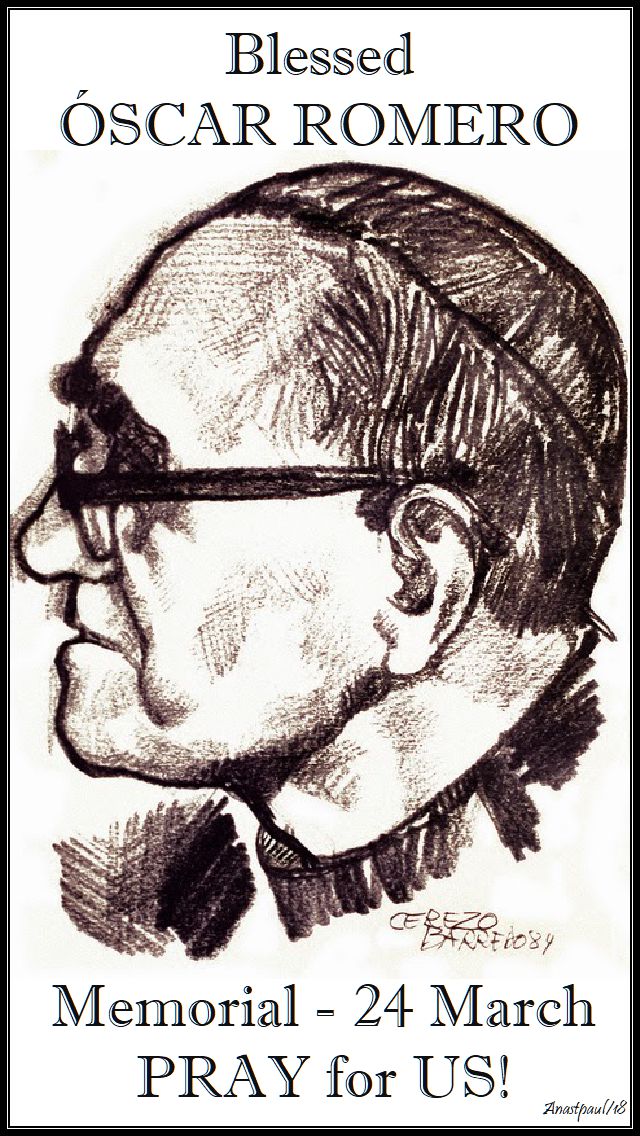
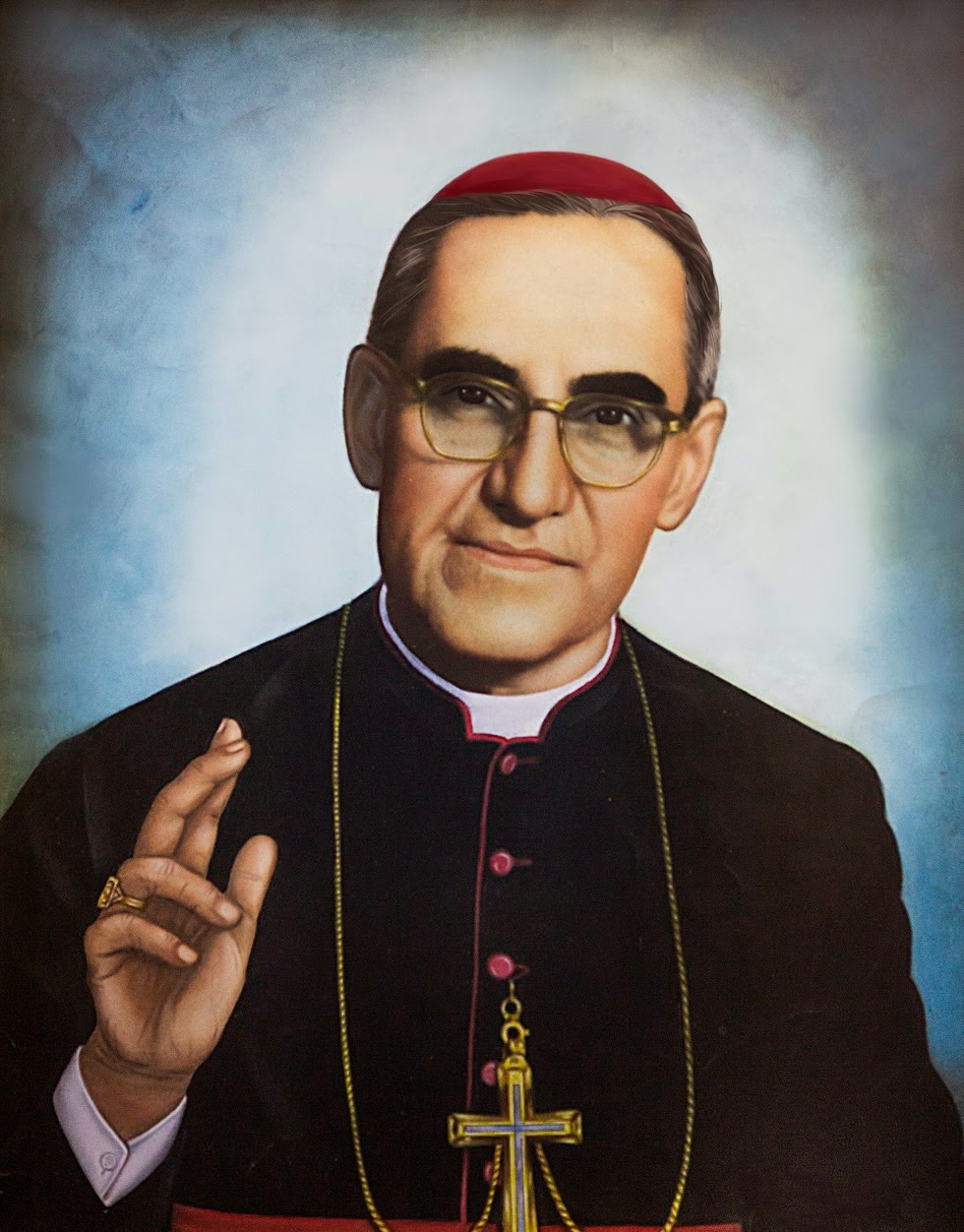
Quote/s of the Day – – 24 March – The Memorial of Bl Óscar Arnulfo Romero y Galdámez (1917–1980) to be Canonised this year, 2018.

Quote/s of the Day – – 24 March – The Memorial of Blessed Óscar Arnulfo Romero y Galdámez (1917–1980) to be Canonised this year, 2018.

“Peace is not the product of terror or fear.
Peace is not the silence of cemeteries.
Peace is not the silent result of violent repression.
Peace is the generous, tranquil contribution of all to the good of all.
Peace is dynamism.
Peace is generosity.
It is right and it is duty.”peace is not - bl oscar romero - 24 march 2018

“I don’t want to be an anti, against anybody.
I simply want to be the builder of a great affirmation:
the affirmation of God,
who loves us and who wants to save us.”

“If we are worth anything,
it is not because we have more money or more talent,
or more human qualities. Insofar as we are worth anything,
it is because we are grafted onto Christ’s life,
His cross and resurrection.
That is a person’s measure.”i don't want to be an anti - bl oscar romero - 24 march 2018

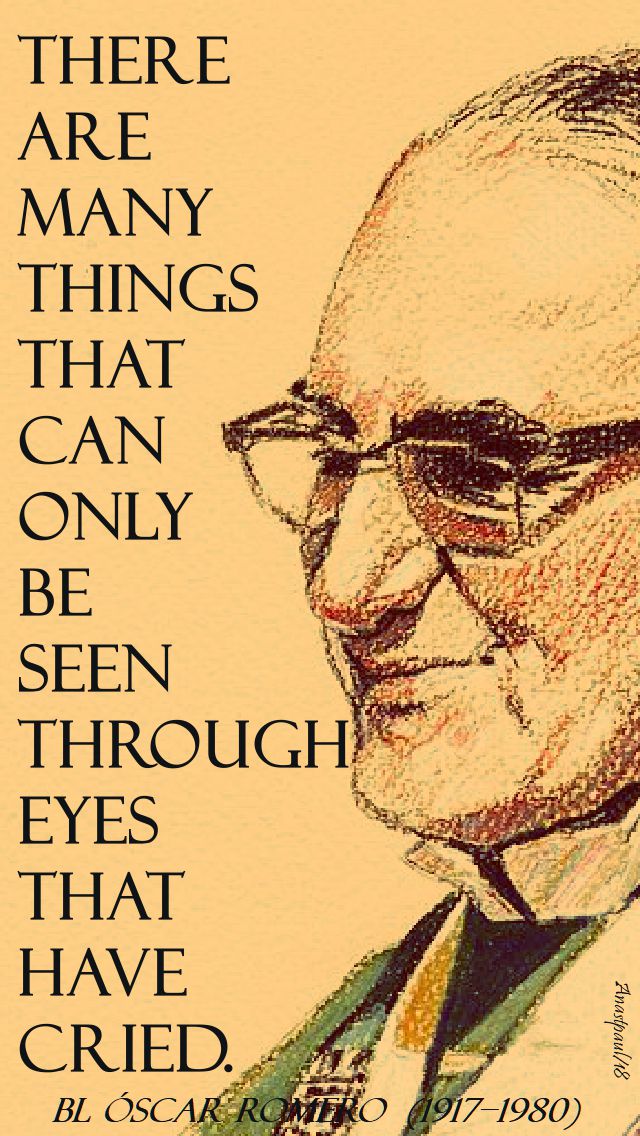
“There are many things that can only be seen through eyes that have cried.”

Blessed Óscar Arnulfo Romero y Galdámez (1917–1980)there are many things - bl oscar romero - 24 march 2018

Posted in MORNING Prayers, PAPAL MESSAGES, QUOTES of the SAINTS, SAINT of the DAY, The WORD

One Minute Reflection – – 24 March – The Memorial of Bl ÓSCAR ROMERO (1917-1980) Martyr

One Minute Reflection – – 24 March – The Memorial of Bl ÓSCAR ROMERO (1917-1980) Martyr

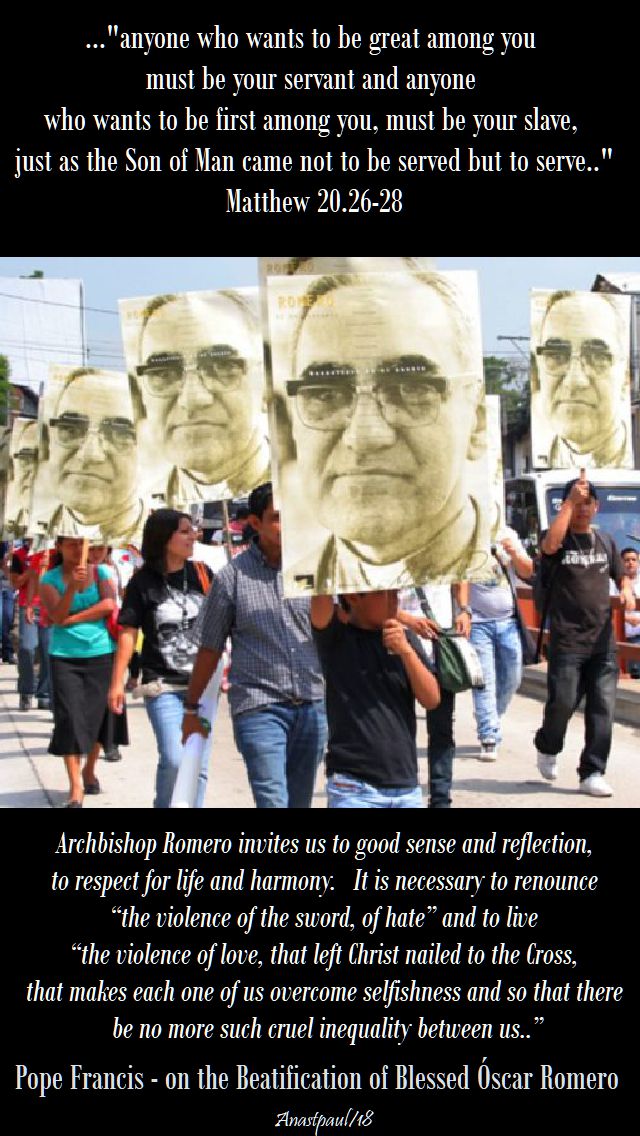
“anyone who wants to be great among you must be your servant and anyone who wants to be first among you, must be your slave, just as the Son of Man came not to be served but to serve.”… Matthew 20:26-28

REFLECTION – “Archbishop Romero invites us to good sense and reflection, to respect for life and harmony.   It is necessary to renounce “the violence of the sword, of hate” and to live “the violence of love, that left Christ nailed to the Cross, that makes each one of us overcome selfishness and so that there be no more such cruel inequality between us”.   He knew how to see and experienced in his own flesh “the selfishness that hides itself in those who do not wish to give up what is theirs for the benefit of others”. And, with the heart of a father, he would worry about the “poor majority”, asking the powerful to convert “weapons into sickles for work”.
May those who hold Archbishop Romero as a friend of faith, those who invoke him as protector and intercessor, those who admire his image, find in him the strength and courage to build the Kingdom of God, to commit to a more equal and dignified social order.”…Pope Francis 23 May 2015 (Letter of Pope Francis on the Beatification of Bl Óscar Romero)archbishop romero invites us to good sense - pope francis - 24 march 2018

PRAYER – Almighty and everlasting God, You gave Blessed Óscar Romero, grace to fight to the death for the true faith.   Let his prayer enable us to endure every trial for love of You and to make all haste on our way to You, in whom alone is life.   We make our prayer, through our Lord Jesus Christ, our Saviour and Redeemer, in the unity of the Holy Spirit, one God, forever, amen.bl oscar romero - pray for us -no 2. - 24 march 2018

Posted in MORNING Prayers, QUOTES of the SAINTS, SAINT of the DAY

Thought for the Day – 24 March – The Memorial of Bl Óscar Arnulfo Romero y Galdámez (1917–1980) Martyr – Every now and then it helps us to take a step back and to see things from a distance.

Thought for the Day – 24 March – The Memorial of Bl Óscar Arnulfo Romero y Galdámez (1917–1980) Martyr – Every now and then it helps us to take a step back and to see things from a distance.

Every now and then it helps us to take a step back
and to see things from a distance.
The Kingdom is not only beyond our efforts,
it is also beyond our visions.
In our lives, we manage to achieve only a small part
of the marvellous plan that is God’s work.
Nothing that we do is complete,
which is to say that the Kingdom is greater than ourselves.
No statement says everything that can be said.
No prayer completely expresses the faith.
No Creed brings perfection.
No pastoral visit solves every problem.
No programme fully accomplishes the mission of the Church.
No goal or purpose ever reaches completion.
This is what it is about:
We plant seeds that one day will grow.
We water seeds already planted,
knowing that others will watch over them.
We lay the foundations of something that will develop.
We add the yeast which will multiply our possibilities.
We cannot do everything,
yet it is liberating to begin.
This gives us the strength to do something and to do it well.
It may remain incomplete but it is a beginning, a step along the way.
It is an opportunity for the grace of God to enter and to do the rest.
It may be that we will never see its completion
but that is the difference between the master and the labourer.
We are labourers, not master builders,
servants, not the Messiah.
We are prophets of a future that does not belong to us.

Blessed Óscar Romero (1917–1980) Martyr, Pray for us!bl oscar romero - pray for us - 24 march 2018

Posted in MORNING Prayers, PRAYERS of the SAINTS, SAINT of the DAY

Our Morning Offering – 24 March – The Memorial of Bl ÓSCAR ROMERO (1917-1980) Martyr

Our Morning Offering – 24 March – The Memorial of Bl ÓSCAR ROMERO (1917-1980) Martyr

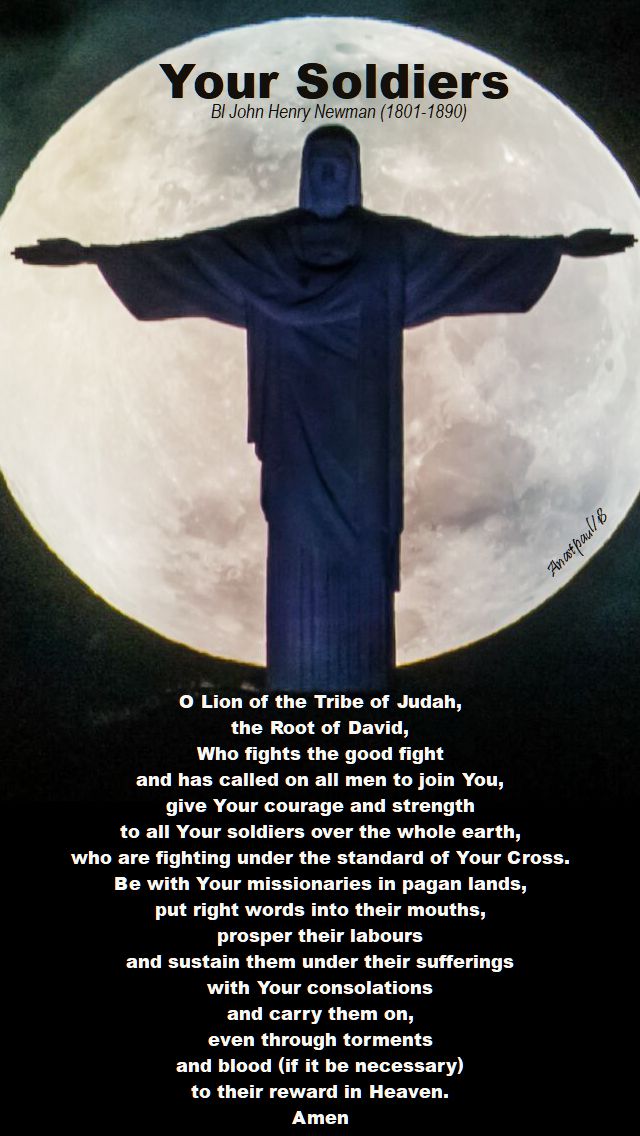
Your Soldiers
Blessed John Henry Newman (1801-1890)

O Lion of the Tribe of Judah,
the Root of David,
Who fights the good fight
and has called on all ment to join You,
give Your courage and strength
to all Your soldiers over the whole earth,
who are fighting under the standard of Your Cross.
Be with Your missionaries in pagan lands,
put right words into their mouths,
prosper their labours
and sustain them under their sufferings
with Your consolations
and carry them on,
even through torments
and blood (if it be necessary)
to their reward in Heaven.
Ameno lion of the tribe of judah - your soldiers - bl john henry newman - prayer for martyrs - 28 aug 2018 and 24 march 2018


Posted in SAINT of the DAY

Saint of the Day – 24 March – Blessed Óscar Arnulfo Romero y Galdámez (1917–1980) Martyr

Saint of the Day – 24 March – Blessed Óscar Arnulfo Romero y Galdámez (1917–1980) Martyr (soon to be Canonised) Bishop, Martyr, Apostle of the Poor and suppressed, Social Justice campaigner, Preacher, radio broadcaster – born on 15 August 1917 in Ciudad Barrios, San Miguel, El Salvador – martyred by being shot by a government-affiliated death squad on the morning of 24 March 1980 in the chapel of La Divina Providencia Hospital in San Salvador, El Salvador while celebrating Mass.   Bl Oscar was Beatified on 23 May 2015 by Pope Francis.   Recognition celebrated at Plaza Divino Salvador del Mundo, San Salvador, El Salvador, Cardinal Angelo Amato, prefect of the Congregation for Causes of the Saints, chief celebrant.   On 6 March 2018, Pope Francis promulgated a decree of a miracle obtained through the intercession of Blessed Oscar, making way for his Canonisation later this year.   Patronages – Christian communicators, El Salvador, The Americas, Archdiocese of San Salvador, Persecuted Christians, Caritas International (co-patron).

Romero_building-canvas_800x500-720x380bl oscar romero - large

Early life
Oscar Romero was born into a large family on 15 August 1917 in El Salvador.
Although they had more money than many of their neighbours, Oscar’s family had
neither electricity nor running water in their small home and the children slept on the
floor.  Oscar’s parents could not afford to send him to school after the age of twelve, so he went to work as an apprentice carpenter.   He quickly showed great skills but Oscar was already determined to become a priest.   He entered the seminary at the age of
fourteen and was ordained a priest when he was 25 in 1942.

Recognising the power of radio to reach the people, he convinced five radio stations
to broadcast his Sunday sermons to peasant farmers who believed they were
unwelcome in the churches.

In 1970, he became Auxiliary Bishop in San Salvador.   In 1974 he became Bishop of Santiago de Maria.    At this time, Oscar Romero was described as a conservative, not wanting to break from tradition.   He supported the hierarchy who encouraged conformity.   He was uncomfortable with social action that challenged political leaders.
Growing awareness during his two years as Bishop of Santiago de Maria, Romero was horrified to find that children were dying because their parents could not pay for simple medicines.   He began using the resources of the diocese and his own personal resources to help the poor but he knew that simple charity was not enough.   He wrote in his diary that people who are poor should not just receive handouts from the Church or the government but participate in changing their lives for the future.

In 1977, Romero became Archbishop of San Salvador, the capital city.   The situation in El Salvador was becoming worse and he couldn’t remain silent any longer.   The military were killing the Salvadorian people – especially those demanding justice such as teachers, nuns and priests – including Romero’s good friend, Fr Rutilio Grande.
Thousands of people began to go missing.   Romero demanded that the President of El Salvador thoroughly investigate the killings but he failed to do so.

Voice of the voiceless
In his actions and words, Oscar demanded a peace that could only be found by ensuring people had access to basic needs and their rights upheld.   He raised awareness globally about the people in his country who had been killed or “disappeared”.   When he visited the Vatican in 1979, Oscar Romero presented the Pope with seven detailed reports of murder, torture, and kidnapping throughout El Salvador.   In 1979, the number of people being killed rose to more than 3000 per month.   Oscar Romero had nothing left to offer his people except faith and hope.   He continued to use the radio broadcast of his Sunday sermons to tell people what was happening throughout the country, to talk about the role of the Church and to offer his listeners hope that they would not suffer and die in vain.

Martyrdom
On March 23, 1980, after reporting the previous week’s deaths and disappearances, Oscar Romero began to speak directly to soldiers and policemen:  “I beg you, I implore you, I order you… in the name of God, stop the repression!”   The following evening, while saying Mass in the chapel of Divine Providence Hospital, Archbishop Oscar Romero was shot by a paid assassin.
Only moments before his death, Romero spoke these prophetic words: “Those who surrender to the service of the poor through love of Christ will live like the grain of wheat that dies… The harvest comes because of the grain that dies.”   Like many great leaders who have fought for truth, Oscar Romero was killed and became a martyr but his voice could not be silenced.   He is a symbol of hope in a country that has suffered poverty, injustice and violence.

To date, no one has ever been prosecuted for the assassination, or confessed to it.   The gunman has not been identified.oscar romero - bio -my snip.JPG

Funeral
Romero was buried in the Metropolitan Cathedral of San Salvador (Catedral Metropolitana de San Salvador).   The Funeral Mass on 30 March 1980 in San Salvador was attended by more than 250,000 mourners from all over the world.   Viewing this attendance as a protest, Jesuit priest John Dear has said, “Romero’s funeral was the largest demonstration in Salvadoran history, some say in the history of Latin America.”

At the funeral, Cardinal Ernesto Corripio y Ahumada, speaking as the personal delegate of St Pope John Paul II, eulogised Romero as a “beloved, peacemaking man of God,” and stated that “his blood will give fruit to brotherhood, love and peace.”

Massacre at Romero’s funeral
During the ceremony, smoke bombs exploded on the streets near the cathedral and subsequently there were rifle shots that came from surrounding buildings, including the National Palace.   Many people were killed by gunfire and in the stampede of people running away from the explosions and gunfire;  official sources reported 31 overall casualties, while journalists recorded that between 30 and 50 died.   Some witnesses claimed it was government security forces that threw bombs into the crowd and army sharpshooters, dressed as civilians, that fired into the chaos from the balcony or roof of the National Palace.   However, there are contradictory accounts as to the course of the events and “probably, one will never know the truth about the interrupted funeral.”

As the gunfire continued, Romero’s body was buried in a crypt beneath the sanctuary. Even after the burial, people continued to line up to pay homage to their martyred prelate.

Spiritual life
Bl Oscar Romero noted in his diary on 4 February 1943:  “In recent days the Lord has inspired in me a great desire for holiness.   I have been thinking of how far a soul can ascend if it lets itself be possessed entirely by God.”   Commenting on this passage, James R Brockman, S.J., Romero’s biographer and author of Romero:  A Life, said that “All the evidence available indicates that he continued on his quest for holiness until the end of his life.   But he also matured in that quest.”
According to Brockman, Romero’s spiritual journey had some of these characteristics:

  1. love for the Church of Rome, shown by his episcopal motto, “to be of one mind with the Church,” a phrase he took from St Ignatius’ Spiritual Exercises;
  2. a tendency to make a very deep examination of conscience;
  3. an emphasis on sincere piety;
  4. mortification and penance through his duties;
  5. providing protection for his chastity;
  6. spiritual direction;
  7. “being one with the Church incarnated in this people which stands in need of liberation”;
    eagerness for contemplative prayer and finding God in others;
  8. fidelity to the will of God;
  9. self-offering to Jesus Christ.
  10. Romero was a strong advocate of the spiritual charism of Opus Dei.   He received weekly spiritual direction from a priest of the Opus Dei movement.   In 1975 he wrote in support of the cause of Canonisation of Opus Dei’s founder, St Josemaria Escrivá (1902-1975), “Personally, I owe deep gratitude to the priests involved with the Work, to whom I have entrusted with much satisfaction the spiritual direction of my own life and that of other priests.”

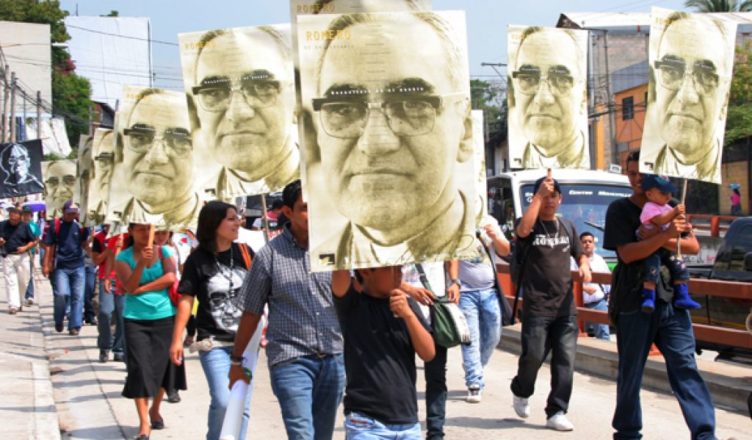
    oscar romero - protesto-ROMERO-facebook

Posted in SAINT of the DAY

Memorials of the Saints – 24 March

St Agapitus of Synnada
St Aldemar the Wise
St Bernulf of Mondovi
Bl Bertha de’Alberti of Cavriglia
Bl Bertrada of Laon
Bl Brian O’Carolan
St Caimin of Lough Derg
St Cairlon of Cashel
St Catherine of Sweden
Bl Diego José of Cádiz
St Domangard of Maghera
St Epicharis of Rome
St Epigmenius of Rome
St Hildelith of Barking
Bl John del Bastone
St Latinus of Brescia
St Macartan of Clogher
Bl Maria Serafina of the Sacred Heart
St Mark of Rome
Bl Óscar Arnulfo Romero y Galdámez (1917–1980) to be Canonised this year, 2018.

St Pigmenius of Rome
St Romulus of North Africa
St Secundus of North Africa
St Seleucus of Syria
St Severo of Catania
St Timothy of Rome

Martyrs of Africa – 9 saints: A group of Christians murdered for their faith in Africa, date unknown. The only details about their that survive are the names – Aprilis, Autus, Catula, Coliondola, Joseph, Rogatus, Salitor, Saturninus and Victorinus.

Martyrs of Caesarea – 6 saints: A group of Christians martyred together in the persecutions of Diocletian. We know little else but six of their names – Agapius, Alexander, Dionysius, Pausis, Romulus and Timolaus. They were martyred by beheading in 303 at Caesarea, Palestine.
Posted in DOMINICAN OP, MORNING Prayers, ON the SAINTS, QUOTES of the SAINTS, SAINT of the DAY

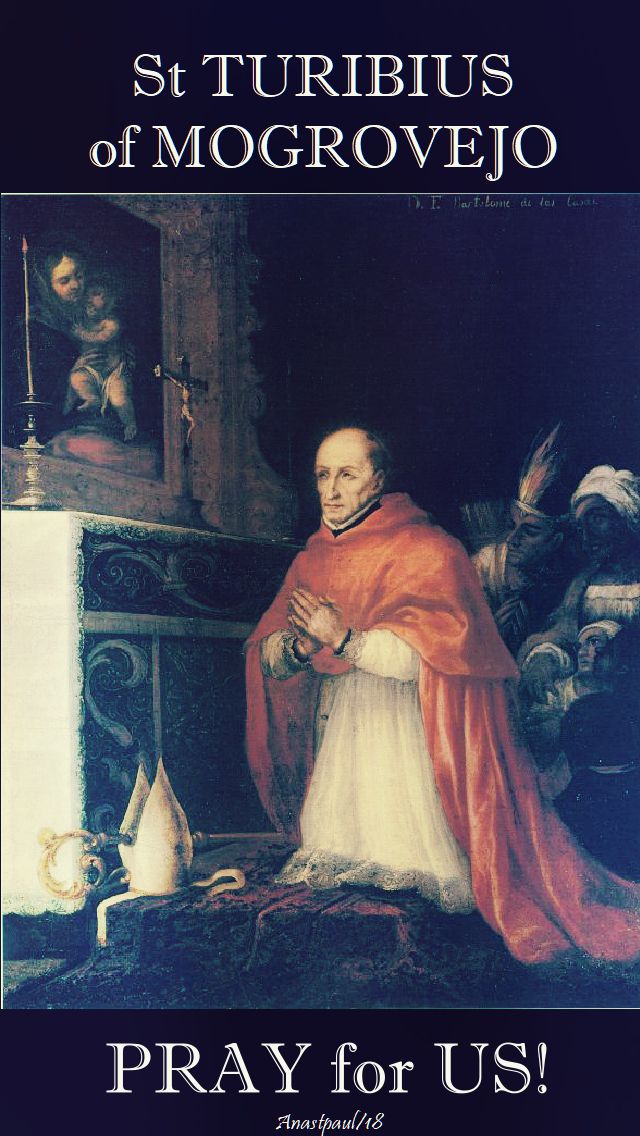
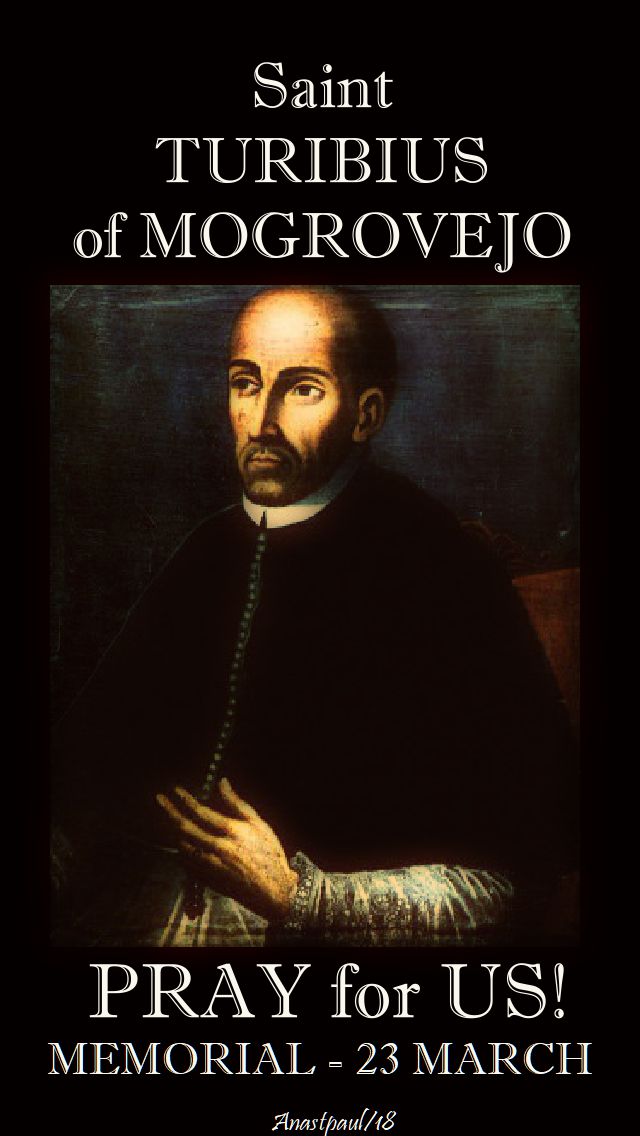
Thought for the Day – 23 March – The Memorial of St Turibius of Mogrovejo (1538-1606)

Thought for the Day – 23 March – The Memorial of St Turibius of Mogrovejo (1538-1606)

Nothing gave our saint so much pleasure as the greatest labours and dangers, to procure the least spiritual advantage to one soul.   Burning with the most vehement desire of laying down his life for his flock and of suffering all things for Him who died for us, he feared no dangers.   When he heard that poor Indians wandered in the mountains and deserts, he sought them out;  and to comfort, instruct, or gain one of them he often suffered incredible fatigues and dangers in the wildernesses and boldly travelled through the haunts of wild animals.
The ardour of his faith, his hope, his love of his Creator and Redeemer, his resignation and perfect sacrifice of himself, gathered strength in the fervent exercises and aspirations which he repeated almost without ceasing in his illness.   By his last will he ordered what he had about him to be distributed among his servants and whatever else he otherwise possessed to be given to the poor.
His body when translated the year after his death to Lima, was found incorrupt, the joints flexible, and the skin soft.
The Lord indeed writes straight with crooked lines.   Against his will and from the unlikely springboard of an Inquisition tribunal, this man became the Christlike shepherd of a poor and oppressed people.   God gave him the gift of loving others as they needed it. St Turibius, pray for us!st turibius pray for us - 23 march 2018-no 2

“Remember that you will derive strength
by reflecting that the saints
yearn for you
to join their ranks;
desire to see you fight bravely,
and behave like a true knight
in your encounters
with the same adversities
which they had to conquer,
and that breathtaking joy
is their eternal reward
for having endured a few years
of temporal pain.
Every drop of earthly bitterness
will be changed into
an ocean of heavenly sweetness.”

Blessed Henry Suso O.P. (1290-1365)remember that you will - bl henry suso - 23 march 2018

Posted in MORNING Prayers, QUOTES of the SAINTS, SAINT of the DAY

Quote of the Day – 23 March – The Memorial of St Turibius of Mogrovejo (1538-1606)

Quote of the Day – 23 March – The Memorial of St Turibius of Mogrovejo (1538-1606)

Christ said “I am the Truth”, He did not say “I am the custom”‘.

St Turibius of Mogrovejo (1538-1606)christ said i am the truth - st turibius of mogrovejo - 23 march 2018

Posted in LENT, MORNING Prayers, QUOTES - J R R Tolkien and MORE, QUOTES on PERSECUTION, QUOTES on SANCTITY, QUOTES on SUFFERING, SAINT of the DAY, The HOLY CROSS, The WORD, Thomas a Kempis

One Minute Reflection – 23 March – Friday of the 5th Week of Lent 2018 and the Memorial of St Turibius of Mogrovejo (1538-1606) – Today’s Gospel John 10:31-42

One Minute Reflection – 23 March – Friday of the 5th Week of Lent 2018 and the Memorial of St Turibius of Mogrovejo (1538-1606) – Today’s Gospel John 10:31-42

The Jews took up stones again to stone him...John 10:31

REFLECTION – “If all goes well with you on earth, how can you expect to be crowned in heaven for a patience you never practised? How can you be Christ’s friend if you will not be opposed? Therefore, you must suffer with Christ and for Christ, if you want to reign with Him.”…Thomas à Kempis (1380-1471) The Imitation of Christ, Book 2if all goes well with you on earth - thomas a kempis - 23 march 2018

PRAYER – Lord, through the pastoral care, suffering and zeal of St Turibius, You built up Your Church in Peru. Grant that the people of God may continually grow in faith and holiness. Accept his prayers on our behalf, that we may always be willing to stand at Your Cross. Through our Lord, Jesus Christ, in the unity of the Holy Spirit, one God forever amen.st turibius pray for us - 23 march 2018

Posted in LENT, MORNING Prayers, POETRY, The PASSION

Our Morning Offering – 23 March – Friday of the 5th Week of Lent 2018

Our Morning Offering – 23 March – Friday of the 5th Week of Lent 2018

Go to dark Gethsemane
James Montgomery (1771-1854)

Go to dark Gethsemane,
you that feel the tempter’s power,
your Redeemer’s conflict see,
watch with Him one bitter hour.
Turn not from His griefs away,
learn of Jesus Christ to pray.

Follow to the judgement hall,
view the Lord of life arraigned,
O the wormwood and the gall!
O the pangs His soul sustained!
Shun not suffering, shame or loss,
learn from Christ to bear the Cross.

Calvary’s mournful mountain climb,
there adoring at His feet.
Mark the miracle of time,
God’s own sacrifice complete,
“It is finished” hear Him cry,
learn from Jesus Christ to die..go to dark gethsamane - james montgomery - 23 march 2018

Posted in SAINT of the DAY

Saint of the Day – 23 March – St Turibius of Mogrovejo (1538-1606)

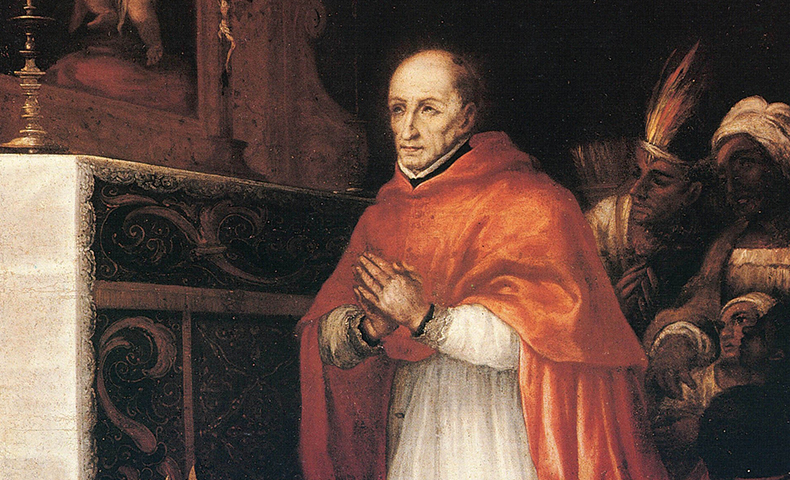
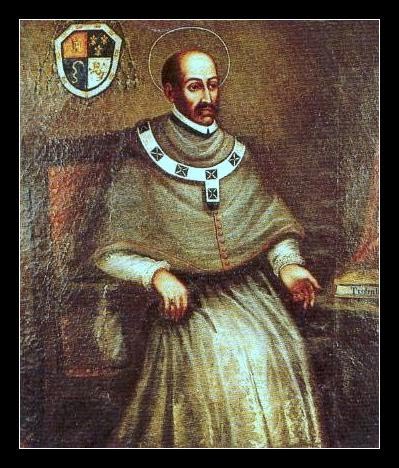
Saint of the Day – 23 March – St Turibius of Mogrovejo (1538-1606) ArchBishop, Lawyer,  Missionary, Preacher, Reformer, Professor, – born Toribio Alfonso de Mogrovejo in 1538 at Mayorga de Campos, Leon, Spain and died on 23 March 1606 at Santa, Peru of natural causes.   Patronages – Peru, Lima, Latin American Bishops, Native rights, Scouts, Valladolid.   St Turibius predicted the exact date and hour he would die, which would come to pass. His reputation for holiness and learning was never forgotten for it led to calls for his Canonisation. Pope Innocent XI Beatified and Pope Benedict XIII Canonise him  on 10 December 1726.SOD-0323-SaintTuribioofMogrovejo-790x480

Toribio Alfonso de Mogrovejo was born on 16 November 1538 in the Valladolid province in Habsburg Spain to the nobles Luis Alfonso de Mogrovejo (1510–1568) and Ana de Roblès i Morán (1515–???);   He was named in honour of Saint Toribio.

He was noted as a pious child with a strong devotion to the Blessed Virgin who fasted once a week in her honour and recited rosaries often.   He received an education befitting for a noble at the time;  he entered the college at Valladolid in 1550 where he studied humanities.   He became a professor teaching law to students at the reputed college in Salamanca.   His uncle Juan de Mogrovejo served as a professor there as well as at the San Salvador High School in Oviedo before King Juan III invited him to teach at the college in Coimbra.   Toribio accompanied his uncle there and studied at the college in Coimbra before returning to Salamanca sometime later.   His uncle died not long after he returned to Salamanca for his studies.   His learning and virtuous reputation led to King Philip II appointing him as the Grand Inquisitor on the Inquisition Court stationed at Granada in February 1571.   He remained in that position until 1576 but not without impressing the king with his work.

During this time Philip II nominated him for the vacant Lima archbishopric despite his strong protests.   He used his knowledge of canon law to remind him and the pope that priests alone could be designated with ecclesial dignities but the pope overruled him. Preparations were made for him to be ordained before the formal announcement could be made.    He was ordained to the priesthood in 1578 in Granada (after four consecutive weeks of receiving the minor orders) and Pope Gregory XIII named him on 16 May 1579 as the Archbishop of Lima;  he received his episcopal consecration in August 1580 from the Archbishop of Seville Cristóbal Rojas Sandoval.   In September 1580 he departed for Peru alongside his sister and her husband.

St.-Turibius-of-Mongrovejo

The new archbishop first arrived in Paita on 12 May 1581 which was 600 miles – or 970 kilometers – from Lima.   He began his new mission travelling to Lima on foot while he baptised and taught the natives.   He was enthroned in his new see a week later.   His favourite topic was:  “Time is not our own and we must give a strict account of it”. He traversed his entire archdiocese three times on foot and alone; exposed to tempests and torrents as well as the wild beasts and tropical heat.   He also had to deal with fevers and often threats from hostile tribes.   He countered these all the while baptising and confirming almost one half million people which included the future Saint Rose and Saint Martin de Porres and also Saint Francis Solano (who later became a close friend) and Blessed Juan Masías.

He built roads and schoolhouses as well as chapels and hospitals;  he never forgot about the religious and established convents for them to live in.   In 1591 founded the first seminary in the western hemisphere and mandated that learning indigenous languages was a prerequisite in their formation.   He inaugurated the first part of the third Lima Cathedral on 2 February 1604.   He also assembled thirteen diocesan synods and three provincial councils during his tenure.   He was seen as a champion of the rights of the natives against the Spanish masters.   He learnt the local dialects for better communication with the native people and his own flock and was seen as a champion for rights and liberties despite Peruvian governors voicing opposition to him since he challenged their power and control.

Mogrovejo sought the reformation of diocesan priests and found that some of their behaviour had grown too scandalous to be continued.   There were those priests who came to resent him for this though Francisco de Toledo supported his reform efforts and rendered assistance to the archbishop in that regard.   He also oversaw the Third Provincial Council from 1582 to 1583 which Philip II had requested he oversee.   He served as the council’s president but guided it rather than lead it;  he involved himself in drafting important concilliar documents.   Mogrovejo also worked to implement the decrees from the Council of Trent and made evangelisation a core theme in his episcopal career.   He produced a trilingual catechism in Spanish as well as in the native languages Quechua and Aymara in 1584 while the council mandated confessional manuals to aid confessors while calling for preaching in indigenous languages.  The council issued a decree from the council – one he endorsed – that proscribed excommunication to those clerics who engaged in business ventures since it was known that there were some clerics who exploited the natives for work and profit.

The council ended and Pope Sixtus V confirmed its decrees in 1588.   He held two more provincial councils in 1591 and in 1601.   Mogrovejo made three pastoral visitations that were all extensive in time.   He visited each parish and would first inspect all objects for divine worship (he expected them to be in good condition) before talking to the parish priest about the life of the parish.   He would then check the parish registers and then checked to see if the priest had the missal that Pope Pius V had mandated over a decade prior.

His prediction of the exact date and hour of his death, would soon come to pass.   It was in Pacasmayo during a pastoral visit that he contracted a fever but continued labouring to the last and arrived at Saña in a critical condition.   He dragged himself to receive the Viaticum and died not long after this on 23 March 1606 (Holy Thursday) at 3:30pm at the Saint Augustine convent.   His final words were those of Jesus Christ on the Cross:  “Lord, into Thy hands I commend my spirit”.   His remains are interred in the archdiocesan cathedral.toribio

His beatification was celebrated under Pope Innocent XI in 1679 (ratified in the papal bull “Laudeamus”) and Pope Benedict XIII later canonised him as a saint on 10 December 1726 through the papal bull “Quoniam Spiritus”.   His liturgical feast was once celebrated on 27 April but is now celebrated on 23 March.   His cult was once confined for the most part to South America but is now universal because of his pioneering reforms.   He became the patron saint for the Latin American episcopate after Pope John Paul II proclaimed him as such in 1983.

Cardinal Juan Luis Cipriani Thorne spoke on Mogrovejo as a tireless pastor who never tired “being close to God” whose “love for the poor manifested itself in the innumerable gestures” that marked his episcopal life.   Thorne further elaborated that “in Saint Toribio we reinforce our conviction that the time devoted to God is a guarantee of a faithful dedication to the fulfillment of our duties and to the service of our brothers”.st turibius at prayer

Posted in SAINT of the DAY

Memorials of the Saints – 23 March

St Turibius of Mogrovejo (1538-1606) (Optional Memorial)

Bl Álvaro del Portillo Díez de Sollano
Bl Annunciata Asteria Cocchetti
St Benedict of Campagna
St Crescentius of Carthage
Bl Edmund Sykes
St Ethelwald of Farne
St Felix the Martyr
St Felix of Monte Cassino
St Fergus of Duleek
St Fidelis the Martyr
St Frumentius of Hadrumetum
St Gwinear
St Joseph Oriol
St Julian the Confessor
St Liberatus of Carthage
St Maidoc of Fiddown
Bl Metod Dominik Trcka
St Nicon of Sicily
St Ottone Frangipane
Bl Peter Higgins
Bl Pietro of Gubbio
St Rafqa
St Theodolus of Antioch
St Victorian of Hadrumetum
St Walter of Pontnoise

Daughters of Feradhach: They are mentioned in early calendars and martyrologies, but no information about them has survived.

Martyrs of Caesarea – 5 saints: A group of five Christians who protested public games which were dedicated to pagan gods. Martyred in the persecutions Julian the Apostate. The only details we know about them are their names – Aquila, Domitius, Eparchius, Pelagia and Theodosia. They were martyred in 361 in Caesarea, Palestine.

Posted in JESUIT SJ, MORNING Prayers, SAINT of the DAY

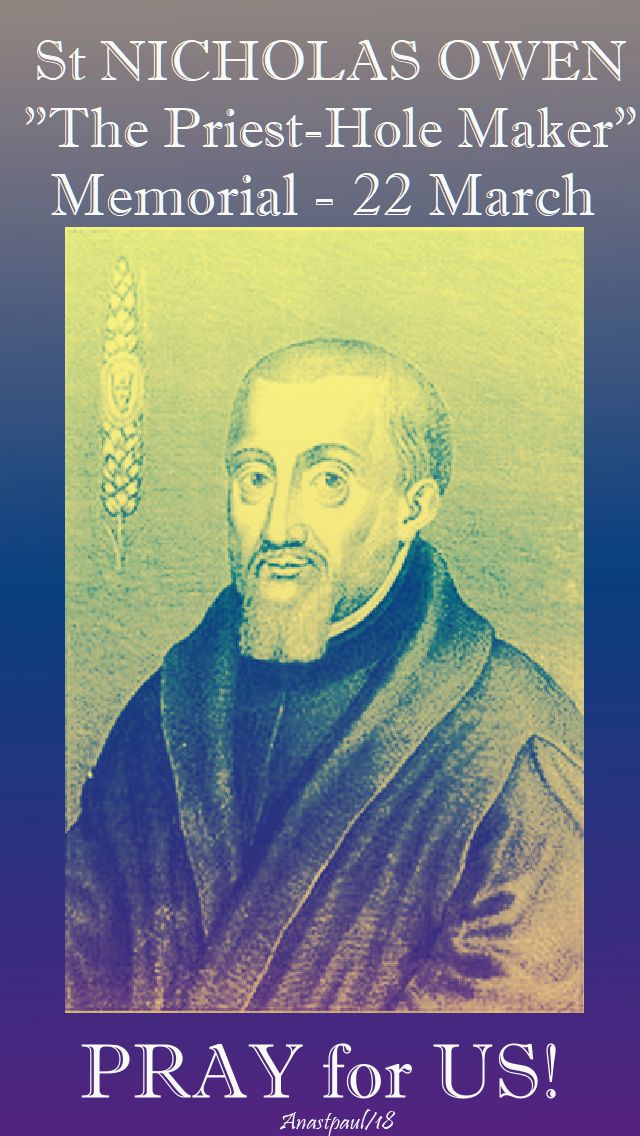
Thought for the Day- 22 March – The Memorial of St Nicholas Owen S.J. (1562-1606) Martyr – “The Priest Hole Maker”

Thought for the Day- 22 March – The Memorial of St Nicholas Owen S.J. (1562-1606) Martyr – “The Priest Hole Maker”

Saint Nicholas Owen possessed great faith and courage and he is highly respected for this, for he is a Saint.   However, what also makes him memorable, is how he used a rather obscure skill and talent for the good of God.   His ability to make hiding places ultimately became a tool of God for protecting the Church.

Saint Nicholas reminds us that any of our talents, regardless of how seemingly unusual or unimportant, can be put to good use for the good of God and our neighbour.   What are your talents and how can you use them for good?

Prayer
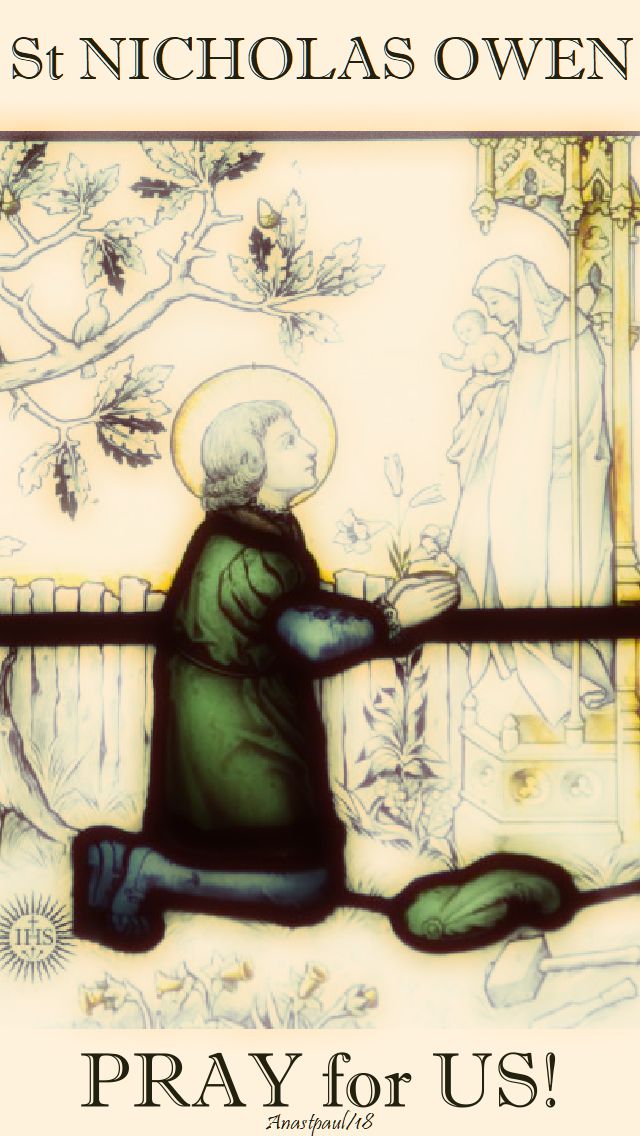
Dear God, please use me to do Your will.    St Nicholas Owen, pray for us!st nicholas owen - pray for us no 2 - 22 march 2018

Posted in DOCTORS of the Church, FATHERS of the Church, LENT, MORNING Prayers, QUOTES of the SAINTS, QUOTES on HUMILITY, SPEAKING of .....

Quote/s of the Day 22 March 2018 – Thursday of the 5th Week of Lent and the Memorial of St Nicholas Owen S.J. (1562-1606) Martyr “Speaking of Humility”

Quote/s of the Day 22 March 2018 – Thursday of the 5th Week of Lent and the Memorial of St Nicholas Owen S.J. (1562-1606) Martyr

“Speaking of Humility”

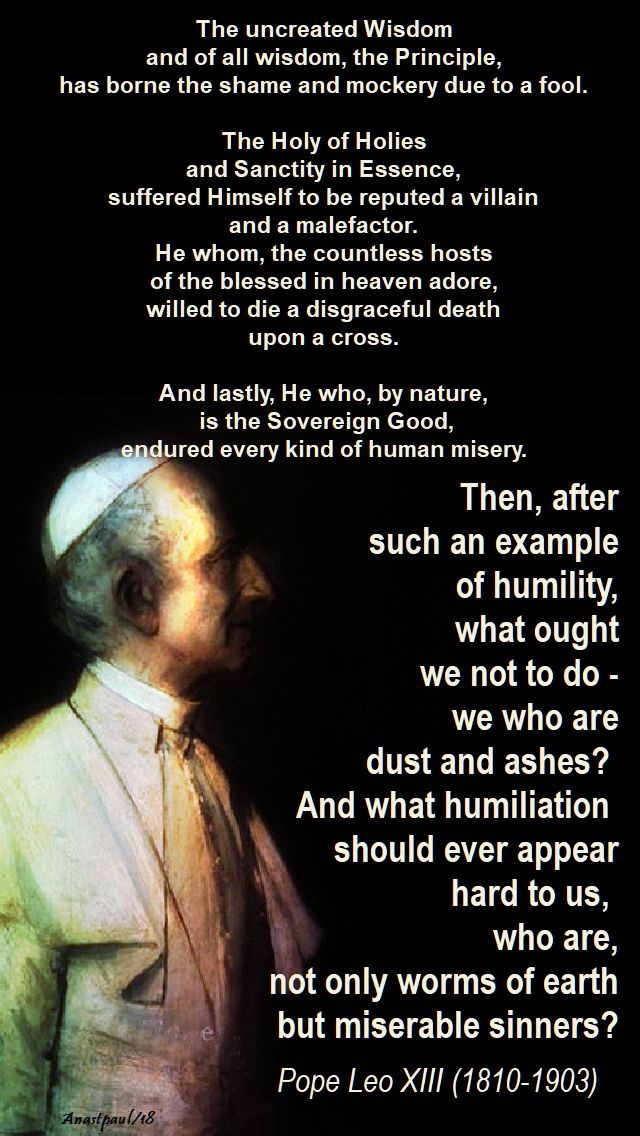
“The uncreated Wisdom and of all wisdom the Principle, has borne the shame and mockery due to a fool.
The Holy of Holies and Sanctity in Essence, suffered Himself to be reputed a villain and a malefactor.
He, whom the countless hosts of the blessed in heaven adore, willed to die a disgraceful death upon a cross.
And lastly, He who by nature, is the Sovereign Good, endured every kind of human misery.

Then, after such an example of humility, what ought we not to do – we who are dust and ashes?
And what humiliation should ever appear hard to us, who are not only worms of earth but miserable sinners?”

Pope Leo XIII (1810-1903)the uncreated wisdom - 22 march 2018 speaking of humility

“Humility is the foundation of all the other virtues,
hence, in the soul in which this virtue does NOT exist,
there cannot be any other virtue except in mere appearance.”

“Do you wish to rise? Begin by descending.
You plan a tower, that will pierce the clouds?
Lay first, the foundation of humility.”

” There never can have been
and never can be
and there never shall be,
any sin without pride.”

St Augustine (354-430) Doctor of the Churchst augustine - 22 march 2018 - speaking of humility -humility is the foundation, do you wish to rise, there never can be

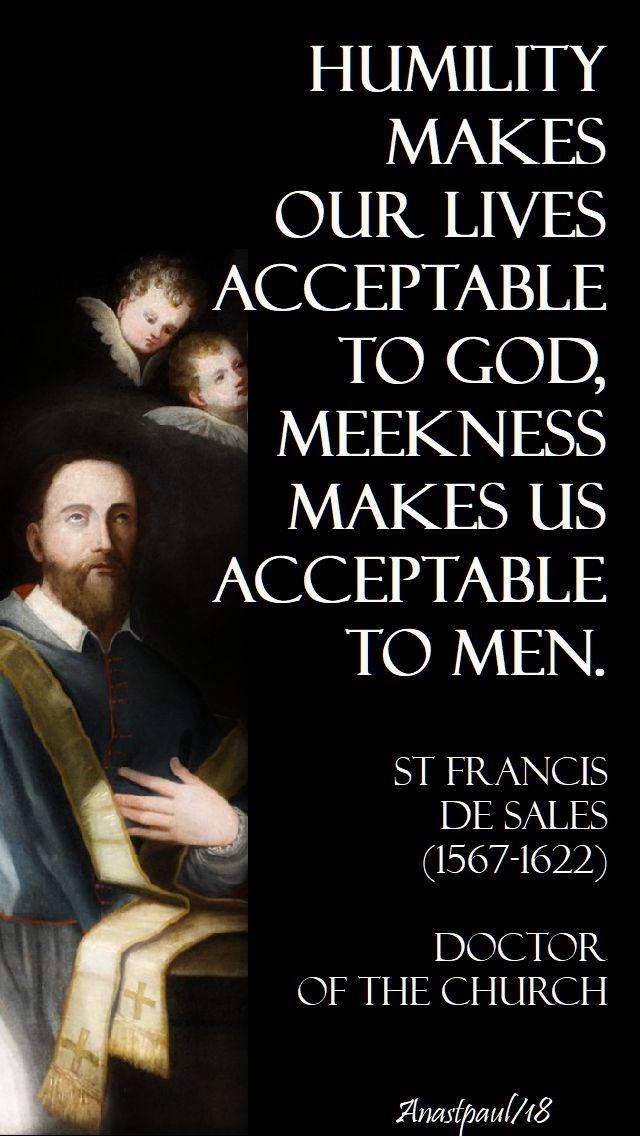
“Humility, makes our lives acceptable to God,
meekness, makes us acceptable to men.”

St Francis De Sales (1567-1622) Doctor of the Churchhumility makes our lives - st francis de sales - 22 march 2018 speaking of humility

“The most powerful weapon, to conquer the devil is humility.
For, as he does not know at all, how to employ it,
neither does he know, how to defend himself from it.”

St Vincent de Paul (1581-1660)the most powerful weapon - st vincent de paul - speaking of humility - 22 march 2018


Posted in DOCTORS of the Church, LENT, MORNING Prayers, QUOTES of the SAINTS, QUOTES on SANCTITY, QUOTES on SUFFERING, SAINT of the DAY, The WORD

One Minute Reflection – 22 March 2018 – Thursday of the 5th Week of Lent and the Memorial of St Nicholas Owen S.J. (1562-1606) Martyr

One Minute Reflection – 22 March 2018 – Thursday of the 5th Week of Lent and the Memorial of St Nicholas Owen S.J. (1562-1606) Martyr

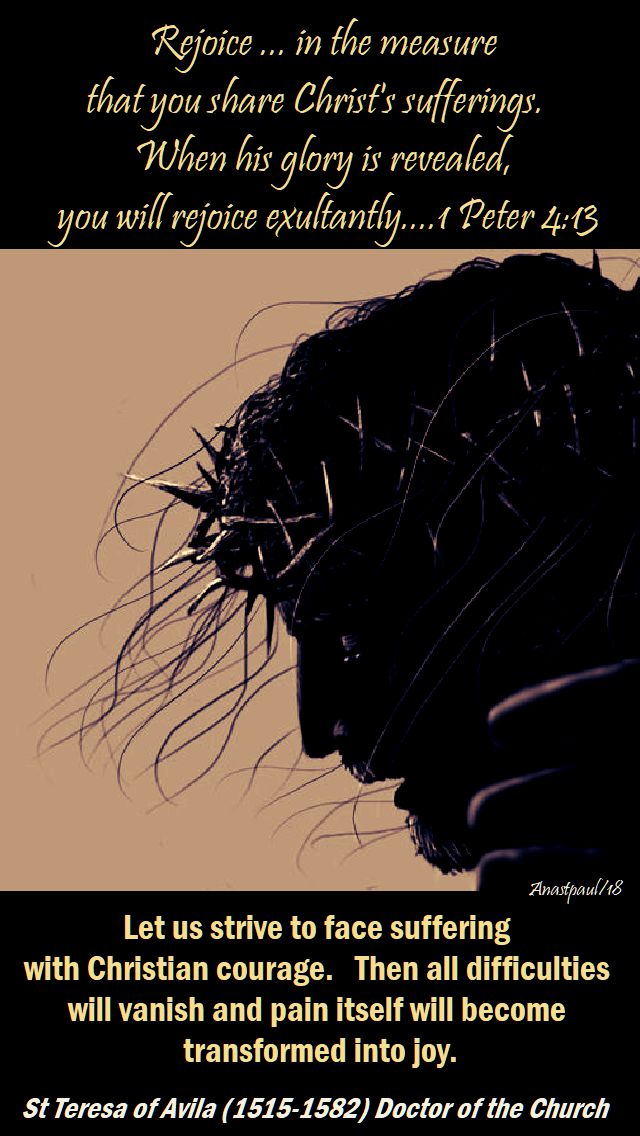
Rejoice … in the measure that you share Christ’s sufferings. When his glory is revealed, you will rejoice exultantly...1 Peter 4:13

REFLECTION – “Let us strive to face suffering with Christian courage. Then all difficulties will vanish and pain itself will become transformed into joy.”…St Teresa of Avila (1515-1582) Doctor of the Churchlet us strive to face suffering - st teresa of avila - 22 march 2018
PRAYER – Jesus, Man of Sorrows, in every suffering keep my eyes fixed on You. Let me keep ever before my mind the glory to come and so face the suffering with true Christian courage.   Lord our God please grant that by the intercession of St Nicholas Owen, who suffered beyond all our understanding, for love of You, we may learn to suffer in silence and with true courage, amen.st nicholas owen - opray for us - 22 march 2018

Posted in LENT, MORNING Prayers, PRAYERS of the SAINTS, SAINT of the DAY

Our Morning Offering – 22 March 2018 – Thursday of the 5th Week of Lent

Our Morning Offering – 22 March 2018 – Thursday of the 5th Week of Lent and the Memorial of St Nicholas Owen S.J. (1562-1606) Martyr

Transform me into Yourself
By St John Gabriel Perboyre (1802-1840) Martyr

O my Divine Saviour,
Transform me into Yourself.
May my hands be the hands of Jesus.
Grant that every faculty of my body
May serve only to glorify You.

Above all,
Transform my soul and all its powers
So that my memory, will and affection
May be the memory, will and affections
Of Jesus.

I pray You
To destroy in me all that is not of You.
Grant that I may live
but in You, by You and for You,
So that I may truly say, with Saint Paul,
“I live – now not I – But Christ lives in me.”transform me into yourself - st john gabriel perboyre - 22 march for the memorial of st nicholas owen sj

Posted in JESUIT SJ, MORNING Prayers, SAINT of the DAY

Saint of the Day – 22 March – St Nicholas Owen S.J. (1562-1606) The Priest-Hole Builder – Martyr

Saint of the Day – 22 March – St Nicholas Owen S.J. (1562-1606) The Priest-Hole Builde, Martyr , Lay Brother of the Society of Jesus, Assistant to St Edmund Campion- born in the 16th century in Oxford, England and was tortured to death on 2 March 1606 in London, England.  Also known as • John Owen and • Little John.   St Nicholas was a Jesuit lay brother who was the principal designer and builder of priest holes during the reigns of Queen Elizabeth I and King James I of England.   He was Canonised on 25 October 1970 by Pope Paul VI.

header - st nicholas owen

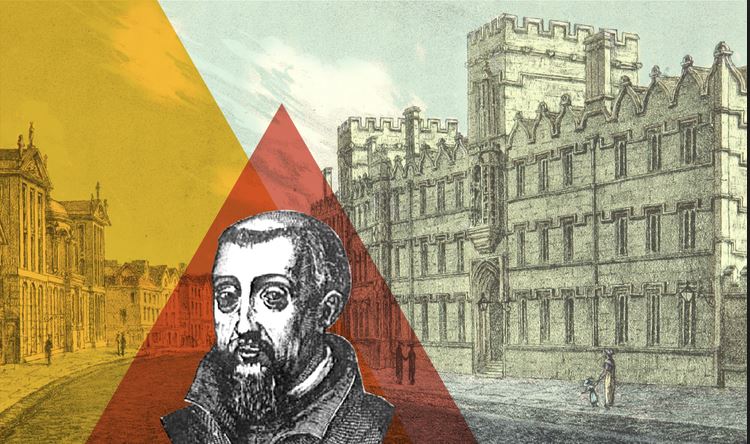
St Nicholas was born in Oxford, England, around 1562 into a devoutly Catholic family and grew up during the Penal Laws.   His father, Walter Owen, was a carpenter and Nicholas was apprenticed as a joiner in February 1577 where he acquired skills that he was to use in building hiding places.   Two of his older brothers became priests.   St Nicholas served as St Edmund Campion’s (1540-1381) assistant and was arrested for protesting Campion’s innocence.   Upon his release, he entered the service of Henry Garnet S.J. around 1588 and for the next 18 years built hiding places for priests in the homes of Catholic families.   He frequently travelled from one house to another, under the name of “Little John”, accepting only the necessities of life as payment before starting off for a new project.   He also used the aliases “Little Michael”, “Andrewes”, and “Draper”.   During the daytime he would work as a travelling carpenter to deflect suspicion.

Owen was only slightly taller than a dwarf and suffered from a hernia, as well as a crippled leg from a horse falling on him.   Nevertheless, his work often involved breaking through thick stonework and to minimise the likelihood of betrayal he often worked at night and always alone.   Sometimes he built an easily discovered outer hiding place which concealed an inner hiding place.   The location of the secret room was known only to himself and the owner of the house.   Examples of his work survive at Sawston Hall (Cambs),[Oxborough] [Norfolk] Huddington Court (Worcestershire) and Coughton Hall (Warwickshire).   Harvington Hall in Worcestershire has seven “priest holes”.   Due to the ingenuity of his craftsmanship, some may still be undiscovered.  Below are 3 at Harvington Hall, the first 2 pics are the entrance and inside the hole.   The third is another in the staircase.

For many years, St Nicholas worked in the service of the Jesuit priest Henry Garnet and was admitted into the Society of Jesus as a lay brother.   He was arrested in 1594 and was tortured at the Poultry Compter but revealed nothing.   He was released after a wealthy Catholic family paid a fine on his behalf, the jailers believing that he was merely the insignificant friend of some priests.   He resumed his work and is believed to have masterminded the famous escape of Father John Gerard from the Tower of London in 1597.

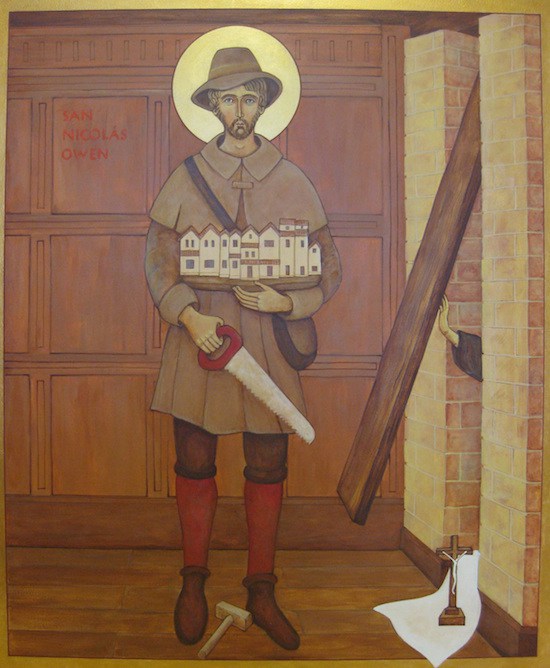
San Nicolas Owen

Early in 1606, St Nicholas was arrested a final time at Hindlip Hall in Worcestershire, giving himself up voluntarily in hope of distracting attention from his master Fr Garnet who was hiding nearby with another priest.   Realising just whom they had caught and his value, Secretary of State Robert Cecil exulted:  “It is incredible, how great was the joy caused by his arrest… knowing the great skill of Owen in constructing hiding places and the innumerable quantity of dark holes which he had schemed for hiding priests all through England.”

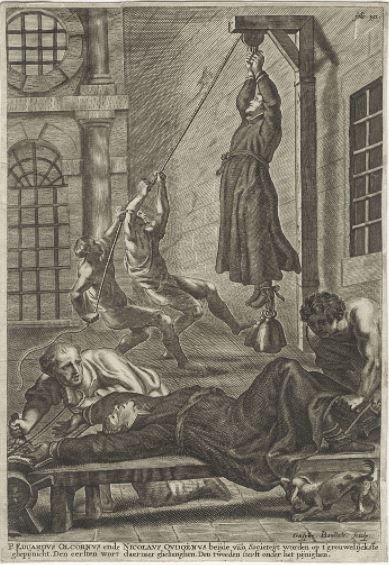
After being committed to the Marshalsea, a prison on the southern bank of the Thames, St Nicholas was then removed to the Tower of London.   He was submitted to terrible “examinations” on the Topcliffe rack, dangling from a wall with both wrists held fast in iron gauntlets and his body hanging.   As his hernia allowed his intestines to bulge out during this procedure, the rackmaster strapped a circular plate of iron to his stomach. When he remained stubborn, it is believed that he was transferred to the rack, where the greater power of the windlass forced out his hernia which was then slashed by the plate, resulting in his death.   He revealed nothing to his inquisitors and died in the night between 1 and 2 March 1606.   Father Gerard wrote of him:

I verily think no man can be said to have done more good of all those who laboured in the English vineyard.   He was the immediate occasion of saving the lives of many hundreds of persons, both ecclesiastical and secular.

Martyrdom of st nicholas owen

St Nicholas was canonised as one of the Forty Martyrs of England and Wales by Pope Paul VI on 25 October 1970.   Catholic stage magicians who practice Gospel Magic consider St Nicholas Owen the patron saint of Illusionists and Escapologists, due to his facility at using “trompe l’oeil” when creating his hideouts and the fact that he engineered an escape from the Tower of London.

There is a Roman Catholic church dedicated to Saint Nicholas Owen in Little Thornton, Lancashire.

Posted in JESUIT SJ, MARIAN TITLES, SAINT of the DAY

Nostra Signora dei Sette Veli / Our Lady of the Seven Veils, Foggia, Italy and Memorials of the Saints – 22 March

Nostra Signora dei Sette Veli / Our Lady of the Seven Veils, Foggia, Italy (11th Century) – 22 March:

In the Cathedral of Foggia one can find an ancient and mysterious image of the Blessed Virgin Mary. This icon, called “Our Lady of the Seven Veils,” once caused Saint Alphonsus to go into ecstasy, which I will describe below. As a young priest, St Pio of Pietreclina would make a visit to this image everyday.
In the eleventh century Foggia, Italy was a tiny town perched around the Tavern of the Owl.   One day some local farmers saw three flames over a small pond or bog.   Intrigued, they dug where the miraculous fire had been and discovered a large “table” buried in the mud.   They realised that this “table” was actually a Byzantine icon that had remained somewhat preserved despite being soaked in water and mud.   The image was cleaned and then cloaked with new veils.   I assume there were seven veils and hence the name but I cannot verify this.   The icon was then placed in the local Tavern of the Owl for veneration.   Soon the tavern became a place of pilgrimage.   In 1080 Robert Guiscard built a church to honour the sacred image.   In 1172 the church was expanded by William II “the Good” of Sicily.   The “face hole” is all that one can now see of the original wooden icon.   It is black and the face is now indiscernible.   However, on Maundy Thursday of 1731, the Virgin Mary’s white face appeared in this portal, which was usually black and dark.
Saint Alphonsus Liguori heard about apparition and went to Foggia to venerate the Immaculate Mother of the Saviour.   He also received an apparition of the Virgin’s face in the small black portal.   He described the Blessed Virgin’s face on that occasion as a girl of 13-14 with a white veil.   The apparitions of the Virgin’s face on the icon continued until about 1745.
As the city grew larger, the church was decorated and enriched.   The Normans, Swabians, Angevins, Aragonese, Spaniards and Bourbons considered the church to be one of the most important in Italy.  It has served as the site for several royal weddings. Today, the image is said to be covered in seven layers of precious metal and embroidered material – hence the name Madonna of the Seven Veils.

St Avitus of Périgord
St Basil of Ancyra
St Basilissa of Galatia
St Benevenuto Scotivoli of Osimo
Bl Bronislaw Komorowski
St Callinica of Galatia
Bl Clemens August von Galen
St Darerca of Ireland
St Deghitche
St Epaphroditus of Terracina
St Failbhe of Iona
Bl François-Louis Chartier
St Harlindis of Arland
Bl Hugolinus Zefferini
St Lea of Rome
Bl Marian Górecki
St Nicholas Owen S.J. (1562-1606)

St Octavian of Carthage
St Paul of Narbonne
St Saturninus the Martyr
St Trien of Killelga

Posted in LENT, MORNING Prayers, ON the SAINTS, QUOTES of the SAINTS, SAINT of the DAY, The PASSION

Thought for the Day – 21 March – The Memorial of St Nicholas of Flue (1417-1487)

Thought for the Day – 21 March – The Memorial of St Nicholas of Flue (1417-1487) and Wednesday of the 5th Week of Lent 2018  (this reflection includes our Lenten Reflection for today.)

Although our minds are limited in their ability to attain God in this life, we are capable of “greater desire and love, and pleasure in knowing divine matters” than we are able to find in “the perfect knowledge of the lowest things.”   Thus far Aquinas, who taught as one who knew.   Saint Nicholas of Flue (1417-1487) was in perfect agreement.   “God,” he once said, “gives us such a taste for prayer that we yearn for it as if we were waiting to go to a dance.”

The likeness was more than a bit incongruous, for the speaker was a true hermit, a man who had given up not only dances but nearly everything else that bound him to this world, even food.   Born to a pious, upstanding peasant family, young Nicholas stood out for his goodness, simplicity and mortification.   While still a young man, labouring in the fields and meadows of the valleys south of Lucerne, he fasted four times per week, explaining himself, when pressed, by saying, “Such is the will of God.”   Until his fiftieth year, his life was that of an exemplary Swiss free man.   Like many of his fellow countrymen, he served his canton both under arms and by holding civic office.   And this pillar of the community raised up five sons and five daughters with the help of his exemplary wife Dorothy.   Yet God persisted in calling him to a life beyond that of the domestic holiness he had already embraced and sent visions to him in his late-night prayer vigils and his moments of afternoon solitude in the fields, visions that beckoned him to leave all.

As the eminent Swiss theologian Charles Cardinal Journet (1891-1975) explained in his biography of the hermit-saint, “it no longer sufficed for him to walk along the roads of the world with God in his heart;  he had to take the path set aside for him, that he might be taken by the hand and led to where he knew not.”   What praise of Dorothy of Flue could be lovelier, Journet asked, than to admire her magnanimity in being able to    They parted friends, just thirteen weeks after the birth of their youngest child and remained so.   Several years later, a pilgrim visitor to Nicholas’ hermitage saw the saint, with joyous mien, lean out of the window of his tiny cell after the morning Mass to greet his family with a blessing:  “May God give you a blessed day, dear friends and good people!”  One is glad to know that his wife and children attended his deathbed.   After all, she had never lost her husband completely.   Honoured by Swiss Protestants, venerated by Swiss Catholics, Nicholas’s cult, uninterrupted since his death, was officially sanctioned by Clement IX (1667-9).  In 1947 he was canonised by Pope Pius XII.

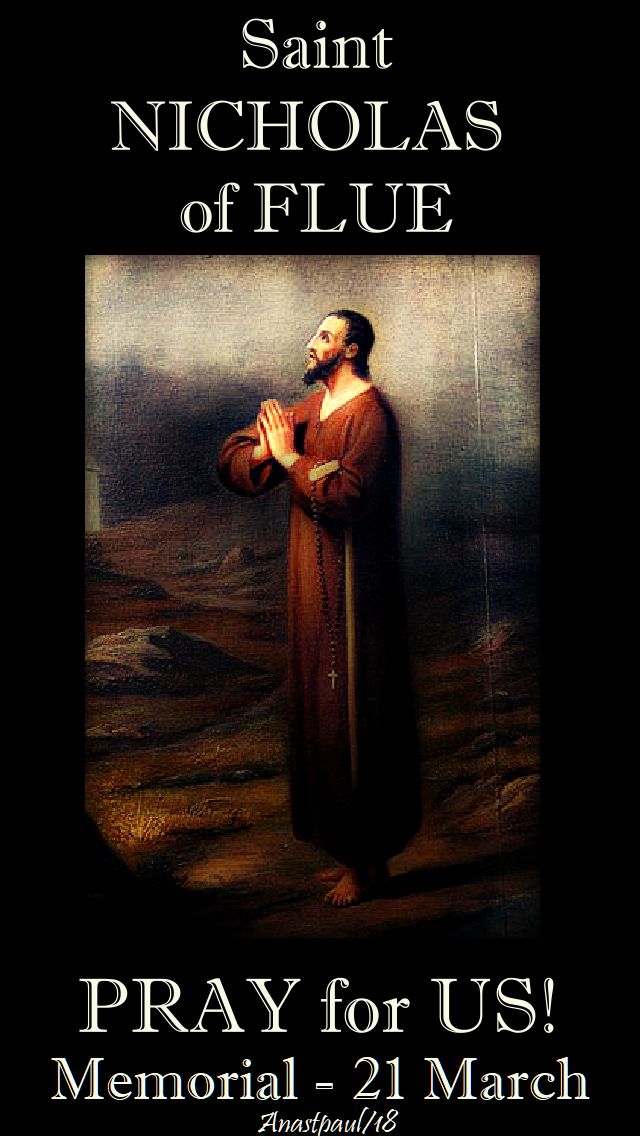
What lesson might Nicholas of Flue hold out for our generation?   Were he alive today this simple Swiss peasant would doubtless be startled by our wealth.   The recession of recent years seems to have done little to dull the edge of our consumption.   The adjective “worldly” is now being used as a term of approbation, to signify the savoir-faire of the person who knows the latest fashions and ways of thinking.   It is a telling linguistic development.   Nicholas of Flue spent the last twenty years of his life in a tiny room with two windows.   Through one of them, he could see something of the beauty of his native land, a beauty that nourished his reflection and piety:  “O man, think of the sun so high in the sky and consider its splendour:  but your soul has received the splendour of the eternal God.”   Through the other, he saw the altar, whence came the very food of his soul.   “We should carry the Passion of God in our hearts, for this is the greatest consolation to a man at the hour of his death.”   The one thing needful indeed.st nicholas of flue pray for us - 21 march 2018-no 2

Posted in DOCTORS of the Church, JESUIT SJ, MORNING Prayers, PRACTISING CATHOLIC, QUOTES of the SAINTS, QUOTES on SANCTITY, SPEAKING of .....

Quote/s of the Day – 21 March “Speaking of Sanctity”

Quote/s of the Day – 21 March
“Speaking of Sanctity”

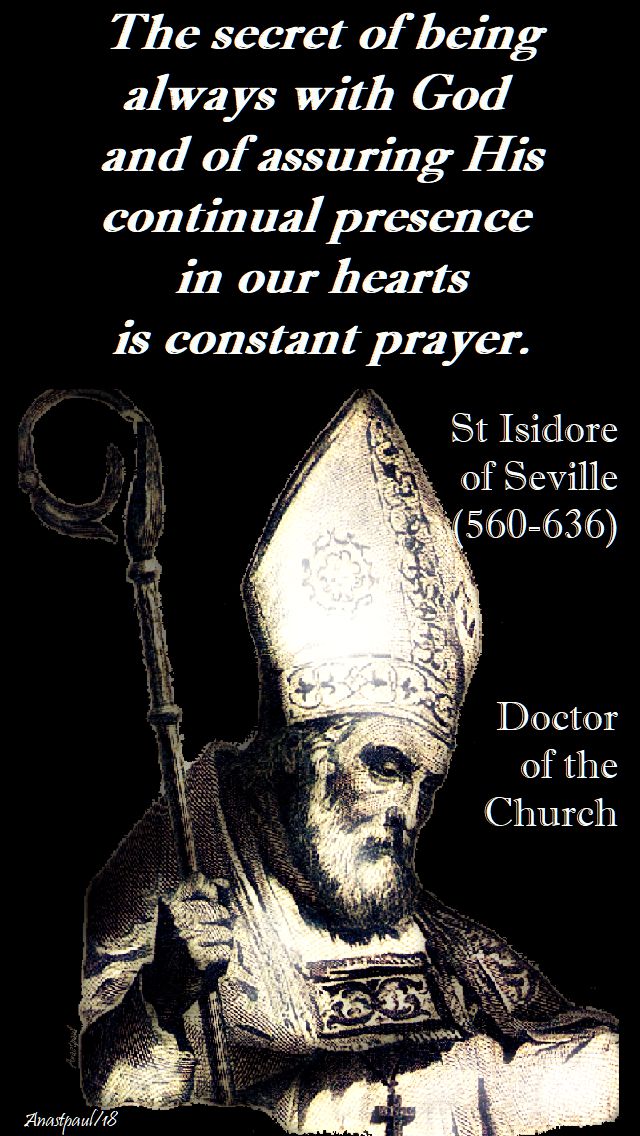
“The secret of being always with God
and of assuring His continual presence
in our hearts is constant prayer.”

St Isidore of Seville (560-636) Doctor of the Churchthe secret of being always with god - st isidore - 21 march 2018 - speaking of sanctity

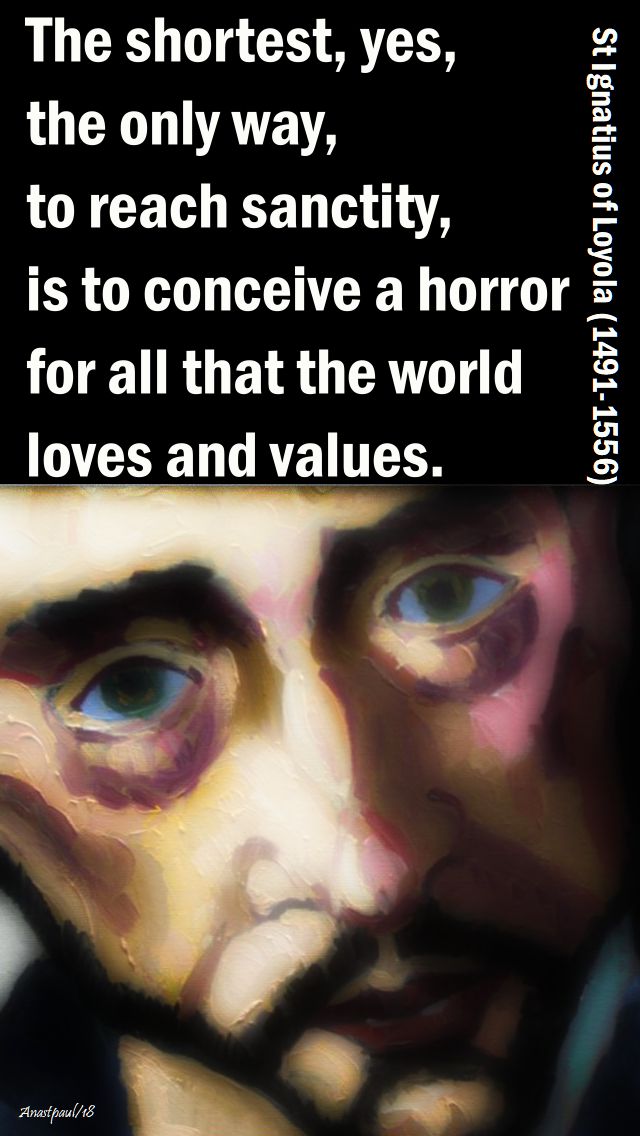
“The shortest, yes, the only way,
to reach sanctity, is to conceive a horror
for all that the world loves and values.”

St Ignatius of Loyola (1491-1556)the shortest, yes, - st ignatius - speaking of sanctity - 21 march 2018

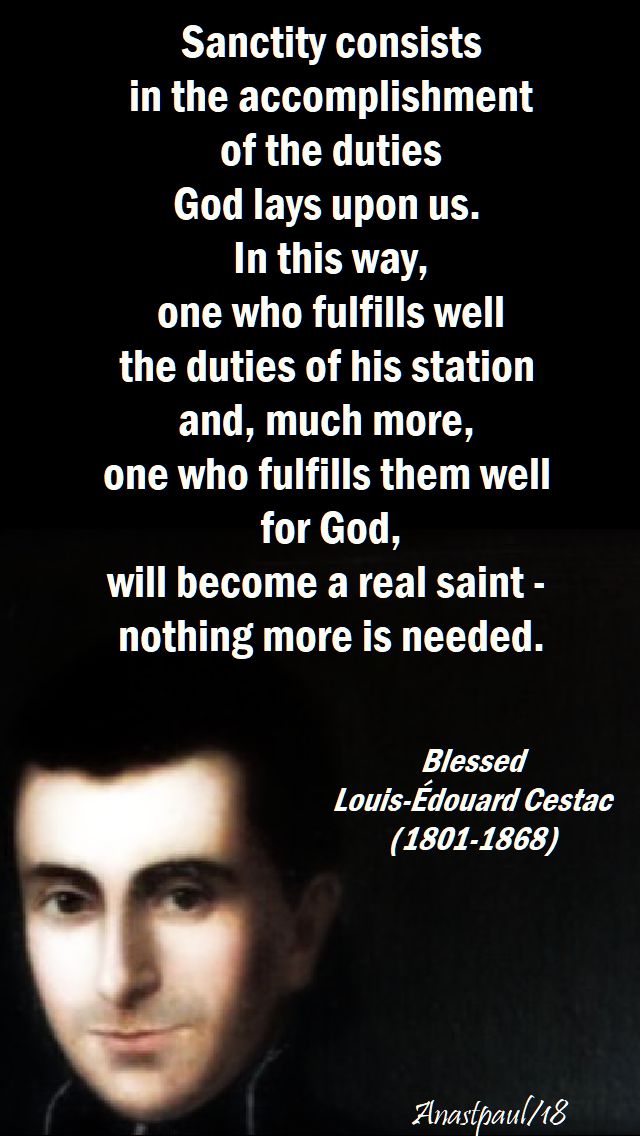
“Sanctity consists in the accomplishment
of the duties God lays upon us.
In this way, one who fulfills well the duties of his station
and, much more, one who fulfills them well for God,
will become a real saint – nothing more is needed.”

Blessed Louis-Édouard Cestac (1801-1868)sanctity consists in the accomplishment - bl louis-edouard cestac - 21 march 2018 speaking of sanctity

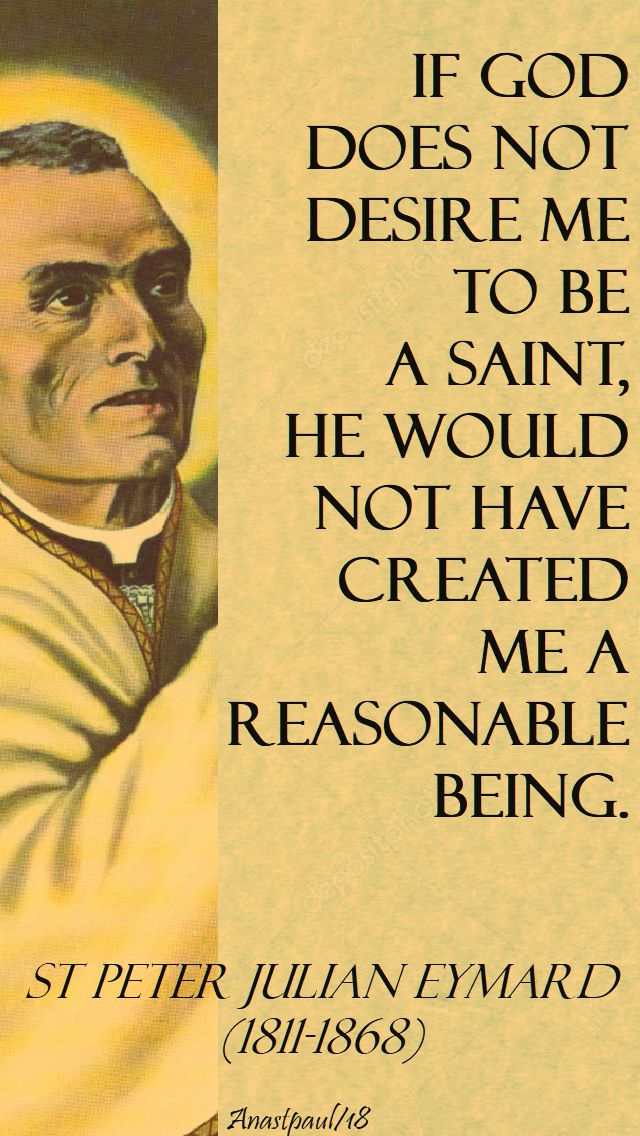
“If God does not desire me to be a saint,
He would not have created me a reasonable being.”

St Peter Julian Eymard (1811-1868)if god does not - st peter julian eymard - speaking of sanctity - 21 march 2018

“Our Lord has created persons for all states in life
and in all of them, we see people,
who achieved sanctity
by fulfilling their obligations well.”

St Anthony Mary Claret (1807-1870)our lord has created - sdt anthony mary claret - speaking of sanctity - 21 march 2018

“Great’ holiness consists in carrying out
the ‘little duties’ of each moment.”

St Josemaria Escriva, (1902-1975) The Way, 81great holiness - st josemaria - speaking of sanctity - 21 march 2018

“We must have a real living determination to reach holiness.
I will be a saint means, I will despoil myself of all, that is not God;
I will strip my heart of all created things;
I will live in poverty and detachment;
I will renounce my will, my inclinations, my whims and fancies
and make myself a willing slave to the will of God.”

St Mother Teresa (1910-1997)we must have a ral living - st mother teresa - speaking of sanctity - 21 march 2018