Saint of the Day – 25 March – St Hermelandus (Died c720) Priest, Founder-Abbot of the Monastery of Aindre, Miracle-worker. Born in Noyon, France and died on 25 March in c720 of natural causes in his Monastery at Aindre. Also known as – Erblon, Ermelando, Herbland, Hermeland, Hermiland. Additional Memorials – 18 October in Rouen, Bagneux and Treguier. 20 November (translation of Relics), 25 November in Nantes, today 25 March (the anniversary of his death) universaly and solemnly celebrated at the Monastery of Fontenelle.
The Roman Martyrology reads today: “In Aindre, an Island of the Loire, the Abbot St Hermelandus, whose glorious life is attested by many miracles.”
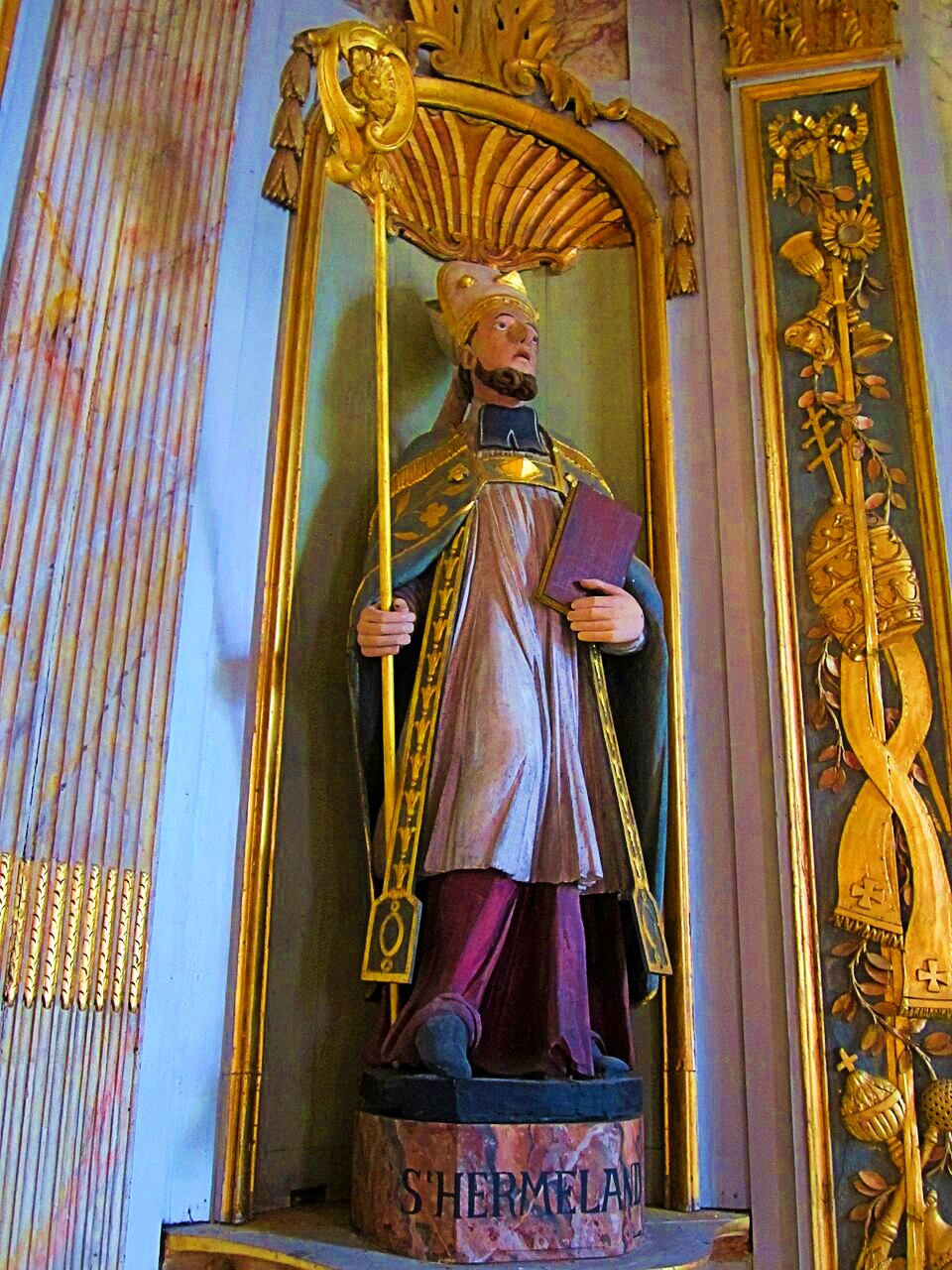
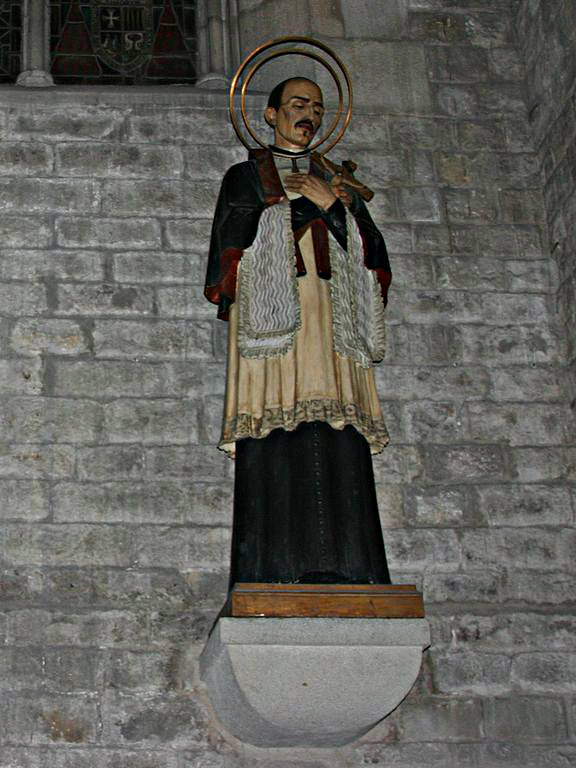
St Hermelandus Statue in the Church dedicated to him in Sottevast
The Life of Saint Hermelandus, Abbot of Aindre, written almost contemporaneously with his death in 767 and preserved in a manuscript, offers us a fascinating glimpse into the life of a Frankish nobleman of the 7th Century.
Born in Noyon to an illustrious family, Hermelandus began a brilliant career at the Court of Clotaire III, obtaining the position of Cupbearer. However, refusing an arranged marriage and desiring a life consecrated to God, he asked the King for permission to enter a Monastery.
Welcomed to Fontenelle, under the guidance of the Abbot Saint Lambert, Hermelandus distinguished himself for his devotion and his ascetic rigour. It was the Bishop of Nantes, Pascarius, who asked Abbot Lambert to send Monks to found an Abbey in his Diocese.
Hermelandus was chosen to lead the community of twelve brothers, identified an Island in the Loire, called Aindre because of its woods, as an ideal site for the new Monastery. With the support of Pascarius, he obtained the Monastery’s exemption from the authority of the future Bishops of Nantes and the confirmation of its freedom by King Childebert III.
The number of years Hermelandus spent as the Abbot remains uncertain; we know only that he abdicated power late in life, dying under his second successor between 710 and 730.
In 843, the Abbey of Aindre, unfortunately, was destroyed by the Normans and was never rebuilt. Devotion to Saint Hermelandus spread over the centuries, as evidenced by the miracle which occurred in the 12th Century in a Church dedicated to him in Rouen. His Relics, twere ransferred to Bagneux and Loches, to escape the Norman invasions, continue to attract the veneration of the faithful.
At the time of the Revolution , the silver Reliquary was removed but the Relics were saved. Then placed in the Collegiate Church of Saint-Ours in Loches , they were returned in 1848, to the Church which bears his name of Saint-Herblain.
St Dula the Slave Bl Everard of Nellenburg Bl Herman of Zahringen St Hermelandus (Died c720) Priest, Abbot St Humbert of Pelagius Bl James Bird St Kennocha of Fife
St Lucia Filippini (1672-1732) Virgin, Religious Sister, Founder. On 22 June 1930, Lucia Filippini was declared a Saint of the Church by Pope Pius XI and her Statue was given the last available niche in the Basilica of Saint Peter in Rome. Her statue can be seen in the first upper niche from the main entrance on the left (south) side of the nave of St Peter’s. Biography: https://anastpaul.com/2022/03/25/saint-of-the-day-25-march-st-lucia-filippini-1672-1732/
Thought for the Day – 24 March – Meditations with Fr Richard Frederick Clarke SJ (1839-1900)
“Short Meditations for March, St Joseph” From “The Devout Year” By Fr Richard Frederick Clarke SJ (1839-1900)
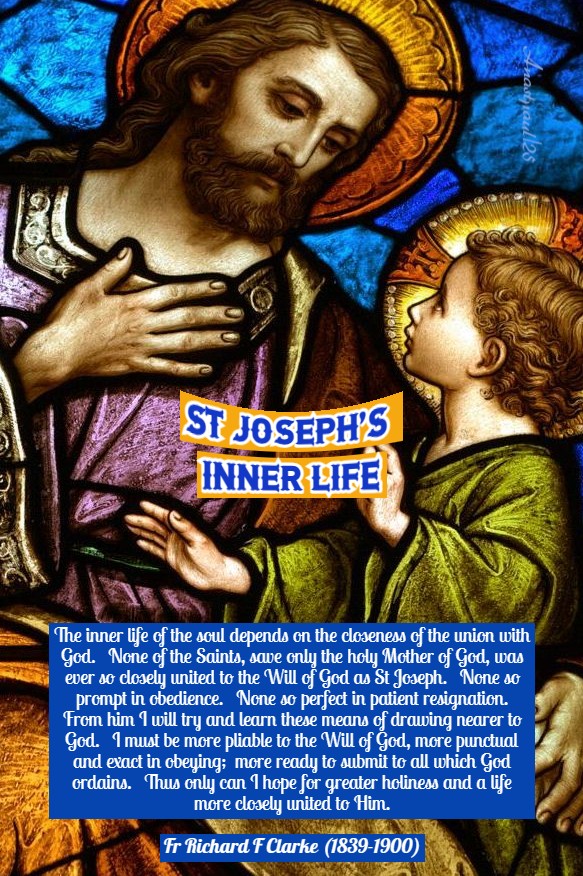
24th Day – St Joseph’s Inner Life
+1. The inner life of the soul depends on the closeness of the union with God. None of the Saints, save only the holy Mother of God, was ever so closely united to the Will of God as St Joseph. None so prompt in obedience. None so perfect in patient resignation. From him I will try and learn these means of drawing nearer to God. I must be more pliable to the Will of God, more punctual and exact in obeying; more ready to submit to all which God ordains. Thus only can I hope for greater holiness and a life more closely united to Him.
+2. St Joseph had a privilege on earth which, for all other Saints, is reserved for the Eternal Paradise – of being in the continual company of his God, of gazing on the Sacred Humanity of the Incarnate Word, of hearing Words of love and gratitude from Him, of drinking in delicious draughts of heavenly delight, from the Words, Touches and Looks of the Incarnate God. His life must have been one long ecstasy. If those who touched the Hem of Jesus’ Garment received an inflow of heavenly virtue, what must he have received, who nursed Him in infancy and bore Him the closest company, in youth and manhood!
+3. How often St Joseph called Jesus his dear Son and Jesus, in return, called him His dear father! What happiness to him to have a right thus to address the Second Person of the Divine Trinity! What grace must have flowed into his heart when Jesus called him father! Pray that you may deserve to have Jesus smile sweetly upon you, as He so often did upon His great foster-father.
Quote/s of the Day – 24 March – Feast of St Gabriel the Archangel It is piously believed that St Gabriel, who assisted in His Mission to Redeem mankind, is also the Angel of the Agony, who assisted Jesus in His terrible sufferings in the completion of that Redemption.
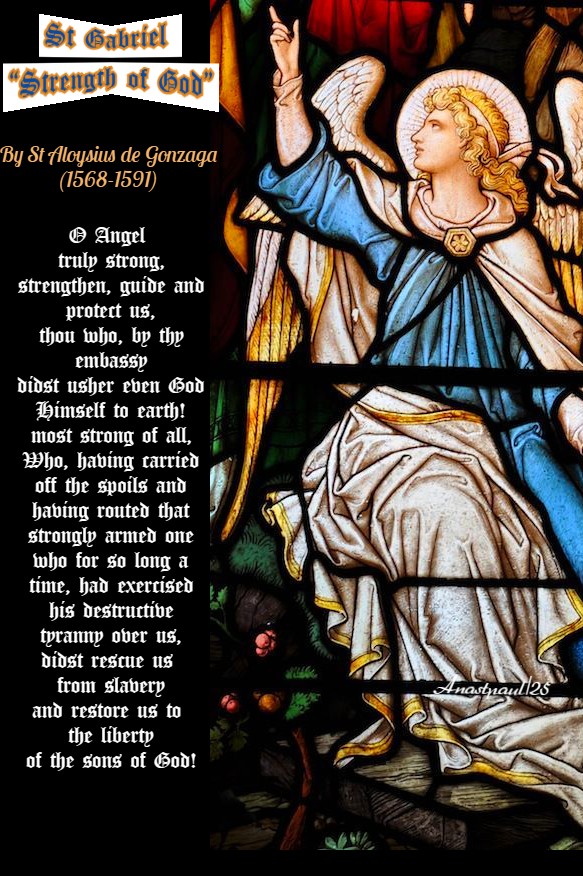
St Gabriel “Strength of God” By St Aloysius de Gonzaga SJ (1568-1591)
O Angel truly strong, strengthen, guide and protect us, thou who, by thy embassy didst usher even God Himself to earth! most strong of all, Who, having carried off the spoils and having routed that strongly armed one who for so long a time, had exercised his destructive tyranny over us, didst rescue us from slavery and restore us to the liberty of the sons of God!
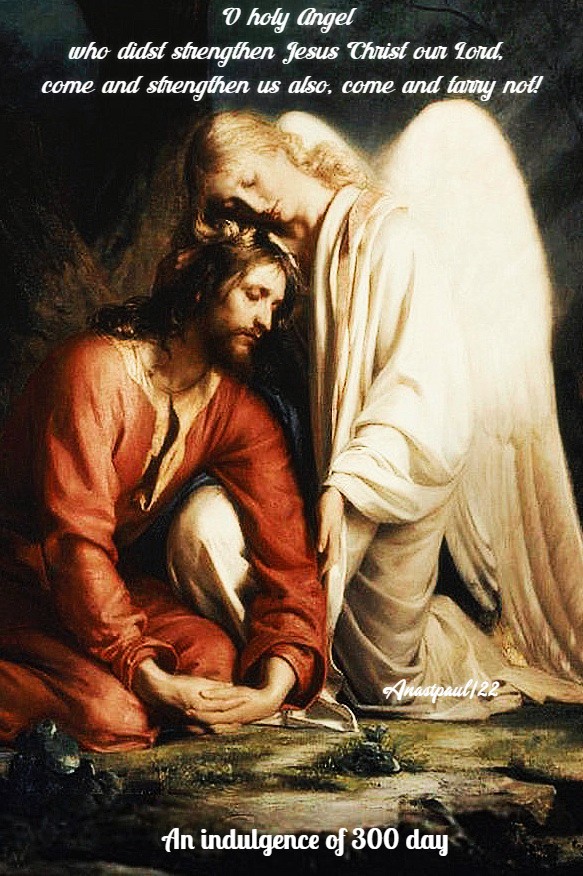
“O holy Angel who didst strengthen Jesus Christ our Lord, come and strengthen us also, come and tarry not!”
An indulgence of 300 day
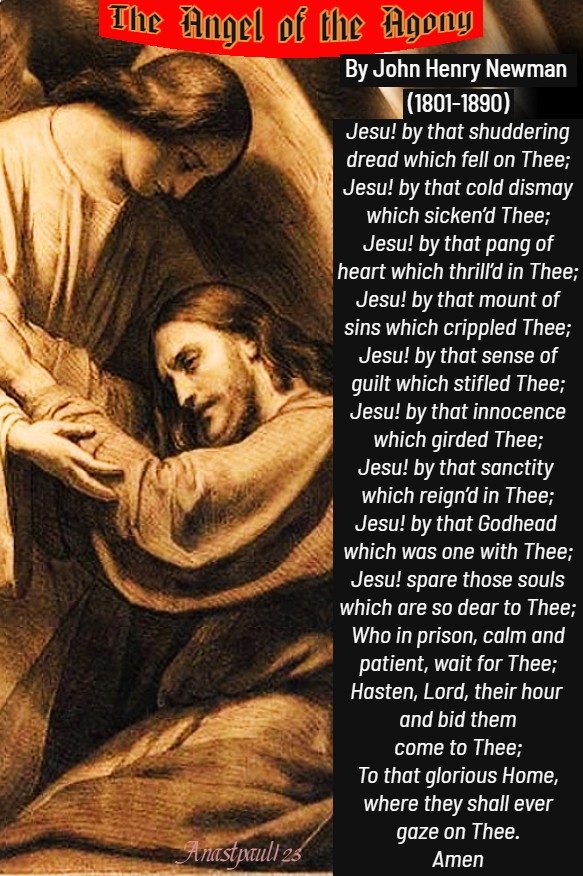
The Angel of the Agony John Henry Newman (1801-1890)
Jesu! by that shuddering dread which fell on Thee; Jesu! by that cold dismay which sicken’d Thee; Jesu! by that pang of heart which thrill’d in Thee; Jesu! by that mount of sins which crippled Thee; Jesu! by that sense of guilt which stifled Thee; Jesu! by that innocence which girded Thee; Jesu! by that sanctity which reign’d in Thee; Jesu! by that Godhead which was one with Thee; Jesu! spare those souls which are so dear to Thee; Who in prison, calm and patient, wait for Thee; Hasten, Lord, their hour and bid them come to Thee; To that glorious Home, where they shall ever gaze on Thee. Amen
Lenten Meditations – 24 March – With Fr Richard Frederick Clarke SJ (1839-1900) Scripture search here: https://www.drbo.org/
“The Sacred Passion of Our Lord Jesus Christ” “Short Meditations for Lent” From “The Devout Year” By Fr Richard Frederick Clarke SJ (1839-1900)
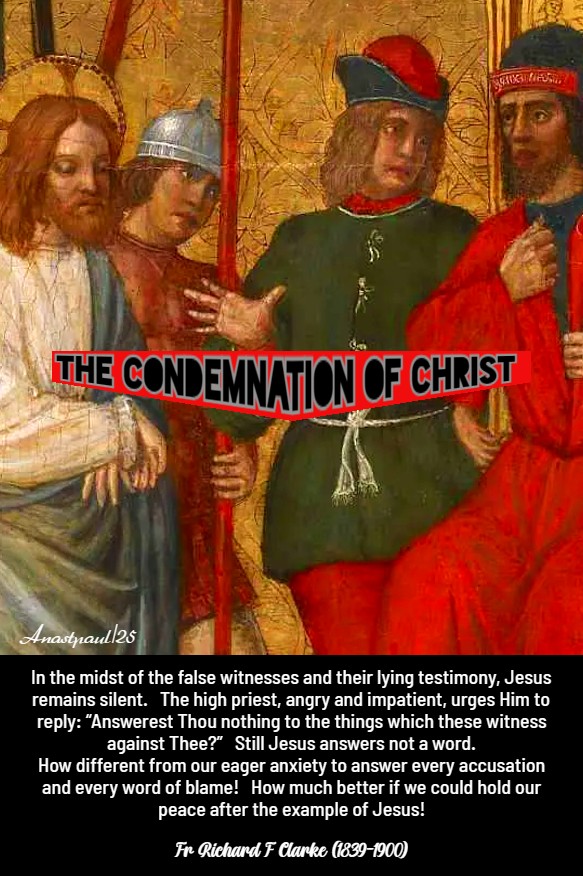
Monday After the Third Sunday in Lent The Condemnation of Christ
Read St Mark xiv:60-64 .
[60] And the high priest rising up in the midst, asked Jesus, saying: Answerest Thou nothing to the things that are laid to Thy charge by these men? [61] But He held His peace and answered nothing. Again the high priest asked Him and said to Him: Art Thou the Christ the Son of the blessed God? [62] And Jesus said to him: I Am. And you shall see the Son of man sitting on the right hand of the power of God and coming with the clouds of heaven. [63] Then the high priest rending his garments, saith: What need we any further witnesses? [64] You have heard the blasphemy. What think you? Who all condemned Him to be guilty and to be condemned to death. [Mark 14:60-64]
+I. In the midst of the false witnesses and their lying testimony, Jesus remains silent. The high priest, angry and impatient, urges Him to reply: “Answerest Thou nothing to the things which these witness against Thee?” Still Jesus answers not a word. How different from our eager anxiety to answer every accusation and every word of blame! How much better if we could hold our peace after the example of Jesus!
+2. At length, the high priest rises and asks a direct question; nay, he summons Christ in the Name of God to declare the truth: “I adjure Thee by the living God that Thou tell us if Thou be the Christ, the Son of God?” Ordered by authority, Jesus at once says: “I Am and one day I shall come in all the power of God which is now entrusted to you, as the high priest of God.” Another lesson for us We must obey authority even where he who carries it shamefully abuses it (but never when sin is ordered!); for those in authority, like Caiphas, speak in their official capacity as in the place of God.
+3. When Christ declares Himself to be the Son of God, the high priest and the council rise indignantly to protest against such blasphemy. In this, they are the type of modern heretics who accuse the Church of God and the Vicar of Christ, of blasphemously usurping Divine prerogatives. Pride and jealousy and self -love so blinded the eyes of the Sanhedrim that they called good~ evil and evil~good; thus condemned the Son of God to death because He told them the truth. My God , preserve me from ever being thus blinded by sin!
One Minute Reflection – 24 March – “The Month of Saint Joseph” –Feast of St Gabriel the Archangel – Daniel 9:21-26 – Luke 1:26-38 – Scripture search here: https://www.drbo.org/
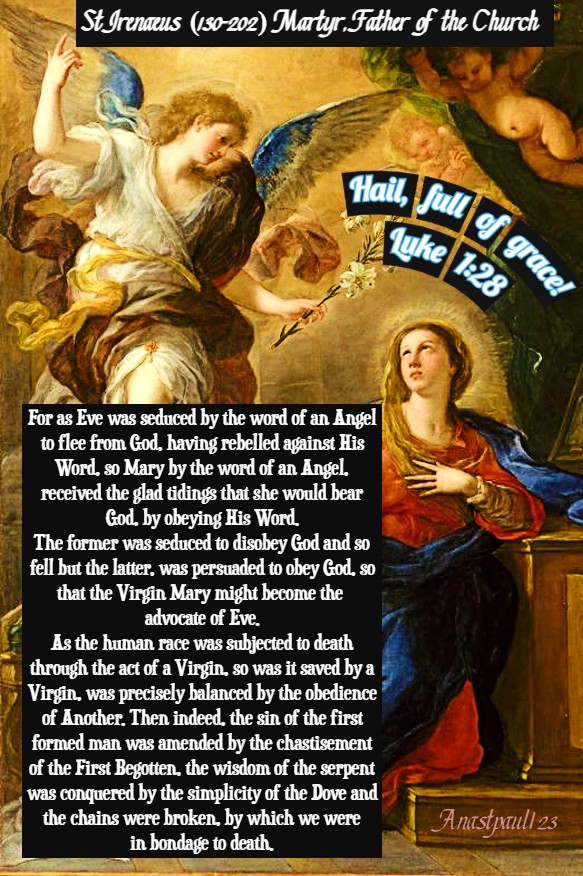
“Hail, full of grace!” – Luke 1:28
REFLECTION – “So the Lord now manifestly came to His own. Born by His own created order which He Himself bears, He, by His obedience on the tree, renewed and reversed that which was done by disobedience, in connection with a tree.
The power of that seduction, by which the virgin Eve, already betrothed to a man, had been wickedly seduced, was broken, when the Angel in truth, brought good tidings to the Virgin Mary, who already, by her betrothal, belonged to a man. For as Eve was seduced by the word of an Angel to flee from God, having rebelled against His Word, so Mary by the word of an Angel, received the glad tidings that she would bear God, by obeying His Word.
The former was seduced to disobey God and so fell but, the latter, was persuaded to obey God, so that the Virgin Mary might become the advocate of Eve.
As the human race was subjected to death through the act of a Virgin, so was it saved by a Virgin, was precisely balanced by the obedience of Another. Then indeed, the sin of the first formed man was amended by the chastisement of the First Begotten, the wisdom of the serpent was conquered by the simplicity of the Dove and the chains were broken, by which we were in bondage to death.” – St Irenaeus (130-202) Bishop of Lyons, Martyr, Father of the Church (Against Heresies, 5)
PRAYER – O God, Who, out of all the Angels, chose the Archangel Gabriel to announce the Mystery of Thy Incarnation, mercifully grant that we who keep his feast on earth, may have him as our patron in Heaven.Through the same Jesus Christ, Thy Son our Lord, Who lives and reigns with Thee, in the unity of the Holy Ghost, God, world without end. Amen (Collect).
Our Morning Offering – 24 March – The Feast of St Gabriel the Archangel
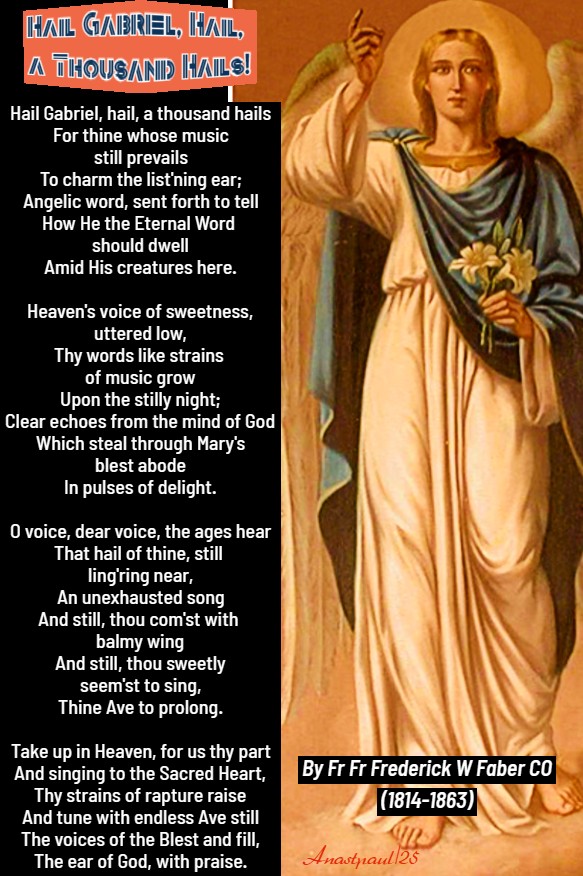
Hail Gabriel, Hail, a Thousand Hails! By Fr Fr Frederick W Faber CO (1814-1863)
Hail Gabriel, hail, a thousand hails For thine whose music still prevails To charm the list’ning ear; Angelic word, sent forth to tell How He the Eternal Word should dwell Amid His creatures here.
Heaven’s voice of sweetness, uttered low, Thy words like strains of music grow Upon the stilly night; Clear echoes from the mind of God Which steal through Mary’s blest abode In pulses of delight.
O voice, dear voice, the ages hear That hail of thine, still ling’ring near, An unexhausted song And still, thou com’st with balmy wing And still, thou sweetly seem’st to sing, Thine Ave to prolong.
Take up in Heaven, for us thy part And singing to the Sacred Heart, Thy strains of rapture raise And tune with endless Ave still The voices of the Blest and fill, The ear of God, with praise.
The Above is an excerpt from Fr Faber’s 14 stanza Hymn. Tune: “Pembroke” J. Foster, 1807-1885.
Saint of the Day – 24 March – Saint Severus (Died c814) Bishop of Catania, Sicily, Italy. Also known as – Severo.
In the official chronology of the Diocese he is listed in the 19th place. He succeeds Teodoro mentioned in 787. In the list of Diocesan Bishops Severus is not historically documented but is known only thanks to some hagiographic texts written between the 8th and 9th Centuries. Tradition tells us his Episcopate was administered between the years 802 and 814.
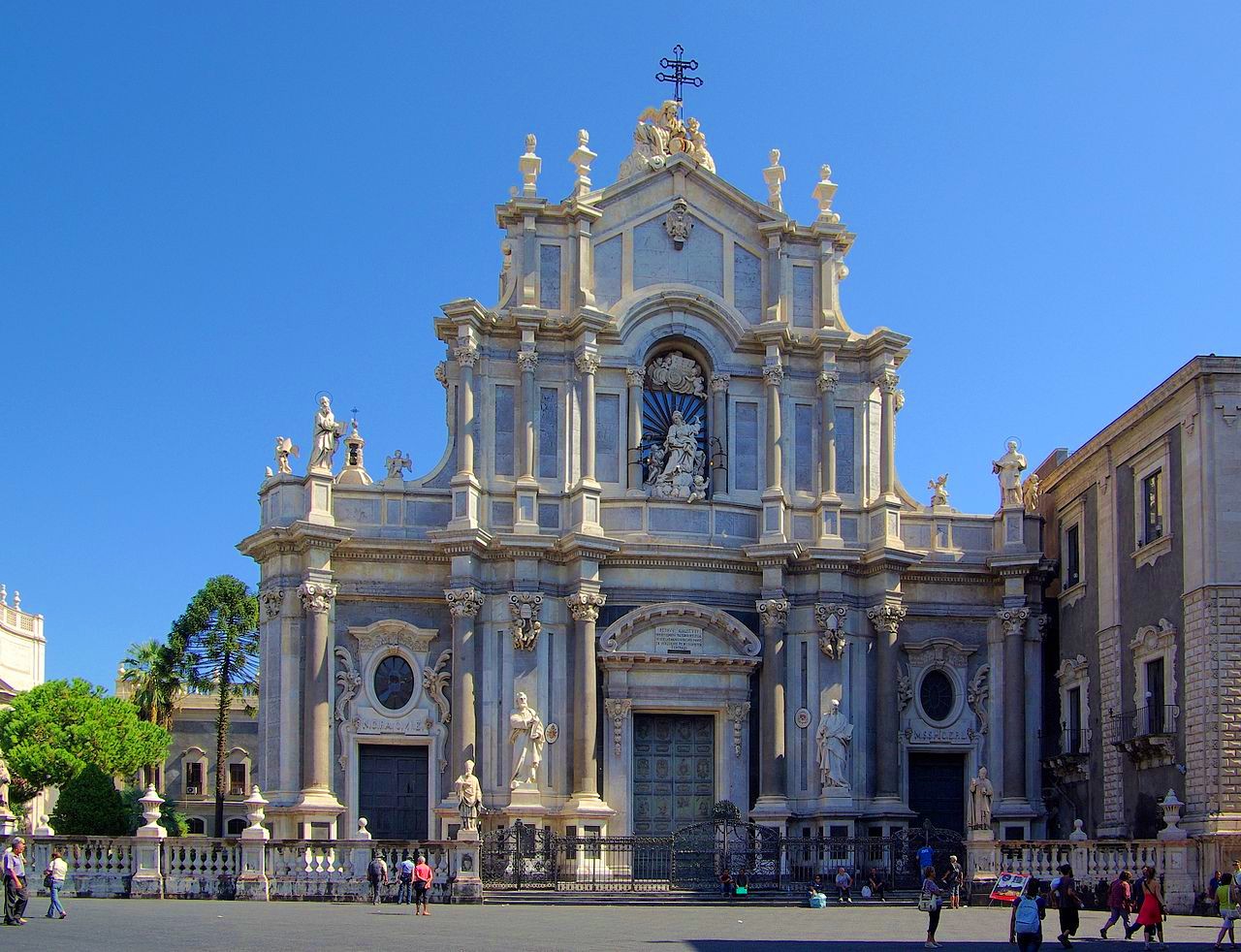
Catania Cathedral
Severus governed the Diocese in a saintly manner, with his word and example, deserving the highest praise from all. There are a few citations of his memory in the Menologium of Cardinal Sirleto and in the National Library of Paris.
The Bollandists cite him as follows: “24 March – memory of Severus, Bishop of Catania, a City in Sicily.”
In the modern lists of Bishops of Catania, another San Severo (or Everio) has also been included in second place and a San Severino in fourth place. According to the historian, Francesco Lanzoni, “they could be a back projection of the holy Bishop Severus, whose Episcopate dates to the beginning of the 9th Century.”
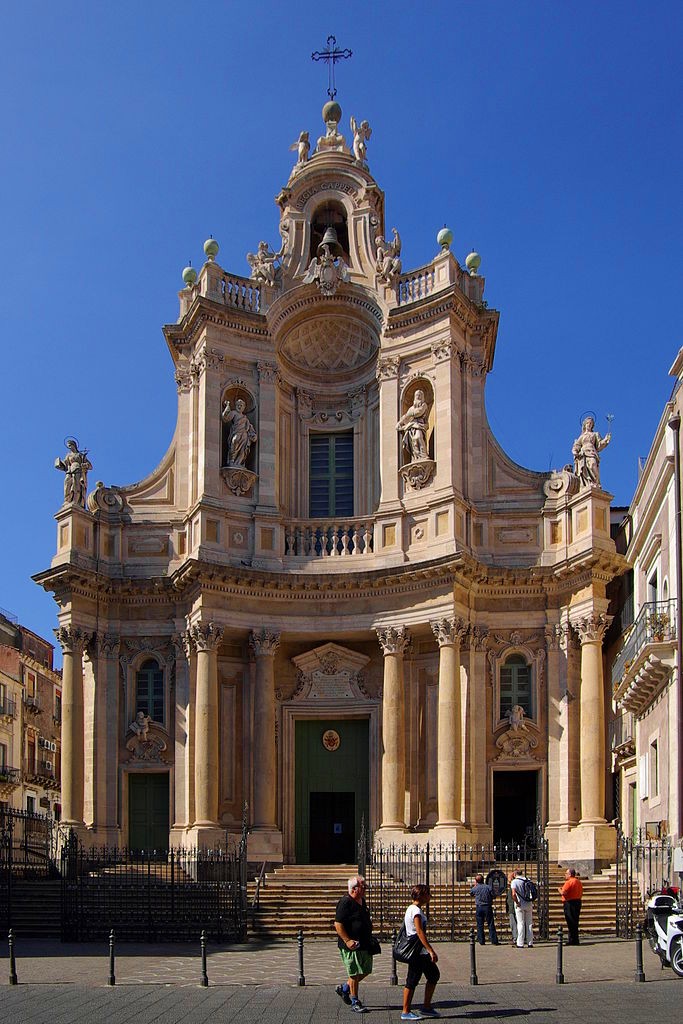
In the Baptistery of the Basilica of Maria Santissima dell’Elemosina, better known as the Collegiate Basilica of Catania, there is an image of our Saint Severus. This is the Basilica below which contains many magnificent paintings, statues, sacred vessels, murals and more but I could not find our Saint Severus.
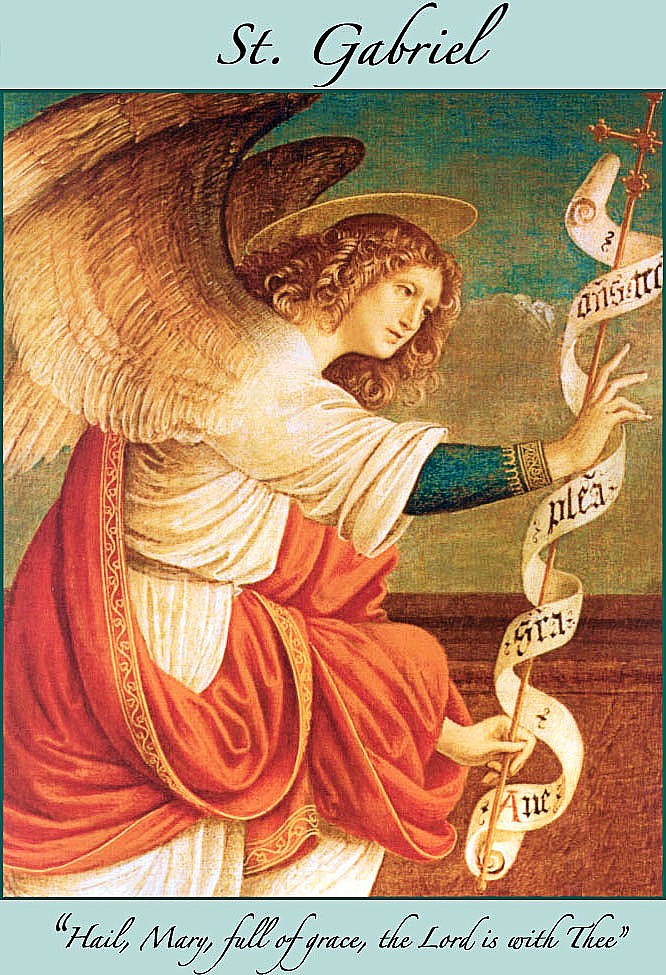
The Archangel Saint Gabriel The Feast of Saint Gabriel was included by Pope Benedict XV in the General Roman Calendar in 1921, for celebration on 24 March. The Archangel Saint Gabriel’s name means “the Power of God” He appeared to the Prophet Daniel (Dan 8:16; 9:21), to the priest Zachary to announce the forthcoming birth of Saint John the Baptist (Luke 1:11, 19) and, most importantly, to the Blessed Virgin Mary to announce the birth of Our Saviour (Luke 1:26). St Gabriel! https://anastpaul.com/2022/03/24/saint-of-the-day-24-march-the-archangel-saint-gabriel/
St Agapitus of Synnada (Died 3rd Century) Bishop of Synnada, Phrygia, in Asia Minor. Its site is now occupied by the modern Turkish Town of Suhut. We have no further information on the life of St Agapitus..
St Latinus of Brescia St Macartan of Clogher St Mark of Rome St Pigmenius of Rome St Romulus of North Africa St Secundus of North Africa St Seleucus St Severus (Died c814) Bishop of Catania St Timothy of Rome
Martyrs of Africa – 9 Saints: A group of Christians murdered for their faith in Africa, date unknown. The only details about their that survive are the names – Aprilis, Autus, Catula, Coliondola, Joseph, Rogatus, Salitor, Saturninus and Victorinus. .
Martyrs of Caesarea – 6 Saints: A group of Christians Martyred together in the persecutions of Diocletian. We know little else but six of their names – Agapius, Alexander, Dionysius, Pausis, Romulus and Timolaus. They were martyred by beheading in 303 at Caesarea, Palestine.
Thought for the Day – 23 March – Meditations with Fr Richard Frederick Clarke SJ (1839-1900)
“Short Meditations for March, St Joseph” From “The Devout Year” By Fr Richard Frederick Clarke SJ (1839-1900)
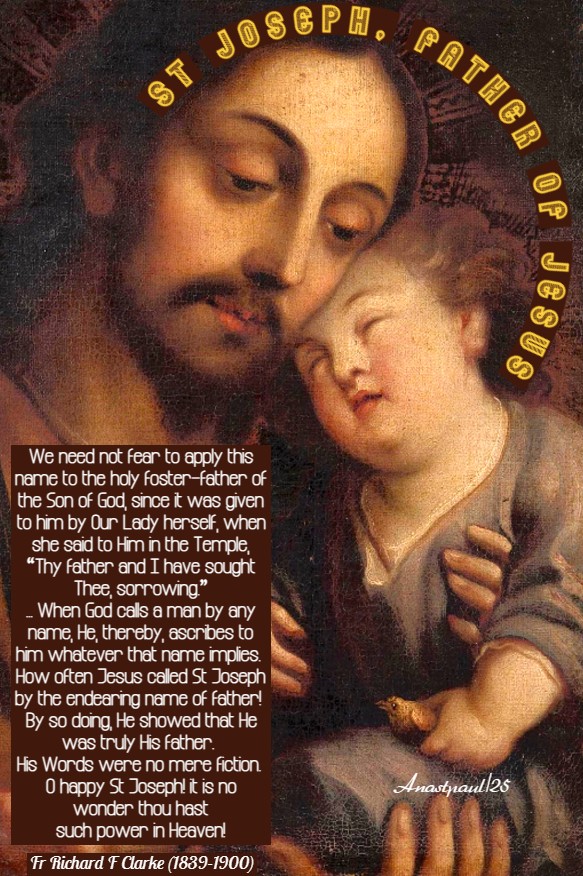
23rd Day – St Joseph, Father of Jesus
We need not fear to apply this name to the holy foster-father of the Son of God, since it was given to him by Our Lady herself, when she said to Him in the Temple, “Thy father and I have sought Thee, sorrowing.”
+1. He had the position of father of Jesus and was recognised as such, by the common consent. He had all the rights and the authority of a father, as far as any could have, over the Son of God. His Divine Foster-Son from His birth, depended on him, as the child naturally depends upon his father. He fulfilled the office of father. God delegated to him, the duties, the rights, the privileges, of a father and, therefore, he is truly called, the father of Jesus.
+2. We may also piously believe, his Divine Son was made like to him in outward form. In the natural order, Jesus would not be made after the likeness of His holy Mother alone. The Holy Ghost, in fashioning the features of the Son of God, would have taken St Joseph as in some sort, the model to be followed in form and face. What must have been St Joseph’s beauty, sweetness of expression, symmetry of form, perfect purity of body and soul! What a contrast to my unsightliness and impurity!
+3. When God calls a man by any name, He, thereby, ascribes to him whatever that name implies. How often Jesus called St Joseph by the endearing name of father! By so doing, He showed that He was truly His father. His Words were no mere fiction. O happy St Joseph! it is no wonder thou hast such power in Heaven!
Quote/s of the Day – 23 March – The Third Sunday in Lent – Ephesians 5:1-9; Luke 11:14-28 – Scripture search here: https://www.drbo.org/ –
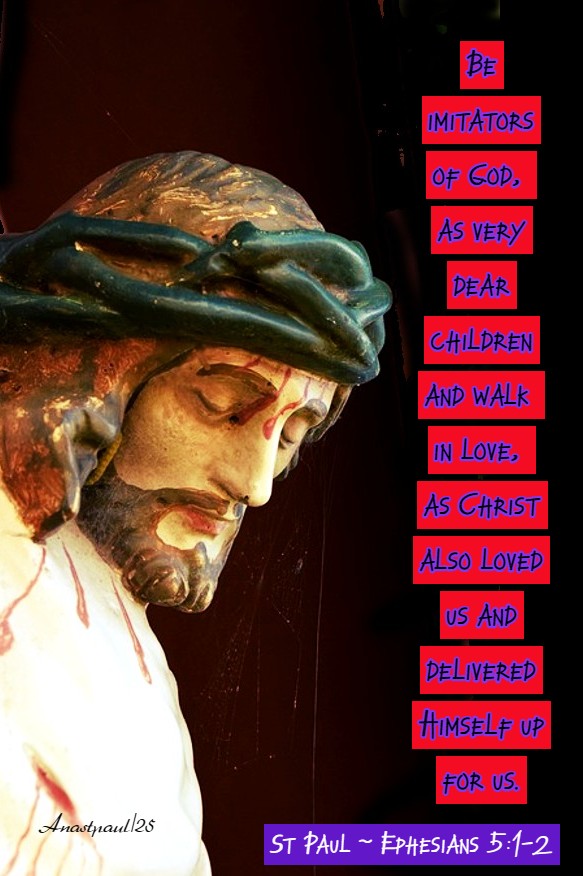
“Be imitators of God, as very dear children and walk in love, as Christ also loved us and delivered Himself up for us …”
St Paul … Ephesians 5:1-2
“If we kept before ourselves, the Mercy of God, we would never be deficient in doing good, while strength was in us. For, when we give to the poor, out of the love of God, that which what He Himself has given us, His Promise is that, we shall receive a hundredfold in eternal happiness. That indeed, is a fortunate and happy way of gaining a profit! Who will not give, whatever he has, to this best of Merchants! He administers our business Himself and begs us, with outstretched arms, to turn to Him and weep for our sins and become servants in love, first for ourselves and then for our neighbour.”
St John of God (1495-1550)
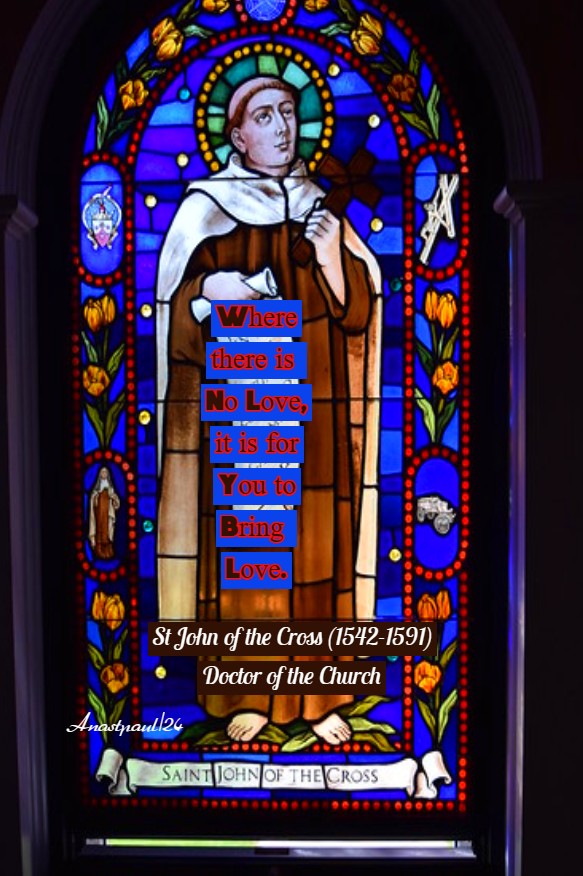
“Where there is no love, it is for you to bring love.”
St John of the Cross (1542-1591) Doctor of the Church
“ I shall spend every moment loving. One who loves, does not notice her trials; or perhaps, more accurately, she is able to love them. I shall do everything for Heaven, my true home. There, I shall find my Mother, in all the splendour of her glory. I shall delight with her in the joy of Jesus Himself, in perfect safety.”
Lenten Meditations – 23 March – With Fr Richard Frederick Clarke SJ (1839-1900) Scripture search here: https://www.drbo.org/
“The Sacred Passion of Our Lord Jesus Christ” “Short Meditations for Lent” From “The Devout Year” By Fr Richard Frederick Clarke SJ (1839-1900)
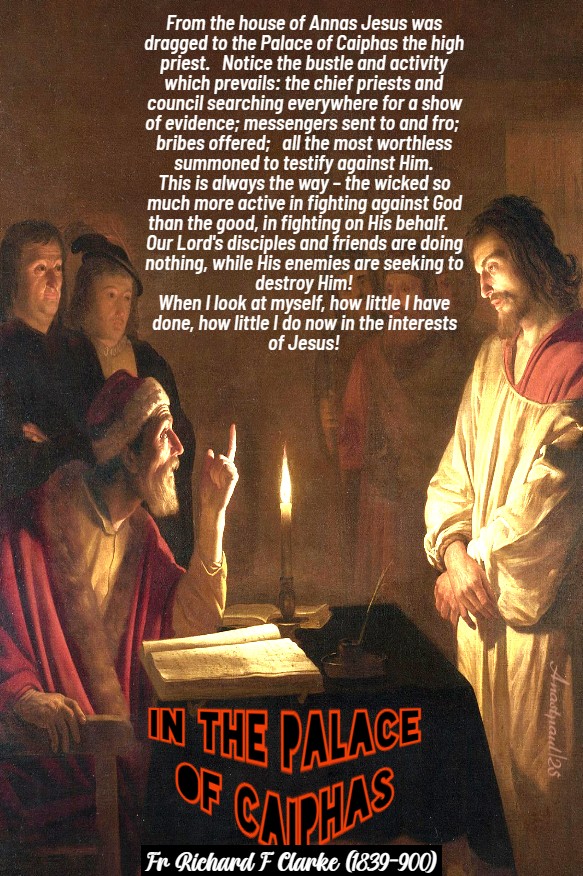
The Third Sunday in Lent In the Palace of Caiphas
Read St Mark xiv:55-64
[55] And the chief priests and all the council, sought for evidence against Jesus that they might put Him to death and found none. [56] For many bore false witness against Him and their evidence were not agreeing. [57] And some rising up, bore false witness against Him, saying: [58] We heard Him say, I will destroy this temple made with hands and within three days, I will build another not made with hands. [59] And their witness did not agree. [60] And the high priest rising up in the midst, asked Jesus, saying: Answerest Thou nothing to the things that are laid to Thy charge by these men? [61] But He held His peace and answered nothing. Again the high priest asked Him and said to Him: Art Thou the Christ the Son of the blessed God? [62] And Jesus said to him: I Am. And you shall see the Son of man sitting on the right hand of the power of God and coming with the clouds of heaven. [63] Then the high priest rending his garments, saith: What need we any further witnesses? [64] You have heard the blasphemy. What think you? Who all condemned Him to be guilty and to be condemned to death. [Mark 14:55-64]
+1. From the house of Annas Jesus was dragged to the Palace of Caiphas the high priest. Notice the bustle and activity which prevails: the chief priests and council searching everywhere for a show of evidence; messengers sent to and fro; bribes offered; all the most worthless summoned to testify against Him. This is always the way – the wicked so much more active in fighting against God than the good, in fighting on His behalf. Our Lord’s disciples and friends are doing nothing, while His enemies are seeking to destroy Him! When I look at myself, how little I have done, how little I do now in the interests of Jesus!
+2. The false witnesses who came forward had a certain show of truth. The words they quoted against Him were really spoken . They had learned the ways of their master the devil; Satan, when he deceives , always mixes up a large element of truth with his deceits. This is why we should never argue with him, for he can represent what is false and unlawful, as true and right, if once we listen, by bringing into prominence the element of truth it contains .
+3. These false witnesses, in spite of their cunning, could not agree together but contradicted one another. It is one of the certain tests of error, that it is inconsistent and self-contradictory; the City of Confusion and the home of strife, always thus betrays its imposture. Warring discord, is the mark of the foes of Christ – peace and concord, are the privilege of those who are on His side. How I should thank God that He has caused me to dwell in the City of Truth, the Church of the Living God!
One Minute Reflection – 23 March – “The Month of Saint Joseph” – The Third Sunday in Lent – Ephesians 5:1-9 – Luke 11:14-28 – Scripture search here: https://www.drbo.org/
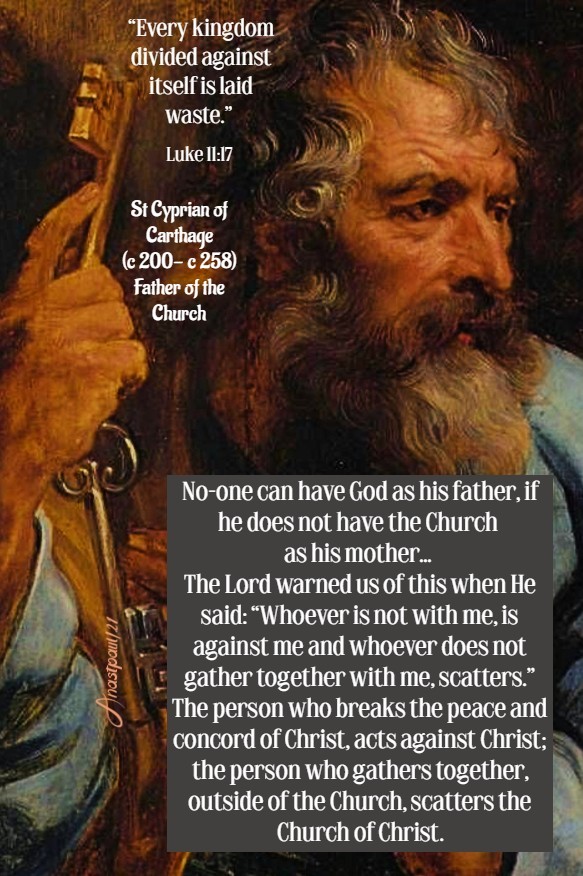
“Every kingdom divided against itself is laid waste.” – Luke 11:17
REFLECTION –“No-one can have God as his father, if he does not have the Church as his mother… The Lord warned us of this when He said: “Whoever is not with Me, is against Me and whoever does not gather together with Me, scatters.” The person who breaks the peace and concord of Christ, acts against Christ; the person who gathers together, outside of the Church, scatters the Church of Christ.
The Lord said: “The Father and I are one.” (Jn 10:30) It is also written of the Father, the Son and the Holy Ghost: “These Three are One.” (1 Jn 5:7) From now on, who can believe, that the unity which has its origin in this Divine harmony which is linked with this heavenly Mystery, can be divided up in the Church … through conflicts of will? Whoever does not observe this unity, neither observes the law of God, nor faith, in the Father and the Son – he keeps neither life, nor salvation.
In the Gospel, this sacrament of unity, this bond of concord, in indissoluble cohesion, is shown us through the Lord’s Tunic. It could neither be divided nor torn but they drew lots, so as to know who would put on Christ (Jn 19:24) … It is the symbol of unity which comes from on high!” – St Cyprian of Carthage (c 200- c 258) Bishop and Martyr, Father of the Church (On the unity of the Church).
PRAYER – We beseech Thee, Almighty God, hear the prayers of the humble and stretch forth the right hand of Thine majesty to protect us. Through Jesus Christ, Thy Son our Lord, Who lives and reigns with Thee, in the unity of the Holy Ghost, God, world without end. Amen (Collect).
Saint of the Day – 23 March – Saint Felix OSB (10th-11th Century) Monk of Monte Cassino, spiritual teacher and director to the shepherds in the area. Patronage – against jaundice. Also known as – Felix of Chieti, Felice… Fele… Féle…
Little is known regarding Felix’s personal history. That which we do have, has been handed down by Desiderio, the renowned Abbot of Montecassino, who became Pope Victor III (Died 1087).
The Pontiff, while in Chieti, saw an Altar dedicated to a blessed Saint in the Cathedral there. He turned to the Bishop and learned that the Altar was dedicated to Felix, a Monk from Monte Cassino, who had been sent by his Abbot to spiritually assist the shepherds who lived in that area.
Chieti Cathedral
After the Monk’s death, numerous miracles occurred through his intercession, so much so, that his body was elevated and transferred to the Cathedral. The Pontiff upon hearing the tale immediately called the Monk Felix and blessed. The Benedictine Monk Bucelino, included him in his Martyrology with the title of Saint.
Some sources state: “There are some references to the Benedictine friar, sent to Chieti to assist the shepherds, probably between the 10th and 11th Centuries, referring to a St Felix of Chieti, probably identifiable with tour Saint Felix mentioned in two parchments preserved in the Archives of the Archbishop’s Curia.”
Felix’s cult as ‘Blessed’ or Fele (“Sante Féle” in dialect), is considered a protector against jaundice, flourished thanks to the pilgrims from various parts of Abruzzo, who flocked to invoke his aid in prayer.
Some of his Relics (at least eleven including hair, bones and other items) are preserved in the Chapel of the Sacrament of the Cathedral of Chieti. St Felix (?) Feastday has been set for 23 March.
St Felix the Martyr St Felix OSB (10th-11th Century) Monk of Monte Cassino St Fergus of Duleek St Fidelis the Martyr St Frumentius of Hadrumetum St Gwinear
St Julian the Confessor St Liberatus of Carthage St Maidoc of Fiddown St Nicon of Sicily
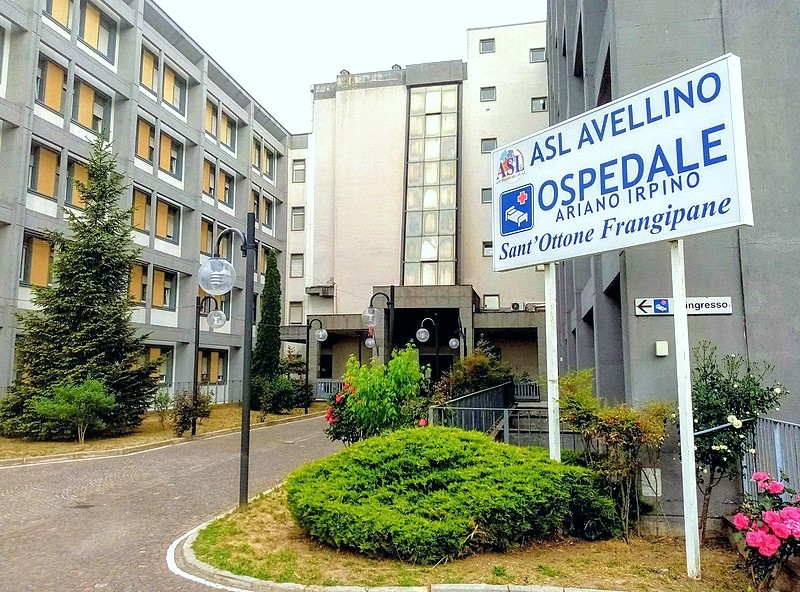
St Ottone Frangipane (1040-1127) Layman, military Knight, Pilgrim, Ascetic, Hermit, Miracle-worker both during life and after his death. Founder of a Pilgrim’s Hospice in Ariano which later became a huge Hospital. Born in 1040 in Rome, Italy and died on 23 March 1127 in Ariano Irpino, Italy of natural causes. His Life: https://anastpaul.com/2023/03/23/saint-of-the-day-23-march-st-ottone-frangipane-1040-1127/
St Theodolus Priest in Antioch, Syria. No other information has survived.
St Turibius (1538-1606) Spanish ArchBishop of Lima in Peru, Lawyer, Missionary, Preacher, Reformer, Professor, Miracle-worker. Patronages – Peru, Lima, Latin American Bishops, Native rights, Scouts, Valladolid. St Turibius predicted the exact date and hour he would die, which would come to pass. His reputation for holiness and learning was never forgotten for it led to calls for his Canonisation. Pope Innocent XI Beatified and Pope Benedict XIII Canonise him on 10 December 1726. Amazing St Turibius: https://anastpaul.com/2018/03/23/saint-of-the-day-23-march-st-turibius-of-mogrovejo-1538-1606/
Daughters of Feradhach: They are mentioned in early calendars and martyrologies but no information about them has survived.
Martyrs of Caesarea – 5 Saints: A group of five Christians who protested public games which were dedicated to pagan gods. Martyred in the persecutions Julian the Apostate. The only details we know about them are their names – Aquila, Domitius, Eparchius, Pelagia and Theodosia. They were martyred in 361 in Caesarea, Palestine.
Thought for the Day – 22 March – Meditations with Fr Richard Frederick Clarke SJ (1839-1900)
“Short Meditations for March, St Joseph” From “The Devout Year” By Fr Richard Frederick Clarke SJ (1839-1900)
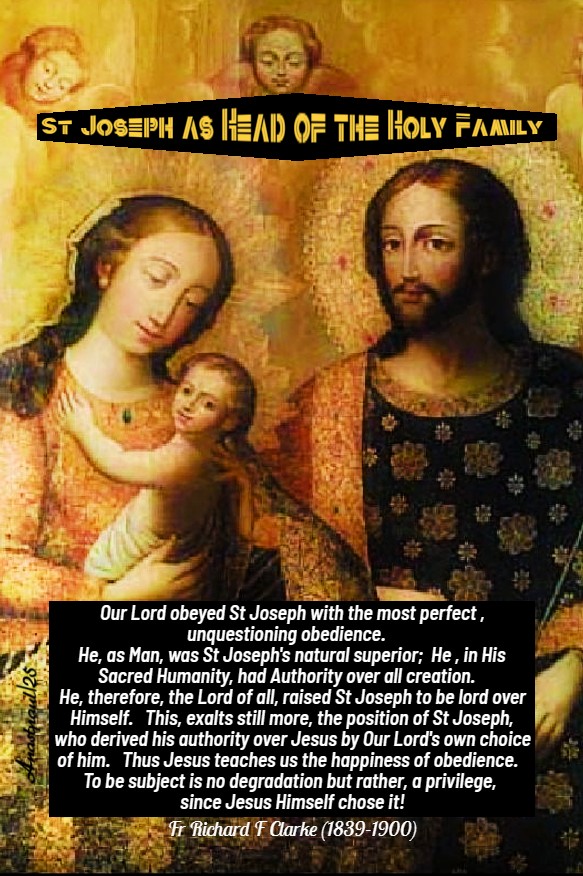
22nd Day – St Joseph as Head of the Holy Family
+1. The dignity of any Office of Authority, is in proportion to the excellence of those over whom such authority is exercised. What then must have been the dignity and perfection of St Joseph? To rule over the Angels would be a small privilege compared with the privilege of ruling God Himself and His holy Mother! What prudence, what discretion, what purity of intention, what perfect unselfishness, what intense love of God and of men, must have been found in St Joseph! How humble he must have been, how thoughtful, how kind, how considerate, how wise, how faithful to God’s holy inspirations! Next to Our Lady, it is impossible to suppose that any Saint could approach the dignity of St Joseph!
+2. Watch St Joseph as a superior. Notice how he gives his orders, firmly and decidedly, without hesitation but yet, kindly and gently and considerately. St Joseph had to command others besides Jesus and Mary. To all he showed the same thoughtful, tender, watchful affection and respect. Am I like St Joseph in dealing with those over whom I am placed?
+3. Our Lord obeyed St Joseph with the most perfect , unquestioning obedience. He, as Man, was St Joseph’s natural superior; He , in His Sacred Humanity, had Authority over all creation. He, therefore, the Lord of all, raised St Joseph to be lord over Himself. This, exalts still more, the position of St Joseph, who derived his authority over Jesus by Our Lord’s own choice of him. Thus Jesus teaches us the happiness of obedience. To be subject is no degradation but rather, a privilege, since Jesus Himself chose it!
Quote/s of the Day – 22 March – Saturday of the Second Week in Lent, A Day of Fasting
“Fasting is the death of sin, the destruction of our crimes and the remedy of our salvation.”
St Ambrose (340-397) Father and Doctor of the Church
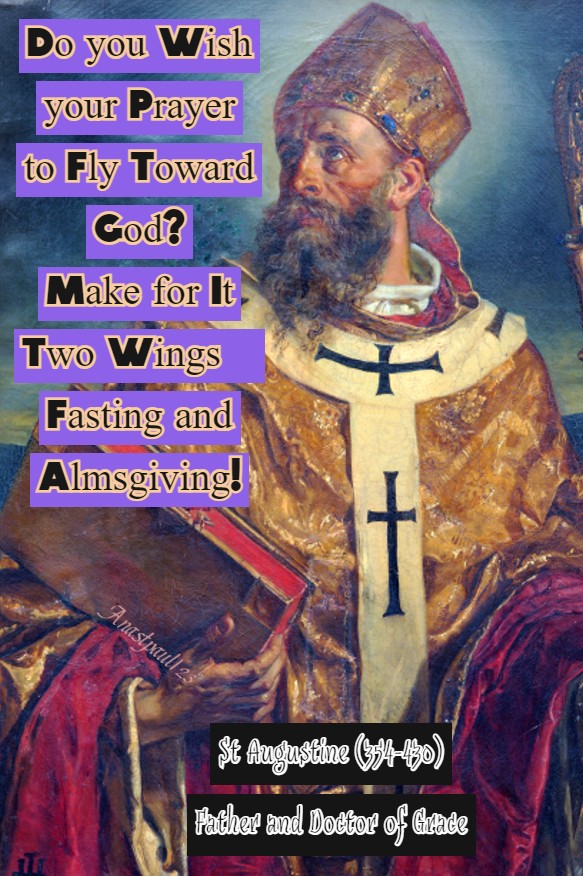
“Do you wish your prayer to fly toward God? Make for it two wings – fasting and almsgiving!”
“Fasting cleanses the soul, raises the mind, subjects one’s flesh to the spirit, renders the heart contrite and humble, scatters the clouds of concupiscence, quenches the fire of lust and kindles the true light of chastity. Enter again into yourself!”
St Augustine (354-430) Father and Doctor of Grace
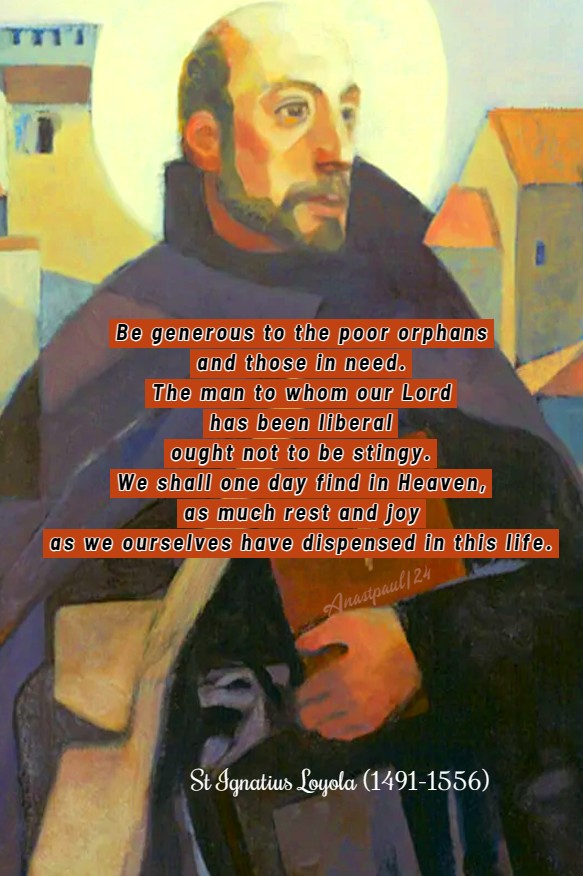
“Be generous to the poor orphans and those in need. The man to whom our Lord has been liberal ought not to be stingy. We shall one day find in Heaven, as much rest and joy as we ourselves have dispensed in this life.”
St Ignatius Loyola (1491-1556)
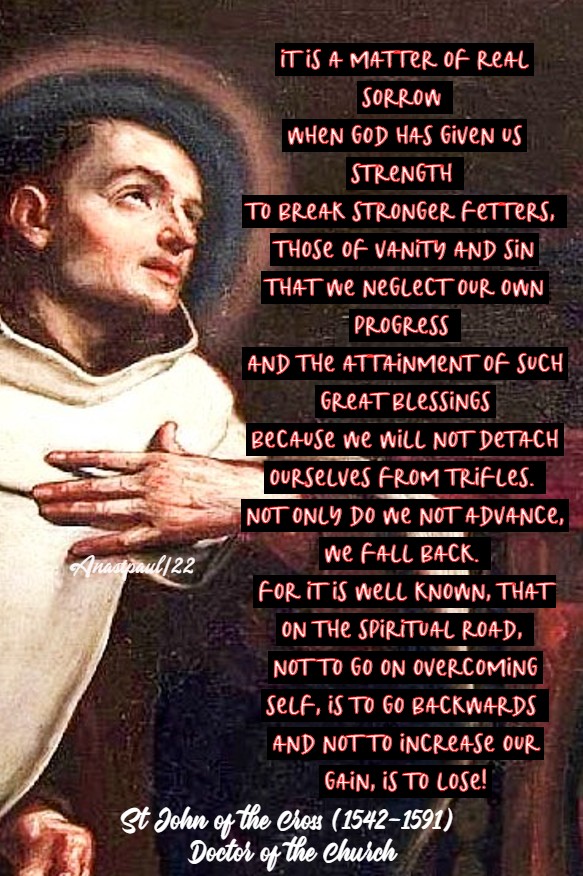
“It is a matter of real sorrow when God has given us strength to break stronger fetters, those of vanity and sin that we neglect our own progress and the attainment of such great blessings because we will not detach ourselves from trifles. Not only do we not advance, we fall back. For it is well known, that on the spiritual road, not to go on overcoming self, is to go backwards and not to increase our gain, is to lose!”
St John of the Cross (1542-1591) Doctor of the Church
Lenten Meditations – 22 March – With Fr Richard Frederick Clarke SJ (1839-1900) Scripture search here: https://www.drbo.org/
“The Sacred Passion of Our Lord Jesus Christ” “Short Meditations for Lent” From “The Devout Year” By Fr Richard Frederick Clarke SJ (1839-1900)
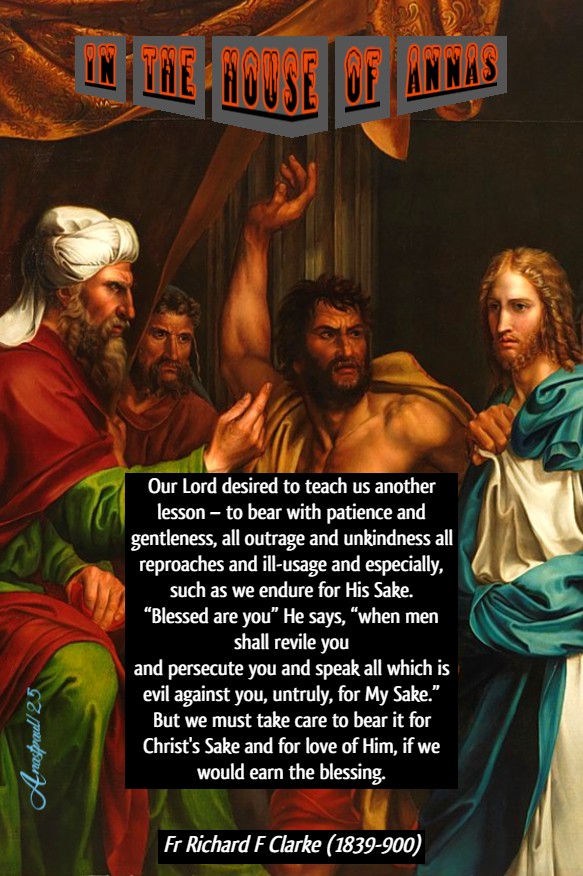
Saturday after the Second Sunday in Lent In the House of Annas
Read St John xviii:19-24
[19] The high priest, therefore, asked Jesus of His disciples and of His doctrine. [20] Jesus answered him: I have spoken openly to the world: I have always taught in the synagogue and in the temple, whither all the Jews resort and, in secret I have spoken nothing. [21] Why asketh thou Me? ask them who have heard what I have spoken unto them, behold they know what things I have said. [22] And when He had said these things, one of the servants standing by, gave Jesus a blow, saying: Answerest thou the high priest so? [23] Jesus answered him: If I have spoken evil, give testimony of the evil but if well, why strikest thou me? [24] And Annas sent Him bound to Caiphas the high priest. [John 18:19-24]
+1. Try to picture the scene – watch the persons, listen to their words, observe their actions. Annas, a cunning, bitter, cynical old man, delighted to find his enemy within his power; the Pharisees crowding around in eager excitement; the false witnesses trying to concoct a plausible story and, in their midst, Jesus, sorrowful, bleeding, exhausted; yet calm and full of dignity. Hear the insulting questions of Annas, the derisive jeers of the Pharisees, the shouts of the mob the firm, quiet, gentle words of Jesus. See the angry, eager gestures of the enemies of Christ, the assumed indignation of the judge, the cruel blow struck by the mailed hand of the soldier on the face of Jesus, causing the Blood to flow from His Sacred Mouth.
+2. Christ received this blow upon His Face, to atone for our sins of the tongue for the wicked words, the censorious words, the uncharitable words, the impure words which, too often, proceed from our mouth. Grant, O Lord that I may remember Thee suffering this cruel blow and thus, may learn to hate my sins of the tongue, which inflicted suffering upon Thee.
+3. Our Lord desired to teach us another lesson – to bear with patience and gentleness, all outrage and unkindness all reproaches and ill-usage and especially, such as we endure for His Sake. “Blessed are you” He says, “when men shall revile you and persecute you and speak all which is evil against you, untruly, for My Sake.” But we must take care to bear it for Christ’s Sake and for love of Him, if we would earn the blessing.
One Minute Reflection – 22 March – “The Month of Saint Joseph” – Saturday of the Second Week in Lent –Ferial Day – Genesis 27:6-40 – Luke 15:11-32 – Scripture search here: https://www.drbo.org/
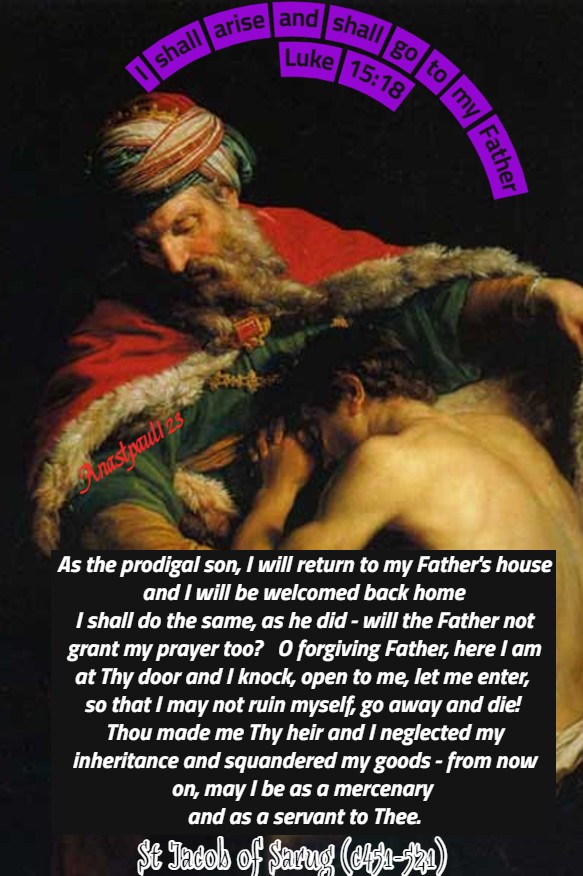
“I shall arise and shall go to my Father” – Luke 15:18
REFLECTION – “As the prodigal son, I will return to my Father’s house and I will be welcomed back home. I shall do the same, as he did – will the Father not grant my prayer too? O forgiving Father, here I am at Thy door and I knock, open to me, let me enter, so that I may not ruin myself, go away and die! Thou made me Thy heir and I neglected my inheritance and squandered my goods – from now on, may I be as a mercenary and as a servant to Thee.
As of the tax collector, have mercy on me and I shall live by Thy grace! O Son of God, forgive my sins as Thou did with the adulteress. Save me from the waves, as Thou did with Peter. Have mercy on my lowness, as Thou did for the good criminal and remember me! O Lord, come search for me, like the lost sheep and Thou will find me; carry me on Thy shoulders, Lord, to the house of Thy Father.
As Thou didst, with the blind man, open my eyes that I may see Thy Light! As for the deaf, open my ears, that I may hear Thy Voice! As for the paralytic, heal my disability so that I may praise Thy Name. As for the leper, cleanse me of my sin with Thy hyssop (cf Ps 50:9). As the young girl, the daughter of Jairus, make me live, our Lord. As Peter’s mother-in-law, heal me, for I am sick. As the young boy, the widow’s son, raise me up, that I may stand up again. As Thou did with Lazarus, cry out to me with Thy Own Voice and undo my bandages. For I am dead because of sin, like as for a sickness, raise me up from my ruin that I may praise Thy Name!
I beg Thee, Lord of Heaven and earth, come save me and show me Thy Way, so that I may come towards Thee. Bring me back to Thee, Son of the Good Lord and fill me with Thy Mercy. I will come to Thee and then will I be filled with joy!” – St Jacob of Sarug (c451-521) Bishop, Theologian, Poet, Writer, Father (A poem).
PRAYER – Grant that our fasting may be beneficial to us, we beseech Thee, O Lord, so that by chastising our flesh, we may obtain strength for our souls. Through tJesus Christ, Thy Son our Lord, Who lives and reigns with Thee, in the unity of the Holy Ghost, God, world without end. Amen (Collect).
Our Morning Offering – 22 March – Saturday of the Second Week in Lent
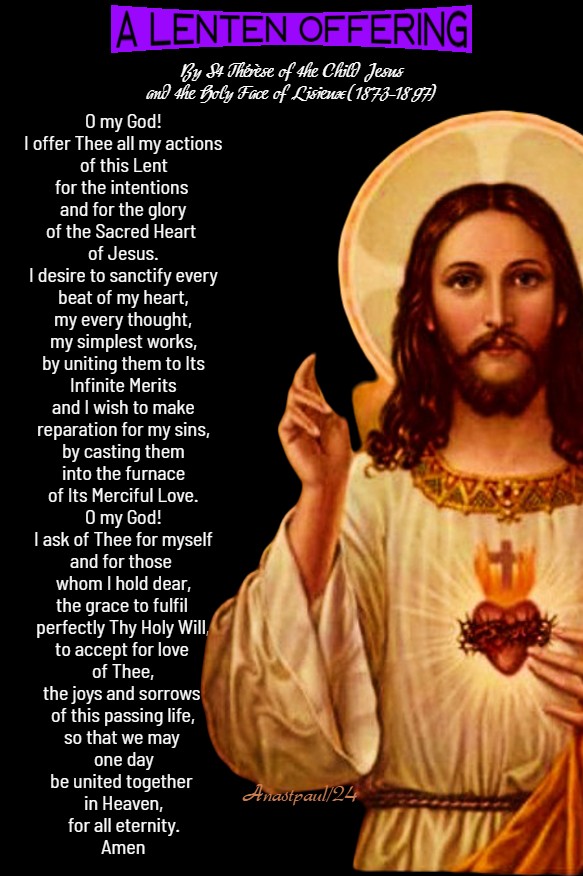
Lenten Offering By St Thérèse of the Child Jesus and the Holy Face of Lisieux (1873-1897)
O my God! I offer Thee all my actions of this Lent for the intentions and for the glory of the Sacred Heart of Jesus. I desire to sanctify every beat of my heart, my every thought, my simplest works, by uniting them to Its Infinite Merits and I wish to make reparation for my sins, by casting them into the furnace of Its Merciful Love. O my God! I ask of Thee for myself and for those whom I hold dear, the grace to fulfil perfectly Thy Holy Will, to accept for love of Thee, the joys and sorrows of this passing life, so that we may one day be united together in Heaven, for all eternity. Amen
Saint of the Day – 22 March – Saint Lea (Died 384) Widow of Rome, a disciple of St Jerome, Nun, Prioress, Died in 384 of natural causes in Ostia, Rome. Patronage – of widows.
The Roman Martyrology reads today: “At Rome, St Lea, a widow, whose virtues and happy death are related by St Jerome.”
A letter which St Jerome wrote to St Marcella, the noblewoman and leader of a female community of a monastic type, who had gathered in her residence on the Aventine Way, provides the only information we have of St Lea.
Lea, herself of a noble and rich family, was a widow, who upon the death of her husband, she instead of re-marrying as had been arranged for her, entered St Marcella’s community, where they studied the Scriptures and fasted and prayed, living in chastity and poverty. Lea ultimately became the Superior.
St Jerome’s correspondence, written after Lea’s death, concentrated on Lea’s final fate in comparison with that of a Consul who had recently died. St Jerome’s words:
“Who will praise the blessed Lea as she deserves? She renounced painting her face and adorning her head with shining pearls. She exchanged her rich attire for sackcloth and ceased to command others, in order to obey all. She dwelt in a corner with a few bits of furniture; she spent her nights in prayer and instructed her companions through her exampl, rather than through protests and speeches. And she looked forward to her arrival in Heaven in order to receive her recompense for the virtues which she practiced on earth.
So it is that thenceforth, she enjoyed perfect happiness. From Abraham’s bosom, where she resides with Lazarus, she sees our consul who was once decked out in purple, now vested in a shameful robe, vainly begging for a drop of water to quench his thirst. Although he went up to the capital, to the plaudits of the people and his death occasioned widespread grief, it is futile for the wife to assert, he has gone to Heaven and possesses a great mansion there. The fact is, he is plunged into the darkness outside, whereas Lea, who was willing to be considered a fool on earth, has been received into the House of the Father,, at the Wedding Feast of the Lamb. Hence, I tearfully beg you to refrain from seeking the favors of the world and to renounce all that is carnal. It is impossible to follow both the world and Jesus. Let us live a life of renunciation, for our bodies will soon be dust and nothing else will last any longer.”
St Callinica of Galatia St Catherine of Sweden St Darerca of Ireland St Deghitche
St Epaphroditus (1st Century) First Bishop of Terracina, Italy, Missionary, Evangelist, Disciple of the Apostles, Friend and Envoy of St Paul Apostle. St Hippolytus’ list of the Seventy Disciples includes “Epaphroditus, Bishop of Andriace.” The Roman Martyrology reads: “At Terracina, St Epaphroditus, a disciple of the Apostles, who was Consecrated Bishop of that City by the blessed Apostle Peter.” Biography: https://anastpaul.com/2022/03/22/saint-of-the-day-22-march-saint-epaphroditus-of-terracina-1st-century/
Thought for the Day – 21 March – Meditations with Fr Richard Frederick Clarke SJ (1839-1900)
“Short Meditations for March, St Joseph” From “The Devout Year” By Fr Richard Frederick Clarke SJ (1839-1900)
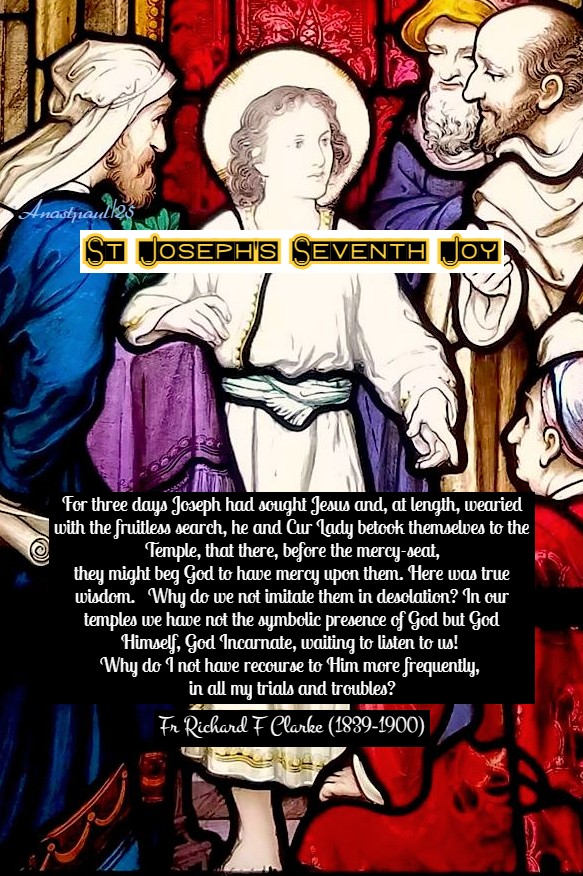
21st Day – St Joseph’s Seventh Joy The Finding of Jesus Amongst the Doctors in the Temple
+1. For three days Joseph had sought Jesus and, at length, wearied with the fruitless search, he and Cur Lady betook themselves to the Temple, that there, before the mercy-seat, they might beg God to have mercy upon them. Here was true wisdom. Why do we not imitate them in desolation? In our temples we have not the symbolic presence of God but God Himself, God Incarnate, waiting to listen to us! Why do I not have recourse to Him more frequently, in all my trials and troubles?
+2. In one of the halls of the Temple, they espied a group of old men gathered around a Boy and absorbed in their conversation with Him. In an instant, Joseph recognised Him Whom they sought. Now all his anxiety was at an end; the darkness of night was turned into the dazzling brightness of the glorious day. So in an instant, Jesus can work the same merciful change for us and, by His Presence, can turn all our darkness into Light.
+3. What was Jesus doing? He was listening to what the rabbis had to say about the Messias, putting questions to them which set them a-thinking – whether the time had come for His appearance, answering their questions with such supernatural Wisdom, the old men sat there astonished and, as it were in a trance Jesus was anticipating His public ministry, beginning the Work which He had Come to accomplish, at that early age. So, from the first, He began His Work within my soul, suggesting holy thoughts, pouring heavenly wisdom into me. Alas, how little have I learned His Divine lessons!?
Lenten Meditations – 21 March – With Fr Richard Frederick Clarke SJ (1839-1900) Scripture search here: https://www.drbo.org/
“The Sacred Passion of Our Lord Jesus Christ” “Short Meditations for Lent” From “The Devout Year” By Fr Richard Frederick Clarke SJ (1839-1900)
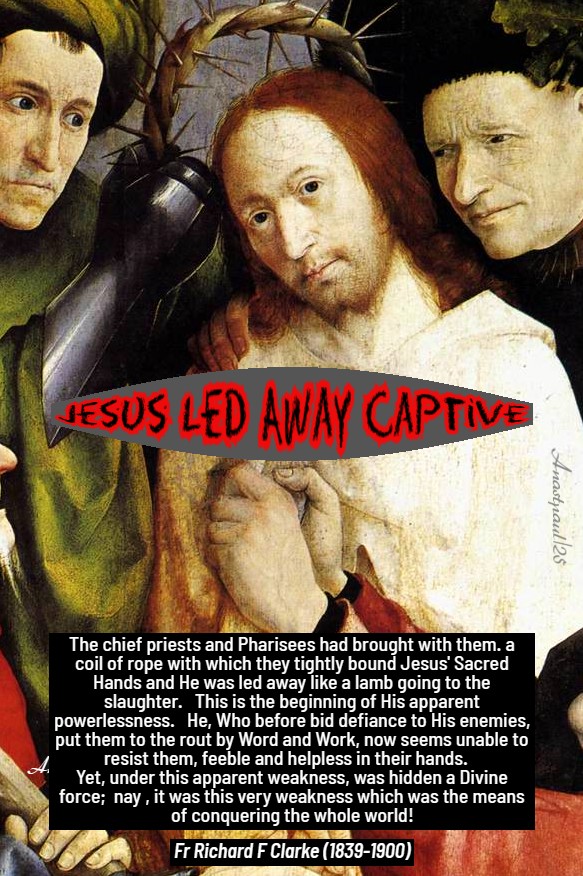
Friday after the Second Sunday in Lent Jesus Led Away Captive
Read St John xviii:12-13
[12] Then the band and the tribune and the servants of the Jews, took Jesus and bound Him[13] and they led him away to Annas firstly, for he was father in law to Caiphas, who was the high priest of that year. [John 18:12-13]
+1. The chief priests and Pharisees had brought with them. a coil of rope with which they tightly bound Jesus’ Sacred Hands and He was led away like a lamb going to the slaughter. This is the beginning of His apparent powerlessness. He, Who before bid defiance to His enemies, put them to the rout by Word and Work, now seems unable to resist them, feeble and helpless in their hands. Yet, under this apparent weakness, was hidden a Divine force; nay , it was this very weakness which was the means of conquering the whole world!
+2. The officers tied Jesus’ Hands, thus, He could no longer lay them upon the sick and the afflicted, to heal their diseases and their miseries. So we too tie the Jesus’ Hands by bands far more fatal, in hindering His power to heal the sickness of our soul. When we reject His graces and turn a deaf ear to His counsel, we render Him powerless to assist us. He cannot bestow the blessings He delights to impart upon us – our obstinacy has tied His Hands so that He cannot help us as He wishes.
+3. Often in our desire to work for others, we find our hands tied. Something hinders our charitable designs; some hostile influence renders us apparently powerless. Our prayers seem to avail nothing; our kind acts are rejected; we seem to do the incorrect thing when trying our best to do what is correct. Yet, we must not repine; we are only treading in our Master’s Steps. The very suffering entailed in this, is a sure means of earning the graces we desire.
One Minute Reflection – 21 March – “The Month of Saint Joseph” – Feast of the Holy Shroud – St Benedict OSB (c 480-547) Abbot, Patron of Europe and Founder of Western Monasticism.–Friday of the Second Week in Lent – Ecclesiasticus 45:1-6 – Matthew 19:27-29 – Scripture search here: https://www.drbo.org/
“… Shall receive a hundredfold and shall possess life everlasting.” – Matthew 19:29
REFLECTION – “The possessions which we have, are not our own –God has given them to us to cultivate and He wishes us to render them fruitful and profitable … Always deprive yourself, therefore, of some part of your means, giving them to the poor with a willing heart … It is true that God will return it to you, not only in the next world but also in this, for there is nothing which makes a person prosper, in temporal matters, so much, as almsgiving. But until such time as God shall repay it, you will always be impoverished to that extent. Oh! how holy and rich is the impoverishment which is caused by almsgiving!
Love the poor and poverty, for by this love you will become truly poor, since, as Scripture says: “We become like the things which we love” (cf Hos 9:10). Love makes those who love, equal to one another: “Who is weak and I am not weak?” says St Paul (2 Cor 11:29). He might have said: “Who is poor, with whom I am not poor?” For love made him become, such as those whom he loved. If, then, you love the poor, you will be truly participating in their poverty and poor like them. Now, if you love the poor, be often among them; be pleased to see them in your house and to visit them in theirs; associate willingly with them; be glad that they are near you in the Churches, in the streets and elsewhere. Be poor in speech with them, speaking to them as their equal but be rich in deed, giving them of your goods, as one who possesses more abundantly.
Will you do even more? … Become a servant of the poor; go to serve them … with your own hands … and at your own expense. This service has more glory in it than a throne!” – St Francis de Sales (1567-1622) Bishop of Geneva and Doctor of the Church (Introduction to the devout life, Part three Ch 15).
PRAYER – May the intercession of the blessed Abbot Benedict, commend us to Thee, O Lord, so that through his merits we may obtain that which we cannot accomplish by our own. T hrough Jesus Christ, thy Son our Lord, Who lives and reigns with Thee, in the unity of the Holy Ghost, God, world without end.. Amen (Collect).
Our Morning Offering – 21 March – The Feast of the Holy Shroud of Jesus
Faithful Cross! Above All Other By St Venantius Fortunatus (c 530 – c 609)
Faithful Cross! above all other, one and only noble tree! None in foliage, none in blossom, none in fruit thy peer may be; sweetest wood and sweetest iron, sweetest weight is hung on thee.
Bend thy boughs, O tree of glory! Thy relaxing sinews bend; for awhile the ancient rigour that thy birth bestowed, suspend and the King of heavenly beauty gently on thine arms extend.
Praise and honour to the Father, praise and honour to the Son, praise and honour to the Spirit, ever Three and ever One: One in might and One in glory while eternal ages run.
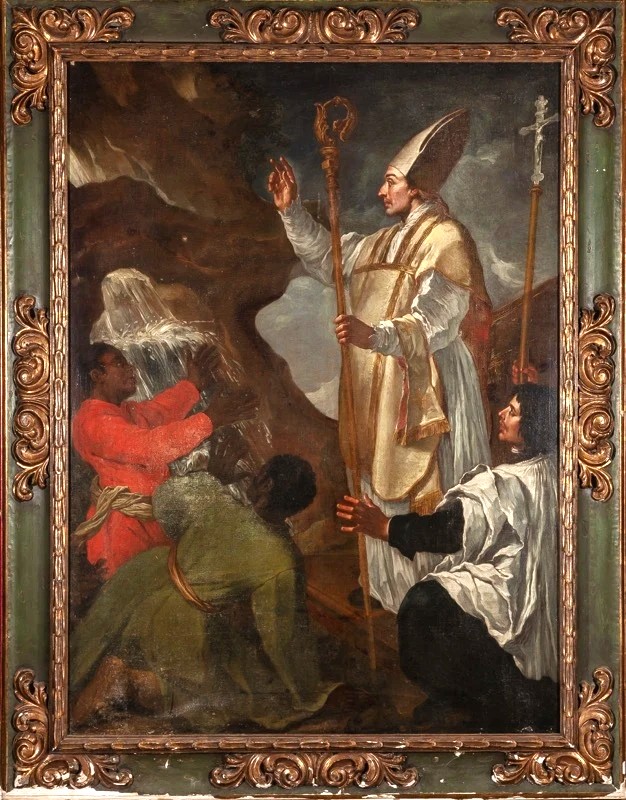
Saint of the Day – 21 March – Saint Birillus (Died c90) the 1st Bishop of Catania, Consecrated by St Peter, Missionary. Born in Antioch (in modern Turkey) and died in c90 in Catania, Italy of natural causes . Patronage – of the Archdiocese of Catania, Italy. Also known as – Berillo, Beryl, Beryllus, Brillus.
The Roman Martyrology reads today: “At Catania, St Brillus, who was Consecrated Bishop by St Peter. After converting many Gentiles to the Faith, he rested in peace in extremely old age.”
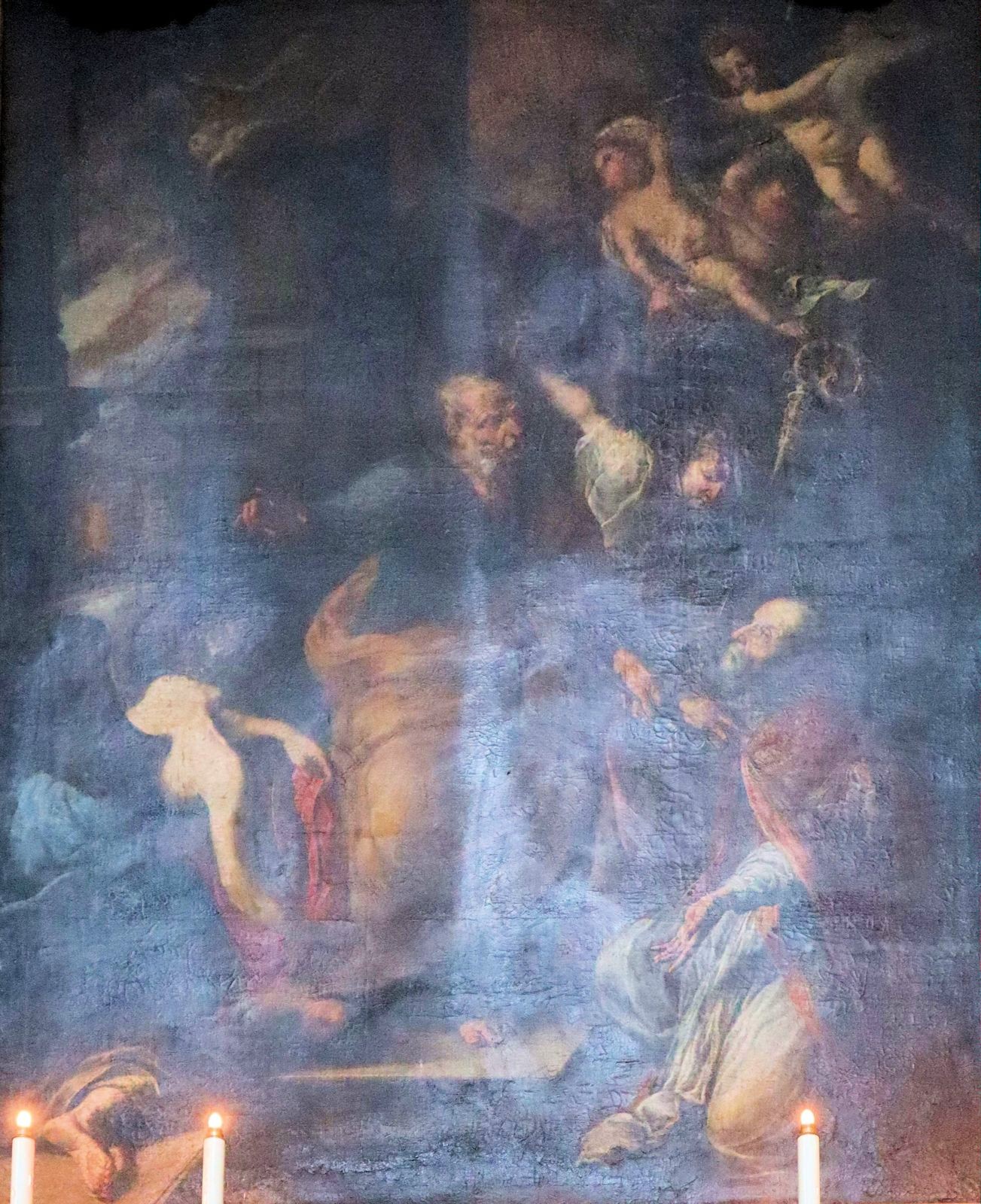
St Peter Consecrates St Birillus Bishop, 1693, in the Cathedral in Catania by Andrea Suppa
Birillus was Consecrated Bishop by St Peter in Antioch in 42 and sent to Catania as a Missionary. After a long service as the City’s 1st Bishop, he died at an advanced age.
St Peter sends St Birillus to preach the Gospel
Birillus was first mentioned in the 8th Century in the biography of Leo of Catania, then in that of Pancras of Taormina and in two liturgical texts of the 9th Century.
In fact, the City’s first Cathedral, from 380 onward, was the Church of Sant’Agata la Vetere —probably only appeared in the 3rd/4th Century.
The tradition concerning Birillus is, therefore, uncertain, nevertheless, he is highly revered in his City of Catania.



























 AnaStpaul
You must be logged in to post a comment.