Posted in MORNING Prayers, QUOTES of the SAINTS, SAINT of the DAY

Quote/s of the Day – 7 April

Quote/s of the Day – 7 April

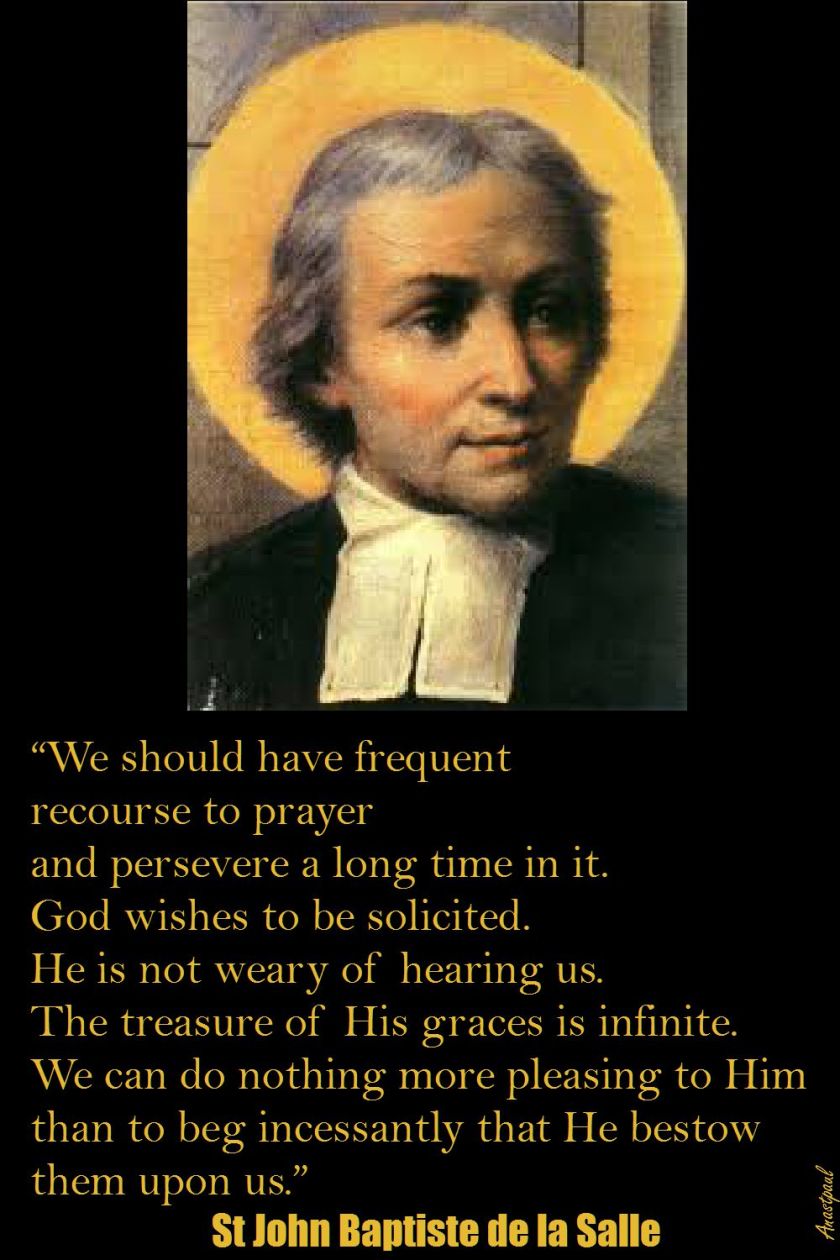
“We should have frequent recourse to prayer
and persevere a long time in it.
God wishes to be solicited.
He is not weary of hearing us.
The treasure of His graces is infinite.
We can do nothing more pleasing to Him
than to beg incessantly that He bestow them upon us.”

PRAYER - ST J B DE LA SALLE

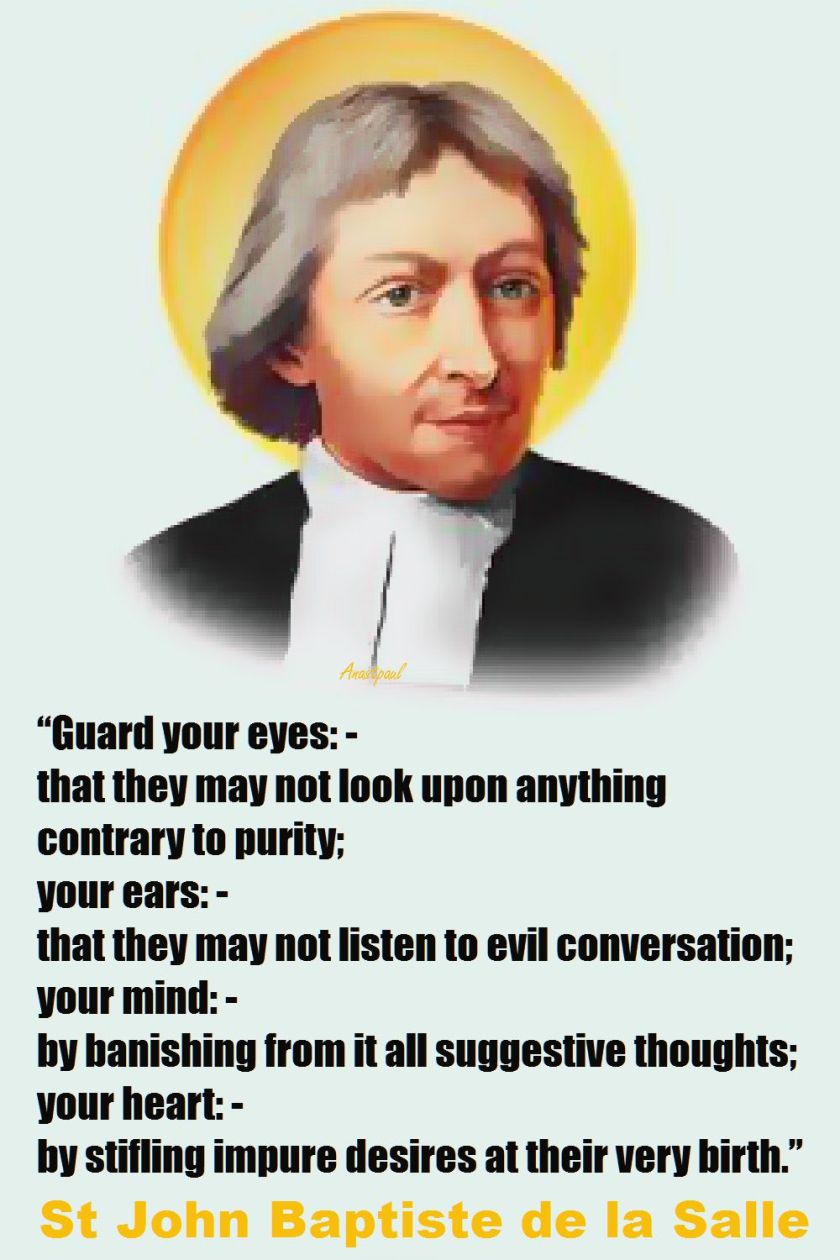
“Guard your eyes: –
that they may not look
upon anything contrary to purity;
your ears: –
that they may not listen to evil conversation;
your mind: –
by banishing from it all suggestive thoughts;
your heart: –
by stifling impure desires at their very birth.”

GUARD YOUR EYES - ST JBDELASALLE

“Pride makes us forgetful of our eternal interests.
It causes us to neglect totally the care of our soul.”

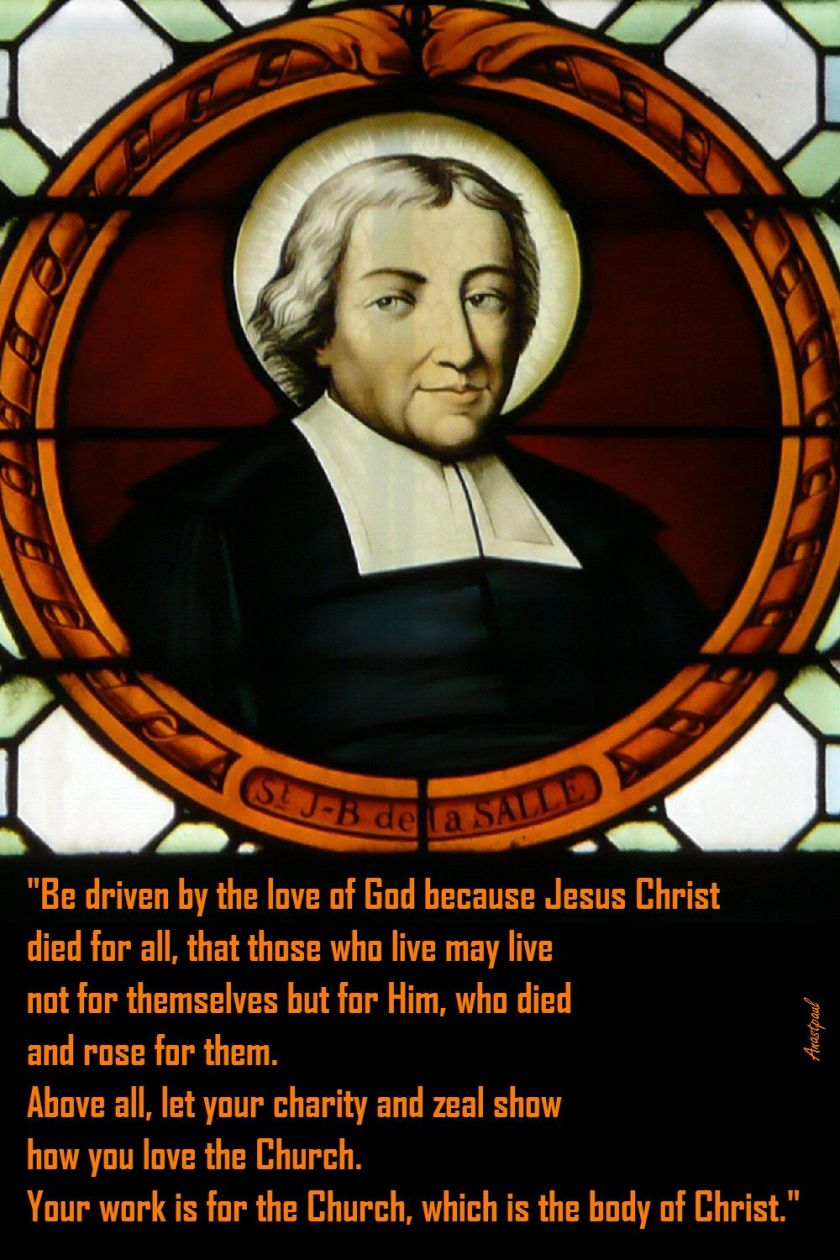
“Be driven by the love of God because Jesus Christ died for all,
that those who live may live not for themselves but for Him,
who died and rose for them.
Above all, let your charity and zeal show how you love the Church.
Your work is for the Church, which is the body of Christ.”

BE DRIVEN-STJBDELASALLE

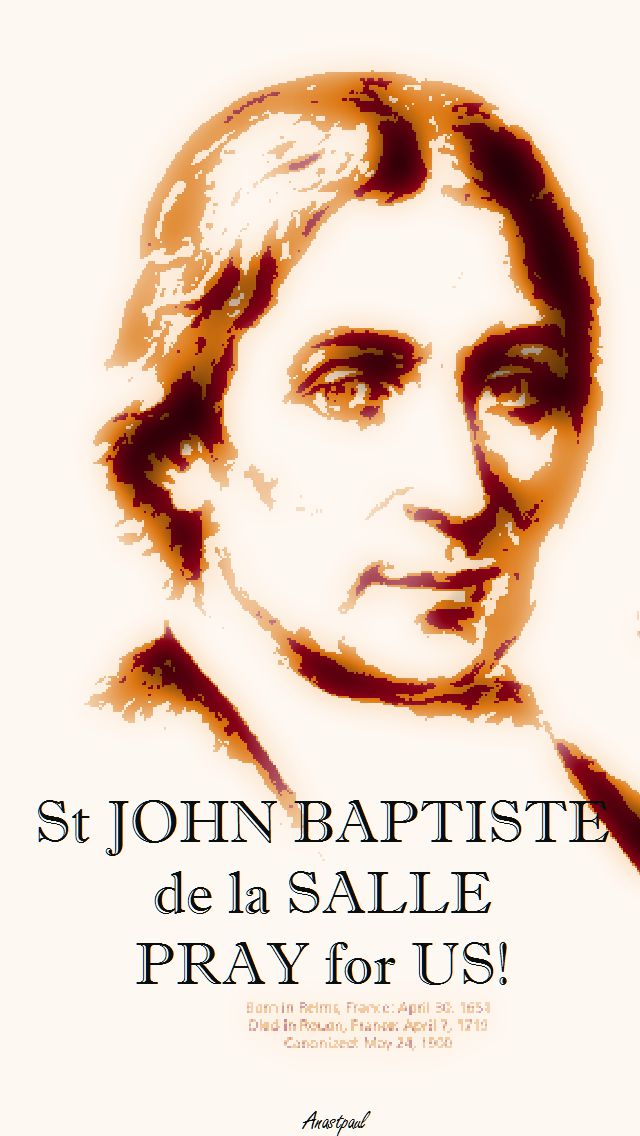
St. Jean-Baptiste de la Salle, pray for us!

ST JB DE LA SALLE PRAY FOR US 2

Posted in MORNING Prayers, QUOTES of the SAINTS, SAINT of the DAY, The WORD

One Minute Reflection – 7 April

One Minute Reflection – 7 April

Jesus offered one sacrifice for sins and took his seat forever at the
right hand of God………Hebrews 10:12

REFLECTION – “When you are at Mass, be there as if you were on Calvary.
For it is the same sacrifice and the same Jesus Christ Who is doing for you
what He did on the Cross for all human beings.”………st John Baptiste de la Salle

PRAYER – Jesus, my Redeemer, at each Mass let me thank You for the supreme sacrifice You offered to free me from sin. Help me to be sorry for my sins and to resolve to follow You more closely, to love You more dearly and to keep Your Cross always before my eyes. St John Baptiste de la Salle, pray for us, amen.

WHEN YOU ARE AT MASS- ST J B DE LA SALLEST JOHN BAPTISTE DE LA SALLE PRAY FOR US

Posted in MORNING Prayers, PRAYERS of the SAINTS, SAINT of the DAY

Our Morning Offering – 7 April

Our Morning Offering – 7 April

La Salle Prayer

My Lord,
let me be the change I want to see
To do with strength and wisdom
All that needs to be done..
And become the hope that I can be.
Set me free from my fears and hesitations
Grant me courage and humility
Fill me with spirit to face the challenge
And start the change I long to see.
Today I start the change I want to see.
Even if I’m not the light
I can be the spark
In faith, service and communion.
Let us start the change we want to see.
The change that begins in me.
Live Jesus in our hearts forever (La Sallian Invocation)
Amen

LA SALLE PRAYER

Posted in QUOTES of the SAINTS, SAINT of the DAY

Saint of the Day – 7 April – St John Baptiste de la Salle

Saint of the Day – 7 April – St John Baptiste de la Salle – (1651-1719 aged 67) Priest and founder of La Salle Schools and of the Brothers of the Christian Schools/ Institute of the Brothers of the Christian Schools or FSC (Fratres Scholarum Christianarum) educational reformer and pioneer, founder, writer – Patron of Teachers of Youth, (May 15, 1950, Pius XII), Institute of the Brothers of the Christian Schools, Lasallian educational institutions, educators, school principals, teachers.

De La Salle was born to a wealthy family in Rheims, France on April 29, although some say 30, in 1651. He was the oldest child of Louis de La Salle and Nicolle de Moet de Brouillet. Nicolle’s family was a noble one and ran a successful winery business and she was a relative of Claude Moët, founder of Moët & Chandon

La Salle received the tonsure at age eleven and was named canon of Rheims Cathedral when he was sixteen. He was sent to the College des Bons Enfants, where he pursued higher studies and on July 10, 1669, he took the degree of Master of Arts. When De La Salle had completed his classical, literary and philosophical courses, he was sent to Paris to enter the Seminary of Saint-Sulpice on October 18, 1670. His mother died on July 19, 1671 and on April 9, 1672, his father died. This circumstance obliged him to leave Saint-Sulpice on April 19, 1672. He was now twenty-one, the head of the family and as such had the responsibility of educating his four brothers and two sisters. He completed his theological studies and was ordained to the priesthood at the age of 26 on April 9, 1678 . Two years later he received a Doctorate in Theology.

De La Salle was a man of refined manners, a cultured mind, and great practical ability, in whom personal prosperity was balanced with kindness and affability. In physical appearance he was of commanding presence, somewhat above the medium height. He had large, penetrating blue eyes and a broad forehead.

The Sisters of the Child Jesus were a new religious congregation whose work was the care of the sick and education of poor girls. The young priest had helped them in becoming established and then served as their chaplain and confessor. It was through his work with the Sisters that in 1679, he met Adrian Nyel. What began as a charitable effort to help Adrian Nyel establish a school for the poor in De La Salle’s home town gradually became his life’s work. With De La Salle’s help, a school was soon opened . Shortly thereafter, a wealthy woman in Rheims told Nyel that she also would endow a school but only if La Salle would help.

At that time, most children had little hope for social and economic advancement. Jean Baptiste de la Salle believed that education gave hope and opportunity for people to lead better lives of dignity and freedom.   Moved by the plight of the poor who seemed so “far from salvation” either in this world or the next, he determined to put his own talents and advanced education at the service of the children “often left to themselves and badly brought up”.

La Salle knew that the teachers in Reims were struggling, lacking leadership, purpose, and training and he found himself taking increasingly deliberate steps to help this small group of men with their work.   First, in 1680, he invited them to take their meals in his home, as much to teach them table manners as to inspire and instruct them in their work.   This crossing of social boundaries was one that his relatives found difficult to bear.   In 1681, De La Salle realized that he would have to take a further step – he brought the teachers into his own home to live with him. De La Salle’s relatives were deeply disturbed, his social class was scandalized.   When, a year later, his family home was lost at auction because of a family lawsuit, De La Salle rented a house into which he and the handful of teachers moved.

La Salle decided to resign his canonry to devote his full attention to the establishment of schools and the training of teachers.   He had inherited a considerable fortune and this might have been used to further his aims but on the advice of a Father Barre of Paris, he sold what he had and sent the money to the poor of the province of Champagne, where a famine was causing great hardship.

De La Salle thereby began a new religious institute, the first one with no priests at all among its members: the Institute of the Brothers of the Christian Schools, also known as the De La Salle Brothers (in the U.K., Ireland, Malta, Australasia, and Asia) or, most commonly in the United States, the Christian Brothers.   (They are sometimes confused with a different congregation of the same name founded by Blessed Edmund Ignatius Rice in Ireland, who are known in the U.S. as the Irish Christian Brothers.)   The De La Salle Brothers were the first Roman Catholic teaching religious institute that did not include any priests.   One decision led to another until De La Salle found himself doing something that he had never anticipated. De La Salle wrote:

“ I had imagined that the care which I assumed of the schools and the masters would amount only to a marginal involvement committing me to no more than providing for the subsistence of the masters and assuring that they acquitted themselves of their tasks with piety and devotedness …… Indeed, if I had ever thought that the care I was taking of the schoolmasters out of pure charity would ever have made it my duty to live with them, I would have dropped the whole project……. God, who guides all things with wisdom and serenity, whose way it is not to force the inclinations of persons, willed to commit me entirely to the development of the schools.   He did this in an imperceptible way and over a long period of time so that one commitment led to another in a way that I did not foresee in the beginning.”

De La Salle’s enterprise met opposition from the ecclesiastical authorities who resisted the creation of a new form of religious life, a community of consecrated laymen to conduct free schools “together and by association”. The educational establishment resented his innovative methods.[6] Nevertheless, De La Salle and his Brothers succeeded in creating a network of quality schools throughout France that featured instruction in the vernacular, students grouped according to ability and achievement, integration of religious instruction with secular subjects, well-prepared teachers with a sense of vocation and mission, and the involvement of parents

In 1685, De La Salle founded what is generally considered the first normal school — that is, a school whose purpose is to train teachers — in Rheims, France.   In addition, De La Salle pioneered in programs for training lay teachers, Sunday courses for working young men, and one of the first institutions in France for the care of delinquents.

Worn out by austerities and exhausting labours, De La Salle died at Saint Yon, near Rouen, early in 1719 on Good Friday, only three weeks before his 68th birthday.
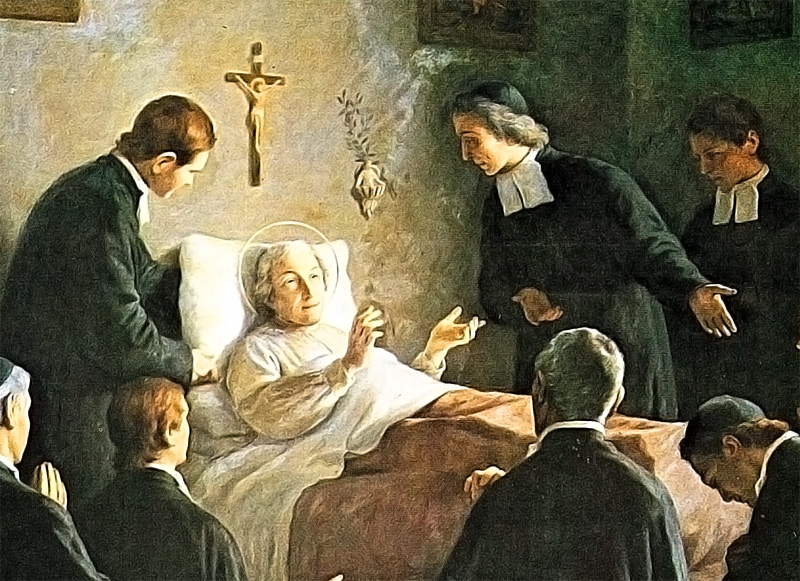
56-deathbed-closeup

St John Baptiste de La Salle was a pioneer in founding training colleges for teachers, reform schools for delinquents, technical schools and secondary schools for modern languages, arts, and sciences.   His work quickly spread through France and, after his death, continued to spread across the globe.   In 1900 John Baptiste de La Salle was declared a Saint.   In 1950, because of his life and inspirational writings, he was made Patron Saint of all those who work in the field of education.   John Baptiste de La Salle inspired others how to teach and care for young people, how to meet failure and frailty with compassion, how to affirm, strengthen and heal.   At the present time there are De La Salle schools in 80 different countries around the globe.

Posted in SAINT of the DAY

Saints – 7 April

St John Baptist de La Salle (Memorial)

St Albert of Tournai
Bl Alexander Rawlins
St Brenach of Carn-Engyle
St Calliopus of Pompeiopolis
Bl Cristoforo Amerio
St Cyriaca of Nicomedia
St Donatus of North Africa
Bl Edward Oldcorne
St Epiphanius the Martyr
St Finian of Kinnitty
St George the Younger
St Gibardus of Luxeuil
St Goran
St Guainerth
St Hegesippus of Jerusalem
St Henry Walpole
Bl Herman Joseph
Bl Mary Assunta
St Peleusius of Alexandria
St Peter Nguyen Van Luu
Bl Ralph Ashley
St Rufinus the Martyr
St Saturninus of Verona
Bl Ursuline of Parma

Martyrs of Pentapolis – 4 saints
Martyrs of Sinope – 200 saints

Posted in LENT, MORNING Prayers, Uncategorized

LENTEN REFLECTION – The Fifth Week – 6 April 2017

LENTEN REFLECTION – The Fifth Week – 6 April 2017

Come to us, free us, help us and guide us.
We pray more intensely now, just a week before Holy Thursday.
We desire more and more that we might be free.
Sorrow leads to profound gratitude,
when we experience the depth of unconditional love offered us.
The gratitude of a loved sinner leads to great generosity.

Christ is the mediator of a new covenant so that since he has died,
those who are called may receive the eternal inheritance promised to them.
The Entrance Antiphon – Hebrews 9:15

What an exquisitely beautiful things is this loving, painstaking Providence of God!
A fatherly care that can turn even our sins to good use!
I think what hurts us most in our sins and our mistakes is the awful feelings of guilt they bring – and the terrible sense of waste.
“If only I could do it all over again!” we say with remorse. “If only I could undo the harm I’ve done, soothe the feelings I’ve hurt, straighten out the mess I’ve made!”Lord, what a joy to know that through Your Death and Resurrection, through Your Father’s loving care, the harm is already undone!
That once we are sorry for our sins, there is never any waste.
All, all is turned to good.
Your wisdom can straighten what my sins have entangled, through the love You gave us in sending Your only Son to die.
Your Providence can take the broken pieces of my life and mend them – and make me into a saint!
I look forward now, my Lord, not back.
Take me – I abandon myself to a new life in Him who will die for my sins but will rise again!

From Meditations on St Paul by Fr James E Sullivan M.S.

LENT-6 APRIL

Posted in MORNING Prayers, SAINT of the DAY

Thought for the Day – 6 April

Thought for the Day – 6 April

A gracious lovable personality does more than anything else to draw others to holiness.   Some preach by words and some by their whole person.   Blessed Notker Balbulus was one of the latter.   The fact that he was dearly loved by those with whom he lived, is the finest witness to his holiness.   It is not our human looks or physical attributes which draw others to us but a heart of love.

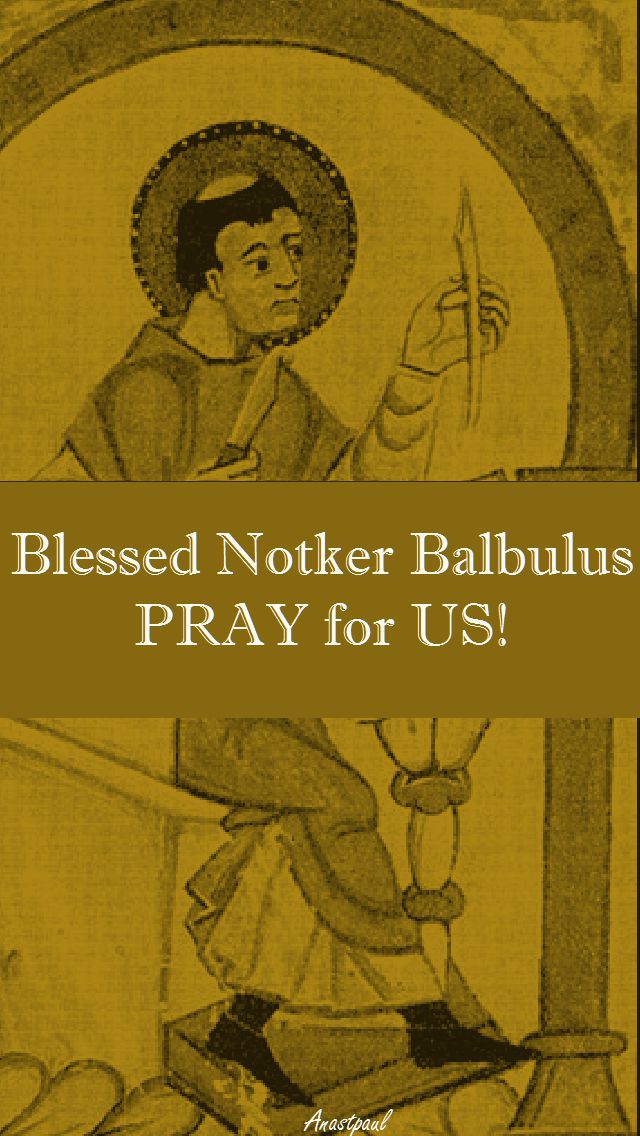
Blessed Notker Balbulus, please pray for us.

BL NOTKER BALBULUS PRAY FOR US

Posted in MORNING Prayers, QUOTES of the SAINTS

Quote/s of the Day – 6 April

Quote/s of the Day – 6 April

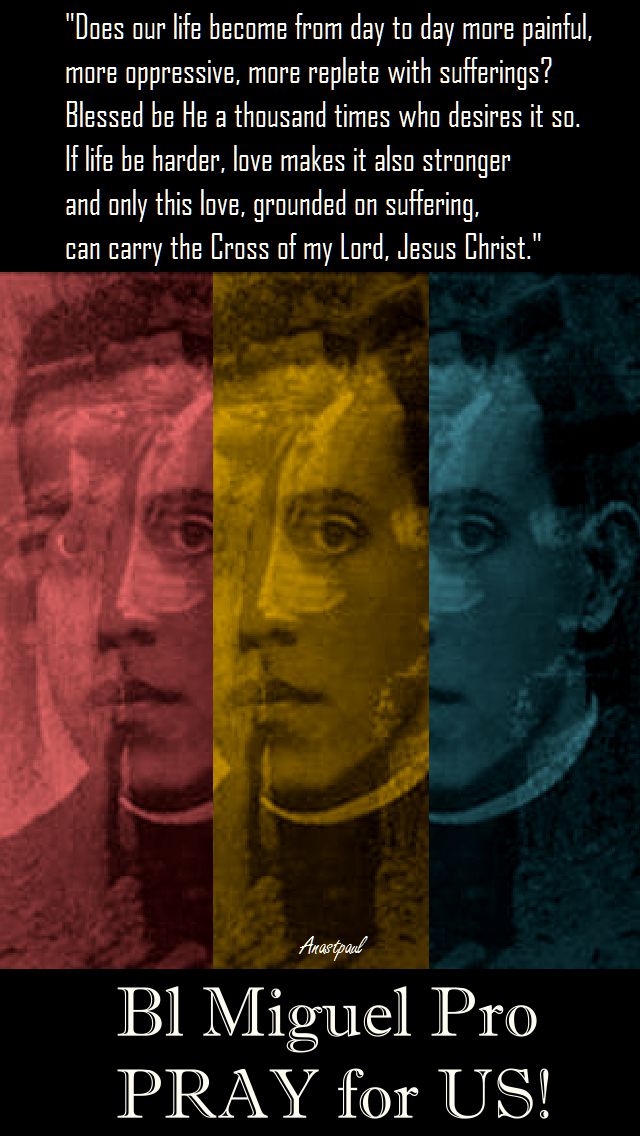
“Does our life become from day to day more painful,
more oppressive, more replete with sufferings?
Blessed be He a thousand times who desires it so.
If life be harder, love makes it also stronger
and only this love, grounded on suffering,
can carry the Cross of my Lord, Jesus Christ.”

Blessed Miguel Pro

DOES OUR LIFE BECOME-BL MIGUEL PRO


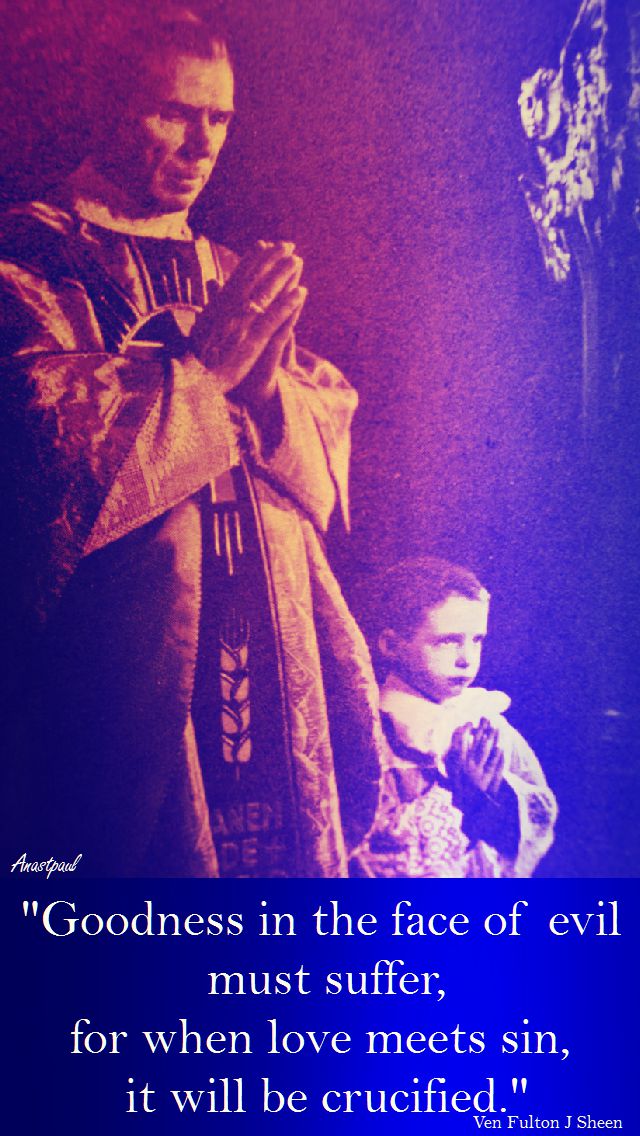
“Goodness in the face of evil must suffer,
for when love meets sin,
it will be crucified.”

Venerable Fulton J Sheen

goodness in the face of evil must suffer - fulton sheen

Posted in MORNING Prayers, QUOTES of the SAINTS, SAINT of the DAY, The WORD

One Minute Reflection – 6 April

One Minute Reflection – 6 April

Through baptism into (Christ’s) death we were buried him, so that, just as Christ was raised from the dead…..we too might live a new life……Romans 6:4

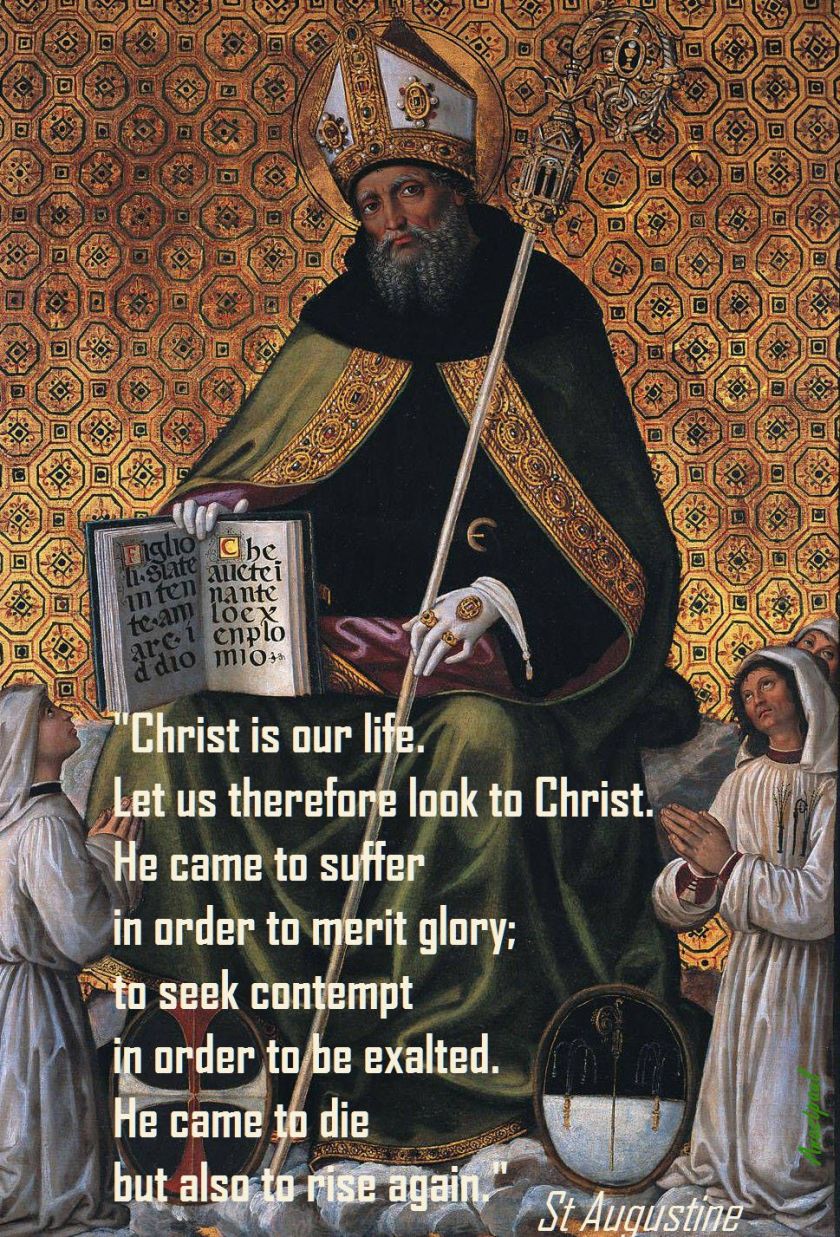
REFLECTION – “Christ is our life.   Let us therefore look to Christ.   He came to suffer in order to merit glory;  to seek contempt in order to be exalted.   He came to die but also to rise again.”……………..St Augustine

PRAYER – Heavenly Father, through my baptism I was buried with Christ and rose to a new life of grace.   Let me so guard that life that I will enjoy it full in heaven with Christ.   Blessed Notker Balbulus, you guarded your life that you lived only for Christ please pray for us all, amen.

ROMANS 6-4CHRIST IS OUR LIFE-ST AUGUSTINE

Posted in JESUIT SJ, MORNING Prayers, PRAYERS of the SAINTS

Our Morning Offering – 6 April

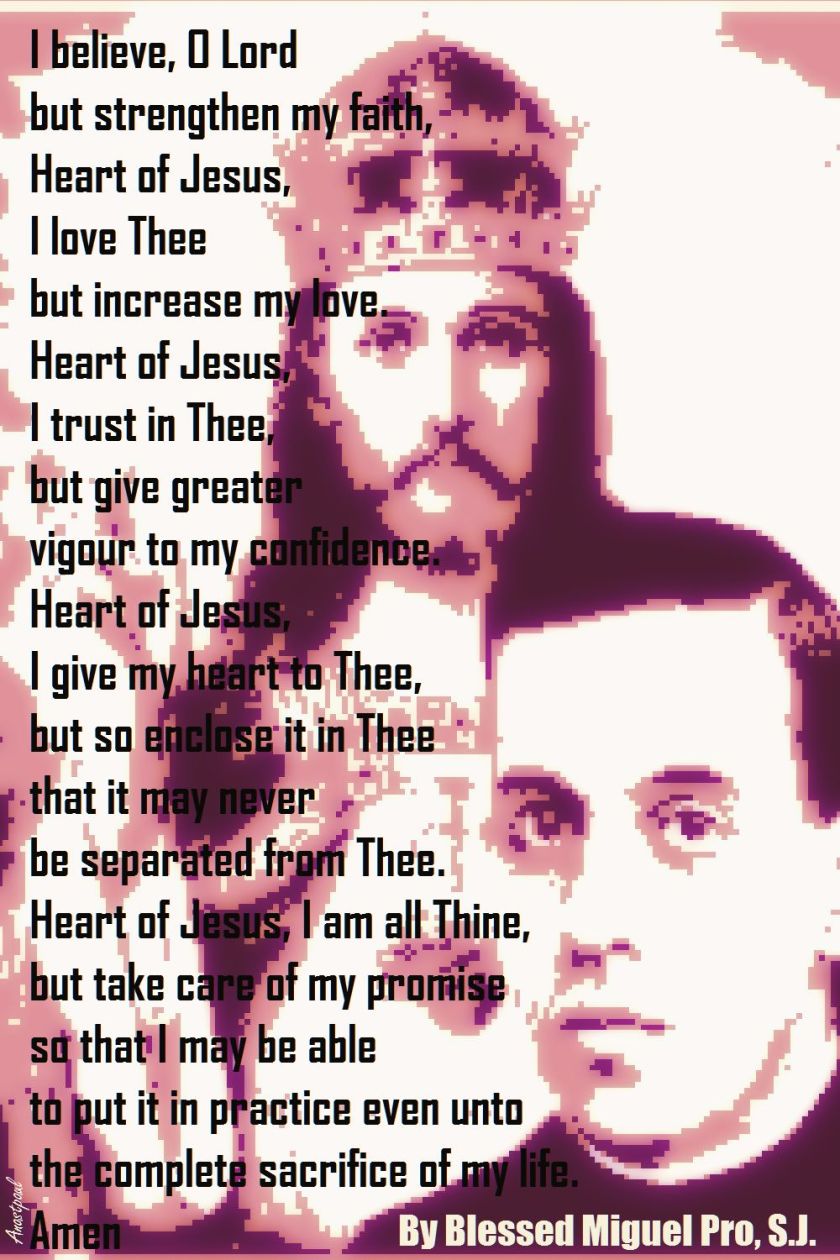
To The Heart Of Jesus
By Blessed Miguel Pro, S.J.

I believe, O Lord, but strengthen my faith,
Heart of Jesus, I love Thee
but increase my love.
Heart of Jesus, I trust in Thee,
but give greater vigour to my confidence.
Heart of Jesus, I give my heart to Thee,
but so enclose it in Thee
that it may never be separated from Thee.
Heart of Jesus, I am all Thine,
but take care of my promise
so that I may be able
to put it in practice even unto
the complete sacrifice of my life.

Amen

I BELIEVE O LORD BUT STRENGTHEN MY FAITH BY BL MIGUEL PRO

Posted in Against STUTTERING or Stammering, of speech defects or disabilities, Of MUSICIANS, Choristors, SAINT of the DAY

Saint of the Day – 6 April – Blessed Notker Balbulus

Saint of the Day – 6 April – Blessed Notker Balbulus/Notker the Stammerer/Notker of Saint Gall (c840-912) Benedictine monk. Priest. Poet. Musician. Teacher. Writer. Historian. Hagiographer; wrote a martyrology, a collection of legends and a metrical biography of Saint Gall. Friend of Saint Tutilo – Patronages –  of Musicians and invoked against stuttering/stammering -Representation:  A rod; Benedictine habit; book in one hand and a broken rod in the other with which he strikes the devil, mill wheel, staff.

220px-Notker_Balbulus_2

Notker was the son of noble Swiss parents.   His father and mother sent him, when he was a child, to be educated in the Benedictine Abbey of St. Gall, Switzerland.    In medieval times Benedictine monks often accepted youngsters as boarding students in their monastery schools.    There may have been an additional reason for entrusting Notker to these monks.    He was frail in health and stammered.   (That is the meaning of his nickname “Balbulus”.)

When he was a teenager, Notker decided to stay on at St. Gall as a monk.    Frailty of body did not keep him from becoming a leader in this religious community.    It was later said of him that he was “weakly in body but not in mind, stammering of tongue but not of intellect, pressing forward boldly in things divine–a vessel filled with the Holy Ghost without equal in his time.”    Notker, a brilliant student, was appointed librarian of the monastery in 890 and held the post of guest master in 892 and 894.

But the stammering little monk gained fame mostly through his own literary work. Having been trained by such able monastic scholars as Iso and the musical Irishman Marcellus (Moengal), he himself became a noted teacher in the monastic school.    Notker was probably the anonymous “Monk of St. Gall” who composed the book Gesta Caroli (The Deeds of Charles), a collection of folk stories about the Emperor Charlemagne.   This popular work did much to make Charlemagne a colossal legendary figure among the German peoples.

In addition to prose, Father Notker, a good theologian, also wrote poetry and composed music, with talent and taste.    In fact, he is considered the first musical composer of German stock.    Some of his musical compositions are hymns in honour of saints.    Most of his fame, however, is based on his two-score sequences.

The sequence is a type of liturgical hymn that originated in the ninth century.    It is a hymn sung after that Alleluia of the Latin Rite Mass that comes just before the singing of the Gospel.   ur liturgy used to have many of these sequences but today the Church retains only the Victimae Paschali (Easter);   the Veni Sancte Spiritus (Pentecost);   the Lauda Sion (Corpus Christi);   and the Stabat Mater (Seven Sorrows of Mary).    (A fifth sequence the Dies Irae for funerals was dropped only after Vatican II).    Now, none of these five sequences was written by Notker but the pattern he gave to the format by his own popular compositions was decisive among later composers.

Notker the Stammerer was so much loved by the monks of his abbey that for a long time after his death, they could not speak of him without shedding tears.    They venerated him as a saint. T   he Holy See confirmed this cult of Blessed Notker in 1512 by permitting a Mass to be celebrated in his honour at the Abbey of St. Gall.    The permission was extended to the diocese of Constance in 1513.    His relics were enshrined in the cathedral of Sankt Gallen in 1628 – see below

Blessed Notker has been declared by some to be the greatest poet of the Middle Ages. Being tongue-tied may impair the speech but it cannot inhibit the soaring imagination.

–Father Robert F. McNamara

Posted in SAINT of the DAY

Saints – 6 April

St Agrarius the Martyr
St Amand of Grisalba
St Berthanc of Kirkwall
St Brychan of Brycheiniog
Bl Catherine of Pallanza
St Diogenes of Philippi
St Elstan of Abingdon
St Galla of Rome
St Gennard
St Irenaeus of Sirmium
Bl Jan Franciszek Czartoryski
St Marcellinus the Martyr
Bl Maria Karlowska
Bl Michele Rua
Bl Notker Balbulus
St Phaolô Lê Bao Tinh
St Philaret of Calabria
Bl Pierina Morosini
St Platonides of Ashkelon
St Prudentius of Troyes
St Pope St. Sixtus I
St Timothy of Philippi
St Ulched
St Urban of Peñalba
St William of Eskilsoe
St Winebald
Bl Zefirino Agostini

Martyrs of Hadiab
Martyrs of Sirmium : 7 saints – A group of fourth century martyrs at Sirmium, Pannonia (modern Sremska Mitrovica, Serbia). We know little more than seven of their names – Florentius, Geminianus, Moderata, Romana, Rufina, Saturus and Secundus.

Martyred in the Spanish Civil War
Enric Gispert Domenech
Josep Gomis Martorell

Posted in MORNING Prayers, PRAYERS for PRIESTS

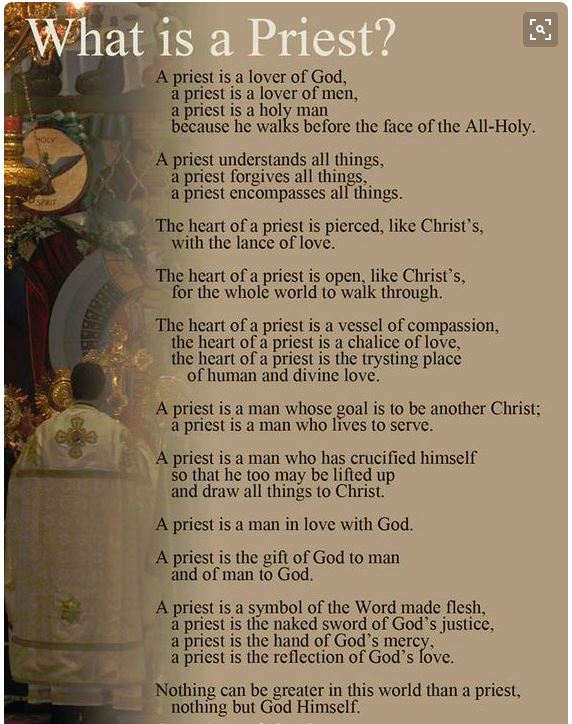
What is a Priest?

WHAT IS A PRIEST?

By Servant of God, Catherine Doherty – foundress of Madonna House, Combermere, Ontario, Canada

A PRIEST is a lover of God,
a priest is a lover of men,
a priest is a holy man
because he walks before the face of the All-Holy.

A priest understands all things,
a priest forgives all things,
a priest encompasses all things.

The heart of a priest is pierced, like Christ’s
with the lance of love.

The heart of a priest is open, like Christ’s
for the whole world to walk through.

The heart of a priest is a vessel of compassion,
the heart of a priest is a chalice of love,
the heart of a priest is the trysting place
of human and divine love.

A priest is a man whose goal is to be another Christ;
a priest is a man who lives to serve.

A priest is a man who has crucified himself
so that he too may be lifted up
and draw all things to Christ.

A priest is a man in love with God.
A priest is the gift of God to man
and of man to God.

A priest is the symbol of the word made flesh,
a priest is the naked sword of God’s justice,
a priest is the hand of God’s mercy,
a priest is the reflection of God’s love.

Nothing can be greater in this world than
a priest
Nothing but God Himself.

WHAT IS A PRIEST

LET US PRAY:

Prayer for Priests by Pope Benedict XVI

Lord Jesus Christ, eternal High Priest,
You offered Yourself to the Father
on the altar of the Cross
and through the outpouring of the Holy Spirit
gave Your priestly people
a share in Your redeeming sacrifice.
Hear our prayer for the sanctification
of our priests.
Grant that all who are ordained
to the ministerial priesthood
may be ever more conformed to You,
the divine Master.
May they preach the Gospel
with pure heart and clear conscience.
Let them be shepherds according to Your own Heart,
single-minded in service to You and to the Church
and shining examples of a holy, simple and joyful life.
Through the prayers of the Blessed Virgin Mary,
your Mother and ours,
draw all priests and the flocks entrusted to their care
to the fullness of eternal life where You live and reign
with the Father and the Holy Spirit,
one God, for ever and ever. Amen

PRAYER FOR PRIESTS-BENEDICT

Posted in LENT, MORNING Prayers

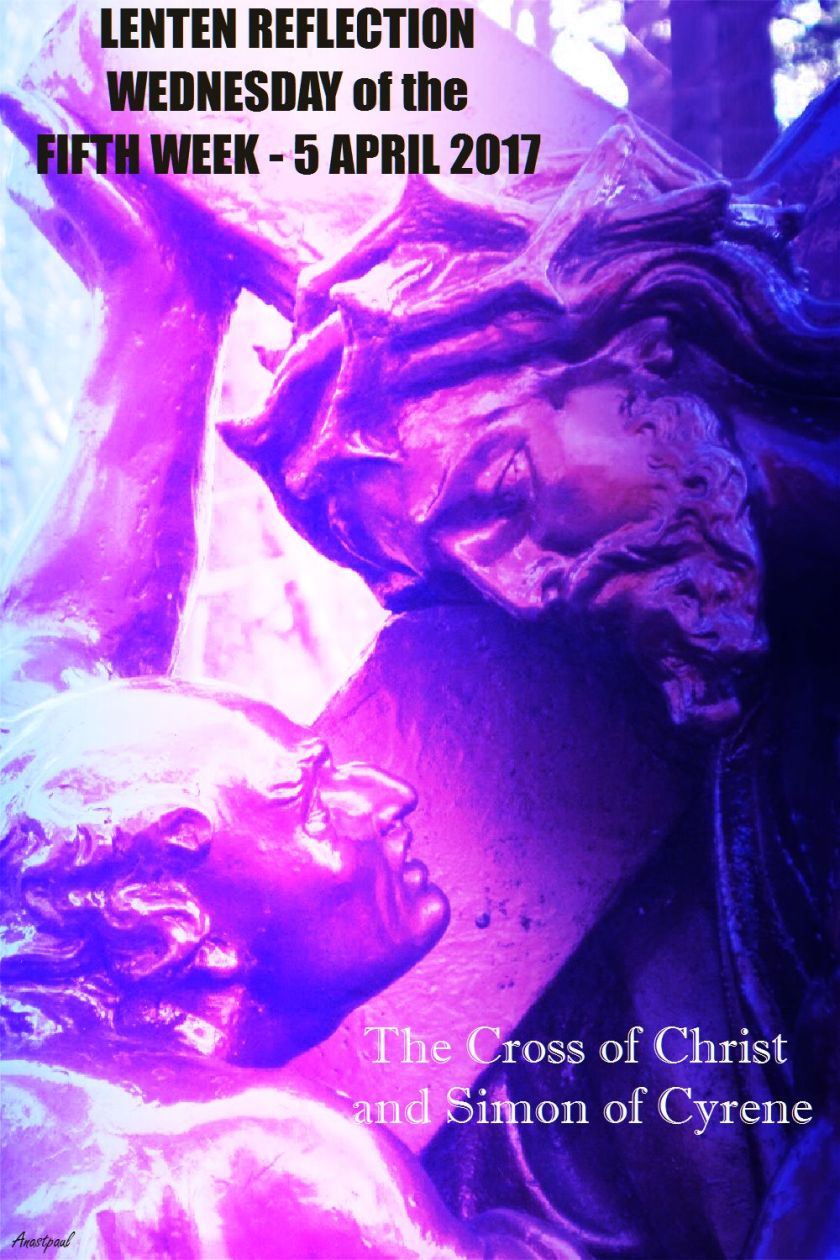
LENTEN REFLECTION – Wednesday of the Fifth Week – 5 April 2017

LENTEN REFLECTION – Wednesday of the Fifth Week – 5 April 2017

The Cross of Christ and Simon of Cyrene

And they compelled a passer-by, Simon of Cyrene, who was coming in from the country, the father of Alexander and Rufus, to carry his cross.Mark 15:21

Our blessed Lord falls again and again beneath the weight of the cross, until it becomes evident to the soldiers that He will never be able to drag it to the place of execution.   They accordingly lay hold of a heathen passing by, Simon the Cyrenian and him they compel to carry the cross.    How little Simon knew the happiness in store for him when those rough soldiers seize him and force him to the ignominious task of carrying for a public criminal the instrument of his punishment!    How often we too fail to recognise in the sudden disagreeables and contradictions we encounter God’s wonderful designs of mercy to us!

Simon at first bore the cross surlily and reluctantly, chafing under the hardship inflicted on him.    But as he carries it, somehow an unaccountable change comes over him.    It has the virtue to change his heart and to make of him a devoted follower of the Crucified, one of the pillars of the Apostolic Church.    Thus many a cross that we carry reluctantly turns out to be really the means of our sanctification and salvation.

Before Simon arrives at the summit of Calvary, the cross has endeared itself to him.    He has recognised that to carry it for Jesus was no hardship but a privilege and a happiness. So too the saints learn to love the cross, to embrace it, to seek it, to carry it with all joy, to be almost discontented if they are without it.    This is the very height of peace and felicity;  for those who find their joy in the cross find everywhere around them cause for rejoicing.

– from The Sacred Passion of Jesus Christ: Short Meditations for Lent, by Father Richard Frederick Clark, S.J.

THE CROSS OF CHRIST AND SIMON OF CYRENE

Posted in MORNING Prayers, SAINT of the DAY

Thought for the Day – 5 April

Thought for the Day – 5 April

The polarisation in the Church today (but only in certain countries-never forget that the world is a big place and in most places the Church stands united) is a mild breeze compared with the tornado that ripped the Church apart during the lifetime of this saint. If any saint is a patron of reconciliation, Vincent Ferrer is.    The split in the Church at the time of Vincent Ferrer should have been fatal—36 long years of having two “heads.”   We cannot imagine what condition the Church today would be in if that happened today.   It is an ongoing miracle that the Church has not long since been shipwrecked on the rocks of human pride and ignorance, greed and ambition but we must always take into account the fact that the Church is Divine, it is Holy and is the Mystical Body of Christ and not our man-made institution – for that it is NOT – it is true love!   “We believe that “truth is mighty and it shall prevail”—but it sometimes takes a long time.   And so, even if we are wrong, as in St Vincent’s case, we can still become saints.   How great is our God for the “gates of hell shall not prevail.”! (portion of this comment from Fr. Don Miller, OFM)

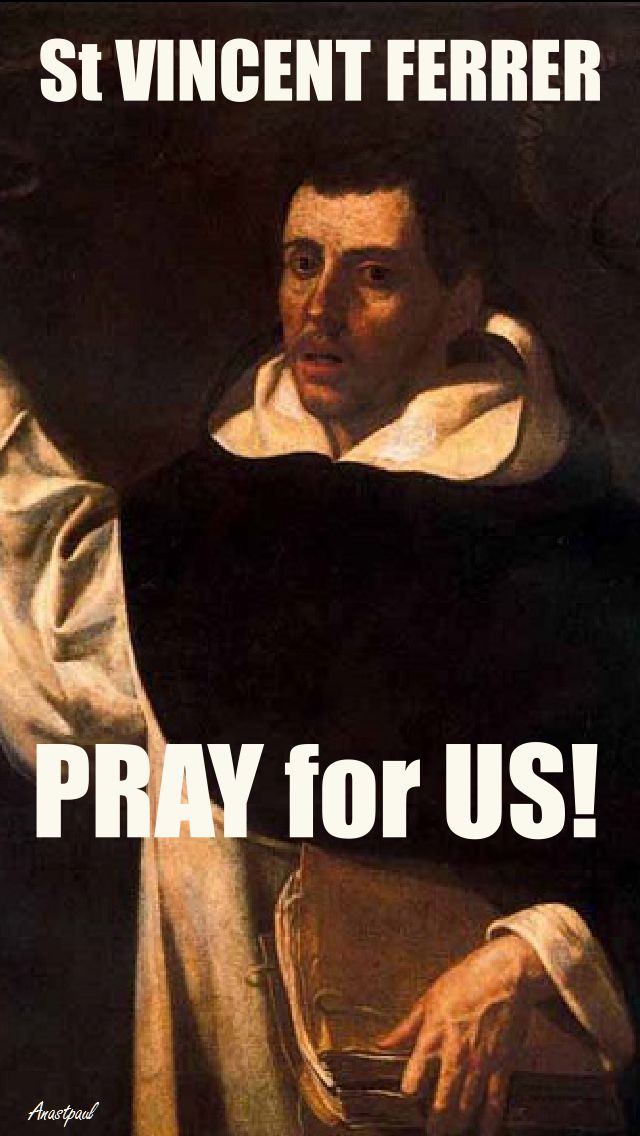
St Vincent Ferrer, pray for us!

SR V FERRER PRAY FOR US 2

ST V FERRER PRAY FOR US 3

Posted in MORNING Prayers, QUOTES of the SAINTS, SAINT of the DAY

Quote/s of the Day – 5 April

Quote/s of the Day – 5 April

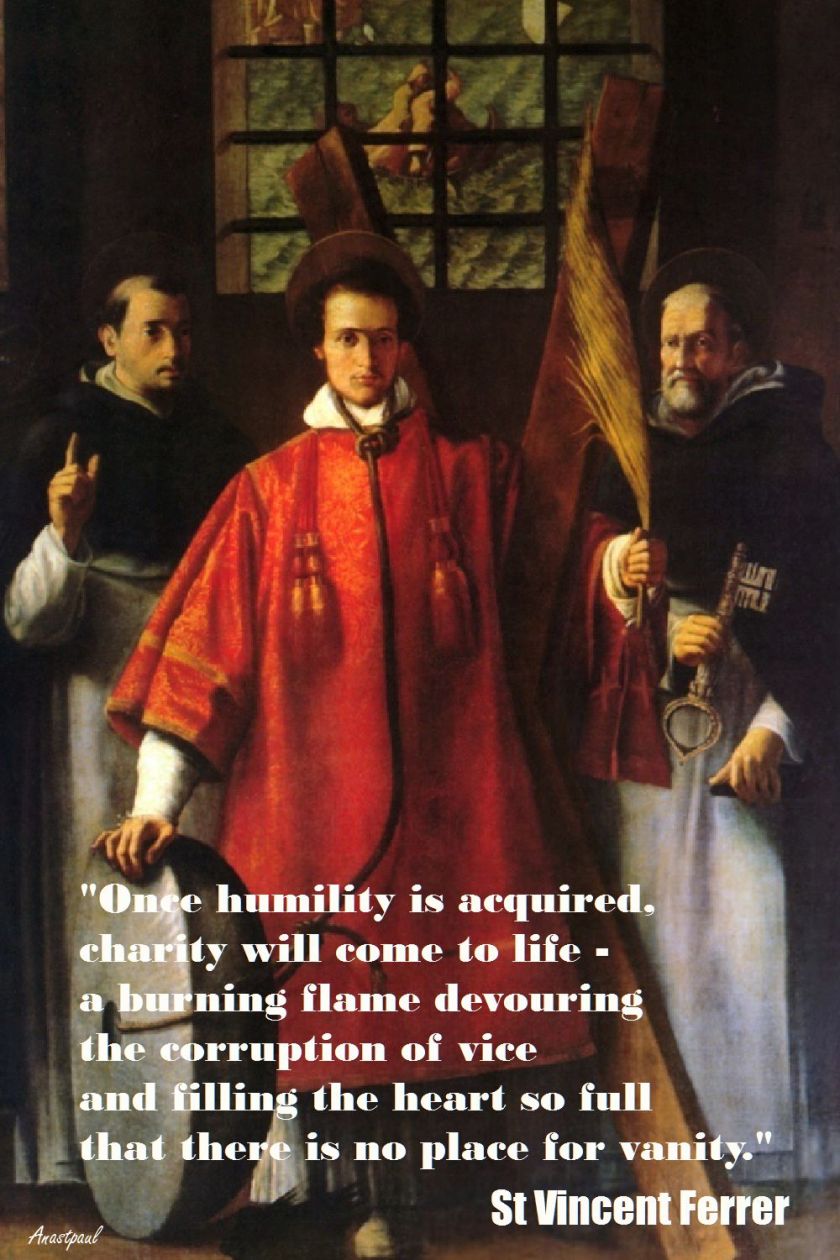
“Once humility is acquired, charity will come to life –
a burning flame devouring the corruption of vice and filling
the heart so full that there is no place for vanity.”

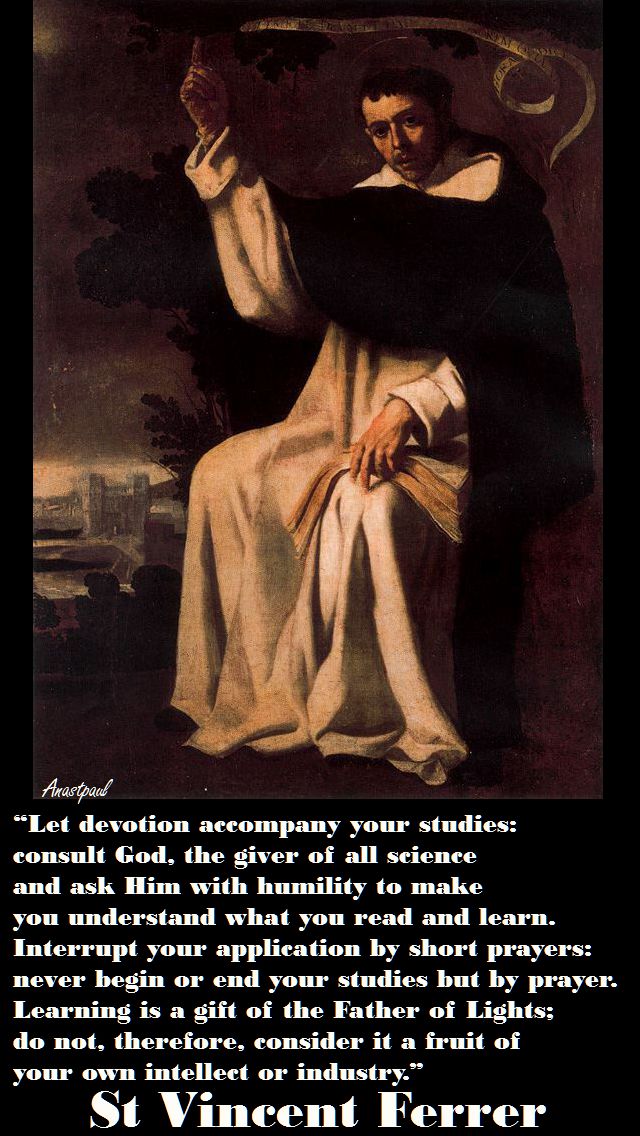
“Let devotion accompany your studies:
consult God, the giver of all science and ask Him with humility to make
you understand what you read and learn.
Interrupt your application by short prayers:  never begin or end your studies but by prayer. Learning is a gift of the Father of Lights;   do not, therefore, consider it a fruit of
your own intellect or industry.”

St Vincent Ferrer (Saint of the Day)

ST VINCENT - ONCE HUMILITY IS ACQUIREDLET DEVOTION -ST VINCENT FERRER

Posted in MORNING Prayers, SAINT of the DAY

One Minute Reflection – 5 April

One Minute Reflection – 5 April

Love the Lord your God with all your heart………
Love your neighbour as yourself……..Mark 12:30-31

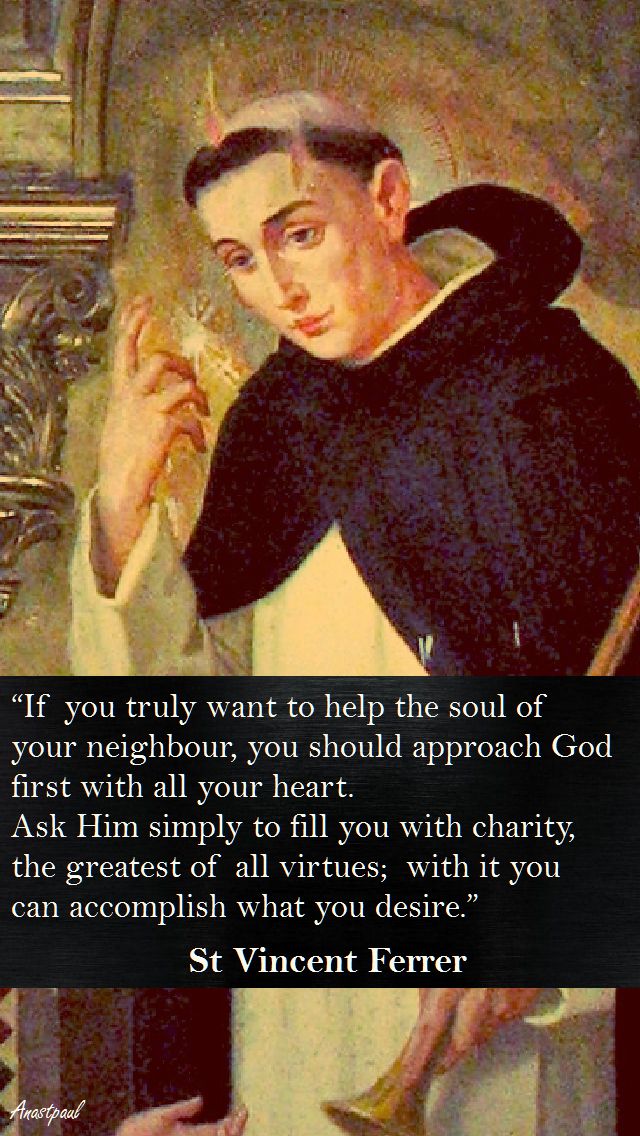
REFLECTION – “If you truly want to help the soul of your neighbour, you should pproach God first with all your heart.   Ask Him simply to fill you with charity, the greatest of all virtues;  with it you can accomplishwhat you desire.” …………….St Vincent Ferrer

PRAYER – Heavenly Father, grant me the grace to love You above all things and to do all my actions out of love for You. Help me to love others and to work for their salvation. St Vincent Ferrer, pray for us, amen.

MARK 12 - 30,31IF YOU TRULY - ST V FERRERST V FERRER PRAY FOR US

Posted in MORNING Prayers, SAINT of the DAY

Our Morning Offering – 5 April

Our Morning Offering – 5 April

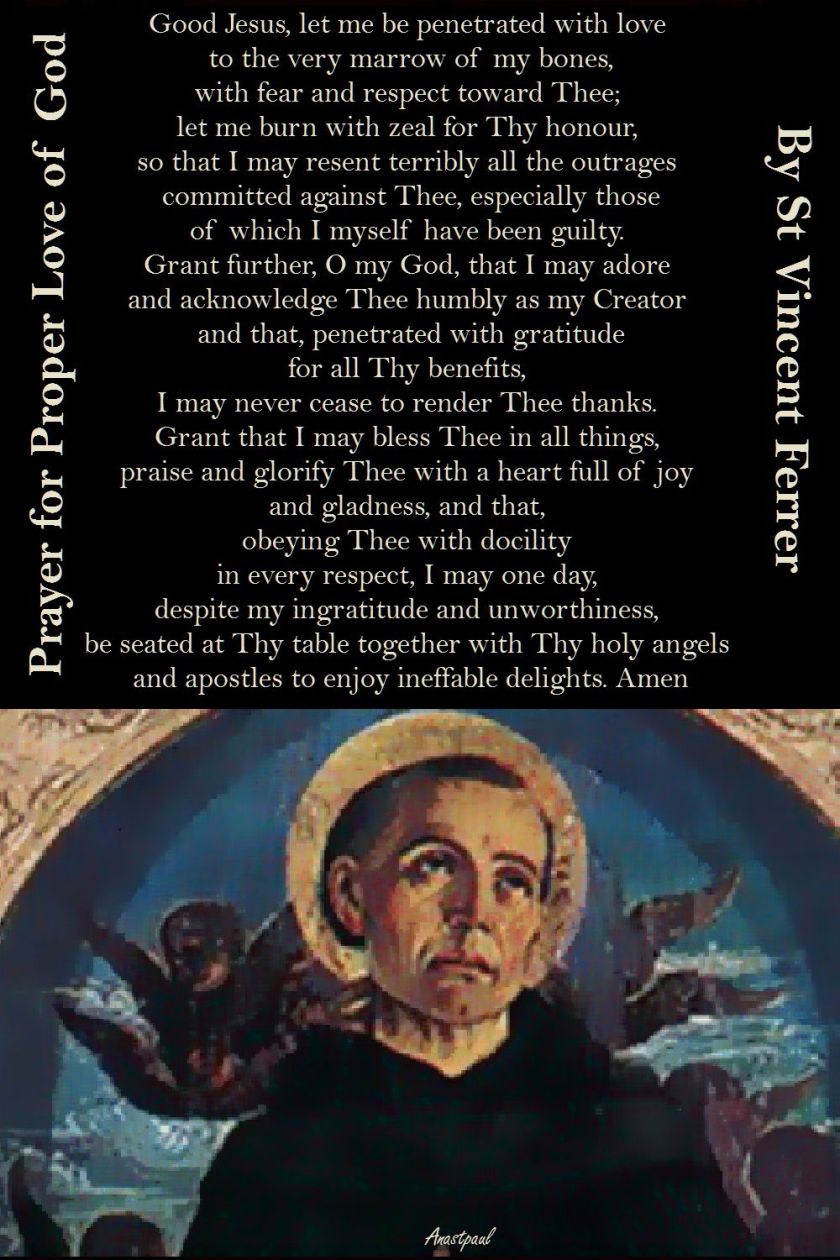
Prayer for Proper Affections Toward God
By St Vincent Ferrer

Good Jesus, let me be penetrated with love
to the very marrow of my bones,
with fear and respect toward Thee;
let me burn with zeal for Thy honour,
so that I may resent terribly all the outrages
committed against Thee, especially those
of which I myself have been guilty.
Grant further, O my God, that I may adore
and acknowledge Thee humbly as my Creator
and that, penetrated with gratitude
for all Thy benefits,
I may never cease to render Thee thanks.
Grant that I may bless Thee in all things,
praise and glorify Thee with a heart full of joy
and gladness, and that,
obeying Thee with docility
in every respect, I may one day,
despite my ingratitude and unworthiness,
be seated at Thy table together with Thy holy angels
and apostles to enjoy ineffable delights. Amen

GOOD JESUS LET ME BE PENETRATED...ST VINCENT FERRER

Posted in SAINT of the DAY

Saint of the Day – 5 April – St Vincent Ferrer

Saint of the Day – 5 April – St Vincent Ferrer O.P. (1530-1419 aged 69) Religious Priest, Miracle-worker, Logician, Preacher, Missionary, Confessor, Teacher, Philosopher, Theologian known as the “Angel of the Apocalypse” and the “Mouthpiece of God” – Patron of  brick makers, builders, Calamonaci, Italy, Casteltermini, Agrigento, Italy, construction workers, Leganes, Philippines, Orihuela-Alicante, Spain, diocese of, pavement workers, plumbers, .  tile makers.   Representation: Bible, cardinal’s hat, Dominican preacher with a flame on his hand, Dominican preacher with a flame on his head, Dominican holding an open book while preaching, Dominican with a cardinal’s hat, Dominican with a crucifix, Dominican with a trumpet nearby, often coming down from heaven, referring to his vision, Dominican with wings, referring to his vision as being an ‘angel of the apocalypse’, pulpit, representing his life as a preacher, flame, referring to his gifts from the Holy Spirit.

saint-vincent-ferrer-01


Vincent was the fourth child of the nobleman Guillem Ferrer, a notary who came from Palamós and wife, Constança Miquel, apparently from Valencia itself or Girona.   Legends surround his birth.    It was said that his father was told in a dream by a Dominican friar that his son would be famous throughout the world.    His mother is said never to have experienced pain when she gave birth to him.    He was named after St. Vincent Martyr, the patron saint of Valencia.   He would fast on Wednesdays and Fridays and he loved the Passion of Christ very much.    He would help the poor and distribute alms to them.    He began his classical studies at the age of eight, his study of theology and philosophy at fourteen.

Four years later, at the age of nineteen, Ferrer entered the Order of Preachers, commonly called the Dominican Order, in England also known as Blackfriars.    As soon as he had entered the novitiate of the Order, though, he experienced temptations urging him to leave.    Even his parents pleaded with him to do so and become a secular priest. He prayed and practiced penance to overcome these trials.    Thus he succeeded in completing the year of probation and advancing to his profession.

924f0ba36b2d72c2e396fe5df0adc509

For a period of three years, he read solely Sacred Scripture and eventually committed it to memory.    He published a treatise on Dialectic Suppositions after his solemn profession, and in 1379 was ordained a Catholic priest at Barcelona.    He eventually became a Master of Sacred Theology and was commissioned by the Order to deliver lectures on philosophy.    He was then sent to Barcelona and eventually to the University of Lleida, where he earned his doctorate in theology.

Vincent Ferrer is described as a man of medium height, with a lofty forehead and very distinct features.    His hair was fair in colour and tonsured.    His eyes were very dark and expressive;   his manner gentle.    Pale was his ordinary colour.    His voice was strong and powerful, at times gentle, resonant and vibrant.

Three men claimed to be pope in the 1300s and 1400s. Kings, princes, priests, and laypeople fought one another to support the different claimants for the Chair of Peter. This chaos led to the Western Schism, and God raised up Vincent Ferrer.

When Vincent joined the Dominicans, he zealously practiced penance, study and prayer. He was a teacher of philosophy and a naturally gifted preacher called the “mouthpiece of God.”  His saintly life was what made his preaching so effective.  Vincent’s subjects were judgment, heaven, hell and the need for repentance.

Even the holiest people can be misled. Pope Urban VI was the real pope and lived in Rome but Vincent and many others thought that Clement VII and his successor Benedict XIII, who lived in Avignon, France, were the true popes. Vincent convinced kings, princes, clergy and almost all of Spain to give loyalty to them.   After Clement VII died, Vincent tried to get both Benedict and the pope in Rome to abdicate so that a new election could be held. It hurt Vincent when Benedict refused.

Vincent came to see the error in Benedict’s claim to the papacy.   Discouraged and ill, Vincent begged Christ to show him the truth.    In a vision, he saw Jesus with Saint Dominic and Saint Francis, commanding him to “go through the world preaching Christ.” For the next 20 years, Vincent spread the Good News throughout Europe.    He fasted, preached, worked miracles and drew many people to become faithful Christians.   Vincent returned to Benedict in Avignon and asked him to resign.    Benedict refused. One day while Benedict was presiding over an enormous assembly, Vincent, though close to death, mounted the pulpit and denounced him as the false pope.    He encouraged everyone to be faithful to the one, true Catholic Church in Rome.    Benedict fled, knowing his supporters had deserted him.   Later, the Council of Constance met to end the Western Schism.

St Vincent always slept on the floor, he had the gift of tongues (he spoke only Spanish but all listeners understood him, he lived in an endless fast, celebrated Mass daily and known as a miracle worker;  he is reported to have brought a murdered man back to life to prove the power of Christianity to the onlookers and he would heal people throughout a hospital just by praying in front of it.   He worked so hard to build up the Church that he became the patron of people in building trades.

Because of the Spanish’s harsh methods of converting Jews at the time, the means which Vincent had at his disposal were either baptism or spoliation.   He won them over by his preaching, estimated at 25,000.   Vincent also attended the Disputation of Tortosa (1413–14), called by Avignon Pope Benedict XIII in an effort to convert Jews to Catholicism after a debate among scholars of both faiths.

Vincent died on 5 April 1419 at Vannes in Brittany, at the age of sixty-nine and was buried in Vannes Cathedral.    He was canonised by Pope Calixtus III on 3 June 1455.  His feast day is celebrated on 5 April.   The Fraternity of Saint Vincent Ferrer, a pontifical religious institute founded in 1979, is named for him.

Posted in SAINT of the DAY

Saints- 5 April

St Vincent Ferrer (Optional Memorial)

St Albert of Montecorvino
Bl Antonius Fuster
St Becan
Bl Blasius of Auvergne
St Claudius of Mesopotamia
St Derferl Gadarn
St Gerald of Sauve-Majeure
St Irene of Thessalonica
St Maria Crescentia Hoss
St Mariano de la Mata Aparicio
St Pausilippus
Bl Peter Cerdan
St Theodore the Martyr
St Zeno the Martyr

Martyrs of Lesbos – 5 saints – Five young Christian women martyred together for their faith. We don’t even know their names. island of Lesbos, Greece
Martyrs of North-West Africa – Large group of Christians murdered while celebrating Easter Mass during the persecutions of Genseric, the Arian king of the Vandals. 459 at Arbal (in modern Algeria)

Posted in LENT, MORNING Prayers, QUOTES of the SAINTS

LENTEN REFLECTION – Tuesday of the Fifth Week – 4 April 2017

LENTEN REFLECTION – Tuesday of the Fifth Week – 4 April 2017

Look at the cross of Christ – Blessed John Henry Newman

“Look around, and see what the world presents of high and low.    Go to the court of princes.    See the treasure and skill of all nations brought together to honour a child of man.    Observe the prostration of the many before the few.    Consider the form and ceremonial, the pomp, the state, the circumstance and the vainglory.    Do you wish to know the worth of it all? Look at the cross of Christ.

Go to the political world.    See nation jealous of nation, trade rivalling trade, armies and fleets matched against each other.    Survey the various ranks of the community, its parties and their contests, the strivings of the ambitious, the intrigues of the crafty.    What is the end of all this turmoil – the grave!    What is the measure – the cross.

Go, again, to the world of intellect and science.    Consider the wonderful discoveries which the human mind is making, the variety of arts to which its discoveries give rise, the all but miracles by which it shows its power.    And next, the pride and confidence of reason and the absorbing devotion of thought to transitory objects, which is the consequence.    Would you form a right judgment of all this?    Look at the cross.

Again, look at misery, look at poverty and destitution, look at oppression and captivity. Go where food is scanty, and lodging unhealthy.    Consider pain and suffering, diseases long or violent, all that is frightful and revolting.   Would you know how to rate all these? Gaze upon the cross.

Thus in the cross, and Him who hung upon it, all things meet.    All things subserve it, all things need it.    It is their centre and their interpretation.    For He was lifted up upon it, that He might draw all peoples and all things to himself.

………………..And so, too, as regards this world, with all its enjoyments, yet disappointments, let us not trust it.    Let us not give our hearts to it.    Let us not begin with it.    Let us begin with faith.    Let us begin with Christ.    Let us begin with His cross and the humiliation to which it leads.    Let us first be drawn to Him who is lifted up, that so He may, with Himself, freely give us all things.    Let us “seek first the kingdom of God and his righteousness,” and then all those things of this world “will be added to us.”

They alone are able truly to enjoy this world, who begin with the world unseen.    They alone enjoy it, who have first abstained from it.    They alone can truly feast, who have first fasted.    They alone are able to use the world, who have learned not to abuse it. They alone inherit it, who take it as a shadow of the world to come and who for that world to come relinquish it.”

LOOK AT THE CROSS OF CHRIST - NEWMAN

Posted in DOCTORS of the Church, FATHERS of the Church, MORNING Prayers, SAINT of the DAY

Thought for the Day – 4 April

Thought for the Day – 4 April

How amazing it is – what one person can accomplish when he works for God alone!   We all find ourselves in situations of leadership or influence and the good we can do by our labour and our example knows no bounds.    Look around, see the lives you can touch – become a genuine influence and example to others.   We have every tool we need AND we have every reason to work for the glory of the Kingdom!

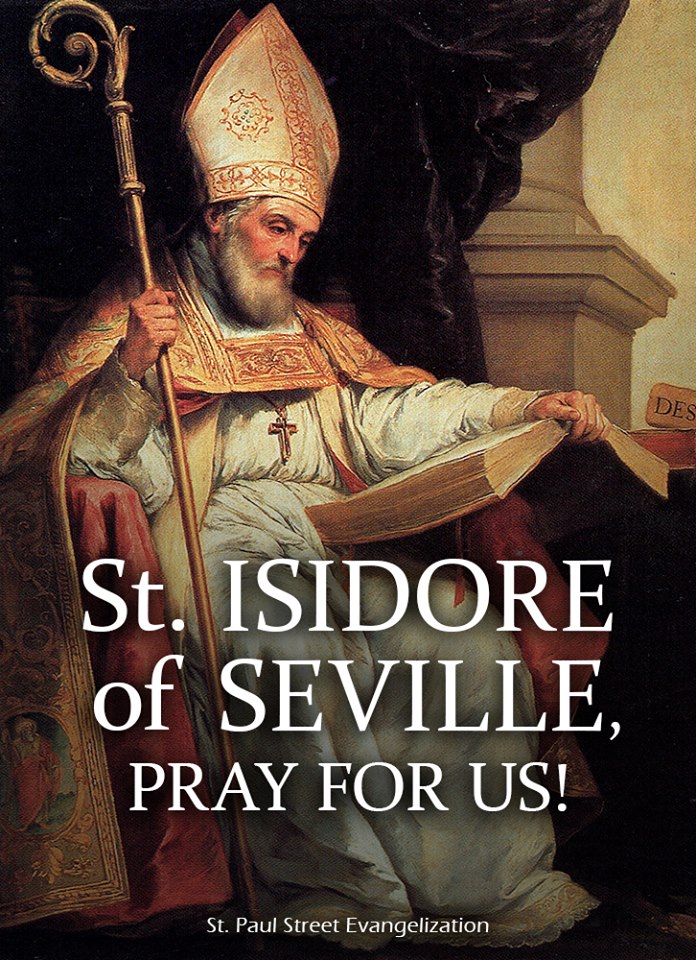
St Isidore of Seville, pray for us!

ST ISIDORE PRAY FOR US 2ST ISIDORE OF SEVILLE - APRIL 4

Posted in DOCTORS of the Church, FATHERS of the Church, QUOTES of the SAINTS, SAINT of the DAY

Quote/s of the Day – 4 April

Quote/s of the Day – 4 April

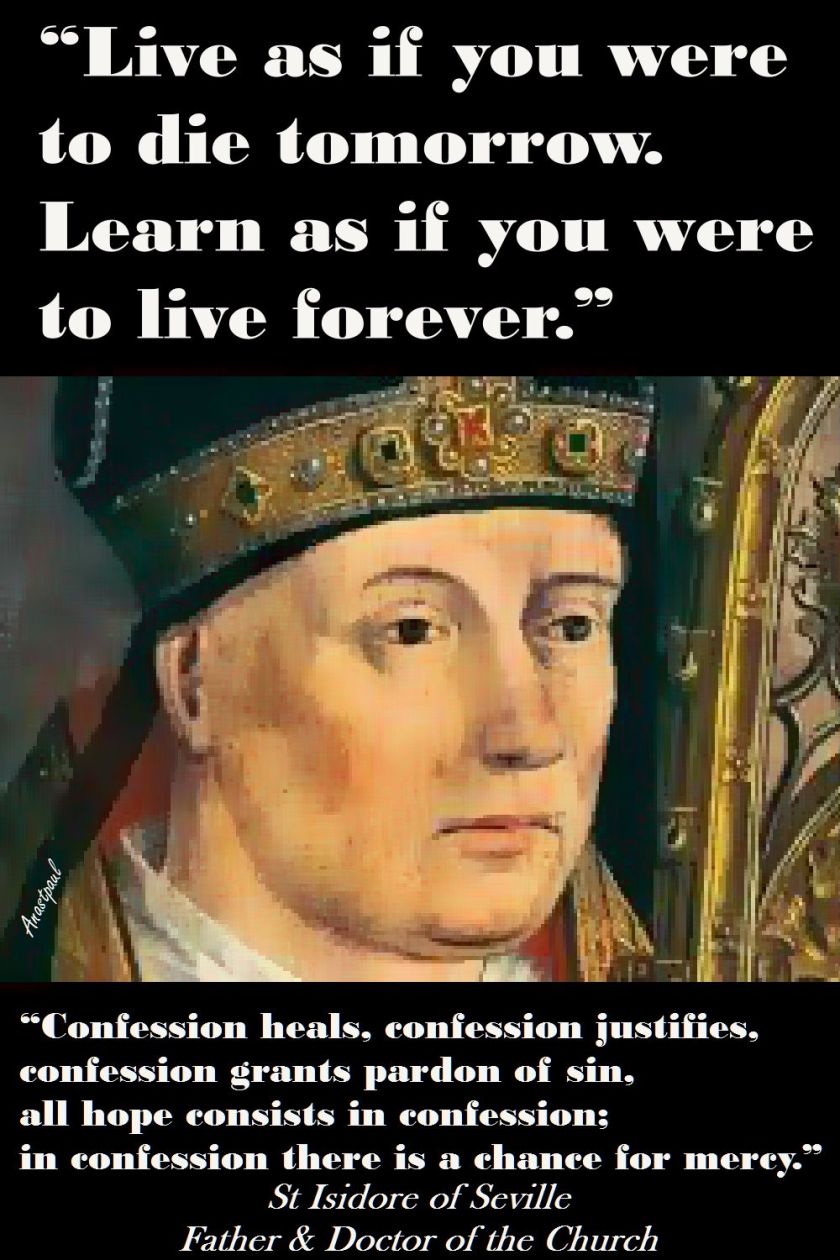
“Live as if you were to die tomorrow.
Learn as if you were to live forever.”

“Confession heals, confession justifies,
confession grants pardon of sin,
all hope consists in confession;
in confession there is a chance for mercy.”

St Isidore of Seville – Father & Doctor of the Church

QUOTES - ST ISIDORE

Posted in DOCTORS of the Church, FATHERS of the Church, MORNING Prayers, QUOTES of the SAINTS, SAINT of the DAY, The WORD

One Minute Reflection – 4 April

One Minute Reflection – 4 April

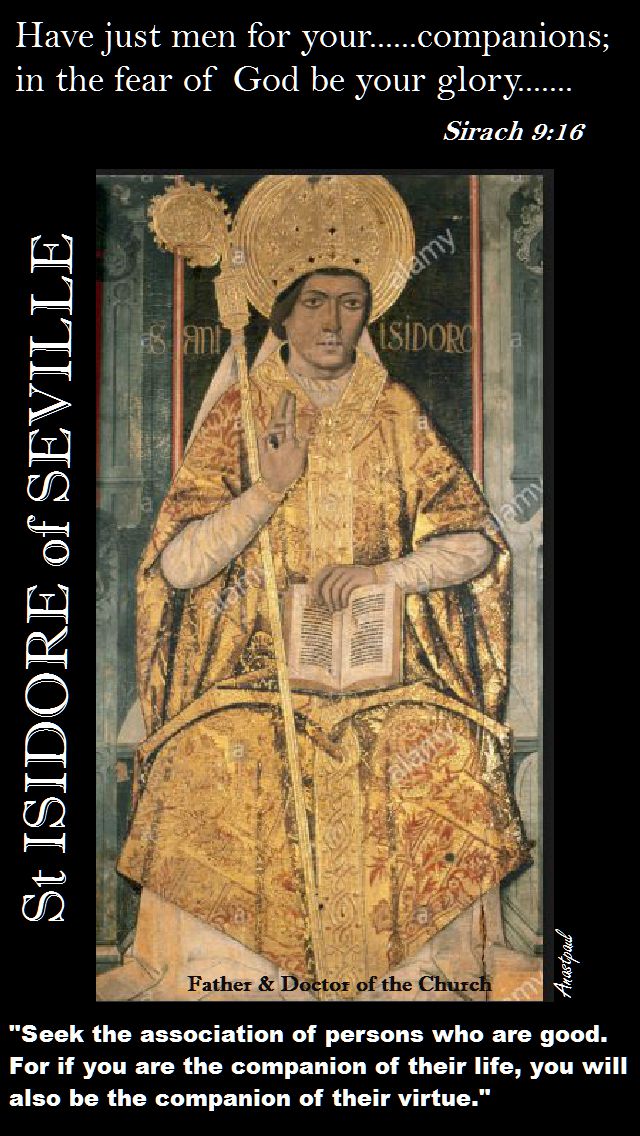
Have just men for your……companions;
in the fear of God be your glory…………Sirach 9:16

REFLECTION – “Seek the association of persons who are good. For if you are the companion of their life, you will also be the companion of their virtue.”…….St Isidore of Seville

PRAYER – God of goodness, help me to be continually in the company of true Christians.
Let me be edified by their virtues and their works and let our association bring us all to heavenly glory.   St Isidore of Seville, pray for us, amen.

ST ISIDORE-QUOTEST ISIDORE PRAY FOR US

Posted in DOCTORS of the Church, MORNING Prayers, PRAYERS of the SAINTS

Our Morning Offering – 4 April

Our Morning Offering – 4 April

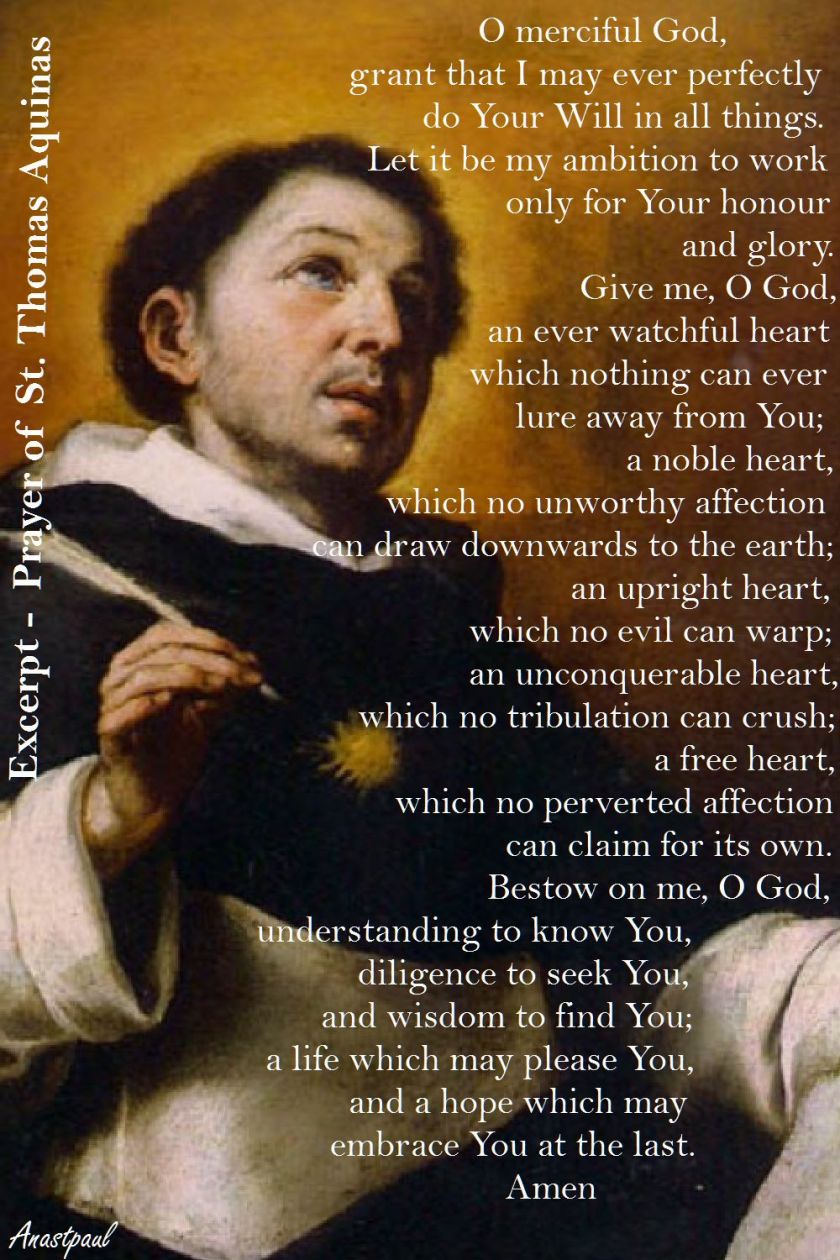
Excerpt from a Prayer of St. Thomas Aquinas

O merciful God,
grant that I may ever perfectly
do Your Will in all things.
Let it be my ambition to work
only for Your honour and glory.
Give me, O God,
an ever watchful heart
which nothing can ever
lure away from You;
a noble heart,
which no unworthy affection
can draw downwards to the earth;
an upright heart,
which no evil can warp;
an unconquerable heart,
which no tribulation can crush;
a free heart,
which no perverted affection
can claim for its own.
Bestow on me, O God,
understanding to know You,
diligence to seek You,
and wisdom to find You;
a life which may please You,
and a hope which may
embrace You at the last.
Amen

Prayer of St. Thomas Aquinas

Posted in DOCTORS of the Church, FATHERS of the Church, PATRONAGE-INTERNET, COMPUTERS, IT Technicians, PC Propgrammers,, etc, QUOTES of the SAINTS, QUOTES on HELL, QUOTES on SUFFERING, SAINT of the DAY

Saint of the Day – 4 April – St Isidore of Seville – Father and Doctor of the Church

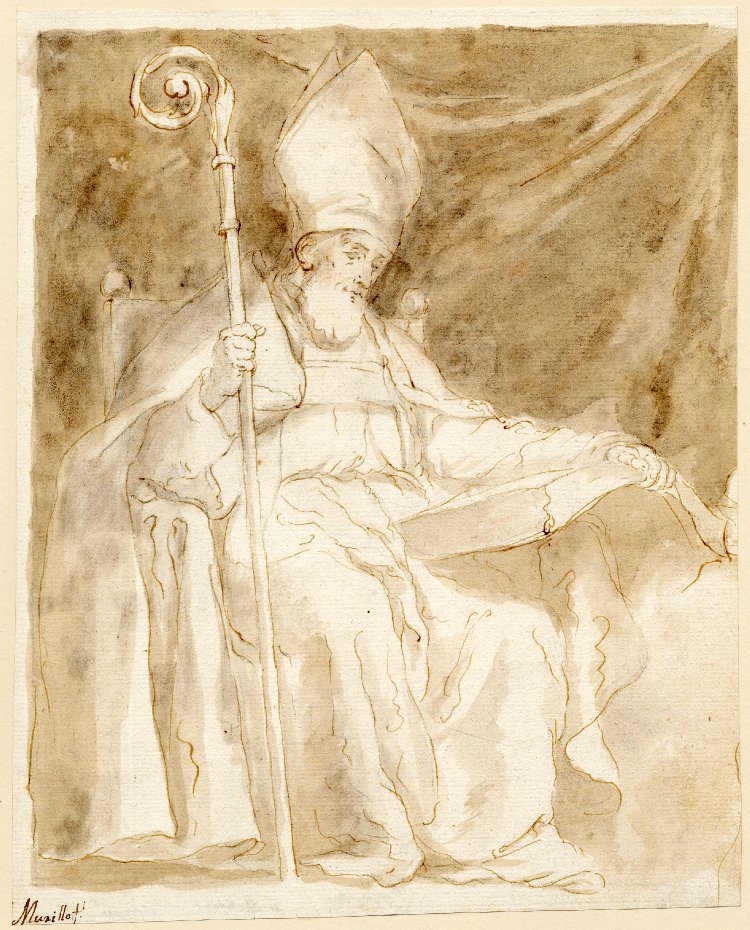
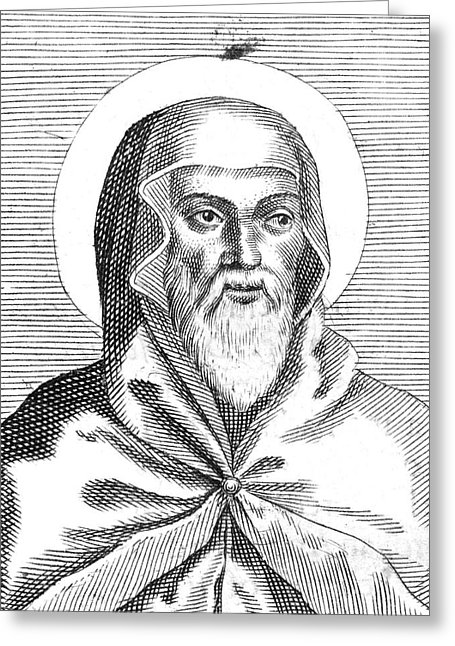
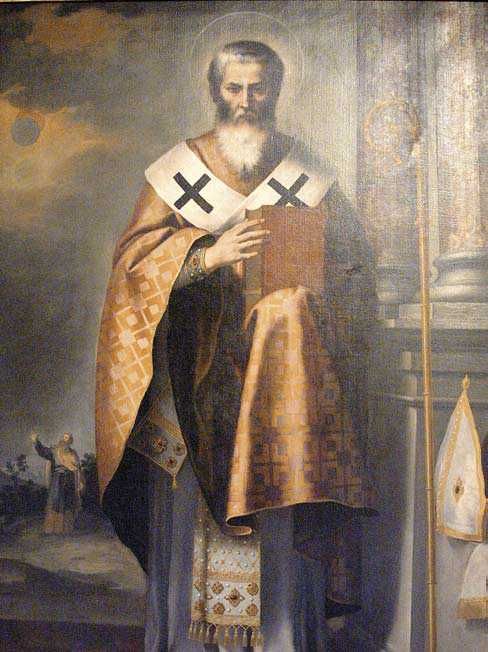
Saint of the Day – 4 April – St Isidore of Seville – Father and Doctor of the Church (560-636) Bishop, Confessor, Father, Doctor, Scholar, Writer, Teacher, Reformer and Evangelist – Patron of newsagents, the internet (not officially appointed), computer programmers and technicians, 2 Diocese, 13 Cities.  He was, for over three decades, the Archbishop of Seville.  The 19th-century historian Montalembert called him, in an oft-quoted phrase, “The Last Scholar of the Ancient World.”   Born in Cartagena of a family that included three other sibling Saints–Leander, Fulgentius and Florentina–he was educated by his elder brother, Leander, whom he succeeded as the Bishop of Seville.1 isisdore.jpg

St Isidore of Seville is sometimes called “the schoolmaster of the Middle Ages” because his books and schools helped shape the education and culture of medieval Europe.   For ten centuries, Isidore’s voluminous works were among those most quoted by other writers.   And his establishment of cathedral schools laid a foundation for the medieval universities and for education in the West.2-saint-isidore-isidro-of-seville-mary-evans-picture-library.jpg

In 599, Isidore became bishop of Seville and for thirty-seven years led the Spanish church through a period of intense religious development.    Isidore also organised representative councils that established the structure and discipline of the church in Spain.    At the Council of Toledo in 633 he obtained a decree that required the establishment of a school in every diocese.    Reflecting the saint’s broad interests, the schools taught every branch of knowledge, including the liberal arts, medicine, law, Hebrew, and Greek.Isidor_von_Sevilla.jpeg
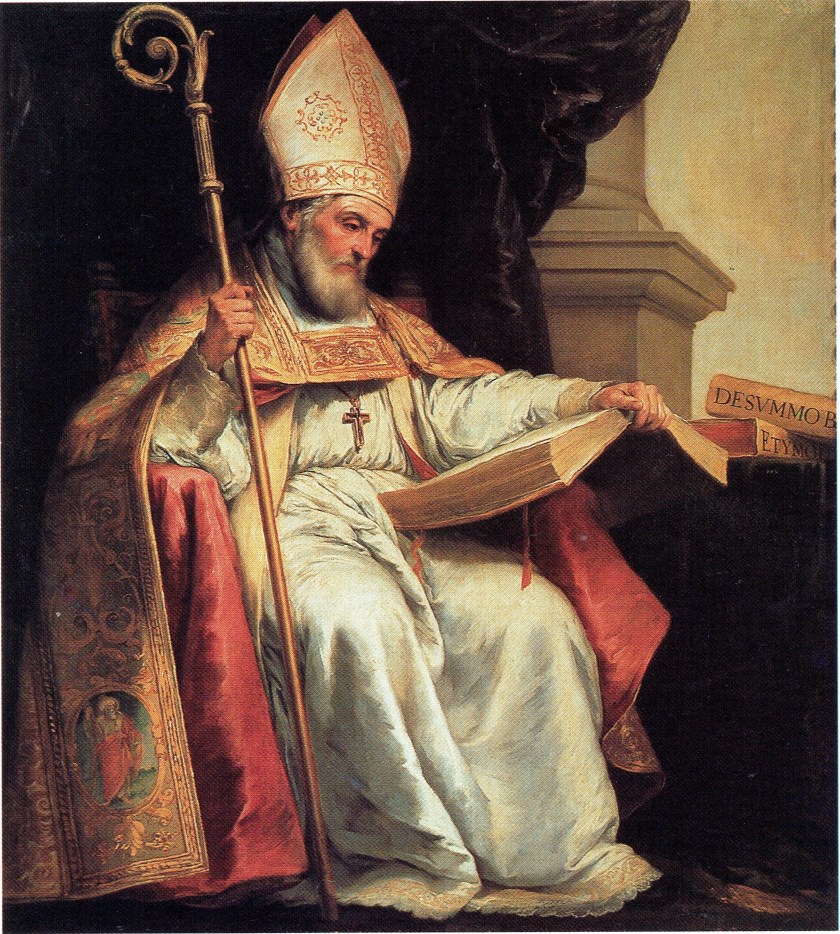
Isidore wrote many books, the most famous being the Etymologies, an encyclopedia of grammar, rhetoric, theology, history, medicine, and mathematics.   He also wrote a dictionary of synonyms, brief biographies of illustrious men, treatises on theological and philosophical subjects, a history of world events since the creation and a history of the Goths, which is our only source of information about them.   Throughout his long life, Isidore lived austerely so that he could give to the poor.   But while Isidore had compassion for needy, he thought they were better off than their oppressors, as he explains in this selection:

We ought to sorrow for people who do evil rather than for people who suffer it. The wrongdoing of the first leads them further into evil.   The others’ suffering corrects them from evil.   Through the evil wills of some, God works much good in others. Some people, resisting the will of God, unwittingly do His purpose.   Understand then that so truly are all things subject to God that even those who oppose His law nevertheless fulfil His will.

Evil men are necessary so that through them the good may be scourged when they do wrong…Some simple men, not understanding the dispensation of God, are scandalised by the success of evil men.   They say with the prophet: “Why does the way of the wicked prosper?”   Those who speak thus should not wonder to see the frail temporal happiness of the wicked.   Rather they should consider the final end of evil men and the everlasting torments prepared for them.   As the prophet says: “They spend their days in wealth and in a moment they go down to hell.”

Shortly before his death, Isidore had two friends clothe him in sackcloth and rub ashes on his head so that he could come before God as a poor penitent.   He died peacefully at Seville in 636.

ST ISIDORE

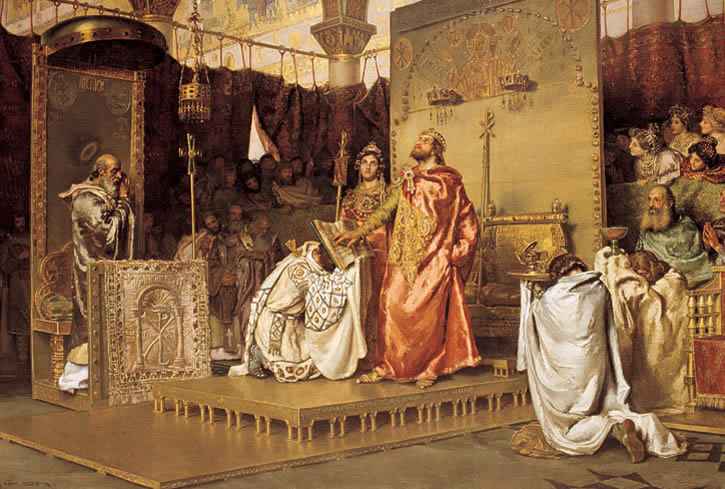
King Reccared abjures his heresy before St. Leander.
King Reccared abjures his heresy before St Isidore
Posted in SAINT of the DAY

Saints’ Memorials – 4 April

St Isidore of Seville (Optional Memorial)

Bl Abraham of Strelna
St Agathopus of Thessalonica
St Aleth of Dijon
St Benedict the Black
St Gaetano Catanoso
Bl Giuseppe Benedetto Dusmet
St Gwerir of Liskeard
St Henry of Gheest
St Hildebert of Ghent
St Peter of Poitiers
St Plato
St Theodulus of Thessalonica
St Theonas of Egypt
St Tigernach of Clogher
St Zosimus of Palestine

Posted in CATHOLIC DEVOTIONS of the Month

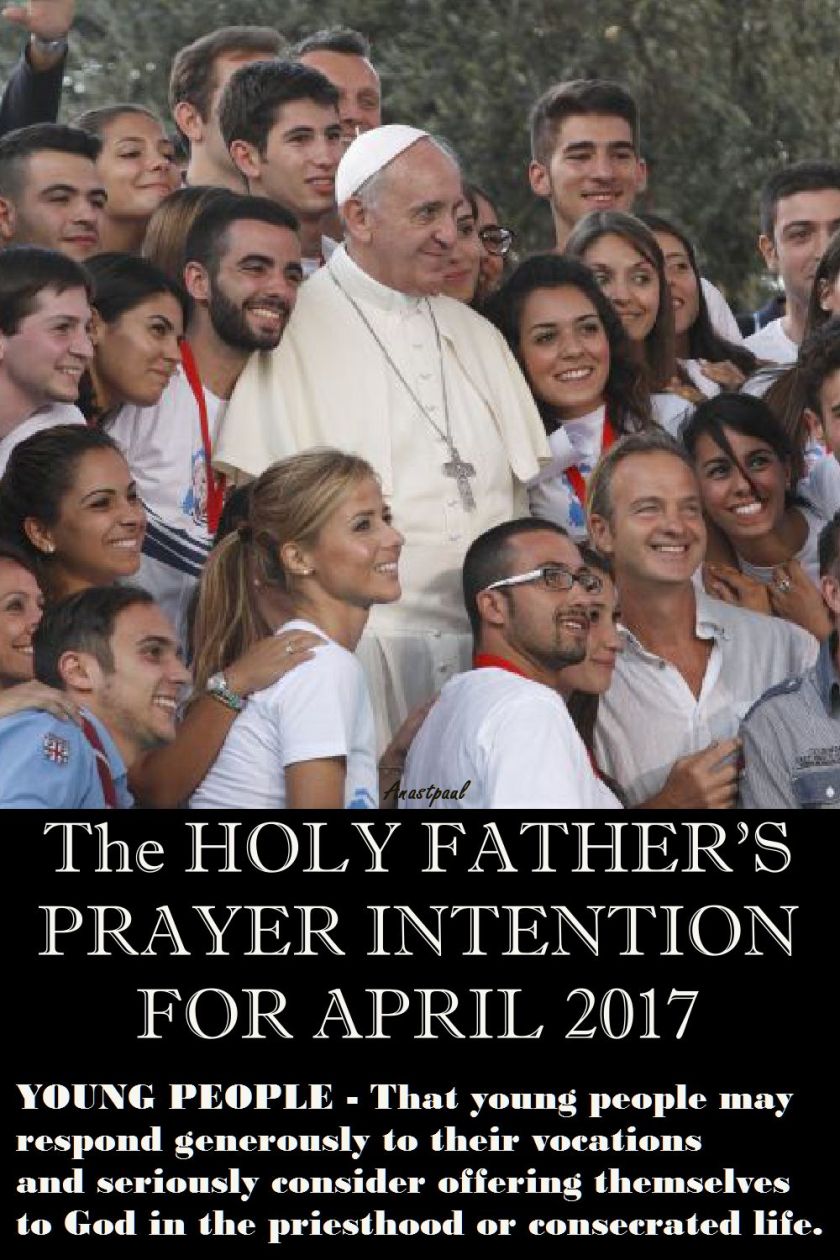
The HOLY FATHER’S PRAYER INTENTION FOR APRIL 2017

The HOLY FATHER’S PRAYER INTENTION FOR APRIL 2017

Young People. 

That young people may respond generously to their vocations and seriously consider offering themselves to God in the priesthood or consecrated life.

PRAYER INTENTIONS APRIL 2017

Posted in CATHOLIC DEVOTIONS of the Month, EUCHARISTIC Adoration

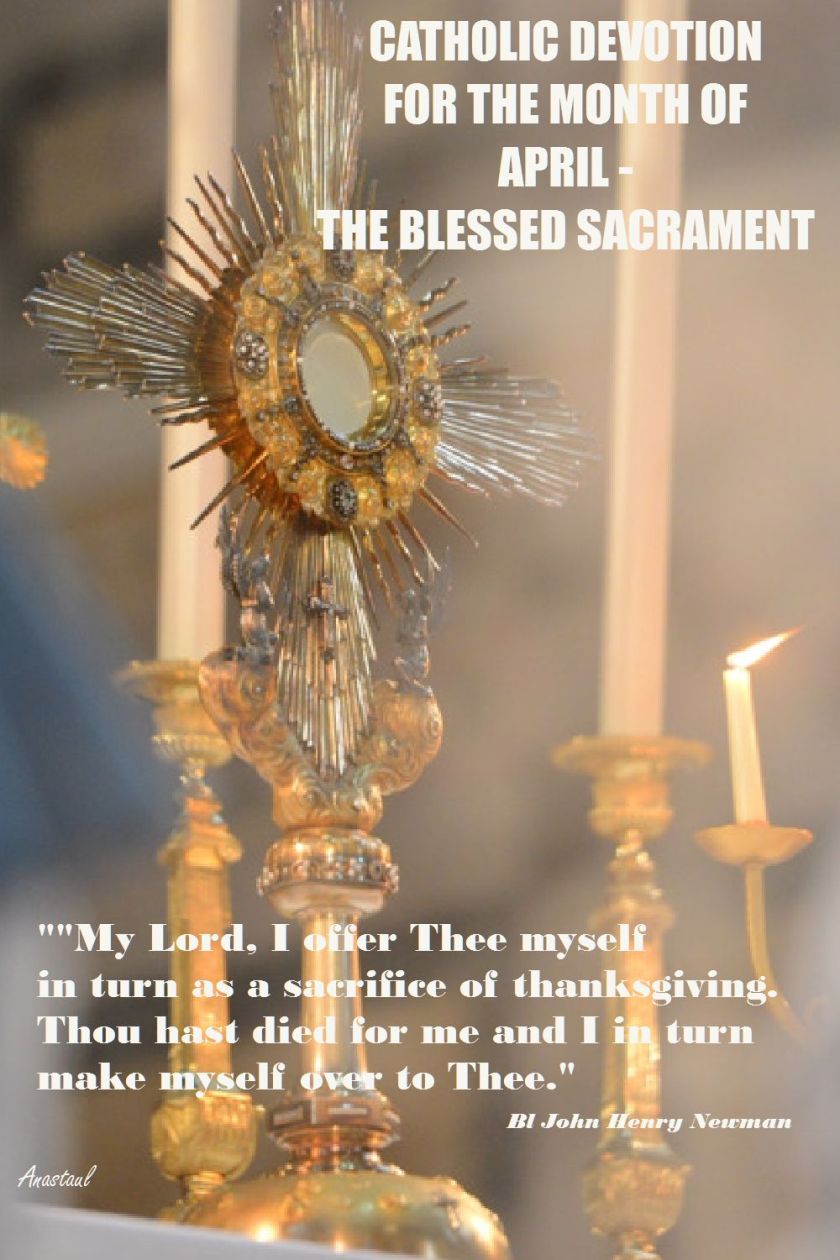
Devotion for the Month of April – The Blessed Sacrament

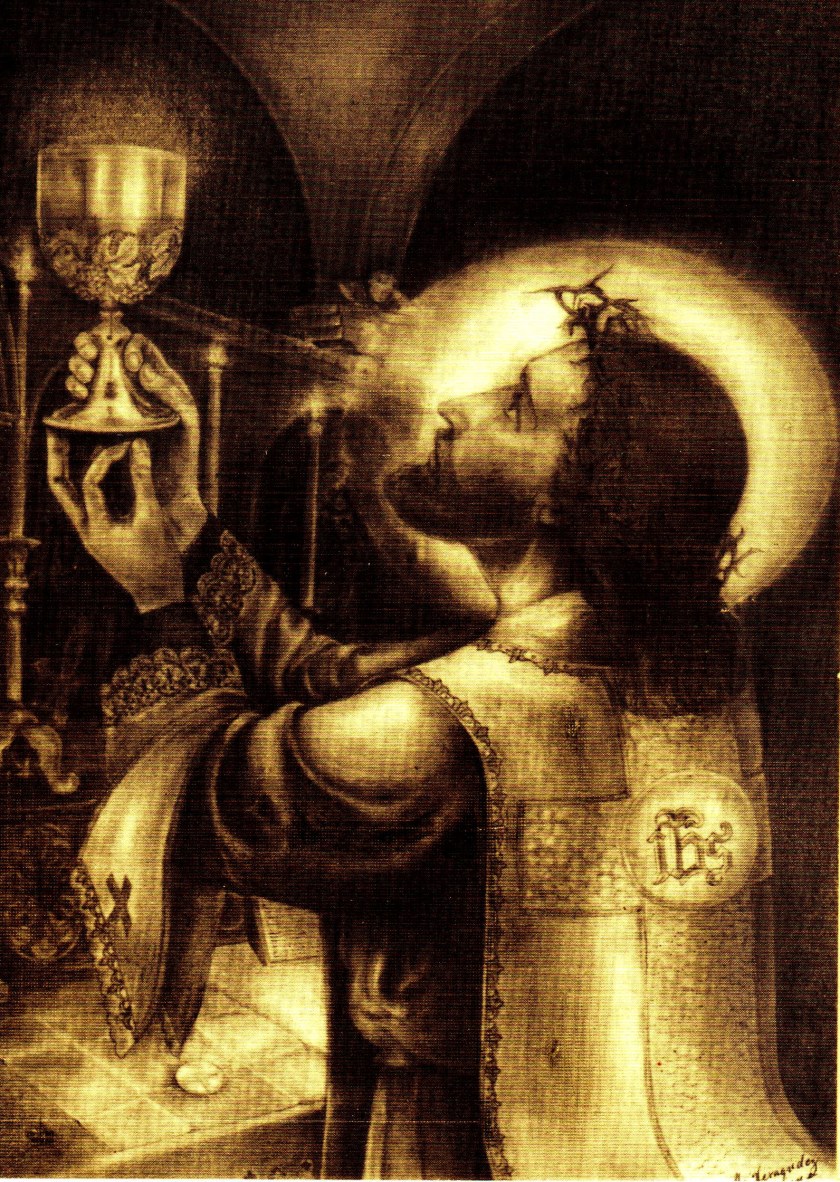
Devotion for the Month of April – The Blessed SacramentHOLY MASS AND JESUS AS PRIEST


Every Catholic Church contains a tabernacle in which the Body of Christ is reserved between Masses and the faithful are encouraged to come and pray before the Blessed Sacrament.   Frequent prayer before the Blessed Sacrament is a path to spiritual growth.

EUCHARISTIC ADORATION

The practice of Eucharistic adoration on earth not only brings us grace but prepares us for our life in Heaven. As Pope Pius XII wrote in Mediator Dei (1947):

“These exercises of piety have brought a wonderful increase in faith and supernatural life to the Church militant upon earth and they are re-echoed to a certain extent by the Church triumphant in heaven which sings continually a hymn of praise to God and to the Lamb “who was slain.”

This month, why not make a special effort to spend some time in prayer before the Blessed Sacrament? It doesn’t need to be long or elaborate:  You can start simply by making the Sign of the Cross and uttering a short profession of faith, such as “My Lord and my God!” as you pass a Catholic church.   If you have the time to stop for five minutes, all the better.

“My Lord, I offer Thee myself in turn as a sacrifice of thanksgiving.    Thou hast died for me and I in turn make myself over to Thee.    I am not my own.    Thou hast bought me;  I will by my own act and deed complete the purchase.    My wish is to be separated from everything of this world;  to cleanse myself simply from sin; to put away from me even what is innocent, if used for its own sake, and not for Thine.    I put away reputation and honour and influence and power, for my praise and strength shall be in Thee.   Enable me to carry on what I profess. Amen.”

AN EXPLANATION OF AN OFFERING OF ONESELF TO CHRIST IN THE EUCHARIST
We should leave each visit to the Blessed Sacrament renewed in our commitment to live a Christian life. This Offering of Oneself to Christ in the Eucharist, written by John Henry Cardinal Newman, reminds us of the sacrifice that Christ made for us, in dying on the Cross and asks Christ in the Blessed Sacrament to help us to dedicate our lives to Him.   It is the perfect prayer to end a visit to the Blessed Sacrament.

APRIL DEVOTION

Posted in DOCTORS of the Church, FATHERS of the Church, LENT, MORNING Prayers, QUOTES of the SAINTS

LENTEN REFLECTION – The Fifth Week – Monday 3 April 2017

LENTEN REFLECTION – The Fifth Week – Monday 3 April 2017

ALMSGIVING

Excerpt from a Homily of St John Chrysostum Doctor and Father of the Church (347-407

Nay, if you desire to honour the sacrifice, offer your soul, for which also it was slain; cause that to become golden;  but if that remain worse than lead or potter’s clay, while the vessel is of gold, what is the profit?

Let not this therefore be our aim, to offer golden vessels only but to do so from honest earnings likewise.   For these are of the sort that is more precious even than gold, these that are without injuriousness.   For the church is not a gold foundry nor a workshop for silver but an assembly of angels.   Wherefore it is souls which we require, since in fact God accepts these for the souls’ sake.

That table at that time was not of silver nor that cup of gold, out of which Christ gave His disciples His own blood; but precious was everything there….

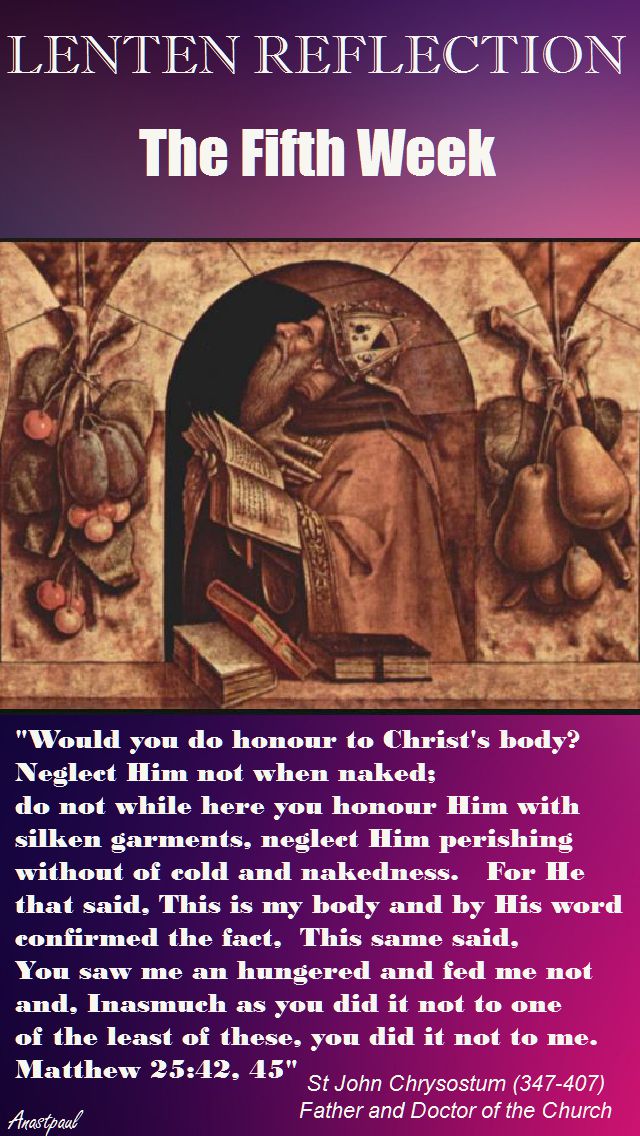
Would you do honour to Christ’s body? Neglect Him not when naked; do not while here you honour Him with silken garments, neglect Him perishing without of cold and nakedness.   For He that said, This is my body, and by His word confirmed the fact, This same said, You saw me an hungered, and fed me not; and, Inasmuch as you did it not to one of the least of these, you did it not to me. Matthew 25:42, 45   For this indeed needs not coverings, but a pure soul; but that requires much attention.

Let us learn therefore to be strict in life and to honour Christ as He Himself desires.   For to Him who is honoured that honour is most pleasing, which it is His own will to have, not that which we account best.   Since Peter too thought to honour Him by forbidding Him to wash his feet but his doing so was not an honour, but the contrary.

Even so do thou honour Him with this honour, which He ordained, spending your wealth on poor people.   Since God has no need at all of golden vessels but of golden souls.

And these things I say, not forbidding such offerings to be provided;  but requiring you, together with them and before them, to give alms………..

For what is the profit, when His table indeed is full of golden cups but He perishes with hunger?   First fill Him, being an hungered and then abundantly deck out His table also. Do you make Him a cup of gold, while you give Him not a cup of cold water?   And what is the profit?   Do you furnish His table with cloths bespangled with gold, while to Himself you afford not even the necessary covering?   And what good comes of it?   For tell me, should you see one at a loss for necessary food and omit appeasing his hunger, while you first overlaid his table with silver;  would He indeed thank you and not rather be indignant?   What, again, if seeing one wrapped in rags and stiff with cold, you should neglect giving him a garment and build golden columns, saying, thou were doing it to His honour, would He not say that thou were mocking and account it an insult and that the most extreme?

Let this then be your thought with regard to Christ also, when He is going about a wanderer and a stranger, needing a roof to cover Him;   and thou, neglecting to receive Him, deckest out a pavement, and walls, and capitals of columns and hangest up silver chains by means of lamps but Himself bound in prison you will not even look upon.

ALMSGIVING-STJOHNCHRYSOSTUM LENT MON 3 APRIL