Posted in FATHERS of the Church, MORNING Prayers, PRAYERS of the SAINTS, SAINT of the DAY

Our Morning Offering – 28 June

Our Morning Offering – 28 June

O Lamb of God
by St Irenaeus

O Lamb of God,
who takes away the sin of the world,
look upon us and have mercy upon us;
You who art Yourself both victim and Priest,
Yourself both Reward and Redeemer,
keep safe from all evil
those whom You have redeemed,
O Saviour of the world.
Amen

o lamb of god by st irenaeus

Posted in SAINT of the DAY

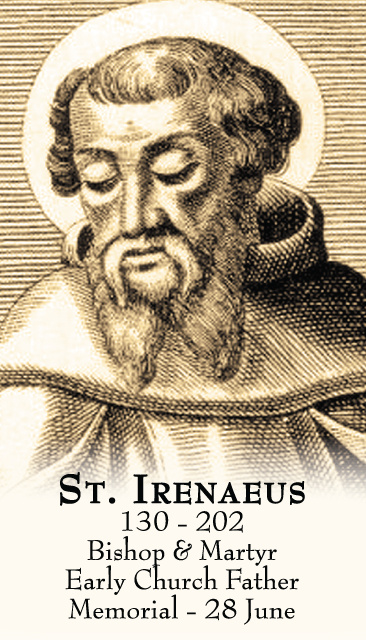
Saint of the Day – 28 June – St Irenaeus (c 130-202) Bishop Martyr

Saint of the Day – 28 June – St Irenaeus (c 130-202) – Bishop, Martyr & Father of the Church – (c 130 in Smyrna, Asia Minor (modern Izmir, Turkey) – martyred in 202 in Lyons, France)   His tomb and relics were destroyed by Calvinists in 1562 but his head is thought to be in Saint John’s church, Lyons, France.   Patronage – archdiocese of Mobile, Alabama.

Card_430-St-Irenaeus-front

St Irenaeus was born during the first half of the 2nd century (the exact date is disputed: between the years 115 and 125 according to some, or 130 and 142 according to others), and he is thought to have been a Greek from Polycarp’s hometown of Smyrna in Asia Minor, now İzmir, Turkey.    Unlike many of his contemporaries, he was brought up in a Christian family rather than converting as an adult.

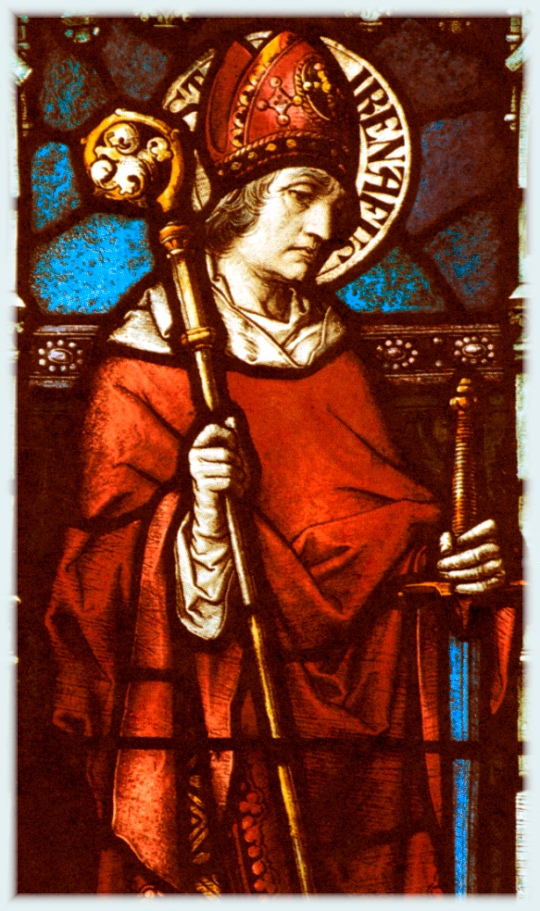
During the persecution of Marcus Aurelius, the Roman Emperor from 161–180, Irenaeus was a priest of the Church of Lyon.   The clergy of that city, many of whom were suffering imprisonment for the faith, sent him in 177 to Rome with a letter to Pope Eleuterus concerning the heresy Montanism and that occasion bore emphatic testimony to his merits.   While Irenaeus was in Rome, a massacre took place in Lyon.   Returning to Gaul, Irenaeus succeeded the martyr Saint Pothinus and became the second Bishop of Lyon.st-irenaeus-3

The new bishop divided his activities between the duties of a pastor and of a missionary (as to which we have but brief data, late and not very certain), during the religious peace which followed the persecution of Marcus Aurelius.   Almost all his writings were directed against Gnosticism.   The most famous of these writings is Adversus haereses (Against Heresies).

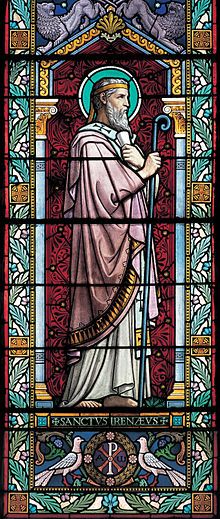
St Irenaeus linked the Church at the time of the twelve apostles and the Church of the second century.   He wrote and taught the faith handed on by the apostles and preserved it when it was attacked.   His chief concern was unity among the churches.st-irenaeus-2

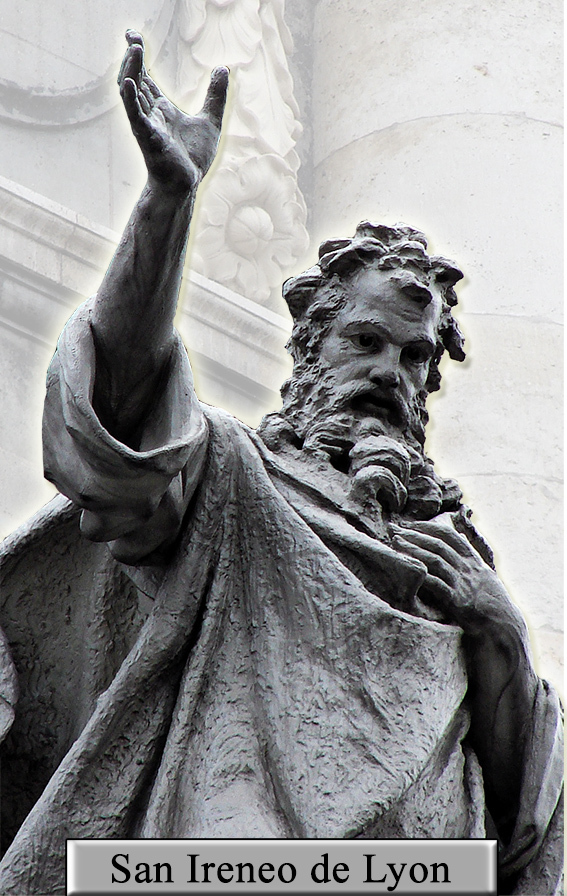
The date of the death of Irenaeus is usually given as about the year 202/203.   According to a late tradition he suffered martyrdom under Septimius Severus.san-ireneo-de-lyon


Posted in SAINT of the DAY

Saints – 28 June

St Irenaeus of Lyons (Memorial)
—
Bl Almus of Balmerino
St Argymirus of Córdoba
St Attilio of Trino
St Austell of Cornwall
St Benignus of Utrecht
St Crummine
Bl Damian of Campania
St Egilo
St Heimrad
St John Southworth
St Lupercio
St Papias the Martyr
St Pope Paul I
Bl Teresa Maria Mastena
St Theodichildis
St Vincentia Gerosa
—
Martyrs of Africa – 27 saints: 27 Christians martyred together. The only details about them to survive are the names – Afesius, Alexander, Amfamon, Apollonius, Arion, Capitolinus, Capitulinus, Crescens, Dionusius, Dioscorus, Elafa, Eunuchus, Fabian, Felix, Fisocius, Gurdinus, Hinus, Meleus, Nica, Nisia, Pannus, Panubrius, Plebrius, Pleosus, Theoma, Tubonus and Venustus. Unknown location in Africa, date unknown.

Martyrs of Alexandria – 8 saints: A group of spiritual students of Origen who were martyred together in the persecutions of emperor Septimius Severus – Heraclides, Heron, Marcella, Plutarch, Potamiaena the Elder, Rhais, Serenus and Serenus. They were burned to death c.206 in Alexandria, Egypt.


Martyrs of China:
St Lucia Wang Cheng
St Maria Chi Yu
St Maria Du Zhauzhi
St Maria Fan Kun
St Maria Zheng Xu

Martyrs of Korea:
Bl Matthaeus Choe In-gil
Bl Paul Yun Yu-il
Bl Sabas Ji-Hwang
Martyrs of Ukraine
Bl Severian Baranyk
Bl Yakym Senkivsky

Posted in DOCTORS of the Church, FATHERS of the Church, MORNING Prayers, QUOTES of the SAINTS, SAINT of the DAY

Thought for the Day – 27 June – The Memorial of St Cyril of Alexandria (376-444) Father and Doctor of the Incarnation

Thought for the Day – 27 June – The Memorial of St Cyril of Alexandria (376-444) Father and Doctor of the Incarnation

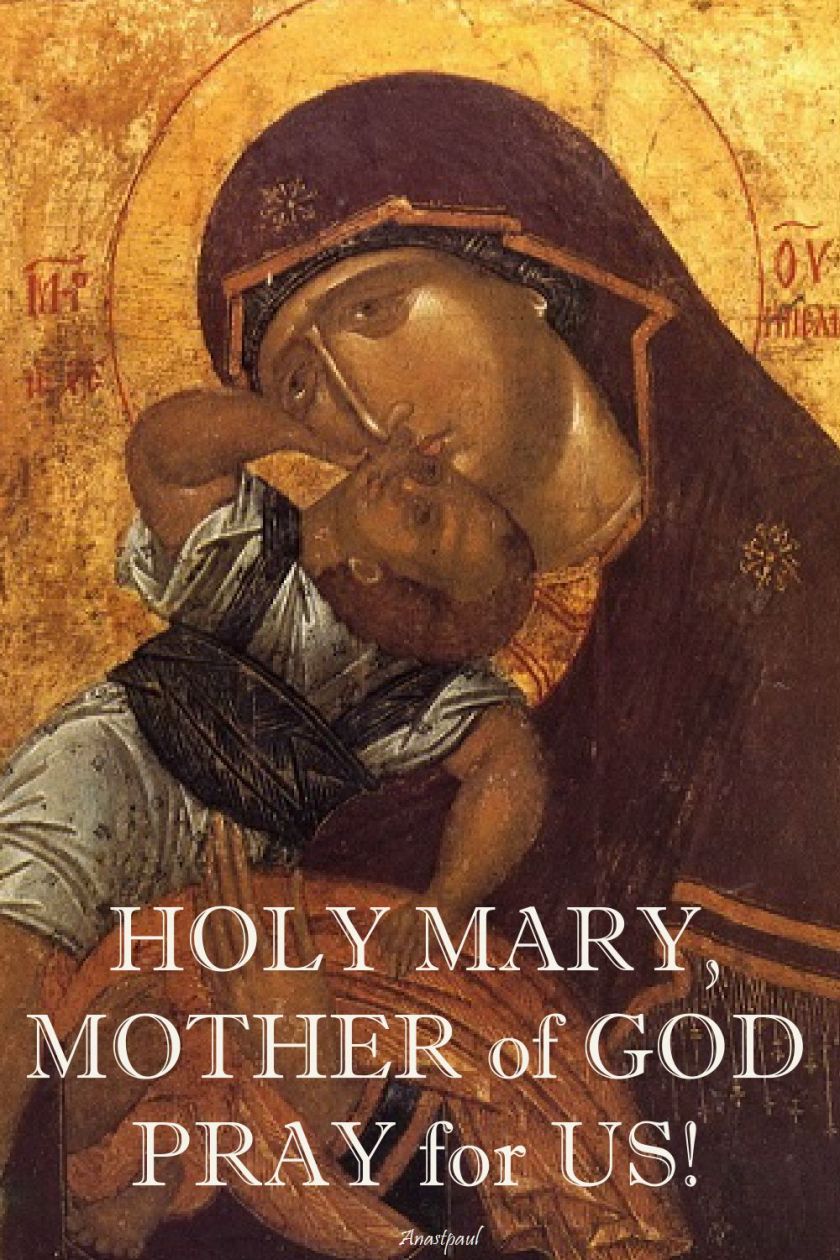
Theotokos is the official name of Mary and it is well to remember the great battle that was fought (and to my mnd, continues to fought today) over this title.  SHE IS the Mother of God – the Son of God was born of her in His human nature, without ceasing to be God. The whole mystery of the Incarnation is bound up in Mary and she is at the very heart of the work of Jesus’ Redemption of mankind!
St Cyril of Alexandria’s battle raged over the combined front of the Divinity of Christ and therefore, Mary the Mother of the Divinity, is summed up thus:   “Only if it is one and the same Christ who is consubstantial with the Father and with men can He save us, for the meeting ground between God and man is the flesh of Christ. Only if this is God’s own flesh can man come into contact with Christ’s divinity through His humanity, through his earthy mother, Mary.  Because of our kinship with the Word made flesh we are sons of God.   The Eucharist consummates our kinship with the word, our communion with the Father, our sharing in the divine nature—there is very real contact between our body and that of the Word.”

St Cyril of Alxandria, pray for us.
Mary, Mother of God, pray for us.

st cyril of alexandria pray for usholy mary mothr of god pray for us

Posted in DOCTORS of the Church, FATHERS of the Church, MORNING Prayers, QUOTES of the SAINTS, SAINT of the DAY

Quote/s of the Day – 27 June – Memorial of St Cyril of Alexandria (376-444) Father and Doctor

Quote/s of the Day – 27 June – Memorial of St Cyril of Alexandria (376-444) Father and Doctor

“He who receives Communion is made holy and divinised in soul and body
in the same way that water, set over a fire, becomes boiling…
Communion works like yeast that has been mixed into dough
so that it leavens the whole mass;
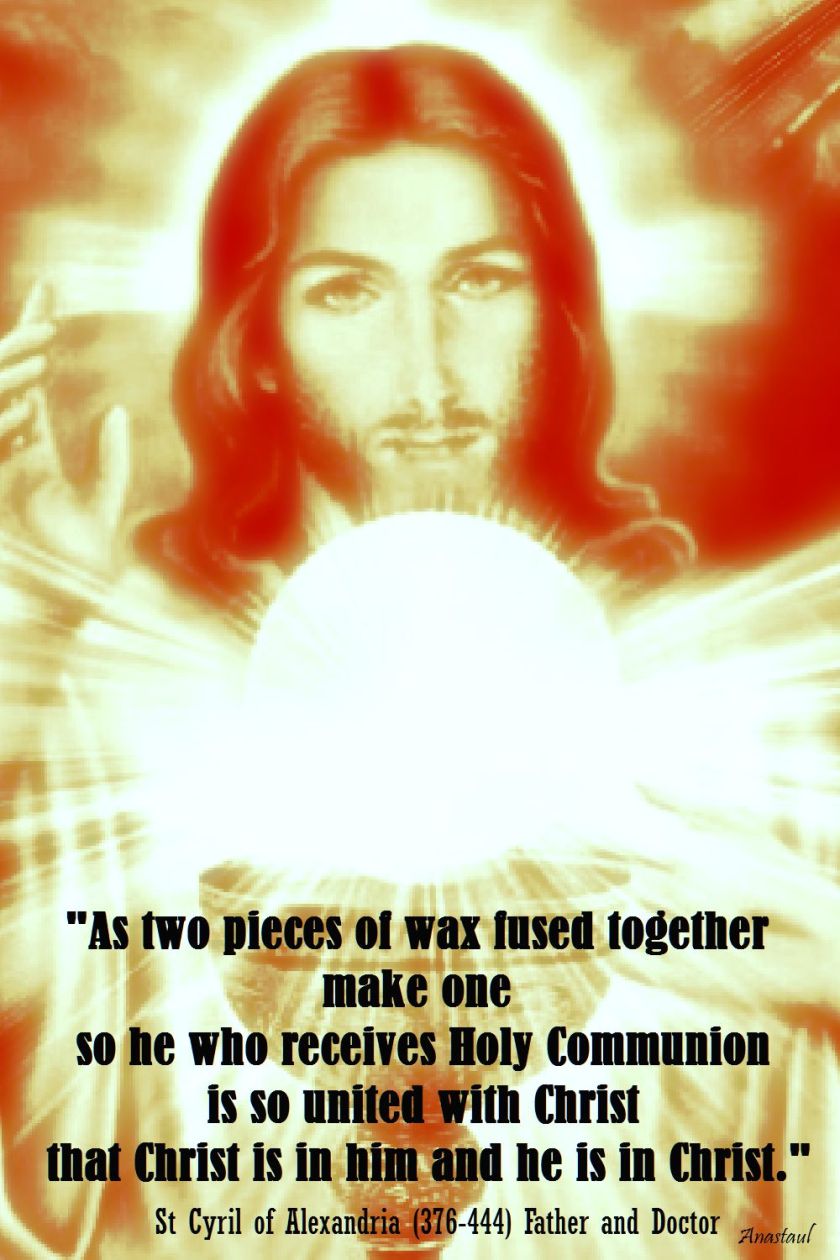
…Just as by melting two candles together you get one piece of wax,
so, I think, one who receives the Flesh and Blood of Jesus
is fused together with Him by this Communion
and the soul finds that he is in Christ and Christ is in him.”

as two pieces of wax-st cyril of alexandria

“Indeed the mystery of Christ runs the risk
of being disbelieved – precisely because
it is so incredibly wonderful.”

indeed the mystery of christ - st cyril of alexandria

“It is like employing a small tool on big constructions,
if we use human wisdom
in the hunt for knowledge of reality.”

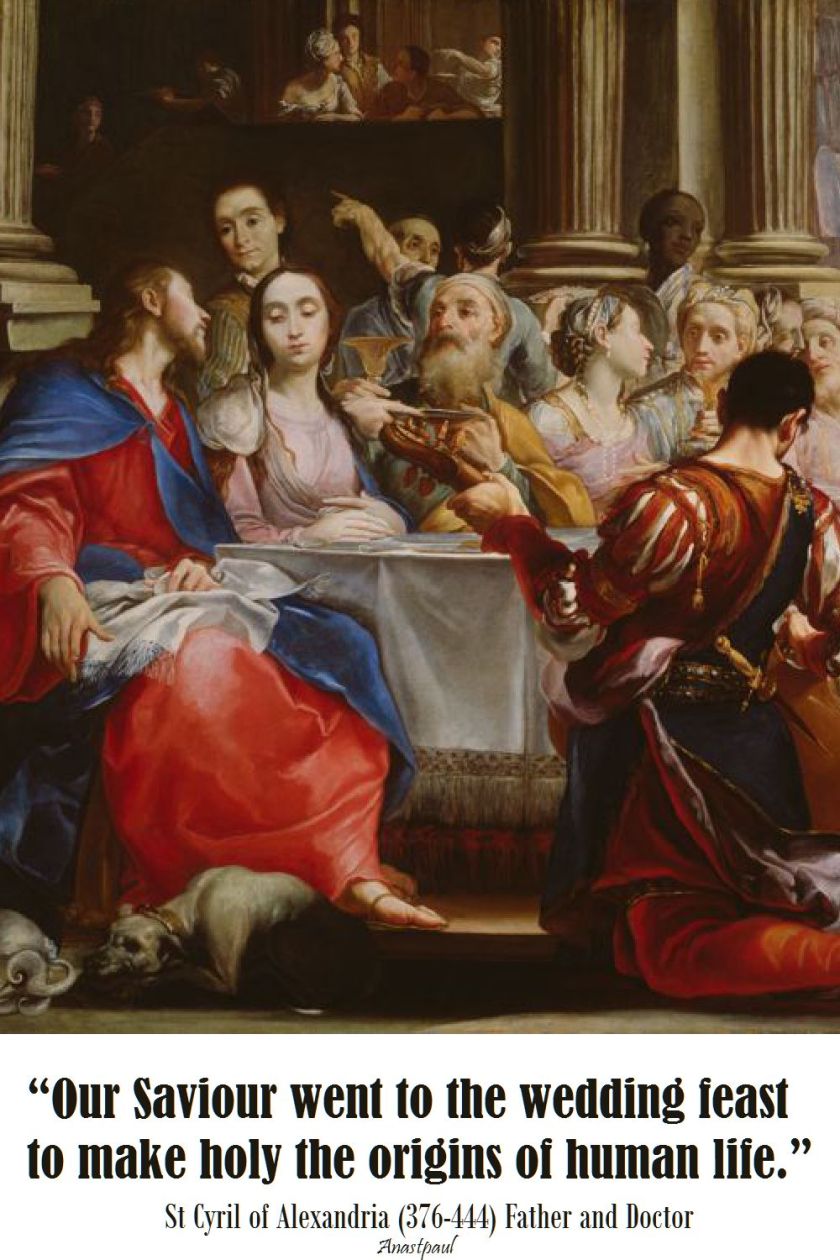
“Our Saviour went to the wedding feast
to make holy the origins of human life.”

our saviour went to the edding feast-st cyril of alexandria

ST CYRIL OF ALEXANDRIA

Posted in DOCTORS of the Church, FATHERS of the Church, MORNING Prayers, QUOTES of the SAINTS, SAINT of the DAY, The WORD

One Minute Reflection – 27 June

One Minute Reflection – 27 June

Do you not see that your bodies are members of Christ?………..1 Cor 7:15

1 corinthians 7-15

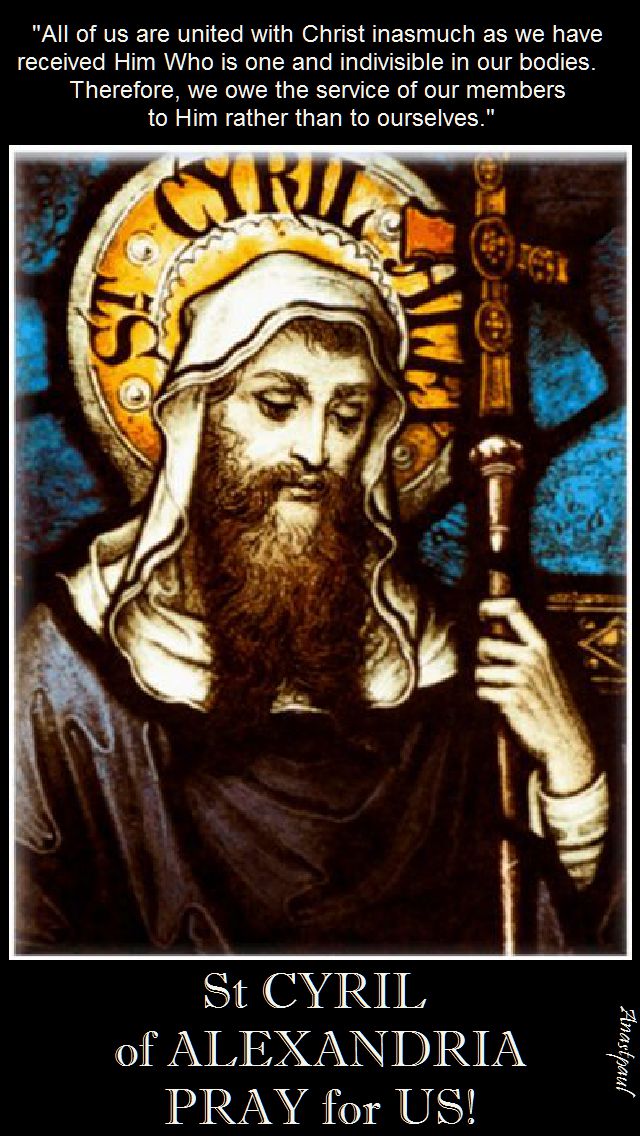
REFLECTION – “All of us are united with Christ inasmuch as we have received Him Who is one and indivisible in our bodies.   Therefore, we owe the service of our members to Him rather than to ourselves.”………. St Cyril of Alexandria (376-444) Doctor and Father of the Church (Saint of the Day)

PRAYER – Almighty God and Father, help me to put all my faculties at the disposal of Christ so as to be His link to others and with the world around me.   Let me give myself wholly to Him this day and every day. St Cyril of Alexandria, defender of the divinity of Christ and the Mother of God, intercede for us, amen.

all of us are united - st cyrill of alexandria

Posted in DOCTORS of the Church, FATHERS of the Church, MORNING Prayers, PRAYERS of the SAINTS, SAINT of the DAY, The BLESSED VIRGIN MARY

Our Morning Offering – 27 June

Our Morning Offering – 27 June

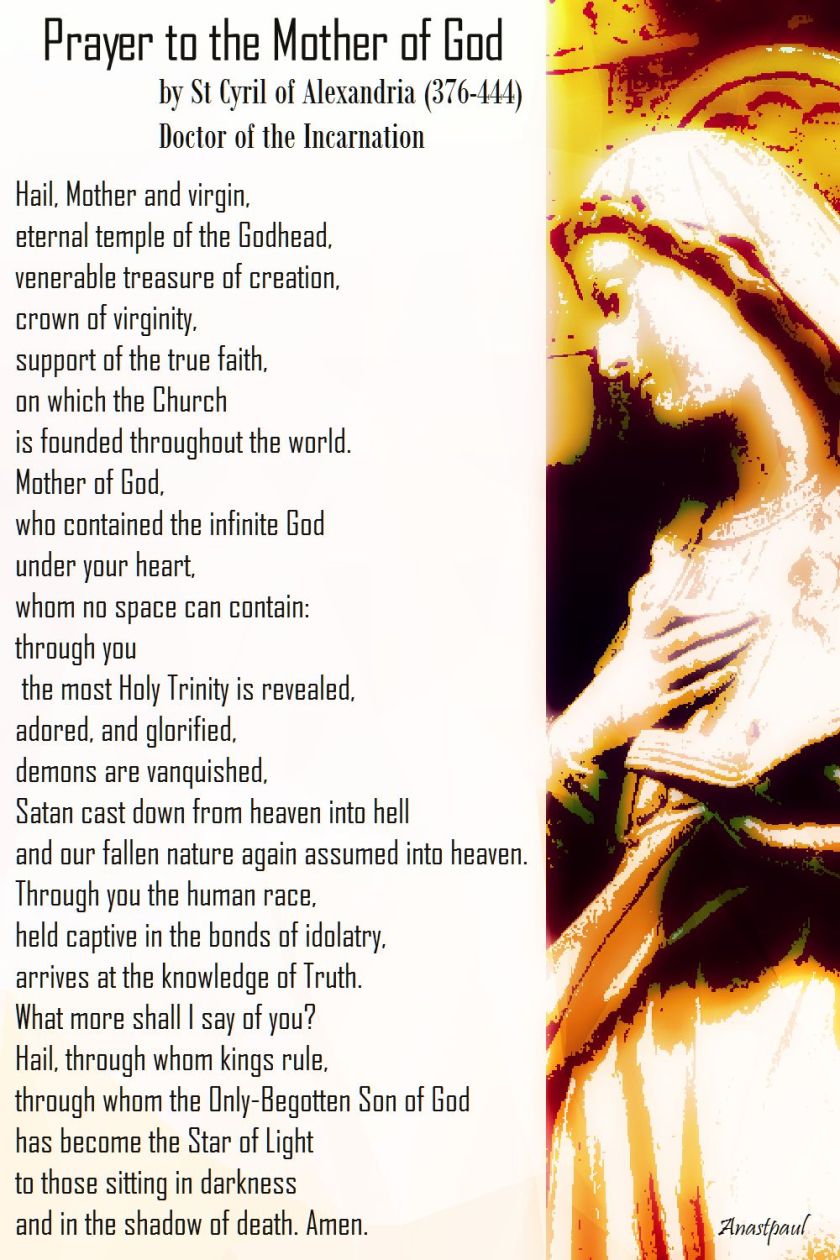
Prayer to the Mother of God
by St Cyril of Alexandria (Saint of the Day) 

Hail, Mother and virgin,
eternal temple of the Godhead,
venerable treasure of creation,
crown of virginity,
support of the true faith,
on which the Church is founded
throughout the world.
Mother of God,
who contained the infinite God
under your heart,
whom no space can contain:
through you
the most Holy Trinity is revealed,
adored, and glorified,
demons are vanquished,
Satan cast down from heaven into hell
and our fallen nature again
assumed into heaven.
Through you the human race,
held captive in the bonds of idolatry,
arrives at the knowledge of Truth.
What more shall I say of you?
Hail, through whom kings rule,
through whom the Only-Begotten
Son of God
has become the Star of Light
to those sitting in darkness
and in the shadow of death. Amen

prayer to the mother of god - st cyril of alexandria

Posted in DOCTORS of the Church, FATHERS of the Church, SAINT of the DAY

Saint of the Day – 27 June – St Cyril of Alexandria – Doctor & Father of the Church – “The Pillar of Faith” & “Seal of all the Fathers” – Doctor Incarnationis (Doctor of the Incarnation) Added by Pope Leo XIII in 1883

Saint of the Day – 27 June – St Cyril of Alexandria – Doctor of the Church “The Pillar of Faith” & “Seal of all the Fathers” – Doctor Incarnationis (Doctor of the Incarnation) Added by Pope Leo XIII in 1883 – (376 at Alexandria, Egypt – 444 at Alexandria, Egypt of natural causes, his relics are in Alexandria).   Bishop, Confessor, Writer, Defender of the Faith.   Patron of Alexandria, Egypt.   Attributes – book, pen or scroll, indicative of his work as a writer, the Blessed Virgin Mary holding the Child Jesus, representing his advocacy of the doctrine of Mary as Mother of God.

On June 27, Roman Catholics honour St. Cyril of Alexandria.   An Egyptian bishop and theologian, he is best known for his role in the Council of Ephesus, where the Church confirmed that Christ is both God and man in one person.

st cyril of alexandria 4

Cyril was most likely born in Alexandria, the metropolis of ancient Egypt, between 370 and 380.   From his writings, it appears he received a solid literary and theological education.   Along with his uncle, Patriarch Theophilus of Alexandria, he played a role in an early fifth-century dispute between the Egyptian and Greek churches.   There is evidence he may have been a monk before becoming a bishop.

When Theophilus died in 412, Cyril was chosen to succeed him at the head of the Egyptian Church.   He continued his uncle’s policy of insisting on Alexandria’s preeminence within the Church over Constantinople, despite the political prominence of the imperial capital.   The two Eastern churches eventually re-established communion in approximately 418.st-cyril-of-alexandria upsize

Ten years later, however, a theological dispute caused a new break between Alexandria and Constantinople.   Cyril’s reputation as a theologian, and later Doctor of the Church, arose from his defense of Catholic orthodoxy during this time.

In 428, a monk named Nestorius became the new Patriarch of Constantinople.   It became clear that Nestorius was not willing to use the term “Mother of God” (“Theotokos”) to describe the Virgin Mary.   Instead, he insisted on the term “Mother of Christ” (“Christotokos”).   During the fourth century, the Greek Church had already held two ecumenical councils to confirm Christ’s eternal preexistence as God prior to his incarnation as a man.   From this perennial belief, it followed logically that Mary was the mother of God.   Veneration of Mary as “Theotokos” confirmed the doctrine of the incarnation, and Christ’s status as equal to the God the Father.   Nestorius insisted that he, too, held these doctrines.   But to Cyril, and many others, his refusal to acknowledge Mary as the Mother of God seemed to reveal a heretical view of Christ which would split him into two united but distinct persons:  one fully human and born of Mary, the other fully divine and not subject to birth or death.

Cyril responded to this heretical tendency first through a series of letters to Nestorius (which are still in existence and studied today), then through an appeal to the Pope, and finally through the summoning of an ecumenical council in 431.   Cyril presided over this council, stating that he was “filling the place of the most holy and blessed Archbishop of the Roman Church,” Pope Celestine, who had authorised it.st cyril_of alex mosaic - small

The council was a tumultuous affair.   Patriarch John of Antioch, a friend of Nestorius, came to the city and convened a rival council which sought to condemn and depose Cyril.   Tension between the advocates of Cyril and Nestorius erupted into physical violence at times and both parties sought to convince the emperor in Constantinople to back their position.

During the council, which ran from June 22 to July 31 of the year 431, Cyril brilliantly defended the orthodox belief in Christ as a single eternally divine person who also became incarnate as a man.   The council condemned Nestorius, who was deposed as patriarch and later suffered exile.   Cyril, however, reconciled with John and many of the other Antiochian theologians who once supported Nestorius.

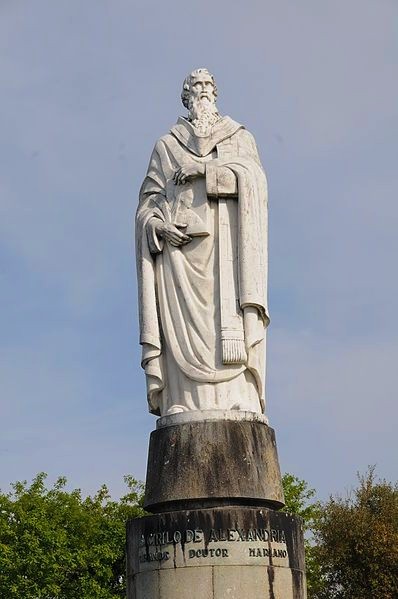
St. Cyril of Alexandria died on June 27, 444, having been a bishop for nearly 32 years. Long celebrated as a saint, particularly in the Eastern Catholic and Eastern Orthodox churches, he was declared a Doctor of the Church in 1883.st-cyril-of-alexandria-statue


Posted in SAINT of the DAY, The BLESSED VIRGIN MARY

Saints’ Memorials and Feast Days of the Blessed Virgin Mary – 27 June

St Cyril of Alexandria (Optional Memorial)

Our Lady of Perpetual Succour:  The picture of Our Lady of Perpetual Succour is painted on wood, with background of gold.   It is Byzantine in style and is supposed to have been painted in the thirteenth century.   It represents the Mother of God holding the Divine Child while the Archangels Michael and Gabriel present before Him the instruments of His Passion.   Over the figures in the picture are some Greek letters which form the abbreviated words Mother of God, Jesus Christ, Archangel Michael and Archangel Gabriel respectively.

It was brought to Rome towards the end of the fifteenth century by a pious merchant, who, dying there, ordered by his will that the picture should be exposed in a church for public veneration.   It was exposed in the church of San Matteo, Via Merulana, between Saint Mary Major and Saint John Lateran.   Crowds flocked to this church and for nearly three hundred years many graces were obtained through the intercession of the Blessed Virgin.   The picture was then popularly called the Madonna di San Matteo.   The church was served for a time by the Hermits of Saint Augustine, who had sheltered their Irish brethren in their distress.

These Augustinians were still in charge when the French invaded Rome, Italy in 1812 and destroyed the church.   The picture disappeared; it remained hidden and neglected for over forty years but a series of providential circumstances between 1863 and 1865 led to its discovery in an oratory of the Augustinian Fathers at Santa Maria in Posterula. The pope, Pius IX, who as a boy had prayed before the picture in San Matteo, became interested in the discovery and in a letter dated 11 Dececember 1865 to Father General Mauron, C.SS.R., ordered that Our Lady of Perpetual Succour should be again publicly venerated in Via Merulana and this time at the new church of Saint Alphonsus.    The ruins of San Matteo were in the grounds of the Redemptorist Convent.   This was but the first favour of the Holy Father towards the picture.   He approved of the solemn translation of the picture (26 April 1866) and its coronation by the Vatican Chapter (23 June 1867).   He fixed the feast as duplex secundae classis, on the Sunday before the Feast of the Nativity of Saint John the Baptist and by a decree dated May 1876, approved of a special office and Mass for the Congregation of the Most Holy Redeemer.   This favour later on was also granted to others.   Learning that the devotion to Our Lady under this title had spread far and wide, Pius IX raised a confraternity of Our Lady of Perpetual Succour and Saint Alphonsus, which had been erected in Rome, to the rank of an arch-confraternity and enriched it with many privileges and indulgences.   He was among the first to visit the picture in its new home and his name is the first in the register of the arch-confraternity.

Two thousand three hundred facsimiles of the Holy Picture have been sent from Saint Alphonsus’s church in Rome to every part of the world.   At the present day not only altars but churches and dioceses (e.g. in England, Leeds and Middlesbrough; in the United States, Savannah) are dedicated to Our Lady of Perpetual Succour.   In some places, as in the United States, the title has been translated Our Lady of Perpetual Help but generally Catholics throughout the rest of the world use the proper title.Patronage:
• The Redemptorist Order, Haiti 1 Arch and 7 Diocese around the world, 3 cities in various parts of the world.


Mother of God of Gietrzwald:   Our Lady appeared for the first time to Justyna Szafrynska (13) when she was returning home with her mother after having taken an examination prior to receiving the First Holy Communion.   The next day, Barbara Samulowska (12) also saw the ‘Bright Lady’ sitting on the throne with Infant Christ among Angels over the maple tree in front of the church while reciting the rosary.   The girls asked “Who are you?” she answered, “I am the Blessed Virgin Mary of the Immaculate Conception!”. “What do you require, Mother of God?”, they asked, the answer was:  “I wish you recite the rosary everyday!”  There were 13 more apparitions from 27 June 1877 to 16 September 1877.
2 February 1970 – Pope Paul VI elevated the church in Gietrzwald to the rank of Basilica Minor.

11 September 1977 – One hundredth anniversary of Our Lady apparitions in Gietrzwald. Masses of faithful gathered with the representatives of the Episcopal Conference of Poland headed by Cardinal Karol Wojtyla who prayed:  “Remember, the Blessed Virgin Mary, no one has heard that anybody who has entrusted his needs to your maternal kindness has been disappointed.   Therefore, full of trust in face of pleading might of your heart, we are laying down in your generous hands, the health of your servant and our Primate.   Look at his loyalty and devotion, with which he has been serving you for many years as priest and bishop and restore in full his strength so that he may see your glory in the days of the jubilee of the basilica of Our Lady of Czestochowa and direct the Church in Poland for many years.”   The primate who was too ill to attend recovered.

11 September 1977 – During the ceremonies, the decree of the Warmian Bishop, Jozef Drzazga, was read approving the devotion to Our Lady’s apparitions in Gietrzwald as not contradicting Christian faith and morality and recognizing the miraculous and divine nature of the events.


—
St Adeodato of Naples
St Aedh McLugack
St Anectus of Caesarea
St Arialdus of Milan
St Arianell of Wales
Bl Benvenutus of Gubbio
St Brogan
St Crescens of Galatia
St Crescentius of Mainz
Bl Daniel of Schönau
Bl Davanzato of Poggibonsi
St Desideratus of Gourdon
St Dimman
St Felix of Rome
St Ferdinand of Aragon
St Gudene of Carthage
St Joanna the Myrrhbearer
St John of Chinon
St Ladislas I of Hungary
St Sampson of Constantinople
St Spinella of Rome
St Tôma Toán
St Zoilus of Cordoba
—
Martyrs Killed Under Communist Regimes in Eastern Europe: Among the thousands of Christians murdered by various Communist regimes in their hatred of the faith, there were 25 members of the Ukrainian Greek Catholic Church and Russian Byzantine Catholic Church, priests, bishops, sisters and lay people, whose stories are sufficiently well documented that we know they were murdered specifically for their faith in eastern Europe and whose Causes for Canonization were opened. Their Causes were combined and they were beatified together. They have separate memorials but are remembered together today. They are –

• Andrii Ischak • Hryhorii Khomyshyn • Hryhorii Lakota • Ivan Sleziuk • Ivan Ziatyk • Klymentii Sheptytskyi • Leonid Feodorov • Levkadia Harasymiv • Mykola Konrad • Mykola Tsehelskyi • Mykolai Charnetskyi • Mykyta Budka • Oleksa Zarytskyi • Ol’Ha Bida • Ol’Ha Matskiv • Petro Verhun • Roman Lysko • Stepan Baranyk • Symeon Lukach • Vasyl Vsevolod Velychkovskyi • Volodomyr Bairak • Volodymyr Ivanovych Pryima • Yakym Senkivsky • Yosafat Kotsylovskyi • Zenon Kovalyk

Beatified – 27 June 2001 by Pope John Paul II in Ukraine

Posted in MORNING Prayers, QUOTES of the SAINTS, SAINT of the DAY

Thought for the Day – 26 June

Thought for the Day – 26 June

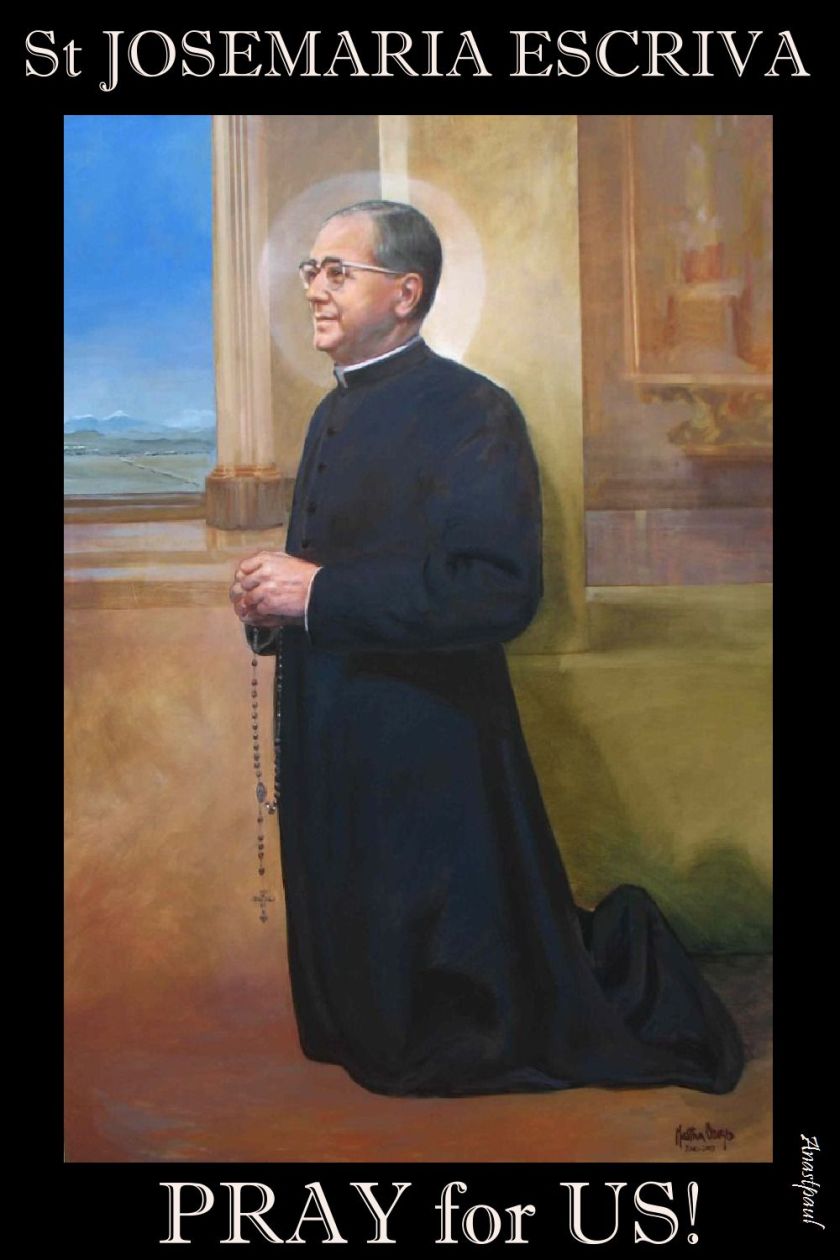
Opus Dei, which means Work of God, emphasizes that men and women can become holy by performing their daily duties with a Christian spirit.   In his homily, Pope John Paul II emphasised the importance of every believer following God’s will, as had the newly sainted founder of Opus Dei.   “The Lord has a plan for each one of us.  Saints cannot even conceive of themselves outside of God’s plan: they live only to fulfill it.”

St Josemaria is a good example of what one person with conviction can do.   Granted, we all have differing personalities and talents but still each of us can do great things with the grace of God and, let us never forget “we are all called to be saints! – a saint is a person who lets the light shine through.”

Let us go forth!   St Josemaria, Pray for us!

a saint is a person who lets the light shine through

st josemaria - pray for us 2


Posted in EUCHARISTIC Adoration, MORNING Prayers, QUOTES of the SAINTS, SAINT of the DAY, The BLESSED VIRGIN MARY

Quote/s of the Day 26 June

Quote/s of the Day 26 June

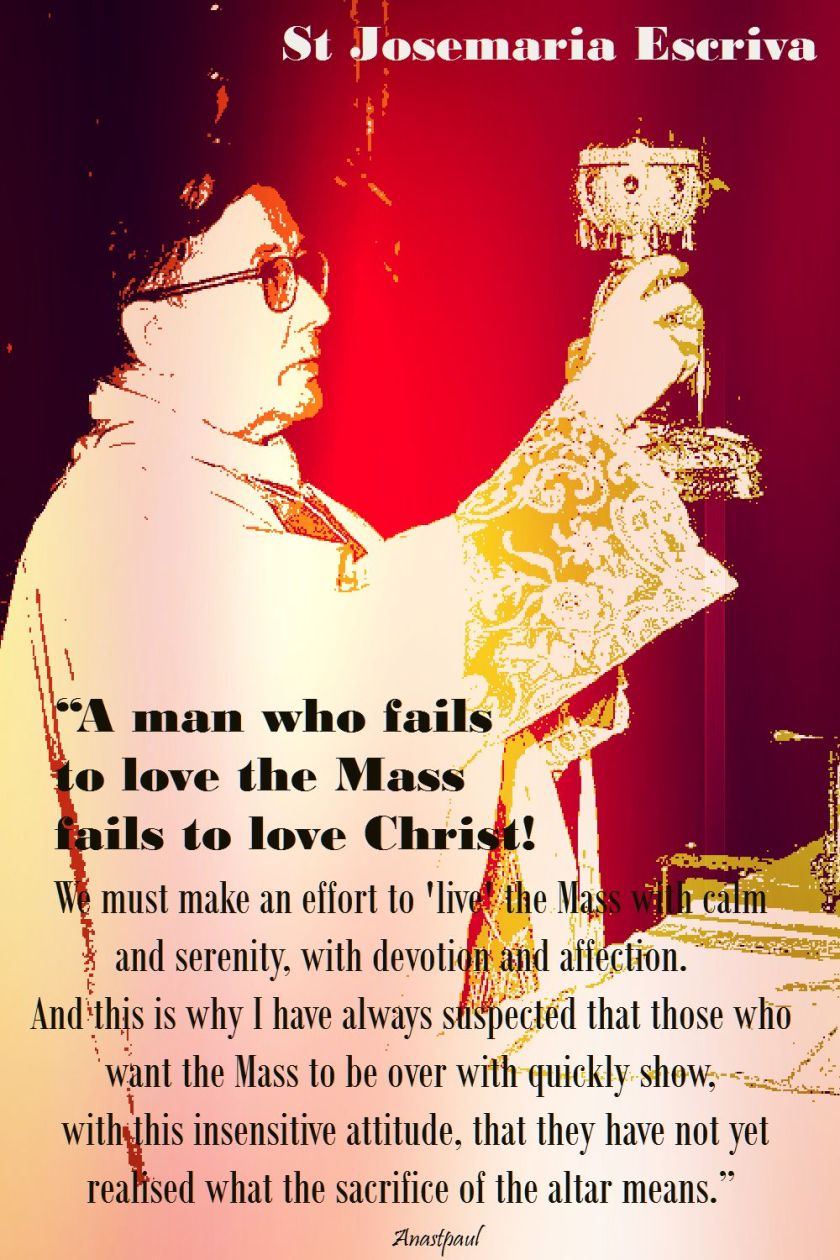
“A man who fails to love the Mass fails to love Christ.   We must make an effort to ‘live’ the Mass with calm and serenity, with devotion and affection.   And this is why I have always suspected that those who want the Mass to be over with quickly show, with this insensitive attitude, that they have not yet realised what the sacrifice of the altar means.” AND   “Many Christians take their time and have leisure enough in their social life (no hurry here).   They are leisurely, too, in their professionally activities, at table and recreation (no hurry here either).   But isn’t it strange how those same Christians find themselves in such a rush and want to hurry the priest, in their anxiety to shorten the time devoted to the most holy sacrifice of the altar?”

the man who fails to love the mass-st josemaria

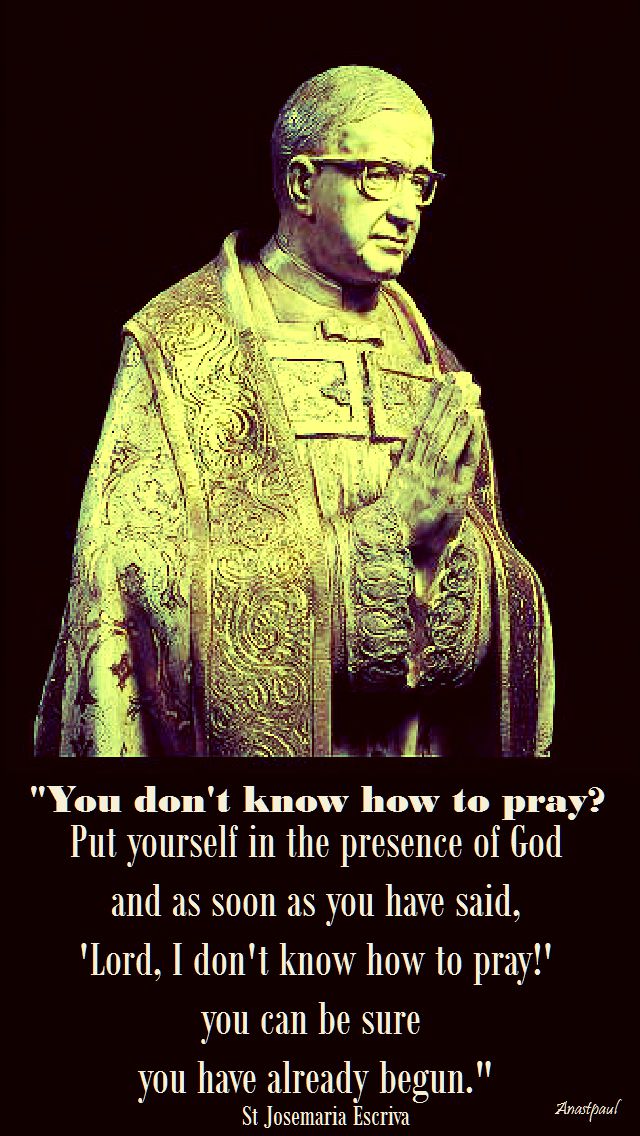
“You don’t know how to pray? Put yourself in the presence of God, and as soon as you have said, ‘Lord, I don’t know how to pray!” you can be sure you have already begun.”

you don't know how to pay - st josemaria

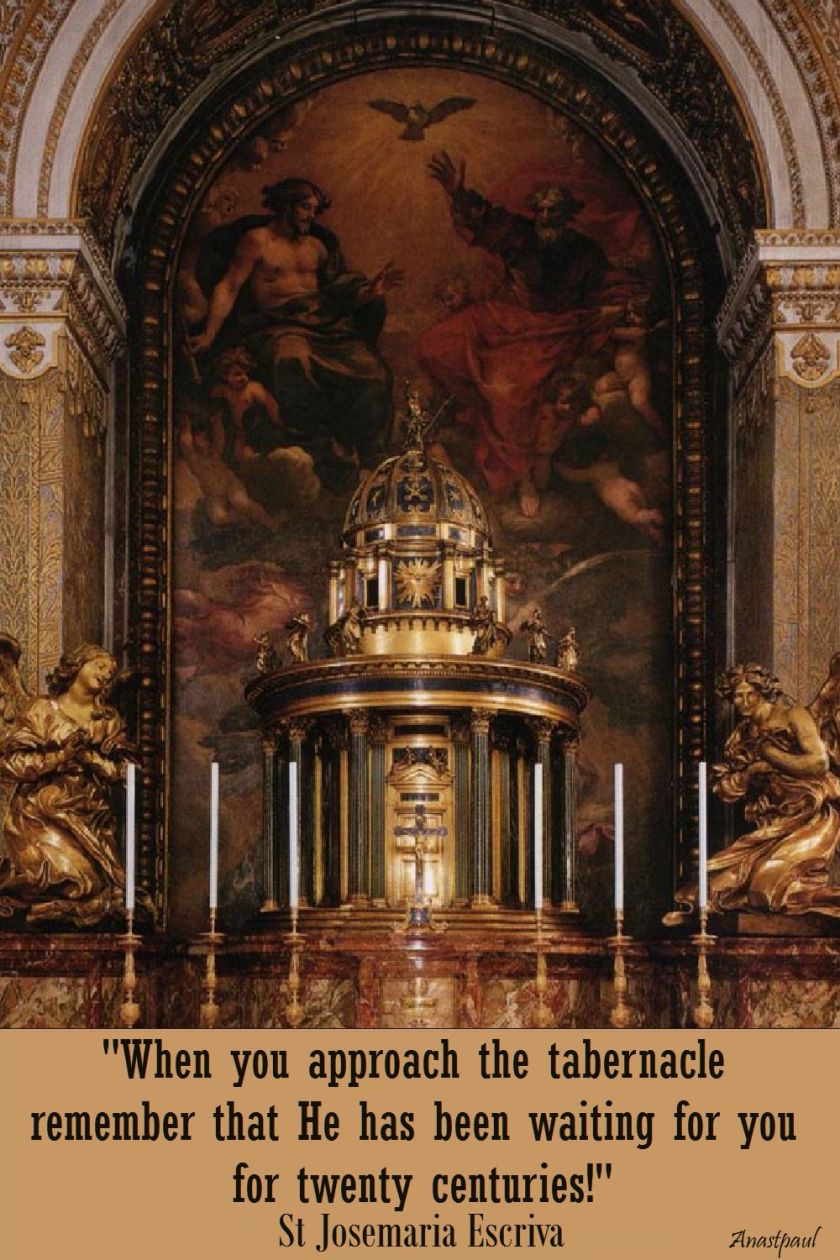
“When you approach the tabernacle remember that he has been waiting for you for twenty centuries.”

when you approach the tabernacle - st josemaria

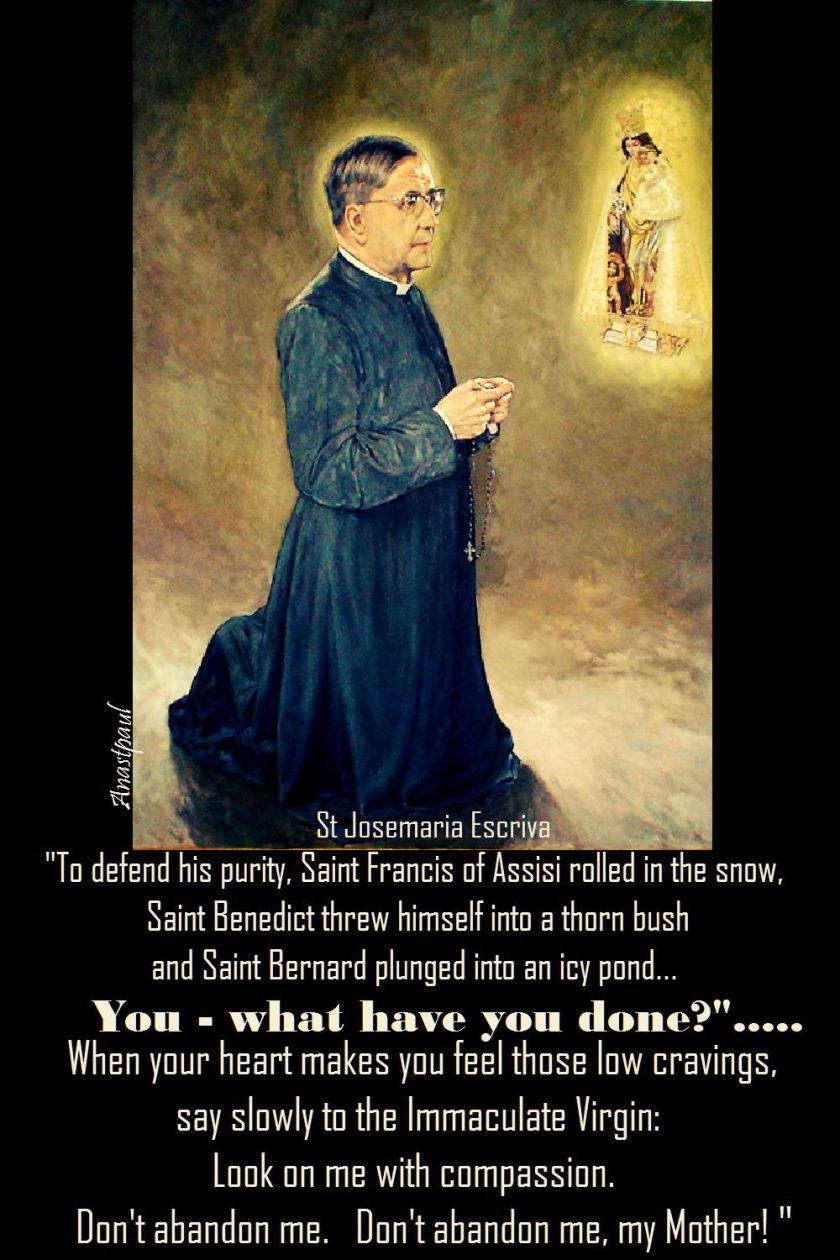
“To defend his purity, Saint Francis of Assisi rolled in the snow, Saint Benedict threw himself into a thorn bush and Saint Bernard plunged into an icy pond… You – what have you done?” …………………May I give you some advice for you to put into practice daily? When your heart makes you feel those low cravings, say slowly to the Immaculate Virgin:  Look on me with compassion.   Don’t abandon me.   Don’t abandon me, my Mother! – And recommend this prayer to others.”

don't abandon me my mother - st josemaria

“If you have so many defects, why are you surprised to find defects in others?”

IF YOU HAVE SO MANY DEFECTS-ST JOSEMARIA


Posted in MORNING Prayers, QUOTES - J R R Tolkien and MORE, SAINT of the DAY, The WORD

One Minute Reflection – 26 June

One Minute Reflection – 26 June

If you live in me and my words stay part of you, you may ask what you will – and it will be done for you………John 15:7

john 15-7

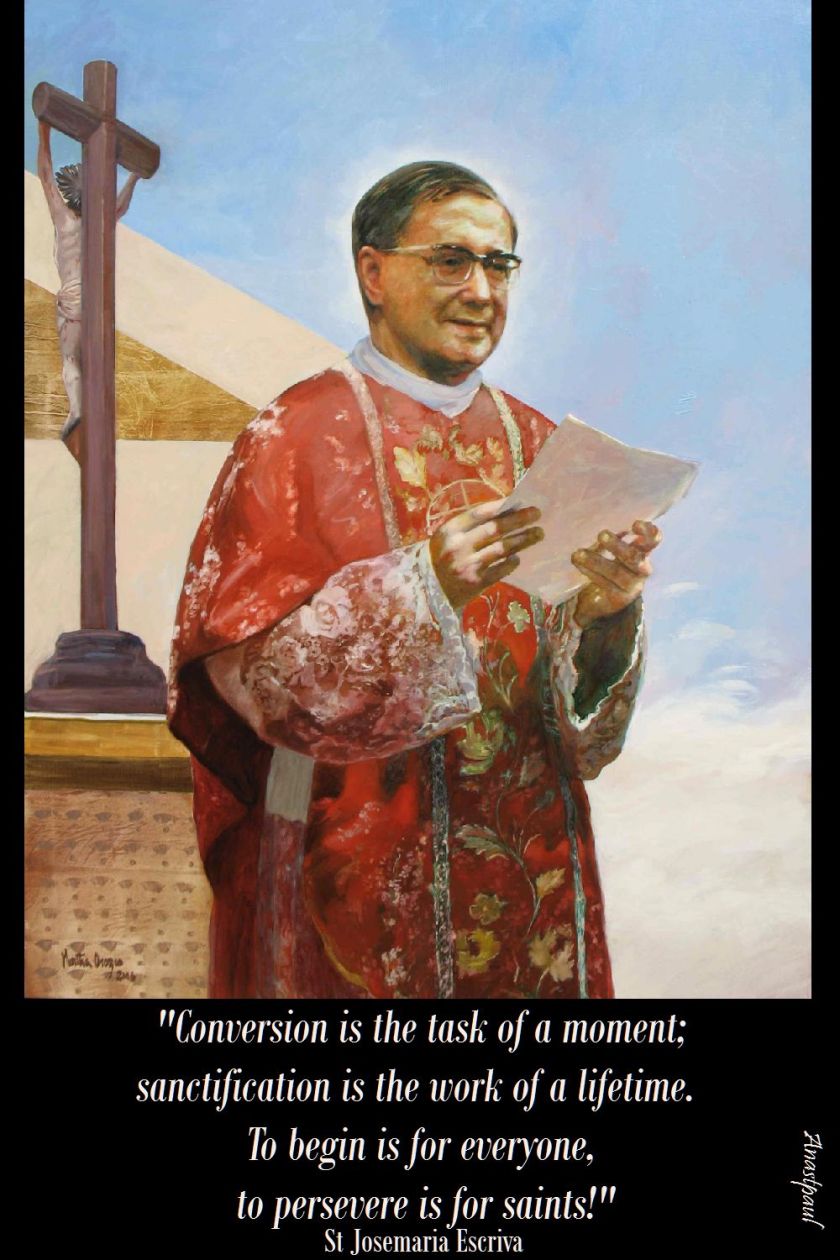
REFLECTION – “Turn your gaze constantly to Jesus who, without ceasing to be God, humbled Himself and took the nature of a slave, in order to serve us………..May you seek Christ, may you find Christ, may you love Christ………..Conversion is the task of a moment; sanctification is the work of a lifetime. To begin is for everyone, to persevere is for saints!”…….St Josemaria Escriva

conversion is the task of a moment - st josemaria

PRAYER – Enable me loving Father, to live a life of purity that will make me live in You. Let me be so united with You that whatever I might ask will be in total accord with Your will for me. St Josemaria, your inspiration and teachings help and show us the way to sanctification, please intercede for us all, amen.

st josemaria - pray for us

Posted in MORNING Prayers, PRAYERS of the CHURCH, SAINT of the DAY, The HOLY GHOST

Our Morning Offering – 26 June

Our Morning Offering – 26 June

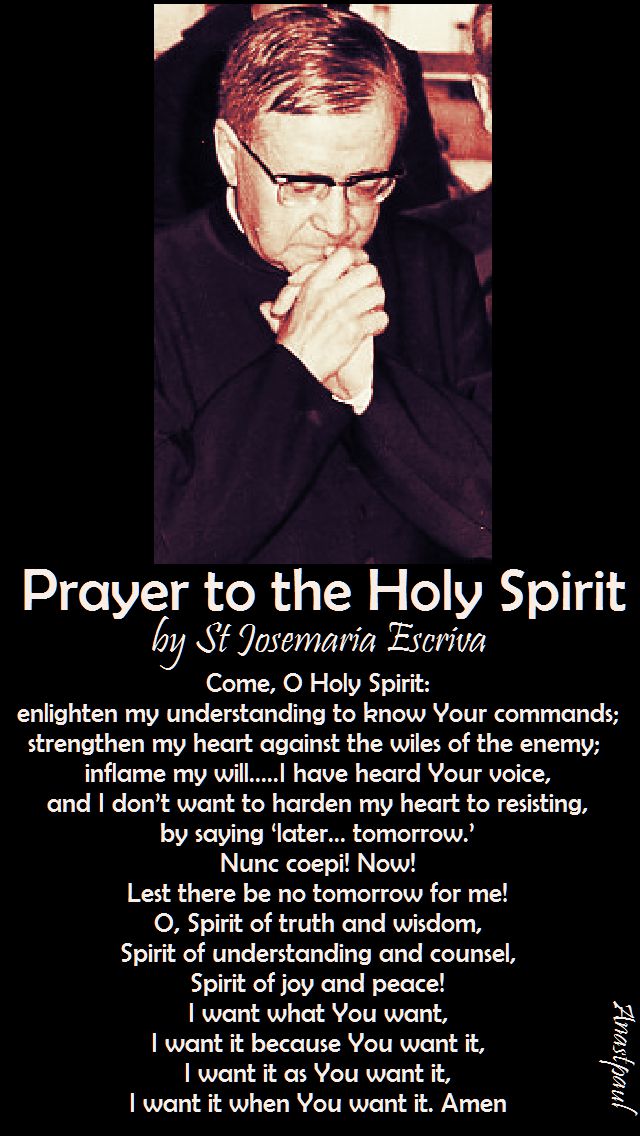
Prayer to the Holy Spirit
by St Josemaria Escriva

Come, O Holy Spirit:
enlighten my understanding
to know Your commands;
strengthen my heart
against the wiles of the enemy;
inflame my will…
I have heard Your voice,
and I don’t want to harden my heart to resisting,
by saying ‘later… tomorrow.’
Nunc coepi! Now!
Lest there be no tomorrow for me!
O, Spirit of truth and wisdom,
Spirit of understanding and counsel,
Spirit of joy and peace!
I want what You want,
I want it because You want it,
I want it as You want it,
I want it when You want it.
Amen

prayer to the holy spirit by st josemaria

Posted in QUOTES of the SAINTS, SAINT of the DAY

Saint of the Day – 26 June – Josemaría Escrivá de Balaguer y Albás

Saint of the Day – 26 June – Josemaría Escrivá de Balaguer y Albás – (9 January 1902 at Barbastro, Spain Died– 26 June 1975 of natural causes in his office in Rome, Italy; his body is interred at Prelatic Church of Our Lady of Peace at Viale Bruno Buozzi 75, Rome, Italy) – Priest, Founder Writer, Teacher, Doctor of Civil Law and Theology – known as “The Saint of Ordinary Life”.; St Josemaria was Beatified on 17 May 1992 by Pope John Paul II: the beatification miracle involved the cure in 1976 of Carmelite Sister Concepcion Boullon Rubio from the nearly-fatal cancerous form of lipomatosis following prayers by her family for the intercession of Father Josemaria and was Canonised on 6 October 2002 by Pope John Paul II: the canonization miracle involved saving a surgeon’s hands from a career-ending disease. Patron of Opus Dei and of Ordinary Life.

1312215965_stjosemariaprayercard-127878617_1458725696

St Josemaria founded Opus Dei, an organization of laypeople and priests dedicated to the teaching that everyone is called to holiness by God and that ordinary life can result in sanctity.   He was canonised during 2002 by Pope John Paul II, who declared Saint Josemaría should be “counted among the great witnesses of Christianity.”
His principal work was the initiation, government and expansion of Opus Dei.  Escrivá’s best-known publication is The Way, which has been translated into 43 languages and has sold several million copies.

St Josemaria Escrivá and Opus Dei have aroused controversy, primarily concerning allegations of secrecy, elitism, cult-like practices and political involvement with right-wing causes, such as the dictatorship of General Franco in Spain (1939–1975).   After his death, his canonisation attracted considerable attention and controversy, by some Catholics and the worldwide press.   Several journalists who have investigated the history of Opus Dei, among them Vatican analyst John L. Allen, Jr., have argued that these accusations are unproven or have grown from allegations by enemies of Escrivá and his organization.   Cardinal Albino Luciani (later Pope John Paul I), John Paul II, Benedict XVI, Francis, Oscar Romero and many Catholic leaders have endorsed Escrivá’s teaching concerning the universal call to holiness, the role of laity and sanctification of ordinary work.   According to Allen, among Catholics, Escrivá is “reviled by some and venerated by millions more”.

Early life
José María Mariano Escrivá y Albás was born to José Escrivá y Corzán and his wife, María de los Dolores Albás y Blanc on 9 January 1902, in the small town of Barbastro, in Huesca, Aragon, Spain, the second of six children and the first of two sons.   José Escrivá was a merchant and a partner of a textile company which eventually became bankrupt, forcing the family to relocate during 1915 to the city of Logroño, in the northern province of La Rioja, where he worked as a clerk in a clothing store.   Young Josemaría first felt that “he had been chosen for something”, it is reported, when he saw footprints left in the snow by a monk walking barefoot.

With his father’s blessing, Escrivá prepared to become a priest.   He studied first in Logroño and then in Zaragoza, where he was ordained as deacon on Saturday, 20 December 1924.   He was ordained a priest, also in Zaragoza, on Saturday, 28 March 1925. After a brief appointment to a rural parish in Perdiguera, he went to Madrid, the Spanish capital, during 1927 to study law at the Central University.   In Madrid, Escrivá was employed as a private tutor and as a chaplain to the Foundation of Santa Isabel, which comprised the royal Convent of Santa Isabel and a school managed by the Little Sisters of the Assumption.

Mission as the founder of Opus Dei
A prayerful retreat helped him to discern more definitely what he considered to be God’s will for him and, on 2 October 1928, he “saw” Opus Dei (English: Work of God), a way by which Catholics might learn to sanctify themselves by their secular work.   He founded it during 1928 and Pius XII gave it final approval during 1950.   According to the decree of the Congregation for the Causes of Saints, which contains a condensed biography of Escrivá, “[t]o this mission he gave himself totally. From the beginning his was a very wide-ranging apostolate in social environments of all kinds. He worked especially among the poor and the sick languishing in the slums and hospitals of Madrid.”

During the Spanish Civil War, Escrivá fled from Madrid, which was controlled by the republicans, via Andorra and France, to the city of Burgos, possessed by the nationalist forces of General Francisco Franco.   After the war ended during 1939 with Franco’s victory, Escrivá was able to resume his studies in Madrid and complete a doctorate in law, for which he submitted a thesis on the historical jurisdiction of the Abbess of Santa María la Real de Las Huelgas.

The Priestly Society of the Holy Cross, affiliated with Opus Dei, was founded on Sunday, 14 February 1943.   Escrivá relocated to Rome during 1946.  The decree declaring Escrivá “Venerable” states that “in 1947 and on Monday, 16 June 1950, he obtained approval of Opus Dei as an institution of pontifical right.   With tireless charity and operative hope he guided the development of Opus Dei throughout the world, activating a vast mobilization of lay people … He gave life to numerous initiatives in the work of evangelisation and human welfare;  he fostered vocations to the priesthood and the religious life everywhere… Above all, he devoted himself tirelessly to the task of forming the members of Opus Dei.”\

Later years
According to some accounts, at the age of two he suffered from a disease (perhaps epilepsy) so severe that the doctors expected him to die soon but his mother had taken him to Torreciudad, where the Aragonese locals venerated a statue of the Virgin Mary (as “Our Lady of the Angels”), thought to date from the 11th century.   Escrivá recovered and as the director of Opus Dei during the 1960s and 1970s, promoted and oversaw the design and construction of a major shrine at Torreciudad.   The new shrine was inaugurated on 7 July 1975, soon after Escrivá’s death and to this day remains the spiritual center of Opus Dei, as well as an important destination for pilgrimage.   By the time of Escrivá’s death during 1975, the members of Opus Dei numbered some 60,000 in 80 countries.   As an adult, Escrivá suffered from type 1 diabetes and, according to some sources, also epilepsy.

During 1950, Escrivá was appointed an Honorary Domestic Prelate by Pope Pius XII, which allowed him to use the title of Monsignor.   During 1955, he received a doctorate of theology from the Pontifical Lateran University in Rome.   He was a consultor to two Vatican congregations (the Congregation for Seminaries and Universities and the Pontifical Commission for the Authentic Interpretation of the Code of Canon Law) and an honourary member of the Pontifical Academy of Theology.   The Second Vatican Council (1962–65) confirmed the importance of the universal call to holiness, the role of the laity, and the Mass as the basis of Christian life.

During 1948 Escrivá founded the Collegium Romanum Sanctae Crucis (Roman College of the Holy Cross), Opus Dei’s educational center for men, in Rome. During 1953 he founded the Collegium Romanum Sanctae Mariae (Roman College of Saint Mary) to serve the women’s section (these institutions are now joined into the Pontifical University of the Holy Cross.)   Escrivá also established the University of Navarre, in Pamplona, and the University of Piura (in Peru), as secular institutions affiliated with Opus Dei. Escrivá died on 26 June 1975, aged 73.

Three years after Escrivá died, the then Cardinal Albino Luciani (later Pope John Paul I) celebrated the originality of his contribution to Christian spirituality.   The Statue below is at St Peter’s the Vatican.

St Josemaria and the Blessed Virgin Mary 
Pope John Paul II stated on Sunday, 6 October 2002, after the Angelus greetings:  “Love for our Lady is a constant characteristic of the life of Josemaría Escrivá and is an eminent part of the legacy that he left to his spiritual sons and daughters.”   The Pope also said that “St. Josemaría wrote a beautiful small book called The Holy Rosary which presents spiritual childhood, a real disposition of spirit of those who wish to attain total abandonment to the divine will”.

When Escrivá was 10 or 11 years old, he already had the habit of carrying the rosary in his pocket.   As a priest, he would ordinarily end his homilies and his personal prayer with a conversation with the Blessed Virgin.   He instructed that all rooms in the offices of Opus Dei should have an image of the Virgin.   He encouraged his spiritual children to greet these images when they entered a room.   He encouraged a Marian apostolate, preaching that “To Jesus we go and to Him we return through Mary”. While looking at a picture of the Virgin of Guadalupe giving a rose to San Juan Diego, he commented:  “I would like to die that way.”   On 26 June 1975, after entering his work room, which had a painting of the Virgin of Guadalupe, he slumped on the floor and died.

st josemaria 3200px-Univnavarrefairlovest josemaria 12

Teachings and legacy
The significance of Escrivá’s message and teachings has been a topic of debate, by Catholics and others.   The Protestant French historian Pierre Chaunu, a professor at the Sorbonne and president of the Academy of Moral and Political Sciences, said that “the work of Escrivá de Balaguer will undoubtedly mark the 21st century.   This is a prudent and reasonable wager.   Do not pass close to this contemporary without paying him close attention”.   The Catholic theologian Hans Urs von Balthasar, who was appointed cardinal by Pope John Paul II (but died during 1988 before his investiture), dismissed Escrivá’s principal work, The Way, as “a little Spanish manual for advanced Boy Scouts” and argued that it was quite insufficient to sustain a major religious organization. However, the monk and spiritual writer Thomas Merton declared that Escrivá’s book “will certainly do a great deal of good by its simplicity, which is the true medium for the Gospel message”.

Critics of Opus Dei have often argued that the importance and originality of Escrivá’s intellectual contributions to theology, history and law, at least as measured by his published writings, has been grossly exaggerated by his devotees.   However, various officials of the Catholic church have spoken well of Escrivá’s influence and of the relevance of his teachings.  In the decree introducing the cause of beatification and canonisation of Escrivá, Cardinal Ugo Poletti wrote during 1981:  “For having proclaimed the universal call to holiness since he founded Opus Dei during 1928, Msgr. Josemaría Escrivá de Balaguer, has been unanimously recognized as the precursor of precisely what constitutes the fundamental nucleus of the Church’s magisterium, a message of such fruitfulness in the life of the Church.”  Sebastiano Baggio, Cardinal Prefect of the Congregation for Bishops, wrote a month after Escrivá’s death:  “It is evident even today that the life, works, and message of the founder of Opus Dei constitutes a turning point, or more exactly a new original chapter in the history of Christian spirituality.”   A Vatican peritus or consultor for the process of beatification said that “he is like a figure from the deepest spiritual sources”. Franz König, Archbishop of Vienna, wrote in 1975:

“The magnetic force of Opus Dei probably comes from its profoundly lay spirituality.   At the very beginning, in 1928, Msgr. Escrivá anticipated the return to the Patrimony of the Church brought by the Second Vatican Council … [H]e was able to anticipate the great themes of the Church’s pastoral action in the dawn of the third millennium of her history.”

The “absolutely central” part of Escrivá’s teaching, says American theologian William May, is that “sanctification is possible only because of the grace of God, freely given to his children through his only-begotten Son and it consists essentially in an intimate, loving union with Jesus, our Redeemer and Saviour.”

Escrivá’s books, including Furrow, The Way, Christ is Passing By and The Forge, continue to be read widely and emphasize the laity’s calling to daily sanctification (a message also to be found in the documents of Vatican II).   Pope John Paul II made the following observation in his homily at the beatification of Escrivá:

“With supernatural intuition, Blessed Josemaría untiringly preached the universal call to holiness and apostolate.   Christ calls everyone to become holy in the realities of everyday life.   Hence work too is a means of personal holiness and apostolate, when it is done in union with Jesus Christ.”

John Paul II’s decree Christifideles omnes states:  “By inviting Christians to seek union with God through their daily work — which confers dignity on human beings and is their lot as long as they exist on earth — his message is destined to endure as an inexhaustible source of spiritual light regardless of changing epochs and situations”   St Josemaria pray for us!
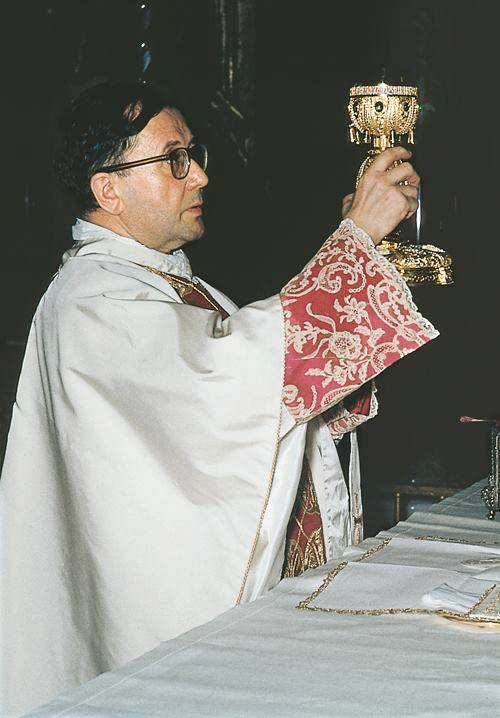
st josemaria 14st-josemaria-escriva-sylvia-castellanosst josemaria 13st josemaria 11

Posted in FEASTS and SOLEMNITIES, SAINT of the DAY, The BLESSED VIRGIN MARY

Saints’ Memorials and Feast Days of The Blessed Virgin Mary – 26 June

Our Lady of Longing: Matka Boża Tęskniąca / Longing Mother of God, Warsaw, Poland – One of the oldest churches in the Archdiocese of Warsaw is St. Elizabeth Powsin. Located on the main altar is a painting of Our Lady of Longing – artist unknown – from the first half of the seventeenth century. At either side, the image is surrounded by statues of Saints Adalbert and Stanislaus – Polish bishops and martyrs. The testimony of miracles and graces relating to the Our Lady of Longing icon have been collected at least since the mid-seventeenth century. On June 28, 1998, the image became the fourth image of Mary in the Archdiocese of Warsaw to be canonically crowned.

OUR LADY OF LONGING 26 JUNE
Our Lady of Longing

Our Lady of Trompone: Italy(1562)
—
St Acteie of Rome
St Albinus of Rome
Bl Andrea Giacinto Longhin
Bl Andrii Ischak
St Anthelm of Belley
St Babolenus of Stavelot-Malmédy
St Barbolenus of Fossés
Bl Bartholomew of Vir
St Corbican
St David of Thessalonica
St Deodatus of Nola
St Dionysius of Bulgaria
St Edburga of Gloucester
St Hermogius of Tuy
St Iosephus Ma Taishun
St John of Rome
St John of the Goths
St José Maria Robles Hurtado
St Josemaria Escriva
Bl Khalil Al-Haddad
St Maxentius of Poitou
St Medico of Otricoli
Bl Mykola Konrad
St Paul of Rome
St Pelagius of Oviedo
St Perseveranda of Poitiers
Bl Raymond Petiniaud de Jourgnac
St Salvius
Bl Sebastian de Burgherre
St Soadbair
St Superius
St Terence of Rome
St Vigilius of Trent
Bl Volodymyr Ivanovych Pryima
—
Martyrs of Africa – 4 saints: Four Christians who were martyred together – Agapitus, Emerita, Felix and Gaudentius at an unknown location in Africa, date unknown.

Martyrs of Alexandria – 3 saints: Three Christians who were martyred together, but we really know little more that the names – Agatho, Diogenes and Luceja. They were martyred in Alexandria, Egypt, date unknown.

Martyrs of Cambrai – 4 beati: Four Daughters of Charity of Saint Vincent de Paul nuns at Arras, France. Imprisoned together in 1792 and executed together two years later in the anti-Catholic excesses of the French Revolution. They were:
• Jeanne Gerard
• Marie-Françoise Lanel
• Marie-Madeleine Fontaine
• Thérèse-Madeleine Fantou
They were guillotined on 26 June 1794 at Cambrai, Nord, France and Beatified in June 1920 by Pope Benedict XV.


Posted in MORNING Prayers, NOVENAS

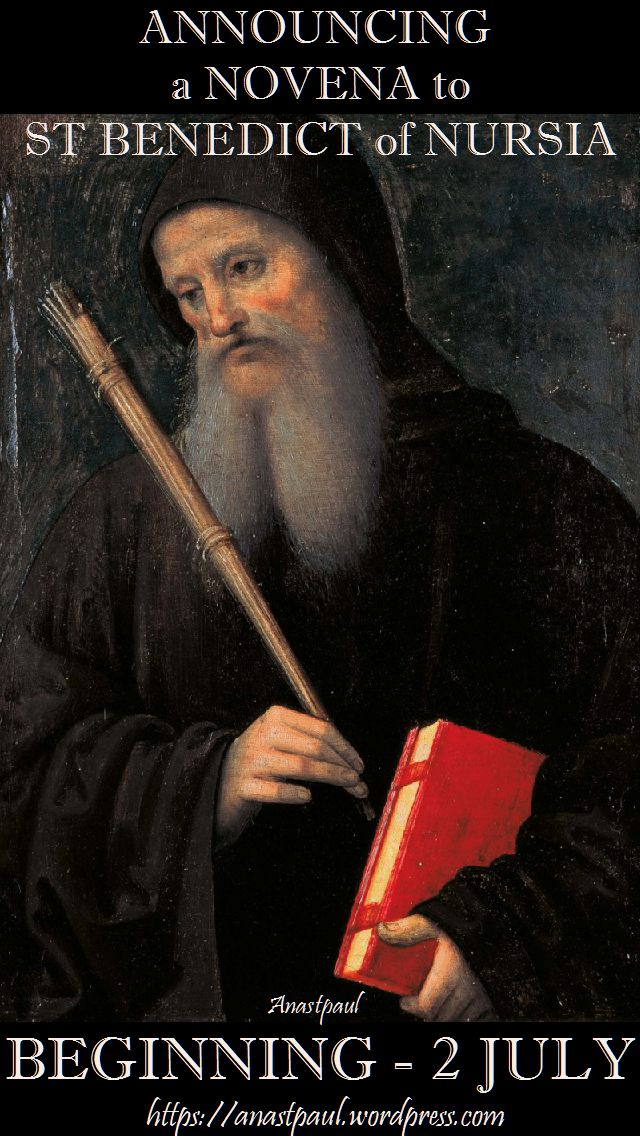
ANNOUNCING A NOVENA TO ST BENEDICT of NURSIA – BEGINNING SUNDAY – 2 JULY

ANNOUNCING A NOVENA TO ST BENEDICT of NURSIA –
BEGINNING SUNDAY – 2 JULY

Who Is St. Benedict?

St Benedict was born to a noble family around 480 A.D. in Nursia, in central Italy.   He lived a sequestered life for many years, leaving family and friends behind to live in a cave near the town of Subiaco.   St. Benedict chose to live a quiet life of prayer and devotion to God after disapproving of the immoral lifestyle he encountered while he attended school in Rome.   Even though he lived a life devoted to God, St. Benedict (like all of us) was constantly tempted by the devil.   St. Benedict was able to defeat the devil numerous times throughout his life, earning him the title of protector against evil spirits, temptation and witchcraft.    St Benedict also offers protection against being poisoned, infectious diseases, childbirth complications and destruction during storms and tempests.   He also obtains for sinners the grace of conversion.

St. Benedict’s Protection — A Lifetime of Defeating the Devil

Pope Gregory I, also known as St. Gregory the Great, detailed St. Benedict’s encounters with the devil as part of his four-part book series, The Dialogues.   St Gregory called him “a shining light to the world.”

The Rule of St. Benedict has been used by monasteries all throughout the West for centuries.   It champions listening to God’s word and doing His work through a life of prayer, temperance, charity, obedience, patience and humility.   The Rule was considered rigorous, yet not unbendingly so, when Benedict first introduced it in his writings.

Cardinal Ratzinger was thinking of him in part when he was elected Pope in 2005 and chose the name Benedict XVI!   As the Pope has said, may St. Benedict encourage us all (as he sought to do with his Rule and his life) to put Christ first in our thoughts and in our actions!

St Benedict we run to you for aid and intercession, please pray for us all!

announcing a novena to st benedict beginning 2 july

Posted in MORNING Prayers, SAINT of the DAY, The BLESSED VIRGIN MARY

Thought for the Day – 25 June

Thought for the Day – 25 June

A Still quiet Moment

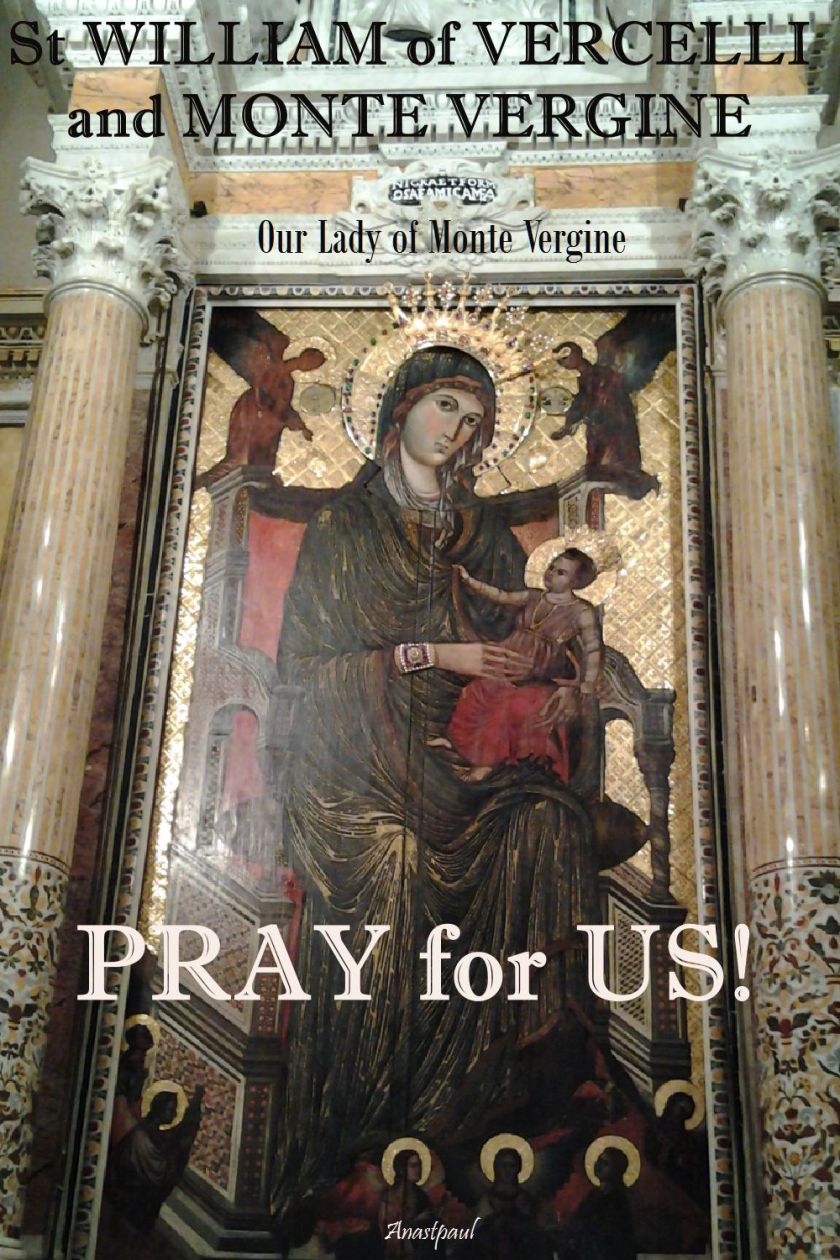
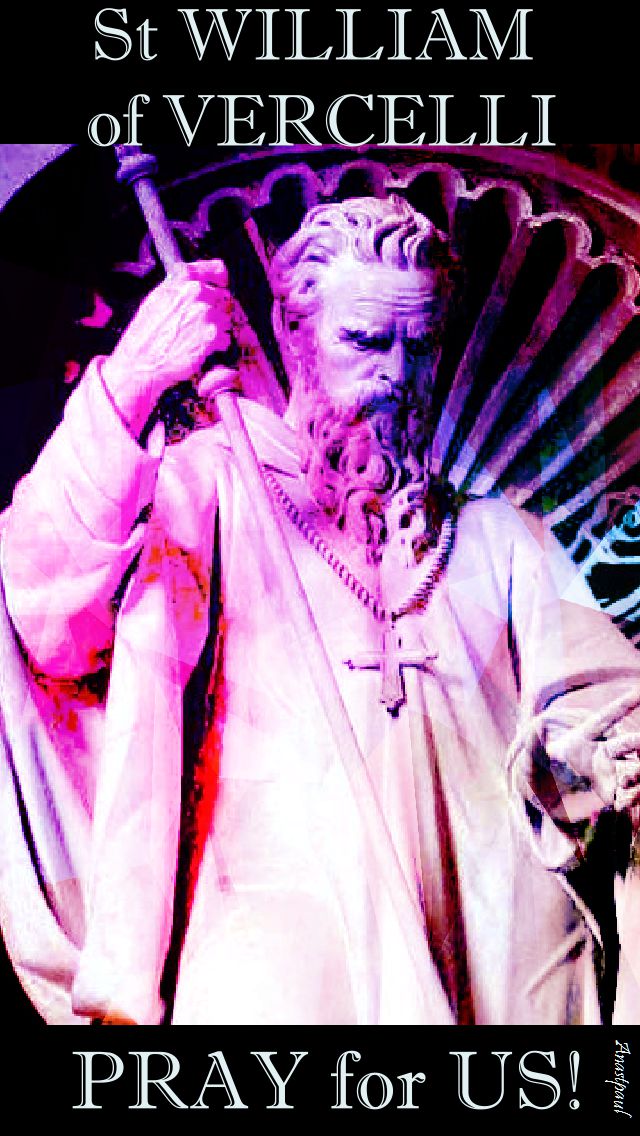
Today, 25 June, we celebrate the feast day of Saint William of Vercelli (1085-1142), founder of the Order of Monte Vergine, also known as the “Williamites.”   Saint William lived a quiet life of solitude and contemplation, listening intently for the voice of God and following the directions he received.   Through his obedience, William was taken far from home, worked many miracles and established a thriving religious community—all because he was quiet and paused to discern the Will of the Lord.
Saint William had complete trust in the Lord and in His Divine Providence.   Ever faithful and contemplative, William was willing to leave his home as a youth and subsequently leave the community he had built with his own hands in service to God.   Patient, humble and obedient, Saint William of Vercelli put the Lord’s work above his own desires at every moment of his life.   His great devotion to Our Lady, was a source of immense comfort and trust in the holy Mother of God, who he knew would lead him to her Son. We could do well by observing Saint William’s confidence in the Divine Providence and striving to imitate him by creating quiet moments in our own lives for prayer, reflection and contemplation.   It is in those moments that the Divine Plan for our own lives quietly unfolds…… if we listen.

St William of Vercelli and Monte Vergine, please pray for us!

st william of vercelli pray for us.2


Posted in MORNING Prayers, QUOTES - J R R Tolkien and MORE

Quote of the Day – 25 June

Quote of the Day – 25 June

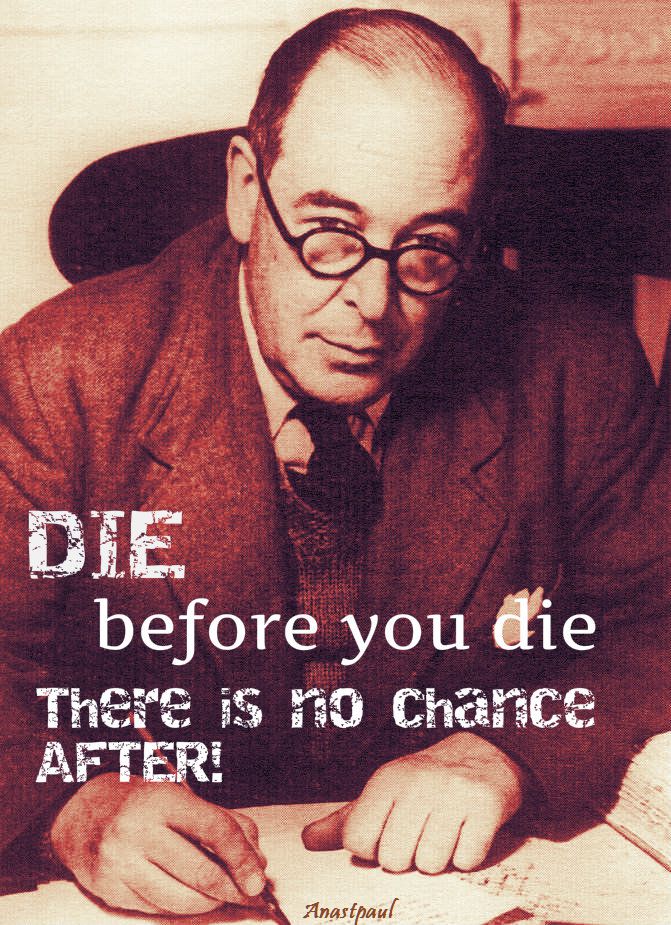
“DIE before you die
there is no chance after.”

Prof C S Lewis


Die before you die. C S LEWIS MYPIC

Posted in DOCTORS of the Church, FATHERS of the Church, MORNING Prayers, QUOTES of the SAINTS, SAINT of the DAY, The WORD

One Minute Reflection – 25 June

One Minute Reflection – 25 June

Blessed be God the Father . who gave us a new birth to a living hope…..to an inheritance that is imperishable, undefiled and unfading, kept in heaven for you………1 Peter 1:3-4

1 PETER 1-3,4

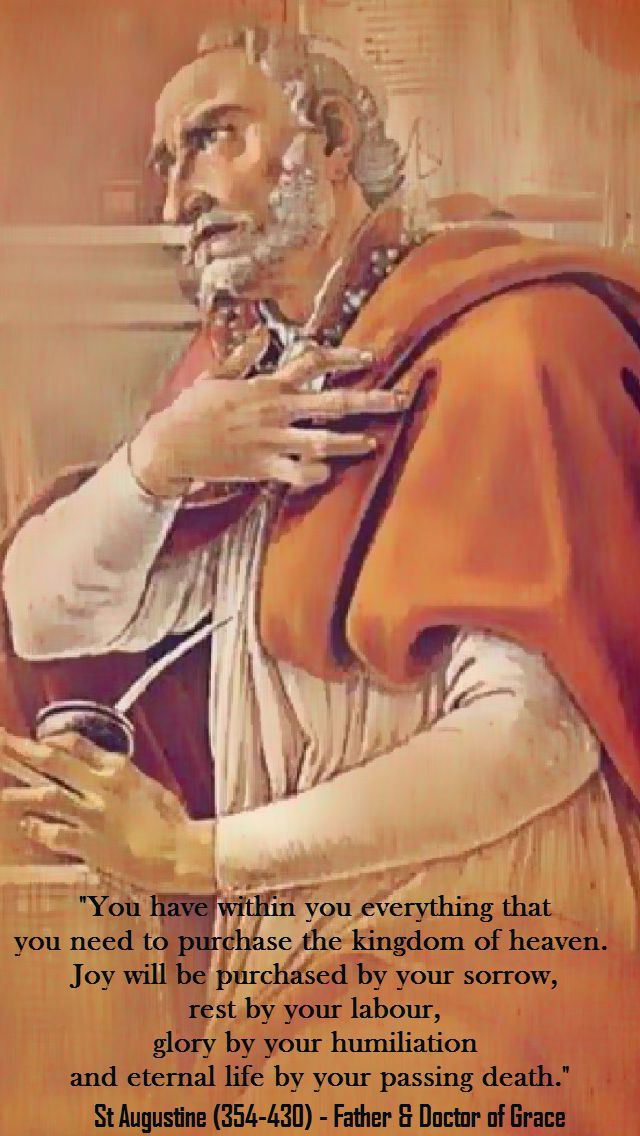
REFLECTION – “You have within you, everything that you need to purchase the kingdom of heaven.
Joy will be purchased by your sorrow,
rest by your labour,
glory by your humiliation
and eternal life by your passing death.”………………….St Augustine

YOU HAVE WITHIN YOU - ST AUGUSTINE

PRAYER – Loving Father,. teach me how to make every event on earth lay up treasures for me in heaven. Help me to endure sorrows, labour, humiliations, pain and death willingly so as to attain heaven with You, in unity with Your Son, Lord Jesus Christ and the Holy Spirit, one God forever and ever. St William of Vercelli, your life was a focused gift to God, pray for us that we too may join you in eternal life. Amen

st william of vercelli pray for us

Posted in MORNING Prayers, PRAYERS of the SAINTS, Uncategorized

Our Morning Offering – 25 June

Our Morning Offering – 25 June

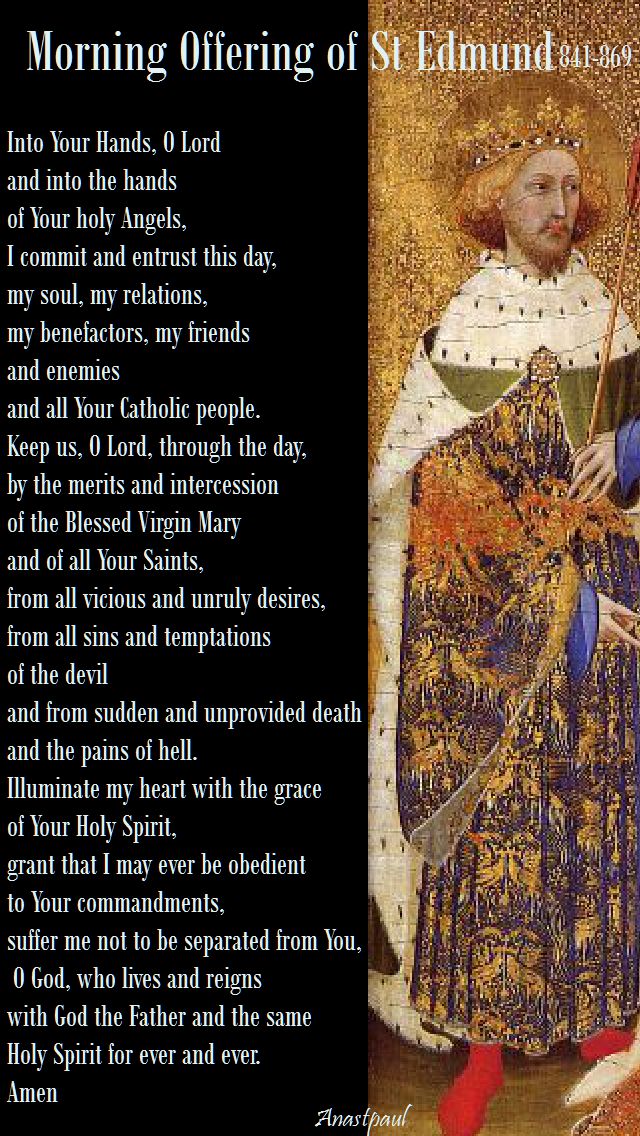
Morning Offering of St Edmund

Into Your Hands, O Lord
and into the hands of Your holy Angels,
I commit and entrust this day my soul,
my relations, my benefactors,
my friends and enemies
and all Your Catholic people.
Keep us, O Lord, through the day,
by the merits and intercession
of the Blessed Virgin Mary
and of all Your Saints,
from all vicious and unruly desires,
from all sins and temptations of the devil
and from sudden and unprovided death
and the pains of hell.
Illuminate my heart with the grace of Your Holy Spirit,
grant that I may ever be obedient
to Your commandments,
suffer me not to be separated from You, O God,
who lives and reigns with God the Father
and the same Holy Spirit for ever and ever.
Amen


morning offering of st edmund martyr - and king

Posted in The BLESSED VIRGIN MARY

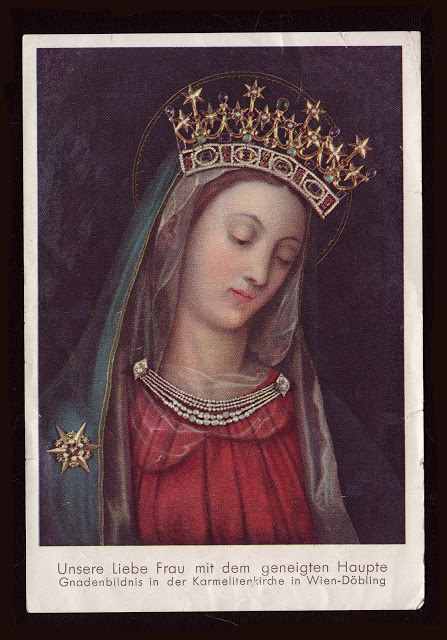
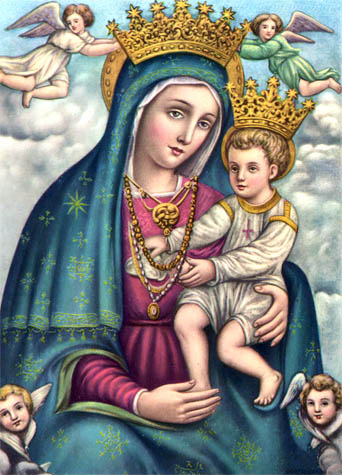
Beata Vergine delle Grazie / Our Lady of Grace/Our Lady of the Bowed Head, Montegridolfo, Rimini, Emilia-Romagna, Italy (1548)

Beata Vergine delle Grazie / Our Lady of Grace/Our Lady of the Bowed Head, Montegridolfo, Rimini, Emilia-Romagna, Italy (1548) – 25 June

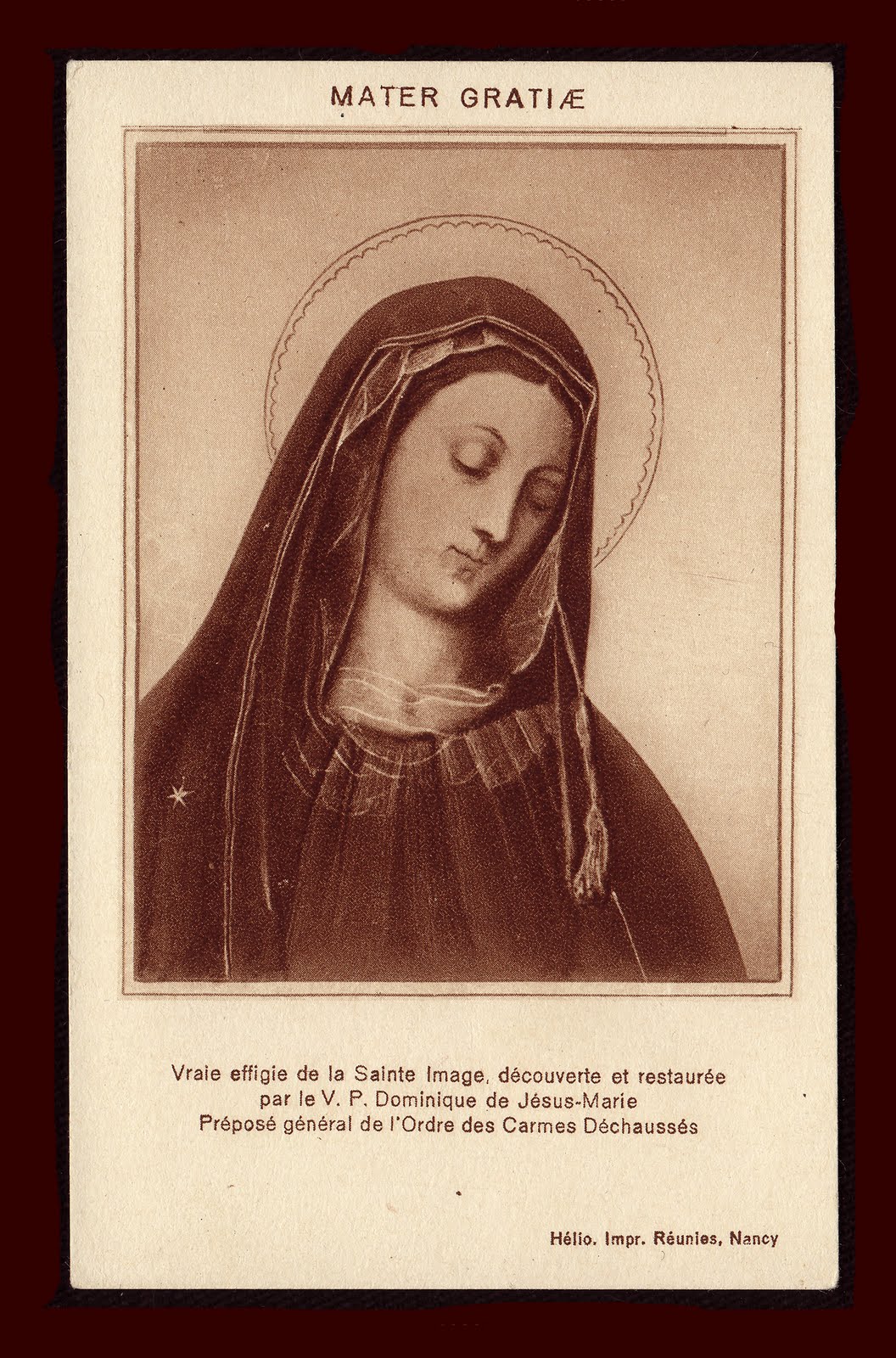
Among the many miraculous images of the Mother of God through which she deigns to grant her favours, there is one in the monastery church of the Carmelites in Vienna, entitled the Mother of Grace, or Our Lady of Grace, also known also as Our Lady of the Bowed Head.

In 1610 a Carmelite, Dominic of Jesus-Mary, found among the votaries of an old altar in the monastery church of Maria della Scala in Rome and oil painting of the Mother of God, dust-covered and somewhat torn, which grieved him.   Taking it into his hands, he shook the dust off it, and kneeling down venerated it with great devotion.

He had the picture renovated and placed it on the shelf in his cell, where he made it the object of his love and supplications in favour of those who came to him in their necessities and afflictions.

One night while he was praying fervently before the picture, he noticed that some dust had settled on it.   Having nothing but his course woolen handkerchief he dusted it with that and apologized,

“O pure and holiest Virgin, nothing in the whole world is worthy of touching your holy face but since I have nothing but this coarse handkerchief, deign to accept my good will.”

To his great surprise, the face of the Mother of God appeared to take on life and smiling sweetly at him, she bowed her head, which thereafter remained inclined.

Fearing he was under an illusion, Dominic became troubled but Mary assured him that his requests would be heard:  he could ask of her with full confidence any favour he might desire.   He fell upon his knees and offered himself entirely to the service of Jesus and Mary and asked for the deliverance of one of is benefactor’s souls in purgatory. Mary told him to offer several Masses and other good works;  a short time after when he was again praying before the image, Mary appeared to him bearing the soul of his benefactor to Heaven.   Dominic begged that all who venerated Mary in this image of Our Lady of Grace might obtain all they requested.   In reply the Virgin gave him this assurance:

“All those who devoutly venerate me in this picture and take refuge to me will have their request granted and I will obtain for them many graces;  but especially will I hear their prayers for the relief and deliverance of the souls in purgatory.”

Dominic soon after placed the image into the church of Maria Della Scala so that more devotees of Mary could venerate it.   Many wonderful favours were obtained by those who honoured and invoked Mary here.   Reproductions were made of Our Lady of Grace and sent to different parts of the world.   After the death of Dominic the original painting was lent to Prince Maximilian of Bavaria.   He gave it to the discalced Carmelites in Munich in 1631;  they gave it to Emperor Ferdinand II of Austria and his wife Eleanore. After Ferdinand’s death, Eleanore entered the Carmelite convent in Vienna and took the picture with her.   During the succeeding years the image was transferred to various places.   Today it is in the monastery church of Vienna Doabling.    On 27 September 1931, it was solemnly crowned by Pope Pius XI – its 300th anniversary of arrival in Vienna.

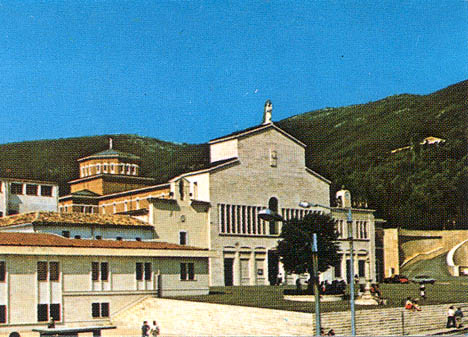
Saint Padre Pio prayed daily to Our Lady of Grace at San Giovanni Rotondo, Italy.

olgrace

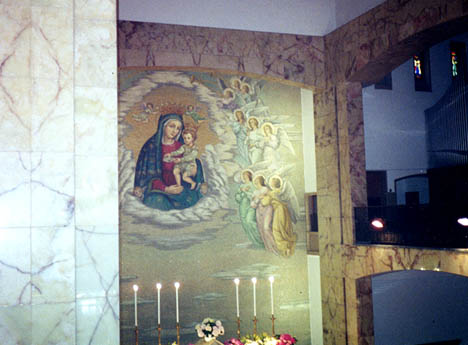
image of Our Lady of Grace is painted on the front wall and ceiling behind the altar in the church at San Giovanni Rotondo, Italy, where St. Pio lived.

sgr
Our Lady of Grace Church in San Giovanni Rotondo
olgchurch
Inside Our Lady of Grace Church

St Padre Pio prayed the following Prayer every day to Our Lady of Grace.

O heavenly treasurer of all graces, Mother of God and my mother Mary, since you are the first-born daughter of the Eternal Father and hold in your hands His omnipotence, be moved to pity my soul and grant me the graces which I fervently ask of you.

Hail Mary

O merciful dispenser of divine graces, Mary most holy, mother of the Eternal incarnate Word who has crowned you with His immense wisdom, look upon the greatness of my sorrow and grant me the graces I need so much.

Hail Mary

O most loving dispenser of divine graces, immaculate Spouse of the Eternal Holy Spirit, most holy Mary, who have received from Him a heart which is moved to pity by human misfortunes and which is constrained to offer consolation to those who suffer, be moved to pity my soul and grant me whose graces which I await from you with full confidence in your immense goodness.

Hail Mary

O my mother, treasurer of all graces, refuge of poor sinners, consolation of the afflicted, hope of those who despair and most powerful help of Christians, I places all my confidence in you, being sure that you will obtain for me from Jesus the graces which I so much desire, if they are good for my soul. Amen

Hail Mary

Posted in INCORRUPTIBLES, SAINT of the DAY, Uncategorized

Saint of the day – 25 June – St William of Vercelli (1085-1142)

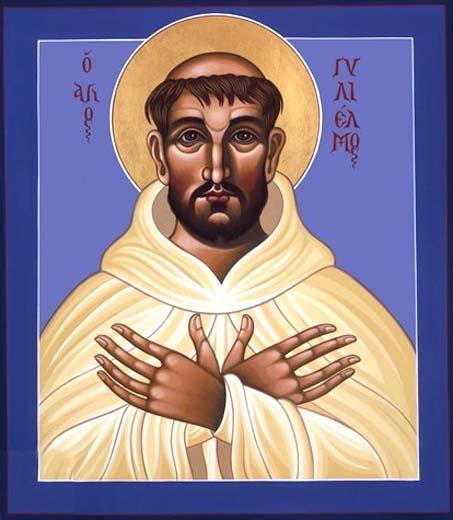
Saint of the day – 25 June – St William of Vercelli OSB (1085 at Vercelli, Italy – 25 June 1142 at Guglietto, Italy of natural causes)  Hermit, Abbot, Founder of the Congregation of Monte Vergine, or “Williamites,” miracle-worker, Marian devotee.   Also known as William of Monte Vergine.   Patronage – Irpinia, Italy.   Attributes –  pilgrim, usually near Santiago de Compostela, Spain, abbot near a wolf wearing a saddle, receiving an appearance by Christ, saddling a wolf that killed his donkey, wolf.   His Body is incorrupt.   The Statue below is the Founder Statue at St Peter’s Basilica.512px-StWilliam of Vercelli -FounderSaint

St William was born to nobility in Vercelli, Italy and was orphaned at a young age when both his parents were killed.   Subsequently raised by a pious family member, William matured into a contemplative young man with only one desire—to devote his life to the Lord.   At the young age of 15, William left home, setting out on pilgrimage to Santiago de Compostela, Spain.   As the journey was not difficult enough for him, he encircled his legs with tight iron bands, causing pain and making walking difficult, his suffering bringing him closer to God.   Upon arrival, he worked many miracles including the healing of a blind man through prayer and, subsequently, felt called to journey to the Holy Land.   However, soon after departing, he was set upon by thieves and following that encounter, felt the Will of God calling him to Italy.ST WILLIAM OF VERCELLI


Saint William retired to Monte Vergiliano (today known as Monte Vergine, named for Our Blessed Mother) and became a hermit.   There, he spent his days in prayer, fasting and contemplation of the Lord.   Especially devoted to the Blessed Virgin Mary, he began construction of a Church in her honour, mining the rocks from the mountain by hand with the assistance of a lone donkey. st-william-of-vercelli-OUR LADY OF MONTE VERGINE pray-for-us-2

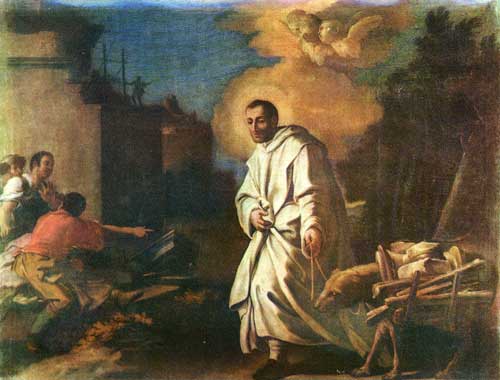
As holy legend tells us, one evening, the donkey was killed and eaten by a wolf.   Saint William called the wolf to him, ordering it to take the donkey’s place.   The wolf, bowing in respect and realising that it had interrupted the work of God, immediately took up the task of dragging rocks from the quarry.   The faithful who continue to travel on pilgrimage to Monte Vergine report that the wolf is still spotted today, visible to those who call upon the name of the Blessed Virgin.St-william of vercelli Guillaume

ST WILLIAM OF VERCELLI

Eventually, due to his working of more miraculous cures (none of which he sought credit for), the faithful began seeking William out on his mountain.   His reputation for holiness attracted many disciples, both men and women, and he founded the Order of Mount Vergine—a religious community with strict rules of austerity.   William and the nuns and monks of his order lived in peace and contemplation for some time, until the members of the order began complaining that William’s rules of poverty, fasting and penance were too extreme.  There is evidence of heavenly support for the austerities of William’s rule.   For example, William did not permit the order to eat meat, eggs, milk or cheese.   If someone tried to violate this regulation, storm clouds would appear in the sky and the lightning would destroy the illicit foodstuff that had been brought into the monastery.san-william guglielmo-di-montevergine-da-vercelli-e-1

With the members of the Order growing more disgruntled, William humbly removed himself from the situation to remove controversy and ensure the future of the order.    He travelled to Naples, where he served as adviser to the King Roger I and established several more monasteries.

Saint William died of natural causes at the Guglielmo monastery near Nusco, Italy, where he was buried.   Church tradition holds that William predicted the date and time of his death and went to meet his Maker with peace and joy.   At the time of his death, he had not yet written a Rule for his religious to govern their affairs.   His successor, fearing the dissolution of a community without constitutions, placed them under the Rule of Saint Benedict.   The community, which continues to exist today, now belongs to the Benedictine congregation of Subiaco and has a much venerated picture of our Lady of Constantinople, to which pilgrimages are frequently made by the faithful.   While Benedictine monks generally wear black robes, the Monks who reside at Monte Vergine today continue to wear the white robes of the Williamites.

williamofvercelli


Posted in SAINT of the DAY, The BLESSED VIRGIN MARY

Saints, Feasts and Celebrations – 25 June

12th Sunday in Ordinary Time (2017)
Our Lady of Grace
—
St Adalbert of Egmond
St Amand of Coly
Bl Burchard of Mallersdorf
St Cyneburga of Gloucester
St Domingo Henares de Zafra Cubero
Bl Dorothy of Montau
St Eurosia of Jaca
St Febronia of Nisibis
Bl Fulgentius de Lara
St Gallicanus of Embrun
St Gallicanus of Ostia
St Gohard of Nantes
Bl Guy Maramaldi
Bl Henry Zdick
Bl John the Spaniard
St Luceias and Companions
St Maximus of Turin
St Moloc of Mortlach
St Molonachus of Lismore
St Phanxicô Ðo Van Chieu
St Prosper of Reggio
St Selyf of Cornwall
St Solomon I
St Solomon III of Bretagne
St William of Vercelli – https://www.youtube.com/watch?v=g8DVvgPMJtU

Posted in FEASTS and SOLEMNITIES, MORNING Prayers, SACRED and IMMACULATE HEARTS, The BLESSED VIRGIN MARY

Thought for the Day – 24 June – Feast of the Immaculate Heart of Mary

Thought for the Day – 24 June – Feast of the Immaculate Heart of Mary

“It was through the body of a young, Jewish girl, living in a tiny village called Nazareth, that Jesus, the divine Word, was made flesh.   Mary belonged to that part of the people of Israel, who awaited the Lord’s coming with expectation and longing.   She had no doubt read about His coming in the Old Testament Scriptures and prayed for it.   But she had no idea how it would come about.   Most Israelites thought the Messiah would manifest Himself gloriously.

When the Archangel Gabriel announced to Mary that she was to be the “door’ through which the long awaited desire of the nations would be fulfilled, she must have been astonished:  “Hail, O favored one, the Lord is with you! … You will conceive in your womb and bear a son, and you shall call His name Jesus” (Lk 1.28-31).   A new life – filled with risks – opened before her.   According to the Church’s tradition, Mary, in an exceptional gesture for a Jewish woman, had decided “not to know man” (Lk 1.34).   She had discerned virginity to be God’s will.   Her Immaculate Heart – the Feast we keep this day – prompted a total giving of herself to God and included the gift of both her body and her heart.   Reassuring her that God had not disdained her vow, Gabriel told Mary that, like the glory of God coming upon the ark, so would the Spirit overshadow her.   The young “handmaid of the Lord” contemplated the Angel’s words.   She treasured them in her heart.   Her response, known as her fiat – “let it be done to me as you say” (Lk 1.38) – shows that she entrusted herself fully to God’s designs.   She chose to forgo her own plans for God’s.   Through her fiat, the Word of God took flesh in the tabernacle of her womb…..

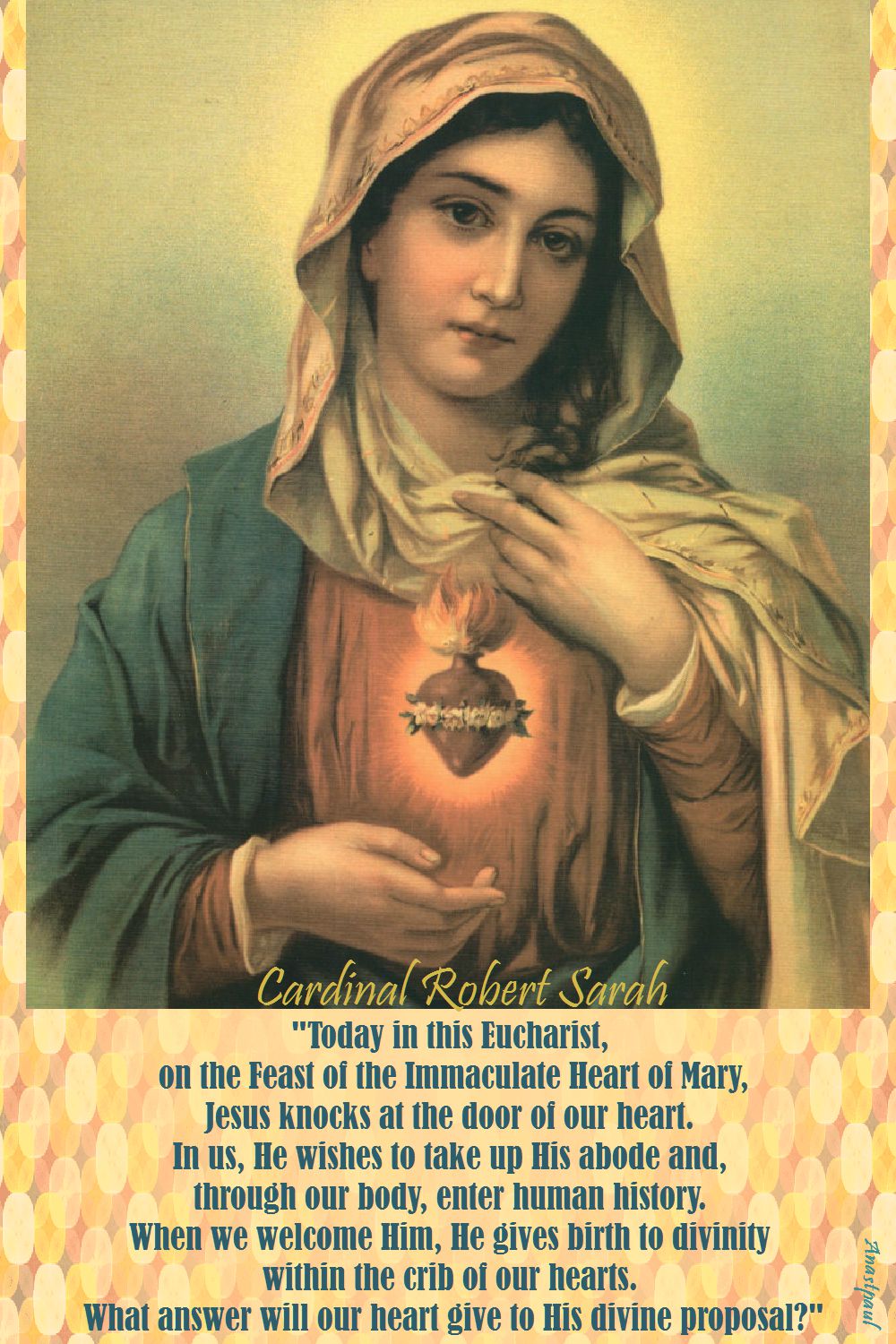
Today in this Eucharist, on the Feast of the Immaculate Heart of Mary, Jesus knocks at the door of our heart.   In us, He wishes to take up His abode and, through our body, enter human history.   When we welcome Him, He gives birth to divinity within the crib of our hearts.   What answer will our heart give to His divine proposal?”…..Cardinal Robert Sarah (16 June 2012)

tday in this eucharist-card robert sarah

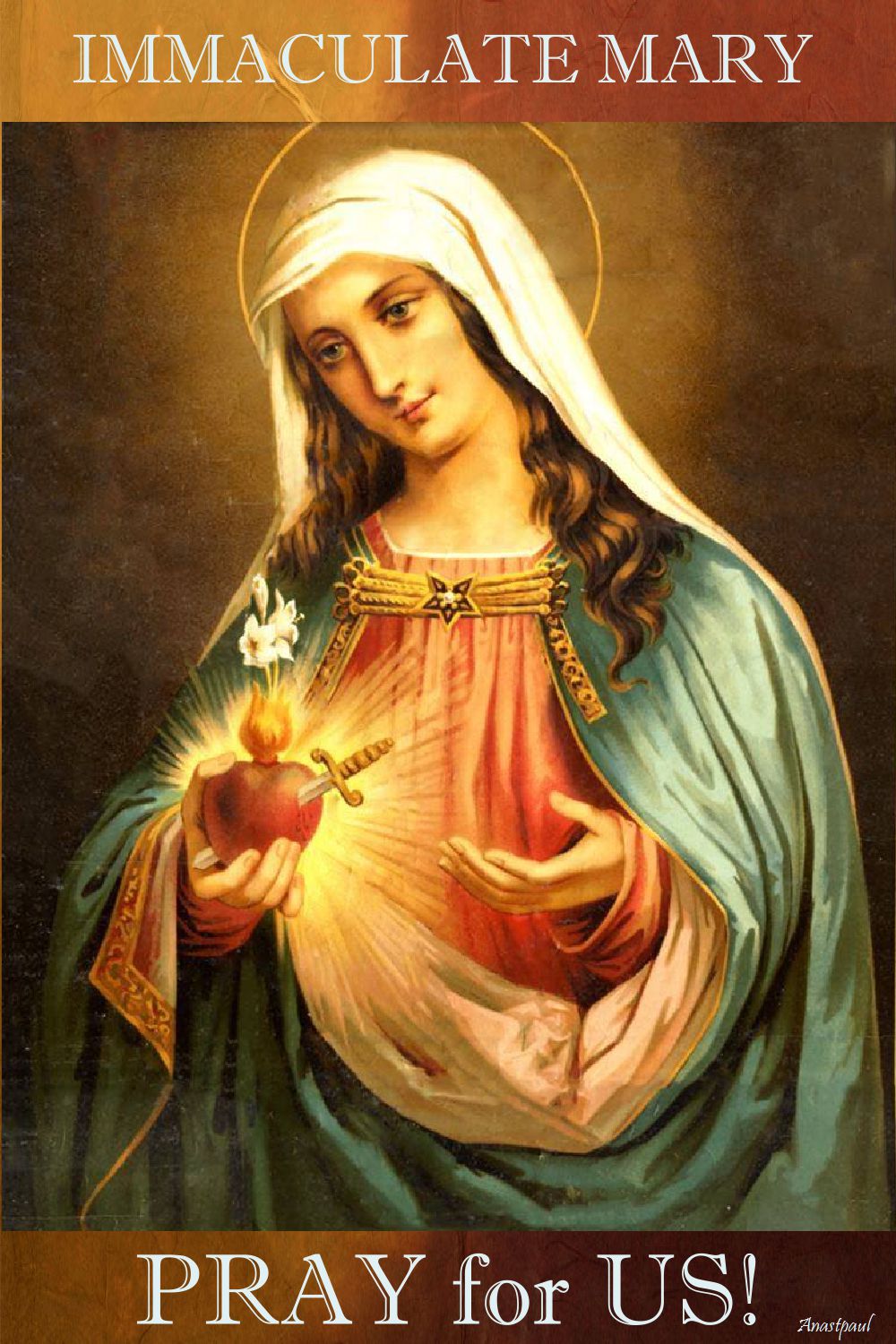
Immaculate Mary, Pray for us!
immaculate mary poray for us

Posted in DOCTORS of the Church, FEASTS and SOLEMNITIES, SACRED and IMMACULATE HEARTS, The BLESSED VIRGIN MARY

Quote/s of the Day – 24 June – The Solemnity of the Birthday of St John the Baptist and the Feast of the Immaculate Heart of Mary

Quote/s of the Day – 24 June 2017 – The Solemnity of the Birthday of St John the Baptist and the Feast of the Immaculate Heart of Mary

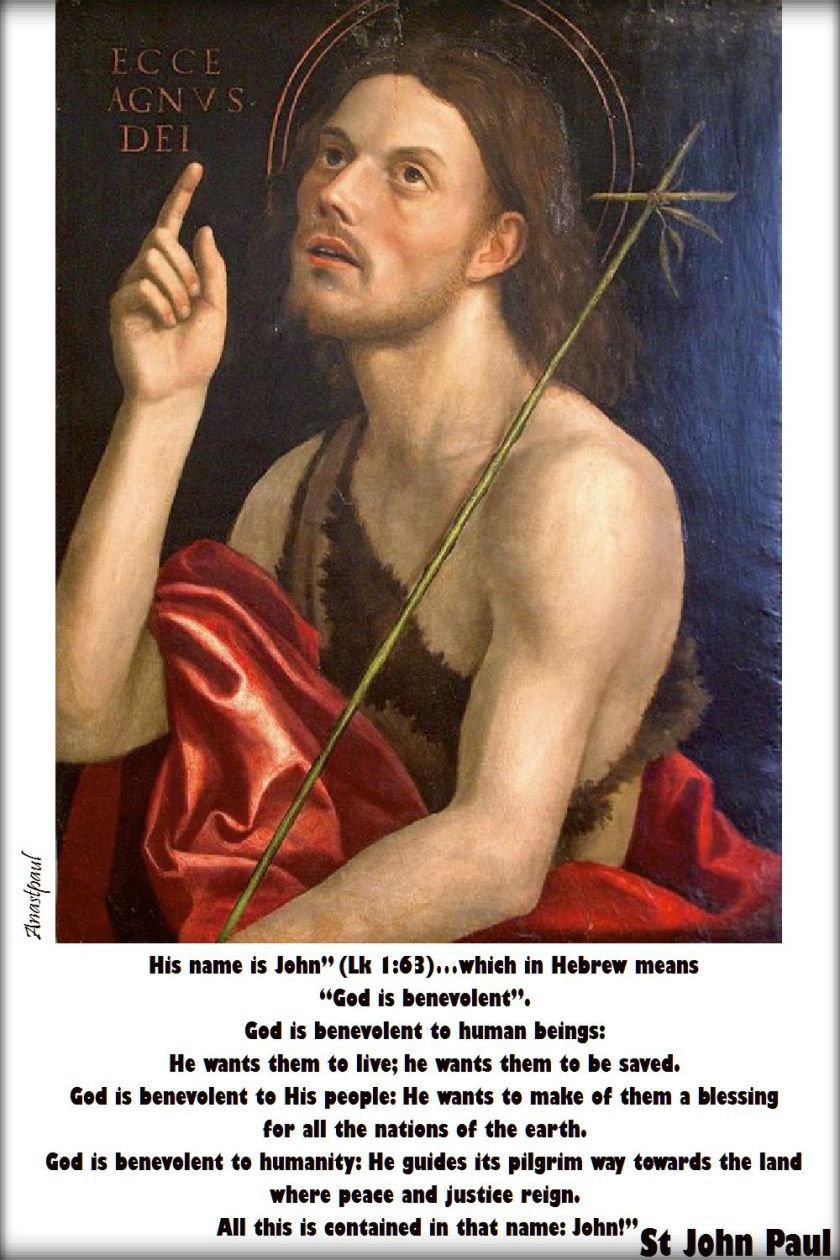
“His name is John” (Lk 1:63)…which in Hebrew means “God is benevolent”. God is benevolent to human beings:  He wants them to live; he wants them to be saved. God is benevolent to His people:  He wants to make of them a blessing for all the nations of the earth.   God is benevolent to humanity:  He guides its pilgrim way towards the land where peace and justice reign.   All this is contained in that name: John!”…St John Paul (24 June 2001)his-name-is-john-st-john-paul - 24 june 2017


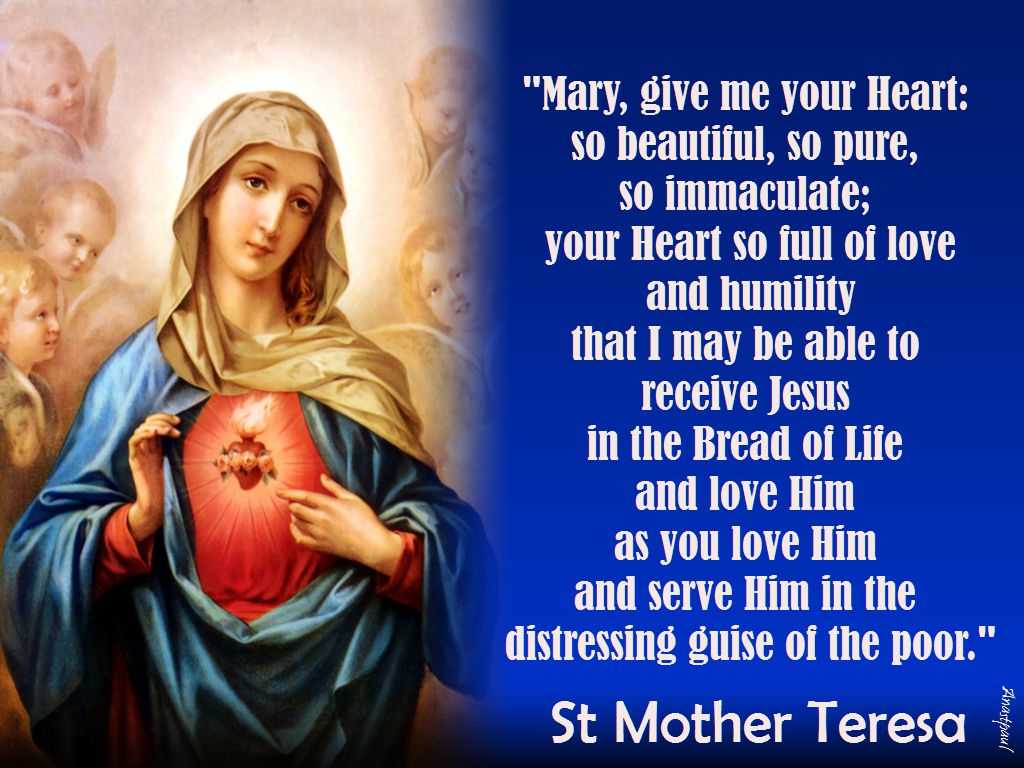
“Mary, give me your Heart: so beautiful, so pure, so immaculate; your Heart so full of love and humility that I may be able to receive Jesus in the Bread of Life and love Him as you love Him and serve Him in the distressing guise of the poor.”
–St Mother Teresa

mary give me your heart-st mother teresa


Posted in CATHOLIC DEVOTIONS of the Month, CATHOLIC-PRAYERS OF THE CHURCH, FEASTS and SOLEMNITIES, MORNING Prayers, SACRED and IMMACULATE HEARTS, The BLESSED VIRGIN MARY

Our Morning Offering – 4 June

Our Morning Offering – 4 June

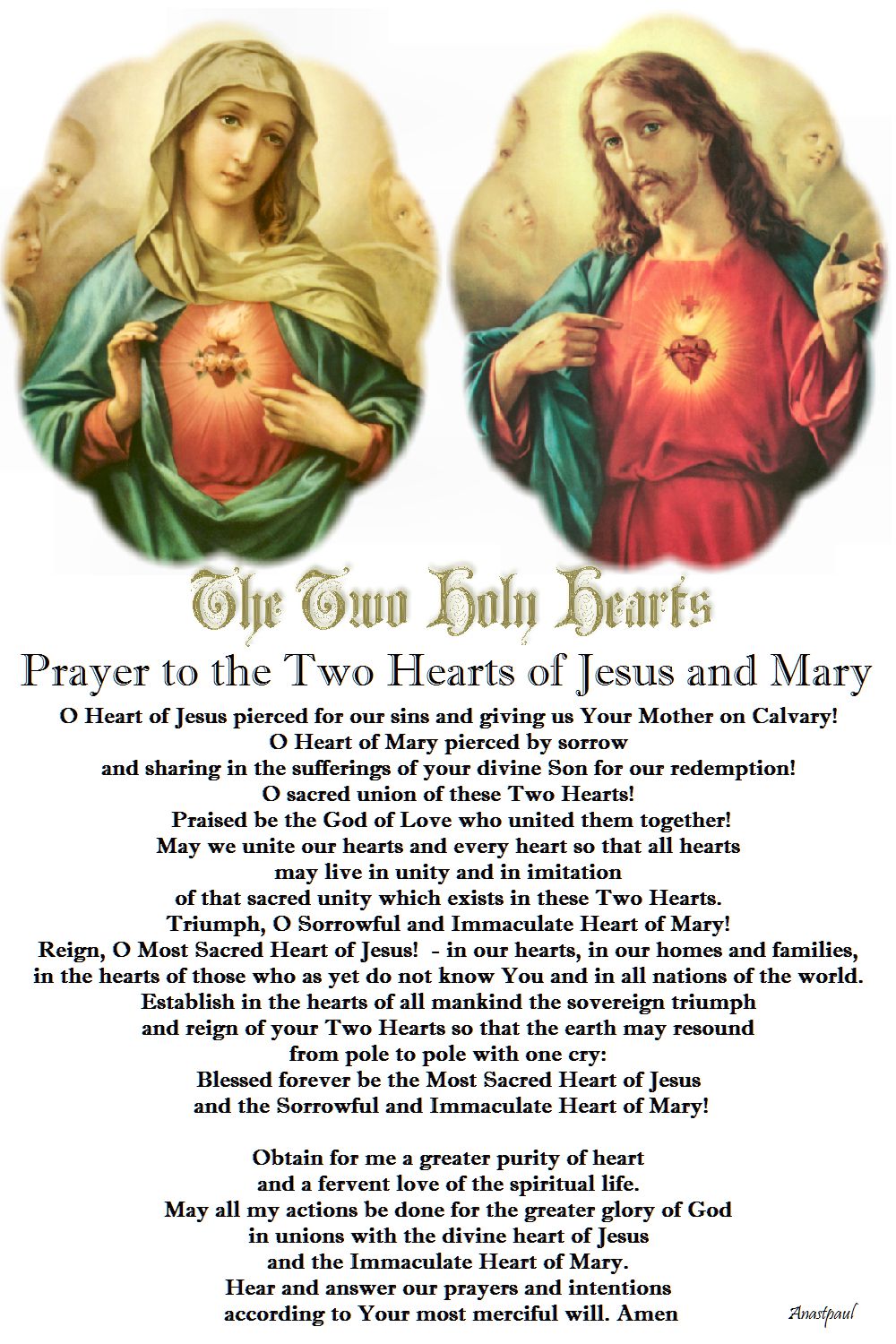
Prayer to the Two Hearts of Jesus and Mary

O Heart of Jesus pierced for our sins
and giving us Your Mother on Calvary!
O Heart of Mary pierced by sorrow
and sharing in the sufferings of your divine Son
for our redemption!
O sacred union of these Two Hearts!
Praised be the God of Love who united them together!
May we unite our hearts and every heart
so that all hearts may live in unity and in imitation
of that sacred unity which exists in these Two Hearts.
Triumph, O Sorrowful and Immaculate Heart of Mary!
Reign, O Most Sacred Heart of Jesus!
– in our hearts, in our homes and families,
in the hearts of those who as yet do not know You
and in all nations of the world.
Establish in the hearts of all mankind the sovereign triumph
and reign of your Two Hearts so that the earth may resound
from pole to pole with one cry:
Blessed forever be the Most Sacred Heart of Jesus
and the Sorrowful and Immaculate Heart of Mary!
Obtain for me a greater purity of heart
and a fervent love of the spiritual life.
May all my actions be done for the greater glory of God
in unions with the divine heart of Jesus
and the Immaculate Heart of Mary.
Hear and answer our prayers and intentions
according to Your most merciful will. Amen

Prayer to the Two Hearts of Jesus and Mary

Posted in FEASTS and SOLEMNITIES, MORNING Prayers

One Minute Reflection – 24 June

One Minute Reflection – 24 June

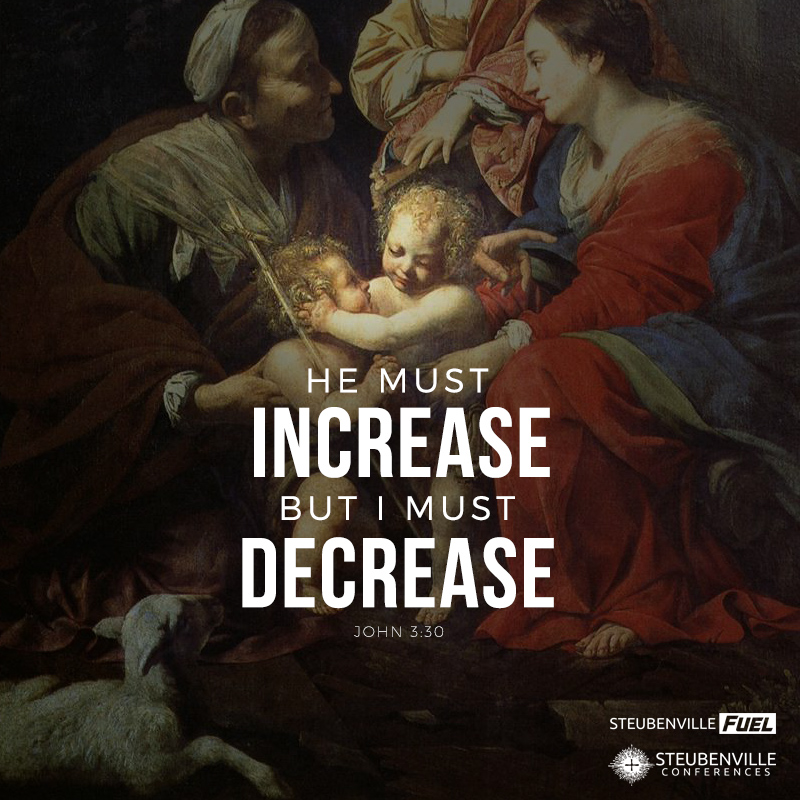
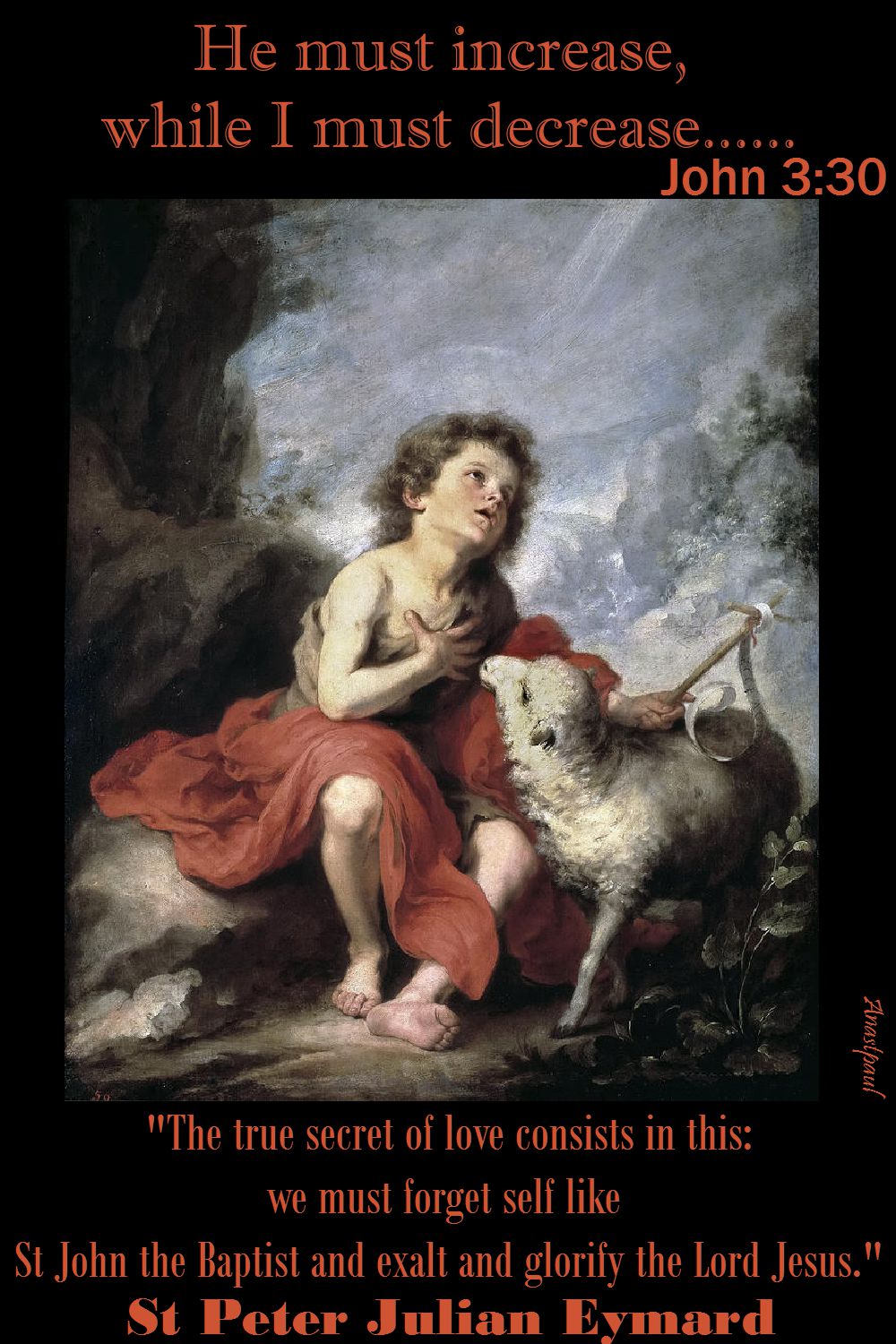
He must increase, while I must decrease………John 3:30

24Jun

REFLECTION – “The true secret of love consists in this:
we must forget self like S John the Baptist and exalt and glorify the Lord Jesus.”………..St Peter Julian Eymard

PRAYER – Almighty God, help me to put my self-interests in the background. Let me seek Your interests and do everything for the honour and glory of Your Son Jesus the Christ, amen.

the true secret of love-st peter julian eymard

Posted in FEASTS and SOLEMNITIES, SAINT of the DAY, The BLESSED VIRGIN MARY

The Feast of the Immaculate Heart of Mary – 24 June – the Saturday following the Feast of the Sacred Heart

The Feast of the Immaculate Heart of Mary – 24 June 2017 – the Saturday following the Feast of the Sacred Heart

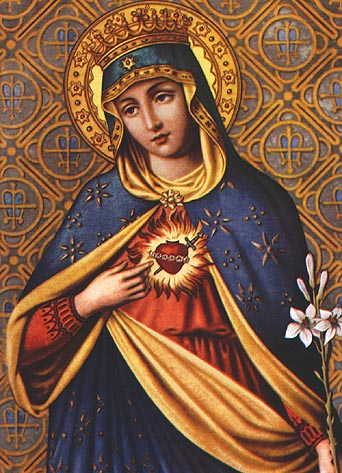
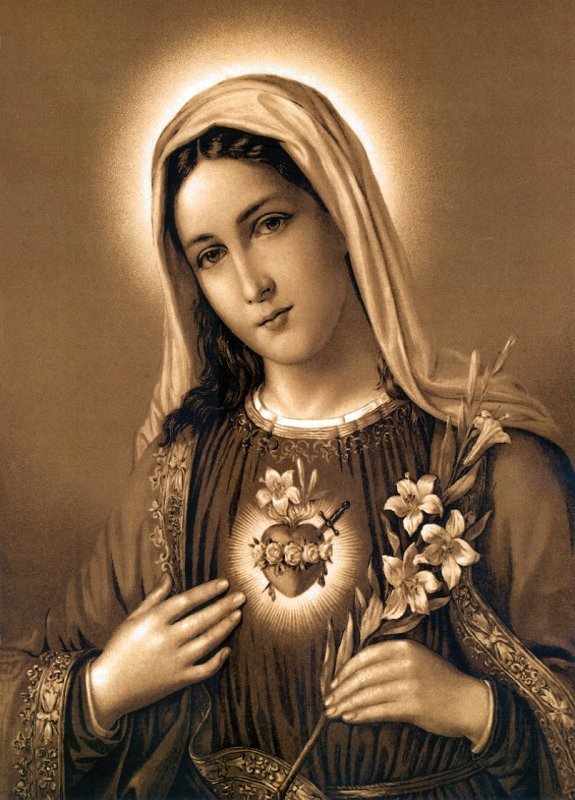
The Feast of the Immaculate Heart of Mary is a devotional name used to refer to the interior life of the Blessed Virgin Mary, her joys and sorrows, her virtues and hidden perfections and above all, her virginal love for God the Father, her maternal love for her son Jesus and her compassionate love for all persons.    Two elements are essential to the devotion, Mary’s interior life and the beauties of her soul and Mary’s virginal body.  According to Roman Catholic theology, soul and body are necessary to the constitution of man.   It was in 1855, that the Mass of the Most Pure Heart of Mary formally became a part of the Catholic practice.   Traditionally, the heart of Mary in artwork is depicted with seven wounds or swords, in homage to the seven sorrows of Mary.    Also, roses or another type of flower may be wrapped around the heart.

Veneration of the Immaculate Heart of Mary generally coincides with the worship of the Most Sacred Heart of Jesus.    However, there is a difference that explains the Roman Catholic devotion to the Immaculate Heart of Mary.    The devotion to the Sacred Heart of Jesus is especially directed to the “Divine Heart”, as overflowing with love for humanity.  In the devotion to the Immaculate Heart of Mary, on the other hand, the attraction is the love of her Immaculate Heart for Jesus and for God.immaculate-heart-of-mary

A second difference is the nature of the devotion itself.   In devotion to the Most Sacred Heart of Jesus, the Roman Catholic venerates in a sense of love, responding to love.   In devotion to the Immaculate Heart of Mary, love is formed from study and imitation of Mary’s yes to God as the mother of Jesus.    In this devotion, love is more the result, than the “object” of the devotion; the object being rather to love God and Jesus by uniting one’s self to Mary for this purpose and by imitating her virtues, to help one achieve this.

History of the devotion to the Immaculate Heart of Mary is connected in many ways to that of the Sacred Heart of Jesus.   Christians were drawn to the love and virtues of the Immaculate Heart of Mary, and this paved the devotion from the beginning.   Early Christians had compassion for the Virgin Mary and the Gospels recount prophecy delivered to her at Jesus’ presentation in the temple, and that her heart would be pierced with a sword.   The image of the Immaculate Heart of Mary with the pierced heart is the most popular representation.   St. John’s Gospel further invites us to the attention of Mary’s heart with its depiction of Mary at the foot of the cross at Jesus’ crucifixion.  St. Augustine tells us that Mary was more blessed in having born Christ in her heart, than in having conceived him in the flesh.

immacmary

b419cee6970e3b78ec91c071daabff83

The Alliance of the Hearts of Jesus and Mary

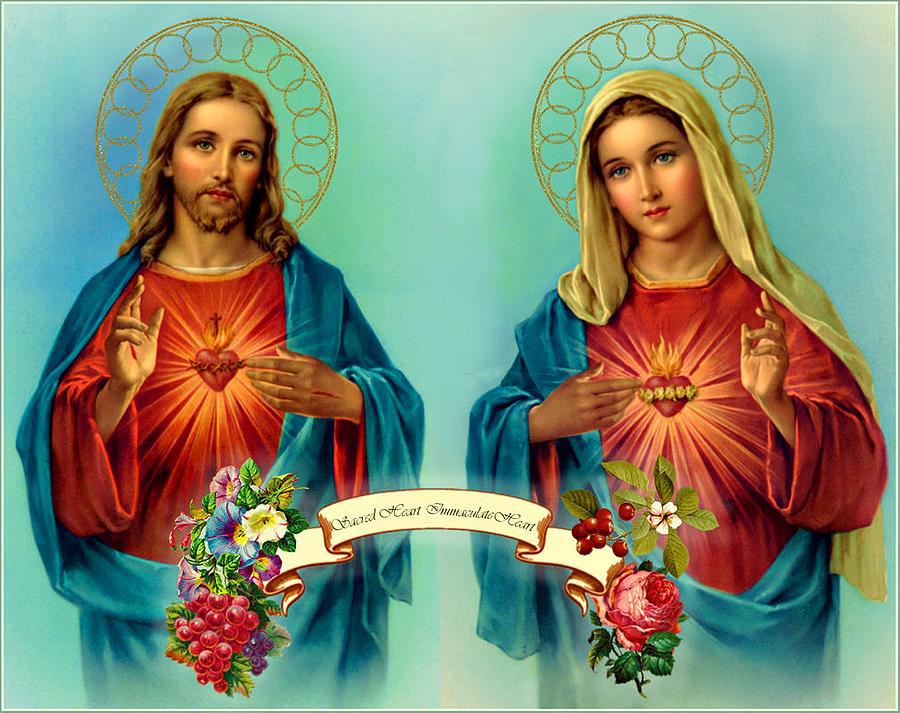
The Alliance of the Hearts of Jesus and Mary is based on the historical, theological and spiritual links in Catholic devotions to the Sacred Heart of Jesus and the Immaculate Heart of Mary.   The joint devotion to the hearts was first formalized in the 17th century by St. John Eudes who organized the scriptural, theological and liturgical sources relating to the devotions and obtained the approbation of the Church, prior to the visions of St. Margaret Mary Alacoque.

In the 18th and 19th centuries the devotions grew, both jointly and individually through the efforts of figures such as St. Louis de Montfort who promoted Catholic Mariology and St. Catherine Labouré’s Miraculous Medal depicting the Heart of Jesus thorn-crowned and the Heart of Mary pierced with a sword.   The devotions, and the associated prayers, continued in the 20th century, e.g., in the Immaculata prayer of St. Maximillian Kolbe and in the reported messages of Our Lady of Fátima which stated that the Heart of Jesus wishes to be honored together with the Heart of Mary.

The Popes have supported the individual and joint devotions to the hearts through the centuries;  in 1956 the encyclical Haurietis aquas, Pope Pius XII encouraged the joint devotion to the hearts,   In 1979 the encyclical Redemptor hominis, Pope John Paul II explained the theme of unity of Mary’s Immaculate Heart with the Sacred Heart.   In his Angelus address on 15th September 1985 he coined the term The Alliance of the Hearts of Jesus and Mary and in 1986 addressed the international conference on that topic held at Fátima, Portugal.

sacred-heart

Posted in FEASTS and SOLEMNITIES

Solemnity of The Nativity of Saint John the Baptist – 24 June

Solemnity of The Nativity of Saint John the Baptist – 24 June

Ordinarily the Church observes the day of a saint’s death as his feast, because that day marks his entrance into heaven.  To this rule there are two notable exceptions, the birthdays of Blessed Mary and of St John the Baptist.   All other persons were stained with original sin at birth, hence, were displeasing to God.   But Mary, already in the first moment of her existence, was free from original sin (for which reason even her very conception is commemorated by a special feast) and John was cleansed of original sin in the womb of his mother.   This is the dogmatic justification for today’s feast. In the breviary St. Augustine explains the reason for today’s observance in the following words:

“The Church observes the birth of John as in some way sacred;  and you will not find any other of the great men of old whose birth we celebrate officially.   We celebrate John’s, as we celebrate Christ’s.   This point cannot be passed over in silence and if I may not perhaps be able to explain it in the way that such an important matter deserves, it is still worth thinking about it a little more deeply and fruitfully than usual.

St. John the Baptist - Bernardo Strozzi 1620

John is born of an old woman who is barren;  Christ is born of a young woman who is a virgin.   That John will be born is not believed and his father is struck dumb;  that Christ will be born is believed and he is conceived by faith.

I have proposed some matters for inquiry and listed in advance some things that need to be discussed.   I have introduced these points even if we are not up to examining all the twists and turns of such a great mystery, either for lack of capacity or for lack of time. You will be taught much better by the one who speaks in you even when I am not here; the one about whom you think loving thoughts, the one whom you have taken into your hearts and whose temple you have become.

John, it seems, has been inserted as a kind of boundary between the two Testaments, the Old and the New.   That he is somehow or other a boundary is something that the Lord himself indicates when he says, The Law and the prophets were until John.   So he represents the old and heralds the new.   Because he represents the old, he is born of an elderly couple; because he represents the new, he is revealed as a prophet in his mother’s womb.   You will remember that, before he was born, at Mary’s arrival he leapt in his mother’s womb.   Already he had been marked out there, designated before he was born; it was already shown whose forerunner he would be, even before he saw him.   These are divine matters and exceed the measure of human frailty.   Finally, he is born, he receives a name and his father’s tongue is loosed.

Zachary is struck dumb and loses his voice, until John, the Lord’s forerunner, is born and releases his voice for him.   What does Zachary’s silence mean but that prophecy was obscure and, before the proclamation of Christ, somehow concealed and shut up?   It is released and opened up by his arrival, it becomes clear when the one who was being prophesied is about to come.   The releasing of Zachary’s voice at the birth of John has the same significance as the tearing of the veil of the Temple at the crucifixion of Christ. If John were meant to proclaim himself, he would not be opening Zachary’s mouth.   The tongue is released because a voice is being born – for when John was already heralding the Lord, he was asked, Who are you and he replied I am the voice of one crying in the wilderness.

John is the voice but the Lord in the beginning was the Word.   John is a voice for a time, but Christ is the eternal Word from the beginning.”

This reading on the Birth of John the Baptist is taken by a sermon of St. Augustine (Sermo 293, 1-3; PL 38, 1327-1328) that compares and contrasts Christ, the Word, with John, the voice who is the boundary between New and Old Covenants.   It is used in the Roman Office of Readings for June 24, the Solemnity of the Birth of John the Baptist.

In other words, today’s feast anticipates the feast of Christmas.   Taking an overall view, we keep during the course of the year only two mysteries, that of Christ’s Incarnation and that of His Redemption.   The Redemption mystery is the greater of the two; the Incarnation touches the human heart more directly.   To the Redemption mystery the entire Easter season is devoted, from Septuagesima until Pentecost;  and likewise every Sunday of the year, because Sunday is Easter in miniature.

The Christmas season has for its object the mystery of God-become-Man, to which there is reference only now and then during the remaining part of the year, e.g., on Marian feasts, especially that of the Annunciation (March 25) and today’s feast in honour of the Baptist.   In a sense, then, we are celebrating Christ’s incarnation today.   The birth of Jesus is observed on December 25 at the time of the winter solstice, while the birth of His forerunner is observed six months earlier at the time of the summer solstice.   Christmas is a “light” feast; the same is true today.   The popular custom centering about “St. John’s Fire” stems from soundest Christian dogma and could well be given renewed attention. St. John’s Fire symbolizes Christ the Light; John was a lamp that burned and shone. We Christians should be the light of the world.

Excerpted from The Church’s Year of Grace, Pius Parsch

Posted in FEASTS and SOLEMNITIES, SAINT of the DAY

Saints’ Memorials, Solemnity and Feast – 24 June

The Nativity of Saint John the Baptist (Solemnity) – https://www.youtube.com/watch?v=yXCySmXhue8
Feast of the Immaculate Heart of Mary
Madonna della Navicella
—
St Aglibert of Créteil
St Agoard of Créteil
St Alena of Brussels
St Amphibalus of Verulam
St Anastasia Guadalupe García Zavala
St Bartholomew of Farne
Bl Christopher de Albarran
St Erembert I of Kremsmünster
St Faustus of Rome and Companions
St Festus of Rome
St Germoc
St Gohardus of Nantes
Bl Henry of Auxerre/the Hagiographer
St Ivan of Bohemia
St John of Rome
St John of Tuy
St Joseph Yuan Zaide
Bl Maksymilian Binkiewicz
St Rumold
St Simplicio of Autun
Bl Theodgar of Vestervig
St Theodulphus of Lobbes
—
Martyrs of Satala: Seven Christian brothers who were soldiers in the imperial Roman army. They were kicked out of the military, exiled and eventually martyred in the persecutions of Maximian. We know little more about them than their names – Cyriacus, Firminus, Firmus, Longinus, Pharnacius, Heros and Orentius. The martyrdoms occurred in c311 at assorted locations around the Black Sea.