Visitation of the Blessed Virgin Mary (Feast)
Mary, Mediatrix of All Graces
—
Alexander of Auvergne
Camilla Battista Varano
Crescentian of Sassari
Donatian of Cirta
Felice of Nicosia
Galla of Auvergne
Hermias of Comana
Bl Jacob Chu Mun-mo
Bl James Salomone
Juan Moya Collado
Bl Kasper Gerarz
Lupicinus of Verona
Mancus of Cornwall
Bl Mariano of Roccacasale
Mechtildis of Edelstetten
Myrbad of Cornwall
Bl Nicolas Barré
Bl Nicholaus of Vangadizza
Bl Nicholaus of Vaucelles
Nowa Mawaggali
Paschasius of Rome
Petronilla of Rome
Bl Robert Thorpe
Silvio of Toulouse
Bl Thomas Watkinson
Bl Vitalis of Assisi
Winnow of Cornwall
—
Martyrs of Aquileia – 3 saints: Three young members of the imperial Roman nobility and who were raised in a palace and had Saint Protus of Aquileia as tutor and catechist. To escape the persecutions of Diocletian, the family sold their property and moved to Aquileia, Italy. However, the authorities there quickly ordered them to sacrifice to idols; they refused. Martyrs all – Cantianilla, Cantian and Cantius. They were beheaded in 304 at Aquae-Gradatae (modern San-Cantiano) just outside Aquileia, Italy
Martyrs of Gerona – 29 saints: A group of Christians martyred together in Gerona, Catalonia, Spain, date unknown. No details about them have survived but the names –
• Agapia
• Amelia
• Castula
• Cicilia
• Donatus
• Firmus
• Fortunata
• Gaullenus
• Germanus
• Honorius
• Istialus
• Justus
• Lautica
• Lupus
• Maxima
• Paulica
• Rogate
• Rogatus
• Silvanus
• Tecla
• Teleforus
• Tertula
• Tertus
• Victoria
• Victurinus
• Victurus
Martyrs of the Via Aurelia – 4 saints: Four Christians martyred together. No information about them has survived except their names – Justa, Lupus, Tertulla and Thecla. The martyrdom occurred in 69 on the Via Aurelia near Rome, Italy
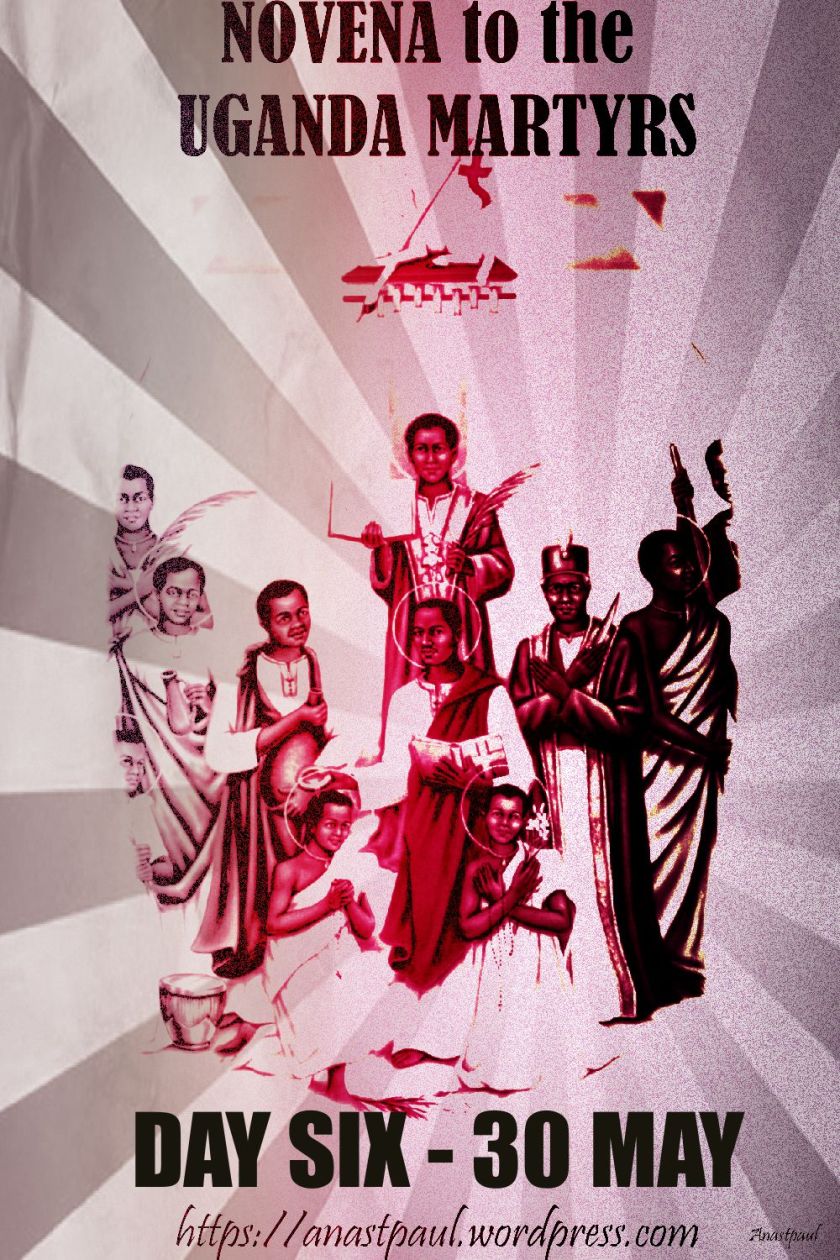
O God, who in Your love and mercy
was pleased to send missionaries to Uganda
to bring the light of Christ to all the peoples,
we thank You for the gift of the
Holy Martyrs of Uganda, our ancestors in faith,
whom You gave the strength to overcome sin and the
anguish of torture and to bear witness to the truth.
Mary, Queen of Africa!
Lead all people into the Lord’s Kingdom of holiness,
truth and life.
You who freely said “yes” to God
and became the Virgin Mother of His only Son,
remain ever close to your children in Uganda.
May they be reborn in hope,
and may God’s saving plan be fulfilled in them.
Through them, may all Africa come to know
and love the name of Jesus Christ our Saviour.
To the Holy Martyrs, we beg for intercession,
be pleased to hear our prayer and pray for us that this,
our special request may be granted
(make your intention)
Holy Martyrs of Uganda, we honour and praise you!
Please pray for us!
O heavenly Father, we make our prayer
through our Lord, Jesus Christ, in union with the Holy Spirit,
one God forever and ever, amen.
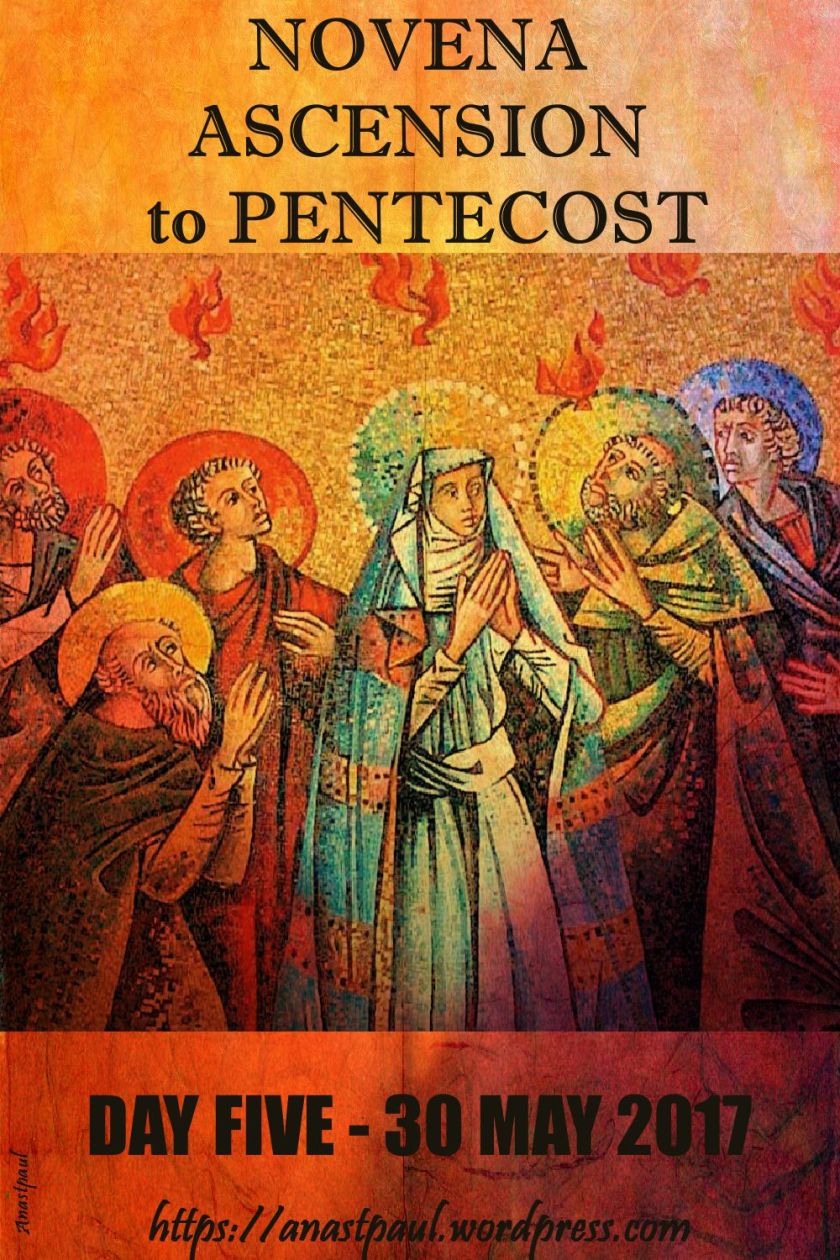
NOVENA from ASCENSION to PENTECOST DAY FIVE – TUESDAY 30 MAY 2017
The Holy Spirit Only one thing is important: eternal salvation. Only one thing, therefore, is to be feared: sin. Sin is the result of ignorance, weakness and indifference. The Holy Spirit is the Spirit of Light, of Strength and of Love. With His sevenfold gifts He enlightens the mind, strengthens the will and inflames the heart with the love of God. To ensure our salvation we ought to invoke the Divine Spirit daily, because the Spirit comes to us in our needs. When we don’t know what to say, it is the Spirit who speaks within us.
The Gift of Knowledge
The gift of Knowledge enables the soul to evaluate created things at their true worth ~ in their relation to God. Knowledge unmasks the pretence of creatures, reveals their emptiness and points out their only true purpose as instruments in the service of God. It shows us the loving care of God even in adversity and directs us to glorify Him in every circumstance of life. Guided by its light, we put first things first and prize the friendship of God beyond all else. “Knowledge is a fountain of life to him who possesses it.”
Prayer
Come and fill me, O Blessed Spirit of Knowledge and grant that I may perceive the will of the Father in all things, in every moment of every day. Give me an awareness of the pointlessness of earthly things and the ugliness of unholy desires, that I may stay pure in all my decisions and use the things of this world only if they bring You glory. Tell me what I need to know for my salvation and for the service of others. Amen
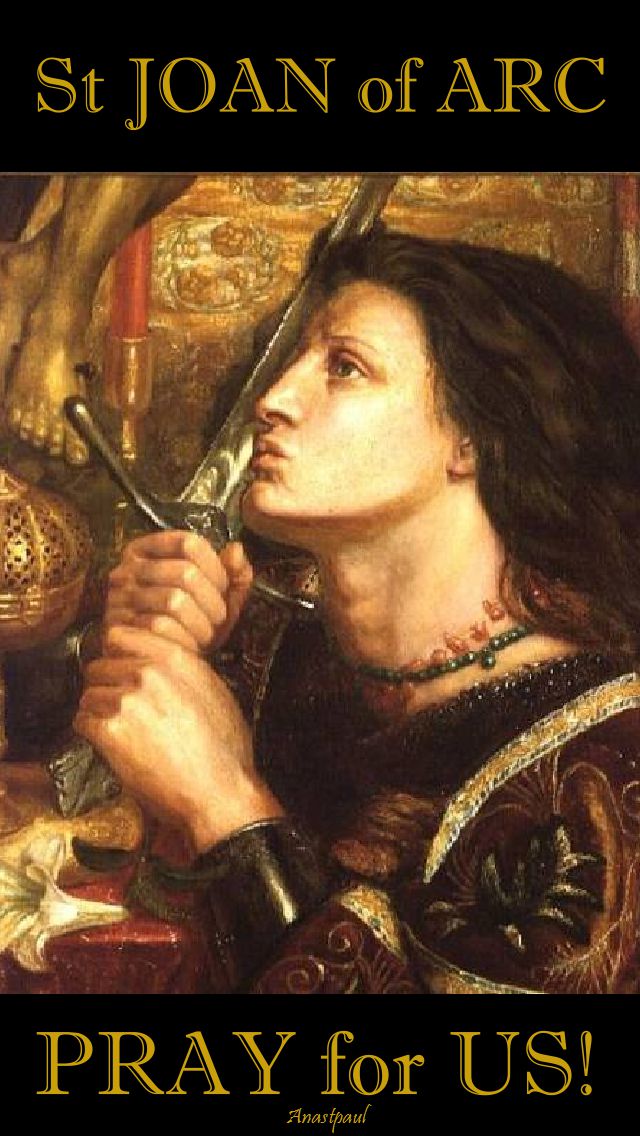
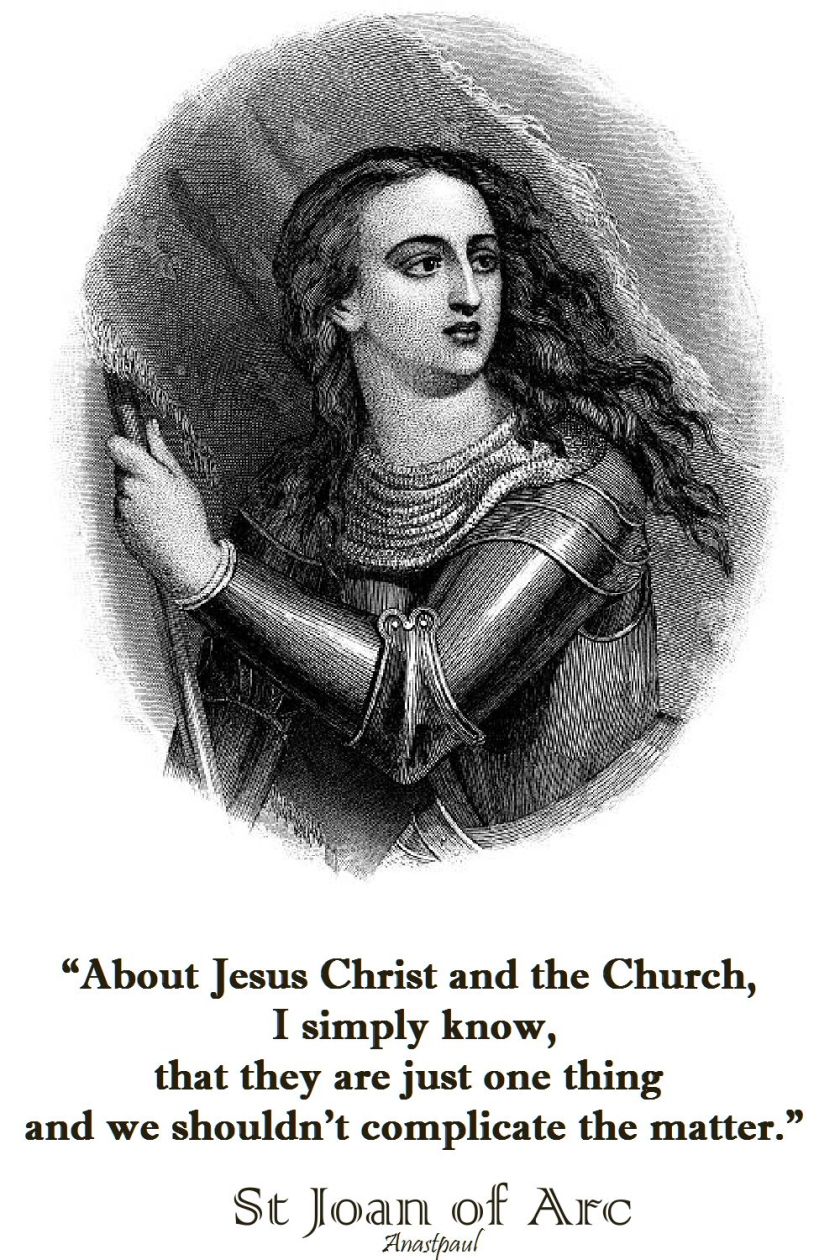
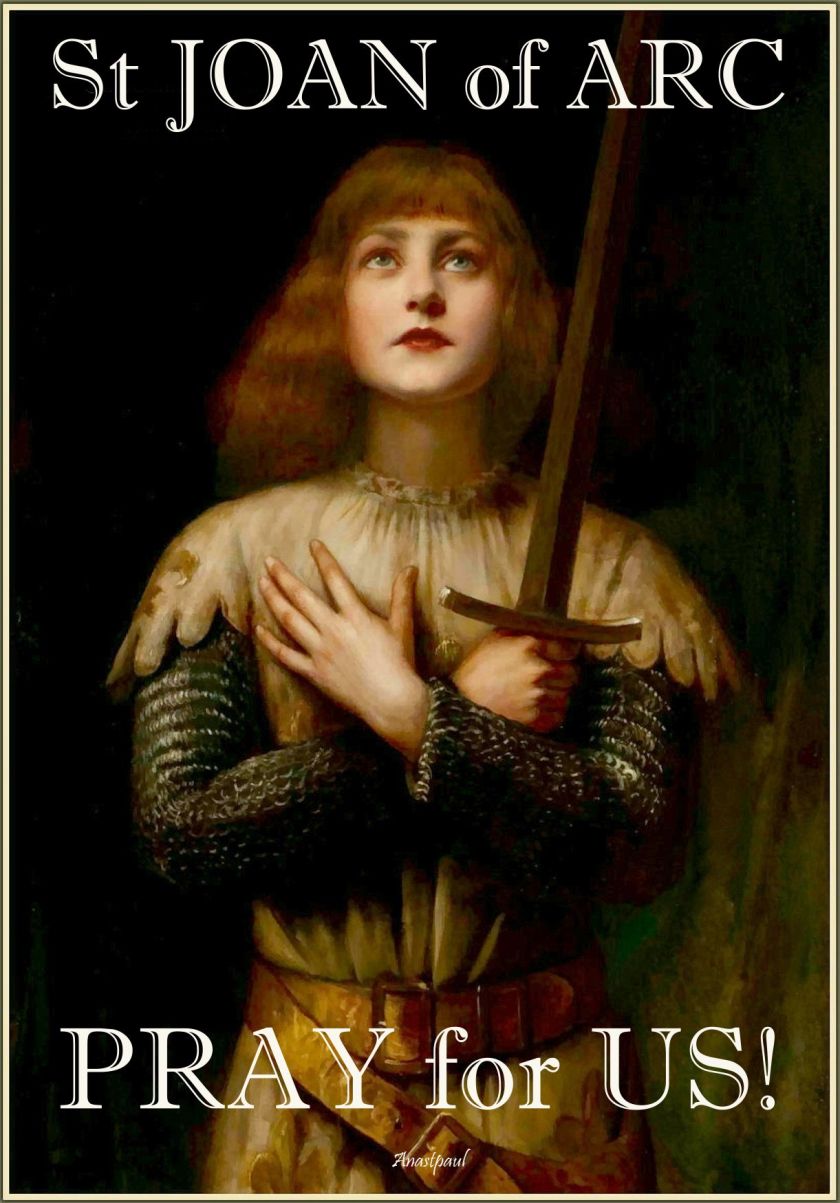
Like Jesus’ life, Joan of Arc’s life seemed to end in failure. But like Jesus, to love God means to always obey His will. She said with total confidence and abandonment: “I entrust myself to my Creator God, I love Him with my whole heart”. One of the best known texts of the first trial has to do with this: “Asked if she knew that she was in God’s grace, she replied: ‘If I am not, may it please God to put me in it; if I am, may it please God to keep me there’” It is this fidelity we should seek – this mission which Joan seemed to know would destroy her, still for her it was to carry out God’s work, regardless of the effects on her life. May we too seek this total fidelity and self-giving to God for this life of ours, it is not ours but has been given to us by grace of His love.
The spirit of the Lord shall rest upon him:
a spirit of wisdom and understanding……..Is 11:2
REFLECTION – “Those who are led by the Holy Spirit have a right concept of everything.
Hence, many unlettered people enjoy such knowledge more than the wise.”…………St John Vianney
“(St Joan of Arc) our saint lived prayer as a form of continuous dialogue with the Lord, who also enlightened her answers to the judges, giving her peace and security. She prayed with faith: “Sweetest God, in honour of your holy Passion, I ask You, if You love me, to reveal to me how I must answer these men of the Church”. Joan saw Jesus as the “King of Heaven and Earth.” Thus, on her standard, Joan had the image painted of “Our Lord who sustains the world”………..Pope Benedict XVI (2010)
PRAYER – Father if every good gift, send forth Your Spirit upon me with His sevenfold gifts. Grant that through my love for Your Son, I too may like St Joan of Arc, achieve the heights of the Christian life, make prayer the guiding thread of my days; fulfilling the will of God, whatever it is; to live in charity without favouritisms, without limits and have, as she had, in the love of Jesus, a profound love for the Church. St Joan of Arc, pray for us all, amen.
To You we Cry, O Queen of Mercy! By St Bernard of Clairvaux (1090-1153) Doctor mellifluus (Mellifluous Doctor)
To you we cry,
O Queen of Mercy!
Return, that we may
behold you dispensing favours,
bestowing remedies,
giving strength.
Ah, tender Mother!
Tell your all-powerful Son
that we have no more wine.
We are thirsty after the wine of His love,
of that marvelous wine
that fills souls with a holy inebriation,
inflames them,
and gives them the strength to despise
the things of this world
and to seek with ardor heavenly goods.
Amen
Saint of the Day – 30 May – St Joan of Arc (1412-1431) – Virgin (6 January 1412 at Greux-Domremy, Lorraine, France – burned alive on 30 May 1431 at Rouen, France) – Beatified 11 April 1905 by Pope Saint Pius X, Canonised on 16 May 1920 by Pope Benedict XV. Patron of France; martyrs; captives; military personnel; people ridiculed for their piety; prisoners; soldiers; opposition of Church authorities; WACs (Women’s Army Corps); WAVES (Women Appointed for Voluntary Emergency Service). Attributes – bareheaded girl in armour with sword, lance or banner.
The Church officially remembers Joan of Arc not as a Martyr but as a virgin—the Maid of Orleans. Of course, Joan was a Martyr, but not in the technical sense. Yes, she died because she did what she thought God wanted her to do. But she was killed for her politics, not for her faith. Pagans did not execute her for refusing to worship their gods. Infidels did not slay her for defying them. Political enemies burned her at the stake for defeating them at war.
Paradoxically, Christian people, good and bad alike, cheered at her demise. Other Christians wept. This incongruity may trouble us but Joan would have expected it. The war she fought embroiled French Christians against English Christians. We too have waged wars like that, pitting Christian against Christian. Just as we may have felt that God was on our side, Joan believed that God was with the French. When the judges who condemned her asked if the heavenly voices she followed to war spoke in English, she replied tartly, “Why should they speak English when they were not on the English side?”
Joan of Arc was born into the violent times of the fifteenth century. During her childhood, King Henry V of England invaded France and seized Normandy. He laid claim to the crown of the French king, Charles VI, who was mentally ill. Paralysed by civil war between the duke of Burgundy and the duke of Orleans, the French could not put up much of a defense. Things worsened when agents of the duke of Orleans murdered the duke of Burgundy. The Burgundians reacted by becoming England’s allies. Eventually, Burgundian mercenaries brought the war home to Joan’s family. The raiders sacked the little village of Domrémy-la-Pucelle, forcing them to flee. Thus, the indiscriminate brutality of war disrupted Joan of Arc’s pleasant childhood to acquaint her with fear.
Born of a fairly well-to-do peasant couple in Domremy-Greux southeast of Paris, Joan was only 12 when she experienced a vision and heard voices that she later identified as Saints Michael the Archangel, Catherine of Alexandria, and Margaret of Antioch.
By May 1428, Joan’s voices had become relentless and specific. They directed her to go at once to a town nearby and to offer her services to Robert de Baudricourt, the commander of the royal forces. Reluctantly, she obeyed. De Baudricourt, however, greeted her with laughter, telling her that her father should give her a good spanking.
At that time, conditions were deteriorating for the French. The English had put Orleans under siege, and the stronghold was in grave danger. Joan’s voices became more insistent. “But I am merely a girl! I cannot ride a horse or wield a weapon!”she protested.
“It is God who commands it!” came the reply.
Unable to resist any longer, Joan secretly made her way back to de Baudricourt. When she arrived she told the commander a fact she could have known only by revelation. She said the French army—on that very day—had suffered a defeat near Orleans. Joan urged him to send her to Orleans so that she might fulfill her mission. When official reports confirmed Joan’s word, de Baudricourt finally took her seriously and sent her to Charles VII.
She was outfitted with white armour and provided a special standard bearing the names Jesus and Mary. The banner depicted two kneeling angels offering a fleur-de-lis to God. On April 29, 1429, Joan led her army into Orleans. Miraculously, she rallied the town. By May 8, the French had captured the English forts and had lifted the siege. An arrow had penetrated the armour over Joan’s breast but the injury was not serious enough to keep her out of the battle. Everything, including the wound, occurred exactly as Joan had prophesied before the campaign. A peasant maiden had defeated the army of a mighty kingdom, a humiliation that demanded revenge.
The way to Reims was now open. Joan urged the immediate coronation of the king but the French leaders dragged their feet. Finally, however, at Reims on July 17, 1429, Charles VII was anointed king of France. The Maid of Orleans stood triumphantly at his side. Joan had accomplished her mission.
During the battles at Orleans, the voices had told Joan she had only a little time left. Her shameful end lurked ominously in the shadows. Later, she sustained a serious arrow wound in the thigh during an unsuccessful attack on Paris. In May 1430, after spending the winter in court, she led a force to relieve Compiègne, which the Burgundians had under siege. Her effort failed, and the Burgundians captured her.
Through the summer and fall, the duke of Burgundy held Joan captive. The French, apparently ungrateful, made no effort to rescue her or obtain her release. On November 21, 1430, the Burgundians sold Joan to the English for a large sum. The English were quite eager to punish the maiden who had bested them. They could not execute Joan for winning but they could impose capital punishment for sorcery or heresy. For several months she was chained in a cell in the castle at Rouen, where five coarse guards constantly taunted her. In February 1431, Joan appeared before a tribunal headed by Peter Cauchon, the avaricious and wicked bishop of Beauvais.
Joan had no chance for a fair trial. She stood alone before devious judges, an uneducated girl conducting her own defense. The panel interrogated her six times in public, nine times in private. They questioned her closely about her visions, voices, male dress, faith and submissiveness to the church. Giving good, sometimes even unexpectedly clever answers, Joan handled herself courageously. However, the judges took advantage of her lack of education and tripped her up on a few slippery theological points. The panel packed its summary with her damaging replies and condemned her with that unfair report. They declared that demons inspired her revelations. The tribunal decided that unless Joan recanted, she was to die as a heretic. At first she refused. But later, when she was taken before a huge throng, she seems to have made some sort of retraction.
Cauchon visited her, observed her dress,and determined that she had fallen back into error. Joan, her strength renewed, then repudiated her earlier retraction. She declared that God had truly commissioned her and that her voices had come from him. Having condemned Joan of Arc as a relapsed heretic, the judges remanded her to the state for execution. The next morning she was taken into Rouen’s public square and burned at the stake.
Twenty-three years later, however, Joan’s mother and brothers asked that her case be reopened. Pope Callistus III appointed a commission to review the matter. In 1456, the new panel repudiated the trial and verdict and completely restored Joan’s reputation. Once again her piety and exemplary conduct had triumphed.
St Anastasius II of Pavia
St Basil the Elder
Bl Carlo Liviero
St Crispulus of Sardinia
Bl Elisabeth Stagel
St Emmelia
St Euplius
St Exuperantius of Ravenna
St Pope Felix ISt
Ferdinand III of Castille
St Gamo of Brittany
St Gavino of Sardinia
St Issac of Constantinople
St Joan of Arc
St Joseph Marello
Bl Lawrence Richardson
St Luke Kirby
St Madelgisilus
Bl Marie-Céline of the Presentation
Bl Otto Neururer
St Reinhildis of Riesenbeck
St Restitutus of Cagliari
Bl Richard Newport
Bl Thomas Cottam
St Venantius of Lérins
St Walstan of Bawburgh
Bl William Filby
Bl Willilam Scott
—
Martyrs of Aquileia – 3 saints: Three Christians martyr together. We have no other details than their names – Cantianus, Euthymius and Eutychius. Aquileia, Italy
Celebrating the Memorial of BL JOSEPH GéRARD O.M.I. – 29 May Priest and Missionary, Apostle to Lesotho (12 March 1831-29 May 1914 aged 83) – Patron of Missionaries.
Joseph Gerard was born in 1831 in Bouxieres-aux-Chenes in the Diocese of Nancy, France. He joined the Missionary Oblates of Mary Immaculate at the age of 20 and at the age of 22 was sent by St Eugene de Mazenod (https://anastpaul.wordpress.com/?s=St+Eugene+de+Mazenod) as a missionary to Southern Africa, never to see his family or homeland again. He was ordained a priest in 1854 in Pietermaritzburg and at first served the Oblate mission to the Zulu people, later joining Bishop Allard, the Bishop of Natal, in setting up the first Catholic mission in Lesotho. With the permission of the great Chief Moshoeshoe they founded Motse-oa-Ma-Jesu (the Village of the Mother of Jesus) thirty two kilometres south of Moshoeshoe’s stronghold of Thaba Bosiu. (The village which they founded later became Roma, site of the Catholic University College and now the University of Lesotho.)
Joseph Gerard was well respected by Chief Moshoeshoe, particulaly because he remained with the Basotho during the three wars between the Basotho and the Orange Free State. It is said that it was through Joseph Gerard’s efforts that Chief Moshoeshoe sought the protection of the British at the end of the wars, a decision which resulted in Lesotho becoming a British Protectorate and an Independent country today.
Joseph Gerard’s mission grew slowly and by the end of 1879, when he was already 48 years of age, there were only 700 Catholics in Lesotho. He persevered, however in prayer, faith and work, remaining in Lesotho as a missionary for the rest of his life.
Early beginnings at the
Village of the Mother Of Jesus
The Oblate mission to the Basotho grew and flourished. He died on 29th May 1914 at the age of 83, a man greatly revered by the people of Lesotho. The fact that Lesotho is very largely a Catholic country today can be traced back to those early beginnings at the Village of the Mother of Jesus.
The beatification process commenced under Pope Pius XII on 1 March 1955 and he became titled as a Servant of God while the confirmation of his life of heroic virtue allowed for Pope Paul VI to name him as Venerable on 13 November 1976. The miracle required for his beatification was investigated and later received validation from the Congregation for the Causes of Saints on 14 March 1986; a medical board approved it on 3 December 1986 as did theologians on 13 March 1987 and the C.C.S. members on 19 May 1987. Pope John Paul II approved this miracle on 1 June 1987 and beatified the late priest while on his visit to Lesotho on 15 September 1988. The current postulator for this cause is the O.M.I. priest Thomas Klosterkamp
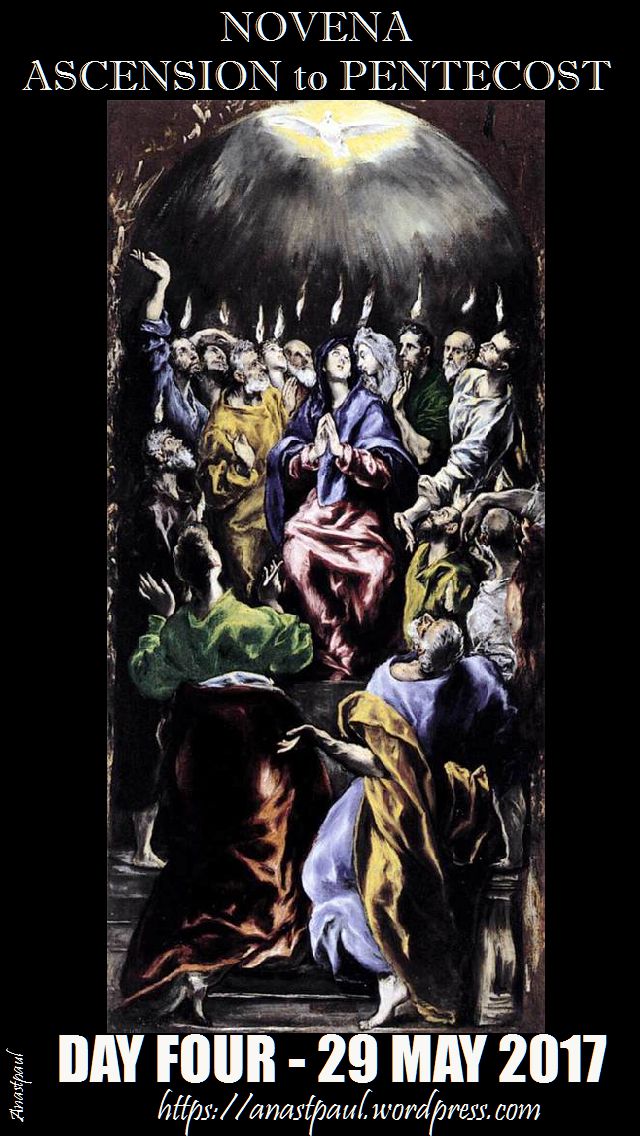
NOVENA from ASCENSION to PENTECOST DAY FOUR – MONDAY 29 MAY 2017
The Holy Spirit Only one thing is important: eternal salvation. Only one thing, therefore, is to be feared: sin. Sin is the result of ignorance, weakness and indifference. The Holy Spirit is the Spirit of Light, of Strength and of Love. With His sevenfold gifts He enlightens the mind, strengthens the will and inflames the heart with the love of God. To ensure our salvation we ought to invoke the Divine Spirit daily, because the Spirit comes to us in our needs. When we don’t know what to say, it is the Spirit who speaks within us.
The Gift of Fortitude
By the gift of Fortitude the soul is strengthened against natural fear and supported to the end in the performance of duty. Fortitude provides us an impulse and energy which moves us to undertake without hesitancy the most arduous tasks, to face dangers, to disregard human glory and to endure without complaint the hardships and difficulties that life brings in its various circumstances and situations. “He who endures to the end shall be saved.”
Prayer
Come and fill me, O Blessed Spirit of Fortitude. Protect my soul in times of trouble and adversity. Sustain my efforts in holiness, strengthen me in my weakness and give me courage against all the assaults and temptations of my enemies, that I may not be overcome and separated from you, my God and greatest Good. Amen.
O God, who in Your love and mercy
was pleased to send missionaries to Uganda
to bring the light of Christ to all the peoples,
we thank You for the gift of the
Holy Martyrs of Uganda, our ancestors in faith,
whom You gave the strength to overcome sin and the
anguish of torture and to bear witness to the truth.
Mary, Mother of Sorrows!
Look with mercy on those who suffer.
Be close to the victims of violence and terror,
and console those who mourn.
May Jesus your Son grant comfort
and peace to all the sick and dying,
and may He strengthen those
devoted to their physical and spiritual care.
To the Holy Martyrs, we beg for intercession,
be pleased to hear our prayer and pray for us that this,
our special request may be granted
(make your intention)
Holy Martyrs of Uganda, we honour and praise you!
Please pray for us!
O heavenly Father, we make our prayer
through our Lord, Jesus Christ, in union with the Holy Spirit,
one God forever and ever, amen.
Today, the congregation founded by Mother Ursula continues its work around the world, numbering at approximately 900 nuns and 100 communities in 12 countries including Poland, Italy, France, Germany, Finland, Belarus, Ukraine, Canada, Brazil, Argentina and Tanzania. St Ursula educated her sisters to love God above all things and to see God in every human person and all creation. As a shining example of faith and complete trust in the Lord, she demonstrated her confidence through tireless work, constant smile, serenity of spirit, humility and the desire to live an ordinary life as a privileged path to holiness. Throughout her life, during a difficult political period, including the First World War, Julia maintained a constant focus on helping the poor, displaced and forgotten. When questioned about her political views, often at risk to her own life, she simply and repeatedly replied, “My policy is love.”
And there we have it – so often told us, most importantly by our Lord, the answer is clear – to be saints, our policy has to be LOVE!
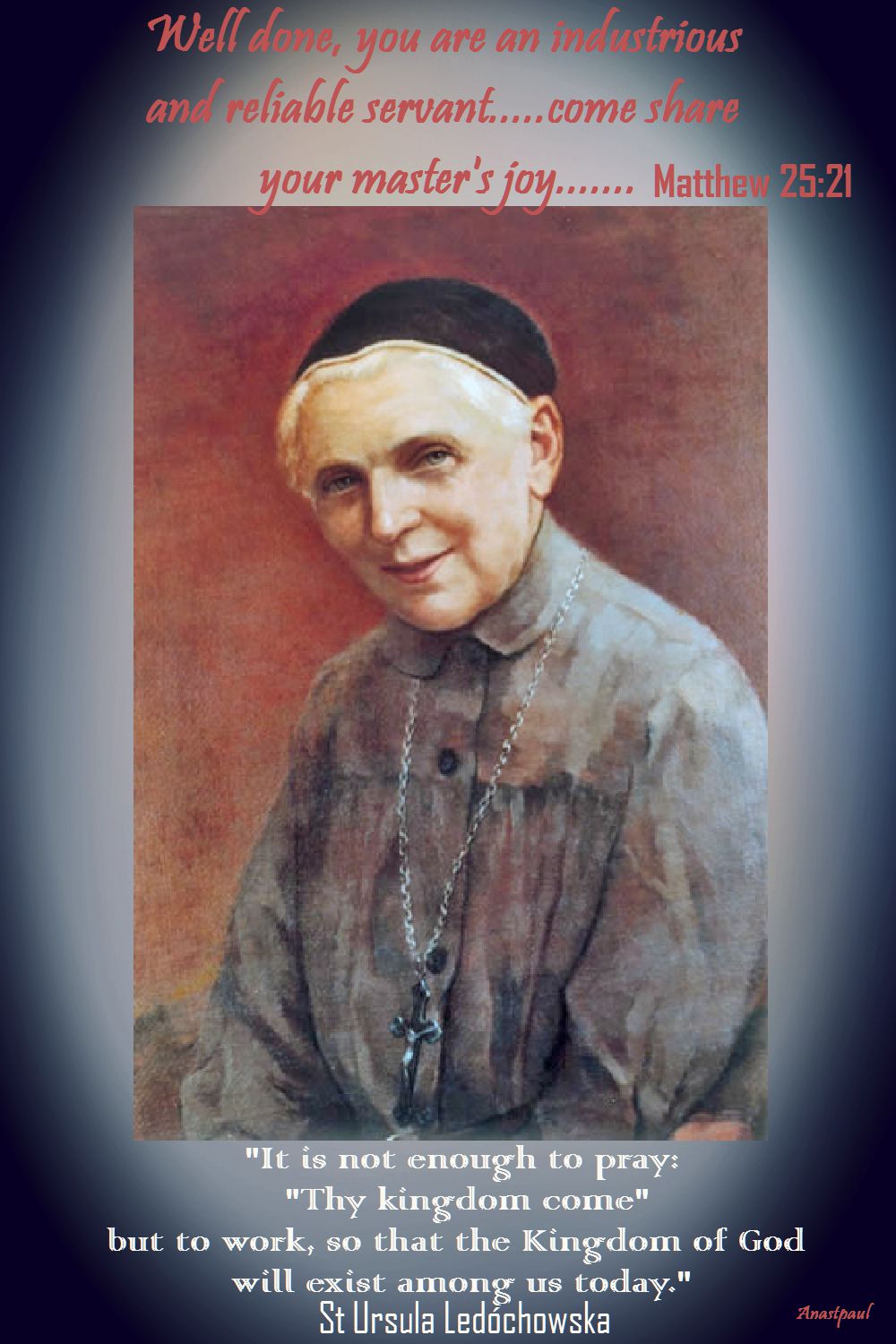
Well done, you are an industrious and reliable servant…..come share your master’s joy……..Matthew 25:21
REFLECTION – “It is not enough to pray: “Thy kingdom come” but to work, so that the Kingdom of God will exist among us today.”…………St Ursula Ledóchowska
PRAYER – Heavenly Father, help me to accept the tasks you have given me to do in life. Let me be faithful all my days and be able to attain Your eternal reward in heaven. St Ursula Ledóchowska, you accepted all work given you, no matter the circumstances and undergoing immense hardships to fulfil your mission and do the work of God, please pray for us, that we too, may be faithful at all times and in all circumstances, amen.
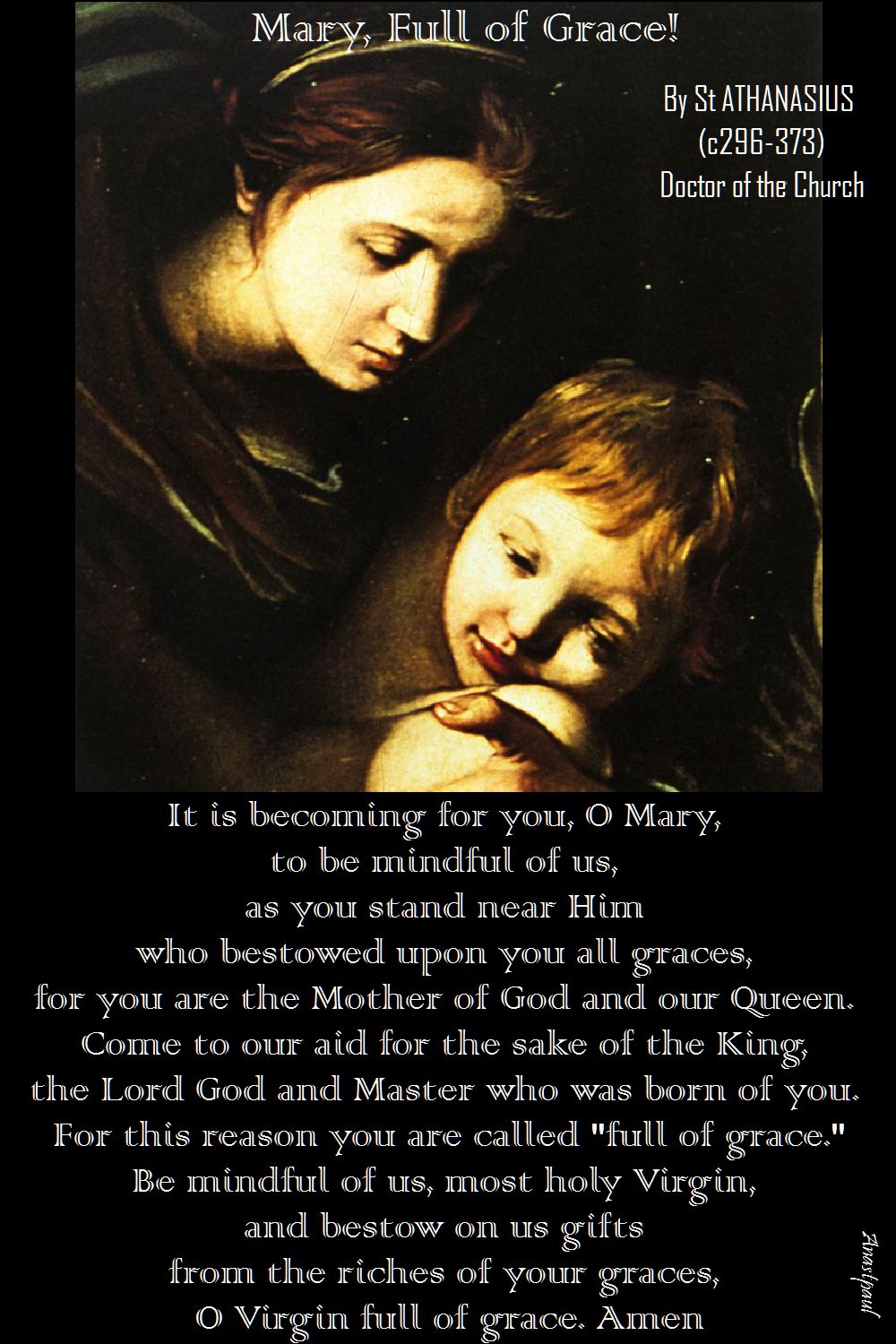
Mary, Full of Grace! By St ATHANASIUS (c296-373) Doctor of the Church
It is becoming for you, O Mary,
to be mindful of us,
as you stand near Him
who bestowed upon you all graces,
for you are the Mother of God and our Queen.
Come to our aid for the sake of the King,
the Lord God and Master who was born of you.
For this reason you are called “full of grace.”
Be mindful of us, most holy Virgin,
and bestow on us gifts
from the riches of your graces,
O Virgin full of grace. Amen
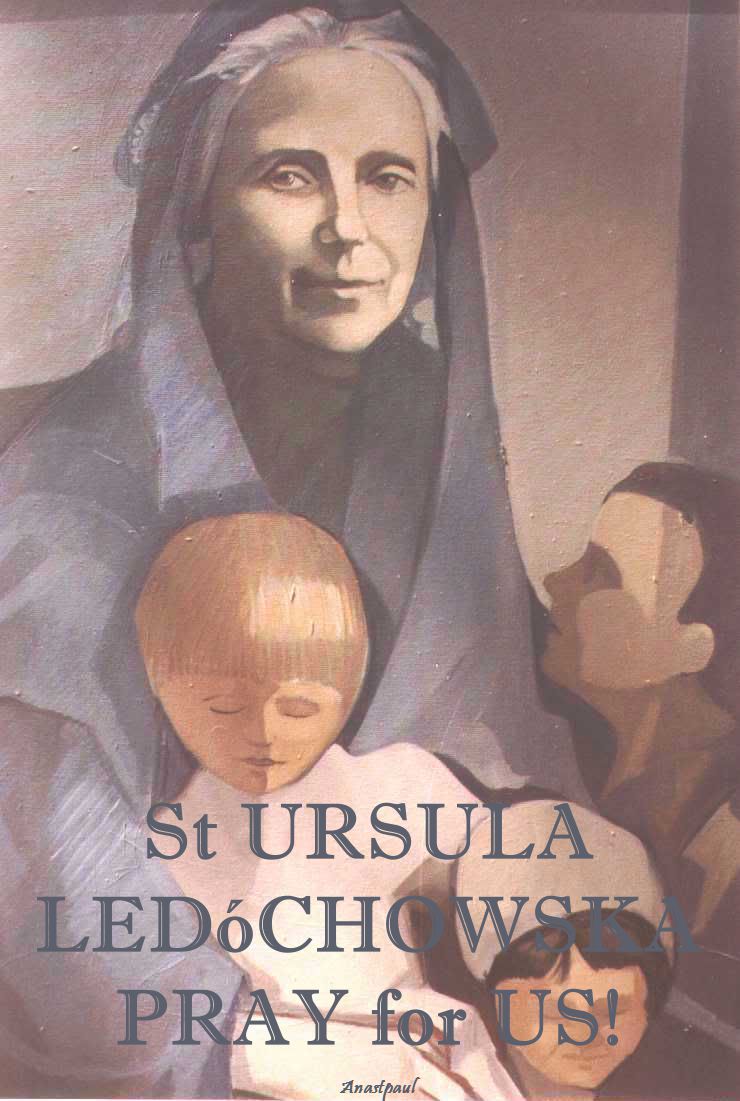
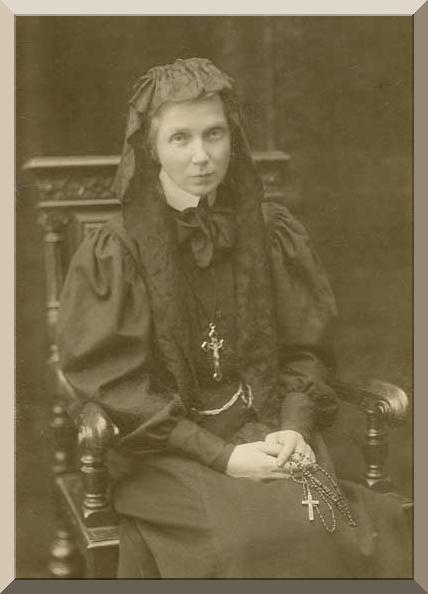
Saint of the Day – 29 May – St Ursula Ledóchowska (1865-1939) religious name – Maria Ursula of Jesus – Religous and Foundress of the Institute of Ursuline Sisters of the Sacred Heart of Jesus in Agony (17 April 1865 at Loosdoor, Austria as Julia Ledóchowska – 29 May 1939 in the Gray Ursuline convent, Via del Casalet, Rome, Italy of natural causes) . Canonised 18 May 2003 by Pope John Paul II at Vatican Basilica. Her body is incorrupt, it was transferred to the Gray Ursuline motherhouse in Pniewy, Poland on 29 May 1989.
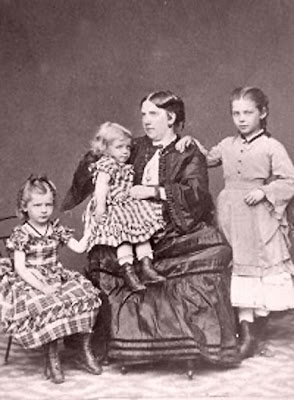
Born in Austria, Julia was born into a privileged family, the daughter of a Polish count and a Swiss noblewoman. She was one of five children born into the family. Her elder sister, Blessed Maria Teresa Ledóchowska, founded the Missionary Sisters of Saint Peter Claver and is affectionately known as the “Mother of Africa.”
Julia (at left), her mother, and sisters
Julia’s uncle, the Cardinal Mieczyslaw Ledóchowski, the Primate of Poland, was persecuted and imprisoned for his opposition to the policies of the Prussian “culture war.” For this reason and for reasons of finances, Julia’s father moved the family back to his native Poland, where he fell ill. Before his death, he gave his daughter his blessing to enter the Convent of Ursuline Sisters in Krakow. Taking the name of Maria Ursula of Jesus, she dedicated herself to service of those in need. Sister Maria Ursula was especially drawn to youth, specifically young women who were in need of education. She founded the first Polish residence for female university students and both watched over them and assisted them in their spiritual and academic studies.
Sister Maria Ursula became prioress of the convent in which she lived and later received a request from Monsignor Constantine Budkiewicz, a Polish nobleman living and priest of Saint Catherine’s Church. His wish was for Mother Maria Ursula to found a boarding school in Russia, for Polish girls wishing to study in Saint Petersburg. Having received approval from Pope Saint Pius X, she traveled to Russia and founded a convent there to work among Catholic immigrants. Given the state of Russian politics at that time, the nuns wore lay clothing and conducted themselves appropriately, but were under constant threat and surveillance by the Russian secret police.
As World War I dawned, Mother Ursula was expelled from Russia, given her Austrian birth. Monsignor Budkiewicz was eventually martyred for the faith, during the fall and renaming of Saint Petersburg as Leningrad. Having been expelled from Russia, Mother Ursula fled to Sweden. There, she organised relief efforts for war victims, charitable enterprises for those (like herself) living in exile from Poland. She further founded a monthly Catholic newspaper.
In 1920, Mother Ursula and her growing community made its way back into Poland, bringing with her dozens of orphaned youth. Upon their return, Mother Ursula found that her community had developed a separate and unique identity, mission and charism from the Ursuline community, given their exile and separation and as a result, she founded her own congregation: The Institute of Ursuline Sisters of the Sacred Heart of Jesus in Agony. Having obtained Vatican approval, she dedicated herself and her congregation to “the education and training of children and youth and service to the poorest and the oppressed among our brethren.”
From that time on, the Ursulines founded congregations in working class towns, organizing a “Eucharistic Crusade” by which to educate the factory workers and their families in the ways of the faith. With tireless energy and faith, Mother Ursula continued to lead her community until 1939, when she passed away quietly at the general house of her community in Rome. Her incorrupt body was translated to the Gray Ursuline motherhouse in Pniewy, Poland in 1989. She was canonised in 2003 by Pope John Paul II. At her canonization, the pontiff proclaimed:
“Mother Ursula Ledóchowska made her life a mission of mercy for the most deprived. Wherever Providence took her, she found young people in need of instruction and spiritual formation, poor, sick or lonely people, battered by life in various ways, who expected of her understanding and concrete help. In accordance with her means, she never refused help to anyone. Her work of mercy will remain engraved forever in the message of holiness, which yesterday became part of the whole Church.”
Miracles
The first miracle that led to her beatification involved the cure of Jan Kołodziejski on 26 March 1946 while the second miracle leading to beatification involved the cure of the nun (from Ledóchowska’s own order) Magdalene Pawlak (in religious “Maria Danuta”) on 16 April 1946. The decisive miracle that led to her canonisation was the cure of Daniel Gajewski (b. 1982) who avoided electrocution in circumstances where he would otherwise would have been killed had it not been for the late nun whom he saw moments before fading into unconsciousness on 2 August 1996.
St Bona of Pisa
St Conon the Elder
St Conon the Younger
St Daganus
St Eleutherius of Rocca d’Arce
St Felix of Atares
St Gerald of Mâcon
Bl Gerardesca of Pisa
Bl Giles Dalmasia
St Hesychius of Antioch
St John de Atarés
BL Joseph Gerard
St Maximinus of Trier
St Maximus of Verona
St Restitutus of Rome
Bl Richard Thirkeld
St Theodosia of Caesarea and Companions
St Ursula Ledochowska
St Votus of Atares
St William of Cellone
—
Martyrs of Toulouse: A group of eleven Dominicans, Franciscans, Benedictines, clergy and lay brothers who worked with the Inquisition in southern France to oppose the Albigensian heresy. Basing their operations in a farmhouse outside Avignonet, France, he and his brother missioners worked against heresy. Murdered by Albigensian heretics while singing the Te Deum on the eve of Ascension. They werebeaten to death on the night of 28 to 29 May 1242 in the church of Avignonet, Toulouse, France and Beatified on 1 September 1866 by Pope Pius IX (cultus confirmation).
• Adhemar
• Bernard of Roquefort
• Bernard of Toulouse
• Fortanerio
• Garcia d’Aure
• Pietro d’Arnaud
• Raymond Carbonius
• Raymond di Cortisan
• Stephen Saint-Thibery
• William Arnaud
• the prior of Avignonet whose name unfortunately has not come down to us.
The church in which they died was placed under interdict as punishment to the locals for the offense. Shortly after the interdict was finally lifted, a large statue of the Blessed Virgin Mary was found on the door step of church. Neither the sculptor nor the patron was ever discovered, nor who delivered it or how. The people took it as a sign that they were forgiven, but that they should never forget, and should renew their devotion to Our Lady. They referred to the image as “Our Lady of Miracles”.
Until recently there was a ceremony in the church on the night of the 28th to 29th of May, the anniversary of the martyrdom. Called “The Ceremony of the Vow”, parishioners would gather in the church, kneel with lit candles, and process across the church on their knees, all the while praying for the souls of the heretics who had murdered the martyrs.
Martyrs of Trentino: Three missionaries to the Tyrol region of Austria, sent by Saint Ambrose of Milan and welcomed by Saint Vigilius of Trent. All were martyred – Alexander, Martyrius and Sisinius. They were born in Cappadocia and died in 397 in Austria.
Thought for the Day – 28 May – The Ascension of the Lord
“As a mother who teaches her children to speak and so to understand and communicate, the Church our Mother teaches us the language of faith in order to introduce us to the understanding and the life of faith” (CCC No. 71, excerpt). The life of true faith. It is a stimulating and vigorous Catholic life of love and brightness; one which cannot be shaken nor injured nor destroyed by the appearance of any earthly catastrophe so long as we ourselves remain in the Light, remembering what we have heard from the beginning, never turning from our Beloved who ascended into heaven in order to appear in the presence of God on our behalf!
Lord Jesus Christ, seated at the Right Hand of the Father, intercede for us!
“For our citizenship is in heaven” (Philippians 3:20)
“The Lord opening the way to heaven, gives us a foretaste of divine life, already on this earth.”
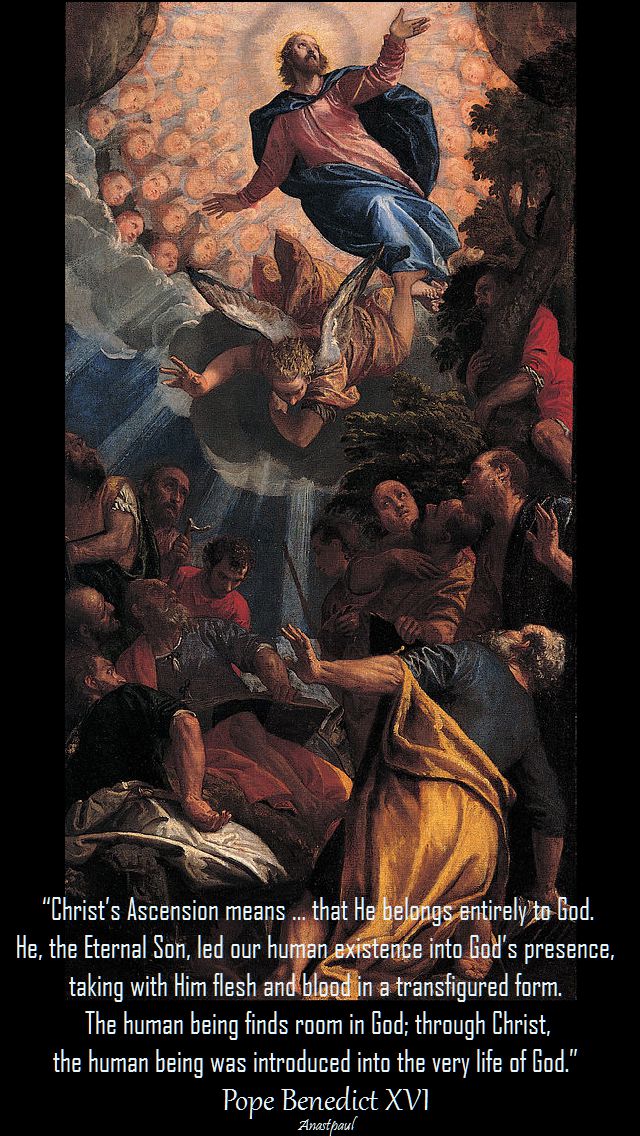
“Christ’s Ascension means … that He belongs entirely to God. He, the Eternal Son, led our human existence into God’s presence, taking with Him flesh and blood in a transfigured form. The human being finds room in God; through Christ, the human being was introduced into the very life of God.”
Pope Benedict XVI
“Next to the Blessed Sacrament itself, your neighbour is the holiest object presented to your senses.”
C S Lewis
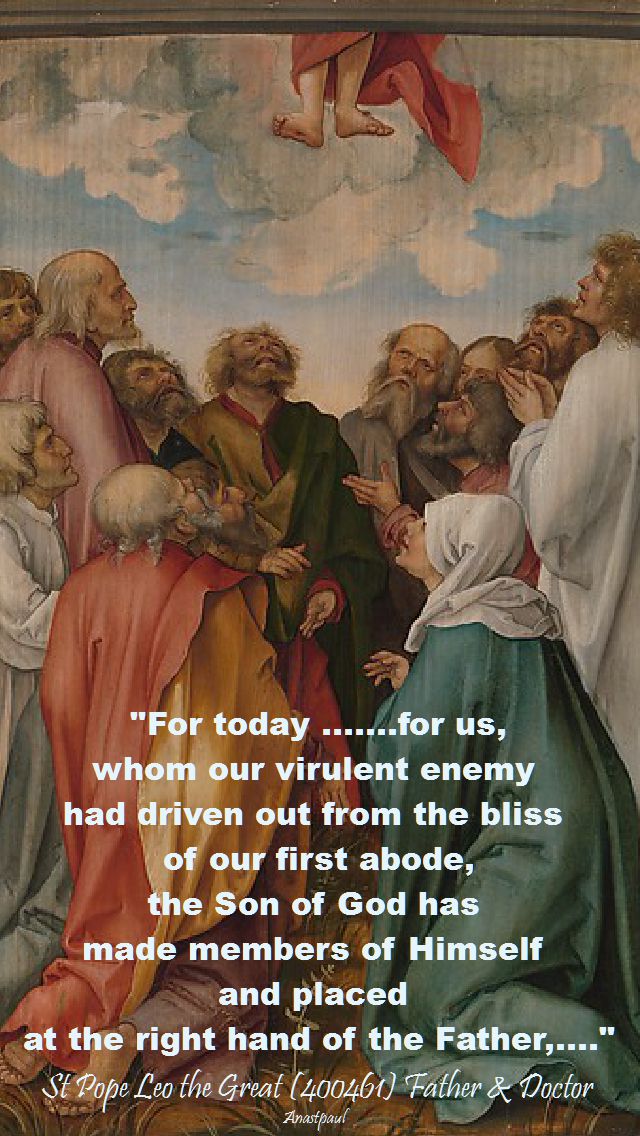
“For today …….for us, whom our virulent enemy had driven out from the bliss of our first abode, the Son of God has made members of Himself and placed at the right hand of the Father, with Whom He lives and reigns in the unity of the Holy Spirit, God for ever and ever. Amen.”
When he had said this, as they were looking on,
he was lifted up and a cloud took him from their sight……….Acts 1:9
REFLECTION – “Today our Lord Jesus Christ ascended into heaven; let our hearts ascend with Him. Listen to the words of the Apostle: If you have risen with Christ, set your hearts on the things that are above where Christ is, seated at the right hand of God; seek the things that are above, not the things that are on earth. For just as He remained with us even after His ascension, so we too are already in heaven with Him, even though what is promised us has not yet been fulfilled in our bodies.”………………………St. Augustine
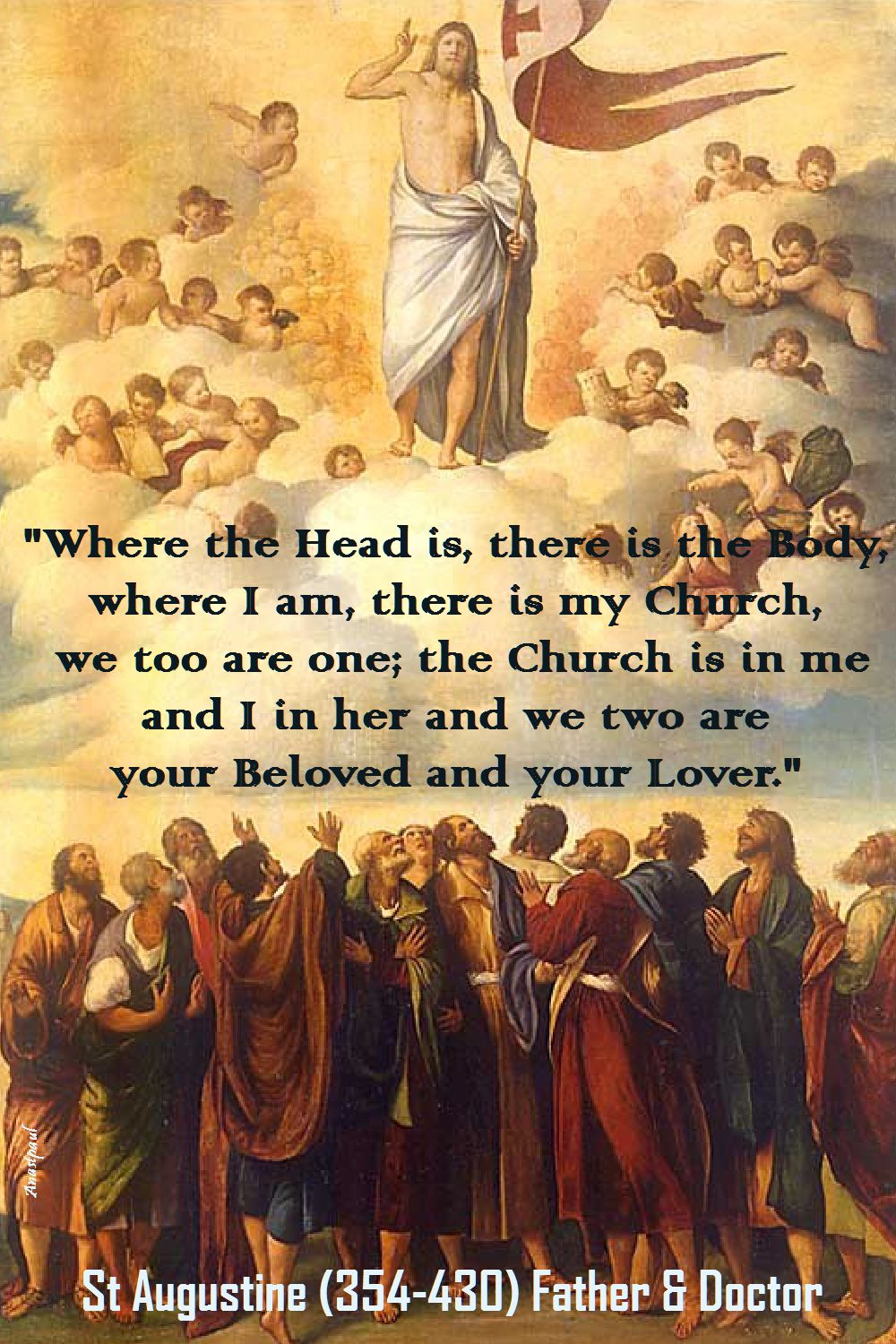
When we went down into the Font of Baptism we were incorporated into Jesus Christ, made members of His Body, the Church. Therefore, as Augustine also wrote, “Where the Head is, there is the Body, where I am, there is my Church, we too are one; the Church is in me and I in her and we two are your Beloved and your Lover.” In other words, we have ascended with the Lord!
PRAYER – Holy Father, teach me and help me to ‘abide’ in Your Son, who by ascending to You, took me too with Him. For He is my root and my foundation and I live only in Him! My Saviour and Redeemer, Jesus Christ my Lord, be with me always and intercede for us all with our Father. Amen
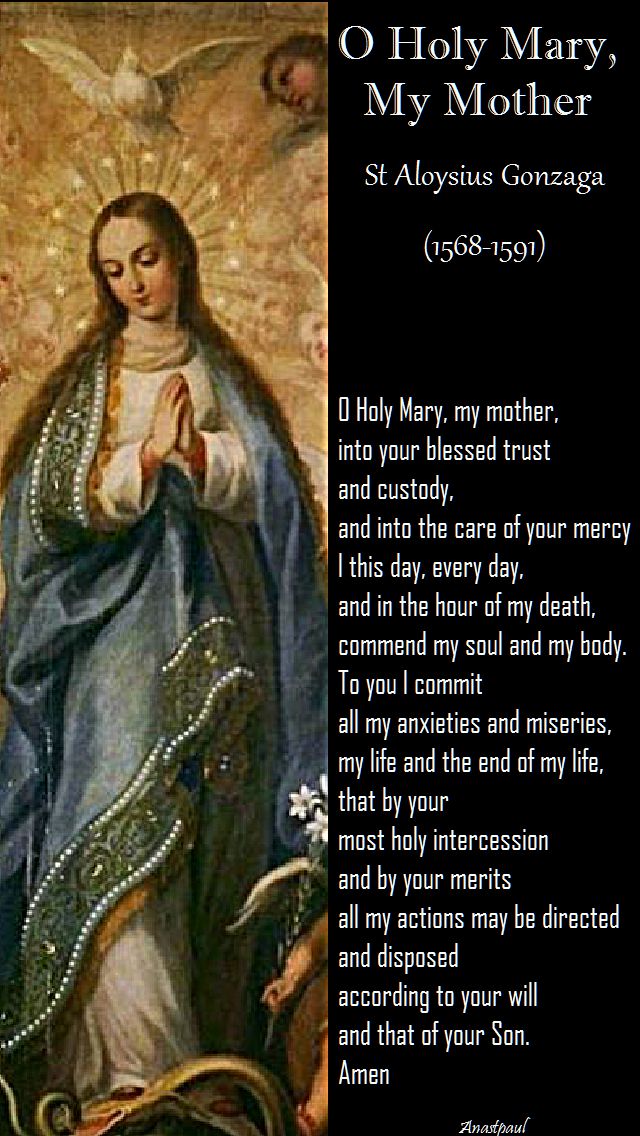
O Holy Mary, My Mother St Aloysius Gonzaga (1568-1591)
O Holy Mary, my mother,
into your blessed trust and custody,
and into the care of your mercy
I this day, every day,
and in the hour of my death,
commend my soul and my body.
To you I commit
all my anxieties and miseries,
my life and the end of my life,
that by your most holy intercession
and by your merits
all my actions may be directed
and disposed
according to your will
and that of your Son.
Amen
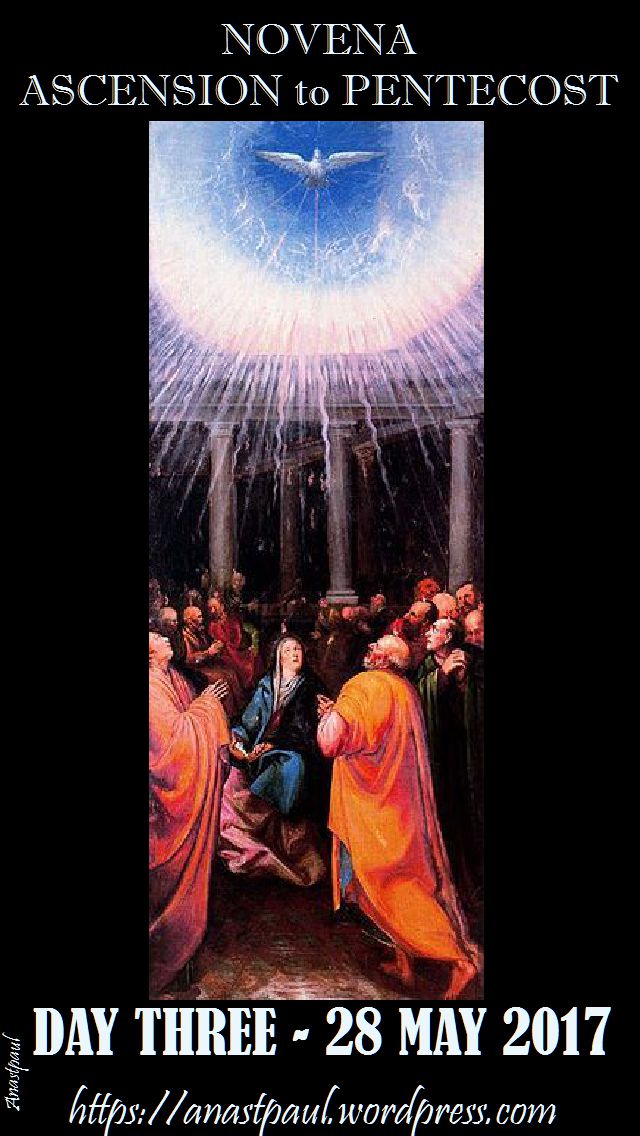
NOVENA from ASCENSION to PENTECOST DAY THREE – SUNDAY 28 MAY 2017
The Holy Spirit
Only one thing is important: eternal salvation. Only one thing, therefore, is to be feared: sin. Sin is the result of ignorance, weakness and indifference. The Holy Spirit is the Spirit of Light, of Strength and of Love. With His sevenfold gifts He enlightens the mind, strengthens the will and inflames the heart with the love of God. To ensure our salvation we ought to invoke the Divine Spirit daily, because the Spirit comes to us in our needs. When we don’t know what to say, it is the Spirit who speaks within us.
The Gift of Piety
The gift of Piety creates in our hearts a deep affection for God as our most loving Father. It inspires us to love and respect for His sake all people and things consecrated to him, as well as those who act with His Divine authority, Mary Mother of the Saviour and the Saints, the Church and its visible head the Pope, our parents and superiors, our country and its rulers. The person who is filled with the gift of Piety finds the practice of the faith, not a burdensome duty but a delightful service. Where there is love, there is no labour.
Prayer
Come and fill me, O Blessed Spirit of Piety. Possess my heart. Purify me. Humble me. Enkindle in me such a love for God that I may be satisfied only in His service and lovingly submit to all legitimate authority for the sake of Your kingdom. Make me increasingly uncomfortable with everything that is evil, so that I turn away from it and live only in You. Amen.
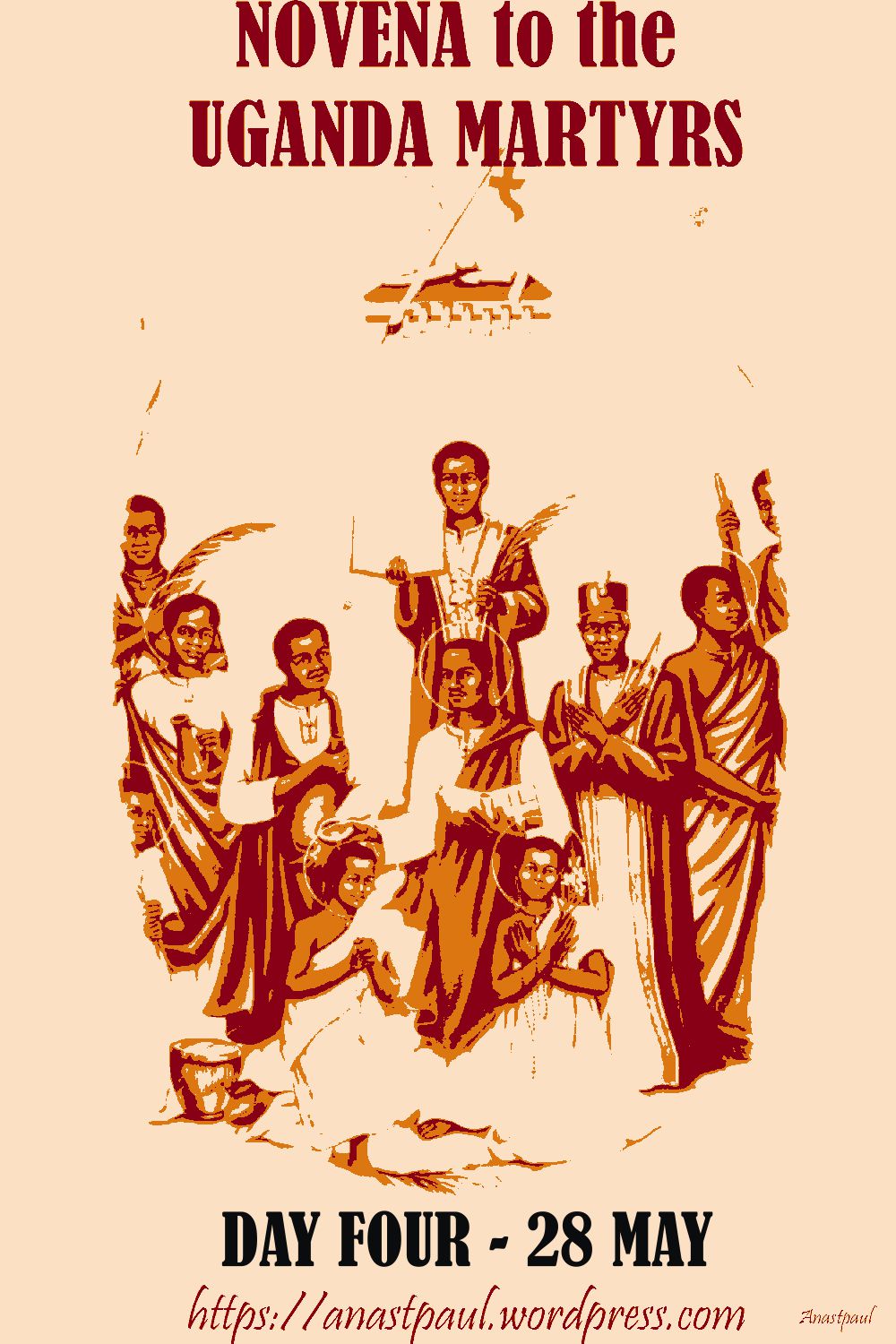
O God, who in Your love and mercy
was pleased to send missionaries to Uganda
to bring the light of Christ to all the peoples,
we thank You for the gift of the
Holy Martyrs of Uganda, our ancestors in faith,
whom You gave the strength to overcome sin and the
anguish of torture and to bear witness to the truth.
Mary, Mother of all who believe!
May all Christ’s followers in universal Church
draw ever closer together in a spirit
of mutual respect and cooperation.
May they bear ever more fraternal witness
to the reconciling love of Jesus the Redeemer.
Impelled by the Spirit of love,
may they help spread the light of the Gospel
to all the people of Uganda and all the world..
To the Holy Martyrs, we beg for intercession,
be pleased to hear our prayer and pray for us that this,
our special request may be granted
(make your intention)
Holy Martyrs of Uganda, we honour and praise you!
Please pray for us!
O heavenly Father, we make our prayer
through our Lord, Jesus Christ, in union with the Holy Spirit,
one God forever and ever, amen.
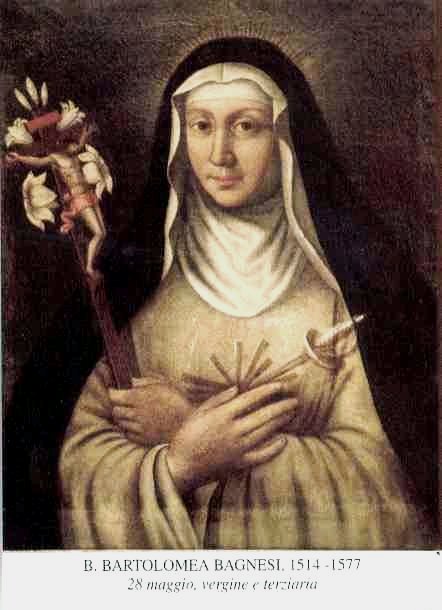
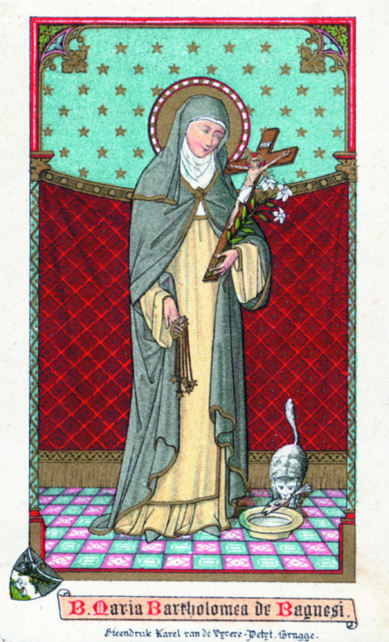
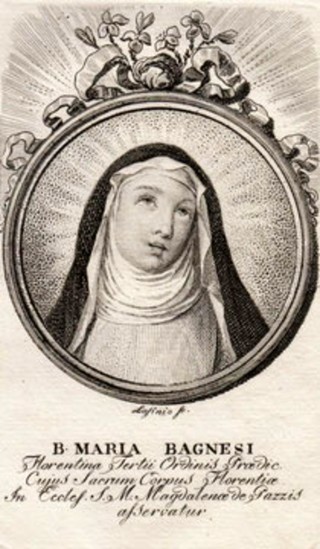
Saint of the Day – 28 May – Blessed Maria Bartolomea Bagnesi OP (1514-1577) Virgin, Third Order Dominican, Mystic, Ecstatic, with the gift of levitation – born as Maria Bagnesi but always called “Marietta” because of her tiny frame, on 15 August 1514 at Florence, Italy and died on 28 May 1577 at Florence, Italy of natural causes, agd 62. Patronages – abuse victims, ill people, against the death of parents, Dominican tertiaries. Her body is incorrupt.
Maria Bagnesi was born in Florence on 15 August 1514 – the Feast of the Assumption – to Carlo Bagnesi and Alessandra Orlandini. Bagnesi was a neglected child and her mother often left her in the care of others which included one of Bagnesi’s sisters who was a nun from the Order of Preachers so she spent most of her childhood in her sister’s convent. Four of her sisters would end up in the religious life.
Her father organised a marriage for her when she turned seventeen and she fainted in horror upon learning this. The thought made Bagnesi so ill she could not walk and was thus confined to her bed. Her father turned to con men and charlatans – for he could be manipulated with ease – and put his daughter through over three decades of non-stop “treatment”. Being bedridden meant that she could not follow her sisters into the religious life but she nevertheless became a member of the Third Order of Saint Dominic in 1544 and made her profession in 1545. She made her profession into the hands of and received the habit from Vittorio di Mattheo who allowed for this to take place in Bagnesi’s room. Bl Maria developed a deep devotion to Saint Bartholomew the Apostle and she assumed the name of “Bartolomea” as part of her actual name as a sort of middle name when she made her profession. After she professed she found that she could get out of her bed for brief periods of time. The combination of asthma and these quack treatments immobilised her just as she began to heal and she started to have visions and converse with angels and demons alike. Neighbours began to believe she was under demonic possession and summoned a local priest – who became her spiritual advisor who assured the locals she was not possessed or in need of an exorcism. People also claim to have seen her levitate. She was also granted the special privilege of having Mass celebrated in her room at times.
Her room soon became a place for pilgrims to go to in order to seek her wisdom and counsel and her room became a place for cats to roam – some remained with her and even slept on her bed while guarding her pet songbirds. She also came to know Saint Maria Maddalena de’ Pazzi and shared her visions with her; the saint would herself be cured due to Bagnesi’s intercession on 16 June 1584. Bagnesi received the Eucharist three to six times a week and prepared beforehand with docile care and spent the time following her reception of it in deep reflection. Her confessors were the Priests Alessandro Capocchi and Agostino Campi.
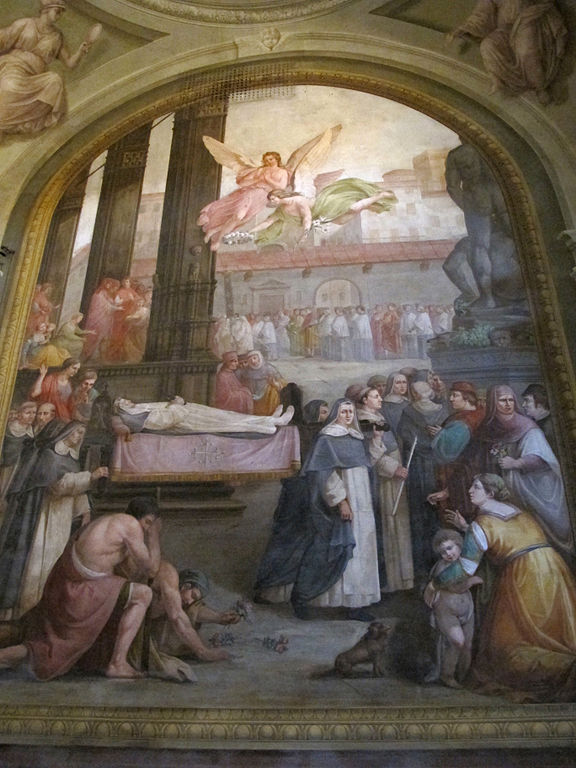
Bagnesi died in Florence in 1577 and at the end of her life, five Priests were present at her deathbed and one of them read to her one of the Gospel accounts of the Passion of Jesus Christ. Her remains were taken in procession for her funeral from Santa Maria Novella to Santa Maria degli Angeli where she was interred.
Painting depicting her funeral.
Let us Pray: O God, the lover of souls, who in Blessed Mary Bartholomew, Thy Virgin, didst unite wonderful endurance of illness with equal innocence of mind, grant , that we who are afflicted according to our deserts may be refreshed with the comfort of Thy grace. Through Christ our Lord. Amen.
7th Sunday of Easter (2017) or ASCENSION Sunday in many parts of the world where the Solemnity is transferred
—
St Accidia
Bl Albert of Csanád
Bl Antoni Julian Nowowiejski
St Bernard of Menthon
St Caraunus of Chartres
St Caraunus the Deacon
St Crescens of Rome
St Dioscorides of Rome
Eoghan the Sage
Gemiliano of Cagliari
Germanus of Paris
Bl Heliconis of Thessalonica
Helladius of Rome
Herculaneum of Piegaro
Bl John Shert
Justus of Urgell
Bl Lanfranc of Canterbury
Luciano of Cagliari
Bl Luigi Biraghi
Bl Margaret Plantagenet Pole
Bl Maria Bagnesi
Bl Mary of the Nativity
Moel-Odhran of Iona
Paulus of Rome
Phaolô Hanh
Podius of Florence
Bl Robert Johnson
Senator of Milan
Bl Thomas Ford
Ubaldesca Taccini
William of Gellone
Bl Wladyslaw Demski
—
Martyrs of Palestine: A group of early 5th century monks in Palestine who were martyred by invading Arabs.
Martyrs of Sardinia – 6 saints: A group of early Christians for whom a church on Sardinia is dedicated; they were probably martyrs, but no information about them has survived except the names Aemilian, Aemilius, Emilius, Felix, Lucian and Priamus. Patrons of the diocese of Alghero-Bosa, Italy.
Martyred in the Spanish Civil War: Lluís Berenguer Moratona
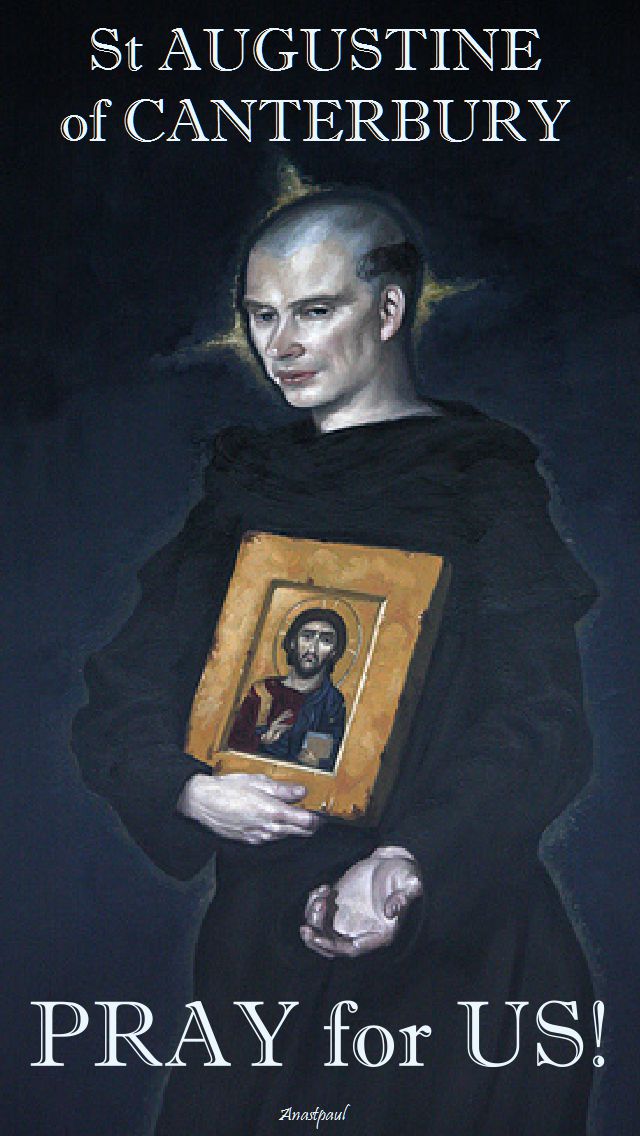
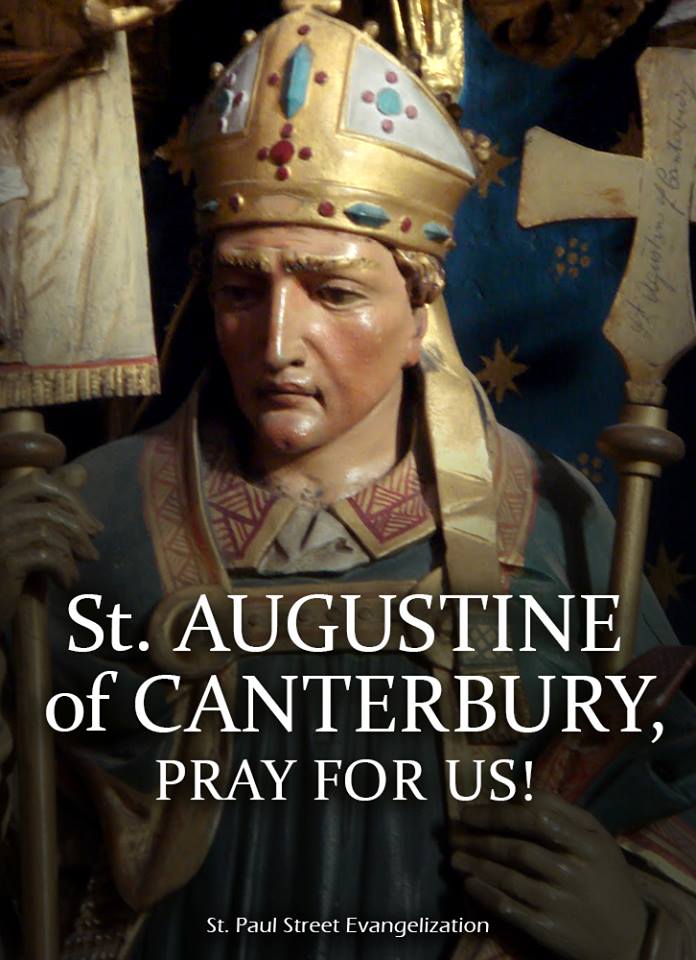
St Augustine of Canterbury comes across today as a very human saint, one who could suffer like many of us from a failure of nerve. For example, his first venture to England ended in a big U-turn back to Rome. He made mistakes and met failure in his peacemaking attempts with the Briton Christians. He often wrote to Rome for decisions on matters he could have decided on his own had he been more self-assured. He even received mild warnings against pride from Pope Gregory, who cautioned him to “fear lest, amidst the wonders that are done, the weak mind be puffed up by self-esteem.” Augustine’s perseverance amidst obstacles and only partial success teaches today’s apostles and pioneers to struggle on despite frustrations and be satisfied with gradual advances. by Fr. Don Miller, OFM
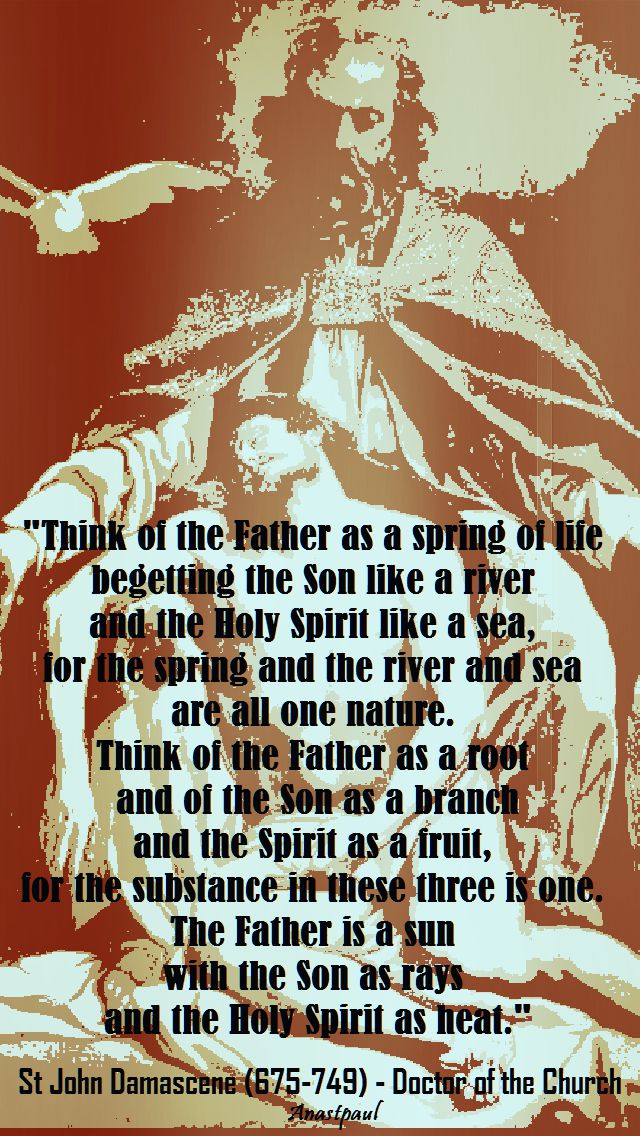
“Think of the Father as a spring of life begetting the Son like a river and the Holy Spirit like a sea, for the spring and the river and sea are all one nature. Think of the Father as a root and of the Son as a branch and the Spirit as a fruit, for the substance in these three is one. The Father is a sun with the Son as rays and the Holy Spirit as heat.”
St John Damascene (675-749) – Doctor of the Church
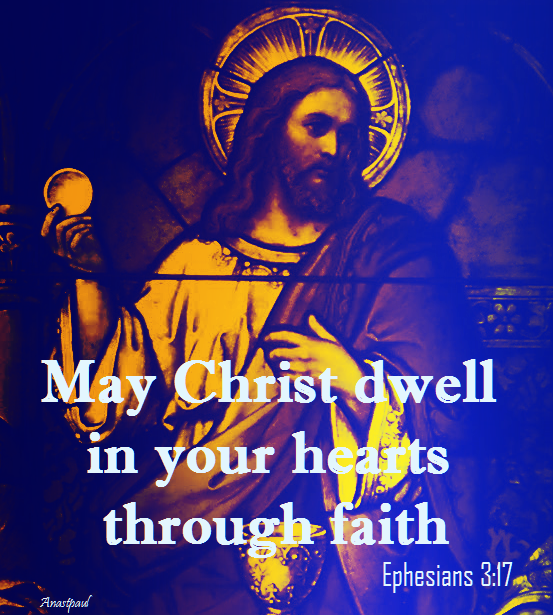
May Christ dwell in your hearts through faith……Ephesians 3:17
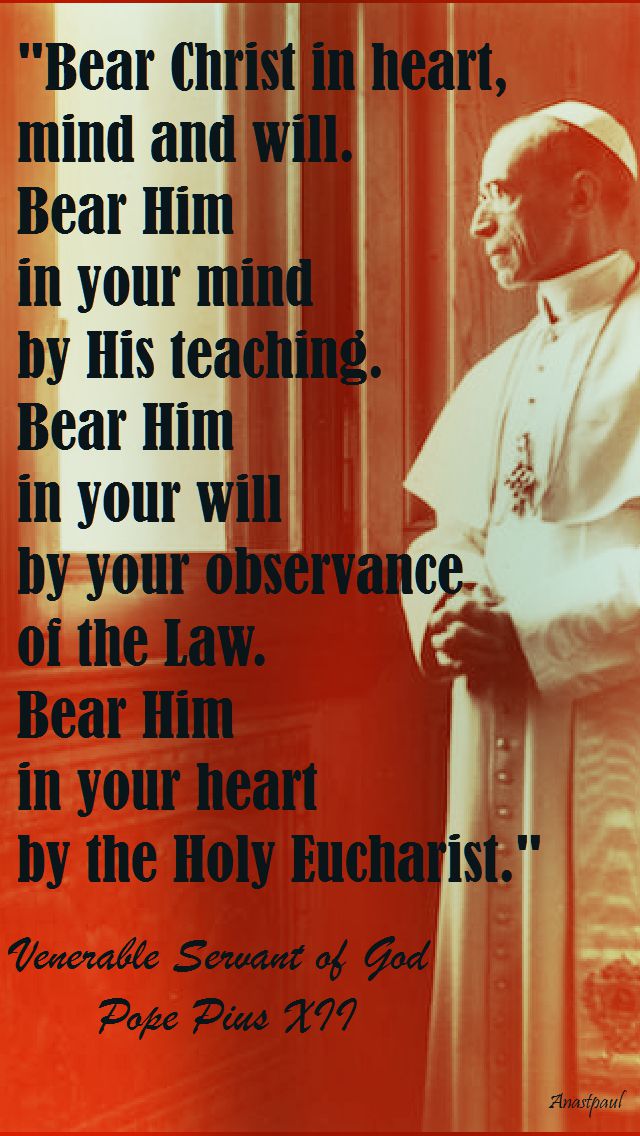
REFLECTION – “Bear Christ in heart, mind and will.
Bear Him in your mind by His teaching.
Bear Him in your will by your observance of the Law.
Bear Him in your heart by the Holy Eucharist.”…………Venerable Servant of God Pope Pius XII
PRAYER – Heavenly Father, let me be true bearer of Christ, Your Son, by doing always the things that are in imitation of and pleasing to Him. Help me to bear witness to Him in the world, one just as pagan as that approached by St Augustine of Canterbury in trepidation. But in Your light and by Your Holy Spirit, he succeeded and pleased You, help me too I beg, to work for the salvation of souls. St Augustine of Canterbury, pray for us all, amen.
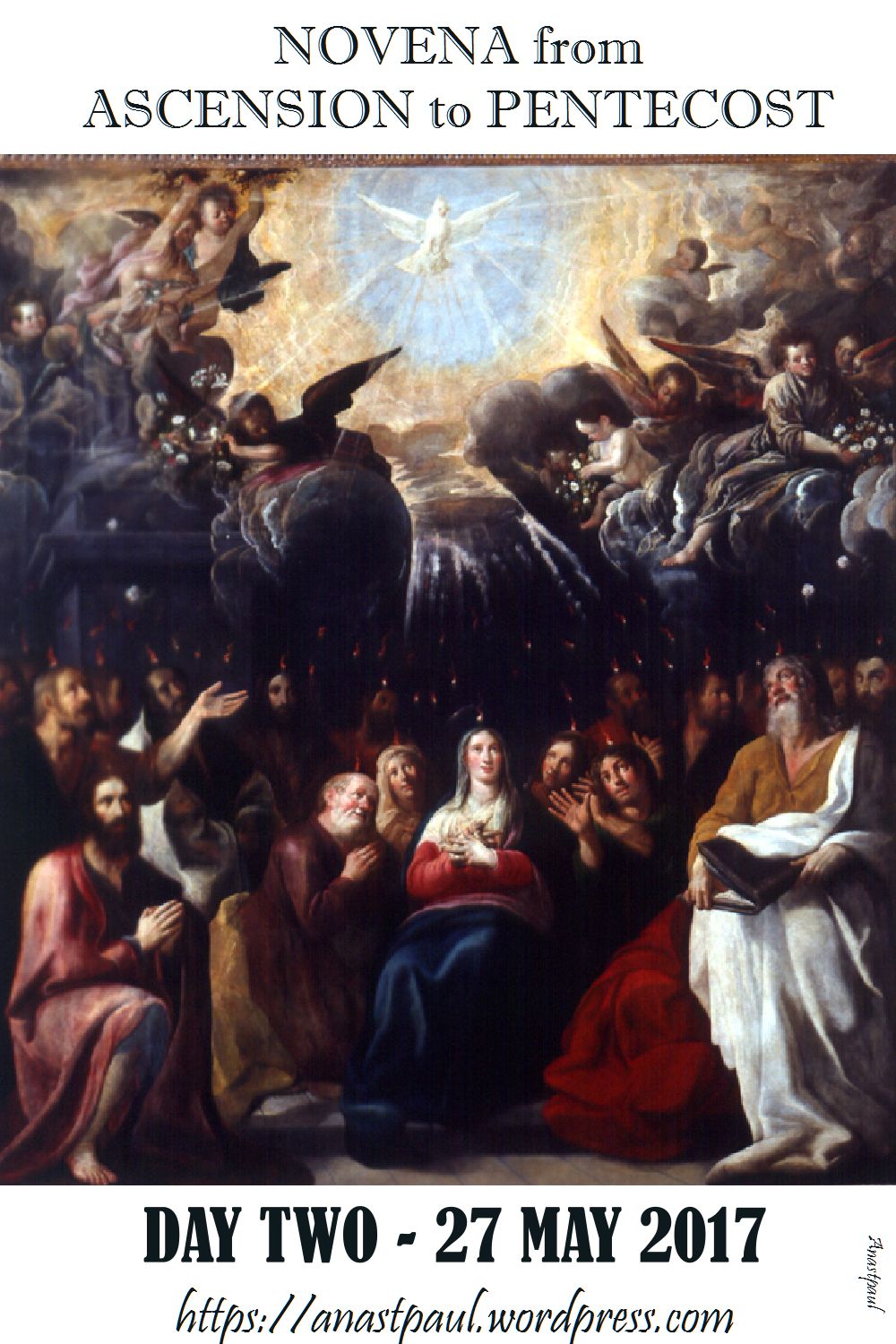
NOVENA from ASCENSION to PENTECOST DAY TWO – SATURDAY 27 MAY
The Holy Spirit
Only one thing is important: eternal salvation. Only one thing, therefore, is to be feared: sin. Sin is the result of ignorance, weakness and indifference. The Holy Spirit is the Spirit of Light, of Strength and of Love. With His sevenfold gifts He enlightens the mind, strengthens the will and inflames the heart with the love of God. To ensure our salvation we ought to invoke the Divine Spirit daily, because the Spirit comes to us in our needs. When we don’t know what to say, it is the Spirit who speaks within us.
The Gift of Fear
The gift of Fear fills us with a profound respect for God and makes us continually avoid the weakness of sin. It is a fear that arises, not from the thought of hell but the living presence of God within us and a desire to respond to His immense love for us. It is the fear that is the beginning of wisdom, detaching us from immersing ourselves in the worldly pleasures that could in any way separate us from God. “They that fear the Lord will prepare their hearts and in His sight will sanctify their souls.”
Prayer
Come and fill me, O blessed Spirit of Holy Fear. Penetrate my inmost heart so that I may honour, obey and prefer You and my Lord Jesus and my Father God above all else. Help me to despise all things that offend You and make me worthy to appear before the pure eyes of your Divine Majesty in heaven, where you live and reign forever in the unity of the ever Blessed Trinity. Amen
Our Father, Hail Mary, Glory be to the Father
The following Three Prayers to be recited daily during the Novena
ACT OF CONSECRATION TO THE HOLY SPIRIT
I offer myself, soul and body to You, Eternal Spirit of God. I adore the brightness of Your purity, the unerring keenness of Your justice and the might of Your love. You are the Strength and Light of my soul. In You I live and move and am. I desire never to grieve You by unfaithfulness to grace and I pray with all my heart to be kept from the smallest sin against You. Mercifully guard my every thought and grant that I may always watch for Your light and listen to Your voice and follow Your inspirations. I give myself to You and ask You, by Your compassion, to watch over me in my weakness. Mindful of the wounds of Jesus and with trust in His Precious Blood I implore You, Holy Spirit, Helper in my need, to keep me in Your grace that I may never sin against You. Give me grace O Holy Spirit, Spirit of the Father and the Son to say to You always and everywhere, “Speak Lord your servant is listening.” Amen
PRAYER TO THE HOLY SPIRIT
Come, Holy Spirit,
fill the hearts of Your faithful
and enkindle in them the fire of Your love.
Send forth Your Spirit and we shall be created,
and You will renew the face of the earth.
Father, You taught the hearts of Your faithful people by sending them the light of the Holy Spirit. In that Spirit give us right judgement and the joy of His comfort and guidance.
We make this prayer through Christ our Lord. Amen.
PRAYER FOR THE SEVEN GIFTS OF THE HOLY SPIRIT
Lord Jesus Christ, before you ascended into heaven You promised to send the Holy Spirit to bring to completion Your work in the hearts, minds and lives of Your Apostles and Disciples. Fill me with the presence of the same Holy Spirit that He may perfect in my soul, the work of Your grace and Your love. Grant me the Spirit of Wisdom that I may never be bound to the passing things of this world and aspire only after the things that are eternal. Fill me with:
the Spirit of Understanding to enlighten my mind with the light of Your divine truth, the Spirit on Counsel that I may ever choose the surest way of pleasing God and gaining heaven, the Spirit of Fortitude that I may bear the crosses of my life with You and that I may overcome with courage all the obstacles that oppose my salvation, the Spirit of Knowledge that I may know God and know myself and grow perfect in the imitation of the Saints, the Spirit of Piety that I may find the service of God joyful and desirable and the Spirit of Fear that I may be filled with a loving reverence towards God and avoid all that would displease Him. Mark me, dear Lord with the sign of Your true disciples, and help me to grow and live in all things with Your Spirit. Amen.






 all the assaults and temptations of my enemies, that I may not be overcome and separated from you, my God and greatest Good. Amen.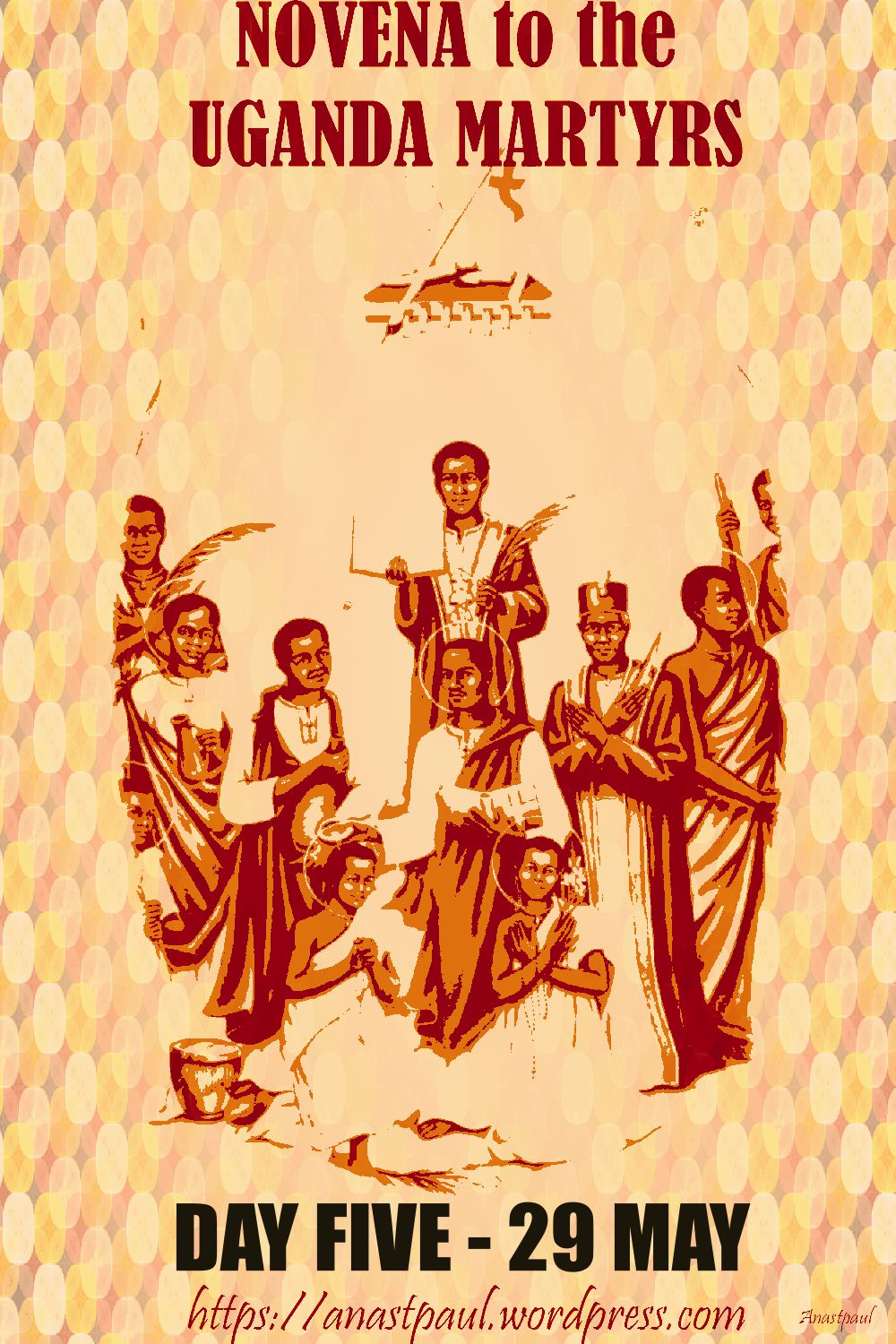







 Our Father, Hail Mary, Glory be to the Father

You must be logged in to post a comment.