St Lazarus the Leper St Leutfridus of La-Croix St Martia of Syracuse St Martin of Tongres St Melchiorre della Pace St Mewan of Bretagne Bl Nicholas Plutzer
Martyrs of Taw – 3+ Saints: Three Christians of different backgrounds who were Martyred together – Moses, Paphnutius, Thomas. They were beheaded in Taw, Egypt, date unknown.
Thought for the Day – 20 June – Meditations with Antonio Cardinal Bacci (1881-1971)
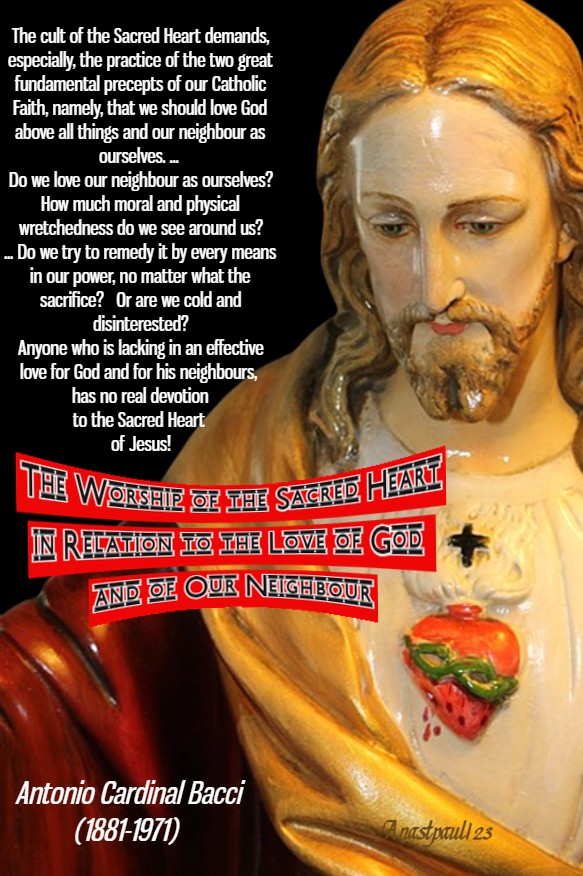
The Worship of the Sacred Heart in Relation to the Love of God and of Our Neighbour
“The cult of the Sacred Heart demands, especially, the practice of the two great fundamental precepts of our Catholic Faith, namely, that we should love God above all things and our neighbour as ourselves. The implementation of this teaching will transform our lives.
Do we love God above all things and more than we love ourselves? What is the predominant concept in our minds? Is it the concept of God? What is the first love in our hearts? Is it the love of God? What is our main desire in life? Is it the glory of God? Or is it our own glory or our own pleasure?
We have still, a long way to go in the way of love of God which is the way of perfectiuon. We can only really be said to be ourselves moreover, when we love God above all things and more than ourselves. If a man does not love God above all things, neither does he love himself in the way in which he ought to love himself because, God is our only true to happiness.
Do we love our neighbour as ourselves? How much moral and physical wretchedness do we see around us? But do we try to remedy it by every means in our power, no matter what the sacrifice? Or are we cold and disinterested? Let us remember the words of St John the Apostle of Charity. “In this we have come to know His love that He laid down His life for us and we likewise, ought to lay down our life for the brethren” (1 Jn 3:16). Are we prepared to do this? Are we at least prepared to give away whatever do do not need ourselves, in order to relieve poverty and want?
Anyone who is lacking in an effective love for God and for his neighbours, has no real devotion to the Sacred Heart of Jesus!”
Quote/s of the Day – 20 June – “The Month of the Most Sacred Heart of Jesus” – Within the Corpus Christi Octave
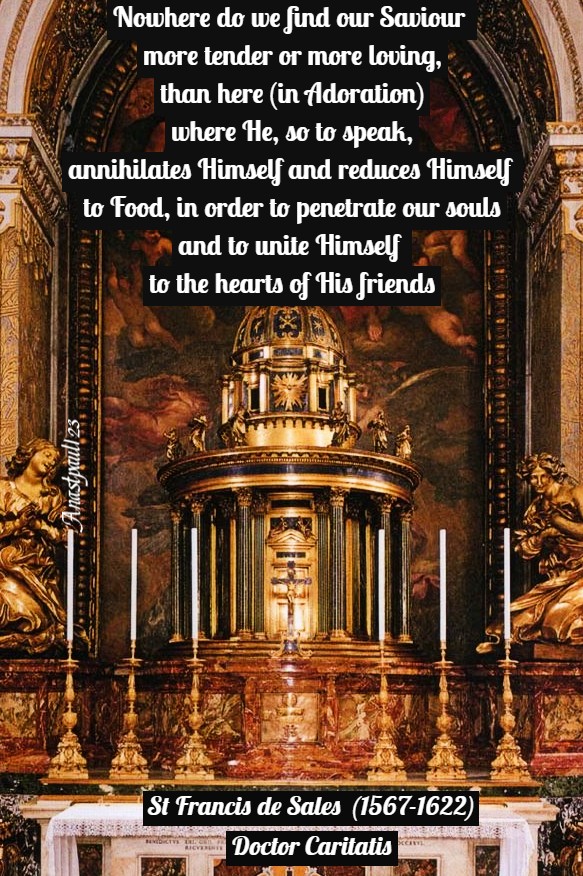
“Nowhere do we find our Saviour more tender or more loving, than here [in Adoration] where He, so to speak, annihilates Himself and reduces Himself to Food, in order to penetrate our souls and to unite Himself to the hearts of His friends.”
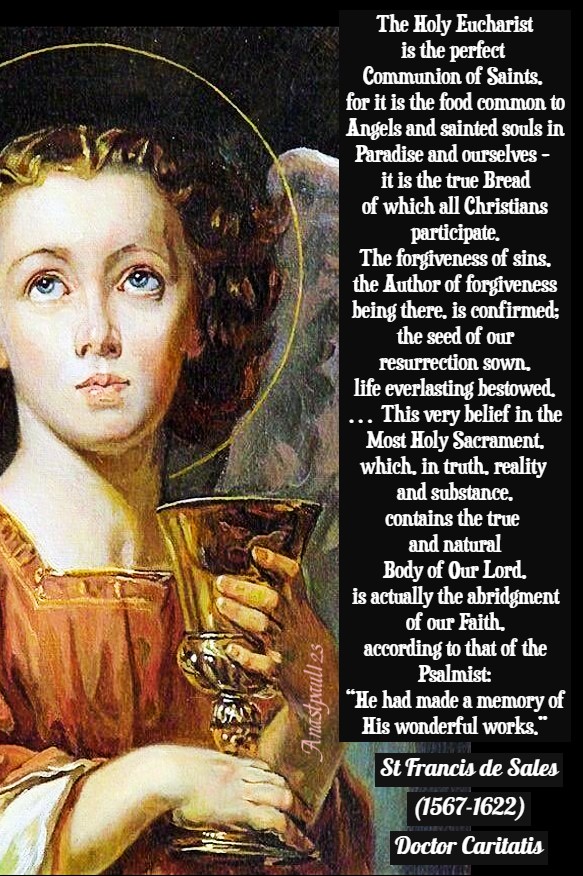
“The Holy Eucharist is the perfect Communion of Saints, for it is the food common to Angels and Sainted souls in Paradise and ourselves – it is the true Bread of which all Christians participate. The forgiveness of sins, the Author of forgiveness being there, is confirmed; the seed of our resurrection sown, life everlasting bestowed. … This very belief in the Most Holy Sacrament, which, in truth, reality and substance, contains the true and natural Body of Our Lord, is actually the abridgment of our Faith, according to that of the Psalmist: “He had made a memory of His wonderful works.”
St Francis de Sales (1567-1622) Doctor Caritatis
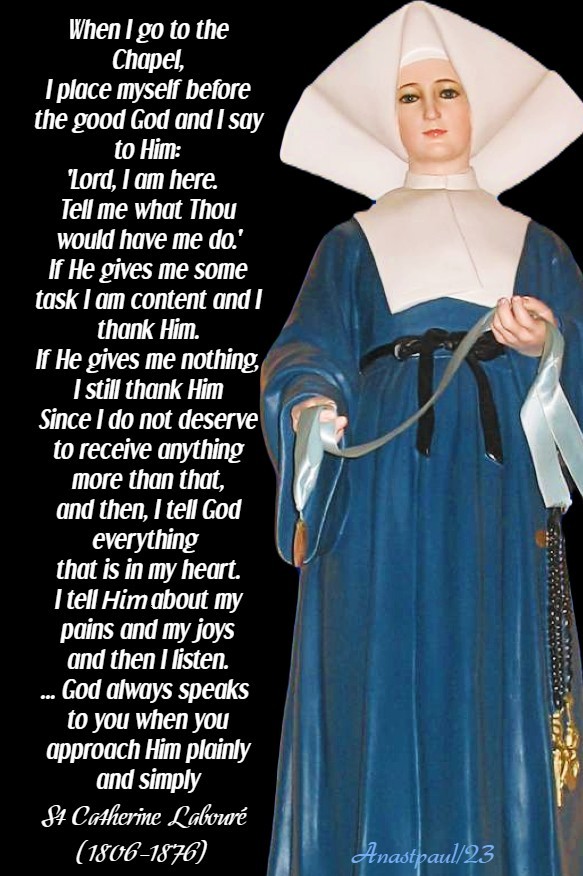
“When I go to the Chapel, I place myself before the good God and I say to Him: ‘Lord, I am here. Tell me what Thou would have me do.’ If He gives me some task I am content and I thank Him. If He gives me nothing, I still thank Him Since I do not deserve to receive anything more than that, and then, I tell God everything that is in my heart. I tell hIm about my pains and my joys and then I listen. … God always speaks to you when you approach Him plainly and simply.”
St Catherine Labouré (1806-1876) The Visionary of the Miraculous Medal
One Minute Reflection – 20 June – “The Month of the Most Sacred Heart of Jesus” – Within the Corpus Christi Octave – St Pope Silverius (Died 538) Martyr – 1 Corinthians 23-29 – John 6:56-59 – Scripture search here: https://www.drbo.org/
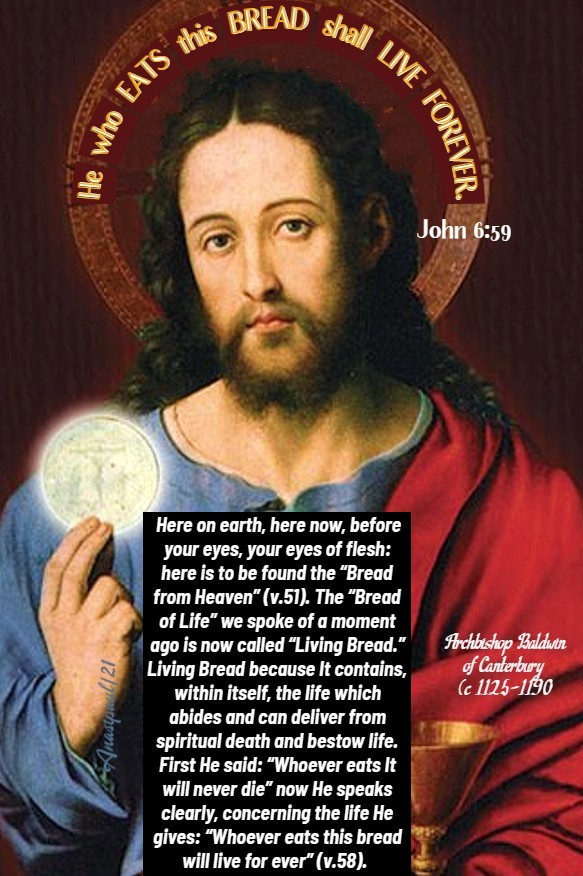
“This is the Bread which has come down from Heaven; not as your fathers ate the manna and died. He who eats this Bread shall live forever.” – John 6:59
REFLECTION – Christ is “the bread of life” for those who believe in Him: to believe in Christ is to eat the bread of life, to possess Christ within one, is to possess eternal life… “I am the bread of life,” He says; “your fathers ate manna in the wilderness and they are dead” (Jn 6,48f). By this is to be understood spiritual death. Why are they dead? Because they believed in what they saw and did not understand what they could not see… Moses ate manna, Aaron ate it and many others, too, who pleased God and are not dead. Why are they not dead? Because they understood, in a spiritual fashion, they were spiritually hungry, they tasted the manna spiritually, so that they might be spiritually satisfied. “This is the bread that came down from heaven: whoever eats it will never die” (v.50). This manna – that is to say, Christ, who Himself spoke like this…, was prefigured by the manna but was able to do more than manna could. For manna could not, of itself, prevent dying spiritually… But the righteous saw Christ in the manna, they believed in His coming and Christ, of whom manna was the symbol, grants to all who believe in Him that they should not spiritually die. Hence He says: “This is the bread come down from heaven; whoever eats it will never see death.” Here on earth, here now, before your eyes, your eyes of flesh: here is to be found the “bread from heaven” (v.51). The “bread of life” we spoke of a moment ago is now called “living bread.” Living bread because it contains, within itself, the life that abides and can deliver from spiritual death and bestow life. First He said: “Whoever eats it will never die” now he speaks clearly, concerning the life He gives: “Whoever eats this bread will live for ever” (v.58). Archbishop Baldwin of Canterbury (c 1125-1190) Cistercian – The Sacrament of the Altar II
PRAYER – Look forgivingly on Thy flock, Eternal Shepherd and keep it in Thy constant protection, by the intercession of blessed Sylverius Thy Martyr and Sovereign Pontiff, whom Thou didst constitute Shepherd of the whole Church. Through Jesus Christ, Thy Son our Lord, Who lives and reigns with Thee, in the unity of the Holy Ghost, God, world without end. Amen (Collect).
ALL PRAISE, honour and glory to the Divine Heart of JESUS.Indulgenced– 50 Days, once a day. 168 Pope Leo XIII, 14 June 1901.
Our Morning Offering – 20 June – “The Month of the Sacred Heart of Jesus” – Within the Corpus Christi Octave
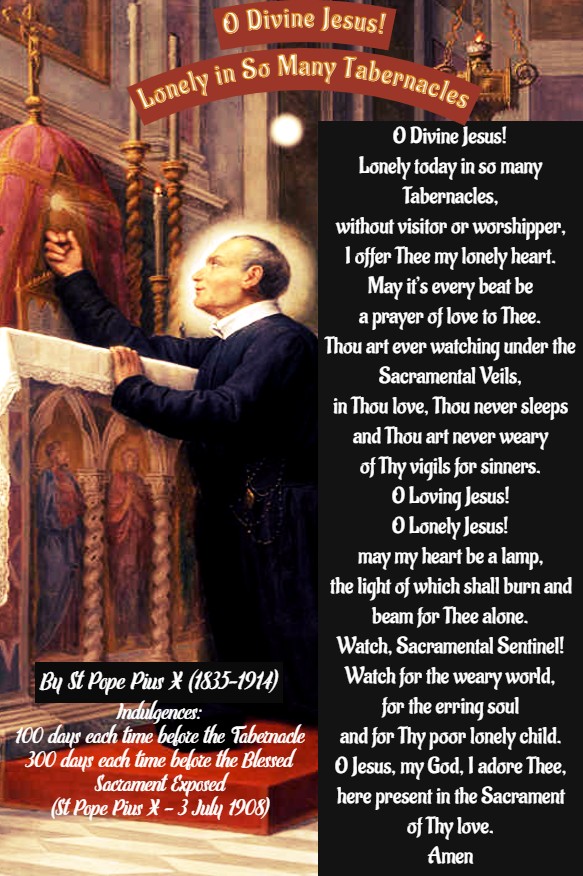
O Divine Jesus! Lonely in So Many Tabernacles By St Pope Pius X (1835-1914) “Pope of the Blessed Sacrament”
O Divine Jesus! Lonely today in so many Tabernacles, without visitor or worshipper, I offer Thee my lonely heart. May it’s every beat be a prayer of love to Thee. Thou are ever watching under the Sacramental Veils, in Thou love, Thou never sleeps and Thou are never weary of Thy vigils for sinners. O Loving Jesus! O Lonely Jesus! may my heart be a lamp, the light of which shall burn and beam for Thee alone. Watch, Sacramental Sentinel! Watch for the weary world, for the erring soul and for Thy poor lonely child.
O Jesus, my God, I adore Thee, here present in the Sacrament of Thy love. Amen
Indulgences: 100 days each time before the Tabernacle 300 days each time before the Blessed Sacrament Exposed (St Pope Pius X – 3 July 1908) Prayers to the Sacred Heart 15th Ed 1936
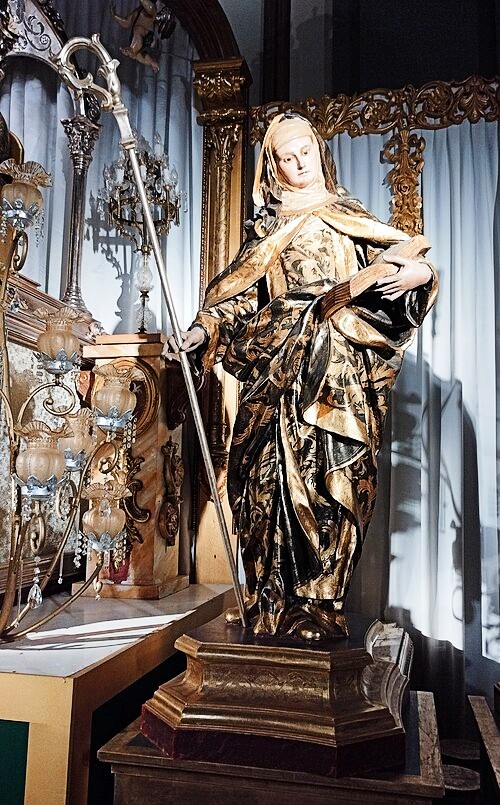
Saint of the Day – 20 June – Saint Florentia (Died c612) Virgin, Nun, sister of Saints Leander, Isidore and Fulgentius. Born towards the middle of the 6th Century in Cartagena, Spain and died in c612. Florentia was younger than her brother Leander, later Archbishop of Seville but older than St Isidore, who succeeded Leander as the Archbishop. Patron of – the Diocese of Plasencia. Also known as – Florentyna, Florentina.
The Roman Martyrology reads today: “At Seville, in Spain, the holy virgin Florentia, sister of the Holy Bishops Leander, Isidore and Fulgentius.”
Statue of St Florentia at the Church of Santa María de Gracia in Cartagena
Florentia’s family supplies us with an example of lives of total service to God and active engagement in furthering the best interests of the Church of Christ.
Florentina was the sister of three renowned and Sainted Bishops in the time of the Visigothic dominion, Leander, Isidore and Fulgentius, St Isidore also being a Doctor of the Church.
She consecrated her virginity to God. Before his elevation to the Episcopal dignity, Leander had been a Monk and it was through his influence that Florentia embraced the ascetic life. She, together with a number of virgins, who also desired to forsake the world, formed themselves into a religious community. Later sources declare their residence to have been the Convent of St Maria de Valle near Ecija (Astigis), where her brother Fulgentius, was the Bishop.
In any case, it is certain that she had consecrated herself to God before the year 600, as her brother Leander, who died either in the year 600 or 601, wrote for her guidance an extant work dealing with a Nun’s Rule of Life and with contempt for the world.
St Leander expresses the Rules according to which cloistered virgins, consecrated to God, should regulate their lives. He strongly advises them to avoid communication with women living in the world and with men, especially youths; recommends strict temperance in eating and drinking, gives advice concerning the reading of and meditation on Holy Scripture, enjoins equal love and friendship for all those living together in community and earnestly exhorts his sister to remain true to her holy state.
Florentia regulated her life according to the advice of her brother, entered with fervour into the spirit of the Rule in Religious life and was honoured as a Saint after her death.
Her younger brother Isidore dedicated his work “De fide catholica contra Judeos” to her which he wrote at her request.
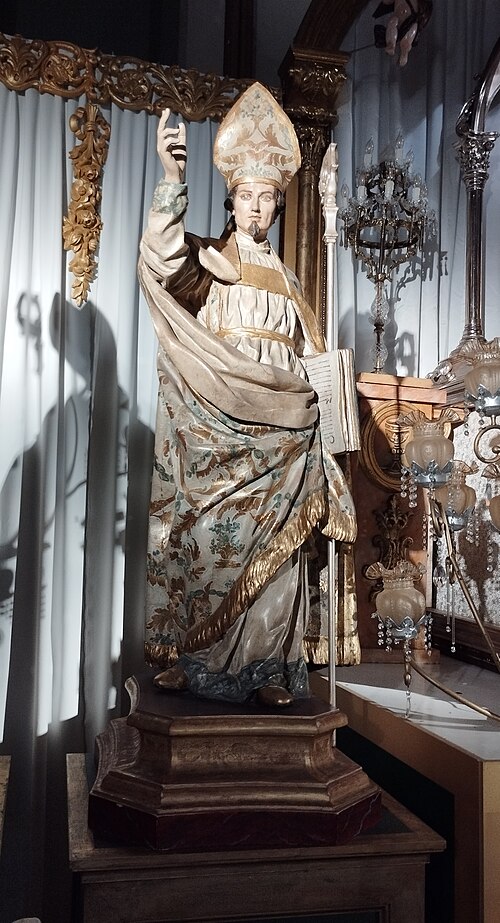
Florentia died early in the 7th Century and is venerated as the patron of the Diocese of Plasencia. Below from the eldest Leander, then Isidore, then Fulgentius.
Jose’ Montes de Oca and Pedro Duque Cornejo, St. Isidore of Seville, 17th century
St Bagne of Thérouanne (Died c706) the 5th Bishop of Thérouanne in northwest France (now St Omer) and then Abbot of Fontanelle, the Monastery of Saint Wandrille in Normandy, a disciple of *St Wandrille (c 605–668) Priest, Monk, Abbot. Died in c711 of natural causes Patronage – of Calais, France. A Life of Grace: https://anastpaul.com/2024/06/20/saint-of-the-day-20-june-saint-bagne-of-therouanne-died-c706-bishop/
Blessed Benignus of Breslau O,Cist. (13th-14th Century) Cistercian Monk and Martyr St Edburga of CaistorFulgentius. St Florentia (Died c612) Virgin, sister of Sts Leander, Isidore and Fulgentius.
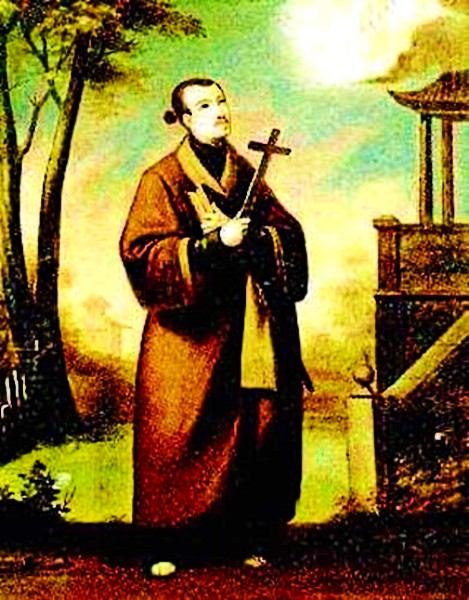
Blessed Francisco Pacheco SJ (1566-1626) Martyr, Priest of the Society of Jesus, Missionary to India, China and Japan, Provincial Superior. Fr Pacheco and his eight Jesuit companions, together with the nine lay Christians, were included among the 205 Martyrs Beatified by Blessed Pope Pius IX on 7 May1867. His Life and Death: https://anastpaul.com/2021/06/20/saint-of-th-day-20-june-blessed-francisco-pacheco-sj-1566-1626/
St Gemma of Saintonge St Goban of Picardie St Helen of Öehren
St Macarius (Died c350) Bishop of Petra and Confessor St Methodius of Olympus
Blessed Michelina TOSF (1300-1356) Widow, Religious of the Third Order of the Friars Minor, Stigmatic, Penitent, Apostle of all in need, Founder of the Confraternity of the Annunciation, to care for the poor, nurse the sick and bury the dead. Patronages – Pesaro, widows, against mental illness, against death of children. Beatified on 13 April 1737 by Pope Clement XII. Her Holy Life: https://anastpaul.com/2022/06/20/saint-of-the-day-20-june-blessed-michelina-of-pesaro-tosf-1300-1356/
St Novatus of Rome (Died c151) Confessor, Layman. The Roman Martyrology reads today: “At Rome, the demise of St Novatus, son of the blessed Senator, Puden and brother of the saintly Priest, Timothy and of the Holy Virgins of Christ, Pudentiana and Praxedes, who were instructed in the Faith by the Apostles. Their house was converted into a Church and bore the title of Pastor.” A Zealous Life: https://anastpaul.com/2023/06/20/saint-of-the-day-20-june-saint-novatus-of-rome-died-c151-confessor/
Martyred in London: Bl Anthony Turner Bl John Fenwick Bl John Gavan BL Thomas Whitbread Blessed William Harcourt
Irish Martyrs – 260 Beati – This is the collective title given to the 260 or more persons who are credited with dying for the Faith in Ireland between 1537 and 1714.
Martyrs of Lower Moesia: Martyred on the Black Sea at Lower Moesia (in modern Bulgaria), date unknown. St Cyriacus St Paul
Martyred in Nagasaki: 9 Beati : burned alive on 20 June 1626 in Nagasaki, Japan. Their ashes were thrown into the sea and no relics remain. They were Beatified on 7 May 1867 by Pope Pius IX. Blessed Baltasar de Torres Arias Blessed Francisco Pacheco Blessed Gaspar Sadamatsu Blessed Giovanni Battista Zola Blessed Ioannes Kisaku Blessed Michaël Tozo Blessed Paulus Shinsuke Blessed Petrus Rinsei Blessed Vincentius Kaun
Quote/s of the Day – 19 June – “The Month of the Most Sacred Heart of Jesus” – Corpus Christi
“He who eats My Flesh and drinks My Blood, abides in Me and I in him. ”
John 6:57
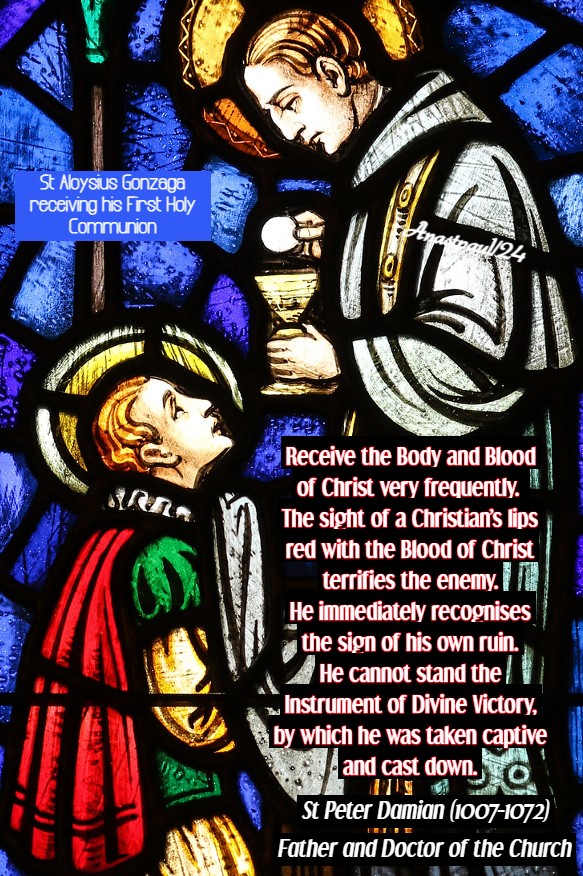
“Receive the Body and Blood of Christ very frequently. The sight of a Christian’s lips red with the Blood of Christ terrifies the enemy. He immediately recognises the sign of his own ruin. He cannot stand the Instrument of Divine Victory, by which he was taken captive and cast down.”
St Peter Damian (1007-1072) Doctor of the Church
“Everything in us which is strong, steadfast, firm, happy and joyful to carry out God’s commands, bear with misfortune, act obediently, stand up for justice – all these things come from this Bread’s strength, this Wine’s gladness. Happy are they whose deeds are strong and joyful! And since no-one can do it of themselves, happy are they who have an eager desire to cleave to what is just and right and to be strengthened in everything and rejoice through Him … ”
Baldwin of Canterbury (c1125-1190) Cistercian Abbot of Forde Monastery and Archbishop of Canterbury
“The Saviour has instituted the most glorious Sacrament of the Eucharist, which truly contains His Body and His Blood, so that, whoever eats it will live forever. Therefore, those who receive it frequently, with devotion, strengthen their spiritual life and well-being, to such an extent, that it is almost impossible for them to be poisoned by any kind of evil attachment.”
(Introduction to the Devout Life, Part II, Chapter 20)
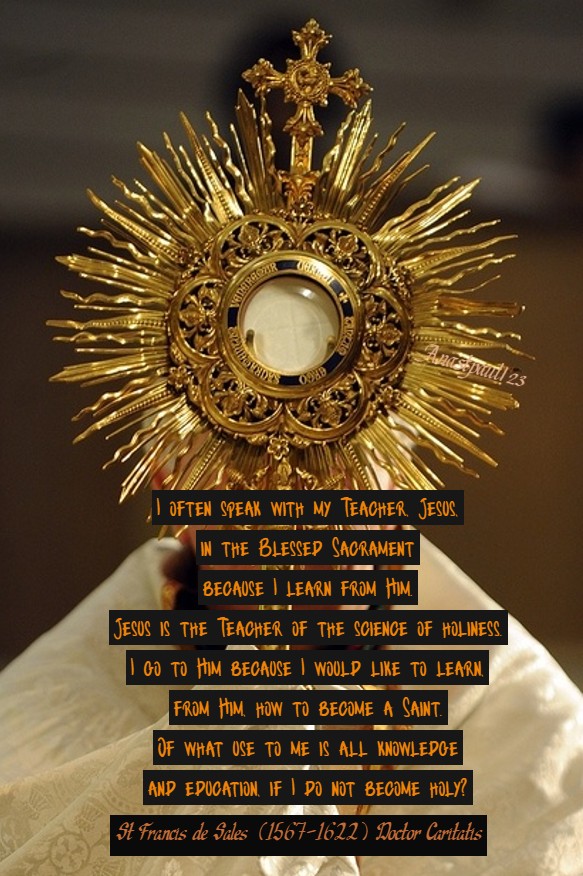
“I often speak with my Teacher, Jesus, in the Blessed Sacrament because I learn from Him. Jesus is the Teacher of the science of holiness. I go to Him because I would like to learn, from Him, how to become a Saint. Of what use to me is all knowledge and education, if I do not become holy?”
St Francis de Sales (1567-1622) Doctor of the Church
Thought for the Day – 19 June – Meditations with Antonio Cardinal Bacci (1881-1971)
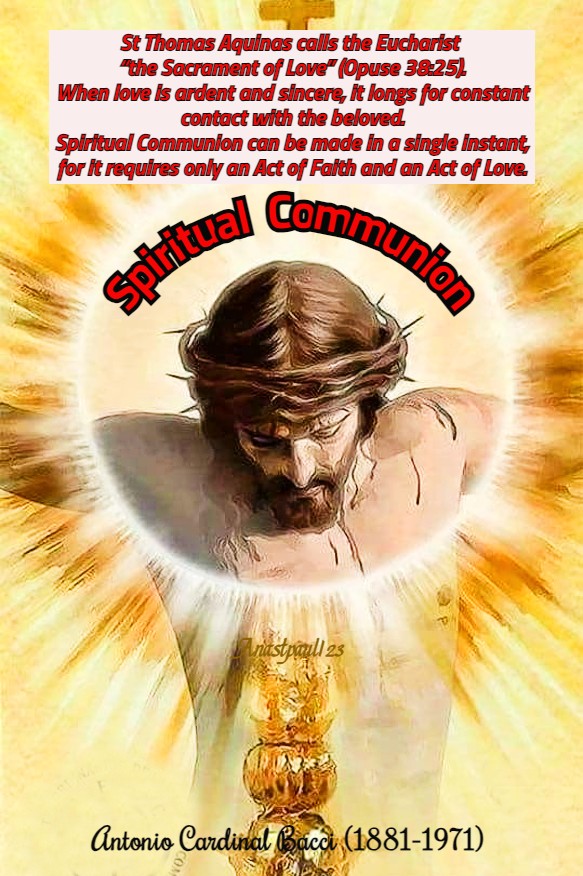
Spiritual Communion
“St Thomas Aquinas calls the Eucharist “the Sacrament of Love” (Opuse 38:25). When love is ardent and sincere, it longs for constant contact with the beloved. Spiritual Communion can be made in a single instant, for it requires only an Act of Faith and an Act of Love. Jesus, come into my heart, for I have need of You. I love You, my Jesus, keep me close to You always.
Aspiration: O Jesus, I cling to You, with all my heart!”
One Minute Reflection – 19 June – “The Month of the Most Sacred Heart of Jesus” – Corpus Christi – 1 Corinthians 11:23-29. – John 6:56-59 – Scripture search here: https://www.drbo.org/
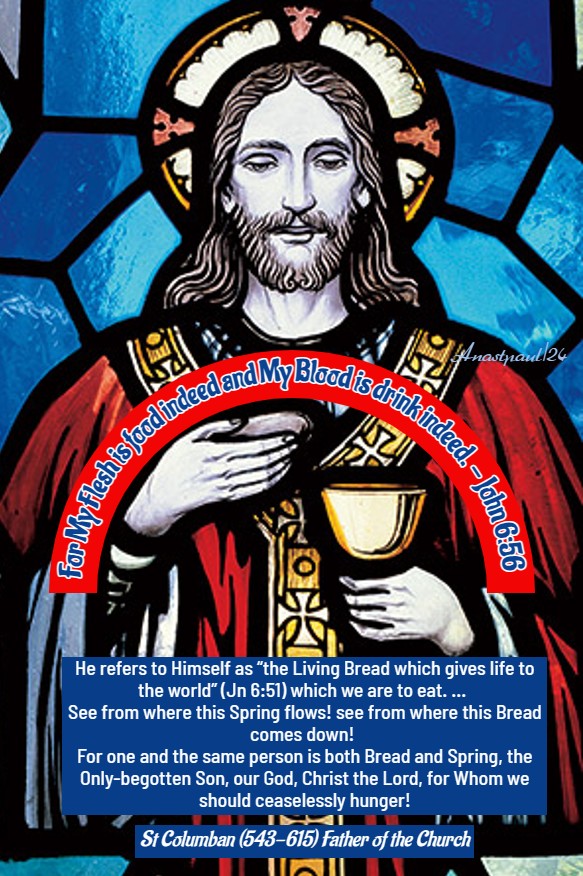
“For My Flesh is food indeed and My Blood is drink indeed.” – John 6:56
REFLECTION – “Beloved brethren, quench your thirst at the waters of that Divine Spring we want to tell you about – quench it but do not extinguish it; drink but do not become satisfied. The Living Spring, the Source of Life, calls us and says: “Let anyone who thirsts come to Me and drink” (Jn 7:37). Understand what it is you are drinking. Let the Prophet tell you and let the Source Itself tell you: “Listen to the word of the Lord, they have forsaken Me the Source of Living Water” (Jer 2:13). So the Lord our God Himself, Jesus Christ, is He Who is that Source of Life and that is why He invites us to come to Him so that we might drink Him. Whoever loves Him, drinks Him; whoever feeds on the Word of God, drinks Him. … Drink, therefore, from this Source that others have forsaken!
That we might eat of this Bread and drink from this Spring … He refers to Himself as “the Living Bread which gives life to the world” (cf Jn 6:51) which we are to eat. … See from where this Spring flows! see from where this Bread comes down! For one and the same person is both Bread and Spring, the Only-begotten Son, our God, Christ the Lord, for Whom we should ceaselessly hunger!
It is our love which gives Him as food to us, our desire which makes us eat Him and when we have been satisfied, we desire Him still. Let us go to Him as to a fountain and drink of Him in our overflowing love, let us drink Him always with ever-new desire, finding our joy in the sweetness of His Love. The Lord is gentle and good. We eat and drink Him without ceasing to hunger and thirst for Him, for we cannot exhaust this Food and Drink. We eat of this Bread yet do not run out of it; we drink at this Spring, yet it does not run dry. This Bread is eternal; this Stream flows without end!” – St Columban (543-615) Father of the Church, Monk, Irish Missionary, Abbot, Writer, Reformer, Teacher, Miracle-worker, Founder of numerous Nonateries. (Spiritual instructions 12, 2, 3).
PRAYER – O God, Thou Who in this wondrous Sacrament has left us a memorial of Thy Passion, grant us, we beseech Thee, so to venerate the Sacred Mysteries of Thine Body and Blood that we may ever experience within ourselves, the effect of Thy redemption. Who lives and reignest with God the Father, in the unity of the Holy Ghost, God, world without end. Amen (Collect).
EUCHARISTIC Heart of JESUS, model of the priestly heart, have mercy on us. COR JESU Eucharisticum, cordis sacerdotalis exemplar, miserere nobis.– Indulgence 300 Days, Everytime – Raccolta 177St Pius X, 11 Sept
Our Morning Offering – 19 June – “The Month of the Most Sacred Heart of Jesus” – Corpus Christi
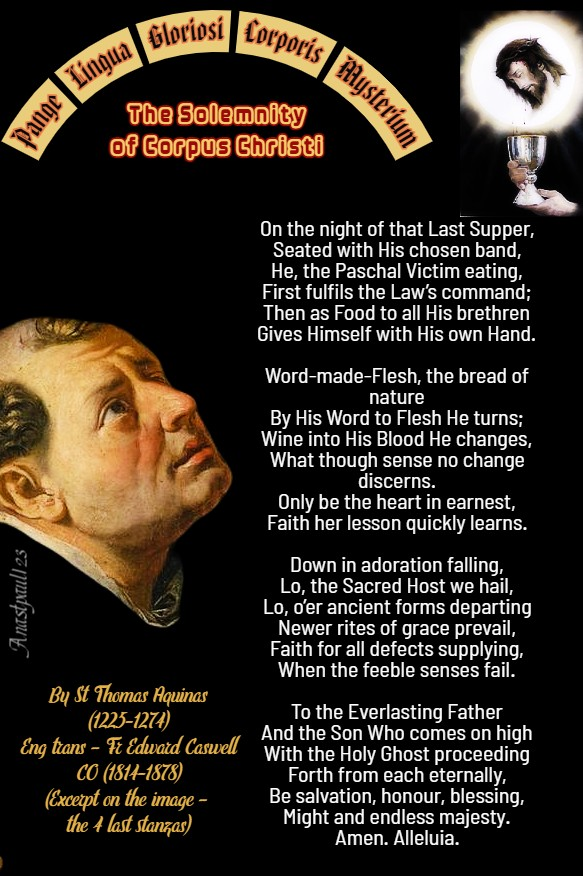
Pange Lingua Gloriosi Corporis Mysterium Sing, My Tongue By St Thomas Aquinas (1225-1274) Eng trans – Fr Edward Caswell CO (1814-1878) (Excerpt on the image – the 4 last stanzas)
Sing, my tongue, the Saviour’s glory, Of His Flesh, the Mystery sing; Of the Blood, all price exceeding, Shed by our Immortal King, Destined, for the world’s redemption, From a noble Womb to spring.
Of a pure and spotless Virgin Born for us on earth below, He, as Man, with man conversing, Stayed, the seeds of truth to sow; Then He closed in solemn order Wondrously His Life of woe.
On the night of that Last Supper, Seated with His chosen band, He, the Paschal Victim eating, First fulfils the Law’s command; Then as Food to all His brethren Gives Himself with His own Hand.
Word-made-Flesh, the bread of nature By His Word to Flesh He turns; Wine into His Blood He changes, What though sense no change discerns. Only be the heart in earnest, Faith her lesson quickly learns.
Down in adoration falling, Lo, the Sacred Host we hail, Lo, o’er ancient forms departing Newer rites of grace prevail, Faith for all defects supplying, When the feeble senses fail.
To the Everlasting Father And the Son Who comes on high With the Holy Ghost proceeding Forth from each eternally, Be salvation, honour, blessing, Might and endless majesty. Amen. Alleluia.
Written by St Thomas Aquinas (1225-1274) the Angelic and Common Doctor of the Church, for the very first Solemnity of Corpus Christi, this Hymn is considered the most beautiful of Aquinas’ Hymns and one of the seven great Hymns of the Church.
The last two stanzas make up the Tantum Ergo (Down in Adoration Falling) which is used at Benediction of the Blessed Sacrament. The Hymn is also used on Maundy Thursday during the procession from the Sanctuary to the Altar of Repose, where the Blessed Sacrament is kept until Good Friday.
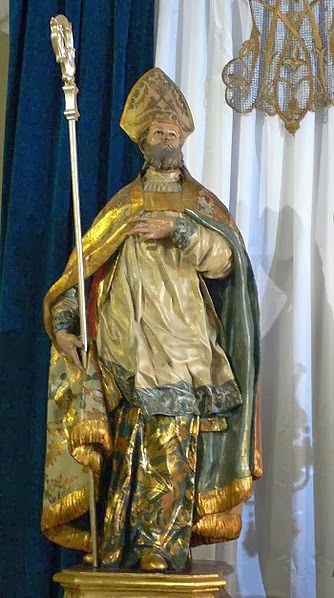
Saint of the Day – 19 June – Saint Hildegrim (c750-c827) Bishop of Châlons in France from 804 to 810 and then 2nd Abbot of Werden Abbey, after his elder brother, the Founder, St Ludger. Also known as – Hildegrin … of Werden.
This is an Unknown Bishop not our St Hildegrim
Hildegrim was of born of Christian Frisian noble descent. He received a thorough education at the Utrecht Cathedral School, founded by Bishop Gregory, and in York .under St Alcuin.
Mentioned as a Deacon in 793, he was Ordained a Priest three years later.
In around 804, he was elected as the Bishop of Châlons. Upon St Ludger’s death in 809, he succeeded him as the Abbot of Werden and Helmstadt.
He is also traditionally named as the 1st Bishop of Halberstadt, a position now discounted by some scholars. Hildegrim is known to have been active in spreading Christianity as a Missionary into Osterwieck and Halberstadt region after the Saxon Wars of Charlemagne.
St Hildegrim is buried in the Crypt of Werden Abbey Church. He is remembered and celebrated on 19 June.
Sts Adleida and Lupo of Bergamo Married Martyrs Bl Arnaldo of Liniberio St Culmatius of Arezzo St Deodatus of Jointures St Deodatus of Nevers St Gaudentius of Arezzo
St Innocent (Died 559) Bishop of Le Mansserving his Diocese for over 40 years and that is the sum total of the information which we have of this Saint. St Lambert of Saragossa Layman Martyr St Lupo of Bergamo St Modeste Andlauer St Nazario of Koper St Rémi Isoré Bl Sebastian Newdigate Bl Thomas Woodhouse Bl William Exmew St Zosimus of Umbria
Thought for the Day – 18 June – Meditations with Antonio Cardinal Bacci (1881-1971)
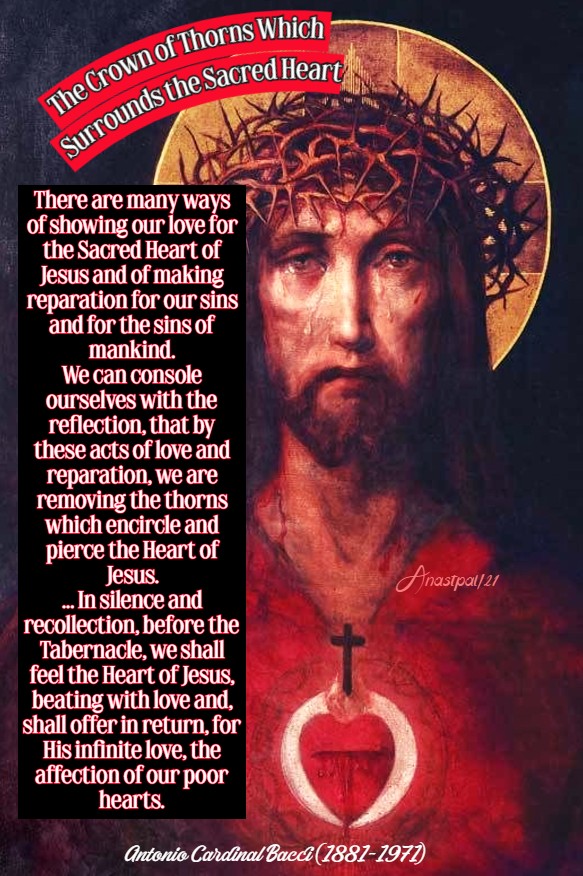
The Crown of Thorns Which Surrounds the Sacred Heart
“There are many ways of showing our love for the Sacred Heart of Jesus and of making reparation for our sins and for the sins of mankind. We can console ourselves with the reflection, that by these acts of love and reparation, we are removing the thorns which encircle and pierce the Heart of Jesus. The simplest ways of doing this, are by prayers, aspirations and expressions of love, directed towards the adorable Heart of our Redeemer and, by visits to Jesus in the Blessed Sacrament. In silence and recollection, before the Tabernacle, we shall feel the Heart of Jesus, beating with love and, shall offer in return, for His infinite love, the affection of our poor hearts.
We can also receive Holy Communion in reparation. When Jesus is in us and we are in Jesus, it will be easier and more pleasant, to offer Him our love and expiation. We can make reparation also, by practising the devotion of the First Fridays of the month. This pious practice, so pleasing to the Heart of Jesus, aims at being a mass offering of love and reparation, for the sins of the entire human race!”
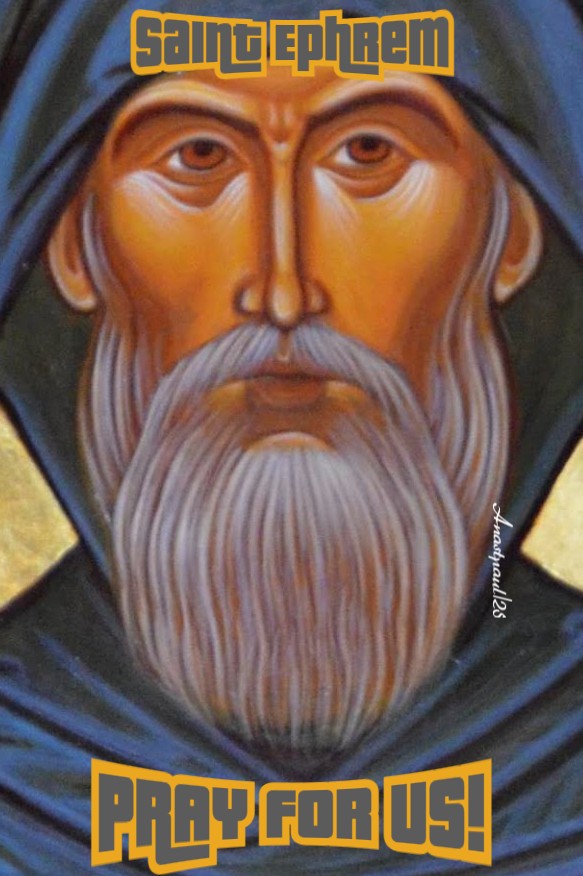
Quote/s of the Day – 18 June – St Ephrem (306-373) Father & Doctor of the Church, “The Harp of the Holy Ghost!”
“And lo a Voice out of the cloud, saying: This is My Beloved Son, in Whom I Am well pleased, hear ye Him.” Matthew 17:5
“He leads them up a high mountain and shows them His royalty before suffering, His power before dying, His glory before being insulted and His honour before undergoing ignominy. In this way, when He will be captured and Crucified, His Apostles will understand that He did not undergo this because of weakness but, to consent and willingly so, for the salvation of the world.”
“The Cross gives Light to the whole universe; it casts out darkness and gathers nations together in charity, into One Church, One Faith, One Baptism…”
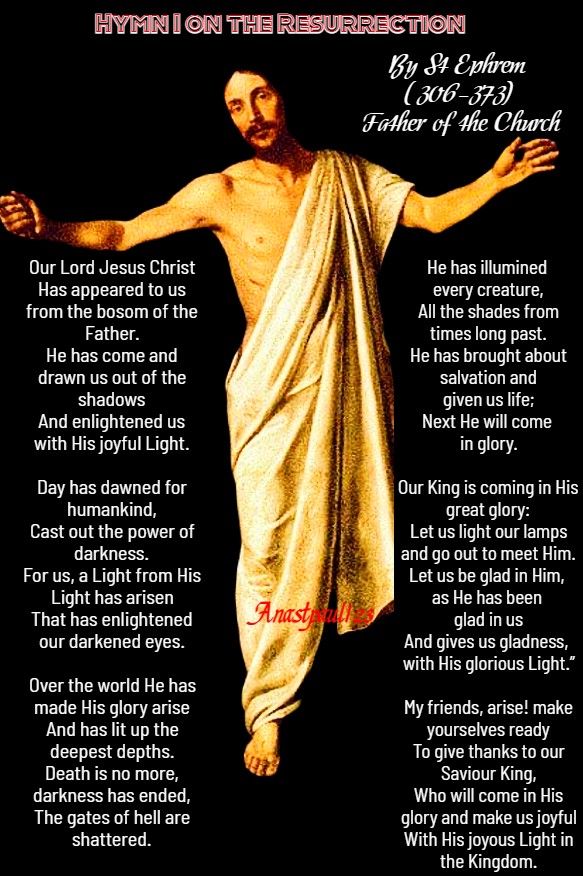
“Our Lord Jesus Christ Has appeared to us from the bosom of the Father. He has come and drawn us out of the shadows And enlightened us with His joyful Light.
Day has dawned for humankind, Cast out the power of darkness. For us, a Light from His Light has arisen That has enlightened our darkened eyes.
Over the world He has made His glory arise And has lit up the deepest depths. Death is no more, darkness has ended, The gates of hell are shattered.
He has illumined every creature, All the shades from times long past. He has brought about salvation and given us Life; Next He will come in glory.
Our King is coming in His great glory: Let us light our lamps and go out to meet Him (Mt 25,6); Let us be glad in Him, as He has been glad in us And gives us gladness, with His glorious Light.
My friends, arise! make yourselves ready To give thanks to our Saviour King, Who will come in His glory and make us joyful With His joyous Light in the Kingdom.”
(Hymn I on the Resurrection)
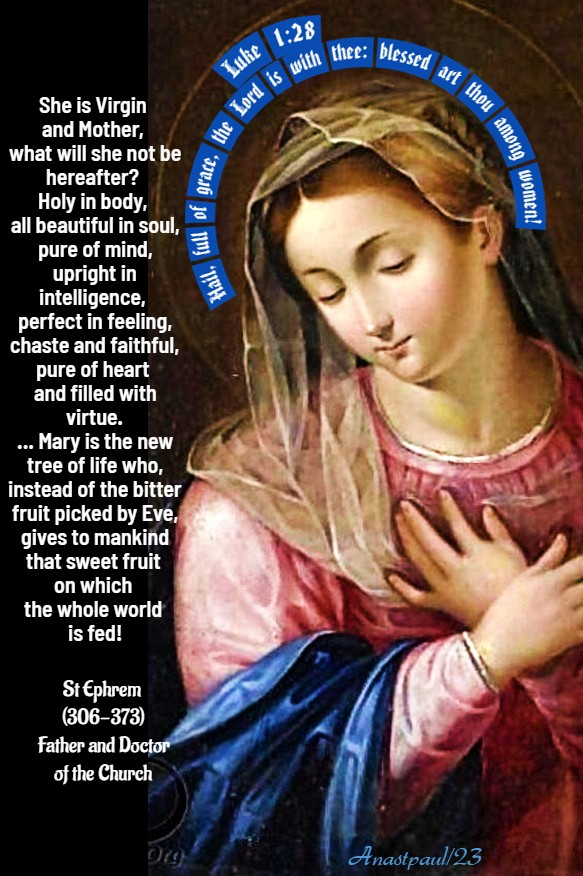
“She is Virgin and Mother, what will she not be hereafter? Holy in body, all beautiful in soul, pure of mind, upright in intelligence, perfect in feeling, chaste and faithful, pure of heart and filled with virtue.
… Mary is the new Tree of Life, who, instead of the bitter fruit picked by Eve, gives to mankind that Sweet Fruit on which the whole world is fed.”
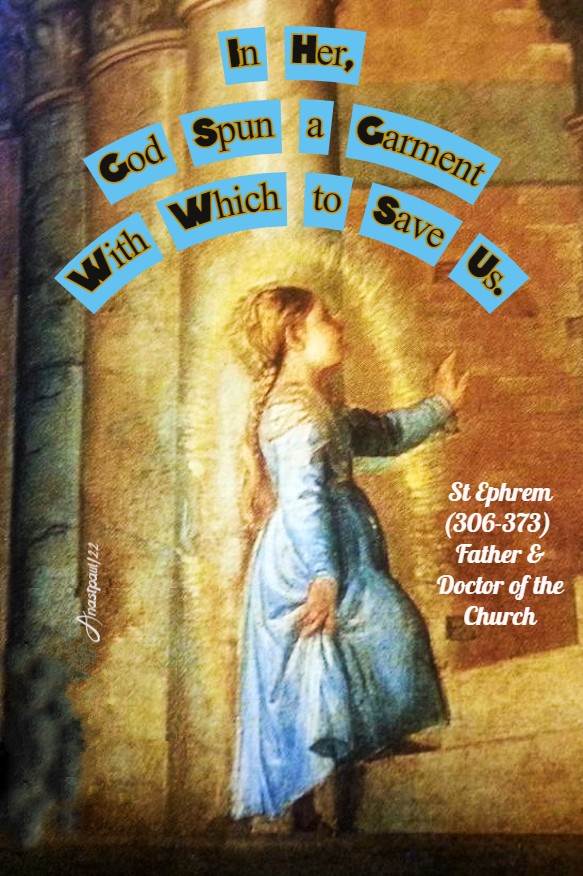
“In her, God spun a garment with which to save us.”
One Minute Reflection – 18 June – “The Month of the Most Sacred Heart of Jesus” – St Ephrem (306-373) Father & Doctor of the Church, “The Harp of the Holy Ghost!” – Timothy 4:1-8 – Matthew 5:13-19 – Scripture search here: https://www.drbo.org/
“Neither do men light a candle and put it under a bushel but upon a candlestick that it may shine to all in the house.” – Matthew 5:15
REFLECTION – “Men do not light a candle and put it under a bushel …” Through these words, Jesus again encourages His disciples to lead an irreproachable life, by advising them to watch over themselves constantly because, they are placed in the sight of all humankind, like athletes in a stadium, who are seen by the whole world (1 Cor 4:9).
He told them: “Do not say to yourselves: ‘Now we can stay here quietly sitting, we are hidden in a little corner of the world,’ for you will be visible to all humankind, like a City on top of a mountain (Mt 5:14), like a light in the house which has been placed on the lamp stand … I have lit the light of your torch but it is up to you to see it is kept burning, not just to your personal advantage but also, in the interest of all who will see it and who, through it, will be led to the Truth. The worst wickedness would not put a shadow over your light, if you live with the vigilance of those who are called to bring the whole world to good. So, let your life correspond to the holiness of your mission, so that God’s grace may be proclaimed everywhere.” – St John Chrysostom (347-407) Father and Doctor of the Church (Homilies on St Matthew’s Gospel No 15).
PRAYERS – O God, Who willed to enlighten Thy Church by the wondrous learning and glorious merits of the life of blessed Ephrem, Thy Confessor and Doctor, we humbly pray Thee that, by his pleading, Thou will shield her with Thy lasting power, against the snares of error and evil. Through Jesus Christ, Thy Son our Lord, Who lives and reigns with Thee, in the unity of the Holy Ghost, God, world without end. Amen (Collect).
MAY the Heart of JESUS in the most Blessed Sacrament be praised, adored and loved with grateful affection, at every moment, in all the Tabernacles of the world, even to the end of time. Amen.Indulgence 100 Days, Once a day. Raccolta 161 Blessed Pius IX, 29 February 1868.
Our Morning Offering – 18 June – “The Month of the Most Sacred Heart of Jesus”
O Heart of Jesus in the Blessed Sacrament By The League of the Sacred Heart 1929 (Ireland)
O Heart of Jesus in the Blessed Sacrament, overflowing with gentleness, tenderness and charity, I bury in the abyss of Thy Mercy, all my iniquities and all my negligence. I offer Thee my labours and my sufferings, my sorrows and my miseries, I recommend to Thee my life and my death. Solace my doubts Sweet Jesus, calm my fears and grant, that day-by-day, I may become more united to Thy Sacred Heart, learning Thy love and Thy holiness. Amen
Saint of the Day – 18 June – Saint Calogerus (c466-c561) Hermit in Sicily, Missionary evangeliser graced with visions and the charism of casting out demons as an Exorcist, Born in c466 in Chalcedon, Thrace in Egypt and died in c561 at Monte Cronios, Sciacca, Sicily. Patronage – of Petralia Sottana a Town in Sicily. Also known as – Calogero, Calogerus of Sicily, … the Hermit, Calogerus of Sicily. The name Calogerus, is of Greek origin and means “elderly beauty.” In the Greek ideal of beauty, that which is beautiful is also fair and good, suffice it to remember in the Gospel according to St John, the original Greek version calls Jesus the “beautiful Shepherd” which later became the “good Shepherd.”
This term was used in the East and in southern Italy for the Hermit Monks, who were thus called Caloyers or Calogeri, Therefore, some experts believe that this was not the name of our Hermit Haint but rather the appellation he was recognised by. However, other scholars are convinced that this was, in fact, his name.
The Roman Martyrology reads today: “At Sacca, in Sicily,, St Calogerus, Hermit, whose holiness is principally manifested by the deliverance of possessed persons.”
According to tradition, since there is no certain documentation, Calogerus was born around 466 in Chalcedon on the Bosphorus, a Town in ancient Thrace which, in 46 became a Roman Province and then followed the fate of the Byzantine Empire.
Since Calogerus’ childhood he fasted, prayed and studied the Holy Scripture and according to the ‘Acts’ taken from the ancient Siculo-Gallican Breviary, in use in Sicily from the 9th Century to the 16th, he came to Rome on a pilgrimage, receiving from Pope Felix III (483-492), permission to live in solitude in an unspecified place.
Here, he had an angelic vision or a celestial inspiration which instructed him to evangelise Sicily. When he returned from the Pope, he obtained authorisation to go to the island, with his companions Philip, Onofrius and Archileone, to free that people from demons and from the worship of pagan gods. He and his companions spread out to different places to more effectively spread the Gospel.
During stay on the island of Lipari, Calogerus had a vision of the death of King Theodoric († 526) who, in recent years had begun to persecute those Latins he considered a danger to his kingdom, among whom were the philosopher Boethius (480-524). This is reported in the ‘Dialogues’ of Pope St Gregory I the Great, the vision had come true on the exact day and hour of the King’s death and Calogerus saw his soul hurled into the crater of the nearby Volcano.
Calogerus is also held to have worked as a missionary on Lipari in the Aeolian Islands, before retiring to live as a solitary Hermit on Monte Giummariaro which is now sometimes called in Sicilian: Monte San Caluòru in his honour, as is another mountain near Palermo. Calogerus settled in a cave adjacent to the vaporous ones, which, as in Lipari, also exist here in abundance.
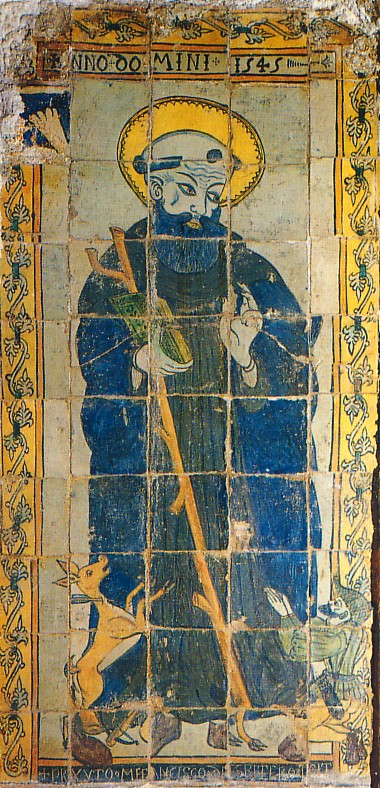
In said cave, there is a majolica image (see below) of St Calogerus walled into the rock, placed above a rustic Altar which is said to have been built by himself, The image is from 1545 and represents the bearded hermit holding a book and a stick-branch in his right hand, at his feet there is a kneeling believer and a doe collapsed and wounded by an arrow.
Saint Calogerus from the Cave above Monte Giummariaro dated 1545, Calogerus the Hermit, Calogerus of Sicily, San Calogero
The image refers to an episode of his last days, being now over ninety years old, he could no longer feed himself, so God sent him a doe which fed him with her delicate milk. One day, a hunter named Sierus, seeing the animal, took his bow and pierced the doe with an arrow which managed to drag itself inside Calogerus’ cave, dying in his arms.
The repentant and crying hunter, recognised, in the old man, the one who had Baptised him years before, asked for forgiveness and Calogerus took him to the nearby steamy cave, giving him instructions for the healing properties of that steam and the waters which flowed from that mountain. The hunter Sierus, who had become his disciple, often climbed the mountain to visit him but 40 days after killing the doe, he found the old hermit dead, still kneeling before the Altar. According to tradition, he had died in the cave between 17 and 18 June 561 and had lived in that place for 35 years.
When the news spread, the inhabitants of the nearby Towns flocked to him and buried him in the cave itself which was then transferred to another cave, whose memory has been lost over the centuries.
It should be added that the Relics of the Saint, according to another tradition, were later transferred to a Monastery three km from the cave. And, in 1490 they were moved to Fragalà (Messina) by the Basilian Monk Urbano da Naso and then to Frazzanò (Messina), to the Parish Church. Some of his Relics are kept in the Sanctuary of San Calogerus built near his cave in the 17 Century. This Church is now a destination for pilgrimages.
In any case, St Calogerus is venerated throughout Sicily and in all the Cities he is honoured with Processions and celebrations, typical of the intense pirty and devotion of the Sicilians, almost all of which take place on his Feastday on 18 June.
St Alena of Dilbeek St Amandus of Bordeaux St Arcontius of Brioude St Athenogenes of Pontus St Calogerus (c466-c561) Hermit in Sicily St Calogerus of Fragalata St Calogerus the Anchorite St Colman mac Mici St Cyriacus of Malaga St Demetrius of Fragalata St Edith of Aylesbury
St Elpidius of Brioude St Equizio of Telese St Erasmo St Etherius of Nicomedia Bl Euphemia of Altenmünster St Fortunatus the Philosopher St Gerland of Caltagirone St Gregory of Fragalata
St Osanna of Northumberland St Osmanna of Jouarre St Paula of Malaga Bl Peter Sanchez
Hermits of Karden: A father (Felicio) and his two sons (Simplicio and Potentino) who became pilgrim to various European holy places and then Hermits at Karden (modern Treis-Karden, Germany). (Born in Aquitaine (in modern France. ) Their relics transferred to places in the Eifel region of western Germany at some point prior to 930. They were Canonised on 12 August 1908 by Pope Pius X (cultus confirmation).
Martyrs of Ravenna – 4 Saints: A group of four Christians Martyred together. We have no details but their names – Crispin, Cruciatus, Emilius and Felix. They were martyred in Ravenna, Italy, date unknown.
Martyrs of Rome – 3 Saints: Three Christians Martyred together . We have no details but their names – Cyriacus, Paul and Thomas. In Rome, Italy, date unknown.
Martyrs of Tripoli – 3 Saints: Three imperial Roman soldiers, at last two of them recent converts, who were imprisoned, tortured and executed for their faith. Martyrs – Hypatius, Leontius and Theodulus. They were Greek born and they died c135 at Tripoli, Phoenicia (in modern Lebanon).
Thought for the Day – 17 June – Meditations with Antonio Cardinal Bacci (1881-1971)
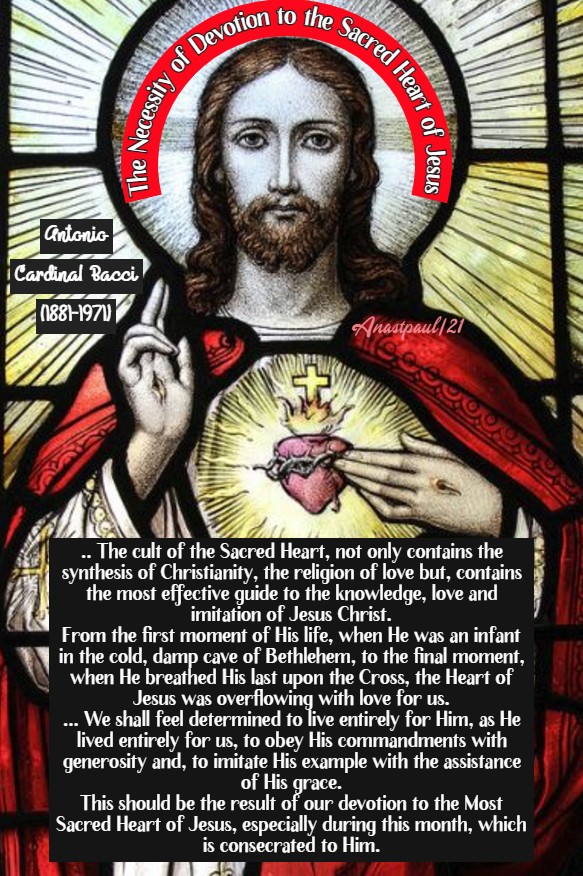
The Necessity of Devotion to the Sacred Heart of Jesus
“It is necessary to develop and meditate on these words of Pius XI, (see Part One) from which, it is clear, that the cult of the Sacred Heart, not only contains the synthesis of Christianity, the religion of love but, contains the most effective guide to the knowledge, love and imitation of Jesus Christ. From the first moment of His life, when He was an Infant in the cold, damp cave of Bethlehem, to the final moment, when He breathed His last upon the Cross, the Heart of Jesus was overflowing with love for us. We can learn from this, to know our Divine Saviour better, so that appreciating more fully His infinite love for us, we shall feel an upsurge of gratitude and, of love. We shall feel determined to live entirely for Him, as He lived entirely for us, to obey His commandments with generosity and, to imitate His example with the assistance of His grace. This should be the result of our devotion to the Most Sacred Heart of Jesus, especially during this month, which is consecrated to Him.”
Quote/s of the Day – 17 June – 1 John 4:8-21 – Luke 6:36-42 – Scripture search here: https://www.drbo.org/
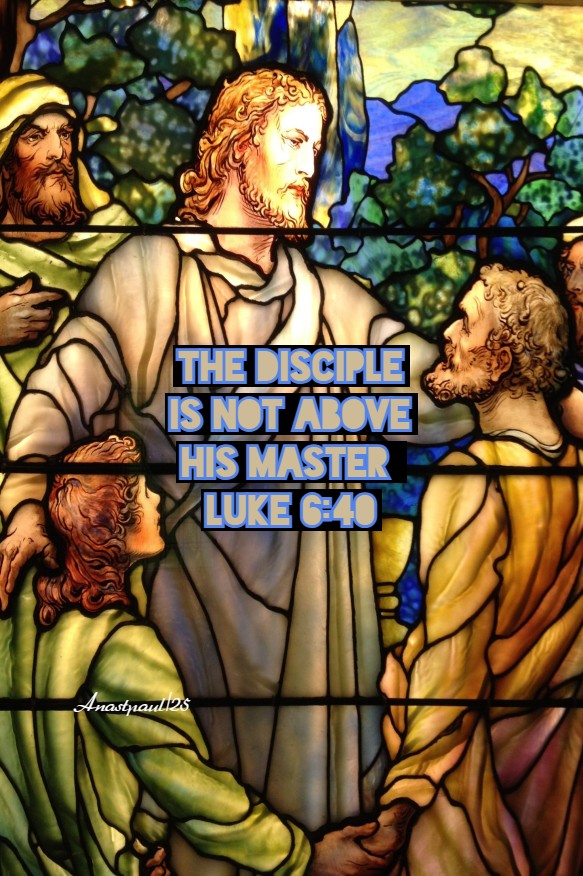
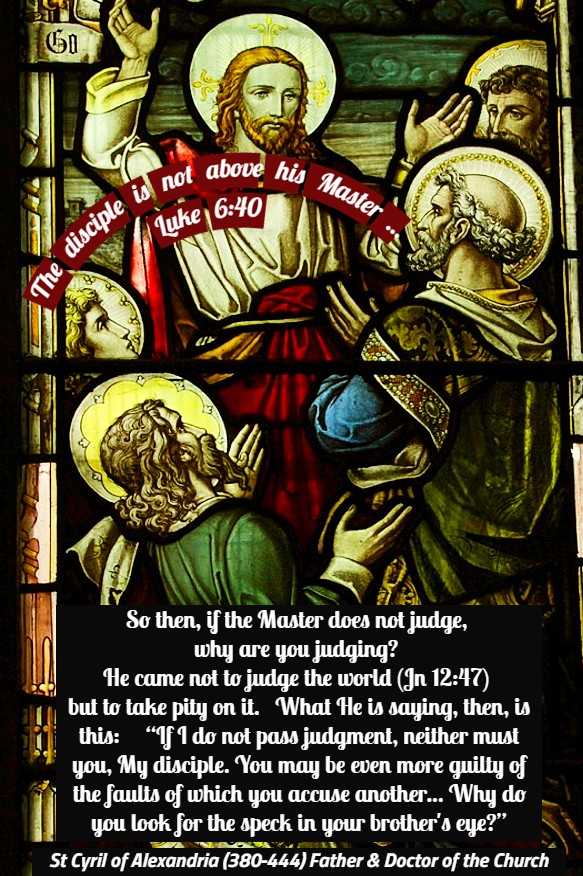
“The disciple is not above his Master …”
Luke 6:40
“Sir, did you not sow good seed in your field? How then has it weeds?”
Matthew 13:27
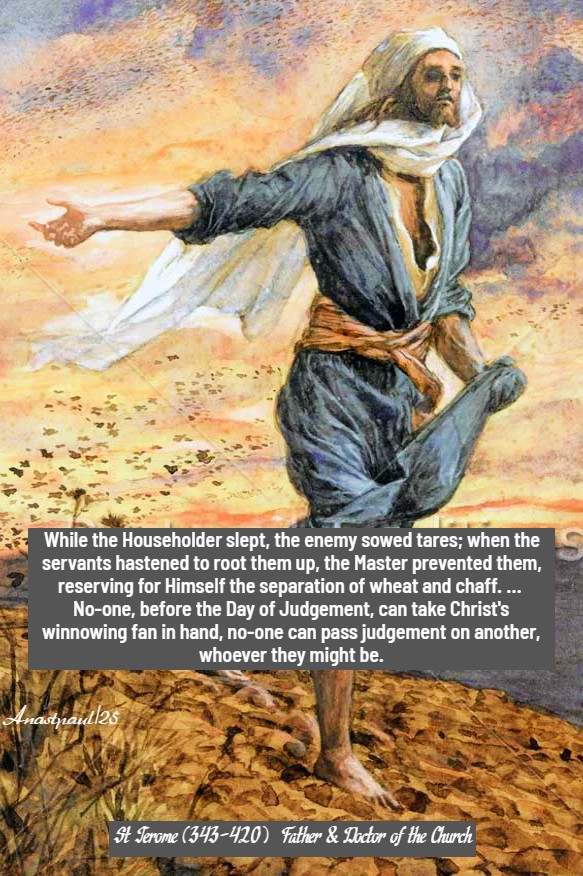
“While the Householder slept, the enemy sowed tares; when the servants hastened to root them up, the Master prevented them, reserving for Himself the separation of wheat and chaff. … No-one, before the Day of Judgement, can take Christ’s winnowing fan in hand, no-one can pass judgement on another, whoever they might be.”
St Jerome (343-420) Father & Doctor of the Church
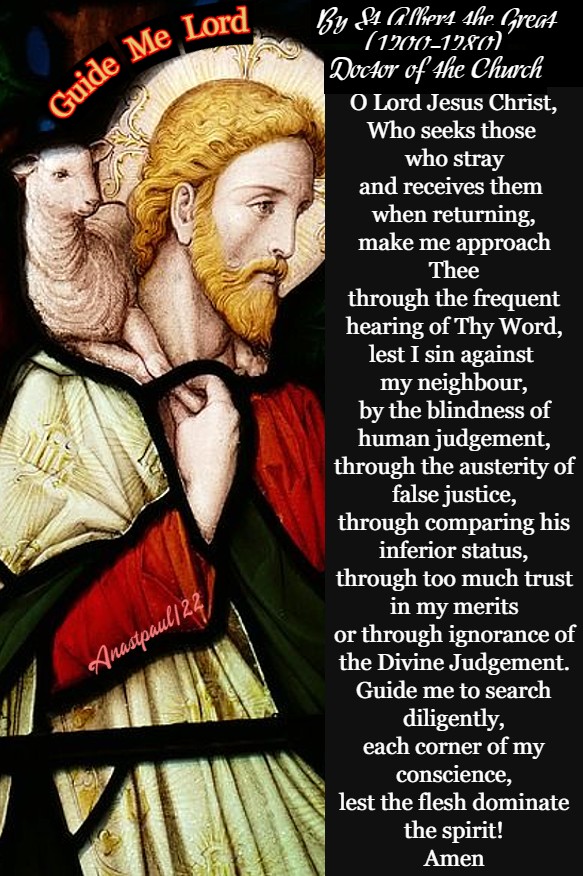
Guide Me Lord By St Albert the Great (1200-1280) Doctor of the Church
O Lord Jesus Christ, Who seeks those who stray and receives them when returning, make me approach Thee through the frequent hearing of Thy Word, lest I sin against my neighbour, by the blindness of human judgement, through the austerity of false justice, through comparing his inferior status, through too much trust in my merits or through ignorance of the Divine Judgement. Guide me to search diligently, each corner of my conscience, lest the flesh dominate the spirit! Amen
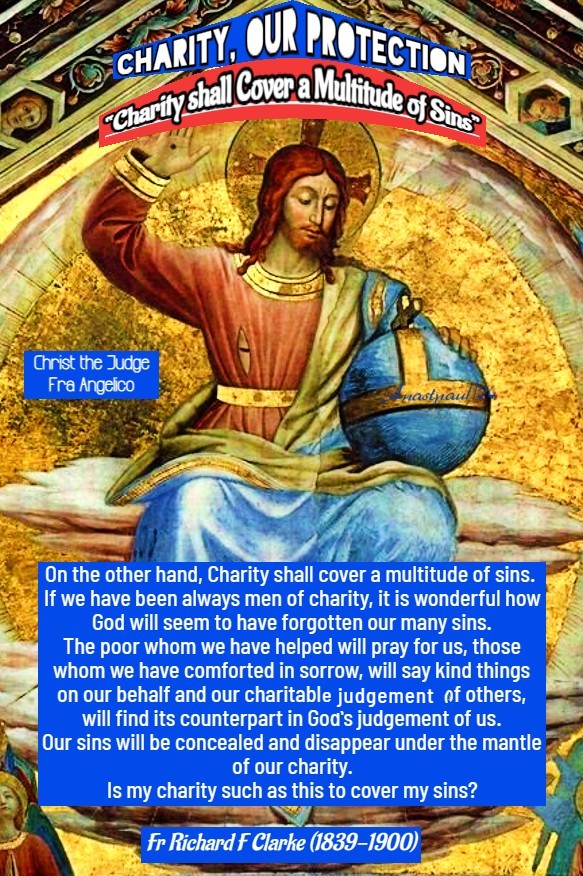
“On the other hand, Charity shall cover a multitude of sins. If we have been always men of charity, it is wonderful how God will seem to have forgotten our many sins. The poor whom we have helped will pray for us, those whom we have comforted in sorrow, will say kind things on our behalf and our charitable judgeement of others, will find its counterpart in God’s judgement of us. Our sins will be concealed and disappear under the mantle of our charity. Is my charity such as this to cover my sins?”
One Minute Reflection – 17 June – “The Month of the Sacred Heart of Jesus” – 1 John 4:8-21 – Luke 6:36-42 – Scripture search here: https://www.drbo.org/
“The disciple is not above his Master …” – Luke 6:40
REFLECTION – “The blessed disciples were to be the spiritual guides and teachers of the whole world. It had, therefore, to be clearly seen by all that they held fast to the True Faith. It was essential for them to be familiar with the Gospel way of life, skilled in every good work and to give teaching which was precise, salutary and scrupulously faithful to the Truth they themselves had long pondered, enlightened by the Divine Radiance. Otherwise, they would be blind leaders of the blind. Those imprisoned in the darkness of ignorance can never lead others in the same sorry state, to knowledge of the Truth. Should they try, both would fall headlong into the ditch of the passions.
To destroy the ostentatious passion of boastfulness and stop people from trying to win greater honour than their teachers, Christ declared: “The disciple is not above his teacher.” Even if some should advance so far as to equal their teachers in holiness, they ought to remain within the limits set by them and follow their example. Paul also taught this when he said: “Be imitators of me as I am of Christ,” (1Cor 11:1).
So then, if the Master does not judge, why are you judging? He came not to judge the world (Jn 12:47) but to take pity on it. What He is saying, then, is this: “If I do not pass judgment, neither must you, My disciple. You may be even more guilty of the faults of which you accuse another… Why do you look for the speck in your brother’s eye?” – St Cyril of Alexandria (380-444) Bishop, Father and Doctor of the Church (Commentary on the Gospel of Luke, 6).
PRAYER – From all perils of soul and body defend us, O Lord, we beseech Thee and by the intercession of blessed and gloriosus ever Virgin Mary, Mother of God, of blessed Joseph, of Thy blessed Apostles, Peter and Paul and all the Saints, graciously grant us safety and peace that all adversities and errors being overcome, Thy Church may serve Thee in security and freedom. Through Jesus Christ, Thy Son our Lord, Who lives and reigns with Thee, in the unity of the Holy Ghost, God, world without end. Amen (Collect).
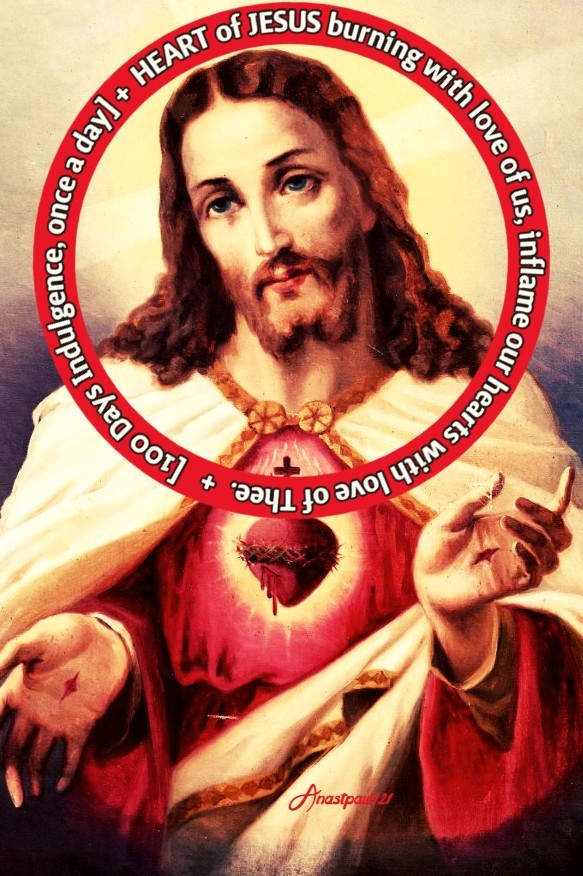
HEART of JESUS burning with love of us, inflame our hearts with love of Thee. – 100 Days, once a day. (See Instructions. – Unless otherwise stated, e.g., “once a day,” a partial Indulgence may be gained any number of times in succession.) [169 Raccolta or Collection of Indulgences, 1910] Pope Leo XIII, 16 July 1893.
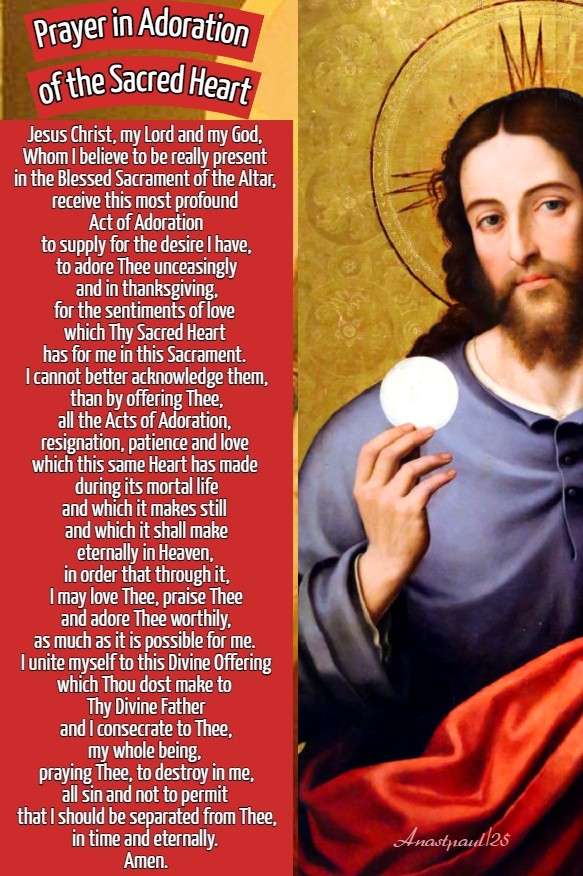
Prayer in Adoration of the Sacred Heart By St Margaret Mary Alacoque (1647-1690) Visionary and Apostle of the Sacred Heart of Jesus
Jesus Christ, my Lord and my God, Whom I believe to be really present in the Blessed Sacrament of the Altar, receive this most profound Act of Adoration to supply for the desire I have, to adore Thee unceasingly and in thanksgiving, for the sentiments of love which Thy Sacred Heart has for me in this Sacrament. I cannot better acknowledge them, than by offering Thee, all the Acts of Adoration, resignation, patience and love which this same Heart has made during its mortal life and which it makes still and which it shall make eternally in Heaven, in order that through it, I may love Thee, praise Thee and adore Thee worthily, as much as it is possible for me. I unite myself to this Divine Offering which Thou dost make to Thy Divine Father and I consecrate to Thee, my whole being, praying Thee, to destroy in me, all sin and not to permit that I should be separated from Thee, in time and eternally. Amen.
Saint of the Day – 17 June – St Avitus (Died c530) Priest, Confessor, Abbot, Hermit. Born in Orléans, France and died there in c530. Patronages of Orléans and Perche, France. Also known as – Avitus of Micy, Avit, Avito, Avy … of Orléans, … of Perche.
The Roman Martyrology reads today: “At Orléans, St Avitus, Priest and Confessor.”
Avitus was a native of Orléans and, retiring into Auvergne, took the monastic Habit, together with St. Calais, in the Abbey of Menat. This Monastery was, at that time very small, though afterward enriched by Queen Brunehault, and by St Boner, Bishop of Clermont.
The two Saints soon after returned to Miscy, a famous Abbey situated a league and a half below Orleans. It was founded toward the end of the reign of Clovis I. by St Euspicius, a holy Priest, honoured on 14 June and his nephew St Maximin or Mesnim, whose name this Monastery nears. It is now of the Cistercian Order. Many call St Maximin the first Abbot, others St Euspicius, St. Maximin the second and our St Avitus the third.
But our Saint and St Calais did not remain at Miscy very long, although St Maximin gave them a gracious reception. In quest of solitude, Avitus, who had succeeded St Maximin, soon after resigned the Abbacy and with St Calais lived as a recluse in the territory now called Dunois, on the border of La Perche. Others soon joining them, St Calais retired into a forest in Maine and King Clotaire built a Church and Monastery for Avitus and his companions. This is at present a Benedictine Nunnery, called St.Avy of Chateaudun and is situated on the Loire, at the foot of the hill on which the Town of Chateaudun is built, in the Diocese of Chartres.
Three famous Monks, Leobin, afterwards Bishop of Chartres, Euphronius and Rusticus, attended our Saint to his happy death which happened about the year 530. His body was carried to Orléans and buried with great pomp in that City now protected by our St Avitus. (Taken from Lives of the Saints, by Alban Butler).
St Adolph of Utrecht St Agrippinus of Como St Antidius of Besançon Bl Arnold of Foligno St Avitus (Died c530) Priest, Confessor, Abbot St Blasto of Rome
St Himerius of Amelia St Hypatius of Chalcedon St Molling of Wexford St Montanus of Gaeta St Nectan of Hartland Bl Paul Burali d’Arezzo Bl Peter Gambacorta Bl Philippe Papon St Prior St Rambold of Ratisbon
Martyrs of Apollonia – 7 Saints: A group of Christians who fled to a cave near Apollonia, Macedonia to escape persecution for his faith, but were caught and executed. The names we know are – Basil, Ermia, Felix, Innocent, Isaurus, Jeremias and Peregrinus. They were beheaded at Apollonia, Macedonia.
Martyrs of Aquileia – 4 Saints: Four Christian Martyrs memorialised together. No details about them have survived, not even if they died together – Ciria, Maria, Musca and Valerian. c.100 in Aquileia, Italy.
Martyrs of Chalcedon – 3 Saints: Three well-educated Christian men who were sent as ambassadors from King Baltan of Persia to the court of emperor Julian the Apostate to negotiate peace between the two states, and an end of Julian’s persecutions of Christians. Instead of negotiating, Julian imprisoned them, ordered them to make a sacrifice to pagan idols and when they refused, had them executed. Their names were Manuel, Sabel and Ismael. They were beheaded in 362 in Chalcedon (part of modern Istanbul, Turkey) and their bodies burned and no relics survive.
Martyrs of Fez – 4 Beati: A group of Mercedarians sent to Fez, Morocco to ransom Christians imprisoned and enslaved by Muslims. For being openly Christian they were imprisoned, tortured, mutilated and executed. Martyrs – Egidio, John, Louis and Paul. They were martyred in Fez, Morocco.
Martyrs of Rome – 262 Saints: A group of 262 Christians Martyred in the persecutions of Diocletian. In c303 in Rome, Italy. They were buried on the old Via Salaria in Rome.
Martyrs of Venafro – 3 Saints: Three Christian lay people, two of them imperial Roman soldiers, who were converts to Christianity and were Martyred together in the persecutions of Maximian and Diocletian – Daria, Marcian and Nicander. They were beheaded c.303 in Venafro, Italy. By 313 a basilica had been built over their graves which were re-discovered in 1930. They are patrons of Venafro, Italy.
Thought for the Day – 16 June – Meditations with Antonio Cardinal Bacci (1881-1971)
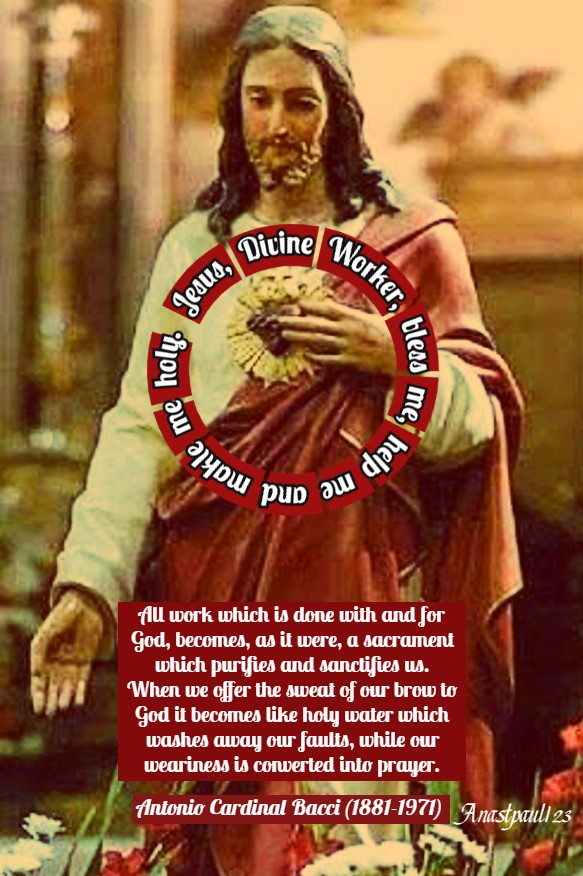
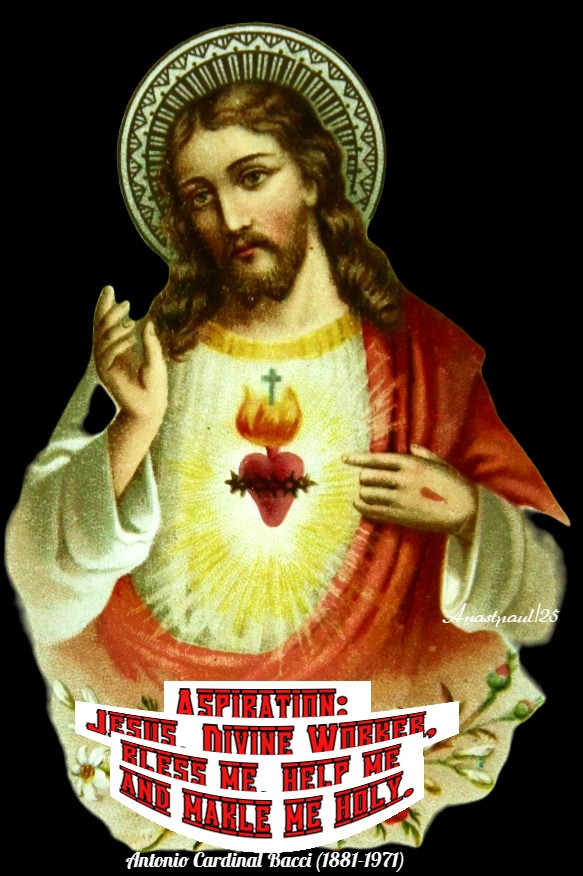
The Divine Worker
“We should accept our daily work and sanctify it with prayer as Jesus did. “To pray and to work” was the ancient motto of the Benedictines.
All work which is done with and for God, becomes, as it were, a sacrament which purifies and sanctifies us. When we offer the sweat of our brow to God it becomes like holy water which washes away our faults, while our weariness is converted into prayer.
Aspiration: Jesus, Divine Worker, bless me, help me and makle me holy.”
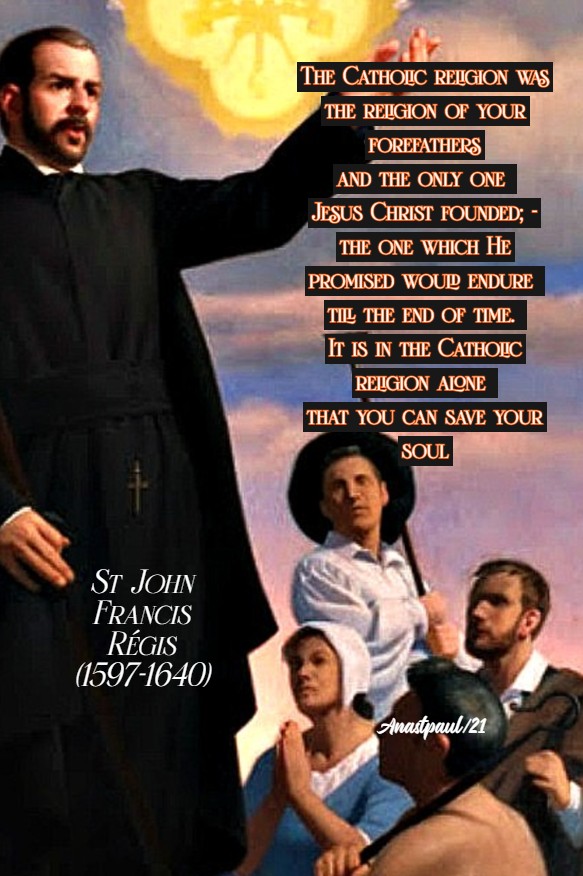
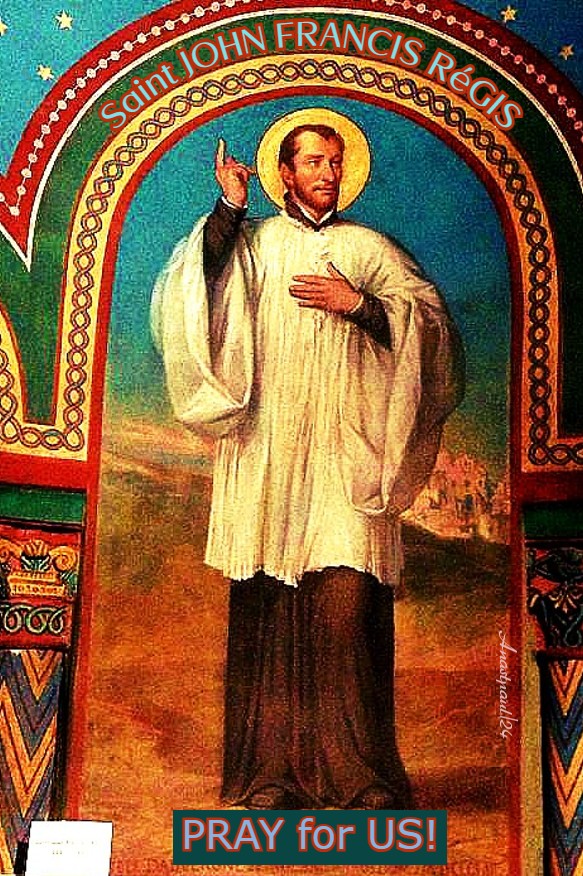
Quote/s of the Day – 16 June – St John Francis Régis SJ (1597-1640) Priest, Confessor, Missionary
“The Catholic religion was the religion of your forefathers and the only one Jesus Christ founded; – the one which He promised would endure till the end of time. It is in the Catholic religion alone that you can save your soul.”
“How long are you going to be deaf to His call? Or are you going to lose your soul, which Jesus Christ bought at the price of His Precious Blood?”
“My child, it is indeed the Voice of God you have heard. He has given you a great grace in thus calling you into His one true Church. While you live, never cease to thank Him and bless Him for it.”
(All the above from – Rev Fr D. Chisholm, The Catechism in Examples (London: R & T Washbourne, Ltd
“Brother, I see our Lord and our Lady opening the gates of Paradise for me. Into Your hands, O Lord, I commend my spirit.” St John Francis Regis on his deathbed
One Minute Reflection – June – “The Month of the Most Sacred Heart of Jesus” – Resumed Mass of Sunday – Ferial Day – St John Francis Régis SJ (1597-1640) Priest, Confessor, Missionary – Rom 11:33-36 – Matthew 28:18-20 – Scripture search here: https://www.drbo.org/
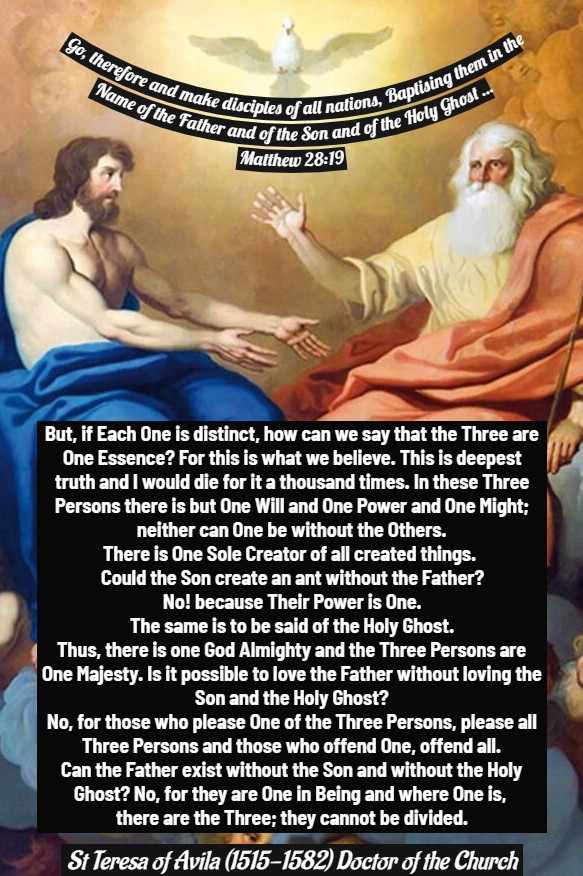
“Go, therefore and make disciples of all nations, Baptising them in the Name of the Father and of the Son and of the Holy Ghost, teaching them to observe all that I have commanded you.” – Matthew 28:19-20
REFLECTION – “God gave me to see clearly the truth of the most Holy Trinity. It is just as learned theologians told me but I did not understand it as I do now… What I have seen is this – Three distinct Persons, Each One visible and Who speaks and to Whom we can speak. Afterwards, I thought how the Son alone took human flesh, which shows clearly that the Three Persons are distinct. The Persons love each other, communicate and know each other. But, if Each One is distinct, how can we say that the Three are One Essence? For this is what we believe. This is deepest truth and I would die for it a thousand times. In these Three Persons there is but One Will and One Power and One Might; neither can One be without the Others. There is One Sole Creator of all created things. Could the Son create an ant without the Father? No! because Their Power is One. The same is to be said of the Holy Ghost.
Thus, there is one God Almighty and the Three Persons are One Majesty. Is it possible to love the Father without loving the Son and the Holy Ghost? No, for those who please One of the Three Persons, please all Three Persons and those who offend One, offend all. Can the Father exist without the Son and without the Holy Ghost? No, for they are One in Being and where One is, there are the Three; they cannot be divided.
How is it, then, that we see that the Three Persons are distinct? And how is it that the Son, not the Father, nor the Holy Ghost, took human flesh? This is what I have never understood – theologians know it. What I know is that the Three were there when that marvellous work was done. I do not busy myself with much thinking about this, all my thinking comes down to this – God is Almighty, that He has done what He would do and can do what He wills. The less I understand it, the more I believe it and the greater the devotion it excites in me. May He be blessed for ever! Amen.” – St Teresa of Avila (1515-1582) Carmelite, Founder, Reformer, Doctor of the Church (Relations, 33).
PRAYER – Grant, we beseech Thee, O Lord God, unto all Thy servant, that they may remain continually in the enjoyment of soundness, both of mind and body and by the glorious intercession of the Blessed Mary, always a Virgin, Thy Saints, remembering Thy Confessor John Francis Regis, may be delivered from present sadness, and enter into the joy of thine eternal. Through the same Jesus Christ, Thy Son our Lord, Who lives and reigns with Thee, in the unity of the Holy Ghost, God, world without end. Amen (Collect).
MAY the Heart of JESUS in the most Blessed Sacrament be praised, adored and loved with grateful affection, at every moment, in all the Tabernacles of the world, even to the end of time. – Indulgence 100 Days, Once a Day. Raccolta 161 Blessed Pius IX, 29 February 1868.
Our Morning Offering – 16 June – “The Month of the Most Sacred Heart of Jesus”
Be the Heart of My Heart By St John Eudes (1601-1680) Apostle of the Sacred Heart
O Heart all Lovable and all Loving of my Saviour, be the Heart of my heart, the Soul of my soul, the Spirit of my spirit, the Life of my life and the sole Principle of all my thoughts, words and actions, of all the faculties of my soul and of all my senses, both interior and exterior. Amen
St John Eudes is the Author of the Proper for the Mass and Divine Office of the Sacred Heart of Jesus Christ and the Immaculate Heart of the Blessed Virgin. St John was an ardent proponent of the Sacred Heart and dedicated himself to it’s promotion and celebration. The Masses he compiled for both the Sacred Heart of Jesus and for the Immaculate Heart of Mary, were both first celebrated during his lifetime. He preached missions across France, including Paris and Versailles, while earning recognition as a popular Evangelist and Confessor. St John Eudes was also a prolific writer and wrote on the two Holy Hearts despite opposition from the Jansenists.
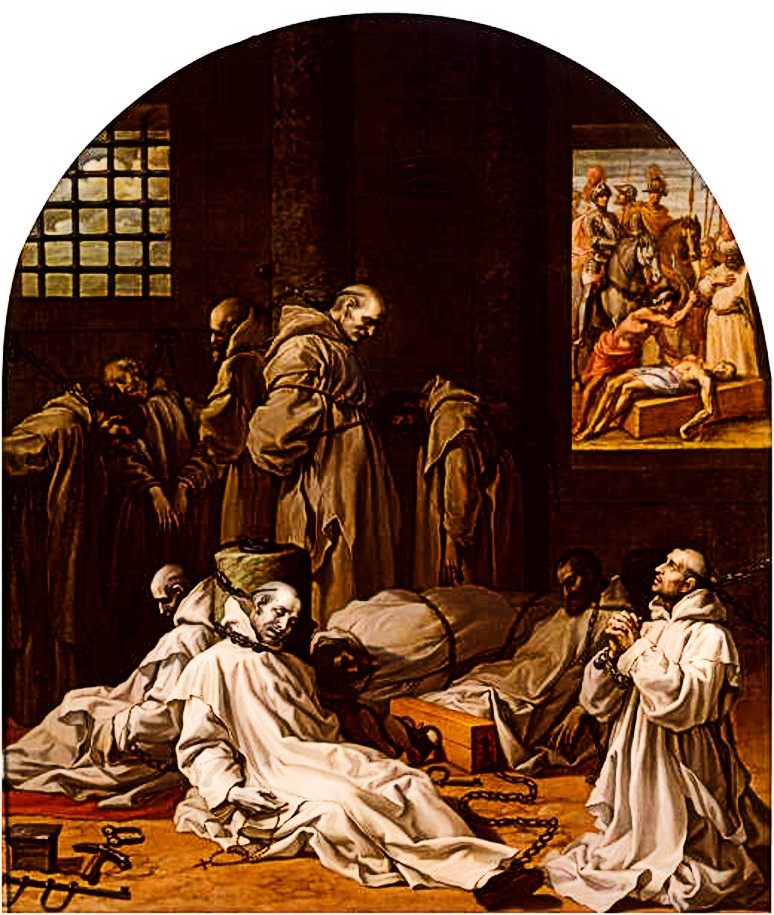
Saint of the Day – 16 June – Blessed Thomas Redyng (Died 1539) O.Cart. Monk of the Carthusian Charterhouse of London, Enland, Martyr. Born in England and died by being starved to death in Newgate Prison on 16 June 1539. Also known as – Thomas Reding. He was Beatified on29 December 1886 by Pope Leo XIII. Additional Memorial – 4 May as one of the Carthusian Martyrs.
In the great persecution against Catholics, decreed by Henry VIII, King of England, every Religious Order of the time, together with the Diocesan Clergy, left a tribute of blood and Martyrdom for the defence of the Catholic Church.
Even the Carthusians, although well-liked as Monks not involved in any political activity, contributed to this river of blood and field of the Palms of Martyrdom. The Monks of the Charterhouse of London, received a visit from the King’s Officials who, according to the decree issued, asked all adults, including Religious, for the approval of the repudiation by the King, by Queen Catherine of Aragon and, therefore, the acceptance of Anne Boleyn as Sovereign.
The Prior and the Procurator were arrested and confined in prison for having objected to the legitimacy of the repudiation but after a month, convinced that this oath did not affect the Faith, they did in fact alter their position to the Oath and were then released. Upon returned to the Charterhouse they convinced the other Monks of their arguments and so on 25 May 1534, they swore to the Officials, who had returned accompanied by soldiers.
The hoped-for peace did not last long, however, at the end of 1534 a new decree of the King and Parliament established that all subjects had to disown the authority of the Pope and instead, recognise the Henry VIII as the head of the English Church even in spiritual matters and, whoever did not consent, was guilty of High Treason. Having heard of this, the Prior John Houghton gathered all the Carthusians and communicated this and this time everyone said they were ready to die for the Roman Catholic Church. Two Priors from other Houses had also arrived at the Charterhouse, who, informed of the dangerous situation of the Monks, went in common agreement to the Vicar of the King, Thomas Cromwell, to ask him to convince King Henry VIII to exempt them from this Oath.
The two priors, after making their requests, were arrested by an indignant Cromwell and locked up in the Tower of London as rebels and traitors. After a week they were put on trial at Westminster where they reiterated their refusal and then sentenced to death and locked up again, where they were joined by two other Religiouswho had also been condemned for the same reason.
On 4 May 1535, the two Priors, Father Robert Laurence and Father Augustine Webster, together with Father Richard Reynolds of the Order of St Bridget and the Priest John Haile, Parish Priest of Isleworth, robed in their Religious Habits, were tied, stretched out on mats and dragged through the stony and muddy streets which led to Tyburn Tree, the infamous place of capital executions.
Father John Houghton, Prior of London Charterjhouse was then also arrested and condemned, was the first to ascend the scaffold and collaborated with the executioner in the hanging, uttering words of forgiveness and trust in God but he had not yet suffocated to death, when one of those present cut the rope and the Father fell to the ground, the executioner stripped him and took out his entrails while still alive so as to be able to show his heart to the King’s advisors. The execution of the other four followed and their bodies were cut to pieces and exposed to the people to strike terror into the ‘papists’.
Three other Carthusians – Humphrey Middlemore, vicar, William Exmew, a learned Latinist and Sebastian Newdigate, of noble origins, were arrested, tortured and Martyred on 19 June 1535. Two other,s who had moved from London to Hull Charterhouse were denounced, arrested and hanged on 11 May 1537.
Ten more Carthusians were imprisoned on 29 May 1537 in Newgate Prison, where they died of hardship and suffering in a short time – among them, on 16 June 1537, it was Thomas Reding ‘s turn . Only William Horn survived the prison and was hanged on 4 November 1540.
Eighteen other Monks remained in the Charterhouse, who, hoping to save the Monastery, had adhered to the Oath but after some time they were expelled and the Charterhouse was sold to private individuals.
The 18 Carthusians of London, together with 35 other Martyrs of that period, were Beatified by Pope Leo XIII on 9 December 1886. A common Feastday is celebrated on 4 May, while the individuals are remembered on their respective anniversaries of Martyrdom, today 16 June being the Feastday of Blessed Thomas Redyng.




































 AnaStpaul
You must be logged in to post a comment.