Quote/s of the Day – 12 June – Ecclesiasticus i 31:8-11; Luke 12:35-40– Scripture search here: https://www.drbo.org
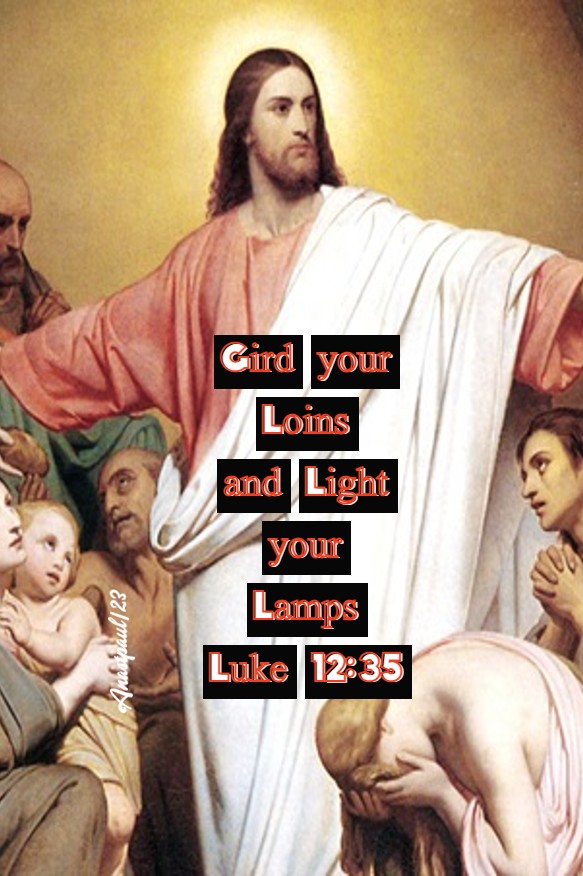
“Let your loins be girt about and your lamps burning …”
Luke 12:35
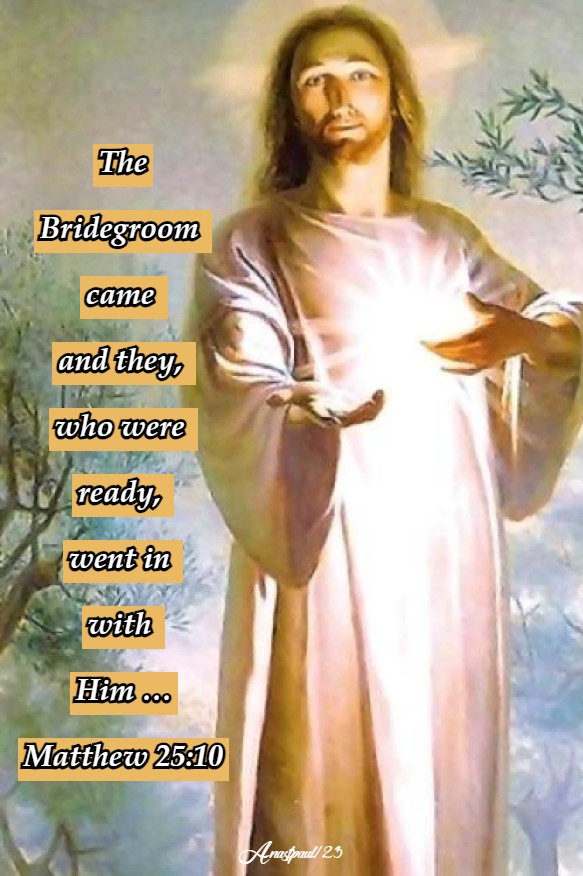
“ … The Bridegroom came and they, who were ready, went in with Him … ”
Matthew 25:10
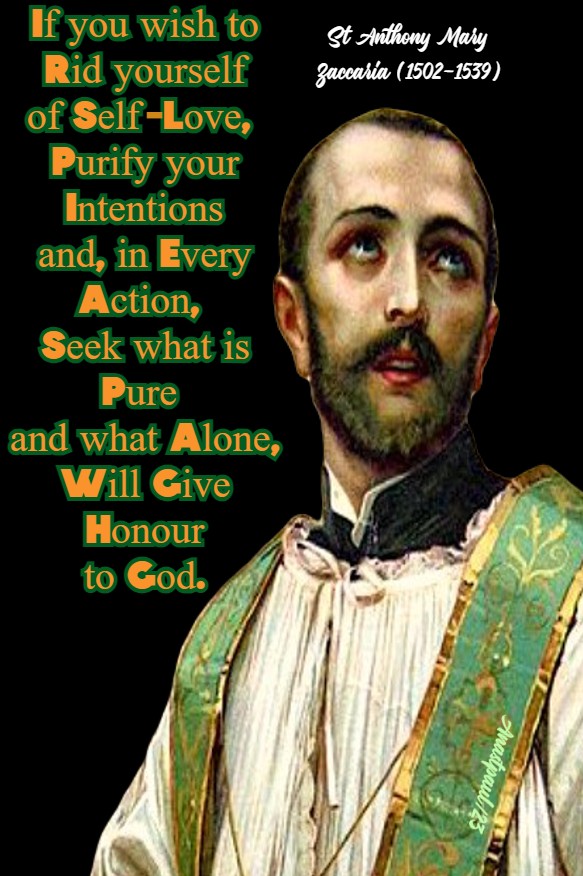
“If you wish to rid yourself of self-love, purify your intentions and, in every action, seek what is pure and what alone, will give honour to God.”
St Anthony Mary Zaccaria (1502-1539)
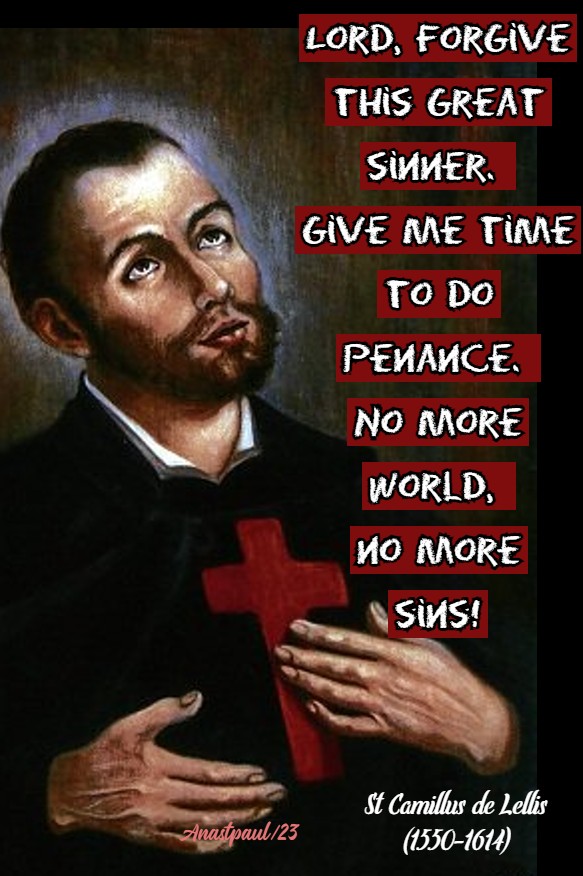
“Lord, forgive this great sinner. Give me time to do penance. No more world, no more sins!”
St Camillus de Lellis MI (1550-1614)
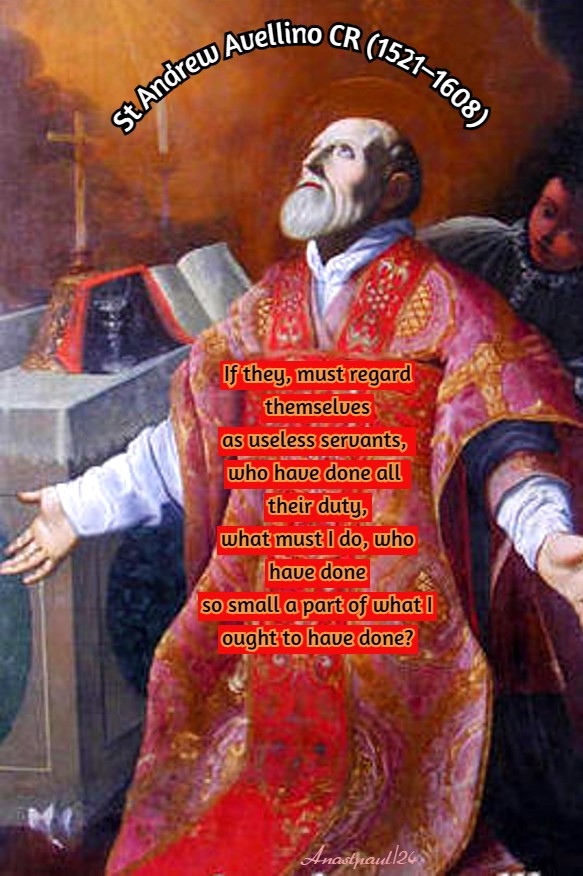
“If they, must regard themselves as useless servants, who have done all their duty, what must I do, who have done so small a part of what I ought to have done?”
One Minute Reflection – 12 June – “The Month of the Most Sacred Heart of Jesus” – Pentecost Thursday – St Juan de Sahagun (1419-1479) Confessor, Priest and Friar of the Order of the Augustinians – Ecclesiasticus i 31:8-11 – Luke 12:35-40 – Scripture search here: https://www.drbo.org/
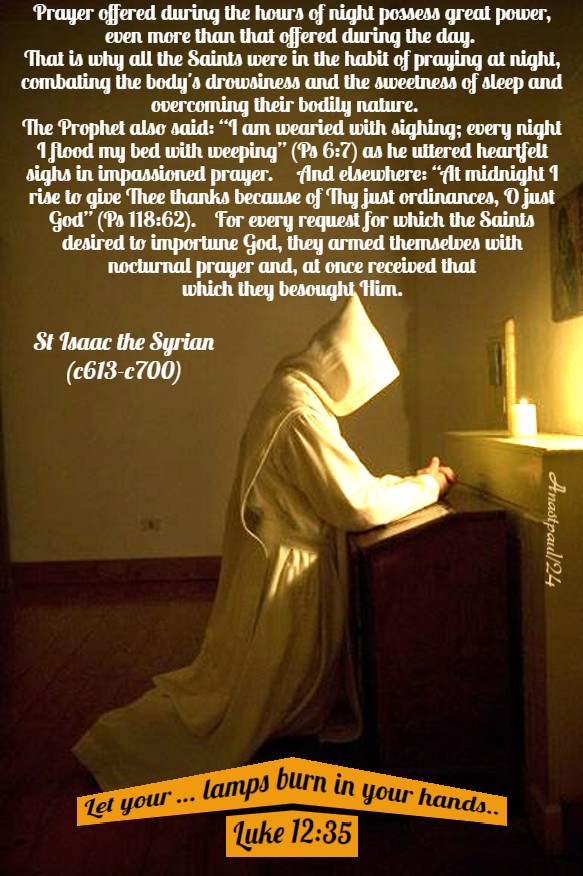
“Jesus said to His disciples: Let your … lamps burn in your hands.” – Luke 12:35
REFLECTION – “Prayer offered during the hours of night possess great power, even more than that offered during the day. That is why all the Saints were in the habit of praying at night, combating the body’s drowsiness and the sweetness of sleep and overcoming their bodily nature. The Prophet also said: “I am wearied with sighing; every night I flood my bed with weeping” (Ps 6:7) as he uttered heartfelt sighs in impassioned prayer. And elsewhere: “At midnight I rise to give Thee thanks because of Thy just ordinances, O just God” (Ps 118:62). For every request for which the Saints desired to importune God, they armed themselves with nocturnal prayer and, at once received that which they besought Him.
Satan himself fears nothing as much as prayer offered during the night watches. Even if they are accompanied by distractions, it does not return fruitless, as long as something inappropriate is not being asked for. That is why Satan engages in severe combat against those who keep watch at night, so as to deter them from this practice if he can, especially if they show themselves to be persevering. But those who are in any way defended against his pernicious wiles and have tasted the gifts God grants, at these times of vigil and, have had personal experience, of the greatness of the help God gives them, wholly despise him, he and all his craftiness.” – St Isaac the Syrian of Nineveh (c613-c700) Bishop of Nineveh, Monk at Mosul, Father of the Church (Ascetical Discourses)
PRAYER – O God, Author of peace and lover of charity, Who endowed blessed John, Your Confessor, with a wondrous grace for reconciling enemies; grant by his merits and intercession that, being ourselves firmly rooted in Thy charity, we may not be separated from Thee by any temptations.Through Jesus Christ, Thy Son our Lord, Who lives and reigns with Thee, in the unity of the Holy Ghost, God, world without end. Amen (Collect).
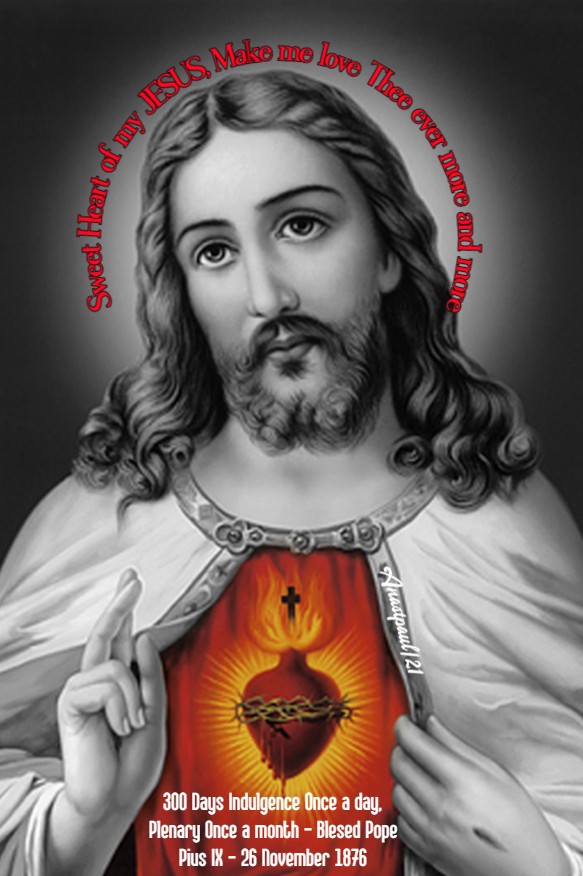
weet Heart of my JESUS, Make me love Thee ever more and more! –300 Days Indulgence Once a day, Plenary Once a month – Pope Pius IX – 26 November 1876
Our Morning Offering – 12 June – “The Month of the Sacred Heart of Jesus”
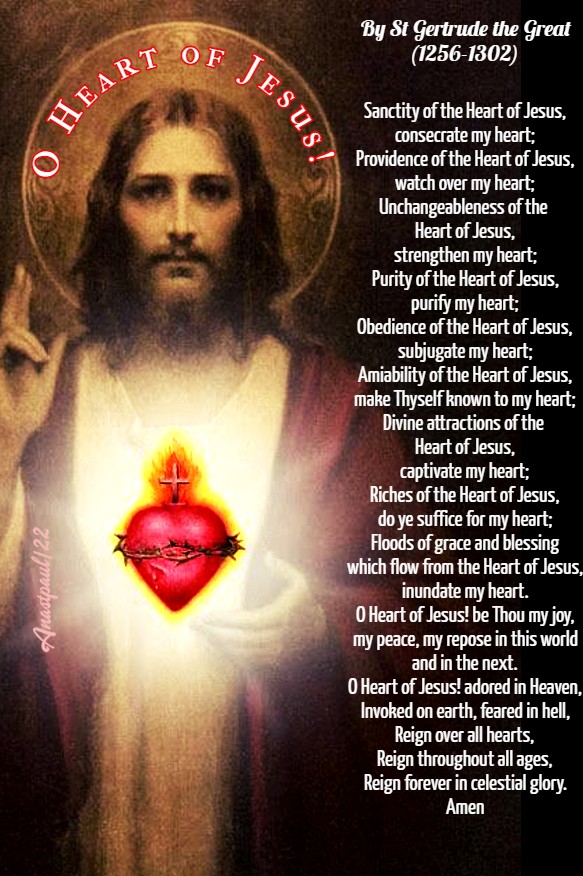
O Heart of Jesus! By St Gertrude the Great (1256-1302)
Sanctity of the Heart of Jesus, consecrate my heart; Providence of the Heart of Jesus, watch over my heart; Unchangeableness of the Heart of Jesus, strengthen my heart; Purity of the Heart of Jesus, purify my heart; Obedience of the Heart of Jesus, subjugate my heart; Amiability of the Heart of Jesus, make Thyself known to my heart; Divine attractions of the Heart of Jesus, captivate my heart; Riches of the Heart of Jesus, do ye suffice for my heart; Floods of grace and blessing which flow from the Heart of Jesus, inundate my heart. O Heart of Jesus! be Thou my joy, my peace, my repose in this world and in the next. O Heart of Jesus! adored in Heaven, Invoked on earth, feared in hell, Reign over all hearts, Reign throughout all ages, Reign forever in celestial glory. Amen
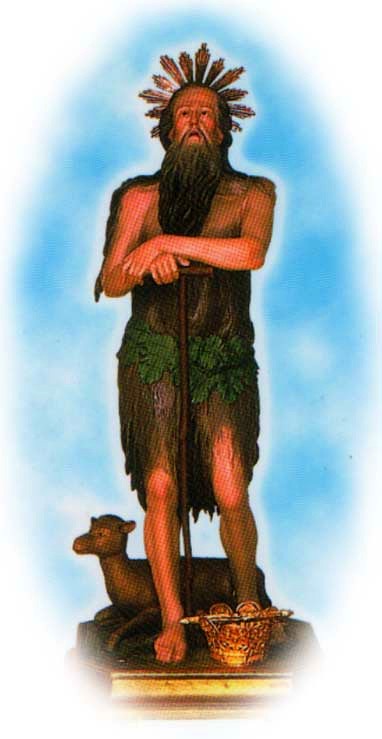
Saint of the Day – 12 June – St Onuphrius (Died c400) Hermi, living a miraculous life assisted by his Angel alone in the Egyptian desert for 60 years. Speaking to God and His Angel only, who weekly brought him Holy Communion and daily brought him bodily sustenance. The dates and details of his birth and death are unknown except that he died in June c400. Patronages – of weavers (apparently due to his leaf-woven garment and his long hair which also acted as clothing, Towns in Italy – Centrache, Catanzaro Paterno, Avezzano, Siena and Sutera. Also known as – Onuphrius of Egypt, Humphrey… Onofre… Onofrio… Onophry… Onouphrius… The name Onophrius is of Egyptian origin and means ‘who is always happy.’
The Roman Martyrology reads today: “In Egypt, St Onuphrius, an Anchorite, who led a religioys life in the desert for 60 years and renowned for great virtues and merits, departed for Heaven. His admirable deeds were recorded by the Abbot, Paphmutius.”
The Vita of our Saint today, Onuphrius, was written by another Saint, Paphmutius, an Egyptian Monk. His writing bears an unmistakable resemblance to two other great classics of the genre, St Jerome’s life of St Paul the First Hermit and the tale of St Mary of Egypt.
Paphmutius, eager to meet the desert Hermit, to learn about their lives and their eremeiic experience which was so much discussed at that time, went into the desert in search of them. After two stops in 21 days, exhausted, he collapsed onto the ground. Looking up, he saw a human figure of terrible appearance appear, covered from head to toe only by long hair and a few leaves.
This was usual for Hermits, who were accustomed to being always alone and seen only by Angels, in the end did without a garment difficult to obtain or replace in the desert.
Initially frightened, Paphmutius tried to escape but the human figure called him telling him to stay, then he understood that he had found who he was looking for, it was an Hermit. Once mutual trust had been established, the confidences began, the Hermit said his name was Onuphrius and he had been in the desert for around 60 years and had never seen another living soul! He ate herbs and rested in caves but initially it was not like this, he had lived in a Monastery in the Thebaid area, together with a hundred Monks.
But desirous of a more solitary life following the example of St. John the Baptist and the Prophet Elijah, he left the Monastery to dedicate himself to the eremitical life; having advanced into the desert area with little food, after a few days he met another Hermit in a cave, whom he asked to assit him and initiate him into that very particular life.
The Hermit obliged and then accompanied him to a place which was an oasis with palm trees, stayed with him for thirty days and then left, returning to his cave. Once a year the Hermit would come to visit him and comfort him but on one of these visits, as soon as he arrived he bowed to greet him and collapsed and died. Filled with sadness Onuphrius buried him in a place near his Hermitage. Onuphrius then told Paphmutius how he adapted to the changing seasons; how he resisted the elements and how he supported his physical needs, an Angel provided for his daily nourishment, the same Angel brought him Holy Communion on Sundays. The miracle of the Angel was also seen by Paphmutius whom Onuphrius led to his Hermitage of ‘Calidiomea,’ the place of palm trees.
They continued their spiritual conversations until the holy Hermit said: “God has sent you here so that you may give my body a suitable burial, since I have reached the end of my earthly life.” Paphnutius proposed that Onuphrius take his place, but the Hermit replied that this was not God’s Will, he had to return to Egypt and tell what he had witnessed.
After blessing him, he knelt in prayer and Died. Paphnutius covered him with part of his own tunic and buried him in a crevice in the rock. Before he left, a landslide reduced Onuphrius’ cave to ruins, also knocking down the palm trees, a sign of God’s Will that no one else would live as a Hermit in that place.
Regardless of the historical existence of St Onuphrius, the Greek ‘Life’ of Paphnutius concludes by saying that the holy Hermit died on 11 June 11, however St Onuphrius is celebrated on 12 June. Anthony, Archbishop of Novgorod, reports that in his time (1200) the head of St Onuphrius was preserved in the Church of St Acindino.
St Onuphrius’ cult and his memory spread to all the countries of Asia Minor and to Egypt, all the calendars of these regions report him on the 10th, 11th, 12th of June; in Arabic he is Abü Nufar, (the herbivore).
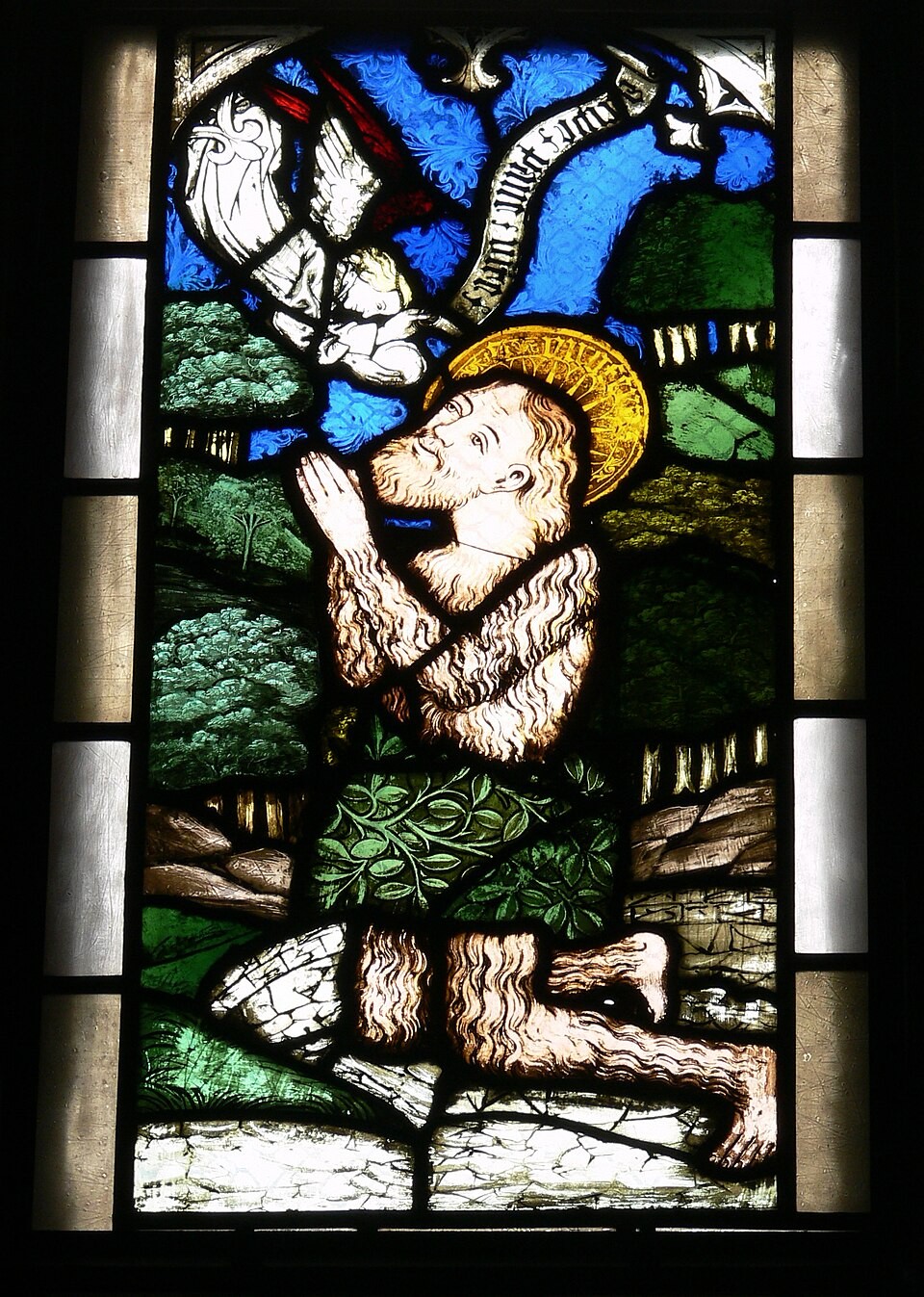
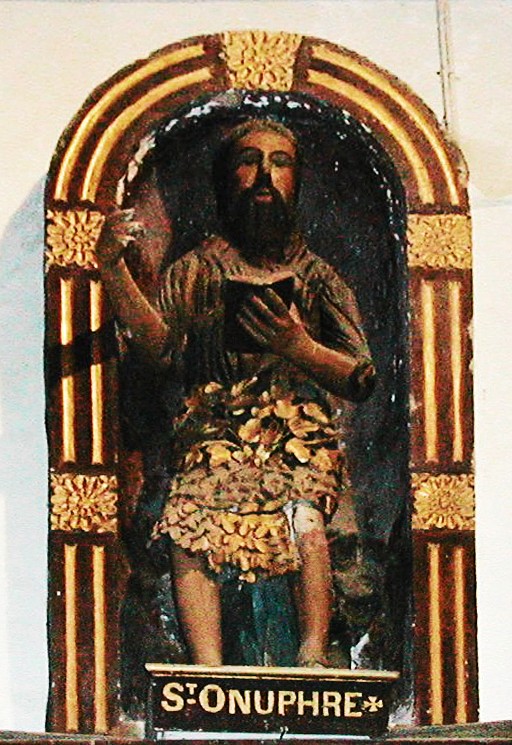
The image of St Onuphrius, a naked Hermit, covered only with his hair, was the object of figurative representation in art, in all the centuries, enriched by the many narrated details, the loincloth made of leaves, the camel, the skull, the Cross, the host with the chalice, the Angel.
St Amphion of Nicomedia Bl Antonio de Pietra St Arsenius of Konev St Christian O’Morgair of Clogher St Chrodobald of Marchiennes St Cominus Bl Conrad of Maleville St Cunera St Cuniald St Cyrinus of Antwerp St Eskil St Galen of Armenia St Gerebald of Châlons-sur-Seine St Geslar
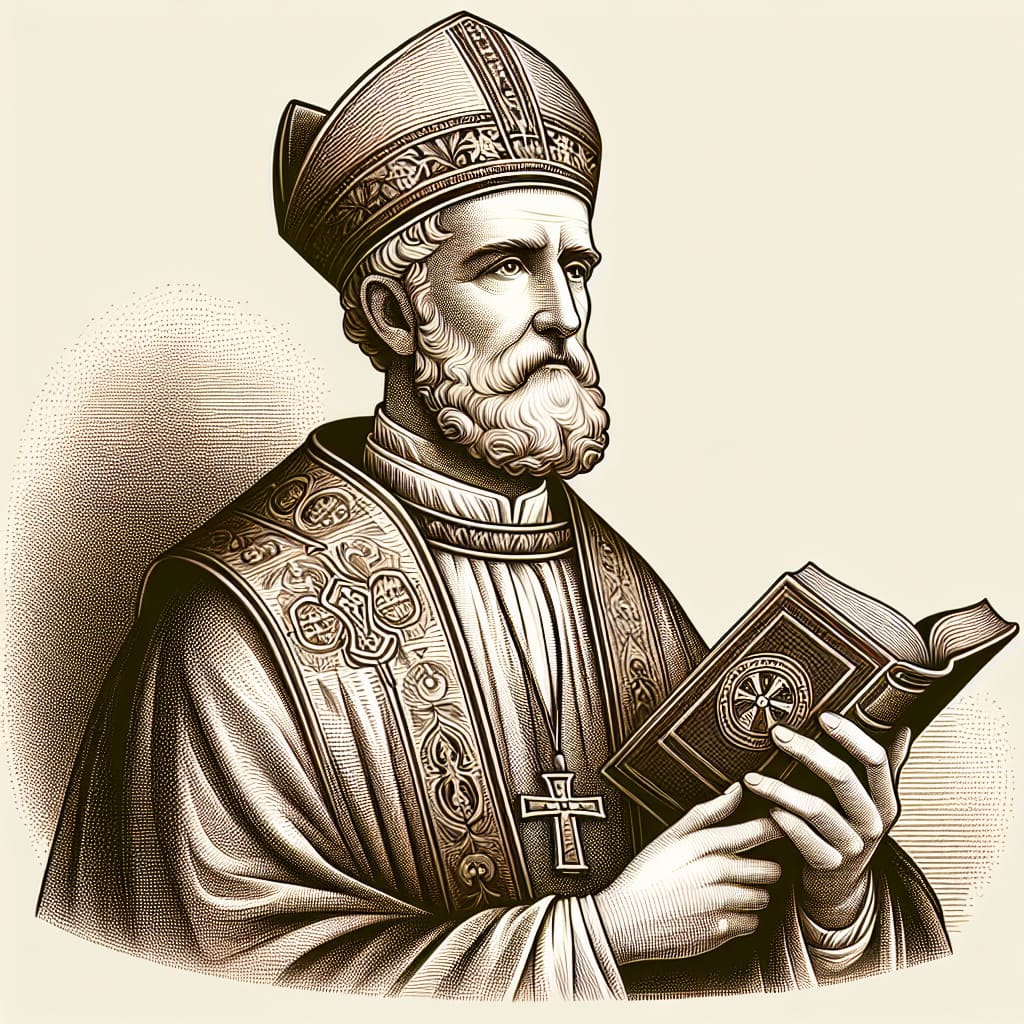
St Pope Leo III (c 750-816) Bishop of Rome and Ruler of the Papal States from 26 December 795 to his death. Defender of the City ad peoples of Rome and of the Church. Peacemaker and restorer of Churches and Monasteries, Patron of the Arts and Apostle of the poor. Know as “Charlemagne’s Pope” His Holy Life: https://anastpaul.com/2021/06/12/saint-of-the-day-12-june-st-pope-leo-iii-c-750-816/
St Odulf (Died c865) Priest, Monk, Prior, zealous Missionary to the Frisians. Odulf was gifted with the charism of prophecy. Born in Brabant (in modern Belgium) and died in c865 of natural causes at his Monastery, Saint Martin of Utrecht. Patronages – Borgloon, Belgium, Evesham, England, Stavoren, Holland, Utrecht, Holland. Zealous St Odulf: https://anastpaul.com/2024/06/12/saint-of-the-day-12-june-saint-odulf-of-utrecht-died-c865-priest/
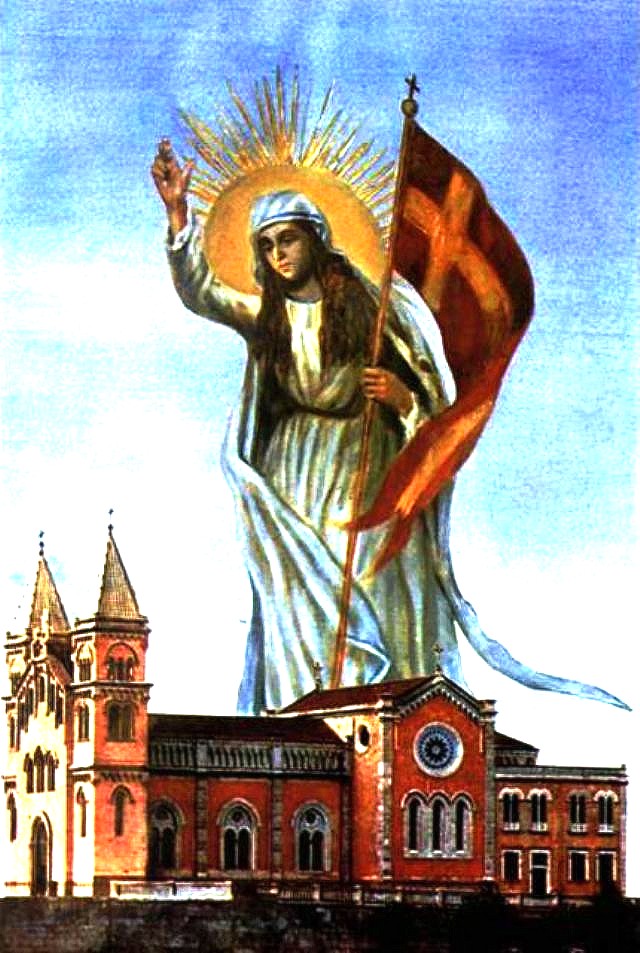
St Olympius of Aenos St Onuphrius (Died c400) Hermit Bl Pelagia Leonti of Milazzo St Peter of Mount Athos St Placid of Val d’Ocre St Ternan of Culross St Valerius of Armenia
Martyrs of Bologna: Three Christians who were Martyred at different times and places, but whose relics have been collected and enshrined together – Celsus, Dionysius, and Marcellinus. Their relics were enshrined in churches in Bologna and Rome in Italy.
St Basilides and Companions / Martyrs of Rome: Four members of the Imperial Roman nobility. They were all soldiers, one or more may have been officers and all were Martyred in the persecutions of Diocletian – Basilides, Cyrinus, Nabor and Nazarius. They were martyred in 304 outside Rome, Italy and buried along the Aurelian Way.
Three Holy Exiles: Three Christian men who became Benedictine Monks at the Saint James Abbey in Regensburg, Germany, then Hermits at Griestatten and whose lives and piety are celebrated together. – Marinus, Vimius and Zimius.
Thought for the Day – 11 June – Meditations with Antonio Cardinal Bacci (1881-1971)
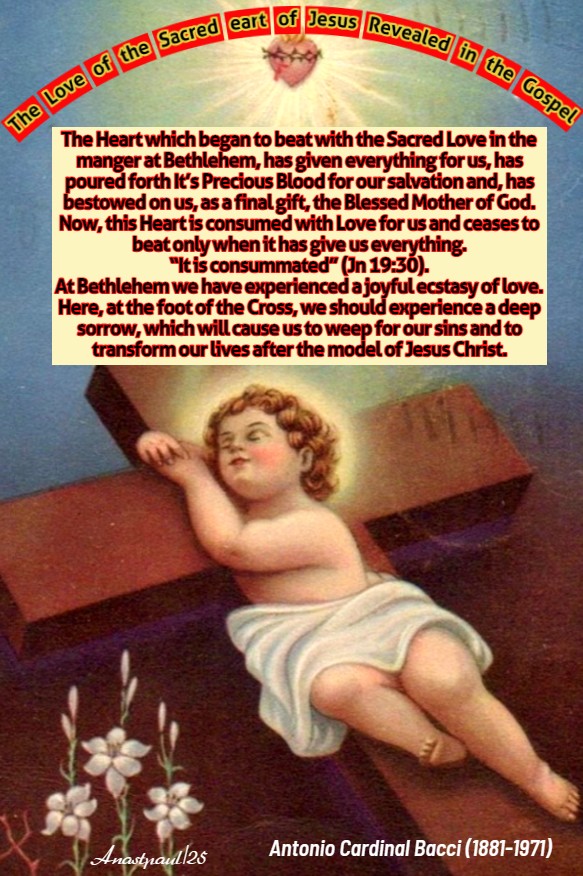
The Love of the Sacred Heart of Jesus Revealed in the Gospel
“If we meditate upon the pages of the Gospel, we shall find they are vibrant with the Infinite Love of the Sacred Heart of Jesus. Let us, in imagination, enter the cave of Bethlehem and kneel before the crib where the Divine Infant is lying. Darkness is all around, darkness over the earth, darkness in the minds and hearts of the majority of men. But, now, the heavens open and from the brightness the voices of Angels ring out, “Glory to God in the highest and on earth, peace among men of goodwill.” Who is this Infant? He is the Eternal Word, the substantial Image of God, Who, for love of us, has been made man. He is the Infinite One Who has willed to unite Himself with the finite, in order to lift us towards Himself. This little Heart is throbbing like that of any baby but, in this throb, is expressed the love of the God-Man. It is a profound Mystery, that God should have loved man so much, that He became a tiny Infant. Yet, He did this so that we might love Him more easily and in order to show us His own immeasurable Love. There is about this Infant, a fascination, at once human and divine which compels us to love Him, even as Mary, Joseph and the simple shepherds loved Him. He is asking us for love, adoration and complete surrender. Can we refuse Him?
Now let us take ourselves in imagination to Calvary and kneel at the foot of the Cross. The Heart which began to beat with the Sacred Love in the manger at Bethlehem, has given everything for us, has poured forth It’s Precious Blood for our salvation and, has bestowed on us, as a final gift, the Blessed Mother of God. Now, this Heart is consumed with Love for us and ceases to beat only when it has give us everything. “It is consummated” (Jn 19:30). At Bethlehem we have experienced a joyful ecstasy of love. Here, at the foot of the Cross, we should experience a deep sorrow, which will cause us to weep for our sins and to transform our lives after the model of Jesus Christ.”
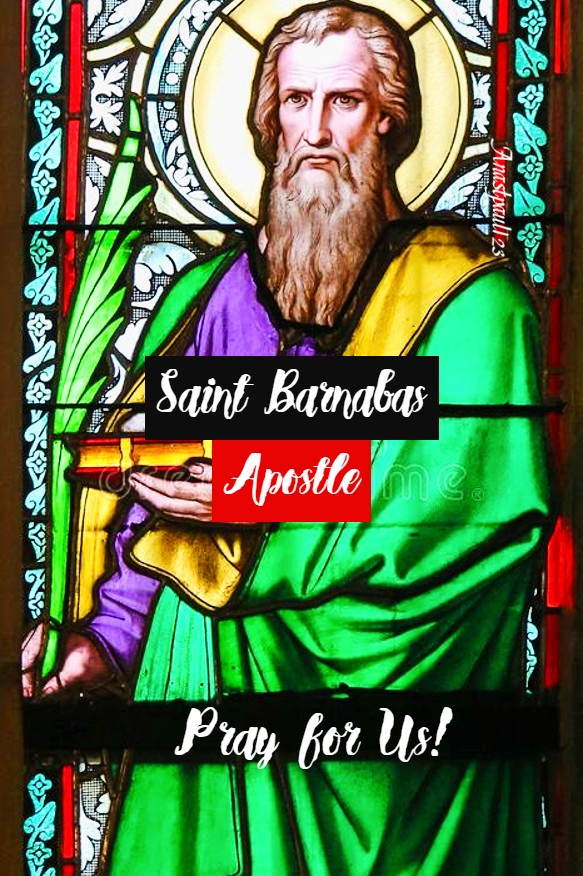
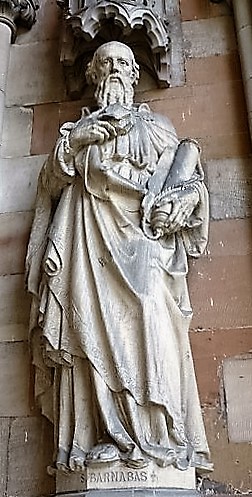
Quote/s of the Day – 11 June – “The Month of the Sacred Heart of Jesus” – Feast of St Barnabas the Apostle, Martyr, The “Son of Encouragement” – Acts 11:21-26; 13:1-3; Matthew 10:16-22.– Scripture search here: https://www.drbo.org/
“Behold I send you as sheep in the midst of wolves. Be, therefore, wise as serpents and simple as doves. ”
Matthew – 10:16
“Go you also into My Vineyard.”
Matthew 20:7
“You did not choose Me but I chose you…”
John 15:16
“That is amazing grace! For what were we before Christ had chosen us besides being wicked and lost? What then has He chosen in those who are not good? You cannot say, I am chosen because I believed. For if you believed in Him, you had already chosen Him. Nor can you say, before I believed I did good works and, therefore, was chosen. For what good work is there before faith when the Apostle says, “Whatever is not of faith is sin?” What is there for us to say, then but that we were wicked and were chosen, that by the grace of having been chosen, we might become good?”
St Augustine (354-430) Father and Doctor of Grace
“Day by day follow God’s path, keeping Him closely attached to you by His promise. In fact, He Himself said, through the mediation of His Apostles, to all those who seek His will and His testimonies that He would be with them until the end of the world (Mt 28:20) where paths and footsteps will be unknown (cf Ps 76:20), as the divine David said in his songs. Yet, in an invisible way, He is present to the eyes of the mind, making Himself seen by those who have a pure heart and conversing with them. So pursue your path …. ”
St Theodore the Studite (759-826) Abbot, Confessor, Father of the Church
One Minute Reflection – 11 June – “The Month of the Most Sacred Heart of Jesus” – Pentecost Wednesday – Ember Wednesday, Fast & Abstinence – The Feast of St Barnabas the Apostle, Martyr, The “Son of Encouragement” – Acts 11:21-26; 13:1-3 – Matthew 10:16-22 – Scripture search here: https://www.drbo.org/
“Behold I send you as sheep in the midst of wolves. Be, therefore, wise as serpents and simple as doves. ” – Matthew – 10:16
REFLECTION – “Christ also suffered for you, leaving you an example that you should follow in His Footsteps,” (1Pt 2:21). Which of the Lord’s examples will we have to follow? Is it His raising of the dead? Is it to walk on the sea? Not in the least. But it is that of being meek and humble of heart (Mt 11:29) and of loving not only our friends but even our enemies (Mt 5:44).
“So that you might follow in His Footsteps,” writes St Peter. The blessed Evangelist John also says the same thing: “Whoever claims to abide in Christ ought to walk as He has walked,” (1 Jn 2:6). And how has Christ walked? He prayed for His enemies on the Cross, saying: “Father, forgive them, for they know not what they do,” (Lk 23:34). They have actually lost their senses and are possessed by an evil spirit and while they are persecuting us, they themselves are undergoing a far greater persecution from the devil. Hence, we should be praying more for their deliverance than for their condemnation.
That is indeed what Blessed Stephen did, he who was the first so gloriously to follow in the Footsteps of Christ. For, when he was struck by a hail of stones, he prayed standing for himself but, falling to his knees, he cried out with all his strength for his enemies: “Lord Jesus Christ, do not hold this sin against them,” (Ac 7:60). So even if we think we cannot imitate our Lord, let us at least imitate him who was just as much His servant as we are.” – St Caesarius of Arles (470-543) Father of the Church, Bishop (Sermons to the people, No 37).
PRAYER – O God, Who gladden us by the merits and intercession of blessed Barnabas, Thy Apostle, mercifully grant that we, who ask of Thee favours through him, may obtain them by the gift of Thy grace.ThroughJesus Christ, Thy Son our Lord, Who lives and reigns with Thee, in the unity of the Holy Ghost, God, world without end. Amen (Collect).
SACRED Heart of JESUS, I trust in Thee. 300 Days Indulgence Once a Day – Plenary, Once a month. Raccolta 175 – St Pius X, 19 August 1905 and 27 June 1906.
Our Morning Offering – 11 June – Feast of St Barnabas the Apostle, Martyr, The “Son of Encouragement.”
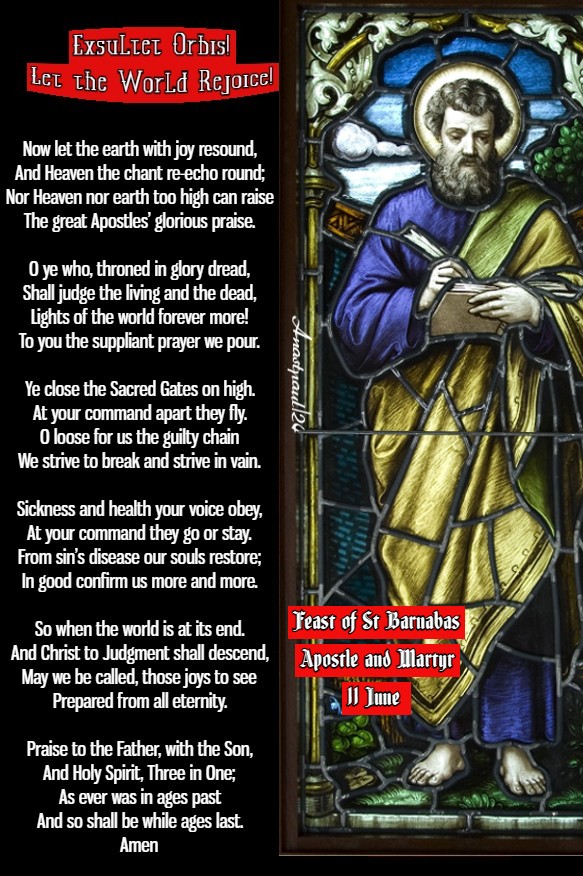
Exsultet Orbis! Let the World Rejoice! Unknown Author
Now let the earth with joy resound, And Heaven the chant re-echo round; Nor Heaven nor earth too high can raise The great Apostles’ glorious praise.
O ye who, throned in glory dread, Shall judge the living and the dead, Lights of the world forever more! To you the suppliant prayer we pour.
Ye close the Sacred Gates on high. At your command apart they fly. O loose for us the guilty chain We strive to break and strive in vain.
Sickness and health your voice obey, At your command they go or stay. From sin’s disease our souls restore; In good confirm us more and more.
So when the world is at its end. And Christ to Judgment shall descend, May we be called, those joys to see Prepared from all eternity.
Praise to the Father, with the Son, And Holy Spirit, Three in One; As ever was in ages past And so shall be while ages last. Amen
(Roman Breviary for the Common of Apostles) An Office Hymn that was traditionally prescribed for Vespers and Lauds on the Feasts of Apostles and Evangelists outside Easter time. The Hymn is found as early as the 10th Century in a Hymnal of Moissac Abbey.
Saint of the Day – 11 June – Saint Blitharius (7th Century) Priest, Hermit , Missionary in Ireland and France, as a disciple of St Fursey (Died c648) He became a renowned and fervent Preacher and Evangeliser. Born in Scotland and died in the late 7th century in Sézanne, France, Also known as – Blitarius, Blitario, Blier. Additional Memorial – 17 June in the Diocese of Troyes.
St Fursey and his Companions journey of evangelisation in England and France
Born in Scotland, Blitharius embarked on a spiritual journey following in the footsteps of St Fursey, an Irish Monk revered for his sanctity and wisdom. Under his guidance, Blitharius was Ordained a Priest and began a journey through Ireland and France, spreading the message of the Gospel and inspiring the faithful with his preaching.
Between 640 and 644, Blitharius’ life took a decisive turn. Attracted by quiet and solitude, he settled in Verzeracus, France, where he built a small shelter which became his hermitage. In this ascetic refuge, Blitharius dedicated his whole life to prayer, fasting and mortification of the body, offering himself to God as a “victim” as a sign of absolute devotion.
Blitharius’ ermitic life was characterised by rigid discipline and profound austerity. He deprived himself of all material comforts, eating only herbs and roots and spending his days in prayer and meditation.
His fame for sanctity spread rapidly, attracting pilgrims from all over the region who sought his spiritual counsel and blessing.
After a life devoted to prayer and mortification, Blitharius left this world to jo enter his eternal home. His body was buried in Sézanne, where his tomb became a place of pilgrimage for the faithful who venerated his memory.
In 1568, Saint Blitharius’ Relics were translated to the Collegiate Church of Broyes in the Marne. However, during the Wars of Religion in France in 1568, Calvinists burned the Relics, destroying this precious tangible link to the Saint.
The Feast of Saint Blitharius was always celebrated on J11une 11. However, in the Proper of Troyes, his Feast was moved to 17 June, a date which is still commemorated there today.
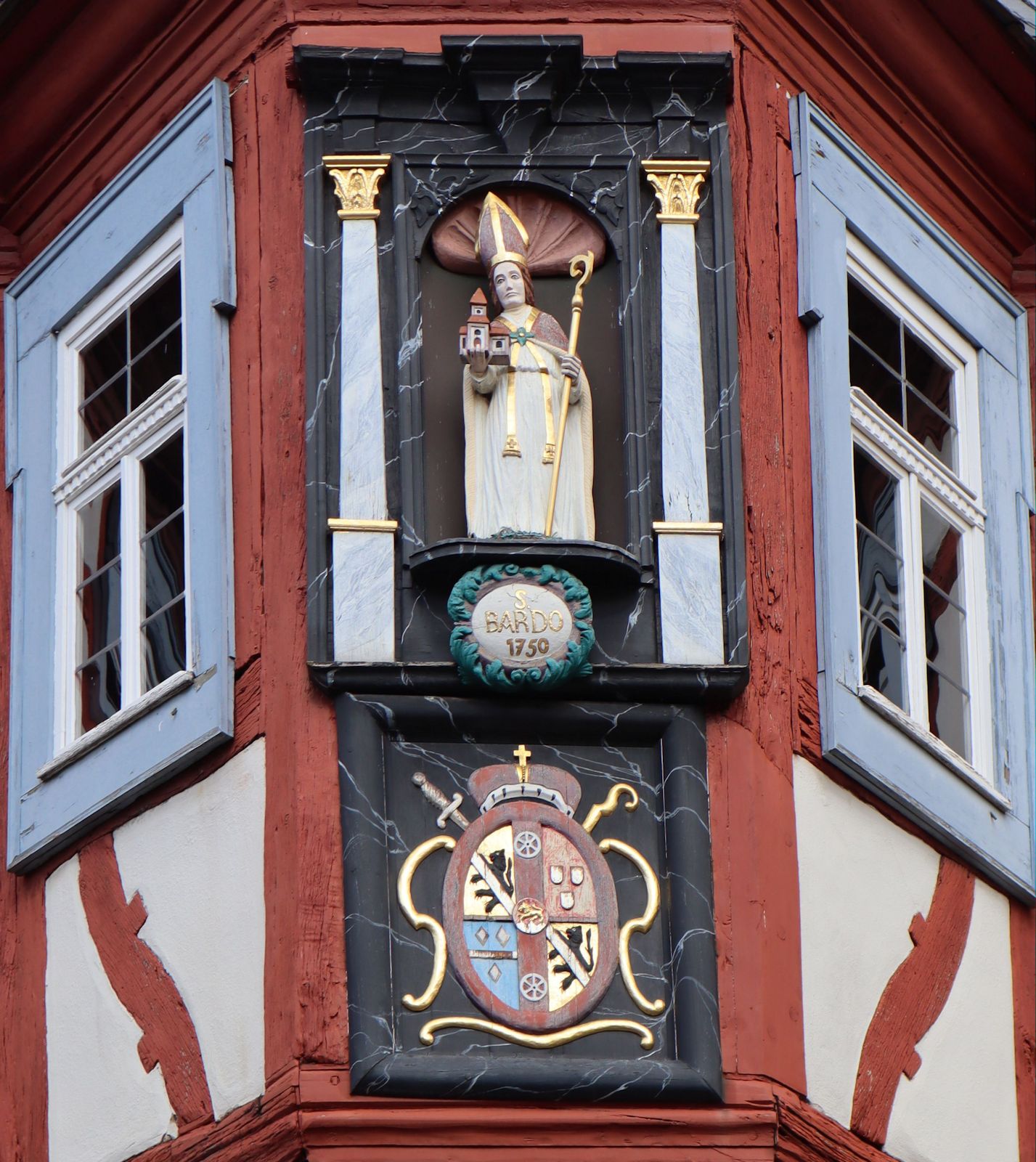
St Bardo (c981-c1053) Archbishop of Mainz from 1031 until 1051, the Abbot of Werden from 1030 until 1031 and the Abbot of Hersfeld in 1031. Ascetic, renowned for his piety and devotion, for his care and love of the poor, renowned Preacher, called “The Chrysostom” of his time. Born in c981 in Oppershofen, Germany and died on 10 or 11 June in 1051 or 1053 (records vary) in Oberdorla near Mühlhausen in Thuringia, of natural causes. Patronage – of Oppershofen “The Chrysostom” of his time: https://anastpaul.com/2024/06/11/saint-of-the-day-11june-saint-bardo-of-mainz-c981-c1053-archbishop-the-chrysostom-of-his-time/
St Herebald of Bretagne Bl Hugh of Marchiennes Bl Jean de Bracq
Bl Kasper of Grimbergen
St Parisius ECMC (c1160-1267) Priest and Monk of the Camaldolese Hermits of Mount Corona, Spiritual Director, Reformer, Miracle-worker during his life and after his death. A very long life of humble and loving service, for the glory of God!: The Roman Martyrology reads: “In Treviso, Saint Parisio, Priest of the Camaldolese Order, who for seventy-seven years took care of the spiritual direction of the Nuns with healthy advice, dying at the age of one hundred and eight.” https://anastpaul.com/2022/06/11/saint-of-the-day-11-june-st-parisius-ecmc-c-1160-1267-a-very-long-life-of-humble-and-loving-service-for-the-glory-of-god/
St Rembert (c830-888) Archbishop of Hamburg-Bremen, Missionary, Miracle-worker, Founder of Churches and Monasteries, Disciple of St Ansgar (801-865) “The Apostle of the North.” The Roman Martyrology reads : “In Bremen in Saxony, in today’s Germany, Saint Rembert, Bishop of Hamburg and Bremen, who, a faithful disciple of Saint Ansgar and his successor, extended his ministry to the regions of Denmark and Sweden and, at the time of the invasions of the Normans, he took care of the ransom of the Christian prisoners.” A True Shepherd: https://anastpaul.com/2023/06/11/saint-of-the-day-11-june-st-rembert-of-hamburg-c830-888-archbishop/
St Riagail (Died c881) Abbot of Bangor Monastery Bl Stephen Bandelli OP St Tochumra of Kilmore St Tochumra of Tuam
Martyrs of Tavira – 7 Beati: Members of the Knights of Santiago de Castilla. During the re-conquest of the Iberian peninsula from the Muslims by Christian forces, in a period of truce between the armies, the group was allowed to leave the Portuguese camp to hunt. Near Tavira, Portugal, he and his companions were ambushed and killed by a Muslim force. Making a reprisal attack, the Portuguese army took the city of Tavira. The murdered knights were considered to be martyrs as they died in an action defending the faith. They were – Blessed Alvarus Garcia, Blessed Beltrão de Caia, Blessed Damião Vaz, Blessed Estêvão Vasques, Blessed Garcia Roiz, Blessed Mendus Valle, Blessed Pedro Rodrigues’ They were Martyred in 1242 outside Tavira, Faro, Portugal. Their relics are enshrined under the altar of Saint Barnabas in the Church of Our Lady, Queen of the Angels (modern Santa Maria do Castelo) in Tavria, Portugal.
Mercedarian Martyrs of Damietta: Three Mercedarian Lay Knights who worked to ransom Christians enslaved by Muslims. During the 7th Crusade, a plague swept through the Christian army and these knights volunteered to work with the sick. During this work they were captured by Muslims and ordered to convert to Islam; they refused. They were tortured, taken to Damietta, Egypt where they were murdered for their faith. They were thrown from a tower in the mid-13th century in Damietta, Egypt.
Thought for the Day – 10 June – Meditations with Antonio Cardinal Bacci (1881-1971)
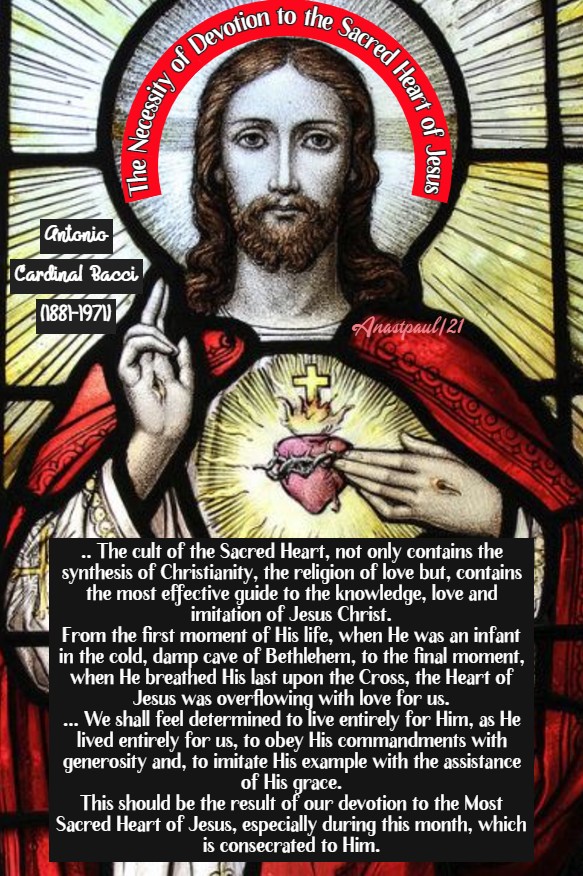
The Necessity of Devotion to the Sacred Heart of Jesus
“It is necessary to develop and meditate on these words of Pius XI, (see Part One) from which, it is clear, that the cult of the Sacred Heart, not only contains the synthesis of Christianity, the religion of love but, contains the most effective guide to the knowledge, love and imitation of Jesus Christ. From the first moment of His life, when He was an infant in the cold, damp cave of Bethlehem, to the final moment, when He breathed His last upon the Cross, the Heart of Jesus was overflowing with love for us. We can learn from this, to know our Divine Saviour better, so that appreciating more fully His infinite love for us, we shall feel an upsurge of gratitude and, of love. We shall feel determined to live entirely for Him, as He lived entirely for us, to obey His commandments with generosity and, to imitate His example with the assistance of His grace. This should be the result of our devotion to the Most Sacred Heart of Jesus, especially during this month, which is consecrated to Him.
O my Jesus, Thou Who art Love itself, enkindle in my heart the divine fire which consumed and transformed the Saints!”
Quote/s of the Day – 10 June – “The Month of the Most Sacred Heart of Jesus” – Pentecost Tuesday
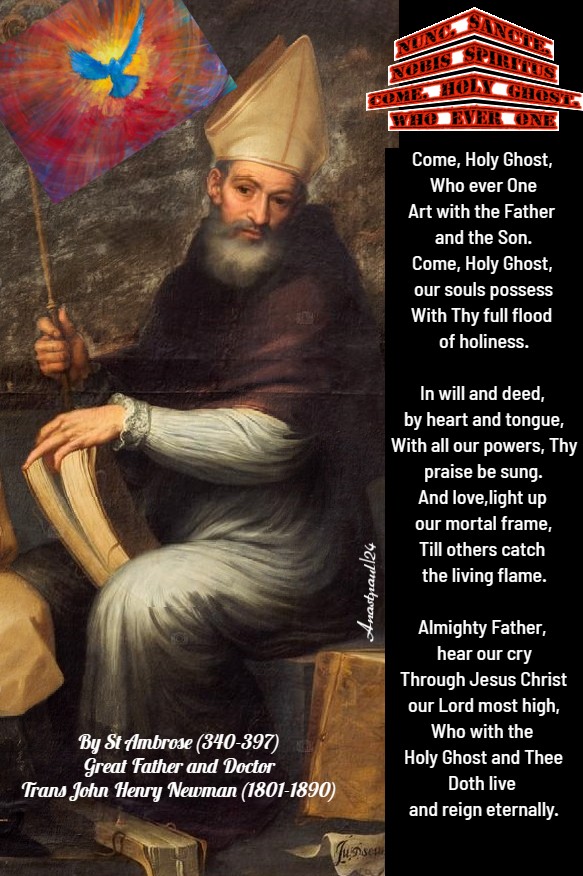
Nunc, Sancte, nobis Spiritus Come, Holy Ghost, Who ever One By St Ambrose (340-397) Trans John Henry Newman (1801-1890) Trans 1836
Come, Holy Ghost, Who ever One Art with the Father and the Son. Come, Holy Ghost, our souls possess With Thy full flood of holiness.
In will and deed, by heart and tongue, With all our powers, Thy praise be sung. And love, light up our mortal frame, Till others catch the living flame.
Almighty Father, hear our cry Through Jesus Christ our Lord most high, Who with the Holy Ghost and Thee Doth live and reign eternally.
One Minute Reflection – 10 June – “The Month of the Most Sacred Heart of Jesus” – Pentecost Tuesday – Acts 8:14 -17 – John 10:1-10 – Scripture search here: https://www.drbo.org/
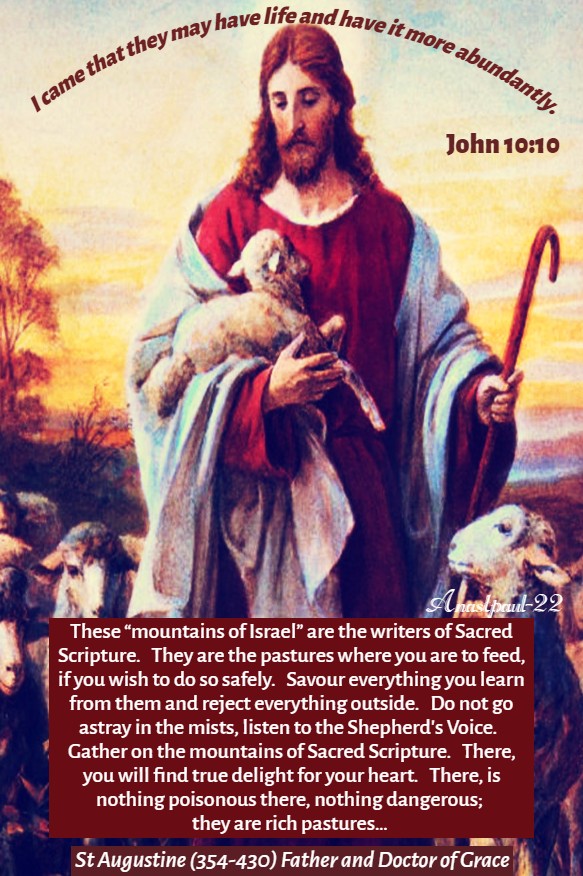
“I came that they may have life and have it more abundantly.” – John 10:10
REFLECTION – “Thus says the Lord: “I Myself will come’”… This is what He has undoubtedly done and what He will yet do: “I Myself am coming: I will seek out My sheep, I will tend them as a shepherd tends His flock.” The wicked shepherds took no care of them because they did not redeem their sheep, with their blood… “My sheep hear My Voice. I will seek out My sheep from the midst of the scattered sheep and will bring them out from all the places they were scattered, on the day of clouds and darkness. No matter how difficult it is to find them, I will find them… I will rescue My sheep from foreign lands, I will gather them and lead them back to their own homes; I will lead them to pasture on the mountains of Israel.”
These “mountains of Israel” are the writers of Sacred Scripture. They are the pastures where you are to feed, if you wish to do so safely. Savour everything you learn from them and reject everything outside. Do not go astray in the mists, listen to the Shepherd’s Voice. Gather on the mountains of Sacred Scripture. There, you will find true delight for your heart. There, is nothing poisonous there, nothing dangerous; they are rich pastures… “I will lead them beside rivers, in the best places.” From those mountains we were just talking about, rivers of Gospel preaching pour down since “the voice [of the Apostles] resounds to the ends of the earth” and all the ends of the earth provide pleasant and fertile pastures for the sheep.
“I will cause them to feed in good pasture… and their sheepfold will be there,” that is to say, there, they will rest, there, they will be able to say: “It is good to be here; true enough, it is perfectly clear, we have found the truth.” They will take their rest in the glory of God as in a sheepfold.” – St Augustine (354-430) Father and Doctor of Grace (Sermon 46, On the shepherds; CCL 41, 529).
PRAYER – Let the power of the Holy Spirit be present within us, O Lord, graciously to cleanse our hearts, as well as to guard us from all harm. Through Jesus Christ, Thy Son our Lord, Who lives and reigns with Thee, in the unity of the Holy Ghost, God, world without end. Amen (Collect).
SACRED Heart of JESUS, Thy Kingdom come! – Indulgence 300 Days – Every time – Raccolta 179 St Pius X, 6 November 1906.
Our Morning Offering – 10 June – “The Month of the Most Sacred Heart of Jesus” – Penticost Tuesday
Act of Love to the Sacred Heart of Jesus By Servant of God Cardinal Rafael Merry del Val (1865-1930)
Reveal Thy Sacred Heart to me, O Jesus and show me Its attractions. Unite me to It forever. Grant that all my aspirations and all the beats of my heart, which cease, not even while I sleep, may be a testimonial to Thee, of my love for Thee and may it say to Thee – “Yes, Lord, I am all Thine” the pledge of my allegiance to Thee, rests forever in my heart and will never cease to be there. May Thou accept, the slight amount of good that I do and be graciously pleased, to repair all my wrong-doing – so that I may be able, to bless Thee, in time and in eternity. Amen
Servant of God Cardinal Rafael Merry del Val (1865-1930) – In his first Consistory, on 9 November 1903, when St Pius X announced the elevation of Abbot Merry del Val to the dignity of Cardinal to the Sacred College, the Pope did not fear to affirm that he had personally observed his “noble gifts of soul and of character, as well as his outstanding prudence in dealing with the affairs of the Church.” The Holy Father made the following reply to the comments made by one of the Cardinals: “I chose him because he is a polyglot – born in England, educated in Belgium, of Spanish nationality and living in Ital; the son of a diplomat and himself a diplomat, he is acquainted with the problems of all countries. He is very modest, he is a saint. He comes here every morning and informs me of all the questions concerning the world. I need never make an observation to him and he knows no compromise.”
Saint of the Day – 10 June – St Asterius (Died c364) Bishop of Petra, in Arabia and Confessor, Defender of the true Faith against the heresy of the Arians, surviving banishment and persecution to protect St Athanasius and the holy Church.
The Roman Martyrology reads today: “At Petra, in Arabia, St Asterius, a Bishop, who suffered much from the Arians for the Catholic Faith. He was banished, by the Emperor Constantius, to Africa where he died a glorious Confessor.”
In 343, Emperor Constantius II an Arian sympathiser, convened the Council of Sardica to resolve the theological controversies which were desiccating the Church. Among the participants was Asterius, sent by the Arians to accuse Saint Athanasius, a staunch defender of orthodox doctrine.
However, during the work of the Council, Asterius had the opportunity to witness, first-hand, the machinations and falsehoods of the heretics. In an act of extraordinary moral and spiritual integrity, he decided to abandon the Arian and instead, he supported and agreed with Saint Athanasius, publicly denouncing the Arians’ perfidy.
Asterius’ choice did not fail to provoke harsh reactions from the Arians, who threatened and persecuted him. But his faith was unshakable. Despite intimidation and obstacles, he remained faithful to his principles, demonstrating extraordinary courage. His testimony became a symbol of resistance against doctrinal oppression and a shining example for all those who were called to defend the truth of the Faith.
The date of Saint Asterius’ death is uncertain,but it is assumed to have occurred around the middle of the 4th Century.
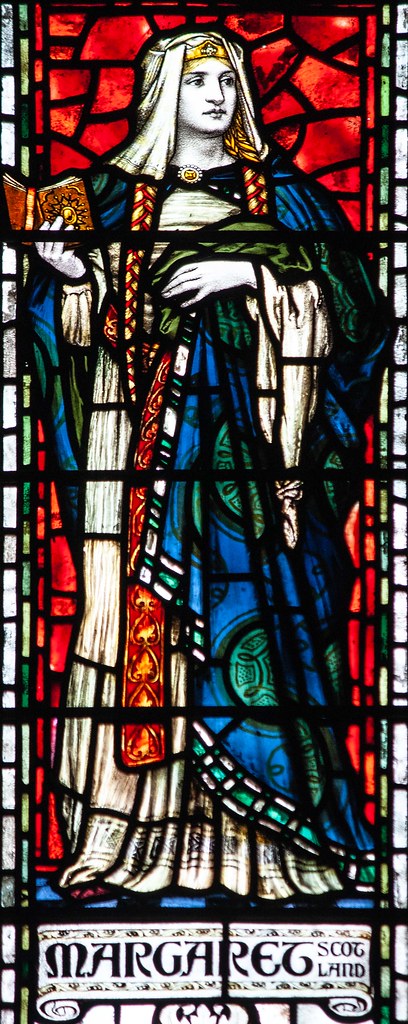
St Margaret of Scotland (1045-1093) Queen consort of Scotland, Wife and Mother, Apostle of the poor, Reformer. Saint Margaret’s name signifies “pearl” “a fitting name,” says Bishop Turgot, her Confessor and her first Biographer, “for one such as she.” Her soul was like a precious pearl. A life spent amidst the luxury of a Royal Court never dimmed its lustre, or stole it away from Him who had bought it with His Blood. Pope Innocent IV Canonised St Margaret in 1250 in recognition of her personal holiness, fidelity to the Roman Catholic Church, work for Ecclesiastical reform and charity. In 1693 Pope Innocent XII moved her feast day to 10 June but it was changed after Vatican II to 16 November. Illustrious St Margaret: https://anastpaul.com/2018/11/16/saint-of-the-day-16-november-st-margaret-of-scotland-1045-1093-queen/ AND: https://anastpaul.com/2022/06/10/saint-of-the-day-10-june-st-margaret-of-scotland-1045-1093/
Bl Amata of San Sisto St Amantius of Tivoli St Asterius (Died c364) Bishop of Petraand Confessor St Bardo of Mainz
St Caerealis of Tivoli St Censurius of Auxerre (Died 486) Bishop St Crispulus of Rome
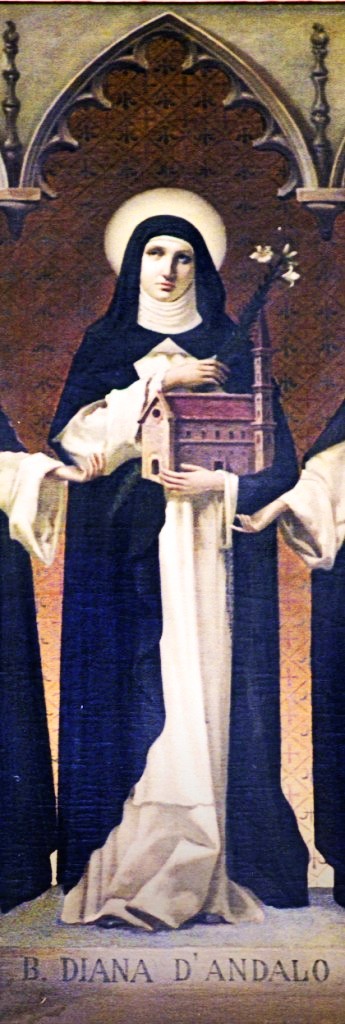
Blessed Diana d’Andalo OP (1201-1236) Virgin, Nun of the Order of Preachers Beatified on 8 August 1888 by Pope Leo XII. The Roman Martyrology states: “In Bologna, blessed Diana d’Andalò, Virgin, who, having overcome all the impediments posed by her family, took a vow of cloistered life in the hands of Saint Dominic himself, entering the Monastery of Saint Agnes, which she founded.” Her Holy Life: https://anastpaul.com/2023/06/10/saint-of-the-day-10june-blessed-diana-dandalo-op-1201-1236-virgin/
Bl Elisabeth Hernden Bl Elizabeth Guillen St Evermund of Fontenay St Faustina of Cyzicus Bl Gerlac of Obermarchtal St Getulius of Tivoli
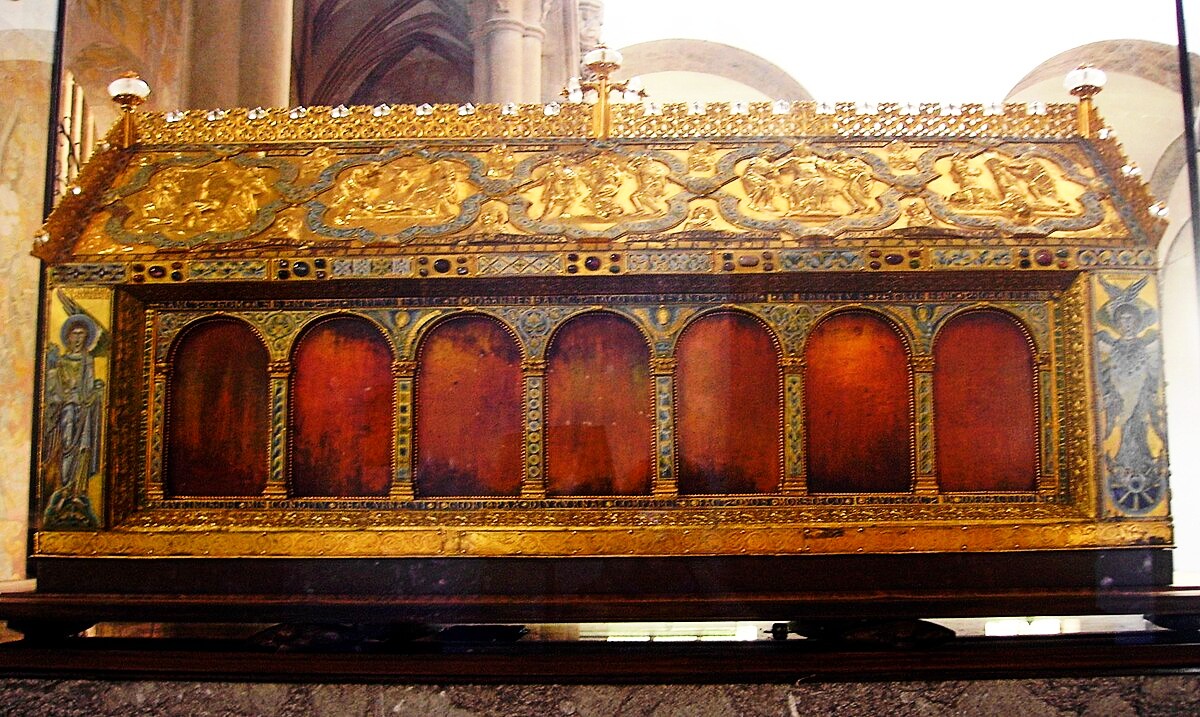
St Maurinus of Cologne (9th Century) Abbot, Martyr. St Maurinus . His Relics are kept in a Romanesque casket, a true masterpiece of goldsmith’s craft, dated around 1180. In 1922, it was brought back to the Church of St Pantaleone, from the Chapel of St Maria alla Schnurgasse. Since the 12th Century the Feast of St Maurinud is celebrated throughout the Diocese of Cologne on 10 June and in the Universal Church. His Life and Death: https://anastpaul.com/2024/06/10/saint-of-the-day-10-june-saint-maurinus-of-cologne-9th-century-abbot-martyr/
St Primitivus of Tivoli St Restitutus of Rome Bl Thomas Green St Timothy of Prusa Bl Walter Pierson St Zachary of Nicomedia
Martyrs of North Africa – 17 Saints: A group of seventeen Christians Martyred together in North Africa; the only surviving details are two of their names – Aresius and Rogatius. Both the precise location in North Africa and the date are unknown.
Martyrs of the Aurelian Way – 23 Saints: A group of 23 Martyrs who died together in the persecutions of Aurelian. The only details that survive are three of their names – Basilides, Mandal and Tripos. c.270-275 on the Aurelian Way, Rome, Italy.
Thought for the Day – 9 June – Meditations with Antonio Cardinal Bacci (1881-1971)
Devotion to the Sacred Heart
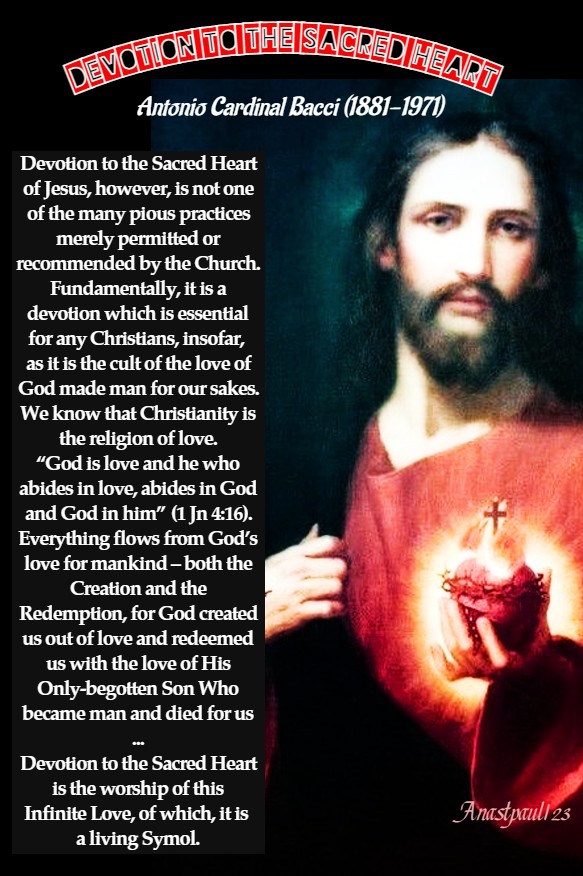
“All devotions which have been approved by the Church are valuable because they are acts of religion which have, as their object, the author of all holiness and source of all goodness. By these acts, God is adored, thanked and supplicated by His children who have been redeemed by the Precious Blood of Christ. Devotion to the Blessed Virgin and to the Saints, is also directed, ultimately, towards God, Who has endowed His faithful servants, especially the Mother of Jesus, with His gifts and graces and has established them as mediators by His Throne. Devotion to the Sacred Heart of Jesus, however, is not one of the many pious practices merely permitted or recommended by the Church. Fundamentally, it is a devotion which is essential for any Christians, insofar, as it is the cult of the love of God made man, for our sakes.
We know that Christianity is the religion of love. “God is love and he who abides in love, abides in God and God in him” (1 Jn 4:16). Everything flows from God’s love for mankind – both the Creation and the Redemption, for God created us out of love and redeemed us with the love of His Only-begotten Son Who became man and died for us and, both the Old and the New Law, for the basis of the Old Law was “You shall love the Lord, your God, with all your heart and with all your soul and with all your strength,” (Deut 6:4) and the commandment of charity, was called by Jesus His own commandment, on which His entire teaching was based. The Sacraments, especially the Blessed Eucharist, have their origin in the same Infinite Love. So have the graces which God gives us, our justification, through the merits of our Redeemer and the final reward for which we hope in Heaven. Devotion to the Sacred Heart is the worship of this Infinite Love, of which, it is a living symbol.”
Quote/s of the Day – 9 June – “The Month of the Most Sacred Heart of Jesus” – Pentecost Monday
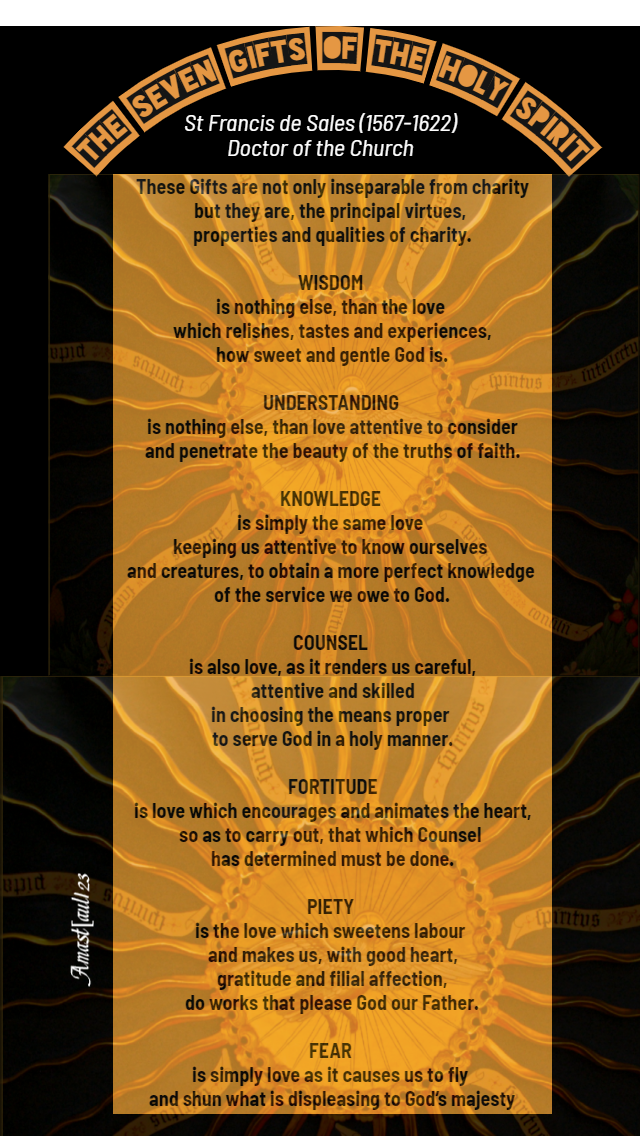
“These Gifts are not only inseparable from charity but they are, the principal virtues, properties and qualities of charity.”
WISDOM is nothing else, than the love which relishes, tastes and experiences, how sweet and gentle God is.
UNDERSTANDING is nothing else, than love attentive to consider and penetrate the beauty of the truths of faith.
KNOWLEDGE is simply the same love keeping us attentive to know ourselves and creatures, to obtain a more perfect knowledge of the service we owe to God.
COUNSEL is also love, as it renders us careful, attentive and skilled in choosing the means proper to serve God in a holy manner.
FORTITUDE is love which encourages and animates the heart, so as to carry out, that which Counsel has determined must be done.
PIETY is the love which sweetens labour and makes us, with good heart, gratitude and filial affection, do works that please God our Father.
FEAR is simply love as it causes us to fly and shun what is displeasing to God’s majesty.” (Treatise on the Love of God, Book 11, Chapter 15)
St Francis de Sales (1567-1622) Doctor of the Church
One Minute Reflection – 9 June – “The Month of the Most Sacred Heart of Jesus” – Pentecost Monday – Acts 10:34, 42-48 – John 3:16-21 – Scripture search here: https://www.drbo.org/
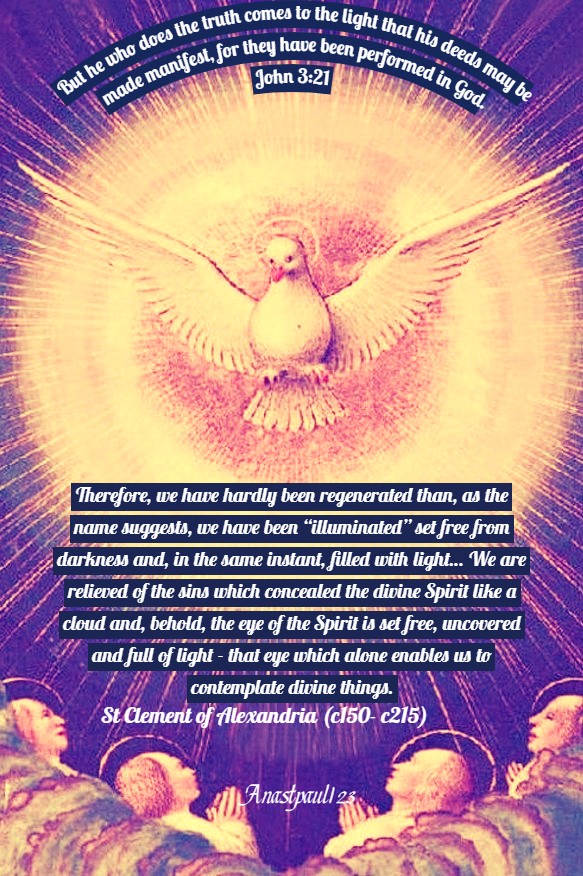
“But he who does the truth comes to the light that his deeds may be made manifest, for they have been performed in God.” – John 3:21
REFLECTION – “Being Baptised, we are illuminated; illuminated, we become children; being made children, we are made perfect; being made perfect, we are made immortal. God says: “I have said you are gods and all children of the Most High” (Ps 81:6).
This work of Baptism is variously called grace, illumination, perfection and washing. Washing, by which we cleanse away our sins; grace, by which the punishment owing to our sins is remitted; illumination, by which the holy light of salvation is beheld, so that we clearly see the divine things; perfection, because nothing is lacking. For what is yet lacking to one who knows God? Or how could we call “God’s grace” something which is not perfect? Being perfect Himself, God only bestows perfect gifts …
Therefore, we have hardly been regenerated than, as the name suggests, we have been “illuminated” set free from darkness and, in the same instant, filled with light… We are relieved of the sins which concealed the divine Spirit like a cloud and, behold, the eye of the Spirit is set free, uncovered and full of light – that eye which alone enables us to contemplate divine things.” – St Clement of Alexandria (c150- c215) Theologian and Philosopher, Professor who taught at the Catechetical School of Alexandria. (The Instructor [Paedagogus] 1:6).
PRAYER – O God, Thou Who gave the Holy Spirit to Thy Apostles, grant that the devout prayers of Your people may be effective and, as Thou hast given us faith, also grant us peace. Through Jesus Christ Thy Son, in the unity of the Holy Ghost, God, world without end. Amen (Collect).
Our Morning Offering – 9 June – “The Month of the Sacred Heart of Jesus” – Pentecost Monday
O DIVINE Heart of JESUS By Pope Leo XIII (1810-1903) Indulgence 100 Days, Once a day Raccolta 167 13 March 1901.
O DIVINE Heart of JESUS, grant, we beseech Thee, eternal rest to the souls in purgatory, the final grace to those who shall die today, true repentance to sinners, the light of the faith to pagans and Thy Blessing to me and mine. To Thee, O most compassionate Heart of JESUS! I commend all these souls and I offer to Thee, on their behalf, all Thy merits, together with the merits of Thy most Holy Mother and of all the Saints, Angels and all the Sacrifices of the Holy Mass, Communions, prayers and good works, which shall be accomplished today, throughout the Christian world. Amen
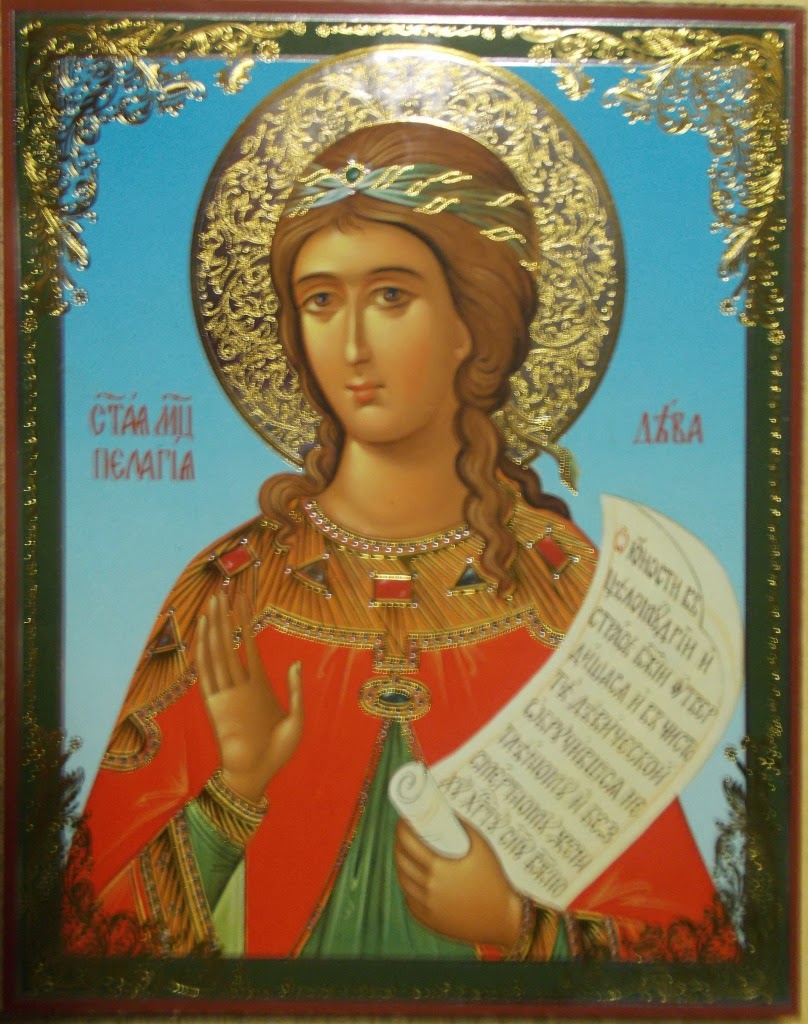
Saint of the Day – 9 June – St Pelagia (Died c311) Virgin Martyr of Antioch, aged 15. Born in the late 3rd Century in Antioch and died during the persecution of Diocletian around c311 by voluntarily plunging to her death in order to protect her virginity. Patronage – protection of virginity. Also known as – Pelagia the Virgin … of Antioch.
The Roman Martyrology reads today: “At Antioch, St Pelagia, virgin and Martyr, whose eulogy has been presented by St Ambrose and St John Chrysostom.”
Pelagia is mentioned by St Ambrose and was the subject of two sermons by St John Chrysostom.
She was 15 years old when Roman soldiers arrived during the Diocletian Persecution. Pelagia was at home alone at the time, coming outside to meet them, she discovering they intended to compel her to participate in a pagan sacrifice (or to molest her). Receiving their agreement to enter her house to change her garments, she went to the roof of her house and threw herself into the sea. Thus earned the Sacred Palm of Martyrdom.
St Felicianus and St Primus * (Died c304) Brothers, Confessors, Lay Martyrs. The Roman Martyrology reads today: “At Rome, on Mount Caelius, the birthday of the holy Martyrs, Primus and Felician, under the Emperor Diocletian and Maximian. These glorious Martyrs lived long in the service of the Lord and endured sometimes together, sometimes separately, various cruel torments. They were finally beheaded by Promotus, Governor of Nomentum and thus happily ended their combat.” Their Lives and Death: https://anastpaul.com/2023/06/09/saints-of-the-day-9-june-saints-primus-and-felicianus-died-c304-martyrs-confessors/
St Alexander of Prusa St Arnulf of Velseca
St Baithen of Iona (c536-c 599) Abbot, the first successor of St Columba of Iona. An Irish Monk, especially selected by St Columba, as one of the band of Missionaries who set sail for Scotland in 563. St Baithen of Iona is generally known as Baithen Mor, to distinguish him from eight other Saints of the same name — the affix mor meaning “the Great.” This holy man was closely related to the great St Columba. His Illustrious Life: https://anastpaul.com/2022/06/09/saint-of-the-day-9-june-st-baithen-of-iona-c-536-c-599/
St Comus of Scotland St Cumian of Bobbio St Cyrus Bl Diana d’Andalo OP St Diomedes of Tarsus St Julian (Died c370) Monk in Edessa, Syria St Luciano Verdejo Acuña
St Maximian of Syracuse (Died 594) Bishop, Monk at St Gregory the Great’s Monastery in Rome and a close friend and collaborator with St Gregory in many instances and on many projects. The Roman Martyrology states: “In Syracuse, Saint Maximian, Bishop, of whom Saint Pope Gregory the Great often makes mention.” His Holy and Dedicated Life: https://anastpaul.com/2024/06/09/saint-of-the-day-9-june-saint-maximian-of-syracuse-died-594-bishop/
Master of Portillo The Mass of Saint Gregory the Great (possibly the Bishop is our St Maximian)
St Pelagia (Died c311) Virgin Martyr of Antioch St Primus * St Richard of Andria Bl Robert Salt Bl Sylvester Ventura St Valerius of Milan St Vincent of Agen
Martyrs of Arbil – 5 Saints: Five Nuns who were Martyred together in the persecutions of Tamsabur for refusing to renounce Christianity for sun-worship – Amai, Mariamne, Martha, Mary and Tecla. They were beheaded on 31 May 347 at Arbil, Assyria (in modern Kurdistan, Iraq).
Thought for the Day – 8 June – Meditations with Antonio Cardinal Bacci (1881-1971)
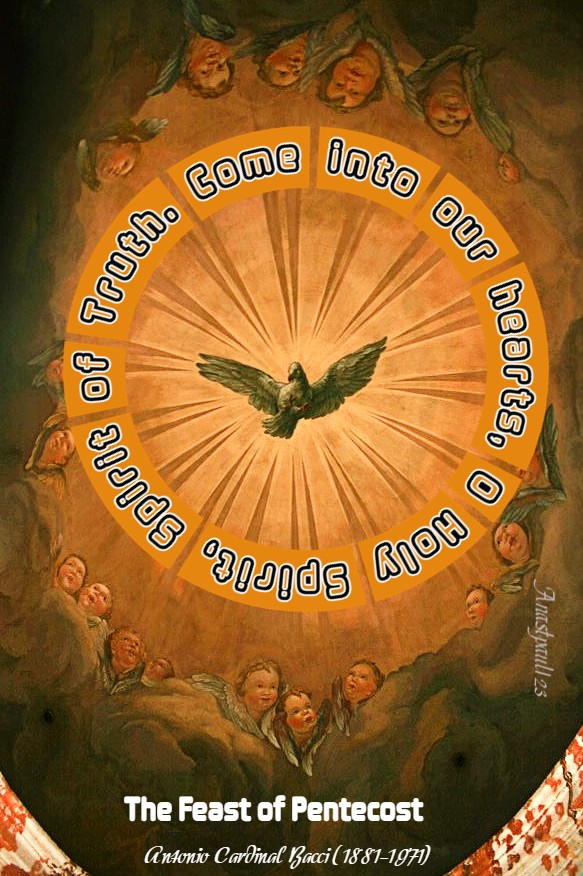
The Feast of Pentecost
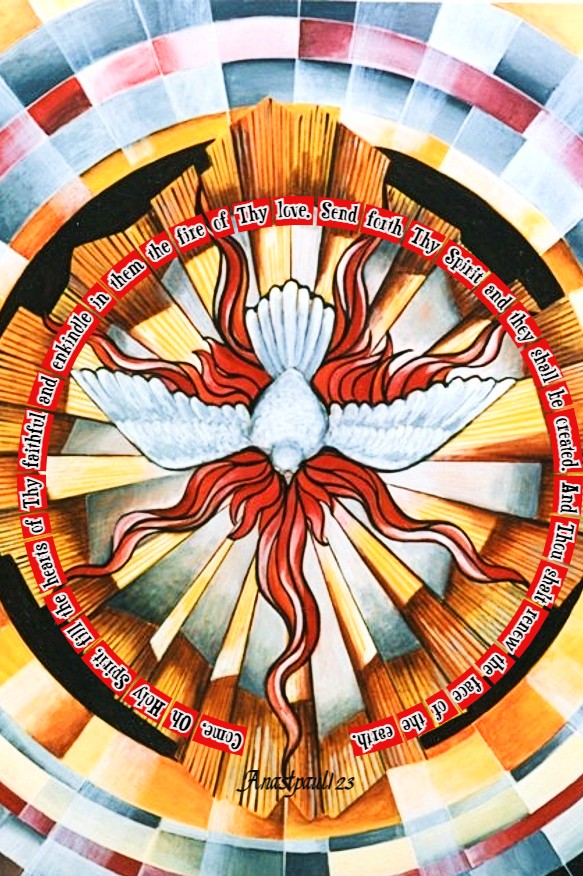
“Let us pray fervently to the Holy Ghost. Let us pray with the Church: “Send forth Thy Spirit and they shall be created and Thou shalt renew the face of the earth.”
Let us recollect ourselves in prayer before the Spirit of God on this day of Pentecost. Let us renew our resolutions and entrust them to Him so that He may help us to carry them out.
Aspiration: Come into our hearts, O Holy Spirit, Spirit of Truth.”
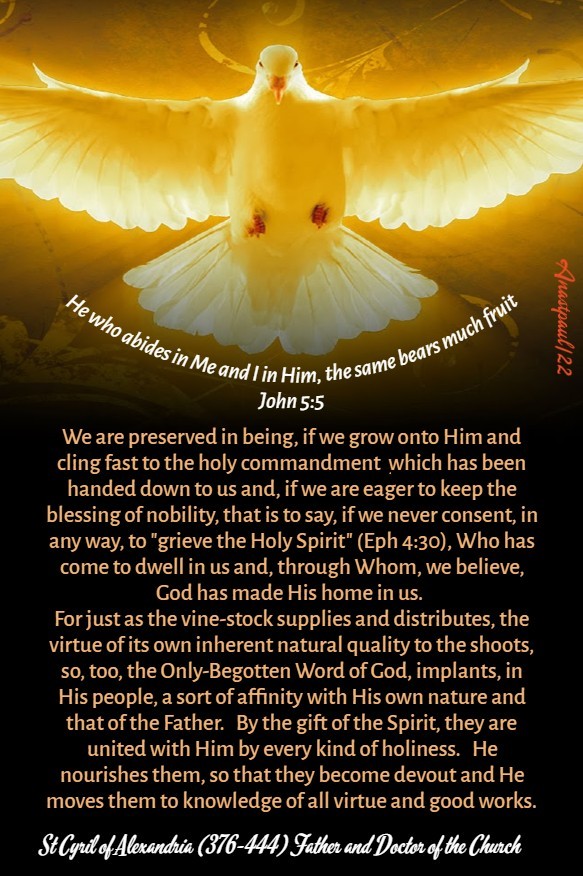
“He who abides in Me and I in Him, the same bears much fruit” John 5:5
“We are preserved in being, if we grow onto Him and cling fast to the holy commandment, which has been handed down to us and, if we are eager to keep the blessing of nobility, that is to say, if we never consent, in any way, to “grieve the Holy Spirit” (Eph 4:30), Who has come to dwell in us and, through Whom, we believe, God has made His home in us. … For just as the vine-stock supplies and distributes, the virtue of its own inherent natural quality to the shoots, so, too, the Only-Begotten Word of God, implants, in His people, a sort of affinity with His own nature and that of the Father. By the gift of the Spirit, they are united with Him by every kind of holiness. He nourishes them, so that they become devout and He moves them to knowledge of all virtue and good works.”
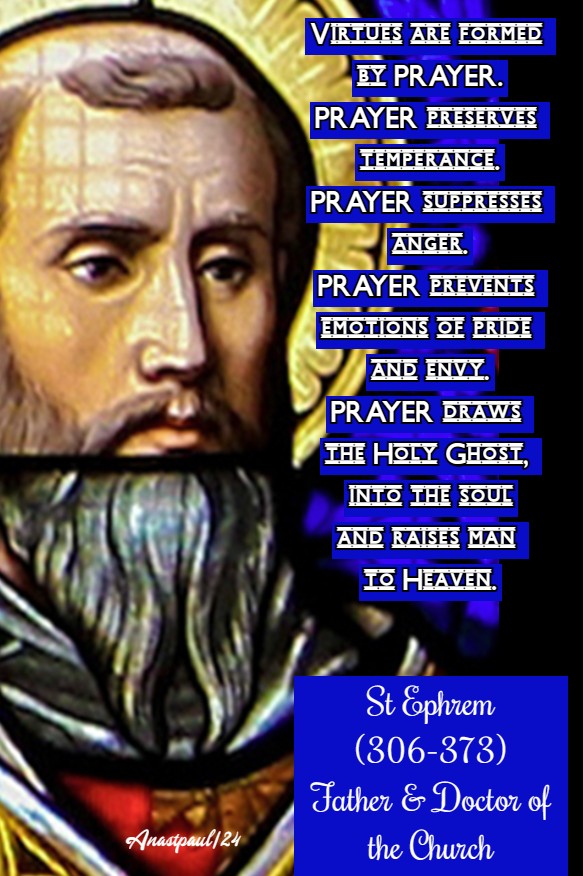
“Virtues are formed by PRAYER. PRAYER preserves temperance. PRAYER suppresses anger. PRAYER prevents emotions of pride and envy. PRAYER draws the Holy Ghost, into the soul and raises man to Heaven.”
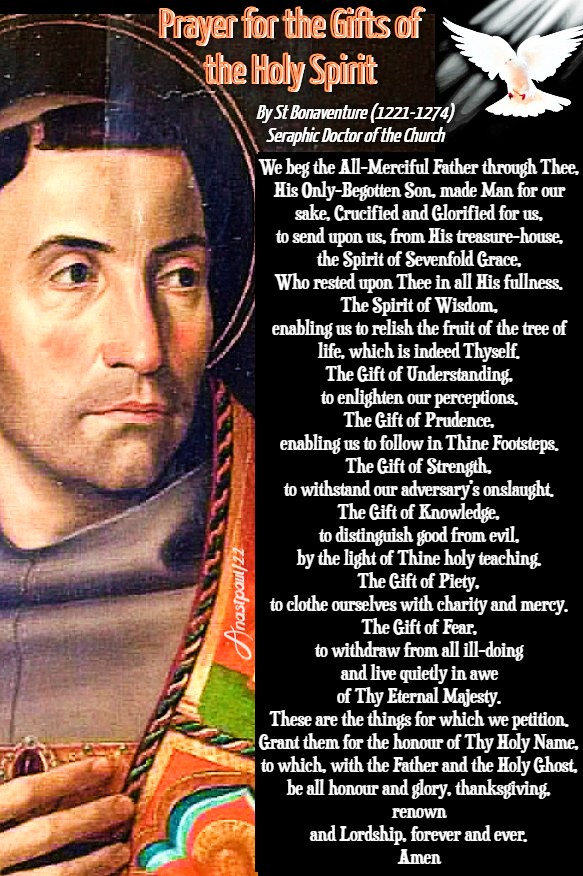
Prayer for the Gifts of the Holy Ghost By St Bonaventure (1221-1274) Seraphic Doctor of the Church
We beg the All-Merciful Father through Thee, His Only-Begotten Son, made Man for our sake, Crucified and Glorified for us, to send upon us, from His treasure-house, the Spirit of Sevenfold Grace, Who rested upon Thee in all His fullness.
The Spirit of Wisdom, enabling us to relish the fruit of the tree of life, which is indeed Thyself. The Gift of Understanding, to enlighten our perceptions. The Gift of Prudence, enabling us to follow in Thine Footsteps. The Gift of Strength, to withstand our adversary’s onslaught. The Gift of Knowledge, to distinguish good from evil, by the light of Thine holy teaching. The Gift of Piety, to clothe ourselves with charity and mercy. The Gift of Fear, to withdraw from all ill-doing and live quietly in awe of Thy Eternal Majesty.
These are the things for which we petition. Grant them for the honour of Thy Holy Name, to which, with the Father and the Holy Ghost, be all honour and glory, thanksgiving, renown and Lordship, forever and ever. Amen
One Minute Reflection – 8 June – “The Month of the Most Sacred Heart of Jesus” – Pentecost Sunday – Acts 2:1-11 – John 14:23-31 – Scripture search here: https://www.drbo.org/
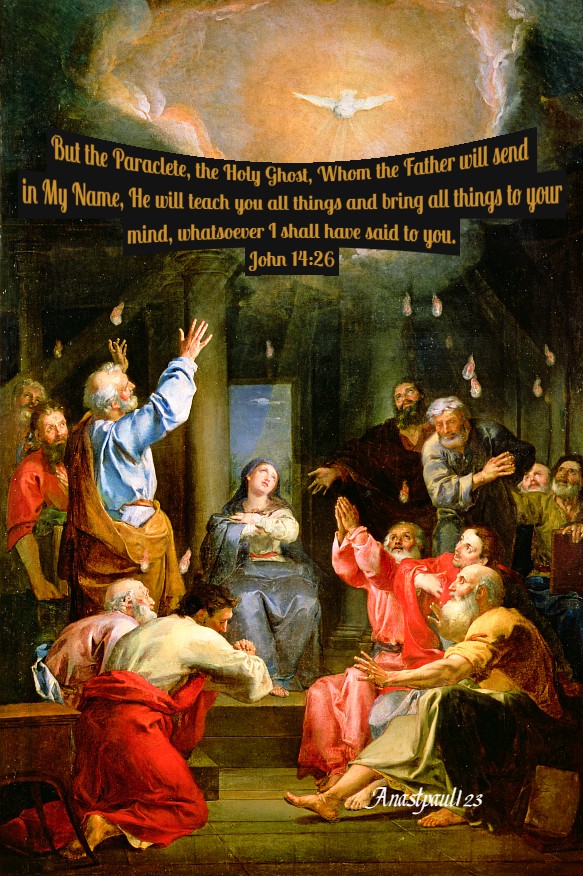
“But the Paraclete, the Holy Ghost, Whom the Father will send in My Name, He will teach you all things and bring all things to your mind, whatsoever I shall have said to you.” – John 14:26
REFLECTION – “The Apostles were sitting there in the Cenacle, the Upper Room, waiting for the Holy Ghost’s coming. Like torches, they were present there, ready and waiting to be set alight by the Holy Ghost so as to illumine the whole creation with their teaching… They were there like farm hands carrying seed in their coat pocket, waiting for the order to go out and sow. They were there like sailors whose boat is tied up in the harbour of the Son’s commandment and who are waiting for the gentle wind of the Spirit. They were there like shepherds who have just received their staff from the Chief Shepherd of the fold and who are waiting for the flock to be divided among them.
“And they began to speak in different tongues as the Spirit enabled them to proclaim.” O Cenacle, kneading trough into which has been thrown the leaven, leavening the whole world! O Cenacle, mother of all the Churches, who have witnessed the miracle of the burning bush (Ex 3). O Cenacle, amazing Jerusalem with a wonder far greater than that of the burning furnace which astonished the inhabitants of Babylon (Dn 3). The fire of the furnace burned all those around it but protected those in its midst – the flames of the Cenacle gather together those outside who wish to see them, while bringing comfort to those who receive them. O fire, whose coming is word, whose silence is light! O fire, establishing hearts in thankfulness!…
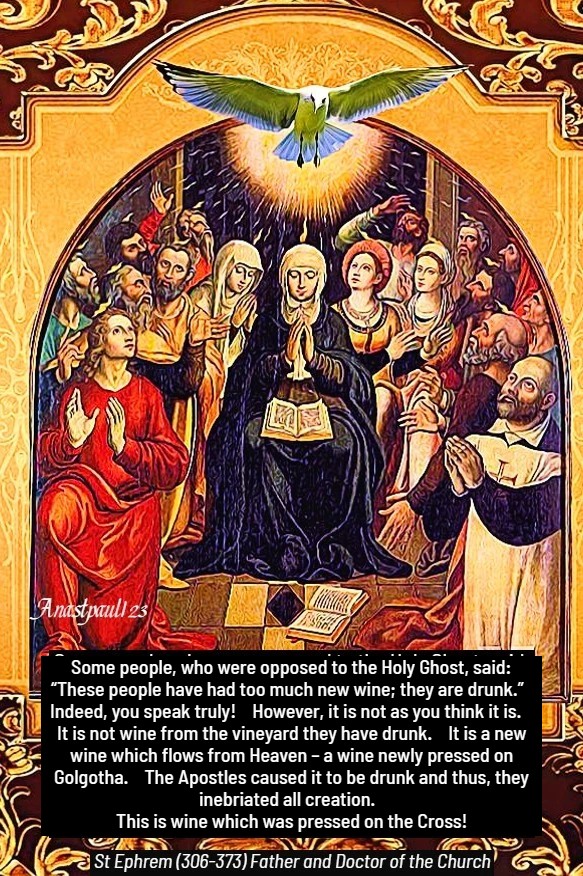
Some people, who were opposed to the Holy Ghost, said: “These people have had too much new wine; they are drunk.” Indeed, you speak truly! However, it is not as you think it is. It is not wine from the vineyard they have drunk. It is a new wine which flows from Heaven – a wine newly pressed on Golgotha. The Apostles caused it to be drunk and thus, they inebriated all creation. This is wine which was pressed on the Cross!” – St Ephrem (306-373) Deacon in Syria, Father and Doctor of the Church [Added by Pope Benedict XV in 1920] – (On the outpouring of the Holy Ghost).
PRAYER – O God, Thou Who on this day have taught the hearts of the faithful by the Light of the Holy Spirit, grant us by that Holy Spirit Himself, to know what is right and ever to rejoice in His consolation. Through Jesus Christ, Thy Son our Lord, Who lives and reigns with Thee, in the unity of the Holy Ghost, God, world without end. Amen (Collect).
Our Morning Offering – 8 June – “The Month of the Most Sacred Heart of Jesus” – Pentecost Sunday
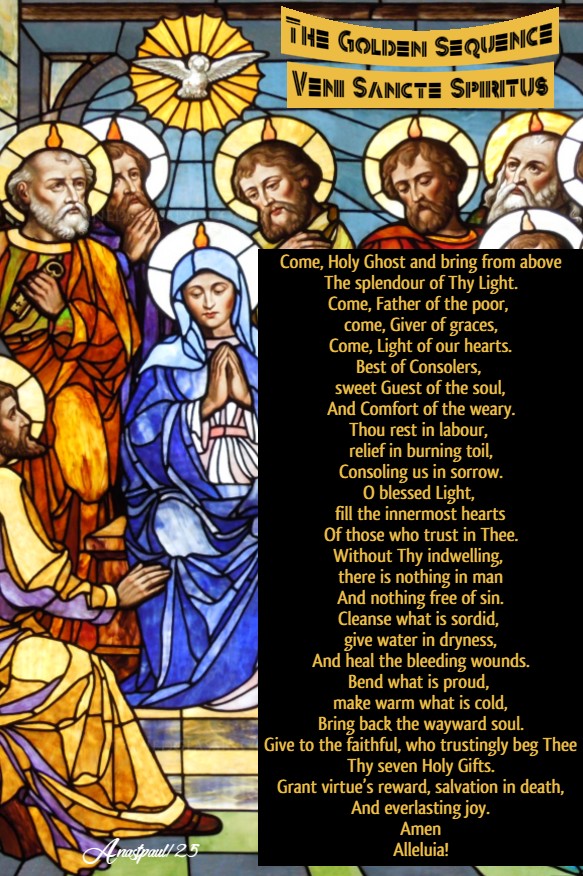
Veni Sancte Spiritus The Golden Sequence(Extract)
Come, Holy Ghost and bring from above The splendour of Thy Light. Come, Father of the poor, come, Giver of graces, Come, Light of our hearts. Best of Consolers, sweet Guest of the soul, And Comfort of the weary. Thou rest in labour, relief in burning toil, Consoling us in sorrow. O blessed Light, fill the innermost hearts Of those who trust in Thee. Without Thy indwelling, there is nothing in man And nothing free of sin. Cleanse what is sordid, give water in dryness, And heal the bleeding wounds. Bend what is proud, make warm what is cold, Bring back the wayward soul. Give to the faithful, who trustingly beg Thee Thy seven Holy Gifts. Grant virtue’s reward, salvation in death, And everlasting joy. Amen Alleluia!
“Veni Sancte Spiritus,” the “Golden Sequence” is a sequence prescribed in the Roman Liturgy for the Masses of Pentecost and its Octave, exclusive Trinity Sunday. It is usually attributed to either the 13th Century Pope Innocent III (c1160 – 1216) or to the Archbishop of Canterbury, Cardinal Stephen Langton (c1150 – 1228).
Saint of the Day – 8 June – St Clodulphus (c605-c696) Bishop of Metz, modern France, serving for around 40 years from approximately 647 until his death in 606 or 607. A man of great holiness and charity, he served his Diocese and his King and Government with brilliant and faithful apostolic fervour. Devoting himself to both spiritual and pastoral care of the most needy to the King and noblemen. Born in c605 and died on 8 June in c696. Patronage – of Metz. Also known as – Chlodulf, Clodould, Clodulphe, Clodulph, Clou, Cloud, Clodolfo, Clodulfo,
The Roman Martyrology reads today: “At Metz, St Clodulphus, Bishop.”
St Clodulphus and his wife Maria
Clodulphus was the son of St Arnulf, the Bishop of Metz and his wife, Doda. He was raised in an environment permeated by religious values and commitment to the community.
Together with his brother, Ansegis, Clodulphus distinguished himself for his abilities and his high sense of duty, obtaining important positions at the Court of the Kings of Austrasia, modern France.
However, it was at the death of his father’s successor, St Arnulf, on the Episcopal seat of Metz, that Clodulphus embarked on a path destined to leave an indelible mark on history. Although he was a layman and already led a devout and holy life, he was elected as the Bishop, accepting the office with humility and deep dedication.
Bishop Clodulphus led the Diocese of Metz for forty years, distinguishing himself for his wisdom, his generosity and his commitment to promoting the well-being of the people. His pastoral work was characterised by the attentive care of the clergy, the promotion of devotions and piety among the faithful and the realisation of numerous charitable works, including the distribution of alms to the most needy.
Clodulphus did not limit himself only to the spiritual aspect,but also proved to be a skilled administrator, wisely managing the resources of the Diocese and contributing to its economic and social development. It is thought that he also composed a biography of his father St Arnulf, testimony to his deep family ties and his admiration for his parent’s work.
In addition to his Episcopal role, Clodulphus played a leading role as an advisor to the Kings of Austrasia. His wisdom and political experience made him an important point of reference for the Sovereigns, who relied upon his judgement in crucial matters for the Kingdom.
Clodulphus’ influence also extended to the dynastic sphere. His brother, Ansegis, by marrying Begga, daughter of Pepin of Landen, became the founder of the Carolingian Dynasty, destined to profoundly mark European history. In this way, Clodulphus found himself playing an indirect but significant role in the birth of this powerful Dynasty.
Clodulphus died at the age of about ninety-one, leaving a lasting legacy in the Diocese of Metz and in Frankish history. As Patron Saint of the Diocese and City of Metz, Clodulphus is celebrated on 8 June each year.
Blessed Armand of Zierikzee OFM (Died c1524) Friar of the Order of the Friars Minor, renowned Scriptural Scholar. St Bron of Cassel Bishop, Spiritual student of Saint Patrick. St Calliope St Clodulf (c605-c696) Bishop of Metz Bl Engelbert of Schäftlarn St Eustadiola of Moyen-Moutier St Fortunatus of Fano Bishop
St Gildard of Rouen (c 456-c 545 Bishop of Rouen, Confessor * Twin Brother of St Medard below. The Roman Martyrology states of St Medard and his twin brother, St Gildard, today: “At Soissons, in France, the birthday of St Gildard, Bishop of Rouen, whose life and precious death are illustrated by glorious miracles – at Rouen, St Gildard, Bishop, twin brother of St Medard,who was born with his brother on the same day, Consecrated Bishops at the same time and being taken away from this life, also on the same day, they entered Heaven together!” About St Gildard: https://anastpaul.com/2022/06/08/saint-of-the-day-8-june-st-gildard-of-rouen-c-456-c-545/
Bl Giorgio Porta Bl Giselbert of Cappenberg St Heraclius of Sens
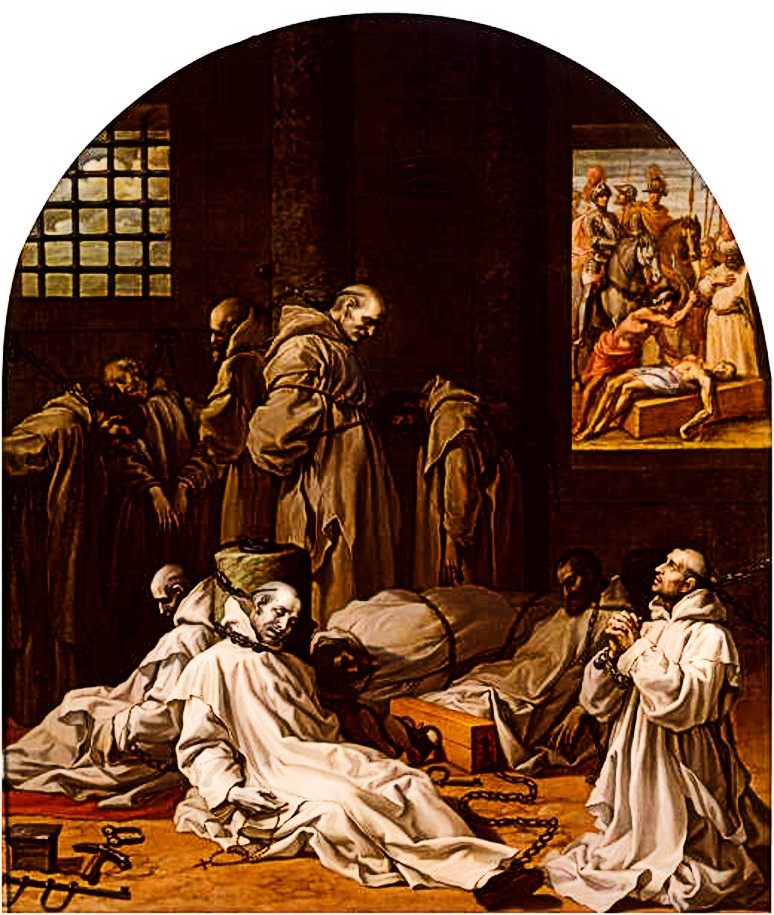
Blessed John Davy O.Cart. (c1490-1535) Deacon of the Carthusian Order, Martyr. Born in York in c1490 and died by being chained to a wall in the Tower prison, London and starved, until his death on 8 June 1535. Also known as – John Davies. Additional Memorial – 4 May as one of the Carthusian Martyrs of London. Blessed John was Beatified on 20 December 1886 by Pope Leo XIII. His Life and Death: https://anastpaul.com/2024/06/08/saint-of-the-day-8-june-blessed-john-davy-o-cart-c1490-1535-deacon-martyr/
Bl essedJohn Rainuzzi Bl Maddallena of the Conception
St Medard (c456-545) Bishop and Confessor * Twin Brother of St Gildard above. About these iluustrious Saint: https://anastpaul.com/2020/06/08/saint-of-the-day-8-june-saint-medard-c-456-545-bishop/ The Roman Martyrology states of St Medard and his twin brother, St Gildard, today: “At Soissons, in France, the birthday of St Medard, Bishop of Novon, whose life and precios death are illustrated by glorious miracles – at Rouen, St Gildard, Bishop, twin brother of St Medard,who was born with his brother on the same day, Consecrated Bishops at the same time and being taken away from this life, also on the same day, they entered Heaven together!”
St Melania the Elder St Muirchu St Pacificus of Cerano Bl Peter de Amer Bl Robert of Frassinoro St Sallustian St Syra of Troyes St Victorinus of Camerino
Thou, on those who evermore Thee confess and Thee adore In Thy sevenfold Gifts, descend. Give them comfort when they die, Give them life with Thee on high, Give them joys which never end.
THE FRUITS of the HOLY GHOST
The Gifts of the Holy Ghost perfect the supernatural virtues, by enabling us to practice them with greater docility to Divine inspiration. As we grow in the knowledge and love of God, under the direction of the Holy Ghost, our service becomes more sincere and generous, the practice of virtue becomes more perfect. Such acts of virtue leave the heart filled with joy and consolation and are known as Fruits of the Holy Spirit. These Fruits, in turn, render the practice of virtue more attractive and become a powerful incentive for still greater efforts, in the service of God, to serve Whom is to reign!
Prayer
Come, O Divine Spirit, fill my heart with Thy heavenly fruits, Thy charity, joy, peace, patience, benignity, goodness, faith, mildness and temperance, that I may never weary of the service of God but, by continued faithful submission, to Thy inspiration, may merit to be united eternally with Thee, in the love of the Father and the Son. Amen
Our Father and Hail Mary – ONCE. Glory be to the Father – SEVEN TIMES.


































You must be logged in to post a comment.