Thought for the Day – 31 July – Meditations with Antonio Cardinal Bacci (1881-1971)

Entrusting Ourselves to God
“Sometimes the cross seems too heavy. Physical or moral sufferings may give rise to a feeling of rebellion, or temptations may grow so strong that I feel overwhelmed and unable to experiece the supernatural influence of God’s grace.
At such times, I should remember the words of Jesus: “Come to me, all you who labour and are burdened and I will give you rest. Take my yoke upon you and learn from me, for I am meek and humble of heart and you will find rest for your souls. For my yoke is easy and my burden light” (Mt 11:28).
If I leave myself entirely in God’s hands, my cross will become lighter. My worries and woes, will be easier to bear and, I shall not be excessively elated by worldly pleasures.
All the Saints had perfect TRUST in God. Therefore, they were always content.”
Thought for the Day – 28 July – Meditations with Antonio Cardinal Bacci (1881-1971)
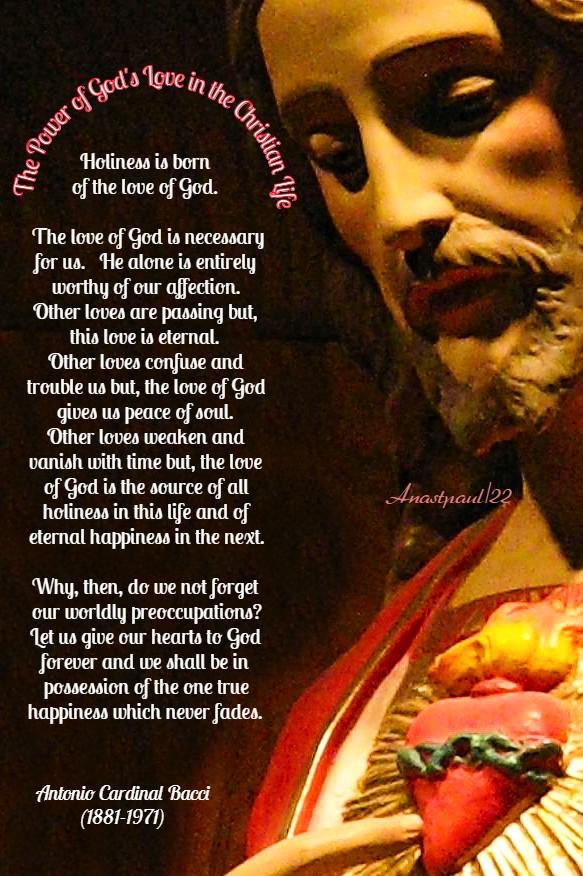
The Power of God’s Love in the Christian Life
“Everyday, in the lives of the Saints, was a continual act of love of God. This was how they became holy. They loved God intensely all the time. They loved Him above all things. Everything which they thought, desired or did, was directed to Him. Their entire lives were consecrated to Him.
We should all desire to be holy, if we do, we must love God with our whole heart, strength and will. Not until then, will every action of ours become meritorious. Holiness is born of the love of God. Without the love of God, everything is futile and useless; our conversation is so much idle chatter; our desires are empty dreams which excite us for a while and then dissolve like bubbles of soap; our actions are unprofitable and our enterprises are not aimed at a true objective; our achievements can inflate us for a time but they will leave us disillusioned at the hour of death.
The love of God is necessary for us. He alone is entirely worthy of our affection. Other loves are passing but, this love is eternal. Other loves confuse and trouble us but, the love of God gives us peace of soul. Other loves weaken and vanish with time but, the love of God is the source of all holiness in this life and of eternal happiness in the next. Why, then, do we not forget our worldly preoccupations? Let us give our hearts to God forever and we shall be in possession of the one true happiness which never fades.“
Thought for the Day – 27 July – Meditations with Antonio Cardinal Bacci (1881-1971)

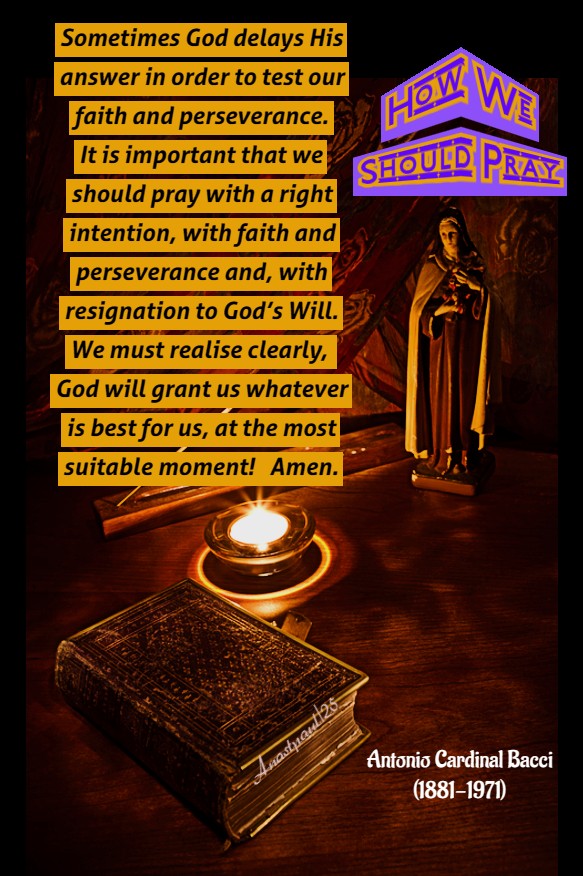
How We Should Pray
“When Jesus asked us to pray, He promised to answer our prayers. “Ask and it shall be given to you; seek and you shall find; knock and it shall be opened to you” (Mt 7:7). “If you ask the Father anything in My name, He will give it to you,” (Jn 16:23). God cannot break His promises. Why, then, do our prayers often seem to remain unanswered? There are several reasons but the main one is that which is pointed out by St James. “You ask and do not receive because you ask amiss” (Js 4:3). Some people say a few prayers with their lips only but without any real faith or confidence that they will be answered. Jesus told the heartbroken father who begged Him to free his son from an evil spirit: “If thou canst believe, all things are possible to him who believes” (Mk 9:22). Then He healed the unfortunate boy. It is necessary to have complete confidence if we wish our prayers to be answered.
Other people ask for worldly favours without ever giving a thought to their spiritual welfare. But Jesus taught us to act otherwise. “Seek first the Kingdom of God and His justice and all these things shall be given unto you besides” (Mt 6:33). There are those who look for favours, such as bodily health or riches which, if they obtained them, could lead to their spiritual destruction.
Sometimes God delays His answer in order to test our faith and perseverance. It is important that we should pray with a right intention, with faith and perseverance and, with resignation to God’s Will. We must realise clearly, God will grant us whatever is best for us, at the most suitable moment! Amen.”
Thought for the Day – 26 July – Meditations with Antonio Cardinal Bacci (1881-1971)
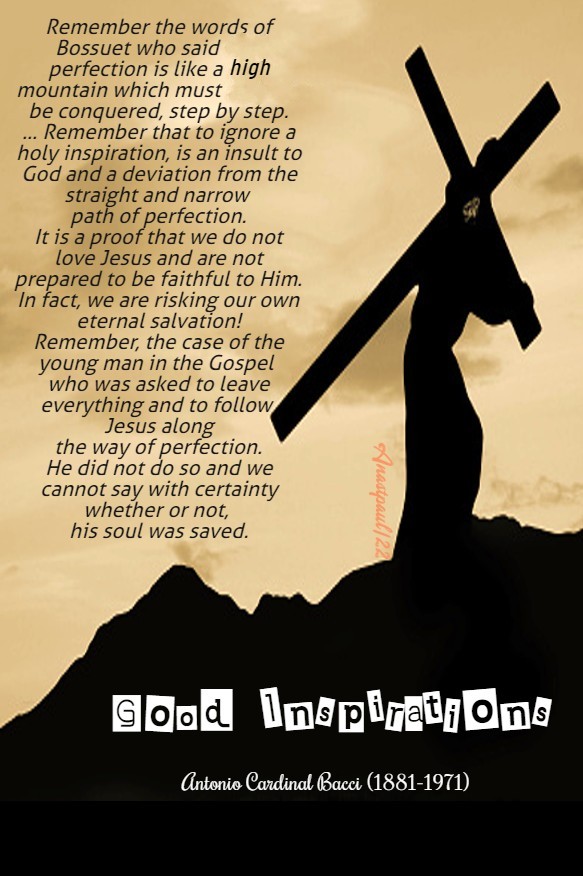
Good Inspirations
“These good inspirations are a wonderful gift from God but, it can be disastrous to refuse to hear them Are we being called to reform our lives? Let us begin immediately the difficult task of changing ourselves. Are we being called to Christian perfection? Let us be generous! Remember the words of Bossuet who said perfection is like a high mountain which must be conquered, step by step. So begin the ascent right away in obedience to God’s wishes. Remember that to ignore a holy inspiration, is an insult to God and a deviation from the straight and narrow path of perfection. It is a proof that we do not love Jesus and are not prepared to be faithful to Him. In fact, we are risking our own eternal salvation! Remember, the case of the young man in the Gospel who was asked to leave everything and to follow Jesus along the way of perfection. He did not do so and we cannot say with certainty whether or not, his soul was saved.”
Thought for the Day – 25 July – Meditations with Antonio Cardinal Bacci (1881-1971)
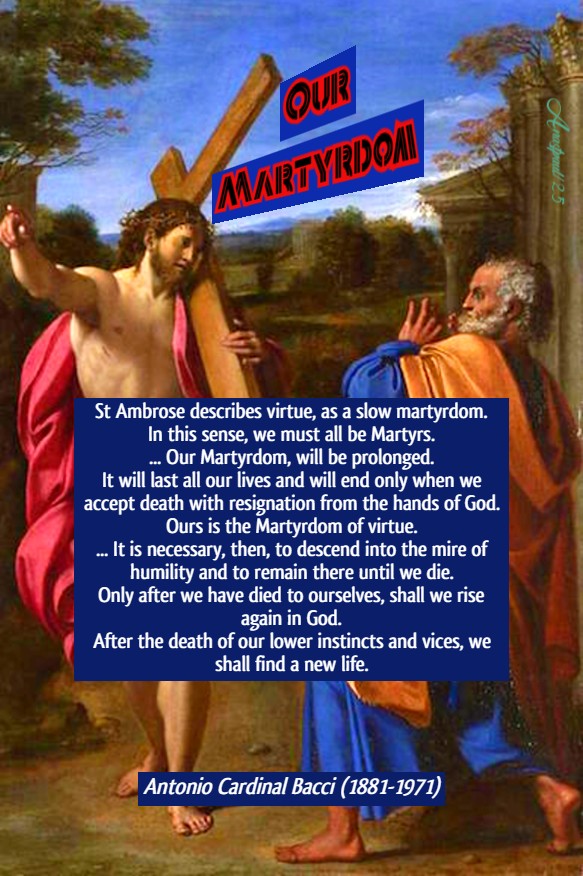
Our Martyrdom
“St Ambrose describes virtue, as a slow martyrdom. In this sense, we must all be Martyrs. There is only one difference. The Martyrs of the Church shed their blood and gave up their lives for Jesus, within one hour or one day and gained their reward immediately. Our Martyrdom, on the other hand, will be prolonged. It will last all our lives and will end only when we accept death with resignation from the hands of God. Ours is the Martyrdom of virtue. Let us clearly understand, that solid Christian virtue is a slow and continual Martyrdom which will only end with death. It is not a flower which springs up spontaneously in the garden of the soul. It is like a seed which is thrown on the damp earth and must die there slowly, so that it can generate young shoots which will produce the ears of corn. “Unless the grain of wheat falls into the ground and dies, it remains alone. But, if it dies, it brings forth much fruit” (Jn 12:24-25). It is necessary, then, to descend into the mire of humility and to remain there until we die. Only after we have died to ourselves, shall we rise again in God (Cf ibid). After the death of our lower instincts and vices, we shall find a new life.”
Thought for the Day – 23 July – Meditations with Antonio Cardinal Bacci (1881-1971)
The Duties of Our State
“Everyone finds himself in a certain position in life. He may be there, either through force of circumstances, or, through somebody else’s desire, or through some secret inspiration from God, In any case, each of us is in a certain place and God, either wills it or permits it. We should not complain about our state in life. No matter what that state is, we can either be saved or damned for all eternity. In any position, we can do a great deal of good or a great deal of evil, according to the way in which we co-operate with the grace of God. We should not envy the positions of others. This would be unjust because, it would be tantamount to questioning the arrangements of Providence, which gives everyone the graces necessary, in his particular state. It would also be injurious, insofar, as we should be worried and disturbed, instead of working peacefully and earnestly, in the place assigned to us by God.”
Thought for the Day – 22 July – Meditations with Antonio Cardinal Bacci (1881-1971)idity,

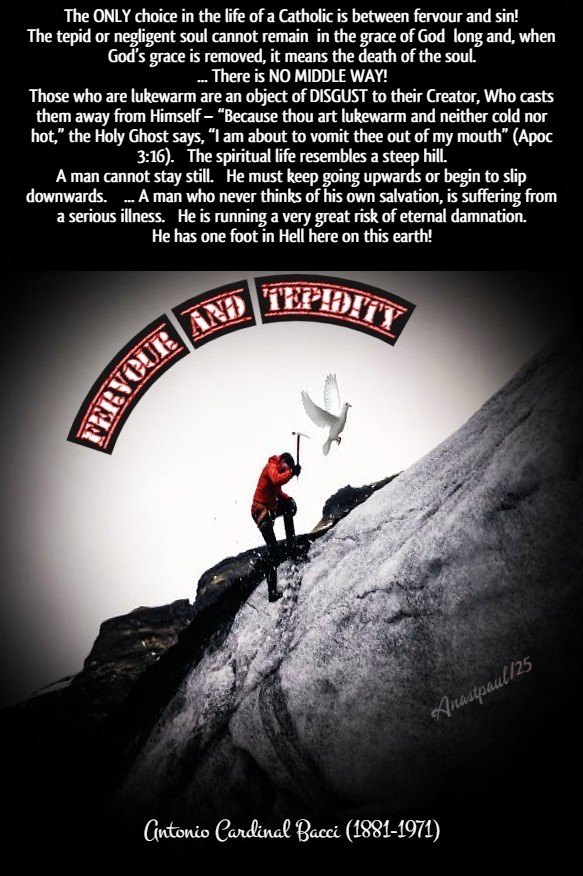
Fervour and Tepidity
“The ONLY choice in the life of a Catholic is between fervour and sin! The tepid or negligent soul cannot remain in the grace of God long and, when God’s grace is removed, it means the death of the soul.
The spiritual life resembles a steep hill. A man cannot stay still. He must keep going upwards or begin to slip downwards. Whoever struggles on, up the hill is approaching perfection and Heaven; whoever slips backwards, is approaching sin, a dead soul and Hell.
There is NO MIDDLE WAY! Those who are lukewarm are an object of DISGUST to their Creator, Who casts them away from Himself – “Because thou art lukewarm and neither cold nor hot,” the Holy Ghost says, “I am about to vomit thee out of my mouth” (Apoc 3:16).
So, it is not enough to be mediocre Catholic. The half-hearted and indifferent are already travelling along the slippery path of sin and are on the waiting list for hell! It is dangerous for anyone to remain thoughtlessly in this state of spiritual ineptitude. A man who never thinks of his own salvation, is suffering from a serious illness. He is running a very great risk of eternal damnation. He has one foot in Hell here on this earth!”
Thought for the Day – 21 July – Meditations with Antonio Cardinal Bacci (1881-1971)
The Examination of Conscience
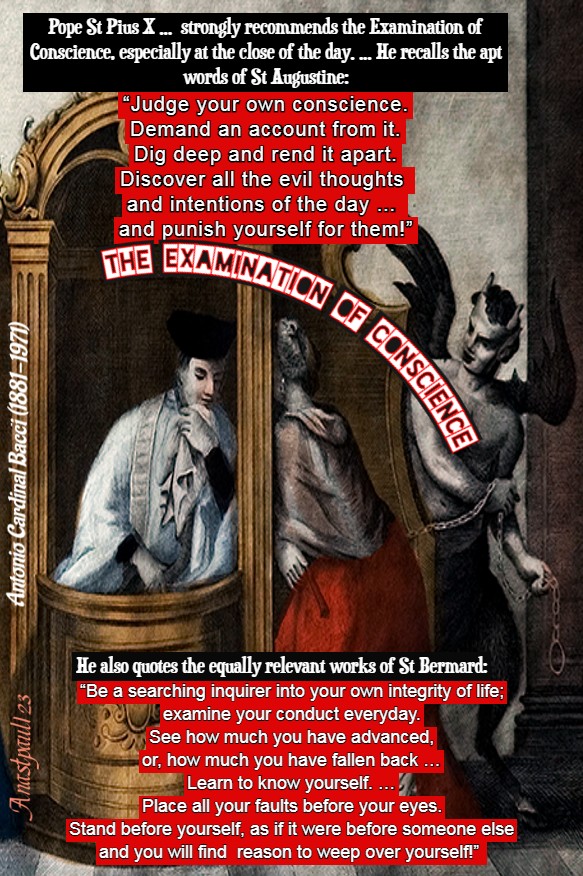
“Pope St Pius X holds great authority for a Christian. In his Exhortatio ad Clerum, he strongly recommends the Examination of Conscience, especially at the close of the day. This Examination, he says, is necessary for Priests but it is no less necessary for the laity. He recalls the apt words of St Augustine: “Judge your own conscience. Demand an account from it. Dig deep and rend it apart. Discover all the evil thoughts and intentions of the day … and punish yourself for them!” (Expos in Ps 4 n 8). He also quotes the equally relevant words of St Bernard: “Be a searching inquirer into your own integrity of life; examine your conduct everyday. See how much you have advanced, or, how much you have fallen back … Learn to know yourself. … Place all your faults before your eyes. Stand before yourself, as if it were before someone else and you will find reason to weep over yourself!” (Meditat Cap 5 de quotidiano sui ipsius examine).
The Saintly Pontiff concludes his inspiring address as follows: “Experience has proven that anyone who makes a strict examination of his thoughts, words and actions, is more firmly resolved to hate and avoid what is evil and wholeheartedly to love what is good” (Acta Pii X, IV p257).”
Thought for the Day – 20 July – Meditations with Antonio Cardinal Bacci (1881-1971)
Leaving Our Worries in God’s Hands
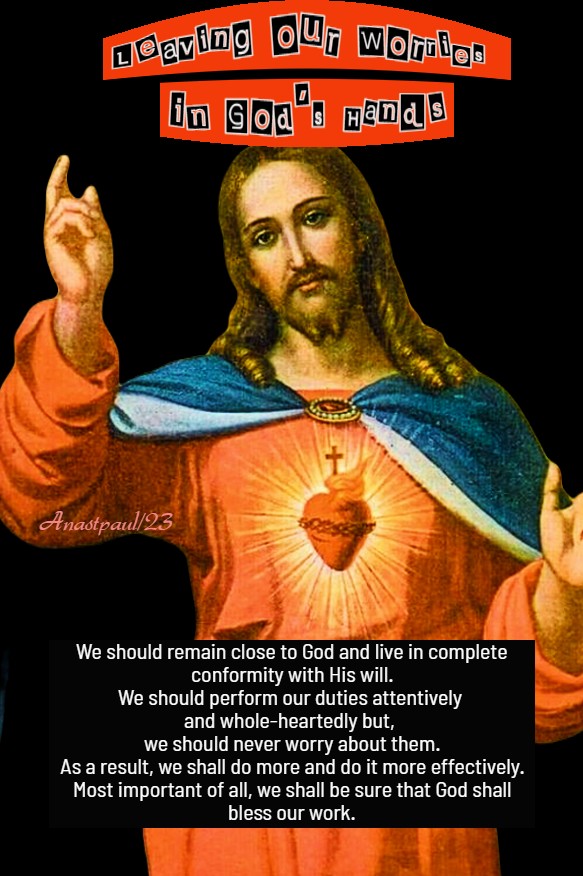
“We should try to behave with similar serenity. We should remain close to God and live in complete conformity with His will. We should perform our duties attentively and whole-heartedly but, we should never worry about them. As a result, we shall do more and do it more effectively. Most important of all, we shall be sure that God shall bless our work.”
Thought for the Day – 18 July – Meditations with Antonio Cardinal Bacci (1881-1971)
The Love of Our Neighbour
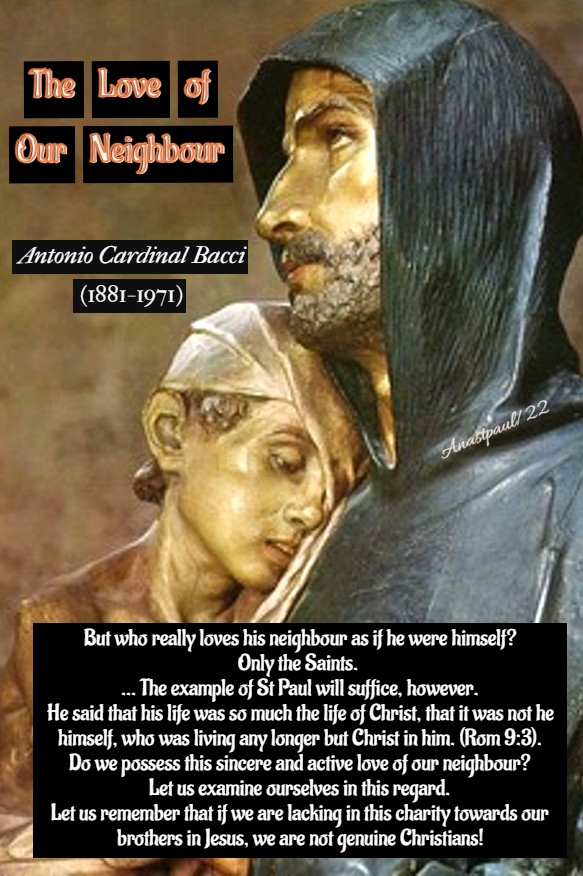
“But who really loves his neighbour as if he were himself? Only the Saints. Jesus loved us, not only as much as He loved Himself but much more than this because He gave His life and His own Precious Blood for salvation. The Saints who lived the life of Christ and followed His example, saw Jesus in all their fellowmen. Therefore, they loved them as themselves and even more than themselves. One could cite thousands of instances of heroic charity in the lives of the Saints. The example of St Paul will suffice, however. He said that his life was so much the life of Christ, that it was not he himself, who was living any longer but Christ in him. (Rom 9:3).
Do we possess this sincere and active love of our neighbour? Let us examine ourselves in this regard. Let us remember that if we are lacking in this charity towards our brothers in Jesus, we are not genuine Christians!”
Meditations with Antonio Cardinal Bacci (1881-1971) on the Feast of the Humility of Mary

The Humility of Mary
“Unfortunately, we often look for our share of glory on earth. We wish to appear to others, not only at our true value but much more than we are really worth. We imagine that the gifts and qualities which God has given us, belong to ourselves, whereas they are entirely His.
We like to put on a good appearance to win praise and renown – in other words, we wish to have our reward upon this earth. We should remember, however, that if we look for our reward now, we shall not have it in Heaven.
God sees when our motives in doing good are distorted and, when we appear before His Judgement Throne, He will say to us: “You have received your reward” (Cf Mt 6:2).
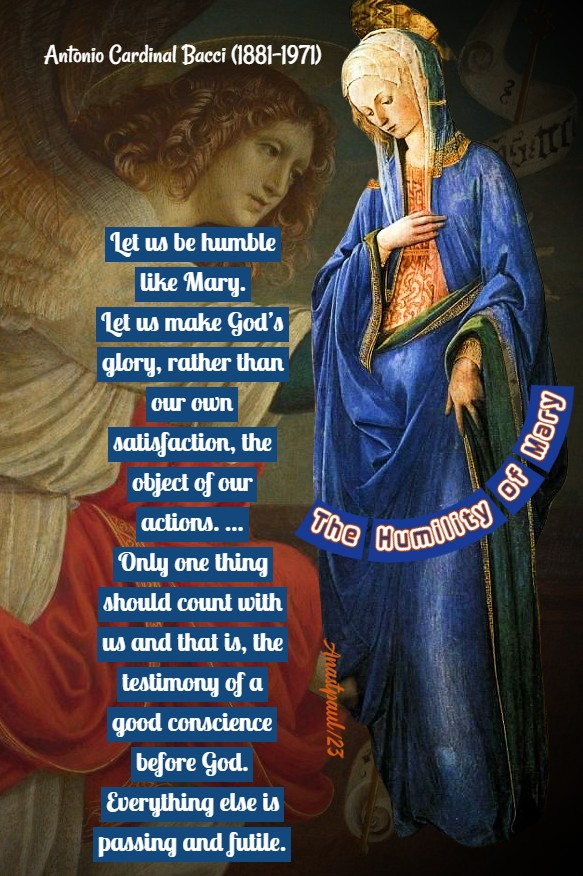
Let us be humble like Mary. Let us make God’s glory, rather than our own satisfaction, the object of our actions. It will sometimes happen that men will misunderstand us, perhaps even insult us. We are not forbidden to defend ourselves and explain our position. We may not have the heroic virtue of St Francis de Sales, who remained silent when he was caluminated. But we should not be too disturbed by lack of understanding or slander, nor should we be too elated by flattery. Only one thing should count with us and that is, the testimony of a good conscience before God. Everything else is passing and futile.
Our humility will be tested by the inevitable opposition, sometimes jealous and malicious, which we shall experience on the part of other men. On these occasions, we shall see if we are really meek and humble of heart, like Jesus and our Blessed Mother.”
Thought for the Day – 16 July – Meditations with Antonio Cardinal Bacci (1881-1971)
The Intercession of Our Lady
“Our Lady’s intercession is very powerful with God. St Bernard tells us that it is the Will of God, that everything comes to us through her holy hands (Sermo in Nativ BMV no 7). He assures us, that Mary is the Mediatrix through whom we receive all favours from God (In Assump. BMV sermo 2, no 2). Her power of intercession is the result of her divine and human Motherhood. Because she is the Mother of God, Jesus refuses her nothing; because she is our mother, she loves us dearly and is eager to obtain from God, the spiritual favours, for which we ask. For this reason, we should approach her with complete confidence. St Bernard also writes: “If anyone feels that he is overwhelmed by the tempests of this world and cannot keep an even course, let him raise his eyes towards Mary, let him remember Mary and call upon her…. In danger and in doubt, let him remember and call upon her. Let the thought of Mary never leave his mind; let her name never be far from his lips and from his heart …” (Super Miss. Homil 2, no 17). In all our necessities, we should have confident recourse to our heavenly Mother. Let us remember, however, that if we wish to be true sons of Mary and to be sure of being heard by her, we should ask especially, for spiritual graces. Afterwards, we may ask, with equal confidence but, with resignation to God’s Will, for temporal favours, provided they will not stand in the way of our eternal salvation.”
Quote/s of the Day – 16 July – The Feast of Our Lady of Mount Carmel – Ecclesiasticus Sirach 24:23 – Luke 11:27-28 – Scripture search here: https://www.drbo.org/ –
… Rather blessed are those, who hear the Word of God and keep it.”
Luke 11:28
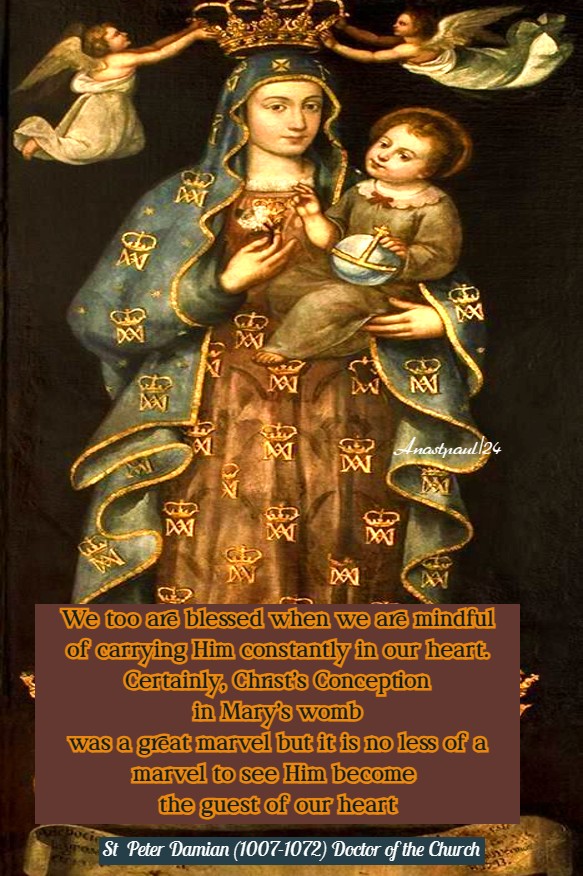
“We too are blessed when we are mindful of carrying Him constantly in our heart. Certainly, Christ’s Conception in Mary’s womb was a great marvel but it is no less of a marvel to see Him become the guest of our heart.”
St Peter Damian (1007-1072) Doctor of the Church
Mother of Salvation, Blessed Lady By St Anselm (1033-1109) Magnificent Doctor Marian Doctor
Mother of Salvation, Blessed Lady, you are the Mother of Justification and those who are justified; the Mother of Reconciliation and those who are reconciled; the Mother of Salvation and those who are saved. What a blessed trust and what a secure refuge! The Mother of God is our Mother. The Mother of the One in Whom alone, we hope and Whom alone, we fear, is our Mother! … The One Who partook of our nature and by restoring us to life, made us children of His Mother, invites us by this grace, to proclaim that we are His brothers and sisters. Therefore, our Judge, is also our Brother. The Saviour of the world, is our Brother. Our God has become – through Mary – our Brother! Anen
“Be our Mother, O Mary, for you have borne us spiritually on Mount Calvary, at the foot of the Cross. Deign to obtain for us, through your intercession that we may love Jesus as you loved Him and follow Him faithfully, as you followed Him, unto Death. Amen.”
Thought for the Day – 15 July – Meditations with Antonio Cardinal Bacci (1881-1971)

Carrying our Cross
“We also read in the Imitation of Christ: “No man has so heartfelt a sense of the Passion of Christ, as he whose lot it has been, to suffer like things.” (Imitation of Christ, Bk II, Ch 12) If you carry your cross willingly, it will lead you to your longed for destination, where suffering ends and everlasting joy begins. If you carry it unwillingly, the weight will become unbearable and you will have to bear it in any case! If you fling away the cross which you are carrying, immediately, an even heavier one will be laid upon you! Look upon them as wonderful consolations because, the sufferings of this life cannot be regarded as the measure of that glory which will be ours in Heaven … (Rom 8:18). We are fortunate and greatly blessed, if we deserve to suffer a little, for the Name of Jesus … Only when we begin to die ourselves, can we begin to live in God. Nothing is more acceptable to God and more helpful for us in this world, than to suffer willingly for love of Christ.”
Thought for the Day – 14 July – Meditations with Antonio Cardinal Bacci (1881-1971)
Humility
“Humility is, in fact, truth. Many think it is a menial fiction, or a pious congregation and that only a few can really achieve it.
In other words, we must disregard ourselves. We must be content to be unknown and unesteemed. This might seem to be contrary to, or at least, superior to human nature but it is based on the simple naked truth. What have we that is not a gift of God? All we have in the natural and supernatural order, we have received from God: “What hast thou that thou hast not received? And if thou hast receive it, why dost thou boast as if thou hast not received it?” (1 Cor 4:7).
Our defects and sins are the only things which are really our own! So we have a double motive for humility. Everything good about us is a gift from God. Only our sins belong to us!”
“As “pride is the beginning of all sin,” (Eccl. 10:15) so humility is the foundation of all virtue. Learn to be really humble and not, as the hypocrite, humble merely in appearance.”
St Bonaventure OFM (1221-1274) Seraphic Doctor of the Church
Thought for the Day – 13 July – Meditations with Antonio Cardinal Bacci (1881-1971)
Following Jesus, the Divine Model
“When we have renounced ourselves and have embraced our cross with resignation and love, we must follow Jesus. We must follow Him in a special way as the Infallible Teacher of tTuth. The teachings of men cannot satisfy our intellects. Still less, can they satisfy our hearts. What they teach is either incomplete or false. This is proved by the fact that the doctrines of men have succeeded and replaced one another, down through the Centuries while “the Word of the Lord endures forever” (1 Peter 1:25).
The teaching of Christ produces an extraordinary renovation in the individual, in the family and in society. It is this renewal which we call Christianity and Christian civilisation. There is a wide chasm between paganism and Christianity. This gulf would be even wider, only for the fact that Christianity has not yet been fully put into practice throughout the universe. There is only one reform necessary. This is to realise the Christian ideal everywhere. We must begin by carrying it out ourselves. Let us follow Jesus, Who is saying to us: “I Am the Way and the Truth and the Life” (Jn 14:6). “He who follows Me does not walk in darkness” (Jn 8:12).
Let us follow our Divine Master and we shall be sure that we are travelling towards Heaven!”
Thought for the Day – 12 July – Meditations with Antonio Cardinal Bacci (1881-1971)
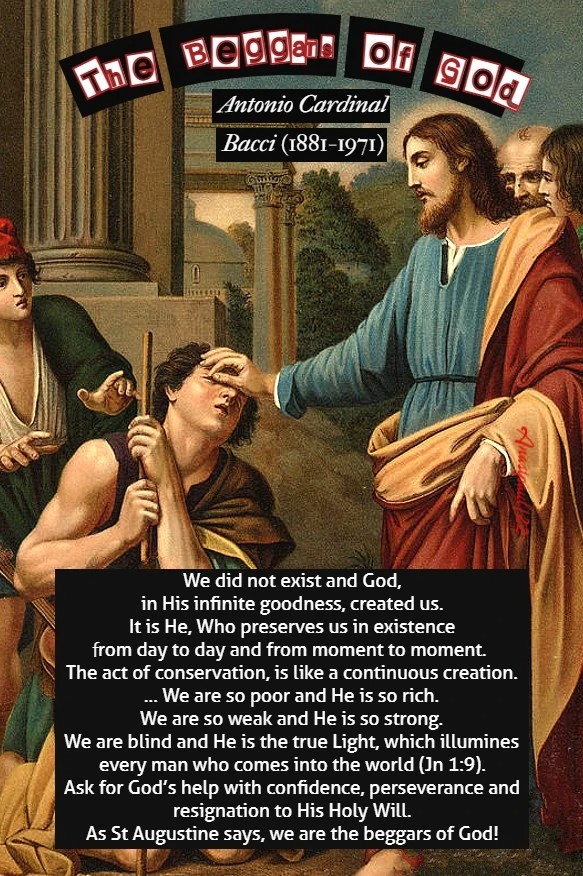
The Beggars of God
“Both in the natural and in the supernatural order, we are in continual need of the aid of God. We did not exist and God, in His Infinite Goodness, created us. It is He, Who preserves us in existence from day to day and from moment to moment. The act of conservation, is like a continuous creation. If God did not sustain us, we should return immediately to the dust from which we came: “Remember, man, that dust you are and unto dust you shall return” (Gen 3:19).
We are continually dependent on our Lord and Creator for our existence and activity. If we remained always aware of this tremendous fact, we would never offend God. We would show Him a filial gratitude and humbly implore His assistance.
We are so poor and He is so rich. We are so weak and He is so strong. We are blind and He is the true Light, which illumines every man who comes into the world (Jn 1:9). Ask for God’s help with confidence, perseverance and resignation to His Holy Will. As St Augustine says, we are the beggars of God!”
Thought for the Day – 10 July – Meditations with Antonio Cardinal Bacci (1881-1971)
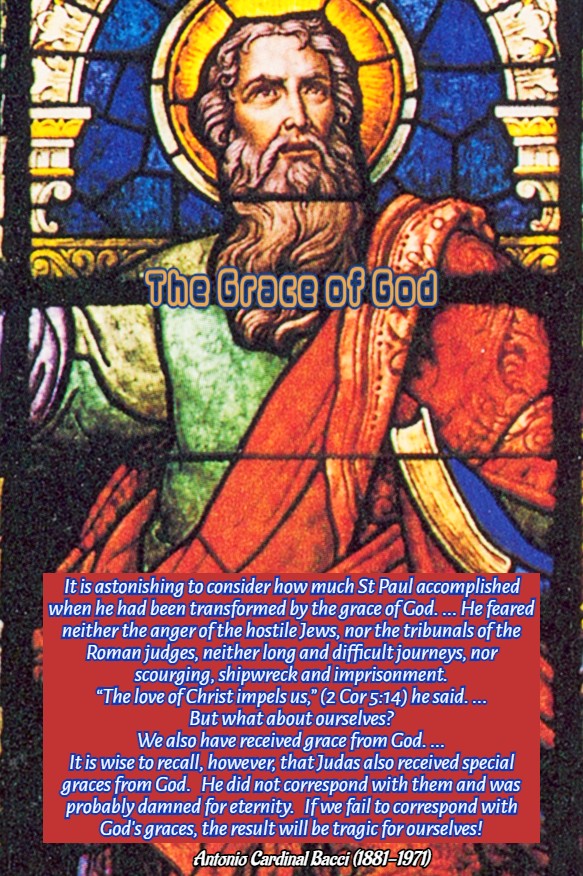
The Grace of God
“It is astonishing to consider how much St Paul accomplished when he had been transformed by the grace of God. Formerly, a persecutor of Christians, he became the Apostle of the Gentiles. Enlightened by faith and inspired by charity, he travelled the globe, spreading everywhere, the religion of Jesus Christ.
He feared neither the anger of the hostile Jews, nor the tribunals of the Roman judges, neither long and difficult journeys, nor scourging, shipwreck and imprisonment. “The love of Christ impels us,” (2 Cor 5:14) he said. It was the love of God which drove him on and on, until he met his Martyrdom. But what about ourselves? We also have received grace from God. Often we hear His Voice appealing to us to abandon our sinful ways, to practise virtue, to love Him more ardently and to prove our love, by deeds. If we co-operate, we shall be able to say with St Paul: “by the grace of God, I am what I am and his grace in me has not been fruitless,” (1 Cor 15:10) and “I have laboured … yet, not I but the grace of God with me” (ibid).
It is wise to recall, however, that Judas also received special graces from God. He did not correspond with them and was probably damned for eternity. If we fail to correspond with God’s graces, the result will be tragic for ourselves.”
Thought for the Day – 6 July – Meditations with Antonio Cardinal Bacci (1881-1971) – The Octave Day of Sts Peter and Paul
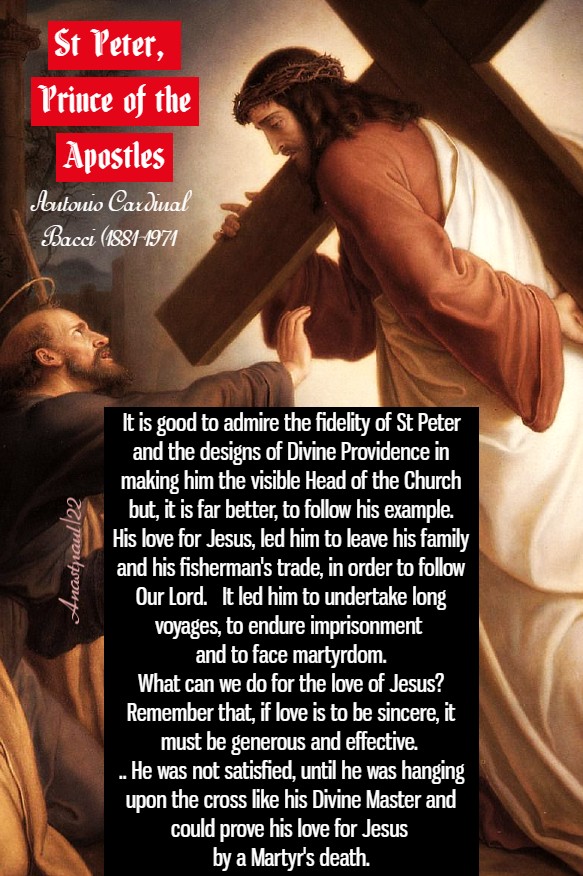
St Peter, Prince of the Apostles St Paul, the Apostle to the Gentiles
“It is good to admire the fidelity of St Peter and the designs of Divine Providence in making him the visible Head of the Church but, it is far better, to follow his example. His love for Jesus, led him to leave his family and his fisherman’s trade, in order to follow Our Lord. It led him to undertake long voyages, to endure imprisonment and to face Martyrdom. What can we do for the love of Jesus? Remember that, if love is to be sincere, it must be generous and effective.
Secondly, let us meditate on and imitate, the ardent and fearless faith of St Peter. He was not afraid to preach the teaching of Christ before the Sanhedrin. He was not afraid of Herod, who cast him into prison.
He was not afraid of the Roman Emperor, who caused him to be crucified. Our faith should be steadfast and lively, like his!
Finally, let us imitate Peter in his repentance. Although he loved Jesus very much and had such great faith in Him, in a moment of weakness and of imprudence, he denied Him three times. All his life, however, be wept bitterly for this sin. Whenever he heard a cock crowing, it was as if an arrow had pierced his heart. He was not satisfied, until he was hanging upon the cross like his Divine Master and could prove his love for Jesus by a Martyr’s death.”
St Paul, the Apostle to the Gentiles
We can learn many other virtues from St Paul, besides his zealous love for God and for his fellowmen. We can also learn from him, the virtues of humility and of apostolic fervour. The Apostle of the Gentiles reached such heights of sanctity, as to feel himself transformed into Christ Himself and to deserve to be taken up into the third Heaven, where he enjoyed a foretaste of eternal happiness. Nevertheless, he considered himself unworthy to be called an Apostle and he realised, that all his gifts came to him from God. “Not that we are sufficient of ourselves, to think anything as from ourselves but our sufficiency, is from God” (2 Cor 3:5). Whenever we succeed in any project, we should think on the same lines because, it is only when we are humble and depend on the grace of God, that the success of our actions will redound to the glory of our Creator. If the cancer of ambition or of self-love, should corrupt our purity of intention, our work would not be blessed by God and would not make us worthy of everlasting life. Let us repeat often: “All for You, with You and in You, my God.”
Thought for the Day – 1 July – “The Feast and Month of the Most Precious Blood of Jesus” – Meditations with Antonio Cardinal Bacci (1881-1971)
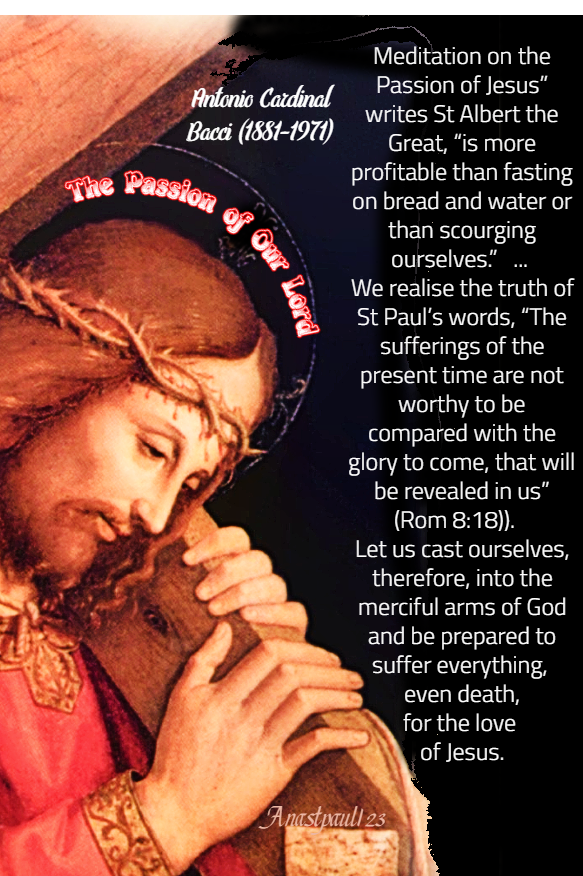
The Passion of Our Lord
“Meditation on the Passion of Jesus” writes St Albert the Great, “is more profitable than fasting on bread and water or than scourging ourselves.”
This is because, when we meditate with love and gratitude on the Passion of our Redeemer, we have the experience of being transformed and set aglow with charity. We realise the truth of St Paul’s words, “The sufferings of the present time are not worthy to be compared with the glory to come, that will be revealed in us” (Rom 8:18)).
Let us cast ourselves, therefore, into the merciful arms of God and be prepared to suffer everything, even death, for the love of Jesus.”
Thought for the Day – 30 June – Meditations with Antonio Cardinal Bacci (1881-1971)
The Worship of the Sacred Heart in Relation to the Love of God and of Our Neighbour
“There is nothing sentimental about having devotion to the Sacred Heart of Jesus. Neither does this devotion consist only in prayers and pious practices. It is much deeper than this. It should flood our whole being, enkindle the fire of divine love in our hearts and transform our lives in accordance with the commands of Jesus. A love which is not active cannot be genuine, it is only a passing emotion.
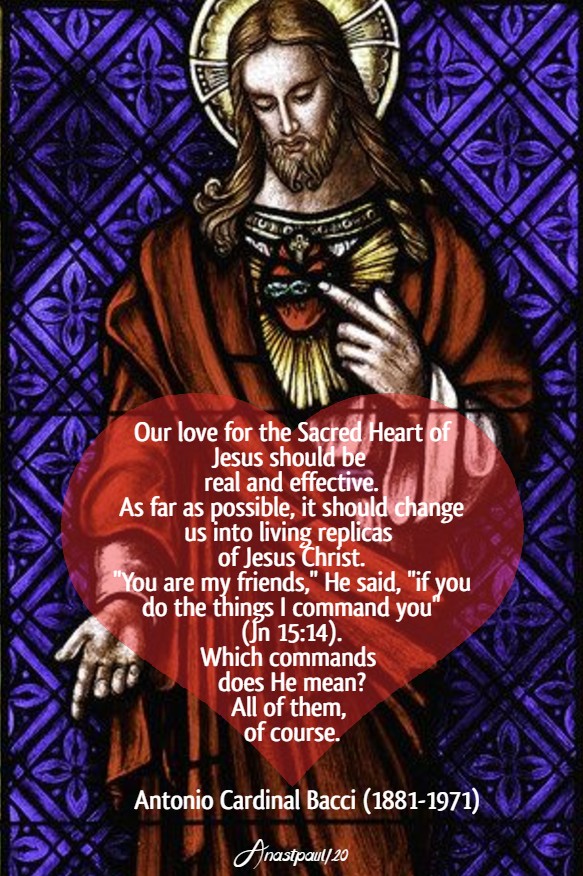
Our love for the Sacred Heart of Jesus should be real and effective. As far as possible, it should change us into living replicas of Jesus Christ.
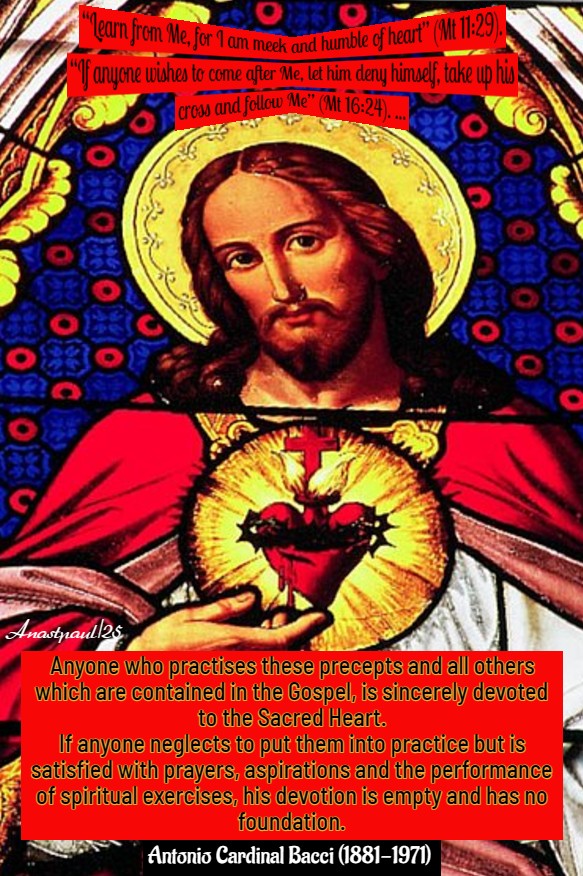
“You are My friends,” He said, “if you do the things I command you” (Jn 15:14). Which commands does He mean? All of them, of course. “Learn from Me, for I am meek and humble of heart” (Mt 11:29). “If anyone wishes to come after Me, let him deny himself, take up his cross and follow Me” (Mt 16:24). “Thy shalt love the Lord thy God, with they whole heart and with they whole soul” (Mt 22:37).
Anyone who practises these precepts and all others which are contained in the Gospel, is sincerely devoted to the Sacred Heart. If anyone neglects to put them into practice but is satisfied with prayers, aspirations and the performance of spiritual exercises, his devotion is empty and has no foundation.
These prayers, aspirations and pious practices have their value, insofar, as they can attract God’s grace. But, we must co-operate with God’s grace by our good actions. Then our devotion to the Sacred Heart of Jesus, will be sincere and effective.”
Thought for the Day – 25 June – Meditations with Antonio Cardinal Bacci (1881-1971)
Devotion to the Sacred Heart
“We should have a very high regard for devotion to the Sacred Heart. We should excite in our hearts, acts of love, which will compensate, in some way, for the Infinite Love which Jesus has for us.
Finally, we should try to make our lives correspond with our love by emulating, as far as possible, the holy and immaculate life of Jesus Christ. It is not a waste of time to constantly think to ourselves, “What would Jesus do in this situation?”
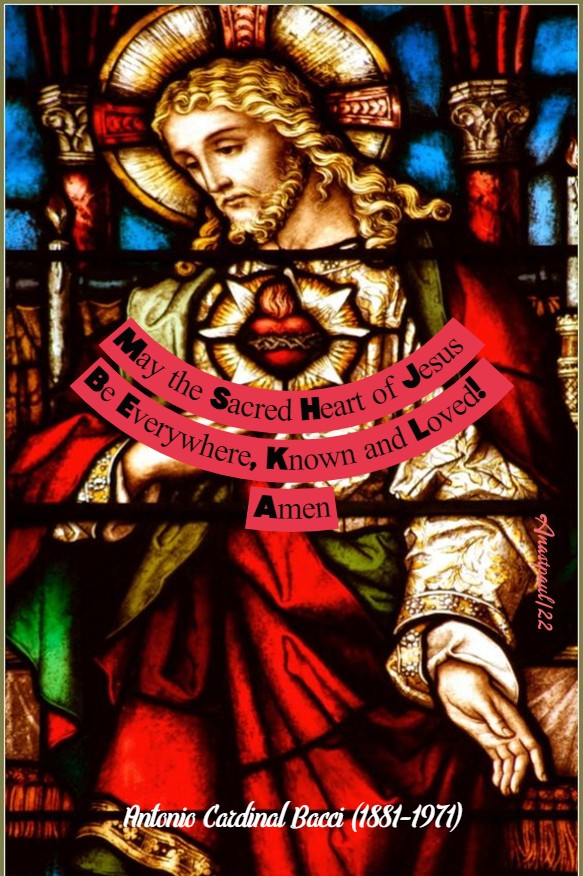
Ejaculation: May the Sacred Heart of Jesus be everywhere, known and loved! Amen
Thought for the Day – 23 June – Meditations with Antonio Cardinal Bacci (1881-1971)
The Holy Mass The Four Ends of the Holy Mass
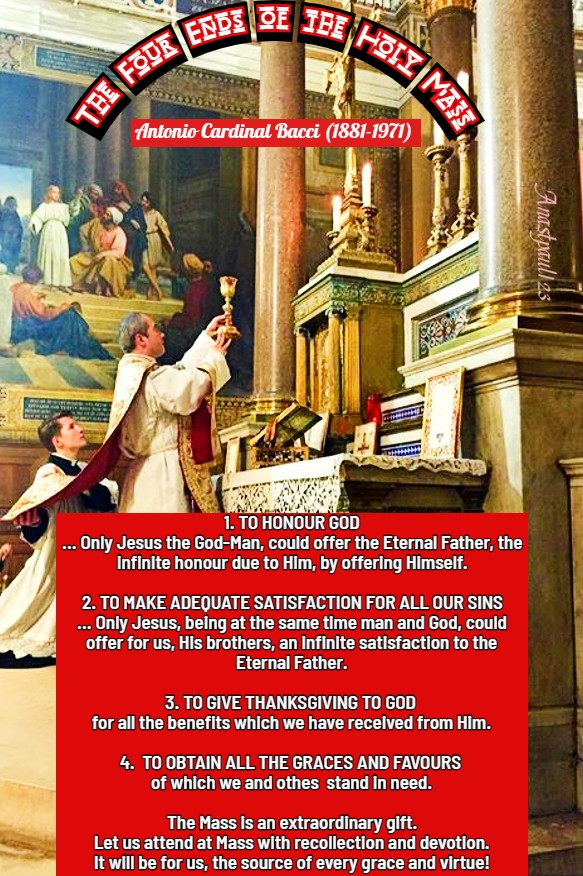
“Let us meditate on the fact, that the Sacrifice of the Eucharist, was instituted for four ends, namely:
1. TO HONOUR GOD All the Angels and Saints of Heaven and all the human beings upon earth, could not possibly honour God, as He ought to be honoured because, they are creatures who derive everything which they possess from God. Only Jesus the God-Man, could offer the Eternal Father, the infinite honour due to Him, by offering Himself.
2. TO MAKE ADEQUATE SATISFACTION FOR ALL OUR SINS Insofar, as they are a revolt against God, our sins are, in a certain way, infinite. This is because they offend an Infinite Being. Only Jesus, being at the same time man and God, could offer for us, His brothers, an infinite satisfaction to the Eternal Father. Only He, could redeem us from the debt of crime and punishment, which we had contracted, by offering Himself, without reserve, in the Eucharistic Sacrifice. It must be explained, however, that although the Mass is of infinite value in itself, God applies this value to us in a finite way only, according to His good pleasure and according to our dispositions. For this reason, we should do well to attend Mass, as often as possible and with the maximum fervour.
3. TO GIVE THANKSGIVING TO GOD for all the benefits which we have received from Him.
4. Finally, TO OBTAIN ALL THE GRACES AND FAVOURS of which we and others stand in need. The Mass is an extraordinary gift. Let us attend at Mass with recollection and devotion. It will be for us, the source of every grace and virtue!” Amen
Thought for the Day – 21 June – Meditations with Antonio Cardinal Bacci (1881-1971)
The Eucharistic Life
“The Eucharistic life which is the life of union with Jesus, especially by means of daily Communion, transforms us and makes us holy. It preserves and increases in us, the grace which is the supernatural life of the soul. The Eucharist, of itself, does not bestow grace because, it is a Sacrament of the living. It is our food and food is not given to the dead but, to the living. For this reason, we should receive Holy Communion free from the stain of sin. The Eucharist, moreover, remits venial sin, strengthens us in our resolution and increases our charity. Venial sin, is a sickness of the soul. Just as natural food banishes listlessness and vulnerability to disease, our Eucharistic nourishment has the same effect on our spiritual life.
It is because the Blessed Eucharist increases our love for Jesus, that it weakens our evil inclinations. The Eucharist and sin, are mutually exclusive of one another because, the Eucharist is Jesus and sin is the devil. Our Eucharistic food, moreover, produces, in our souls, a spiritual consolation which is a foretaste of the happiness of Heaven.
Let us listen to Jesus living within us. He will enable us to forget our worldly cares and will raise us to a higher plane where, by God’s Infinite Goodness, we shall continue to grow in virtue.”
Thought for the Day – 20 June – Meditations with Antonio Cardinal Bacci (1881-1971)
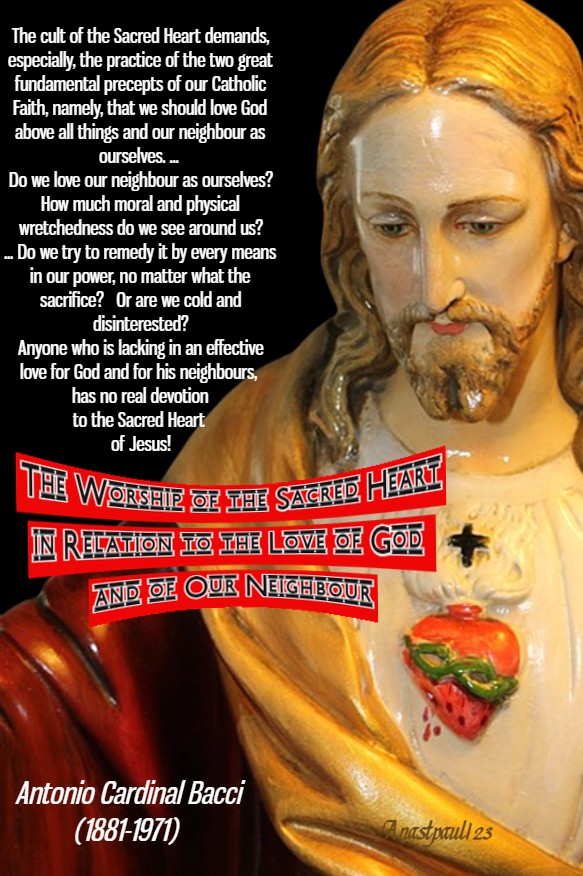
The Worship of the Sacred Heart in Relation to the Love of God and of Our Neighbour
“The cult of the Sacred Heart demands, especially, the practice of the two great fundamental precepts of our Catholic Faith, namely, that we should love God above all things and our neighbour as ourselves. The implementation of this teaching will transform our lives.
Do we love God above all things and more than we love ourselves? What is the predominant concept in our minds? Is it the concept of God? What is the first love in our hearts? Is it the love of God? What is our main desire in life? Is it the glory of God? Or is it our own glory or our own pleasure?
We have still, a long way to go in the way of love of God which is the way of perfectiuon. We can only really be said to be ourselves moreover, when we love God above all things and more than ourselves. If a man does not love God above all things, neither does he love himself in the way in which he ought to love himself because, God is our only true to happiness.
Do we love our neighbour as ourselves? How much moral and physical wretchedness do we see around us? But do we try to remedy it by every means in our power, no matter what the sacrifice? Or are we cold and disinterested? Let us remember the words of St John the Apostle of Charity. “In this we have come to know His love that He laid down His life for us and we likewise, ought to lay down our life for the brethren” (1 Jn 3:16). Are we prepared to do this? Are we at least prepared to give away whatever do do not need ourselves, in order to relieve poverty and want?
Anyone who is lacking in an effective love for God and for his neighbours, has no real devotion to the Sacred Heart of Jesus!”
Thought for the Day – 19 June – Meditations with Antonio Cardinal Bacci (1881-1971)
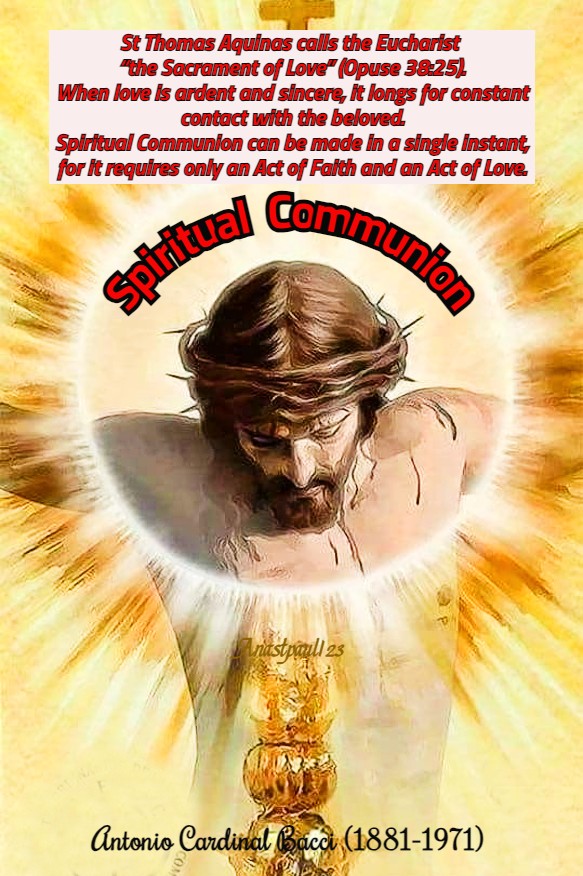
Spiritual Communion
“St Thomas Aquinas calls the Eucharist “the Sacrament of Love” (Opuse 38:25). When love is ardent and sincere, it longs for constant contact with the beloved. Spiritual Communion can be made in a single instant, for it requires only an Act of Faith and an Act of Love. Jesus, come into my heart, for I have need of You. I love You, my Jesus, keep me close to You always.
Aspiration: O Jesus, I cling to You, with all my heart!”
Thought for the Day – 18 June – Meditations with Antonio Cardinal Bacci (1881-1971)
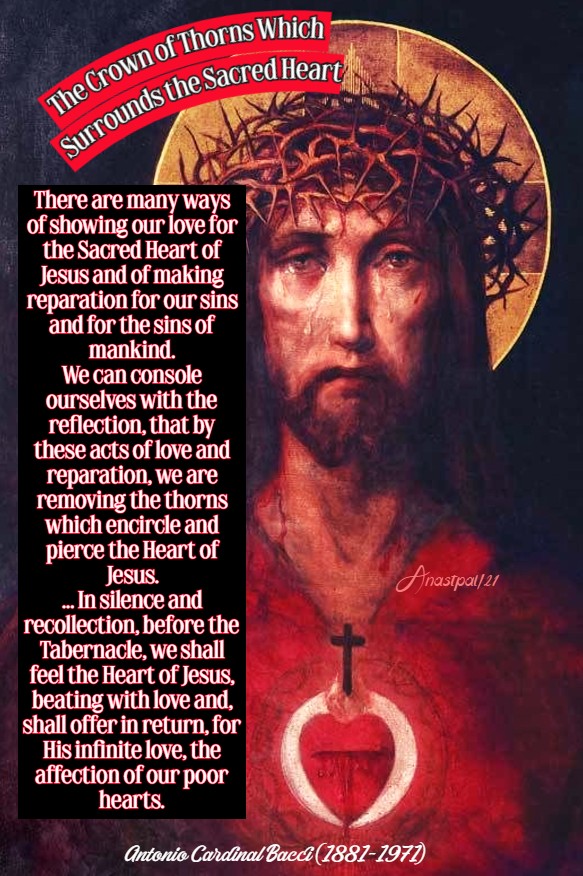
The Crown of Thorns Which Surrounds the Sacred Heart
“There are many ways of showing our love for the Sacred Heart of Jesus and of making reparation for our sins and for the sins of mankind. We can console ourselves with the reflection, that by these acts of love and reparation, we are removing the thorns which encircle and pierce the Heart of Jesus. The simplest ways of doing this, are by prayers, aspirations and expressions of love, directed towards the adorable Heart of our Redeemer and, by visits to Jesus in the Blessed Sacrament. In silence and recollection, before the Tabernacle, we shall feel the Heart of Jesus, beating with love and, shall offer in return, for His infinite love, the affection of our poor hearts.
We can also receive Holy Communion in reparation. When Jesus is in us and we are in Jesus, it will be easier and more pleasant, to offer Him our love and expiation. We can make reparation also, by practising the devotion of the First Fridays of the month. This pious practice, so pleasing to the Heart of Jesus, aims at being a mass offering of love and reparation, for the sins of the entire human race!”
Thought for the Day – 17 June – Meditations with Antonio Cardinal Bacci (1881-1971)
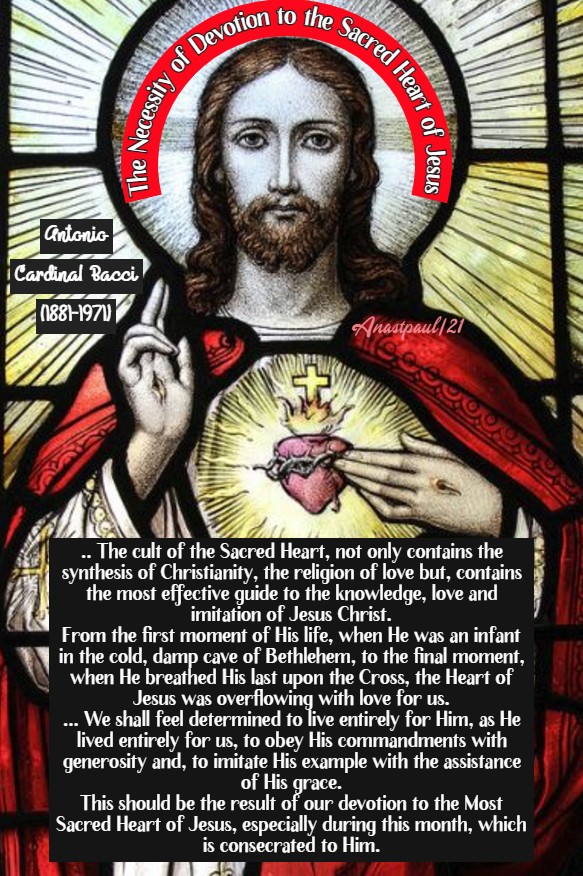
The Necessity of Devotion to the Sacred Heart of Jesus
“It is necessary to develop and meditate on these words of Pius XI, (see Part One) from which, it is clear, that the cult of the Sacred Heart, not only contains the synthesis of Christianity, the religion of love but, contains the most effective guide to the knowledge, love and imitation of Jesus Christ. From the first moment of His life, when He was an Infant in the cold, damp cave of Bethlehem, to the final moment, when He breathed His last upon the Cross, the Heart of Jesus was overflowing with love for us. We can learn from this, to know our Divine Saviour better, so that appreciating more fully His infinite love for us, we shall feel an upsurge of gratitude and, of love. We shall feel determined to live entirely for Him, as He lived entirely for us, to obey His commandments with generosity and, to imitate His example with the assistance of His grace. This should be the result of our devotion to the Most Sacred Heart of Jesus, especially during this month, which is consecrated to Him.”
Thought for the Day – 15 June – Meditations with Antonio Cardinal Bacci (1881-1971)
Our Relationship with the Most Holy Trinity
“The bonds of love between God and man which had been broken by sin, were restored by the Redemption. The bonds of love between our soul and the Three Persons of the Blessed Trinity are described by St Bonaventure in this manner. (1) The soul is the daughter of the Divine Father. (2) It is the spouse of Jesus Christ. (3) It is the temple of the Holy Spirit.
The concept of our divine sonship can be found even in the Old Testament. “As one whom the mother caresseth,” God promises, “so will I comfort you” (Is 66:13). But Jesus insisted in a special way on this concept of our divine sonship, so that we might love our heavenly Father more. He told us to address God as Father in our prayers. He described Him as a loving Father, waiting with love and forgiveness for His prodigal sons. When leaving this earth, He told us: “I go to my Father and to your Father.”
“Behold what manner of love the Father has bestowed upon us.” writes St John, “that we should be called children of God and so we are” (1 Jn 3:1). “You have not received a spirit of bondage,” explains St Paul, “so as to be again in fear but, you have received a spirit of adoption as sons, by virtue of which, we cry: “Abba! Father!” (Rom 8:15). This divine paternity is the result of the elevation of our souls to the supernatural order by means of grace, which flows into our souls and makes us partakers of the very life of God. It is necessary, therefore, to nourish this grace in ourselves by praying to our heavenly Father with humility and with perseverance. It is equally essential for us to keep this grace alive by being obedient always to the commandments of God and to His holy Will.
Let us examine our behaviour and see if we can honestly claim that we are one with God in mind and in heart, in intention and action.”
You must be logged in to post a comment.