St Boethian of Pierrepont St Castus the Martyr St Conall of Inniscoel Bl Diego de Baja Bl Dionisio Senmartin St Emilius the Martyr St Faustinus the Martyr St Fulgentius of Otricoli (Mid 6th Century) Bishop Bl Fulk of Castrofurli Bl Giacomo Soler Bl Giusto Samper St Helen of Auxerre
St Lupo of Limoges St Marcian of Ravenna St Margaret of Hulme Bl Pedro of the Assumption St Quiteria St Romanus of Subiaco St Timothy the Martyr St Venustus the Martyr
St Aigulf of Bourges St Atto of Pistoia St Aureliano of Pavia St Ausonius of Angoulême St Baoithin of Ennisboyne St Basiliscus of Pontus (Died c 310) Bishop
St Boethian of Pierrepont St Castus the Martyr St Conall of Inniscoel Bl Diego de Baja Bl Dionisio Senmartin St Emilius the Martyr St Faustinus the Martyr St Francisco Salinas Sánchez St Fulgencio of Otricoli Bl Fulk of Castrofurli Bl Giacomo Soler Bl Giusto Samper St Helen of Auxerre
St Lupo of Limoges St Marcian of Ravenna St Margaret of Hulme Bl Pedro of the Assumption St Quiteria St Romanus of Subiaco St Timothy the Martyr St Venustus the Martyr
Martyred in Japan John Baptist Machado Matthias of Arima Pedro of the Assumption
Martyred in the Spanish Civil War: • Blessed Francisco Salinas Sánchez • Blessed José Quintas Durán
St Aigulf of Bourges
St Atto of Pistoia
St Aureliano of Pavia
St Ausonius of Angoulême
St Baoithin of Ennisboyne
St Basiliscus of Pontus St Beuvon (Died 986)
St Boethian of Pierrepont
St Castus the Martyr
St Conall of Inniscoel
Bl Diego de Baja
Bl Dionisio Senmartin
St Emilius the Martyr
St Faustinus the Martyr
St Francisco Salinas Sánchez
St Fulgencio of Otricoli
Bl Fulk of Castrofurli
Bl Giacomo Soler
Bl Giusto Samper
St Helen of Auxerre
St Humility of Faenza
Bl John Baptist Machado Bl John Forest OFM (1471-1538) Martyr of Oxford University Biography: https://anastpaul.wordpress.com/2018/05/22/saint-of-the-day-22-may-bl-john-forest-o-f-m-1471-1538-martyr/
St John of Parma
St José Quintas Durán St Julia (5th century) Martyr Her Life and Death: https://anastpaul.com/2019/05/22/saint-of-the-day-22-may-st-julia-5th-century-martyr/
St Lupo of Limoges
St Marcian of Ravenna
St Margaret of Hulme
Bl Pedro of the Assumption
St Quiteria
St Romanus of Subiaco
St Timothy the Martyr
St Venustus the Martyr
—
Martyred in the Spanish Civil War:
• Blessed Francisco Salinas Sánchez
• Blessed José Quintas Durán
St Rita of Cascia (1386-1457) (Optional Memorial) About St Rita: https://anastpaul.wordpress.com/2017/05/22/saint-of-the-day-22-may-st-rita-of-cascia-patron-of-impossible-causes-abused-wives-and-widows/
St Aigulf of Bourges
St Atto of Pistoia
St Aureliano of Pavia
St Ausonius of Angoulême
St Baoithin of Ennisboyne
St Basiliscus of Pontus
St Bobo of Provence
St Boethian of Pierrepont
St Castus the Martyr
St Conall of Inniscoel
Bl Diego de Baja
Bl Dionisio Senmartin
St Emilius the Martyr
St Faustinus the Martyr
St Francisco Salinas Sánchez
St Fulgencio of Otricoli
Bl Fulk of Castrofurli
Bl Giacomo Soler
Bl Giusto Samper
St Helen of Auxerre
St Humility of Faenza
Bl John Baptist Machado Bl John Forest OFM (1471-1538) Martyr of Oxford University Biography: https://anastpaul.wordpress.com/2018/05/22/saint-of-the-day-22-may-bl-john-forest-o-f-m-1471-1538-martyr/
St John of Parma
St José Quintas Durán St Julia (5th century) Martyr
St Lupo of Limoges
St Marcian of Ravenna
St Margaret of Hulme
Bl Maria Rita Lopes Pontes de Souza Brito
Bl Pedro of the Assumption
St Quiteria
St Romanus of Subiaco
St Timothy the Martyr
St Venustus the Martyr
—
Martyred in the Spanish Civil War:
• Blessed Francisco Salinas Sánchez
• Blessed José Quintas Durán
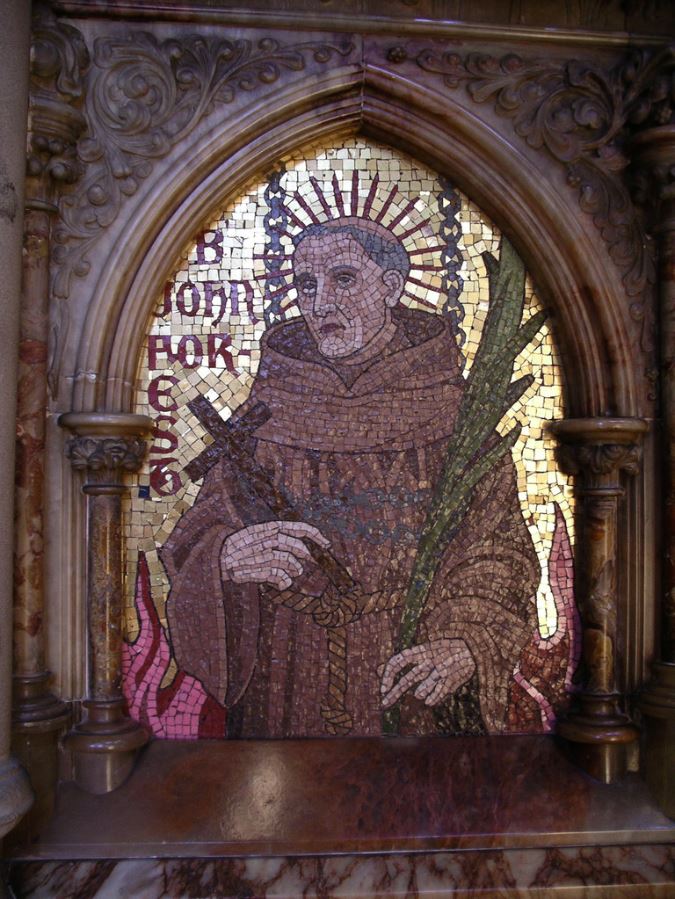
Saint of the Day – 22 May – Bl John Forest O.F.M. (1471-1538) Martyr – Franciscan Priest and Friar and Martyr – Born in 1471 at Oxford, England – died by being hanged and burned on 22 May 1538 at Smithfield, England. Additional Memorial – 1 December as one of the Martyrs of Oxford University.
Already by the 15th century, England was upset about church and country relations. Many of the people were very proud to be English; in fact too proud. They did not want to listen to their Bishops and Priests and they did not want to obey the Pope in Rome. They felt that they knew what was best concerning the laws of the church and the laws of the country but they were wrong, very, very wrong.
During this period of time, in 1471, a very great man was born; his name was John Forest. He was born at Oxford, England of noble, well-to-do parents. In spite of their wealth, John did not become a worldly person and during his boyhood, he got a very good religious education. When he was 21 years old, he entered the Strict Franciscan Order at the Greenwich Monastery. He proved to be a very brilliant student when he was sent to study at Oxford and there he received his doctorate in Theology, when he was about 26 years old.
In time, John Forest became a Franciscan priest. As the years passed, Fr Forest became known as a very holy and learned man. And in 1520, when he was about 49 years old, the Franciscan brothers elected him as the Provincial Superior. Then five years later, Cardinal Wolsey appointed him to be a regular preacher at St Paul’s, in the capital, London.
Then there quickly followed the appointment that was to lead him down the narrow road to martyrdom. Catherine of Aragon was married to Henry VIII, the King of England. She was a very devout Third Order Franciscan and asked Fr Forest to become her Confessor and Chaplain. But before King Henry VIII got married to Catherine of Aragon, he had to get a dispensation from Pope Julius, to marry the widow of his dead brother. Catherine was actually his sister-in-law. The Pope gave the dispensation and after Henry and Catherine were married they had three sons and a daughter, Princess Mary. Little Mary lived o, but the three boys died. In time King Henry wanted to get an annulment from the Pope. Henry figured that since he had to get permission to marry his sister–in-law in the first place, the Pope could now give him an annulment. But the King was in for a big surprise when the Pope said he would not give Henry an annulment, their marriage was valid and he should stay married to his good wife Catherine.
By now, King Henry was already starting to look at another woman,her name was Anne Boleyn. And to make matters worse, Anne was also looking at King Henry. Now, both you and I know that it is wrong to desire to have another man or woman, when you are already married. Henry’s second desire, was to have a male heir to the throne, he wanted a King to rule England, not a Queen!
Covetousness and Pride; these were Henry’s faults. In 1527, Henry asked Pope Clement VII to annul the marriage, or to grant him a divorce. But when the good Pope refused to go along with the king’s stupid ideas, Henry was most angry. He got a divorce from Catherine and married Anne Boleyn, he didn’t care what the Pope told him to do. In 1533, the Pope declared that King Henry was truly married to Catherine and that he was not married to Anne Boleyn. Because of this, Henry VIII hated Catherine and all that was connected with her. Now, not only Catherine, but also young Princess Mary and Fr Forest as well, suffered from the King’s anger. Henry thought that when his wife Catherine had written to the Pope, that Fr Forest should have stopped her from doing so.
Fr Forest and the other Franciscan Friars lived at Greenwich, near King Henry’s palace. The friars discussed Henry’s affairs among themselves and they thought that they had nothing to fear from Henry because he had always admired these friars. In fact, in the past, King Henry had written to Pope Leo X, telling him: “I admire the holiness and life of the Greenwich Franciscans. I find it quite impossible to describe their merits, as they deserve. They present an ideal of Christian poverty, sincerity and charity. Their lives are devoted to fasting, watching and prayer. They are occupied in hard toil by day and night, to win sinners back to God.”
After, their discussions, the friars, especially Fr Forest, sided with Queen Catherine and not Henry VIII. They knew that Henry was in the wrong and that Catherine was right. When Henry found out that the friars were against him, he demanded that Fr Forest be replaced by another person. After a meeting, Fr Forest was moved to a convent in the North and later, in 1534, King Henry had the holy priest cast into prison at Newgate. While in this prison, Fr Forest spent his time in prayer and in writing a book, defending the Pope and the Church. His reason for writing this book was because King Henry VIII had left the Catholic Church and was now calling himself the “Supreme Head of the Church” of England. Only the Pope is the Head of the Church Henry was making a terrible mistake! When Henry found out that Fr Forest had written this book, the King was furious. He condemned the holy priest to death, because he refused to recognise the King as the Head of the Church, in England.
Henry also persecuted the Strict Franciscan Friars in England. He took away all their monasteries and cast many of them into prison, where fifty of them died. But a good friend also helped a lot of these good friars to escape to France and Scotland.
Because Fr Forest did not expect to be long in prison, he sent his rosary to Queen Catherine. In a letter he had sent with the rosary, he had written: “I presume to make you a poor present of my beads, as I have been given only three more days to live on this earth.”He was now 63 years old and had been a monk for forty-three years.
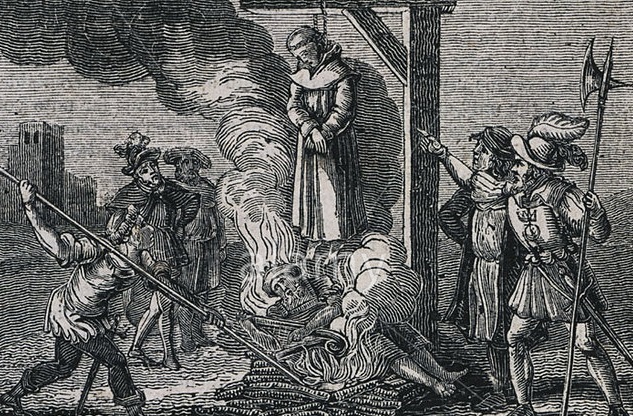
But Fr Forest’s sufferings were just beginning, he was to be in prison for four years, (1534-1538). During this long time in prison, King Henry had sent men to question and torture Fr Forest, so that he would break down and follow Henry’s new law. But the good priest chose to suffer, rather than give up his faith. Catherine died a few years before Fr Forest did and during her life she did all she could to ease the sufferings of the good priest. After two more years of imprisonment, Fr. Forest was condemned to be hanged over a fire and slowly burned to death because he would not swear that the King was the Supreme Head of the Church of England.
On 22 May 1538, Fr Forest’s hands and feet were tied to a hurdle and he was dragged to the place of execution at Smithfield, near a Franciscan Monastery. Upon arrival, the poor priest was forced to listen to an hours talk on the glories of the Supreme Headship of King Henry, given by Bishop Latimer, who had become an apostate. Then Fr Forest’s tortures began, chains were wrapped around his waist and under his armpits and then he was suspended in the air above a fire. The fire was kept low so that it would burn his feet and cause the poor priest even more suffering. And all the while a bunch of apostates scoffed and jeered at the holy priest. Throughout the two long hours that Fr Forest swayed over the fire, he prayed: “In the shadow of Thy wings I will trust, O God, until iniquity pass away.”
John Forest was the only Catholic martyr to be burned at the stake. Extra fuel for the pyre is said to have been provided by an enormous statue of St Derfel, from the pilgrimage site of Llandderfel in north Wales and of which it was prophesied, would “one day set a forest on fire.” Fr Forest, together with fifty-three other English martyrs, was Beatified by Pope Leo XIII on 9 December 1886. His relics rest near the priory gate of at Smithfield.
The tough times are returning. We are fighting to keep the Catholic Faith, so be faithful in saying your Rosary, wearing the Brown Scapular and being a good Catholic and God will help you now and in the tough times. Blessed John Forest—Pray for Us!
Bl John Forest, nave statue – St Etheldreda, Ely Place, London






 AnaStpaul
You must be logged in to post a comment.