Posted in Our MORNING Offering, PAPAL PRAYERS, The HOLY FACE, Uncategorized

Our Morning Offering – 24 September – Monday of the Twenty-fifth week in Ordinary Time, Year B

Our Morning Offering – 24 September – Monday of the Twenty-fifth week in Ordinary Time, Year B

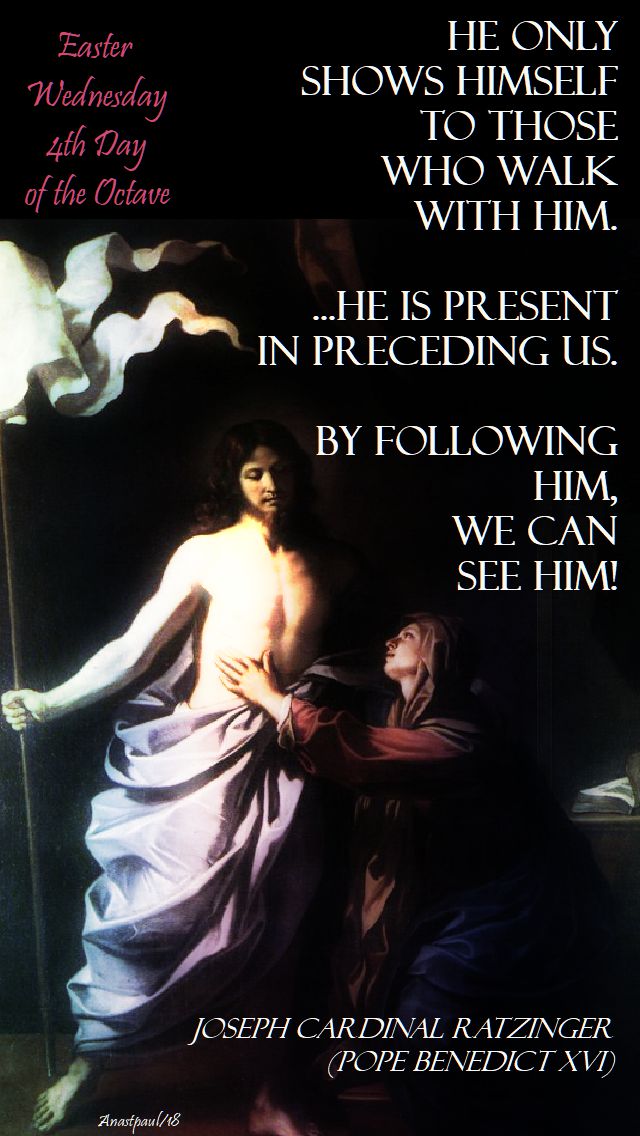
May We Seek Your Face
By Pope Benedict XVI

Lord Jesus, grant us restless hearts,
hearts which seek Your Face.
Keep us from the blindness of heart
which sees only the surface of things.
Give us the simplicity and purity
which allow us to recognise
Your presence in the World.
When we are not able to accomplish great things,
grants us the courage
which is born of humility and goodness.
Impress Your Face on our hearts.
May we encounter You along the way
and show forth Your image
to the world.
Amenmay we seek your face - pope benedict - lord jesus, grant us restless hearts - 24 sept 2018

Posted in MORNING Prayers, PAPAL SERMONS, SAINT of the DAY, The WORD

One Minute Reflection – 20 September – Today’s Gospel: Luke 7:36–50

One Minute Reflection – 20 September – Today’s Gospel: Luke 7:36–50 – Thursday of the Twenty-fourth week in Ordinary Time, Year B and The Memorial of the Korean Martyrs – Sts Andrew Kim Taegon, Paul Chong Hasang & Companions – 103 saints and beati & St Eustachius & family (died 2nd century) – Martyrs

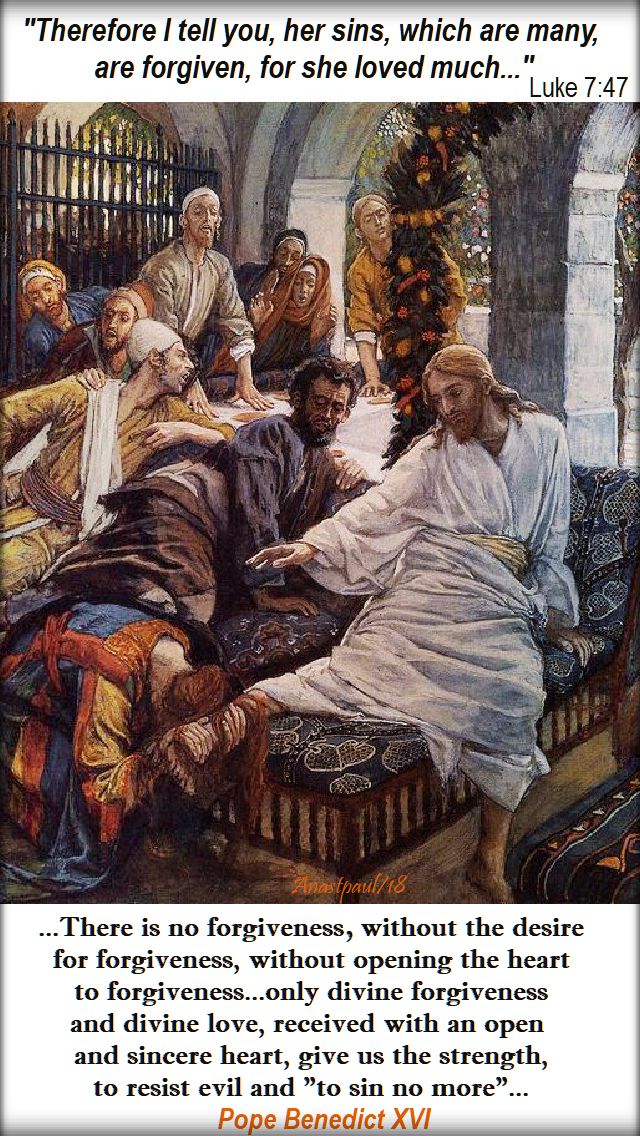
“Therefore I tell you, her sins, which are many, are forgiven, for she loved much”….Luke 7:47

REFLECTION – “Today, in particular, Jesus brings us to inner conversion:  He explains why He forgives us and teaches us to make forgiveness received from and given to, our brothers and sisters – the “daily bread” of our existence.
…Dear friends, from the Word of God we have just heard emerge practical instructions for our life.   Jesus does not enter into a theoretical discussion with His interlocutors on this section of Mosaic Law;  He is not concerned with winning an academic dispute about an interpretation of Mosaic Law but His goal is to save a soul and reveal that salvation is only found in God’s love.   This is why He came down to the earth, this is why He was to die on the Cross and why the Father was to raise Him on the third day.
Jesus came to tell us, that He wants us all in Paradise and that hell, about which little is said in our time, exists and is eternal for those who close their hearts to His love. …it is stressed that there is no forgiveness without the desire for forgiveness, without opening the heart to forgiveness – here it is highlighted, that only divine forgiveness and divine love, received with an open and sincere heart, give us the strength to resist evil and “to sin no more”, to let ourselves be struck by God’s love so that it becomes our strength.   Jesus’ attitude, thus becomes a model to follow, for every community, which is called to make love and forgiveness the vibrant heart of its life.”…Pope Benedict XVI – Sunday, 25 March 2007her sins which are many - luke 7 47 and there is no forgiveness without - pope benedict - 20 sept 2018

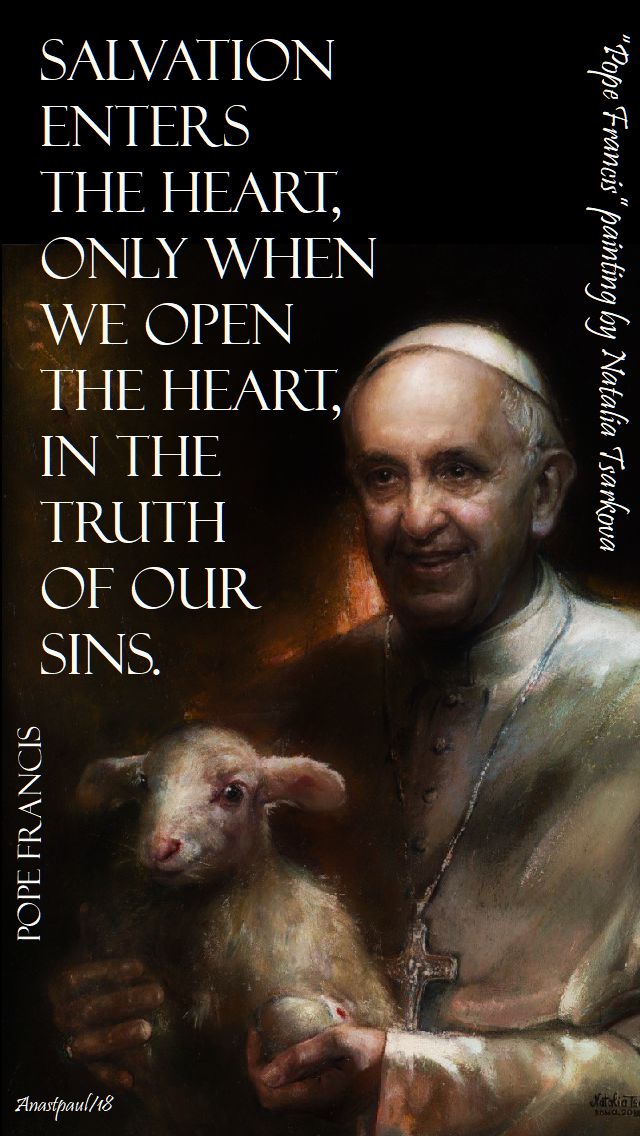
” Salvation enters the heart, only when we open the heart, in the truth of our sins.”…Pope Francis – Santa Marta, 18 Sept 2014 (“Pope Francis” painting by Natalia Tsarkova)salvation enters the heart only when we - pope francis 20 sept 2018

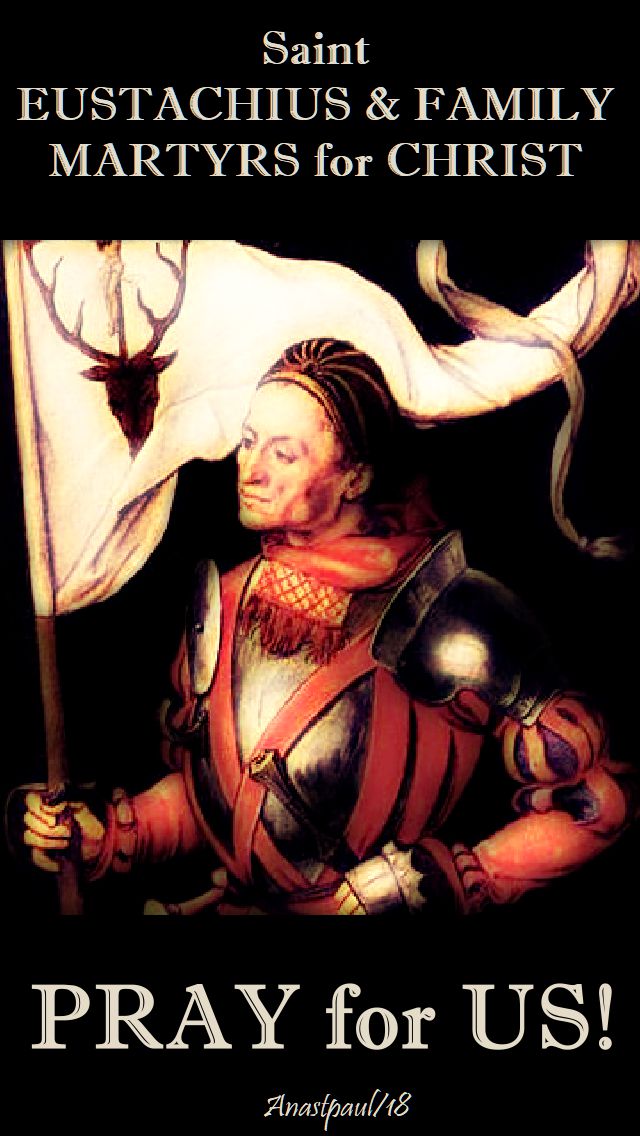
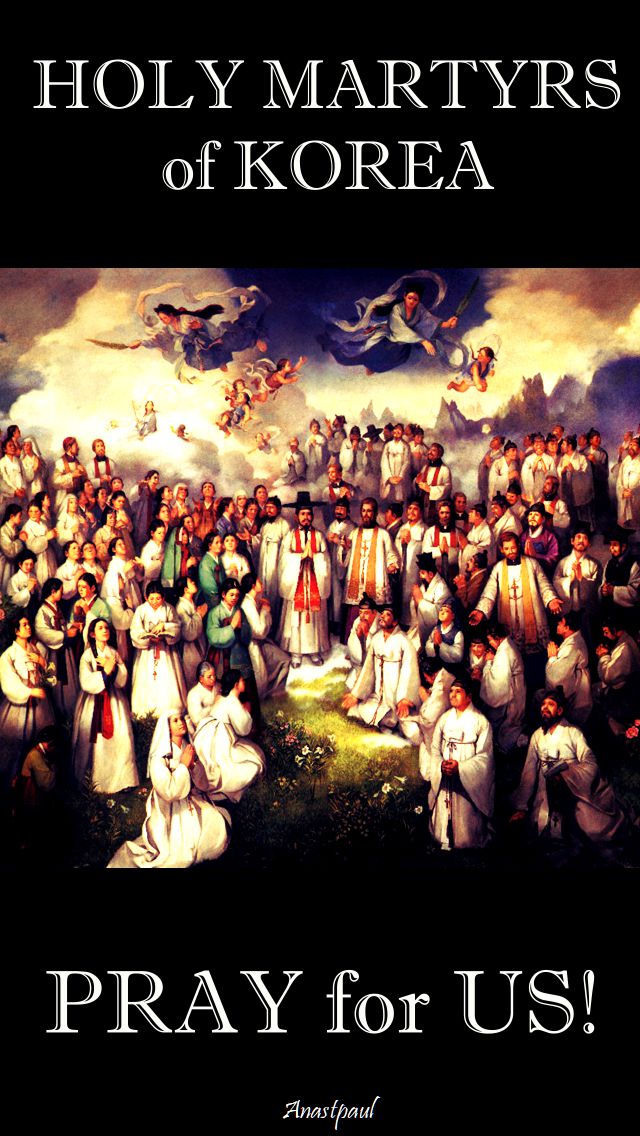
PRAYER – Grant us Lord, a true knowledge of salvation, so that, freed from fear and from the power of our foes, we may serve You faithfully, all the days of our life.   Give us Holy Father, a true desire for repentance and forgiveness and teach us each day, to forgive all with love.   Holy Martyrs, St Eustachius and family and those who so filled with love, died for the faith in Korea, please pray for us that we too may be filled with holy love and courage.   We make our prayer through our Lord, Jesus Christ in union with the Holy Spirit, one God, forever, amen.st eustachius and family martyrs - pray for us - 20 sept 2018holy-martyrs-of-korea-pray-for-us-20-sept-2017

Posted in SAINT of the DAY

Saint of the Day – 17 September – Blessed Hildegard (1098-1179) Abbess

Saint of the Day – 17 September – Blessed Hildegard Abbess at Bingen OSB (1098-1179).   Born in 1098 at Bermersheim, Rhineland Palatinate (modern Germany) and died on 17 September 1179 at Bingen, Rhineland Palatinate (modern Germany) of natural causes.   She was Beatified on 26 August 1326 by Pope John XXII.   St Hildegard is also known as Saint Hildegard and Sibyl of the Rhine, was a German Benedictine Abbess, Theologian, Writer, Composer, Philosopher, Poet, Mystic, Visionary, Founder, Scientist, Artist and Polymath. She is considered to be the founder of scientific natural history in Germany.    Hildegard was elected magistra by her fellow nuns in 1136; she founded the Monasteries of Rupertsberg in 1150 and Eibingen in 1165.   One of her works as a composer, the Ordo Virtutum, is an early example of liturgical drama and arguably the oldest surviving morality play.   She wrote theological, botanical and medicinal texts, as well as letters, liturgical songs and poems, while supervising miniature illuminations in the Rupertsberg manuscript of her first work, Scivias.   She is also noted for the invention of a constructed language known as Lingua Ignota.st hildegard bio infoHILDEGARD VON BINGEN
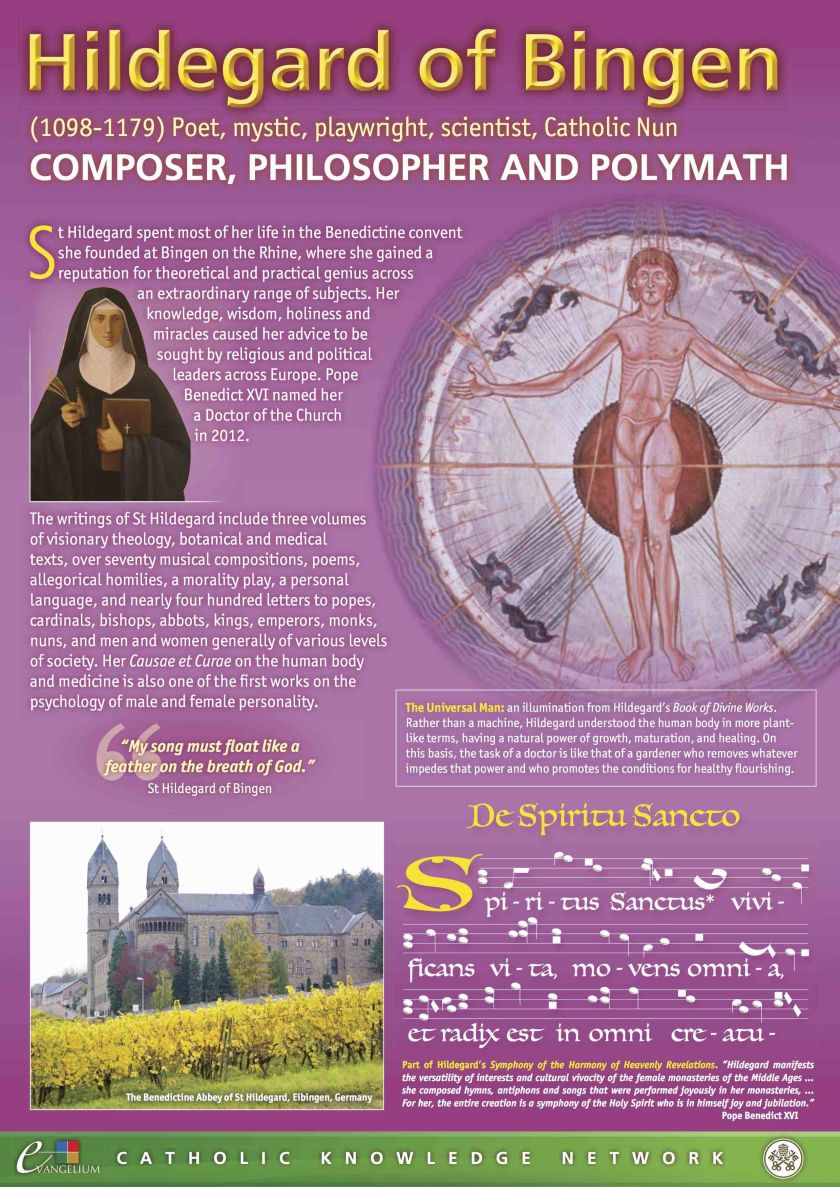
1. A “light for her people and her time”:  in these words Blessed John Paul II, my Venerable Predecessor, described Saint Hildegard of Bingen in 1979, on the occasion of the eight-hundredth anniversary of the death of this German mystic.   This great woman truly stands out crystal clear against the horizon of history for her holiness of life and the originality of her teaching.   And, as with every authentic human and theological experience, her authority reaches far beyond the confines of a single epoch or society; despite the distance of time and culture, her thought has proven to be of lasting relevance.

In Saint Hildegard of Bingen there is a wonderful harmony between teaching and daily life.   In her, the search for God’s will in the imitation of Christ was expressed in the constant practice of virtue, which she exercised with supreme generosity and which she nourished from biblical, liturgical and patristic roots in the light of the Rule of Saint Benedict.   Her persevering practice of obedience, simplicity, charity and hospitality was especially visible.   In her desire to belong completely to the Lord, this Benedictine Abbess was able to bring together rare human gifts, keen intelligence and an ability to penetrate heavenly realities.514px-Engraving;_German_abbess_and_physician_Hildegard_von_Bingen_Wellcome_L0005783

2. Hildegard was born in 1098 at Bermersheim, Alzey, to parents of noble lineage who were wealthy landowners.   At the age of eight she was received as an oblate at the Benedictine Abbey of Disibodenberg, where in 1115 she made her religious profession. Upon the death of Jutta of Sponheim, around the year 1136, Hildegard was called to succeed her as magistra.   Infirm in physical health but vigorous in spirit, she committed herself totally to the renewal of religious life.   At the basis of her spirituality was the Benedictine Rule which views spiritual balance and ascetical moderation as paths to holiness.   Following the increase in vocations to the religious life, due above all to the high esteem in which Hildegard was held, around 1150 she founded a monastery on the hill of Rupertsberg, near Bingen, where she moved with twenty sisters.   In 1165, she established another monastery on the opposite bank of the Rhine.   She was the Abbess of both.

Within the walls of the cloister, she cared for the spiritual and material well-being of her sisters, fostering in a special way community life, culture and the liturgy.   In the outside world she devoted herself actively to strengthening the Christian faith and reinforcing religious practice, opposing the heretical trends of the Cathars, promoting Church reform through her writings and preaching and contributing to the improvement of the discipline and life of clerics  . At the invitation first of Hadrian IV and later of Alexander III, Hildegard practised a fruitful apostolate, something unusual for a woman at that time, making several journeys, not without hardship and difficulty, to preach even in public squares and in various cathedral churches, such as at Cologne, Trier, Liège, Mainz, Metz, Bamberg and Würzburg.   The profound spirituality of her writings had a significant influence both on the faithful and on important figures of her time and brought about an incisive renewal of theology, liturgy, natural sciences and music. Stricken by illness in the summer of 1179, Hildegard died in the odour of sanctity, surrounded by her sisters at the monastery of Rupertsberg, Bingen, on 17 September 1179.

3. In her many writings Hildegard dedicated herself exclusively to explaining divine revelation and making God known in the clarity of His love.   Hildegard’s teaching is considered eminent both for its depth, the correctness of its interpretation and the originality of its views.   The texts she produced are refreshing in their authentic “intellectual charity” and emphasise the power of penetration and comprehensiveness of her contemplation of the mystery of the Blessed Trinity, the Incarnation, the Church, humanity and nature as God’s creation, to be appreciated and respected.

These works were born from a deep mystical experience and propose a perceptive reflection on the mystery of God.   The Lord endowed her with a series of visions from childhood, whose content she dictated to the Benedictine monk Volmar, her secretary and spiritual advisor and to Richardis von Stade, one of her women religious.   But particularly illuminating are the judgements expressed by Saint Bernard of Clairvaux, who encouraged her and especially by Pope Eugene III, who in 1147 authorised her to write and to speak in public.   Theological reflection enabled Hildegard to organise and understand, at least in part, the content of her visions.   In addition to books on theology and mysticism, she also authored works on medicine and natural sciences.   Her letters are also numerous — about four hundred are extant;  these were addressed to simple people, to religious communities, popes, bishops and the civil authorities of her time.   She was also a composer of sacred music.   The corpus of her writings, for their quantity, quality and variety of interests, is unmatched by any other female author of the Middle Ages.

Her main writings are the Scivias, the Liber Vitae Meritorum and the Liber Divinorum Operum.   They relate her visions and the task she received from the Lord to transcribe them. In the author’s view her Letters were no less important, they bear witness to the attention Hildegard paid to the events of her time, which she interpreted in the light of the mystery of God.   In addition there are 58 sermons, addressed directly to her sisters. They are her Expositiones Evangeliorum, containing a literary and moral commentary on Gospel passages related to the main celebrations of the liturgical year.   Her artistic and scientific works focus mainly on music, in the Symphonia Harmoniae Caelestium Revelationum;  on medicine, in the Liber Subtilitatum Diversarum Naturarum Creaturarum and in the Causae et Curae and on natural sciences in the Physica.   Finally her linguistic writings are also noteworthy, such as the Lingua Ignota and the Litterae Ignotae, in which the words appear in an unknown language of her own invention but are composed mainly of phonemes present in German.

Hildegard’s language, characterised by an original and effective style, makes ample use of poetic expressions and is rich in symbols, dazzling intuitions, incisive comparisons and evocative metaphors.HILDEGARD ICON

4. With acute wisdom-filled and prophetic sensitivity, Hildegard focused her attention on the event of revelation.   Her investigation develops from the biblical page in which, in successive phases, it remains firmly anchored.   The range of vision of the mystic of Bingen was not limited to treating individual matters but sought to offer a global synthesis of the Christian faith.   Hence in her visions and her subsequent reflections she presents a compendium of the history of salvation from the beginning of the universe until its eschatological consummation.   God’s decision to bring about the work of creation is the first stage on this immensely long journey which, in the light of sacred Scripture, unfolds from the constitution of the heavenly hierarchy until it reaches the fall of the rebellious angels and the sin of our first parents.

This initial picture is followed by the redemptive Incarnation of the Son of God, the activity of the Church that extends in time the mystery of the Incarnation and the struggle against Satan.   The definitive Coming of the Kingdom of God and the Last Judgement crown this work.

Hildegard asks herself and us the fundamental question, whether it is possible to know God:  This is theology’s principal task.   Her answer is completely positive: through faith, as through a door, the human person is able to approach this knowledge.   God, however, always retains his veil of mystery and incomprehensibility  . He makes himself understandable in creation but, creation itself is not fully understood when detached from God.   Indeed, nature considered in itself provides only pieces of information which often become an occasion for error and abuse.   Faith, therefore, is also necessary in the natural cognitive process, for otherwise knowledge would remain limited, unsatisfactory and misleading.

Creation is an act of love by which the world can emerge from nothingness.   Hence, through the whole range of creatures, divine love flows as a river.   Of all creatures God loves man in a special way and confers upon him an extraordinary dignity, giving him that glory which the rebellious angels lost.   The human race may thus be counted as the tenth choir of the angelic hierarchy.   Indeed human beings are able to know God in Himself, that is, His one nature in the Trinity of Persons. Hildegard approached the mystery of the Blessed Trinity along the lines proposed by Saint Augustine.   By analogy with his own structure as a rational being, man is able to have an image at least of the inner life of God.   Nevertheless, it is solely in the economy of the Incarnation and human life of the Son of God that this mystery becomes accessible to human faith and knowledge.   The holy and ineffable Trinity in supreme Unity was hidden from those in the service of the ancient law.   But in the new law of grace it was revealed to all who had been freed from slavery.   The Trinity was revealed in a special way in the Cross of the Son.

A second “space” in which God becomes known is His word, contained in the Books of the Old and New Testament.   Precisely because God “speaks”, man is called to listen.   This concept affords Hildegard the opportunity to expound her doctrine on song, especially liturgical song.   The sound of the word of God creates life and is expressed in his creatures.   Thanks to the creative word, beings without rationality are also involved in the dynamism of creation.   But man of course is the creature who can answer the voice of the Creator with his own voice.   And this can happen in two ways:  in voce oris, that is, in the celebration of the liturgy, and in voce cordis, that is, through a virtuous and holy life.   The whole of human life may therefore be interpreted as harmonic and symphonic.Museum - Hildegard von Bingen

5. Hildegard’s anthropology begins from the biblical narrative of the creation of man (Gen 1:26), made in the image and likeness of God.   Man, according to Hildegard’s biblically inspired cosmology, contains all the elements of the world because the entire universe is recapitulated in him;  he is formed from the very matter of creation.   The human person can therefore consciously enter into a relationship with God.   This does not happen through a direct vision, but, in the words of Saint Paul, as “in a mirror” (1 Cor 13:12).   The divine image in man consists in his rationality, structured as intellect and will.   Thanks to his intellect, man can distinguish between good and evil;  thanks to his will, he is spurred to action.

Human beings are seen as a unity of body and soul. The German mystic shows a positive appreciation of corporeity and providential value is given even to the body’s weaknesses. The body is not a weight from which to be delivered.   Although human beings are weak and frail, this “teaches” them a sense of creatureliness and humility, protecting them from pride and arrogance.   Hildegard contemplated in a vision the souls of the blessed in paradise waiting to be rejoined to their bodies.   Our bodies, like the body of Christ, are oriented to the glorious resurrection, to the supreme transformation for eternal life.   The very vision of God, in which eternal life consists, cannot be definitively achieved without the body.

The human being exists in both the male and female form.   Hildegard recognised that a relationship of reciprocity and a substantial equality between man and woman is rooted in this ontological structure of the human condition.   Nevertheless the mystery of sin also dwells in humanity and was manifested in history for the first time precisely in the relationship between Adam and Eve.   Unlike other medieval authors who saw Eve’s weakness as the cause of the Fall, Hildegard places it above all in Adam’s immoderate passion for her.

Even in their condition as sinners, men and women continue to be the recipients of God’s love, because God’s love is unconditional and, after the Fall, acquires the face of mercy. Even the punishment that God inflicts on the man and woman brings out the merciful love of the Creator.   In this regard, the most precise description of the human creature is that of someone on a journey, homo viator.   On this pilgrimage towards the homeland, the human person is called to a struggle in order constantly to choose what is good and avoid evil.

The constant choice of good produces a virtuous life.   The Son of God made man is the subject of all virtues, therefore the imitation of Christ consists precisely in living a virtuous life in communion with Christ.   The power of virtue derives from the Holy Spirit, poured into the hearts of believers, who brings about upright beha  viour. This is the purpose of human existence.   In this way man experiences his Christ-like perfection.vonbingenhildeg

6. So as to achieve this goal, the Lord has given his Church the sacraments.   Salvation and the perfection of the human being are not achieved through the effort of the will alone but rather through the gifts of grace that God grants in the Church.

The Church herself is the first sacrament that God places in the world so that she may communicate salvation to mankind.   The Church, built up from “living souls”, may rightly be considered virgin, bride and mother and thus resembles closely the historical and mystical figure of the Mother of God.  The Church communicates salvation first of all by keeping and proclaiming the two great mysteries of the Trinity and the Incarnation, which are like the two “primary sacraments” and then through administration of the other sacraments.   The summit of the sacramental nature of the Church is the Eucharist. The sacraments produce the sanctification of believers, salvation and purification from sin, redemption and charity and all the other virtues.   However, to repeat, the Church lives because God within her has manifested his intraTrinitarian love, which was revealed in Christ.   The Lord Jesus is the mediator par excellence.   From the Trinitarian womb He comes to encounter man and from Mary’s womb He encounters God.   As the Son of God, He is love incarnate;  as the Son of Mary, He is humanity’s representative before the throne of God.

The human person can have an experience of God.   Relationship with Him, in fact, is not lived solely in the sphere of rationalit but involves the person totally.   All the external and internal senses of the human being are involved in the experience of God.   “But man was created in the image and likeness of God, so that he might act through the five bodily  senses;  he is not divided by them, rather through them he is wise, knowledgeable and intelligent in doing his work (…). For this very reason, because man is wise, knowledgeable and intelligent, he knows creation;  he knows God — whom he cannot see except by faith — through creation and his great works, even if with his five senses he barely comprehends them” (Explanatio Symboli Sancti Athanasii in PL 197, 1073).   This experiential process finds once again, its fullness in participation in the sacraments.

Hildegard also saw contradictions in the lives of individual members of the faithful and reported the most deplorable situations.   She emphasised in particular that individualism in doctrine and in practice on the part of both lay people and ordained ministers is an expression of pride and constitutes the main obstacle to the Church’s evangelising mission to non-Christians.

One of the salient points of Hildegard’s magisterium was her heartfelt exhortation to a virtuous life addressed to consecrated men and women.   Her understanding of the consecrated life is a true “theological metaphysics”, because it is firmly rooted in the theological virtue of faith, which is the source and constant impulse to full commitment in obedience, poverty and chastity.   In living out the evangelical counsels, the consecrated person shares in the experience of Christ, poor, chaste and obedient and follows in his footsteps in daily life.   This is fundamental in the consecrated life.hildegard statue

7. Hildegard’s eminent doctrine echoes the teaching of the Apostles, the Fathers and writings of her own day, while it finds a constant point of reference in the Rule of Saint Benedict.   The monastic liturgy and the interiorisation of sacred Scripture are central to her thought which, focusing on the mystery of the Incarnation, is expressed in a profound unity of style and inner content that runs through all her writings.

The teaching of the holy Benedictine nun stands as a beacon for homo viator.   Her message appears extraordinarily timely in today’s world, which is especially sensitive to the values that she proposed and lived.   For example, we think of Hildegard’s charismatic and speculative capacity, which offers a lively incentive to theological research;  her reflection on the mystery of Christ, considered in its beauty;  the dialogue of the Church and theology with culture, science and contemporary art;  the ideal of the consecrated life as a possibility for human fulfilment; her appreciation of the liturgy as a celebration of life;  her understanding of the reform of the Church, not as an empty change of structure but as conversion of heart;  her sensitivity to nature, whose laws are to be safeguarded and not violated.

For these reasons the attribution of the title of Doctor of the Universal Church to Hildegard of Bingen has great significance for today’s world and an extraordinary importance for women.   In Hildegard are expressed the most noble values of womanhood – hence the presence of women in the Church and in society is also illumined by her presence, both from the perspective of scientific research and that of pastoral activity.   Her ability to speak to those who were far from the faith and from the Church make Hildegard a credible witness of the new evangelisation.

By virtue of her reputation for holiness and her eminent teaching, on 6 March 1979 Cardinal Joseph Höffner, Archbishop of Cologne and President of the German Bishops’ Conference, together with the Cardinals, Archbishops and Bishops of the same Conference, including myself as Cardinal Archbishop of Munich and Freising, submitted to Blessed John Paul II the request that Hildegard of Bingen be declared a Doctor of the Universal Church. In that petition, the Cardinal emphasized the soundness of Hildegard’s doctrine, recognized in the twelfth century by Pope Eugene III, her holiness, widely known and celebrated by the people, and the authority of her writings. As time passed, other petitions were added to that of the German Bishops’ Conference, first and foremost the petition from the nuns of Eibingen Monastery, which bears her name. Thus, to the common wish of the People of God that Hildegard be officially canonized, was added the request that she be declared a “Doctor of the Universal Church”.

With my consent, therefore, the Congregation for the Causes of Saints diligently prepared a Positio super Canonizatione et Concessione tituli Doctoris Ecclesiae Universalis for the Mystic of Bingen.   Since this concerned a famous teacher of theology who had been the subject of many authoritative studies, I granted the dispensation from the measures prescribed by article 73 of the Apostolic Constitution Pastor Bonus.   The cause was therefore examined and approved by the Cardinals and Bishops, who met in Plenary Session on 20 March 2012.   The proponent (ponens) of the cause was His Eminence Cardinal Angelo Amato, Prefect of the Congregation for the Causes of Saints. At the audience of 10 May 2012, Cardinal Amato informed us in detail about the status quaestionis and the unanimous vote of the Fathers at the above-mentioned Plenary Session of the Congregation for the Causes of Saints.   On 27 May 2012, Pentecost Sunday, I had the joy of announcing to the crowd of pilgrims from all over the world gathered in Saint Peter’s Square the news of the conferral of the title of Doctor of the Universal Church upon Saint Hildegard of Bingen and Saint John of Avila at the beginning of the Assembly of the Synod of Bishops and on the eve of the Year of Faith.

Today, with the help of God and the approval of the whole Church, this act has taken place.   In Saint Peter’s Square, in the presence of many Cardinals and Prelates of the Roman Curia and of the Catholic Church, in confirming the acts of the process and willingly granting the desires of the petitioners, I spoke the following words in the course of the Eucharistic sacrifice:  “Fulfilling the wishes of numerous brethren in the episcopate and of many of the faithful throughout the world, after due consultation with the Congregation for the Causes of Saints, with certain knowledge and after mature deliberation, with the fullness of my apostolic authority I declare Saint John of Avila, diocesan priest and Saint Hildegard of Bingen, professed nun of the Order of Saint Benedict, to be Doctors of the Universal Church.   In the name of the Father, and of the Son, and of the Holy Spirit.”HILDEGARD VON BINGEN-LG
Posted in DOCTORS of the Church, EUCHARISTIC Adoration, FATHERS of the Church, MORNING Prayers, PAPAL MESSAGES, QUOTES of the SAINTS, QUOTES on PRAYER, SUNDAY REFLECTIONS, The HOLY EUCHARIST / The HOLY MASS

Sunday Reflection – 16 September – Twenty-fourth Sunday in Ordinary Time, Year B

Sunday Reflection – 16 September – Twenty-fourth Sunday in Ordinary Time, Year B

Excerpt from a Letter of His Holiness Pope Benedict XVI,
given on the Occasion of the 16th Centenary
of the Death of St John Chrysostom “Doctor of the Eucharist”

For Chrysostom, the ecclesial unity that is brought about in Christ is attested to in a quite special way in the Eucharist. “Called “Doctor of the Eucharist’ because of the vastness and depth of his teaching on the Most Holy Sacrament”, he taught that the sacramental unity of the Eucharist constitutes the basis of ecclesial unity in and for Christ.   “Of course, there are many things to keep us united. A table is prepared before all… all are offered the same drink, or, rather, not only the same drink but also the same cup. Our Father, desiring to lead us to tender affection, has also disposed this – that we drink from one cup, something that is befitting to an intense love”.   Reflecting on the words of St Paul’s First Letter to the Corinthians, “The bread which we break, is it not a participation in the body of Christ?”, John commented,for the Apostle, therefore, “just as that body is united to Christ, so we are united to Him through this bread”.   And even more clearly, in the light of the Apostle’s subsequent words:  “Because there is one bread, we who are many are one body”, John argued:  “What is bread?   The Body of Christ  . And what does it become when we eat it?   The Body of Christ – not many bodies but one body.   Just as bread becomes one loaf although it is made of numerous grains of wheat…, so we too are united both with one another and with Christ…. Now, if we are nourished by the same loaf and all become the same thing, why do we not also show the same love, so as to become one in this dimension, too?”.

Chrysostom’s faith in the mystery of love that binds believers to Christ and to one another led him to experience profound veneration for the Eucharist, a veneration which he nourished in particular in the celebration of the Divine Liturgy.   Indeed, one of the richest forms of the Eastern Liturgy bears his name:  “The Divine Liturgy of St John Chrysostom”.   John understood that the Divine Liturgy places the believer spiritually between earthly life and the heavenly realities that have been promised by the Lord.   He told Basil the Great of the reverential awe he felt in celebrating the sacred mysteries with these words:   “When you see the immolated Lord lying on the altar and the priest who, standing, prays over the victim… can you still believe you are among men, that you are on earth? Are you not, on the contrary, suddenly transported to Heaven?”   The sacred rites, John said, “are not only marvellous to see but extraordinary because of the reverential awe they inspire. The priest who brings down the Holy Spirit stands there… he prays at length that the grace which descends on the sacrifice may illuminate the minds of all in that place and make them brighter than silver purified in the crucible. Who can spurn this venerable mystery?”.when you see the immolated lord - st john chrysostom - sunday reflection - 16 sept 2018 24th ord time year b

With great depth, Chrysostom developed his reflection on the effect of sacramental Communion in believers:  “The Blood of Christ renews in us the image of our King, it produces an indescribable beauty and does not allow the nobility of our souls to be destroyed but ceaselessly waters and nourishes them”.   For this reason, John often and insistently urged the faithful to approach the Lord’s altar in a dignified manner, “not with levity… not by habit or with formality”, but with “sincerity and purity of spirit”.   He tirelessly repeated that preparation for Holy Communion must include repentance for sins and gratitude for Christ’s sacrifice made for our salvation.   He therefore urged the faithful to participate fully and devoutly in the rites of the Divine Liturgy and to receive Holy Communion with these same dispositions:  “Do not permit us, we implore you, to be killed by your irreverence but approach Him with devotion and purity and, when you see Him placed before you, say to yourselves:  “By virtue of this Body I am no longer dust and ashes, I am no longer a prisoner but free, by virtue of this, I hope in Heaven and to receive its goods, the inheritance of the angels and to converse with Christ'”.by virtue of this body - st john chrysostom - 16 sept 2018

Of course, he also drew from contemplation of the Mystery the moral consequences in which he involved his listeners: he reminded them that communion with the Body and Blood of Christ obliged them to offer material help to the poor and the hungry who lived among them.   The Lord’s table is the place where believers recognise and welcome the poor and needy whom they may have previously ignored.   He urged the faithful of all times to look beyond the altar where the Eucharistic Sacrifice is offered and see Christ in the person of the poor, recalling that thanks to their assistance to the needy, they will be able to offer on Christ’s altar a sacrifice pleasing to God.”...Pope Benedict

He said:
“Lift up and stretch out your hands,
not to heaven but to the poor…
if you lift up your hands in prayer
without sharing with the poor,
it is worth nothing.”lift up and stretch out your hands, not to heaven but to the poor - st john chrysostom - 16 sept 2018

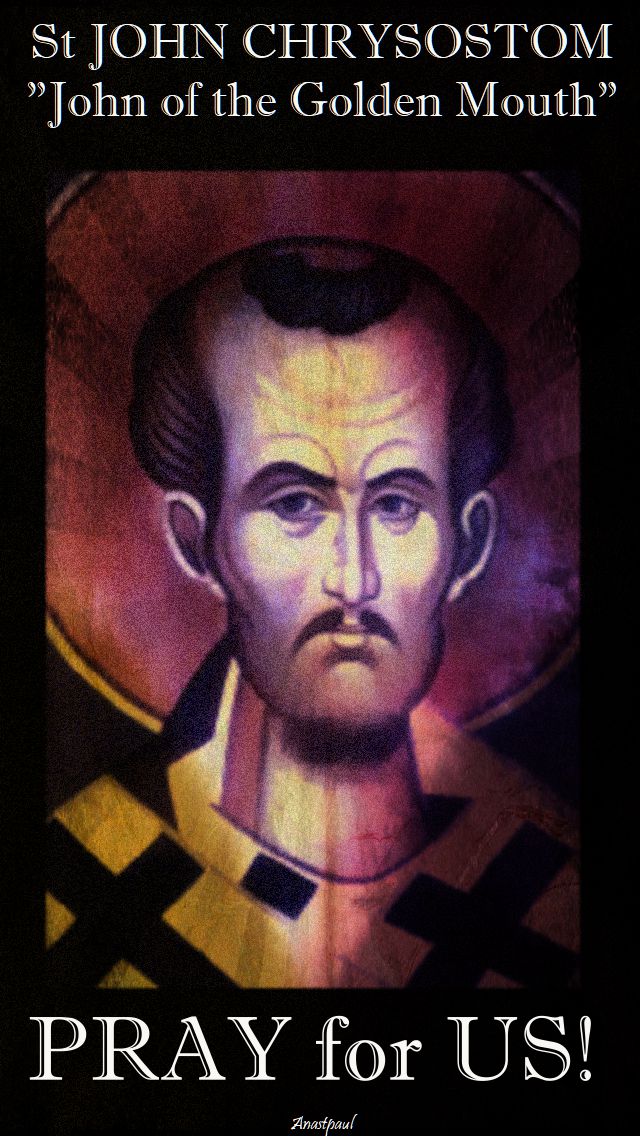
St John Chrysostom (347-407), Father and Doctor of the Eucharist, Pray for us!st john chrysostom pray for us.2

Posted in CATHOLIC DEVOTIONS of the Month, MARIAN DEVOTIONS, MARIAN QUOTES, MARIAN TITLES, PAPAL SERMONS, SAINT of the DAY, The BLESSED VIRGIN MARY

Memorial of The Seven Sorrows of the Blessed Virgin Mary – 15 September

Memorial of The Seven Sorrows of the Blessed Virgin Mary 

Excerpt from the Homily of His Holiness, Pope Benedict XVI,
at the Esplanade in front of the Basilica of Notre-Dame du Rosaire, Lourdes
Monday, 15 September 2008

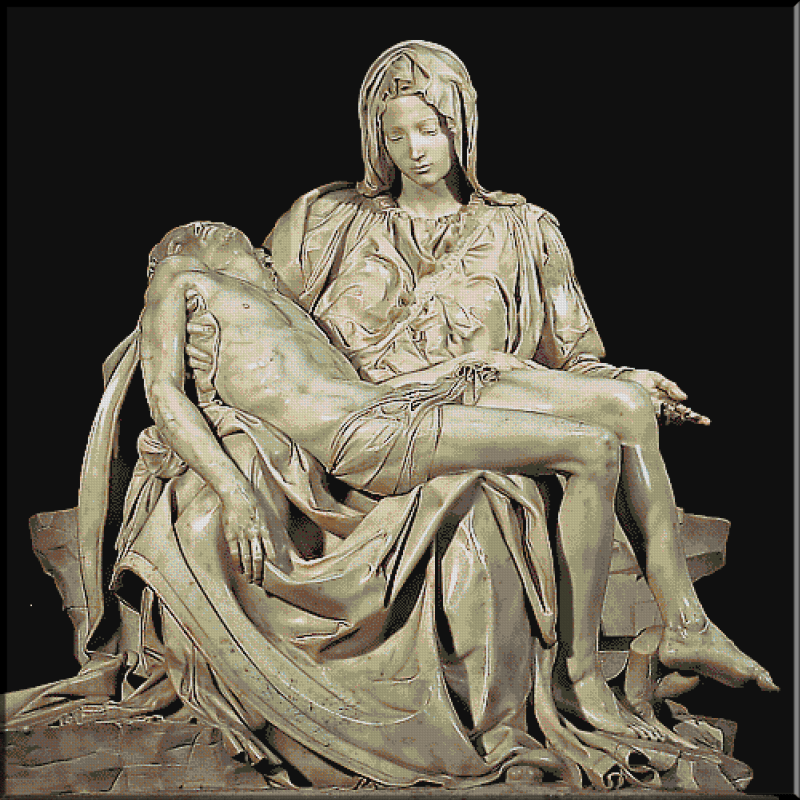
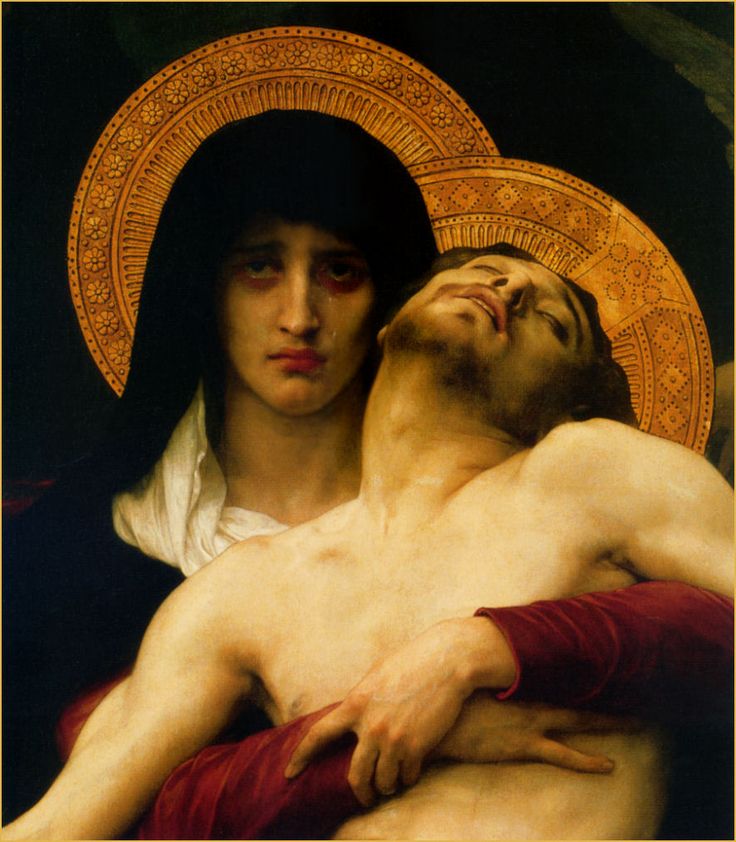
“Yesterday we celebrated the Cross of Christ, the instrument of our salvation, which reveals the mercy of our God in all its fullness.   The Cross is truly the place where God’s compassion for our world is perfectly manifested.   Today, as we celebrate the memorial of Our Lady of Sorrows, we contemplate Mary sharing her Son’s compassion for sinners.700-pietaHEADER & WP ourlady of sorrows - bougeureau

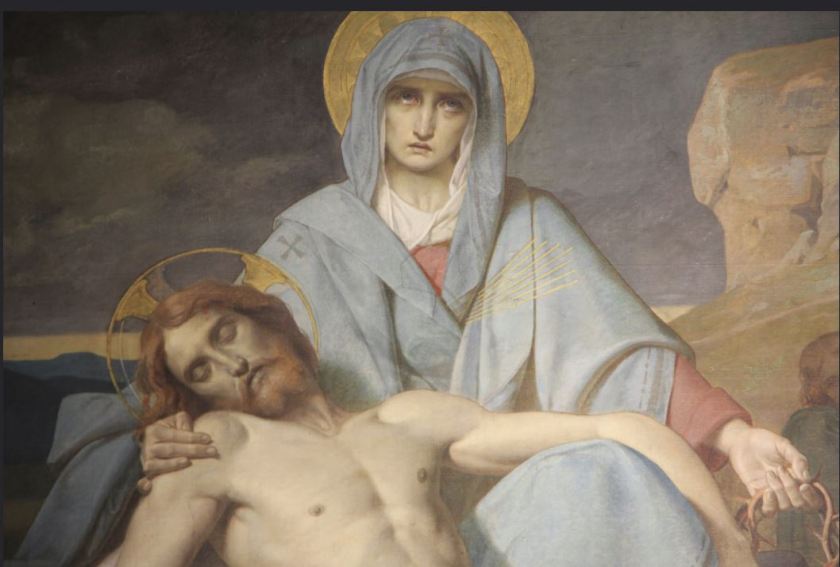
As Saint Bernard declares, the Mother of Christ entered into the Passion of her Son through her compassion (cf. Homily for Sunday in the Octave of the Assumption).   At the foot of the Cross, the prophecy of Simeon is fulfilled:  her mother’s heart is pierced through (cf. Lk 2:35) by the torment inflicted on the Innocent One born of her flesh. pieta - fr james bradley

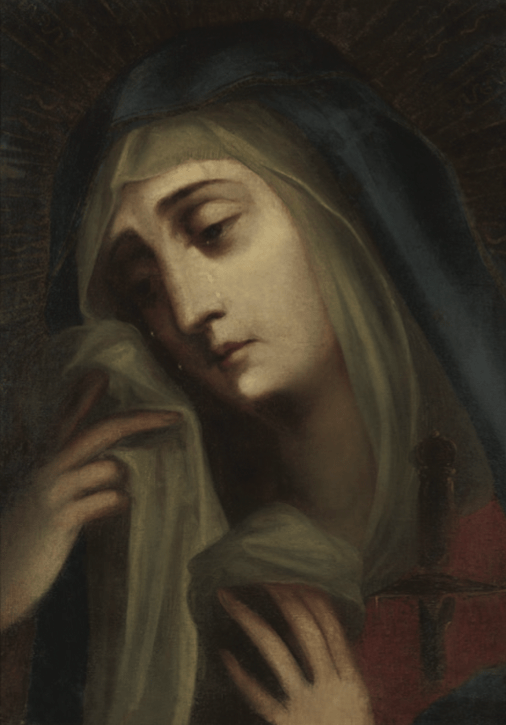
Just as Jesus cried (cf. Jn 11:35), so too Mary certainly cried over the tortured body of her Son. Her self-restraint, however, prevents us from plumbing the depths of her grief;  the full extent of her suffering is merely suggested by the traditional symbol of the seven swords. As in the case of her Son Jesus, one might say that she too was led to perfection through this suffering (cf. Heb 2:10), so as to make her capable of receiving the new spiritual mission that her Son entrusts to her immediately before “giving up his spirit” (cf. Jn 19:30) – that of becoming the mother of Christ in his members.  In that hour, through the figure of the beloved disciple, Jesus presents each of his disciples to his Mother when he says to her –  Behold your Son (cf. Jn 19:26-27).our lady of sorrows

Today Mary dwells in the joy and the glory of the Resurrection.   The tears shed at the foot of the Cross have been transformed into a smile which nothing can wipe away, even as her maternal compassion towards us remains unchanged.   The intervention of the Virgin Mary in offering succour throughout history testifies to this and does not cease to call forth, in the people of God, an unshakable confidence in her, the Memorare prayer expresses this sentiment very well.   Mary loves each of her children, giving particular attention to those who, like her Son at the hour of his Passion, are prey to suffering, she loves them quite simply because they are her children, according to the will of Christ on the Cross.

The psalmist, seeing from afar this maternal bond which unites the Mother of Christ with the people of faith, prophesies regarding the Virgin Mary that “the richest of the people … will seek your smile” (Ps 44:13).   In this way, prompted by the inspired word of Scripture, Christians have always sought the smile of Our Lady, this smile which medieval artists were able to represent with such marvellous skill and to show to advantage.   This smile of Mary is for all but it is directed quite particularly to those who suffer, so that they can find comfort and solace therein.   To seek Mary’s smile is not an act of devotional or outmoded sentimentality but rather the proper expression of the living and profoundly human relationship which binds us to her whom Christ gave us as our Mother.

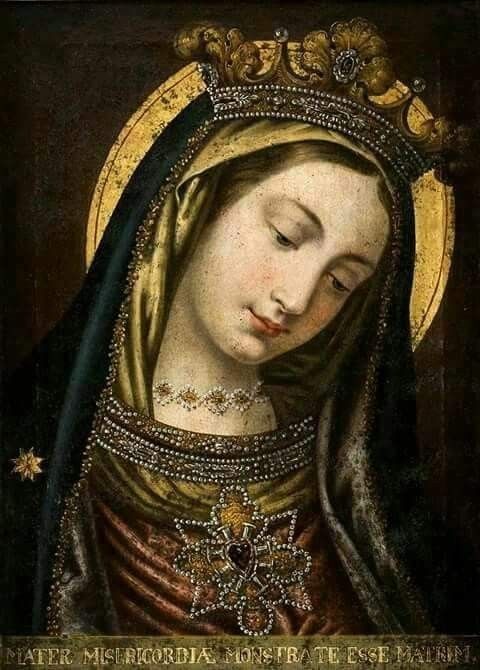
mother of sorrows monstrate

To wish to contemplate this smile of the Virgin, does not mean letting oneself be led by an uncontrolled imagination.   Scripture itself discloses it to us through the lips of Mary when she sings the Magnificat:  “My soul glorifies the Lord, my spirit exults in God my Saviour” (Lk 1:46-47). When the Virgin Mary gives thanks to the Lord, she calls us to witness.   Mary shares, as if by anticipation, with us, her future children, the joy that dwells in her heart, so that it can become ours.   Every time we recite the Magnificat, we become witnesses of her smile.”

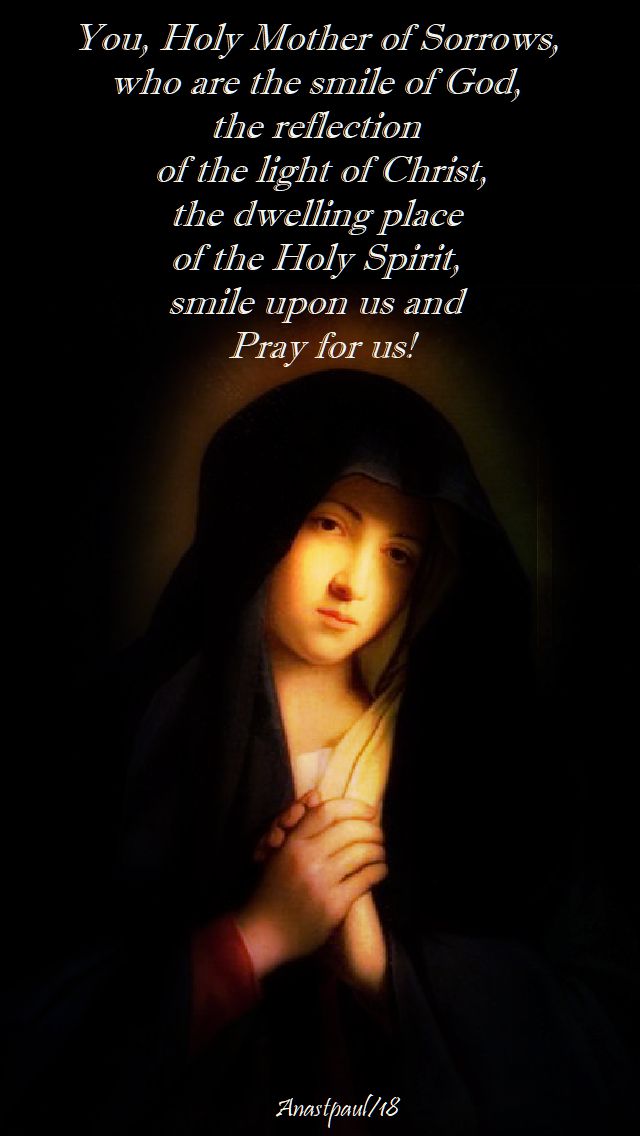
You, Holy Mother of Sorrows, who are the smile of God, the reflection of the light of Christ, the dwelling place of the Holy Spirit, smile upon us and pray for us!you holy mother of sorrows - smile upon us and pray for us - 15 sept 2018

Posted in CATHOLIC DEVOTIONS of the Month, FEASTS and SOLEMNITIES, MORNING Prayers, PAPAL SERMONS, QUOTES on the CROSS of CHRIST, SAINT of the DAY, The HOLY CROSS

Thought for the Day – 14 September – Feast of the Exaltation of the Holy Cross

Thought for the Day – 14 September – Feast of the Exaltation of the Holy Cross14-sept-exaltation-of-the-holy-cross 2017

Excerpt – Pope Benedict XVI

 Angelus, 17 September 2006

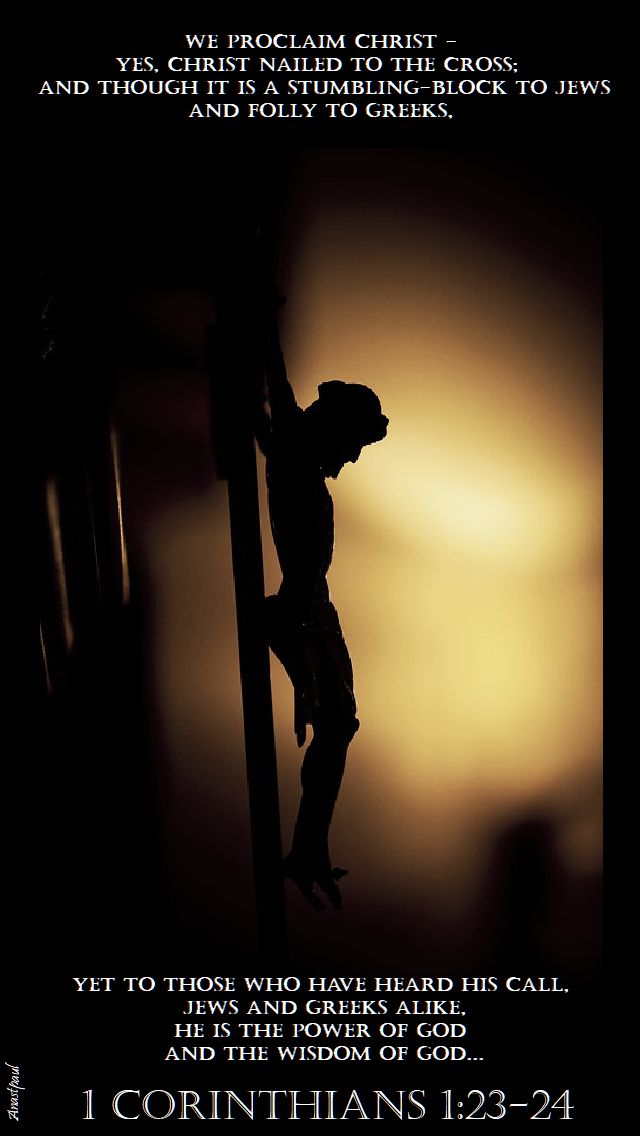
“But what does exalting the Cross mean?   Is it not maybe scandalous to venerate a shameful form of execution?   The Apostle Paul says: “We proclaim Christ crucified, a stumbling block to Jews and folly to Gentiles” (I Cor 1: 23). Christians, however, do not exalt just any cross but the Cross which Jesus sanctified with His sacrifice, the fruit and testimony of immense love.   Christ on the Cross pours out His Blood to set humanity free from the slavery of sin and death.1-corinthians-1-23-24 - we proclaim christ crucified = 14 sept 2017

Therefore, from being a sign of malediction, the Cross was transformed into a sign of blessing, from a symbol of death into a symbol par excellence of the Love that overcomes hatred and violence and generates immortal life.   “O Crux, ave spes unica! O Cross, our only hope!”.   Thus sings the liturgy.

The Evangelist recounts – Mary was standing by the Cross (cf. Jn 19: 25-27).   Her sorrow is united with that of her So  n. It is a sorrow full of faith and love.   The Virgin on Calvary participates in the saving power of the suffering of Christ, joining her “fiat”, her “yes”, to that of her Son.

Dear brothers and sisters, spiritually united to Our Lady of Sorrows, let us also renew our “yes” to God who chose the Way of the Cross in order to save us.   This is a great mystery which continues and will continue to take place until the end of the world and which also asks for our collaboration.

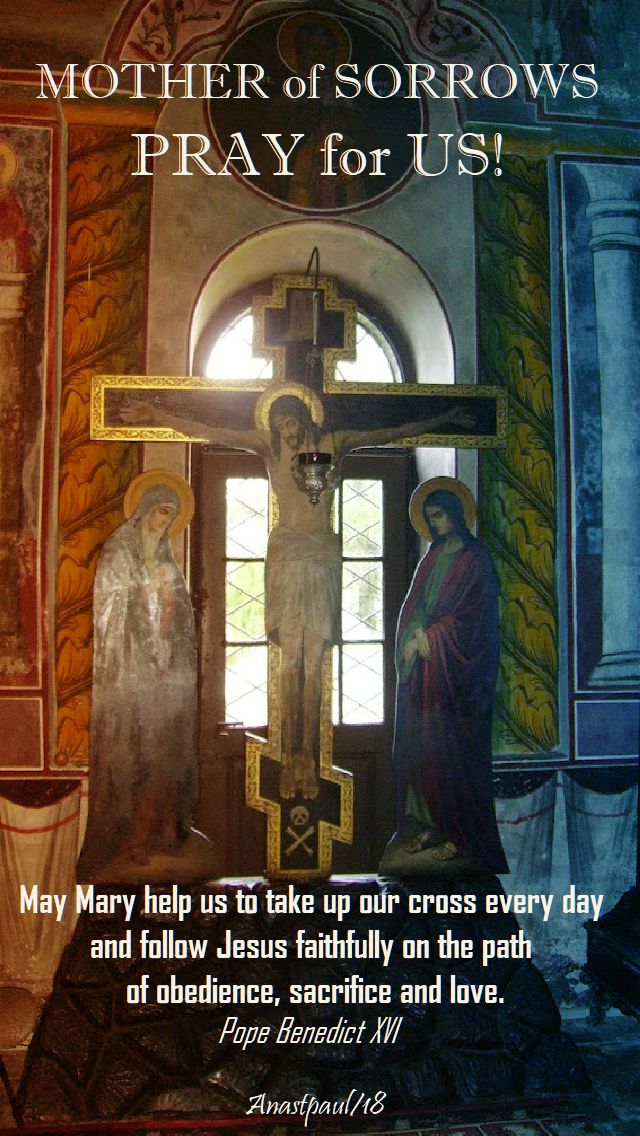
May Mary help us to take up our cross every day and follow Jesus faithfully on the path of obedience, sacrifice and love.”mother of sorrows pray for us - may mary help us - pope benedict - 14 sept 2018

We adore You Christ and we bless You,

for by Your holy Cross You have redeemed the world.

we adore you o christ - 14 sept 2018


Posted in DOCTORS of the Church, FATHERS of the Church, GOD the FATHER, MORNING Prayers, PAPAL SERMONS, QUOTES of the SAINTS, QUOTES on FAITH, SAINT of the DAY, The WORD

Thought for the Day – 13 September – 13 September – St John Chrysostom (347-407) Doctor – “John of the Golden Mouth”

Thought for the Day – 13 September – 13 September – St John Chrysostom (347-407) Doctor – “John of the Golden Mouth”

“The Second Paul”

“The Ladder to God”

It is said of John Chrysostom that when he was seated upon the throne of the New Rome, that is, Constantinople, God caused him to be seen as a second Paul, a doctor of the Universe.

Indeed, there is in Chrysostom a substantial unity of thought and action, in Antioch as in Constantinople.   It is only the role and situations that change.

In his commentary on Genesis, in meditating on God’s eight acts in the sequence of six days, Chrysostom desired to restore the faithful from the creation to the Creator:  “It is a great good”, he said, “to know the creature from the Creator”, He shows us the beauty of the creation and God’s transparency in His creation, which thus becomes, as it were, a “ladder” to ascend to God in order to know Him.

To this first step, however, is added a second:  this God Creator is also the God of indulgence (synkatabasis).   We are weak in “climbing”, our eyes grow dim.   Thus, God becomes an indulgent God who sends to fallen man, foreign man, a letter, Sacred Scripture, so that the creation and Scripture may complete each another.   We can decipher creation in the light of Scripture, the letter that God has given to us.   God is called a “tender father” (philostorgios) (ibid.), a healer of souls (Homily on Genesis, 40, 3), a mother (ibid.) and an affectionate friend (On Providence 8, 11-12).

But in addition to this second step – first, the creation as a “ladder” to God and then, the indulgence of God through a letter which he has given to us, Sacred Scripture – there is a third step.   God does not only give us a letter – ultimately, He Himself comes down to us, He takes flesh, becomes truly “God-with-us”, our brother until His death on a Cross.

And to these three steps – God is visible in creation, God gives us a letter, God descends and becomes one of us – a fourth is added at the end.   In the Christian’s life and action, the vital and dynamic principle is the Holy Spirit (Pneuma) who transforms the realities of the world.   God enters our very existence through the Holy Spirit and transforms us from within our hearts.”

Pope Benedict XVI – General Audience 26 September 2007

St John Chrysostom, Pray for us!st-john-chrysostom-pray-for-us-13 sept 2017

Posted in Against EPIDEMICS, All THEOLOGIANS, Moral Theologians, CONFESSORS, DOCTORS of the Church, FATHERS of the Church, PAPAL SERMONS, PATRONAGE - WRITERS, PRINTERS, PUBLISHERS, EDITORS, etc, PREACHERS, SAINT of the DAY, VATICAN Resources

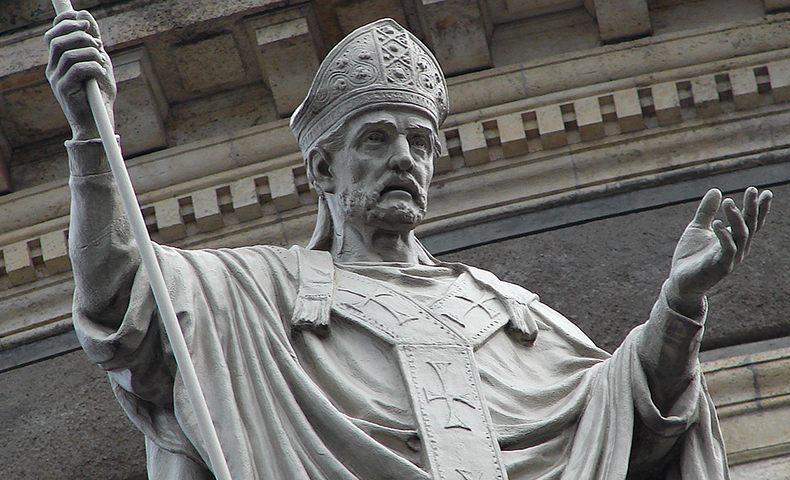
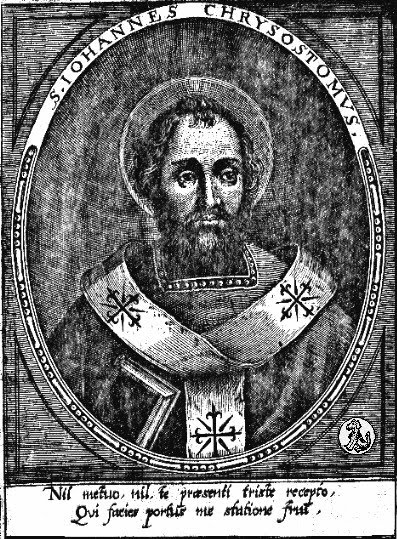
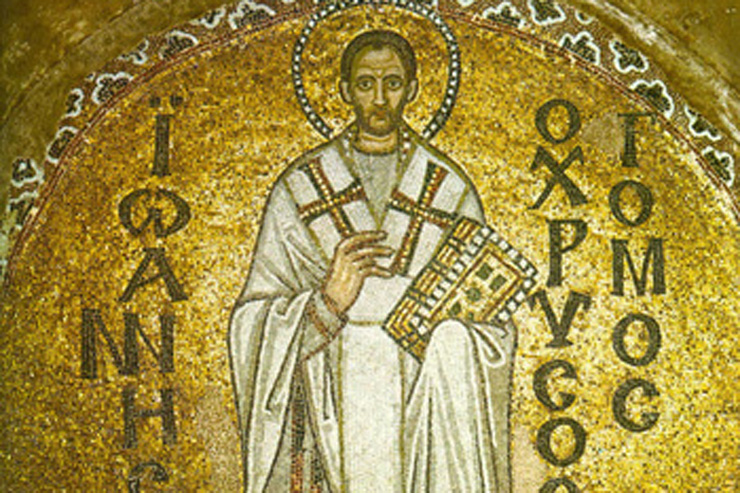
Saint of the Day – 13 September – St John Chrysostom (347-407) Father and Doctor of the Church – “Golden Mouthed”

Saint of the Day – 13 September – St John Chrysostom (347-407) Father and Doctor of the Church – “Golden Mouthed” – (c 347 at Antioch, Asia Minor – 407 of natural causes) Bishop, Father and Doctor, Preacher, Orator, Writer, Theologian, Confessor.

Listening to Pope Benedict XVI’s Homily,
General Audience, 19 September 2007

st john chryosotom info

“This year (2007) is the 16th centenary of St John Chrysostom’s death (407-2007).  It can be said that John of Antioch, nicknamed “Chrysostom”, that is, “golden-mouthed“, because of his eloquence, is also still alive today because of his works.   An anonymous copyist left in writing that “they cross the whole globe like flashes of lightening”.beautiful - SaintJohnChrysostom-790x480

Chrysostom’s writings also enable us, as they did the faithful of his time whom his frequent exiles deprived of his presence, to live with his books, despite his absence.   This is what he himself suggested in a letter when he was in exile (To Olympias, Letter 8, 45).

He was born in about the year 349 in Antioch, Syria (today Antakya in Southern Turkey). He carried out his priestly ministry there for about 11 years, until 397, when, appointed Bishop of Constantinople, he exercised his episcopal ministry in the capital of the Empire prior to his two exiles, which succeeded one close upon the other – in 403 and 407.   Let us limit ourselves today to examining the years Chrysostom spent in Antioch.   He lost his father at a tender age and lived with Anthusa, his mother, who instilled in him exquisite human sensitivity and a deep Christian faith.   After completing his elementary and advanced studies crowned by courses in philosophy and rhetoric, he had as his teacher, Libanius, a pagan and the most famous rhetorician of that time.   At his school John became the greatest orator of late Greek antiquity.st john chrysostom - engraving

He was baptised in 368 and trained for the ecclesiastical life by Bishop Meletius, who instituted him as lector in 371.   This event marked Chrysostom’s official entry into the ecclesiastical cursus.   From 367 to 372, he attended the Asceterius, a sort of seminary in Antioch, together with a group of young men, some of whom later became Bishops, under the guidance of the exegete Diodore of Tarsus, who initiated John into the literal and grammatical exegesis characteristic of Antiochean tradition.

He then withdrew for four years to the hermits on the neighbouring Mount Silpius.   He extended his retreat for a further two years, living alone in a cave under the guidance of an “old hermit”.   In that period, he dedicated himself unreservedly to meditating on “the laws of Christ”, the Gospels and especially the Letters of Paul.   Having fallen ill, he found it impossible to care for himself unaided and therefore had to return to the Christian community in Antioch (cf. Palladius, Dialogue on the Life of St John Chrysostom, 5).

The Lord, his biographer explains, intervened with the illness at the right moment to enable John to follow his true vocation.   In fact, he himself was later to write that were he to choose between the troubles of Church government and the tranquillity of monastic life, he would have preferred pastoral service a thousand times (cf. On the Priesthood, 6, 7):  it was precisely to this that Chrysostom felt called.   It was here that he reached the crucial turning point in the story of his vocation:  a full-time pastor of souls! Intimacy with the Word of God, cultivated in his years at the hermitage, had developed in him an irresistible urge to preach the Gospel, to give to others what he himself had received in his years of meditation.   The missionary ideal thus launched him into pastoral care, his heart on fire.

ST JOHN CHRYSOSTOM

Between 378 and 379, he returned to the city.   He was ordained a deacon in 381 and a priest in 386 and became a famous preacher in his city’s churches.   He preached homilies against the Arians, followed by homilies commemorating the Antiochean martyrs and other important liturgical celebrations: this was an important teaching of faith in Christ and also in the light of his Saints.   The year 387 was John’s “heroic year”, that of the so-called “revolt of the statues”.   As a sign of protest against levied taxes, the people destroyed the Emperor’s statues.   It was in those days of Lent and the fear of the Emperor’s impending reprisal that Chrysostom gave his 22 vibrant Homilies on the Statues, whose aim was to induce repentance and conversion.   This was followed by a period of serene pastoral care (387-397).my snip - st john chrysostom 4

Chrysostom is among the most prolific of the Fathers – 17 treatises, more than 700 authentic homilies, commentaries on Matthew and on Paul (Letters to the Romans, Corinthians, Ephesians and Hebrews) and 241 letters are extant.   He was not a speculative theologian.   Nevertheless, he passed on the Church’s tradition and reliable doctrine in an age of theological controversies, sparked above all by Arianism or, in other words, the denial of Christ’s divinity.   He is, therefore, a trustworthy witness of the dogmatic development achieved by the Church, from the fourth to the fifth centuries.

His is a perfectly pastoral theology in which there is constant concern for consistency between thought expressed via words and existential experience.   It is this in particular that forms the main theme of the splendid catecheses with which he prepared catechumens to receive Baptism.

On approaching death, he wrote that the value of the human being lies in “exact knowledge of true doctrine and in rectitude of life” (Letter from Exile).   Both these things, knowledge of truth and rectitude of life, go hand in hand – knowledge has to be expressed in life.   All his discourses aimed to develop in the faithful the use of intelligence, of true reason, in order to understand and to put into practice the moral and spiritual requirements of faith.st-John-chrysostom-02-featured-w740x493

John Chrysostom was anxious to accompany his writings with the person’s integral development in his physical, intellectual and religious dimensions.   The various phases of his growth are compared to as many seas in an immense ocean:  “The first of these seas is childhood” (Homily, 81, 5 on Matthew’s Gospel).   Indeed, “it is precisely at this early age that inclinations to vice or virtue are manifest”.   Thus, God’s law must be impressed upon the soul from the outset “as on a wax tablet” (Homily 3, 1 on John’s Gospel).   This is indeed the most important age.   We must bear in mind how fundamentally important it is that the great orientations which give man a proper outlook on life truly enter him in this first phase of life.   Chrysostom therefore recommended – “From the tenderest age, arm children with spiritual weapons and teach them to make the Sign of the Cross on their forehead with their hand” (Homily, 12, 7 on First Corinthians).   Then come adolescence and yout –  “Following childhood is the sea of adolescence, where violent winds blow…, for concupiscence… grows within us” (Homily 81, 5 on Matthew’s Gospel).   Lastly comes engagement and marriage – “Youth is succeeded by the age of the mature person who assumes family commitments – this is the time to seek a wife” (ibid.).

He recalls the aims of marriage, enriching them – referring to virtue and temperance – with a rich fabric of personal relationships.  Properly prepared spouses therefore bar the way to divorce, everything takes place with joy and children can be educated in virtue. Then when the first child is born, he is “like a bridge, the three become one flesh, because the child joins the two parts” (Homily 12, 5 on the Letter to the Colossians) and the three constitute “a family, a Church in miniature” (Homily 20, 6 on the Letter to the Ephesians).

snip st john chrysostom

Chrysostom’s preaching usually took place during the liturgy, the “place” where the community is built with the Word and the Eucharist.   The assembly gathered here expresses the one Church (Homily 8, 7 on the Letter to the Romans), the same word is addressed everywhere to all (Homily 24, 2 on First Corinthians), and Eucharistic Communion becomes an effective sign of unity (Homily 32, 7 on Matthew’s Gospel).

His pastoral project was incorporated into the Church’s life, in which the lay faithful assume the priestly, royal and prophetic office with Baptism.   To the lay faithful he said: “Baptism will also make you king, priest and prophet” (Homily 3, 5 on Second Corinthians).

From this stems the fundamental duty of the mission, because each one is to some extent responsible for the salvation of others:  “This is the principle of our social life… not to be solely concerned with ourselves!” (Homily 9, 2 on Genesis).   This all takes place between two poles – the great Church and the “Church in miniature”, the family, in a reciprocal relationship.

As you can see, dear brothers and sisters, Chrysostom’s lesson on the authentically Christian presence of the lay faithful in the family and in society is still more timely than ever today.   Let us pray to the Lord to make us docile to the teachings of this great Master of the faith.”

“I would like to end this writing with a final word of the great Doctor, in which he invites his faithful – and also us, of course – to reflect on the eternal values:

“For how long will we be nailed to the present reality?   How much longer will it be before we can meet with success?   How much longer will we neglect our salvation? ” 

Let us remember what Christ considered we deserved, let us thank Him, glorify Him, not only with our faith but also with our effective actions, in order to obtain future goods through the grace and loving tenderness of Our Lord Jesus Christ, for whom and with whom glory be to the Father and to the Holy Spirit, for ever and ever.  Amen”

(Pope Benedict XVI, 10 August 2007)

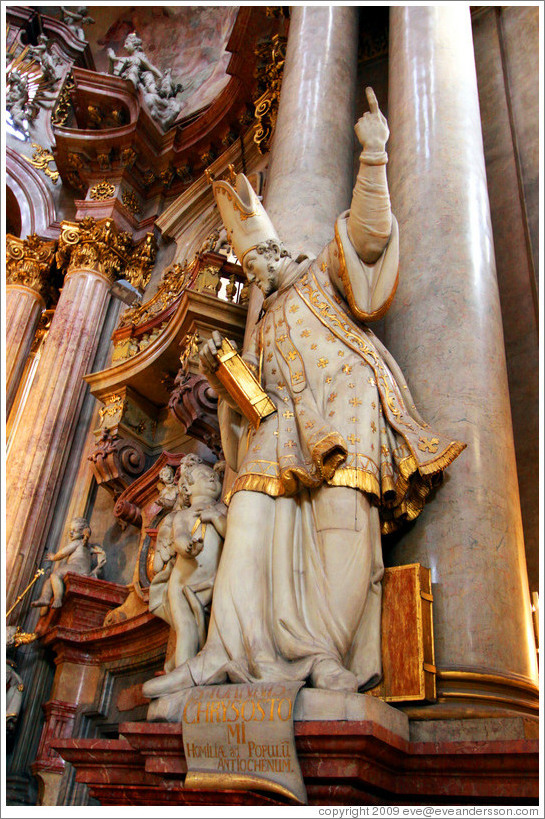
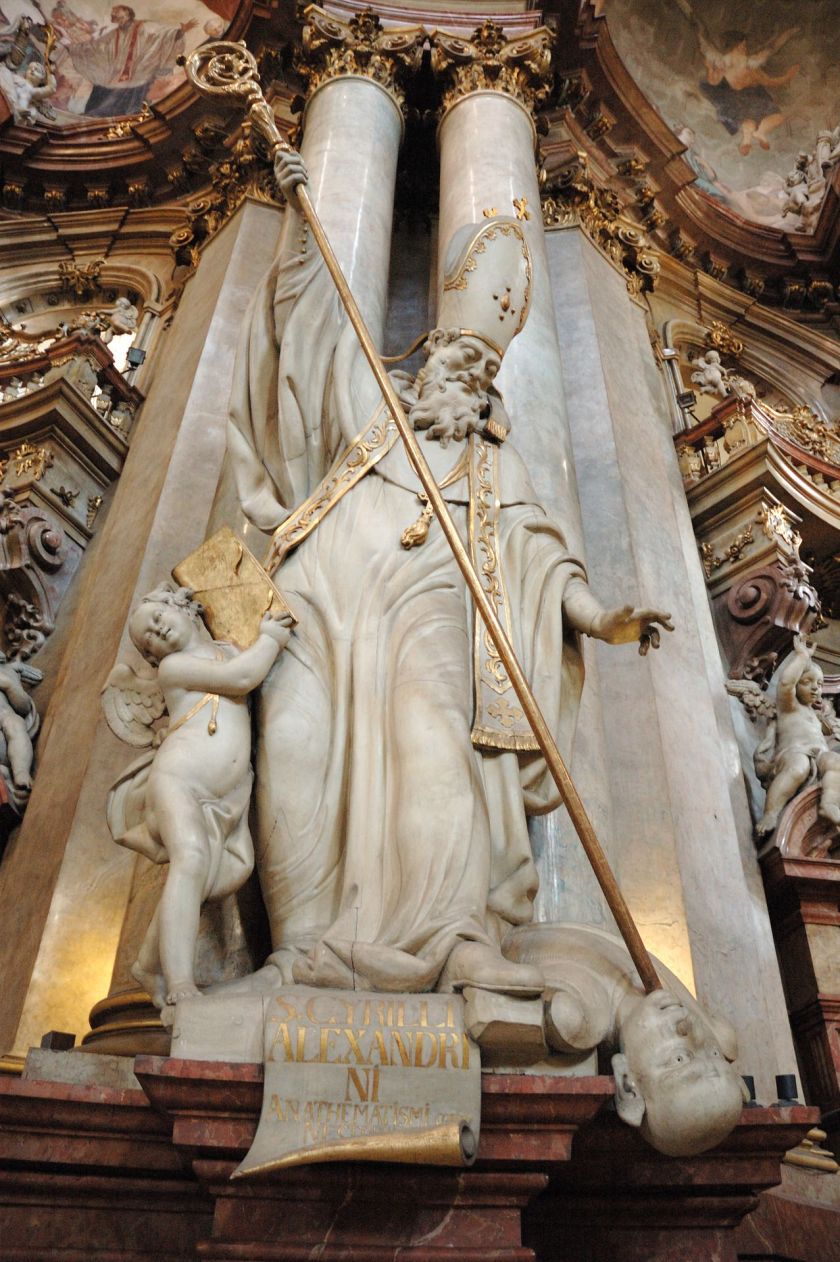
prague-mala-strana-st-nicholas-church-saint-john-chrysostom-sculpture-large

Posted in DOCTORS of the Church, FATHERS of the Church, FRUITS of the SPIRIT, MORNING Prayers, PAPAL SERMONS, QUOTES of the SAINTS, QUOTES on HUMILITY, SAINT of the DAY, The WORD, VATICAN Resources

Thought for the Day – 3 September – The Memorial of St Pope Gregory the Great (540-604) Father & Doctor of the Church “Father of the Fathers” “Servant of the Servants”

Thought for the Day – 3 September – The Memorial of St Pope Gregory the Great (540-604)
Father & Doctor of the Church
“Father of the Fathers”
“Servant of the Servants”

Excerpt from Pope Benedict XVI’s Homily – General Audience – 4 June 2009
St Pope Gregory the Great “Servant of the Servants” “Servus Servorum Dei”

“Probably the most systematic text of Gregory the Great is the Pastoral Rule, written in the first years of his Pontificate.   In it, Gregory proposed to treat the figure of the ideal Bishop, the teacher and guide of his flock.   To this end he illustrated the seriousness of the office of Pastor of the Church and its inherent duties.   Therefore, those who were not called to this office may not seek it with superficiality, instead those who assumed it without due reflection necessarily feel trepidation rise within their soul.   Taking up again a favourite theme, he affirmed that the Bishop is above all the “preacher” par excellence;  for this reason he must be above all an example for others, so that his behaviour may be a point of reference for all.   Efficacious pastoral action requires that he know his audience and adapt his words to the situation of each person – here Gregory paused to illustrate the various categories of the faithful with acute and precise annotations, which can justify the evaluation of those who have also seen in this work a treatise on psychology.   From this one understands that he really knew his flock and spoke of all things with the people of his time and his city.

Nevertheless, the great Pontiff insisted on the Pastor’s duty to recognise daily his own unworthiness in the eyes of the Supreme Judge, so that pride did not negate the good accomplished.   For this the final chapter of the Rule is dedicated to humility : “When one is pleased to have achieved many virtues, it is well to reflect on one’s own inadequacies and to humble oneself, instead of considering the good accomplished, it is necessary to consider what was neglected”.   All these precious indications demonstrate the lofty concept that St Gregory had for the care of souls, which he defined as the “ars artium”, the art of arts.   The Rule had such great and the rather rare, good fortune to have been quickly translated into Greek and Anglo-Saxon.

He wanted to be – and this is his expression – “Servus Servorum Dei”.   Coined by him, this phrase was not just a pious formula on his lips but a true manifestation of his way of living and acting.   He was intimately struck by the humility of God, who in Christ made Himself our servant.   He washed and washes our dirty feet.   Therefore, he was convinced that a Bishop, above all, should imitate this humility of God and follow Christ in this way.

His desire was to live truly as a monk, in permanent contact with the Word of God but for love of God he knew how to make himself the servant of all in a time full of tribulation and suffering.   He knew how to make himself the “servant of the servants”. Precisely because he was this, he is great and also shows us the measure of true greatness.”

St Pope Gregory the Great, “Servant of the Servants”, Pray for Us!st pope gregory the great servant of the servants - pray for us - 3 sept 2018

Posted in MARIAN PRAYERS, MORNING Prayers, PAPAL SERMONS, QUOTES - J R R Tolkien and MORE, QUOTES of the SAINTS, QUOTES on DIVINE PROVIDENCE, SAINT of the DAY

Thought for the Day – 30 August – The Memorial of St Jeanne Jugan L.S.P. (Mary of the Cross) (1792 – 1879)

Thought for the Day – 30 August – The Memorial of St Jeanne Jugan L.S.P. (Mary of the Cross) (1792 – 1879)

By her admirable work at the service of the most deprived elderly, St Mary of the Cross is also like a beacon to guide our societies which must always rediscover the place and the unique contribution of this period of life.
Born in 1792 at Cancale in Brittany, Jeanne Jugan was concerned with the dignity of her brothers and sisters in humanity whom age had made more vulnerable, recognising in them the Person of Christ himself.   “Look upon the poor with compassion”, she would say, “and Jesus will look kindly upon you on your last day”.
Jeanne Jugan focused upon the elderly a compassionate gaze drawn from her profound communion with God in her joyful, disinterested service, which she carried out with gentleness and humility of heart, desiring herself to be poor among the poor.   Jeanne lived the mystery of love, peacefully accepting obscurity and self-emptying until her death.   Her charism is ever timely while so many elderly people are suffering from numerous forms of poverty and solitude and are sometimes also abandoned by their families.
In the Beatitudes Jeanne Jugan found the source of the spirit of hospitality and fraternal love, founded on unlimited trust in Providence, which illuminated her whole life.  This evangelical dynamism is continued today across the world in the Congregation of Little Sisters of the Poor, which she founded and which testifies, after her example, to the mercy of God and the compassionate love of the Heart of Jesus for the lowliest.
May St Jeanne Jugan be for elderly people a living source of hope and for those who generously commit themselves to serving them, a powerful incentive to pursue and develop her work!

I would like to address to all the invitation to let yourselves be attracted by the luminous examples of these Saints, to let yourselves be guided by their teaching so that our entire life may become a song of praise to God’s love.   May their heavenly intercession obtain for us this grace and, especially, the motherly protection of Mary, Queen and Mother of humanity. Amen

Pope Benedict XVI – Homily at the Canonisation of St Mary of the Cross/Jeanne Jugan – Vatican Basilica Sunday, 11 October 2009

Once after meeting Jeanne Jugan, Charles Dickens said, “there is in this woman something so calm and so holy, that in seeing her I know myself to be in the presence of a superior being.

Her words went straight to my heart, so that my eyes, I know not how, filled with tears.”

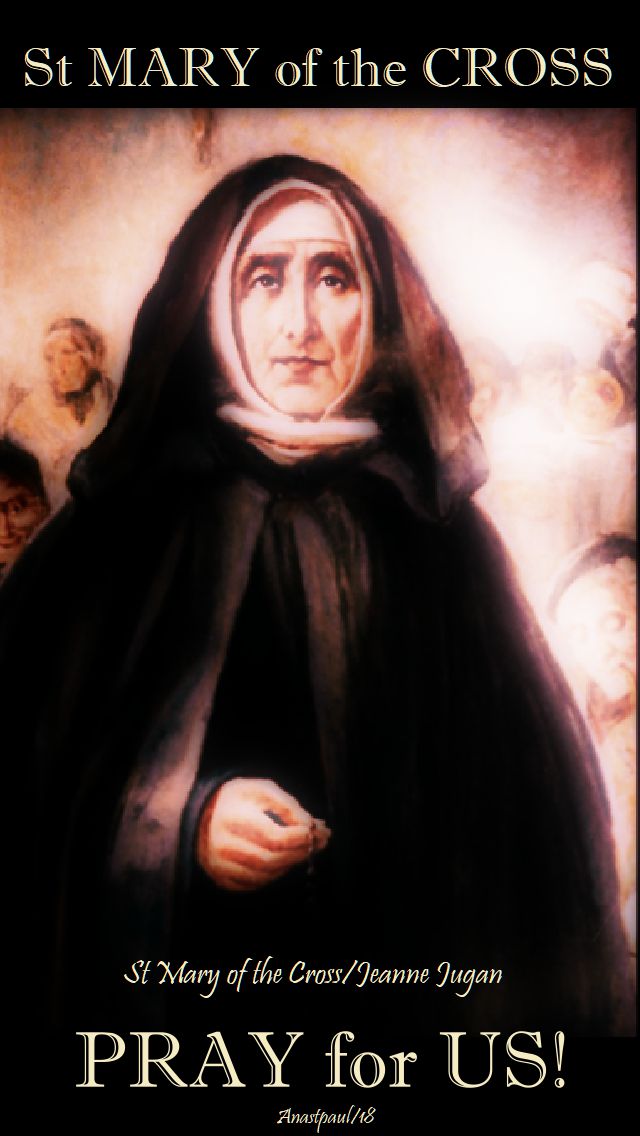
St Mary of the Cross, Pray for us!st mary of the cross - jeanne jugan - pray for us - 30 aug 2018

Posted in DOCTORS of the Church, FATHERS of the Church, MORNING Prayers, ON the SAINTS, PAPAL SERMONS, QUOTES - J R R Tolkien and MORE, QUOTES of the SAINTS, SAINT of the DAY

Quote/s of the Day – 29 August – The Memorial of the Beheading of St John the Baptist

Quote/s of the Day – 29 August – The Memorial of the Beheading of St John the Baptist

“And what else did John have in mind but what is virtuous,
so that he could not endure a wicked union even in the king’s case, saying:
“It is not lawful for thee to have her to wife.”
He could have been silent, had he not thought it unseemly for himself
not to speak the truth for fear of death,
or to make the prophetic office yield to the king,
or to indulge in flattery.
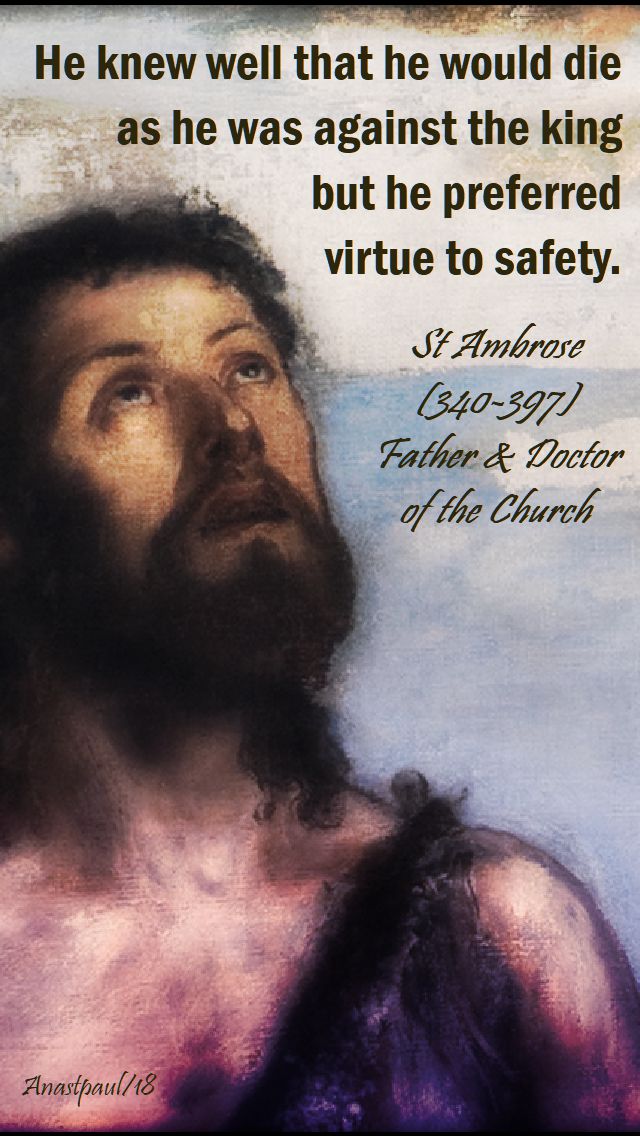
He knew well that he would die as he was against the king
but he preferred virtue to safety.
Yet what is more expedient than the suffering
which brought glory to the saint.”

St Ambrose (340-397) Father & Doctor of the Churchhe knew well that he would die - st ambrose - beheading st john the baptist - 29 aug 2018

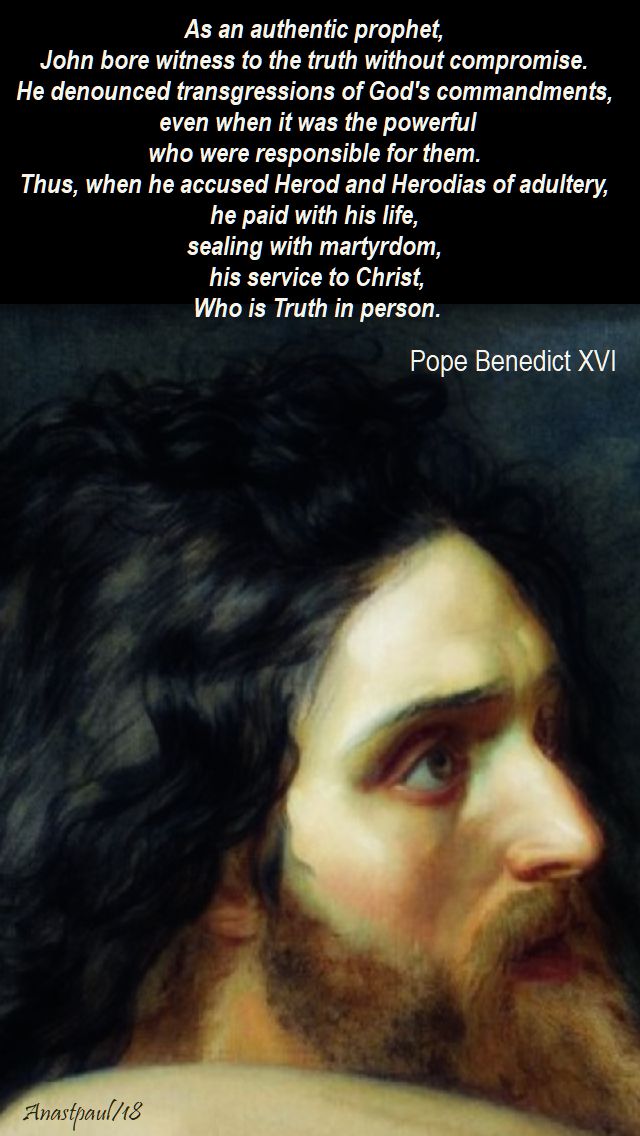
“As an authentic prophet,
John bore witness to the truth without compromise.
He denounced transgressions of God’s commandments,
even when it was the powerful who were responsible for them.
Thus, when he accused Herod and Herodias of adultery,
he paid with his life,
sealing with martyrdom,
his service to Christ who is Truth in person.”

Pope Benedict XVI (24 June 2007)as an authentic prophet - pope benedict - mem of beheading of st john the baptist - 29 aug 2018

Posted in BREVIARY Prayers, DOCTORS of the Church, FATHERS of the Church, FEASTS and SOLEMNITIES, MORNING Prayers, ON the SAINTS, QUOTES of the SAINTS, QUOTES on HUMILITY, QUOTES on SANCTITY, QUOTES on SUFFERING, QUOTES on the CROSS of CHRIST, SAINT of the DAY, The APOSTLES & EVANGELISTS

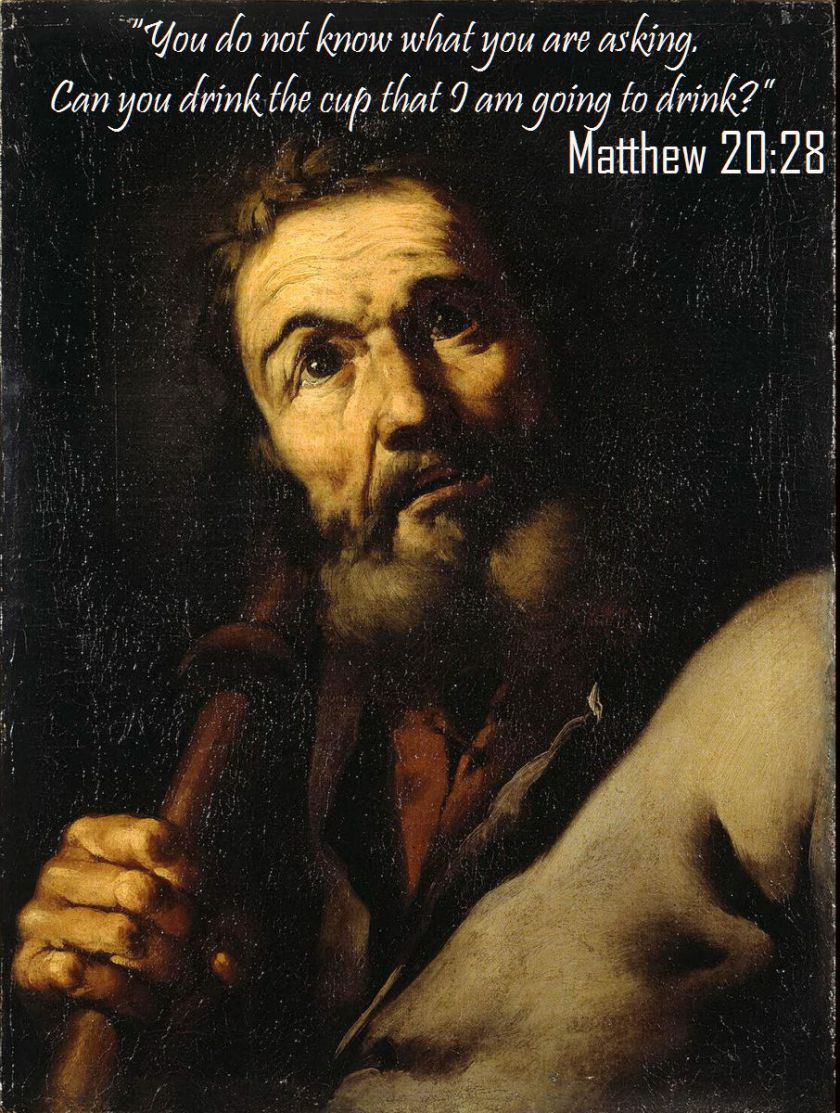
One Minute Reflection – 25 July – The Memorial of St James the Greater, Apostle of Christ – Today’s Gospel: Matthew 20:20–28

One Minute Reflection – 25 July – The Memorial of St James the Greater, Apostle of Christ – Today’s Gospel: Matthew 20:20–28

Jesus said in reply, “You do not know what you are asking.   Can you drink the cup that I am going to drink?”   They said to him, “We can.”……Matthew 20:28matthew-20-28- 25 july 2017

REFLECTION – “Through their mother’s mediation, the sons of Zebedee press Christ as follows in the presence of their fellow apostles:  “Command that we may sit, one at your right side and one at your left” (cf. Mk 10:35f.)… Christ hastens to free them from their illusions, telling them they must be prepared to suffer insults, persecutions, even death. “You do not know what you are asking.  Are you able to drink the cup that I shall drink?” Let no one be surprised to see the apostles displaying such imperfect dispositions.   Wait until the mystery of the cross has been fulfilled and the strength of the Holy Spirit given to them.   If you want to see the strength of their souls, take a look at them later on and you will see them to be above all human weakness.   Christ does not conceal their pettiness so you will be able to see what they become later on by the power of the grace that will transform them…”… St John Chrysostom (c 345-407) Father & Doctor of the Church

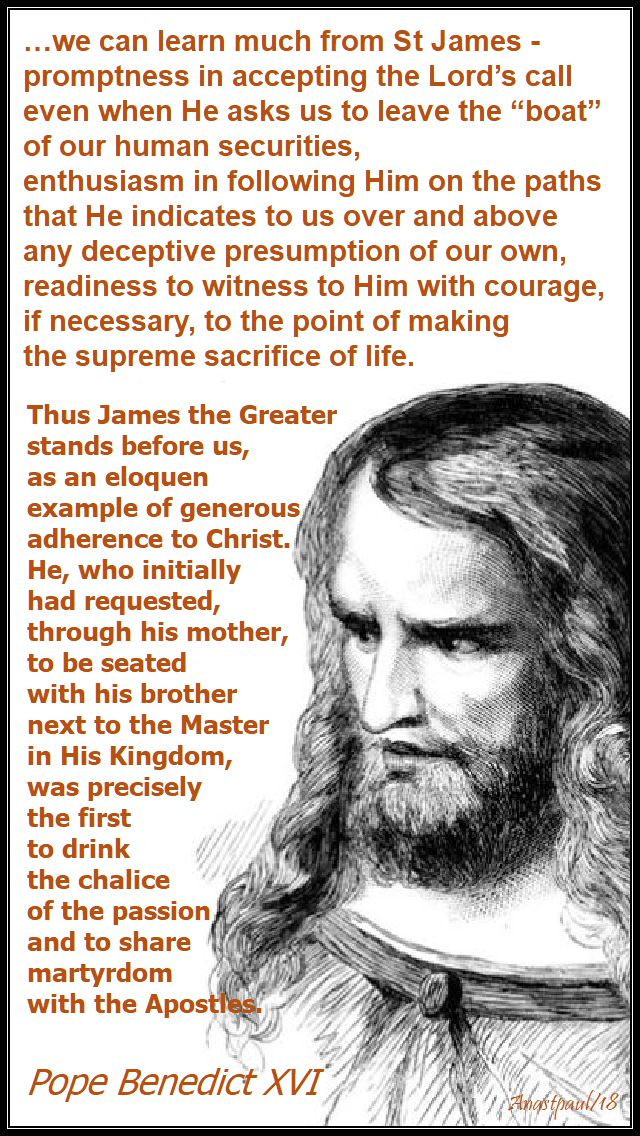
“…we can learn much from St James:   promptness in accepting the Lord’s call even when He asks us to leave the “boat” of our human securities, enthusiasm in following Him on the paths that He indicates to us over and above any deceptive presumption of our own, readiness to witness to Him with courage, if necessary to the point of making the supreme sacrifice of life.   Thus James the Greater stands before us, as an eloquent example of generous adherence to Christ.   He, who initially had requested, through his mother, to be seated with his brother next to the Master in His Kingdom, was precisely the first to drink the chalice of the passion and to share martyrdom with the Apostles.”…Pope Benedict XVI – General Audience, 21 June 2006we can learn much from st james - pope benedict - 25 july 2018

PRAYER – Lord our God, You accepted the sacrifice of St James, the first of Your Apostles to give his life for Your sake.   May Your Church find strength in his martyrdom and support in his constant prayer.   Through our Lord Jesus Christ, your Son, who lives and reigns with you in the unity of the Holy Spirit, one God, for ever and ever.   St James the Greater, Apostle of Christ, Pray for us! Amenst-james-pray-for-us-25-july 2017

Posted in ART DEI, MORNING Prayers, PAPAL SERMONS, QUOTES - J R R Tolkien and MORE, SAINT of the DAY, The WORD

One Minute Reflection – 19 July – Today’s Gospel: Matthew 11:28-30.

One Minute Reflection – 19 July – Thursday of the Fifteenth week in Ordinary Time, Year B – Today’s Gospel: Matthew 11:28-30.

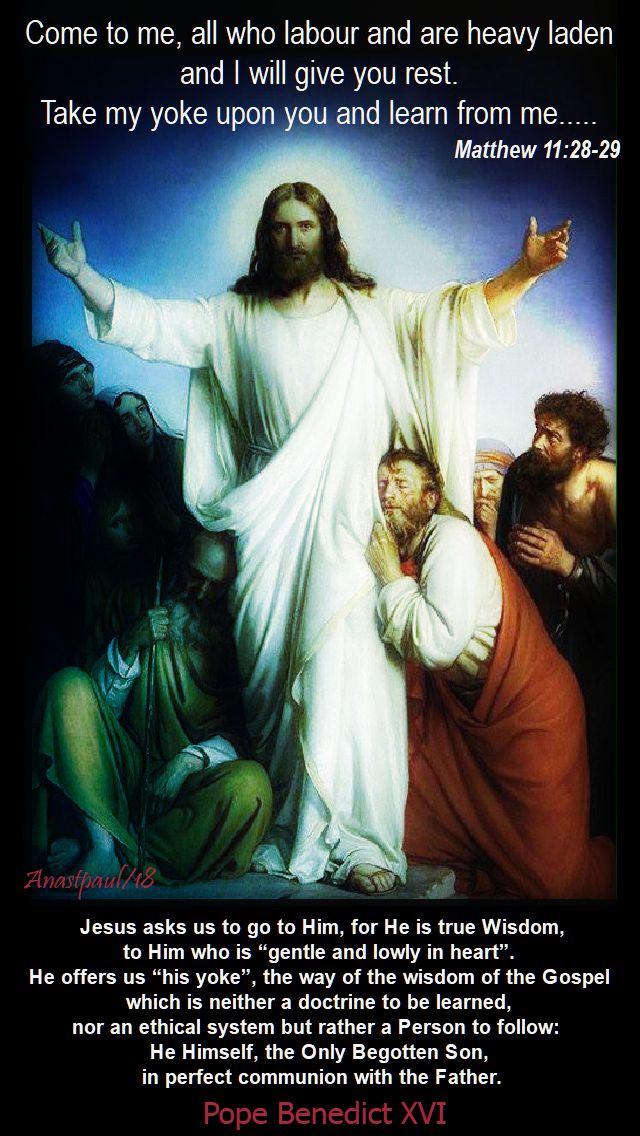
“Come to me, all who labour and are heavy laden and I will give you rest. Take my yoke upon you and learn from me; for I am gentle and lowly in heart and you will find rest for your souls. For my yoke is easy, and my burden is light.”…Matthew 11:28-30

REFLECTION – “Jesus asks us to go to Him, for He is true Wisdom, to Him who is “gentle and lowly in heart”.   He offers us “his yoke”, the way of the wisdom of the Gospel which is neither a doctrine to be learned, nor an ethical system but rather a Person to follow: He Himself, the Only Begotten Son, in perfect communion with the Father.”…Pope Benedict, XVI, General Audience, 7 December 2011come to me all who are burdened - matthew 11 28-29- jesus asks us to go to him - pope benedict - 19 july 2018

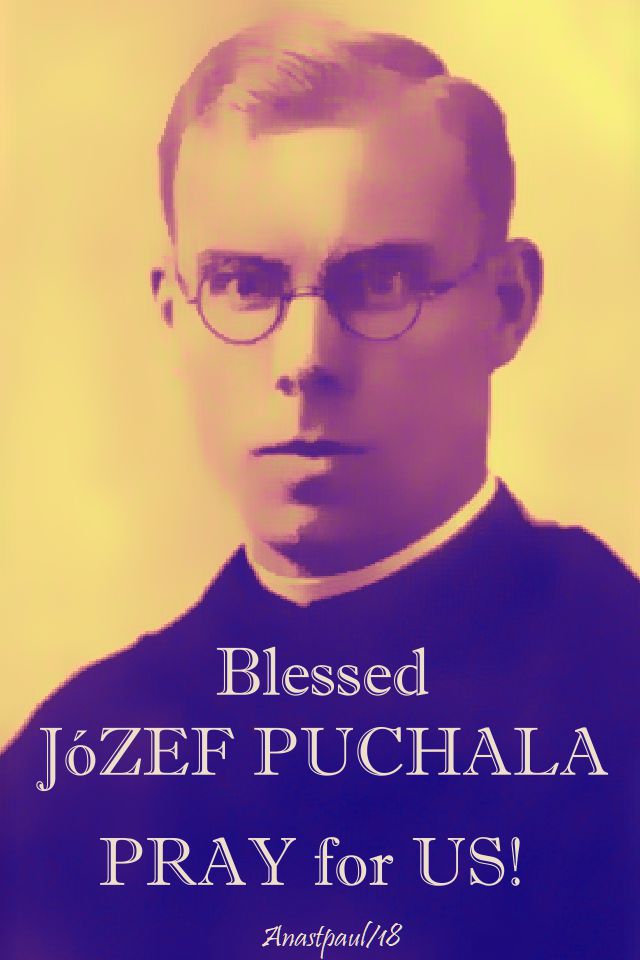
PRAYER – “Holy God, our Father, we turn to You in confidence as children and pray, give us meekness of heart, make us “poor in spirit” that we may recognise that we are not self-sufficient, that we are unable to build our lives on our own but need You, we need to encounter You, to listen to You, to speak to You.   Help us to understand that we need Your gift, Your wisdom, which is Jesus Himself, in order to do the Your will in our lives and thus to find rest in the hardships of our journey.”   Blessed Jozef Puchala, Holy Martyr for Christ, Pray for us, amen.   (Adapted from the same homily above.)bl jozef puchala martyr - 19 july 2018- pray for us

NOTE:   The Image used for the Reflection above is called “Christ the Consolator” by Carl Heinrich Bloch (1834-1890).   You would be mistaken in believing that this great Artist was a Mormon but of course, he was a Danish Artist of a Christian leaning (Mormons are NOT Christians and were begun by Joseph Smith in the 1820s in New York), studied and was inspired and drawn to Catholicism (but did not convert) in Rome and was vastly influenced by Rembrandt (a protestant) in Holland.   The Mormons have used his artworks endlessly – in their temples, advertising and media, he would be highly indignant I believe, without a doubt!

Posted in CATHOLIC-PRAYERS OF THE CHURCH, DEVOTIO, DOCTORS of the Church, FATHERS of the Church, MORNING Prayers, PRACTISING CATHOLIC, PRAYERS for PRIESTS, QUOTES - J R R Tolkien and MORE, QUOTES of the SAINTS, QUOTES on the PRIESTHOOD

Quote/s of the Day – 18 July – The Holy Father’s Prayer Intention for July “Pray for our Priests and their Pastoral Ministry”

Quote/s of the Day – 18 July – The Holy Father’s Prayer Intention for July “Pray for our Priests and their Pastoral Ministry”holy fathers prayer intention for july 2018 - 1 july 2018

“He made them,
the vicars of His love.

St Ambrose (340-397)

Father & Doctor of the Churchhe made them the vicars of his love - st ambrose - 18 july 2018

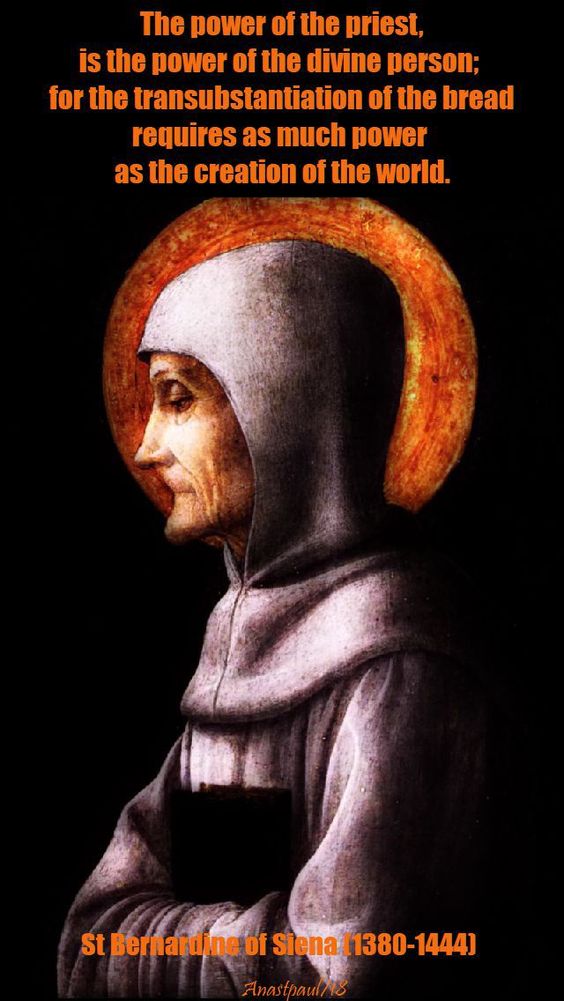
“The power of the priest,
is the power of the divine person,
for the transubstantiation of the bread,
requires as much power,
as the creation of the world.”

St Bernardine of Siena (1380-1444)the power of the priest - st bernardine -2018

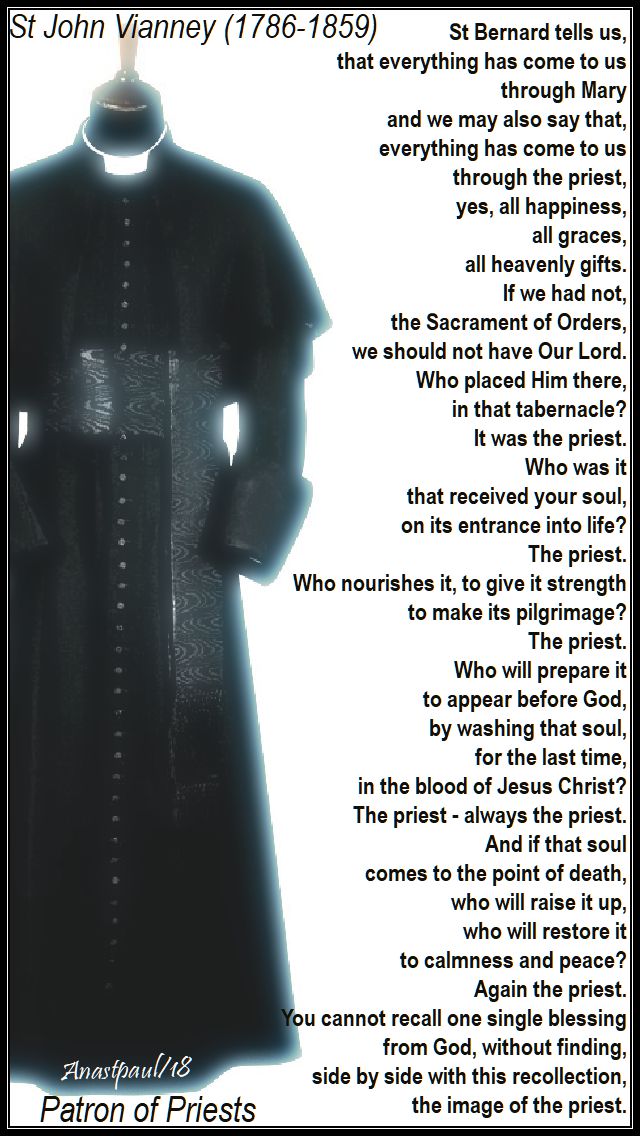
“St Bernard tells us that everything has come to us through Mary
and we may also say that everything has come to us through the priest,
yes, all happiness, all graces, all heavenly gifts.
If we had not the Sacrament of Orders, we should not have Our Lord.
Who placed Him there, in that tabernacle?
It was the priest.
Who was it that received your soul, on its entrance into life?
The priest.
Who nourishes it, to give it strength to make its pilgrimage?
The priest.
Who will prepare it to appear before God, by washing that soul,
for the last time, in the blood of Jesus Christ?
The priest – always the priest.
And if that soul comes to the point of death, who will raise it up,
who will restore it to calmness and peace?
Again the priest.
You cannot recall one single blessing from God,
without finding, side by side with this recollection,
the image of the priest.”st bernard tells us that all things - st john vianney on the priesthood - 18 july 2018

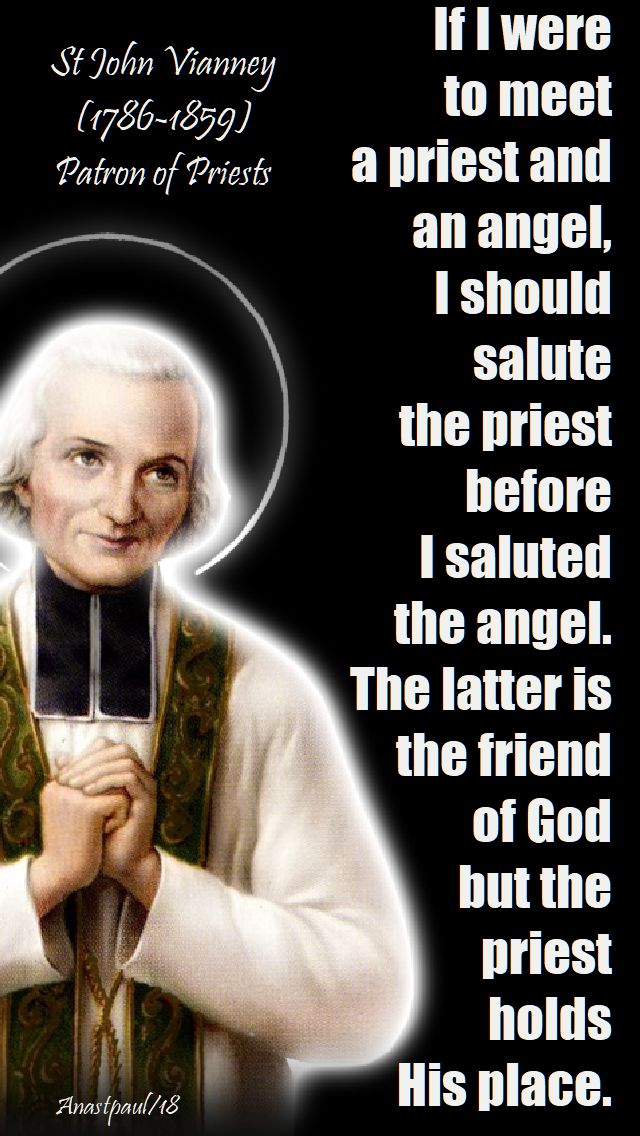
“If I were to meet a priest and an angel,
I should salute the priest before I saluted the angel.
The latter is the friend of God
but the priest holds His place.”

St John Vianney (1786-1859) Patron of Priestsif i were to meet a priest - st john vianney - 18 july 2018

“Day after day, it is necessary to learn,
that I do not possess my life for myself.
Day by day, I must learn to abandon myself,
to keep myself available for whatever He, the Lord,
needs of me at a given moment,
even if other things seem more appealing
and more important to me,
this means giving life, not taking it.”

Pope Benedict XVIday after day it is necessary to learn - pope benedict on the priesthood - 18 july 2018

Posted in FEASTS and SOLEMNITIES, PAPAL SERMONS, SAINT of the DAY, The APOSTLES & EVANGELISTS, VATICAN Resources

Saint of the Day – 3 JULY – Feast of St Thomas, Apostle of Christ

Saint of the Day – 3 JULY _ Feast of St Thomas, Apostle of Christ

Thomas the twin
By Pope Benedict XVI – General Audience, 27 September 2006

Dear Brothers and Sisters,

Continuing our encounters with the Twelve Apostles chosen directly by Jesus, today we will focus our attention on Thomas.  Ever present in the four lists compiled by the New Testament, in the first three Gospels he is placed next to Matthew (cf. Mt 10: 3; Mk 3: 18; Lk 6: 15), whereas in Acts, he is found after Philip (cf. Acts 1: 13).

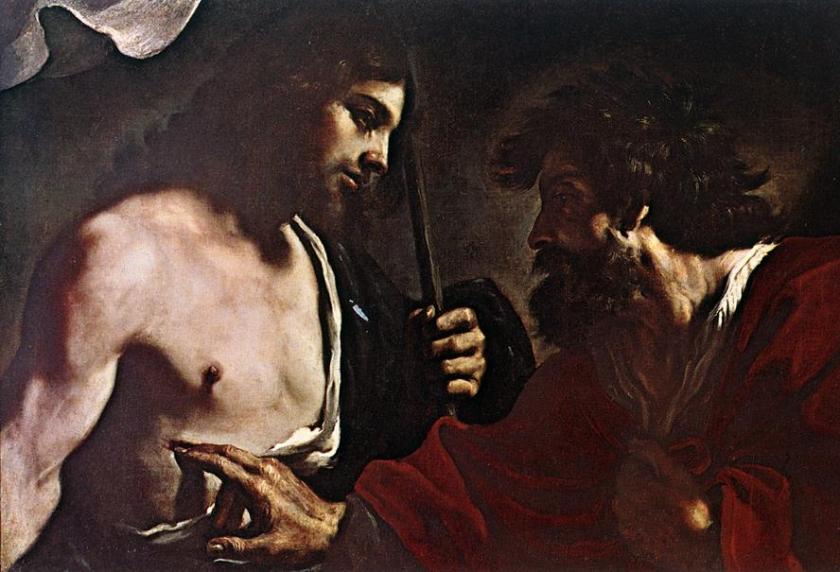
His name derives from a Hebrew root, ta’am, which means “paired, twin”. In fact, John’s Gospel several times calls him “Dydimus” (cf. Jn 11: 16; 20: 24; 21: 2), a Greek nickname for, precisely, “twin”.   The reason for this nickname is unclear.header - St. Thomas the Apostle (2)Header 2 Guercino - Doubting Thomas

It is above all the Fourth Gospel that gives us information that outlines some important traits of his personality.
The first concerns his exhortation to the other Apostles when Jesus, at a critical moment in His life, decided to go to Bethany to raise Lazarus, thus coming dangerously close to Jerusalem (Mk 10: 32).
On that occasion Thomas said to his fellow disciples:  “Let us also go, that we may die with him” (Jn 11: 16).   His determination to follow his Master is truly exemplary and offers us a valuable lesson:  it reveals his total readiness to stand by Jesus, to the point of identifying his own destiny with that of Jesus and of desiring to share with Him the supreme trial of death.

In fact, the most important thing is never to distance oneself from Jesus.
Moreover, when the Gospels use the verb “to follow”, it means that where He goes, his disciple must also go.
Thus, Christian life is defined as a life with Jesus Christ, a life to spend together with Him. St Paul writes something similar when he assures the Christians of Corinth:  “You are in our hearts, to die together and to live together” (II Cor 7: 3).   What takes place between the Apostle and his Christians must obviously apply first of all to the relationship between Christians and Jesus himself: dying together, living together, being in his Heart as He is in ours.

A second intervention by Thomas is recorded at the Last Supper.   On that occasion, predicting his own imminent departure, Jesus announced that He was going to prepare a place for His disciples so that they could be where He is found and He explains to them: “Where [I] am going you know the way” (Jn 14: 4).   It is then that Thomas intervenes, saying: “Lord, we do not know where you are going; how can we know the way?” (Jn 14: 5).
In fact, with this remark he places himself at a rather low level of understanding but his words provide Jesus with the opportunity to pronounce His famous definition:  “I am the Way and the Truth and the Life” (Jn 14: 6).
Thus, it is primarily to Thomas that He makes this revelation but it is valid for all of us and for every age.   Every time we hear or read these words, we can stand beside Thomas in spirit and imagine that the Lord is also speaking to us, just as He spoke to him.
At the same time, his question also confers upon us the right, so to speak, to ask Jesus for explanations.   We often do not understand Him.   Let us be brave enough to say:  “I do not understand you, Lord, listen to me, help me to understand”.   In such a way, with this frankness which is the true way of praying, of speaking to Jesus, we express our meagre capacity to understand and at the same time place ourselves in the trusting attitude of someone who expects light and strength from the One able to provide them.

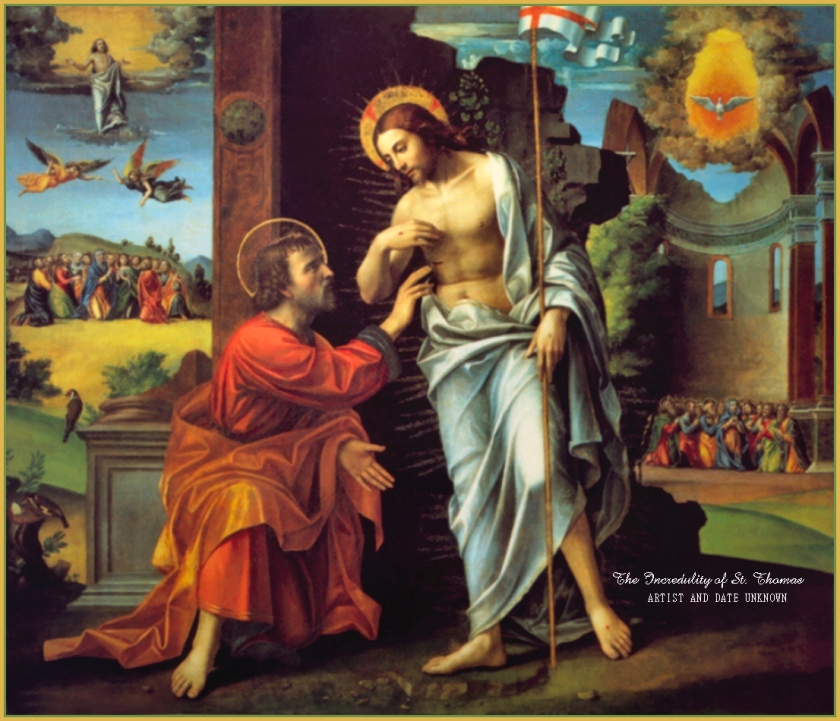
Then, the proverbial scene of the doubting Thomas that occurred eight days after Easter is very well known.   At first he did not believe that Jesus had appeared in his absence and said:  “Unless I see in his hands the print of the nails, and place my finger in the mark of the nails, and place my hand in his side, I will not believe” (Jn 20: 25).
Basically, from these words emerges the conviction that Jesus can now be recognised by His wounds rather than by His face.   Thomas holds that the signs that confirm Jesus’ identity are now above all His wounds, in which He reveals to us how much He loved us. In this the Apostle is not mistaken.

The_Disbelief_of_Saint_Thomas-569ffff65f9b58eba4ae6452
As we know, Jesus reappeared among his disciples eight days later and this time Thomas was present.   Jesus summons him:  “Put your finger here, and see my hands; and put out your hand, and place it in my side; do not be faithless, but believing” (Jn 20: 27).
Thomas reacts with the most splendid profession of faith in the whole of the New Testament:  “My Lord and my God!” (Jn 20: 28).   St Augustine comments on this: Thomas “saw and touched the man and acknowledged the God whom he neither saw nor touched but by the means of what he saw and touched, he now put far away from him every doubt and believed the other” (In ev. Jo. 121, 5).
The Evangelist continues with Jesus’ last words to Thomas:  “Have you believed because you have seen me? Blessed are those who have not seen and yet believe” (Jn 20: 29).   This sentence can also be put into the present:  “Blessed are those who do not see and yet believe”.
In any case, here Jesus spells out a fundamental principle for Christians who will come after Thomas, hence, for all of us.DO---0307--St-Thomas-Apostle-by-Lawrence-Lew-OP_0St. Thomas, Apostle

It is interesting to note that another Thomas, the great Medieval theologian of Aquinas, juxtaposed this formula of blessedness with the apparently opposite one recorded by Luke:  “Blessed are the eyes which see what you see!” (Lk 10: 23).   However, Aquinas comments:  “Those who believe without seeing are more meritorious than those who, seeing, believe” (In Johann. XX lectio VI 2566).

In fact, the Letter to the Hebrews, recalling the whole series of the ancient biblical Patriarchs who believed in God without seeing the fulfilment of His promises, defines faith as “the assurance of things hoped for, the conviction of things not seen” (Heb 11: 1).

The Apostle Thomas’ case is important to us for at least three reasons:  first, because it comforts us in our insecurity;  second, because it shows us that every doubt can lead to an outcome brighter than any uncertainty and, lastly, because, the words that Jesus addressed to him remind us of the true meaning of mature faith and encourage us to persevere, despite the difficulty, along our journey of adhesion to Him.

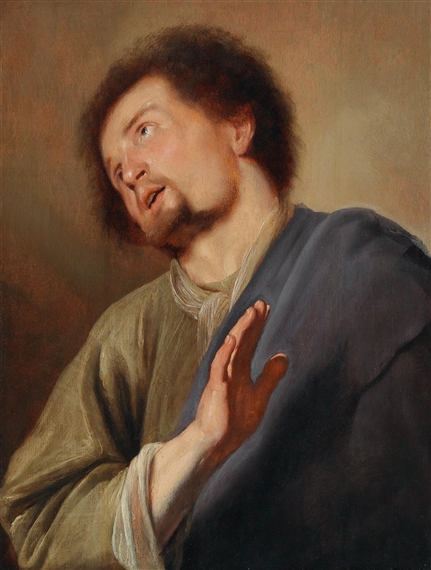
Jan Lievens, The Apostle Saint Thomas

A final point concerning Thomas is preserved for us in the Fourth Gospel, which presents him as a witness of the Risen One in the subsequent event of the miraculous catch in the Sea of Tiberias (cf. Jn 21: 2ff.).
On that occasion, Thomas is even mentioned immediately after Simon Peter:  an evident sign of the considerable importance that he enjoyed in the context of the early Christian communities.
Indeed, the Acts and the Gospel of Thomas, both apocryphal works but in any case important for the study of Christian origins, were written in his name.

Lastly, let us remember that an ancient tradition claims that Thomas first evangelised Syria and Persia (mentioned by Origen, according to Eusebius of Caesarea, Ecclesiastical History 3, 1) then went on to Western India (cf. Acts of Thomas 1-2 and 17ff.), from where also he finally reached Southern India.

Let us end our reflection in this missionary perspective, expressing the hope that Thomas’ example will never fail to strengthen our faith in Jesus Christ, Our Lord and Our God. Amen…Pope Benedict, vatican.vaTHOMAS - verrocch_ph96_pl124_050404

THOMAS - verrocchio_gp69_28_012503
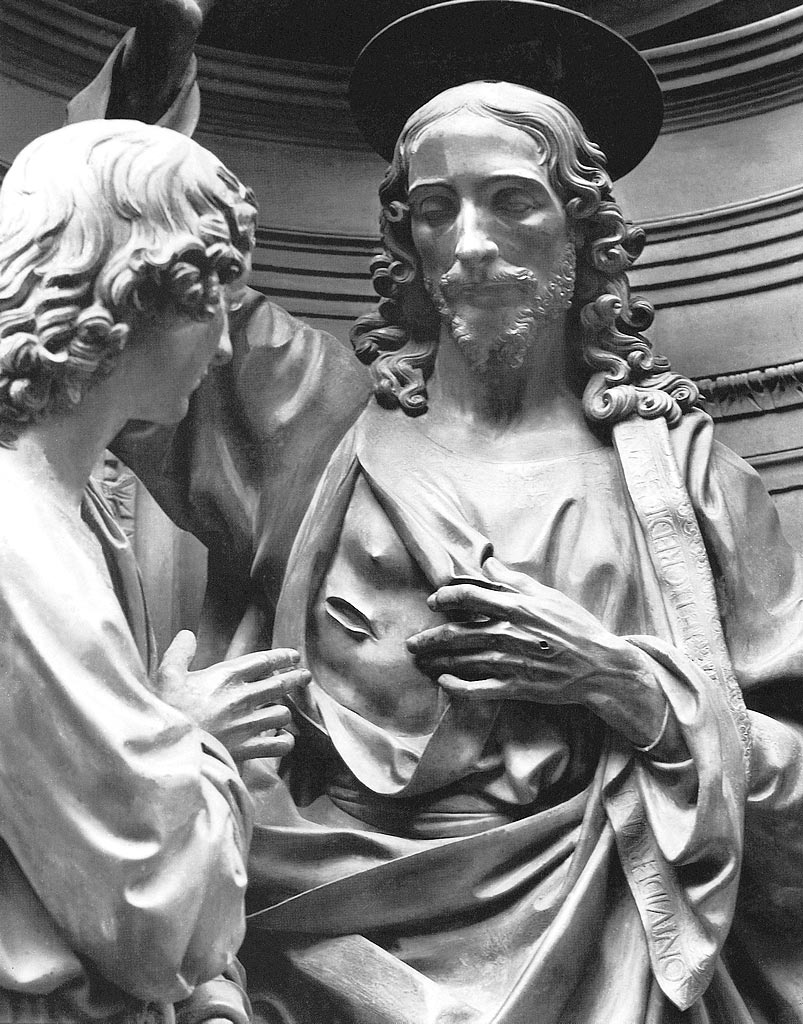
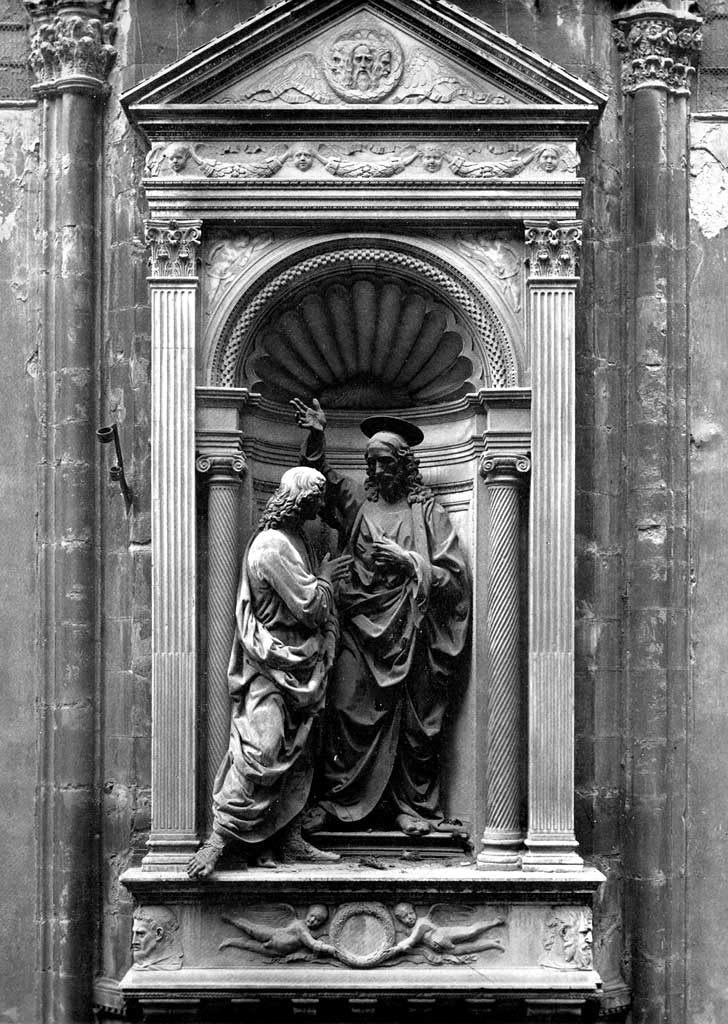
Christ and St Thomas – San Michele, Florence by Andrea del Verrocchio 1465-1483

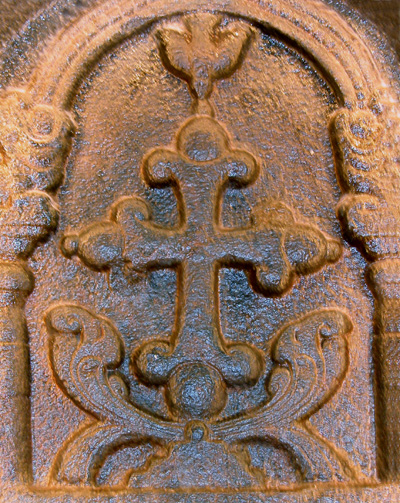
There is a large population of native Christians who call themselves ‘the Christians of St Thomas’.   They have an ancient oral tradition that he landed at Cranganoreon, the west coast and established seven churches in Malabar though his landing on the west coast is disputed today, the rest is not. He then passed eastward to the Coromandel Coast, where he was Martyred, by spearing, on the ‘Big Hill’, eight miles from Madras and was buried at Mylapore, now a suburb of that city.   There are several medieval references to the tomb of St Thomas in India, some of which name Mylapore and in 1522 the Portuguese discovered the tomb there, with certain small relics now preserved in the cathedral of St Thomas at Mylapore.   But the bulk of his relics were certainly at Edessa in the fourth century, as the Acta Thomae relate.   They were later translated from Edessa to the island of Khios in the Aegean and from thence to Ortona in the Abruzzi, where they are still venerated.

When St Francis Xavier came to India, the signs of blood were still to be seen on the cross where the murderous deed of the martyrdom of St Thomas was committed and more than once drops of blood appeared on this cross during the celebration of Mass, when crowds of people were present.   St Xavier, shortly after his arrival in India, went to the tomb of St Thomas, and passed many days and nights there in prayer. He begged God fervently to bestow upon him the Spirit and zeal of this holy Apostle, that he might be able to restore the Christian faith which St Thomas had preached there but which had gradually been entirely exterminated.   Before undertaking any important work, he went, if possible, to the tomb of St Thomas and when this was impossible, he invoked the holy Apostle’s intercessio, and endeavoured to follow his example in all things.

the bleeding cross
The Bleeding Cross

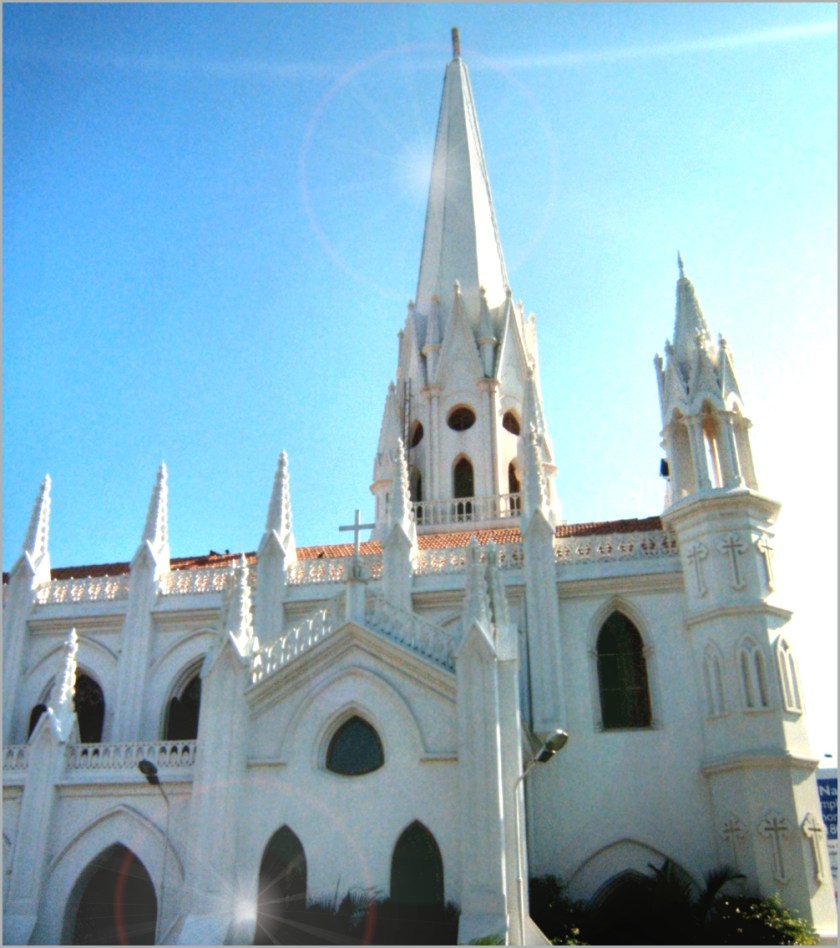
Saint Thomas was declared the “Apostle of India” by Pope Paul VI in 1972.   Below is the St Thomas Cathedral in Madras, India.

More info with patronages etc and many pics here:  https://anastpaul.wordpress.com/2017/07/03/saint-of-the-day-3-july-st-thomas-the-apostle-of-christ/apostle-thomas5b-madras cathedralrubens-san-giacomo-minoresnip st thomas

Posted in Uncategorized

Congratulations, Prayers and Love to Pope Emeritus Benedict XVI on the occasion of the 67th Anniversary of his Priestly Ordination

Congratulations, Prayers and Love to Pope Emeritus Benedict XVI on the occasion of the 67th Anniversary of his Priestly Ordinationcongrats-67-years-29-june-papa-b.29 june 2018

PRAYER FOR POPE EMERITUS BENEDICT XVI

ON THE 67TH ANNIVERSARY OF HIS ORDINATION – 29 JUNE 2018

Most gracious Heavenly Father,
We thank You for our faithful Pope Emeritus Benedict XVI,
whose spiritual fatherhood and example of fidelity,
self-sacrifice, humility and devotion
has been so vital to the faith of Your people
through 67 years of living his role as Your earthly shepherd.
May our spiritual father, who continues his mission for his flock
be always guided by the examples of Saints Peter and Paul,
all the Apostles and their saintly successors.
Give him valiant strength in his twilight years,
hope in times of trouble and sorrow and steadfast love for You,
and for all Your people throughout the world.
May the light of Your Truth continue to shine through him.
We thank You for blessing Pope Emeritus Benedict with his
continued generosity in imparting his knowledge to all Your children.
Bless him and keep him and protect him
and let him know that he is greatly loved and respected.
Our prayers arise to You, our Father for our beloved Pope Benedict
Through Christ, our Lord.
Amenprayer for pope benedict XVI on his 67 anniversary - 29 june 2018

Posted in DOCTORS of the Church, FATHERS of the Church, ON the SAINTS, PAPAL SERMONS, SAINT of the DAY, VATICAN Resources

Saint of the Day – 27 June – St Cyril of Alexandria (376-444) Father and Doctor of the Church

Saint of the Day – 27 June – St Cyril of Alexandria (376-444) Father and Doctor of the Church – “The Pillar of Faith” & “Seal of all the Fathers”Doctor Incarnationis (Doctor of the Incarnation) – Patronage – Alexandria, Egypt.

Pope Benedict’s Catechesis on The Fathers of the Church
St Cyril of Alexandria
Wednesday, 3 October 2007

Today too, continuing our journey following the traces left by the Fathers of the Church, we meet an important figure:  St Cyril of Alexandria.   Linked to the Christological controversy which led to the Council of Ephesus in 431 and the last important representative of the Alexandrian tradition in the Greek Orient, Cyril was later defined as “the guardian of exactitude” – to be understood as guardian of the true faith – and even the “seal of the Fathers”.   These ancient descriptions express clearly a characteristic feature of Cyril:  the Bishop of Alexandria’s constant reference to earlier ecclesiastical authors (including, in particular, Athanasius), for the purpose of showing the continuity with tradition of theology itself.   He deliberately, explicitly inserted himself into the Church’s tradition, which he recognised as guaranteeing continuity with the Apostles and with Christ himself.   Venerated as a Saint in both East and West, in 1882 St Cyril was proclaimed a Doctor of the Church by Pope Leo XIII, who at the same time also attributed this title to another important exponent of Greek Patristics, St Cyril of Jerusalem (315-387).   Thus are revealed the attention and love for the Eastern Christian traditions of this Pope, who later also chose to proclaim St John Damascene (675-749) a Doctor of the Church, thereby showing that both the Eastern and Western traditions express the doctrine of Christ’s one Church.header - st cyril of alexandria

We have almost no information on Cyril’s life prior to his election to the important See of Alexandria.   He was a nephew of Theophilus, who had governed the Diocese of Alexandria as Bishop since 385 AD with a prestigious and iron hand. It is likely that Cyril was born in this Egyptian metropolis between 370 and 380 A.D., was initiated into ecclesiastical life while he was still very young and received a good education, both culturally and theologically. In 403, he went to Constantinople in the retinue of his powerful uncle.   It was here that he took part in the so-called “Synod of the Oak” which deposed the Bishop of the city, John (later known as “Chrysostom”) and thereby marked the triumph of the Alexandrian See over its traditional rival, the See of Constantinople, where the Emperor resided.   Upon his uncle Theophilus’ death, the still young Cyril was elected in 412 as Bishop of the influential Church of Alexandria, which he governed energetically for 32 years, always seeking to affirm her primacy throughout the East, strong also because of her traditional bonds with Rome.

Two or three years later, in 417 or 418, the Bishop of Alexandria showed himself to be realistic in mending the broken communion with Constantinople, which had lasted by then since 406 as a consequence of Chrysostom’s deposition.   But the old conflict with the Constantinople See flared up again about 10 years later, when in 428 Nestorius was elected, a severe and authoritarian monk trained in Antioch.   The new Bishop of Constantinople, in fact, soon provoked opposition because he preferred to use as Mary’s title in his preaching “Mother of Christ” (Christotòkos) instead of “Mother of God” (Theotòkos), already very dear to popular devotion.   One reason for Bishop Nestorius’ decision was his adherence to the Antiochean type of Christology, which, to safeguard the importance of Christ’s humanity, ended by affirming the division of the Divinity. Hence, the union between God and man in Christ could no longer be true, so naturally it was no longer possible to speak of the “Mother of God”.st cyril of alexandria - detail

The reaction of Cyril – at that time the greatest exponent of Alexandrian Christology, who intended on the other hand to stress the unity of Christ’s person – was almost immediate, and from 429 he left no stone unturned, even addressing several letters to Nestorius himself.   In the second of Cyril’s letters to Nestorius (PG 77, 44-49), written in February 430, we read a clear affirmation of the duty of Pastors to preserve the faith of the People of God.   This was his criterion, moreover, still valid today:  the faith of the People of God is an expression of tradition, it is a guarantee of sound doctrine.   This is what he wrote to Nestorius:  “It is essential to explain the teaching and interpretation of the faith to the people in the most irreproachable way and to remember that those who cause scandal, even to only one of the little ones, who believe in Christ, will be subjected to an unbearable punishment”.

In the same letter to Nestorius – a letter which later, in 451, was to be approved by the Council of Chalcedon, the Fourth Ecumenical Council – Cyril described his Christological faith clearly:  “Thus, we affirm that the natures are different that are united in one true unity but from both, has come only one Christ and Son, not because, due to their unity, the difference in their natures has been eliminated but rather, because divinity and humanity, reunited in an ineffable and indescribable union, have produced for us one Lord and Christ and Son”.   And this is important –  true humanity and true divinity are really united in only one Person, Our Lord Jesus Christ. Therefore, the Bishop of Alexandria continued:  “We will profess only one Christ and Lord, not in the sense that we worship the man together with the Logos, in order not to suggest the idea of separation by saying “together’ but in the sense that we worship only one and the same, because He is not extraneous to the Logos, His body, with which He also sits at His Father’s side, not as if “two sons” are sitting beside Him but only one, united with His own flesh”.Icon_St._Cyril_of_Alexandria

And soon the Bishop of Alexandria, thanks to shrewd alliances, obtained the repeated condemnation of Nestorius, by the See of Rome, consequently with a series of 12 anathemas which he himself composed and finally, by the Council held in Ephesus in 431, the Third Ecumenical Council.   The assembly which went on with alternating and turbulent events, ended with the first great triumph of devotion to Mary and with the exile of the Bishop of Constantinople, who had been reluctant to recognise the Blessed Virgin’s right to the title of “Mother of God” because of an erroneous Christology that brought division to Christ Himself.    After thus prevailing against his rival and his doctrine, by 433 Cyril was nevertheless already able to achieve a theological formula of compromise and reconciliation with the Antiocheans.   This is also significant, on the one hand, is the clarity of the doctrine of faith but in addition, on the other, the intense search for unity and reconciliation.   In the following years he devoted himself in every possible way to defending and explaining his theological stance, until his death on 27 June 444.

Cyril’s writings – truly numerous and already widely disseminated in various Latin and Eastern translations in his own lifetime, attested to by their instant success – are of the utmost importance for the history of Christianity.   His commentaries on many of the New and Old Testament Books are important, including those on the entire Pentateuch, Isaiah, the Psalms and the Gospels of John and Luke.   Also important are his many doctrinal works, in which the defence of the Trinitarian faith against the Arian and Nestorian theses recurs.   The basis of Cyril’s teaching is the ecclesiastical tradition and in particular, as I mentioned, the writings of Athanasius, his great Predecessor in the See of Alexandria.   Among Cyril’s other writings, the books Against Julian deserve mention. They were the last great response to the anti-Christian controversies, probably dictated by the Bishop of Alexandria in the last years of his life to respond to the work Against the Galileans, composed many years earlier in 363 by the Emperor known as the “Apostate” for having abandoned the Christianity in which he was raised.st-cyril-of-alexandria-4

The Christian faith is first and foremost the encounter with Jesus, “a Person, which gives life a new horizon” (Deus Caritas Est, n. 1).   St Cyril of Alexandria was an unflagging, staunch witness of Jesus Christ, the Incarnate Word of God, emphasising above all his unity, as he repeats in 433 in his first letter (PG 77, 228-237) to Bishop Succensus:  “Only one is the Son, only one the Lord Jesus Christ, both before the Incarnation and after the Incarnation.   Indeed, the Logos born of God the Father was not one Son and the one born of the Blessed Virgin another but we believe, that the very One who was born before the ages, was also born according to the flesh and of a woman”.   Over and above its doctrinal meaning, this assertion shows that faith in Jesus the Logos born of the Father is firmly rooted in history because, as St Cyril affirms, this same Jesus came in time with His birth from Mary, the Theotò-kos and in accordance with His promise will always be with us.

And this is important –  God is eternal, He is born of a woman and He stays with us every day.   In this trust we live, in this trust we find the way for our life…. Pope Benedict XVI

For more on St Cyril here : https://anastpaul.wordpress.com/2017/06/27/saint-of-the-day-27-june-st-cyril-of-alexandria-doctor-father-of-the-church-the-pillar-of-faith-seal-of-all-the-fathers-doctor-incarnationis-doctor-of-the-incarnation/cyril in prague.jpg


Posted in MORNING Prayers, ON the SAINTS, POETRY, SAINT of the DAY

Thought for the Day – 22 June – The Memorial of St Paulinus of Nola (c 354-431)

Thought for the Day – 22 June – The Memorial of St Paulinus of Nola (c 354-431)

Of him, Pope Benedict XVI said:

“In our catechesis on the great teachers of the early Church, we now turn to Saint Paulinus, the Bishop of Nola in southern Italy.
A native of Bordeaux in Gaul, Paulinus became the Roman governor of Campania, where, after encountering the depth of popular devotion to Saint Felix Martyr, he was led to embrace the Christian faith.   After the tragic loss of their first child, he and his wife sold their goods and undertook a life of chastity and prayer.
Ordained a priest and then Bishop of Nola, Paulinus distinguished himself by his charity to the poor during the troubled times of the barbarian invasions.
A man of letters and a gifted poet, Paulinus placed his art at the service of Christ and the Church. In his poetry and his vast correspondence, Paulinus expressed his deep faith and his love of the poor.   

His letters to such contemporary churchmen as Saints Ambrose, Augustine, Jerome and Martin of Tours, reflect his asceticism, his deep sense of the Church’s communion and his cultivation of the practice of spiritual friendship as a means of experiencing that communion within the mystery of Christ’s mystical Body, enlivened by the Holy Spirit.”
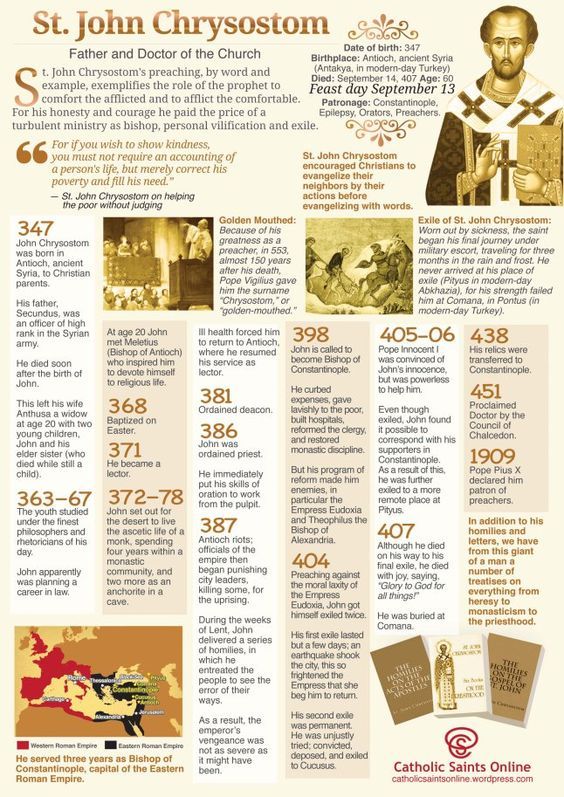
Many of us are tempted to “retire” early in life, after an initial burst of energy.   Devotion to Christ and His work is waiting to be done all around us.   Paulinus’ life had scarcely begun when he thought it was over, as he took his ease on that estate in Spain.   “Man proposes, but God disposes.”

The life of Saint Paulinus is one of great accomplishments and positions—none more important than those which began with his baptism into the faith.   As with all baptism, Paulinus was made anew, filled with the Holy Spirit and through this rebirth, was able to devote himself to the holy work of God, serving others and bringing many to the faith. Today, we pray for a renewal of our own baptismal promise, awake and alive in our faith!

The Word of the Cross

by Saint Paulinus of Nola

Look on thy God, Christ hidden in our flesh.
A bitter word, the cross, and bitter sight:
Hard rind without, to hold the heart of heaven.
Yet sweet it is; for God upon that tree
Did offer up His life: upon that rood
My Life hung, that my life might stand in God.
Christ, what am I to give Thee for my life?
Unless take from Thy hands the cup they hold,
To cleanse me with the precious draught of death.
What shall I do? My body to be burned?
Make myself vile? The debt’s not paid out yet.
Whate’er I do, it is but I and Thou,
And still do I come short, still must Thou pay
My debts, O Christ;  for debts Thyself hadst none.
What love may balance Thine? My Lord was found
In fashion like a slave, that so His slave
Might find himself in fashion like his Lord.
Think you the bargain’s hard, to have exchanged
The transient for the eternal, to have sold
Earth to buy Heaven? More dearly God bought me.

St Paulinus of Nola, Pray for us!st paulinus of nola pray for us - 22 june 2018

Posted in DOCTORS of the Church, EUCHARISTIC Adoration, MORNING Prayers, QUOTES - J R R Tolkien and MORE, QUOTES of the SAINTS, QUOTES on PRAYER, SPEAKING of ....., The HOLY EUCHARIST / The HOLY MASS

Quote/s of the Day – 18 June – The Memorial of St Romuald (c 951-1027)

Quote/s of the Day – 18 June – The Memorial of St Romuald (c 951-1027)

Speaking of: Prayer

“It is better to say
one Our Father fervently
and devoutly
than a thousand,
with no devotion
and full of distraction.”

St Edmund (841-869)it is better to say one our father - st edmund - king and martyr - 18 june 2018

“Sit in your cell as in paradise.
Put the whole world
behind you and forget it.
Watch your thoughts
like a good fisherman
watching for fish.”

St Romuald (c 951-1027)sit in your cell as in paradise - st romuald - 18 june 2018

“Were you to ask,
‘what are the means
of overcoming temptations’,
I would answer:
The first means is prayer;
the second is prayer;
the third is prayer;
and should you ask me,
a thousand times,
I would repeat the same.”

St Alphonsus Liguori (1696-1787)
Most Zealous Doctorwere you to ask - st alphonsus - 18 june 2018

“When we speak to Jesus
with simplicity and with all our heart,
He does like a mother
who holds her child’s head with her hands
and covers it with kisses and caresses.”

St John Vianney (1786-1859)when we speak to jesus - st john vianney - 19 june 2018

“Jesus is waiting
for you
in the chapel.
Go and find Him.”

St Jeanne Jugan (1792-1879) 30 Augustjesus is waiting for you in the chapel - st jeanne jugan - 19 june 2018

“To clasp the hands in prayer
is a beginning of an uprising
against the disorder of the world.”

Karl Barth (1886-1968)to clasp the hands in prayer - karl barth - 19 june 2018

“Friends,
do not be afraid
of silence or stillness.
Listen to God.
Adore Him in the Eucharist.”

Pope Benedict XVIfriends, do not be afraid - pope benedict - 18 june 2018

“Turn your car into a monastery.”

Bishop Robert Barronturn your car into a monastery - bishop robert barron - 18 june 2018

“Seek a relationship
when you pray, not answers.
You won’t always find answers
but you will always find Jesus.”

Father Mike Schmitzseek a relationship when you pray - fr mike schmitz - 18 june 2018

Posted in EUCHARISTIC Adoration, MORNING Prayers, PAPAL SERMONS, QUOTES - J R R Tolkien and MORE, QUOTES on CHARITY, SAINT of the DAY, The HOLY EUCHARIST / The HOLY MASS

Thought for the Day – 4 June – Ninth Week in Ordinary Time, Year B and the Memorial of St Filippo Smaldone (1848-1923)

Thought for the Day – 4 June – Ninth Week in Ordinary Time, Year B and the Memorial of St Filippo Smaldone (1848-1923) – Apostle of Eucharistic Adoration and of Charity

Speaking of: Eucharistic Adoration

“St Filippo Smaldone, son of South Italy, knew how to instil in his life the higher virtues characteristic of his land.

A priest with a great heart nourished continuously on prayer and Eucharistic Adoration, he was above all, a witness and servant of charity, which he manifested in an eminent way through service to the poor, in particular to deaf-mutes, to whom he dedicated himself entirely.

The work that he began developed thanks to the Congregation of the Salesian Sisters of the Sacred Hearts, founded by him and which spread to various parts of Italy and the world.

St Filippo Smaldone saw the image of God reflected in deaf-mutes and he used to repeat that, just as we prostrate before the Blessed Sacrament, so we should kneel before a deaf-mute.

From his example we welcome the invitation to consider the ever indivisible love for the Eucharist and love for one’s neighbour.   But the true capacity to love the brethren, can come only, from meeting with the Lord in the Sacrament of the Eucharist.”

Pope Benedict XVI on the Canonisation of St Filippo Smaldone, St Peter’s Square, Sunday, 15 October 2006consider the ever indivisble love of the eucharist and love neighbour - pope benedict - 4 june 2018

St Filippo Smaldone, Pray for us!st filippo smaldone - pray for us no 2 - 4 june 2018

Posted in CATHOLIC DEVOTIONS of the Month, MARIAN DEVOTIONS, MARIAN PRAYERS, MARIAN QUOTES, MARIAN TITLES, MORNING Prayers, PAPAL ENCYLICALS, The BLESSED VIRGIN MARY

Our Morning Offering – 25 May “Mary’s Month”

Our Morning Offering – 25 May “Mary’s Month” Friday of the Seventh Week in Ordinary Time, Year B

Mary, Virgin and Mother,
shows us what love is
and whence it draws its origin
and its constantly renewed power.
To her we entrust the Church
and her mission in the service of love.

Pope Benedict XVI:
Deus Caritas Est, 42

Holy Mary, Mother of God
By Pope Benedict XVI:
Deus Caritas Est, 42

Holy Mary, Mother of God,
you have given the world its true light,
Jesus, your Son – the Son of God.
You abandoned yourself completely
to God’s call and this became a wellspring
of the goodness which flows forth from Him.
Show us Jesus.
Lead us to Him.
Teach us to know and love Him,
so that we too, can become capable of true love
and be fountains of living water
in the midst of a thirsting world.

Amenholy mary mother of god by pope benedict deus caritas est no 42 - 25 may 2018

Posted in CATHOLIC DEVOTIONS of the Month, EUCHARISTIC Adoration, MARIAN QUOTES, MARY, MATER ECCLESIAE, MORNING Prayers, PAPAL ENCYLICALS, PRACTISING CATHOLIC, QUOTES - J R R Tolkien and MORE, The BLESSED VIRGIN MARY, The HOLY EUCHARIST / The HOLY MASS

Quote/s of the Day – 11 May – “Mary’s Month!” – Friday of the Sixth Week of Eastertide

Quote/s of the Day – 11 May – “Mary’s Month!” – Friday of the Sixth Week of Eastertide

“Who, more than Mary, could be, a star of hope for us?
With her “yes”, she opened the door of our world,
to God Himself;  she became the living Ark of the Covenant,
in whom God took flesh, became one of us
and pitched His tent among us.”

Spe Salvi 49who, more than mary - pope benedict XVI - 11 may 2018

“Consequently, every time we approach
the Body and Blood of Christ in the Eucharistic liturgy,
we also turn to her who, by her complete fidelity,
received Christ’s sacrifice for the whole Church.
The Synod Fathers rightly declared that
“Mary inaugurates the Church’s participation
in the sacrifice of the Redeemer.”
She is the Immaculata, who receives God’s gift
unconditionally and is thus associated with His work of salvation.
Mary of Nazareth, icon of the nascent Church,
is the model for each of us, called to receive the gift
that Jesus makes of Himself in the Eucharist.”

Sacramentum Caritatis 33

Pope Benedict XVIevery time we approach the body and blood of christ - pope benedict - 11 may 2018

Posted in JESUIT SJ, MORNING Prayers, QUOTES - J R R Tolkien and MORE, QUOTES of the SAINTS, QUOTES on CHARITY, QUOTES on DIVINE PROVIDENCE, QUOTES on LOVE, QUOTES on MERCY, SPEAKING of .....

Quote/s of the Day – 30 April – Monday of the Fifth Week of Eastertide and the Memorial of St Joseph Benedict Cottolengo (1786-1842) – known as “The Labourer of Divine Providence”.

Quote/s of the Day – 30 April – Monday of the Fifth Week of Eastertide and the Memorial of St Joseph Benedict Cottolengo (1786-1842) – known as “The Labourer of Divine Providence”.

Speaking of:  Recognising God’s Hand

“There is absolutely nothing
that gives us more peace, 
or does more to make us holy,
than obeying the will of God.”there is absolutely nothing - fr jean pierre de caussade - 30 april 2018

“God makes all chosen souls, pass through
a fearful time of poverty,
misery and nothingness.
He desires to destroy in them gradually,
all the help and confidence they derive
from themselves, so that He may be
their sole source of support,
their confidence,
their hope,
their only resource.”god makes all chosen souls pass - fr jean pierre de caussade - 30 april 2018

“We must offer ourselves to God
like a clean, smooth canvas
and not worry ourselves about
what God may choose to paint on it
but at each moment,
feel only, the stroke of His brush.”

Fr Jean Pierre de Caussade (1675-1751)
‘Abandonment to Divine Providence’we must offer ourselves - fr jean pierre de caussade - 30 april 2018

“The poor are Jesus
they are not just an image of Him.”

St Joseph Benedict Cottolengo (1786-1842)the poor are jesus - st joseph benedict cottolengo - 30 april 2018

“The Lord always sets signs on our path
to guide us according to His will, 
to our own true good.”

Pope Benedict XVIthe lord always set signs - pope benedict - 30 april 2018

“If you do this one thing
you will become a saint.
If you don’t do it,
you never will.
The one thing is this:
Let Jesus interrupt your life.”

Father Mike Schmitzif you do this one thing - fr mike - 30 april 2018

Posted in PAPAL SERMONS, SAINT of the DAY, VATICAN Resources

Saint of the Day – 30 April – St Joseph Benedict Cottolengo (1786-1842) – An Intense Day of Love

Saint of the Day – 30 April – St Joseph Benedict Cottolengo (1786-1842) Priest, Founder, Confessor, Apostle of Charity.   Born as Giuseppe Benedetto Cottolengo on 3 May 1786 at Bra, Cuneo, Piedmont region, Italy and died on 30 April 1842 of typhus at Chieri, Turin, Italy.  He was buried in the Mary altar in the main chapel in Valdocco, Italy.   St Joseph was Canonised on 19 March 1934 by Pope Pius XI.   Known as “the labourer of Divine Providence”.

Header - st joseph benedetto cottolengo

“Joseph Benedict Cottolengo was born in Bra, a small town in the Province of Cuneo, on 3 May 1786.   The eldest of 12, six of whom died in infancy, he showed great sensitivity to the poor from childhood.   He embraced the way of the priesthood, setting an example to two of his brothers.   The years of his youth coincided with the Napoleonic period and the consequent hardships in both the religious and social contexts.   Cottolengo became a good priest much sought after by penitents and, in the Turin of that time, a preacher of spiritual exercises and conferences for university students who always met with noteworthy success.   At the age of 32, he was appointed canon of the Santissima Trinità, a congregation of priests whose task was to officiate in the Corpus Domini Church and to ensure the decorum of the city’s religious ceremonies but he felt uneasy in this situation.   God was preparing him for a special mission and, precisely with an unexpected and decisive encounter, made him realise what was to be his future destiny in the exercise of the ministry.

The Lord always sets signs on our path to guide us according to his will to our own true good.   This also happened to Cottolengo, dramatically, on Sunday morning, 2 September 1827.   The diligence from Milan arrived in Turin, more crowded than ever.   Crammed into it was a whole French family.   The mother, with five children, was at an advanced stage of pregnancy and had a high temperature.   After traipsing to various hospitals, this family found lodgings in a public dormitory but the woman’s situation was serious and some people went in search of a priest.   By a mysterious design they came across Cottolengo and it was precisely he who, heavy hearted, accompanied this young mother to her death, amid the distress of the entire family.   Having carried out this painful task, with deep anguish he went to the Blessed Sacrament and knelt in prayer:  “My God, why?   Why did you want me to be a witness?   What do you want of me?  Something must be done!”.   He got to his feet and had all the bells rung and the candles lit and, gathering in the church those who were curious, told them:  “The grace has been granted!   The grace has been granted!”.   From that time Cottolengo was transformed: all his skills, especially his financial and organisational ability, were used to give life to projects in support of the neediest.

In his undertaking he was able to involve dozens and dozens of collaborators and volunteers.   Moving towards the outskirts of Turin to expand his work, he created a sort of village, in which he assigned a meaningful name to every building he managed to build:  “House of Faith”, “House of Hope”, “House of Charity”.   He adopted a “familystyle”, establishing true and proper communities of people with volunteers, men and women religious and lay people, who joined forces in order to face and overcome the difficulties that arose.   Everyone in that Little House of Divine Providence had a precise task:  work, prayer, service, teaching or administration.   The healthy and the sick shared the same daily burden.   With time religious life could be specifically planned in accordance with particular needs and requirements.

 430piccolacasa

Cottolengo even thought of setting up his own seminary to provide specific formation for the priests of his Work.   He was always ready to follow and serve Divine Providence and never questioned it.   He would say:  “I am a good for nothing and I don’t even know what to make of myself.   But Divine Providence certainly knows what it wants.   It is only up to me to support it. Let us go ahead in Domino”.   To his poor and the neediest, he would always call himself “the labourer of Divine Providence”.

St Joseph Benedict Cottolengo 7st joseph benedetto cottolengo.4st joseph benedetto cottolengo.3

He also chose to found beside the small citadels five monasteries of contemplative sisters and one of hermits and considered them among his most important achievements.   They were a sort of “heart” which was to beat for the entire Work.   He died on 30 April 1842, with these words on his lips:  “Misericordia, Domine, Misericordia, Domine.   Good and Holy Providence… Blessed Virgin, it is now up to you”.   The whole of his life, as a newspaper of the time said, was “an intense day of love”.”….Pope Benedict XVI General Audience, Saint Peter’s Square, Wednesday, 28 April 2010.

Today Cottolengo Fathers, Sisters and Brothers still work together in activities focused on communicating God’s love for the poorest. They are spread out all over the world: Ecuador, India, Italy, Kenya, Switzerland, Tanzania and the United States.   Don Cottolengo contracted typhoid while assisting his patients and died in Chieri, Piedmont on 30 April 1842.   Cottolengo was beatified by Pope Benedict XV in 1917 and was Canonised by Pope Pius XI in 1934.
Joseph Benedict Cottolengo was enlisted among the saints of charity by Pope Benedict XVI in his encyclical Deus caritas est.   The parish of Saint Joseph Benedict Cottolengo is located in Grosseto, Italy.   There is a Via San Giuseppe Benedetto Cottolengo in Pisa.

StJosephCottolengo30-4a

The Sisters of St. Joseph Cottolengo pray before the blessed sacrament inside the Chiesa Piccola.jpg
The Sisters of St Joseph Cottolengo pray before the blessed sacrament inside the Chiesa Piccola
cottolengo sisters
Cottolengo Sisters at Prayer
Posted in CATECHESIS, EASTER, FEASTS and SOLEMNITIES, MORNING Prayers, ON the SAINTS, PAPAL MESSAGES, PAPAL SERMONS, QUOTES - J R R Tolkien and MORE, QUOTES on FAITH, QUOTES on LOVE, QUOTES on the CHURCH, SAINT of the DAY, The WORD

Thought for the Day – 25 April – Wednesday of the Fourth Week of Easter and the Feast of St Mark the Evangelist

Thought for the Day – 25 April – Wednesday of the Fourth Week of Easter and the Feast of St Mark the Evangelist

Today we celebrate St Mark, the Evangelist, the first Gospel writer and the friend of Sts Peter and Paul, the cousin of St Barnabas and our Father in faith – our friend too, a chosen member of the Catholic Church who has gone before to show us the way.   Mark knew there would be difficulties for believers in every age, for the persecution of the early Church was the beginning “of the labour pains” (13:8), since “the Gospel must first be preached to all nations” (13:10).   He has given us a moving story of how God works in mysterious ways and shown us in the actions of Jesus how to be patient in our faith even in the most troubling circumstances, for “he is going before you to Galilee; there you will see him as he told you” (16:7).   This narrative could only have been created by someone who himself knew suffering, the pain of unfulfilled hopes and the sorrow of untimely death.   His faith made him write about it.   His hope makes it so convincing!   Let us listen to Pope Benedict on being a Catholic today, now, in the world we live in!

Chosen:   I think it is worth reflecting on this word.   We are chosen.   God has always known us, even before our birth, before our conception, God wanted me as a Christian, as a Catholic, He wanted me as a priest.   God thought of me, He sought me among millions, among a great many, He saw me and He chose me.   It was not for my merits, which were non-existent but out of His goodness;  He wanted me to be a messenger of His choice, which is also always a mission, above all a mission and a responsibility for others.   Chosen: we must be grateful and joyful for this event.   God thought of me, he chose me as a Catholic, me, as a messenger of His Gospel, as a priest.   In my opinion it is worth reflecting several times on this and coming back to this fact of His choice;  He chose me, He wanted me, now I am responding.

Perhaps today we are tempted to say:  we do not want to rejoice at having been chosen, for this would be triumphalism.   It would be triumphalism to think that God had chosen me because I was so important.   This would really be erroneous triumphalism. However, being glad because God wanted me is not triumphalism.   Rather, it is gratitude and I think we should relearn this joy:  God wanted me to be born in this way, into a Catholic family, he wanted me to know Jesus from the first.   What a gift to be wanted by God so that I could know His face, so that I could know Jesus Christ, the human face of God, the human history of God in this world!   Being joyful because He has chosen me to be a Catholic, to be in this Church of His, where subsistit Ecclesia unica;  we should rejoice because God has given me this grace, this beauty of knowing the fullness of God’s truth, the joy of his love.

Chosen:  a word of privilege and at the same time of humility.   However “chosen” — as I said — is accompanied by the word “parepidemois”, exiles, foreigners.   As Christians we are dispersed and we are foreigners:  we see that Christians are the most persecuted group in the world today, because it does not conform, because it is a stimulus, because it opposes the tendencies to selfishness, to materialism and to all these things.

Christians are certainly not only foreigners; we are also Christian nations, we are proud of having contributed to the formation of culture, there is a healthy patriotism, a healthy joy of belonging to a nation that has a great history of culture and of faith.   Yet, as Christians, we are always also foreigners — the destiny of Abraham, described in the Letter to the Hebrews.   As Christians we are, even today, also always foreigners. In the work place Christians are a minority, they find themselves in an extraneous situation;  it is surprising that a person today can still believe and live like this.   This is also part of our life:  it is a form of being with the Crucified Christ, this being foreigners, not living in the way that everyone else lives, but living — or at least seeking to live — in accordance with His Word, very differently from what everyone says.   And it is precisely this that is characteristic of Christians.   They all say:  “But everyone does this, why don’t I?”   No, I don’t, because I want to live in accordance with God.   St Augustine once said:  “Christians are those who do not have their roots below, like tree, but have their roots above and they do not live this gravity in the natural downwards gravitation”.   Let us pray the Lord that he help us to accept this mission of living as exiles, as a minority, in a certain sense, of living as foreigners and yet being responsible for others and, in this way, reinforcing the goodness in our world.

This is faith:  touching Christ with the hand of faith, with our heart and thus entering into the power of His life, into the healing power of the Lord.   And let us pray the Lord, that we may touch Him more and more, so as to be healed.   Let us pray that He will not let us fall, that He too may take us by the hand and thus preserve us for true life….

LECTIO DIVINA” OF THE HOLY FATHER BENEDICT XVI

Chapel of the Seminary
Friday
, 8 February 2013

St Mark, Pray for us!st-mark-pray-for-us-25 april 2017


Posted in CATHOLIC Quotes, EASTER, MORNING Prayers, PRACTISING CATHOLIC, QUOTES - J R R Tolkien and MORE, QUOTES of the SAINTS, QUOTES on CHARITY, QUOTES on CONVERSION, QUOTES on FAITH, QUOTES on LOVE, QUOTES on MERCY, QUOTES on SANCTITY, QUOTES on SUFFERING, QUOTES on the CROSS of CHRIST, SPEAKING of ....., The HOLY CROSS, The PASSION

Quote/s of the Day – 19 April – Thursday of the Third Week of Eastertide “Speaking of: Becoming a Saint”

Quote/s of the Day – 19 April – Thursday of the Third Week of Eastertide

“Speaking of:  Becoming a Saint”

“Think well.
Speak well.
Do well.
These three things,
through the mercy of God,
will make a man go to Heaven.”

St Camillus de Lellis (1550-1614)think well speak well do well-st camillus de lellis

“He who wishes for anything but Christ,
does not know what he wishes;
he who asks for anything but Christ,
does not know what he is asking;
he who works and not for Christ,
does not know what he is doing.”

St Philip Neri (1515-1595)he who wishes for anything - st philip neri - 19 april 2018

“The great saint may be said,
to mix all his thoughts with thanks.
All goods look better,
when they look like gifts.”

G K Chesterton (1874-1936)the great saint - g k chesterton - 19 april 2018 speaking of becoming a saint

“Enemy-occupied territory –
that is what this world is.
Christianity is the story of how,
the rightful king has landed,
you might say landed in disguise
and is calling us all, to take part,
in a great campaign of sabotage.”

C S Lewis (1898-1963)enemy occupied territory - c s lewis - 19 april - speaking of becoming a saint

“What people don’t realise, 
is how much Christianity costs.
They think faith is a big electric blanket,
when of course, it is the cross.”

Flannery O’Connor (1925-1964)what people don't realise = flannery o'connor - speaking of becoming a saint - 19 april 2018

“Take courage!
Fix your gaze on our saints.”

Pope Benedict XVItake courage - pope benedict - speaking of becoming a saint - 19 april 2018

“Take the Crucifixion personally.”take the crucifixion - fr mike schmitz - 19 april 2018

“The road to holiness
goes through your neighbour.”

Father Mike Schmitzthe road to holiness - fr mike schmitz - 19 april 2018


Posted in MORNING Prayers

Wishing our Holy Father Emeritus Papa Benedict XVI a Blessed 91st Birthday! 16 April 2018

Wishing our Holy Father Emeritus Papa Benedict XVI a Blessed 91st Birthday!
16 April 2018

Greatly beloved Papa Benedict
We send you all our Love
and our Prayers
on your 91st Birthdayhappy birthday papa benedict - 16 april 2018 - 91st birthday

He plans to spend his birthday in private, in the Vatican Gardens, with his brother Georg, who is 94.

Just like last year, he will most likely celebrate the day in a Bavarian style, which will remind him of the tastes of his land.

Throughout this year, Benedict has found all the rumours about his delicate health quite humorous.   He even wrote a letter to an Italian newspaper to thank them for paying so much attention to him.

Past recent birthdays have seen Benedict celebrate the day with a pint of beer.

His personal secretary, long-time aide and prelate of the Vatican Household, ArchBishop Georg Gaenswein, said “Certainly, his physical strength is lessening. It’s hard for him to walk.   However, he uses a walker, which ensures autonomy in movement and safety,” the aide said.

The rhythm of Benedict’s retirement in a monastery on Vatican City grounds consists of “prayer, meditation, reading, study, correspondence,” Gaenswein said. “He has visitors, too.   Music certainly still has its place, together with a daily walk.”happy 91st birthday papa benedict - 16 april 2018


Posted in DOCTORS of the Church, EASTER, FATHERS of the Church, MORNING Prayers, QUOTES - J R R Tolkien and MORE, QUOTES of the SAINTS, QUOTES on FAITH

Thought for the Day – 7 April – Easter Saturday, Seventh Day in the Octave of Easter

Thought for the Day – 7 April – Easter Saturday, Seventh Day in the Octave of Easter

What is Faith? by Father Richard Frederick Clarke, SJ

Faith is that disposition of our minds which makes us ready to accept all that God has revealed simply because He has revealed it.   It is an assent to that which comes to us with God’s authority because it comes with His authority and not because in itself it commends itself to our reason.   It is quite satisfied that God has said that this or that is true and it gives its adherence to what He has said without any further question.   It thus earns the benediction of those “who have not seen but have believed.” (John 20:29)   Have I this simple, unquestioning faith?

Faith is never opposed to reason.   It is above and beyond reason but never contrary to it. What God has spoken can never be in contradiction with what our reason tells us is true. It may contradict our ordinary experience, as in the case of miracles; it may seem to set aside the testimony of our senses, as in the case of the Blessed Eucharist;  it may require our acceptance of what is beyond the power of reason to grasp, as the doctrine of the Blessed Trinity but it never requires us to believe in an absurdity.   Thank God for your faith in the Catholic religion, since all others are ultimately in contradiction with reason.

Yet faith requires us to believe many things that are difficult of belief and that we cannot believe without the help of God.   Faith is a gift of God.   No amount of searching or inquiry will obtain it.   I must humbly pray to God, “Give me a strong faith; increase my faith; make me loyal in my readiness to believe,” if I wish my faith to be that of a true child of the Catholic Church. (Beautiful Pearls of Catholic Truth-1897)

“Of course, this adherence to God is not without content;  with it we are aware that God has shown Himself to us in Christ, He has made us see His face and has made Himself really close to each one of us.   Indeed, God has revealed thatHhis love for man, for each one of us, is boundless:  on the Cross, Jesus of Nazareth, the Son of God made man, shows us in the clearest possible way how far this love reaches, even to the gift of Himself, even to the supreme sacrifice.   With the mystery of Christ’s death and Resurrection, God plumbs to the depths of our humanity to bring it back to Him, to uplift it to His heights. Faith is believing in this love of God that is never lacking in the face of human wickedness, in the face of evil and death but is capable of transforming every kind of slavery, giving us the possibility of salvation.

Having faith, then, is meeting this “You”, God, who supports me and grants me the promise of an indestructible love that not only aspires to eternity but gives it;  it means entrusting myself to God with the attitude of a child, who knows well that all his difficulties, all his problems are understood in the “you” of his mother.   And this possibility of salvation through faith is a gift that God offers all men and women.   I think we should meditate more often — in our daily life, marked by problems and at times by dramatic situations — on the fact that believing in a Christian manner means my trusting abandonment to the profound meaning that sustains me and the world, that meaning that we are are unable to give to each other but can only receive as a gift and that is the foundation on which we can live without fear.   And we must be able to proclaim this liberating and reassuring certainty of faith with words and show it by living our life as Christians.”

Pope Benedict XVI – General Audience “What is faith?” – 24 October 2012

having faith then - pope benedict - 7 april 2018 easter sat 7th day of the octave

“We speak, we cast the seed, we scatter the seed.
There are those who deride us,
those who reproach us,
those who mock at us.
If we fear them, we have nothing left to sow
and on the day of reaping, we will be left without a harvest.
Therefore, may the seed in the good soil sprout!”

St Augustine (354-430) Father & Doctor of the Churchwe speak, we cast the seed - st augustine - 7 april 2018 - easter saturday

Posted in EASTER, FEASTS and SOLEMNITIES, MORNING Prayers, QUOTES - J R R Tolkien and MORE, QUOTES of the SAINTS, QUOTES on FAITH, The RESURRECTION

Thought for the Day – 6 April – Easter Friday the Sixth day in the Easter Octave

Thought for the Day – 6 April – Easter Friday the Sixth day in the Easter Octave

“When they got out on land, they saw a charcoal fire there, with fish lying on it, and bread. Jesus said to them, “Bring some of the fish that you have just caught.” So Simon Peter went aboard and hauled the net ashore, full of large fish, a hundred and fifty-three of them; and although there were so many, the net was not torn. Jesus said to them, “Come and have breakfast.” Now none of the disciples dared ask him, “Who are you?” They knew it was the Lord. Jesus came and took the bread and gave it to them, and so with the fish. This was now the third time that Jesus was revealed to the disciples after he was raised from the dead.”…John 21:9-14

“Today …. is bathed in the luminous joy of Easter.   In these days, in fact, the Church celebrates the mystery of the Resurrection and experiences the great joy that comes to her from the Good News of Christ’s victory over evil and over death.   This joy is not only prolonged in the Octave of Easter but is extended for 50 days until Pentecost.

Christ’s Pasch is the supreme and unequalled act of God’s power.   It is an absolutely extraordinary event, the most beautiful, ripe fruit of the “Mystery of God”.   It is so extraordinary that it is ineffable in its dimensions that escape our human capacity for knowing and investigating.   Yet, it is also a “historical” event, witnessed to and documented.   It is the event on which the whole of our faith is founded.   It is the central content in which we believe and the main reason why we believe.

There is a glorified Resurrected Saviour now seated at the right hand of the Father, holding the place He has prepared for each of us.   His wounds are glorified now, beautiful, streaming the light of grace upon an earth being reborn, revealing the depth of His love and the Hope that springs eternal.   Through taking on our very humanity, He did for us what we could never have done for ourselves.   He “who knew no sin” walked in the perfect obedience of the Son and bridged the gap between the Father and the sons and daughters who had rejected His invitation to communion, through the offering of His own Body on the altar of the Cross.

Through His passion, obedience unto death, and Resurrection, He welcomed us into the very inner life of the Trinity.   In Him we now make our home in God.   In His sacred humanity He transforms the entire human experience.   He invites us to live differently and shows us the path to a fullness of life now and eternal glory in the new world to come.   He opened eternity to all who were bound by the chains of time.   He clothed in glorious freedom those once wrapped in the grave clothes of death.   He gave purpose to the sheep who had wandered aimlessly in empty self pursuits.

The whole world, created through Him, is now re-created in Him.   We can see our lives differently as we open ourselves to His Spirit and allow Him to replace our finite vision with the eyes of eternal perspective.   Our feet are now shod with the hope of the Good News.   His redemptive mission continues through us to a world waiting to be born anew. He walks through time in His Body on earth, His church;  the world reconciled and invites all men and women to follow Him.”

Pope Benedict XVIhe walks through time - pope benedict - 6 april 2018

Faith helps us recognise that Christ is God;  it shows that He is our saviour;  it brings us to identify ourselves with Him and to act as He acted.   When the risen Christ frees the apostle Thomas from his doubts, showing him His wounds, Jesus exclaims:  “Blessed are they who have not seen, and yet have believed.”   And St Gregory the Great comments that “He is referring in particular to us, for we possess spiritually Him whom we have not seen in the body.”  He is referring to us, provided our behaviour agrees with our faith.   A person does not truly believe unless he puts into practice what he believes.   That is why St Paul says of those whose faith is limited to words:   “They profess recognition of God, but in their behaviour they deny him”

St Josemaria Escrivá (1902-1975)

(Christ is Passing By)

a person does not truly believe - st josemaria - 6 april easter friday - 2018

Posted in EASTER, MORNING Prayers, QUOTES - J R R Tolkien and MORE, QUOTES of the SAINTS, The RESURRECTION, The WORD

Second Thoughts for the Day – 4 April – Easter Wednesday, the Fourth day in the Octave of Easter

Second Thoughts for the Day – 4 April – Easter Wednesday, the Fourth day in the Octave of Easter

“He is not here, he is going before you to Galilee; there you will see him” (Mk 16:6)

“There is another important aspect (in the Resurrection):  Jesus show Himself in the act of departure.

This is clearest in the event of Emmaus and in His meeting with Mary Magdalen.   He summons us to go with Him.

Resurrection is not an indulgence of curiosity – it is MISSION.   It’s intention is to transform the world!   It calls for an active joy, the joy of those who are themselves going along the path of the Risen One.

That is true today too – He only shows Himself to those who walk with Him.  The angel’s first word to the women was “He is not here, he is going before you to Galilee; there you will see him” (Mk 16:6).   So once and for all, we are told where the Risen One is to be found and how we are to meet Him – HE GOES BEFORE YOU.   He is present in preceding us.

By following Him, we can see Him!”

Joseph Cardinal Ratzinger (Pope Benedict XVI)
The Word of the Witnesses – Seek that Which is Abovehe only shows himself - pope benedict - joseph ratzinger - easter wed - 4 april 2018 - no 2 with octave note

“They alone are able truly, to enjoy this world, who begin with the world unseen. They alone enjoy it, who have first abstained from it.   They alone can truly feast, who have first fasted.   They alone are able, to use the world, who have learned not to abuse it.   They alone inherit it, who take it as a shadow, of the world to come and who for that world to come relinquish it.”
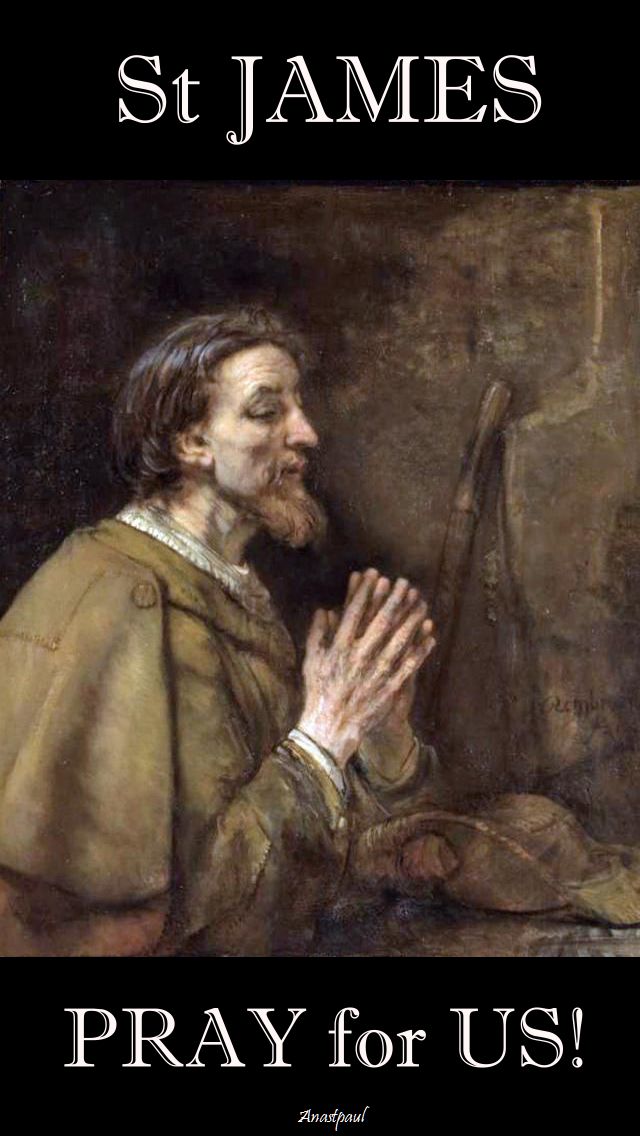
Look at the cross of Christ – Blessed John Henry Newman  (1801-1890)THEY ALONE ARE ABLE TRULY - BL JOHN HENRY NEWMAN 0 4 APRIL EASTER WED 2018