Saints Felix, Regula and Essuperanzio were martyrs beheaded together in the 3rd century, near Zürich, Switzerland, for converting to Christianity. Felix and Regula were brother and sister, while Essuperanzio was their servant. They are the patron saints of Zürich.
Felix was a member of the Theban legion which was based in Egypt under Saint Maurice and stationed in Agaunum in the Valais, Switzerland. When the legion refused to sacrifice to Emperor Maximian, the order was given to execute them. The siblings fled, reaching Zürich before they were caught, tried and executed in 286. After decapitation, they miraculously stood to their feet, picked up their own heads, walked forty paces uphill, and prayed before lying down in death. They were buried on the spot where they lay down, on the hilltop which would become the site of the Grossmünster.
This was revealed in a dream to a monk called Florentius in the 8th century. It contributed greatly to the massive conversion of the inhabitants of these regions to Christianity and had such an impact on Zurich that these three saints still appear on the seal of Zurich today.
And Hilarianus the procurator, who had just received the power of life and death in the place of the proconsul Minucius Timinianus, who was deceased, said, ‘Spare the grey hairs of your father, spare the infancy of your boy, offer sacrifice for the well-being of the emperors.’ And I replied, ‘I will not do so.’ Hilarianus said, ‘Are you a Christian?’ And I replied, ‘I am a Christian.’
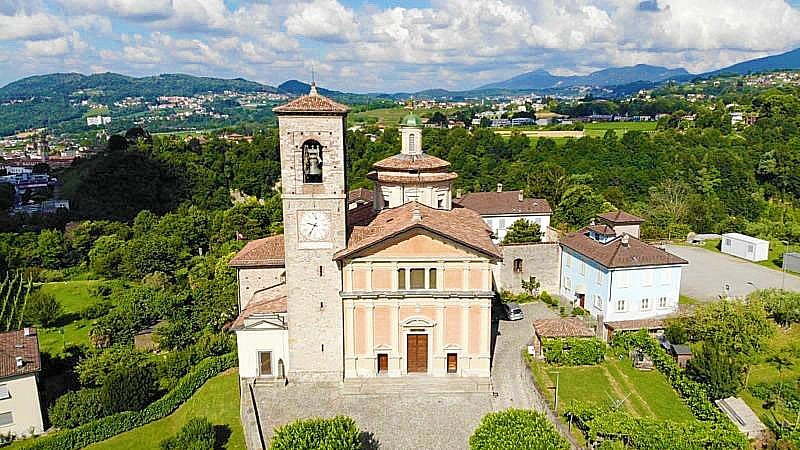
Madonna dei Miracoli / Holy Mary of Miracles, Morbio Inferiore, Ticino, Switzerland (1594) – 29 July:
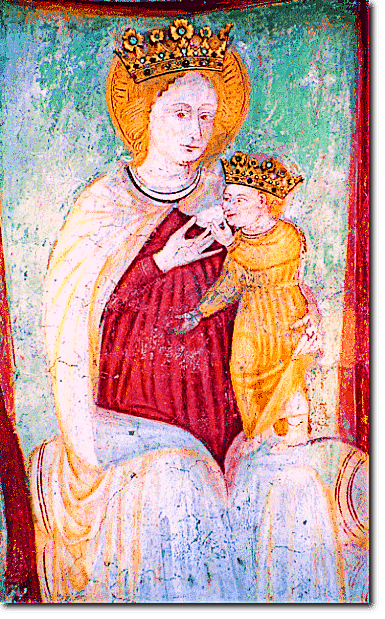
Where the Sanctuary of Morbio now stands, a castle stood centuries ago, attested in 1198 and destroyed in the first half of the sixteenth century. Only the ruins of a Chapel, dedicated to St Bernardino of Siena, transformed over time into a pile of rubble, buried by weeds, brambles and thorns., remained. Surrounded by ivy and fortunately well preserved, remained the Fresco in the Chapel, depicting the Virgin with the Child.
The history of the Sanctuary of Holy Mary of Miracles began on 29 July 1594. It was a Friday when the two mothers with their daughters, Catherine and Angela , respectively ten and seven years old, travelled to Morbio to entreat the assistance of Fr Gaspare Basbetrini. They were sick girls, tormented by the devil and had travelled to Morbio, to ask for the blessing of Don Gaspare Barberini, the assistant Priest at Morbio, who was well-known as an Exorcist. However, sadly for the pilgrims, Fr Basbetrini was absent.
To the tiredness of the journey and the sadness of illness, the bitterness of disappointment was added. Among the ruins of the ancient castle the little group of supplicants waited and discovered on the crumbling and crumbling walls, the faded remains of a fresco depicting the Virgin in a deeply maternal position nursing Baby Jesus.
The two mothers knelt before the Virgin with their daughters and prayed in deep sadness and devotion for the intercession of the Holy Mother to come to the aid of the sick children.
And then the miracle happened. Those two poor simple and innocent creatures were cured. This is Morbio’s miracle – the Madonna appeared to the two little girls and cureds them of all their illnesses, dispelling any demonic presence within them.
Our Lady spoke to the elder girl, Catherine and instructed her to tell the Bishop that the Church should be rebuilt and that the Holy Rosary must be said everyday.
Eight days after the event, on 5 August 1594, the episcopal curia of Como, whose ecclesiastical jurisdiction also extended to the southern regions of Ticino, instructed the regular canonical process, which recognized, upon the sworn deposition of the main eyewitnesses, the truth of what happened and their prodigious and supernatural nature.
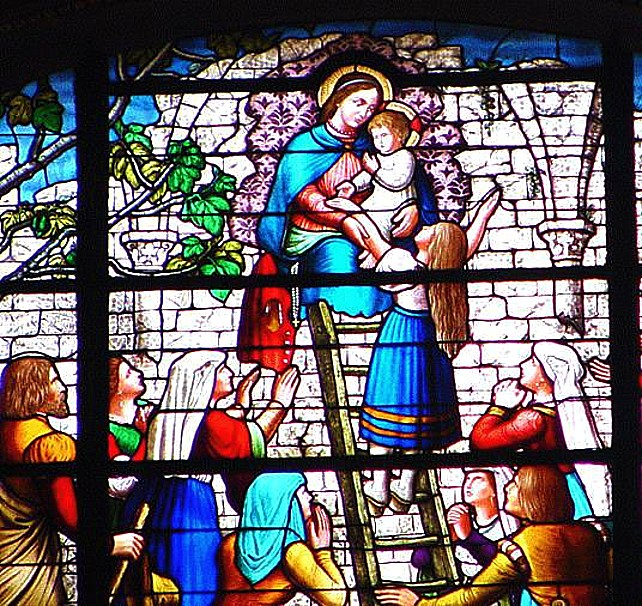
A stained-glass window, located at the top of the apse and placed at the beginning of this century, illustrates and reminds those who enter the Sanctuary of this miracle. Catherine is depicted on a ladder, with her arms outstretched, listening in front of the image of the Madonna dei Miracoli. At the foot of the ladder, Angela, the other sick girl, is lying asleep.
In a short while an Oratory was built on the site to recite the Rosary and celebrate Mass there, as the Madonna had said to Catherine, while on 29 July 1595, the Anniversary of the apparition and the miracle, the first stone was blessed and laid for the construction of the Sanctuary, Consecrated on 16 May 1631 by the Bishop of Como, Msgr Filippo Archinti.
St Antony St Beatrix of Rome Bl Beatrix of Valfleury St Callinicus of Paphlagonia Bl Charles-Antoine-Nicolas Ancel St Faustinus of Rome St Faustinus of Spello St Felix of Rome St John Baptist Luo Tingyin St John the Soldier Bl José Calasanz Marqués St Joseph Zhang St Kilian of Inishcaltra St Lek Sirdani Bl Luis Bertran St Lupus of Troyes Bl Mancius of the Cross St Martha Wang St Olaf II St Olaus of Sweden St Paulus Chen Changpin Bl Petrus of Saint Mary St Pjetër Çuni St Prosper of Orleans St Rufo of Rome St Seraphina St Serapia of Syria St Simplicius of Rome St Sulian
Blessed Pope Urban II (c 1035-1099) Bishop of Rome from 1088 until his death, Carthusian Abbot, Confessor
Martyrs of Calanda – 8 beati: A group of Dominican priests and friars who were martyred over the course of a day in the same town by the same group of anti-Christian forces in the Spanish Civil War. • Antonio Manuel López Couceiro • Felicísimo Díez González • Gumersindo Soto Barros • Lamberto María de Navascués de Juan • Lucio Martínez Mancebo • Matías Manuel Albert Ginés • Saturio Rey Robles • Tirso Manrique Melero They were martyred on 29 July 1936 in Calanda, Teruel, Spain I.
Martyrs of Lleida – 12 beati: Carmelites of the Ancient Observance novices, friars and priests who were all martyred together in the Spanish Civil War. • Àngel Prat Hostench • Eliseo Maneus Besalduch • Gabriel Escoto Ruiz • Ginés Garre Egea • Joan Maria Puigmitjà Rubió • Joan Prat Colldecarrera • Josep Solé Rovira • Lluis Fontdecava Quiroga • Manuel Serrano Buj • Miquel Soler Sala • Pere Dorca Coromina • Pere Ferrer Marín They were martyred on 29 July 1936 in Clot dels Aubens, Cervera, Lleida, Spain.
Martyred in the Spanish Civil War: Thousands of people were murdered in the anti-Catholic persecutions of the Spanish Civil War from 1934 to 1939. • Blessed Bartolomé Rodríguez Soria
Martyrs of Rome – 23 saints Eugene Flora the Martyr Lucilla Theodore
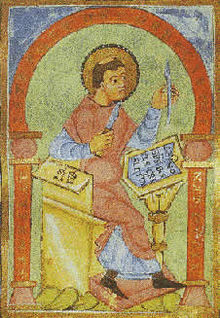
Saint of the Day – 6 April – Blessed Notker Balbulus/Notker the Stammerer/Notker of Saint Gall (c840-912) Benedictine monk. Priest. Poet. Musician. Teacher. Writer. Historian. Hagiographer; wrote a martyrology, a collection of legends and a metrical biography of Saint Gall. Friend of Saint Tutilo – Patronages – of Musicians and invoked against stuttering/stammering -Representation: A rod; Benedictine habit; book in one hand and a broken rod in the other with which he strikes the devil, mill wheel, staff.
Notker was the son of noble Swiss parents. His father and mother sent him, when he was a child, to be educated in the Benedictine Abbey of St. Gall, Switzerland. In medieval times Benedictine monks often accepted youngsters as boarding students in their monastery schools. There may have been an additional reason for entrusting Notker to these monks. He was frail in health and stammered. (That is the meaning of his nickname “Balbulus”.)
When he was a teenager, Notker decided to stay on at St. Gall as a monk. Frailty of body did not keep him from becoming a leader in this religious community. It was later said of him that he was “weakly in body but not in mind, stammering of tongue but not of intellect, pressing forward boldly in things divine–a vessel filled with the Holy Ghost without equal in his time.” Notker, a brilliant student, was appointed librarian of the monastery in 890 and held the post of guest master in 892 and 894.
But the stammering little monk gained fame mostly through his own literary work. Having been trained by such able monastic scholars as Iso and the musical Irishman Marcellus (Moengal), he himself became a noted teacher in the monastic school. Notker was probably the anonymous “Monk of St. Gall” who composed the book Gesta Caroli (The Deeds of Charles), a collection of folk stories about the Emperor Charlemagne. This popular work did much to make Charlemagne a colossal legendary figure among the German peoples.
In addition to prose, Father Notker, a good theologian, also wrote poetry and composed music, with talent and taste. In fact, he is considered the first musical composer of German stock. Some of his musical compositions are hymns in honour of saints. Most of his fame, however, is based on his two-score sequences.
The sequence is a type of liturgical hymn that originated in the ninth century. It is a hymn sung after that Alleluia of the Latin Rite Mass that comes just before the singing of the Gospel. ur liturgy used to have many of these sequences but today the Church retains only the Victimae Paschali (Easter); the Veni Sancte Spiritus (Pentecost); the Lauda Sion (Corpus Christi); and the Stabat Mater (Seven Sorrows of Mary). (A fifth sequence the Dies Irae for funerals was dropped only after Vatican II). Now, none of these five sequences was written by Notker but the pattern he gave to the format by his own popular compositions was decisive among later composers.
Notker the Stammerer was so much loved by the monks of his abbey that for a long time after his death, they could not speak of him without shedding tears. They venerated him as a saint. T he Holy See confirmed this cult of Blessed Notker in 1512 by permitting a Mass to be celebrated in his honour at the Abbey of St. Gall. The permission was extended to the diocese of Constance in 1513. His relics were enshrined in the cathedral of Sankt Gallen in 1628 – see below
Cathedral of St. Gallen
Cathedral of St. Gallen
Cathedral of St. Gallen
Blessed Notker has been declared by some to be the greatest poet of the Middle Ages. Being tongue-tied may impair the speech but it cannot inhibit the soaring imagination.





You must be logged in to post a comment.