
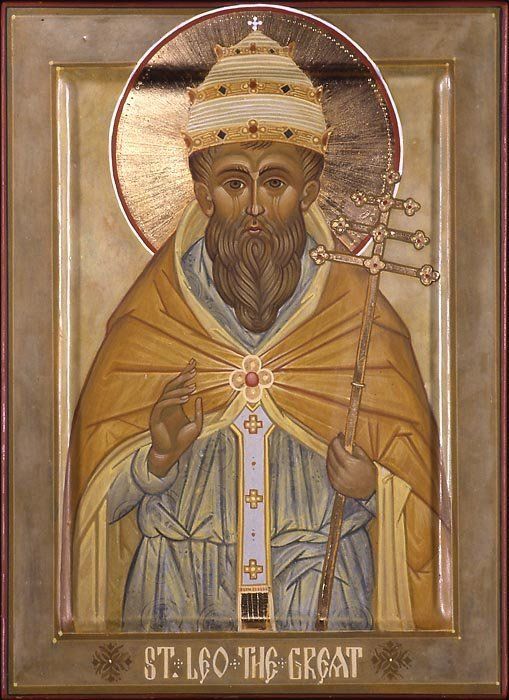
Only two Popes have earned the title Great—Gregory I and Leo I. Leo was born in the beginning of the fifth century. When he was a Deacon, other Church leaders looked to him for advice and for explanations of the faith. Leo was sent to settle arguments between leaders. With strong conviction of the importance of the Bishop of Rome in the Church and of the Church as the ongoing sign of Christ’s Presence in the world, Leo the Great displayed endless dedication as Pope. Elected in 440, he worked tirelessly as “Peter’s successor,” guiding his fellow Bishops as “equals in the episcopacy and infirmities.”
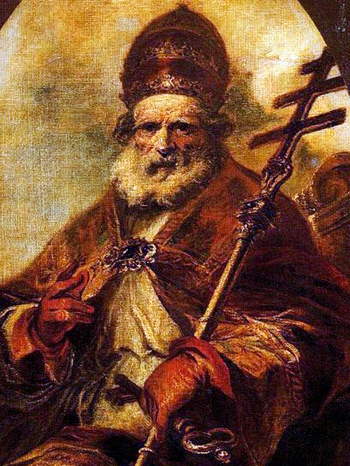
Leo is known as one of the best administrative Popes of the ancient Church. His work branched into four main areas, indicative of his notion of the Pope’s total responsibility for the flock of Christ. He worked at length to control the heresies of Pelagianism–overemphasising human freedom– Manichaeism–seeing everything material as evil–and others, placing demands on their followers so as to secure true Christian beliefs.
A second major area of his concern was doctrinal controversy in the Church in the East, to which he responded with a classic letter setting down the Church’s teaching on the two natures of Christ. With strong faith, he also led the defense of Rome against barbarian attack, taking the role of peacemaker.
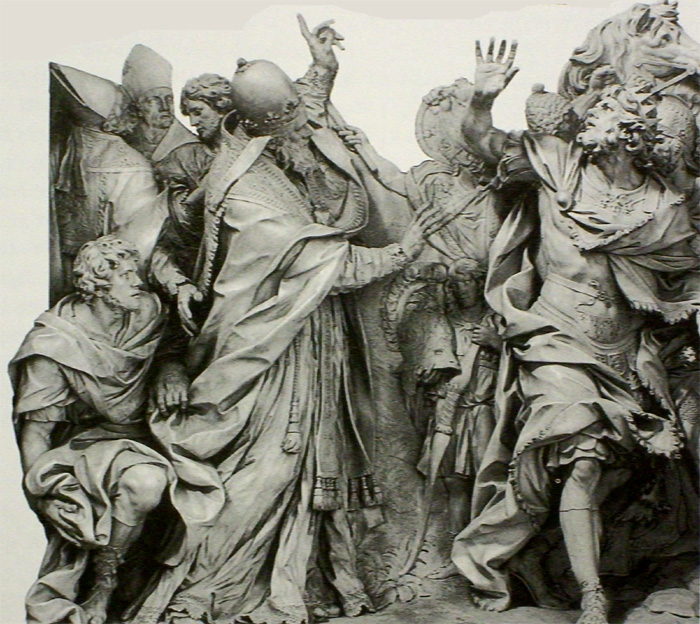
In these three areas, Leo’s work has been highly regarded. His growth to sainthood has its basis in the spiritual depth with which he approached the pastoral care of his people, which was the fourth focus of his work. He is known for his spiritually profound sermons. An instrument of the call to holiness, well-versed in Scripture and ecclesiastical awareness, Leo had the ability to reach the everyday needs and interests of his people. One of his sermons is used in the Office of Readings on Christmas. Almost 100 sermons and 150 letters of Leo I have been preserved.
It is said of Leo that his true significance rests in his doctrinal insistence on the mysteries of Christ and the Church and in the supernatural charisms of the spiritual life given to humanity in Christ and in his Body, the Church. Thus Leo held firmly that everything he did and said as pope for the administration of the Church represented Christ, the head of the Mystical Body and Saint Peter, in whose place Leo acted.
Leo died on 10 November 461 and, as he wished to be buried as close as possible to the tomb of St Peter, his body was placed in a tomb in the portico of St Peter’s basilica. In 688 his remains were moved inside the basilica itself.
Pope Emeritus Benedict XVI said that Leo’s papacy “…was undoubtedly one of the most important in the Church’s history.”
The significance of Leo’s pontificate lies in his assertion of the universal jurisdiction of the Roman bishop, as expressed in his letters and still more in his 100 extant orations. This assertion is commonly referred to as the doctrine of Petrine supremacy.
According to Leo and several Church Fathers as well as certain interpretations of the Scriptures, the Church is built upon Peter, in pursuance of the promise of Matthew 16:16–19. Peter participates in everything which is Christ’s; what the other apostles have in common with him they have through him. What is true of Peter is true also of his successors. Every other bishop is charged with the care of his particular flock, the Roman pontiff with that of the whole Church. Other bishops are his assistants in this great task. In Leo’s eyes the decrees of the Council of Chalcedon acquired their validity from his confirmation.
Leo’s letters and sermons reflect the many aspects of his career and personality and are invaluable historical sources. His rhythmic prose style, called cursus leonicus, influenced ecclesiastical language for centuries.
In 1754 Pope Benedict XIV proclaimed Leo I a Doctor of the Church.

 AnaStpaul
3 thoughts on “Saint of the Day – 10 November – St Pope Leo I Father and Doctor of the Church (c 400 – 461)”