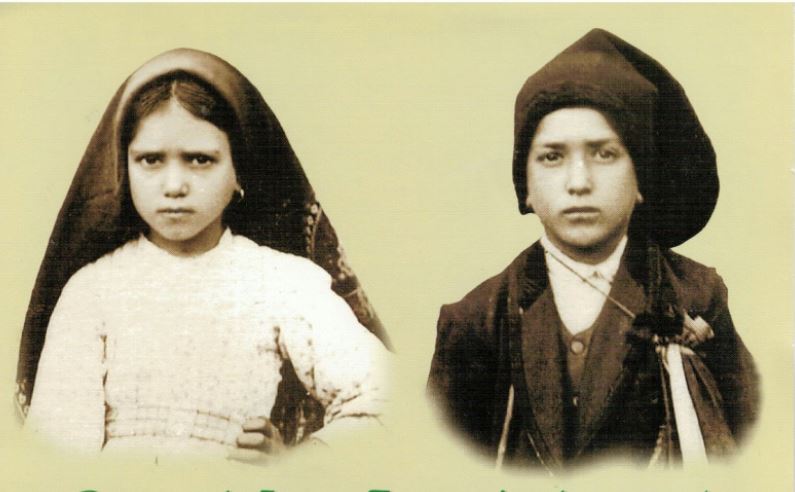
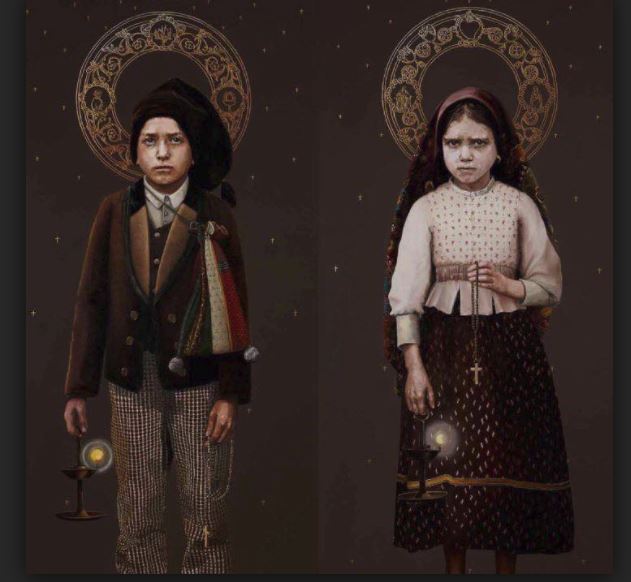
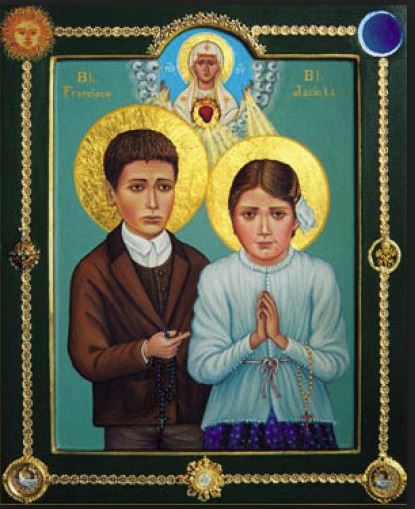
Quote/s of the Day – 20 February 2018 -The First Memorial of Saints Francisco (1908-1919) and Jacinta (1910-1920) – “The Shepherds of Fatima”
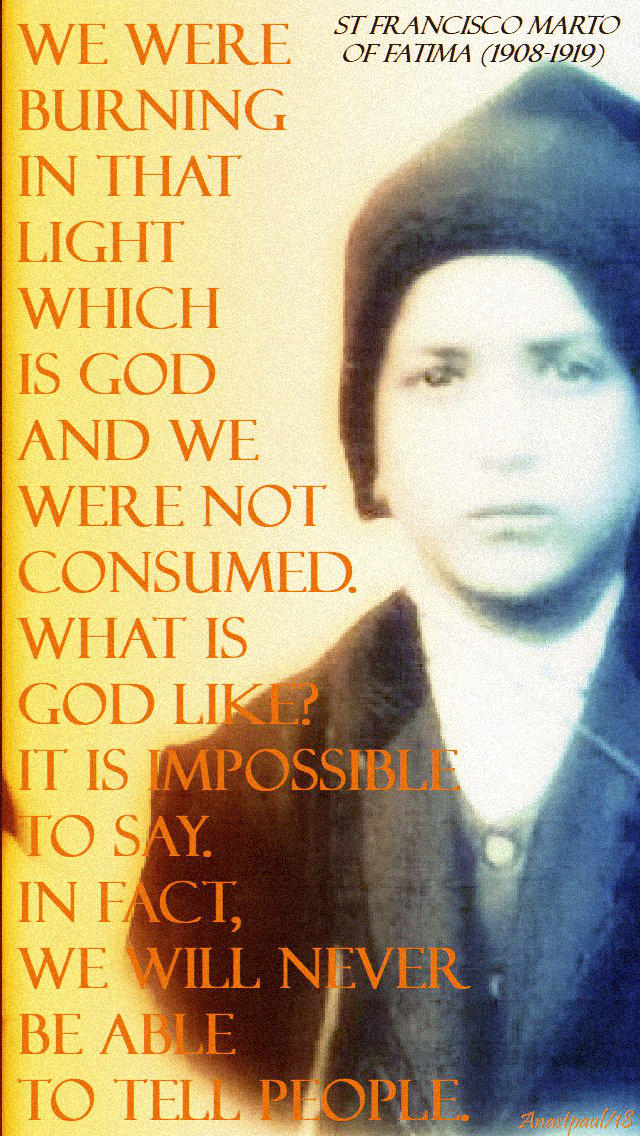
“We were burning in that light which is God and we were not consumed. What is God like? It is impossible to say. In fact, we will never be able to tell people”
St Francisco Marto of Fatima (1908-1919)
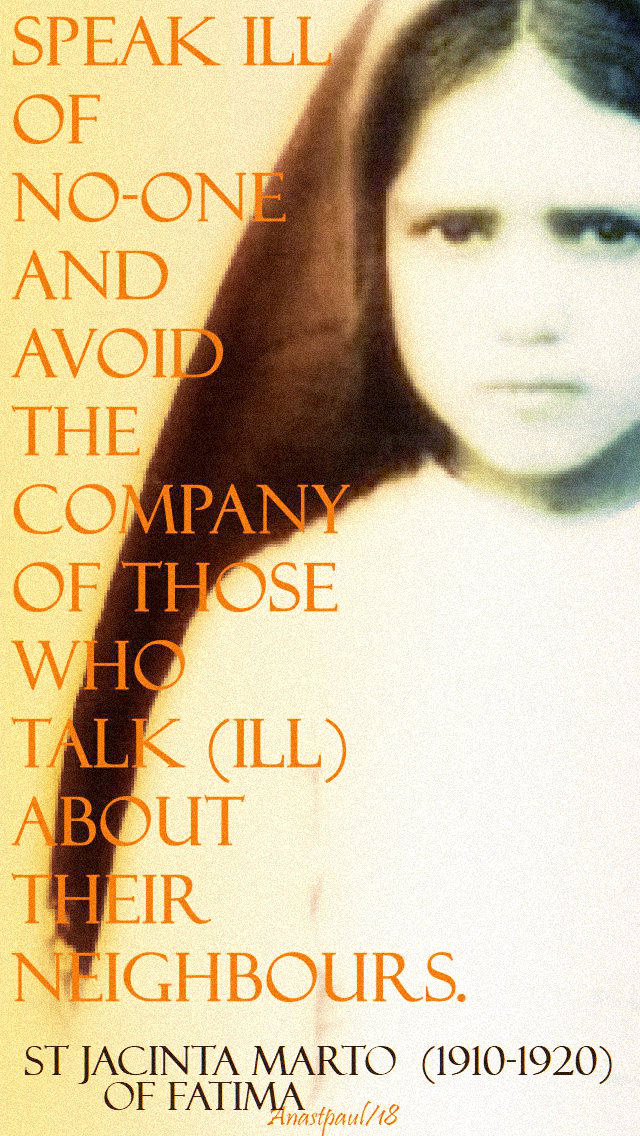
“Speak ill of no-one and avoid the company of those who talk (ill) about their neighbours.”
St Jacinta Marto of Fatima (1910-1920)
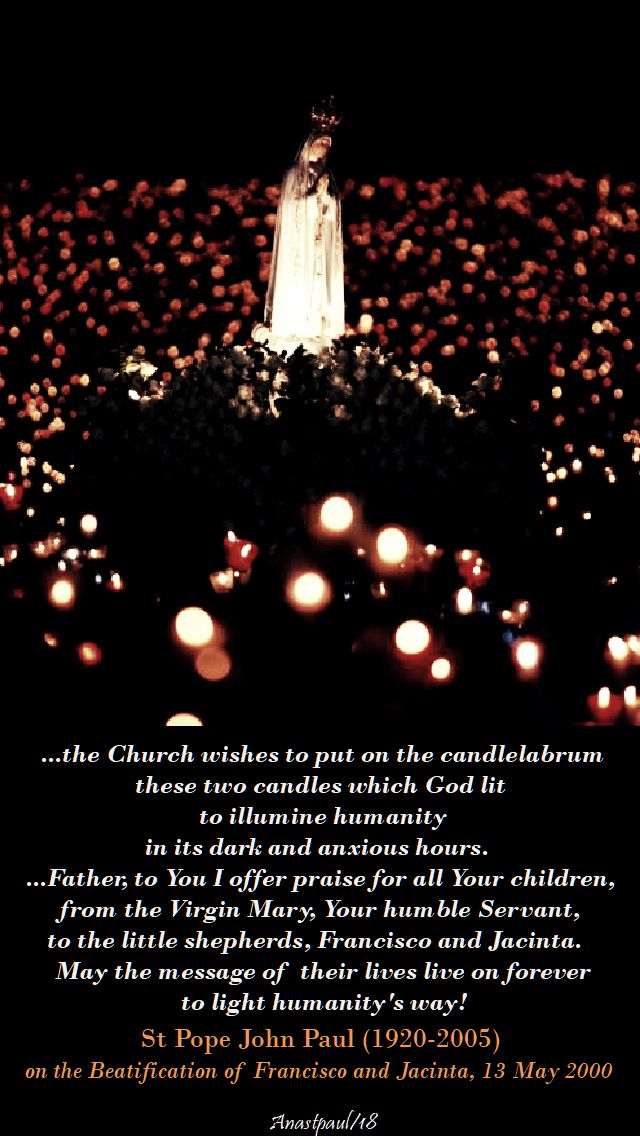
“Father, to You I offer praise, for you have revealed these things to the merest children”. Today Jesus’ praise takes the solemn form of the beatification of the little shepherds, Francisco and Jacinta. With this rite the Church wishes to put on the candlelabrum these two candles which God lit to illumine humanity in its dark and anxious hours. …Father, to You I offer praise for all Your children, from the Virgin Mary, Your humble Servant, to the little shepherds, Francisco and Jacinta. May the message of their lives live on forever to light humanity’s way!”
St Pope John Paul (1920-2005) on the Beatification of Francisco and Jacinta, 13 May 2000
One Minute Reflection – 20 February 2018 – Tuesday of the First Week of Lent and The First Memorial of Saints Francisco (1908-1919) and Jacinta (1910-1920)
“Unless a grain of wheat falls into the earth and dies, it remains just a single grain; but if it dies, it bears much fruit..” …John 12:24
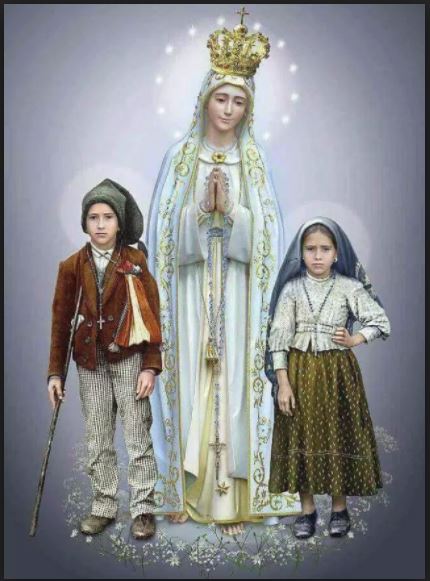
REFLECTION – “In Lucia’s account, the three chosen children found themselves surrounded by God’s light as it radiated from Our Lady. She enveloped them in the mantle of Light that God had given her. According to the belief and experience of many pilgrims, if not of all, Fatima is more than anything this mantle of Light that protects us, here, as in almost no other place on earth. We need but take refuge under the protection of the Virgin Mary and to ask her, as the Salve Regina teaches: “show unto us… Jesus”.
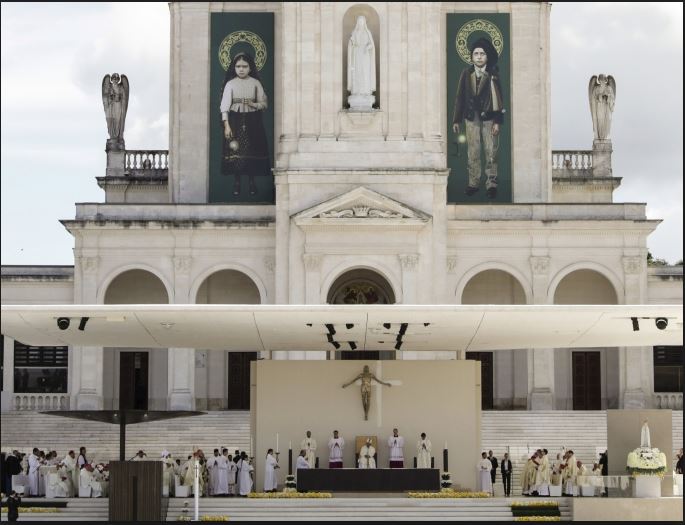
“The Lord, who always goes before us, said this and did this (Jn 12:24). Whenever we experience the cross, He has already experienced it before us. We do not mount the cross to find Jesus. Instead it was He who, in His self-abasement, descended even to the cross, in order to find us, to dispel the darkness of evil within us and to bring us back to the light.”…Pope Francis at the Canonisation of Saints Francisco and Jacinta on 14 May 2017
PRAYER – Heavenly Father, just as the little children, Francisco and Jacinta, were chosen to be bearers of Your message, grant we pray, that by their prayers on our behalf, we too may Your bearers of light. Be with us, holy Mother, during our Lenten journey to the Resurrection of your Son, help us to become like little children and in that new purity, shine with His Light. Through Jesus our Lord, with the Holy Spirit, one God forever, amen.
Our Morning Offering – 20 February 2018 – Tuesday of the First Week of Lent
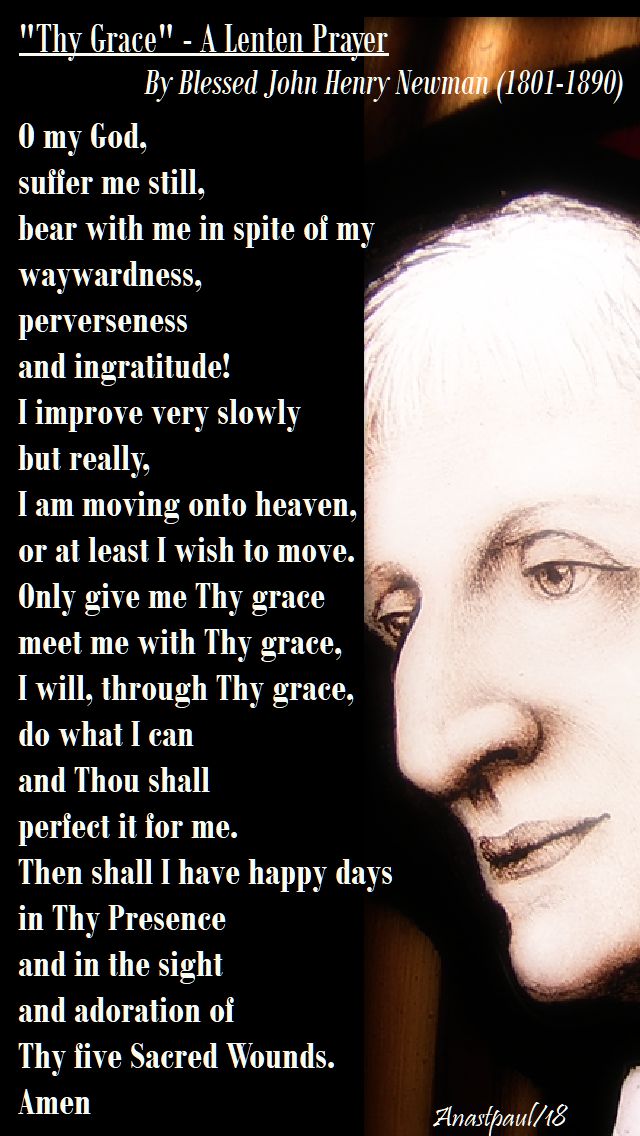
Thy Grace – a Lenten Prayer By Blessed John Henry Newman
O my God,
suffer me still,
bear with me in spite of my
waywardness,
perverseness
and ingratitude!
I improve very slowly
but really, I am moving onto heaven,
or at least I wish to move.
Only give me Thy grace
meet me with Thy grace,
I will, through Thy grace, do what I can
and Thou shall perfect it for me.
Then shall I have happy days, in Thy Presence
and in the sight and adoration of
Thy five Sacred Wounds.
Amen
Saints of the Day – 20 February 2018 – Today, is the First Memorial of Saints Francisco (1908-1919) and Jacinta Marta (1910-1920) who were Canonised last year, 13 May 2017 – “The Shepherds of Fatima”
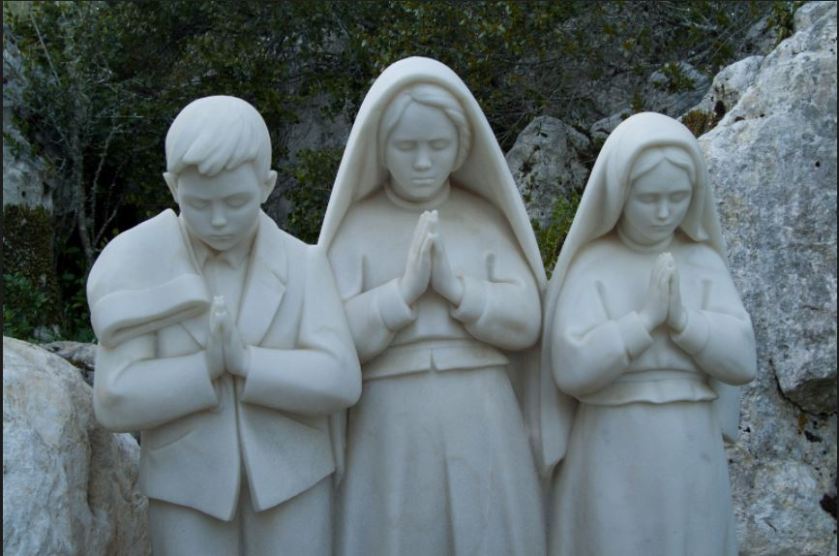
Between 13 May and 13 October 1917, three Portuguese shepherd children from Aljustrel, received apparitions of Our Lady at Cova da Iria, near Fátima, a city 110 miles north of Lisbon. At that time, Europe was involved in an extremely bloody war. Portugal itself was in political turmoil, having overthrown its monarchy in 1910; the government disbanded religious organisations soon after.
At the first appearance, Mary asked the children to return to that spot on the thirteenth of each month for the next six months. She also asked them to learn to read and write and to pray the rosary “to obtain peace for the world and the end of the war.” They were to pray for sinners and for the conversion of Russia, which had recently overthrown Czar Nicholas II and was soon to fall under communism. Up to 90,000 people gathered for Mary’s final apparition on 13 October 1917, when Our Lady of the Rosary asked them to build a chapel on the rocky hillside. This apparition is now known as the Miracle of the Sun. The entire crowd saw a remarkable sight. The sun seemed to dance in the sky. It was spinning like a top and shooting off brilliant colours of the rainbow. Suddenly the sun dropped treacherously close to earth. People dropped to their knees and the sun just as quickly returned to its play in the sky.
Less than two years later, Francisco died of influenza in his family home. He was buried in the parish cemetery and then re-buried in the Fátima basilica in 1952. Jacinta died of influenza in Lisbon in 1920, offering her suffering for the conversion of sinners, peace in the world and the Holy Father. She was re-buried in the Fátima basilica in 1951, when it was discovered that her body is incorrupt. Their cousin Lúcia dos Santos, became a Carmelite nun and was still living when Jacinta and Francisco were beatified in 2000; she died five years later.
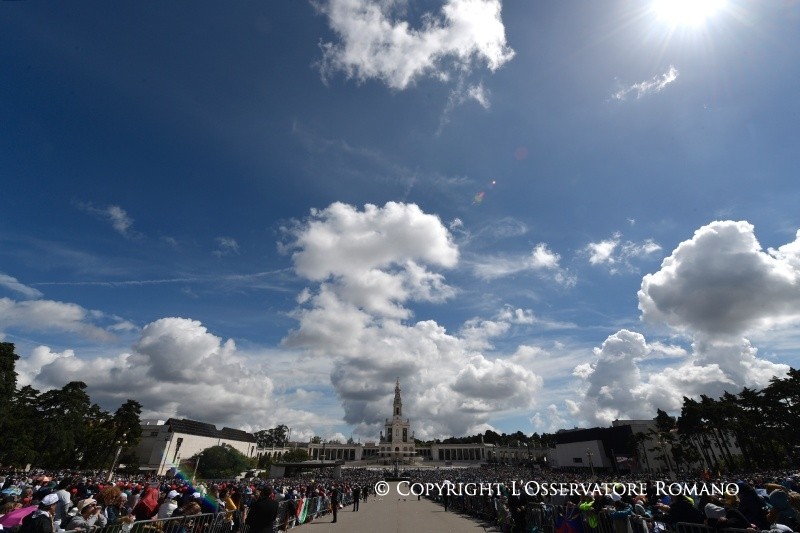
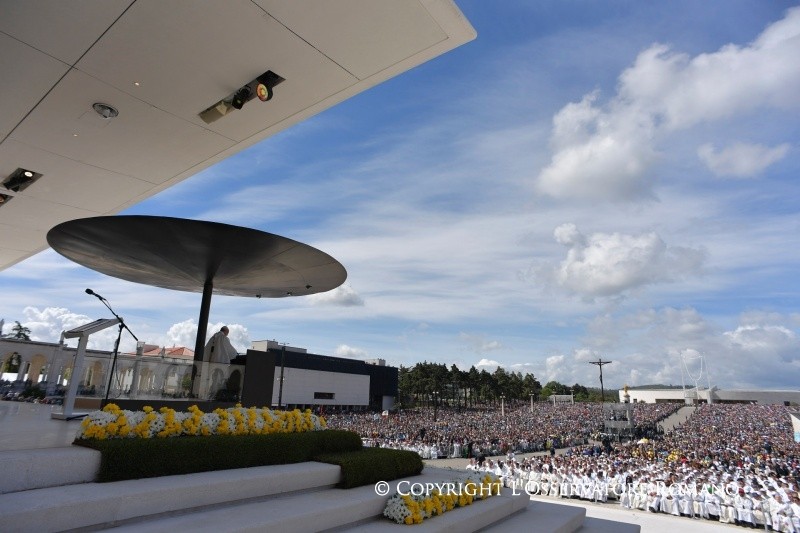
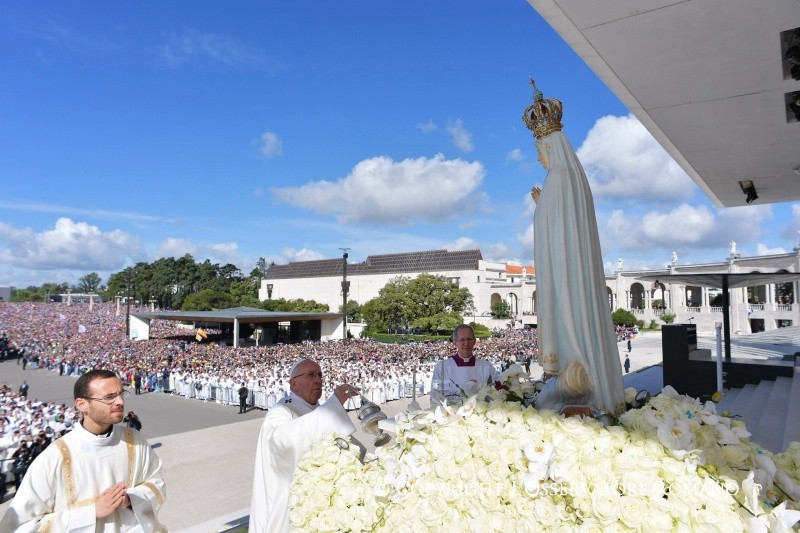
Pope Francis canonised the younger children on his visit to Fátima to commemorate the 100th anniversary of the first apparition, last year, 13 May 2017.
The shrine of Our Lady of Fátima is visited by up to 20 million people a year.
St Amata of Assisi
St Bolcan of Derken
St Colgan
St Eleutherius of Tournai
St Eucherius of Orleans
St Falco of Maastricht
St Francisco Marto
St Jacinta Marto
St Leo of Catania
St Nemesius of Cyprus
St Pothamius of Cyprus
St Serapion of Alexandria
St Silvanus of Emesa
St Stanislawa Rodzinska
St Valerius of Courserans
St Wulfric of Haselbury
St Zenobius of Antioch
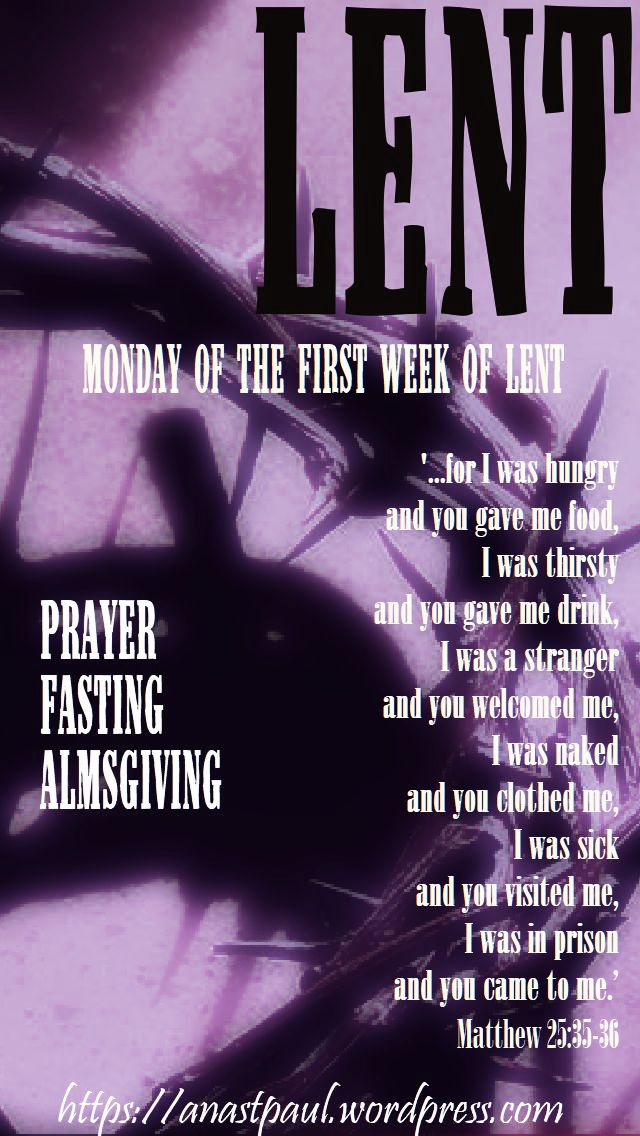
19 February 2018 – Monday of the First Week of Lent
Leviticus 19:1-2, 11-18, Psalms 19:8-10, 15, Matthew 25:31-46
Levitus 19:1-2 – And the Lord said to Moses, “Say to all the congregation of the people of Israel, You shall be holy; for I the Lord your God am holy.
Matthew 25:34-36 – Then the King will say to those at his right hand, ‘Come, O blessed of my Father, inherit the kingdom prepared for you from the foundation of the world; for I was hungry and you gave me food, I was thirsty and you gave me drink, I was a stranger and you welcomed me, I was naked and you clothed me, I was sick and you visited me, I was in prison and you came to me.’
We are definitely off now. Lent has really begun.
It begins with a programme for us, proposed by God Himself!
Deeper holiness, more evident godliness is the aim of Lent for us and for whole Church.
Ultimately, the litmus test of our faith is in how we respond to those in need: the hungry, the lonely, the stranger, the sick and the prisoner. We could add to this list – those who are survivors of abuse, refugees looking for a place of safety and many who so despair in finding work.
God identifies with all these so powerfully. What we do or neglect to do for those in need is our response to God.
Sometimes we may feel a sense of ‘compassion fatigue’ – the whole world seems to be such a huge mess and there is so much need all around us. How, where do we begin? It may just feel easier to close our eyes to it. And too, we may experience fear for our own safety.
But despite these obstacles, God is challenging us. Often there are simple things that can make a big difference – a smile, a word of conversation and encouragement, soup delivered to a family in need, a visit to an elderly neighbour. If we try it, because God is God, we shall find that we receive far more than we give! Be not afraid, for I am with you! “The Lord will overshadow you and you will find refuge under his wings” (Communion Antiphon for today).
Can I slow down enough today to be fully present to someone in need – even just with a smile and a little chat? What is my biggest obstacle in reaching out to others? What grace do I most need from God?
(Excerpt Fr Nicholas King SJ – The Lenten Journey to Easter & The Long Journey to the Resurrection)
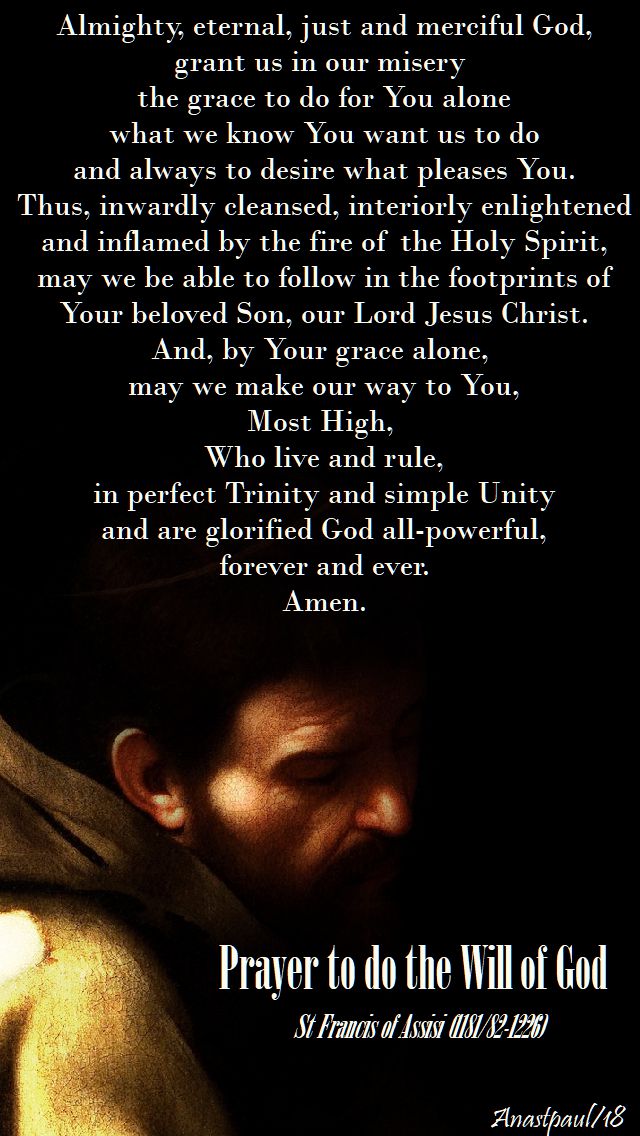
Prayer to do the Will of God By St Francis of Assisi
Almighty, eternal, just and merciful God, grant us in our misery, the grace to do for You alone what we know You want us to do and always to desire, what pleases You. Thus, inwardly cleansed, interiorly enlightened and inflamed by the fire of the Holy Spirit, may we be able to follow in the footprints of Your beloved Son, our Lord Jesus Christ. And, by Your grace alone, may we make our way to You, Most High, Who live and rule in perfect Trinity and simple Unity and are glorified God all-powerful, forever and ever. Amen. (From “A Letter to the Entire Order”)
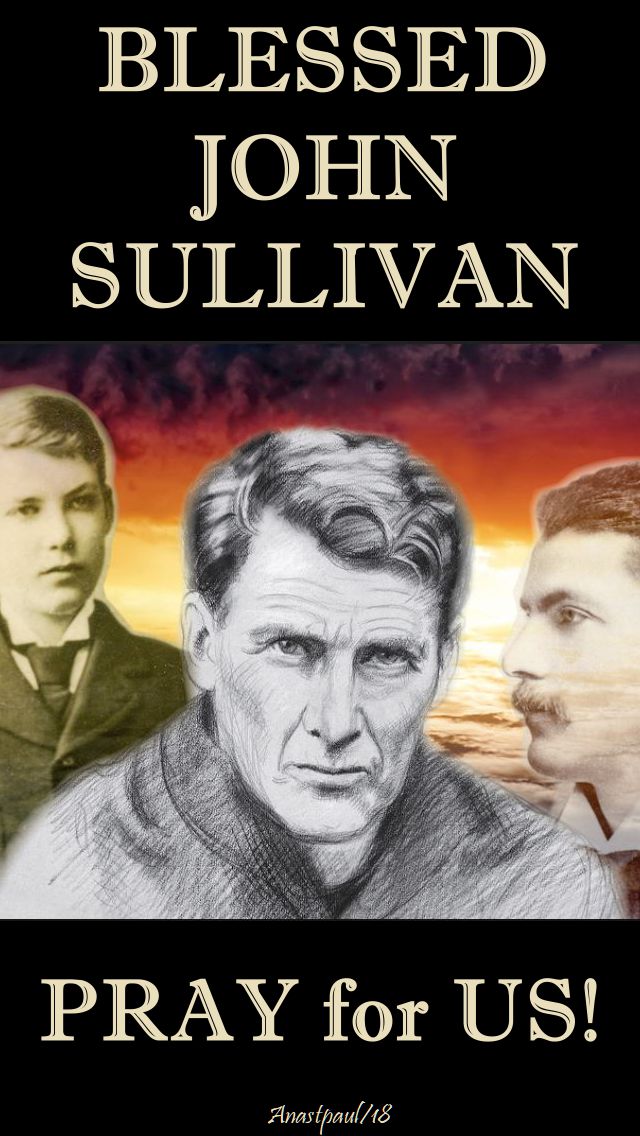
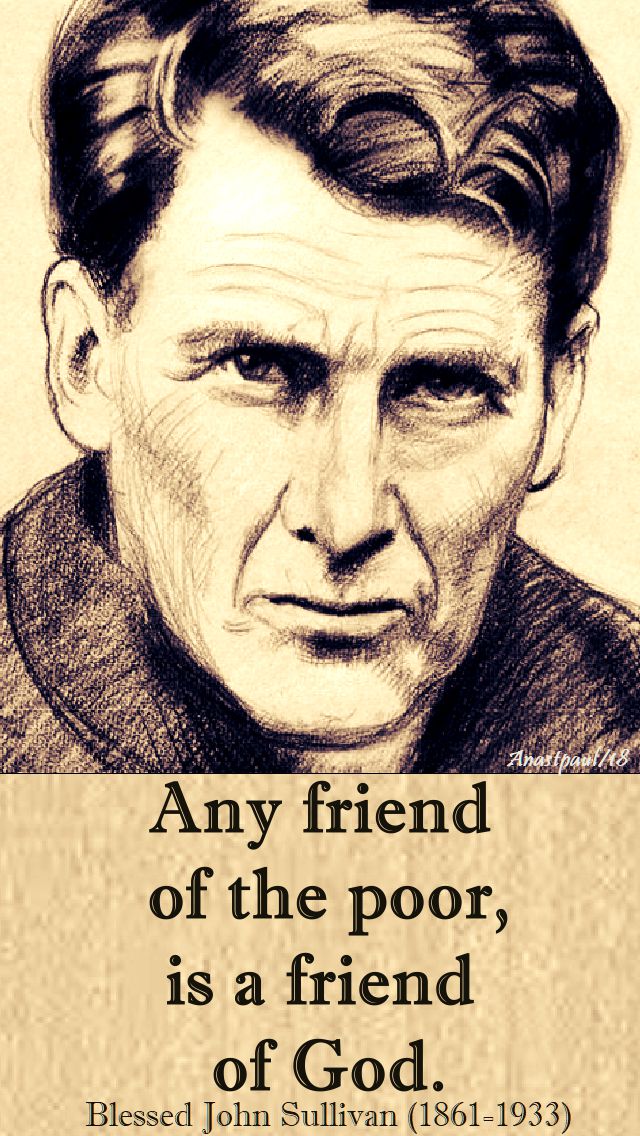
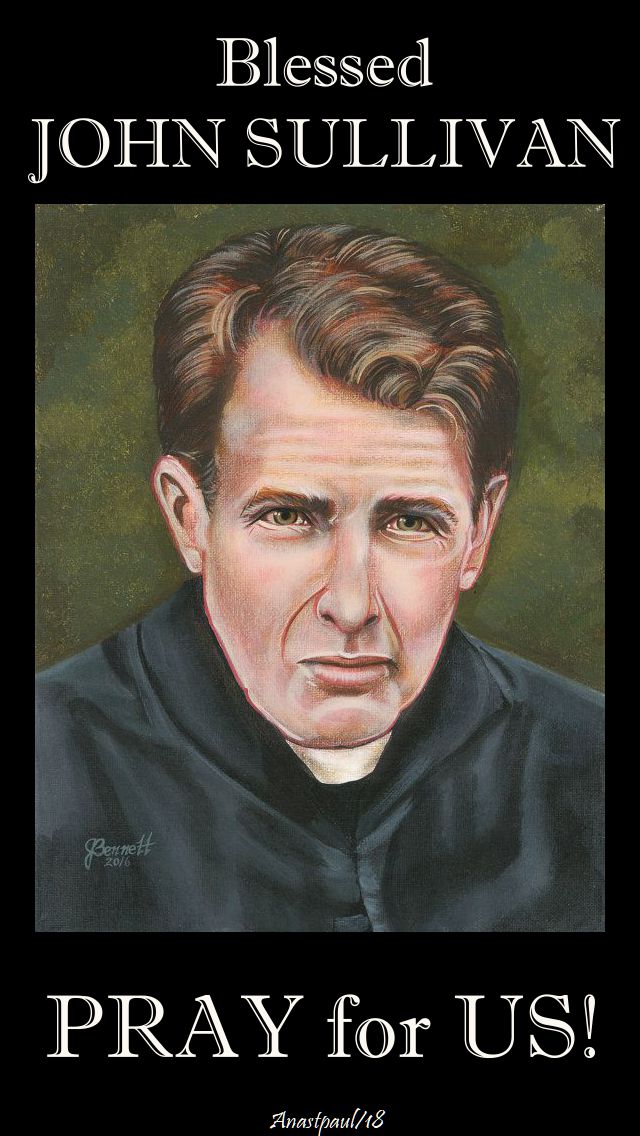
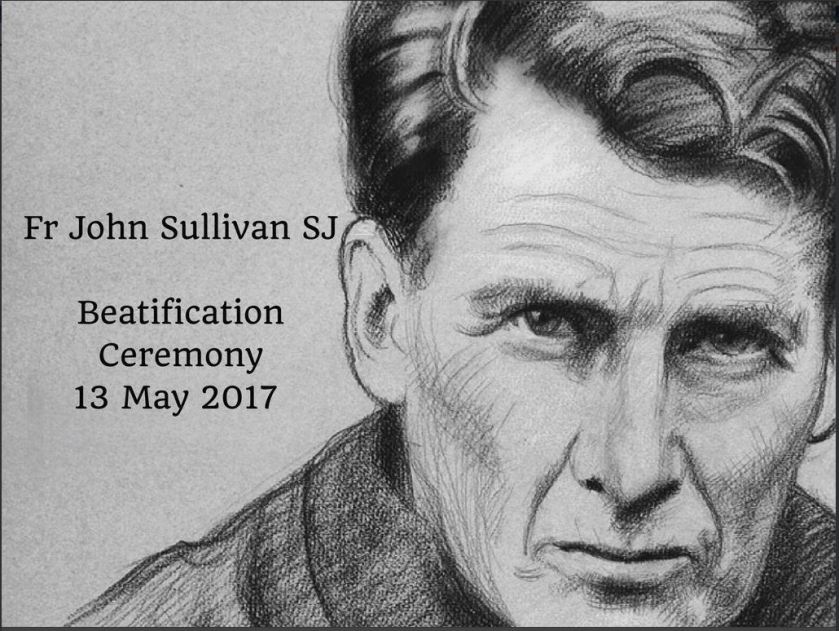
Thought for the Day – 19 February – The Memorial of Bl John Sullivan SJ (1861-1933)
It was at Clongowes that his life of prayer and penance began to be noticed. He ate the plainest of food. Staff who looked after rooms said his bed was untouched and he slept on the floor. He was always seen in the chapel praying until late and rising early to do so again. At times, he hardly seemed to notice the world around him. But if he was hard on himself, he was never so on others. Despite his brilliant mind and academic achievements it was his holiness that was recognised. Many revered him as a saint. He prayed constantly – he walked with God continually – he listened to Him and he found Him and God worked through him. Many who were in need of spiritual or physical healing flocked to him and asked his prayers – and strange things happened. The power of God seemed to work through him and many were cured.
But there was another dimension. Apart from his work as teacher, spiritual father and retreat director, Father Sullivan was a familiar figure amongst the sick and the needy for miles around Clongowes. He visited them on foot or on an old battered bicycle. On these home visits to the poor, he brought them small luxuries, including a bit of tobacco, tea and sugar, as well as oranges and apples. In time, there was an ever-widening circle of others, whom he visited in hospitals and consoled by letter, or who came to him from almost every county in Ireland to ask the intercession of his prayers in their illness and misfortunes. He constantly heard confessions in the church attached to the college. People came by bicycle, by horse or donkey and cart, or arranged a lift in a car for a sick person. In later years, it was a common sight to see several vehicles waiting outside the door, in which invalids had been brought to receive his blessing.
Neither weather nor distance seemed to be major obstacles. Once Fr Sullivan walked fourteen miles there and fourteen miles back to pray with and to bless a sick person. His bicycle brought him on longer journeys, including visits to Dublin and back. In his threadbare clothes and his aged and patched boots, he was a familiar sight on the roads around Clongowes and further afield.
Fr Sullivan’s prayers restored people to health, cured their pain, relieved them of psychological problems. His compassion and reverence for the person was often observed. He would draw very close to them, when even medical staff found their condition near nauseating. There have been hundreds of testimonies attributing various healings to him during his life and a number of those are seen as miracles and have been verified as such, which has led to his beatification.
Cardinal Amato, at the Beatification ceremony, also referred to an incident when Fr John, on one of his customary visits to the sick, encountered a priest already in the cottage visiting. “The pastor asked him to leave, fearing a dangerous opponent in the ministry. Upon his brusque command, Fr Sullivan knelt down and asked forgiveness. The pastor was profoundly moved.” The profound humility of Bl John reaches out now still to us all. May we constantly pray for his intercession that God may grace us with this greatest of all virtues, humility!
PRAYER for the CANONISATION of Blessed JOHN SULLIVAN (1861-1933)
O God, who honour those who honour You, make sacred the memory of Your servant, John Sullivan, by granting through his intercession the petition we now make ………………………………………. [bring to mind your intention] Hasten the day when his name will be numbered among those of Your saints. We make our prayer through Christ our Lord. Amen.
One Minute Reflection – 19 February – The Memorial of Bl John Sullivan SJ (1861-1933)
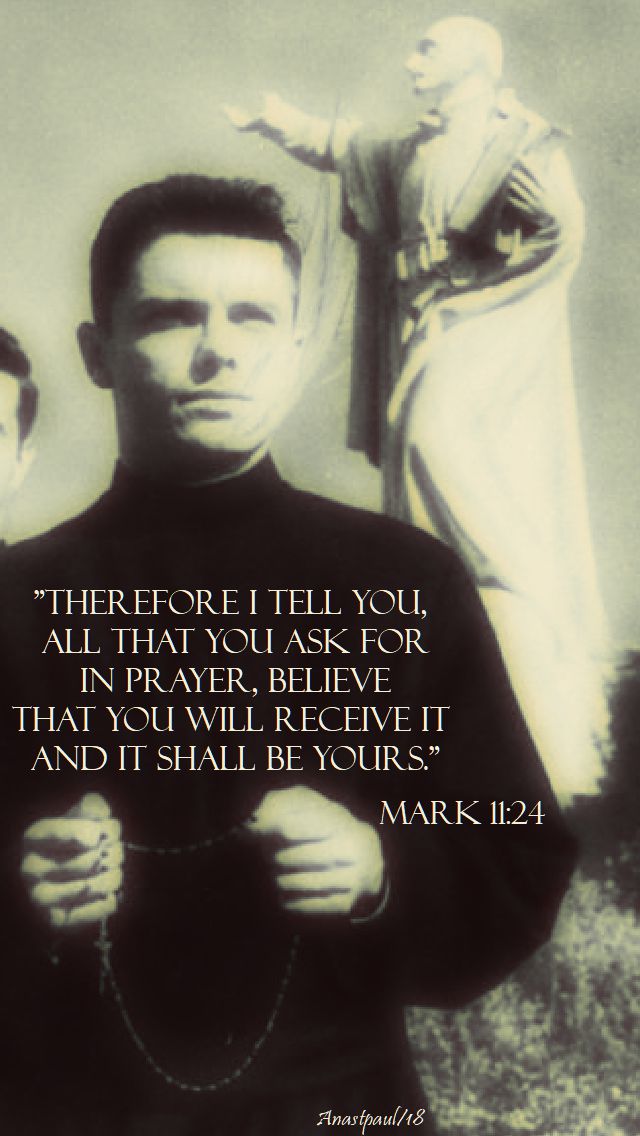
Therefore I tell you, all that you ask for in prayer, believe that you will receive it and it shall be yours...Mark 11:24
REFLECTION – “In prayer,don’t mind the scaffolding. Get at God.”
PRAYER – God of mercy, teach us to live as You have ordained. Help us to follow Your commandments with courage and steadfast devotion. Let our Saviour be our master, help us to learn from Him, the ways of prayer in silence. Fill us with the fire of the Holy Spirit, that we may learn how to pray. Grant blessed Trinity, that by the prayers of Blessed John Sullivan, who so clearly gave himself totally in prayer, we may grow in holiness. Through Jesus our Lord, in unity with the Holy Spirit, one God forever. Amen
Our Morning Offering – 19 February – The Memorial of Bl John Sullivan SJ (1861-1933) and Monday of the First Week of Lent – a Penitential Prayer from St Ignatius
Pardon Me, O my God St Ignatius Loyola S.J. (1491-1556)
Pardon me,
O perfections of my God,
for having preferred imperfect
and evil inclinations to Thee!
Pardon me,
O justice of my God,
for having outraged Thee by my sins.
Pardon me,
O holiness of my God,
for having so long stained
Thy sight’s purity, by my sins.
Pardon me,
O mercy of my God,
for having despised so long
Thy mercy’s voice.
In deep sorrow and contrition,
I cast myself at Thy feet.
Have mercy on me.
Amen
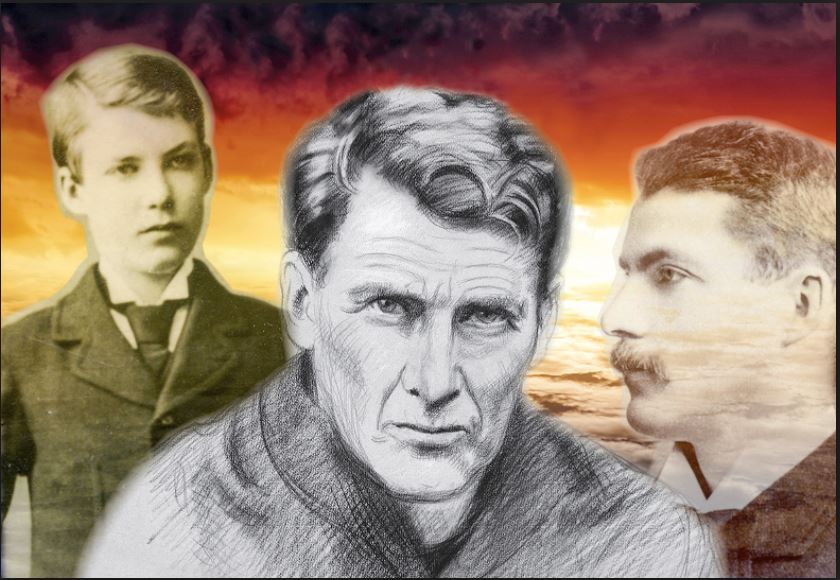
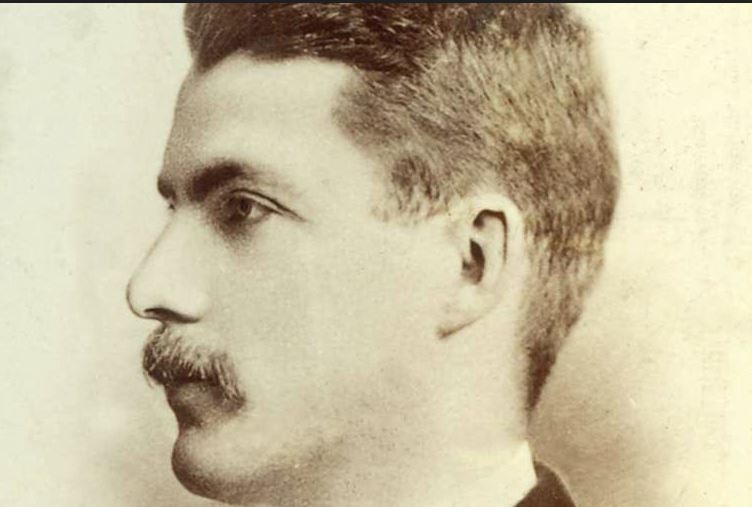
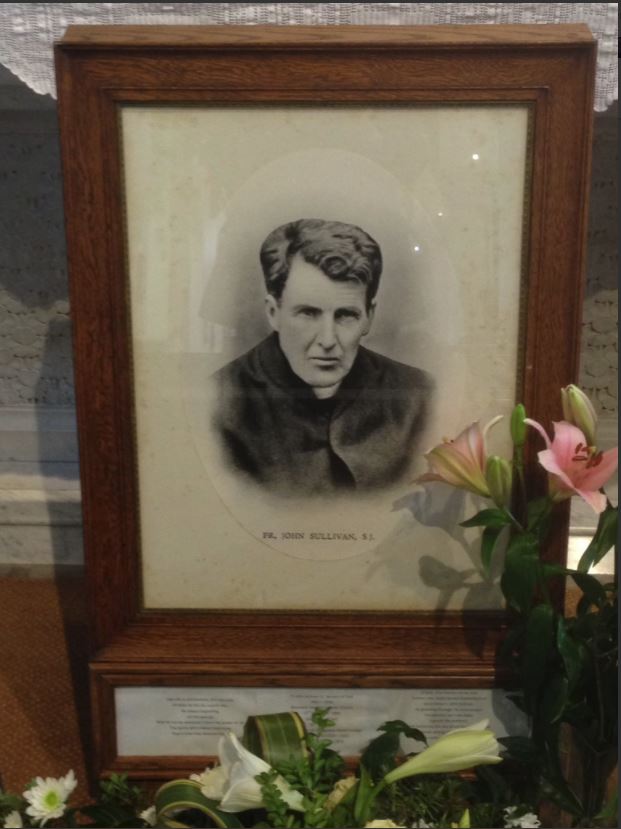
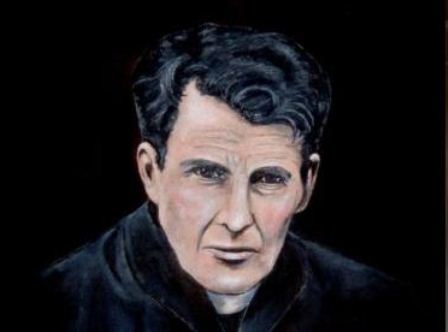
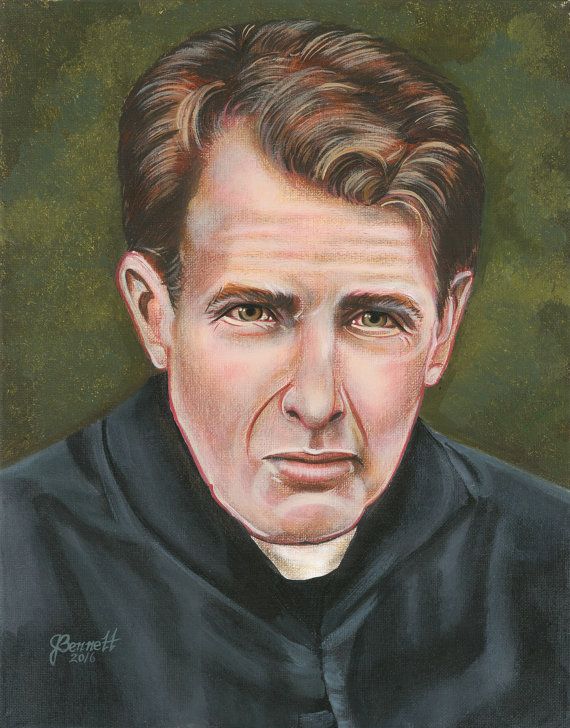
Saint of the Day – 19 February – Blessed John Sullivan S.J. (1861-1933) – Priest, Religious, Lawyer, Teacher, Writer, Miracle Worker, Apostle of Charity. Patronages – Ecumenism, teachers. Blessed John (8 May 1861 – 19 February 1933) was an Irish Roman Catholic priest and a professed member of the Jesuits. Sullivan was known for his life of deep spiritual reflection and personal sacrifice; he is recognised for his dedicated work with the poor and afflicted and spent much of his time walking and riding his bike to visit those who were troubled or ill in the villages around Clongowes Wood College school where he taught from 1907 until his death.
From the 1920s onwards there were people who testified to his healing power despite the fact that he never claimed credit or causation for himself from these reported cases. Father Sullivan was known for his friendliness, his amiable nature was coupled with a somewhat shy temperament but one willing to aid those who needed it most. He was noted for his strong faith and for leading multiple penances on himself such as eating little.
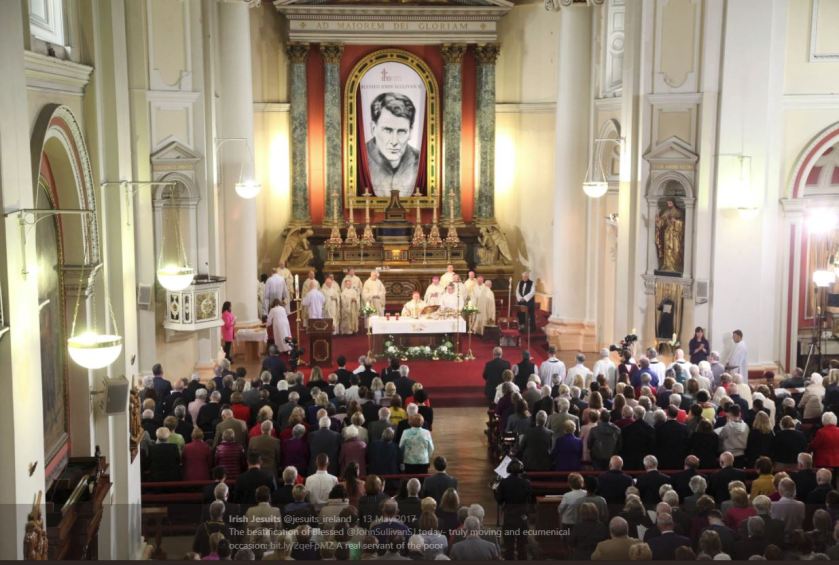
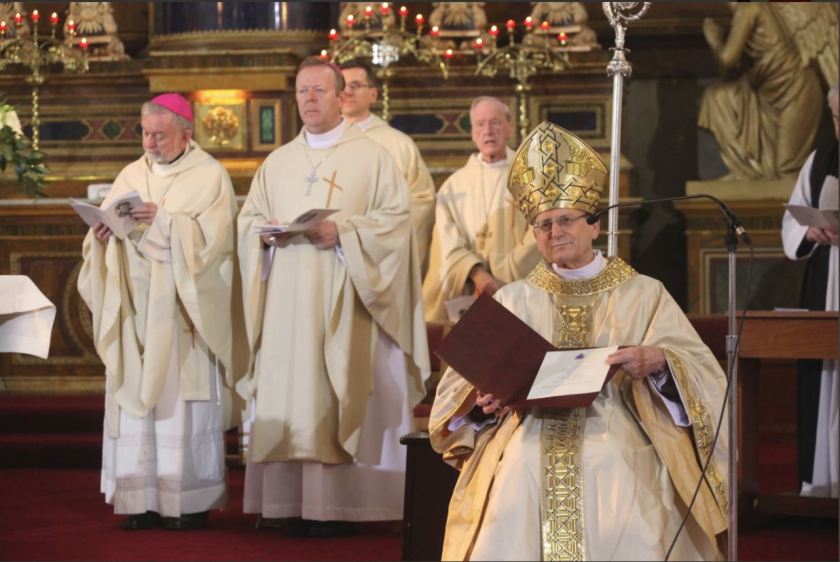
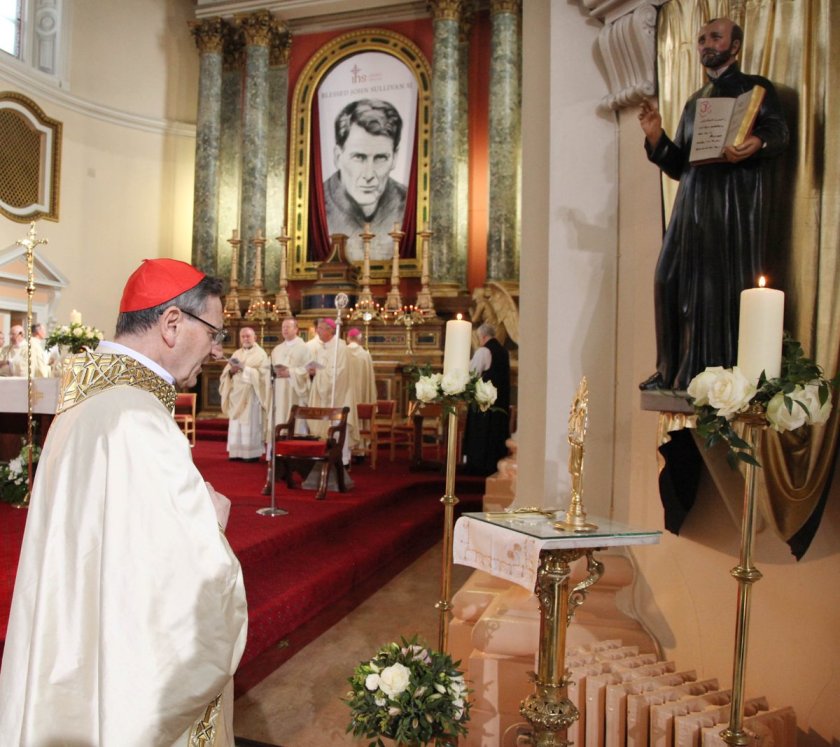
Sullivan had long been admired during his life and was known as a man of inspirational holiness which prompted for calls for his beatification; the cause later opened and would culminate on 7 November 2014 after Pope Francis confirmed his heroic virtue and named him as Venerable. The same pope approved a miraculous healing credited to his intercession on 26 April 2016. His beatification, the first ever to take place Ireland, took place in Dublin on 13 May 2017 and was celebrated by Cardinal Angelo Amato.
Childhood and education
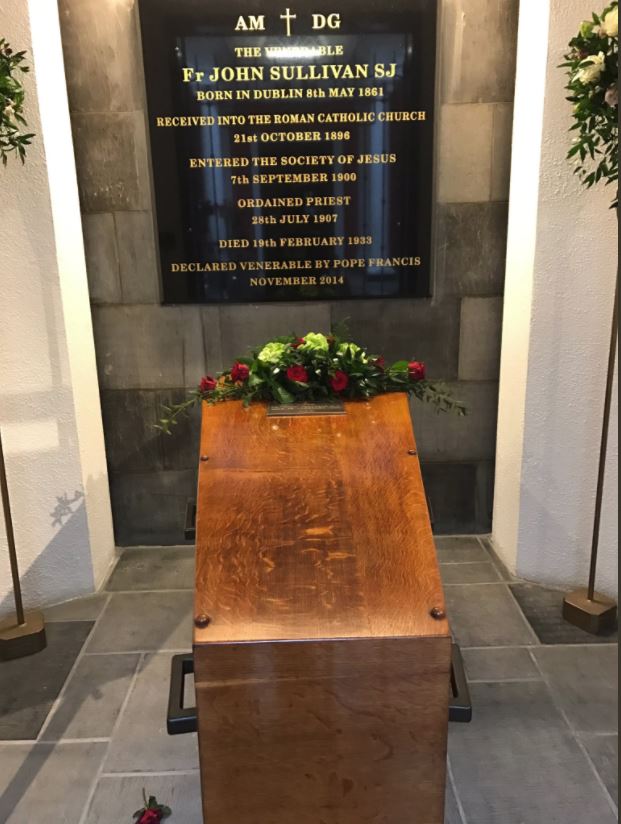
John Sullivan was born in mid-1861 at 41 Eccles Street in the old Dublin. He was born as the last of five children to Sir Edward Sullivan (10.07.1822–13.04.1885) – member of the Church of Ireland and a successful barrister who would later become the Lord Chancellor of Ireland – and Elizabeth Josephine Bailey (1823–27.01.1898) – a Roman Catholic from a prominent land-owning household in Passage West. Sullivan was raised as a Protestant and was baptised in the local Church of Ireland parish of Saint George on Temple Street on 15 July 1861. One sister was Annie Sullivan (1852-25.01.1918) and a brother was William (23.02.1860–07.07.1937). The girls were raised as Catholics while the sons were raised as Protestants. The first child was Annie and then came Edward, Robert and William.
In late 1861 the household relocated to 32 Fitzwilliam Place in Dublin. In 1873 he was sent to the Portora Royal School in Enniskillen with his brother William. In 1877 his brother Robert (1853–77) drowned after a boating accident in Killiney Bay along with Constance Exham who was the daughter of a family friend.
After his time at the Portora Royal School he followed in his father’s footsteps and went to Trinity College from 1879 where he studied classics. He was awarded the Gold Medal in Classics in 1885 and he studied for the English Bar at Lincoln’s Inn in London. During this period he travelled across Europe and spent time taking walking tours in Macedonia and Greece as well as Asia Minor. He spent several months in one of the Orthodox monasteries on Mount Athos and even contemplated entering it as a monk. He travelled through Southern Italy en route home but was forced to prolong his stay there due to contracting smallpox.
Upon his father’s death in 1885 he came into a comfortable inheritance. He was a frequent visitor to the Hospice of the Dying at Harold’s Cross where he brought comfort and companionship in addition to small tokens of food and drink as well as clothing to those ill people. Even after he became a teacher at Clongowes Wood College he continued these small luxuries to the poor including a bit of tobacco while also providing them with tea and sugar as well as oranges and apples. His brother novices remember him for his small kindnesses extended to his classmates.
Conversion and priesthood
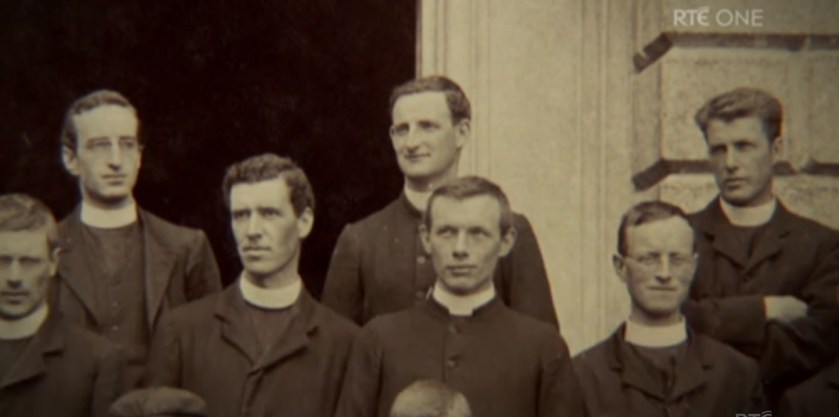
Sullivan was received into the Roman Catholic Church on 21 December 1896 in a celebration that the Jesuit priest Michael Gavin presided over at Farm Street Church Mayfair in central London. His family had expressed their great surprise upon his decision to convert to the Catholic faith. He commenced his Jesuit novitiate on 7 September 1900 at Saint Stanislaus College at Tullabeg. On completion of his novitiate around 1901 he was sent for his philosophical studies – until 1904 – to Saint Mary’s Hall in Stonyhurst. In 1904 – once he concluded his studies – he went to Milltown Park in Dublin for his theological studies and the Archbishop of Dublin William Walsh later ordained Sullivan as a Jesuit priest in the chapel at Milltown Park on 28 July 1907. He said his first Mass at the convent of the Irish Sisters of Charity at Mount Saint Anne’s in Milltown.
Sullivan soon after took up a teaching position at Clongowes Wood College which was an all-male boarding school the Jesuits managed near Clane. From 25 July 1919 until 20 May 1924 he served as the rector of the Juniorate and Retreat House at Rathfarnham Castle on the outskirts of Dublin. Sullivan then returned to teaching at Clongowes Wood College after this. Sullivan was untiring in his attention to the sick and he would travel miles to make a sick call which was often on foot but also riding a battered bike. On one occasion a workman by chance passed the chapel at the school at 2:00 am to see Sullivan in deep prayer on his knees. Each Holy Thursday, he spent five or six hours kneeling before the altar.
Illness and death
In February 1933 he began suffering severe abdominal pains and so was transferred on 17 February from the college to Saint Vincent’s Nursing Home in Lower Leeson Street in Dublin while asking for his breviary to be brought to him. Sullivan died at 11:00 pm on 19 February 1933 with his brother Sir William Sullivan at his side; an old friend who was present at his death said: “He died well”. He was buried in Clongowes Wood Cemetery. In 1960 his remains were exhumed and transferred to Saint Francis Xavier Church on Upper Gardiner Street.
Beatification
In 1944 his name was placed on the list that the Jesuit postulator Carlo Micinelli had set up in relation to prospective sainthood causes that could be opened; opening the process saw him titled as a Servant of God. The informative process that opened in 1953 saw the accumulation of witness testimonies and documentation being gathered and this process was completed in September 1960. The Congregation for the Causes of Saints were given the evidence and validated the informative process in acceptance in 1969 prior to theologians approving his spiritual writings in 1972. On 22 February 2000 the C.C.S. issued the official “nihil obstat” to the cause which acted as a formal introduction to the cause and approval of its continuation.
In June 2002 another process was held in Dublin to collate further evidence and the findings of this particular tribunal were forwarded to the C.C.S. who validated it on 18 October 2002. In 2004 the postulation submitted the Positio dossier to the C.C.S. for inspection with their consulting theologians approving its contents on 19 November 2013; the C.C.S. later approved this on 16 October 2014.
On 7 November 2014 he was named as Venerable after Pope Francis – himself a Jesuit – approved a decree acknowledging the heroic virtue of the late priest’s life based on the cardinal and theological virtues. Sullivan’s beatification depended on the approval of a miracle that was an unexplainable healing after his death; one such case was investigated in Ireland and it received C.C.S. validation on 10 February 2006. The C.C.S. approved this miracle on 19 April 2016 after the medical experts and theologians approved it. The pontiff – on 26 April 2016 – approved a miracle attributed to the late priest’s intercession and thus approved his beatification to take place. The miracle approved was the 1954 healing of a cancerous tumor on the neck of the Dublin woman Delia Farnham.
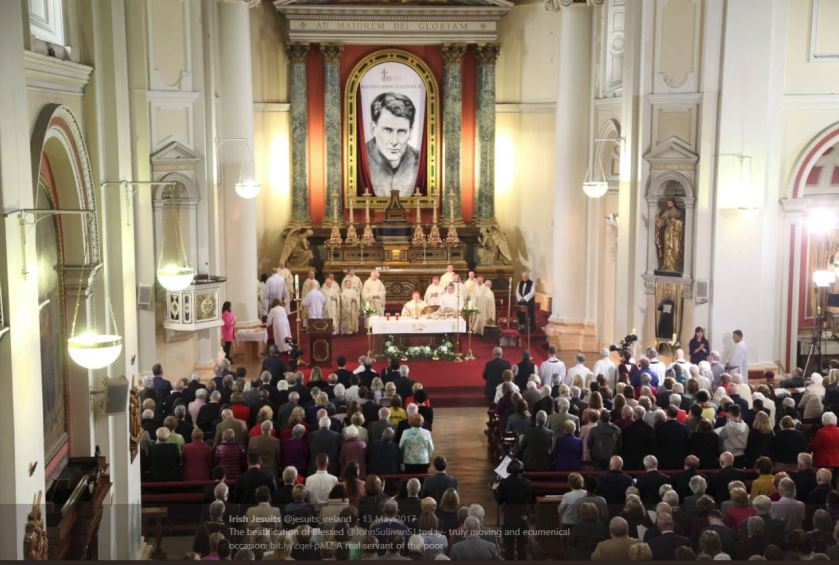
The beatification was celebrated in Dublin at the Saint Francis Xavier Church on 13 May 2017. He was also the first person to ever be beatified in Ireland.
The current postulator for this cause is the Jesuit priest Anton Witwer. The current vice-postulator is the Jesuit priest Conor Harper.
Devotions and legacies
There is a constant demand for blessings with his vow crucifix which is kept in the Saint Francis Xavier Church where his remains are located in the Sacred Heart Chapel. There is a special Mass celebrated in that church once each month dedicated to him and there is also an annual Mass to celebrate his life at the same church celebrated close to the commemoration of his 1933 death. The people of Kildare created their own monument to the late priest in Clane close to Clongowes Wood College.
Sullivan had been a Protestant until he reached middle age though that church was an important aspect to his life. On 8 May 1983 the retired Church of Ireland Archbishop George Simms gave the address at a memorial service to honour Sullivan’s life and work which was held in Saint Georges Church on Temple Street. The Catholic Auxiliary Bishop James Kavanagh attended and bought with him a text from Pope John Paul II reading: “His Holiness asks you to convey his cordial greetings to all present. In communion of prayer he gives thanks to Almighty God for the extraordinary gifts bestowed on Father Sullivan during his life and for the spirit of mutual understanding, reconciliation and goodwill which his memory enkindles between various christian communities in Ireland today”.
Miracles during his lifetime
There have been miracles reported during Sullivan’s life such as the two mentioned below:
The cure of Michael Collins (b. 1925) – nephew of the famed Michael Collins – from infantile paralysis. The child awoke one night in October 1928 in extreme distress and the summoned doctor diagnosed him with infantile paralysis. Mrs Collins drove to the school seeking out Sullivan’s assistance; Sullivan promised to say a Mass but also rode his bike to their home where he touched the child’s leg and prayed over him for two hours.
The cure of Miss Kitty Garry (aged ten at the time) from TB; he blessed her and the ailment left her after a month.
Bl Alvarez of Cordova
St Auxibius
St Baoithin
St Barbatus of Benevento
St Beatus
St Belina
St Boniface of Lausanne
St Conon of Alexandria
St Conrad of Piacenza
Bl Elizabeth of Mantua
St Gabinus
St George of Lodeve
Bl John Sullivan S.J. (1861-1933)
Bl Józef Zaplata
St Lucia Yi Zhenmei
St Mansuetus of Milan
St Odran
St Proclus of Bisignano
St Quodvultdeus
St Valerius of Antibes
St Zambdas of Jerusalem
Genesis 9:8-15, Psalms 25:4-9, 1 Peter 3:18-22, Mark 1:12-15
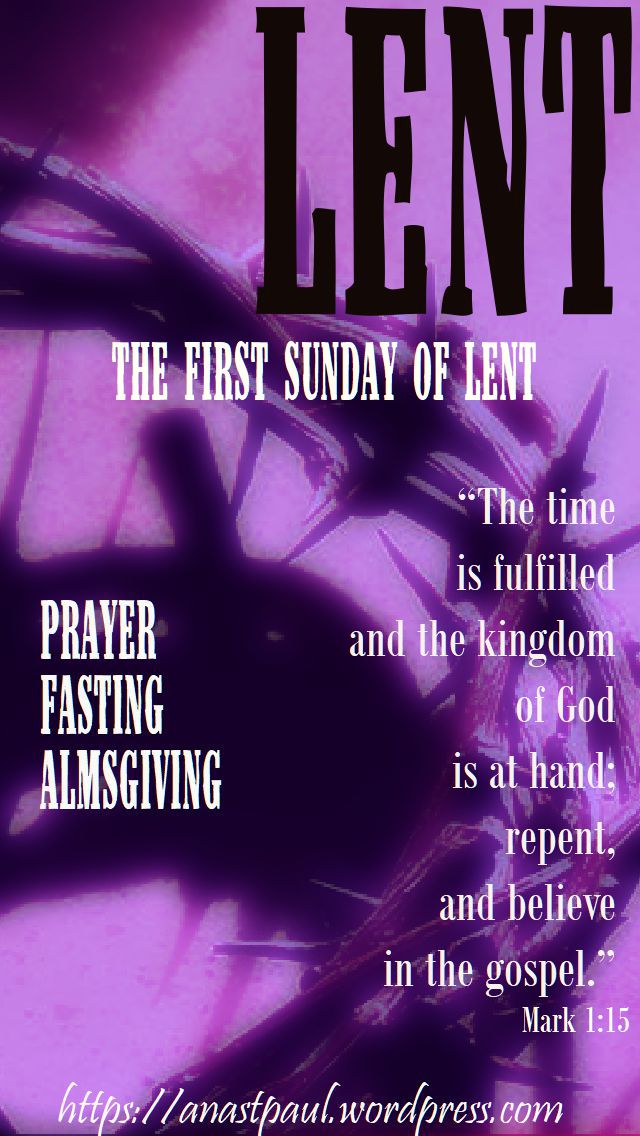
Mark 1:15 – “The time is fulfilled, and the kingdom of God is at hand; repent, and believe in the gospel.”
Psalm 25:4 – Make me to know thy ways, O Lord; teach me thy paths
Lent is a kind of desert. A time set apart to pray with greater focus and intensity.
A time to fast from what distracts us from what is most important – that good news!
When the outside noise is quietened, we are more in touch with the inner pulls that are going on inside of us.
It is not always a comfortable space to be!
We are used to be anaesthetised to the tugs of the Holy Spirit calling us to something new, something more and often we struggle to be free from the attachment to things, we would prefer them staying just as they are, thank you.
But now we seek to emerge, like Jesus, from our desert time of Lent, strengthened and renewed.
We have a new energy and courage to respond to whatever God is asking of us in this moment of our lives.
Part of that time is to spend true moments, as Jesus did, listening to the Father. We must create some desert space.
Is there a time we can safeguard each day for prayer?
Can we reduce the clutter of too much external stimulation from TV, social media, so that we can tune into what God is saying, what the Holy Spirit is wanting us to notice?
Be sure to find that “desert time and space” each day. What are those inner concerns, questions, worries with which the Spirit is driving you into that desert this Lent? Imagine yourself with Jesus in the desert. Enter into conversation with Him.
Fr Nicholas King SJ – Long Journey to the Resurrection
Christus.Behold a matter that is deeply displeasing to Me, namely, how few there are who recognise the value of time, the time that I lend to men for doing penance, for increasing the grace given them, for acquiring heavenly glory. Lo, the acceptable yet irrevocable time, passes and no one is considering it in his heart; the days of salvation are slipping by and no one makes the occasion of their flight a reason for using well what can never return.
But you, as far as you are able, flee the things of time, such as acquaintanceship, speech-making and occupations of small profit and because the days are evil, redeem the time that should be given rather to Me and to your soul than to others. Is My proposition hard and difficult? Observe how much time is given up to the body for food and sleep, to conversation, banquets and the rest, so that you cannot give ever so small a portion to God, to your soul, to eternity! Alas, how prodigal men are of time when it is a question of serving vanity, how sparing of it when it is a case of occupying themselves with His business to whom all time is owed.
Make me to know thy ways, O Lord; teach me thy paths…Psalm 25:4
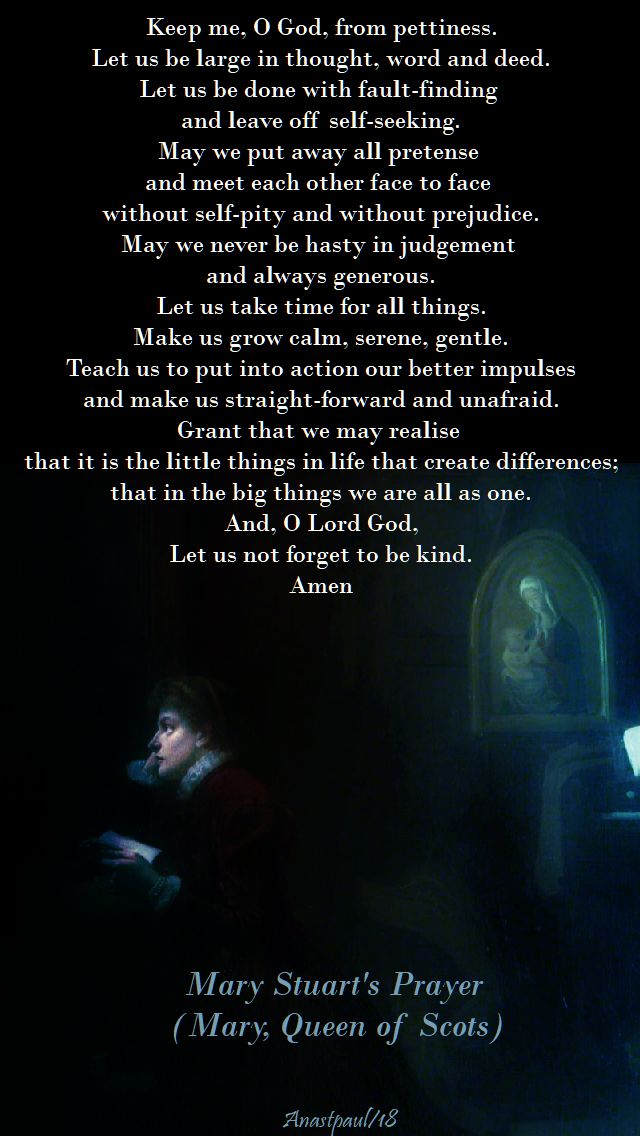
Keep me, O God, from pettiness. Let us be large in thought, word and deed. Let us be done with fault-finding and leave off self-seeking. May we put away all pretense and meet each other face to face without self-pity and without prejudice. May we never be hasty in judgement and always generous. Let us take time for all things. Make us grow calm, serene, gentle. Teach us to put into action our better impulses and make us straight-forward and unafraid. Grant that we may realise that it is the little things in life that create differences; that in the big things we are all as one. And, O Lord God, Let us not forget to be kind. Amen
Sunday Reflection – 18 February – The First Sunday of Lent Year B
Beyond the daily life of the believer, the Eucharist extends its action to the whole cosmos.
As Teilhard de Chardin wrote: “When He (Christ) says through the priest “This is my body”, His words go well beyond the piece of bread over which they are pronounced: they effect the birth of the whole Mystical Body. Beyond the transubstantiated Host, the priestly action extends to the cosmos itself.”
Every Eucharist is a “Mass on the world.”
This vision inspired a prayer of Teilhard de Chardin that we can make our own, each time we participate in the Mass and even when we cannot participate:
“On the altar of the whole earth I offer You, Lord, the work and the toil of the world…. All that will grow in the world in the course of this day, all that will decline in it and all that will die in it… Receive, Lord, this total Host that Creation presents to You, drawn and moved by You, at the dawn of a new day.”
Fr Raneiro Cantalamessa OFM (Preacher to the Papal Household) “This is My Body”
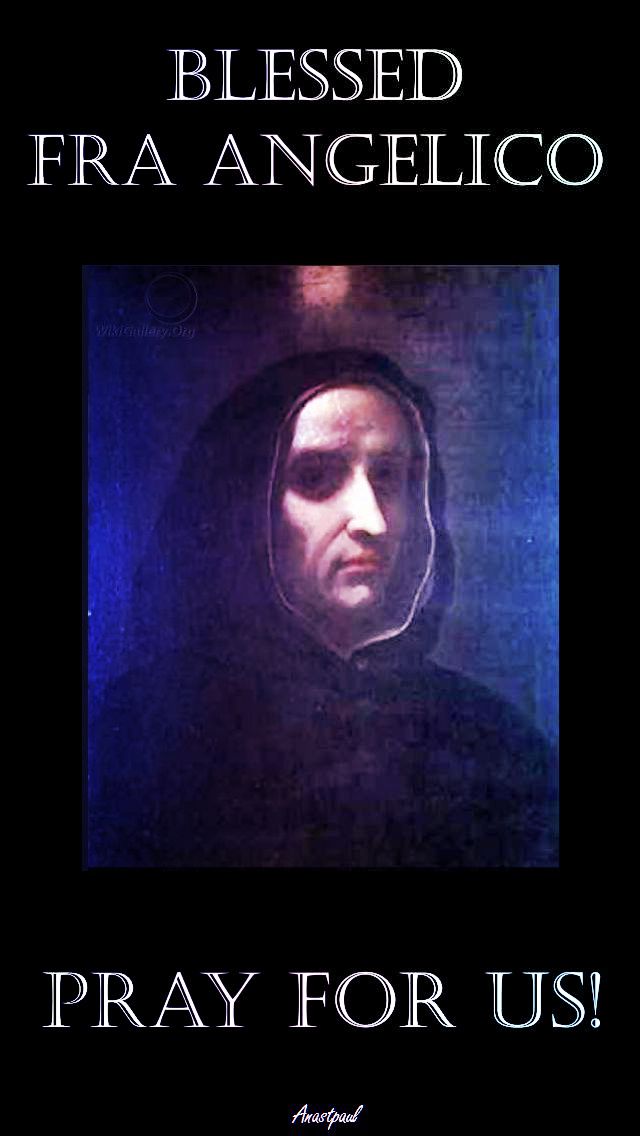
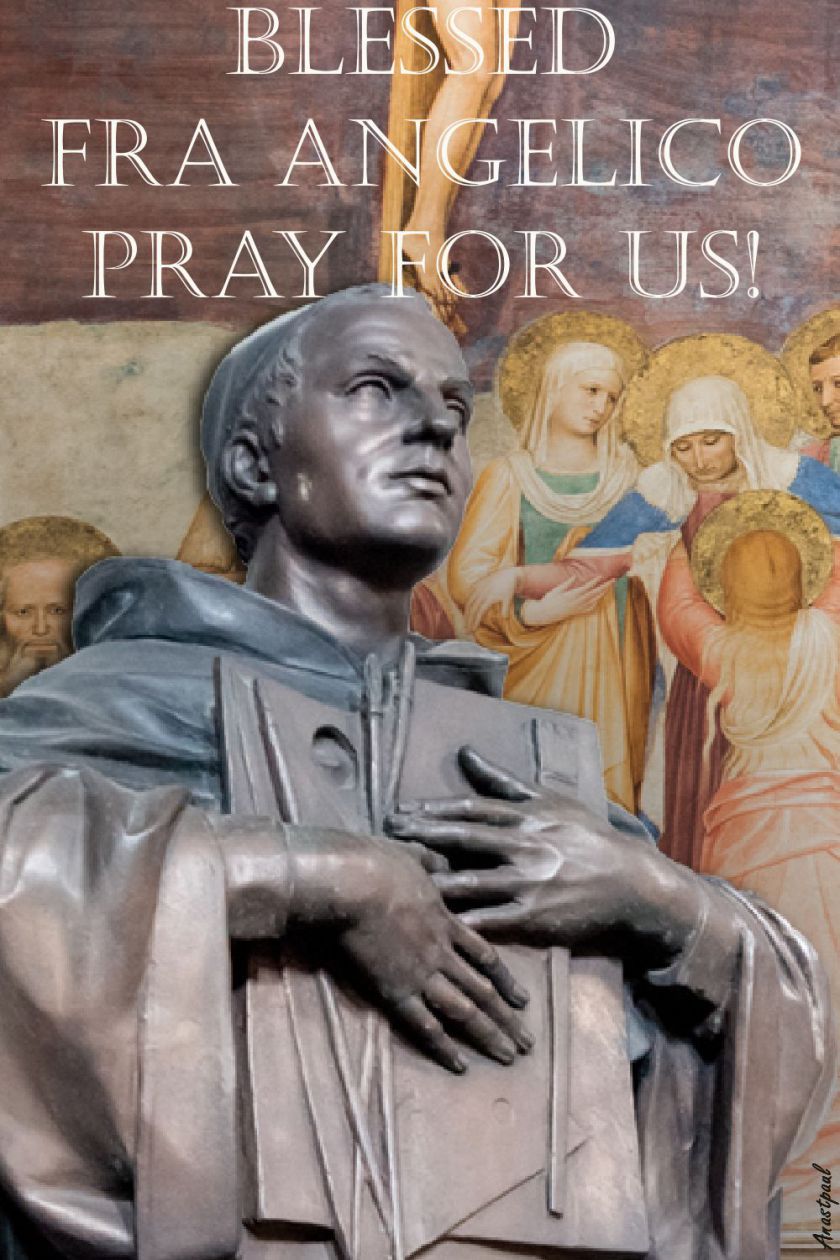
Thought for the Day – 18 February – The Memorial of Blessed John of Fiesole/Fra Angelico O.P. (1387-1455)
One of the greatest Christian artists is Giovanni Fiesole, better known to the world as Blessed Fra Angelico, the “Angelic Brother.” Fra Angelico is a patron saint for Catholic artists. His style of painting beautifully bridges the iconographic and gothic traditions. Giorgio Vasari, author of “Lives of the Artists,” referred to Angelico as a “rare and perfect talent.”
Very little of his writings have survived the centuries but one phrase still resonates, more than 400 years after his death. “He who does Christ’s work, must stay with Christ always.”
Saint Paul, in his letter to the Galatians said something similar. “I live; yet now, it is not I, but truly Christ, who lives in me. And though I live now in the flesh, I live in the faith of the Son of God, who loved me and who delivered himself for me.” Galatians 2:20
What does it mean when Paul tells us it is no longer he who lives but Christ who lives in him? What does it mean to stay with Christ always?
In Paul’s time it was believed that the only way to have a right relationship with God was to follow the law, the Ten Commandments and all the thousands of rules that derive from them. But Paul rejected this idea and preached that the only road to justification, to having that right relationship with God, is through faith in Jesus Christ.
It is not enough to simply “follow the rules” and stay out of trouble. If that is all we do then we are trying to achieve heaven by our own merits. God wants more from us than that. God invites us into a relationship of friends and family, a relationship of love. This type of relationship is a living, dynamic one. To love Christ and to want to be near Him is to be crucified with Him.
It means standing up for the Truth even when it is unpopular. It means finding time to pray. It means that we stay faithful to the teachings of Jesus. And it means that when we fail, we humbly confess our sins as we would apologise to a friend we have hurt, so that that relationship can be restored. It means that we must reflect Christ to the whole world, so that when people look at us they do not see us, they see Christ.
For the Artist this means we must deeply consider our vocation, St John Paul described it as a vocation of beauty. Do we work to bring beauty to the world? Do we use our gifts to lift peoples hearts and minds to God? Does our work reflect His splendour and bring hope and joy to our brothers and sisters? This does not mean that every artist must confine themselves to religious art but it does mean that we may be called to sacrifice lucrative opportunities. or turn away from work that does not suit our vocation. But in the end that is what it means to live for Christ and not for ourselves. (Deacon Lawrence Klimecki – Speaker, Writer, Artist)
Quote of the Day – 18 February – The First Sunday of Lent Year B
“Lent is like a long ‘retreat’ during which we can turn back into ourselves and listen to the voice of God, in order to defeat the temptations of the Evil One.
It is a period of spiritual ‘combat’ which we must experience alongside Jesus, not with pride and presumption, but using the arms of faith: prayer, listening to the word of God and penance.
In this way we will be able to celebrate Easter in truth, ready to renew the promises of our baptism.”
One Minute Reflection – 18 February – The Memorial of Blessed John of Fiesole/Fra Angelico O.P. (1387-1455)
Well done you are an industrious and reliable servant…… Come share your master’s joy…………Matthew 25:21
REFLECTION – “In God’s house we must try to accept whatever job he gives us – cook, kitchen boy, waiter, stable boy or baker. For we know that our reward depends not on the job itself but on the faithfulness with which we serve God.”… Pope John Paul I
“Fra Angelico’s painting was the fruit of the great harmony between a holy life and the creative power with which he had been endowed.”… St Pope John Paul II
PRAYER – O God, in Your providence You inspired blessed Fra Angelico to portray the beauty and sweetness of heaven. By his prayers and the example of his virtues, grant that we may manifest this splendour to our brothers and sisters. Blessed Angelico, pray for us! Through Christ our Lord, amen.
Our Morning Offering – 18 February – The First Sunday of Lent, Year B
Act of Oblation before Holy Mass
Eternal Father,
we offer You the sacrifice
wherein your Son Jesus
offered Himself upon the Cross
and which He now renews upon this altar.
We adore You and render to You
that honour which is Your due,
acknowledging Your dominion over all things
and our absolute dependence on You.
You are our first beginning and our last end;
we give You thanks for countless benefits received;
we ask You to forgive our sins
and to offer You worthy satisfaction for the same.
Finally to implore Your grace and mercy
for all of us who will offer this sacrifice today,
for all those who are in tribulation and distress,
for all of us sinners,
for the whole world and for the souls in purgatory.
We ask this through Christ our Lord.
Amen.
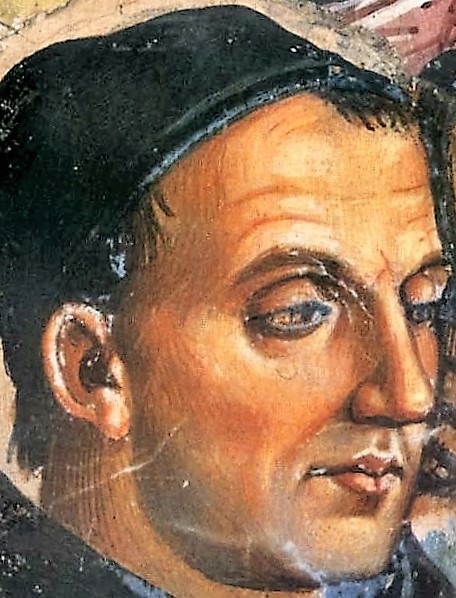
Saint of the Day – 18 February – Blessed John of Fiesole/Fra Angelico O.P. (1387-1455) Born in 1387 in Vicchio di Mugello near Florence, Italy as Guido di Pietro – he died on 18 February 1455 in the Dominican convent in Rome, Italy of natural causes. He was known to contemporaries as Fra Giovanni da Fiesole (Brother John of Fiesole) and Fra Giovanni Angelico (Angelic Brother John). In modern Italian he is called il Beato Angelico (Blessed Angelic One); the common English name Fra Angelico means the “Angelic friar”. In 1982, Pope John Paul II proclaimed his beatification in recognition of the holiness of his life, thereby making the title of “Blessed” official. Fiesole is sometimes misinterpreted as being part of his formal name but it was merely the name of the town where he took his vows as a Dominican friar and was used by contemporaries to separate him from others who were also known as Fra Giovanni. He is listed in the Roman Martyrology as Beatus Ioannes Faesulanus, cognomento Angelicus—”Blessed Giovanni of Fiesole, surnamed ‘the Angelic’ “. Patron of Catholic Artists.
Fra Angelico was an Early Italian Renaissance painter described by Vasari in his Lives of the Artists as having “a rare and perfect talent”.
Early life, 1395–1436
Fra Angelico was born Guido di Pietro at Rupecanina in the Tuscan area of Mugello near Fiesole towards the end of the 14th century. Nothing is known of his parents. He was baptised Guido or Guidolino. The earliest recorded document concerning Fra Angelico dates from 17 October 1417 when he joined a religious confraternity or guild at the Carmine Church, still under the name of Guido di Pietro. This record reveals that he was already a painter, a fact that is subsequently confirmed by two records of payment to Guido di Pietro in January and February 1418 for work done in the church of Santo Stefano del Ponte. The first record of Angelico as a friar dates from 1423, when he is first referred to as Fra Giovanni (Friar John), following the custom of those entering one of the older religious orders of taking a new name. He was a member of the local community at Fiesole, not far from Florence, of the Dominican Order; one of the medieval Orders belonging to a category known as mendicant Orders because they generally lived not from the income of estates but from begging or donations. Fra, a contraction of frater (Latin for ‘brother’), is a conventional title for a mendicant friar.
According to Vasari, Fra Angelico initially received training as an illuminator, possibly working with his older brother Benedetto who was also a Dominican and an illuminator. The former Dominican convent of San Marco in Florence, now a state museum, holds several manuscripts that are thought to be entirely or partly by his hand. The painter Lorenzo Monaco may have contributed to his art training and the influence of the Sienese school is discernible in his work. He had several important charges in the convents he lived in but this did not limit his art, which very soon became famous. According to Vasari, the first paintings of this artist were an altarpiece and a painted screen for the Charterhouse (Carthusian monastery) of Florence; none such exist there now.
From 1408 to 1418, Fra Angelico was at the Dominican friary of Cortona, where he painted frescoes, now mostly destroyed, in the Dominican Church and may have been assistant to Gherardo Starnina or a follower of his. Between 1418 and 1436 he was at the convent of Fiesole, where he also executed a number of frescoes for the church and the Altarpiece, which was deteriorated but has since been restored. A predella of the Altarpiece remains intact and is conserved in the National Gallery, London, and is a great example of Fra Angelico’s ability. It shows Christ in Glory surrounded by more than 250 figures, including beatified Dominicans.
San Marco, Florence, 1436–1445
In 1436, Fra Angelico was one of a number of the friars from Fiesole who moved to the newly built convent or friary of San Marco in Florence. This was an important move which put him in the centre of artistic activity of the region and brought about the patronage of one of the wealthiest and most powerful members of the city’s governing authority, or “Signoria” (namely Cosimo de’ Medici), who had a cell reserved for himself at the friary in order that he might retreat from the world.
It was, according to Vasari, at Cosimo’s urging that Fra Angelico set about the task of decorating the convent, including the magnificent fresco of the Chapter House, the often-reproduced Annunciation at the top of the stairs leading to the cells, the Maesta (or Coronation of the Madonna) with Saints (cell 9) and the many other devotional frescoes, of smaller format but remarkable luminous quality, depicting aspects of the Life of Christ that adorn the walls of each cell.
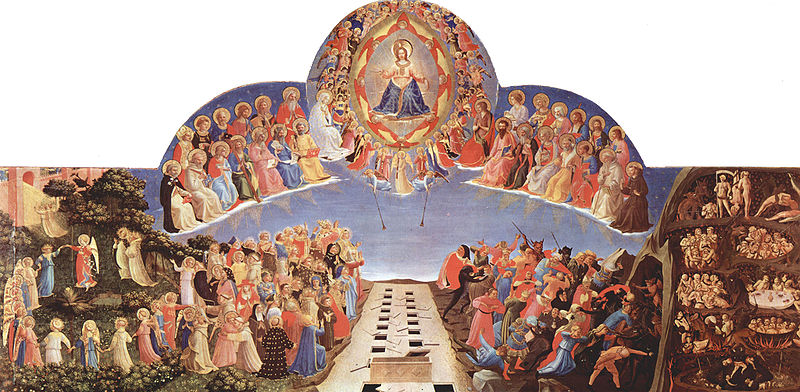
The Last JudgementThe Transfiguration shows the directness, simplicity and restrained palette typical of these frescoes. Located in a monk’s cell at the Convent San’ Marco and intended for private devotion.
In 1439 Fra Angelico completed one of his most famous works, the San Marco Altarpiece at Florence. The result was unusual for its time. Images of the enthroned Madonna and Child surrounded by saints were common, but they usually depicted a setting that was clearly heaven-like, in which saints and angels hovered about as divine presences rather than people. But in this instance, the saints stand squarely within the space, grouped in a natural way as if they were able to converse about the shared experience of witnessing the Virgin in glory. Paintings such as this, known as Sacred Conversations, were to become the major commissions of Giovanni Bellini, Perugino and Raphael.
San Marco Altarpiece
The Vatican, 1445–1455
In 1445 Pope Eugene IV summoned him to Rome to paint the frescoes of the Chapel of the Holy Sacrament at St Peter’s, later demolished by Pope Paul III. Vasari claims that at this time Fra Angelico was offered the Archbishopric of Florence by Pope Nicholas V and that he refused it, recommending another friar for the position. The story seems possible and even likely. However, if Vasari’s date is correct, then the pope must have been Eugene IV and not Nicholas, who was elected Pope only on 6 March 1447. Moreover, the archbishop in 1446–1459 was the Dominican Antoninus of Florence (Antonio Pierozzi), canonised by Pope Adrian VI in 1523. In 1447 Fra Angelico was in Orvieto with his pupil, Benozzo Gozzoli, executing works for the Cathedral. Among his other pupils were Zanobi Strozzi.
From 1447 to 1449 Fra Angelico was back at the Vatican, designing the frescoes for the Niccoline Chapel for Nicholas V. The scenes from the lives of the two martyred deacons of the Early Christian Church, St Stephen and St Lawrence may have been executed wholly or in part by assistants. The small chapel, with its brightly frescoed walls and gold leaf decorations gives the impression of a jewel box. From 1449 until 1452, Fra Angelico returned to his old convent of Fiesole, where he was the Prior.
Death and beatification
In 1455, Fra Angelico died while staying at a Dominican convent in Rome, perhaps on an order to work on Pope Nicholas’ chapel. He was buried in the church of Santa Maria sopra Minerva.
When singing my praise, don’t liken my talents to those of Apelles. Say, rather, that, in the name of Christ, I gave all I had to the poor.
The deeds that count on Earth are not the ones that count in Heaven.
I, Giovanni, am the flower of Tuscany. — Translation of epitaph
The English writer and critic William Michael Rossetti wrote of the friar:
“From various accounts of Fra Angelico’s life, it is possible to gain some sense of why he was deserving of canonisation. He led the devout and ascetic life of a Dominican friar and never rose above that rank; he followed the dictates of the order in caring for the poor; he was always good-humoured. All of his many paintings were of divine subjects and it seems that he never altered or retouched them, perhaps from a religious conviction that, because his paintings were divinely inspired, they should retain their original form. He was wont to say that he who illustrates the acts of Christ should be with Christ. It is averred that he never handled a brush without fervent prayer and he wept when he painted a Crucifixion. The Last Judgement and the Annunciation were two of the subjects he most frequently treated.”
The Crucified Christ
Pope John Paul II beatified Fra Angelico on 3 October 1982 and in 1984 declared him patron of Catholic artists.
“Angelico was reported to say “He who does Christ’s work must stay with Christ always”. This motto earned him the epithet “Blessed Angelico” because of the perfect integrity of his life and the almost divine beauty of the images he painted, to a superlative extent those of the Blessed Virgin Mary.”— St Pope John Paul II
St Angilbert of Centula
St Colman of Lindisfarne
St Constance of Vercelli
St Esuperia of Vercelli
St Ethelina
Bl John of Fiesole/Fra Angelico O.P. (1387-1455)
St Gertrude Caterina Comensoli
St Helladius of Toledo
St Ioannes Chen Xianheng
St Ioannes Zhang Tianshen
St Jean-François-Régis Clet
St Jean-Pierre Néel
Bl Jerzy Kaszyra
Bl John Pibush – one of the Martyrs of Douai
St Leo of Patera
St Martinus Wu Xuesheng
Bl Matthew Malaventino
St Paregorius of Patara
St Sadoth of Seleucia
St Simeon
St Tarasius of Constantinople
St Theotonius
Bl William Harrington
—
Martyrs of North Africa – 7 saints: Group of Christians who were martyred together, date unknown. We know nothing else but seven of their names – Classicus, Fructulus, Lucius, Maximus, Rutulus, Secundinus and Silvanus.
They were born and martyred in North Africa.
Martyrs of Rome – 5 saints: A group of Christians martyred together in the persecutions of Diocletian. We know nothing else but their names – Alexander, Claudius, Cutias, Maximus and Praepedigna. They were martyred in 295 in Rome, Italy.
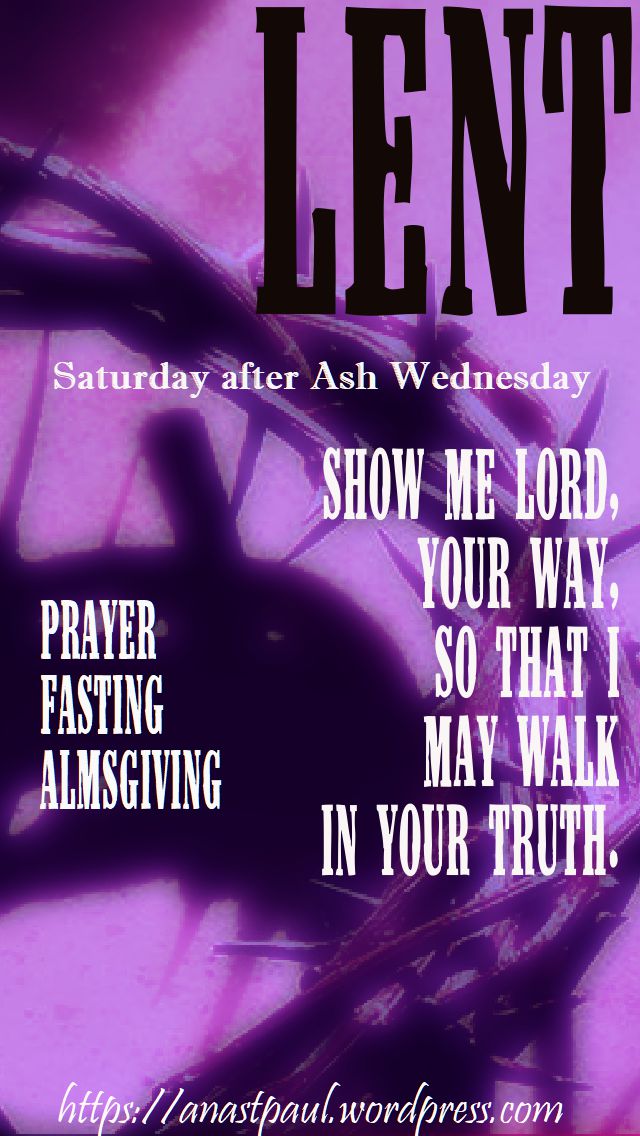
Saturday after Ash Wednesday – 17 February 2018 Isaiah 58:9-14, Psalms 86:1-6, Luke 5:27-32
Show me Lord, your way, so that I may walk in your truth.
Isaiah 58:9-10: “If you take away from the midst of you the yoke, the pointing of the finger and speaking wickedness, if you pour yourself out for the hungry and satisfy the desire of the afflicted, then shall your light rise in the darkness and your darkest hour will be like noon.
Luke 5:32: “I have come to call not the upright but sinners to repentance.”
Isaiah makes it abundantly clear that it is our service to the poor and the weak that wins God’s favour, not lifeless religious practices. The message becomes most meaningful in modern society, marked by unfair distribution of resources, hatred, violence, abuse and mutual accusations. It is only when we strive against such evils that we win God’s approval. “You shall be like the watered garden” the prophet says. The image stands for the possession of every good thing that we desire.
The Gospel speaks of the call of Levi. His joy was so great that he could hardly contain it.
He organised a party for his fellow tax-collectors, which unfailingly earned the criticism of the Pharisees. Jesus’ answer was that His mission was precisely to wrongdoers, to the least and the lost. These words indeed offer us hope when we stray and urge us to reach out to others as Jesus did.
That is the Christian calling, that is the Christian ‘job’! (Archbishop Thomas Menamparanpil SDB – Gods Word)
Don’t you wonder what it was about Levi that moved Jesus to call him? And what was it that caused Levi to respond?
He must have been a pretty successful man in economic terms but as a tax collector, he was undoubtedly not popular in his own community and was seen as a collaborator with Rome. Perhaps he had a nagging sense of “there must be something more to life”. perhaps a sense of emptiness and sadness. Something touched him so deeply at Jesus call, that he let go of a previous way of life and opened himself instantly to the gift being offered. He was overjoyed, he was filled with joy, he was joyous, he bubbled over and threw a big party in order to share his joy! And Jesus attended the party! He was at the party! He is at our party too when we allow Him entrance to our hearts.
When asked who he is, Pope Francis responded “I am a sinner, whom the Lord has looked upon.” When we are able to see ourselves as Pope Francis does, as loved sinners, we are open to receive the forgiveness and help God longs to give us. When we are aware of ourselves as sinners, loved and called by God, we respond with a deep sense of repentance, gratitude and joy, we throw that party and invite other sinners to join us. We simply have to share the joy!
Where do I experience my own sinfulness? How is this awareness a gift? Spend some time with Jesus today sharing with Him your struggles and Your need of His help. Have a party with Him! (excerpt Fr Nicholas King S.J. ‘The Long Journey to the Resurrection’)
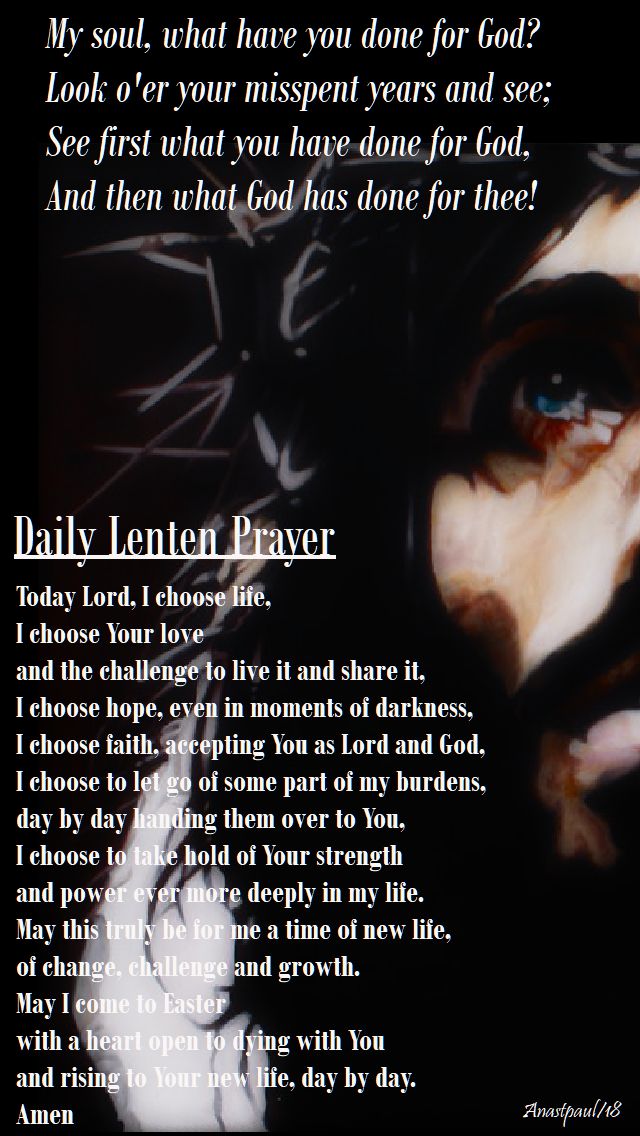
My soul, what have you done for God?
Look o’er your misspent years and see;
See first what you have done for God,
And then what God has done for thee!
Daily Lenten Prayer
Today Lord, I choose life,
I choose Your love
and the challenge to live it and share it,
I choose hope, even in moments of darkness,
I choose faith, accepting You as Lord and God,
I choose to let go of some part of my burdens,
day by day handing them over to You,
I choose to take hold of Your strength
and power ever more deeply in my life.
May this truly be for me a time of new life,
of change, challenge and growth.
May I come to Easter with a heart open to dying with You
and rising to Your new life, day by day.
Amen
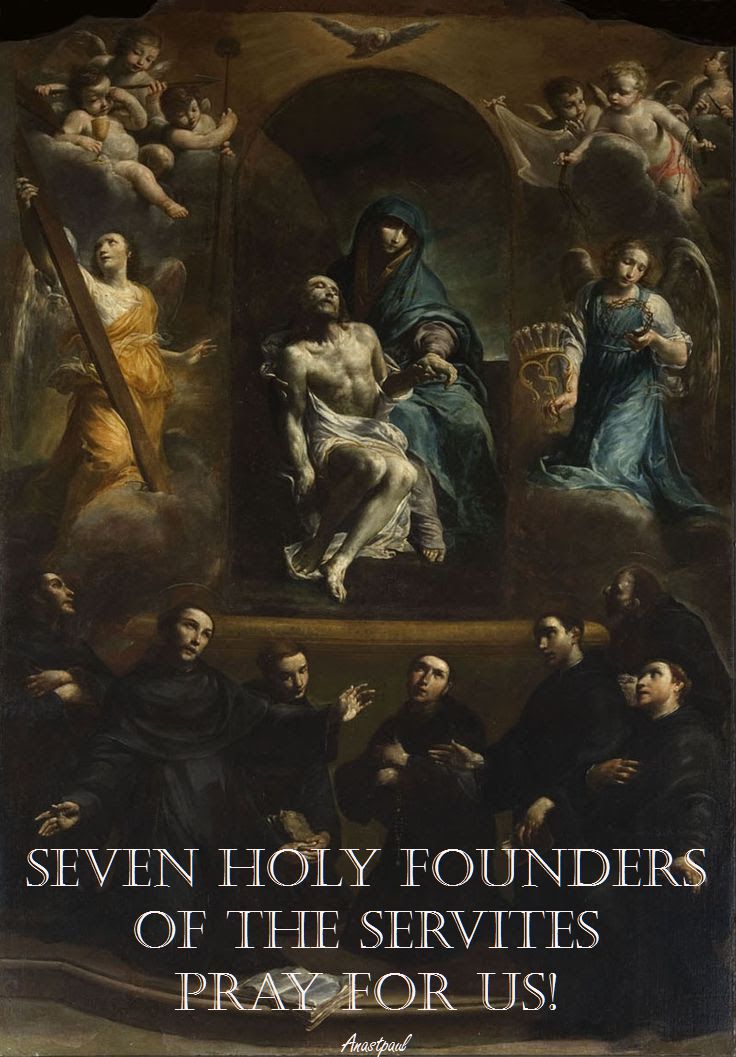
Thought for the Day – 17 February – The Memorial of the Seven Holy Founders of the Servite Order (1233)
Can you imagine seven prominent men of any great city banding together, leaving their homes and professions and going into solitude for a life directly given to God? That is what happened in the cultured and prosperous city of Florence in the middle of the 13th century. The city was torn with political strife as well as the heresy of the Cathari, who believed that physical reality was inherently evil. Morals were low and religion seemed meaningless. In 1240, seven noblemen of Florence mutually decided to withdraw from the city to a solitary place for prayer and direct service of God. Community members combined monastic life and active ministry. In the monastery, they led a life of prayer, work and silence while in the active apostolate they engaged in parochial work, teaching, preaching and other ministerial activities.
Since criminals and people with evil purposes often band together for their common interests, good people often have to do the same. Faced with the immorality and blood feuds of thirteenth century Florence, the Seven Holy Founders banded together for their own spiritual good and succeeded in founding a whole new religious order. Good companions are on of the most powerful helps toward a holy life, for all of us are faced in a new and urgent way with the challenge to make our lives decisively centred in Christ. In this new day, we often find those ‘good companions’ online, let us too band together and live a holy life amidst the dangers around us!
One Minute Reflection – 17 February – The First Saturday of Lent 2018
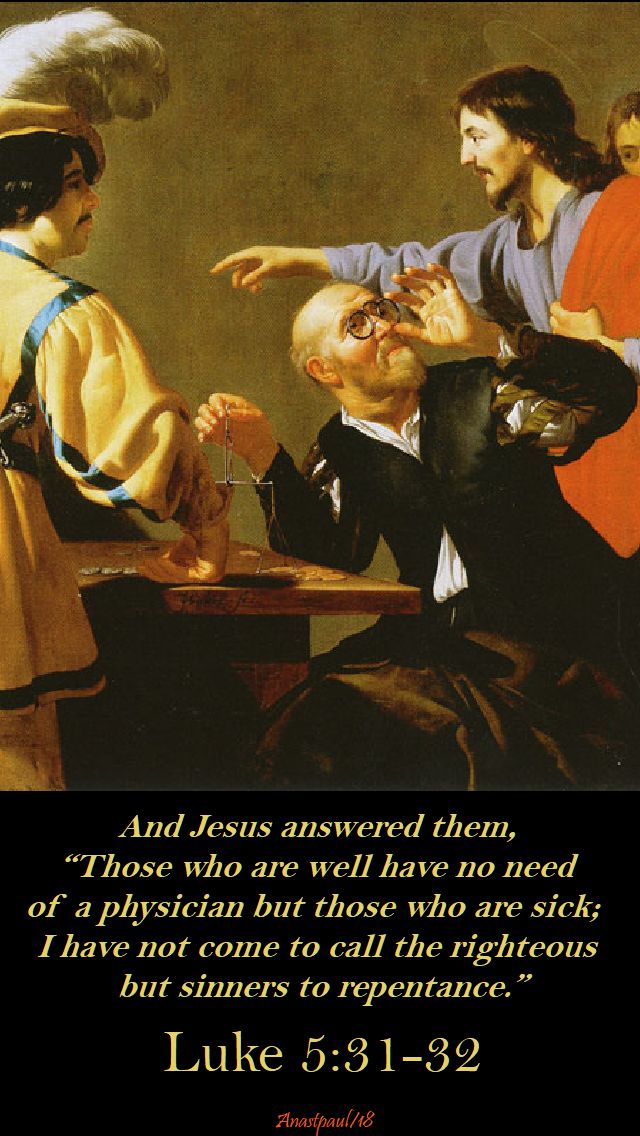
And Jesus answered them, “Those who are well have no need of a physician but those who are sick; I have not come to call the righteous but sinners to repentance.”...Luke 5:31-32
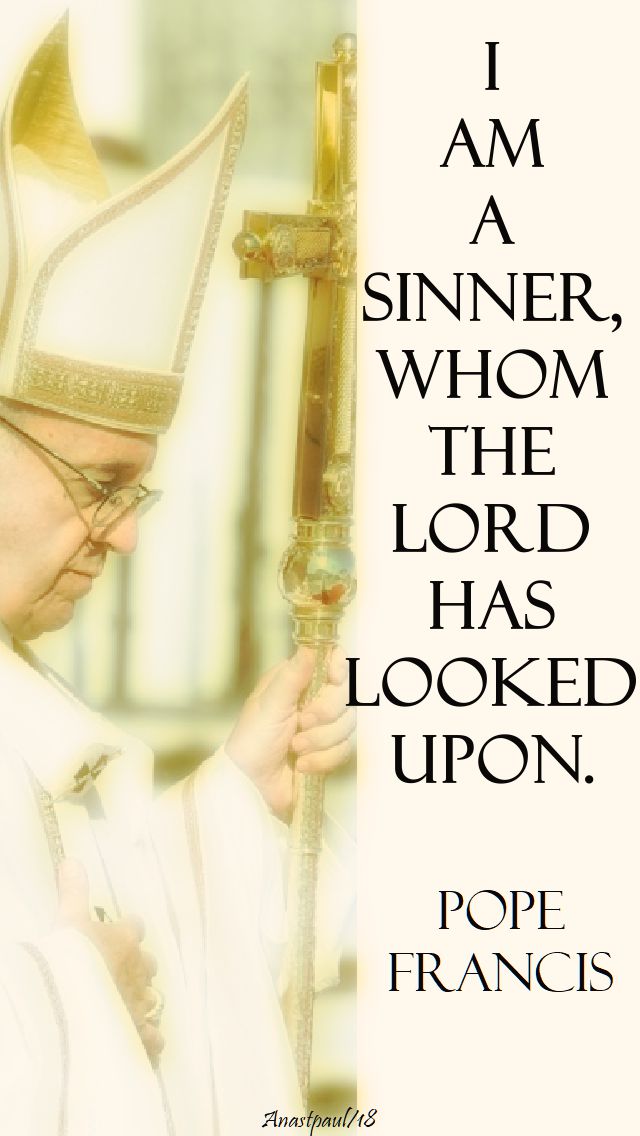
REFLECTION – “I am a sinner, whom the Lord has looked upon.”…Pope Francis
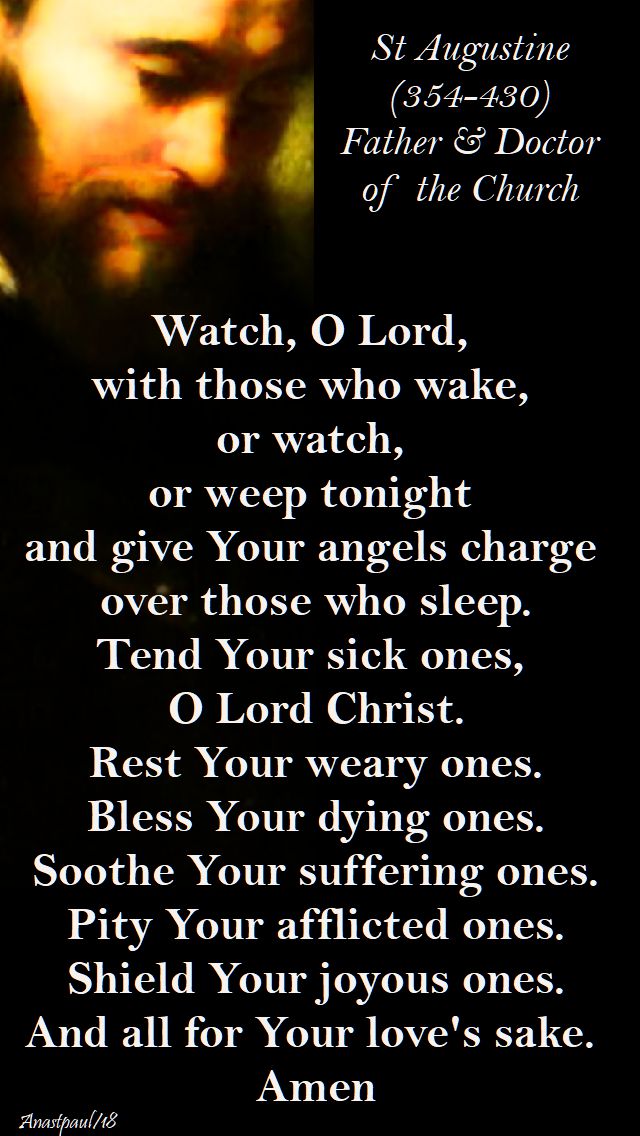
PRAYER – Watch, O Lord, with those who wake, or watch, or weep tonight and give Your angels charge over those who sleep.
Tend Your sick ones, O Lord Christ.
Rest Your weary ones.
Bless Your dying ones.
Soothe Your suffering ones.
Pity Your afflicted ones.
Shield Your joyous ones.
And all for Your love’s sake. Amen…St Augustine (354-430) Father & Doctor of the Church
Our Morning Offering – 17 February – The Memorial of the Seven Holy Founders of the Servite Order (1233)
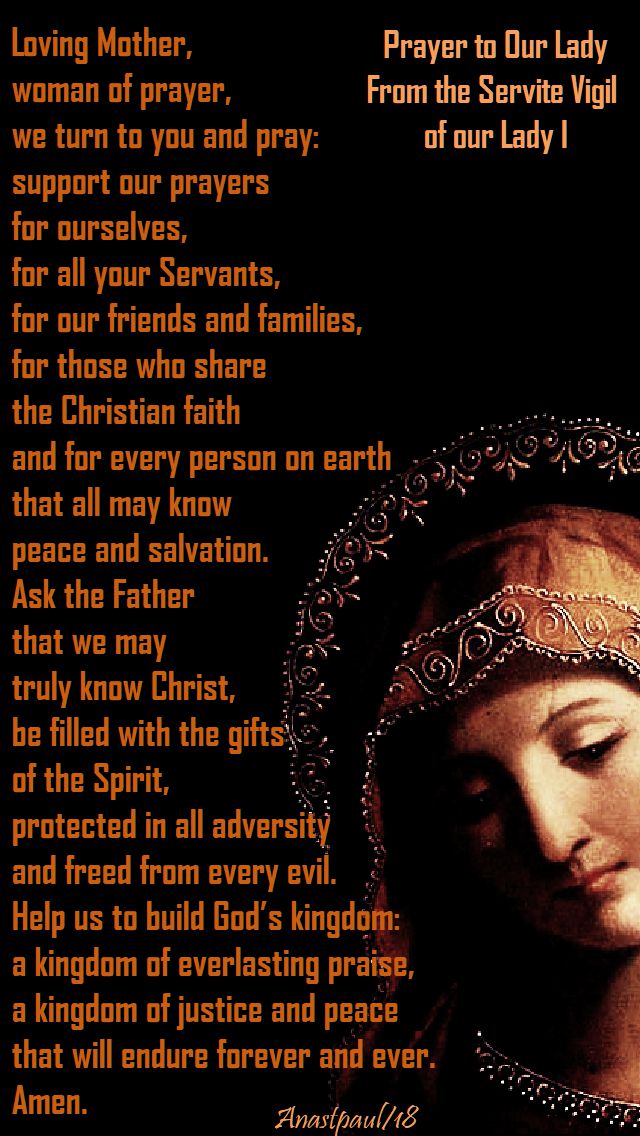
Prayer to Our Lady From the Servite Vigil of our Lady I
Loving Mother,
woman of prayer,
we turn to you and pray:
support our prayers
for ourselves,
for all your Servants,
for our friends and families,
for those who share the Christian faith
and for every person on earth
that all may know peace and salvation.
Ask the Father that we may truly know Christ,
be filled with the gifts of the Spirit,
protected in all adversity
and freed from every evil.
Help us to build God’s kingdom:
a kingdom of everlasting praise,
a kingdom of justice and peace
that will endure forever and ever.
Amen.
Saints of the Day – 17 February – The Seven Holy Founders of the Servite Order OSM – Formation on 15 August 1233. The Servite Order is one of the five original Catholic mendicant orders. Its objectives are the sanctification of its members, preaching the Gospel and the propagation of devotion to the Mother of God, with special reference to her sorrows. The members of the Order use O.S.M. (Ordo Servorum Beatae Mariae Virginis) as their post-nominal letters. The male members are known as Servite Friars or Servants of Mary. The Order of Servants of Mary (The Servites) religious family includes friars (priests and brothers), contemplative nuns, a congregation of active sisters and lay groups.
Between the years 1225 and 1227 seven young Florentines joined the Confraternity of the Blessed Virgin—popularly known as the ‘Laudesi’ or Praisers. It was a period when the prosperous city of Florence was being rent by political factions and distracted by the heresy of the Cathari: it was also a time of general relaxation of morals even where devotional practices were retained. These young men were members of the most prominent families of the city. Whether they were all friends before they joined the Laudesi is not clear but in that confraternity they became closely allied.
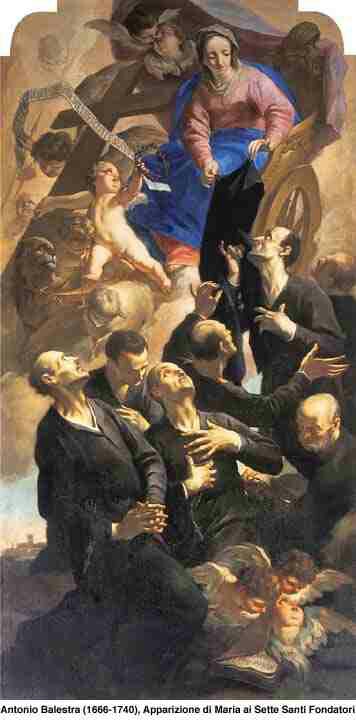
The eldest was Buonfiglio Monaldo, who became their leader. The others were Alexis Falconieri, Benedict dell’ Antella, Bartholomew Amidei, Ricovero Uguccione, Gerardino Sostegni, and John Buonagiunta. They had as their spiritual director James of Poggibonsi, who was chaplain of the Laudesi, a man of great holiness and spiritual insight. All of them came to realise the call to a life of renunciation and they determined to have recourse to our Lady in their perplexity. On the feast of the Assumption, as they were absorbed in prayer, they saw her in a vision and were inspired by her to withdraw from the world into a solitary place and to live for God alone. There were difficulties, because, though three of them were celibates, four had been married and had ties, although two had become widowers. Suitable provision for their dependants was arranged and with the approval of the bishop they withdrew from the world and betook themselves to a house called La Carmarzia, outside the gates of Florence, twenty-three days after they had received their call. Before long they found themselves so much disturbed by constant visitors from Florence that they decided to withdraw to the wild and deserted slopes of Monte Senario, where they built a simple church and hermitage and lived a life of almost incredible austerity.
In spite of difficulties, visitors sometimes found their way to the hermits and many wished to join them but they refused to accept recruits. So they continued to live for several years,—until they were visited by their bishop, Ardingo, and Cardinal Castiglione, who had heard about their sanctity. He was greatly edified but made one adverse criticism: ‘You treat yourselves in a manner bordering on barbarity and you seem more desirous of dying to time than of living for eternity. Take heed, the enemy of souls often hides himself under the appearance of an angel of light . . . Hearken to the counsels of your superiors.’
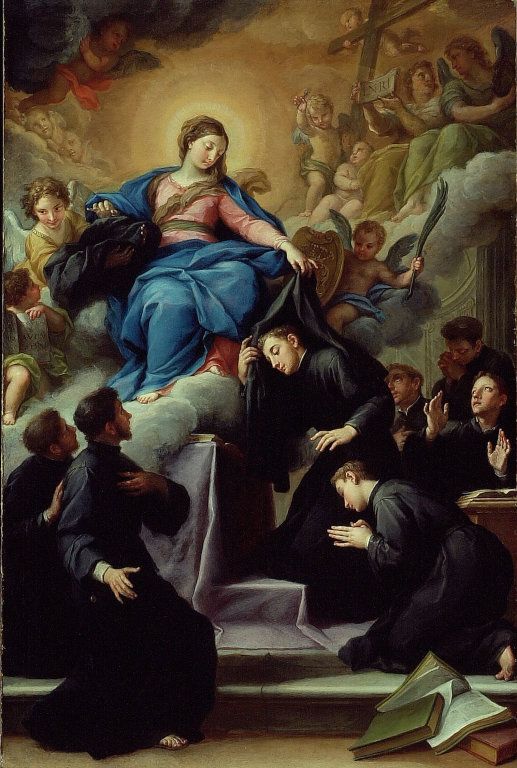
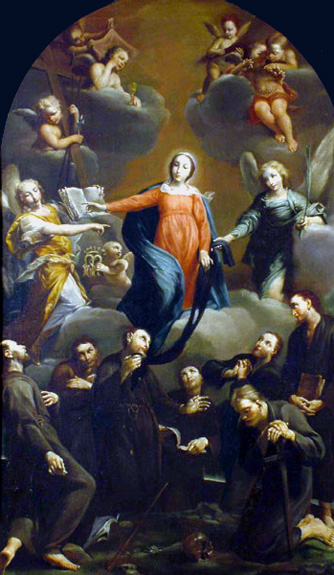
Again the solitaries gave themselves up to prayer for light and again they had a vision of our Lady, who bore in her hand a black habit while an angel held a scroll inscribed with the title of Servants of Mary. She told them she—had chosen them to be her servants, that she wished them to wear the black habit and to follow the Rule of St Augustine. From that date, April 13, 1240, they were known as the Servants of Mary, or Servites.
They were clothed by the bishop himself, Buonfiglio being elected their superior. According to custom they selected names by which they should thenceforth be known, and became Brothers Bonfilius, Alexis, Amadeus, Hugh, Sostenes, Manettus and Buonagiunta. By the wish of the bishop, all except St Alexis, who in his humility begged to be excused, prepared to receive holy orders and in due time they were fully professed and ordained priests. The new order, which took a form more like that of the mendicant friars than that of the monastic orders, increased amazingly and it soon became necessary to form fresh houses. Siena, Pistoia and Arezzo were the first places chosen, and afterwards the houses at Carfaggio, the convent and church of the Santissima Annunziata in Florence and the convent at Lucca were established. Meanwhile, although the Servites had the approval of their immediate superiors, they had not been recognised by the Holy See. It was only in 1259 that the order was practically recognised by Alexander IV, and not until 1304 over sixty years after its foundation-that it received the explicit and formal approbation of Blessed Benedict XI. St Bonfilius had remained as prior general until 1256, when he begged to be relieved owing to old age. He died on new year’s night, 1261.
St Buonagiunta, the youngest of the seven, was the second prior general but not long after his election he breathed his last in chapel while the gospel of the Passion was being read. St Amadeus ruled over the important convent of Carfaggio, but returned to Monte Senario to end his days. St Manettus became fourth prior general and sent missionaries to Asia but he retired to make way for St Philip Benizi, upon whose breast he died. St Hugh and St Sostenes went abroad—Sostenes to Paris and Hugh to found convents in Germany. They were recalled in 1276 and, being attacked by illness, they passed away side by side the same night. St Alexis, the humble lay-brother outlived them all and he was the only one who survived to see the order fully and finally recognised. He is reported to have died at the age one hundred and ten.
Seven Founders of Servants of Mary (Optional Memorial)
• Sts Alexis Falconieri
• St Bartholomew degli Amidei
• St Benedict dell’Antella
• St Buonfiglio Monaldi
• St Gherardino Sostegni
• St Hugh dei Lippi-Uguccioni
• St John Buonagiunta Monetti
—
St Alexis Falconieri – SEVEN HOLY FOUNDERS
Optional Memorial of the Seven Holy Founders of the Servite Order
St Antoni Leszczewicz
St Bartholomew degli Amidei – SEVEN HOLY FOUNDERS
St Benedict dell’Antella – SEVEN HOLY FOUNDERS
St Benedict of Cagliari
St Buonfiglio Monaldi – SEVEN HOLY FOUNDERS
St Bonosus of Trier
Bl Constabilis of Cava
St Donatus the Martyr
Bl Elisabetta Sanna
St Evermod of Ratzeburg
St Faustinus the Martyr
St Finan of Iona
St Fintan of Clonenagh
St Flavian of Constantinople
St Fortchern of Trim
St Gherardino Sostegni – SEVEN HOLY FOUNDERS
St Guevrock
St Habet-Deus
St Hugh dei Lippi-Uguccioni – SEVEN HOLY FOUNDERS
St John Buonagiunta Monetti – SEVEN HOLY FOUNDERS
St Julian of Caesarea
St Loman of Trim
Bl Luke Belludi
St Lupiano
Bl Martí Tarrés Puigpelat
St Mesrop the Teacher
St Petrus Yu Chong-nyul
St Polychronius of Babylon
St Romulus the Martyr
St Secundian the Martyr
St Silvinus of Auchy
St Theodulus of Caesarea
Bl William Richardson
Friday after Ash Wednesday – 16 February 2018
Isaiah 58:1-9, Psalms 51:3-6, 18-19, Matthew 9:14-15
Isaiah 58:3-4 – Behold, in the day of your fast you seek your own pleasure and oppress all your workers. Behold, you fast only to quarrel and to fight and to hit with wicked fist. Fasting like yours this day will not make your voice to be heard on high…
Matthew 9:14-15 – 14 – Then the disciples of John came to him, saying, “Why do we and the Pharisees fast but your disciples do not fast?” And Jesus said to them, “Can the wedding guests mourn as long as the bridegroom is with them? The days will come, when the bridegroom is taken away from them, and then they will fast.”
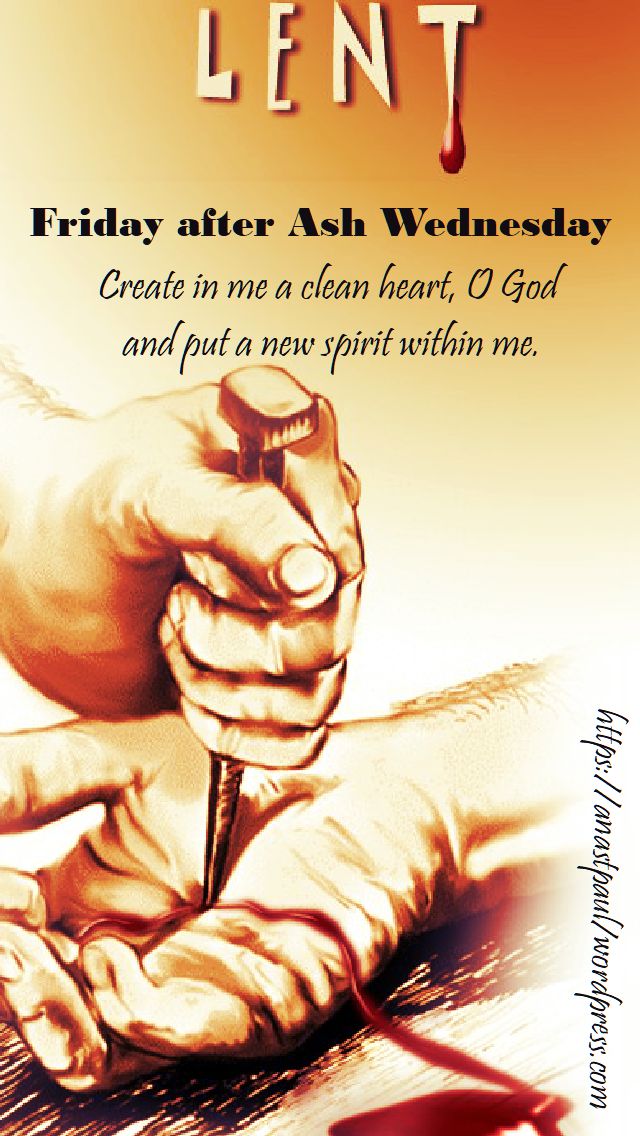
Create in me a clean heart, O God and put a new spirit within me.
Genuine faith does not make a believer pretentious.
Dialogue with God is not a business bargain.
External observance of religion wins little favour with God, if it is combined with unfairness to the weak and indifference to the poor.
Openness to the indigent is the door to true religion.
The world itself changes for the better with the widening of human concern for the poor. Good works multiply on the face of the earth and everyones sees the glory of God in action.
The Gospel presents Jesus, as refusing to absolutise ritual fasting.
What He expects from His disciples is that they remain faithful to the mission He is about to give them even at great sacrifice.
It will make evidently greater demands from them than mere ritual fasting.
They should be prepared.
Jesus is introducing a new set of values of immense worth, for which the old order of things must make way. (Archbishop Thomas Menamparanpil SDB – GodsWord)
Each of us has different talents, material resources and opportunities. Lent is an invitation, not to introspection and penance for its own sake but always to help us to better partner with God in responding to the needs of our world.
Is there a need I feel called to do something about? Could I ask God to show me where He is inviting me to act? What one thing might I do today to reach out to someone in need? (excerpt Fr Nicholas King S.J. ‘The Long Journey to the Resurrection’)
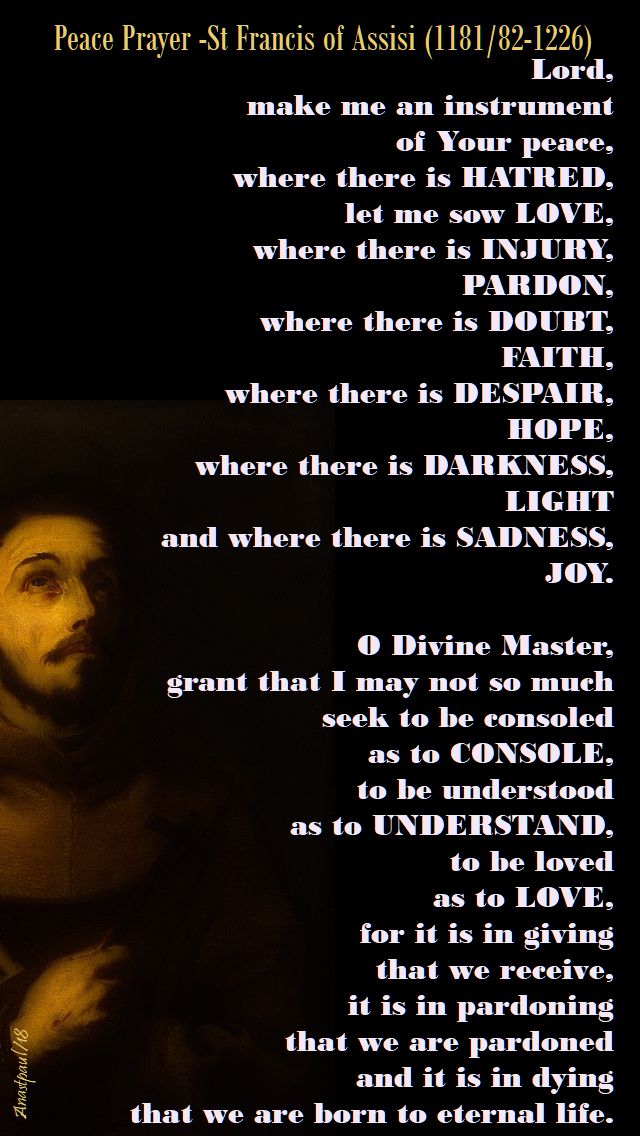
Lord, make me an instrument of Your peace, where there is hatred, let me sow love, where there is injury, pardon, where there is doubt, faith, where there is despair, hope, where there is darkness, light and where there is sadness, joy. O Divine Master, grant that I may not so much seek to be consoled as to console, to be understood as to understand, to be loved as to love, for it is in giving that we receive, it is in pardoning that we are pardoned and it is in dying that we are born to eternal life.
Thought for the Day – – 16 February – The First Friday of Lent 2018
Alas, for our dearest Lord! up to this day what have we done for Him?
You see what He has done for us and the end of His doing it was to gain our love!
We look upon a crucifix and it hardly moves us.
We hear of His bittter passion but our eyes are dry and our hearts indifferent.
We kneel down to pray but we can hardly keep our thoughts fixed upon Him for a quarter of an hour together.
We go into His own most holy presence and we hardly bend the knee before the Tabernacle lest it should spoil our clothes.
We see others sin and what is it to us that Jesus is offended, so long as it is not we, who are risking our souls, by offending Him?
These are strange signs of love!
Surely Jesus cannot be much to us if this is the way we feel about Him.
Yet so it is.
We go our own way and do our own will.
The great thing is to please ourselves and to make things easy to ourselves.
Life must be taught to run smooth.
As to penance, it must be kept at arm’s length.
We must have our bodily comforts and worldly conveniences and our spiritual life must be nothing but a sufficiency of those inward consolations without which our souls give us pain, because they are not at rest.
If we worship God it is for self, if we do good to others, it is self we are seeking, even in our charity.
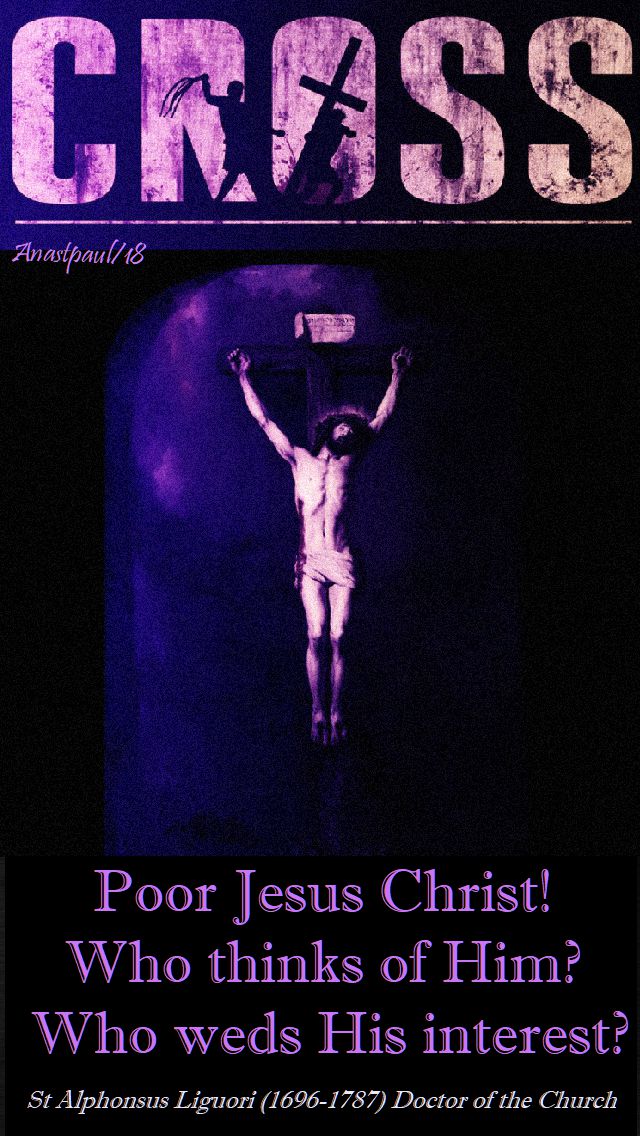
Poor Jesus Christ! as Saint Alphonsus used to say, “Poor Jesus Christ! Who thinks of Him? Who weds His interest?”
Father Faber – Remember Me: Daily Readings for Lent
Quote of the Day – 16 February – The First Friday of Lent 2018
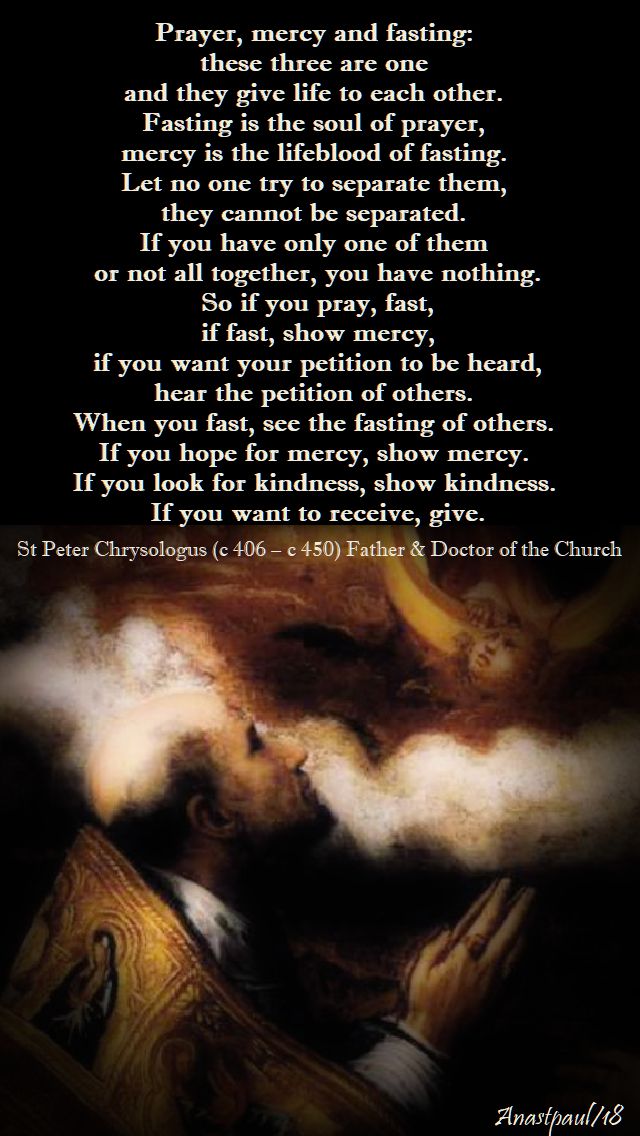
“Prayer, mercy and fasting: these three are one and they give life to each other. Fasting is the soul of prayer, mercy is the lifeblood of fasting. Let no one try to separate them, they cannot be separated. If you have only one of them or not all together, you have nothing. So if you pray, fast, if fast, show mercy, if you want your petition to be heard, hear the petition of others. When you fast, see the fasting of others. If you hope for mercy, show mercy. If you look for kindness, show kindness. If you want to receive, give.”
St Peter Chrysologus (c 406 – c 450) Father & Doctor of the Church


















 AnaStpaul
You must be logged in to post a comment.