Posted in MARIAN TITLES, SAINT of the DAY

Feast of Our Lady of Good Counsel and Memorials of the Saints – 26 April

Our Lady of Good Counsel (Memorial) – https://anastpaul.wordpress.com/2017/04/26/thought-for-the-day-26-april/

our-lady-of-good-counsel-pray-for-us

Bl Alda of Siena
St Antoninus of Rome
St Basileus of Amasea
St Clarence of Venice
St Claudius of Rome
St Pope Cletus
St Cyrinus of Rome
St Exuerantia of Troyes
Bl Gregory of Besians
Bl Juli Junyer Padern
St Lucidius of Verona
St Pope MarcellinusSt
Paschasius Radbertus
St Pelligrino of Foggia
St Peter of Braga
St Primitive of Gabi
St Rafael Arnáiz Barón (1911-1938)

https://youtu.be/xOpxwYh7Y4Uhttps://youtu.be/e390UMs1pik

St Richarius of Celles
Bl Stanislaw Kubista
St Trudpert of Munstertal
St William of Foggia
Bl Wladyslaw Goral

Posted in CATECHESIS, EASTER, FEASTS and SOLEMNITIES, MORNING Prayers, ON the SAINTS, PAPAL MESSAGES, PAPAL SERMONS, QUOTES - J R R Tolkien and MORE, QUOTES on FAITH, QUOTES on LOVE, QUOTES on the CHURCH, SAINT of the DAY, The WORD

Thought for the Day – 25 April – Wednesday of the Fourth Week of Easter and the Feast of St Mark the Evangelist

Thought for the Day – 25 April – Wednesday of the Fourth Week of Easter and the Feast of St Mark the Evangelist

Today we celebrate St Mark, the Evangelist, the first Gospel writer and the friend of Sts Peter and Paul, the cousin of St Barnabas and our Father in faith – our friend too, a chosen member of the Catholic Church who has gone before to show us the way.   Mark knew there would be difficulties for believers in every age, for the persecution of the early Church was the beginning “of the labour pains” (13:8), since “the Gospel must first be preached to all nations” (13:10).   He has given us a moving story of how God works in mysterious ways and shown us in the actions of Jesus how to be patient in our faith even in the most troubling circumstances, for “he is going before you to Galilee; there you will see him as he told you” (16:7).   This narrative could only have been created by someone who himself knew suffering, the pain of unfulfilled hopes and the sorrow of untimely death.   His faith made him write about it.   His hope makes it so convincing!   Let us listen to Pope Benedict on being a Catholic today, now, in the world we live in!

Chosen:   I think it is worth reflecting on this word.   We are chosen.   God has always known us, even before our birth, before our conception, God wanted me as a Christian, as a Catholic, He wanted me as a priest.   God thought of me, He sought me among millions, among a great many, He saw me and He chose me.   It was not for my merits, which were non-existent but out of His goodness;  He wanted me to be a messenger of His choice, which is also always a mission, above all a mission and a responsibility for others.   Chosen: we must be grateful and joyful for this event.   God thought of me, he chose me as a Catholic, me, as a messenger of His Gospel, as a priest.   In my opinion it is worth reflecting several times on this and coming back to this fact of His choice;  He chose me, He wanted me, now I am responding.

Perhaps today we are tempted to say:  we do not want to rejoice at having been chosen, for this would be triumphalism.   It would be triumphalism to think that God had chosen me because I was so important.   This would really be erroneous triumphalism. However, being glad because God wanted me is not triumphalism.   Rather, it is gratitude and I think we should relearn this joy:  God wanted me to be born in this way, into a Catholic family, he wanted me to know Jesus from the first.   What a gift to be wanted by God so that I could know His face, so that I could know Jesus Christ, the human face of God, the human history of God in this world!   Being joyful because He has chosen me to be a Catholic, to be in this Church of His, where subsistit Ecclesia unica;  we should rejoice because God has given me this grace, this beauty of knowing the fullness of God’s truth, the joy of his love.

Chosen:  a word of privilege and at the same time of humility.   However “chosen” — as I said — is accompanied by the word “parepidemois”, exiles, foreigners.   As Christians we are dispersed and we are foreigners:  we see that Christians are the most persecuted group in the world today, because it does not conform, because it is a stimulus, because it opposes the tendencies to selfishness, to materialism and to all these things.

Christians are certainly not only foreigners; we are also Christian nations, we are proud of having contributed to the formation of culture, there is a healthy patriotism, a healthy joy of belonging to a nation that has a great history of culture and of faith.   Yet, as Christians, we are always also foreigners — the destiny of Abraham, described in the Letter to the Hebrews.   As Christians we are, even today, also always foreigners. In the work place Christians are a minority, they find themselves in an extraneous situation;  it is surprising that a person today can still believe and live like this.   This is also part of our life:  it is a form of being with the Crucified Christ, this being foreigners, not living in the way that everyone else lives, but living — or at least seeking to live — in accordance with His Word, very differently from what everyone says.   And it is precisely this that is characteristic of Christians.   They all say:  “But everyone does this, why don’t I?”   No, I don’t, because I want to live in accordance with God.   St Augustine once said:  “Christians are those who do not have their roots below, like tree, but have their roots above and they do not live this gravity in the natural downwards gravitation”.   Let us pray the Lord that he help us to accept this mission of living as exiles, as a minority, in a certain sense, of living as foreigners and yet being responsible for others and, in this way, reinforcing the goodness in our world.

This is faith:  touching Christ with the hand of faith, with our heart and thus entering into the power of His life, into the healing power of the Lord.   And let us pray the Lord, that we may touch Him more and more, so as to be healed.   Let us pray that He will not let us fall, that He too may take us by the hand and thus preserve us for true life….

LECTIO DIVINA” OF THE HOLY FATHER BENEDICT XVI

Chapel of the Seminary
Friday
, 8 February 2013

St Mark, Pray for us!st-mark-pray-for-us-25 april 2017


Posted in CATHOLIC Quotes, DOCTORS of the Church, EASTER, FATHERS of the Church, MORNING Prayers, PRACTISING CATHOLIC, QUOTES - J R R Tolkien and MORE, QUOTES of the SAINTS, QUOTES on FAITH, QUOTES on SUFFERING, SPEAKING of .....

Quote/s of the Day – 25 April – Wednesday of the Fourth Week of Easter and the Feast of St Mark the Evangelist

Quote/s of the Day – 25 April – Wednesday of the Fourth Week of Easter and the Feast of St Mark the Evangelist

Speaking of:  Being Catholic

“I would not believe in the Gospel,
had not the authority
of the Catholic Church
already moved me.”

St Augustine (354-430) Father & Doctori would not believe - st augustine - speaking of being catholic - 25 april 2018

“In her voyage,
across the ocean of this world,
the Church is like a great ship
being pounded by the waves
of life’s different stresses.
Our duty is not to abandon ship
but to keep her on her course.”

St Boniface (672-754) Father & Martyrin her voyage across the ocean - st boniface - speaking of being catholic - 25 april 2018

“Jesus is with me.
I have nothing to fear.”

Blessed Pier Giorgio Frassati (1901-1925)jesus is with me - bl pier - 25 april 2018

“The Jesus of the Gospels
is surely not convenient for us.”the jesus of the gospels - pope benedict - 25 april 2018

“The Jesus who makes everything okay
for everyone is a phantom,
a dream,
not a real figure…”

Pope Benedict XVIthe jesus who makes - pope benedict - 25 april 2018

“Catholicism is a matter
of the body
and the senses,
as much as it is a matter
of the mind,
precisely because,
the Word became flesh.”catholicism is a matter - bishop barron - 25 april 2018

“Easter is an earthquake,
an explosion.
If you see it as less than that,
you’re not getting it.”

Bishop Robert Barroneaster is an earthquake - bishop barron - 25 april 2018

“At some point,
Jesus is going to call you out.
That’s what He does.”

Father Mike Schmitzat some point - fr mike schmitz - 25 april 2018


Posted in EASTER, FEASTS and SOLEMNITIES, MORNING Prayers, PRAYERS of the CHURCH, QUOTES of the SAINTS, SAINT of the DAY, The WORD

One Minute Reflection – 25 April – Wednesday of the Fourth Week of Easter and the Feast of St Mark the Evangelist

One Minute Reflection – 25 April – Wednesday of the Fourth Week of Easter and the Feast of St Mark the Evangelist

Jesus said to the Eleven, “go out to the whole world and the proclaim the gospel to all creation.”…Mark 16:15

REFLECTION – So that this call should resound throughout the world, Christ sent forth the apostles he had chosen, commissioning them to proclaim the gospel:  “Go therefore and make disciples of all nations, baptising them in the name of the Father and of the Son and of the Holy Spirit, teaching them to observe all that I have commanded you; and lo, I am with you always, to the close of the age.”    Strengthened by this mission, the apostles “went forth and preached everywhere, while the Lord worked with them and confirmed the message by the signs that attended it.”
Those, who with God’s help, have welcomed Christ’s call and freely responded to it, are urged on, by love of Christ, to proclaim the Good News, everywhere in the world.   This treasure, received from the apostles, has been faithfully guarded by their successors.   All Christ’s faithful are called to hand it on, from generation to generation, by professing the faith, by living it in fraternal sharing and by celebrating it, in liturgy and prayer…CCC 2-3those who with god's help...ccc 2-3 - 25 april 2018

PRAYER – Almighty God, You chose the Evangelist St Mark and ennobled him with grace, to preach the Gospel.   Let his teaching so improve our lives and his prayers so support us, that we may walk faithfully in his footsteps, which are the footsteps of Christ our Lord.   Through Jesus Christ our Lord, in union with the Holy Spirit, one God forever, amen.st mark - pray for us - 25 april 2018

Posted in DOCTORS of the Church, EASTER, FATHERS of the Church, MORNING Prayers, PRAYERS of the SAINTS, The RESURRECTION

Our Morning Offering – 25 April – Wednesday of the Fourth Week of Easter

Our Morning Offering – 25 April – Wednesday of the Fourth Week of Easter

Easter Prayer
By St Pope Gregory the Great (540-604) Father & Doctor of the Church

It is only right,
with all the powers of our heart and mind,
to praise You Father
and Your Only-Begotten Son,
Our Lord Jesus Christ.
Dear Father,
by Your wondrous condescension
of Loving-Kindness toward us,
Your servants,
You gave up Your Son.
Dear Jesus, You paid the debt of Adam for us
to the Eternal Father
by Your Blood poured forth in Loving-Kindness.
You cleared away the darkness of sin
by Your magnificent and radiant Resurrection.
You broke the bonds of death
and rose from the grave as a Conqueror.
You reconciled Heaven and earth.
Our life had no hope of Eternal Happiness
before You redeemed us.
Your Resurrection has washed away our sins,
restored our innocence and brought us joy.
How inestimable is the tenderness of Your Love!
We pray You, Lord,
to preserve Your servants
in the peaceful enjoyment
of this Easter happiness.
We ask this through Jesus Christ Our Lord,
Who lives and reigns with God the Father,
in the unity of the Holy Spirit,
forever and ever.
Amen

it is only right with all the powers - easter prayer of st pope gregory the great - wed 4th week of easter - 25 april 2018


Posted in EASTER, FEASTS and SOLEMNITIES, Of LAWYERS & CANON Lawyers, Attorneys, Solicitors, Barristers, Notaries, Para-Legals, PATRONAGE - PRISONERS, The APOSTLES & EVANGELISTS

Saint of the Day – 25 April – St Mark the Evangelist

Saint of the Day – 25 April – St Mark the Evangelist – also known as John Mark (Born 1st century – Martyred 25 April 68 at Alexandria, Egypt) – The Winged Lion – Evangelist, Martyr, Missionary, Preacher, Teacher, friend and assistant to St Peter, St Paul, cousin of St Barnabas.1977.2_evangelista-san-marcosst mark and the winged lion

John Mark, later known simply as Mark, was a Jew by birth.   He was the son of that Mary who was proprietress of the Cenacle or “upper room” which served as the meeting place for the first Christians in Jerusalem (Acts 12:12).   He was still a youth at the time of the Saviour’s death.    We cannot be certain whether he knew Jesus personally.    Some scholars feel that the evangelist is speaking of himself (so he then did know Jesus) when describing the arrest of Jesus in Gethsemane:  “Now a young man followed him wearing nothing but a linen cloth about his body.    They seized him, but he left the cloth behind and ran off naked” (Mark 14:51-52). 

During the years that followed, the rapidly maturing youth witnessed the growth of the infant Church in his mother’s Upper Room and became acquainted with its traditions. This knowledge he put to excellent use when compiling his Gospel.   Later, we find Mark acting as a companion to his cousin Barnabas and Saul on their return journey to Antioch and on their first missionary journey.   But Mark was too immature for the hardships of this type of work and therefore left them at Perge in Pamphylia to return home.

As the two apostles were preparing for their second missionary journey, Barnabas wanted to take his cousin with him.   Paul, however, objected.   Thereupon the two cousins undertook a missionary journey to Cyprus.   Time healed the strained relations between Paul and Mark and during the former’s first Roman captivity (61-63), Mark rendered Paul valuable service (Col. 4:10; Philem. 24) and the Apostle learned to appreciate him.   When in chains the second time Paul requested Mark’s presence (2 Tim. 4:11).

An intimate friendship existed between Mark and Peter;  he played the role of Peter’s companion, disciple and interpreter.   According to the common patristic opinion, Mark was present at Peter’s preaching in Rome and wrote his Gospel under the influence of the prince of the apostles.   This explains why incidents which involve Peter are described with telling detail (e.g., the great day at Capharnaum, 1:14f)).   Little is known of Mark’s later life.   It is certain that he died a Martyr’s death as bishop of Alexandria in Egypt.   His relics were transferred from Alexandria to Venice, where a worthy tomb was erected in St Mark’s Cathedral.

tomb-st-mark-venice
St Mark’s Tomb inside the Altar at St Mark’s, Venice
st mark's venice
St Mark’s Venice

The Gospel of St Mark, the shortest of the four, is, above all, a Roman Gospel.   It originated in Rome and is addressed to Roman, or shall we say, to Western Christianity. Another high merit is its chronological presentation of the life of Christ.   For we should be deeply interested in the historical sequence of the events in our blessed Saviour’s life.

Mark2. Benozzo Gozzoli
Ceilings in the Vatican depicting St Mark

Saint Mark Mosaic Angels Saint Peter's Basilica Vatican Rome Ita

Furthermore, Mark was a skilled painter of word pictures.   With one stroke he frequently enhances a familiar scene, shedding upon it new light.   His Gospel is the “Gospel of Peter,” for he wrote it under the direction and with the aid of the prince of the apostles.   “The Evangelist Mark is represented as a lion because he begins his Gospel in the wilderness,   ‘The voice of one crying in the desert:   Make ready the way of the Lord,’ or because he presents the Lord as the unconquered King.”…Excerpted from The Church’s Year of Grace, Pius Parsch

st mark - the winged lionthe winged lion of st mark


Posted in EASTER, FEASTS and SOLEMNITIES, SAINT of the DAY, The APOSTLES & EVANGELISTS

25 April – Feast of St Mark the Evangelist and Memorials of the Saints

St Mark the Evangelist (Feast) Also known as John Mark (Born 1st century – martyred 25 April 68 at Alexandria, Egypt) – The Winged Lion

https://www.youtube.com/watch?v=7yGskrUpw2U


St Agathopodes of Antioch
Bl Andrés Solá Molist
St Anianus of Alexandria
Bl Antonio Pérez Lários
St Callista of Syracuse
St Clarentius of Vienne
St Ermin of Lobbes
St Evodius of Syracuse
St Franca Visalta
St Giovanni Piamarta
St Heribaldus of Auxerre
St Hermogenes of Syracuse
Bl José Trinidad Rangel y Montaño
St Kebius
St Macaille
St Macedonius
St Mario Borzaga
St Pasicrate of Mesia
St Paul Thoj Xyooj
Pedro de San Jose Betancur
Phaebadius of Agen
Philo of Antioch
Robert of Syracuse
Bl Robert Anderton
Stefano of Antioch
St Valenzio of Mesia
Bl William Marsden

Martyrs of Yeoju – 3 saints: Three Christian laymen martyred together in the apostolic vicariate of Korea. 25 April 1801 in Yeoju, Gyeonggi-do, South Korea
They were Beatified15 August 2014 by Pope Francis
• Ioannes Won Gyeong-do
• Marcellinus Choe Chang-ju
• Martinus Yi Jung-bae

Posted in MORNING Prayers, QUOTES of the SAINTS, QUOTES on CHARITY, QUOTES on FAITH, QUOTES on LOVE, QUOTES on MERCY, QUOTES on PRAYER, QUOTES on SILENCE, SAINT of the DAY, Uncategorized

Thought for the Day – 24 April – Tuesday of the Fourth Week of Eastertide and the Memorial of St Mary Euphrasia Pelletier (1796-1868)

Thought for the Day – 24 April – Tuesday of the Fourth Week of Eastertide and the Memorial of St Mary Euphrasia Pelletier (1796-1868)

Sorrow and joy alternated almost without interruption in Angers and the new houses. There were difficulties connected with each of the foundations, entailing a great deal of hard work.   Throughout these hardships, St Mary Euphrasia endured and embraced them, and said “Great crosses bring great graces.”

Ardent prayer sustained her.   “Pray, be silent and hope” became her motto.   She loved to repeat: “I belong to every country where there are souls to be saved.”   Her work of saving them was going on apace and souls were bought at a great price.

Mary Euphrasia’s last years were very lonely. Labour, enterprises, intense activities, physical and moral sufferings were steadily taking a toll on the Foundress’ strength.   She was almost seventy-two years of age when she breathed her last on 24 April 1868, the Friday after Good Shepherd Sunday.   “Goodbye my daughters, goodbye dear Institute” were her last words.

Mary Euphrasia founded, in her lifetime, 110 houses on every continent.   Today, the Mission Partners of the Good Shepherd (Sisters and Lay) are present in more than 70 countries, embracing the world with their zeal for the salvation of all people.   A year after the death of Mary Euphrasia, the Ceylon (Sri Lanka) mission was founded.   From Ceylon, the Good Shepherd Sisters came to Singapore in 1939 and reached Malaysia in 1956.

It is not easy to sum up the life of Mary Euphrasia.   Perhaps it is best understood in terms of her own wish for her Sisters:  “You will effect no good, my dear Sisters … until you become animated with the thoughts, sentiments and affections of the Good Shepherd” and “Live His way of life!”

St Mary Euphrasia, pray for us!st mary euphrasia pelletier - pray for us - no 2 - 24 april 2018

Posted in EUCHARISTIC Adoration, MORNING Prayers, PRACTISING CATHOLIC, QUOTES of the SAINTS, QUOTES on LOVE, QUOTES on REPENTANCE, QUOTES on SIN, SAINT of the DAY, The HOLY EUCHARIST / The HOLY MASS

Quote/s of the Day – 24 April – Tuesday of the Fourth Week of Eastertide and the Memorial of St Mary Euphrasia Pelletier (1796-1868)

Quote/s of the Day – 24 April – Tuesday of the Fourth Week of Eastertide and the Memorial of St Mary Euphrasia Pelletier (1796-1868)

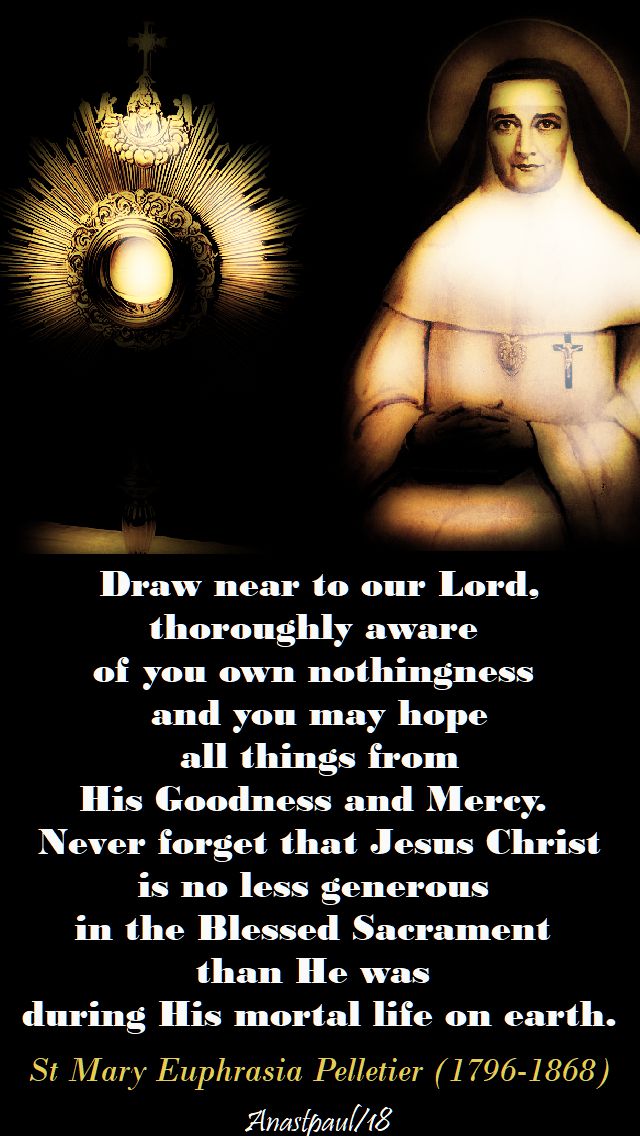
“Draw near to our Lord, thoroughly aware
of you own nothingness and you may hope
all things from His Goodness and Mercy.
Never forget that Jesus Christ is no less generous
in the Blessed Sacrament than He was
during His mortal life on earth.”draw near to our lord - st mary euphrasia - 24 april 2018

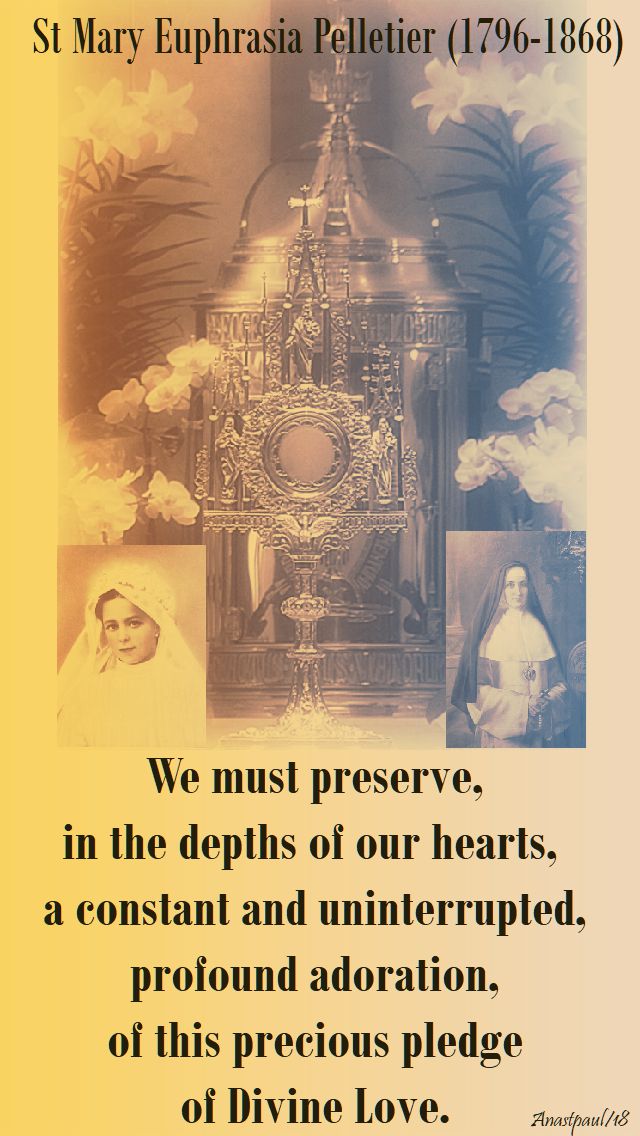
“The Blessed Sacrament is the first
and supreme object of our worship.
We must preserve, in the depths of our hearts,
a constant and uninterrupted, profound adoration,
of this precious pledge, of Divine Love.”we must preserve - st mary euphrasia - 24 april 2018

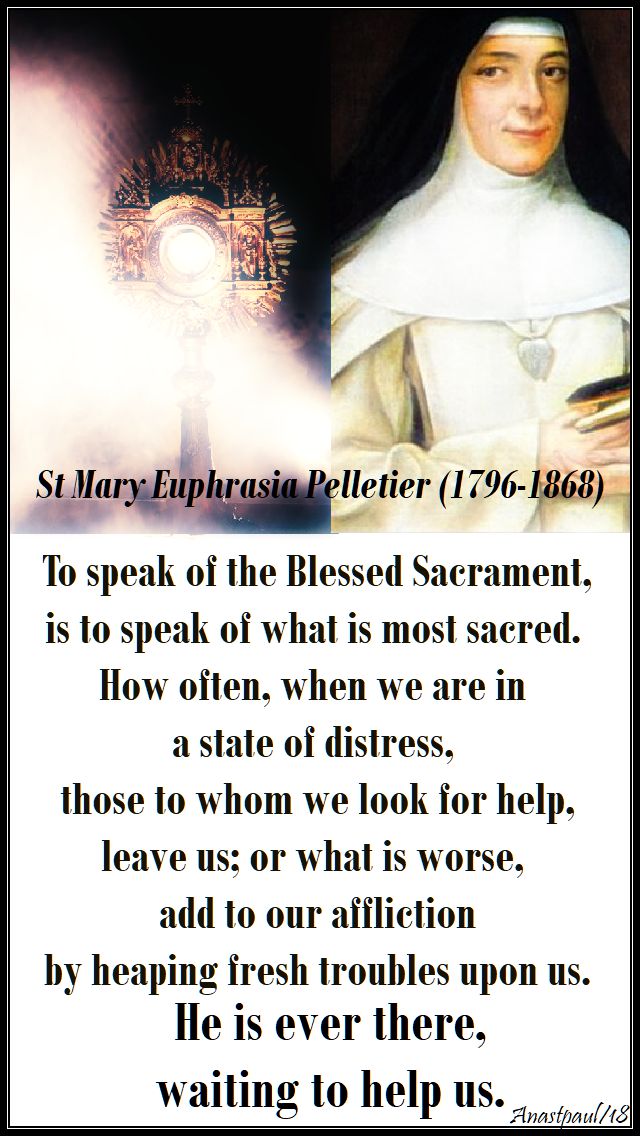
“To speak of the Blessed Sacrament,
is to speak of what is most sacred.
How often, when we are in a state of distress,
those to whom we look for help leave us;
or what is worse, add to our affliction
by heaping fresh troubles upon us.
He is ever there waiting to help us.”to speak of the blessed sacrament - st mary euphrasia- no 2- 24 april 2018

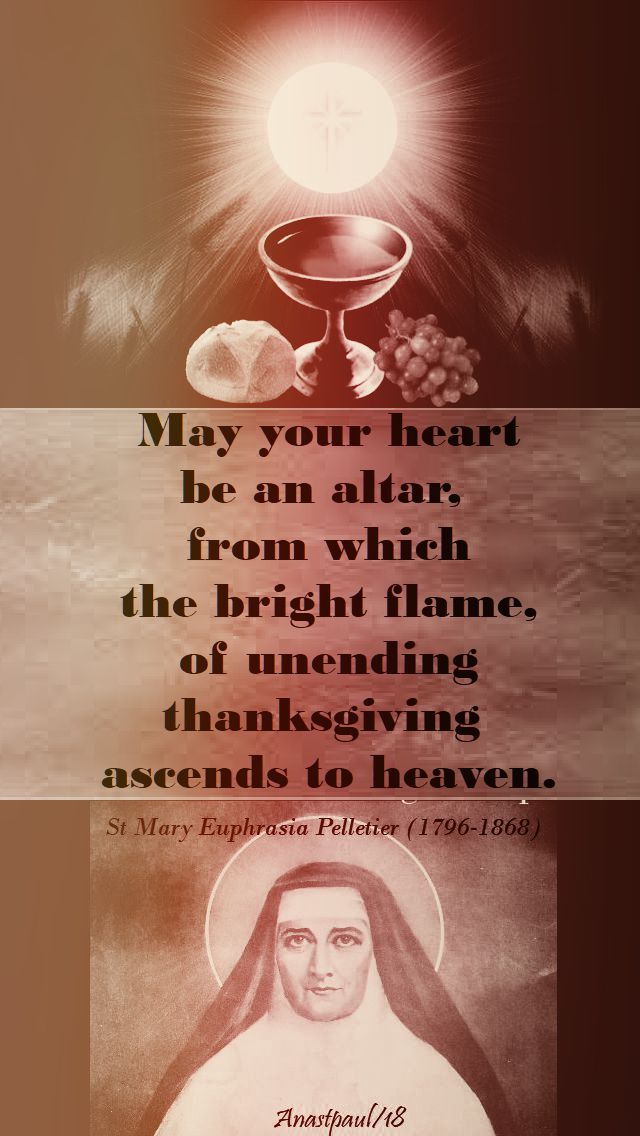
“May your heart be an altar,
from which the bright flame,
of unending thanksgiving
ascends to heaven.”may your heart be an altar - st mary euphrasia - 24 april 2018

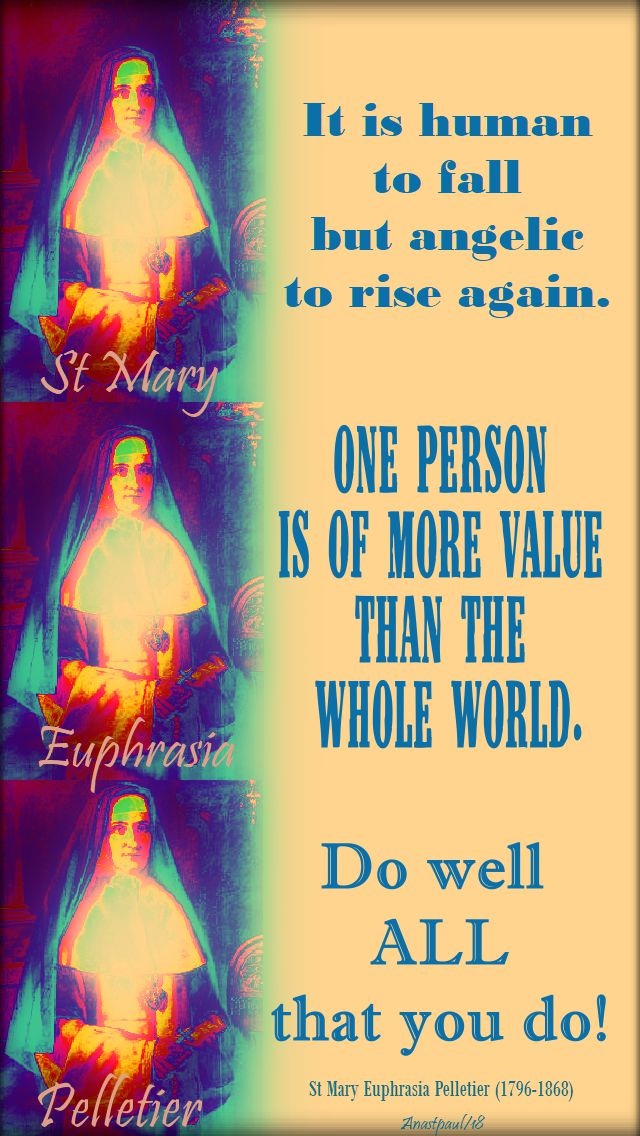
“It is human to fall
but angelic to rise again.”

“One person is of more value
than the whole world.”

“Do well ALL that you do!”it is human...one person is more value ...do well all - st mary euphrasia pelletier - 24 april 2018

St Mary Euphrasia Pelletier (1796-1868)

Posted in MORNING Prayers, QUOTES of the SAINTS, QUOTES on CHARITY, QUOTES on LOVE, SAINT of the DAY

One Minute Reflection – 24 April – Tuesday of the Fourth Week of Eastertide and the Memorial of St Mary Euphrasia Pelletier (1796-1868)

One Minute Reflection – 24 April – Tuesday of the Fourth Week of Eastertide and the Memorial of St Mary Euphrasia Pelletier (1796-1868)

In brotherly love, let your feelings of deep affection for one another, come to expression and regard others as more important than yourself...Romans 12:10

REFLECTION – “If you always love one another, if you always uphold one another, you will be capable of working wonders!”…St Mary Euphrasia Pelletier

if you always love another - st mary euphrasia pelletier - 24 april 2018

PRAYER – Lord, by Your grace, we are made one in mind and heart.   Give us a love for what You command and a longing for what You promise, so that, amid this world’s changes, our hearts may be one with each other and be set on the world of lasting joy. May the prayers of St Mary Euphrasia on our behalf, help us to achieve holy love for all Your children and our brothers.   Through Jesus Christ our Lord in the unity of the Holy Spirit, one God forever, amen.

st mary euphrasia pelletier - pray for us - 24 april 2018

Posted in MORNING Prayers, PRAYERS of the SAINTS, SAINT of the DAY

Our Morning Offering – 24 April – Tuesday of the Fourth Week of Eastertide and the Memorial of St Mary Euphrasia Pelletier (1796-1868)

Our Morning Offering – 24 April – Tuesday of the Fourth Week of Eastertide and the Memorial of St Mary Euphrasia Pelletier (1796-1868)

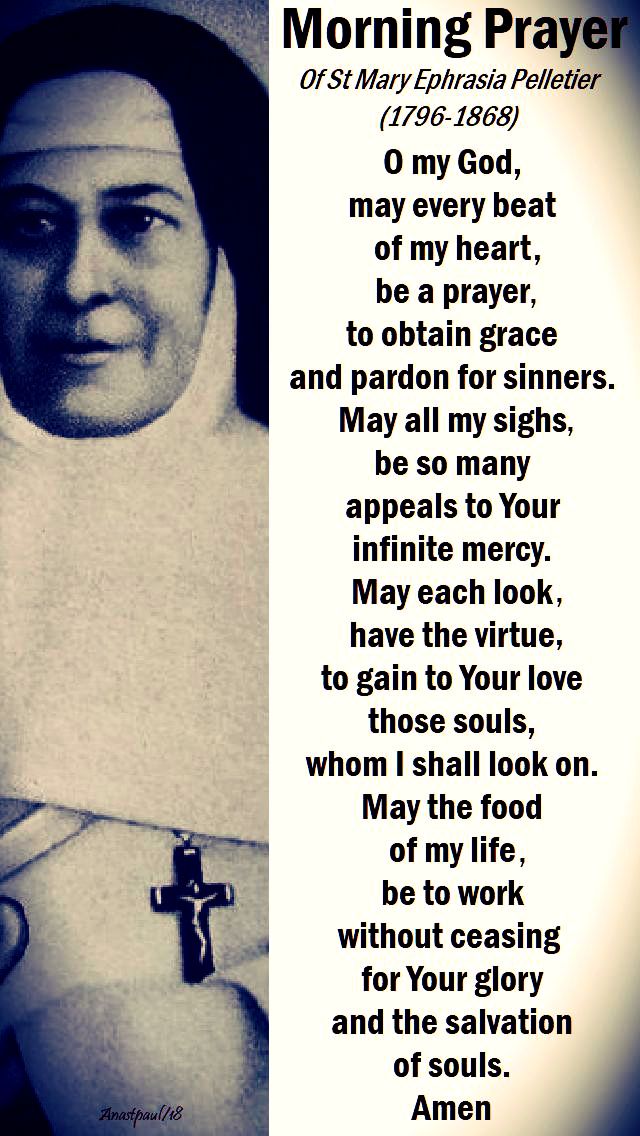
Morning Prayer
By St Mary Ephrasia Pelletier

O my God,
may every beat of my heart,
be a prayer, to obtain grace
and pardon for sinners.
May all my sighs, be so many
appeals to Your infinite mercy.
May each look, have the virtue,
to gain to Your love,
those souls, whom I shall look on.
May the food of my life,
be to work without ceasing
for Your glory
and the salvation of souls.
Amen

morning prayer of st mary euphrasia pelletier - 24 april - o my god, may every beat of my heart. no. 2. jpg


Posted in Of TRAVELLERS / MOTORISTS, SAINT of the DAY

Saint of the Day – 24 April – St Mary Euphrasia Pelletier (1796-1868)

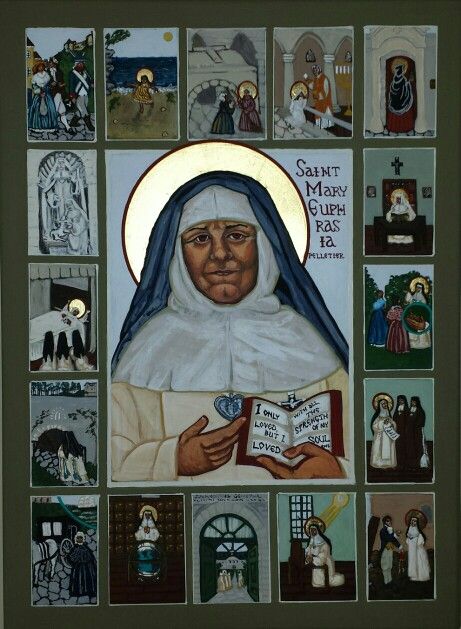
Saint of the Day – 24 April – St Mary Euphrasia Pelletier (1796-1868) Nun, Foundress of the Congregation of Our Lady of Charity of the Good Shepherd.  St Mary Euphrasia was born on 31 July 1796 at Noirmoutier, Vendée, France as Rose Virginie Pelletier – Died 24 April 1868 at Angers, Maine-et-Loire, France of natural causes.   Patronages – Good Shepherd Sisters, travellers.

st mary euphrasia-holy card and info

Rose Virginie was born on 31 July 1796 on Noirmoutier a small island off the northwest coast of France.   Her parents had fled there thinking that they could escape the violence of the French Revolution.   She was the 8th child of Dr Julian and Anne Pelletier.   An elder sister and her father died when she was ten years old.   In 1810 her mother placed Rose Virginie in a boarding school in Tours.   Shortly after her eldest brother died and then her mother in 1813.   All these deaths were great tragedies and hardships for the young girl.

Near the boarding school was the convent of the Order of Our Lady of Charity of the Refuge, a religious Congregation founded by Saint John Eudes to provide care and protection for women and girls who were homeless and at risk of exploitation.   Despite her guardian’s reservations Rose Virginie was allowed to join the sisters provided that she not make her vows before she turned 21.   She made her profession in 1816, taking the name of Mary of Saint Euphrasia.   The sisters of the community had been dispersed at one point during the revolution;  the majority had been imprisoned.   Rose Virginie joined what was a community of elderly weary sisters.    A short time after her profession, she became first mistress of the penitents and about eight years later was made prioress of the house of Tours.    She founded a community, the “Sisters Magdalen” for women who wanted to lead a contemplative and enclosed life and would support, by their ministry of prayer, the different works of the Congregation.   It is now known as the Contemplatives of the Good Shepherd.

The city of Angers asked that Sister Mary Euphrasia establish a Convent of Refuge there. She established a house in an old factory and called it “Bon Pasteur” (Good Shepherd).   In 1831 she was appointed as Mother Superior of the House in Angers.   The congregation in Tours did not wish to expand to Angers, nor did the house in Nantes. St John Eudes had established his houses as separate and autonomous.   Mother Mary Euphrasia came to believe that if the work was to grow, that each house should be under the direction of a Generalate.   She founded additional convents in Le Mans, Poitiers, Grenoble and Metz.

In April 1835, Pope Gregory XVI granted approval of the Mother-House at Angers for the institute known as Congregation of Our Lady of Charity of the Good Shepherd of Angers. Convents that developed for Angers would be part of the institute while those houses that did not attach themselves to the General Administration would remain Refuges.  The development of the Generalate made possible the sending of the sisters to wherever they were needed.   Convents were also established in Italy, Belgium, Germany and England.  The institute is directly subject to the Holy See;   Cardinal Odescalchi was its first cardinal-protector.

header st mary euphrasia pelletier.jpg

For some time, Mother Mary Euphrasia Pelletier had to deal with the opposition of the Bishop Angebault of Angers, who wished to exercise the authority of Superior General, although the constitutions of the Order did not provide for this.   She was accused of ambition, of innovation and of disobedience.   Sometimes she was put in the position of addressing conflicting instructions from Rome and the bishop.   Although she had the support of Rome, the local clergy tended to keep their distance from someone who had incurred the bishop’s displeasure.   According to Sister Norma O’Shea, the bishop’s opposition, coupled with the deaths of a number of sisters and longtime supporters, made Sister Mary Euphrasia’s last years very lonely.

st mary euphrasia-holy card

Mother Mary Euphrasia Pelletier devoted herself to the work entrusted to her. By 1868, she was Superior General of 3,000 religious, in 110 convents, in thirty-five countries.   She died of cancer on 24 April 1868.   She is buried on the property of the Motherhouse of the Sisters of the Good Shepherd in Angers, France.

On 11 December 1897, Pope Leo XIII declared her “Venerable.”   She was Beatified on 30 April 1933 and Canonised on 2 May 1940 by Venerable Pope Pius XII.

Posted in MARIAN TITLES, SAINT of the DAY, The BLESSED VIRGIN MARY

Feast of Our Lady of Bonnaria, Our Lady of Luján and Memorials of the Saints – 24 April

St Fidelis of Sigmaringen (1577-1622) Known as “The Poor Man’s Lawyer” (Optional Memorial)

https://www.youtube.com/watch?v=uAOqqMOsxyM

Our Lady of Bonaria:   Devotion to the Blessed Virgin Mary in the form of a statue of Mary and the Christ Child that was washed up at a Mercedarian monastery near Cagliari, Italy on 25 April 1370, apparently from a shipwreck the night before.   Legend says that the locals tried to open the crate it was in, but only one of the Mercedarian monks could get the it open.   Patron of Sardinia, Italy.

Our Lady of Bonaria

Our Lady of Luján in Buenos Aires:   Virgin of Luján, Patroness of Argentina, Uruguay and Paraguay. 16th-century icon of the Virgin Mary.   Tradition holds that a settler ordered the terracotta image of the Immaculate Conception in 1630 because he intended to create a shrine in her honour to help reinvigorate the Catholic faith in Santiago del Estero, his region.   After embarking from the port of Buenos Aires, the caravan carrying the image stopped at the residence of Don Rosendo Oramas, located in the present town of Zelaya.   When the caravan wanted to resume the journey, the oxen refused to move. Once the crate containing the image was removed, the animals started to move again. Given the evidence of a miracle, people believed the Virgin wished to remain there.   The image was venerated in a primitive chapel for 40 years.   Then the image was acquired by Ana de Matos and carried to Luján, where it currently resides.
Among the Popes who have honoured Our Lady of Luján are Clement XI, Clement XIV, Pius VI, Pius IX, Leo XIII, Pius XI, Venerable Pius XII, and St John Paul II.   In 1824, Fr John Mastai Ferretti visited the shrine on his way to Chile.   He later became Pope Pius IX and defined the dogma of the Immaculate Conception on 8 December 1854.
Because of the reputation of the shrine, Pope Leo XIII decided in 1886 to honour the miraculous statue with a Canonical Coronation.   On 30 September of that year, he blessed the crown, which was made of pure gold and set with 365 diamonds, rubies, emeralds and sapphires, 132 pearls and a number of enamels depicting the emblems of the Archbishop and the Argentine Republic.   The papal coronation of Our Lady of Luján took place on 8 May 1887.   The celebrant chosen by the Pope for this event was Archbishop Federico León Aneiros who at that time made a pilgrimage in thanksgiving to Our Lady for sparing his archdiocese from the scourge of cholera.   On 8 September 1930, Pope Pius XI formally declared Our Lady of  Luján. as the Patroness of Argentina, Paraguay and Uruguay.   The Papal document was signed by Cardinal Eugenio Pacelli, the future Venerable Pope Pius XII.
In 1982, during the Falklands War, St Pope John Paul II became the first pope to visit Our Lady of Luján.   During this visit the Pope celebrated an outdoor Mass in the square of the Basilica of Our Lady of Luján and bestowed upon her the Golden Rose.   Both in his homily of June 11 and his Angelus back in Rome reflecting on the trip, he commented on Our Lady’s never failing maternal solicitude for the faithful in times of distress.   Sixteen years later in Rome, St John Paul II gave a replica of the image to the Argentine National Parish during his pastoral visit there.
The Golden Rose is a gift from the Pope to nations, cities, basilicas, sanctuaries or images. It is blessed by him on the fourth Sunday of Lent, anointed with the Holy Chrism and dusted with incense.   This Rose consists of a golden rose stem with flowers, buds and leaves, placed in a silver vase lined on the inside with a bronze case bearing the Papal shield.   Pope Leo IX is considered as the originator of this tradition in the year 1049.
In the Americas, the Rose has been given to Our Lady of Guadalupe in Mexico, to Our Lady of Aparecida in Brazil, to St Joseph’s Oratory in Canada, to the Basilica of the National Shrine of the Immaculate Conception in the United States, to the Cathedral Basilica of Nuestra Señora del Valle in Argentina and to the Basílica Santuario Nacional de Nuestra Señora de la Caridad del Cobre in Cuba.   On 11 June 1982, St John Paul II personally bestowed a Golden Rose on Our Lady of Luján.


St Alexander of Lyon
St Anthimos of Nicomedia
St Authairius of La Ferté
St Benedetto Menni
St Bova of Rheims
St Deodatus of Blois
St Diarmaid of Armagh
St Doda of Rheims
St Dyfnan of Anglesey
St Egbert of Rathemigisi
St Eusebius of Lydda
St Gregory of Elvira
St Honorius of Brescia
St Ivo of Huntingdonshire
St Leontius of Lydda
St Longinus of Lydda
St Mary Euphrasia Pelletier (1796-1868)

St Mary of Cleophas
St Mary Salome
St Mellitus of Canterbury
St Neon of Lydda
St Sabas the Goth of Rome
St Tiberio of Pinerolo
St William Firmatus

Mercedarian Martyrs of Paris: No info yet.

Posted in MORNING Prayers, SAINT of the DAY

Thought for the Day – 23 April – Monday of the Fourth Week of Eastertide and the Memorial of St George

Thought for the Day – 23 April – Monday of the Fourth Week of Eastertide and the Memorial of St George

Saint George is the object of a vast amount of imagination.  There is every reason to believe that he was a real martyr who suffered at Lydda in Palestine, probably before the time of Constantine.   The Church adheres to his memory, but not to the legends surrounding his life.   That he was willing to pay the supreme price to follow Christ is what the Church believes.   And it is enough.

But deny it as much as we will, human nature seems to crave more than cold historical data.   The life of Saint Francis of Assisi is inspiring enough, but for centuries the Italians have found his spirit in the legends of the Fioretti, too.   Santa Claus is the popular extension of the spirit of Saint Nicholas.   The legends about Saint George are part of this yearning.   Both fact and legend are human ways of illumining the mysterious truth about the One who alone is holy.

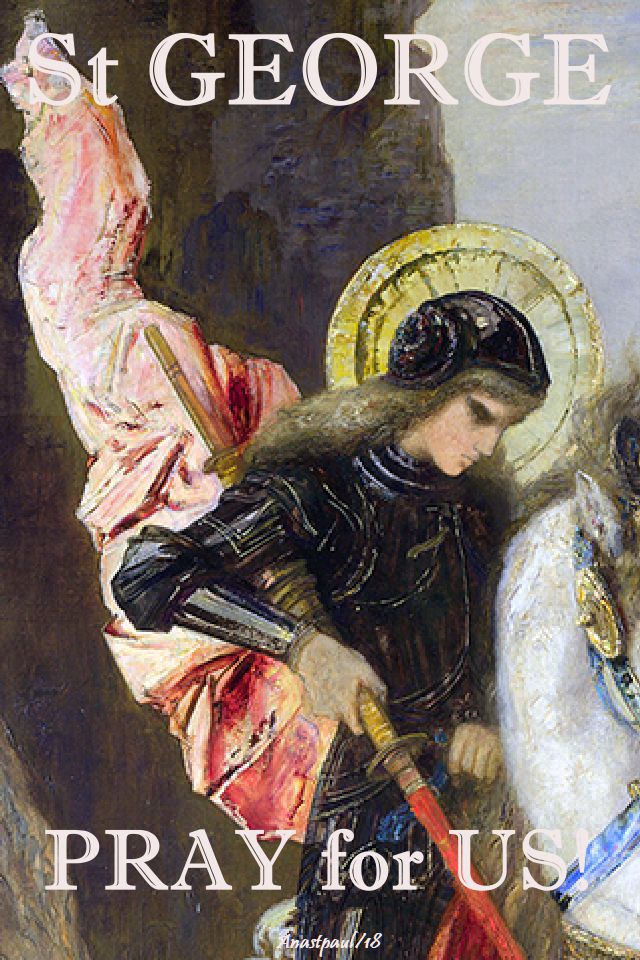
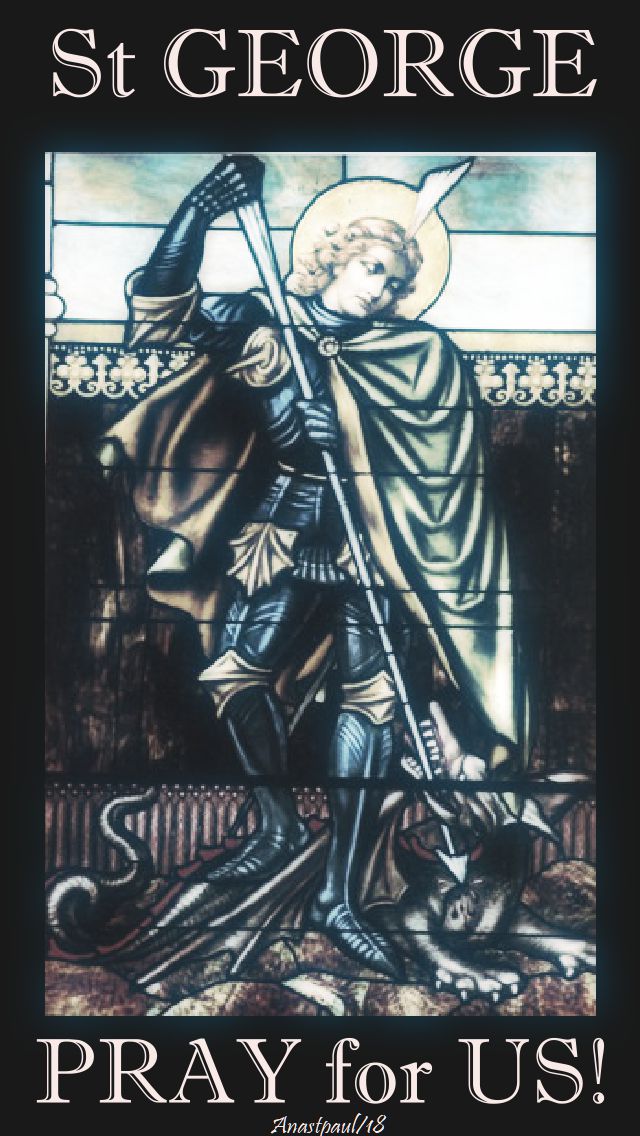
St George, Pray for us!st george - pray for us - no 2 - 23 april 2018

Posted in DOCTORS of the Church, FATHERS of the Church, MORNING Prayers, QUOTES - J R R Tolkien and MORE, QUOTES of the SAINTS, QUOTES on FAITH, QUOTES on HUMILITY, QUOTES on LOVE, QUOTES on SANCTITY, SPEAKING of .....

Quote/s of the Day – 23 April – Monday of the Fourth Week of Eastertide

Quote/s of the Day – 23 April – Monday of the Fourth Week of Eastertide

“Speaking of Love, Life & Virtue”

“He that is kind is free, though he is a slave;
he that is evil is a slave, though he be a king.”

St Augustine (354-430) Doctor of Gracehe that is kind - st augustine - 23 april 2018

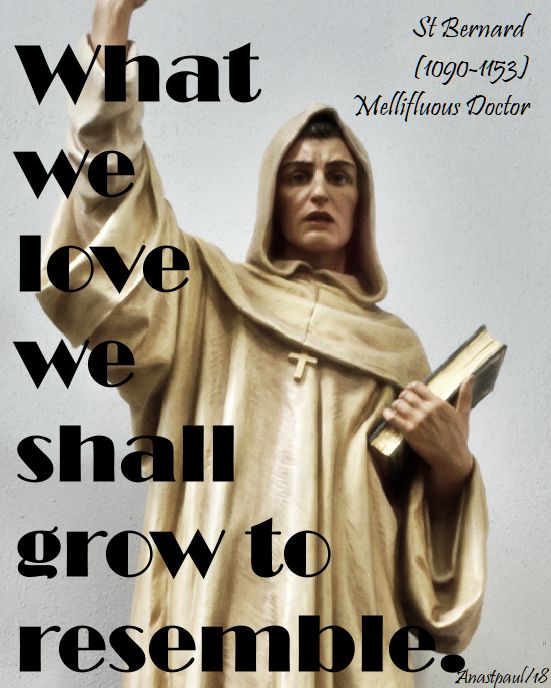
“What we love
we shall grow to resemble.”

St Bernard of Clairvaux (1090-1153) Mellifluous Doctor

what we love - st bernard - 23 april 2018

“The creator of the heavens obeys a carpenter;
the God of eternal glory listens to a poor virgin.
Has anyone ever witnessed anything comparable to this?
Let the philosopher no longer disdain from listening
to the common labourer;
the wise, to the simple;
the educated, to the illiterate;
a child of a prince, to a peasant.”

St Anthony of Padua (1195-1231) Evangelical Doctor

the creator of the heavens - st anthony of padua - 23 april 2018

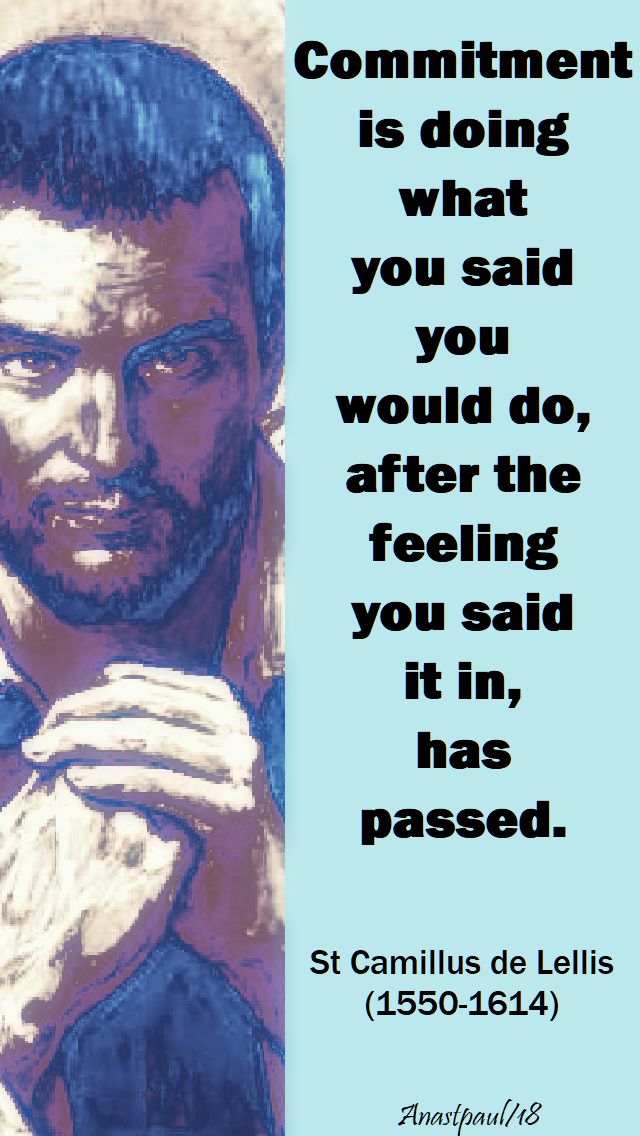
“Commitment is doing what you said you would do,
after the feeling you said it in, has passed.”

St Camillus de Lellis (1550-1614)commitment is - st camillus de lellis - 23 april 2018

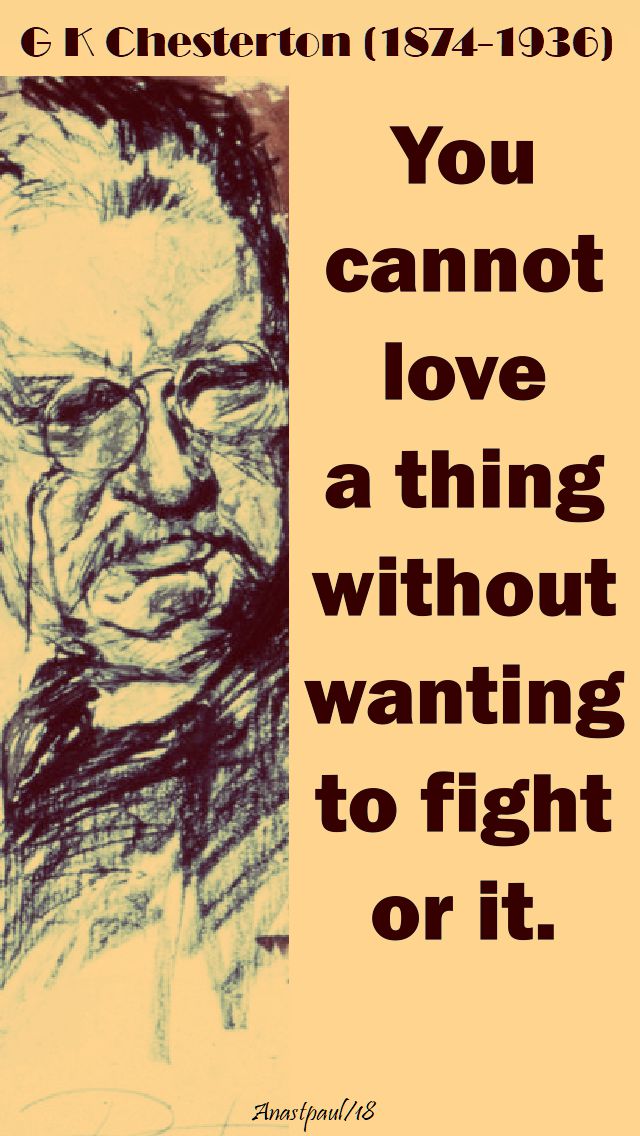
“You cannot love a thing
without wanting to fight for it.”

G K Chesterton (1874-1936)you cannot love a thing - g k chersterton - 23 april 2018

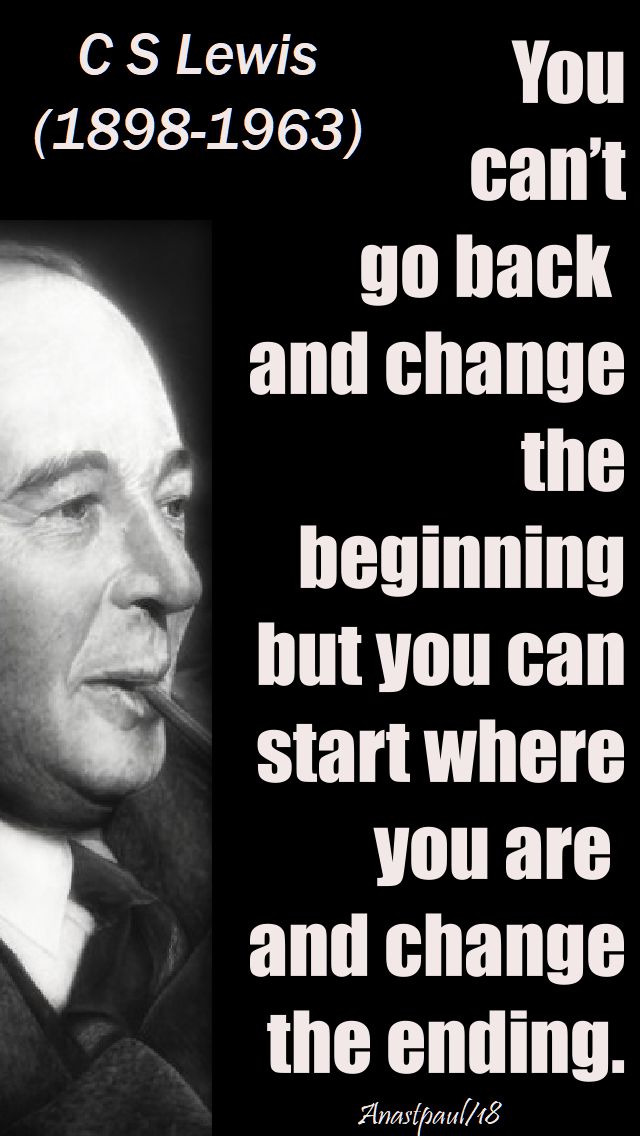
“You can’t go back
and change the beginning
but you can start where you are
and change the ending.”

C S Lewis (1898-1963)you can't go back and change the beginning - c s lewis - 23 april 2018

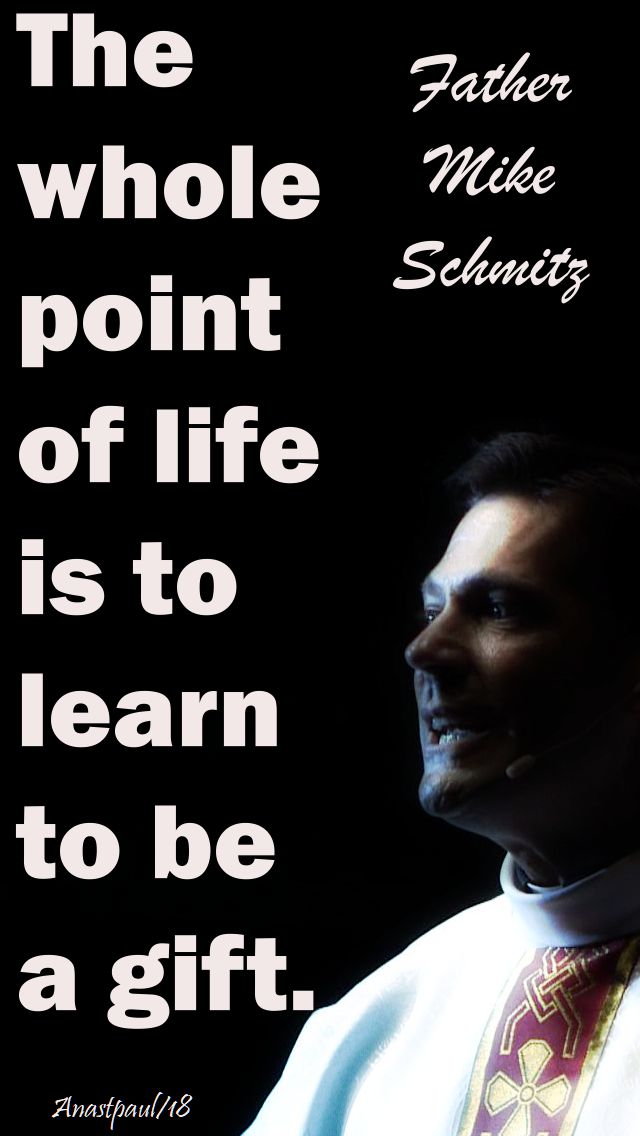
“The whole point of life
is to learn to be a gift.”

Father Mike Schmitzthe whole point of life - fr mike schmitz - 23 april 2018

Posted in DOCTORS of the Church, MORNING Prayers, ON the SAINTS, QUOTES of the SAINTS, QUOTES on CHARITY, QUOTES on FAITH, QUOTES on PERSECUTION, QUOTES on SANCTITY, QUOTES on SUFFERING, SAINT of the DAY

One Minute Reflection – 23 April – Monday of the Fourth Week of Eastertide and the Memorial of St George

One Minute Reflection – 23 April – Monday of the Fourth Week of Eastertide and the Memorial of St George

Since we have these promises, beloved, let us cleanse ourselves from every defilement of flesh and spirit, making holiness perfect in the fear of God.…2 Corinthians 7:1

REFLECTION – “Saint George was a man who abandoned one army for another, he gave up the rank of tribune to enlist as a soldier for Christ.   Eager to encounter the enemy, he first stripped away his worldly wealth by giving all he had to he poor.   Then, free and unencumbered, bearing the shield of faith, he plunged into the thick of the battle, an ardent soldier for Christ.   Clearly what he did, serves to teach us a valuable lesson, if we are afraid to strip ourselves of out worldly possessions, then we are unfit to make a strong defence of the faith.   Dear brothers, let us not only admire the courage of this fighter in heaven’s army but follow his example.   Let us be inspired to strive for the reward of heavenly glory.   We must now cleanse ourselves, as Saint Paul tells us, from all defilement of body and spirit, so that one day we too may deserve to enter that temple of blessedness to which we now aspire.” – from a sermon by St Peter Damian (1007-1072) Doctor of the Churcheager to encounter the enemy - st peter damian on st george - 23 april 2018

PRAYER – Almighty, everliving God, we confidently call You Father, as well as Lord. Renew Your Spirit in our hearts, make us ever more perfectly Your children.   Grant that all who have received the grace of Baptism may strive to be worthy of their Christian calling and reject everything opposed to it.   St George, in strength and love, you rejected false Gods, gave all you had to the poor and bravely went to your death in complete trust, please pray for us.   Through our Lord Jesus Christ, in union with the Holy Spirit, one God forever, amen.st george - pray for us - 23 april 2018

Posted in DOCTORS of the Church, MORNING Prayers, PRAYERS for VARIOUS NEEDS, PRAYERS of the SAINTS

Our Morning Offering – 23 April – Monday of the Fourth Week of Eastertide

Our Morning Offering – 23 April – Monday of the Fourth Week of Eastertide

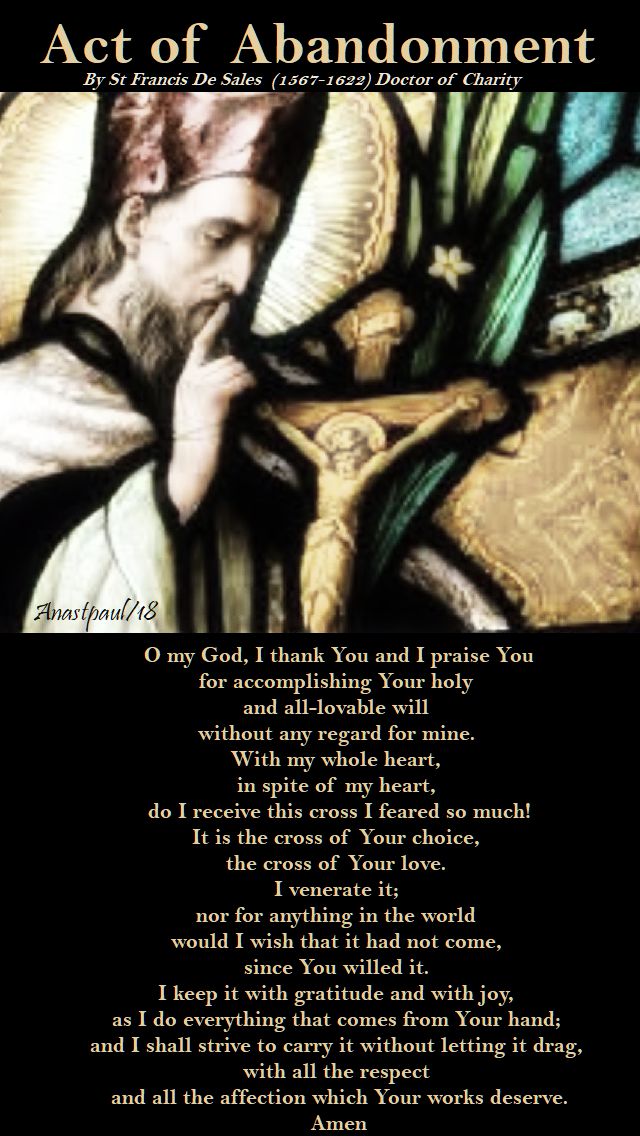
Act of Abandonment
By St Francis De Sales (1567-1622) Doctor of Charity

O my God, I thank You
and I praise You
for accomplishing Your holy
and all-lovable will
without any regard for mine.
With my whole heart,
in spite of my heart,
do I receive this cross I feared so much!
It is the cross of Your choice,
the cross of Your love.
I venerate it;
nor for anything in the world
would I wish that it had not come,
since You willed it.
I keep it with gratitude and with joy,
as I do everything that comes from Your hand;
and I shall strive to carry it without letting it drag,
with all the respect
and all the affection which Your works deserve.
Ameno my god, I thank you and I praise You - st francis de sales - act of abandonment - 23 april 2018

Posted in Against EPIDEMICS, HORSES - and sick horses, JOCKEYS, all HORSE-related workers, Of GARDENERS, Horticulturists, Farmers, PATRONAGE - POLICE, SOLDIERS, SAINT of the DAY, SKIN DISEASES, RASHES

Saint of the Day – 23 April – St George (died c 303) Martyr, one of the Fourteen Holy Helpers

Saint of the Day – 23 April – St George (died c 303) also known as St George of Lydda,  Jirí, Jordi, Zorzo,  Victory Bringer – Martyr and Soldier.   St George was born c 256-285 in Palestine and was tortured and beheaded to death in c 303 in Nicomedia, Bithynia, Roman Empire.   Patronages – • against herpes • against leprosy • against plague • against skin diseases • against skin rashes • against syphilis • agricultural workers • Aragon • archers • armourers • Boy Scouts • butchers • Canada • Cappadocia • Catalonia • cavalry • chivalry • Crusaders • England • equestrians • Ethiopia • farmers • field hands • field workers • Georgia • Germany • Greece • halberdiers • horsemen • horses  • knights • lepers • Lithuania • Malta • Montenegro • Order of the Garter • Palestine • Palestinian Christians • Portugal • riders • Romanian Army • saddle makers • saddlers • Serbia • sheep • shepherds • soldiers • Teutonic Knights • 2 Dioceses • 181 Cities.   He is one of the Fourteen Holy Helpers.

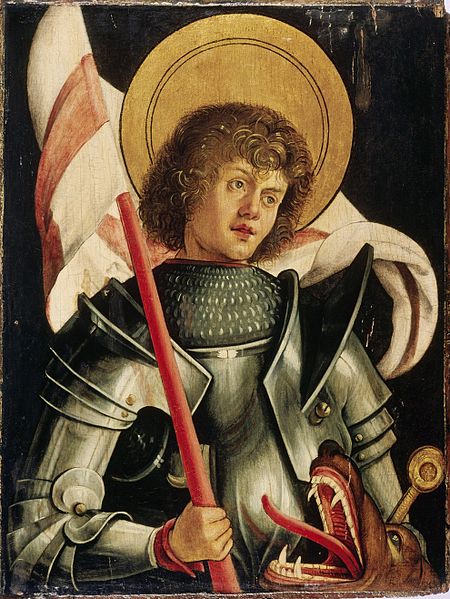
450px-Hans_Süß_von_Kulmbach_(zugeschr.)_-_Heiliger_Georg

St George was a Roman soldier of Greek origin and officer in the Guard of Roman emperor Diocletian, who was sentenced to death for refusing to recant his Christian faith.   As a Christian Martyr, he later became one of the most venerated saints in Christianity and was especially venerated by the Crusaders.   George’s parents were Christians of Greek background, his father Gerontius was a Roman army official from Cappadocia and his mother Polychronia was a Christian and a Greek native from Lydda in the Roman province of Syria Palaestina.

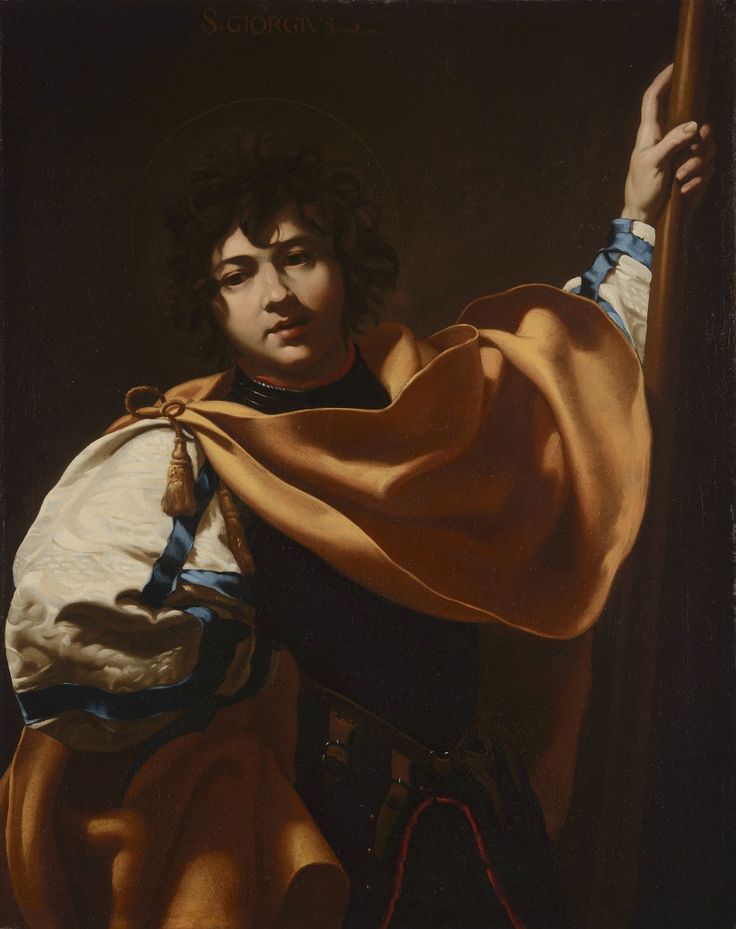
St George is commemorated and remembered as one of the Fourteen Holy Helpers and one of the most prominent military Saints, he is immortalised in the myth of Saint George and the Dragon.  Due to his chivalrous behaviour (protecting women, fighting evil, dependence on faith and might of arms, largesse to the poor), devotion to Saint George became popular in the Europe after the 10th century.   In the 15th century his feast day was as popular and important as Christmas.   Many of his areas of patronage have to do with life as a knight on horseback.   The celebrated Knights of the Garter are actually Knights of the Order of Saint George.   The shrine built for his relics at Lydda, Palestine was a popular point of pilgrimage for centuries.

Simon Vouet - ST GEORGE

There is little information on the early life of Saint George.   Herbert Thurston in The Catholic Encyclopedia states that based upon an ancient cultus, narratives of the early pilgrims and the early dedications of churches to Saint George, going back to the fourth century, “there seems, therefore, no ground for doubting the historical existence of St. George”.    According to Donald Attwater, “No historical particulars of his life have survived, … The widespread veneration for St George as a soldier saint from early times had its centre in Palestine at Diospolis, now Lydda.   St George was apparently martyred there, at the end of the third or the beginning of the fourth century; that is all that can be reasonably surmised about him.”

On 24 February 303, Diocletian, who hated Christians, announced that every Christian the army passed would be arrested and every other soldier should offer a sacrifice to the Roman gods.   George refused to abide by the order and told Diocletian, who was angry but greatly valued his friendship with George’s father.   When George announced his beliefs before his peers, Diocletian was unable to keep the news to himself.   In an effort to save George, Diocletian attempted to convert him to believe in the Roman gods, offered him land, money and slaves in exchange for offering a sacrifice to the Roman gods and made several other offers that George refused.

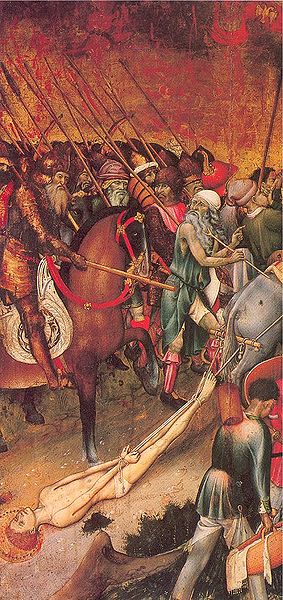
Finally, after exhausting all other options, Diocletian ordered George’s execution.   In preparation for his death, George gave his money to the poor and was sent for several torture sessions.   He was lacerated on a wheel of swords and required resuscitation three times but still George did not turn from God.

283px-StGeorgeDragged
Saint George dragged through the city behind horses – 15th century – Bernardo Martorell

George was decapitated before Nicomedia’s outer wall.   His body was sent to Lydda for burial and other Christians went to honour George as a martyr.

Saint George and the Dragon

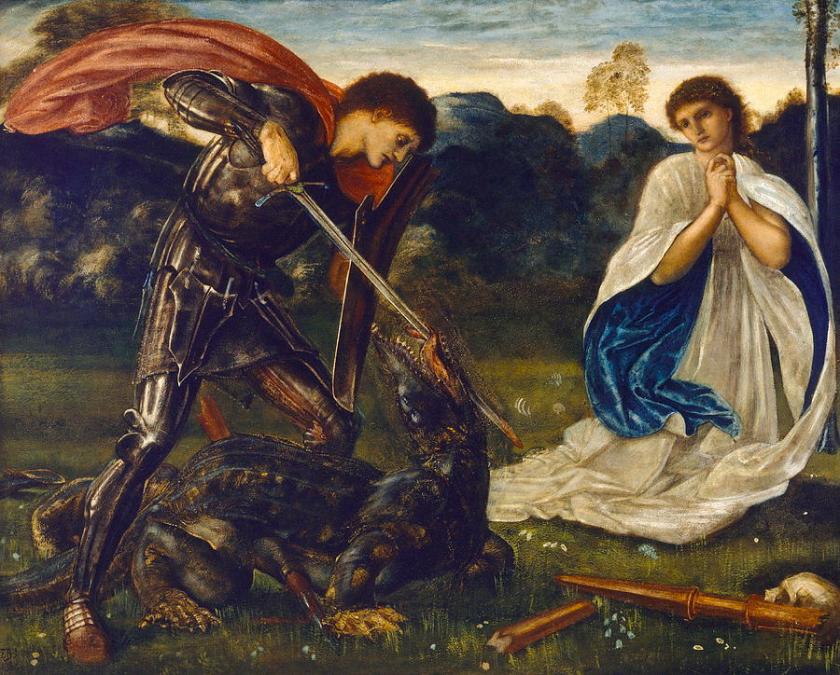
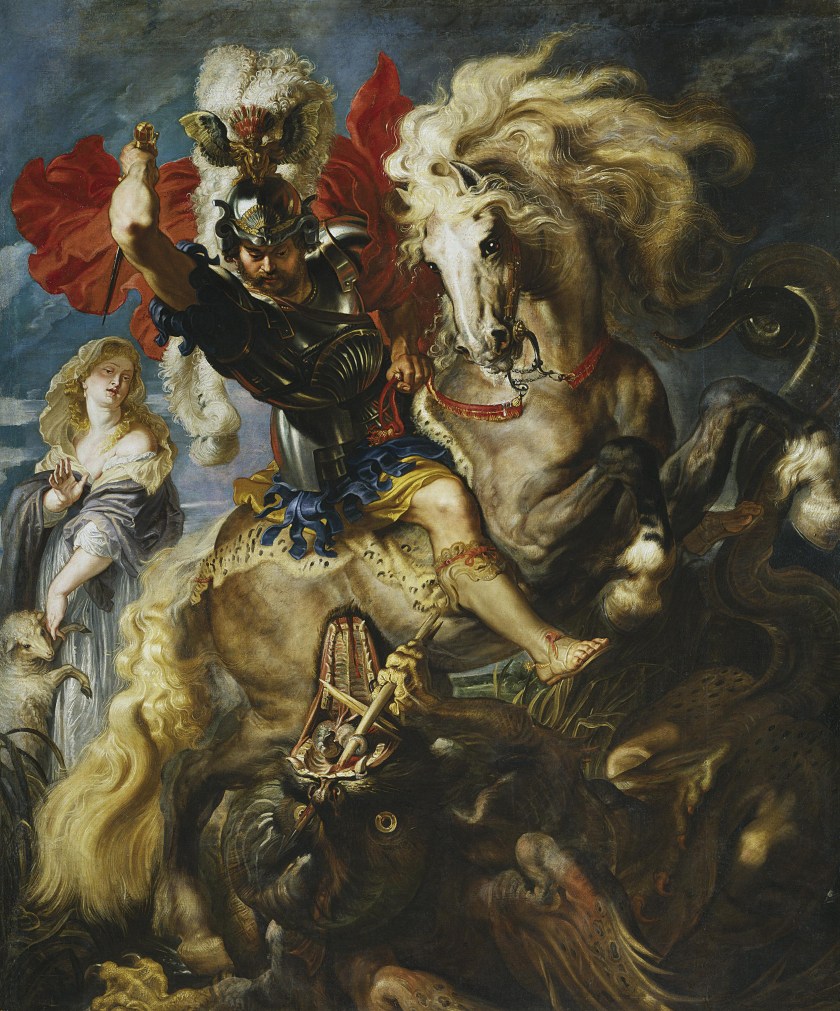
There are several stories about George fighting dragons but in the Western version, a dragon or crocodile made its nest at a spring that provided water to Silene, believed to be modern-day Lcyrene in Libya.   The people were unable to collect water and so attempted to remove the dragon from its nest on several occasions.   It would temporarily leave its nest when they offered it a sheep each day, until the sheep disappeared and the people were distraught.  This was when they decided that a maiden would be just as effective as sending a sheep.   The townspeople chose the victim by drawing straws.   This continued until one day the princess’ straw was drawn.   The monarch begged for her to be spared but the people would not have it.   She was offered to the dragon but before she could be devoured, George appeared.   He faced the dragon, protected himself with the sign of the Cross and slayed the dragon.   After saving the town, the citizens abandoned their paganism and were all converted to Christianity.

header - Detail from Saint George and the Dragon, Raphael, about 1506 ·1-the-fight-st-george-kills-the-dragon-vi-edward-burne-jonesRubens_-_San_Jorge_y_el_Dragón_(Museo_del_Prado,_1605)

Interesting Facts

Saint George stands out among other saints and legends because he is known and revered by both Muslims and Christians.
It is said Saint George killed the dragon near the sea in Beirut, thus Saint George Bay was named in his honour.
Saint George’s feast day is celebrated on 23 April but if it falls before Easter, it is celebrated Easter Monday.
The Russian Orthodox Church celebrates three St George feast days each year -23 April, 3 November, to commemorate the consecration of a cathedral dedicated to him in Lydda, and on 26 November for when a church in Kiev was dedicated to him.
In Bulgaria, his feast day is celebrated 6 May with the slaughter and roasting of a lamb.
In Egypt, the Coptic Orthodox Church of Alexandria calls St George the “Prince of Martyrs” and celebrates on 1 May.   There is a second celebration 17 November in honour of the first church dedicated to him.
Saint George is the patron saint of England and Catalonia and his cross can be found throughout England including on the English and other Commonwealth flags.
In older works, Saint George is depicted wearing armour and holding a lance or fighting a dragon, which represents Christ’s enemies.

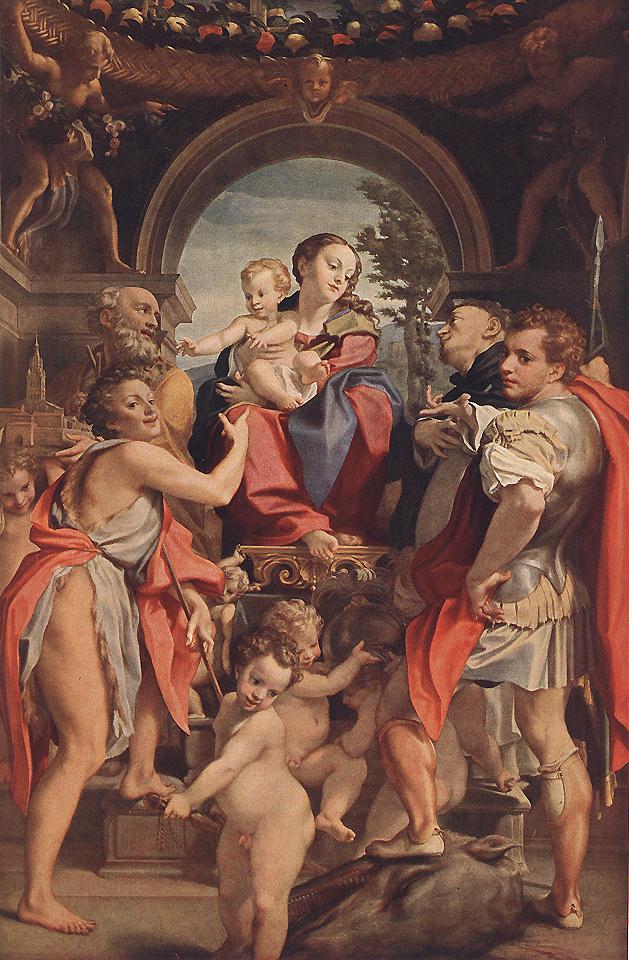
Correggio, Madonna with St George, 1530-32,
The Madonna with St George – Correggio
Posted in SAINT of the DAY

Memorials of the Saints – 23 April

St Adalbert of Prague (c 957-997) (Optional Memorial)

https://youtu.be/Dqz2ajDC8nY

St George (died c 303) (Optional Memorial)


St Achilleus of Vienne
Bl Adalbert III of Salzburg
St Felix of Vienne
St Fortunatus of Vienna
St George of San Giorio
St Gerard of Orchimont
Bl Gerard of Toul
Bl Giles of Assisi
Bl Giles of Saumur
Bl Giorgio di Suelli
Bl Helen del Cavalanti
St Ibar of Meath
Bl Maria Gabriela Sagheddu
St Marolus of Milan
St Pusinna of Champagne
Bl Teresa Maria of the Cross

French Mercedarian Martyrs: No info yet.

Martyrs of Rome: No info yet.

Martyrs of Africa: A group of Christians murdered for their faith in northern Africa. Little information has survived but their names. The ones we know are – Catulinus, Chorus, Faustinus, Felicis, Felix, Nabors, Plenus, Salunus, Saturninus, Silvius, Solutus, Theodora, Theodorus, Theon, Ursus, Valerius, Venustus, Victorinus, Victurus, Vitalis

Posted in CATECHESIS, MORNING Prayers, PRACTISING CATHOLIC, PRAYERS for PRIESTS, PRAYERS for VARIOUS NEEDS, PRAYERS of the SAINTS, QUOTES of the SAINTS, QUOTES on the PRIESTHOOD

22 April – Vocations Sunday:  Catechism on the Priesthood

22 April – Vocations Sunday: Catechism on the Priesthood

Vocations Sunday 

Catechism on the Priesthood

by St John Vianney  (1786-1859) Patron of Priests

        My children, we have come to the Sacrament of Orders.   It is a Sacrament which seems to relate to no one among you and which yet relates to everyone. This Sacrament raises man up to God.   What is a priest!   A man who holds the place of God – a man who is invested with all the powers of God. “Go,” said Our Lord to the priest; “as My Father sent Me, I send you.   All power has been given Me in Heaven and on earth.   Go then, teach all nations….  He who listens to you, listens to Me; he who despises you despises Me.”   When the priest remits sins, he does not say, “God pardons you”; he says, “I absolve you.”   At the Consecration, he does not say, “This is the Body of Our Lord;” he says, “This is My Body.”

St Bernard tells us that everything has come to us through Mary and we may also say that everything has come to us through the priest; yes, all happiness, all graces, all heavenly gifts.   If we had not the Sacrament of Orders, we should not have Our Lord.   Who placed Him there, in that tabernacle?   It was the priest.   Who was it that received your soul, on its entrance into life?   The priest.   Who nourishes it, to give it strength to make its pilgrimage?   The priest. Who will prepare it to appear before God, by washing that soul, for the last time, in the blood of Jesus Christ?   The priest – always the priest. And if that soul comes to the point of death, who will raise it up, who will restore it to calmness and peace?   Again the priest. You cannot recall one single blessing from God without finding, side by side with this recollection, the image of the priest.

Go to confession to the Blessed Virgin, or to an angel; will they absolve you?   No.  Will they give you the Body and Blood of Our Lord?   No.   The Holy Virgin cannot make her Divine Son descend into the Host.   You might have two hundred angels there but they could not absolve you.   A priest, however simple he may be, can do it; he can say to you, “Go in peace; I pardon you.”   Oh, how great is a priest!   The priest will not understand the greatness of his office till he is in Heaven.   If he understood it on earth, he would die, not of fear but of love.

The other benefits of God would be of no avail to us without the priest.   What would be the use of a house full of gold, if you had nobody to open you the door!   The priest has the key of the heavenly treasures; it is he who opens the door;  he is the steward of the good God, the distributor of His wealth.   Without the priest, the Death and Passion of Our Lord would be of no avail.   Look at the heathens, what has it availed them that Our Lord has died?   Alas!   they can have no share in the blessings of Redemption, while they have no priests to apply His Blood to their souls!

The priest is not a priest for himself.   He does not give himself absolution, he does not administer the Sacraments to himself. He is not for himself, he is for you.   After God, the priest is everything.   Leave a parish twenty years without priests, they will worship beasts.   If the missionary Father and I were to go away, you would say, “What can we do in this church? there is no Mass, Our Lord is no longer there,we may as well pray at home.”   When people wish to destroy religion, they begin by attacking the priest, because where there is no longer any priest there is no sacrifice and where there is no longer any sacrifice there is no religion.

When the bell calls you to church, if you were asked, “Where are you going?” you might answer, “I am going to feed my soul.”           If someone were to ask you, pointing to the tabernacle, “What is that golden door?”  “That is our storehouse, where the true Food of our souls is kept.” “Who has the key?   Who lays in the provisions?   Who makes ready the feast, and who serves the table?”   “The priest.” “And what is the Food?”   “The precious Body and Blood of Our Lord.”   O God!   O God! how You have loved us!   See the power of the priest;   out of a piece of bread the word of a priest makes a God.   It is more than creating the world…. Someone said, “Does St Philomena, then, obey the Cure of Ars?”   Indeed, she may well obey him, since God obeys him.   If I were to meet a priest and an angel, I should salute the priest before I saluted the angel.   The latter is the friend of God but the priest holds His place.   St Teresa kissed the ground where a priest had passed.   When you see a priest, you should say, “There is he who made me a child of God and opened Heaven to me by holy Baptism;  he who purified me after I had sinned;  who gives nourishment to my soul.”   At the sight of a church tower, you may say, “What is there in that place?” “The Body of Our Lord.” “Why is He there?”   “Because a priest has been there, and has said holy Mass.”

What joy did the Apostles feel after the Resurrection of Our Lord, at seeing the Master whom they had loved so much! The priest must feel the same joy, at seeing Our Lord whom he holds in his hands.   Great value is attached to objects which have been laid in the drinking cup of the Blessed Virgin and of the Child Jesus, at Loreto.   But the fingers of the priest, that have touched the adorable Flesh of Jesus Christ, that have been plunged into the chalice which contained His Blood, into the pyx where His Body has lain, are they not still more precious?   The priesthood is the love of the Heart of Jesus.   When you see the priest, think of Our Lord Jesus Christ and thank Him!

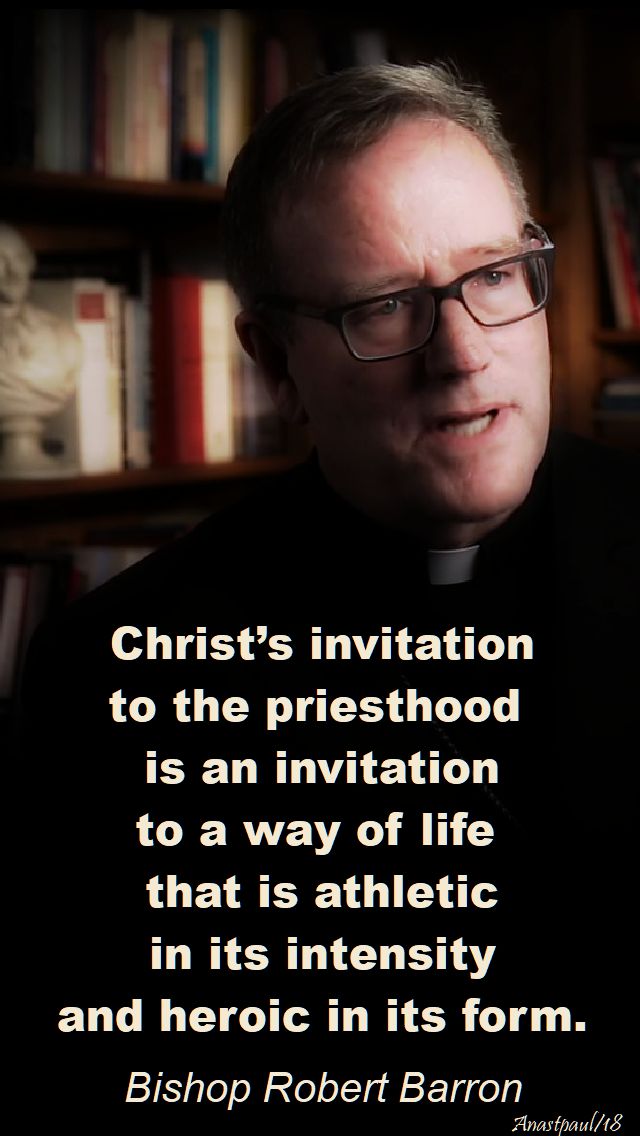
“Christ’s invitation to the priesthood
is an invitation to a way of life
that is athletic in its intensity
and heroic in its form.”

Bishop Robert Barronchrist's invitation to the priesthood - bishop robert barron - 22 april 2018 - vocations sunday
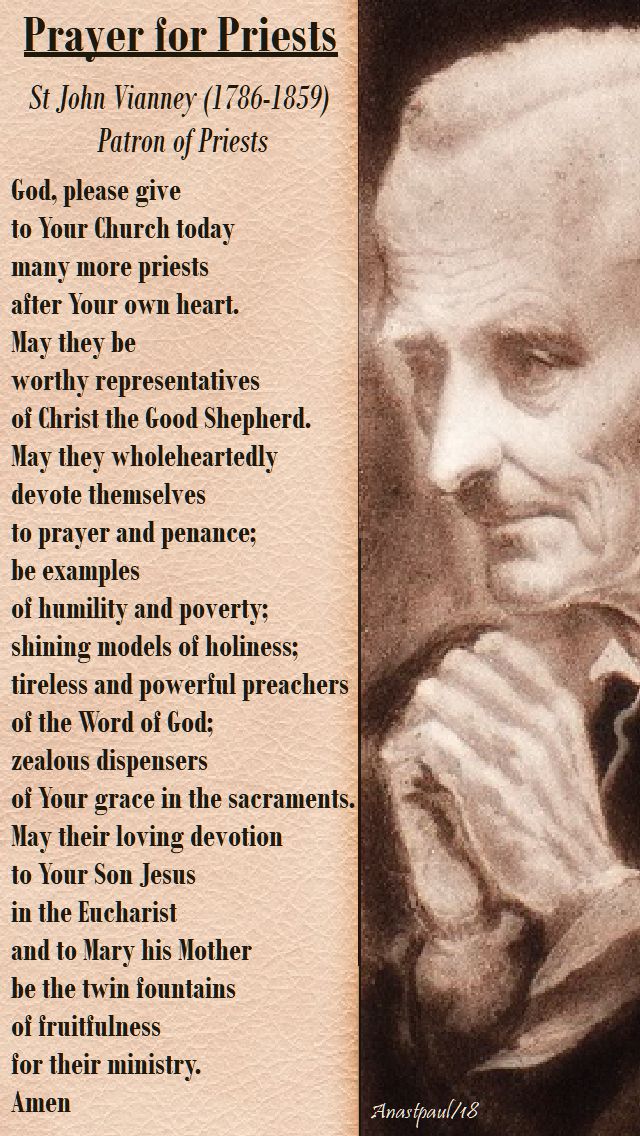
PRAYER FOR PRIESTS
By St John Vianney

God, please give to Your Church today
many more priests after Your own heart.
May they be worthy representatives
of Christ the Good Shepherd.
May they wholeheartedly devote themselves
to prayer and penance;
be examples of humility and poverty;
shining models of holiness;
tireless and powerful preachers of the Word of God;
zealous dispensers of Your grace in the sacraments.
May their loving devotion to Your Son Jesus
in the Eucharist
and to Mary his Mother
be the twin fountains of fruitfulness for their ministry.
Amenprayer for priests by st john vianney - vocations sunday - 22 april 2018
St John Vianney, Pray for our Priests!
st-john-vianney-pray-for-our-priests.2017


Posted in DOCTORS of the Church, FATHERS of the Church, MORNING Prayers, QUOTES of the SAINTS, QUOTES on the CHURCH, SUNDAY REFLECTIONS, The HOLY EUCHARIST / The HOLY MASS

Sunday Reflection – 22 April – The Fourth Sunday of Easter – Good Shepherd/Vocations Sunday – Year B

Sunday Reflection – 22 April – The Fourth Sunday of Easter – Good Shepherd/Vocations Sunday – Year B

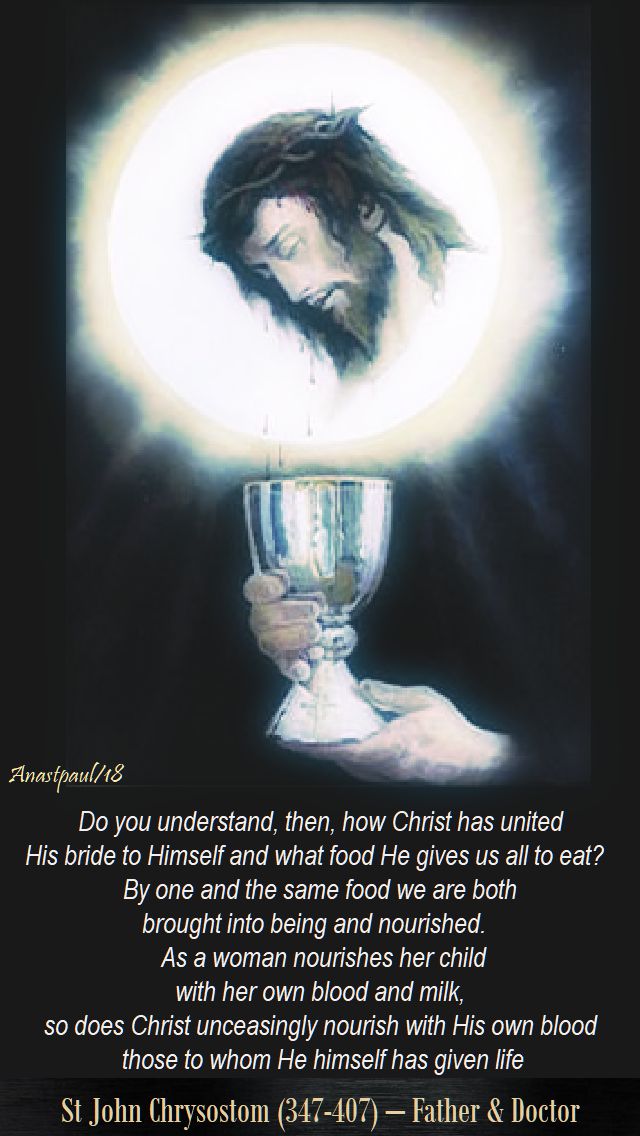
“There flowed from His side water and blood.   Beloved, do not pass over this mystery without thought; it has yet another hidden meaning, which I will explain to you. I said that water and blood symbolised Baptism and the Holy Eucharist.   From these two sacraments the Church is born:- from baptism, the cleansing water that gives rebirth and renewal through the Holy Spirit and from the holy Eucharist.

Since the symbols of baptism and the Eucharist flowed from His side, it was from His side that Christ fashioned the Church, as He had fashioned Eve from the side of Adam. Moses gives a hint of this when he tells the story of the first man and makes him exclaim:- Bone from my bones and flesh from my flesh!   As God then took a rib from Adam’s side to fashion a woman, so Christ has given us blood and water from His side to fashion the Church.   God took the rib when Adam was in a deep sleep and in the same way Christ gave us the blood and the water after His own death.

Do you understand, then, how Christ has united His bride to Himself and what food He gives us all to eat?   By one and the same food we are both brought into being and nourished.   As a woman nourishes her child with her own blood and milk, so does Christ unceasingly nourish with His own blood those to whom He himself has given life.’”

St John Chrysostom (347-407) – Father & Doctordo you understand then, how christ has united His bride to Himself - st john chrysostom - 22 april 2018 - sunday reflection

Posted in EASTER, MORNING Prayers, The GOOD SHEPHERD, The WORD

Thought for the Day – The Fourth Sunday of Easter Year B – “Good Shepherd/Vocations Sunday

Thought for the Day – The Fourth Sunday of Easter Year B – “Good Shepherd/Vocations Sunday” – Todays Readings: Acts 4:8-12, Psalm 118:1, 8-9, 21-23, 26, 28-29, 1 John 3:1-2, John 10:11-18

“The Good Shepherd gives his life for the sheep”

Despite Jesus’ realistic word-picture, the parable of the Good Shepherd only fully comes alive in Jesus Himself, God’s appointed “Shepherd” of men.   He names two characteristics of such a shepherd:  first the shepherd’s commitment to the flock even to the point of death;  and second, the reciprocal recognition between sheep and shepherd, which is anchored in the innermost mystery of God.

The theme of self-giving to the point of death, is found at both the beginning and the end of the Gospel.   This devotion, contrasts sharply with the flight of the “hired hand”, who, when facing danger, has the excuse that the life of a man is more valuable than the life of a dumb animal.   This argument loses its force, however, when the shepherd cares so much for his sheep, that he prefers them to his own life.   That is scarcely conceivable in purely natural terms but it becomes a central truth in the realm of grace.   It only makes sense with the aid of the second theme of the parable – the shepherd knows his sheep and the animals likewise instinctively recognise him.   For Jesus, this is merely the point of comparison for a completely different recognition:  “as the Father knows me and I know the Father.”   This has nothing to do with instinct but with the most profound mutual recognition, as it is found in absolute trinitarian love.   When Jesus applies this utterly sublime trinitarian love recognition to the inward mutuality between Himself and His own, He elevates this knowledge far above that which is hinted at by the parable.

And thus, it becomes clear, that the first motif of the parable (giving one’s life for the sheep) and the second motif (mutual recognition) coincide rather than merely parallel each other.   The Father’s and the Son’s knowledge of each other is identical with their mutual and perfect selfgiving and therefore, the knowledge exchanged between Jesus and His own, is one with the perfect selfgiving of Jesus for and to His own and it implicitly includes the unity of the Christian’s knowledge and loving dedication to his Lord.

At the end, both themes are expressly joined together:  the Father (also) loves the Son for His perfect selfgiving for the sake of men, a selfgiving which is both freely chosen by the Son and commissioned by the Father.   This unmitigated surrender to mankind because it is Divine Love, is at the same time the power that achieves victory over death (“the power to take up life again”).

“No other name under heaven”  in the First Reading, Peter gives the Lord all glory for the miracle he has effected.   The point is not that, Jesus excepted, all who care for sheep are “hired hands” for the Lord Himself installed Peter to pasture His flock – precisely Jesus’ Flock, not Peter’s.   Thus everything effective and appropriate ultimately is accomplished by the “chief Shepherd alone” (1 Pet 5:4), even if through the activity of His assistants.

Hans Urs von Balthasar “Light of the Word”

john 10 11 - good shepherd no 2


Posted in franciscan OFM, MORNING Prayers, QUOTES - J R R Tolkien and MORE, The GOOD SHEPHERD

Quote/s of the Day – 22 April – The Fourth Sunday of Easter Year B – “Good Shepherd/Vocations Sunday”

Quote/s of the Day – 22 April – The Fourth Sunday of Easter Year B – “Good Shepherd/Vocations Sunday” – Todays Readings: Acts 4:8-12, Psalm 118:1, 8-9, 21-23, 26, 28-29, 1 John 3:1-2, John 10:11-18

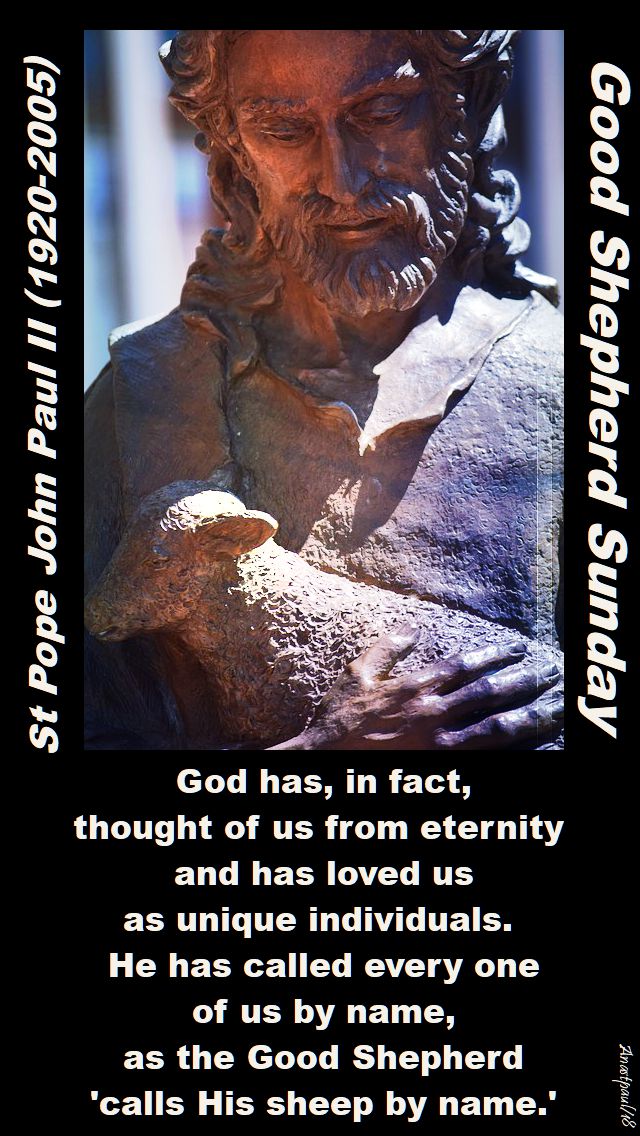
“God has, in fact, thought of us from eternity
and has loved us as unique individuals.
He has called every one of us by name,
as the Good Shepherd ‘calls His sheep by name.'”

St Pope John Paul II (1920-2005)god has in fact thought of us from eternity - 22 april 2018 - good shepherd sunday - st pope john paul

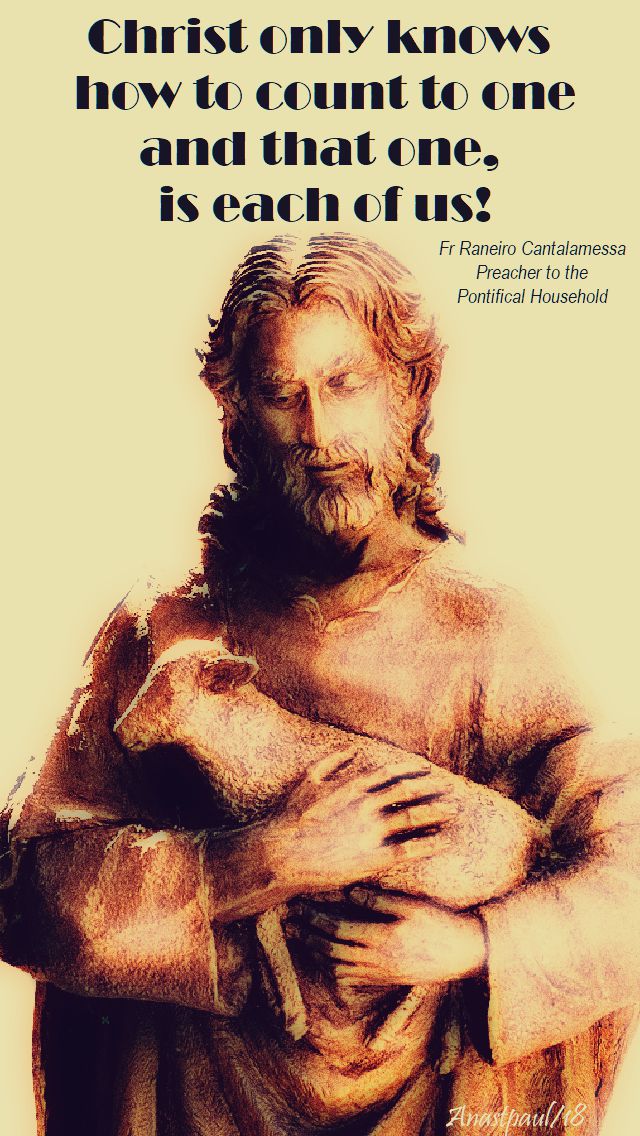
“What Jesus wants to say with these images is clear.
He knows His disciples (and, as God, all men),
He knows them “by name,” which, for the Bible,
means their innermost essence.
He loves them with a personal love
that treats each as if, they were the only one
who existed for Him.
Christ only knows how to count to one
and that one, is each of us.”

Fr Raneiro Cantalamessa OFM CAP
Preacher to the Pontifical Householdchrist only knows how to count to one - fr raneriro cantalamessa - 22 april 2018 - vocations good shepherd sunday-no 2

Posted in MORNING Prayers, QUOTES of the SAINTS, The GOOD SHEPHERD, The WORD

One Minute Reflection – 22 April – The Fourth Sunday of Easter Year B – “Good Shepherd/Vocations Sunday”

One Minute Reflection – 22 April – The Fourth Sunday of Easter Year B – “Good Shepherd/Vocations Sunday” and the Memorial of St Pope Soter (died C 174)

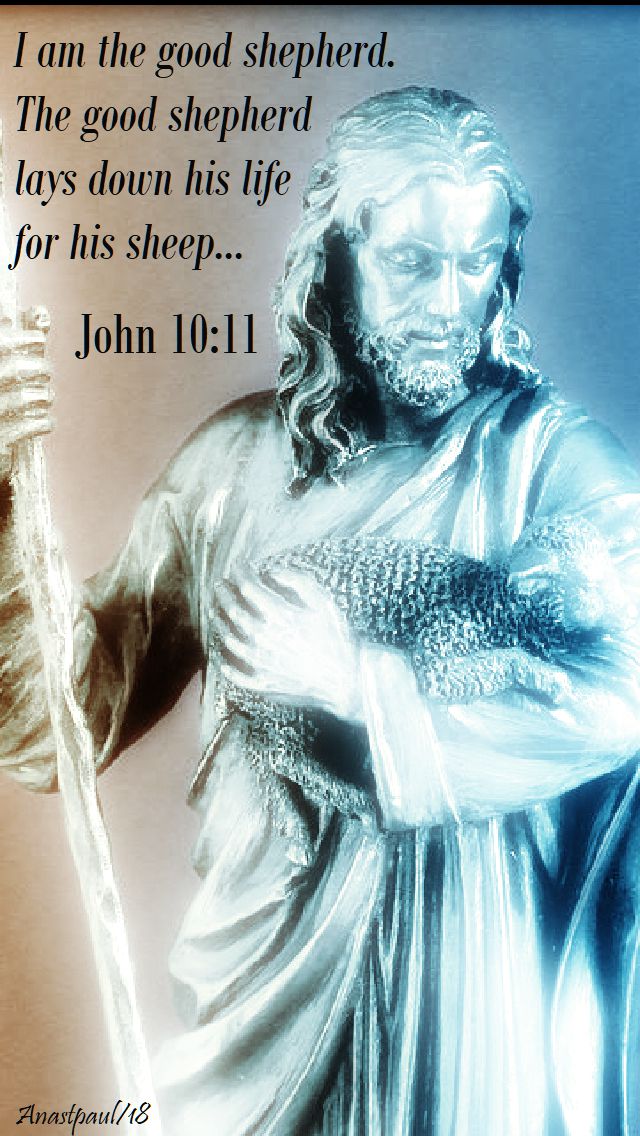
I am the good shepherd.   The good shepherd lays down his life for the sheep...John 10:11john 10 11 - the good shepherd

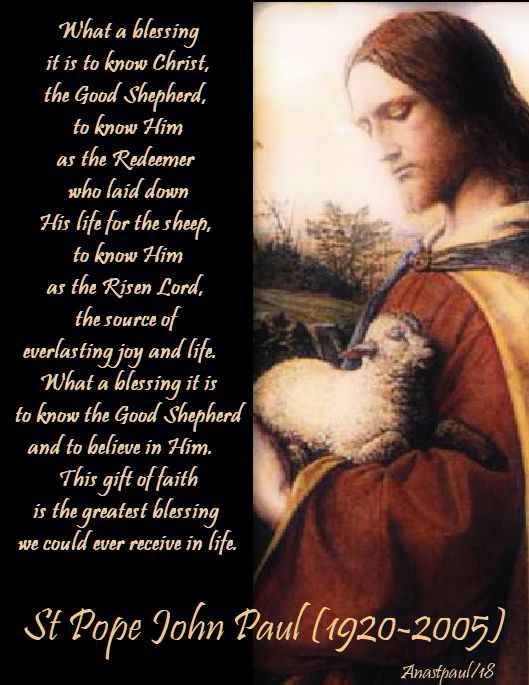
REFLECTION – “What a blessing it is to know Christ, the Good Shepherd, to know Him as the Redeemer who laid down His life for the sheep, to know Him as the Risen Lord, the source of everlasting joy and life.   What a blessing it is to know the Good Shepherd and to believe in Him.   This gift of faith is the greatest blessing we could ever receive in life.”…St Pope John Paul (1920-2005)

what a blessing it is to know christ - good shepherd sunday - st pope john paul - 22 april 2018

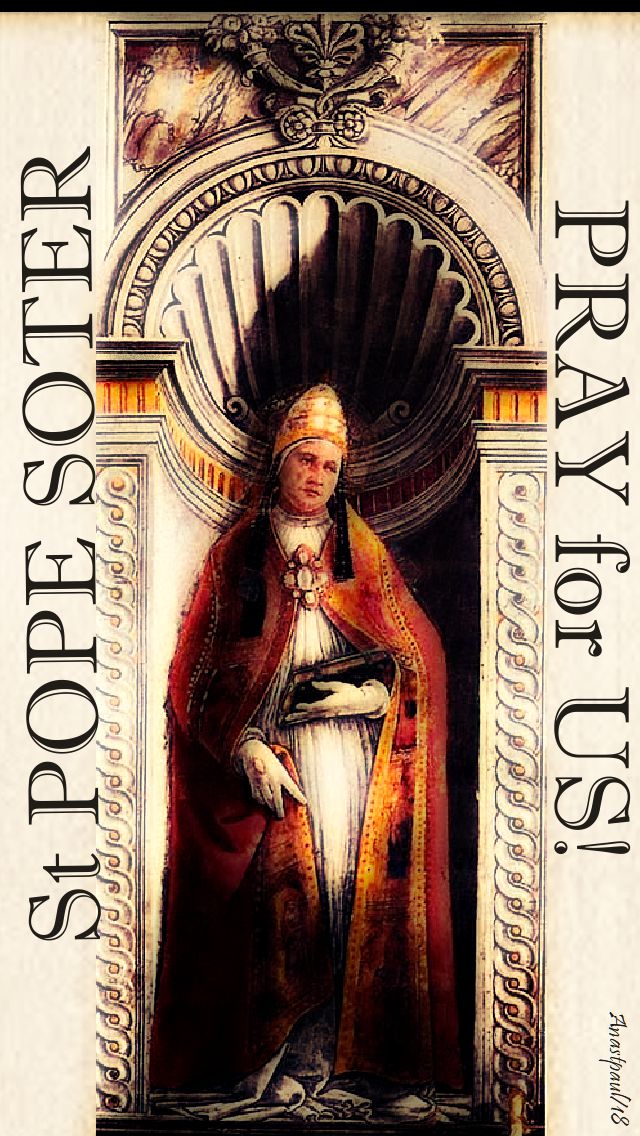
PRAYER – Almighty, ever-living God, bring us to the joy of Your heavenly city, so that we, Your little flock, may follow where Christ, our Good Shepherd, has gone before us, by the power of His Resurrection.   St Pope Soter, please pray for us that we may always follow our Shepherd, as you did and thus reach our heavenly home, to praise Him with you, forever.   We make our prayer through Christ, our Lord, amen.st pope soter - pray for us - 22 april 2018

Posted in DOCTORS of the Church, EASTER, FATHERS of the Church, MORNING Prayers, PRAYERS of the SAINTS, The HOLY EUCHARIST / The HOLY MASS

Our Morning Offering -22 April – The Fourth Sunday of Easter Year B

Our Morning Offering -22 April – The Fourth Sunday of Easter Year B

Give me Yourself, O My God
By St Augustine (354-430) Doctor of Grace

Give me Yourself, O my God,
give Yourself to me.
Behold I love You
and if my love is too weak a thing,
grant me to love You more strongly.
I cannot measure my love
to know how much it falls short of being sufficient
but let my soul hasten to Your embrace
and never be turned away,
until it is hidden in the secret shelter
of Your presence.
This only do I know,
that it is not good for me
when You are not with me,
when You are only outside me.
I want You in my very self.
All the plenty in the world
which is not my God is utter want.
Amengive me yourself o my god - prayer of st augustine - act of petition - 22 april 2018 - 4th sun of easter year B


Posted in SAINT of the DAY

Saint of the Day – St Pope Soter (Died c 174) Martyr

Saint of the Day – St Pope Soter (Died c 174) – Martyr, Latin: Soterius; Died c 174) was the Bishop of Rome from c 167 to his death c 174.   According to the Annuario Pontificio, the dates may have ranged from 162–168 to 170–177.   He was born in Fondi, Campania, today Lazio region, Italy.   St Pope Soter is known for declaring that marriage was valid only as a sacrament blessed by a Priest and also for formally inaugurating Easter as an annual festival in Rome and for combatting Montanism.  His name, from Greek σωτήρ “saviour”, would be his Baptismal name, as his lifetime predates the tradition of adopting Papal names.

Saint Soter’s feast day is celebrated today, 22 April, as is that of Saint Pope Caius.   The Roman Martyrology, reads:  The Roman Martyrology reads: “At Rome, on the Appian Way, the birthday of St Soter, Pope and Martyr.

header - st pope soter

Born to a Greek father in Latium, Italy, St Soter became the twelfth pope, raised to the Papacy upon the death of St Anicetus in 173.   He is remembered for his love and charity of persecuted Christians, as well as his bravery during a time in which it was dangerous to be a Christian, let alone the pope!

The Montanist movement, which originated in Asia Minor, made its way to Rome and Gaul in the second half of the 2nd century, during the reign of Eleuterus.   Its nature did not diverge so much from the orthodoxy of the time for it to initially be labelled heresy. During the violent persecution at Lyon, in 177, local confessors wrote from their prison concerning the new movement to the Asiatic and Phrygian communities as well as to Pope Eleuterus.   The bearer of their letter to the pope was the presbyter St Irenaeus, soon to become Bishop of Lyon.   It appears from statements of Eusebius concerning these letters that the Christians of Lyon, though opposed to the Montanist movement, advocated patience and pleaded for the preservation of ecclesiastical unity.

When the Roman church took its definite stand against Montanism is not precisely known.   Tertullian records that a Roman bishop sent some conciliatory letters to the Montanists but based on the complaints of Praxeas “concerning the prophets themselves and their churches and by insistence on the decisions of the bishop’s predecessors” forced the pontiff to recall these letters.   Another ancient source states that “Holy Soter, Pope of the City, wrote against them a book, as did the master, Apollonius of Ephesus. Against these wrote the priest Tertullian of Carthage.   Who in all ways wrote well, wrote first and wrote incomparably, in this alone did reprehensibly, that he defended Montanus”.   At Rome, the Gnostics and Marcionites continued to preach against the Catholic Church.

pope7soterst pope soter - snip

Letters written to Saint Soter have survived, addressed to him by Saint Dionysius of the Corinthian church and others.  These letters reference the fatherly love with which Saint Soter wrote to and help support and build the congregation of the Church, offering prayers and financial assistance to all in need—those imprisoned in Rome, those Christians sent to work in the dangerous mines for failing to renounce their faith and those who lived in the remotest of Churches (like Corinth at the time), extending the charity of the Church well beyond that of his predecessors.

st pope soterst pope soter statue in the vatican

From the letter of Saint Dionysius:  “From the beginning it has been your custom to do good to all the brethren in many ways and to send alms to many churches in every city, refreshing the poverty of those who sent requests, or giving aid to the brethren in the mines, by the alms which you have had the habit of giving from old, Romans keeping up the traditional custom of the Romans;  which your blessed Bishop Soter has not only preserved but has even increased, by providing the abundance which he has sent to the saints and by further consoling with blessed words with brethren who came to him, as a loving father his children… Today, therefore, we have kept the holy Lord’s day, on which we have read your letter, which we shall always have to read and be admonished, even as the former letter which was written to us by the ministry of Clement.”

St Soter died in C 174 and buried in the Callistus Catacombs in Rome, Italy.   At his tomb are written the words, “Pope Saint Soter, Master of Charity, Pray for us!”

While we know little about his life, the charitable works and principles of Pope Saint Soter remain extant, inspiring us to evaluate our lives.   Who could we be more loving and charitable to?   How better could be model our lives after Saint Soter,?   How better could we model our lives after Our Blessed Mother, the perfect model of Christian charity? callistus catacombs - snipcecilia-3.Callistus Catacombs - Rome

Posted in SAINT of the DAY

Memorials of the Saints – 22 April

St Abel McAedh
St Aceptismas of Hnaita
St Pope Agapitus I,
St Apelles of Smyrna
St Arwald
St Epipodius of Lyon
St Euflamia
Bl Francis of Fabriano
St Helimenas
St Joseph of Persia
St Leo of Sens
St Leonidas of Alexandria
St Lucius of Laodicea
St Opportuna of Montreuil
St Senorina
St Pope Soter

St Theodore of Sykeon
St Virginio

Martyrs of Alexandria: No info yet

Martyrs of Persia: Bishops, priests, deacons and laity who were martyred in Persia and celebrated together. Several of them have their stories related in the Acta of Saints Abdon and Sennen.
• Abdiesus the Deacon
• Abrosimus
• Aceptismas of Hnaita
• Aithilahas of Persia
• Azadanes the Deacon
• Azades the Eunuch
• Bicor
• Chrysotelus of Persia
• Helimenas of Persia
• James of Persia
• Joseph of Persia
• Lucas of Persia
• Mareas
• Milles of Persia
• Mucius of Persia
• Parmenius of Persia
• Tarbula of Persia

Posted in franciscan OFM, MORNING Prayers, QUOTES of the SAINTS, QUOTES on CHARITY, QUOTES on FASTING, QUOTES on LOVE, QUOTES on OBEDIENCE, QUOTES on PEACE, QUOTES on PRAYER, QUOTES on SANCTITY, QUOTES on TEMPTATION, SAINT of the DAY, The BLESSED VIRGIN MARY

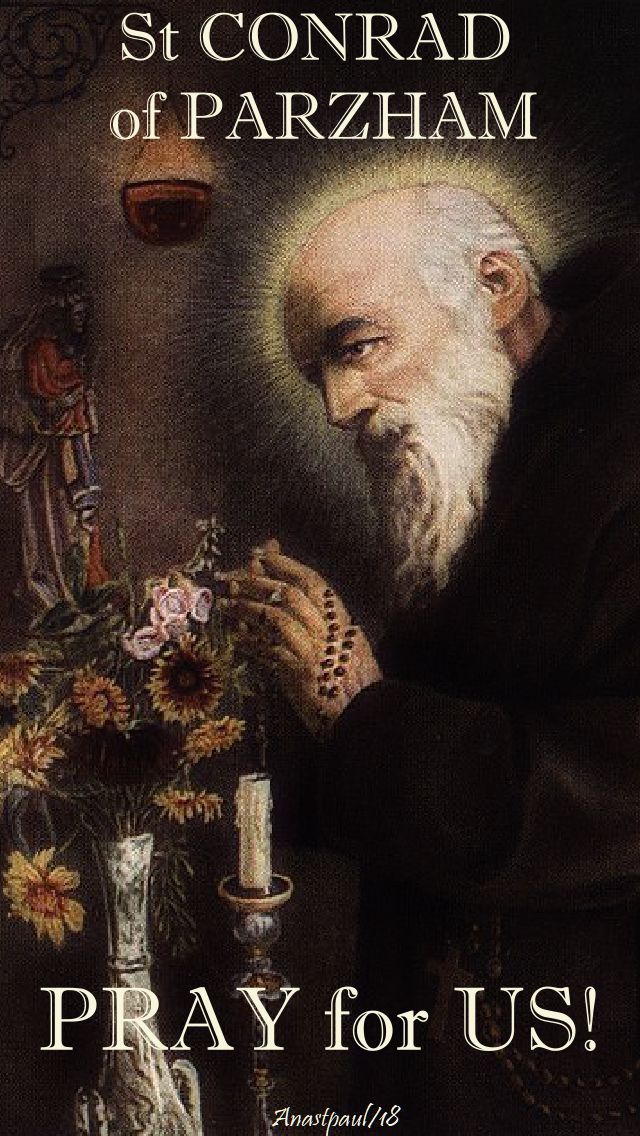
Thought for the Day -21 April – Saturday of the Third Week of Eastertide and the Memorial of St Conrad of Parzham OFM Cap. (1818-1894)

Thought for the Day -21 April – Saturday of the Third Week of Eastertide and the Memorial of St Conrad of Parzham OFM Cap. (1818-1894)

Resolutions of St Conrad whilst a Novice

1. I resolve in the first place to remain continually
in the presence of God
and to ask myself frequently if I would do this or that,
if my confessor or superior were watching me
and especially if God and my guardian angel were present.

2. I resolve to ask myself, whenever I have to encounter crosses of suffering,
“Conrad, why have you come here?”

3. I resolve to avoid leaving the friary, as far as possible,
unless it be out of love for my neighbour, obedience, reasons of health,
a pious pilgrimage or some other good cause.

4. I resolve to foster fraternal charity in myself and in others.
Therefore, I resolve to take care never to say an unkind word.
I resolve to bear up patiently with the defects and weaknesses of others
and as far as possible, to hide them, with the mantle of charity,
unless I am in duty bound, to manifest them, to someone,
who is in a position to correct them.

5. I resolve to observe silence conscientiously.
I resolve to speak briefly and so avoid many pitfalls
and be better able to converse with God.

6. When at table I resolve to place myself in the presence of God,
as far as I can, to remain recollected and to pass up my favorite dishes
so as to practice a hidden form of mortification.
I resolve not to eat between meals, unless ordered to do so,
under obedience.

7. I resolve to answer the first call of the bell unless legitimately hindered.

8. I resolve to avoid, as far as possible, conversing with the opposite sex
unless obedience imposes duties on me which make it necessary to speak with women.
In that case I resolve to be very reserved and maintain custody of the eyes.

9. I resolve to carry out orders punctually and to the letter.
I resolve especially to make every effort to conquer my own will in all things.

10. I resolve to force myself to pay close attention to minor details
and as far as possible avoid every imperfection.
I resolve to observe the holy rule faithfully
and not to depart from it a hairsbreadth, come what may.

11. I resolve to cultivate a deep devotion to the Blessed Virgin Mary
and strive to imitate her virtues.

St Conrad of Parzham (1818-1894)

Pray for us!st conrad of parzham - pray for us no 2, - 21 april 2018


Posted in DOCTORS of the Church, EUCHARISTIC Adoration, MORNING Prayers, QUOTES on LOVE, QUOTES on MERCY, QUOTES on REPENTANCE, QUOTES on SANCTITY, QUOTES on SIN, SAINT of the DAY, The HOLY EUCHARIST / The HOLY MASS

Quote/s of the Day – 21 April – Saturday of the Third Week of Eastertide, the Memorial of St Anselm (1033-1109) Doctor of the Church and of St Conrad of Parzham OFM Cap. (1818-1894)

Quote/s of the Day – 21 April – Saturday of the Third Week of Eastertide, the Memorial of St Anselm (1033-1109) Doctor of the Church and of St Conrad of Parzham OFM Cap. (1818-1894)

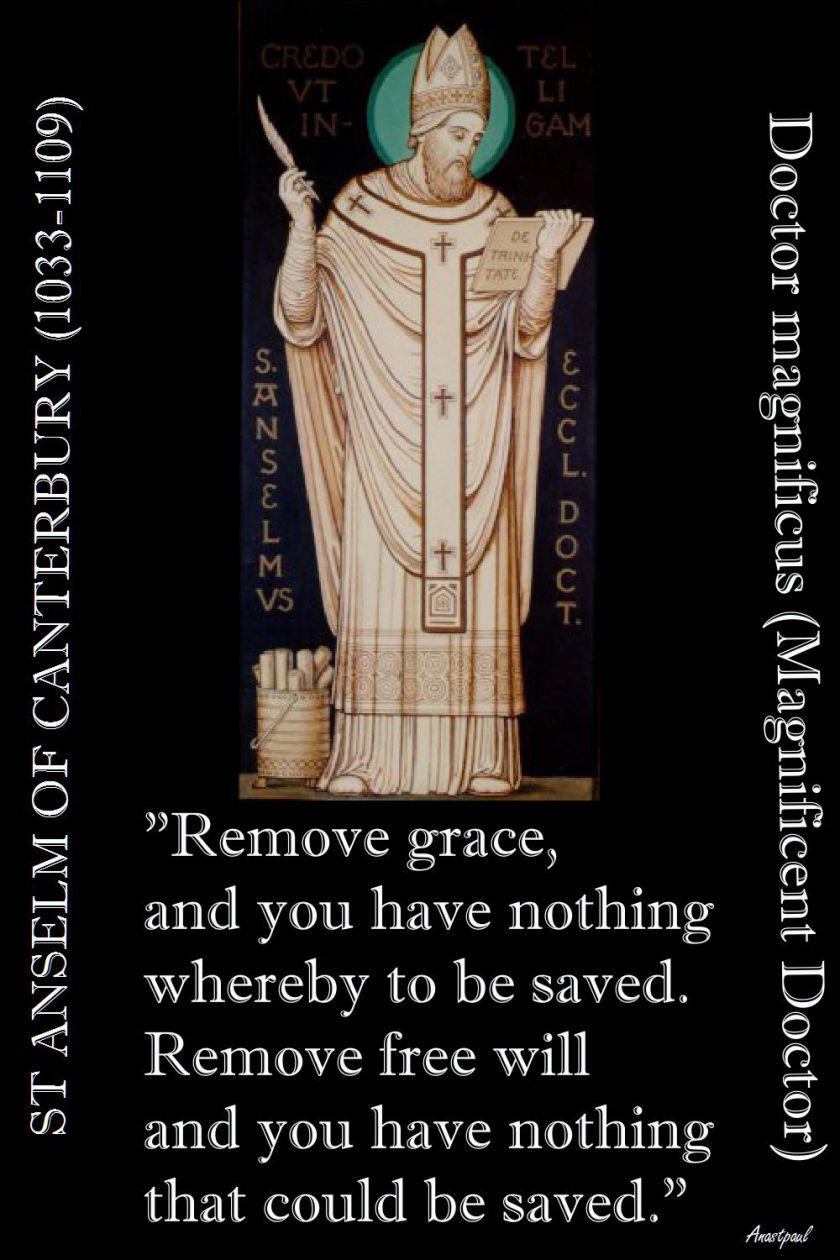
“Remove grace
and you have nothing
whereby to be saved.
Remove free will
and you have nothing
that could be saved.”remove-grace-st-anselm.21 april 2017

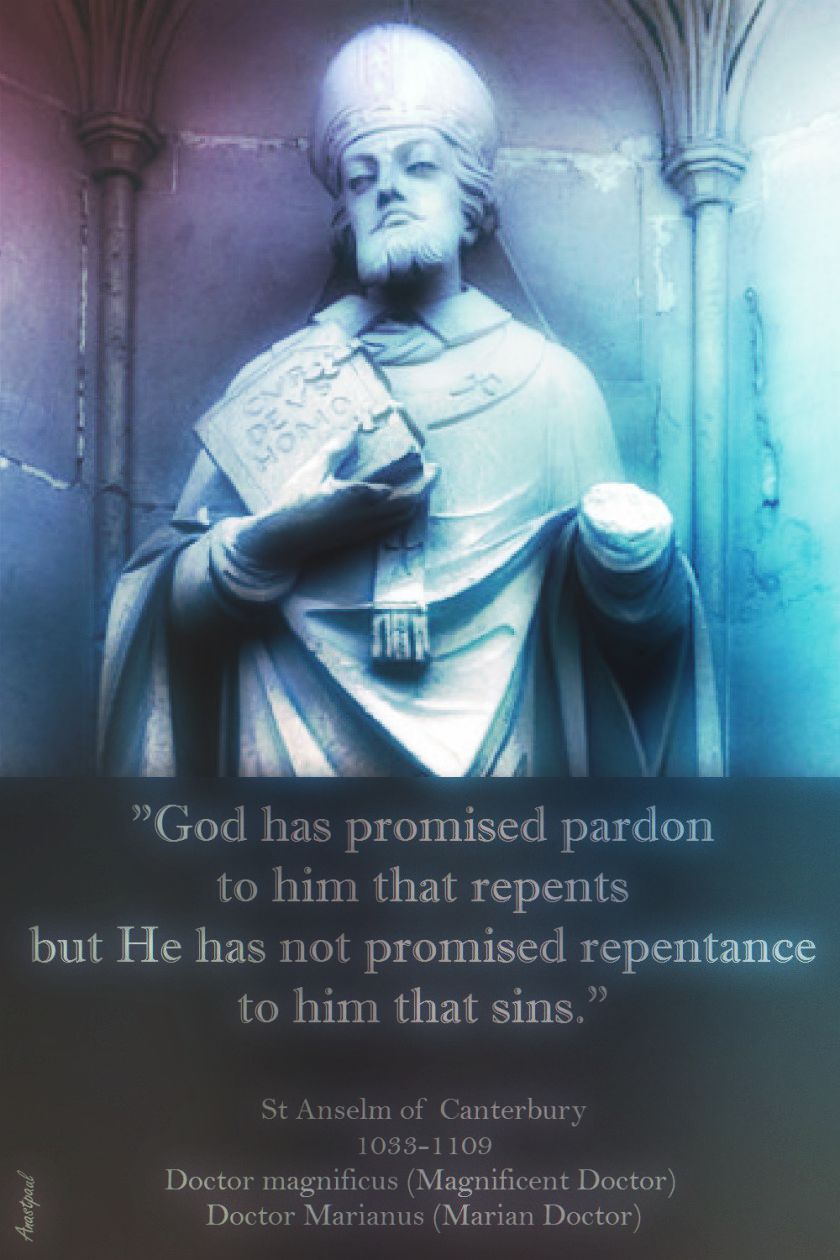
“God has promised pardon
to him that repents
but he has not promised repentance
to him that sins.”

St Anselm (1033-1109) Doctor of the Churchst-anslem-god-has-promised-pardon.-21 april 2017

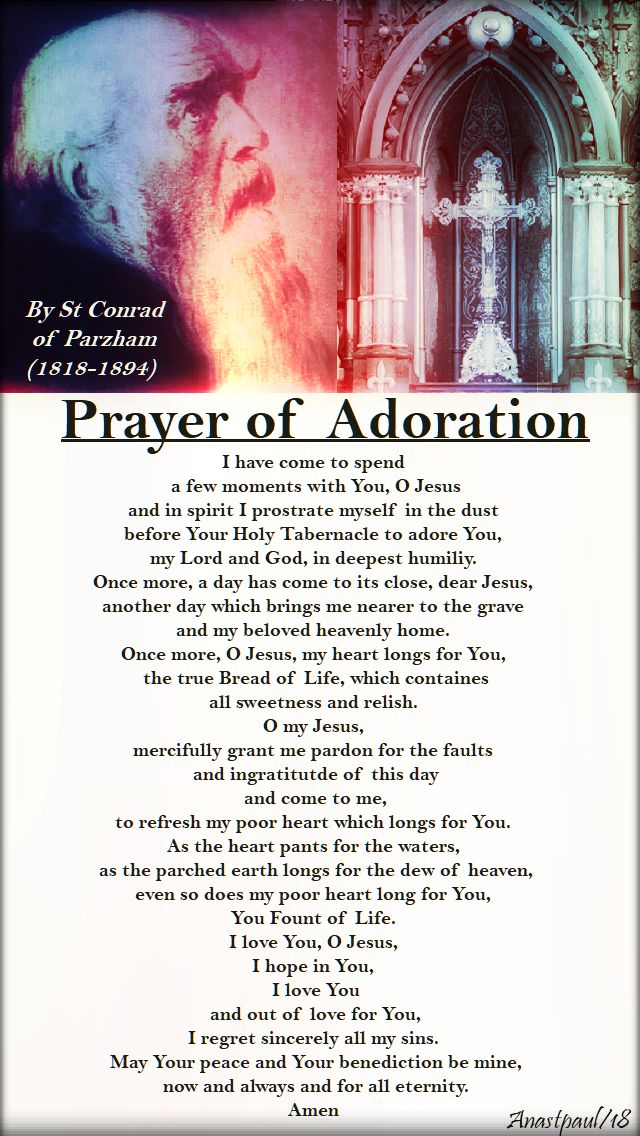
Prayer of Adoration and Repentance/Night Prayer
By St Conrad of Parzham (1818-1894)

I have come to spend
a few moments with You, O Jesus
and in spirit I prostrate myself in the dust
before Your Holy Tabernacle to adore You,
my Lord and God, in deepest humility.
Once more, a day has come to its close, dear Jesus,
another day which brings me nearer to the grave
and my beloved heavenly home.
Once more, O Jesus, my heart longs for You,
the true Bread of Life, which contains
all sweetness and relish.
O my Jesus,
mercifully grant me pardon for the faults
and ingratitude of this day
and come to me,
to refresh my poor heart which longs for You.
As the heart pants for the waters,
as the parched earth longs for the dew of heaven,
even so does my poor heart long for You,
You Fount of Life.
I love You, O Jesus,
I hope in You,
I love You
and out of love for You,
I regret sincerely all my sins.
May Your peace and Your benediction be mine,
now and always and for all eternity.
Amen

St Conrad of Parzham (1818-1894)prayer of adoration - i have come to spend - st conrad of parzham - 21 april 2018


Posted in franciscan OFM, MORNING Prayers, QUOTES of the SAINTS, SAINT of the DAY, The WORD

One Minute Reflection – – 21 April – Saturday of the Third Week of Eastertide and the Memorial of St Conrad of Parzham (1818-1894)

One Minute Reflection – 21 April – Saturday of the Third Week of Eastertide and the Memorial of St Conrad of Parzham (1818-1894)   Today’s Readings: Acts 9:31-42, Psalm 116:12-17, John 6:60-69

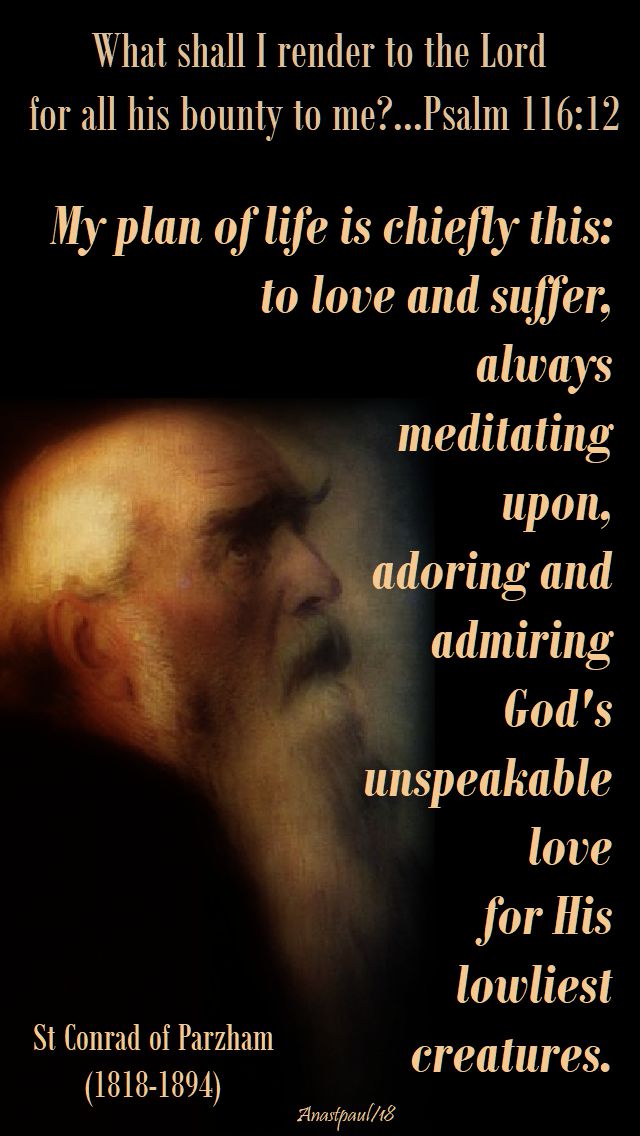
What shall I render to the Lord for all his bounty to me?…Psalm 116:12

REFLECTION – “It was God’s will that I should leave everything that was near and dear to me.   I thank Him for having called me to religious life where I have found such peace and joy as I could never have found in the world.   My plan of life is chiefly this: to love and suffer, always meditating upon, adoring and admiring God’s unspeakable love for His lowliest creatures.” – St Conrad of Parzham (1818-1894) (from a letter of Saint Conrad)my plan of life is chiefly this - st conrad of parzham - 21 april 2018

PRAYER – Lord God, our Father, in You is our hope and our life.   You have made us and be belong to You.   Give us Your grace and Your help to constantly render to You, our love and gratitude and to suffer for that great love, by which You sent your only Son to save us.   St Conrad, pray for us that we may grow in holiness and soon meet you in heaven, amen.

st conrad of parzham - pray for us - 21 april 2018