Posted in DOCTORS of the Church, EASTER, MORNING Prayers, PRAYERS of the SAINTS, SAINT of the DAY

Our Morning Offering – 21 April – Saturday of the Third Week of Eastertide and the Memorial of St Anselm (1033-1109) Doctor of the Church

Our Morning Offering – 21 April – Saturday of the Third Week of Eastertide and the Memorial of St Anselm (1033-1109) Doctor of the Church

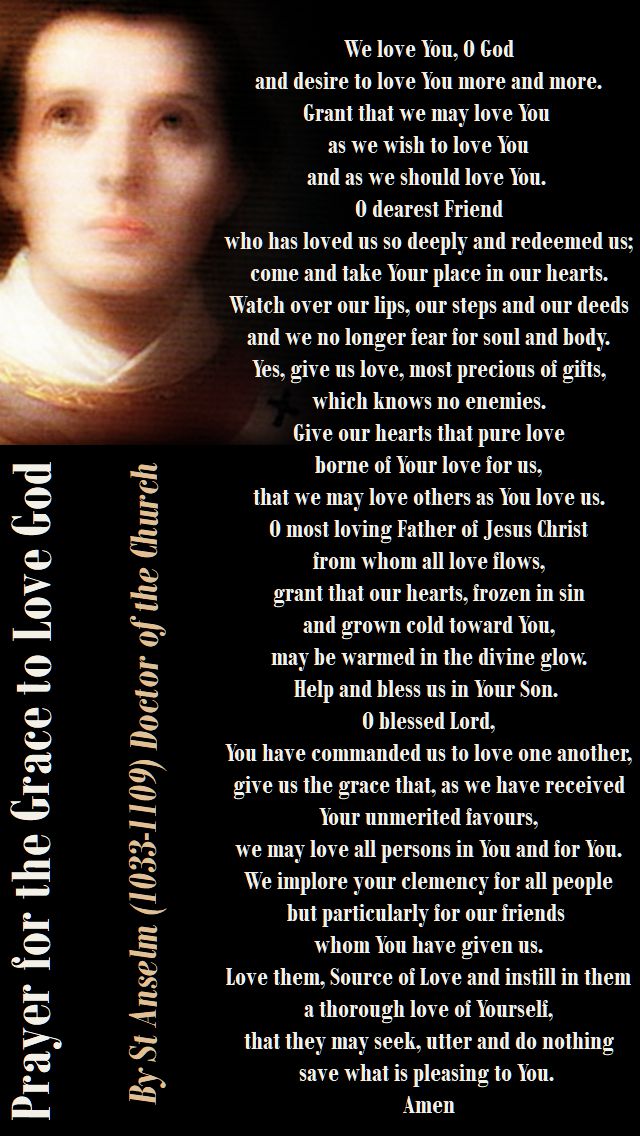
Prayer for the Grace to Love God
By St Anselm (1033-1109) Doctor of the Church

We love You, O God
and desire to love You more and more.
Grant that we may love You
as we wish to love You
and as we should love You.
O dearest Friend
who has loved us so deeply and redeemed us;
come and take Your place in our hearts.
Watch over our lips, our steps and our deeds
and we no longer fear for soul and body.
Yes, give us love, most precious of gifts,
which knows no enemies.
Give our hearts that pure love
borne of Your love for us,
that we may love others as You love us.
O most loving Father of Jesus Christ
from whom all love flows,
grant that our hearts, frozen in sin
and grown cold toward You,
may be warmed in the divine glow.
Help and bless us in Your Son.
O blessed Lord,
You have commanded us to love one another,
give us the grace that, as we have received
Your unmerited favours,
we may love all persons in You and for You.
We implore your clemency for all people
but particularly for our friends
whom You have given us.
Love them, Source of Love and instill in them
a thorough love of Yourself,
that they may seek, utter and do nothing
save what is pleasing to You.
Amenprayer for the grace to love god - by st anselm - we love you o god - 21 april 2018

Posted in franciscan OFM, SAINT of the DAY

Saint of the Day – 21 April – St Conrad of Parzham OFM Cap (1818-1894)

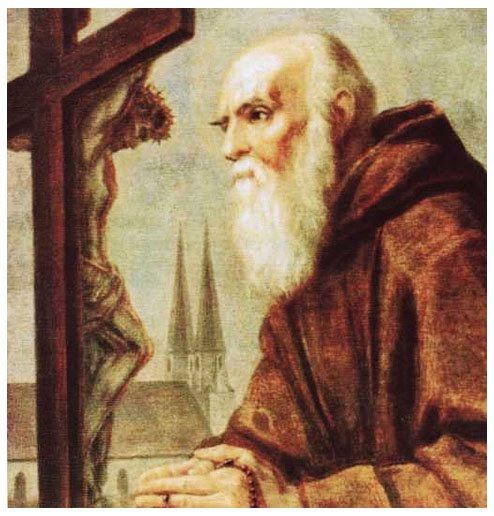
st conrad - large

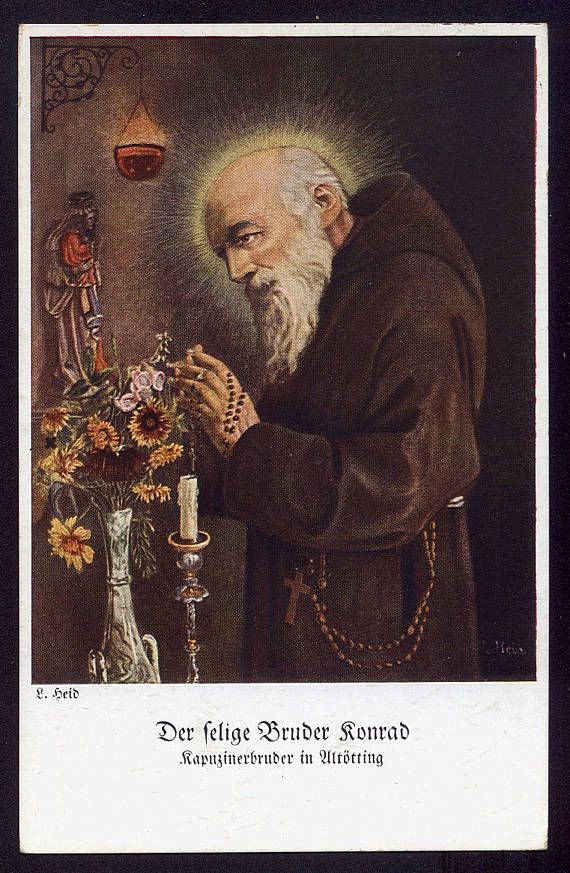
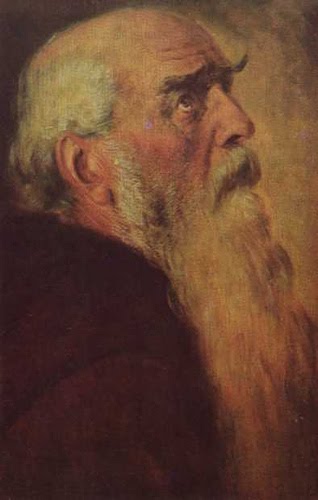
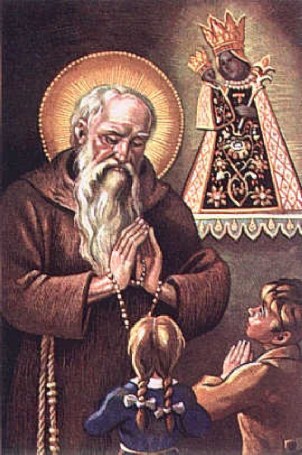
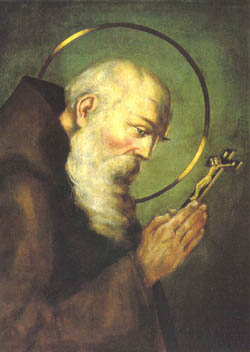
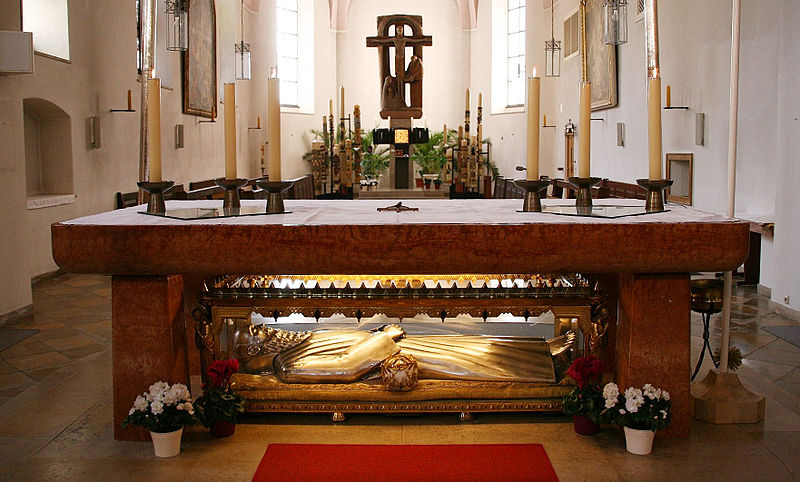
Saint of the Day – 21 April – St Conrad of Parzham OFM Cap (1818-1894) – Franciscan Religious Lay Friar, Blessed Sacrament and Marian devotee, Apostle of Charity, Miracle worker with the charism of prophecy – born on 22 December 1818 at Parzham, Bavaria, Germany as Johann Birndorfer and died on 21 April 1894 in Altötting, Bavaria, Germany of natural causes.  He served for over 40 years in the post of porter of the Capuchin friary in Altötting, through which work he gained a widespread reputation for his wisdom, holiness and charity.   Patronages – Capuchin-Franciscan Province of Mid-America, Catholic Student Association, doorkeepers, Passau, Germany, diocese of (since 1984).

St Conrad of Parzham was born in Bavaria, Germany on 22 December 1818.   He was the ninth son of a poor farming family.   From his early years he gave evident signs of a deep interior life, preferring places of solitude where he could be alone with God.   Despite the great distance from the nearest Church, Conrad walked frequently through rain and snow to attend the holy Mass.   He had a great devotion to Our Lady and prayed the Rosary daily.

konrad_parzham

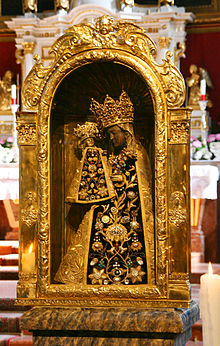
Conrad remained on the farm without much thought of the future.   His mother died when he was only 14.   At age 31, with the passing of his father, Conrad decided to follow his heart and become a Capuchin Franciscan.   After giving away his possessions he was admitted to the novitiate as a lay brother and received the religious name Conrad (his Baptismal name was John).   Immediately after his profession he was sent to the friary of St Ann, in the city of Altötting.   The friary served the Shrine of Our Lady of Altötting, the National Shrine of Bavaria to the Blessed Mother.

220px-Gnadenbild,_Gnadenkapelle_Altötting
Our Lady of Altötting

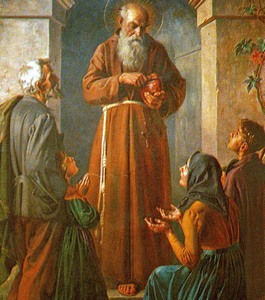
Conrad was given the position of porter at this shrine and retained it until his death.  Because it was a large and busy city, the duty of the friary porter was a very difficult one. Conrad was known to be diligent at his work, sparing in words, bountiful to the poor, eager and ready to receive and help strangers.   Brother Conrad fulfilled the task of porter for more than forty years, assisting the inhabitants of the town in their needs of body and soul.

Conrad loved silence!   As mentioned, he sought places of solitude as a child in order to raise his thoughts to God.   During his spare moments as a porter, he would duck into a nook near the door where it was possible to see the Blessed Sacrament in the nearby chapel.   During the night, he often deprived himself of hours of sleep in order to be alone with Jesus in the chapel.   It was generally believed that he never took any rest but continually occupied himself in work and exercises of devotion.   Conrad also continued his childhood devotion to Our Lady, deepening his love for the Mother of God with every year of his religious life.   These were his great secrets to sanctity:  Silence, the Blessed Sacrament and Mary, Queen of the Friars Minor.

During his lifetime, Brother Conrad was reputed to have been able to read the hearts of those he met and was attributed the gift of prophecy.   His heroic virtues and the miracles he performed won for him the distinction to be ranked among the Blessed by Pope Pius XI in 1930.   Four years later, the same pope, approving additional miracles which had been performed, solemnly inscribed his name in the list of saints.

800px-Reliquienschrein_Heiliger_Konrad_von_Parzham
Posted in DOCTORS of the Church, SAINT of the DAY

Memorials of the Saints – 21 April

St Anselm (of Canterbury) (1033-1109) Doctor of the Church (Optional Memorial)
Holy Infant of Good Health (Mexico)

St Abdechalas
St Anastasius I of Antioch
St Anastasius of Sinai
St Apollo of Nicomedia
St Apollonius the Apologist
St Arator of Alexandria
St Beuno Gasulsych
St Conrad of Parzham (1818-1894)

https://www.youtube.com/watch?v=Is2GcJLZMrY

St Crotates of Nicomedia
St Cyprian of Brescia
St Felix of Alexandria
St Fortunatus of Alexandria
St Frodulphus
St Isacius of Nicomedia
Bl John Saziari
St Maelrubba of Applecross
St Roman Adame Rosales
St Silvius of Alexandria
St Simeon of Ctesiphon
St Vitalis of Alexandria
Bl Vitaliy Bayrak
Bl Wolbodó of Liège

Posted in DOCTORS of the Church, MORNING Prayers, QUOTES of the SAINTS

Thought for the Day – 20 April – Friday of the Third Week of Eastertide

Thought for the Day – 20 April – Friday of the Third Week of Eastertide

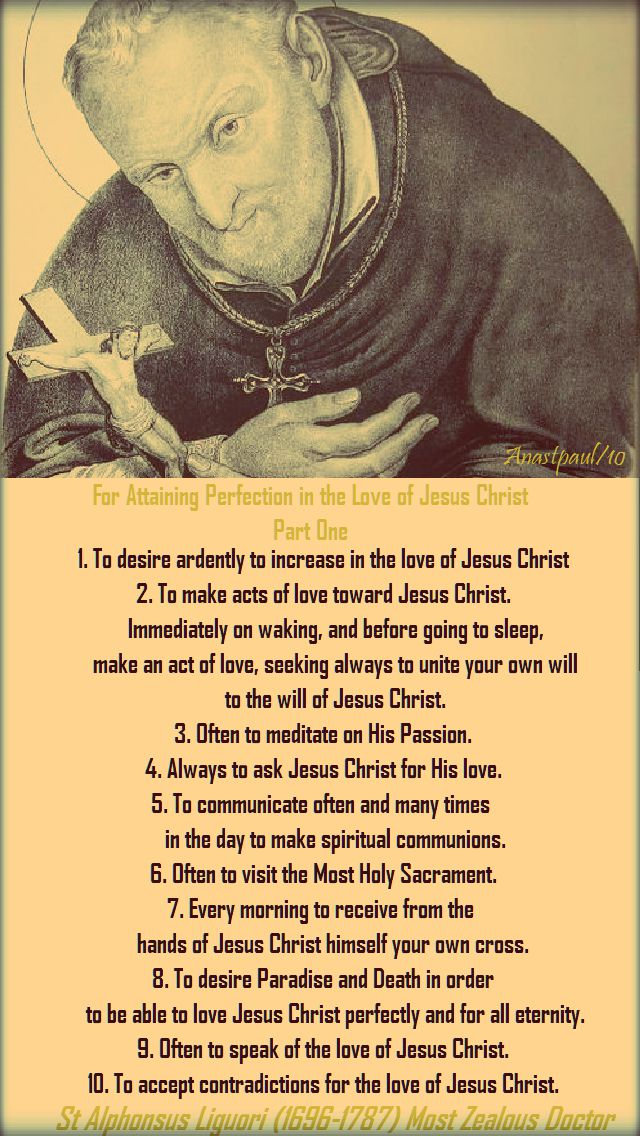
St Alphonsus Liguori’s
50 Maxims for Attaining Perfection in the Love of Jesus Christ
Part One

1.   To desire ardently to increase in the love of Jesus Christ

2.   To make acts of love toward Jesus Christ.

Immediately on waking and before going to sleep,

make an act of love, seeking always to unite your own will

to the will of Jesus Christ.

3.   Often to meditate on His Passion.

4.   Always to ask Jesus Christ for His love.

5.   To communicate often and many times in the day to make spiritual communions.

6. Often to visit the Most Holy Sacrament.

7.   Every morning to receive from the hands of Jesus Christ Himself your own cross.

8.   To desire Paradise and Death in order to be able to love Jesus Christ perfectly and for all eternity.

9.   Often to speak of the love of Jesus Christ.

10.   To accept contradictions for the love of Jesus Christ.

St Alphonsus Liguori (1696-1787) Most Zealous Doctorst alphonsus - for attaining perfection - part one - 20 april 2018

Posted in DEVOTIO, DOCTORS of the Church, EASTER, EUCHARISTIC Adoration, FATHERS of the Church, MORNING Prayers, QUOTES of the SAINTS, SPEAKING of ....., The HOLY EUCHARIST / The HOLY MASS, Uncategorized

Quote/s of the Day – 20 April – Friday of the Third Week of Eastertide – Today’s Gospel: John 6:52-59

Quote/s of the Day – 20 April – Friday of the Third Week of Eastertide – Today’s Gospel: John 6:52-59

“Speaking of: The Holy Eucharist”

“You can call happy those who saw Him.
But, come to the altar and
you will see Him,
you will touch Him,
you will give to Him holy kisses,
you will wash Him with your tears,
you will carry Him within you
like Mary Most Holy.”

St John Chrysostom (347-407) Doctor of the Churchyou can call happy - st john chrysostom - 20 april 2018

“The Blessed Eucharist is the perfect Sacrament
of the Lord’s Passion, since
It contains Christ Himself and his Passion.”

St Thomas Aquinas (1225-1274) Angelic Doctorthe blessed eucharist - st thomas aquinas - 20 april 2018

“The last degree of love
is when He gave Himself to us
to be our Food;
because He gave Himself to be
united with us in every way.” 

St Bernardine of Siena (1380-1444)the last degree of love - st bernardine of siena - 20 april 2018

“Of all devotions, that of adoring Jesus
in the Blessed Sacrament
is the greatest after the sacraments,
the one dearest to God
and the one most helpful to us.”

St Alphonsus Liguori (1696-1787) Most Zealous Doctorof all devotions that of adoring Jesus in the blessed sacrament - st alphonsus liguori - 20 april 2018

“Upon receiving Holy Communion,
the Adorable Blood of Jesus Christ
really flows in our veins and His Flesh
is really blended with ours.”

St John Vianney (1786-1859)upon receiving holy comm - st john vianney - 20 april 2018 - fri 3rd week easter

“I urge you with all the strength of my soul
to approach the Eucharistic Table
as often as possible.
Feed on this Bread of the Angels from which
you will draw the strength to fight inner struggles.”

Blessed Pier Giorgio Frassati (1901-1925)i urge you 2 - bl pier

Posted in EASTER, MORNING Prayers, QUOTES of the SAINTS, The HOLY EUCHARIST / The HOLY MASS, The WORD

One Minute Reflection – 20 April – Friday of the Third Week of Eastertide

One Minute Reflection – 20 April – Friday of the Third Week of Eastertide

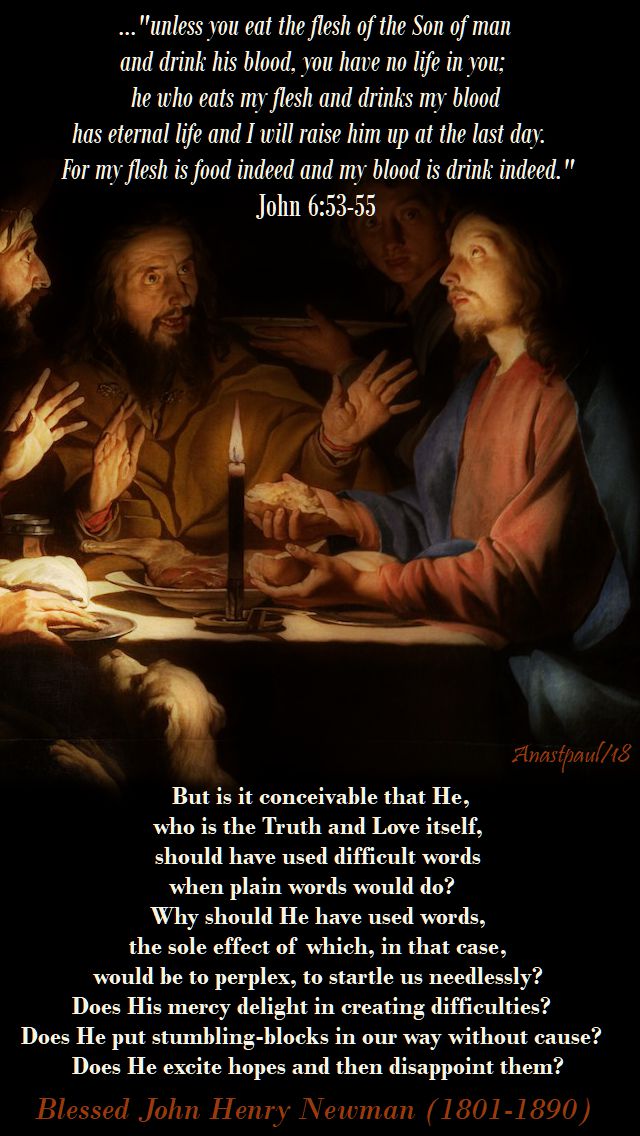
So Jesus said to them, “Truly, truly, I say to you, unless you eat the flesh of the Son of man and drink his blood, you have no life in you;  he who eats my flesh and drinks my blood has eternal life and I will raise him up at the last day.   For my flesh is food indeed and my blood is drink indeed.”...John 6:53-55

REFLECTION – “About these words I observe, first, that they evidently declare on the face of them some very great mystery.   How can they be otherwise taken?   If they do not, they must be a figurative way of declaring something which is not mysterious but plain and intelligible.   But is it conceivable, that He who is the Truth and Love itself, should have used difficult words, when plain words would do?   Why should He have used words, the sole effect of which, in that case, would be to perplex, to startle us needlessly?   Does His mercy delight in creating difficulties?   Does He put stumbling-blocks in our way without cause?   Does He excite hopes and then disappoint them?   It is possible;  He may have some deep purpose in so doing but which is more likely, that His meaning is beyond us, or His words beyond His meaning?
All who read such awful words as those in question will be led by the first impression of them, either with the disciples to go back, as at a hard saying, or with St Peter to welcome what is promised:  they will be excited in one way or the other, with incredulous surprise or with believing hope?   And are the feelings of these opposite witnesses, discordant indeed, yet all of them deep, after all unfounded?   Are they to go for nothing?   Are they no token of our Saviour’s real meaning?   This desire and again this aversion, so naturally raised, are they without a real object and the mere consequence of a general mistake on all hands, of what Christ meant as imagery, for literal truth?   Surely this is very improbable!”…Blessed John Henry Newman (1801-1890)but is it conceivable that he, who is the truth and love itself - bl john henry newman - 20 april 2018 - john chapter 6

PRAYER – Lord God, source of our freedom and our salvation, listen to our humble prayer.   We stand with St Peter and welcome what our divine Saviour, Your Son, our Lord Jesus Christ has promised.   Help us to grow in love and faith at each Holy Sacrifice we attend.   Help us to accept with total commitment this great Mystery and as He gives Himself to and for us, help us to give ourselves to and for the glory of Your Kingdom. Through our Lord Jesus, in the unity of the Holy Spirit, one God, forever and ever, amen.  Peter, the spokesman for the apostles, proclaims, “Lord, to whom shall we go?   You have the words of eternal life and we have believed and have come to know, that you are the Holy One of God” (Jn 6:67-69).john 6 67-69

Posted in JESUIT SJ, MORNING Prayers, PRAYERS of the SAINTS

Our Morning Offering – 20 April – Friday of the Third Week of Eastertide

Our Morning Offering – 20 April – Friday of the Third Week of Eastertide

Jesus, Help Me!
By St Claude de la Colombière S.J. (1641-1682)

Jesus, Help Me!
In every need let me come to You
with humble trust, saying,
Jesus, help me!
In all my doubts, perplexities
and temptations,
Jesus, help me!
In hours of loneliness,
weariness and trials,
Jesus, help me!
In the failure of my plans and hopes;
in disappointments, troubles and sorrows,
Jesus, help me!
When my heart is cast down by failure,
at seeing no good come from my efforts,
Jesus, help me!
When others fail me
and Your grace alone can assist me,
Jesus, help me!
When I throw myself on Your tender love
as Brother and Saviour,
Jesus, help me!
When I feel impatient
and my cross irritates me,
Jesus, help me!
When sickness and loneliness
overcome me,
Jesus, help me!
Always, in weakness, falls
and shortcomings of every kind,
Jesus, help me and never forsake me.
Amenjesus help me by st claude de la colombiere - 20 april 2018

Posted in SAINT of the DAY

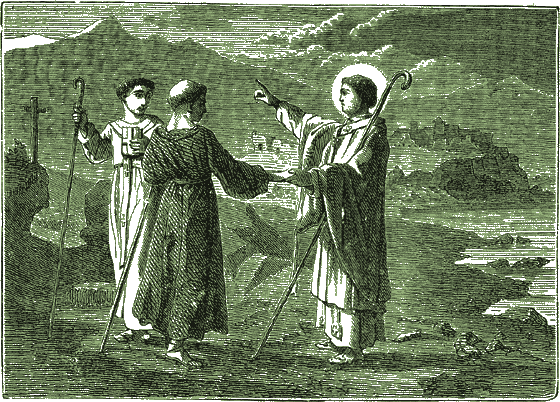
Saint of the Day – 20 April – St Marcellinus of Embrun born in North Africa- died 374)

Saint of the Day – 20 April – St Marcellinus of Embrun born in North Africa- died 374) Bishop – also known as Marcellinus of Gaul and Marcellin was the first bishop of Embrun from 354 AD.   He was a native of Africa.

ST MARCELLINUS

Marcellinus, went to Rome with two other bishops of North Africa, Vincent and Domnin, to attend a synod in 313 to judge the Donatists movement.   They met the then Pope, Miltiades and from him received a mission.   They went to Nice, where they landed, they say, after taking advice of the bishops assembled in Arles in 314.   They preached the gospel to the inhabitants of Italian side of the Alps, from the shores of the sea to Vercelli, where Eusebius was chosen as bishop and where they separated.

Marcellinus and his two disciples then headed towards the Alps and arrived in Embrun.  As the main missionaries evangelising in the regions, they became the first bishops. Marcellinus became the first bishop of Embrun and Vincent, bishop of Digne.   When the Arian heresy arrived in his area, Marcellinus was forced to flee into the mountains and care for his diocese from exile.

St Marcellinus died in c 374 of natural causes.   His relics were transferred to Digne-les-Bains, France in the 10th century but they were destroyed in the anti-Christian excesses of the French Revolution.

Posted in SAINT of the DAY

Memorials of the Saints – 20 April

St Agnes of Montepulciano
Bl Antony Page
St Caedwalla of Wessex
Bl Catwallon
Bl Chiara Bosatta
St Domninus of Digne
Bl Francis Page
Bl Gerald of Salles
Bl Harduin
Bl Hildegun of Schönau
St Hugh of Anzy-le-Duc
Bl James Bell
Bl John Finch
Bl John of Grace-Dieu
St Marcellinus – Bishop of Embrun (born in North Africa- died 374)
St Marcian of Auxerre
St Margaret of Amelia
Bl Maurice MacKenraghty
St Michel Coquelet
Bl Oda of Rivreulle
Bl Richard Sergeant
St Sara of Antioch
St Secundinus of Córdoba
St Servilian
Bl Simon Rinalducci
St Sulpicius
St Theodore Trichinas
St Theotimus of Tomi
St Vincent of Digne
St Wiho of Osnabrück
Bl William Thomson

Posted in MORNING Prayers, SAINT of the DAY

Thought (and Smile) for the Day – 19 April – Thursday of the Third Week of Eastertide & The Memorial of St Pope Leo IX (1002-1054)

Thought (and Smile) for the Day – 19 April – Thursday of the Third Week of Eastertide & The Memorial of St Pope Leo IX (1002-1054)

POPE LEO!  OR, A SKETCH ABOUT A DEAD PARROT

Pope Leo IX is a celebrated figure in medieval history, famous for his role in church reform – attacking clerical marriage and simony, and strongly asserting the superiority of St Peter’s see within the church.   He had also been deeply affected by the attack of a demonic toad (!) during his childhood, which one might imagine would encourage a degree of circumspection about animals.

Yet the Toul Life of Pope Leo IX, from which this information comes, makes it clear that this deeply serious man was thrilled by the gift of a bird that talked (presumably in Latin).   Whenever implementing Church Reform and papal primacy just got a bit much, Leo would go to his rooms, and be cheered up by listening to his parrot saying ‘Pope Leo’, over and over again.

Extract from the Life of Pope Leo IX, tr. Robinson (The Papal Reform of the 11th Century, Manchester, 2004)

“Among the many who strove to visit his [Leo’s] presence, the king of Denmark sent him a parrot as a gift, in which divine grace appeared through an admirable virtue. Certain birds can indeed be mastered by hunger and taught to pronounce human words; but it is said that this bird without compulsion throughout the journey on which he was brought to the lord pontiff continued to say, ‘I am going to the pope.’ Immediately on being presented to him, without being taught, the bird exclaimed in a sweet voice, ‘Pope Leo!’ Whenever this venerable pastor, fatigued by the conduct of business, retired to his private room or when some sadness chanced to oppress his mind, afflicted by excessive cares, this bird often alleviated his distress and, by sweetly and succinctly repeating ‘Pope Leo’, he restored his mental vigour.”

Pope Leo died in 1054.   One might wonder whether his successor, Victor II, would have found the parrot’s constant repetition of ‘Pope Leo!’ quite as endlessly entertaining. Luckily for him, he did not have to put up with it.   For according to a number of manuscripts, the parrot fell into Leo’s grave and died ‘from excessive grief’, ‘as if it were unwilling to live without him’.   Leo’s affection for his divinely-inspired pet was, apparently, reciprocated.

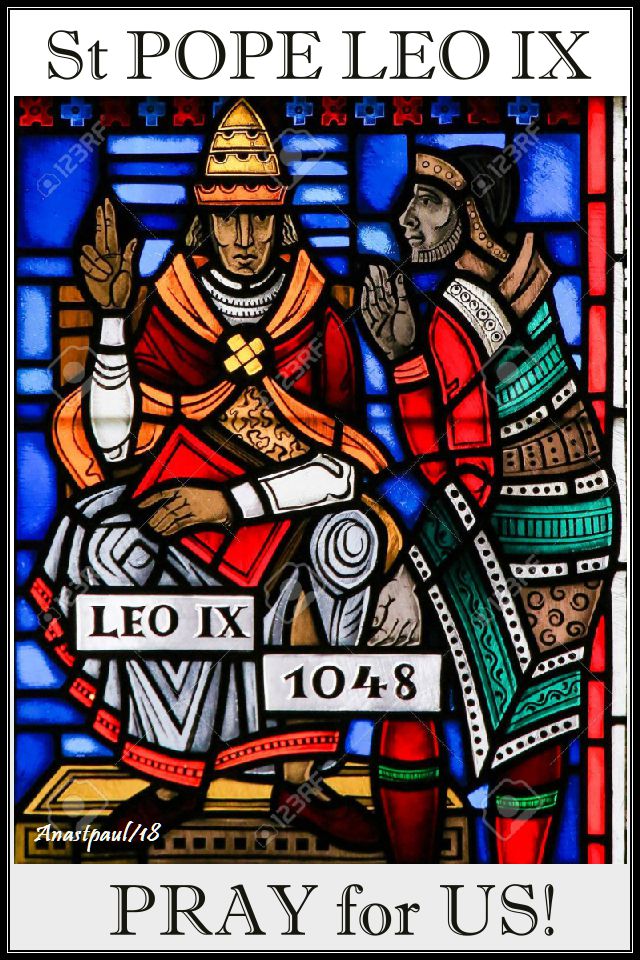
St Pope Leo IX, smile with us and pray for us!st pope leo IX - pray for us no 2 - 19 april 2018

Posted in CATHOLIC Quotes, EASTER, MORNING Prayers, PRACTISING CATHOLIC, QUOTES - J R R Tolkien and MORE, QUOTES of the SAINTS, QUOTES on CHARITY, QUOTES on CONVERSION, QUOTES on FAITH, QUOTES on LOVE, QUOTES on MERCY, QUOTES on SANCTITY, QUOTES on SUFFERING, QUOTES on the CROSS of CHRIST, SPEAKING of ....., The HOLY CROSS, The PASSION

Quote/s of the Day – 19 April – Thursday of the Third Week of Eastertide “Speaking of: Becoming a Saint”

Quote/s of the Day – 19 April – Thursday of the Third Week of Eastertide

“Speaking of:  Becoming a Saint”

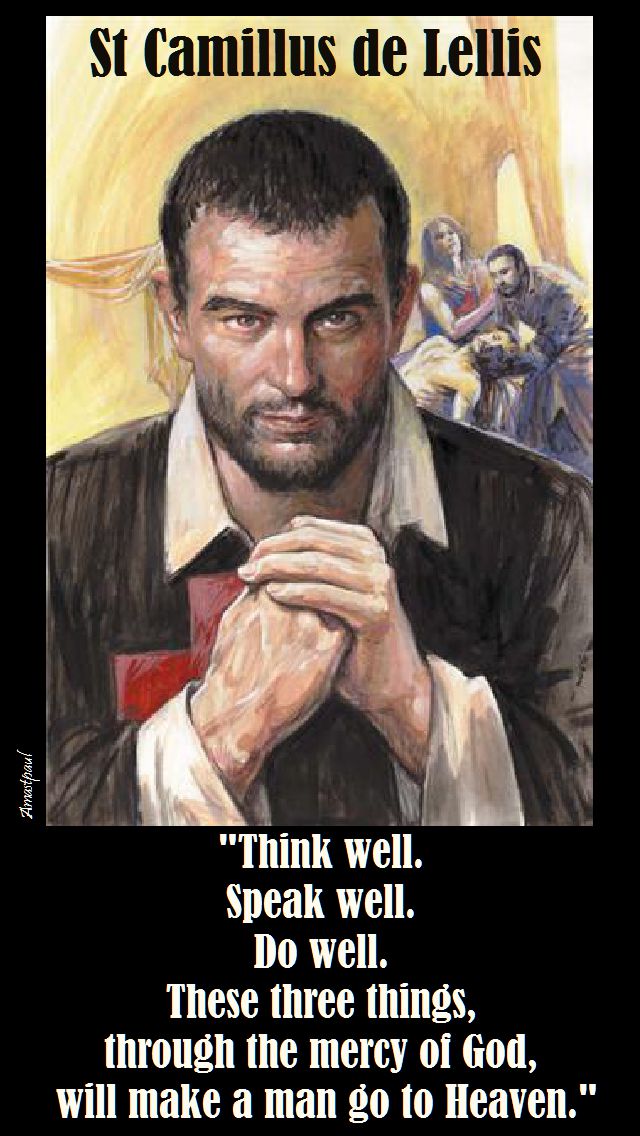
“Think well.
Speak well.
Do well.
These three things,
through the mercy of God,
will make a man go to Heaven.”

St Camillus de Lellis (1550-1614)think well speak well do well-st camillus de lellis

“He who wishes for anything but Christ,
does not know what he wishes;
he who asks for anything but Christ,
does not know what he is asking;
he who works and not for Christ,
does not know what he is doing.”

St Philip Neri (1515-1595)he who wishes for anything - st philip neri - 19 april 2018

“The great saint may be said,
to mix all his thoughts with thanks.
All goods look better,
when they look like gifts.”

G K Chesterton (1874-1936)the great saint - g k chesterton - 19 april 2018 speaking of becoming a saint

“Enemy-occupied territory –
that is what this world is.
Christianity is the story of how,
the rightful king has landed,
you might say landed in disguise
and is calling us all, to take part,
in a great campaign of sabotage.”

C S Lewis (1898-1963)enemy occupied territory - c s lewis - 19 april - speaking of becoming a saint

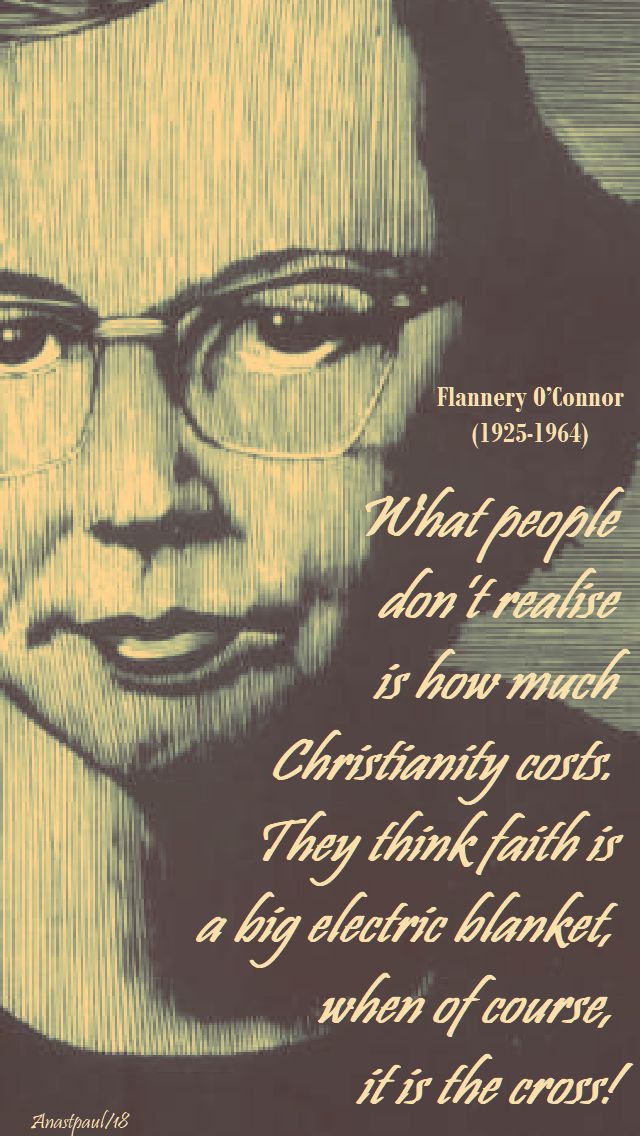
“What people don’t realise, 
is how much Christianity costs.
They think faith is a big electric blanket,
when of course, it is the cross.”

Flannery O’Connor (1925-1964)what people don't realise = flannery o'connor - speaking of becoming a saint - 19 april 2018

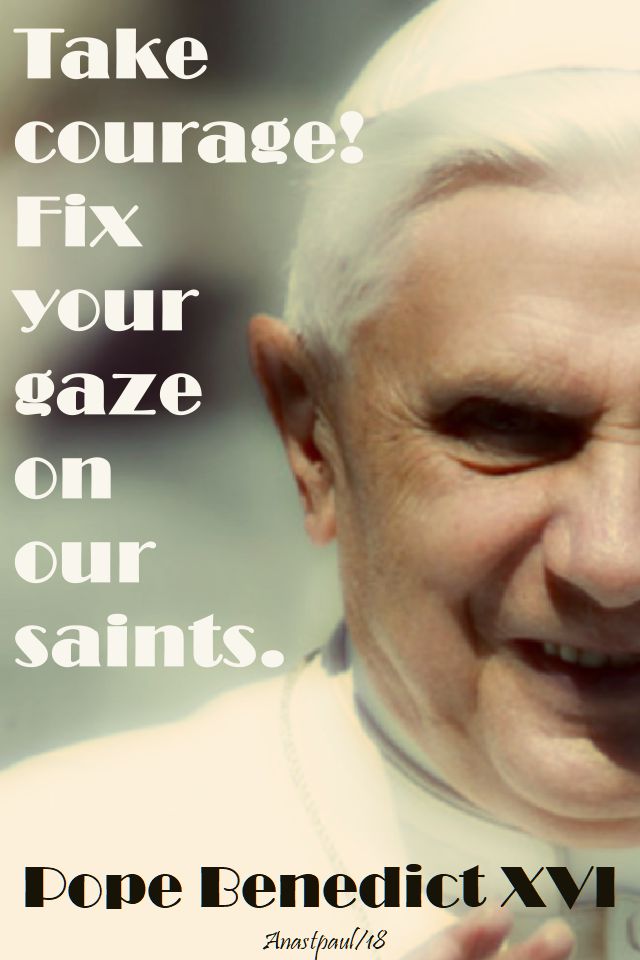
“Take courage!
Fix your gaze on our saints.”

Pope Benedict XVItake courage - pope benedict - speaking of becoming a saint - 19 april 2018

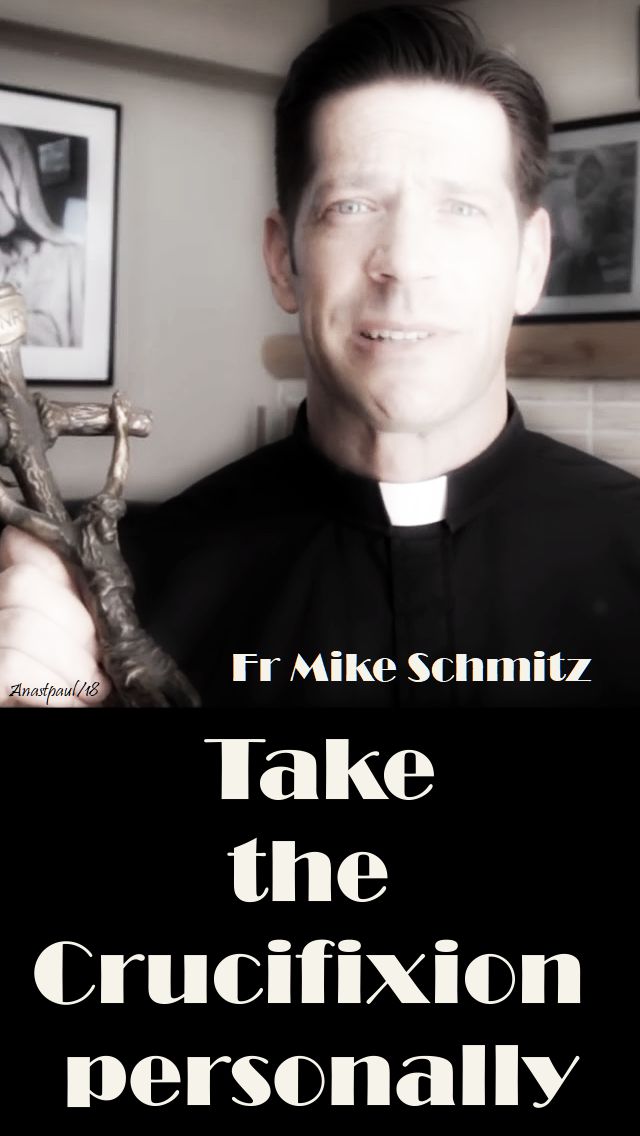
“Take the Crucifixion personally.”take the crucifixion - fr mike schmitz - 19 april 2018

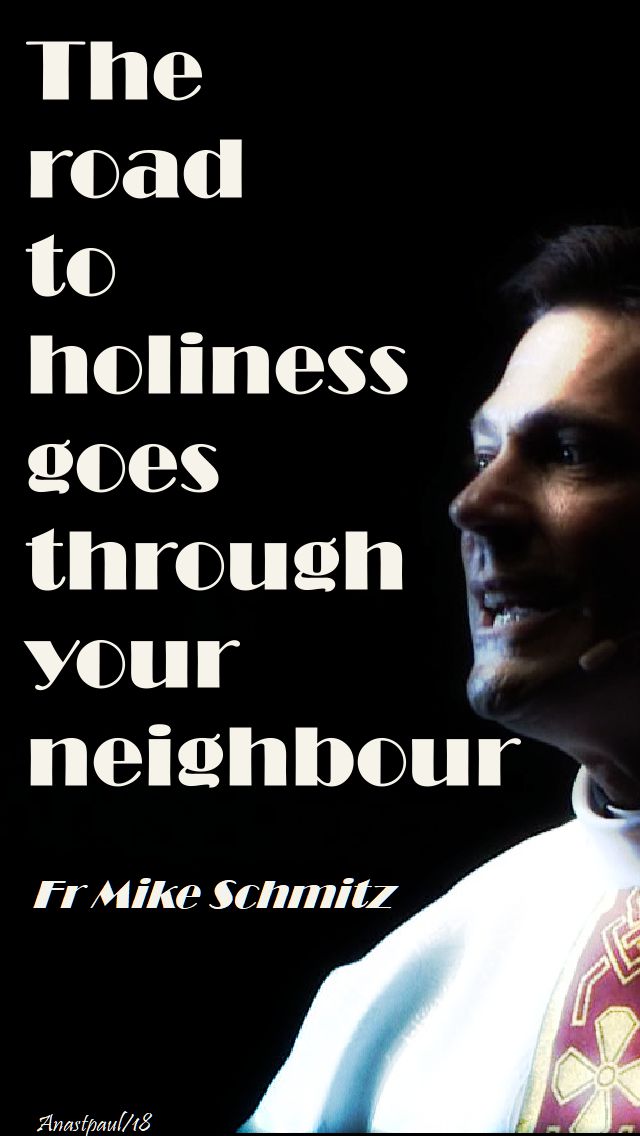
“The road to holiness
goes through your neighbour.”

Father Mike Schmitzthe road to holiness - fr mike schmitz - 19 april 2018


Posted in EASTER, MORNING Prayers, QUOTES of the SAINTS, QUOTES on SANCTITY, SAINT of the DAY, The WORD

One Minute Reflection – 19 April – Thursday of the Third Week of Eastertide – Today’s Gospel John 6:44–51

One Minute Reflection – 19 April – Thursday of the Third Week of Eastertide – Today’s Gospel John 6:44–51

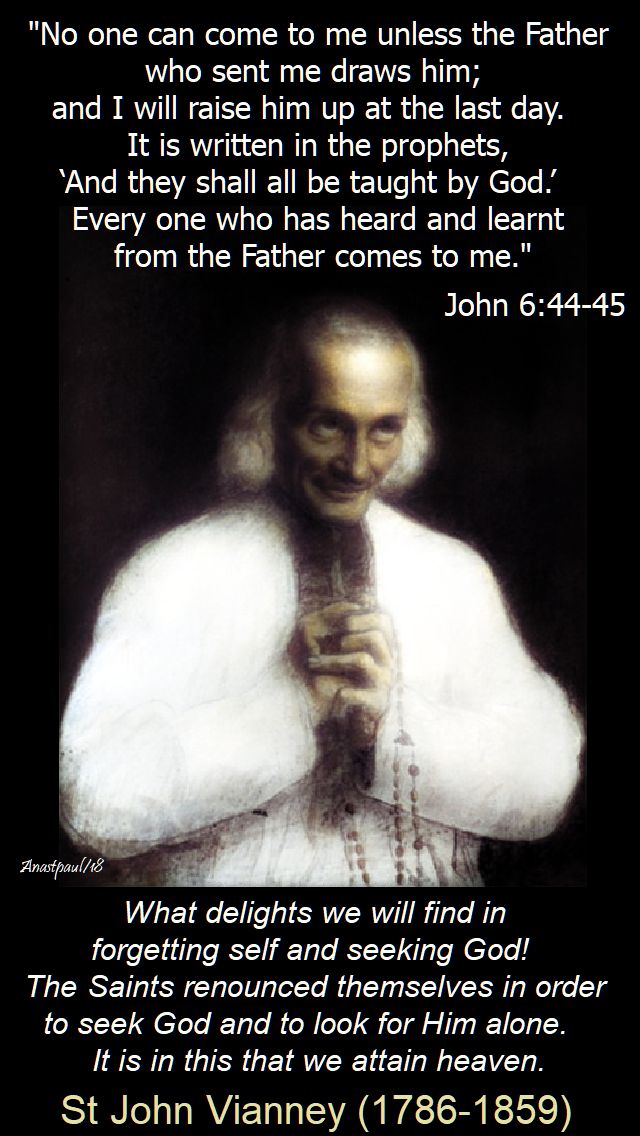
“No one can come to me unless the Father who sent me draws him; and I will raise him up at the last day.   It is written in the prophets, ‘And they shall all be taught by God.’   Every one who has heard and learnt from the Father comes to me.”….John 6:44-45

REFLECTION – “What delights we will find in forgetting self and seeking God!   The Saints renounced themselves in order to seek God and to look for Him alone.   It is in this that we attain heaven.”…St John Vianneywhat delights we will find in forgetting self - st john vianney - 19 april 2018

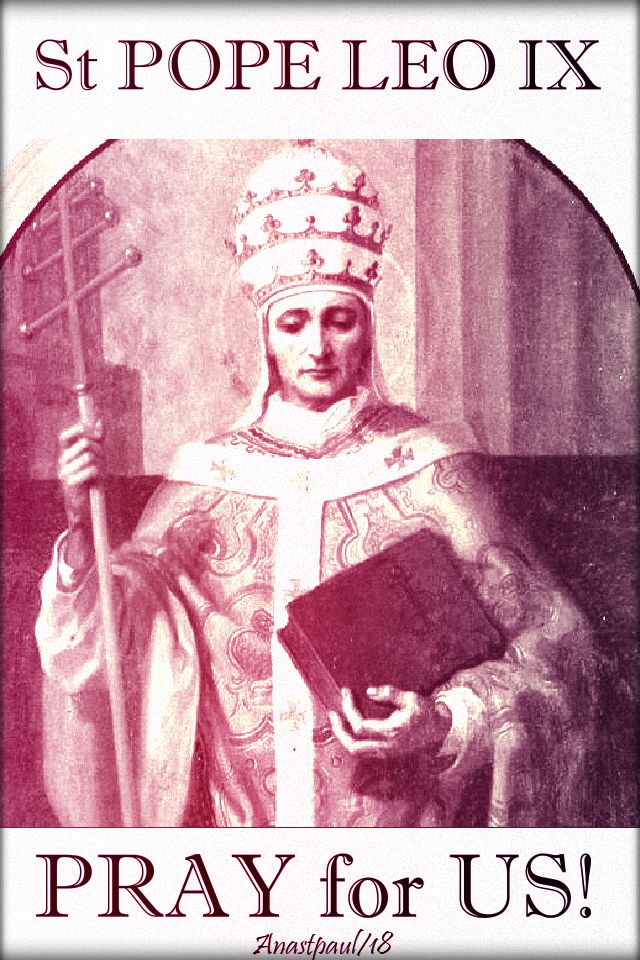
PRAYER – Infinite Lord, You are greater than anything we can imagine.   Help us to forget self and seek only You in Your divine Son, who You sent to teach us and save us.   May we follow Your Son and live in You in all our thoughts, words and actions.   St Pope Leo IX, you sought by your life to follow the Lord, please pray for us.   Through Jesus Christ, our Lord, in the unity of the Holy Spirit, one God forever amen.st pope leo IX - pray for us - 19 april 2018.jpg

Posted in MORNING Prayers, PRAYERS of the SAINTS

Our Morning Offering – 19 April – Thursday of the Third Week of Eastertide

Our Morning Offering – 19 April – Thursday of the Third Week of Eastertide

O Lord, Enkindle Our Lamps
St Columba of Ireland (521-597)

O Lord,
grant us that love
which can never die,
which will enkindle our lamps
but not extinguish them,
so that they may shine in us
and bring light to others.
Most dear Saviour,
enkindle our lamps
that they may shine
forever in Your temple.
May we receive
unquenchable light
from You,
so that our darkness
will be illuminated
and the darkness of the world
will be made less.
Amen

o lord enkindle our lamps - st columba of ireland - 19 april 2018

Posted in SAINT of the DAY

Saint of the Day – 19 April – St Pope Leo IX (1002-1054)

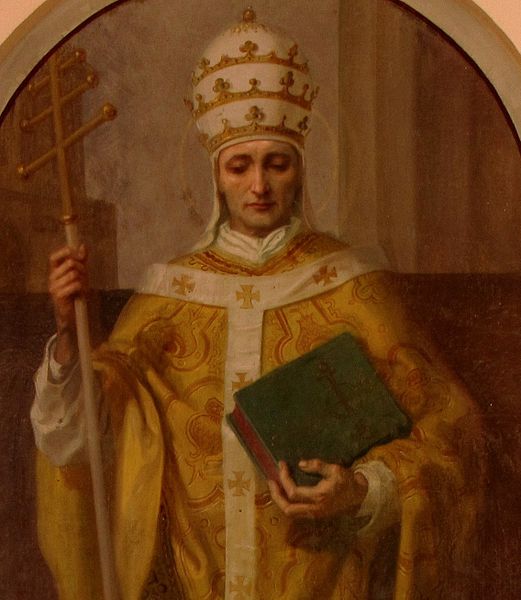
Saint of the Day – 19 April – St Pope Leo IX (1002-1054) – known as “Apostolic Pilgrim.”  Born on 21 June 1002 at Eguisheim, Alsace, France as Bruno of Eguisheim-Dagsburg – 19 April 1054 in Saint Peter’s Basilica, Rome, Italy of natural causes.

521px-Dingsheim_StKilian_Leo_IX

St Leo was born to Count Hugh and Heilwig and was a native of Eguisheim, Upper Alsace (present day Alsace, France).   His family was of noble rank and his father, Count Hugh, was a cousin of Emperor Conrad II (1024–1039).   He was educated at Toul, where he successively became canon and, in 1026, bishop – he administered the Diocese of Toul for twenty years.   In the latter capacity he rendered important political services to his relative Conrad II, and afterwards to Emperor Henry III.    He became widely known as an earnest and reforming ecclesiastic.

When the German Pope Damasus II died in 1048, Bishop Bruno was selected by the Emperor, Henry III, to succeed him.   Bruno agreed to go to Rome and to accept the Papacy if freely elected thereto by the Roman people.   He wished, at least, to rescue the See of Peter from its servitude to the German Emperors.   When, in company with Hildebrand he reached Rome and presented himself to its people clad in pilgrim’s guise and barefooted but still tall and fair to look upon, they cried out with one voice that him and no other would they have as Pope.   Assuming the name of Leo, he was solemnly enthronedon 12 February, 1049.

One of his first public acts was to hold the well-known Easter synod of 1049, at which celibacy of the clergy (down to the rank of subdeacon) was required anew.   Also, the Easter synod was where the Pope at least succeeded in making clear his own convictions against every kind of simony.   The greater part of the year that followed was occupied in one of those progresses through Italy, Germany and France which form a marked feature in Leo IX’s pontificate.   Leo chose a body of capable and reform-minded advisers from outside the Roman Curia:  Hildebrand, who was to become Pope St Gregory VII; Frederick of Liege, who was to become Pope Stephen IX;  and Humbert of Moyenmoutier.   He also took advice from reformers such as St Hugh of Cluny and St Peter Damian.

Pope Leo did not just write letters or give sermons to announce his reforms.   He travelled to major dioceses to conduct meetings and discuss why the reforms were necessary.   He travelled so much that he was nicknamed the “Apostolic Pilgrim.”   Leo also appointed men who believed in the reforms to important Church positions.   Leo knew that the changes he wanted would not be accomplished in his lifetime.   He trusted the men he appointed to carry out the needed reforms and they did.

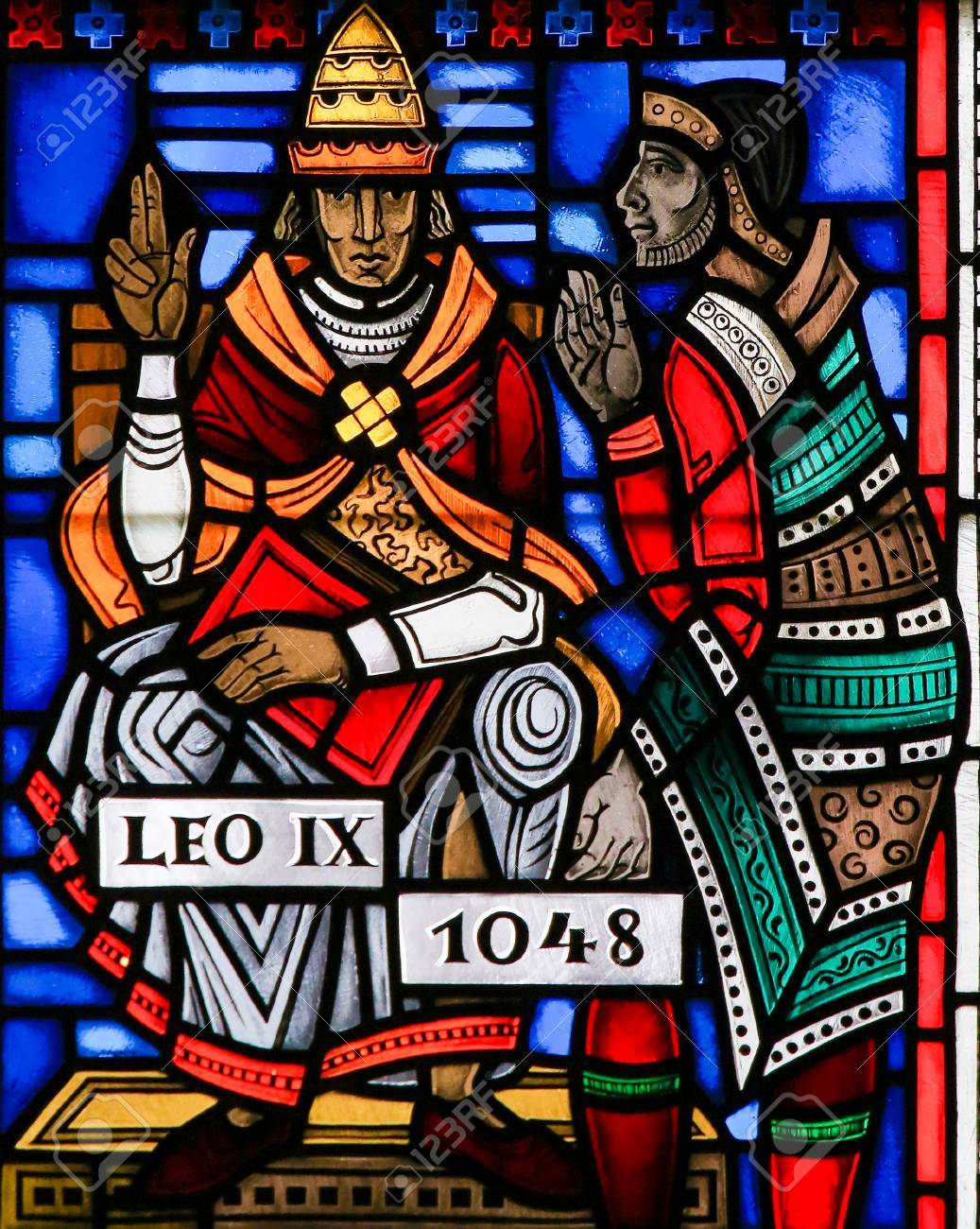
He died in 1054 and was Canonised in 1082 by Pope Saint Gregory VII.Stained Glass in Worms - Pope Leo IX

Posted in SAINT of the DAY

Memorials of the Saints – 19 April

St Alphege of Winchester
St Apollonius the Priest
St Aristonicus of Melitene
St Crescentius of Florence
St Expeditus of Melitene
St Gaius of Melitene
St Galata of Melitene
St George of Antioch
St Gerold of Saxony
St James Duckett
Bl Jaume Llach-Candell
St Pope Leo IX (1002-1054)
St Martha of Persia
Bl Ramon Llach-Candell
St Rufus of Melitene
St Vincent of Collioure

Martyrs of Carthage – 17 saints:   A group of Christians martyred in the persecutions of Decius. We know little more than the names – Aristo, Basso, Credula, Donato, Ereda, Eremio, Fermo, Fortunata, Fortunio, Frutto, Julia, Mappalicus, Martial, Paul, Venusto, Victorinus and Victor.   Died in the year 250 in prison in Carthage, North Africa (modern Tunis, Tunisia).

Posted in DOCTORS of the Church, EASTER, FATHERS of the Church, MORNING Prayers, QUOTES of the SAINTS, QUOTES on CONVERSION, QUOTES on DEATH, QUOTES on ETERNAL LIFE, QUOTES on REPENTANCE, QUOTES on SANCTITY, The RESURRECTION, The WORD

Thought for the Day – 18 April – Wednesday of the Third Week of Eastertide – Acts 8:1-8, Psalm 66:1-7, John 6:35-40

Thought for the Day – 18 April – Wednesday of the Third Week of Eastertide – Acts 8:1-8, Psalm 66:1-7, John 6:35-40

St John Chrysostom (347-407) – Sermon 45 on the Gospel of John – John 6:40

And I will raise him up at the last day.   Why does He continually dwell upon the Resurrection?   Is it that men may not judge of God’s providence by present things alone; that if they enjoy not results here, they become not on that account desponding but wait for the things that are to come and that they may not, because their sins are not punished for the present, despise Him, but look for another life.

Now those men gained nothing but let us take pains to gain by having the Resurrection continually sounded in our ears;  and if we desire to be grasping, or to steal, or to do any wrong thing, let us straightway take into our thoughts that Day, let us picture to ourselves the Judgment-seat, for such reflections will check the evil impulse more strongly than any bit.   Let us continually say to others and to ourselves, There is a resurrection, and a fearful tribunal awaits us.

If we see any man insolent and puffed up with the good things of his world, let us make the same remark to him and show him that all those things abide here:  and if we observe another grieving and impatient, let us say the same to him and point out to him that his sorrows shall have an end;  if we see one careless and dissipated, let us say the same charm over him and show that for his carelessness he must render account.

This saying is able more than any other remedy to heal our souls.   For there is a Resurrection and that Resurrection is at our doors, not afar off, nor at a distance.  For yet a little while, and He that shall come will come and will not tarry. Hebrews 10:37   And again, We must all appear before the judgement-seat of Christ 2 Corinthians 5:10;   that is, both bad and good, the one to be shamed in sight of all, the other in sight of all to be made more glorious.   For as they who judge here, punish the wicked and honour the good publicly, so too will it be there, that the one sort may have the greater shame and the other more conspicuous glory.

Let us picture these things to ourselves every day.  If we are ever revolving them, no care for present things will be able to sting us.   For the things which are seen are temporal, but the things which are not seen are eternal. 2 Corinthians 4:18   Continually let us say to ourselves and to others, There is a Resurrection, and a Judgement and a scrutiny of our actions;  and let as many as deem that there is such a thing as fate repeat this and they shall straightway be delivered from the rottenness of their malady;  for if there is a Resurrection, and a Judgement, there is no fate, though they bring ten thousand arguments and choke themselves to prove it.

But I am ashamed to be teaching Christians concerning the Resurrection:  for he that needs to learn that there is a Resurrection and who has not firmly persuaded himself that the affairs of this world go not on by fate and without design and as chance will have them, can be no Christian.

Wherefore, I exhort and beseech you, that we cleanse ourselves from all wickedness and do all in our power to obtain pardon and excuse in that Day….For a man cannot possibly live a pure life without believing in the Resurrection!for a man cannot - st john chrysostom - 18 april 2018

Posted in MORNING Prayers, QUOTES - J R R Tolkien and MORE, SPEAKING of .....

Quote/s of the Day – 18 April – Wednesday of the Third Week of Eastertide

Quote/s of the Day – 18 April – Wednesday of the Third Week of Eastertide

Speaking of: Gilbert Keith Chesterton (1874-1936)           A Beginning ……

English Catholic Convert, writer, poet, philosopher, dramatist, journalist, orator, lay theologian, biographer, and literary and art critic. Chesterton is often referred to as the “prince of paradox”

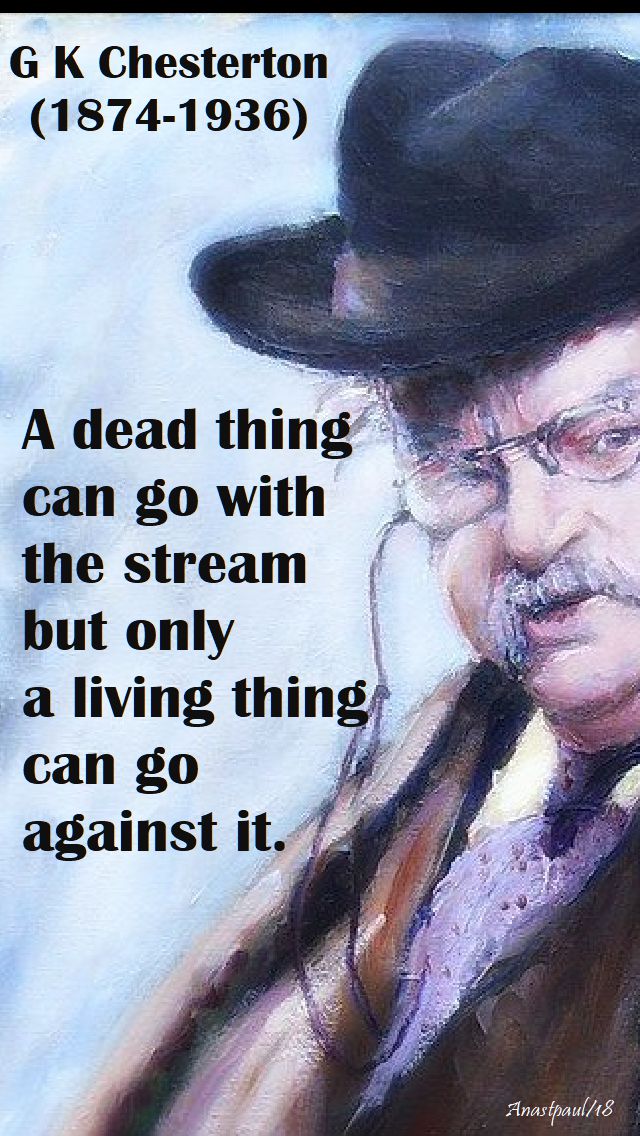
“A dead thing can go with the stream
but only a living thing can go against it.”
The Everlasting Man, 1925A dead thing - g k - 18 april 2018

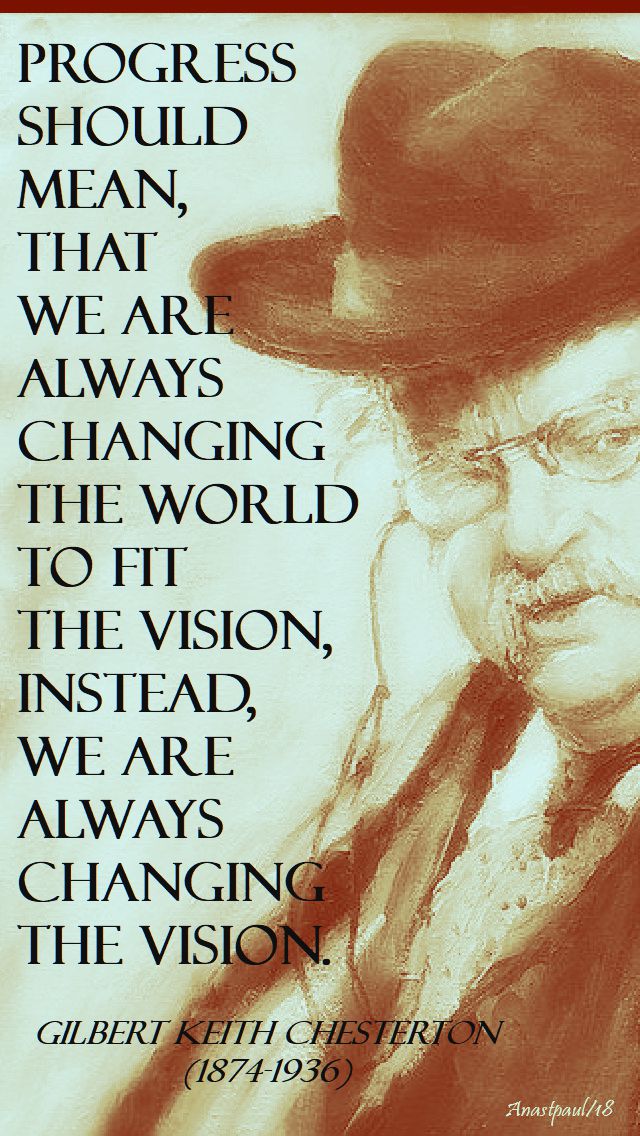
“Progress should mean,
that we are always
changing the world
to fit the vision,
instead, we are always
changing the vision.”
Orthodoxy, 1908progress - g k - 18 april 2018

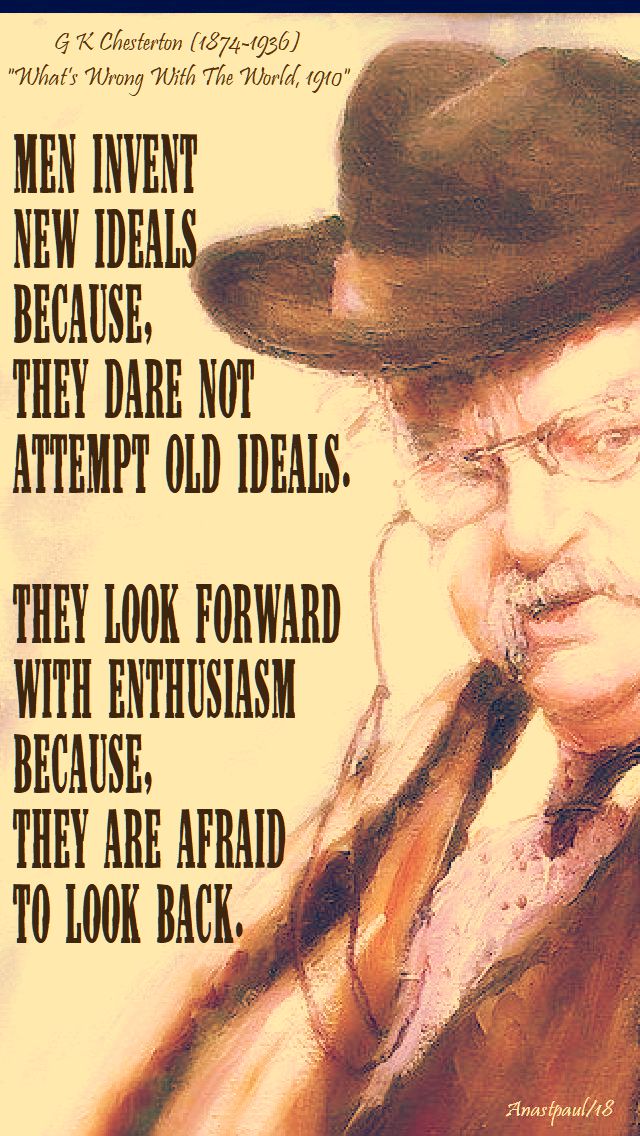
“Men invent new ideals
because, they dare not
attempt old ideals.
They look forward,
with enthusiasm,
because, they are afraid
to look back.”
What’s Wrong With The World, 1910men invent - g k - 18 april 2018

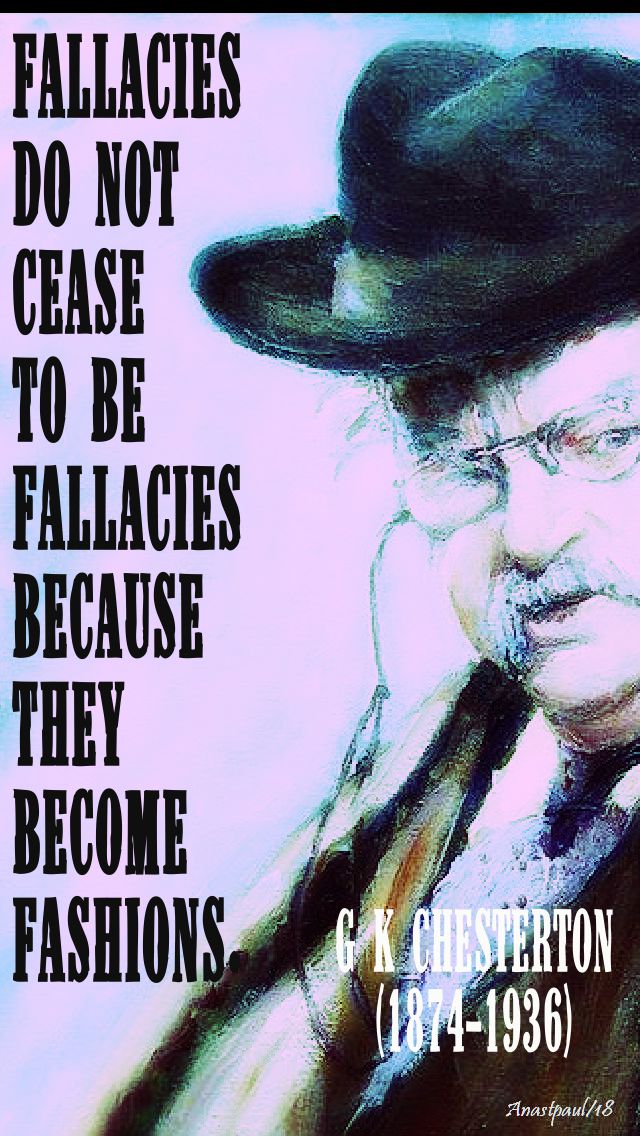
“Fallacies do not cease to be fallacies
because they become fashions.”
Illustrated London News, 19 April 1930

Gilbert Keith Chesterton (1874-1936) fallacies- g k - 18 april 2018


Posted in DOCTORS of the Church, EASTER, FATHERS of the Church, MORNING Prayers

One Minute Reflection – 18 April – Wednesday of the Third Week of Eastertide

One Minute Reflection – 18 April – Wednesday of the Third Week of Eastertide – Acts 8:1-8, Psalm 66:1-7, John 6:35-40

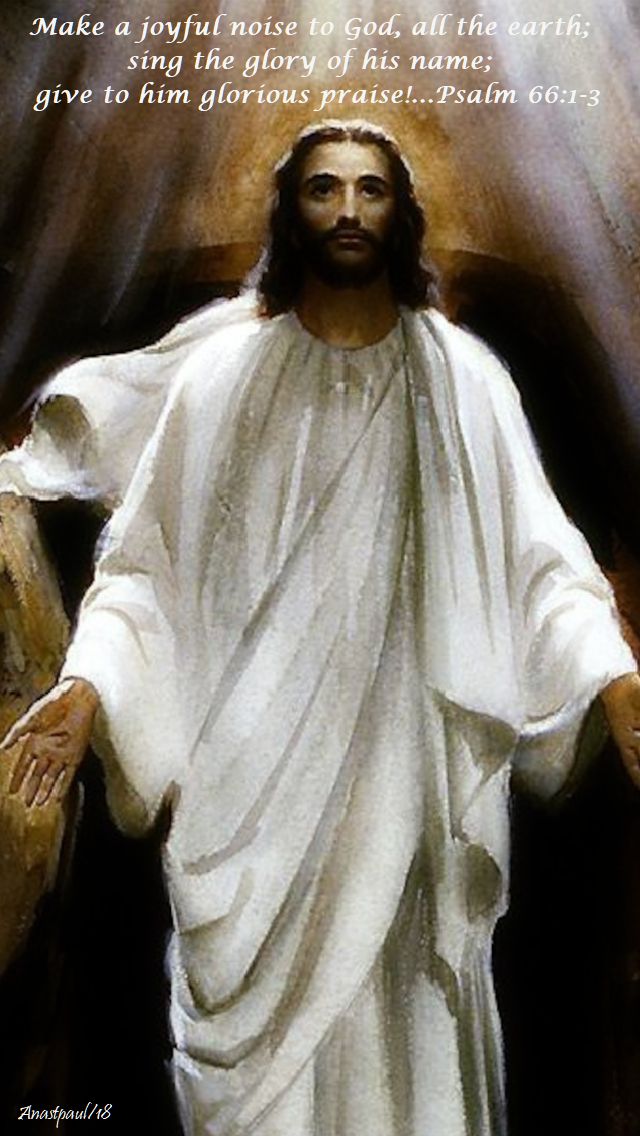
Make a joyful noise to God, all the earth;  sing the glory of his name;  give to him glorious praise!...Psalm 66:1-3psalm 66 - 1 3

REFLECTION – “My dear brothers and sons, fruit of the true faith and holy seed of heaven, all you who have been born again in Christ and whose life is from above, listen to me;  or rather, listen to the Holy Spirit saying through me:  Sing to the Lord a new song.   Look, you tell me, I am singing.   Yes indeed, you are singing;  you are singing clearly, I can hear you.   But make sure that your life does not contradict your words. Sing with your voices, your hearts, your lips and your lives:  Sing to the Lord a new song’.
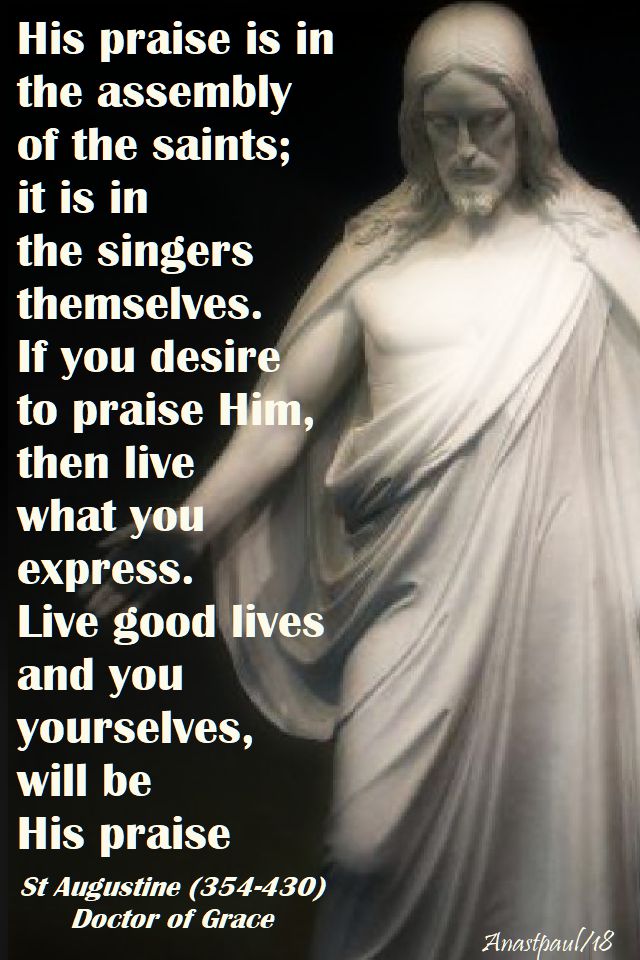
Now it is your unquestioned desire to sing of Him whom you love but you ask me how to sing His praises.   You have heard the words:  Sing to the Lord a new song and you wish to know what praises to sing.   The answer is:  His praise is in the assembly of the saints;  it is in the singers themselves.   If you desire to praise Him, then live what you express.   Live good lives and you yourselves, will be His praise.”…St Augustine (354-430) Doctor of Gracehis praise is in the assembly of saints - st augustine - 18 april 2018

PRAYER – God and Father, we honour the yearly feast of Your Son’s Resurrection by celebrating it in the sacramental mystery.   Give us likewise the grace, to rejoice at all times, with all the saints, until He comes in glory.   Through our Lord Jesus, in the unity of the Holy Spirit, one God forever, amen.

Posted in BREVIARY Prayers, EASTER, HYMNS, MORNING Prayers

Our Morning Offering – – 18 April – Wednesday of the Third Week of Eastertide

Our Morning Offering – – 18 April – Wednesday of the Third Week of Eastertide

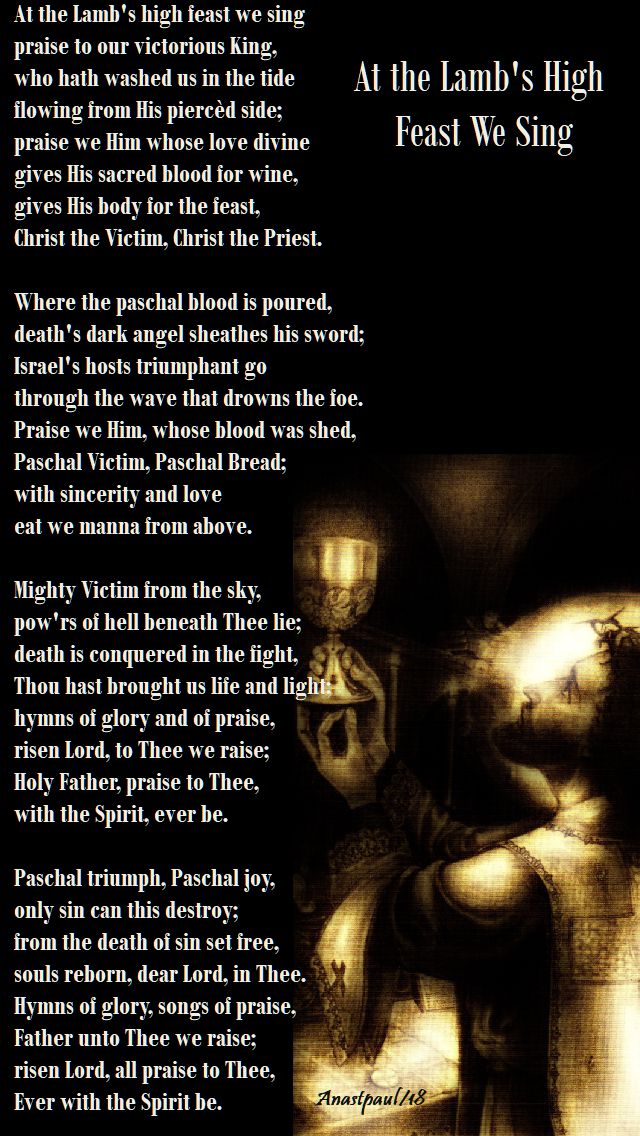
At the Lamb’s High Feast We Sing

At the Lamb’s high feast we sing
praise to our victorious King,
who hath washed us in the tide
flowing from His piercèd side;
praise we Him whose love divine
gives His sacred blood for wine,
gives His body for the feast,
Christ the Victim, Christ the Priest.

Where the paschal blood is poured,
death’s dark angel sheathes his sword;
Israel’s hosts triumphant go
through the wave that drowns the foe.
Praise we Him, whose blood was shed,
Paschal Victim, Paschal Bread;
with sincerity and love
eat we manna from above.

Mighty Victim from the sky,
pow’rs of hell beneath Thee lie;
death is conquered in the fight,
Thou hast brought us life and light;
hymns of glory and of praise,
risen Lord, to Thee we raise;
Holy Father, praise to Thee,
with the Spirit, ever be.

Paschal triumph, Paschal joy,
only sin can this destroy;
from the death of sin set free,
souls reborn, dear Lord, in Thee.
Hymns of glory, songs of praise,
Father unto Thee we raise;
risen Lord, all praise to Thee,
Ever with the Spirit be.

Translator:  Robert Campbell
Robert Campbell was a Catholic advocate residing in Edinburgh. He died in 1868.

at the lamb's high feast we sing - 18 april 2018 - wed of the 3rd week of easter

Posted in Uncategorized

Saints – 18 April

Saints – 18 April

Apologies, I mixed up the 17 and 18 April – the Saint of the Day I posted yesterday is actually celebrated today!   So I am going to miss the Saint altogether today.   Last year I posted the story of St Marie of the Incarnation O.S.U. (1599-1672) – Also known as Marie Guyard, Marie Guyart of the Incarnation,Marie Guyart, Marie de l’Incarnation, Marie of the Ursulines, Mother of New France, Teresa of the New World, for today.   Here is the post:  https://anastpaul.wordpress.com/2017/04/18/saint-of-the-day-18-april-st-marie-of-the-incarnation/

Posted in DEVOTIO, DOCTORS of the Church, EUCHARISTIC Adoration, MORNING Prayers, PRAYERS for VARIOUS NEEDS, PRAYERS of the SAINTS, QUOTES of the SAINTS, The HOLY EUCHARIST / The HOLY MASS

Thought for the Day – Tuesday of the Third Week of Eastertide – Today’s Gospel: John 6:30–35 & the Memorial of Bl Andrés Hibernón Real O.F.M. (1534-1602) ‘Apostle of Eucharistic Adoration’

Thought for the Day – – Tuesday of the Third Week of Eastertide – Today’s Gospel:  John 6:30–35 & the Memorial of Bl Andrés Hibernón Real O.F.M. (1534-1602) ) ‘Apostle of Eucharistic Adoration’

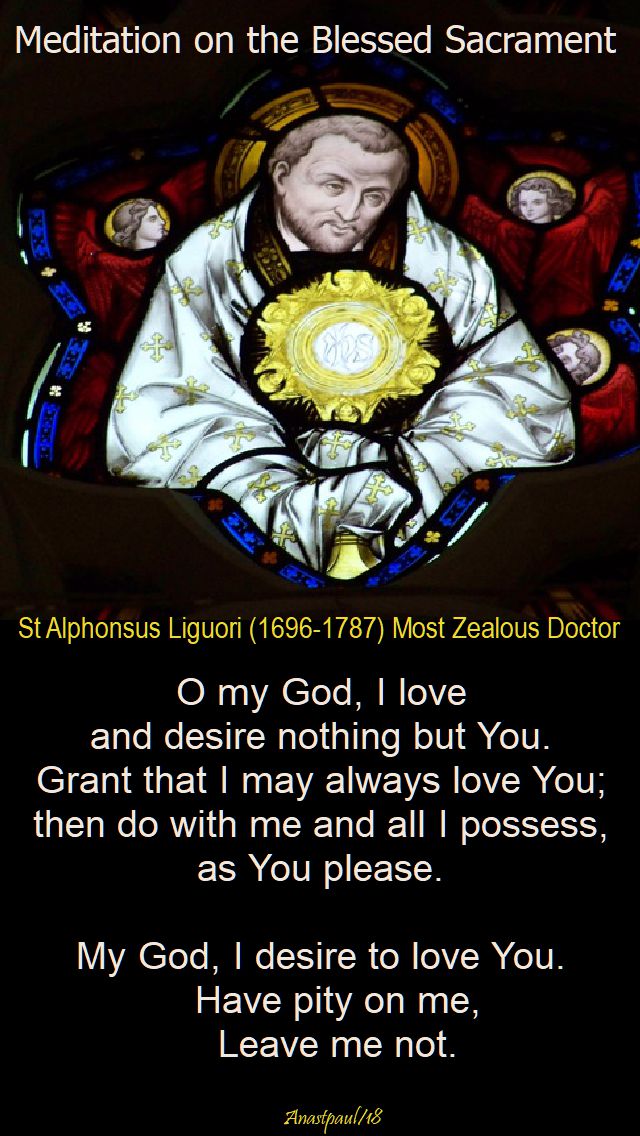
Meditation on the Blessed Sacrament by St Alphonsus Liguori (1696-1787)  – Most Zealous Doctor

Meditation, wherever it is made,
pleases God.
But it seems that Jesus,
especially delights in prayer,
made before the Blessed Sacrament.
Did he not leave Himself for us
in this sacrament to be food for our spirit
and to be present for all who seek Him?

We cannot all make pilgrimages
to the places where Jesus lived
but the Lord who died for us
on the cross of Calvary
now dwells in person,
in the tabernacle – waiting.

We need not await a command
as we would of an earthly king,
to enter His presence –
He is waiting for us
to lay before Him our wants
and to seek His help.
So that we may taste
the sweetness of His presence,
it is good to empty ourselves
of earthly desires.

Be still and know that I am God. Psalm 46: 10

What pleasure is found in spending
a long time before the altar
where the Lord dwells!

What heavenly sweetness the Lord
allows us to taste and enjoy!

What should we do in the presence
of the Lord in the Eucharist?

We should stay there, not to enjoy
sweetness and consolation
but to give pleasure to God
by making acts of love, saying

O my God, I love

and desire nothing but You.

Grant that I may always love You;

then do with me and all I possess,

as You please.

These acts of love,
even when made without sensible delight,
please god greatly.
For good people often have to bear
with distractions and dryness in prayer.

As for distractions,
of these we must not make much account.
It is enough to drive them away
when they come.
Do not on this account leave off prayer.

Saint Francis de Sales said:

“If, in meditation, we do nothing
but drive away distractions,
our meditation would be of great profit.”

And as for dryness:
this is the greatest pain
for those given to prayer,
for we find ourselves without
any sensible desire of loving God.
Added to this, at times, is the fear
of being separated from God
because of our sins.
There is the feeling
of being in utter darkness
without any way of escape.
At such times let us unite our desolation
with that which Jesus suffered on the cross.

If we can say nothing else,
it is enough to say,
at least by an act of the will:

My God, I desire to love You.
Have pity on me;
Leave me not.

PRAYER of one in deep affliction.

My God, I love You tenderly
though I feel You far away.
I will seek You ceaselessly
lest from You I stray.
AMENmeditation on the blessed sacrament - st alphonsus liguori - 17 april 2018


Posted in EUCHARISTIC Adoration, franciscan OFM, MORNING Prayers, QUOTES of the SAINTS, SAINT of the DAY, The HOLY EUCHARIST / The HOLY MASS, The WORD

One Minute Reflection – Tuesday of the Third Week of Eastertide – Today’s Gospel: John 6:30–35 & the memorial of Bl Andrés Hibernón Real O.F.M. (1534-1602)

One Minute Reflection – Tuesday of the Third Week of Eastertide – Today’s Gospel: John 6:30–35 & the memorial of Bl Andrés Hibernón Real O.F.M. (1534-1602)

Jesus said to them, “I am the bread of life;  he who comes to me shall not hunger and he who believes in me shall never thirst…John 6:35i am the bread of life - john 6 35. - 17 april 2018

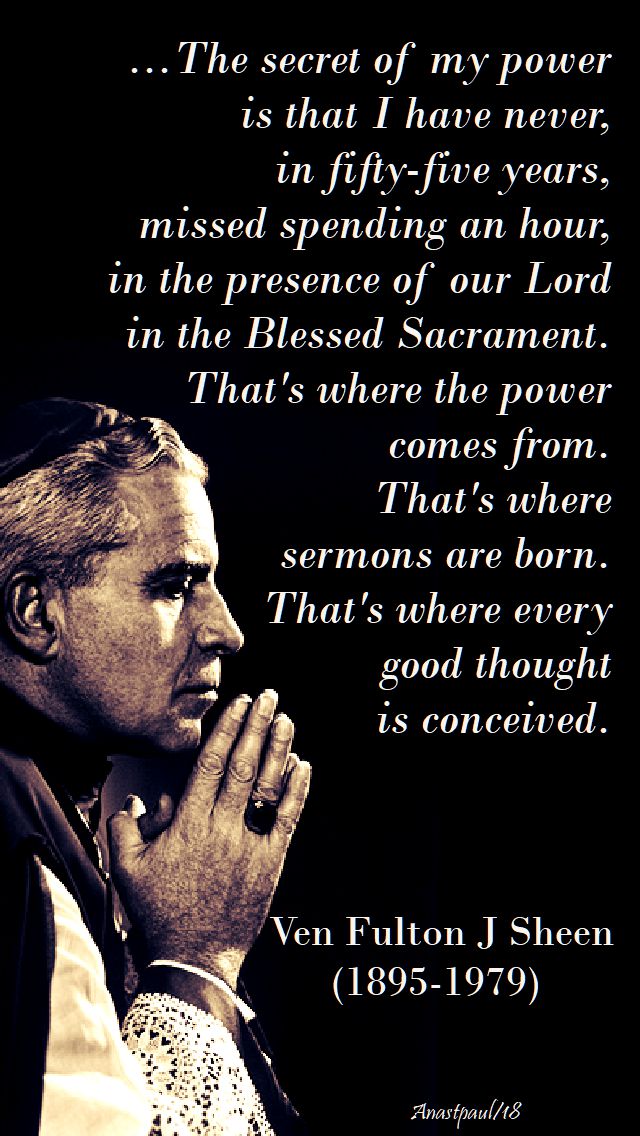
REFLECTION – “When I stand up to talk, people listen to me;  they will follow what I have to say.   Is it any power of mine?   Of course not.   St Paul says, ‘What have you that you have not received and you who have received, why do you glory as if you had not?’  But the secret of my power is that I have never, in fifty-five years, missed spending an hour in the presence of our Lord, in the Blessed Sacrament.   That’s where the power comes from.  That’s where sermons are born.  That’s where every good thought is conceived.” …Venerable Archbishop Fulton J Sheen (1895-1979)the secret of my power - ven fulton j sheen - 17 april 2018

PRAYER – Lord Jesus, present for me in the Holy Eucharist, everyday, everywhere. Lord Jesus, the life of my soul, the food of my life, the quenching of my thirst.   Let me love You in the Holy Eucharist.   May Your Sacred Heart become my heart.   Blessed Andrés Hibernón Real, you who loved to spend time with the Lord, who never missed a day being with Him, please pray for us, amen.bl andres hibernon real - pray for us - 17 april 2018

Posted in EASTER, franciscan OFM, MORNING Prayers, PRAYERS of the SAINTS

Our Morning Offering – Tuesday of the Third Week of Eastertide

Our Morning Offering – Tuesday of the Third Week of Eastertide

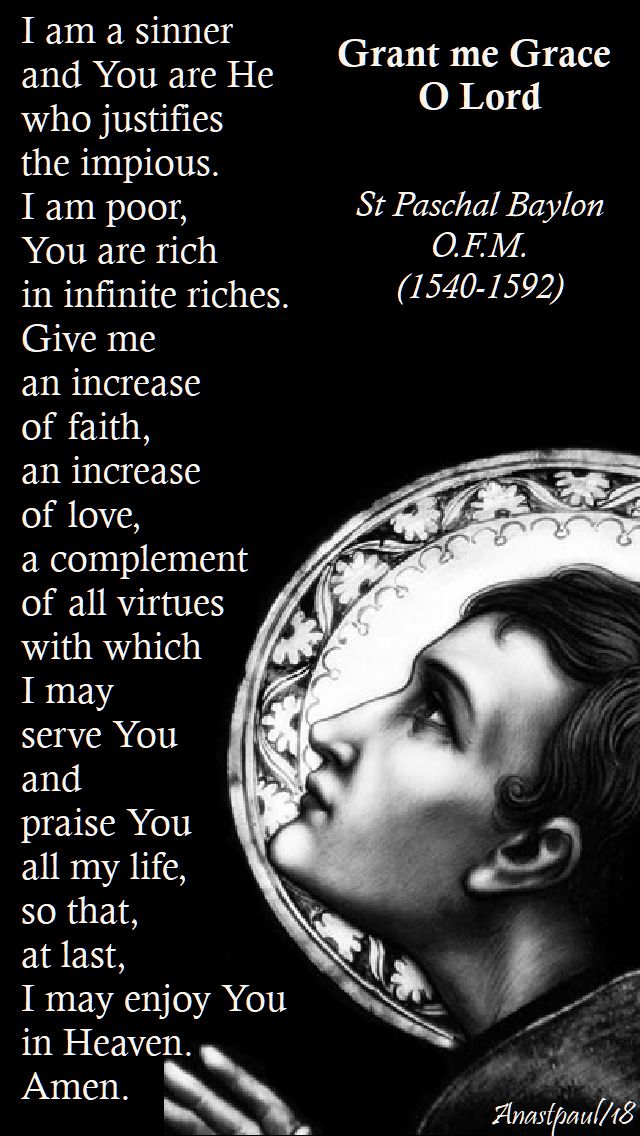
Grant me Grace O Lord
By St Paschal Baylon O.F.M. (1540-1592)

I am a sinner
and You are He
who justifies the impious.
I am poor,
You are rich in infinite riches.
Give me an increase of faith,
an increase of love,
a complement of all virtues
with which I may serve You
and praise You
all my life so that, at last,
I may enjoy You in Heaven.
Amengrant me grace o lord - st paschal baylon - 17 april 2018


Posted in franciscan OFM, INCORRUPTIBLES, SAINT of the DAY

Saint of the Day – 17 April – Blessed Andrés Hibernón Real O.F.M. (1534-1602)

Saint of the Day – 17 April – Blessed Andrés Hibernón Real O.F.M. (1534-1602) Religious Friar, Apostle of the Holy Eucharist, the Blessed Virgin and the Holy Rosary, Apostle of the poor.   Patronages –  Alcantarilla, Spain (chosen in May 1950), Murcia, Spain.   He was born in 1534 in Murcia, Spain.   He predicted the date of his death four years before the fact, which was 18 April 1602 in Gandia, Valencia, Spain of natural causes immediately after having prayed a rosary.   His body is incorrupt.duoandres

Andrés Hibernón Real was born in Murcia in 1534, he came from an old noble house that was reduced to the state of poorness due to a range of adverse circumstance.    His uncle in Valencia, assumed charge of his initial education, in order to relieve his parents.   He was baptised in the Murcia Cathedral where an uncle of his was a chaplain.

In his late childhood and into his adolescence he endeavoured to earn funds that would support his parents and siblings.   He saved a considerable amount on one occasion to provide for his sister’s impending marriage and so left where he was to travel back home to Murcia.   En route home a group of thieves attacked him and stripped him of all he had.   Hibernón interpreted this as a sign of how much he depended on material goods and so resolved to labour for the remainder of his life for goods not of this world.

In Albacete in 1556 he begged to be admitted into a convent of the Order of Friars Minor and so was admitted into it on 1 November 1557 where he commenced his period of novitiate and received the habit.220px-andres_hibernon

He frequented Marian shrines and often spent hours on end kneeling in silent and deep meditation before the tabernacle that housed the Eucharist.   He fostered an ardent devotion to the poor and the ill and often accompanied priests to visit ill people.   In February 1563 he relocated to the Alcantarine Franciscan reform convent of San José in Elche and in 1564 attended the vesting of the habit of Saint Paschal Baylon (1540-1592). He remained there until 1574 save for a short duration of time in Villena.   In 1574 his superiors sent him to undertake the establishment of a convent in Valencia where he made friends with the Archbishop of Valencia, Saint Juan de Ribera (1532-1611).

He died on 18 April 1602 – he had foretold that exact date of his death in 1598.   He died as he completed reciting the rosary.   His incorrupt remains are now housed in the Murcia Cathedral – though some are in Alcantarilla – after being relocated from Gandia in 1936 due to the Spanish Civil War.   He was Beatified on 22 May 1791 by Pope Pius VI at Saint Peter’s Basilica, Rome, Papal States (modern Italy) (cultus confirmation).

Murcia_Catedral5_tango7174
Murcia Cathedral

Posted in franciscan OFM, SAINT of the DAY

Memorials of the Saints – 18 April

Bl Andrés Hibernón Real O.F.M. (1534-1602)
St Agia of Hainault
St Anthia of Illyria
St Athanasia of Aegina
St Bitheus
St Calocerus of Brescia
St Cogitosus
St Corebus
St Eleuterius of Illyria
St Elpidius of Melitene
St Eusebius of Fano
St Galdinus of Milan
St Gebuinus of Lyons
St Genocus
St Hermogenes of Melitene
Bl Idesbald of Dunes
Bl James Oldo
Bl Joseph Moreau
St Laserian of Leighlin
Bl Louis Leroy
Bl Luca Passi
Bl Marie of the Incarnation
St Perfecto of Córdoba
St Pusicio
Bl Roman Archutowski
Bl Savina Petrilli
St Ursmar of Lobbes
St Wigbert of Augsburg

Posted in MORNING Prayers

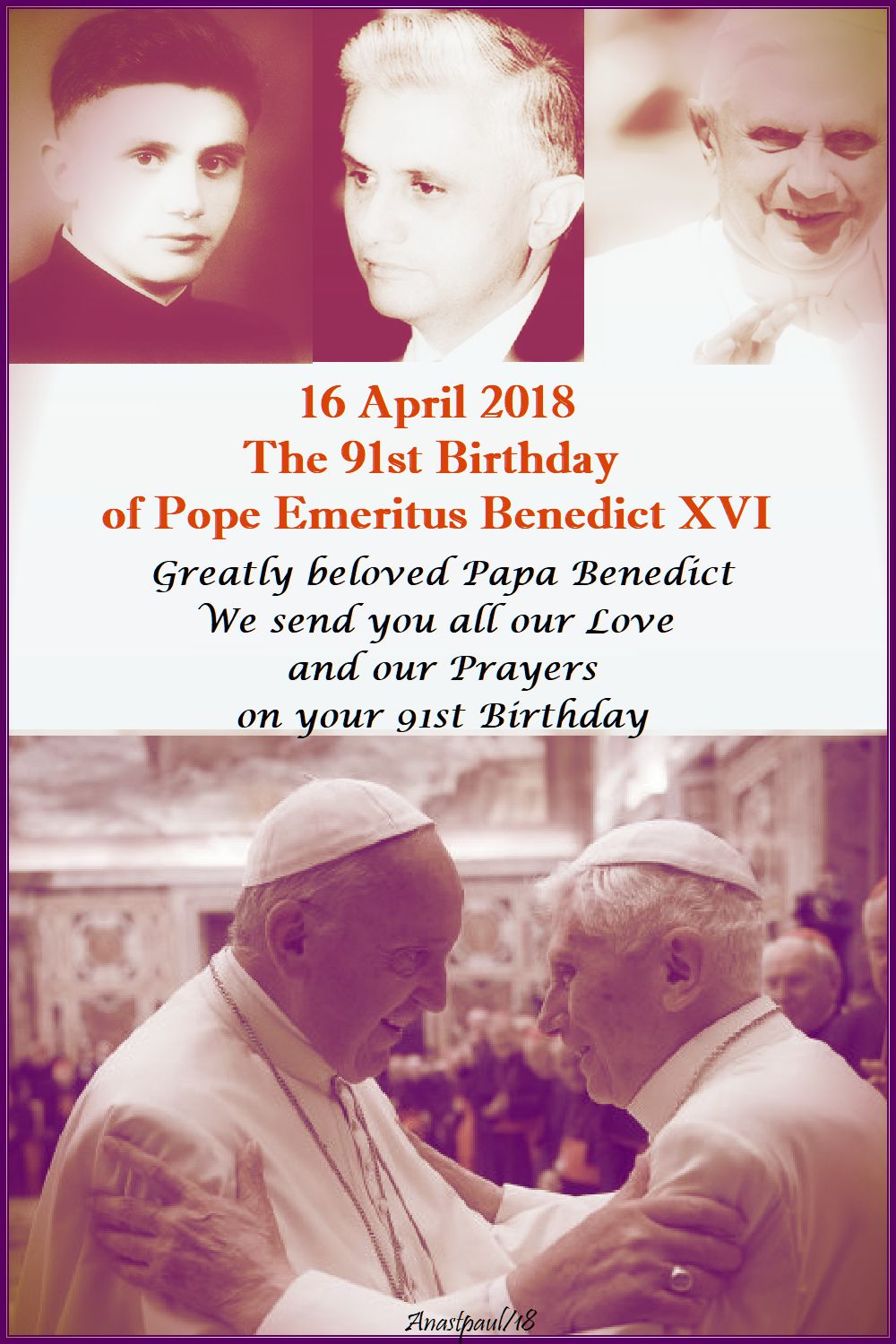
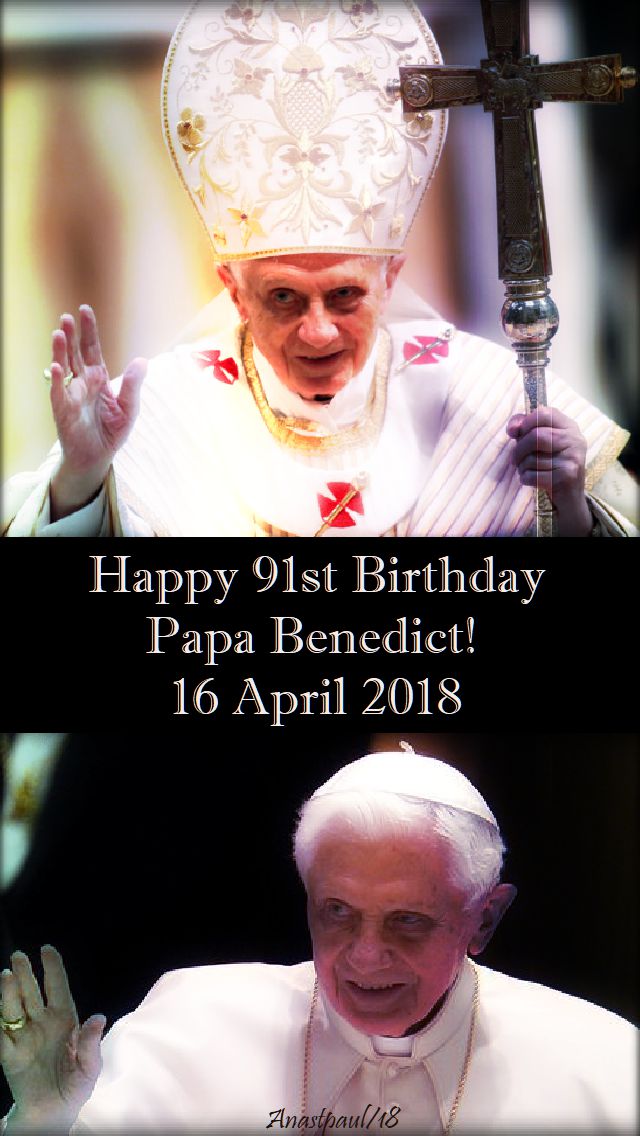
Wishing our Holy Father Emeritus Papa Benedict XVI a Blessed 91st Birthday! 16 April 2018

Wishing our Holy Father Emeritus Papa Benedict XVI a Blessed 91st Birthday!
16 April 2018

Greatly beloved Papa Benedict
We send you all our Love
and our Prayers
on your 91st Birthdayhappy birthday papa benedict - 16 april 2018 - 91st birthday

He plans to spend his birthday in private, in the Vatican Gardens, with his brother Georg, who is 94.

Just like last year, he will most likely celebrate the day in a Bavarian style, which will remind him of the tastes of his land.

Throughout this year, Benedict has found all the rumours about his delicate health quite humorous.   He even wrote a letter to an Italian newspaper to thank them for paying so much attention to him.

Past recent birthdays have seen Benedict celebrate the day with a pint of beer.

His personal secretary, long-time aide and prelate of the Vatican Household, ArchBishop Georg Gaenswein, said “Certainly, his physical strength is lessening. It’s hard for him to walk.   However, he uses a walker, which ensures autonomy in movement and safety,” the aide said.

The rhythm of Benedict’s retirement in a monastery on Vatican City grounds consists of “prayer, meditation, reading, study, correspondence,” Gaenswein said. “He has visitors, too.   Music certainly still has its place, together with a daily walk.”happy 91st birthday papa benedict - 16 april 2018


Posted in EUCHARISTIC Adoration, SAINT of the DAY, The HOLY EUCHARIST / The HOLY MASS

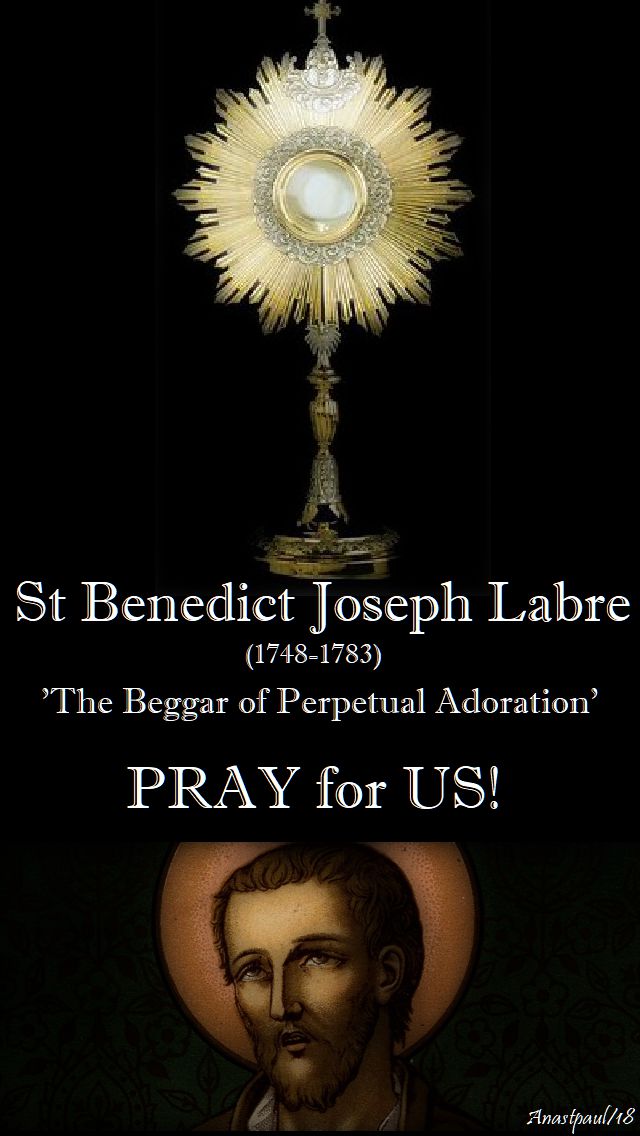
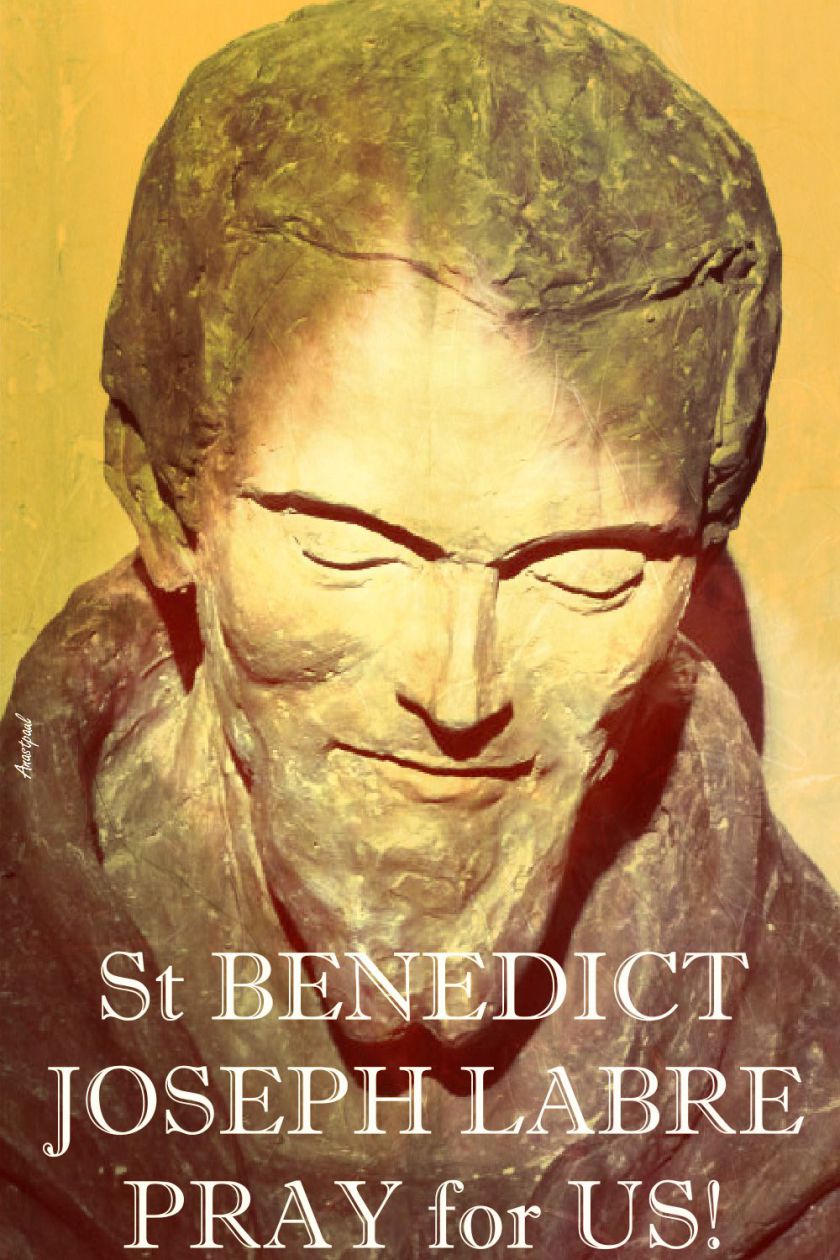
Thought for the Day – 16 April – Monday of the Third Week of Eastertide and the Memorial of St Benedict Joseph Labre – Known as the Beggar of Perpetual Adoration (1748-1783)

Thought for the Day – 16 April – Monday of the Third Week of Eastertide and the Memorial of St Benedict Joseph Labre – Known as the Beggar of Perpetual Adoration (1748-1783)

Benedict Joseph Labre was truly eccentric, one of God’s special little ones.   Born in France and the eldest of 18 children, he studied under his uncle, a parish priest.   Because of poor health and a lack of suitable academic preparation he was unsuccessful in his attempts to enter the religious life.   Then, at age 16, a profound change took place. Benedict lost his desire to study and gave up all thoughts of the priesthood, much to the consternation of his relatives.

He became a pilgrim, traveling from one great shrine to another, living off alms.   He wore the rags of a beggar and shared his food with the poor.   Filled with the love of God and neighbour, Benedict had special devotion to the Blessed Mother and to the Blessed Sacrament.   In Rome, where he lived in the Colosseum for a time, he was called “the poor man of the Forty Hours devotion” and “the beggar of Rome.”

On 16 April 1783, the last day of his life, Benedict dragged himself to a church in Rome and prayed there for two hours before he collapsed, dying peacefully in a nearby house. Immediately after his death, the people proclaimed him a saint.

Benedict Joseph Labre was canonised by Pope Leo XIII in 1881.

St Benedict’s life reminds us that the Lord loves and has a beautiful plan for all His creations, despite what society may judge or view them as.   I, personally, do not regard him as being mentally ill, though many do and he is the Patron of mental illness and against insanity.   For me, his mission was simply a striving, throughout his life to grow closer to the Lord, to serve Him through his neighbour and to serve as an example for others.   I see shades of St Francis and many other Saints.   He faced multiple rejections with grace and eventually changed his plan in obedience to God, never giving up his search for holiness.   We are challenged by the life of this saint to consider our own actions, both when we encounter difficulties in our lives that prevent us from following what we perceive to be the will of God and also when we encounter those individuals in our communities who society has written off, marginalised and judged as ‘less than’ and ‘unworthy’.

My thought is this, that if we seek Christ who sought us first, we will find Him, for He is right beside us, whatever our circumstances.   St Benedict found Him, in his neighbour and waiting quietly, in the Real Presence of the Blessed Sacrament, as He waits for you and me.

St Benedict Joseph Labre, pray for us!  (Last year’s Saint of the Day – https://anastpaul.wordpress.com/2017/04/16/saint-of-the-day-16-april-st-benedict-joseph-labre/)ST BENEDICT - BEGGAR OF PERPETAUL ADORATION - PRAY FOR US - 16 APRIL 2018st-labre-pray-for-us- 16 april 2017 - no 2

Posted in MARIAN TITLES, MIRACLES, MORNING Prayers, QUOTES of the SAINTS, QUOTES on LOVE, QUOTES on SANCTITY, SAINT of the DAY, The HOLY EUCHARIST / The HOLY MASS

Quote/s of the Day – 16 April – Monday of the Third Week of Eastertide and the Memorial of St Bernadette Soubirous (1844-1879)

Quote/s of the Day – 16 April – Monday of the Third Week of Eastertide and the Memorial of St Bernadette Soubirous (1844-1879)

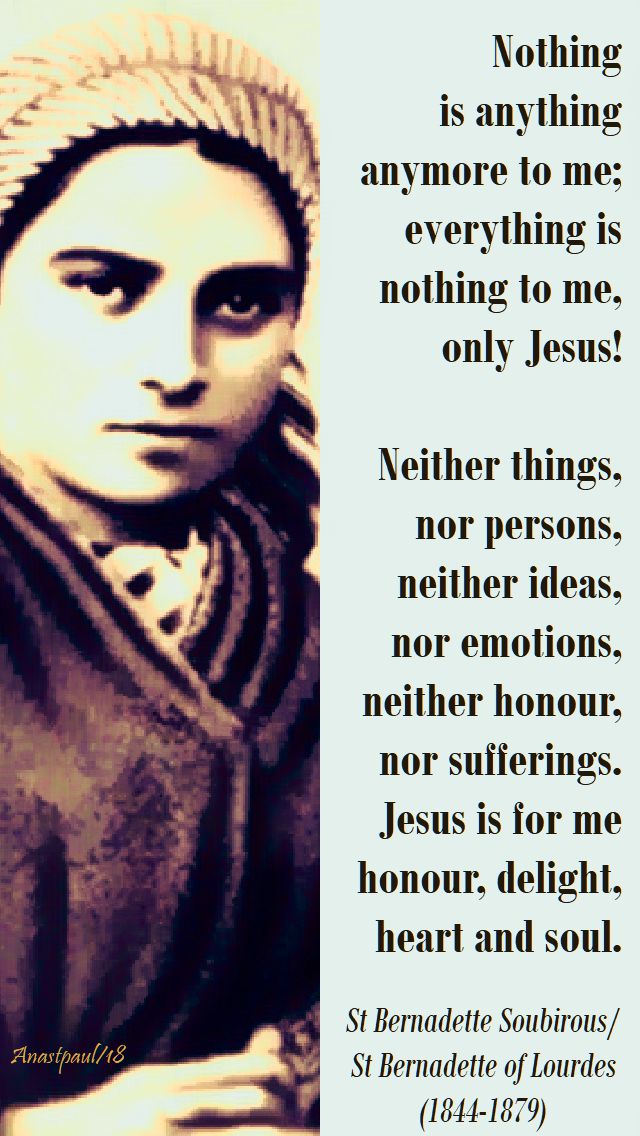
“Nothing is anything anymore to me,
everything is nothing to me,
only Jesus!
Neither things,
nor persons,
neither ideas,
nor emotions,
neither honour,
nor sufferings.
Jesus is for me honour,
delight,
heart and soul.”nothing is anything anymore to me - st bernadette - 16 april 2018

“You must receive God well – 
give Him a loving welcome,
for then, He has to pay us rent.”

St Bernadette Soubirous (1844-1879)you must receive god well - st bernadette - 16 april 2018

Posted in EASTER, MORNING Prayers, QUOTES on SUFFERING, QUOTES on the CROSS of CHRIST, SAINT of the DAY, The HOLY CROSS, The WORD

One Minute Reflection – 16 April – Monday of the Third Week of Eastertide and the Memorial of St Bernadette Soubirous (1844-1879)

One Minute Reflection – 16 April – Monday of the Third Week of Eastertide and the Memorial of St Bernadette Soubirous (1844-1879)

For to you has been granted, for the sake of Christ, not only to believe in him but also to suffer for him...Philippians 1:29for to you has been granted - philippians 1 29

REFLECTION – “The more I am crucified, the more I rejoice.”…St Bernadette Soubirous

the more i am crucified - st bernadette - 16 april 2018

PRAYER – Let the crucifix be not only in my eyes and on my breast but in my heart.   O Jesus!   Release all my affections and draw them upwards.   Let my crucified heart sink forever into Thine and bury itself in the mysterious wound made by the entry of the lance…By St Bernadette Soubirous, of whom we request, your prayers!st bernadette - pray for us - 16 april 2018

Posted in INCORRUPTIBLES, MARIAN TITLES, MIRACLES, Of BEGGARS, the POOR, against POVERTY, Of the SICK, the INFIRM, All ILLNESS, SAINT of the DAY, The BLESSED VIRGIN MARY

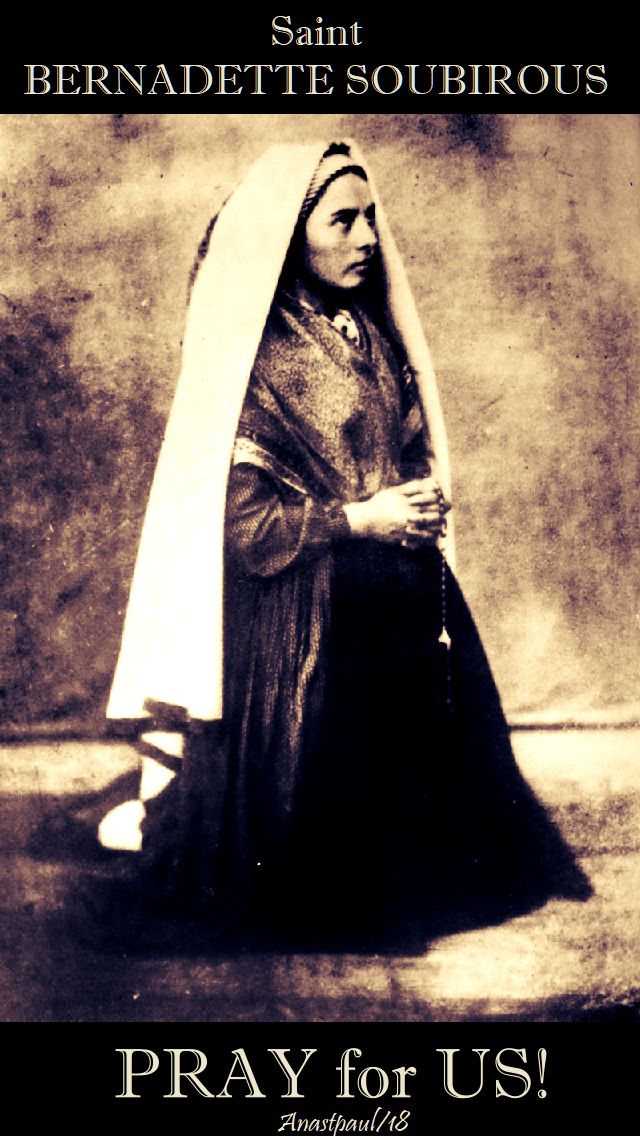
Saint of the Day – 16 April – Saint Bernadette Soubirous (1844-1879)

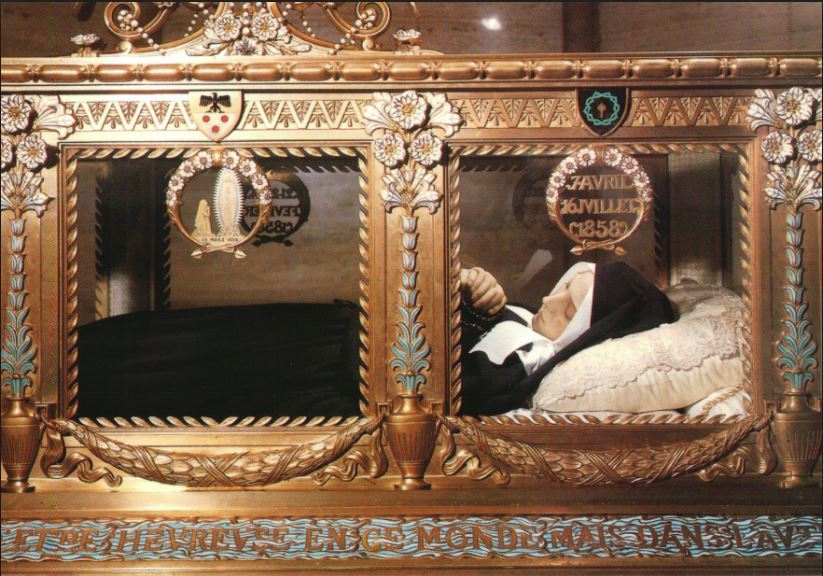
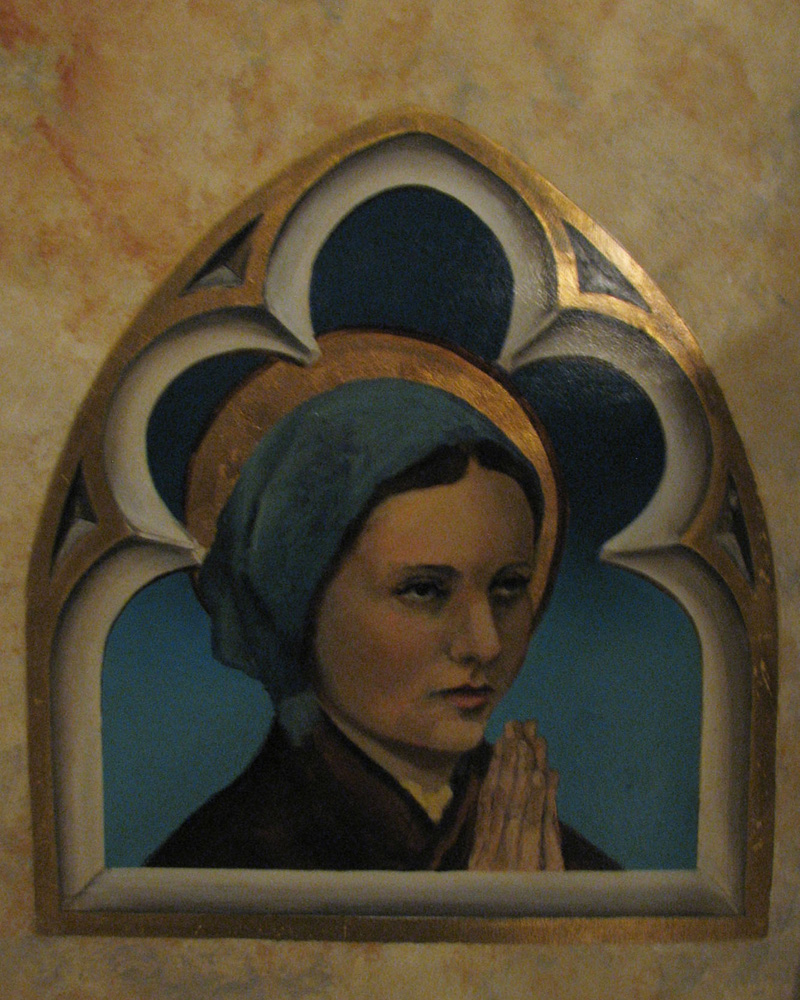
Saint of the Day – 16 April – Saint Bernadette Soubirous (1844-1879) Marian Visionary of Lourdes, Virgin, Consecrated Religious.  Born on 7 January 1844 at Lourdes, Hautes-Pyrénées, France and died on 16 April 1879, Nevers, Nièvre, France of natural causes, aged 35.   Patronages – Bodily illness,  Lourdes, France, shepherds, against poverty, people ridiculed for their faith.   She was Canonised on 8 December 1933 by Pope Pius XI.   Her Body is incorrupt and is on display in Nevers, France.st-bernadette-soubirous1St. Bernadette -at Death & Todayst bernadette's incorrupt body

The eldest of nine children, only four of whom survived childhood, Marie-Bernarde Soubirous was born at Lourdes, in the foothills of the Pyrenees.   After her father, a miller, lost his job in 1854, the family was exposed to the direst extremes of poverty.

By the time she was 14, Bernadette had been sick so often that she hadn’t grown properly.   She was the size of a much younger girl.   She, her parents and her younger brothers and sisters all lived in a tiny room at the back of someone else’s house, a building that had actually been a prison many years before.   They slept on three beds: one for the parents, one for the boys and one for the girls.   Every night they battled mice and rats.   Every morning, they woke up, put their feet on cold stone floors and dressed in clothes that had been mended more times than anyone could count.   Each day they hoped the work they could find would bring them enough bread to live on that day.

“Bernadette” grew up uneducated, undernourished and asthmatic, obliged to work as a waitress and a farmhand.   The little girl spoke in a Basque dialect and could scarcely read or write.   She did, however, imbibe from her parents a deep Catholic devotion.

By 1856 the Soubirous were living in an abandoned prison cell which stank of sewage. On 11 February 1858 Bernadette, with her sister Toinette and a friend, went to gather firewood.   In a grotto beside the River Gave, at a place used as a watering hole for pigs, she saw a vision of a “Lady” wearing a white dress, a blue girdle and a yellow rose on each foot.   Bernadette’s companions saw nothing and she herself wondered whether her experience had been an illusion.   Three days later, though, she returned to the grotto, and again saw the apparition.   On 18 February her third visit, the vision spoke for the first time, asking for her presence over the next fortnight.   Next day, the Lady instructed Bernadette to tell the priests to build a chapel at the grotto.

Grotte_miraculeuse_à_Lourdes_Charles_Mercereau

Crowds began to gather to witness the regular phenomenon of the small girl in ecstasy. The police, concerned, interrogated Bernadette, who related her experiences with clarity and conviction.   Local interest quickened after the Lady told Bernadette to drink from a muddy trickle in the grotto.   By the morrow the trickle had turned into an active spring.

On 4 March at the end of the prescribed fortnight, a crowd of 10,000 gathered to watch Bernadette.   In fact, she would experience three more apparitions, bringing the total to 18.   Chivied by the parish priest, she insisted that the Lady should give her name.   “I am the Immaculate Conception,” came the reply, in perfect Basque dialect.   Bernadette had no idea what this meant.   She repeated it to herself over and over on her way back to the village so she wouldn’t forget the strange, long words.   When she told her parish priest what the lady had said, he was quite surprised.   The priest knew that what the mysterious lady had said meant that she was Mary, Jesus’ mother.   The mysterious lady of the grotto had told Bernadette who she was.   But it was not very common for people—especially poor little girls who couldn’t read—to think of Mary as the “immaculate conception,” a phrase that reminds us of how God saved Mary from sin even before she was born.   The Blessed Virgin also told her:   “I do not promise to make you happy in this world but in the next,” the apparition had told her.

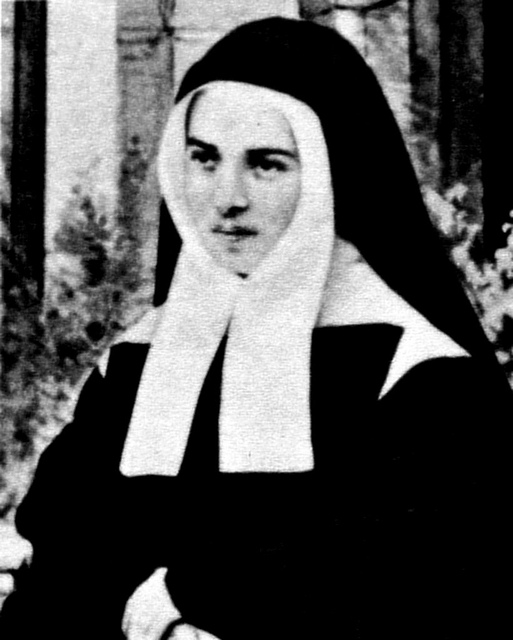
Disliking the attention she was attracting, Bernadette went to the hospice school run by the Sisters of Charity of Nevers where she had learned to read and write.   Although she considered joining the Carmelites, her health precluded her entering any of the strict contemplative orders.   On 29 July 1866, with 42 other candidates, she took the religious habit of a postulant and joined the Sisters of Charity at their motherhouse at Nevers.   Her Mistress of Novices was Sister Marie Therese Vauzou.   The Mother Superior at the time gave her the name Marie-Bernarde in honour of her godmother who was named “Bernarde”.
st bernadette - nun

Bernadette spent the rest of her brief life there, working as an assistant in the infirmary and later as a sacristan, creating beautiful embroidery for altar cloths and vestments. Her contemporaries admired her humility and spirit of sacrifice.   One day, asked about the apparitions, she replied:

“The Virgin used me as a broom to remove the dust.   When the work is done, the broom is put behind the door again.” and  “They think I’m a saint,” she observed. “When I’m dead they’ll come and touch holy pictures and rosaries to me, and all the while I’ll be getting boiled on a grill in purgatory.”

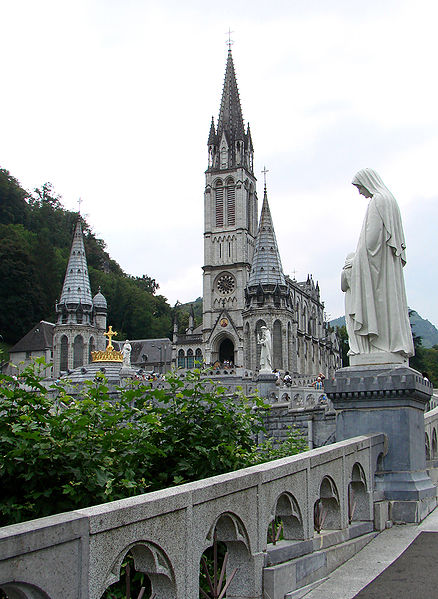
She later contracted tuberculosis of the bone in her right knee.   She had followed the development of Lourdes as a pilgrimage shrine while she still lived at Lourdes but was not present for the consecration of the Basilica of the Immaculate Conception there in 1876.
438px-Lourdes_ND_Rosaire_03

For several months prior to her death, she was unable to take an active part in convent life.   She eventually died of her long-term illness at the age of 35 on 16 April 1879 (Easter Wednesday) while praying the holy rosary.   On her deathbed, as she suffered from severe pain and in keeping with the Virgin Mary’s admonition of “Penance, Penance, Penance,” Bernadette proclaimed that “all this is good for Heaven!”   Her final words were, “Blessed Mary, Mother of God, pray for me! A poor sinner, a poor sinner”. 

In the 1858 Lourdes apparitions, the Blessed Virgin Mary declared herself as the Immaculate Conception to the innocent little shepherd girl named Bernadette: … The Immaculate Conception (CCC, 490-3)st bernadette in art