Thought for the Day – 6 May – “Mary’s Month” Meditations with Antonio Cardinal Bacci (1881-1971)
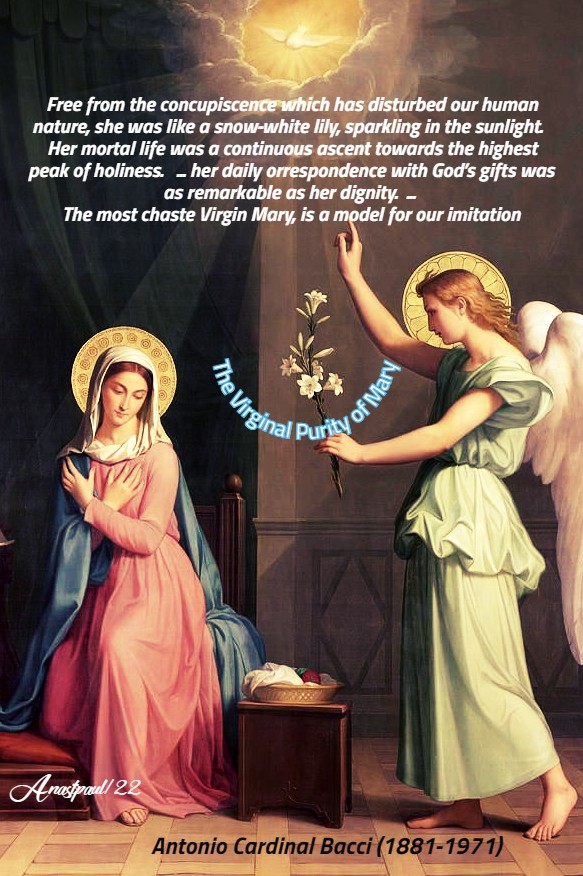
The Virginal Purity of Mary
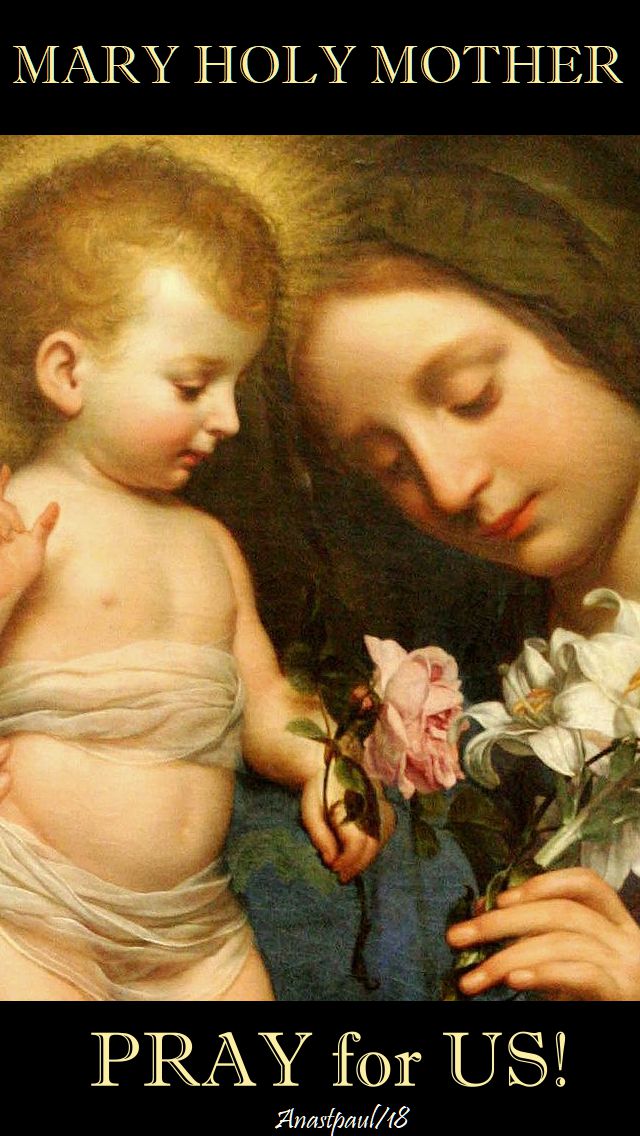
“It is a Dogma of Faith, that Mary was always a virgin in body and soul. According to the teaching of the holy Fathers, Mary would have renounced her dignity as Mother of God, rather than lose her virginity. When the Archangel Gabriel appeared with the news of the great privilege which she was about to receive, Mary was afraid and asked meekly, how she could become the Mother of God, since she had promised to remain always a virgin. The Angel assured her, that it was through the power of the Holy Spirit, that the eternal Word of God, would take human flesh in her and become her son. Only then did she bow her had and reply: “Be it done to me according to thy word.” Mary’s perpetual virginity is complemented by her purity and absolute immunity from sin. When we consider sin of any kind, says St Augustine, Mary must always be the one exception to it (Cf De natura et gratia, c 36). She was preserved free from original sin and possessed the fullness of grace. The devil never had any power over her spotless soul. Not even the slightest tarnish marred her virginal splendour. Free from the concupiscence which has disturbed our human nature, she was like a snow-white lily, sparkling in the sunlight. Her mortal life was a continuous ascent towards the highest peak of holiness. It would be wrong to believe that the extraordinary privileges which God had granted her from her conception remained fixed and static, like an acquired inheritance. On the contrary, her daily correspondence with God’s gifts was as remarkable as her dignity. The most chaste Virgin Mary, is a model for our imitation. We cannot obtain her privileges but, we should try and imitate her heroic and constant co-operation with the gifts of God.”
Quote/s of the Day – 6 May – Wednesday of the Fourth Week of Easter
May God bestow upon our Bishops. all the graces needed to carry out their role in our Church!
“Give him a spirit of courage and right judgement, a spirit of knowledge and love.”
“O Christ, my God, You stooped down to me, poor straying sheep, to take me on Your shoulders (Lk 15:5) and have set me down in green pastures (Ps 23[22]:2). You have quenched my thirst at the springs of true doctrine, through the mediation of Your pastors, whose shepherd You were, before entrusting to them Your flock… And now, O Lord, You have called me… to serve Your disciples, by what design of Your Providence I know not, only You know.
But, Lord, lighten the heavy burden of those sins of mine that have so gravely offended You, purify my mind and heart. Lead me by the right way (Ps 23[22]:3) as by a light enlightening me. Enable me to proclaim Your word boldly, may Your Spirit’s tongue of flame (Acts 2:3) give perfect freedom to my tongue and make me constantly attentive to Your presence.
Be a shepherd to me, O Lord and together with me, be the shepherd of Your sheep, that my heart may not cause me to swerve either to right or to left. Let Your good Spirit lead me in the right way, that my actions may be carried out, according to Your will – even to the end. Amen
St John Damascene (675-749)
Father and Doctor of the Church
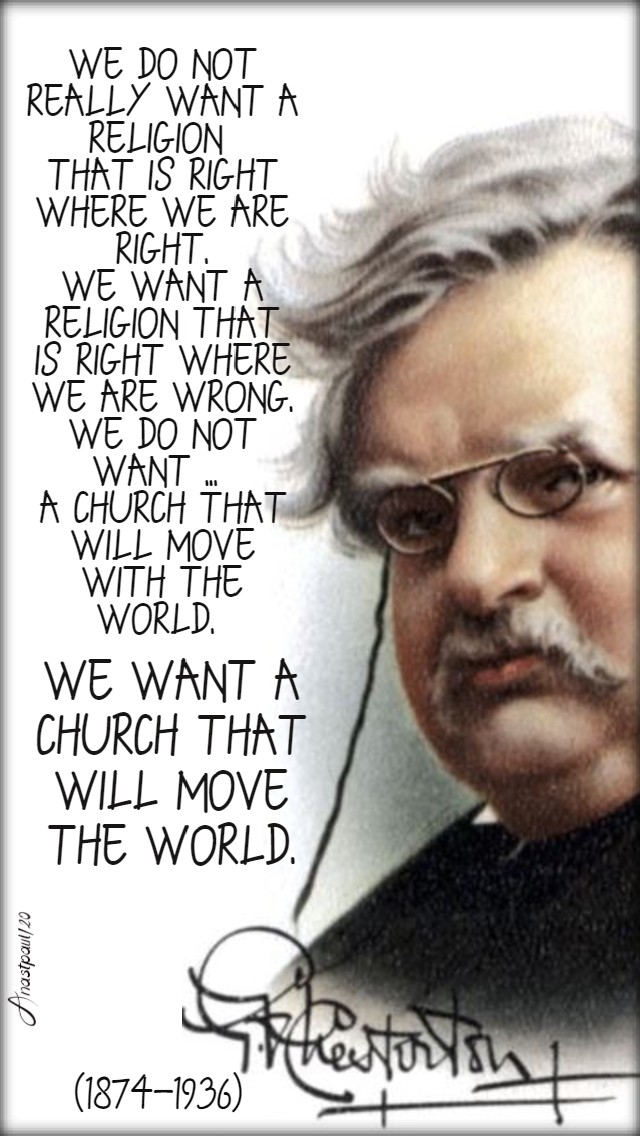
“We do not really want a religion that is right where we are right. We want a religion that is right where we are wrong. We do not want, as the newspapers say, a church that will move with the world. We want a church that will move the world.”
G K Chesterton (1874-1936)
A Prayer for our Bishops
Jesus, Good Shepherd, You sent us the Holy Spirit to guide Your Church and lead her faithful to You, through the ministry of the successors of Your Apostles, the Bishops. Through the inspiration of the Holy Spirit, grant to Your bishops wisdom in leading, faithfulness in teaching and holiness in guarding Your sacred Mysteries. As they cry out with all the faithful, “Our Father!”, may Your Bishops be ever more closely identified with You in Your divine Sonship and offer their own lives with You, the one saving Victim. Renew in Your Bishops deeper faith, greater trust in You, childlike reliance on our Mother Mary and unwavering fidelity to the Holy Father. Holy Mary, intercede for Your bishops.
Sts Peter & Paul, pray for them. St Andrew, pray for them. St James, pray for them. St John, pray for them. St Thomas, pray for them. St James, pray for them. St Philip, pray for them. St Bartholomew, pray for them. St Matthew, pray for them. Sts Simon & Jude, pray for them. St Matthias, pray for them. St Joseph, protect them. St Michael, defend them. St John Vianney, pray for them. All you saints in heaven, pray for them. Amen
“The Church exists, for nothing else but to draw men into Christ, to make them little Christs. If they are not doing that, all the cathedrals, clergy, missions, sermons, even the Bible itself, are simply a waste of time. God became man for no other purpose.”
One Minute Reflection – 6 May – ‘Mary’s Month” – Wednesday of the Fourth week of Easter, Readings: Acts 12:24–13:5, Psalm 67:2-3, 5-6, 8, John 12:44-50
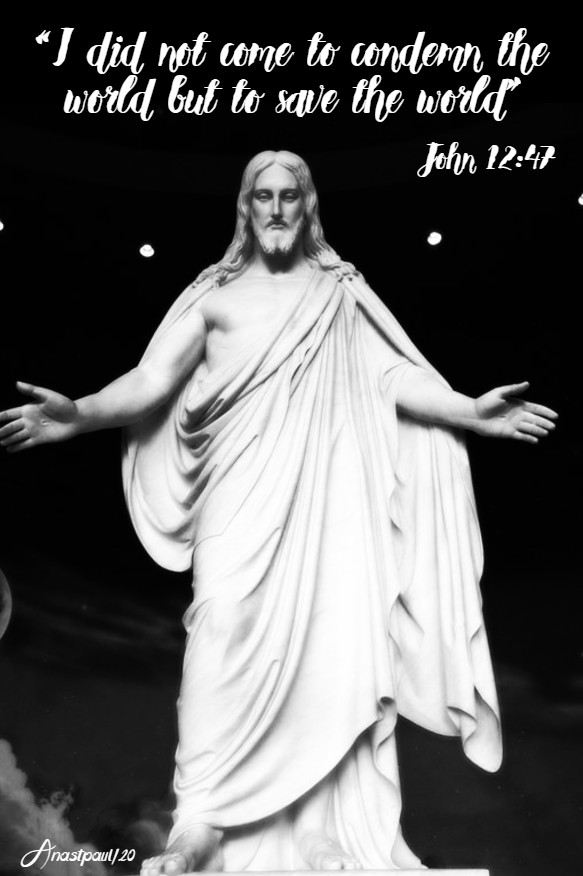
“I did not come to condemn the world but to save the world”…John 12:47
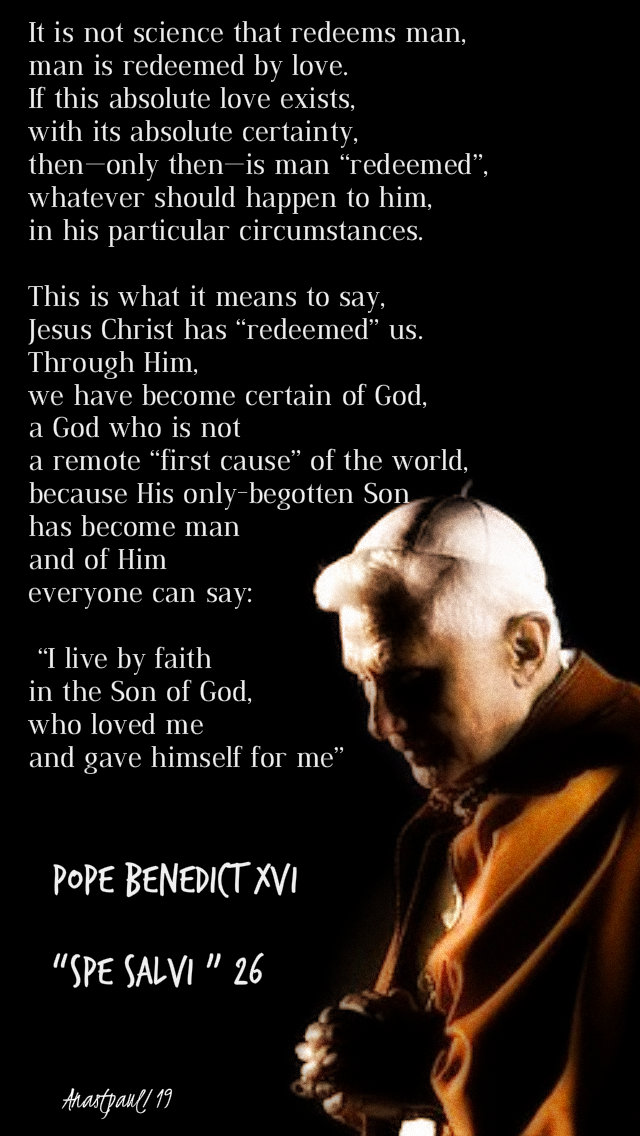
REFLECTION – “It is not science that redeems man, man is redeemed by love. This applies even in terms of this present world. When someone has the experience of a great love in his life, this is a moment of “redemption” which gives a new meaning to his life. But soon, he will also realise that the love bestowed upon him cannot by itself resolve the question of his life. It is a love that remains fragile. It can be destroyed by death. The human being needs unconditional love. He needs the certainty which makes him say – “neither death, nor life, nor angels, nor principalities, nor things present, nor things to come, nor powers, nor height, nor depth, nor anything else in all creation, will be able to separate us from the love of God in Christ Jesus our Lord” (Rom 8:38- 39). If this absolute love exists, with its absolute certainty, then—only then—is man “redeemed”, whatever should happen to him, in his particular circumstances.
This is what it means to say, Jesus Christ has “redeemed” us. Through Him we have become certain of God, a God who is not a remote “first cause” of the world, because His only-begotten Son has become man and of Him everyone can say: “I live by faith in the Son of God, who loved me and gave himself for me” (Gal 2:20)….Pope Benedict XVI – Encyclical “ Spe Salvi ”#26
PRAYER – Lord God, life of those who believe in You, glory of the humble and happiness of the Saints, listen kindly to our prayer. We long for what You promises, fill us from Your abundance, give us true faith and obedience. May the Blessed Virgin, Mother of Your Son, be our constant recourse. Through Our Lord, Jesus with the Holy Spirit, God forever, amen.
Our Morning Offering – 6 May – ‘Mary’s Month” – Wednesday of the Fourth week of Easter
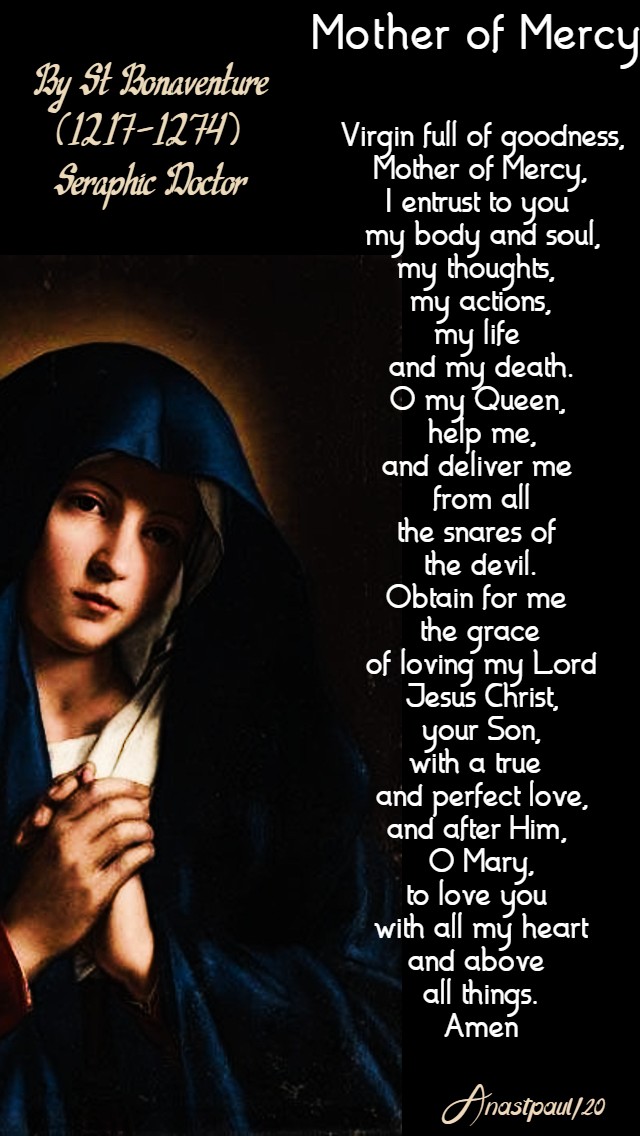
Mother of Mercy By St Bonaventure (1217-1274) Serpahic Doctor
Virgin full of goodness,
Mother of Mercy,
I entrust to you my body and soul,
my thoughts, my actions,
my life and my death.
O my Queen, help me,
and deliver me from all
the snares of the devil.
Obtain for me the grace
of loving my Lord Jesus Christ,
your Son,
with a true and perfect love,
and after Him, O Mary,
to love you with all my heart
and above all things.
Amen
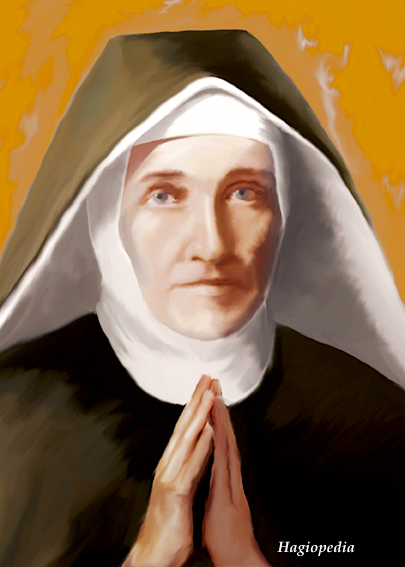
Saint of the Day – 6 May – Blessed Maria Catalina of Saint Rose Troiani (1813-1997) Virgin, Nun, Missionary, Founder of the Franciscan Missionaries of the Immaculate Heart of Mary, Third Order Franciscan, Apostle of the poor, especially children, teacher – born on 19 January 1813 in Giuliano di Roma, Italy and died on 6 May 1887 in Cairo, Egypt of natural causes. Patronage – the Franciscan Missionaries of the Immaculate Heart of Mary.
Maria Caterina Troiani was born in Giuliano di Roma in 1813 as the third of four children. She was born in the Napoleonic period.
She approached the Bishop of Ferentino and asked him if she could be received into a convent as a nun. She lived and learned the Franciscan path with Saint Francis of Assisi as a guide and dedicated herself – with her fellow noviates – to education and the care of girls.
On 8 December 1829 she took the religious habit of the institute and changed her name to “Maria Teresa of Saint Rose” in honour of Saint Rose of Viterbo.
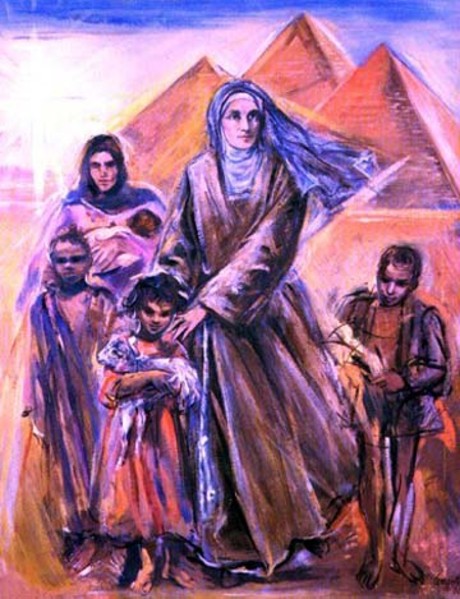
Sr Maria had a great desire for Missionary work, especially in Africa. In 1852 the Apostolic Vicar of Egypt requested that a Franciscan institute be opened in Cairo with the aim of providing education and vocational training to poor girls.
She and four others left on 25 August 1859, first to Rome, where they met with Pope Pius IX 4 September who blessed them before their departure. The five embarked at Civitavecchia and Father Giuseppe Modena accompanied them. The group arrived in Malta to learn that the Apostolic Vicar of Egypt had suddenly died. On 14 September the group entered Cairo.
In 1868 various agreements between the Order of Friars Minor and the Congregation of Propaganda Fide ensured that the institution she established in Cairo was named as the Third Order Franciscan Sisters of Cairo. It was later renamed the Franciscan Missionary Sisters of Egypt, only to be changed in 1950 to its current name. She was it’s Mother Superior until her death.
She died in 1887 and was buried in Cairo. Her remains were exhumed and moved to Rome on 3 November 1967. Pope Leo XIII had held her in high esteem and wished her to be reinterred in her home country.
St Pope John Paul II Beatified her on 14 April 1985 at St Peter’s. The cause of Canonisation continues, with a second miracle under investigation at present.
Bl Anthony Middleton
Bl Bartolomeo Pucci-Franceschi
St Benedicta of Rome
St Colman Mac Ui Cluasigh of Cork
St Colman of Loch Eichin
St Dominic Savio
St Edbert of Lindisfarne
Bl Edward Jones
St Evodius of Antioch St Francis-Xavier de Montmorency Laval (1623-1708) His Life: https://anastpaul.com/2019/05/06/saint-of-the-day-6-may-st-francis-xavier-de-montmorency-laval-francois-laval-1623-1708/
St Heliodorus
Bl Henryk Kaczorowski
St James of Numidia
St Justus of Vienne
Bl Kazimierz Gostynski
St Lucius of Cyrene Blessed Maria Catalina of Saint Rose Troiani (1813-1997)
St Marianus of Lambesa
Bl Peter de Tornamira
St Petronax of Monte Cassino
St Protogenes of Syria
Bl Prudence Castori
St Theodotus of Kyrenia
St Venerius of Milan
St Venustus of Africa
St Venustus of Milan
Bl William Tandi
Mary Immaculate
Moments with Saint Pope John XXIII (1881-1963)
The splendour of dawn is called immaculate, unstained.
Mary, preserved from all stain of original sin, was full of grace, from the first moment of her conception.
While she was still in her mother’s womb, the divine light had entered into her soul.
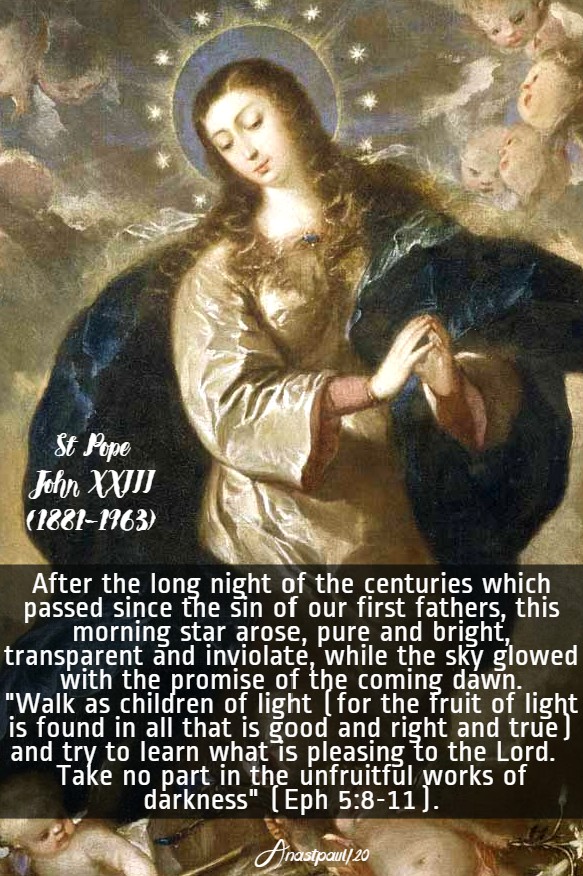
After the long night of the centuries which passed since the sin of our first fathers, this morning star arose, pure and bright, transparent and inviolate, while the sky glowed with the promise of the coming dawn.
Friendship with God, granted to Adam when he was created and so soon lost, was restored in all it’s original perfection in Mary and already, men had heard the good news of the coming of the Sun of Justice (Mal 4:2), of Him who, by giving His life, has restored friendship and union with God for men of goodwill.
The Christian soul must feel this throb of supernatural life which begins with Baptism.
We say to you, in the words of the Apostle: “Walk as children of light (for the furit of light is found in all that is good and right and true) and try to learn what is pleasing to the Lord. Take no part in the unfruitful works of darkness” (Eph 5:8-11).
Thought for the Day – 5 May – “Mary’s Month” Meditations with Antonio Cardinal Bacci (1881-1971)
Mary, Our Mother
“Let us imagine that we are on Calvary, at the foot of the Cross.
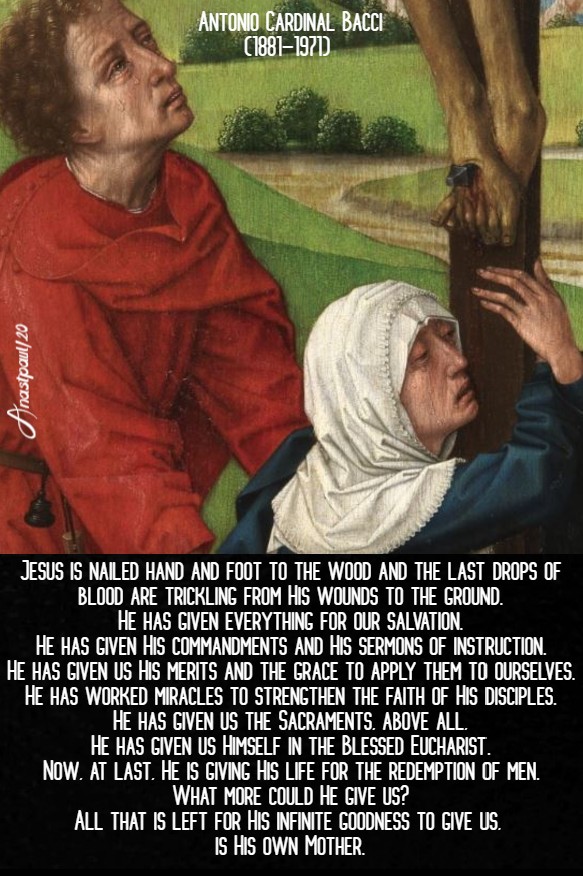
Jesus is nailed hand and foot to the wood and the last drops of blood are trickling from His wounds to the ground.
His thorn-crowned head has now nowhere to rest and the weight of His body is extending the wounds caused by the nails which hold it suspended between earth and sky.
He has given everything for our salvation.
He has given His commandments and His sermons of instruction.
He has given us His merits and the grace to apply them to ourselves.
He has worked miracles to strengthen the faith of His disciples.
He has given us the Sacraments, above all, He has given us Himself in the Blessed Eucharist.
Now, at last, He is giving His life for the redemption of men.
What more could He give us?
His eyes, misty with suffering, look down and see, near the Cross, the two beings whom He loves, even more than the rest.
His Mother Mary and the Apostle John.
All that is left for His infinite goodness to give us, is His own Mother.
He bestows on her, a last loving look and says: “Woman, behold thy son.”
Then, he turns to the beloved disciple. “Son,” He says, “behold thy mother.”
Now, He has surrendered everything, even His dearest affections.
According to the interpretation of the Fathers and of the Church, in John, we become, from that moment, the sons of Mary and Mary became our Mother.
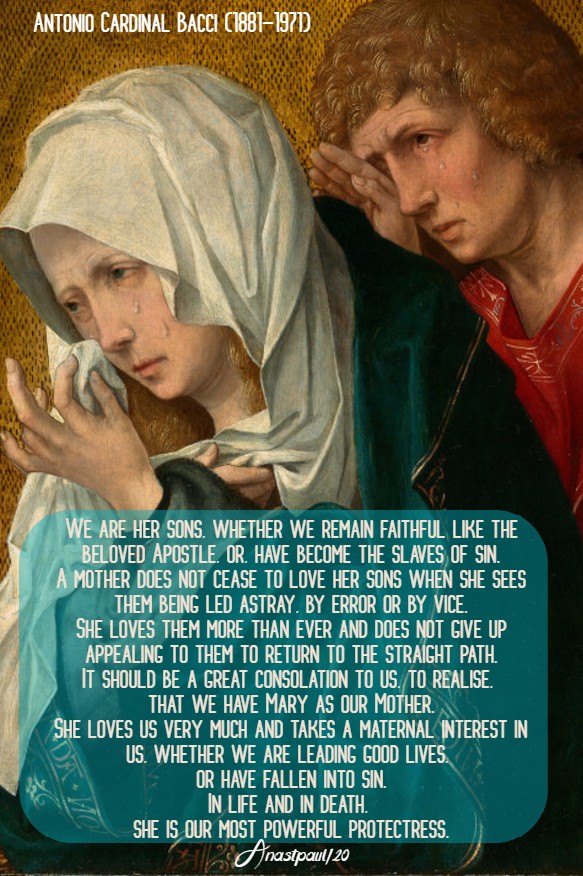
We are her sons, whether we remain faithful like the beloved Apostle, or, have become the slaves of sin.
A mother does not cease to love her sons when she sees them being led astray, by error or by vice.
She loves them more than ever and does not give up appealing to them to return to the straight path.
It should be a great consolation to us, to realise, that we have Mary as our Mother.
She loves us very much and takes a maternal interest in us, whether we are leading good lives, or have fallen into sin.
In life and in death, she is our most powerful protectress.”
Quote/s of the Day – 5 May – Tuesday of the Fourth Week of Easter, Readings: Acts11:19-26, Psalm 87:1-7, John 10:22-30
“I and the Father are one.”
John 10:30
Christians are baptised “in the name of the Father and of the Son and of the Holy Spirit” (Mt 28:30). Before receiving the sacrament, they respond to a three-part question when asked to confess the Father, the Son and the Spirit: “I do.” “The faith of all Christians rests on the Trinity”( St Caesarius of Arles). Christians are baptised “in the name” of the Father and of the Son and of the Holy Spirit – not “in their names,, for there is only one God, the almighty Father, His only Son and the Holy Spirit – the Most Holy Trinity.
The mystery of the Most Holy Trinity is the central mystery of Christian faith and life. It is the mystery of God in Himself. It is, therefore, the source of all the other mysteries of faith, the light that enlightens them. It is the most fundamental and essential teaching in the hierarchy of the truths of faith. The whole history of salvation is identical with the history of the way and the means, by which the one true God, Father, Son and Holy Spirit, reveals Himself to men and reconciles and unites with Himself, those who turn away from sin. …
The Trinity is a mystery of faith in the strict sense, one of the mysteries that are hidden in God, which can never be known unless they are revealed by God. To be sure, God has left traces of His Trinitarian Being in His work of creation and in His Revelation throughout the Old Testament. But His inmost Being, as Holy Trinity, is a mystery that is inaccessible to reason alone, or even to Israel’s faith before the Incarnation of God’s Son and the sending of the Holy Spirit.
CCC – Catechism of the Catholic Church
# 232-234, 237
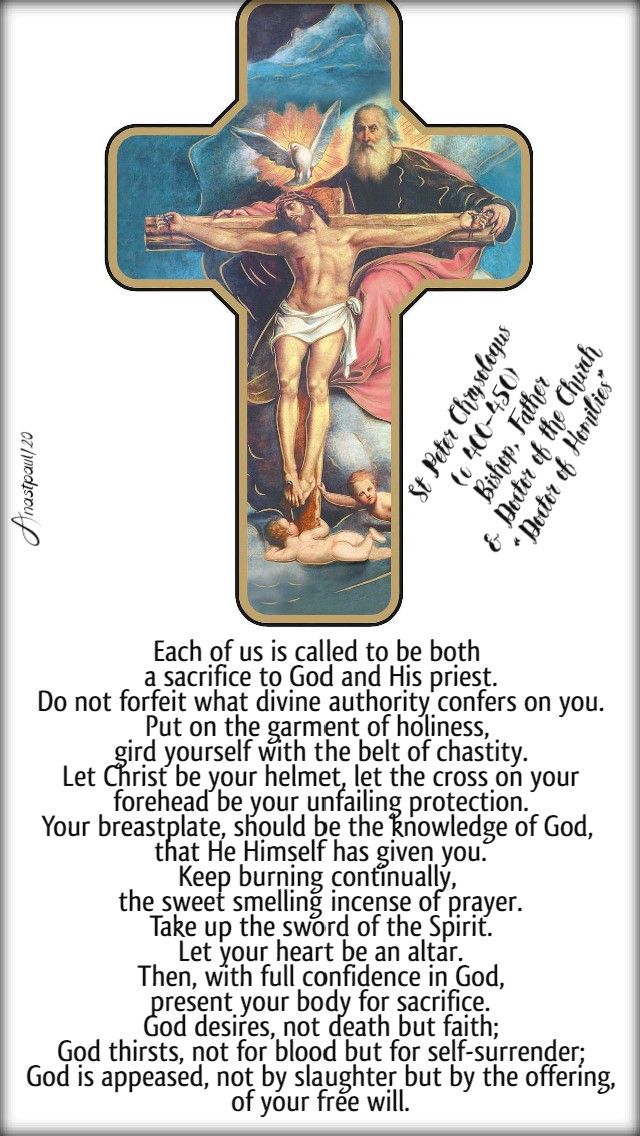
“Paul says: I appeal to you by the mercy of God, to present your bodies as a sacrifice, living and holy. The prophet said the same thing: Sacrifice and offering you did not desire but you have prepared a body for me. Each of us is called to be both a sacrifice to God and His priest. Do not forfeit what divine authority confers on you. Put on the garment of holiness, gird yourself with the belt of chastity. Let Christ be your helmet, let the cross on your forehead be your unfailing protection. Your breastplate, should be the knowledge of God, that He Himself has given you. Keep burning continually, the sweet smelling incense of prayer. Take up the sword of the Spirit. Let your heart be an altar. Then, with full confidence in God, present your body for sacrifice. God desires, not death but faith; God thirsts, not for blood but for self-surrender; God is appeased, not by slaughter but by the offering, of your free will.”
St Peter Chrysologus (c 400-450)
Bishop, Father & Doctor of the Church
“Doctor of Homilies”
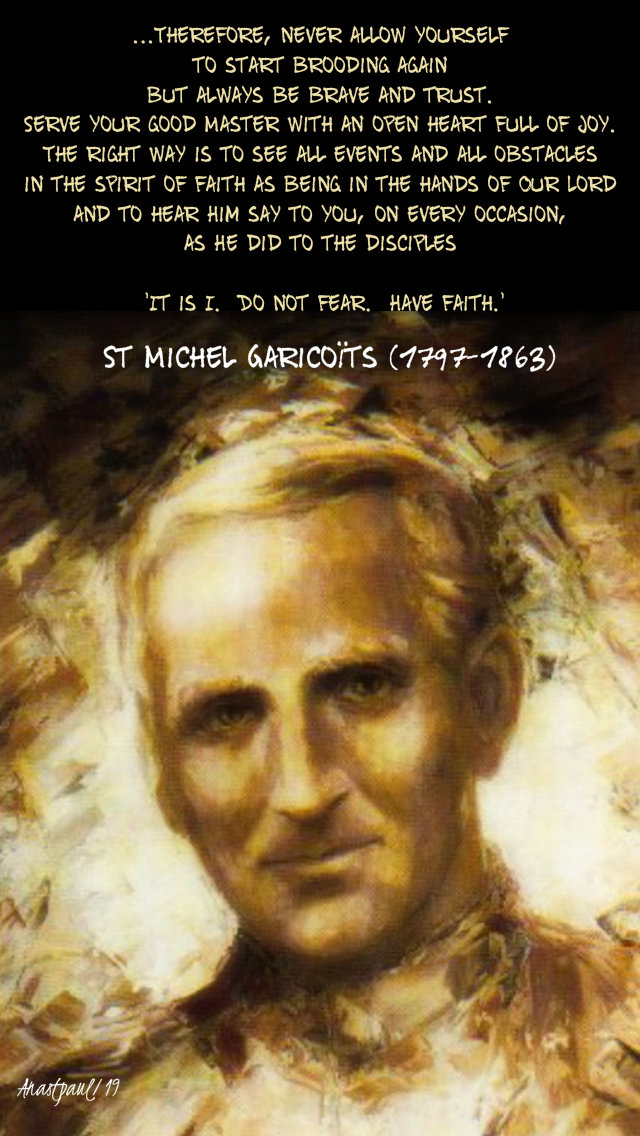
“…Therefore, never allow yourself to start brooding again but always be brave and trust. Serve your good Master with an open heart full of joy. The right way is to see all events and all obstacles in the spirit of faith as being in the hands of Our Lord and to hear Him say to you, on every occasion, as He did to the disciples ‘It is I. Do not fear. Have faith.’”
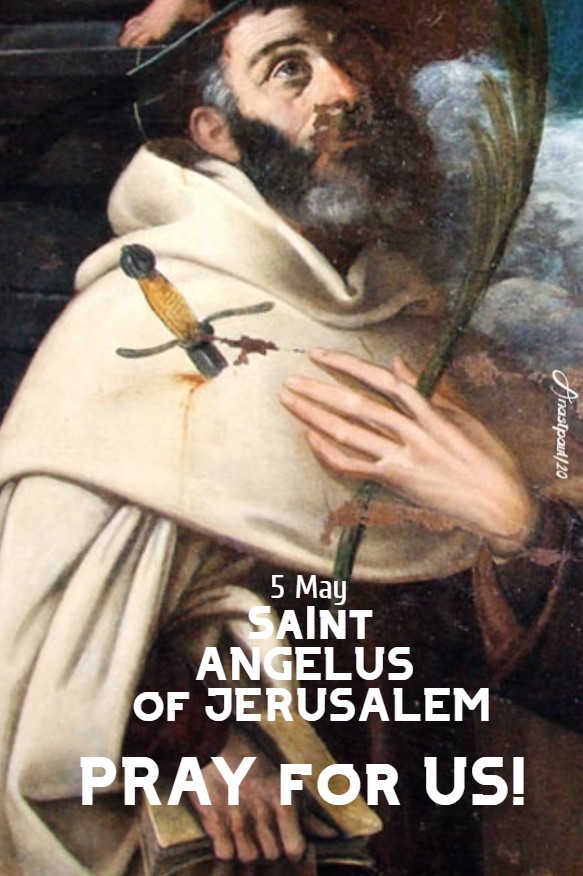
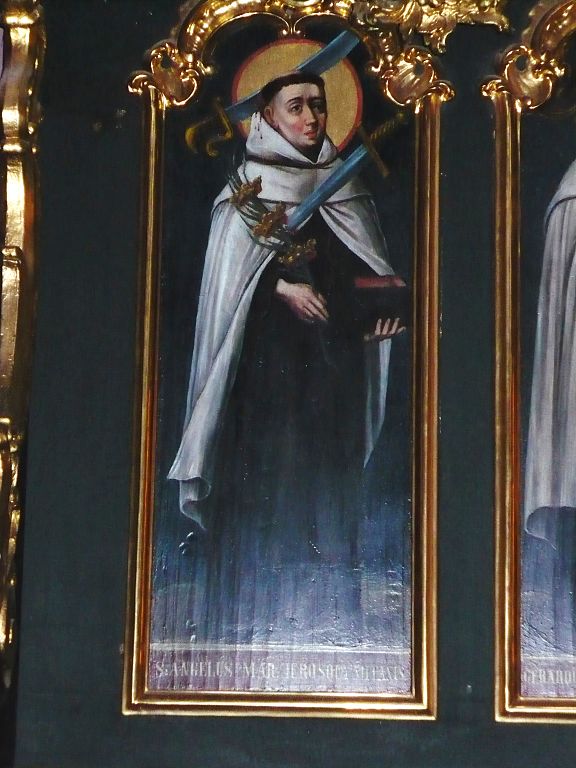
One Minute Reflection – 5 May – Tuesday of the Fourth Week of Easter, Readings: Acts11:19-26, Psalm 87:1-7, John 10:22-30 and the Memorial of St Angelus of Jerusalem O.Carm (1185-1220) Priest, Martyr
“My Father, who has given them to me, is greater than all and no-one is able to snatch them out of the Father’s hand..” … John 10:29
REFLECTION – “My sheep hear my voice and I know them and they follow me and I give them eternal life and they shall never perish and no-one shall snatch them out of the Father’s hand.” Did these sheep learn by following Jesus and then believe? No. “My Father, who has given them to me, is greater than all.” It is thus the Father, who gives the sheep to the shepherd, it is the Father, who draws hearts to Jesus.
And the humble prayer that we can say as daughters and sons is: ‘Father, draw me to Jesus, Father, lead me to know Jesus’ and the Father will send the Spirit to open our hearts and lead us to Jesus. Amen” … Pope Francis – Santa Marta, 19 April 2016
PRAYER – Lord God, grant Your people constant joy in the renewed vigour of their souls. They rejoice because You have restored them to the glory of Your adopted children, let them look forward gladly to the certain hope of the resurrection. Draw us constantly to Your son, Jesus, our Lord, teach us to know Him and may the prayers of our Blessed Mother and St Angelus of Jerusalem, who so zealously fought the good fight, be of assistance to us amidst the storms of this mortal life. We make our prayer through our Resurrected Christ, with the Holy Spirit, one God forever, amen, alleluia!
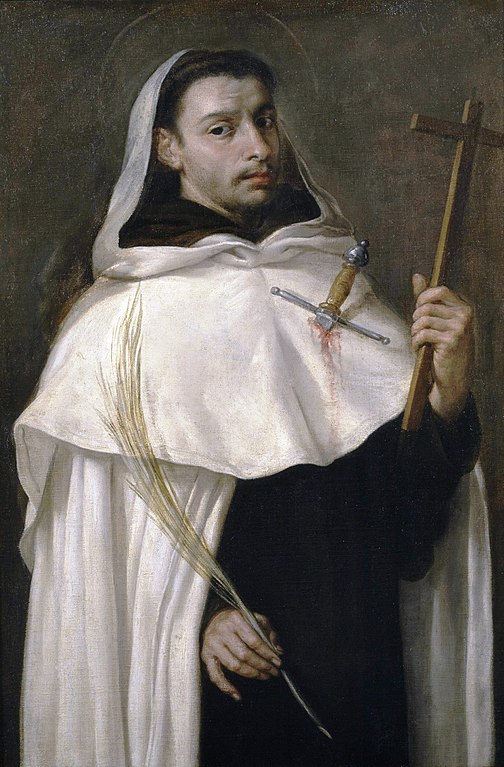
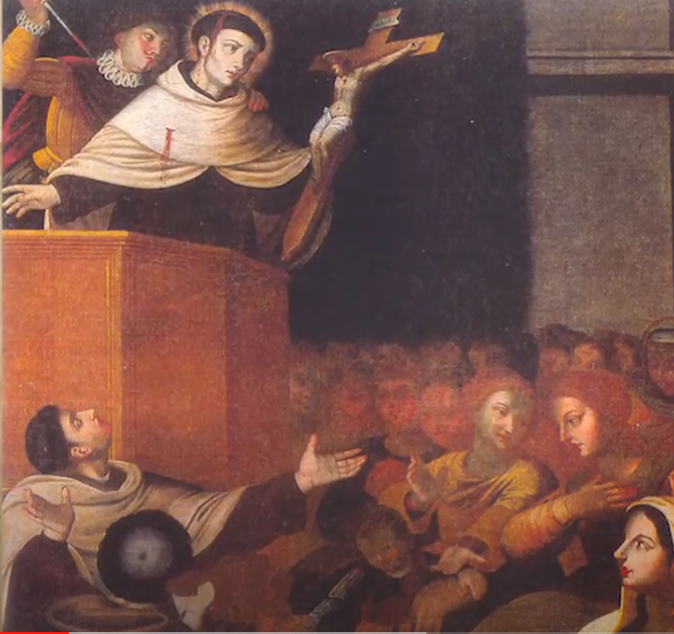
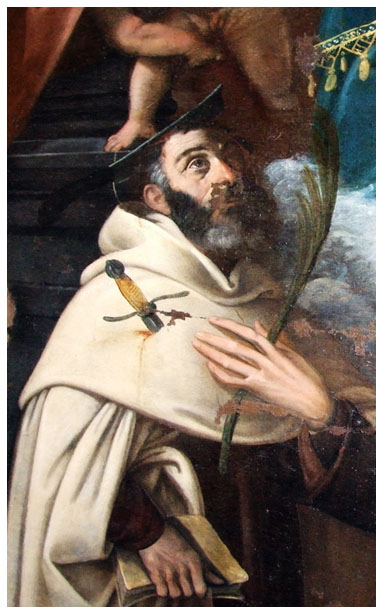
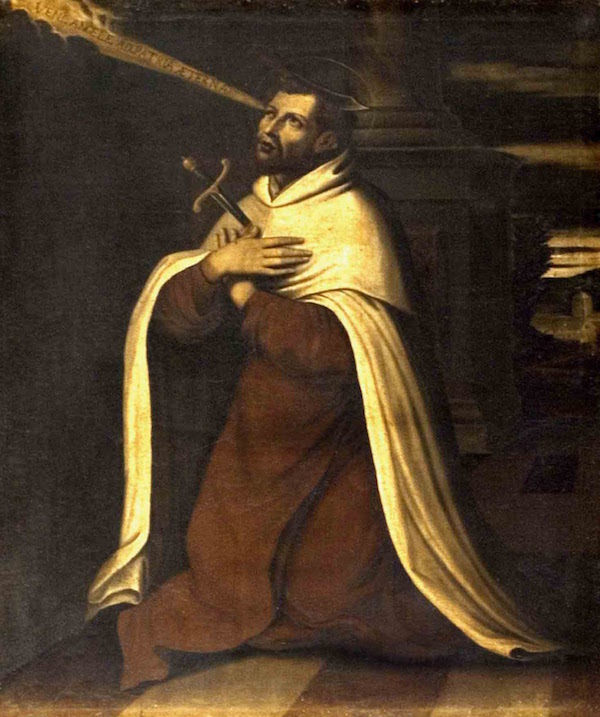
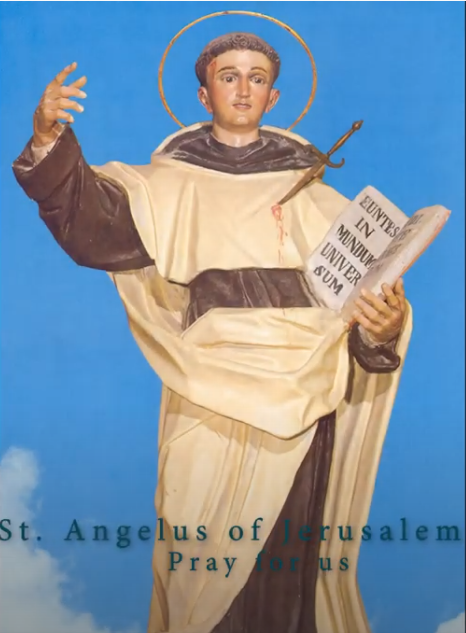
Saint of the Day – 5 May – Saint Angelus of Jerusalem O.Carm (1185-1220) Priest, Martyr, Hermit, Mystic, Reformer, Thaumaturge, Missionary, convert from Judaism and a professed Priest of the Order of the Brothers of the Blessed Virgin Mary of Mount Carmel – also known as St Angelus of Sicily and St Angelo. Born in 1145 at Jerusalem and died by being stabbed to death in 1220 at Licata, Sicily, Italy. Patronages – Palermo, Sicily, Licata and Sant’Angelo Muxaro, all in Italy. Today is the 800th Anniversary of his death.
St Angelus was born in Jerusalem to a Jewish family. His mother converted to Christianity and Angelo, along with his twin brother John, was Baptised and converted along with her. His parents died while he was in his childhood and the Patriarch Nicodemus oversaw their education until the twins turned eighteen. He and his brother John entered the Carmelites then, at the Saint Anne convent near the Golden Gate to commence their novitiate.
They were well learned and already spoke Greek, Latin and Hebrew. In 120, when he was twenty-six, Angelo was Ordained in Jerusalem and travelled throughout Palestine. Various miraculous cures were attributed to him as he travelled. His “Acta” tells us that he sought to avoid fame and when he was becoming known for his miracles, he withdrew from society to a hermitage to avoid the pilgrims who were following him. Angelus withdrew to a hermitage on Mount Carmel, until he was instructed by Christ in a vision, to leave Mount Carmel for Italy to preach against the Albigensians, Bulgars and other heresies.
He set off on a Genoese ship on 1 April 1219 and stopped first in Messina before heading off to Civitavecchia before he ended up in Rome to meet with the pope. The friar preached in the Basilica of Saint John Lateran while in Rome where he met both Saint Francis of Assisi and Saint Dominic. He foretold that Francis would receive the stigmata while Francis foretold his premature death.
From there he was a guest of the Basilians in Palermo where he was for about a month, before preaching in Agrigento for over a month before settling in Licata. He had healed seven lepers and the ailing Archbishop of Palermo Bernardo de Castanea while in Palermo. He settled on the Sicilian island though his fame as a wonderworker caused crowds to flock to him. He also had success in converting some Jews though most Jews in Palermo came to despise him for this since he himself was once Jewish.
He wanted to convert a Knight named Berenger. Catholic tradition states that Berenger was living in incest and that Angelo convinced the knight’s companion to leave him. Berenger became enraged and arranged to have him attacked and murdered, in front of the Church of Saints Filippo and Giacomo in Licata. He didn’t die from the attack until four days after the attack and during that time, he prayed for his assassin and asked the civil authorities to pardon him. He showed the ultimate in forgiveness, setting an example for all those that he preached to. He was buried at Saints Filippo and Giacomo Church. His sepulchre at Licata quickly became a site of Pilgrimage.
The Carmelites venerated him as a saint from 1456 and Pope Pius II Canonised him in 1459. His relics were translated to a new Church in Licata, Saint Maria del Carmine. It was through St Angelo’s intercession that the plague in the Kingdom of Naples was halted.
St Angelus of Jerusalem O.Carm (1185-1220) Priest, Martyr +2020 – The 800th Anniversary of his death
St Avertinus of Tours
Bl Benvenuto Mareni
St Britto of Trier Blessed Caterina Cittadini (1801-1857) Biography: https://anastpaul.com/2018/05/05/saint-of-the-day-5-may-blessed-caterina-cittadini-1801-1857/
St Crescentiana
St Echa of Crayke
St Eulogius of Edessa
St Euthymius of Alexandria
St Geruntius of Milan
St Godehard of Hildesheim
Bl Grzegorz Boleslaw Frackowiak
St Hilary of Arles
St Hydroc
St Irenaeus of Thessalonica
St Irenes of Thessalonica
Bl John Haile
St Jovinian of Auxerre
St Jutta Kulmsee
St Leo of Africo
St Maurontius of Douai
St Maximus of Jerusalem
St Nectarius of Vienne
St Nicetas of Vienne St Nunzio/Nuntius Sulprizio (1917-1836) Aged 19 St Nunzio’s very short life:
The Watchful Guardian of the Family
Moments with Saint Pope John XXIII (1881-1963)
“The family is a most precious gift.
Founded by divine decree on the differing and complementary characteristics of the husband and wife, it finds in the wife, a watchful guardian.
We beg women, therefore, to love the family, understood as the natural setting for the growth of the human personality and the God-given shelter in which the passions of life are soothed and sweetened, the stirrings of unruly desires are stilled and the influence of evil example opposed.
This sanctuary is threatened by so many insidious attacks.
Propaganda, at times unrestrained, makes use of the formidable power of the press, entertainments and of amusements, to scatter the fatal seeds of corruption, especially among our young people.
The family must defend itself and the women must play their part in this struggle, courageously, with a sense of their responsibility, never wearied of watching and correcting and teaching the difference between good and evil.
When necessary, they must avail themselves of the protection offered by the laws of the State.
The Gospel … records the words of an unknown woman …. “Blessed is the womb that bore you and the breasts that suckled you!” (Lk 11:28).
These words very rightly referred to Mary but the same might be said of all mothers, if their children, on the hard, rough ways of this life, know how to bear themselves like true Christians, in accordance with the teachings they have received.
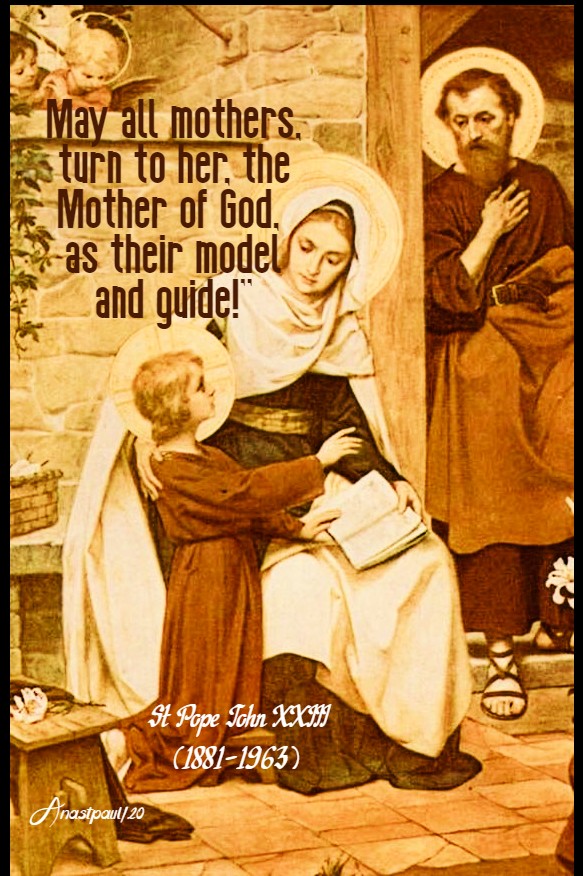
May all mothers, turn to her, the Mother of God, as their model and guide!”
Thought for the Day – 4 May – Meditations with Antonio Cardinal Bacci (1881-1971)
Mary, the Mother of God
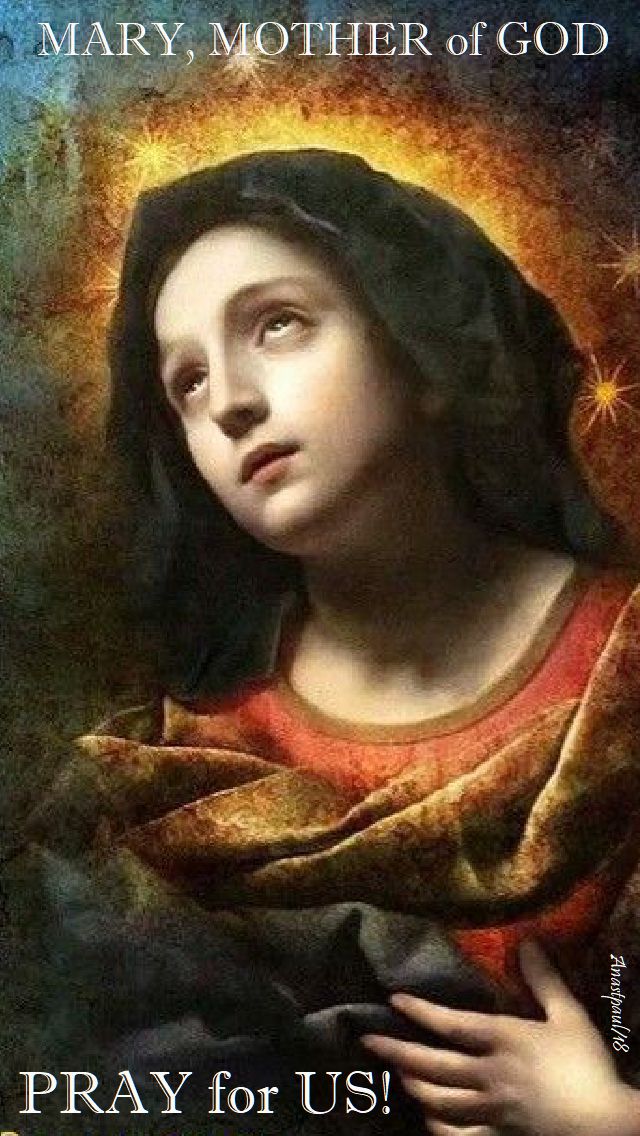
“The near-infinite greatness of Mary, flows from the fact, that she is the Mother of God. The Eternal Word of the Father, consubstantial with Him in nature and equal to Him in majesty, willed to become man in order to set us free from the slavery of sin and to regain Heaven for us. He became man in the chaste womb of the Virgin Mary. He took a human body and soul and was born of her, as the God-Man. For this reason, there is attributed to His Divine Person, the title of Son of Mary and to Mary, the title of Mother of God.
There is a relationship between Mary and each of the three Divine Persons, for she is the daughter of God the Father, the spouse of the Holy Spirit by whose power the Word became incarnate in her and the mother of the Word made Man. She is, moreover, in the words of Dante, the “termine fisso di eterno consiglio” (Paradiso 33:1-3). In other words, she is the centre of the eternal plan which God established for the redemption of the human race. It was God’s eternal design to reunite creation to the Uncreated, by means of Mary. She became the mother of the Eternal Word, in whom the divine and human natures were indissolubly united. He redeemed us by His infinite merits but, in this work of redemption, He employed the co-operation of His holy Mother. All the graces, privileges and virtues of Mary, flow from this great mystery of her divine Motherhood. As befitted the future Mother of God, she was conceived free from the stain of original sin and full of grace. Her mortal life was a continuous ascent towards the highest peak of sanctity. When she died, she was assumed body and soul into Heaven, where she was crowned in glory, as Queen of Angels and Queen of Saints. When we consider the sublime nobility of Our Lady, we should be moved to love and venerate her. This love and veneration does not subtract in the slightest from God’s glory, because, she is the Mother of God. In fact, it is a great advantage to us, to imitate her and to call on her to intercede for us.”
Quote/s of the Day – 4 May – Monday of the Fourth Week of Easter, Readings: Acts 11:1-18, Psalm 42:2-3; 43:3-4, John 10:11-18
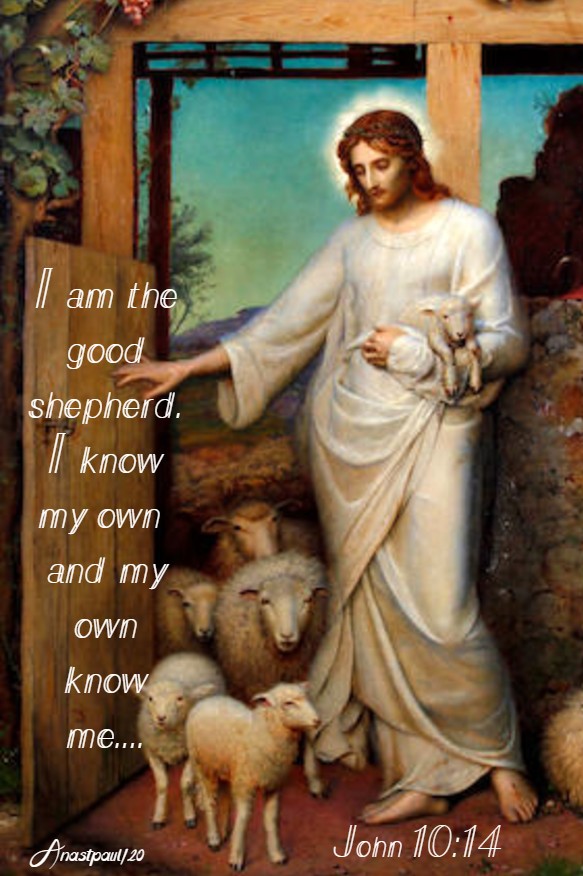
“I am the good shepherd. I know my own and my own know me….”
John 10:14
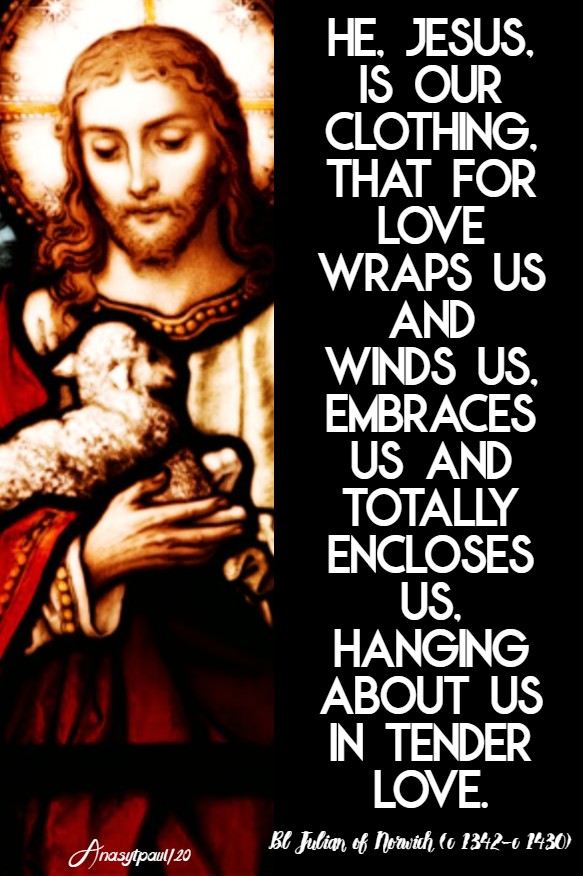
“He [ Jesus] is our clothing, that for love wraps us and winds us, embraces us and totally encloses us, hanging about us in tender love.”
Blessed Julian of Norwich (c 1342-c 1430)
God beholds me individually, whoever I am.
He “calls you by your name”.
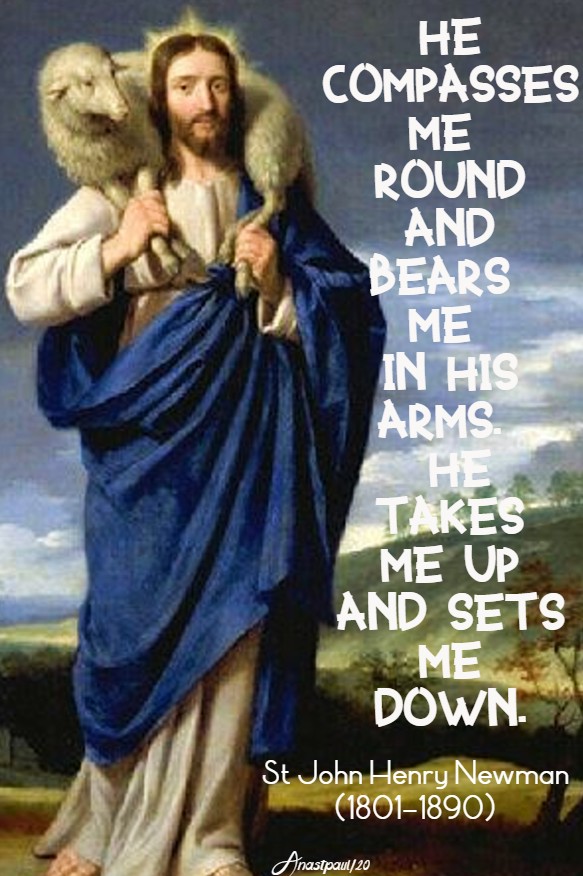
He sees me and understands me, as He made me. He knows what is in me, all my own peculiar feelings and thoughts, my dispositions and likings, my strength and my weakness. He views me in my day of rejoicing and my day of sorrow. He sympathises in my hopes and my temptations. He interests Himself in all my anxieties and remembrances, all the risings and fallings of my spirit. He has numbered the very hairs of my head and the cubits of my stature. He compasses me round and bears me in His arms. He takes me up and sets me down. He notes my very countenance, whether smiling or in tears, whether healthful or sickly. He looks tenderly upon my hands and my feet. He hears my voice, the beating of my heart and my very breathing. I do not love my self better than He loves me. I cannot shrink from pain more than He dislikes my bearing it and if He puts it on me, it is as I will put it on myself, if I am wise, for a greater good afterwards…
St John Henry Newman (1801-1890)
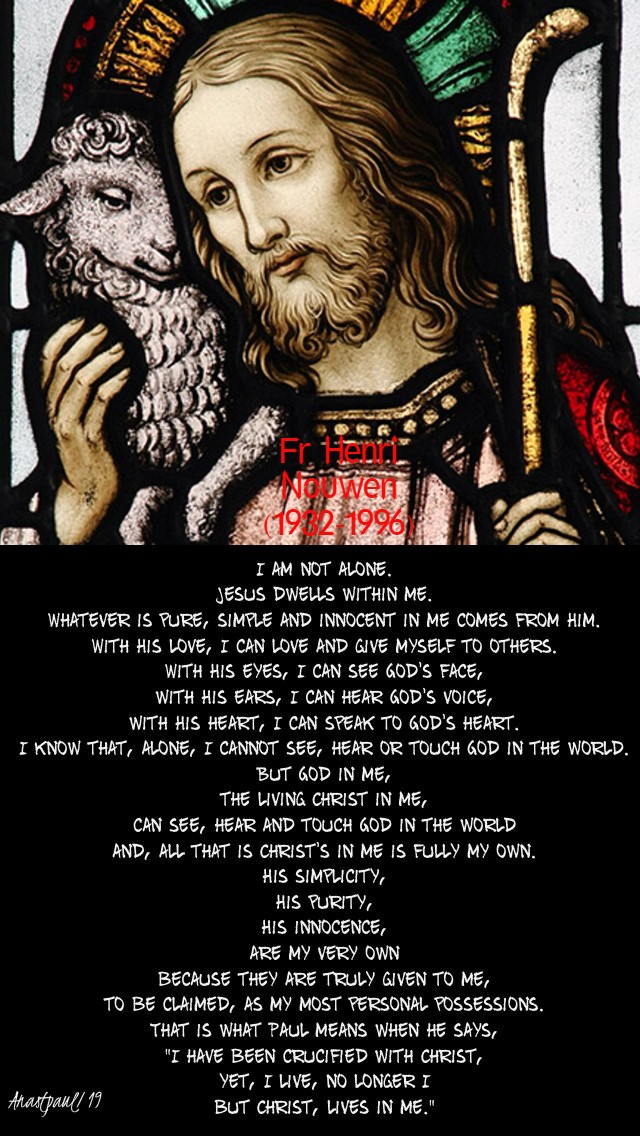
“I am not alone. Jesus dwells within me. Whatever is pure, simple and innocent in me comes from Him. With His love, I can love and give myself to others. With His eyes, I can see God’s face, with His ears, I can hear God’s voice, with His heart, I can speak to God’s heart. I know that, alone, I cannot see, hear or touch God in the world. But God in me, the living Christ in me, can see, hear and touch God in the world and, all that is Christ’s in me is fully my own. His simplicity, His purity, His innocence, are my very own because they are truly given to me, to be claimed, as my most personal possessions. That is what Paul means when he says, “I have been crucified with Christ, yet, I live, no longer I but Christ, lives in me.”
One Minute Reflection– 4 May – ‘Mary’s Month’ -Monday of the Fourth Week of Easter, Readings: Acts 11:1-18, Psalm 42:2-3; 43:3-4, John 10:11-18 and the Memorial of Blessed Tommaso da Olera
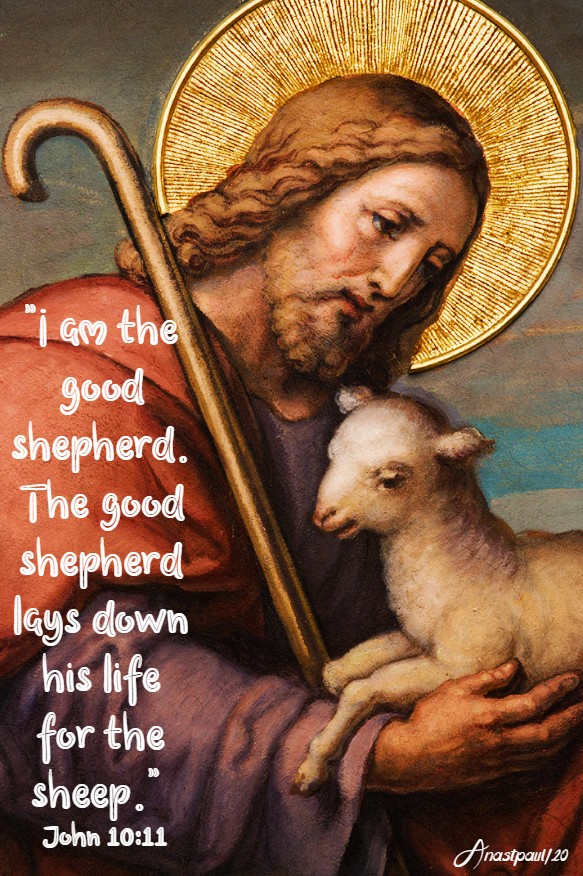
“I am the good shepherd. The good shepherd lays down his life for the sheep.” … John 10:11
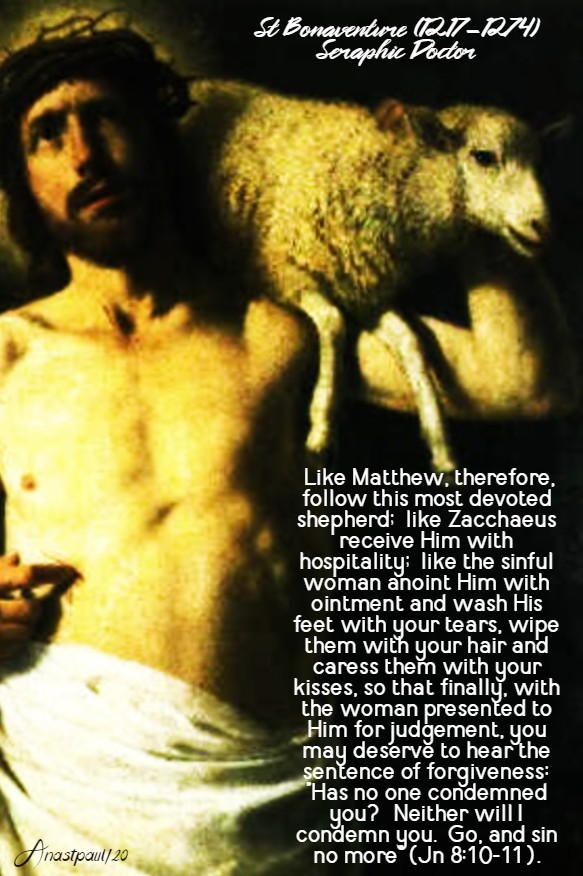
REFLECTION – “How great was this devoted shepherd’s solicitous care for the lost sheep and how great His mercy, the Good Shepherd Himself indicates with an affectionate metaphor in the parable of the shepherd and the hundredth sheep that was lost, sought with much care and finally found and joyfully brought back on His shoulders. He openly declares the same thing in an express statement when He says: “The good shepherd gives his life for his sheep” (Jn 10:11). In Him is truly fulfilled the prophecy: “Like a shepherd he will feed his flock” (Is 40:11).
In order to do this He endured toil, anxiety and lack of food, He travelled through towns and villages preaching the kingdom of God in the midst of many dangers and the plotting of the Pharisees and He passed the nights in watchful prayer. Fearless of the murmuring and scandal of the Pharisees, He was affable to the publicans, saying that He had come into the world for the sake of those who are sick (Mt 9:12). He also extended fatherly affection to the repentant, showing them the open bosom of divine mercy.
As witness to this, I call upon and summon Matthew, Zacchaeus, the sinful woman who prostrated herself at His feet and the woman taken in adultery. Like Matthew, therefore, follow this most devoted shepherd; like Zacchaeus receive Him with hospitality; like the sinful woman anoint Him with ointment and wash His feet with your tears, wipe them with your hair and caress them with your kisses, so that finally, with the woman presented to Him for judgement, you may deserve to hear the sentence of forgiveness: “Has no one condemned you? Neither will I condemn you. Go, and sin no more” (Jn 8:10-11).” … St Bonaventure (1217-1274) Seraphic Doctor – The Tree of Life
PRAYER – Almighty God and Father, You have rescued Your faithful from enslavement to sin, by Your Son’s self-abasement. You have raised up the world through His suffering. Fill us now with holy joy at His rising and triumph. Let us hear His voice and follow Him to everlasting life. Blessed Tommaso da Olera, you truly became a shepherd to the lowly and might, pray for us! Our Lady Mother of our God, stay with us on our way. Through Christ our Lord, with the Holy Spirit, God now and forever, amen.
Our Morning Offering – 4 May – ‘Mary’ Month’ -Monday of the Fourth Week of Easter
O Lady, I Call upon You By St Bernard (1090-1153) Doctor of the Church
Run, hasten, O Lady,
and in your mercy help your sinful servant,
who calls upon you,
and deliver him from the hands of the enemy.
Who will not sigh to you?
We sigh with love and grief,
for we are oppressed on every side.
How can we do otherwise than sigh to you,
O solace of the miserable,
refuge of outcasts,
ransom of captives?
We are certain that when you see our miseries,
your compassion will hasten to relieve us.
O our sovereign Lady and our Advocate,
commend us to your Son.
Grant, O blessed one,
by the grace which you have merited,
that He, who through you,
was graciously pleased to become a partaker
of our infirmity and misery,
may also, through your intercession,
make us partakers, of His happiness and glory.
Amen
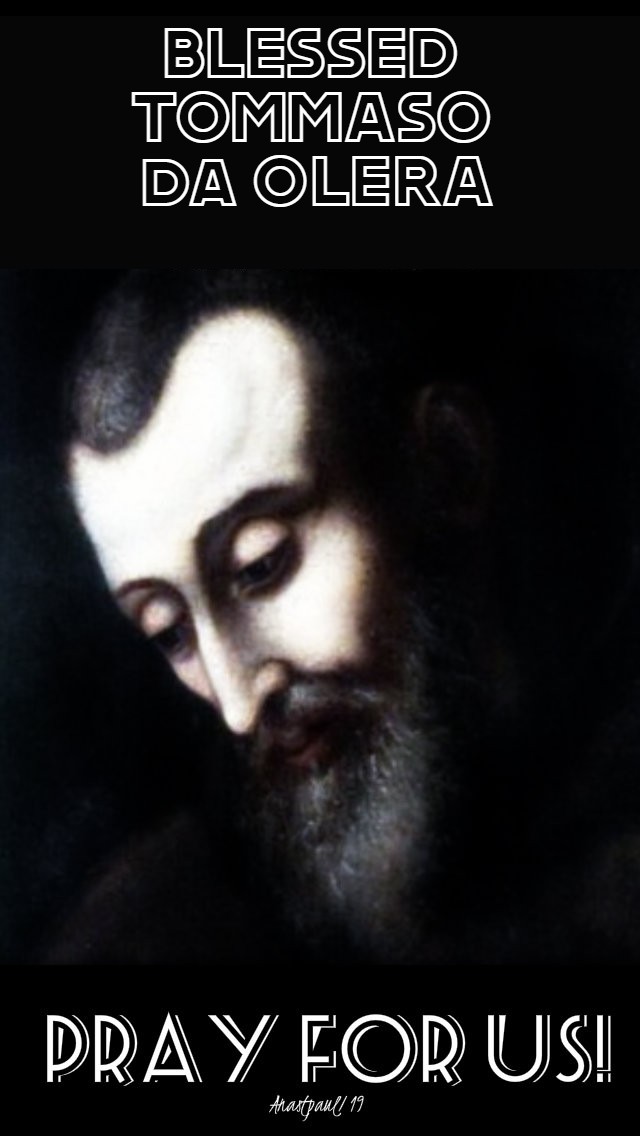
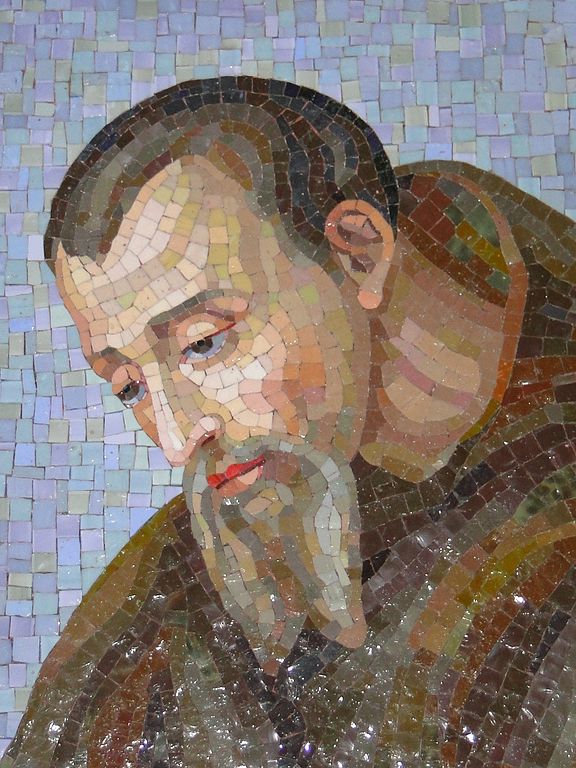
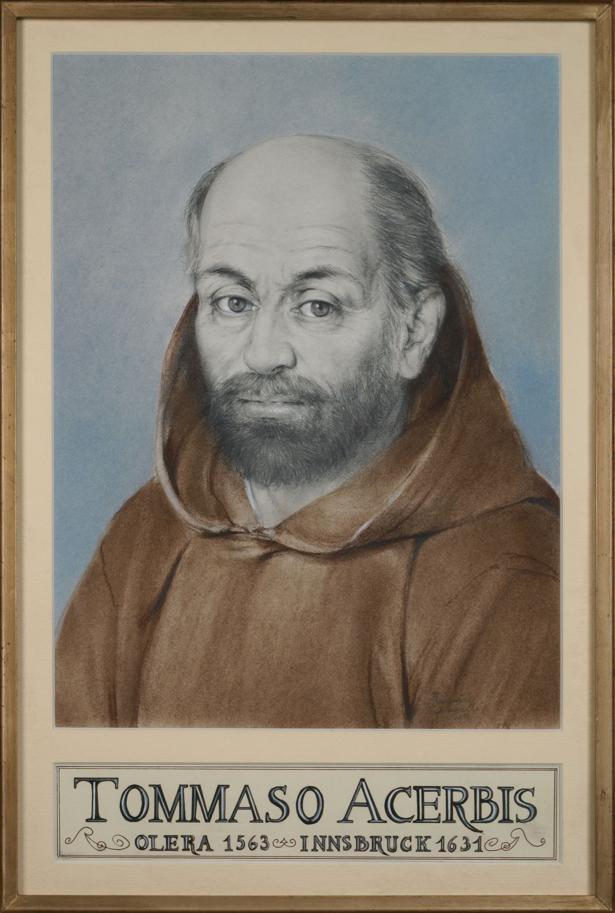
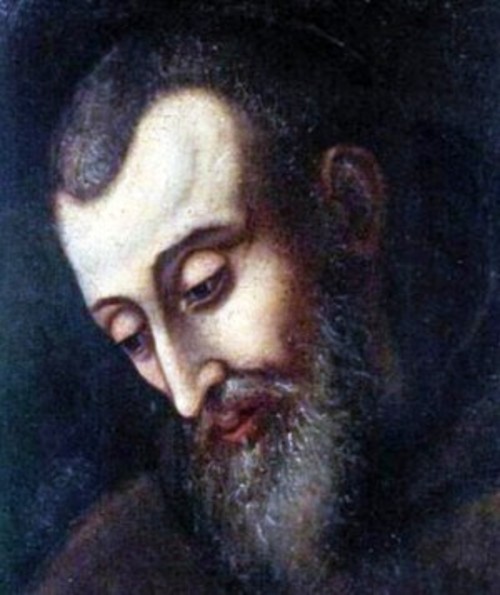
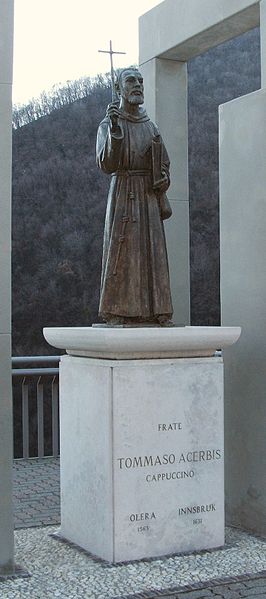
Saint of the Day – 4 May – Blessed Tommaso da Olera OFM Cap (1563-1631) Lay Brother of the the Order of Friars Minor Capuchin, Spiritual Advisor, Confessor, Apostle of Charity, Writer, Mystic, Penitent and Ascetic. He was born Tommaso Acerbis in 1563 in Olera, Bergamo, Milan and died on 3 May 1631 in Innsbruck, Austria. Blessed Tommaso lived as a Franciscan porter and alms-seeker and as a religious who provided Spiritual advice and consolation to many nobility that included Leopold V and his wife.
Of the time of his birth at the end 1563 in Olera, a small village at the mouth of the Serio river and of his childhood, we do not know much. The child of peasants and shepherds, until age seventeen he was a peasant and shepherd himself, helping his parents in their work. Illiterate because the small village lacked schools, he wanted to become a Capuchin Friar and was received on 12 September 1580 at the friary of Santa Croce di Cittadella in Verona, becoming a lay friar of the Province of Venice. There he sought and obtained, although a lay friar, to learn to read and write. Living in the school and the choir with great intensity, his remarkable qualities and above all his virtues came to light during the three years of formation.
Tommaso flourished in his vocation and advanced quickly in the spiritual life. He made his religious profession on 5 July 1584 and was charged with the delicate and essential service of alms-seeking in Verona. He carried this out until 1605 when he was transferred to Vicenza with the same assignment. There he remained until 1612 before being in Rovereto from 1613 to 1617. The humble friar’s daily tasks included washing pots, collecting alms and visiting the sick but he also joyfully shared the Gospel with everyone he met. His reputation for holiness spread quickly and in 1619 Archduke Leopold V of Austria requested Tommaso’s assistance in confronting the spread of Lutheranism. Barely literate, Tommaso avoided disputation. Instead, with great success, he simply witnessed to Christ’s impassioned love for His Church. At the time Austria was the ‘bridgehead’ for the Catholic reform and above all the ‘Catholic reconquest’ of the German lands.
Obedience and humility made him the ‘begging brother’ for almost fifty years, love for souls made him a ‘tireless apostle’ in proclaiming the Gospel. With everyone, believer or not, he spoke of the love of God revealed in Jesus Christ. He taught the faith to all, the little and the great. He asked everyone, the great and the humble, to commit themselves to love. A true apostle, many “were astounded and it seemed humanly impossible that a simple lay friar should speak, as he spoke, in such an elevated way about God.” His commitment was a fire of love. “Everywhere he spoke of the things of God with such spirit and devotion that everyone was put in awe and wonder.” At the same time, he invited and urged peacemaking and forgiveness, he visited and comforted the sick, he listened to and encouraged the poor; reading consciences, he denounced evil and facilitated conversions. In order to obtain from God what he envisaged for those he met, he stayed awake at night in prayer, scourging his body, imposing fasts and austerities on himself for the salvation of others.
Br Thomas was also a promoter of vocations to consecrated life. In Vicenza he sponsored the erection of the Monastery of the Capuchin Poor Clares, built at Porta Nuova in 1612-13. At Rovereto he sought from the commissioners of the city a Poor Clare monastery, which was then built in 1642. There he met and guided the thirteen-year old Bernardina Floriani, who would become the mystic Venerable Giovanna Maria della Croce.
In Tyrol he was the spiritual guide of the poor of the Inn Valley, catechist and promoter and defender of the Tridentine decrees for a true Catholic reform.
From 1617 he was friend and spiritual director to the scientist Ippolito Guarinoni of Hall,
Court Physician in Innsbruck. There are also many letters written to the Archduchesses Maria Cristina of Habsburg and Eleonora, sister of Leopold V, as there were also many personal encounters with them. Br Thomas was Spiritual Guide to Leopold and to his wife Claudia de’ Medici, with frequent meetings at the palace and many letters.
To all he taught that “high wisdom of love” that “one learns from the precious wounds of Christ,” urging them to take refuge in “happiness in suffering.” He also counselled Archbishop Paris von Lodron, Prince of Salzburg and Spiritual Director of Emperor Ferdinand II, staying at his side during the Thirty Years’ War (1618-48). During his stay in Vienna (1620-1621), Br Thomas assisted the conversion to the Catholic faith of Eva Maria Rettinger, widow of George Fleicher, count of Lerchenberg, who then entered Nonnberg Abbey as a Benedictine nun and became Abbess. Still at Vienna, in 1620, he drafted the “moral concepts against the heretics,” published posthumously in Fire of Love.Here the source from which his writing was drawn is revealed: “I have never read a syllable of books but I strive to read the suffering Christ.”
Despite the studies completed with fervour and diligence during the years of the novitiate in Verona, his Italian remained elementary and ungrammatical. And yet, his writings reveal a surprising spiritual profundity and doctrinal exactness. A fellow friar, Ilarione from Mantova, noted in this regard: “I saw him many times after communion retire to his cell and write meditational pieces on the life and passion of the Lord and, having sometimes read me these spiritual works of his after having written them, he confidently affirmed [….] that he could not himself understand how he could have put those things on paper.” This book was among St Pope John XXIII’s favourite spiritual works, speaking of Bl Tommaso as“a saint and a true master of the spirit” and the Pontiff had portions of it read to him on his death bed. St Pope Paul VI also spoke of him with high esteem.
Love for Our Lady in his writings recognises, among other things, her Immaculate Conception (Dogma 1854) and Assumption (Dogma 1950), hundreds of years before these Dogmas were promulgated. He made pilgrimage to the Holy House of Loreto three times (1623, 1625, 1629), recalling that “arriving at the that Holy House, I seemed to be in paradise.”
To his friend Ippolito Guarinoni, he pointed out a location near Hall, at the Volders bridge on the Inn river, such that a church dedicated to the Immaculate Conception should be built there. In 1620 the foundations were laid and, many criticisms and difficulties having been overcome, the church was completed in 1654. It was the first church on German-speaking land dedicated to the Immaculate Conception and St Charles Borromeo. Even today it is considered an Austrian national monument.
Many who were present at his death, which came on 3 May 1631, considered it a ‘death of love.’ He was buried on Sunday, 5 May in the crypt of the chapel of Our Lady in the Capuchin church in Innsbruck.
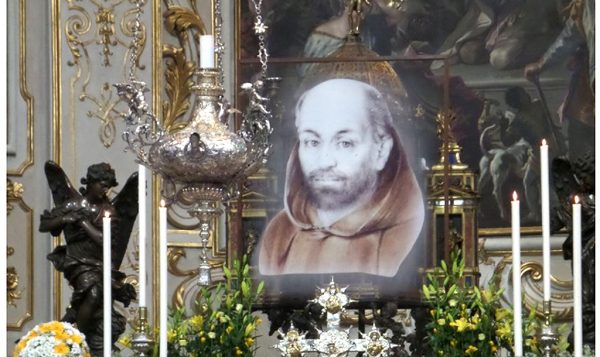
Bl Tommaso’s Shrine in Innsbruck
It took another 356 years before St Pope John Paul II proclaimed the friar Venerable in 1987. Pope Benedict XVI authorised Tommaso’s Beatification in 2012 and the Beatification Mass was finally celebrated by Cardinal Angelo Amato on behalf of Pope Francis in 2013.
St Albian of Albée
Bl Angela Bartolomea dei Ranzi
Bl Angela Isabella dei Ranzi
St Antonia of Constantinople
St Antonina of Nicaea
St Antonia of Nicomedia
St Antonius of Rocher
St Arbeo of Freising
St Augustine Webster
St Cunegund of Regensburg
St Curcodomus of Auxerre
St Cyriacus of Ancona
St Enéour
St Ethelred of Bardney
St Florian of Lorch
Bl Hilsindis Bl Jean-Martin Moyë (1730-1793) Biography: https://anastpaul.wordpress.com/2018/05/04/saint-of-the-day-4-may-blessed-jean-martin-moye-1730-1793/
St Judas Cyriacus
Bl Ladislas of Gielniów
St Luca da Toro
Bl Margareta Kratz
Bl Michal Giedroyc
St Nepotian of Altino
Bl Paolino Bigazzini
St Paulinus of Cologne
St Paulinus of Senigallia
St Pelagia of Tarsus
St Porphyrius of Camerino Rino
St Richard Reynolds
St Robert Lawrence
St Silvanus of Gaza Bl Tommaso da Olera OFM Cap (1563-1631)
—
Carthusian Martyrs: A group of Carthusian monks who were hanged, drawn and quartered between 19 June 1535 and 20 September 1537 for refusing to acknowledge the English royalty as head of the Church:
• Blessed Humphrey Middlemore
• Blessed James Walworth
• Blessed John Davy
• Blessed John Rochester
• Blessed Richard Bere
• Blessed Robert Salt
• Blessed Sebastian Newdigate
• Blessed Thomas Green
• Blessed Thomas Johnson
• Blessed Thomas Redyng
• Blessed Thomas Scryven
• Blessed Walter Pierson
• Blessed William Exmew
• Blessed William Greenwood
• Blessed William Horne
• Saint Augustine Webster
• Saint John Houghton
• Saint Robert Lawrence
Martyrs of Cirta: Also known as
• Martyrs of Cirtha
• Martyrs of Tzirta
A group of clergy and laity martyred together in Cirta, Numidia (in modern Tunisia) in the persecutions of Valerian. They were – Agapius, Antonia, Emilian, Secundinus and Tertula, along with a woman and her twin children whose names have not come down to us.
Martyrs of England: 85 English, Scottish and Welsh Catholics who were martyred during the persecutions by Protestants in the 16th and 17th centuries. They are commemorated together on 22 November.
• Blessed Alexander Blake • Blessed Alexander Crow • Blessed Antony Page • Blessed Arthur Bell • Blessed Charles Meehan • Blessed Christopher Robinson • Blessed Christopher Wharton • Blessed Edmund Duke • Blessed Edmund Sykes • Blessed Edward Bamber • Blessed Edward Burden • Blessed Edward Osbaldeston • Blessed Edward Thwing • Blessed Francis Ingleby • Blessed George Beesley • Blessed George Douglas • Blessed George Errington • Blessed George Haydock • Blessed George Nichols • Blessed Henry Heath • Blessed Henry Webley • Blessed Hugh Taylor • Blessed Humphrey Pritchard • Blessed John Adams • Blessed John Bretton • Blessed John Fingley • Blessed John Hambley • Blessed John Hogg • Blessed John Lowe • Blessed John Norton • Blessed John Sandys • Blessed John Sugar • Blessed John Talbot • Blessed John Thules • Blessed John Woodcock • Blessed Joseph Lambton • Blessed Marmaduke Bowes • Blessed Matthew Flathers • Blessed Montfort Scott • Blessed Nicholas Garlick • Blessed Nicholas Horner • Blessed Nicholas Postgate • Blessed Nicholas Woodfen • Blessed Peter Snow • Blessed Ralph Grimston • Blessed Richard Flower • Blessed Richard Hill • Blessed Richard Holiday • Blessed Richard Sergeant • Blessed Richard Simpson • Blessed Richard Yaxley • Blessed Robert Bickerdike • Blessed Robert Dibdale • Blessed Robert Drury • Blessed Robert Grissold • Blessed Robert Hardesty • Blessed Robert Ludlam • Blessed Robert Middleton • Blessed Robert Nutter • Blessed Robert Sutton • Blessed Robert Sutton • Blessed Robert Thorpe • Blessed Roger Cadwallador • Blessed Roger Filcock • Blessed Roger Wrenno • Blessed Stephen Rowsham • Blessed Thomas Atkinson • Blessed Thomas Belson • Blessed Thomas Bullaker • Blessed Thomas Hunt • Blessed Thomas Palaser • Blessed Thomas Pilcher • Blessed Thomas Pormort • Blessed Thomas Sprott • Blessed Thomas Watkinson • Blessed Thomas Whitaker • Blessed Thurstan Hunt • Blessed William Carter • Blessed William Davies • Blessed William Gibson • Blessed William Knight • Blessed William Lampley • Blessed William Pike • Blessed William Southerne • Blessed William Spenser • Blessed William Thomson •
They were Beatified on 22 November 1987 by Pope John Paul II.
Martyrs of Novellara: A bishop and several his flock who were martyred together in the persecutions of Diocletian and whose relics were kept and enshrined together. We know nothing else about them but the names – Apollo, Bono, Cassiano, Castoro, Damiano, Dionisio, Leonida, Lucilla, Poliano, Tecla, Teodora and Vespasiano. They were Martyred on 26 March 303. Their relics were enshrined in the parish of Saint Stephen in Novellara, Italy in 1603.
The Sweet Name of Mary
Moments with Saint Pope John XXIII (1881-1963)
“We are in the month of Mary – what could be found more beautiful and more encouraging, than a visit to the altar of Mary, there to join our voices with the songs of spring, with the birds of the air, the murmur of the wind, the blossoming of nature and above all, with the chants of those innocent children of our families?
Nothing is more joyful than this vision of youth, which is the promises of a sure future and an augury and fountain of blessings, because, pure young people who have flowered in innocence, are the pledge of the Lord’s most wonderful graces.
The Pope recalls his Lenten visits to some parishes of his Diocese of Rome, in newly built areas. He knew then, that all felt in their innermost hearts, the sweetness of this meeting of Christians and welcomed the Pope’s endeavour to bring to everyone, the name of Mary and the blessing of Jesus, to describe to them and recall to their minds, the great wonders and miracles, which, by the Lord’s grace, the Catholic faith and the practice of virtue, bring into the world.
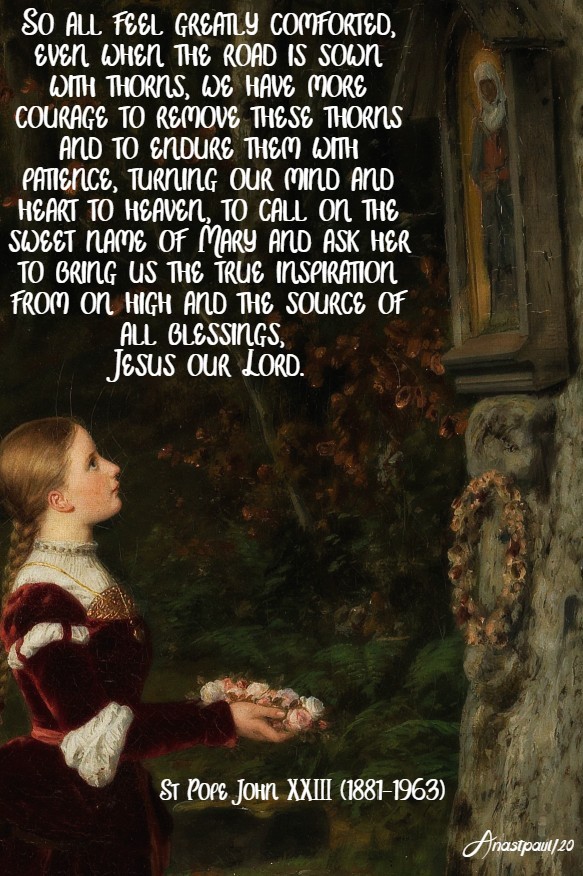
So all feel greatly comforted, even when the road is sown with thorns, we have more courage to remove these thorns and to endure them with patience, turning our mind and heart to heaven, to call on the sweet name of Mary and ask her to bring us the true inspiration from on high and the source of all blessings, Jesus our Lord.”
Thought for the Day – 3 May – Meditations with Antonio Cardinal Bacci (1881-1971)
The Imitation of Mary
“Earthly mothers are delighted when they see a reflection of themselves in the features and mannerisms of their children. In the same way, Mary, our Heavenly Mother, is pleased when her sons seek to reproduce, as far as possible, in their lives, the faithful imprint of her spiritual motherhood. We should imitate Mary, therefore. Especially in this month, which is dedicated to her, we should not be content, merely, to pray before her altar and decorate it with flowers but, we should make daily progress in imitating her virtues, particularly, the virtue which we need most. We may be lacking in humility, that virtue which is so outstanding in Our Lady. Or perhaps we are lacking in purity, the most difficult yet, the most necessary of all the virtues. Then again, we may be wanting in acceptance of God’s will when we are suffering or misunderstood. We should try and do God’s will in everything and with perfect trust in Him, as Mary did at Nazareth and Bethlehem, in exile and in her own country, in her humble home and on the apostolic journeys in which she followed her divine Son, on the sorrowful way of the Cross, on Calvary, at the feet of Jesus, at the Resurrection and glorious Ascension and in the years in which she waited on earth for the final loving reunion in Heaven. Let us repeat with her always: “Be it done to me according to thy word” (Lk 1:38). There is a story told about a holy man who prayed to Mary in all his difficulties: “Show yourself to be my mother.” One day, he heard the reply: “Show yourself to be my son.” Mary says this to us as well. If we wish her to prove that she is our mother, we must show her, that we are really her sons, by mirroring in our lives, her outstanding sanctity.”
Quote/s of the Day – 3 May – The Fourth Sunday of Easter, Vocations/Good Shepherd Sunday and the Memorial of Blessed Edoardo Giuseppe Rosaz (1877-1903)
The charism of Blessed Rosaz is a wonderful example of a model of the Good Shepherd, Christ Himself. Bl Edoardo had the gift of the Holy Spirit placed in his heart as a man, a Priest, a Bishop in love with God, the saving mystery of Christ and the Holy Virgin. This charism emerged as a consequence of his being “consecrated” totally to the glory of God and the salvation of souls. It stems from his “Do all, so as to win over all to Christ” (Cf 1 Cor 9:19) and from his passion for the poor – the image of the poor and suffering Christ.
“We have the Providential love of God as our guide. When there is a ship at sea and heads towards the port, nobody doubts that it is led by a pilot and one could doubt that there is a God who guides the universe only because He cannot be seen? By His Providential Love, God arranges and regulates events, regulates everything, with gentleness and wisdom. I advise you to abandon yourself completely into the hands of Divine Providence. “
“Prayer is the rest of the soul, the refreshment of those who are hungry and thirsty for justice; it is the sweet conversation of a son with the most tender of fathers; of a friend with the most fond of friends; prayer is the strength, the comfort, the happiness of life on earth. “
Sunday Reflection – 3 May – The Fourth Sunday of Easter, Good Shepherd/Vocations Sunday
How long have we been without Sunday Mass? How much longer will this continue? How are we holding on? How are we surviving?
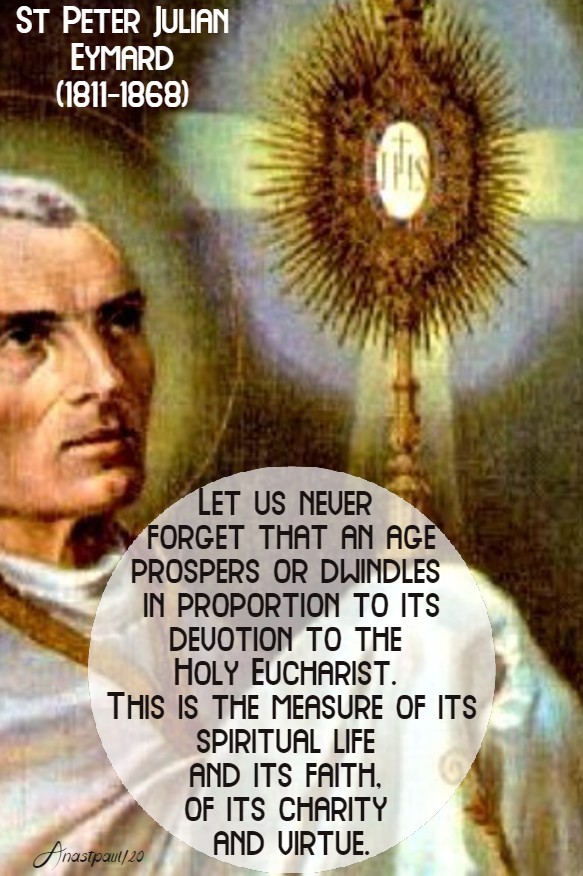
“Let us never forget that an age prospers or dwindles in proportion to it’s devotion to the Holy Eucharist. This is the measure of it’s spiritual life and it’s faith, of it’s charity and virtue”
St Peter Julian Eymard (1811-1868)
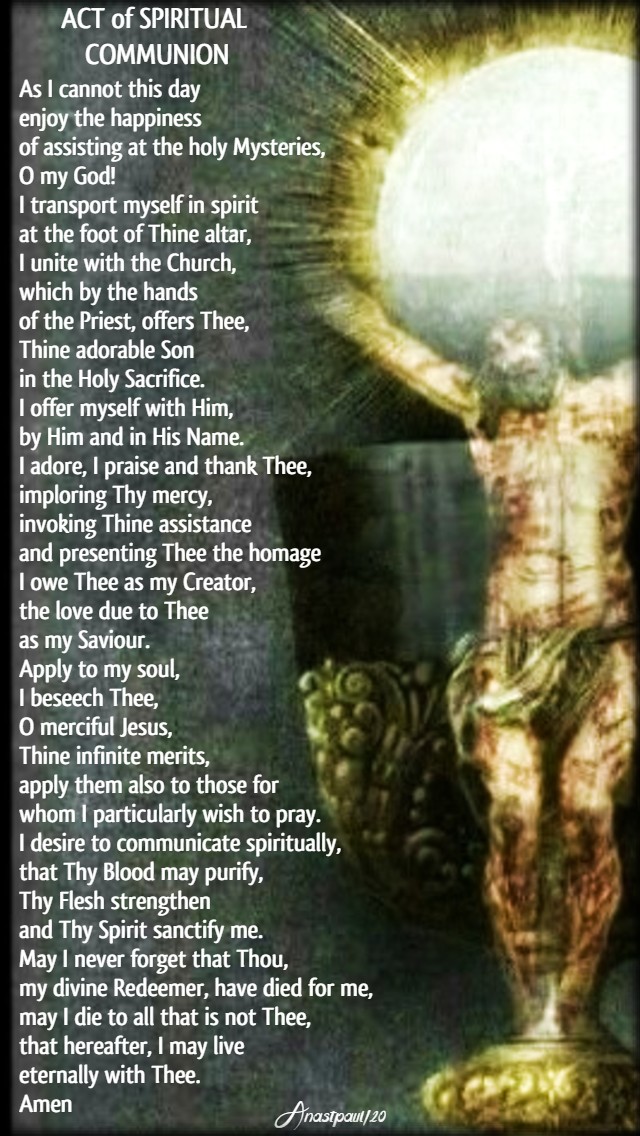
Act of Spiritual Communion
As I cannot this day enjoy the happiness
of assisting at the holy Mysteries, O my God!
I transport myself in spirit at the foot of Thine altar,
I unite with the Church, which by the hands of the priest,
offers Thee, Thine adorable Son in the Holy Sacrifice.
I offer myself with Him, by Him and in His Name.
I adore, I praise and thank Thee,
imploring Thy mercy,
invoking Thine assistance
and presenting Thee the homage
I owe Thee as my Creator,
the love due to Thee as my Saviour.
Apply to my soul, I beseech Thee, O merciful Jesus,
Thine infinite merits,
apply them also to those for whom I particularly wish to pray.
I desire to communicate spiritually,
that Thy Blood may purify,
Thy Flesh strengthen
and Thy Spirit sanctify me.
May I never forget that Thou,
my divine Redeemer, have died for me,
may I die to all that is not Thee,
that hereafter, I may live eternally with Thee.
Amen
“[Our time] is a period in which the world is in crisis, as formerly and in which most values, even the most sacred ones, are rashly questioned in the name of freedom, so that many people have no longer any point of reference, in a period in which danger comes certainly not from an excess of dogmatism but rather from the dissolution of doctrine and the nebulousness of thought… It seems to Us that an additional effort should be courageously undertaken to give the Christian people, who are waiting for it more than is thought, a solid, exact catechetical base, easy to remember. We well understand that it is difficult today to adhere to the Faith, particularly for the young, a prey to so many uncertainties. They have the right at least to know precisely the message of Revelation, which is not the fruit of research and to be the witnesses of a Church that lives by it.”
One Minute Reflection – 3 May – The Fourth Sunday of Easter, Good Shepherd/Vocations Sunday, Readings: Acts 2:14, 36-41, Psalm 23:1-6, 1 Peter 2:20-25, John 10:1-10 and the Memorial of Blessed Edoardo Giuseppe Rosaz (1877-1903)
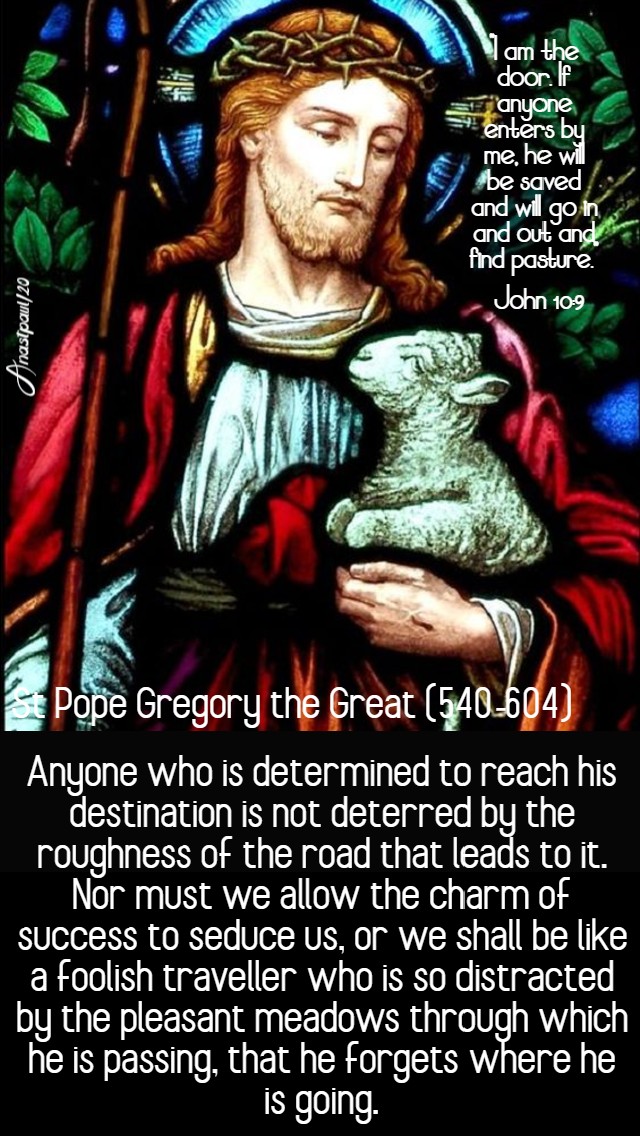
“I am the door. If anyone enters by me, he will be saved and will go in and out and find pasture.” … John 10:9
REFLECTION – “Anyone who enters by me will be saved, he will go in out and will find pasture.”(Jn 10:9) He will go into faith, he will go out from faith to vision, from belief to contemplation, will find pasture in eternal refreshment.
The Good Shepherd’s sheep will pasture, because whoever follows Him with a guileless heart, is nourished with a food of eternal freshness. What are the pastures of these sheep but the eternal joys of an evergreen paradise? The pasture of the elect, is the face of God always before us. When we see Him perfectly, our hearts are endlessly satisfied with the food of life…
Let us seek these pastures, dearly beloved! There we may enjoy the celebration of so many citizens. Let the festival of those who rejoice attract us… Let us enkindle our hearts, my friends, let our faith grow warm again for what it believes, let our desire for heavenly things take fire. To love thus, is to be already on the way. Anyone who is determined to reach his destination is not deterred by the roughness of the road that leads to it. Nor must we allow the charm of success to seduce us, or we shall be like a foolish traveller who is so distracted by the pleasant meadows through which he is passing, that he forgets where he is going.”… St Pope Gregory the Great (540-604) Father & Doctor of the Church – Homilies on the Gospel, no15
PRAYER – Almighty, ever-living God, bring us to the joy of Your heavenly city, so that we, Your little flock, may follow where Christ, our Good Shepherd, has gone before us, by the power of His Resurrection. May the prayers of Bl Edoardo Giuseppe Rosaz and the Blessed Virgin, guide us, that we may always follow our Shepherd and thus reach our heavenly home, to praise Him forever. We make our prayer through Christ, our Lord, with the Holy Spirit, God now and for all eternity, amen.
Our Morning Offering – 3 May – The Fourth Sunday of Easter, Good Shepherd Sunday and “Mary’s Month”
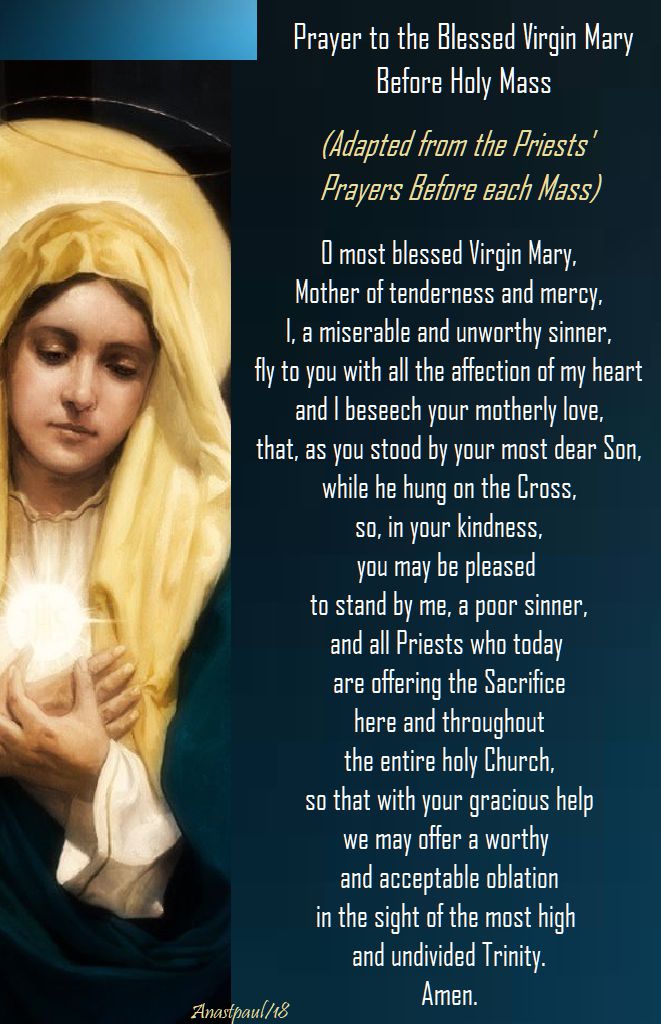
Prayer to the Blessed Virgin Mary Before Holy Mass
O most blessed Virgin Mary,
Mother of tenderness and mercy,
I, a miserable and unworthy sinner,
fly to you with all the affection of my heart
and I beseech your motherly love,
that, as you stood by your most dear Son,
while he hung on the Cross,
so, in your kindness,
you may be pleased to stand by me, a poor sinner,
and all Priests who today are offering the Sacrifice
here and throughout the entire holy Church,
so that with your gracious help,
we may offer a worthy and acceptable oblation
in the sight of the most high and undivided Trinity.
Amen.
(This prayer is adapted from the Priests’ Prayers Before each Mass)
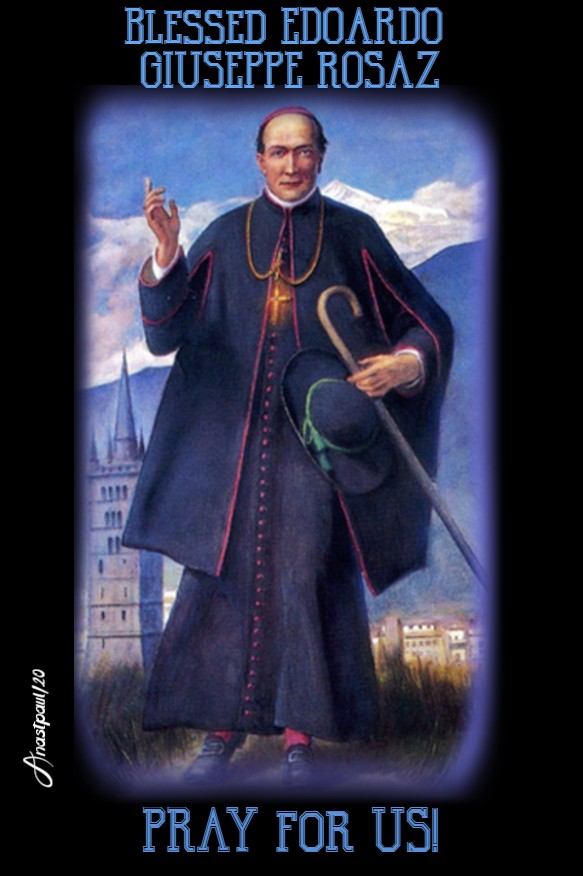
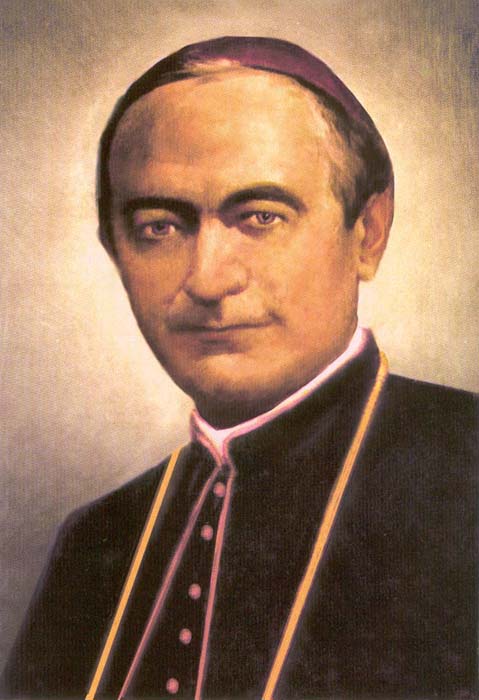
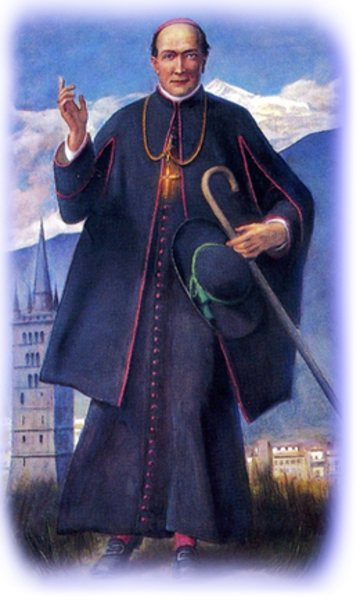
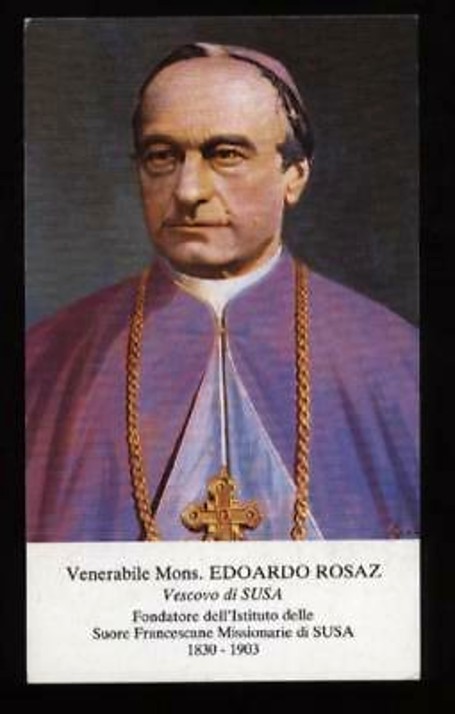
Saint of the Day – 3 May – Blessed Edoardo Giuseppe Rosaz TOSF (1877-1903) Bishop of Susa from 1877 until his death, Founder of Franciscan Mission Sisters of Susa, Third Order Franciscan, Apostle of the poor, his charism was one totally supported by the Holy Eucharist and total abandonment to Divine Providence and Prayer, Spiritual Director – born on 15 February 1830 in Susa, Piedmont, Italy and died on 3 May 1903 in Susa, Piedmont, Italy of natural causes, aged 73. Patronages – Franciscan Mission Sisters of Susa and of Susa.
Edoardo Giuseppe Rosaz was born on 15 February 1830 in Susa, as the fifth of seven children to a wealthy family who had fled the French Revolution. He was Baptised in the Susa Cathedral on 16 February.
During his childhood and youth he manifested a patient, peaceful, profoundly good nature and extended himself for the good of others. Edoardo was poor in health from his birth but he was also endowed with a spiritual fortress that led him to overcome any difficulty. In his gentleness and sensitivity, he favoured the poorest, adapting to their mentality and their way of life, giving himself to everyone and thus grew evermore in love for Christ.
At a very young age he entered the Seminary, showing a deep zeal and a strong docility to the action of the Holy Spirit. He completed his ecclesial studies in Nice, France where he was Ordained to the Priesthood.
As a twenty-four year old priest, he took charge of the social problems he perceived in his territory. He became Canon of the Cathedral Church, Chaplain of the Carceri, Rector of the Diocesan Seminary, spiritual director of various religious families and, finally, Bishop of Susa in 1878. He also opened a retreat house for girls and during this time, he met and became a friend of St John Bosco, who was instrumental in recommending him as the Rector of the Seminary. During this vocational itinerary he decided to become a Franciscan tertiary, living in extreme poverty, great humility and penance. He followed the spirituality of the Seraphic Father Francis in his mission as pastor.
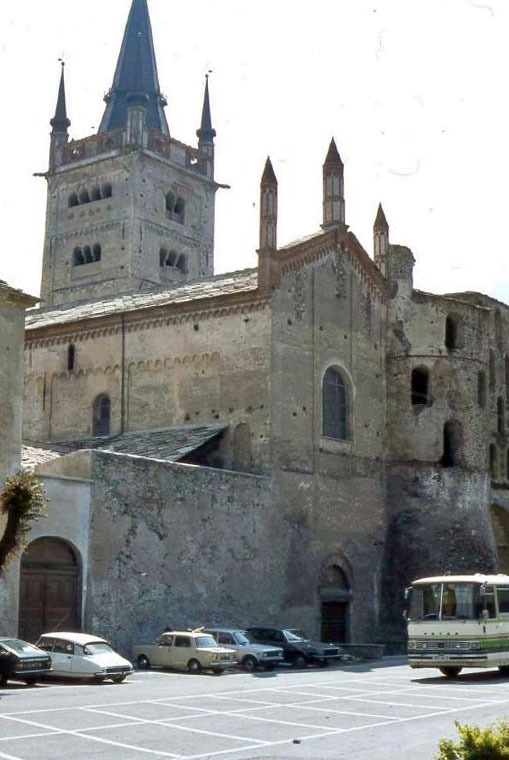
Suso and the Cathedral
Pope Pius IX appointed him as the Bishop of Susa on 31 December 1877 – at St John Bosco’s suggestion – and the Archbishop of Turin, Lorenzo Gastaldi granted him his episcopal Consecration in 1878 in the Susa Cathedral. He had wept upon learning he was to be made a Bishop and sent a letter to Cardinal Giacomo Antonelli protesting the appointment, mentioning his lack of theological or canon law doctorates. But for his Diocese, he became an example to be imitated, on the path of Christian conversion.
Following divine inspiration, he founded the Institute of the Franciscan Missionary Sisters of Susa in 1874, with the aim of continuing to face the problems present in the Val di Susa, first of all the reception of young people in difficulty, with a simple Franciscan style that his nuns would live. He adopted as a motto for his “daughters” a famous phrase of St Paul: “Do all so as to win over all to Christ”(Cf 1 Cor 9:19).
In January 1888, he was at St John Bosco’s deathbed in Turin and attended and assisted at his funeral. In 1898 he led Diocesan pilgrimages to Rome and to Turin for the exposition of the Holy Shroud. After attending St John Bosco’s funeral he took part in the Eucharistic Congress in Turin and another in Milan, in 1895.
In the last years of his life he conceived the idea of building retirement homes for elderly and abandoned people. A lot of work and dedication assisted in undermining his already not too robust health. The first signs of illness hit him on 12 January 1903, while visiting the schools of Susa. Finally, after an edifying preparation, on the morning of 3 May 1903 ‘Sister death’ arrived.
His remains were relocated in 1919 to the Motherhouse of his order in Susa. His order received diocesan approval on 2 February 1903 while being aggregated to the Order of Friars Minor Capuchin on 9 March 1906. It received the decree of praise from Pope Pius XI on 10 July 1934 and papal approval from Pope Pius XII on 27 July 1942.
On 14 July 1991, in Susa, Pope John Paul II Beatified the Founder by describing him as “apostle of God of Love who responded to the expectations of his brothers, especially the poorest, with the charity of the heart of Christ.”
Today, after over a hundred years, the charism and works of Blessed Rosaz continue to live through the Franciscan Missionary Sisters of Susa founded by him with 40 convents and 240 sisters in Italy, Switzerland, Libya and Brazil.
St Adalsindis of Bèze
Bl Adam of Cantalupo in Sabina
St Ahmed the Calligrapher
St Aldwine of Peartney
St Pope Alexander I
St Alexander of Constantinople
Bl Alexander of Foigny
St Alexander of Rome
Bl Alexander Vincioli
St Ansfrid of Utrecht
St Antonina of Constantinople
St Diodorus the Deacon Blessed Edoardo Giuseppe Rosaz TOSF (1877-1903)
St Ethelwin of Lindsey
St Eventius of Rome
St Fumac
St Gabriel Gowdel
St Juvenal of Narni
Bl Maria Leonia Paradis
St Maura of Antinoe
St Peter of Argos
St Philip of Zell
Bl Ramon Oromí Sullà
St Rhodopianus the Deacon
St Scannal of Cell-Coleraine
Bl Sostenaeus St Stanislas Kazimierczyk CRL (1433–1489) His Life: https://anastpaul.com/2019/05/03/saint-of-the-day-3-may-saint-stanislaw-kazimierczyk-crl-1433-1489/
St Theodolus of Rome
St Timothy of Antinoe
Bl Uguccio
Bl Zechariah
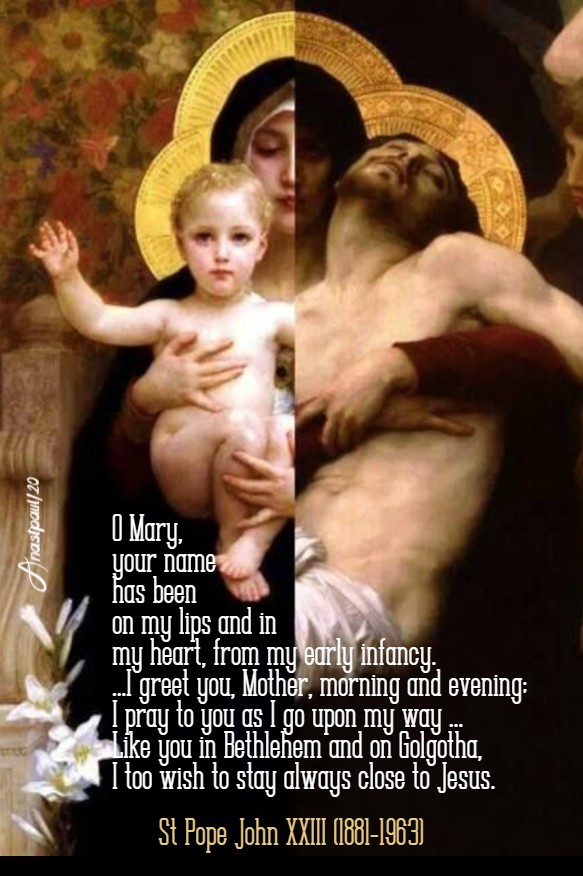
Mother of Good Counsel
By St Pope John XXIII (1881-1963)
O Mary, your name has been on my lips and in my heart, from my early infancy.
When I was a child, I learnt to love you as a Mother, turn to you in danger and trust to your intercession.
You see in my heart, the desire to know the truth, to practise virtue, to be prudent and just, strong and patient, a brother to all.
O Mary, help me to keep my purpose of living as a faithful disciple of Jesus, for the building up of Christian society and the joy of the Holy Catholic Church.
I greet you, Mother, morning and evening;
I pray to you as I go upon my way;
from you, I hope for the inspiration and encouragement, that will enable me to fulfil the sacred promises of my earthly vocation, give glory to God and win eternal salvation.
O Mary!
Like you in Bethlehem and on Golgotha, I too wish to stay always close to Jesus.
He is the eternal King of all ages and all peoples.
Amen
Thought for the Day – 2 May – Meditations with Antonio Cardinal Bacci (1881-1971)
The Intercession of Our Lady
“Our Lady’s intercession is very powerful with God. St Bernard tells us that it is the will of God, that everything comes to us through her holy hands (Sermo in Nativ BMV no 7). He assures us, that Mary is the Mediatrix through whom we receive all favours from God (In Assump. BMV sermo 2, no 2). Her power of intercession is the result of her divine and human motherhood. Because she is the Mother of God, Jesus refuses her nothing; because she is our mother, she loves us dearly and is eager to obtain from God, the spiritual favours, for which we ask. For this reason, we should approach her with complete confidence. St Bernard also writes: “If anyone feels that he is overwhelmed by the tempests of this world and cannot keep an even course, let him raise his eyes towards Mary, let him remember Mary and call upon her…. In danger and in doubt, let him remember and call upon her. Let the thought of Mary never leave his mind; let her name never be far from his lips and from his heart …” (Super Miss. Homil 2, no 17). In all our necessities, we should have confident recourse to our heavenly Mother. Let us remember, however, that if we wish to be true sons of Mary and to be sure of being heard by her, we should ask especially, for spiritual graces. Afterwards, we may ask, with equal confidence but, with resignation to God’s will, for temporal favours, provided they will not stand in the way of our eternal salvation.”





















 AnaStpaul
You must be logged in to post a comment.