Posted in DOCTORS of the Church, GOD ALONE!, PRACTISING CATHOLIC, PRAYER WARRIORS, PRAYERS of the SAINTS, QUOTES for CHRIST, QUOTES of the SAINTS, QUOTES on LOVE of GOD, QUOTES on PRAYER, QUOTES on SACRIFICE, QUOTES on SILENCE, QUOTES on WORRY/ANXIETY, SACRED HEART PRAYERS, SPEAKING of .....

Quote/s of the Day – 7 July – “Pray, hope and don’t worry.”

Quote/s of the Day – 7 July – “Month of the Precious Blood” – Tuesday of the Fourteenth week in Ordinary Time, Readings: Hosea 8:4-7, 11-13, Psalm 115:3-10, Matthew 9:32-38

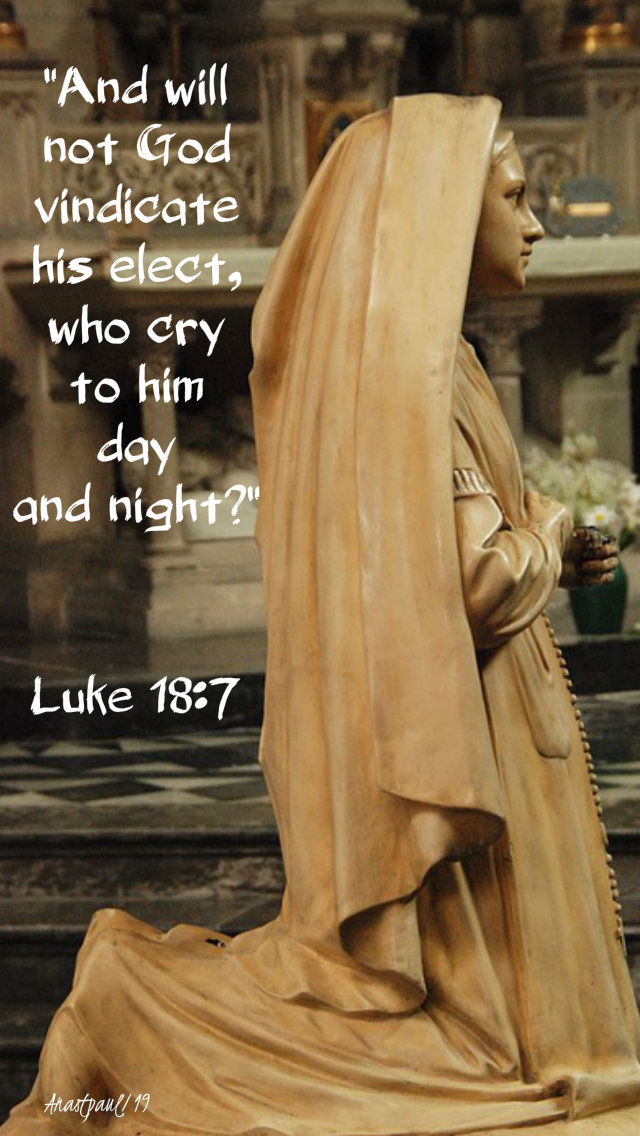
“And will not God vindicate his elect,
who cry to him day and night?”

Luke 18:7

luke-18-7-and-will-not-god-vindicate-his-elect-who-cry-to-him-day-and-night-16-nov-2019 and 7 july 2020

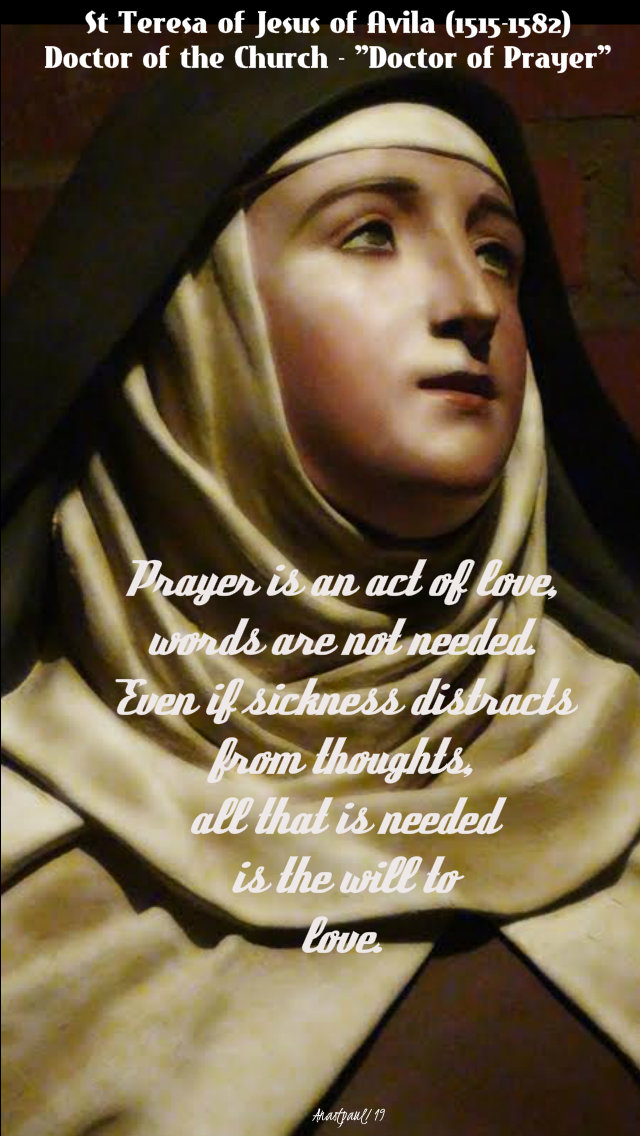
“Prayer is an act of love,
words are not needed.
Even if sickness distracts from thoughts,
all that is needed is the will to love.”

St Teresa of Jesus of Avila (1515-1582)

prayer-is-an-act-of-love-st-teresa-of-jesus-of-avila-15-oct-2019 and 7 july 2020

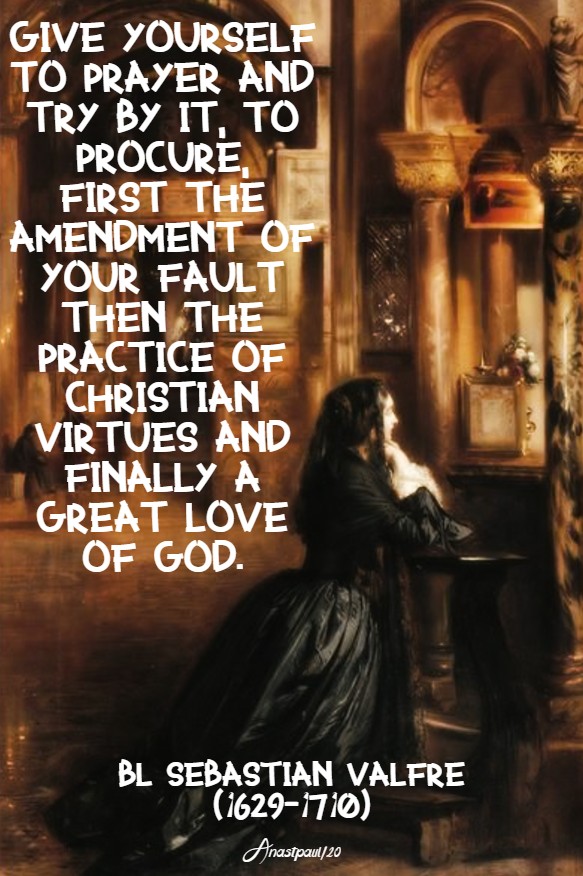
“Give yourself to prayer
and try by it, to procure,
first the amendment
of your fault,
then the practice of Christian virtues
and finally a great love of God.”

Bl Sebastian Valfre (1629-1710)

give-yourself-to-prayer-bl-sebastian-valfre-30-jan-2020 and 7 july 2020

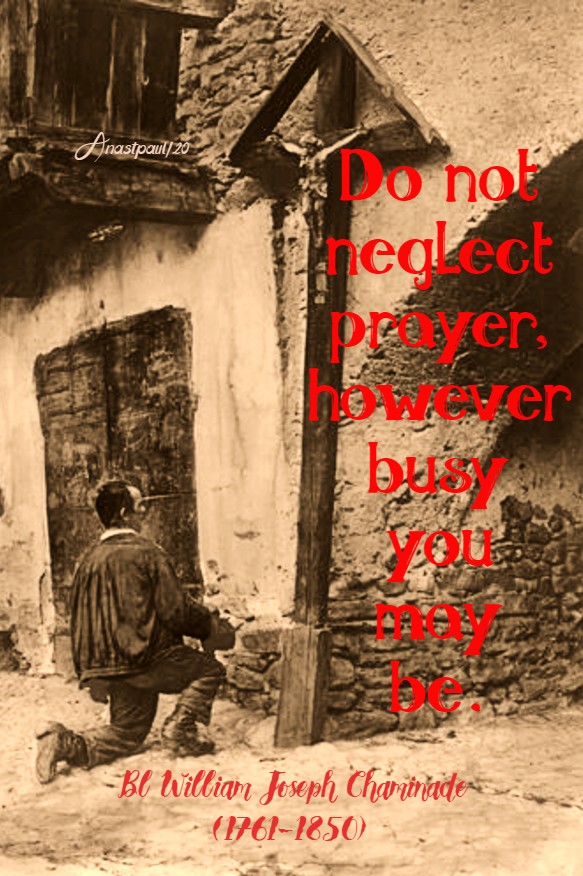
“Do not neglect prayer,
however busy you may be.”

Bl William Joseph Chaminade (1761-1850)

do not neglect prayer however busy you may be bl william joseph chaminade 7 july 2020

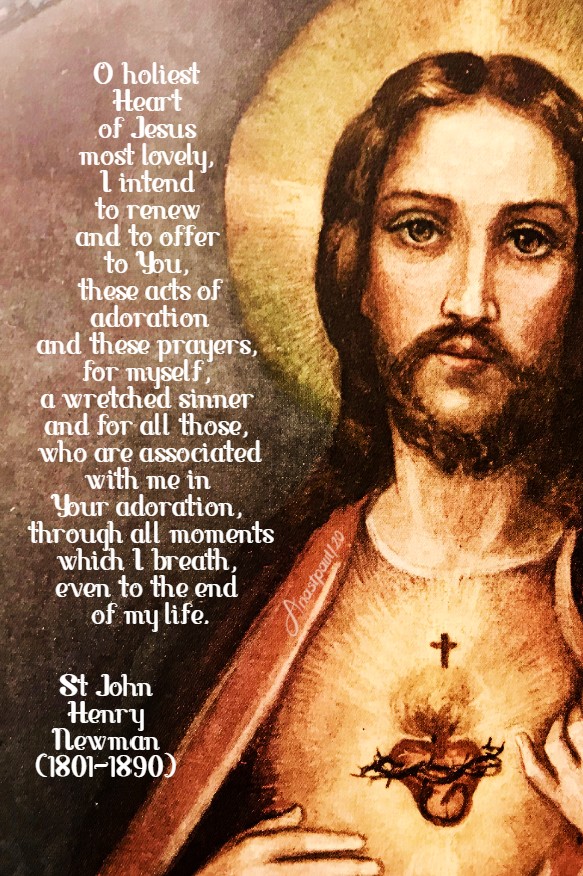
“O holiest Heart of Jesus most lovely,
I intend to renew and to offer to You,
these acts of adoration and these prayers,
for myself, a wretched sinner
and for all those,
who are associated with me in Your adoration,
through all moments which I breath,
even to the end of my life.”

St John Henry Newman (1801-1890)

o holiest heart of jesus - st john henry newman 7 july 2020

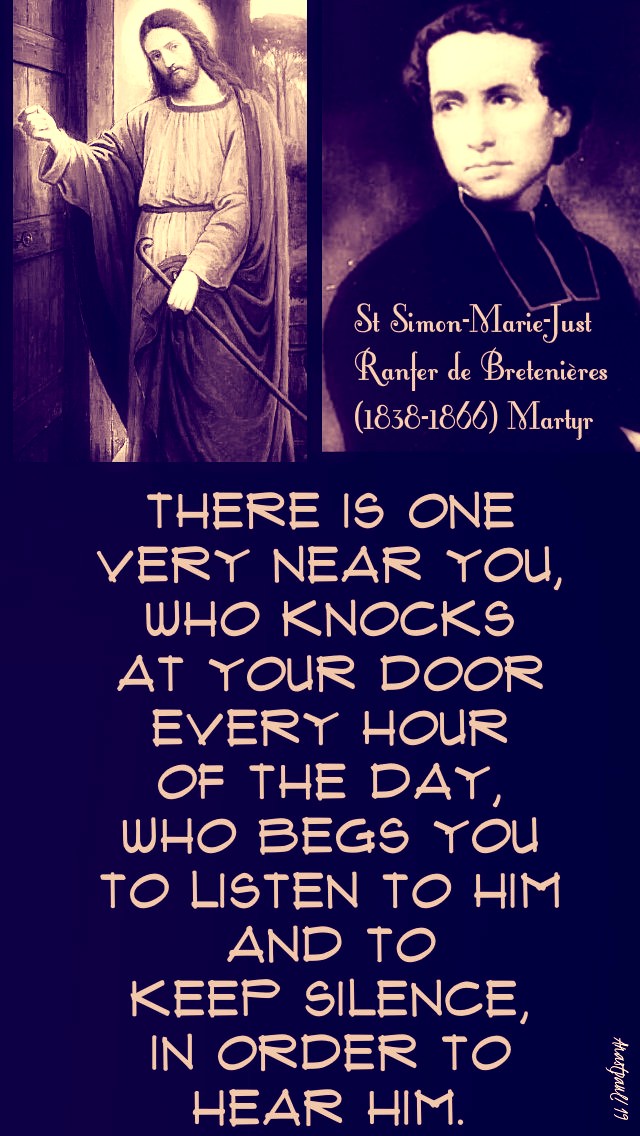
“There is One very near you
Who knocks at your door every hour of the day,
Who begs you to listen to Him
and to keep silence in order to hear Him.”

St Simon-Marie-Just Ranfer de Bretenières (1838-1866) Martyr

there-is-one-very-near-you-st-simon-ranfer-de-bretenieres-14-nov-2019 and 7 july 2020

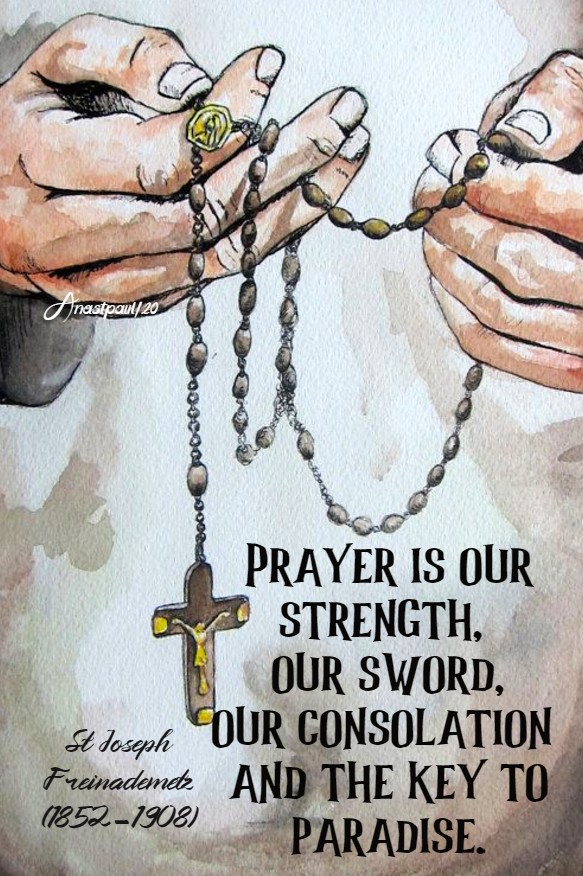
“Prayer is our strength,
our sword,
our consolation
and the key to paradise.”

St Joseph Freinademetz (1852-1908)

prayer is our strength our sword our consolation and the key to paradise st joseph freinadametz 7 july 2020

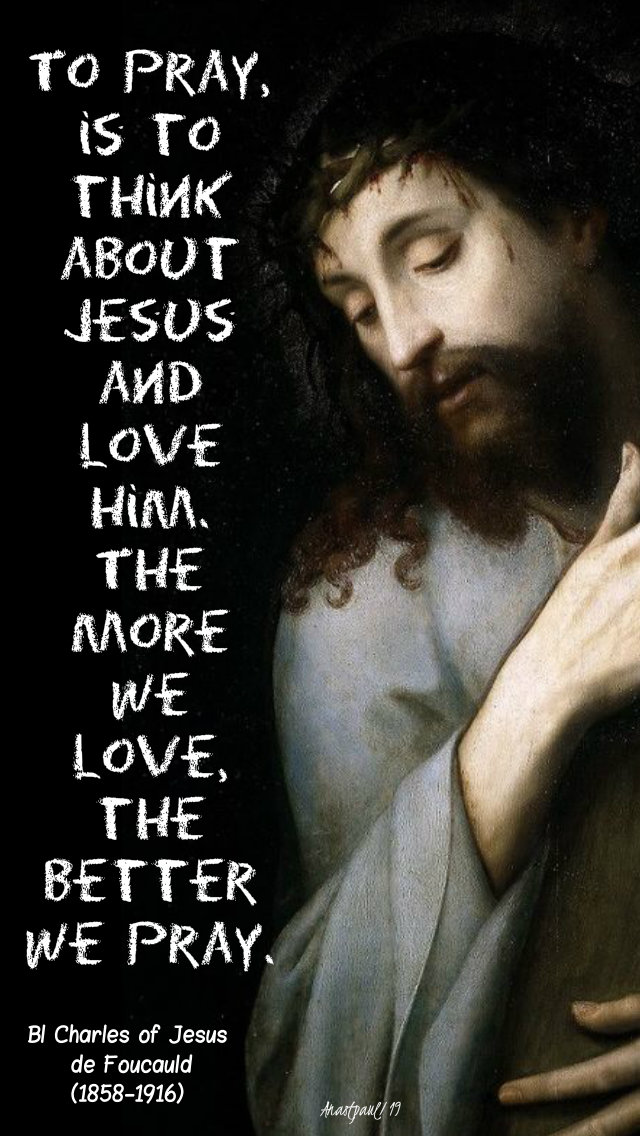
“To pray,
is to think about Jesus
and love Him.
The more we love,
the better we pray.”

Bl Charles of Jesus de Foucauld (1858-1916)

to-pray-is-to-think-about-jesus-and-to-love-him-bl-charles-de-foucauld-1-dec-2019 and 7 july 2020

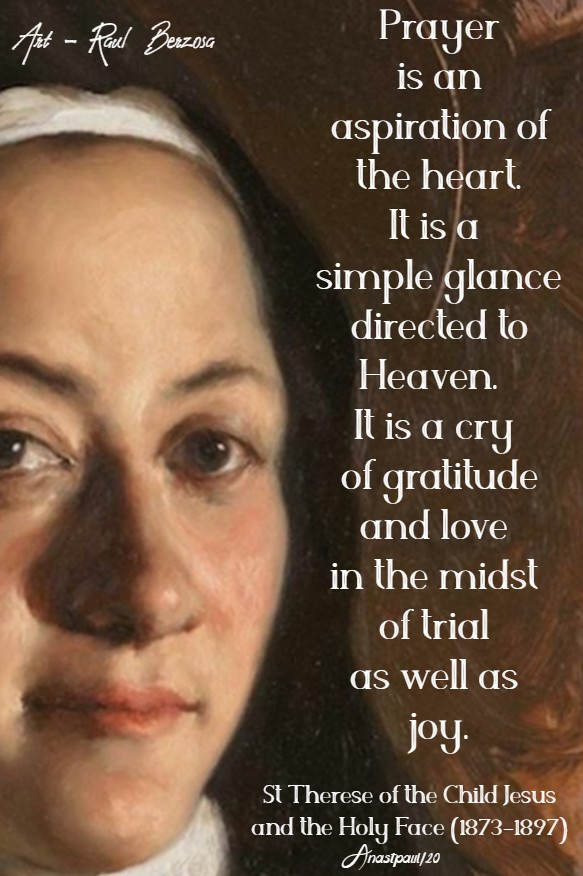
“Prayer is an aspiration of the heart.
It is a simple glance directed to Heaven.
It is a cry of gratitude and love
in the midst of trial as well as joy.”

St Therese of the Child Jesus and the Holy Face (1873-1897)
Doctor of the Church

prayer-is-an-aspiration-of-the-heart-st-therese-child-jesus-6-march-2020 and 7 july 2020

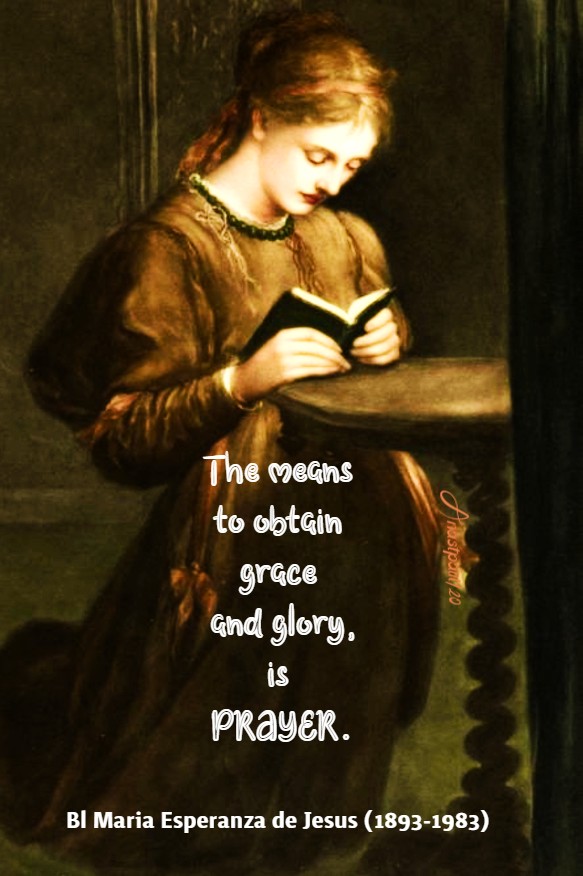
“The means to obtain
grace and glory,
is PRAYER.”

Bl Maria Esperanza de Jesus (1893-1983)

the means to obtain grace and glory is prayer - bl maria esperanza de jesus 7 july 2020

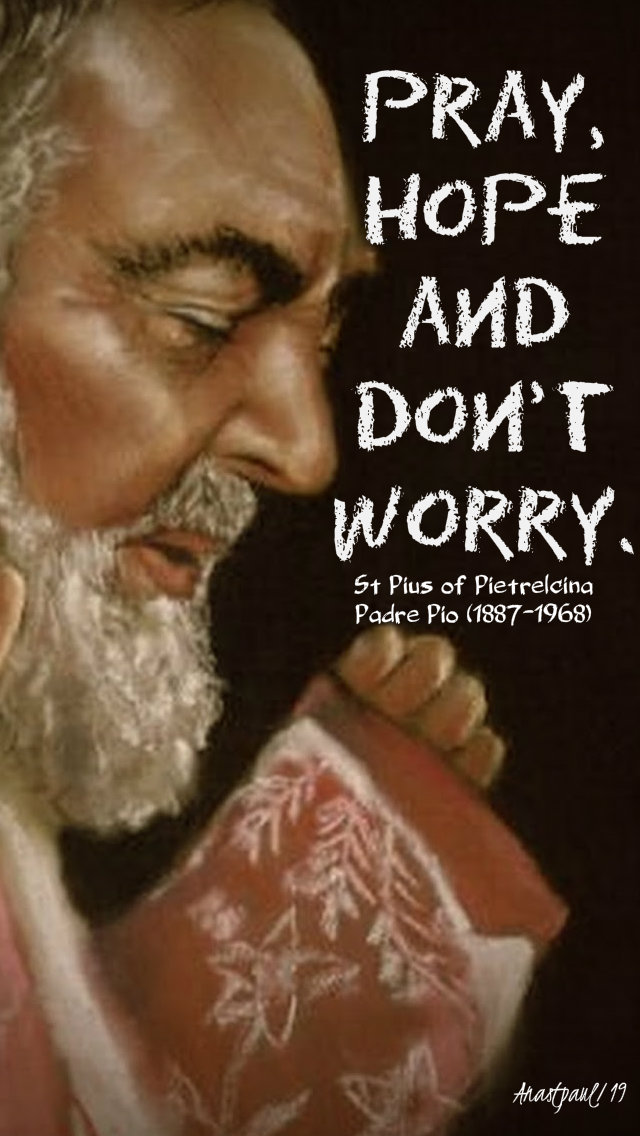
Pray, hope and don’t worry.”

St Pius of Pietrelcina/Padre Pio (1887-1968)

pray hope and dont worry - st padre pio 6 dec 2019

Posted in DOCTORS of the Church, ONE Minute REFLECTION, PRACTISING CATHOLIC, QUOTES of the SAINTS, QUOTES on PRAYER, QUOTES on VOCATIONS, SAINT of the DAY, The WORD

One Minute Reflection – 7 July – ‘Our Vocation … ‘

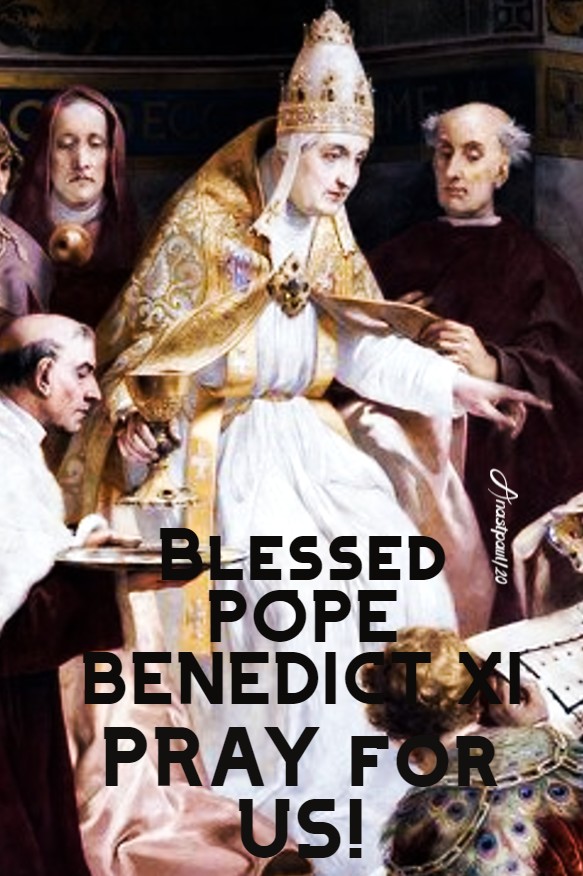
One Minute Reflection – 7 July – “Month of the Precious Blood” – Tuesday of the Fourteenth week in Ordinary Time, Readings: Hosea 8:4-711-13Psalm 115:3-10Matthew 9:32-38 and the Memorial of Blessed Pope Benedict XI OP (1240-1303)

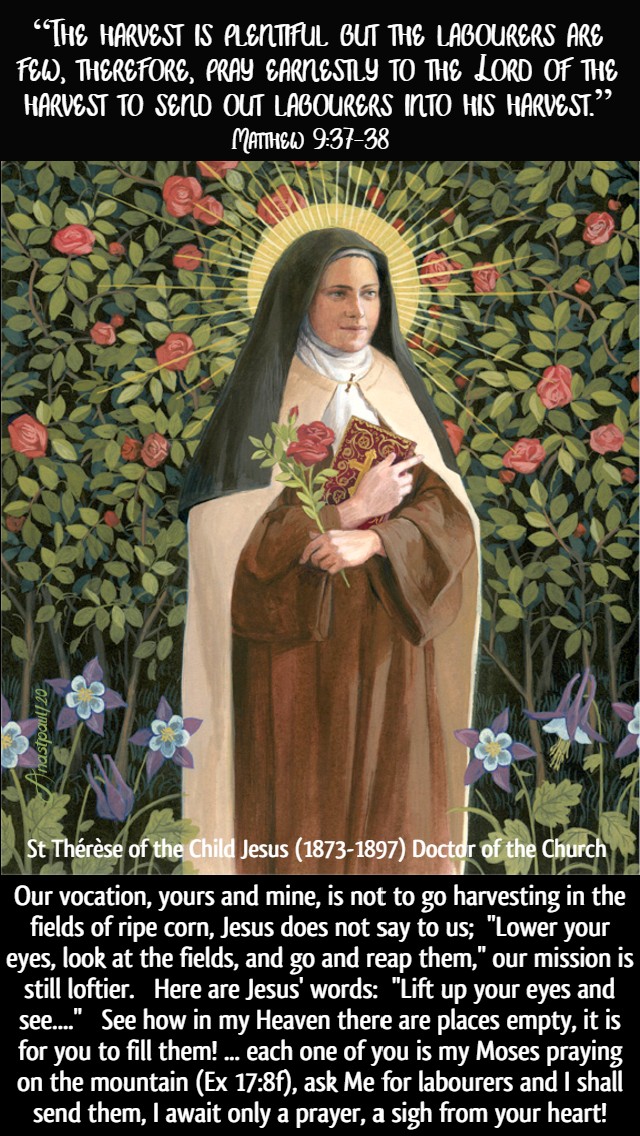
“The harvest is plentiful but the labourers are few, therefore, pray earnestly to the Lord of the harvest to send out labourers into his harvest.” … Matthew 9:37-38

REFLECTION – “One day I was pondering over what I could do to save souls;  a phrase from the Gospel showed me a clear light – Jesus said to His disciples, pointing to the fields of ripe corn, “Look up and see the fields ripe for harvest” (Jn 4:35) and a little later, “The harvest is abundant but the labourers are few;  so ask the master of the harvest to send out labourers.”   How mysterious it is!   Is not Jesus all-powerful? Do not creatures belong to Him who made them?   Why then does Jesus say:  “Pray the master of the harvest to send out labourers … ?”   Why? …

Ah!   Jesus has so incomprehensible a love for us, that He wants us to have a share with Him in the salvation of souls.   He wants to do nothing without us.   The creator of the universe waits for the prayer of a poor little soul, to save other souls redeemed like itself, at the price of all His blood.

Our vocation, yours and mine, is not to go harvesting in the fields of ripe corn, Jesus does not say to us;  “Lower your eyes, look at the fields, and go and reap them,” our mission is still loftier.   Here are Jesus’ words:  “Lift up your eyes and see….”   See how in my Heaven there are places empty, it is for you to fill them! … each one of you is my Moses praying on the mountain (Ex 17:8f), ask Me for labourers and I shall send them, I await only a prayer, a sigh from your heart!” … St Thérèse of the Child Jesus (1873-1897) Doctor of the Churchmatthew 8 37-38 the harvest is plentiful - our vocation yours and mine is not to harvesting - st therese of lisieux 7 july 2020

PRAYER – True Light of the world, Lord Jesus Christ, as You enlighten all men for their salvation, give us grace, we pray, to herald Your coming, by preparing Your ways of justice and of peace.   We lift our hearts and eyes in prayer and beg of You that we may always offer You the souls of those in need of You.   And may the prayers of Bl Pope Benedict XI, who fulfilled his role as Your labourer, strengthen us on our journey.   Who live and reign with the Father and the Holy Spirit, God forever, amen.bl pope benedict XI pray for us 7 july 2020 (1)

Posted in JULY - The MOST PRECIOUS BLOOD, Our MORNING Offering, POETRY, PRECIOUS BLOOD PRAYERS

Our Morning Offering – 7 July – Good Friday By Christina Rossetti

Our Morning Offering – 7 July – “Month of the Precious Blood” – Tuesday of the Fourteenth week in Ordinary Time

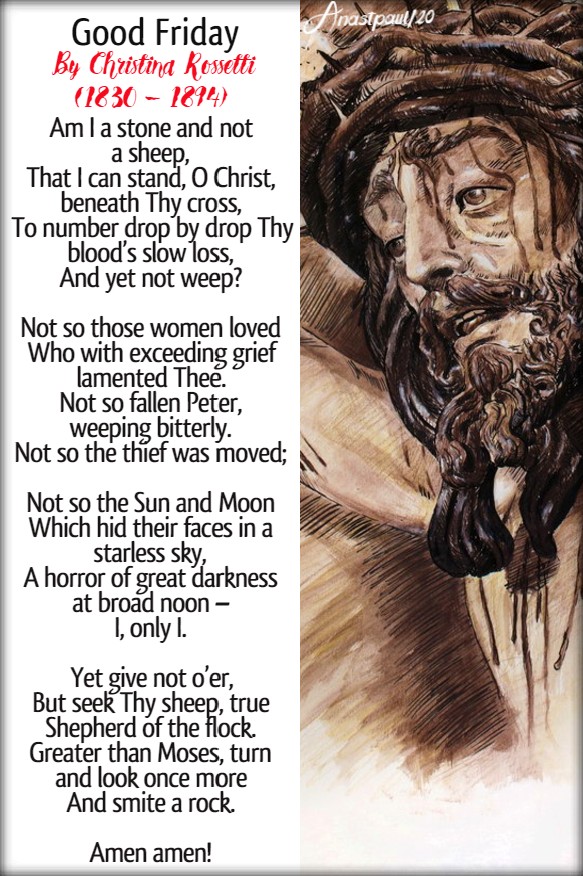
Good Friday
By Christina Rossetti (1830 – 1894)
Published in 1866

Am I a stone and not a sheep,
That I can stand, O Christ, beneath Thy cross,
To number drop by drop Thy blood’s slow loss,
And yet not weep?

Not so those women loved
Who with exceeding grief lamented Thee.
Not so fallen Peter, weeping bitterly.
Not so the thief was moved.

Not so the Sun and Moon
Which hid their faces in a starless sky,
A horror of great darkness at broad noon –
I, only I.

Yet give not o’er,
But seek Thy sheep, true Shepherd of the flock.
Greater than Moses, turn and look once more
And smite a rock.

Christina Georgina Rossetti (5 December 1830 – 29 December 1894) was an English poet who wrote various romantic, devotional and children’s poems.   “Goblin Market” and “Remember” remain famous.   She wrote the words of two Christmas carols well known in the UK: “In the Bleak Midwinter.” later set by Gustav Holst and by Harold Darke and “Love Came Down at Christmas,” set by Harold Darke and by other composers.   She was the sister of the well-known ‘Pre-Raphaelite’ Artist and Poet Dante Gabriel Rossetti.Good friday by Christina Rossetti 7 july 2020

Posted in SAINT of the DAY

Saint of the Day – 7 July – Blessed Pope Benedict XI (1240-1303)

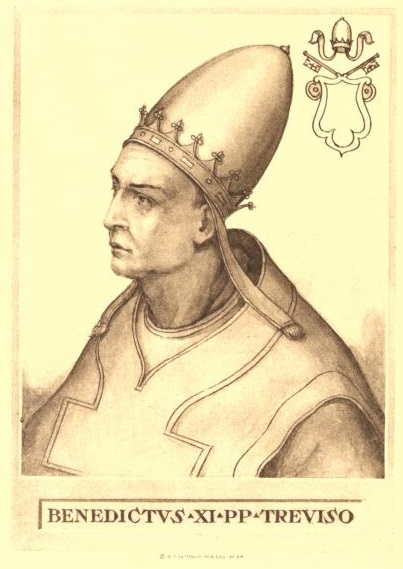
Saint of the Day – 7 July – Blessed Pope Benedict XI (1240-1303) Cardinal-Priest of St Sabina, Bishop of Ostia then of Rome, Dominican Friar, Prior Provincial of Lombardy Prior to becoming the Master of the Order in 1296, Apostolic Papal Legate to Hungary and France, Teacher, Preacher, Writer and renowned Scholar with special emphasis on Biblical commentary.   His Papacy began on 22 Ocober 1303 and ended at his death on 7 July 1304.   His predecessor was Boniface VIII and successor, Clement V.   Born in 1240 at Treviso, Italy as Niccolò  Boccasini and died on 7 July 1304 at Perugia, Italy of natural causes. His Motto “Illustra faciem Tuam super servum Tuum”“Let Your Face shine upon Your servant.”   Patronages – Treviso, all Popes named Benedict.Blessed-Benedict X1-e1426571409185

Niccolò Boccasini entered the Order of Preachers in his native Trevino. He studied at Venice and Milan before becoming a teacher in Venice and in other Dominican houses.   A scholar by temperament, he taught and preached for years, publishing biblical commentaries and sermons.   He served two terms as Provincial Prior of Lombardy before being elected Master of the Order in 1296.   Two years later he was made Cardinal.   He was appointed Bishop of Ostia and served as Apostolic Papal Legate first to Hungary and then to France.   He was with Pope Boniface VIII when Boniface was attacked by French forces at Anagni.

Niccolò Boccasini was born in Treviso to Boccasio, a municipal notary (died 1246), whose brother was a Priest and Ber(n)arda, who worked as a laundress for the Dominican Friars of Treviso.   Niccolò had a sister, Adelette.   The family lived outside the walls of Treviso, in a suburb called St Bartolommeo.    In 1246, a Dominican friar left a sum of money in his will to Bernarda and her children, recently orphaned.   A condition was that if Niccolò were to enter the Dominican Order he would receive half of the entire legacy.    From the age of six, it seems, Niccolò was destined for the monkish life.   His first teacher was his uncle, the Parish Priest of St Andrea.

He entered the Order of Preachers in 1254, at the age of fourteen, taking the habit of a novice in his native Treviso.    He was taken to Venice by his Prior and presented to the Provincial, who assigned him to the Convent of St Giovanni e Paolo in Venice.   For the next seven years or so, Niccolò pursued his basic education in Venice.   Toward the end of this period, he served as tutor to the young sons of Romeo Quirini of Venice, whose brother was a Canon in the Cathedral of Treviso.   In 1262, Niccolò was transferred to Milan, to the new Cathedral of St Eustorgio.   He spent the next six years at St Eustorgio.  By the end of his term there he must have become a professed member of the Order of Preachers – the actual date, however, is unknown.   As a professed Friar he served in the responsible position as a Lecturer in the Seminary in Venice, where he was the instructor of the elementary education of the Novices in his Convent.   Each convent had it’s own Lector.    Niccolò served as Lector for fourteen years, from 1268 to 1282.   In 1276 he is attested as being Lector at the Dominican Convent in his native Treviso, a post he was still holding in 1280.   In February 1282 he was sent to Genoa, again as Lector.   He was not a Professor, since he had never taken a university degree, being one of the few Popes who was not a university graduate.

bl Benedictus_XI_Tommaso_da_Modena
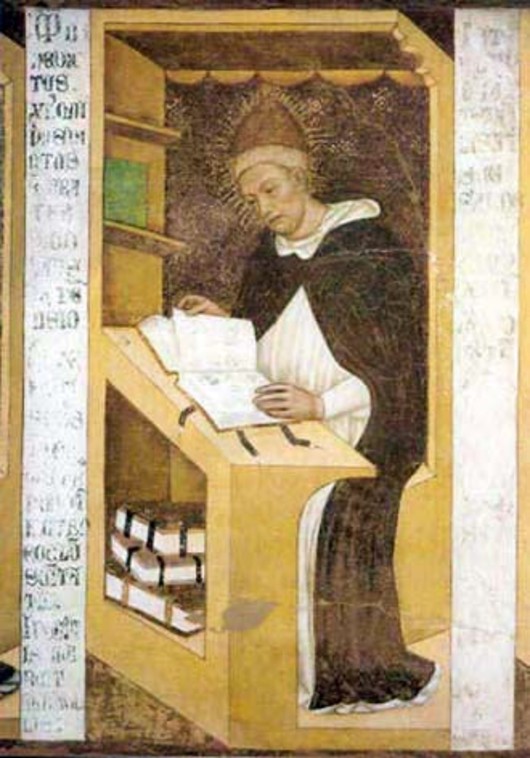
“Pope Benedict XI” by Tommaso da Modena (1326-1379)

In 1286, at the meeting of the Provincial Chapter, which took place that year in Brescia, Fr Niccolò was elected Provincial Prior of Lombardy.As Provincial of Lombardy, Fr Niccolò’s lifestyle changed considerably. Instead of being firmly attached to a single Convent for years, he would instead become peripatetic, moving from one Convent to another on visits of inspection, encouragement and correction.   In Lombardy at the time there were some fifty-one Domiican Convents!    He also had responsibility as an Inquisitor, a task for which popes considered Franciscans and Dominicans especially suited.   He also had the responsibility of convening the Provincial Chapters.   In 1287, the Chapter was at Venice;  in 1288, it was at Rimini;  in 1289 at the General Chapter, which was held at Trier, Fr Niccolò was released from the office of Provincial of Lombardy, having completed his three-year term.   It is probable that, without office, he returned to a convent, possibly that of Treviso—though the evidence is scanty and based on wills and codicils.   He was elected Provincial Prior of Lombardy again, however, at the Provincial Chapter held at Brescia in 1293.   In 1294 it was held at Faventia, in 1295 at Verona, and in 1296 at Ferrara, where Fr Niccolò’s successor was elected, since he had a new assignment.

At the Capitulum Generale of the Order of Preachers, which was held at Strasbourg in 1296, Fr Niccolò of Treviso was elected Master of the Order of Preachers and issued ordinances that forbade, by any Dominican, public questioning of the legitimacy of Pope Boniface VIII’s Papal election (which had taken place on Christmas Eve, 1295).Harley 1340, f.4

He was elevated to the Cardinalate on 4 December 1298 by Boniface VIII and assigned the title of Cardinal-Priest of Santa Sabina.   He entered the Roman Curia on 25 March 1299 and thus began to receive his share of the profits of the Chamber of the College of Cardinals.

He was promoted to the rank of Cardinal-Bishop of the See of Ostia on 2 March 1300 and also received Episcopal Consecration.   On 13 May 1301 he was appointed Apostolic Legate to Hungary.   He made his official departure on 22 June 1301 and returned on 10 May 1303.  He also served as Papal Legate to France.

When Pope Boniface VIII was seized at Anagni in September 1303, Boccasini was one of only two Cardinals to defend the Pope in the Episcopal Palace itself.   The other was Pedro Rodriguez, Bishop of Sabina.   They were imprisoned for three days.    On Monday 10 September they were liberated by forces led by Cardinal Luca Fieschi and on 14 September the Pope and his retinue returned to Rome, with an escort organised by Cardinal Matteo Rosso Orsini.

The conclave to elect the successor of Boniface VIII was held in the Basilica of Saint John Lateran and the College of Cardinals desired an appropriate candidate who would not be hostile towards King Philip IV of France.   After one ballot in a conclave that lasted a day, Boccasini was elected as pope.

He was quick to release King Philip IV from the excommunication that had been put upon him by Boniface VIII.   Nevertheless, on 7 June 1304, Benedict XI excommunicated Philip IV’s implacable minister Guillaume de Nogaret and all the Italians who had played a part in the seizure of his predecessor at Anagni.   Benedict XI also arranged an armistice between Philip IV of France and Edward I of England.bl Pope_Benedict_XI

After a brief Pontificate that spanned a mere eight months, Benedict XI died suddenly at Perugia.   As original reports had it, suspicion fell primarily on Nogaret with the suspicion that his sudden death was caused by poisoning.    There is no direct evidence, however, to either support or disprove the contention that Nogaret poisoned the Pope.

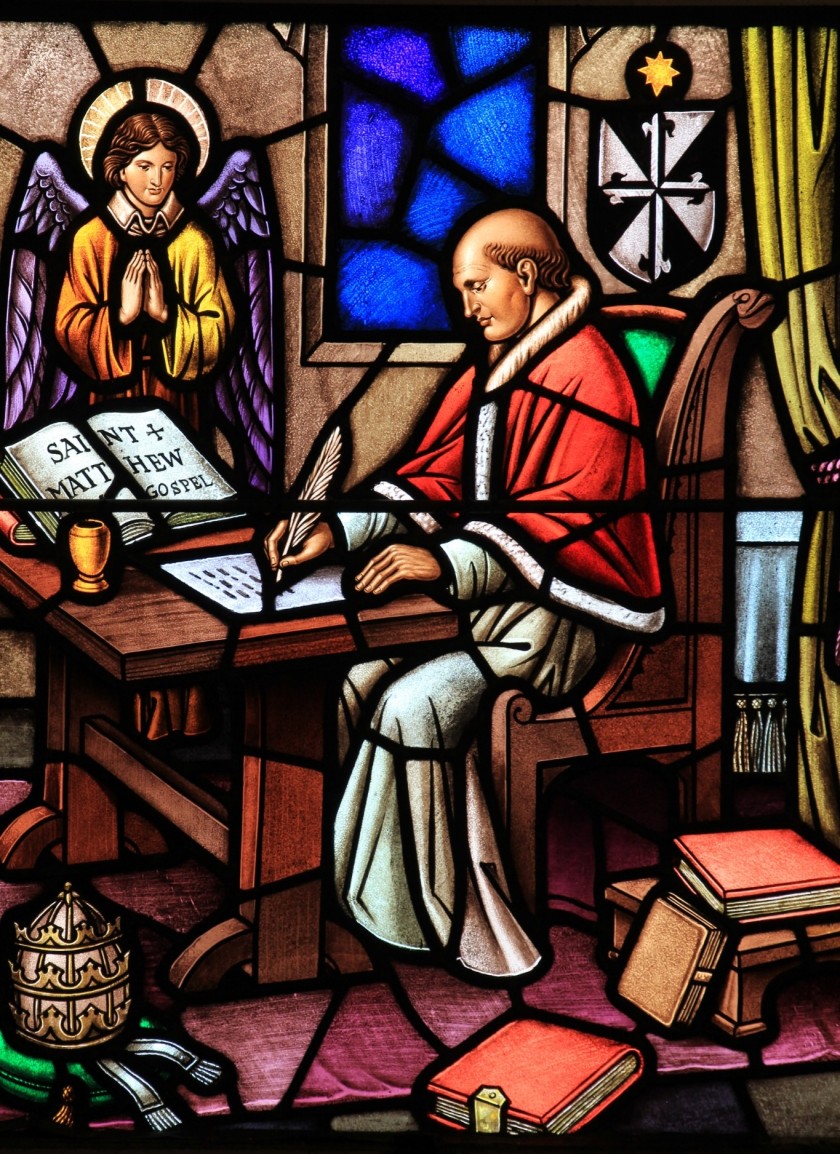
Benedict XI was the author of a volume of sermons and commentaries on the Gospel of Matthew, the Psalms, the Book of Job and the Book of Revelation.

Cardinal Caesar Baronius (1538–1607) wrote that, on the Monday of Easter week in 1304, Benedict XI was celebrating Mass but a pilgrim interrupted it, because he wanted the Pope to hear his Confession. Rather than telling him to find another time or another Priest, the Pope left the Mass to hear his Confession and then returned to continue the Mass.

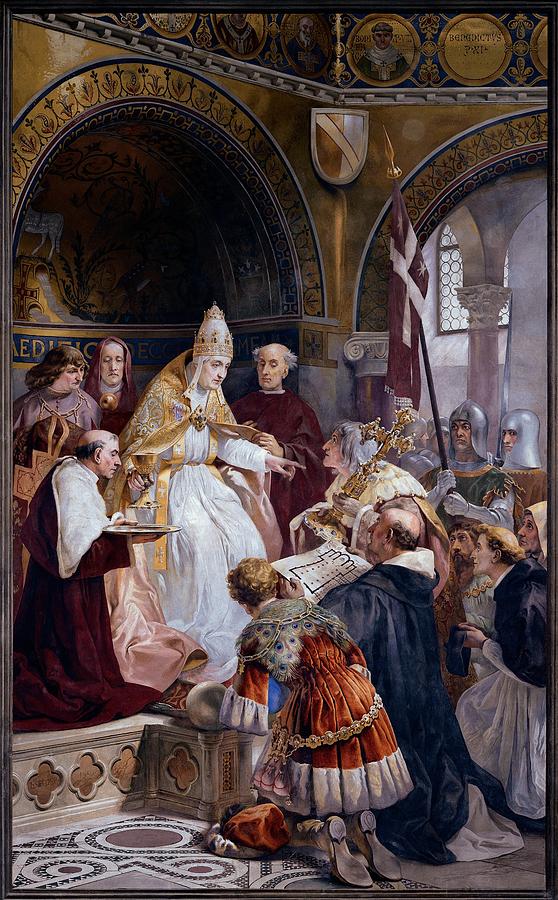
seitz-ludovico-pope-benedict-xi-everett (1)
Pope Benedict XI Approves the Plans of San Nicol Church Received by a Deputation of Treviso Citizens, 1880 – 1888 by Seitz Ludovico

There is also a story that, at the General Chapter of the Dominicans at Lucca in May 1288, the Provincial of the Roman Province, Thomas de Luni predicted to Fr Niccolò that he would someday be elected to the Papacy.   On another occasion, when he was in Venice, a Friar of Torcello, predicted that he would be Provincial, Master General, Cardinal and Pope.

Pope Benedict XI died of dysentery on 7 July 1304.   Benedict XI earned a reputation for holiness and the faithful came to venerate him.   His Tomb gained a reputation for the amount of miracles that emerged from the site.   Pope Clement XII approved his cultus on 24 April 1736 which acted as his formal Beatification.

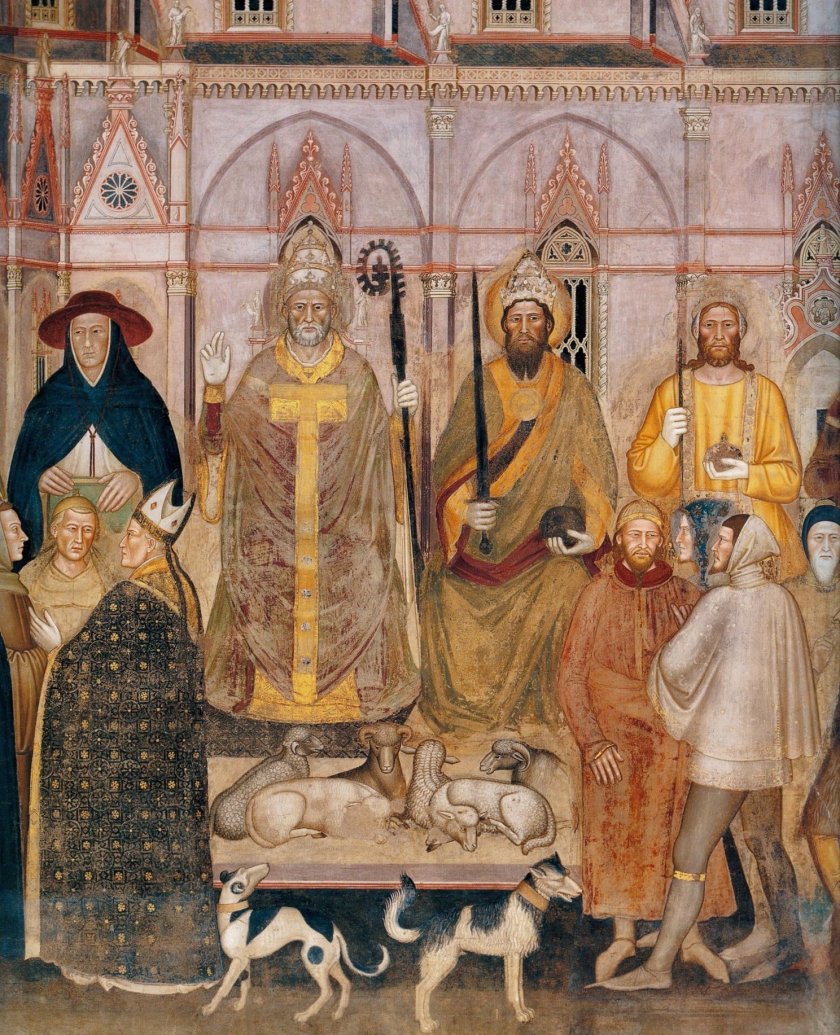
bl pope benedict xi old
Pope Benedict XI with King Philip IV

Papal numbering
A note on the numbering:    Pope Benedict X (1058–1059) is now considered an Antipope by the Catholic Church.   At the time of Benedict XI’s election, however, Benedict X was still considered a legitimate pope and thus the man the Catholic Church officially considers the tenth true Pope Benedict, Niccolo Boccasini, took the official number XI rather than X.   This has advanced the numbering of all subsequent Popes Benedict by one digit.   Popes Benedict XI-Benedict XVI are, from an official point of view, the 10th through 15th popes by that name.

bl benedict xi tomb Lorenzo_maitani_(attr.),_monumento_di_benedetto_XI,_1305_circa,_01
The Tomb of Bl Benedict XI
Posted in SAINT of the DAY

Memorials of the Saints – 7 July

St Alexander
St Angelelmus of Auxerre
St Antonino Fantosati
St Apollonius of Brescia
Blessed Pope Benedict XI (1240-1303)

Bl Bodard of Poitiers
St Bonitus of Monte Cassino
St Carissima of Rauzeille
St Eoaldus of Vienne
St Ethelburga of Faremoutier
Bl Francisco Polvorinos Gómez
St Hedda of Wessex
Bl Joseph Juge de Saint-Martin
Bl Juan Antonio Pérez Mayo
Bl Juan Pedro del Cotillo Fernández
Bl Justo González Lorente
St Maelruan
Bl Manuel Gutiérrez Martín
St Marcus Ji Tianxiang
Bl María del Consuelo Ramiñán Carracedo
Bl Maria Romero Meneses FMA (1902-1977)
Biography:
https://anastpaul.com/2018/07/07/saint-of-the-day-7-july-blessed-maria-romero-meneses-1902-1977/

Bl Marie-Gabrielle-Françoise-Suzanne de Gaillard de Lavaldène
St Medran
St Merryn
Bl Oddino Barrotti
St Odo of Urgell
St Odran
St Palladius of Ireland
St Pantaenus of Alexandria
St Pantænus, Father of the Church (Died c 216)
Biography:
https://anastpaul.com/2019/07/07/saint-of-the-day-7-july-st-pantaenus-father-of-the-church-died-c-216/
Bl Pascual Aláez Medina
Bl Peter To Rot (1912-1945) Martyr
About Bl Peter:
https://anastpaul.com/2017/07/07/saint-of-the-day-7-july-blessed-peter-to-rot/

St Prosper of Aquitaine
St Syrus of Genoa
St They
St Willibald of Eichstatt

Martyrs of Durres – 7 saints: Also known as – Martyrs of Dyrrachium/ Martyrs of Durazzo. A group of seven Italian Christians who fled Italy to escape the persecutions of emperor Hadrian. Arrived in Dyrrachium, Macedonia to find Saint Astius tied to a cross, covered in honey, laid in the sun and left to be tortured by biting and stinging insects. When they expressed sympathy for Astius, they were accused of being Christians, arrested, chained, weighted down, taken off shore and drowned. We know little more about each of them than their names – Germaus, Hesychius, Lucian, Papius, Peregrinus, Pompeius and Saturninus. They were born in Italy and were martyred at sea c117 off the coast of Dyrrachium (Durazzo), Macedonia (modern Durres, Albania).

Posted in GOD the FATHER, MEDITATIONS - ANTONIO CARD BACCI, QUOTES - J R R Tolkien and MORE, QUOTES on HUMILITY, QUOTES on NATURE - GOD'S CREATION

Thought for the Day – 6 July – A Ladder Ascending to God

Thought for the Day – 6 July – “Month of the Most Precious Blood” – Meditations with Antonio Cardinal Bacci (1881-1971)

A Ladder Ascending to God

a ladder ascending to god - bacci - 6 july 2020 (1)

“Nature shows forth the power and beauty of God.
When we gaze at the sky on a clear night, countless millions of stars seem to look back at us like so many shining eyes, wishing to remind us of God’s greatness.
These brilliant pin-points of light are really immense bodies, often much larger than our own globe.
God created them and flung them into space, where He fixed for them, the orbits which they must travel every year, throughout the ages.
They carry out their Creator’s plan at every moment, never deflecting, in the slightest, from their course.
If they were to do so, the result would be an universal catastrophe.

Everything in the firmament obeys God’s law.
“The heavens declare the glory of God and the firmament proclaims his handiwork” (Ps 18:2).
The further science advances, the more wonderful appear God’s power and greatness.
Our ancestors wove legends about the bright belt of stars which ploughed it’s milky way through the firmament but, today we know, that this apparent conglomeration of gleaming dust, consists of other worlds and faraway systems of planets.
We should feel humble in the presence of so much beauty and harmony.
Let us adore and love the omnipotent Creator of such wonders!”

Antonio Cardinal Bacci

Posted in CHRIST, the WAY,TRUTH,LIFE, DOCTORS of the Church, FATHERS of the Church, GOD ALONE!, I BELIEVE!, QUOTES on DISCIPLESHIP, QUOTES on FAITH, QUOTES on GRACE, QUOTES on LOVE, QUOTES on PRAYER, QUOTES on PURITY, QUOTES on PURITY of INTENTION, QUOTES on REPENTANCE, QUOTES on SIN, QUOTES on SLOTH, QUOTES on the CHURCH, QUOTES on THE WORLD, SPEAKING of ....., The HOLY GHOST, The WORD

Quote/s of the Day – 6 July – ‘… The Measure of each One’s Faith…’

Quote/s of the Day – 6 July – Monday of the Fourteenth week in Ordinary Time, Year A, Readings: Hosea 2:14-16, 19-20 (16-18, 21-22), Psalm 145:2-9, Matthew 9:18-26

‘… The measure of each one’s faith…’

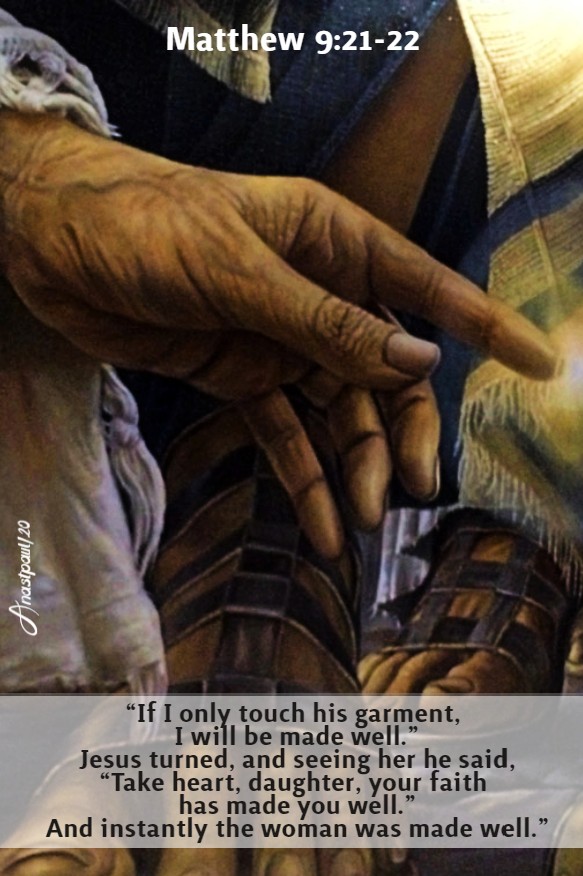
“If I only touch his garment, I will be made well.”
Jesus turned, and seeing her he said,
“Take heart, daughter, your faith has made you well.”
And instantly the woman was made well.”

Matthew 9:21-22

matthew 9 21-22 if I only touch his garment i will be made well - 6 july 2020

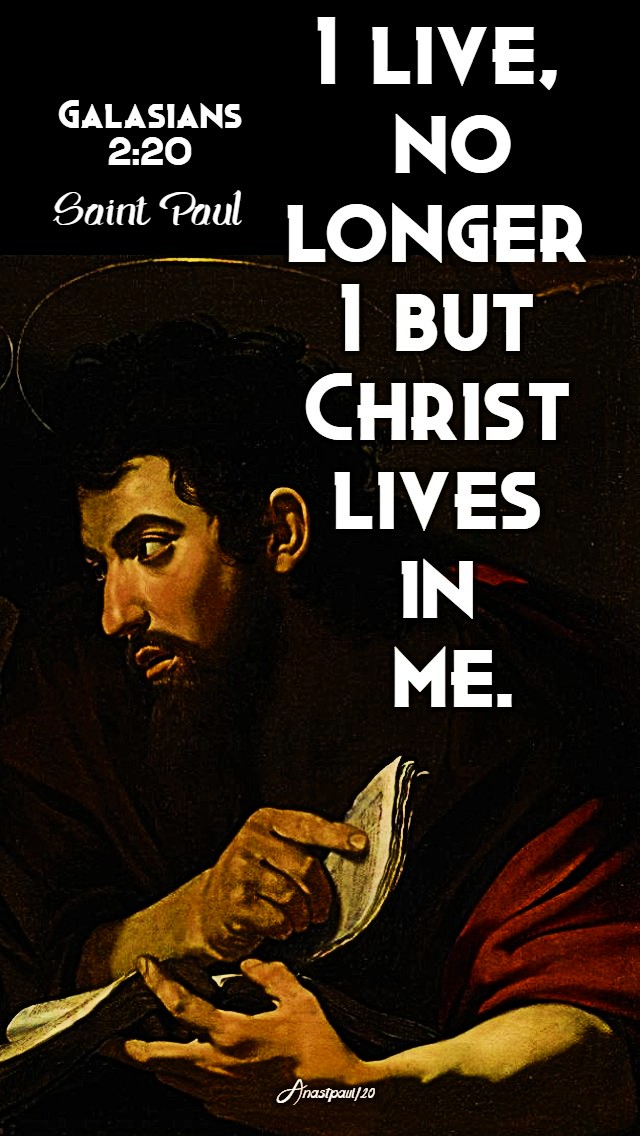
“I live, no longer I
but Christ lives in me,”

Galasians 2:20

galasians-2-20-i-live-no-longer-i-but-christ-lives-in-me-25-jan-2020 - ST PAUL - and 6 july 2020

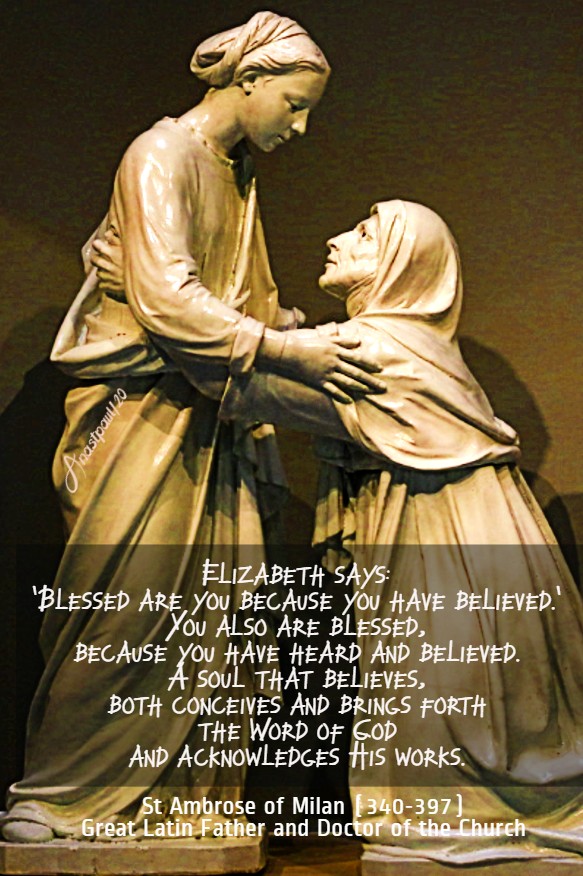
“Elizabeth says:
‘Blessed are you because you have believed.’
You also are blessed,
because you have heard and believed.
A soul that believes,
both conceives and brings forth
the Word of God
and acknowledges His works.”

St Ambrose of Milan (340-397)
Great Latin Father and Doctor of the Church

A Commentary on Luke, Book 2

elizabeth says blessed are you because you have believed - you also are blessed - st ambrose 6 july 2020

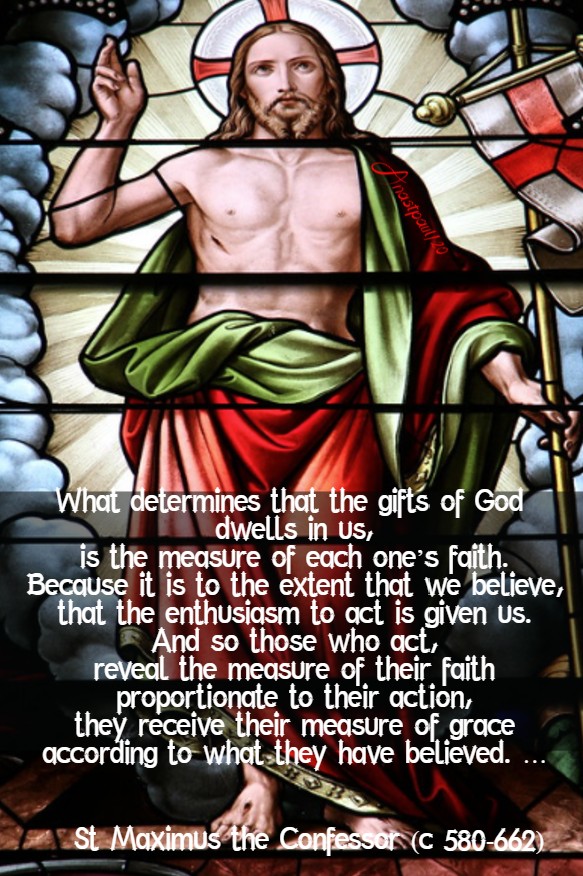
“What determines that the gifts of God dwells in us,
is the measure of each one’s faith.
Because it is to the extent that we believe,
that the enthusiasm to act is given us.
And so those who act,
reveal the measure of their faith
proportionate to their action,
they receive their measure of grace
according to what they have believed. …”

St Maximus the Confessor (c 580-662)
Monk and Theologian

what determines that the gifts of god dwells in us - st maximus the confessor 6 july 2020

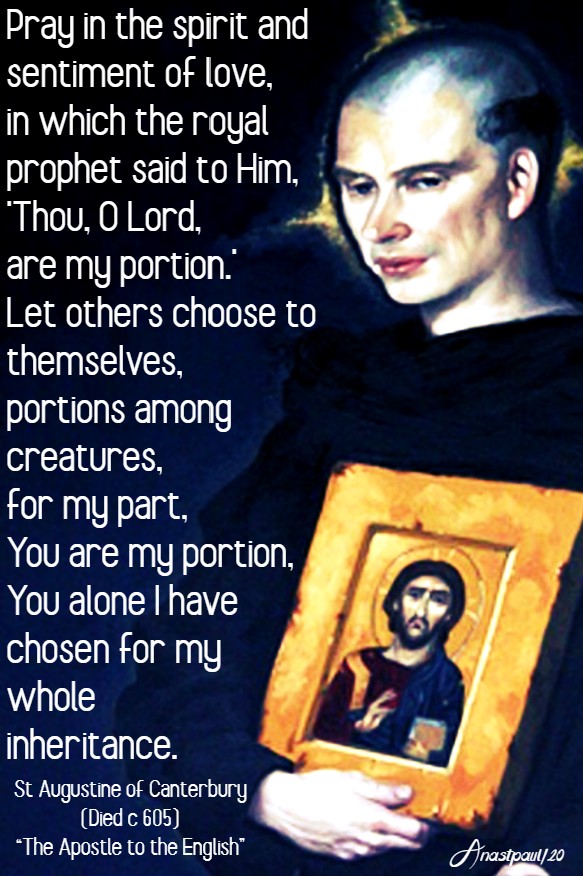
“Pray in the spirit and sentiment of love,
in which the royal prophet said to Him,
‘Thou, O Lord, are my portion.’
Let others choose to themselves,
portions among creatures,
for my part, You are my portion,
You alone I have chosen for my whole inheritance.”

St Augustine of Canterbury (Died c 605)

pray-in-the-spirit-and-sentiment-of-love-you-alone-i-have-chosen-st-augustine-of-canterbury-27-may-2020 and 6 july 2020 speaking of faith

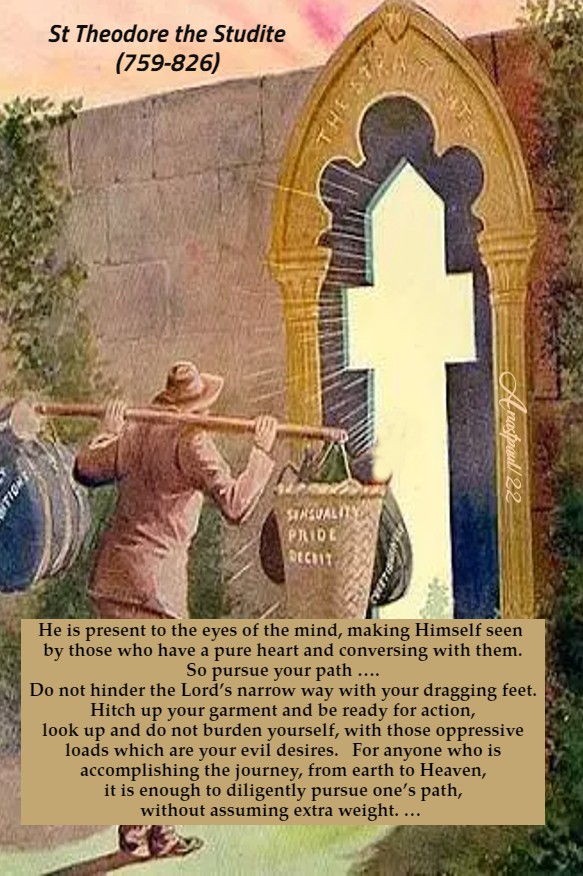
“He is present to the eyes of the mind,
making Himself seen by those who have a pure heart
and conversing with them.
So pursue your path ….
Do not hinder the Lord’s narrow way
with your dragging feet.
Hitch up your garment and be ready for action,
look up and don’t burden yourself
with those oppressive loads
which are your evil desires.
For anyone who is accomplishing
the journey from earth to heaven,
it is enough to diligently pursue one’s path
without assuming extra weight. … ”

St Theodore the Studite (759-826)
Monk and Theologian at Constantinople


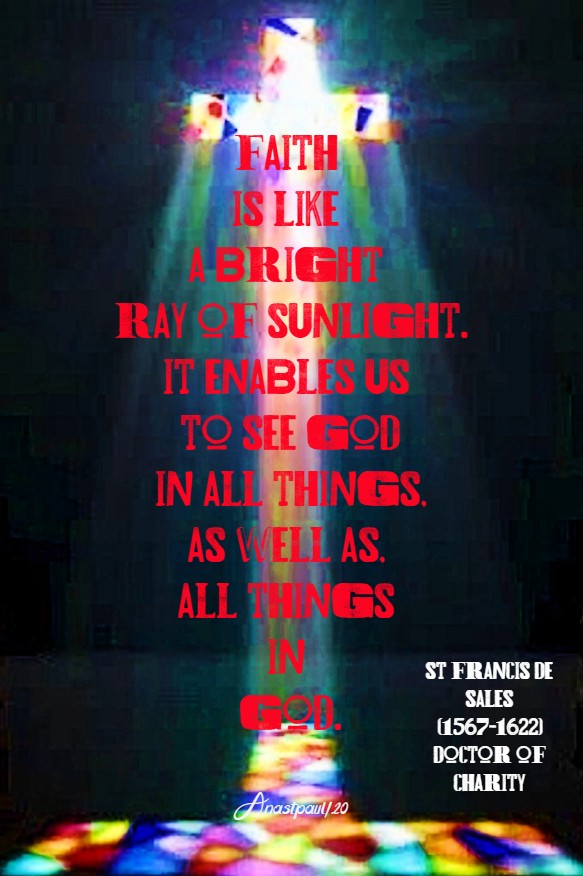
“Faith is like a bright ray of sunlight.
It enables us to see God in all things,
as well as, all things in God.”

St Francis de Sales (1567-1622)
Doctor of Charity

faith is like a bright ray of sunlight - st francis de sales 6 july 2020

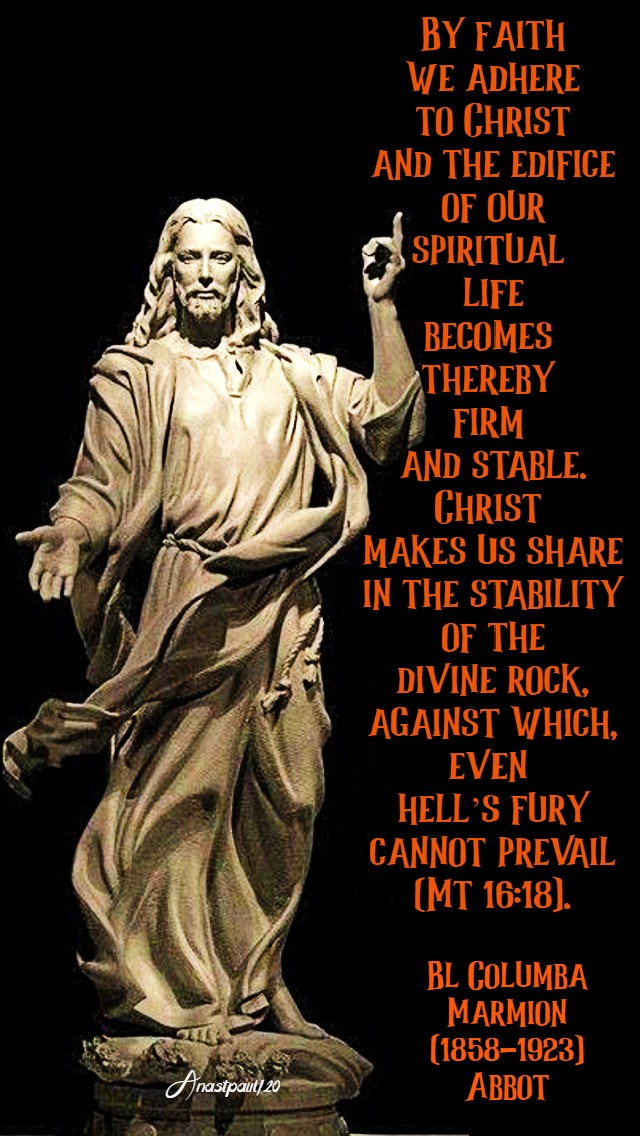
“By faith we adhere to Christ
and the edifice of our spiritual life
becomes thereby firm and stable.
Christ makes us share
in the stability of the divine rock
against which even hell’s fury
cannot prevail (Mt 16:18).”

Blessed Columba Marmion (1858-1923) Abbot

Our faith, the victory over the world

by faith we adhere to christ - bl columba marmion 6 july 2020

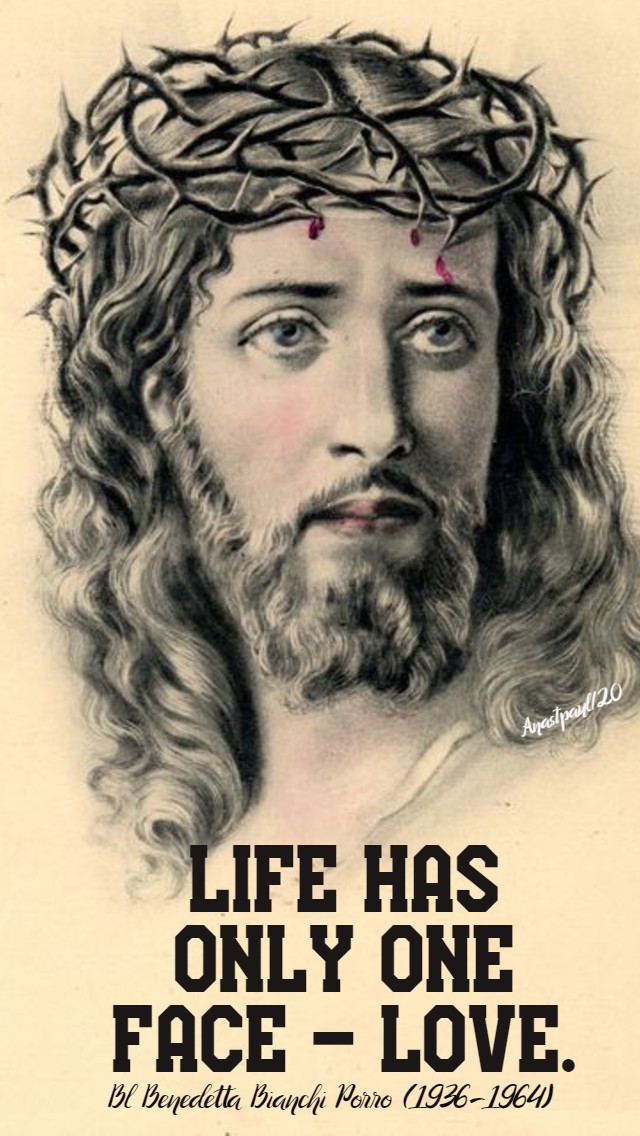
“Life has only one face – LOVE.”

Blessed Benedetta Bianchi Porro (1936-1964)

life-has-only-one-face-love-bl-benedetta-porro-23-jan-2020 and 6 july 2020

Posted in ONE Minute REFLECTION, QUOTES of the SAINTS, QUOTES on FAITH, SAINT of the DAY, The WORD

One Minute Reflection – 6 July – ‘Faith … transforms all things…’ Bl Charles Eugène de Foucauld

One Minute Reflection – 6 July – Monday of the Fourteenth week in Ordinary Time, Year A, Readings: Hosea 2:14-1619-20 (16-18, 21-22), Psalm 145:2-9Matthew 9:18-26 and the Memorial of St Maria Goretti (1890-1902) Martyr and Blessed Maria Theresa Ledóchowska SSPC (1863-1922)

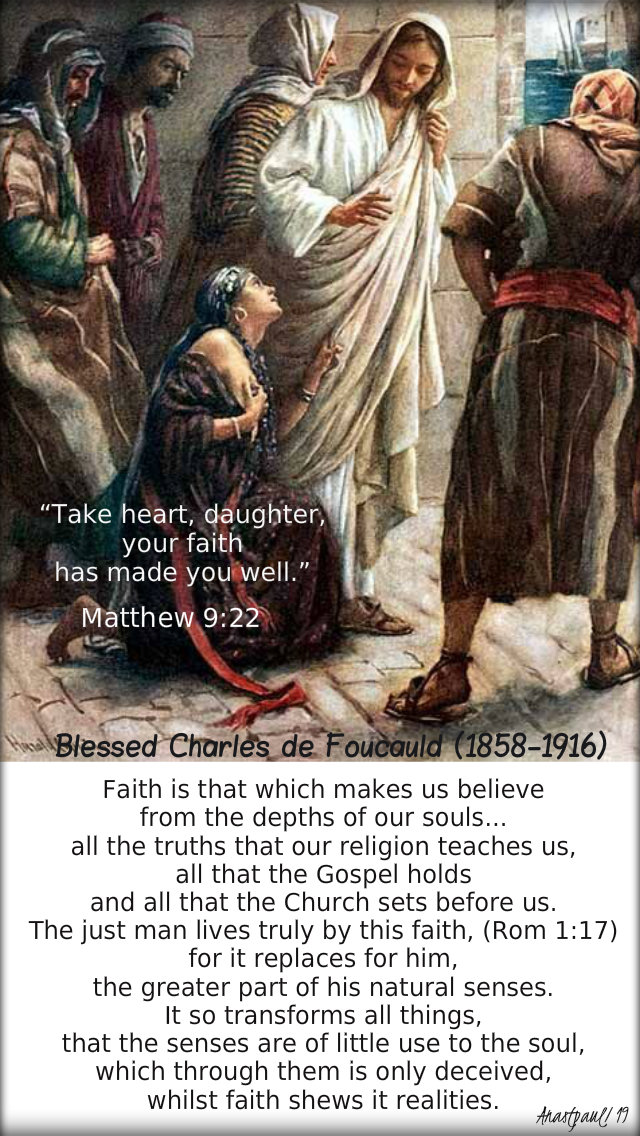
“Take heart, daughter, your faith has made you well.”…Matthew 9:22

REFLECTION – “Faith is that which makes us believe from the depths of our souls… all the truths that our religion teaches us, all that the Gospel holds and all that the Church sets before us.   The just man lives truly by this faith (Rom 1:17), for it replaces for him, the greater part of his natural senses.   It so transforms all things, that the senses are of little use to the soul, which through them is only deceived, whilst faith shews it realities.
Where the eye sees but a poor man, faith sees Jesus (Mt 25:40).   Where the ear hears curses and persecution, faith sings:  “Rejoice and be glad” (cf Mt 5:12).   The touch feels only blows and stonings but faith says: “Be glad you are deemed worthy to suffer for the name of Christ” (cf. Acts 5:41)…  The smell perceives only incense, faith tells us that the true incense is “the prayers of the saints” (Rv 8,4).
The senses lead us astray to created beauty, faith thinks of the eternal beauty and despises all created things, for they are as nothing and as dust beside that beauty.   The senses hold pain in horror, faith blesses it as a marriage crown that unites it to its Beloved, like a walk with her Bridegroom hand in divine hand.   The senses rebel against injuries but faith blesses them:  “Bless those that curse you” (Lk 6:28)… she finds them sweet, for in them she shares the lot of Jesus.   The senses are full of curiosity, faith is content to know nothing, she thirsts to bury herself and longs to pass her life motionless before the Tabernacle.”… Blessed Charles Eugène de Foucauld OCSO (1858-1916) Hermit and Missionary in the Sahara (Retreat at Nazareth 1897) To be Canonised as soon as possible after the return to normal routines, hopefully still this year, 2020. matthew-9-22-take-heart-daughter-your-faith-has-faith-is-bl-charles-de-foucauld-8-july-2019 and 6 july 2020

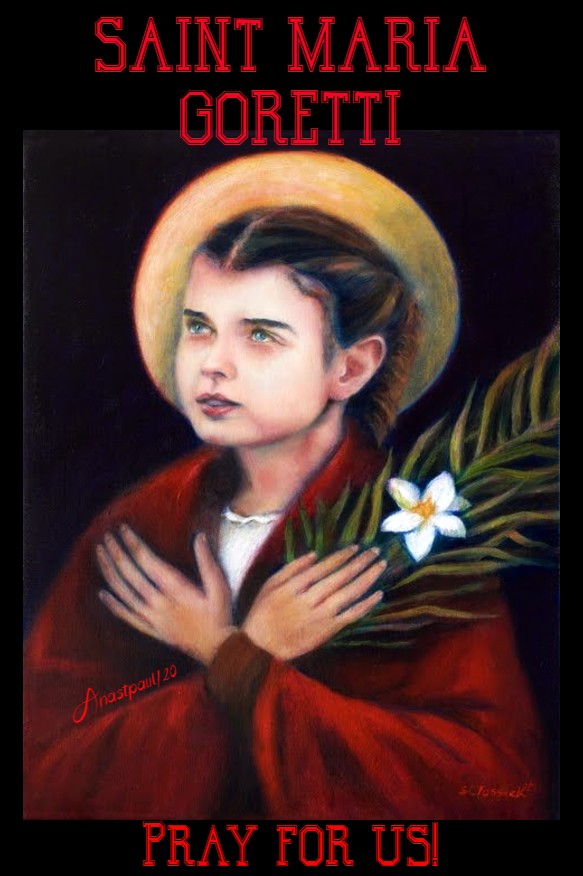
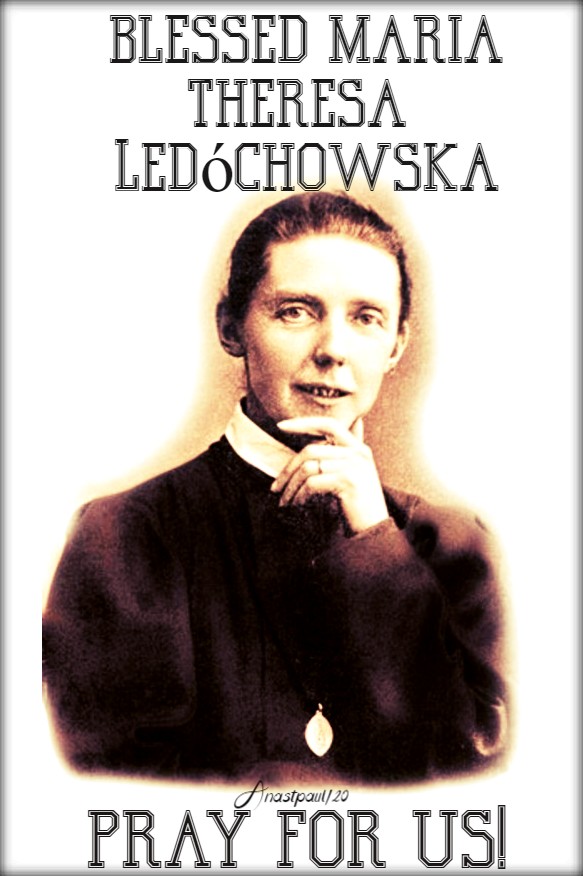
PRAYER – Almighty Lord and God, protect and strengthen us by Your power throughout this day, even as You have enabled us to begin it.   By Your grace, may the our faith be our guide and let our every thought, word and deed aim at doing Your will and what is pleasing in Your sight.   Grant that by the prayers of St Maria Goretti and Blessed Maria Theresa Ledóchowska, we may ever turn our eyes and hearts to our Lord Jesus Christ.   Through Him, Your divine Son, who lives and reigns with You and the Holy Spirit, God now and forever, amen.st maria goretti pray for us 6 july 2020

bl maria theresa ledochowska pray for us 6 july 2020

Posted in DOCTORS of the Church, JULY - The MOST PRECIOUS BLOOD, Our MORNING Offering, PRAYERS for SEASONS, PRAYERS of the SAINTS, PRECIOUS BLOOD PRAYERS

Our Morning Offering – 6 July – By Your Heart and By Your Blood! by St Francis de Sales

Our Morning Offering – 6 July – “Month of the Most Precious Blood” – Monday of the Fourteenth Week in Ordinary Time

By Your Heart and By Your Blood!
By St Francis De Sales (1567-1622)
Doctor of Charity

May Your Heart
dwell always in our hearts!
May Your Blood
ever flow in the veins of our souls!
O Sun of our hearts,
You give life to all things
by the rays of Your goodness!
I will not go,
until Your Heart has strengthened me,
O Lord Jesus!
May the Heart of Jesus
be the King of my heart!
Blessed be God.
Amenby your heart and by your blood - st francis de sales 6 july 2020

Posted in SAINT of the DAY

Saint of the Day – 6 July – Blessed Maria Theresa Ledóchowska SSPC (1863-1922)

Saint of the Day – 6 July – Blessed Maria Theresa Ledóchowska SSPC (1863-1922) Religious Sister and Co-Founder of the Missionary Sisters of St Peter Claver (commonly known as the Claverian Sisters), dedicated to service in Africa, Missionary – she is called the “Mother of the African missions.”   Born on 29 April 1863 in Loosdorf, Melk, Austria and died on 6 July 1922 in Rome, Italy of natural causes. Patronage – the Missionary Sisters of St Peter Claver.bl maria teresa lg header 1
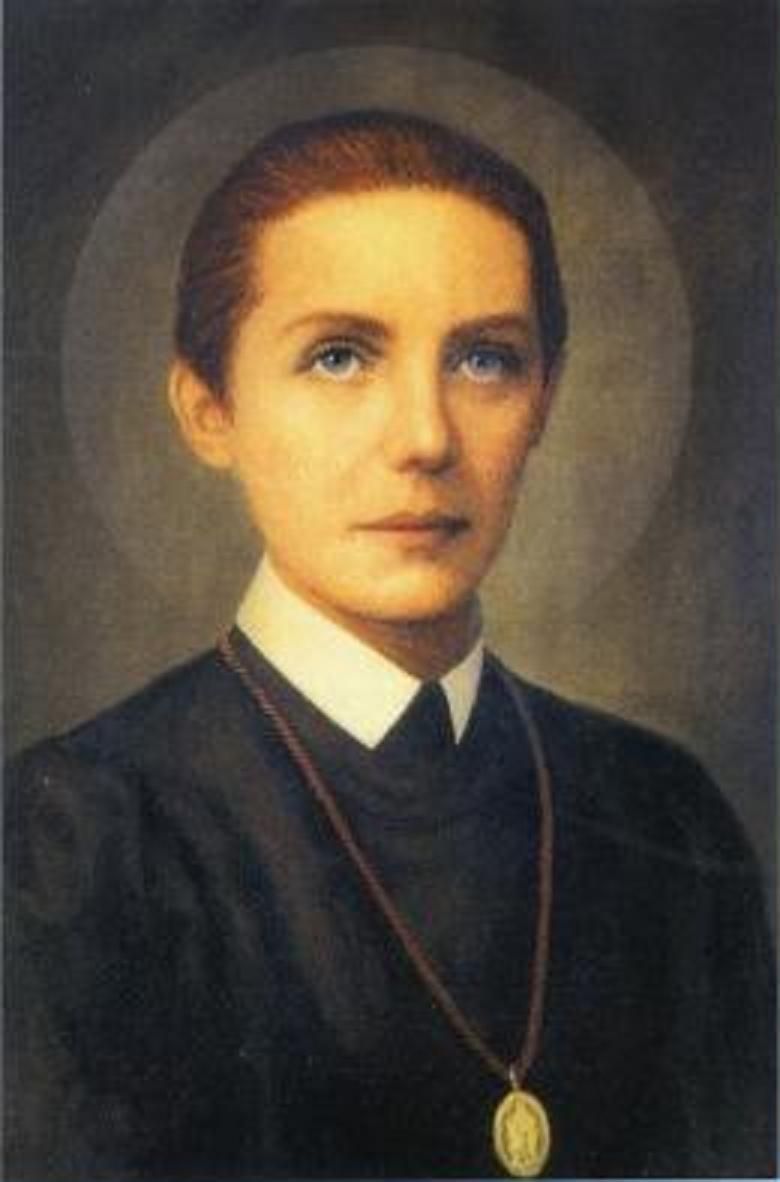
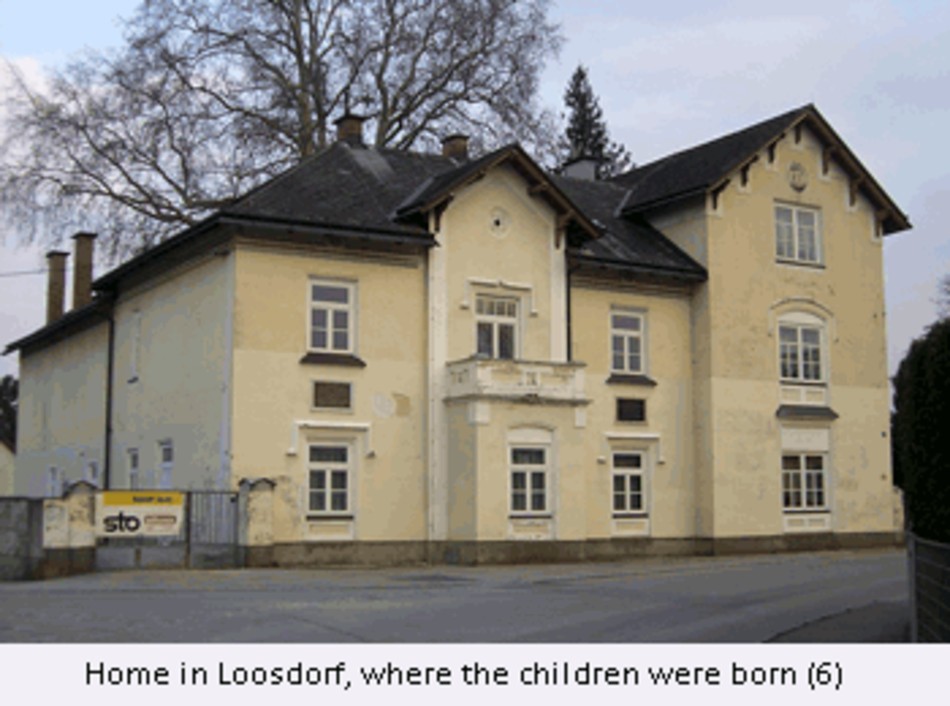
Maria Theresa (presumably named after the Austrian Empress Maria Theresa, who joined the first partition of Poland in 1773) was the first of seven children of Antoni Ledóchowski 1823–1885 and his second wife Józefina (“Sefina”) née Salis-Zizers and was born on 29 April 1863, in Loosdorf, Austria, about 80 kilometres West of Vienna.   This was “the most beautiful day of her mother’s life.”   The story of her family and in particular, her remarkable Swiss-Austrian mother Sefina “Mother of Saints,” is told in a separate article on her parents, who put a lot of effort into educating and instilling in their children a strong sense of duty to God, the Catholic Church and their father’s country, Poland.bl maria teresa's birth home Ledochowskahaus-subtitle
When she was just five years old, Maria Theresa could already read and write.   Her mother saw her one day writing something furiously in her exercise book and on further investigation discovered this was a play, with family members in key roles.   She was soon writing poetry. By eight, she could play the piano quite well and was writing notes on visits to art galleries and the World Fair in Vienna.bl Maria-Teresa-Ignacy-child
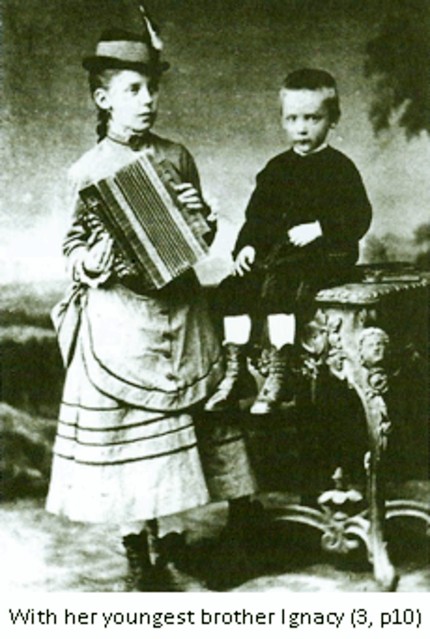
In 1873, when Maria Theresa was 10, her father lost a major investment in an Austrian bank which failed.   He sold Loosdorf and the family moved a little closer to Vienna, to St Pölten, where the eldest girls could go to a “school run by English Ladies” or the Marienfried convent.   These were the Loreto Sisters or the Institute of the Blessed Virgin Mary, dedicated to education, founded by an Englishwoman, Mary Ward, in 1609.   Their education was very good.   At the age of 12 Maria Theresa was editing the school magazine.   She was a thoughtful, serious girl and she flourished, to the great pride of her parents.   (Saint Maria Teresa of Calcutta was educated by the same order.)

In early 1876 Maria Theresa accompanied her family to Vienna to meet her uncle (son of Maria Rozalia, and her father’s first cousin) Cardinal Mieczysław Ledóchowski.   The Cardinal was being greeted everywhere as a great hero for his defence of both the Catholic Church and Polish culture, against Bismarck’s Kulturkampf.   For this, he had been imprisoned for two years, expelled from the German partition and promoted to Cardinal.   He was now on his way back to Rome.  The Cardinal made such an impression on the 12 year old girl that she got permission from her father to learn Polish, wrote to the Cardinal in Polish two years later and continued corresponding with him thereafter.Cardinal Mieczyslaw-1886
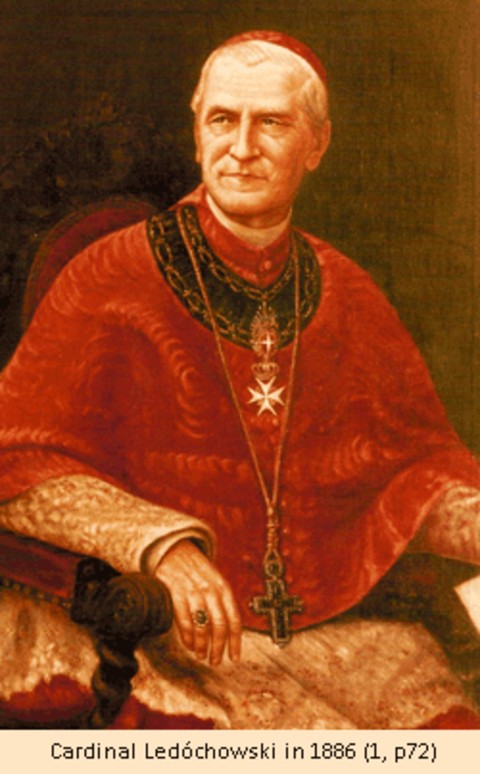
In 1879 the 16 year old Maria Theresa accompanied her father on a trip to Poland, which she recorded in a diary entitled Mein Polen (My Poland) and published under the pen name Alexander Halka.   The warmth of their relatives convinced Antoni that they should consider moving to Poland.   In Wilno, however, Maria Theresa was infected with typhus and barely recovered.   The disease was killing quite a few children in Europe at the time.   The same year her 12 year old sister Maria also caught it and died from it.

Maria Theresa and her siblings strongly supported the family’s move, partly financed by the Cardinal as described in the article on her parents, to Lipnica Murowana, in the Austrian partition of Poland, in 1883, when she was 20.   She made use of this to improve her Polish but did not stay there long.

In early 1885, when Maria Theresa was not quite 22, she contracted smallpox.   Shortly afterwards, her father Antoni, was infected too and he died during an asthma attack on 24 February 1885.   The severity of the smallpox and the tragic death of her beloved father, on top of the typhus she had endured and which had killed her younger sister a few years earlier, were debilitating for Maria Theresa and left her underweight and disfigured.   Fr Laurita says she looked at herself in the mirror and bravely accepted her fate with even some humour – and so began her decision to do something big for God.  bl Maria_Teresia_Ledóchowska_4As part of her convalescence she went to the Gmunden health resort in Austria.

The eldest three children were now leaving home – the third eldest, the highly intelligent Wladimir, went to Kraków University to study law, changed to theology and entered the Tarnów seminary in October 1885 and the second eldest, Julia (the future Ursula – the future Saint Ursula Ledóchowska (1865-1939) https://anastpaul.com/2017/05/29/saint-of-the-day-29-may-st-ursula-ledochowska-mother-maria-ursula-of-jesus/ ), had decided to become a nun and entered the Ursuline Convent at Starowiślna in Kraków in 1886.

At the Gmunden health resort the eldest, Maria Theresa, had met Princess Alice, Archduchess of Tuscany and she now moved to Salzburg where on 1 December 1885 she became Lady-in-Waiting to the Princess.  bl maria teesa at ruscan court young womanAt the Princess’ Court, Maria Theresa planned to develop her skills and love for music, painting and literature.   But several events then changed Maria Teresa’s life:-
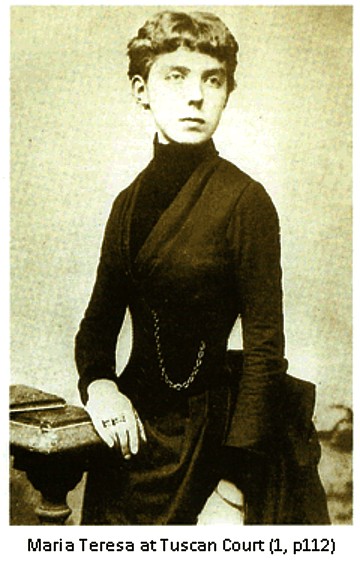
● Two Franciscan Missionaries of Mary, an order founded in British India in 1877, visited the Court with stories of how they strive to alleviate hunger, poverty and disease.

● She heard about the visit of Cardinal Lavigerie to London, who urged the “Christian ladies of Europe” to use their talents to support the fight against slavery in Africa.

● She wrote a play, Zaida, about an African slave girl.

● Her uncle Cardinal Mieczysław Ledóchowski strongly encouraged her.

● She established contact with many missionaries in the poor world.

● She started writing articles entitled “Echo from Africa” in a German newspaper in which St Angela-Blatt, called for support for the Missionaries.

● In November 1889 she started publishing a separate monthly paper Echo from Africa dedicated to supporting the work of Missionaries and especially the fight against slavery.bl maria_teresa header

1894:   The Sodality of St Peter Claver
In 1891 Maria Theresa left the Court.   A violent physical attack increased her determination to pursue her mission.   At the age of 31, in 1894, with her uncle’s support, she secured the approval of PopeLeo XIII for the establishment of the St Petrus Claver-Sodalität, or Sodality of St Peter Claver for African Missions.   St Peter is known as the “Apostle to the Slaves.”   Tellingly, she named it after the Jesuit who tried to alleviate the suffering of African slaves transported to South America in the early seventeenth century, is estimated to have personally baptised around 300,000 people, and became the patron saint of slaves and seafarers.

Shortly after founding the Sodality, Maria Theresa was joined by her first recruit, Melania von Ernst, a subscriber to Echo from Africa.   In 1895 the two were joined by Maria Jandl.   More young women were inspired to join.   In 1896 they were established in a country house they called Maria Sorg in Austria, which included a Chapel commemorating the defeat of the Turks at Vienna in 1683.   Their publications included Echo from Africa, The Small African Library later called African Youth, Propaganda for the Missions later called Africa for Christ, the St Peter Claver Calendar and the Children’s Calendar, all raising funds and support for the missions.

On 8 September 1897 (the Feast of the Nativity of Mary, but also the anniversary of St Peter Claver’s death) she and her first companions professed their permanent religious vows as Missionary Sisters of St Peter Claver.   They adopted the Jesuit Constitutions for their own use, to combine the elements of contemplation with an active life of service.bl maria teresa ledochowska sml

The Sodality then grew to what it is today – the Claverian Sisters, or the Congregation of the Missionary Sisters of St Peter Claver, dedicated to Missionary work, serving the Church, the needy and disadvantaged. They have communities in 23 countries, including Austria, Poland, the UK, Africa and the Americas and are active in 78 countries.   Their website has a map of their global presence.

Maria Theresa and her sister Ursula together recorded their memories of their mother Józefina née Salis-Zizers and this was published by the Sodality in 1935, an extremely rare, if not unique, example of daughters publishing a book in honour of their mother.

She died of tuberculosis at the relatively young age of 59 on 6 July 1922.   She was buried in a cemetery near St Peter’s and was moved to the General Motherhouse of the Congregation of Claverian Sisters on Via dell’Olmata 16, Rome, in 1935.bl maria teresa's Grave-subtitle
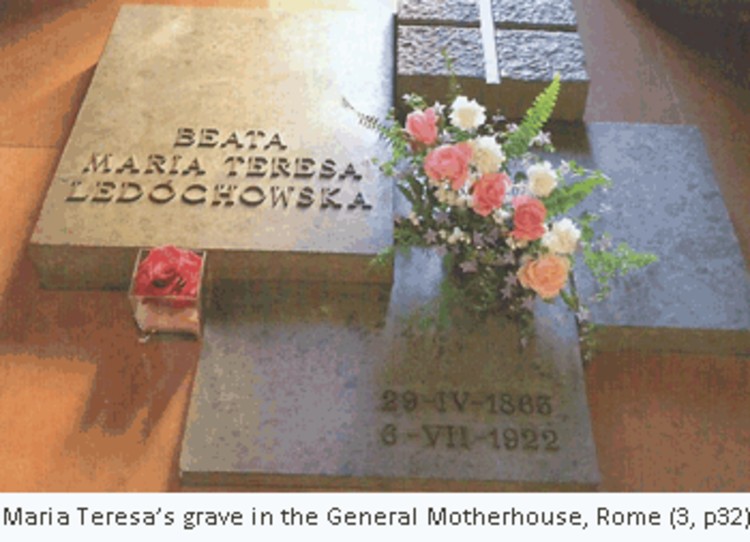
Two events in Italy in the 1930s were recognised as miracles.   Guiditta De Rivo, from Velletri, was knocked over by a fast motorcycle and her three month old child died on the spot.   She could not move afterwards due to several wounds and a broken pelvis.   She dedicated herself to the care of Mother Maria Theresa Ledóchowska and shortly afterwards got up from her bed, asked for her clothes and left the hospital.

Vincenza Mazzeotti, from Flavetto di Rovito, suffered from severe inflammation of the left knee.   On 4 July 1936 the doctor decided an operation was necessary.    On 5th July she received a copy of Echo from Africa and started praying for the intervention of Maria Theresa. On 6 July, Maria Theresa’s day, when Vincenza was due to be operated on in hospital, she got up.   Her leg was already cured.

The cause for her Beatification was opened about 1930.   As part of the process, her remains were exhumed and transferred to the Chapel of the General Motherhouse in 1934.   Pope Paul VI Beatified her on 19 October 1975.   Her feast day is celebrated on 6 July.  Beatification-bl maria theresa
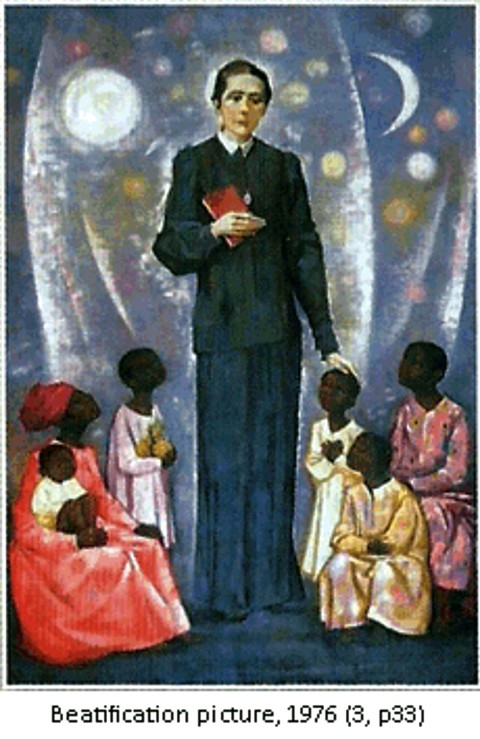
Posted in SAINT of the DAY

Memorials of the Saints – 6 July

St Maria Goretti (1890-1902) Martyr (Optional Memorial)
About St Maria here:
https://anastpaul.wordpress.com/2017/07/06/saint-of-the-day-6-july-st-maria-goretti/

Bl Angela of Bohemia
Bl Augustin-Joseph Desgardin
Bl Christopher Solino
St Cyril of Thessaloniki
St Dominica of Campania
St Gervais
St Giusto of Condat
St Goar of Aquitaine
St Godelieve
Blessed Maria Theresa Ledóchowska SSPC (1863-1922)
St Monenna
St Nazaria Ignacia March y Mesa (1889-1943) –Canonised on 14 October 2018, together with Blessed Pope Paul VI and Blessed Oscar Romero and others on 14 October 2018.
Her story:
https://anastpaul.com/2018/07/06/saint-of-the-day-6-july-blessed-sr-nazaria-of-saint-teresa-of-jesus-nazaria-ignacia-march-y-mesa-1889-1943/

St Noyala of Brittany
St Petrus Wang Zuolung
St Romulus of Fiesole (Died c 90) Martyr
Biography:
https://anastpaul.com/2019/07/06/saint-of-the-day-6-july-saint-romulus-of-fiesole-died-c-90-martyr/
St Saxburgh of Ely
St Sisoes the Great
Bl Suzanne Agathe de Loye
St Thomas Alfield
St Tranquillinus of Rome

Martyrs of Campania – 23 saints: A group of 23 Christians arrested, tortured and then beheaded together in the later 3rd century by order of governor Rictiovarus in the persecutions of Diocletian. The names that have come down to us are – Antoninus, Arnosus, Capicus, Cutonius, Diodorus, Dion, Isidore, Lucia, Lucian, Rexius, Satyrus and Severinus.

Martyrs of Fiesole – 5 saints: Five Christians martyred together in the persecutions of emperor Domitian – Carissimus, Crescentius, Dulcissimus, Marchisianus and Romulus. c 90 near Fiesole, Italy.

Posted in EUCHARISTIC Adoration, MEDITATIONS - ANTONIO CARD BACCI, QUOTES - J R R Tolkien and MORE, The HOLY EUCHARIST / The HOLY MASS

Thought for the Day – 5 July – The Eucharistic Life

Thought for the Day – 5 July – “Month of the Most Precious Blood” – Meditations with Antonio Cardinal Bacci (1881-1971)

The Eucharistic Life

the eucharistic life - the eucharist in our spiritual life - bacci 5 july 2020

“The Eucharist in our spiritual life could be compared to the sun in the physical life of the world.
The sun gives light, heat and life.
We can imagine what a terrible thing it would be if the sun set one evening and never rose again!
Darkness would envelop the earth once more as at the beginning of creation.
The cold would become relentless and life would be gradually extinguished everywhere.
Men could, for sometime, depend on their reserves of artificial light to illuminate their creeping agony but, life would slowly decline, until it ended in death for everything and for everybody.
Such would be the spiritual life without Jesus, especially without Jesus in the Blessed Eucharist, Who lives amongst us as our only true Friend, Who hears, helps and nourishes us.

He is the sun of our souls, the source of our enlightenment, fervour and consolation.
Are we weary and discouraged beneath the weight of our daily cross and of our sins?
Let us go to Jesus and He will help us to carry our cross.
He will wash away our sins and give us the supernatural strength, never to sin again.

Let us unite ourselves to Jesus, by frequent communion, by a daily visit to Him in the Tabernacle and, by making a spiritual communion whenever we cannot receive Him in the Blessed Eucharist.
Let us make fervent aspirations, whenever we find our cross too heavy for us or when we are strongly tempted.

Many people go on long pilgrimages to famous Sanctuaries, such as Lourdes, Fatima and the Holy Places of Palestine.
These are certainly worthwhile but, we should not forget that the greatest sanctuary of all is close at hand.
It is in every Church which contains Jesus in the Tabernacle.
Here, we have Jesus Himself, really present and anxious to listen to us and to help us.
The Saints could find no greater joy on earth than to to pray before the Blessed Sacrament.
We are all called to be saints!”

Antonio Cardinal Bacci

the eucharistic life - many people go on long pilgrimages - bacci 5 july 2020

Posted in INCORRUPTIBLES, QUOTES of the SAINTS, QUOTES on DISCIPLESHIP, QUOTES on HUMILITY, QUOTES on HYPOCRISY, QUOTES on LOVE of GOD, QUOTES on OBEDIENCE, QUOTES on PRAYER, QUOTES on PRIDE, QUOTES on SANCTITY, QUOTES on SELF-DENIAL, The HOLY GHOST

Quote/s of the Day – 5 July – St Anthony Mary Zaccaria

Quote/s of the Day – 5 July – The Memorial of St Anthony Mary Zaccaria CRSP (1502-1539)

“We manifest our love for God
in our observance of His commandments
and in our readiness to obey,
even His smallest decree.”

we manifest our love for god in our observance of his commandments - st anthony mary zaccaria 5 july 2020

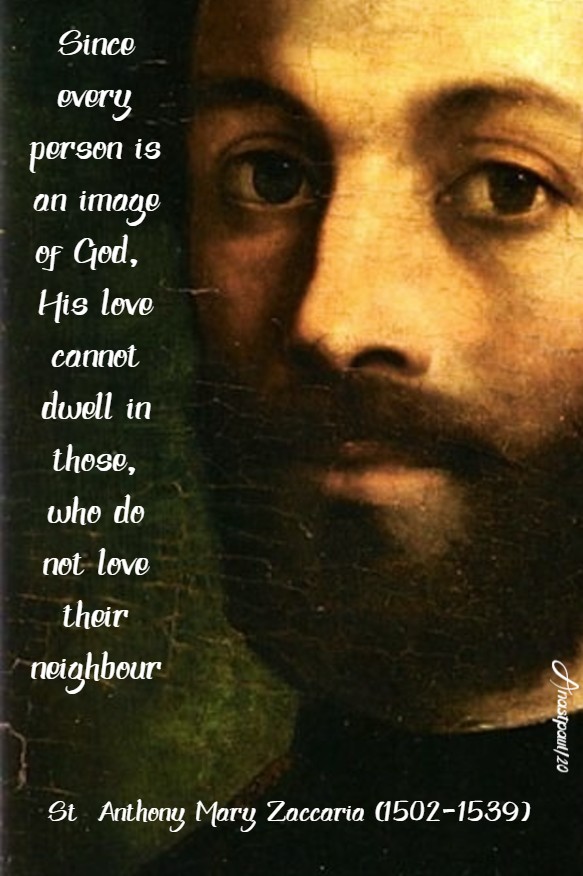
“Since every person is an image of God,
His love cannot dwell in those,
who do not love their neighbour.”

since every person is an image of god - st anthony mary zaccaria 5 july 2020

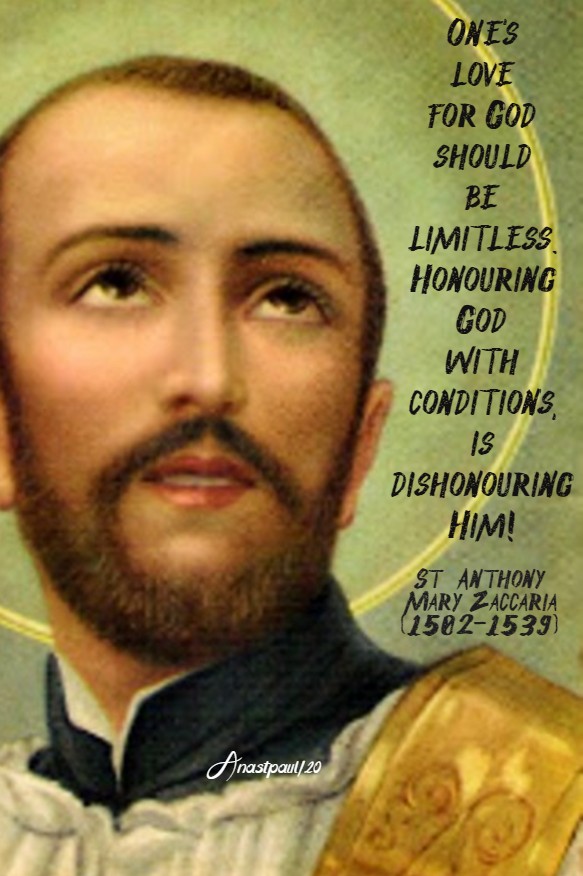
“One’s love for God should be limitless.
Honouring God with conditions,
is dishonouring Him!”

one's love for god should be limitless - st anthony mary zaccaria 5 july 2020

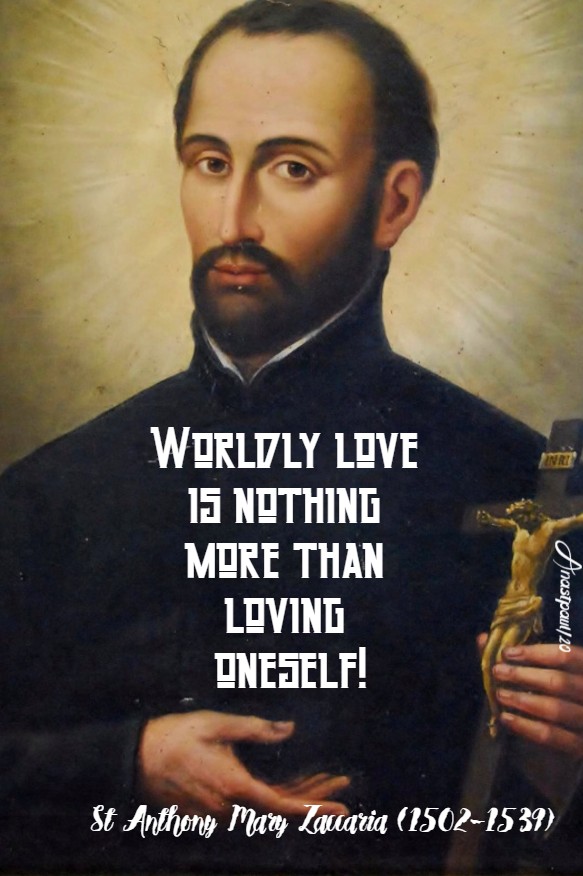
“Worldly love
is nothing more than
loving oneself!”

worldly love is nothing more than loving oneelf st anthony mary zaccaria 5 july 2020

“Worldly love aims
at pleasing everyone
and saddening no-one.
Many call this politeness
but, it is simply,
self-praise and flattery.”

worldy love aims at pleasing everyone - st anthony mary zaccaria 5 july 2020

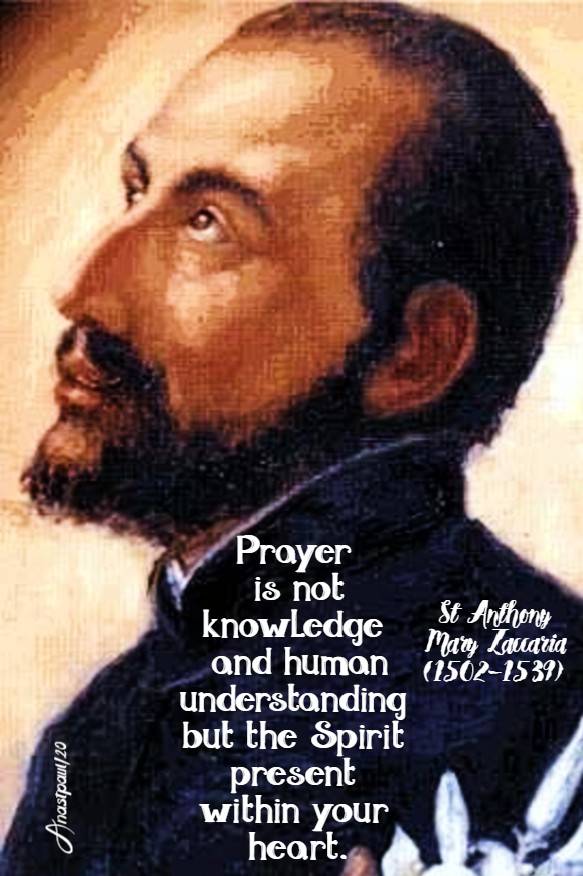
“Prayer is not knowledge
and human understanding
but the Spirit present
within your heart.”

St Anthony Mary Zaccaria (1502-1539)

MORE HERE:   https://anastpaul.com/2019/07/05/quote-s-of-the-day-5-july-st-anthony-mary-zaccaria/

prayer is not knowledge and human - st anthony mary zaccaria 5 july 2020

Posted in CHRIST, the WAY,TRUTH,LIFE, franciscan OFM, HOLY COMMUNION, I BELIEVE!, QUOTES of the SAINTS, SUNDAY REFLECTIONS, The HOLY EUCHARIST / The HOLY MASS

Sunday Reflection – 5 July – The Body of the Lord – St Francis of Assisi

Sunday Reflection – 5 July – “Month of the Most Precious Blood” – Fourteenth Sunday in Ordinary Time

Saint Francis of Assisi (c 1181-1226)
First Admonition

The Body of the Lord

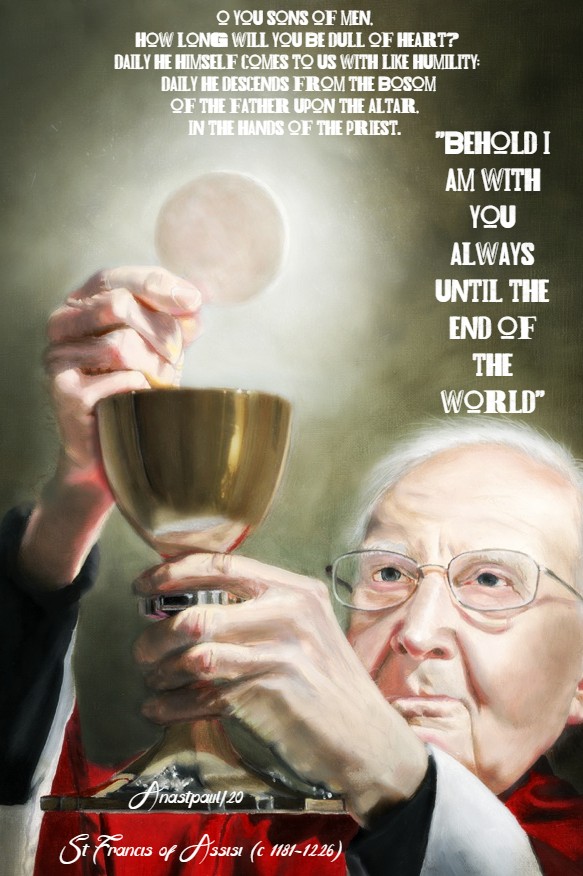
o you sons of men how longwill you be dull of heart - st francis 5 july 2020 sun reflection

“The Lord Jesus says to His disciples:   “I am the way, the truth and the life;  no-one comes to the Father but through me.   If you had known me, you would have known my Father also and from now on, you shall know him and have seen him.”    Philip says to him:  “Lord, show us the Father and it is enough for us.”  Jesus says to him:  “Am I with you so long a time and still you do not know me? Philip, he who sees me sees my Father also” (Jn 14:6-9).   The Father dwells in unapproachable light (1 Tim 6:16) and God is spirit (Jo 4:24) and no-one has ever seen God (Jo 1,18). Hence only in spirit can He be seen, for it is the spirit that gives life;  the flesh has nothing to offer (Jo 6:63).   Yet, neither is the Son, inasmuch as He is equal to the Father, seen by anyone other than by the Father, other than by the Holy Spirit.

Wherefore, all those who saw the Lord Jesus according to humanity and did not see and believe, according to the spirit and the divinity, that He is the true Son of God, were condemned.   So also now, all those who behold the Sacrament which is sanctified by the words of the Lord upon the altar, at the hand of the priest, in the form of bread and wine and do not see and believe according to the spirit and divinity, that it is truly the most Holy Body and Blood of our Lord Jesus Christ, are condemned.   This the Most High Himself attests, who says:  “This is my body and the blood of my New Testament” (Mk 14:22-24) and:  “who feeds on my Flesh and drinks my Blood will have everlasting life” (Jn 6:55).   Wherefore, the Spirit of the Lord, who dwells in His faithful ones, He it is who receives the most Holy Body and Blood of the Lord. All others who do not share of that Spirit and presume to receive Him eat and drink judgement to themselves (1Cor 11:29).

Wherefore, O you sons of men, how long will you be dull of heart? (Ps 4:3).   Why do you not recognise the truth and believe in the Son of God (Jo 9,35)?   Behold – daily He humbles Himself (Phil 2:8) as when from heaven’s royal throne (Wisd 18:15) He came down into the womb of the Virgin.    Daily He Himself comes to us with like humility;  daily He descends from the bosom of the Father ( Jo 1:18; 6,38) upon the altar, in the hands of the priest.   And, as He appeared to the Apostles in true flesh, so now also he shows himself to us in the Sacred Bread.   And, as they by their bodily sight saw only His flesh, yet contemplating Him with the eyes of the spirit, believed Him to be very God, so we also, as we see our bodily eyes the bread and wine, are to see and firmly believe, that it is His most holy body and blood living and true.   And in this way the Lord is always with His faithful, as He Himself says: “Behold I am with you always until the end of the world” (Mt 28:20).”

St Francis of Assisi

Posted in DOCTORS of the Church, FATHERS of the Church, INCORRUPTIBLES, ONE Minute REFLECTION, QUOTES on HUMILITY, The WORD

One Minute Reflection – 5 July – ‘… For I am meek and humble of heart’

One Minute Reflection – 5 July – “Month of the Most Precious Blood” – Fourteenth Sunday in Ordinary Time, Year A, Readings: Zechariah 9:9-10Psalm 145:1-28-1113-14Romans 8:911-13Matthew 11:25-30 and the Memorial of St Anthony Mary Zaccaria CRSP (1502-1539)

“Take my yoke upon you and learn from me, for I am meek and humble of heart and you will find rest for your souls…” … Matthew 11:29take my yoke upon you - matthew 11 29 5 july 2020

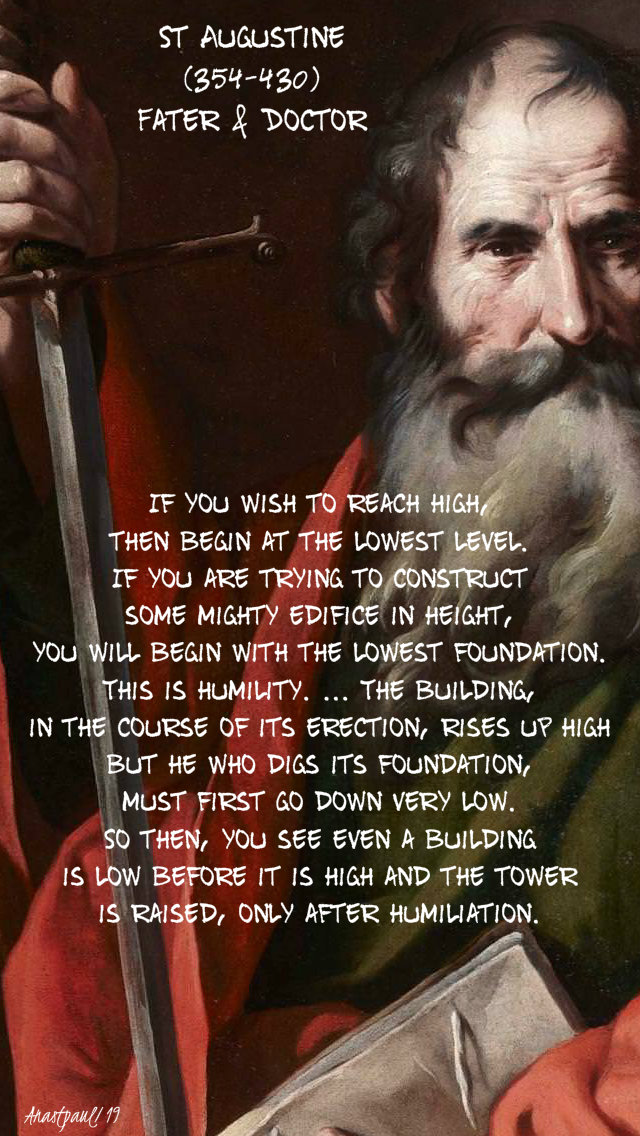
REFLECTION – “You are to “take my yoke upon you and learn from me.”   You are not learning from me how to refashion the fabric of the world, nor to create all things visible and invisible, nor to work miracles and raise the dead.   Rather, you are simply learning of me: “that I am meek and lowly in heart.”   If you wish to reach high, then begin at the lowest level.   If you are trying to construct some mighty edifice in height, you will begin with the lowest foundation.  This is humility.   However great the mass of the building you may wish to design or erect, the taller the building is to be, the deeper you will dig the foundation.   The building in the course of its erection, rises up high but he who digs its foundation, must first go down very low.   So then, you see even a building is low before it is high and the tower is raised, only after humiliation.”… St Augustine (354-430) Fater & Doctor (Sermon 69)if-you-wish-to-reach-high-then-begin-at-the-lowest-level-st-augustine-18-july-2019 and 5 july 2020

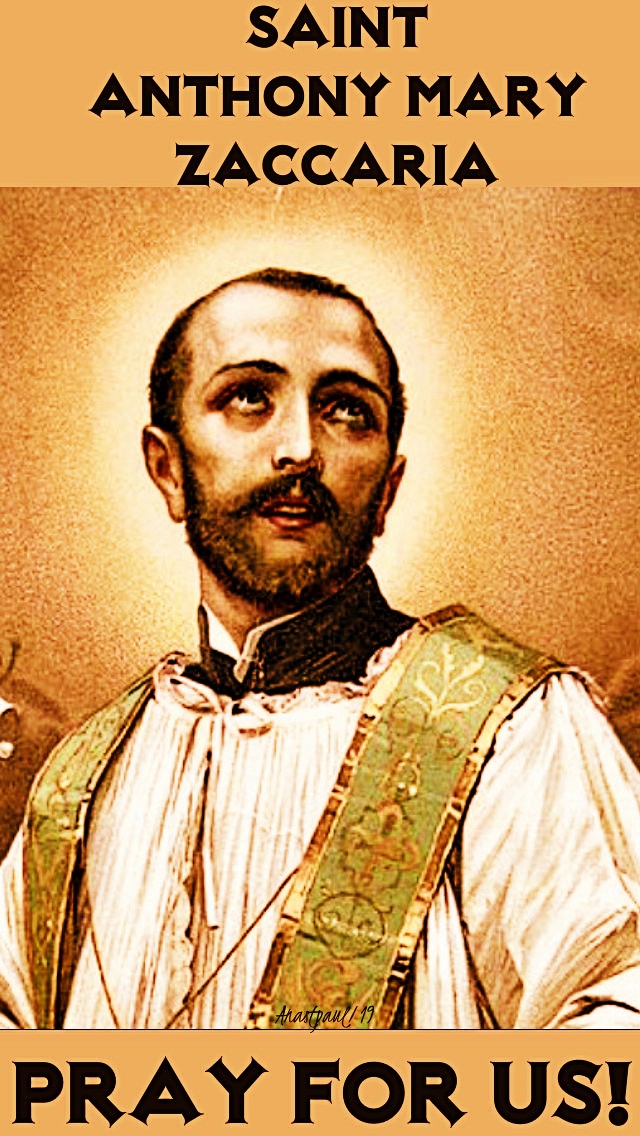
PRAYER – Holy God, our Father, we turn to You in confidence as children and pray, give us meekness of heart, make us “poor in spirit” that we may recognise that we are not self-sufficient, that we are unable to build our lives on our own but need You, we need to encounter You, to listen to You, to speak to You.   Help us to understand that we need Your gift, Your wisdom, which is Jesus Himself, in order to do the Your will in our lives and thus to find rest in the hardships of our journey.   May the prayers of Saint Anthony Zaccaria help us to learn the true humility of Your divine Son.   Grant this, we pray, through our Lord Jesus Christ who lives and reigns with You and the Holy Spirit, one God, forever and ever, amen.st-anthony-mary-zaccaria-pray-for-us-5-july-2019 and 5 july 2020

Posted in EUCHARISTIC, EUCHARISTIC Adoration, HYMNS, JULY - The MOST PRECIOUS BLOOD, Our MORNING Offering, PRAYERS of the CHURCH, The HOLY EUCHARIST / The HOLY MASS

Our Morning Offering – 5 July – Ave Verum Corpus

Our Morning Offering – 5 July – “Month of the Most Precious Blood” -Fourteenth Sunday in Ordinary Time

Ave Verum Corpus
By Pope Innocent VI (c 1282-1362)
Papacy 1352-1362

Hail, true Body, truly born
Of the Virgin Mary mild
Truly offered, wracked and torn,
On the Cross for all defiled,
From Whose love pierced, sacred side
Flowed Thy true Blood’s saving tide.
Be a foretaste sweet to me
In my death’s great agony.
O Jesu dulcis!
O Jesu pie!
O Jesu Fili Mariae.
Amen

Just as St John the Baptist leapt with joy in his mother’s womb when the Saviour drew near in the womb of Mary, so we leap with joy in the presence of Our Eucharistic Lord.ave verum corpus - by pope innocent VI 5 july 2020

Posted in SAINT of the DAY

Saint of the Day – 5 July – Blessed Joseph Boissel OMI (1909-1969) Priest and Martyr

Saint of the Day – 5 July – Blessed Joseph Boissel OMI (1909-1969) Priest and Martyr, Missionary of the Missionary Oblates of Mary Immaculate, Founded by St Eugene de Mazenod, Apostle of sick – born on 20 December 1909 in Le Loroux, Ille-et-Vilaine, of the Archdiocese of Rennes , in Brittany France and died by being shot on 5 July 1969 on the road near Hat I-Et, Bolikhamxay, Laos, aged 59.   He is one of the Seventeen Martyrs of Laos (including ten French, six Laotians and an Italian), whose combined Feast day is 16 November.bl joseph boissel.2jpg

Joseph Boissel was born 20 December 1909 in the Marches of Brittany (France), in the hamlet of La Tiolais, outside the town of Loroux. into a family of modest farmers and became fatherless at the age of fourteen. He entered the Minor Seminary of the Oblates of Marie-Immaculate. His masters found him “conscientious, very devoted, honest and frank” and especially “very attached to his vocation.”   He was Ordained a Priest on 4 July 1937.bl joseph boissel very young

Fr Joseph received his orders to the brand new mission of Laos, begun less than two years earlier.   He arrived in Laos in 1938.

In March 1945, the Japanese hit Laos.   On 1 June Fr Joseph Boissel was captured with his companion Father Vincent Le Calvez and the Apostolic Prefect, Msgr Jean Mazoyer, OMI.   All three were taken to Vinh, Vietnam, where they were held among a hostile population.  Back in Laos in 1946, Joseph again found his Tran Ninh peoples and had contact with the Hmong.bl joseoph boissel young

On Saturday, 5 July 1969, he decided to go to Hat I-Êt, a village of Kmhmu’ refugees a good 20 kilometers from Paksane, going up along the River Nam San.   Because of the lack of security, that year he had been unable to go there to administer the Sacraments, for several months.   The Catechist André Van was there and he needed to know that he was supported.

Setting out around four in the afternoon, he took two young Laotian Oblate Missionaries with him as usual, they were to help him with the visits, the care of the sick and the religious service.Blessed-Joseph-Boissel

The following is told by one of the two passengers, the only survivor able to do so:

Two or three kilometers before arriving at the village, at a bend in the road, I heard a burst of gunfire aimed at us.   The tires blew out and I was hit in the hand.   I saw a red flag moving in the forest bordering our route.   A second burst of gunfire and Thérèse was hit in the head, since I am smaller, the bullets did not hit me.   The firing came from the left, on the driver’s side.

Father Boissel was hit in the head – near the mouth and in the skull. The jeep went into a ditch, turned over on us and burst into flames. Father’s glasses were broken, he died on the spot… His big eyes were open.   All three of us were completely covered with blood.

Father Boissel was dead, Thérèse was unconscious.   I was in a huge daze… not moving… like dead.   But I saw three young Vietnamese soldiers going around the vehicle three times.   One said: “Let’s kill them!” – “Let’s burn the vehicle and its occupants!”   They moved away and threw a grenade at the car.   The grenade exploded – it was the explosions that caused our injuries.   I said, “O Lord!” but veil of darkness came over me…

I don’t know how long we stayed like that in the car.   But Thérèse came to first.   She pushed me to get out…   The grenade had deafened us…   It was difficult for us to communicate, to understand one another…   Both of us prayed to the Lord:   “If you still need us… send someone to help us.”   We went to sleep along the road.   I put my hand on Thérèse’s heart and she put hers on my heart – united in suffering.

Oh, we had to wait a long time, from 4:30 until about 9:30.   Finally, some people arrived to pick us up.   Father’s body had been burned to the point that his face was totally unrecognisable.   Thérèse, hit in the head, remained mentally handicapped as a result of the attack.   She really has no happiness in living.”

Fr Joseph was Beatified on 11 December 2016 by Pope Francis.   The recognition was celebrated in Laos, presided by Cardinal Angelo Amato.   Below are the six OMI Martys of Laos and all the Martyrs of the region.

This slideshow requires JavaScript.

bl joseph boissel

Posted in INCORRUPTIBLES, SAINT of the DAY

Memorials of the Saints – 5 July

St Anthony Mary Zaccaria CRSP (1502-1539) (Optional Memorial)
Biography:

Saint of the Day – 5 July – St Anthony Mary Zaccaria C.R.S.P. (1502-1539)

AND:

Saint of the Day – 5 July – St Anthony Mary Zaccaria CRSP (1502-1539)

St Agatho of Sicily
St Athanasius the Athonite
St Athanasius of Jerusalem
St Cast
St Cyprille of Libya
St Cyrilla of Cyrene
St Domèce
St Domitius of Phrygia
St Edana of West Ireland
Bl Edward Cheevers
Bl Elias of Bourdeilles
St Erfyl
St Fragan
Bl George Nichols
St Grace of Cornwall
St Gwen
Bl Humphrey Pritchard
Blessed Joseph Boissel OMI (1909-1969) Priest and Martyr
St Marinus of Tomi
St Mars of Nantes
St Marthe
Bl Matthew Lambert
St Modwenna
St Numerian of Treves
Bl Patrick Cavanagh
St Philomena of San Severino
St Probus of Cornwall
Bl Richard Yaxley
Bl Robert Meyler
St Rosa Chen Aijieh
St Sedolpha of Tomi
St Stephen of Reggio
St Teresia Chen Qingjieh
St Theodotus of Tomi
Bl Thomas Belson
St Thomas of Terreti
St Triphina of Brittany
St Triphina of Sicily
St Zoe of Rome

Posted in GOD the FATHER, MEDITATIONS - ANTONIO CARD BACCI, PRACTISING CATHOLIC, QUOTES - J R R Tolkien and MORE, QUOTES on LOVE of GOD, QUOTES on OBEDIENCE, QUOTES on SANCTITY

Thought for the Day – 4 July – The New Life

Thought for the Day – 4 July – “Month of the Most Precious Blood” – Meditations with Antonio Cardinal Bacci (1881-1971)

The New Life

the new life - a man who loves god above all things - bacci 4 july 2020

“Only a Christian,” wrote Tertullian, “can be wise, sincere and lofty” (De praescriptione haereticorum, 3).

He had in mind, of course, the true follower of Jesus Christ, who is practising the precepts of Our Lord.
“Thou shalt love the Lord thy God, with they whole heart ... Thou shalt love thy neighbour as thyself” (Mt 22:37, MK 12:30, Lk 10:27).
“You are to be perfect, even as your heavenly Father is perfect” (Mt 5:48).

A man who loves God above all things, can fairly be called wise.
God is the supreme good and as such, should be the final end towards which we direct all our thoughts and actions.
If anyone adopts his own ego or some created good as his goal in life, he is not wise because he has upset the proper scale of values.
It is not true to say that we should love ourselves before anything else because we are creatures who belong to God and should refer everything to Him.
Only if we love God above all things, even above ourselves, can we really be said to love ourselves.
How can we love ourselves, if, in the first place, we do not love our highest good, which is God?
Since this love must be active, it makes us faithful to God’s commandments and raises us above the rest of creation to a state of immediate dependence on God.
A love of all mankind flows as a natural consequence from this union of love with God.
If we regard all men as our brothers in Jesus Christ, we shall be perfect Christians in the manner intended by our divine Redeemer when He desires us to be like His heavenly Father.
This is the new life which Jesus came to bring into the world and which we should nurture in ourselves (Cf Heb 4:23-24).”

Antonio Cardinal Bacci

Posted in INCORRUPTIBLES, JESUIT SJ, QUOTES of the SAINTS, QUOTES on ALMS, QUOTES on CHARITY, QUOTES on COURAGE, QUOTES on FAITH, QUOTES on FEAR, QUOTES on GRACE, QUOTES on MERCY, QUOTES on PERSECUTION, QUOTES on PRAYER, QUOTES on the CHURCH, QUOTES on THE MYSTICAL BODY, QUOTES on TRUST and complete CONFIDENCE in GOD, QUOTES on TRUTH, SAINT of the DAY

Quote/s of the Day – 4 July – Blessed Petrus Kasui Kibe and Blessed Pier Giorgio Frassati

Quote/s of the Day – 4 July – The Memorial of Blessed Petrus Kasui Kibe SJ (c 1587-1639) Priest and Martyr “A Christian Walking Through the World” and Blessed Pier Giorgio Frassati TOSF (1901-1925)Man of the Beatitudes”

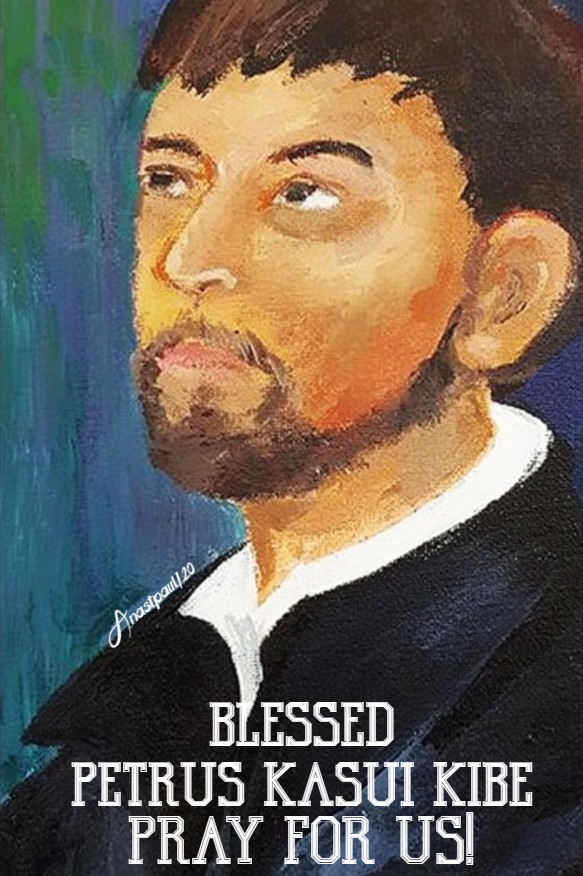
“Let us hoist our sails
trusting in the wind
of God’s grace.”

Blessed Petrus Kasui Kibe (c 1587-1639)
Priest and Martyr
“A Christian Walking Through the World”

let us hoist our sails trusting in the wind of god's grace - bl petrus kasui kibe 4 july 2020

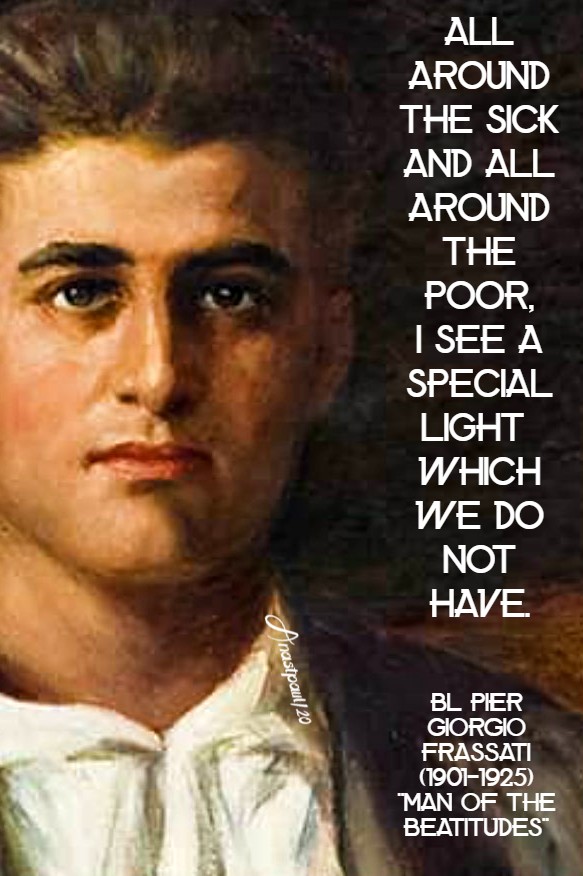
“All around the sick
and all around the poor,
I see a special light
which we do not have.”

all around the sick and all around the poor i see a special light which we do not have - bl pier giorgio frassati 4 july 2020

“In prayer,
the soul rises
above life’s sadnesses.”

in prayer the souls rises above lifes sadnesses - bl pier giorgio frassati - 4 july 2020

“The faith given to me in Baptism
suggests to me surely –
by yourself you will do nothing
but, if you have God as the centre of all your action,
then you will reach the goal.”

the faith given to me in baptism - bl pier giorgio frassati 4 july 2020

“The times we are going through are difficult
because cruel persecution of the Church is raging.
But you, bold and good young people,
should not be afraid of this small thing,
remember, that the Church is a divine institution
and cannot come to an end.
She will last till the end of the world.
Not even the gates of hell can prevail against her.”

the times we are going through are difficult - bl pier giorgio frassati 4 july 2020

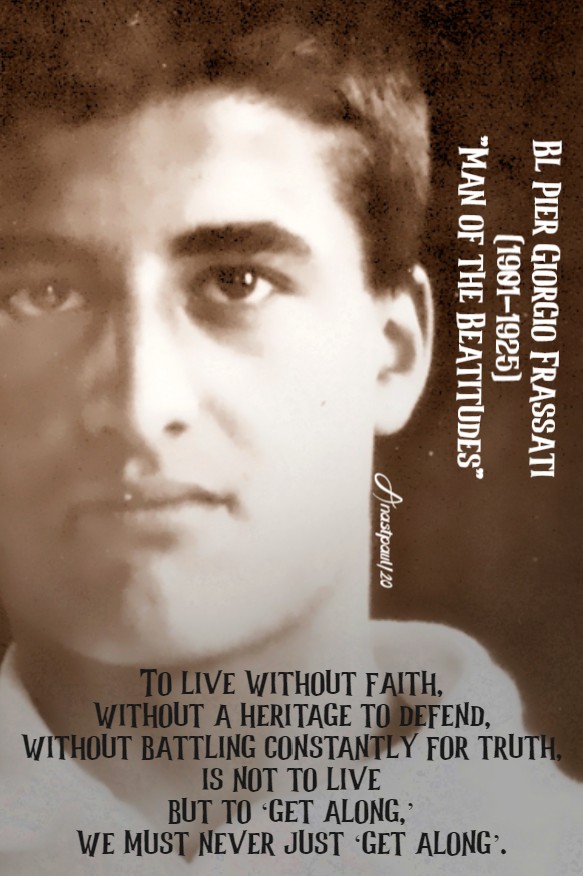
“To live without faith,
without a heritage to defend,
without battling constantly for truth,
is not to live
but to ‘get along,’
we must never just ‘get along’.”

Blessed Pier Giorgio Frassati (1901-1925)
“Man of the Beatitudes”

More from Blessed Pier Giorgio here:
https://anastpaul.com/2019/07/04/quote-s-of-the-day-4-july-blessed-pier-giorgio-frassati/

to live without faith - bl pier giorgio frassati 4 july 2020

Posted in DOCTORS of the Church, FATHERS of the Church, INCORRUPTIBLES, JESUIT SJ, ONE Minute REFLECTION, QUOTES of the SAINTS, QUOTES on ETERNAL LIFE, QUOTES on FASTING, QUOTES on HOPE, SAINT of the DAY, The WORD

One Minute Reflection – 4 July – So let us fast and pray since we are still on the threshold of birth.

One Minute Reflection – 4 July – “Month of the Precious Blood” – Saturday of the Thirteenth Week of Ordinary Time, Year A, Readings:  Amos 9:11-15Psalm 85:11-14Matthew 9:14-17 and the Memorial of Blessed Petrus Kasui Kibe SJ (c 1587-1639) Prist and Martyr and Bl Pier Giorgio Frassati TOSF (1901-1925)

And Jesus said to them, “Can the wedding guests mourn as long as the bridegroom is with them?   The days will come, when the bridegroom is taken away from them and then they will fast.” … Matthew 9:15

REFLECTION – “However, our mourning is right if we burn with desire to see Him.   How happy they were who were able to enjoy His presence before His Passion, to question Him as they wished and listen to Him as necessary… As for us, we see the fulfilment of what He said: “The days are coming when you will long to see one of the days of the Son of Man, and you will not see it” (Lk 17:22)… “A little while and you will no longer see me and again a little while and you will see me” (Jn 16:19).

But now this is the hour of which He said:  “You will weep and mourn but the world will rejoice… But, He added, I will see you again and your hearts will rejoice and no-one will take your joy away from you” (v.22). The hope thus given us by Him, who is faithful in His promises, never now leaves us, without a certain joy — until that overwhelming joy comes on the day when we will be like Him because we will see Him as he is (1Jn 3:2)… “When a woman is in labour, she has pain because her hour has come,” says the Lord, “but when her child is born, she no longer remembers the anguish because of the joy of having brought a human being into the world” (Jn 16:21).   This is the joy no-one can take away from us and with which we will be satisfied when we pass to eternal light from our present conception in faith.   So let us fast and pray since we are still on the threshold of birth.“…St Augustine (354-430) Father and Doctormatthew 9 15 can the wedding guests mourn - however our morurning is right if we burn with desire to see him - st augustine 4 july 2020

PRAYER – Father almighty, as we wait and work and pray and fast in joyful hope of our eternal life with You, grant we pray that we may always remain steadfast in Your love.   Blessed Petrus Kasui Kibe, you of intrepid perseverance and faith and Pier Giorgio Frassati, you whose faith could move mountains, pray for us, that we will fully utilise the many gifts our Almighty God has bestowed on us as we journey home. We make our prayer through Jesus Christ our Lord, in union with You and the Holy Spirit, one God forever, amen.bl petrus kasui kibe pray for us 4 july 2020

bl-pier-pray-for-us - 4 july 2017

Posted in JULY - The MOST PRECIOUS BLOOD, MARIAN PRAYERS, MARIAN Saturdays, Our MORNING Offering, PRAYERS for SEASONS, PRECIOUS BLOOD PRAYERS, The BLESSED VIRGIN MARY

Our Morning Offering – 4 July – Mother of the Eternal Word

Our Morning Offering – 4 July – “Month of the Precious Blood” and a Marian Saturday of the Thirteenth week in Ordinary Time

Mother of the Eternal Word
Raccolta Prayer

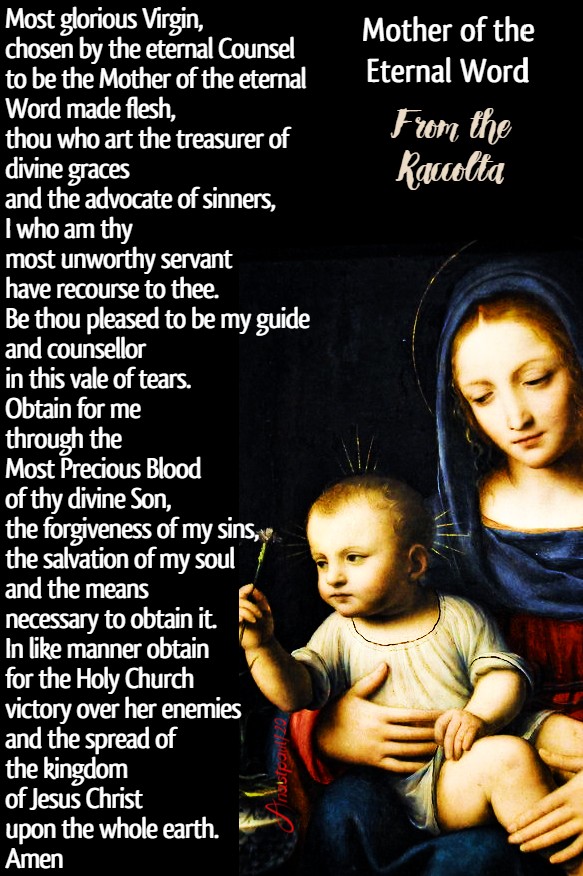
Most glorious Virgin,
chosen by the eternal Counsel
to be the Mother of the eternal Word made flesh,
thou who art the treasurer of divine graces
and the advocate of sinners,
I who am thy most unworthy servant
have recourse to thee.
Be thou pleased to be my guide
and counsellor in this vale of tears.
Obtain for me
through the Most Precious Blood
of thy divine Son,
the forgiveness of my sins,
the salvation of my soul
and the means necessary to obtain it.
In like manner obtain for the Holy Church
victory over her enemies
and the spread of the kingdom of Jesus Christ
upon the whole earth.
Amenmother of the eternal word from the raccolta 4 july 2020

Posted in JESUIT SJ, SAINT of the DAY

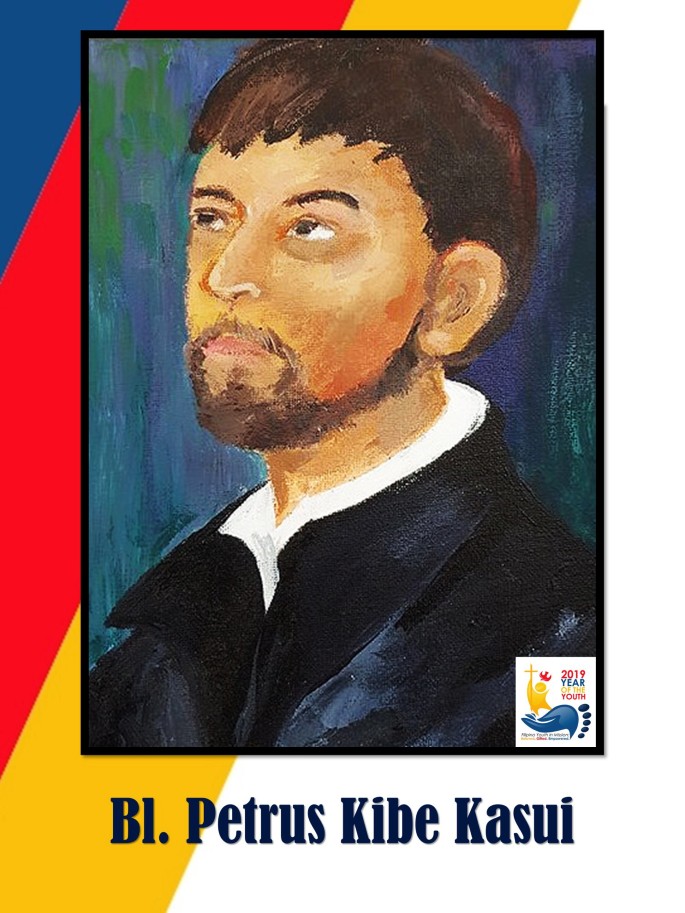
Saint of the Day – 4 July – Blessed Petrus Kasui Kibe SJ (c 1587-1639) Priest and Martyr – “A Christian Walking Through the World”

Saint of the Day – 4 July – Blessed Petrus Kasui Kibe SJ (c 1587-1639) Japanese Jesuit Priest and Martyr.   Born in c 1587 in Kibe, Oita, Japan and died by being run through with a spear on 4 July 1639 in Tokyo, Japan.   He is called the “Japanese Marco Polo” or “A Christian Walking Through the World” and “The man who walked 4000kms.”

This is the extraordinary story of Fr Petrus Kibe who walked 4000kms to get permission to become a priest.

On 4 July 1639, Japanese samurai and Jesuit priest Father Petrus Kasui Kibe refused to renounce Christ under the most gruelling regime of torture ever devised by man or devil.   In the wake of Father Petrus’ death, the Shogun’s master torturer dubbed him “the man who would not say, I give in”—a perfect epitaph to his heroic life.
He was the most international Japanese of his day, perhaps the most determined man on the planet and unflinchingly faithful to Christ unto death—and a most horrible death it was indeed.   No wonder Peter Kibe’s name (pronounced KEE-beh) heads the list of the 188 Japanese Martyrs Beatified on 24 November 2008 by Pope Benedict XVI as Peter Kibe Kasui and 187 Companions, Martyrs.bl petrus kibe kasui

The Kibes were samurai of Urabe in the province of Bungo on the island of Kyushu, a province which had been visited by Portuguese traders, six years before St Francis Xavier’s arrival in Kyushu on 15 Augus 1549—the Feast of the Assumption.   Petrus was born in 1587, the year the dictator Hideyoshi first decreed a ban on Christianity, his parents, faithful Catholics, had their infant son Baptised in the Church at Nakatsu soon after his birth.

In 1600, Petrus entered the Jesuit Minor Seminary at Arima southeast of Nagasaki and on graduating, he declared his desire to enter the Society of Jesus.   The Society wouldn’t open their doors to just any would-be Jesuit, though, they wanted solid proof of God’s call, so Petrus began eight years of humble labours as a Catechist until, in 1614, the de-facto Shogun Ieyasu expelled all Christian missionaries from Japan.

Petrus was shipped to the Portuguese colony of Macao, where the Society of Jesus was hard put to accommodate the huge influx of Japanese exiles.   Some they sent to new Southeast Asian missions and others—like Petrus Kibe—they took in as Seminarians but they had to close their school in 1618, frustrating those men’s hopes for Ordination. Undaunted, Petrus and two other young samurai-missionaries set out for Rome, via India.   The other two went on from India by sea but Petrus struck out on foot alone across Persia, heading for the Holy Land.   Since he left us no record of his journey, we can only imagine the dangers he must have encountered along the way, traversing territory hostile to Christians, all the way to the Holy Land.   That samurai grit of his, would march the stalwart Petrus Kibe all the way to Heaven, via the strait and narrow path of Martyrdom.bl petrus kibe - Columban-The-man-who-walked-4000kms

Having arrived in Rome with no proof on paper of his studies in Japan and Macao, he nevertheless conquered the churchmen’s doubts and on Sunday, 15 November 1620, he became Father Petrus Kibe by the laying-on of the Bishop’s hands in a chapel at the Lateran.   When he showed up in his Cassock at the Jesuits’ door in Rome five days later, they didn’t turn him away, despite the Jesuit Visitor’s exhortations, written from Macao, to distrust wandering Japanese exiles like him – he won them over too and entered the Jesuit novitiate—normally lasting two years.   For Father Petrus, though, two years was too long to wait – incoming reports of the ravening persecution in Japan would give him no peace – he must hurry to the aid of his countrymen.   He petitioned the General of the Society of Jesus, who promptly agreed, Father Petrus’ mission was clearly ordained by God!  He would leave Rome at once and finish his two years’ Novitiate en route to Japan.
He made his Jesuit vows in Lisbon on 21 November 1622 and the following March, on the Feast of the Annunciation, he set out on a trouble-plagued, fourteen-month voyage to India.   Next he went on to Macao but the local government would let no Missionaries sail from their island to Japan, fearing the Shogun’s reprisals against Macao’s trade with his captive nation—the colony’s economic lifeline—so Petrus headed for Siam, hoping to sail on from there to his benighted homeland.   On the way, his ship was chased by pirates in the Malacca Strait and everybody abandoned ship and swam for shore.

The Siamese royal capital of Ayutthaya had a large Japanese community, about 400 of them Catholic exiles.   Some hundreds of these Japanese were ronin, or itinerant samurai, who served in the King’s Royal Guards.   Petrus lived incognito among his countrymen in that exotic city for two years, trying to find passage to Japan but all Japan-bound ships’ captains were demanding oaths of apostasy of all Japanese-Christian would-be passengers, fearing the reprisals of the Shogun’s sheriff at Nagasaki—and Father Petrus would not deny Christ. After two years’ fruitless waiting, he sailed for Manila to try his luck there but the same rule held at Manila – no Missionaries could sail from there for Japan.

He and some other Japanese Christians—one of them a Priest like himself, Father Michael Matsuda—were determined to get to Japan somehow, anyhow, so they moved to a small island and there built their own boat.   It was promptly attacked by termites.   Undaunted, the intrepid believers plugged the holes with extra planking and, putting everything into God’s hands, set out for their beloved homeland.
It was the typhoon season of 1630 and they could have expected that their ramshackle, home-made boat would become a plaything of the tempests but they had almost made it to Japan, their dream was in sight, when a tempest came raging along and smashed their boat into the rocky shore of an island just off the coast of Kagoshima—the very place where Saint Francis Xavier had first set foot on Japanese soil to plant the Gospel seeds.   Yet all in the shipwreck survived and the islanders not only gave them shelter but later ferried them on to Kagoshima after the storm had passed.

Now Father Petrus and his companions plunged into the fiery furnace that was the Shogun Iemitsu’s Japan.    Father Petrus went north and for nine harried years, daily risking capture and the horrific torture that would inevitably follow, he offered the Body, Blood, Soul and Divinity of Jesus Christ for the starving souls of countless persecuted Christians;  then, in July of 1639, he was caught and dragged before the wretched Shogun to testify for Jesus.   The Shogun Iemitsu – paranoiac, pederast and sadist, this wretch, harboured a morbid fear of Christ and, according to the authoritative Japan-historian C R Boxer, he “derived considerable pleasure from cross-examining Christians under torture.”

The Shogun’s torture-masters were aiming for apostate priests, not dead ones and their method of persuasion was, by 1639, quite refined – the victim was cocooned in tight coils of rope and hung by his heels in a pit—probably containing human dung and other filth—his waist pinched in a clamp of sorts, a circular wooden lid cut in halves, with a hole in the middle for the pinched waist.   This device both cut off the victim’s circulation and sealed the pit, shutting him in in that horrific stench;  meanwhile, the torturers tempted him with promises of relief if only he would chant to Buddha and thus renounce Christ.   All the while it felt like his head was exploding, while blood dripped from his mouth, ears and nose.   On the day Petrus Kibe was given the treatment, two other priests were apparently induced under the same torture to chant the name of Amida Buddha and were hauled up and out, soon to die of their wounds—officially declared ‘apostates’ even though they had tried to recant their murmured chants before dying. Petrus, though, had been hung in another hole together with two Catechists and, ignoring his own agonies, he continually encouraged his brothers-in-suffering to cling to Christ to the end.   Fearing the contagion of his faith, the executioners pulled him out and finished him off by burning firewood on his belly, according to one account, and since this didn’t kill the steely Father Petrus, they finally ripped out his bowels.

While Father Petrus was enduring his final torments, the Shogun’s torturers asked him why he didn’t just give in, and he told them, “You cannot understand this, therefore, it is no use guiding you.”
His guiding words they might not have understood but how Petrus Kibe’s living testimony—his superhuman faith—must have fired their hearts!   A torch of truth still burning white-hot in this fourth century following his Martyrdom – proof of the blinding fact that God is real and that His Name is Jesus.

His interrogator was the infamous former Christian, Inoue.   In his written deposition Inoue wrote, “Petrus Kibe has not fallen.   He has also fortified his fellow prisoners.   His sentence is death by strangulation.”   Fr Petrus Kibe was executed in July 1639.   He had run his race, finished the course and kept his faith.   He had worked in Japan as a Priest for nine years.   He was 52 when he died.   Fr Petrus Kibe loved Christ, he loved his country and its culture, he loved his people  . He was 100% Christian and 100% Japanese.   He had the endurance Jesus spoke of.   “You will be betrayed even by parents and brothers, relations and friends; and some of you will be put to death… but not a hair of your head will be lost.   Your endurance will win you your lives” (Lk21:16-19).

Among the 188 martyrs beatified on 24 November were the following:

109 men – 32 samurai, seven catechists, one Jesuit brother and four priests.

49 women – 27 of whom died with their husbands.

30 children – from the age of one year to 14 years died with their parents.

“Though many were samurai and knew how to fight, they chose the path of non-violent resistance and that is significant for people today.” Cardinal Fumio Hamao.

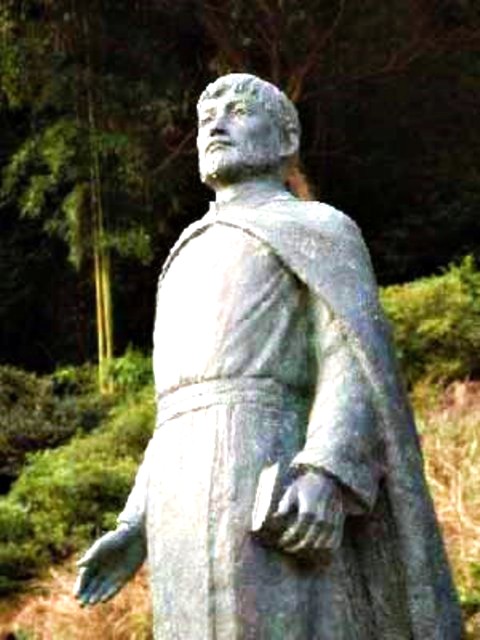
The Beatification of Peter Kibe and 187 other martyrs took place on 24 November 2008, in Nagasaki.   For the liturgical celebration in Nagasaki Stadium more than 30,000 participants attended, which was celebrated by Cardinal José Saraiva Martins on behalf of Pope Benedict XVI.bl petrus kibe kasui statue (1)

Posted in INCORRUPTIBLES, MARIAN TITLES, SAINT of the DAY

Our Lady of Refuge and Memorials of the Saints – 4 July

4 July – Our Lady of Refuge, Nuestra Señora del Refugio, is Patroness of California and parts of Mexico.
This painting is from the hands of the artist, Joseph de Paez, 1750, Mexico.our lady of refuge

The Franciscan missionary Francisco Diego Garcia y Moreno was the first Bishop of Baja, California.   He proclaimed Nuestra Señora del Refugio, as Patron on 4 January 1843, at Mission Santa Clara in Alta California.

His proclamation included the following:
The entire text of Bishop Garcia Diego’s declaration is recorded in Mission Santa Clara’s Libro de Patentes.   After citing the early Fathers of the Church on the practice and spiritual benefits of naming patron Saints, the first Bishop of the Californias stated:  “We make known to you that we hereby name the great Mother of God in her most precious title, ‘del Refugio, ‘ the principal patroness of our Diocese . . . With so great a patroness and protectress, what can we not promise ourselves? What can be wanting and whom need we fear?”

The Liturgical Feast:
In 1981 the California Catholic Conference of Bishops petitioned the Vatican Congregation for the Sacraments and Divine Worship for authorisation to observe the Feast of Our Lady of Refuge on 5 July as an obligatory memorial. This was approved by official document dated 15 January 1982 and signed by Archbishop Giuseppe Casoria.

The Diocese of Baja California celebrate this Patronal Feast on 4 July.

Paintings of Our Lady of Refuge are, with few exceptions, quite similar in design and execution.   The heads of the Infant Jesus and his Mother Mary lean together with no background between them.   Both figures wear a crown.   Mary’s eyes are turned toward the observer, while the gaze of the child seems to turn left of the viewer.
In the Santa Clara Mission church the painting of Our Lady of Refuge is found above the larger picture of Our Lady of Guadalupe in one of the side altar niches on the left as one nears the sanctuary.   Another painting by Eulalio, a local Native American, is on display in Santa Clara University’s De Saisset Museum near the mission church.
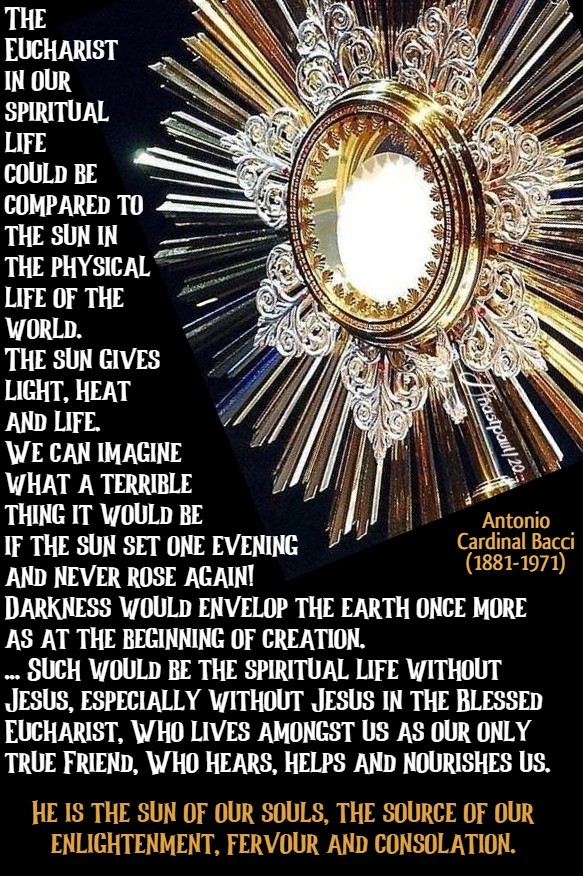
The above image is darker than the Eulalio painting, which has a wood-tone background.   The flower motif is almost the same, the two figures are almost identical in both images.

++++++
St Elizabeth of Portugal TOSF (1271-1336) (Optional Memorial)
Biography:
https://anastpaul.com/2018/07/04/saint-of-the-day-4-july-st-elizabeth-of-portugal-t-o-s-f-1271-1336/

Bl Agatha Yun Jeom-Hye
St Albert Quadrelli
St Andrew of Crete
St Anthony Daniel
St Aurelian of Lyons
St Bertha of Blangy
St Carileffo of Anille
Bl Catherine Jarrige
St Cesidio Giacomantonio
Bl Damiano Grassi of Rivoli
St Donatus of Libya
St Edward Fulthrop
St Elias of Jerusalem
St Finbar of Wexford
St Fiorenzo of Cahors
St Flavian of Antioch
St Giocondiano
Bl Giovanni of Vespignano
St Haggai the Prophet
Bl Hatto of Ottobeuren
Bl Henry Abbot
St Henry of Albano
St Hosea the Prophet
St Innocent of Sirmium
Bl John Carey
Bl John Cornelius
Bl Jozef Kowalski
St Jucundian
St Laurian of Seville
St Lauriano of Vistin
Bl Maria Crocifissa Curcio
St Namphanion the Archmartyr
Bl Natalia of Toulouse
St Odo the Good
Bl Odolric of Lyon
Bl Patrick Salmon
Bl Pedro Romero Espejo
Blessed Petrus Kasui Kibe SJ (c 1587-1639) Priest and Martyr
The first of the 188 Japanese Martyrs

Bl Pier Giorgio Frassati (1901-1925) Incorrupt
About dear Blessed Pier Giorgio:
https://anastpaul.wordpress.com/2017/07/04/saint-of-the-day-4-july-blessed-pier-georgio-frassati-t-o-s-d-the-man-of-the-eight-beatitudes/

St Sebastia of Sirmium
St Theodore of Cyrene
St Theodotus of Libya
Bl Thomas Bosgrave
Bl Thomas Warcop
St Ulric of Augsburg (c 890–973)
His Life:
https://anastpaul.com/2019/07/04/saint-of-the-day-4-july-saint-ulric-of-augsburg-c-890-973/
St Ulric of Ratzeburg
St Valentine of Langres
St Valentine of Paris
Bl William Andleby
Bl William of Hirsau

Posted in MEDITATIONS - ANTONIO CARD BACCI, QUOTES - J R R Tolkien and MORE, QUOTES on CONVERSION, QUOTES on REPENTANCE, QUOTES on SIN, QUOTES on TEMPTATION, The GOOD SHEPHERD

Thought for the Day – 3 July – The Good Shepherd

Thought for the Day – 3 July – “Month of the Sacred Heart” – Meditations with Antonio Cardinal Bacci (1881-1971)

The Good Shepherd

the good shepherd - we may often have been - bacci 3 july 2020

“The Good Shepherd is the theme of two of the most moving passages in the Gospel.
“I am the good shepherd,” Jesus says. “The good shepherd lays down his life for his sheep. But, the hireling, who is not a shepherd, whose own the sheep are not, sees the wolf coming and leaves the sheep and flees. and the wolf snatches and scatters the sheep … I am the good shepherd and I know mine and mine know me, even as the father knows me and I know the Father and I lay down my life for my sheep” (Jn 10:11-15).

“What man of you, having a hundred sheep,” He says elsewhere “and losing one of them, does not leave the ninety-nine in the desert and go after that which is lost, until he finds it?   And when he has found it, he lays it upon his shoulders rejoicing.   And on coming home, he calls together his friends and neighbours, saying to them, “Rejoice with me because, I have found my sheep that was lost.”
“I say to you that, even so, there will be joy in heaven over one sinner who repents, more than over ninety nine just, who have no need of repentance” (Cf Lk 15:4-7).

These texts vividly describe God’s mercy towards poor sinners.

We may often have been amongst the lost sheep which are separated from the flock of Jesus Christ.
We found, perhaps, the poisoned pastures of error and vice and strayed from the path of truth and goodness.
But what happened?
We experienced disillusionment and remorse and knew that we had lost our only real good, which is God.
How sad our fate would have been, if the Good Shepherd, Jesus, had not come to look for us and to enlighten us with His grace.
We should have been lost forever, in the desert of sin!”

Antonio Cardinal Bacci

Posted in DOCTORS of the Church, FATHERS of the Church, FEASTS and SOLEMNITIES, QUOTES of the SAINTS, QUOTES on DOUBT, QUOTES on FAITH, QUOTES on TRUTH, SAINT of the DAY, SPEAKING of ....., The APOSTLES & EVANGELISTS, The WORD

Quote/s of the Day – 3 July – Doubt or Faith?

Quote/s of the Day – 3 July – Feast of Saint Thomas, Apostle of Christ

Speaking of:  Doubt or Faith?

Jesus said to him,
“Have you come to believe because you have seen me?
Blessed are those who have not seen and have believed.”

John 20:28-29

john 20 29 blessed are those who have not seen and have believed - 3 july 2020

“Men imitate the gods whom they adore
and to such miserable being,
their crimes become their religion.”

St Cyprian of Carthage (200-258)
Bishop of Carthage and Martyr
Father of the Church

men imitate the gods whom they adore st cyprian of carthage 3 july 2020 doubt

“For by your doubting, I am taught to believe,
by your forked-tongue, that revealed the wound
on the divine body that was pierced,
I harvest the fruit for myself without pain.”

St John Chrysostom (347-407)
Father and Doctor

for by your doubting i am taught to believe - st joh chrysostom 3 july 2020 thomas

“Do you desire security?
Here you have it.
The Lord says to you, “I will never abandon you,
I will always be with you.”
If a good man made you such a promise,
you would trust him.
God makes it and do you doubt?
Do you seek a support, more sure
than the word of God, which is infallible?
Surely, He has made the promise,
He has written it,
He has pledged His word for it, it is most certain!”

do you desire security - st augustine faith or doubt 3 july 2020

“If you believe what you like in the Gospels
and reject what you don’t like,
it is not the Gospel you believe
but yourself.”

Saint Augustine (354-430)
Father and Doctor of Grace

if you believe what you like - st augustine 26 nov 2019

“I believe
though I do not comprehend
and I hold by faith,
what I cannot grasp
with the mind.”

St Bernard (1090-1153)
Mellifluous Doctor

i believe though i do not comprehend - st bernard - 3 july 2020

“To one who has faith,
no explanation is necessary.
To one without faith,
no explanation is possible.”

to one who has faith no explanation is necessary - st thomas aquinas 3 july 2020

“Believing is
an act of the intellect
assenting to the divine truth,
by command of the will,
moved by God through grace.”

St Thomas Aquinas (1225-1274)
Doctor Angelicus
Doctor Communis

believing-is-an-act-of-the-intellect-st-thomas-aquinas-28-jan-2018 and 3 july 2020 - Copy

“You cannot be half a saint,
you must be a whole saint
or no saint at all.”

St Theresa of the Child Jesus/Lisieux (1873-1897)
Doctor of the Church

you-cannot-be-half-a-saint-st-therese-lisieux-11-june-2018-seeking-sainthood

“Divine truth [is not] ours
to summon at will.
If we determine that
we will find it out,
we shall find nothing ….
Let us believe,
evidence will come,
after faith, as it’s reward,
better than before it,
as it’s groundwork.”

St John Henry Newman (1801-1890)

divine truth is not ours to summon at will - st john henry newman 3 july 2020 doubt or faith

Posted in DOCTORS of the Church, FEASTS and SOLEMNITIES, ONE Minute REFLECTION, QUOTES of the SAINTS, QUOTES on DIVINE PROVIDENCE, QUOTES on DOUBT, QUOTES on FAITH, SAINT of the DAY, The APOSTLES & EVANGELISTS, The WORD

One Minute Reflection – 3 July – ‘Saintly doubt of the disciple!’

One Minute Reflection – 3 July – Feast of Saint Thomas, Apostle of Christ, Readings:  Ephesians 2: 19-22, Psalms 117: 1bc, 2, John 20: 24-29

Thomas answered, and said to him: ‘My Lord, and my God.’ … John 20:28

john-20-28-my-lord-and-my-god-feat-of-st-thomas-3-july-2019 and 3 july 2020

REFLECTION“Thomas said to the Twelve: “Unless I see the mark of the nails in his hands and put my finger into the nailmarks and put my hand into his side, I will not believe!” (Jn 20:25).   The name ‘Thomas’ means ‘abyss’, for by his doubt he gained an even deeper understanding and became firmer in his faith.  …  It was not by chance but by divine decree, that Thomas was absent and unable to believe what he heard. A splendid decree!   Saintly doubt of the disciple!
“Unless I see in his hands,” he said (Jn 20:25).   He wished to see raised up, the fallen tent of David, of which Amos had said:  “On that day I will raise up the fallen tent of David;  I will repair the breaches of its walls” (cf. Am 9:11).   ‘David’ stands for the divinity;   the ‘tent’, Christ’s own body in which the divinity was contained as in a tent, fallen, crushed in death and the Passion.   The breaches in the walls stand for the wounds of his hands, feet and side.   These are the wounds that the Lord would rebuild in his Resurrection.   It was of them that Thomas said:  “Unless I put my finger into the nailmarks and put my hand into his side, I will not believe!”
The Lord, understanding, did not want to leave His honest disciple, who was to become a vessel of election, in doubt.   And so, He removed the smoke of doubt from his mind, in an act of kindness, just as He removed the blindness of infidelity from Paul.   “Put your finger here and see my hands, and bring your hand and put it into my side and do not be unbelieving but believe”   Then Thomas said to Him:  “My Lord and my God!” (Jn 20:27-28)” … St Anthony of Padua (1195-1231) Doctor of the Churchthe name thomas means abyss for by his doubt he gained an even deeper understanding - st anthony of padua 3 july 2020

PRAYER – Almighty Father,as we honour Thomas the Apostle, let us always experience the help of his prayers. May we have eternal life by believing in Jesus, whom Thomas acknowledged as Lord, for He lives and reigns with You and the Holy Spirit, one God, forever and ever. Amenst-thomas-pray-for-us-2 3 july 2019 and 2020

Posted in BREVIARY Prayers, CATHOLIC-PRAYERS OF THE CHURCH, FEASTS and SOLEMNITIES, HYMNS, Our MORNING Offering, PRAYERS of the CHURCH, SAINT of the DAY, The APOSTLES & EVANGELISTS

Our Morning Offering – 3 July – Saint Thomas, Whom the Saviour Chose

Our Morning Offering – 3 July – Feast of Saint Thomas, Apostle of Christ

Saint Thomas, Whom the Saviour Chose
Breviary Hymn For the Feast of St Thomas
By Samuel Scheidt, 1567-1654
Text: Qui luce splendes ordinis
Trans: Benedictines of Saint Cecilia’s Abbey, Ryde, UK

Saint Thomas, whom the Saviour chose
When here on earth, as special friend,
Accept our joyful hymn of praise,
And to our earnest prayer attend.

Your love for Christ made you desire
To die with Him and share His plight.
His love for you gave you a throne
Of glory in His realm of light.

Your tortured love could not believe
The Ten had seen Him, as they said
But you must touch His hands and feet
To prove Him risen from the dead.

And later when you saw Him too
With joy, His mercy you adored,
Acclaiming Him as truly God,
And worshipping your risen Lord.

As you once grew to know our Lord,
Give us more faith, both strong and firm,
And make our love grow deeper yet
For Jesus whom we have not seen.

All glory be to Christ, our Lord,
Who by your prayer will grant us grace,
When we have blindly walked in faith,
To see the glory of His face.
Amen

st thomas whom the saviour chose - breviary hymn - 3 july 2020

Posted in FATHERS of the Church, SAINT of the DAY

Saint of the Day – 3 July – St Anatolius of Alexandria (Died 283) Bishop

Saint of the Day – 3 July – St Anatolius of Alexandria (Died 283) Bishop, Scholar, Scientiest, Philosoper, Conputist, Mathematiian, Writer – also known as Anatolius of Laodicea.   Born in Alexandria, Egypt and died in 283 at Laodicea, Syria of natural causes.   He was not only one of the foremost scholars of his day in the physical sciences, as well as in Aristotelean philosophy but also a great computist.st anatolius of laodicea

Note:  ComputistThe computus (Latin for ‘computation’) is a calculation that determines the calendar date of Easter.   Easter is traditionally celebrated on the first Sunday after the Paschal full moon, which is the first full moon on or after 21 March (an approximation of the March equinox).   Determining this date in advance requires a correlation between the lunar months and the solar year, while also accounting for the month, date and weekday of the calendar.

Anatolius was born and raised in Alexandria, Egypt, during the early 3rd century.   Prior to becoming one of the great lights of the Church, Anatolius enjoyed considerable prestige at Alexandria.   According to Eusebius of Caesarea, he was credited with a rich knowledge of arithmetic, geometry, physics, rhetoric, dialectic and astronomy.   Also according to Eusebius, Anatolius was deemed worthy to maintain the school of the Aristotelian succession in Alexandria.   The pagan philosopher Iamblichus studied among his disciples for a short time.

There are fragments of ten books on Arithmetic written by him.   There is also a treatise onthe time of the Paschal celebration.   His famous 19-year Paschal cycle has survived in seven different complete medieval manuscripts of the Latin text De ratione paschali.   Saint Jerome praised his scholarship and writing, however, he was known not just as a scholar but as a humble and deeply religious man.   Ignorance horrified him and part of his work with the poor was to educate them. St Anatolius also held a number of government posts in Alexandria.

A story is told by St Eusebius of the way in which Anatolius broke up a rebellion against the Roman authorities in 263 in a part of Alexandria known then as Bruchium.   It was held by the forces of Zenobia and being violently beleaguered by the Romans was in a state of starvation. Anatolius, who was living in Bruchium at the time, met with the Romans and negotiated the release of non-combatant children, women, the sick and the elderly, saving many and earning him a reputation as a peacemaker.   The rebels, freed of caring for the non-combatants, were able to fight even longer.   However, when they lost, Anatolius found himself with enemies on both sides of the conflict and he decided to leave Alexandria.

Anatolius emigrated to Caesaria, Palestine.   His reputation as a scholar and Christian had preceeded him and he became assistant and advisor to the Bishop.   In 268, while en route to the Council of Antioch, he passed through Laodicea, Syria.   Their Bishop, Saint Eusebius of Laodicea, had just died, they saw Anatolius’ arrival as a gift from God and insisted that he assume the Bishopric.   He accepted and spent his remaining fifteen years there.

He died in 283 of natural causes.Saint-Anatolius-of-Alexandria

Posted in FEASTS and SOLEMNITIES, SAINT of the DAY, The APOSTLES & EVANGELISTS

Feast of St Thomas, Apostle and Memorials of the Saints – 3 July

St Thomas the Apostle (Feast)

St Thomas:
https://anastpaul.com/2018/07/03/saint-of-the-day-feast-of-st-thomas-apostle-of-christ/
AND:
https://anastpaul.com/2019/07/03/feast-of-st-thomas-apostle-of-christ-martyr-3-july/
AND:
https://anastpaul.com/2017/07/03/saint-of-the-day-3-july-st-thomas-the-apostle-of-christ/

St Anatolius of Alexandria (Died 283) Bishop

St Anatolius of Constantinople
Bl Andreas Ebersbach
Bl Barbara Jeong Sun-mae
St Bladus
St Byblig
St Cillene
St Dathus of Ravenna
St Eusebius of Laodicea
St Firminus
St Firmus
Bl Gelduin
St Germanus of Man
St Giuse Nguyen Ðình Uyen
St Gunthiern
St Guthagon
St Heliodorus of Altinum
St Hyacinth of Caesarea
St Ioannes Baptista Zhao Mingxi
St Irenaeus of Chiusi
St Pope Leo II (611–683)
Biography:
https://anastpaul.com/2019/07/03/saint-of-the-day-3-july-st-pope-leo-ii-611-683/
St Maelmuire O’Gorman
St Mark of Mesia
St Mennone the Centurian
St Mucian of Mesia
St Paul of Mesia
St Petrus Zhao Mingzhen
St Philiphê Phan Van Minh
St Raymond of Toulouse

Martyrs of Alexandria – 13 saints: Thirteen Christian companions marytred together. No details about them have survived but the names – Apricus, Cyrion (2 of), Eulogius, Hemerion, Julian, Julius, Justus, Menelaus, Orestes, Porfyrios and Tryphon (2 of). They martyred in Alexandria, Egypt, date unknown.

Martyrs of Constantinople – 24 saints: A group of 24 Christians martyred in the persecutions of Arian emperor Valens. We know little more than their names – Acacios, Amedinos, Ammonius, Ammus, Cerealis, Cionia, Cionius, Cyrianus, Demetrius, Eulogius (2), Euphemia, Heliodoros, Heraclios, Horestes, Jocundus, Julian, Martyrios, Menelaeus, Sestratus, Strategos, Thomas, Timotheos and Tryphon. They were martyred in c367 in Constantintinople.

Theodotus and Companions – 6 saints: Six Christians who were imprisoned, tortured and martyred together in the persecutions of Trajan. Saint Hyacinth ministered to them in prison. We know nothing else about them but their names – Asclepiodotus, Diomedes, Eulampius, Golinduchus, Theodota and Theodotus. They were beheaded in c110, location unknown.