Posted in SAINT of the DAY

Saint of the Day – 15 April – Saint Abbondio of Como (Died c 564)

Saint of the Day – 15 April – Saint Abbondio of Como (Died c 564) the Fourth Bishop of Como, Italy, Confessor, Theologian, Papal Legate. Patronage – The City ad the Diocese of Como. He is also known as – Abundius, Acoitius, Agontius, Habundius. Additional memorial – the Diocese of Como celebrates it on 31 August. Abbondio is one of those to whom the authorship of the Te Deum is attributed.

The Roman Martyrology states: “In Como, Saint Abbondio, Bishop, who was sent to Constantinople by Pope Saint Leo the Great and zealously defended the right faith.”

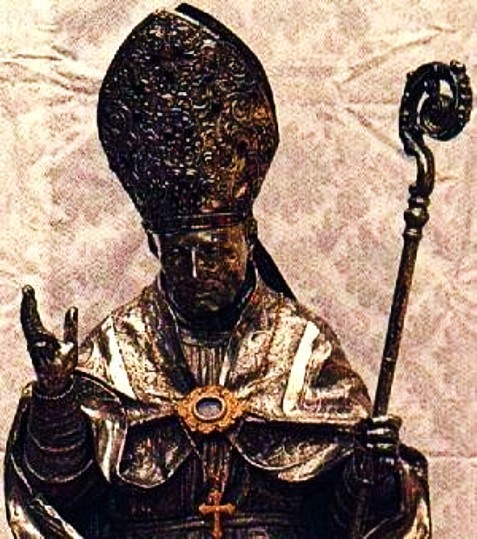
St Abbondio in the Basilica dedicated to him in Como

Abbondio, Bishop of Como, a City that still preserves his remains in the Basilica dedicated to him and honours him as their Patron.

A tradition says that Abbondio was Greek, from Thessalonica (now Thessaloniki) but his name is so frankly Latin, which makes it doubtful. Instead, it appears that Abbondio knew the Greek language well, a rare case in the Western Church at the time. The time and place of his birth are, therefore, uncertain and the first certain date of his biography is 17 November 440 – on that day, Abbondio, former assistant of Bishop St Amanzio in Como, received Episcopal Consecration, as his successor.

But he could not immediately dedicate himself to the Diocese, for St Pope Leo I the Great (the one of the meeting with Attila) needed him for a task that was anything but peaceful. St Leo wanted him to go to Constantinople, as Papal Legate, to the Emperor Theodosius II.

There Abbondio’s mission was to re-establish unity in the faith in a lasting way, after the long doctrinal conflict aroused by the Bishop Nestorius and the Superior General Eutiche. These were two eminent figures of Eastern Christianity, both however, in opposition to the Doctrines of the Church of Rome and of the Councils, on the theme of the two natures – human and divine – in the person of Christ.

Emperor Theodosius II also died in 440 and Abbondio found his successor, Marcian in Constantinople. To him, as to the Bishops, clergy, Monks and faithful, Abbondio, forcefully reaffirms the Catholic Doctrine on the two natures in Christ, as it was explained by Pope Leo in a letter which Abbondio carried and which was addressed to the Emperor.

He completed the mission by having the Papal document accepted by all the Bishops of the East. Abbondio was happifully welcomed home in Rome by Pope Leo in 451, after the peaceful and complete success of his mission.

After a similar mission at the Council of Milan in 452, he was finally able to occupy his See and be the full-time Bishop of Como. For Appondio, this meant becoming a missionary, proclaiming the Gospel in the mountain regions, in the Lugano area and in other country areas not yet fully Christianised. The Diplomat and theologian became an itinerant preacher in his great pastoral zeal to reach all the people of his Diocese.

Appondio died on an Easter Sunday, says a text of the time, immediately after having offered Holy Mass and preached. But the year of death is not known with certainty, indicated by some in 469, by others in 488 or 499.

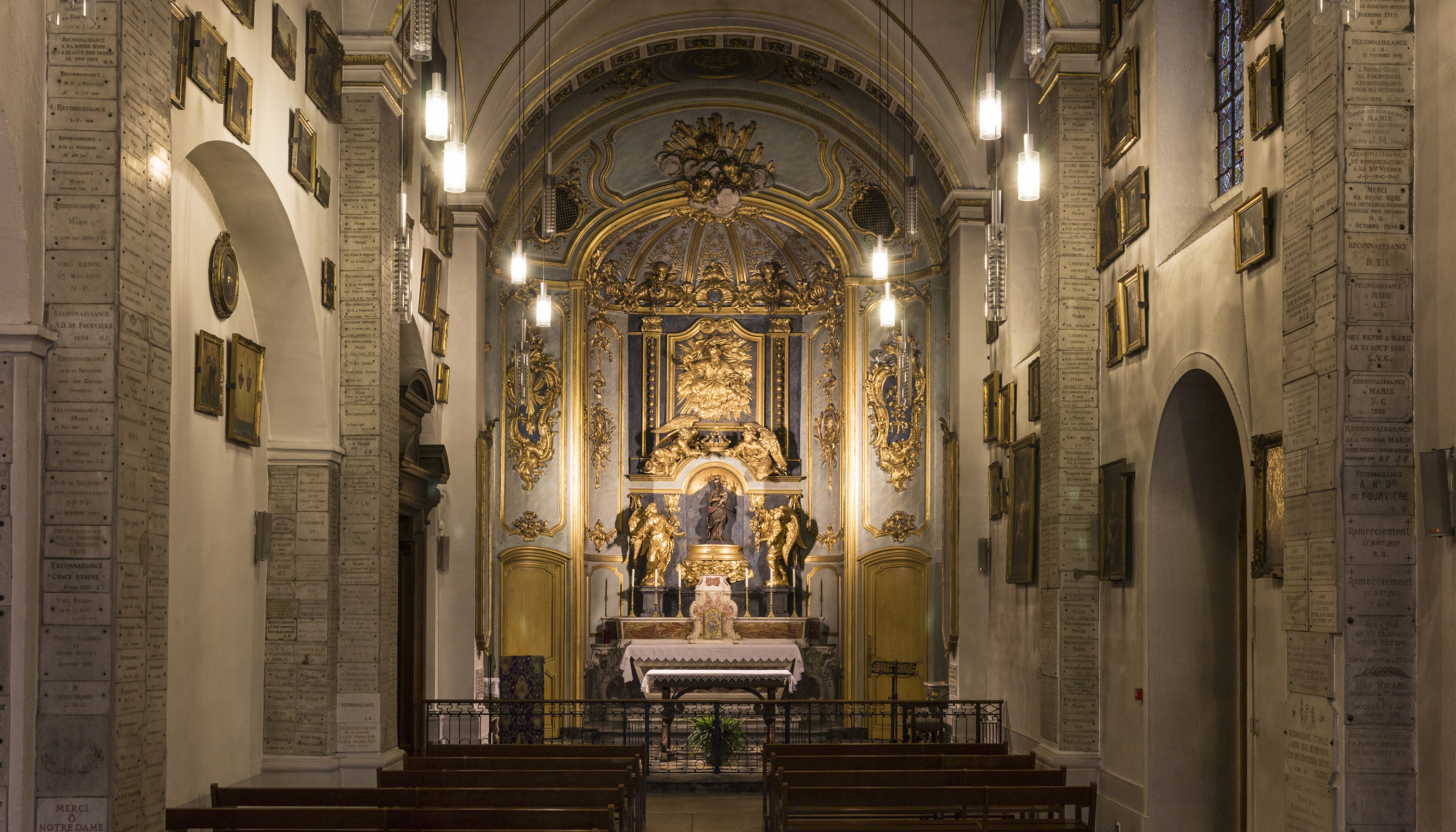
The Romanesque Basilica of Sant’Abbondio at Como, consecrated in 1095 by Pope Urban II, is dedicated to him and his relics are conserved beneath its principal Altar, see below.

The Sant’Abbondio Basilica is found outside Como’s ancient City walls near via Regina, the ancient road along the hillside that traces Lake Como’s western shore. Built between 1050 and 1085, on the site where a paleo-Christian dedicated to Saints Peter and Paul had stood. The Basilica was consecrated in 1095 by Pope Urban II, travelling through Como on his way to the Council of Clermond Ferrand, where he announced the beginning of the First Crusade.

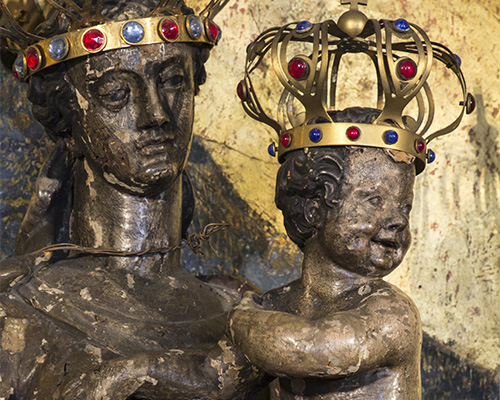
The Sant’Abbondio Basilica unwinds across five naves, which are spaced out by grand pilasters and granite columns. In the central aisle there are gravestones of the Bishops of Como. Next to the main Altar we find a Statue of Sant’Abbondio, attributed to Tommaso Rodari at the end of the 15th century – see the first image above. The pictorial cycle in the basilica’s choir loft is noteworthy and the frescoes of the Birth and the Passion of Jesus were realised in the 14th century by an unknown Lombardy painter. To the sides of the entrance portal, we can admire two splendid 17th century canvases one which is Giovan Battista Recchi’s St. Abbondio with a Child, see below.

Posted in SAINT of the DAY

Our Lady of Kieff (1010) and Memorials of the Saints – 15 April

Thursday of the Second Week of Easter +2021

Our Lady of Kieff (1010) – 15 April:

Kieff on the banks of the Dneiper River was the first resting place of this famous image of Mary. Here, according to legend, the Apostle Saint Andrew had once stopped on his way from Constantinople to Rome. Waking in the morning to the sights of the heights of Kieff, he was moved to prophecy:

“See those hills? On those hills shall shine hereafter, the grace of God.”

However, it was nearly 1,000 years, 1010, to be exact, before the Russian Prince Vladimir was baptised at Kieff with all his people and the teachings of the Gospel began to go out from the heights, which had so impressed the Apostle.
The Prince sent to Kherson for a picture of Our Lady which was, according to legend, painted by Constantine and according to another, commissioned by him, which seems more likely. The Prince endowed the Monastery in Petchersk to house the famous painting and here it remained until the fifteenth century.
In 1467 Ivan III, Grand Duke of Moscow, built the Church of the Assumption in the Kremlin as a memorial of his marriage. As a crowning jewel of his new Church, he asked for the famous image of Kieff. This aged City was both grieved and frightened at the demand. The people rose in protest; they did not want to lose their dearest treasure. Then the Blessed Virgin appeared in sleep to the Prince and told him to give up the painting because, she would personally ensure, that it was replaced. He gave it to the agents of the Duke of Moscow on the following morning and returned to his Church to find that another painting, exactly like it, had mysteriously appeared in the place of the one he had returned.
Kieff and Moscow were still disputing vigorously up to fifty years ago, the 400-year old customary disagreement over which City had the original picture of Our Lady of Kieff and which City had the one placed there by the Blessed Mother. There are thousands of copies now spread all over the world.

St Abbo II of Metz
St Abbondio of Como (Died c 564) Bishop
St Acuta
St Basilissa of Rome
Blessed Cesar de Bus (1544-1607)
Biography:

https://anastpaul.wordpress.com/2017/04/15/saint-of-the-day-15-april-bl-cesar-de-bus/

St Crescens of Myra
St Eutyches of Rome
St Eutychius of Ferentino
St Huna of Slättåkra
St Hunna (of Strasbourg) (died 679)
The life of St Hunna:

https://anastpaul.wordpress.com/2018/04/15/saint-of-the-day-15-april-st-hunna-died-679/

Bl Laurentinus Sossius
St Maro of Rome
St Maximus of Persia
St Mundus
St Nidger of Augsburg
St Olympiades of Persia
St Ortario of Landelles
St Paternus/Padarn of Wales (c 482-c 568)
About St Paternus:

https://anastpaul.com/2020/04/15/saint-of-the-day-15-april-st-paternus-of-wales-c-482-c-568/
St Pausilopo of Thrace
St Ruadhan of Lorrha (died 584)
About St Ruadhan:

https://anastpaul.com/2019/04/15/saint-of-the-day-15-april-st-ruadan-died-584/
St Sylvester of Réome
St Theodore of Thrace
St Victorinus of Rome
St Waltmann of Cambrai

Mercedarian Martyrs of Africa: A group of Mercedarian monks sailing to Africa as on a mission to redeem capture Christians. Captured by Moors, they were tortured and executed for their faith. Martyrs. 1393

Posted in EUCHARISTIC Adoration, LOVE of NEIGHBOUR, MEDITATIONS - ANTONIO CARD BACCI, QUOTES on CHARITY, QUOTES on FAITH, QUOTES on HOPE, QUOTES on LOVE of GOD, The HOLY EUCHARIST / The HOLY MASS

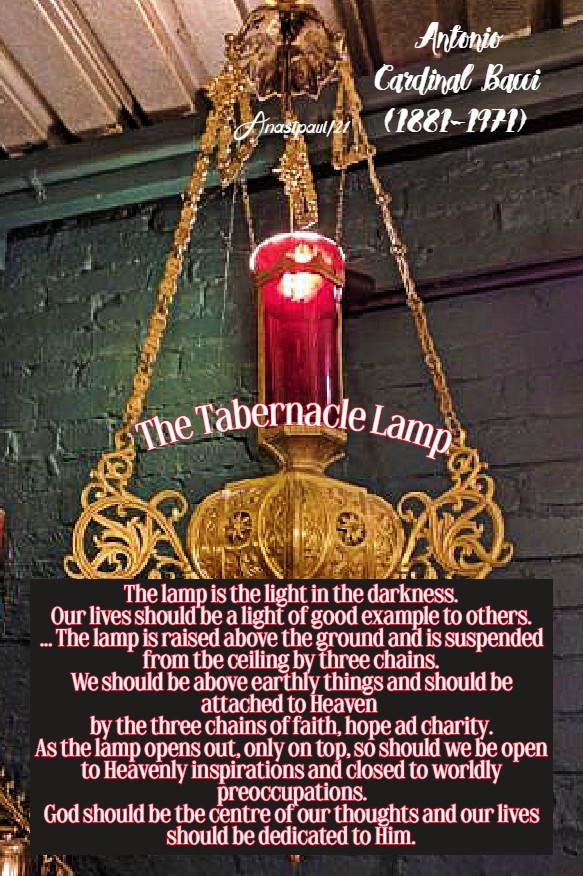
Thought for the Day – 14 April – The Tabernacle Lamp

Thought for the Day – 14 April – Meditations with Antonio Cardinal Bacci (1881-1971)

The Tabernacle Lamp

“Look up at the lamp quietly glowin before the Taberncle in honour of the Eucharistic Presence of Jesus, the Light of the world.
We also, should be like living lamps of love.

The lamp burns night and day in the Presence of Jesus and burns itself out for Him.
For what do we wear out our lives?
In useless and unnecessary projects, perhaps for worldly reasons, for the satisfaction of our ego or of our passions?
We shall certainly never find peace this way but only disillusionment and remorse.

The lamp is the light in the darkness.
Our lives should be a light of good example to others.

The lamp has a flame which gives heat.
We should burn with love for God, our one and only good and, for all men, whom we should regard as our brothers in Jesus Christ.

The lamp is raised above the ground and is suspended from tbe ceiling by three chains.
We should be above earthly things and should be attached to Heaven by the three chains of faith, hope ad charity.
As the lamp opens out, only on top, so should we be open to Heavenly inspirations and closed to worldly preoccupations.
God should be tbe centre of our thoughts and our lives should be dedicated to Him.

In this way, we shall find peace on earth and happiness hereafter.”

Antonio Cardinal Bacci

PART ONE HERE:
https://anastpaul.com/2020/07/02/thought-for-the-day-2-july-the-tabernacle-lamp/

Posted in CHRIST the LIGHT, DOCTORS of the Church, FATHERS of the Church, The WORD

Quote/s of the Day – 14 April – Christ the Light

Quote/s of the Day – 14 April – Wednesday of the Second Week of Easter, Readings: First: Acts 5: 17-26, Psalm: Psalms 34: 2-3, 4-5, 6-7, 8-9, Gospel: John 3: 16-21 *Readings below

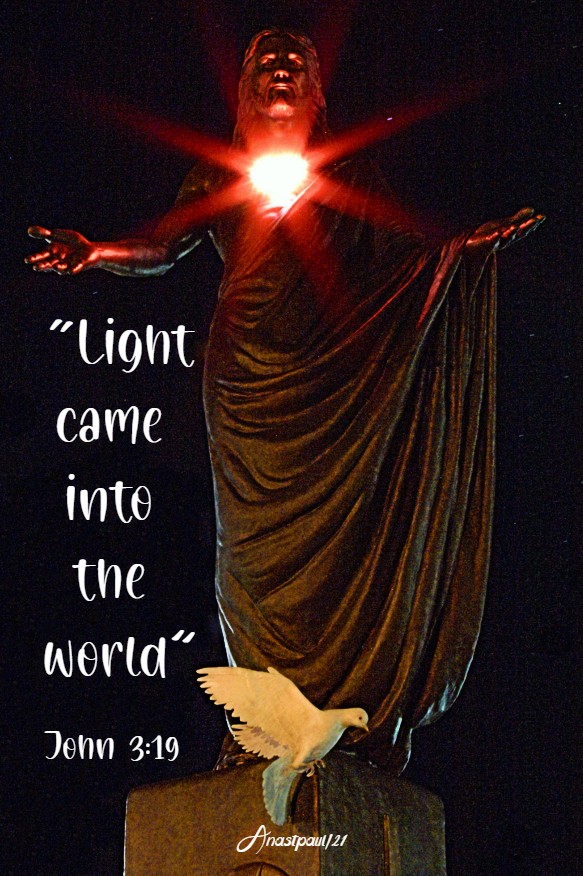
“Light came into the world”

John 3:19

“In You is the source of life
and in Your Light Lord, we see light”

Psalm 35(36)

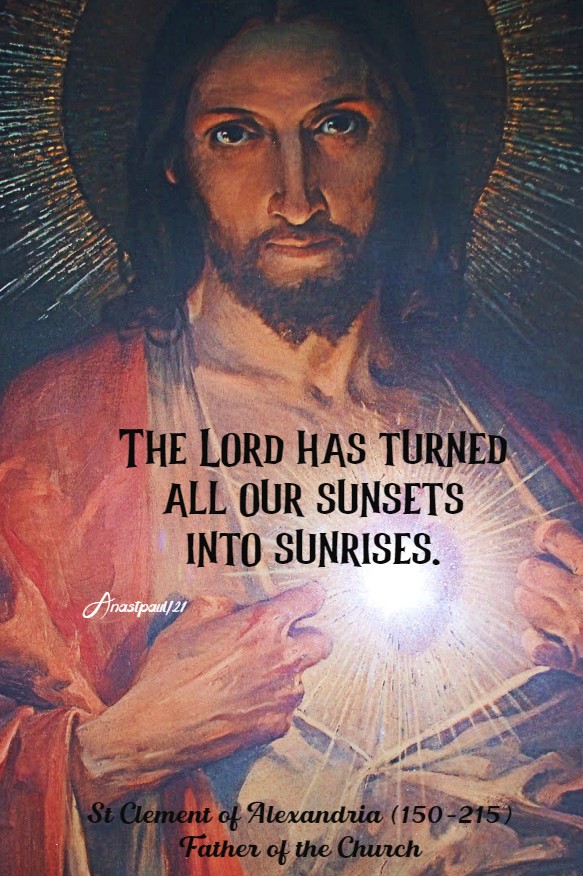
“The Lord has turned
all our sunsets
into sunrises.”

St Clement of Alexandria (150-215)
Father of the Church

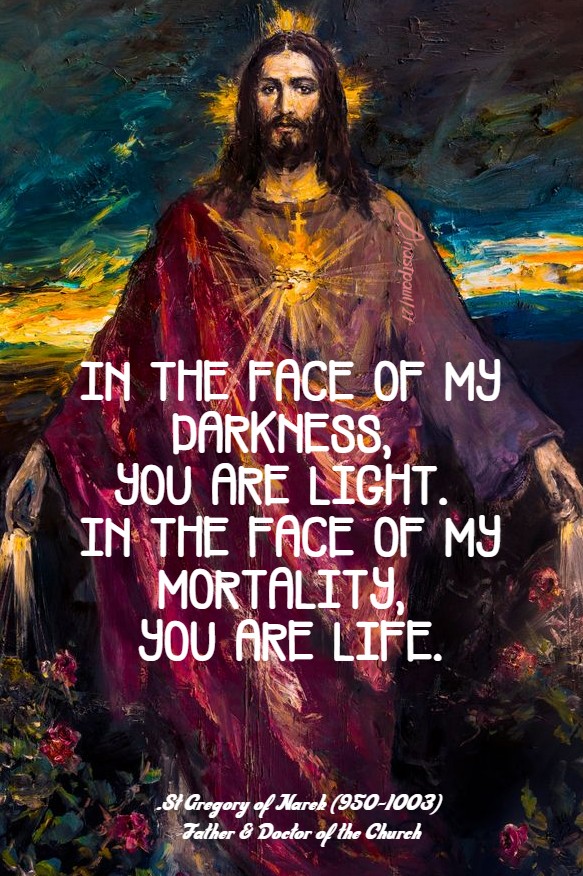
“In the face of my darkness,
You are light.
In the face of my mortality,
You are life.”

St Gregory of Narek (950-1003)
Father & Doctor of the Church

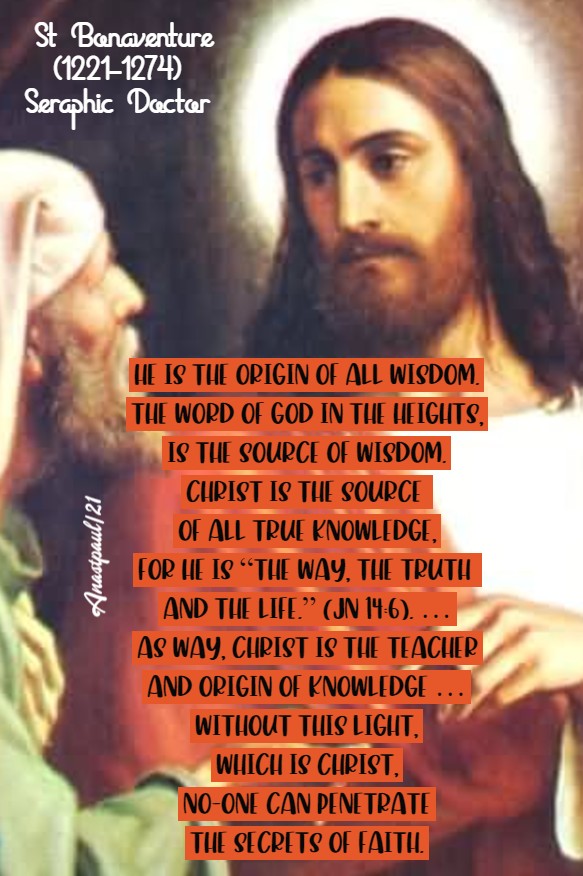
“He is the origin of all wisdom.
The Word of God in the heights,
is the source of wisdom.
Christ is the source of all true knowledge,
for He is “the way, the truth and the life.” (Jn 14:6). …
As way, Christ is the teacher
and origin of knowledge …
Without this Ligh,
which is Christ,
no-one can penetrate
the secrets of faith.”

St Bonaventure (1221-1274)
Seraphic Doctor

Posted in CHRIST the LIGHT, FATHERS of the Church, ONE Minute REFLECTION, QUOTES on TRUTH, The WORD

One Minute Reflection – 14 April – “Light came into the world” – John 3:19

One Minute Reflection – 14 April – Wednesday of the Second Week of Easter, Readings: First: Acts 5: 17-26, Psalm: Psalms 34: 2-3, 4-5, 6-7, 8-9, Gospel: John 3: 16-21 *Readings below

“Light came into the world” – John 3:19

REFLECTION – “The commandment of the Lord shines clearly, enlightening the eyes” (Ps 18 [19].9). Receive Christ, receive power to see, receive your light, that you may plainly recognise both God and man… Let us open ourselves to the light, then and so to God. Let us open ourselves to the light and become disciples of the Lord… Let us, then, shake off forgetfulness of truth, shake off the mist of ignorance and darkness that dims our eyes and contemplate the true God… For upon us, buried in darkness, imprisoned in the shadow of death, a heavenly light has shone, a light of a clarity, surpassing the sun’s and of a sweetness, exceeding any this earthly life can offer. That light is eternal life and those who receive it live. Night, on the other hand, is afraid of the light, and melting away in terror gives place to the day of the Lord. Unfailing light has penetrated everywhere and sunset has turned into dawn.

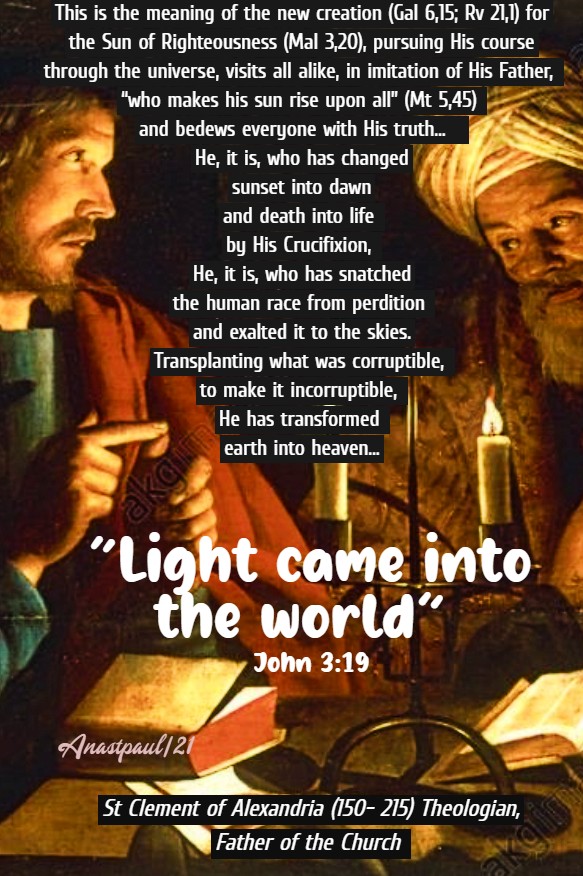
This is the meaning of the new creation (Gal 6,15; Rv 21,1) for the Sun of Righteousness (Mal 3,20), pursuing His course through the universe, visits all alike, in imitation of His Father, “who makes his sun rise upon all” (Mt 5,45) and bedews everyone with His truth… He, it is, who has changed sunset into dawn and death into life by His Crucifixion, He, it is, who has snatched the human race from perdition and exalted it to the skies. Transplanting what was corruptible, to make it incorruptible, He has transformed earth into heaven…

He deifies us by His heavenly teaching, by “instilling his laws into our minds, and writing them on our hearts. That all, be they of high estate or low, shall know God. And I will be merciful to them, God says and I will remember their sin no more” (Jr 31,33f.). Let us accept the laws of life, then; let us obey God’s promptings, let us learn to know Him.” – St Clement of Alexandria (150- 215) Theologian, Father of the Church – Exhortation to the Greeks, 11, 113

PRAYER – Shed your clear light on our hearts, Lord, so that walking continually in the way of Your commandments, we may never be deceived or misled. Your ways are not our ways, teach us to willingly agree to them, for You know which way we should go. Help us to say “yes” always to Your plan and to render ourselves as a sacrament of Your divine love to all we meet. Fill us with the grace to be your tools to bring glory to Your kingdom. May the prayers of your Angels and Saints and Your Blessed Mother and ours, bring us strength. Through Our Lord Jesus Christ with You, in the union of the Holy Spirit, one God forever, amen.

Acts 5: 17-26
17 Then the high priest rising up and all they that were with him, (which is the heresy of the Sadducees,) were filled with envy.
18 And they laid hands on the apostles,and put them in the common prison.
19 But an angel of the Lord by night opening the doors of the prison and leading them out, said: 20 Go and standing, speak in the temple to the people, all the words of this life.
21 Who having heard this, early in the morning, entered into the temple and taught. And the high priest coming and they that were with him, called together the council and all the ancients of the children of Israel and they sent to the prison to have them brought.
22 But when the ministers came and opening the prison, found them not there, they returned and told, 23 Saying: The prison indeed we found shut with all diligence and the keepers standing before the doors but opening it, we found no man within.
24 Now, when the officer of the temple and the chief priests heard these words, they were in doubt concerning them, what would come to pass.
25 But one came and told them: Behold, the men whom you put in prison are in the temple standing and teaching the people.
26 Then went the officer with the ministers and brought them without violence; for they feared the people, lest they should be stoned.

John 3: 16-21
16 For God so loved the world, as to give his only begotten Son, that whosoever believeth in him, may not perish but may have life everlasting.
17 For God sent not his Son into the world, to judge the world but that the world may be saved by him.
18 He that believeth in him is not judged. But he that doth not believe, is already judged – because he believeth not in the name of the only begotten Son of God.
19 And this is the judgement: because the light is come into the world and men loved darkness rather than the light, for their works were evil.
20 For everyone that doth evil hateth the light and cometh not to the light, that his works may not be reproved.
21 But he that doth truth, cometh to the light, that his works may be made manifest because they are done in God.

Posted in DOCTORS of the Church, JESUIT SJ, Our MORNING Offering, PRAYERS of the SAINTS

Our Morning Offering – 14 April – May I Be United with You, Good Jesus

Our Morning Offering – 14 April – Wednesday of the Second Week of Easter

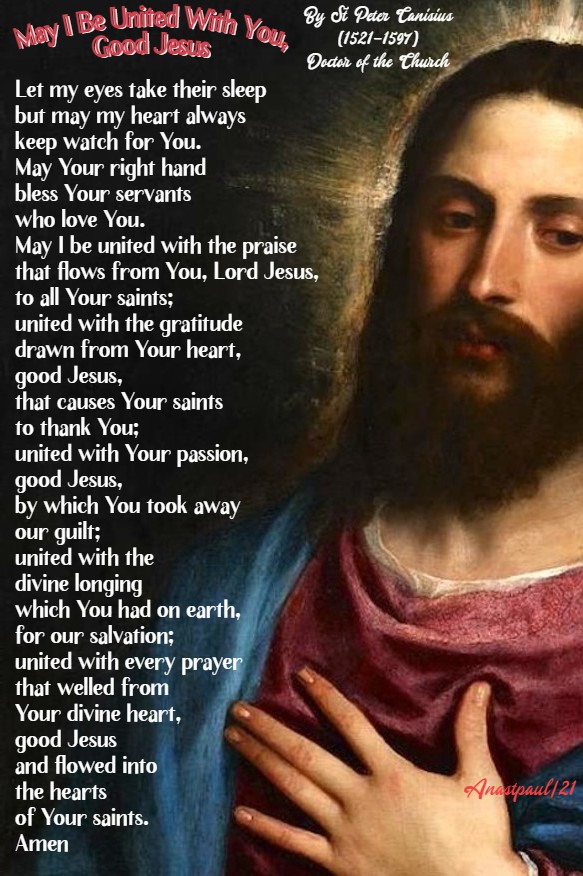
May I Be United with You, Good Jesus
St Peter Canisius (1521-1597)
Doctor of the Church

Let my eyes take their sleep
but may my heart always
keep watch for You.
May Your right hand bless Your servants
who love You.
May I be united with the praise
that flows from You, Lord Jesus,
to all Your saints;
united with the gratitude
drawn from Your heart, good Jesus,
that causes Your saints to thank You;
united with Your passion, good Jesus,
by which You took away our guilt;
united with the divine longing
that You had on earth, for our salvation;
united with every prayer
that welled from Your divine heart, good Jesus
and flowed into the hearts of Your saints.
Amen

Posted in SAINT of the DAY

Saint of the Day – 14 April – Saint John of Montemarano OSB (Died 1095)

Saint of the Day – 14 April – Saint John of Montemarano OSB (Died 1095) First Bishop of Montenarano, Italy in 1074, Benedictine Monk, thaumaturge. Died on 14 April 1095 of natural causes. Patronage – Montemarano, Italy. Additional Memorial – 21 August in Motemarano.

Montemarano, Italy may be a sleepy little vineyard Town now but from 1059 to 1818, it was the seat of a Diocese. The Town’s first Bishop is appropriately its Patron Saint.

I can find no information online about his early life and path to the Priesthood. His career begins with Pope Gregory VII, who had been exiled by Emperor Henry IV; during that exile, he agreed with the good folks of Montemarano that they should have their own Bishop. John was appointed and duly consecrated.

When John took over his seat, the building was in a state of decay. John then led the congregation in prayer for the means to restore the building. As they prayed, it was revealed to John, that the local Priest had been living a sinful life and actually using the Church as a rendezvous for evil friends. Once this Priest had repented and performed suitable penance, the Church was miraculously restored to its former glory.

Another miracle involved, wine. Some workers were clearing land so that more vineyards could be planted. One source suggests that John was the inspiration for this land-clearing project and he was involved in the labour as well. The work was hard and they demanded more wine before they continued. But there wasn’t enough wine, so they needed more vineyards. They couldn’t expand the vineyards until they gave the workers more wine. Bishop John, drew a quantity of water from the nearby river and blessed it. The Lord, recalling the second chapter of the Gospel of John, changed the water into wine!

John was Canonised in 1906 by Saint Pope Pius X.

Posted in MARIAN TITLES, SAINT of the DAY

Santa Maria de Camarino / Our Lady of Guam, Mariana Islands (1825) and Memorials of the Saints – 14 April

Wednesday of the Second Week of Lent +2021

Santa Maria de Camarino / Our Lady of Guam, Mariana Islands (1825), Patron of Guam – 14 April:

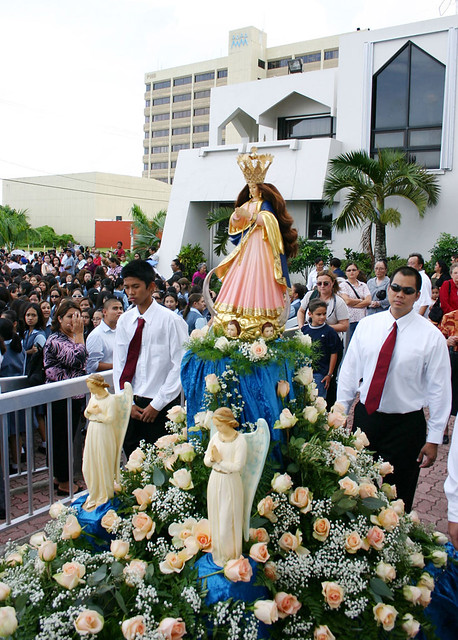
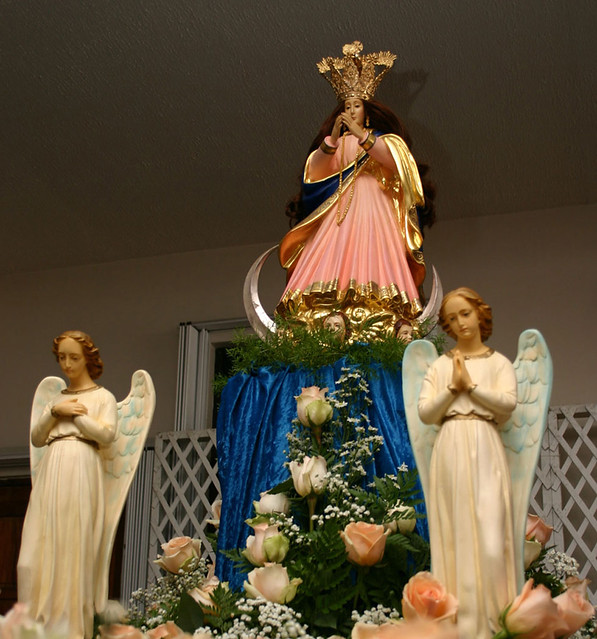
Our Lady of Guam, the miraculous Statue to which the natives have such deep devotion, is three feet high, all ivory from the delicate classical face of Our Lady to the hem of her exquisite gown. She has a head of long brown hair, adorned with a beautiful crown and golden rings hang from her tiny ears. According to the Jesuit history of the island, Our Lady’s coming was miraculous.
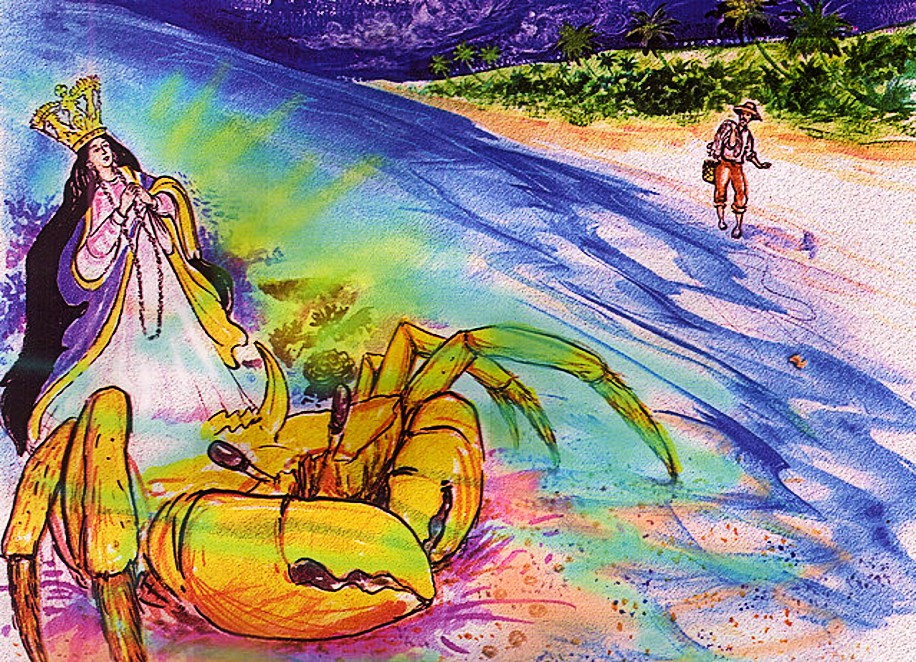
A Spanish soldier, in the year 1825, was fishing a distance from the shore between the villages of Mirizo and Umatac, when he saw a strange object floating upon the waves. He moved closer and saw that it was a Statue, supported by giant golden crabs, holding lighted candles in their claws. The soldiers claiming the Statue as their own, installed it as Patroness in their barracks. They made a Shrine for her, a wall recess with doors like a cupboard or camarino, from which Our Lady of the Cupboard takes her name. She is called Santa Maria de Camarino.

She made her home for many years in the barracks but the atmosphere did not always please her. She would be found missing, only to return with the edge of her mantle full of burs. When the soldiers were drunk with coconut brew, she would slam the doors of her cupboard shut against them.
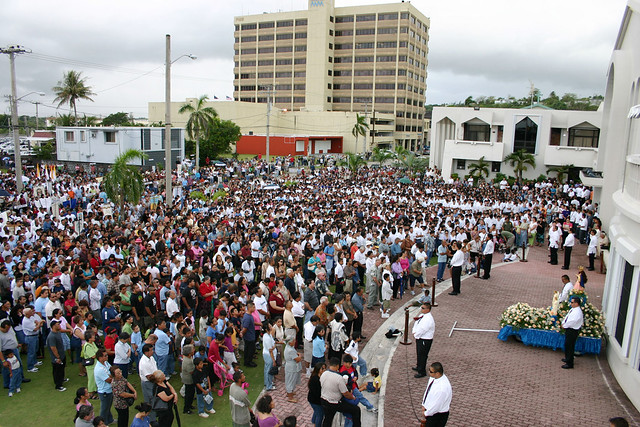
No-one remembers how she came to leave the barracks for the Cathedral of Agana but on 14 April, a great earthquake occurred, terrorising the natives and destroying their homes. It is believed that on that day, she deserted the uncouth soldiers and showed herself to be the Patroness of the people and of Guam in particular. Many miracles of protection are attributed to Our Lady of Guam on this day.

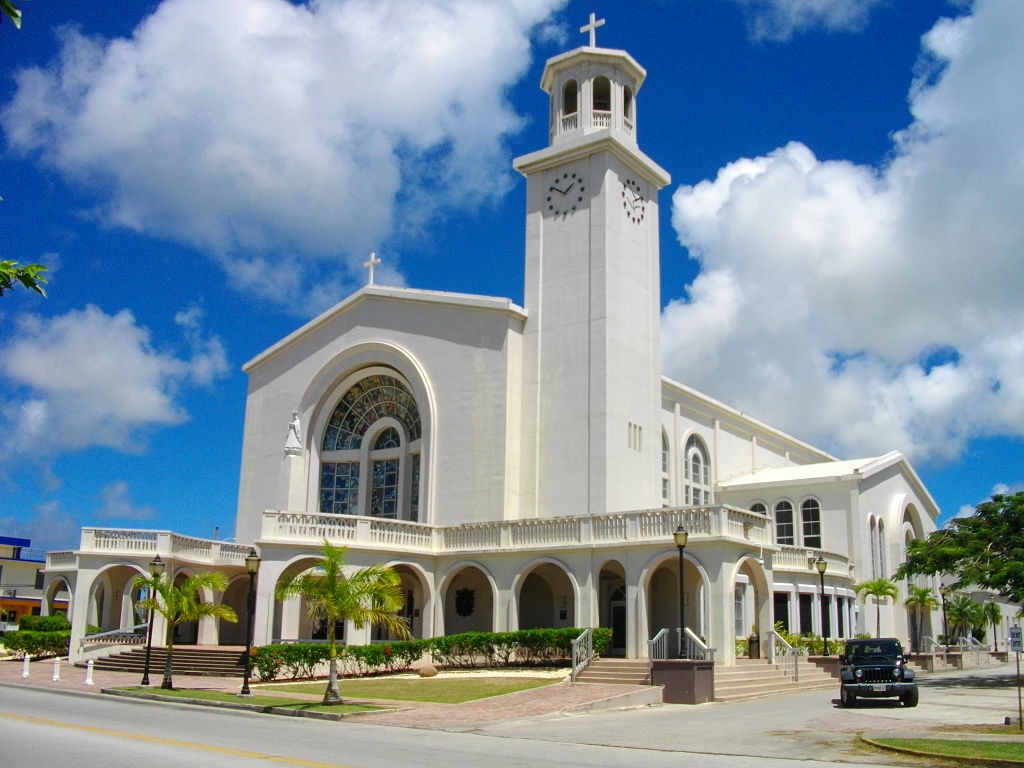
The Cathedral of Agana

On the eve of this day, the people place a lighted candle outside their tight-closed shutters, they do this in memory of their Fathers who made the promise to Santa Maria de Camarino. In 1825 and again in 1834, they vowed to celebrate yearly a special feast for her protection from Linao, the earthquake and Pagyo, the typhoon.

On its part the miraculous Statue has seen to it ,that no devout life has since that time been lost. Earthquakes and typhoons have come and left destruction, yet they have never taken one life or harmed the children of Santa Maria de Camarino, Our Lady of Guam.
Such is the story of Our Lady of the Cupboard, the miraculous Virgin of Guam; to the eyes of fact simply a beautiful Statue, some three feet height, executed with all the refinement of eighteenth century art, yet to the eye of faith, she is power incarnate. She is all ivory, but where that ivory came from, or what artist fashioned those exquisite hands, she alone can tell, just as she is the only one who knows the truth of her coming to Guam. The Statue has real human hair and two crowns are used to dress the Statue. One of the crowns is made from gold pieces given to the Church by the late Ana Martinez Underwood, who donated the gold pieces (given to her by her husband as a wedding gift) in thanksgiving for the safe return of her husband from prison camp following World War II.

One of the more famous miraclesis that of a great earthquake in 1902, when the Dulce Nombre de Maria Church was severely damaged. Many of the Statues were broken but not that of Our Lady of Camarin, which the Priest, Father José Palomo, found standing intact on the ground.

The Statue also survived fire, when on 8 December 1945, it was rescued from a burning float by Jose D Leon Guerrero.

Because the Statue has suffered discolourations, nicks and other minor defects in the course of time, minor repairs have been made. According to one story, during one occasion when repairs were being made, the scraping of her face was too rough and the face began to bleed.

Other miracles attributed to her include, belief in her powers of intercession, cures of dreadful diseases and safe removal from great danger. She has long been considered, the protectress of the island and its people.
Flags of various nations have flown over the royal coconut trees of Agana, admirals and governors have come and gone and each, in his proper time, has departed. Spanish architecture has had its day and the Seabee buildings mushroomed all over the island. Yet, Santa Maria de Camarino abides through all changes to cherish her strangely chosen people. She reigns affectionately in the hearts of the people, the natives, as their Queen and Patroness.

When American Marines and Soldiers during the latter part of July, 1944, captured the island of Guam, the native population was, for the most part, Catholic. The Faith was brought there, no doubt, by Spanish Priests who accompanied Magellan when he sailed around the world. And Mary, Our Lady of Guam, Our Lady of the Cupboard, loves them and protects them.

St Abundius the Sacristan
St Antony of Vilna
St Ardalion the Actor
St Benezet the Bridge Builder (c 1163-1184)
Wonderful St Benezet:

https://anastpaul.com/2020/04/14/saint-of-the-day-14-april-st-benezet-the-bridge-builder-c-1163-1184/

St Bernhard of Tiron
St Domnina of Terni
St Eustace of Vilna
St Fronto of Nitria
Bl Hadewych
St John of Montemarano OSB (Died 1095) Bishop
St John of Vilna
St Lambert of Lyon
Blessed Lucien Botovasoa (1908-1947) Martyr
Blessed Lucien’s life:

https://anastpaul.wordpress.com/2018/04/14/saint-of-the-day-14-april-blessed-lucien-botovasoa-o-f-s-1908-1947-martyr/

St Lydwina of Schiedam (1380-1433)
Biography:

https://anastpaul.com/2019/04/14/saint-of-the-day-14-april-saint-lydwina-of-schiedam-1380-1433/

St Maximus of Rome
St Peter Gonzalez OP (1190 – 1246)
About St Peter:

https://anastpaul.wordpress.com/2017/04/14/saint-of-the-day-14-april-blessed-peter-gonzalez-o-p/

St Tassach of Raholp
St Thomaides of Alexandria
St Tiburtius of Rome
St Valerian of Trastevere

Posted in "Follow Me", CHRIST the LIGHT, CHRIST, the WAY,TRUTH,LIFE, GOD ALONE!, MEDITATIONS - ANTONIO CARD BACCI, QUOTES for CHRIST, QUOTES on DISCIPLESHIP, QUOTES on MISSION, QUOTES on SANCTITY, QUOTES on SELF-DENIAL, The HEART

Thought for the Day – 13 April – My Life is Christ

Thought for the Day – 13 April – Meditations with Antonio Cardinal Bacci (1881-1971)

My Life is Christ

“St Paul reached such a degree of union with Christ that he could exclaim” “To me to live is Christ” (Phil 1:21).
Elsewhere he says” “It is now no longer I that live but Christ lives in me” (Gal 2:20).
This is a characteristic of the Saints.
They live their own lives no longer, for they live the life of Christ.
That is to say, their minds and hearts are always fixed on Jesus.
They love the Lord, more than all things and, more than themselves.
God is the object of all their desires, affections and actions.
As a result, the soul is transfigured and is infused with divine life, so that it does nothing which is not activated by grace.
In the Saints, then, there is reflected something heavenly which attracts and stimulates one to virtue.

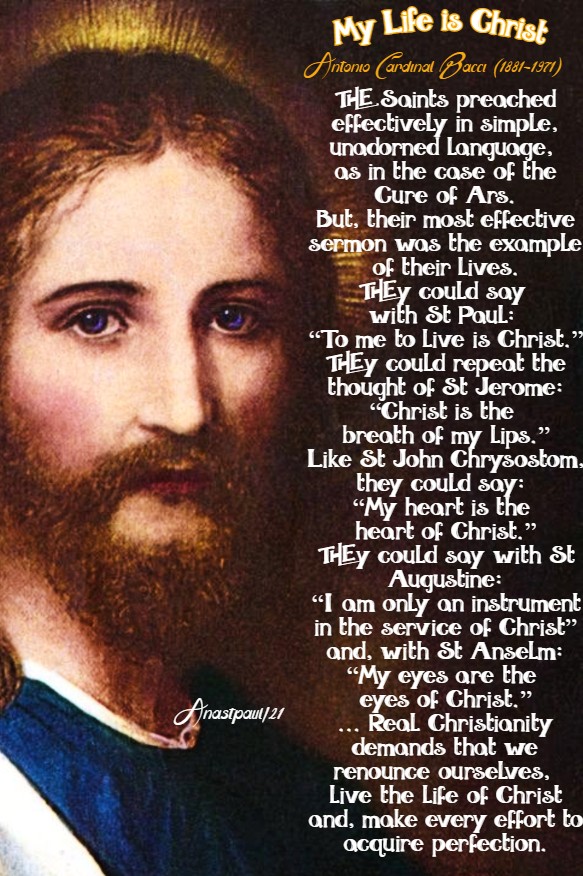
The Saints preached effectively in simple, unadorned language, as in the case of the Cure of Ars.
But, their most effective sermon was the example of their lives.
They could say with St Paul: “To me to live is Christ.”
They could repeat the thought of St Jerome: “Christ is the breath of my lips.”
Like St John Chrysostom, they could say: “My heart is the heart of Christ.”
They could say with St Augustine: “I am only an instrument in the service of Christ” and, with St Anselm: “My eyes are the eyes of Christ.”

When we meditate on these words, which signify the height of sanctity, we feel very small, shabby and far from the Christian perfection to which we should aspire.
Perhaps we are still immersed in sin, or perhaps, we are wavering between the things of this world and the things of God, or perhaps, as yet, we have not given up our egoism and complacent mediocrity in order to offer ourselves entirely to God.
Real Christianity demands that we renounce ourselves, live the life of Christ and, make every effort to acquire perfection.”

Antonio Cardinal Bacci

Posted in DOCTORS of the Church, FATHERS of the Church, LOVE of NEIGHBOUR, QUOTES of the SAINTS, QUOTES on GRACE, QUOTES on the CHURCH, QUOTES on THE MYSTICAL BODY, QUOTES on UNITY/with GOD, The HOLY EUCHARIST / The HOLY MASS, The WORD

Quote/s of the Day – 13 April – “One heart and one soul” Acts 4:32

Quote/s of the Day – 13 April – Tuesday of the Second Week of Easter, Readings: First: Acts 4: 32-37, Psalm: Psalms 93: 1ab, 1cd-2, 5, Gospel: John 3: 7b-15

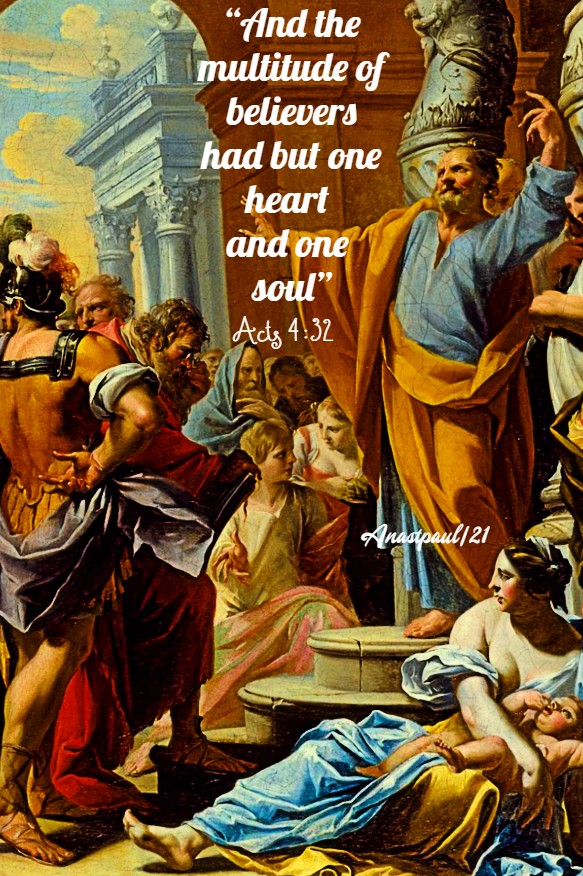
“And the multitude of believers
had but one heart and one soul”

Acts 4:32

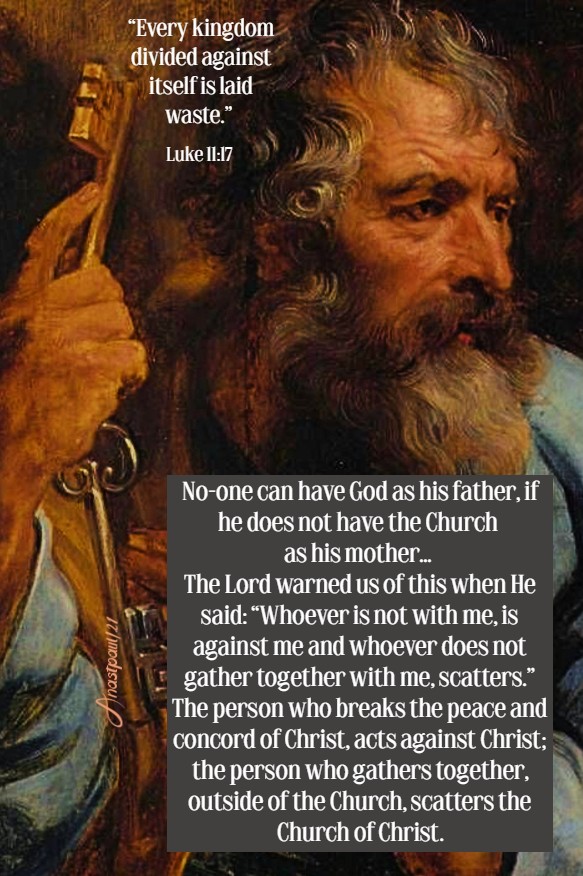
Every kingdom divided against itself
is laid waste.”

Luke 11:17

“No-one can have God as his father,
if he does not have the Church as his mother…
The Lord warned us of this when He said:
“Whoever is not with me, is against me
and whoever does not gather together with me, scatters.”
The person who breaks the peace and concord of Christ,
acts against Christ;
the person who gathers together,
outside of the Church,
scatters the Church of Christ.”

St Cyprian of Carthage (c 200- c 258)
Bishop and Martyr, Father of the Church
On the unity of the Church

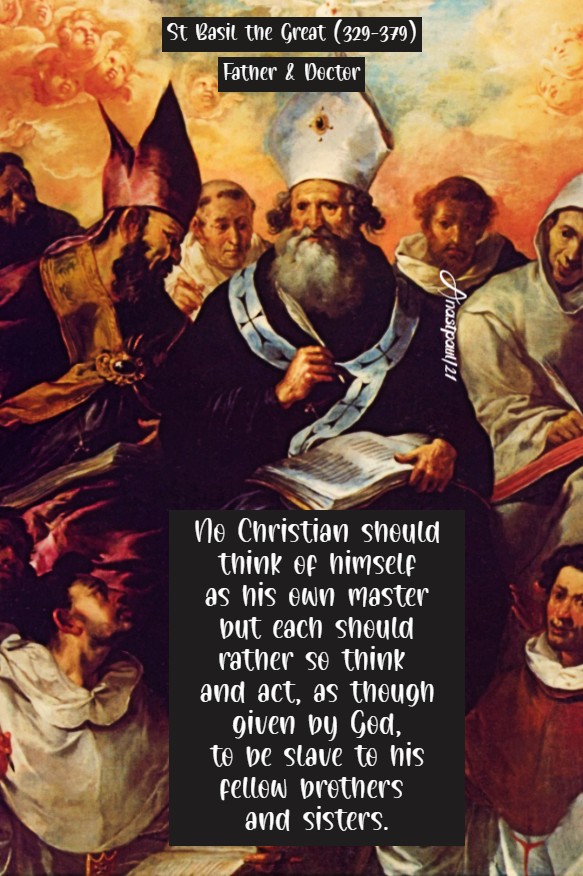
“No Christian should think of himself
as his own master
but each should rather so think and act,
as though given by God,
to be slave to his fellow brothers and sisters.”

St Basil the Great (329-379)
Father & Doctor

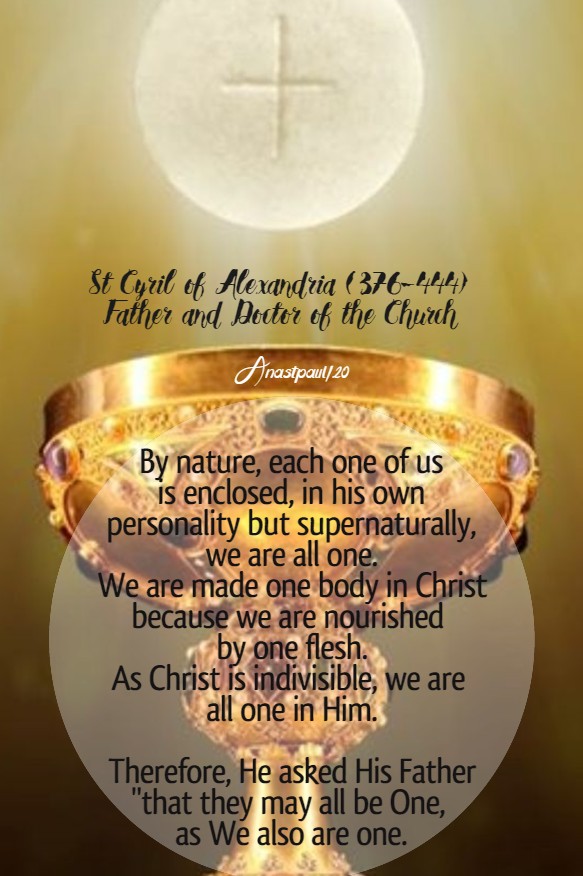
“By nature, each one of us
is enclosed, in his own personality
but supernaturally, we are all one.
We are made one body in Christ
because we are nourished by one flesh.
As Christ is indivisible, we are all one in Him.
Therefore, He asked His Father
“that they may all be One, as We also are one.”

St Cyril of Alexandria (376-444)
Father and Doctor of the Incarnation

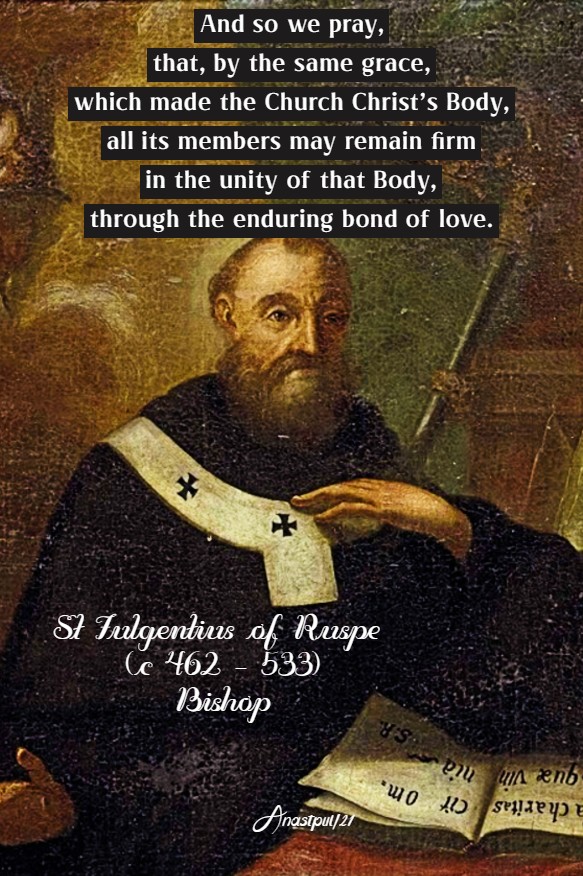
“And so we pray,
that, by the same grace,
which made the Church Christ’s Body,
all its members may remain firm
in the unity of that Body,
through the enduring bond of love.”

St Fulgentius of Ruspe (c 462 – 533)
Bishop, Father of the Church

Posted in BAPTISM, DOCTORS of the Church, FATHERS of the Church, HOLY SPIRIT, The HOLY GHOST, The WORD

One Minute Reflection – 13 April – ‘… The grace of Him Who has called us.’

One Minute Reflection – 13 April – Tuesday of the Second Week of Easter, Readings: First: Acts 4: 32-37, Psalm: Psalms 93: 1ab, 1cd-2, 5, Gospel: John 3: 7b-15 *Readings below

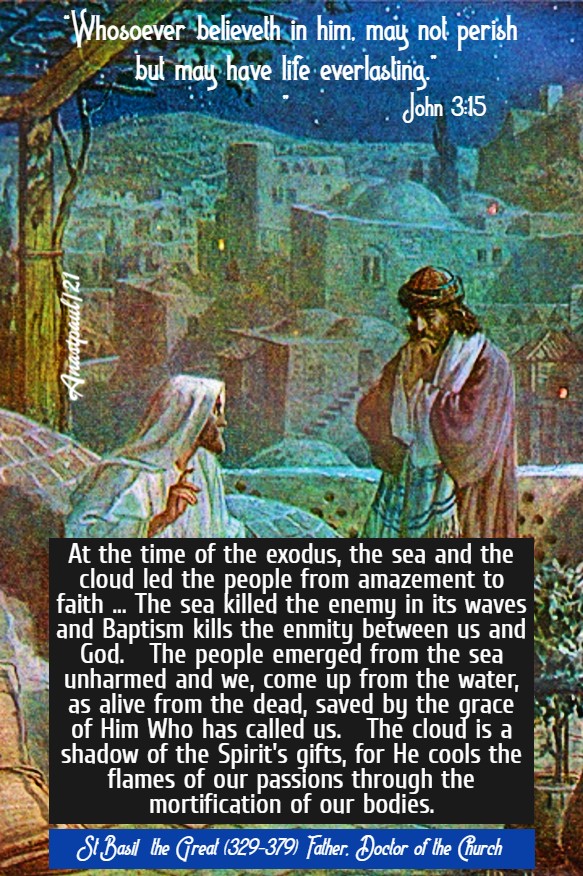
“Whosoever believeth in him, may not perish but may have life everlasting.” – John 3:15

REFLECTION – “Typology points out what is to be expected, indicating through imitation, what is to happen before it happens. Adam was a type of Him who was to come (Rom 5:14); “the Rock was Christ” (1 Cor 10:4) typologically and, the water from the rock, was a type of the living power of the Word, for He says, “If anyone thirst, let him come to Me and drink.” (Jn 7:37) The manna was a type of the living bread which came down from heaven (Jn 6:41) and the serpent suspended on the pole, was a type of the saving Passion accomplished on the Cross (Nb 21:8f.), since the life of everyone who looked at the serpent was preserved.

Similarly, the history of Israel’s exodus, was recorded to typify those who would be saved through Baptism. The firstborn of the Israelites were saved …) through grace given, to those who were marked with blood. The blood of the lamb is a type of the blood of Christ …

At the time of the exodus, the sea and the cloud led the people from amazement to faith but ,they also typified the grace which was yet to come. “Whoever is wise, let him understand these things” – how the baptism in the sea, which brought about Pharaoh’s demise, typifies the washing, which makes the devil’s tyranny depart. The sea killed the enemy in its waves and Baptism kills the enmity between us and God. The people emerged from the sea unharmed and we come up from the water, as alive from the dead, saved by the grace of Him Who has called us. The cloud is a shadow of the Spirit’s gifts, for He cools the flames of our passions through the mortification of our bodies.” – St Basil the Great (329-379) Bishop of Caesarea in Cappadocia, Father, Doctor of the Church – Treatise on the Holy Spirit, 14

PRAYER – True Light of the World, Lord Jesus Christ, as You enlighten all men for their salvation, fill us the grace of the Holy Spirit, that our eyes may be opened and our path visible. May our hearts be filled with the certainty of Your love and grant us the grace to share Your light with all. May Your love in us overcome all things, let there be no limit to our faith, our hope and our endurance. Lead us in Your ways of peace to eternal life by Your Mother’s protecting help. Who live and reign with the Father and Holy Spirit, God forever and ever, amen.

Acts 4: 32-37
32 And the multitude of believers had but one heart and one soul, neither did anyone say that aught of the things which he possessed, was his own but all things were common unto them.
33 And with great power did the apostles give testimony of the resurrection of Jesus Christ our Lord and great grace was in them all.
34 For neither was there anyone needy among them. For as many as were owners of lands or houses, sold them and brought the price of the things they sold 35 and laid it down before the feet of the apostles. And distribution was made to everyone, according as he had need.
36 And Joseph, who, by the apostles, was surnamed Barnabas, (which is, by interpretation, The son of consolation), a Levite, a Cyprian born, 37 having land, sold it and brought the price and laid it at the feet of the apostles.

John 3: 7b-15
7 Wonder not, that I said to thee, you must be born again.
8 The Spirit breatheth where he will and thou hearest his voice but thou knowest not whence he cometh and whither he goeth, so is everyone that is born of the Spirit.
9 Nicodemus answered and said to him: How can these things be done?
10 Jesus answered and said to him: Art thou a master in Israel and knowest not these things?
11 Amen, amen I say to thee, that we speak what we know and we testify what we have seen and you receive not our testimony.
12 If I have spoken to you earthly things,and you believe not; how will you ,believe, if I shall speak to you heavenly things?
13 And no man hath ascended into heaven but he that descended from heaven, the Son of man who is in heaven.
14 And as Moses lifted up the serpent in the desert, so must the Son of man be lifted up: 15 that whosoever believeth in him, may not perish but may have life everlasting.

Posted in EASTER, HYMNS, Our MORNING Offering, The RESURRECTION

Our Morning offering – 13 April – He is Risen, Tell the Story

Our Morning Offering – 13 April – Tuesday of the Second Week of Easter

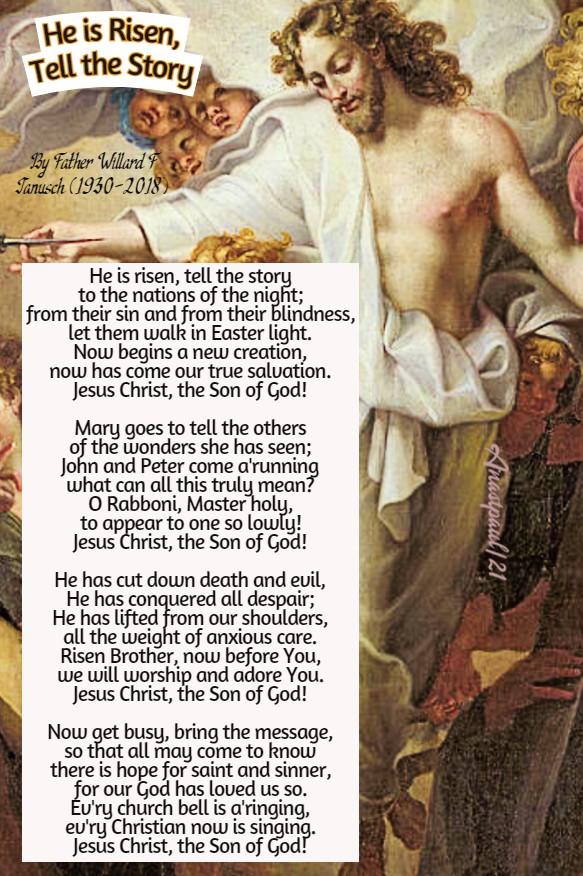
He is Risen, Tell the Story
By Father Willard F Janusch (1930-2018)

He is risen, tell the story
to the nations of the night;
from their sin and from their blindness,
let them walk in Easter light.
Now begins a new creation,
now has come our true salvation.
Jesus Christ, the Son of God!

Mary goes to tell the others
of the wonders she has seen;
John and Peter come a’running
what can all this truly mean?
O Rabboni, Master holy,
to appear to one so lowly!
Jesus Christ, the Son of God!

He has cut down death and evil,
He has conquered all despair;
He has lifted from our shoulders,
all the weight of anxious care.
Risen Brother, now before you,
we will worship and adore You.
Jesus Christ, the Son of God!

Now get busy, bring the message,
so that all may come to know
there is hope for saint and sinner,
for our God has loved us so.
Ev’ry church bell is a’ringing,
ev’ry Christian now is singing.
Jesus Christ, the Son of God!

A Parish Priest, Seminary Professor and prolific Musician and Hymnist, Fr Willard wa Ordained in 1956 and died at the age of 88 in 2018.

Posted in INCORRUPTIBLES

Saint of the Day – 13 April – Saint Caradoc of Wales (Died 1124)

Saint of the Day – 13 April – Saint Caradoc of Wales (Died 1124) Priest, Monk, Hermit , miracle-worker, Harpist. Born in the 11th century in Brycheiniog, Wales and died on 13 April 1124, which was Low Sunday that year, at Saint Isells, Wales of natural causes. His body is incorrupt. Also known as Caradog, Caractacus, Caradocus, Caradoco.

Caradoc was a Welsh nobleman, native of Brecknockshire, who after he had received a liberal education, enjoyed the confidence of Rees, or Resus, Prince of South-Wales and held an honourable place in his Court, as a harp player.

The Prince one day, on account of two greyhounds ,which were lost, fell into such a fury against Caradoc as to threaten his life. Caradoc, from this disgrace learned the inconstancy and uncertainty, of worldly honours and the best founded hopes and resolved to dedicate himself altogether to the service of the King of kings, whose promises can never fail and whose rewards are eternal.

Upon the spot he broke the tip of his spear to turn it into a walking stick and he made the sacrifice of himself to God, by a vow of perpetual chastity and of embracing a religious life. Repairing to Landaff to become a Monk, he received from the Bishop the clerical tonsure and for some time served God in the Church of St Theliau.

Being desirous of finding a closer union with God in solitude, he spent some years in a little hut, which he built himself, near the abandoned Church of St Kined.

The reputation of his sanctity filled the whole country and the Archbishop of Menevia, or St David’s, calling him to that town, promoted him to the Priestly orders. The saint hence retired, with certain devout companions, to the isle of Ary.

Certain pirates from Norway, who often infested these coasts, carried them off as prisoners,but, fearing the judgements of God, safely set them on shore again the next day. However, the Archbishop of Menevia assigned the saint another habitation in the Monastery of St Hismael, commonly called Ysam, in the country of Ross, or Pembroke-shire.

Henry I., King of England, having subdued the southern Welsh, sent a colony of Flemings into the country of Ross, who drove the old Britons out of their possessions. The saint and his Monastery suffered much from the oppressions of these new inhabitants, especially of Richard Tankard, a powerful Englishman among them. This nobleman was, after some time, struck by God with a dangerous illness and having recourse to St Caradoc, was, by his prayers, restored to his health. From this time the saint and his Monastery found a benefactor and protector.

St Caradoc died on Low-Sunday, the 13th of April, in the year 1124 and was buried with great honour in the Church of St David. We are assured that his tomb was illustrated by miracles and his body was found whole and incorrupt several years after, when it was translated with great solemnity. The historian, William of Malmesbury, tried to cut off a finger to take as a relic but St Caradoc’s hand jerked away!

A letter from Pope Innocent III ordering an enquiry into his life and miracles still survives. The Church at Lawrenny in Wales, is dedicated to him.

Posted in MARIAN TITLES, SAINT of the DAY

Santa Maria dei Voti / Our Lady of Mantua (1640) and Memorials of the Saints – 13 April

Tuesday of the Second Week of Easter +2021

Santa Maria dei Voti / Our Lady of Mantua, Italy (1640) – 13 April:

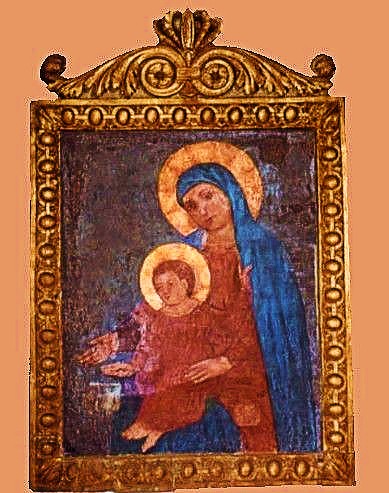
This present Shrine to Our Lady of Mantua was built by the Gonzaga family in the year 1460. There is seen a miraculous painting of the Blessed Virgin Mary holding the Baby Jesus, that is known to have been venerated since about the year 1000. Originally known as Saint Mary of the Vows, the painting is crowned today.

According to tradition, the history of the site dates back to Saint Anselm. At that time, the Blessed Virgin had promised her protection to the City. Starting in 1477, word spread that before the image numerous miracles had occurred, so that by then substantial offerings began to pour into the Church (hence the name of Santa Maria dei Voti).
After the plague of 1630, which had overwhelmed the City and its territory, the Princess Maria Gonzaga, regent of the duchy, wanted to entrust herself, her dynasty and the region, to the protection of the Blessed Virgin. The Princess was determined to place herself, her son Charles II and the City of Mantua and of Monferrato, under the special protection of Mary. She ordered that the image of Mary should be carried in procession through the streets and desired that the image be solemnly crowned in the Basilica of Saint Andrea, as the Queen of Mantua.
The solemn crowning of Our Lady commonly called Santa Maria dei Voti, was strongly urged by the pious Princess Maria Gonzaga in the year 1640, when the dam of the Po River in Italy broke. The coronation took place with great solemnity on 28 November 1640.
Since then, the Church and the picture painted of Santa Maria dei Voti were named dell’Incoronata, or ‘Saint Mary the Crowned,’ and the annual festival was fixed on the first Sunday after the Feast of Saint Martin, 11 November. On this occasion but also during the month of May, which is traditionally dedicated to Marian devotion, the dell’Incoronata is exposed in the Cathedral, covered in sumptuous dresses dating from the seventeenth century.
The three following centenary years, in particular, saw an unanimous and grateful expression of love on the part of the Mantuans, who still venerate the Madonna “Incoronata,” the Madonna who said, “Mantua is mine and as mine I will always defend it.”

St Pope Martin I (598-655) Martyr (Optional Memorial)
Biography:

https://anastpaul.wordpress.com/2017/04/13/saint-of-the-day-13-april-st-pope-martin-i/

St Agathonica of Pergamus
St Agathodorus of Pergamus
St Caradoc of Wales (Died 1124) Priest, Hermit
St Carpus of Pergamus
Bl Edward Catherick
Bl Francis Dickenson
St Guinoc
St Hermengild
St Ida of Boulogne
Bl Ida of Louvain
Bl Isabel Calduch Rovira
Bl James of Certaldo
Bl John Lockwood
Blessed Margaret of Castello OP (1287-1320)
About Blessed Margaret:

https://anastpaul.wordpress.com/2018/04/13/saint-of-the-day-13-april-blessed-margaret-of-castello-o-p-1287-1320/

St Martius of Auvergne
Bl Miles Gerard
St Papylus of Pergamus
St Proculus of Terni
St Jose Sabás Reyes Salazar (1883-1927) Priest and Martyr of the Cristero War
His Life and Death:

https://anastpaul.com/2020/04/13/saint-of-the-day-13-april-st-jose-sabas-reyes-salazar-1883-1927-priest-and-martyr/
Blessed Scubilion Rousseau FSC (1797-1867)
His life:

https://anastpaul.com/2019/04/13/saint-of-the-day-13-april-blessed-scubilion-rousseau-fsc-1797-1867-the-catechist-of-slaves/

St Ursus of Ravenna

Martyrs of Dorostorum – 3 saints: A lector and two students martyred together in the persecutions of Diocletian – Dadas, Maximus and Quinctillianus. Beheaded c303 in Dorostorum, Lower Mysia (modern Sillistria, Bulgaria.

Posted in BAPTISM, MEDITATIONS - ANTONIO CARD BACCI, QUOTES on GRACE

Thought for the Day – 12 April– The Sacrament of Baptism

Thought for the Day – 12 April– Meditations with Antonio Cardinal Bacci (1881-1971)

The Sacrament of Baptism

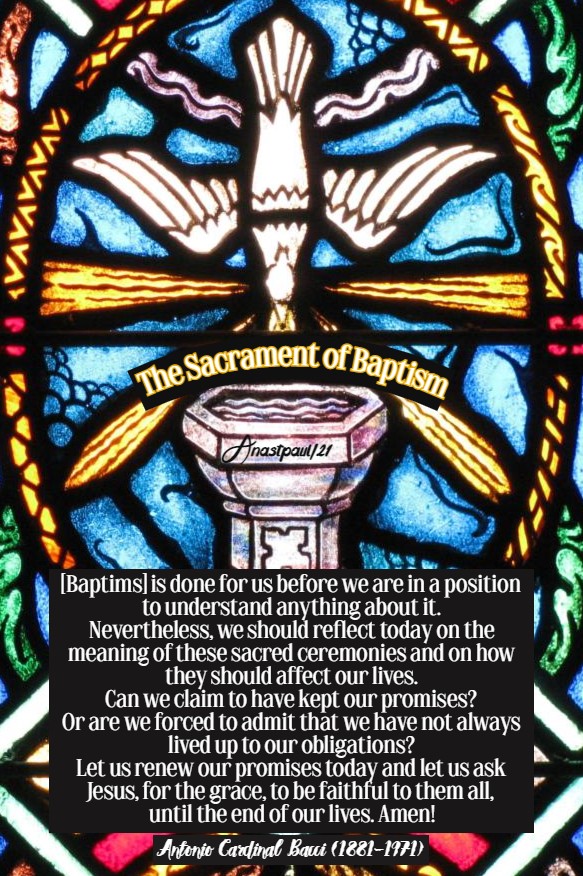
“Like the other Sacraments, Baptism is composed of a material and a spiritual element.
The sensible outward sign produces the grace, or spiritual element, which it signifies.
Since we are composed of body and soul, it is fitting that the Sacrament should also consist of this double element.
Baptism, for example, being a spiritual cleansing of the soul, is conferred by the pouring of natural water, accompanied by the sacramental words by Jesus Christ.

The Church adds its own ceremonial to the essential part of the Sacrament.
By means of the exorcisms, the devil is expelled and the tongue is consecrated with the salt of wisdom, to indicate, that it should be the instrument of goodness.
The body is sanctified by the oil and chrism, so that it may always be the living temple of the Holy Spirit.
The white garment, symbolises the innocence which we ought to preserve for the rest of our lives and the lighted candle, stands for the faith and charity, which ought always to inspire the soul.

All this is done for us before we are in a position to understand anything about it.
Nevertheless, we should reflect today on the meaning of these sacred ceremonies and on how they should affect our lives.
Can we claim to have kept our promises?
Or are we forced to admit that we have not always lived up to our obligations?
Let us renew our promises today and let us ask Jesus, for the grace, to be faithful to them all, until the end of our lives. Amen!

Antonio Cardinal Bacci

PART ONE HERE:
https://anastpaul.com/2021/01/10/thought-for-the-day-10-january-the-sacrament-of-baptism/

Posted in BAPTISM, DOCTORS of the Church, EASTER, FATHERS of the Church, QUOTES on CONVERSION, QUOTES on ETERNAL LIFE, The HOLY GHOST, The LAST THINGS, The WILL of GOD, The WORD

Quote/s of the Day – – 12 April – ‘… A second life ‘

Quote/s of the Day – – 12 April – Monday of the Second week of Easter, Readings: First: Acts 4: 23-31, Psalm: Psalms 2: 1-3, 4-7a, 7b-9, Gospel: John 3: 1-8

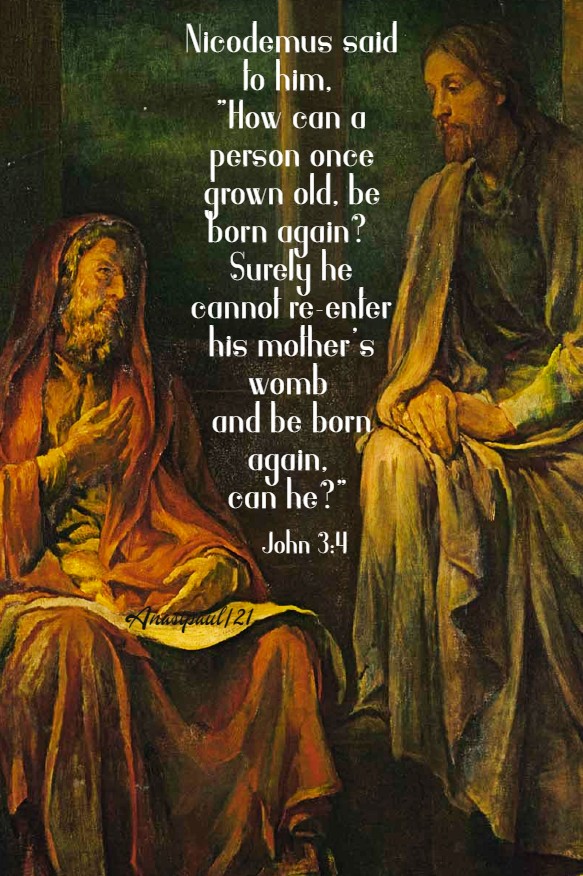
“Nicodemus said to him,
“How can a person once grown old, be born again?
Surely he cannot reenter his mother’s womb
and be born again, can he?”

John 3:4

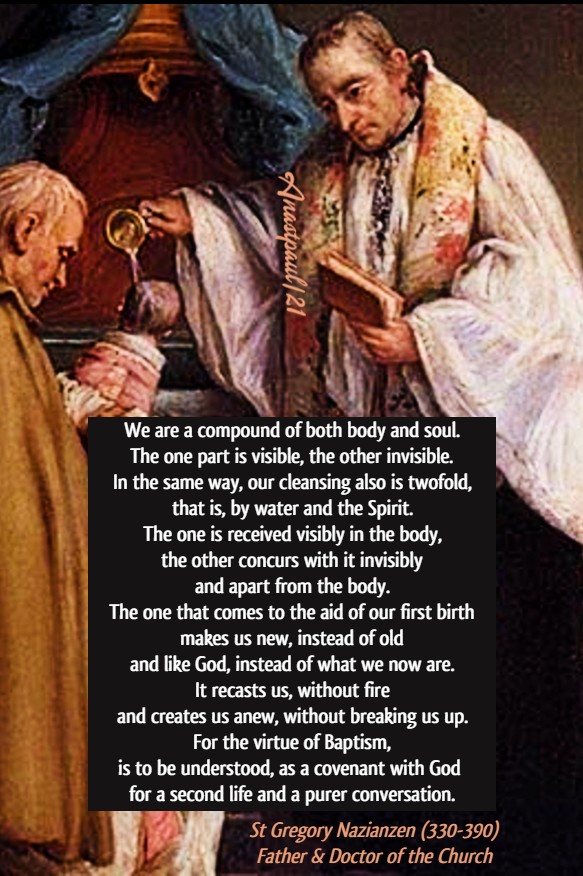
“We are a compound of both body and soul.
The one part is visible, the other invisible.
In the same way, our cleansing also is twofold,
that is, by water and the Spirit.
The one is received visibly in the body,
the other concurs with it invisibly
and apart from the body.
The one that comes to the aid of our first birth
makes us new, instead of old
and like God, instead of what we now are.
It recasts us, without fire
and creates us anew, without breaking us up.
For the virtue of Baptism,
is to be understood, as a covenant with God
for a second life and a purer conversation.”

St Gregory Nazianzen (330-390)
Father & Doctor of the Church

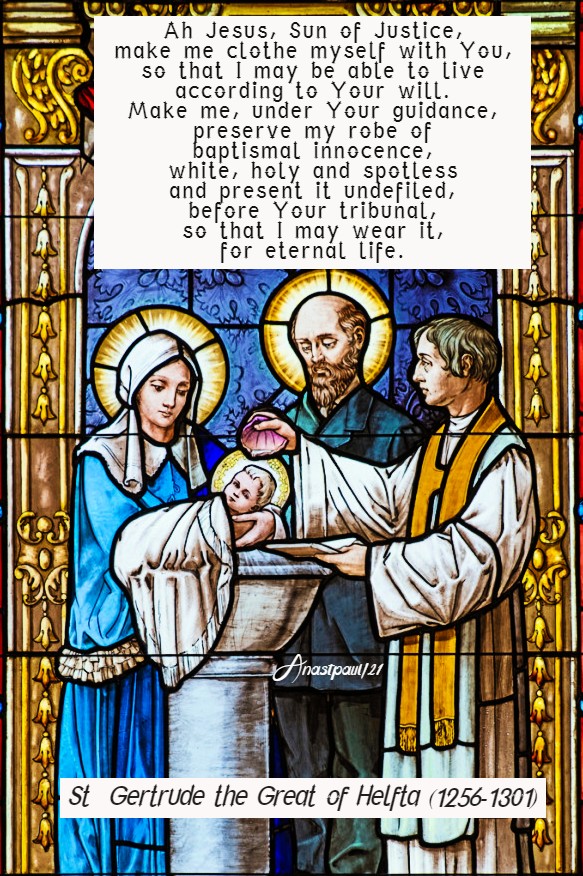
“Ah Jesus, Sun of Justice,
make me clothe myself with You,
so that I may be able to live
according to Your will.
Make me, under Your guidance,
preserve my robe of baptismal innocence,
white, holy and spotless
and present it undefiled,
before Your tribunal,
so that I may wear it,
for eternal life.”

St Gertrude the Great of Helfta (1256-1301)

Posted in BAPTISM, DOCTORS of the Church, QUOTES on CONVERSION, QUOTES on REPENTANCE, SAINT of the DAY, The WORD

One Minute Reflection – 12 April – Make room for God …

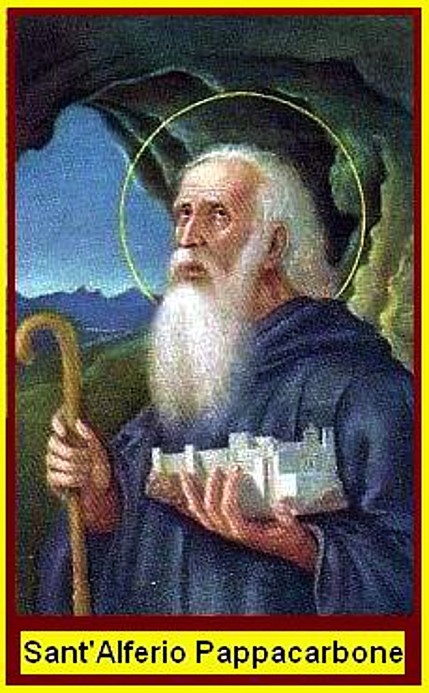
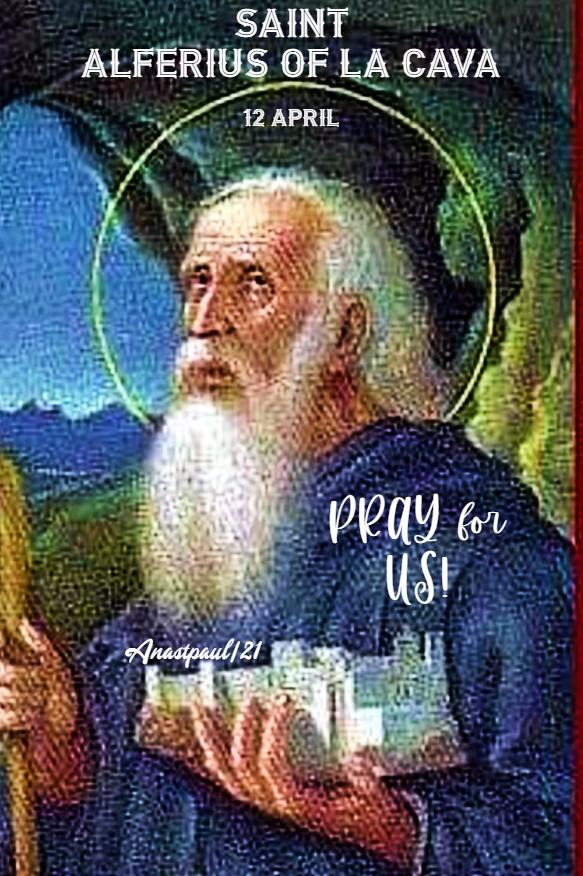
One Minute Reflection – 12 April – Monday of the Second week of Easter, Readings: First: Acts 4: 23-31, Psalm: Psalms 2: 1-3, 4-7a, 7b-9, Gospel: John 3: 1-8 * readings below and the Memorial of St Alferius of La Cava (930–1050) Priest, Abbot, Founder

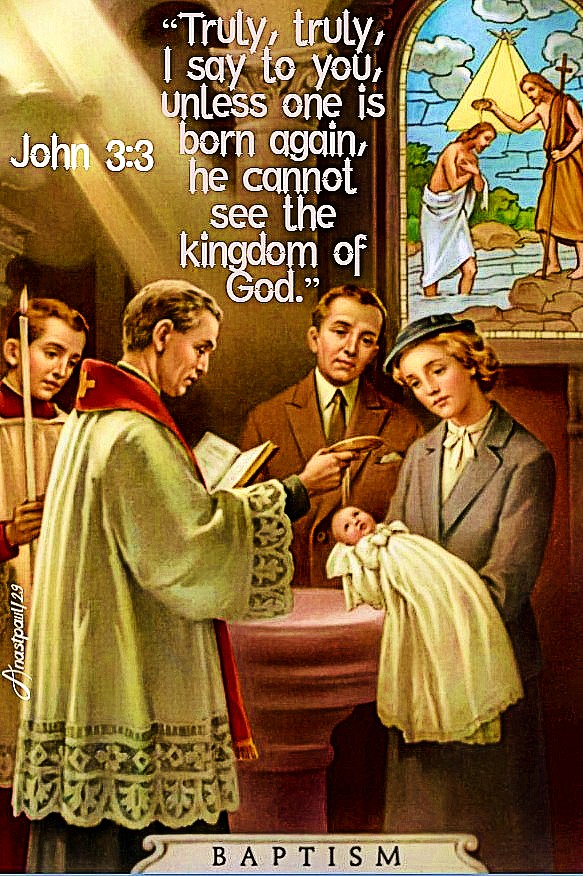
“Truly, truly, I say to you, unless one is born again,
he cannot see the kingdom of God.”
– John 3:3

REFLECTION – “We read in Saint John – No-one can enter the Kingdom of God without being born of water and Spirit. To be reborn in the Holy Spirit during this life, is to become most like God in purity, without any mixture of imperfection. Accordingly, pure transformation can be effected – although not essentially – through the participation of union.

Here is an example that will provide a better understanding of this explanation. A ray of sunlight shining on a smudgy window, is unable to illumine that window completely and transform it into its own light. It could do this, if the window were cleaned and polished… The extent of illumination is not dependent on the ray of sunlight but, on the window. If the window is totally clean and pure, the sunlight will so transform and illumine it, that to all appearances, the window will be identical with the ray of sunlight and shine just as the sun’s ray. Although, obviously, the nature of the window is distinct from that of the sun’s ray, even if the two seem identical, we can assert, that the window is the ray or light of the sun by participation.
The soul on which the divine light of God’s being is ever shining, or better, in which it is ever dwelling by nature, is like this window. A soul makes room for God by wiping away all the smudges and smears of creatures, by uniting its will perfectly to God’s, for to love is to labour, to divest and deprive oneself for God, of all that is not God . When this is done, the soul will be illumined by and transformed in God.” – St John of the Cross (1542-1591) – Mystical Doctor of the Church
PRAYER – Almighty God and Father, grant that Your faithful people who were buried with Your Son in baptism, may by His Resurrection and intercession, at Your right hand, obtain for us eternal life. Send Your Spirit upon Your adopted children and lead us in Your way. Grant that by the intercession of Your Angels and Saints and holding on always, to our Blessed Virgin Mother, our path may be straightened and glow with Your light. Through Christ our Lord, with the Holy Spirit, God forever, amen.

Acts 4: 23-31
23 And being let go, they came to their own company and related all that the chief priests and ancients had said to them.
24 Who having heard it, with one accord lifted up their voice to God and said: Lord, thou art he that didst make heaven and earth, the sea,and all things that are in them.
25 Who, by the Holy Ghost, by the mouth of our father David, thy servant, hast said: Why did the Gentiles rage and the people meditate vain things?
26 The kings of the earth stood up and the princes assembled together against the Lord and his Christ.
27 For of a truth, there assembled together in this city against thy holy child Jesus, whom thou hast anointed, Herod and Pontius Pilate, with the Gentiles and the people of Israel, 28 To do what thy hand and thy counsel decreed to be done.
29 And now, Lord, behold their threatenings and grant unto thy servants, that with all confidence they may speak thy word, 30 by stretching forth thy hand to cures,and signs and wonders to be done, by the name of thy holy Son Jesus.
31 And when they had prayed, the place was moved wherein they were assembled and they were all filled with the Holy Ghost and they spoke the word of God with confidence.

Gospel: John 3: 1-8
1 And there was a man of the Pharisees, named Nicodemus, a ruler of the Jews.
2 This man came to Jesus by night,and said to him: Rabbi, we know that thou art come, a teacher from God, for no man can do these signs which thou dost, unless God be with him.
3 Jesus answered, and said to him: Amen, amen I say to thee, unless a man be born again, he cannot see the kingdom of God.
4 Nicodemus saith to him: How can a man be born when he is old? can he enter a second time into his mother’s womb and be born again?
5 Jesus answered: Amen, amen I say to thee, unless a man be born again of water and the Holy Ghost, he cannot enter into the kingdom of God.
6 That which is born of the flesh, is flesh; and that which is born of the Spirit, is spirit.
7 Wonder not, that I said to thee, you must be born again.
8 The Spirit breatheth where he will and thou hearest his voice but thou knowest not ,whence he cometh and whither he goeth, so is everyone that is born of the Spirit.

Posted in "Follow Me", CHRIST the LIGHT, CHRIST, the WAY,TRUTH,LIFE, EASTER, GOD ALONE!, Our MORNING Offering, PRAYERS for VARIOUS NEEDS, QUOTES for CHRIST

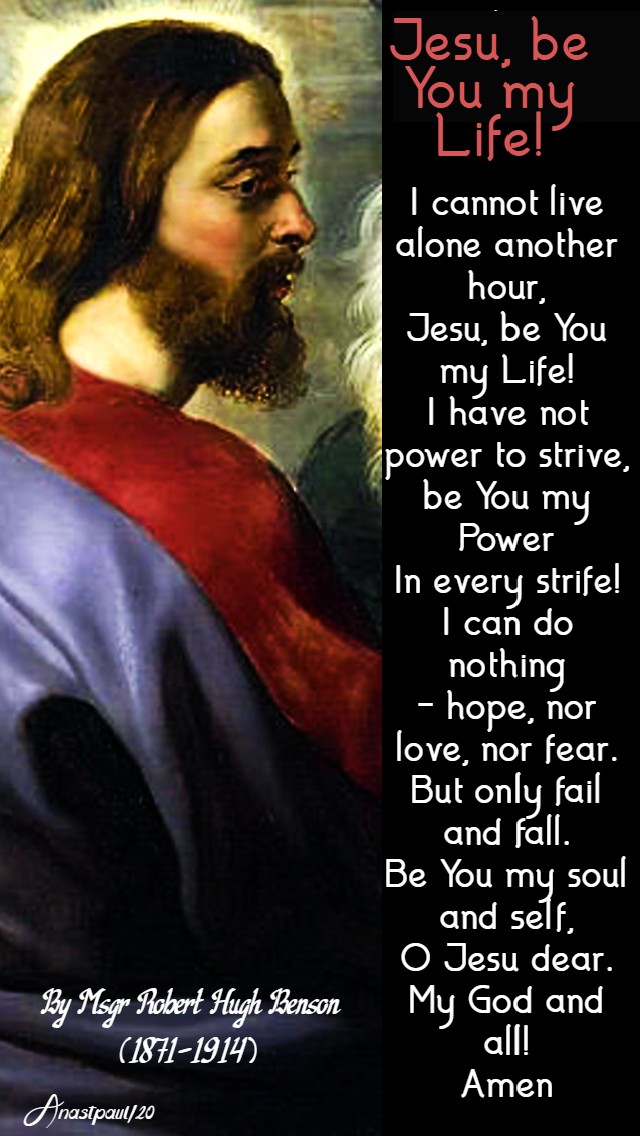
Our Morning Offering – 12 April – Jesu, be You my Life!

Our Morning Offering – 12 April – Monday of the Second week of Easter

Jesu, be You my Life!
Msgr Robert Hugh Benson (1871-1914)
Supernumerary Private Chamberlain to St PopePius X

I cannot live alone another hour,
Jesu, be You my Life!
I have not power to strive,
be You my Power
in every strife!
I can do nothing
– hope, nor love, nor fear.
But only fail and fall.
Be You my soul and self,
O Jesu dear.
My God and all!
Amen

Posted in SAINT of the DAY

Saint of the Day – 12 April – Saint Alferius of La Cava (930–1050)

Saint of the Day – 12 April – Saint Alferius of La Cava (930–1050) Cluniac Priest, Founder and Abbot of Arsicia (La Trinità della Cava) which follows the Benedictine Rule, nobleman, Diplomat to Prince Waimar III of Salerno, Cluniac reformer, cave Hermit, Mystic and Ecstatic, Miracle-worker. Born in 930 in Salerno, Italy and died on Holy Thursday 1050, of natural causes. Also known as – Alferius Abbate, Alferius the Abbot, Adalfere, Adalfericus, Adalferius, Alfere, Alferio, Allerius, Alpherius.

The Roman Martyrology states: “In the Monastery of Cava de ‘Tirreni in Campania, Saint Alferius, Founder and first Abbot, who, after having been adviser to Guaimario, Duke of Salerno, who became a disciple of Saint Odilone in Cluny, learned in an excellent way, the discipline of monastic life.”

Alferius was born into a noble Lombard family in the second half of the 10th century. It is uncertain whether he actually did belong to the noble Lombard Pappacarbone family, related to the Princes of Salerno. From his youth, he had placed himself at the service of the Princes of his City. who had dominated the region since the seventh century.

In the year 1002 , Alferius, was sent as Ambassador of his Prince to the Emperor Henry II, to solicit military aid against the Byzantines who threatened the borders of the Principality of Salerno . On reaching the Alps he fell seriously ill and asked for hospitality in the Monastery of Chiusa di San Michele. There, he vowed ,that if he recovered, he would give up his Diplomatic career and become a Benedictine Monk. He did recover and fulfilled his vow by wearing the habit of St Benedict of Nursia , in the great Abbey of Cluny in France .

Alferius, having obtained the cure, had asked the Abbot of Cluny Sant’Odilone , who was passing through San Michele, to welcome him among his Monks. There he studied and grew in piety and was eventually Ordained to the Priesthood.

After a few years, however, Prince Guaimario III of Salerno, called him back to Salerno to reform the many Monasteries of that City. Alferius began the work but after a while, feeling attracted by a life of solitude, he secretly abandoned Salerno and took refuge in the Arsicia cave, at the foot of Monte Finestra, today in the Municipality of Cava de ‘Tirreni . Here, with two companions, he devoted himself totally to prayer, penance and manual work.

Soon the fame of his holiness spread to the surrounding countries and disciples eager to follow his example wished to join his community. People from all walks of life, sought hisspiritual assistance and began to flock to hs Cave.

It was then necessary to build a Monastery sufficient for a dozen religious. Following the famous vision of the three rays, handed down by oral tradition, the construction of the Monastery and the Church began in the narrow space between the Selano river and the Arsicia cave. Thus was born the Abbey of Cava, which Alferius dedicated to the Holy Trinity, La Trinità della Cava. It was around the year 1011.

The Building begins according to a divine plan

However, in the Cavense Archive, the Princes of Salerno, Guaimario III and Guaimario IV, granted full ownership to the Monastery, all the land sorrounding it, including the Arsicia Cave and the large area above, on which the current Church of Cava was built.

Among his disciples we remember, in particular, St Leo, who would succeed him in the government of the Monastery and Desiderio di Benevento who later became Abbot of the Monastery of Montecassino and then the 158th Pope with the name of Victor III. His successor, Pope Urban II, endowed this Monastery with many privileges, making it immediately subject to the Holy See, with jurisdiction over the surrounding territory.

Alferius died on Holy Thursday, 12 April 1050 at the age of 120 after having celebrated Holy Mass, comforted by a vision of the Redeemer , Who summoned his home.

He was buried in the same cave, see below, which since then, has become the heart of the Abbey.

The first four Abbots were Canonised on 21 December 1893, by Pope Leo XIII.
Pope Pius XI, in 1927, Beatified the next 8 Abbots, being the Blesseds: Simeone, Falcone, Marino, Benincasa, Pietro II, Balsamo, Leonardo and Leo II.

Posted in MARIAN TITLES, SAINT of the DAY

Our Lady of Charity, Cobre, Cuba and Memorials of the Saints – 12 April

Monday of the Second Week of Easter

Nuestra Senora de la Caridad / Our Lady of Charity, Cobre, Cuba OR Our Lady of Cobre – 12 Apri;:

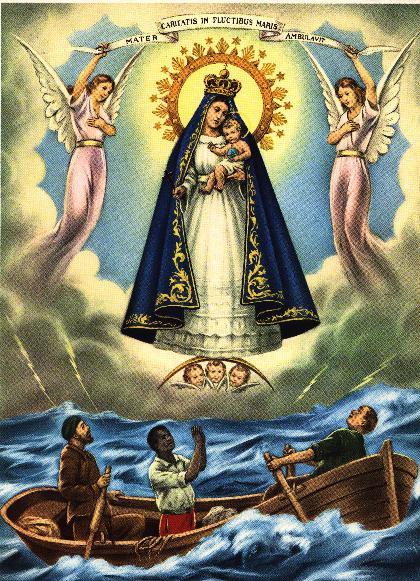
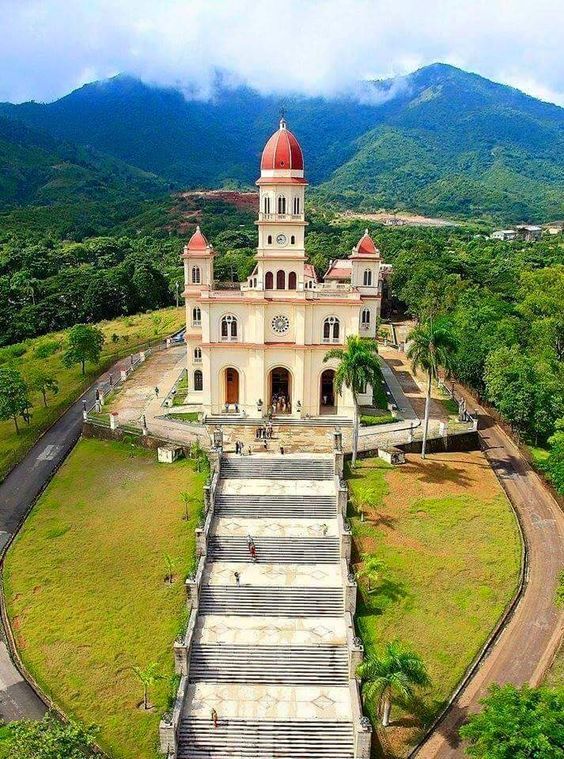
In the mountains outside Santiago in Cuba, is an old pilgrimage Church, “Nuestra Senora de la Caridad,” which means, “Our Lady of Charity,” also known as “Our Lady of Cobre.” It is the National Shrine of Cuba.
Early in the 17th century, three sailors left the Bay of Nipe to collect salt. Their vessel was small, so that when a storm arose, they were drifting and rocked violently on the roaring ocean. One of the men wore a medal stamped with an image of the Blessed Virgin, and the three began to pray for her protection. The storm suddenly cleared and the men saw something they could not immediately identify, coming toward them across the water.
We still have the testimony of one of the men, Juan Moreno, regarding this incident. It was taken in 1687:
“Having camped in the French Key, which is in the middle of the Bay of Nipe, waiting for a good time to leave for the salt mines, being a morning of calm seas, they left the French Keys, before daybreak. The aforementioned Juan y Rodrigo de Hoyos and myself, embarked in a canoe, headed for the salt mines and far from the French Key, we saw something white above the foam of the water, which we couldn’t distinguish. As we got closer, birds and dry branches appeared. The aforementioned Indians said, “It looks like a girl.” While they were discussing this among themselves, they saw an image of Our Lady, the Holy Virgin, on top of a small wooden plank, holding the baby Jesus in her arms. On this small tablet, was written in large letters, which read, “I am the Virgin of Charity.” Looking at her clothes, they realised that they were not wet.”

Upon returning home, the men revealed what they had seen and told the story of what had happened to them. A government official, Don Francisco Sanchez de Moya, had a small Chapel built in her honor.
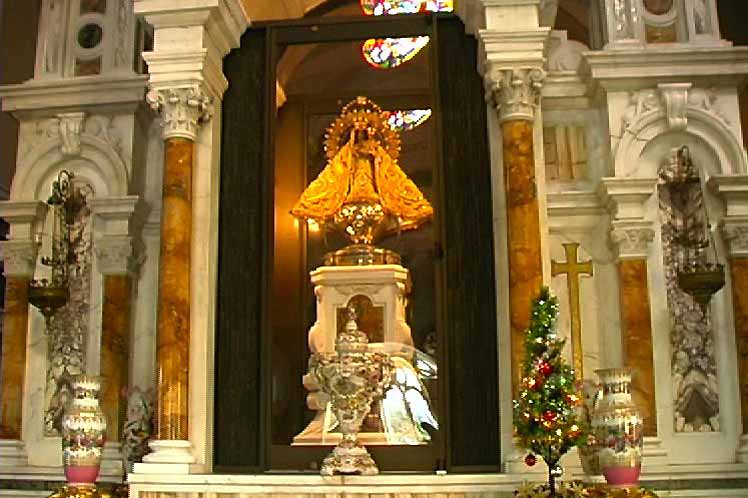
The Village of Cobre, where the Shrine is, is surrounded by high hills that roll back to the Sierra Maestra Mountains. The village is named Cobre because of the rich deposit of copper. A lamp of copper is kept burning before the Statue of Our Lady. Twice the Statue mysteriously disappeared from the locked Church and then returned, just as unaccountably. In each case ,Our Lady indicated where richer deposits f copper could be found.
In 1936 after the completion of a beautiful Church, now a minor Basilica, in honour of Our Lady of Charity, the Statue was solemnly crowned amid great rejoicing and religious festivity.

The Shrine has much of old-time charm and literally hundreds of lights burn before the Shrine’s Statue. Our Lady is dressed richly in silken garments; she is dark like a Cuban girl with a sun-tanned Infant on her arm, smiling down on her Cuban children, who come to her in great numbers and with great confidence. The prayers of centuries seem to hang down from the walls in heavy folds. It is a place where prayer comes easily and its answer, seems to be a matter of course.

St Acutina
St Alferius Pappacarbone of La Cava (930–1050) Priest, Abbot
Bl Andrew of Montereale
Blessed Angelo Carletti di Chivasso OFM (1411-1495)
Blessed Angelo’s Biography:

https://anastpaul.wordpress.com/2017/04/12/saint-of-the-day-12-apil-blessed-angelo-carletti-di-chivasso/
St Artemón of Caesarea
St Basil of Parion
St Constantine of Gap
St Damian of Pavia
St David Uribe Velasco (1889-1927) Priest and Martyr of the Cristero War
His Life and Death:

https://anastpaul.com/2020/04/12/saint-of-the-day-12-april-saint-david-uribe-velasco-1889-1927-priest-and-martyr-of-the-cristero-war/
St Erkemboden of Thérouanne
St Florentin of Arles
St Pope Julius I
St Lorenzo of Belem
St Peter of Montepiano
St Sabas the Lector
St Teresa de Jesús “de los Andes” OCD (1900-1920)
St Teresa’s Life:

https://anastpaul.com/2019/04/12/saint-of-the-day-12-april-saint-teresa-de-jesus-de-los-andes-ocd-1900-1920/
St Tetricus of Auxerre
St Victor of Braga
St Vissia of Fermo
St Wigbert
St Zeno of Verona (c 300 – 371)
About St Zeno:

https://anastpaul.wordpress.com/2018/04/12/saint-of-the-day-12-april-st-zeno-of-verona-c-300-371/


Posted in DIVINE Mercy, Goodness, Patience, EASTER, JULY - The MOST PRECIOUS BLOOD, MEDITATIONS - ANTONIO CARD BACCI, QUOTES on PEACE, QUOTES on REPENTANCE, QUOTES on SACRED SCRIPTURE, QUOTES on SIN, QUOTES on WILL (Reasonable or Superior), The MOST PRECIOUS BLOOD, The UNFORGIVEABLE SIN

Thought for the Day – 11 April – The Mercy of God

Thought for the Day – 11 April – Meditations with Antonio Cardinal Bacci (1881-1971)

The Mercy of God

“God is the Being, Who is infinitely true, beautiful and good.
His goodness is manifested in His infinite love for all the creatures which He has made but, it is in His relations with sinners, in particular, that we call Him merciful.
He loves all things which He has created and directs them towards Himself, their beginning and their end.
When He is dealing, however, with beings endowed with free will, who can separate themselves from Him and even offend Him, He tries, while respecting the liberty which He has given them, to recall them to Himself, by the influence of His love and of His grace.
It is this supernatural outpouring of love towards sinners, which we call mercy.

The mercy of God shines forth in all the pages of Sacred Scripture.
In the Old Testament, there is promised and foreshadowed, in many ways, the coming of the Saviour of the sinful human race.
In the New Testament, Jesus appears, made man for our salvation, meek and humble of heart and merciful towards the unfortunate, especially towards sinners.
For them, He offers His life and His Precious Blood, dying on the Cross with His arms outstretched, as if in an embrace of forgiveness.
He tells us that He has not come to call the just but sinners, (Lk 5:32) and, that He has not come to those who are in health but to those who are sick (Mk 2:17);  He assures us that, if we ask the Father for anything in His name, it will be given to us (Jn 16:23).
So much goodness should move and soften our hearts.
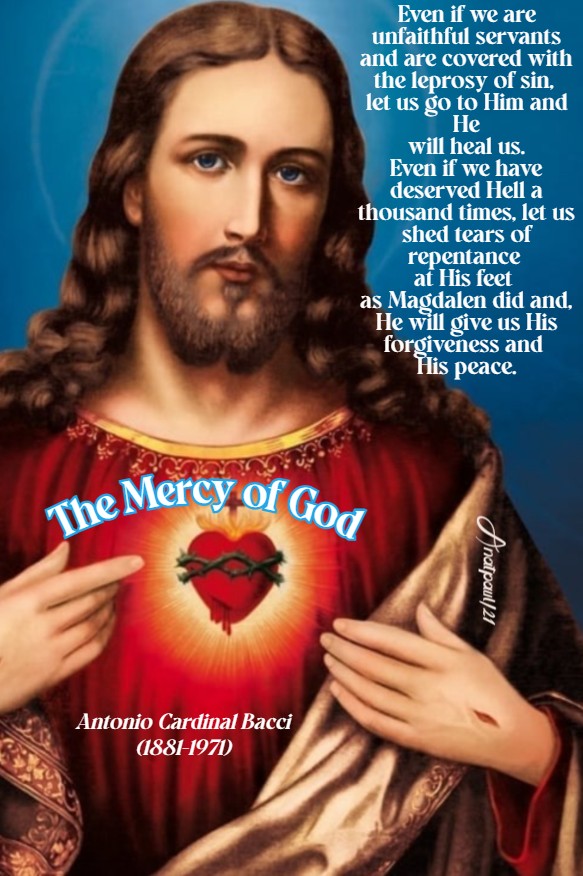
Even if we are unfaithful servants and are covered with the leprosy of sin, let us go to Him and He will heal us.
Even if we have deserved Hell a thousand times, let us shed tears of repentance at His feet as Magdalen did and, He will give us His forgiveness and His peace.

Antonio Cardinal Bacci

Posted in DOCTORS of the Church, FATHERS of the Church, I BELIEVE!, QUOTES of the SAINTS, QUOTES on FAITH, QUOTES on TRUST and complete CONFIDENCE in GOD, The FAITHFUL on PILGRIMAGE, The WORD, Thomas a Kempis

Quote/s of the Day – 11 April – Faith , Hope and Trust

Quote/s of the Day – 11 April – The Octave Day of Easter, Readings; First: Acts 4: 32-35,salm: Psalms 118: 2-4, 13-15, 22-24,Second: First John 5: 1-6, Gospel: John 20: 19-31

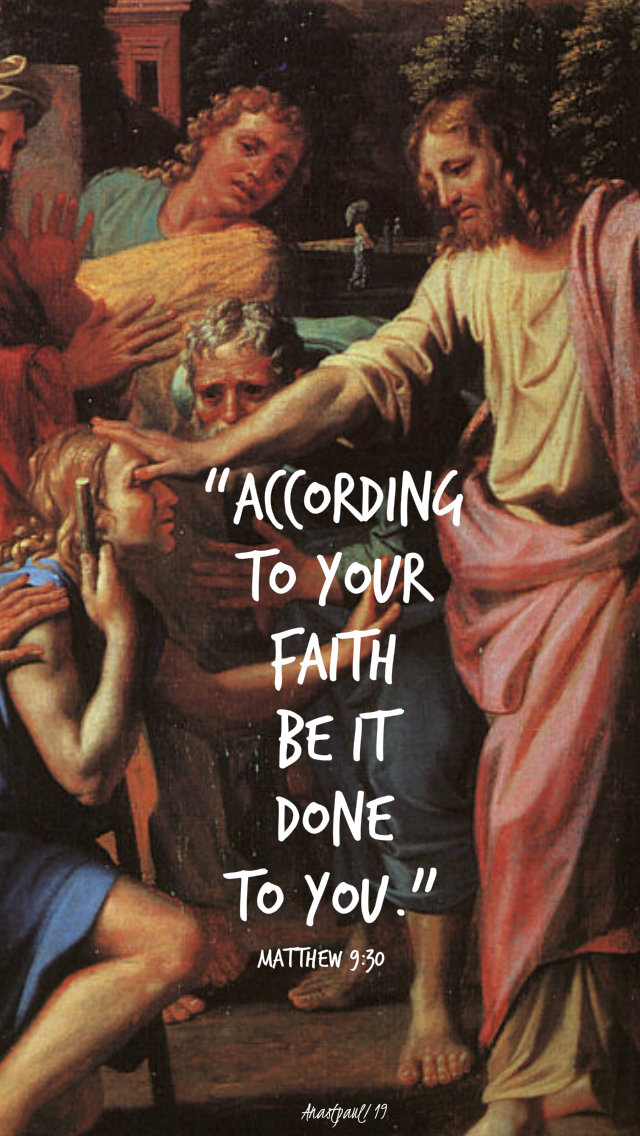
“According to your faith,
be it done to you.”

Matthew 9:30

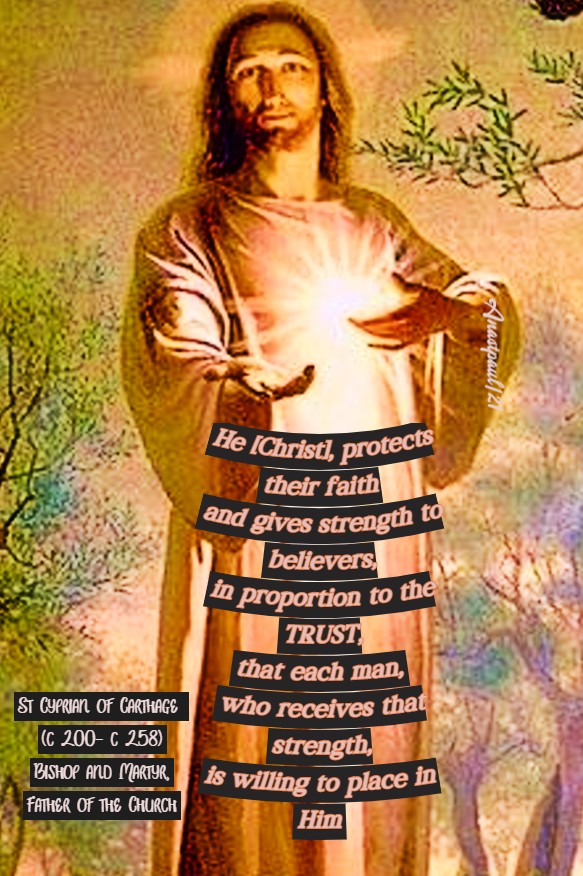
“He [Christ], protects their faith
and gives strength to believers,
in proportion to the TRUST,
that each man,
who receives that strength,
is willing to place in Him.”

St Cyprian of Carthage (c 200- c 258)
Bishop and Martyr, Father of the Church

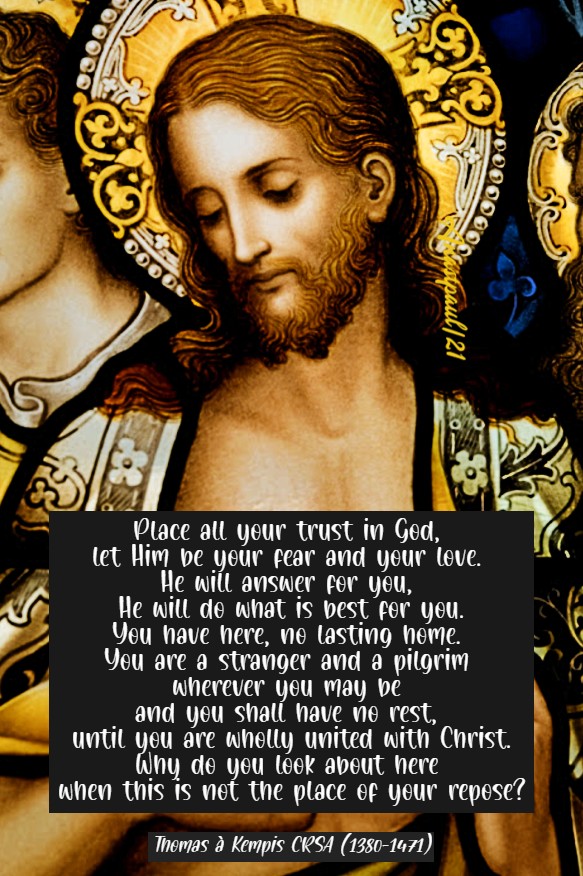
“Place all your trust in God,
let Him be your fear and your love.
He will answer for you,
He will do what is best for you.
You have here no lasting home.
You are a stranger and a pilgrim
wherever you may be
and you shall have no rest,
until you are wholly united with Christ.
Why do you look about here
when this is not the place of your repose?”

Thomas à Kempis CRSA (1380-1471)

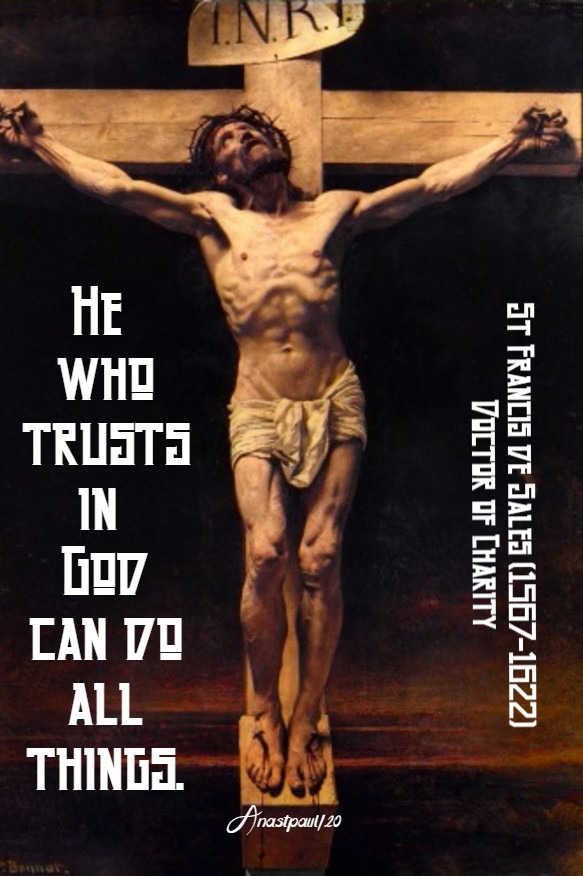
“He who trusts in God
can do all things.”

St Francis de Sales (1567-1622)
Doctor of Charity

Posted in DOCTORS of the Church, EASTER, FATHERS of the Church, I BELIEVE!, QUOTES on DOUBT, QUOTES on FAITH, The RESURRECTION, The WORD

One Minute Reflection – 11 April – ‘do not be unbelieving but believe’ John 20:27

One Minute Reflection – 11 April – The Octave Day of Easter, Readings; First: Acts 4: 32-35,salm: Psalms 118: 2-4, 13-15, 22-24,Second: First John 5: 1-6, Gospel: John 20: 19-31

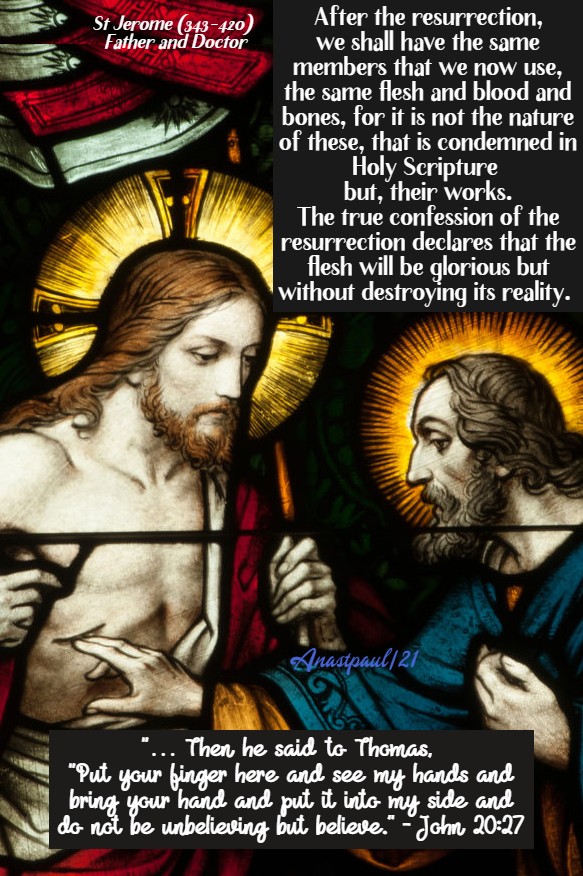
“… Then he said to Thomas, “Put your finger here and see my hands and bring your hand and put it into my side and do not be unbelieving but believe.” – John 20:27

REFLECTION – “After the resurrection, we shall have the same members that we now use, the same flesh and blood and bones, for it is not the nature of these, that is condemned in Holy Scripture but, their works.
The true confession of the resurrection declares that the flesh will be glorious but without destroying its reality.

And so, when the Apostle says, “This [flesh] is corruptible and mortal,” his words denote this very body, in other words, the flesh that was then seen.
But when he further adds, that it “puts on incorruption and immortality,” he is not saying that what was put on [i.e., the clothing] does away with the body that it adorns in glory.
Rather, it makes that body glorious that previously lacked glory.
When the more worthless robe of mortality and weakness is laid aside, then we can be clothed with the gold of immortality and the blessedness of strength as well as virtue.” – St Jerome (343-420) Father and One of the original four Doctors of the Church- Against John of Jerusalem

PRAYER – God of eternal compassion, each Easter, You rekindle the faith of Your consecated people. Grant still greater grace, so that all may truly understand, the water in which they were cleansed, the Spirit by which they were reborn, the Blood by which they were redeemed. May Mary’s help, Mater Misericordiae, Mother of the Risen Jesus Christ, be always with us. Through Christ, Redeemer and Merciful Lord, with the Holy Spirit, God for always and forever, amen.

First Reading: Acts 4: 32-35
32 And the multitude of believers had but one heart and one soul: neither did any one say that aught of the things which he possessed, was his own; but all things were common unto them.
33 And with great power did the apostles give testimony of the resurrection of Jesus Christ our Lord; and great grace was in them
34 For neither was there any one needy among them. For as many as were owners of lands or houses, sold them and brought the price of the things they sold 35 And laid it down before the feet of the apostles. And distribution was made to every one, according as he had need.

Second Reading: First John 5: 1-6
1 Whosoever believeth that Jesus is the Christ, is born of God. And every one that loveth him who begot, loveth him also who is born of him.
2 In this we know that we love the children of God: when we love God, and keep his commandments.
3 For this is the charity of God, that we keep his commandments: and his commandments are not heavy.
4 For whatsoever is born of God, overcometh the world: and this is the victory which overcometh the world, our faith.
5 Who is he that overcometh the world but he that believeth that Jesus is the Son of God?
6 This is he that came by water and blood, Jesus Christ: not by water only, but by water and blood. And it is the Spirit which

Gospel: John 20: 19-31
19 Now when it was late that same day, the first of the week, and the doors were shut, where the disciples were gathered together, for fear of the Jews, Jesus came and stood in the midst, and said to them: Peace be to you.
20 And when he had said this, he shewed them his hands and his side. The disciples therefore were glad, when they saw the Lord.
21 He said therefore to them again: Peace be to you. As the Father hath sent me, I also send you.
22 When he had said this, he breathed on them and he said to them: Receive ye the Holy Ghost.
23 Whose sins you shall forgive, they are forgiven them and whose sins you shall retain, they are retained.
24 Now Thomas, one of the twelve, who is called Didymus, was not with them when Jesus came.
25 The other disciples, therefore, said to him: We have seen the Lord. But he said to them: Except I shall see in his hands the print of the nails and put my finger into the place of the nails and put my hand into his side, I will not believe.
26 And after eight days again his disciples were within, and Thomas with them. Jesus cometh, the doors being shut and stood in the midst and said: Peace be to you.
27 Then he saith to Thomas: Put in thy finger hither and see my hands and bring hither thy hand and put it into my side and be not faithless but believing.
28 Thomas answered and said to him: My Lord, and my God.
29 Jesus saith to him: Because thou hast seen me, Thomas, thou hast believed: blessed are they that have not seen and have believed.
30 Many other signs also did Jesus in the sight of his disciples, which are not written in this book.
31 But these are written, that you may believe that Jesus is the Christ, the Son of God and that believing, you may have life in his name.

Posted in CATHOLIC-PRAYERS OF THE CHURCH, EASTER, MARIAN Antiphons, MARIAN PRAYERS, Our MORNING Offering, PRAYERS of the CHURCH

Our Morning Offering – 11 April – The Regina Coeli

Our Morning Offering – 11 April – The Octave Day of Easter

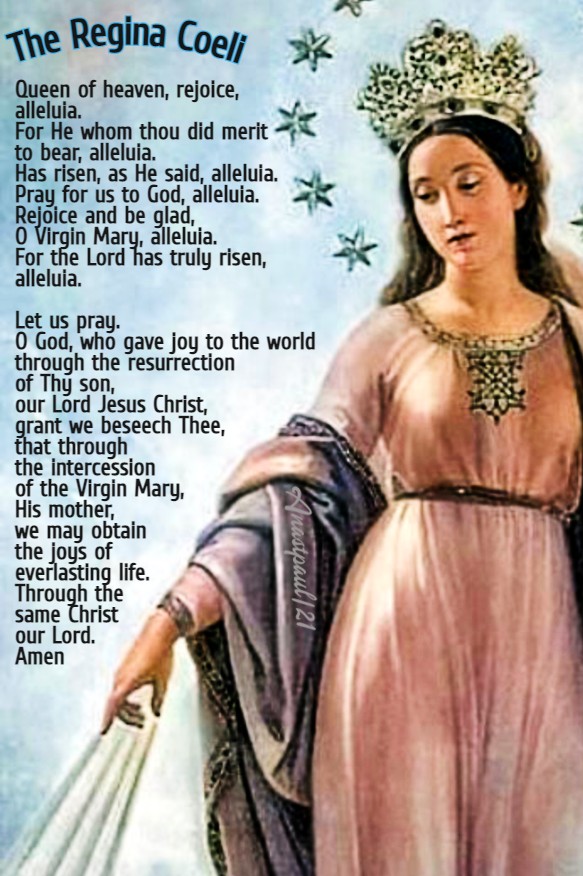
The Regina Coeli

Queen of heaven, rejoice, alleluia.
For He whom thou did merit to bear, alleluia.
Has risen, as He said, alleluia.
Pray for us to God, alleluia.
Rejoice and be glad, O Virgin Mary, alleluia.
For the Lord has truly risen, alleluia.

Let us pray.
O God, who gave joy to the world
through the resurrection of Thy son,
our Lord Jesus Christ,
grant we beseech Thee,
that through the intercession
of the Virgin Mary,
His mother, we may obtain
the joys of everlasting life.
Through the same Christ our Lord.
Amen

Remember to exchange your Angelus prayer for the Regina Coeli as from Easter Sunday for the next 50 days of Eastertide.
According to Catholic tradition, St Gregory the Great (540-604) heard angels chanting the first three lines one Easter morning in Rome, while following barefoot in a great religious procession of the icon of the Virgin painted by St Luke the Evangelist. He was thereupon inspired to add the fourth line.

Posted in PATRONAGE - TOOTHACHE and Diseases of the TEETH,, of DENTISTS, SAINT of the DAY, The WORD

Saint of the Day – 11 April – St Antipas of Pergamum (Died c 92) Spiritual student of Saint John the Apostle and Evangelist.

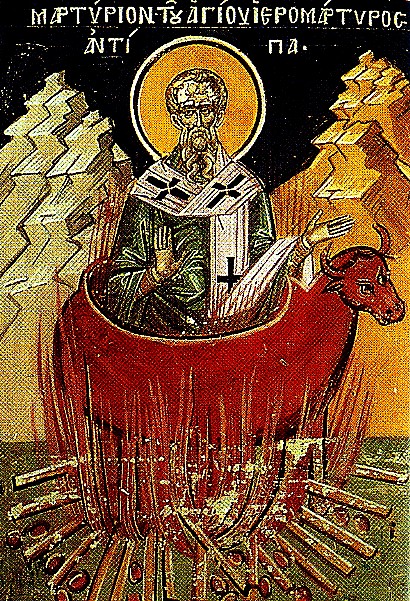
Saint of the Day – 11 April – St Antipas of Pergamon (Died c 92) Bishop of Pergamon (then in Greece) in during the persecutions of Emperor Domitian and Martyr, spiritual student of Saint John the Apostle and Evangelist. Unknown place of birth but died in c 92 by being roasted to death in a bronze bull at Pergamum, Greece (an area in modern Turkey). Patronages – against toothaches and diseases of the teeth and gums.

“I know where thou dwellest, where the seat of Satan is and thou holdest fast my name and hast not denied my faith. Even in those days when Antipas was my faithful witness, who was slain among you, where Satan dwelleth.”

The Apocalypse of St John (Revelation)
Chapter 2:13

When St John the Apostle, wrote the Book of the Apocalypse, he made an interesting reference to a person named Antipas, calling the man a “faithful witness” and one “who was slain.” This reference can be found fairly early on in the Apocalypse, within the section containing special messages to the seven Christian communities in Asia Minor (present-day Turkey). Antipas’s name is found in the third of the seven letters―the letter to the Church in the City of Pergamum.

Pergamum was a City not far from the Aegean Sea. It was considered to be a beautiful and cultural City. Impressively, parchment was invented in Pergamum about 150 years before the birth of Christ.

The modern City of Bergama, Turkey, overlaps some of the ruins of ancient Pergamum. Interestingly, St John, the author of the Apocalypse referred to Pergamum as the location of Satan’s throne! It has been suggested that this distressing label could be due to the multitude of pagan practices that abounded in the City, including, the worshipping of the Roman Emperor as a God.

St Antipas’ tomb became a site of miracles with a miraculous oil being secreted from his relics.

The Roman Martyrology states of St Antipas: “St Antipas, a faith witness, of whom St John speaks in the Apocalypse, under the Emperor Domitian, he was shut up n a red-hot brazen ox and thus, consummated his martyrdom.”

Posted in MARIAN TITLES, SAINT of the DAY

Low Sunday +2021, Our Lady of Fourviere and Memorials of the Saints – 11 April

Low Sunday +2021 The Octave Day of Easter, also known as the Sunday in White

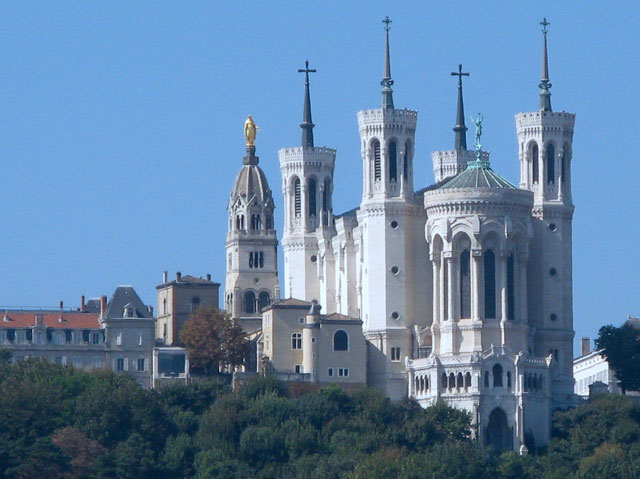
Notre-Dame de Fourviere / Our Lady of Fourviere, France – 11 April:

This is a copy of the original Statue, which was destroyed by the protestants. It was placed above the main Altar in 1751 and crowned on 8 September 1900 by the Order of Pope Leo XIII, at the same time as the Statue of Our Lady in the Basilica.

According to the traditions of Lyons, supported by a Bull of Pope Innocent IV, Saint Pothinus erected the first Oratory where Mary was invoked in Gaul. It is asserted that he brought, from the interior of Asia, a small Statue of the Blessed Virgin, which he deposited in a solitary and shaded crypt on the banks of the Saone, in front of the hill of Fourviere. He set up in this wild and secluded spot an Altar to the true God and placed there, the image, which was transferred later to a Church built on the hill itself, whence it took the name of Our Lady of Fourviere.
The veneration of the people, in the middle ages, surrounded this Church and it was a pilgrimage of great renown throughout the Lyonnais but the Calvinists, who destroyed and pillaged so many rich Sanctuaries, showed no favour to that of Lyons, the Church of Fourviere, where, from the birth of Christianity, each generation had marked its passage by gifts to Our Lady of Fourviere. After the desecration, the Church retained nothing but its four bare walls, which could not be melted down in the crucible, where so many master productions disappeared, which had the misfortune to be made of gold or silver.
The chapter of Saint John could not attend to the renovation of the Church of Fourviere, until long after the ravages of the Protestants. They worked at it after they had restored the Cathedral and the cloister. The Altar of Mary, Our Lady of Fourviere, was at last consecrated on 21 August 1586. From that moment, the confidence of the inhabitants turned towards that beacon of salvation. “The source of prodigies seemed dried up there,” says an ancient historian; “they began again at the end of the sixteenth century and all Lyons felt great joy on the occasion.”

During the revolution of 1793, the Church of Fourviere was sold but when calm was restored, the zealous prelate who governed the ancient Church of Pothinus and Irenaeus, procured the Sanctuary of Mary, to be restored to the veneration of her as Our Lady of Fourviere. The inauguration of the Sanctuary was performed on 19 April 1805, by the Sovereign Pontiff Pius VII. In 1832 and 1835, Lyons being threatened with cholera, lifted up her eyes to the holy mountain and the Blessed Virgin said to the scourge, “Thou shalt go no farther.” The capital of the Lyonnese, changed its cries of alarm into canticles of joy and the prayers of thanksgiving were solemnly and justly offered to Mary.
Ever since the happy period when that Sanctuary was restored to religious worship, piety seems to have redoubled its ardour for Our Blessed Lady and, it is at Fourviere, that it is sharpened and revived. The inhabitants of Lyons and those of the county adjacent, throng the paths of the hill of Mary; at whatever hour you repair there, you will always find yourself in the midst of a crowd of pious persons ,of all ranks, ages and conditions.

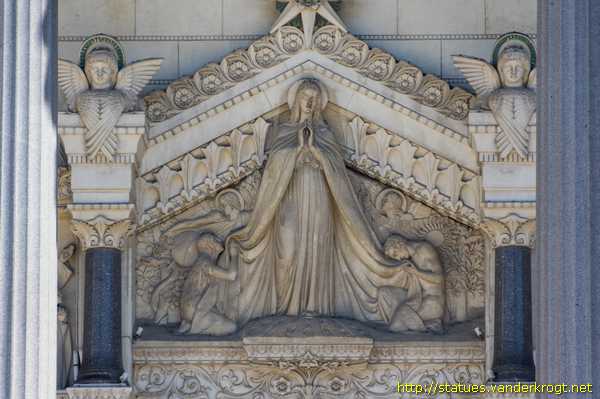
Our Lady on the Facade

One day, in the year 1815, a pilgrim of an unusual kind, who had begun by observing Lyons from the summit of the hill, like a man who wanted to study both its strength and its weakness, presented himself in the Church of Notre Dame and the faithful, lifting up for a moment their eyes, which had been cast down in prayer, said to themselves, “Marshal Suchet!”
It was indeed he – the Marshal of the empire, the child of Lyons, to whom was confided the defence of his native city – who passed along the nave of the Church of Mary with a slow step, with a respectful countenance, in which was mingled something mild and softened, something like a distant remembrance of joy, which awakens and soothes the soul with an invisible music. He went into the Sacristy and directed one of the Chaplains to come to him there;. The vice-president hastened to him: “Monsieur l’Abbe,” said the marshal, stepping forward towards the ecclesiastic, “when I was quite a child, my pious and good mother often brought me here, to the feet of Our Lady and this I still remember…I will say more, this recollection is dear to me and I have never lost it. Be pleased to have some Masses said for my intentions.” And putting down three Napoleons on the table where the offerings are registered, the brilliant hero of the gigantic epoch went to kneel, before the Altar of Mary, where he prayed for some time with edifying devotion. Moreover, Marshal Suchet terminated his noble and loyal career by a Christian end, for which he was praised upon his tomb.

St Stanislaus (1030-1079) Bishop and Martyr (Memorial)
St Stanislaus life:

https://anastpaul.wordpress.com/2017/04/11/saint-of-the-day-11-april-st-stanislaus/
t Agericus of Tours
St Aid of Achard-Finglas
St Antipas of Pergamum (Died c 92) Bishop and Martyr, spiritual student of Saint John the Apostle and Evangelist

St Barsanuphius the Hermit (Died c 563)
About St Barsanuphius:

https://anastpaul.com/2020/04/11/saint-of-the-day-11-april-saint-barsanuphius-the-hermit/
St Domnio of Salona
Bl Elena Guerra
St Eustorgius of Nicomedia
St Gemma Galgani (1878-1903)
St Gemma:

https://anastpaul.wordpress.com/2018/04/11/saint-of-the-day-11-april-st-gemma-galgani-1878-1903/

Bl George Gervase
St Godeberta of Noyon
St Guthlac of Crowland (674–715)
Biography:

https://anastpaul.com/2019/04/11/saint-of-the-day-11-april-st-guthlac-674-715/
St Hildebrand of Saint-Gilles
St Isaac of Monteluco
Bl James of Africa
Bl John of Cupramontana
Bl Lanunio
St Machai
St Maedhog of Clonmore
Bl Mechthild of Lappion
Bl Paul of Africa
St Philip of Gortyna
St Raynerius Inclusus
St Sancha of Portugal
St Stephen of Saint-Gilles
Bl Symforian Ducki

Posted in "Follow Me", LOVE of NEIGHBOUR, MEDITATIONS - ANTONIO CARD BACCI, QUOTES on DISCIPLESHIP, QUOTES on EVANGELISATION, QUOTES on HUMILITY, QUOTES on LOVE of GOD, QUOTES on SELF-DENIAL, The WORD

Thought for the Day – 10 April – Word and Example

Thought for the Day – 10 April – Meditations with Antonio Cardinal Bacci (1881-1971)

Word and Example

“Good example is the most effective sermon and we are all obliged to preach in this fashion.
God entrusted the care of his neighbour to each one of us (Ecclus 17:12).
Each of us is responsible for the salvation of those who have been entrusted to him in this way, especially for the salvation of those who live near him and are influenced by his behaviour.
Jesus’ exhortations in this regard, have the force of a command.
“Let your light shine before men,” He says, “in order that they may see your good works and give glory to your Father in heaven” (Mt 5:16).
St Paul urges us to “provide good things, not only in the sight of God but also, in the sight of all men” (Cf Rom 12:17).
This must not be interpreted as meaning, that we should be anxious for others to see our good deeds, in order that they may respect and praise us.
It is our own undoing if our good example is tainted with ostentation, for we should lose all merit for it and should deserve to hear the words of the Eternal Judge: “You have received your reward” (Cf Mt 6:5).
Our good example should be inspired only by the love of God and of our neighbour but never, by self-love.
By saving the souls of others, we save our own!”

Antonio Cardinal Bacci

PART ONE HERE:
https://anastpaul.com/2020/04/25/thought-for-the-day-25-april-word-and-example/

Posted in "Follow Me", CHRIST the LIGHT, CHRIST the WORD and WISDOM, CHRIST, the WAY,TRUTH,LIFE, DOMINICAN OP, EASTER, GOD ALONE!, QUOTES for CHRIST, QUOTES of the SAINTS, QUOTES on DISCIPLESHIP, QUOTES on EVANGELISATION, QUOTES on GRACE, The WORD

Quote/s of the Day – 10 April – Easter Saturday, “Preach the gospel to every creature”

Quote/s of the Day – 10 April – Easter Saturday, Readings: First: Acts 4: 13-21, Psalm: Psalms 118: 1 and 14-15ab, 16-18, 19-21, Gospel: Mark 16: 9-15

“Preach the gospel to every creature”

Mark 16:15

“I send you a very little word,
THE WORD,
made little in the crib,
THE WORD,
made flesh for us ….
THE WORD,
of salvation and grace
THE WORD,
of sweetness and glory
THE WORD
Who is good and gentle –
JESUS CHRIST!”

“There are two ways of keeping God’s word,
namely, one, whereby we store in our memory
what we hear and the other,
whereby we put into practice,
what we have heard
(and none will deny that the latter
is more commendable, inasmuch,
as it is better to sow grain,
than to store it in the barn).”

Blessed Jordan of Saxony OP (1190-1237)

Posted in "Follow Me", CHRIST the LIGHT, CHRIST, the WAY,TRUTH,LIFE, DOCTORS of the Church, EASTER, FATHERS of the Church, ONE Minute REFLECTION, QUOTES on EVANGELISATION, The APOSTLES & EVANGELISTS, The REDEMPTION, The WORD

One Minute Reflection – 10 April – Easter Saturday – ‘What He offers us, is so precious, that what He asks of us, is as nothing.’ St Augustine

One Minute Reflection – 10 April – Easter Saturday, Readings: First: Acts 4: 13-21, Psalm: Psalms 118: 1 and 14-15ab, 16-18, 19-21, Gospel: Mark 16: 9-15 *First Reading and Gospel in full below

“Preach the gospel to every creature” – Mark 16:15

REFLECTION – “You have heard what the Lord said to His disciples after the Resurrection. He sent them out to preach the Gospel and they did so. Listen: “Through all the earth their voice resounds and to the ends of the world, their message” (Ps 18[19],5). Step by step, the Gospel has reached even to us and the ends of the earth. In a few words the Lord, addressing Himself to His disciples, set out what we are to do and what we have to hope for. Just as you have heard, He said: “Whoever believes and is baptised will be saved.” He asks for our faith and offers us salvation. What He offers us, is so precious, that what He asks of us, is as nothing.

“The children of men take refuge in the shadow of your wings, O my God… from your delightful stream You give them to drink, for with you is the fountain of life” (Ps 35[36],8f.). Jesus Christ is the Fountain of Life. Before the Gountain of Life came to us, we had only a human salvation, like that of the beasts of which the psalm speaks: “Man and beast you save, O Lord” (Ps 35[36],7). But now, the Fountain of Life has come even to us, the Fountain of Life died for our sakes. Will He refuse us His life Who, for our sakes, gave His death? He is salvation and this salvation is not worthless, like the other one. Why? Because it does not pass away. The Lord has come. He died, but He killed death. In Himself, He brought an end to death. He assumed it and He killed it. Where is death now, then? Look for it in Christ and it is no longer there. It used to be there but there it died. O life, death of death! Take heart, it will also die in us. What was fulfilled in the Head, will also be fulfilled in the members and death will die in us, too.” – St Augustine (354-430) Father and Doctor of the Church – Sermon 233

PRAYER – Lord our God, You increase and multiply Your faithful by Your abundant gift of grace.   Look now on Your chosen people and clothe them forever in the garment of eternal life.   May we, in confident love of You, go forth and live our lives in witness and speaking with joy of the ways of truth.   Grant that the intercession of the Blessed Virgin, the Saints and Angels, may accompany us on our journey.   Through our Lord Jesus and the Holy Spirit, God forever, amen.

Acts 4: 13-21
13 Now seeing the constancy of Peter and of John, understanding that they were illiterate and ignorant men, they wondered and they knew them that they had been with Jesus.
14 Seeing the man also who had been healed standing with them, they could say nothing against it.
15 But they commanded them to go aside out of the council; and they conferred among themselves,
16 Saying: What shall we do to these men? for indeed a known miracle hath been done by them, to all the inhabitants of Jerusalem: it is manifest and we cannot deny it.
17 But that it may be no farther spread among the people, let us threaten them that they speak no more in this name to any man.
18 And calling them, they charged them not to speak at all, nor teach in the name of Jesus.
19 But Peter and John answering, said to them: If it be just in the sight of God, to hear you rather than God, judge ye.
20 For we cannot but speak the things which we have seen and heard.
21 But they threatening, sent them away, not finding how they might punish them, because of the people; for all men glorified what had been done, in that which had come to pass.

Gospel: Mark 16: 9-15
9 But he rising early the first day of the week, appeared first to Mary Magdalen, out of whom he had cast seven devils.
10 She went and told them that had been with him, who were mourning and weeping.
11 And they hearing that he was alive and had been seen by her, did not believe.
12 And after that he appeared in another shape to two of them walking, as they were going into the country.
13 And they going, told it to the rest: neither did they believe them.
14 At length he appeared to the eleven as they were at table and he upbraided them with their incredulity and hardness of heart because they did not believe them, who had seen him after he was risen again.
15 And he said to them: Go ye into the whole world and preach the gospel to every creature.

Posted in HYMNS, MARIAN POETRY, MARIAN PRAYERS, MARIAN Saturdays, MARIAN TITLES, Our MORNING Offering

Our Morning Offering – 10 April – Easter Saturday – The Mater Christi

Our Morning Offering – 10 April – Easter Saturday

The Mater Christi
Unknown Author

Mother of Christ, Mother of Christ,
What shall I ask of thee?
I do not sigh for the wealth of earth
For the joys that fade and flee,
But, Mother of Christ, Mother of Christ,
This do I long to see —
The bliss untold which thy arms enfold,
The Treasure upon thy knee.

Mother of Christ, Mother of Christ,
He was All-in-All to thee,
In the winter’s cave, in Nazareth’s home,
In the hamlets of Galilee,
So, Mother of Christ, Mother of Christ,
He will not say nay to thee,
When He lifts His Face to thy sweet embrace,
Speak to Him, Mother, of me.

Mother of Christ, Mother of Christ,
The world will bid Him flee,
Too busy to heed His gentle voice,
Too blind His charms to see,
Then, Mother of Christ, Mother of Christ,
Come with thy Babe to me,
Tho’ the world be cold, my heart shall hold
A shelter for Him and thee.

Mother of Christ, Mother of Christ,
What shall I do for thee?
I will love thy Son with the whole of my strength,
My only King shall He be.
Yes! Mother of Christ, Mother of Christ,
This will I do for thee,
Of all that are dear or cherished here,
None shall be dear as He.

Mother of Christ, Mother of Christ,
I toss on a stormy sea,
O lift thy Child as a Beacon Light,
To the Port where I fain would be!
And, Mother of Christ, Mother of Christ,
This do I ask of thee —
When the voyage is o’er, oh! stand on the shore
And show Him at last to me.

The author is unclear – The 1920 St Gregory Hymn book (editor Nicola A. Montani) credits it to Nicola A Montani.
The 1914 American Catholic hymn book credits it to “S. N. D. ” – most likely meaning a Sister of Notre Dame.