One Minute Reflection –7 June – “Month of the Sacred Heart” – Readings: First: Second Corinthians 1: 1-7, Psalm: Psalms 34: 2-3, 4-5, 6-7, 8-9, Gospel: Matthew 5: 1-12
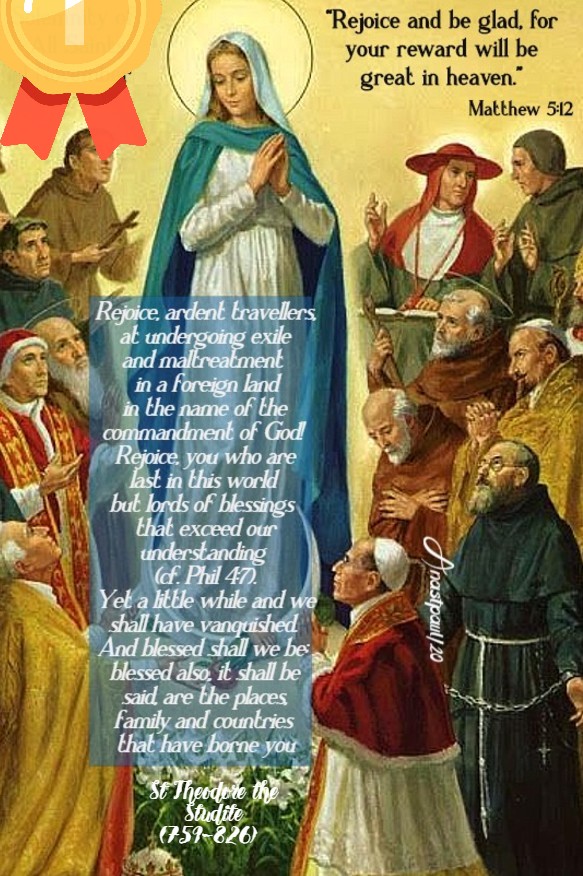
“Rejoice and be glad, for your reward will be great in heaven.” – Matthew 5:12
REFLECTION – “Rejoice in the Lord without ceasing (cf. Phil 4:4), my dear children. I beg you rejoice, citizens of heaven but exiles on earth, inhabitants of the Jerusalem on high (cf. Gal 4:26) but banished from affairs here below, inheritors of the kingdom of heaven but disinherited from taking any part at all, in earthly pleasures! Rejoice, ardent travellers, at undergoing exile and maltreatment in a foreign land in the name of the commandment of God! Rejoice, you who are last in this world but lords of blessings that exceed our understanding (cf. Phil 4:7). Rejoice, noble company, brought together by God, assembly united in heart and soul, who give life to filial and fraternal love, a replica on earth of the host of angels! (…) Rejoice, God’s workers, apostolic men. … Rejoice, you who set your joy in each other, each making his own the reputation of his brother, you in whom is found neither jealousy, rivalry nor envy but, in their place, peace and charity and life in common. In truth, I do not say that we are not attacked – indeed, who is crowned if not the one who struggles and fights, who exchanges thrusts and wounds with his assailants? – but I say that we should not let ourselves be brought down by the machinations of Satan. Yes, my children, assembly of God, nourish yourselves with the food of the Spirit and drink the water given by the Lord – whoever comes to possess this water, will never thirst again but it will become, in Him, a spring of living water welling up to eternal life (cf. Jn 4:14). … Yet a little while and we shall have vanquished. And blessed shall we be; blessed also, it shall be said, are the places, family and countries that have borne you (cf. Lk 11:27-28).” – St Theodore the Studite (759-826) – Catechesis 47 (The Great Catecheses)
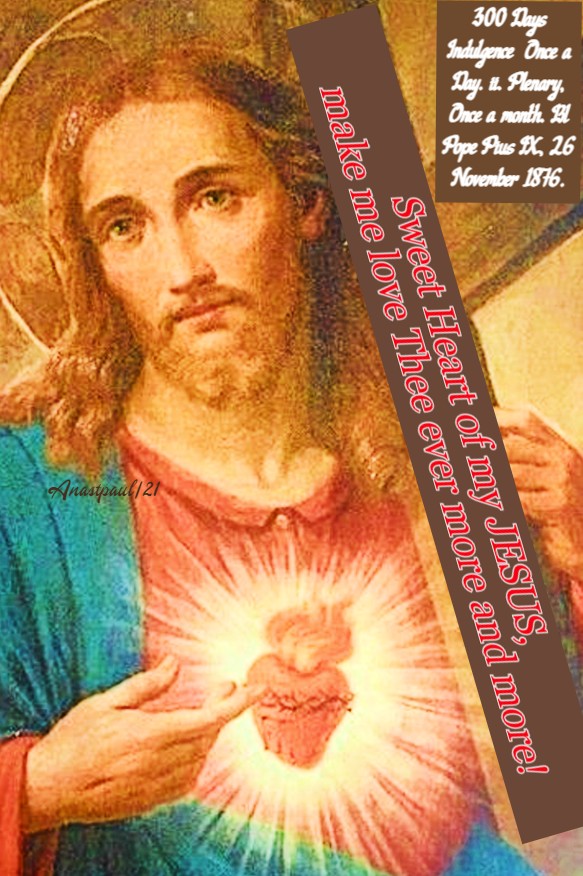
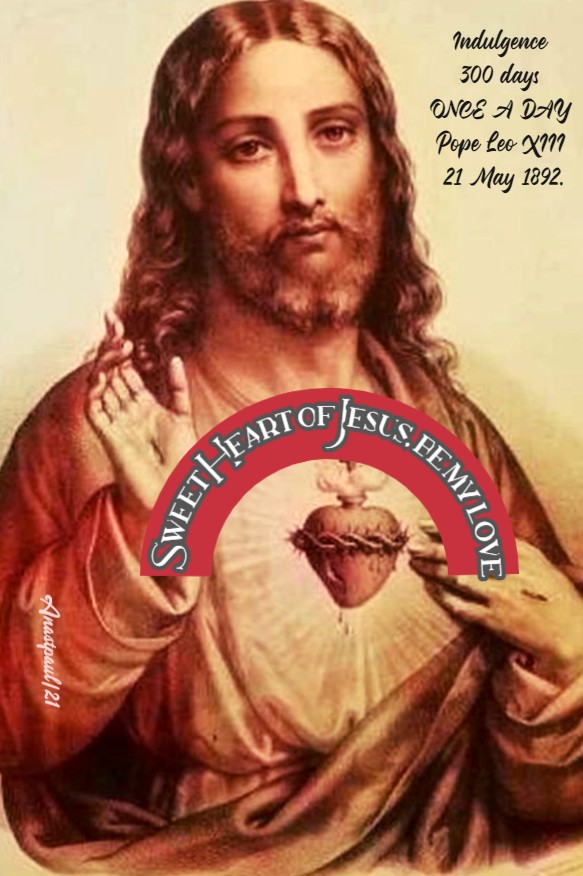
PRAYER – King of heaven and earth, Lord God, rule over or hearts and bodies this day. Sanctify us and guide our every thought, word and deed according to the commandments of Your law, so that now and forever, Your grace may free and save us. Teach us Lord to walk in the ways of the Cross of Your Son, our Saviour, rlonging for and rejoicing always in our heavenly home as St Robert Newminster so lovingly and willingly inspires us to do. Through Christ our Lord, with the Holy Spirit, God, forever, amen. Sweet Heart of my JESUS, make me love Thee ever more and more!300 Days Once a Day. ii. Plenary, Once a month. Raccolta – 162. Blessed Pope Pius IX, 26 November 1876.
Our Morning Offering – 7 June – “Month of the Sacred Heart”
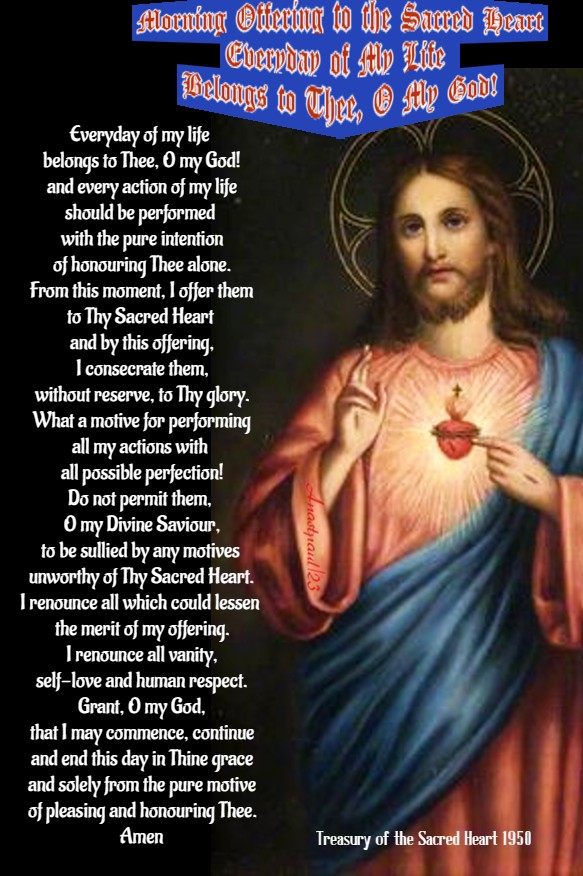
Morning Offering to the Sacred Heart Everyday of My Life Belongs to Thee, O My God! (Treasury of the Sacred Heart 1950)
Everyday of my life belongs to Thee, O my God! and every action of my life should be performed with the pure intention of honouring Thee alone. From this moment, I offer them to Thy Sacred Heart and by this offering, I consecrate them, without reserve, to Thy glory. What a motive for performing all my actions with all possible perfection! Do not permit them, O my Divine Saviour, to be sullied by any motives unworthy of Thy Sacred Heart. I renounce all which could lessen the merit of my offering. I renounce all vanity, self-love and human respect. Grant, O my God, that I may commence, continue and end this day in Thine grace and solely from the pure motive of pleasing and honouring Thee. Amen
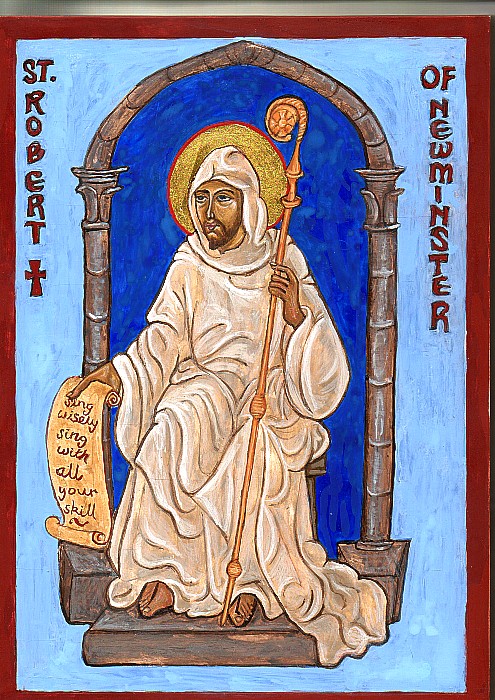
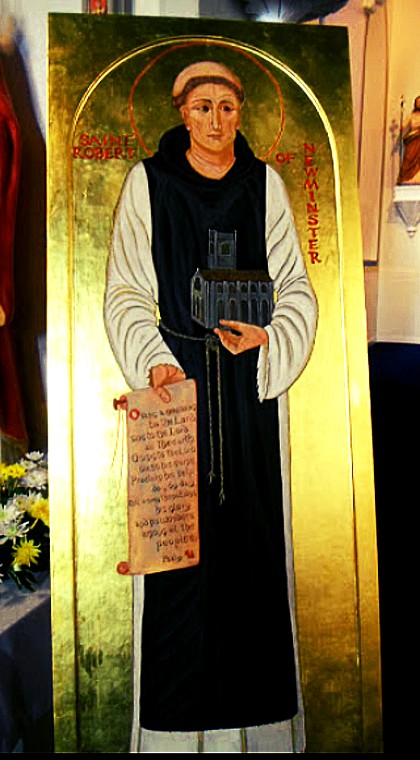
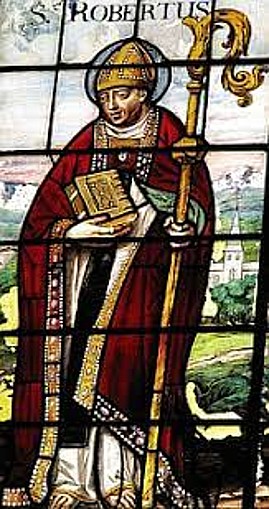
Saint of the Day – 7 June – Saint Robert of Newminster O.Cist. (c 1100–1159) English Priest, Abbot, Apostle of the poor, Miracle-worker. He was one of the Monks who founded Fountains Abbey in North Yorkshire, England, another at Newminster, Northumbria and 3 other Monasteries Robert ruled and directed the Monks at Newminster for 21 years. Born in c 1100 at Gargrave, Craven district, Yorkshire County, England and died on 7 June 1159 at Newminster England of natural causes. Saint Robert of Newminster is remembered as a generous, compassionate and capable man devoted to God. A man of great simplicity, he was reported to be strong and active and committed to fasting. His acts and miracles continue to inspire people to help others and to honoUr , love and obey God.
Robert was born in what is now the district of Craven, near Skipton in North Yorkshire, probably in the village of Gargrave. He studied at the University of Paris, where he composed a commentary – since lost – on the Psalms. He became a parish priest, returning to serve Gargrave.
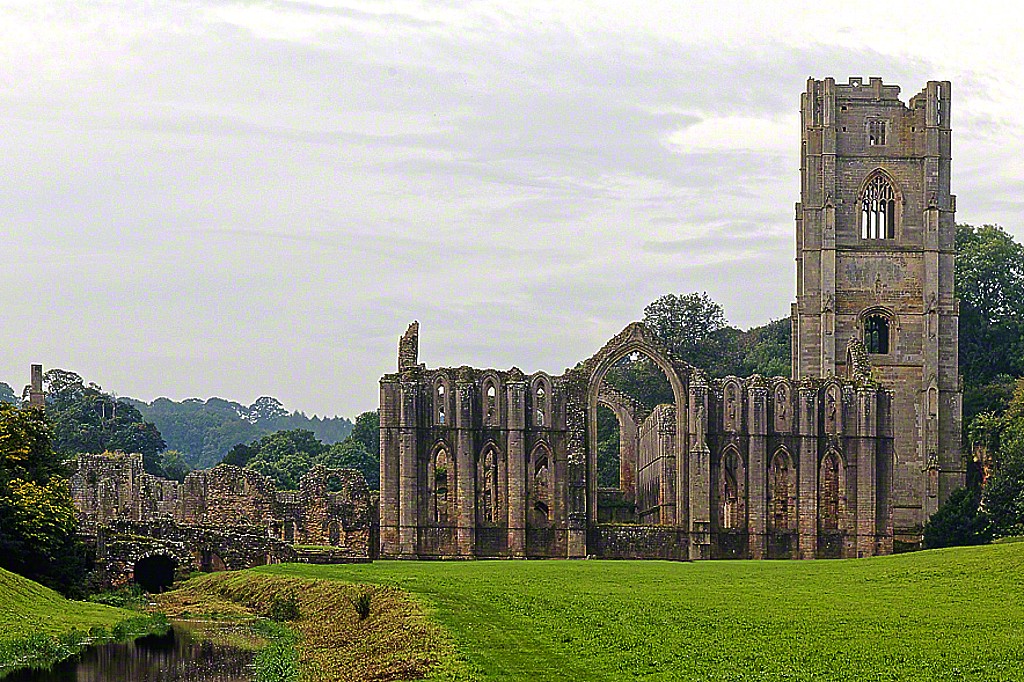
Aftrer a time he became a Benedictine joining the Monks of Saint Mary’s Abbey in York. A group of Monks, including Robert, established a Monastery in a valley near Skeldale, on land given them by Archbishop Thurstan in 1132. The first two years were difficult and the Monks struggled in extreme poverty. Initially they lived in a makeshift structure on the banks of the River Skell. Despite the hardships, the Monks were known for their holiness, austerity and dedication to the strict Benedictine way of life. Their fame brought a new novice, St Hugh, Dean of York, who relinquished all his wealth to the community who built more suitable facilities.
Because of the many natural springs in the area, the Monastery was called Fountains’ Abbey. Fountains Abbey became affiliated with the Cistercian reform which had been introduced by St Bernard of Clairvaux and became a Cistercian Abbey. (I lived very near Fountains’ Abbey for 10 years. It is still a pilgrimage site, although in ruins, destroyed and pillaged by the excesses of the Henry VIII and Elizabeth I. I have attended Holy Mass in the Crypt, a place still ofpalpable holiness and great beauty. Of course, many of the so-called pilgrims are really just tourists now and there is a very fine restaurant too, which attracts those unconcerned with or even unaware of, the holy history of the amazing Abbey.)
Robert was described as a devout, prayerful, and gentle man. He is known for being merciful in his judgement of others and a warm and considerate companion. He was zealous regarding his own vows of poverty. About 1138 he headed a group of Monks sent out from Fountains’ to establish Newminster Abbey near the Castle of Ralph de Merlay and his wife, Juliana, , west of Morpeth in Northumberland. Abbot Robert was said to be blessed with the gift of prophecy and miracles. During his Abbacy three colonies of Monks were sent to found new Monasteries at Pipewell in Northamptonshire (1143), Roche in South Yorkshire (1147), and Sawley in Lancashire (1148).
Capgrave’s life tells that an accusation of misconduct was brought against him by his own Monks. . He went to defend himself before St Bernard of Clairvaux in 1147–1148. Bernard did not doubt Robert’s innocence as he had received a heavenly sign of his virtuous conduct
Robert ruled and directed the Monks at Newminster for 21 years. The small Monastery of only 17 Monks, was one of the first to be dissolved in 1535 by Henry VIII and the site has been privately owned since.
Robert was a close spiritual friend of the Hermit St Godric of Finchale. On the night Robert died, Godric s saw a vision of Robert’s soul, like a ball of fire, being lifted by Angels on a pathway of light ,toward the gates of Heaven. As they approached, Godric heard a voice saying, “Enter now my friends.”
When Robert died in 1159 he was buried in Newminster,but after its dissolution his remains were entombed in the local Church of Newminister, where many miracles were reported and which still remain a place of veneration and pilgraimage.
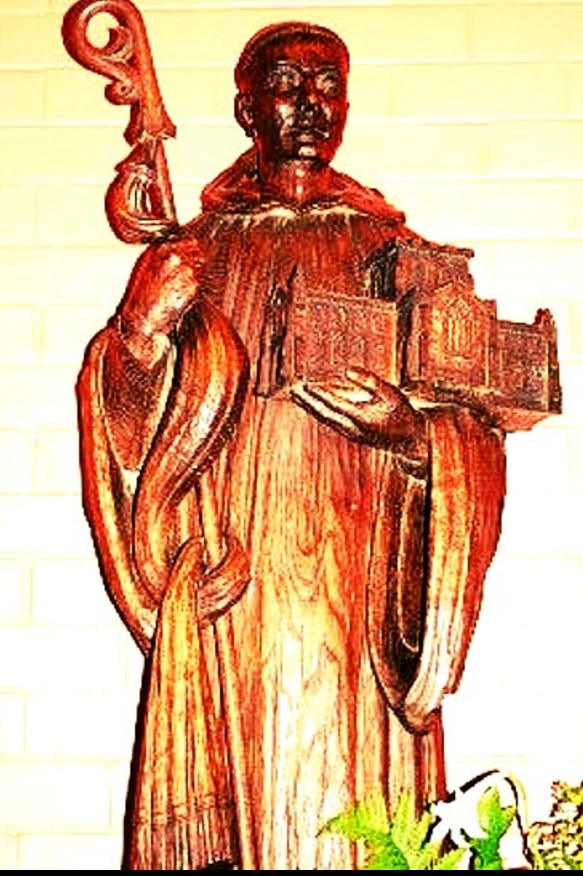
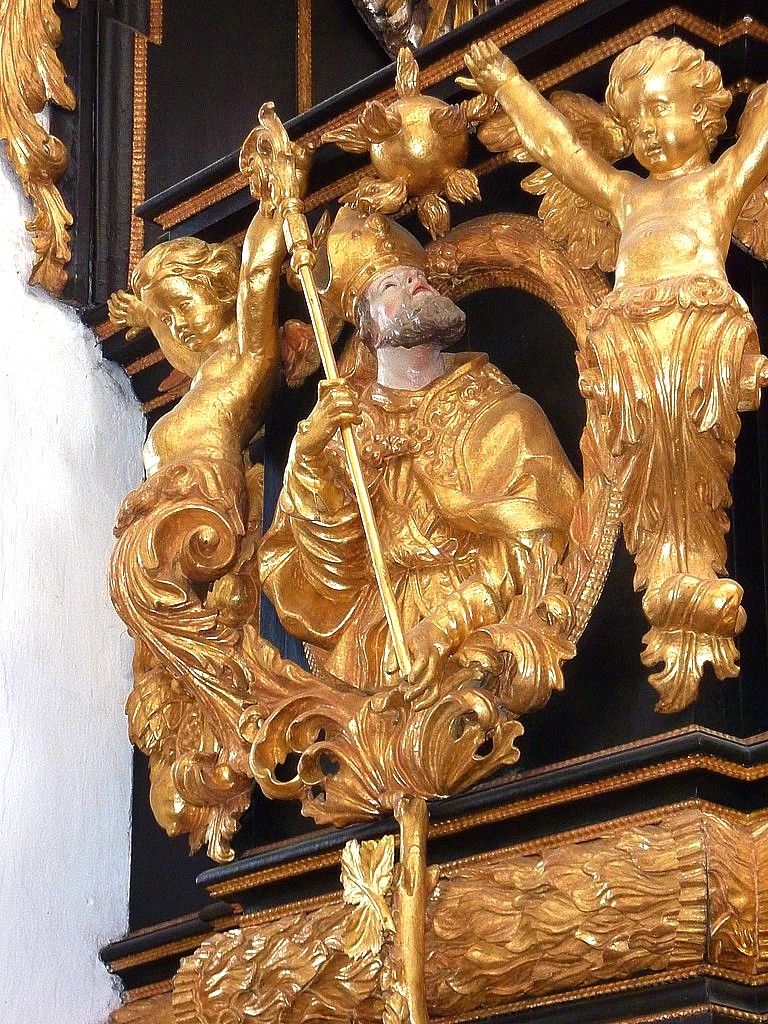
Relief of St Robert at the pulpit in the former Cistercian Abbey at Baumgartenberg, Austria
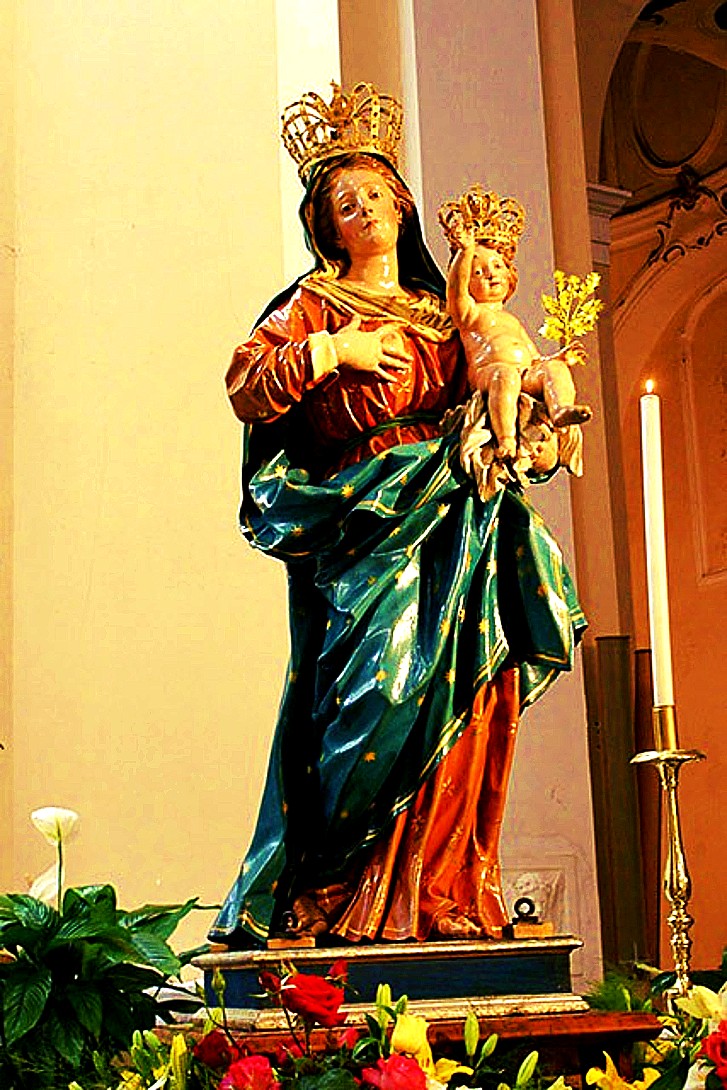
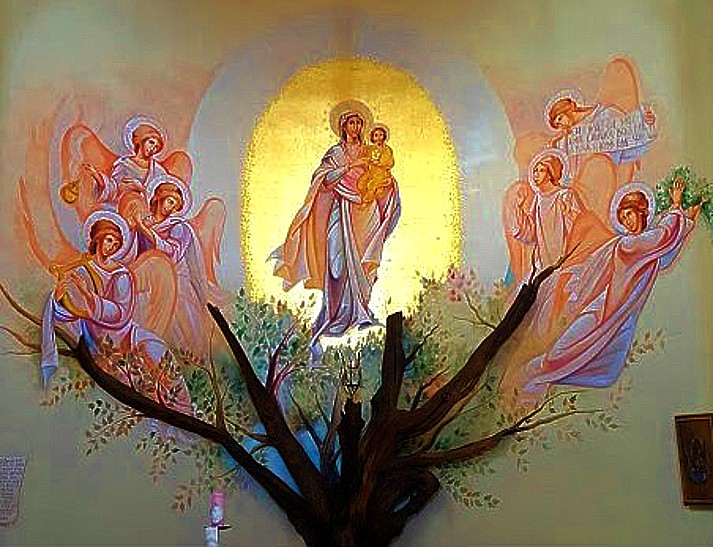
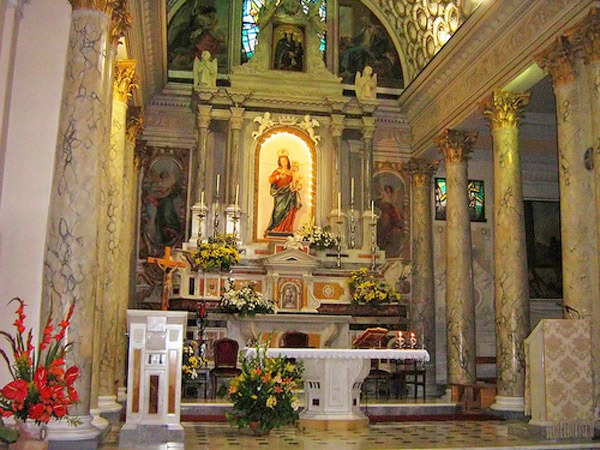
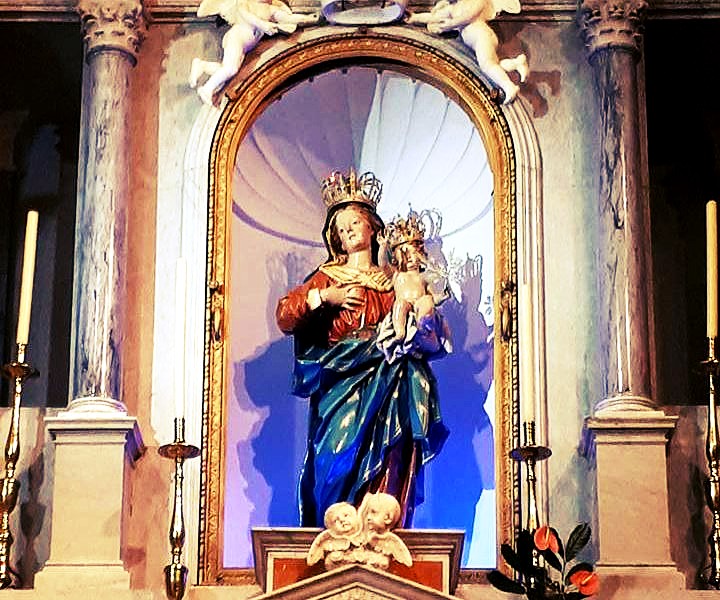
Madonna della Quercia / Our Lady of the Oak – Visora di Conflenti, Italy (1578) – 7 June:
On 7 June 1578, the Virgin appeared for the first time to a shepherd of humble conditions, named Lorenzo Folino. Due to the sultry heat, the young man had lain down under a Chestnut tree and had fallen asleep. He was suddenly awakened by the sound of a beautiful melody, which became gradually clearer and more intense. Frightened, he looked at a small hill called Serracampanara and saw the Virgin Mary surrounded by angels, descending on a large Oak tree. Lorenzo immediately rushed to the tree and knelt devoutly in prayer. Smiling, Our Lady asked him to come closer and entrusted him with this message:
“Go, my son, to the Mayor and the Parish Priest and tell them what you have seen. Say that I am the Mother of God and that I want a Church to be built in the place which I will show to you.“
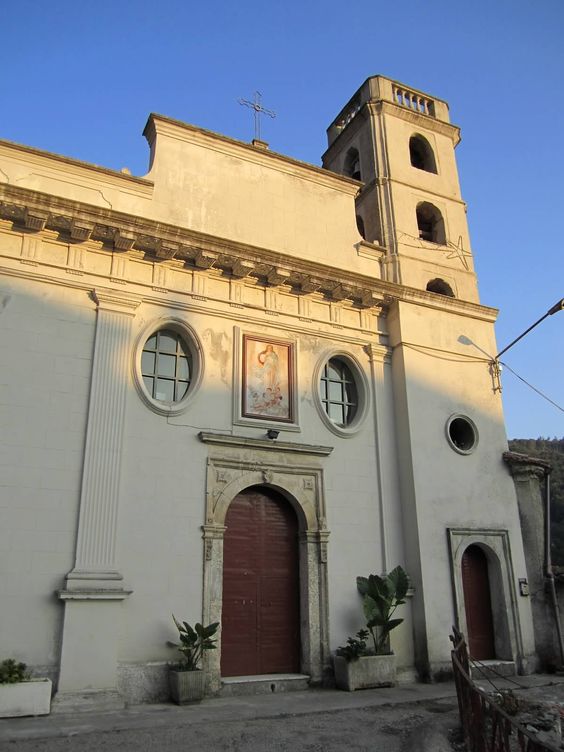
After showing him a large Oak tree, in the place called Visora, not far from the Town of Conflenti, she disappeared. Lorenzo ran into the village and told the Parish Priest and the Mayor what he had seen and heard, referring to Mary’s message. However, his story provoked general laughter, many believed he had gone mad and turned him away with derision. The Madonna della Quercia then appeared to the peasant Vermiglia Mercuri and, finally, to the housewife Delicia Mastroianni always asking for the erection of a Church to be dedicated to her. Since the reactions of the people did not change and even the ecclesiastical authorities did not give weight to the reports of the three visionaries, Mary reappeared many other times, both to individual citizens and to all the people. She worked numerous miracles, until it was evident that it was a supernatural event and was finally decided, that a Church had to be built. In 1862 a Church was built ad even the Oak tree on which the Our Lady had appeared was kept as a part of the Shrine.
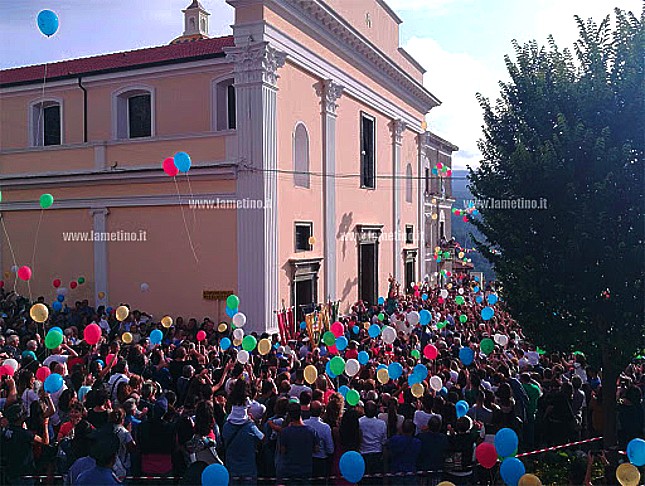
But, on the evening of 21 July 1921, the Church was destroyed by fire. After a decade of complete abandonment, the Church was eventually rebuilt, with the help of the emigrants of Conflenti, scattered around the world. On 7 Jue each year, a Procession and festival is held and attended by many from the Town and surrounding villages.
St Aventinus of Larboust Bl Basilissa Fernandez St Colman of Dromore Bl Demosthenes Ranzi St Deochar St Gotteschalk St Justus of Condat St Landulf of Yariglia St Lycarion of Egypt
Venerable Matt Talbot (1856 – 1925) (born Matthew Talbot) – Layman, Ascetic, Mystic – known as the “Saint in Overalls” and “the Workers’ Saint” disciple of Eucharistic Adoration and the Blessed Virgin – Patron of Struggling and Recovering Addicts and Alcoholics and many addiction treatment programs, retreats and centres throughout the world bear his name. The Matt Talbot Story: https://anastpaul.com/2017/06/07/saint-of-the-day-7-june-venerable-matt-talbot-ofs/
St Meriadoc I of Vannes St Meriadoc II of Vannes St Odo of Massay St Potamiaena of Alexandria the Younger St Quirinus of Cluny St Robert of Newminster O.Cist. (c 1100–1159) Priest, Abbot St Sergius of Cluny St Vulflagius of Abbeville — Martyrs of Africa – 7 saints: A group of seven Christians who were martyred together. No details about them have survived except the names – Donata, Evasius, Guirillus, Januaria, Privata, Spisinna, Victurus. The precise location in Africa and date are unknown.
Martyred in Córdoba, Spain: Habentius of Córdoba Jeremiah of Córdoba Peter of Córdoba Sabinian of Córdoba Wallabonsus of Córdoba Wistremundus of Córdoba
Thought for the Day – 6 June – Meditations with Antonio Cardinal Bacci (1881-1971)
The Feast of Corpus Christi
“Human words cannot express the beauty ad depth of the passage from the Gospel which the liturgy of the Holy Mass offers for our meditation. It is the passage in which Jesus promises the institution of the Blessed Eucharist.
“ For my flesh is food indeed and my blood is drink indeed. He that eateth my flesh and drinketh my blood, abideth in me and I in him. As the living Father hath sent me and I live by the Father; so he that eateth me, the same also shall live by me. This is the bread that came down from heaven. Not as your fathers did eat manna and are dead. He that eateth this bread, shall live forever.” (Jn 6:56-59)
No human being could have visualised or uttered such words. Only the God-Man could have spoken them.
Even outside the Eucharist, God communicates with us, descending with His grace into our souls. We feel that He is present, we experience His supernatural influence and inspiration, His appeals to us to do good. But in the Eucharist, we have far more than this. We have the God-Man as the food of our souls, through which we live His own life, so that, like St Paul, it is no longer we who live but Christ Who lives in us.
This intimate and mysterious union has been compared with the unfathomable union in which the Son of God, lives the life of His heavenly Father because. by means of the Eucharist, we should live the supernatural life of Jesus. A a result of this transformation, there can be no further place in us for sin, nor for disordered affectations and desires but only for virtue and for God.”
Quote/s of the Day – 6 June – “Month of the Sacred Heart” – Corpus Christi, The Solemnity of The Most Holy Body and Blood of Christ
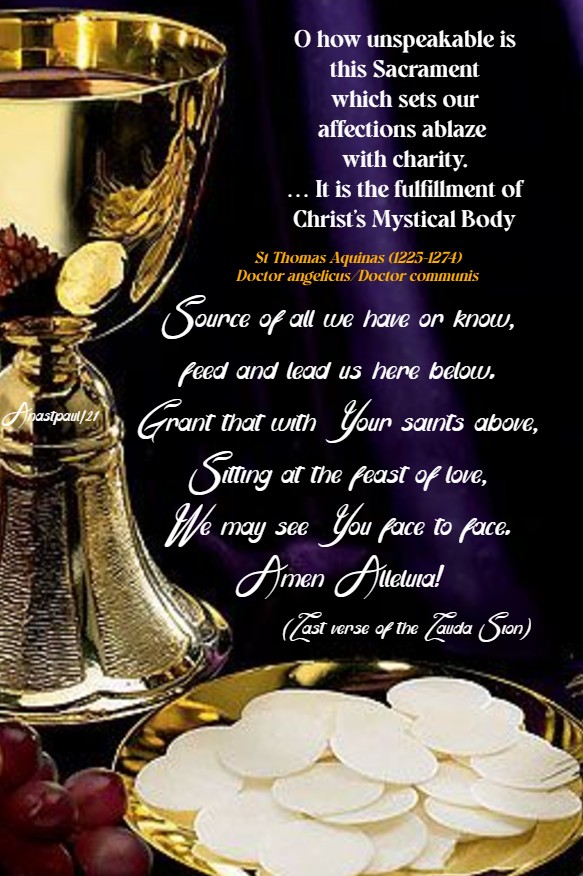
“O how unspeakable is this Sacrament which sets our affections ablaze with charity. … It is the fulfillment of Christ’s Mystical Body.”
“Source of all we have or know, feed and lead us here below. Grant that with Your saints above, Sitting at the feast of love, We may see You face to face.”
Amen Alleluia!
(Last verse of the Lauda Sion)
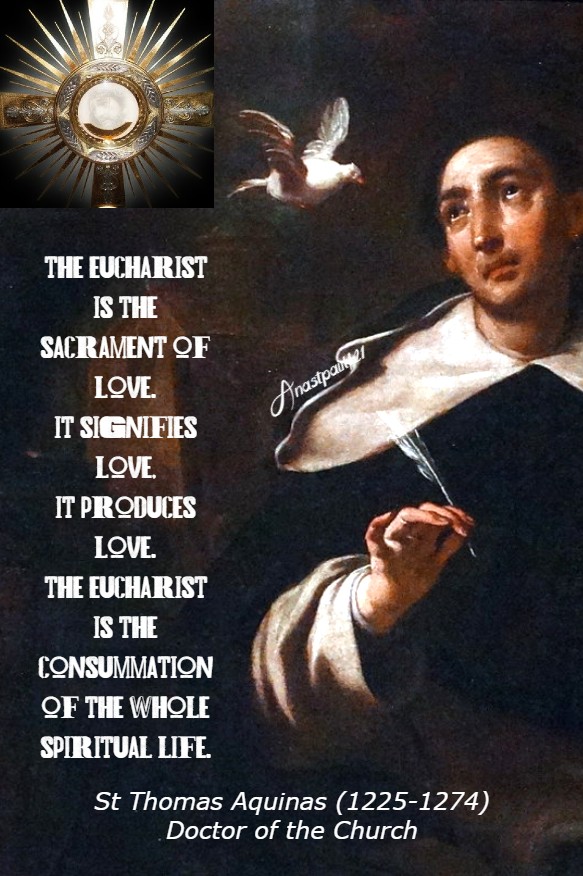
“The Eucharist is the Sacrament of Love. It signifies Love, It produces love. The Eucharist is the consummation of the whole spiritual life.”
St Thomas Aquinas (1225-1274) Doctor angelicus/Doctor communis
One Minute Reflection – 6 June – “Month of the Sacred Heart” – Corpus Christi, The Solemnity of The Most Holy Body and Blood of Christ, Readings: First: Exodus 24: 3-8, Psalm: Psalms 116: 12-13, 15-16, 17-18 (13), Second: Hebrews 9: 11-15, Gospel: Mark 14: 12-16, 22-26
“ This is my body … this is my blood ” – Mark14: 22,24
REFLECTION – “The lovers of this world display their generosity by giving money, clothes and various gifts but not one of them gives his own blood. Christ gives His. In this way He demonstrates the tenderness He feels for us and His ardent love. Under the Old Law … God consented to receive the blood of sacrifices but this was just to prevent His people from offering it to false gods and, already, this was proof of a very great love. But Christ transformed this rite… there is no longer the same sacrificial victim – it is Himself He offers in sacrifice.
“The bread that we break, is it not a communion in the body of Christ?” (1 Cor 10:16) What is this bread? The Body of Christ. What becomes of those who communicate in it? The Body of Christ – not a large number of bodies but just one Body. Just as this bread, made up of so many wheat grains, makes only one loaf into which the grains disappear – for even though the grains remain in it, yet it is impossible to distinguish them in such a closely compacted mass – so all of us, together with Christ, make up a single whole … Now, if we all share in the same bread and are united to the same Christ, why don’t we show the same love to each other? Why don’t we become one in this case too?
This is what was seen at the beginning: “The community of believers was of one heart and mind” (Acts 4:32) … Christ came in search of you who were far away from Him to unite Himself to you but you do not wish to become one with your brother? … You violently separate yourself from him, after winning from the Lord so great a proof of His love – and life! For He did not only give His Body but, just as our flesh, drawn from the earth, had lost its life and died through sin, so He has introduced, so to speak, another substance like a leaven, this is His Body, the Body sharing the same nature as ours but free from sin and abounding in life. And He has given it to all of us, so that, fed with the banquet of this new food … we might enter immortal life.” – St John Chrysostom (347-407) Archbishop of Constantinople, Father ad Doctor of the Church – 24th homily on the 1st letter to the Corinthians 2
PRAYER – Lord Jesus Christ, You gave Your Church, an admirable Sacrament as the abiding memorial of Your Passion. Teach us to worship the sacred mystery of Your Body and Blood, that it’s redeeming power may sanctify us always. Who live and reign with the Father and the Holy Spirit, God, forever, amen.
Our Morning Offering – 6 June – “Month of the Sacred Heart” – The Solemnity of Corpus Christi – The Most Holy Body ad Blood of Our Lord Jesus Christ
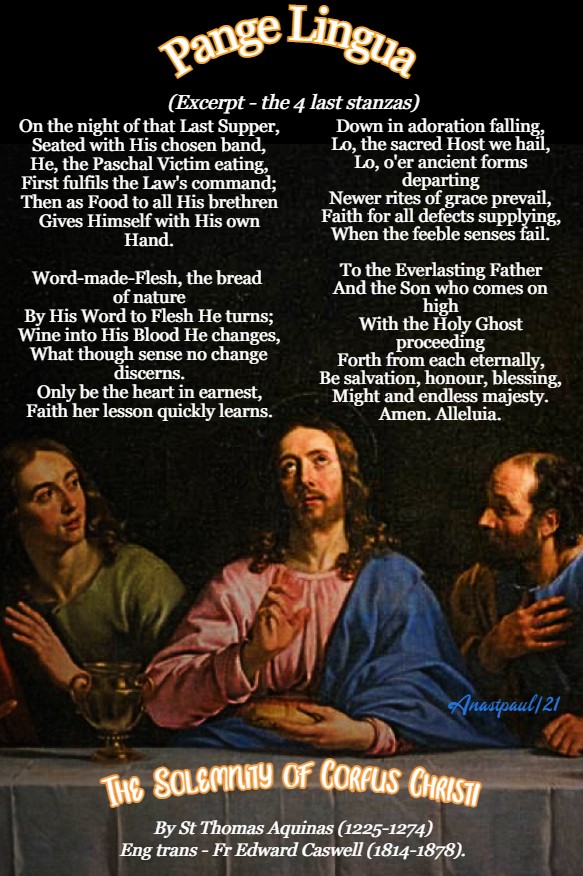
Pange Lingua Sing, My Tongue By St Thomas Aquinas (1225-1274) Eng trans – Fr Edward Caswell CO (1814-1878) (Excerpt on the image – the 4 last stanzas)
Sing, my tongue, the Saviour’s glory, Of His Flesh, the mystery sing; Of the Blood, all price exceeding, Shed by our Immortal King, Destined, for the world’s redemption, From a noble Womb to spring.
Of a pure and spotless Virgin Born for us on earth below, He, as Man, with man conversing, Stayed, the seeds of truth to sow; Then He closed in solemn order Wondrously His Life of woe.
On the night of that Last Supper, Seated with His chosen band, He, the Paschal Victim eating, First fulfils the Law’s command; Then as Food to all His brethren Gives Himself with His own Hand.
Word-made-Flesh, the bread of nature By His Word to Flesh He turns; Wine into His Blood He changes, What though sense no change discerns. Only be the heart in earnest, Faith her lesson quickly learns.
Down in adoration falling, Lo, the sacred Host we hail, Lo, o’er ancient forms departing Newer rites of grace prevail, Faith for all defects supplying, When the feeble senses fail.
To the Everlasting Father And the Son who comes on high With the Holy Ghost proceeding Forth from each eternally, Be salvation, honour, blessing, Might and endless majesty. Amen. Alleluia.
Written by St Thomas Aquinas (1225-1274) for the Solemnity of Corpus Christi, this Hymn is considered the most beautiful of Aquinas’ Hymns and one of the great seven Hymns of the Church. The Hymn is also used on Holy Thursday. The last two stanzas make up the Tantum Ergo (Down in Adoration Falling) that is used at Benediction of the Blessed Sacrament.
PANGE, lingua, gloriosi Corporis mysterium, Sanguinisque pretiosi, quem in mundi pretium fructus ventris generosi Rex effudit Gentium.
Nobis datus, nobis natus ex intacta Virgine, et in mundo conversatus, sparso verbi semine, sui moras incolatus miro clausit ordine.
In supremae nocte cenae recumbens cum fratribus observata lege plene cibis in legalibus, cibum turbae duodenae se dat suis manibus.
Verbum caro, panem verum verbo carnem efficit: fitque sanguis Christi merum, et si sensus deficit, ad firmandum cor sincerum sola fides sufficit.
Tantum ergo Sacramentum veneremur cernui: et antiquum documentum novo cedat ritui: praestet fides supplementum sensuum defectui.
Genitori, Genitoque laus et iubilatio, salus, honor, virtus quoque sit et benedictio: procedenti ab utroque compar sit laudatio. Amen. Alleluia.
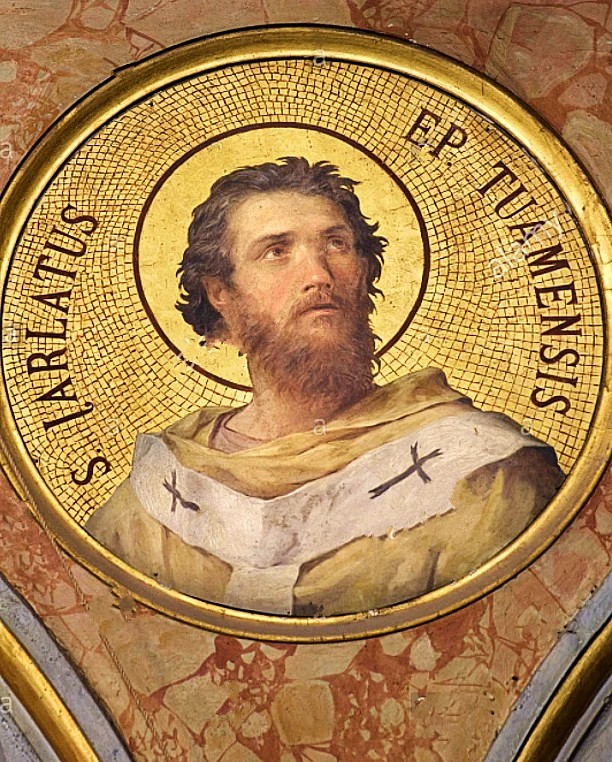
Saint of the Day – 6 June – Saint Jarlath of Tuam (c 445-c 540) Priest, Bishop, Abbot, Scholar, Founder of the Monastic School of Tuam and of the Archdiocese of Tuam, in Galway, Ireland. The Féilire of Aengus, tells us that he was noted for his mortification, fasting, and prayer. Born in c 445 at Connaught, Galway, Ireland and died in c 540 of natural causes. Patronage – The Archdiocese of Tuam, Ireland. Also known as – Iarlaith, Iarlath.
Very little is known about the life of Jarlath. He firstly studed under Benen, a disciple of St Patrick and then became a disciple of St Enda at Arran Island. The Monasteries he founded, first at Cloonfush and later at Tuam, were renowned for their scholarship and learning.
From the second syllable of his name in Irish, fhlaith, meaning “lord,”,it could be taken that he came from a wealthy family.
He own first monastic foundation was at Cloonfush, some miles east of Tuam. His students at the monastic college included Saint Brendan of Clonard and Saint Colman of Cloyne.
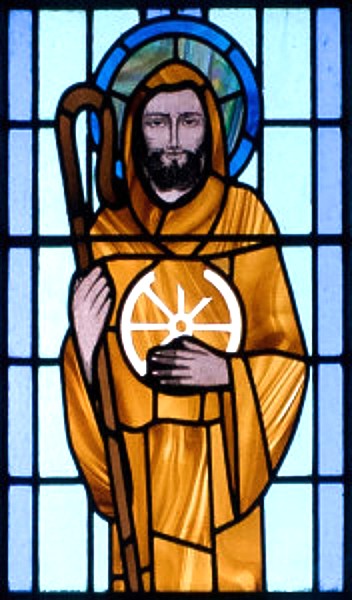
Jarlath appears briefly as a prominent figure in the medieval Irish Lives of St Brendan of Clonfert. Brendan is said to have visited Connacht to study under the famous Jarlath. One day, when Jarlath was in his old age, Brendan advised his mentor to leave the school and to depart in a newly built chariot until its two hind shafts broke because there would be the place of his resurrection and that of many after him. Because Jarlath acknowledged the holiness and superior wisdom of his pupil, saying “take me into thy service forever and ever,” he gladly accepted his advice. His travel did not take him very far, as the shafts broke at Tuaim Mound. From this incident, the chariot wheel has become the symbol of the Town of Tuam.
St Jarlath’s Chariot Wheel at Tuam
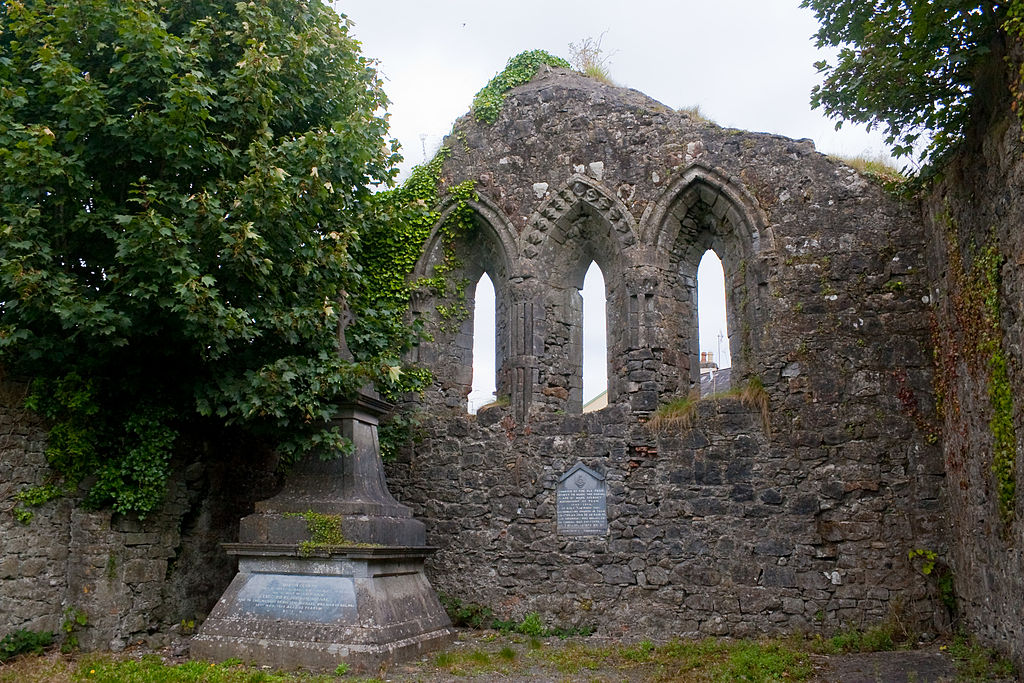
The ruins of Tuam Monastery
The Diocese was established by the twelfth-century synods of Rathbreasail and Kells and subsequently became an Archdiocese absorbing into it two other medieval Dioceses: Annaghdown and Mayo.
St Jarlath as depicted in a stained glass window of Tuam Cathedral, designed by Richard King in 1961
Jarlath died, “full of days,” on 26 December, c 540, aged about 90 years old. Saint Jarlath’s Feast day is 6 June, which is the date of the translation of his relics to a Church especially built in his honour next to the Cathedral of Tuam. His remains were encased in a silver Shrine, from which the 13th-century Church gained the name Teampul na scrín, that is the “Church of the Shrine.“
Solemnity of Corpus Christi – The Most Holy Body ad Blood of Our Lord Jesus Christ +2021 – celebrated today in many countries, where Thursday was not a Holy Day
Panna Mária,/ Blessed Virgin Mary, Pozba, Nové Zámky, Nitra, Slovakia 1512 –Second Sunday after Feast of the Ascension:
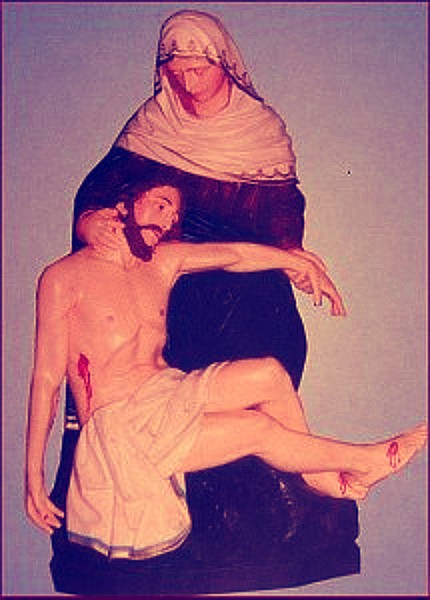
In 1512, the Pauline Fathers built a Marian Shrine, in the southwest Slovakian Town of Vel’ké Lovce. In the 1700s is was a popular place of pilgrimage. One day in those years, shepherds and pilgrims, observed a white dove bathing in a spring in the woods five miles away, outside the village of Pozba. The story circulated that a shepherd’s blind daughter regained her sight after washing her eyes with the dove’s bathwater. The landowner made fun of this, wondering if the spring could help his blind horse. It did, but he went blind instead. A sick girl saw the Virgin, wearing a white dress and blue sash, in a pear tree and was immediately cured. From the wood of this tree, a Pietà was carved, still venerated in a Chapel by the spring, which hosts annual pilgrimages on Pentecost Sunday and on 15 September, Feast of Our Lady of Sorrows.
St Norbert (c 1080-1134) (Optional Memorial) Bishop, Confessor, Founder of the Premonstratensian or theNorbertine Canons and Sisters, “Defender of the Eucharist” and “Apostle of the Eucharist,” Exorcist, Reformer, Preacher His amazing life: https://anastpaul.com/2017/06/06/saint-of-the-day-6-june-st-norbert/
St Agobard of Lyon St Alexander of Fiesole St Alexander of Noyon St Amantius of Noyon St Anoub of Skete St Artemius of Rome St Bazalota of Abyssinia St Bertrand of Aquileia (1258– 1350) Bishop St Candida of Rome St Ceratius of Grenoble St Claudius of Besançon St Cocca St Colmán of Orkney Bl Daniel of Bergamo St Euphemia of Abyssinia St Eustorgius II of Milan Bl Falco of La Cava Bl Gilbert of Neufontaines St Grazia of Germagno St Gudwall Bl Gundisalvus of Azebeyro St Hilarion the Younger
St Paulina of Rome St Phêrô Dung St Phêrô Thuan St Rafael Guízar y Valencia St Vincent of Bevagna St Vinh-Son Duong — Marytrs of Tarsus: A group of 20 martyrs who were killed together during the persecutions of Diocletian. They were martyred in Tarsus (in modern Turkey).
Mercedarian Fathers of Avignon: Several Mercedarians from the Santa Maria convent of Avignon, France who worked with plague victims in that city and died of the disease themselves. They died in Avignon, France of plague and are remembered together today for their great charity and commitment to their people.
Thought for the Day – 5 June – “Month of the Sacred Heart” – Meditations with Antonio Cardinal Bacci (1881-1971)
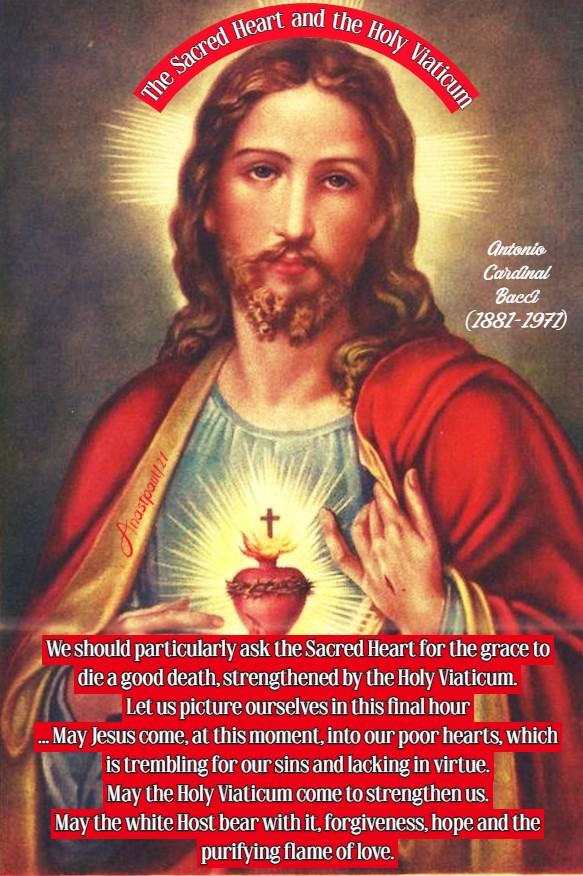
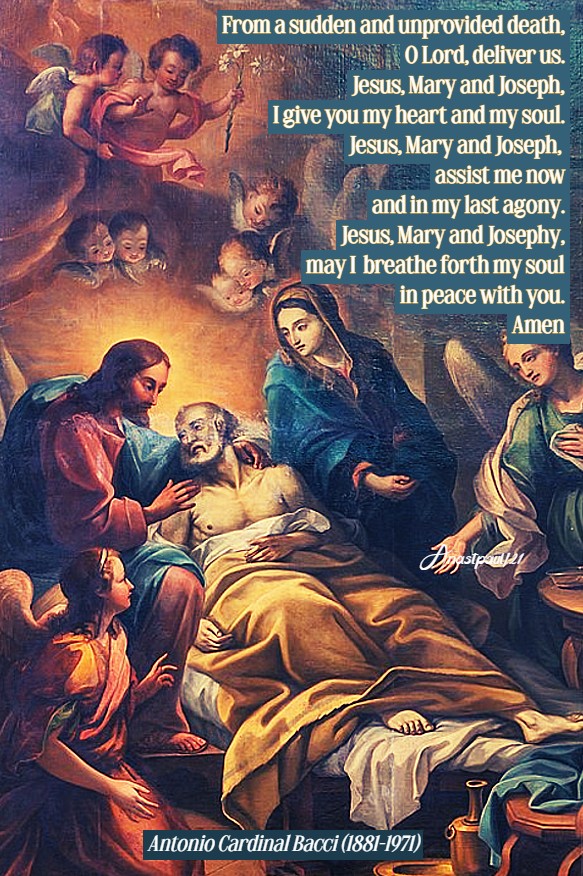
The Sacred Heart and the Holy Viaticum
“We should particularly ask the Sacred Heart for the grace to die a good death, strengthened by the Holy Viaticum. Let us picture ourselves in this final hour. The world is fading away and nothing remains of the honours, successes and pleasures of our passing life. There will remain only two things – on one side, the merits which we have obtained by our prayers, penances and good works; on the other side, the sum total of our sins and ingratitude to God. May Jesus come, at this moment, into our poor hearts, which is trembling for our sins and lacking in virtue. May the Holy Viaticum come to strengthen us. May the white Host bear with it, forgiveness, hope and the purifying flame of love.
Then, the infinite love of the Heart of Jesus will be mingled with th weak limited love of our hearts. It will waft us into a state of everlasting happiness, where, to love, is to possess, the boundless joy of God.
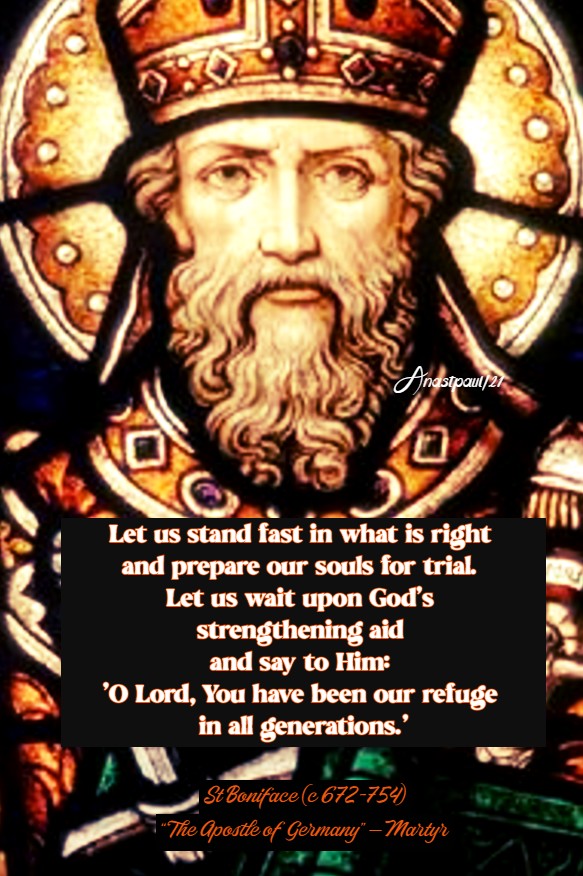
Quote/s of the Day – 5 June – The Memorial of St Boniface (c 672-754) “The Apostle of Germany” – Martyr
“Let us stand fast in what is right and prepare our souls for trial. Let us wait upon God’s strengthening aid and say to Him: ‘O Lord, you have been our refuge in all generations.’”
St Boniface (c 672-754) “The Apostle of Germany” – Martyr
One Minute Reflection – 5 June – “Month of the Sacred Heart” – Readings: First: Tobit 12: 1, 5-15, 20, Psalm: Tobit 13: 2, 6efgh, 7, 8, Gospel: Mark 12: 38-44 and the Memorial of St Bopniface (672-754) “The Apostle of Germany,” Martyr and Bl Ferdinand of Portugal (1402-1443) “The Holy Prince”
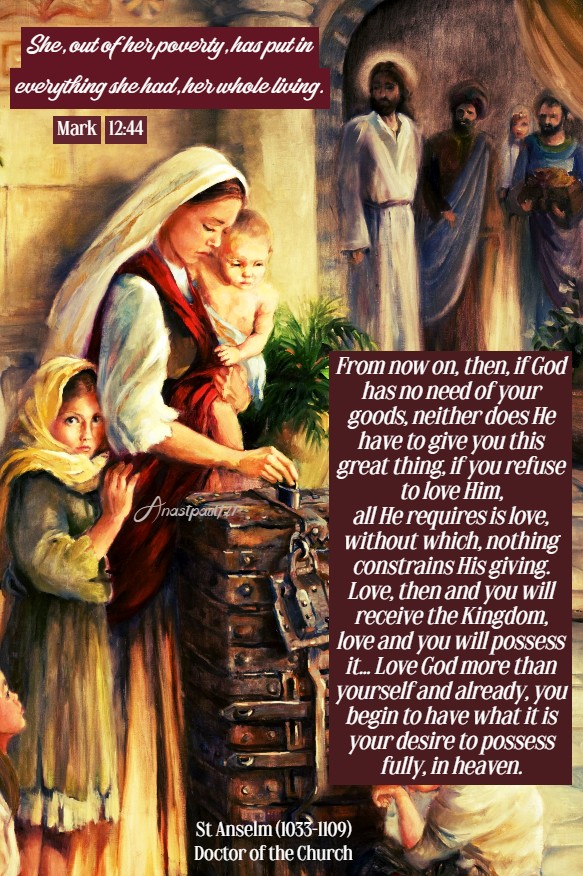
“For they all contributed out of their abundance but she, out of her poverty, has put in everything she had, her whole living.”… Mark 12:44
REFLECTION – “Now, if someone is wondering what the cost is, here is their answer – He who offers a Kingdom in heaven has no need of earthly coin. No-one can offer God anything, except what already belongs to Him, since all that exists is His. And yet, God does not give away so great a thing, without a price being placed on it, He does not give it to someone who doesn’t value it. For indeed, nobody gives away something they hold dear without placing some kind of value on it. From now on, then, if God has no need of your goods, neither does He have to give you this great thing, if you refuse to love Him, all He requires is love, without which nothing constrains His giving. Love, then and you will receive the Kingdom, love and you will possess it… Love God more than yourself and already, you begin to have what it is your desire to possess fully, in heaven.”… St Anselm (1033-1109) Doctor of the Church
PRAYER – Lord God, Your Son has shown us the way. As we follow in His steps, may we never wander from the path that leads to life. Renew the wonders of Your grace in our hearts so that neither death nor life may separate us from Your love. Holy Father, as You were glorified by the life and death of St Boniface and Blessed Ferdinand of Portugal, grant that by their prayers, we may receive strength to always give You our hearts, minds and complete selves. Through our Lord, Jesus Christ, with You in union with the Holy Spirit, one God for all eternity, amen.Sweet Heart of Jesus, be my love.300 days ONCE A DAY – Unless otherwise stated, e.g., “once a day,” a partial Indulgence may be gained any number of times in succession.) Pope Leo XIII 21 May 1892.
Our Morning Offering – 5 June – “Month of the Sacred Heart” and a Marian Saturday
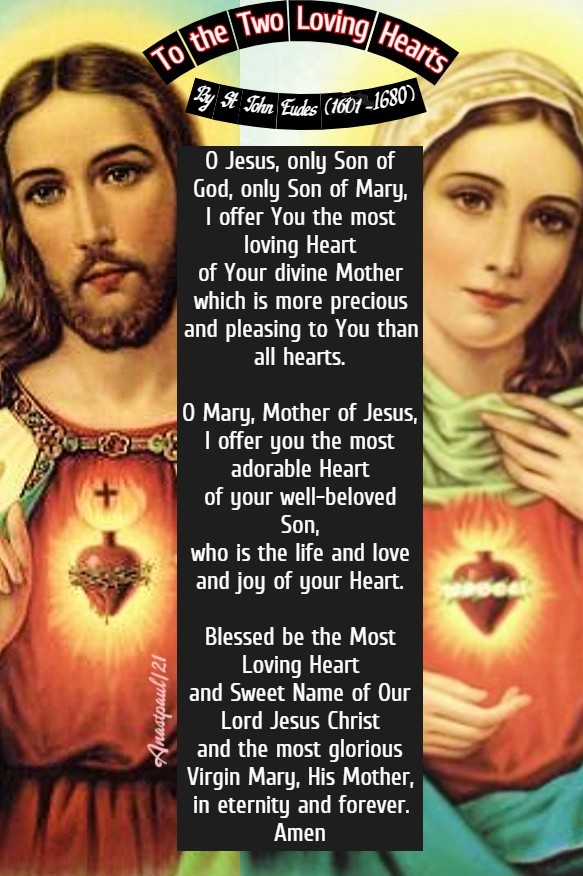
To the Two Loving Hearts By St John Eudes (1601-1680)
O Jesus, only Son of God, only Son of Mary, I offer You the most loving Heart of Your divine Mother which is more precious and pleasing to You than all hearts.
O Mary, Mother of Jesus, I offer you the most adorable Heart of your well-beloved Son, who is the life and love and joy of your Heart.
Blessed be the Most Loving Heart and Sweet Name of Our Lord Jesus Christ and the most glorious Virgin Mary, His Mother, in eternity and forever. Amen
Saint of the Day – 5 June – Blessed Ferdinand of Portugal (1402-1443) “The Holy Prince.” Blessed Ferdinand spent as much time as he could in adoration of the Most Blessed Sacrament especially during the Easter Triduum when his habit was to be constantly in adoration, from Holy Thursday to Easter. He was the youngest of the “Illustrious Generation” of 15th-century Portuguese Princes of the House of Aviz and lay Master of the Knightly Order of Aviz. Born on 29 September 1402 at Santarem, Portugal and died on 5 June 1443 (aged 40) in prison in Fez, Morocco of maltreatment by the Moors – for this reason some call him a Martyr. Also known as Ferdinand the Prince, “Saint Prince” or the “Constant Prince.”
Ferdinand was born in Santarém on 29 September 1402, the Feast of St Michael, a Saint to whom he would remain affectionately attached. He had a complicated birth and would remain a sickly child throughout much of his youth. Relatively sheltered because of his illnesses, Ferdinand had a quiet and very pious upbringing, a favourite of his English mother, from whom he acquired a preference for the Sarum Rite of Salisbury in the religious Liturgy of Holy Mass. Bodily weakness did not hinder his growth in spirit and even in his boyhood and youth, he gave evidence of remarkable qualities of soul and intellect. With great strength of character and a keen sense of justice and order, he combined an innocence, gentleness, and charity which excited the wonder of the Royal Court.
Ferdinand had a special predilection for prayer and for the ceremonies and devotions of the Church, especially time in adoration before our lord in the Blessed Sacrament. After his fourteenth year, he recited daily, the canonical hours, rising at midnight for Matins. Always severe with himself, he was abstemious in his diet and fasted on Saturdays and on the eves of the Feasts of the Church. He cared for the spiritual, as well as the corporal, necessities of his domestics, while his solicitude for the poor and oppressed was unbounded. His generosity towards the Monasteries was impelled by his desire to share in their prayers and good works. He had himself enrolled for the same reason in all the pious Congregations of the Kingdom.
He was one of five sons, his mother being, Philippa, daughter of John of Gaunt, Duke of Lancaster and his father, King John I, known in history for his victories over the Moors and in particular, for his conquest of Ceuta, a powerful Moorish stronghold and his establishment of an episcopal see within its walls. Upon the death of his father in 1433, his brother, Edward (Duarte) ascended the throne, while he himself received but a small inheritance. It was then that he was induced to accept the Grand-Mastership of the Knightly Order of Aviz, in order that he might be better able to help the poor. As he was not a cleric, his brother, the King, obtained for him the necessary Papal dispensation. The fame of his charity went abroad, and Pope Eugene IV, through the Papal Legate, offered him the Cardinal’s hat. This he refused, not wishing, as he declared, to burden his conscience.
Though living a life of great sanctity in the midst of the Court, Ferdinand was not a mere recluse. He was also a man of action and in his boyhood, his soul was stirred by the heroic campaign against the Moors. His mother, the Queen, had nurtured the martial spirit of her sons, and it is even said that on her deathbed, she gave them each a sword, charging them to use it in defence of widows, orphans and their country and, in particular, against unbelievers. An opportunity soon presented itself. In 1437 Edward planned an expedition against the Moors in Africa and placed his brothers Henry and Ferdinand, in command. They set sail on 22 August 1437 and four days later, arrived at Ceuta. During the voyage, Ferdinand became dangerously ill, in consequence of an abcess and fever which he had concealed before the departure, in order not to delay the fleet. Through some mismanagement, the Portuguese numbered only 6000 men, instead of 14,000, as ordered by the King. Though advised to wait for reinforcements, the two Princes, impatient for the fray, advanced towards Tangiers, to which they lay siege. Ferdinand recovered slowly but was not able to take part in the first battle.
The Portuguese fought bravely against great odds but were finally compelled to make terms with the enemy, agreeing to restore Ceuta in return for a safe passage to their vessels. The Moors likewise demanded that one of the Princes be delivered into their hands as a hostage for the delivery of the City. Ferdinand offered himself for the dangerous post and, with a few faithful followers,, including João Alvarez, his Secretary and later his Biographer, began a painful captivity which ended only, with his death.
He was first brought to Arsilla by Salà ben Salà, the Moorish Ameer. In spite of sickness and bodily sufferings, he continued all his devotions and showed great charity towards his Christian fellow-captives. Henry at first repaired to Ceuta, where he was joined by his brother John. Realising that it would be difficult to obtain the Royal consent to the restoration of the fortress, they proposed to exchange their brother for the son of Salà ben Salà, whom Henry held as a hostage. The Moor scornfully rejected the proposal, and both returned to Portugal to devise means of setting the Prince free. Though his position was perilous in the extreme, the Portuguese Cortes refused to surrender Ceuta, not only on account of the treachery of the Moors but because the place had cost them so dearly and might serve as a point of departure for future conquests. It was resolved to ransom him if possible. Salà ben Salà refused all offers, his purpose being to recover his former seat of government.
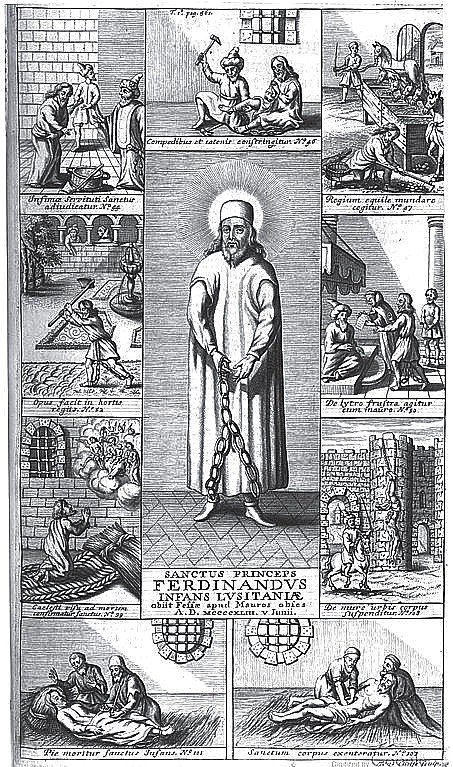
Scenes from Ferdinand’s captivity and death in Fez (from the Bollandist’s Acta Sanctorum, 1695). The only known depiction of Ferdinand with a saint’s halo.
Various attempts were made to free the Prince, but all proved futile and only served to make his lot more unbearable. On 25 May, 1438, he was sent to Fez and handed over to the cruel Lazurac, the King’s vizier. He was first condemned to a dark dungeon and, after some months of imprisonment, was compelled to work like a slave in the royal gardens and stables. Amid insult and misery, Ferdinand never lost patience. Though often urged to seek safety in flight, he refused to abandon his companions and grieved more for their sufferings, of which he considered himself the cause, than for his own. His treatment of his persecutors was respectful and dignified, but he would not descend to flattery to obtain any alleviation of his sufferings. During the last fifteen months of his life, he was confined alone in a dark dungeon with a block of wood for his pillow and the stone floor for a bed. He spent most of his time in prayer and in preparation for death, which his rapidly failing health warned him, was near at hand. In May, 1443, he was stricken with the fatal disease to which he finally succumbed. His persecutors refused to change his loathsome abode, although they allowed a physician and a few faithful friends to attend him.
On the evening of 5 June, after making a general confession and a profession of faith, he peacefully gave up his soul to God. aged just 40. During the day he had confided to his Confessor, who frequently visited him, that the Blessed Virgin with St John and the Archangel Michael had appeared to him in a vision. Lazurac ordered the body of the Prince to be opened and the vital organs removed and then caused it to be suspended head downwards for four days on the walls of Fez. Nevertheless, he was compelled to pay tribute to the constancy, innocence and spirit of prayer of his royal victim. Of Ferdinand’s companions, four shortly afterwards followed him to the grave, one joined the ranks of the Moors and the others regained their liberty after Lazurac’s death. One of the latter, João Alvarez, his Secretary and Biographer, carried his heart to Portugal in 1451 and in 1473, his body was brought to Portugal, and laid to rest in the Royal Vault at Batalha Monastery amid imposing ceremonies.
Effigy of Ferdinand the Holy Prince in the Monument of the Discoveries, in Lisbon,
Prince Ferdinand has ever been held in great veneration by the Portuguese on account of his saintly life and devotion to the country. Miracles were wrought at his intercession and in 1470, he was Beatified by Paul II.
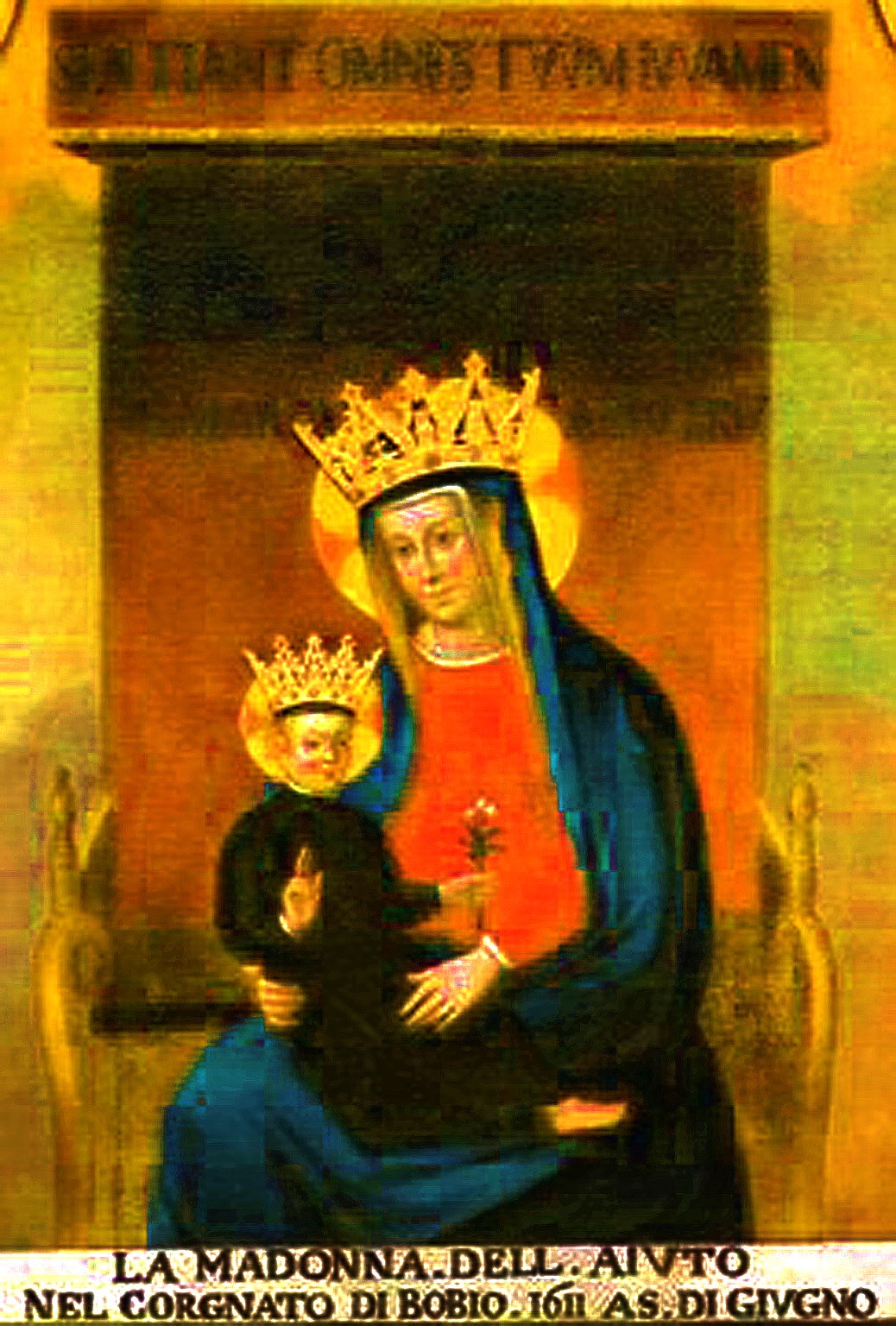
Beata Vergine dell’Aiuto, / Our Lady of Help, Bobbio, Piacenza, Emilia Romagna, Italy 15th century – 5 June :
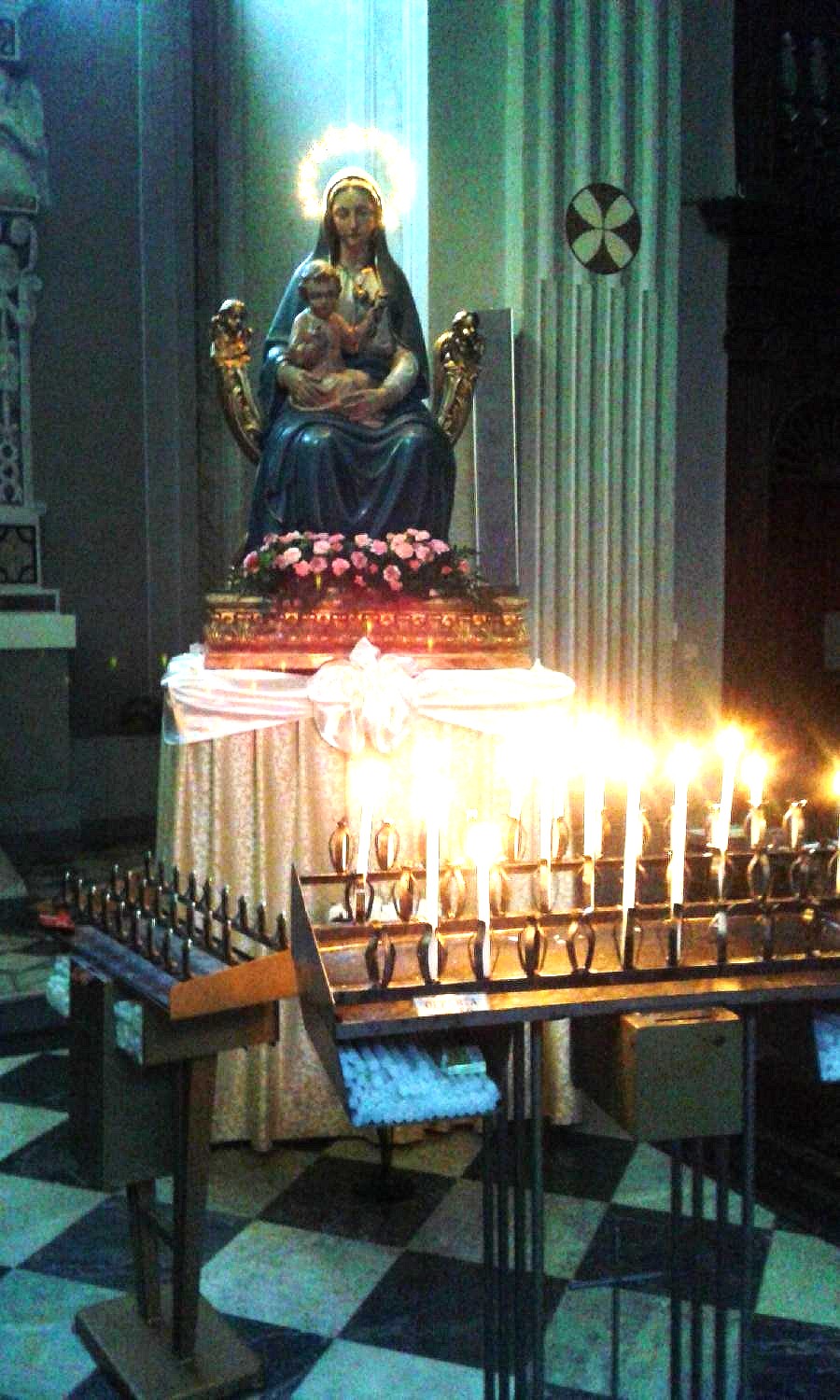
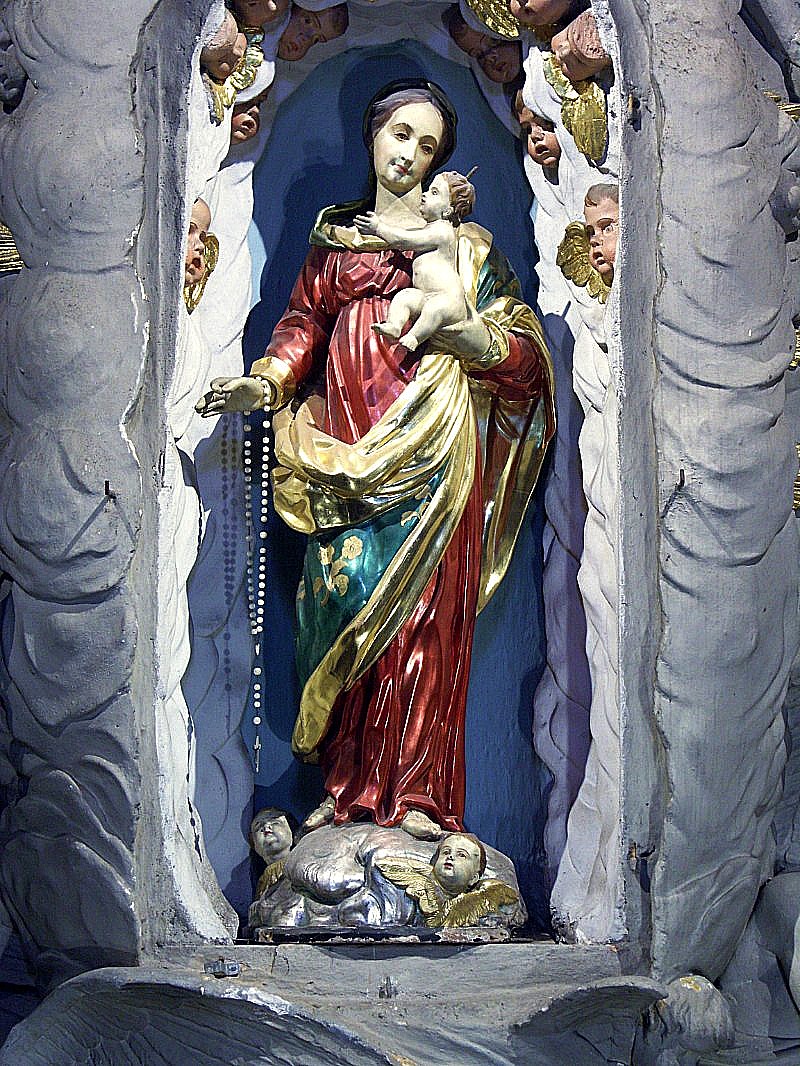
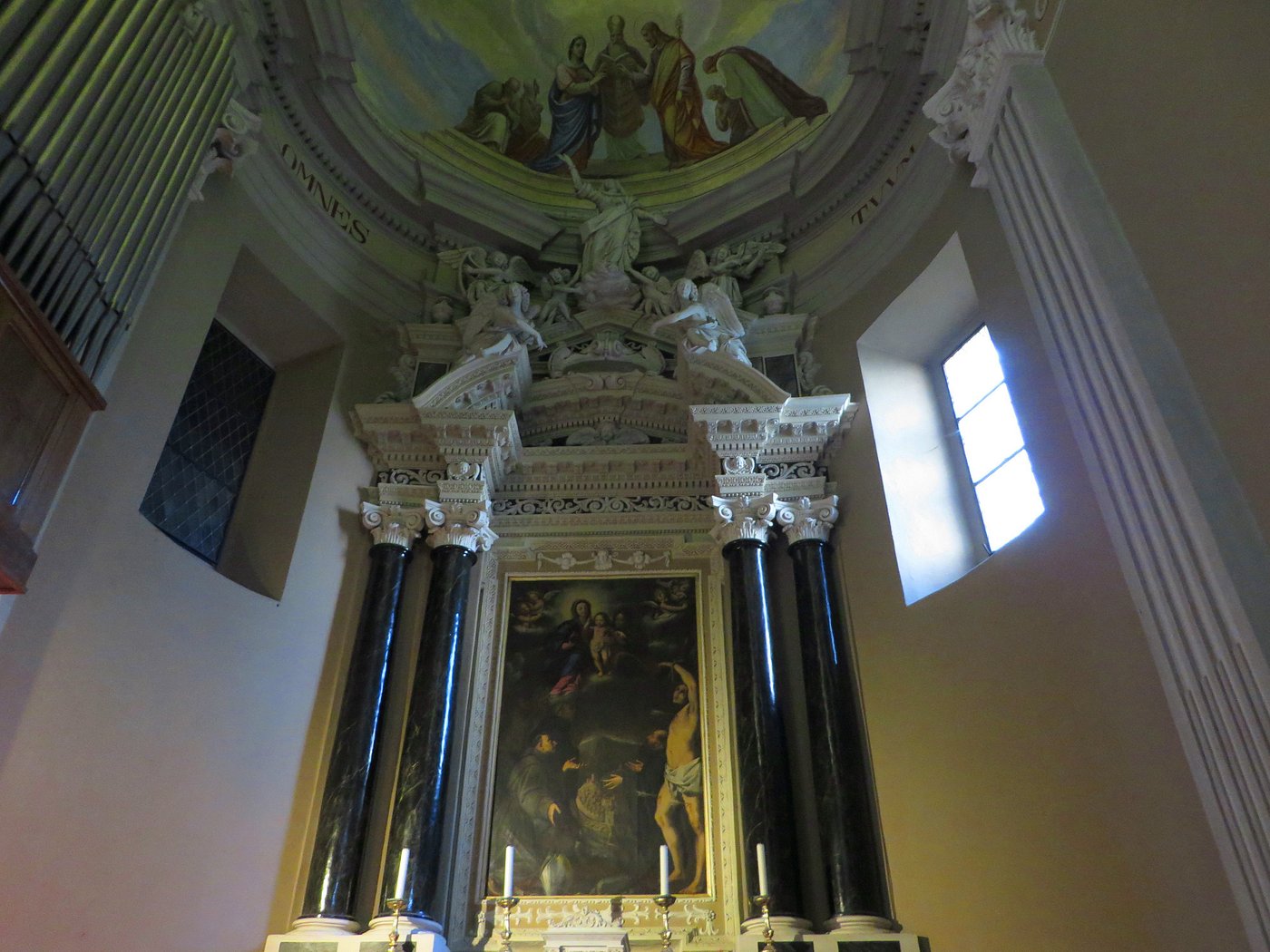
In the 1400s, Adriano Repetino had a vineyard in fields of Corgnate outside Bobbio, on the road to the hub of Piacenza. He built a wall along the road,and in it, a niche, with an image of Mary seated with the Child, who held a bouquet with one hand and raised the other in blessing. In the summer of 1472, the image became a focus of local devotion – there were miracles and the picture was seen to change its appearance. After an investigation, Church authorities decided the site merited a Chapel. Adriano Repetino donated some property and the building was dedicated to the Annunciation of Maria. On 5 June 1611, miracles resumed. The picture was found covered in sweat. Cures and other miracles multiplied. The Bishop named the wonder-working image the “Blessed Virgin of Help.” A larger, finer Church, begun in 1621, was finally consecrated on 13 July 1738 and construction continued into the 1800s. Built over the old, the newer Shrine houses the Madonna of Help’s processional Statue, modelled on the miraculous fresco in the old Shrine below.
In thanks for her protection during World War II, the Town of Bobbio named the Madonna of Help its principal Patron in 1947, when the image was officially Crowned. In 1970 Pope Paul VI elevated the Church to the rank of Basilica Minor.
St Adalar of Erfurt Bl Adalbert Radiouski Bl Adam Arakawa St Austrebertus of Vienne St Claudius of Egypt and Companions St Ðaminh Huyen St Ðaminh Toai St Dorotheus of Tyre St Elleher St Eoban of Utrecht St Eutichius of Como St Evasius of Africa St Felix of Fritzlar Blessed Ferdinand of Portugal (1402-1443) “The Holy Prince” St Franco of Assergi St Genesius, Count of Clermont St Gregory of Lilybaeum St Gundekar St Hadulph St Luke Loan Bl Meinwerk of Paderborn St Privatus of Africa St Sanctius of Córdoba St Tudno of Caernarvon St Waccar
Martyrs of Caesarea: A group of Christians who converted together, were imprisoned together, tortured together, and martyred together. We know nothing more about them but their names – Cyria, Marcia, Valeria and Zenaides. Died Caesarea, Palestine, date unknown.
Martyrs of Egypt: A group of Christians martyred together in the persecutions of Galerius Maximian. The only other information was have is three of their names – Apollonius, Marcian and Nicanor. Died in Egypt, date unknown.
Martyrs of Perugia: A group of Christians martyred together in the persecutions of Decius. We know little more than their names – Cyriacus, Faustinus, Florentius, Julian and Marcellinus. Died beheaded in 250 in Perugia, Italy
Martyrs of Rome: 26 Christians martyred together. We have no details about them but their names – Candida, Castula, Fappa, Felician, Felicitas (2 of), Felicula, Fortunatus, Gagus, Gregor, Hilarius, Ingenuus, Juliana, Martialis, Maurus, Mustilus, Nicander, Prima, Rogata, Rutianus, Sacrinus, Saturnin, Secundian, Secundus, Urbicus, Victurus. Died • Rome, Italy, date unknown • relics transferred to Antwerp, Belgium, date unknown.
Thought for the Day – 4 June – “Month of the Sacred Heart” – Meditations with Antonio Cardinal Bacci (1881-1971)
The Sacred Heart of Jesus and the Blessed Eucharist
“By means of this wonderful gift, we can live the life of Jesus Himself.
It is Our Lord Himself, Who says to us: “As the living Father has sent me and as I live because of the Father, so he who eats me, he also shall live because of me” (Jn 6:58). In other words, as He draws His divine and human life from the Father and lives by means of Him, to Whom as God, He is substantially united and equal, so anyone who partakes of the Eucharist, is united closely to Jesus, lives His life and is transformed by His supernatural grace. When Holy Communion is received, therefore, as it ought to be and as the Saints received it, it leads to the mysterious union of which St Paul speaks: “To me to live is Christ” (Phil 1:21). “It is now no longer I that live but Christ, lives in me” (Gal 2:20).
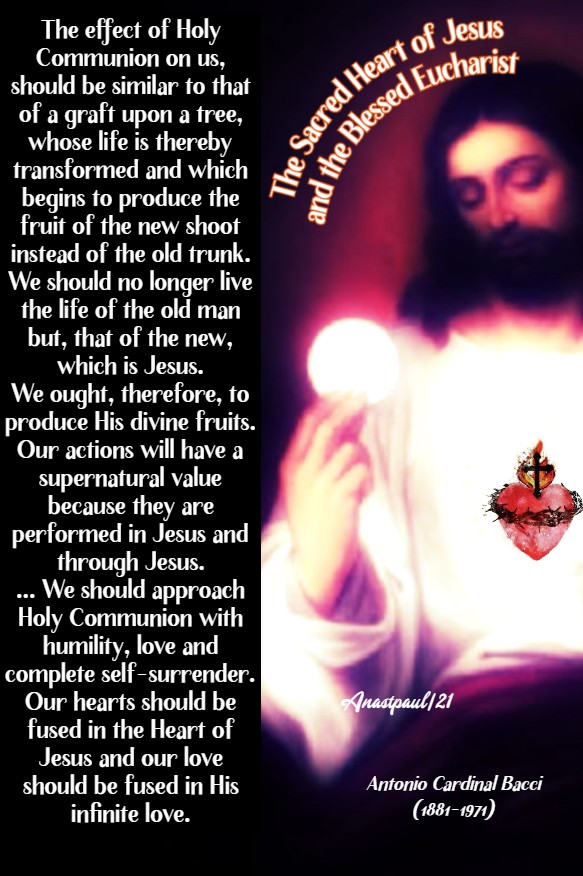
The effect of Holy Communion on us, should be similar to that of a graft upon a tree, whose life is thereby transformed and which begins to produce the fruit of the new shoot instead of the old trunk. We should no longer live the life of the old man but, that of the new, which is Jesus. We ought, therefore, to produce His divine fruits. Our actions will have a supernatural value because they are performed in Jesus and through Jesus. We should be very grateful to the Sacred Heart of Jesus for this gift of His infinite love and goodness. We should approach Holy Communion with humility, love and complete self-surrender. Our hearts should be fused in the Heart of Jesus and our love should be fused in His infinite love.”
Quote/s of the Day – 4 June – “Month of the Sacred Heart” –Readings: First: Tobit 11: 5-17, Psalm: Psalms 146: 1b-2, 6c-7, 8-9a, 9bc-10, Gospel: Mark 12: 35-37
“David himself calls him ‘Lord.’”
Mark 12:37
“Therefore, ,just as He was both the Son and the Lord of David, the Son of David, according to the flesh, the Lord of David, according to [His] divinity, so He was the Son of Mary, according to the flesh and the Lord of Mary, according to [His] majesty.”
St Augustine (354-430) Father and Doctor of Grace
“Christ has dominion over all creatures, a dominion not seized by violence nor usurped but His, by essence and by nature.”
St Cyril of Alexandria (376-444) Father and Doctor of the Church
“Who is like You, Who founded heaven and earth …, You, Who will Your delight to be with the children of humankind? How great You are, King of kings and Lord of Lords, Who rule the stars and set Your Heart on humankind!”
St Gertrude the Great of Helfta (1256-1301)
“The Name of Jesus is the purest and holiest, the noblest and most indulgent of names, the Name of all blessings and of all virtues, it is the Name of the God-Man, of sanctity itself.”
St Bernard of Clairvaux (1090-1153) Mellifluous Doctor of the Church
Jesus, Name Full of Glory By St Bernardine of Siena (1380-1444)
Jesus, Name full of glory, grace, love and strength! You are the refuge of those who repent, our banner of warfare in this life, the medicine of souls, the comfort of those who morn, the delight of those who believe, the light of those who preach the true faith, the wages of those who toil, the healing of the sick. To You our devotion aspires, by You our prayers are received; we delight in contemplating You. O Name of Jesus, You are the glory of all the saints for eternity. Amen
One Minute Reflection – 4 June – “Month of the Sacred Heart” –Readings: First: Tobit 11: 5-17, Psalm: Psalms 146: 1b-2, 6c-7, 8-9a, 9bc-10, Gospel: Mark 12: 35-37
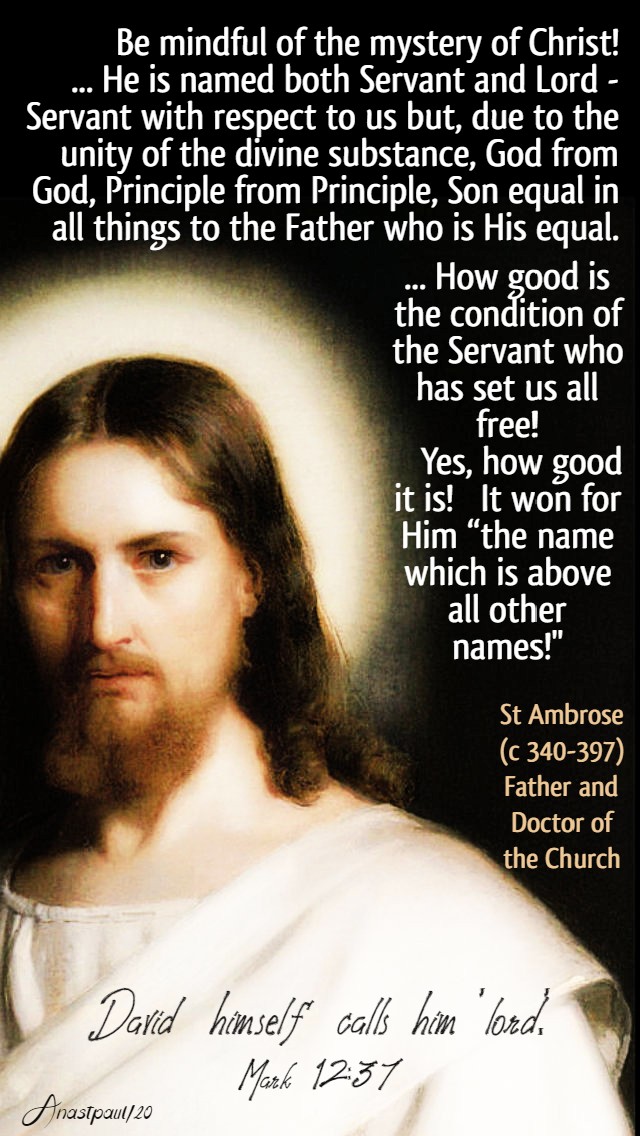
David himself calls him ‘lord.’ … Mark 12:37
REFLECTION – “Be mindful of the mystery of Christ! Born from the Virgin’s womb, both Servant and Lord – Servant to set to work, Lord to command so that He might plant a Kingdom for God in people’s hearts. Twofold in origin but one in nature, He is not one thing when He comes from the Father, another when He comes from the Virgin. He is the very same, the one born of the Father before all ages and who has taken flesh of the Virgin in the course of time. And that is why He is named both Servant and Lord – Servant with respect to us but, due to the unity of the divine substance, God from God, Principle from Principle, Son equal in all things to the Father who is His equal. For the Father has not begotten a Son different to Himself – the Son of whom He asserted: “In him I am well pleased” (Mt 3:17) (…)
In every respect the Servant preserves His titles of dignity. God is great and the Servant is also great – when He came in the flesh He did not lose this “greatness that has no limit” (Ps 145[144]:3) … “Though he was in the form of God he did not regard equality with God something to be grasped. Rather, he emptied himself, taking the form of a slave” (Phil 2:6-7) … Therefore, as Son of God He is equal to God, He took the form of a slave by becoming incarnate, He whose greatness has no limit “tasted death” (Heb 2:9) (…)
How good is the condition of the Servant who has set us all free! Yes, how good it is! It won for Him “the name which is above all other names!” How good that humility is! It was through it that, “at the name of Jesus every knee should bend, of those in heaven and on earth and under the earth, and every tongue confess that Jesus Christ is Lord to the glory of God the Father” (Phil 2:10-11).” … St Ambrose (c 340-397) Father and Doctor of the Church – Sermon on Psalm 36[35]:4-5
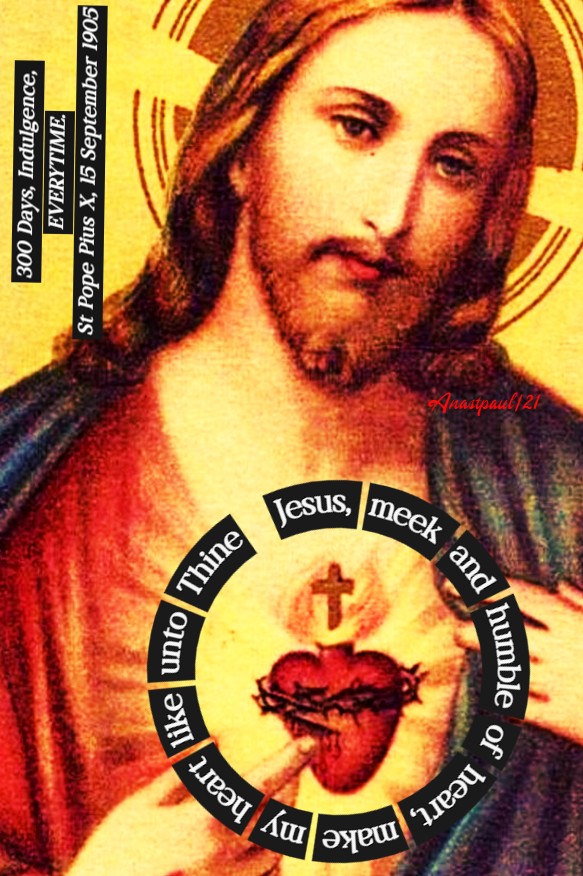
PRAYER – Almighty God, Whose grace, even here on earth brings us the gifts of heaven, turn our hearts to Yourself Lord, so that in seeking the ways of Your Son, Our Lord Jesus Christ, we too may walk in humility and love, always seeking the one thing necessary for the glory of Your kingdom. We make our prayer through Jesus Christ our Lord in the unity of the Holy Sprit, God now and for ll eternity, amen. “Jesus, meek and humble of heart, make my heart like unto Thine.” – 300 Days, EVERYTIME. (Unless otherwise stated, e.g., “once a day,” a partial Indulgence may be gained any number of times in succession.) St Pope Pius X, 15 September 1905.
Our Morning Offering – 4 June – “Month of the Most Sacred Heart of Jesus”
O Most Compassionate Jesus! By Blessed Pope Pius IX (1792-1878) Indulgence of 100 days, once a day 6 October 1870
O Most compassionate Jesus! Thou alone art our salvation, our life and our resurrection. We implore Thee, therefore, do not forsake us in our needs and afflictions but by the agony of Thy Most Sacred Heart and by the sorrows of Thy Immaculate Mother, succour Thy servants, whom Thou hast redeemed by Thy Most Precious Blood. Amen
Saint of the Day – 4 June – Blessed Pacificus of Cerano OFM (c 1424-1482) Priest of the Order of the Friars, renowned Preacher, called the “very famous apostolic orator,” Writer of spiritual works. Born as Pacifico Ramati in c 1424 at Cerano, Novara, Lombardy, Italy and died on 14 June 1482 in Sassari, Sardinia, Italy of natural causes. He was considered by scholars to be “outstanding for doctrine and holiness, the care and protection of his homeland.” Patronage – Cerano, Italy. Also known as – Pacifico Ramati, Pacificus of Ceredano, Pacificus Ramota.
The Roman Martyrology states of him today: “In Sassari, blessed Pacifico Ramati, priest of the Order of Minors, who preached in defense of Christians and died in the Lord.”
A native of Cerano in the Province of Novara, Pacifico Ramati was orphaned at an early age and welcomed in the Monastery of St Lorenzo dei Benedettini were he was educated by the Superior in all necessary studies and in love of God and neighbour.
On the death of the Superior, his benefactor, he chose to remain in the religious state but preferring the Franciscan Order of Minors, thus entering the famous Observants Convent of St Nazario della Costa, already the cradle of future Saints of the Order.
After being Ordained as a Priest and having excelled in his studies, he was sent to the Sorbonne in Paris, where he obtained his doctorate. He returned to Italy and dedicated himself to preaching with fervour and competence, so as to be considered another St Bernardine and nicknamed the “very famous apostolic orator.”
He fought the religious ignorance of both the faithful and the clergy, especially in matters of penance. Pacificus became very active against religious ignorance and wrote the “Summa Pacifica,” a dissertation written in Italian and named after him ,as the Summa Pacifica which elaborates on the proper method of hearing Confessions. It was published in 1474 in the vernacular in order to reach as many as possible. The work was also published in Latin at Venice on two occasions first in 1501 and then in 1513.
His work took place in particular in Piedmont and Lombardy and in Cerano where he often returned and where he had a Chapel built to the Madonna to increase her devotion.
In 1471 Pope Sixtus IV sent him on a special mission to Sardinia and then a second time in 1480 during the Arab invasion of Mohammed II, with the task of organising a special Crusade against the Turks.
After two years of fruitful missionary efforts, on 4 June 1482, he died in Sassari consumed by apostolic labours. Fulfilling his wishes, his body was buried in the Franciscan Church in Cerano and some of his relics were given to the Parish Church as Patron of the Town. He was immediately honoured as a Saint and Pope Benedict XIV approved the cult on 12 May 1746.
Virgen María Sembradora / Virgin Mary the Planter, Hurlingham, Buenos Aires, Argentina – 4 June :
She is a great sower in the world of the best Seed, that of her Son. She was chosen to be the door of that great Seed that has changed the colour and flavour of all things and peoples of this world, Jesus Christ, the Son of God. A planter of the Gospel as a woman in her home, in that family of Nazareth where Jesus grew in wisdom and truth. She sowed silence around her Son, a silence of listening, of following, of accepting God’s will. But she also sowed commitment to the need of Elizabeth her relative and at that wedding in Cana. She again put seeds of the Kingdom at the foot of the Cross, welcoming that disconsolate disciple, becoming a Mother to him and to us all. Her seeds of unity, affection and advice in the midst of the community bore fruit … Today she continues to plant all this in our hearts to love her Son Jesus and God our Father who chose her as His Masterpiece.
The image of Virgen Maria Sembradora / Virgin Mary the Planter is housed in the Parish “San Carlos Borromeo” in Hurlingham, Buenos Aires, Argentina. The Virgin carries in her right hand the Seed of the Word, planting it in the hearts of the faithful.
A Novena is begun on 25 May and on 4 June every year, the Statue is carried out in procession.
St Aldegrin of Baume St Alexander of Verona St Alonio Bl Antoni Zawistowski St Aretius of Rome Bl Boniface of Villers St Breaca of Cornwall St Buriana of Cornwall St Christa of Sicily St Clateus of Brescia St Cornelius McConchailleach St Croidan St Cyrinus of Aquileia St Dacian of Rome St Degan St Edfrith of Lindisfarne St Elsiar of Lavedan St Ernin of Cluain
St Francis Caracciolo CRM (1563-1608) Priest, Co-Founder of the Congregation of the Clerics Regular Minor with Venerable John Augustine (1551-1587) the “Adorno Fathers,” Confessor, Apostle of the Eucharistic Adoration. His body was given enough preparation for a long journey to Naples. Truly, God has left His own sign on him. When the body was lanced, the blood spouted a red and scented fluid and his vital organs were uncorrupted. Around his heart were printed the words of the Psalm: “The zeal of your house consumes me” (Ps 69:10). Wow!: https://anastpaul.com/2020/06/04/saint-of-the-day-4-june-saint-francis-caracciolo-crm-1563-1608/
Bl Francis Ronci Bl Margaret of Vau-le-Duc St Medan Bl Menda Isategui St Metrophanes of Byzantium St Nennoc St Nicolo of Sardinia St Optatus of Milevis Blessed Pacificus of Cerano OFM (c 1424-1482) Priest of the Order of the Friars Minor of St Francis St Petroc of Cornwall St Quirinus of Croatia St Quirinus of Tivoli St Rutilus of Sabaria Saturnina of Arras Bl Stanislaw Kostka Starowieyski St Trano of Sardinia St St Walter of Fontenelle Walter of Serviliano — Martyrs of Cilicia – 13 saints: A group of 13 Christians who were martyred together. The only details about them that have survived are their names – • Cama• Christa• Crescentia• Eiagonus• Expergentus• Fortunus• Italius • Jucundian• Julia• Momna• Philip• Rustulus• Saturnin They were martyred in in Cilicia, Asia Minor (in modern Turkey), date unknown
Martyrs of Nyon – 41 saints: A group of 41 Christians martyred together for refusing to sacrifice to imperial Roman idols. We know the names of some but no other details. • Amatus• Attalus• Camasus• Cirinus• Dinocus• Ebustus• Euticus• Eutychius • Fortunius• Galdunus• Julia• Quirinus• Rusticus• Saturnina• Saturninus • Silvius• Uinnita• Zoticus Martyred by being beheaded in Noviodunum (modern Nyon, Switzerland).
Thought for the Day – 3 June – “Month of the Sacred Heart” – Meditations with Antonio Cardinal Bacci (1881-1971)
The Love of the Sacred Heart of Jesus Revealed in the Gospel
“The whole life of our Saviour was motivated by love for us, from the moment of birth to the moment of death. Let us recall to mind, an incident of particular significance; Jesus was at the gate of Nain when a funeral procession came out from the City. The only son of a poor widow had died. He was all that she had in life. The Heart of Jesus was moved with compassion. He stopped the procession, recalled the young man to life and restored him to his mother.
Once, when Jesus was preaching in the desert, He was surrounded by a multitude who had followed Him there, without giving thought to material necessities. His Heart was touched by th sight of this hungry crowd. “I have compassion on the crowd,” (Mk 8:2) He said and performed the miracle of the multiplication of the loaves.
One day, Jesus saw a poor woman in tears who was surrounded by a group of men who were planning to stone her. She was an adulteress and this was the penalty commanded by the law of Moses. But Jesus looked into the soul of the unfortunate woman and saw, that she was repentant. He looked into the hearts of the men who had condemned her and saw, that they were full of evil. “Let him who is without sin among you,” He said, “be the first to cast a stone at her.” At this, her accusers went away. Jesus turned to the woman, “has no-one condemned thee,” He asked her. “Neither will I condemn thee. Go thy way and from now on, sin no more” ((Jn 8:1-2).
Let us recall the touching parables of the prodigal son and the lost sheep. Let us recall all these pages in which the human-divine love of Jesus is forcefully shown and we shall feel eager to return such great love, to weep for our sins and to live entirely for Jesus, as He lived entirely for us.
Quote/s of the Day – 3 June – Solemnity of Corpus Christi, The Most Holy Body and Blood of our Lord Jesus Christ
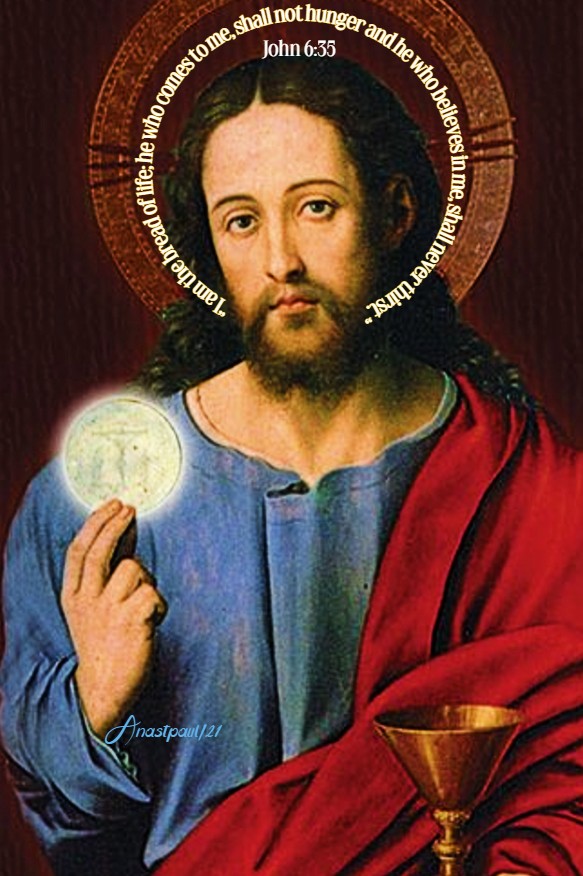
“I am the bread of life; he who comes to me, shall not hunger and he who believes in me, shall never thirst.”
John 6:35
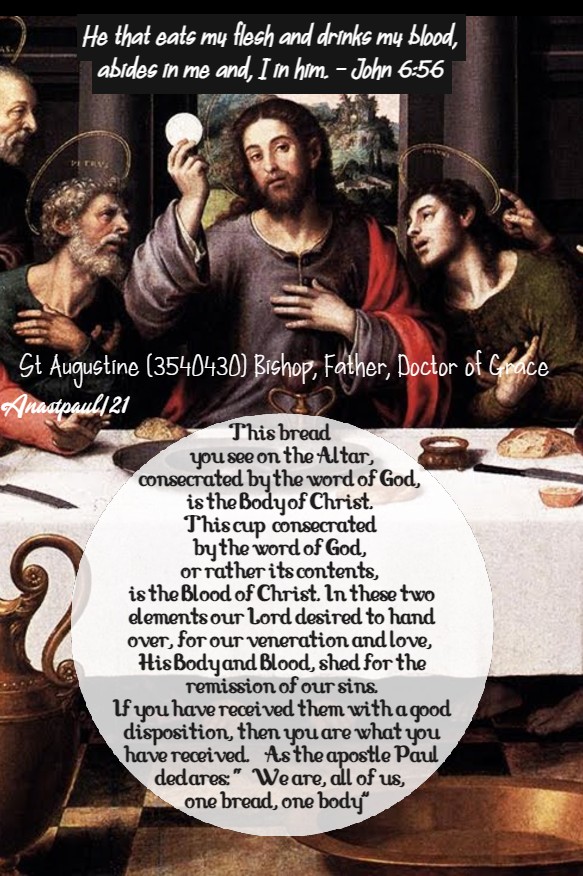
“This bread you see on the Altar, consecrated by the word of God, is the Body of Christ. This cup consecrated by the word of God, or rather its contents, is the Blood of Christ. In these two elements our Lord desired to hand over, for our veneration and love, His Body and Blood, shed for the remission of our sins. If you have received them with a good disposition, then you are what you have received. As the apostle Paul declares: “We are, all of us, one bread, one body” (1 Cor 10,17)…”
St Augustine (354-430) Bishop, Father, Doctor of Grace
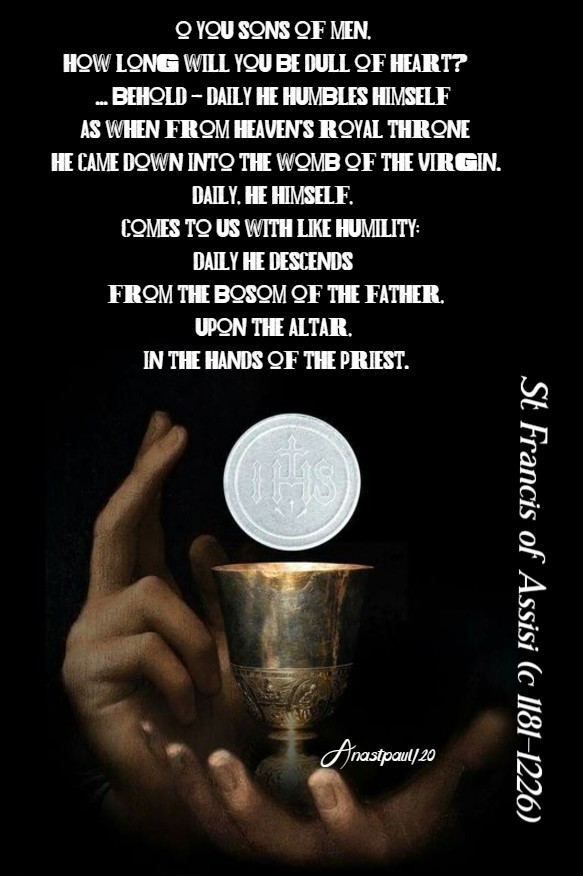
“O you sons of men, how long will you be dull of heart? … Behold – daily He humbles Himself as when from heaven’s royal throne He came down into the womb of the Virgin. Daily, He Himself, comes to us with like humility; daily He descends from the bosom of the Father, upon the Altar, in the hands of the Priest.”
St Francis of Assisi (c 1181–1226)
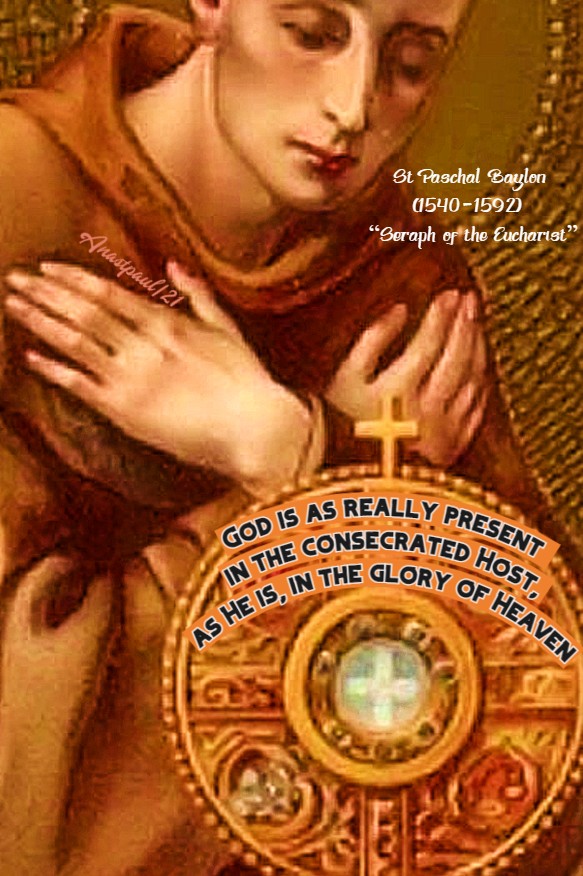
“God is as really present in the consecrated Host, as He is, in the glory of Heaven.”
St Paschal Baylon (1540-1592)
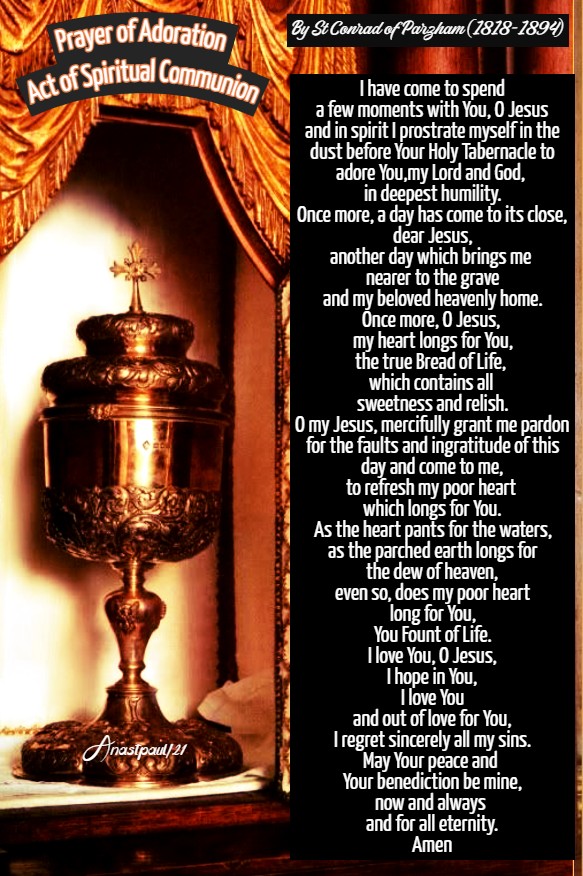
Prayer of Adoration Act of Spiritual Communion By St Conrad of Parzham (1818-1894)
I have come to spend a few moments with You, O Jesus and in spirit I prostrate myself in the dust before Your Holy Tabernacle to adore You, my Lord and God, in deepest humility. Once more, a day has come to its close, dear Jesus, another day which brings me nearer to the grave and my beloved heavenly home. Once more, O Jesus, my heart longs for You, the true Bread of Life, which contains all sweetness and relish. O my Jesus, mercifully grant me pardon for the faults and ingratitude of this day and come to me, to refresh my poor heart which longs for You. As the heart pants for the waters, as the parched earth longs for the dew of heaven, even so, does my poor heart long for You, You Fount of Life. I love You, O Jesus, I hope in You, I love You and out of love for You, I regret sincerely all my sins. May Your peace and Your benediction be mine, now and always and for all eternity. Amen
One Minute Reflection – 3 June – Solemnity of Corpus Christi, The Most Holy Body and Blood of our Lord Jesus Christ, Readings: First: Exodus 24: 3-8, Psalm: Psalms 116: 12-13, 15-16, 17-18 (13), Second: Hebrews 9: 11-15, Gospel: John 6:44-51
“The bread that I will give, is my flesh for the life of the world.” – John 6:51
REFLECTION – “They are wholly mistaken who reject God’s plan for His creation, deny the salvation of the flesh and scoff at the idea of its regeneration, asserting that it cannot put on an imperishable nature. If the flesh is not saved, then the Lord did not redeem us with His Blood, the Chalice of the Eucharist is not a share in His Blood and the Bread which we break is not a share in His Body (1Cor 10,16). For… the human substance, which the Word of God truly became, redeems us with His Blood…
Since we are His members (1Cor 6,15) and are nourished by His creation… He declared, that the Chalice of His creation is His own Blood, from which He augments our own blood and He affirmed, that the Bread of His creation is His own Body from which He gives growth to our being.
So, when the mixed chalice and the baked loaf receive the word of God and when the Eucharistic elements become the Body and Blood of Christ, which brings growth and sustenance to our bodily frame, how can it be maintained that our flesh is incapable of receiving God’s gift of eternal life?
For our flesh feeds on the Lord’s Body and Blood and is His member. So Saint Paul writes: “We are members of his body, of his flesh and of his bones” (Eph 5,30; Gn 2,23). He is not speaking about some spiritual and invisible man…: he is speaking of the anatomy of a real man, consisting of flesh, nerves and bones. It is this that is nourished by His Chalice, the Chalice of His Blood and gains growth from the Bread which is His Body… In the same way, our bodies are nourished by the after being buried in the earth and… rise again in due season, when the word of God confers resurrection upon them “for the glory of God the Father” (Phil 2,11).” – St Irenaeus of Lyons (130-202) Bishop, Theologian and Martyr
PRAYER – Lord Jesus Christ, You gave Your Church an admirable Sacrament, as the abiding memorial of Your Passion. Teach us so to worship the sacred mystery of Your Body and Blood, that ts redeeming power may sanctify us always. Who live and reign with the Father and the Holy Spirit, God forever and ever, amen.
Our Morning Offering – 3 June – Solemnty of Corpus Christ, The Most Holy Body and Blood of our Lord Jesus Christ
St Thomas Aquinas wrote the Liturgy for Corpus Christi when Pope Urban IV added the Solemnity to the universal Church’s Liturgical calendar in 1264. He provided a great sequence, one of the great poems chanted or recited before the proclamation of the Gospel. Lauda Sion is one of only four medieval sequences which were preserved in the Roman Missal published in 1570 following the Council of Trent (1545–1563)—the others being Victimae Paschali Laudes (Easter), Veni Sancte Spiritus (Pentecost) and Dies irae (requiem masses). (A fifth, Stabat Mater, would later be added in 1727.) Before Trent, many feasts had their own sequences. The existing versions were unified in the Roman Missal promulgated in 1570. The Lauda Sion is still sung today as solemn Eucharistic hymn, though its use is optional in the post-Vatican II Ordinary form. As with St Thomas’s other three Eucharistic Hymns, the last few stanzas of the Lauda Sion are often used alone, in this case, to form the “Ecce Panis Angelorum”.
Lauda Sion Salvatorem Sion, Lift Up thy Voice and Sing (Excerpt) By St Thomas Aquinas (1225-1274) Doctor Angelicus / Doctor Communis
Sion, lift thy voice and sing, Praise thy Saviour and thy King, Praise with hymns thy Shepherd true, Dare thy most to praise Him well, For He doth all praise excel, None can ever reach His due.
Special theme of praise is Thine, That true living Bread divine, That life-giving flesh adored, Which the brethren twelve received, As most faithfully believed, At the Supper of the Lord.
Let the chant be loud and high, Sweet and tranquil be the joy Felt to-day in every breast; On this festival divine Which recounts the origin Of the glorious Eucharist.
Saint of the Day – 3 June – Saint Kevin of Glendalough (c 498-618) Priest, Founder and first Abbot of the Glendalough Monastery in County Wicklow, Ireland, Hermit, Ascetic and Mystic, scholar, Spiritual Adviser, miracle-worker., he possessed a miraculous affinity with animals and nature. Born in c 498 as Coemgen which means “fair-begotten”, or “of noble birth” at the Fort of the White Fountain, Leinster, Ireland and died on 3 June 618 of natural causes. Patronages – blackbirds, Archdiocese of Dublin, Glendalough. Also known as – Kevin of Glen da locha, Caoimhghin, Coemgen, Coemgenus, Comegen, Keivin. Glendalough, or the Glen of two Lakes, is one of the most important sites of monastic ruins in Ireland. Before the arrival of St Kevin this glen would have been desolate and remote, ideal for a secluded retreat.
Kevin (like St Columba) was of noble birth, the son of Coemlog and Coemell of Leinster. He was born in c 498 at the Fort of the White Fountain and Baptised by Saint Cronan of Roscrea. He became a pupil of Saint Petroc of Cornwall, who had come to Leinster about 492. He was Ordained by Bishop Lugidus and, following his Ordination, he moved to Glendalough in order to live a life of contemplation and prayer. He lived as a Hermit in a partially man made cave, now known as St Kevin’s Bed, to which he was led, in the account of his Vita, by an angel.
St Kevin’s Bed can best be described as a man-made cave cut in the rock face very close to the edge of the mountain. It overlooks the upper lake from a height of about 0 metres. The approach to the cave is very difficult, with access to it through a rectangular space and a short passageway 1 metre high and les than that in width. The inner or main part of the cave is just 1.5 metres wide and less than 31 metre high. It is reasonable to assume that the cave could only have been used as a sleeping place and would have been impossible for an adult to stand upright in, so it is quite likely that St Kevin only used it as his bed, or a place for pious prayer or meditation.
There is a legend which claims that St Laurence O’Toole used the “bed” as he frequently made penitential visits to Glendalough, especially during the season of Lent.
Kevin lived the life of a hermit there with an extraordinary closeness to nature. His companions were the animals and birds all around him. He lived as a Hermit for seven years wearing only animal skins, sleeping on stones and eating very sparingly.
He went barefoot and spent his time in prayer. Disciples were soon attracted to Kevin and a further settlement enclosed by a wall, called Kevin’s Cell, was established nearer the lakeshore. By 540 Saint Kevin’s fame as a teacher and holy man had spread far and wide. Many people came to seek his help and guidance. In time, Glendalough grew into a renowned seminary of saints and scholars and the parent of several other Monasteries.
In 544, Kevin went to the Hill of Uisneach in County Westmeath to visit the holy Abbots, Sts Columba, Comgall and Cannich and to establish a brotherly league of communication with them. He then proceeded to Clonmacnoise, where St Cieran had died three days before. Having firmly established his community, he retired into solitude for four years and only returned to Glendalough at the earnest entreaty of his Monks. Until his death in 618, Kevin presided over his Monastery in Glendalough, living his life by fasting, praying and teaching. St Kevin is one of the Patron Saints of the diocese of Dublin.
He belonged to the second order of Irish saints. Eventually, Glendalough, with its seven Churches, became one of the chief pilgrimage destinations in Ireland.
Kevin of Glendalough was Canonised by St Pope Pius X on 9 December 1903 (cultus confirmation).
You were privileged to live in the Age of Saints, O Father Kevin being Baptised by one Saint, taught by another and buried by a third. Pray to God that He will raise up saints in our day to help, support and guide us into the Way of salvation. (A troparion to St Kevin)
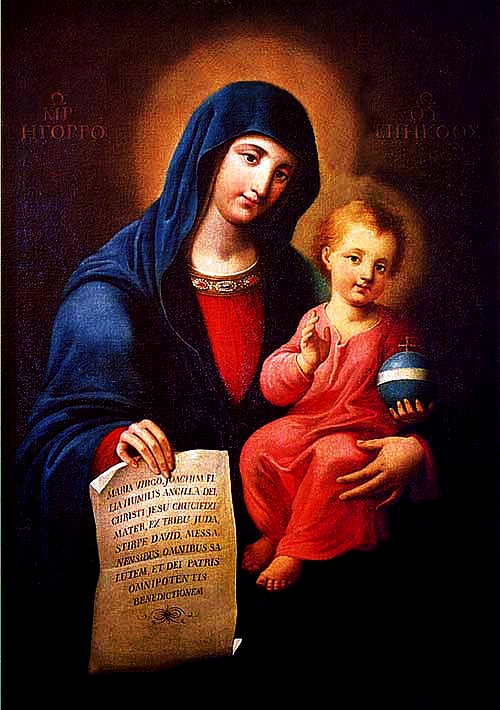
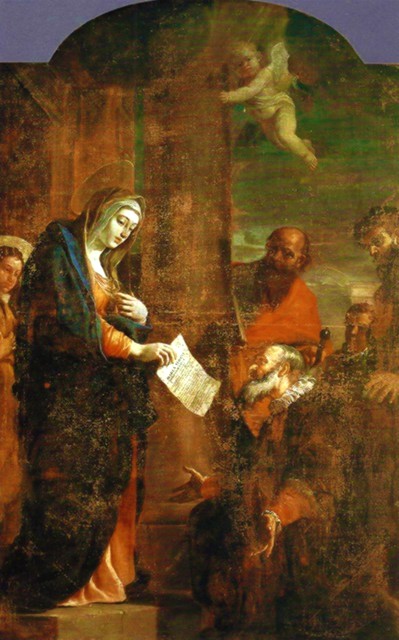
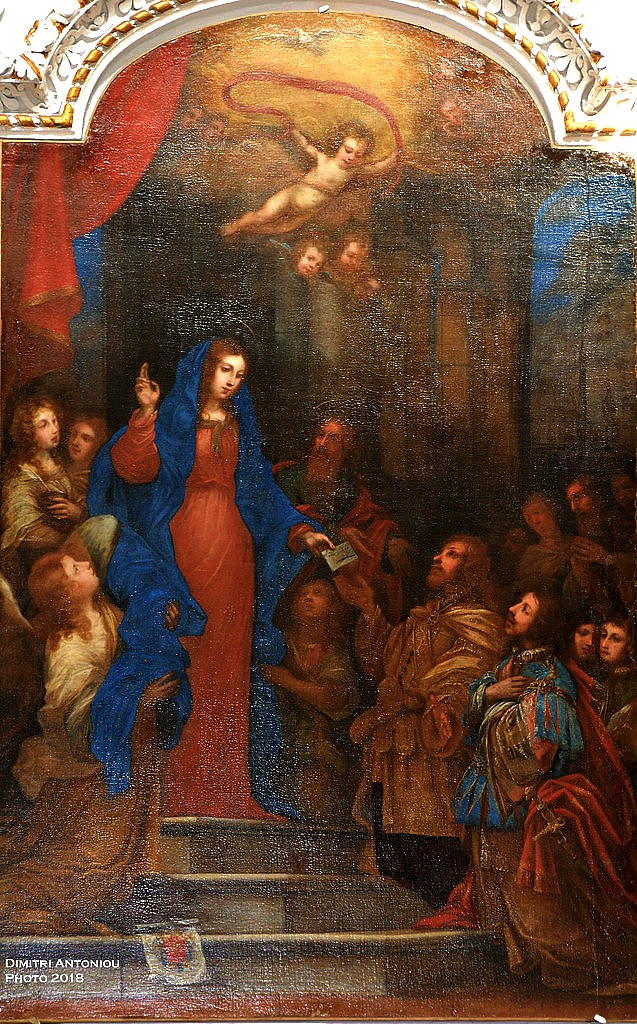
Madonna della Lettera / Our Lady of the Letter (Messina, Sicily, Italy) 1693 – Patron of Messina, Palmi (Reggio Calabria) and of Finale (Palermo) – 3 June and 9 January:
According to tradition, Saint Paul arrived in Messina to preach the Gospel and the population welcomed him with enthusiasm, thus obtaining many conversions. In 42, when Paul was about to return to Palestine, some Messinesi asked to accompany him in order to get to know Our Lady in person. So a delegation of Messinesi went to Palestine with a missive, in which many fellow citizens converted to the faith of Christ, professed their faith and asked for the protection of Mary.
Mary welcomed them and, in response to the letter, sent back a letter of her, written in Hebrew, rolled up and tied with a lock of her hair. The delegation returned to Messina on 8 September 42 carrying the important letter. In it, Mary praised their faith, mentioning that their devotion pleased her and assured them of her perpetual prayers and protection.
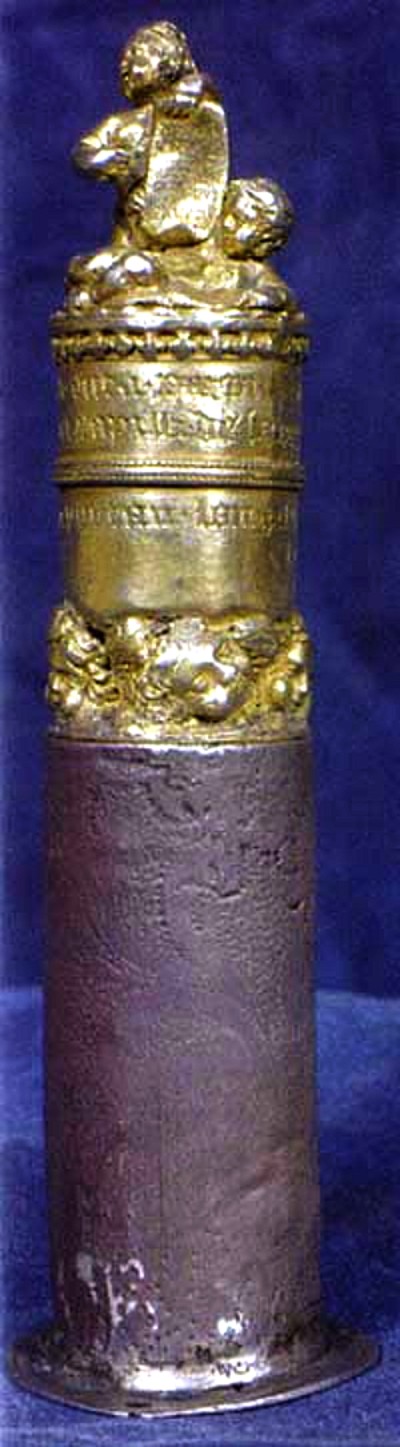
The lock of hair is kept in the Cathedral of Messina and exposed on the day of Corpus Christi set in the tree of a small galleon built in silver, which represents one of the examples of the protection of the Lady for Messina. (see image below)
The cult of Our Lady of the Letter, however, only became established in 1716, the year in which the Monk Gregorio Arena brought a translation of the letter of Mary from Arabic into Messina. Since then, the City of Messina has celebrated the festival on 3 June with a crowded procession of the silvery litter of Our Lady. The tradition of the names Letterio and Letteria (abbreviations, respectively Lillo and Lilla) derives from the cult of Our Lady of the Letter, spread above all in Messina and the Province.
The text of the letter delivered to the Messina delegation reads:
“Most humble servant of God, Mother of Jesus crucified, of the tribe of Judah, of the lineage of David, good health to all the Messinese and Blessing of God the Father Almighty. It is clear to us, through public instrument, that all of you with great faith, have sent Legates and Ambassadors, confessing that Our Son, begotten of God, is God and man and that after his Resurrection, ascended into heave. Having known the way of truth through the preaching of Paul, the chosen Apostle for whom we bless you and your city and, of which, we want to be its perpetual protector.
(From Jerusalem 3 June year 42 of Our Son. Indiction 1 moon XXVII) “
The phrase VOS ET IPSAM CIVITATEM BENEDICIMUS(“We bless you and your City”) is now written in large letters at the base of the Statue of Our Lady on the extreme arm of the Port of Messina. It should be noted that the text of the letter has an inconsistency in the date, since at that time Christian dating did not yet exist.
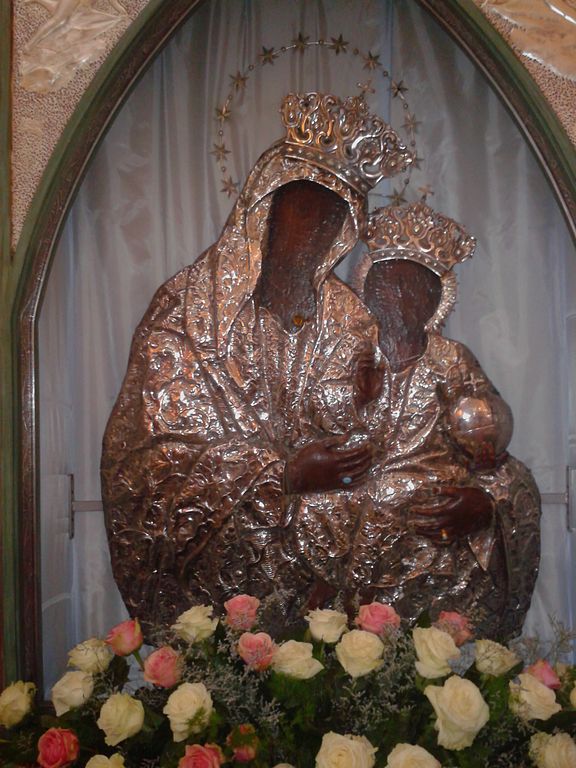
The devotion in Palmi (Reggio Calabria): – In 1575 an epidemic of plague broke out in Messina which caused the death of over 40,000 people. The citizens of Palmi welcomed those who fled the Peloritan City and also, through its sailors, sent aid of various kinds of food and oil. After the calamity, the City of Messina wanted to donate one of the hairs of Our Lady that were brought to the Sicilian City to the ecclesial authorities of Palmi, as a sign of gratitude for the help given. In 1582 a reliquary containing a Holy Hair of the Virgin arrived at the Marina di Palmi. From that moment, veneration towards Our Lady with the title “of the Holy Letter” began also in the people of Palmese and her Effigy carved in dark wood and enclosed in a silver mantle, similar to that venerated in the Peloritan City, was adopted.
Martyrs of Uganda (Memorial) – 22 saints: Twenty-two (22) young Ugandan converts martyred in the persecutions of King Mwanga. They are – • Achileo Kiwanuka • Adolofu Mukasa Ludigo • Ambrosio Kibuuka • Anatoli Kiriggwajjo • Anderea Kaggwa • Antanansio Bazzekuketta • Bruno Sserunkuuma • Charles Lwanga • Denis Ssebuggwawo • Gonzaga Gonza • Gyavire • James Buzabaliao • John Maria Muzeyi • Joseph Mukasa • Kizito • Lukka Baanabakintu • Matiya Mulumba • Mbaga Tuzinde • Mugagga • Mukasa Kiriwawanvu • Nowa Mawaggali • Ponsiano Ngondwe They were Canonised on 18 October 1964 by Pope Paul VI at Rome, Italy. The Lives and Martyrdom of the Ugandan Martyrs: https://anastpaul.com/2017/06/03/saints-of-the-day-3-june-uganda-martyrs-or-st-charles-lwanga-companions/
Bl Adam of Guglionesi St Albert of Como St Athanasius of Traiannos St Auditus of Braga Bl Beatrice Bicchieri St Caecilius of Carthage
St Charles Lwanga & Companions (see the Martyrs of Uganda above)
Bl Charles-René Collas du Bignon St Clotilde of France St Conus of Lucania St Cronan the Tanner St Davinus of Lucca Bl Diego Oddi Bl Francis Ingleby St Gausmarus of Savigny St Genesius of Clermont St Glunshallaich St Hilary of Carcassone St Isaac of Córdoba
St Laurentinus of Arezzo St Liphardus of Orléans St Morand of Cluny St Moses of Arabia St Oliva of Anagni St Paula of Nicomedia St Pergentinus of Arezzo St Phaolô Vu Van Duong St Urbicius — Dominicans Martyred in China
Martyrs of Africa – 156 saints: 156 Christians martyred together in Africa, date unknown; the only other information to survive are some of their names – • Abidianus• Demetria• Donatus• Gagus• Januaria• Juliana• Nepor• Papocinicus• Quirinus• Quirus Martyrs of Byzantium – 5 saints: A group of Christians, possibly related by marriage, who were martyred together. They were – • Claudius• Dionysius• Hypatius• Lucillian• Paul They were Martyred in 273 in Byzantium.
Martyrs of Rome – 8 saints: A group of Christians martyred together. We know nothing else about them but the names – • Amasius• Emerita• Erasmus• Lucianus• Orasus• Satuaucnus• Septiminus• Servulus They were Martyred in Rome, Italy, date unknown.
Martyrs of Rome – 86 saints: 85+ Christians martyred together in Rome, Italy, date unknown. The only details that have survived are some of their names – • Apinus • Apronus • Aurelius • Avidus • Cassianus • Criscens • Cyprus • Domitius • Donata • Donatus • Emeritus • Extricatus • Exuperia • Faustina • Felicitas • Felix • Flavia • Florus • Fortunata • Fortunatus • Fructus • Gagia • Gagus • Gallicia • Gorgonia • Honorata • Januaria • Januarius • Justa • Justus • Libosus • Luca • Lucia • Matrona • Matura • Mesomus • Metuana • Nabor • Neptunalis • Obercus • Paula • Peter • Pompanus • Possemus • Prisca • Procula • Publius • Quintus • Rogatian • Romanus • Rufina • Saturnin • Saturnus • Secundus • Severa • Severus • Sextus • Silvana • Silvanus • Sinereus • Tertula • Titonia • Toga • Urban • Valeria • Veneria • Veranus • Victor • Victoria • Victorinus • Victuria • Victurina • Virianus • Weneria • Zetula. They were Martyred in Rome date unknown.
Thought for the Day – 2 June – “Month of the Sacred Heart” – Meditations with Antonio Cardinal Bacci (1881-1971)
The Necessity of Devotion to the Sacred Heart of Jesus
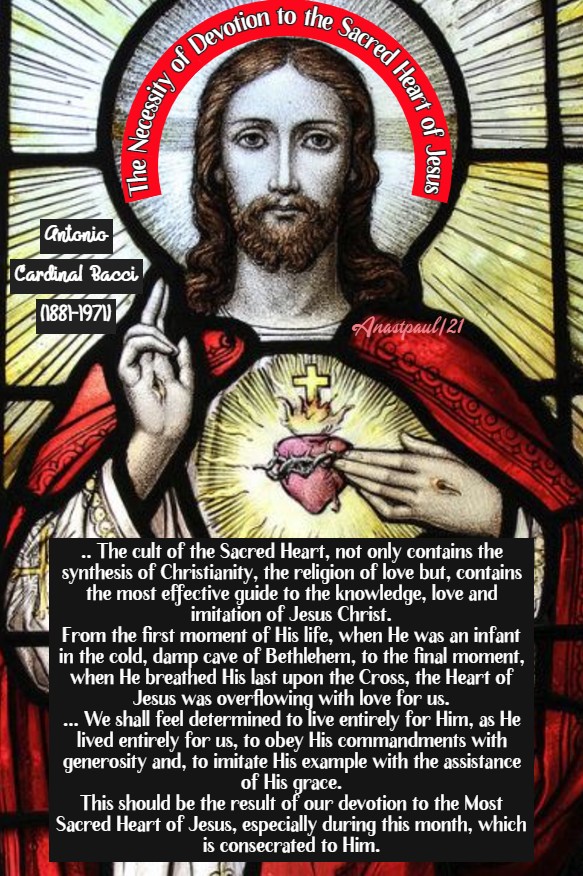
“It is necessary to develop and meditate on these words of Pius XI, (see Part One) from which, it is clear, that the cult of the Sacred Heart, not only contains the synthesis of Christianity, the religion of love but, contains the most effective guide to the knowledge, love and imitation of Jesus Christ. From the first moment of His life, when He was an infant in the cold, damp cave of Bethlehem, to the final moment, when He breathed His last upon the Cross, the Heart of Jesus was overflowing with love for us. We can learn from this, to know our Divine Saviour better, so that appreciating more fully His infinite love for us, we shall feel an upsurge of gratitude and, of love. We shall feel determined to live entirely for Him, as He lived entirely for us, to obey His commandments with generosity and, to imitate His example with the assistance of His grace. This should be the result of our devotion to the Most Sacred Heart of Jesus, especially during this month, which is consecrated to Him.
O my Jesus, You Who are Love itself, enkindle in my heart the divine fire which consumed and transformed the Saints!”
Quote/s of the Day – 2 June – “Month of the Most Sacred Heart of Jesus” – Readings: First: Tobit 3: 1-11a, 16-17a, Psalm: Psalms 25: 2-3, 4-5ab, 6 and 7bc, 8-9, Gospel: Mark 12: 18-27
“He is not God of the dead but of the living. ”
Mark 12:27
“If anyone serves me, he must follow me and where I am, there will my servant be also.”
John 12:26
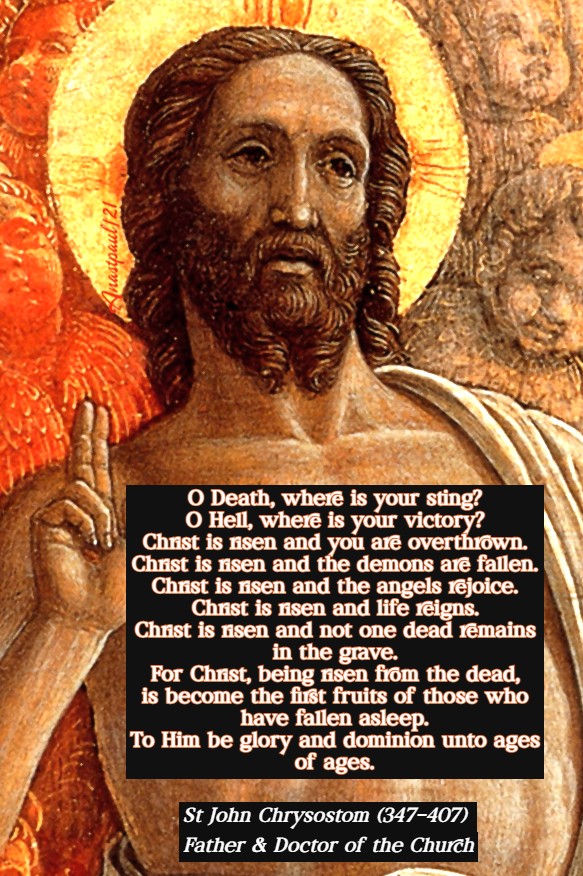
“O Death, where is your sting? O Hell, where is your victory? Christ is risen and you are overthrown. Christ is risen and the demons are fallen. Christ is risen and the angels rejoice. Christ is risen and life reigns. Christ is risen and not one dead remains in the grave. For Christ, being risen from the dead, is become the first fruits of those who have fallen asleep. To Him be glory and dominion unto ages of ages.”
St John Chrysostom (347-407) Father & Doctor of the Church
“He died, but He vanquished death. In Himself, He put an end to what we feared; He took it upon Himself and He vanquished it, as a mighty hunter, He captured and slew the lion.”
St Augustine (354-430) Father and Doctor of Grace
“How precious the gift of the Cross, how splendid to contemplate! In the Cross there is no mingling of good and evil, as in the tree of paradise; it is wholly beautiful to behold and good to taste. The fruit of this tree is not death but life, not darkness but light. This tree does not cast us out of paradise but opens the way for our return.”
St Theodore the Studite (750–826) Father, Abbot, Theologian, Writer








































 AnaStpaul
You must be logged in to post a comment.