Posted in JESUIT SJ, MARIAN TITLES, SAINT of the DAY

Notre-Dame de Chartres / Our Lady of Chartres, (Pèlerinage de Chartres / The Chartres Pilgrimage) Mother of Youth (1935) and Memorials of the Saints – 22 December

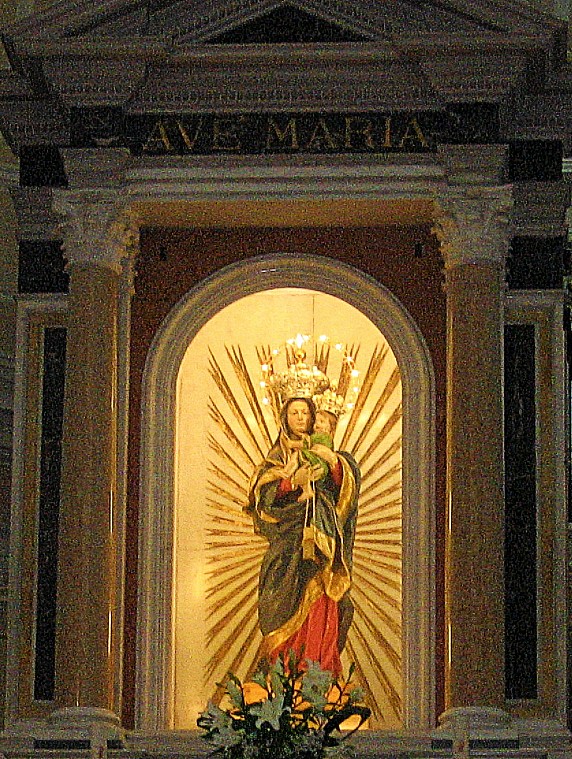
Notre-Dame de Chartres / Our Lady of Chartres, (Pèlerinage de Chartres / The Chartres Pilgrimage) Mother of Youth (1935): also known as the Pilgrimage of Christendom, has been gathering thousands of people on the Solemnity of Pentecost for a three-day trek from the Cathedral of Notre Dame in Paris to the Cathedral of Notre Dame in Chartres.
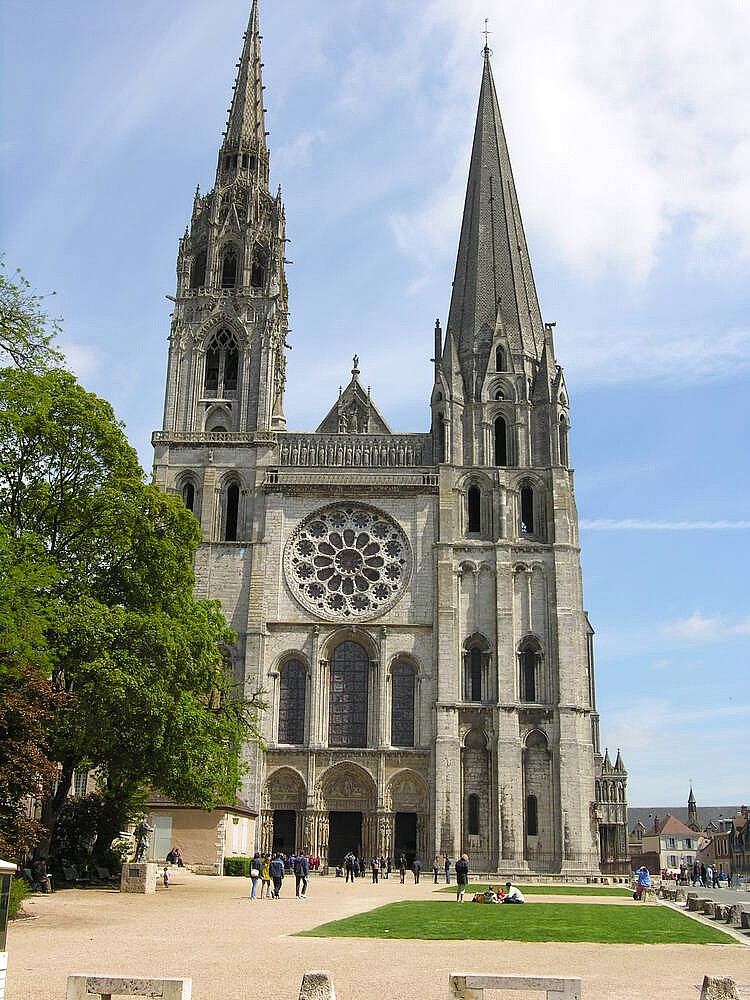
Our Lady of Chartres, or Notre-Dame de Chartres, is a beautiful Gothic style Cathedral located in Beauce, France, which is about 80 kilometres southwest of Paris. This Cathedral, which was first built in the time of the Apostles, was demolished several times over the centuries. It was re-erected in its present state by Saint Fulbert, the fifty-fifth Bishop of Chartres at the end of the 12th Century into the beginning of the 13th century.
The Pilgrimage was inspired by French-Catholic writer Charles Péguy, who made a solitary Pilgrimage from Notre Dame of Paris to the Marian Sanctuary of Chartres in 1912, covering more than 136 kilometres in four days, 14-17 June, to ask the intercession of the Virgin Mary to help his ill son. He undertook the same Pilgrimage a year later, shortly before losing his life on the battlefield at the beginning of World War I in 1914.

The student’s Pilgrimage to Chartres started in 1935 with a group of fifteen young men and girls of the Sorbonne, who sacrificed their Pentecostal holidays in prayer to the Holy Spirit and to Mary. They marched 100 kilometres to the Shrine in Chartres and prayed there together. The next year there were 36 who went and in the following year 150. Then the war came but during the eight hard years that followed, the Pilgrimages were not deserted. The numbers increased, until in 1948, about 6,500 students formed a line to march to Mary.
Most of the Pilgrims were in their early twenties or late teens, from the universities, colleges and schools of Paris and the Provinces, although some were from foreign countries. The number of unbelievers, atheists and Communists has always been high even among the students; while Protestants and Jews also make up a goodly portion of the number (very much like the Santiago de Compostela). Some come out of curiosity, some following the persistent urgings of a friend; some for the sport of hiking, or to answer an invitation to test their grit and endurance but whatever their reasons for starting, few end, without a definite spiritual “joy.” Many make the Pilgrimage in bare feet over gravel roads; the sick and crippled go, too.
In our day there are thousands, perhaps 10,000 Pilgrims who walk through the French countryside to Chartres. Their trek is an open act of faith and reparation, something almost never seen in modern times.
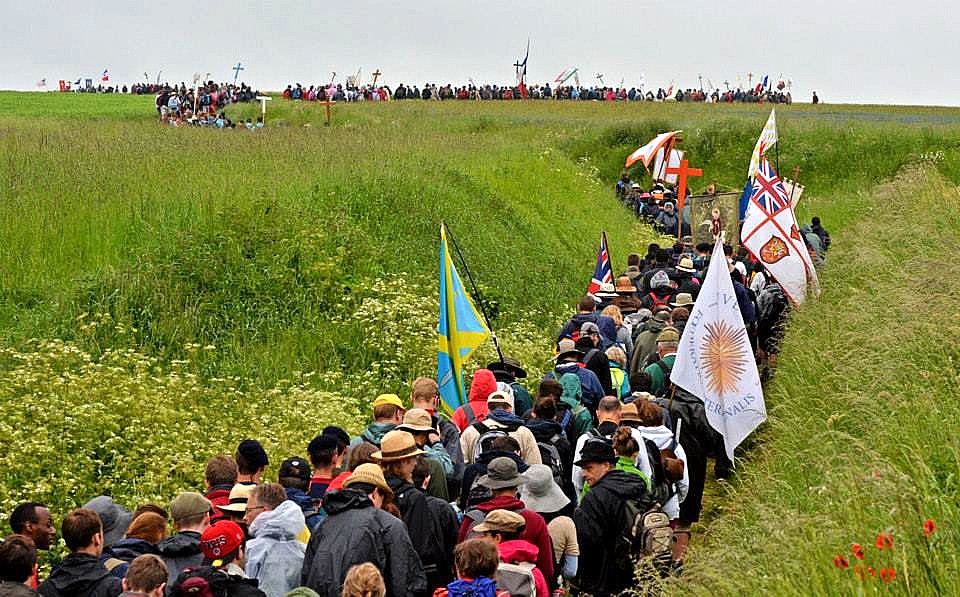
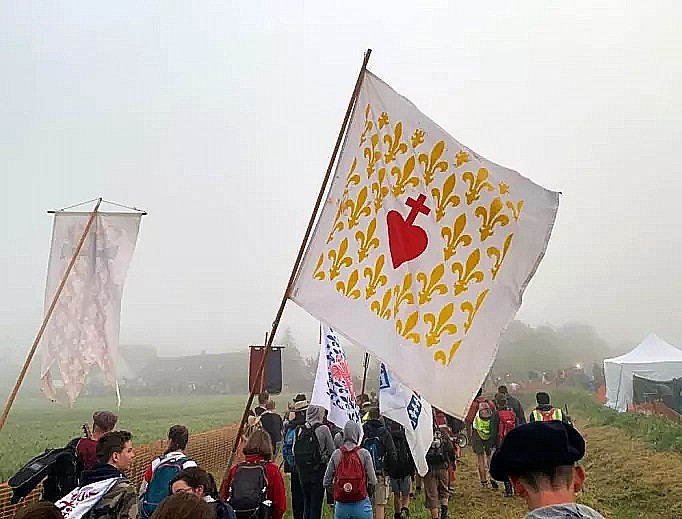
In making the Chartres Pilgrimage, these young people help to give France a new birth of devotion to Mary; something new and spotless has been born as in the warmth of endless glorious Saints – re-lit in the hearts of young moderns. France must now place her hope in youth, the youth of France and the youth of the Church, through Our Blessed Mother, Mary the Lady of Chartres. Although this is primarily a Pentecost Pilgrimage, many smaller groups commence a Pilgrimage on 22 December to be in time for Midnight Mass on Christmas Eve and, in fact, all year round. Below,  a French flag displaying the Most Sacred Heart of Jesus with ‘Hope and Salvation of France.’ A Priest hears confession while other Pilgrims participate in Adoration in the background (at the final campsite of the pilgrimage in Gas, France, about 12 miles from Chartres). 
St Frances Xavier Cabrini (1850-1917) – Universal optional memorial (except in the USA which is on 13 November) Italian-American religious sister, who founded the Missionary Sisters of the Sacred Heart of Jesus.
About St Frances:

https://anastpaul.wordpress.com/2017/12/22/saint-of-the-day-22-december-st-frances-xavier-cabrini-m-s-c-1850-1917/

St Abban of New Ross
Bl Adam of Saxony
St Amaswinthus of Málaga
St Athernaise of Fife
St Bertheid of Münster
St Chaeremon of Nilopolis
St Flavian of Acquapendente (Died 363) Martyr Layman
St Honoratus of Toulouse

St Hungerus Frisus of Utrecht (Died 866) Bishop of Utrecht
His Life:

https://anastpaul.com/2020/12/22/saint-of-the-day-22-december-saint-hungerus-frisus-of-utrecht-died-866/

St Ischirione of Alexandria

Blessed Jutta of Disibodenberg OSB (c 1084-1136) Nun of the Benedictine Order, Foundress and Abbess, Spiritual Director (most notably of St Hildegard of Bingen), Mystic, miracle worker.
Biography:

https://anastpaul.com/2018/12/22/saint-of-the-day-22-december-blessed-jutta-of-disibodenberg-osb-c-1084-1136/

Bl Ottone of Toulouse

Blessed Thomas Holland SJ (1600-1642) Priest of the Society of Jesus and Martyr. of England and Wales.
His Life and Death:

https://anastpaul.com/2019/12/22/saint-of-the-day-22-december-blessed-thomas-holland-sj-1600-1642-priest-and-martyr-his-faith-was-his-crime/

St Zeno of Nicomedia

Martyrs of Ostia – (3 saints): A group of Christians martyred together. The only details about them to survive are three names – Demetrius, Florus and Honoratus. They were martyred at Ostia, Italy.

Martyrs of Rhaitu – (43 saints): 43 monks martyred by Blemmyes, in Raíthu, Egypt, date unknown.

Martyrs of Via Lavicana – (30 saints): A group of 30 Christians martyred together in the persecutions of Diocletian.
c 303 in Rome, Italy and were buried between two bay trees on the Via Lavicana outside Rome.

Posted in "Follow Me", CHRIST the WORD and WISDOM, MEDITATIONS - ANTONIO CARD BACCI, QUOTES on BAD CONVERSATION, QUOTES on CONSOLATION, QUOTES on HUMILITY, QUOTES on PRAYER, QUOTES on SANCTITY, QUOTES on SELF-DENIAL, QUOTES on SILENCE, QUOTES on the DEVIL/EVIL, QUOTES on THE WORLD, The DIVINE INFANT, The NATIVITY of JESUS, The WILL of GOD

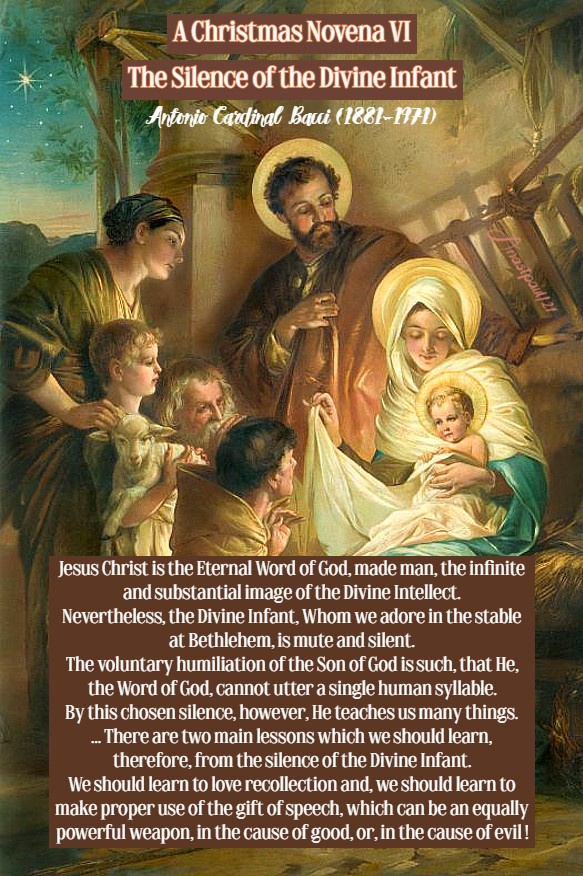
Thought for the Day – 21 December – The Silence of the Divine Infant

Thought for the Day – 21 December – Meditations with Antonio Cardinal Bacci (1881-1971)

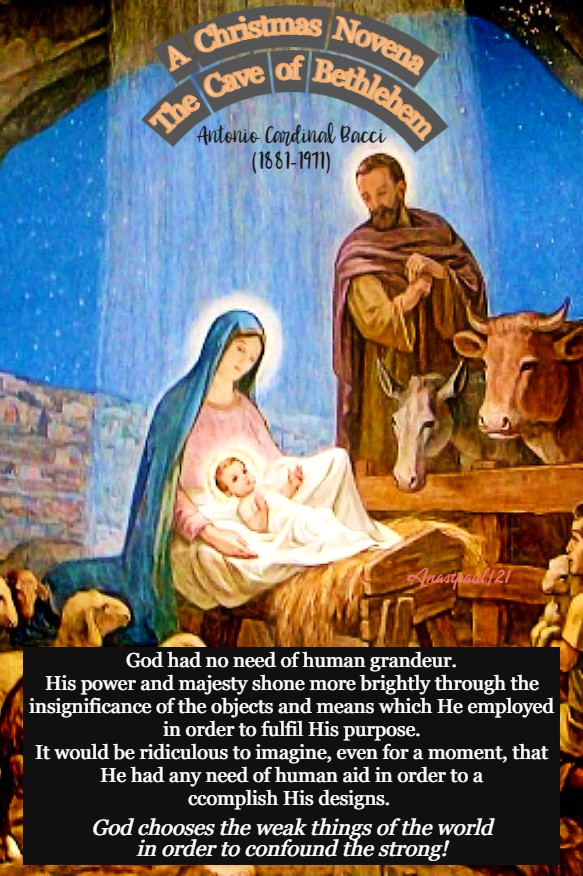
A Christmas Novena VI
The Silence of the Divine Infant

Jesus Christ is the Eternal Word of God, made man, the infinite and substantial image of the Divine Intellect.
Nevertheless, the Divine Infant, Whom we adore in the stable at Bethlehem, is mute and silent.
The voluntary humiliation of the Son of God is such, that He, the Word of God, cannot utter a single human syllable.

By this chosen silence, however, He teaches us many things.
In the first place, He teaches us humility and self-denial.
He teaches us, moreover, to recollect ourselves in the Presence of God, so that it may be easier for us to speak with Him and for Him, to make known what He requires of us.
The silence of prayer brings forth divine consolations and inspirations to holiness,

Do we love to be silent?
It is not necessary to become hermits but, it is essential, from time to time, to place ourselves quietly in the Presence of God.
God cannot be heard through the noise and confusion of the world, whereas, He speaks clearly to the soul, which seeks the silence of prayer.
In any case, if we go about looking for the gossip and idle chatter of the world, it is almost impossible not to offend God.
“Avoid profane and empty babblings,” St Paul urges us, “for they contribute much to ungodliness” (2 Tim 2:16).
“If anyone does not offend in word,” adds St James, “he is a perfect man” (Js 3:2).
“The tongue is a little member,” he continues but, goes onto emphasis that it is capable of doing either a great deal of good or a great deal of harm.
“With it, we bless God the Father and, with it, we curse men, who have been made after the likeness of God. Out of the same mouth proceed blessing and cursing. These things, my brethren ought not to be so” (Js 3:5-10).

There are two main lessons which we should learn, therefore, from the silence of the Divine Infant.
We should learn to love recollection and, we should learn to make proper use of the gift of speech, which can be an equally powerful weapon, in the cause of good, or, in the cause of evil!”

Antonio Cardinal Bacci

Posted in ArchAngels and Angels, DOCTORS of the Church, FATHERS of the Church, JESUIT SJ, MARIAN QUOTES, MOTHER of GOD, papal ENCYCLICALS, QUOTES on SANCTITY, QUOTES on the DEVIL/EVIL, The HOLY NAME of MARY

Quote/s of the Day – 21 December – Our Mother

Quote/s of the Day – 21 December – O Oriens/O Radiant Dawn – “Month of the Immaculate Conception” – Tuesday of the Fourth Week of Advent, Readings: Songs 2: 8-14 or Zephaniah 3: 14-18a; Psalm 33: 2-3, 11-12, 20-21; Luke 1: 39-45

“Having confidence in you,
O Mother of God, I shall be saved.
Being under you protection,
I shall fear nothing.
With your help,
I shall give battle to my enemies
and put them to flight,
for devotion to you,
is an arm of Salvation
.”

St John Damascene (676-749)
Father and Doctor of the Church

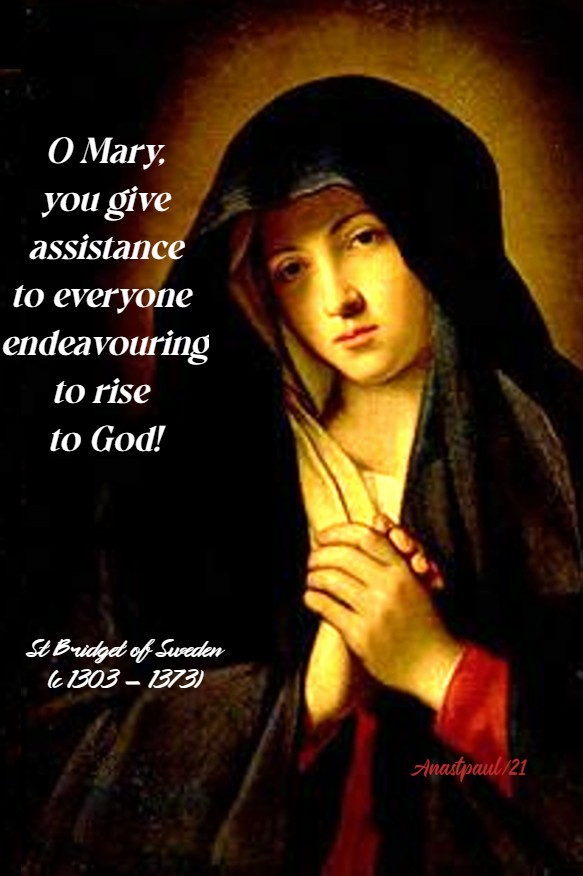
“O Mary,
you give assistance
to everyone endeavouring
to rise to God!

St Bridget of Sweden (c 1303 – 1373)

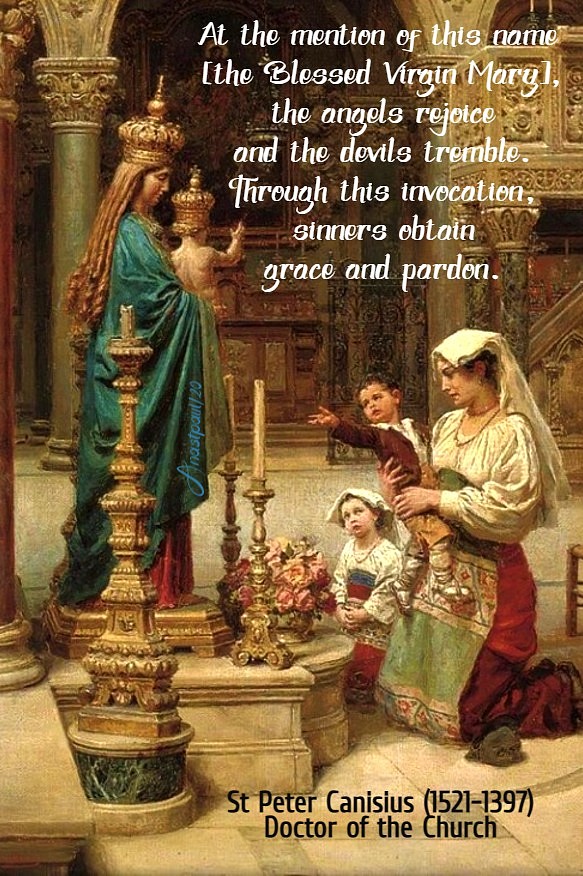
“At the mention of this name
[the Blessed Virgin Mary],
the Angels rejoice
and the devils tremble.
Through this invocation,
sinners obtain
grace and pardon.

St Peter Canisius SJ (1521-1397)
Doctor of the Church

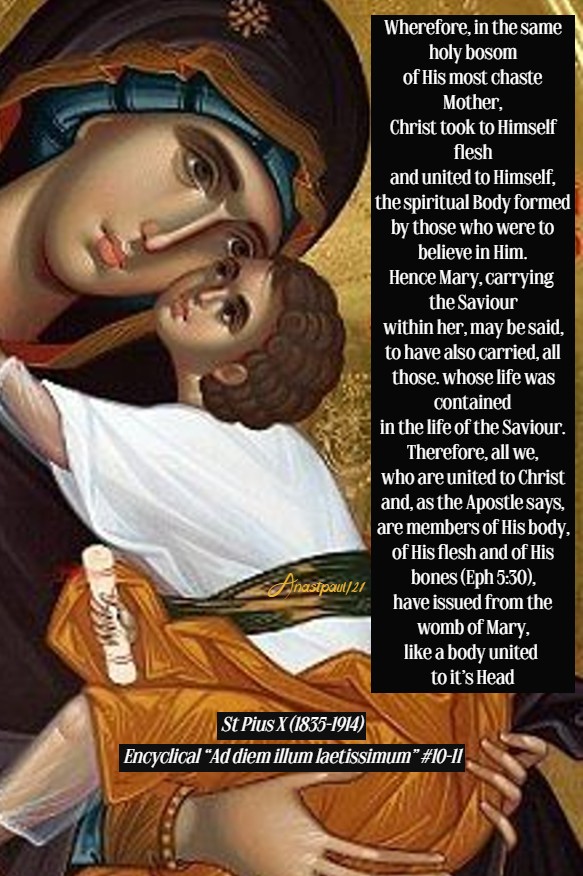
“Wherefore, in the same holy bosom
of His most chaste Mother,
Christ took to Himself flesh
and united to Himself,
the spiritual Body formed
by those who were to believe in Him.
Hence Mary, carrying the Saviour
within her, may be said,
to have also carried, all those.

whose life was contained
in the life of the Saviour.
Therefore, all we,
who are united to Christ
and, as the Apostle says,
are members of His body,

of His flesh and of His bones (Eph 5:30),
have issued from the womb of Mary,
like a body united to it’s Head.”

St Pius X (1835-1914)
Pope from 1903 to 1914
Encyclical “Ad diem illum laetissimum” #10-11

Posted in CATHOLIC-PRAYERS OF THE CHURCH, Hail MARY!, MARIAN Antiphons, MARIAN PRAYERS, MARIAN REFLECTIONS, ONE Minute REFLECTION, PRAYERS of the CHURCH, The O ANTIPHONS, The WORD

One Minute Reflection – 21 December – O Oriens/O Radiant Dawn

One Minute Reflection – 21 December – O Oriens/O Radiant Dawn – “Month of the Immaculate Conception” – Tuesday of the Fourth Week of Advent, Readings: Songs 2: 8-14 or Zephaniah 3: 14-18a; Psalm 33: 2-3, 11-12, 20-21; Luke 1: 39-45

The Lord is at hand, come let us adore Him.

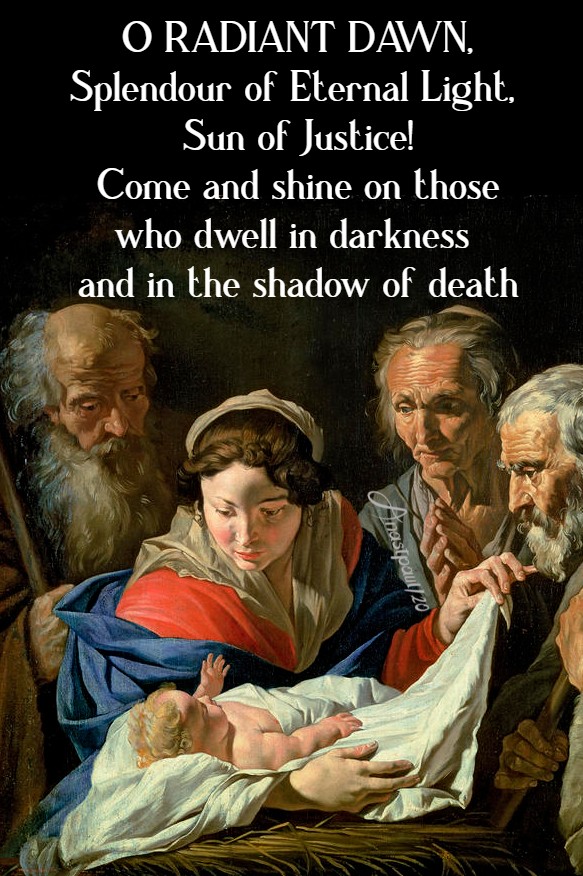
O Radiant Dawn,
Splendour of Eternal Light,
Sun of Justice!
Come and shine on those
who dwell in darkness
and in the shadow of death.

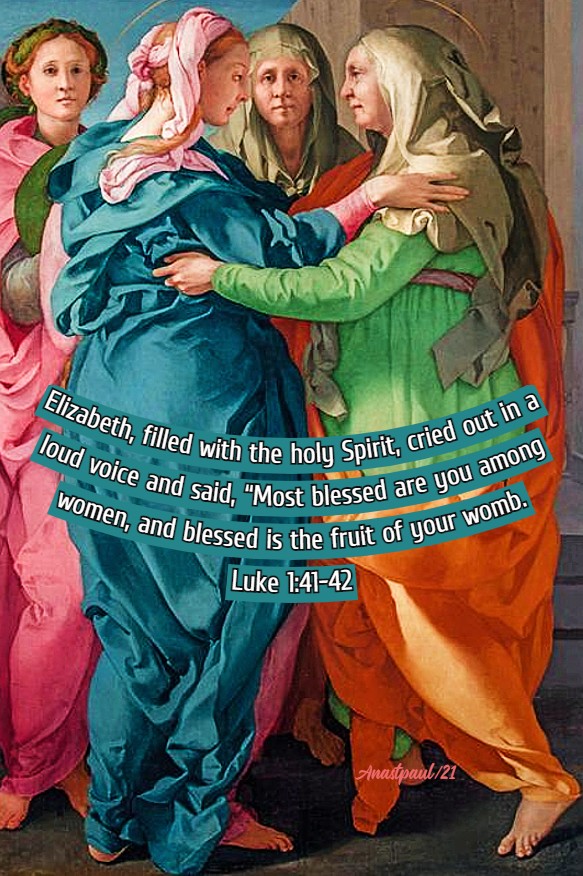
Elizabeth, filled with the holy Spirit, cried out in a loud voice and said, “Most blessed are you among women, and blessed is the fruit of your womb.” – Luke 1:41-42

REFLECTION – “Everyday we devoutly greet the most Blessed Virgin Mary with the angel’s greeting and we usually add: Blessed is the fruit of thy womb. After she was greeted by the Virgin, Elizabeth added this phrase as if she were echoing the salutation of the Angel – Blessed are you among women and blessed is the fruit of your womb. This is the fruit of which Isaiah spoke – On that day the shoot of the Lord shall be splendid and radiant—the sublime fruit of earth. What is this fruit but the holy one of Israel, the seed of Abraham, the shoot of the Lord, the flower arising from the Root of Jesse, the fruit of life, Whom we have shared?

Blessed surely in seed and blessed in the shoot, blessed in the flower, blessed in the gift, finally blessed in thanksgiving and praise, Christ, the Seed of Abraham, was brought forth from the seed of David into the flesh.

He alone among men is found perfected in every good quality, for the Spirit was given to Him without measure so that He alone could fulfill all justice. For His justice is sufficient for all nations, according to the Scriptures. As the earth brings forth its buds and as the garden germinates its own seed, so the Lord God shall bring forth justice and praise before all the nations. For this is the shoot of justice, which the flower of glory adorns with its blessings when it has grown. But how great is this glory? How can anyone think of anything more glorious, or rather, how can anyone conceive of this at all? For the flower rises from the root of Jesse. you ask: “How far?” Surely it rises even to the highest place because Jesus Christ is in the glory of God the Father. His magnificence is elevated above the heavens, so that He, the issue of the Lord, is splendid and glorious, the sublime fruit of earth.

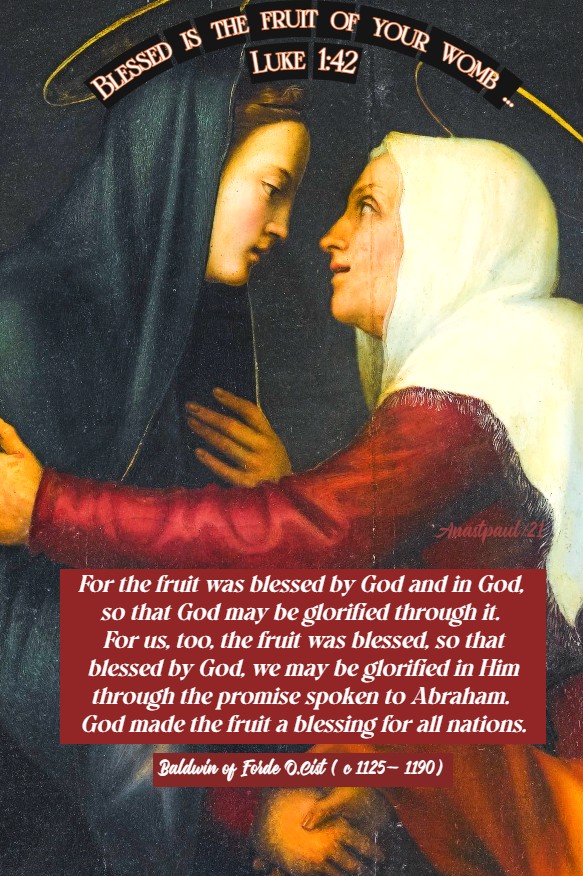
But what is our benefit from this fruit? What other than the fruit of blessing from the blessed fruit? From this seed, this shoot, this flower, surely the fruit of blessing comes forth. It has come even to us; first as a seed it is planted through the grace of pardon, then germinated with the increase of perfection and finally, it flowers in the hope or the attainment of glory. For the fruit was blessed by God and in God, so that God may be glorified through it. For us, too, the fruit was blessed, so that blessed by God, we may be glorified in Him through the promise spoken to Abraham. God made the fruit a blessing for all nations.” – Baldwin of Forde O.Cist ( c 1125– 1190) Cistercian Abbot, Bishop, then Archbishop of Canterbury ( An excerpt from A Sermon on the ‘Hail Mary’).

PRAYER – In Your goodness Lord, as we rejoice at the coming of Your Son in flesh and blood like ours, grant that when He comes again in glory, we may receive the gift of eternal life. And may His Blessed and Immaculate ever Virgin Mother, cast upon us a look of mercy and intercede on our behalf. Through Jesus Christ our Lord, with the Holy Spirit, God now and for all eternity, amen.

Posted in CATHOLIC-PRAYERS OF THE CHURCH, Hail MARY!, MARIAN Antiphons, MARIAN DEVOTIONS, MARIAN PRAYERS, Our MORNING Offering

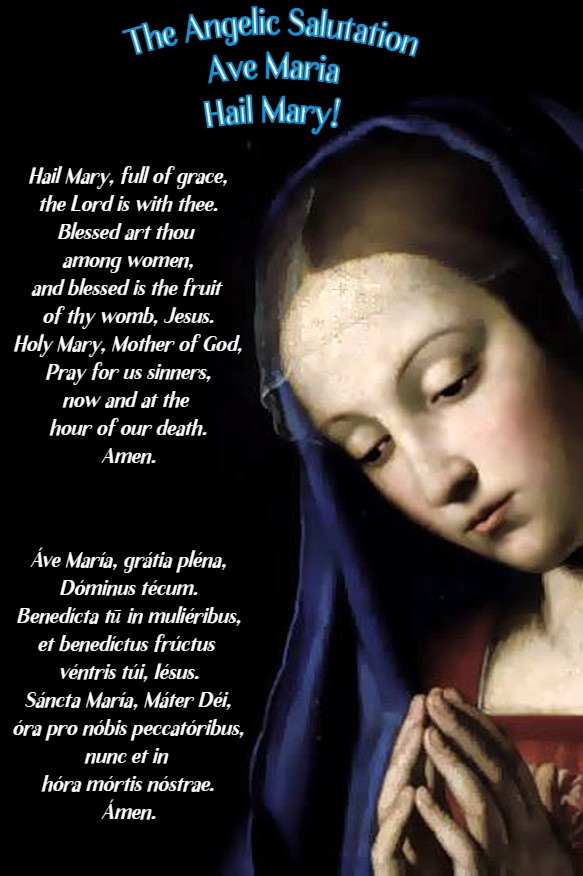
Our Morning Offering – 21 December – Hail Mary, the Angelic Salutation

Our Morning Offering – 21 December – “Month of the Immaculate Conception” – Tuesday of the Fourth Week of Advent

Hail Mary, the Angelic Salutation

The Hail Mary/Ave Maria

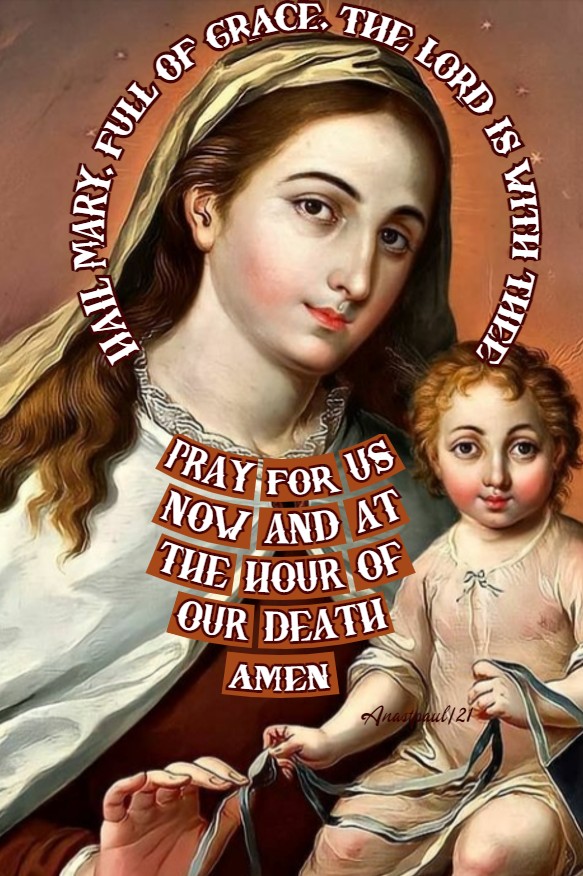
Hail Mary, full of grace,
the Lord is with thee.
Blessed art thou among women,
and blessed is the fruit of thy womb, Jesus.
Holy Mary, Mother of God,
pray for us sinners,
now and at the hour of our death.
Amen.

Áve María, grátia pléna,
Dóminus técum.
Benedícta tū in muliéribus,
et benedíctus frúctus véntris túi, Iésus.
Sáncta María, Máter Déi,
óra pro nóbis peccatóribus,
nunc et in hóra mórtis nóstrae.
Ámen.

Today, Catholics may wish to thank St Peter Canisdius (1521-1397), for this Doctor of the Church gave us the second half of the Hail Mary prayer.

This 16th-century Saint, known as the second Apostle of Germany, followed in the giant footsteps of St Boniface, who evangelised Germany a thousand years earlier. He was also active at the Council of Trent and wrote much on the Blessed Virgin Mary.

The first half of the Hail Mary, of course, comes from Scripture. What many Catholics don’t know, is that the second half of this Catholic prayer is due to the intervention of St Peter Canisius at the Council of Trent. St Peter began adding onto the scriptural part of the Hail Mary, the “Holy Mary Mother of God pray for us sinners, now and at the hour of our death.” It was Trent that officially accepted this addition to the prayer and included it in their famous Catechism of the Council of Trent in 1566.

Posted in SAINT of the DAY

Saint of the Day – 21 December – Blessed Daniel of the Annunciation OdeM

Saint of the Day – 21 December – Blessed Daniel of the Annunciation OdeM (13th Century-possibly) Friar of the Order of Our Lady of Mercy and the Redemption of the Captives, commonly called the Mercedarians. Also known as Daniele dell’Annunziata.

Sadly, we have almost no information of this Blessed not even the confirmed dates of his life.

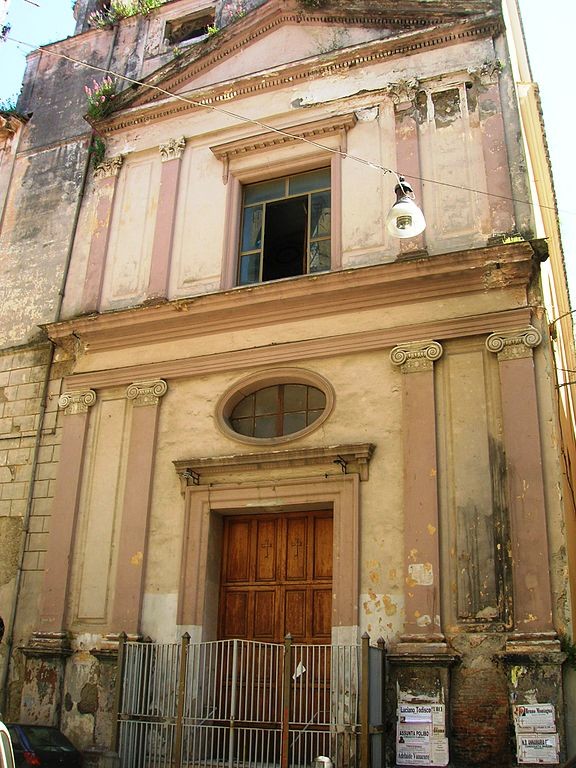
Daniel was a Mercedarian Friar at the Monastery of Santa Maria della Pace in Naples, Italy. He was a staunch defender of the freedom of the Church from state control and of his Order.

Monastery of Santa Maria della Pace

He was known for personal piety and strict adherence to his Order’s rule and orthodox Christian doctrine.

The Church of Monastery of Santa Maria della Pace
Posted in JESUIT SJ, MARIAN TITLES, NOVENAS, SAINT of the DAY, The APOSTLES & EVANGELISTS

Feast of St Thomas, Apostle of Christ, Christmas Novena to the Christ Child, Day Six, Notre-Dame de Saint-Acheul / Our Lady of Saint Acheul, Amiens, France, (4th Century) and Memorials of the Saints – 21 December

Feast of St Thomas, Apostle of Christ
His Feast was moved to 3 July in 1969

https://anastpaul.com/2018/07/03/saint-of-the-day-feast-of-st-thomas-apostle-of-christ/
AND:
https://anastpaul.com/2019/07/03/feast-of-st-thomas-apostle-of-christ-martyr-3-july/
AND:
https://anastpaul.com/2017/07/03/saint-of-the-day-3-july-st-thomas-the-apostle-of-christ/

Christmas Novena to the Christ Child, Day Six:
https://anastpaul.com/2018/12/21/christmas-novena-to-the-christ-child-day-six-21-december-2/

Notre-Dame de Saint-Acheul / Our Lady of Saint Acheul, Amiens, France, founded by Saint Firmin, Bishop (4th Century) – 21 December:

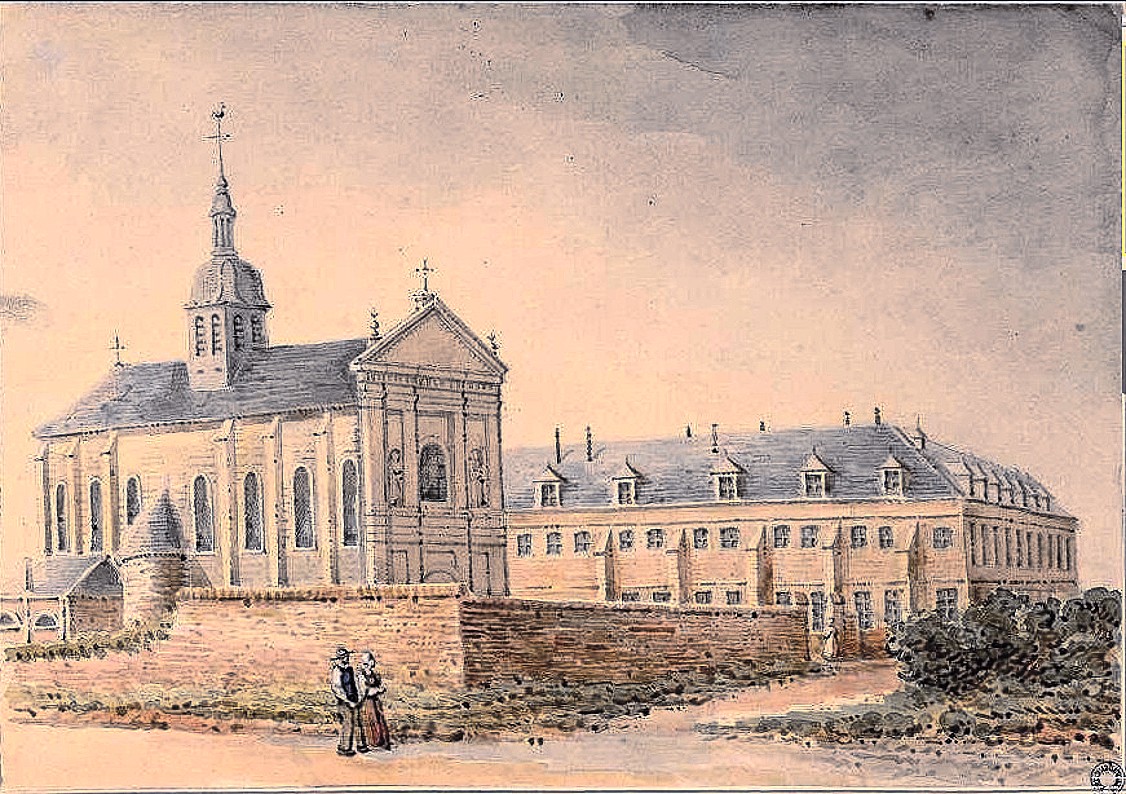
The Church containing the Shrine of Our Lady of Acheul, was located near Amiens. In fact, Saint Acheul was once considered the Mother-Church of the Cathedral of Amiens and was sometimes called the “Old Cathedral of Amiens,” although this is no longer the case, as there is now a larger Cathedral Church in Amiens.
The Church stands on the very place where once a Roman temple stood, and tradition tells that Saint Firminus (Died 303) was the Apostle of Amiens, arriving there before the close of the third century after Christ. It is said that by the eloquence of his preaching and the number of his miracles, Saint Firminus (or Saint Firmin) converted many idolaters to the True Faith and Baptised three thousand men in forty days.
The early Church, built around the year 300, contained the remains of the Martyred Saint. This Church was devastated repeatedly by the invasions of the Normans, and was finally totally destroyed in 1218. The relics of Saint Firmin were transferred to the Cathedral of Amiens during the Middle Ages.
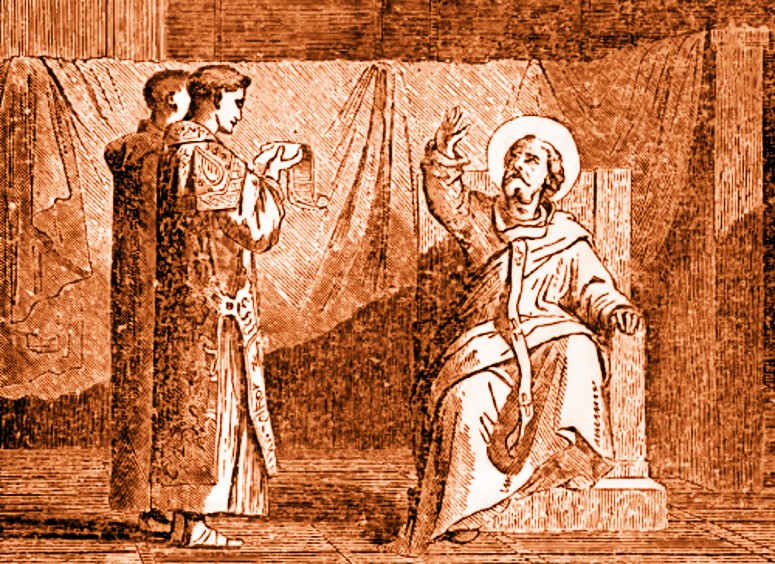
The Shrine of the Virgin of Saint Acheul, is noteworthy for a singular miracle – an apparition which occurred during the Holy Sacrifice of the Mass. The celebrant, after the Consecration, saw a hand appear from within a luminous cloud and the hand of Christ took the Sacred Host and dropped it into the Chalice. Some of the faithful present likewise witnessed the same thing – a certain skeptic was brought to his knees in humble acceptance of the fact, that the Holy Sacrifice is truly the same as that of Calvary. The armorial bearings of the Abbey of Saint-Acheul, displays a hand in remembrance of this miracle.

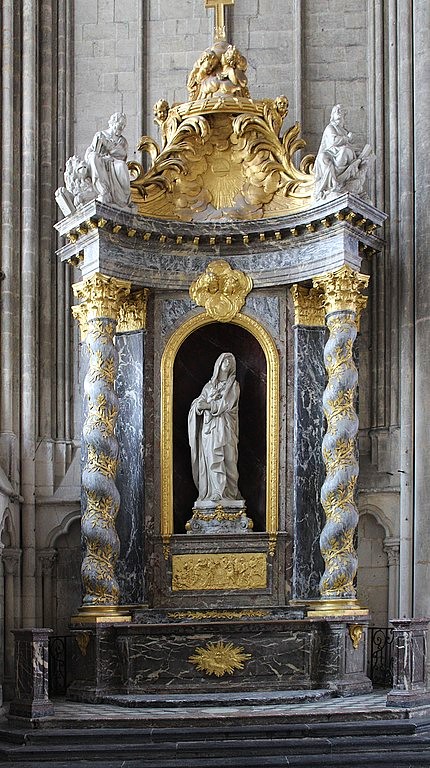
The Altar to Our Lady at the Cathedral

The present Cathedral of Saint Acheul was not finished until the fifteenth century. After the erection of the new Cathedral at Amiens, Saint Acheul was known as the Church of Our Lady of Acheul. Miracles took place frequently and pilgrimages continued.
The Church of Saint Acheul was destroyed by a natural phenomenon, probably a strong storm, in about the year 1751. It was rebuilt and completed in 1760. A few short years later, during the Terror of the French Revolution, the Church was used as a stable.
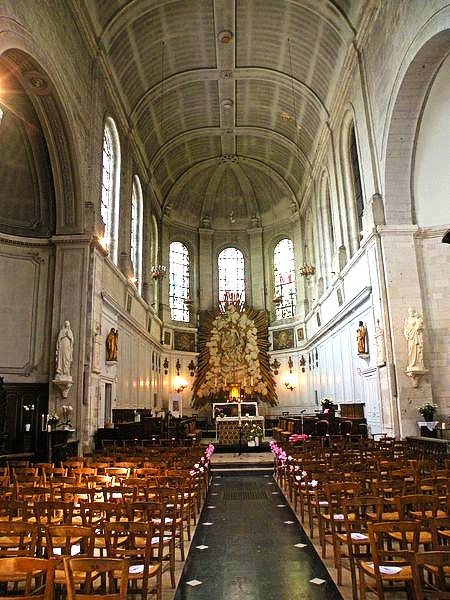
Today, the Church is protected as an historical monument, the decree given in 1969. The Abbey buildings are now occupied by a private party but the Church is used as a Parish Church.

The Abbey building is visible next door

St Peter Canisius SJ (1521-1397) Doctor of the Church (Optional Memorial)
His Feast day is 27 April (General Roman Calendar, 1926–1969.
Biography:

https://anastpaul.wordpress.com/2017/12/21/saint-of-the-day-21-december-st-peter-canisius-s-j-1521-1397-doctor-of-the-church/
AND Pope Benedict’s Catechesis on St Peter Canisius:
https://anastpaul.com/2018/12/21/saint-of-the-day-21-december-st-peter-canisius-s-j-1521-1397-the-second-apostle-of-germany-doctor-of-the-church/

Bl Adrian of Dalmatia

St Anastasius II of Antioch (Died 609) Bishop and Martyr, Confessor, Defender of the Faith.
https://anastpaul.com/2020/12/21/saint-of-the-day-21-december-saint-anastasius-ii-of-antioch/

St Anrê Tran An Dung
St Baudacarius of Bobbio
St Beornwald of Bampton
Bl Bezela of Göda
Blessed Daniel of the Annunciation OdeM Mercedarian Friar (13th Century?)
St Dioscorus

Blessed Dominic Spadafora OP (1450-1521) Dominican Priest, renowned Preacher and Evangelist. His body is incorrupt.
Biography:

https://anastpaul.com/2019/12/21/saint-of-the-day-21-december-blessed-dominic-spadafora-op-1450-1521/

St Festus of Tuscany
St Glycerius of Nicomedia
St James of Valencia
St John of Tuscany
St John Vincent
St Micah the Prophet
St Phêrô Truong Van Thi
St Severin of Trèves (Died c 300) Bishop, Confessor
Bl Sibrand of Marigård
St Themistocles of Lycia

Posted in "Follow Me", CONFESSION/PENANCE, MEDITATIONS - ANTONIO CARD BACCI, QUOTES on HUMILITY, QUOTES on REPARATION/EXPIATION, QUOTES on SACRIFICE, QUOTES on SUFFERING, The DIVINE INFANT, The NATIVITY of JESUS

Thought for the Day – 20 December – The Swaddling Clothes of the Divine Infant

Thought for the Day – 20 December – Meditations with Antonio Cardinal Bacci (1881-1971)

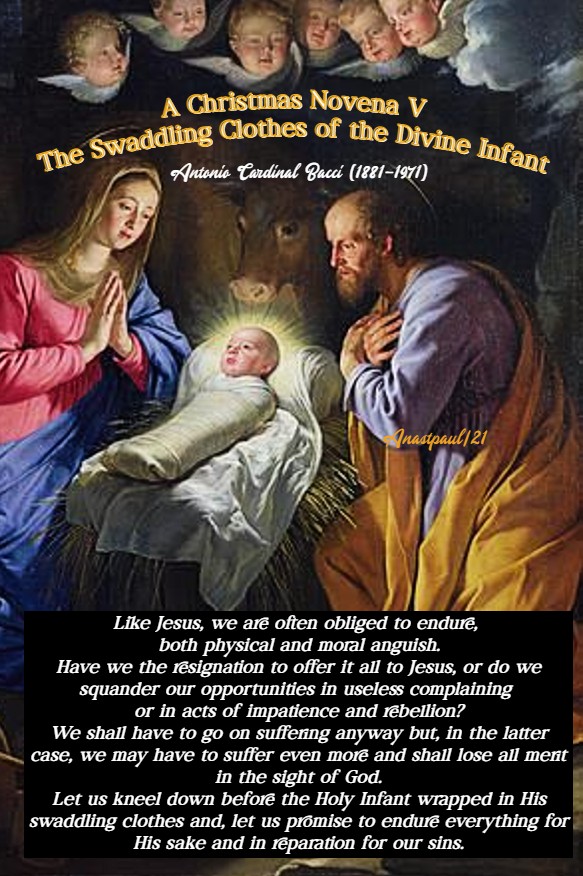
A Christmas Novena V
The Swaddling Clothes of the Divine Infant

“Mary, like other mothers in those days, wrapped the Infant Jesus in swaddling clothes.
The Divine Child quietly offered this new humiliation to His heavenly Father.
He saw prefigured in these bands, the ropes with which He would be bound in the garden of Gethsemane, even after He had given sinful humanity, His celestial teaching, example and miracles and finally, His own Body inthe Sacrament of the Eucharist.
He saw in them too, the chains with which He would be secured to the pillar, in order to be scourged in the Praetorium of Pilate among the jeers and insults of the onlookers.
He saw in them, finally, the cords with which, after having been condemned to the ignominious death of the Cross, He would be tied, while being led to the place of execution on Mount Calvary.
Filled with infinite love for stricken humanity, the Heart of the Divine Infant offered all this, in advance, to His Father in heaven.

Are we making any effort to return such great love?
Like Jesus, we are often obliged to endure, both physical and moral anguish.
Have we the resignation to offer it all to Jesus, or do we squander our opportunities in useless complaining or in acts of impatience and rebellion?
We shall have to go on suffering anyway but, in the latter case, we may have to suffer even more and shall lose all merit in the sight of God.

Let us kneel down before the Holy Infant wrapped in His swaddling clothes and, let us promise to endure everything for His sake and in reparation for our sins.”

Antonio Cardinal Bacci

Posted in ADVENT REFLECTIONS, CHRIST the WORD and WISDOM, DOCTORS of the Church, FATHERS of the Church, MARIAN POETRY, MARIAN REFLECTIONS, POETRY, The ANNUNCIATION, The WORD

Quote/s of the Day – 20 December – ‘… Answer quickly, O Virgin. …’

Quote/s of the Day – 20 December – Monday of the Fourth Week of Advent, Readings: Isaiah 7: 10-14; Psalm 24: 1-6; Luke 1: 26-38

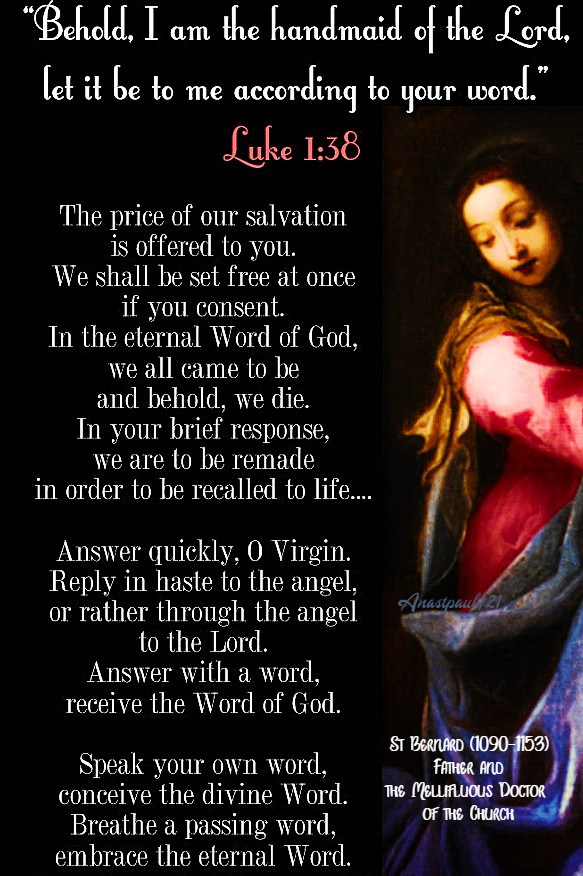
“And Mary said,
‘Behold, I am the handmaid of the Lord.
May it be to me according to your word
.’”

Luke 1:38

The price of our salvation
is offered to you.
We shall be set free at once, if you consent.
In the eternal Word of God, we all came to be
and behold, we die.
In your brief response,
we are to be remade.
in order to be recalled to life.

… Answer quickly, O Virgin.
Reply in haste to the Angel,
or rather, through the Angel to the Lord.
Answer with a word,
receive the Word of God.
Speak your own word,
conceive the Divine Word.
Breathe a passing word,
embrace the Eternal Word!

St Bernard of Clairvaux (1090-1153)
The Last Father and
the Mellifluous Doctor of the Church

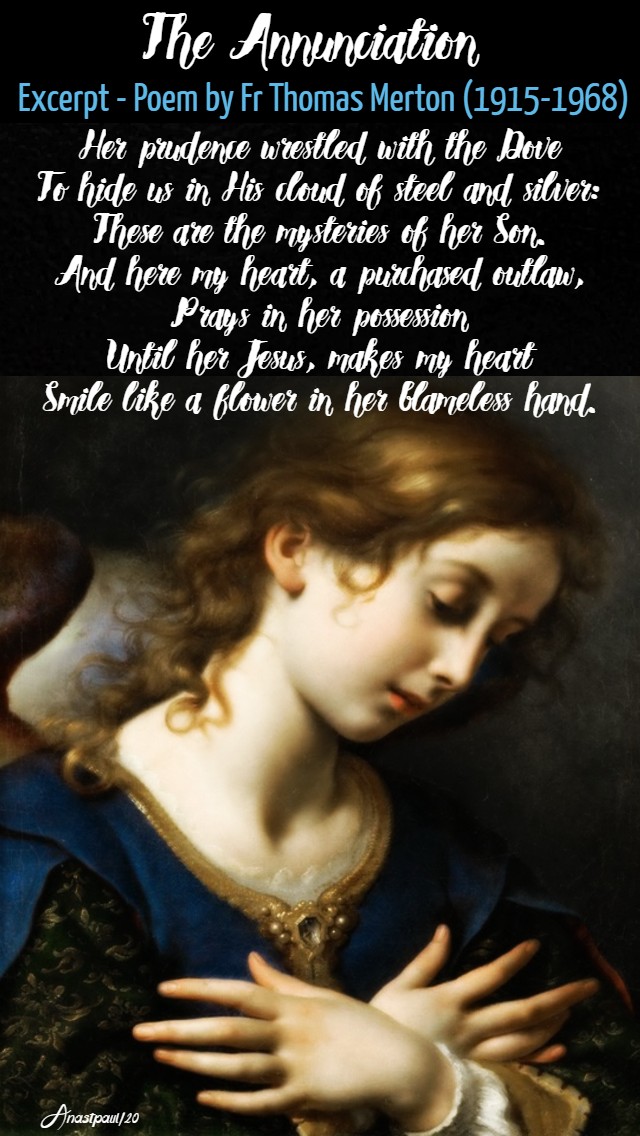
The Annunciation
By Fr Thomas Merton (1915-1968)

Ashes of paper, ashes of a world
Wandering, when fire is done:
We argue with the drops of rain!

Until one comes Who walks unseen
Even in elements we have destroyed.
Deeper than any nerve
He enters flesh and bone.
Planting His truth, He puts our substance on.

Air, earth and rain
Rework the frame that fire has ruined.
What was dead is waiting for His Flame.
Sparks of His Spirit spend their seeds, and hide
To grow like irises, born before summertime.

These blue thinas bud in Israel.

The girl prays by the bare wall
Between the lamp and the chair.
(Framed with an angel in our galleries
She has a richer painted room, sometimes a crown.
Yet seven pillars of obscurity
Build her to Wisdom’s house, and Ark and Tower.
She is the Secret of another Testament
She owns their manna in her jar.)

Fifteen years old –
The flowers printed on her dress
Cease moving in the middle of her prayer
When God, Who sends the messenger,
Meets His messenger in her Heart.
Her answer, between breath and breath,
Wrings from her innocence our Sacrament!
In her white body God becomes our Bread.

It is her tenderness
Heats the dead world like David on his bed.
Times that were too soon criminal
And never wanted to be normal
Evade the beast that has pursued
You, me and Adam out of Eden’s wood.
Suddenly we find ourselves assembled
Cured and recollected under several green trees.

Her prudence wrestled with the Dove
To hide us in His cloud of steel and silver:
These are the mysteries of her Son.
And here my heart, a purchased outlaw,
Prays in her possession

Until her Jesus, makes my heart
Smile like a flower in her blameless hand.

Fr Thomas Merton (1915-1968), Trappist Monk and Priest. Thomas Merton expressed his vision in his poetry, novels, essays, devotionals and autobiographical writings.

Posted in DOCTORS of the Church, FATHERS of the Church, Hail MARY!, MARIAN QUOTES, MARIAN REFLECTIONS, ONE Minute REFLECTION, The ANNUNCIATION, The INCARNATION, The O ANTIPHONS

One Minute Reflection – 20 December – “Hail, full of grace!” – Luke 1:28

One Minute Reflection – 20 December – Monday of the Fourth Week of Advent O Clavis David/O Key of David – Readings: Isaiah 7: 10-14; Psalm 24: 1-6; Luke 1: 26-38

The Lord is at hand, come let us adore Him.

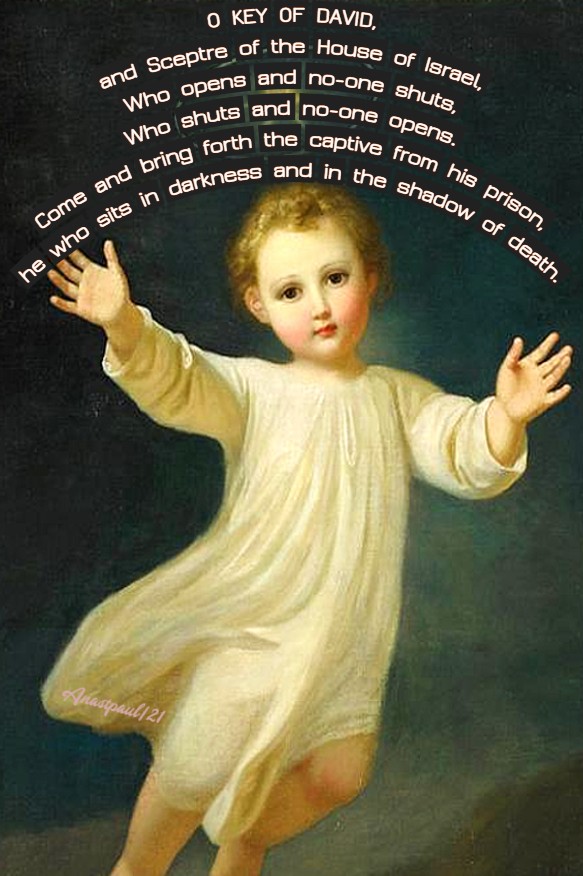
O KEY OF DAVID,
and Sceptre of the House of Israel,
who opens and no-one shuts,
who shuts and no-one opens.
Come and bring forth the captive from his prison,
he who sits in darkness and in the shadow of death.

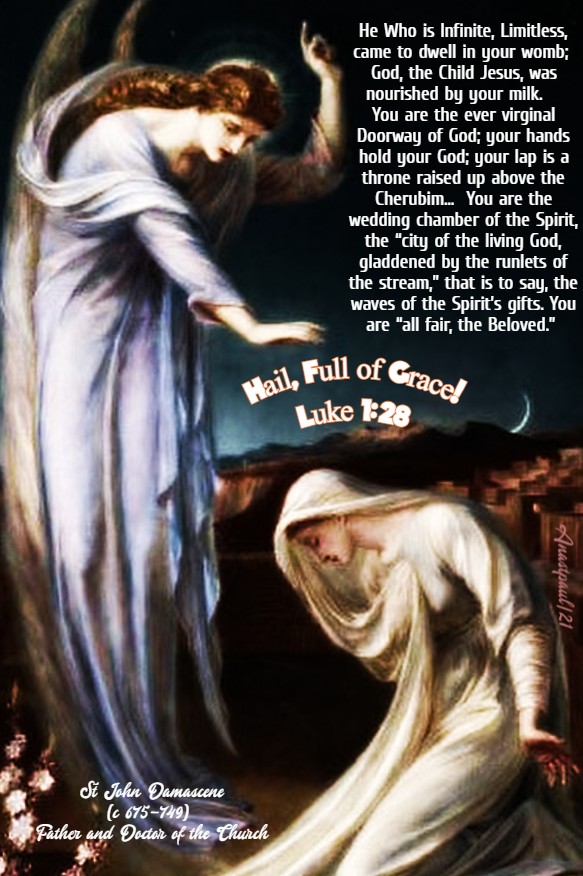
Hail, full of grace!” – Luke 1:28

REFLECTION – “This woman will be the Mother of God, the door to Light, source of Life; she will reduce to oblivion the judgement that weighed on Eve. “The rich among the people seek the face” of this woman, “the kings of the nations shall pay her homage”, they shall “offer gifts”…, yet the glory of the Mother of God is an interior glory: the fruit of her womb.

O woman, so worthy of love, thrice happy, “blessed are you among women and blessed is the fruit of your womb.” Daughter of David the king and Mother of God, King of the universe, masterpiece in whom the Creator rejoices…: you are to be nature’s full achievement. For you, life is not yours; you were not born for yourself alone but your life is to be God’s. You came into the world for Him, you will serve for the salvation of all people, fulfilling God’s design established from the beginning: the Incarnation of the Word and our own divinisation. Your whole desire is to feed on the words of God, to be strengthened by their sap, like “a green olive tree in the house of God,” “like a tree planted by running water,” you are the “tree of life” who “yielded its fruit in due season”…

He Who is Infinite, Limitless, came to dwell in your womb; God, the Child Jesus, was nourished by your milk. You are the ever virginal Doorway of God; your hands hold your God; your lap is a throne raised up above the Cherubim… You are the wedding chamber of the Spirit, the “city of the living God, gladdened by the runlets of the stream”, that is to say, the waves of the Spirit’s gifts. You are “all fair, the Beloved” of God.” – St John Damascene (675-749) Monk, Theologian, Father and Doctor of the Church (Homily on the Nativity of the Virgin, # 9 ; SC 80) [( Biblical references : Ps 44[45],13; 71[72],11.10; Mt 2,11; Lk 1,42; Is 62,5; Ps 51[52],10; 1,3; cf Gn 2,9, Rv 22,2; cf Ez 44,2; Ps 79[80],2; cf Sg 1,4; Ps 45[46],5; Sg 4,7].

PRAYER – Lord, at the Angel’s message, Mary, the Immaculate Virgin, became the temple of God and was filled with the light of the Holy Spirit, when she received Your divine Word. Grant that, after her example, we may humbly and steadfastly follow Your will. Through Christ the Incarnate Word, our Lord and Saviour, with the Holy Spirit, one God for all ages, amen.

Posted in ADVENT PRAYERS, MARIAN POETRY, MARIAN PRAYERS, Our MORNING Offering, The ANNUNCIATION, The INCARNATION

Our Morning Offering – 20 December – Blessed Shall be Her Name

Our Morning Offering – 20 December – Monday of the Fourth Week of Advent

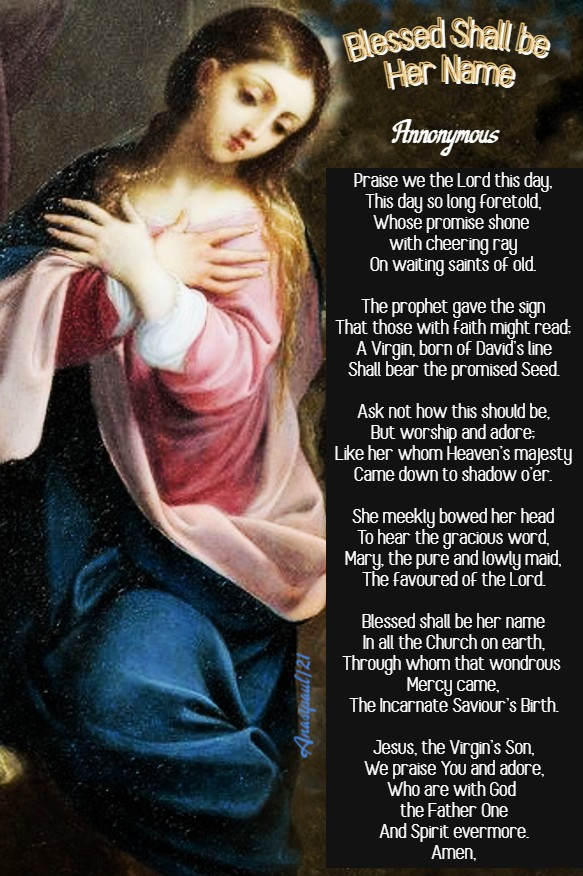
Blessed Shall be Her Name
Anonymous Author

Praise we the Lord this day,
This day so long foretold,
Whose promise shone with cheering ray
On waiting saints of old.

The prophet gave the sign
That those with faith might read;
A Virgin, born of David’s line
Shall bear the promised Seed.

Ask not how this should be,
But worship and adore;
Like her whom Heaven’s majesty
Came down to shadow o’er.

She meekly bowed her head
To hear the gracious word,
Mary, the pure and lowly maid,
The favoured of the Lord.

Blessed shall be her name
In all the Church on earth,
Through whom that wondrous Mercy came,
The Incarnate Saviour’s Birth.

Jesus, the Virgin’s Son,
We praise You and adore,
Who are with God the Father One
And Spirit evermore.
Amen,

Posted in SAINT of the DAY

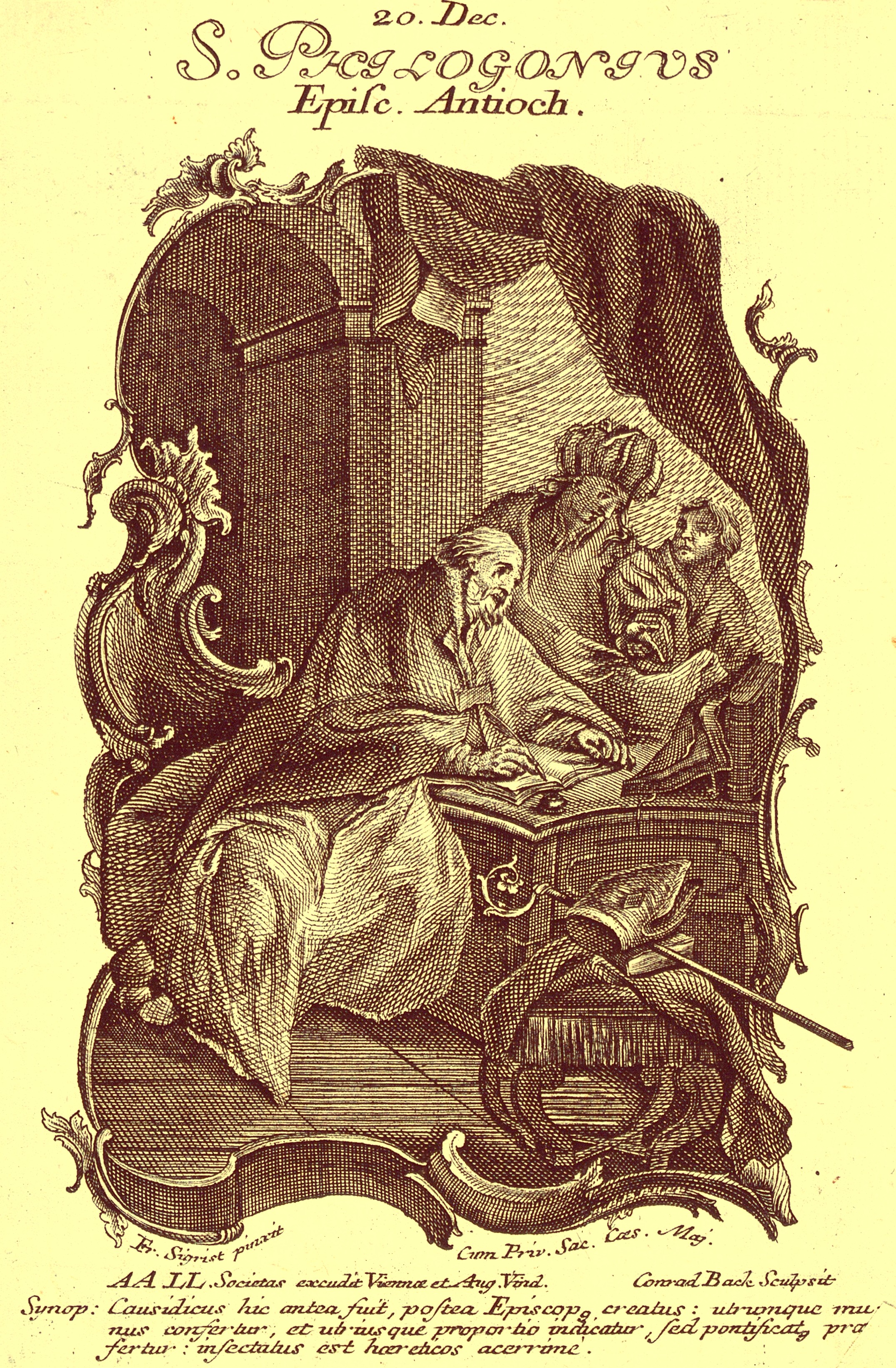
Saint of the Day – 20 December – Saint Philogonius of Antioch (Died 324)

Saint of the Day – 20 December – Saint Philogonius of Antioch (Died 324) Bishop, Widower, Lawyer, Patriarch of Antioch. Defender of the true Faith against Arianism, in fact, he was one of the first to publicly denouce the hereby, Defender of the people against persecution, Ascetic. Died in 324 of natural causes. Patronage – of Lawyers.

The Roman Martyrology states: “In Antioch in Syria, St Philogonius, Bishop, who, a Lawyer, called by God to govern this Church one day, started together with the Bishop St Alexander and other companions ,the fight for the Catholic faith against Arianism and full of merit, he rested in the Lord. St John Chrysostom celebrated him in a famous commendation.”

Philogonius was a successful Lawyer and Advocate, at the Bar of Antioch. He was known for his eloquence, moral integrity and Christian Faith. He married and had a daughter, but became a Monk and Ascetic after his wife died.

The celebrated and holy Philogonius lived in the reign of Constantine the Great. After having finished his studies, he practised law but in such a manner that he might serve as a model to all in a similar calling. He never undertook any lawsuit before he had thoroughly examined the case and, being entirely frank with those who desired his assistance, he never pleaded a cause which seemed unjust. Nothing could deter him from what he thought right, neither fear of those above him, nor promises nor gifts. The poor he served gratis, and he defended, both by word and writing, the widow and the orphan against the power of the great, never refusing his counsel to those whose means allowed but a small recompense or none at all. Love for his neighbour was to him a greater incentive to work than eagerness to gain temporal goods.

How high these noble qualities raised him in the estimation of the people was especially manifest, when after the death of the Bishop, they were choosing a worthy Successor to their late shepherd. The entire people insisted on having him as Bishop, who, until then, had with so much kindness and justice, assisted them in their temporal affairs. The voice of the people was regarded as the voice of God, and Philogonius was Consecrated Bishop of Antioch.

He administered his sacred functions in the most zealous manner. Saint John Chrysostom, who preached a magnificent sermon on Saint Philogonius, says himself, that to speak worthily in his praise surpassed all eloquence. Licinius, at that period, persecuted the Christians and Philogonius did his utmost to protect them. He animated them to constancy, and taught them not to allow either the loss of their temporal goods, nor other sufferings to separate them from Christ, or to leave the true Church, as they would deprive themselves of their eternal possessions, and would have nothing to expect but the pains of hell. By frequent representations of the unending joys of heaven and the torments of hell, he strengthened his flock so effectually in the true faith, that they were willing to suffer poverty and tortures and even death, rather than leave it. When it happened that one would apparently forsake the true faith through fear of martyrdom, the holy man, though deeply grieved, spoke neither harshly nor unkindly to him but, with a heartfelt compassion, represented the greatness of his sin, exhorted him to do penance and atone for his error and encouraged him to constancy. When he saw that his admonitions were heeded, he greatly rejoiced and always treated the penitent with kindness, without ever reproaching him for his fault, or even alluding to it.

When the persecution of Licinius had ceased, Arius began to disseminate his heresy. No shepherd could be more solicitous to protect his sheep from an attack of wolves than Saint Philogonius was to keep the heresy from his people and retain them in the faith of Christ. Arius confessed that Philogonius had been his strongest adversary and had opposed him most effectually. The holy Bishop explained the wickedness of the new heresy and refuted it as well in public sermons as in private discourses, by which he greatly benefited his flock. Besides this, he zealously endeavoured to uproot all abuses that had crept in and to plant in the hearts of all, a hatred of sin and a love of virtue. Towards this end he directed all his exhortations, which had great influence over the people, as he supported his precepts by the example of his virtue. His conduct was so blameless, that even his enemies could find no fault in it.

He was greatly devoted to prayer, and always sought refuge in it when he was in affliction. He allowed no comfort to his body, not even necessary rest. He guarded his sheep day and night and the result was, that it was said of the Church at Antioch, that true virtue and piety reigned among all classes of people. Saint Chrysostom compares it to a well cultivated and fruitful garden, cleansed from thorns and brambles and says. that it showed the indefatigable care of him who had governed it.

The Almighty wished, at last, to give the promised reward to His true and faithful servant. A sickness, apparently of no consequence, prepared his way. The thought of the labours he had undergone in his functions during his life, for the honour of God and the salvation of souls, gave him inexpressible comfort in his last hour and the hope of going to Heaven gave him the most ardent desire to die and rest in God. This wish the Almighty granted, to the great grief of the people of Antioch.

Saint John Chrysostom preached a beautiful eulogy on St Philogonius.

Posted in MARIAN TITLES, NOVENA, SAINT of the DAY, The APOSTLES & EVANGELISTS

Notre-Dame de Bon Retour à Île-Molène / Our Lady of Molene, France (1075), Christmas Novena Day Five and Memorials of the Saints – 20 December

Christmas Novena to the Christ Child – DAY FIVE:
https://anastpaul.com/2018/12/20/christmas-novena-to-the-christ-child-day-five-20-december-3/

Vigil of St Thomas, Apostle.

Notre-Dame de Bon Retour à Île-Molène / Our Lady of Molene, France (1075) – 20 December

The Abbot Orsini wrote: “The Shrine of Our Lady of Molene is in the Abbey of the Order of Saint Benedict in Langres. It was founded on the 20th of December, 1075, by Saint Robert who was the Abbot.”

The Benedictine Monastery in the Diocese of Langres founded by Saint Robert was actually the famous Molesme Abbey. As the Abbot Orsini mentioned, it was indeed founded by Saint Robert, henceforth known as Saint Robert of Molesme O.Cist (1028-1111), in the year 1075. He had been the Abbot of Saint Michael Abbey but left and founded a new Abbey when they refused to accept his necessary reforms.
Saint Robert was born in the year 1029 and had a deep, childlike devotion to the Mother of God – by reason of a vision his mother saw, before Robert was born – and he instilled the same into the hearts of his Monks. Saint Robert’s holiness attracted many sincere men to join him, and as many of them were also noblemen, they provided Saint Robert with the financial means necessary to build a magnificent Abbey. Among those who flocked to Saint Robert was St Bruno of Cologne, who was the future Founder of the Carthusian Order.
When Saint Robert died in the year 1111, he was buried in the Ahurch at the Abbey he founded. St Alberic, Robert’s Successor, decided that the Order should be dedicated to Mary. According to legend, Mary bestowed on Alberic a white mantle; for that reason, the Monks changed their black habit and wore white. All their Churches were dedicated to the Virgin and each had its Mary Altar before which the office of Mary was chanted every Saturday.
The Church and Monastery were destroyed and any remaining property stolen in 1472 during the war between Burgundy and France. The Huguenots burned what had been rebuilt the following century during the French Wars of Religion. The end came during the French Revolution when the Abbey was suppressed and the buildings and Church destroyed.
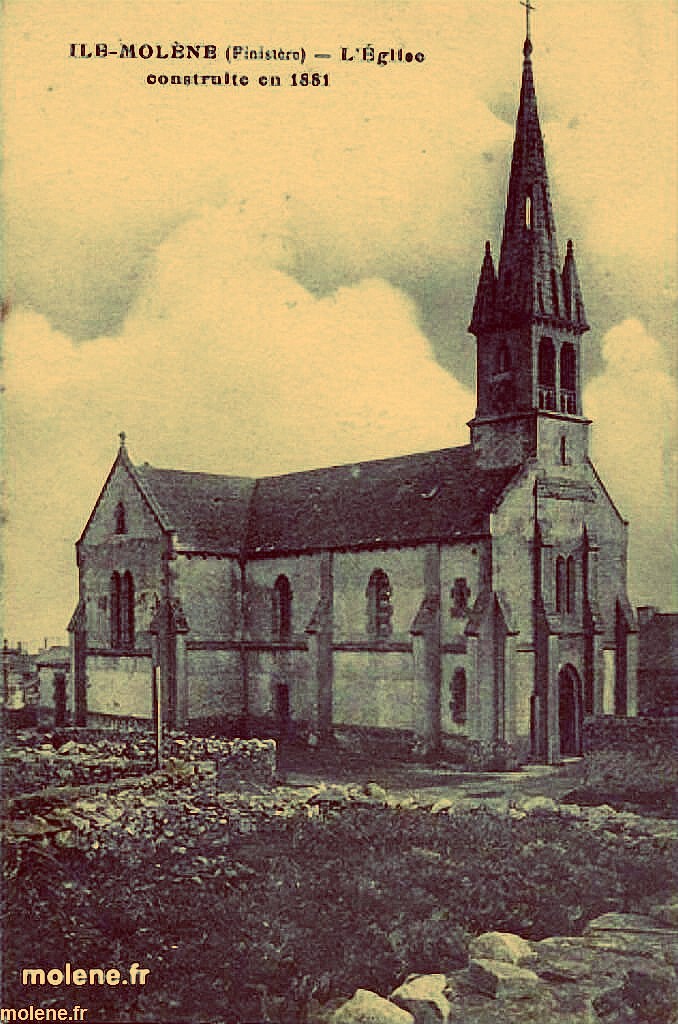
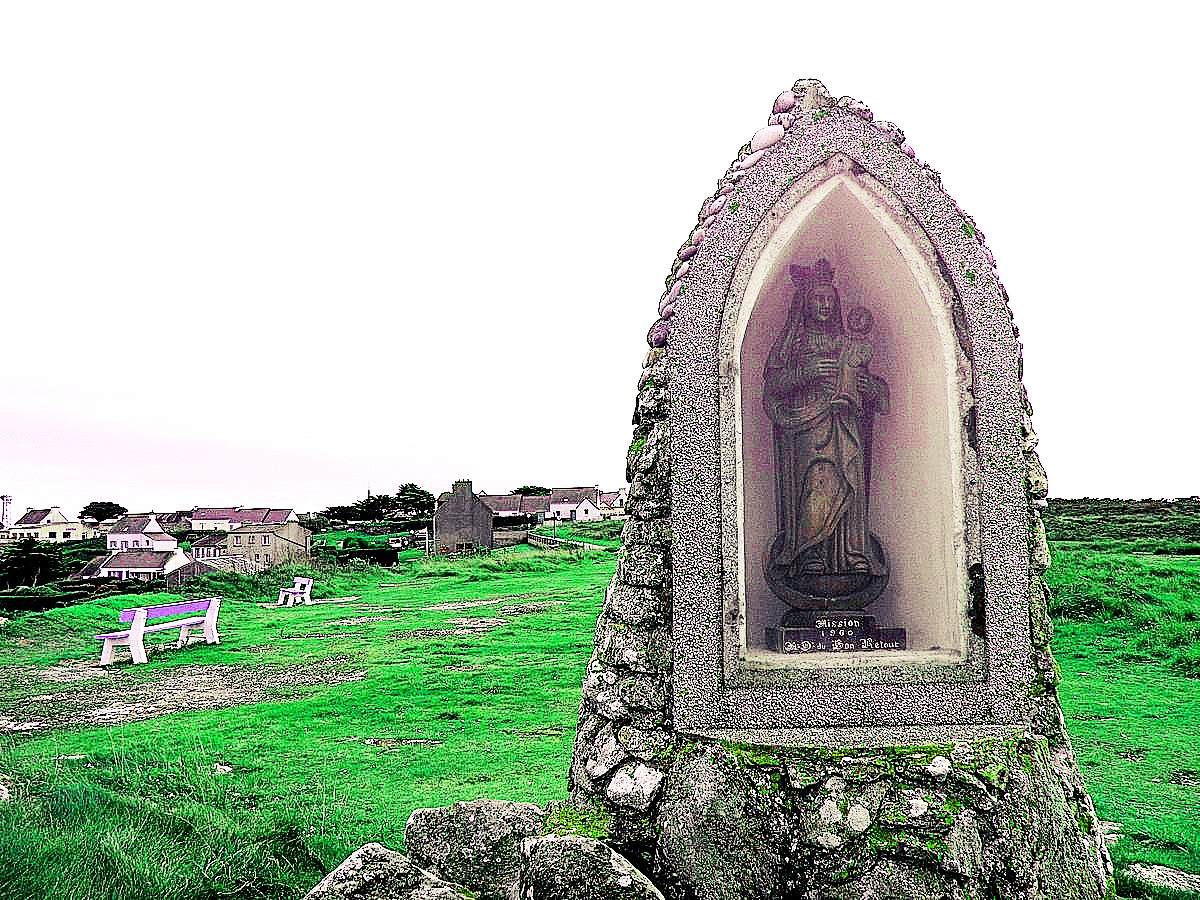
The small Church pictured is the Church of Sainte-Croix, built in the 13th century as a Chapel for the novices at the Abbey. Even this building was damaged in 1940 during combat between the French and German troops and some of that damage can still be seen. However, this is now a thriving Parish with an annual pilgrimage to honour Our Lady. The Grotto above and below, stands in the open field previously the site of the Monastery.
The Abbey site has been an historical monument since 1985. The once thriving community is gone and the site now is only accessible by prior arrangement.
The Monastery seal pictured the Virgin Mary crowned.

St Attala of Strasbourg
St Bajulus of Rome
St Crescentius of Africa
St Dominic of Brescia

St Dominic de Silos OSB (1000-1073) Monk, Abbot.
Biography:

https://anastpaul.wordpress.com/2017/12/20/saint-of-the-day-20-december-st-dominic-de-silos-o-s-b-c1000-1073/

St Eugene of Arabia
St Gabriel Olivares Roda
St Hoger of Hamburg-Bremen
Bl John de Molina
St Julius of Gelduba
Bl Lorenzo Company
St Liberatus of Rome
St Macarius of Arabia
St Malou of Hautvillers

Blessed Michal Piaszczynski (1885-1940) Priest and Martyr.
His Life and Death:

https://anastpaul.com/2019/12/20/saint-of-the-day-20-december-blessed-michal-piaszczynski-1885-1940-priest-and-martyr/

St Paul of Latra
Bl Peter de la Cadireta
Bl Peter Massalenus
St Philogonius of Antioch (Died 324) Bishop

St Thomas of Dover
St Ursicinus of Saint-Ursanne

St Vincenzo Romano (1751-1831) “A Priest of the People.”
His story:

https://anastpaul.com/2018/12/20/saint-of-the-day-20-december-st-vincenzo-romano-1751-1831-a-priest-of-the-people/

St Pope Zephyrinus (Died 217) Bishop of Rome from 199-217, Confessor, Defender of the Faith especially of the Doctrine of the Holy Trinity. He is known for combatting heresies and defending the Divinity of Christ.
About Pope Zephyrinus:

https://anastpaul.com/2020/12/20/saint-of-the-day-20-december-saint-pope-zephyrinus-died-217/

Posted in MEDITATIONS - ANTONIO CARD BACCI, QUOTES on HEAVEN, QUOTES on HUMILITY, QUOTES on POVERTY, QUOTES on SANCTITY, QUOTES on SUFFERING, QUOTES on THE WORLD, QUOTES on VIRTUE, The DIVINE INFANT, The NATIVITY of JESUS

Thought for the Day – 19 December –

Thought for the Day – 19 December – Meditations withAntonio Cardinal Bacci (1881-1971)

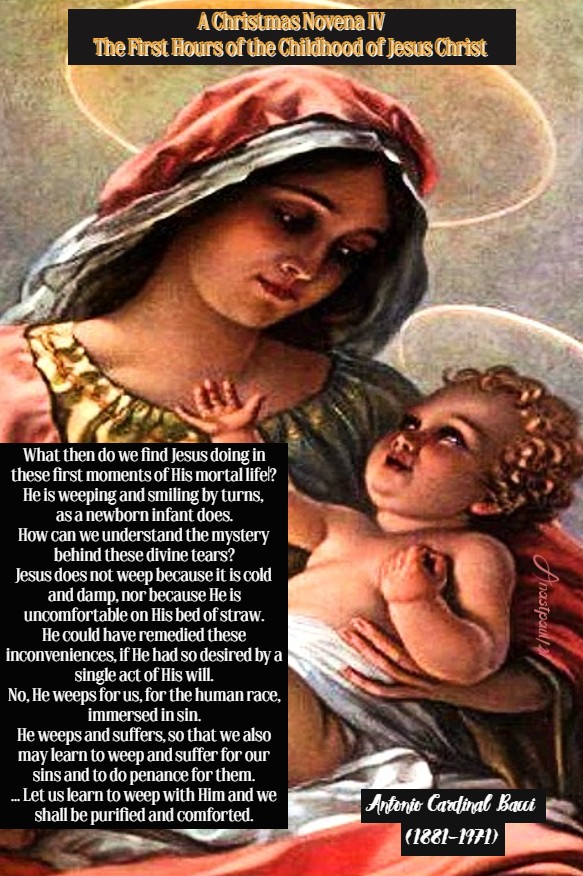
A Christmas Novena IV
The First Hours of the
Childhood of Jesus Christ

“Enter in spirit into the stable at Bethlehem and humbly kneel before the Word of God made man.
What do we find Jesus doing in these first moments of His mortal life.
By a single act of His divine will, He could have instantly transformed the human race.
But, He came to redeem men and preach to them before anything else, the virtues which they most needed – humility, indifference to worldly possessions and the acceptance of suffering.
He taught them to endure suffering, neither rebelliously, nor even as a disagreeable necessity but, as a means of purification and sanctification.
Before the time of Jesus Christ, suffering was dreaded and abhorred.
He taught us to love it because it is the salt of the earth which saves us from corruption because, it detaches us from worldly things and because, it lifts our thoughts towards Heaven.

What then do we find Jesus doing in these first moments of His mortal life|?
He is weeping and smiling by turns, as a newborn infant does.
How can we understand the mystery behind these divine tears?
Jesus does not weep because it is cold and damp, nor because He is uncomfortable on His bed of straw.
He could have remedied these inconveniences, if He had so desired by a single act of His will.
No, He weeps for us, for the human race, immersed in sin.

He weeps and suffers, so that we also may learn to weep and suffer for our sins and to do penance for them.
This is the explanation of the tears of the Divine Child.
Let us learn to weep with Him and we shall be purified and comforted.”

Antonio Cardinal Bacci

Posted in NOTES to Followers

No Electricity Again!

Apologies dear friends, we were blacked out again for about 12 hours late yesterday afternoon and way into the early hours.

Posted in MARIAN TITLES, NOVENAS, SAINT of the DAY

The Fourth Sunday of Advent, Christmas Novena to the Christ Child – Day Four, Nuestra Señora de Toledo / Our Lady of Toledo, Spain (The Chasuble of St Ildephonsus) (657) and Memorials of the Saints – 19 December

The Fourth Sunday of Advent

Christmas Novena to the Christ Child – Day Four:
https://anastpaul.com/2018/12/19/christmas-novena-to-the-christ-child-day-four-19-december-2/

Nuestra Señora de Toledo (La Casulla de Santo Ildephonsus) / Our Lady of Toledo, Spain (The Chasuble of St Ildephonsus) (657) – 19 December:

XJL86515 Presentation of the Cope to St. Ildefonsus, 1600-24 by Aguilar, Diego de (the Younger) (fl.1570-1624) oil on canvas 151×103 Museo de Santa Cruz, Toledo, Spain Spanish, out of copyright

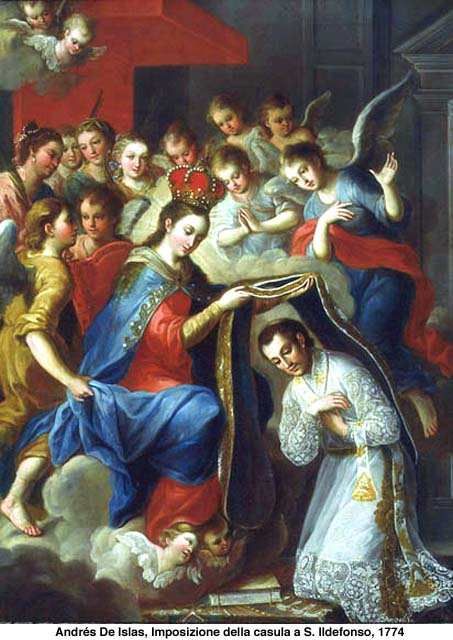
In the year 657 one day while St Ildephonsus (607-670), Archbishop of Toledo, was saying matins, Our Lady appeared to him, accompanied by a great number of the blessed and holding in her hands the book which he had composed in her honour. Sshe thanked him for it and out of gratitude, gave him a white Chasuble.
This celestial gift is still preserved and is now at Oviedo — Alphonsus, the chaste King of Castile, having transferred it to the Church of St Saviour, which he had built.
Tradition claims, that Ildephonsus’successor, Siagrius, tried to use the Vestment but died in the act of robing. The garment is said to have been seen and touched by Herbert Losinga, Bishop of Norwich, as late as the eleventh century.

St Adelaide of Susa (c 1014-1091) Countess, Married Laywoman

St Pope Anastasius I (Died 401) Bishop of Rome from 27 November 399 until his death on 19 December 401.
Biography:

https://anastpaul.com/2019/12/19/saint-of-the-day-19-december-st-pope-anastasius-i-died-401/

St Augustine Moi Van Nguyen
St Avitus of Micy
Bl Berengar of Banares

St Berardo Valeara OSB (c 1050-1122) Benedictine Monk, Bishop of Teramo, Evangelist, Apostle of Charity and Peace.
His life:

https://anastpaul.com/2018/12/19/saint-of-the-day-st-berardo-valeara-of-teramo-osb-c-1050-1122/

Bl Bogumila Noiszewska
St Boniface of Cilicia
Bl Cecilia of Ferrara
St Dominic Uy Van Bui
St Fausta of Sirmium
St Gregory of Auxerre
St Jaume Boguñá Casanovas
St Johannes Gogniat
St Jordi Sampé Tarragó
St Josep Albareda Ramoneda
Bl Kazimiera Wolowska
Bl Konrad Liechtenau
St Manirus of Scotland
St Meuris of Alexandria
St Nemesius of Alexandria
St Phanxicô Xaviê Hà Trong Mau
St René Dubroux
Ribert of Saint-Oyend
St Stêphanô Nguyen Van Vinh
St Thea of Alexandria
St Timothy the Deacon
St Tôma Nguyen Van Ðe

Blessed Pope Urban V (1310-1370) Bishop of Rome from 28 September 1362 to his death in 1370, Priest, Benedictine Monk, Abbot, Canon lawyer, brilliant scholar, teacher.
About Blessed Pope Urban:

https://anastpaul.wordpress.com/2017/12/19/saint-of-the-day-19-december-blessed-pope-urban-v-1310-1370/

Blessed William of Fenoli O.Cart. (1065-1120) Carthusian Monk, Hermit, miracle-worker.
His Life:

https://anastpaul.com/2020/12/19/saint-of-the-day-19-december-blessed-william-of-fenoli-o-cart-1065-1120/

Blessed Mercedarian Fathers – (6 beati): A group of Mercedarian monks noted for their dedication to the Order’s rule, for their continuous prayer life and their personal piety.
• Blessed Bartolomeo of Podio
• Blessed Giovanni of Verdera
• Blessed Guglielmo de Gallinaris
• Blessed Guglielmo of Prunera
• Blessed Pietro of Benevento
• Blessed Pietro of Gualba

Martyrs of Nicaea – (4 saints): A group of Christians martyred together. The only surviving details are four of their names – Darius, Paul, Secundus and Zosimus. They were martyred at Nicaea, Bithynia (modern Izmit, Turkey).

Martyrs of Nicomedia – (5 saints): A group of Christians martyred together in the persecutions of Diocletian. We know little more than the names of five – Anastasius, Cyriacus, Paulillus, Secundus and Syndimius. They were martyred in 303 at Nicomedia, Asia Minor.

Martyred in the Spanish Civil War:
Thousands of people were murdered in the anti-Catholic persecutions of the Spanish Civil War from 1934 to 1939. Virtually each day of the year a Group are celebrated, usually individually but sometimes an entire Monastery or Convent or Lay Movement were martyred together. Today we remember:
• Blessed Jaume Boguñá Casanovas
• Blessed Jordi Sampé Tarragó
• Blessed Josep Albareda Ramoneda

Posted in MEDITATIONS - ANTONIO CARD BACCI, QUOTES on HUMILITY, The DIVINE INFANT, The HEART, The NATIVITY of JESUS

Thought for the Day – 18 December – A Christmas Novena- The Cradle of the Divine Infant Jesus

Thought for the Day – 18 December – Meditations with Antonio Cardinal Bacci (1881-1971)

A Christmas Novena III
The Cradle of the Divine Infant Jesus

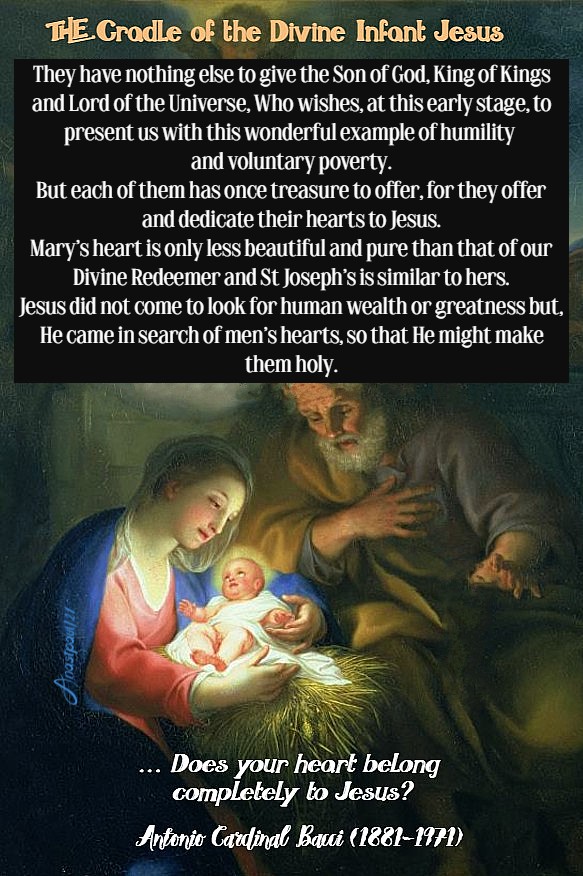
“Enter once more with faith and love into the stable of Bethlehem.
As soon as her Son has been miraculously delivered without any damage to her virginity, Mary adores Him and, with such maternal love as we could never conceive of, she takes Him to her heart.
Joseph, kneeling in ecstasy at the sight, bows reverently and kisses the forehead of the Divine Infant.
In this moment of blis, he is well rewarded for his unshaken faith and for all the sacrifices which he has made from his youth until the time of his alliance with Mary.

Now Mary and Joseph look around and, since they can find no better cradle for the Baby Jesus, they place Him upon some straw in a manger and cover Him with a rough linen cloth.
They have nothing else to give the Son of God, King of Kings and Lord of the Universe, Who wishes, at this early stage, to present us with this wonderful example of humility and voluntary poverty.
But each of them has once treasure to offer, for they offer and dedicate their hearts to Jesus.
Mary’s heart is only less beautiful and pure than that of our Divine Redeemer and St Joseph’s is similar to hers.

Jesus did not come to look for human wealth or greatness but, He came in search of men’s hearts, so that He might make them holy.
Throughout the centuries there have been many generous-hearted people who joined with Mary and Joseph in loving Jesus and in dedicating themselves entirely to Him.
Does your heart belong completely to Jesus?”

Antonio Cardinal Bacci

Posted in DOCTORS of the Church, DOMINICAN OP, JANUARY month of THE MOST HOLY NAME of JESUS, PRAYERS of the SAINTS, REDEMPTORISTS CSSR, The HOLY NAME of MARY, The WORD

Quote/s of the Day – 18 December – “The Holy Name of Jesus”

Quote/s of the Day – 18 December – O Adonai … O Lord – Saturday of the Third Week of Advent, Readings:
Jeremiah 23:5-8, Psalm 72:1-2, 12-13, 18-19, Matthew 1:18-25

“She will bear a son
and you are to name him Jesus
because he will save his people
from their sins
.”

Matthew 1:21

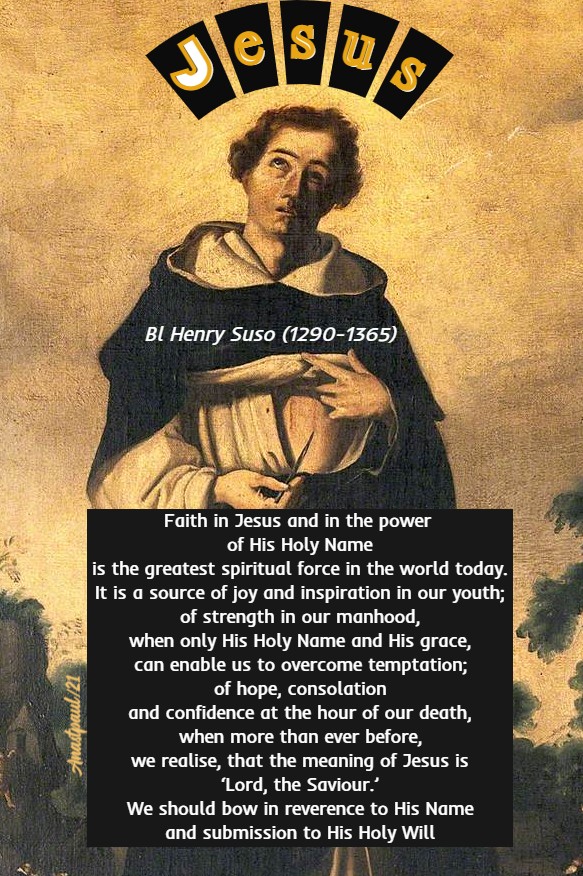
“Faith in Jesus and in the power of His Holy Name
is the greatest spiritual force in the world today.
It is a source of joy and inspiration in our youth;
of strength in our manhood,
when only His Holy Name and His grace,
can enable us to overcome temptation;
of hope, consolation
and confidence at the hour of our death,
when more than ever before,
we realise, that the meaning of Jesus is
‘Lord, the Saviour.

We should bow in reverence to His Name
and submission to His Holy Will.

Bl Henry Suso (1290-1365)

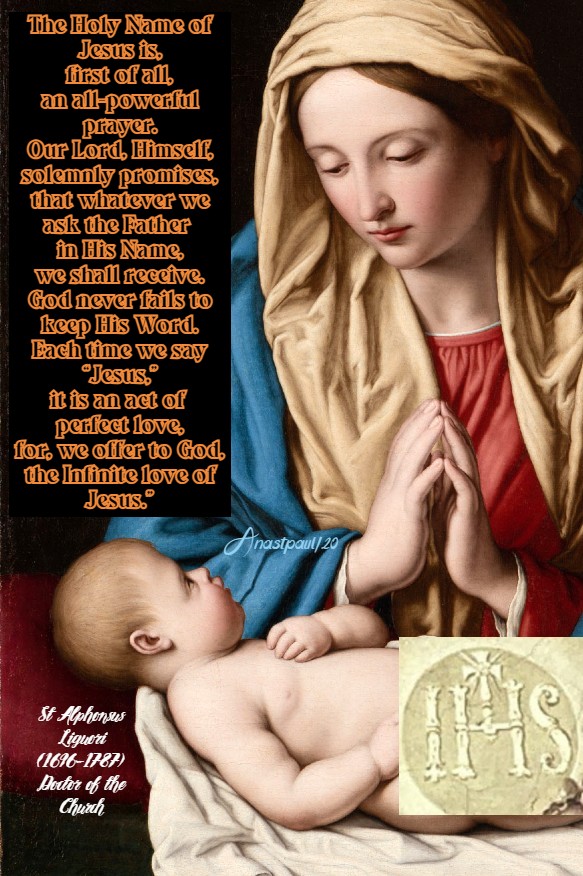
The Holy Name of Jesus is,
first of all,
an all-powerful prayer.
Our Lord, Himself, solemnly promises,
that whatever we ask the Father in His Name,
we shall receive.
God never fails to keep His Word.
Each time we say “Jesus,”
it is an act of perfect love,
for, we offer to God,
the infinite love of Jesus
.”

St Alphonsus Liguori (1696-1787)
Doctor of the Church

Jesus, Name Full of Glory
By St Bernardine of Siena (1380-1444)

Jesus,
Name full of glory,
grace, love and strength!
You are the refuge of those who repent,
our banner of warfare in this life,
the medicine of souls,
the comfort of those who morn,
the delight of those who believe,
the light of those
who preach the true faith,
the wages of those who toil,
the healing of the sick.
To You our devotion aspires,
by You our prayers are received;
we delight in contemplating You.
O Name of Jesus,
You are the glory of all the saints for eternity.
Amen

Posted in DOCTORS of the Church, FATHERS of the Church, JANUARY month of THE MOST HOLY NAME of JESUS, ONE Minute REFLECTION, St JOSEPH, The HEART, The HOLY NAME, The O ANTIPHONS, The WORD, Thomas a Kempis

One Minute Reflection – 18 December – O Adonai … O Lord

One Minute Reflection – 18 December – O Adonai … O Lord – Saturday of the Third Week of Advent, Readings: Jeremiah 23:5-8, Psalm 72:1-2, 12-13, 18-19, Matthew 1:18-25

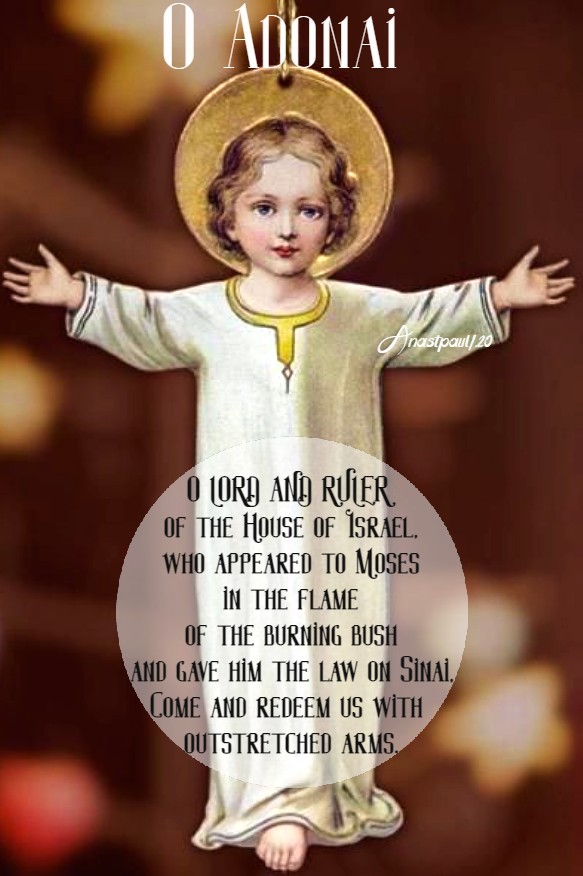
O LORD AND RULER
of the House of Israel,
who appeared to Moses in the flame
of the burning bush
and gave him the law on Sinai,
Come and redeem us with outstretched arms.

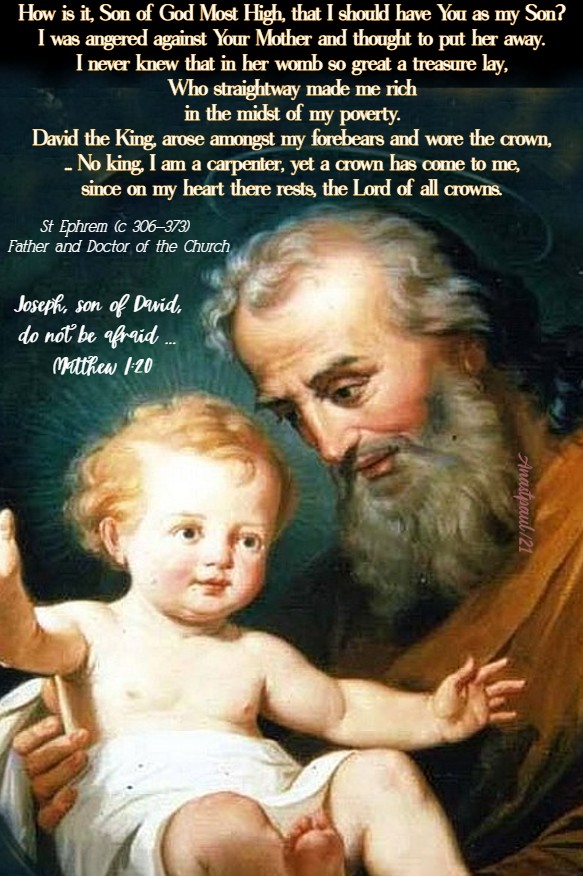
“Joseph, son of David, do not be afraid” – Matthew 1:20

REFLECTION – “Joseph embraced
the Son of the heavenly Father
as he would a newborn babe
and served Him as his God.
He took pleasure in this
as in goodness itself
and he, who was complete righteousness (Mt 1:19),
worshiped Him.

Oh how great was his wonderment!
How is it, Son of God Most High,
that I should have You as my Son?
I was angered against Your Mother
and thought to put her away.
I never knew that in her womb
so great a treasure lay,
Who straightway made me rich
in the midst of my poverty
.

David the King, arose amongst my forebears
and wore the crown,
yet how great is the destitution
to which I have come!

No king, I am a carpenter,
yet a crown has come to me,
since on my heart there rests,
the Lord of all crowns.
” – St Ephrem (306-373) Deacon in Syria, Father and Doctor of the Church (Hymn for the Nativity.)

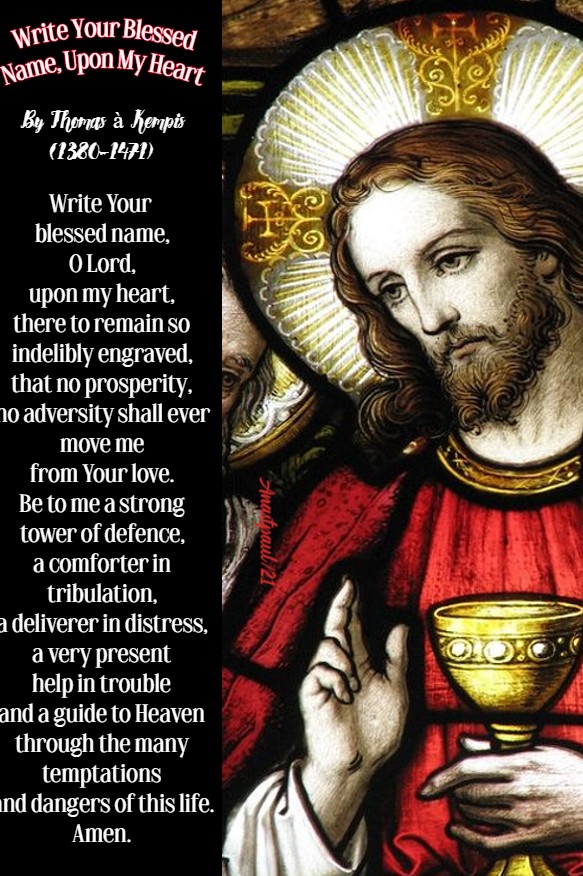
PRAYERWrite Your Blessed Name, Upon My Heart
By Thomas à Kempis (1380-1471)

Write Your blessed name,
O Lord,
upon my heart,
there to remain so indelibly engraved,
that no prosperity,
no adversity shall ever move me
from Your love.
Be to me a strong tower of defence,
a comforter in tribulation,
a deliverer in distress,
a very present help in trouble
and a guide to Heaven
through the many temptations
and dangers of this life.
Amen.

Posted in DECEMBER - The DIVINE INFANCY and The IMMACULATE CONCEPTION, HYMNS, MARIAN DEVOTIONS, MARIAN Saturdays, MARIAN TITLES, Our MORNING Offering, The IMMACULATE CONCEPTION

Our Morning Offering – 18 December – O Purest of Creatures, Sweet Mother, Sweet Maid

Our Morning Offering – 18 December – “Month of the Immaculate Conception”and also the Feast of Our Lady of Expectation

O Purest of Creatures, Sweet Mother, Sweet Maid
By
Fr Frederick W Faber C.Orat. (1814-1863)

O Purest of creatures, sweet Mother, sweet maid,
The one spotless womb wherein Jesus was laid!
Dark night hath come down on us, Mother! and we
Look out for thy shining, sweet Star of the Sea!

Deep night hath come down on this rough-spoken world,
And the banners of darkness are boldly unfurled;
And the tempest-tossed Church,—
all her eyes are on thee;
They look to thy shining, sweet Star of the Sea!

He gazed on thy soul, it was spotless and fair,
For the empire of sin—it had never been there;
None ever had owned thee, dear Mother but He.
And He blest thy clear shining, sweet Star of the Sea!

Earth gave Him one lodging; t’was deep in thy breast,
And God found a home where the sinner finds rest;
His home and His hiding-place, both were in thee,
He was won by thy shining, sweet Star of the Sea!

Raised in the Church of England, Frederick W Faber (born at Calverley, Yorkshire, England, 1814 and died Kensington, London, England, 1863) came from a Huguenot and strict Calvinistic family background. He was educated at Balliol College, Oxford and ordained in the Church of England in 1839. Influenced by the teaching of John Henry Newman, Faber followed Newman into the Roman Catholic Church in 1845 and served under Newman’s supervision in the Oratory of St Philip Neri. Fr Faber wrote 150 hymns for the use of the Catholic faithful. One of his best known is , “Faith of Our Fathers.”

Posted in SAINT of the DAY

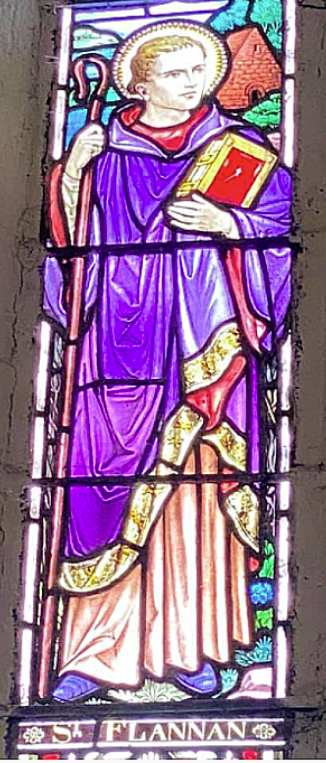
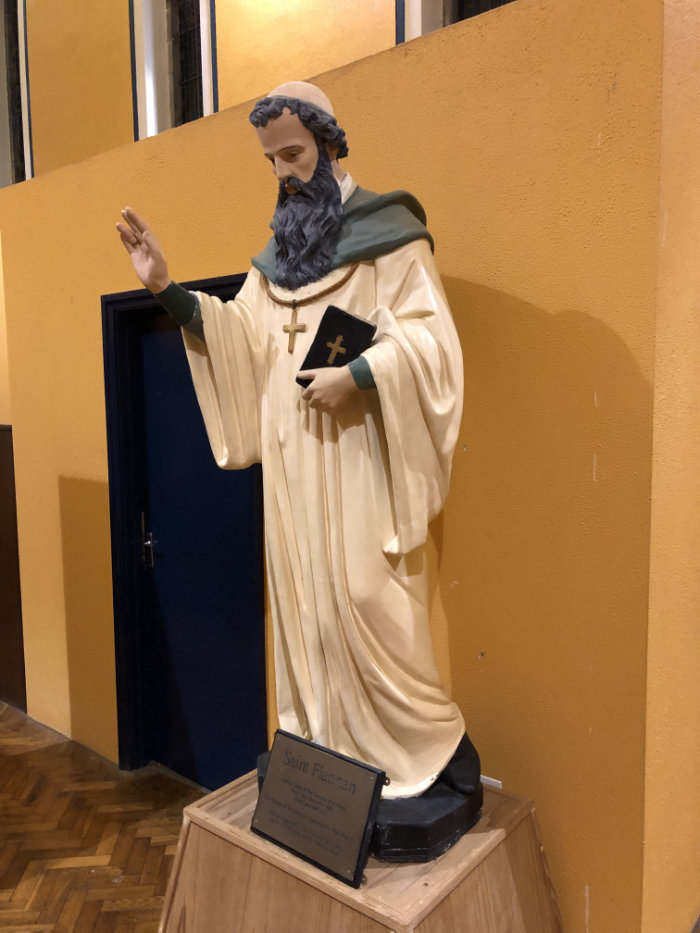
Saint of the Day – 18 December – Saint Flannán of Killaloe (7th Century)

Saint of the Day – 18 December – Saint Flannán of Killaloe (7th Century) Bishop, Abbot, Missionary to the Hebrides Islands, renowned for his preaching. Born in Thomond, Ireland in the 7th Century and died in the 7th to 8th Century’s in Killaloe, Munster, Ireland. Patronages – Diocese of Killaloe and Country Clare,Ireland. Additional Memorial – 28 August on a local Irish Calendar.

St Flannan is honoured in a particular way in Killaloe, a small village on the border of Counties Clare and Tipperary. The Cathedral Church of Killaloe is named after St Flannan.

Born sometime in the seventh century, Flannan was the son of an Irish chieftain, Turlough of Thomond. He joined the Monastery in Killaloe, which the famous Irish Abbot St Molua founded.

A legend about how Flannan became the successor of Abbot Molua says that one day, Flannan was baking bread for the Monks and for the poor. He worked in the Monastery kitchen for thirty-six hours without rest!. In the middle of the night, light began to stream from his fingers into the darkness around him, enabling him to keep baking throughout the night. When Abbot Molua heard about this young Monk’s dedication to service, he appointed him as the next Abbot of Killaloe.

Unsurprisingly, Flannan, before and during his tenure as Abbot, gained a reputation for his unwavering charity, care of the needy and hospitality. The families surrounding the Abbey. whom he looked after, clamoured for Flannan to be appointed a Bishop.

Accordingly, Flannan travelled to Rome where Pope John IV Consecrated him the first Bishop of Killaloe. He was an immensely popular and beloved Bishop, including in the Hebrides Islands, where he was particularly renowned for his preaching.

The Feast of St Flannan is celebrated throughout Ireland on 18 December, the day in which it is in fact commemorated by the Martyrology of Tallaght, in the form Flannain meic Tairdelbaig, although it is also celebrated under the date of 28 August.

The Flannan Islands, off the west coast of the Scottish Isle of Lewis, certainly owe their name to this Irish Saint.

Saint Flannan’s cultus was confirmed and he was Canonised on 19 June 1902 by Pope Leo XIII.

Posted in ADVENT, EMBER DAYS, MARIAN TITLES, NOVENAS, SAINT of the DAY

Christmas Novena to the Christ Child – Day Three, Ember Saturday, Our Lady of Expectation and Memorials of the Saints – 18 December

Christmas Novena to the Christ Child – Day Three:
https://anastpaul.com/2018/12/18/christmas-novena-to-the-christ-child-day-three-18-december-3/

EMBER SATURDAY
Fast and Partial Abstinence

Our Lady of the Expectation – This Feast originated in Spain. When the Feast of the Annunciation (25 March) was transferred to 18 December because of the regulation forbidding Feasts in Lent, it remained on this date after the Annunciation was again celebrated on its original date. It impressed on the faithful, the sentiments of the Blessed Virgin as the time of her delivery approached.

More about the Feast here:
https://anastpaul.com/2018/12/18/the-feast-of-our-lady-of-expectation-18-december/

St Auxentius of MopsueStia
St Basilian of Laodicea
St Bodagisil of Aquitaine
St Desiderius of Fontenelle
Bl Eugenio Cernuda Febrero
St Flannán of Killaloe (7the Century) Bishop, Abbot, Missionary.

St Gatian of Tours (c 251-301) The founding Bishop of the See of Tours, Missionary..
About St Gatian:

https://anastpaul.com/2019/12/18/saint-of-the-day-18-december-saint-gatian-of-tours-c-251-301/

Blessed Giulia Valle (1847-1916) Nun
About Blessed Giulia:

https://anastpaul.wordpress.com/2017/12/18/saint-of-the-day-18-december-bl-giulia-nemesia-valle-1847-1916/

St Malachi the Prophet
St Mawnan of Cornwall
Bl Miguel San Román Fernández
St Phaolô Nguyen Van My
St Phêrô Truong Van Ðuong
St Phêrô Vu Van Truat
Bl Philip of Ratzeburg
St Rufus of Philippi
St Samthann of Clonbroney
St Theotimus of Laodicea

St Winebald OSB (c 701-761) Benedictine Priest, Abbot, Confessor, Missionary, Founder of many Monasteries, disciple of St Boniface.
St Winebald’s Life:

https://anastpaul.com/2020/12/18/saint-of-the-day-18-december-saint-winebald-osb-c-701-761/

St Zosimus of Philippi

Martyrs of Northwest Africa – 42 saints:
Mercedarian Redeemers – 6 beati – These are a group of Mercedarian friars who worked together, under the leadership of Saint Peter de Amer, to ransom (e.g., redeem) prisoners and minister to them after.

Posted in ADVENT REFLECTIONS, GOD is LOVE, MEDITATIONS - ANTONIO CARD BACCI

Thought for the Day – 17 December – A Christmas Novena II – Preparation for the Nativity

Thought for the Day – 17 December – Meditations with Antonio Cardinal Bacci (1881-1971)

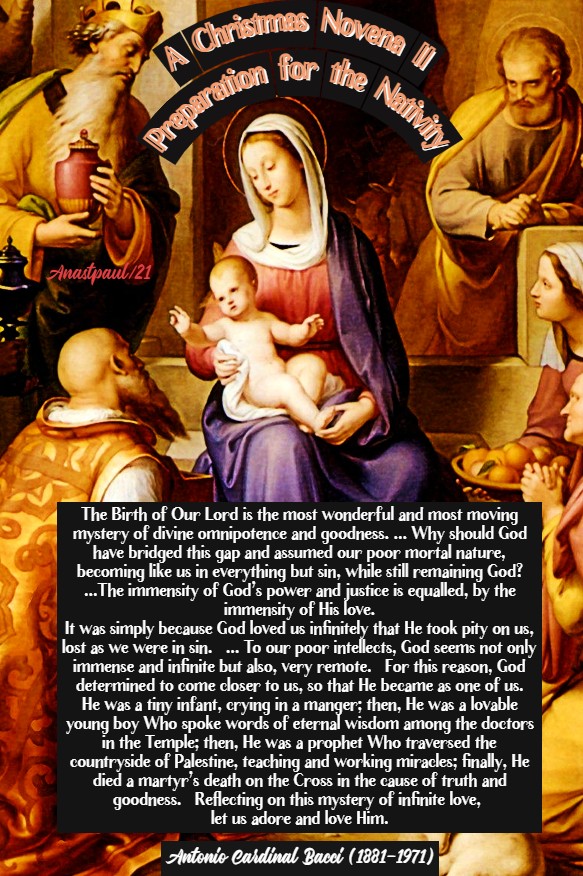
A Christmas Novena II
Preparation for the Nativity

The Birth of Our Lord is the most wonderful and most moving mystery of divine omnipotence and goodness.
At first thought, the idea of the infinite God becoming man, would seem impossible.
Between God and man, there is a vast abyss.
Why should God have bridged this gap and assumed our poor mortal nature, becoming like us in everything but sin, while still remaining God?
It is a hard question for the human mind to answer.
There is only one reply, however.
The immensity of God’s power and justice is equalled, by the immensity of His love.
It was simply because God loved us infinitely that He took pity on us, lost as we were in sin.
He assumed a human body and became man and, He suffered and died for us, so that we might love and obey Him more easily and follow in the way of goodness.

To our poor intellects, God seems not only immense and infinite but also, very remote.
For this reason, God determined to come closer to us, so that He became as one of us.
He was a tiny infant, crying in a manger; then, He was a lovable young boy Who spoke words of eternal wisdom among the doctors in the Temple; then, He was a prophet Who traversed the countryside of Palestine, teaching and working miracles; finally, He died a martyr’s death on the Cross in the cause of truth and goodness.
Reflecting on this mystery of infinite love, let us adore and love Him.

Antonio Cardinal Bacci

Posted in ADVENT QUOTES, AUGUSTINIANS OSA, CHRIST the PHYSICIAN, CHRIST the WORD and WISDOM, CHRIST, the WAY,TRUTH,LIFE, CHRISTMASTIDE!, DOCTORS of the Church, DOMINICAN OP, FATHERS of the Church, JULY - The MOST PRECIOUS BLOOD, QUOTES for CHRIST, QUOTES on the CROSS of CHRIST, The HOLY CROSS, The MOST PRECIOUS BLOOD

Quote/s of the Day – 17 December – O Wisdom …….

Quote/s of the Day – 17 December – O Wisdom …….

“Let us fix our thoughts
on the Blood of Christ
and reflect how Precious that Blood is,
in God’s eyes,
inasmuch, as its outpouring f
or our salvation,
has opened the grace of repentance
to all mankind.

St Pope Clement I (c 35 – c 99)

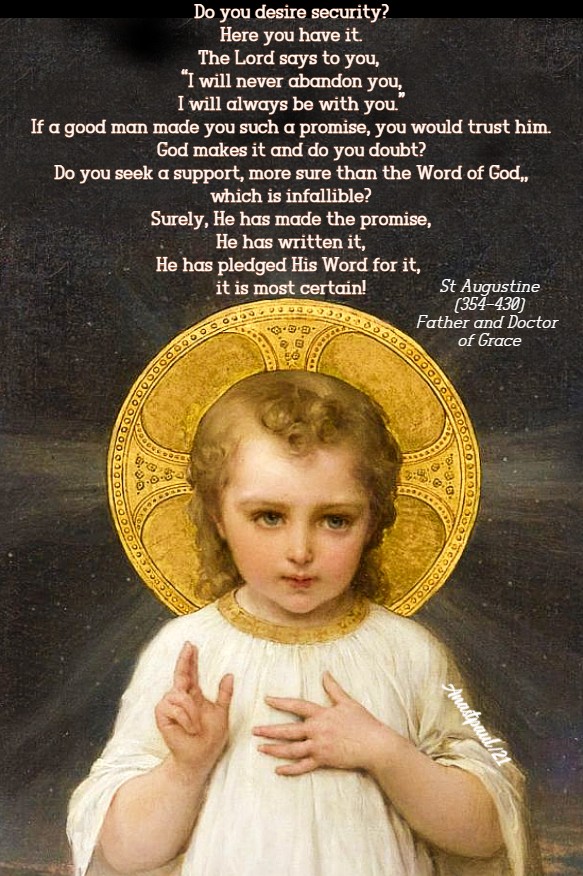
Do you desire security?
Here you have it.
The Lord says to you,
“I will never abandon you,
I will always be with you.”
If a good man made you such a promise,
you would trust him.
God makes it and do you doubt?
Do you seek a support, more sure
than the Word of God, which is infallible?
Surely, He has made the promise,
He has written it,
He has pledged His Word for it,
it is most certain!

St Augustine (354-430)
Father and Doctor of Grace

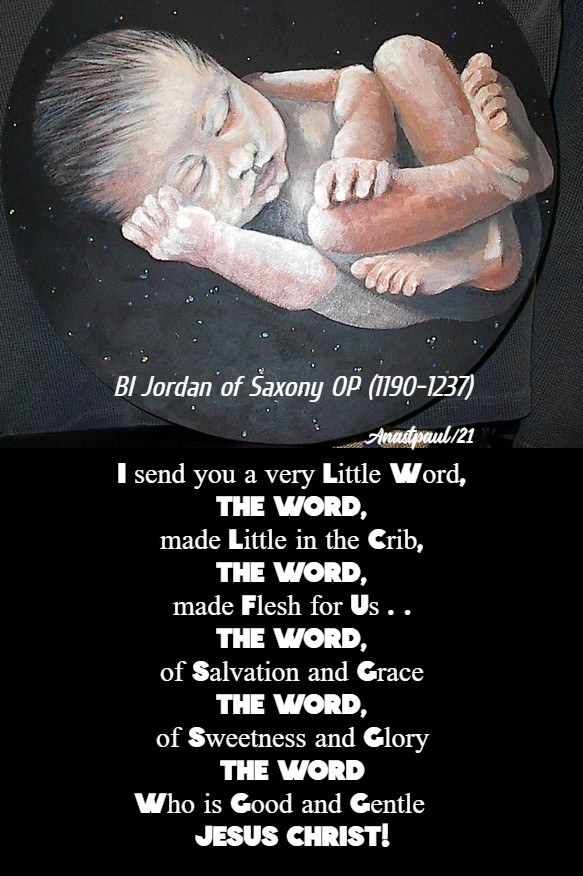
“I send you a very little word,
THE WORD,
made little in the crib,
THE WORD,
made flesh for us ….
THE WORD,
of salvation and grace
THE WORD,
of sweetness and glory
THE WORD
Who is good and gentle –
JESUS CHRIST!

Blessed Jordan of Saxony OP (1190-1237)

Posted in "Follow Me", ADVENT REFLECTIONS, CHRIST the WORD and WISDOM, DOCTORS of the Church, FATHERS of the Church, ONE Minute REFLECTION, QUOTES on HUMILITY, The NATIVITY of JESUS, The O ANTIPHONS, The WORD

One Minute Reflection – 17 December – O Wisdom … O Sapientia …

One Minute Reflection – 17 December – O Wisdom … O Sapientia … – Friday of the Third Week of Advent, Readings: Genesis 49: 2, 8-10; Psalm 72: 1-4, 7-8, 17; Matthew 1: 1-17

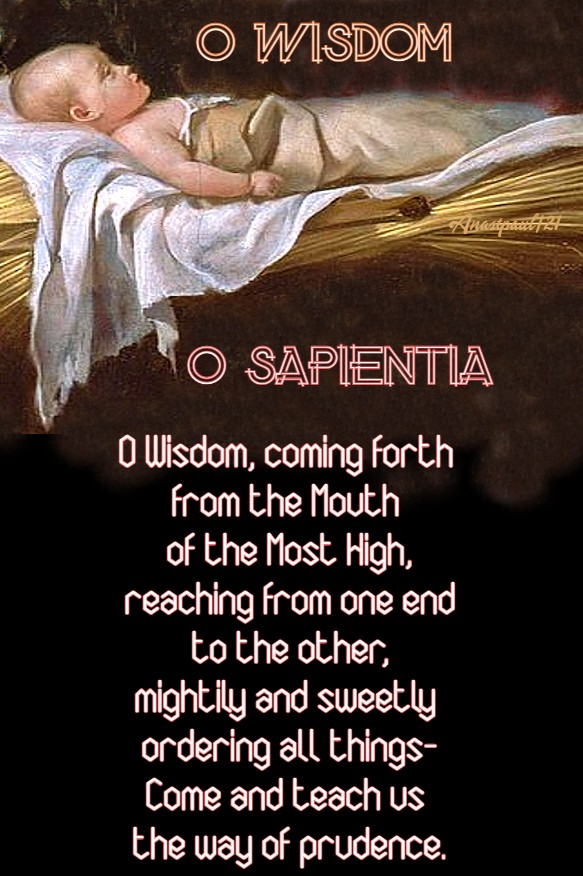
O Wisdom
O Sapientia

O Sapientia, quae ex ore Altissimi prodiisti,
attingens a fine usque ad finem,
fortiter suaviterque disponens omnia-
veni ad docendum nos viam prudentiae.

O Wisdom, coming forth
from the Mouth of the Most High,
reaching from one end to the other,
mightily and sweetly ordering all things-
Come and teach us the way of prudence.

The book of the genealogy of Jesus Christ, the son of David, the son of Abraham. … Matthew 1:1

REFLECTION – “The Incarnation of the Word only contributed to the doing of those things that were done and the mystery of humankind’s salvation was never, even in the remotest age, at a standstill.   What the propehts foretold, the apostles announced, nor were those things fulfilled too late, which had always been believed.   But the wisdom and goodness of God, made us all the more receptive of His call …  as the foretelling of it had been ancient and oft-repeated.

And so it was no new counsel, no tardy pity, whereby God took thought for us but from the foundation of the world, He ordained one and the same cause of Salvation for all.   For the grace of God, by which the whole body of the saints is continually made righteous, was increased, not initiated, when Christ was born.   And this mystery of God’s great love, with which the whole world is now filled, was so effectively pre-signified, that those who believed the promise, obtained no less, than those who were the actual recipients.

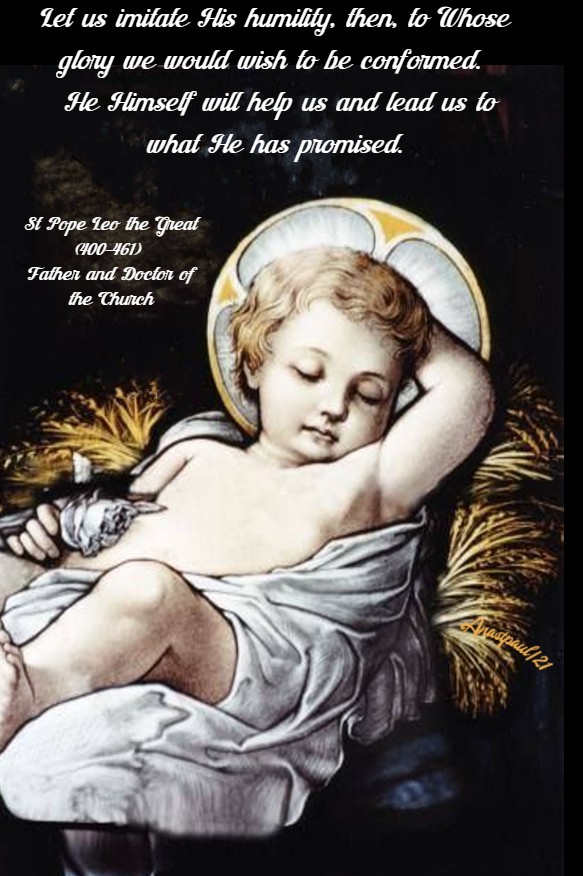
And so, dearly beloved, since that loving-kindness is now manifest with which all the wealth of divine goodness has been showered on us, Whose call to eternal life has been promoted, not only by the supportive example of those who went before us but, by the visible and bodily appearance of Truth itself, we are bound to keep the day of our Lord’s Nativity with a joy beyond this world…   By the illumination of the Holy Spirit consider who it was who received us into Himself and Whom we have received, since as the Lord Jesus became our flesh by being born, so we also became His Body by being re-born…  For God suggested to us the standard of His own gentleness and humility…  Let us imitate His humility, then, to whose glory we would wish to be conformed.   He Himself will help us and lead us to what He has promised.” … St Pope Leo the Great (400-461) Father and Doctor of the Church (3rd sermon on the Feast of the Nativity, 4-5).

PRAYER – Collect:
O God, Creator and Redeemer of human nature,
Who willed that Your Word should take flesh
in an ever-virgin womb, look with favour on our prayers,
that Your only Begotten Son, having taken to Himself our humanity, may be pleased to grant us a share in his divinity.
Who lives and reigns with You in the unity of the Holy Spirit,
one God, for ever and ever. Amen

Rejoice! Rejoice! Emmanuel
Shall come to thee, O Israel

Posted in FATHERS of the Church, HYMNS, MARIAN POETRY, MARIAN PRAYERS, MARIAN TITLES, MOTHER of GOD, Our MORNING Offering, QUEENSHIP of MARY, QUOTES of the SAINTS

Our Morning Offering – 17 December – Queen on Whose Starry Brow Doth Rest

Our Morning Offering – 17 December – “Month of the Immaculate Conception” – Friday of the Third Week of Advent

Queen on Whose Starry Brow Doth Rest
St Venantius Fortunatus (c 530-c 609)

Translation by Monsignor Ronald A Knox (1888 – 1957)

Queen, on whose starry brow doth rest
The crown of perfect maidenhood,
The God who made thee, from thy brest
Drew, for our sakes, His earthly food.

The grace that sinful Eve denied,
With thy Child-bearing, re-appears;
Heaven’s lingering door, set open wide,
Welcomes the children of her tears.

Fate, for such royal progress meet,
Beacon, whose rays such light can give,
Look, how the ransomed nations greet
The virgin-womb that bade them live!

O Jesus, whom the Virgin bore,
Be praise and glory unto Thee.
Praise to the Father evermore
And His life-giving Spirit be.
Amen!

Saint Venantius Fortunatus (c 530 – c 609) Bishop, Poet, Hymnist, Writer – born c 530 at Rreviso, Italy and died c 609 at Poitiers, modern France of natural causes.
St Venantius was unique, first a travelling lay poet, he later became a Priest and then a Bishop. But he always remained a professional author of poetry, a “Troubadour” of Christ. He is the attributed author of the Ave Maris Stella, amongst many others.

Posted in SAINT of the DAY

Saint of the Day – 17 December – Saint Lazarus of Bethany (1st Century) Friend amd Disciple of Jesus

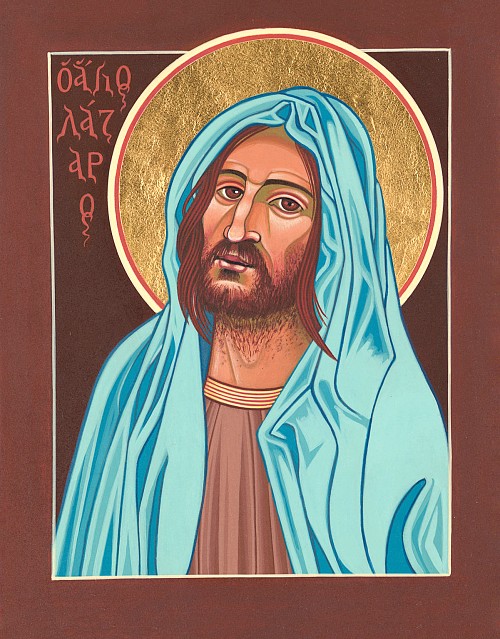
Saint of the Day – 17 December – Saint Lazarus of Bethany (1st Century) Friend amd Disciple of Jesus, raised to life by Jesus after having been in his tomb for 4 days, brother of Sts Martha and Mary of Bethany, Bishop of Marseilles, France, , Martyr, Missionary. Died by being beheaded in the 1st century in a cave near Marseilles, France. Patronages – Autun, France, Diocese of, Marseille, France, Archdiocese of. Also known as – “Eleazar (the Hebrew version – which means ‘God helped‘),” Lazarus of the Four Days, Lazarus the Resurrected, Lazare…

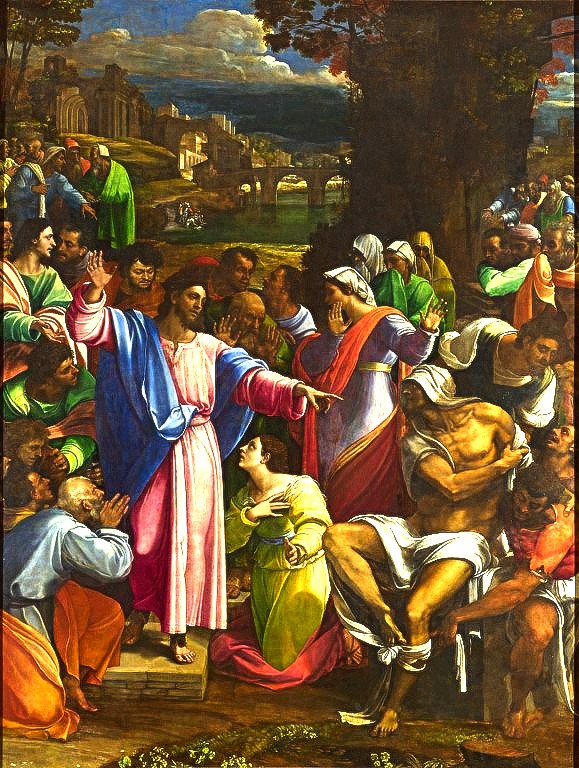
The Raising of Lazarus, c 1517–1519, Sebastiano del Piombo
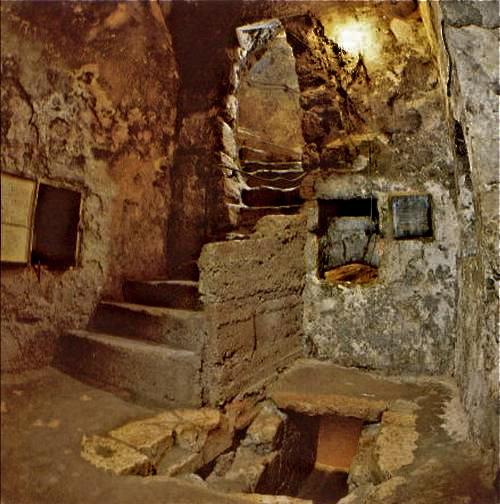
Inside the burial tomb of St Lazarus

According to a tradition, or rather a series of traditions combined at different epochs, the members of the family at Bethany, the friends of Christ, together with some holy women and others of His disciples, were put out to sea by the Jews hostile to Christianity in a vessel without sails, oars, or helm and after a miraculous voyage landed in Provence, at a place called today the Saintes-Maries. It is related that they separated there to go and preach the Gospel in different parts of the southeast of Gaul.

Lazarus went to Marseilles and, having converted a number of its inhabitants to Christianity, became their first Bishop. . During the first persecution under Nero, he hid himself in a crypt, over which the celebrated Abbey of St-Victor was constructed in the fifth century. In this same crypt he was interred, when he shed his blood for the Faith., during the new persecution of Domitian. He was cast into prison and beheaded in a spot which is believed to be identical with a cave beneath the prison Saint-Lazare.

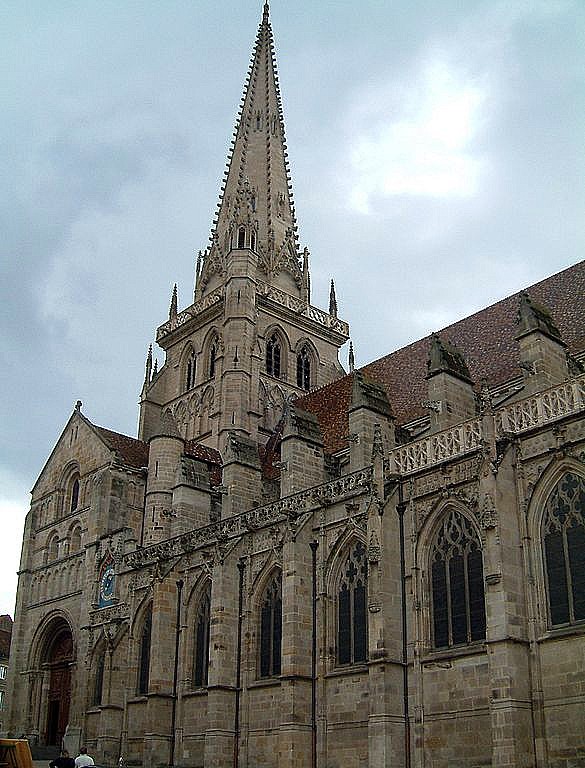
His body was later translated to Autun, and buried in the Cathedral of that Town. But the inhabitants of Marseilles claim to be in possession of his head which they still venerate.

Autun Cathedral

Like the other legends concerning the Saints of the Palestinian group, this tradition, which was believed for several centuries and which still finds some advocates, has no solid foundation. It is in a writing, contained in an eleventh century manuscript, with some other documents relating to St Magdalen of Vezelay, that we first read of Lazarus in connection with the voyage that brought Magdalen to Gaul. Before the middle of the eleventh century there does not seem to be the slightest trace of the tradition according to which the Palestinian Saints came to Provence.

At the beginning of the twelfth century, perhaps through a confusion of names, it was believed at Autun, that the tomb of St. Lazarus was to be found in the Cathedral dedicated to St Nazarius. A search was made and remains were discovered, which were solemnly translated and were considered to be those of him whom Christ raised from the dead but it was not thought necessary to inquire why they should be found in France.

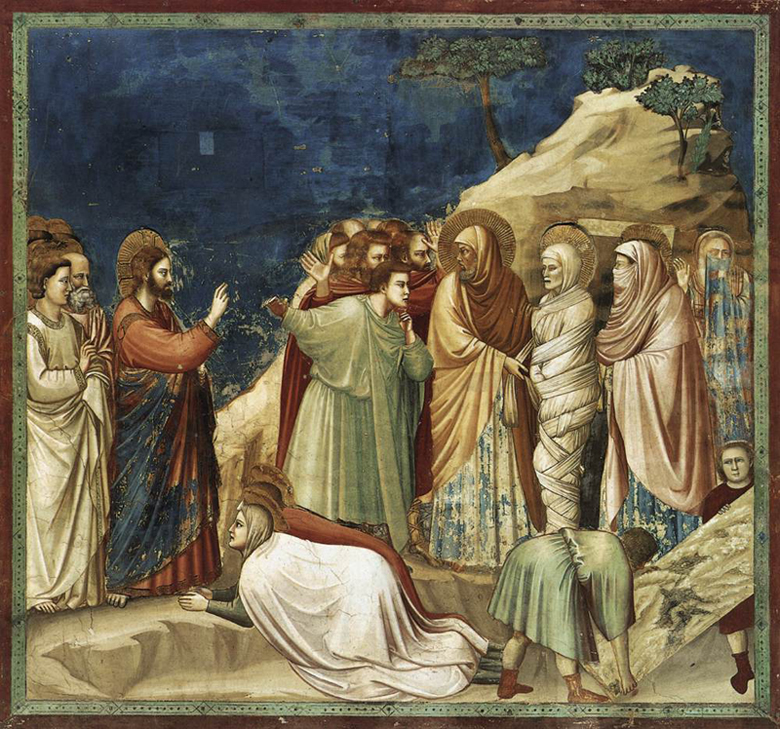
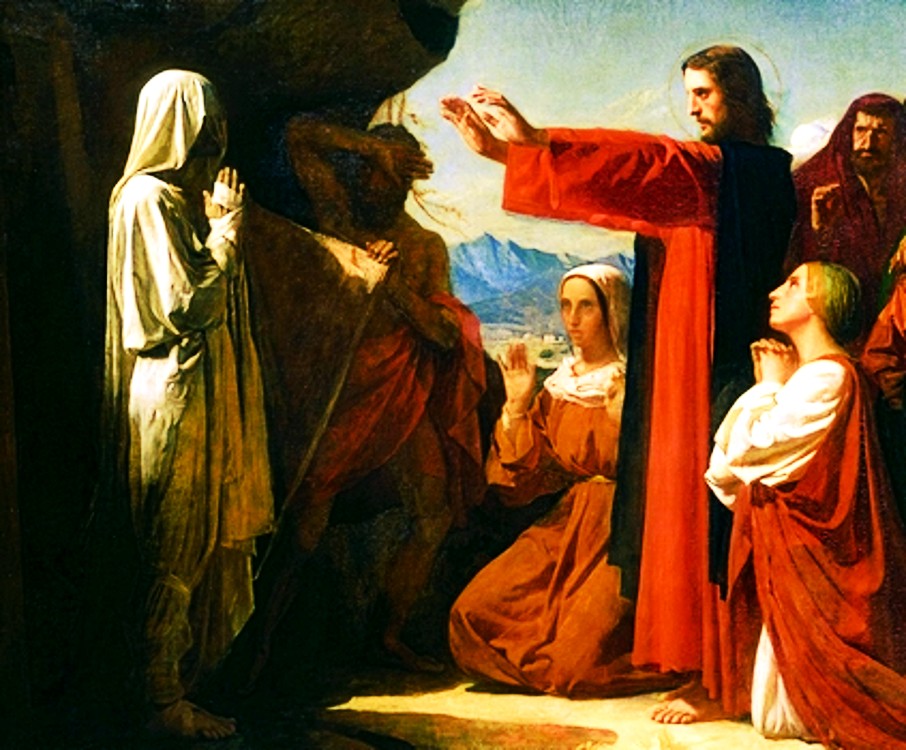
The account of Jesus raising Lazarus occurs only in the Gospel of John, the Gospel which most strongly focuses on Jesus as the Son of God. Lazarus served as an instrument for Jesus to provide indisputable proof that he was the Saviour.

John 11:1-44

Now a man was ill, Lazarus from Bethany, at the village of Mary and her sister Martha. Mary was the one who had anointed the Lord with perfumed oil and dried his feet with her hair; it was her brother Lazarus who was ill. So the sisters sent word to him, saying, “Master, the one you love is ill.”
When Jesus heard this he said, “This illness is not to end in death but is for the glory of God, that the Son of God may be glorified through it.”
Now Jesus loved Martha and her sister and Lazarus. But, when he heard that he was ill, he remained for two days in the place where he was. Then after this he said to his disciples, “Let us go back to Judea.”
The disciples said to him, “Rabbi, the Jews were just trying to stone you and you want to go back there?”
Jesus answered, “Are there not twelve hours in a day? If one walks during the day, he does not stumble because he sees the light of this world. But if one walks at night, he stumbles, because the light is not in him.” He said this,and then told them, “Our friend Lazarus is asleep but I am going to awaken him.”
So the disciples said to him, “Master, if he is asleep, he will be saved.”
But Jesus was talking about his death, while they thought that he meant ordinary sleep. So then Jesus said to them clearly, “Lazarus has died. And I am glad for you that I was not there, that you may believe. Let us go to him.”
So Thomas, called Didymus, said to his fellow disciples, “Let us also go to die with him.”
When Jesus arrived, he found that Lazarus had already been in the tomb for four days. Now Bethany was near Jerusalem, only about two miles away. And many of the Jews had come to Martha and Mary to comfort them about their brother. When Martha heard that Jesus was coming, she went to meet him but Mary sat at home. Martha said to Jesus, “Lord, if you had been here, my brother would not have died. [But] even now I know that whatever you ask of God, God will give you.”
Jesus said to her, “Your brother will rise.”
Martha said to him, “I know he will rise, in the resurrection on the last day.”
Jesus told her, “I am the resurrection and the life; whoever believes in me, even if he dies, will live and everyone who lives and believes in me will never die. Do you believe this?”
She said to him, “Yes, Lord. I have come to believe that you are the Messiah, the Son of God, the One who is coming into the world.”
When she had said this, she went and called her sister Mary secretly, saying, “The teacher is here and is asking for you.”
As soon as she heard this, she rose quickly and went to him. For Jesus had not yet come into the village but was still where Martha had met him. So when the Jews, who were with her in the house comforting her saw Matha, they got up quickly and went out to followed her, presuming that she was going to the tomb to weep there. When Mary came to where Jesus was and saw him, she fell at his feet and said to him, “Lord, if you had been here, my brother would not have died.”
When Jesus saw her weeping and the Jews who had come with her weeping, he became perturbed and deeply troubled, and said, “Where have you laid him?”
They said to him, “Sir, come and see.”
And Jesus wept. So the Jews said, “See how he loved him.” But some of them said, “Could not the One who opened the eyes of the blind man have done something so that this man would not have died?”
So Jesus, perturbed again, came to the tomb. It was a cave, and a stone lay across it. Jesus said, “Take away the stone.”
Martha, the dead man’s sister, said to him, “Lord, by now there will be a stench; he has been dead for four days.”
Jesus said to her, “Did I not tell you that if you believe you will see the glory of God?”
So they took away the stone. And Jesus raised his eyes and said, “Father, I thank you for hearing me. I know that you always hear me but because of the crowd here I have said this, that they may believe that you sent me.” And when he had said this, he cried out in a loud voice,
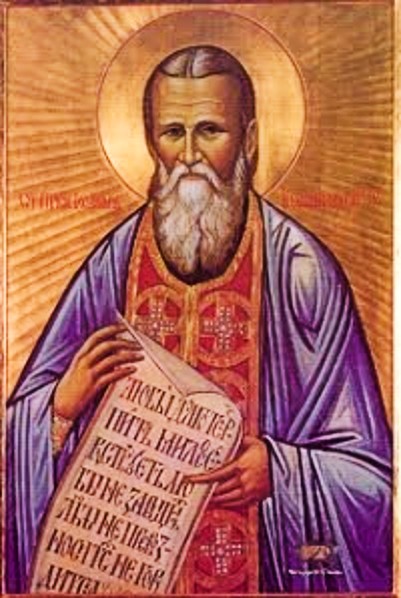
“Lazarus, come out!”

The dead man came out, tied hand and foot with burial bands and his face was wrapped in a cloth. So Jesus said to them, “Untie him and let him go.”

St Lazarus, Pray for us, amen!

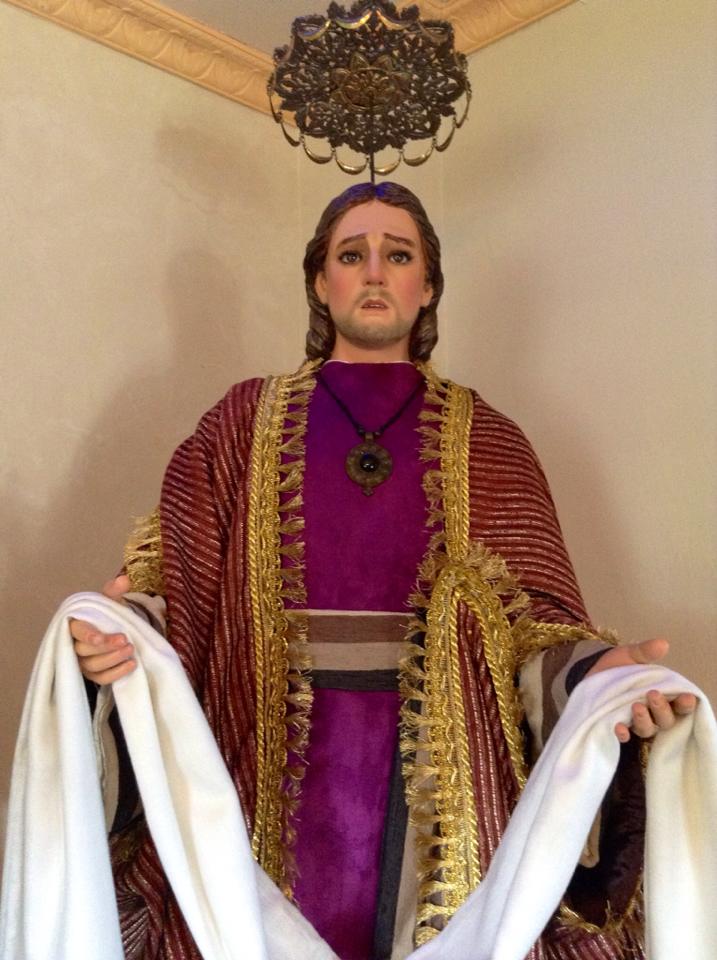
Statue of St Lazarus
Posted in EMBER DAYS, MARIAN TITLES, NOVENAS, SAINT of the DAY

Christmas Novena, Ember Day, Madonna del Terremoto (Madonna del Carmine) / Our Lady of the Earthquake, Paterno, Potenza, Basilicata, Italy (1857) and Memorials of the Saints – 17 December

DAY TWO of the CHRISTMAS NOVENAhttps://anastpaul.com/2018/12/17/christmas-novena-to-the-christ-child-day-two-17-december-3/

EMBER FRIDAY

Madonna del Terremoto (Madonna del Carmine) / Our Lady of the Earthquake, Paterno, Potenza, Basilicata, Italy (1857) – 17 December. (As Patron-Our Lady of Carmel – 26 July):

In the evening of 16 December 1857 a terrible earthquake struck the population of Basilicata and neighbouring regions. In the entire area, the earthquake wreaked havoc devastating the region.
The next day, the residents of Paterno began to pray and they processed with the Statue of the Madonna del Carmine, Out Lady of Carmel, who is the Patron of the Town.
As soon as the procession reached the devastated area where the destroyed buildings and carts containing the bodies of the dead stood, Our Lady turned her face and her eyes shed blood.
This miraculous event is commemorated every year on 17 December with a procession and Holy Mass.

St Briarch of Bourbriac

St John of Matha O.SS.T (1160-1213) Priest, Founder of The Order of the Most Holy Trinity and of the Captives, also known as the Trinitarians, Confessor.
Biography:

https://anastpaul.com/2018/12/17/saint-of-the-day-17-december-st-john-of-matha-o-ss-t-1160-1213/

St Josep/José Manyanet y Vives (1833-1901) Priest and Founder of of the Sons of the Holy Family and the Missionary Daughters of the Holy Family.
Biography:

https://anastpaul.wordpress.com/2017/12/17/saint-of-the-day-17-december-st-josep-manyanet-y-vives-1833-1901/

St Judicaël
St Lazarus of Bethany (1st Century) Bishop, Martyr, Missionary

BL Mariano Alarcón Ruiz
Bl Mathilde Téllez Robles
St Maxentiolus
St Modestus of Jerusalem

St Olympias of Constantinople (c 361-365 – 408) Childless Widow, Diaconess, friend of St John Chrysostom, Apostle of charity and Founder of a Convent, hospital and an orphanage, Defender of the true faith.
About St Olympias:

https://anastpaul.com/2019/12/17/saint-of-the-day-17-december-st-olympias-of-constantinople-c-361-365-408/

Bl Peter of Spain

St Sturmi of Fulda OSB (c 705-779) Priest, Monk, Missionary, disciple of Saint Boniface and Founder and first Abbot of the Benedictine Monastery and Abbey of Fulda. Known as “The Apostle of the Saxons,” “The Apostle of Germany.”
About St Sturmi:

https://anastpaul.com/2020/12/17/saint-of-the-day-17-december-saint-sturmi-of-fulda-c-705-779/

St Tydecho
St Wivina
St Yolanda

Martyrs of Eleutheropolis – (60+ Martyrs-Beati): Approximately 60 Christian soldiers in the imperial Roman army of emperor Heraclius; they were murdered as a group for their faith by invading Saracen Muslims. We know the names of two of them – Calaoicus and Florian. 638 in Eleutheropolis (Beit Jibrin), Palestine.
Posted in ADVENT REFLECTIONS, MEDITATIONS - ANTONIO CARD BACCI, QUOTES on HUMILITY, The NATIVITY of JESUS

Thought for the Day – 16 December – The Cave of Bethlehem

Thought for the Day – 16 December – Meditations with Antonio Cardinal Bacci (1881-1971)

A Christmas Novena
The Cave of Bethlehem

“Why, asked Bossuet, should the Eternal Word of God, infinitely and everlastingly happy, have deigned to assume in time, the fallen state of humanity?
Why should He have chosen, as the scene of His miraculous life of love, this insignificant world, a planet almost imperceptible among the myriads of gigantic heavenly bodies?
It was for the very same reason, Bossuet replied, that propmpted Him, once He had become man, to choose as His birthplace, the tiny and unknown village of Nazareth in Galilee rather than Rome, the centre of power, or Athens, the centre of learning, or Jerusalem, the capital of the State of Israel.
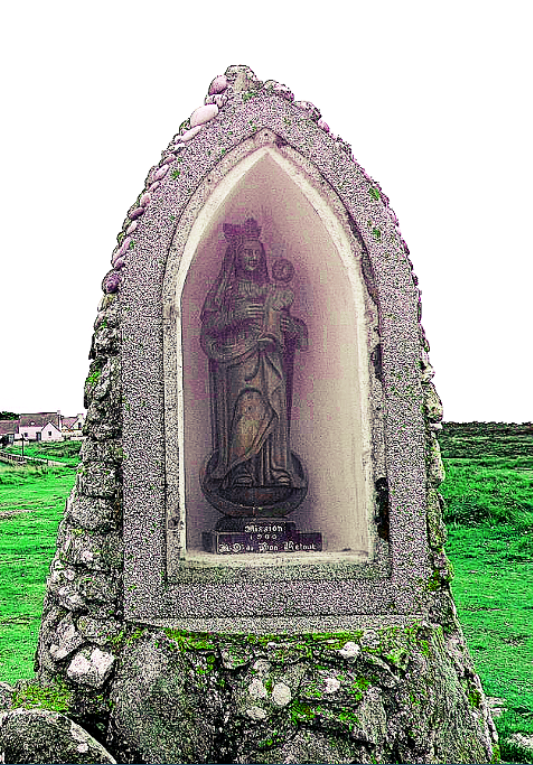
Our world is the Nazareth of creation, one of the smallest planets in the firmament.

God did not even choose, moreover, to be born in the poor but comparatively comfortable house at Nazareth.
He preferred to be born in the strange town of Bethlehem.
It was the cradle of His ancestral line but it gave Him no welcome and compelled Him to be born in a cold and squalid barn on the straw of a manger.
God had no need of human grandeur.
His power and majesty shone more brightly through the insignificance of the objects and means which He employed in order to fulfil His purpose.
It would be ridiculous to imagine, even for a moment, that He had any need of human aid in order to accomplish His designs.
God chooses the weak things of the world in order to confound the strong!” (Missale Romanum, Miss. Virg et Mart).

Antonio Cardinal Bacci

Posted in AUGUSTINIANS OSA, CHRIST, the WAY,TRUTH,LIFE, DOCTORS of the Church, FATHERS of the Church, GOD is LOVE, JESUIT SJ, QUOTES on COURAGE, QUOTES on FEAR, QUOTES on GRACE, QUOTES on HEAVEN, QUOTES on the CROSS of CHRIST, QUOTES on THE WORLD, St JOHN the BAPTIST, The HOLY CROSS, The KINGDOM of GOD / HEAVEN, The WORD

Quote/s of the Day – 16 December – ‘Our Treasure in Heaven’

Quote/s of the Day – 16 December – “Month of the Immaculate Conception” – Thursday of the Third week of Advent, Readings: Isaiah 54: 1-10; Psalm30: 2 and 4-6,11-12a and 13b; Luke 7: 24-30

I tell you, among those born of women,
no-one is greater than John;
yet the least in the kingdom of God
is greater than he.

Luke 7:28

He who calls us, came here below,
to give us the means of getting there.
He chose the wood
that would enable us to cross the sea –
indeed, no-one can cross the ocean of this world,
who is not borne by the Cross of Christ.
Even the blind can cling to this Cross.
If you can’t see where you are going very well,
don’t let go of it, it will guide you by itself
.”

St Augustine (354-430)
Father and Doctor of Grace

“Hate what the world seeks
and seek, what it avoids.

“God’s love calls us to move beyond fear.
We ask God for the courage
to abandon ourselves unreservedly,
so that we might be moulded
by God’s grace,
even as we cannot see
where that path may lead us.

St Ignatius Loyola SJ (1491-1556)

“Do not be afraid any longer, little flock,
for your Father is pleased
to give you the kingdom.
Sell your belongings and give alms.
Provide money bags for yourselves
that do not wear out,
an inexhaustible treasure in heaven
that no thief can reach nor moth destroy.

St John Leonardi (1541-1609)