Forty Martyrs of Sebaste, Armenia (Died 320) – Forty Christian soldiers of the Thunderstruck Legion of the Imperial Roman army who were tortured and murdered for their faith during the persecutions of Emperor Licinius. They were exposed naked on a frozen pond to freeze to death at Sebaste, Armenia in 320 and their bodies afterward were burned. THE FULL STORY HERE: https://anastpaul.com/2021/03/10/saints-of-the-day-10-march-the-forty-martyrs-of-sebaste-armenia-died-320/
St Alexander of Apema St Anastasia the Patrician St Andrew of Strumi St Attalas of Bobbio St Blanchard of Nesle-la-Réposte St Caius of Apema St Cordratus of Nicomedië St Droctoveus of Paris Bl Elias del Socorro Nieves St Emilian of Lagny St Failbhe the Little St Gustav the Hermit St Himelin Bl Jean-Marie Joseph Lataste
Thought for the Day – 9 March – Meditations with Antonio Cardinal Bacci (1881-1971)
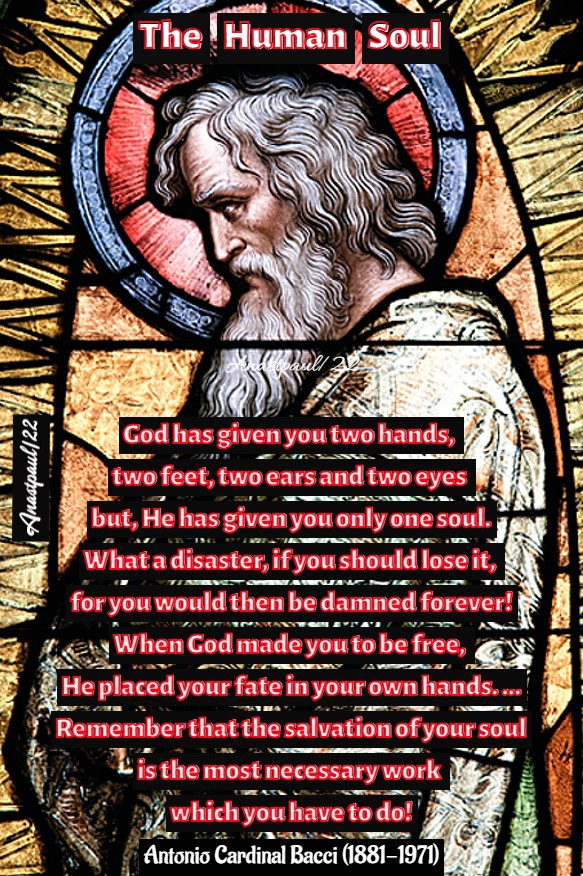
The Human Soul
“Consider that you have only one soul, which belongs entirely to God and has Heaven for its true home. God has given you two hands, two feet, two ears and two eyes but, He has given you only one soul. What a disaster, if you should lose it, for you would then be damned forever! When God made you to be free, He placed your fate in your own hands. “When God, in the beginning, created man, He made him subject to his own free choice” (Ecclus 15:14). Remember that the salvation of your soul is the most necessary work which you have to do! It is more precious to you than gold or silver. “More precious than gold is health and well-being, contentment of spirit, than coral” (Ecclus 30:15). All our attention should be devoted to keeping our soul free from sin and endowing it with every virtue.”
Wednesday of the First Week of Lent – 9 March – Our Lenten Journey with the Great Fathers – 3 Kings 19:3-8, Matthew 12:38-50
“Relieve the troubles of my heart and bring me out of distress, O Lord.” – Psalm 24:17-18
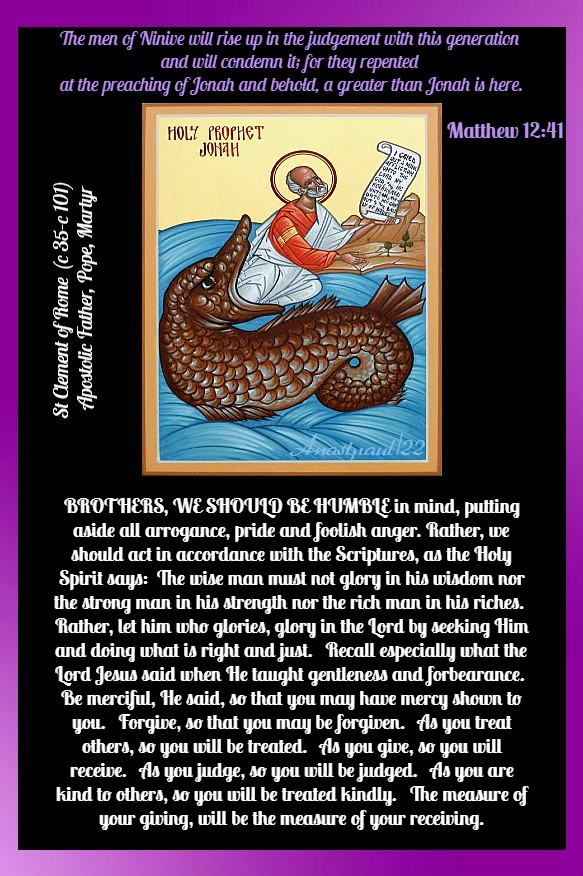
“The men of Ninive will rise up in the judgement with this generation and will condemn it; for they repented at the preaching of Jonah and behold, a greater than Jonah is here.”
Matthew 12:41
“ LET US FIX OUR ATTENTION on the Blood of Christ and recognise how precious it is to God His Father, since it was shed for our salvation and brought the grace of repentance to all the world.
If we review the various ages of history, we will see ,that in every generation the Lord has offered the opportunity of repentance to any who were willing to turn to Him. When Noah preached God’s message of repentance, all who listened to him were saved. Jonah told the Ninevites they were going to be destroyed,but when they repented, their prayers gained God’s forgiveness for their sins and they were saved, even though they were not of God’s people.
UUNDER THE INSPIRATION of the Holy Spirit, the ministers of God’s grace have spoken of repentance; indeed, the Master of the whole universe Himself, spoke of repentance with an oath: As I live, says the Lord, I do not wish the death of the sinner but his repentance. He added this evidence of His goodness: House of Israel, repent of your wickedness. Tell the sons of my people – If their sins should reach from earth to heaven, if they are brighter than scarlet and blacker than sackcloth, you need only turn to Me with your whole heart and say, “Father” and I will listen to you as a holy people.
IN OTHER WORDS. God wanted all His beloved ones to have the opportunity to repent and He confirmed this desire, by His own Almighty Will. That is why we should obey His Sovereign and Glorious Will and prayerfully entreat His mercy and kindness. We should be suppliant before Him and turn to His compassion, rejecting empty works and quarreling and jealousy which only lead to death.
BROTHERS, WE SHOULD BE HUMBLE in mind, putting aside all arrogance, pride and foolish anger. Rather, we should act in accordance with the Scriptures, as the Holy Spirit says: The wise man must not glory in his wisdom nor the strong man in his strength nor the rich man in his riches. Rather, let him who glories, glory in the Lord by seeking Him and doing what is right and just. Recall especially what the Lord Jesus said when He taught gentleness and forbearance. Be merciful, He said, so that you may have mercy shown to you.Forgive, so that you may be forgiven.As you treat others, so you will be treated.As you give, so you will receive. As you judge, so you will be judged.As you are kind to others, so you will be treated kindly. The measure of your giving, will be the measure of your receiving.
LET THESE COMMANDMENTS AND PRECEPTS strengthen us to live in humble obedience to his sacred words. As Scripture asks: Whom shall I look upon with favour, except the humble, peaceful man who trembles at my words?
Sharing then in the heritage of so many vast and glorious achievements, let us hasten toward the goal of peace, set before us from the beginning. Let us keep our eyes firmly fixed on the Father and Creator of the whole universe and hold fast to His splendid and transcendent gifts of peace and all His blessings.” – St Clement of Rome (c 35-c 101) Apostolic Father, Pope, Martyr (An excerpt from his Letter to the Corinthians).
One Minute Reflection – 9 March –Wednesday of the First Week of Lent, Ember Wednesday – 3 Kings 19:3-8, Matthew 12:38-50 and the Memorial of St Dominic Savio (1842-1857)
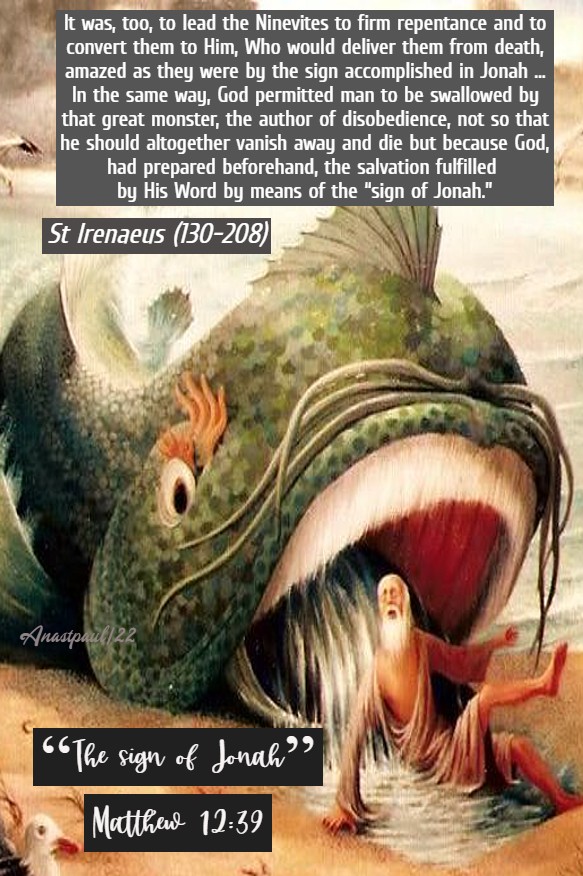
“The sign of Jonah” – Matthew 12:39
REFLECTION – “God showed patience in the face of man’s weakness because He saw beforehand, the victory He would eventually give him, through His Word. For, when “power was made perfect in weakness” (2 Cor 12:9), the Word caused God’s goodness and tremendous power, to be made manifest. Indeed, it was the same with man, as it was with the prophet Jonah. God permitted Jonah to be swallowed by a sea-monster, not to make him altogether vanish away and die but, so that when he had been vomited out by the monster, he would become more subject to God and would give all the more glory to Him who had given him this unexpected deliverance. It was, too, to lead the Ninevites to firm repentance and to convert them to Him, Who would deliver them from death, amazed as they were by the sign accomplished in Jonah … In the same way, God permitted man to be swallowed by that great monster, the author of disobedience, not so that he should altogether vanish away and die but because God, had prepared beforehand, the salvation fulfilled by His Word by means of the “sign of Jonah.” This salvation has been prepared, for those who have the same feelings for God as Jonah did and, who confess Him in the same words: “I am the servant of the Lord and I worship the Lord, the God of heaven, who made the sea and the dry land” (Jon 1:9). God desired that man, by receiving an unanticipated salvation from Him, would rise from the dead and worship God, saying with Jonah: “Out of my distress I called to the Lord; from the midst of the nether world he heard my voice” (Jon 2:2). God desired, too, that man would always remain faithful in giving Him worship and unceasing thanks for the salvation he has received from Him.” – St Irenaeus (130-208) Bishop of Lyons, Martyr, Theologian – Against the heresies III, 20, 1
PRAYER – Infinite Lord, help me to serve You always in accord with Your holy will. Show us how to make You our Lord and our All. St Dominic Savio, you the little giant showed us all the way of holiness within the confines of our lives, always joyfully doing the will of God. Please pray for us all. Through Jesus Christ, Thy Son our Lord, Who lives and reigns with Thee, in the unity of the Holy Ghost, God, world without end. Amen.
Our Morning Offering – 9 March – Wednesdayof the First Week of Lent, Ember Wednesday – FAST & PARTIAL ABSTINENCE
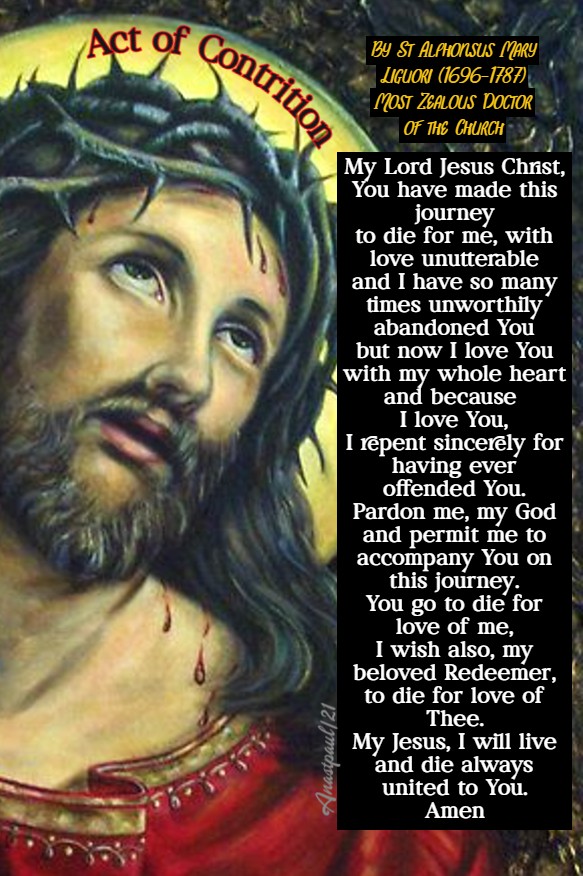
Act of Contrition By St Alphonsus Maria de Liguori (1696-1787) Most Zealous Doctor of the Church
My Lord Jesus Christ, You have made this journey to die for me, with love unutterable and I have so many times unworthily abandoned You but now I love You with my whole heart and because I love You, I repent sincerely for having ever offended You. Pardon me, my God and permit me to accompany You on this journey. You go to die for love of me, I wish also, my beloved Redeemer, to die for love of Thee. My Jesus, I will live and die always united to You.” Amen
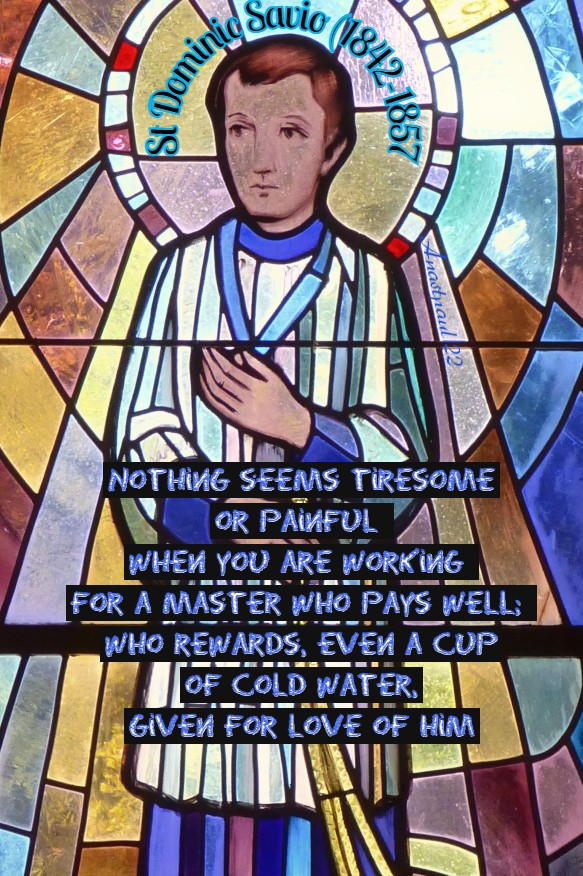
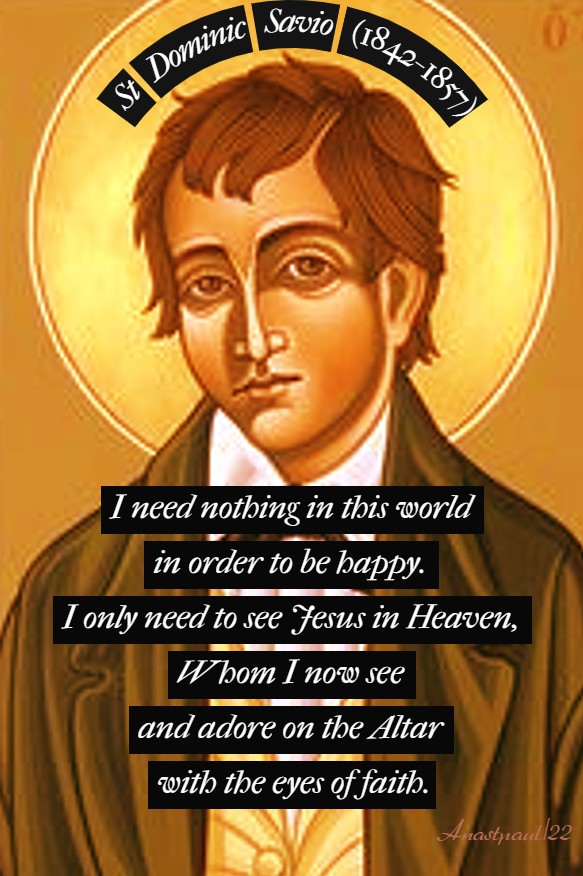
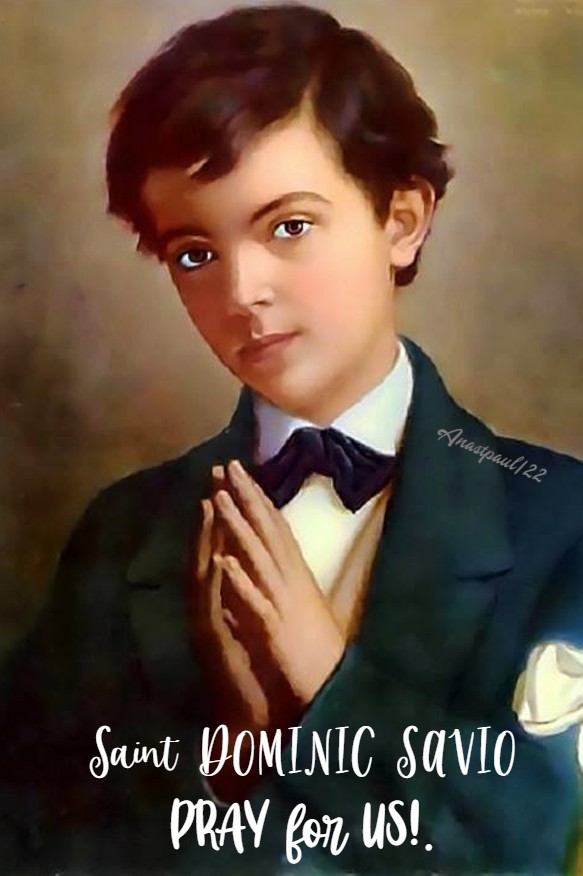
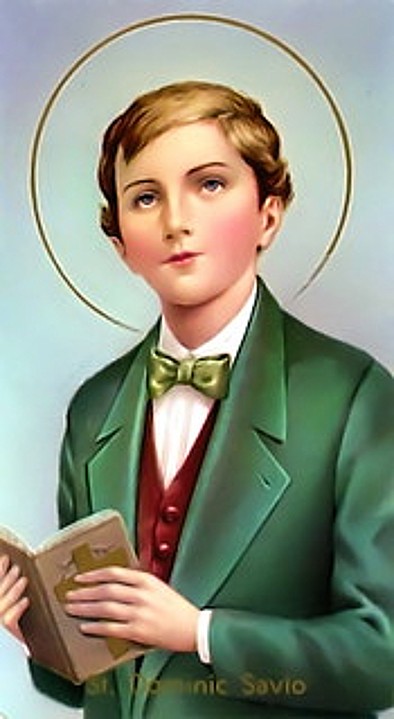
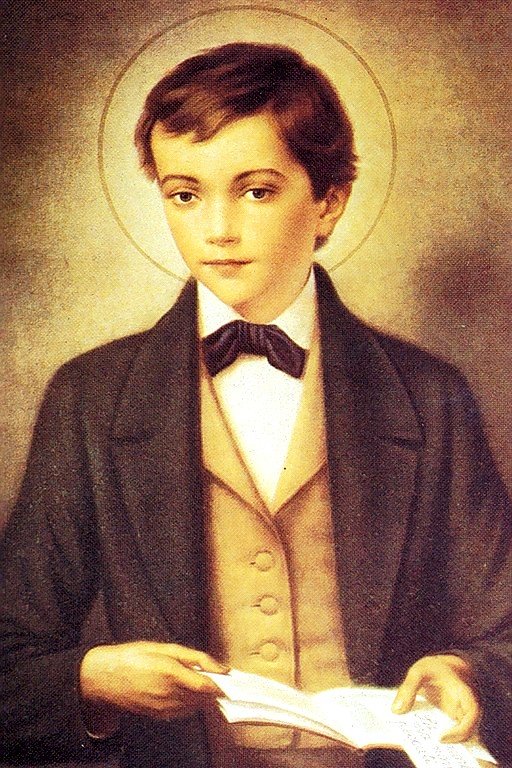
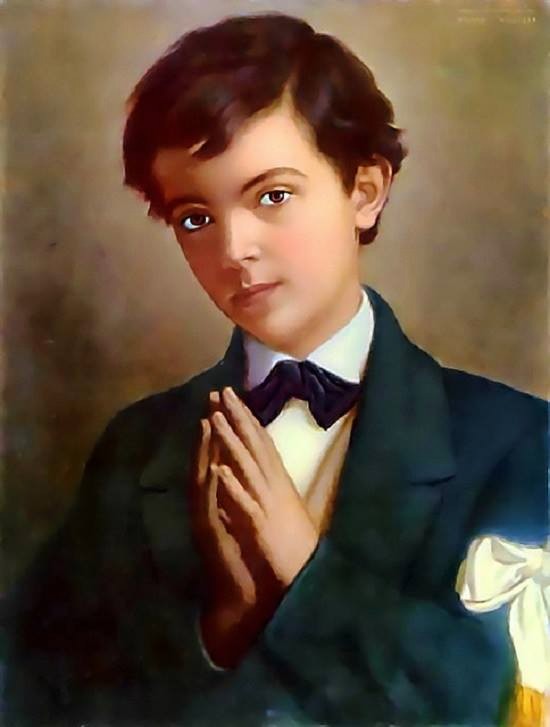
Saint of the Day – 9 March – St Dominic Savio (1842-1857) “The Little Giant”, Student of Saint John Bosco. He was studying to become a priest when he became ill and died at the age of 14. Born on 2 April 1842 at Riva di Chieri, Turin, Italy and died on 9 March 1857 at Mondonio, Italy of natural causes. Patronages – boys, children’s choirs, choir boys (given on 8 June 1956 by Pope Pius XII), choirs, falsely accused people, juvenile delinquents, Pueri Cantors, Colegio Santo Domingo, Bogotá, Colombia (chosen in January 1977), singers.
Dominic was born on 2 April 1842, in San Giovanni di Riva, near Chieri (Turin). On the occasion of his First Communion, at the age of seven, he set out his life’s program: “I will go to Confession frequently and Communion as often as my Confessor allows. I want to make Sundays and feast days holy. My friends will be Jesus and Mary. Death but not sin!”
At the age of twelve, he was accepted by Don Bosco into the Oratory of St Francis de Sales in Turin and Dominic asked his help in order to “become a saint.” Gentle, serene and happy, he put great effort into fulfilling his duties as a student and helping his companions in every way he could, teaching them Catechism, assisting the sick and settling quarrels.
One day he said to a companion who had just arrived in the Oratory: “You should know that here we make holiness consist in being always joyful. We try to avoid sin, which is the great enemy that robs us of the grace of God and peace of heart and, we try to fulfil our duties exactly.” He was very faithful to his program of work, sustained by intense participation in sacramental life, by a filial devotion to Mary and by joyful sacrifice. God enriched him with many special gifts.
On 8 December 1854, when Pope Pius IX proclaimed the Dogma of the Immaculate Conception, Dominic consecrated himself to Mary and began to advance rapidly in holiness. In 1856, he founded the Immaculate Conception Sodality among his friends. This was a group dedicated to apostolic action and peer ministry.
Mamma Margaret, St John Bosco’s Mother, who had come to Turin to help her Priest son, one day said to John “You have many good boys, but no-one surpasses the beauty of heart and soul of Dominic Savio.” And she explained: “I see him always praying, even remaining in Church after the others. Everyday he leaves recreation to visit the Blessed Sacrament; when he is in Church, he is like an angel in Heaven.”
He died in Murialdo on 9 March 1857, possibly of pleurisy. Pope Pius XI defined him as “a little, or rather, a great giant of the Spirit.”
St John Bosco regarded Savio very highly and wrote a Biography of his young student, The Life of Dominic Savio. This volume, along with other accounts of hims life were critical factors in his cause for sainthood. Dominic was Beatified on 5 March 1950 and Canonised on 12 June 1954, both by Pope Pius XII. He is the youngest non-martyr to be Canonised.
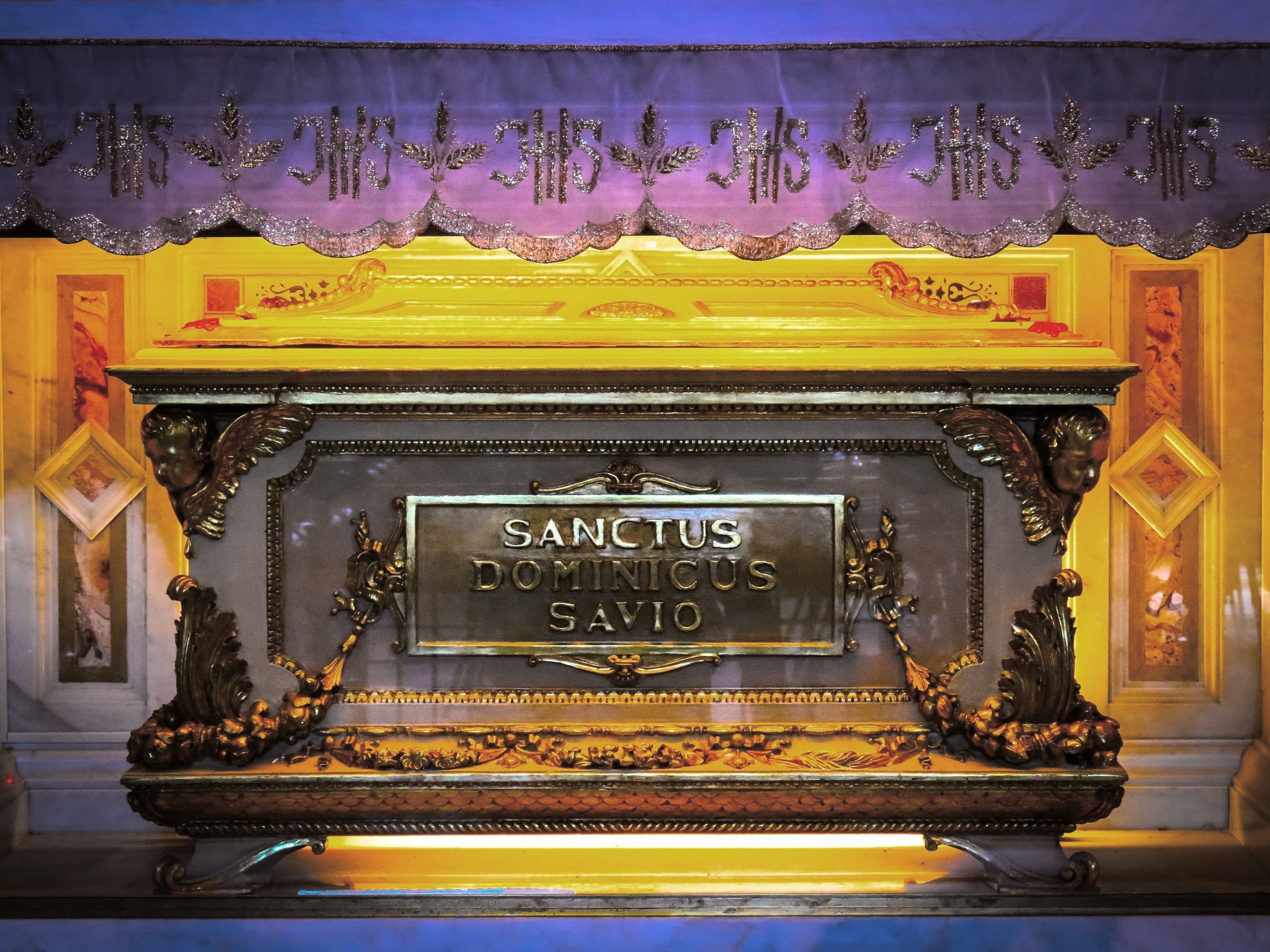
His birthplace is now a retreat house for teenagers and the home where he grew up in Morialdo is now a retreat house for children. The final house in which he lived is the home in Mondonio where the Savio family moved when he was 10 and where he eventually died. Here. you can see his father‘s metal shop and his mother‘s tailoring shop. His tomb is in the Basilica of Mary, Help of Christians in Turin, not far from the tomb of his mentor, teacher and biographer, Saint John Bosco.
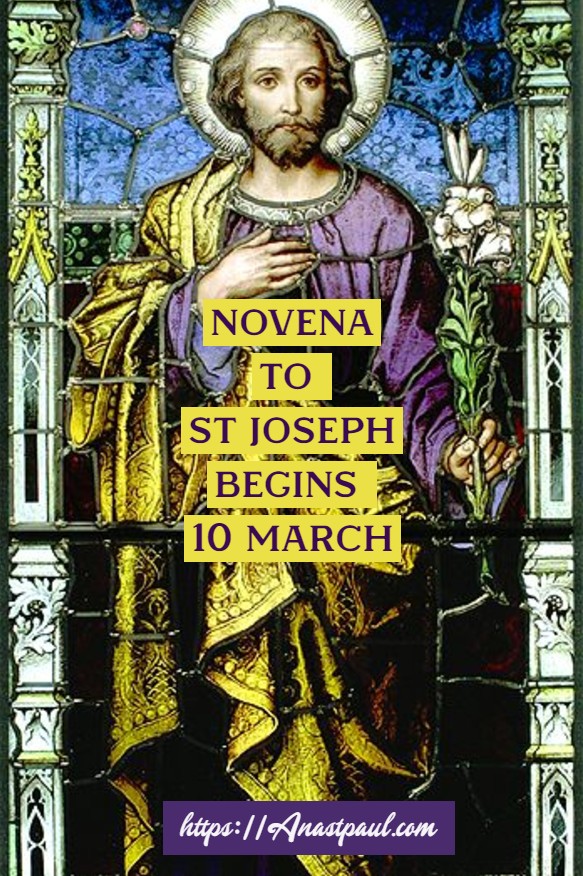
St Joseph, we ask for your assistance in all our needs. The Novena begins on Thursday 10 March. Please pray for us!
St Teresa of Avila’s Plea
“Would that I could persuade all men to be devoted to this glorious Saint, for I know, by long experience, what blessings he can obtain for us from God. I have never known anyone who was truly devoted to him and honoured him, by particular services, who did not advance greatly in virtue, for he helps in a special way, those souls who commend themselves to him. It is now very many years since I began asking him for something on his feast and I have always received it. If the petition was in any way amiss, he rectified it for my greater good . . .
I ask for the love of God, that he who does not believe me, will make the trial for himself—then he will find out by experience, the great good that results from commending oneself to this glorious Patriarch and in being devoted to him.”
Thought for the Day – 8 March – Meditations with Antonio Cardinal Bacci (1881-1971)
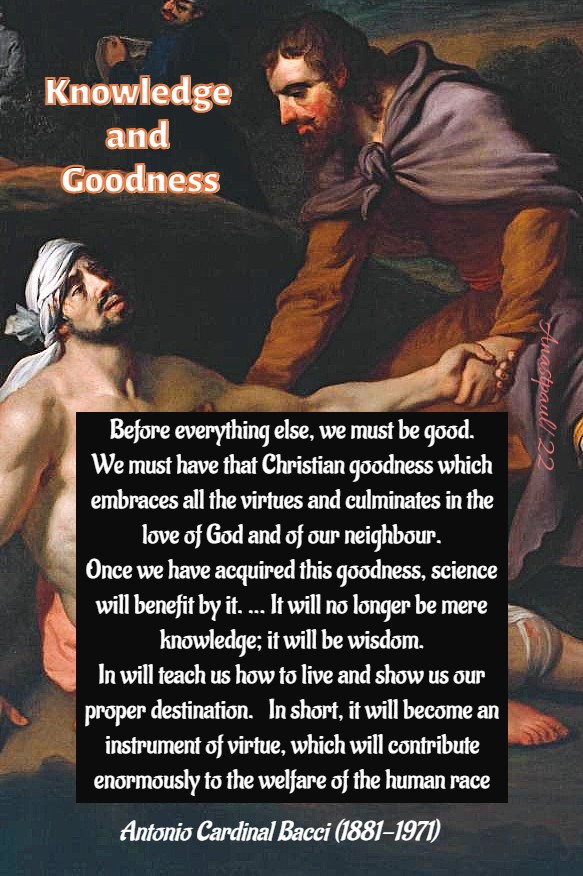
Knowledge and Goodness
“The supremacy of goodness over knowledge, has to be admitted in practice, as well as in theory. It is useless and even harmful, for us to be courageous, if we not also good. Very often, knowledge is like a weapon in the hands of a child. If the child is naughty or careless, he can do a great deal of damage with his weapon. Before everything else, we must be good. We must have that Christian goodness which embraces all the virtues and culminates in the love of God and of our neighbour. Once we have acquired this goodness, science will benefit by it. It will become a powerful means of enlightenment, rather than of destruction. It will no longer be mere knowledge; it will be wisdom. In will teach us how to live and show us our proper destination. In short, it will become an instrument of virtue, which will contribute enormously to the welfare of the human race.”
Tuesday of the First Week of Lent – 7 March – Our Lenten Journey with the Great Fathers
“Let my prayer come like incense before You, O Lord. – Psalm 140:2
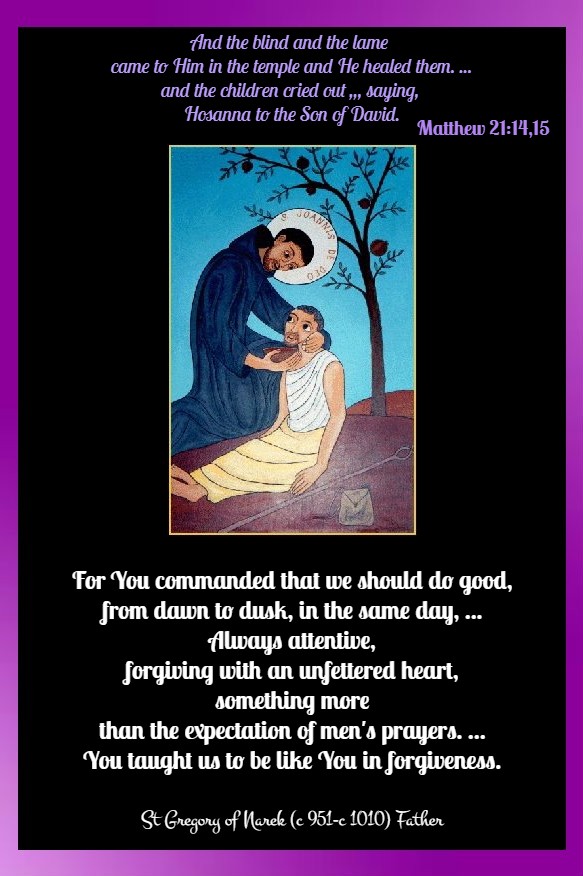
“And the blind and the lame came to Him in the temple and He healed them. … and the children cried out ,,, saying, Hosanna to the Son of David” –
Matthew 21:14,15
“You alone are great and generous in everything. You are the definition of abundant goodness, Who pours forth constantly, without measure, more than we ask or expect, as Paul said in gratitude.
For You commanded that we should do good, from dawn to dusk, in the same day, nine times fifty, plus four times ten. Always attentive, forgiving with an unfettered heart, something more than the expectation of men’s prayers.
And if we place my wretchedness and disgrace beside Your glory, omnipotent and awesome Power, God of all, blessed Lord Christ, by what measure of weight shall the balance between the Creator and the clay be set? You remain in these things infinite and unexaminable, good in all things, having no part in the wrath of darkness, therefore, far less are the number of stars than Your greatness, for You called them into existence from nothing by merely pronouncing their names. Or take the mass of the earth floating in air, created from nothing, from which You established the dry land of earth. These are less than the number I formulated above, by which You taught us to be like You in forgiveness.” – St Gregory of Narek (c 951-c 1010) Monk, Poet, Mystical philosopher, Theologian, Father (Excerpt – Speaking with God from the Depths of the Heart)
Quote/s of the Day – 8 March – Tuesday of the First Week of Lent and the Memeorial of St John of God (1495-1550)
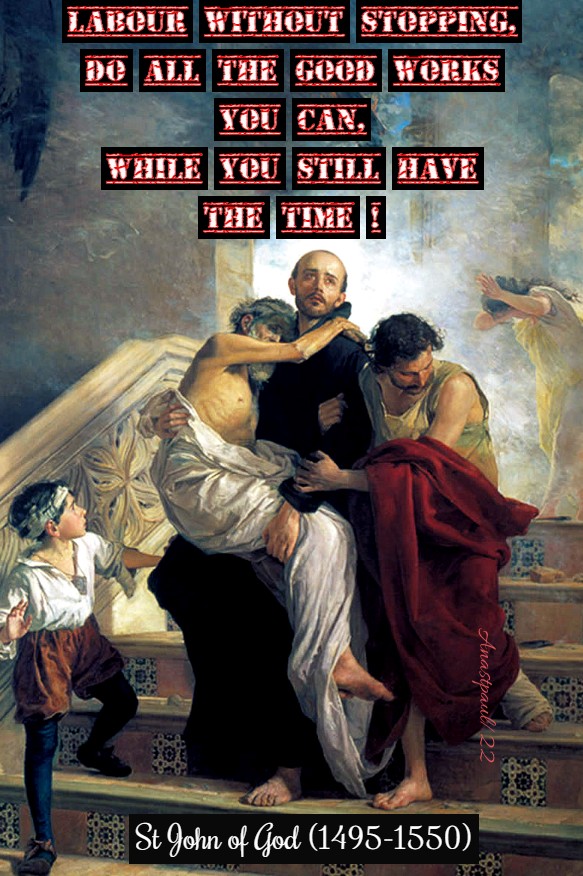
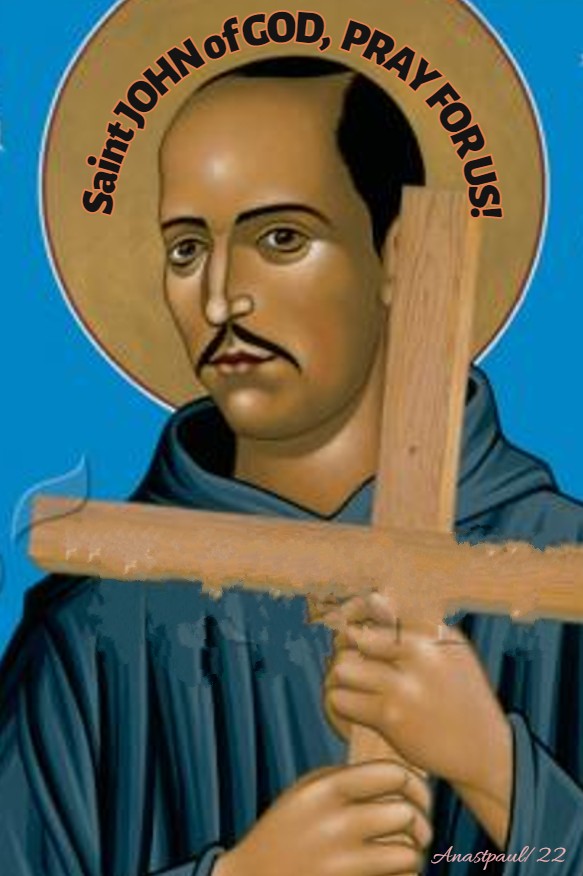
“Labour without stopping, do all the good works you can, while you still have the time!”
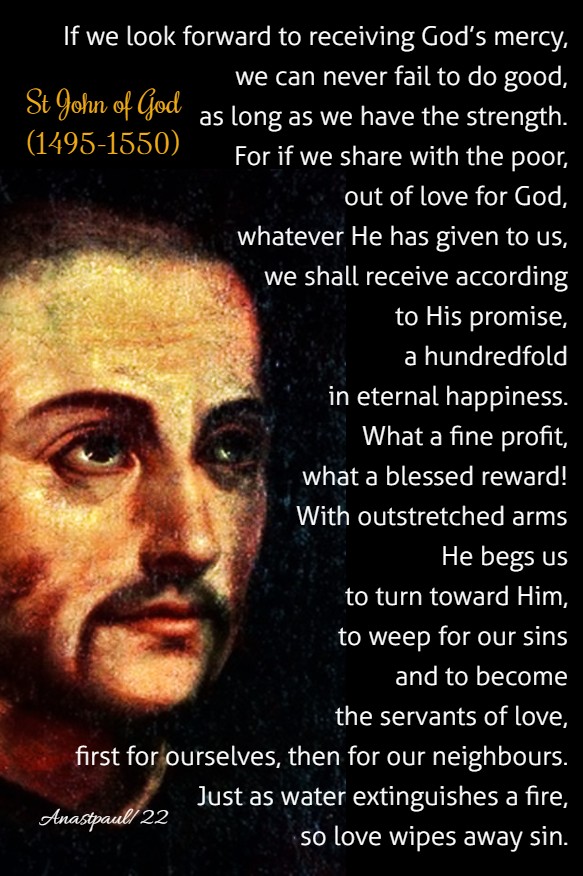
“If we look forward to receiving God’s mercy, we can never fail to do good, as long as we have the strength. For if we share with the poor, out of love for God, whatever He has given to us, we shall receive according to His promise, a hundredfold in eternal happiness. What a fine profit, what a blessed reward! With outstretched arms He begs us to turn toward Him, to weep for our sins and to become the servants of love, first for ourselves, then for our neighbours. Just as water extinguishes a fire, so love wipes away sin.”
One Minute Reflection – 8 March – Tuesday of the First Week of Lent – Isaias 55:6-11 Matthew 21:10-17-1and the Memeorial of St John of God (1495-1550)
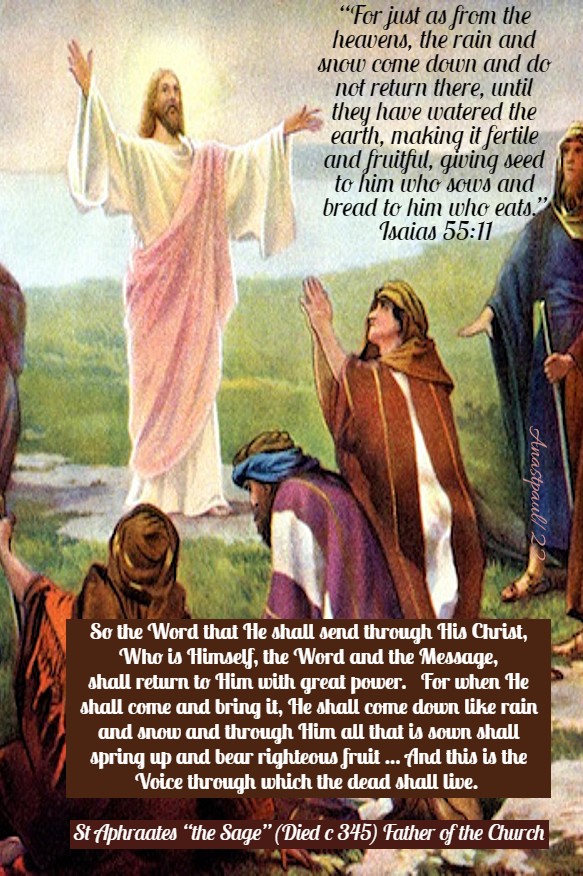
“For just as from the heavens, the rain and snow come down and do not return there, until they have watered the earth, making it fertile and fruitful, giving seed to him who sows and bread to him who eats.” – Isaias 55:11
REFLECTION – “For the rain and the snow do not return to heaven but accomplish in the earth the will of him that sends them. So the Word that He shall send through His Christ, Who is Himself, the Word and the Message, shall return to Him with great power. For when He shall come and bring it, He shall come down like rain and snow and through Him all that is sown shall spring up and bear righteous fruit and the Word shall return to His Sender but not in vain shall His going have been but thus shall He say, in the presence of His Sender, “Behold, I and the children that the Lord has given me.” And this is the Voice through which the dead shall live. And this is the Voice of God that shall sound from on high and raise up all the dead.” – St Aphraates “the Sage” (Died c 345) (Feast Day – 29 January) Abbot, Father of the Church [see note below] (Demonstrations 8).
PRAYER – Lord God, bestow a full measure of Your grace upon us, who seek to make our lenten journey fruitful. Confirm us in Your service and help us to bear witness to You in the society in which we live by our lives, our fasting and prayer, our gift of self. Listen kindly we pray, to the prayers of St John of God who so avidly followed in the footsteps of our Saviour, Lord Jesus Christ, in whose name, with the Holy Ghost, we pray, one God forever, amen.
St Aphraates was a Syriac Christian author of the third century from the Persian Empire who composed a series of twenty-three sermons on points of Christian doctrine and practice. He was an Ascetic and Celibate. He may have been a Bishop and later Syriac tradition places him at the head of Mar Mattai Monastery near Mosul, therefore, he was certainly an Abbot.
Our Morning Offering – 8 March – Tuesday of the First Week of Lent
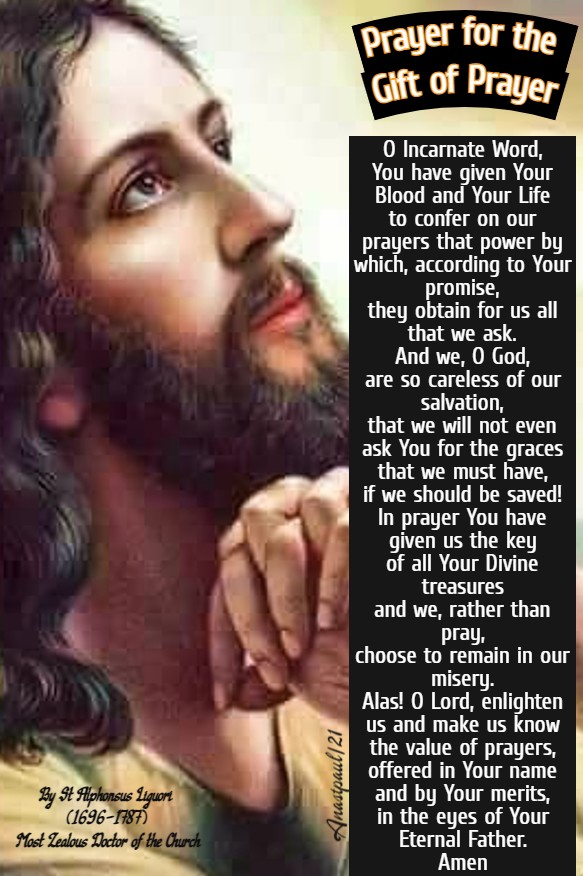
Prayer for the Gift of Prayer By St Alphonsus Liguori (1696-1787) Most Zealous Doctor of the Church
O Incarnate Word, You have given Your Blood and Your Life to confer on our prayers that power by which, according to Your promise, they obtain for us, all that we ask. And we, O God, are so careless of our salvation, that we will not even ask You for the graces that we must have, if we should be saved! In prayer You have given us the key of all Your Divine treasures and we, rather than pray, choose to remain in our misery. Alas! O Lord, enlighten us, and make us know the value of prayers, offered in Your Name and by Your merits, in the eyes of Your Eternal Father. Amen
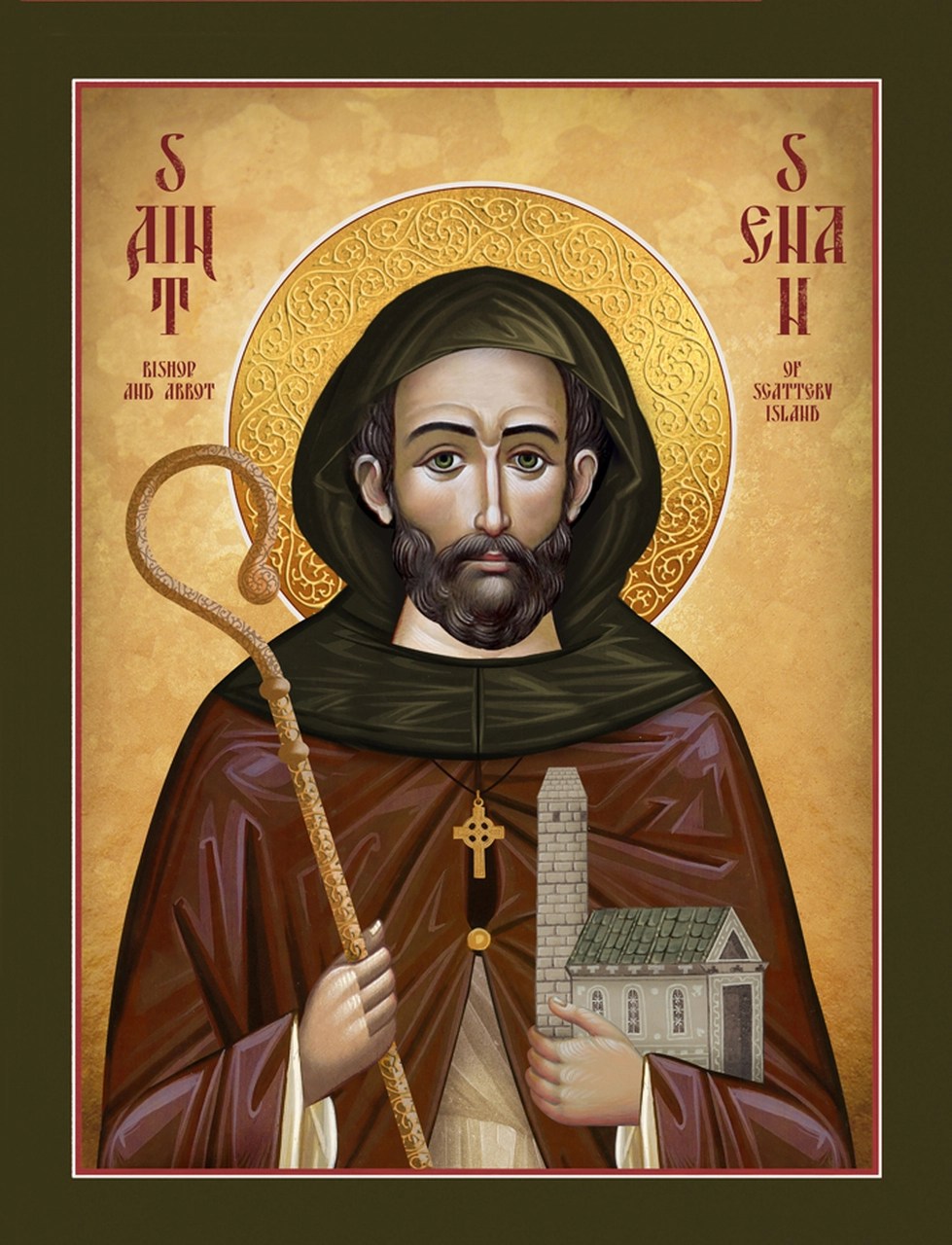
Saint of the Day – 8 March – Saint Senan of Scattery (c 488-541) Monk, Abbot, Founder of many Monasteries and Churches. miracle-worker, one of the Twelve Apostles of Ireland. Born in c 488 at Corca Bhaisin, County Clare, Ireland, tradition says that Saint Patrick foretold his birth and saintliness and died on 8 March 544 at Inish Cathaig, Ireland of natural causes. Patronages – sailors and bodily afflictions. Also known as – Senan of Inis Cathaigh, Senames… Additional Memorial – 6 January as one of the Twelve Apostles of Ireland.
Senan was born in Corca Bhaisin, County Clare about 488. It seems that Senan’s family had two farms, one at Moylough and the other at a place called Tracht Termainn.
He placed himself under the Abbot Cassidan and took the monastic Habit. Cassidan was originally from South-west Cork. Senan then went to the Monastery of Kilmanagh (Ossory) to continue his preparations for the religious life. There he was credited with the performance of many miracles. He is next heard of having established a Church at Enniscorthy. The Book of Lismore states that Senan went to Rome and from there to Tours, which was at that time, the great monastic establishment in West Europe. Returning to Ireland,Senan established a Church and Monastery at Inniscarra, in Cork. Returning to his native district, he began his work on the islands of the Fergus . He crossed to Mutton Island, then to Bishop’s Island, south of Kilkee. Finally, about 534, he established himself at Scattery, the low green island about a mile off the coast off Kilrush.
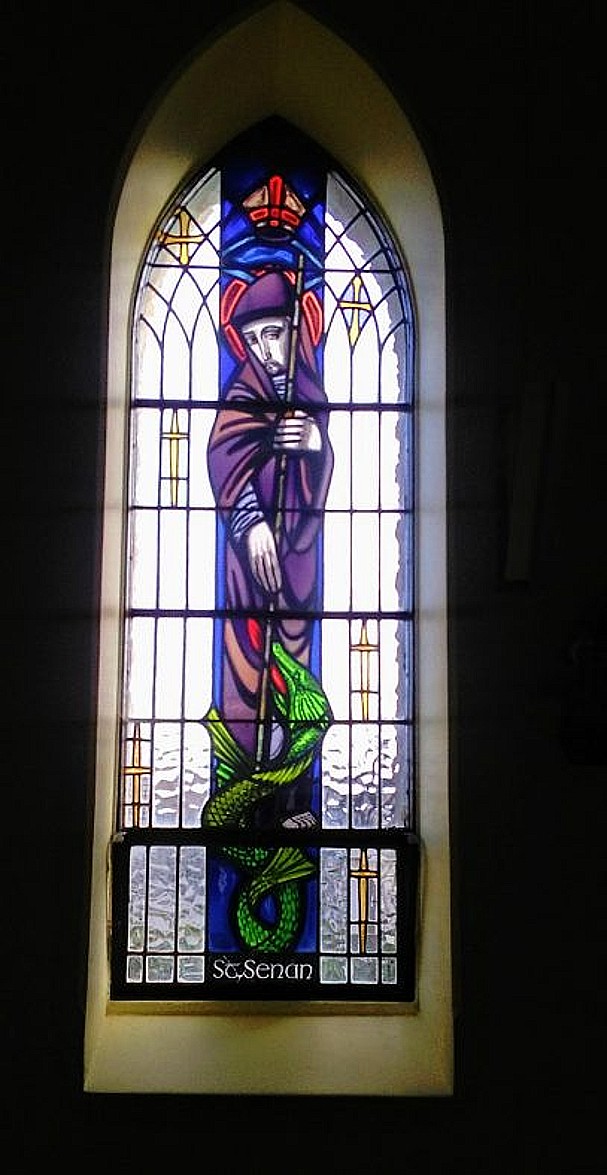
Before Senan arrived on Scattery, also called Inis Cathaig, a legendary monster called “The Cathach” inhabited the island and terrorised the people who were afraid to approach the island. Sometimes referred to as the “peist” or sea-serpent, the Cathach was depicted on a carving in the old chapel of Kilrush as the “Cata.” On his arrival in the island, the Angel Raphael led Senan to the highest hill from which he was able to locate the Cathach. He then faced the monster and ordered it, in the name of the Trinity, to depart from the island. The Cathach obeyed immediately and “neither stopped nor stayed” until he reached the dark waters of Doolough Lake at the foot of Mount Callan.
Little is known of the Saint’s life in Scattery beyond the miracles recorded and the fact that the rule of his monastery was austere in the extreme. Apparently, no woman was allowed to live in or even land on the island. St Cainir, a relation of enans, had a convent to the West of Ballylongford. She crossed the river and hoped to end her days on Scattery Island but Senan forbade her to come ashore. She requested the last sacraments and a grave on the island. Senan agreed to this and she was buried at high water mark.
Senan died on 8 March 544. The river Shannon is believed to be named after him. His patron day on 8 March is an important day of pilgrimage to Inis Cathaig. He is buried on Scattery Island. The grave is supposed to be the site of miraculous cures as well as the miraculous holy well. Stones from St Senan’s Bed (his grave) were regarded as relics and a protection against diseases and especially drowning. In the folklore of West Clare the cult of Senan still survives.
In 1864 it is reported, that the Saint appeared in a vision to a paralysed woman who had visited Senan’s grave on the island. He came to her in a dream and asked her why she had come. She told the bearded man she wanted to be cured of her disease and trusted in the intercession of St Senan whom she had invoked. The next morning she awoke and found herself completely healed!
The above statue of St Senan came all the way from Australia and now rests in the parish of Doonbeg in West Clare.
St Apollonius of Antinoë St Arianus of Alexandria St Beoadh of Ardcarne St Duthus of Ross St Felix of Burgundy St Humphrey of Prüm St Jon Helgi Ogmundarson St Litifredus of Pavia St Philemon of Antinoë St Pontius of Carthage St Provinus of Como St Quintilis of Nicomedia St Rhian St Senan of Scattery (c 488-541) Monk, Abbot, Founder of many Monasteries and Churches.
St Stephen of Obazine St Theophylact of Nicomedia St Theoticus of Alexandria St Veremundus of Irache
Martyrs of North Africa – 9 Saints – A Bishop and some of his flock who were Martyred together in North Africa. The only details that have survived are nine of the names – Beata, Cyril, Felicitas, Felix, Herenia, Mamillus, Rogatus, Silvanus, Urban.
Thought for the Day – 7 March – Meditations with Antonio Cardinal Bacci (1881-1971)
ST THOMAS AQUINAS
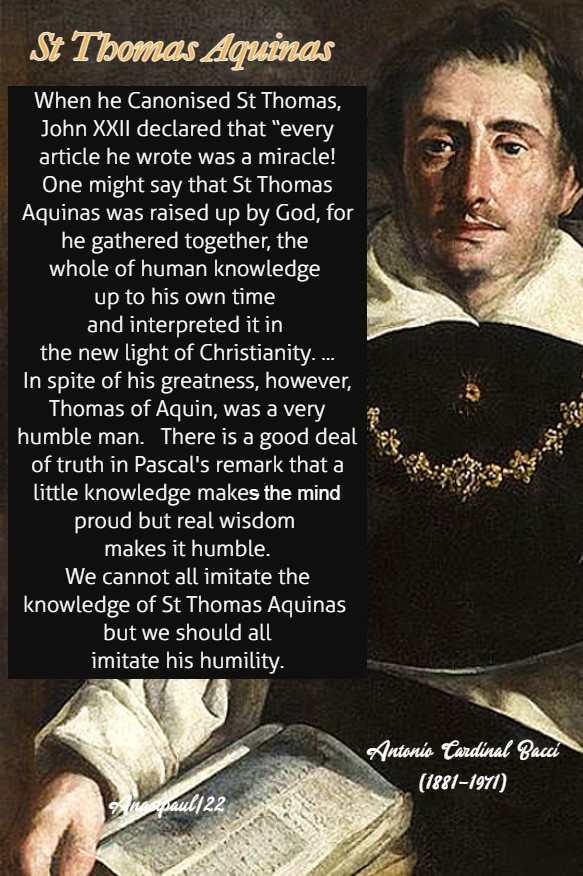
“It is generally recognised that St Thomas Aquinas was a great Philosopher and Theologian. The Cartesian Philosopher, Jourdain , said of him, that no other man had come so near to being infallible! The eclectic Philosopher, Cousin, referred to the Summa Theologiae, as one of the greatest masterpieces of human genius. Dante celebrated in immortal verse, this wonderful synthesis of thought. When he Canonised St Thomas, John XXII declared that “every article he wrote was a miracle!”
One might say that St Thomas Aquinas was raised up by God, for he gathered together, the whole of human knowledge up to his own time and interpreted it in the new light of Christianity. He ordered it into a complete compact body of philosophical and theological doctrine, to serve as an impregnable defence against the errors of his own and later times.
In spite of his greatness, however, Thomas of Aquin, was a very humble man. There is a good deal of truth in Pascal’s remark that a little knowledge makes the mind proud but real wisdom makes it humble.
We cannot all imitate the knowledge of St Thomas Aquinas but we should all imitate his humility.”
Monday of the First Week of Lent – 7 March – Our Lenten Journey with the Great Fathers
“O Lord, deal with us, not according to our sins, nor requite us, according to our crimes..” Psalm 102:10
“Amen I say to you, as long as you did not do it for one of these least ones, you did not do it for Me.”
Matthew 25:45
“RECOGNISE TO WHOM you owe the fact, that you exist, that you breathe, that you understand, that you are wise and, above all, that you know God and hope for the Kingdom of Heaven and the vision of glory, now darkly as in a mirror but then, with greater fullness and purity. You have been made a son of God, co-heir with Christ. Where did you get all this and from whom?
LET ME TURN to what is of less importance: – the visible world around us. What benefactor has enabled you to look out upon the beauty of the sky, the sun in its course, the circle of the moon, the countless number of stars, with the harmony and order that are theirs, like the music of a harp? Who has blessed you with rain, with the art of husbandry, with different kinds of food, with the arts, with houses, with laws, with states, with a life of humanity and culture, with friendship and the easy familiarity of kinship?
WHO HAS GIVEN YOU DOMINION over animals, those that are tame and those that provide you with food? Who has made you lord and master of everything on earth? In short, Who has endowed you with all that makes man superior to all other living creatures?
IS IT NOT GOD WHO ASKS YOU NOW, in your turn, to show yourself generous above all other creatures and for the sake of all other creatures? Because we have received from Him so many wonderful gifts, will we not be ashamed to refuse Him this one thing only, our generosity? Although He is God and Lord, He is not afraid to be known as our Father. Shall we, for our part, repudiate those who are our kith and kin?
BRETHREN AND FRIENDS, let us never allow ourselves to misuse what has been given us by God’s gift. If we do, we shall hear Saint Peter say: Be ashamed of yourselves for holding onto what belongs to someone else. Resolve to imitate God’s justice and no-one will be poor. Let us not labour to heap up and hoard riches, while others remain in need. If we do, the prophet Amos will speak out against us with sharp and threatening words – Come now, you that say:- When will the new moon be over, so that we may start selling? When will the sabbath be over, so that we may start opening our treasures?
LET US PUT INTO PRACTICE the supreme and primary law of God. He sends down rain on just and sinful alike and causes the sun to rise on all, without distinction. To all earth’s creatures he has given the broad earth, the springs, the rivers and the forests. He has given the air to the birds and the waters to those who live in the water. He has given abundantly to all the basic needs of life, not as a private possession, not restricted by law, not divided by boundaries but as common to all, amply and in rich measure. His gifts are not deficient in any way because He wanted to give equality of blessing to equality of worth and to show the abundance of His generosity.” – St Gregory Nazianzen (330-390) Archbishop of Constantinople, Father and Doctor of the Church (An excerpt from his Oration 14: On Love of the Poor)
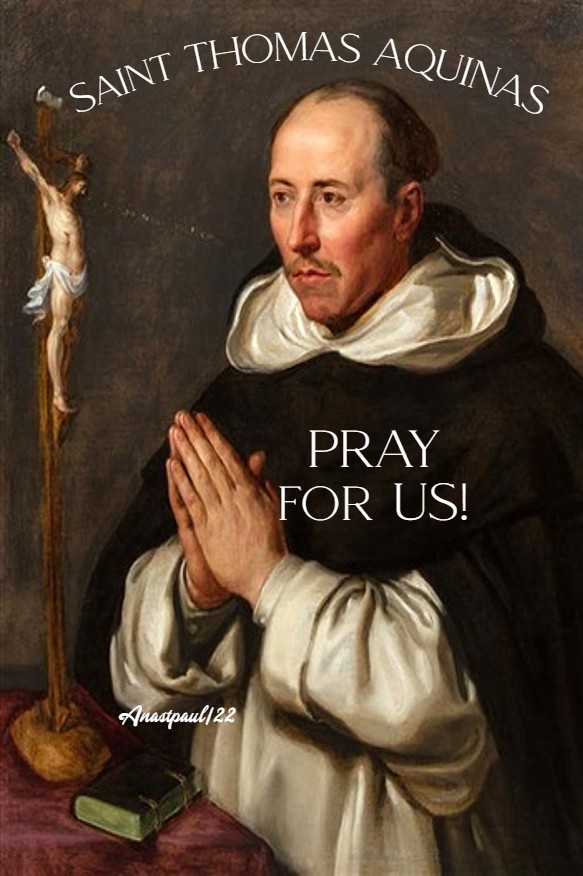
Quotes of the Day – 7 March – Monday of the First Week of Lent and the Memorial of St Thomas Aquinas OP (1225-1274) Doctor Angelicus and Doctor Communis
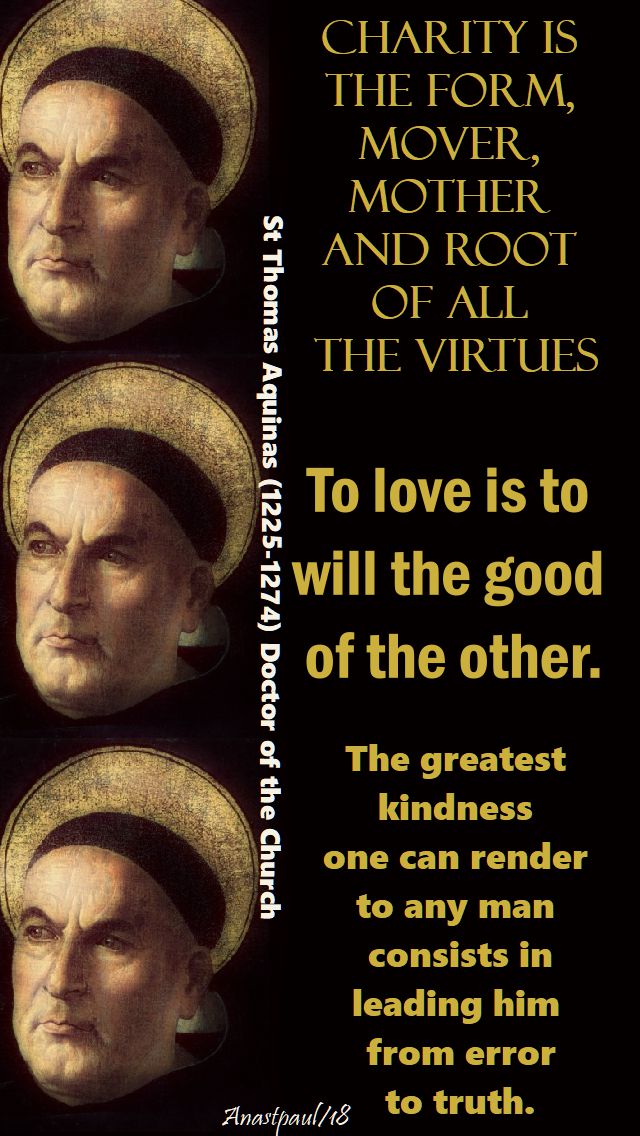
“Charity is the form, mover, mother and root of all the virtues.”
“To love is to will the good of the other.”
“The greatest kindness one can render to any man consists in leading him from error to truth.”
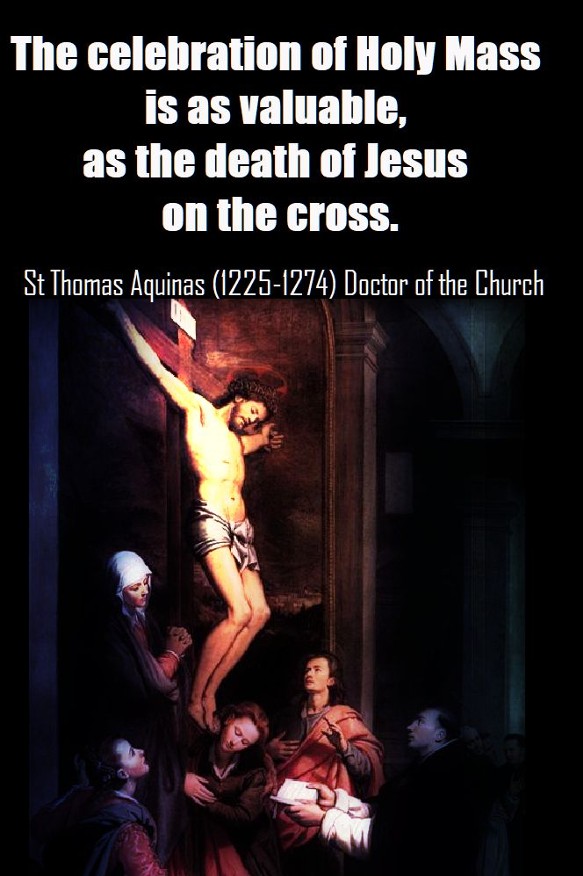
“The celebration of Holy Mass is as valuable, as the death of Jesus on the cross.”
“Believing is: an act of the intellect assenting to the divine truth, by command of the will, moved by God through grace.”
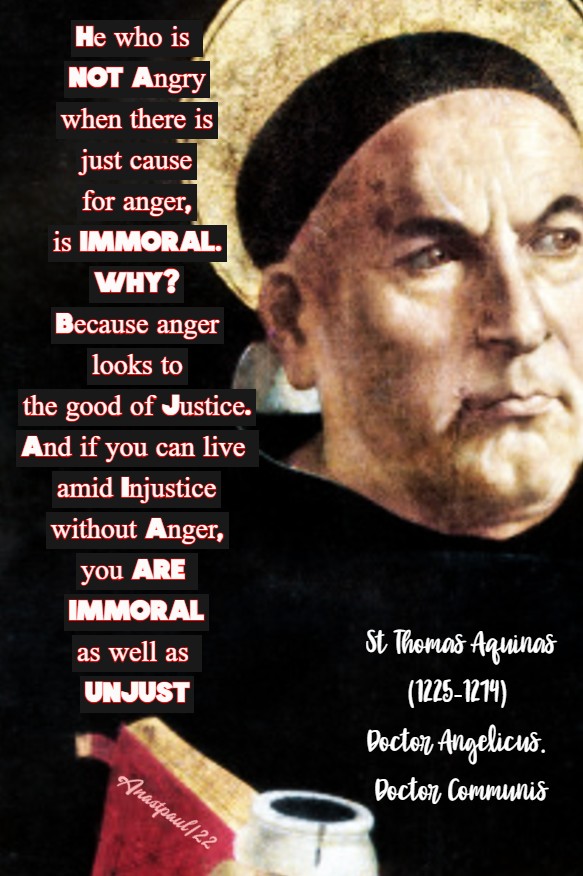
“He who is NOT angry when there is just cause for anger, is IMMORAL. WHY? Because anger looks to the good of Justice. And if you can live amid Injustice without anger, you ARE IMMORAL as well as UNJUST!”
St Thomas Aquinas (1225-1274) Doctor Angelicus. Doctor Communis
One Minute Reflection – 7 March – Monday of the First Week of Lent – Ezech 34:11-16, Matt hew 25:31-46 and the Memorial of St Thomas Aquinas OP (1225-1274) Doctor Angelicus and Doctor Communis
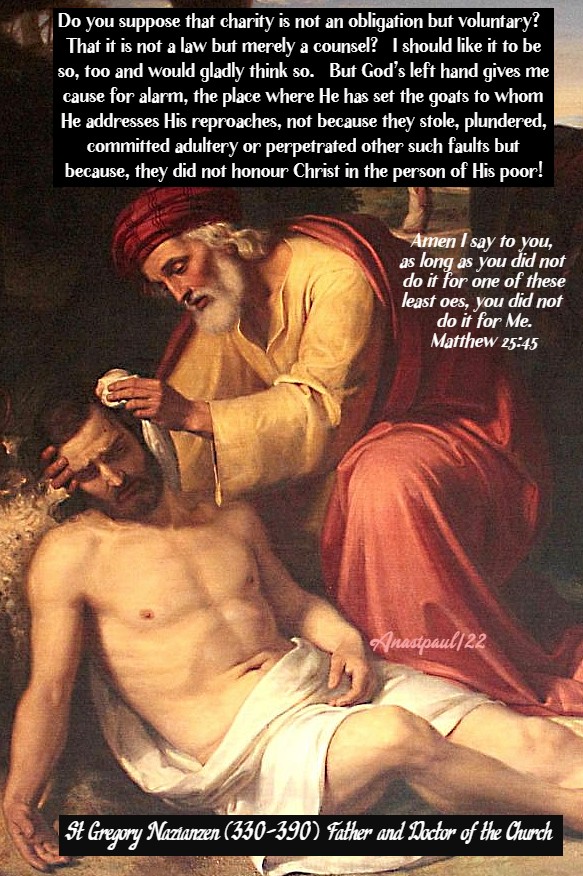
“Amen I say to you, as long as you did not do it for one of these least ones, you did not do it for Me.” – Matthew 25:45
REFLECTION – “Do you suppose that charity is not an obligation but voluntary? That it is not a law but merely a counsel? I should like it to be so, too and would gladly think so. But God’s left hand gives me cause for alarm, the place where He has set the goats to whom He addresses His reproaches, not because they stole, plundered, committed adultery or perpetrated other such faults but because, they did not honour Christ in the person of His poor!
If you are willing to listen to me, then, O servants of Christ, His brothers and co-heirs, I say ,that we should visit Christ while there is an opportunity, take care of Him and feed Him. We should clothe Christ and welcome Him. We should honour Him, not only at our table, like some; not only with ointments, like Mary Magdalene; not only with a sepulchre, like Joseph of Arimathea; nor with things which have to do with His burial, like Nicodemus… nor finally, with gold, incense and myrrh, like the Magi.
But, as the Lord of all “desires mercy and not sacrifice” (Mt 9,13) and as compassion is better than tens of thousands of fat rams, let us offer Him this mercy through the needy and those who are at present cast down to the ground. Let us do this, so that, when we depart hence, they may “welcome us into the eternal habitations” (Lk 16,9), in the same Christ our Lord, to whom be glory forever.” – St Gregory Nazianzen (330-390) Archbishop of Constantinople, Father and Doctor of the Church (Sermon 14, on Love for the Poor, 27, 28, 39-40).
PRAYER – O God, our Saviour, direct our minds by Your heavenly teaching, so that the Lenten fast may profit us. And may the intercession of St Thomas Aquinas, Your humble servant, aid us in our need. Through Jesus Christ, Thy Son our Lord, Who lives and reigns with Thee, in the unity of the Holy Ghost, God, world without end. R. Amen.
Our Morning Offering – 7 March – Monday of the First Week of Lent
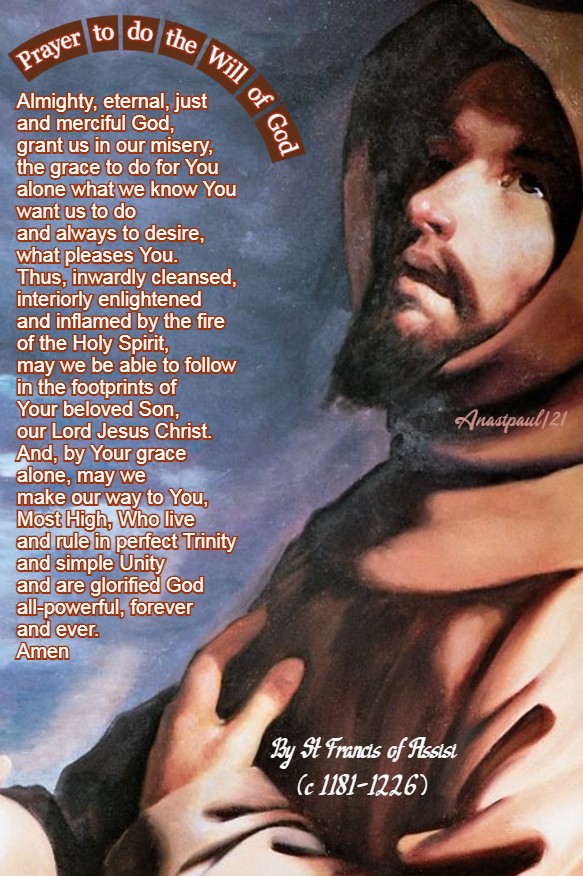
Prayer to do the Will of God By St Francis of Assisi (c 1181-1226)
Almighty, eternal, just and merciful God, grant us in our misery, the grace to do for You alone what we know You want us to do and always to desire, what pleases You. Thus, inwardly cleansed, interiorly enlightened and inflamed by the fire of the Holy Spirit, may we be able to follow in the footprints of Your beloved Son, our Lord Jesus Christ. And, by Your grace alone, may we make our way to You, Most High, Who live and rule in perfect Trinity and simple Unity and are glorified God all-powerful, forever and ever. Amen
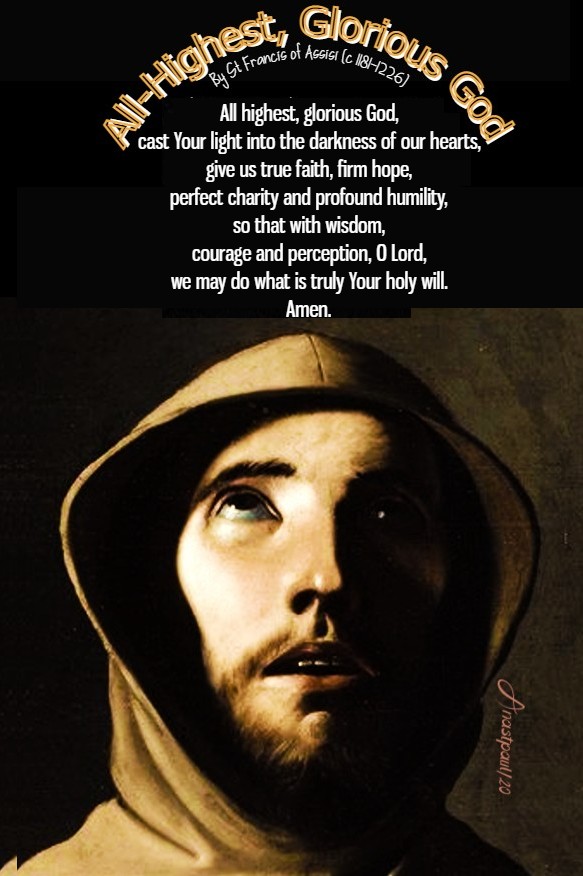
All Highest, Glorious God
All highest, glorious God, cast Your light into the darkness of our hearts, give us true faith, firm hope, perfect charity and profound humility, so that with wisdom, courage and perception, O Lord, we may do what is truly Your holy will. Amen.
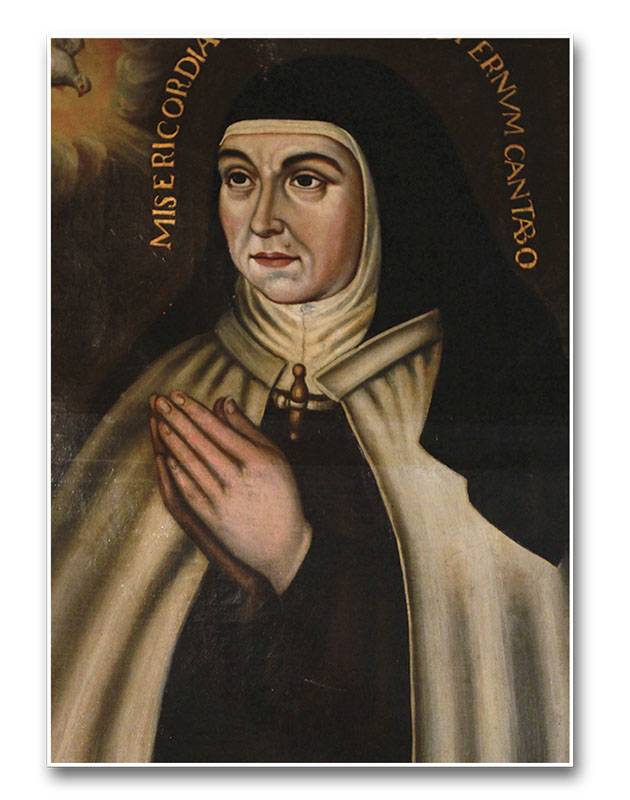
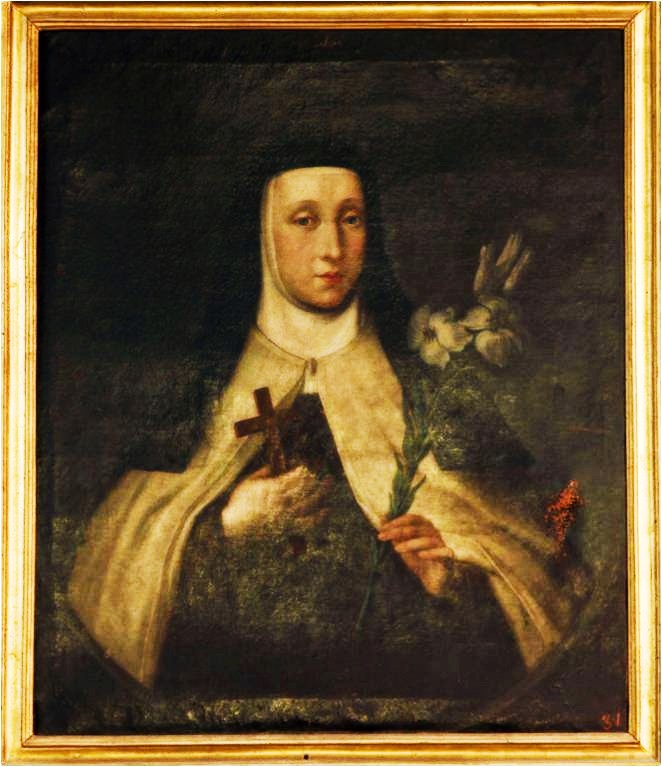
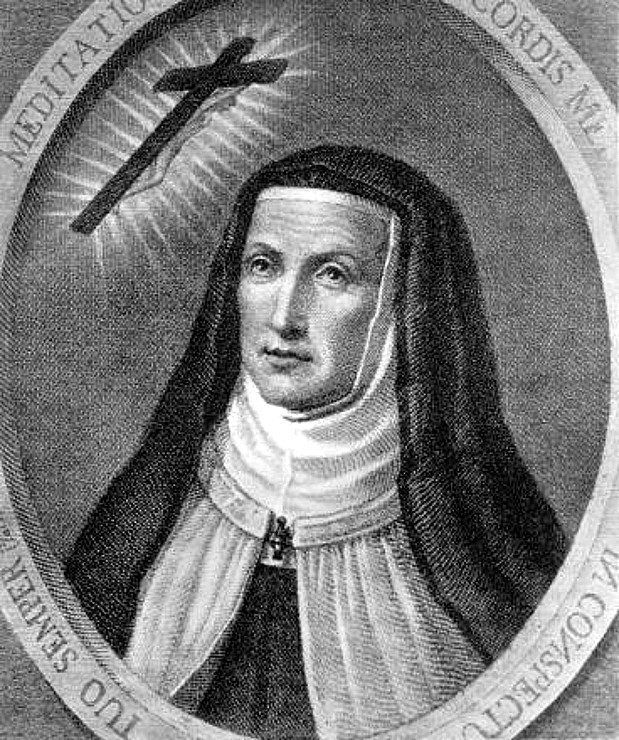
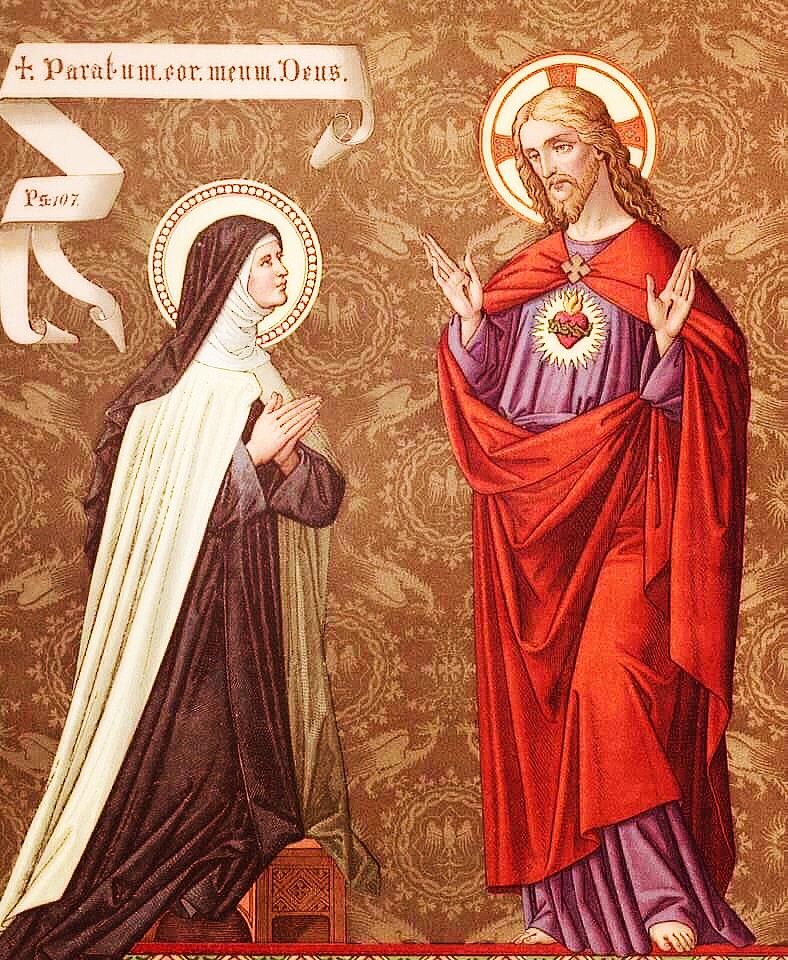
Saint of the Day – 7 March – Saint Teresa Margaret Redi of the Sacred Heart OCD (1747– 1770) Virgin, Nun of the Order of the Discalced Carmelites, Mystic. Born on 15 July 1747 at Arezzo, Tuscany, Italy as Anna Maria Redi and died on 7 March 1770 at Florence, Italy of a severe and painful abdominal disorder, aged just 22. Also known as – Ann Maria Redi, Anna Maria Redi, Anne Mary Redi. Teresa Margherita Redi of the Sacred Heart.
The Roman Martyrology states: “In Florence, Saint Teresa Margherita Redi, a Virgin, who, having entered the Order of the Discalced Carmelites, travelled an arduous path of perfection and was struck by premature death.”
“Eu sou Teresa de Jesus e te quero entre as minhas filhas!” – Santa Teresa de Ávila, Mosteiro de São José, Ávila (Espanha) – Foto: Francisco Lecaro
Anna was born into a large, noble and devout family in Arezzo Italy in 1747. From the earliest days of her childhood, Anna was filled with a deep love of God questioning the adults around her as to “Who is God?” Already she was dissatisfied with answers given her. Only the contemplative life of a Carmelite nun could begin to quench her thirst to know and give herself completely to God. Her entire life was driven by the desire to “return love for love.”
She entered the Carmelite convent in Florence at the age of seventeen, advanced rapidly in holiness and died an extraordinary death at twenty-two.
She was a model religious with an astonishing depth of spirituality, purity of heart, humility and ardent love for the Sacred Heart of Jesus. She was given a special contemplative experience of the words of St John, “God is love” and she lived in fidelity to this experience by a hidden life of love and self-gift.
Christ crucified was always in her mind, “the captain of love,” who held aloft “the standard of the Cross.” After her 1758 spiritual retreat, she proposed in all her actions not to be motivated other than by love and to unite her will with that of God. She was assiduous in small services to the sisters and would not allow gossip or criticism. She exclaimed constantly, “God is love.”. Her life was one of continuous thanksgiving, “which would prove to the person who does not believe in Him or not dare to approach Him, the goodness and generosity of our most loving God!”
Her love of God was powerfully expressed in her love for her sisters, to whom she gave herself in dedication and service. Appointed Infirmarian, she cared for the ill and elderly of her community, even the most difficult, with gentleness, equanimity, and patience.
True to the tradition of the Order, Teresa Margaret was utterly devoted to Our Lady whom she regarded as the model and protectress of her own virginal purity.
The cornerstone of St Teresa Margaret’s spirituality was to remain hidden, to appear just like everyone else’ in spite of her heroic virtue. To our loss, she has remained very much hidden even after her death. Fr Gabriel of St. Mary Magdalen commented “This is an odd fact, for we do not hesitate to rank her among the primary figures who represent the glory of Carmel – among Teresa of Jesus, John of the Cross and Thérèse of the Child Jesus.”
Although St.Teresa Margaret led a life of exquisite holiness and purity, it was also a life that is whollyone of imitation. In her were combined Martha and Mary, as she served her community as a nurse in the Infirmary, while reaching the heights of contemplation. N
After her death all the swelling and discoloration in her body disappeared, her body was incorrupt several weeks later, had a healthy glow and exuded an odour of perfume. Pope Pius XI Canonised her on 13 March 1934.
St Ardo of Aniane St Deifer of Bodfari St Drausinus of Soissons St Enodoch St Esterwine of Wearmouth St Eubulus of Caesarea St Gaudiosus of Brescia Bl Henry of Austria
St Paul of Prusa St Paul the Simple St Reinhard of Reinhausen St Teresa Margaret Redi of the Sacred Heart OCD (1747– 1770) Virgin, Nun of the Order of the Discalced Carmelites, Mystic. Bl William of Assisi
Martyrs of Carthage – 4 Saints: A catechist and three students Martyred together for teaching and learning the faith. We know little more than their names – Revocatus, Saturninus, Saturus and Secundulus. Mauled by wild beasts and beheaded 7 March 203 at Carthage, North Africa
Thought for the Day – 6 March – Meditations with Antonio Cardinal Bacci (1881-1971)
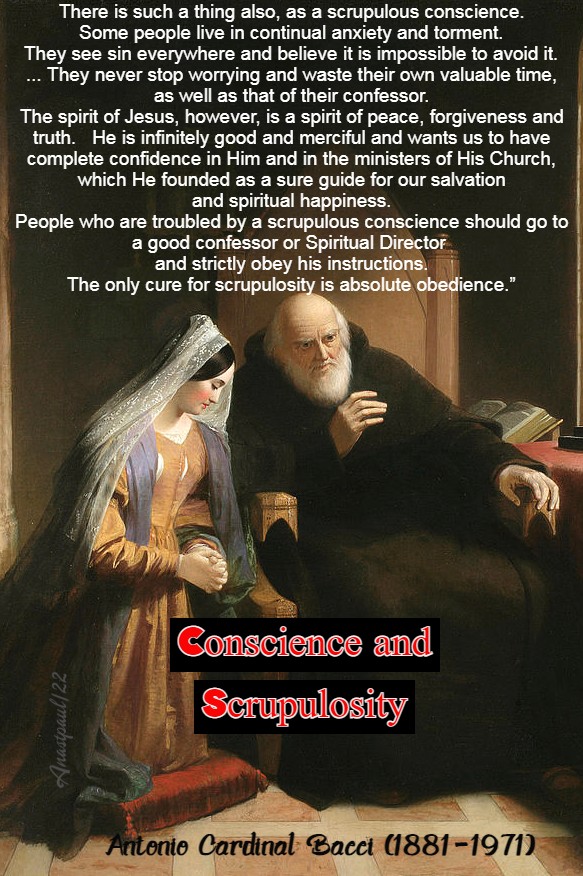
CONSCIENCE
“There is such a thing also, as a scrupulous conscience. Some people live in continual anxiety and torment. They see sin everywhere and believe it is impossible to avoid it. In spite of the clear directions of their confessor, they postpone receiving Holy Communion because they feel unworthy. They say their prayers over and over again because they feel that they are saying them badly. They become a burden to themselves and to others. They never stop worrying and waste their own valuable time, as well as that of their confessor. The spirit of Jesus, however, is a spirit of peace, forgiveness and truth. He is infinitely good and merciful and wants us to have complete confidence in Him and in the ministers of His Church, which He founded as a sure guide for our salvation and spiritual happiness.
People who are troubled by a scrupulous conscience should go to a good confessor or Spiritual Director and strictly obey his instructions. The only cure for scrupulosity is absolute obedience.”
First Sunday of Lent – 6 March – Our Lenten Journey with the Great Fathers
“You who dwell in the shelter of the Most High, shall abide in the shadow of the Almighty.” – Psalm 90:1
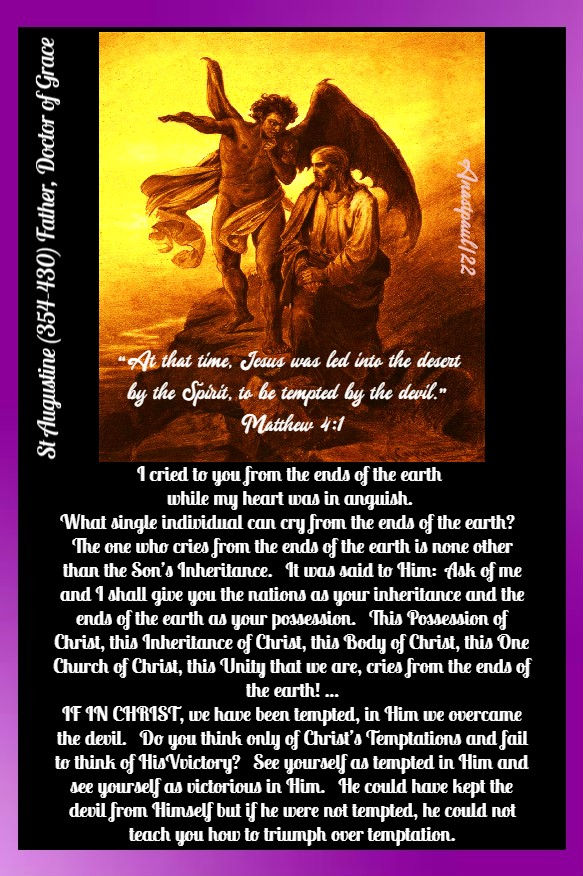
“At that time, Jesus was led into the desert by the Spirit, to be tempted by the devil.”
Matthew 4:1
“HEAR O GOD,my petition, listen to my prayer. Who is speaking? An individual, it seems. See if it is an individual: – I cried to you from the ends of the earth while my heart was in anguish. Now it is no longer one person, rather, it is one in the sense that Christ is One and we are all His Members. What single individual can cry from the ends of the earth?The one who cries from the ends of the earth is none other than the Son’s Inheritance.It was said to Him: Ask of me and I shall give you the nations as your inheritance and the ends of the earth as your possession. This Possession of Christ, this Inheritance of Christ, this Body of Christ, this One Church of Christ, this Unity that we are, cries from the ends of the earth! What does it cry? What I said before: Hear, O God, my petition, listen to my prayer; I cried out to you from the ends of the earth. That is, I made this cry to You from the ends of the earth; that is, on all sides.
Why did I make this cry? While my heart was in anguish. The speaker shows that he is present among all the nations of the earth in a condition, not of exalted glory but of severe trial.
OUR PILGRIMAGE ON EARTH cannot be exempt from trial. We progress by means of trial. No-one knows himself except through trial, or receives a crown except after victory, or strives except against an enemy or temptations.
THE ONE WHO CRIES from the ends of the earth is in anguish but is not left on his own. Christ chose to foreshadow us, who are His Body, by means of His body, in which He has died, risen and ascended into Heaven, so that the Members of His Body may hope to follow where their Head has gone before.
HE MADER US ONE WITH HIMSELF,when He chose to be tempted by Satan. We have heard in the Gospel how the Lord Jesus Christ was tempted by the devil in the wilderness. Certainly Christ was tempted by the devil. In Christ you were tempted, for Christ received His flesh from your nature but by His own Power gained life for you; He suffered insults in your nature but by His own Power gained glory for you; therefore, He suffered temptation in your nature, but by His own Power gained victory for you!
IF IN CHRIST, we have been tempted, in Him we overcame the devil. Do you think only of Christ’s Temptations and fail to think of His Victory? See yourself as tempted in Him and see yourself as victorious in Him. He could have kept the devil from Himself but if he were not tempted, he could not teach you how to triumph over temptation.” – St Augustine (354-430) Bishop of Hippo, Father, Doctor of Grace (“In Christ we suffer temptation and in Him we overcame the devil.” – An excerpt from his Commentary on the Psalms, Psalm 60).
Quote/s of the Day – 6 March – The First Sunday of Lent – 2 Cor.inthians 6:1-10, Matthew 4:1-1
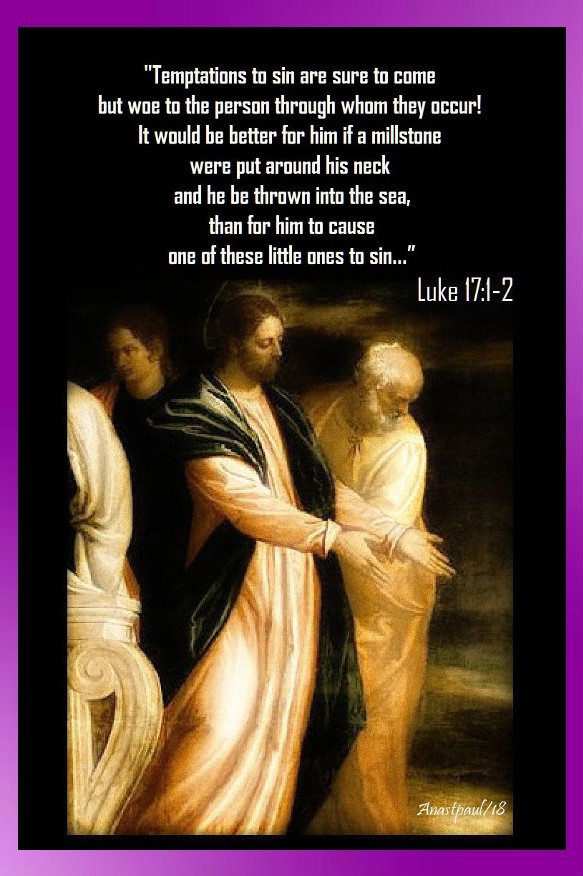
“Temptations to sin are sure to come but woe to the person through whom they occur! It would be better for him, if a millstone were put around his neck and he be thrown into the sea, than for him to cause one of these little ones to sin…”
Luke 17:1-2
“He says that these temptations must come. Is this then because God, who governs all, forces people to their commission of sin? Away with the thought! Nothing that is evil comes from Him. He is the fountain of all virtue. Why then must this happen? They clearly happen because of our infirmity, for all of us stumble in many things, as it is written. Nevertheless, He says, that there will be woe to the person who lays the stumbling blocks in the way. He does not leave indifference in these things without rebuke but restrains it by fear of punishment. He still commands us to bear with patience ” those who cause sins to happen.”
St Cyril of Alexandria (376-444) Father & Doctor
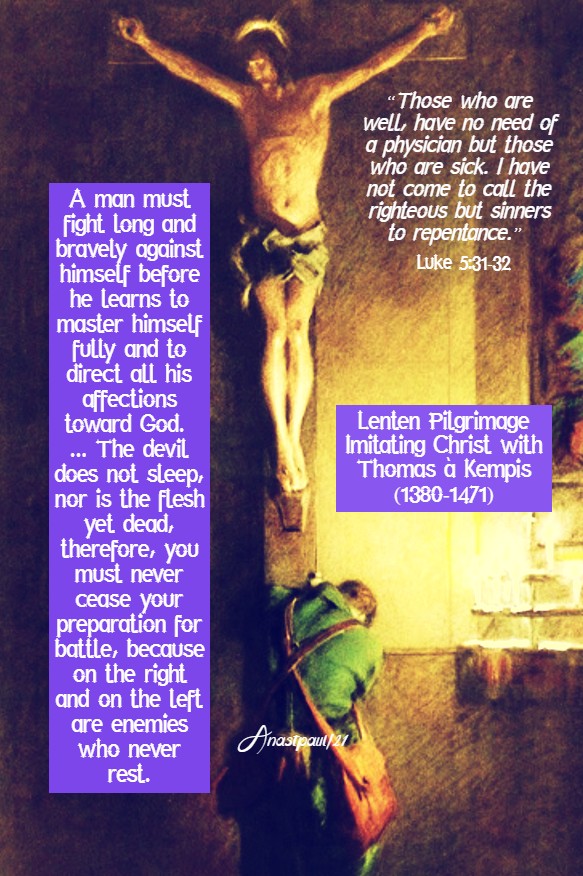
“A man must fight long and bravely against himself before he learns to master himself fully and to direct all his affections toward God. ” … The devil does not sleep, nor is the flesh yet dead, therefore, you must never cease your preparation for battle because, on the right and on the left are enemies who never rest.”
Thomas à Kempis CRSA (1380-1471)
“When you gossip about a person it means that you have removed the person from your heart. But be aware, when you remove a man from your heart, Jesus also goes away from your heart with that man.”
One Minute Reflection – 6 March – The First Sunday of Lent – 2 Cor.inthians 6:1-10, Matthew 4:1-11 and “The Month of St Joseph”
“Then the devil left Him …” – Matthew 4:11
REFLECTION – “When the Lord had been tempted with this triple temptation—because in all the allurements of the world these three are to be found, either pleasure, or curiosity, or pride — what did the Evangelist say? After the devil had concluded every temptation — every kind but of the alluring sort — there remained the other sort of temptation, by harsh and hard treatment, savage treatment, atrocious and ferocious treatment. Yes, there remained the other sort of temptation. Another Evangelist knew this, knew what had been carried out, what remained, and so he said, “After the devil had completed every temptation, he departed from him, until the time.” He departed from him in the form, that is, of the insidious serpent. He is going to come back in the form of the roaring lion. The One Who will trample on the lion and the cobra, will conquer him. Satan will return. He will enter Judas and will make him betray his Master. He will bring along the Jews, not flattering now but raging. Taking possession of his own instruments, he will cry out with the tongues of all of them, “Crucify him, crucify him!” That Christ was the Conqueror there, why should we be surprised? He is Almighty God.” – St Augustine (354-430) Bishop of Hippo, Father and Doctor of Grace (Sermon 284)
PRAYER – O God, You Who purify Your Church by the yearly Lenten observance, grant to Your household that what they strive to obtain from You by abstinence, they may achieve by good works. Through Jesus Christ, Thy Son our Lord, Who lives and reigns with Thee, in the unity of the Holy Ghost, God, world without end. Amen (Collect).
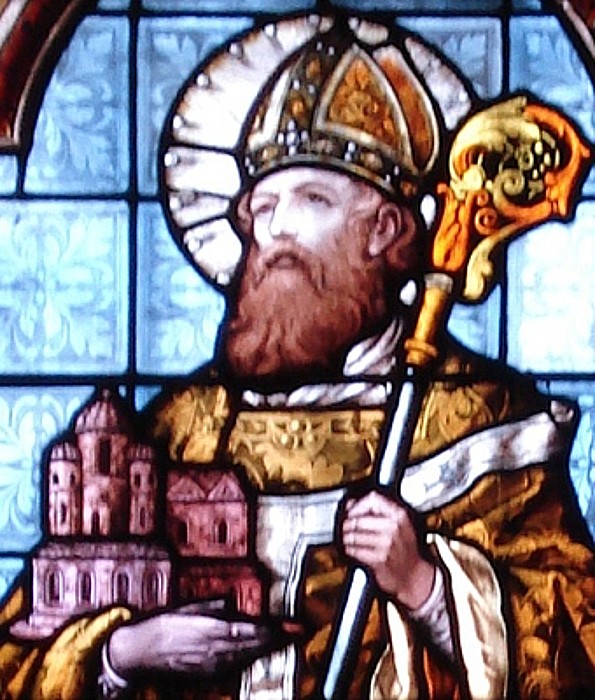
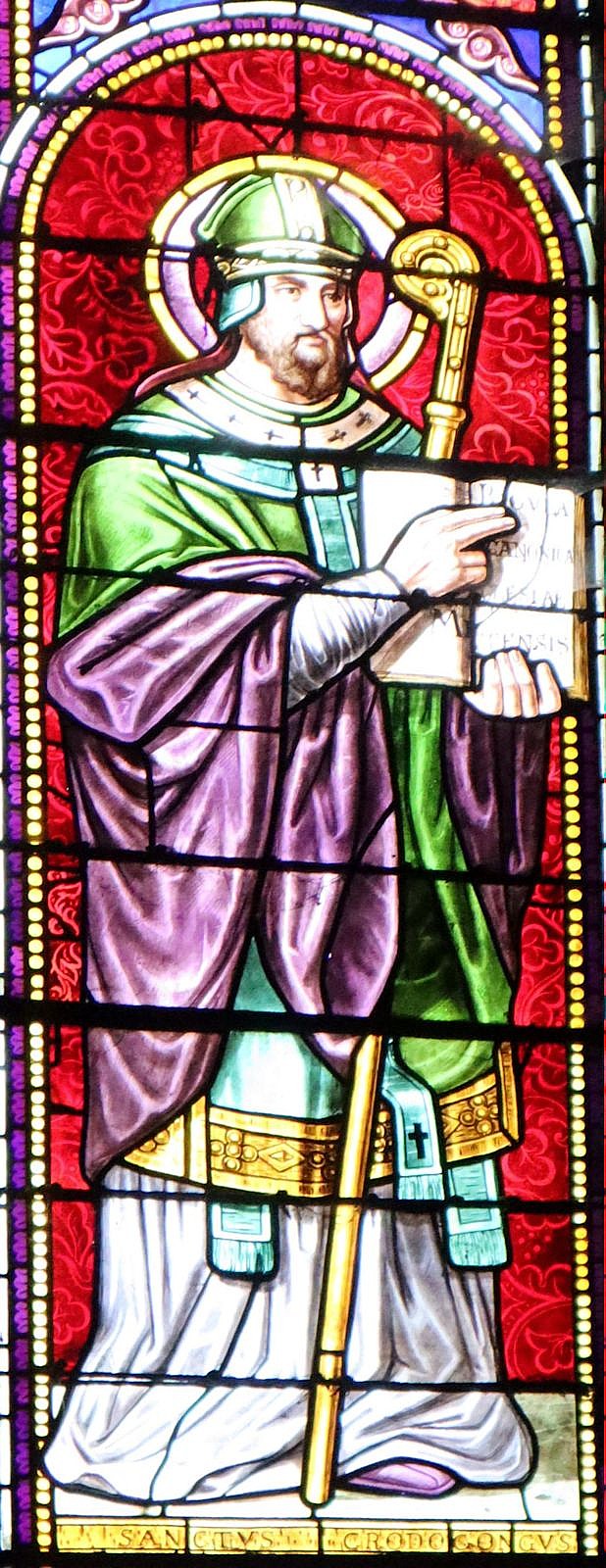
Saint of the Day – 6 March – Saint Chrodegang of Metz (c 714-776) First Bishop of Metz, Protector and Father of the poor and orphans, Reformer of the Clergy, a relative of King Pepin and of Prince Charles Martel, both of whom he was Court Chancellor, Royal Diplomat, Saint Opportuna of Montreuil was his brother. Born in c 714 at Hesbaye, Brabant, near Liege, Belgium and died on 6 March 776 at Metz, France. Also known as – Chrodegand, Chrodegangus, Chrodegrang, Chrodegrangus, Chrodogand, Chrodogandus, Chrotgang, Chrotgangus, Droctegangus, Godegrand, Godegrandus, Grodegandus, Grodegangus, Grodogangus, Gundigran, Krodegandus, Ratgang, Rodigang, Rudigangus, Ruggandus, Ruodgangus, Ruotgangus, Rutgangus, Sirigang and Sirigangus. Additional Memorial – 3 October (Augustinians).
The Roman Martyrology states: “In Metz in Austrasia, in today’s France, St Crodegango, Bishop, who arranged for the Clergy to live as if within the walls of a cloister under an exemplary rule of life and greatly promoted liturgical chant.”
Chrodegang was born in c 714 at Hesbaye, Brabant, near Liege, Belgium into a noble family. His parents, of Frankish origin, sent him to be educated at the Benedictine Abbey of Saint-Trond.
Chrodegang was good-looking young man, very educated and an excellent linguist. Charles Martell, Duke and Prince, noticed his great skills and appointed him head of the diplomatic and juridical corps at his service. When Charles Martel died in 742, his successor, Charlemagne, also appointed him Bishop of Metz. Codregando, however, was still a layman and, therefore ,had to receive Diaconal and Priestly Ordinations and Episcopal Consecration. He retained his political office and took advantage of the prestige achieved by the exercise of the two offices and exploited his influence for a good purpose.
As King Pepin’s Ambassador to Pope Stephen II, Chrodegang carried out a profound reform of the Clergy, which at that time was in a deadly moral crisis. Determined to intervene in the difficult situation, he began with the Priests of his City. He ,therefore, gathered all the Clergy in houses and established for them a rule of life inspired by that of St Benedict. The code that he applied to Metz was made up of thirty-four chapters and everyday, in the presence of the whole community, one was read – hence these meetings took the name of “Chapter.” Soon, this name was extended to the people who attended the readings, while all those who were linked to the canons were called “Canons” and those who followed a rule began to define themselves as “Regular,”
Other norms of community life were inserted later, concerning enclosure, domicile, study, liturgy, dress and meals and were aimed at providing the ecclesiastics with mutual support in remaining faithful to the vow of chastity and other commitments proper to the Clergy. The main difference from the friars was in the possibility of retaining their possessions, a habit that was later questioned. The Rule of Chrodegang was then adopted by other Diocese and finally, extended by Charlemagne to all Priests, who were thus required to be either Monks or Canons. This Rule also found success abroad and over the centuries it repeatedly returned to vogue, albeit not in its original form.
On the initiative of Chrodegang, the Roman Rite and Chant were also introduced in Metz, the repertoire of which returned to Rome enriched by French compositions and from there, spread throughout Europe. The “schola cantorum” – “School of Singers'” of Metz, fame lasted for centuries. In 805 Charlemagne even ordered that all singing teachers should be trained in Metz.
Chrodegang laboured earnestly for the welfare of Church and State and was ever solicitous of strengthen the bonds of union between the temporal and spiritual Rulers. He founded (748) the Abbey of Gorze (near Metz), and remained its friend and protector. He also established St Peter’s Abbey, on the Moselle and did much for the Abbeys of Gengenbach and Lorsch. For the latter, he is said to have obtained the relics of St Nazarius, and for Gorze those of St Gorgonius The holy Bishop also distinguished himself in the construction and restoration of Churches, Monasteries and charitable institutions. After the death of St Boniface, Pope Stephen conferred the Pallium on Chrodegang (754-755), thus making him an Archbishop but not elevating the See of Metz.
Chrodegang was a man of imposing appearance, of a mild, though firm, character, of great liberality to the poor, and of more than ordinary abilities in many fields and was extremely well versed in Latin and German.
In 762, during a dangerous illness, he introduced among his Priests a Confraternity of Prayer, known as the League of Attigny. The ‘Rule of Chrodegang‘ spread far and wide and it seems probable that the Rule was brought by Irish monks to their native land from the Monasteries of north-eastern Gaul and that Irish anchorites originally unfettered by the rules of the cloister bound themselves by it. In the course of the 9th century mention is made of nine places in Ireland (including Armagh, Clonmacnoise, Clones, Devenish and Sligo) where communities of Culdees were established as a kind of annex to the regular Monastic institutions. They seem especially to have had the care of the poor and the sick and were interested in the musical part of worship.
On his death, on 6 March 766, he received burial at the Abbey of Gorze, which he himself had founded and loved more than any other. Tradition has it that some of his relics are also kept at the Saint-Symphorien Church in Metz.
St Aetius St Bairfhion St Baldred of Strathclyde St Baldred the Hermit St Balther of Lindisfarne St Basil of Bologna St Cadroë St Chrodegang of Metz (c 714-776) Bishop
St Cyriacus of Trier St Cyril of Constantinople St Evagrius of Constantinople St Fridolin Vandreren of Säckingen Bl Guillermo Giraldi St Heliodorus the Martyr Bl Jordan of Pisa St Julian of Toledo St Kyneburga of Castor St Kyneswide of Castor St Marcian of Tortona Bl Ollegarius of Tarragona St Patrick of Malaga St Sananus
Martyrs of Amorium – 42 Saints – Also known as Martyrs of Syria and Martyrs of Samarra; A group of 42 Christian senior officials in the Byzantine Empire who were captured by forces of the Abbasid Caliphate when the Muslim forces overran the City of Amorium, Phrygia in 838 and massacred or enslaved its population. The men were imprisoned in Samarra, the seat of the Caliphate, for seven years. Initially thought to be held for ransom due to their high position in the empire, all attempts to buy their freedom were declined. The Caliph repeatedly ordered them to convert to Islam and sent Islamic scholars to the prison to convince them; they refused until the Muslims finally gave up and killed them. Martyrs. We know the names and a little about seven of them: • Aetios • Bassoes • Constantine • Constantine Baboutzikos • Kallistos • Theodore Krateros • Theophilos but details about the rest have disappeared over time. However, a lack of information did not stop several legendary and increasingly over-blown “Acts” to be written for years afterward. One of the first biographers, a monk name Euodios, presented the entire affair as a judgement by God on the empire for its official policy of Iconoclasm. Deaths: • beheaded on 6 March 845 in Samarra (in modern Iraq) on the banks of the Euphrates river by Ethiopian slaves • the bodies were thrown into the river, but later recovered by local Christians and given proper burial.


































 AnaStpaul
You must be logged in to post a comment.