One Minute Reflection – 16 April – Holy Saturday (Vigil Mass of Easter) – Matthew 28,1-7.
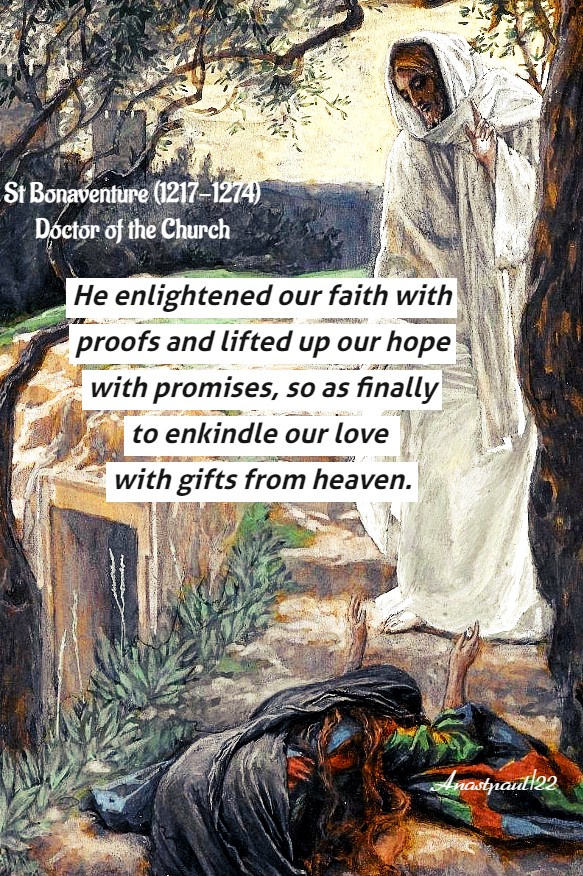
“And the Angel answering, said to the women: Fear not you, for I know that you seek Jesus Who was Crucified, He is not here, for He is risen, as He said.” – Matthew 28:5-6
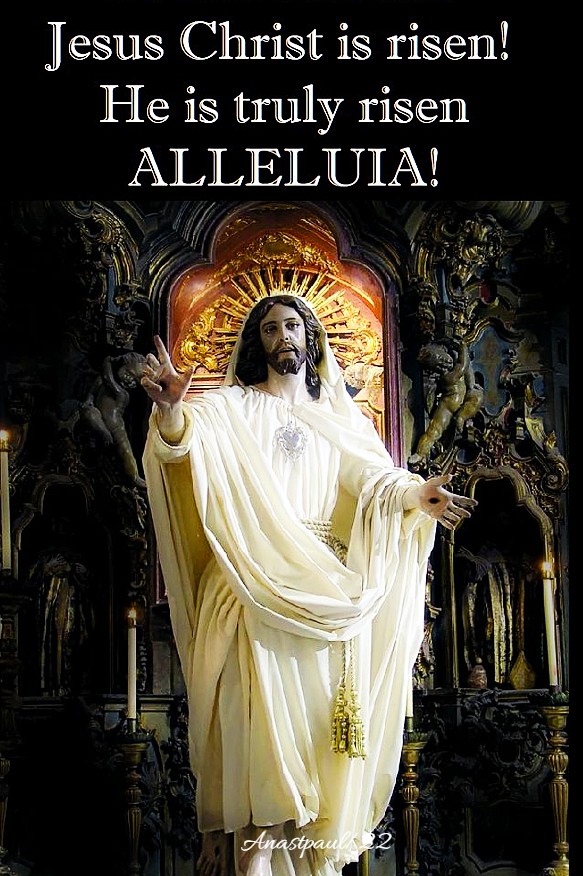
REFLECTION – “When the third day dawned of the Lord’s sacred repose in the tomb (…) Christ, the “power and Wisdom of God” (1 Cor 1:24), with the author of death lying prostrate, conquered even death itself and opened to us access to eternity, when He raised Himself from the dead by His divine power in order to make known to us the paths of life.
Then there was a great earthquake, for an angel of the Lord came down from heaven, with raiment like snow and his countenance like lightening. He appeared attractive to the devout and severe to the wicked – for he terrified the soldiers and comforted the timid women, to whom the Lord Himself first appeared after rising, because their intense devotion so merited. Then He was seen by Peter, then by the disciples going to Emmaus, then by all the apostles except Thomas. Later He presented Himself to be touched by Thomas, who proclaimed his faith: “My Lord and my God.” And thus, during forty days, He appeared in many ways to His disciples, both eating and drinking with them.
He enlightened our faith with proofs and lifted up our hope with promises, so as finally to enkindle our love with gifts from heaven.” … St Bonaventure (1217-1274) Doctor of the Church
PRAYER – O God, Who dost illuminate this most holy night by the glory of the Lord’s Resurrection, preserve in the new children of Thy family, the spirit of adoption which Thou hast given, that renewed in body and mind, they may render to Thee a pure service. Through our Lord Jesus Christ, Thy Son, who lives and reigns with Thee in the unity of the Holy Ghost, God, world without end. Amen (Collect).
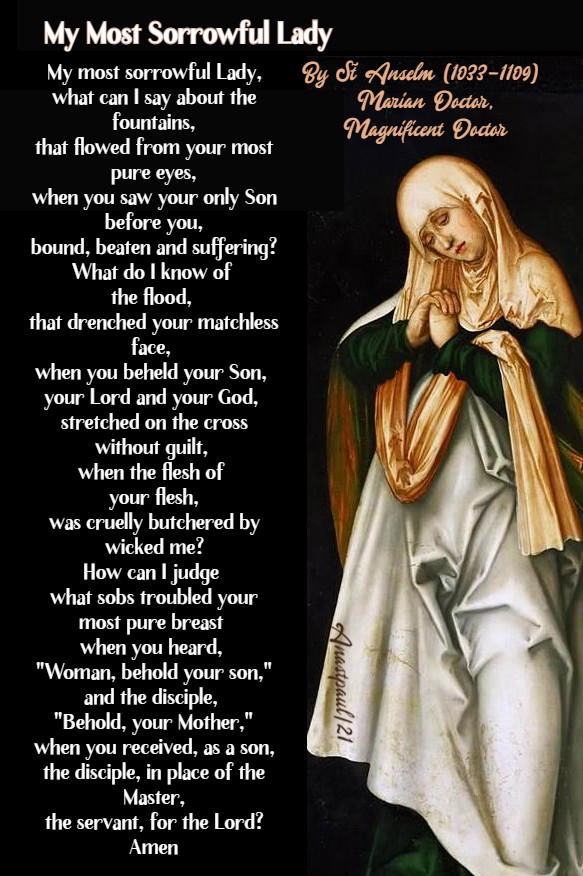
My Most Sorrowful Lady By St Anselm (1033-1109) Marian Doctor Magnificent Doctor
My most sorrowful Lady, what can I say about the fountains, that flowed from your most pure eyes, when you saw your only Son before you, bound, beaten and suffering? What do I know of the flood, that drenched your matchless face, when you beheld your Son, your Lord and your God, stretched on the Cross without guilt, when the flesh of your flesh, was cruelly butchered by wicked me? How can I judge what sobs troubled your most pure breast when you heard, “Woman, behold your son,” and the disciple, “Behold, your Mother,” when you received, as a son, the disciple, in place of the Master, the servant, for the Lord? Amen
Saint of the Day – 16 April – Saint Magnus of Orkney (c 1075-1115) Layman Martyr, Earl of Orkney, Born in c1075 in the Orkney Islands, Scotland and died by being struck in the head with an axe, in 1115 at Egilsay Island, Scotland. Patronage – Orkney Islands. Also known as – Magnus Erlendsson of Orkney, Magnus Erlendsson, Magnus the Martyr, Mans… Additional Memorial – 13 December (translation of relics). The image below is a reconstruction of the face of St Magnus by the BBC.
Magnus was the Earl of Orkney in Scotland and related to the Royal House of Norway, which exercised sovereignty over the Orkney Islands at that time. The story of St Magnus’ life and Martyrdom are well attested. Three legends tell his story, the most famous being the Orkneyinga saga. His life is also recounted in two Latin accounts. Magnus was born around 1075. He was the son of Erlend Thorfinnson, Earl of Orkney. Erlend held the earldom of Orkney under the Norse crown but was practically independent. Magnus’ father and uncle had been among the Norse invaders of England under Harald Hadrada in 1066. In 1098 King Magnus III of Norway came and deposed St. Magnus’ father, taking personal possession of the Orkneys and installing his illegitimate son as ruler. Magnus entered the service of King Magnus III and served as his personal Chamberlain.
Reconstruction of St Magnus’ Face by the BBC
St. Magnus had a disposition for piety and gentleness. The warriors of King Magnus’ retinue mistook this for weakness and harassed him. At this time, many Norse were still pagans or only Christians in a very nominal sense. He was present in 1098 for the Battle of Angelsey Sound in Wales but refused to take part in what essentially was a Viking raid, preferring instead to stay on the ship and sing Psalms. This disgraced him with the King’s retinue and he was obliged to take refuge in Scotland.
Magnus returned to Orkney in 1105 to dispute an inheritance issue with his cousin, Haakon. The dispute could not be resolved and Magnus appealed to the new King, Eystein I of Norway. In 1114, King Eystein made Magnus and Haakon, his cousin, joint Earls of Orkney, an arrangement which was obviously doomed to failure. The two sides almost came to blows but it was agreed that the Earls would meet on the Island of Egilsay on Easter to work out their differences. Each Earl was to bring only two ships. Magnus, being good natured, virtuous and honest,arrived with the requisite two ships. Haakon, however, treacherously brought eight ships full of armed followers.
Magnus took refuge in the Island Church overnight, praying to God and preparing his soul for whatever lay before him. In the morning he was dragged out of the Church by the chieftains loyal to Haakon. Magnus offered to go into exile or imprisonment but the chieftains demanded that one of the Earls must die. However, Haakon could find none of his chiefs willing to strike the fatal blow, as it was clear Magnus was innocent of any wrongdoing, his only crime consisting in being born with a title to the Earldom which Haakon coveted in his lust for power.
In the end, Haakon made his cook deliver the lethal blow. Before death, Magnus prayed for his captors and implored God’s to forgive them. He was killed with a single blow to the head from an axe, tn Easter Monday, 1117.
Magnus was hastily buried in the field where he was executed. According to legend, the rocky area around his grave miraculously became a green field. Magnus’ mother Thora, was later given permission to have Magnus interred at Christchurch in Birsay on Orkney’s mainland. A Church was later constructed on the spot where he was killed on Egilsay.
Tale of Magnus’ sanctity soon spread as well as tales of miracles at his tomb. William the Old, Bishop of Orkney in the 12th century, spoke condescendingly about miracles attributed to Magnus and was subsequently struck blind until receiving his sight again after praying at St Magnus’ tomb. Not long after, Bishop William authorized the cult of Magnus on the island at constructed the church of St Magnus near the site of the murder. A Cathedral dedicated to St Magnus was constructed shortly thereafter, which became the final repository of his relics. A renovation of the Cathedral in 1919 uncovered a box with the skull of St Magnus within.
Since his death, St. Magnus has been venerated as a Martyr but his status as a martyr has been questioned. Magnus’ Canonisation was done locally, prior to the institution of canonical procedures by Pope Alexander III. It is difficult to see in what sense St. Magnus was a Martyr. The occasion of the hostility of Haakon, was not the practice of the faith or the defence thereof but, in a dispute over the rightful possession of the Earldom of Orkney. Magnus certainly was pious and saintly, even praying for his persecutors before his execution but it is difficult to see how his death itself was a Martyrdom, in the proper sense. We should keep in mind, that while the Church has adopted the Episcopal Canonisation of Magnus, his title of “martyr” is more an exercise of popular piety than a strict theological title.
The feast day of St. Magnus is also interesting. In the Orkney’s his feast day is celebrated today, 16 April, the date of his death. It is known as Mansemass and attended with considerable public festivities. But has become more of a popular commemoration than a liturgical one; it is often not celebrated liturgically because it frequently coincides with Easter, Holy Week, or the Easter Octave. In Denmark, where devotion to St Magnus was very strong, there was an alternate feast day of 19 August. How this date got fixed was due to a confusion between St Magnus of Orkney and Magnus of Milan. It happened that there was another and earlier St Magnus – an Italian Martyr from Milan – who had long occupied 19 August in the Calendar of Saints. So, for no better reason than the coincidence of their names, our saintly Earl took over his Italian counterpart’s spot on the Danish Calendar.
‘So Magnus Erlendson, when he came up from the shore that Easter Monday, towards noon, to the stone in the centre of the island, saw against the sun eleven men and a boy and a man with an axe in his hand who was weeping … Then in the light of the new day, 16 April 1117, there was a blinding flash of metal in the sun’. – George Mackay Brown
St Benedict Joseph Labre – Known as the Beggar of Perpetual Adoration (1748-1783) Laqy Penitent and Pilgrim – he “abandoned his country, his parents and whatever is flattering in the world, to lead a new sort of life, a life most painful, most penitential, not in a wilderness, nor in a cloister but in the midst of the world, devoutly visiting as a pilgrim the famous places of Christian devotion.” Canonised by Pope Leo XIII on 8 December 1881. Dearest St Benedict Joseph: https://anastpaul.wordpress.com/2017/04/16/saint-of-the-day-16-april-st-benedict-joseph-labre/
St Lambert of Saragossa St Lambert of Saragossa St Magnus of Orkney (c 1075-1115) Layman Martyr
St Turibius of Astorga St Vaise St William Gnoffi
Martyrs of Avrillé – 26 Beati: – A group of lay people who were executed together for their faith during the anti-Christian persecutions of the French Revolution. They were martyred on 16 April 1794 at Avrillé, Maine-et-Loire, France. • Blessed Anne Maugrain, • Blessed François Micheneau veuve Gillot, • Blessed François Suhard veuve Ménard, • Blessed Jean Ménard, • Blessed Jeanne Gourdon veuve Moreau, • Blessed Jeanne Leduc épouse Paquier • Blessed Jeanne Onillon veuve Onillon, • Blessed Jeanne Thomas veuve Delaunay, • Blessed Madeleine Cady épouse Desvignes, • Blessed Madeleine Sallé épouse Havard • Blessed Marguerite Robin, • Blessed Marie Forestier • Blessed Marie Gingueneau veuve Coiffard, • Blessed Marie Lardeux, • Blessed Marie Piou épouse Supiot, • Blessed Marie Rechard, • Blessed Marie Roger veuve Chartier, • Blessed Marie-Genevieve Poulain de la Forestrie, • Blessed Marthe Poulain de la Forestrie, • Blessed Perrine Bourigault, • Blessed Perrine Laurent • Blessed Perrine Pottier épouse Turpault, • Blessed Pierre Delépine, • Blessed Renée Bourgeais veuve Juret, • Blessed Renée Rigault épouse Papin, • Blessed Renée Sechet veuve Davy. 16 April 1794 at Avrillé, Maine-et-Loire, France – Beatified: 19 February 1984 by Pope John Paul II at Rome, Italy
Martyrs of Corinth – 9 Saints: A group of nine Christians who were tortured and Martyred together in the persecutions of Decius. We know little more than three of their names – Callistus, Charisius and Leonide. They were thrown into the sea at Corinth, Greece c250.
Martyrs of Saragossa: Group of eighteen Martyrs murdered in 304 in Saragossa, Spain in the persecutions of Diocletian and the prefect Dacean. We know little more than the names – Apodemus, Caecilian, Caius, Crementius, Engratia, Eventius, Felix, Fronto, Gaius, Julia, Lambert, Lupercus, Martial, Optatus, Primitivus, Publius, Quintilian, Saturnius (4 men of this name), Succesus and Urban. Their graves re-discovered in 1389 in the crypt under the church of San Encrazia in Saragossa.
Thought for the Day – 15 April – Meditations with Antonio Cardinal Bacci (1881-1971)
The Crucifixion
“When Jesus had been nailed to the Cross and the executiioners had dug a hole nearby, they lifted the heavy piece of wood and thrust it into the ground. The whole weight of Jesus’ Body was borne by His Hands and Feet, so that the shock caused by the Wounds made by the nails, to become enlarged and sent an acute quiver of pain through His suffering Members. He raised His glazed Eyes towards Heaven and murmured a prayer offorgiveness and love.
For three long hours, Jesus hung suspended between earth and sky as a Victim of reparation for our sins. His Precious Blood fell drop by drop from the Wounds in His worn-out Body. He gasped for breath in an ever-increasing agony, while His Heart throbbed with infinite love. He looked down and saw His most Holy Mother and the beloved disciple. Having sacrificed everything for us, He desired to leave us the last precious possession which remained to Him – His Mother. He turned to her and then to the beloved disciple, “Woman, behold thy son,” He said. “Son, behold thy Mother.” We were all present in the person of St John and so, we were all entrusted to the loving maternal care of Mary. From that moment, we were taken into her protection.
Let us turn to her, therefore, in sorrow and in temptation. Let us be faithful to her during this life and she will be always at our side, especially at the hour of death!”
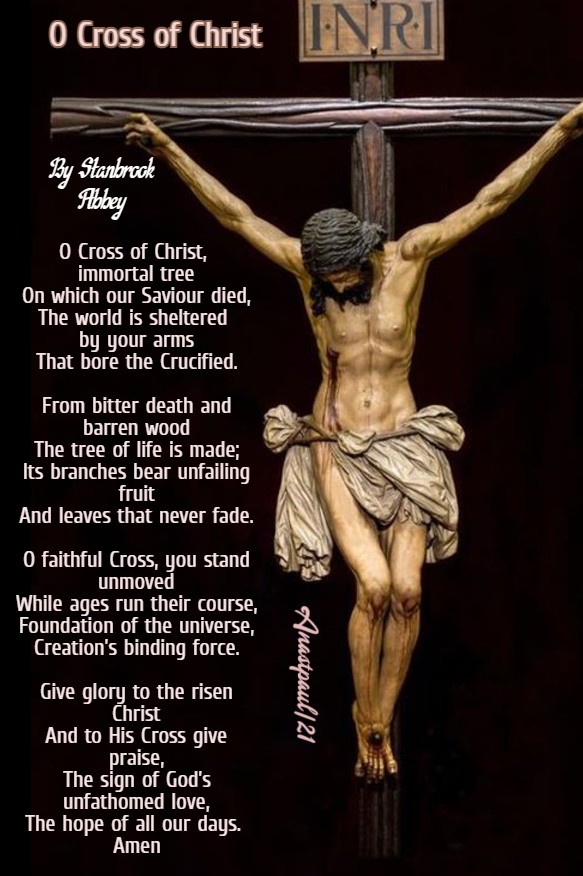
Adoration of the Holy Cross – 15 April – Good Friday – The Passion of Our Lord Jesus Christ – Faithful Cross!
Faithful Cross! Above All Other By St Venantius Fortunatus (c 530 – c 609)
Faithful Cross! above all other, one and only noble tree! None in foliage, none in blossom, none in fruit thy peer may be; sweetest wood and sweetest iron, sweetest weight is hung on thee.
Bend thy boughs, O tree of glory! Thy relaxing sinews bend; for awhile the ancient rigour that thy birth bestowed, suspend and the King of heavenly beauty gently on thine arms extend.
Praise and honour to the Father, praise and honour to the Son, praise and honour to the Spirit, ever Three and ever One: One in might and One in glory while eternal ages run.
The Passion of Our Lord St Leo the Great (400-461) Pope, Father & Doctor (Excerpt from a Sermon on the Passion and Cross of Christ)
“TRUE REVERENCE for the Lord’s Passion means fixing the eyes of our heart on Jesus Crucified and recognising in Him our own humanity. The earth – our earthly nature – should tremble at the suffering of its Redeemer. The rocks – the hearts of unbelievers – should come forth, the massive stones now ripped apart. Foreshadowings of the future Resurrection, should appear in the Holy City, the Church of God – what is happening to our bodies should now take place in our hearts.
NO-ONE, however weak, is denied a share in the victory of the Cross. No-one is beyond the help of the prayer of Christ. His prayer brought benefit to the multitude that raged against Him. How much more ,does it bring to those, who turn to Him in repentance. Ignorance has been destroyed, obstinacy has been overcome. The Sacred Blood of Christ has quenched the flaming sword that barred access to the tree of life. The age-old night of sin has given place to the true Light. The Christian people are invited to share the riches of paradise. All who have been reborn, have the way open before them, to return to their native land, from which they had been exiled. Unless indeed, they close off for themselves, the path that could be opened, before the faith of a thief.
THE BUSINESS of this life should not preoccupy us with its anxiety and pride, so that we no longer strive, with all the love of our heart, to be like our Redeemer and to follow His example. Everything that He did or suffered, was for our salvation – He wanted His body to share the goodness of its Head.
in taking our human nature while remaining God, so that the Word became Man, He left no member of the human race, the unbeliever excepted, without a share in His mercy. Who does not share a common nature with Christ, if He has welcomed Christ, Who took our nature, and is reborn in the Spirit, through Whom Christ was conceived? Again, who cannot recognise in Christ, his own infirmities? Who would not recognise that Christ’s eating and sleeping, His sadness and His shedding tears of love, are marks of the nature of a slave? It was this nature of a slave that had to be healed of its ancient wounds and cleansed of the defilement of sin. For that reason the Only- Begotten Son of God, became also, the Son of Man. He was to have both the reality of human nature and the fullness of the Godhead.
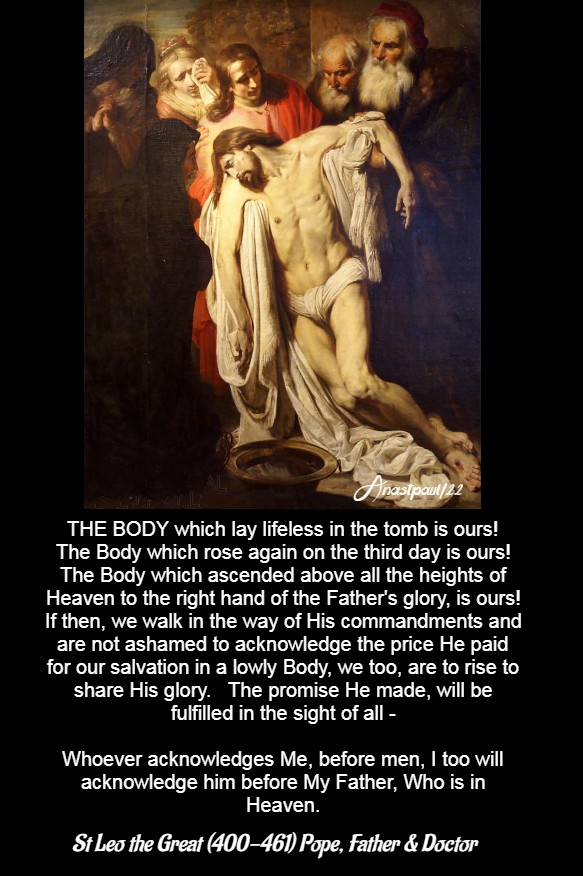
THE BODY WHICH LAY LIFELESS in the tomb is ours! The Body which rose again on the third day is ours! The Body which ascended above all the heights of Heaven to the right hand of the Father’s glory, is ours! If then, we walk in the way of His commandments and are not ashamed to acknowledge the price He paid for our salvation in a lowly Body, we too, are to rise to share His glory. The promise He made, will be fulfilled in the sight of all – Whoever acknowledges Me, before men, I too will acknowledge him before My Father, Who is in Heaven.”
Quote/s of the Day – 15 April – Friday of the Passion of the Lord
GOOD FRIDAY A Day of Deep Mourning, Fasting and Abstinence!
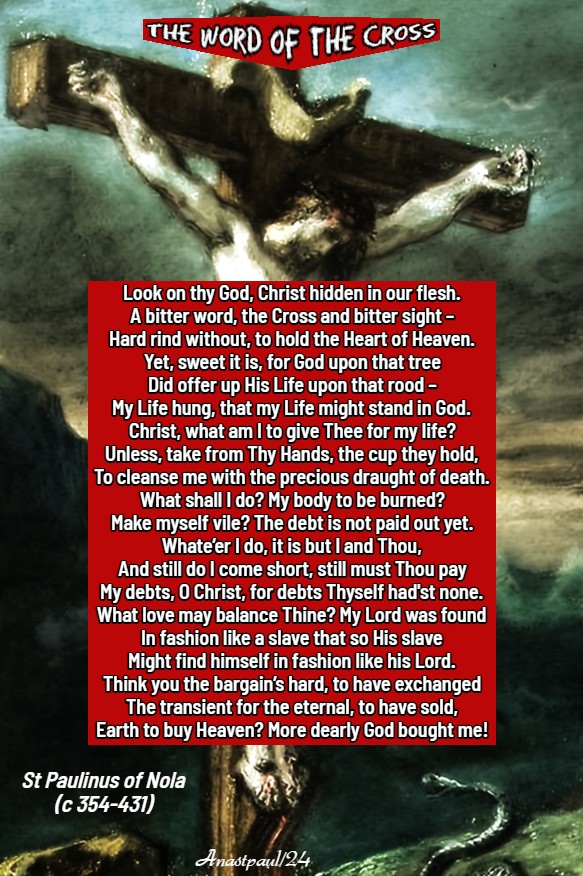
The Word of the Cross
“Look on thy God, Christ hidden in our flesh. A bitter word, the Cross and bitter sight – Hard rind without, to hold the Heart of Heaven. Yet, sweet it is, for God upon that tree Did offer up His Life upon that rood – My Life hung, that my Life might stand in God. Christ, what am I to give Thee for my life? Unless, take from Thy Hands, the cup they hold, To cleanse me with the precious draught of death. What shall I do? My body to be burned? Make myself vile? The debt is not paid out yet. Whate’er I do, it is but I and Thou, And still do I come short, still must Thou pay My debts, O Christ, for debts Thyself had’st none. What love may balance Thine? My Lord was found In fashion like a slave that so His slave Might find himself in fashion like his Lord. Think you the bargain’s hard, to have exchanged The transient for the eternal, to have sold, Earth to buy Heaven? More dearly God bought me!”
St Paulinus of Nola (c 354-431) Father of the Church
“By the Cross, death was slain and Adam was restored to life. The Cross is the glory of all the Apostles, the Crown of the Martyrs, the Sanctification of the Saints. By the Cross, we put on Christ and cast aside our former self. By the Cross we, the sheep of Christ, have been gathered into one flock, destined for the Sheepfold of Heaven.”
St Theodore the Studite (759-826) Father, Abbot, Theologian, Writer
“On whose dear arms, so widely flung, The weight of this world’s ransom hung, The price of humankind to pay And spoil the spoiler of his prey All hail, O Cross, our only hope!”
One Minute Reflection – 15 April – Good Friday – The Passion of Our Lord Jesus Christ according to St John 18:1-40.19,1-42.
“There they crucified Him and with Him two others, one on either side and Jesus between them. ” – John 19:18
REFLECTION – “Truly, you are a hidden God!” (Is 45:15). Why hidden? Because He had neither form nor beauty, yet power was in His Hands. It was there His fortitude was hidden.
Was He not hidden when He submitted His Hands to brutes and His Palms received the nails? The print of the nails gleamed on His Hands and His innocent Side received the wound. They shackled His Feet in fetters, the iron pierced His soles and His Feet were fastened to the tree. These wounds did God suffer on our behalf, at the hands of His own people, in His own home. O how marvellous are His Wounds by which the wounds of the world were healed! How victorious His Wounds, by which He slew death and stung hell! … Therefore, O Church, O dove, You have coverts in the rock and a hollow in the wall in which to rest (cf. Sg 2:14). …
And what will you do … when He comes in the clouds with great power and majesty? (cf. Mt 24:30) He will come down with Heaven and earth ablaze and by the terror of His coming, He will dissolve the elements. When He has come, the Sign of the Cross will be seen in the sky and the beloved One will show the scars of His Wounds and the prints of the nails, by which He was transfixed in His own home.” … St Amadeus of Lausanne (1108-1159) – Cistercian Monk, Bishop
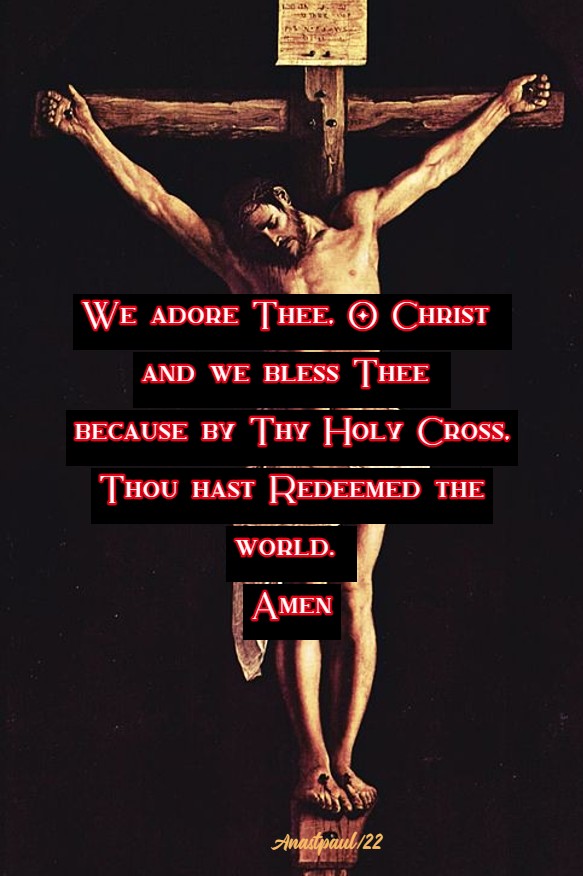
PRAYER – We adore Thee, O Christ and we bless Thee because by Thy Holy Cross, Thou hast Redeemed the world. Amen
A Prayer of the Passion By St Melito of Sardis (Died 180) Bishop of Sardis, Apologist, Father
Lord Jesus Christ, You were bound as a ram, You were shorn like a lamb, You were led to the slaughter like a sheep, You bore the wood of the Cross on Your shoulders, You were led up the hill of Calvary, You were displayed naked on the Cross, You were nailed to the bitter Cross by three spikes, You delivered Your last Seven Words from the Cross You died on the Cross, with a shout of victory, You were buried in noble Joseph’s rock-hewn tomb, By Your boundless suffering on our behalf, fix our eyes unceasingly on Your broken Body and the Blood that poured from Yout Hands, Feet and Side. By the Holy Sacrifice of the Mass that renews each day Your Sacrifice of the Cross on our Altars, apply the merits of the Cross to all humanity and, especially to those who worship it daily and who offer themselves back to You, our great High Priest and perpetually Intercessor, before the Eternal Throne of God. You live and reign, through all the ages of ages. Amen.
Saint/s of the Day – 15 April – Saints Anastasia (Died c 68) Martyr, AND St Basilissa of Rome (Died c 68) Martyr. Spiritual Students of St Peter the ApostleMartyrs of Rome, put to death during the reign of Nero. They were among the first converts to Christianity in the 1st century after Christ.
Martyrs, St Julian, Basilissa and Anastasia
The Roman Martyrology states today: “At Rome, the Saints Basilissa and Anastasia. Of noble families, they were disciples of the Apostles and, as they persevered courageously in the profession of their faith, in the time of the Emperor Nero, they had their tongues and feet cut off, were put to the sword and thus obtained the Crown of Martyrdom.”
Basilissa and Anastasia were described as “Roman matrons of high rank and great wealth.” They were disciples of and were probably Baptised by the Apostles Peter and Paul.
St Anastasia
Sts Peter and Paul’s were Martyrdom in Rome on the same day in c 67. The location of the two tombs eventually became St Peter’s Basilica and the Basilica of St Paul Outside the Walls. The burials of the two great Apostles might have exposed Basilissa and Anastasia to persecution and they were arrested for collecting the relics of and burying the bodies of other Martyred Christians.
They refused to apostatise their Christian faith and were beheaded with swords by order of Nero in c 68, after being tortured, including having their tongues torn out, their skins scraped with hooks, being burned with fire and their breasts and feet cut off.
Their relics are at Santa Maria della Pace Church in Rome.
Tre Ore (The Three Hours Devotion) The Three Hours’ Agony on Good Friday from Noon until 3 o’clock to commemorate the three hours of Christ’s Hanging at the Cross. It includes sermons on the Seven Last Words from the Cross and usually occurs between Noon and 3PM, the latter being the time when Jesus Died on the Cross and the time the Liturgy of the Lord’s Passion begins. In 1815, Pope Pius VII decreed a plenary indulgence to those who practice this devotion on Good Friday.
It is a fine tradition to keep silent from Noon to 3:00 PM today.
Saint Anastasia of Rome (Died c 68) Martyr, Spiritual Student of St Peter the Apostle AND: St Basilissa of Rome (Died c 68) Martyr, Spiritual Student of St Peter the Apostle
St Sylvester of Réome St Theodore of Thrace St Victorinus of Rome St Waltmann of Cambrai
Mercedarian Martyrs of Africa: A group of Mercedarian Monks sailing to Africa as on a mission to redeem capture Christians. Captured by Moors, they were tortured and executed for their faith. Martyrs. 1393.
Martyred in Rome Anastasia Basilissa Eutyches Maro Victorinus
Thought for the Day – 14 April – Meditations with Antonio Cardinal Bacci (1881-1971)
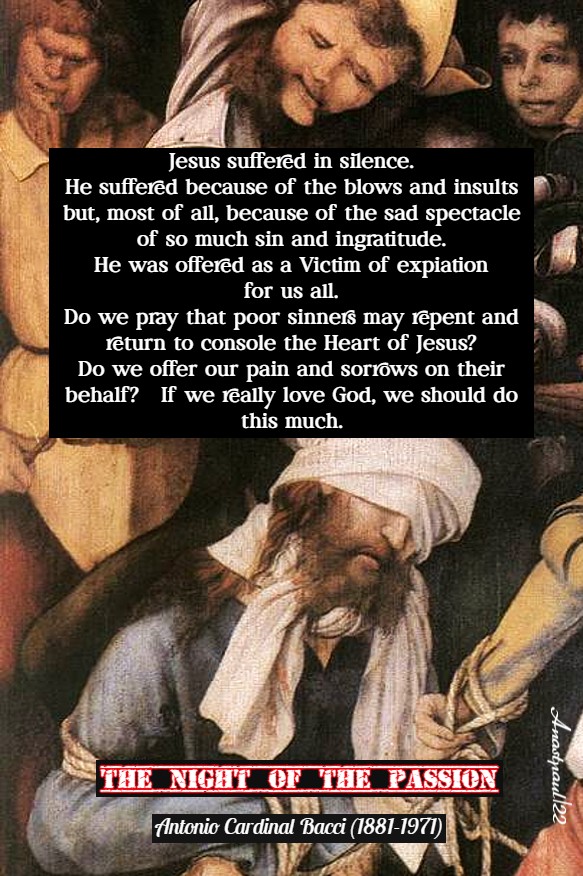
The Night of the Passion
“Caiphas, the High Priest, could not gather any solid and unconflicting evidence which would convict Jesus and further his own evil plans. At last, he solemnly commanded Jesus in the name of the living God, to say whether He was really the Christ, the Son of God. “Thou hast said it,” Jesus replied: “Nevertheless, I say to you, hereafter you shall see the Son of Man sitting at the right hand of the Power and coming upon the clouds of heaven.” At this, the High Priest tore his garments. “He has blasphemed,” he cried, “He deserves to die” (Cf Mt 26:63-66).
The unjust sentence was met with general acclaim and Jesus was handed over to the soldiers, as if He were a common criminal. For the rest of the night, these ruffians humiliated and ill-treated Him in the worst possible fashion. Some spat in His face, others slapped and struck Him and still others, blindfolded Him and jeeringly asked: “Prophecy to us, O Christ! Who is it who struck thee?” (CF Mt 26:67-68) Jesus suffered in silence. He suffered because of the blows and insults but, most of all, because of the sad spectacle of so much sin and ingratitude. He was offered as a Victim of expiation for us all.
When we realise tbe vast number of sins which are committed , what do we do about it? Do we pray that poor sinners may repent and return to console the Heart of Jesus? Do we offer our pain and sorrows on their behalf? If we really love God, we should do this much.”
Maundy Thursday – 14 April – Our Lenten Journey with the Great Fathers – 1 Corinthians 11:20-32, John 13:1-15
“May God have mercy on us and bless us: may He cause the light of His countenance, to shine upon us and may He have mercy on us.” – Psalm 66:2
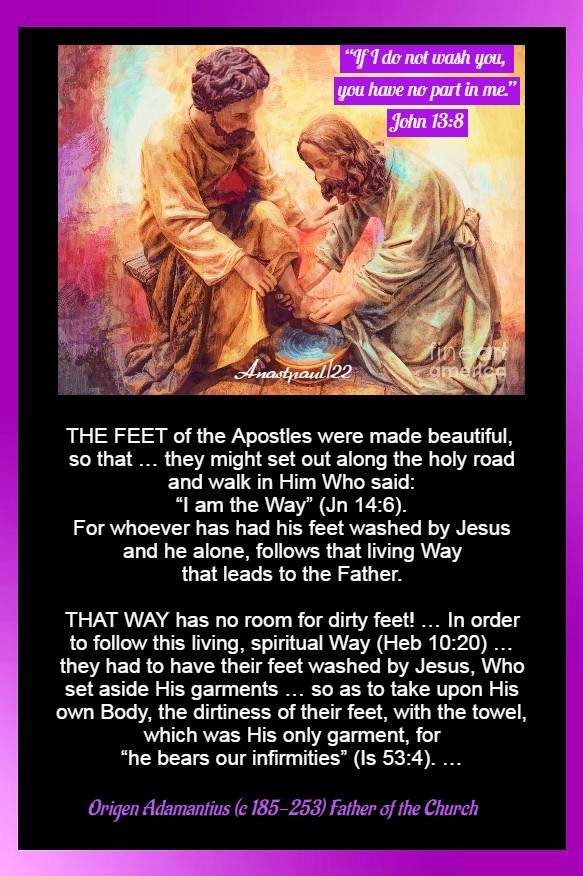
Jesus answered him, “What I am doing you do not know now but afterward, you will understand.” P eter said to him, “You shall never wash my feet.” Jesus answered him, “If I do not wash you, you have no part in me.”
John 13:7-8
O WHAT WAS JESUS DOING in washing the feet of His disciples ? By washing them and wiping them with the towel around His waist, was not Jesus making their feet beautiful, at the moment when they were going to have to proclaim the good news? It was then, in my opinion, that the prophetic word was fulfilled: “How beautiful are the feet of those who proclaim good news!” (Is 52:7; Rm 10:15). But if, by washing the feet of His disciples, Jesus makes them beautiful, how can we express the genuine beauty in those whom He immerses fully “in the Holy Spirit and in fire” (Mt 3:11)?
THE FEET of the Apostles were made beautiful, so that … they might set out along the holy road and walk in Him Who said: “I am the Way” (Jn 14:6). For whoever has had his feet washed by Jesus and he alone, follows that living Way that leads to the Father.
THAT WAY has no room for dirty feet! … In order to follow this living, spiritual Way (Heb 10:20) … they had to have their feet washed by Jesus, Who set aside His garments … so as to take upon His own Body, the dirtiness of their feet, with the towel, which was His only garment, for “he bears our infirmities” (Is 53:4). … ” – Origen Adamantius (c 185-253) Priest, Theologian, Exegist, Writer, Apologist, Father (Commentary on St John’s Gospel)
Quote/s of the Day – 14 April – Maundy Thursday – 1 Corinthians 11:20-32, John 13:1-15
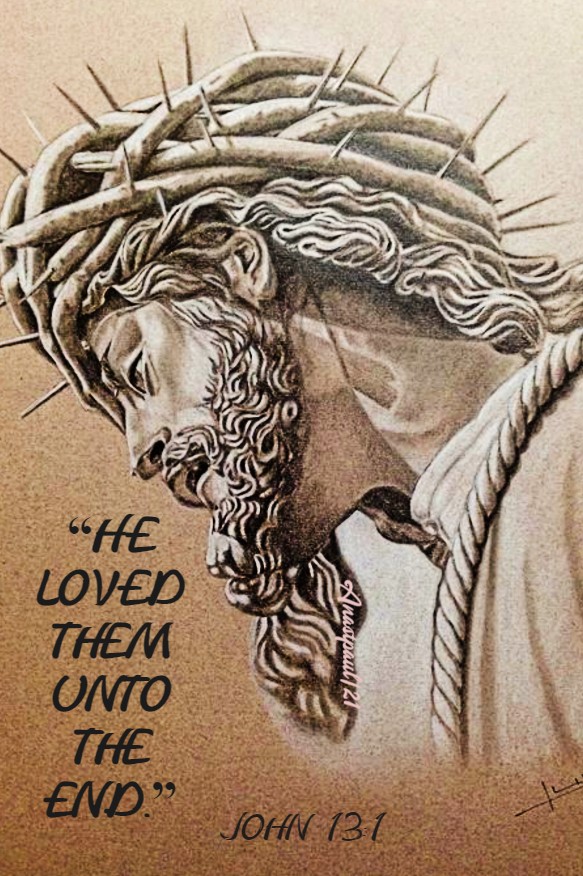
“He loved them unto the end.”
John 13:1
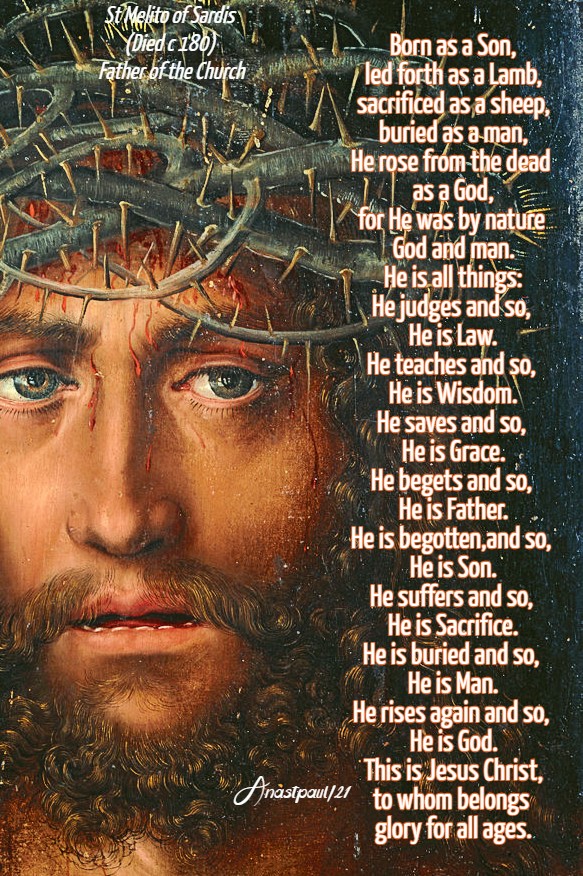
“Born as a Son, led forth as a Lamb, sacrificed as a sheep, buried as a man, He rose from the dead as a God, for He was by nature God and man.
He is all things – He judges and so, He is Law. He teaches and so, He is Wisdom. He saves and so, He is Grace. He begets and so, He is Father. He is begotten,and so, He is Son. He suffers and so, He is Sacrifice. He is buried and so, He is Man. He rises again and so, He is God. This is Jesus Christ, to whom belongs glory for all ages.”
St Melito of Sardis (Died c 180) Bishop, Early Church Father
One Minute Reflection – 14 April – Maundy Thursday – 1 Corinthians 11:20-32, John 13:1-15
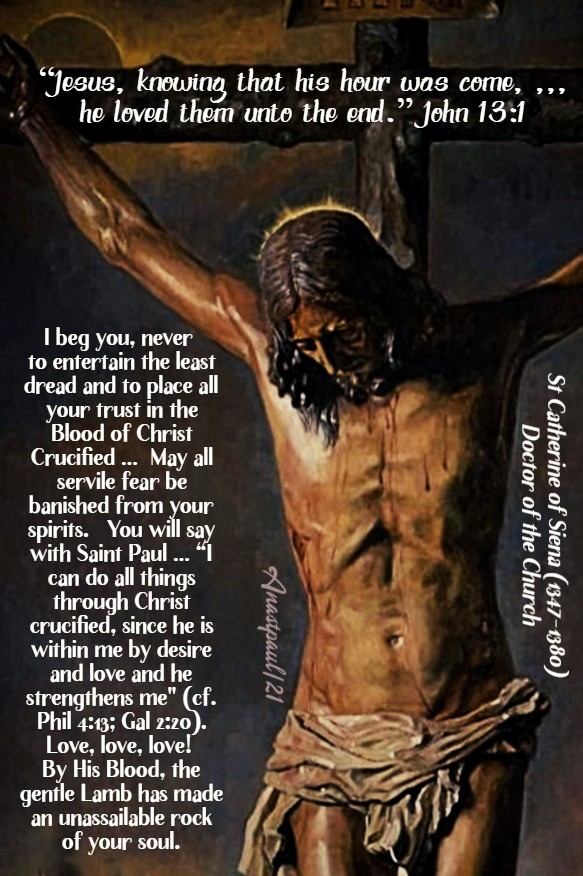
“Jesus, knowing that his hour was come, … he loved them unto the end.” – John 13:1
REFLECTION – “Be obedient to the death, following the example of the spotless Lamb who obeyed His Father even to a shameful death on the Cross. Reflect that He is the way and the rule you are to follow. Always hold Him present before the eyes of your spirit. See how obedient He is, this Word, this Utterance of God! He does not refuse to take up the burden of suffering laid on Him by His Father; to the contrary, He throws Himself into it, spurred on by His great desire. Isn’t this what He reveals during the Last Supper on Maundy Thursday, when He says: “I have eagerly desired to eat this Passover with you before I suffer” (Lk 22:15)? By “eat this Passover” He means, the accomplishment of the Father’s will and His desire. Seeing that scarcely any time lies before Him (He was already looking ahead to the end, when He would sacrifice His body for our sake), He rejoices, He is glad and joyfully says: “I have greatly desired.” Here is the Passover He is speaking about – that which consists in giving His own self as food, in laying down His own body in obedience to the Father.
Jesus had celebrated many another Passover with His disciples but never this one, O unspeakable, sweet and burning charity! You think neither of Your suffering nor of Your humiliating death – if You had thought of them, You would not have been so joyful, You would not have called it a Passover. The Word sees ,that it is He Himself Who has been chosen, He Himself Who has received all our humanity as His spouse. He has been asked to give us His own Blood so that God’s will might be accomplished in us, so that it might be His Blood that sanctifies us. This is, indeed, the sweet Passover, this Lamb without blemish accepts (cf. Ex 12:5) and it is with great love and great desire that He fulfils the Father’s will and wholly carries out His design. What unspeakably sweet love! …
That is why, my beloved, I beg you never to entertain the least dread and to place all your trust in the Blood of Christ Crucified … May all servile fear be banished from your spirits. You will say with Saint Paul …: “I can do all things through Christ crucified, since he is within me by desire and love and he strengthens me” (cf. Phil 4:13; Gal 2:20). Love, love, love! By His Blood, the gentle Lamb has made an unassailable rock of your soul.” – St Catherine of Siena (1347-1380) Dominican tertiary, Doctor of the Church, Co-patron of Europe – Letter 129
PRAYER – O God, from whom Judas received the punishment of his guilt and the thief the reward of his confession: grant unto us the full fruit of Thy clemency, that even as in His Passion, our Lord Jesus Christ gave to each a retribution according to his merits, so having taken away our old sins, He may bestow upon us the grace of His Resurrection. Who with Thee lives and reigns in the unity of the Holy Ghost, God, world without end. Amen
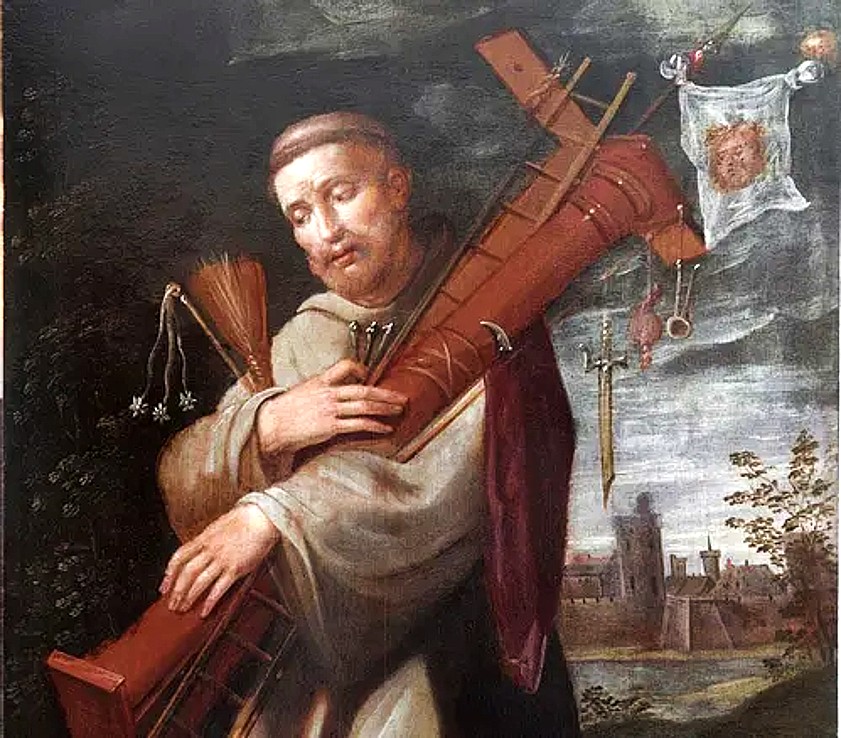
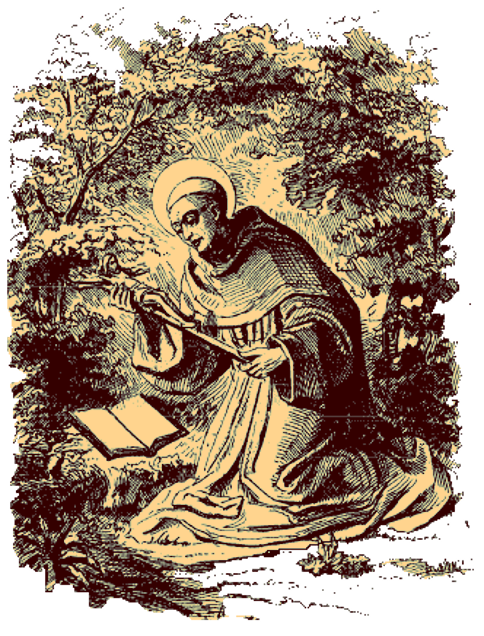
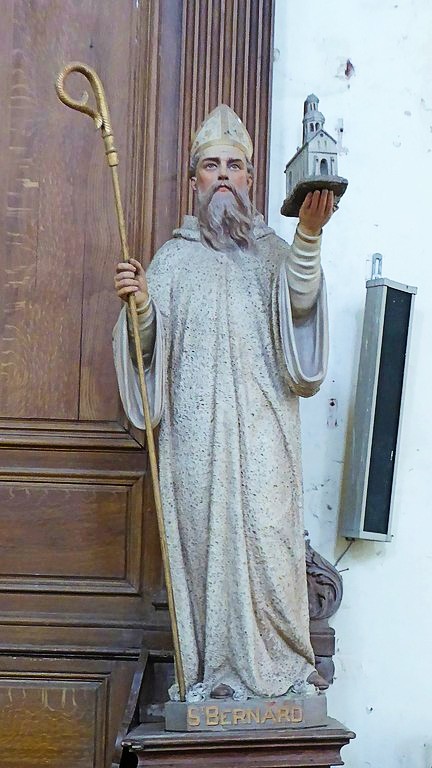
Saint of the Day – 14 April – St Bernard of Tiron (c 1046-1117) French Monk, Hermit, Abbot, Founder of the the Tiron Abbey and the Tironensian Order. St Bernard had a deep devotion to the Passion of Christ, teaching and instruction his disciples in the love of the Holy Cross. Also known as – Bernard of Ponthieu, Bernard of Abbeville, Bernhard…
The Roman Martyrology reads: “In the Monastery of Tiron near Chartres in France, Saint Bernard, Abbot, who on several occasions gave himself up to a hermit life in the woods and on the Island of Chausey but also dedicated himself to instructing and guiding the disciples, who in great numbers, flocked to him.”
Saint Bernard of Tiron is represented as a Monk. He carries the instruments of the Passion, among which we can see: the column of the flagellation, the spear of Longinus, the Cross, the veil of Saint Veronica, the nails, the sword of Saint Peter, the lantern of the guards, the whip , the scale.
Bernard was born near Abbeville in 1046. Having already made good studies and knowing the Sacred Scriptures, in particular, Bernard, at the age of around 19, was accepted at the Monastery of Saint-Cyprien, near Poitiers. He remained there for ten years, before being transferred to Saint-Savin-sur-Gartempe to fill the position of Prior. When the Abbot was convicted of simony in 1082, Bernard assumed the responsibilities of superior. For fear of being elected Abbot, Bernard escaped secretly, becoming a Hermit in the Craon forest, on the borders of Brittany and the Maine, in a place called Tiron.
Being discovered after three years by the Monks of St Savin, who still wished to have him as their Abbot, Bernardo again disappeared and went to live in perennial contemplation on the Island of Chausey. Only after three more years, having learned that the Monks of St Savin had elected another as Abbot, did Bernard return to Tiron. He did not stay there for long, however, for, he gained many followers to his hermit way of life, including St Adelelmus of Flanders. The community grew into a centre for hermits, with many building cells around his. Bernard fame grew eventually gaining the attention of the Saint Cypriene Monastery. (Bernard’s first Monastery) . Abbot Renault then called for Bernard to return to the Monastery bringing with him his new followers. Bernard returned and resumed the habit as well as being appointed Renault’s successor. Bernard accepted the office of Prior of that Monastery and then, on the death of Rinaldo, that of Abbot.
He took part in the Council of Poitiers in 1100 and obtained from Rome, permission of independence from Cluny, for his Monastery of St Cypriene. He returned to the Island of Chausey, which he again had to leave because he was disturbed by the pirates and then accepted the land of Brunelles, given to him by a benefactor, in the forest of Tiron, founding a new Monastery there (1109). However, since a quarrel arose with the Monks of Nogent, of the Cluniac Congregation, who demanded a tithe, instead of agreeing to this demand, he abandoned the Monastery and went to found another at the mouth of the Tiron (1113/14).
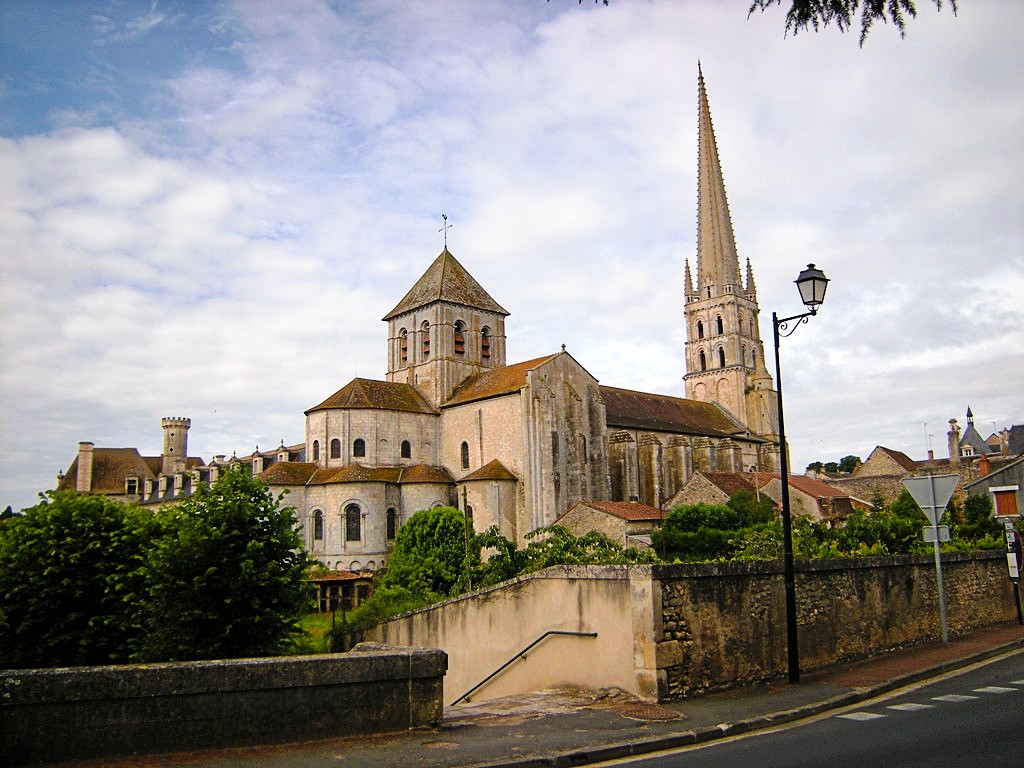
Abbey of the Holy Trinity of Tiron
With the aid of donations from the kings and nobles of France, England and Scotland, Bernard established the Abbey of the Holy Trinity of Tiron in 1114. From here Bernard founded the Tironensian Order, based on a strict observance of the Rule of Saint Benedict and an emphasis on manual labour. This Abbey was so succesful, that the Monks there soon reached the number of five hundred! The Tironensian Order, spread to Germany, England, Scotland and elsewhere. The Order ceased to exist in the 17th Century.
The life of a Tironensian – The Passion of Christ, Sacred Scriptures and working the land.
Bernard remained there until his death on 14 April 1117. His cult, previously limited to Tiron, extended to the whole of his Congregation. Pope Pius IX authorised the Diocese of Chartres and Amiens to celebrate the Feast on 14 April, a Feastwhich is also found in toitiers, Séez, Lavai and Bourges.
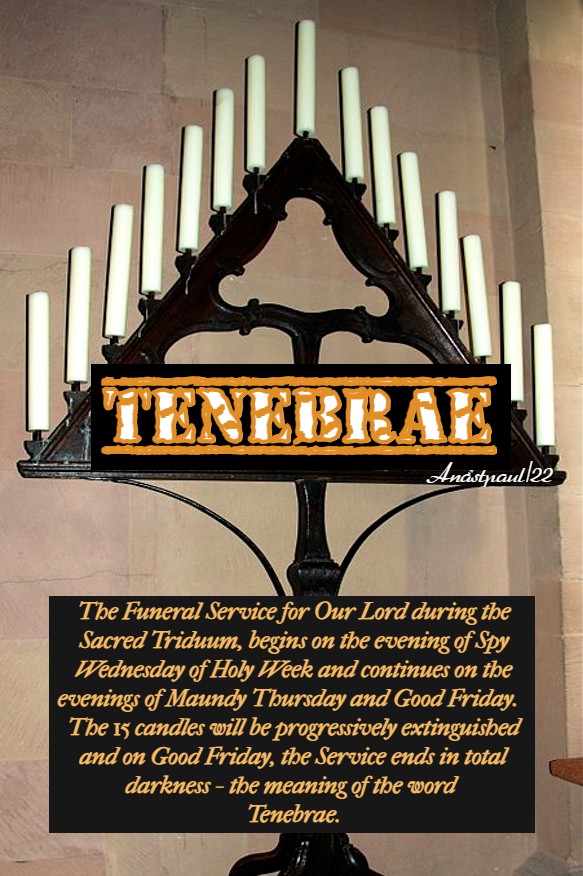
The public singing of part of the Divine Office, on Wednesday, Thursday and Friday evenings of Holy Week, anticipating Matins and Lauds of Holy Thursday, Good Friday, and Holy Saturday. A custom that went back centuries, it acquired the name because of the mourning ritual surrounding the ceremony, which included a triangular stand with fifteen candles. These were put out one by one until, after the last candle was extinguished, a prayer was said in darkness, one candle was lighted, and the assembly dispersed in silence. — Fr John Hardon, Modern Catholic Dictionary
The Matins and Lauds of the Divine Office sung during the Triduum (Holy Thursday, Good Friday and Holy Saturday) are known as the Tenebrae services (“tenebrae” meaning “darkness or shadows”), which is basically a funeral service for Our Lord.
During the Matins on Good Friday, one by one, the candles are extinguished in the Church, leaving the congregation in total darkness and in a silence that is punctuated by the “strepitus” (a loud clang intended to evoke the earthquake that occurred at the moment of Our Saviour’s Death) meant to evoke the convulsion of nature at the Death of Christ. It has also been described as the sound of the tomb door closing.
Thought for the Day – 13 April – Meditations with Antonio Cardinal Bacci (1881-1971)
The Night of the Passion
“The night of the Passion of Jesus Christ began in the Garden of Gethsemane. Here the tired Apostles left Him to pray alone and to endure the agonising pre-vision of the torments and death which awaited Him, as well as of the ingratitude with which men would repay His Infinite love. Soon afterwards, abandoned by everyone, He was led before the Sanhedrin as a criminal and a disturber of the public peace. Not only was the accusation false but, it was, of course, a complete inversion of the truth.
Jesus had, in fact, taught the noblest and most elevating of doctrines for all humanity. He had proved the truth of His teaching by His miracles. He restored sight to the blind, health to the lepers, to the lame and to the paralysed and even, life to the dead. He had stated quite clearly, “Render to Caesar, the things that are Caesar’s and to God, the things that are God’s” (Mt 22:21). Nevertheless, in the presence of His wicked judges, He showed Himself to be meek and humble. But when He was confronted with an obvious falsehood, He spoke out in defence of the truth of His teaching. For this, He was struck by one of the High Priests’s attendants , who said: “Is that the way thou dost answer the high priest?” “If I have spoken ill,” Jesus replied quietly, “bear witness to the evil but if well, why dost thou strike me?” (Jn 18:19-23).
Let us learn from our Divine Redeemer to conquer self-love and to bear insults humbly and peacefully.”
Spy Wednesday in Holy Week – 13 April – Our Lenten Journey with the Great Fathers – Isaias 53:1-12, Luke 22:39-71; 23:1-53
“And turn not away thy face from thy servant, for I am in trouble, hear me speedily. Save me, O God, for the waters are come in, even unto my soul.” – Psalm 68:2
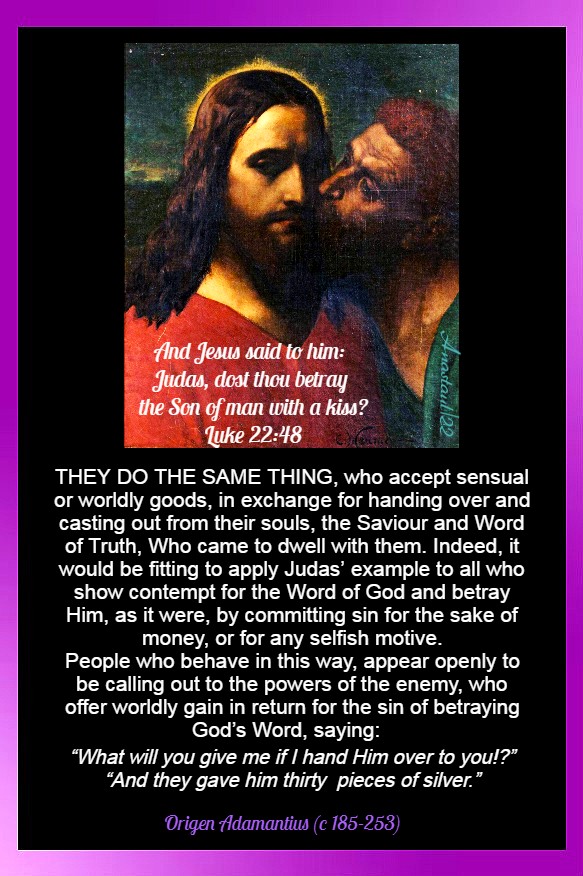
“And Jesus said to him: Judas, dost thou betray the Son of man with a kiss?”
Luke 22:48
“LET US CONSIDER what Judas said to the Jewish priests: “What will you give me if I hand him over to you?” He was willing to take money in exchange for handing over the Word of God!
THEY DO THE SAME THING, who accept sensual or worldly goods, in exchange for handing over and casting out from their souls, the Saviour and Word of Truth, Who came to dwell with them. Indeed, it would be fitting to apply Judas’ example to all who show contempt for the Word of God and betray Him, as it were, by committing sin for the sake of money, or for any selfish motive. People who behave in this way, appear openly to be calling out to the powers of the enemy, who offer worldly gain in return for the sin of betraying God’s Word, saying: “What will you give me if I hand Him over to you!?” “And they gave him thirty pieces of silver.”
THE NUMBER OF COINS they gave Judas, was equivalent, to the number of years the Saviour had sojourned in this world. For at the age of thirty, He was Baptised and began to preach the gospel, like Joseph was thirty years old when he began to gather grain for his brothers. Just as at that time the grain was prepared by God for the sons of Israel but given also to the Egyptians, so also, the gospel was prepared for the saints but preached also to the unfaithful and wicked.” – Origen Adamantius (c 185-253) Priest, Theologian, Exegist, Writer, Apologist, Father (Commentary on Matthew 78)
Quote/s of the Day – 13 April – Spy Wednesday in Holy Week – Isaias 53:1-12, Luke 22:39-71; 23:1-53
“And Jesus said to him: Judas, dost thou betray the Son of man with a kiss?”
Luke 22:48
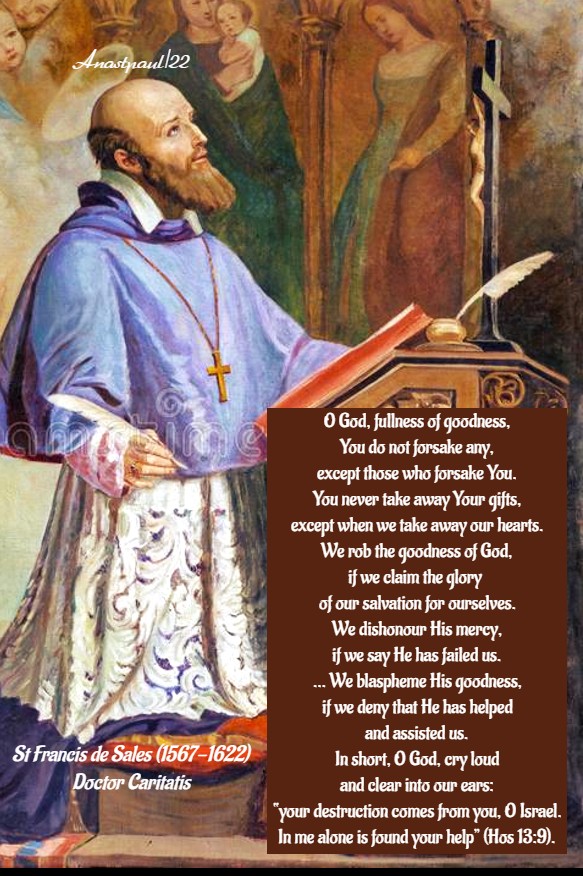
“O God, fullness of goodness, You do not forsake any, except those who forsake You. You never take away Your gifts, except when we take away our hearts. We rob the goodness of God, if we claim the glory of our salvation for ourselves. We dishonour His mercy, if we say He has failed us. … We blaspheme His goodness, if we deny that He has helped and assisted us. In short, O God, cry loud and clear into our ears: “your destruction comes from you, O Israel. In me alone is found your help” (Hos 13:9).
St Francis de Sales (1567-1622) Doctor Caritatis Treatise on the Love of God, Ch 9
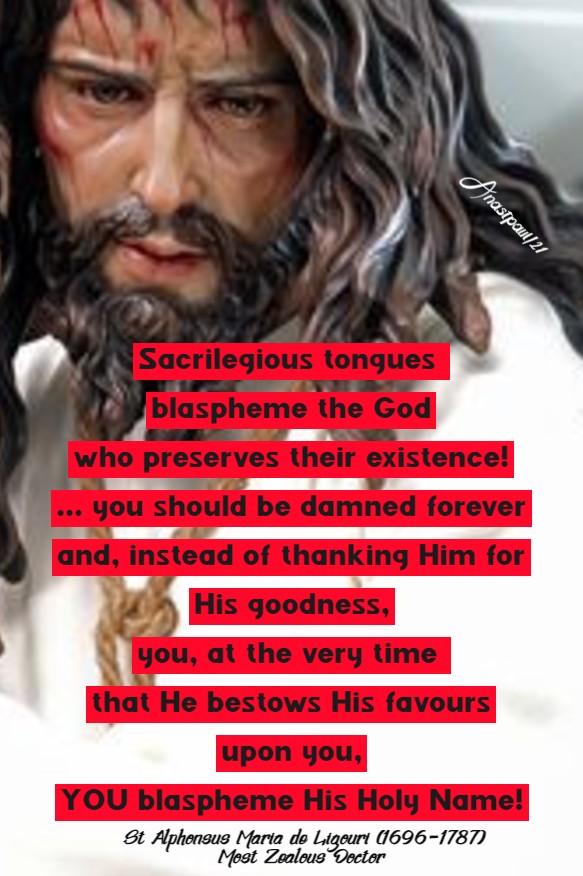
“Sacrilegious tongues blaspheme the God who preserves their existence! … you should be damned forever and, instead of thanking Him for His goodness, you, at the very time that He bestows His favours upon you, YOU blaspheme His Holy Name!”
St Alphonsus Maria de Ligouri (1696-1787) Most Zealous Doctor
One Minute Reflection – 13 April – Spy Wednesday in Holy Week – Isaias 53:1-12, Luke 22:39-71; 23:1-53
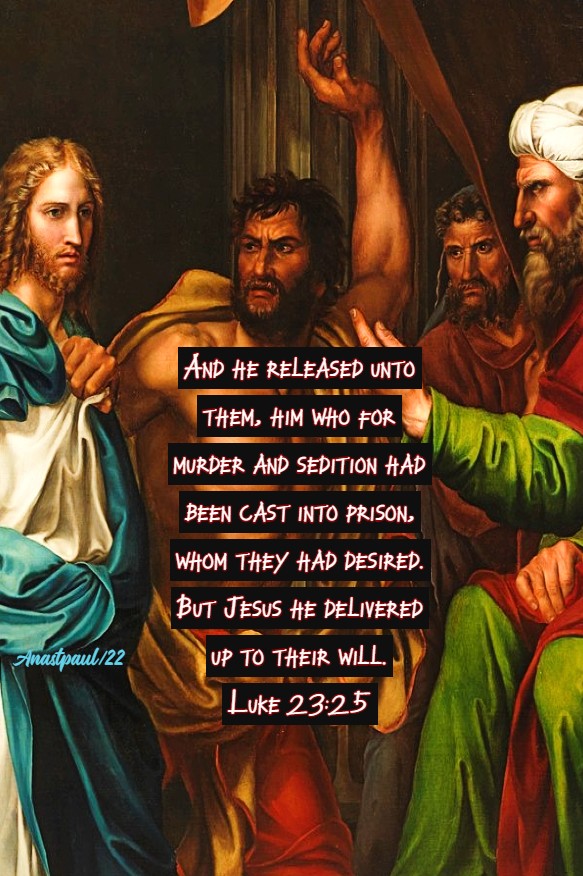
“And he released unto them, him who for murder and sedition had been cast into prison, whom they had desired. But Jesus he delivered up to their will.” – Luke 23:25
REFLECTION – “Jesus made His way of His own free will towards the sufferings Scripture had foretold. He had frequently predicted them to His disciples and had even severely rebuked Peter, who had received their discovery with indignation (Mt 16:23). Finally, He showed how they were the cause of the world’s salvation. This was why, to the men coming to arrest Him, He referred to Himself as: “I am he whom you are seeking” (cf. Jn 18:5.8) … He was struck, covered with spittle, mocked, tortured, scourged and, in the end crucified. He allowed two outlaws, one at His right and one at His left, to share His suffering. Classed alongside murderers and criminal, He took vinegar and gall, fruits of a bitter vine. He was struck in mockery by a reed, pierced by a lance in His side and, in the end, laid in a tomb.
All this He suffered while working out our salvation … By His thorns He brought an end to the punishment laid on Adam, since the latter, having sinned, received this sentence: “Cursed be the ground because of you! Thorns and thistles shall it bring forth to you” (Gn 3:17-18). With the gall He took to Himself all that is bitter and painful in mortal life and sorrowful to men. With the vinegar He accepted human nature’s decline and bestowed on it, its restoration to a higher state. By the purple he symbolised His royalty; with the reed, He indicated how weak and feeble the devil’s power is. Being slapped, He made known our enfranchisement [just as we do in the case of a slave]. He bore with the abuse, punishment and beating due to us.
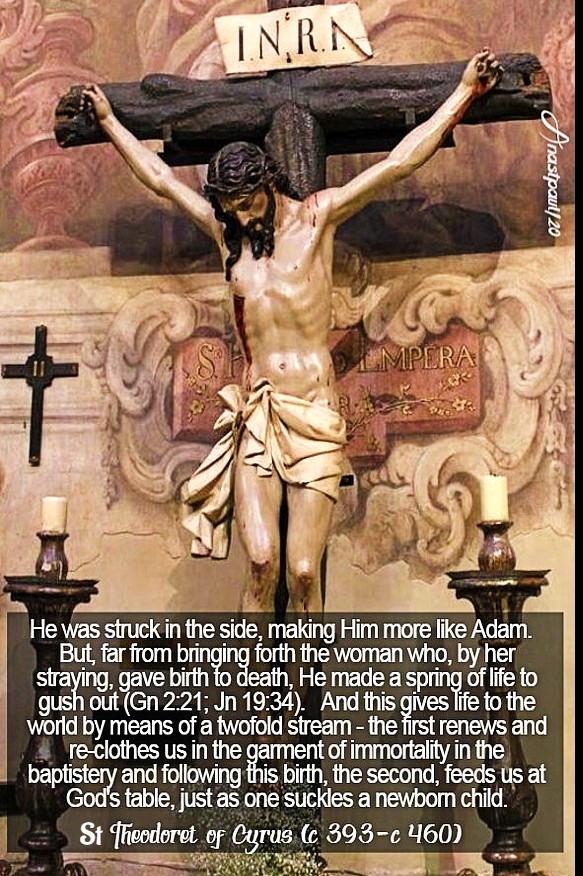
He was struck in the side, making Him more like Adam. But, far from bringing forth the woman, who, by her straying, gave birth to death, He made a spring of life to gush out (Gn 2:21; Jn 19:34). And this gives life to the world by means of a twofold stream – the first renews and re-clothes us in the garment of immortality in the baptistery and following this birth, the second, feeds us at God’s table, just as one suckles a newborn child.” … St Theodoret of Cyrus (c 393-c 460) Bishop (Treatise on the Incarnation, 26-27).
PRAYER – O God, Who to drive far from us, the power of the enemy, didst will that Thy Son should suffer for us on the gibbet of the Cross, grant us Thy servants, that we may obtain the grace of the resurrection. Through the same Jesus Christ, Thy Son, Our Lord, Who lives and reigns with Thee in the unity of the Holy Ghost, God, world without end. Amen (Collect).
Our Morning Offering – 13 April – Wednesday of Holy Week
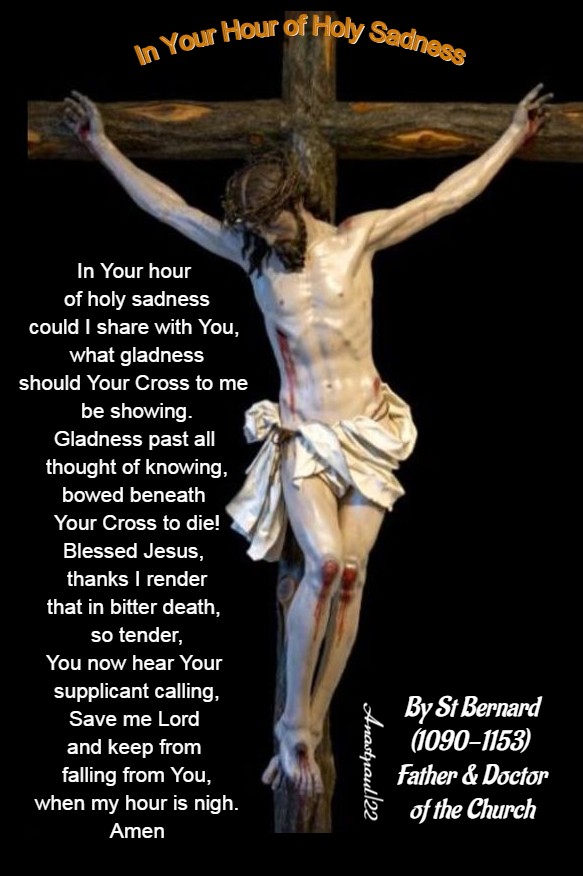
In Your Hour of Holy Sadness By St Bernard (1090-1153) Father & Doctor of the Church
In Your hour of holy sadness could I share with You, what gladness should Your Cross to me be showing. Gladness past all thought of knowing, bowed beneath Your Cross to die! Blessed Jesus, thanks I render that in bitter death, so tender, You now hear Your supplicant calling, Save me Lord and keep from falling from You, when my hour is nigh. Amen.
Saint of the Day – 13 April – Blessed Albertinus of Fonte Avellana OSB (Died 1294) Monk. Prior General, talented Administrator and Peacemaker, not only in his Monastery but also in the greater world outside it. Born in the mid 13th-Century in Montone, Italy and died on 13 April 1294 of natural causes. Also known as – Albertinus of Montone, Albertino.
Albertinus was born between 1216 and 1220 in the Castle of Montone. The historical context of the time was characterised by a cruel conflict which ended with the victory of the Guelfi and subjected Montone to the rule of Perugia. We do not know when Albertinus became a Benedictine Monk nor which his first hermitage was.
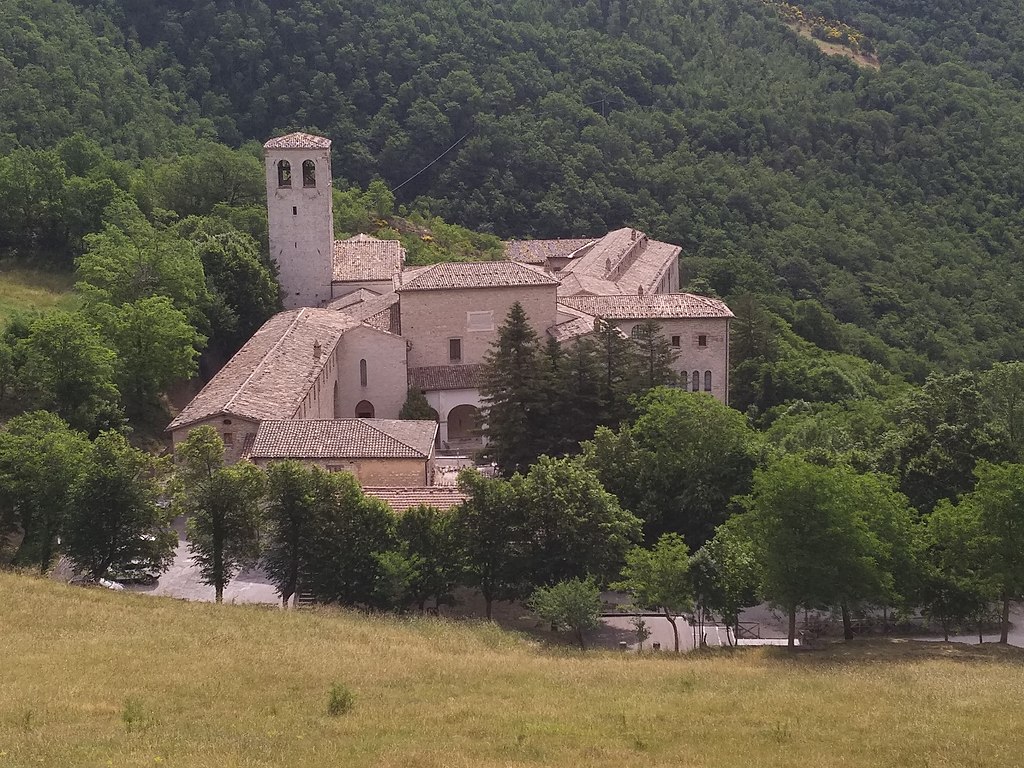
Albertinus was nominated Prior at the Monastery of Fonte Avellana (meaning the Venerable Hermitage of the Holy Cross) in Serra Sant’Abbondio (Marche) when his congregation merged with the Camaldolese in 1270. At that time, the Abbey was going through a serious crisis, despite the fact, that it was also in a phase of great power and expansion. Albertinus, a virtuous young man, was called to solve the problems and restore peace.
Fonte Avellana
The Prior is responsible for the running of the Monastery and for maintaining the Rule, the traditions and institutions, in the absence of the Abbot. Due to his moderation and sanctity, Albertinus succeeded in returning peace to Fonte Avellana.
Albertinus left a collection of “papers” composed of four hundred original documents, elaborated during his thirty-year Priorship. These “papers” indirectly inform us about Prior-general’s innovative ideas and principles which inspired his work.
Throughout Albertinus’ term in office, the lack of recourse to ordinary justice and the search for the settlement of disputes, was a constant in Fonte Avellana. Albertinus always managed to remove the differences and replace them with agreement.s To ensure better economic conditions, for a more dignified existence. Albertinus faced difficult situations, especially conflicts with the neighbouring towns. He understood that establishing good relations with the people counted much more than formal laws and through a spirit of peace and reconciliation, Albertinus was able to establish good relations with the municipalities, which were the new emerging power.
Albertinus died on 13April 1294 and was buried in the Church of Fonte Avellana, where he still rests today. Pope Pius VI Beatified Albertinus.
Spy Wednesday in Holy Week +2022 According to the Calendar of Church, Spy Wednesday marks the last full day of Lent and Holy Week. The Sacred Triduum begins on the evening of the following day, Maundy Thursday.
St Carpus of Pergamus Bl Edward Catherick Bl Francis Dickenson St Guinoc St Hermengild St Ida of Boulogne Bl Ida of Louvain Bl Isabel Calduch Rovira Bl James of Certaldo Bl John Lockwood
Martyrs of Dorostorum – 3 Saints: A lector and two students Martyred together in the persecutions of Diocletian – Dadas, Maximus and Quinctillianus. Beheaded c303 in Dorostorum, Lower Mysia (modern Sillistria, Bulgaria.
Thought for the Day – 12 April – Meditations with Antonio Cardinal Bacci (1881-1971)
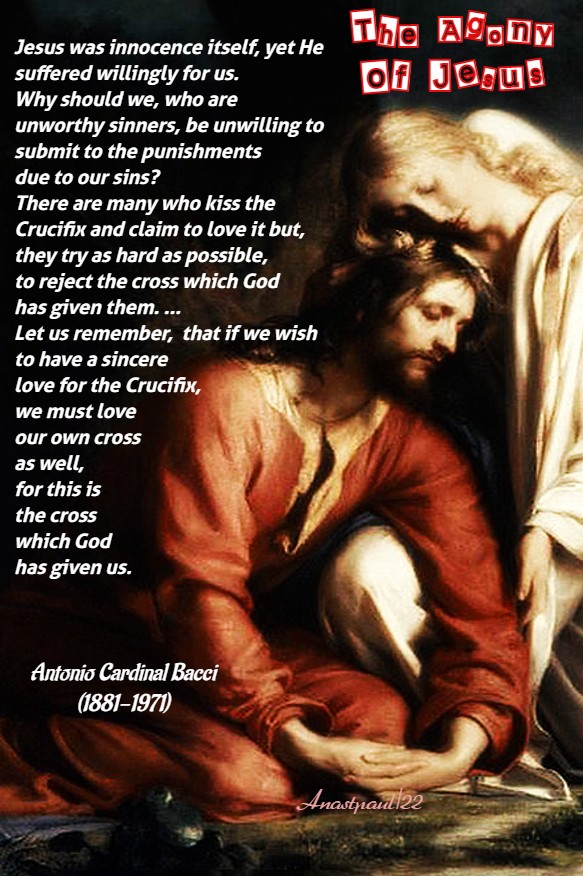
The Agony of Jesus
“Jesus suffered willingly and generously for us. First of all, He endured this near-fatal anguish of soul, which caused blood to ooze from the pores of His Body. Then He suffered the cruelest of physical tortures. What must our reaction be?
If we lack the heroic generosity of the Saints and are not prepared to look for suffering by scourging ourselves or by wearing hair-shirts or chains next to our flesh, let us at least accept our inevitable sorrows and trials, with perfect resignation.
Jesus was innocence itself, yet He suffered willingly for us. Why should we, who are unworthy sinners, be unwilling to submit to the punishments due to our sins?
There are many who kiss the Crucifix and claim to love it but, they try as hard as possible, to reject the cross which God has given them. This is an impossible state of affairs!
Let us remember, that if we wish to have a sincere love for the Crucifix, we must love our own cross as well, for this is the cross which God has given us.”
Tuesday of Holy Week – 12 April – Our Lenten Journey with the Great Fathers – Jeremias 11:18-20, Mark 14:32-72; 15, 1-46
“May God have mercy on us and bless us; may He cause the Light of His Countenance to shine upon us and may He have mercy on us.” – Psalm 66:2
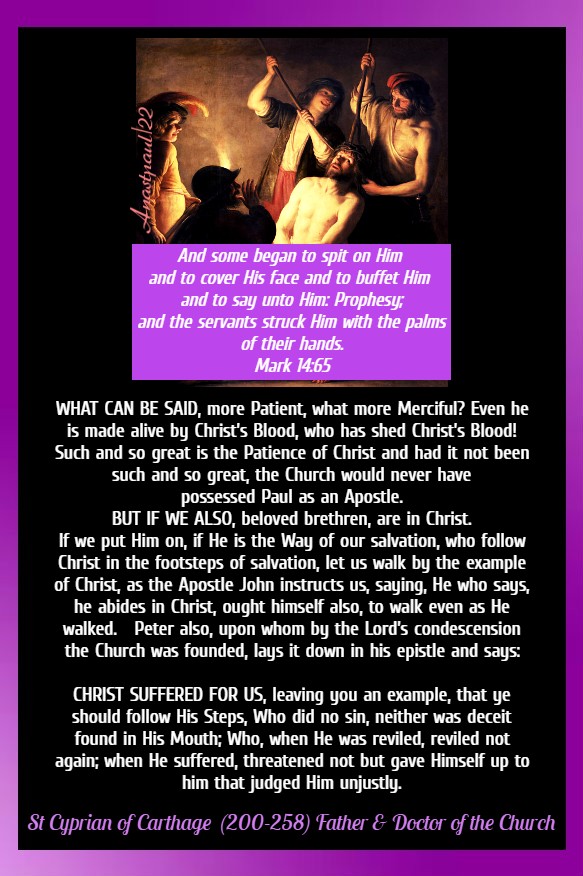
“And some began to spit on Him and to cover His face and to buffet Him and to say unto Him: Prophesy; and the servants struck Him with the palms of their hands.”
Mark 14:65
“HE RECEIVED the spittings of insulters, who with His spittle had a little before made eyes for a blind man. And He in Whose Name the devil and his angels is now scourged by His servants, Himself suffered scourgings! He was crowned with thorns, Who crowns Martyrs with eternal flowers. He was smitten on the Face with palms, Who gives the true palms to those who overcome. He was despoiled of His earthly garment, Who clothes others in the vesture of immortality. He was fed with gall, Who gave heavenly food. He was given to drink of vinegar, Who appointed the cup of salvation. That guiltless, that just One—nay, He who is Innocency itself and Justice itself—is counted among transgressors and Truth is oppressed with false witnesses.
HE, WHO SHALL JUDGE, is judged and the Word of God is led silently to the slaughter. And when, at the Cross, of the Lord the stars are confounded, the elements are disturbed, the earth quakes, night shuts out the day, the sun… He speaks not, nor is moved, nor declares His Majesty even in His very Passion itself. Even to the end, all things are borne perseveringly and constantly, in order that in Christ, a full and perfect patience may be consummated.
AND AFTER ALL THESE THINGS, He still receives His murderers, if they will be converted and come to Him. And with a saving patience, He who is benignant to preserve, closes His Church to none. Those adversaries…, if they repent of their sin, if they acknowledge the crime committed, He receives, not only to the pardon of their sin but to the reward of the Heavenly Kingdom.
WHAT CAN BE SAID, more Patient, what more Merciful? Even he is made alive by Christ’s Blood, who has shed Christ’s Blood! Such and so great is the Patience of Christ and had it not been such and so great, the Church would never have possessed Paul as an Apostle.
BUT IF WE ALSO, beloved brethren, are in Christ. If we put Him on, if He is the Way of our salvation, who follow Christ in the footsteps of salvation, let us walk by the example of Christ, as the Apostle John instructs us, saying, He who says, he abides in Christ, ought himself also, to walk even as He walked. Peter also, upon whom by the Lord’s condescension the Church was founded, lays it down in his epistle and says:
CHRIST SUFFERED FOR US, leaving you an example, that ye should follow His Steps, Who did no sin, neither was deceit found in His Mouth; Who, when He was reviled, reviled not again; when He suffered, threatened not but gave Himself up to him that judged Him unjustly.” – St Cyprian of Carthage (200-258) Bishop of Carthage and Martyr, Father of the Church (On Patience, 7-9).
Quote/s of the Day – 12 April – Tuesday of Holy Week – Jeremias 11:18-20, Mark 14:32-72; 15, 1-46
“And some began to spit on Him and to cover His face and to buffet Him and to say unto Him: Prophesy; and the servants struck Him with the palms of their hands.”
Mark 14:65
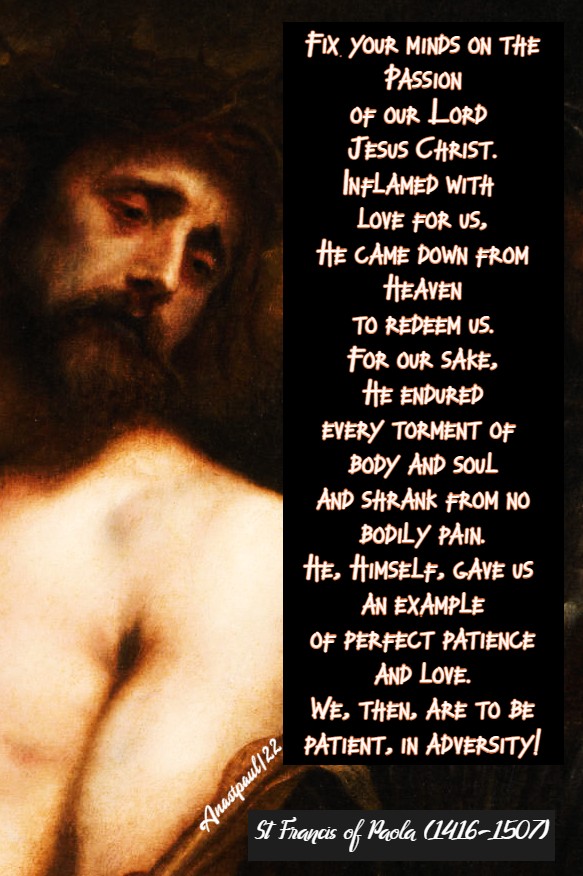
“Fix your minds on the Passion of our Lord Jesus Christ. Inflamed with love for us, He came down from Heaven to redeem us. For our sake, He endured every torment of body and soul and shrank from no bodily pain. He, Himself, gave us an example of perfect patience and love. We, then, are to be patient, in adversity!”
One Minute Reflection – 12 April – Tuesday of Holy Week – Jeremias 11:18-20, Mark 14:32-72; 15, 1-46
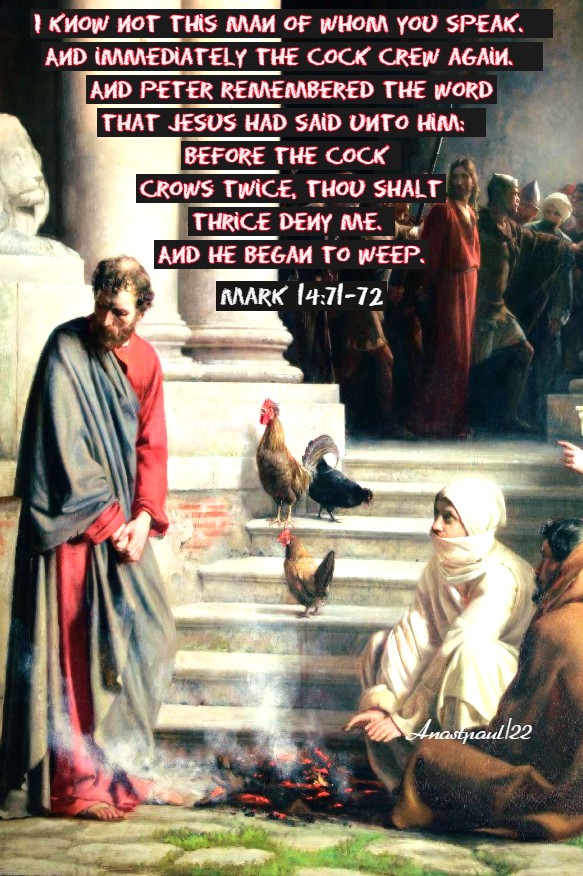
“ I know not this man of whom you speak. And immediately the cock crew again. And Peter remembered the word that Jesus had said unto him: Before the cock crows twice, thou shalt thrice deny me. And he began to weep.” – Mark 14:71-72
REFLECTION – “The first time Peter denied, he did not weep because the Lord had not looked at him. He denied a second time and did not weep because the Lord still did not look at him. He denied a third time; Jesus looked at him and he wept very bitterly (Lk 22:62). Look at us, Lord Jesus, so that we might know how to weep for our sins. This shows us that even the fall of the Saints may be useful to us. Peter’s denial has done me no wrong, on the contrary, I have gained from his repentance – I have learned to be beware of faithless companions. …
So Peter wept and wept bitterly; he wept so hard that he washed away his offence with his tears. And you, too, if you would win pardon, wipe out your guilt with tears. At that very moment, in that same hour, Christ will look at you. If some kind of fall happens to you, then He, the ever-present witness of your intimate life, looks at you to call you back and cause you to confess your lapse. Then do as Peter did, who thrice said: “Lord, you know that I love you” (Jn 21:15). He denied three times and three times he also confessed. But he denied by night; he confessed in broad daylight.
All this has been written, to make us understand, that no-one should be puffed up. If Peter fell for having said: “Though all may have their faith in you shaken, mine will never be” (Mt 26:33), who is there to count on himself? … From whence then, Peter, shall I call you to mind, to teach me your thoughts as you wept? From heaven where you have already taken your place among the choirs of angels, or from the grave? For that death, from which the Lord was raised, did not reject you in your turn. Teach us what use your tears were to you. But you taught it without delay for having fallen before you wept, your tears caused you to be chosen to guide others, you who, to begin with, did not know how to guide yourself.” – St Ambrose (340-397) Bishop of Milan, Father and Doctor of the Church – Commentary on St Luke’s Gospel, 10,89f.
PRAYER – Almighty and eternal God, grant us so to celebrate thy mysteries of our Lord’s Passion, that we may deserve to obtain forgiveness. Through the same Jesus Christ, Thy Son, Our Lord, Who lives and reigns with Thee in the unity of the Holy Ghost, God, world without end. Amen (Collect).























 AnaStpaul
You must be logged in to post a comment.