Our Morning Offering – 12 April – Tuesday of Holy Week
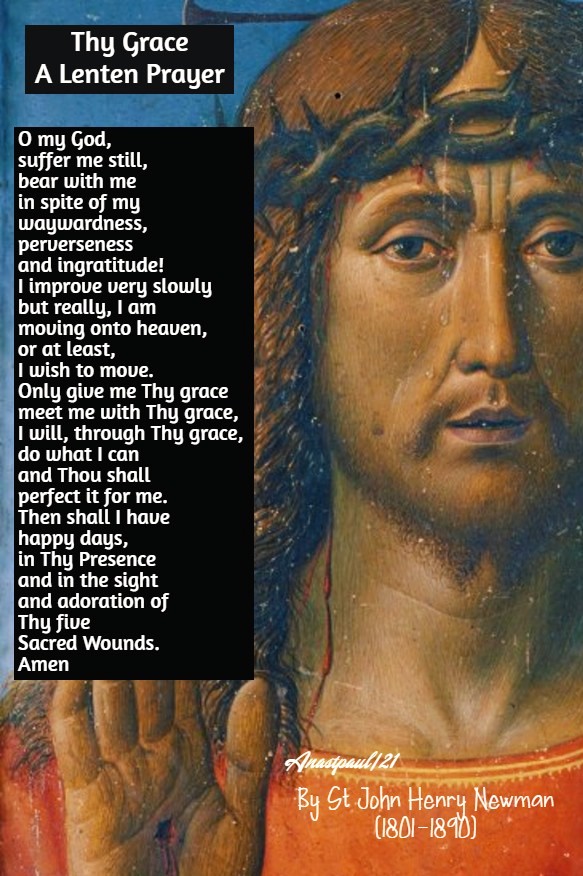
Thy Grace A Lenten Prayer By St John Henry Newman (1801-1890)
O my God, suffer me still, bear with me in spite of my waywardness, perverseness and ingratitude! I improve very slowly but really, I am moving onto Heaven, or at least, I wish to move. Only give me Thy grace meet me with Thy grace, I will, through Thy grace, do what I can and Thou shall perfect it for me. Then shall I have happy days, in Thy Presence and in the sight and adoration of Thy five Sacred Wounds. Amen
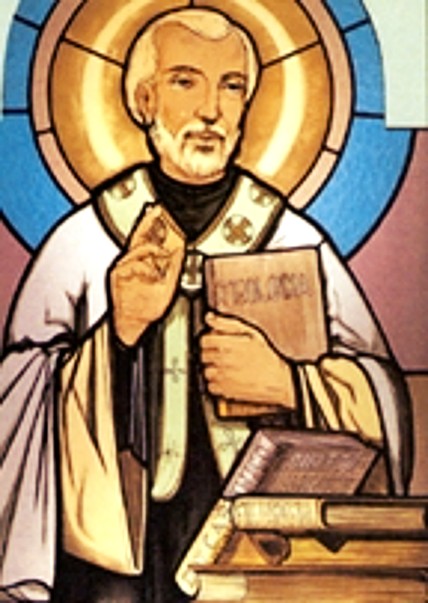
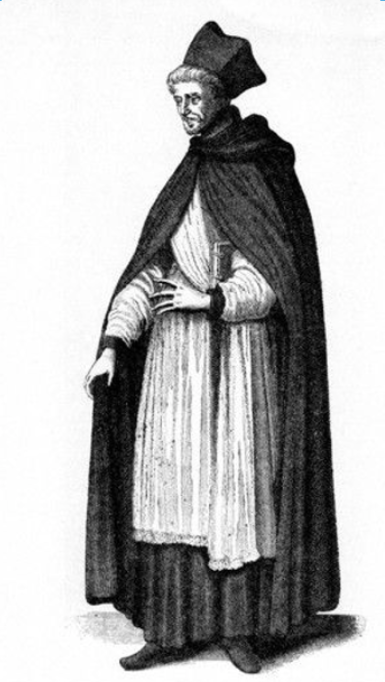
Saint of the Day – 12 April – Blessed Andrew of Montereale OSA (c 1403-1479) Priest of the Hermits of St Augustine, renowned Scholar, Preacher, Teacher, Reformer. Confessor and Spiritual Director to the Royal Court of France, Miracle-worker. His life was devoted to teaching, preaching and leading the Augustinians from several positions of leadership. He was hailed, even during his lifetime, as a pious Miracle worker. Born in c 1403 in Mascioni, Campotosto, Italy as Antonio Artesi and died on 18 April 1479 at the Augustinian Monastery of Montereale, Italy of natural causes. Additional Memorial – 18 April (The Augustinians). Patronage – Montereale, Italy.
The Roman Martyrology reads: “In Montereale in Abruzzo, Blessed Andrea, Priest of the Order of the Hermits of St Augustine, who devoted himself to preaching in Italy and France.”
The birthplace of Blessed Andrew is certain – Mascioni, on the shores of Lake Campotosto into a modest household; no less certain is the place of his death: the Augustinian Monastery in Montereale, a short distance from Mascioni, to which the Blessed retired, a few years before his death. His earthly sojourn ended on 18 April 1479.
The sad events of the Avignon Schism had negative effects on the Church and the Augustinian Order, well beyond 1417, the year in which Martin V was elected to the Supreme Pontificate. The quest for unity in the Order, which had been split by the schism and the path of reform, were the most urgent concerns of the General Chapters and the Priors General of the time. Those same events were inevitably echoed in the first part of Blessed Andrew’s life. According to tradition, he had, from childhood, worked as a shepherd. A meeting with Augustinian Father Augustine of Terni, Prior of the Monastery in Montereale, decided Andrew’s entrance into that same Monastery and the beginning of his Novitiate. He was Ordained a Priest at the age of twenty-five and then, in light of his bent for studies, was destined for teaching. To that end he acquired the various academic Degrees of Bachelor, Reader and Master of Theology while attending the general house of studies of the Order in Rimini and in Siena; he appears as Director of studies in the latter place, in 1459.
During these same years, enjoying, as he did, the trust of his superiors and fellow religious, he held Offices in Government. He was Vicar General and visitor of some Monasteries; he was elected Prior Provincial of the Province of the Valley of Spoleto and in that capacity, took part in the General Chapters of Avignon in 1455 and Pamiers (France) in 1465.
In 1459, for reasons we do not know, he resigned from the Priorate and his position as Director of studies in Siena and in 1461, by order of the Prior General, Father William Becchi, a Florentine, he was sent away from the Monastery of Norcia, along with the local Prior, Father Jerome of Cittaducale. This was “at the request of various religious of the Province, in order to avoid scandal and begin the reform of that Monastery.”
In 1468, when William Becchi was still the Prior General, he appointed Blessed Andrew as his Vicar for visiting the Monastery of Amatrice. In 1471, Andrew was again elected Prior Provincial of the Province of the Valley of Spoleto.
Thus far we have the cold facts of his “external” life as a religious. Other sources help us to know more about his interior life.
A few months after the Blessed’s death, his contemporary, Ambrose of Cori, who had been Provincial of the Roman Province and was now Prior General of the Order (1476-1482) listed 36 Blesseds of the Order, in the Chronicle of the Order, which he published in 1481. At the time when Blessed Andrew had been expelled from the Monastery of Norcia, Ambrose was Director of studies in Perugia and, therefore, knew Andrew personally. In the 36th place in his list he put Blessed Andrew of Montereale, “who lived in our time and is made glorious by many signs and miracles. He was very learned in Canon Law, Philosophy and Theology and showed the greatest example of holiness in preaching, helping the poor and enduring abuse and in every kind of patience.”
In a few words Ambrose exalts Blessed Andrew well above even fervent religious, tells us of his reputation for miracles and of his teaching and calls him Blessed, thereby, in all likelihood, expressing the sentiments of the people. In the epitaph engraved beneath the image of the Blessed on the wall of the Choir in the Church of Saint Augustine in Montereale—an epitaph that is now gone but was cited by Riccitelli in 1581 and went back to the end of the fourteenth or the beginning of the fifteenth century—people could read the following:
Here lies the body of Blessed Andrew of the Order of Hermits of Saint Augustine, who worked countless great miracles. Due to his holiness of life, the austerity of his ways and his Catholic teaching, due also to his honeyed preaching and great miracles, he was famous throughout Italy and France.
He is dear to God and humanity and is an honour to the Order, an adornment of his native land and of great advantage to his neighbour. He was and is, a great benefit to the world, having preached the Word of God for fifty years.
His works have not come down to us. At that time an inventory of goods had to be made by Masters of Theology. A copy of the one which the Blessed compiled on the day of his death has survived and therein, is a list of the books he had loaned to brother Friars. Among these was the Decretals, a Gloss on the subject and a “little book,” a term suggesting a work of his own. The other objects listed give a glimpse of the simplicity of his life, for among them are “a little brass jar, four table forks, a little bell and some other little things.”
Augustinians and the Rule
Among the many writers who have spoken of him, mention may be made of Blessed Alonso de Orozco, who, in his Chronicle of the Glorious Saint Augustine, Father and Doctor of the Church (1551), lists Andrew among the blessed and describes him as “a very gifted man and a great preacher; very patient and charitable; – he performed many miracles.”
Although Andrew had the reputation of being a saint, it was only in the years 1756-1757, during the Pontificate of Benedict XIV, that the cause of his Beatification was taken up by the Diocese of Rieti, of which Montereale was a part. During the process, witnesses bore unanimous testimony to Andrew’s commitment to the struggle against schism and heresy, his exercise of the preaching office over several decades, his journeys to France and the role he played at the Court of the King of France, where he was the Queen’s Confessor and Spiritual Director. They also attested that his name was Antonio Artesi. Blessed Andrew was Beatified on 18 February 1764 by Pope Clement XIII (By the Augustinian Friends).
Thought for the Day – 11 April – Meditations with Antonio Cardinal Bacci (1881-1971)
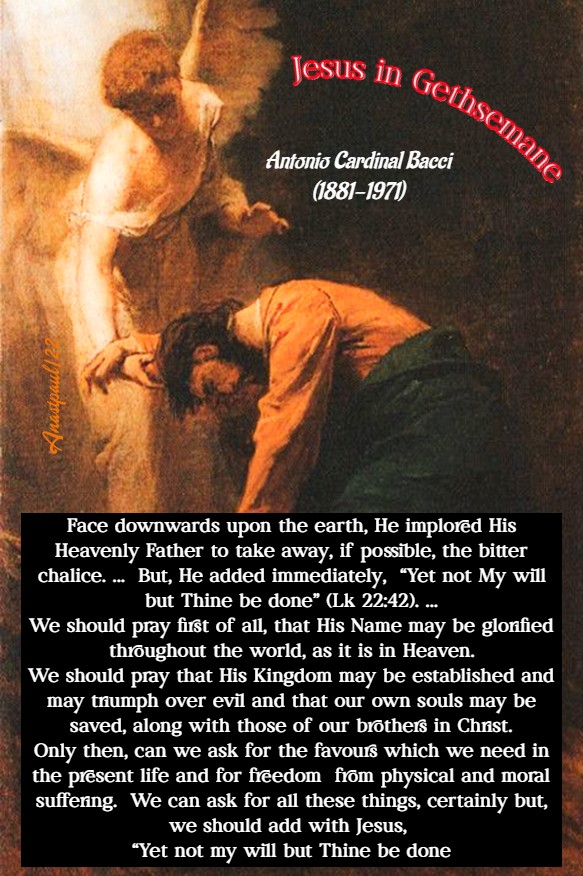
Jesus in Gethsemane
“What was the prayer of Jesus in the moment of anguish when He saw Himself abandoned or betrayed by everyone on this earth and foresaw the terrible sufferings of His Passion and Death, which, despite His infinite love, would prove to be in vain for so many men? Face downwards upon the earth, He implored His Heavenly Father to take away, if possible, the bitter chalice. But, He added immediately, “Yet not My will but Thine be done” (Lk 22:42).
We should pray like Jesus, especially when we are suffering in body and tormented in mind. We should prostrate ourselves before God, with an act of deep humility and of perfect confidence in His infinite goodness. We should pray first of all, that His Name may be glorified throughout the world, as it is in Heaven. We should pray that His Kingdom may be established and may triumph over evil and that our own souls may be saved, along with those of our brothers in Christ. Only then, can we ask for the favours which we need in the present life and for freedom from physical and moral suffering. We can ask for all these things, certainly but, we should add with Jesus, “Yet not my will but Thine be done!” In other words, we should be ready to offer up our sufferings, as a proof of our love for Him. Amen.”
Monday of Holy Week – 11 April – Our Lenten Journey with the Great Fathers – Isaias 50:5-10, John 12:1-9
“Help us, O God, our saviour and for the glory of thy name, O Lord, deliver us and forgive us our sins, for Thy name’s sake” – Psalm 78:9
“He (Judas Iscariot) said this, not because he cared about the poor but because, he was a thief and held the money bag and used to steal the contributions.”
John 12:6
“LOOK NOW AND LEARN that this Judas did not become perverted, only at the time when he yielded to the bribery of the Jews and betrayed his Lord. For not a few, inattentive to the Gospel, suppose, that Judas only perished, when he accepted money from the Jews, to betray the Lord. It was not then that he perished but he was already a thief and a reprobate, when following the Lord;,for it was with his body and not with his heart, that he followed. He made up the apostolic number of twelve but had no part in the apostolic blessedness. He had been made the twelfth in semblance and on his departure and the succession of another, the apostolic reality was completed and the entirety of the number conserved.
WHAT LESSON THEN, my brethren, did our Lord Jesus Christ wish to impress on His Church, when it pleased Him, to have one castaway among the twelve – but this – that we should bear with the wicked and refrain from dividing the body of Christ? Here you have Judas among the saints,- that Judas, mark you! who was a thief, yes – do not overlook it – not a thief of any ordinary type but a thief and a sacrilegis – a robber of money bags,but of such as were the Lord’s; of money bags but of such as were sacred! . … How much more severe ought to be, the sentence on the sacrilegious thief, who has dared to steal, not from places of any ordinary kind but, to steal from the Church!?
HE WHO THIEVES from the Church, stands side by side with the castaway Judas. Such was this man Judas and yet, he went in and out with the eleven holy disciples. With them, he came even to the table of the Lord, he was permitted to have intercourse with them but he could not contaminate them.
OF ONE BREAD did both Peter and Judas partake and yet, what communion had the believer with the infidel? Peter’s partaking was unto life but that of Judas unto death. For that good bread was just like the sweet savour. For as the sweet savour, so also does the good bread give life to the good and bring death to the wicked. “For he that eateth unworthily, eateth and drinketh judgement to himself:” – “judgment to himself,” not to thee. If, then, it is judgement to himself, not to thee, bear as one that is good, with him that is evil, that you may attain the rewards of the good,and be not hurled into the punishment of the wicked.” – St Augustine (354-430) Bishop of Hippo, Great Western Father and Doctor of the Church (On John 12:1-9 Monday of Holy Week).
Quote/s of the Day – 11 April – Monday of Holy Week – Isaias 50:5-10, John 12:1-9
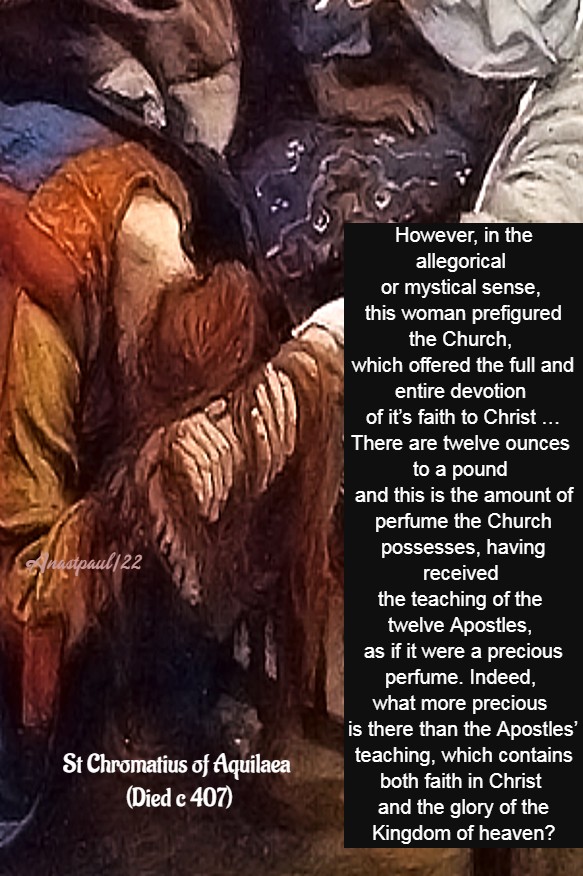
“However, in the allegorical or mystical sense, this woman prefigured the Church, which offered the full and entire devotion of it’s faith to Christ … There are twelve ounces to a pound and this is the amount of perfume the Church possesses, having received the teaching of the twelve Apostles, as if it were a precious perfume. Indeed, what more precious is there than the Apostles’ teaching, which contains both faith in Christ and the glory of the Kingdom of heaven? ”
St Chromatius of Aquilaea (Died c 407)
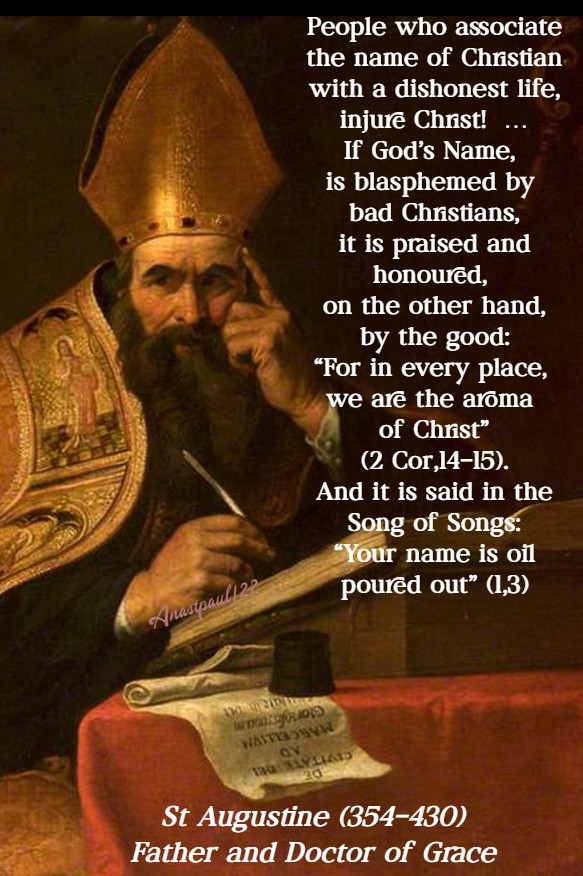
“People who associate the name of Christian with a dishonest life, injure Christ! … If God’s Name, is blasphemed by bad Christians, it is praised and honoured, on the other hand, by the good: “For in every place, we are the aroma of Christ” (2 Cor,14-15). And it is said in the Song of Songs: “Your name is oil poured out” (1,3).”
One Minute Reflection – 11 April – Monday of Holy Week – Isaias 50:5-10, John 12:1-9
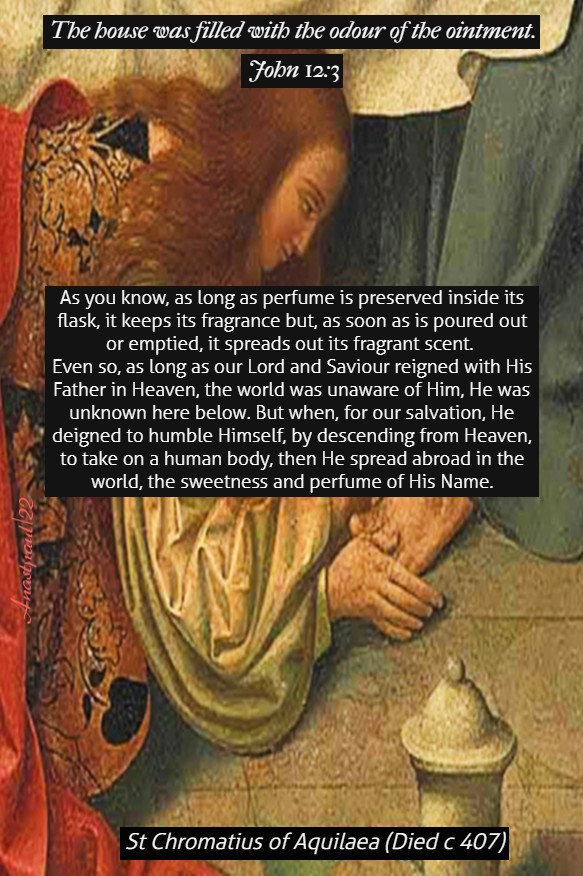
“The house was filled with the odour of the ointment.” – John 12:3
REFLECTION – “When she had anointed the Lord’s feet this woman did not wipe them with a cloth but with her own hair, to show Him greater honour … Like a thirsty person drinking from a fresh waterfall, this holy woman drank in grace full of delights, from the Springs of Holiness, to quench the thirst of her faith.
However, in the allegorical or mystical sense, this woman prefigured the Church, which offered the full and entire devotion of its faith to Christ …There are twelve ounces to a pound and this is the amount of perfume the Church possesses, having received the teaching of the twelve Apostles, as if it were a precious perfume. Indeed, what more precious is there than the Apostles’ teaching, which contains both faith in Christ and the glory of the Kingdom of Heaven? Furthermore, it is related that the whole house was filled with the scent of that perfume because, the whole world has been filled with the Apostles’ teaching. As it is written: “Through all the earth their voice resounds and to the ends of the world, their message” (Ps 19[18]:5).
In the Song of Songs we read the following words addressed through Solomon, to the Church: “Your name spoken is a spreading perfume” (1,2). Not without cause, is the Lord’s Name called a “spreading perfume.” As you know, as long as perfume is preserved inside its flask, it keeps its fragrance but, as soon as is poured out or emptied, it spreads out its fragrant scent. Even so, as long as our Lord and Saviour reigned with His Father in Heaven, the world was unaware of Him, He was unknown here below. But when, for our salvation, He deigned to humble Himself, by descending from Heaven, to take on a human body, then He spread abroad in the world, the sweetness and perfume of His Name.“ – St Chromatius of Aquilaea(Died c 407) – Bishop of Aquileia, Italy, Theologian, Exegete (Sermon 11).
PRAYER – Grant, we beseech thee, almighty God, that we who fail through our weakness, in so many difficulties, may be relieved through the pledging of the Passion of Thy only-begotten Son. Who lives and reigns with God the Father, in the unity of the Holy Spirit, God, world without end. Amen (Collect).
Our Morning Offering – 11 April – Monday of Holy Week
Dearest Lord Jesus Christ The Old Roman Missal
Dearest Lord Jesus Christ, I entreat Thee to let me find in Thy Passion, a strong defence, protection and safegiard. Let Thy Wounds be my food and drink, to nourish and make me drunk with delight. Let the shedding of Thy Blood wash all my offenses away, Thy Death, bring me, the life that knows no ending, Thy Cross be my everlasting glory. In them, let my heart find renewal, gladness, health and delight, Thou Who lives and reigns, forever and ever. Amen.
Saint of the Day – 11 April – Blessed George Gervase OSB (1571–1608) Priest and Martyr, Confessor, Missionary. Born at Boscham, Suffolk, England and died on 11 April, 1608.by being hung, drawn and quartered at Tyburn, London, England. Additional Memorial- 29 October as one of the Martyrs of Douai.
His mother’s name was Shelly and both his father’s and mother’s families had been long established in the County of Suffolk. Losing both parents when he was twelve years old, he was kidnapped by pirates (probably a lieutenant of Drake, who was then buccaneering on the Spanish Main) and carried off to the West Indies with two of his brothers., remaining in captivity for over twelve years.
He lost his religion during that period but, when at last he was able to return to England and found that his brother, Henry had become a voluntary exile in Flanders, in order to be able to practice his faith, George followed him there and was soon reconciled with the Church.
He entered the English College at Douai in 1595 and was Ordained Priest in 1603. He at once went to the English mission. He laboured very successfully for over two years but was arrested in June 1606 and banished with several other clergy. He then made a pilgrimage to Rome and there, endeavoured to enter the Society of Jesus but, not being admitted for some unknown reason, he returned to Douai, where he received the Benedictine habit as a Novice.
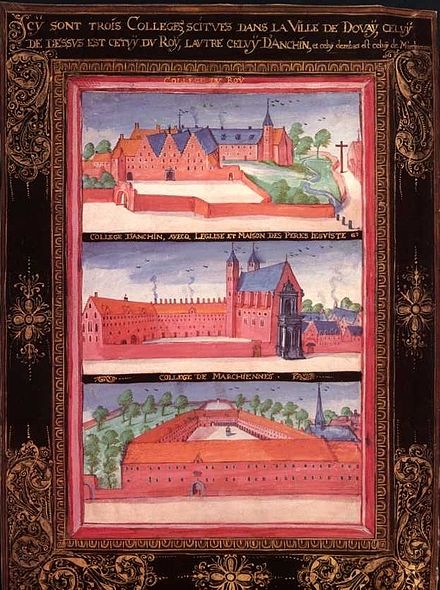
Douai Colleges
His brother Henry, had obtained for him, a comfortable position near Lille, being anxious to preserve him from the persecution then raging in England. But George was determined to preach the Gospel and labour for the conversion of his native land and succeeded in returning to England. He was soon arrested again and incarcerated.
Martys of Douai
Refusing to take the new oath of allegiance to the reigning Monarch, he was tried, convicted of the offence of merely being a Catholic Priest, under the statute 27 of Elizabeth I and was hanged, drawn and quartered at Tyburn.
A short time before his death, George was clothed in the Benedictine Habit by Father Augustine Bradshaw.
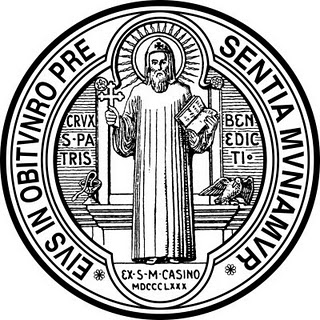
St Benedict Medal
George was Beatified on 15 December 1929 by Pope Pius XI.
Monday of Holy Week +2022 As the most Sacred week of the Liturgical year, the Church does not celebrate the Feast Days of the Saints during Holy Week. However, for chronalogical accuracy, I continue to post the list and the Saint of the Day.
St Hildebrand of Saint-Gilles St Isaac of Monteluco Bl James of Africa Bl John of Cupramontana Bl Lanunio St Machai St Maedhog of Clonmore Bl Mechthild of Lappion Bl Paul of Africa St Philip of Gortyna St Raynerius Inclusus St Stephen of Saint-Gilles Bl Symforian Ducki
Thought for the Day – 10 April – Meditations with Antonio Cardinal Bacci (1881-1971)
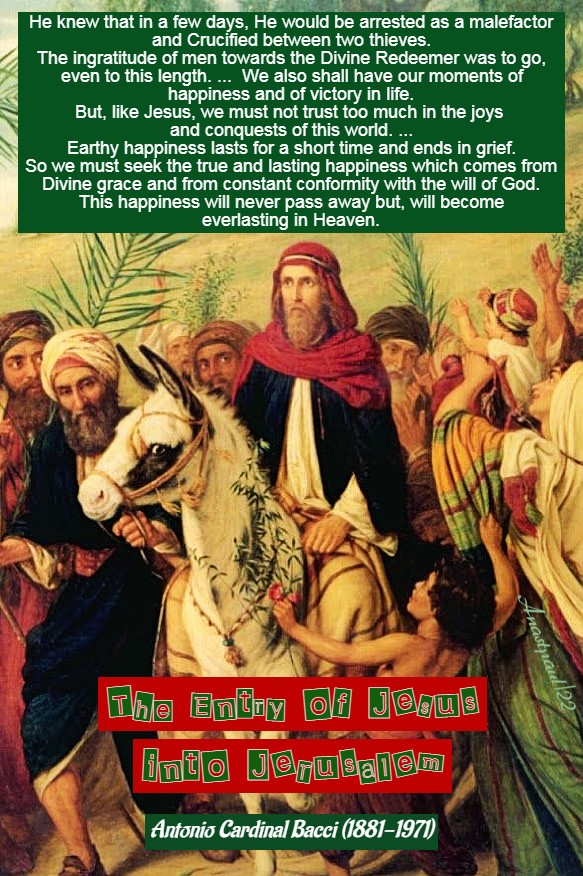
The Entry of Jesus into Jerusalem
“Imagine the joyful and triumphant entry of Jesus into Jerusalem. The cheering crowds line the street along which He approaches, riding upon the foal of an ass. Palm and olive branches are waved aloft, while groups of children cry out: “Hosanna to the Son of David! Blessed is he who comes in the name of the Lord! Hosanna in the highest” (Cf Mt 21:9). In the midst of all this exultation, Jesus appears to be absorbed and detached. In his representation of this scene, a famous artist painted a large cross in the distance, far beyond the cheering crowd. The divine vision of Jesus, certainly saw this cross. He knew that in a few days, He would be arrested as a malefactor and Crucified between two thieves. The ingratitude of men towards the Divine Redeemer was to go, even to this length.
We also shall have our moments of happiness and of victory in life. But, like Jesus, we must not trust too much in the joys and conquests of this world. The warning of the Holy Spirit, that “the end of joy may be sorrow” (Prov 14:13), is unfortunately, only too true. Earthy happiness lasts for a short time and ends in grief. So we must seek the true and lasting happiness which comes from Divine grace and from constant conformity with the will of God. This happiness will never pass away but, will become everlasting in Heaven.”
Palm Sunday – 10 April – Our Lenten Journey with the Great Fathers – Philippians 2:5-11, The Passion of Our Lord Jesus Christ according to Matthew 26:36-75; 27:1-60
“My God, my God, look upon me, why have You forsaken me?” – Psalm 21:2
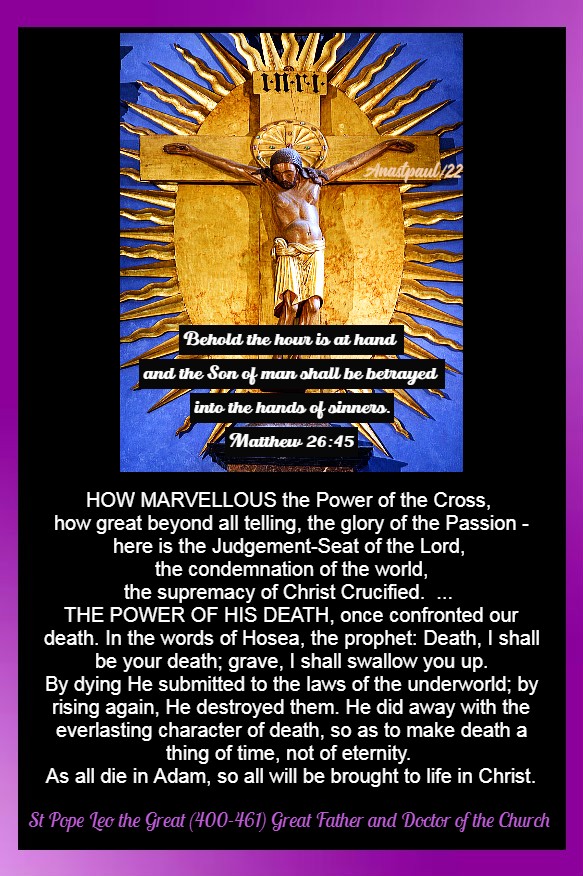
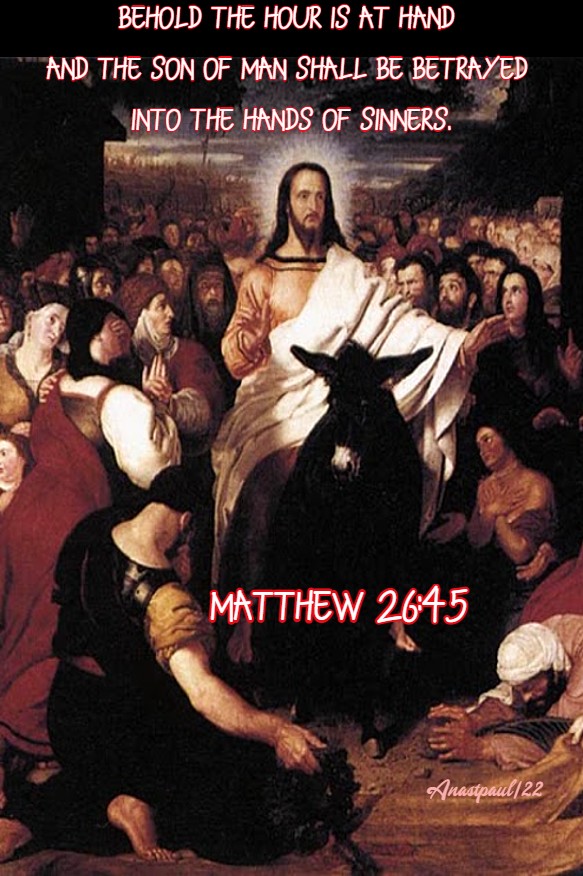
“Behold the hour is at hand and the Son of man shall be betrayed into the hands of sinners.”
Matthew 26:45
“OUR UNDERSTANDING, which is enlightened by the Spirit of Truth, should receive with purity and freedom of heart the glory of the Cross, as it shines in Heaven and on earth. It should see with inner vision. the meaning of the Lord’s Words when He spoke of the imminence of His passion – The hour has come for the Son of Man to be glorified. Afterward He said – Now my soul is troubled and what am I to say? Father, save Me from this hour. But it was for this that I came to this hour. Father, glorify Your Son. When the voice of the Father came from Heaven, saying, I have glorified him, and will glorify Him again, Jesus said in reply to those around Him – It was not for Me that this Voice spoke but for you. Now is the judgement of the world, now will the prince of this world be cast out. And I, if I Am lifted up from the earth, will draw all things to Myself.
HOW MARVELLOUS the Power of the Cross, how great beyond all telling, the glory of the Passion – here is the Judgement-Seat of the Lord, the condemnation of the world, the supremacy of Christ Crucified.LORD, You drew all things to Yourself so that the devotion of all peoples, everywhere, might celebrate, in a Sacrament made perfect and visible, what was carried out in the one temple of Judea, under obscure foreshadowings. …
DEARLY BELOVED, let us then acknowledge what Saint Paul, the teacher of the nations, acknowledged so exultantly: This is a saying worthy of trust, worthy of complete acceptance – Christ Jesus came into this world to save sinners. God’s compassion for us is all the more wonderful because Christ died, not for the righteous, or the holy but for the wicked and the sinful and, although the Divine Nature could not be touched by the sting of death, He took to Himself, through His birth as one of us, something He could offer on our behalf.
THE POWER OF HIS DEATH, once confronted our death. In the words of Hosea, the prophet: Death, I shall be your death; grave, I shall swallow you up. By dying He submitted to the laws of the underworld; by rising again, He destroyed them. He did away with the everlasting character of death, so as to make death a thing of time, not of eternity. As all die in Adam, so all will be brought to life in Christ.” – St Leo the Great (400-461) Great Father and Doctor of the Church (Excerpt from his “On the Lord’s Passion” Sermon 8).
Quote/s of the Day – 10 April – Palm Sunday – Philippians 2:5-11, he Passion of Our Lord Jesus Christ according to Matthew 26:36-75; 27:1-60
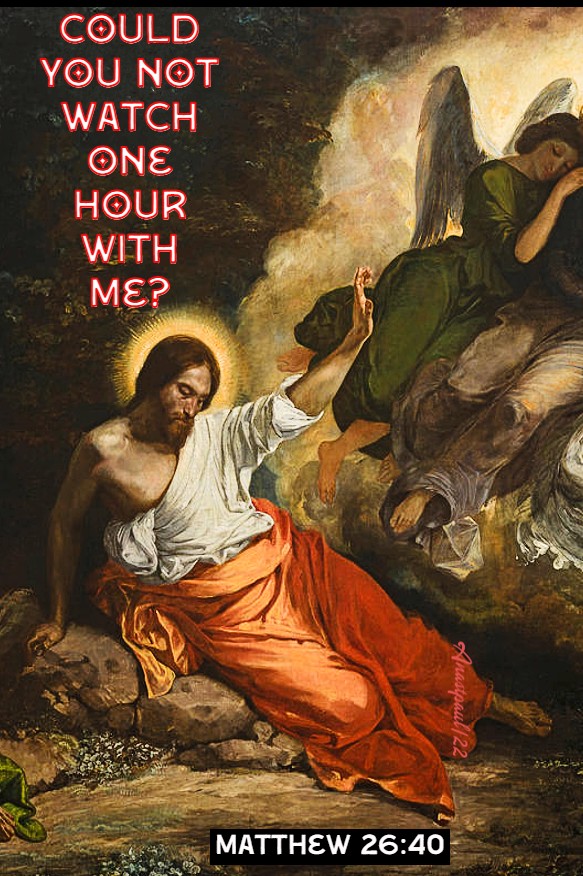
“Could you not watch one hour with Me?”
Matthew 26:40
“Behold the hour is at hand and the Son of man shall be betrayed into the hands of sinners.”
Matthew 26:45
“Yesterday, Christ raised Lazarus from the dead; today, He is going to His own death. Yesterday, He tore off the strips of cloth which bound Lazarus; today, He is stretching out His Hand, to those who want to bind Him. Yesterday, He tore that man away from darkness; today, for humankind, He is going down into darkness and the shadow of death. And the Church is celebrating. She is beginning the feast of Feasts, for she is receiving her King as a Spouse, for her King is in her midst.”
St Ephrem (306-373) (Attri) Father ad Doctor of the Church
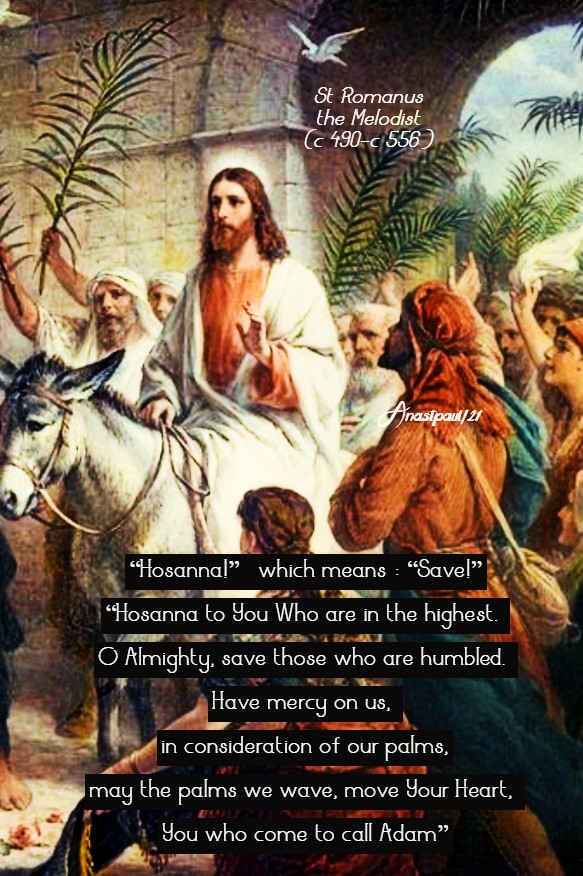
“Hosanna!”—which means : “Save!” “Hosanna to You Who are in the highest. O Almighty, save those who are humbled. Have mercy on us, in consideration of our palms, may the palms we wave move Your Heart, You who come to call Adam”…
One Minute Reflection – 10 April – Palm Sunday – Philippians 2:5-11, The Passion of Our Lord Jesus Christ according to Matthew 26:36-75; 27:1-60
“Behold the hour is at hand and the Son of man shall be betrayed into the hands of sinners.” – Matthew 26:45
REFLECTION – By St Nerses Chnorhali (1102-1173) Armenian Bishop (Jesus, Only Son of the Father, § 708-724)
“Because of sin, O innocent One, You were set before the criminal’s judgement seat; When You return in the Father’s glory Do not judge me together with him.
You were put to scorn with sacrilegious spittle On account of the first created man’s shame; Wipe away the dishonour of the impudent man’s sins, With which my face is covered…
You have put on crimson, Set the scarlet cloak over You As a dishonour and an affront, As Pontius Pilate’s soldiers thought it to be (Mt 27:28).
Remove sin’s shirt of hair from me, Crimson red, colour of blood, Reclothe me in the garment of joy With which You clothed the first man.
Kneeling, they made sport, Acting ridicule, they mocked; When they saw it, Heaven’s armies Worshipped in fear.
This You underwent that You might remove The shame, of being sin’s accomplice, from Adam’s nature in us That, from my soul and my conscience, You might suppress my sorrowing shame…
Following the judge’s verdict, You received the terrible blows of flagellation Over Your whole body And on Your limbs’ every part.
As for me who, from foot to head Suffer unbearable pain: Be pleased to heal me once again As through the grace of Baptism’s fount.
In exchange for the thorns of sin That the curse caused to grow up for us (Gn 3,18) A Crown of Thorns was set on Your Head By the labourers in Jerusalem’s vineyard (Mt 21,33f.).
Pull out the thorns of sin from me, Which my enemy planted within me, And heal in me the bite of the wound That the marks of sin might be erased.”
PRAYER – Almighty, eternal God, Who, to provide mankind an example of humility for it to imitate, willed that the Saviour should assume our flesh and suffer death upon the Cross, mercifully grant that we may be found worthy of the lesson of His endurance and the fellowship of His Resurrection. Through the same Jesus Christ, Thy Son, Our Lord, Who lives and reigns with Thee in the unity of the Holy Ghost, God, world without end. Amen (Collect).
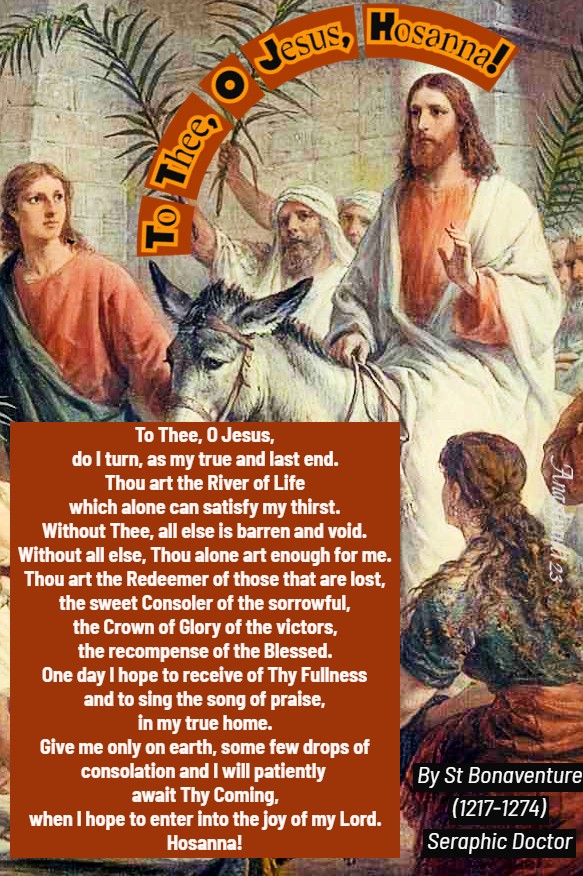
To Thee, O Jesus, Hosanna! By St Bonaventure (1217-1274) Seraphic Doctor of the Church
To Thee, O Jesus, do I turn, as my true and last end. Thou art the River of Life which alone can satisfy my thirst. Without Thee, all else is barren and void. Without all else, Thou alone art enough for me. Thou art the Redeemer of those that are lost, the sweet Consoler of the sorrowful, the Crown of Glory of the victors, the recompense of the Blessed. One day I hope to receive of Thy Fullness and to sing the song of praise, in my true home. Give me only on earth, some few drops of consolation and I will patiently await Thy Coming, when I hope to enter into the joy of my Lord. Hosanna!
Saint of the Day – 10 April – Blessed Marcus Fantuzzi OFM (c 1405-1479) Priest and Friar of the Friars Minor, renowned Preacher, Superior, then Vicar General of the Observant Friars Minor. Born in c 1405 at Bologna, Italy as Pace or Pasotto and died on 10 April 1479 at Piacenza, Italy of natural causes. Also known as – Marcus Fantucci, Mark Fantucci, Marcus of Bologna, Pace, Pasotto. Additional Memorial – 19 April on some local calendars.
The Roman Martyrology reads: “In Piacenza, Blessed Marcus Fantuzzi of Bologna, Priest of the Order of Minors, distinguished for his piety, prudence and preaching.”
Among the beautiful Palaces in Bologna, which, to this day, gives evidence of the glory enjoyed by this City in the Middle Ages, one of the most beautiful is the Palace of the Fantuzzi. Marcus was born there, in the year c 1405, the only son of this wealthy patrician family.
When Blessed Marcus had completed his studies in philosophy as well as in civil and ecclesiastical law, at the University of his native City and the question of choosing a state of life arose, this generous young man, for whom the glory of his world was too insignificant, went to the door of the poor Franciscan Convent and asked to be admitted there.
Marcus received the habit on the Feast of his holy Patron, St Mark. He was then twenty-six years old. Blessed James Primadizzi was charged to initiate him in the religious life and St Bernardine of Siena was his teacher in theology. Under such direction, Marcus made rapid progress in perfection and, within a few years, had developed into so perfect a religious, that he was appointed Guardian of the Convent of Fonte Colombo, that venerable abode where our Divine Saviour dictated the holy Rule to St Francis.
Marcus was ever zealous for the faithful observance of the holy Rule. After he had given proof of his sterling qualities as Superior in several other Convents, he was elected Provincial and in the year 1452, Vicar General of the Observant Friars Minor. Later again, he had to discharge the duties of this office for two terms announcing the word of God to the people but above all, he was solicitous to maintain the faithful observance of the Rule of his Convents.
When the King of Bosnia, who had lately been converted to the Faith by the Friars Minor, imposed upon his subjects a special tax for the support of the Convents, Marcus begged him to leave his people full liberty in the matter, so that the benefactors might not lose their merits and the spirit of poverty of his brethren might not suffer injury. On the other hand, this wise director did not wish to impose any precepts over and above those already laid down in the Rule. Hence, when a suggestion was made, at one of the Chapters, that perpetual abstinence should be imposed on all the religious, Father Marcus would not permit its adoption, saying:
“Our perfection consists in the observance of our Rule. It can do no good to add thereto anything more perfect,, since in such cases, the more perfect is enemy to that which is good.”
More edifying than his zeal and wisdom in the administration of his office, was the humility he displayed when he completed his third period of administration. He prostrated himself before his brethren and, with tears, accused himself of the many faults which he believed he had committed, in the administration of his office.
Because of his wisdom and zeal for the interests of the Church, Popes Nicholas V, Callistus III, Pius II and Paul II held him in high regard. The last named Pope wished even to raise him to the Cardinalate but Father Marcus, however, withdrew from Rome and found a way to evade this honour. It was not without the permission of God, that for a time, Marcus received little consideration in the order but the holy Friar bore all without a word of complaint.
Full of zeal for the honour of God and the salvation of souls, Blessed Marcus preached everywhere with the fervour of an Apostle. In his seventy-fourth year he still preached the Lenten sermons at Piacenza. It was then that he was attacked by a fever that brought him close to death’s door. He asked to see the Guardian of the Convent of the Friars Minor, which was located in the suburbs of the City and said to him:
“Father, although I am a great sinner and not worthy to die in your Convent, still I beg you to grant me the privilege that I may be taken to it.”
There, after devoutly receiving the Viaticum, Blessed Marcus Fantuzzi died the death of the just in Holy Week, of the year 1479. His mortal remains are kept in the Church of Santa Maria di Campagna. The cult, paid to him, which had already been widespread for four centuries, was confirmed by Pope Pius IX in 1868.
Bl Antonio Vallesio St Apollonius of Alexandria Bl Archangelus Piacentini St Bademus St Bede the Younger St Beocca of Chertsey Bl Boniface Zukowski Bl Eberwin of Helfenstein St Ethor of Chertsey St Ezekiel the Prophet
St Malchus of Waterford Bl Marco Mattia Blessed Marcus Fantuzzi OFM (c 1405-1479) Priest
St Miguel de Sanctis O.SS.T (1591-1625) Priest of the Order of the Most Holy Trinity and of the Captives also known as the Trinitarian Order or the Trinitarians, Mystic, Penitent, Ecstatic, Apostle of prayer, mortification, of the poor and the sick, he had a special devotion to the Blessed Sacrament and would fall into ecstatic prayer during the Consecration at Holy Mass, so much so, that he became known as “El Extático”, “The Ecstatic.” Pope Pius IX Canonised Miguel on 8 June 1862. About St Miguel: https://anastpaul.com/2020/04/10/saint-of-the-day-10-april-st-miguel-de-sanctis-o-ss-t-1591-1625/
St Palladius of Auxerre St Paternus the Scot
Martyrs of Carthage – 50 Saints: A group of 50 Christians who were imprisoned in a pen of snakes and scorpions and then Martyred, all during the persecutions of Decius. Only six of their names have come down to us – Africanus, Alessandro, Massimo, Pompeius, Terence and Teodoro. Beheaded in 250 at Carthage.
Martyrs of Georgia: Approximately 6,000 Christian Monks and lay people Martyred in Georgia in 1616 for their faith by a Muslim army led by Shah Abbas I of Persia.
Martyrs of Ostia: A group of criminals who were brought to the faith by Pope Saint Alexander I while he was in prison with them. Drowned by being taken off shore from Ostia, Italy, in a boat which was then scuttled, c 115.
Thought for the Day – 9 April – Meditations with Antonio Cardinal Bacci (1881-1971)
The Passion of Our Lord
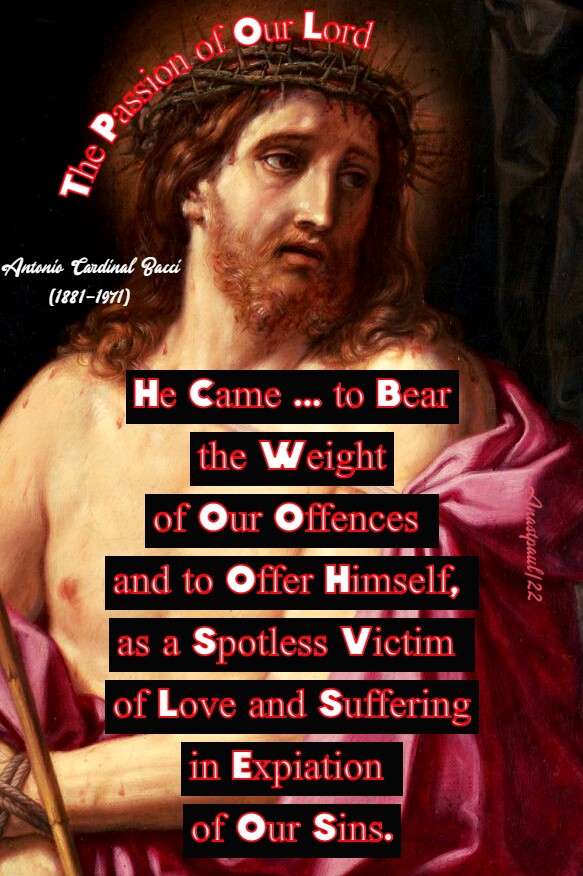
“The Incarnation of Our Lord Jesus Christ is one of the most profound mysteries of our religion. It is a mystery of infinite goodness and mercy, that, out of love for fallen humanity, the Eternal Word of God, should have assumed a human form and become man, in order to show us the way to Heaven and to enable us, to reach it. Jesus came amongst us, to instruct us, to call us, to perfection and to give us, an example and the necessary help. But He did much more than this. He came also to bear the weight of our offences and to offer Himself, as a spotless victim of love and suffering in expiation of our sins. All this, seems too great a mystery, almost inconceivable, in fact, until we consider that the charity of God is as infinite as His nature. This is why, the Saints experienced hours of ecstasy contemplating the Passion and Death of our Divine Redeemer. Whenever St Gertrude looked upon the figure of Jesus nailed to the Cross, she could not restrain her tears. She was accustomed to say, that God was specially merciful towards those who meditated on the Passion and Death of Jesus. St Bernard writes, that even as the rocks were rent asunder at the Death of Our Redeemer, so, our sin-hardened hearts, should feel as if they were breaking, when we meditate on His Sufferings. Let us meditate, therefore, on the Passion and Death of Our Lord Jesus Christ. If we are sinners, as unfortunately, we all are, we shall we moved to weep for our sins. If we are imperfect and lukewarm, we shall be set on fire with love and a determination, to requite, as far as possible, the infinite charity of Jesus Christ.”
Saturday in Passion Week – 9 April – Our Lenten Journey with the Great Fathers – Jeremias 18:18-23, John 12:10-36
“In You, O Lord, I take refuge; let me never be put to shame. In Your justice rescue me. – Psalm 30:2”
“He who loves his life, loses it and he who hates his life in this world, keeps it unto life everlasting. If anyone serves Me, let him follow Me and where I am, there also shall My servant be.”
John 12:25-26
“OUR OBLIGATION is to do God’s will and not our own. We must remember this, if the praye that our Lord commanded us to say daily, is to have any meaning on our lips. How unreasonable it is to pray that God’s will be done and then not promptly obey it, when He calls us from this world! Instead, we struggle and resist like self-willed slaves and are brought into the Lord’s presence, with sorrow and lamentation, not freely consenting to our departure but constrained by necessity.
AND YET, WE EXPECT to be rewarded with heavenly honours by Him to Whom we come, against our will! Why then do we pray for the Kingdom of Heaven to come, if this earthly bondage pleases us?
WHAT IS THE POINT of praying so often for its early arrival, if we would rather serve the devil here than reign with Christ!?” – St Cyprian of Carthage (200-258) Bishop of Carthage, Martyr, Great Father of the Church (Excerpt from On Man’s Mortality).
Quote/s of the Day – 9 April – Our Lenten Journey with the Great Fathers – Jeremias 18:18-23, John 12:10-36
“He who loves his life, loses it and he who hates his life in this world, keeps it unto life everlasting. If anyone serves Me, let him follow Me and where I am, there also shall My servant be.”
John 12:25-26
“This is the time for Confession. Confess the sins you have committed in word or deed, by day or by night. Confess during this “favourable time” and on “the day of salvation,” receive Heaven’s treasure… ”
St Cyril of Jerusalem (313-350), Father & Doctor of the Church
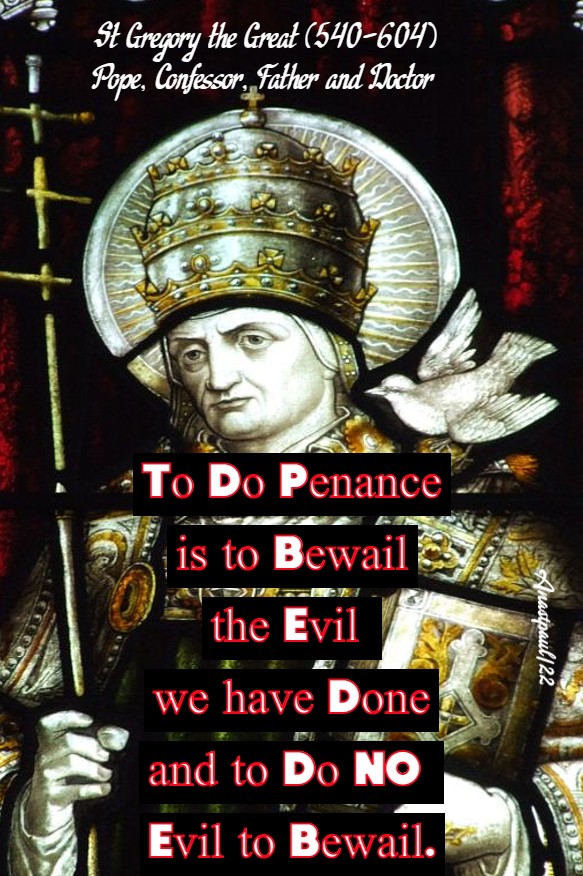
“To do penance is to bewail the evil we have done and to do no evil to bewail.”
St Gregory the Great (540-604) Pope, Confessor, Father and Doctor
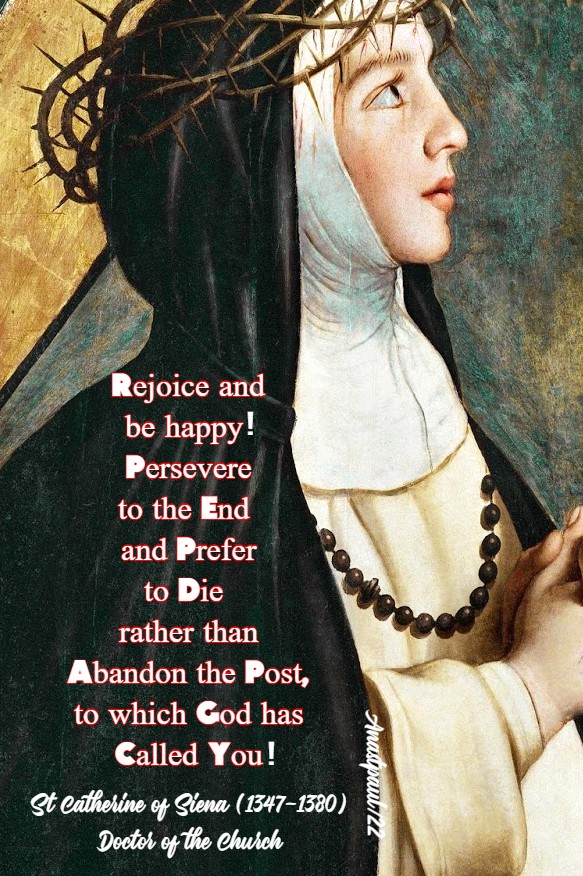
“Rejoice and be happy! Persevere to the end and prefer to die rather than abandon the post, to which God has called you!”
St Catherine of Siena (1347-1380) Doctor of the Church
One Minute Reflection – 9 April – Saturday in Passion Week, the Fifth Week in Lent – Jeremias 18:18-23, John 12:10-36
“He who loves his life, loses it and he who hates his life in this world, keeps it unto life everlasting. If anyone serves Me, let him follow Me and where I Am ,there also shall My servant be.” – John 12:25-26
REFLECTION – “… We are being towed along by a world that passes away, forgetting the world to come. We are greedy for present things but do not take into account the coming judgement. We will not run to meet the Lord as He comes…
Let us turn back, brethren, let us turn back… By the very fact of His delay, of His still waiting, our Lord proves His desire to see us come back to Him, His desire that we should not perish. In His great goodness, He continues addressing these words to us: “I take no pleasure in the death of the wicked but would rather he would change his ways and live ”(Ez 33,11). So let us turn back to Him, brethren, not fearing that time is running short. The time that belongs to time’s Author cannot be shortened. The proof of it lies in the criminal in the Gospel, who, at the moment of dying on the cross, got away with his pardon, grabbed hold of life and, breaking into paradise like a burglar, managed to make his way into the Kingdom (cf. Lk 23,43)!” – St Peter Chrysologus (c 400-450) Bishop of Ravenna, Father and “Doctor of Sermons” of the Church (Excerpt from Sermon 167).
PRAYER – O Lord, may the people dedicated to You, desire to serve You more and more, that, taught by these sacred rites, they may be enriched by more precious gifts, as they grow in favour with Your majesty. Through Jesus Christ, Thy Son our Lord, Who lives and reigns with Thee, in the unity of the Holy Ghost, God, world without end. Amen (Collect).
Our Morning Offering – 9 April – Saturday in Passion Week, the Fifth Week in Lent
O Afflicted Virgin! By St Alphonsus Liguori (1696-1787) Most Zealous Doctor
O afflicted Virgin! O soul, great in virtues and great also in sorrows! for both arise from that great fire of love thou hast for God; thou “whose heart can love nothing but God.” O Mother, have pity on me, for I have not loved God and I have so much offended Him. Thy sorrows give me great confidence to hope for pardon. But this is not enough; I wish to love my Lord and who can better obtain this for me than thou, thou who art the Mother of fair love? O Mary, thou dost console all, comfort me also. Amen.
Saint of the Day – 9 April – Saint Hugh of Rouen OSB (Died 730) Bishop of Rouen, Paris and Bayeux, Monk, Abbot of of Jumièges and Fontenelle Abbey, while, simultaneously governing his Diocese. Died on 9 April 730 at Jumieges Abbey, France of natural causes. Also known as – Hugh of Champagne, Hugues..
Hugh was born of a noble family. His father was Duke Drago of Burgundy. His uncle was Charles Martel, Mayor of the Palace. The Mayor of the Palace, at that point in history, was more powerful even than the King of the Franks. And Martel’s son, Pepin III, served as both Mayor of the Palace and as the first Monarch of the Carolingian Dynasty, reigning from 751 to 768. Pepin’s son was Emperor Charlemagne (reigned 768-814).
While he was a still a layman, Hugh was appointed the Abbot of Jumièges Abbey. In 718, he embraced the call to monastic life and entered Jumièges as a Monk.
In 722, the important French City of Rouen had lost their Bishop and Hugh was called upon to take up the role. Hugh left his Monastery and succeeded in managing, not only the role of Archdiocese of Rouen but at the same time, Fontenelle Abbey. Two years, later, Hugh took on two more Diocese — Paris and Bayeux!
Hugh’s pastoral energies must have been nearly inexhaustible!
Finally, as he neared death, Hugh retired to his home Monastery of Jumièges. Hugh died on 9 April,730. His earthly remains were laid to rest at Notre Dame in Paris. Two centuries later, his relics were smuggled away to Belgium to save them from being destroyed by Norman invaders.
St Hugh of Rouen, Abbot and Bishop, who gave of himself tirelessly to care for Christ’s flock—pray for us!
St Brogan St Casilda of Toledo St Concessus the Martyr St Demetrius the Martyr St Dotto St Eupsychius of Cappadocia St Gaucherius St Hedda the Abbot St Heliodorus of Mesopotamia St Hilary the Martyr St Hugh of Rouen OSB (Died 730) Bishop, Monk Bl James of Padua Blessed John of Vespignano
Martyrs of Croyland – 9 Saints: A group of Benedictine Monks Martyred by pagan Danes – Agamund, Askega, Egdred, Elfgete, Grimkeld, Sabinus, Swethin, Theodore and Ulric. Croyland Abbey, England.
Martyrs of Masyla: Massylitan Martyrs Group of Christians Martyred in Masyla in northwest Africa.
Martyrs of Pannonia: Seven Virgin-Martyrs in Sirmium, Pannonia (modern Sremska Mitrovica, Serbia).
Martyrs of Thorney Abbey – 3+ Saints: A group of Hermits, hermitesses and monks who lived in or around Thorney Abbey who were Martyred together during raids by pagan Danes. We know little more than the names of three – Tancred, Torthred and Tova. 869 by raiders at Thorney Abbey, Cambridgeshire, England.
Thought for the Day – 8 April – Meditations with Antonio Cardinal Bacci (1881-1971)
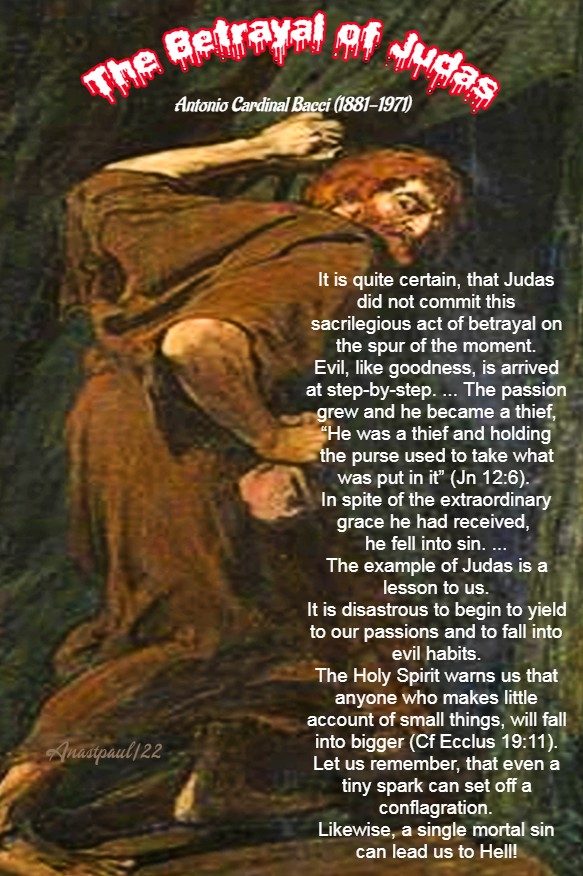
The Betrayal of Judas
“It is quite certain, that Judas did not commit this sacrilegious act of betrayal on the spur of the moment. Evil, like goodness, is arrived at step-by-step. Perhaps it was some motive of self-interest, rather than of pure love, which led Judas to become one of Jesus; Apostles. Covetousness, “the root of all evils,” (Cf 1 Tim 6:10) seems to have been his dominant passion. As the Gospel tells us, he kep the money offerings which those who had been converted, gave to Jesus for His support and for that of His Apostles. Judas did not know how to suppress his dominant passion at times. On one occasion, he complained about Mary Magdalen, when she anointed the feet of Jesus with precious ointment. The passion grew and he became a thief, “He was a thief and holding the purse used to take what was put in it” (Jn 12:6). In spite of the extraordinary grace he had received, he fell into sin. Finally, he was guilty of the betrayal, of the sacrilegious communion at the last supper and of the kiss of hypocrisy in Gethsemane.
The example of Judas is a lesson to us. It is disastrous to begin to yield to our passions and to fall into evil habits. The Holy Spirit warns us that anyone who makes little account of small things, will fall into bigger (Cf Ecclus 19:11). Let us remember, that even a tiny spark can set off a conflagration. Likewise, a single mortal sin can lead us to Hell!”
Friday of Passion Week – 8 April – Our Lenten Journey with the Great Fathers – Jeremiah 17:13-18, John 11:47-54
“O Lord, deal with us not according to our sins, nor requite us according to our crimes.” – Psalm 102:10
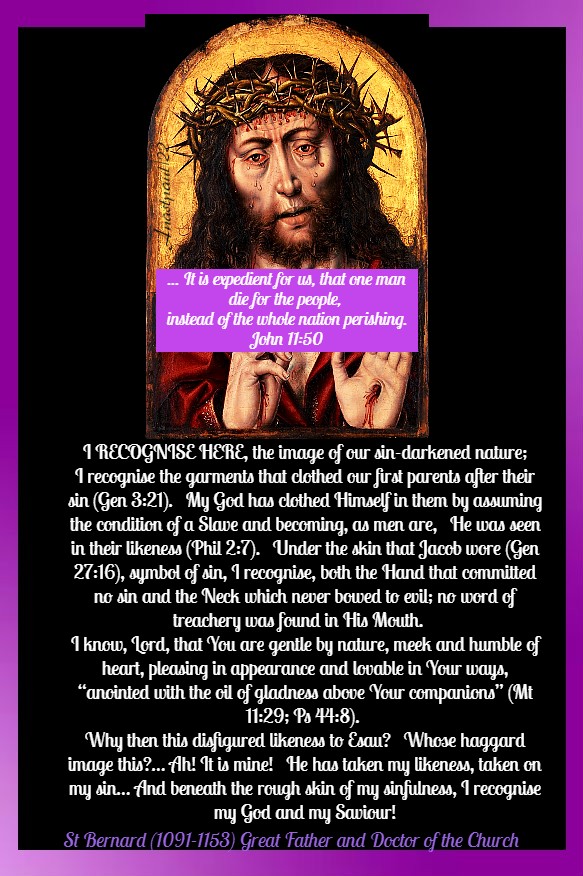
“ … It is expedient for us, that one man die for the people, instead of the whole nation perishing.”
John 11:50
“THE DARKENING OF ONE makes many bright… “It is better,” said Caiaphas, “for one man to die for the people, than for the whole nation to be destroyed.” It is better that One be darkened “in the likeness of sinful flesh,” (Rm 8:3) for the sake of all, than for the whole of mankind to be lost by the darkness of sin; that the splendour and image of the substance of God, should be shrouded in the form of a Slave, in order that a slave might live; that the brightness of eternal Light should become dimmed in the flesh, for the purifying of the flesh; that He, Who surpasses all mankind in beauty (Ps 44:2), should be eclipsed by the darkness of the Passion, for the enlightening of mankind; that He should suffer the ignominy of the Cross, grow pale in death, be totally deprived of beauty and comeliness, that He might gain the Church as a beautiful and comely Bride, without spot or wrinkle (Ep 5:27).
BUT UNDER HIS DARK COVERING (Sg 1:5), I recognise the King… I recognise Him and I embrace Him. For, although He presents this dark exterior… within, is the brightness of Divine life, the beauty of His strength, the splendour of grace, the purity of innocence. But covering it all, is the abject hue of infirmity, His Face, as it were, hidden and despised – “one tempted in every respect, as we are, yet without sinning” (Heb 4:15).
I RECOGNISE HERE ,the image of our sin-darkened nature; I recognise the garments that clothed our first parents after their sin (Gen 3:21). My God has clothed Himself in them by assuming the condition of a Slave and becoming, as men are, He was seen in their likeness (Phil 2:7). Under the skin that Jacob wore (Gen 27:16), symbol of sin, I recognise, both the Hand that committed no sin and the Neck which never bowed to evil; no word of treachery was found in His Mouth. I know, Lord, that You are gentle by nature, meek and humble of heart, pleasing in appearance and lovable in Your ways, “anointed with the oil of gladness above Yourcompanions” (Mt 11:29; Ps 44:8). Why then this disfigured likeness to Esau? Whose haggard image this?… Ah! It is mine! He has taken my likeness, taken on my sin… And beneath the rough skin of my sinfulness, I recognise my God and my Saviour.!” – St Bernard (1091-1153) Cistercian Monk, Great Father and Doctor of the Church (28th Homily on the Song of Songs).
Quote/s of the Day – 8 April – Our Lady of the Seven Sorrows – Friday of Passion Week, the Fifth Week in Lent
“Whoever you are, who love the Mother of God, take note and reflect with all your innermost feelings, upon her, who wept for the Only-Begotten as He died… The grief she felt in the Passion of her Son, goes beyond all understanding.”
St Amadeus of Lausanne (1108-1159)
“During the entire course of her life, the Blessed Virgin Mary, Mother of God, never deviated in the slightest from the precepts and examples of her Divine Son. This was true both in the most sweet joys Mary experienced and in the cruel sufferings she underwent, which made the the Queen of Martyrs.”
Venerable Pope Pius XII (1876-1958)
“If you want to assist at Mass, with devotion and with fruit, think of the sorrowful Mother at the feet of her Son on Calvary.”
St Pio of Pietrelcina OFM Cap (1887-1968) Padre Pio
One Minute Reflection – 8 April – Our Lady of the Seven Sorrows – Friday of Passion Week, the Fifth Week in Lent – Jeremiah 17:13-18, John 11:47-54
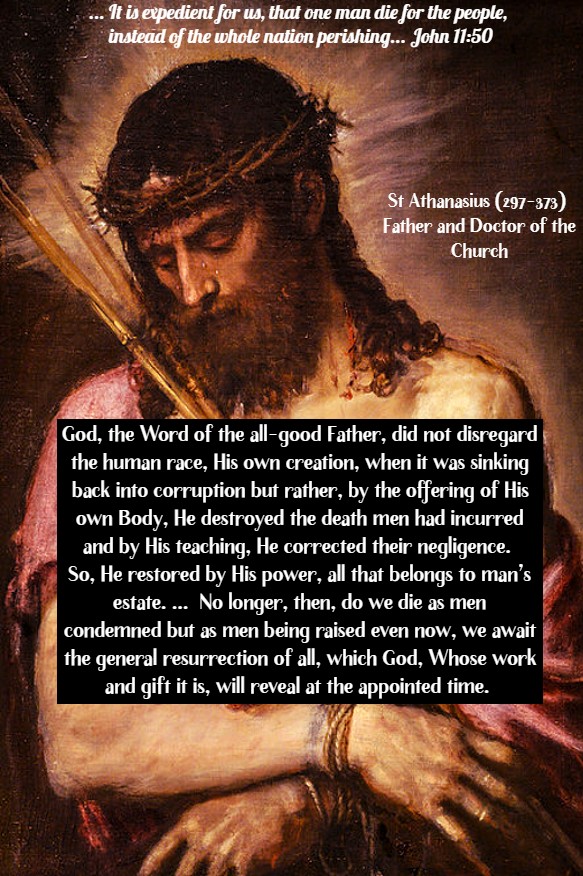
“ … It is expedient for us, that one man die for the people, instead of the whole nation perishing.” – John 11:50
REFLECTION – “God, the Word of the all-good Father, did not disregard the human race, His own creation, when it was sinking back into corruption but rather, by the offering of His own Body, He destroyed the death men had incurred and by His teaching, He corrected their negligence. So, He restored by His power, all that belongs to man’s estate.
Anyone can find confirmation of this from the Saviour’s own disciples who spoke of Him, for in their writings one reads: The charity of Christ constrains us as we judge that if one died on behalf of all, then all died and He died for all, in order that we may live, no longer for ourselves but for Him Who died for us and rose from the dead, our Lord Jesus Christ. And again: We see Jesus, Who for a little while was made lower than the angels, crowned with glory and honour because He suffered death, that by God’s grace He might taste death for everyone. Then the writer goes onto show why it had to be God, the Word and no other Who became Man: Indeed it was fitting that in bringing many sons to glory, God, for Whom and through Whom all things exist, should make perfect the One Who leads them to salvation. By this He means, that the task of bringing men back from the corruption into which they had fallen, belonged to no other save God the Word, Who had made them in the beginning. Further, Scripture shows, that the Word assumed a Body for the purpose of offering It in sacrifice on behalf of other bodies like His own, for the writer continues: Since the children have blood and flesh in common, He likewise, shared in them Himself ,so that, by His own Death, He might destroy the one who had power over death, that is, the devil and might deliver those, who all their life long, were enslaved by fear of death.
For by the sacrifice of His own Body, He both put an end to the law that stood against us and made a new beginning of life for us, by giving us the hope of resurrection. Hence Paul, the Christbearer, declares: As through a man came death, so through a Man has come the Resurrection of the dead. For as all died in Adam, so also in Christ all shall be made to live.
No longer, then, do we die as men condemned but as men being raised even now, we await the general resurrection of all, which God, Whose work and gift it is, will reveal at the appointed time. – St Athanasius (297-373) Archbishop of Alexandria, Great Father and Doctor of the Church (An excerpt from his “On the Incarnation of the Word” 10).
PRAYER – O God, in Whose Passion the sword, according to the prophecy of blessed Simeon, pierced through the soul of Mary, the glorious Virgin and Mother, mercifully grant that we, who reverently commemorate her piercing through and her suffering, may, by the interceding glorious merits of all the saints faithfully standing by the Cross, obtain the abundant fruit of Your Passion. Who lives and reigns with God the Father, in the unity of the Holy Ghost, God, world without end. Amen (Collect).
Our Morning Offering – 8 April – Friday of Passion Week, the Fifth Week in Lent
The Glory of These Forty Days By St Gregory the Great (540-604) Pope, Great Father & Doctor of the Church
The glory of these forty days we celebrate with songs of praise, for Christ, by Whom all things were made, Himself has fasted and has prayed. Alone and fasting Moses saw the loving God Who gave the law. And to Elijah, fasting, came the steed and chariots of flame. So Daniel trained his mystic sight, delivered from the lion’s might. And John, the Saviour’s friend, became the herald of Messiah’s Name. Then grant, O God, that we may, too, return in fast and prayer to You. Our spirits strengthen with Your Grace, and give us joy to see Your Face. Amen!
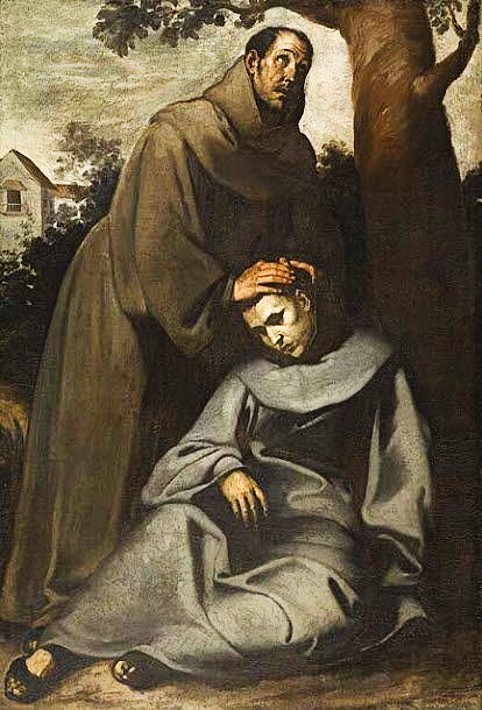
Saint of the Day – 8 April – Blessed Julian of Saint Augustine OFM (c 1550-1606) Lay Brother of the Friars Minor, Hermit, Ascetic, Born in c 1550 as Julián Martinet Gutiérrez at Medinaceli, Diocese of Segovia, Castile, Spain and died on 8 April 1606 at Saint Didacus Friary, Alcalá de Henares, Spain of natural causes. Also known as – Julian Martinet, Fray Julián de Alcalá.
Julian’s father was a French nobleman who, in order to escape from the violent pressure exerted on him by the Calvinists, seeking to make him apostatise from the Catholic Faith, fled to Spain, leaving all his wealth behind. There Julian was born and reared amid unpretentious circumstances but in a very Christian manner. The boy was devoted to piety, his greatest pleasure being to serve the Priests at the Altar.
As a young man, Julian accompanied for some time, a Missionary of the Franciscan Order on his apostolic journeys. This Friar arranged for his admission with the Friars Minor as a lay brother in the Convent of Maria of Salzeda. Julian began his convent life with ardent zeal, he practised such extraordinary acts of mortification that he was considered eccentric and God almighty permitted, as a means of trial, that he was dismissed from the Convent This trial Julian bore with admirable fortitude.
Blessed Julian of Saint Augustine withdrew to a neighbouring mountain, where he built a hut in order to live as a Hermit. Once a day he came to the gate of the Convent from which he had been dismissed, to receive food with the other poor. While waiting for the food to be dispensed, he would instruct the others in the Catechism, and when a poor person one day came clad ina dirty and torn garment, he took off his own garment and gave it to that him
On account of such virtues, the dismissed novice was again received into the Convent, where, after successfully enduring the time of probation, he pronounced his vows. In the zeal that always consumed him, he was impressed with the value of obedience. to such a degree, that he sometimes said that he would rather die than not obey. He constantly wore iron girdles and fasted so strenuously that the physicians declared it was a miracle that he could live and work. While on his rounds to gather alms, he edified everyone by his modest and humble demeanour.
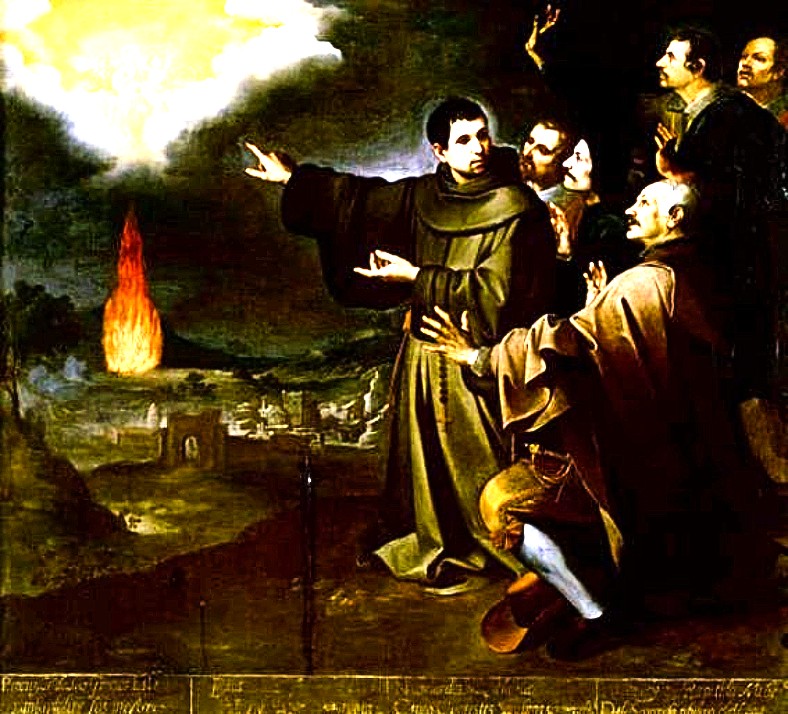
Full of zeal for God and the salvation of souls, he brought many a sinner back to the Church by his exhortations and corrected much that was wrong among the people, who greatly esteemed him. In a special way, he denounced frivolous entertainment. He often exhorted the young people to keep away from such dangerous amusements and many followed his warning. The fires that had been built in the open for the night dances, he stamped out with his bare feet.
A true son of St Francis, he loved holy poverty and practised it so rigorously that he did not even wish to have his own cell. The nights he passed in prayer in the Church, or he rested a bit in some corner of the Friary. During his fervent prayers he was often favoured with visions. In spite of this, he always remained so humble, that he considered himself the greatest sinner and accepted all acts of contempt as deserved treatment.
Blessed Julian of Saint Augustine closed his holy life in the Convent of Alcala on the 8th of April, 1606. At once the people began publicly to venerate him and Philip III, King of Spain at that time, urged his Beatification. The proceedings were, however, often interrupted until the jubilee year of 1825, when Pope Leo XII inscribed him solemnly among the Blessed.





























 AnaStpaul
You must be logged in to post a comment.