Thought for the Day – 6 March – The Spiritual Combat (1589) – Dom Lorenzo Scupoli OSM (c1530-1610)
“None shall be crowned who has not fought well.” 2 Tim 2: 5
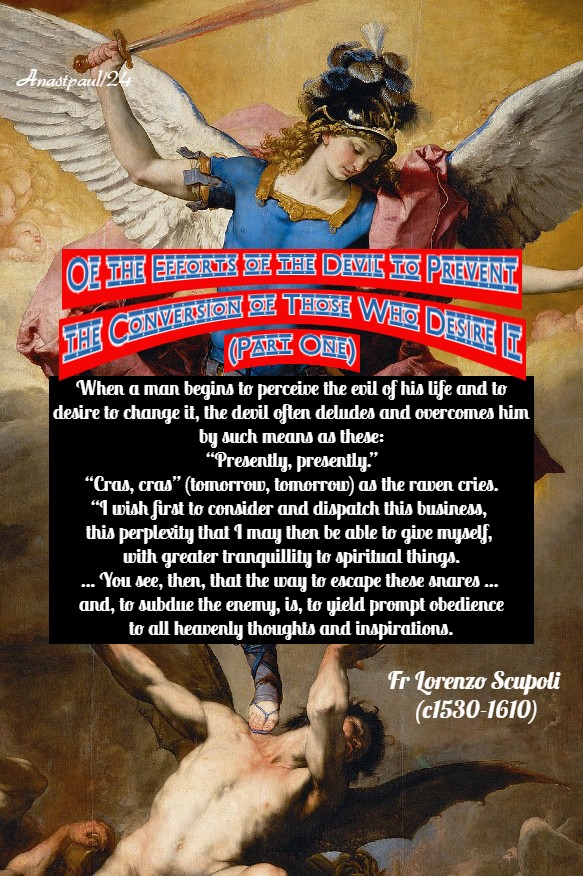
XXIX: … Of the Efforts of the Devil to Prevent the Conversion of Those Who Desire It (Part One)
“When a man begins to perceive the evil of his life and to desire to change it, the devil often deludes and overcomes him by such means as these: “Presently, presently.” “Cras, cras” (tomorrow, tomorrow) as the raven cries. “I wish first to consider and dispatch this business, this perplexity that I may then be able to give myself, with greater tranquillity to spiritual things.”
These are snares in which many men have been and are still daily entangled and, the cause of this, is our own negligence and heedlessness, seeing that, in a matter touching the honour of God and the salvation of the soul, we neglect to seize, instantly that effectual weapon — “Now, now!” … “Even supposing this ‘presently’ and this ‘tomorrow’ should be granted to me, is it the way of safety and of victory to seek first to be wounded and to commit fresh disorders?!”
You see, then, that the way to escape these snares and that mentioned in the preceding chapter and, to subdue the enemy, is, to yield prompt obedience to all heavenly thoughts and inspirations.”
Quote/s of the Day – 6 March – Wednesday of the Third Week in Lent – Ecclesiasticus Sirach 51:13-17; Matthew 13:44-52 – Scripture search here: https://www.drbo.org/
“The Kingdom of Heaven is like a treasure hidden in a field.”
Matthew 13:44
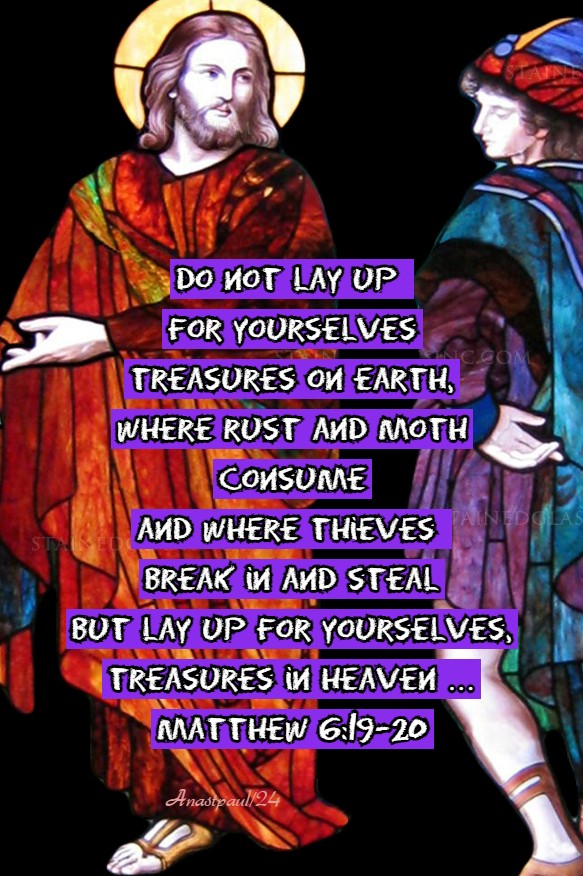
“Do not lay up for yourselves treasures on earth, where rust and moth consume and where thieves break in and steal but lay up for yourselves, treasures in Heaven …”
Matthew 6:19-20
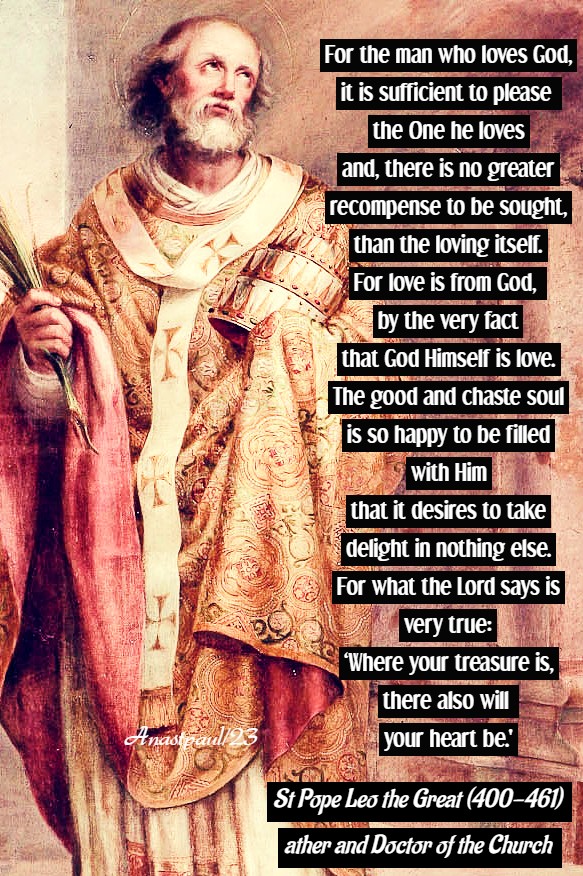
“For the man who loves God, it is sufficient to please the One he loves and, there is no greater recompense to be sought, than the loving itself. For love is from God, by the very fact that God Himself is love. The good and chaste soul is so happy to be filled with Him that it desires to take delight in nothing else. For what the Lord says is very true: ‘Where your treasure is, there also will your heart be.’”
St Pope Leo the Great (400-461) ather and Doctor of the Church
“Watch, therefore and pray and labour diligently and do not delay to weave the web of your wedding-garment that you may be found ready and adorned to meet the Bridegroom! And remember daily that He, Who gives you the morning, does not promise you the evening and although He gives the evening, yet promises not the morrow. Spend, therefore, every moment of every hour according to God’s will, as if it were your last and so much the more carefully, as, for every moment, you will have to give the strictest account!
Finally, I warn you to account that day lost, in which you will neither have gained some victory over your evil inclinations and your self-will, although it may have been full of busy action, nor returned thanksgiving to your Lord for His mercies and especially for His bitter Passion endured for you and for His sweet and fatherly correction, when He has made you worthy to receive, at His Hand, the inestimable treasure of suffering.”
Fr Lorenzo Scupoli OSM (c1530-1610)
“Where is the heart which loves? On the thing it loves. Therefore, where our love is, there our heart is held captive. It cannot leave it; it cannot be lifted higher, it cannot go either to the right or the left; see, it is fixed. Where the miser’s treasure is, there is his heart and where our heart is, there is our treasure. And what is so deplorable is that the things which hold us in servitude, are, for the most part, such unworthy things!”
Our Lenten Journey with the Angels and the Saints – 6 March – Wednesday of the Third Week in Lent – Ecclesiasticus Sirach 51:13-17; Matthew 13:44-52 – Scripture search here: https://www.drbo.org/
“Nor then do thou leave me, Angelical friend! But at the tribunal Of Judgement attend And cease not to plead For my soul, till, forgiven, Thou bear it aloft To the Palace of Heaven!”
“The Kingdom of Heaven is like a treasure hidden in a field.” Matthew 13:44
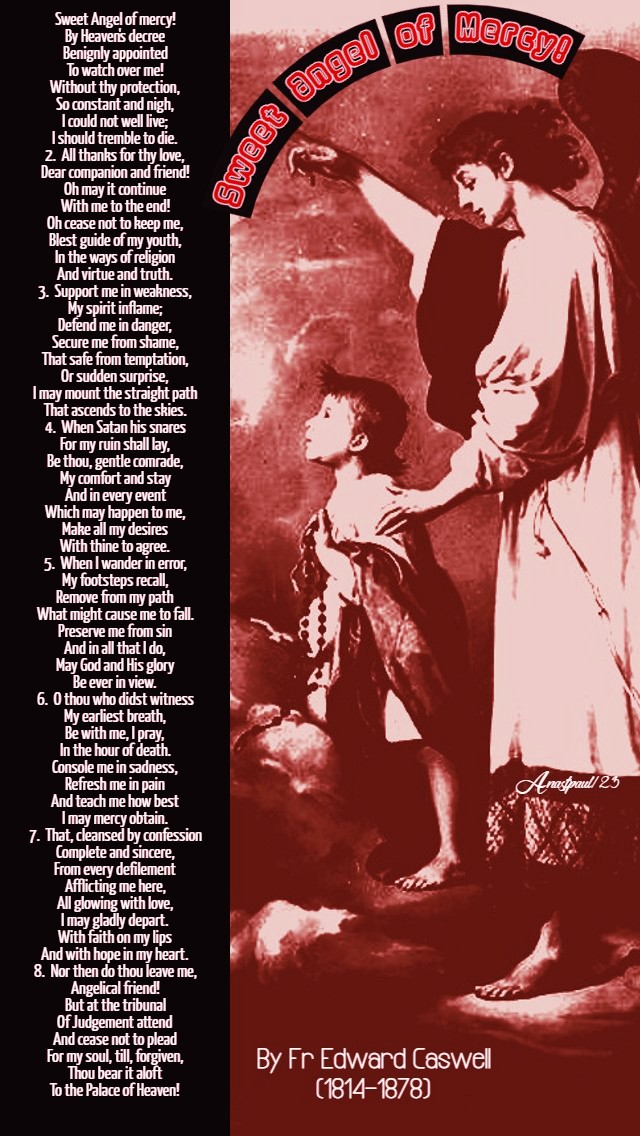
Sweet Angel of Mercy! By Fr Edward Caswell C.Orat. (1814-1878)
Sweet Angel of mercy! By Heaven’s decree Benignly appointed To watch over me! Without thy protection, So constant and nigh, I could not well live; I should tremble to die.
All thanks for thy love, Dear companion and friend! Oh may it continue With me to the end! Oh cease not to keep me, Blest guide of my youth, In the ways of religion And virtue and truth.
Support me in weakness, My spirit inflame; Defend me in danger, Secure me from shame, That safe from temptation, Or sudden surprise, I may mount the straight path That ascends to the skies.
When Satan his snares For my ruin shall lay, Be thou, gentle comrade, My comfort and stay And in every event Which may happen to me, Make all my desires With thine to agree.
When I wander in error, My footsteps recall, Remove from my path What might cause me to fall. Preserve me from sin And in all that I do, May God and His glory Be ever in view.
O thou who didst witness My earliest breath, Be with me, I pray, In the hour of death. Console me in sadness, Refresh me in pain And teach me how best I may mercy obtain.
That, cleansed by confession Complete and sincere, From every defilement Afflicting me here, All glowing with love, I may gladly depart. With faith on my lips And with hope in my heart.
Nor then do thou leave me, Angelical friend! But at the tribunal Of Judgement attend And cease not to plead For my soul, till, forgiven, Thou bear it aloft To the Palace of Heaven!
One Minute Reflection – 6 March – “The Month of St Joseph” – Wednesday of the Third Week in Lent Sts Perpetua and Felicity (Died c203) Martyrs – Ecclesiasticus Sirach 51:13-17; Matthew 13:44-52 – Scripture search here: https://www.drbo.org/
“The Kingdom of Heaven is like a treasure hidden in a field.” – Matthew 13:44
REFLECTION – “Some of the brethren think that they are excluded from the Holy Ghost’s gifts of grace. Because they neglect to practise the commandments, they do not know that he who has an unadulterated faith in Christ, has within himself, the sum total of all the Divine gifts. Since, through our laziness, we are far from having an active love for Him — a love which shows us the Divine Treasures within us — we naturally think that we are excluded from these gifts.
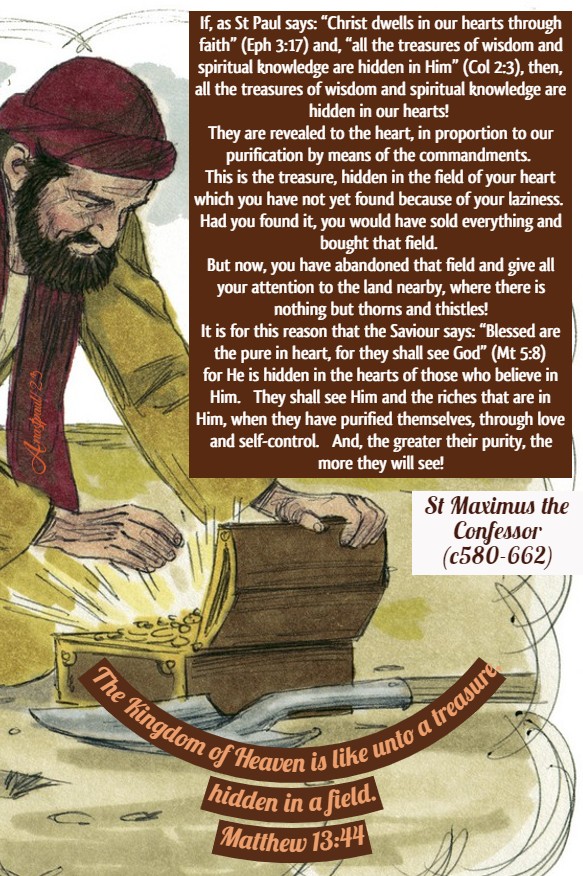
If, as St Paul says: “Christ dwells in our hearts through faith” (Eph 3:17) and, “all the treasures of wisdom and spiritual knowledge are hidden in Him” (Col 2:3), then, all the treasures of wisdom and spiritual knowledge are hidden in our hearts! They are revealed to the heart, in proportion to our purification by means of the commandments. This is the treasure, hidden in the field of your heart which you have not yet found because of your laziness. Had you found it, you would have sold everything and bought that field. But now, you have abandoned that field and give all your attention to the land nearby, where there is nothing but thorns and thistles! It is for this reason that the Saviour says: “Blessed are the pure in heart, for they shall see God” (Mt 5:8) for He is hidden in the hearts of those who believe in Him.They shall see Him and the riches that are in Him, when they have purified themselves, through love and self-control. And, the greater their purity, the more they will see!” – St Maximus the Confessor (c580-662) Abbot and Theologian (Centuries of love 4:69).
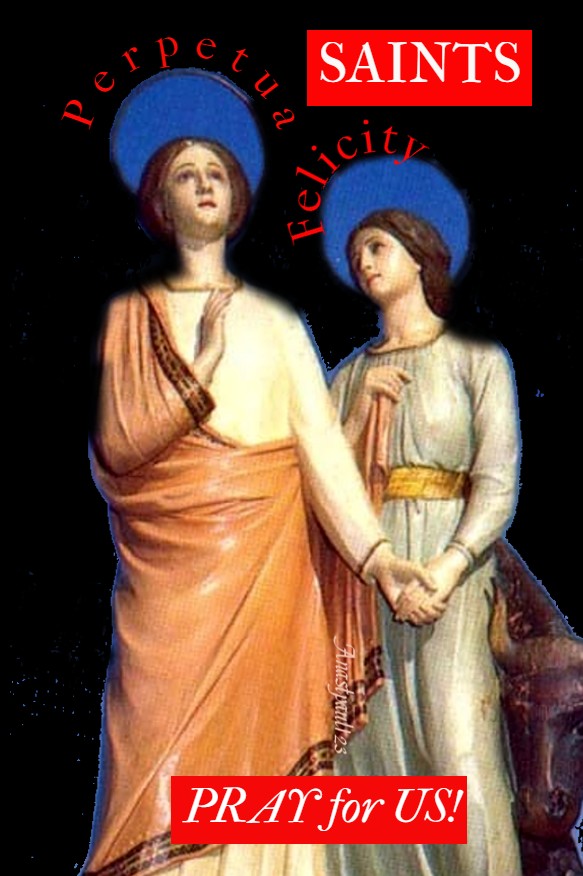
PRAYER – Grant, we beseech Thee, O Lord our God, that we may venerate with unceasing devotion Thy holy Martyrs Perpetua and Felicitas and, although we cannot pay them the honour that is their due, may we at least present to them, our humble homage. Through Jesus Christ, Thy Son our Lord, Who lives and reigns with Thee, in the unity of the Holy Ghost, God, world without end. Amen (Collect).
Our Morning Offering – 6 March – “The Month of St Joseph” and Wednesday, the Day of Saint Joseph – Saint Joseph is known as the Prince and Chief Patron of the Church. As the earthly Foster-Father of Jesus, he had a special role in protecting, providing for and instructing Jesus during His earthly life. Now that Christ is ascended into Heaven, St Joseph continues his fatherly Guardianship of Christ’s Body, the Church. He is a very powerful assistant to all of us.
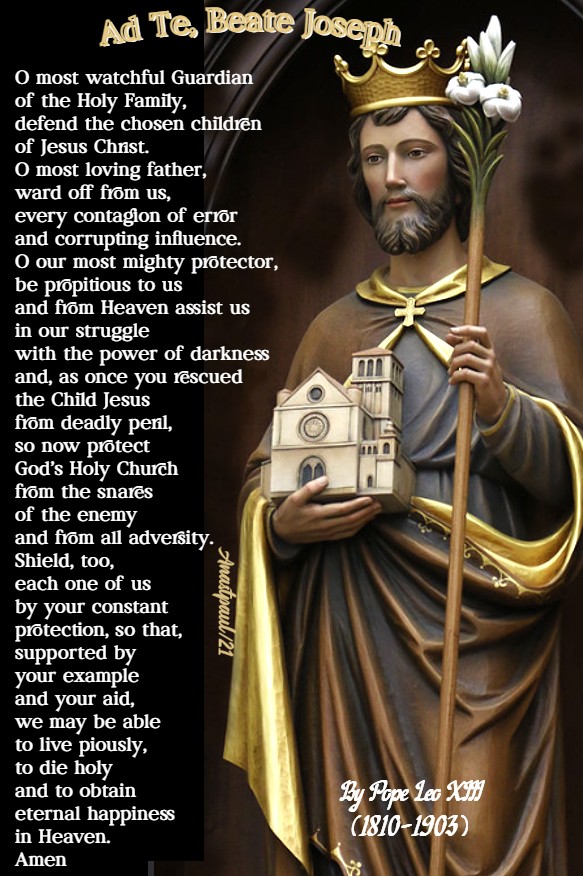
Ad Te, Beate Joseph To Thee, O Blessed Joseph By Pope Leo XIII (1810-1903)
O most watchful Guardian of the Holy Family, defend the chosen children of Jesus Christ. O most loving father, ward off from us, every contagion of error and corrupting influence. O our most mighty protector, be propitious to us and from heaven assist us in our struggle with the power of darkness and, as once you rescued the Child Jesus from deadly peril, so now protect God’s Holy Church from the snares of the enemy and from all adversity. Shield, too, each one of us by your constant protection, so that, supported by your example and your aid, we may be able to live piously, to die holy and to obtain eternal happiness in Heaven. Amen
Saint of the Day – 6 March – St Ollegarius Bonestruga OSA (1060-1137) Bishop, Canon Regular of the Augustinians, Reformer, in both the religious sphere and the social one, Abbot, Diplomat, Peacemaker and Proptector of his people from possible violent incursions. Born in 1060 at Barcelona, Spain and died in Tarragona in 1137 of natural causes. Ollegarius was the Bishop of Barcelona from 1116 and at the same time, the Archbishop of Tarragona from 1118 until his death. He was an intimate friend and Counsellor-Confessor of Count Ramon Berenguer III of Barcelona and often accompanied the Count, on military ventures. Also known as – Ollegarius of Tarragona, Ollegarius of Barcelona, Olaguerand, Oldegar, Olegari, Olegarius, Oligarius, Oleguer, Olegario. Ollegarius was Canonised in 1675 and his major Shrine and Sepulchre is in the side Chapel of Christ of Lepanto, in the Cathedral of Barcelona (see image at the end of the page). His Feast is celebrated the date of his death, today 6 March.
The Roman Martyrology reads: “At Barcelona in Spain, the blessed St Ollegarius, who was first a Canon and afterwards the Bishop of Barcelona and Archbishop of Tarragona.”
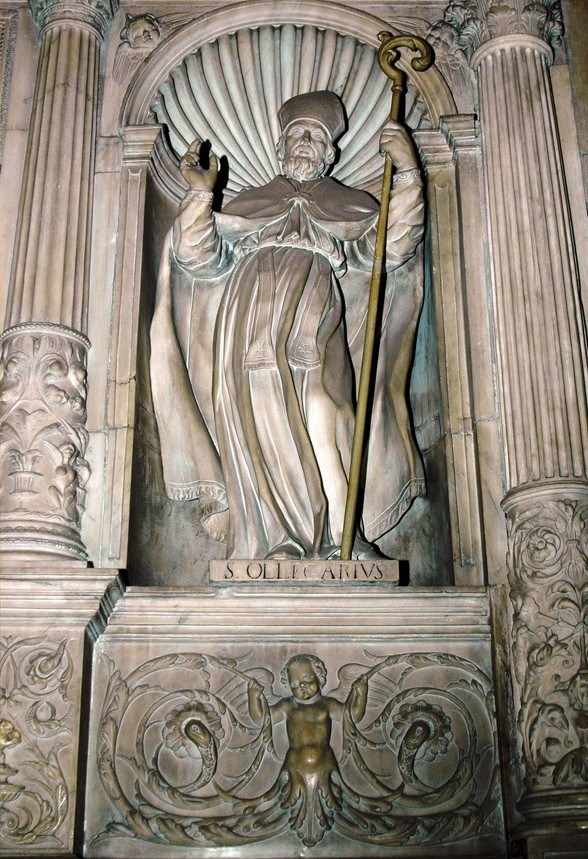
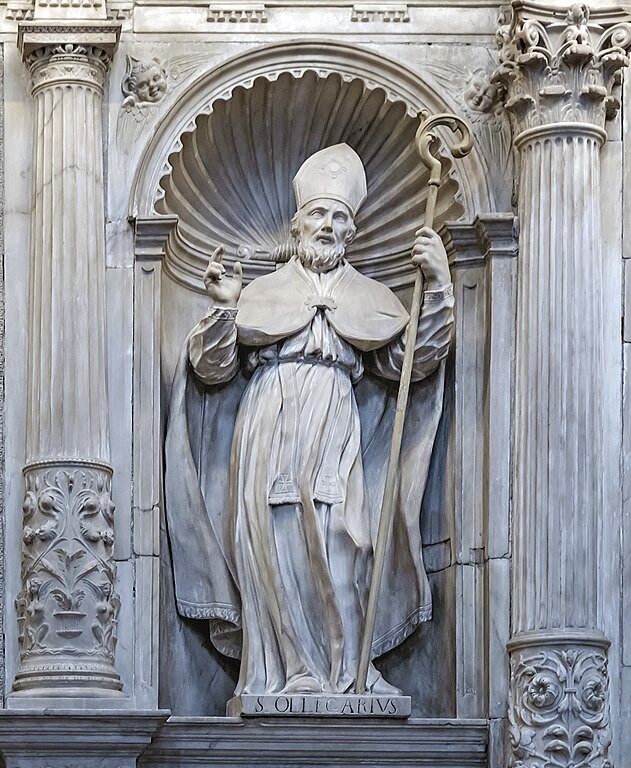
This Statue resides in the Interior of Barcelona Cathedral
Ollegarius was born in 1060 into a wealthy family in Barcelona. At the age of 10, he was included in the Cathedral Chapter in his hometown. He was Ordained a Priest in 1094. Over time, he became the Superior of Canons in Barcelona and Sant Adria de Besós (1095-1108) and the Abbot of the Augustinian Monastery of St Rufus in Avignon (1113-1118). He also joined the confraternity of San Pedro de la Portella.
Raymon Berenguer III, Count of Barcelona, appointed him Bishop of that City in 1116. Ollegarius was Consecrated by Cardinal Boso in the Cathedral of Maguelone in Provence, during the Pontificate of Paschal II. In 1117 he went to Rome to pay homage to Pope Gelasius II.
Saint Ollegarius, Sculpture by Pere Villar in the Choir of the Barcelona Cathedral, 16th Century
Ollegarius was a zealous reformer. He participated in the Synods of Toulouse (1119), Reims (1120), the First Lateran Council (1123), Narbonne (1129), Clermont (1130) and again in Reims (1131). He was also involved in implementing the Augustinian Reform of Monasteries in Catalonia – in the 1220s he transformed the Monastery of St Eulalia (then outside Barcelona) into the community of Augustinian Canons. On 8 March 1118, Olegarius, then still the Bishop of Barcelona, was also appointed the Bishop of Tarragona. He had the difficult task of rebuilding the Church in this region, after regaining the region from the Moors.
After 1124 he went on a pilgrimage to the Holy Land but due to his concern for his new Diocese, he shortened his stay in Antioch and returned before 1127. Between 1126 and 1130, he was very active in rebuilding the City, especially the Churches. He brought in new inhabitants and knights who would defend the City in the future. The years 1126-1127 were a time of efforts to organise the Second Crusade. Olegarius compensated William V for sending his knights to Barcelona in 1124-1125 and brought about an agreement between William and his son, Bernard IV, thus strengthening the alliance against the Almoravida pirates.
In March 1129, Ollegarius transferred his secular powers to Robert Bordet, making him Duke of Tarragona. He himself returned to caring for the renewal of his Diocese. The Synod of Narbonne (1129) approved the existence of the Archfraternity, which Ollegarius had founded a year earlier — its aim was to rebuild the Church in Tarragona. Members of the Archfraternity, clergy and laity, wealthy and poor, made monetary donations which were allocated to the Archdiocese of Tarragona.
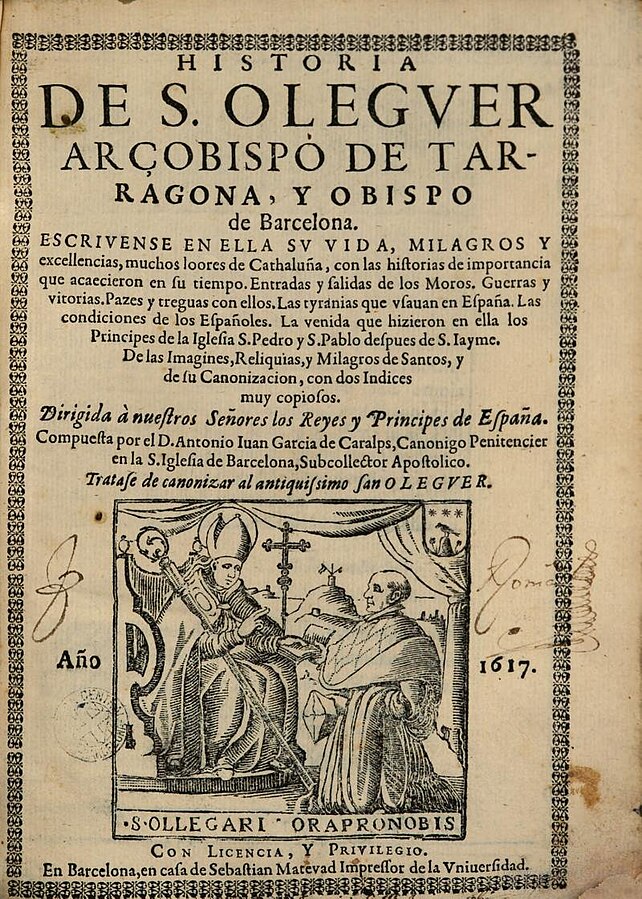
A Life of St Ollegarius 1617
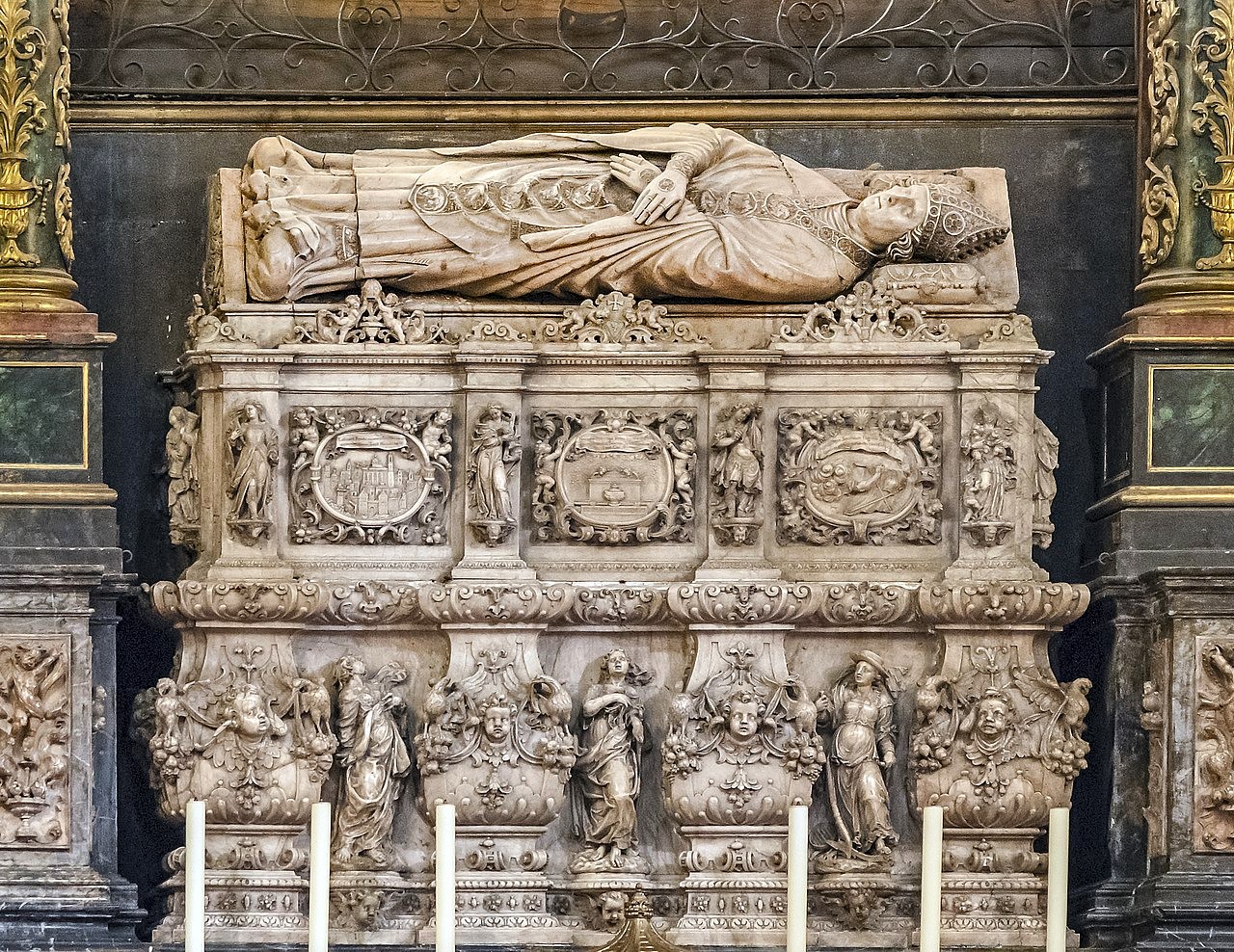
Ollegarius died on 6 March 1137. He was Canonis ed on 18 May 1675 by Pope Clement X. The Tomb of the Bishop of Barcelona and Tarragona, is located in the Cathedral of Barcelona.
The Sepulchre of St Ollegarius in the Cathedral of Barcelona
St Aetius St Bairfhion St Baldred of Strathclyde St Baldred the Hermit St Balther of Lindisfarne St Basil of Bologna St Cadroë
St Chrodegang of Metz (c714-776) The First Bishop of Metz, Protector and Father of the poor and orphans, Reformer of the Clergy, a relative of King Pepin and of Prince Charles Martel, both of whom he was Court Chancellor, Royal Diplomat, Saint Opportuna of Montreuil was his brother. The Roman Martyrology states: “In Metz in Austrasia, in today’s France, St Crodegango, Bishop, who arranged for the Clergy to live as if within the walls of a cloister under an exemplary rule of life and greatly promoted liturgical chant.” Biography: https://anastpaul.com/2022/03/06/saint-of-the-day-6-march-saint-chrodegang-of-metz/
St Colette PCC (1381-1447) Abbess and Foundress of the Colettine Poor Clares, a reform branch of the Order of Saint Clare. Patronages – against eye disorders, against fever, against headaches, against infertility, against the death of parents, of women seeking to conceive, expectant mothers and sick children, craftsmen, Poor Clares, servants, Corbie, France, Ghent, Belgium. St Colette was Canonised on 24 May 1807 by Pope Pius VII. Biography: https://anastpaul.com/2017/03/06/saint-of-the-day-6-march-st-colette/ AND: https://anastpaul.com/2019/03/06/saint-of-the-day-6-march-st-colette-2/
St Cyriacus of Trier St Cyril of Constantinople St Evagrius of Constantinople
Bl Guillermo Giraldi St Heliodorus the Martyr Bl Jordan of Pisa St Julian of Toledo St Kyneburga of Castor St Kyneswide of Castor St Marcian of Tortona St Ollegarius Bonestruga OSA (1060-1137) Bishop St Patrick of Malaga St Sananus
Martyrs of Amorium – 42 Saints – Also known as Martyrs of Syria and Martyrs of Samarra; A group of 42 Christian senior officials in the Byzantine Empire who were captured by forces of the Abbasid Caliphate when the Muslim forces overran the City of Amorium, Phrygia in 838 and massacred or enslaved its population. The men were imprisoned in Samarra, the seat of the Caliphate, for seven years. Initially thought to be held for ransom due to their high position in the empire, all attempts to buy their freedom were declined. The Caliph repeatedly ordered them to convert to Islam and sent Islamic scholars to the prison to convince them; they refused until the Muslims finally gave up and killed them. Martyrs. We know the names and a little about seven of them: Aetios Bassoes Constantine Constantine Baboutzikos Kallistos Theodore Krateros Theophilos but details about the rest have disappeared over time. However, a lack of information did not stop several legendary and increasingly over-blown “Acts” to be written for years afterward. One of the first biographers, a monk name Euodios, presented the entire affair as a judgement by God on the empire for its official policy of Iconoclasm. Deaths: beheaded on 6 March 845 in Samarra (in modern Iraq) on the banks of the Euphrates river by Ethiopian slaves the bodies were thrown into the river, but later recovered by local Christians and given proper burial.












 AnaStpaul
You must be logged in to post a comment.