Posted in GOD ALONE!, HUMILITY-Fr Richard Clarke, JESUIT SJ, QUOTES on HUMILITY

Thought for the Day – 31 May – What Humility is Not!

Thought for the Day – 31 May – Meditations with Fr Richard Frederick Clarke SJ (1839-1900)

HUMILITY
Meditations for a Month

Chapter Five
What Humility is Not!

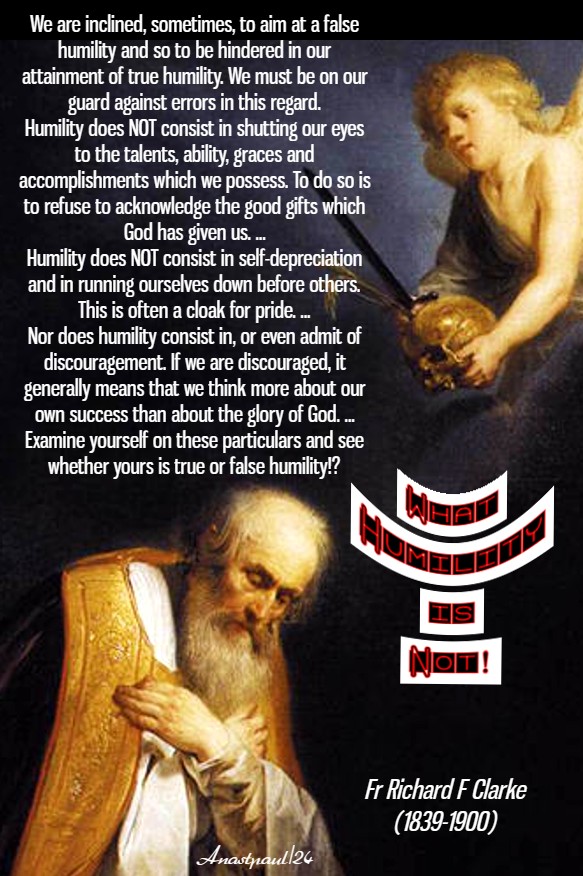
We are inclined, sometimes, to aim at a false humility and so to be hindered in our attainment of true humility. We must be on our guard against errors in this regard.

Humility does NOT consist in shutting our eyes to the talents, ability, graces and accomplishments which we possess. To do so is to refuse to acknowledge the good gifts which God has given us. If we have skill in music, in conversation, in painting, in languages, it is no humility to deny the fact. We ought to thank God for His goodness in bestowing upon us this talent. What is contrary to humility is to take the credit to ourselves and to plume ourselves on what we have received from God.

Humility does NOT consist in self-depreciation and in running ourselves down before others. This is often a cloak for pride. Sometimes its object is to obtain, from others, the praise we deny to
ourselves; sometimes it is a marked expression of discontent. The continual song, “What a poor worm I am!” is very much opposed to the spirit of the Catholic Church and to the cheerfulness which every Christian ought to show in his words.

Nor does humility consist in, or even admit of discouragement. If we are discouraged, it generally means that we think more about our own success than about the glory of God. It means that we are not perfectly resigned; it means that our pride is wounded and our self-will thwarted, or that we have worldly motives in what we do and seek honour from men and not from God. True humility is willing to fail in its projects, if God so wills it.
Examine yourself on these particulars and see whether yours is true or false humility!?

Posted in DOCTORS of the Church, EUCHARISTIC Adoration, HOLY COMMUNION, QUOTES on ETERNAL LIFE, QUOTES on UNITY/with GOD, St Francis de Sales, The HOLY EUCHARIST / The HOLY MASS, The WORD

Quote/s of the Day – 31 May – Corpus Christi

Quote/s of the Day – 31 May – Within the Octave of Corpus Christi

He who eats My Flesh
and drinks My Blood,
abides in Me and I in him.

John 6:57

The Saviour has instituted
the most glorious Sacrament
of the Eucharist,
which truly contains His Body and His Blood,
so that, whoever eats it will live forever.
Therefore, those who receive it frequently,
with devotion, strengthen their spiritual life
and well-being, to such an extent,
that it is almost impossible for them
to be poisoned by any kind of evil attachment.

(Introduction to the Devout Life, Part II, Chapter 20)

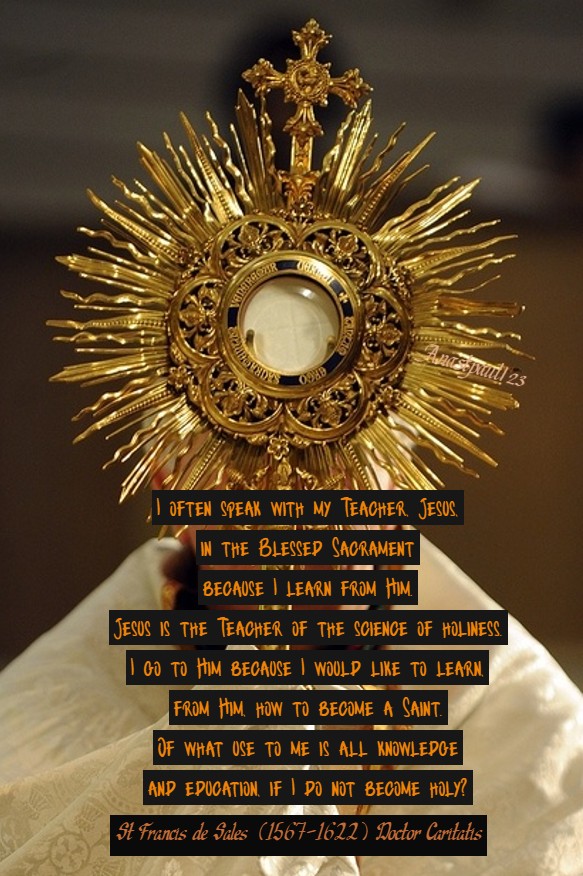
I often speak with my Teacher, Jesus,
in the Blessed Sacrament
because I learn from Him.
Jesus is the Teacher of the science of holiness.
I go to Him because I would like to learn,
from Him, how to become a Saint.
Of what use to me is all knowledge
and education, if I do not become holy?

St Francis de Sales (1567-1622)
Doctor of the Church

Posted in AUGUSTINIANS OSA, CHRIST the JUDGE, DOCTORS of the Church, FATHERS of the Church, FEASTS and SOLEMNITIES, HOLY COMMUNION, JANUARY month of THE MOST HOLY NAME of JESUS, ONE Minute REFLECTION, QUOTES on ENEMIES, QUOTES on JUSTICE, The HOLY EUCHARIST / The HOLY MASS, The HOLY NAME, The LAST THINGS, The WORD

One Minute Reflection – 31 May – Christ has hidden enemies.

One Minute Reflection – 31 May – Within the Octave of Corpus Christi – Mamorial of St Petronilla of Rome (1st Century) Virgin Martyr – 1 Corinthians 23-29; John 6:56-59 – Scripture search here: https://www.drbo.org/

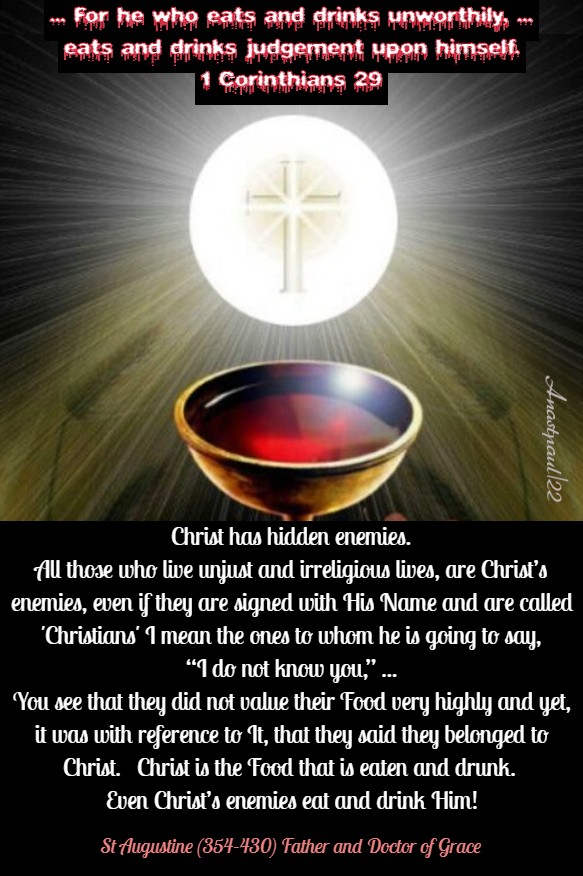
“ … For he who eats and drinks unworthily, … eats and drinks judgement upon himself.”- 1 Corinthians 29

REFLECTION – “Christ has hidden enemies. All those who live unjust and irreligious lives are Christ’s enemies, even if they are signed with His Name and are called ‘Christians’ – I mean the ones to whom he is going to say, “I do not know you and they say to Him, “Lord, in Thy Name we ate and drank. In Thy Name, we performed many deeds of power. What did we eat and drink in Thy Name?”

You see that they did not value their food very highly and yet, it was with reference to It that they said they belonged to Christ. Christ is the Food that is eaten and drunk. Even Christ’s enemies eat and drink Him! The faithful know the Lamb without spot on which they feed, if only they fed on It in such a way that they are not liable to punishment! The Apostle says, “Whoever eats and drinks unworthily, is eating and drinking judgement upon himself.” – St Augustine (354-430) Father and Doctor of Grace (Sermon 308).

PRAYER – Graciously hear us, O God our Saviour, that as we rejoice in the festival of blessed Petronilla, Thy Virgin, so may we be nourished by the food of her heavenly teaching that we may be enlightened by the fervour of her dedicated holiness.Through the same Jesus Christ, Thy Son our Lord, Who lives and reigns with Thee, in the unity of the Holy Ghost, God, world without end. Amen (Collect).

Posted in DOCTORS of the Church, FATHERS of the Church, MARIAN PRAYERS, MATER DOLOROSA - Mother of SORROWS, MAY - The Blessed Virgin MARY'S MONTH, Our MORNING Offering, PRAYERS of the SAINTS, SEPTEMBER-The SEVEN SORROWS of MARY and The HOLY CROSS

Our Morning Offering – 31 May – My Most Sorrowful LadyBy St Anselm (

Our Morning Offering – 31 May – “The Month of the Most Blessed Virgin Mother” and as it is Friday, we remember the Passion of Our Lord

My Most Sorrowful Lady
By St Anselm (1033-1109)
Marian Doctor
Magnificent Doctor

My most sorrowful Lady,
what can I say about the fountains,
that flowed from your most pure eyes,
when you saw your only Son before you,
bound, beaten and suffering?
What do I know of the flood,
that drenched your matchless face,
when you beheld your Son,
your Lord and your God,
stretched on the Cross without guilt,
when the flesh of your flesh,
was cruelly butchered by wicked me?
How can I judge
what sobs troubled your most pure breast
when you heard,
Woman, behold your son,”
and the disciple,
Behold, your Mother,”
when you received, as a son,
the disciple, in place of the Master,
the servant, for the Lord?
Amen

Posted in SAINT of the DAY

Saint of the Day – 31 May – Blessed Hermann of Marienstatt O.Cist. (1150-c1225) Abbot

Saint of the Day – 31 May – Blessed Hermann of Marienstatt O.Cist. (1150-c1225) Cistercian Monk and Abbot of the Himmerod Abbey; founding Abbot of Heisterbach and Marienstatt Monasteries, Hermann was a zealous and powerful administrator, blessed with the gifts of prophecy, visions and miracles, Born in 1150 in the Rhineland (in modern Germany) and died in c1225 in Himmerod, Germany of natural causes.

Hermann is mentioned as Abbot for the last time in 1225. Soon after, he seems to have lived as a simple Monk in Himmerod, where he died around that time. In the Cistercian Order’s calendar, the commemoration (memoria) of “the Blessed Abbot Hermann, who laid the foundations of Marienstatt and who was famous for his gift of prophecy and also for many other miraculous signs” is recorded on 31 May.

Hermann von Marienstatt , depiction from the Baroque period, Marienstatt Abbey

Hermann von Marienstatt was born in 1150 into a noble Rhenish family (Rhenish meaning ‘of the Rhine’). He was initially a Canon at the St Cassius and Florentius Monastery in Bonn but , in around 1175, he joined the Cistercian Abbey of Himmerod.

When, in 1177, the Archbishop of Cologne, Philipp von Heinsberg, offered the Cistercians the property of a defunct Augustinian Canonry on the Stromberg – today’s Petersberg in the Siebengebirge – as a donation, Monks from Himmerod, led by Hermann as founding Abbot, more than 10 years later, in 1189, finally complied and took over the former Monastery.

Due to the unfavourable mountain location, the Convent soon moved to the nearby valley of the Heisterbach (1192-1199), from which the new Abbey took the name Heisterbach. From 1195, Abbot Hermann worked in Himmerod again. Endowments by Cologne Burgrave Eberhard von Aremberg and his wife Adelheid von Molsberg prompted Himmerod, together with its daughter Monastery, Heisterbach, to undertake one last founding action. In 1212, under the proven leadership of our Blessed Hermann, twelve Monks settled near Neunkhausen ‘at the place of St Maria’ – since then known as Marienstatt. Disputes over inheritance law within the founding family soon forced the abandonment of this site. Thanks to a new foundation by the Counts of Sayn the Cistercians were able to gain a foothold in the Westerwald again. In this context, Hermann is now also attested in Marienstatt documents.

A Cistercian Monk in front of the Heisterbach Monastery, depicted according to a reconstructed drawing around 1930, in the new Heisterbach Monastery Church

These events were later given legend on 27 December 1324.and recorded in writing, in the “Marienstatter Tafeln” the document for the Consecration of the Church. This iconographically valuable document is now in the Rheinisches Landes Museum in Bonn. Its border is decorated with fictitious portraits of the Abbots, beginning with Hermann.

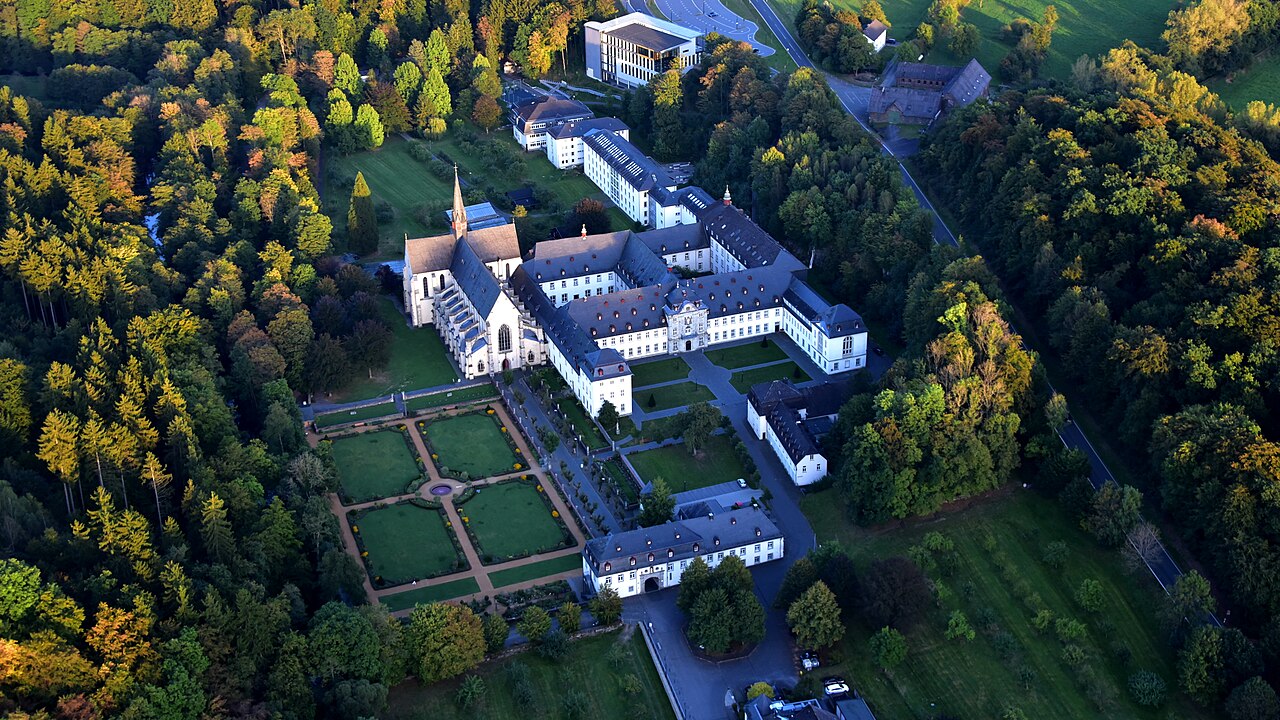
The Cistercian Marienstatt Monastery in 2016

The text tells us that the Mother of God appeared to the worried Abbot in a dream and showed him an alternative building site, where a “hawthorn bush” blooms in the middle of winter. Its branch still adorns the Abbey’s Coat of Arms today, see below.

Hermann had to manage the founding of two Monasteries which were made difficult by geographical disadvantage, inheritance disputes and, in the case of Heisterbach, resistance from the population. When this happened, the Cistercian movement had already passed its peak in the area and was facing competition from new religious movements. Perhaps this is one of the reasons for Hermann’s resignation and retirement.

Pilgrims visiting Marienstatt
Posted in DOMINICAN OP, SAINT of the DAY

Within the Corpus Christi Octave and the Saints for 31 May

Within the Corpus Christi Octave

St Alexander of Auvergne

St Crescentian of Sassari
St Donatian of Cirta
St Felice of Nicosia
St Galla of Auvergne
Blessed Hermann of Marienstatt O.Cist. (1150-c1225) Abbot
St Hermias of Comana

St Juan Moya Collado
Bl Kasper Gerarz
St Lupicinus of Verona
St Mancus of Cornwall
Bl Mariano of Roccacasale
St Mechtildis of Edelstetten
St Myrbad of Cornwall
Bl Nicholaus of Vangadizza
Bl Nicholaus of Vaucelles
St Nowa Mawaggali
St Paschasius of Rome

St Silvio of Toulouse
Bl Vitalis of Assisi
St Winnow of Cornwall

Posted in GOD ALONE!, HUMILITY-Fr Richard Clarke, QUOTES on HUMILITY, QUOTES on PRIDE

Thought for the Day – 30 May – The Deeper Foundations of Humility

Thought for the Day – 30 May – Meditations with Fr Richard Frederick Clarke SJ (1839-1900)

HUMILITY
Meditations for a Month

Chapter Four
The Deeper Foundations of Humility

The consciousness of past sin will not, of itself, give us the perfection of humility. It necessarily fixes the eye of the soul upon ourselves and our own doings, whereas perfect humility means the annihilation of self. We have a deeper and more solid foundation for this virtue in our own nothingness and the absence of any sort of good, save that which God has given us. Every gift of nature is simply a free gift from Him. All that is from ourselves is the marring and injuring of what we have received; the misuse of talents, money, position, influence. What folly, then, to pride ourselves on what belongs to God!

Regarding supernatural gifts, we are still mere nothing and less than nothing. Our natural gifts are put into our hands, they remain with us and are in some sense ours but, a supernatural gift requires a fresh giving immediately from the hand of God each time it is given us! We
cannot begin any supernatural work without His preventing grace; we cannot move a step in it without fresh grace to carry on; we cannot bring it to a successful issue, without the grace necessary to complete it. Do I realise, as I ought, this nothingness of myself and my absolute
and continual dependence upon God, for each thought or act, pleasing to Him?

If this is so, how can I be anything but humble? To pride myself on that which God does in me, would be ridiculous; to pride myself on what I can do of myself, would be to pride myself on all which mars and spoils the work of God.
What hast thou that thou hast not received?” asks St Paul.
Yes, O Lord, I have only one thing that I have not received and that is my vileness, misery, sin.
Can I boast of these!?

Posted in DOCTORS of the Church, DOMINICAN OP, EUCHARISTIC, EUCHARISTIC Adoration, FEASTS and SOLEMNITIES, HOLY COMMUNION, PRAYERS of the SAINTS

Quote/s of the Day – 30 May – The Solemnity of Corpus Christi

Quote/s of the Day – 30 May – The Solemnity of Corpus Christi, The Most Holy Body and Blood of Our Lord Jesus Christ

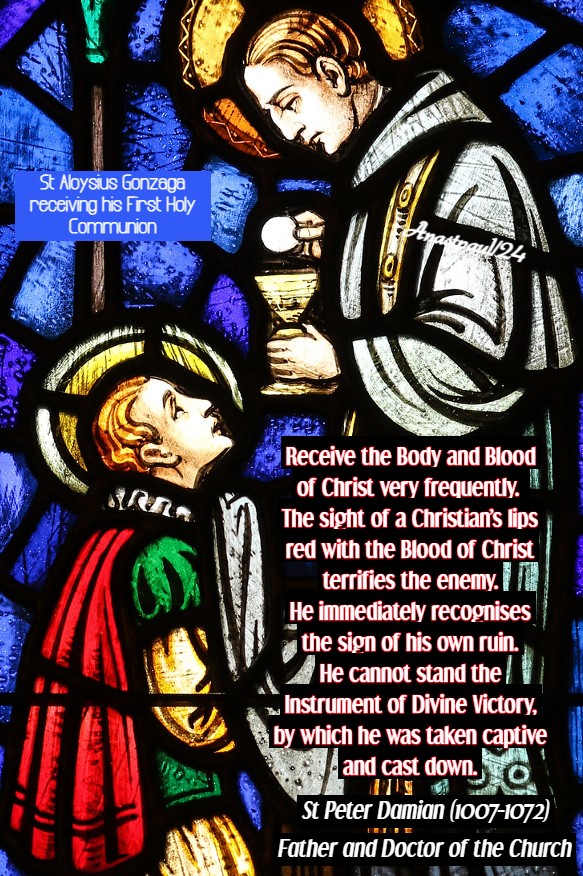
Receive the Body and Blood of Christ
very frequently. The sight of a Christian’s lips
red with the Blood of Christ terrifies the enemy.
He immediately recognises the sign of his own ruin.
He cannot stand the Instrument of Divine Victory,
by which he was taken captive and cast down.

St Peter Damian (1007-1072)
Doctor of the Church

Everything in us which is strong, steadfast,
firm, happy and joyful to carry out God’s commands,
bear with misfortune, act obediently, stand up for justice –
all these things come from this Bread’s strength,
this Wine’s gladness.
Happy are they whose deeds are strong and joyful!
And since no-one can do it of themselves,
happy are they who have an eager desire
to cleave to what is just and right
and to be strengthened in everything
and rejoice through Him
… ”

Baldwin of Canterbury (c1125-1190)
Cistercian Abbot of Forde Monastery and
Archbishop of Canterbury

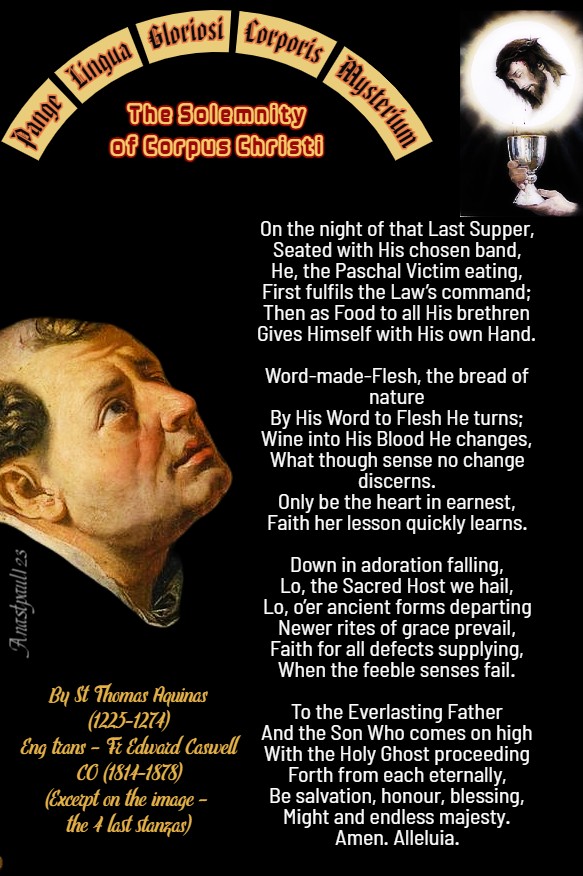
Pange Lingua Gloriosi Corporis Mysterium
Sing, My Tongue
By St Thomas Aquinas (1225-1274)

Eng trans – Fr Edward Caswell CO (1814-1878)
(Excerpt on the image – the 4 last stanzas)

Sing, my tongue, the Saviour’s glory,
Of His Flesh, the Mystery sing;
Of the Blood, all price exceeding,
Shed by our Immortal King,
Destined, for the world’s redemption,
From a noble Womb to spring.

Of a pure and spotless Virgin
Born for us on earth below,
He, as Man, with man conversing,
Stayed, the seeds of truth to sow;
Then He closed in solemn order
Wondrously His Life of woe.

On the night of that Last Supper,
Seated with His chosen band,
He, the Paschal Victim eating,
First fulfils the Law’s command;
Then as Food to all His brethren
Gives Himself with His own Hand.

Word-made-Flesh, the bread of nature
By His Word to Flesh He turns;
Wine into His Blood He changes,
What though sense no change discerns.
Only be the heart in earnest,
Faith her lesson quickly learns.

Down in adoration falling,
Lo, the Sacred Host we hail,
Lo, o’er ancient forms departing
Newer rites of grace prevail,
Faith for all defects supplying,
When the feeble senses fail.

To the Everlasting Father
And the Son Who comes on high
With the Holy Ghost proceeding
Forth from each eternally,
Be salvation, honour, blessing,
Might and endless majesty.
Amen. Alleluia.

Written by St Thomas Aquinas (1225-1274) the Angelic and Common Doctor of the Church, for the very first Solemnity of Corpus Christi, this Hymn is considered the most beautiful of Aquinas’ Hymns and one of the seven great Hymns of the Church.

The last two stanzas make up the Tantum Ergo (Down in Adoration Falling) which is used at Benediction of the Blessed Sacrament. The Hymn is also used on Maundy Thursday during the procession from the Sanctuary to the Altar of Repose, where the Blessed Sacrament is kept until Good Friday.

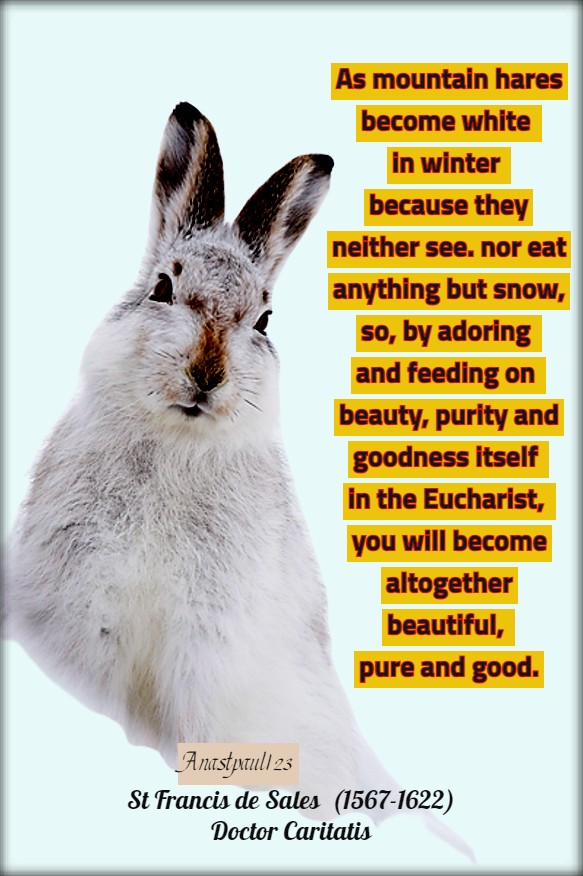
“As mountain hares become white in winter
because they neither see. nor eat
anything but snow,
so, by adoring and feeding on
beauty, purity and goodness itself
in the Eucharist,
you will become altogether
beautiful, pure and good.”

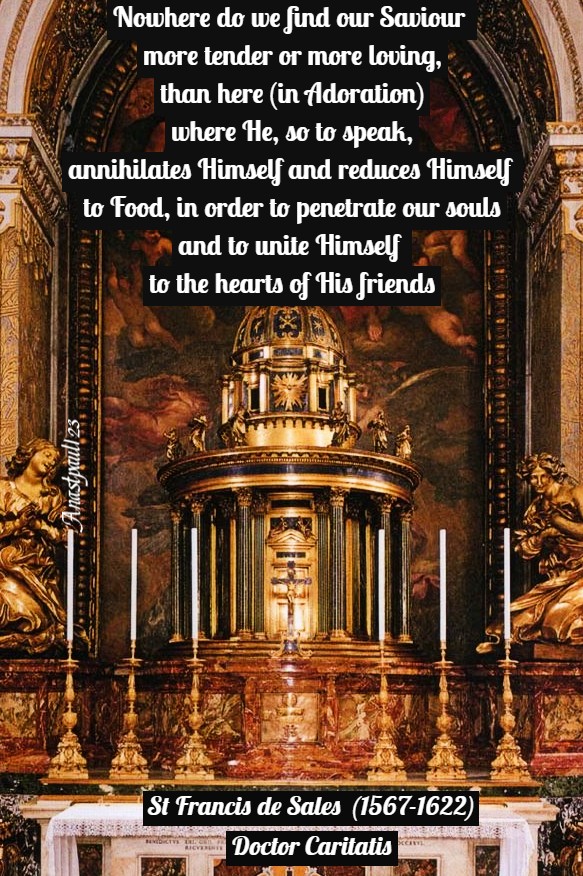
Nowhere do we find our Saviour
more tender or more loving,
than here [in Adoration]
where He, so to speak,
annihilates Himself and reduces Himself
to Food, in order to penetrate our souls
and to unite Himself
to the hearts of His friends.”

St Francis de Sales (1567-1622)
Doctor Caritatis

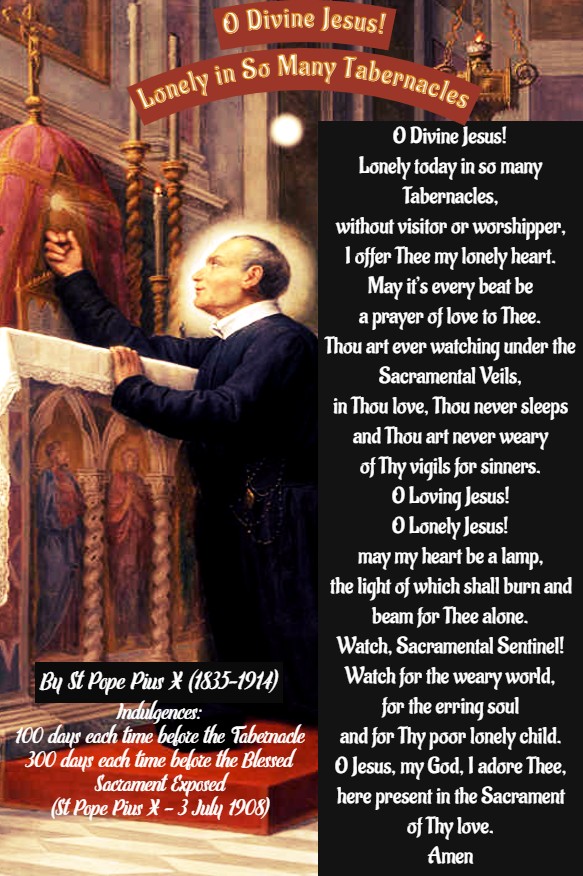
O Divine Jesus!
Lonely in So Many Tabernacles

By St Pope Pius X (1835-1914)
Pope of the Blessed Sacrament

O Divine Jesus!
Lonely today in so many Tabernacles,
without visitor or worshipper,
I offer Thee my lonely heart.
May it’s every beat be a prayer of love to Thee.
Thou are ever watching under the Sacramental Veils,
in Thou love, Thou never sleeps
and Thou are never weary of Thy vigils for sinners.
O Loving Jesus!
O Lonely Jesus!
may my heart be a lamp,
the light of which shall burn and beam
for Thee alone.
Watch, Sacramental Sentinel!
Watch for the weary world,
for the erring soul
and for Thy poor lonely child.

O Jesus, my God, I adore Thee,
here present in the Sacrament of Thy love.
Amen

Indulgences:
100 days each time before the Tabernacle
300 days each time before the Blessed Sacrament Exposed
(St Pope Pius X – 3 July 1908)
Prayers to the Sacred Heart

15th Ed 1936

MORE:
https://anastpaul.com/2023/06/11/quote-s-of-the-day-11-june-he-left-his-body-and-his-blood/

Posted in EUCHARISTIC Adoration, FEASTS and SOLEMNITIES, HOLY COMMUNION, ONE Minute REFLECTION, The HOLY EUCHARIST / The HOLY MASS
One Minute Reflection – 30 May – ‘ …Christ the Lord, for Whom we should ceaselessly hunger! …’St Columban

One Minute Reflection – 30 May – The Solemnity of Corpus Christi, The Most Holy Body and Blood of Our Lord Jesus Christ – 1 Corinthians 23-29; John 6:56-59– Scripture search here: https://www.drbo.org/

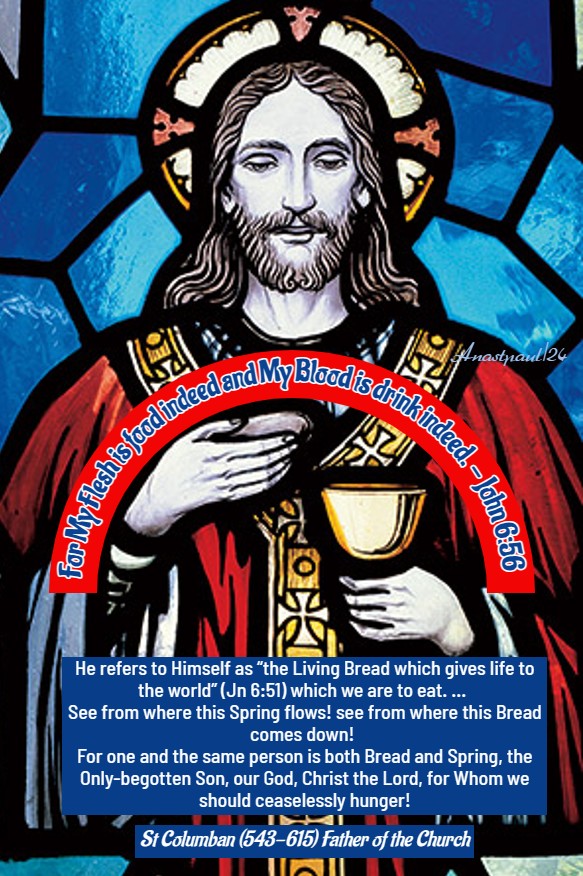
For My Flesh is food indeed and My Blood is drink indeed.” – John 6:56

REFLECTION – “Beloved brethren, quench your thirst at the waters of that Divine Spring we want to tell you about – quench it but do not extinguish it; drink but do not become satisfied. The Living Spring, the Source of Life, calls us and says: “Let anyone who thirsts come to Me and drink” (Jn 7:37). Understand what it is you are drinking. Let the Prophet tell you and let the Source Itself tell you: “Listen to the word of the Lord, they have forsaken Me the Source of Living Water” (Jer 2:13). So the Lord our God Himself, Jesus Christ, is He Who is that Source of Life and that is why He invites us to come to Him so that we might drink Him. Whoever loves Him, drinks Him; whoever feeds on the Word of God, drinks Him. … Drink, therefore, from this Source that others have forsaken!

That we might eat of this Bread and drink from this Spring … He refers to Himself as “the Living Bread which gives life to the world” (cf. Jn 6:51) which we are to eat. … See from where this Spring flows! see from where this Bread comes down! For one and the same person is both Bread and Spring, the Only-begotten Son, our God, Christ the Lord, for Whom we should ceaselessly hunger!

It is our love which gives Him as food to us, our desire which makes us eat Him and when we have been satisfied, we desire Him still. Let us go to Him as to a fountain and drink of Him in our overflowing love, let us drink Him always with ever-new desire, finding our joy in the sweetness of His Love. The Lord is gentle and good. We eat and drink Him without ceasing to hunger and thirst for Him, for we cannot exhaust this Food and Drink. We eat of this Bread yet do not run out of it; we drink at this Spring, yet it does not run dry. This Bread is eternal; this Stream flows without end!” – St Columban (543-615) Father of the Church, Monk, Irish Missionary, Abbot, Writer, Reformer, Teacher, Miracle-worker, Founder of numerous Nonateries. (Spiritual instructions 12, 2, 3).

PRAYER – O God, Thou Who in this wondrous Sacrament has left us a memorial of Thy Passion, grant us, we beseech Thee, so to venerate the Sacred Mysteries of Thine Body and Blood that we may ever experience within ourselves, the effect of Thy redemption. Who lives and reignest with God the Father, in the unity of the Holy Ghost, God, world without end. Amen (Collect).

Posted in CONSECRATION Prayers, EUCHARISTIC, HOLY COMMUNION, MARIAN PRAYERS, Our MORNING Offering

Our Morning Offering – 30 May – On the Feast of Corpus Christi – Consecration to Our Lady of the Eucharist After Holy Communion

Our Morning Offering – 30 May – “The Month of the Blessed Virgin Mother” – Corpus Christi!

Consecration to Our Lady of the Eucharist
After Holy Communion

By the Claretian Fathers Teaching Ministry
Order founded by St Anthony Mary Claret (1807-1870)

Mary is called Our Lady of the Eucharist, because
without her, there would be no physical Body of Jesus
to be present in the Eucharist.
 (See John 6:51)

Most kind Mother,
we consecrate to thee, our bodies,
which have just been
honoured and sanctified,
by the presence of thy Divine Son,
our souls which have
conversed with Him
and our hearts which have loved Him.
O dearest Mother,
may the words which we have spoken, be made
acceptable to Him. through thy intercession.
Tell Him the things which we should have said
but were unable to express.
Love Him and beseech Him for us,
thy poor children.
Receive and keep us in thine heart.
Warn us, protect us
and guide us during this day
that we may faithfully serve thy Divine Son
and please Him
in all our thoughts, desires and actions.
Amen

Posted in DOMINICAN OP, SAINT of the DAY

Saint of the Day – 30 May – Blessed Elisabeth Stagel OP (c1300-1360) Virgin

Saint of the Day – 30 May – Blessed Elisabeth Stagel OP (c1300-1360) Virgin, Prioress of the Order of Preachers, writer, friend and spiritual student of Blessed Henry Suso OP (1290-1365). Born in c1300 in Zurich, Switzerland and died in c1360 of natural causes at Töss Convent in Winterthur in Switzerland, where she was the Prioress. Also known as – Elisabeth Staglin, Elisabeth Steiglin, Elsbeth

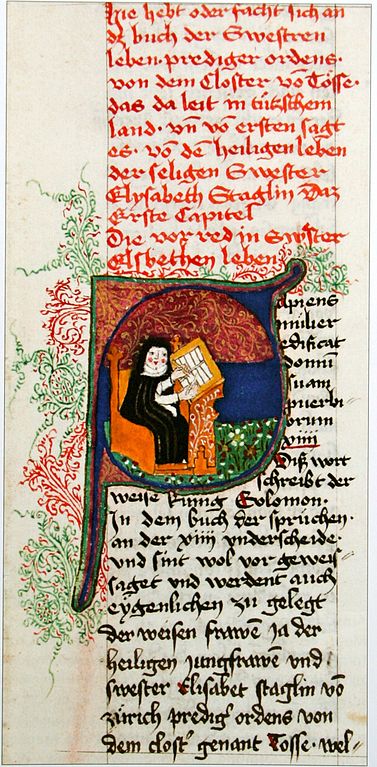
Bl Elisabeth Stagel depicted in a copy of Lives of the Nuns of Töss.

Elisabeth was born into a noble family of Zurich, the daughter of a City Councilor, Rudolf Stagel.

In 1336 she came into contact with the Blessed mystic Henry Suso and from that moment she was his pupil and soulmate. She developed a deep friendship with him and the two remained in active correspondence for the remainder of their lives. Bl Henry considered Elisabeth as his spiritual daughter.

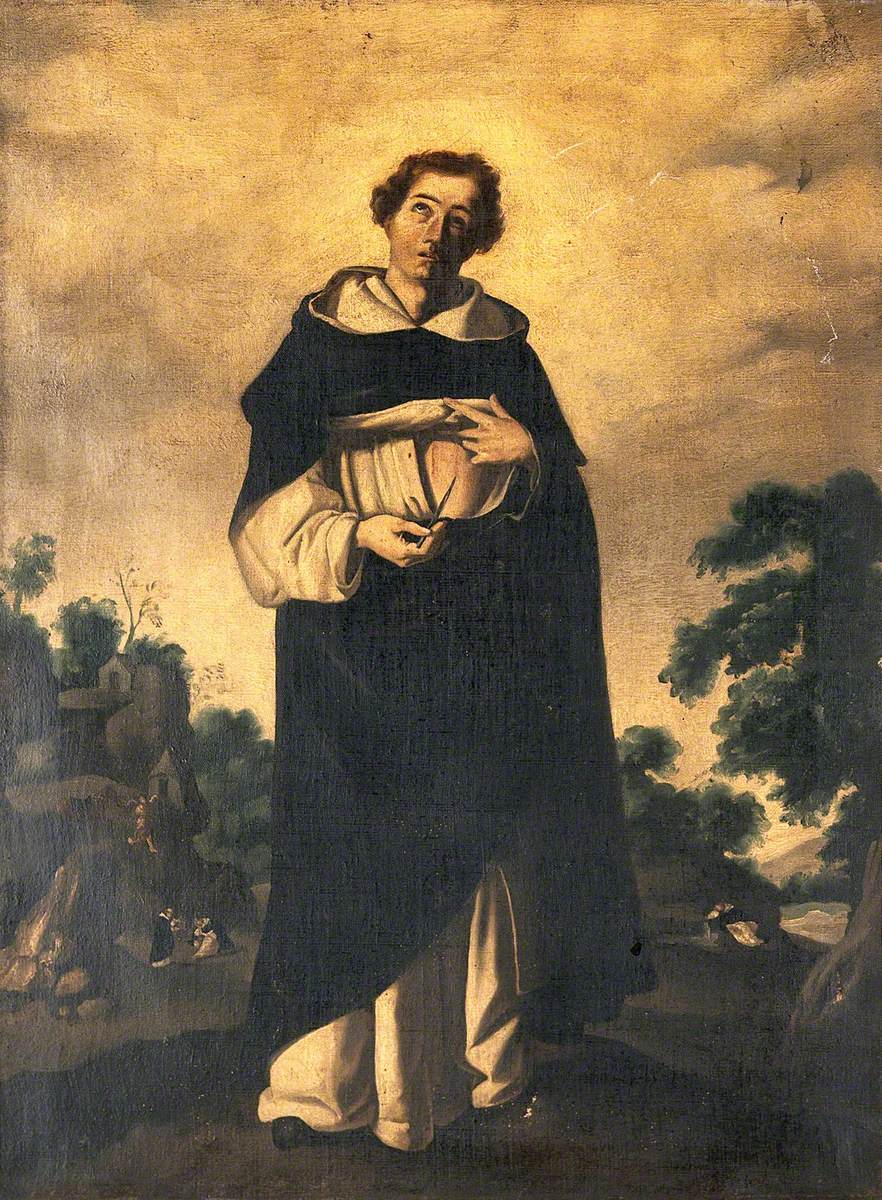
de Zurbaran, Francisco; The Blessed Henry Suso

During their conversations, Elisabeth asked Bl Henry to help her understand the pathway to God by sharing with her his own experiences. However, Suso did not know that the well-educated nun was keeping the letters he sent her and recording all that Suso told her, concerning both theological matters and his extreme practices of personal penance. When he learned of her undertaking, he requested the texts and proceeded to burn them, saving only the second installment of manuscripts for the sake of educating other religious. Bl Henry thereafter forbade Elisabeth to imitate him by engaging in extreme asceticism, fearing for her health.

Elisabeth then authored the Lives of the Nuns of Töss, a work containing biographies of 39 nuns and providing a comprehensive picture of mysticism in the Töss Convent. Blessed Elisabeth of Hungary may have been one of the Nuns whose life Elisabeth described.

Elisabeth died in Töss in 1360 and was probsbly buried there.

Blessed Elisabeth’s book is integral to understanding mysticism and monastic life in medieval Germany.

The former Töss Monastery in a drawing by the Historian, Heinrich Murer (17th Century)
Posted in DOMINICAN OP, FEASTS and SOLEMNITIES, MARIAN TITLES, SAINT of the DAY

The Solemnity of Corpus Christi, The Most Holy Body and Blood of Our Lord Jesus Christ, Dedication of the Church of MonteVergine, near Naples, Italy (1126) and the Saints for 30 May

The Solemnity of Corpus Christi, The Most Holy Body and Blood of Our Lord Jesus Christ:
Corpus Christi

The Feast is liturgically celebrated on the Thursday after Trinity Sunday
https://anastpaul.com/2022/06/16/the-festival-of-corpus-christi/

St Anastasius II of Pavia
St Basil the Elder
St Crispulus of Sardinia
Blessed Elisabeth Stagel OP (c1300-1360) Virgin, Prioress of the Order of Preachers
St Emmelia
St Euplius
St Exuperantius of Ravenna
St Gamo of Brittany
St Gavino of Sardinia
St Isaac of Constantinople
Bl Lawrence Richardson
St Luke Kirby
St Madelgisilus
St Reinhildis of Riesenbeck
St Restitutus of Cagliari
Bl Richard Newport

St Venantius of Lérins
St Walstan of Bawburgh
Bl William Filby
Bl Willilam Scott

Posted in DIVINE Mercy, Goodness, Patience, HUMILITY-Fr Richard Clarke, QUOTES on GRACE, QUOTES on HUMILITY, QUOTES on REPENTANCE, QUOTES on SIN

Thought for the Day – 29 May – The Foundation of Humility

Thought for the Day – 29 May – Meditations with Fr Richard Frederick Clarke SJ (1839-1900) SJ

HUMILITY
Meditations for a Month

Chapter Three
The Foundation of Humility

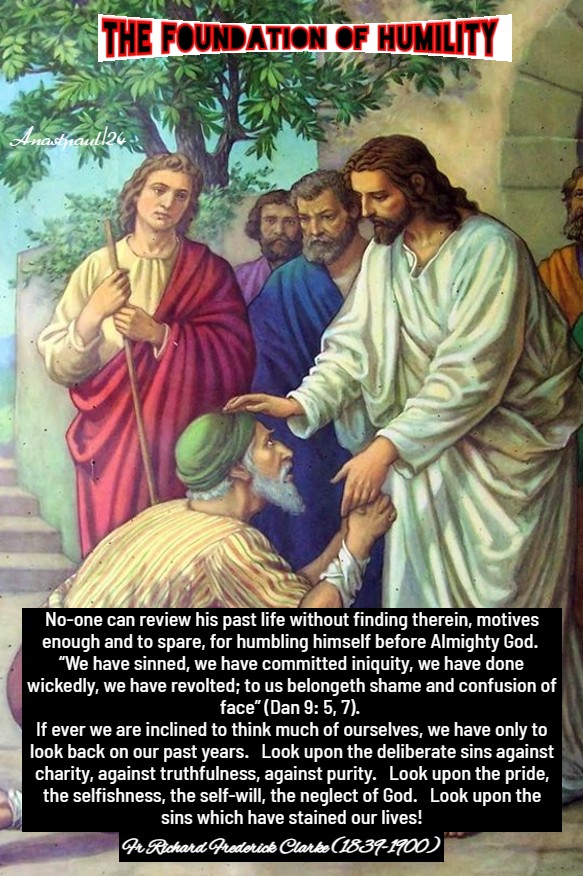
No-one can review his past life without finding therein, motives enough and to spare, for humbling himself before Almighty God. “We have sinned, we have committed iniquity, we have done
wickedly, we have revolted; to us belongeth shame and confusion of face
” (Dan 9: 5, 7). If ever we are inclined to think much of ourselves, we have only to look back on our past years. Look upon the deliberate sins against charity, against truthfulness, against purity. Look upon the pride, the selfishness, the self-will, the neglect of God. Look upon the sins which have stained our lives!

Besides actual sins, how many infidelities to grace have we committed! God has been so liberal with His graces and I have been so negligent in availing myself of them. How many I might have earned if I had been faithful and had not willfully turned aside from what God asked of me,
to follow my own will and pleasure. What cause for humiliation of myself! If others who have perhaps lived and died in sin had had my graces, would they not have made a far better use of them than I have made? To me, O God, shame and confusion of face! I must throw myself on Thy mercy and humbly beg forgiveness.

When, moreover, I look at what I now am, I find fresh cause for humbling myself. I might have been a Saint if I had been more faithful and now I am one of the vilest of sinners. My soul in the sight of God is disfigured by sin, as a body is by the ulcers and sores that spoil its natural beauty and comeliness. I abound with faults innumerable. I am unworthy to appear in the presence of God.
“O hide Thy face from my sins, blot out all my iniquities!”

Posted in CARMELITES, GOD ALONE!, QUOTES on DEATH, QUOTES on LOVE of GOD, QUOTES on PRIDE, QUOTES on SELF-DENIAL, QUOTES on SUFFERING, SAINT of the DAY, SELF-DISTRUST

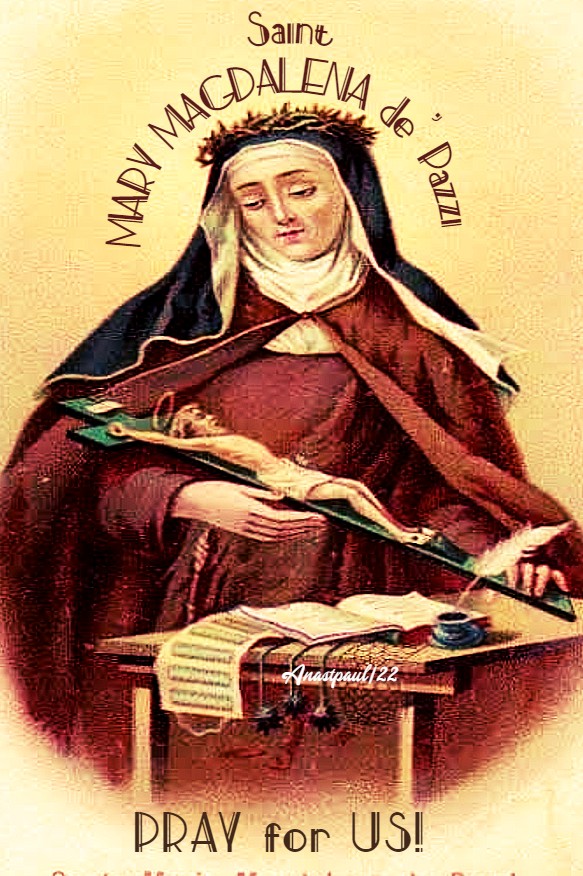
Quote/s of the Day – 29 May – St Maria Magdalena de’ Pazzi

Quote/s of the Day – 29 May – St Maria Magdalena de’ Pazzi O.Carm (1566-1607) Virgin

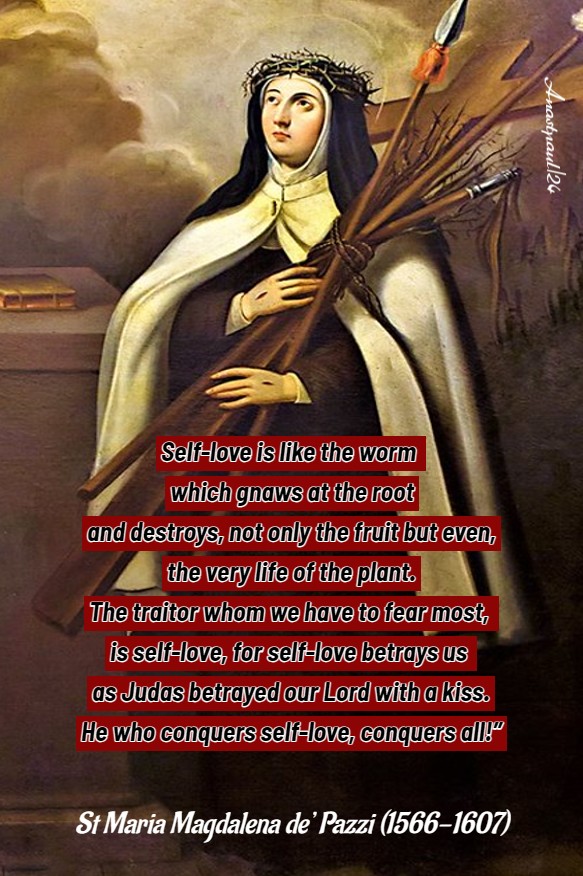
Self-love is like the worm which gnaws at the root
and destroys, not only the fruit but even,
the very life of the plant.
The traitor whom we have to fear most, is self-love, f
or self-love betrays us as Judas
betrayed our Lord with a kiss.
He who conquers self-love, conquers all!

I do not desire to die soon
because, in Heaven, there is no suffering.
I desire to live a long time
because, I yearn to suffer much
for the love of my Spouse.

MORE:
https://anastpaul.com/2022/05/29/quote-s-of-the-day-29-may-st-maria-magdalena-de-pazzi/

St Maria Magdalena de’ Pazzi (1566-1607)

Posted in CHRIST the WORD and WISDOM, FATHERS of the Church, GOD ALONE!, ONE Minute REFLECTION, PRACTISING CATHOLIC, QUOTES on SACRED SCRIPTURE, QUOTES on THE VOICE OF GOD, The WORD

One Minute Reflection – 29 May – ‘… Those who want to be favourably listened to by God, must begin by listening to God. …’

One Minute Reflection – 29 May – “The Month of the Blessed Virgin Mother of God” – St Maria Magdalena de’ Pazzi O.Carm (1566-1607) Virgin – 2 Corinthians 10:17-18; 11:1-2; Matthew 25:1-13 – Scripture search here: https://www.drbo.org/

Amen I say to you, I know you not.” – Matthew 25:12

REFLECTION – “Pay attention, dear brothers – the holy Scriptures were passed onto us, so to speak, like letters come from our homeland. Our homeland, indeed, is paradise; our forebears are the Patriarchs, the Prophets, the Apostles and the Martyrs; our fellow countrymen, the Angels; our King, Christ. When Adam sinned, we were thrown into the exile, as it were, of this world. But because our King is faithful and merciful, more than we can imagine or express, He deigned to send us the holy Scriptures through the Patriarchs and the Prophets, as the letters of invitation, with which He invites us to our eternal and original homeland. … Because of His unspeakable Kindness, He has invited us to reign with Him.

In these conditions, what idea do they have of themselves, these servants who do not deign to read the letters which invite us to the happiness of the Kingdom? … “If anyone does not acknowledge this, he is not acknowledged” (1 Cor 14:38). Certainly, the one who neglects to look for God in this world, by reading the Sacred texts, God, in His turn, will refuse to admit him to eternal happiness. He should fear that he may find the doors locked, leaving him outside with the foolish virgins (Mt 25:10) and that he might hear: “ I do not know who you are, I do not know you, depart from me, all you evildoers. ” … Those who want to be favourably listened to by God, must begin by listening to God. How could we have the effrontery to want God to listen to us favourably, if we attach so little importance to Him that we neglect to read His precepts!?” – St Caesarius of Arles (470-543) Bishop, Father of the Church (Sermons – 7).

PRAYER – O God, lover of chastity, Who endowed with heavenly gifts, blessed Mary Magdalena, a virgin on fire with love for You, grant that we, who keep this feast-day in her honour, may imitate her by purity and love. Through Jesus Christ, Thy Son our Lord, Who lives and reigns with Thee, in the unity of the Holy Ghost, God, world without end. Amen (Collect).

Posted in CARMELITES, DOCTORS of the Church, MAY - The Blessed Virgin MARY'S MONTH, Our MORNING Offering, PRAYERS of the SAINTS

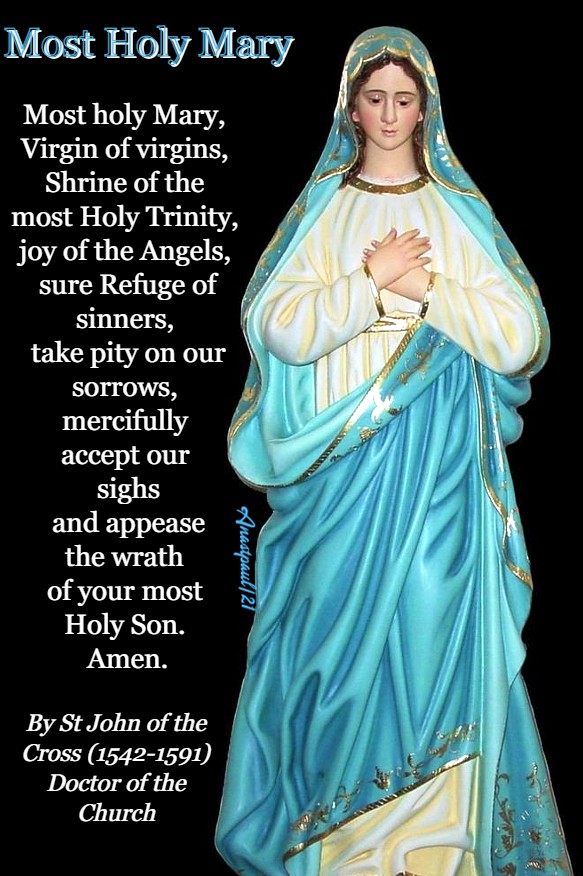
Our Morning Offering – 29 May – Most Holy Mary By St John of the Cross

Our Morning Offering – 29 May – “The Month of the Blessed Virgin Mother of God” –

Most Holy Mary
By St John of the Cross (1542-1591)
Doctor of the Church

Most holy Mary,
Virgin of virgins,
Shrine of the most Holy Trinity,
joy of the Angels,
sure Refuge of sinners,
take pity on our sorrows,
mercifully accept our sighs
and appease the wrath
of your most holy Son.
Amen.

Posted in SAINT of the DAY

Saint of the Day – 29 May – Saint Gerard of Mâcon (Died 926) Bishop

Saint of the Day – 29 May – Saint Gerard of Mâcon (Died 926) Bishop of Mâcon, France for 40 years, ruling from 886 until his death in 926. Uncertainty surrounds his place and date of birth, some indicate it in Belgium, others in Flanders but we do know that he died in a hermitage at Brou near Bourg-en-Bresse in France. Patronages – of Bourg-en-Bresse, Brou and several other French Towns. Also known as – Gerardo, Gérard, Gérald, Girard or Gérard, Gerard of Brou,

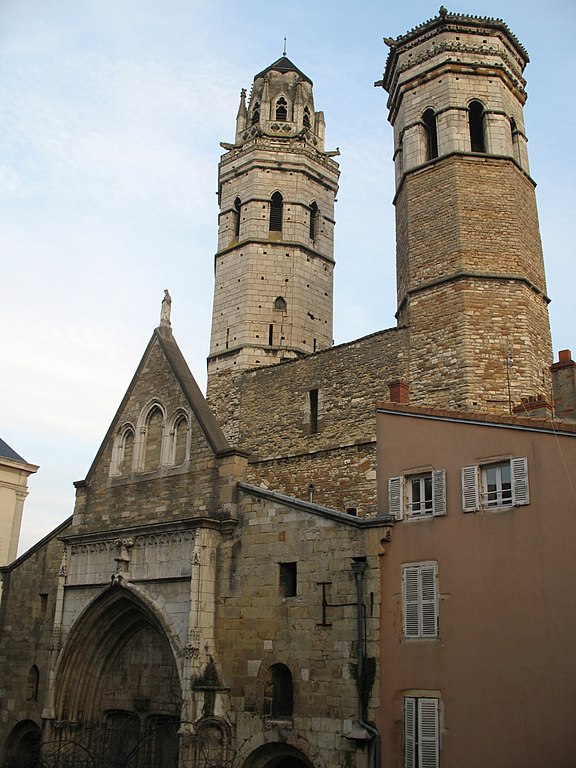
The Old Cathedral of Mâcon

Whilst biographical information on Saint Gerard is conflicting. The oldest sources, such as the Episcopal records and catalogues of Mâcon, place our Saint in the 9th Century, other scholars hypothesise an earlier era. However, less debated is his monastic training at the Abbey of Ainay, a renowned centre of culture and religious piety. The experience within the monastic community undoubtedly shaped his spirit and prepared him for his future Episcopal role.

Around the year 886, Gerard was Consecrated Bishop of Mâcon, a Diocese located in the turbulent region of Burgundy. His Episcopate, which lasted for forty years, coincided with a complex historical period, marked by feudal struggles and Norman incursions. In this stormy context, Gerard stood out as a tenacious and wise leader, capable of defending the rights of the Church and its people.

His participation in the Council of Chalon-sur-Saône in 886 testifies to his commitment to re-establishing ecclesiastical order and discipline, countering the interference of lay people in religious matters.

Despite his dedication to his flock, Gerard was not immune to hardship and disillusionment. Tired of the constant battles with the local lords and wanting a more contemplative life, he decided to retire to Brou, a Town near Bourg-en-Bresse. Here he founded a Monastery and a Church, dedicating himself to prayer and meditation. The hermit choice did not mean an abandonment of his pastoral commitment, for Gerard continued to receive visitors and dispense spiritual advice. His reputation for sanctity spread rapidly, attracting numerous pilgrims to Brou.

Saint Gerard died in 926. His remains were initially buried in the Church he had founded in Brou. Subsequently, after 958, they were transferred to the Church of Saint-Pierre in Mâcon, where they are still venerated today. His memory is still celebrated today on 29 May. Saint Gerard is considered the Patron Saint of Bourg-en-Bresse, Brou and several other French Towns.

Posted in INCORRUPTIBLES, MARIAN TITLES, SAINT of the DAY

Notre-Dame des Ardents / Our Lady of Ardents, France (1095), St Maria Magdalena de’ Pazzi O.Carm and the Saints for 29 May

St Conon the Elder
St Conon the Younger
St Daganus
St Eleutherius of Rocca d’Arce
St Felix of Atares
St Gerard of Mâcon (Died 926) Bishop of Mâcon, France
Bl Gerardesca of Pisa
Bl Giles Dalmasia
St Hesychius of Antioch
St John de Atarés

St Maximus of Verona
St Restitutus of Rome
Bl Richard Thirkeld
St Theodosia of Caesarea and Companions
St Votus of Atares

Posted in "Follow Me", CHRIST, the WAY,TRUTH,LIFE, HUMILITY-Fr Richard Clarke, QUOTES on HUMILITY

Thought for the Day – 28 May – The Obligation of Humility

Thought for the Day – 28 May – Meditations with Fr Richard Frederick Clarke SJ (1839-1900) SJ

HUMILITY
Meditations for a Month

Chapter Two
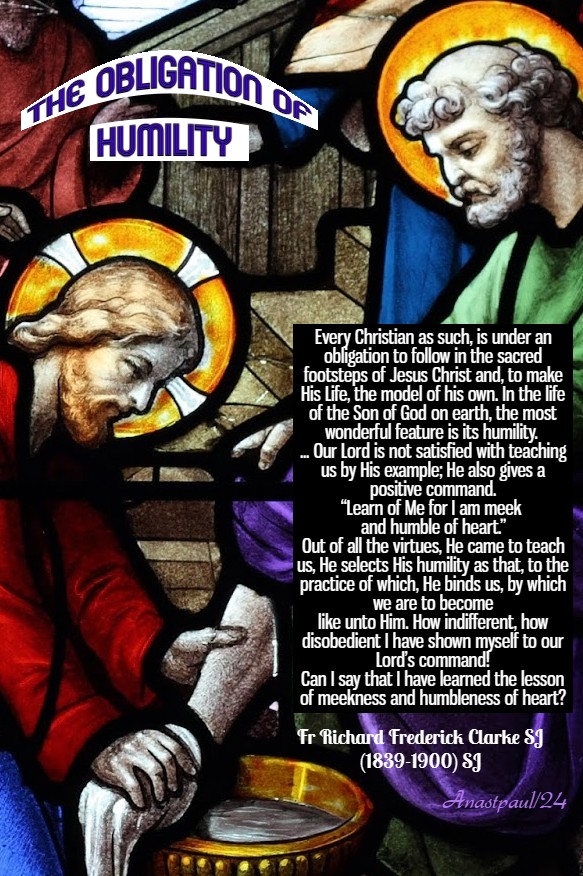
The Obligation of Humility

Every Christian as such, is under an obligation to follow in the sacred footsteps of Jesus Christ and, to make His Life, the model of his own. In the life of the Son of God on earth, the most wonderful feature is its humility. That the omnipotent God should so humble Himself as to take the form of the lowest of the rational creatures He has made, is an almost incredible marvel.
The condescension, the lowering of Himself which is involved in it, altogether passes our power of comprehension. He could not have stooped so low unless He had been God. Thus, His humility
becomes the characteristic feature of the Incarnation and, in proportion, as we lower ourselves, we imitate Jesus upon earth.

Our Lord is not satisfied with teaching us by His example; He also gives a positive command.
“Learn of Me for I am meek and humble of heart.”
Out of all the virtues, He came to teach us, He selects His humility as that, to the practice of which, He binds us, by which we are to become
like unto Him. How indifferent, how disobedient I have shown myself to our Lord’s command!

Can I say that I have learned the lesson of meekness and humbleness of heart?

We are also bound to practice humility as children of the Catholic Church. Humility and submission is the very essence of her teaching — subjection to God, subjection to all lawful authority, subjection of will and intellect to the Dogmas of Faith. He who is not content with
subjection, cannot be a really good Catholic and no-one can love subjection without humility.
Examine your own heart, to find whether you rejoice in being subject, for Christ’s sake.

Posted in "Follow Me", CHRIST, the WAY,TRUTH,LIFE, FATHERS of the Church, GOD ALONE!, QUOTES on The SOUL

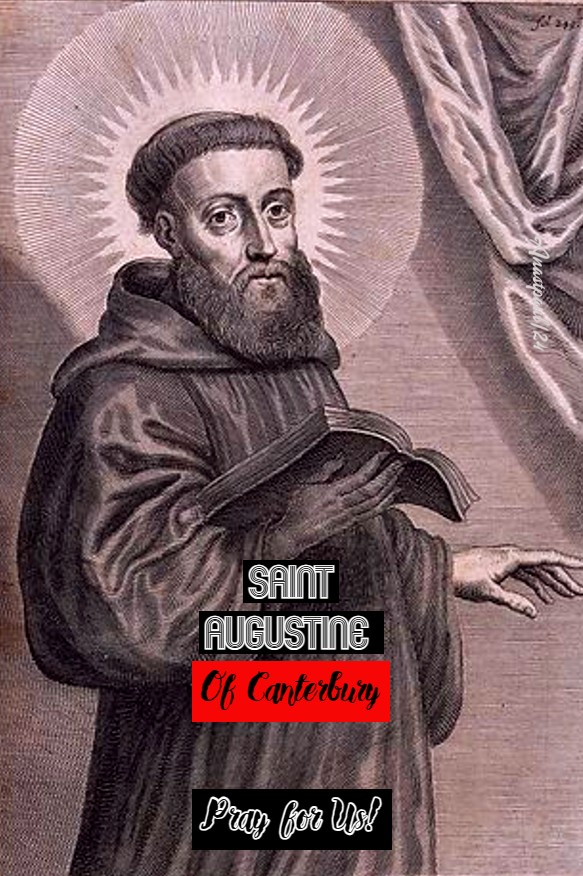
Quote/s of the Day – 28 May – St Augustine of Canterbury

Quote/s of the Day – 28 May – St Augustine of Canterbury (Died c605) He is consideredthe Founder of the English Church and “The Apostle to the English.” He is the first Archbishop of Canterbury, Confessor, Missionary, Father of the Church.

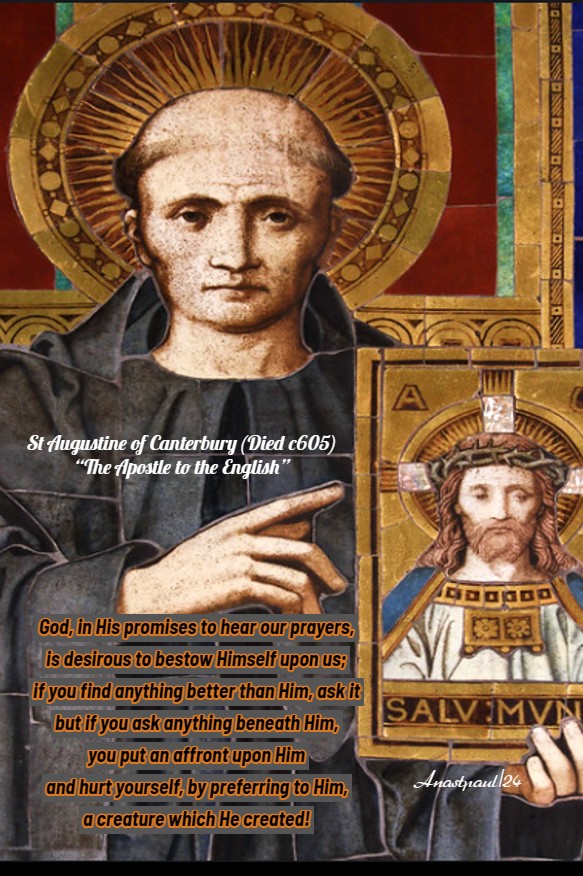
God, in His promises to hear our prayers,
is desirous to bestow Himself upon us;
if you find anything better than Him, ask it
but if you ask anything beneath Him,
you put an affront upon Him
and hurt yourself, by preferring to Him,
a creature which He created!

Pray in the spirit and sentiment of love,
in which the royal Prophet said to Him,
‘Thou, O Lord, art my portion.’
Let others choose to themselves,
portions among creatures,
for my part, Thou art my portion,
Thou alone I have chosen
for my whole inheritance.

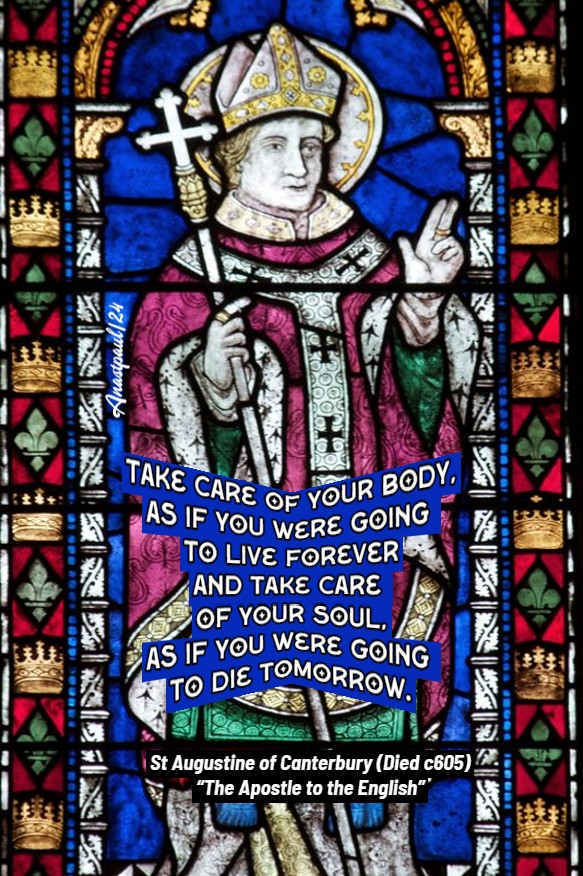
Take care of your body,
as if you were going to live forever
and take care of your soul,
as if you were going to die tomorrow.

St Augustine of Canterbury (Died c605)
“The Apostle to the English”

Posted in DOCTORS of the Church, FATHERS of the Church, I BELIEVE!, ONE Minute REFLECTION, QUOTES on FAITH, QUOTES on MYSTERIES of our FAITH, QUOTES on PEACE, The WORD

One Minute Reflection – 28 May – Into whatever house you enter, first say: Peace be to this house … Luke 10:5

One Minute Reflection – 28 May – “The Month of the Blessed Virgin Mary” – St Augustine of Canterbury (Died c 605) He is consideredthe Founder of the English Church and “The Apostle to the English.” He is the first Archbishop of Canterbury, Confessor, Missionary, Father of the Church. – 1 Thessalonians 2:2-9; Luke 10:1-9 – Scripture search here: https://www.drbo.org/

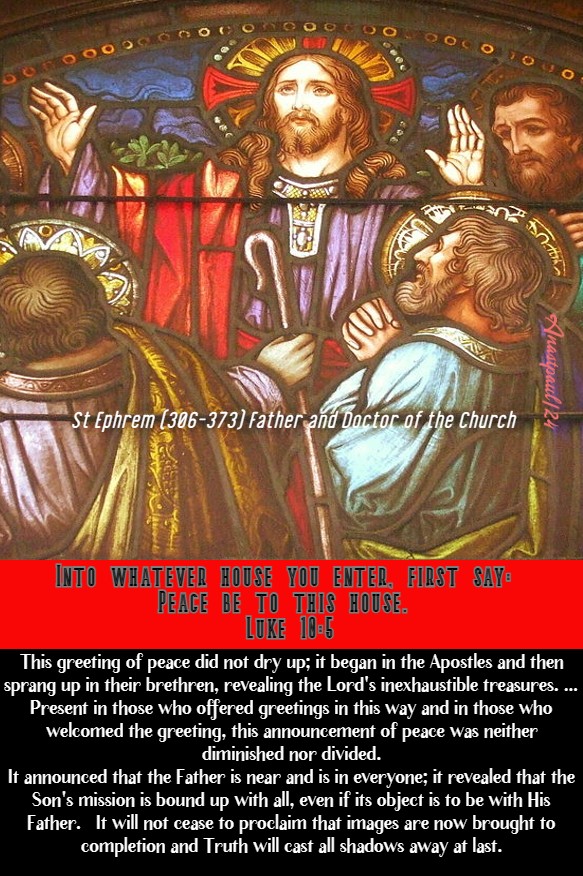
Into whatever house you enter, first say: Peace be to this house.
And, if the son of peace be there, your peace shall rest upon him but if not, it shall return to you.
” – Luke 10:5-7

REFLECTION – “As you enter a house, first say, ‘Peace to this house,‘” (Lk 10:5) so that the Lord Himself might enter and remain there, as with Mary. … This greeting is the Mystery of Faith which shines forth in the world. Through it, enmity is stifled, war is ended and people acknowledge one another. The effect of that greeting was hidden by a veil in spite of the fact that it prefigures the Mystery of the Resurrection … when the light rises and dawn chases night away. From the moment Christ sent out His disciples, people began to give and receive this greeting, a source of healing and blessing. …

This greeting with its hidden power … is amply sufficient for us all. That is why Our Lord sent it out, together with His disciples, as forerunner, so that it might bring about peace and, carried by the voice of the Apostles whom He sent, prepare the way before them. It was sown in every dwelling … it entered into all who heard it, so as to separate and set apart, the children it recognised as its own. It remained in them but it denounced those who were alien to it, for they did not welcome it.

This greeting of peace did not dry up; it began in the Apostles and then sprang up in their brethren, revealing the Lord’s inexhaustible treasures. … Present in those who offered greetings in this way and in those who welcomed the greeting, this announcement of peace was neither diminished nor divided. It announced that the Father is near and is in everyone; it revealed that the Son’s mission is bound up with all, even if its object is to be with His Father. It will not cease to proclaim that images are now brought to completion and Truth will cast all shadows away at last.” – St Ephrem (306-373) Father and Doctor of the Church (Diatessaron 8: 3-4).

PRAYER – O God, Who graciously enlightened the English peoples with the light of the True Faith by the preaching and miracles of the blessed Augustine, Thy Confessor and Bishop, grant, through his intercession that the hearts of those who have strayed, may return to the unity of the True Faith and that, we may be in harmony with Thine Will. Through Jesus Christ, Thy Son our Lord, Who lives and reigns with Thee, in the unity of the Holy Ghost, God, world without end. Amen (Collect).

Posted in MARIAN HYMNS, MARIAN POETRY, MAY - The Blessed Virgin MARY'S MONTH

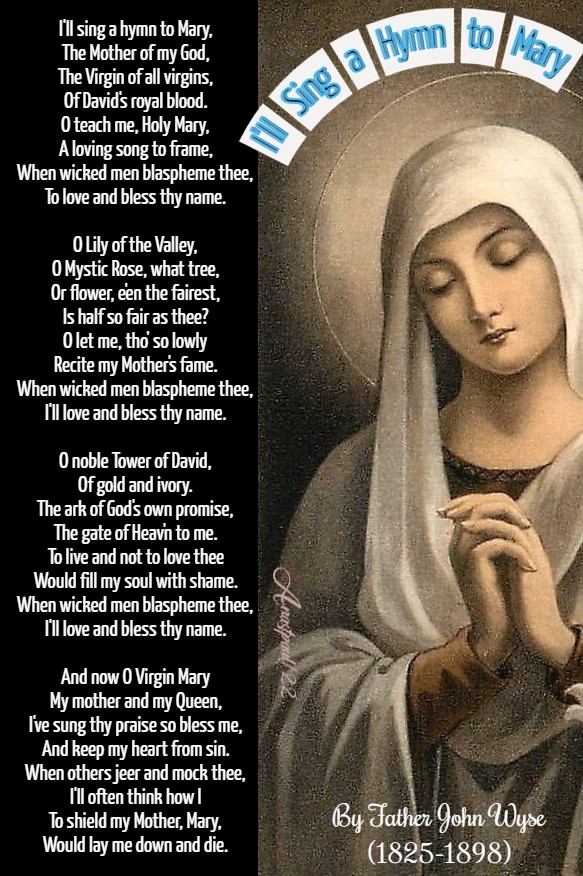
Our Morning Offering – 28 May – I’ll Sing a Hymn to Mary

Our Morning Offering – 28 May – “The Month of the Blessed Virgin Mary” – As we face the last few days of the special month of our Queen and Mother, we kneel at her feet in love, veneration and supplication and implore her unfailing protection and refuge. I cannot imagine how anyone may reach our goal of eternal life and weave their way through this vale of tears, without our Most Blessed Mother!

I’ll Sing a Hymn to Mary
By Father John Wyse (1825-1898)
Irish Priest and Hymn writer

I’ll sing a hymn to Mary,
The Mother of my God,
The Virgin of all virgins,
Of David’s royal blood.
O teach me, Holy Mary,
A loving song to frame,
When wicked men blaspheme thee,
To love and bless thy name.

O Lily of the Valley,
O Mystic Rose, what tree,
Or flower, e’en the fairest,
Is half so fair as thee?
O let me, tho’ so lowly
Recite my Mother’s fame.
When wicked men blaspheme thee,
I’ll love and bless thy name.

O noble Tower of David,
Of gold and ivory.
The ark of God’s own promise,
The gate of Heav’n to me.
To live and not to love thee
Would fill my soul with shame.
When wicked men blaspheme thee,
I’ll love and bless thy name.

When troubles dark afflict me
In sorrow and in care,
Thy light doth ever guide me
O beauteous Morning Star.
Lo, I’ll be ever ready
Thy goodly help to claim,
When wicked men blaspheme thee,
To love and bless thy name.

The saints are high in glory,
With golden crowns so bright;
But brighter far is Mary,
Upon her throne of light.
Oh that which God did give thee,
Let mortal ne’er disclaim;
When wicked men blaspheme thee,
I’ll love and bless thy name.

But in the crown of Mary,
There lies a wonderous gem,
As Queen of all the Angels,
Which Mary shares with them;
No sin hath e’er defiled thee,
So doth our faith proclaim;
When wicked men blaspheme thee,
I’ll love and bless thy name.

And now O Virgin Mary
My mother and my Queen,
I’ve sung thy praise so bless me,
And keep my heart from sin.
When others jeer and mock thee,
I’ll often think how I
To shield my Mother, Mary,
Would lay me down and die.

Verses 4, 5 and 6 omitted on image.

Posted in SAINT of the DAY

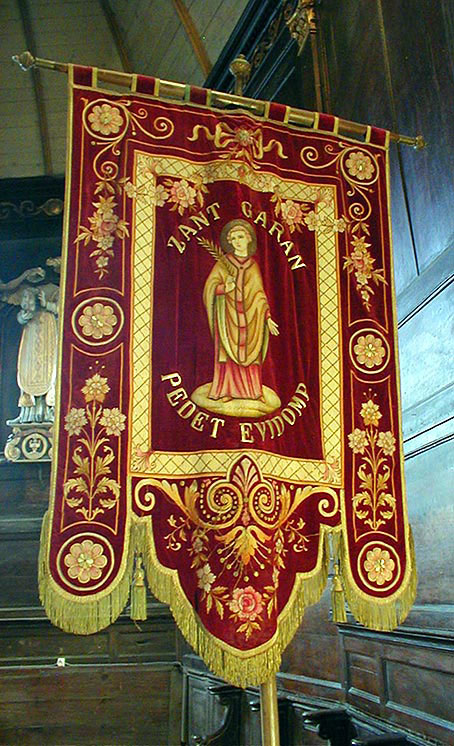
Saint of the Day – 28 May – Saint Caraunus of Chartres (5th Century) Deacon Martyr

Saint of the Day – 28 May – Saint Caraunus of Chartres (5th Century) Deacon Martyr, Missionary, Miracle-worker. Also known as – Caran, Carauno, Ceraunus, Cheron. Additional Memorial – 18 October (translation of Relics).

Although the precise date of the birth of Saint Caraunus is uncertain, hagiographic sources agree that it occurred in Rome in the 5th Century to a noble patrician family. His youth is shrouded in mystery, but it is assumed that he received an excellent education, typical of the Roman elite of the time.

A crucial event in his life was his conversion to Christianity. Embracing faith, Caraunus renounced the privileges and comforts of his aristocratic life to dedicate himself to spreading the Gospel.
Being Ordained as a Deacon, Carauno felt called to bring the Word of God to distant lands. He undertook a journey to Gaul, a region of modern-day France, where he preached Christianity with zeal and passion. His preaching touched several Cities, including Marseille, Lyon and Chartres.

News of his preaching reached the ears of some criminals who, blinded by greed, decided to ambush him. In a location not far from Chartres, where the village of Saint-Chéron stands today, Caraunus was attacked and barbarously killed.

The tomb of San Caraunus soon became a destination for pilgrimages. The faithful, attracted by the fame of his sanctity and by the miracles which occurred through his intercession, went to the place of Martyrdom to pray and ask for graces.

Statue in the Église Saint-Chéron de Cavan

A Chapel was built over the tomb which became the nucleus of a flourishing Monastery, documented as early as the 9th Century. The monastic community prospered for centuries, preserving the memory and devotion to the holy Martyr. However, during the French Revolution, the Monastery was suppressed and the Monks dispersed.
The Relics of our Saint, saved during the revolutionary desecrations, were, in 1849, placed in the new Church dedicated to him. Even today, the memory of St Caraunus is venerated in the Diocese of Chartres and in some others, including that of Paris. His Liturgical Feast is celebrated today 28 May.

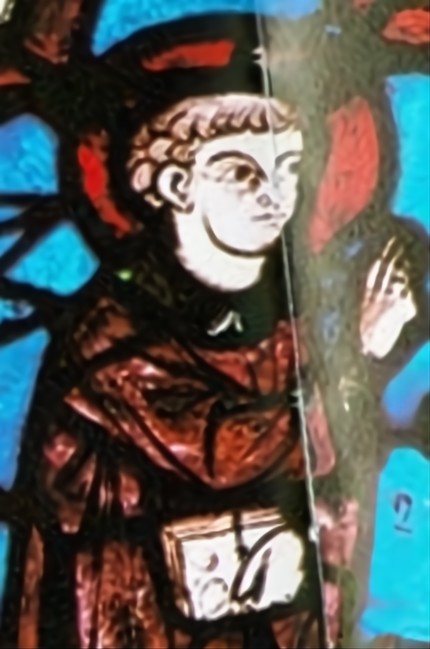
The devotion to St Caraunus is intertwined with a rich hagiographic tradition, narrated in a legendary Vita of the 9th Century. In it, historical elements are mixed with legendary ideas which also reflect the influence of other Saints’ lives. A fascinating 13th Century stained glass window, located in Chartres Cathedral, illustrates some scenes from the Saint’s legend, offering an artistic testimony to his veneration.

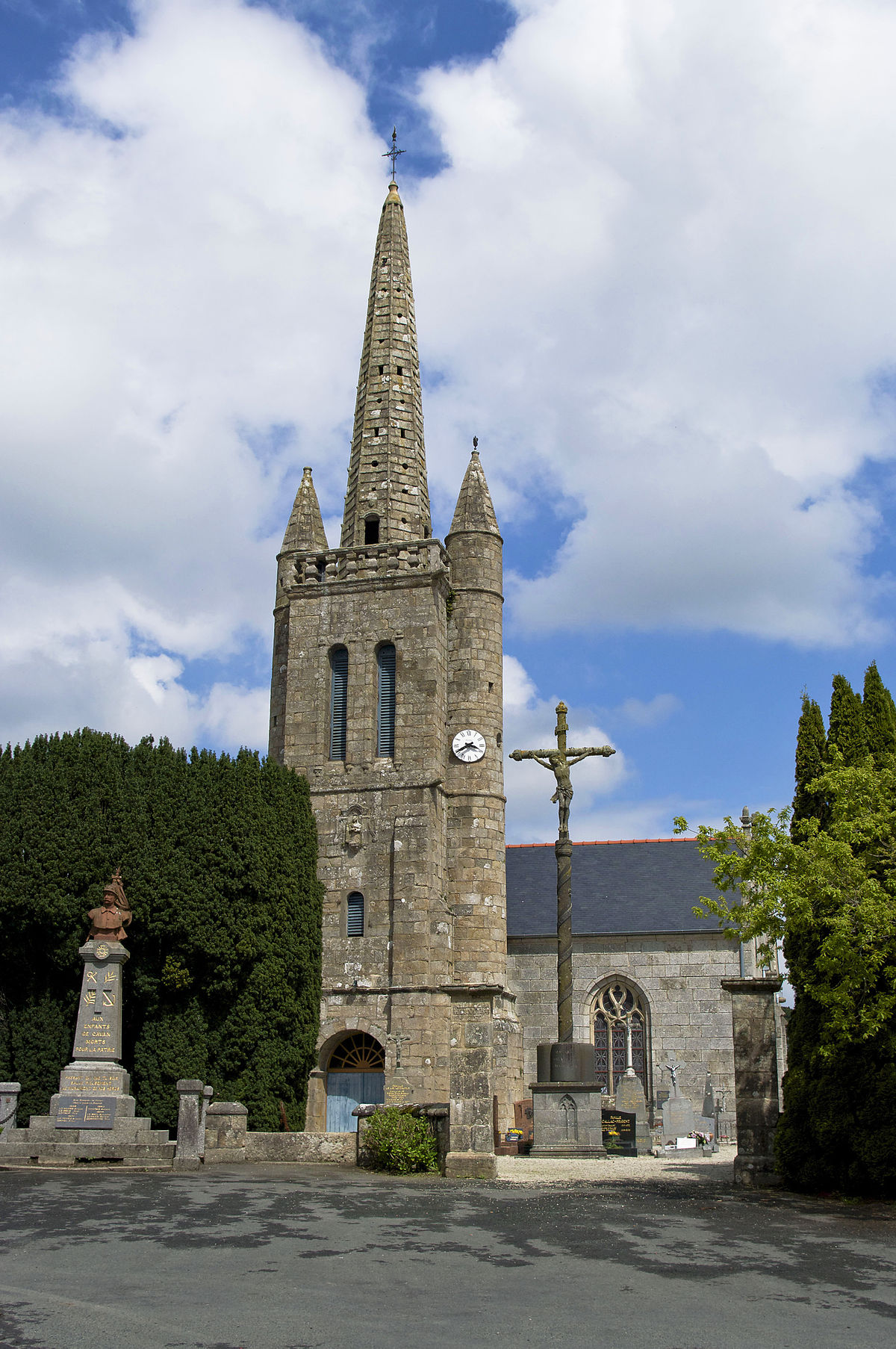
Église Saint-Chéron de Cavan
Posted in INCORRUPTIBLES, SAINT of the DAY

St Augustine of Canterbury and the Saints for 28 May

St Accidia
Bl Albert of Csanád
St Caraunus of Chartres (5th Century) Deacon Martyr
St Caraunus the Deacon
St Crescens of Rome
St Dioscorides of Rome
St Eoghan the Sage
St Gemiliano of Cagliari

Bl Heliconis of Thessalonica
St Helladius of Rome
St Herculaneum of Piegaro
Bl John Shert
St Justus of Urgell

St Luciano of Cagliari

Bl Mary of the Nativity
St Moel-Odhran of Iona
St Paulus of Rome
St Podius of Florence
Bl Robert Johnson
St Senator of Milan
Bl Thomas Ford
St Ubaldesca Taccini

Martyrs of Palestine: A group of early 5th Century Monks in Palestine who were Martyred by invading Arabs.

Posted in HUMILITY-Fr Richard Clarke, QUOTES on GRACE, QUOTES on HUMILITY, QUOTES on PRIDE, The KINGDOM of GOD / HEAVEN

Thought for the Day – 27 May – The Importance of Humility

Thought for the Day – 27 May – Meditations with Fr Richard Frederick Clarke SJ (1839-1900) SJ

The following pages are based, in great measure, on the beautiful little treatise issued by Our Holy Father, Pope Leo XIII on the subject of Humility. They can be read and utilised at any time but, if used from the beginning of Lent, these Meditations will leave the reader free to turn, during Passion Week and Holy Week, to the Sacred Passion of Jesus Christ.

HUMILITY
Meditations for a Month

Chapter One
The Importance of Humility

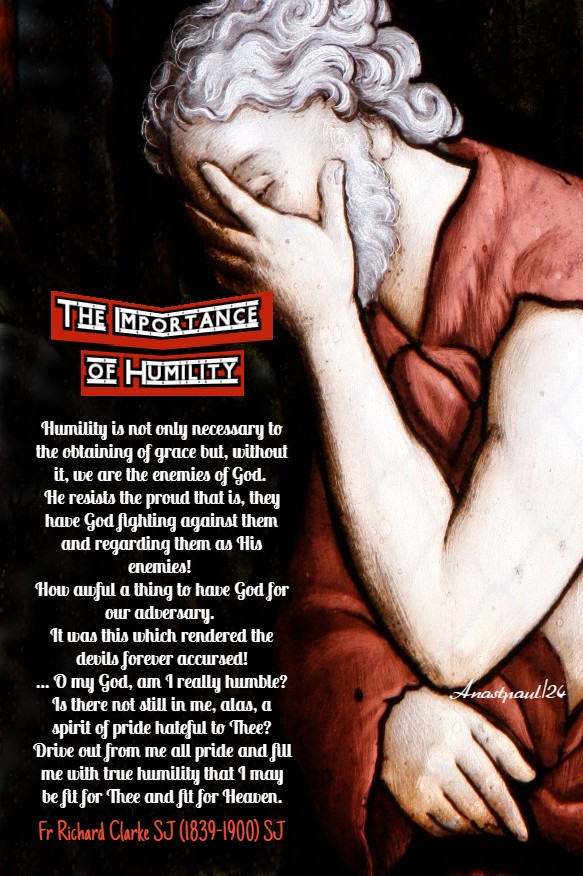
Humility is not only important to the welfare of our souls, it is also absolutely necessary to obtain grace from Almighty God. He resists the proud, and gives grace to the humble. Pride is an insuperable bar to the entrance of grace into the soul and, as we can do nothing good in the sight of God, without the assistance of His grace, we must have at least some degree of humility before we can do anything pleasing to Him. In proportion to our humility, will be the grace given us and the supernatural virtue to which we shall attain. The first thing I must do if I wish to please God more, is to humble myself more.

Humility is not only necessary to the obtaining of grace but, without it, we are the enemies of God. He resists the proud that is, they have God fighting against them and regarding them as His enemies! How awful a thing to have God for our adversary. It was this which rendered the devils forever accursed!

In one moment, the humility of their subjection of themselves in their love of God confirmed the Holy Angels in perfect happiness to all eternity. If I wish God to fight for me, not against me, the first condition is humility.

Humility is a necessary condition of entrance into the Kingdom of Heaven. “Unless you become as little children,” says our Divine Lord, “you cannot enter into the Kingdom of God.” He loves the humble and no-one, who has, in his heart, the spirit of humility, need have any fear of death and judgement.

O my God, am I really humble? Is there not still in me, alas, a spirit of pride hateful to Thee?
Drive out from me all pride and fill me with true humility that I may be fit for Thee and fit for Heaven.

Posted in "Follow Me", CHRIST the LIGHT, DOCTORS of the Church, FATHERS of the Church, GOD ALONE!, QUOTES on ETERNAL LIFE, QUOTES on JOY, QUOTES on LOVE of GOD, The WILL of GOD

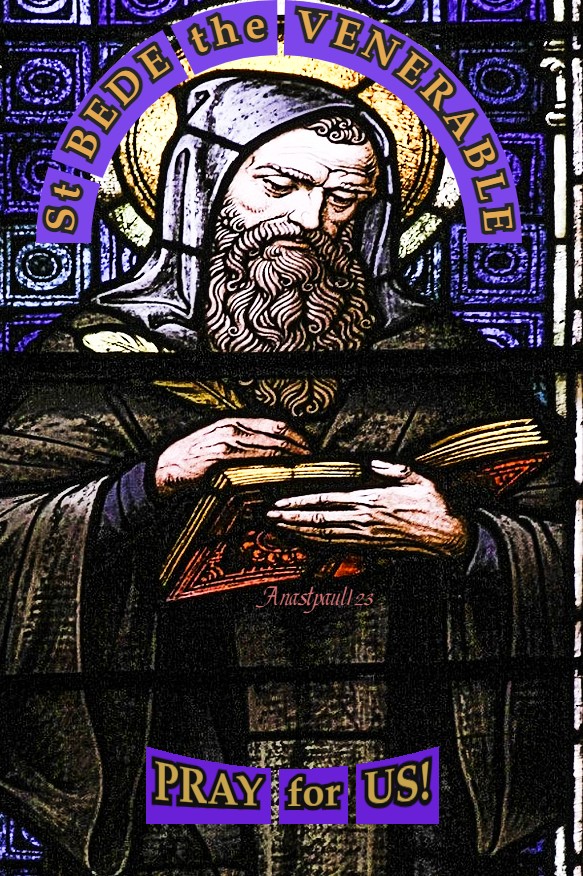
Quote/s of the Day – 27 May – St Bede the Venerable

Quote/s of the Day – 27 May – St Bede the Venerable (673-735) Confessor, Father and Doctor of the Church

St Bede became known as “Venerable Bede or Bede the Venerable” (Latin: Beda Venerabilis) by the 9th Century because of his great devotion and holiness but this was not linked to consideration for sainthood. According to a legend, the epithet was miraculously supplied by Angels. It was first utilised in connection with St Bede, where he was grouped with others, who were called “venerable,” at two Ecclesiastical Councils, held at Aachen in 816 and 836. Paul the Deacon (c 720-c 796) Italian Monk, Writer, Historian, then referred to him as Venerable consistently. By the 11th and 12th Centuries, the title had become commonplace and it is rarely omitted today.

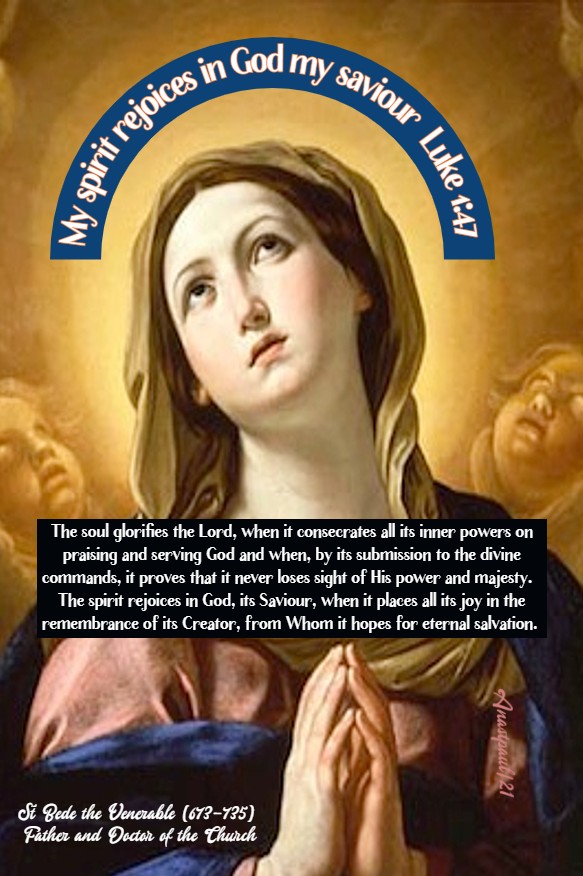
The soul glorifies the Lord,
when it consecrates all its inner powers
on praising and serving God
and when, by its submission
to the Divine commands,
it proves that it never loses sight
of His Power and Majesty.
The spirit rejoices in God, its Saviour,
when it places all its joy
in the remembrance of its Creator,
from Whom it hopes for eternal salvation.

I was no longer the centre of my life
and, therefore, I could see God in everything!

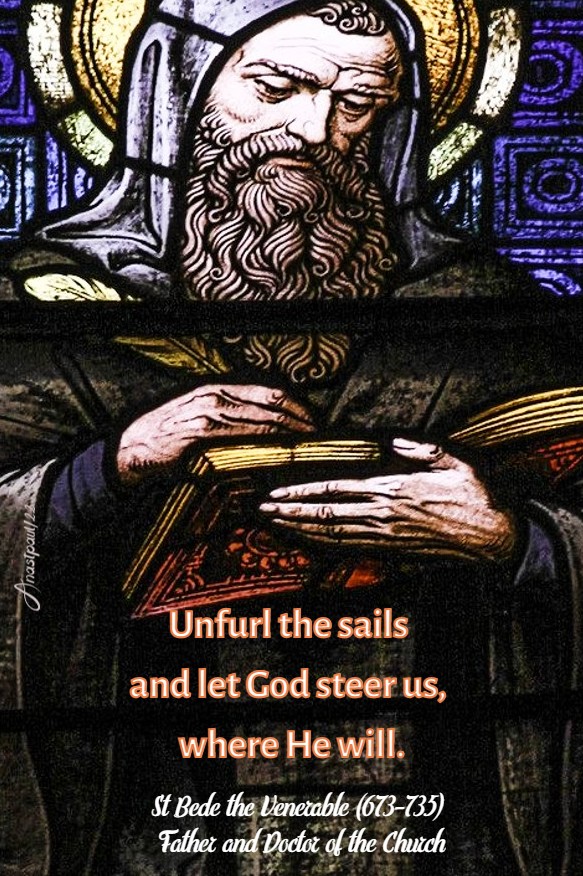
Unfurl the sails
and let God steer us
where He will.

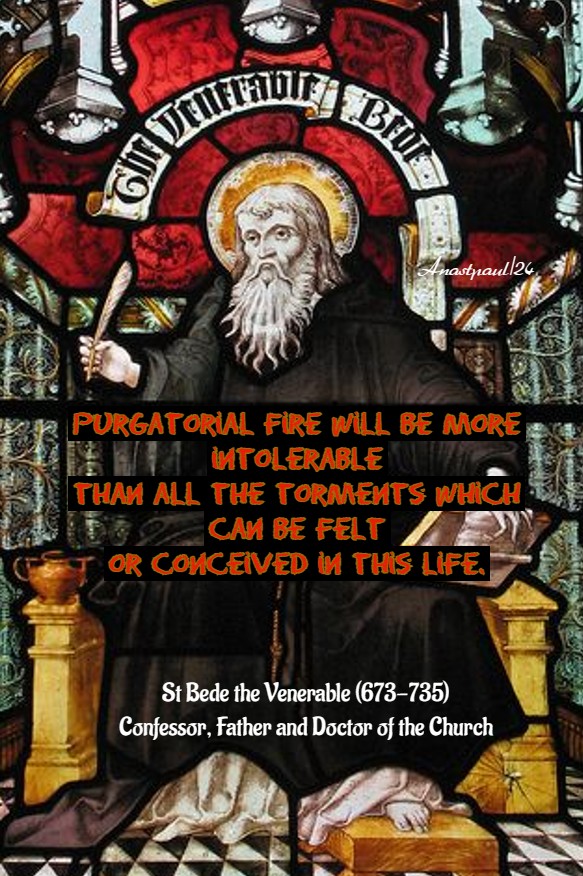
Purgatorial fire will be more intolerable
than all the torments which can be felt
or conceived in this life.

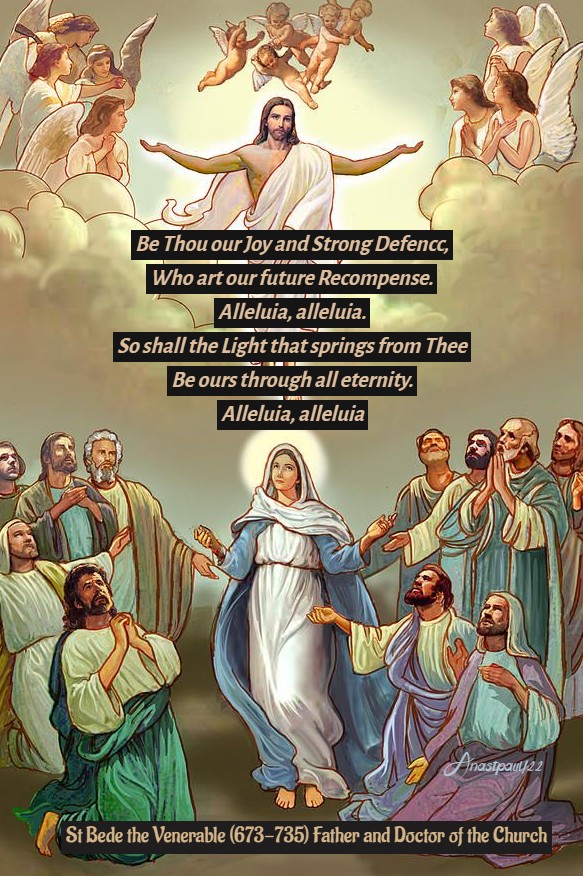
Be Thou our Joy and Strong Defence,
Who art our future Recompense.
Alleluia, alleluia.
So shall the Light that springs from Thee
Be ours through all eternity.
Alleluia, Alleluia.

MORE:
https://anastpaul.com/2023/05/27/quote-s-of-the-day-27-may-st-bede-the-venerable-2/

St Bede the Venerable (673-735)
Confessor, Father and Doctor of the Church

Posted in "Follow Me", CHRIST the LIGHT, DOCTORS of the Church, FATHERS of the Church, QUOTES on DISCIPLESHIP, QUOTES on EVANGELISATION, The WORD

One Minute Reflection – 27 May – ‘ … that it may shine to all …’ Matthew 5:15

One Minute Reflection – 27 May – “The Month of the Blessed Virgin Mary” – St Bede the Venerable (673-735) Confessor, Father and Doctor of the Church – Timothy 4:1-8; Matthew 5:3-19. – – Scripture search here: https://www.drbo.org/

Neither do men light a candle and put it under a bushel but upon a candlestick that it may shine to all who are in the house.” – Matthew 5:15

REFLECTION – “Nothing is more cold than a Christian who is not dedicated to saving others. In this respect there can be no pretence of poverty – the widow who gave her two tiny coins would rise up and call you to account (Lk 21:2). Peter too, who said: “Silver and gold have I none” (Acts 3:6). And Paul, who was so poor that he often went hungry and lacked the necessary means to live on (1 Cor 4:11). Neither can you protest your humble birth – they too were of modest degree. Ignorance will noy give you any better excuse – they were uneducated too … It is no good claiming sickness – Timothy was subject to frequent illnesses (1 Tm 5:23) … Anybody at all can be of service to his neighbour if he would do what he can …

Do not say that it is impossible for you to draw others because, if you are a Christian, it is impossible that you should not! Every tree bears its own fruit (Mt 17:17) and, since there is no contradiction in nature, what we are saying is likewise true, since it follows from the very nature of a Christian … It is easier for light to be darkness than that the Christian should not shine!” – St John Chrysostom (345-407) Bishop of Constantinople, Father and Doctor of the Church (Homilies on the Acts of the Apostles, 20:3-4 ).

PRAYER – O God, Who enlightened Your Church with the learning of blessed Bede, Your Confessor and Doctor, graciously grant that Your servants may ever be enlightened by his wisdom and helped by his merits. Through Jesus Christ, Thy Son our Lord, Who lives and reigns with Thee, in the unity of the Holy Ghost, God, world without end. Amen (Collect).

Posted in CHRIST the LIGHT, DOCTORS of the Church, FATHERS of the Church, Our MORNING Offering, PRAYERS of the SAINTS

Our Morning Offering – 27 May – Grant us Thy Light, O LordBy St Bede

Our Morning Offering – 27 May – St Bede the Venerable (673-735) Confessor, Priest, Monk, Linguist, Translator, Historian, Father and Doctor of the Church (Added by Pope Leo XIII in 1899)

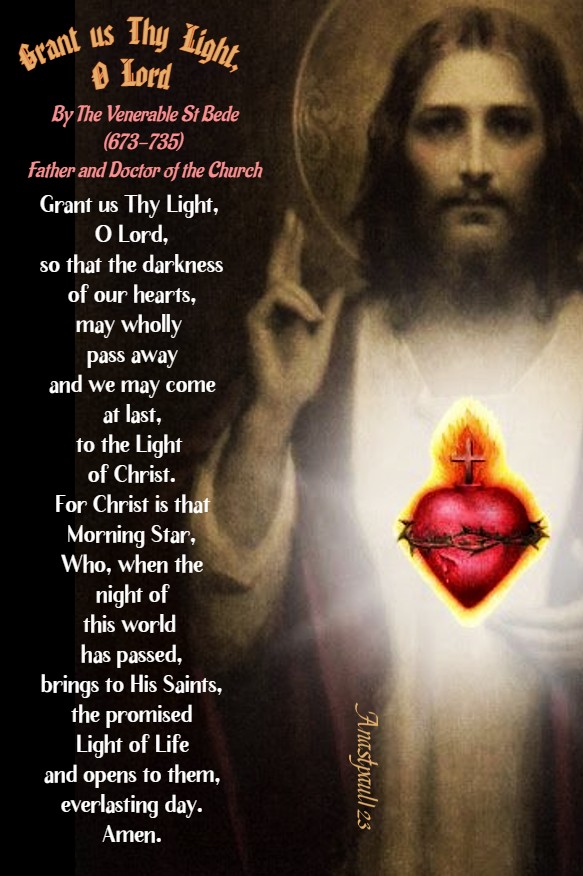
Grant us Thy Light, O Lord
By St Bede the Venerable (673-735)
Father and Doctor of the Church

Grant us Thy Light, O Lord,
so that the darkness of our hearts,
may wholly pass away
and we may come at last,
to the Light of Christ.
For Christ is that Morning Star,
Who, when the night
of this world has passed,
brings to His Saints,
the promised Light of Life
and opens to them,
everlasting day.
Amen.

Posted in SAINT of the DAY

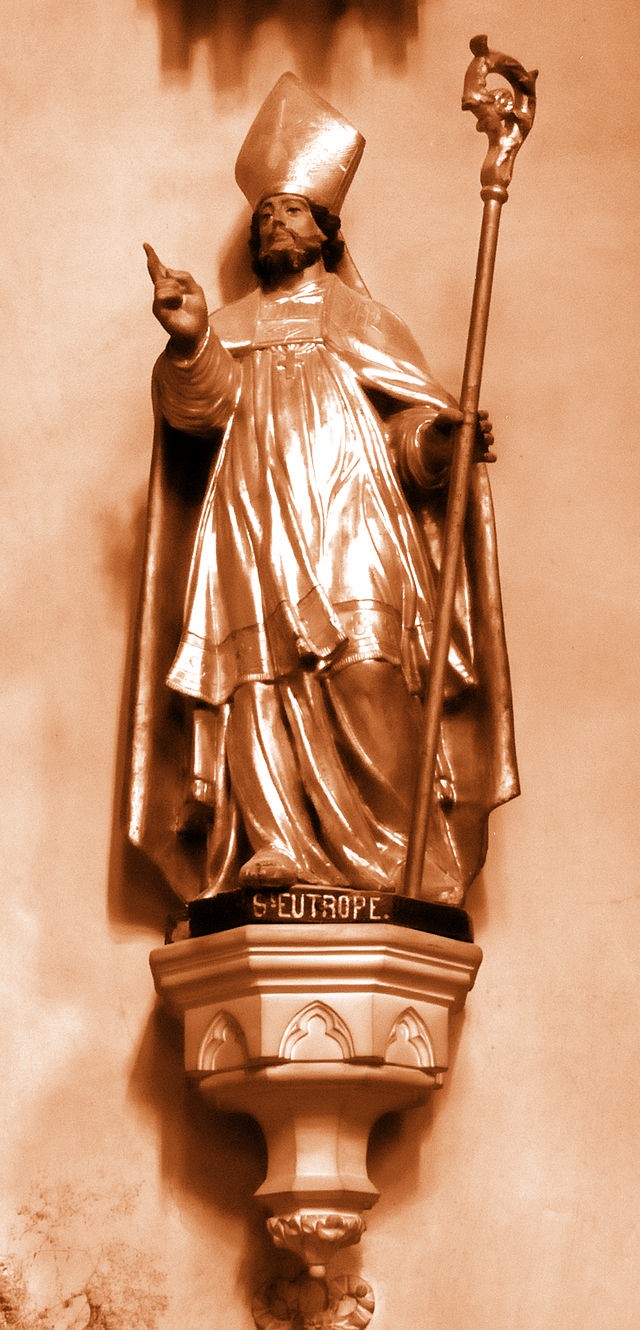
Saint of the Day – 27 May – Saint Eutropius of Orange (Died c475) Bishop

Saint of the Day – 27 May – Saint Eutropius of Orange (Died c475) Bishop of Orange in France, from 463 until his death. It is believed that he was the successor to St Justus. Born in Marseilles, France and died in c475 at his See. Also known as – Eutrope, Eutropio.

The Roman Martyrology reads: “At Orange in France, St Eutropius the Bishop, illustrious for virtues and miracles.

Eutropius was born to the nobility, in Marseille, where he spent a wild dissipated and wasted youth. According to tradition, he was converted by his wife and, after her death, was Ordained a Deacon by the Bishop of Tours, Eustochius.

His conversion proved to be permanent and fruitful. He succeeded Saint Justus at the latest in 463, as Bishop of the old Diocese of Orange (Vaucluse), around 25 kilometers north of Avignon and became Bishop Eutropius II of Orange (c464-c475).

This appointment occurred at a time when the Bishopric had been laid waste by the Visigoths and Eutropius was greatly tempted to give up his difficult task because of the material and moral breakdown. At first, he was overwhelmed by the magnitude of the work he would have to do and fled. A man of God named Aper convinced him to return and devote himself to tending his flock. He became a man of intense piety and pastoral zeal and was regarded as worthy of imitation by all in surrounding regions, among other things, for his extreme devotion.

The new Bishop proved exemplary under difficult circumstances. At the same time, he continued to work with his hands. His biographer and successor as Bishop, Verus (475-494), praises his piety and his acts of love. According to tradition, his prayers also performed several miracles. He exchanged letters with the holy Pope Hilarius (461-468). He was a friend of Saint Faustus of Riez. Letters from contemporaries speak highly of his learning and piety. St Sidonius Apollinaris (c432-c482), Bishop of Clermont, who had experienced similar difficulties in his own Diocese, shows great respect for Eutropius’ learning and piety. Sidonius, an eloquent but wordy writer, has been considered the last representative of classical culture.

During his Episcopate, which lasted about twelve years, he did not hesitate to devote himself to many manual tasks, sometimes in a field where he himself worked with a plough, sometimes at a building site where he carried stones even when the other workers were having their meals.

He took part in the Councils of Arles in 463 and 475. According to tradition, Eutropius died on 27 May 475 in Orange and an Epitaph describes him as flawless. His memorial day in the Martyrologium Romanum is the day of his death on 27 May. His Relics are in the Altar of St Mary Magdalene’s Chapel in the London Oratory.

Around the year 500, his successor, Verus wrote his Vita which describes various miracles – the deliverance of a possessed person, the healing of someone struck by lightning; stopping a fire through prayer.

Posted in SAINT of the DAY

St Bede the Venerable (673-735), St John I (Died 526) Pope and Martyr and the Saints for 27 May

St Acculus of Alexandria
St Antanansio Bazzekuketta
St Barbara Kim
St Barbara Yi

Bl Dionysius of Semur
St Eutropius of Orange (Died c475) Bishop
St Evangelius of Alexandria
St Frederick of Liège
Bl Gausberto of Montsalvy
St Gonzaga Gonza
St James of Nocera

St Julius the Veteran and Companions
St Liberius of Ancona
St Matiya Mulumba
Bl Matthias of Nagasaki
St Melangell
St Ranulphus of Arras
St Restituta of Sora and Companions
St Secundus of Troia