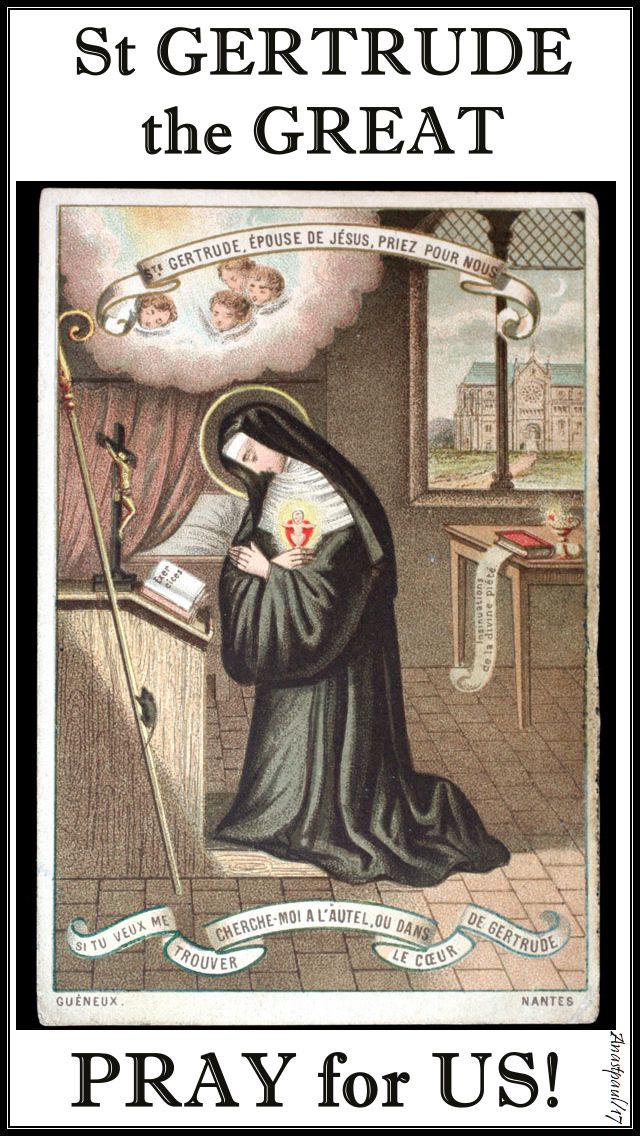
One Minute Reflection – 16 November – Today’s Gospel: Luke 17:26–37, Friday of the Thirty Second week in Ordinary Time, Year B and the memorial of St Margaret of Scotland (1045-1093) and St Gertrude the Great (1256-1302).
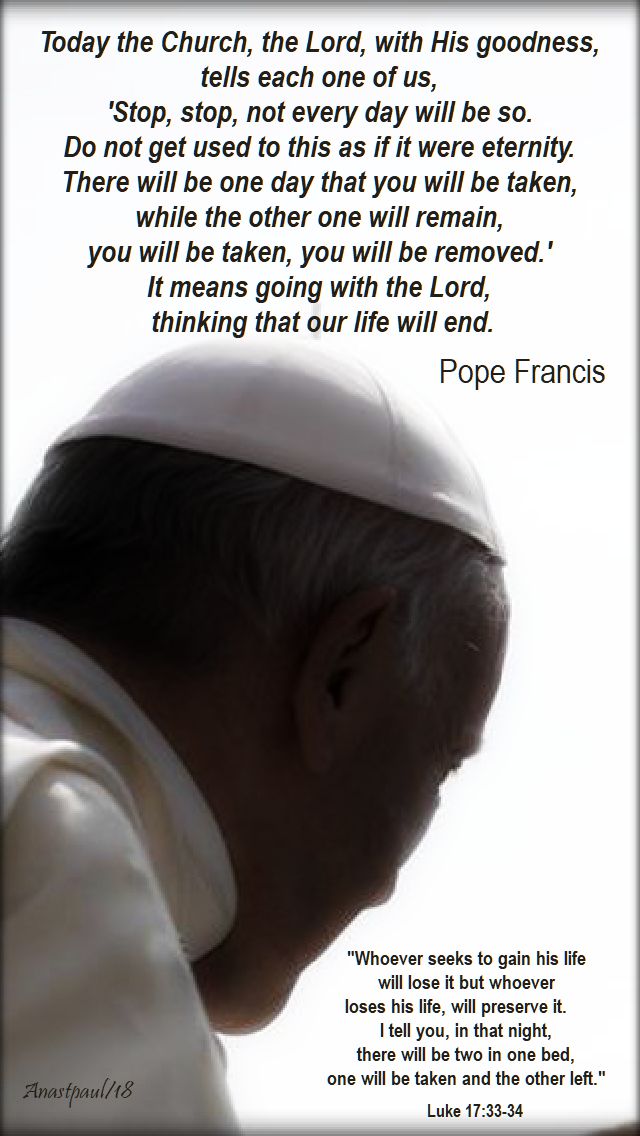
“Whoever seeks to gain his life, will lose it but whoever loses his life, will preserve it. I tell you, in that night there will be two in one bed; one will be taken and the other left.”…Luke 17:33-34
REFLECTION – “Today the Church, the Lord, with His goodness, tells each one of us, ‘Stop, stop, not every day will be so. Do not get used to this as if it were eternity. There will be one day that you will be taken, while the other one will remain, you will be taken, you will be removed.’ It means going with the Lord, thinking that our life will end.”…Pope Francis Santa Marta, 17 November 2017
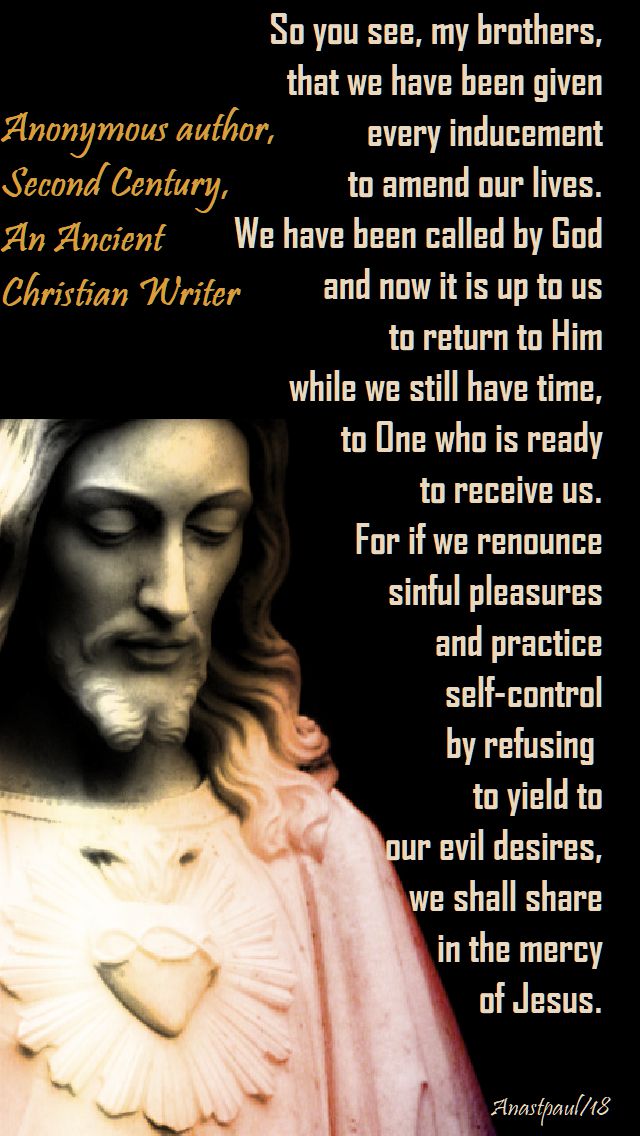
“So you see, my brothers, that we have been given every inducement, to amend our lives. We have been called by God and now it is up to us to return to Him, while we still have time to One, who is ready to receive us. For if we renounce sinful pleasures and practice self-control, by refusing to yield to our evil desires, we shall share in the mercy of Jesus.
You must know, however, that the day of judgement, like a flaming furnace, is already approaching. Sun, moon and stars will be consumed and the whole earth will become like lead melting in the fire. All that each man has done, whether openly or in secret, will then be brought to light. Therefore, a very good way of atoning for our sins is by being generous to the poor. Fasting is better than prayer but almsgiving surpasses both, for love covers a multitude of sins. Nevertheless, prayer delivers the soul from death, if it proceeds from a good conscience. Happy the man who is found rich in these virtues; by relieving the poor, he himself will be relieved of his sins.
To make sure that none of us is lost, we must repent from the bottom of our hearts.”…Anonymous author, second century, An Ancient Christian Writer – An excerpt from A Homily
PRAYER – Lord God, grant to us that the power of Your protecting hand may keep us unshaken in the face of our ancient enemy and all his hidden snares. Lighten our way so that, through the prayers of intercession of St Gertrude and St Margaret of Scotland, we may experience the joy of Your presence in our hearts and courage at times of suffering. Through Jesus Christ, our Lord, with the Holy Spirit, one God for all eternity, amen.
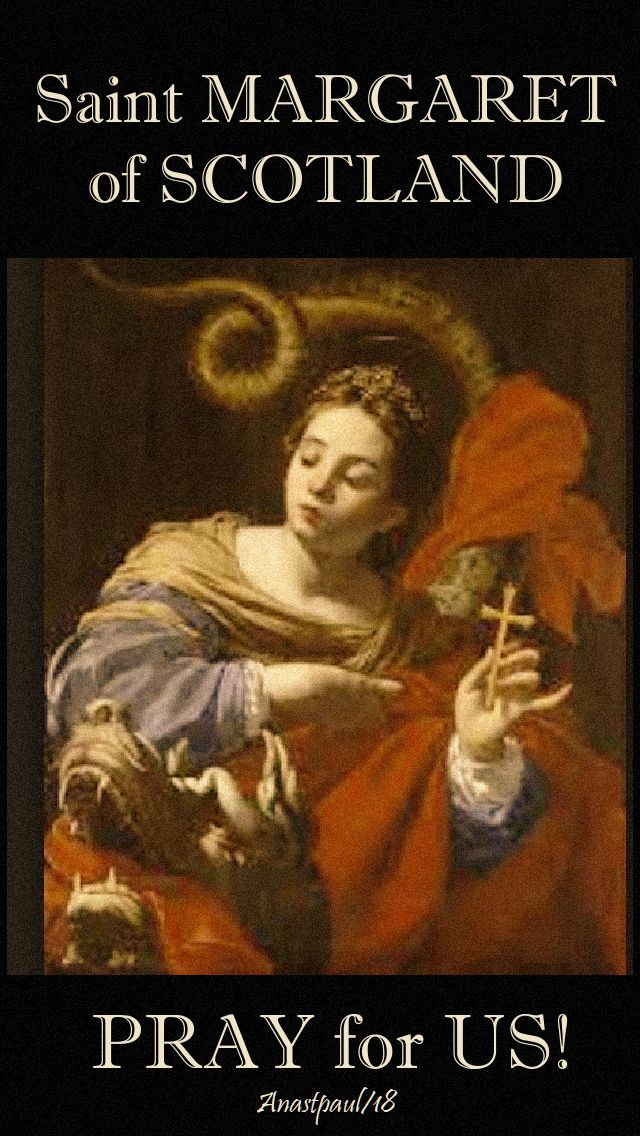
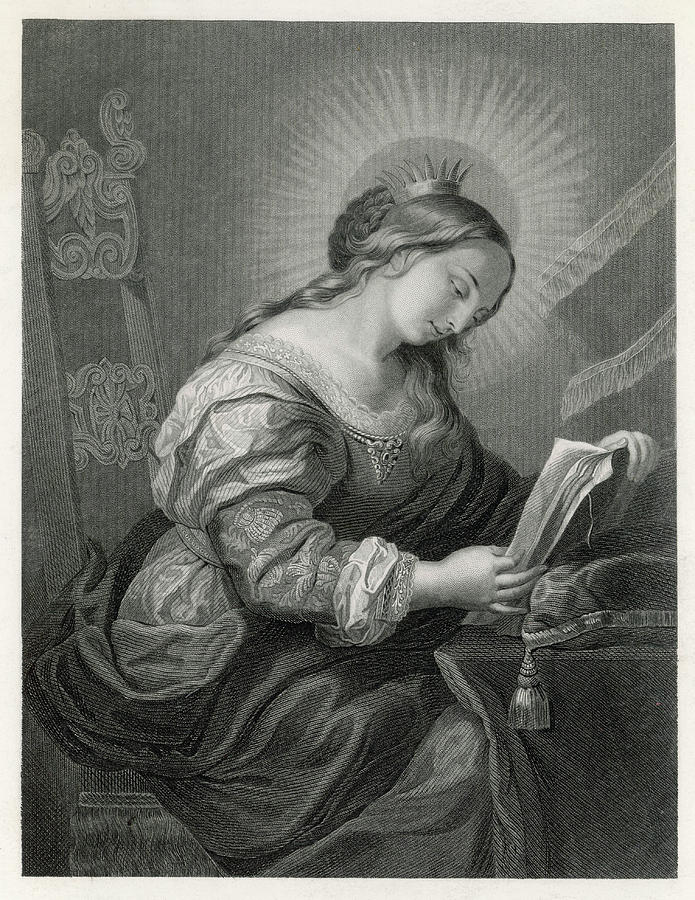
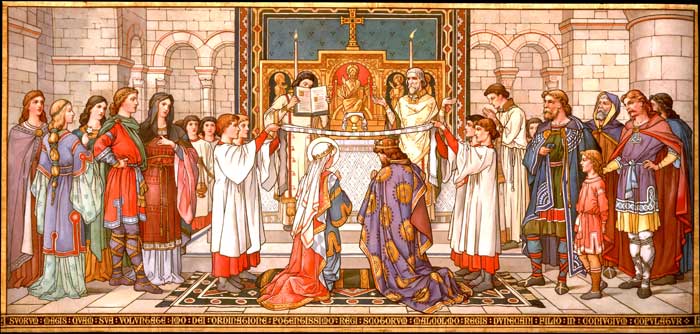
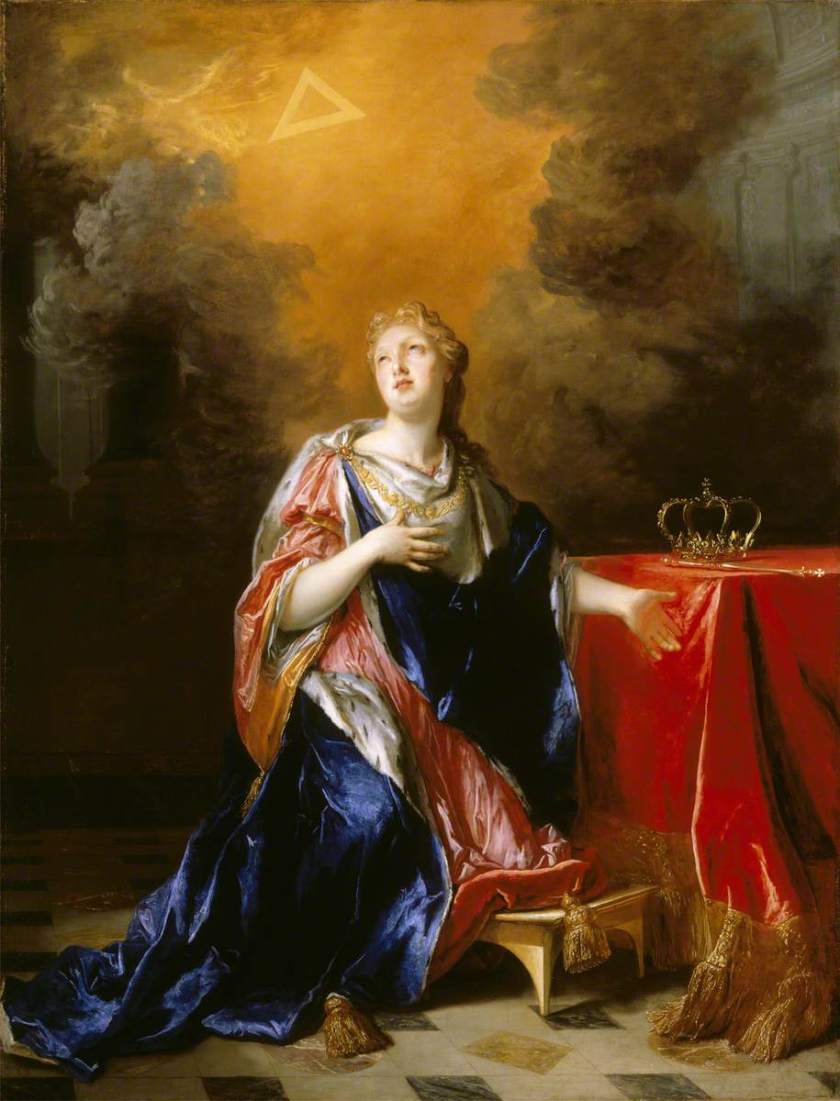
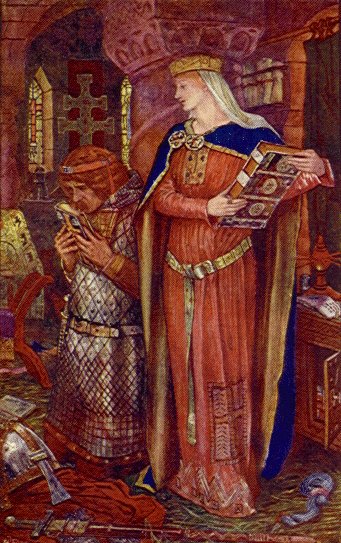
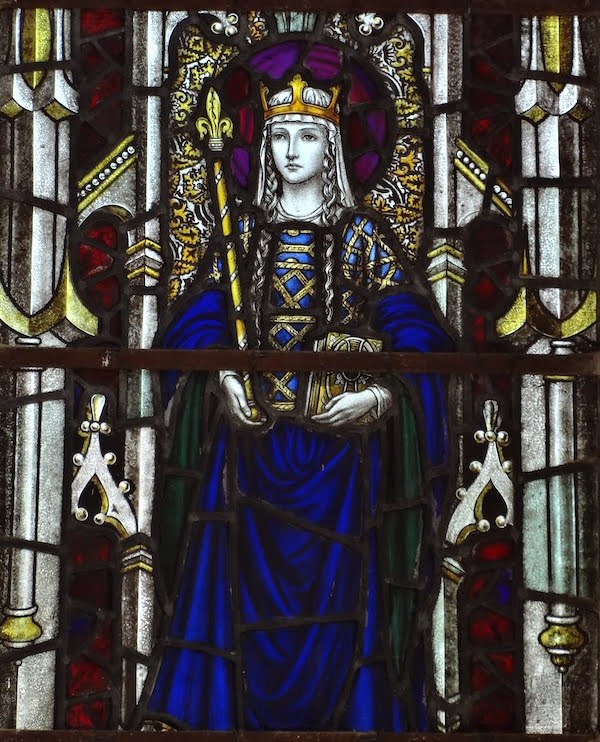
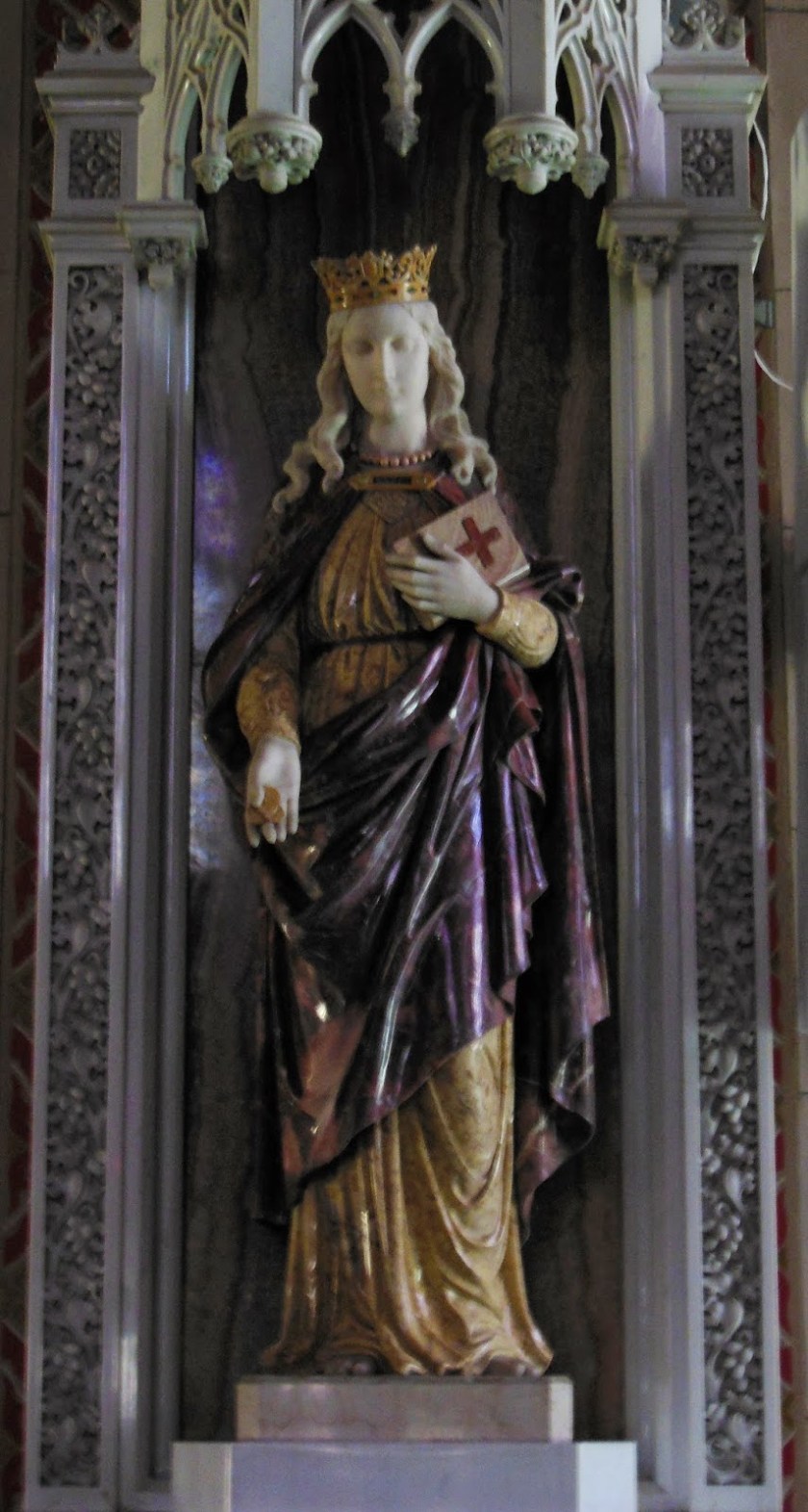
Saint of the Day – 16 November – St Margaret of Scotland (1045-1093) Queen consort of Scotland – born in c 1045 in Hungary and died on 16 November 1093 at Edinburgh Castle, Scotland, four days after her husband and son died in defense of the castle. Patronages – Scotland, Dunfermline, Fife, Shetland, The Queen’s Ferry, queens, widows, against the death of children and Anglo-Scottish relations. St Margaret was the mother of three kings of Scotland, or four, if Edmund of Scotland, who ruled with his uncle, Donald III, is counted and of a queen consort of England. According to the Vita S. Margaritae (Scotorum) Reginae (Life of St Margaret, Queen (of the Scots), attributed to Turgot of Durham, she died at Edinburgh Castle in Edinburgh, Scotland in 1093, merely days after receiving the news of her husband’s death in battle.
Saint Margaret’s name signifies “pearl” “a fitting name,” says Bishop Turgot, her confessor and her first biographer, “for one such as she.” Her soul was like a precious pearl. A life spent amidst the luxury of a royal court never dimmed its lustre, or stole it away from him who had bought it with his blood. She was the grand-daughter of an English king and in 1070 she became the bride of Malcolm and reigned Queen of Scotland till her death in 1093.
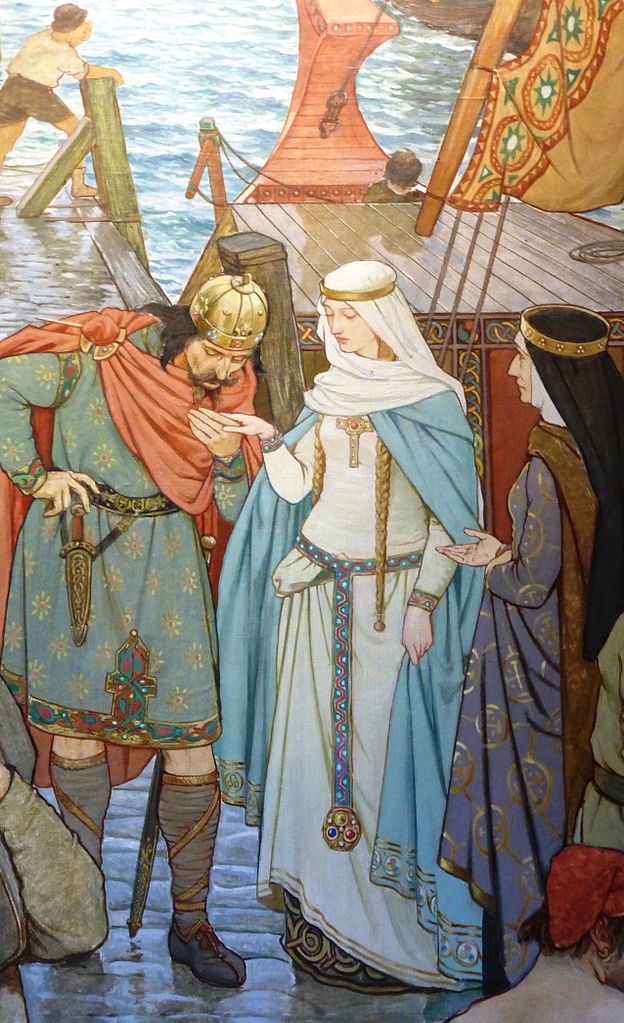
Malcolm greeting Margaret at her arrival in Scotland – detail of a mural by Victorian artist William Hole
How did she become a Saint in a position where sanctity is so difficult?
Margaret’s biographer Turgot of Durham, Bishop of St Andrew’s, credits her with having a civilising influence on her husband Malcolm by reading him narratives from the Bible. She instigated religious reform, striving to conform the worship and practices of the Church in Scotland to those of Rome. This she did on the inspiration and with the guidance of Lanfranc, a future Archbishop of Canterbury. She also worked to conform the practices of the Scottish Church to those of the continental Church, which she experienced in her childhood. Due to these achievements, she was considered an exemplar of the “just ruler” and moreover influenced her husband and children, especially her youngest son, the future King David I of Scotland, to be just and holy rulers.
“The chroniclers all agree in depicting Queen Margaret as a strong, pure, noble character, who had very great influence over her husband and through him over Scottish history, especially in its ecclesiastical aspects. Her religion, which was genuine and intense, was of the newest Roman style and to her are attributed a number of reforms by which the Church [in] Scotland was considerably modified from the insular and primitive type which down to her time it had exhibited. Among those expressly mentioned are a change in the manner of observing Lent, which thenceforward began as elsewhere on Ash Wednesday and not as previously on the following Monday and the abolition of the old practice of observing Saturday (Sabbath), not Sunday, as the day of rest from labour (see Skene’s Celtic Scotland, book ii chap. 8).” The later editions of the Encyclopædia Britannica, however, as an example, the Eleventh Edition, remove Skene’s opinion that Scottish Catholics formerly rested from work on Saturday, something for which there is no historical evidence. Skene’s Celtic Scotland, vol. ii, chap. 8, pp. 348–350, quotes from a contemporary document regarding Margaret’s life but his source says nothing at all of Saturday Sabbath observance but rather says St Margaret exhorted the Scots to cease their tendency “to neglect the due observance of the Lord’s day.”
She attended to charitable works, serving orphans and the poor every day before she ate and washing the feet of the poor in imitation of Christ. She rose at midnight every night to attend the liturgy. She successfully invited the Benedictine Order to establish a monastery in Dunfermline, Fife in 1072 and established ferries at Queensferry and North Berwick to assist pilgrims journeying from south of the Firth of Forth to St Andrew’s in Fife. She used a cave on the banks of the Tower Burn in Dunfermline as a place of devotion and prayer. St Margaret’s Cave, now covered beneath a municipal car park, is open to the public. Among other deeds, Margaret also instigated the restoration of Iona Abbey in Scotland. She is also known to have interceded for the release of fellow English exiles who had been forced into serfdom by the Norman conquest of England.
Margaret was as pious privately, as she was publicly. She spent much of her time in prayer, devotional reading and ecclesiastical embroidery. This apparently had considerable effect on the more uncouth Malcolm, who was illiterate – he so admired her piety that he had her books decorated in gold and silver. One of these, a pocket gospel book with portraits of the Evangelists, is in the Bodleian Library in Oxford, England.[8]
Malcolm was apparently largely ignorant of the long-term effects of Margaret’s endeavours. He was content for her to pursue her reforms as she desired, which was a testament to the strength of and affection in their marriage.
St Margaret did not neglect her duties in the world because she was not of it. Never was a better mother. She spared no pains in the education of her eight children, 6 sons and 2 daughters and their sanctity was the fruit of her prudence and her zeal. Never was a better queen. She was the most trusted counsellor of her husband and she laboured for the material improvement of the country.
Her husband Malcolm III, and their eldest son Edward, were killed in the Battle of Alnwick against the English on 13 November 1093. Her son Edgar was left with the task of informing his mother of their deaths. Not yet 50 years old, Margaret died on 16 November 1093, three days after the deaths of her husband and eldest son. The cause of death was reportedly grief. After receiving Holy Viaticum, she was repeating the prayer from the Missal, “O Lord Jesus Christ, who by thy death didst give life to the world, deliver me.”At the words “deliver me,” says her biographer, she took her departure to Christ, the Author of true liberty.
She was buried before the high altar in Dunfermline Abbey in Fife, Scotland. In 1250, the year of her Canonisation, by Pope Innocent IV, her body and that of her husband were exhumed and placed in a new shrine in the Abbey. Her relics were dispersed after the Scottish Reformation and subsequently lost. Mary, Queen of Scots, at one time owned her head, which was subsequently preserved by Jesuits in the Scottish College, Douai, France, from where it was lost during the French Revolution.
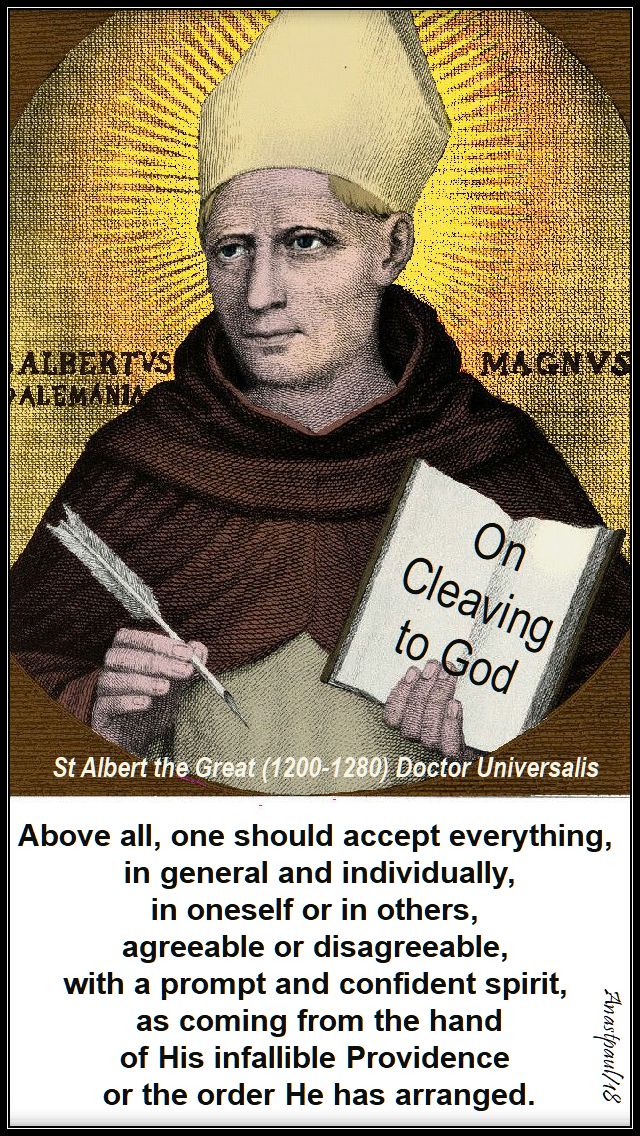
Quote/s of the Day – 15 November – The Memorial of St Albert the Great (1200-1 280) Doctor Universalis (“Universal Doctor”)
Known as Doctor Universalis (“Universal Doctor”) for the extraordinary depth of his knowledge and learning, Albertus Magnus wrote extensively on numerous subjects. Here are some words of wisdom from a variety of his writings.
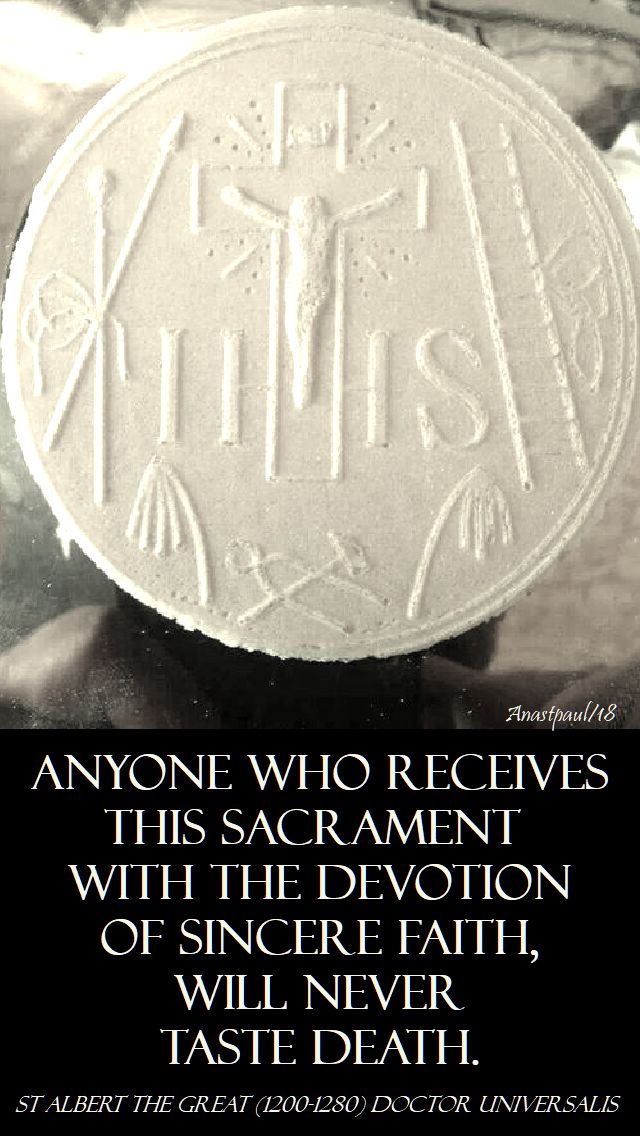
“Anyone who receives this Sacrament, with the devotion of sincere faith, will never taste death.”
“The greater and more persistent, your confidence in God, the more abundantly you will receive, all that you ask.”
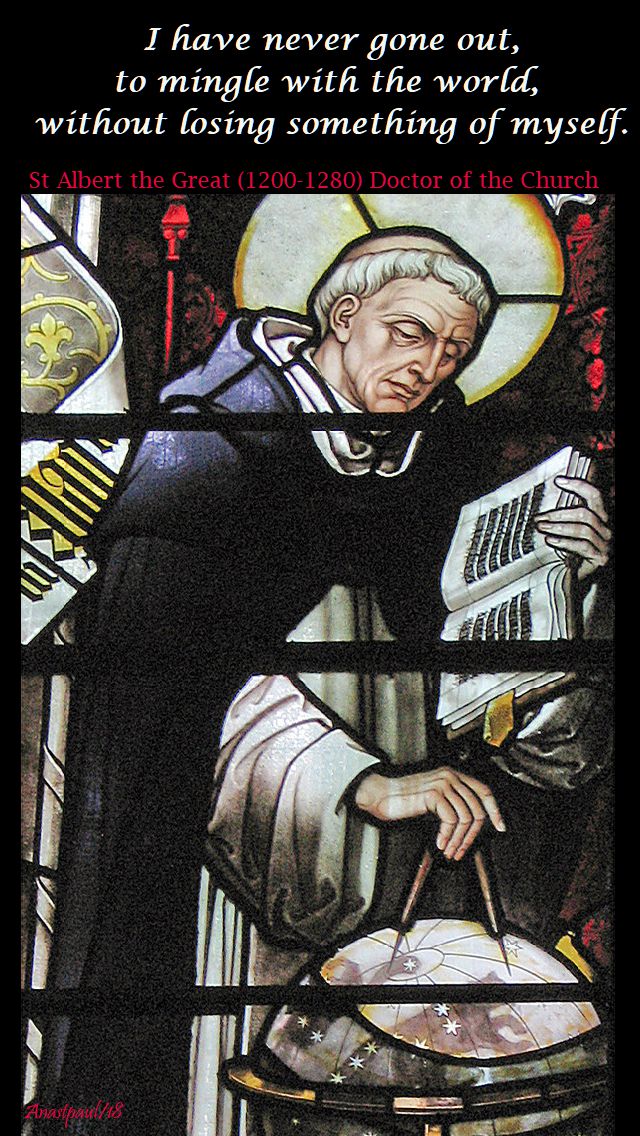
“I have never gone out, to mingle with the world, without losing something of myself.”
“The surest and quickest way to attain perfection, is to strive, for purity of heart. Once the obstacles have been removed, God finds a clear path and does wonders, both in and through the soul.”
“Above all, one should accept everything, in general and individually, in oneself or in others, agreeable or disagreeable, with a prompt and confident spirit, as coming from the hand of His infallible Providence or the order He has arranged.”
On Cleaving to God
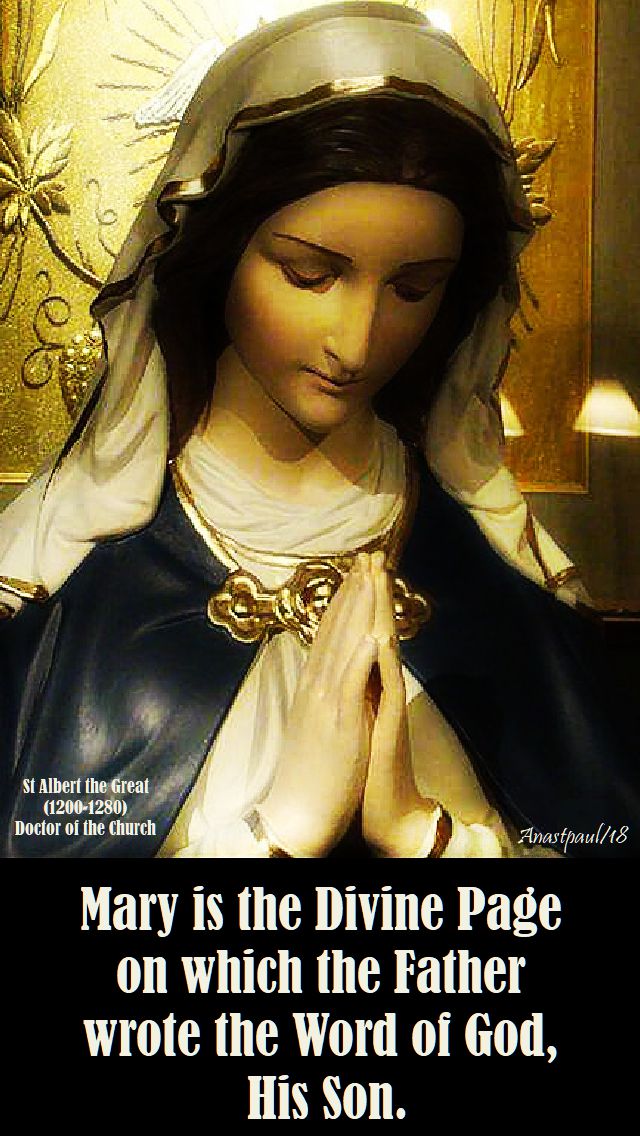
“Mary is the Divine Page on which the Father wrote the Word of God, His Son.”
St Albert the Great (1200-1280) Doctor of the Church
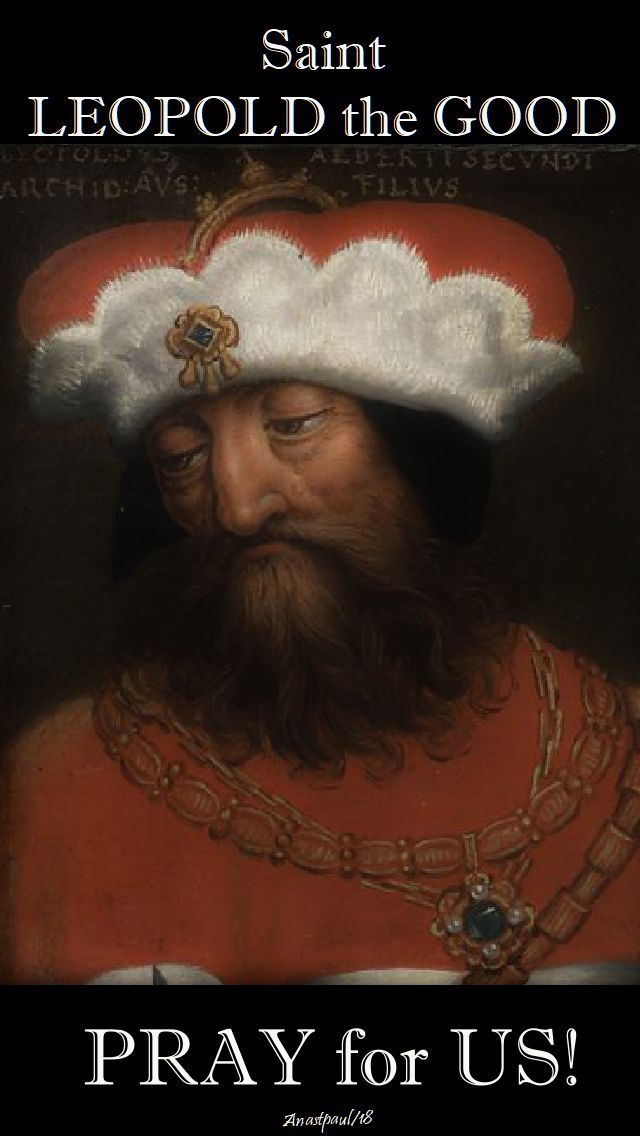
One Minute Reflection – 15 November – Today’s Gospel: Luke 17:20–25 – Thursday of the Thirty Second week in Ordinary Time, Year B and the Memorial of St Albert the Great (1200-1280) and St Leopold the Good (1073-1136)
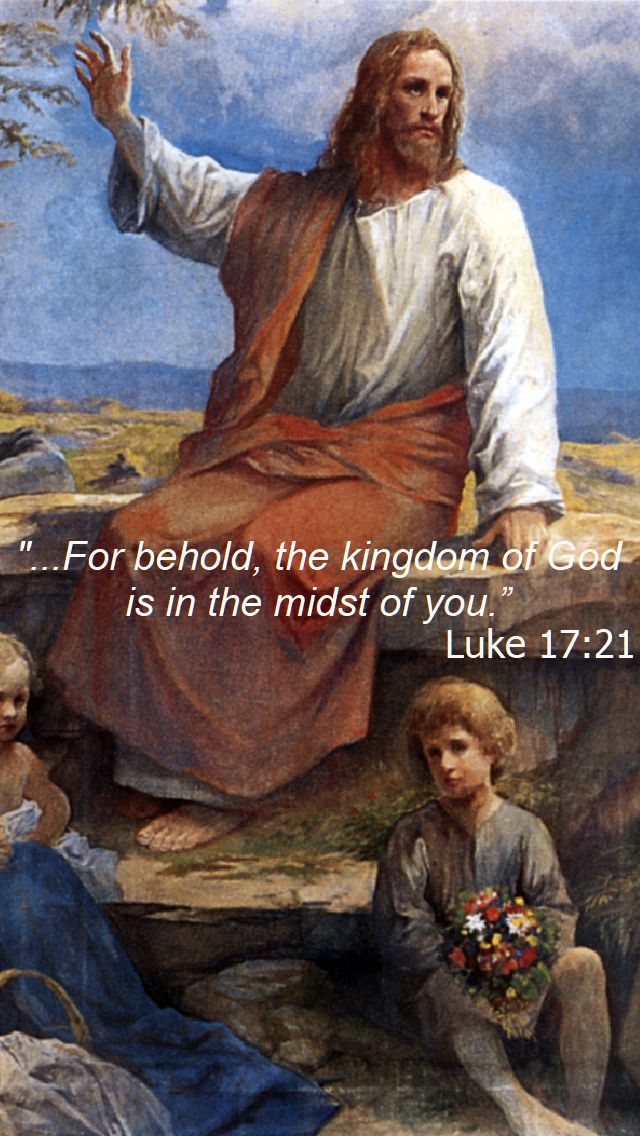
“…For behold, the kingdom of God is in the midst of you.”...Luke 17:21
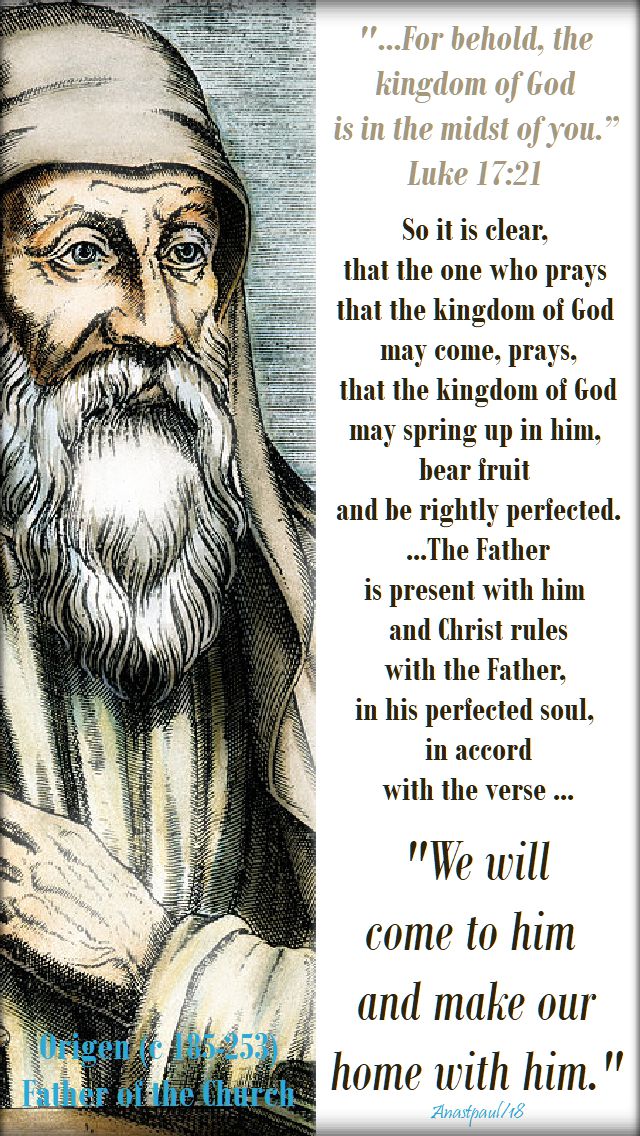
REFLECTION – “The kingdom of God according to our Lord and Saviour’s word “does not come with signs to be observed, nor will they say, ‘Lo, here it is!’ or ‘There!’ but the kingdom of God is within us”. For the Word “is very near, in our mouth and in our heart” (cf. Dt 30:14; Rm 10:8). So it is clear, that the one who prays that the kingdom of God may come, prays that the kingdom of God may spring up in him, bear fruit and be rightly perfected. This is because every saint is ruled by God, obeys the spiritual laws of God and dwells in himself as in a well-ordered city. The Father is present with him and Christ rules with the Father, in his perfected soul, in accord with the verse we called to mind a little earlier, “We will come to him and make our home with him” (Jn 14:23).
As we make continual progress, the highest point of the kingdom of God will be established for us when the apostle Paul’s word is fulfilled, when Christ with all His enemies made subject to Him will deliver “the kingdom to God the Father … that God may be all in all” (1 Cor 15:24, 28).
Therefore, let us pray constantly (cf. Thess 5:17) with a character being divinised by the Word and let us say to our Father in heaven, “hallowed be your name, your kingdom come” (Mt 6:9).”…Origen (c 185-253) Father of the Church
PRAYER – Our Father, hallowed be Your name, Your kingdom come, Your will be done! Grant us Lord, a true knowledge of our salvation, so that freed from fear and from the power of our foes, we may serve You faithfully, all the days of our lives and thus attain eternal joy with You. May the prayers of St Albert and St Leopold on our behalf, be a succour to us all. Through our Lord Jesus Christ with the Holy Spirit, one God for all eternity, amen.
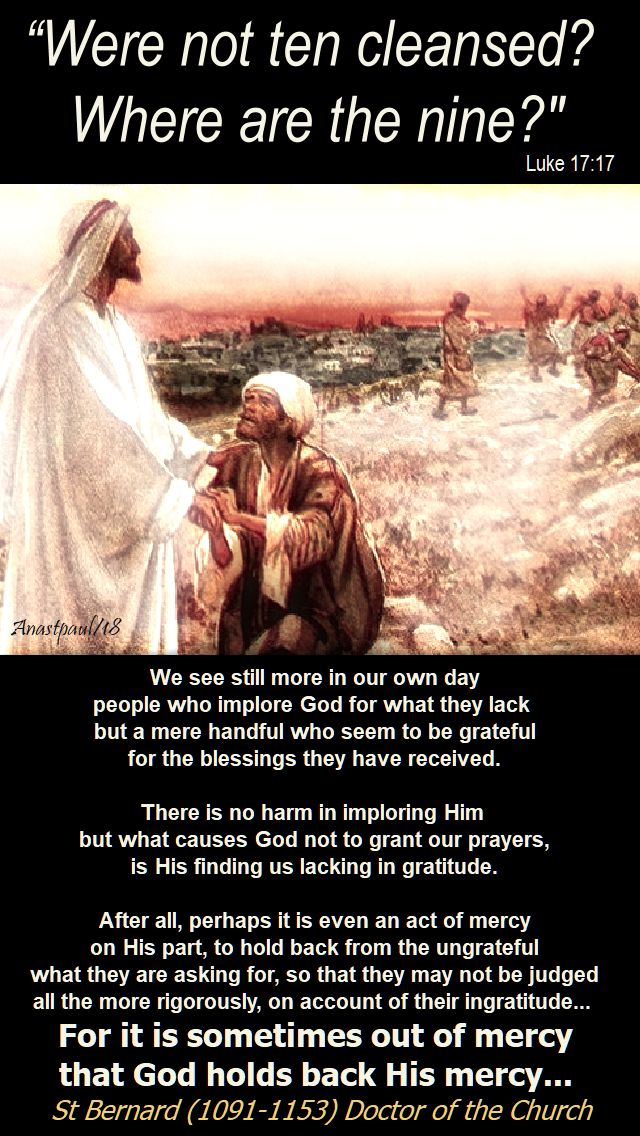
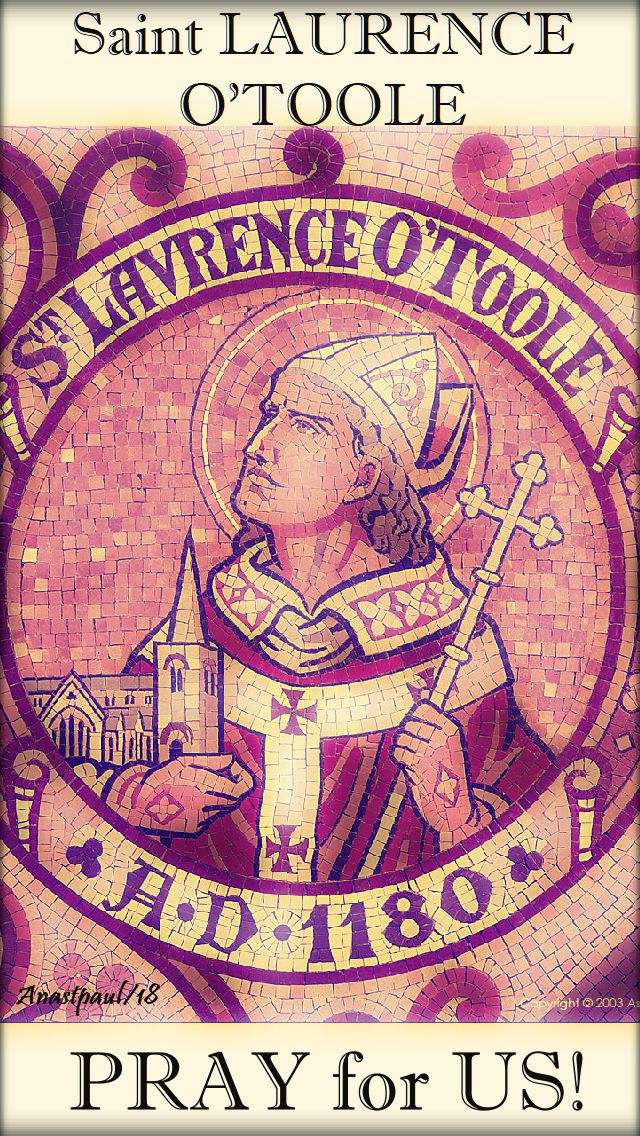
One Minute Reflection – 14 November – Today’s Gospel: Luke 17:11–19 -Wednesday of the Thirty Second week in Ordinary Time, Year B and the Memorial of St Laurence O’Toole (1128 – 1180)
“Were not ten cleansed? Where are the nine?”…Luke 17:17
REFLECTION – “In our own day we see many people at prayer but, unfortunately, we see none of them turning back to give thanks to God… “Ten were cleansed, were they not? Where are the other nine?” As I think you will remember, it was in these words that our Saviour complained about the lack of gratitude of the other nine lepers. We read that they knew well how to make “supplications, prayers, petitions” since they lifted up their voices, crying out: “Jesus, Master! Have pity on us!” But they lacked the fourth thing required by the apostle Paul: “thanksgiving” (1Tm 2:1) for they did not turn back nor give thanks to God.
We see still more in our own day people who implore God for what they lack but a mere handful who seem to be grateful for the blessings they have received. There is no harm in imploring Him but what causes God not to grant our prayers, is His finding us lacking in gratitude. After all, perhaps it is even an act of mercy on His part to hold back from the ungrateful what they are asking for, so that they may not be judged all the more rigorously, on account of their ingratitude… For it is sometimes out of mercy that God holds back His mercy…
So you see that not all those who are healed of the leprosy of this world, I mean their manifest complaints, profit by their healing. Indeed, many are secretly afflicted with an ulcer worse than leprosy, all the more dangerous in that it is more interior. That is why it was right that the Saviour of the world should ask where the other nine lepers were, since sinners avoid healing. So, too, after his sin, God questioned the first man: “Where are you?” (Gn 3:9).”… St Bernard (1091-1153) Doctor of the Church
PRAYER – You Lord, Holy Father, never forget Your solemn covenant and grant us new life each day. We though in our hearts of stone do forget and cease to thank and bless You. Make our hearts turn in gratitude, for all we are and have is by Your grace and we are as nothing without You. May our minds, hearts and souls sing with love and thanks to You, Lord our God. Grant us new hearts by the prayers of Your Saint Laurence O’Toole and all the saints in heaven, who always lived with grateful hearts, praising You always. We ask this this through Jesus Christ with the Holy Spirit, one God forever, amen.
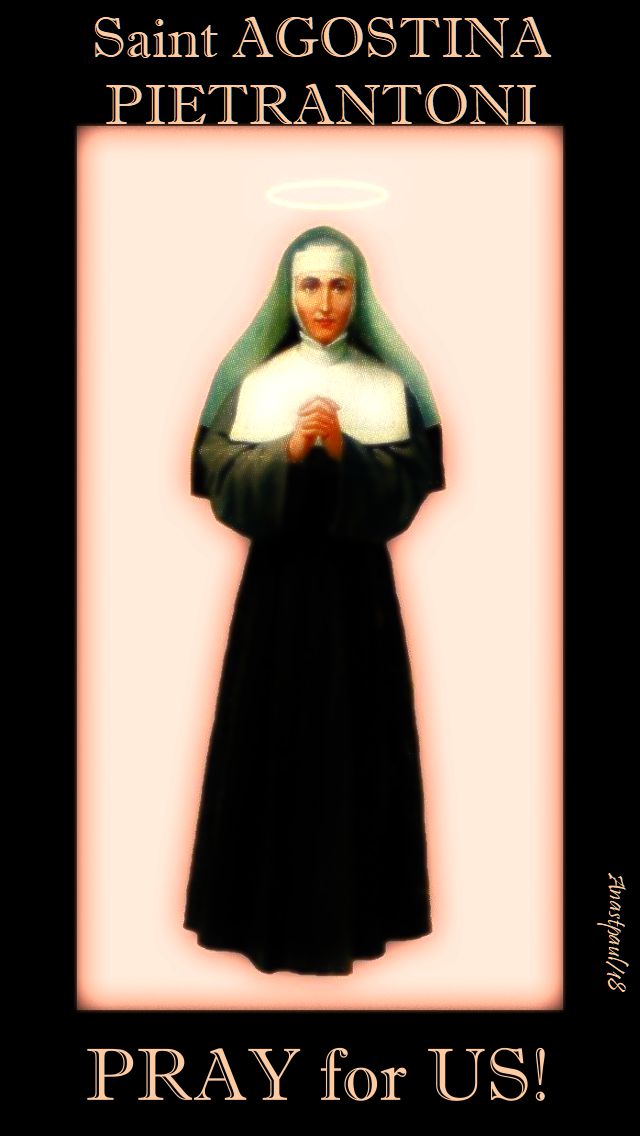
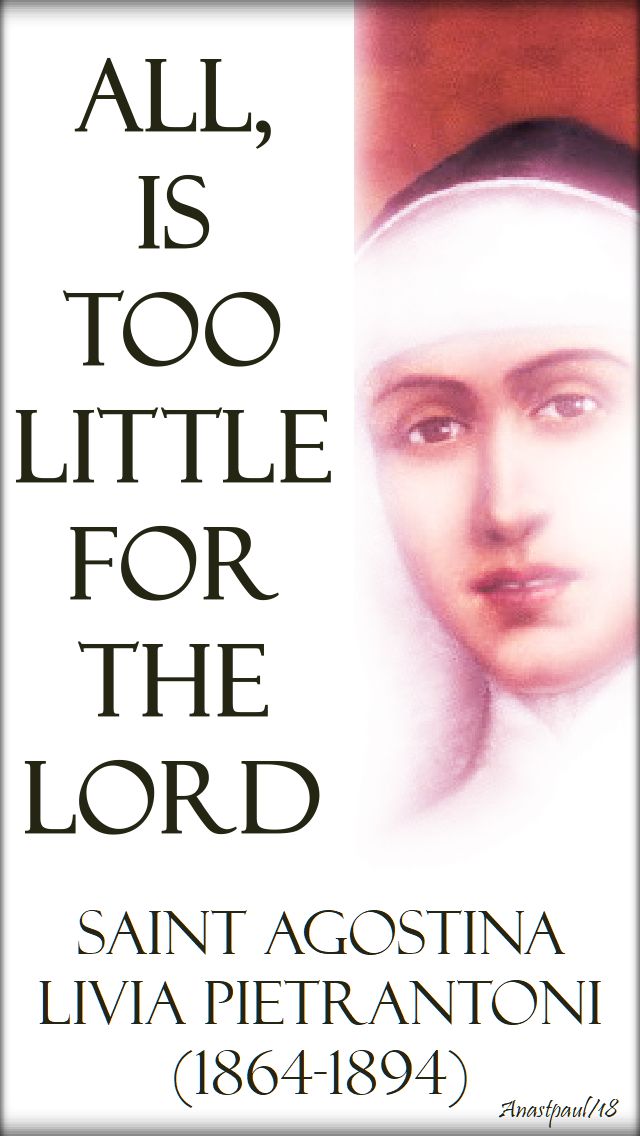
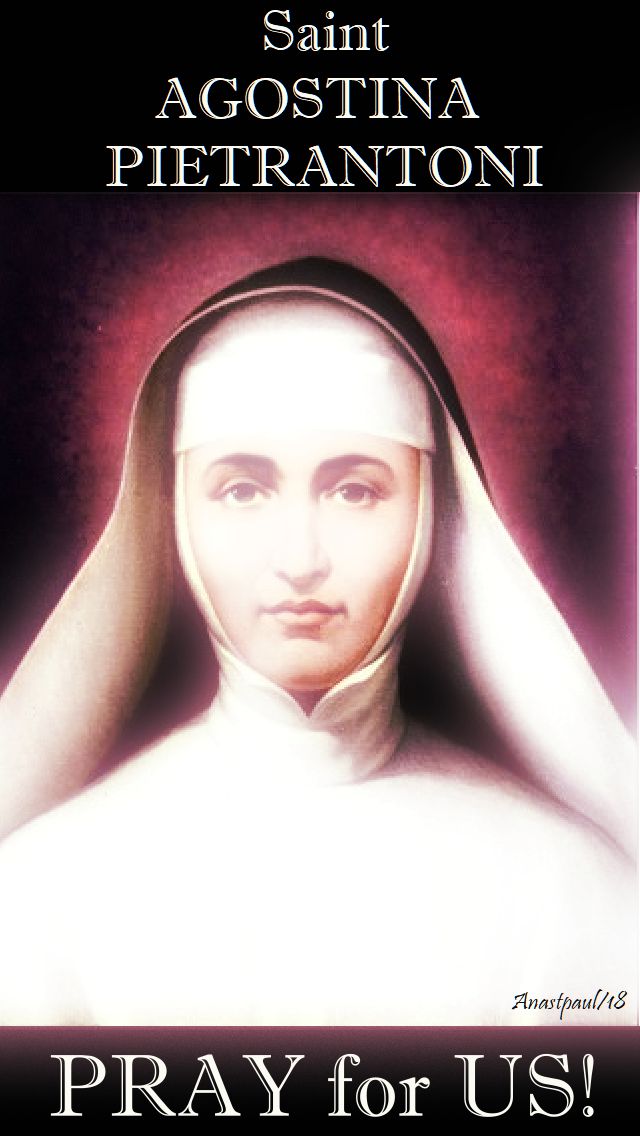
Thought for the Day – 13 November – The Memorial of St Agostina Livia Pietrantoni S.D.C. (1864-1894)
We look to Saint Agostina and contemplate her life and the way that she lived it- always for others, never for herself. First she laboured in the home, taking care of her younger siblings and helping out on the farm. Then, she was a migrant farm worker to earn more money to support her family, while providing love and direction to the many other children in the same situation. When she entered religious life, she dedicated her life to the sick and the poor in the tuberculosis ward- a place of constant suffering and death. Every day she faced the deadly disease and found joy and love in giving care to the people who contracted it. She knew that she was nothing and was prepared to let go of herself entirely every day, in service to the lowest of the low, even after being so brutally attacked, she forgave instantly- she saw the best in the worst of people and knew what she had to do.
I am cowardly and weak and selfish and I hope that one day I can hold in my heart, a tiny fraction of the love and the self-giving of this gentle St Agostina.
We will lie down for such a long time after death that it is worth while to keep standing while we are alive. Let us work now, one day we will rest. – St Agostina
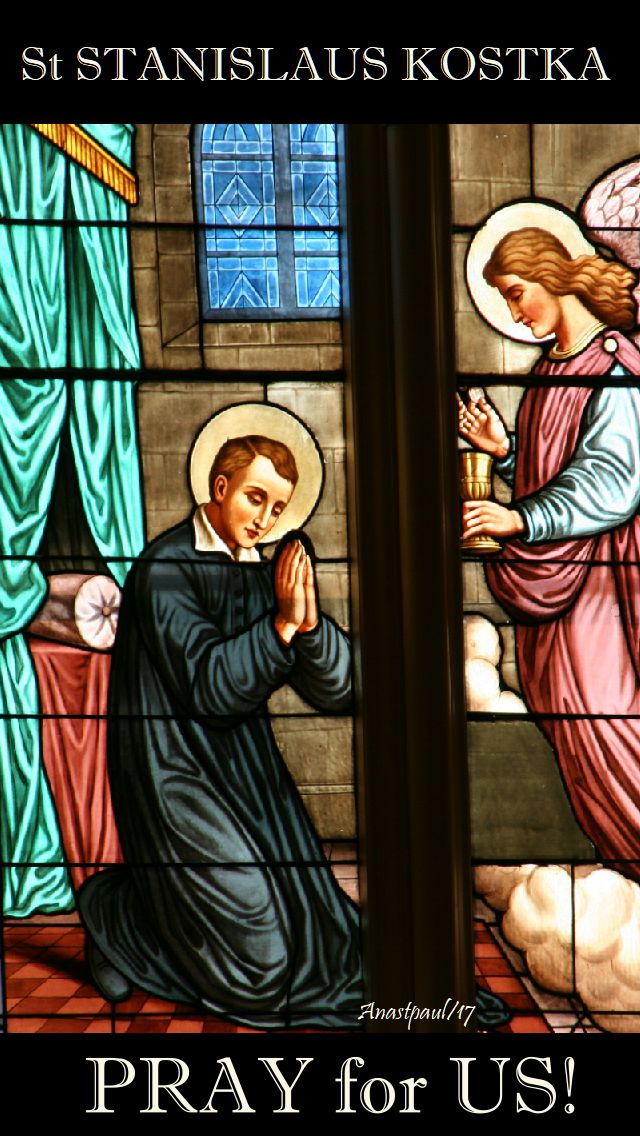
One Minute Reflection – 13 November – Today’s Gospel: Luke 17:7–10 – Tuesday of the Thirty Second week in Ordinary Time, Year B and the Memorial of St Stanislaus Kostka SJ (1550-1568) & St Agostina Livia Pietrantoni S.D.C. (1864-1894)
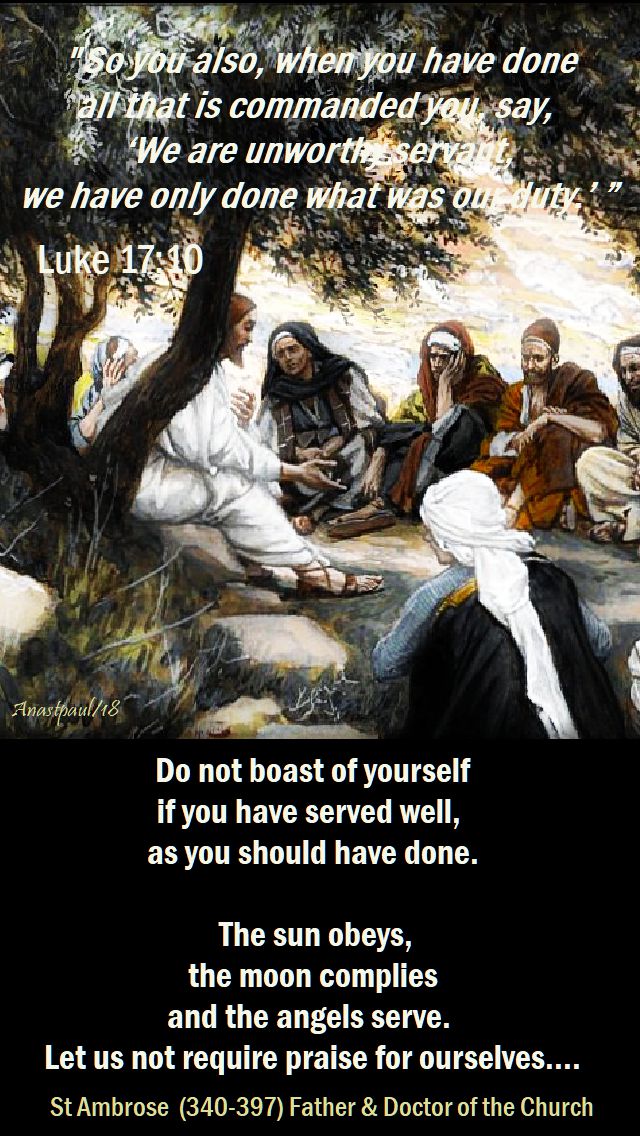
“So you also, when you have done all that is commanded you, say, ‘We are unworthy servants, we have only done what was our duty.’ ”…Luke 17:10
REFLECTION – “You do not say to your servant, “Sit down” but require more service from him and do not thank him. The Lord also, does not allow only one work or labour for you, because so long as we live, we must always work. Know that you are a servant overwhelmed by very much obedience. You must not set yourself first, because you are called a son of God. Grace must be acknowledged but nature not overlooked. Do not boast of yourself if you have served well, as you should have done. The sun obeys, the moon complies and the angels serve. Let us not require praise for ourselves, nor prevent the judgement of God and anticipate the sentence of the Judge but reserve it, for its own time and Judge. ”…Saint Ambrose (340-397) Father & Doctor of the Church (Exposition of the Gospel of Luke, 8)
PRAYER– Holy Father, I beg Your grace to achieve sanctity. Grant me the wisdom to follow Your Son, the fortitude to persevere in all trails and to be Your servant to all Your children but most of all Holy Father, grant me Your grace to obtain eternal life. Precious youths, St Stanislaus and St Agostina, please pray for us all , amen.
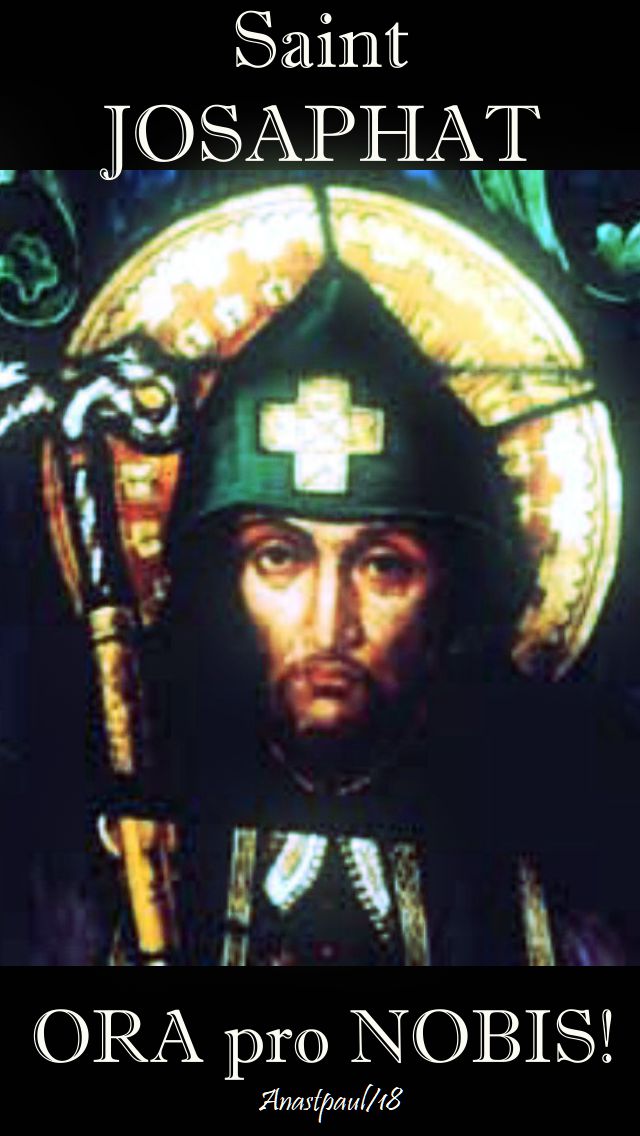
Memorial of St Josaphat (1584-1623) Bishop and Martyr “the thief of souls.”
“In designing his Church God worked with such skill that in the fullness of time it would resemble a single great family embracing all men. It can be identified, as we know, by certain distinctive characteristics, notably its universality and unity.
Christ the Lord passed on to His apostles the task He had received from the Father: ‘I have been given all authority in heaven and on earth. Go, therefore, and make disciples of all nations.’ He wanted the apostles as a body to be intimately bound together, first by the inner tie of the same faith and love which flows into our hearts through the Holy Spirit and, second, by the external tie of authority exercised by one apostle over the others. For this he assigned the primacy to Peter, the source and visible basis of their unity for all time. So that the unity and agreement among them would endure, God wisely stamped them, one might say, with the mark of holiness and martyrdom.
Both these distinctions fell to Josaphat, Archbishop of Polock of the Slavonic rite of the Eastern Church. He is rightly looked upon as the great glory and strength of the Eastern Rite Slavs. Few have brought them greater honour or contributed more to their spiritual welfare than Josaphat, their pastor and apostle, especially when he gave his life as a martyr for the unity of the Church. He felt, in fact, that God had inspired him to restore world-wide unity to the Church and he realised that his greatest chance of success lay in preserving the Slavonic rite and Saint Basil’s rule of monastic life within the one universal Church.
Concerned mainly with seeing his own people reunited to the See of Peter, he sought out every available argument which would foster and maintain Church unity. His best arguments were drawn from liturgical books, sanctioned by the Fathers of the Church, which were in common use among Eastern Christians, including the dissidents. Thus thoroughly prepared, he set out to restore the unity of the Church. A forceful man of fine sensibilities, he met with such success that his opponents dubbed him “the thief of souls.”
The seeds of separation were sown in the fourth century when the Roman Empire was divided into East and West. The actual split came over customs such as using unleavened bread, Saturday fasting and celibacy. No doubt the political involvement of religious leaders on both sides was a large factor and doctrinal disagreement was present. But no reason was enough to justify the present tragic division in Christendom, which is 64 percent Roman Catholic, 13 percent Eastern—mostly Orthodox—Churches and 23 percent Protestant and this when the 71 percent of the world that is not Christian, should be experiencing unity and Christ-like charity from Christians! (These figures from Franciscan Media)
One Minute Reflection – 12 November – Today’s Gospel: Luke 17:1-6 – Monday of the Thirty-second week in Ordinary Time, Year B and The Memorial of St Josaphat (1584-1623) Martyr
“Temptations to sin are sure to come but woe to the person through whom they occur! It would be better for him, if a millstone were put around his neck and he be thrown into the sea, than for him to cause one of these little ones to sin…” Luke 17:1-2
REFLECTION – “The accompanying discussion that immediately follows these opening remarks and speaks of our pardoning our brothers and sisters in case they ever sin against us, leads us to the idea that these were the offences meant. What are these offences? They are, I suppose, mean and annoying actions, fits of anger whether on good grounds or without justification, insults, slander and other stumbling blocks similar to these. He says that these temptations must come. Is this then because God, who governs all, forces people to their commission of sin? Away with the thought! Nothing that is evil comes from Him. He is the fountain of all virtue. Why then must this happen? They clearly happen because of our infirmity, for all of us stumble in many things, as it is written. Nevertheless, He says, that there will be woe to the person who lays the stumbling blocks in the way. He does not leave indifference in these things without rebuke but restrains it by fear of punishment. He still commands us to bear with patience those who cause sins to happen.”…St Cyril of Alexandria (376-444) – Father & Doctor – Commentary on Luke, “Homilies 113-116”
PRAYER – O Lord our God, grant that we may not so much seek to be consoled as to console, to be understood as to understand, to be loved as to love and to be only good influences to our neighbour. That by our love, our brothers in faith may be one . St Josaphat you fought and struggled to unite the Church and by your efforts achieved the crown of martyrdom, please pray for our world, for a one united faith. Amen
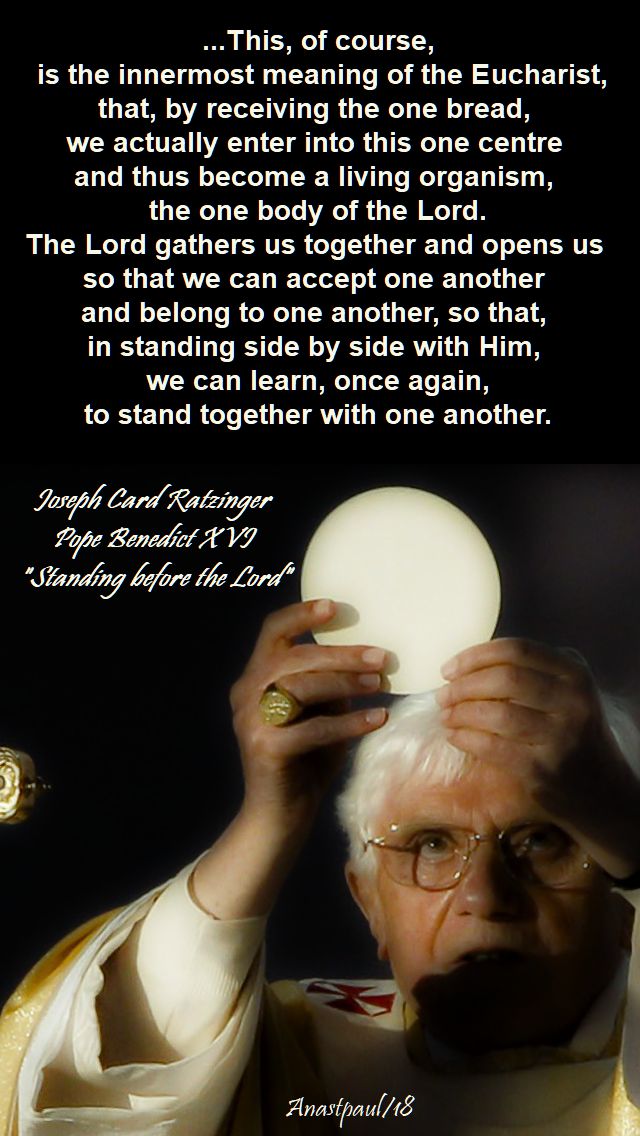
In the Church of former times, the word for this was statio. …From the very beginning, when Christianity spread throughout the world, its heralds laid the greatest importance on there being only one bishop and only one altar in every town. This was meant to express the unity of the one Lord, who unites us all in His embrace from the Cross, an embrace that goes beyond the frontiers drawn by earthly life and forms us into one body. And this, of course, is the innermost meaning of the Eucharist, that, by receiving the one bread, we actually enter into this one centre and thus become a living organism, the one body of the Lord.
The Eucharist is not a private matter among friends, taking place in a club of like-minded people where congenial spirits meet together. On the contrary, just as the Lord allowed Himself to be crucified publicly outside the city walls, stretching out His hands to all, the Eucharist is the public worship celebrated by all, whom the Lord calls….
It was fundamental to the Eucharist in the Mediterranean world, which first saw the growth of Christianity, that the aristocrat who had found his way to Christianity should sit down with the Corinthian dock-worker, the miserable slave who, according to Roman law, was not even held to be a human being and was dealt with as chattel. It is of the very nature of the Eucharist, that the philosopher should sit beside the illiterate man, the converted prostitute and the converted tax-collector beside the ascetic who has found his way to Jesus Christ.
In Rome, for instance, even during the era of persecution, the titular churches came into being as predecessors of the later parishes…..the Eucharist continued to unite people who would otherwise not mix. Consequently, the statio was introduced – here, particularly during Lent, the Pope, as the single Bishop of Rome, goes among the individual titular churches and celebrates the liturgy for the whole city of Rome.
Christians gather together and go to church together, thus, in the individual churches, the whole Church is visible and is manifest at the individual level.
The Lord gathers us together and opens us so that we can accept one another and belong to one another, so that, in standing side by side with Him, we can learn once again to stand together with one another. ….What binds us together is not the private interest of this or that group but the interest which God takes in us. And we can calmly and confidently, entrust all our interests to Him. We commit ourselves to the Lord. And the more we commit ourselves to the Lord and stand before Him, the more we stand together with one another and the more power we discover to understand each other, to recognise each other as human beings, as brothers and sisters. In this way, in this fellowship with one another, we are building the foundations for humanity and making it possible.
Joseph Card Ratzinger/Pope Benedict XVI “Seek that Which is Above”
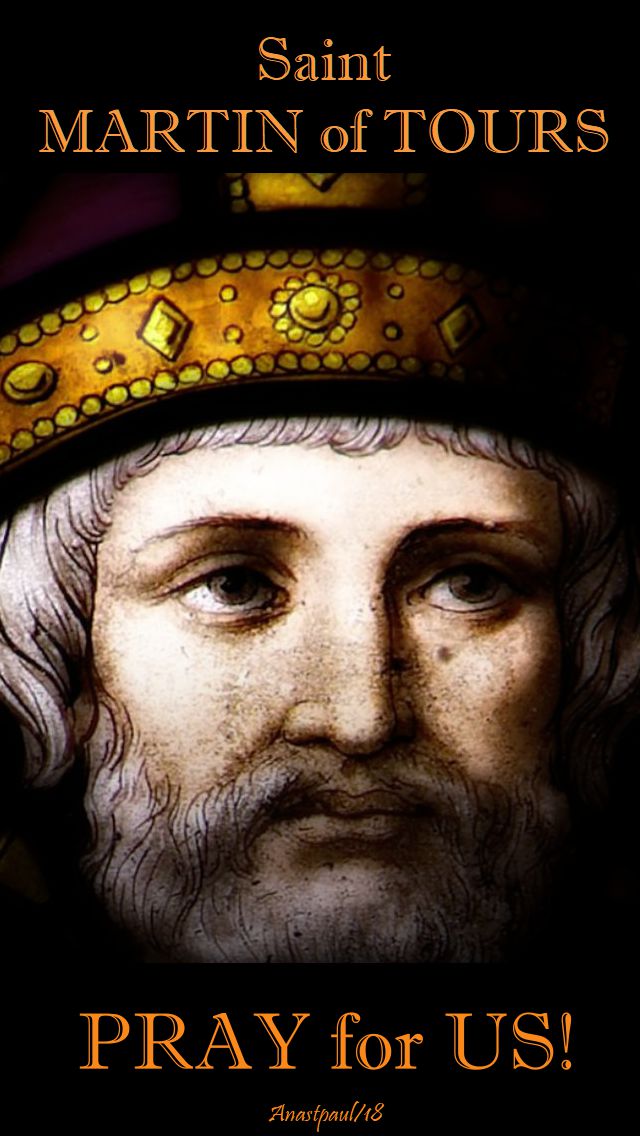
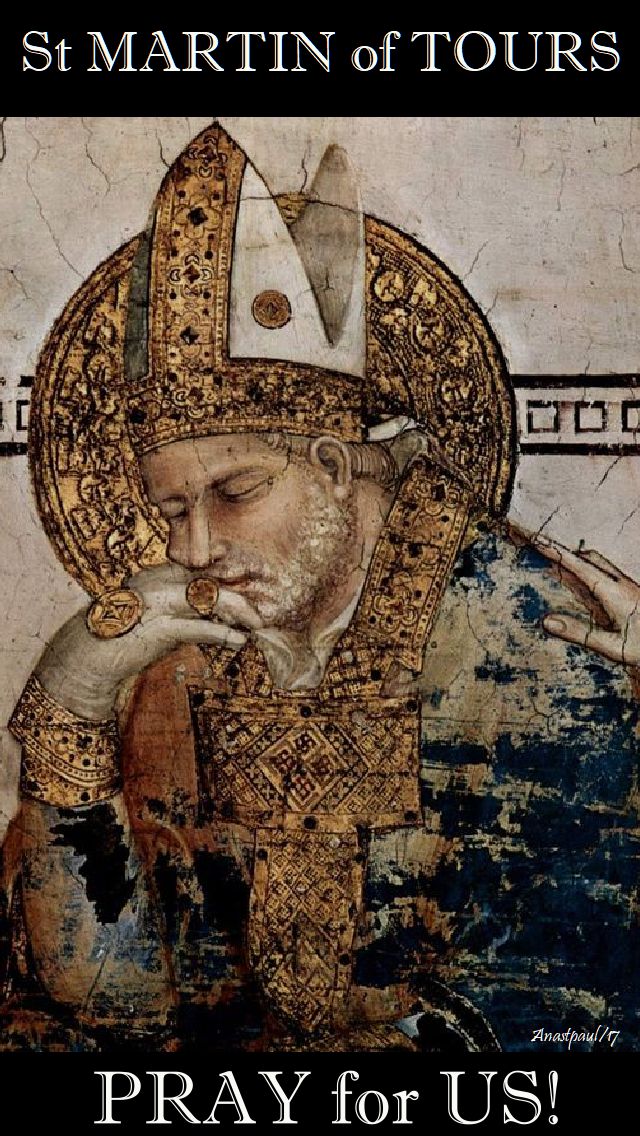
Thought for the Day – 11 November – The Memorial of St Martin of Tours (c 316-397)
Martin knew long in advance the time of his death and he told his brethren that it was near. Meanwhile, he found himself obliged to make a visitation of the parish of Candes. The clergy of that church were quarrelling and he wished to reconcile them.
Although he knew that his days on earth were few, he did not refuse to undertake the journey for such a purpose, for he believed that he would bring his virtuous life to a good end if by his efforts peace was restored in the church.
He spent some time in Candes, or rather in its church, where he stayed. Peace was restored and he was planning to return to his monastery when suddenly he began to lose his strength. He summoned his brethren and told them he was dying. All who heard this were overcome with grief. In their sorrow, they cried to him with one voice: “Father, why are you deserting us? Who will care for us when you are gone? Savage wolves will attack your flock and who will save us from their bite when our shepherd is struck down? We know you long to be with Christ but your reward is certain and will not be any less for being delayed. You will do better to show pity for us, rather than forsake us.”
Thereupon he broke into tears, for he was a man in whom the compassion of our Lord was continually revealed. Turning to our Lord, he made this reply to their pleading: “Lord, if Your people still need me, I am ready for the task, Your will be done.”
Here was a man words cannot describe. Death could not defeat him nor toil dismay him. He was quite without a preference of his own, he neither feared to die nor refused to live. With eyes and hands always raised to heaven he never withdrew his unconquered spirit from prayer. It happened that some priests who had gathered at his bedside suggested that he should give his poor body some relief by lying on his other side. He answered: “Allow me, brothers, to look toward heaven rather than at the earth, so that my spirit may set on the right course when the time comes for me to go on my journey to the Lord.”
“Never was there any word on his lips but Christ and never was there a feeling in his heart except piety, peace and tender mercy.”
a letter by Sulpicius Severus (c 360 – c 425) Born around 360 AD in the region of Gaul (modern France) called Aquitaine, Sulpicius Severus was an up and coming lawyer till his wife’s death caused him to pause and take stock of his life. The example of his frend, St Paulinus of Nola (354-431) and the exhortations of St Martin, bishop of Tours, led to his conversion to the monastic life. He settled on an estate in Southern Gaul and set to work writing the life of St Martin who was still alive at the time. The work became very influential on later authors writing lives of the saints. According to one author, Sulpicius was ultimately ordained a priest and lived till about 420.
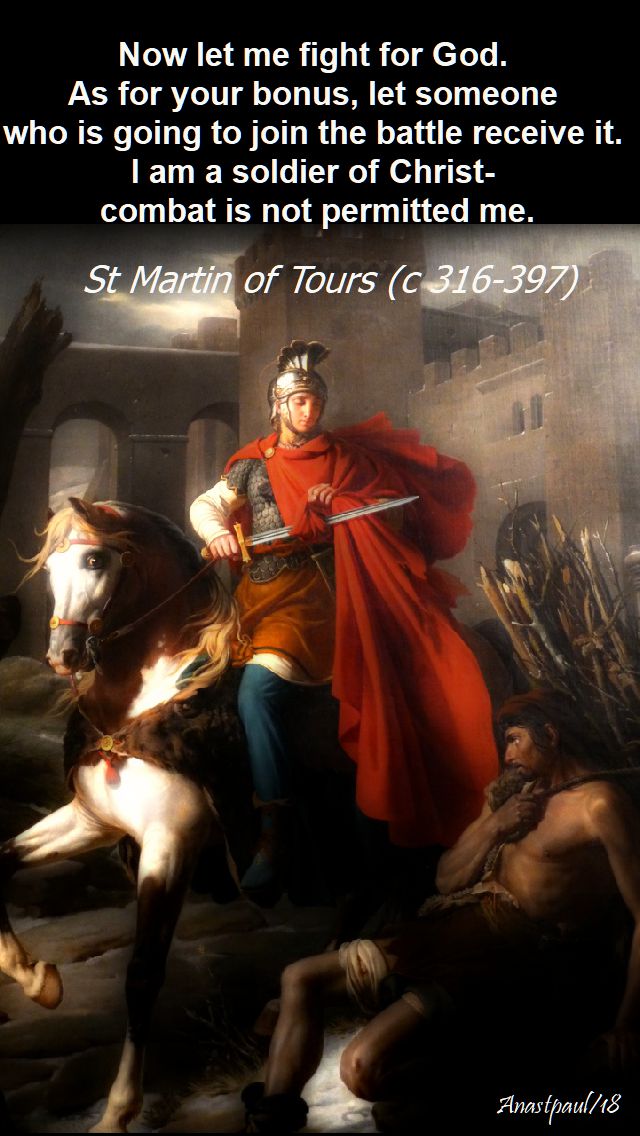
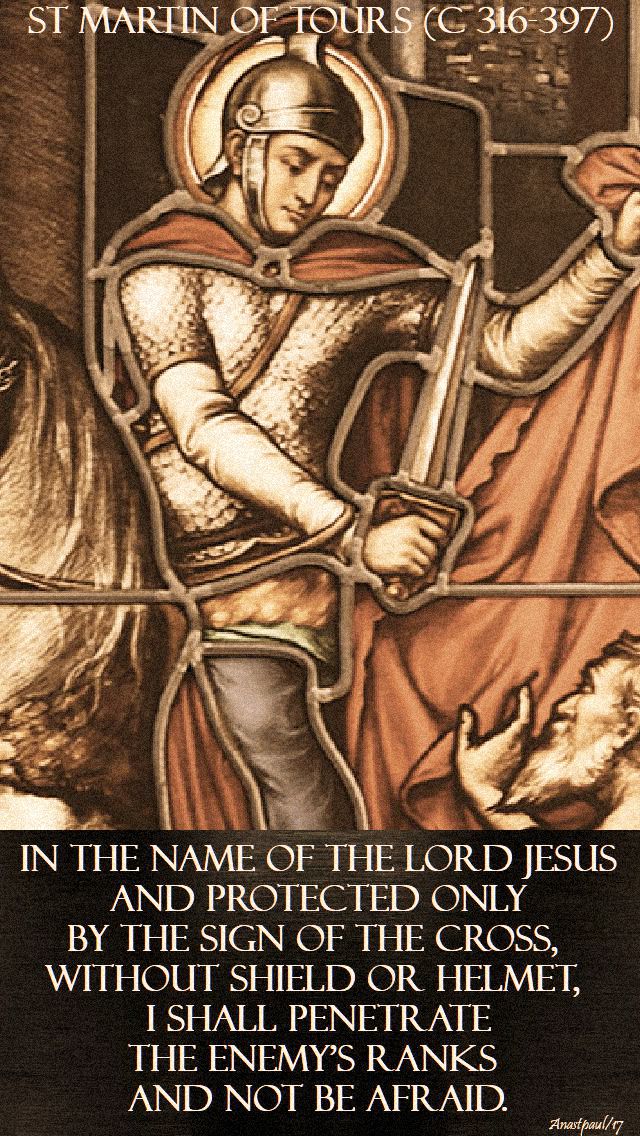
Quote/s of the Day – 11 November – The Memorial of St Martin of Tours (c 316-397)
“Now let me fight for God. As for your bonus, let someone who is going to join the battle receive it. I am a soldier of Christ- combat is not permitted me.”
“In the name of the Lord Jesus and protected only by the sign of the cross, without shield or helmet, I shall penetrate the enemy’s ranks and not be afraid.”
One Minute Reflection – 11 November – Today’s Gospel: Mark 12:38–44 – Thirty Second Sunday in Ordinary Time, Year B and The Memorial of St Martin of Tours (c 316-397)
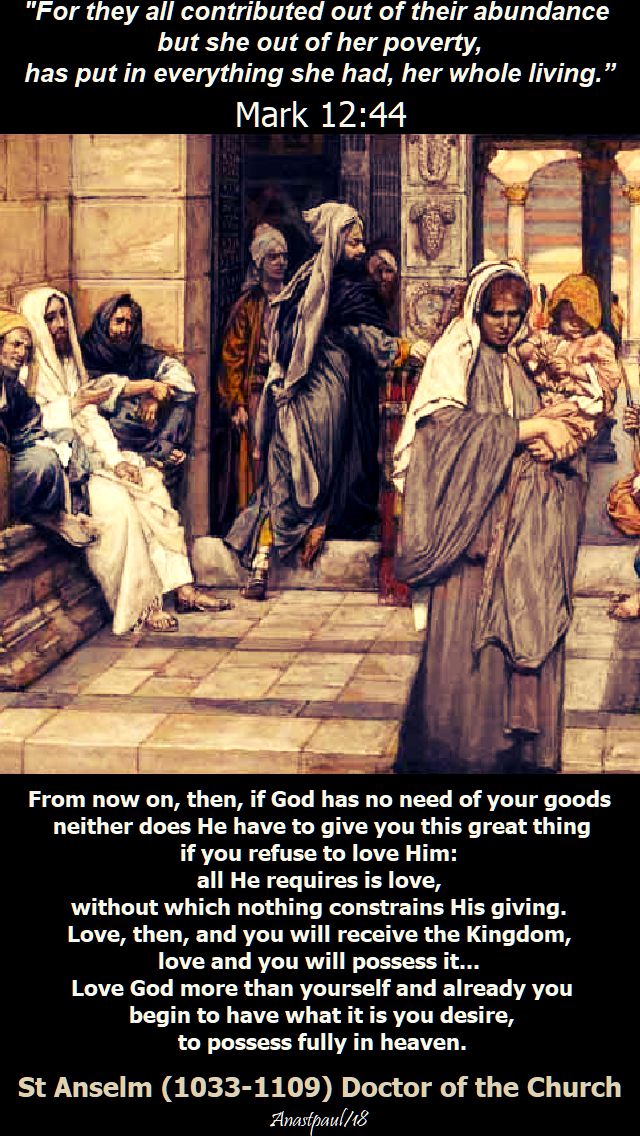
“For they all contributed out of their abundance but she out of her poverty has put in everything she had, her whole living.”…Mark 12:44
REFLECTION – “Now if someone is wondering what the cost is, here is their answer – he who offers a Kingdom in heaven has no need of earthly coin. No one can offer God anything except what already belongs to Him since all that exists is His. And yet God does not give away so great a thing without a price being placed on it, He does not give it to someone who doesn’t value it. For indeed, nobody gives away something they hold dear without placing some kind of value on it. From now on, then, if God has no need of your goods neither does He have to give you this great thing if you refuse to love Him, all He requires is love, without which nothing constrains His giving. Love, then, and you will receive the Kingdom, love and you will possess it… Love God more than yourself and already you begin to have what it is you desire to possess fully in heaven.”…St Anselm (1033-1109) Doctor of the Church
PRAYER – Lord God, Your Son has shown us the way. As we follow in His steps, may we never wander from the path that leads to life. Renew the wonders of Your grace in our hearts so that neither death nor life may separate us from Your love. Holy Father, as You were glorified by the life and death of St Martin, grant that by his prayers, we may receive strength to always give You our hearts, minds and selves. Through our Lord, Jesus Christ, with You in union with the Holy Spirit, one God for all eternity, amen.
Thought for the Day – 10 November – Christian, Remember Your Dignity by St Pope Leo the Great
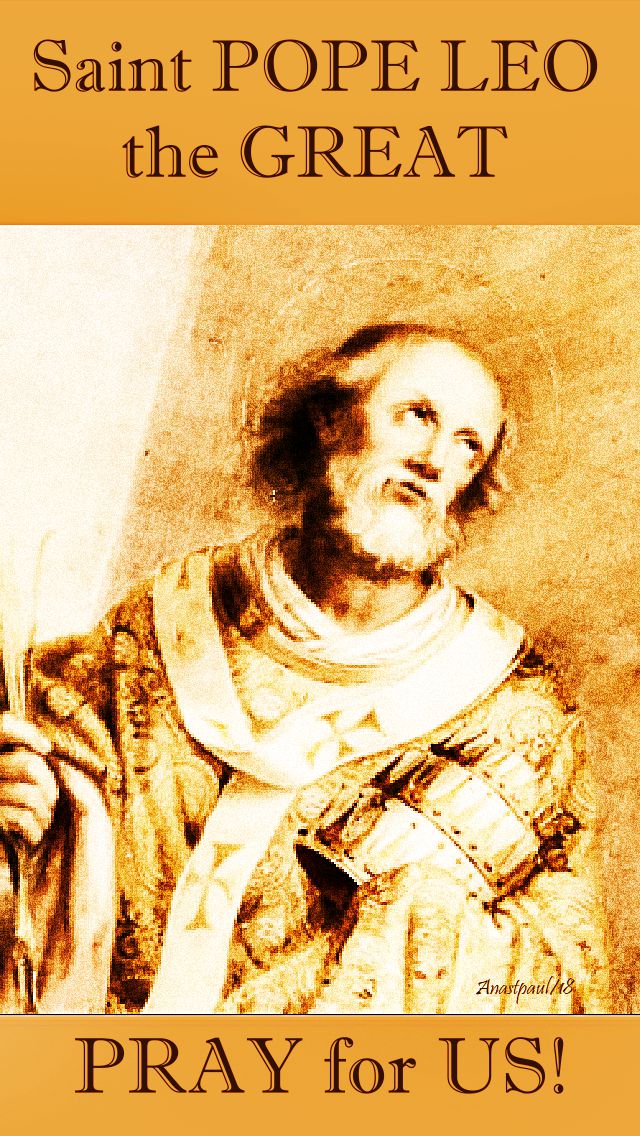
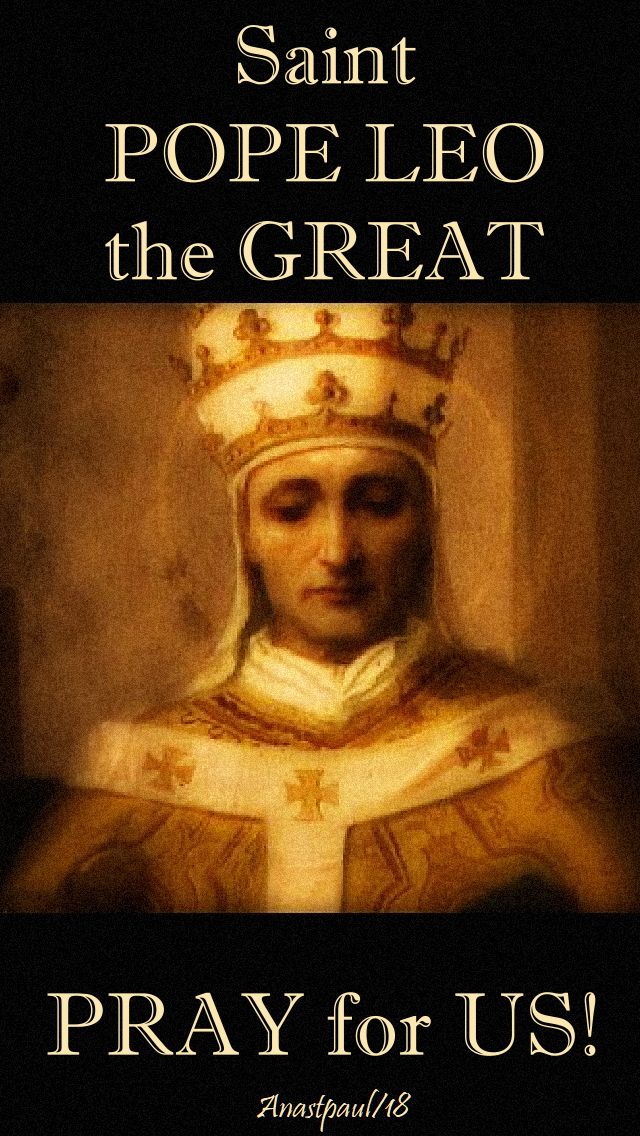
Today we celebrate the feast day of Pope Saint Leo the Great (c 400-461). St Leo is referred to by many names, including “Doctor of Doctrine” and “Doctor of Unity of the Church.” He is the first pope to be referred to by the title “Great” and the first pope made Doctor of the Church. His writings, unifying doctrine and peacemaking, continue to inspire and instruct us today in the ways of the faith. Below, an excerpt from a homily, encouraging Christians to take heed of the joy of Christ and exhorts them to live in freedom and dignity of the Incarnation!
Christian, Remember Your Dignity!
Dearly beloved, today our Saviour is born, let us rejoice. Sadness should have no place on the birthday of life. The fear of death has been swallowed up; life brings us joy with the promise of eternal happiness.
No one is shut out from this joy, all share the same reason for rejoicing. Our Lord, victor over sin and death, finding no man free from sin, came to free us all. Let the saint rejoice as he sees the palm of victory at hand. Let the sinner be glad as he receives the offer of forgiveness. Let the pagan take courage as he is summoned to life.
In the fullness of time, chosen in the unfathomable depths of God’s wisdom, the Son of God took for Himself our common humanity in order to reconcile it with its creator. He came to overthrow the devil, the origin of death, in that very nature by which He had overthrown mankind.
And so at the birth of our Lord the angels sing in joy – Glory to God in the highest and they proclaim peace to men of good will as they see the heavenly Jerusalem being built from all the nations of the world. When the angels on high are so exultant at this marvellous work of God’s goodness, what joy should it not bring to the lowly hearts of men?
Beloved, let us give thanks to God the Father, through His Son, in the Holy Spirit, because in His great love for us He took pity on us and when we were dead in our sins He brought us to life with Christ, so that in Him we might be a new creation. Let us throw off our old nature and all its ways and, as we have come to birth in Christ, let us renounce the works of the flesh.
Christian, remember your dignity and now that you share in God’s own nature, do not return by sin to your former base condition Bear in mind who is your head and of whose body you are a member. Do not forget that you have been rescued from the power of darkness and brought into the light of God’s kingdom.
Through the sacrament of baptism you have become a temple of the Holy Spirit. Do not drive away so great a guest by evil conduct and become again a slave to the devil, for your liberty was bought by the blood of Christ.
Quote/s of the Day – 10 November – The Memorial of St Pope Leo the Great (c 400-461) Doctor of the Church and St Andrew Avellino CR (1521 – 1608)
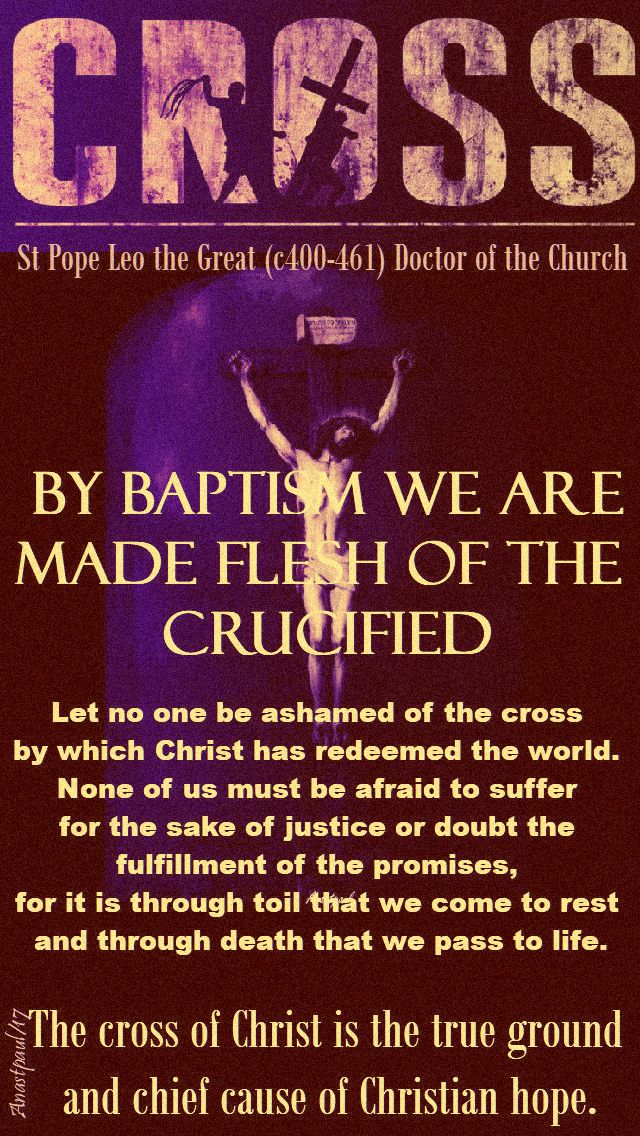
“By Baptism we are made flesh of the Crucified.”
“The cross of Christ is the true ground and chief cause of Christian hope.”
“Let no one be ashamed of the cross by which Christ has redeemed the world. None of us must be afraid to suffer for the sake of justice or doubt the fulfilment of the promises, for it is through toil that we come to rest and through death that we pass to life.”
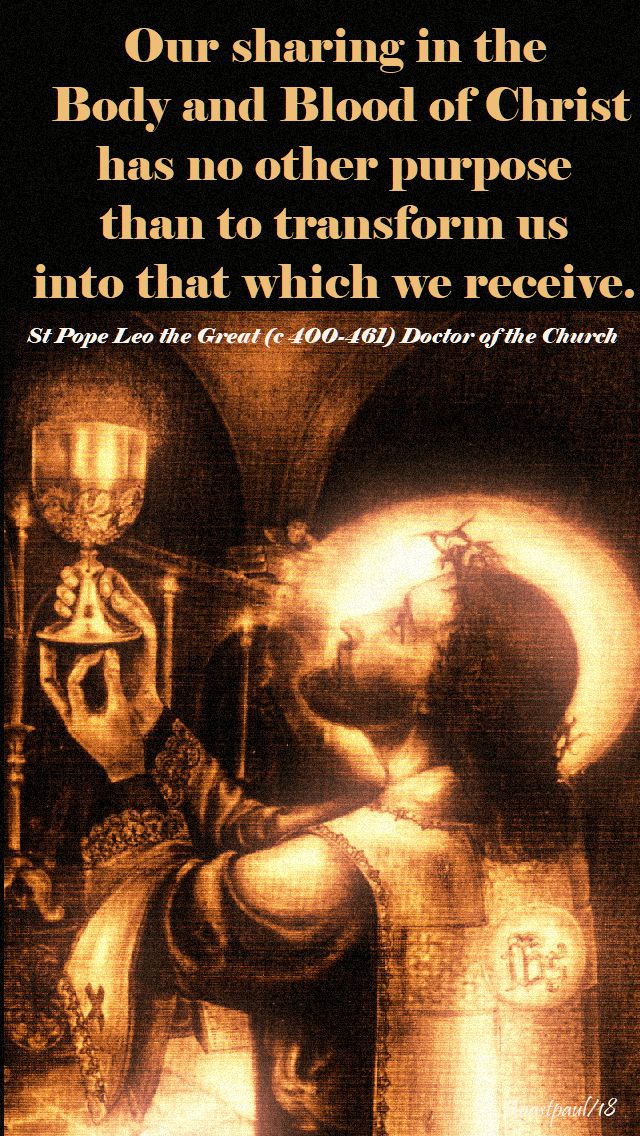
“Our sharing in the Body and Blood of Christ has no other purpose than to transform us into that which we receive.”
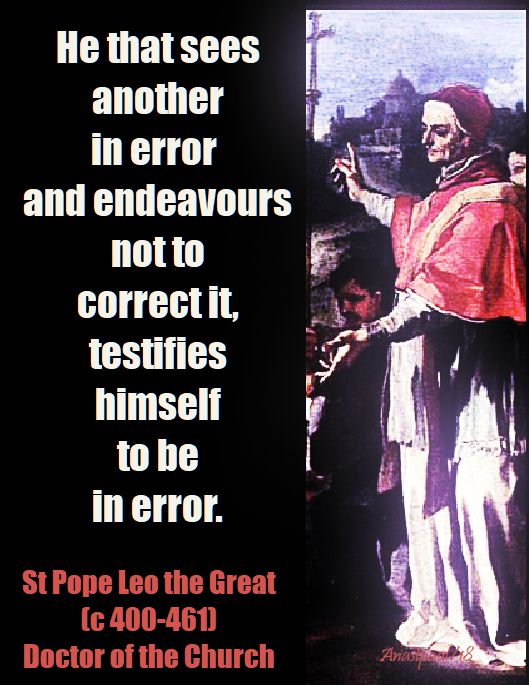
“He that sees another in error and endeavours not to correct it, testifies himself to be in error.”
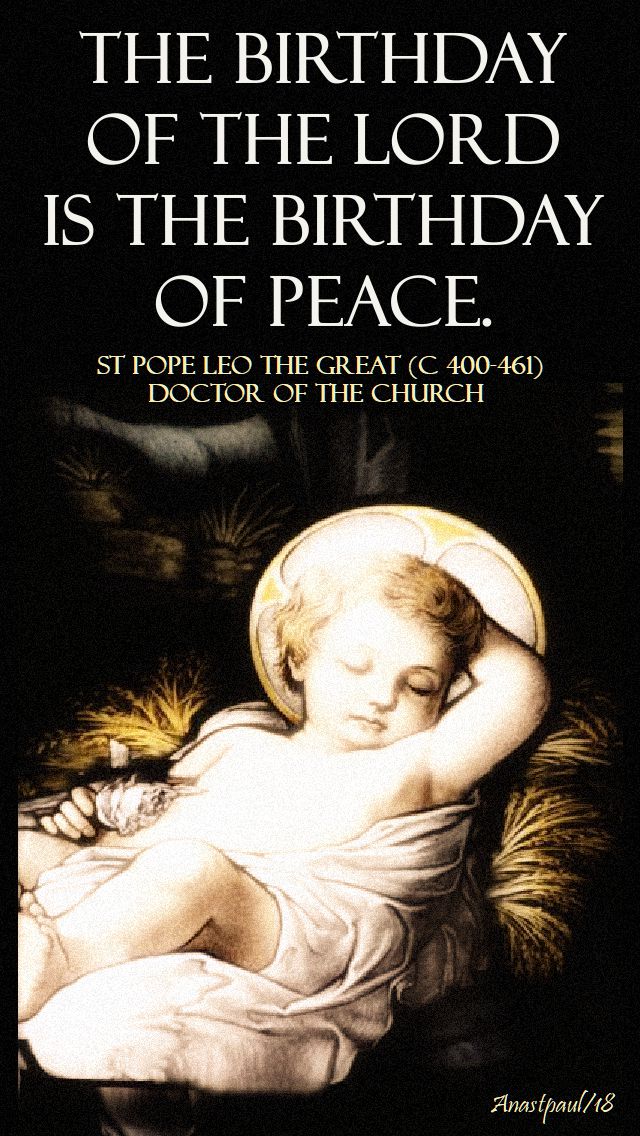
“The birthday of the Lord is the birthday of peace.”
“Beyond our grasp, He chose to come within our grasp. Existing before time began, He began to exist at a moment in time.”
St Pope Leo the Great (c 400-461) Doctor of the Church
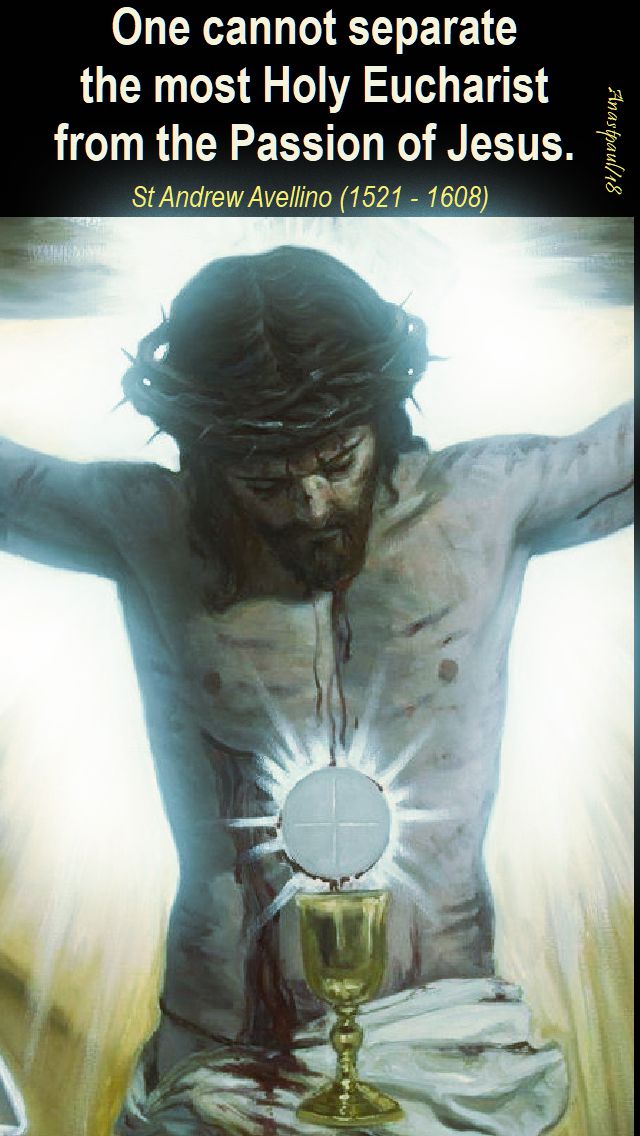
“One cannot separate the most Holy Eucharist from the Passion of Jesus.”
One Minute Reflection – 10 November – Today’s Gospel: Luke 16:9–15 – Saturday of the Thirty First Week in Ordinary Time, Year B and The Memorial of St Leo the Great (c 400-461) Doctor of the Church and St Andrew Avellino CR (1521 – 1608)
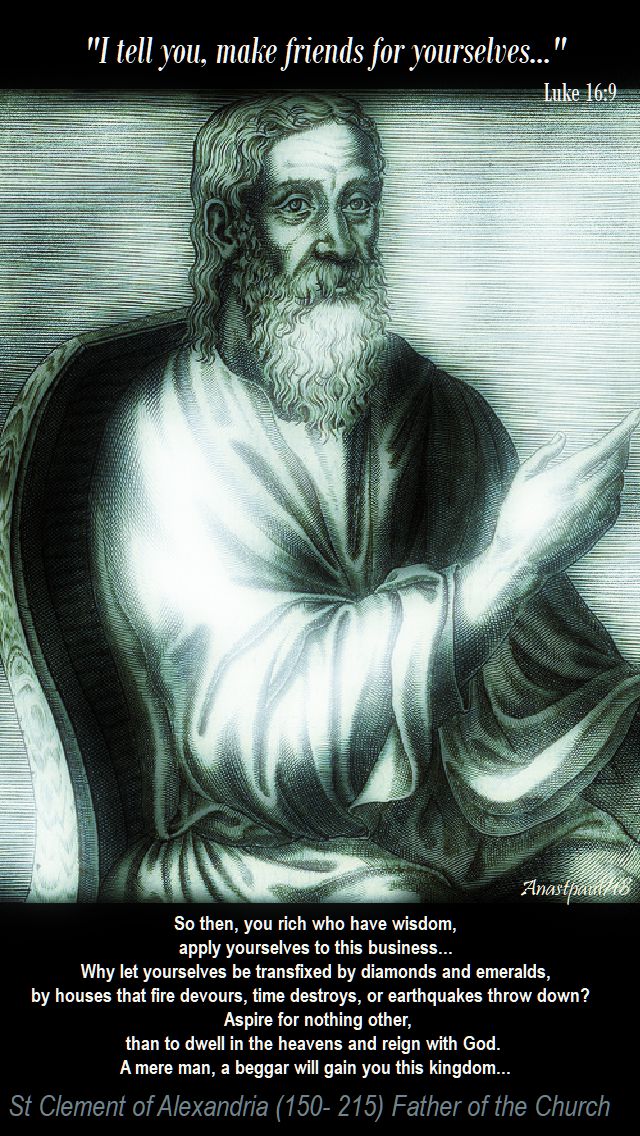
“I tell you, make friends for yourselves with dishonest wealth, so that when it fails, you will be welcomed into eternal dwellings.”...Luke 16:9
REFLECTION – “Consider, then, the splendid reward for your liberality – an everlasting habitation! O excellent trade! O divine commerce! You purchase immortality for money and, by donating the empty things of the world, receive in exchange an eternal mansion in heaven! So then, you rich who have wisdom, apply yourselves to this business… Why let yourselves be transfixed by diamonds and emeralds, by houses that fire devours, time destroys, or earthquakes throw down? Aspire for nothing other than to dwell in the heavens and reign with God. A mere man, a beggar will gain you this kingdom… The Lord did not say: “Give, be generous and bountiful, help your brothers” but: “Make friends for yourselves”. Friendship comes about not by one gift but by long intimacy. For neither faith, nor charity nor patience are the work of one day but “he who endures to the end shall be saved.” (Mt 10:22)...St Clement of Alexandria (150- 215)
PRAYER – Lord God, You built Your Church on the firm foundation of the Apostle Peter and You promised that the gates of hell would never overcome it. So too, may we trust in Your power, that by our faith we may receive the grace to withstand the enemy who will not prevail against us. May we always serve You in our brother and may your Holy Spirit grant us the grace of fortitude to withstand our temptations and thus gain eternal life, supported by the prayers of St Pope Leo the Great and St Andrew Avellino, keep us ever faithful to Your love. Amen
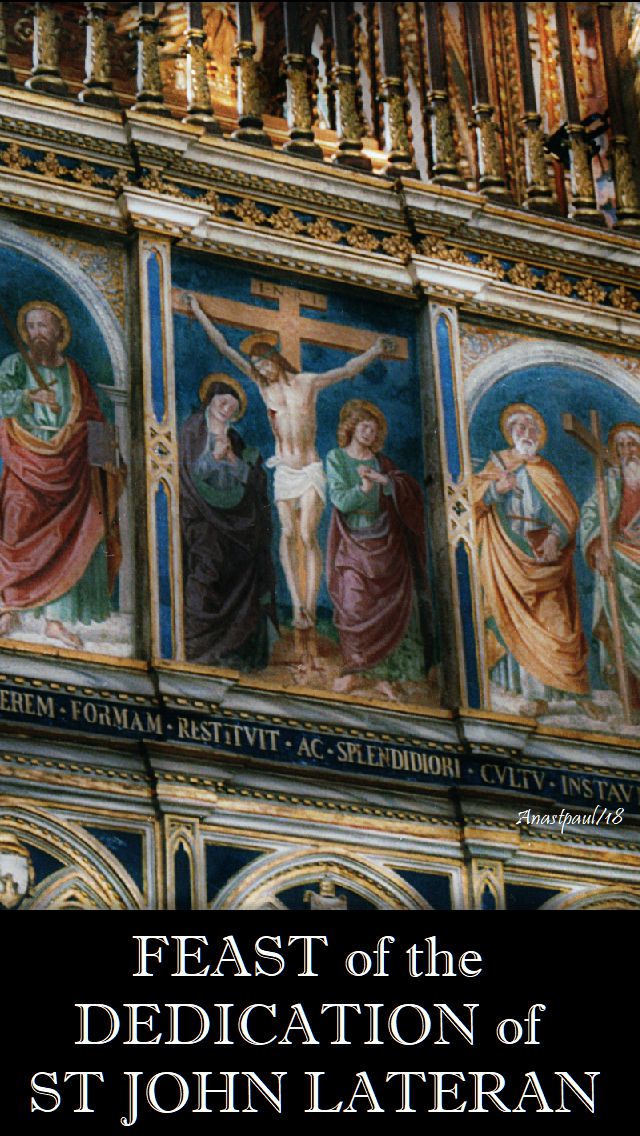
Quote/s of the Day – 9 November – The Feast of the Dedication of St John Lateran
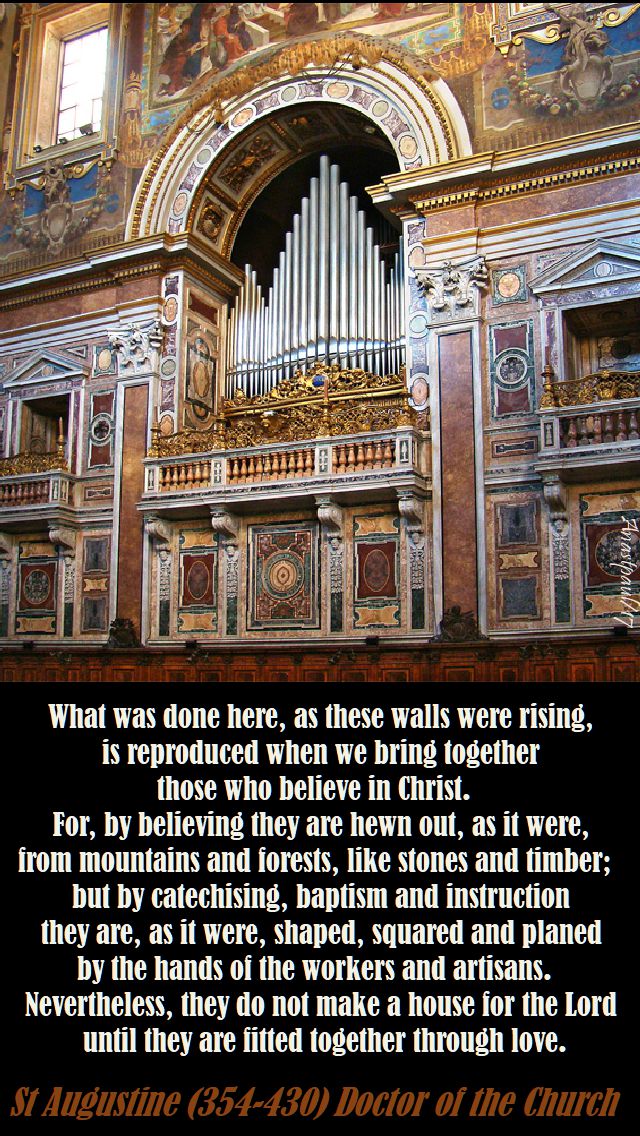
“What was done here, as these walls were rising, is reproduced when we bring together those who believe in Christ. For, by believing they are hewn out, as it were, from mountains and forests, like stones and timber but by catechising, baptism and instruction they are, as it were, shaped, squared and planed by the hands of the workers and artisans. Nevertheless, they do not make a house for the Lord, until they are fitted together through love”.
St Augustine (354-430) Doctor of the Church – Sermon 36
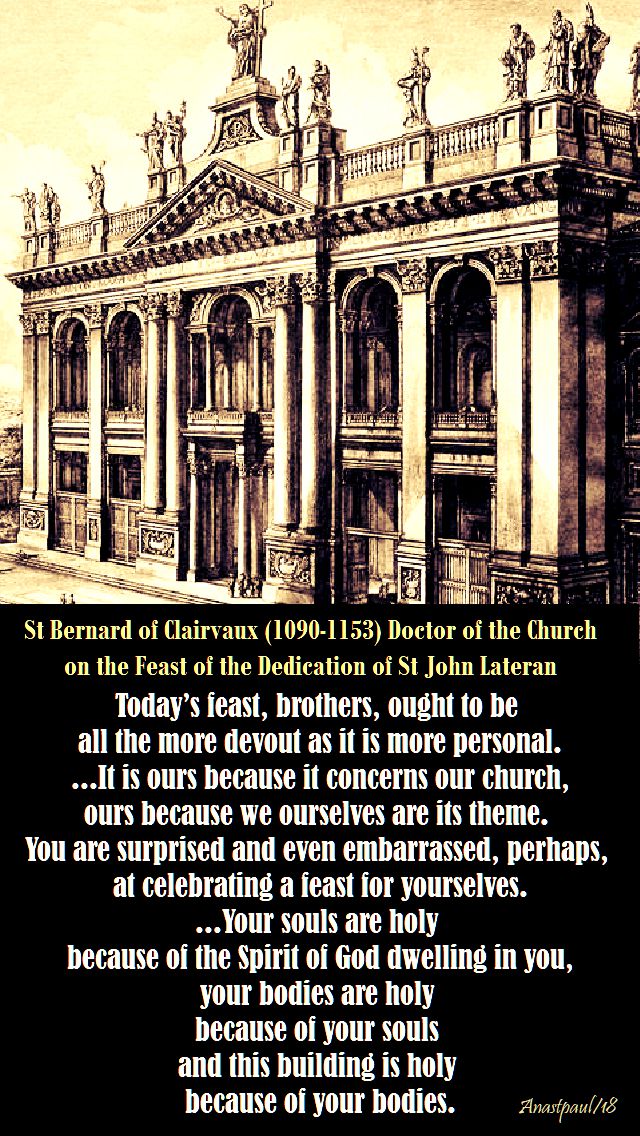
“Today’s feast, brothers, ought to be all the more devout as it is more personal. For other celebrations we have in common with other ecclesiastical communities but this one is proper to us, so that if we do not celebrate it, nobody will. It is ours because it concerns our church, ours because we ourselves are its theme. You are surprised and even embarrassed, perhaps, at celebrating a feast for yourselves. But do not be like horses and mules that have no understanding. Your souls are holy because of the Spirit of God dwelling in you, your bodies are holy because of your souls and this building is holy because of your bodies.”
St Bernard of Clairvaux (1090-1153) Doctor of the Church
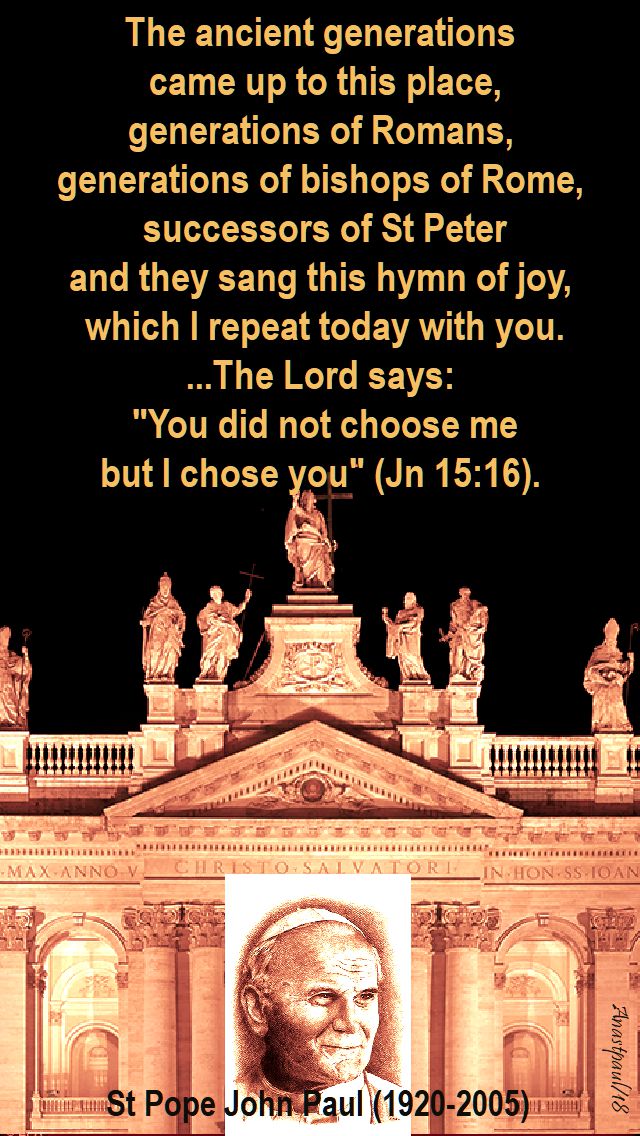
“Is not this an image of today’s event? The ancient generations came up to this place, generations of Romans, generations of bishops of Rome, successors of St Peter and they sang this hymn of joy, which I repeat today with you. I join these generations, I, the new Bishop of Rome, John Paul II, Polish by origin. I stop on the threshold of this temple and I ask you to welcome me in the Lord’s name. I beg you to welcome me, as you welcomed my Predecessors throughout the centuries, as you welcomed, only a few weeks ago, John Paul I, so beloved by the whole world! I beg you to welcome me too. The Lord says: “You did not choose me, but I chose you” (Jn 15:16). This is the only appeal I can make – I am not here by my own will. The Lord has elected me. In the Lord’s name I beg you therefore – welcome me!”
St Pope John Paul (1920-2005) RITE OF POSSESSION OF THE CHAIR OF THE BISHOP OF ROME HOMILY OF HIS HOLINESS JOHN PAUL II Basilica of St John Lateran Sunday, 12 November 1978
One Minute Reflection – 9 November – The Feast of the Dedication of St John Lateran – Today’s Gospel: John 2:13–22
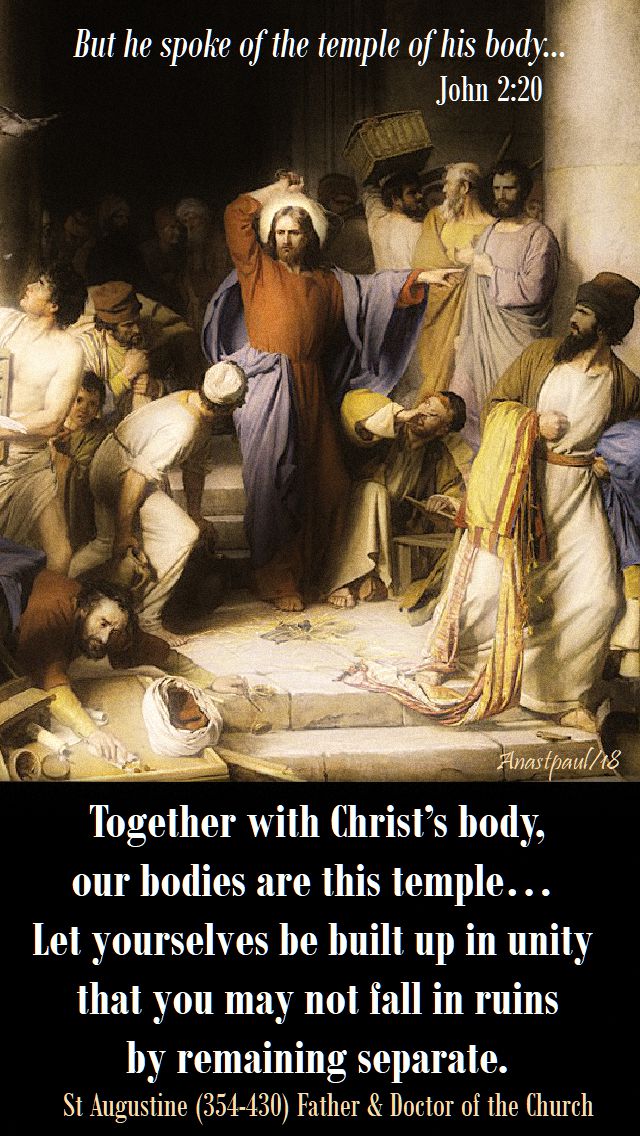
But he spoke of the temple of his body...John 2:20
REFLECTION – “Because Solomon was a prophet he built a temple of stone and wood… for the living God, who made heaven and earth and whose dwelling is in the skies… Why did God ask that a temple be built? Was he lacking somewhere to live? Listen to Stephen’s speech at the time of his passion: “Solomon,’ he said, “built a house but the most High does not live in man-made temples” (Acts 7:48). Why, then, did he build, or cause to be built, a temple? To prefigure Christ’s body. The first temple was only a shadow (Col 2:17), when light comes, shadows flee away. Are you now looking for the temple Solomon built? You will find a ruin. Why is this temple only a ruin? Because the reality it announced has been fulfilled. The true temple, the Lord’s body, also fell but has been raised up again and raised up in such a way it will fall no more…
What about our own bodies? They are members of Christ . Listen to Saint Paul: “Do you not know that your bodies are members of Christ?” (1Cor 6:15). When he says: “Your bodies are members of Christ”, what does this mean but that our bodies, joined to Christ our head (Col 1:18), together form a single temple, God’s temple. Together with Christ’s body, our bodies are this temple… Let yourselves be built up in unity that you may not fall in ruins by remaining separate.”…St Augustine (354-430) Father & Doctor of the Church
PRAYER – Almighty God, as we recall with joy, the Dedication of this house of Yours on each recurring anniversary, listen to Your people’s prayer and grant that our worship here may be a sincere and holy service, honouring Your Name and bringing us the fullness of redemption. Through Jesus Christ, our Lord, in union with the Holy Spirit, one God for all eternity, amen.
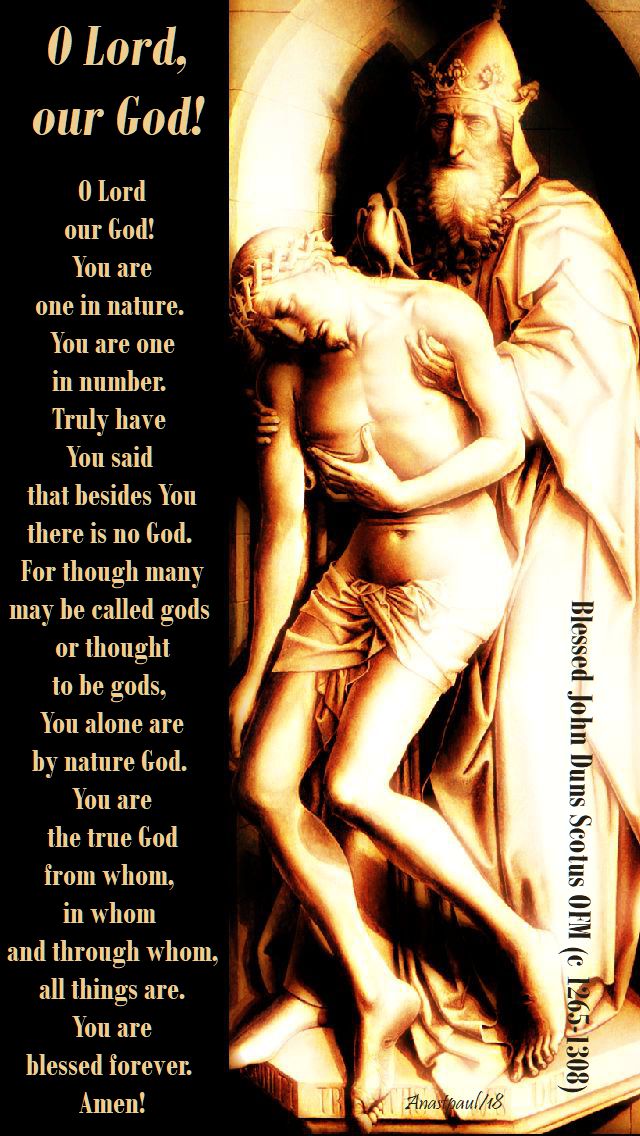
Quote/s of the Day – 8 November – The Memorial of Blessed John Duns Scotus OFM
(c 1265-1308)
O Lord our God! You are one in nature. You are one in number. Truly have You said that besides You there is no God. For though many may be called gods or thought to be gods, You alone are by nature God. You are the true God from whom, in whom and through whom, all things are, You are blessed forever. Amen!
One Minute Reflection – 8 November – Today’s Gospel: Luke 15:1–10 – Thursday of the Thirty First week in Ordinary Time, Year B and the Memorial of Blessed John Duns Scotus OFM (c 1265-1308)
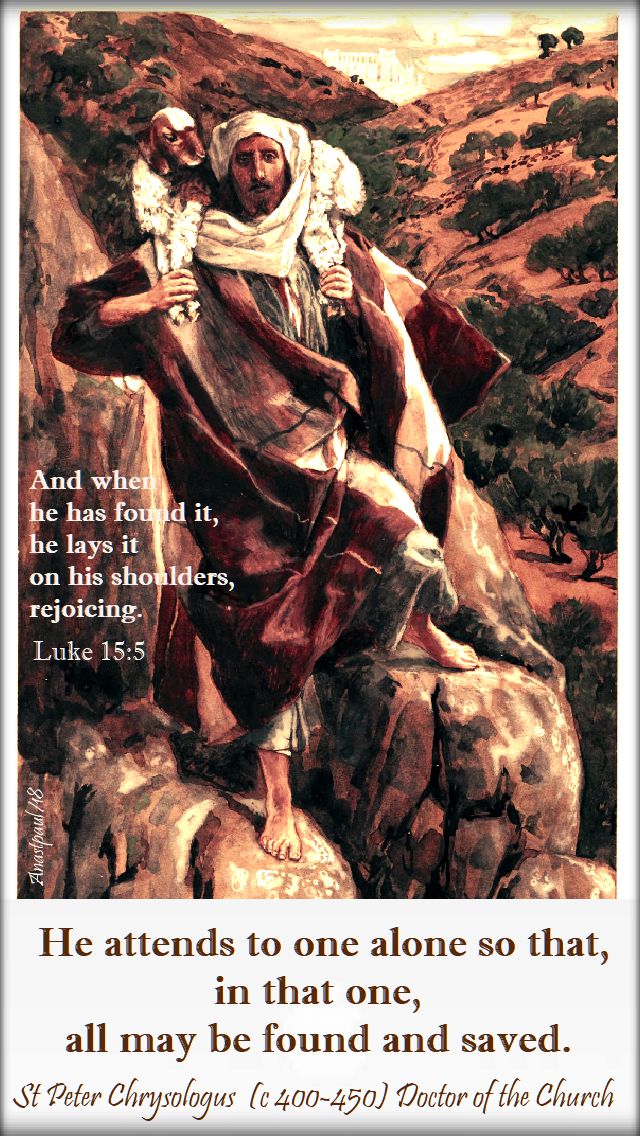
“What man of you, having a hundred sheep, if he has lost one of them, does not leave the ninety-nine in the wilderness and go after the one which is lost, until he finds it? And when he has found it, he lays it on his shoulders, rejoicing.”…Luke 15:4-5
REFLECTION – “The fact of re-finding something we had lost always fills us anew with joy. And this joy is greater than that we felt before losing it, when the thing was safely kept. But the parable of the lost sheep speaks more of God’s tenderness than of the way in which people usually behave. It expresses a profound truth. To leave behind something of importance for love of what is more humble, is characteristic of divine power, not of human possessiveness. For God even brings into existence what is not, He sets out in search of what is lost while still keeping what He had left in place and He finds what had strayed without losing what He has under His protection.
That is why, this shepherd is not of earth but of heaven. The parable is not in any respect, a representation of human achievements but it conceals divine mysteries, as the numbers it mentions immediately show: “What man among you,” says the Lord, “having a hundred sheep and losing one of them…” As you see, the loss of a single sheep has sorely tried this shepherd, as though the whole flock, deprived of His protection, had set out along a treacherous path. This is why, leaving the ninety-nine others there, He sets out in search of the one. He attends to one alone so that, in that one, all may be found and saved.”…St Peter Chrysologus (c 400-450) Doctor of the Church
PRAYER – Lord God, in Your wisdom, You created us, by Your providence You rule us, penetrate our inmost being with Your holy light, so that our way of life, may always be one of faithful service to You. With great love we thank You for the great gifts You shower upon us and for being our Father, who seeks and finds us when we are lost. Grant that by the intercession of Blessed John Duns Scotus, we may ever seek to stay true to our baptism. Through Jesus, our Lord, with the Holy Spirit, God forever, amen.
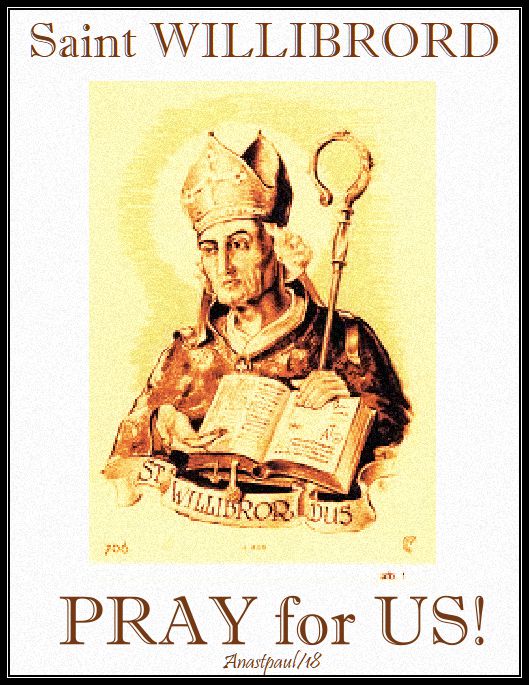
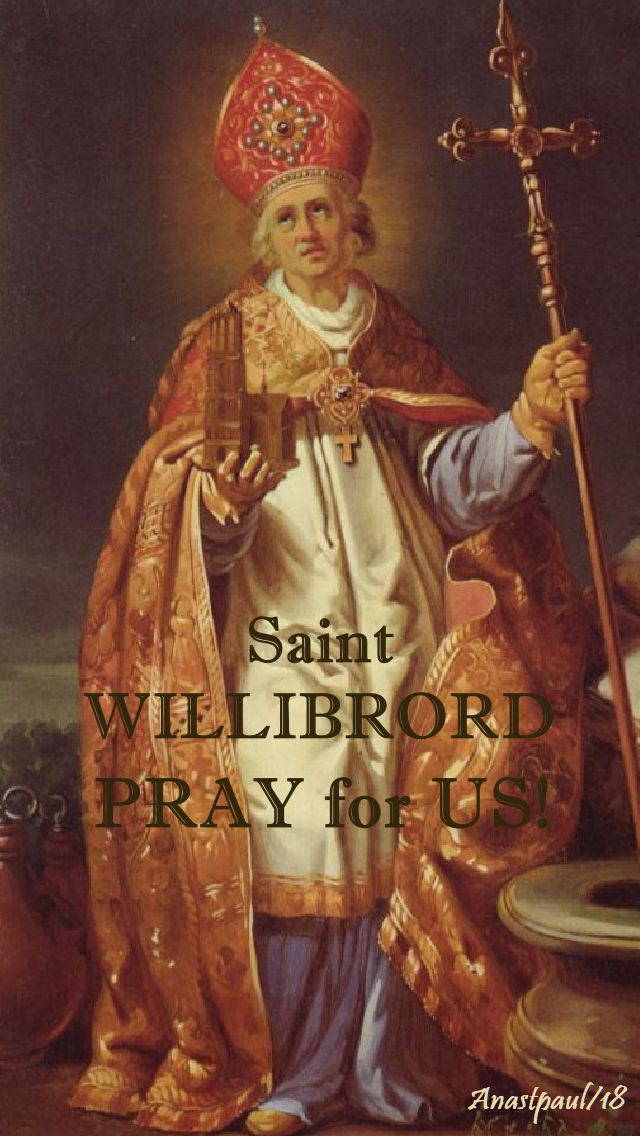
Thought for the Day – 7 November – The Memorial of St Willibrord (c 658 – 739) “Apostle to the Frisians”
The king demanded to know why he had violated their sacred places and insulted their god. The herald of truth answered him with steady courage:
“O king, you do not adore God but the devil. He has foully deluded you so that he can thrust your soul into everlasting fire. For there is no God but one. He created sky, earth, sea and everything that is in them. Whoever worships Him with true faith will have life forever. I urge you finally to renounce that foolish delusion of your ancestors, and to believe in the one Almighty God and Our Lord Jesus Christ. I call on you to be baptised in the font of life and wash away all your sins. Then with all wickedness and wrongdoing cast away from you, you may live as a new man in all reasonableness, righteousness and holiness. If you do this you will win an eternal life of glory with God and His saints. But if instead you reject the path of salvation, then be most assured that you will suffer eternal tortures and hellish flames along with the devil to whom you pay court.”
Quote of the Day – 7 November – The Memorial of St Willibrord (c 658 – 739) “Apostle to the Frisians”
“… there is no God but one, who created heaven and earth, the seas and all that is in them and those who worship Him, in true faith, will possess eternal life.”
One Minute Reflection – 7 November – Today’s Gospel: Luke 14:25–33 – Wednesday of the Thirty First week in Ordinary Time, Year B and The Memorial of St Willibrord (c 658 – 739) “Apostle to the Frisians” and Bl Anthony Baldinucci SJ (1665-1717)
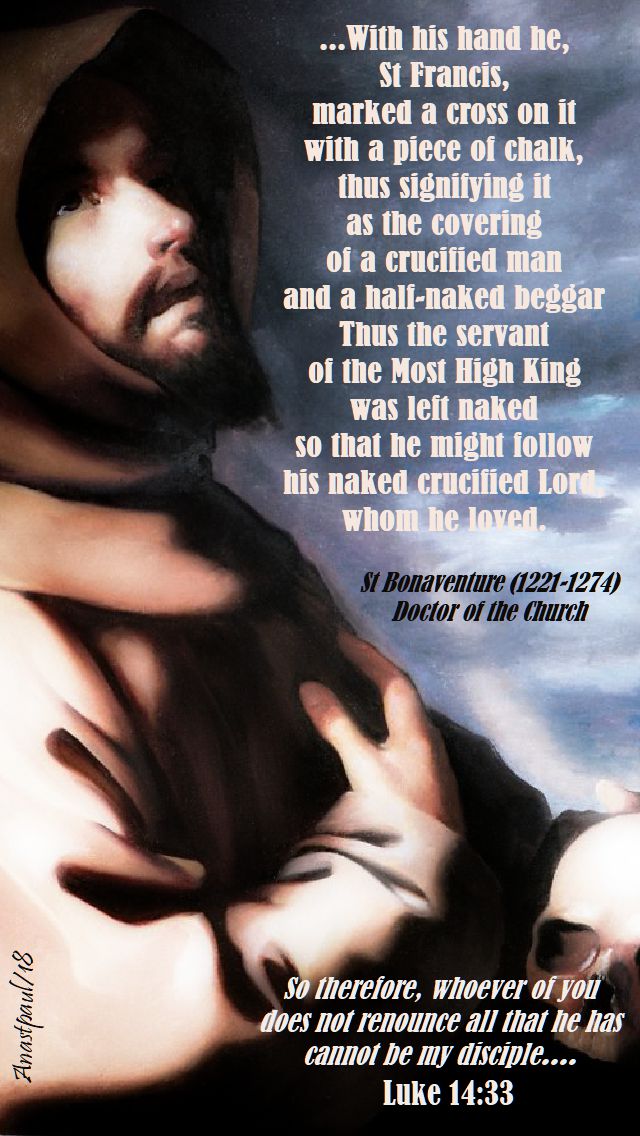
So therefore, whoever of you does not renounce all that he has cannot be my disciple...Luke 14:33
REFLECTION – “Francis’ father led this child of his before the bishop. He wanted to have Francis renounce into his hands his family possessions and return everything he had. A true lover of poverty, Francis showed himself eager to comply; he went before the bishop without delaying or hesitating. He did not wait for any words nor did he speak any but immediately took his clothes and gave them back to his father… Drunk with remarkable fervour, he even took off his underwear, stripping himself completely naked before all. He said to his father : “Until now I have called you father here on earth, but now I can say without reservation, ‘Our Father who art in heaven’ (Matt. 6:9), since I have placed all my treasure and all my hope in him.”
When the bishop saw this, he was amazed at such intense fervour in the man of God. He immediately stood up and in tears drew Francis into his arms, covering him with the mantle he was wearing, like the pious and good man that he was. He bade servants give Francis something to cover his body. They brought him a poor, cheap cloak of a farmer who worked for the bishop. Francis accepted it gratefully and with his hand marked a cross on it with a piece of chalk, thus signifying it as the covering of a crucified man and a half-naked beggar. Thus the servant of the Most High King was left naked so that he might follow his naked crucified Lord, whom he loved.”… St Bonaventure (1221-1274) Doctor of the Church
PRAYER – Holy God and Father, You sent your Son to show us the way to our eternal home. Teach us always to understand that by relinquishing the things of this world and focusing our efforts only on following the Light He shines on our path, we may attain the eternal victory. May the prayers of St Willibrord and St Anthony, assist us in carrying our cross after Him. Through Christ our Lord, with the Holy Spirit, God forever, amen.
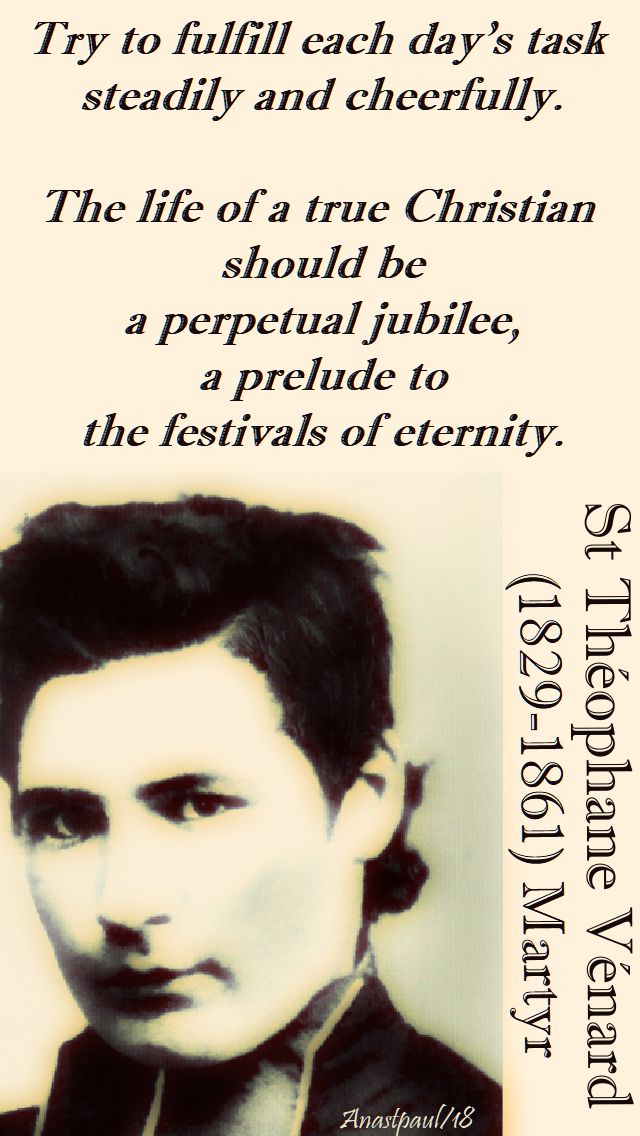
Thought for the Day – 6 November – The Memorial of St Théophane Vénard (1829-1861) Martyr – “The Original little Flower”
Today, 6 November, the Church celebrates the feast of St Jean Théophane Vénard, a French missionary to Vietnam who was martyred for the faith.
Famous for having inspired St Therese of Lisieux, who said of St Théophane that he was someone who had lived her own image of a martyr and missionary, St Théophane was born in France, became a priest in the Society of Foreign Missions and was sent to Vietnam.
It was during his incarceration that he wrote many letters, some to his family. His most famous line is from a letter to his father in which he said, “We are all flowers planted on this earth, which God plucks in His own good time – some a little sooner, some a little later . . . Father and son, may we meet in Paradise. I, poor little moth, go first. Adieu.”
In reading these letters, St Therese the Little Flower came to understand and use the image of being a little flower, whom God nevertheless cared for and cultivated, despite her minute size.
St Théophane Vénard was beheaded 2 February 1861.
His severed head was later recovered and is preserved as a relic in Vietnam. The rest of his body rests in the crypt of the Missions Etrangères in Paris.
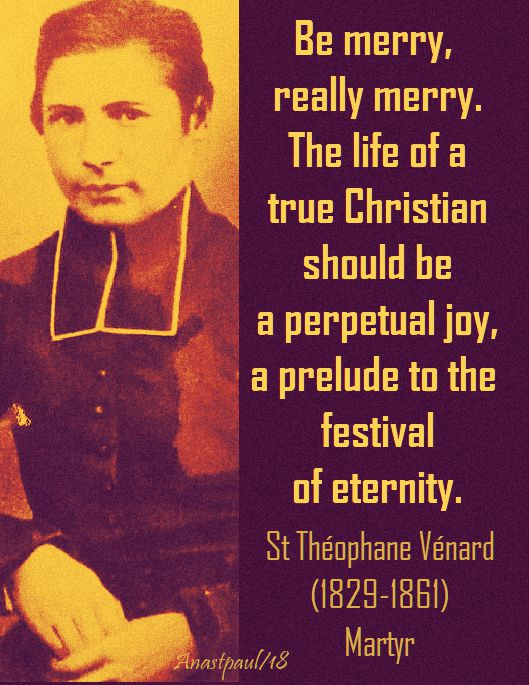
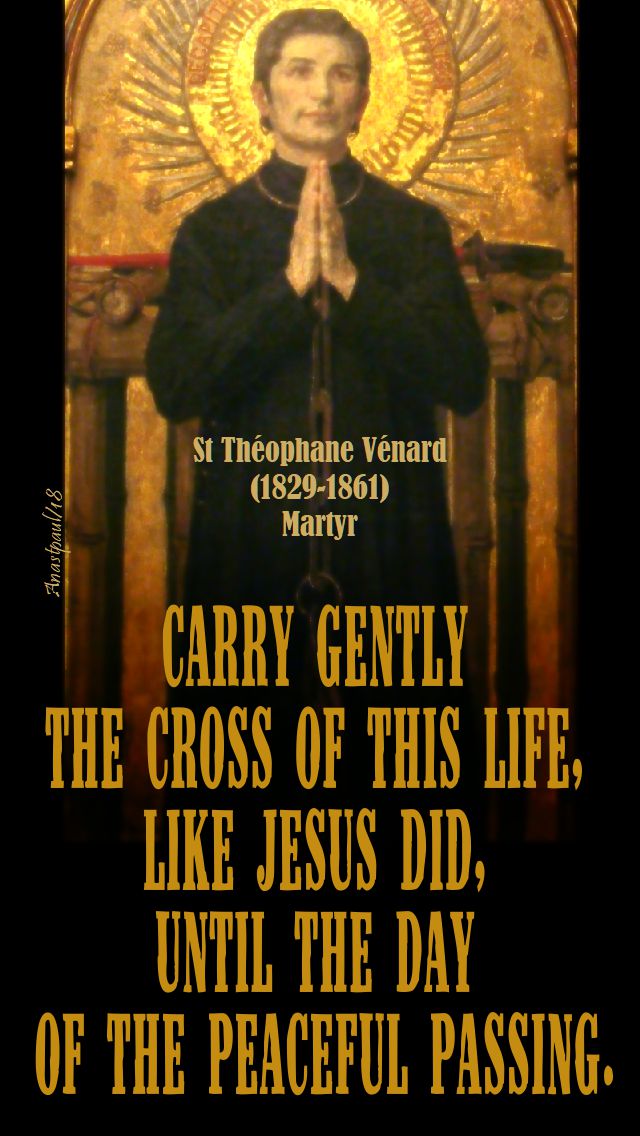
Quote/s of the Day – 6 November – The Memorial of St Théophane Vénard (1829-1861) Martyr
“Try to fulfil each day’s task steadily and cheerfully. The life of a true Christian should be a perpetual jubilee, a prelude to the festivals of eternity.”
“Be merry, really merry. The life of a true Christian should be a perpetual joy, a prelude to the festival of eternity.”
“Carry gently the cross of this life, like Jesus did, until the day of the peaceful passing.”
“Courage! God asks of us only our goodwill. His grace does the rest.”
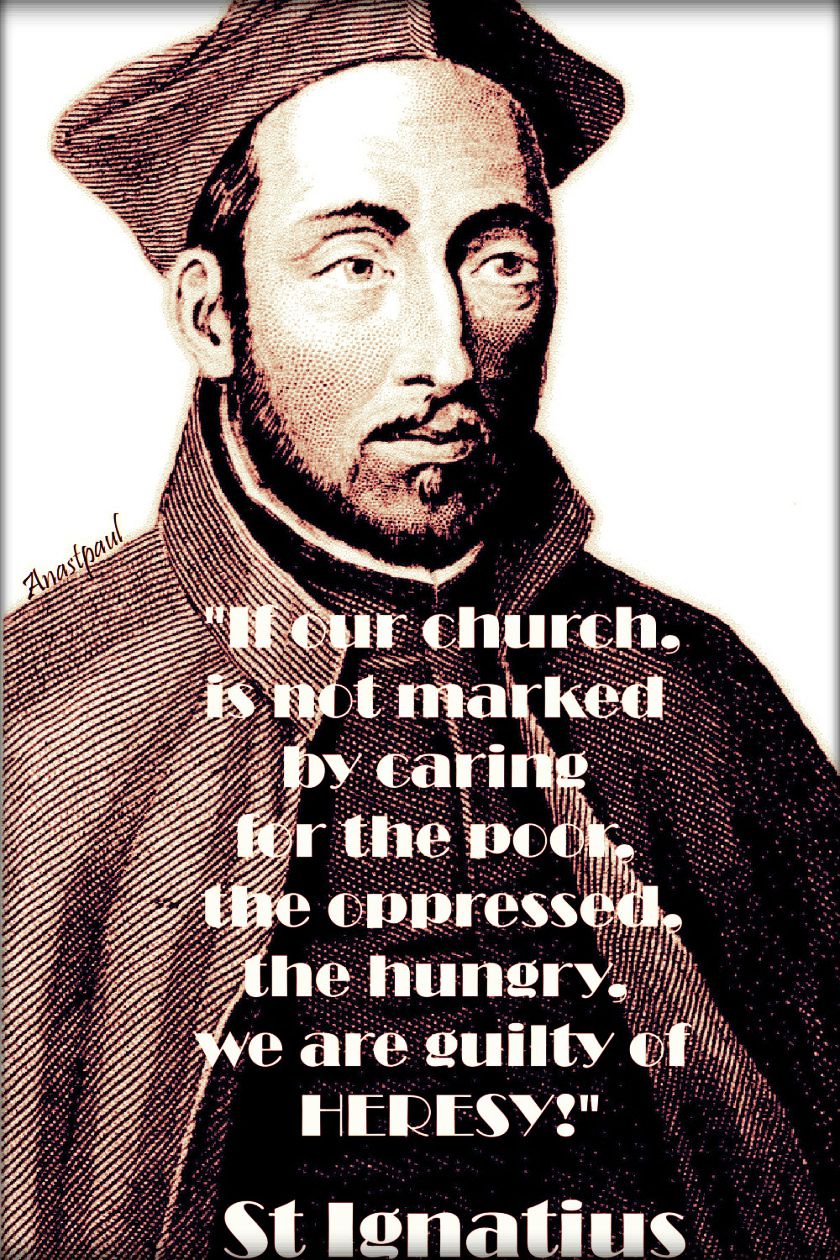
Quote/s of the Day – 5 November – Feast of All Saints and Blesseds of the Jesuits
“If our church is not marked by caring for the poor, the oppressed, the hungry, we are guilty of heresy.”
“Be generous to the poor orphans and those in need. The man to whom our Lord has been liberal ought not to be stingy. We shall one day find in Heaven as much rest and joy as we ourselves have dispensed in this life.”
St Ignatius Loyola SJ (1491-1556)
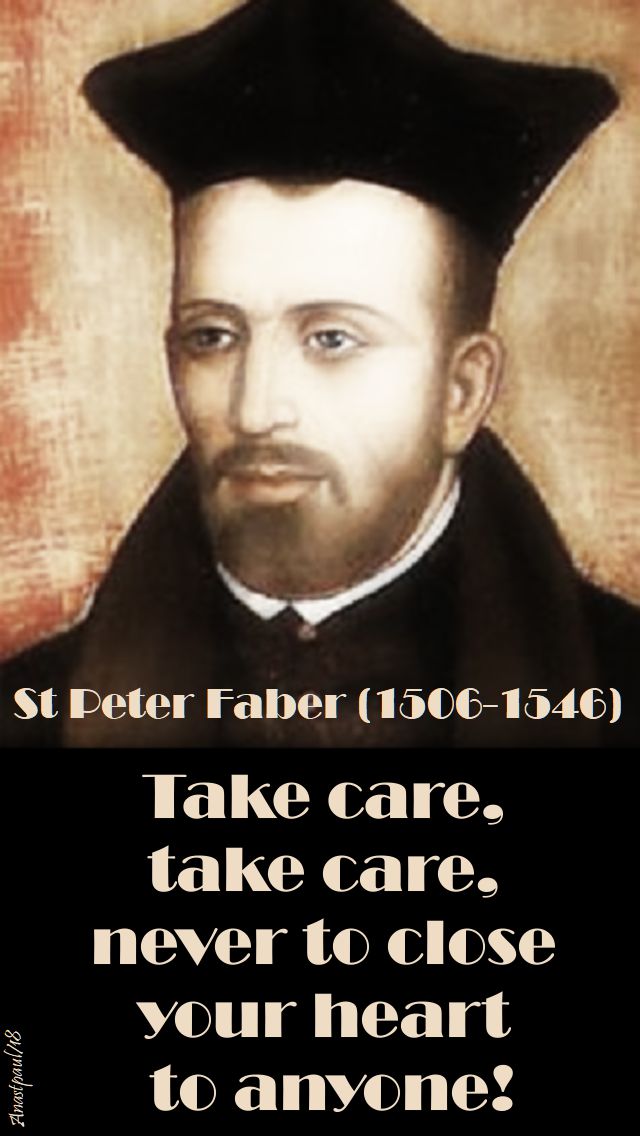
“Take care, take care, never to close your heart to anyone!”
St Peter Faber (1506-1546)
“To do the will of God, man must despise his own – the more he dies to himself, the more he will live to God.”
St Peter Claver SJ (1581-1654)
“God gave Himself to you: give yourself to God.”
St Robert Southwell SJ (1561-1595)
“Any friend of the poor, is a friend of God.”
“Take life in instalments. This one day now. At least let this be a good day. Be always beginning.”
Blessed John Sullivan SJ (1861-1933)
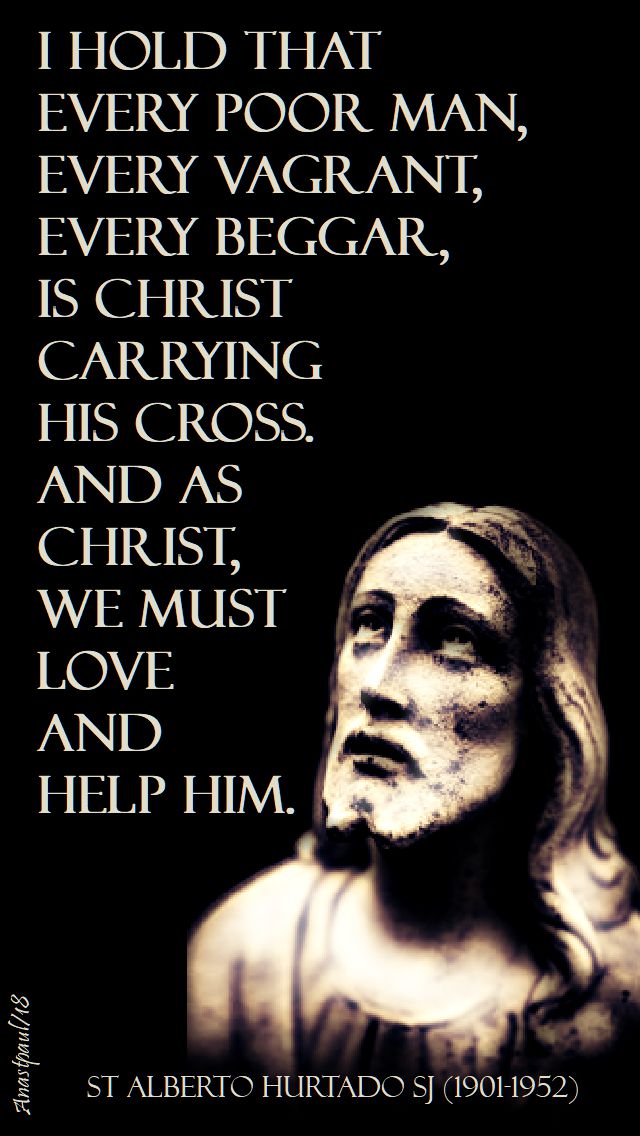
“I hold that every poor man, every vagrant, every beggar, is Christ carrying His cross. And as Christ, we must love and help him.”
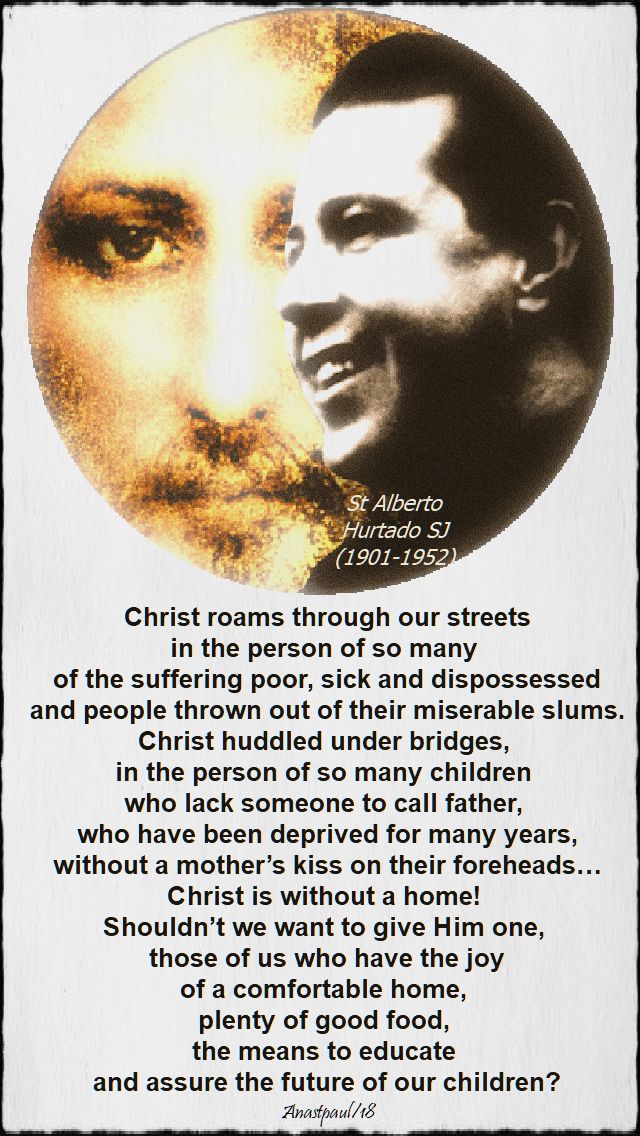
“Christ roams through our streets in the person of so many of the suffering poor, sick and dispossessed and people thrown out of their miserable slums. Christ huddled under bridges, in the person of so many children who lack someone to call father, who have been deprived for many years, without a mother’s kiss on their foreheads… Christ is without a home! Shouldn’t we want to give Him one, those of us who have the joy of a comfortable home, plenty of good food, the means to educate and assure the future of our children?”
St Alberto Hurtado SJ (1901-1952)
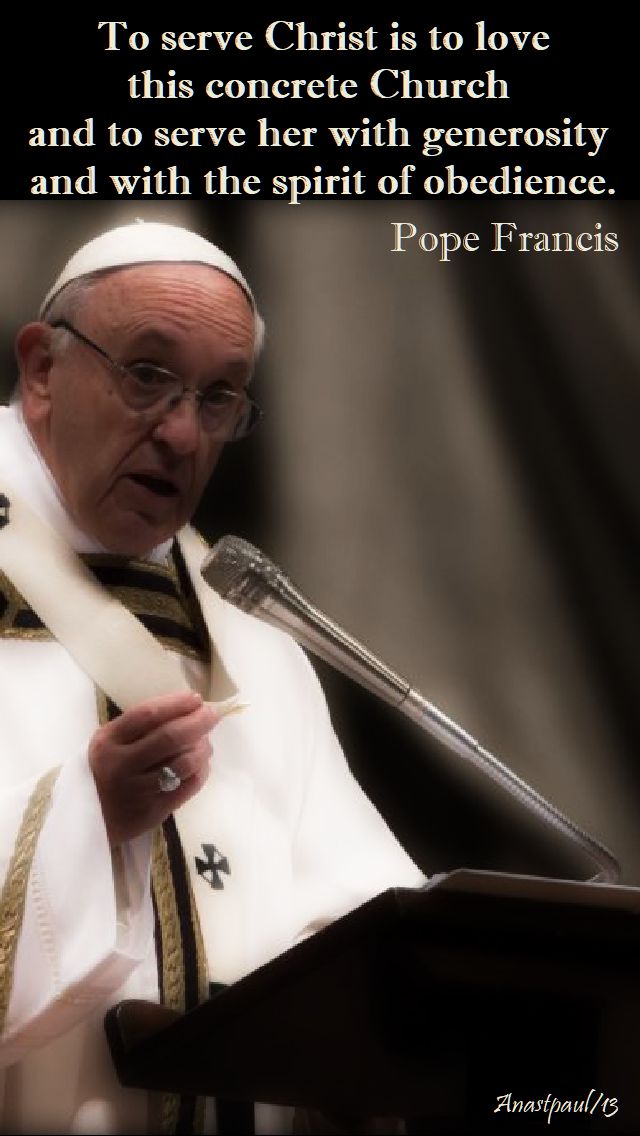
” To serve Christ is to love this concrete Church and to serve her with generosity and with the spirit of obedience.”
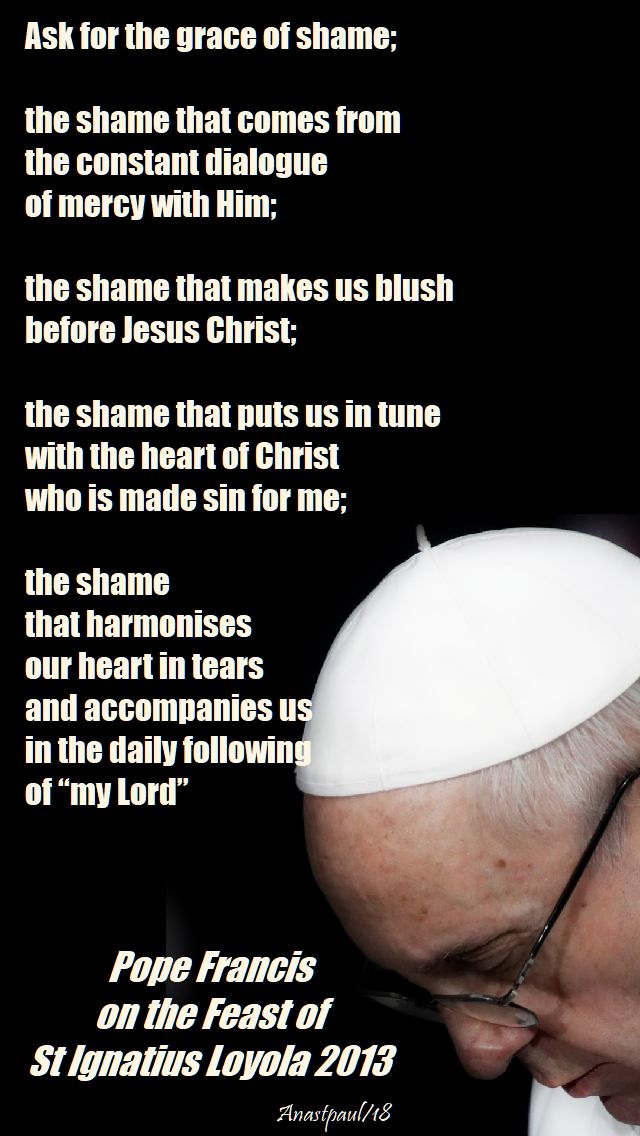
“Ask for the grace of shame; the shame that comes from the constant dialogue of mercy with Him; the shame that makes us blush before Jesus Christ; the shame that puts us in tune with the heart of Christ who is made sin for me; the shame that harmonises our heart in tears and accompanies us in the daily following of “my Lord”.
Pope Francis SJ – 31 July 2013 on the Feast of St Ignatius
One Minute Reflection – 5 November – Today’s Gospel: Luke 14:12–14 – Monday of the Thirty-first week in Ordinary Time, Year B and the Memorial of All Jesuit Saints and Blesseds
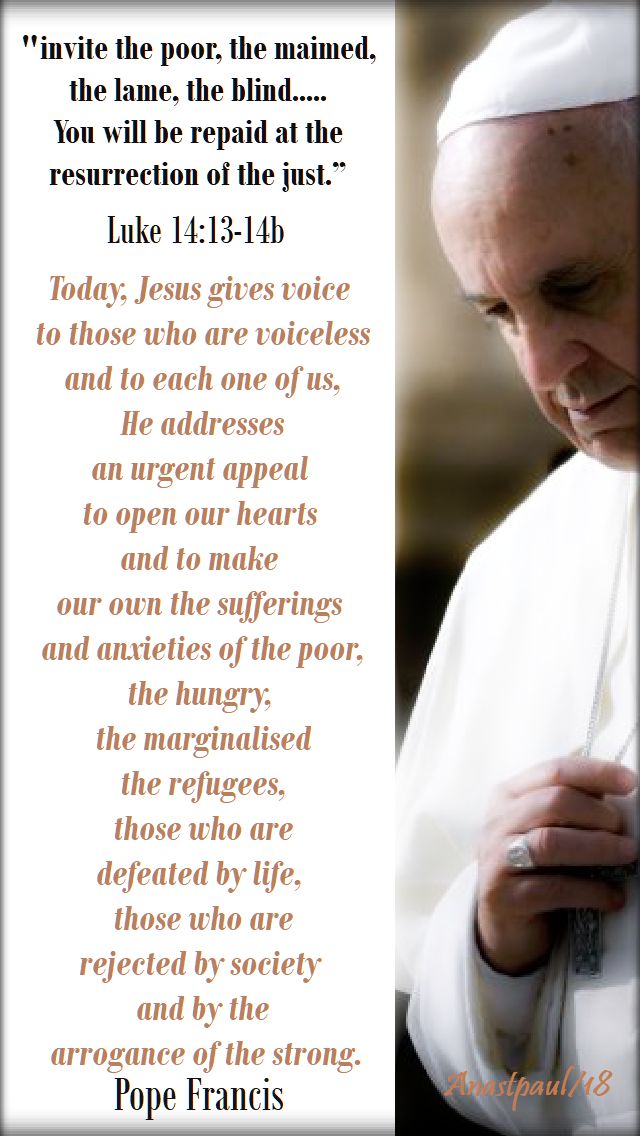
“invite the poor, the maimed, the lame, the blind…..You will be repaid at the resurrection of the just.”…Luke 14:13-14b
REFLECTION – “This means choosing gratuitousness rather than self-seeking and calculating to obtain a reward, seeking interest and trying to increase your wealth. Indeed, the poor, the simple, those who ‘don’t count’, can never reciprocate an invitation to a meal. In this way Jesus shows His preference for the poor and the excluded, who are the privileged in the Kingdom of God and He launches the fundamental message of the Gospel which is to serve others out of love for God.
Today, Jesus gives voice to those who are voiceless and to each one of us, He addresses an urgent appeal, to open our hearts and to make our own, the sufferings and anxieties of the poor, the hungry, the marginalised, the refugees, those who are defeated by life, those who are rejected by society and by the arrogance of the strong.”…Pope Francis – Angelus, 28 August 2016
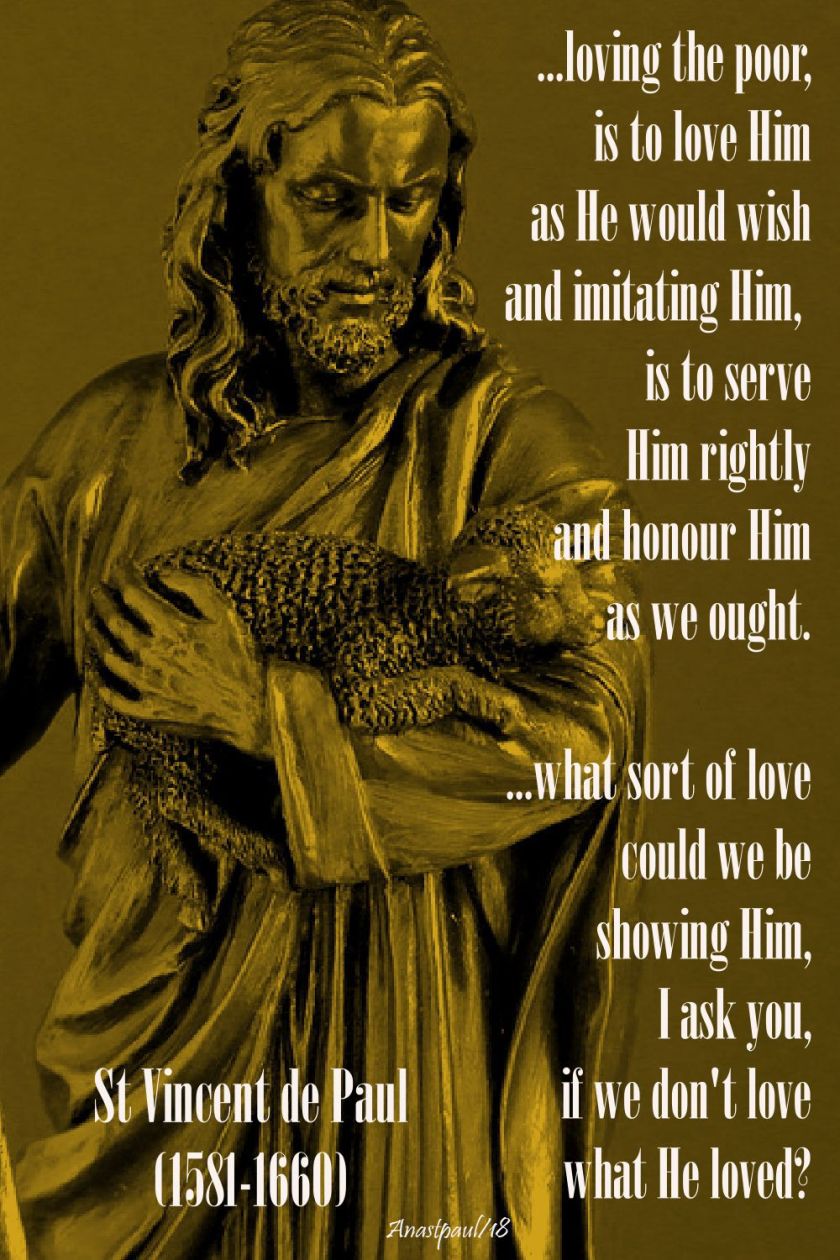
“He himself had wanted to be born in poverty, to welcome the poor into His company, to serve the poor and put Himself in the place of the poor, to the point of saying that the good and evil we do to the poor, will be held by Him to have been done to His own divine person (Mt 25:40). What more tender love could He have shown the poor! And what sort of love could we be showing Him, I ask you, if we don’t love what He loved? So much so, that loving the poor, is to love Him as He would wish and imitating Him, is to serve Him rightly and honour Him as we ought…”…St Vincent de Paul (1581-1660) – Extract from a report concerning the state of the work, 11/07/1657
PRAYER – Lord God, teach us humility, to give and not to count ever the cost to ourselves, to take the lowest part and the back seat – teach us Lord, to strive and not to seek for glory, save for that of Your Kingdom. Let us see Your Face, His Face, He our Teacher, our Saviour in the face of all those in most need. May all those great Jesuit Saints standing before that Face, pray for us! We ask this through Jesus Christ, our Lord, who we beg, have mercy on us all, who seek rewards for our own sakes, amen.
Sunday Reflection – 4 November – Thirty First Sunday in Ordinary Time, Year B
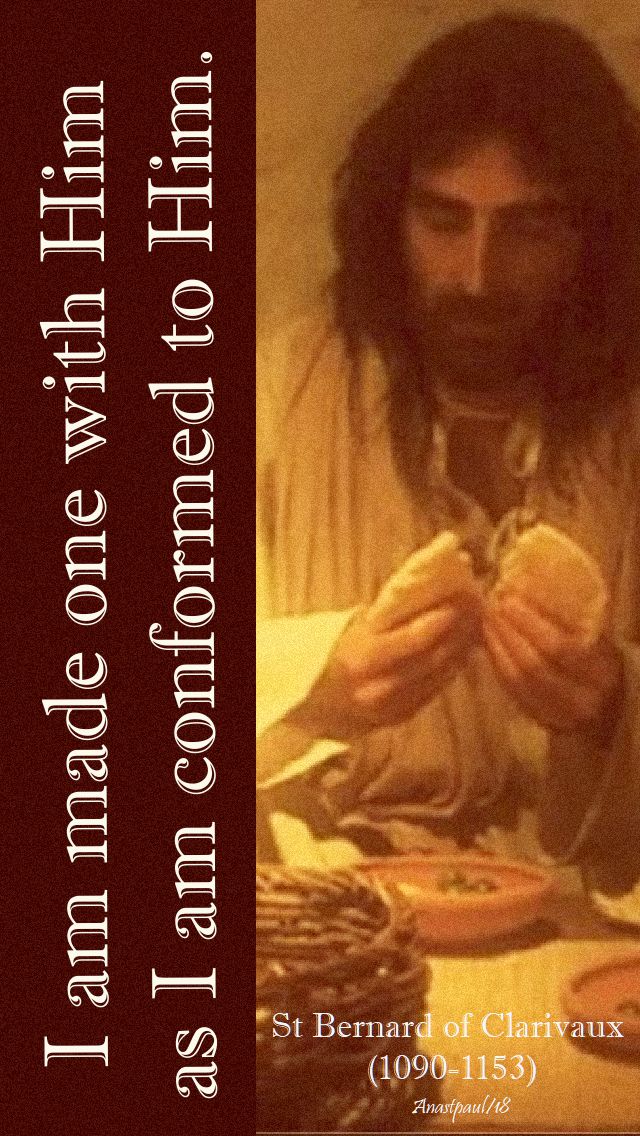
“I am made one with Him, as I am conformed to Him.” St Bernard of Clairvaux (1090-1153) Doctor of the Church
Saint Bernard teaches, that it is not enough for us to take and eat the Bread from Heaven. We must also offer ourselves to be eaten. Holy Communion is a wondrous exchange in which we become the bread of Christ. Listen to Saint Bernard:
“My penitence, my salvation are His food.
I myself am His food.
I am chewed as I am reproved by Him;
I am swallowed by Him as I am taught;
I am digested by Him as I am changed;
I am assimilated as I am transformed;
I am made one with Him, as I am conformed to Him.
He feeds upon us and is fed by us
that we may be the more loosely bound to Him.”
Saint Bernard, ever the poet, uses images of eating and assimilation to describe how Christ unites us to Himself. Our Lord becomes our food that we might become His. We need the language of poets and preachers in our approach to the Eucharist.













 AnaStpaul
You must be logged in to post a comment.