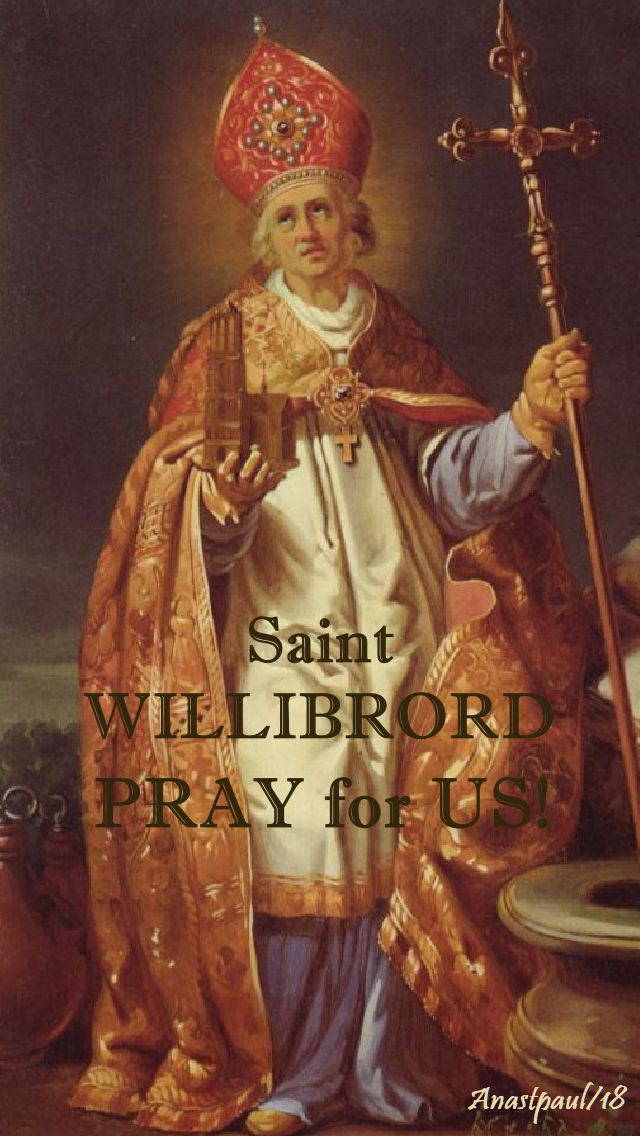
Quote of the Day – 7 November – The Memorial of St Willibrord (c 658 – 739) “Apostle to the Frisians”
“… there is no God but one, who created heaven and earth, the seas and all that is in them and those who worship Him, in true faith, will possess eternal life.”
One Minute Reflection – 7 November – Today’s Gospel: Luke 14:25–33 – Wednesday of the Thirty First week in Ordinary Time, Year B and The Memorial of St Willibrord (c 658 – 739) “Apostle to the Frisians” and Bl Anthony Baldinucci SJ (1665-1717)
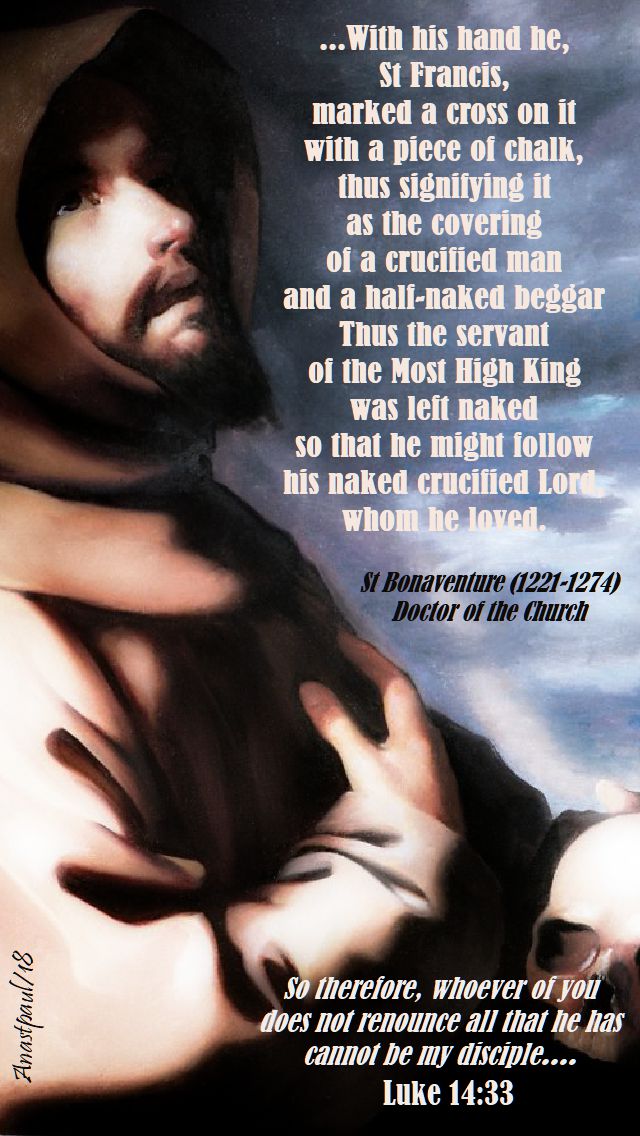
So therefore, whoever of you does not renounce all that he has cannot be my disciple...Luke 14:33
REFLECTION – “Francis’ father led this child of his before the bishop. He wanted to have Francis renounce into his hands his family possessions and return everything he had. A true lover of poverty, Francis showed himself eager to comply; he went before the bishop without delaying or hesitating. He did not wait for any words nor did he speak any but immediately took his clothes and gave them back to his father… Drunk with remarkable fervour, he even took off his underwear, stripping himself completely naked before all. He said to his father : “Until now I have called you father here on earth, but now I can say without reservation, ‘Our Father who art in heaven’ (Matt. 6:9), since I have placed all my treasure and all my hope in him.”
When the bishop saw this, he was amazed at such intense fervour in the man of God. He immediately stood up and in tears drew Francis into his arms, covering him with the mantle he was wearing, like the pious and good man that he was. He bade servants give Francis something to cover his body. They brought him a poor, cheap cloak of a farmer who worked for the bishop. Francis accepted it gratefully and with his hand marked a cross on it with a piece of chalk, thus signifying it as the covering of a crucified man and a half-naked beggar. Thus the servant of the Most High King was left naked so that he might follow his naked crucified Lord, whom he loved.”… St Bonaventure (1221-1274) Doctor of the Church
PRAYER – Holy God and Father, You sent your Son to show us the way to our eternal home. Teach us always to understand that by relinquishing the things of this world and focusing our efforts only on following the Light He shines on our path, we may attain the eternal victory. May the prayers of St Willibrord and St Anthony, assist us in carrying our cross after Him. Through Christ our Lord, with the Holy Spirit, God forever, amen.
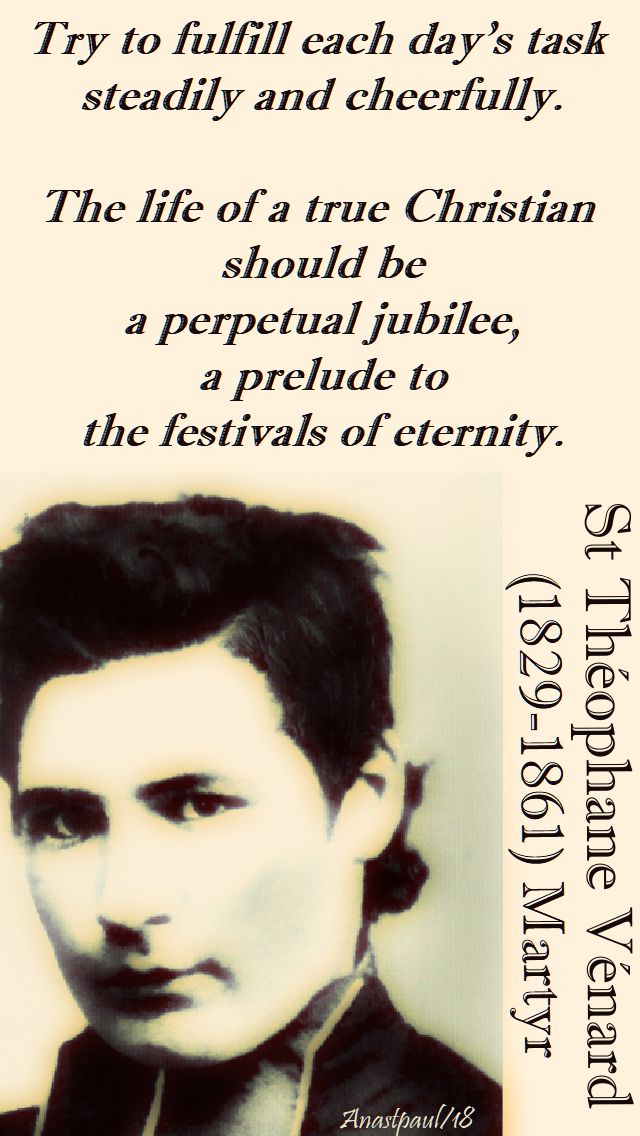
Thought for the Day – 6 November – The Memorial of St Théophane Vénard (1829-1861) Martyr – “The Original little Flower”
Today, 6 November, the Church celebrates the feast of St Jean Théophane Vénard, a French missionary to Vietnam who was martyred for the faith.
Famous for having inspired St Therese of Lisieux, who said of St Théophane that he was someone who had lived her own image of a martyr and missionary, St Théophane was born in France, became a priest in the Society of Foreign Missions and was sent to Vietnam.
It was during his incarceration that he wrote many letters, some to his family. His most famous line is from a letter to his father in which he said, “We are all flowers planted on this earth, which God plucks in His own good time – some a little sooner, some a little later . . . Father and son, may we meet in Paradise. I, poor little moth, go first. Adieu.”
In reading these letters, St Therese the Little Flower came to understand and use the image of being a little flower, whom God nevertheless cared for and cultivated, despite her minute size.
St Théophane Vénard was beheaded 2 February 1861.
His severed head was later recovered and is preserved as a relic in Vietnam. The rest of his body rests in the crypt of the Missions Etrangères in Paris.
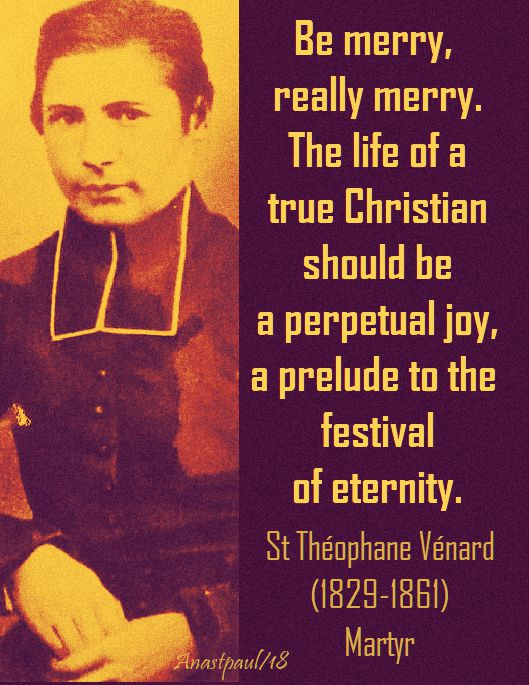
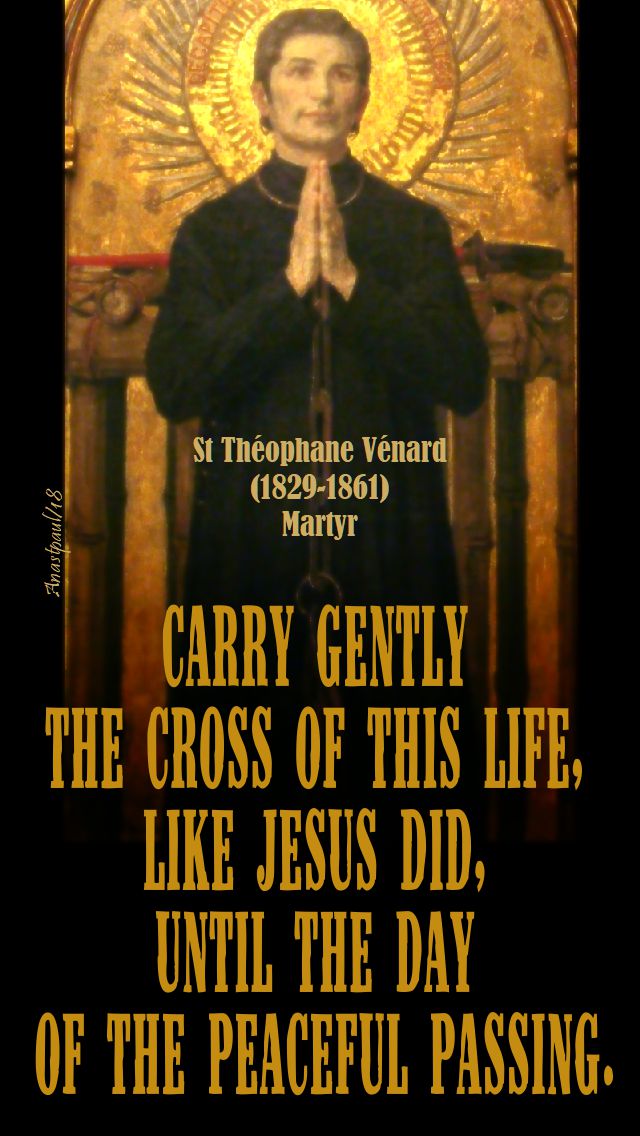
Quote/s of the Day – 6 November – The Memorial of St Théophane Vénard (1829-1861) Martyr
“Try to fulfil each day’s task steadily and cheerfully. The life of a true Christian should be a perpetual jubilee, a prelude to the festivals of eternity.”
“Be merry, really merry. The life of a true Christian should be a perpetual joy, a prelude to the festival of eternity.”
“Carry gently the cross of this life, like Jesus did, until the day of the peaceful passing.”
“Courage! God asks of us only our goodwill. His grace does the rest.”
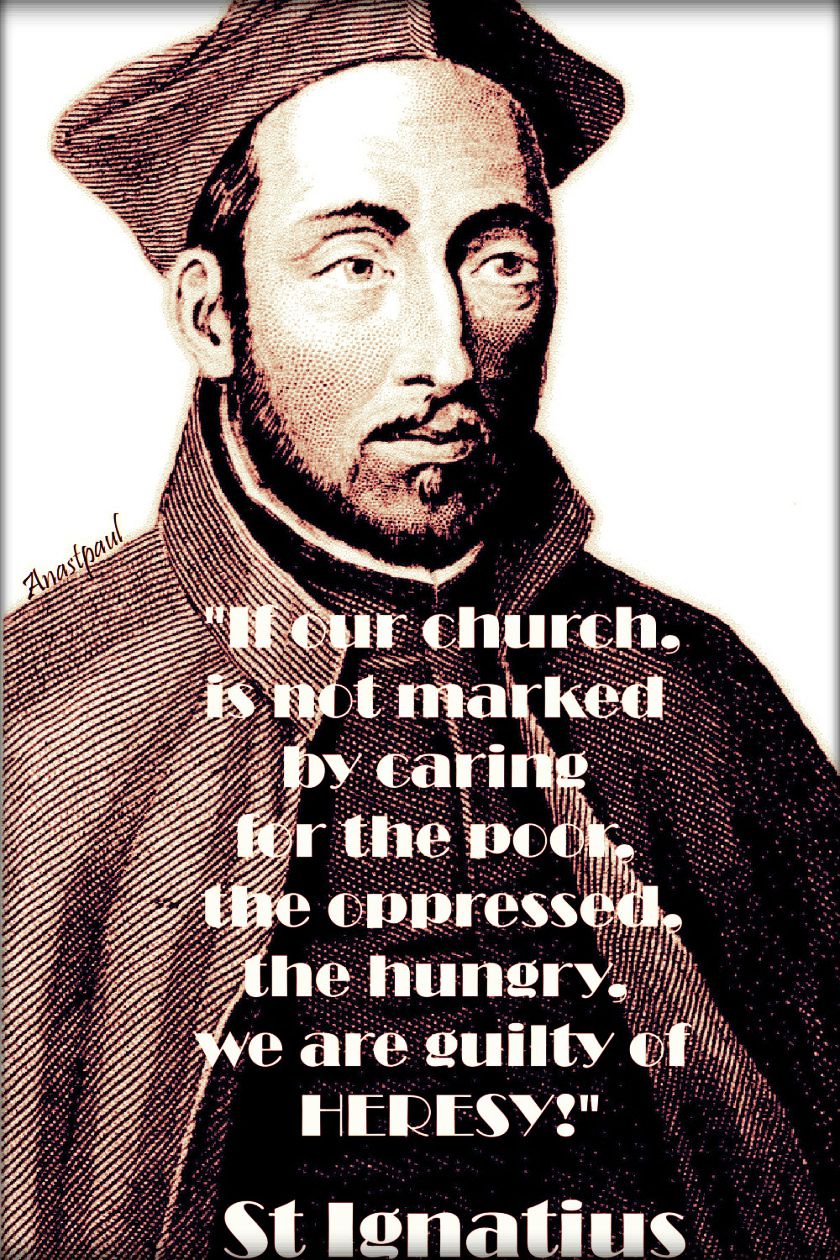
Quote/s of the Day – 5 November – Feast of All Saints and Blesseds of the Jesuits
“If our church is not marked by caring for the poor, the oppressed, the hungry, we are guilty of heresy.”
“Be generous to the poor orphans and those in need. The man to whom our Lord has been liberal ought not to be stingy. We shall one day find in Heaven as much rest and joy as we ourselves have dispensed in this life.”
St Ignatius Loyola SJ (1491-1556)
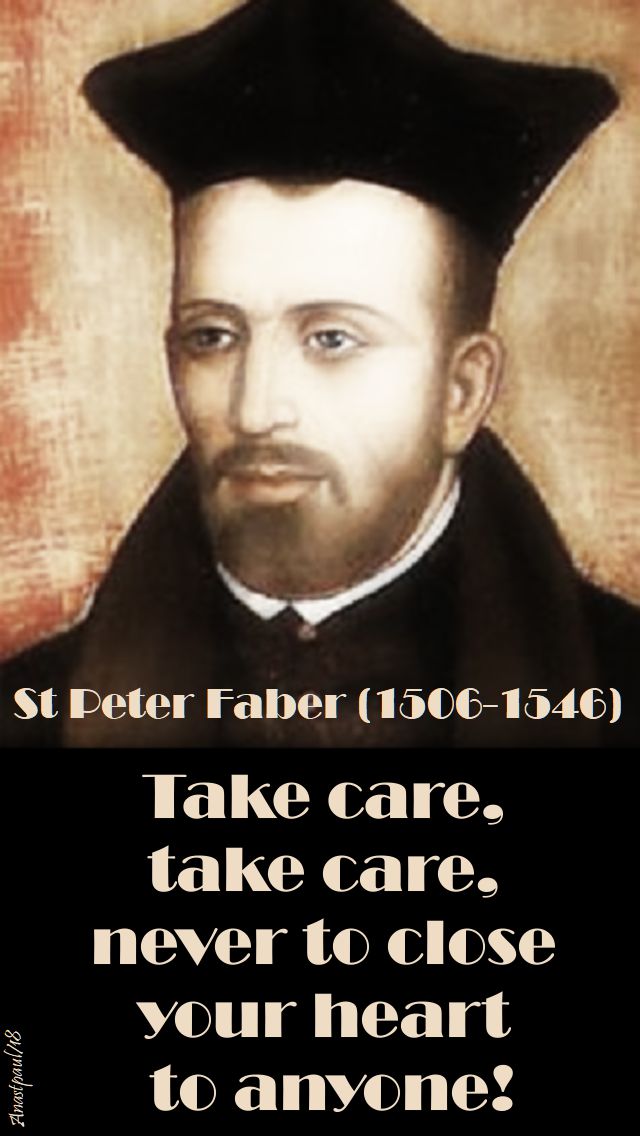
“Take care, take care, never to close your heart to anyone!”
St Peter Faber (1506-1546)
“To do the will of God, man must despise his own – the more he dies to himself, the more he will live to God.”
St Peter Claver SJ (1581-1654)
“God gave Himself to you: give yourself to God.”
St Robert Southwell SJ (1561-1595)
“Any friend of the poor, is a friend of God.”
“Take life in instalments. This one day now. At least let this be a good day. Be always beginning.”
Blessed John Sullivan SJ (1861-1933)
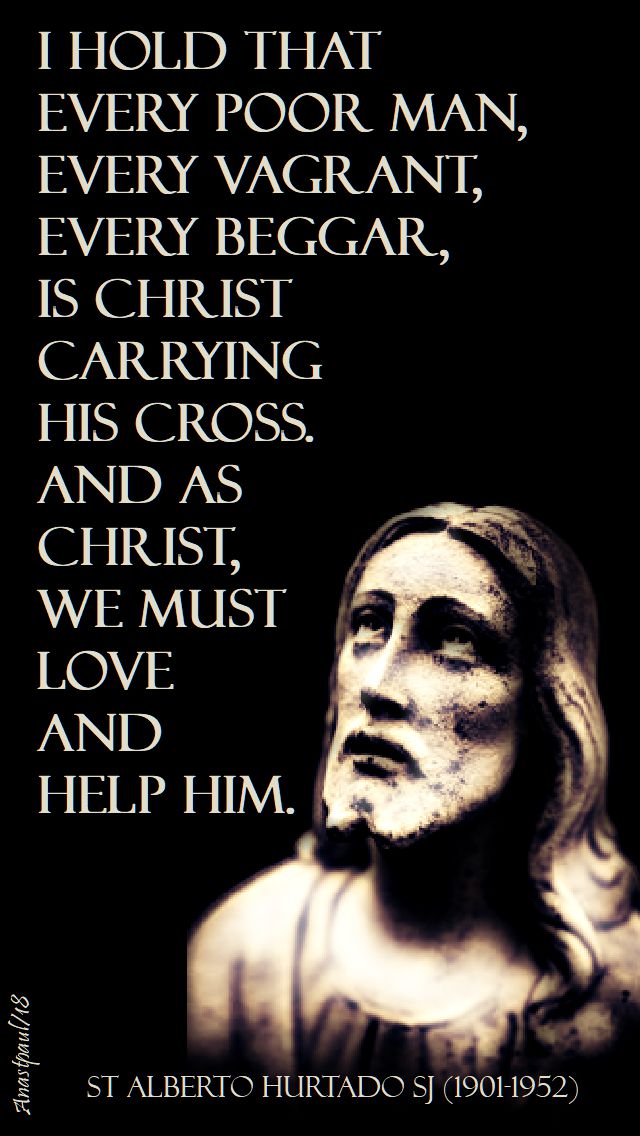
“I hold that every poor man, every vagrant, every beggar, is Christ carrying His cross. And as Christ, we must love and help him.”
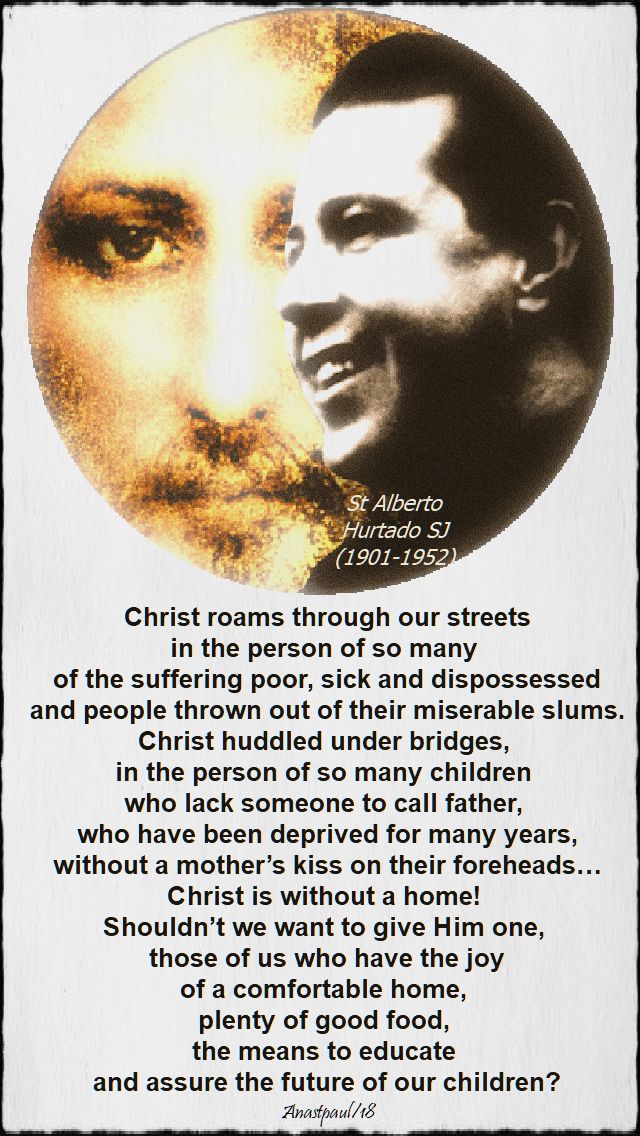
“Christ roams through our streets in the person of so many of the suffering poor, sick and dispossessed and people thrown out of their miserable slums. Christ huddled under bridges, in the person of so many children who lack someone to call father, who have been deprived for many years, without a mother’s kiss on their foreheads… Christ is without a home! Shouldn’t we want to give Him one, those of us who have the joy of a comfortable home, plenty of good food, the means to educate and assure the future of our children?”
St Alberto Hurtado SJ (1901-1952)
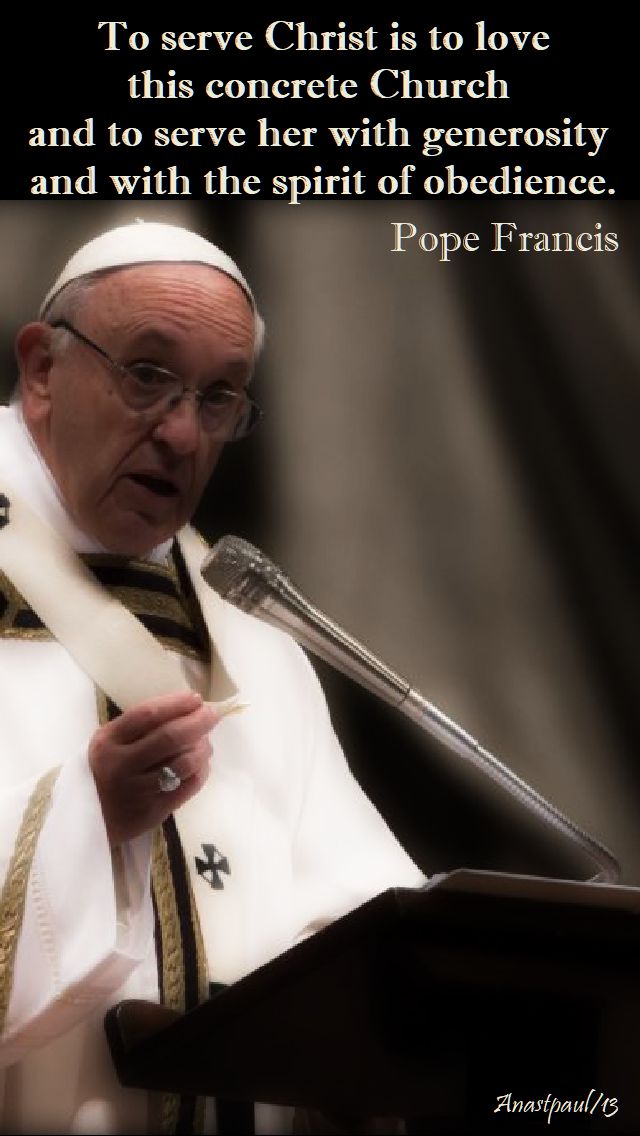
” To serve Christ is to love this concrete Church and to serve her with generosity and with the spirit of obedience.”
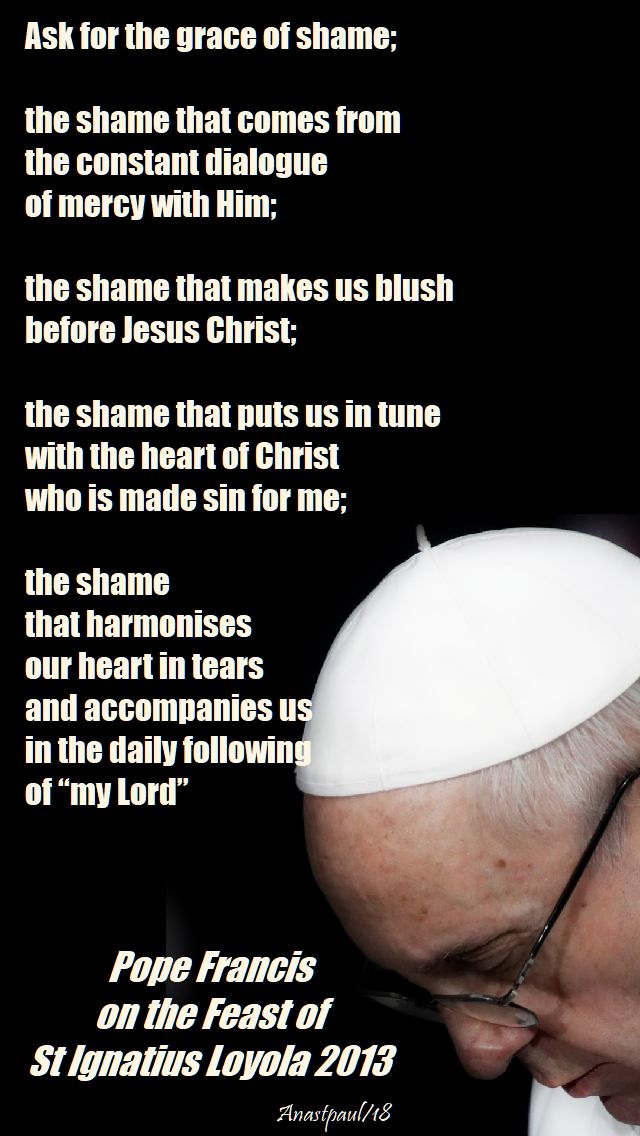
“Ask for the grace of shame; the shame that comes from the constant dialogue of mercy with Him; the shame that makes us blush before Jesus Christ; the shame that puts us in tune with the heart of Christ who is made sin for me; the shame that harmonises our heart in tears and accompanies us in the daily following of “my Lord”.
Pope Francis SJ – 31 July 2013 on the Feast of St Ignatius
One Minute Reflection – 5 November – Today’s Gospel: Luke 14:12–14 – Monday of the Thirty-first week in Ordinary Time, Year B and the Memorial of All Jesuit Saints and Blesseds
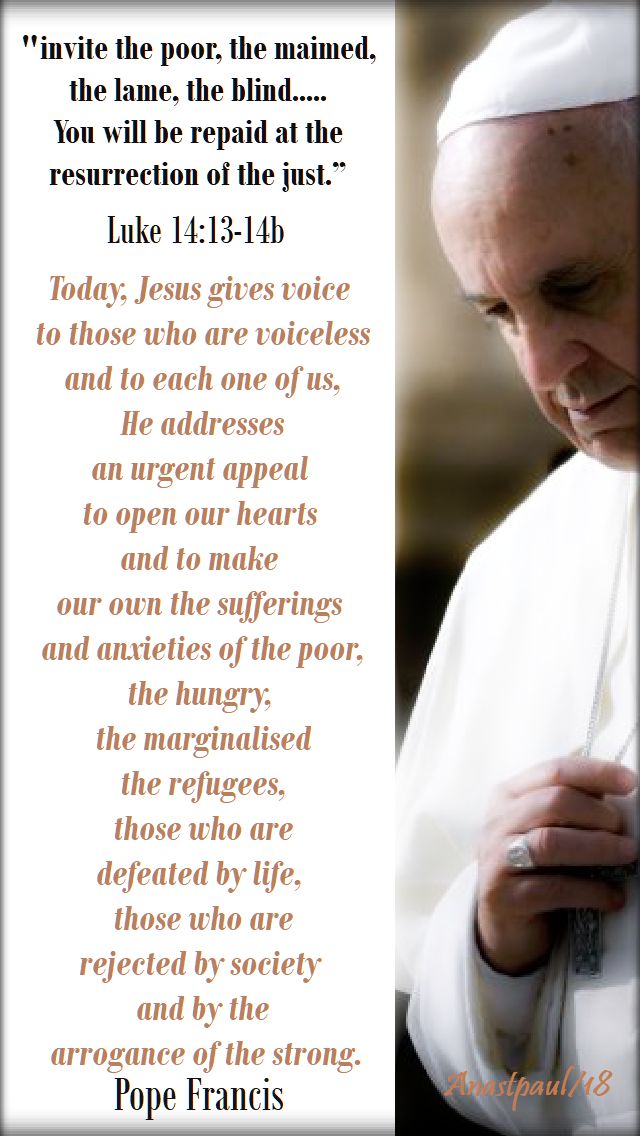
“invite the poor, the maimed, the lame, the blind…..You will be repaid at the resurrection of the just.”…Luke 14:13-14b
REFLECTION – “This means choosing gratuitousness rather than self-seeking and calculating to obtain a reward, seeking interest and trying to increase your wealth. Indeed, the poor, the simple, those who ‘don’t count’, can never reciprocate an invitation to a meal. In this way Jesus shows His preference for the poor and the excluded, who are the privileged in the Kingdom of God and He launches the fundamental message of the Gospel which is to serve others out of love for God.
Today, Jesus gives voice to those who are voiceless and to each one of us, He addresses an urgent appeal, to open our hearts and to make our own, the sufferings and anxieties of the poor, the hungry, the marginalised, the refugees, those who are defeated by life, those who are rejected by society and by the arrogance of the strong.”…Pope Francis – Angelus, 28 August 2016
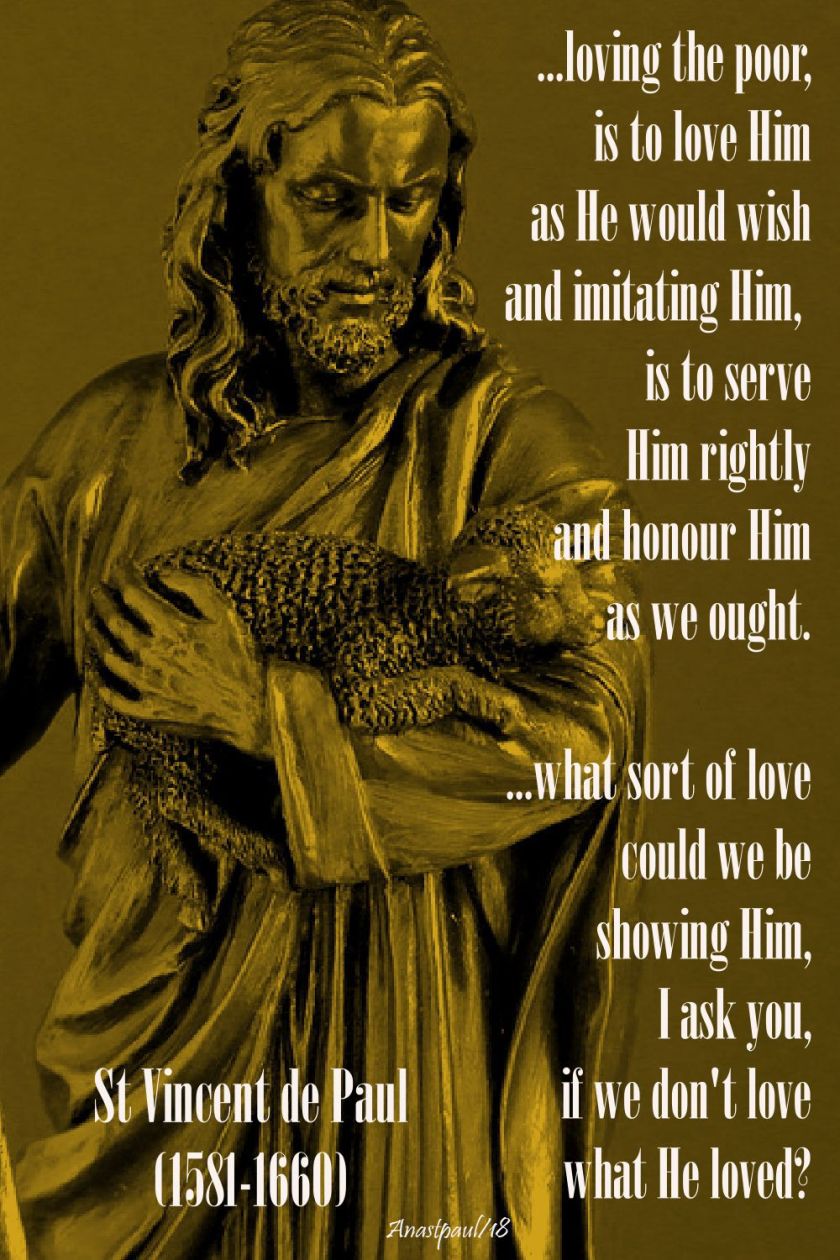
“He himself had wanted to be born in poverty, to welcome the poor into His company, to serve the poor and put Himself in the place of the poor, to the point of saying that the good and evil we do to the poor, will be held by Him to have been done to His own divine person (Mt 25:40). What more tender love could He have shown the poor! And what sort of love could we be showing Him, I ask you, if we don’t love what He loved? So much so, that loving the poor, is to love Him as He would wish and imitating Him, is to serve Him rightly and honour Him as we ought…”…St Vincent de Paul (1581-1660) – Extract from a report concerning the state of the work, 11/07/1657
PRAYER – Lord God, teach us humility, to give and not to count ever the cost to ourselves, to take the lowest part and the back seat – teach us Lord, to strive and not to seek for glory, save for that of Your Kingdom. Let us see Your Face, His Face, He our Teacher, our Saviour in the face of all those in most need. May all those great Jesuit Saints standing before that Face, pray for us! We ask this through Jesus Christ, our Lord, who we beg, have mercy on us all, who seek rewards for our own sakes, amen.
Sunday Reflection – 4 November – Thirty First Sunday in Ordinary Time, Year B
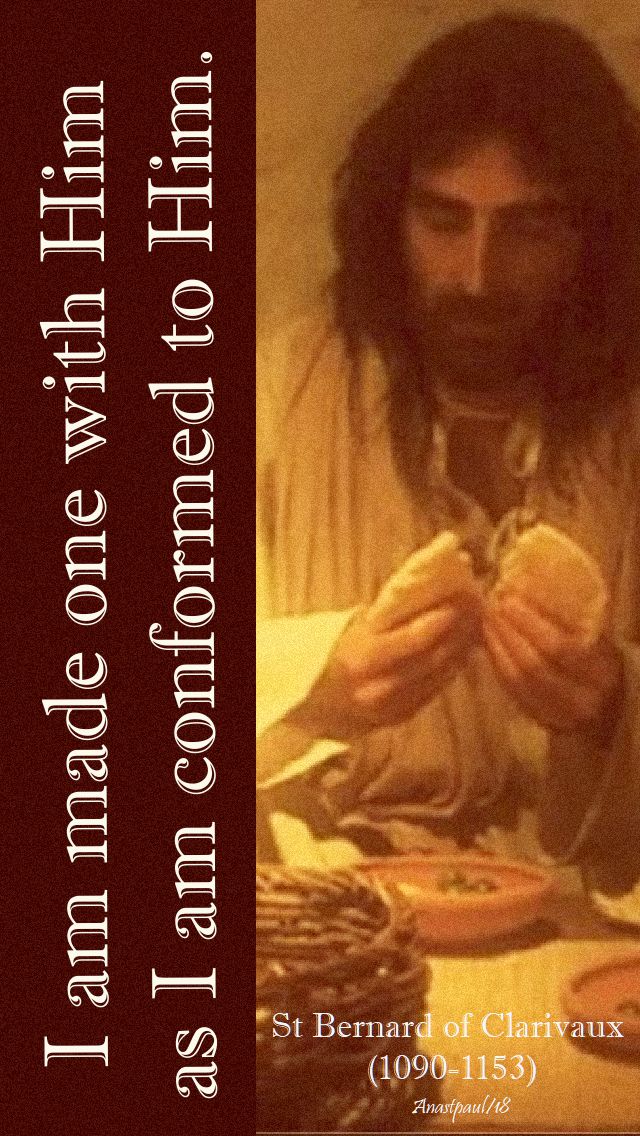
“I am made one with Him, as I am conformed to Him.” St Bernard of Clairvaux (1090-1153) Doctor of the Church
Saint Bernard teaches, that it is not enough for us to take and eat the Bread from Heaven. We must also offer ourselves to be eaten. Holy Communion is a wondrous exchange in which we become the bread of Christ. Listen to Saint Bernard:
“My penitence, my salvation are His food.
I myself am His food.
I am chewed as I am reproved by Him;
I am swallowed by Him as I am taught;
I am digested by Him as I am changed;
I am assimilated as I am transformed;
I am made one with Him, as I am conformed to Him.
He feeds upon us and is fed by us
that we may be the more loosely bound to Him.”
Saint Bernard, ever the poet, uses images of eating and assimilation to describe how Christ unites us to Himself. Our Lord becomes our food that we might become His. We need the language of poets and preachers in our approach to the Eucharist.
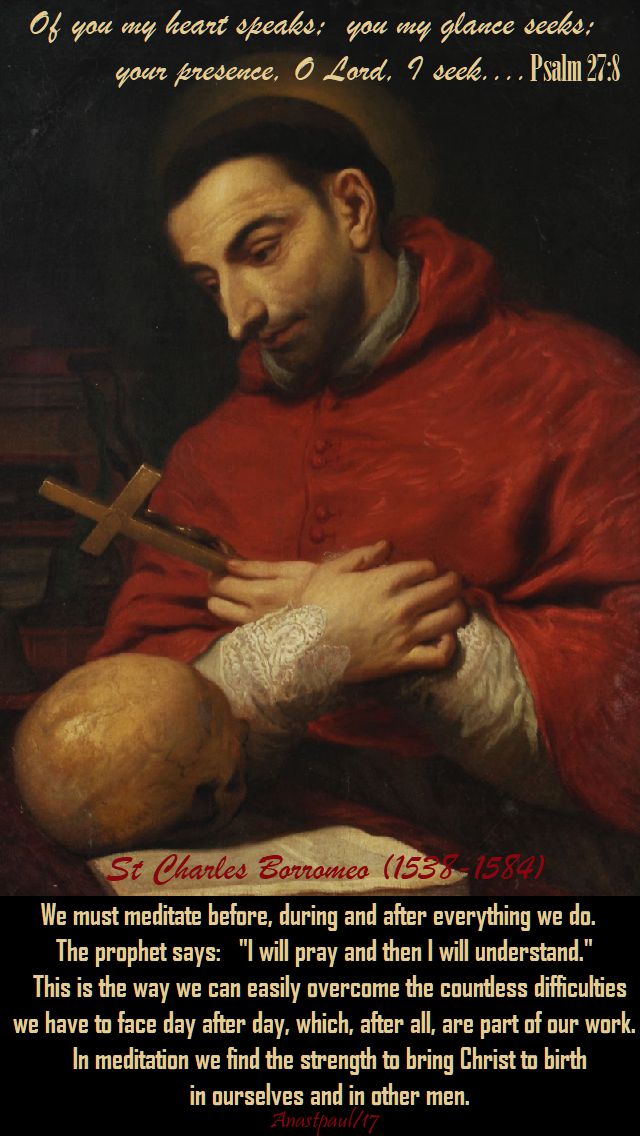
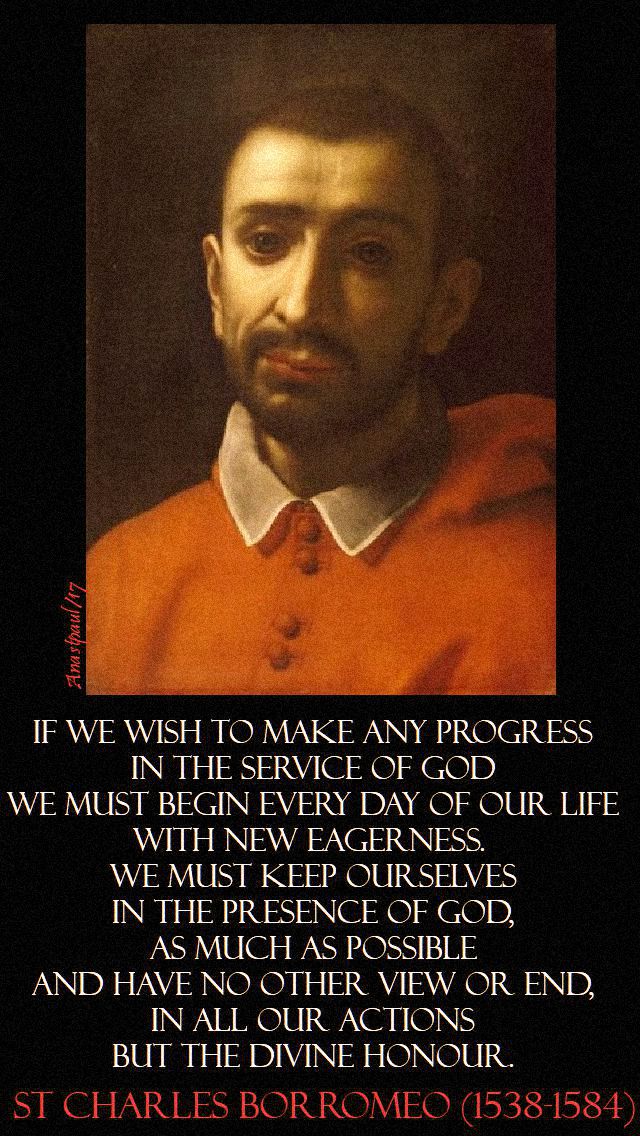
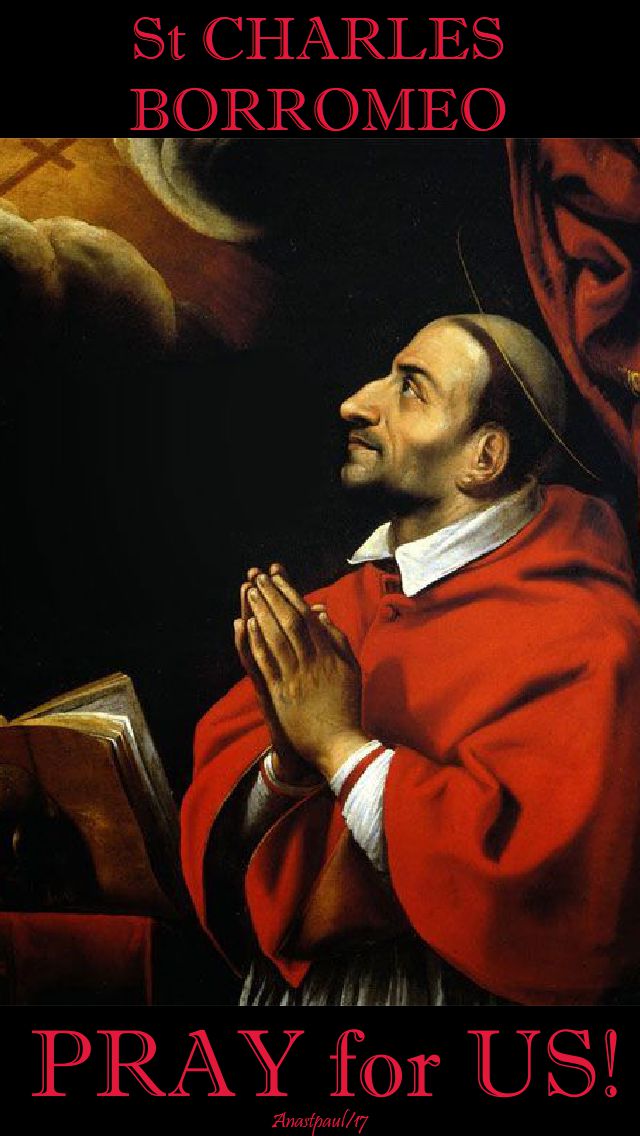
Quote/s of the Day – 4 November – The Memorial of St Charles Borromeo (1538-1584)
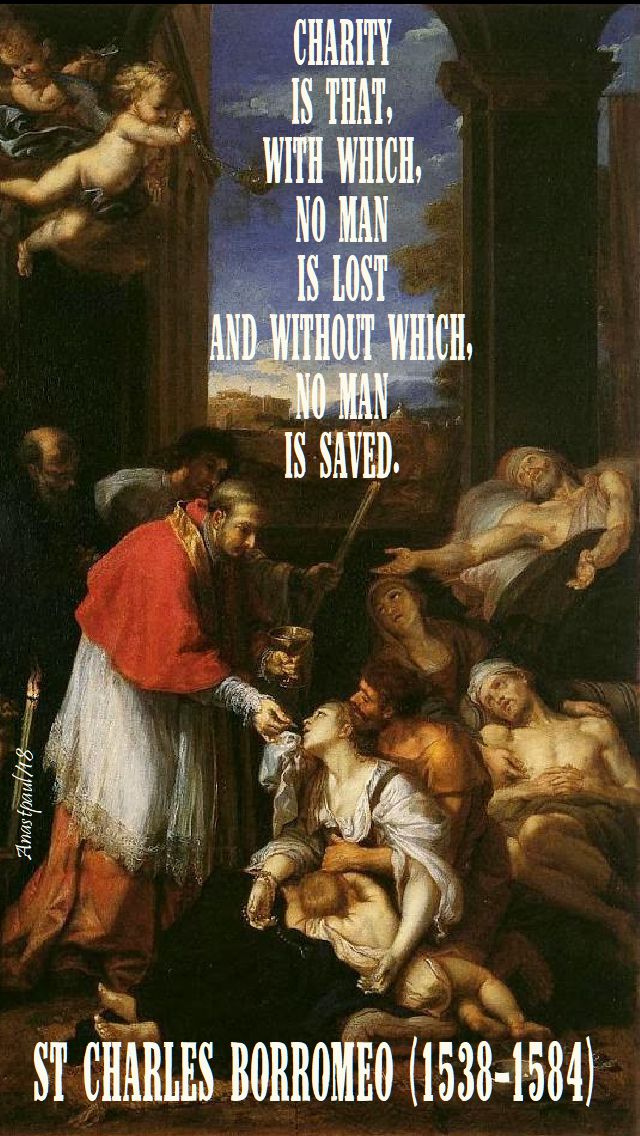
“Charity is that, with which no man is lost and without which, no man is saved.”
“We must meditate before, during and after everything we do. The prophet says: “I will pray and then I will understand.” This is the way we can easily overcome the countless difficulties we have to face day after day, which, after all, are part of our work. In meditation we find the strength, to bring Christ to birth in ourselves and in other men.”
“If we wish to make any progress in the service of God, we must begin every day of our life with new eagerness. We must keep ourselves in the presence of God, as much as possible and have no other view or end, in all our actions but the divine honour.”
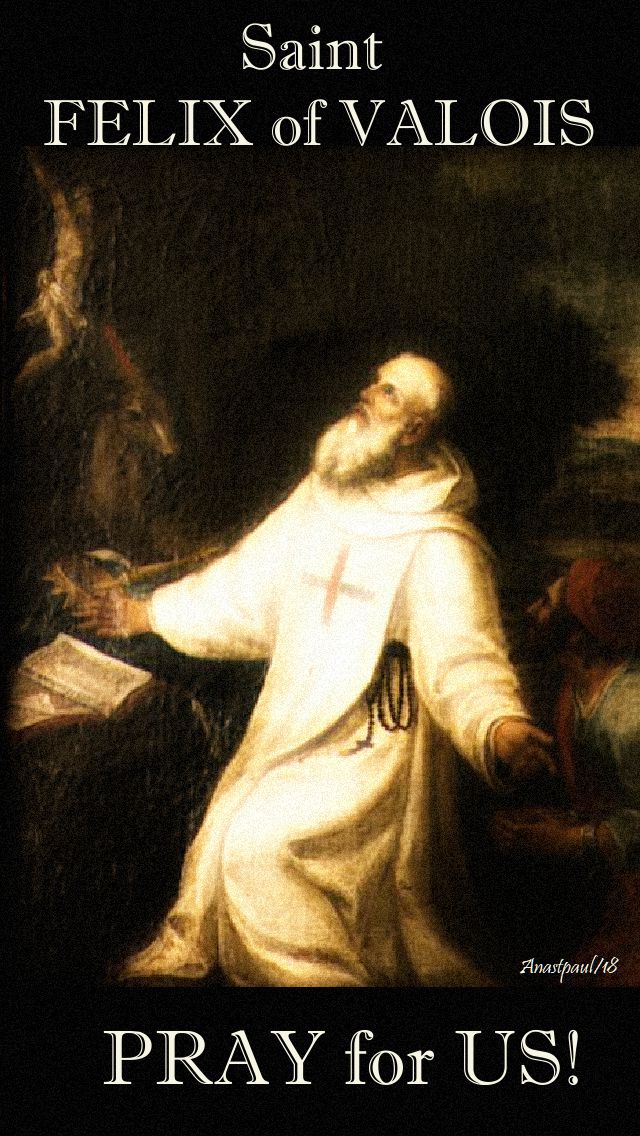
One Minute Reflection – 4 November – Today’s Gospel: Mark 12:28b-34 -Thirty First Sunday in Ordinary Time, Year B and the Memorial of St Charles Borromeo (1538-1584) and St Felix of Valois (1127-1212)
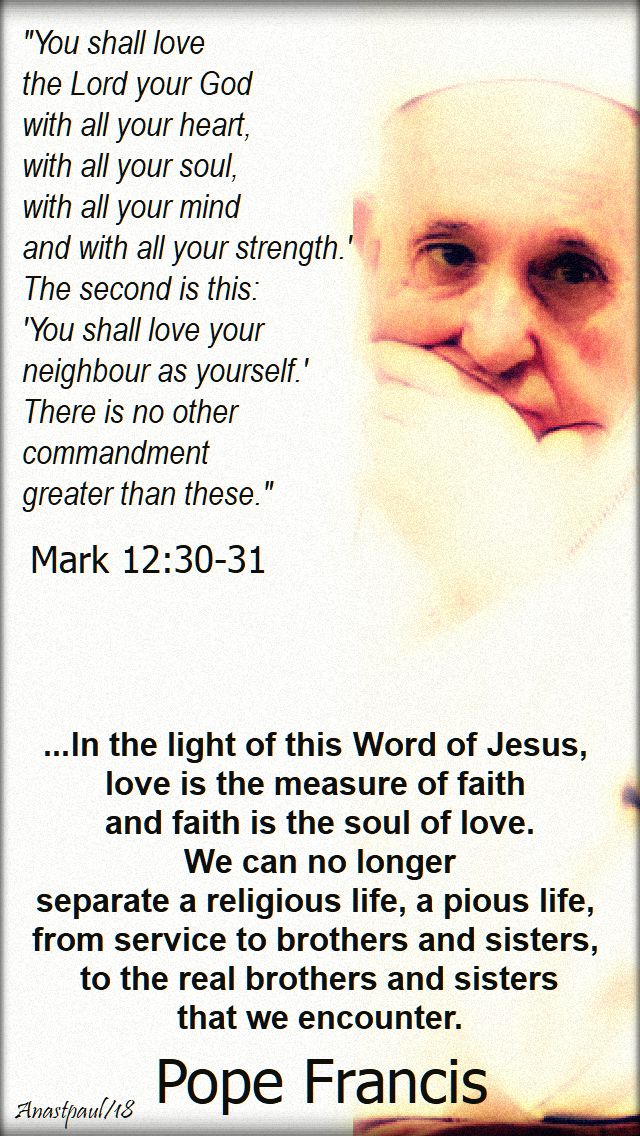
“You shall love the Lord your God with all your heart, with all your soul, with all your mind and with all your strength.’ The second is this: ‘You shall love your neighbour as yourself.’ There is no other commandment greater than these.”...Mark 12:30-31
REFLECTION – “You cannot love God without loving your neighbour and you cannot love your neighbour without loving God. In effect, the visible sign a Christian can show, in order to witness to his love for God to the world and to others, to his family, is the love he bears for his brothers, is the love of his people. The Commandment to love God and neighbour is the first, not because it is at the top of the list of Commandments. Jesus does not place it at the pinnacle but at the centre, because it is from the heart that everything must go out and to which everything must return and refer.
In the Old Testament, the requirement to be holy, in the image of God who is holy, included the duty to care for the most vulnerable people, such as the stranger, the orphan and the widow (cf. Ex 22:20-26). Jesus brings this Covenant law to fulfilment, He who unites in Himself, in His flesh, divinity and humanity, a single mystery of love.
Now, in the light of this Word of Jesus, love is the measure of faith and faith is the soul of love. We can no longer separate a religious life, a pious life, from service to brothers and sisters, to the real brothers and sisters that we encounter.”…Pope Francis – Angelus, 26 October 2014)
PRAYER – God power and mercy, by whose grace, Your people give You praise and worthy service, help us to see Your face in our neighbour. To love them all as we love You. Save us from faltering on our way and grant us the joys You have promised . St Felix of Valois and St Charles Borromeo kindly assist our journey by your prayers. Through Jesus our Lord, with the Holy Spirit, one God forever, amen.
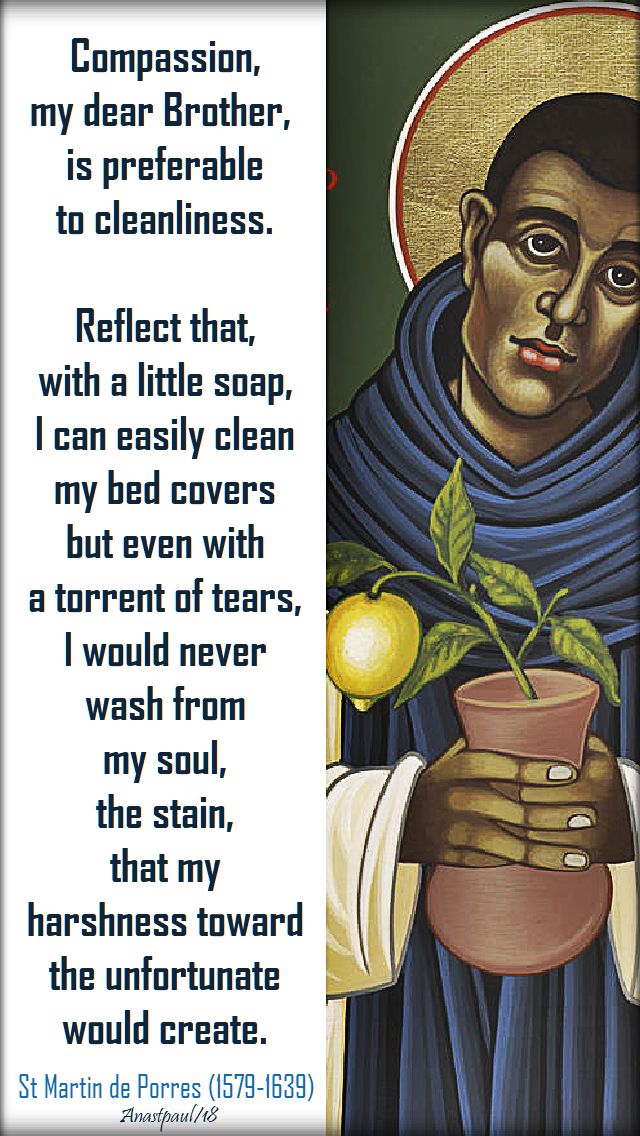
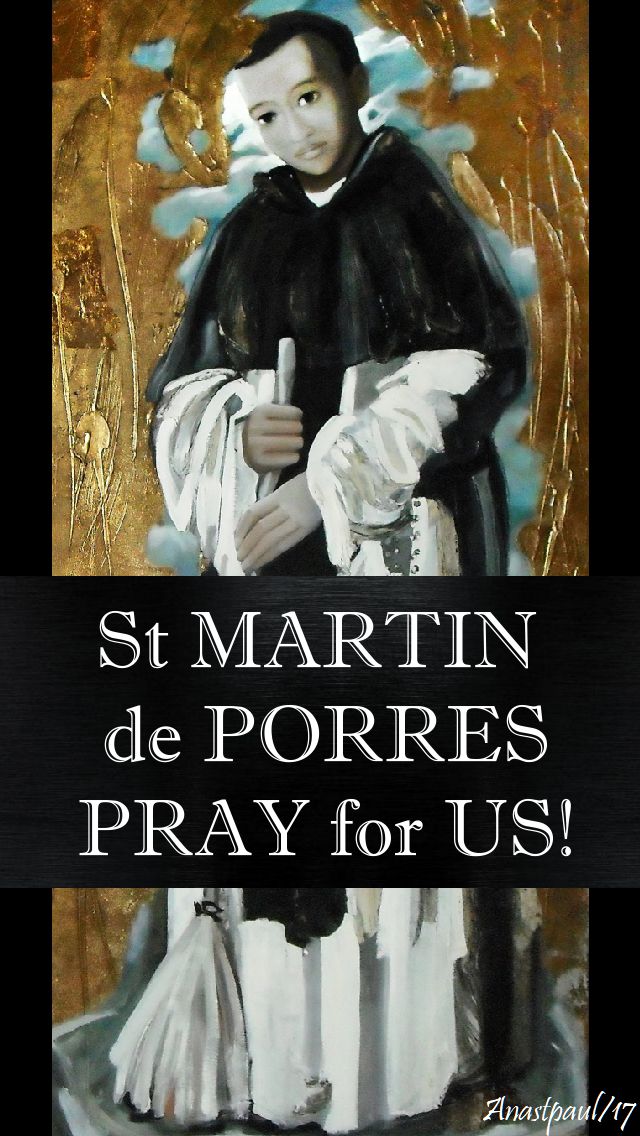
Quote/s of the Day – 3 November – The Memorial of St Martin de Porres (1579-1639)
“Compassion, my dear Brother, is preferable to cleanliness. Reflect that with a little soap, I can easily clean my bed covers but even with a torrent of tears, I would never wash from my soul, the stain, that my harshness toward the unfortunate would create.”
“Everything, even sweeping, scraping vegetables, weeding a garden and waiting on the sick, could be a prayer, if it were offered to God.”
One Minute Reflection – 3 November – Today’s Gospel: Luke 14:1, 7-11 – Saturday of the Thirtieth week in Ordinary Time, Year B and The Memorial of St Martin de Porres (1579-1639)
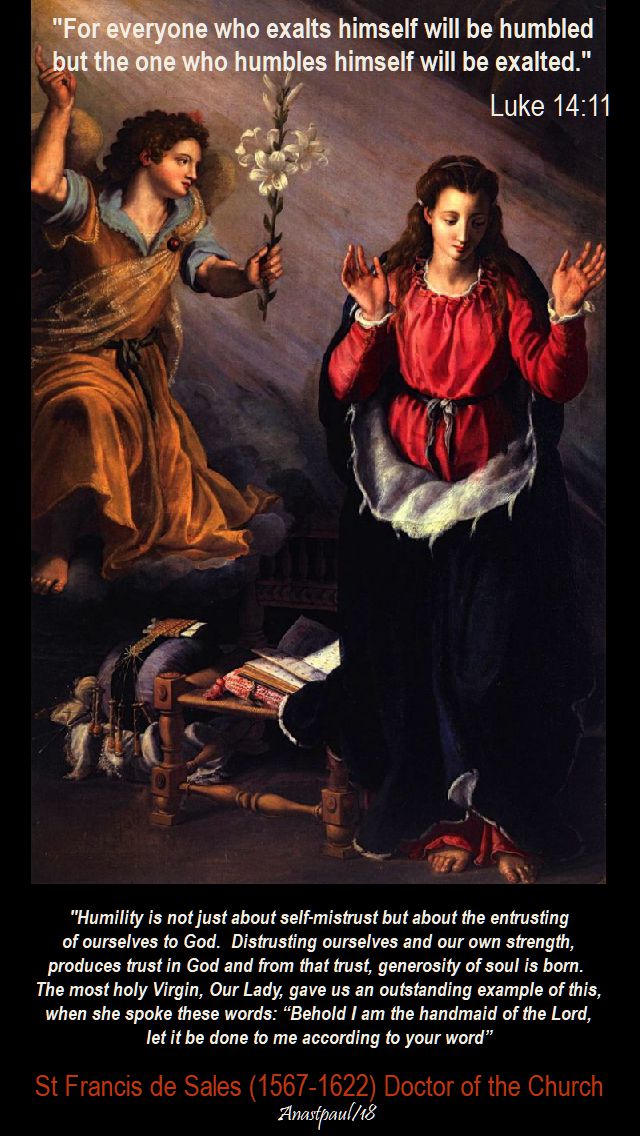
“For everyone who exalts himself will be humbled but the one who humbles himself will be exalted.”…Luke 14:11
REFLECTION – “Humility is not just about self-mistrust but about the entrusting of ourselves to God. Distrusting ourselves and our own strength produces trust in God and from that trust generosity of soul is born.
The most holy Virgin, Our Lady, gave us an outstanding example of this when she spoke these words: “Behold I am the handmaid of the Lord, let it be done to me according to your word” (Lk 1:38). When she said she was the handmaid of the Lord she was performing the greatest act of humility it is possible to do and all the more so in that she was contradicting the praise given her by the angel – that she would be mother of God, that the child to be born from her womb would be called Son of the Most High, a greater dignity than any we might imagine – I say, she opposed her lowliness and unworthiness to all these praises and greatness by saying that she was the handmaid of the Lord. Yet note how, no sooner had she rendered her duty to humility than she practised outstanding generosity by saying: “May it be to me according to your word”.
What she wanted to say was: It is true I am in no way capable of this grace if one is to consider what I am of myself but insofar as what is good in me comes from God and what you say to me is His own most holy will, I believe it may happen and will happen. And so, without the least hesitation, she said: “Let it be done to me according to your word”… St Francis de Sales (1567-1622) Doctor of the Church
PRAYER – Lord Jesus, help us to appreciate and live Your spiritual values and give them the first place in our hearts. Grant that we may always seek them first and remain forever united with You. Send Your Spirit with his gifts and blessings and may the Mother of all Virtue, assist us in our need. Help us to follow the path of humility St Martin so splendidly showed us, that we may obtain from You, as he did, a place in Your Kingdom. St Martin de Porres, pray for us, amen.
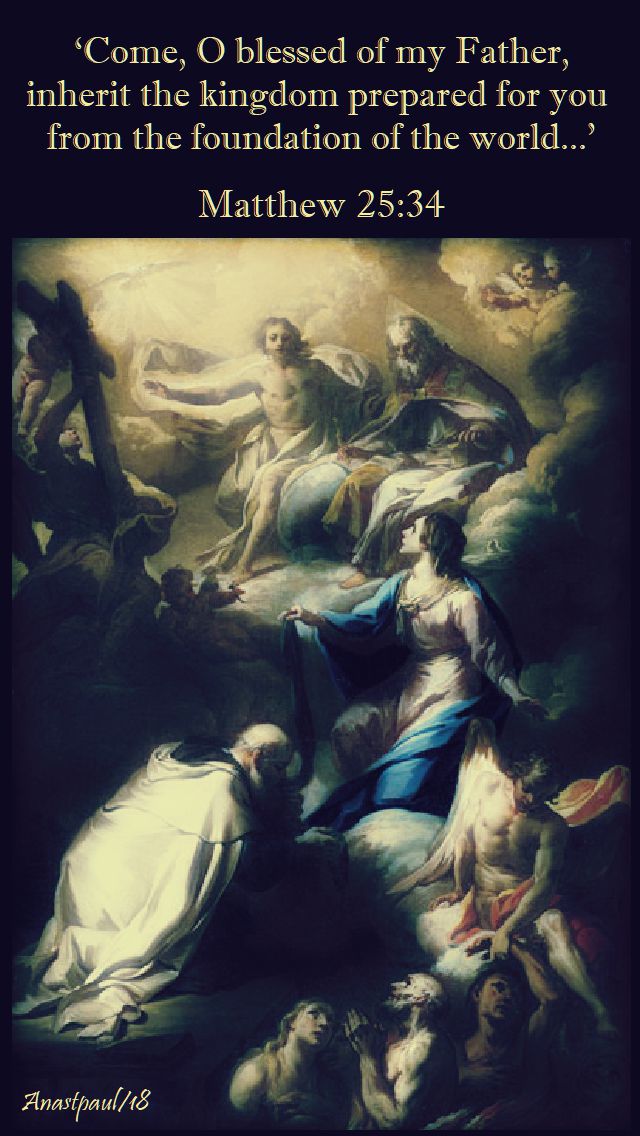
One Minute Reflection – 2 November – Today’s Gospel: Matthew 25:31–46- The Commemoration of All the Faithful Departed (All Souls)
‘Come, O blessed of my Father, inherit the kingdom prepared for you from the foundation of the world…’…Matthew 25:34
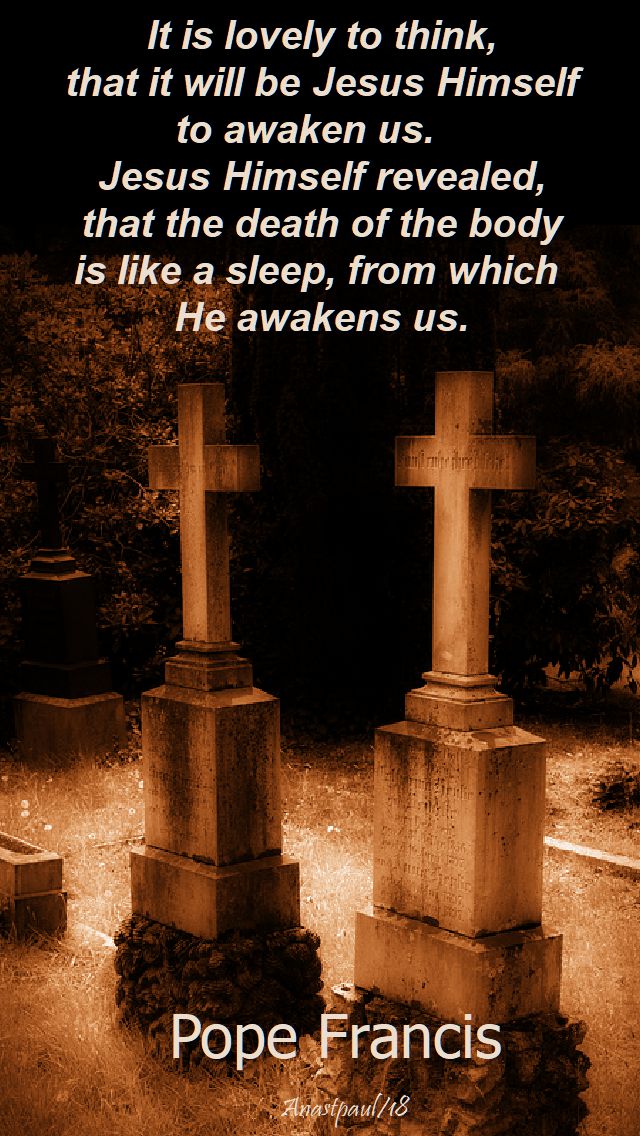
REFLECTION – “Yesterday and today, many have been visiting cemeteries, which, as the word itself implies, is the “place of rest”, as we wait for the final awakening. It is lovely to think, that it will be Jesus Himself to awaken us. Jesus Himself revealed, that the death of the body is like a sleep from which He awakens us. But today we are called to remember everyone, even those who no one remembers. We remember the victims of war and violence, the many “little ones” of the world, crushed by hunger and poverty, we remember the anonymous who rest in the communal ossuary. We remember our brothers and sisters killed because they were Christian and those who sacrificed their lives to serve others.
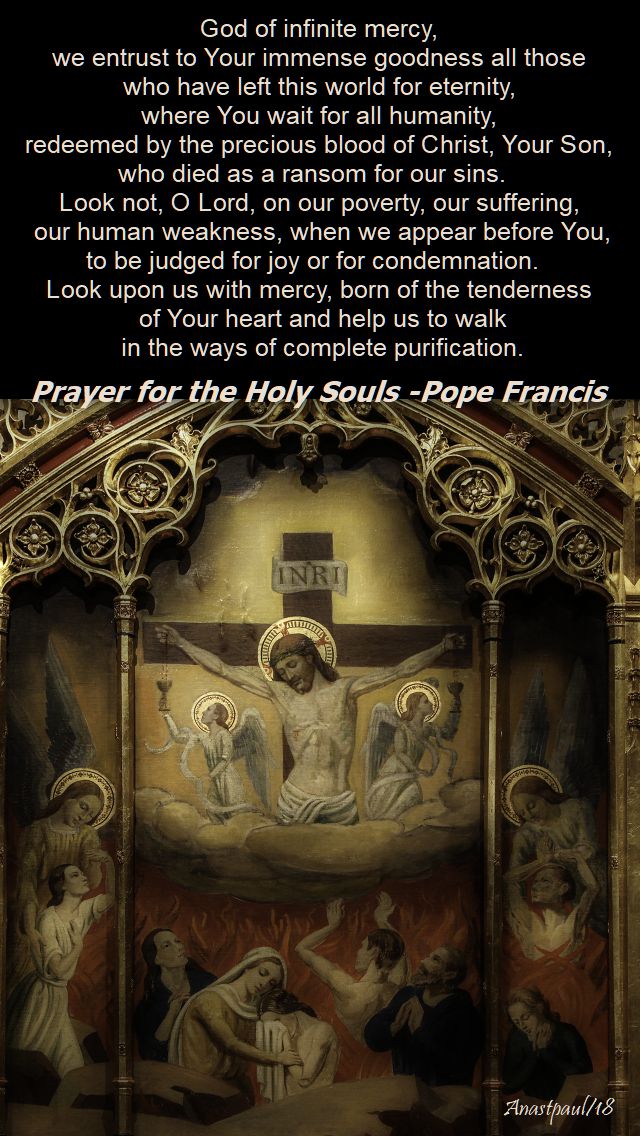
PRAYER – Let us raise this prayer to God: “God of infinite mercy, we entrust to Your immense goodness all those who have left this world for eternity, where You wait for all humanity, redeemed by the precious blood of Christ Your Son, who died as a ransom for our sins. Look not, O Lord, on our poverty, our suffering, our human weakness, when we appear before You to be judged for joy or for condemnation. Look upon us with mercy, born of the tenderness of Your heart and help us to walk in the ways of complete purification.”…Pope Francis – Angelus, 2 November 2014
Thought for the Day – 2 November – The Commemoration of All the Faithful Departed (All Souls)
St Ambrose (340-397) Father & Doctor of the Church
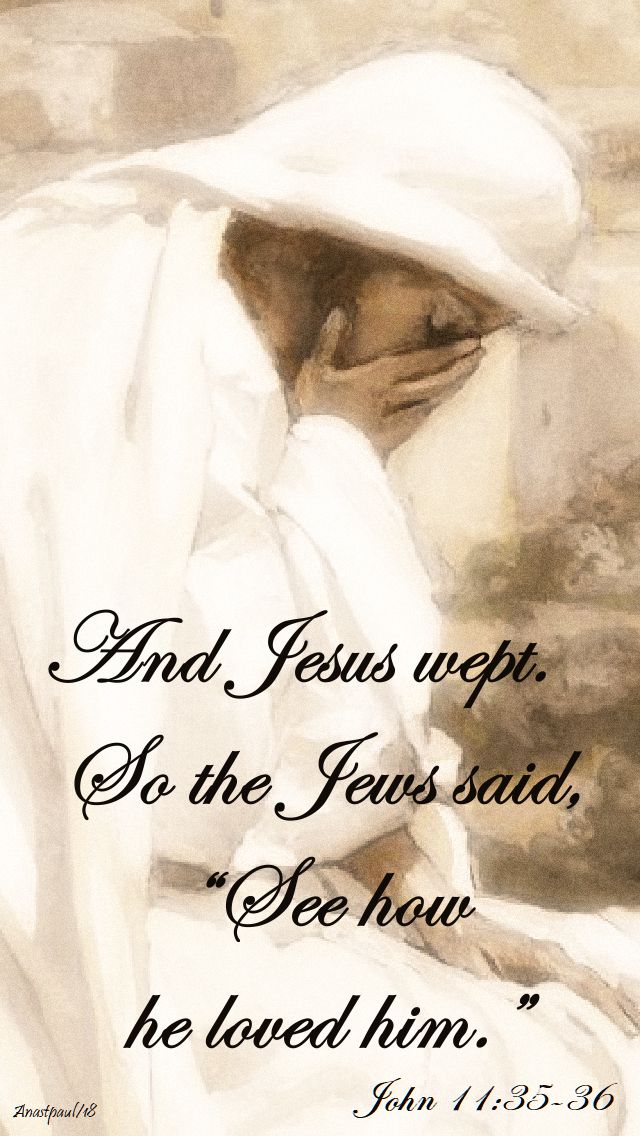
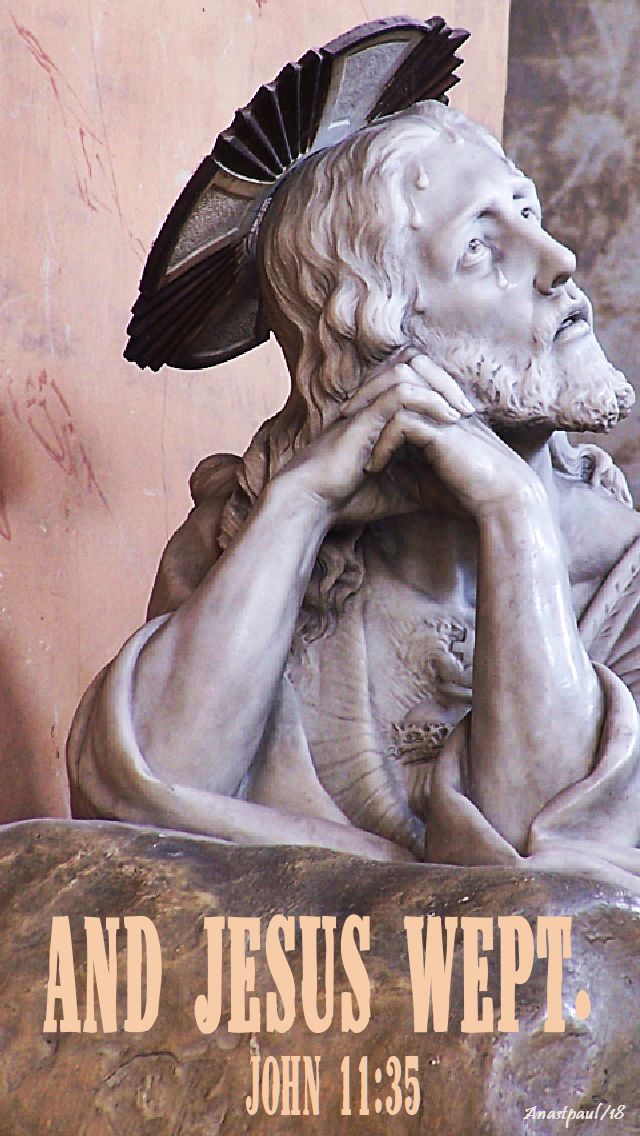
And Jesus wept. So the Jews said, “See how he loved him.”...John 11:35-36
Why do I pray for you, O my brother, who loved me so much and have been carried off from me… ? For I have not lost my relationship to you, rather it has been completely changed in my regard. Up to now, it was inseparable from the body but now, it is indissoluble from feeling. ,,You remain with me and will remain so always… Paul the apostle calls me back and places a sort of brake on my sadness with these words: “We do not want you to be unaware about those who have fallen asleep, so that you may not grieve like the rest who have no hope” (1Thes 4:13)…
But not all weeping is a sign of lack of faith or of weakness. Natural sorrow is one thing, the sadness of unbelief is another… Sorrow is not alone in having its grief and prayer bathes our bed with tears according to the prophet (Ps 6:7). When the patriarchs were enslaved, their people wept bitterly for themselves, as well. Thus tears are signs of affection and not incitements to sorrow. I confess that I have wept but the Lord also wept (Jn 11:35). He wept for someone not of his own kin, I for a brother. He wept for all men in one man – as for me, I will weep for you, my brother, in every man.
Christ wept with the feeling that is ours, not His own, for divinity has no tears… He wept in that man who was “sorrowful even to death” (Mt 26:38); He wept in him who was crucified, who died, who was buried; He wept in that man… who was born of the Virgin.
The Commemoration of All the Faithful Departed (All Souls)
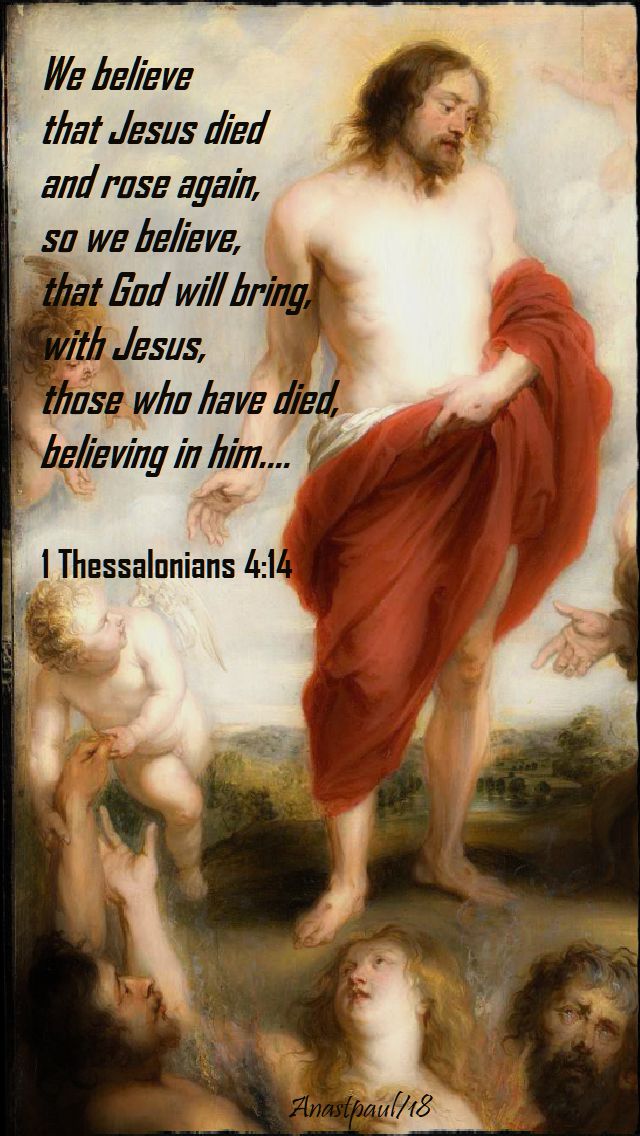
We believe that Jesus died and rose again, so we believe, that God will bring with Jesus, those who have died, believing in him.…
1 Thessalonians 4:14
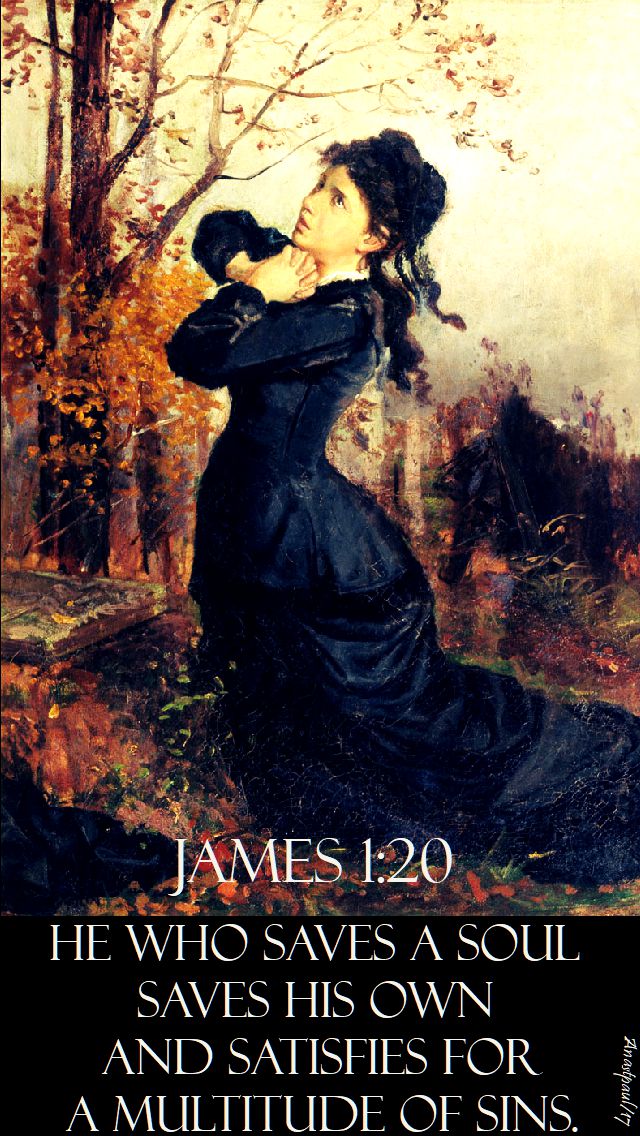
“He who saves a soul, saves his own and satisfies for a multitude of sins.”
James 1:20
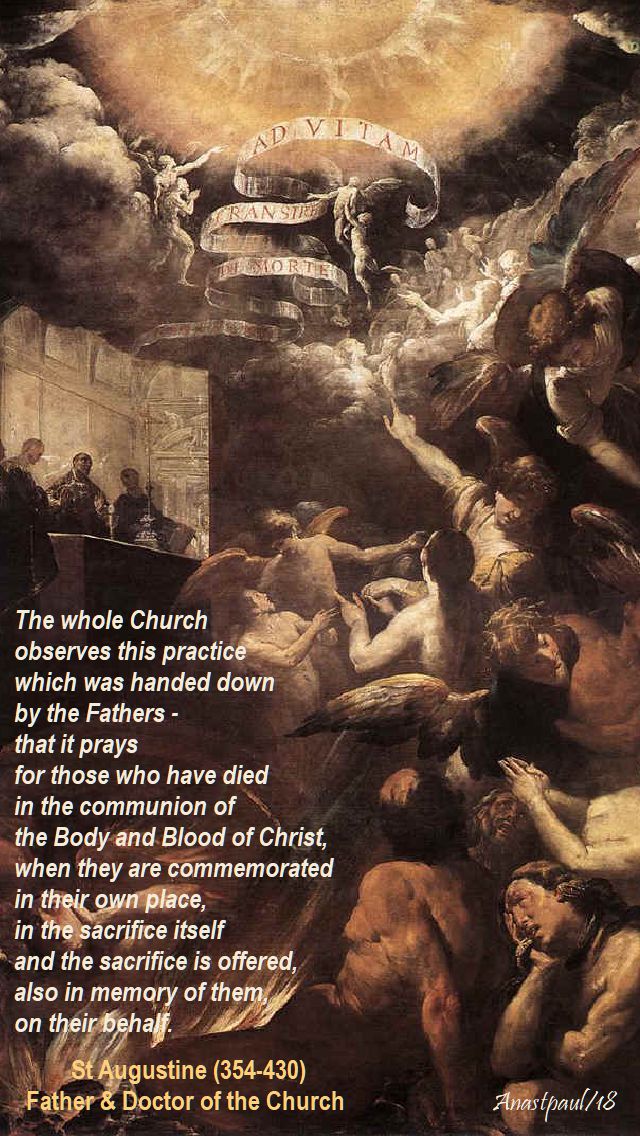
“The whole Church observes this practice which was handed down by the Fathers – that it prays for those who have died in the communion of the Body and Blood of Christ, when they are commemorated in their own place in the sacrifice itself and the sacrifice is offered, also in memory of them, on their behalf.”
St Augustine (354-430) Father & Doctor of the Church
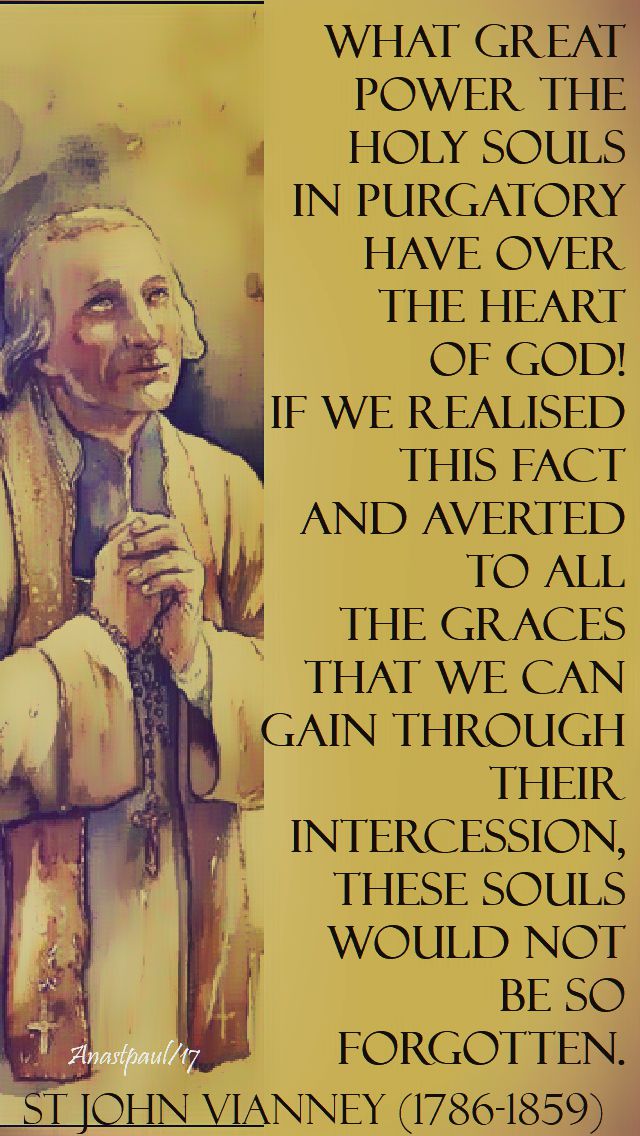
“What great power the holy souls in purgatory have over the heart of God! If we realised this fact and averted to all the graces that we can gain through their intercession, these souls would not be so forgotten.”
St John Vianney (1786-1859)
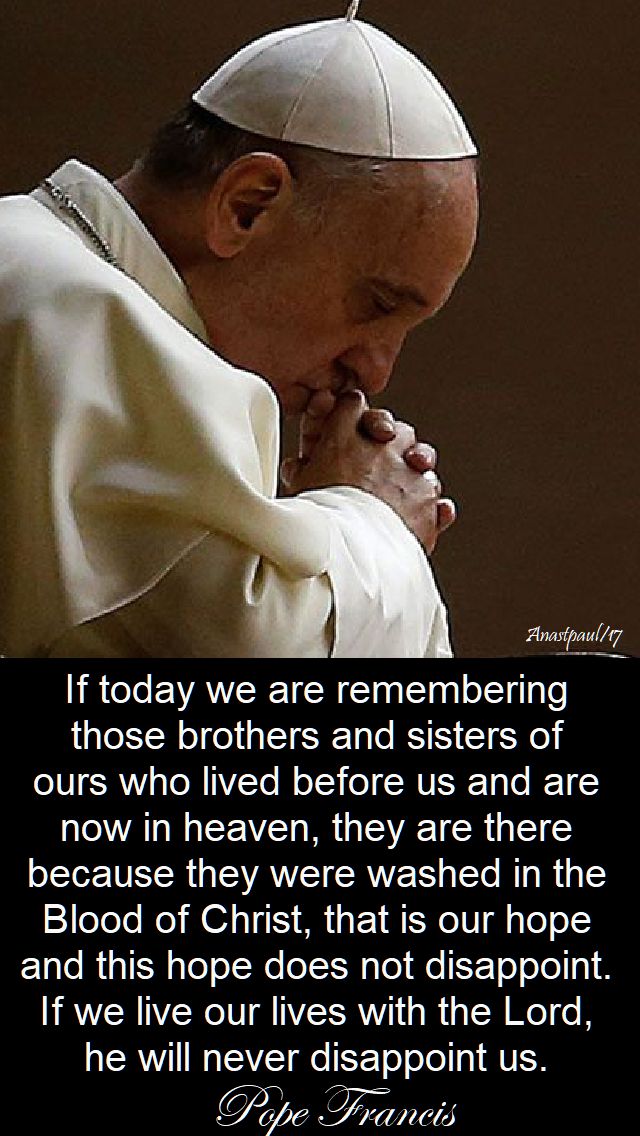
“If today we are remembering these brothers and sisters of ours who lived before us and are now in heaven, they are there because they were washed in the Blood of Christ, that is our hope and this hope does not disappoint. If we live our lives with the Lord, He will never disappoint us.”
Thought for the Day – 1 November – The Solemnity of All the Saints
By Blessed John Henry Newman (1801-1890)
“Very various are the Saints, their very variety is a token of God’s workmanship but however various and whatever was their special line of duty, they have been heroes in it – they have attained such noble self-command, they have so crucified the flesh, they have so renounced the world, they are so meek, so gentle, so tender-hearted, so merciful, so sweet, so cheerful, so full of prayer, so diligent, so forgetful of injuries, they have sustained such great and continued pains, they have persevered in such vast labours, they have made such valiant confessions, they have wrought such abundant miracles, they have been blessed with such strange successes, that they have been the means of setting up a standard before us of truth, of magnanimity, of holiness, of love. They are not always our examples, we are not always bound to follow them – not more than we are bound to obey literally, some of our Lord’s precepts, such as turning the cheek or giving away the coat – not more than we can follow the course of the sun, moon or stars in the heavens; but, though not always our examples, they are always our standard of right and good; they are raised up to be monuments and lessons, they remind us of God, they introduce us into the unseen world, they teach us what Christ loves, they track out for us the way which leads heavenwards.”
Quote/s of the Day – 1 November – The Solemnity of All the Saints
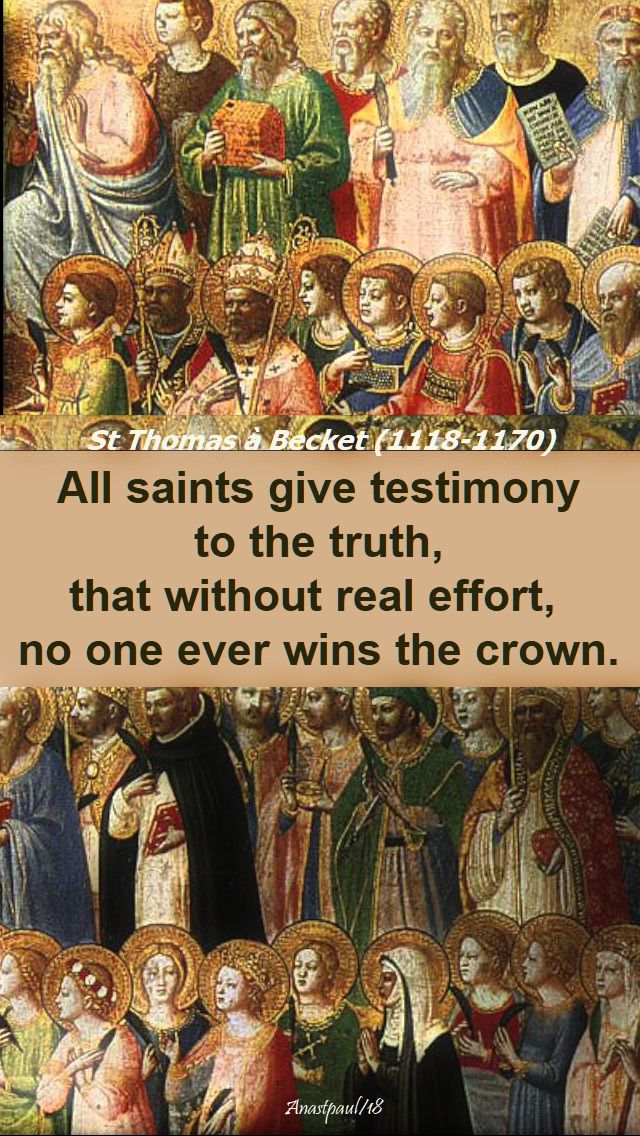
“All saints give testimony to the truth, that without real effort, no one ever wins the crown.”
St Thomas à Becket (1118-1170)
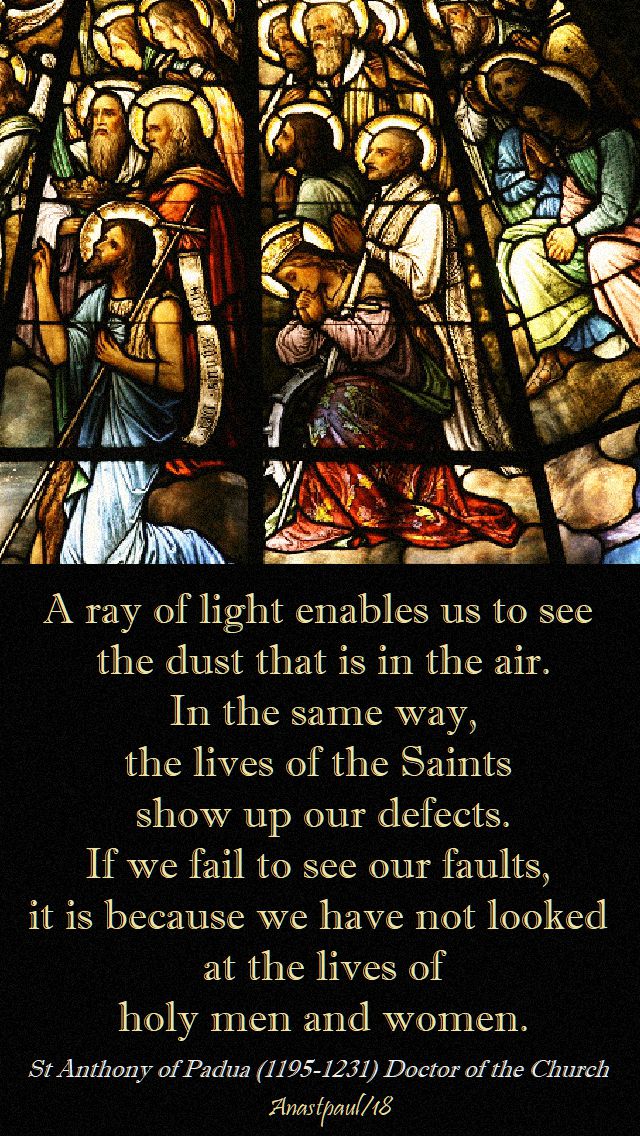
“A ray of light enables us to see the dust that is in the air. In the same way, the lives of the Saints show up our defects. If we fail to see our faults, it is because we have not looked at the lives of holy men and women.”
St Anthony of Padua (1195-1231) Doctor of the Church
“God creates out of nothing. Wonderful you say. Yes, to be sure but He does. what is still more wonderful, He makes saints out of sinners.”
Soren Kierkegaard (1813-1855)
“In heaven, we shall not meet with indifferent glances, because all the elect will discover that they owe to each other, the graces that merited the crown for them.”
St Thérèse of the Child Jesus (1873-1897) Doctor of the Church
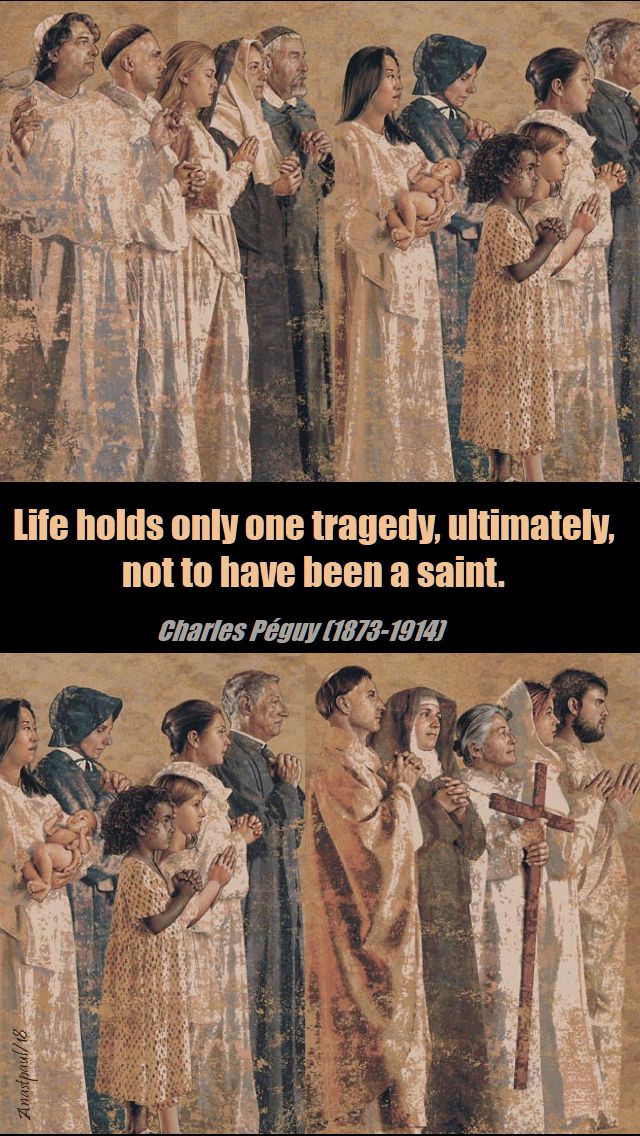
“Life holds only one tragedy, ultimately, not to have been a saint.”
Charles Péguy (1873-1914)
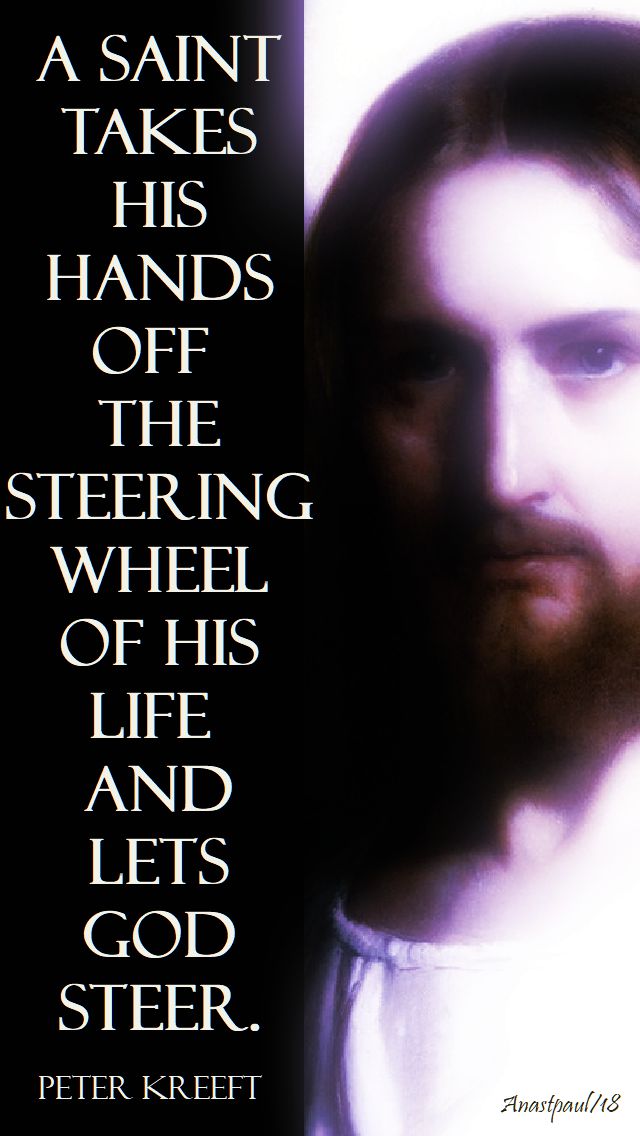
“A saint takes his hands off the steering wheel of his life and lets God steer.”
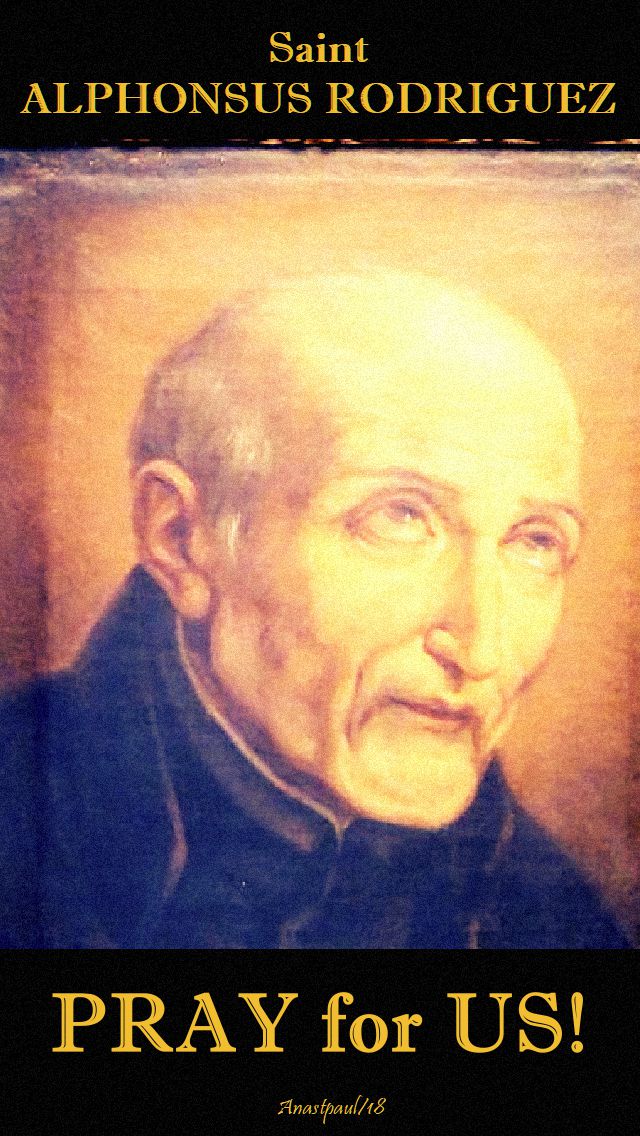
The Memorial of St Alphonsus Rodriguez SJ (1532-1617)
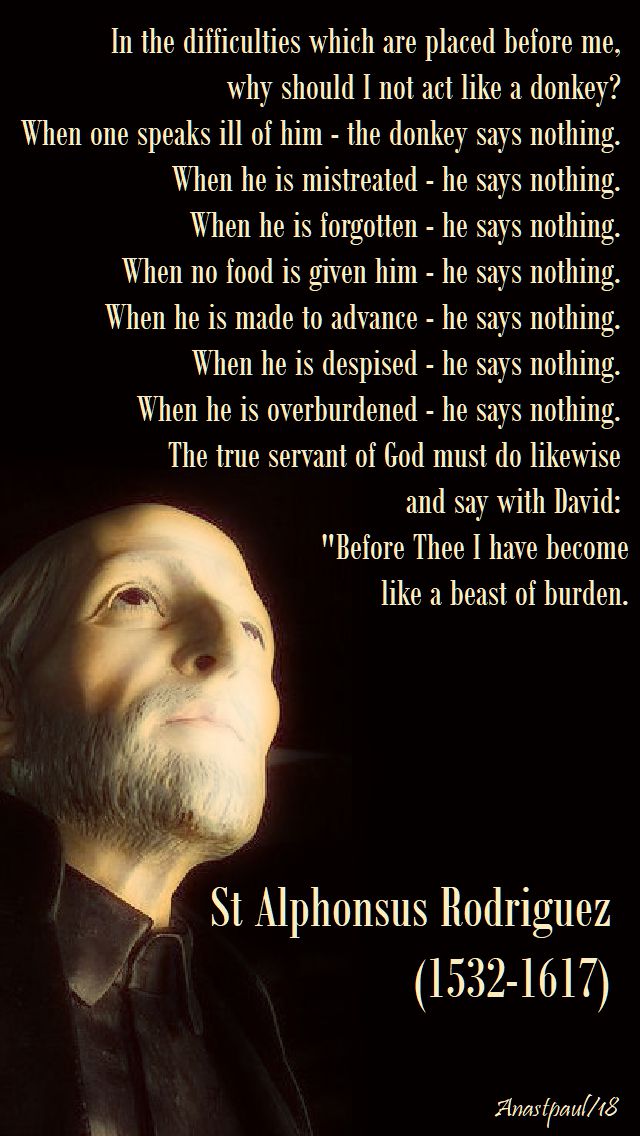
“In the difficulties which are placed before me, why should I not act like a donkey? When one speaks ill of him – the donkey says nothing. When he is mistreated – he says nothing. When he is forgotten – he says nothing. When no food is given him – he says nothing. When he is made to advance – he says nothing. When he is despised – he says nothing. When he is overburdened – he says nothing. The true servant of God must do likewise and say with David: “Before Thee I have become like a beast of burden.”
St Alphonsus Rodriguez (1532-1617)
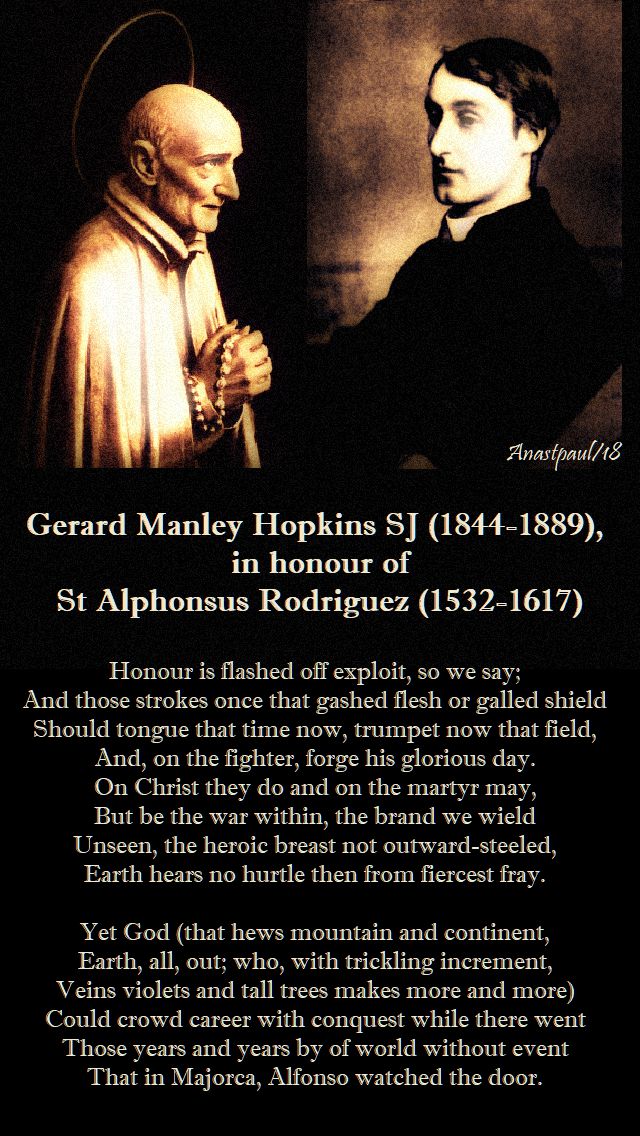
Honour is flashed off exploit, so we say; And those strokes once that gashed flesh or galled shield Should tongue that time now, trumpet now that field, And, on the fighter, forge his glorious day. On Christ they do and on the martyr may; But be the war within, the brand we wield Unseen, the heroic breast not outward-steeled, Earth hears no hurtle then from fiercest fray.
Yet God (that hews mountain and continent, Earth, all, out; who, with trickling increment, Veins violets and tall trees makes more and more) Could crowd career with conquest while there went Those years and years by of world without event That in Majorca, Alfonso watched the door.
Gerard Manley Hopkins SJ (1844-1889),
in honour of Saint Alphonsus Rodriguez SJ (1532-1617)
One Minute Reflection – 31 October – Today’s Gospel: Luke 13:22–30 – Wednesday of the Thirtieth Week in Ordinary Time, Year B and the Memorial of St Alphonsus Rodriguez SJ (1532-1617)
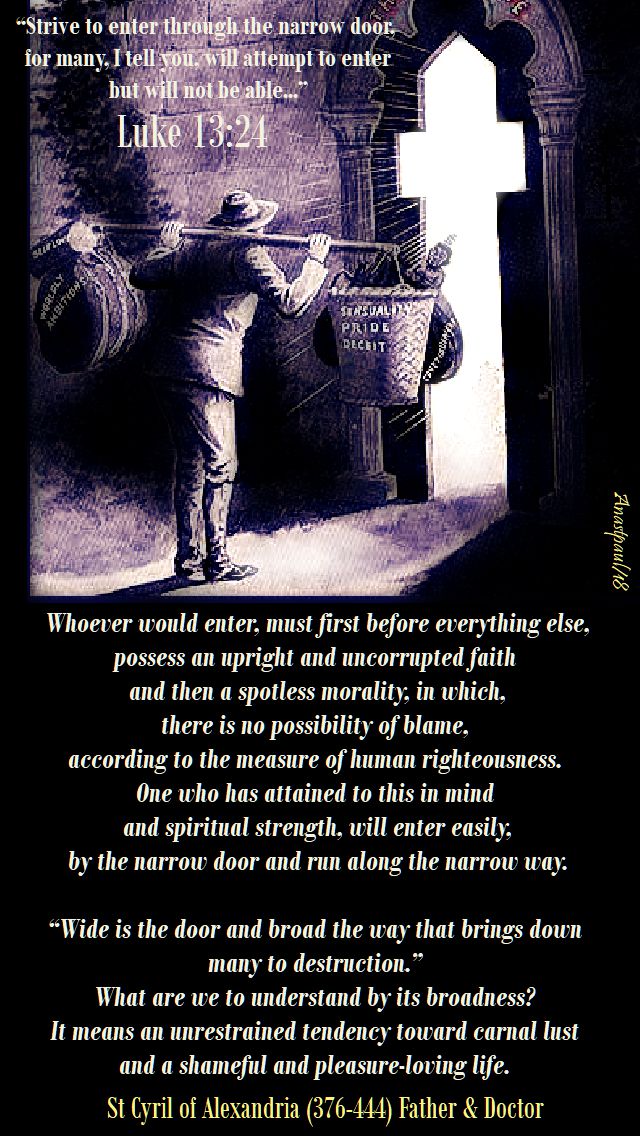
“Strive to enter through the narrow door, for many, I tell you, will attempt to enter but will not be able…”…Luke 13:24.
REFLECTION – “Strive to enter in by the narrow door.” This reply may seem perhaps to wander from the scope of the question. The man wanted to learn whether there would be few who are saved but He explained to him the way whereby he might be saved himself. He said, “Strive to enter in by the narrow door.” What do we answer to this objection? … It was a necessary and valuable thing to know how a man may obtain salvation. He is purposely silent to the useless question. He proceeds to speak of what was essential, namely, of the knowledge necessary for the performance of those duties by which people can enter the narrow door.
I now consider it my duty to mention why the door to life is narrow. Whoever would enter must first, before everything else, possess an upright and uncorrupted faith and then a spotless morality, in which there is no possibility of blame, according to the measure of human righteousness. One who has attained to this in mind and spiritual strength will enter easily by the narrow door and run along the narrow way.
“Wide is the door and broad the way that brings down many to destruction.” What are we to understand by its broadness? It means an unrestrained tendency toward carnal lust and a shameful and pleasure-loving life. It is luxurious feasts, parties, banquets and unrestricted inclinations to everything that is condemned by the law and displeasing to God. A stubborn mind will not bow to the yoke of the law. This life is cursed and relaxed in all carelessness. Thrusting from it the divine law and completely unmindful of the sacred commandments, wealth, vices, scorn, pride and the empty imagination of earthly pride spring from it. Those who would enter in by the narrow door must withdraw from all these things, be with Christ and keep the festival with him.”…St Cyril of Alexandria (376-444) Father & Doctor (Commentary on Luke, Homily 9
PRAYER – Shed Your clear light on our hearts, Lord, so that walking continually in the way of Your commandments, we may never be deceived or misled. Grant that the prayers of our Blessed Mother and St Alphonsus Rodriguez, who always held Your Light up for others to see by, give us strength. Through Jesus Christ, with the Holy Spirit, God forever, amen.
One Minute Reflection = 30 October – Today’s Gospel: Luke 13:18-21 – Tuesday of the Thirtieth week in Ordinary Time, Year B – The Memorial of St Angelo of Acri OFM Cap (1669-1739)
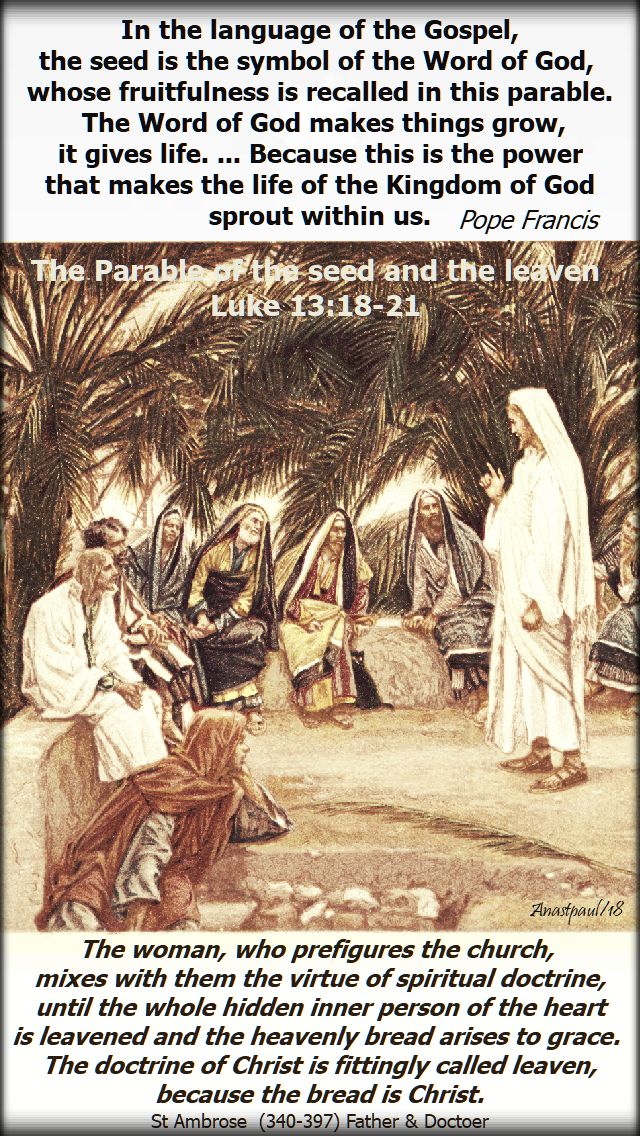
“What is the kingdom of God like? And to what shall I compare it? It is like a grain of mustard seed which a man took and sowed in his garden and it grew and became a tree and the birds of the air made nests in its branches.”..Luke 13:18-19
REFLECTION – “In the language of the Gospel, the seed is the symbol of the Word of God, whose fruitfulness is recalled in this parable. The Word of God makes things grow, it gives life. …Because this is the power that makes the life of the Kingdom of God sprout within us. And thus is the Kingdom of God, a humanly small and seemingly irrelevant reality. To become a part of it, one must be poor of heart, not trusting in their own abilities but in the power of the love of God; not acting to be important in the eyes of the world but precious in the eyes of God, who prefers the simple and the humble. When we live like this, the strength of Christ bursts through us and transforms what is small and modest into a reality, that leavens the entire mass of the world and of history. This opens us up to trust and hope, despite the tragedies, the injustices, the sufferings that we encounter. The seed of goodness and peace sprouts and develops, because the merciful love of God makes it ripen.”…Pope Francis = Angelus, 14 June 2015
“To what shall I compare the kingdom of God? It is like leaven which a woman took and hid in three measures of flour, till it was all leavened.”...Luke 13:20-21
REFLECTION – “There are three measures: of the flesh, of the soul and of the spirit. This is truer of the spirit in which we all live. The woman, who prefigures the church, mixes with them the virtue of spiritual doctrine, until the whole hidden inner person of the heart is leavened and the heavenly bread arises to grace. The doctrine of Christ is fittingly called leaven, because the bread is Christ. The apostle said, “For we, being many, are one bread, one body.” Leavening happens when the flesh does not lust against the Spirit, nor the Spirit against the flesh. We mortify the deeds of the flesh and the soul, aware that through the breath of God it has received the breath of life, shuns the earthly germs of worldly needs.”…St Ambrose (340-397) Father & Doctoer- Exposition of the Gospel of Luke, 7.
PRAYER – True light of the world, Lord Jesus Christ, as You enlighten all men for their salvation, give us grace, we pray, to herald Your coming by preparing the ways of justice and of peace. Help us Lord, that we may sprout and bear fruit, fitting to grow and be a home of comfort to our neighbour. By the prayers of St Angelo of Acri, who bore the seed of Your Word to many, may we too be heralds of Your Kingdom. Through Jesus our Lord, Who lives and reigns with the Father and the Holy Spirit, God forever, amen.
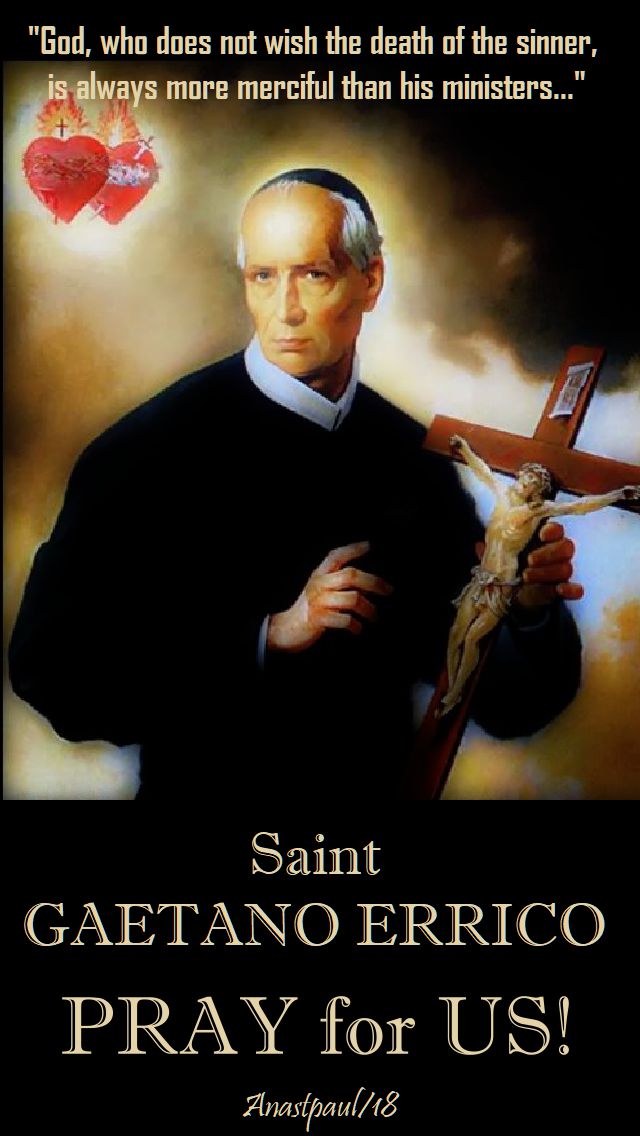
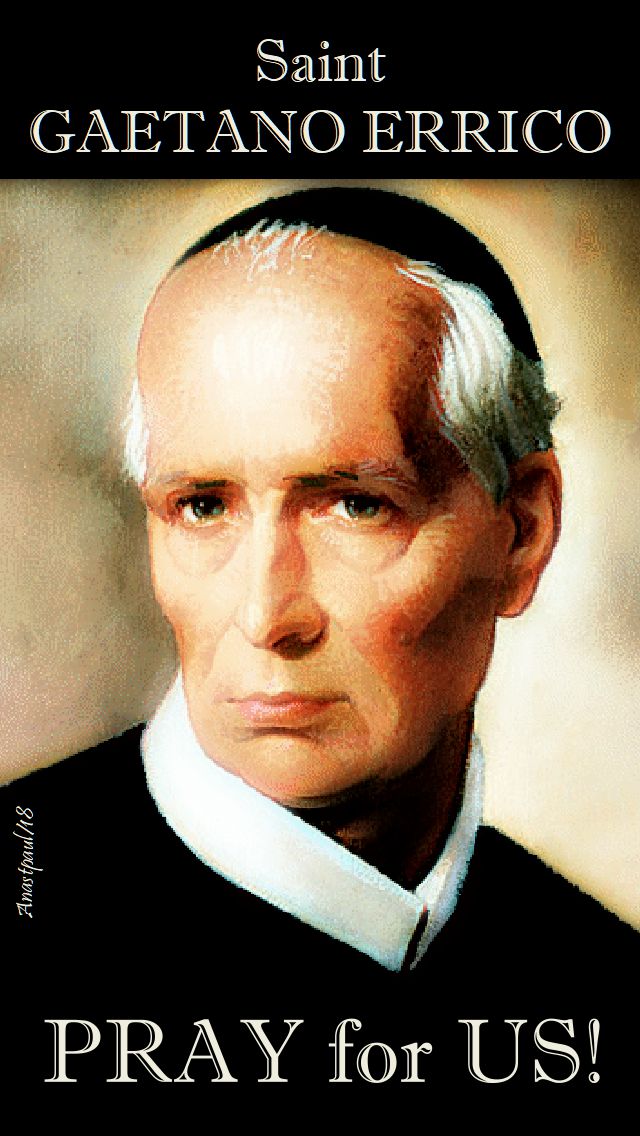
Thought for the Day – 29 October – The Memorial of St Gaetano Errico (1791-1860), Founder of the Missionaries of the Sacred Hearts of Jesus and Mary
Day by day, city to city, village to village, among both the poorest and those of high esteem, he saw the hunger each possessed to know that sin was forgiven, that God’s mercy was infinite and that they were loved. Countless souls found a merciful listener, the embodiment of God’s promise of peace and renewal, in Fr Gaetano, in the Confessional.
“The priest, Gaetano Errico, dedicated himself to this sacrament with diligence, assiduity and patience, never refusing it nor counting the cost. He thus entered among the group of other extraordinary priests who tirelessly made the confessional a place to dispense God’s mercy, helping men to rediscover themselves, to fight against sin and make progress in the spiritual life.
The street and the confessional were the two particular places of Gaetano Errico’s pastoral work. The street was the place that permitted him to offer his customary invitation: “God loves you, when shall we meet?” and in the confession he made their encounter with the mercy of the heavenly Father possible. How many wounded souls did he heal in this way! How many people did he help to be reconciled with God through the sacrament of forgiveness!
In this way St. Gaetano Errico became an expert in the “science” of forgiveness, and concerned himself with teaching it to his missionaries: “God, who does not wish the death of the sinner, is always more merciful than his ministers; so be as merciful as you can and you will find mercy with God!”
Pope Benedict XVI, Homily at Canonisation Mass, October 2008
He found his own encouragement on his knees in prayer . . . indeed it was prayer and the hours he spent in adoration of the Blessed Sacrament that strengthened and renewed him and kept the fire of his love for God ever burning.
Let us rediscover the great grace of the Confessional and the immense joy of Eucharistic Adoration for ourselves!
Quote of the Day – 29 October – The Memorial of St Gaetano Errico (1791-1860), Founder of the Missionaries of the Sacred Hearts of Jesus and Mary
“Let us toil, to the loss of everything, not excluding life, if necessary, to make known to all people, the most ardent love of the Sacred Hearts and to kindle this holy and divine love, in the hearts of humanity.” (From the Rule)
One Minute Reflection – 29 October – Today’s Gospel: Luke 13:10-17 – Monday of the Thirtieth week in Ordinary Time, Year B and the Memorial of St Gaetano Errico (1791-1860)
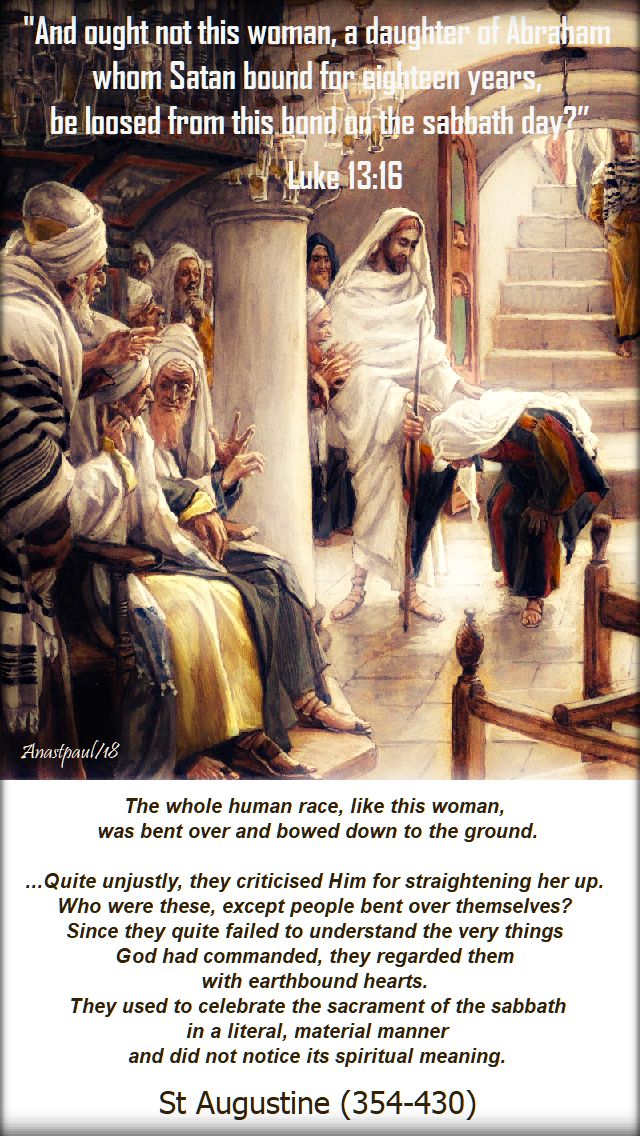
” And ought not this woman, a daughter of Abraham whom Satan bound for eighteen years, be loosed from this bond on the sabbath day?”…Luke 13:16
REFLECTION – “The whole human race, like this woman, was bent over and bowed down to the ground. Someone already understands these enemies. He cries out against them and says to God, “They have bowed my soul down.” The devil and his angels have bowed the souls of men and women down to the ground. He has bent them forward to be intent on temporary and earthly things and has stopped them from seeking the things that are above.
Since that is what the Lord says about the woman whom Satan had bound for eighteen years, it was now time for her to be released from her bondage on the sabbath day. Quite unjustly, they criticised Him for straightening her up. Who were these, except people bent over themselves? Since they quite failed to understand the very things God had commanded, they regarded them with earthbound hearts. They used to celebrate the sacrament of the sabbath in a literal, material manner and did not notice its spiritual meaning.” … St Augustine (354-430) Father & Doctor (Sermon 162)
PRAYER – Almighty Lord and God, protect us by Your power throughout the course of this day, even as You have enabled us to begin it – do not let us turn aside to any sin but, let our every thought, word and deed aim at doing what is pleasing in Your sight. Grant we pray, that by the prayers of St Gaetano Errico, we may strive to seek only to please the Sacred Heart of Your Son and the loving Heart of His Mother. Through Jesus our Lord, Your Son, with the Holy Spirit, God forever, amen.
Sunday Reflection – 28 October – Thirtieth Sunday in Ordinary Time, Year B
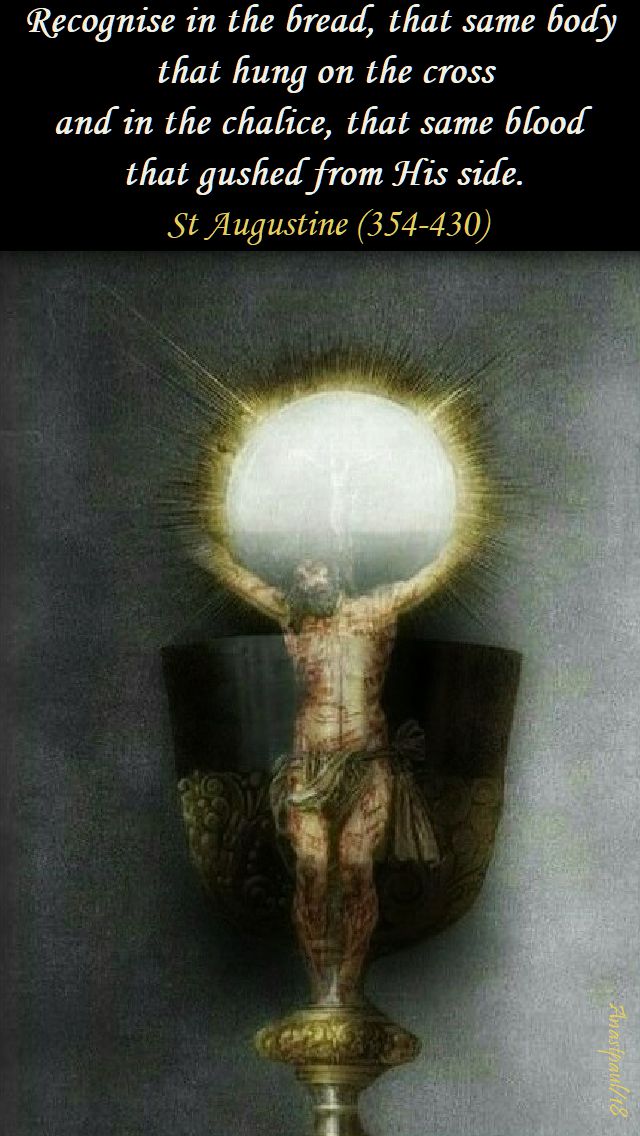
Recognise in the bread, that same body that hung on the cross and in the chalice, that same blood that gushed from His side.
Saint Augustine (354-430)
Transubstantiation
In the offering that Jesus makes of Himself we find all the novelty of Christian worship. In ancient times men offered in sacrifice to the divinity the animals or first fruits of the earth. Jesus, instead, offers Himself, His body and His whole existence – He Himself, in person, becomes the sacrifice that the liturgy offers in the Holy Mass.
In fact, with the consecration of the bread and wine they become His true body and blood.
Saint Augustine invited his faithful, not to pause on what appeared to their sight but to go beyond: “Recognise in the bread — he said — that same body that hung on the cross and in the chalice that same blood that gushed from His side” (Disc. 228 B, 2).
To explain this transformation, theology has coined the word “transubstantiation,” a word that resounded for the first time in this Basilica during the IV Lateran Council, of which in five years will be the 8th centenary. On that occasion the following expressions were inserted in the profession of faith: “his body and his blood are truly contained in the sacrament of the altar, under the species of bread and wine, because the bread is transubstantiated into the body and the wine into the blood by divine power” (DS, 802).
Therefore, it is essential to stress, in the itineraries of education of children in the faith, of adolescents and of young people, as well as in “centres of listening” to the Word of God, that in the sacrament of the Eucharist, Christ is truly, really and substantially present.
Sunday
And let us also keep present that the Eucharist, joined to the cross and resurrection of the Lord, has dictated a new structure to our time.
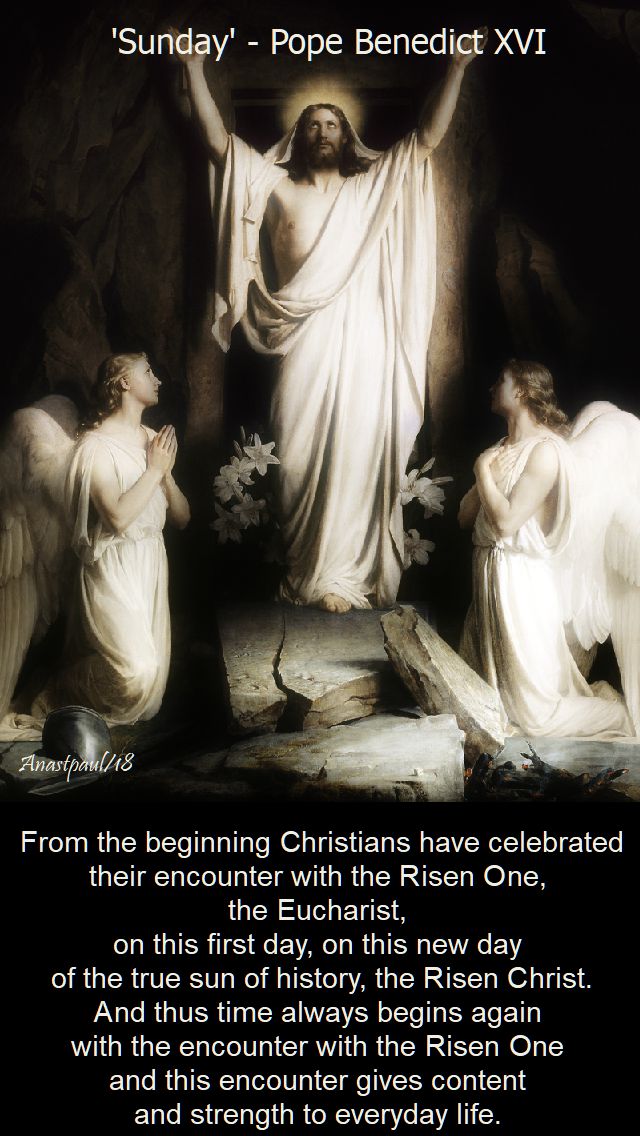
The Risen One was manifested the day after Saturday, the first day of the week, day of the sun and of creation. From the beginning, Christians have celebrated their encounter with the Risen One, the Eucharist, on this first day, on this new day of the true sun of history, the Risen Christ.
And thus time always begins again with the encounter with the Risen One and this encounter gives content and strength to everyday life. Because of this, it is very important for us Christians, to follow this new rhythm of time, to meet with the Risen One on Sunday and thus “to take” with us His presence, which transforms us and transforms our time.
Quote/s of the Day – 28 October – Thirtieth Sunday in Ordinary Time, Year B and the Feast of Sts Simon and Jude, Apostles of Christ
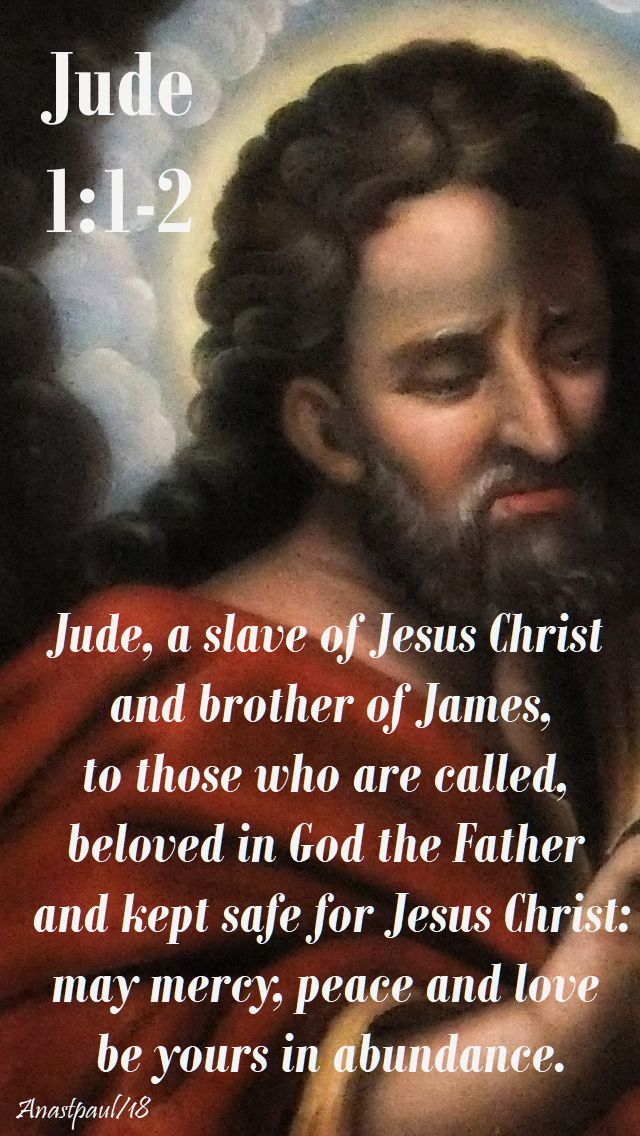
Jude, a slave of Jesus Christ and brother of James, to those who are called, beloved in God the Father and kept safe for Jesus Christ: may mercy, peace and love be yours in abundance.
Jude 1:1-2
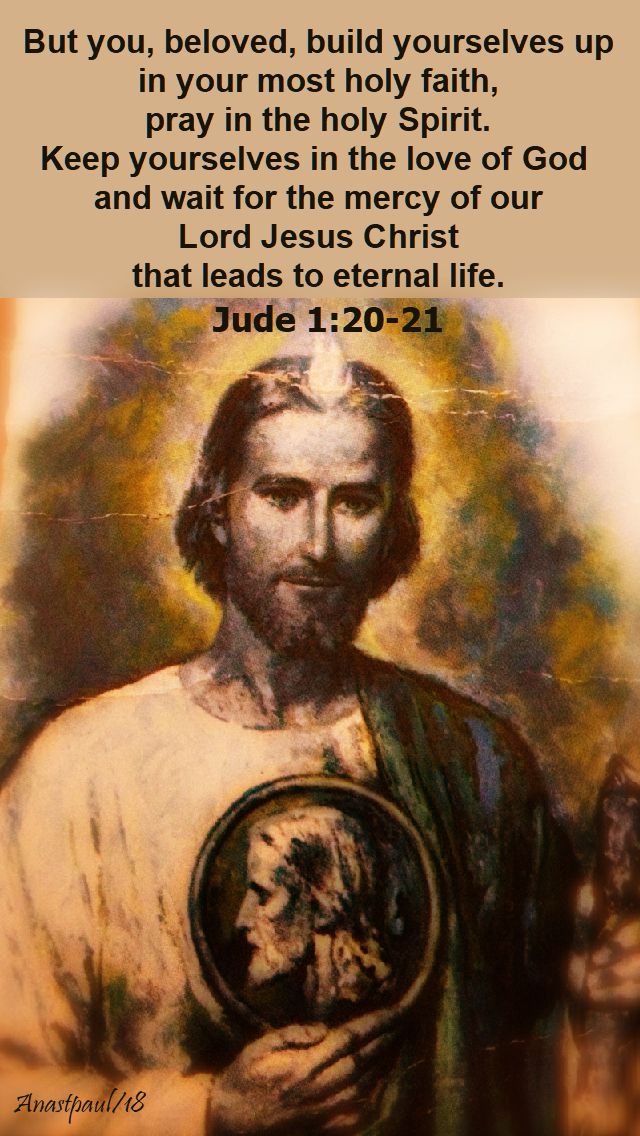
But you, beloved, build yourselves up in your most holy faith, pray in the holy Spirit. Keep yourselves in the love of God and wait for the mercy of our Lord Jesus Christ that leads to eternal life.
Thought for the Day – 27 October – Today’s Gospel: Luke 13:1-9 – Saturday of the Twenty Ninth week in Ordinary Time, Year B
“And he said to the vinedresser, ‘Lo, these three years I have come seeking fruit on this fig tree and I find none. Cut it down, why should it use up the ground?”…Luke 13:7
Answering God’s call to repent at last
St Augustine (354-430) Father & Doctor of the Church – Confessions Bk. 8
Those trifles of all trifles and vanities of vanities, my one-time mistresses, held me back, plucking at my garment of flesh and murmuring softly: “Are you sending us away?” And ” From this moment shall we not be with you, now or forever?” And: ” From this moment shall this or that not be allowed you, now or forever?” What were they suggesting to me, O my God?… I hesitated to shake them off and leap upwards on the way I was called, for the strong force of habit said to me: “Do you think you can live without them?” But by this time its voice was growing fainter. In the direction towards which I had already turned my face and was quivering in fear of going, I could see the austere beauty of Continence honourably soliciting me to come to her and not linger, her hands full of multitudes of good examples… “The Lord their God gave me to them. Why do you rely on yourself and so fail to stand at all? Cast yourself upon Him and do not be afraid, He will not draw back and let you fall. Cast yourself on Him without fea,; He will receive you and heal you”…
This disputation within my heart was nothing other than a struggle between myself against myself… When my most searching scrutiny had drawn up all my vileness from the secret depths of my soul and heaped it in my heart’s sight, a mighty storm rose up in me bringing a mighty rain of tears. In order to give release to my tears and lamentations, I got up and went out… I flung myself down somehow under a certain fig tree and no longer tried to check my tears, which poured from my eyes in a flood, an acceptable sacrifice to Thee. And I spoke to You freely: “And Thou, O Lord, how long? How long, Lord, will You be angry forever? Remember not our former iniquities.” (Ps 6:4; 78:5)… And I continued my miserable complaining: “How long, how long shall I go on saying tomorrow and again tomorrow? Why not now, why not this very hour?”
And suddenly I heard a voice from some nearby house, a boy’s voice or a girl’s voice, a sort of sing-song repeated again and again: “Take and read, take and read.” I stopped weeping and immediately began to search my mind most carefully as to whether children were accustomed to chant these words in any kind of game and I could not remember that I had ever heard any such thing. Damming back my flood of tears I rose up again, interpreting the incident as quite certainly a divine command to open the book of the apostle Paul and read the first passage on which my eyes should fall… I returned hastily and took up the book and read what I had seen before: “Not in rioting and drunkenness, not in chambering and impurities, not in contention and envy but put on the Lord Jesus Christ and make not provision for the flesh in its concupiscence,” (Rom 13:13). I had no wish to read any further and no need. For in that instant, with the very ending of the sentence, it was as though a light of utter confidence shone in my heart, and all the darkness of uncertainty vanished away.
Quote/s of the Day – 27 Oct – Saturday of the Twenty Ninth week in Ordinary Time, Year B
Speaking of: Marian Gems
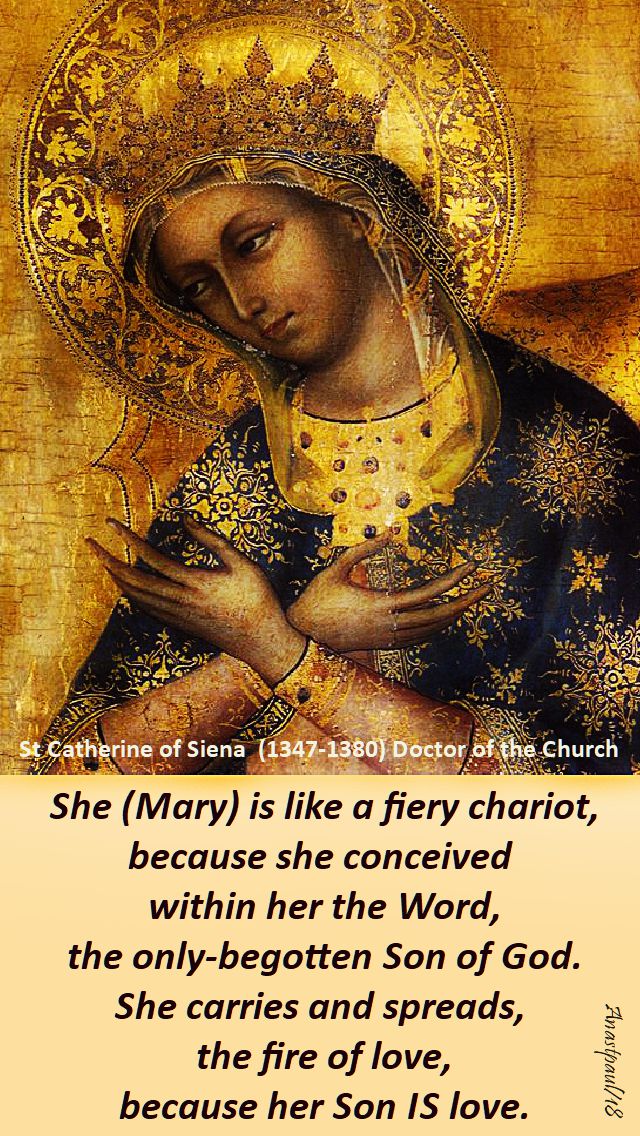
“She (Mary) is like a fiery chariot, because she conceived within her the Word, the only-begotten Son of God. She carries and spreads, the fire of love, because her Son IS love.”
St Catherine of Siena (1347-1380) Doctor of the Church
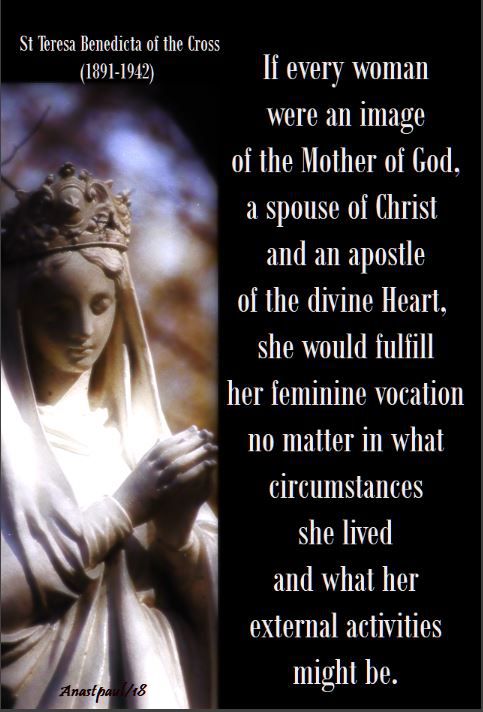
“If every woman were an image of the Mother of God, a spouse of Christ and an apostle of the divine Heart, she would fulfil her feminine vocation no matter in what circumstances she lived and what her external activities might be.”
St Teresa Benedicta of the Cross/Edith Stein (1891-1942)
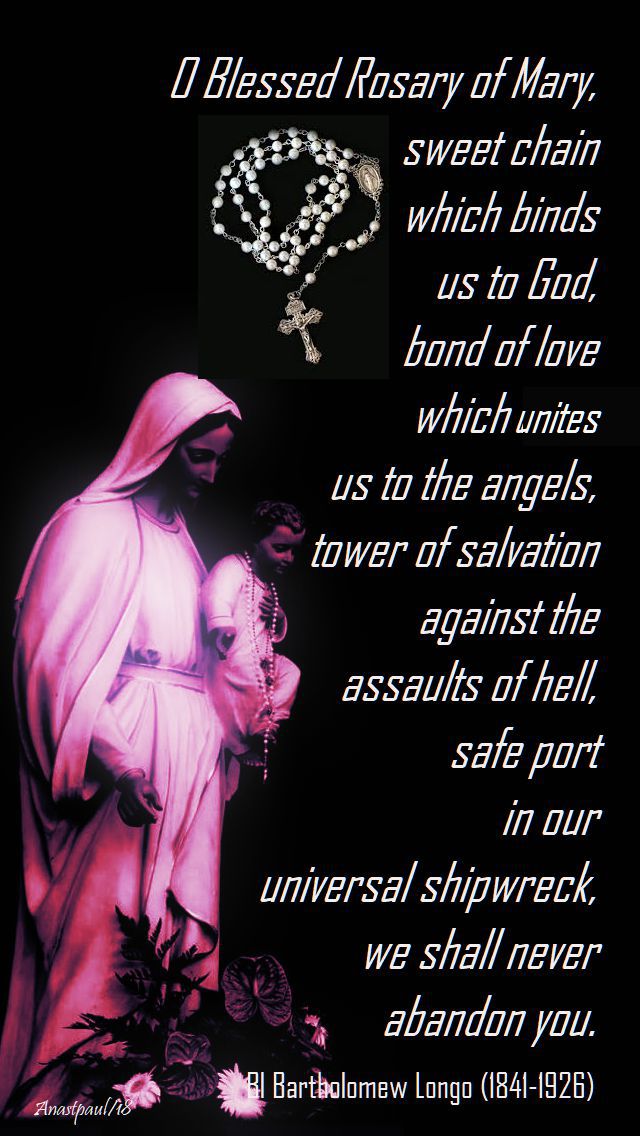
“O Blessed Rosary of Mary, sweet chain which binds us to God, bond of love which unites us to the angels, tower of salvation against the assaults of hell, safe port in our universal shipwreck, we shall never abandon you.”
Bl Bartholomew Longo (1841-1926)
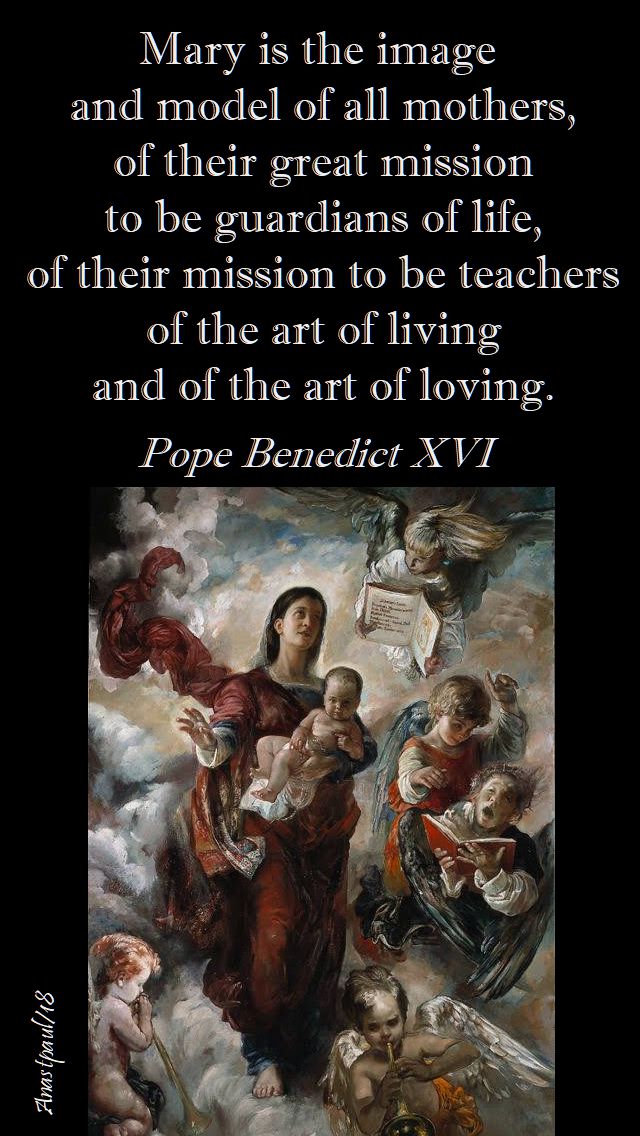
“Mary is the image and model of all mothers, of their great mission to be guardians of life, of their mission to be teachers of the art of living and of the art of loving.”
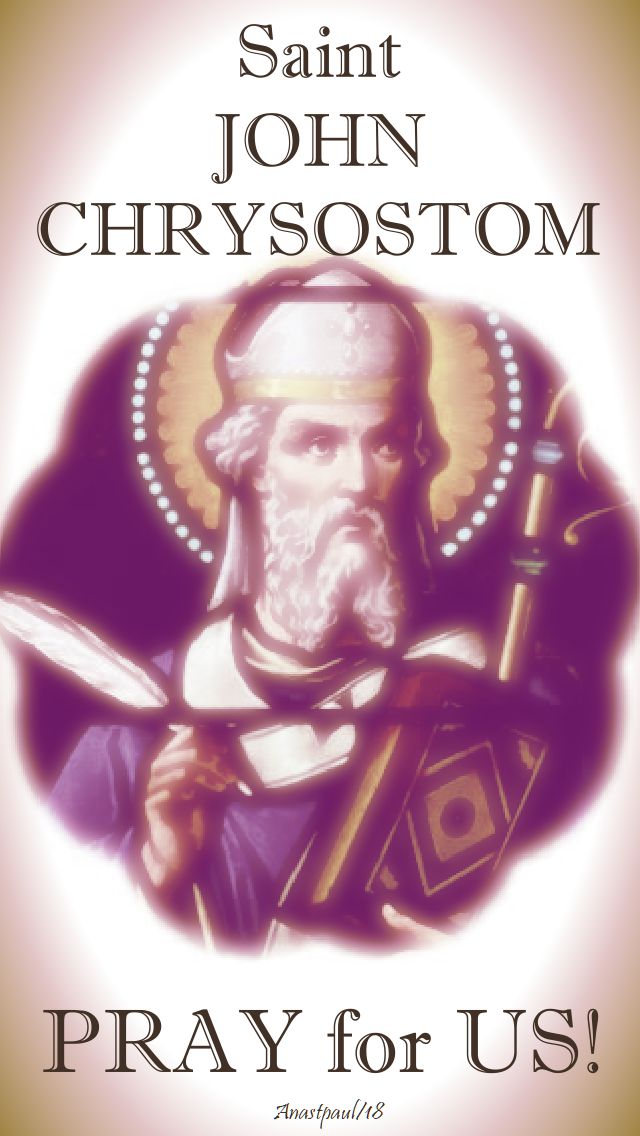
“There is nothing more worthwhile than to pray to God and to converse with Him, for prayer unites us with God as His companions. As our bodily eyes are illuminated by seeing the light, so in contemplating God our soul is illuminated by Him. Of course, the prayer I have in mind is no matter of routine, it is deliberate and earnest. It is not tied down to a fixed timetable – rather it is a state which endures by night and day.
Our soul should be directed in God, not merely when we suddenly think of prayer but even when we are concerned with something else. If we are looking after the poor, if we are busy in some other way, or if we are doing any type of good work, we should season our actions with the desire and the remembrance of God. Through this salt of the love of God we can all become a sweet dish for the Lord. If we are generous in giving time to prayer, we will experience its benefits throughout our life.
Prayer is the light of the soul, giving us true knowledge of God. It is a link mediating between God and man. By prayer the soul is borne up to heaven and in a marvellous way embraces the Lord. This meeting is like that of an infant crying on its mother and seeking the best of milk. The soul longs for its own needs and what it receives is better than anything to be seen in the world.
Prayer is a precious way of communicating with God, it gladdens the soul and gives repose to its affections. You should not think of prayer as being a matter of words. It is a desire for God, an indescribable devotion, not of human origin but the gift of God’s grace. As Saint Paul says : we do not know how to pray as we ought but the Spirit Himself intercedes for us with sighs too deep for words.
Anyone who receives from the Lord the gift of this type of prayer possesses a richness that is not to be taken from Him, a heavenly food filling up the soul. Once he has tasted this food, he is set alight by an eternal desire for the Lord, the fiercest of fires lighting up his soul.
To set about this prayer, paint the house of your soul with modesty and lowliness and make it splendid with the light of justice. Adorn it with the beaten gold of good works and, for walls and stones, embellish it assiduously with faith and generosity. Above all, place prayer on top of this house as its roof so that the complete building may be ready for the Lord. Thus He will be received in a splendid royal house and by grace, His image will already be settled in your soul.”
A reading from the homilies of St John Chrysostom (347-407) Father & Doctor, (Hom 6 on Prayer)
Prayer: Give us the grace, Lord, to be in constant prayer so all of our lives, may be accomplished in sincerity of heart.
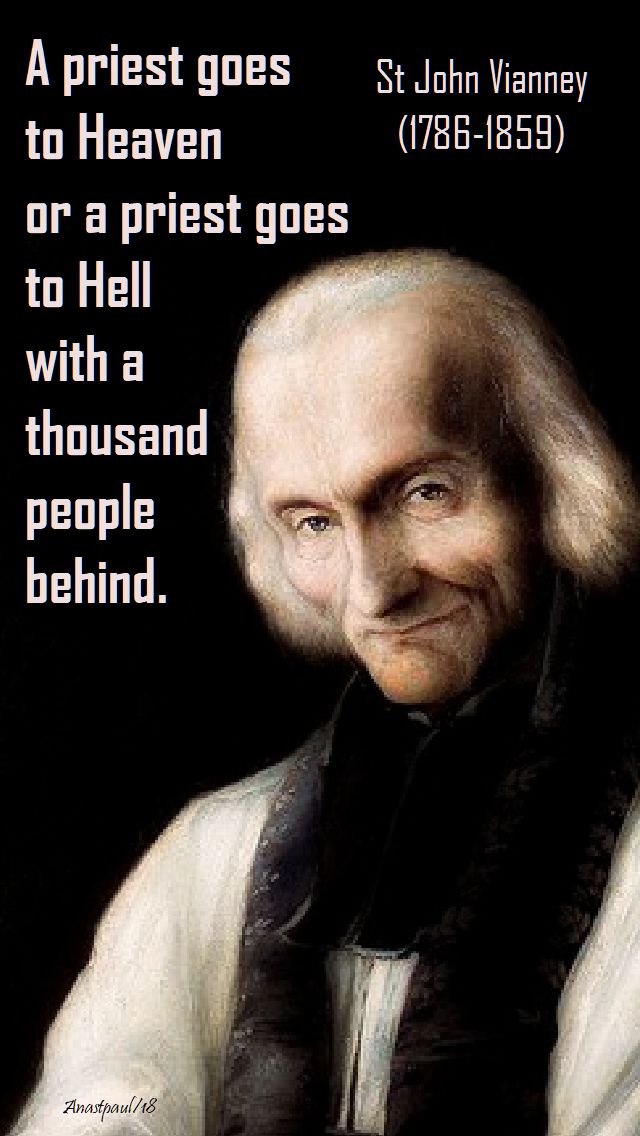
“A priest goes to Heaven or a priest goes to Hell with a thousand people behind.”
St John Vianney (1786-1859)
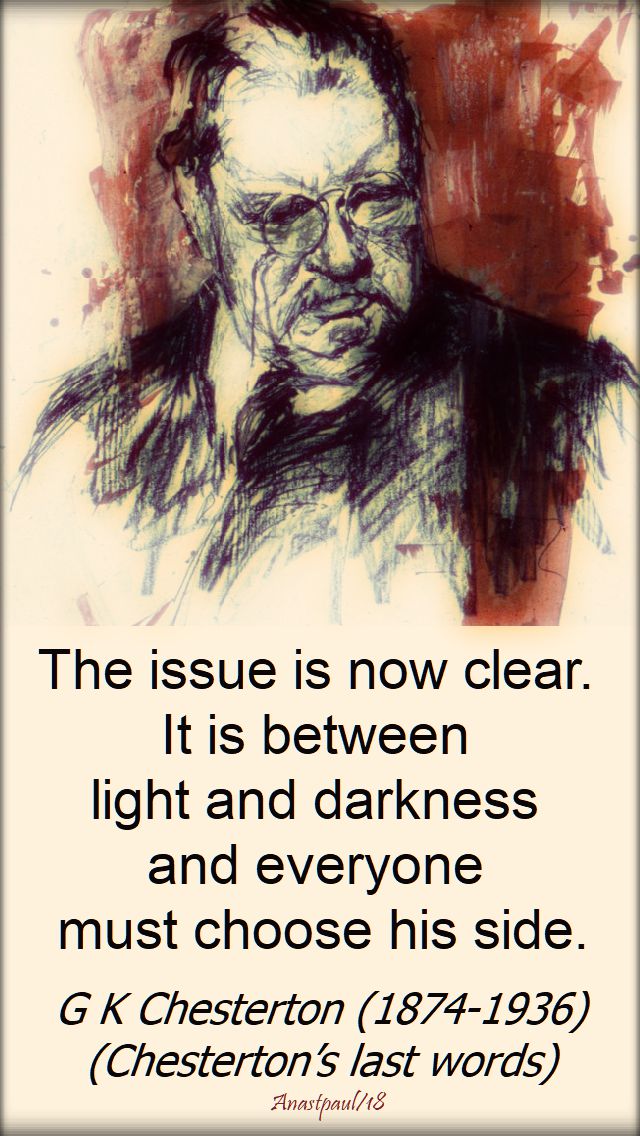
“The issue is now clear. It is between light and darkness and every one must choose his side.”
G K Chesterton (1874-1936) (Chesterton’s last words)
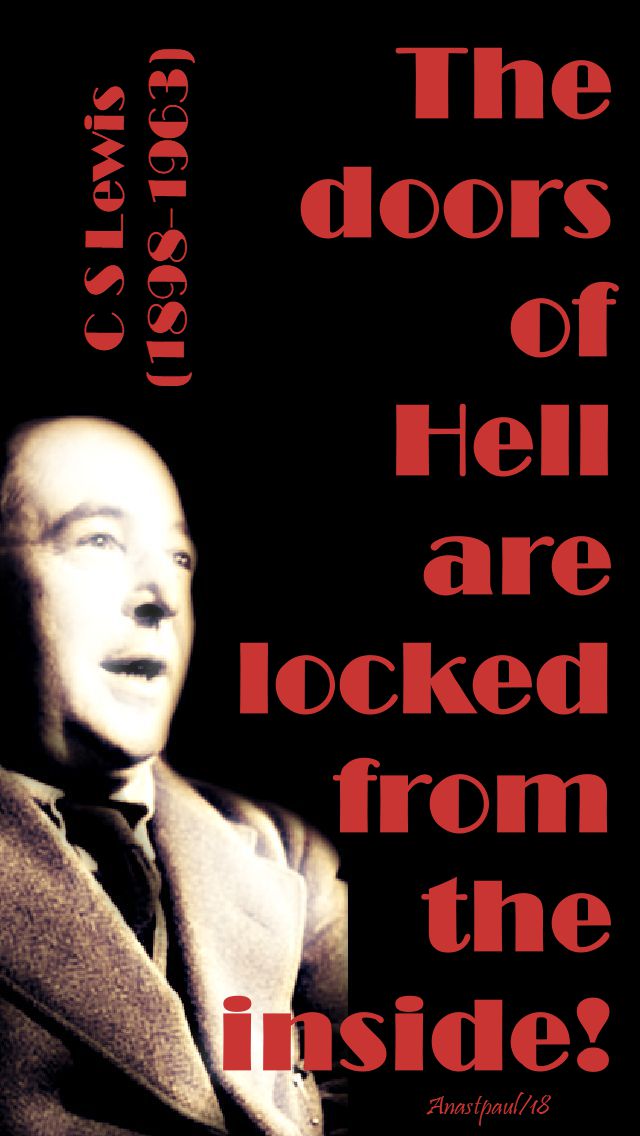
“The doors of Hell are locked from the inside!”
C S Lewis (1898-1963)
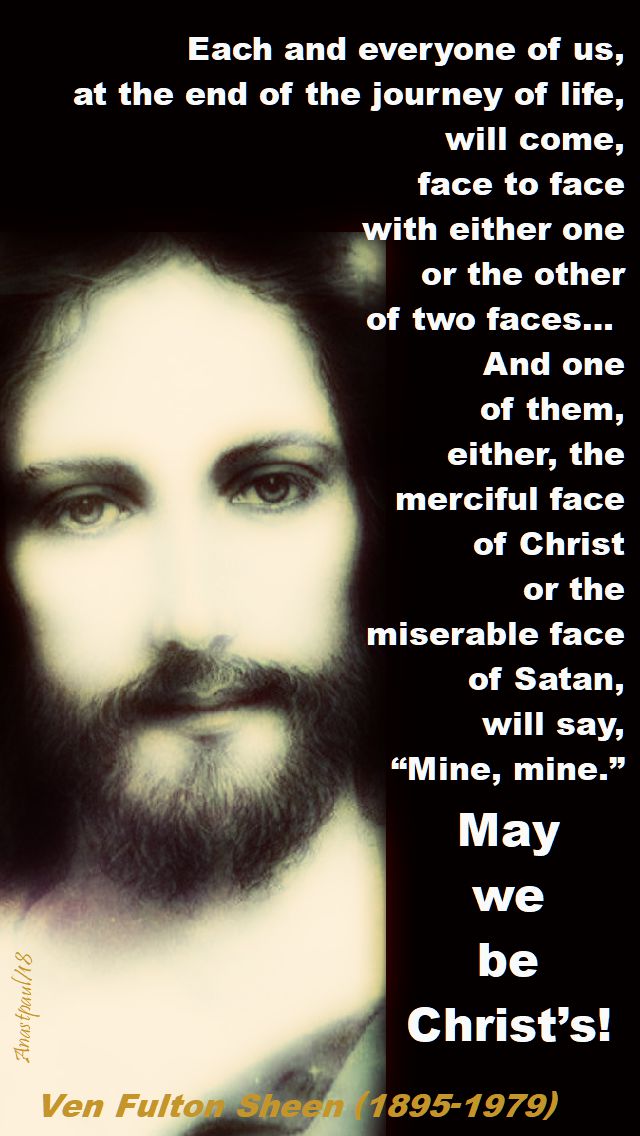
“Each and everyone of us, at the end of the journey of life, will come, face to face with either one or the other of two faces… And one of them, either, the merciful face of Christ or the miserable face of Satan, will say, “Mine, mine.”
May we be Christ’s!”
Ven Fulton Sheen (1895-1979)
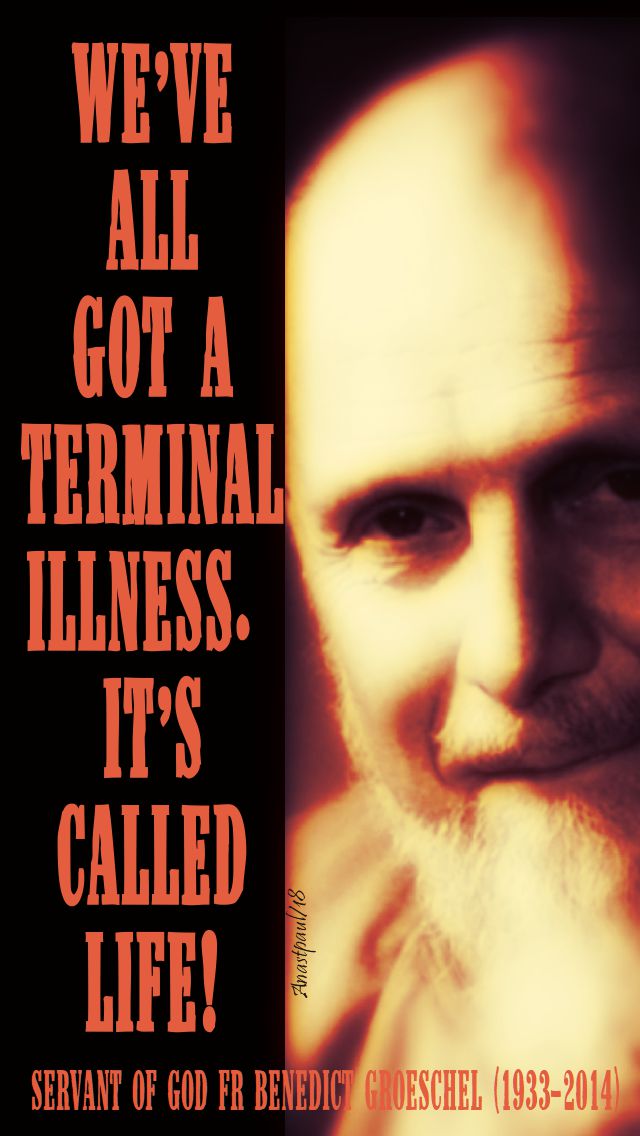
“We’ve all got a terminal illness. It’s called life.”
Servant of God Fr Benedict Groeschel (1933-2014)
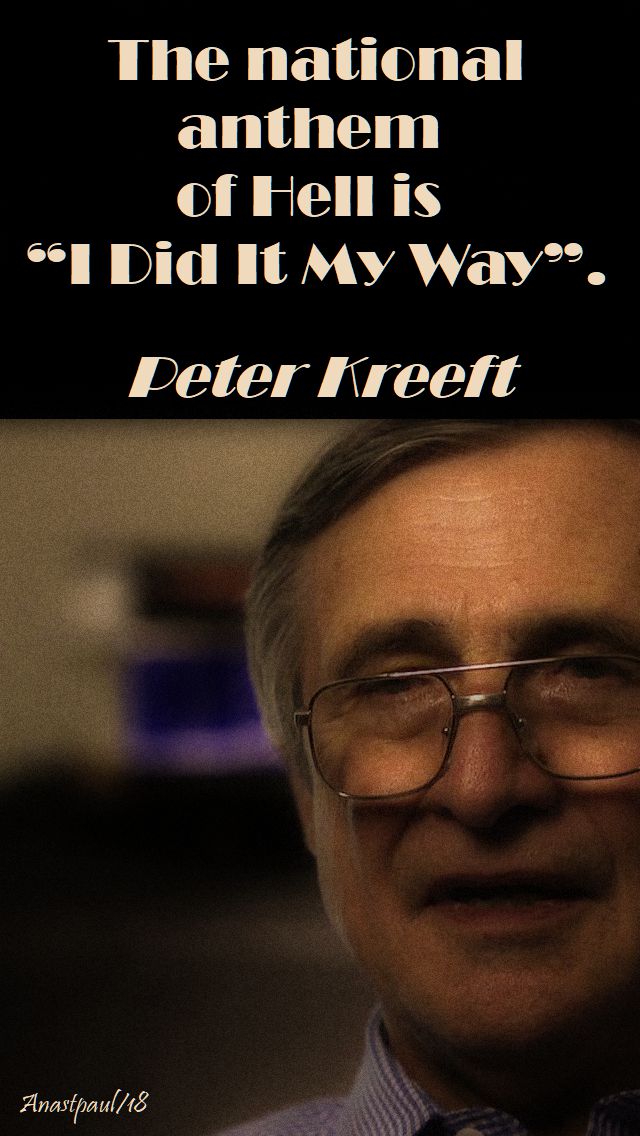
“The national anthem of Hell is “I Did It My Way”.”
Peter Kreeft
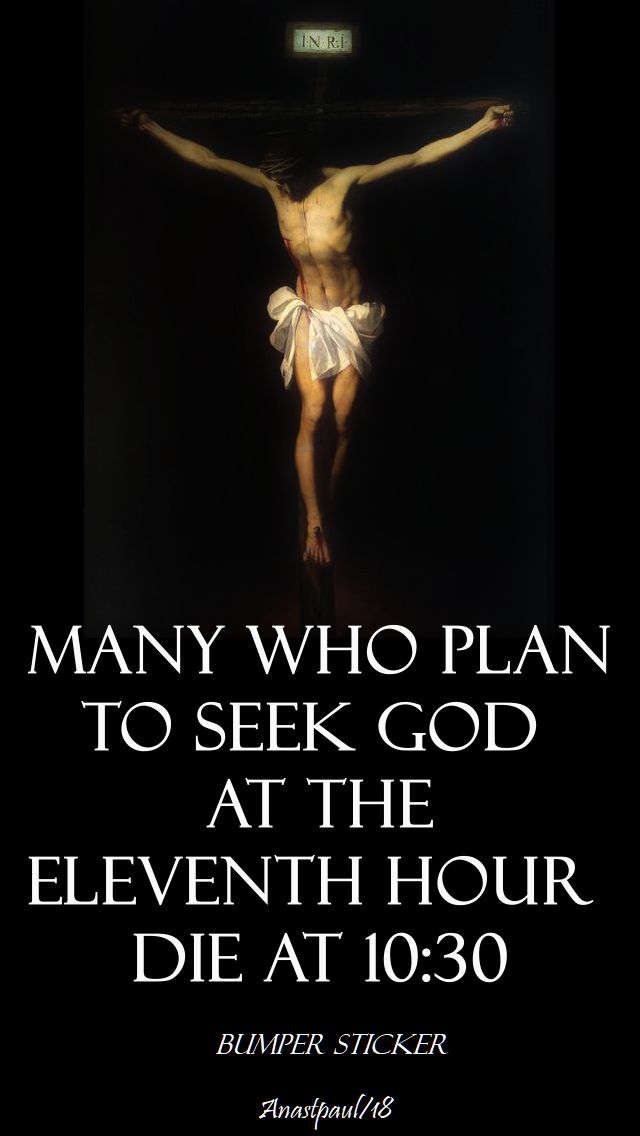
“Many who plan to seek God at the eleventh hour die at 10:30.”
One Minute Reflection – 26 October – Today’s Gospel: Luke 12:54-59 – Friday of the Twenty Ninth week in Ordinary Time, Year B
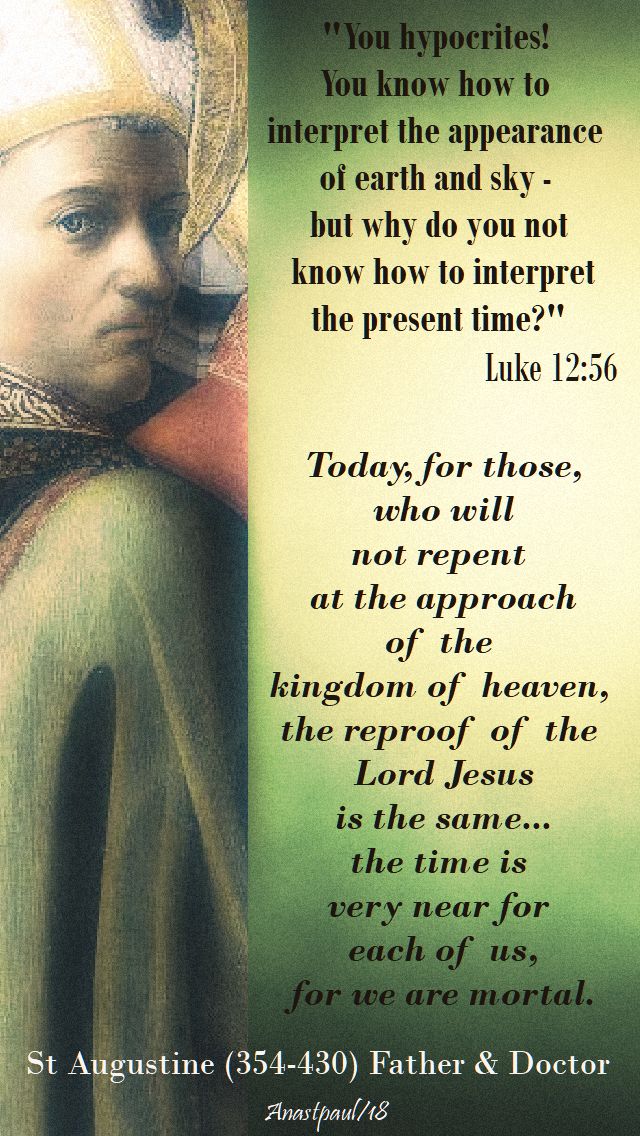
“You hypocrites! You know how to interpret the appearance of earth and sky but why do you not know how to interpret the present time?”...Luke 12:56
REFLECTION – “The gospel tells us that some people were rebuked by the Lord because, clever as they were at reading the face of the sky, they could not recognise the time for faith when the kingdom of heaven was at hand. It was the Jews who received this reprimand but it has also come down to us. The Lord Jesus began His preaching of the gospel with the admonition: “Repent, for the kingdom of heaven is at hand” (Mt 4:17). His forerunner, John the Baptist, began his in the same way: “Repent,” he said, “for the kingdom of heaven is at hand” (Mt 3:2). Today, for those who will not repent at the approach of the kingdom of heaven, the reproof of the Lord Jesus is the same…
As for when the end of the world will be, that is God’s concern… Even so, the time is very near for each of us, for we are mortal. There are hazards all around us. We should be in less danger from them were we made of glass. What more fragile than a vessel of glass? And yet it can be kept safe and last indefinitely. Of course it is exposed to accidents but it is not liable to old age and the suffering it brings. We, therefore, are the more frail and infirm. In our weakness we are haunted by fears of all the calamities that regularly befall the human race and if no such calamity overtakes us, still, time marches on. We may evade the blows of fortune but shall we evade death? We may escape perils from without but shall we escape what comes from within us? Now, suddenly, we may be attacked by any malady. And if we are spared? Even so, old age comes at last and nothing will delay it.”…St Augustine (354-430) – Father & Doctor of the Church – Sermon 109
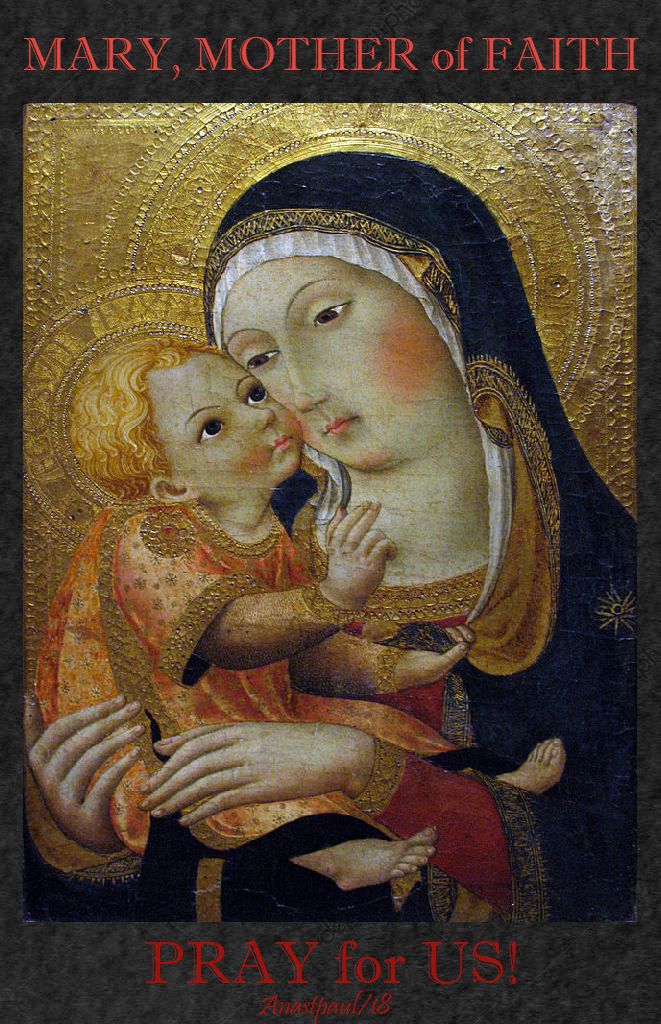
PRAYER – Lord God, You fill us with Your grace and teach us true faith. Strengthen in our hearts that faith that no trials may quench the fire, that we may seek Your face in every moment and accept AND LIVE all of Your will. Send us Your Spirit to keep the fire blazing. May the humble love and intercession of Mary Mother of our faith, be our succour. Through Jesus Your Son our Lord, with the Holy Spirit, God forever, amen.
Quote of the Day – 25 October – The Memorial of Saints Crisp in & St Crispinian – (†285 or 286) Martyrs
The feast day of Saints Crispin and Crispinian is 25 October. Although this feast was removed from the Roman Catholic Church’s universal liturgical calendar following the Second Vatican Council, the two saints are still commemorated on that day in the most recent edition of the Roman Martyrology. Sts Crispin and Crispinian were the first “band of brothers,” who fought bravely on the battlefield of the soul.
The historian and bishop, St Gregory of Tours (538-594) refers twice in his History of the Franks to a Basilica of Sts Crispin and Crispinian in the northern French city of Soissons, if the Church was already well-established at that time, the commemoration of the martyrs dates from much closer to their martyrdom.
The St Crispin’s Day speech was delivered on 25 October 1415 by King Henry V of England to rouse his soldiers on the morning of the Battle of Agincourt and later chronicled by William Shakespeare in his play, Henry V, in Act IV Scene iii 18–67. In the speech, which fell on Saint Crispin’s Day, Henry V urged his men — who were vastly outnumbered by the French — to recall how the English had previously inflicted great defeats upon the French.
The speech by Shakespeare has been famously portrayed by Sir Laurence Olivier to raise British spirits during the Second World War, and by Sir Kenneth Branagh in the 1989 film Henry V (see video below) and it made famous the phrase “band of brothers.” The play was written around 1600 and several later writers have used parts of it in their own texts.
Note: the text is Shakespeare’s, as the wording of Henry’s historical speech is not known.
WESTMORLAND. O that we now had here
But one ten thousand of those men in England
That do no work to-day!
KING. What’s he that wishes so?
My cousin, Westmorland? No, my fair cousin,
If we are mark’d to die, we are enough
To do our country loss; and if to live,
The fewer men, the greater share of honour.
God’s will! I pray thee, wish not one man more.
By Jove, I am not covetous for gold,
Nor care I who doth feed upon my cost,
It yearns me not if men my garments wear,
Such outward things dwell not in my desires.
But if it be a sin to covet honour,
I am the most offending soul alive.
No, faith, my coz, wish not a man from England.
God’s peace! I would not lose so great an honour
As one man more methinks would share from me
For the best hope I have. O, do not wish one more!
Rather proclaim it, Westmorland, through my host,
That he which hath no stomach to this fight,
Let him depart, his passport shall be made,
And crowns for convoy put into his purse,
We would not die in that man’s company
That fears his fellowship to die with us.
This day is call’d the feast of Crispian.
He that outlives this day and comes safe home,
Will stand a tip-toe when this day is nam’d,
And rouse him at the name of Crispian.
He that shall live this day and see old age,
Will yearly on the vigil feast his neighbours,
And say “To-morrow is Saint Crispian.”
Then will he strip his sleeve and show his scars,
And say “These wounds I had on Crispin’s day.”
Old men forget; yet all shall be forgot,
But he’ll remember, with advantages,
What feats he did that day. Then shall our names,
Familiar in his mouth as household words—
Harry the King, Bedford and Exeter,
Warwick and Talbot, Salisbury and Gloucester—
Be in their flowing cups freshly rememb’red.
This story shall the good man teach his son,
And Crispin, Crispian shall ne’er go by,
From this day to the ending of the world,
But we in it shall be rememberèd— We few, we happy few, we band of brothers, For he to-day that sheds his blood with me Shall be my brother, be he ne’er so vile,
This day shall gentle his condition,
And gentlemen in England now a-bed
Shall think themselves accurs’d they were not here,
And hold their manhoods cheap whiles any speaks
That fought with us upon Saint Crispin’s day.















 AnaStpaul
You must be logged in to post a comment.