Posted in CATECHESIS, DOCTORS of the Church, EASTER, FATHERS of the Church, HOLY WEEK 2019, QUOTES of the SAINTS, QUOTES on DEATH, SAINT of the DAY, The INCARNATION, The PASSION, The RESURRECTION

Thought for the Day – 2 May – On the Incarnation of the Word

Thought for the Day – 2 May – Thursday of the Second week of Easter, Gospel: John 3:31–36 and the Memorial of St Athanasius (297-373)

On the Incarnation of the Word

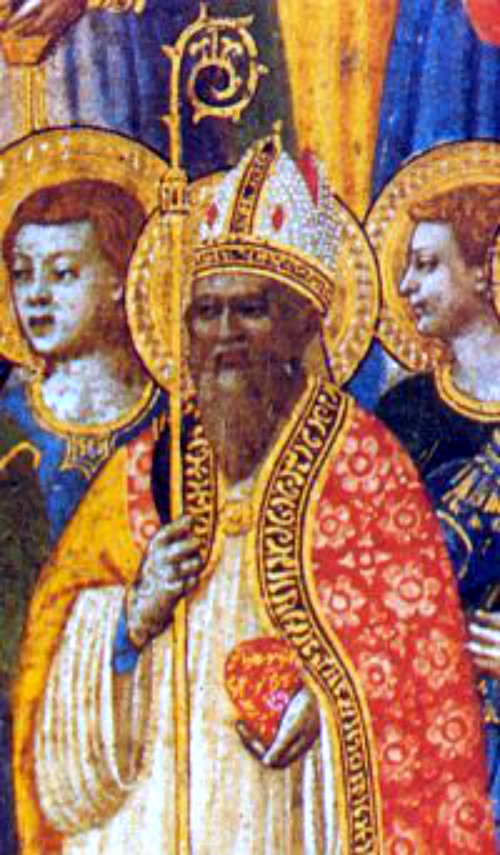
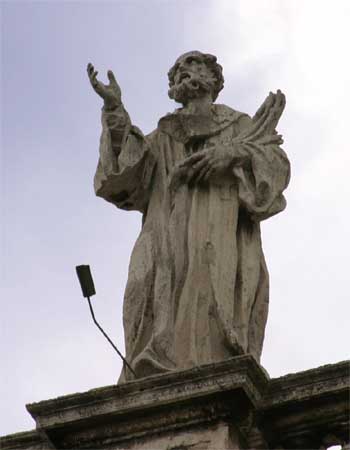
Saint Athanasius (297-373)
Bishop, Great Eastern Father & Doctor of the Church
Known as “The Father of Orthodoxy”

An excerpt from On the Incarnation of the Word

The Word of God, incorporeal, incorruptible and immaterial, entered our world.   Yet it was not as if He had been remote from it up to that time.   For there is no part of the world that was ever without His Presence; together with His Father, He continually filled all things and places.

Out of His loving-kindness for us, He came to us and we see this in the way He revealed Himself openly to us.   Taking pity on mankind’s weakness and moved by our corruption, He could not stand aside and see death have the mastery over us, He did not want creation to perish and His Father’s work in fashioning man, to be in vain.   He, therefore, took to Himself a body, no different from our own, for He did not wish simply to be in a body or only to be seen.

If He had wanted simply to be seen, He could indeed have taken another and nobler, body.   Instead, He took our body in its reality.

Within the Virgin, He built himself a temple, that is, a body, He made it His own instrument in which to dwell and to reveal Himself.   In this way, He received from mankind, a body like our own and, since all were subject to the corruption of death, He delivered this body over to death for all and with supreme love, offered it to the Father. He did so, to destroy the law of corruption, passed against all men, since all died in Him. The law, which had spent its force on the body of the Lord, could no longer have any power over His fellowmen.   Moreover, this was the way in which the Word was to restore mankind to immortality, after it had fallen into corruption and summon it back, from death to life.   He utterly destroyed the power death had against mankind—as fire consumes chaff—by means of the body He had taken and the grace of the Resurrection.

This is the reason why the Word assumed a body that could die, so that this body, sharing in the Word who is above all, might satisfy death’s requirement in place of all.  Because of the Word dwelling in that body, it would remain incorruptible and all would be freed forever from corruption, by the grace of the Resurrection.

In death, the Word made a spotless sacrifice and oblation of the body He had taken.   By dying for others, He immediately banished death for all mankind.in death the word made a spotless - st athanasius - 2 may 2019

In this way the Word of God, who is above all, dedicated and offered His temple, the instrument that was His body, for us all, as He said and so paid, by His own death the debt that was owed.   The immortal Son of God, united with all men by likeness of nature, thus fulfilled all justice, in restoring mankind to immortality, by the promise of the resurrection.

The corruption of death, no longer holds any power over mankind, thanks to the Word, who has come to dwell among them through His one body.

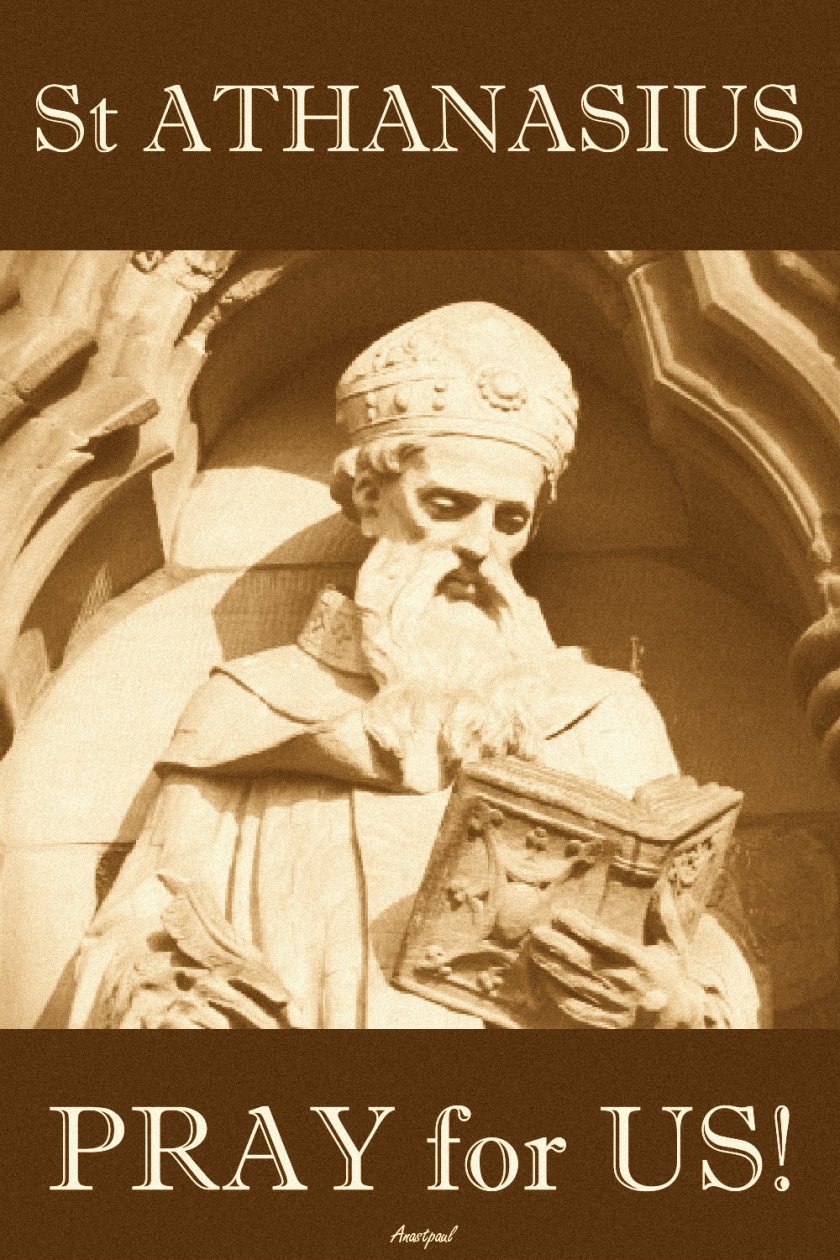
St Athanasius, Pray for Us!st athanasius pray for us no 2 - 2 may 2019 adapted.jpg


Posted in BAPTISM, CATECHESIS, DOCTORS of the Church, EASTER, FATHERS of the Church, QUOTES of the SAINTS, SACRAMENTS

Thought for the Day – 25 April- Baptism is a symbol of Christ’s passion

Thought for the Day – 25 April – Thursday in the Octave of Easter

Congratulations to those who entered
the Church through the Sacraments of Initiation,
(Baptism, Confirmation and Holy Communion)
at the Easter Vigil.
You are now members with us,
in the One, Holy, Catholic and Apostolic Church.
Welcome Home!

congrats to new catholics - welcome home - 25 april 2019 easter thurs

Baptism is a symbol of Christ’s passion

Saint Cyril of Jerusalem (315-387)
Bishop, Father, Doctor of the Church

An excerpt from his Mystagogical Catechesis 3

You were led down to the font of holy baptism just as Christ was taken down from the cross and placed in the tomb which is before your eyes.   Each of you was asked, “Do you believe in the name of the Father and of the Son and of the Holy Spirit?”   You made the profession of faith that brings salvation, you were plunged into the water and three times you rose again.   This symbolised the three days Christ spent in the tomb.

As our Saviour spent three days and three nights in the depths of the earth, so your first rising from the water represented the first day and your first immersion represented the first night.   At night a man cannot see but in the day he walks in the light.   So when you were immersed in the water, it was like night for you and you could not see but when you rose again, it was like coming into broad daylight   In the same instant, you died and were born again, the saving water was both your tomb and your mother.

Solomon’s phrase in another context is very apposite here.   He spoke of a time to give birth and a time to die.   For you, however, it was the reverse – a time to die and a time to be born, although, in fact, both events took place at the same time and your birth was simultaneous with your death.

This is something amazing and unheard of!   It was not we who actually died, were buried and rose again.  We only did these things symbolically but we have been saved in actual fact.   It is Christ who was crucified, who was buried and who rose again and all this has been attributed to us.   We share in His sufferings symbolically and gain salvation in reality.   What boundless love for men!   Christ’s undefiled hands were pierced by the nails, He suffered the pain.   I experience no pain, no anguish, yet, by the share that I have in His sufferings, He freely grants me salvation.

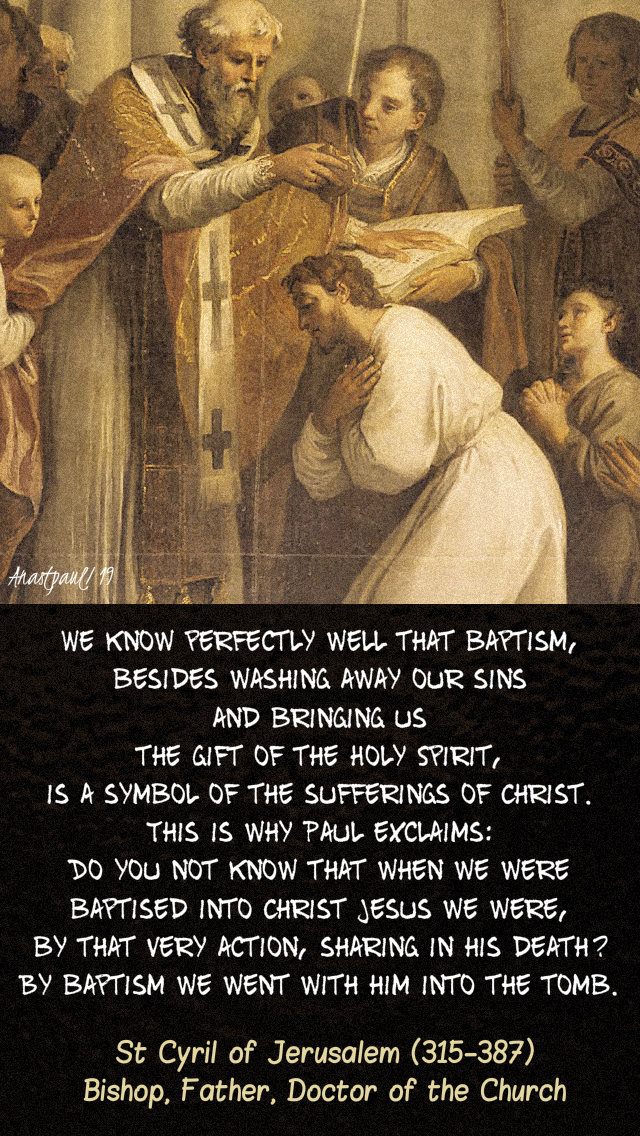
Let no one imagine that baptism consists only in the forgiveness of sins and in the grace of adoption.   Our baptism is not like the baptism of John, which conferred only the forgiveness of sins.   We know perfectly well that baptism, besides washing away our sins and bringing us the gift of the Holy Spirit, is a symbol of the sufferings of Christ.  This is why Paul exclaims:  Do you not know that when we were baptised into Christ Jesus we were, by that very action, sharing in His death?   By baptism we went with Him into the tomb.we know perfectly weel that baptism - st cyril of jerusalem - 25 april 2019 easter thurs.jpg

Posted in CATECHESIS, LENT 2019, SAINT of the DAY, The PASSION

Memorials of the Saints and Palm Sunday 2019 – 14 April

Palm Sunday *2019

St Abundius the Sacristan
St Antony of Vilna
St Ardalion the Actor
St Benezet the Bridge Builder
St Bernhard of Tiron
St Domnina of Terni
St Eustace of Vilna
St Fronto of Nitria
Bl Hadewych
St John of Monte Marano
St John of Vilna
St Lambert of Lyon
Bl Lucien Botovasoa (1908-1947) Martyr
Blessed Lucien’s life:   https://anastpaul.wordpress.com/2018/04/14/saint-of-the-day-14-april-blessed-lucien-botovasoa-o-f-s-1908-1947-martyr/

St Lydwina of Schiedam (1380-1433)

St Maximus of Rome
St Peter Gonzalez OP (1190 – 1246)
About St Peter:   https://anastpaul.wordpress.com/2017/04/14/saint-of-the-day-14-april-blessed-peter-gonzalez-o-p/

St Tassach of Raholp
St Thomaides of Alexandria
St Tiburtius of Rome
St Valerian of Trastevere

Posted in CATECHESIS, CONFESSION/PENANCE, LENTEN THOUGHTS, PRACTISING CATHOLIC, QUOTES of the SAINTS, QUOTES on FORGIVENESS, QUOTES on GOSSIP, QUOTES on HYPOCRISY, QUOTES on LOVE, QUOTES on REPARATION/EXPIATION, QUOTES on REPENTANCE, QUOTES on TRUTH

Lenten Reflection – 29 March – Repairing the Wrong Done by St John Vianney

Lenten Reflection – 29 March – Friday of the Third week of Lent, Year C, Gospel: Mark 12:28–34

“…You shall love the Lord your God
with all your heart and with all your soul
and with all your mind and with all your strength.’
The second is this,
‘You shall love your neighbour as yourself.’
There is no other commandment
greater than these.”

Mark 12:30-32

St John Vianney (1786-1859)

REPAIRING THE WRONG DONE

Having made satisfaction to God, we must then make satisfaction to our neighbour for the wrong which-either in his body or in his soul — we have done him.   I say that it is possible to wrong him in his body, that is to say, in his person, by attacking him either by injurious or insulting words or by bad treatment.   If we have sinned against him by injurious words, then we must apologise to him and make our reconciliation with him.   If we have done him some wrong by belabouring his animals, as sometimes happens when we find that they have been doing damage among our crops, we are obliged to give him all that we have been the cause of his losing: -we could have got compensation without maltreating these animals.   If we have done any harm, we are obliged to repay as soon as we can, otherwise we will be gravely at fault.   If we have neglected to do that, we have sinned and we must confess it.

If you have done wrong to your neighbour in his honour, as, for instance, by scandalous talk, you are obliged to make up by favourable and beneficent talk for all the harm you have done to his reputation, saying all the good of him which you know to be true and concealing any faults which he may have and which you are not obliged to reveal.   If you have calumniated your neighbour, you must go and find the people to whom you have said false things about him and tell them that what you have been saying is not true, that you are very grieved about it and that you beg them not to believe it.

But if you have done him harm in his soul, it is a still more difficult thing to repair and yet it must be done as far as possible, otherwise God will not pardon you.

You must also examine your conscience as to whether you have given scandal to your children or to your next-door neighbours.   How many fathers, mothers, masters and mistresses are there who scandalise their children and their servants, by not saying their prayers morning or evening or by saying them when they are dressing or sitting back in a chair, who do not even make the Sign of the Cross before and after a meal?   How many times are they heard swearing, or perhaps even blaspheming?

How many times have they been seen working on Sunday morning, even before Holy Mass?

You must consider, too, whether you have sung bad songs, or brought in bad books, or whether you have given bad counsel, as, for instance, advising someone that he should take his revenge on someone else, should exact satisfaction by force.

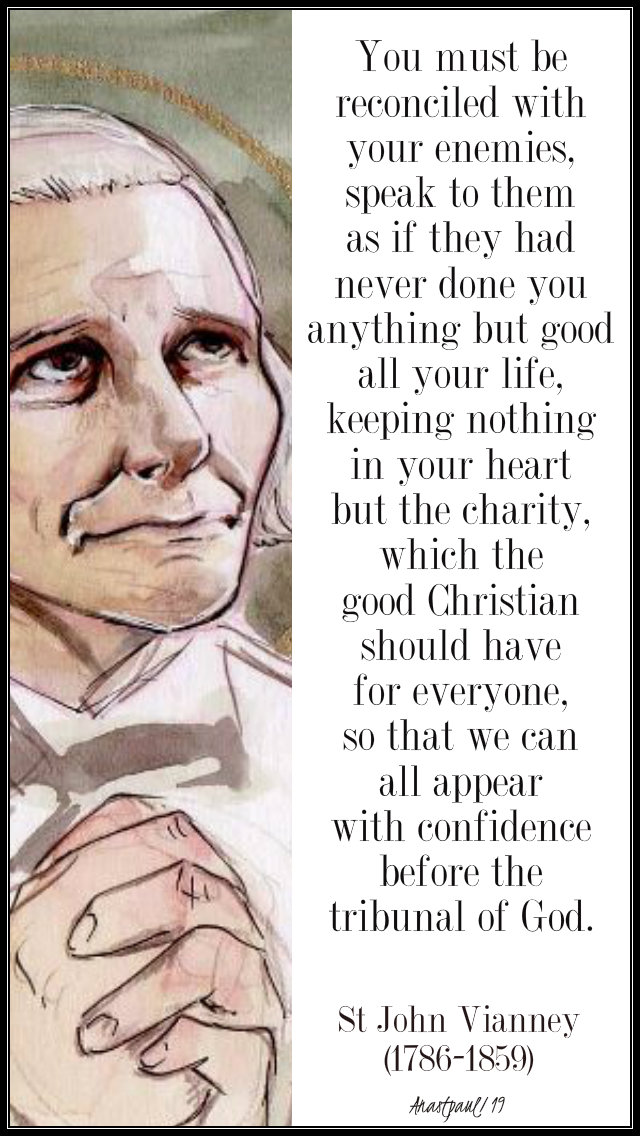
Consider, too, whether you have ever taken anything from a next-door neighbour and neglected to pay it back, whether you have neglected to give some alms which you had been told to give or make some restitution which your parents, who are dead, should have made.   If you wish to have the happiness of having your sins forgiven, you must have nothing belonging to anyone else, which you should and could pay back.   So if you have sullied your neighbour’s reputation, you must do all in your power to repair the damage.   You must be reconciled with your enemies, speak to them as if they had never done you anything but good all your life, keeping nothing in your heart but the charity, which the good Christian should have for everyone, so that we can all appear with confidence before the tribunal of God. repairing the wronge done - you must be reconciled - st john vianney 29 march 2019.jpg

Posted in CATECHESIS, LENT 2019, MORNING Prayers, PRACTISING CATHOLIC, QUOTES of the SAINTS, QUOTES on ALMS, QUOTES on CHARITY, The WORD

Lenten Reflection – 21 March- The rich man and Lazarus

Lenten Reflection – 21 March – Thursday of the Second week of Lent, Year C

“There was a rich man, who was clothed in purple
and fine linen and who feasted sumptuously every day.
And at his gate lay a poor man named Lazarus…”
Luke 16:19–20Luke 16 19–20 rich man and lazarus turs2ndweeklent-21march2019.jpg

St Peter Chrysologus (400-450)
Bishop of Ravenna, Doctor of the Church

Sermon 122, On the rich man and Lazarus

“Abraham was very rich,” Scripture tells us (Gn 13:2)… My brethren, Abraham wasn’t rich for himself but for the poor, rather than keeping hold of his fortune, he intended to share it…This man, who was himself a stranger, did not hesitate to do all he could so that the stranger might not feel himself to be a stranger.   Living in a tent, he was unable to let a passer-by remain without shelter.   Perpetual traveller, he unfailingly welcomed the travellers who came his way…  Far from taking his ease in God’s bounty, he knew himself called to spread it abroad, he used it to protect the oppressed, set prisoners free, even to snatch those about to die from their fate (Gn 14:14)…  Abraham did not sit but remained standing before the stranger he had received.   He was not his guest’s host but made himself his servant.   Forgetting that he was master in his own home, he himself brought the food and, concerned that it should be carefully prepared, called on his wife.   Where he himself was concerned he relied entirely on his servants, but for the stranger he had received he thought it barely enough to entrust it to his wife’s skill.
What more could I say, my brothers?   It was so perfect a consideration… that drew God himself to Abraham’s home and compelled him to become his guest.   Thus the very one who would later claim to be welcomed in the person of the poor and the stranger, came to Abraham, rest for the poor, refuge of strangers.   “I was hungry,” he said, “and you gave me food, I was thirsty and you gave me drink, a stranger and you welcomed me” (Mt 25:35).
And again, we read in the Gospel:  “When the poor man died, he was carried away by angels to the bosom of Abraham.”   Isn’t it only right, brethren, that Abraham should welcome all the saints even into his own rest and should exercise, even in the blessedness of heaven, his service of hospitality?…  Doubtless, he could not have considered himself wholly happy unless, even in glory, he was able to continue to practice his ministry of sharing.”

Daily Meditation:
Bring us back to you.

The story of the Rich Man and Lazarus is our lesson today.
We beg to be open to the workings of the Spirit,
that we might not settle for the consolations of this life alone.

Blessed is the man
who walks not in the counsel of the wicked,
nor stands in the way of sinners,
nor sits in the seat of scoffers
but his delight is in the law of the Lord
and on his law he meditates day and night.
Psalm 1:1-2

LOVE OF OUR NEIGHBOUR

St John Vianney (1786-1859)

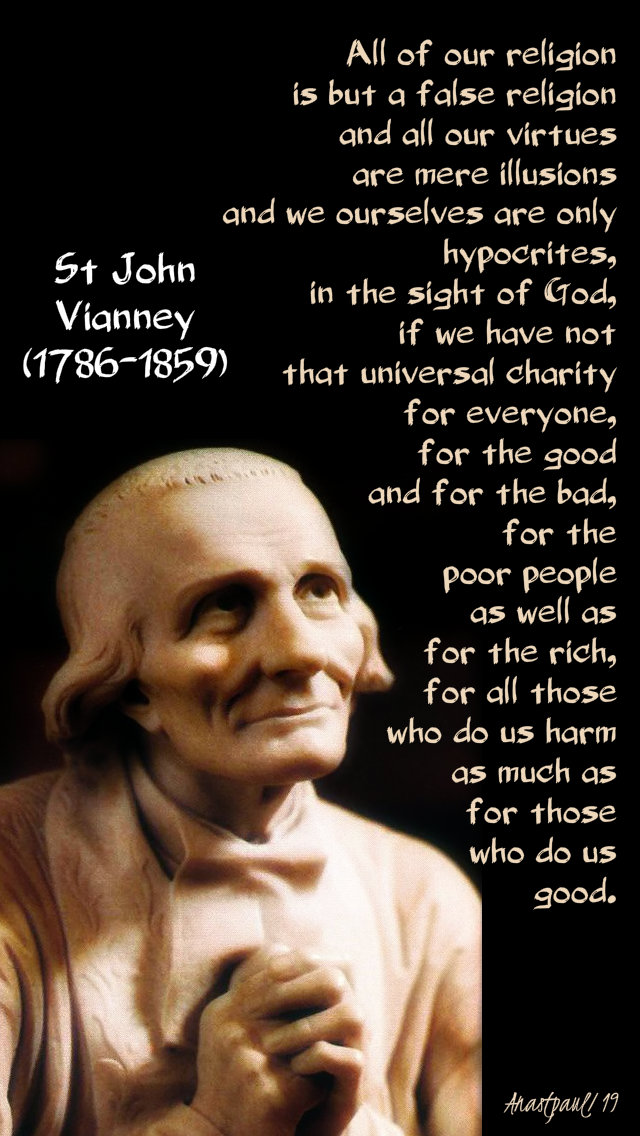
“All of our religion is but a false religion and all our virtues are mere illusions and we ourselves are only hypocrites in the sight of God, if we have not that universal charity for everyone, for the good and for the bad, for the poor people as well as for the rich, for all those who do us harm as much as for those who do us good.
No, my dear brethren, there is no virtue which will let us know better whether we are the children or God than charity.
The obligation we have to love our neighbour is so important, that Jesus Christ put it into a Commandment, which He placed immediately after that by which He commands us to love Him with all our hearts.   He tells us that all the law and the prophets are included in this commandment to love our neighbour.   Yes, my dear brethren, we must regard this obligation as the most universal, the most necessary and the most essential to religion and to our salvation.   In fulfilling this Commandment, we are fulfilling all others.   St Paul tells us that the other Commandments forbid us to commit adultery, robbery, injuries, false testimonies.   If we love our neighbour, we shall not do any of these things because the love we have for our neighbour would not allow us to do him any harm.”

all of our religion is but a false - st john vianney thurs2ndweeklent 21 march 2019.jpg

Closing Prayer:
Loving God,
I hear your invitation, “Come back to me”
and I am filled with such a longing to return to You.
Show me the way to return.
Lead me this day in good works I do in Your name
and send Your Spirit to guide me and strengthen my faith.
I ask only to feel Your love in my life today and if You are with me, how can I not love my neighbour?

May the Lord bless us,
protect us from all evil
and bring us to everlasting life.
Amen

Posted in CATECHESIS, EUCHARISTIC Adoration, QUOTES of the SAINTS, SAINT of the DAY, The HOLY EUCHARIST / The HOLY MASS

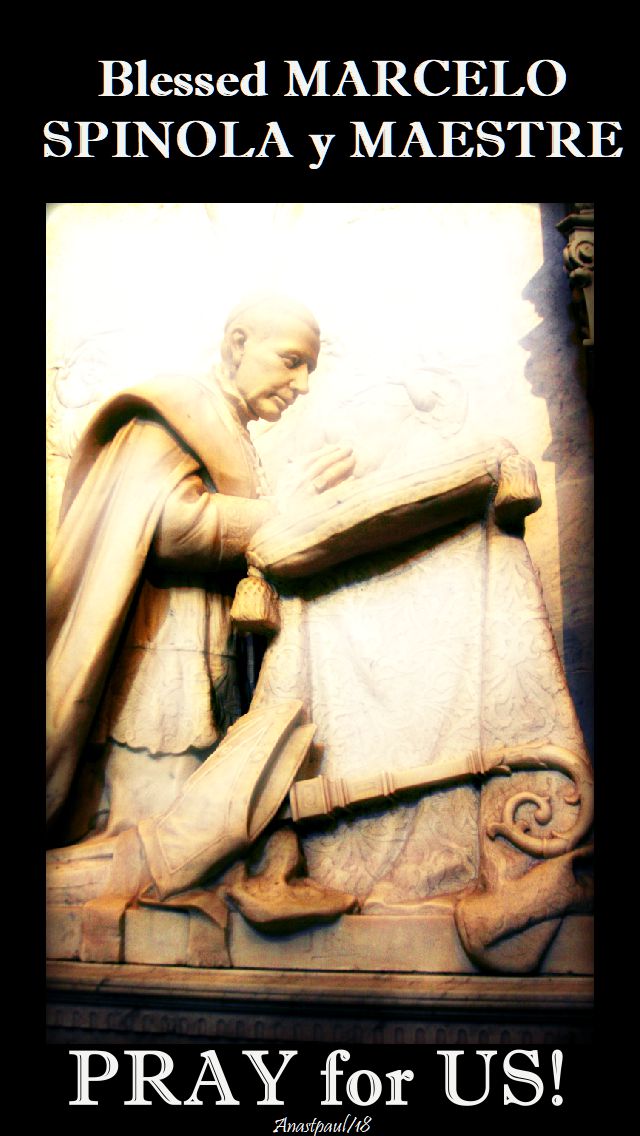
Thought for the day – 19 January – The Memorial of Blessed Marcelo Spínola y Maestre, Cardinal-Priest (1835-1906)

Thought for the day – 19 January – The Memorial of Blessed Marcelo Spínola y Maestre, Cardinal-Priest (1835-1906)

Blessed Marcelo was a pious man, of intense prayer and mortification, extremely sensitive to the needs and suffering of his faithful and an untiring apostle.   Homes, workers’ societies, centres where food was given to those who needed it, orphanages, night schools, creation of the faculty of theology of Seville, etc., were all part of his mark. He toured all the dioceses in which he exercised his ministry, travelling on a mule, he fought against the attempt to displace the teaching of religion from public centres as a senator from Granada, consoled the afflicted and took the gospel to every corner, preaching and confessing.

And at the centre of the heart of Blessed Marcelo was the Holy Eucharist.   He wrote:

“The masterpiece of Jesus Christ’s love for humanity is the Eucharist.
The Eucharist is within our reach.
We can all get close to Christ the guest and talk with Him
and perceive the warmth of His word.
The word!   How it inflames the spirits!
How will the word of Christ inflame them!
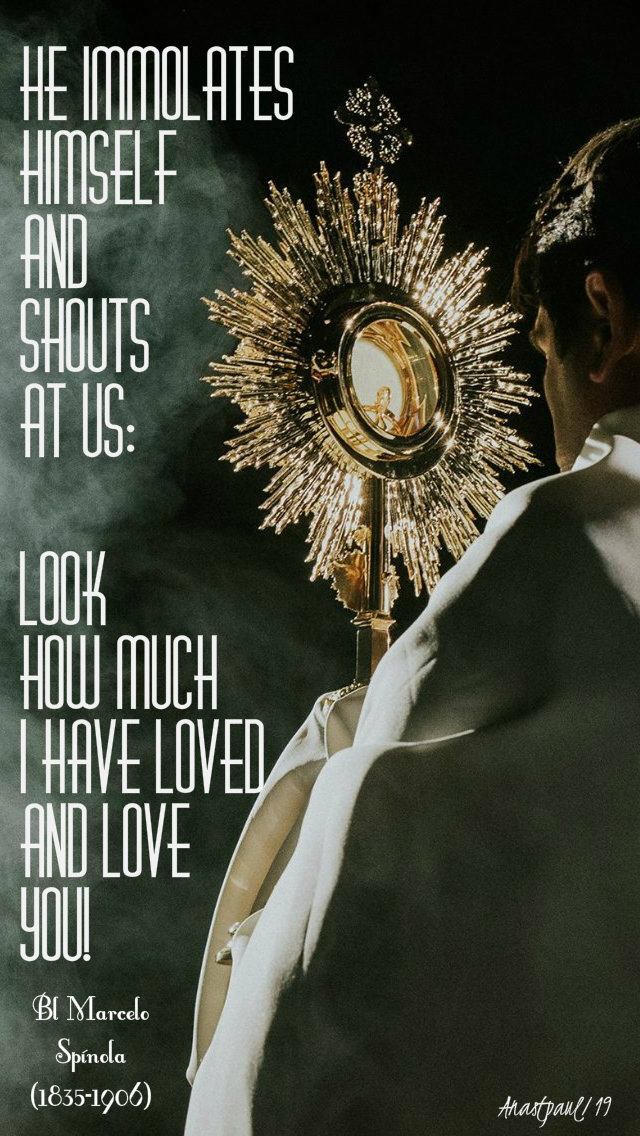
We can all get to the altar when He immolates Himself and shouts at us:
Look how much I have loved and loved you!
And we can all sit at His table
and eat the bread
and drink the intoxicating wine of charity. “

he immolates himself and shouts at us - bl marcelo spinola 19jan2019.jpg

Blessed Marcelo Spínola y Maestre, Pray for Us!blessed-marcelo-pray-for-us.19 jan 2018.jpg

Posted in CATECHESIS, CATHOLIC Quotes, DOCTORS of the Church, FATHERS of the Church, PRACTISING CATHOLIC, PRAYERS of the CHURCH, QUOTES of the SAINTS, SAINT of the DAY, SPEAKING of ....., The SIGN of the CROSS

Quote/s of the Day – 17 January – The Sign of the Cross

Quote/s of the Day – 17 January – Thursday of the First week in Ordinary Time and The Memorial of St Anthony Abbot (251-356)

Speaking of:  The Sign of the Cross

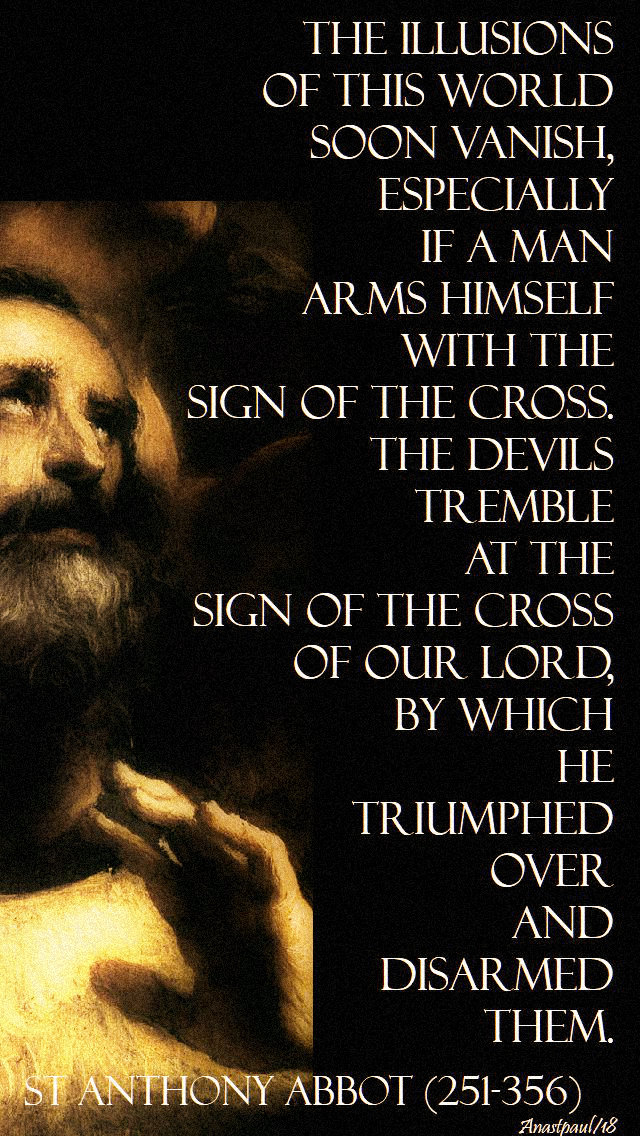
“The illusions of this world soon vanish,
especially if a man arms himself with
the Sign of the Cross.
The devils tremble
at the Sign of the Cross of our Lord,
by which He triumphed over
and disarmed them.”

St Anthony Abbot (251-356)the-illusions-of-this-world-st-anthony-abbot-17-jan-2018.jpg

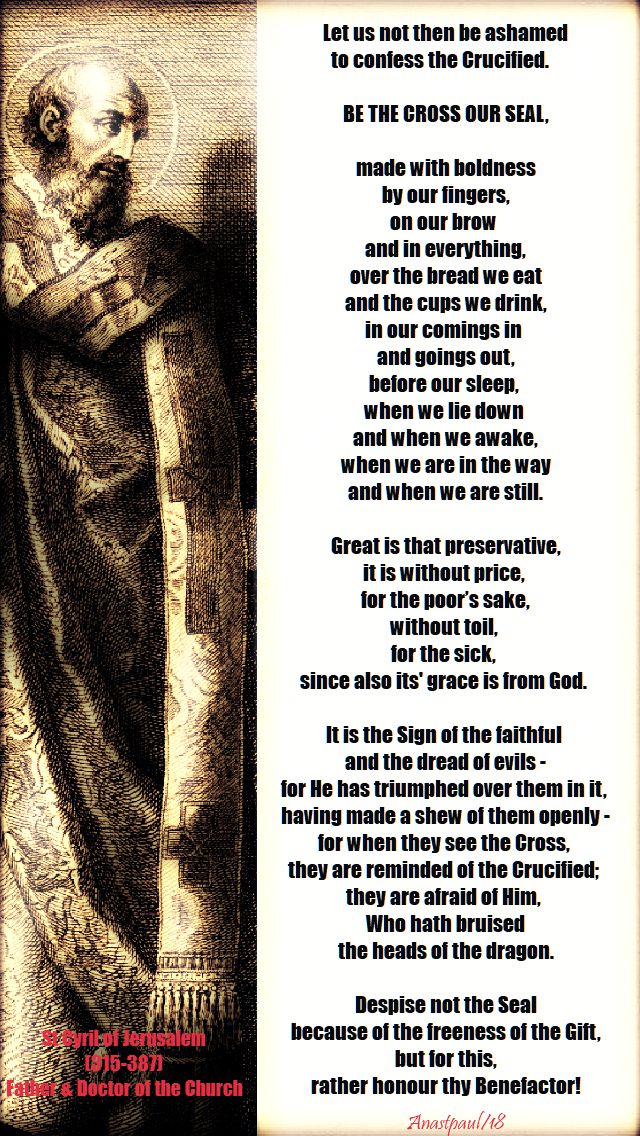
“Let us not then be ashamed to confess the Crucified.
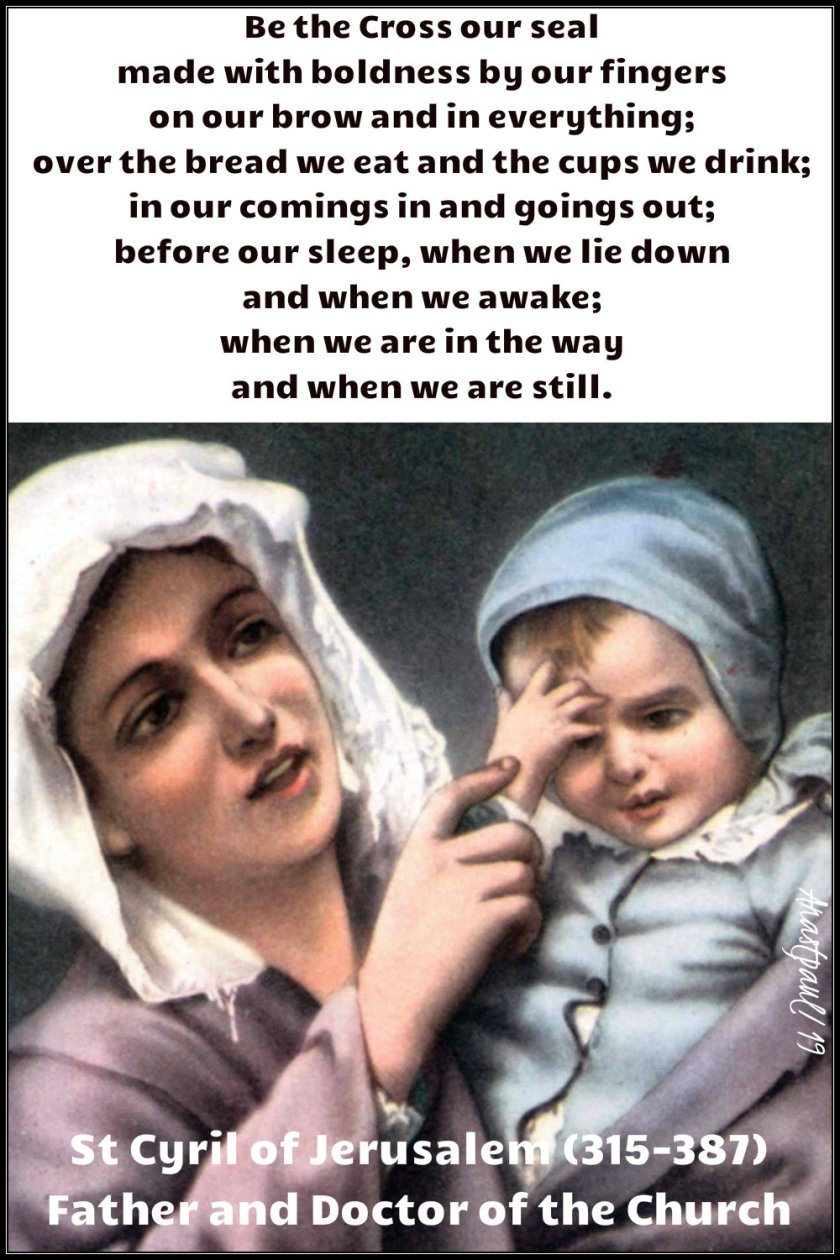
Be the Cross our seal made with boldness by our fingers
on our brow and in everything;
over the bread we eat and the cups we drink;
in our comings in and goings out;
before our sleep, when we lie down and when we awake;
when we are in the way and when we are still.
Great is that preservative;
it is without price, for the poor’s sake;
without toil, for the sick, since also its grace is from God.
It is the Sign of the faithful and the dread of evils;
for He has triumphed over them in it,
having made a shew of them openly;
for when they see the Cross, they are reminded of the Crucified;
they are afraid of Him, Who hath bruised the heads of the dragon.
Despise not the Seal, because of the freeness of the Gift
but for this rather honour thy Benefactor.”

St Cyril of Jerusalem (315-387) Father and Doctorbe the cross our seal - st cyril of jerusalem - 17 jan 2019.jpglet-us-not-then-be-ashamed-st-cyril-of-jerusalem-17-jan-2018.jpg

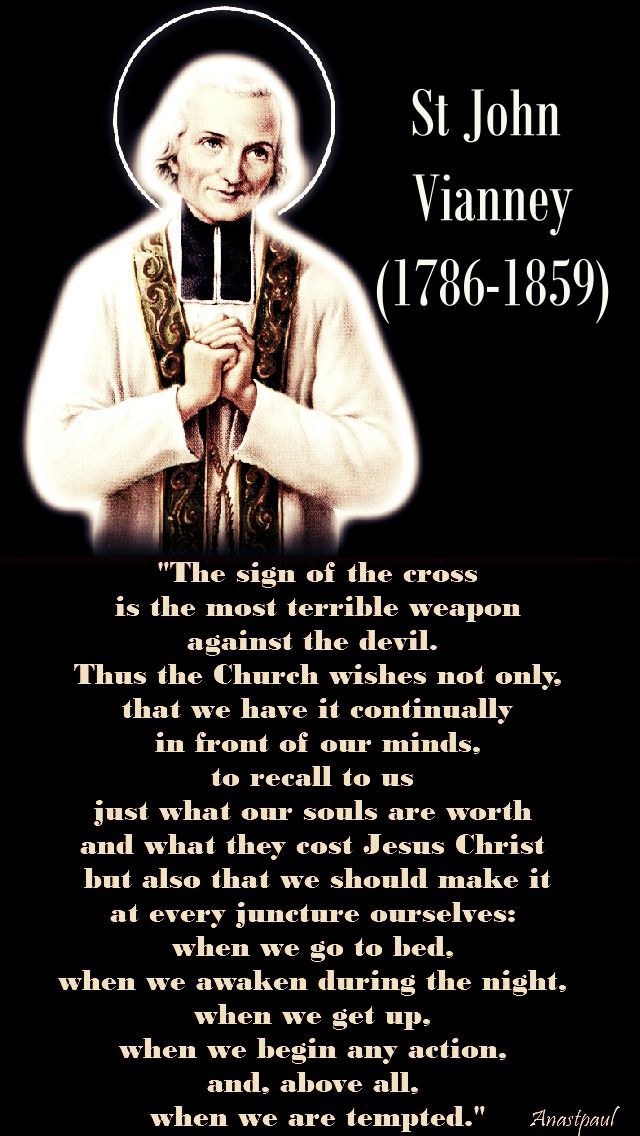
“The sign of the cross
is the most terrible weapon
against the devil.
Thus the Church wishes not only,
that we have it continually
in front of our minds,
to recall to us
just what our souls are worth
and what they cost Jesus Christ
but also that we should make it
at every juncture ourselves:
when we go to bed,
when we awaken during the night,
when we get up,
when we begin any action,
and, above all,
when we are tempted.”

St John Vianney (1786-1859)the sign of the cross - st john vianney.- new version - 17 jan 2018 jpg

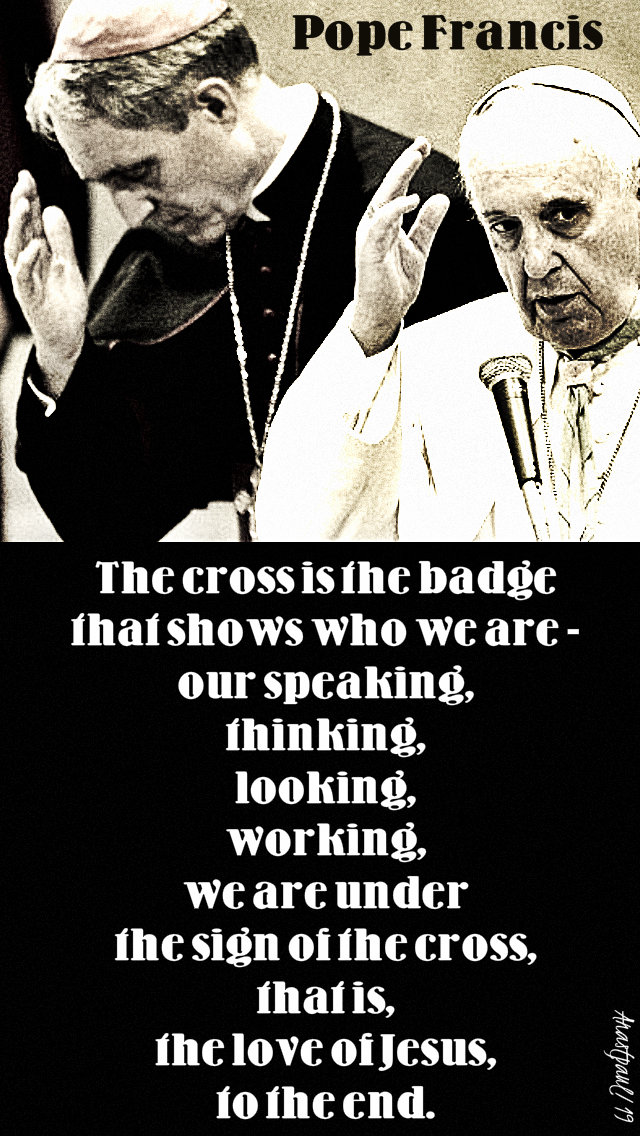
“The cross is the badge that shows who we are –
our speaking, thinking, looking, working,
we are under the sign of the cross,
that is, the love of Jesus, to the end.”the cross is the badge - pope francis 17 jan 2019.jpg

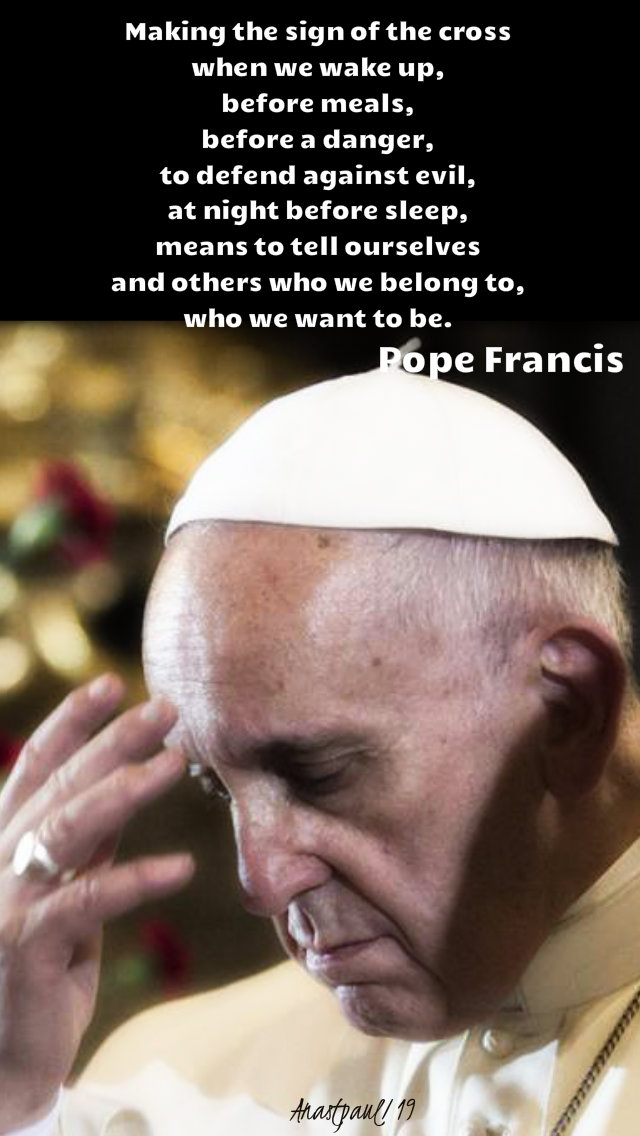
“Making the sign of the cross when we wake up,
before meals, before a danger, to defend against evil,
at night before sleep means to tell ourselves
and others who we belong to, who we want to be.”

Pope Francismaking the sign of the cross - pope francis 17 jan 2019.jpg

3 Things to Know about the Cross – Fr Mike Schmitz

Posted in CATECHESIS, franciscan OFM, QUOTES of the SAINTS, QUOTES on DEATH, QUOTES on ETERNAL LIFE, QUOTES on HELL, QUOTES on PEACE, QUOTES on REPENTANCE, QUOTES on SANCTITY, QUOTES on SIN, SAINT of the DAY, The LAST THINGS

Thought for the Day – 27 November – The Little Number of Those Who Are Saved by St Leonard of Port Maurice OFM (1676-1751)

Thought for the Day – 27 November – The Little Number of Those Who Are Saved by St Leonard of Port Maurice OFM (1676-1751)

“Conclusion”
Brothers, I want to send all of you away comforted today.   So if you ask me my sentiment on the number of those who are saved, here it is:  Whether there are many or few that are saved, I say that whoever wants to be saved, will be saved and that no one can be damned if he does not want to be.   And if it is true that few are saved, it is because there are few who live well.   As for the rest, compare these two opinions – the first one states that the greater number of Catholics are condemned, the second one, on the contrary, pretends that the greater number of Catholics are saved.   Imagine an Angel sent by God to confirm the first opinion, coming to tell you that not only are most Catholics damned but that of all this assembly present here, one alone will be saved.   If you obey the Commandments of God, if you detest the corruption of this world, if you embrace the Cross of Jesus Christ in a spirit of penance, you will be that one alone who is saved.

Now imagine the same Angel returning to you and confirming the second opinion.   He tells you that not only are the greater portion of Catholics saved but that out of all this gathering, one alone will be damned and all the others saved.   If after that, you continue your usuries, your vengeances, your criminal deeds, your impurities, then you will be that one alone who is damned.

What is the use of knowing whether few or many are saved?   Saint Peter says to us, “Strive by good works to make your election sure.”   When Saint Thomas Aquinas’s sister asked him what she must do to go to heaven, he said, “You will be saved if you want to be.”   I say the same thing to you and here is proof of my declaration.   No one is damned unless he commits mortal sin – that is of faith.   And no one commits mortal sin unless he wants to – that is an undeniable theological proposition.   Therefore, no one goes to hell, unless he wants to – the consequence is obvious.   Does that not suffice to comfort you?

Weep over past sins, make a good confession, sin no more in the future and you will all be saved.   Why torment yourself so?   For it is certain, that you have to commit mortal sin to go to hell and that to commit mortal sin, you must want to and that consequently, no one goes to hell, unless he wants to.   That is not just an opinion, it is an undeniable and very comforting truth – may God give you to understand it and may He bless you.   Amen.”

The Little Number of Those Who Are Saved
by St Leonard of Port Maurice
Full Sermon here: https://www.olrl.org/snt_docs/fewness.shtml

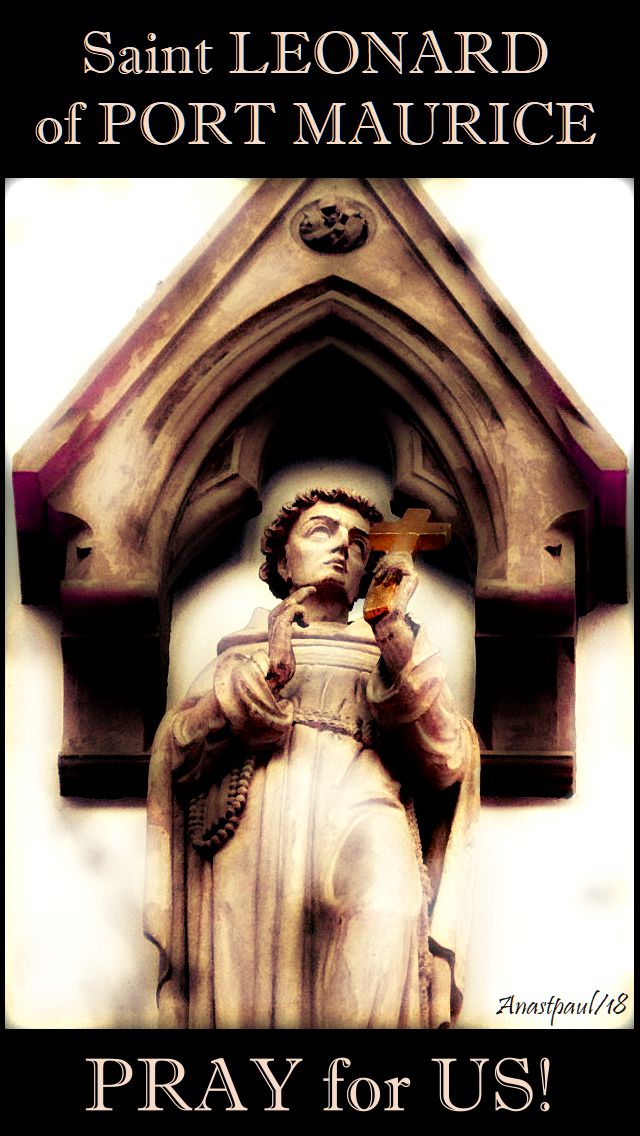
St Leonard of Port Maurice, Pray for Us!st leonard of port maurice pray for us no 2 - 27nov2018

Posted in CATECHESIS, franciscan OFM, MARIAN QUOTES, MARIAN TITLES, PAPAL SERMONS, SAINT of the DAY, The BLESSED VIRGIN MARY

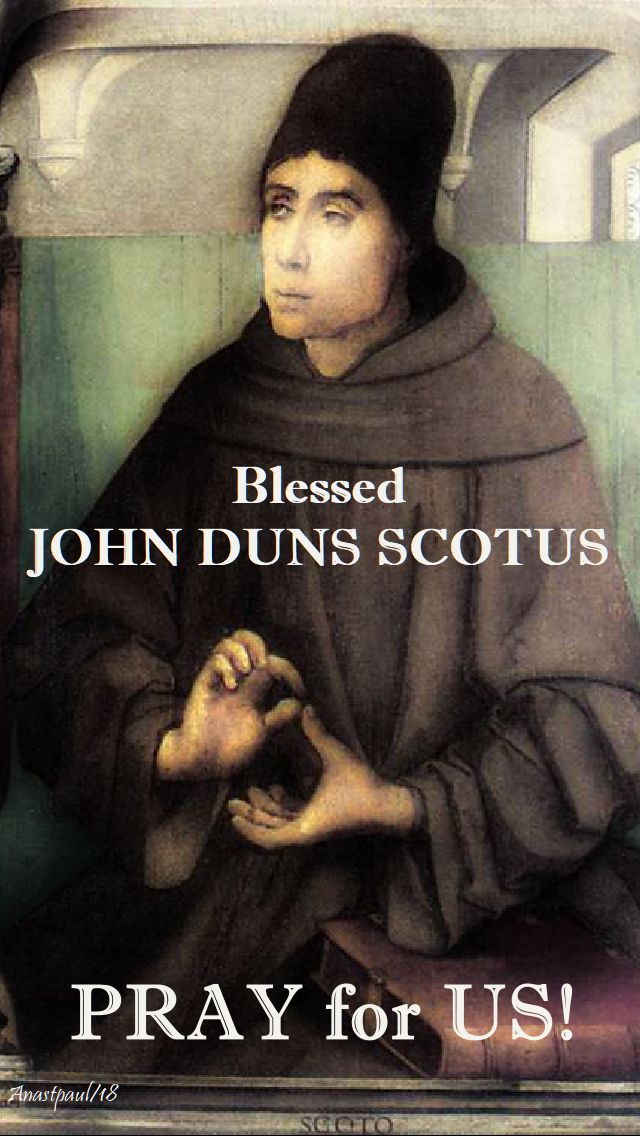
Thought for the Day – 8 November – Pope Benedict on Blessed John Duns Scotus

Thought for the Day – 8 November – The Memorial of Blessed John Duns Scotus OFM (c 1265-1308)

Excerpt from Pope Benedict XVI’s

Catechesis on Blessed John Duns Scotus
General Audience – 7 July 2010

“The Immaculate Conception”

This morning, after several Catecheses on various great theologians, I would like to present to you another important figure in the history of theology.   He is Blessed John Duns Scotus, who lived at the end of the 13th century.   An ancient epitaph on his tombstone sums up the geographical coordinates of his biography:  “Scotland bore me, England received me, France taught me, Cologne in Germany holds me”.   We cannot disregard this information, partly because we know very little about the life of Duns Scotus.   He was probably born in 1266 in a village called, precisely, “Duns”, near Edinburgh.
Attracted by the charism of St Francis of Assisi, he entered the Family of the Friars Minor and was ordained a priest in 1291.   He was endowed with a brilliant mind and a tendency for speculation, which earned him the traditional title of Doctor subtilis, “Subtle Doctor”.

Mary is the subject of the Doctor subtilis’ thought.   In the times of Duns Scotus the majority of theologians countered with an objection that seemed insurmountable, the doctrine which holds that Mary Most Holy was exempt from original sin from the very first moment of her conception – in fact, at first sight the universality of the Redemption brought about by Christ might seem to be jeopardised by such a statement, as though Mary had had no need of Christ or His redemption.   Therefore the theologians opposed this thesis.   Thus, to enable people to understand this preservation from original sin Duns Scotus developed an argument that was later, in 1854, also to be used by Bl Pope Pius IX when he solemnly defined the Dogma of the Immaculate Conception of Mary.   And this argument is that of “preventive Redemption”, according to which the Immaculate Conception is the masterpiece of the Redemption brought about by Christ because the very power of His love and His mediation obtained, that the Mother be preserved from original sin.   Therefore Mary is totally redeemed by Christ but already before her conception.   Duns Scotus’ confreres, the Franciscans, accepted and spread this doctrine enthusiastically and other theologians, often with a solemn oath, strove to defend and perfect it.

In this regard I would like to highlight a fact that I consider relevant.   Concerning the teaching on the Immaculate Conception, important theologians like Duns Scotus enriched what the People of God already spontaneously believed about the Blessed Virgin and expressed in acts of devotion, in the arts and in Christian life in general with the specific contribution of their thought.   Thus faith both in the Immaculate Conception and in the bodily Assumption of the Virgin was already present in the People of God, while theology had not yet found the key to interpreting it in the totality of the doctrine of the faith.   The People of God therefore precede theologians and this is all thanks to that supernatural sensus fidei, namely, that capacity infused by the Holy Spirit that qualifies us to embrace the reality of the faith with humility of heart and mind. In this sense, the People of God is the “teacher that goes first” and must then be more deeply examined and intellectually accepted by theology.

May theologians always be ready to listen to this source of faith and retain the humility and simplicity of children!   I mentioned this a few months ago saying: “There have been great scholars, great experts, great theologians, teachers of faith who have taught us many things.   They have gone into the details of Sacred Scripture… but have been unable to see the mystery itself, its central nucleus…. The essential has remained hidden!… On the other hand, in our time there have also been “little ones” who have understood this mystery.   Let us think of St Bernadette Soubirous; of St Thérèse of Lisieux, with her new interpretation of the Bible that is “non-scientific’ but goes to the heart of Sacred Scripture”

Dear brothers and sisters, Bl Duns Scotus teaches us that in our life the essential is to believe that God is close to us and loves us in Jesus Christ and, therefor,e to cultivate a deep love for Him and for His Church.   We on earth are witnesses of this love.   May Mary Most Holy help us to receive this infinite love of God, which we will enjoy eternally to the full in Heaven, when our soul is at last united to God for ever in the Communion of Saints.

Blessed John Duns Scotus, Pray for Us!bl john duns scotus pray for us - 8 nov 2018 no 2

Posted in CATECHESIS, FATHERS of the Church, PAPAL SERMONS, SAINT of the DAY

Saint of the Day – 17 October – St Ignatius of Antioch (c 35 – 107) Father of the Church

Saint of the Day – 17 October – St Ignatius of Antioch (c 35 – 107) Father of the Church, Martyr

Excerpt from Pope Benedict’s Catechesis on St Ignatius
Wednesday, 14 March 2007

Today, we will be speaking of St Ignatius, who was the third Bishop of Antioch from 70 to 107, the date of his martyrdom. At that time, Rome, Alexandria and Antioch were the three great metropolises of the Roman Empire.   The Council of Nicea mentioned three “primacies”: Rome but also Alexandria and Antioch participated in a certain sense in a “primacy”.

St Ignatius was Bishop of Antioch, which today is located in Turkey.   Here in Antioch, as we know from the Acts of the Apostles, a flourishing Christian community developed.   Its first Bishop was the Apostle Peter – or so tradition claims – and it was there that the disciples were “for the first time called Christians” (Acts 11: 26). Eusebius of Caesarea, a fourth-century historian, dedicated an entire chapter of his Church History to the life and literary works of Ignatius (cf. 3: 36).

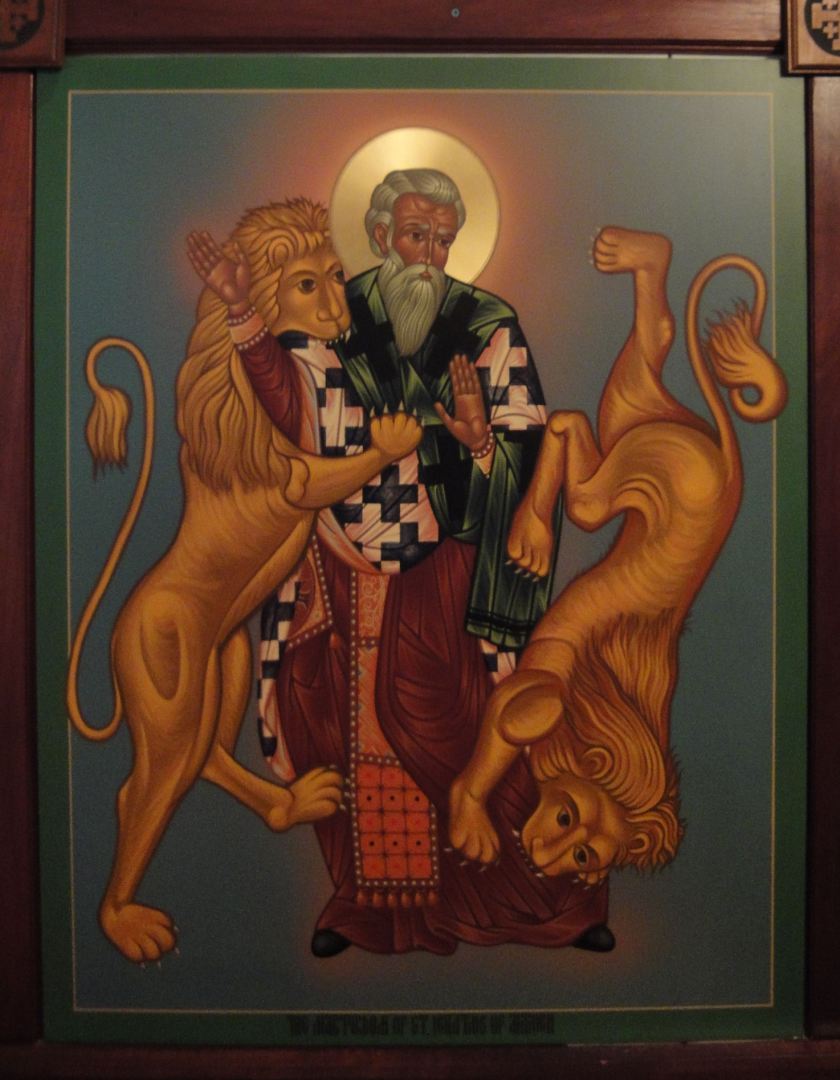
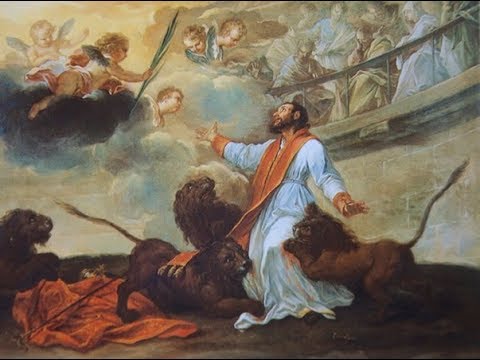
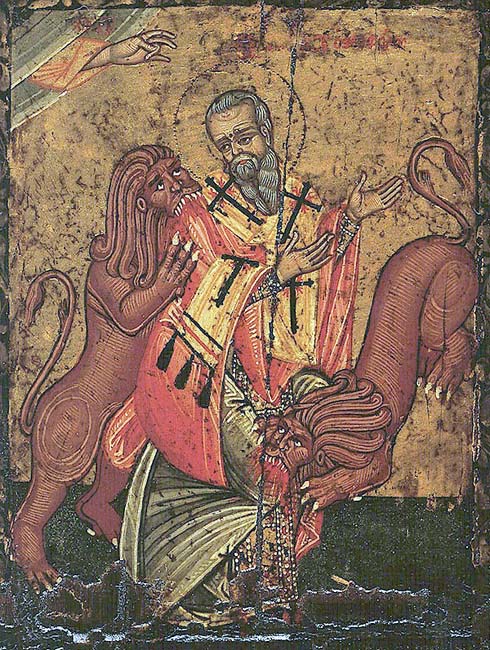
Eusebius writes:  “The Report says that he [Ignatius] was sent from Syria to Rome and became food for wild beasts on account of his testimony to Christ.   And as he made the journey through Asia under the strictest military surveillance” (he called the guards “ten leopards” in his Letter to the Romans, 5: 1), “he fortified the parishes in the various cities where he stopped by homilies and exhortations and warned them above all to be especially on their guard against the heresies that were then beginning to prevail, and exhorted them to hold fast to the tradition of the Apostles”.header - st ignatius

The first place Ignatius stopped on the way to his martyrdom was the city of Smyrna, where St Polycarp, a disciple of St John, was Bishop.   Here, Ignatius wrote four letters, respectively to the Churches of Ephesus, Magnesia, Tralli and Rome.   “Having left Smyrna”, Eusebius continues, Ignatius reached Troas and “wrote again”:  two letters to the Churches of Philadelphia and Smyrna and one to Bishop Polycarp.   Thus, Eusebius completes the list of his letters, which have come down to us from the Church of the first century as a precious treasure.   In reading these texts one feels the freshness of the faith of the generation which had still known the Apostles.   In these letters, the ardent love of a saint can also be felt.

Lastly, the martyr travelled from Troas to Rome, where he was thrown to fierce wild animals in the Flavian Amphitheatre.st ignatius of antioch 2

No Church Father has expressed the longing for union with Christ and for life in Him with the intensity of Ignatius.   We therefore read the Gospel passage on the vine, which according to John’s Gospel is Jesus.   In fact, two spiritual “currents” converge in Ignatius, that of Paul, straining with all his might for union with Christ and that of John, concentrated on life in Him.   In turn, these two currents translate into the imitation of Christ, whom Ignatius several times proclaimed as “my” or “our God”.

Thus, Ignatius implores the Christians of Rome not to prevent his martyrdom since he is impatient “to attain to Jesus Christ”.   And he explains, “It is better for me to die on behalf of Jesus Christ than to reign over all the ends of the earth…. Him I seek, who died for us:  Him I desire, who rose again for our sake…. Permit me to be an imitator of the Passion of my God!” (Romans, 5-6).Sant_Ignazio_di_Antiochia_E

One can perceive in these words on fire with love, the pronounced Christological “realism” typical of the Church of Antioch, more focused than ever on the Incarnation of the Son of God and on His true and concrete humanity:  “Jesus Christ”, St Ignatius wrote to the Smyrnaeans, “was truly of the seed of David”, “he was truly born of a virgin” “and was truly nailed [to the Cross] for us” (1: 1).   Ignatius’ irresistible longing for union with Christ was the foundation of a real “mysticism of unity”.   He describes himself:  “I therefore did what befitted me as a man devoted to unity” (Philadelphians, 8: 1).

For Ignatius unity was first and foremost a prerogative of God, who, since He exists as Three Persons, is One in absolute unity.   Ignatius often used to repeat that God is unity and that in God alone is unity found in its pure and original state.   Unity to be brought about on this earth by Christians is no more than an imitation as close as possible to the divine archetype.ST IGNATIUS OF ANTIOCH MYPIC

Ignatius was the first person in Christian literature to attribute to the Church the adjective “catholic” or “universal” –  “Wherever Jesus Christ is”, he said, “there is the Catholic Church” (Smyrnaeans, 8: 2).   And precisely in the service of unity to the Catholic Church, the Christian community of Rome exercised a sort of primacy of love: “The Church which presides in the place of the region of the Romans and which is worthy of God, worthy of honour, worthy of the highest happiness… and which presides over love, is named from Christ and from the Father…” (Romans, Prologue).

StIgnatius-SouthColonnade-a
St Ignatius on the South Colonnade St Peter’s Basilica c 1669-1670

As can be seen, Ignatius is truly the “Doctor of Unity” – unity of God and unity of Christ (despite the various heresies gaining ground which separated the human and the divine in Christ), unity of the Church, unity of the faithful in “faith and love, to which nothing is to be preferred” (Smyrnaeans, 6: 1).

Ultimately, Ignatius’ realism invites the faithful of yesterday and today, invites us all, to make a gradual synthesis between configuration to Christ (union with Him, life in Him) and dedication to His Church (unity with the Bishop, generous service to the community and to the world).

Posted in CARMELITES, CATECHESIS, DOCTORS of the Church, MORNING Prayers, ON the SAINTS, PAPAL SERMONS, PRACTISING CATHOLIC, QUOTES of the SAINTS, QUOTES on LOVE, QUOTES on MERCY, QUOTES on SANCTITY, QUOTES on TRUST and complete CONFIDENCE in GOD, SAINT of the DAY, The WORD

Thought for the Day – 1 October – The Memorial of St Thérèse of Lisieux O.C.D. (1873 – 1897) Doctor of the Church

Thought for the Day – 1 October – The Memorial of St Thérèse of Lisieux O.C.D. (1873 – 1897) Doctor of the Church

Excerpt from Pope Benedict’s Catechesis on St Thérèse – 6 April 2011

“Today I would like to talk to you about St Thérèse of Lisieux, Thérèse of the Child Jesus and of the Holy Face, who lived in this world for only 24 years, at the end of the 19th century, leading a very simple and hidden life but who, after her death and the publication of her writings, became one of the best-known and best-loved saints. “Little Thérèse” has never stopped helping the simplest souls, the little, the poor and the suffering who pray to her.

I would like to invite you to rediscover this small-great treasure, this luminous comment on the Gospel lived to the full!   The Story of a Soul, in fact, is a marvellous story of Love, told with such authenticity, simplicity and freshness that the reader cannot but be fascinated by it!   But what was this Love that filled Thérèse’s whole life, from childhood to death?   Dear friends, this Love has a Face, it has a Name, it is Jesus!   The Saint speaks continuously of Jesus.

Dear friends, we too, with St Thérèse of the Child Jesus must be able to repeat to the Lord every day that we want to live of love for Him and for others, to learn at the school of the saints to love authentically and totally.  Thérèse is one of the “little” ones of the Gospel who let themselves be led by God to the depths of his Mystery.   A guide for all, especially those who, in the People of God, carry out their ministry as theologians.   With humility and charity, faith and hope, Thérèse continually entered the heart of Sacred Scripture which contains the Mystery of Christ.   And this interpretation of the Bible, nourished by the science of love, is not in opposition to academic knowledge.   The science of the saints, in fact, of which she herself speaks on the last page of her The Story of a Soul, is the loftiest science.

In the Gospel Thérèse discovered above all the Mercy of Jesus, to the point that she said: “To me, He has given His Infinite Mercy and it is in this ineffable mirror, that I contemplate His other divine attributes.   Therein all appear to me radiant with Love.   His Justice, even more perhaps than the rest, seems to me to be clothed with Love” (Ms A, 84r).

In these words she expresses herself in the last lines of The Story of a Soul:   “I have only to open the Holy Gospels and at once I breathe the perfume of Jesus’ life and then I know which way to run;  and it is not to the first place but to the last, that I hasten…. I feel that even had I on my conscience every crime one could commit… my heart broken with sorrow, I would throw myself into the arms of my Saviour Jesus, because I know that He loves the Prodigal Son” who returns to Him. (Ms C, 36v-37r).

“Trust and Love” are therefore the final point of the account of her life, two words, like beacons, that illumined the whole of her journey to holiness, to be able to guide others on the same “little way of trust and love”, of spiritual childhood (cf. Ms C, 2v-3r; LT 226).

Trust, like that of the child who abandons himself in God’s hands, inseparable from the strong, radical commitment of true love, which is the total gift of self for ever, as the Saint says, contemplating Mary:   “Loving is giving all, and giving oneself” (Why I love thee, Mary, P 54/22).

Thus Thérèse points out to us all that Christian life consists in living to the full the grace of Baptism in the total gift of self to the Love of the Father, in order to live like Christ, in the fire of the Holy Spirit, His same love for all the others.”…Pope Benedict XVI

“Trust and trust alone,
should lead us to love”trust and trust alone - st t of l - 1 oct 2018

St Thérèse of Lisieux, Pray for Us!st t of l pray for us - 1 oct 2018

Posted in CATECHESIS, DOCTORS of the Church, FATHERS of the Church, MORNING Prayers, PAPAL SERMONS, QUOTES of the SAINTS, SAINT of the DAY, The WORD

Thought for the Day – 30 September – The Memorial of St Jerome (347-419) Father and Doctor

Thought for the Day – 30 September – The Memorial of St Jerome (347-419) Father and Doctor

Pope Benedict XVI – 7 November 2007 –

Catechesis on St Jerome (1)

What can we learn from St Jerome?   It seems to me, this above all – to love the Word of God in Sacred Scripture.

St Jerome said:  “Ignorance of the Scriptures is ignorance of Christ”.   It is therefore important that every Christian live in contact and in personal dialogue with the Word of God given to us in Sacred Scripture.   This dialogue with Scripture must always have two dimensions:  on the one hand, it must be a truly personal dialogue because God speaks with each one of us through Sacred Scripture and it has a message for each one.   We must not read Sacred Scripture as a word of the past but as the Word of God that is also addressed to us and we must try to understand what it is that the Lord wants to tell us. However, to avoid falling into individualism, we must bear in mind that the Word of God has been given to us precisely in order to build communion and to join forces in the truth on our journey towards God.   Thus, although it is always a personal Word, it is also a Word that builds community, that builds the Church.   We must, therefore, read it in communion with the living Church.   The privileged place for reading and listening to the Word of God is the liturgy, in which, celebrating the Word and making Christ’s Body present in the Sacrament, we actualise the Word in our lives and make it present among us.   We must never forget that the Word of God transcends time  . Human opinions come and go.   What is very modern today will be very antiquated tomorrow.   On the other hand, the Word of God is the Word of eternal life, it bears within it eternity and is valid for ever.   By carrying the Word of God within us, we therefore carry within us eternity, eternal life.ignorance of the scriptures is ignorance of christ - st jerome - 30 sep 2018

I thus conclude with a word St Jerome once addressed to St Paulinus of Nola (354-431).  In it the great exegete expressed this very reality, that is, in the Word of God we receive eternity, eternal life.   St Jerome said: “Seek to learn on earth those truths which will remain ever valid in Heaven” (Ep. 53, 10)…. Pope Benedict XVI – 7 November 2007 – Catechesis on St Jerome (1)

St Jerome, Pray for us!st-jerome-pray-for-us-30-sept-2017

Posted in CATECHESIS, MORNING Prayers, QUOTES of the SAINTS, QUOTES on HUMILITY, QUOTES on PRAYER, SAINT of the DAY

Thought for the Day – 4 August – The Memorial of St John Vianney (1786-1859)

Thought for the Day – 4 August – The Memorial of St John Vianney (1786-1859)

“My little children, reflect on these words:
the Christian’s treasure is not on earth but in heaven.

Our thoughts, then, ought to be directed to where out treasure is.
This is the glorious duty of man – to pray and to love.
If you pray and love, that is where a man’s happiness lies.
Prayer is nothing else but union with God.   In this intimate union, God and the soul are fused together like two bits of wax that no one can every pull apart.   This union of god with a tiny creature is a lovely thing. It is a happiness beyond understanding.

My little children, your hearts, are small but prayer stretches them and makes them capable of loving God.
Through prayer we receive a foretaste of heaven and something of paradise comes down upon us.
Prayer never leaves us without sweetness.   It is honey that flows into the souls and makes all things sweet.

When we pray properly, sorrows disappear like snow before the sun.   Some men immerse themselves as deeply in prayer as fish in water, because they give themselves totally to God.   O, how I love these noble souls!   How unlike them we are!  How often we come to church with no idea of what to do or what to ask for.   And yet, whenever we go to any human being, we know well enough why we go.
And still worse, there are some who seem to speak to the good God like this:  “I will only say a couple of things to You and then I will be rid of You.”
I often think that when we come to adore the Lord, we would receive everything we ask for, if we would ask with living faith and with a pure heart.

Prayer is the inner bath of love into which the soul plunges itself.”

– from the catechetical instructions by Saint John Vianney

St John Marie Baptiste Vianney, the poor boy from Dardilly, ordained a priest “through compassion” and in charge of an isolated parish, the one who prepared himself to die every day:  because of the strange logic of God who chooses the little to depose the mighty, it was this man who became a teacher and model even for the Popes who sit on the Chair of Peter, who are inspired by him and hold him up for emulation to the entire Church.   We must make ourselves ‘little’ in prayer, in total self-giving to God!

St John Marie Baptiste Vianney, Pray for us!st john vianney pray for us no 2 - 4 aug 2018

Posted in CATECHESIS, FATHERS of the Church, MORNING Prayers, QUOTES of the SAINTS, QUOTES on FAITH, QUOTES on SANCTITY, QUOTES on the DEVIL/EVIL, SAINT of the DAY, The HOLY GHOST

Thought for the Day – 28 June – The Memorial of St Irenaeus of Lyons (c 135 – c 202) Father of the Church

Thought for the Day – 28 June – The Memorial of St Irenaeus of Lyons (c 135 – c 202) Father of the Church

Catechism of the Catholic Church
III.  Only One Faith (#172-175)

172   Through the centuries, in so many languages, cultures, peoples and nations, the Church has constantly confessed this one faith, received from the one Lord, transmitted by one Baptism and grounded in the conviction, that all people have only one God and Father.   St Irenaeus of Lyons, a witness of this faith, declared:

173   “Indeed, the Church, though scattered throughout the whole world, even to the ends of the earth, having received the faith from the apostles and their disciples. . . guards [this preaching and faith] with care, as dwelling in but a single house and similarly believes as if having but one soul and a single heart and preaches, teaches and hands on this faith with a unanimous voice, as if possessing only one mouth.”

174   “For though languages differ throughout the world, the content of the Tradition is one and the same.   The Churches established in Germany have no other faith or Tradition, nor do those of the Iberians, nor those of the Celts, nor those of the East, of Egypt, of Libya, nor those established at the centre of the world. . .” The Church’s message “is true and solid, in which one and the same way of salvation appears throughout the whole world.”

175   We guard with care the faith that we have received from the Church, for without ceasing, under the action of God’s Spirit, this deposit of great price, as if in an excellent vessel, is constantly being renewed and causes the very vessel that contains it to be renewed.”JESUS taught a new sacrifice - st irenaeus

From the treatise Against Heresies by Saint Irenaeus

“The Spirit of wisdom and understanding, the Spirit of counsel and strength, the Spirit of knowledge and the fear of God came down upon the Lord and the Lord in turn gave this Spirit to His Church, sending the Advocate from heaven into all the world into which, according to His own words, the devil too had been cast down like lightning.   If we are not to be scorched and made unfruitful, we need the dew of God.   Since we have our accuser, we need an Advocate as well.

And so the Lord in His pity for man, who had fallen into the hands of brigands, having Himself bound up his wounds and left for his care two coins, bearing the royal image, entrusted him to the Holy Spirit.   Now, through the Spirit, the image and inscription of the Father and the Son have been given to us and it is our duty to use the coin committed to our charge and make it yield a rich profit for the Lord.”

St Irenaeus, Pray for us!st irenaeus - pray for us no 2 - 28 june 2018

Posted in CATECHESIS, DIVINE Mercy, Goodness, Patience, EUCHARISTIC Adoration, FATHERS of the Church, GOD the FATHER, MARIAN QUOTES, QUOTES of the SAINTS, QUOTES on CHARITY, QUOTES on DIVINE PROVIDENCE, QUOTES on FAITH, QUOTES on OBEDIENCE, QUOTES on SANCTITY, QUOTES on the CHURCH, QUOTES on TRUST and complete CONFIDENCE in GOD, QUOTES on TRUTH, SAINT of the DAY, The BLESSED VIRGIN MARY, The HOLY EUCHARIST / The HOLY MASS, The LAST THINGS

Quote/s of the Day – 28 June – The Memorial of St Irenaeus of Lyons (c 135 – c 202) Father of the Church

Quote/s of the Day – 28 June – The Memorial of St Irenaeus of Lyons (c 135 – c 202) Father of the Church

“Our way of thinking,
is attuned to the Eucharist
and the Eucharist in turn,
confirms our way of thinking.”our-way-of-thinking-st-irenaeus-28 june 2018

“Jesus Christ, in His infinite love,
has become what we are,
in order that He may make us
entirely what He is.”jesus christ in his infinite love - st irenaeus - 28 june 2018

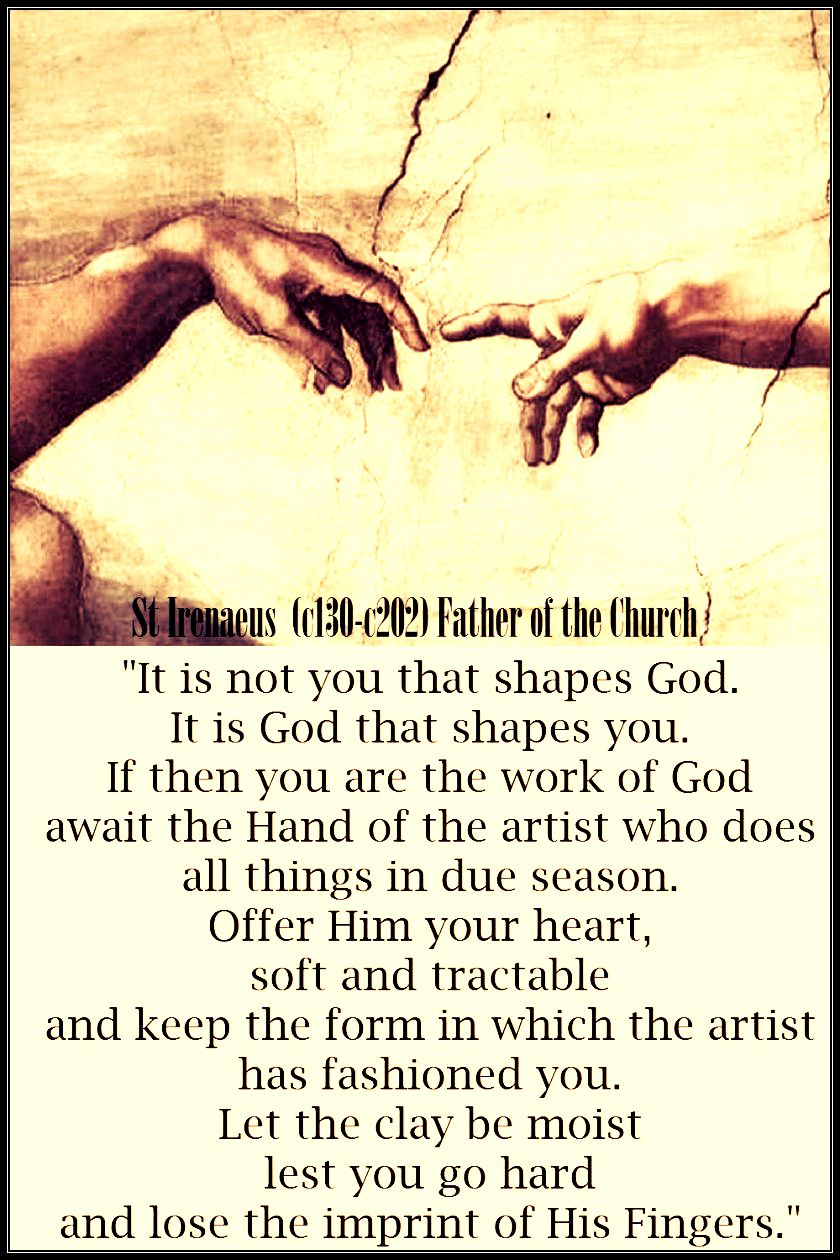
“It is not you that shapes God.
It is God that shapes you.
If then you are the work of God
await the Hand of the artist who does
all things in due season.
Offer Him your heart,
soft and tractable
and keep the form in which the artist
has fashioned you.
Let the clay be moist
lest you go hard
and lose the imprint of His Fingers.”it-is-not-you-that-shapes-god-strenaeus-28 june 2018

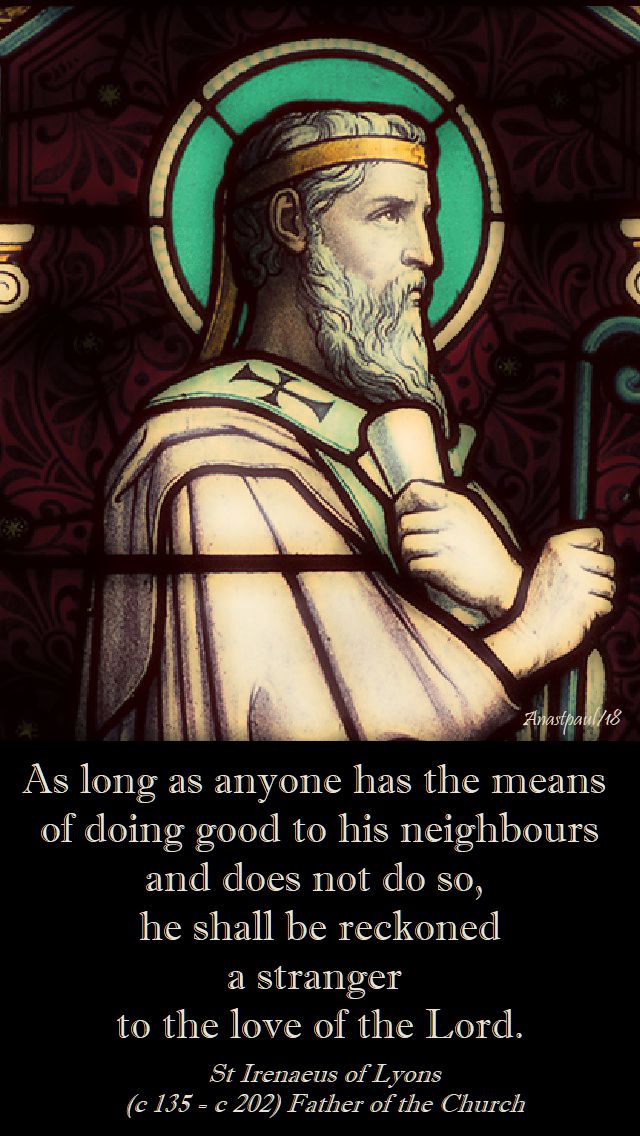
“As long as anyone has the means
of doing good to his neighbours
and does not do so,
he shall be reckoned a stranger
to the love of the Lord.”as-long-as-any-one-has-the-means-st-irenaeus-28 june 2018.no.2

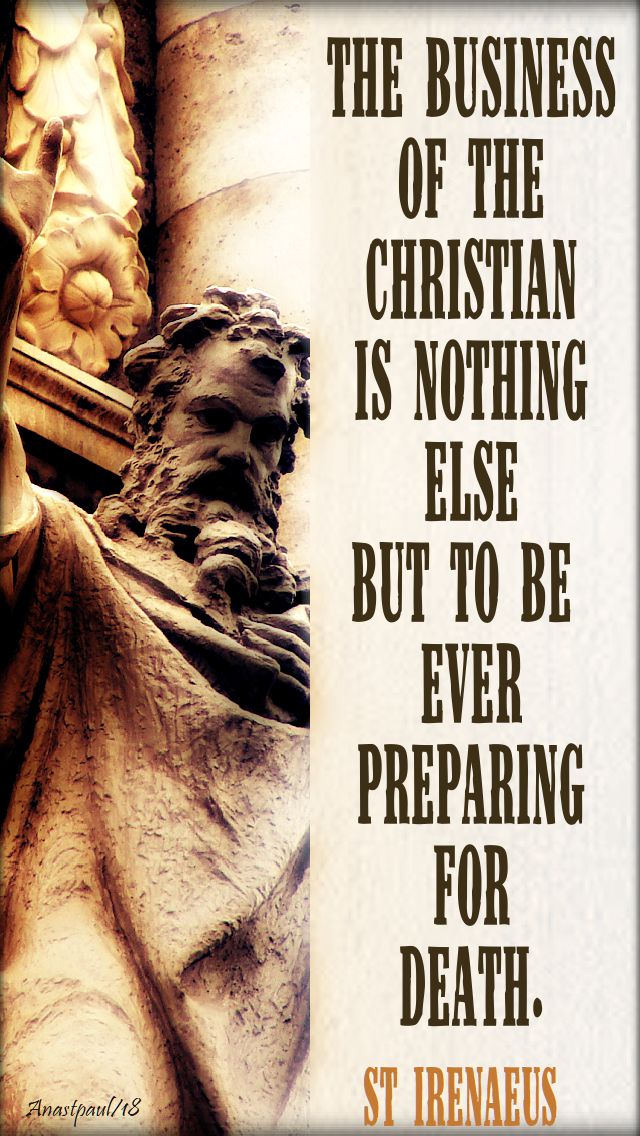
The business of the Christian
is nothing else but to be
ever preparing for death.the business of the christian - st irenaeus - 28 june 2018

“The universal Church, that is, the faithful everywhere, must be in agreement with this Church because of her outstanding superiority.”

the universal church - st irenaeus

“Being obedient she (Mary)
became the cause of salvation for herself
and for the whole human race.
The knot of Eve’s disobedience was untied
by Mary’s obedience:
what the virgin Eve bound through her disbelief,
Mary loosened by her faith.”

St Irenaeus of Lyons (c 135 – c 202)being-obedient-st-irenaeus-28 june 2018 - no 2

Posted in CATECHESIS, MORNING Prayers, PAPAL SERMONS, SUNDAY REFLECTIONS, The HOLY EUCHARIST / The HOLY MASS

Sunday Reflection – 17 June – Eleventh Sunday in Ordinary Time Year B

Sunday Reflection – 17 June – Eleventh Sunday in Ordinary Time Year B

….What happens in Spring?   Plants blossom, trees flower.   I will ask you some questions. Can a sick tree or plant fully blossom if it is sick?   No!   Can a tree, a plant which is not watered by rain or artificially, blossom nicely?   No.   And can a tree and a plant whose roots have been removed or which have no roots flower?   No.   Without roots, can they flower?   No!   And this is a message:  Christian life has to be a life that must blossom in works of charity, in doing what is good.   But if you have no roots, you cannot blossom, and who is the root?   Jesus  ! If you are not with Jesus, there in the roots, you will not blossom.   If you do not water your life with prayer and the sacraments, will you bear Christian flowers?   No!   Because prayer and the sacraments water the roots and our life blossoms.   I hope that your Spring may be bloom beautifully, as blooming as Easter will be;  blossoming with good works, virtue and doing good to others.   Remember this, this is a very beautiful verse from my country:   “What blossoms a tree bears come from what lies underneath it”.   Never cut off Jesus’ roots.

During Mass, after breaking the consecrated Bread, that is the Body of Christ, the priest shows it to the faithful, inviting them to participate in the Eucharistic banquet.   We know the words that ring out from the sacred altar:  “Happy are those who are called to his Supper.   This is the Lamb of God who takes away the sin of the world”.   Inspired by a passage in the Book of Revelation — “Blessed are those who are invited to the marriage supper of the Lamb” (Rev 19:9): it says “marriage” because Jesus is the Spouse of the Church — this invitation calls us to experience intimate union with Christ, the source of joy and holiness.   It is an invitation which brings happiness and at the same time spurs us to an examination of conscience enlightened by faith.

Although we are the ones who stand in procession to receive Communion;  we approach the altar in a procession to receive communion, in reality it is Christ who comes towards us to assimilate us in Him.   There is an encounter with Jesus!   To nourish oneself of the Eucharist means to allow oneself to be changed by what we receive.   Saint Augustine helps us understand this when he talks about the light he received when he heard Christ say to him:   “I am the food of strong men;  grow and you shall feed upon me;  nor shall you convert me, like the food of your flesh, into you but you shall be converted into me” (Confessions VII, 10, 16: pl 32, 742).

Each time we receive Communion, we resemble Jesus more;  we transform ourselves more fully into Jesus.   As the Bread and the Wine are converted into the Body and Blood of the Lord, so too those who receive it with faith, are transformed into a living Eucharist.

You reply “Amen” to the priest who distributes the Eucharist saying “the Body of Christ”; that is, you recognise the grace and the commitment involved in becoming the Body of Christ.   Because when you receive the Eucharist, you become the Body of Christ.  This is beautiful;  it is very beautiful.   As it unites us to Christ, tearing us away from our selfishness, Communion opens us and unites us to all those who are a single thing in Him.   This is the wonder of Communion:  we become what we receive!

Let us approach the Eucharist:  receiving Jesus who transforms us into Him makes us stronger.   The Lord is so good and so great!

Pope Francis, General Audience, 21 March 2018each time we receive communion - pope francis - 17 june 2018

Posted in CATECHESIS, MORNING Prayers, PAPAL Apostolic EXHORTATIONS, PAPAL DECREE, PAPAL MESSAGES, SAINT of the DAY

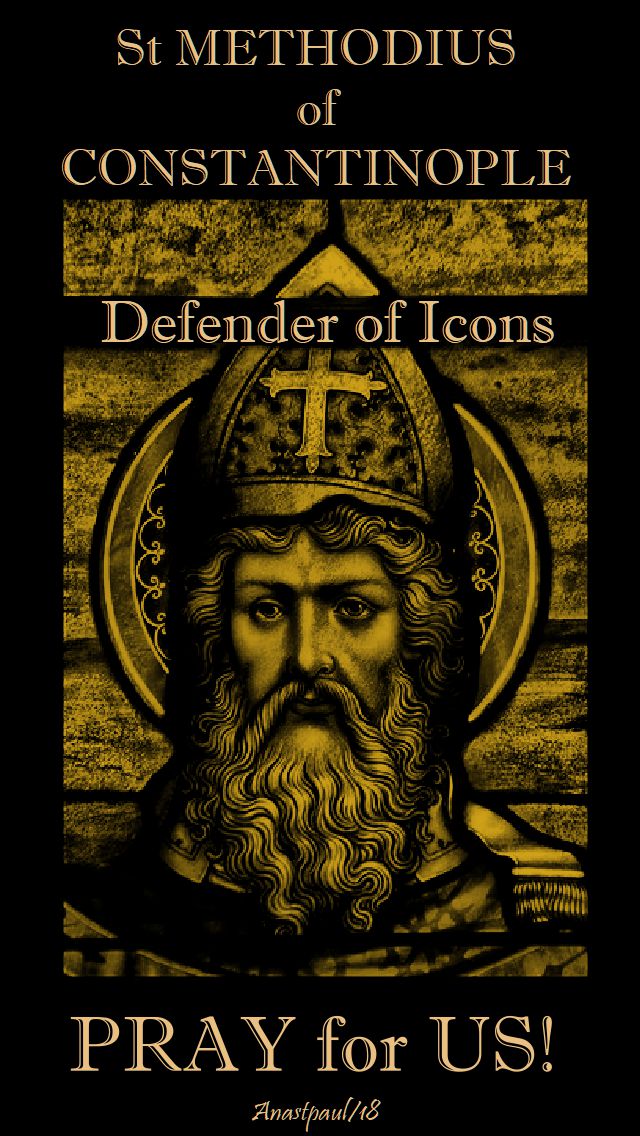
Thought for the Day – 14 June – The Memorial of St Methodius I of Constantinople (8th Cent – 847) “Defender of Icons”

Thought for the Day – 14 June – The Memorial of St Methodius I of Constantinople (8th Cent – 847) “Defender of Icons”

Iconoclasm is still with us today, within and without the Catholic Church. Let us consider this statement from the Second Council of Nicaea that St Methodius fought all his life to defend:

“Following the divinely inspired teaching our of holy Fathers and the tradition of the Catholic Church (for we know that this tradition comes from the Holy Spirit who dwells in her), we rightly define with full certainty and correctness that, like the figure of the precious and life-giving cross, venerable and holy images of our Lord and God and Saviour, Jesus Christ, our inviolate Lady, the holy Mother of God and the venerated angels, all the saints and the just, whether painted or made of mosaic or another suitable material, are to be exhibited in the holy churches of God, on sacred vessels and vestments, walls and panels, in houses and on streets.”

And, from our present-day Catechism of the Catholic Church, we have these words:

“The contemplation of sacred icons, united with meditation on the Word of God and the singing of liturgical hymns, enters into the harmony of the signs of celebration, so that the mystery celebrated, is imprinted in the heart’s memory and is then expressed in the new life of the faithful”…CCC 1162.

St Methodius, “Defender of Icons”, Pray for usst methodius - pray for us - 14 june 2018

Posted in CATECHESIS, FEASTS and SOLEMNITIES, PRACTISING CATHOLIC, PRAYERS of the CHURCH, PRAYERS of the SAINTS, QUOTES of the SAINTS, The HOLY GHOST

Thought for the Day – 20 May – The Solemnity of Pentecost, Alleluia!

Thought for the Day – 20 May – The Solemnity of Pentecost, Alleluia!

“If the damned were asked:   Why are you in Hell? they would answer: ‘ For having resisted the Holy Spirit.’
And if the saints were asked:  Why are you in Heaven? they would answer:  ‘For having listened to the Holy Spirit.’
When good thoughts come into our minds, it is the Holy Spirit who is visiting us.
The Holy Spirit is a power.
The Holy Spirit …. sustained the martyrs.   Without the Holy Spirit, the martyrs would have fallen like the leaves from the trees.   When the fires were lighted under them, the Holy Spirit extinguished the heat of the fire by the heat of divine love.
The good God, in sending us the Holy Spirit, has treated us like a great king who should send his minister to guide one of his subjects, saying, “You will accompany this man everywhere and you will bring him back to me safe and sound.”
How beautiful it is, my children, to be accompanied by the Holy Spirit!
He is indeed a good Guide and to think, that there are some, who will not follow Him!
The Holy Spirit is like a man with a carriage and horse, who should want to take us to Pans.   We should only have to say “yes,” and to get into it.   It is indeed an easy matter to say “yes”!… Well, the Holy Spirit wants to take us to Heaven; we have only to say “yes,” and to let Him take us there.“

St John Vianney (1786-1859)

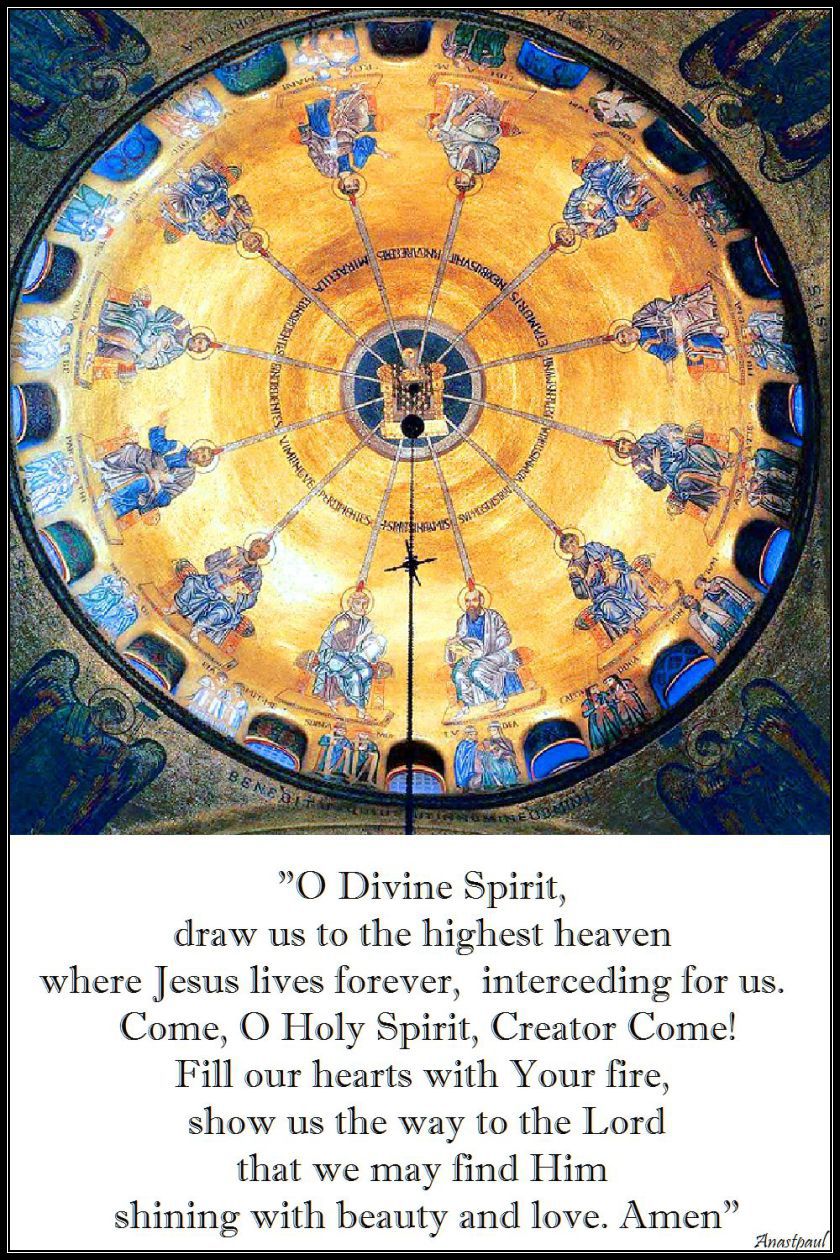
“O Divine Spirit, draw us to the highest heaven where Jesus lives forever, interceding for us.   Come, fill our hearts with Your fire, show us the way to the Lord that we may find Him shining with beauty and love.   Amen”o-divine-spirit, draw us to the highest heaven - 4 june 2017 - pentecost sunday

My most Holy Lord and Sanctifier,
If I differ at all from the world,
it is because You have chosen me out of the world
and have lit up the love of God, in my heart.
If I differ from Your Saints, it is because I do not ask
earnestly enough for Your grace and for enough of it
and because I do not diligently improve
what You have given me.
Increase in me this grace of love,
in spite of all my unworthiness.
It is more precious than anything else in the world.
I accept it in place of all the world can give me.
O give it to me! It is my life.
Come Holy Spirit, Come!
Amen

Bl John Henry Newman – 1801-1890my most holy lord and sanctifier - bl j h newman - 20 may 2018 - pentecost

Posted in CATECHESIS, DOCTORS of the Church, FATHERS of the Church, FEASTS and SOLEMNITIES, MORNING Prayers, QUOTES - J R R Tolkien and MORE, QUOTES of the SAINTS, SAINT of the DAY, The HOLY GHOST

Quote/s of the Day – 20 May – The Solemnity of Pentecost, Alleluia!

Quote/s of the Day – 20 May – The Solemnity of Pentecost, Alleluia!

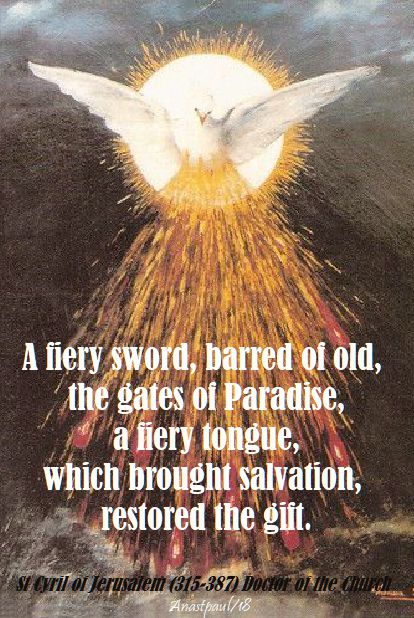
“A fiery sword, barred of old,
the gates of Paradise,
a fiery tongue, which brought salvation,
restored the gift.”

St Cyril of Jerusalem (315-387) Doctor of the Church
(Catechetical Lectures:  Lecture 17 no. 15)

a fiery sword, barred of old - st cyril of jerusalem - 20 may 2018 - pentecost sunday

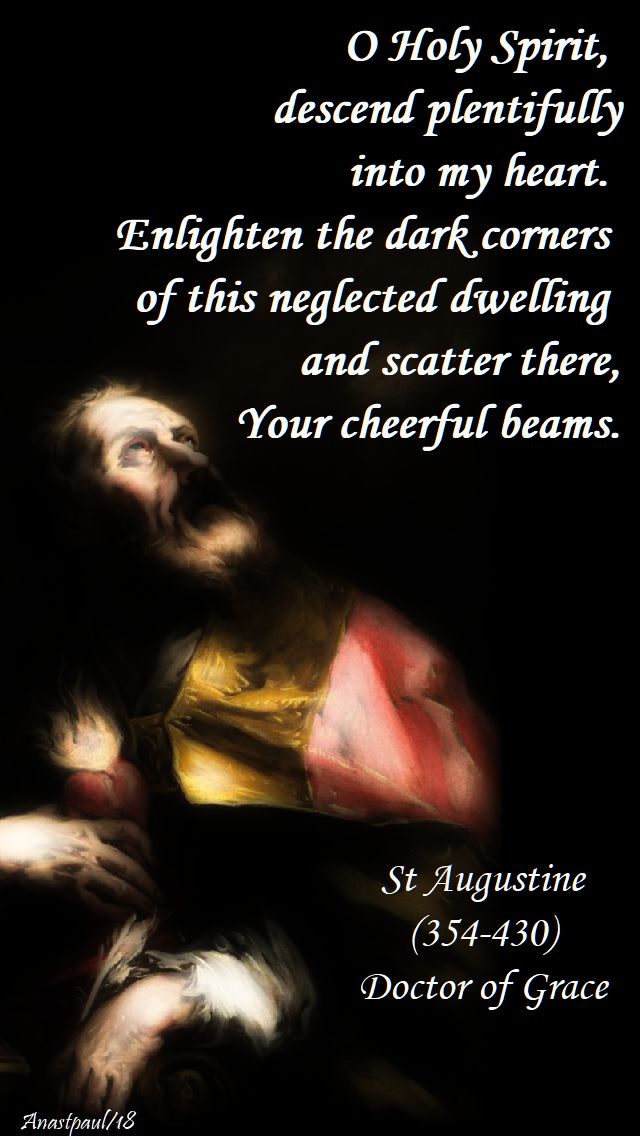
“O Holy Spirit, descend plentifully into my heart.
Enlighten the dark corners of this neglected dwelling
and scatter there, Your cheerful beams.”

St Augustine (354-430) Doctor of Grace

o holy spirit descend plentifully - st augustine - 20 may 2018 - pentecost

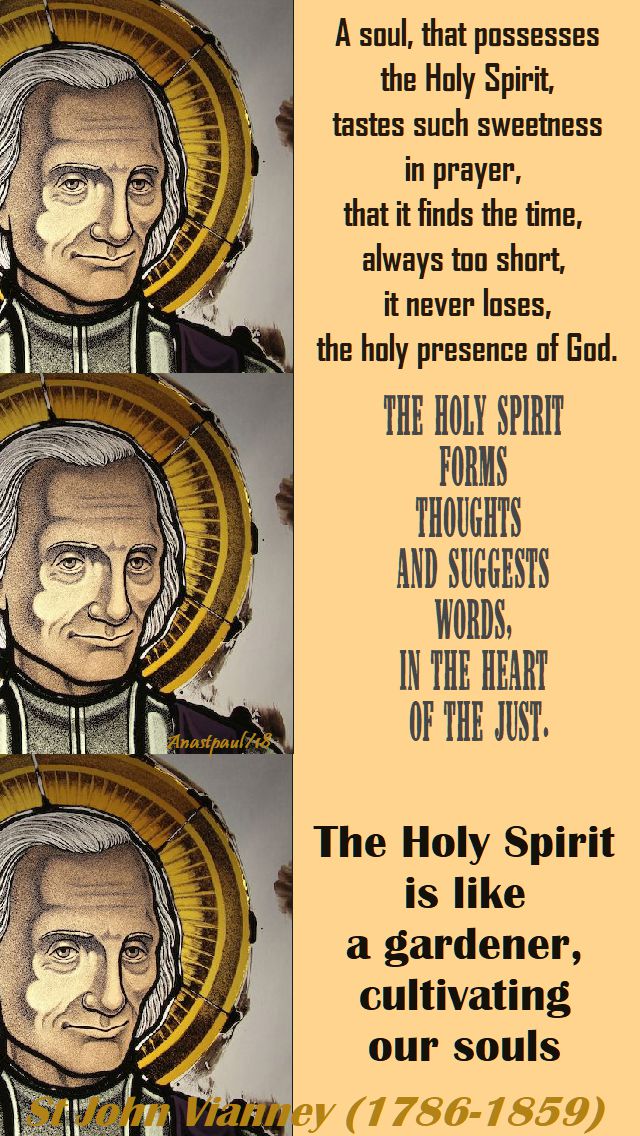
“A soul, that possesses the Holy Spirit,
tastes such sweetness, in prayer,
that it finds the time, always too short,
it never loses, the holy presence of God.”

“The Holy Spirit forms thoughts
and suggests words, in the hearts of the just.”

“The Holy Spirit is like a gardener,
cultivating our souls.”

St John Vianney (1786-1859)

a soul that posseses - the holy spirit is like a gardener - the holy spirit forms - st john vianney - 20 may 2018 pentecost sunday

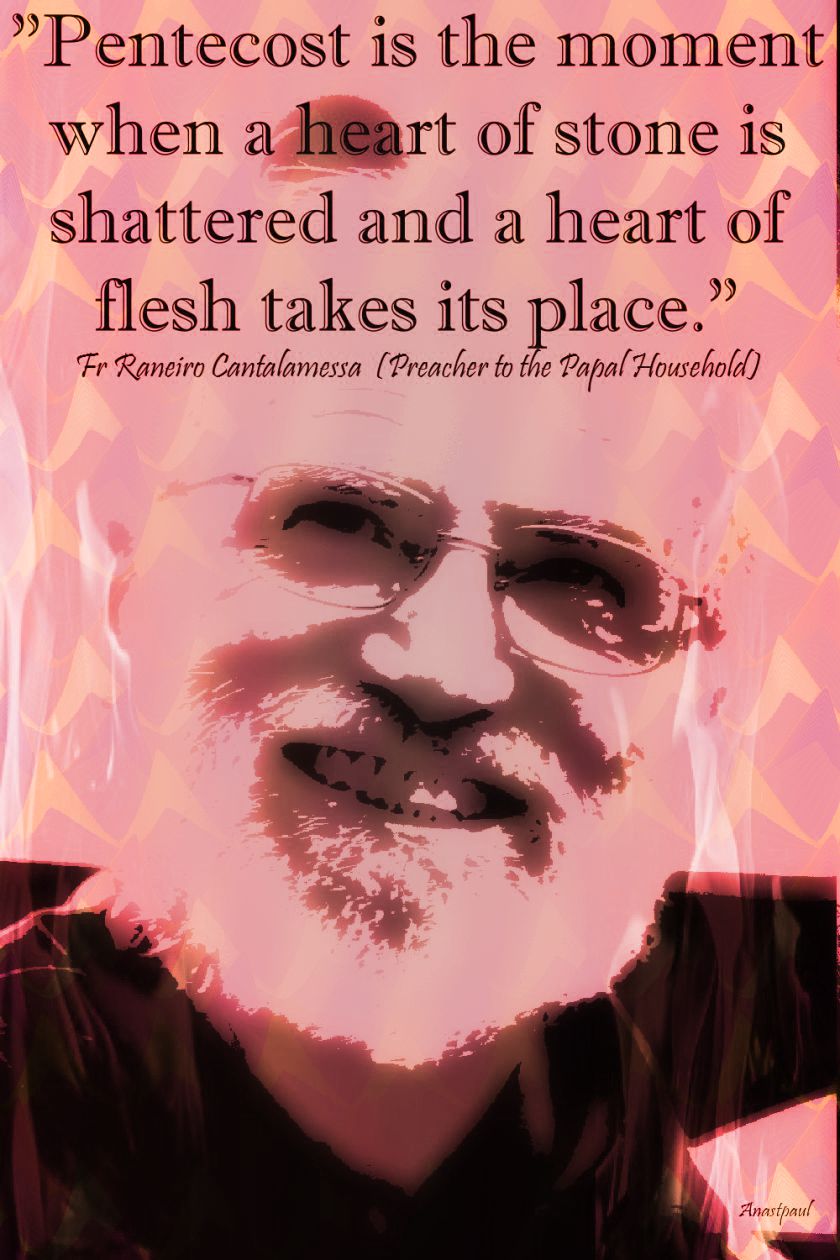
“Pentecost is the moment
when a heart of stone is
shattered and a heart of
flesh takes its place.”

Fr Raneiro Cantalamessa
(Preacher to the Papal Household)

pentecost-is-the-moment-fr-raneiro-cantalamessa-20 may 2018. pentecost sunday

Posted in CATECHESIS, EASTER, MORNING Prayers, QUOTES of the SAINTS, QUOTES on PRAYER, The WORD

Thought for the Day – 12 May – Saturday of the Sixth Week of Eastertide – Today’s Gospel John 16:23-28.

Thought for the Day – 12 May – Saturday of the Sixth Week of Eastertide – Today’s Gospel John 16:23-28.

Saint John-Mary Vianney (1786-1859) Curé of Ars

“Whatever you ask the Father in my name he will give you” (Jn 16:23)

Children, your heart is small but prayer expands it and make is capable of loving God. Prayer is a foretaste of heaven, an outflow from paradise.  Never does it leave us without sweetness.   It is a honey that comes into the soul and sweetens everything.   All our troubles melt away before a well-made prayer like snow before the sun.   Prayer makes the time pass speedily and with such enjoyment that we don’t notice its length…

You can tell well enough who they are who lose themselves in prayer like a fish in water because they belong entirely to God.   There is no division in their hearts.   How I love generous souls like those!   Saint Francis of Assisi and Saint Collette saw our Lord and talked to him as we talk to each other.   But as for us, how often do we come to church not knowing what we’ve come for and what we want to ask!   And yet, when we visit someone’s house we know perfectly well why we’re going there.   There are some people who appear to be saying to the good God:  “I’ve just come to say a word or two so that I can be done with you.”   How often I have thought that we would obtain everything we want if, when we come to worship our Lord, we were to ask him for it with a truly living faith and pure heart.john 16 23 - whatever you ask the father in my name - 12 may 2018

Posted in CATECHESIS, CATHOLIC DEVOTIONS of the Month, DOGMA, MARIAN QUOTES, MARIAN TITLES, MORNING Prayers, QUOTES of the SAINTS, The BLESSED VIRGIN MARY

Marian Thought for the Day – 3 May – Mary’s Month! – Thursday of the Fifth Week of Eastertide and the Feast of Sts Philip and James Apostles and Martyrs

Marian Thought for the Day – 3 May – Mary’s Month! – Thursday of the Fifth Week of Eastertide and the Feast of Sts Philip and James Apostles and Martyrs

On the Immaculate Conception
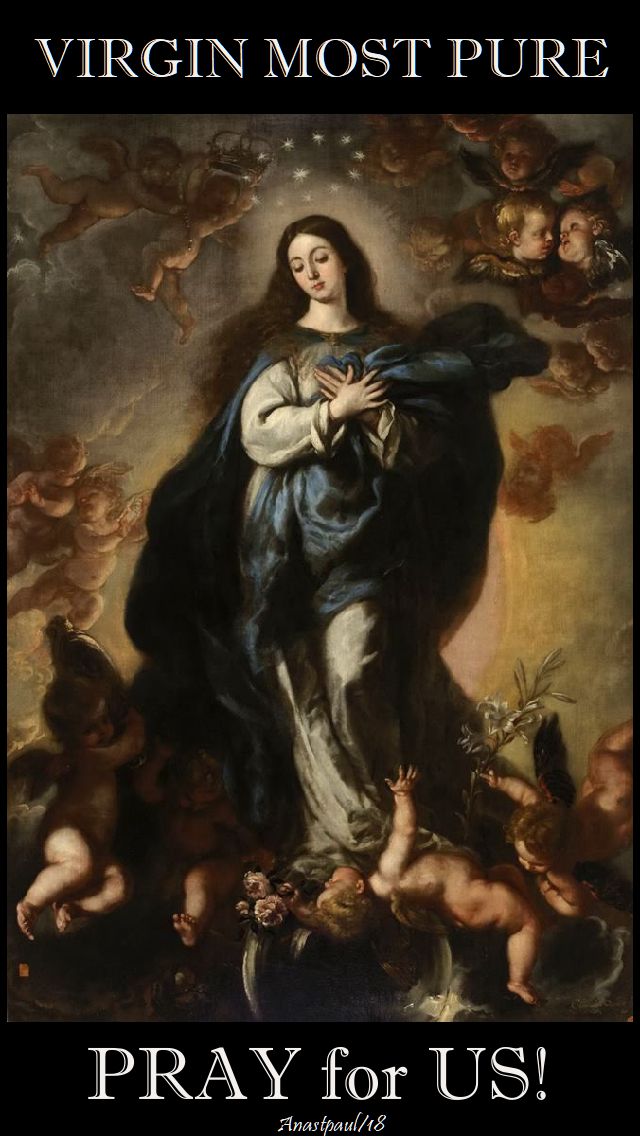
Mary is the “Virgo Purissima,” the Most Pure Virgin
By Blessed John Henry Newman (1801-1890)

BY the Immaculate Conception of the Blessed Virgin is meant the great revealed truth that she was conceived in the womb of her mother, St Anne, without original sin.

Since the fall of Adam all mankind, his descendants, are conceived and born in sin. “Behold,” says the inspired writer in the Psalm Miserere—“Behold, I was conceived in iniquity and in sin did my mother conceive me”.   That sin which belongs to every one of us and is ours, from the first moment of our existence, is the sin of unbelief and disobedience, by which Adam lost Paradise.   We, as the children of Adam, are heirs to the consequences of his sin and have forfeited in him, that spiritual robe of grace and holiness, which he had given him by his Creator at the time that he was made.   In this state of forfeiture and disinheritance we are all of us conceived and born and the ordinary way, by which we are taken out of it, is the Sacrament of Baptism.

But Mary never was in this state, she was by the eternal decree of God exempted from it. From eternity, God, the Father, Son and Holy Ghost, decreed to create the race of man and, foreseeing the fall of Adam, decreed to redeem the whole race by the Son’s taking flesh and suffering on the Cross.   In that same incomprehensible, eternal instant, in which the Son of God was born of the Father, was also the decree passed of man’s redemption through Him.   He who was born from Eternity was born by an eternal decree to save us in Time and to redeem the whole race and Mary’s redemption, was determined in that special manner which we call the Immaculate Conception.   It was decreed, not that she should be cleansed from sin but that she should, from the first moment of her being, be preserved from sin, so that the Evil One never had any part in her.   Therefore, she was a child of Adam and Eve as if they had never fallen, she did not share with them their sin, she inherited the gifts and graces (and more than those) which Adam and Eve possessed in Paradise.   This is her prerogative and the foundation of all those salutary truths, which are revealed to us concerning her.

Let us say then with all holy souls, Virgin most pure, conceived without original sin, Mary, pray for us.virgin most pure - pray for us - 3 may 2018

Posted in CATECHESIS, DOCTORS of the Church, FATHERS of the Church, MORNING Prayers, PRACTISING CATHOLIC, QUOTES of the SAINTS, QUOTES on CONVERSION, QUOTES on DIVINE PROVIDENCE, QUOTES on ETERNAL LIFE, QUOTES on FAITH, QUOTES on LOVE, QUOTES on SANCTITY, QUOTES on SIN, QUOTES on the DEVIL/EVIL, QUOTES on TRUST and complete CONFIDENCE in GOD, QUOTES on TRUTH, SPEAKING of .....

Quote/s of the Day – 3 May – Thursday of the Fifth Week of Eastertide and the Feast of Sts Philip and James Apostles and Martyrs

Quote/s of the Day – 3 May – Thursday of the Fifth Week of Eastertide and the Feast of Sts Philip and James Apostles and Martyrs

Speaking of:  Seeking Augustine

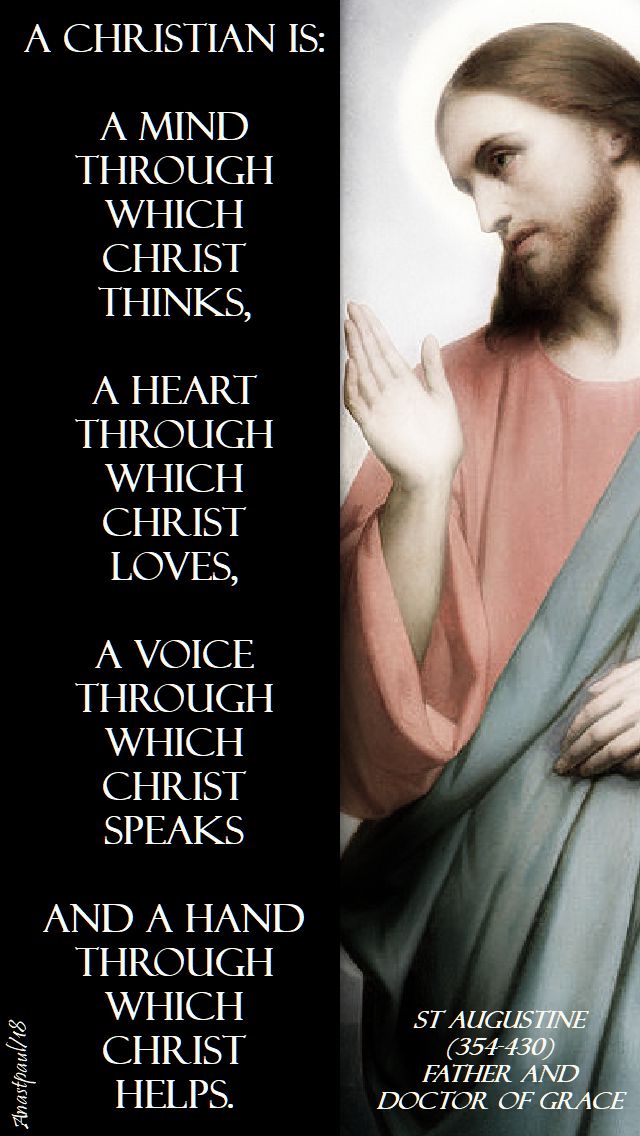
A Christian is:
a mind through which Christ thinks,
a heart through which Christ loves,
a voice through which Christ speaks
and a hand through which Christ helps.a christian is - st augustine - 3 may 2018

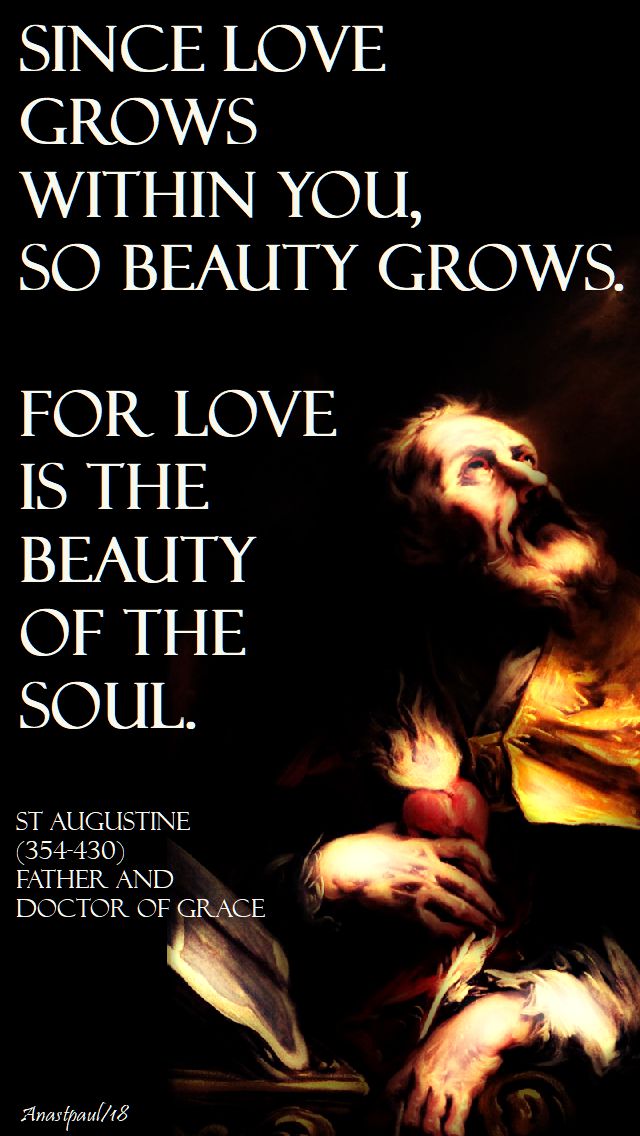
Since love grows within you,
so beauty grows.
For love is the beauty of the soul.since love grows within you - st augustine - 3 may 2018

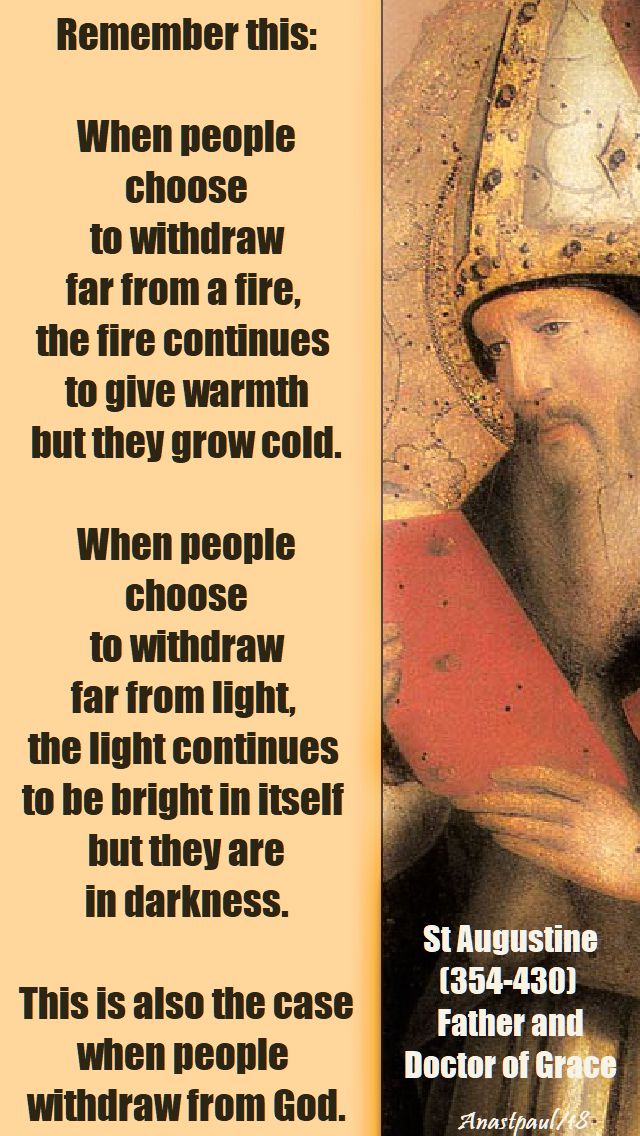
Remember this.
When people choose to withdraw far from a fire,
the fire continues to give warmth
but they grow cold.
When people choose to withdraw far from light,
the light continues to be bright in itself
but they are in darkness.
This is also the case when people withdraw from God.remember this - st augustine - 3 may 2018

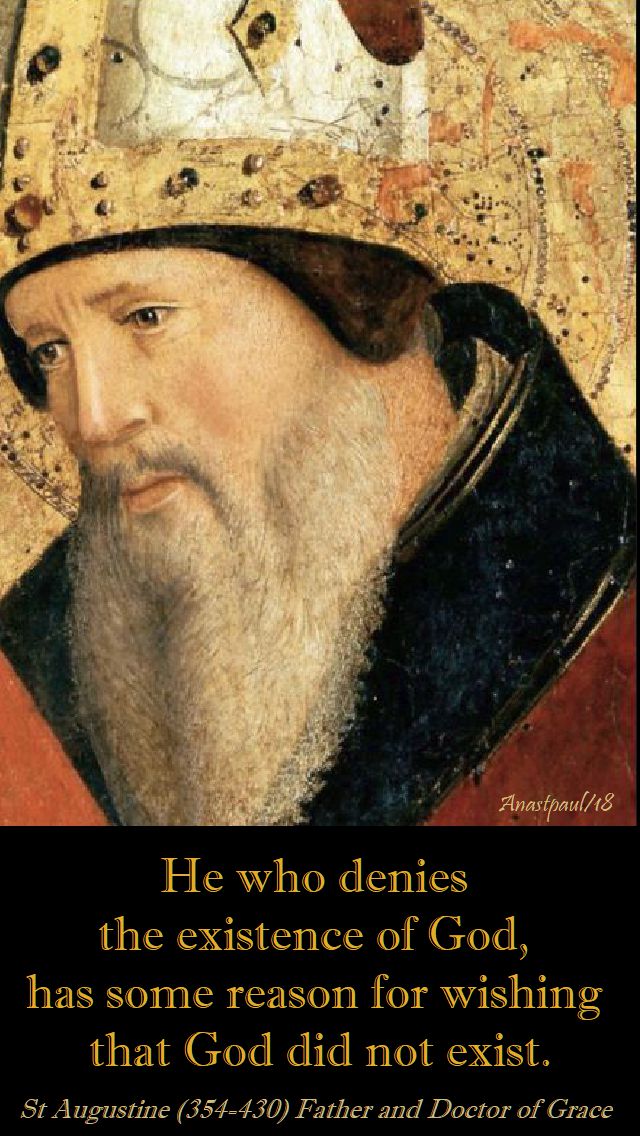
He who denies the existence of God,
has some reason for wishing
that God did not existhe who denies - st augustine - 3 may 2018

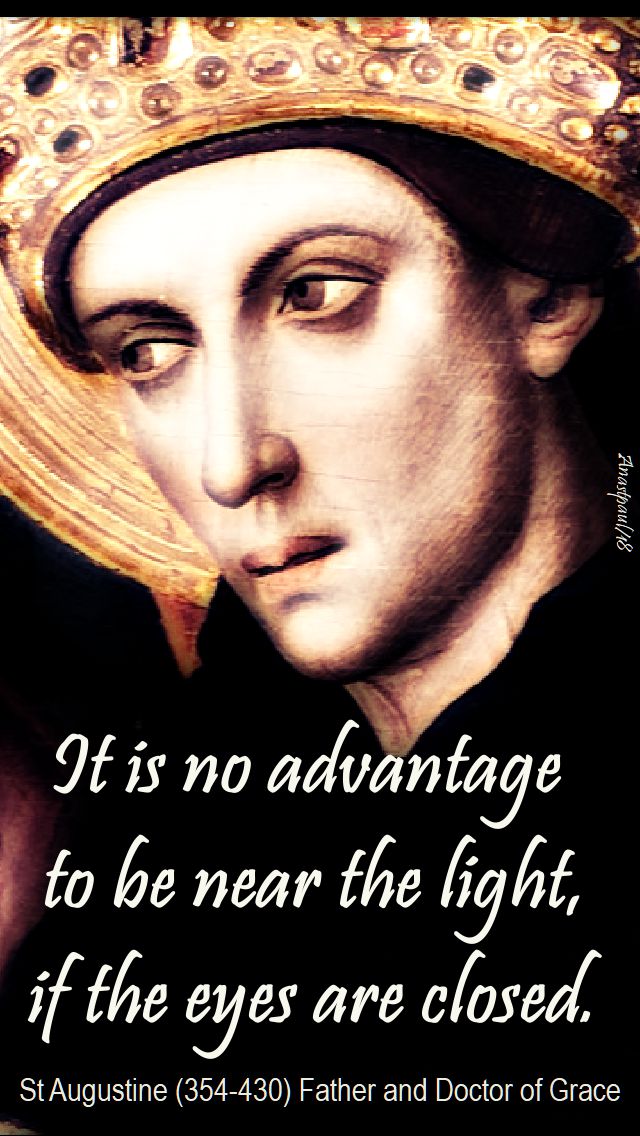
It is no advantage
to be near the light,
if the eyes are closed.it is no advantage - st augustine - 3 may 2018

Faith is to believe
what you do not see.
The reward of this faith,
is to see what you believe.faith is to believe what you do not see - st augustine - 3 may 2018

God provides the wind,
man must raise the sail.god provides the wind man must raise the sail - st augustine - 3 may 2018

God is always trying to give good things to us
but our hands are too full to receive them.

St Augustine (354-430) Father and Doctor of Gracegod is always trying - st augustine - 3 may 2018

Posted in CATECHESIS, EASTER, FEASTS and SOLEMNITIES, MORNING Prayers, ON the SAINTS, PAPAL MESSAGES, PAPAL SERMONS, QUOTES - J R R Tolkien and MORE, QUOTES on FAITH, QUOTES on LOVE, QUOTES on the CHURCH, SAINT of the DAY, The WORD

Thought for the Day – 25 April – Wednesday of the Fourth Week of Easter and the Feast of St Mark the Evangelist

Thought for the Day – 25 April – Wednesday of the Fourth Week of Easter and the Feast of St Mark the Evangelist

Today we celebrate St Mark, the Evangelist, the first Gospel writer and the friend of Sts Peter and Paul, the cousin of St Barnabas and our Father in faith – our friend too, a chosen member of the Catholic Church who has gone before to show us the way.   Mark knew there would be difficulties for believers in every age, for the persecution of the early Church was the beginning “of the labour pains” (13:8), since “the Gospel must first be preached to all nations” (13:10).   He has given us a moving story of how God works in mysterious ways and shown us in the actions of Jesus how to be patient in our faith even in the most troubling circumstances, for “he is going before you to Galilee; there you will see him as he told you” (16:7).   This narrative could only have been created by someone who himself knew suffering, the pain of unfulfilled hopes and the sorrow of untimely death.   His faith made him write about it.   His hope makes it so convincing!   Let us listen to Pope Benedict on being a Catholic today, now, in the world we live in!

Chosen:   I think it is worth reflecting on this word.   We are chosen.   God has always known us, even before our birth, before our conception, God wanted me as a Christian, as a Catholic, He wanted me as a priest.   God thought of me, He sought me among millions, among a great many, He saw me and He chose me.   It was not for my merits, which were non-existent but out of His goodness;  He wanted me to be a messenger of His choice, which is also always a mission, above all a mission and a responsibility for others.   Chosen: we must be grateful and joyful for this event.   God thought of me, he chose me as a Catholic, me, as a messenger of His Gospel, as a priest.   In my opinion it is worth reflecting several times on this and coming back to this fact of His choice;  He chose me, He wanted me, now I am responding.

Perhaps today we are tempted to say:  we do not want to rejoice at having been chosen, for this would be triumphalism.   It would be triumphalism to think that God had chosen me because I was so important.   This would really be erroneous triumphalism. However, being glad because God wanted me is not triumphalism.   Rather, it is gratitude and I think we should relearn this joy:  God wanted me to be born in this way, into a Catholic family, he wanted me to know Jesus from the first.   What a gift to be wanted by God so that I could know His face, so that I could know Jesus Christ, the human face of God, the human history of God in this world!   Being joyful because He has chosen me to be a Catholic, to be in this Church of His, where subsistit Ecclesia unica;  we should rejoice because God has given me this grace, this beauty of knowing the fullness of God’s truth, the joy of his love.

Chosen:  a word of privilege and at the same time of humility.   However “chosen” — as I said — is accompanied by the word “parepidemois”, exiles, foreigners.   As Christians we are dispersed and we are foreigners:  we see that Christians are the most persecuted group in the world today, because it does not conform, because it is a stimulus, because it opposes the tendencies to selfishness, to materialism and to all these things.

Christians are certainly not only foreigners; we are also Christian nations, we are proud of having contributed to the formation of culture, there is a healthy patriotism, a healthy joy of belonging to a nation that has a great history of culture and of faith.   Yet, as Christians, we are always also foreigners — the destiny of Abraham, described in the Letter to the Hebrews.   As Christians we are, even today, also always foreigners. In the work place Christians are a minority, they find themselves in an extraneous situation;  it is surprising that a person today can still believe and live like this.   This is also part of our life:  it is a form of being with the Crucified Christ, this being foreigners, not living in the way that everyone else lives, but living — or at least seeking to live — in accordance with His Word, very differently from what everyone says.   And it is precisely this that is characteristic of Christians.   They all say:  “But everyone does this, why don’t I?”   No, I don’t, because I want to live in accordance with God.   St Augustine once said:  “Christians are those who do not have their roots below, like tree, but have their roots above and they do not live this gravity in the natural downwards gravitation”.   Let us pray the Lord that he help us to accept this mission of living as exiles, as a minority, in a certain sense, of living as foreigners and yet being responsible for others and, in this way, reinforcing the goodness in our world.

This is faith:  touching Christ with the hand of faith, with our heart and thus entering into the power of His life, into the healing power of the Lord.   And let us pray the Lord, that we may touch Him more and more, so as to be healed.   Let us pray that He will not let us fall, that He too may take us by the hand and thus preserve us for true life….

LECTIO DIVINA” OF THE HOLY FATHER BENEDICT XVI

Chapel of the Seminary
Friday
, 8 February 2013

St Mark, Pray for us!st-mark-pray-for-us-25 april 2017


Posted in CATECHESIS, MORNING Prayers, PRACTISING CATHOLIC, PRAYERS for PRIESTS, PRAYERS for VARIOUS NEEDS, PRAYERS of the SAINTS, QUOTES of the SAINTS, QUOTES on the PRIESTHOOD

22 April – Vocations Sunday:  Catechism on the Priesthood

22 April – Vocations Sunday: Catechism on the Priesthood

Vocations Sunday 

Catechism on the Priesthood

by St John Vianney  (1786-1859) Patron of Priests

        My children, we have come to the Sacrament of Orders.   It is a Sacrament which seems to relate to no one among you and which yet relates to everyone. This Sacrament raises man up to God.   What is a priest!   A man who holds the place of God – a man who is invested with all the powers of God. “Go,” said Our Lord to the priest; “as My Father sent Me, I send you.   All power has been given Me in Heaven and on earth.   Go then, teach all nations….  He who listens to you, listens to Me; he who despises you despises Me.”   When the priest remits sins, he does not say, “God pardons you”; he says, “I absolve you.”   At the Consecration, he does not say, “This is the Body of Our Lord;” he says, “This is My Body.”

St Bernard tells us that everything has come to us through Mary and we may also say that everything has come to us through the priest; yes, all happiness, all graces, all heavenly gifts.   If we had not the Sacrament of Orders, we should not have Our Lord.   Who placed Him there, in that tabernacle?   It was the priest.   Who was it that received your soul, on its entrance into life?   The priest.   Who nourishes it, to give it strength to make its pilgrimage?   The priest. Who will prepare it to appear before God, by washing that soul, for the last time, in the blood of Jesus Christ?   The priest – always the priest. And if that soul comes to the point of death, who will raise it up, who will restore it to calmness and peace?   Again the priest. You cannot recall one single blessing from God without finding, side by side with this recollection, the image of the priest.

Go to confession to the Blessed Virgin, or to an angel; will they absolve you?   No.  Will they give you the Body and Blood of Our Lord?   No.   The Holy Virgin cannot make her Divine Son descend into the Host.   You might have two hundred angels there but they could not absolve you.   A priest, however simple he may be, can do it; he can say to you, “Go in peace; I pardon you.”   Oh, how great is a priest!   The priest will not understand the greatness of his office till he is in Heaven.   If he understood it on earth, he would die, not of fear but of love.

The other benefits of God would be of no avail to us without the priest.   What would be the use of a house full of gold, if you had nobody to open you the door!   The priest has the key of the heavenly treasures; it is he who opens the door;  he is the steward of the good God, the distributor of His wealth.   Without the priest, the Death and Passion of Our Lord would be of no avail.   Look at the heathens, what has it availed them that Our Lord has died?   Alas!   they can have no share in the blessings of Redemption, while they have no priests to apply His Blood to their souls!

The priest is not a priest for himself.   He does not give himself absolution, he does not administer the Sacraments to himself. He is not for himself, he is for you.   After God, the priest is everything.   Leave a parish twenty years without priests, they will worship beasts.   If the missionary Father and I were to go away, you would say, “What can we do in this church? there is no Mass, Our Lord is no longer there,we may as well pray at home.”   When people wish to destroy religion, they begin by attacking the priest, because where there is no longer any priest there is no sacrifice and where there is no longer any sacrifice there is no religion.

When the bell calls you to church, if you were asked, “Where are you going?” you might answer, “I am going to feed my soul.”           If someone were to ask you, pointing to the tabernacle, “What is that golden door?”  “That is our storehouse, where the true Food of our souls is kept.” “Who has the key?   Who lays in the provisions?   Who makes ready the feast, and who serves the table?”   “The priest.” “And what is the Food?”   “The precious Body and Blood of Our Lord.”   O God!   O God! how You have loved us!   See the power of the priest;   out of a piece of bread the word of a priest makes a God.   It is more than creating the world…. Someone said, “Does St Philomena, then, obey the Cure of Ars?”   Indeed, she may well obey him, since God obeys him.   If I were to meet a priest and an angel, I should salute the priest before I saluted the angel.   The latter is the friend of God but the priest holds His place.   St Teresa kissed the ground where a priest had passed.   When you see a priest, you should say, “There is he who made me a child of God and opened Heaven to me by holy Baptism;  he who purified me after I had sinned;  who gives nourishment to my soul.”   At the sight of a church tower, you may say, “What is there in that place?” “The Body of Our Lord.” “Why is He there?”   “Because a priest has been there, and has said holy Mass.”

What joy did the Apostles feel after the Resurrection of Our Lord, at seeing the Master whom they had loved so much! The priest must feel the same joy, at seeing Our Lord whom he holds in his hands.   Great value is attached to objects which have been laid in the drinking cup of the Blessed Virgin and of the Child Jesus, at Loreto.   But the fingers of the priest, that have touched the adorable Flesh of Jesus Christ, that have been plunged into the chalice which contained His Blood, into the pyx where His Body has lain, are they not still more precious?   The priesthood is the love of the Heart of Jesus.   When you see the priest, think of Our Lord Jesus Christ and thank Him!

“Christ’s invitation to the priesthood
is an invitation to a way of life
that is athletic in its intensity
and heroic in its form.”

Bishop Robert Barronchrist's invitation to the priesthood - bishop robert barron - 22 april 2018 - vocations sunday
PRAYER FOR PRIESTS
By St John Vianney

God, please give to Your Church today
many more priests after Your own heart.
May they be worthy representatives
of Christ the Good Shepherd.
May they wholeheartedly devote themselves
to prayer and penance;
be examples of humility and poverty;
shining models of holiness;
tireless and powerful preachers of the Word of God;
zealous dispensers of Your grace in the sacraments.
May their loving devotion to Your Son Jesus
in the Eucharist
and to Mary his Mother
be the twin fountains of fruitfulness for their ministry.
Amenprayer for priests by st john vianney - vocations sunday - 22 april 2018
St John Vianney, Pray for our Priests!
st-john-vianney-pray-for-our-priests.2017


Posted in CATECHESIS, MORNING Prayers, QUOTES of the SAINTS, QUOTES on the CHURCH, SAINT of the DAY

Thought for the Day – 15 April – The Third Sunday of Easter Year B and the Memorial of Blessed César de Bus (1544-1607)

Thought for the Day – 15 April – The Third Sunday of Easter Year B and the Memorial of Blessed César de Bus (1544-1607)

He was born in Cavillon, France, on 3 February 1544, the seventh of thirteen children. Though he had a good Jesuit education, he was a worldly young man who couldn’t decide between the career of a soldier and that of a writer.   In the end, he decided for the military.   It was the time of the bloody Wars of Religion in France, when it hung in the balance whether France would remain Catholic or become Protestant.   And yet, despite fighting in the Catholic cause, César himself led a life of dissipation:  he was known as a party boy, as a dandy, as one who wanted to make his way at the royal court in Paris.   He also still had literary ambitions.

Now César’s brother was a priest, a cathedral canon with a good income.   When his brother died, César succeeded in gaining the income from his late brother’s position without himself actually being a priest or doing anything in return for the income.   It was an abuse that often happened in Catholic France in those days:  a layman would hold a clerical position simply as a source of revenue.   Just in case you don’t know, the wasteful and worldly squandering of the Church’s goods is not exactly a new problem.   It was well-known and widely criticised in the 16th century, too.

But then something unexpected happened.  César had come to know an illiterate but very pious servant girl named Antoinette Reveillade.   This young woman had persuaded César to read to her the lives of the saints, even while Antoinette fervently and in tears begged God that death would not find César in mortal sin.   He at first shrugged off her concern.   Then, one night, as César was on his way to a masked ball, he passed a shrine where a light burned before the image of Our Lady.   Suddenly he remembered Antoinette and was stricken with remorse and felt an overwhelming desire to repent and amend his life.   He thought, “How can I recommend myself to God while I am on the way to offend Him?”   In the words of one of César’s biographers, “One tempestuous night, the All-powerful God, the King of Glory, encountered the worldly chevalier César de Bus, obstinate in sin, and conquered him.”   There and then, like St Paul on the road to Damascus, he was converted to Christ.

César resumed at last his studies for the priesthood and was ordained a priest at last in 1582 at the age of thirty-eight.   He read the life of the Catholic Reformer St Charles Borromeo and became convinced that widespread religious ignorance was the cause of many scandals and failures among French Catholics.   But César didn’t just complain or wring his hands:  he did something about it.

First, he converted his cousin Jean-Baptiste back to the Catholic faith. Jean-Baptiste had become a convinced Calvinist because of the impressive zeal and strictness shown by French Protestants, who so often put the Catholics to shame.   After Jean-Baptiste returned to the Church, he, too, was ordained a priest.   César and his cousin then dedicated the rest of their lives to the work of catechesis, founding an order for that purpose called the Fathers of Christian Doctrine and also a similar order for women. After his conversion, Blessed César directed his energies to two things:  penance for his earlier life and the teaching of doctrine.   And yet, it was actually an unlettered servant girl’s prayers that had led to the grace of his conversion.   This reminds us that it is only the love of God and of neighbour that can inspire the teaching of sound doctrine and make it fruitful in our lives.   And yet, true charity cannot be content that those whom Christ has redeemed by his Most Precious Blood should be ignorant of divine truth. Ignorance is not bliss, in religion or in anything else.

Blessed César died on 15 April 1607 and was beatified in 1975.   At the beatification, Pope Paul VI (who will soon be Canonised) had this to say about the parallels between our age and that of Blessed César:

“[Our time] is a period in which the world is in crisis, as formerly and in which most values, even the most sacred ones, are rashly questioned in the name of freedom, so that many people have no longer any point of reference, in a period in which danger comes certainly not from an excess of dogmatism but rather from the dissolution of doctrine and the nebulousness of thought… It seems to Us that an additional effort should be courageously undertaken to give the Christian people, who are waiting for it more than is thought, a solid, exact catechetical base, easy to remember.   We well understand that it is difficult today to adhere to the Faith, particularly for the young, a prey to so many uncertainties.   They have the right at least to know precisely the message of Revelation, which is not the fruit of research and to be the witnesses of a Church that lives by it.”

César de Bus had seen how religious divisions and social upheaval had devastated the faith of many.   Amid all the fighting about religion between Catholics and Protestants—and among French Catholics, too—, there was considerable neglect of the actual practice of the faith.

And, like that great saint, we can do something about the situation.   Think of that amazing story of Blessed César’s conversion and ask his intercession for a renewed zeal for the teaching of sound doctrine in our pulpits, our schools, and our catechetical programs.

In the words of the Letter to the Hebrews, let us “lift up our drooping hands and strengthen our weak knees” (Heb 12.12), for the Lord himself is calling us to work in His vineyard.   Blessed César de Bus, pray for us!
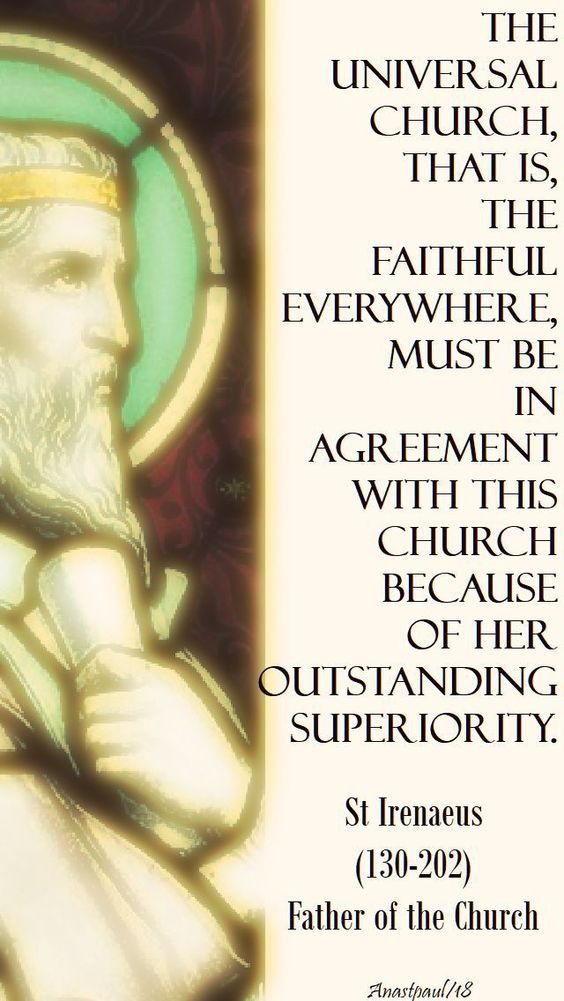
bl-cesar-de-bus-pray-for-us - 15 april 2017

The life of Blessed  César de Bus – https://anastpaul.wordpress.com/2017/04/15/saint-of-the-day-15-april-bl-cesar-de-bus/


Posted in CATECHESIS, EASTER, MORNING Prayers, QUOTES of the SAINTS, SUNDAY REFLECTIONS, The HOLY EUCHARIST / The HOLY MASS

Sunday Reflection – 15 April – The Third Sunday of Easter Year B

Sunday Reflection – 15 April – The Third Sunday of Easter Year B

“Christ wished to choose this sacred symbol of human life, which bread is, to make an even more sacred symbol of Himself.   He has transubstantitated it but has not taken away its expressive power – rather, He has elevated this expressive power to a new meaning, a higher meaning, a mystical, religious, divine meaning.   He has made of it a ladder for an ascent that transcends the natural level.
As a sound becomes a voice and as the voice becomes word, thought, truth – so that sign of the bread has passed from its humble and pious being to signify a mystery, it has become a Sacrament, it has acquired the power to demonstrate the Body of Christ present.”

Blessed Pope Paul VI (1897-1978) – when Archbishop of Milan from a homily on the Solemnity of Corpus Christias a sound becomes a voice - paul VI - 15 april 2018 - sunday reflection

Posted in CATECHESIS, DOCTORS of the Church, ON the SAINTS, PAPAL SERMONS, QUOTES of the SAINTS, SAINT of the DAY

Thought for the Day – 28 January – The Memorial of St Thomas Aquinas (1225-1274) Doctor angelicus (Angelic Doctor) and Doctor communis (Common Doctor)

Thought for the Day – 28 January – The Memorial of St Thomas Aquinas (1225-1274) Doctor angelicus (Angelic Doctor) and Doctor communis (Common Doctor)

Pope John Paul II, recalled that “the Church has been justified in consistently proposing St Thomas as a master of thought and a model of the right way to do theology” (n. 43).   It is not surprising that, after St Augustine, among the ecclesiastical writers mentioned in the Catechism of the Catholic Church, St Thomas is cited more than any other, at least 61 times!   He was also called the Doctor Angelicus, perhaps because of his virtues and, in particular, the sublimity of his thought and the purity of his life.

The last months of Thomas’ earthly life remain surrounded by a particular, I would say, mysterious atmosphere.   In December 1273, he summoned his friend and secretary Reginald to inform him of his decision to discontinue all work because he had realised, during the celebration of Mass subsequent to a supernatural revelation, that everything he had written until then “was worthless”.   This is a mysterious episode that helps us to understand not only Thomas’ personal humility but also the fact that, however lofty and pure it may be, all we manage to think and say about the faith is infinitely exceeded by God’s greatness and beauty which will be fully revealed to us in Heaven.

The life and teaching of St Thomas Aquinas could be summed up in an episode passed down by his ancient biographers.   While, as was his wont, the Saint was praying before the Crucifix in the early morning in the chapel of St Nicholas in Naples, Domenico da Caserta, the church sacristan, overheard a conversation.   Thomas was anxiously asking whether what he had written on the mysteries of the Christian faith was correct.   And the Crucified One answered him:  “You have spoken well of me, Thomas. What is your reward to be?”.   And the answer Thomas gave him was what we too, friends and disciples of Jesus, always want to tell him:  “Nothing but Yourself, Lord!”…Pope Benedict XVI – First in the series of Catechesis on St Thomas Aquinas – 2 June 2010

 “Nothing but Yourself, Lord!”

St Thomas Aquinas, pray for us!st thomas aquinas - pray for us - 28 jan 2018


Posted in ADVENT, CATECHESIS, DOCTORS of the Church, EUCHARISTIC Adoration, FATHERS of the Church, MORNING Prayers, QUOTES of the SAINTS, QUOTES on CHARITY, The HOLY EUCHARIST / The HOLY MASS

Quote/s of the Day – 7 December – The Memorial of St Ambrose (c 340-397)- Father and Doctor of the Church

Quote/s of the Day – 7 December – The Memorial of St Ambrose (c 340-397)- Father and Doctor of the Church

“The Church of the Lord is built upon the rock
of the apostles among so many dangers in the world;
it therefore remains unmoved.
The Church’s foundation is unshakable and firm
against assaults of the raging sea.
Waves lash at the Church but do not shatter it.
Although the elements of this world, constantly beat
upon the Church with crashing sounds,
the Church possesses the safest harbour
of salvation for all in distress.”

the church of the lord - st ambrose - 7 dec 2017

“Rise, you who were lying fast asleep…
Rise and hurry to the Church:
here is the Father,
here is the Son,
here is the Holy Spirit.”

rise you who were lying fast asleep - st ambrose - my pic 2017

“It is a better thing
to save souls for the Lord,
than to save treasures.
He who sent forth
His apostles without gold,
He had not need of gold
to form His Church.
The Church possesses gold,
not to hoard
but to scatter abroad
and come to the aid
of the unfortunate.”

it is a better thing - st ambrose - 7 dec 2017

“When we speak about WISDOM,
we are speaking about CHRIST.
When we speak about VIRTUE,
we are speaking about CHRIST.
When we speak about JUSTICE,
we are speaking about CHRIST.
When we speak about PEACE,
we are speaking about CHRISTt.
When we speak about TRUTH,
and LIFE and REDEMPTION,
we are speaking about CHRIST.”

when we speak - st ambrose - 7 dec 2017

“If it is “daily bread,” why do you take it once a year? . . .
Take daily what is to profit you daily.
Live in such a way that you may deserve
to receive it daily.
He who does not deserve to receive it daily,
does not deserve to receive it once a year.”

if it ias daily - st ambrose - 7 dec 2017

“Let your door stand open
to receive Him,
unlock your soul to Him,
offer Him a welcome in your mind
and then you will see
the riches of simplicity,
the treasures of peace,
the joy of grace.
Throw wide the gate of your heart,
stand before the sun of the everlasting light.”

let your door stand open - st ambrose - 7 dec 2017

“…He, who forgave all, required of all,
that what every one remembers
to have been forgiven to himself,
he also should forgive others.”

“The devil tempts, that he may ruin;
God tests, that He may crown.”

“The rich man who gives to the poor
does not bestow alms but pays a debt.”

“Therefore, let your words be rivers, clean and limpid,
so that you may charm the ears of people.
And by the grace of your words win them over
to follow your leadership.
…. That is, let the meaning of your words shine forth,
let understanding blaze out.
Let no word escape your lips in vain or be uttered,
without depth of meaning.”  from a letter by Saint Ambrose

St Ambrose (c 340-397)- Father and Doctor of the Church

he, who forgave all - st ambrose - 7 dec 2017

Posted in CATECHESIS, CATHOLIC Quotes, DOCTORS of the Church, MORNING Prayers, QUOTES of the SAINTS, SAINT of the DAY, The HOLY CROSS, The HOLY EUCHARIST / The HOLY MASS

Quote/s of the Day – 10 November – The Memorial of St Pope Leo the Great (c400-461) Doctor of the Church

Quote/s of the Day – 10 November – The Memorial of St Pope Leo the Great (c400-461) Doctor of the Church

“Peter has spoken by the mouth of Leo.”

“Those who are not good to others
are bad to themselves.”

“PEACE is the first thing the angels sang.
PEACE is the mark of the children of God.
PEACE is the nurse of love.
PEACE is the mother of unity.
PEACE is the rest of the blessed souls.
PEACE is the dwelling place of eternity.”

“The faith of those who LIVE
their faith is a serene faith.
What you long for will be given you;
what you love will be yours for ever.”quotes of st pope leo the great - peter has spoken - 10 nov 2017

“Our sharing in the Body and Blood of Christ
has no other purpose than to transform us
into that which we receive.”our sharing in the body - st leo - 10 nov 2017

“God decreed that all nations should be saved in Christ.
Dear friends, now that we have received instruction
in this revelation of God’s grace, let us celebrate
with spiritual joy the day of our first harvesting,
of the first calling of the Gentiles.
Let us give thanks to the merciful God,
“who has made us worthy,” in the words of the Apostle,
“to share the position of the saints in light;
who has rescued us from the power of darkness
and brought us into the kingdom of this beloved Son.”
This came to be fulfilled, as we know, from the time
when the star beckoned the three wise men
out of their distant country and led them to recognise
and adore the King of heaven and earth.
The obedience of the star calls us
to imitate its humble service:
to be servants, as best we can,
of the grace that invites all men to find Christ.”god decreed - st leo the great - 10 nov 2017

“The cross of Christ is the true ground
and chief cause of Christian hope.”

“Let no one be ashamed of the cross
by which Christ has redeemed the world.
None of us must be afraid to suffer
for the sake of justice or doubt the
fulfillment of the promises,
for it is through toil that we come to rest
and through death that we pass to life.”

“By Baptism we are made flesh of the Crucified.”by baptism - st leo the great - quotes on the cross - 10 nov 2017

“No-one, however weak, is denied
a share in the victory of the cross.
No-one is beyond the help
of the prayer of Christ.”no-one however weak - st pope leo - 10 nov 2017

St Pope Leo the Great (c400-461) Doctor of the Church

Posted in ArchAngels and Angels, CATECHESIS, DOCTORS of the Church, FEASTS and SOLEMNITIES, MORNING Prayers, SAINT of the DAY, The WORD, Uncategorized

Thought for the Day – 29 September – The Feast of Sts Michael, Gabriel and Raphael

Thought for the Day – 29 September – The Feast of Sts Michael, Gabriel and Raphael

We are celebrating the Feast of the three Archangels who are mentioned by name in Scripture: Michael, Gabriel and Raphael.   But what is an Angel?   Sacred Scripture and the Church’s tradition enable us to discern two aspects.

On the one hand, the Angel is a creature who stands before God, oriented to God with his whole being.   All three names of the Archangels end with the word “El”, which means “God”.   God is inscribed in their names, in their nature.
Their true nature is existing in His sight and for Him.   In this very way the second aspect that characterizes Angels is also explained:  they are God’s messengers.   They bring God to men, they open heaven and thus open earth.  Precisely because they are with God, they can also be very close to man.

Like an angel to others
Indeed, God is closer to each one of us than we ourselves are.   The Angels speak to man of what constitutes his true being, of what in his life is so often concealed and buried. They bring him back to himself, touching him on God’s behalf.   In this sense, we human beings must also always return to being angels to one another – angels who turn people away from erroneous ways and direct them always, ever anew, to God.
If the ancient Church called Bishops “Angels” of their Church, she meant precisely this: Bishops themselves must be men of God, they must live oriented to God. “Multum orat pro populo” – “Let them say many prayers for the people”, the Breviary of the Church says of holy Bishops.   The Bishop must be a man of prayer, one who intercedes with God for human beings.   The more he does so, the more he also understands the people who are entrusted to him and can become an angel for them – a messenger of God who helps them to find their true nature by themselves, and to live the idea that God has of them.

St Michael:  making a space for God in the world
All this becomes even clearer if we now look at the figures of the three Archangels whose Feast the Church is celebrating today.  First of all there is Michael.   We find him in Sacred Scripture above all in the Book of Daniel, in the Letter of the Apostle St Jude Thaddeus and in the Book of Revelation.

Two of this Archangel’s roles become obvious in these texts.   He defends the cause of God’s oneness against the presumption of the dragon, the “ancient serpent”, as John calls it.   The serpent’s continuous effort is to make men believe that God must disappear so that they themselves may become important;   that God impedes our freedom and, therefore, that we must rid ourselves of him.

However, the dragon does not only accuse God.   The Book of Revelation also calls it “the accuser of our brethren…, who accuses them day and night before our God” (12: 10). Those who cast God aside do not make man great but divest him of his dignity.   Man then becomes a failed product of evolution.   Those who accuse God also accuse man. Faith in God defends man in all his frailty and short-comings:  God’s brightness shines on every individual.   It is the duty of the Bishop and of every christian, as a man of God, to make room in the world for God, to counter the denials of Him and thus to defend man’s greatness.   And what more could one say and think about man than the fact that God Himself was made man?   Michael’s other role, according to Scripture, is that of protector of the People of God (cf. Dn 10: 21; 12: 1).
Dear friends, be true “guardian angels” of the Church which will be entrusted to you! Help the People of God whom you must lead in its pilgrimage to find the joy of faith and to learn to discern the spirits: to accept good and reject evil, to remain and increasingly to become, by virtue of the hope of faith, people who love in communion with God-Love.

St Gabriel: God who calls
We meet the Archangel Gabriel especially in the precious account of the annunciation to Mary of the Incarnation of God, as Luke tells it to us (1: 26-38).   Gabriel is the messenger of God’s Incarnation.   He knocks at Mary’s door and, through him, God himself asks Mary for her “yes” to the proposal to become the Mother of the Redeemer, of giving her human flesh to the eternal Word of God, to the Son of God.   The Lord knocks again and again at the door of the human heart.   In the Book of Revelation He says to the “angel” of the Church of Laodicea and, through him, to the people of all times:  “Behold, I stand at the door and knock; if any one hears my voice and opens the door, I will come in to him and eat with him, and he with me” (3: 20).   The Lord is at the door – at the door of the world and at the door of every individual heart.   He knocks to be let in, the Incarnation of God, His taking flesh, must continue until the end of time.  All must be reunited in Christ in one body –  the great hymns on Christ in the Letters to the Ephesians and to the Colossians tell us this. Christ knocks.   Today too He needs people who, so to speak, make their own flesh available to Him, give Him the matter of the world and of their lives, thus serving the unification between God and the world, until the reconciliation of the universe.   Dear friends, it is your task to knock at people’s hearts in Christ’s Name.   By entering into union with Christ yourselves, you will also be able to assume Gabriel’s role: to bring Christ’s call to men.

St Raphael: recovering sight
St Raphael is presented to us, above all in the Book of Tobit, as the Angel to whom is entrusted the task of healing.   When Jesus sends His disciples out on a mission, the task of proclaiming the Gospel is always linked with that of healing.   The Good Samaritan, in accepting and healing the injured person lying by the wayside, becomes without words a witness of God’s love.   We are all this injured man, in need of being healed.   Proclaiming the Gospel itself already means healing in itself, because man is in need of truth and love above all things.

The Book of Tobit refers to two of the Archangel Raphael’s emblematic tasks of healing. He heals the disturbed communion between a man and a woman.  He heals their love. He drives out the demons who over and over again exhaust and destroy their love.   He purifies the atmosphere between the two and gives them the ability to accept each other for ever.   In Tobit’s account, this healing is recounted with legendary images.

In the New Testament, the order of marriage established in creation and threatened in many ways by sin, is healed through Christ’s acceptance of it in His redeeming love.   He makes marriage a sacrament:  His love, put on a cross for us, is the healing power which in all forms of chaos offers the capacity for reconciliation, purifies the atmosphere and mends the wounds.   The priest is entrusted with the task of leading men and women ever anew to the reconciling power of Christ’s love.  He must be the healing “angel” who helps them to anchor their love to the sacrament and to live it with an ever renewed commitment based upon it.

Secondly, the Book of Tobit speaks of the healing of sightless eyes. We all know how threatened we are today by blindness to God.   How great is the danger that with all we know of material things and can do with them, we become blind to God’s light.   Healing this blindness through the message of faith and the witness of love is Raphael’s service, entrusted day after day to the priest and in a special way to the Bishop.   Thus, we are prompted spontaneously also to think of the Sacrament of Reconciliation, the Sacrament of Penance which in the deepest sense of the word is a sacrament of healing.   The real wound in the soul, in fact, the reason for all our other injuries, is sin.   And only if forgiveness exists, by virtue of God’s power, by virtue of Christ’s love, can we be healed, can we be redeemed.

“Abide in my love”, the Lord says to us today in the Gospel (Jn 15: 9).   At the moment of your Episcopal Ordination he says so particularly to you, dear friends.   Abide in His love!   Abide in that friendship with Him, full of love, which He is giving you anew at this moment!   Then your lives will bear fruit, fruit that abides (cf. Jn 15: 16).   Let us all pray for you at this time, dear Brothers, so that this may be granted to you. Amen.

Benedict XVI, fragments of a homily (to Bishops) given on September 29, 2007

Sts Michael, Gabriel and Raphael, pray for us!

holy archangels - pray for us.2