Posted in DIVINE Mercy, Goodness, Patience, DOCTORS of the Church, DOMINICAN OP, GOD ALONE!, Our MORNING Offering, PRAYERS of the SAINTS, Quote on SELF-ABANDONMENT, QUOTES on HUMILITY, QUOTES on OBEDIENCE, QUOTES on SELF-DENIAL, Quotes Self-Oblation, The WILL of GOD

Our Morning Offering – 7 March – O Merciful God By St Thomas Aquinas

Our Morning Offering – 7 March – The Feast of St Thomas Aquinas (1225-1274) Doctor Angelicus, Doctor Communis

O Merciful God
By St Thomas Aquinas (1225-1274)
Doctor Angelicus
Doctor Communis

O merciful God,
grant that I may ever perfectly
do Thy Will in all things.
Let it be my ambition to work

only for Thy honour and glory.
Let me rejoice in nothing
but that which leads to Thee,
nor grieve for anything,
which leads away from Thee.
May all passing things be as nothing in my eyes
and may all which is Thine be dear to me
and Thou, my God, dear above them all.
May all joy be meaningless without Thee
and may I desire nothing apart from Thee.
May all labour and toil delight me, when it is for Thee.
Make me, O Lord, obedient without complaint,
poor without regret,
patient without murmur,
humble without pretence,
joyous without frivolity,
and truthful without disguise.
Amen

Posted in DECEMBER - The DIVINE INFANCY and The IMMACULATE CONCEPTION, HOLY WEEK, IMMACULATE CONCEPTION Prayers and Novena, LENT 2026, QUOTES on CONSCIENCE, QUOTES on the CHURCH, The IMMACULATE CONCEPTION, The PASSION, The SEVEN PASSION Feasts, Thomas Aquinas

Friday of the Second Week of Lent – 6 March – Our Lenten Journey With St Thomas Aquinas – Feast of the Holy Winding Sheet (the Shroud)

Friday of the Second Week of Lent – 6 March – Our Lenten Journey With St Thomas Aquinas (1225-1274) Doctor of the Church

Friday of the Second Week
Feast of the Holy Winding Sheet (the Shroud)

Joseph taking the Body, wrapped It in a clean linen cloth and laid It in his own new monument.
Matthew xxvii. 59

By this clean linen cloth three elements are signified in a hidden way, namely:

(i) The Pure Body of Christ.
For the cloth was made of linen which, by much pressing, is made white and,in like manner, it was after much pressure that the Body of Christ came to the brightness of the Resurrection.
Thus it behoved Christ to Suffer and to Rise again from the dead on the third day (Luke xxiv. 46).

(ii) The Church, which without spot or wrinkle (Eph v. 27), is signified by this linen woven out of many threads.

(iii) A clear conscience, where Christ reposes.

And laid Him in his own new monument.
It was Joseph’s own grave and certainly it was appropriate that He Who had Died for the sins of others, should be buried in another man’s grave!

Notice that it was a new grave.
Had other bodies already been laid in it, there might have been a doubt which had arisen.
There is another fitness in this circumstance, namely – He Who was buried in this new tomb, as He who was born of a virgin mother.

As Mary’s womb knew no child before Him nor after Him, so was it with this tomb.
Again we may understand, it is in a renewed soul renewed where Christ is buried by faith, where Christ may dwell by faith in our hearts (Eph iii. 17).

St. John’s Gospel adds, Now there was in the place where He was crucified, a garden ; and in the garden a new sepulchre (John xix. 41). Which recalls to us that as Christ was taken in a garden and suffered His agony in a garden, so in a garden was He buried, and thereby we are reminded that it was from the sin committed by Adam in the garden of delightfulness that, by the power of His Passion, Christ set us free, and also that through the Passion the Church was consecrated, the Church which again is as a garden closed.

ST THOMAS AQUINAS (1225-1274)
Priest, Theologian, Dominican
Doctor Angelicus (Angelic Doctor)
Doctor Communis (Common Doctor)
Added by Pope Saint Pius V in 1568

Posted in DOCTORS of the Church, FATHERS of the Church, MEDITATIONS - ANTONIO CARD BACCI, QUOTES on CHILDREN, QUOTES on GOOD WORKS, QUOTES on GRACE, QUOTES on HUMILITY, QUOTES on REPENTANCE, QUOTES on SIMPLICITY, QUOTES on SIN, QUOTES on TEMPTATION, St Francis de Sales

Quote/s of the Day – 6 March – ‘… A HATRED for nothing but SIN…’

Quote/s of the Day – 6 March – Friday of the Second Week in Lent and the Feast of the Holy Shroud – Ecclesiasticus
Sir ach51:1-8; 51:12 – Matthew 21:33-46.– Scripture search here: https://www.drbo.org/

He will bring those evil men
to an evil end

Matthew 21:41

Little children follow and obey their father.
They love their mother.
They know nothing of covetousness,
ill-will, bad temper, arrogance and lying.
This state of mind opens the road to Heaven.
To imitate our Lord’s own humility,
we must return to the simplicity
of God’s little ones.

St Hilary (315-368)
Father and Doctor of the Church

Let us then depart, let us depart from Egypt,
let us approach Our Lord,
let us make provision of good works;
let the feet of our affections be bare,
let us clothe ourselves with innocence,
let us not be satisfied with crying for mercy,
let us go forth from Egypt, let us delay no longer.
The hour is come to arise from sleep,
since we know that He receives sinners;
the Angels await our repentance,
the Saints pray for it
!”

St Francis de Sales 91567-1622)
Doctor of the Church

There is a golden rule which we should always remember
as it will be helpful to us in fighting temptation
and in resisting discouragement.
It is simply this:
As long as we implore God’s grace
and do all we can and ought, in order to withstand
the onslaught of temptation, God will do the rest!
If God, nevertheless, allows us to fall,
this will be in order to humble us
and to make us understand,
more clearly that we can do nothing without Him.

Antonio Cardinal Bacci (1881-1971)

Posted in LENT 2026, Our MORNING Offering, PRAYERS of the SAINTS, QUOTES on the CROSS of CHRIST, The HOLY CROSS, The PASSION

Our Morning Offering – 6 March – The Feast of the Holy Shroud of Jesus

Our Morning Offering – 6 March – The Feast of the Holy Shroud of Jesus

Faithful Cross! Above All Other
By St Venantius Fortunatus (c 530 – c 609)

Faithful Cross! above all other,
one and only noble tree!
None in foliage, none in blossom,
none in fruit thy peer may be;
sweetest wood and sweetest iron,
sweetest weight is hung on thee.

Bend thy boughs, O tree of glory!
Thy relaxing sinews bend;
for awhile the ancient rigour
that thy birth bestowed, suspend
and the King of heavenly beauty
gently on thine arms extend.

Praise and honour to the Father,
praise and honour to the Son,
praise and honour to the Spirit,
ever Three and ever One:
One in might and One in glory
while eternal ages run.

Posted in LENT 2026, QUOTES on SACRIFICE, The PASSION, Thomas Aquinas

Thursday of the Second Week of Lent – 5 March – Our Lenten Journey With St Thomas Aquinas – That the Passion of Christ brought about its effect because it was a Sacrifice

Thursday of the Second Week of Lent – 5 March – Our Lenten Journey With St Thomas Aquinas (1225-1274) Doctor of the Church

Thursday of the Second Week
That the Passion of Christ brought about its effect
because it was a Sacrifice

A sacrifice, properly so called, is something done to render God the honour specially due to Him, in order to appease Him. St Augustine teaches this, saying, “Every work done in order that we may, in a holy union, cleave to God, is a true sacrifice; every work, that is to say, related to that final Good Whose possession alone can make us truly happy.”
Christ in the Passion offered Himself for us and it was just this circumstance – that He offered Himself wllingly which was to God the most precious thing of all, since the willingness came from the greatest possible Love. Whence it is evident, the Passion of Christ was a real Sacrifice.

And as He Himself adds later.
The former sacrifices of the saints were so many signs, of different kinds, of this One True Sacrifice. …
St Augustine speaks of four elements being found in every sacrifice, namely – Christ in the Passion offered Himself for us and it was just a person to whom the offering is made, one by whom it is made, the thing offered and those on whose behalf it is offered.
These are all found in the Passion of Our Lord. It is the same Person, the only, true Mediator Himself, Who through the sacrifice of peace reconciles us to God, yet remains One with Him to Whom He offers, those for whom He offers and is Himself One Who both offers and is offered.

It is true in those sacrifices of the old law which were types of Christ, human flesh was never offered but, it does not follow from this that the Passion of Christ was not a sacrifice.
For although the reality and that which typifies it must coincide in one point, it is not necessy that they coincide in every point, for the reality must go beyond that which typifies it.
It was then very fitting that the Sacrifice in which the Flesh of Christ is offered for us was typified by a sacrifice not of the flesh of man but of other animals, to fores-shadow the flesh of Christ which is the Most Perfect Sacrifice of all.

(i) Because, since it is the flesh of human nature which is offered, it is a thing fittingly offered for men and fittingly received by men in a Sacrament.

(ii) Because, since the Flesh of Christ was able to Suffer and to Die it was suitable for immolation.

(iii) Because, since that Flesh was itself without sin, it had a power to cleanse from sin.

(iv) Because, being the Flesh of the very Offerer, it was acceptable to God by reason of the unspeakable Love of the One Who was offering His Own Flesh.

Whence St Augustine says, “What is there more suitably received by men, of offerings made on their behalf, than human flesh and what is so suitable for immolation as mortal flesh? And what is as clean for cleansing mortal viciousness, as that flesh born, without stain of carnal desire, in the womb and of the womb of a virgin?
And what can be so graciously offered and received, as the Flesh of our Sacrifice, the Body so produced of our Priest?”

ST THOMAS AQUINAS (1225-1274)
Priest, Theologian, Dominican
Doctor Angelicus (Angelic Doctor)
Doctor Communis (Common Doctor)

Added by Pope Saint Pius V in 1568

Posted in AUGUSTINIANS OSA, CHRIST the WORD and WISDOM, DOCTORS of the Church, FATHERS of the Church, franciscan OFM, GOD ALONE!, LENT 2026, Of BEGGARS, the POOR, against POVERTY, QUOTES on ALMS, QUOTES on ETERNAL LIFE, QUOTES on GREED, WEALTH, QUOTES on HEAVEN, QUOTES on HUMILITY, QUOTES on SANCTITY, QUOTES on SUFFERING, QUOTES on the POOR, The HEART, The WORD

Quote/s of the Day – 5 March – ‘ … Give earth and receive Heaven! …’

Quote/s of the Day – 5 March – Ferial Day – Thursday of the Second Week in Lent – Jeremias 17:5-10 – Luke 16:19-31 – Scripture search here: https://www.drbo.org/

There was a rich man,
who was clothed in purple
and fine linen
and who feasted sumptuously everyday.
And at his gate lay a poor man,
named Lazarus
…”

Luke 16:19–20

Amen I say to you,
as long as you did NOT do it
for one of these least ones,
you did NOT do it for Me.

Matthew 25:45

Give of your earthly goods
and receive eternal ones;
give earth and receive Heaven
!”

St Augustine (354-430)
Father and Doctor of the Church

What is a man’s treasure
but the heaping up of profits
and the fruit of his toil?
For, whatever a man sows,
this too will he reap and each man’s gain,
matches his toil and where delight
and enjoyment are found,
there the heart’s desire is attached.
Now, there are many kinds of wealth
and a variety of grounds for rejoicing –
every man’s treasure is that, which he desires.
If it is based on earthly ambitions,
its acquisition makes men not blessed but wretched.
… By distributing what might be superfluous
to support the poor, they are amassing
imperishable riches, so that what they have
discreetly given, cannot be subject to loss.
They have properly placed those riches,
where their heart is – it is a most blessed thing,
to work to increase such riches,
rather than to fear that they may pass away.

St Pope Leo the Great (400-461)
ather and Doctor of the Church

If thou wouldst see well, pluck out thine eyes and be blind;
if thou wouldst hear well, be deaf
and if thou wouldst speak well, become dumb;
if thou wouldst advance, stand still
and advance with thy mind;
if thou wouldst work well, cut off thy hands
and work with thy heart;
if thou wouldst love much, hate thyself;
if thou wouldst live well, mortify thyself;
if thou wouldst gain much and be rich,
first lose all and become poor
and if thou wouldst enjoy peace, afflict thyself
and be ever in fear and suspect thine own self;
if thou wouldst be exalted and have great honour,
humble and abase thyself;
if thou wouldst be held in great reverence, despise thyself
and do reverence to him who reviles thee;
if thou wouldst that it should be well with thee,
suffer all evil things and if thou wouldst be blessed,
desire that all should speak ill of thee
and if thou wouldst have true and eternal rest,
then toil and suffer and desire to have every temporal affliction.
O what great wisdom it is to know how to do
and to work out these things.”

Blessed Giles of Assisi (c1190-1262)

Posted in GOD the FATHER, Our MORNING Offering, PRAYERS for VARIOUS NEEDS, PRAYERS of PETITION, QUOTES for CHRIST, QUOTES on SELF-DENIAL, Quotes Self-Oblation, St Francis de Sales, The PASSION

Our Morning Offering – 5 March – Daily Morning Prayer Of St Francis de Sales

Our Morning Offering – 5 March – Thursday of the Second Week of Lent

Daily Morning Prayer
Of St Francis de Sales (1567-1622)
Doctor Caritatis

Lord, I lay before Thee my weak heart,
which Thou fills with good desires.
Thou knows that I am unable
to bring the same to good effect,
unless Thou bless and prosper them
and, therefore, O Loving Father,
I entreat Thee to help me
by the merits and Passion of Thy dear Son,
to Whose honour I would devote this day
and my whole life.
Amen

Posted in LENT 2026, REDEMPTIVE Suffering, The MOST HOLY REDEEMER, Our SAVIOUR, The PASSION, The REDEMPTION, Thomas Aquinas

Wednesday of the Second Week of Lent – 4 March – Our Lenten Journey With St Thomas Aquinas The Passion of Christ brought about our Salvation because it was an Act of Satisfaction

Wednesday of the Second Week of Lent – 4 March – Our Lenten Journey With St Thomas Aquinas (1225-1274) Doctor of the Church

Wednesday of the Second Week
The Passion of Christ brought about our Salvation
because it was an Act of Satisfaction

He is the propitiation for our sins and not for ours alone but also for those of the whole world.
I John ii. 2.

Satisfaction for offences ,is truly made, when there is offered ,to the person offended, something which he loves as much as, or more than, he hates the offences.

Christ, however, by Suffering through His Love and through His Obedience, offered to God something greater by far than the satisfaction needed by all the sins of all mankind and this for three reasons.

In the first place, there was the greatness of the Love which moved Him to Suffer.
Then there was the worth of the Life which He laid down in satisfaction, the Life of God and Man.
Finally, on account of the way in which His Passion involved every part of His Being and of the greatness of the Suffering he undertook.
So it is that the Passion of Christ was not merely sufficient but superabundant as a satisfaction for man’s sins.

It would seem indeed to be the case that satisfaction should be made by the person who committed the offence. But Head and Members are, as it were, One Mystical Person and, therefore, the satisfaction made by Christ avails all the faithful as they are the Members of Christ. One man can always make satisfaction for another, as long as the two are one in charity.

  1. Although Christ, by His Death, made sufficient Satisfaction for Original Sin, it is not unfitting that the penal consequences of Original Sin should still remain even in those who are made sharers in Christ’s Redemption.
    This has been done fittingly and usefully, so that the penalties remain even though the guilt has been removed.

(i) It has been done so that there might be conformity between the faithful and Christ, as there is conformity between members and Head. Just as Christ, first of all, suffered many pains and came in this way to His Glory, so it is only right that His faithful should also first be subjected to sufferings and thence enter into immortality themselves, bearing as it were, the livery of the Passion of Christ so as to enjoy a glory somewhat like to His.

(ii) A second reason is that if men coming to Christ were straightaway freed from suffering and the necessity of death, only too many would come to Him attracted rather by these temporal advantages than by spiritual virtues.
And this would be altogether contrary to the intention of Christ, Who came into this world that He might convert men from a love of temporal advantages and win them to spiritual love and virtue.

(iii) Finally, if those who came to Christ were straightaway rendered immortal and impassible, this would, in a certain way compel men to receive the Faith of Christ and, therefore, the merit of believing would be lessened.

ST THOMAS AQUINAS (1225-1274)
Priest, Theologian, Dominican
Doctor Angelicus (Angelic Doctor)
Doctor Communis (Common Doctor)

Added by Pope Saint Pius V in 1568

Posted in CHRIST the JUDGE, QUOTES on DEATH, QUOTES on PERSECUTION, QUOTES on the DEVIL/EVIL, QUOTES on WATCHING, The O ANTIPHONS, The SECOND COMING

Quote/s of the Day – 4 March – “Watch” over your life. …

Quote/s of the Day – 4 March – “The Month of St Joseph” – Sirach 31:8-11 – Luke 12:35-40 – Scripture search here: https://www.drbo.org/

“Be vigilant at all times and pray,
that you have the strength
to escape the tribulations that are imminent
and to stand before the Son of Man
…”

Luke 21:36

“Watch” over your life. …
Sheep will turn into wolves
and love into hatred.
With the increase of iniquity,
people will hate, persecute
and betray each other.
Then the world deceiver
will appear in the disguise of God’s Son.
He will work “signs and wonders
and the earth will fall into his hands.
He will commit outrages
such as have never occurred before.
Then humankind will come
to the “fiery trial
and many will fall away” and perish.”

Unknown 1st Century Author
of this early Treatise (Didache, 16)

Give me grace,
to amend my life
and to have an eye to mine end,
without grudge of death,
which, to them,
who die in You,
good Lord,
is the gate of a wealthy life.

St Thomas More (1478-1535)
Martyr

Posted in LENT 2026, Quotes on SALVATION, The PASSION, Thomas Aquinas

Tuesday of the Second Week of Lent – 3 March – Our Lenten Journey With St Thomas Aquinas – The Passion of Christ brought about our Salvationbecause it was a Meritorious Act

Tuesday of the Second Week of Lent – 3 March – Our Lenten Journey With St Thomas Aquinas (1225-1274) Doctor of the Church

Tuesday of the Second Week
The Passion of Christ brought about our Salvation
because it was a Meritorious Act

They shall deliver Him to the Gentiles
to be Mocked and Scourged and Crucified.

Matt xx. 19

Grace was given to Christ not only as to a particular person but also, as far as He is the Head of the Church, in order that the Grace might pass from Him to His Members. And the good works Christ performed, therefore, stand in this same way in relationship to Him and to His Members, as the good works of any other man in a State of Grace relate to himself.

Now it is evident that any man who, in a State of Grace, suffers for justice, merits for himself, by this very fact alone, salvation.
As is said in the Gospel, “Blessed are they who suffer persecution for justice sake” (Matt v. 10).
Whence Christ, by His Passion, merited Salvation, not only for Himself but for all His Members.

Christ, indeed, from the very instant of His conception, merited eternal Salvation for us.
But there still remained certain obstacles on our part, obstacles which kept us from possessing ourselves of the effect of what Christ had merited. Wherefore, in order to remove these obstacles, it behoved Christ to Suffer (Luke xxiv. 46).

Now although the love of Christ for us was not increased in the Passion and was not greater in the Passion than before it, the Passion of Christ had a certain effect which His previous meritorious activity did not.
The Passion produced this effect, not on account of any greater Love shown thereby but because, it was an action designed to produce that effect, as is evident from what has already been said on the fitness of the Passion of Christ.

Head and Members belong to One and the same Person. Now Christ is our Head, according to His Divinity and to the fullness of His Grace which overflows upon others too. We are His Members.
What Christ then meritoriously acquires, is not something external and foreign to us but, by virtue of the unity of the Mystical Body, it overflows upon us too.

We should know too, that although Christ, by His Death acquired merit sufficient for the whole human race, there are special elements needed for the particular Salvation of each individual soul and these each soul must itself seek out. The Death of Christ is, as it were, the cause of all Salvation, as the sin of the first man was the cause of all condemnation. But if each individual man is to share in the effect of a universal cause, the universal cause needs to be specially applied to each individual man.

Now the effect of the sin of the first parents is transmitted to each individual through his bodily origin (i.e., through his being a bodily descendant of the first man).
The effect of the Death of Christ is transmitted to each man through a spiritual rebirth, a re-birth in which man is, as it were, conjoined to Christ and incorporated with Him.

Therefore, it is that each individual must seek to be born again through Christ and to receive those other elements in which works the power of the Death of Christ.

ST THOMAS AQUINAS (1225-1274)
Priest, Theologian, Dominican
Doctor Angelicus (Angelic Doctor)
Doctor Communis (Common Doctor)
Added by Pope Saint Pius V in 1568

Posted in DOCTORS of the Church, QUOTES on HUMILITY, QUOTES on PEACE, St Francis de Sales, The WORD

Quote/s of the Day – 3 March – Humility

Quote/s of the Day – 3 March – Tuesday in the Second Week of Lent – Feruial Day – 3 Kings 17:8-16; Matthew 23:1-12 – Scripture search here: https://www.drbo.org/

Whoever exalts himself will be humbled
and whoever humbles himself will be exalted.

Matthew 23:12

The one sole thing, in myself,
in which I glory,
is that I see in myself,
nothing, in which I can glory.

St Catherine of Genoa (1447-1510)

Humility is not just about self-mistrust
but about the entrusting of ourselves to God.
Distrusting ourselves and our own strength
produces trust in God
and from that trust,
generosity of soul is born.

St Francis de Sales (1567-1622)
Doctor of Charity

Keep your heart in peace
and let nothing trouble you,
not even your faults.
You must humble yourself
and amend them peacefully,
without being discouraged or cast down,
for God’s dwelling, is in peace.

St Margaret Mary Alacoque (1647-1690)
“Visionary and Apostle of the Sacred Heart“

Posted in CHRIST the PHYSICIAN, DIVINE Mercy, Goodness, Patience, DOCTORS of the Church, FATHERS of the Church, GOD ALONE!, Holy Name PRAYERS, JULY - The MOST PRECIOUS BLOOD, Our MORNING Offering, PRAYERS for VARIOUS NEEDS, PRAYERS of PETITION, PRAYERS of the SAINTS, PRECIOUS BLOOD PRAYERS, QUOTES on DEATH, QUOTES on ETERNAL LIFE, QUOTES on STRENGTH, QUOTES on SUFFERING, The MOST HOLY REDEEMER, Our SAVIOUR, The MOST PRECIOUS BLOOD

Our Morning Offering – 3 March – Merciful Jesus! Stretch Forth Thy Hand of Mercy

Our Morning Offering – 3 March – Tuesday of the Second Week of Lent –

Merciful Jesus!
Stretch Forth Thy Hand of Mercy
(Excerpt – Prayer in a Time of Anguish)
By St Jerome (347-419)

Father and Doctor of the Church

Merciful Jesus!
Thou art my strength, my refuge and my deliverer;
in Thee I have believed and hoped;
in Thee have I loved.
Call me now, I beseech Thee and I will answer.
Stretch forth Thy Hand of mercy, to the work of Thy Hands
and let me not perish, whom Thou hast redeemed
with Thy Precious Blood.
It is now time for dust to return to dust
and my spirit to Thee Who gavest it.
Open then, Lord, the Gate of Life and receive me.
Receive me most merciful Lord,
according to the multitude of Thy tender mercies,
Who receivedst the thief on the cross
and now prepare my soul for hearing
the same promise of mercy which he did.
I am ill, O Lord and Thee my Physician.
Heal me then, my God and I shall be healed,
let me not be confounded, for I put my trust in Thee.
In Thee have I hoped – let me not be cast off forever!
… Deal not with me, according to what I deserve,
nor chastise me, according to my iniquities
but help me, O God, my Saviour
and for the glory of Thy Name deliver me.
Now, at this hour, show mercy to me
and whenever I depart, receive me
into the number of Thy family that I, may be one of those,
who are to praise Thee forever.
Amen

Posted in CHRIST the LIGHT, FATHERS of the Church, LENT 2026, Our MORNING Offering, PRAYERS of the SAINTS, QUOTES on HEAVEN, QUOTES on PURITY

Our Morning Offering – 2 March – Lord Jesus, Think on Me By St Synesius

Our Morning Offering – 2 March – Monday of the Second Week of Lent

Lord Jesus, Think on Me
By St Synesius of Cyrene (375-430)
Bishop of Ptolemais
, Father

Lord Jesus, think on me
and purge away my sin,
from earth-born passions set me free,
and make me pure within.
Lord Jesus, think on me,
With care and woe oppressed,
let me Thy loving servant be
and taste Thy promised rest.
Lord Jesus, think on me,
nor let me go astray,
through darkness and perplexity
point Thou the heav’nly way.
Lord Jesus, think on me,
that, when the flood is past,
I may eternal brightness see
and share Thy joy at last.
Amen

Posted in GOD ALONE!, GOD is LOVE, GOD the FATHER, JULY - The MOST PRECIOUS BLOOD, QUOTES on ETERNAL LIFE, QUOTES on SELF-DENIAL, QUOTES on SUFFERING, St Francis de Sales, The MOST PRECIOUS BLOOD, The WILL of GOD

Quote of the Day – 1 March – ‘A foretaste of eternal life …’

Quote of the Day – 1 March – The Second Sunday in Lent – Thessalonians 5:14-23, Matthew 17:1-9 – Scripture search here: https://www.drbo.org/

You will begin to taste, even in this life,
a foretaste of eternal life,
for the principal beatitude of the soul in Heaven,
is to be confirmed forever in the Will of the Father.
Thus, it tastes the Divine sweetness.
But it will never taste it in Heaven,
if it is not clothed with it on earth,
where we are pilgrims and travellers.
When it is clothed with it, it tastes God
by grace in its troubles; its memory will be full
of the Blood of the Lamb without blemish;
its mind will be opened and contemplate
the ineffable Love that God has made known
in the Wisdom of His Son and the love it finds,
in the Holy Spirit’s goodness, casts out self-love
and love for created things, to love only God.
So do not be afraid … but suffer with joy,
so as to conform yourself to the Will of God.
””

St Francis de Sales (1567-1622)
Doctor Caritatis

Posted in DIVINE Mercy, Goodness, Patience, DOCTORS of the Church, JANUARY month of THE MOST HOLY NAME of JESUS, JESUIT SJ, Our MORNING Offering, PRAYERS of the SAINTS, QUOTES for CHRIST, QUOTES on SUFFERING, The HOLY NAME, The REDEMPTION

Our Morning Offering – 1 March– Glory, Honour and Praise, To Our Lord Jesus Christ!

Our Morning Offering – 1 March– “The Month of the St Joseph” – The Second Sunday of Lent

Glory, Honour and Praise,
To Our Lord Jesus Christ!
A devout Prayer to our Lord Jesus Christ,
to be said both Morning and Evening

By St Robert Bellarmine (1542-1621)

Doctor of the Church
(From His “A Brief Christian Doctrine”)

GLory, Honour and Praise Be,
May all the world adore Thee,
blessed be Thy Holy Name,
Who for us sinners,
vouchsafest to be born of a humble Virgin
and blessed be Thine Infinite Goodness,
Who died upon the Cross for our Redemption.
O Jesu, Son of God
and Saviour of mankind,
have mercy upon us
and so dispose our lives here,
by Thy Grace
that we may, hereafter,
rejoice with Thee forever
in Thy Heavenly Kingdom,
Amen.

Posted in AUGUSTINIANS OSA, DOCTORS of the Church, FATHERS of the Church, QUOTES on HUMILITY

Quote of the Day – 28 February – If you wish to reach high, then begin at the lowest level.

Quote of the Day – 28 February – Ember Saturday

If you wish to reach high, then begin at the lowest level.
If you are trying to construct some mighty edifice in height,
you will begin with the lowest foundation.
This is humility.
However great the mass of the building
you may wish to design or erect,
the taller the building is to be,
the deeper you will dig the foundation.
The building in the course of its erection,
rises up high but he who digs its foundation,
must first go down very low.
So then, you see even a building is low
before it is high and the tower is raised,
only after humiliation.

St Augustine (354-430)
Father and Doctor of Grace

Posted in BLESSED TRINITY PRAYERS, Holy Name PRAYERS, JANUARY month of THE MOST HOLY NAME of JESUS, LENT 2026, LENTEN PRAYERS & NOVENAS, Our MORNING Offering, PRAYERS of the CHURCH, QUOTES on BLASPHEMY, QUOTES on REPARATION/EXPIATION

Our Morning Offering – 28 February – The Golden Arrow

Our Morning Offering – 28 February – “The Month of the Most Holy and Blessed Trinity” – Saturday of the First Week of Lent

The Golden Arrow

This prayer was revealed by Jesus Himself to a Carmelite Nun of Tours in 1843 as a Reparation for Blasphemy. “This Golden Arrow will wound My Heart delightfully” He said “and heal the wounds, inflicted by blasphemy.”

May the Most Holy,
Most Sacred,
Most Adorable,
Most Mysterious
and Unutterable Name of God
be always praised,
blessed, loved, adored
and glorified in Heaven.
on earth and under the earth,
by all the creatures of God
and by the Sacred Heart
of our Lord Jesus Christ
in the most Holy Sacrament
of the Altar.
Amen

Posted in DIVINE Mercy, Goodness, Patience, MATER DOLOROSA - Mother of SORROWS, QUOTES on DIVINE PROVIDENCE, QUOTES on MERCY, QUOTES on THE WORLD, QUOTES on VOCATIONS, The PASSION

Quote/s of the Day – 27 February – St Gabriel of the Sorrowful Virgin/Gabriel Possenti

Quote/s of the Day – 27 February – St Gabriel of the Sorrowful Virgin/Gabriel Possenti CP (1838-1862) Confessor

The Infinite Mercy of God
has been able to arrange all things sweetly
and today, the Feast of Our Lady of Sorrows,
our Protectress and our Mother,
I have put on, with unutterable joy,
this holy religious Habit and taken the name
of Confrater Gabriel of Our Lady of Sorrows.”

(Letter to his Father,
From Morrovalle on
21 September 1856)

What caution, in fact, does it not require,
to live as a good Christian in the world!

(Letter to his Father,
From Morrovalle on
21 September 1856)

Oh, be assured, he whom God
calls to the religious life
receives a very great favour,
a favour which is impossible to estimate
at its real value.

My sole merit lies in Thy Wounds

MORE:
https://anastpaul.com/2024/02/28/quote-s-of-the-day-28-february-st-gabriel-of-the-sorrowful-virgin-gabriel-possenti-cp-1838-1862/

St Gabriel of the Sorrowful Virgin
/Gabriel Possenti CP (1838-1862)

Posted in Against ICONOCLASM, SAINT of the DAY

Saint/s of the Day – 27 February – St Basil and St Procopius (8th Century) Monks and Defenders of Sacred Images

Saint/s of the Day – 27 February – St Basil (8th Century) Monk of Constantinople AND St Procopius (8th Century) Monk of Decapolis defenders of Sacred images. Both struggled against and were tortured and imprisoned in their fight against those who denied the veneration of Sared images. Some sources declare them as Martyrs but the Martyrology quoted below does not. Basil did probably die of his sufferings, having survived only a short time after their cessation but Procopius survived to carry on his work as a servant of Christ.

The Roman Martyrology reads today: “At Constantinople, in the time of the Emperor Leo, the holy Confessors Basil and Procoppius, who fought courageously for the worship of holy images.

Saints Basil and Procopius were Monks, who lived in Constantinople in the 8th Century, during the reign of Emperor Leo III the Isaurian.

Basil was from a noble family, while Procopius was a Soldier who, after leaving the army, had retired to monastic life.

The two Monks were united by a deep devotion to Christ and the belief that the veneration of Sacred images was a fundamental tool and element in the growth of the Christian Faith.

In 726, Emperor Leo III issued an Edict prohibiting the veneration of Sacred images. This decision was strongly contested by the Church, which considered Sacred images a way to honour God and the Saints.

Basil and Procopius joined the fight against the Imperial Edict. They were arrested and subjected to harsh torture but never renounced their Faith. They were eventually imprisoned, where they spent several years.

Upon the death of Leo III in 741, Basil Procopius were freed. Basil died shortly thereafter, while Procopius continued to live and preach the Gospel of Christ.

In the 8th Century, the veneration of Sacred images was the subject of a controversy that divided the Church. Emperor Leo III and his supporters considered Sacred images a form of idolatry, while the Church maintained that they were a legitimate way to honour God and the Saints.

The controversy ended with the Second Council of Nicaea, which in 787 established that the veneration of Sacred images was devotional and in accordance with theteachings of Holy Church.

Posted in CONFESSION/PENANCE, GOD ALONE!, HOLY COMMUNION

Quote/s of the Day – 26 February – St Margaret of Cortona (

Quote/s of the Day – 26 February – St Margaret of Cortona (1247–1297) Penitent

This morning, my soul is greater
than the universe, since it possesses Thee,
Thou Whom Heaven and earth cannot contain
!”

Hide nothing from your Confessor …
a sick man can only be cured
by revealing his wounds
.”

In times of desolation,
God conceals Himself from us
so that we may discover, for ourselves,
what we are without Him.

St Margaret of Cortona (1247–1297)
Penitent

Posted in DIVINE Mercy, Goodness, Patience, FATHERS of the Church, GOD ALONE!, Our MORNING Offering, PRAYERS of the SAINTS, QUOTES on HOPE, QUOTES on the DEVIL/EVIL

Our Morning Offering – 26 February – To Thee, O Master

Our Morning Offering – 26 February – Thursday of the First Week of Lent – Ferial Day

To Thee, O Master
Morning Offering
By St Macarius the Wonder-Worker (Died 850)

To Thee, O Master,
Who loves all mankind
I hasten Mn rising from sleep.
By Thy Mercy,
I go out to do Thy Work
and I make my prayer to Thee.
Help me at all times and in all things.
Deliver me from every evil thing of this world
and from pursuit by the devil.
Save me and bring me to Thy eternal Kingdom,
For Thou art my Creator,
Thou inspire all good thoughts in me.
In Thee is all my hope
and to Thee I give glory,
now and forever.
Amen

Posted in LENT 2026, QUOTES on SUFFERING, The PASSION, Thomas a Kempis

Wednesday of the First Week of Lent – 25 February – Our Lenten Journey With St Thomas Aquinas – How Great was the Sorrowo of Our Lord in His Passion?

Wednesday of the First Week of Lent – 25 February – Our Lenten Journey With St Thomas Aquinas (1225-1274) Doctor of the Church

Wednesday of the First Week of Lent
How Great was the Sorrow
of Our Lord in His Passion?

“Attend and see if there be any sorrow like unto My sorrow.
Lam i. 12.

Our Lord as He suffered felt in reality and in His Senses, that pain which is caused by some harmful bodily injuries.
He also felt that interior pain which is caused by the fear of something harmful and, which we call sadness.
In both these respects, the pain suffered by Our Lord was the greatest pain possible in this present life.
There are four reasons why this was so.

  1. The causes of the pain.
    The cause of the pain in the senses was the catastrophic injuries to the body, a pain whose bitterness derived partly from the fact that the sufferings attacked every part of His Body and partly, from the fact that, of all species of torture , death by Crucifixion is undoubtedly the most bitter.
    The nails are driven through the most sensitive of all places, the hands and the feet, the weight of the body itself increases the pain every moment.
    Add to this the long extentuated agony, for the Crucified do not die immediately as do those who are beheaded. The cause of the internal pain was:
    (i) All the sins of all mankind for which, by suffering, He was making satisfaction, so that, in a sense, He took them to Himself as though they were His own. The words of my sins, it says in the Psalms (Ps xxi. 2).

(ii) The special case of the Jews and the others who had had a share in the sin of His death and especially, the case of His disciples for whom His death had been a thing to be ashamed of.

(iii) The loss of His Bodily Life which, by the nature of things, is something from which human nature turns away in horror.

  1. We may consider the greatness of the pain according to the capacity, bodily and spiritual, for suffering of Him Who suffered. In
    His Body He was most admirably formed, for it was formed by the miraculous operation of the Holy Ghost and, therefore, Iits Sense of Touch, the sense through which we experience pain, was of the keenest.
    His Soul likewise, from Its interior powers, had a knowledge as from experience of all the causes of sorrow.
  2. The greatness of Our Lord’s Suffering can be considered in regard to this that the pain and sadness were without any alleviation. For, in the case of no matter what other sufferer, the sadness of mind and even the bodily pain, is lessened through a certain kind of reasoning, by means of which there is brought about a distraction of the sorrow from the higher powers to the lower.
    But when Our Lord suffered this did not happen, for He allowed each of His Powers to act and suffer to the fullness of its special capacity.
  3. We may consider the greatness of the suffering of Christ in the Passion, in relationship to this fact, that the Passion and the pain it brought with it, were deliberately undertaken by Christ with the object of freeing man from sin.
    And, therefore, He undertook to suffer an amount of pain proportionately equal to the extent of the fruit which was to follow from the Passion.

From all these causes, if we consider them together, it will be evident that the pain suffered by Christ was the greatest pain ever suffered.

ST THOMAS AQUINAS (1225-1274)
Priest, Theologian, Dominican
Doctor Angelicus (Angelic Doctor)
Doctor Communis (Common Doctor)
Added by Pope Saint Pius V in 1568

Posted in CHRIST the WORD and WISDOM, CONFESSION/PENANCE, DOCTORS of the Church, FATHERS of the Church, GOD is LOVE, JUNE-THE SACRED HEART, MEDITATIONS - ANTONIO CARD BACCI, QUOTES for CHRIST, QUOTES on OBEDIENCE, QUOTES on PATIENCE, QUOTES on REPARATION/EXPIATION, QUOTES on REPENTANCE, QUOTES on SACRIFICE, SACRED and IMMACULATE HEARTS, SACRED HEART QUOTES, The WORD

Quote/s of the Day – 25 February – Repent

Quote/s of the Day – 25 February –– Ember Wednesday – 3 Kings 19:3-8; Matthew 12:38-50 – Scripture search here: https://www.drbo.org/

The sign of Jonah

Matthew 12:39

It was, too, to lead the Ninevites
to firm repentance and to convert them
to Him, Who would deliver them from death,
amazed as they were by the sign accomplished in Jonah …
In the same way, God permitted man
to be swallowed by that great monster,
the author of disobedience,
not so that he should altogether vanish away
and die but because God, had prepared beforehand,
the salvation fulfilled by His Word
by means of the “sign of Jonah.

St Irenaeus (130-208)
Bishop of Lyons, Martyr and Father

To do penance is to bewail
the evil we have done
and to do no evil to bewail.

But He still follows behind us and counsels us,
although we have despised Him,
He still does not cease to call us.
We turn our backs on His face, so to speak,
when we reject His Words,
when we trample His Commandments underfoot
but He, Who sees that we reject Him,
still calls out to us by His Commandments
and waits for us by His patience,
stands behind us and calls us back
when we have turned away.

St Pope Gregory the Great (540-604)
Father & Doctor of the Church

What are we doing?
If we really love the Sacred Heart of Jesus,
we should offer penance and sacrifices
in order to make reparation for our sins
and the sins of others
and, to propitiate this adorable Heart,
Which ardently desires to bestow
new favours upon us.

Antonio Cardinal Bacci (1881-1971)

Posted in DIVINE Mercy, Goodness, Patience, DOCTORS of the Church, FATHERS of the Church, HYMNS, LENT 2026, Our MORNING Offering, PRAYERS of the SAINTS, QUOTES on FASTING, QUOTES on FORGIVENESS

Our Morning Offering – 25 February – Ex More Docti Mystico, The Fast, As Taught by Holy Lore

Our Morning Offering – 25 February – “Wednesday of The First Week of Lent

Ex More Docti Mystico
The Fast, As Taught by Holy Lore
By St Gregory the Great (540-604)
Pope, Father, Doctor of the Church

Trans. John Mason Neale

The fast, as taught by holy lore,
We keep in solemn course once more.
The fast to all men known and bound
In forty days of yearly round.

The law and seers that were of old
In divers ways this Lent foretold,
Which Christ, all seasons’ King and Guide,
In after ages sanctified.

More sparing, therefore, let us make
The words we speak, the good we take,
Our sleep and mirth – and closer barred
Be every sense in holy guard.

Avoid the evil thoughts that roll
Like water o’er the heedless soul;
Nor let the foe occasion find
Our souls in slavery to bind.

In prayer together let us fall,
And cry for mercy, one and all,
And weep before the Judge’s Feet,
And His avenging wrath entreat.

The grace have we offended sore,
By sins, O God, which we deplore;
But pour upon us, from on high,
O pardoning One, Thy clemency.

Remember Thou, though frail we be,
That yet Thine handiwork are we;
Nor let the honour of Thy Name
Be by another put to shame.

Forgive the sin that we have wrought;
Increase the good that we have sought
That we at length, our wanderings o’er,
May please Thee here and evermore.

Grant, O Thou Blessed Trinity,
Grant, O Essential Unity,
That this our fast of forty days
May work our profit and Thy praise.

There are twelve translations of this lovely Lenten Hymn.
This one by L M Neale
Liturgical Use: Matins Hymn on Sundays
and week-days during Lent.

Posted in LENT 2026, QUOTES on SUFFERING, The PASSION, Thomas Aquinas

Tuesday of the First Week of Lent – 24 February – Our Lenten Journey With St Thomas Aquinas – Christ underwent every kind of suffering

Tuesday of the First Week of Lent – 24 February – Our Lenten Journey With St Thomas Aquinas (1225-1274) Doctor of the Church

Tuesday of the First Week :
Christ underwent every kind of suffering

Every kind of suffering.
The things men suffer may be understood in two ways.
By “kind” we may mean a particular, individual suffering and in this sense, there was no reason why Christ should suffer every kind of suffering, for many kinds of sufferings are contrary, one to the other, as for example, to be burnt and to be drowned.
We are of course, speaking of Our Lord as suffering from causes outside Himself, for to suffer the suffering effected by internal causes, such as bodily illness, would not have become Him.
But, if by “kind” we mean, the class, then Our Lord did suffer by every kind of suffering, as we can show
in three ways:

  1. By considering the men through whom He suffered.
    For He suffered something at the hands of Gentiles and of Jews, of men and even of women as the story of the servant girl who accused St.Peter goes to show.
    He suffered, again, at the hands of Rulers, of their Ministers, and of the people, as was prophesied, Why have the Gentiles raged and the people devised vain things? The Kings of the earth stood up and the Princes met together against the Lord and against His Christ (Ps ii. i, 2).
    He suffered, too, from His friends, the men He knew best, for Peter denied Him and Judas betrayed Him.
  2. If we consider the things through which suffering is possible. Christ suffered in the friends who deserted Him and in His good name through the blasphemies uttered against Him.
    He suffered in the respect, in the glory, due to Him through the derision and contempt bestowed upon Him.
    He suffered in all things, for He was stripped even of His clothing; in His soul, through sadness, through weariness and through fear; in His body through wounds and the scourging.
  3. If we consider what He underwent in His various members. His head suffered through the Crown of piercing Thorns, His hands and feet, through the nails driven through them, His face from the blows and the defiling spittle and His whole body through the scourging.

He suffered in every sense of His body.
Touch was afflicted by the scourging and the nailing, taste by the vinegar and gall, smell by the stench of corpses as He hung on the Cross in that place of the dead which is called Calvary.
His hearing was torn with the voices of mockers and blasphemers and He saw the tears of His Mother and of the disciple whom He loved.
If we only consider the amount of suffering required, it is true that one suffering alone, the least indeed of all, would have sufficed to redeem the human race from all its sins. But if we look at the fitness of the matter, it had to be that Christ should suffer in all the kinds of sufferings.

ST THOMAS AQUINAS (1225-1274)
Priest, Theologian, Dominican
Doctor Angelicus (Angelic Doctor)
Doctor Communis (Common Doctor)
Added by Pope Saint Pius V in 1568

Posted in AUGUSTINIANS OSA, CHRIST the WORD and WISDOM, DOCTORS of the Church, FATHERS of the Church, GOD ALONE!, I BELIEVE!, QUOTES on FAITH, QUOTES on GOOD WORKS, QUOTES on GRACE, QUOTES on LOVE of GOD, QUOTES on PURITY, QUOTES on SANCTITY, The BEATITUDES, The HEART, The WORD

Quote/s of the Day – 24 February – Feast of St Matthias “Thou has Chosen”

Quote/s of the Day – 24 February – Feast of St Matthias, Apostle – Acts 1:15-26, Matthew 11:25-30 – Scripture search here: https://www.drbo.org/

And praying, they said:
Thou, Lord, Who knows the hearts of all men,
show which of these two Thou hast chosen,
to take the place of this ministry and apostleship,
from which Judas hath, by transgression, fallen …”

Acts 1:24-25

You did not choose Me
but I chose you…

John 15:16

That is amazing grace!
For what were we before Christ had chosen us
besides being wicked and lost?
What then has He chosen in those who are not good?
You cannot say, I am chosen because I believed.
For if you believed in Him,
you had already chosen Him.
Nor can you say, before I believed I did good works
and, therefore, was chosen.
For what good work is there
before faith when the Apostle says,
“Whatever is not of faith is sin?”
What is there for us to say, then
but that we were wicked and were chosen,
that by the grace of having been chosen,
we might become good?

St Augustine (354-430)
Father and Doctor of Grace

Day by day follow God’s path,
keeping Him closely attached to you by His promise.
In fact, He Himself said, through the mediation of His Apostles,
to all those who seek His will and His testimonies
that He would be with them
until the end of the world (Mt 28:20)
where paths and footsteps
will be unknown (cf Ps 76:20),
as the divine David said in his songs.
Yet, in an invisible way,
He is present to the eyes of the mind,
making Himself seen by those
who have a pure heart
and conversing with them.
So pursue your path 
…. ”

St Theodore the Studite (759-826)
Abbot, Confessor, Father of the Church

Posted in LENT 2026, QUOTES on TEMPTATION, QUOTES on the DEVIL/EVIL, Thomas Aquinas

Monday of the First Week of Lent – 23 February – Our Lenten Journey With St Thomas Aquinas

Monday of the First Week of Lent – 23 February – Our Lenten Journey With St Thomas Aquinas (1225-1274) Doctor of the Church

Monday of the First Week :
Christ had to be tempted in the desert

He was in the desert 40 days and 40 nights and was tempted by satan.
Mark i. 13.

  1. It was by Christ’s Own Will that He was exposed to the temptation by the devil, as it was also, by His Own Will that He was exposed to be slain by the limbs of the devil. Had He not so willed, the devil would never have dared to approach Him.

The devil is always more disposed to attack those who are alone because, as is said in Sacred Scripture: “If a man shall prevail against one, two shall withstand him easily (Eccles iv. 12).
This is why Christ went out into the desert, as one going out to a battleground, that there, He might be tempted by the devil. Whereupon St Ambrose says, Christ went into the desert for the express purpose of provoking the devil. For unless the devil had fought, Christ would never have overcome him for me!

St Ambrose gives other reasons too. He says Christ chose the desert as the place to be tempted for a hidden reason, namely, that He might free Adam from his exile who, from Paradise, was driven into the desert and again, that He did it for a reason in which there is no mystery, namely, to show us that the devil envies those who are tending towards a better life.

  1. We say with St Chrysostom that Christ exposed Himself to the temptation because the devil, most of all, tempts those whom he sees alone.
    So in the very beginning of things, he tempted the woman, when he found her away from her husband. It does not however follow from this that a man ought to throw himself into any occasion of temptation which presents itself.

Occasions of temptation are of two kinds.
One kind arises from man’s own action, when, for example, man himself goes near to sin, not avoiding the occasion of sin.
That such occasions are to be avoided we know and Holy Scripture reminds us of it. “Stay not in any part of the country round about Sodom” (Gen xix. 17).
The second kind of occasion arises from the devil’s constant envy of those who are tending to better things, as St Ambrose says and this occasion of temptation is not one we must avoid.
So, according to St John Chrysostom, not only Christ was led into the desert by the Holy Ghost but all the children of God who possess the Holy Ghost are led in like manner. For God’s children are never content to sit down with idle hands but the Holy Ghost ever urges them to undertake for God some great work. And this, as far as the devil is concerned, is to go into the desert, for in the desert, there is none of that wickedness in which the devil’s delight.
Every good work is, as it were, a desert to the eye of the world and of our flesh, for good works are contrary to the desire of the world.

To give the devil such an opportunity of temptation as this is not dangerous, for it is much more the inspiration of the Holy Ghost, Who is the promoter of every perfect work which prompts us, than the working of the devil, who hates them all.

ST THOMAS AQUINAS (1225-1274)
Priest, Theologian, Dominican
Doctor Angelicus (Angelic Doctor)
Doctor Communis (Common Doctor)
Added by Pope Saint Pius V in 1568

Posted in CONFESSION/PENANCE, DOCTORS of the Church, FATHERS of the Church, OUR Cross, QUOTES on GRACE, QUOTES on PATIENCE, QUOTES on SELF-DENIAL, QUOTES on SILENCE, QUOTES on SUFFERING, Quotes Self-Oblation

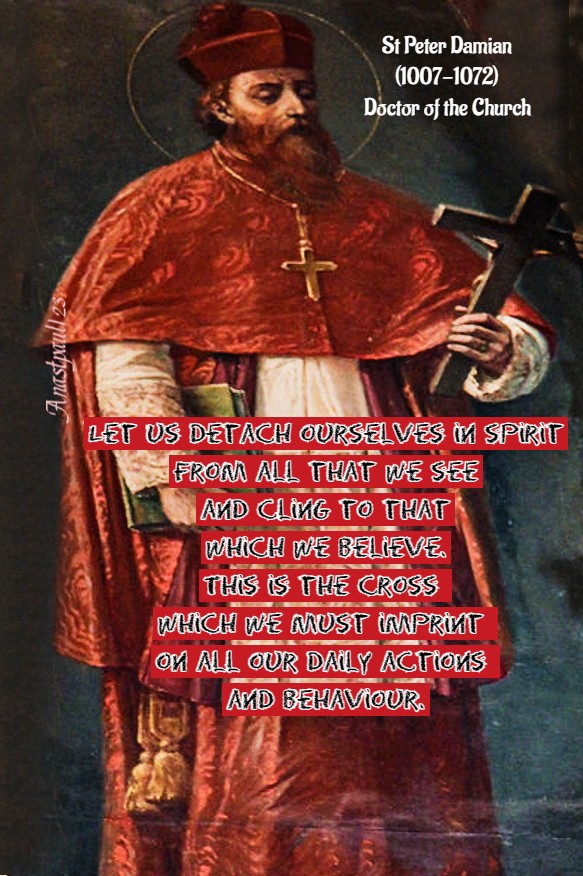
Quote/s of the Day – 23 February – St Peter Damian

Quote/s of the Day – 23 February – Monday of the First Week of Lent – The Feast of St Peter Damian (1007-1072) Cardinal Bishop, Confessor, Father and Doctor of the Church

Let us detach ourselves in spirit
from all that we see
and cling to that which we believe.
This is the Cross
which we must imprint
on all our daily actions and behaviour.

The best penance is to have patience
with the sorrows God permits.
A very good penance is to dedicate oneself
to fulfill the duties of everyday
with exactitude and to study and work
with all our strength.

We hold our tongues in check
because if they are undisciplined
they empty the soul of the strength
of heavenly grace
and weaken its healthful vigour.”

MORE:
https://anastpaul.com/2024/02/23/quote-s-of-the-day-23-february-st-peter-damian-3/

St Peter Damian (1007-1072)
Bishop, Father and Doctor of the Church

Posted in CONFESSION/PENANCE, DIVINE Mercy, Goodness, Patience, DOCTORS of the Church, FATHERS of the Church, Our MORNING Offering, PRAYERS of the SAINTS, QUOTES on MORTIFICATION, QUOTES on REPENTANCE, SAINT of the DAY

Our Morning Offering – 23 February – Have Mercy, LordBy St Peter Damian

Our Morning Offering – 23 February – The Feast of St Peter Damian (1007-1072) Cardinal Bishop, Confessor, Father and Doctor of the Church

Have Mercy, Lord
By St Peter Damian (1007-1072)
Father & Doctor of the Church

Have mercy, Lord,
on all my friends and relatives,
on all my benefactors,
on all who pray to Thee for me
and on all who have asked me
to pray to Thee, for them.
Give them the spirit of fruitful penance,
mortify them in all vices
and make them flower
in all Thy virtues.
Amen

Posted in AUGUSTINIANS OSA, CHRIST the HIGH PRIEST, CHRIST the WORD and WISDOM, DOCTORS of the Church, LENT 2026, QUOTES on TEMPTATION, The WORD, Thomas Aquinas

The First Sunday of Lent – 22 February – Our Lenten Journey With St Thomas Aquinas – Christ willed to be tempted

The First Sunday of Lent – 22 February – Our Lenten Journey With St Thomas Aquinas (1225-1274), Doctor of the Church

The First Week of Lent – Sunday

It was fitting that Christ should be tempted

Jesus was led by the spirit into the desert,
to be tempted by the devil.

Matt iv. i

Christ willed to be tempted:

  1. That He might assist us against our own temptations.
    St Gregory says: “That our Redeemer, Who had come to earth to be killed, should will to be tempted, was not unworthy of Him. It was. indeed but just that He should overcome our temptations by His own, in the same way that He had come to overcome our death by His death.”
  2. To warn us that no man, however holy he be, should think himself safe and free from temptation.
    Whence again, His choosing to be tempted after His Baptism, about which St Hilary says: “The devil’s wiles are especially directed to trap us at times when we have recently been made holy because the devil desires no victory as much as a victory over the world of Grace.”
    Whence too, the Scripture warns us, “Son, when thou comest to the service of God, stand in justice and in fear and prepare thy soul for temptation” (Ecclus ii. i).
  3. To give us an example of how we should overcome the temptations of the devil, St Augustine says: “Christ gave Himself to the devil to be tempted that, in the matter of our overcoming those same temptations, He might be of service, not only by His assistance but too, by His example.”
  4. To fill and saturate our minds with confidence in His Mercy.
    “For we have not a High Priest Who cannot have compassion on our infirmities but One , without sin but ttempted in all things, like as we are, (Heb iv. 15).

ST THOMAS AQUINAS (1225-1274)
Priest, Theologian, Dominican
Doctor Angelicus (Angelic Doctor)
Doctor Communis (Common Doctor)
Added by Pope Saint Pius V in 1568