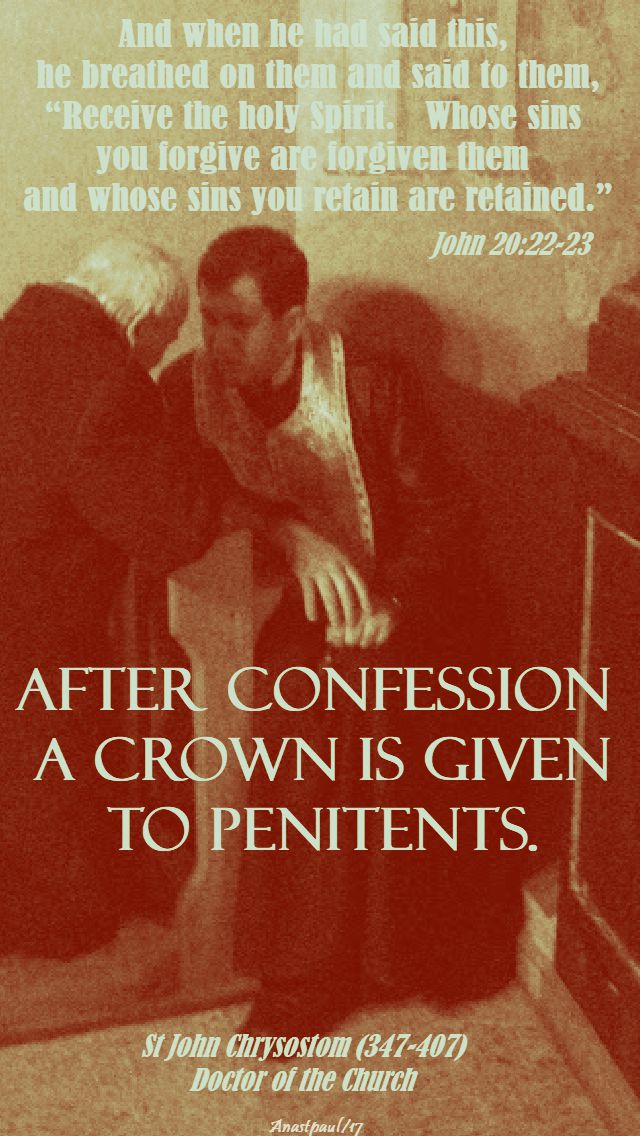
And when he had said this, he breathed on them and said to them, “Receive the holy Spirit. Whose sins you forgive are forgiven them and whose sins you retain are retained.”…John 20:22-23
REFLECTION – “After confession a crown is given to penitents.”… St John Chrysostom (347-407) Doctor of the Church
PRAYER – Lord God, hear my prayer, forgive my sins, teach me true repentance, help me to renew my life and live only in Your love.
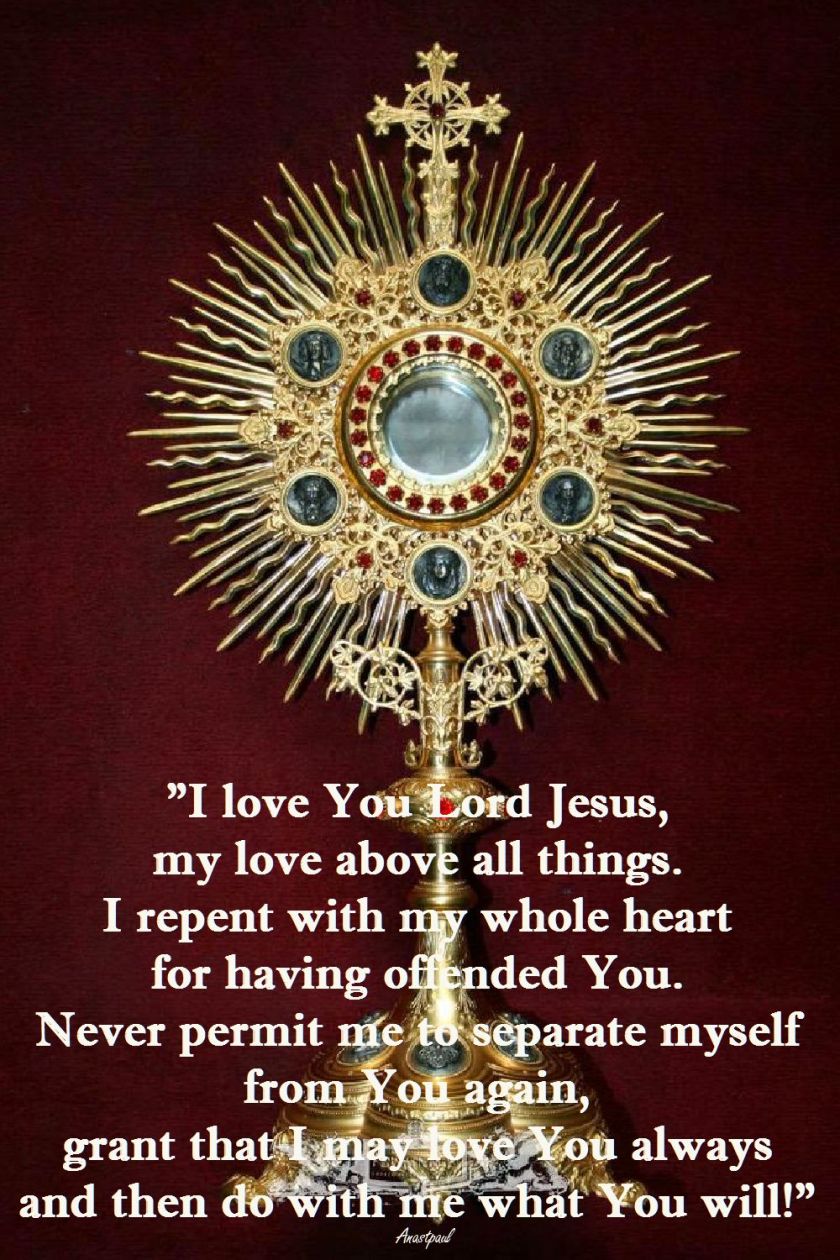
I wish now and every day, sorrow for my sins and the willingness to make reparation for them. Show me how, dear Lord, teach me Your ways. For my sins crucified my Lord, on my God, forgive me! Lord Jesus, I love You, grant that I may never separate myself from You again! Amen
Quote/s of the Day – 24 October – The Memorials of St Anthony Mary Claret (1807-1870) and St Luigi Guanella (1842-1915)
“Although the sinner does not believe in Hell, he shall nevertheless go there, if he has the misfortune to die in mortal sin.”
“Christian perfection consists in three things: praying heroically working heroically and suffering heroically.”
“The Christian who desires to follow Jesus carrying His cross must bear in mind, that the name “Christian” means “learner or imitator of Christ” and that if he wishes to bear that noble title worthily, he must above all do as Christ charges us in the Gospel – we must oppose or deny ourselves, take up the cross and follow Him.”
“When I am before the Blessed Sacrament. I feel such a lively faith that I can’t describe it. Christ in the Eucharist is almost tangible to me… When it is time for me to leave, I have to tear myself away from His sacred presence.”
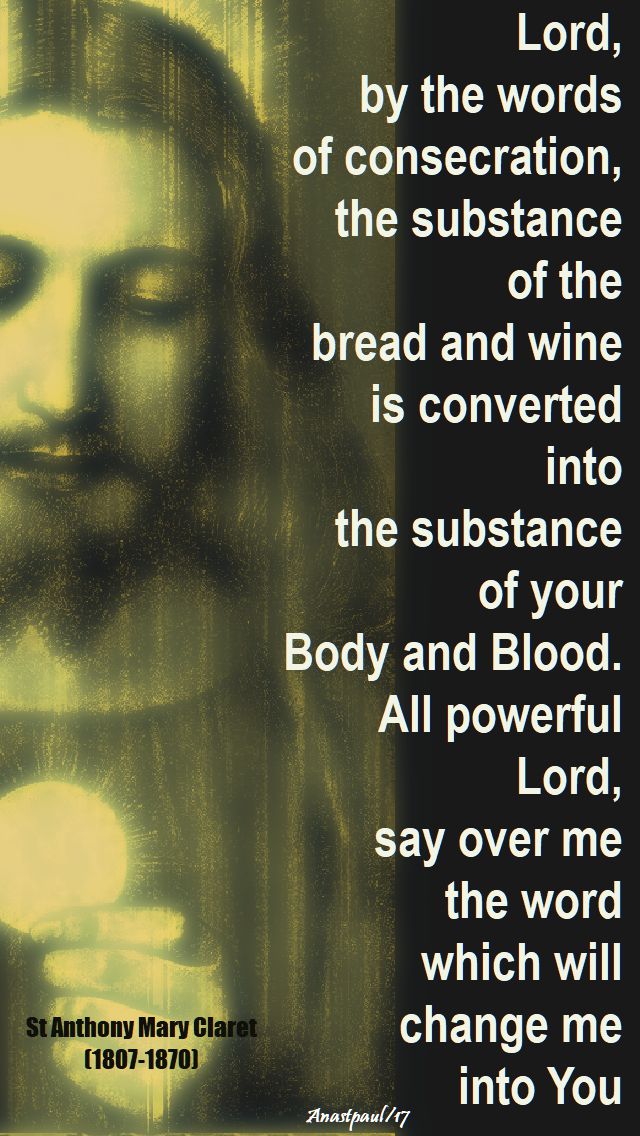
“Lord, by the words of consecration, the substance of the bread and wine is converted into the substance of your Body and Blood. All powerful Lord, say over me the word which will change me into You.”
St Anthony Mary Claret (1807-1870)
“The sun of our lives is the Eucharist. …Live each day with the Eucharistic Christ.”
“Plant your heart in Jesus Crucified and all the thorns will seem like roses.”
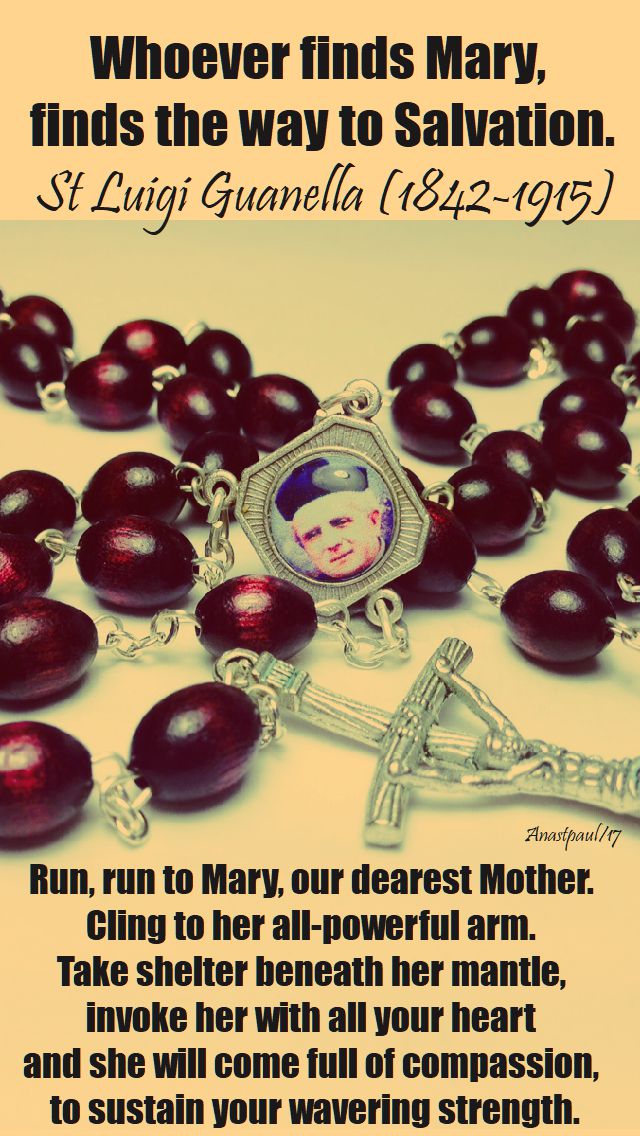
“Whoever finds Mary, finds the way to Salvation.”
…Run, run to Mary, our dearest Mother. Cling to her all-powerful arm. Take shelter beneath her mantle, invoke her with all your heart and she will come full of compassion, to sustain your wavering strength.”
One Minute Reflection – 24 October – The Memorial of St Luigi Guanella (1842-1915)
For the Son of Man will come with his angels in his Father’s glory and then he will repay everyone according to his conduct...Matthew 16:27
REFLECTION – “There is need of living well but there is even more need of dying well. A good death is everything, especially today where people think only of things and enjoyment here on earth, rejecting eternity.” … St Luigi Guanella (1842-1915)
PRAYER – Heavenly Father, help me to keep my death constantly before my eyes, for this is my final account. I pray You for a holy life that my death may be holy and that I may come to You and live for all eternity with You. When my hour is come, bid me come to You, Lord. St Luigi Guanella, you lived each moment of your life for the glory of the Kingdom, please pray for us, amen.
Quote of the Day – 23 October – The Memorial of St John of Capistrano (1386-1456)
“Those who are called to the table of the Lord must glow with the brightness that comes from the good example of a praiseworthy and blameless life. They must learn from the eminent teacher, Jesus Christ. . “You are the light of the world” (see Matthew 5:14). Now a light does not illumine itself but instead it diffuses its rays and shines all around upon everything that comes into its view..“
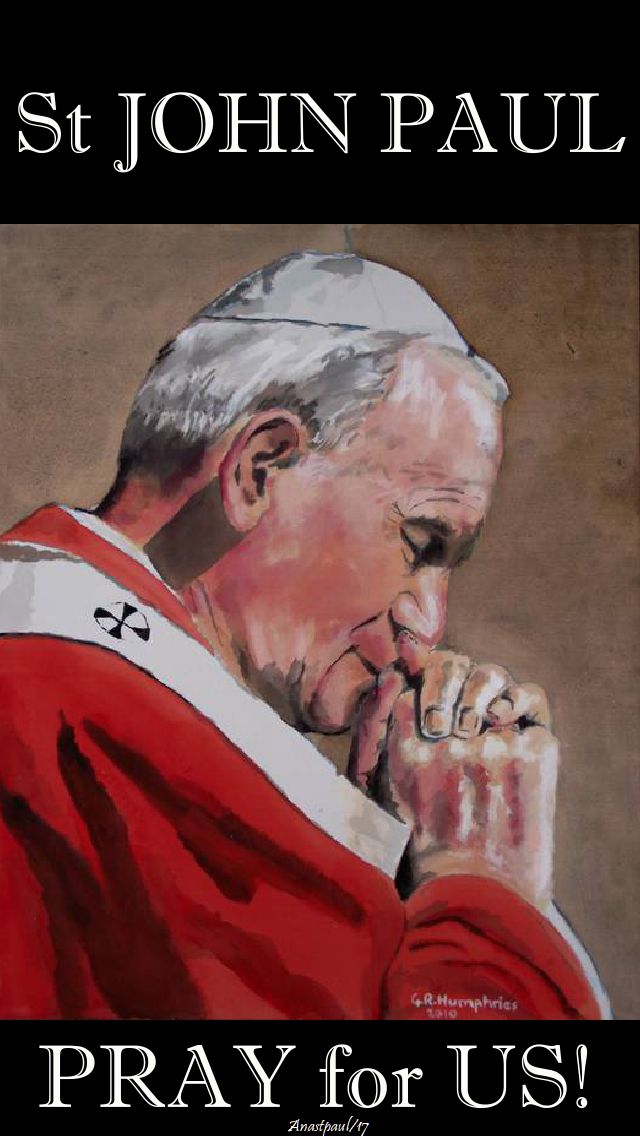
Thought for the Day – 22 October – The Memorial of St Pope John Paul II (1920-2005)
Before John Paul II’s funeral Mass in St Peter’s Square, hundreds of thousands of people had waited patiently for a brief moment to pray before his body, which lay in state inside St Peter’s for several days. The media coverage of his funeral was unprecedented.
Presiding at the funeral Mass, Cardinal Joseph Ratzinger–then dean of the College of Cardinals and later Pope Benedict XVI–concluded his homily by saying: “None of us can ever forget how, in that last Easter Sunday of his life, the Holy Father, marked by suffering, came once more to the window of the Apostolic Palace and one last time gave his blessing urbi et orbi (‘to the city and to the world’).
“We can be sure that our beloved pope is standing today at the window of the Father’s house, that sees us and blesses us. Yes, bless us, Holy Father. We entrust your dear soul to the Mother of God, your Mother, who guided you each day and who will guide you now to the glory of her Son, our Lord Jesus Christ. Amen.”
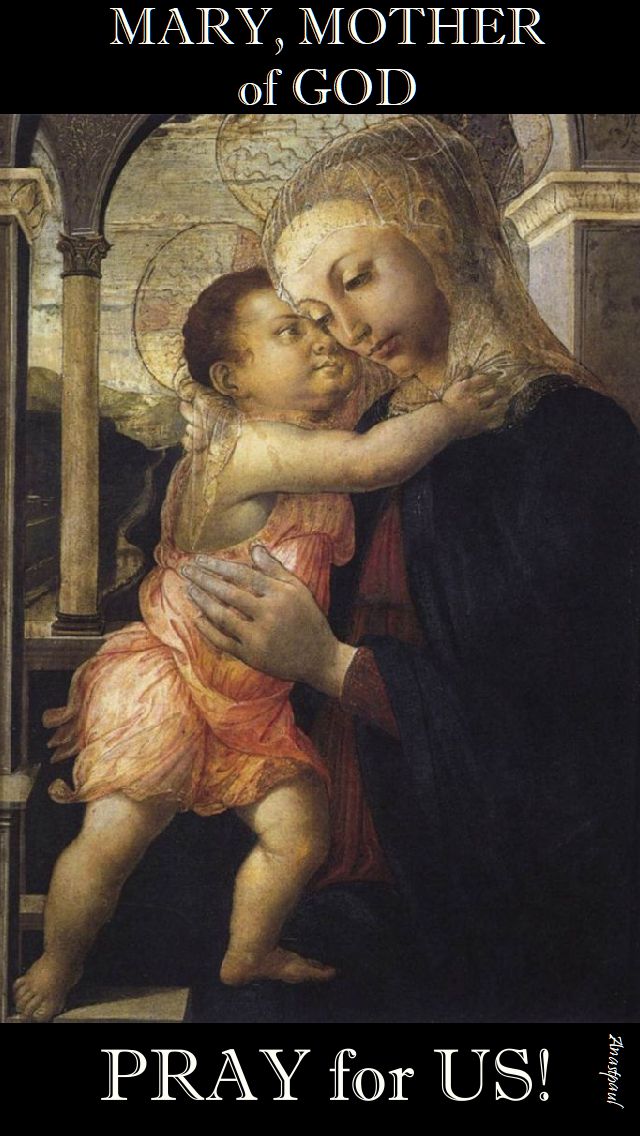
Mary, Mother of God, Pray for us!
St John Paul, ‘Witness to Hope’ – Pray for us!
“Christ is the center of the universe and of human history” was the opening line of John Paul II’s 1979 encyclical, Redeemer of the Human Race. In 1995, he described himself to the United Nations General Assembly as “a witness to hope.”
Quote/s of the Day – 22 October – The Memorial of St Pope John Paul II (1920-2005)
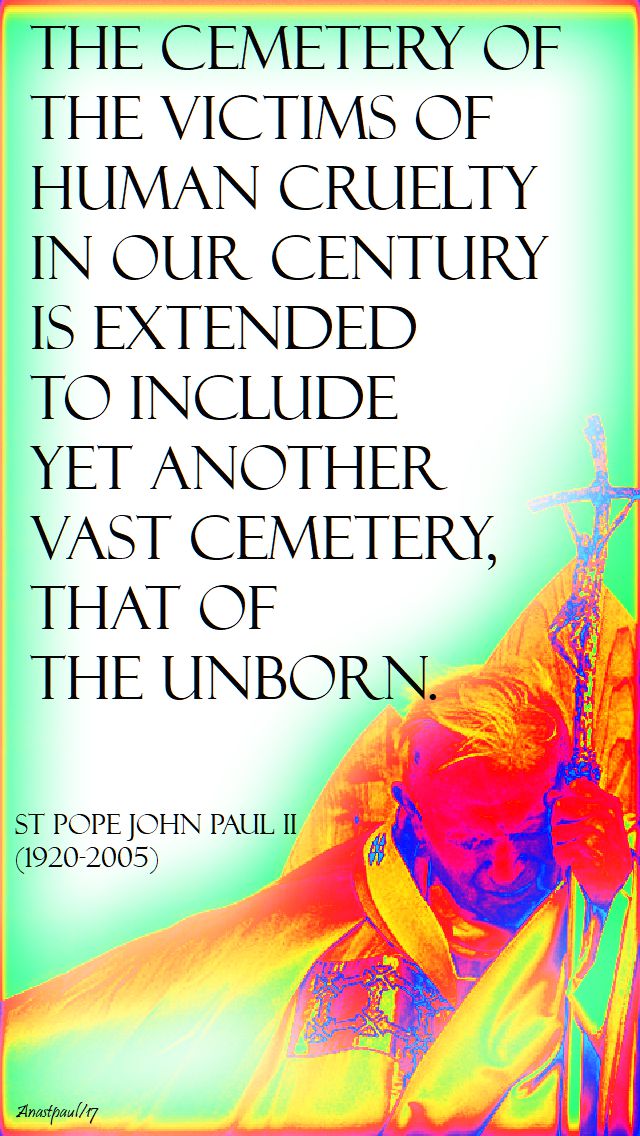
“The cemetery of the victims of human cruelty in our century is extended to include yet another vast cemetery, that of the unborn.”
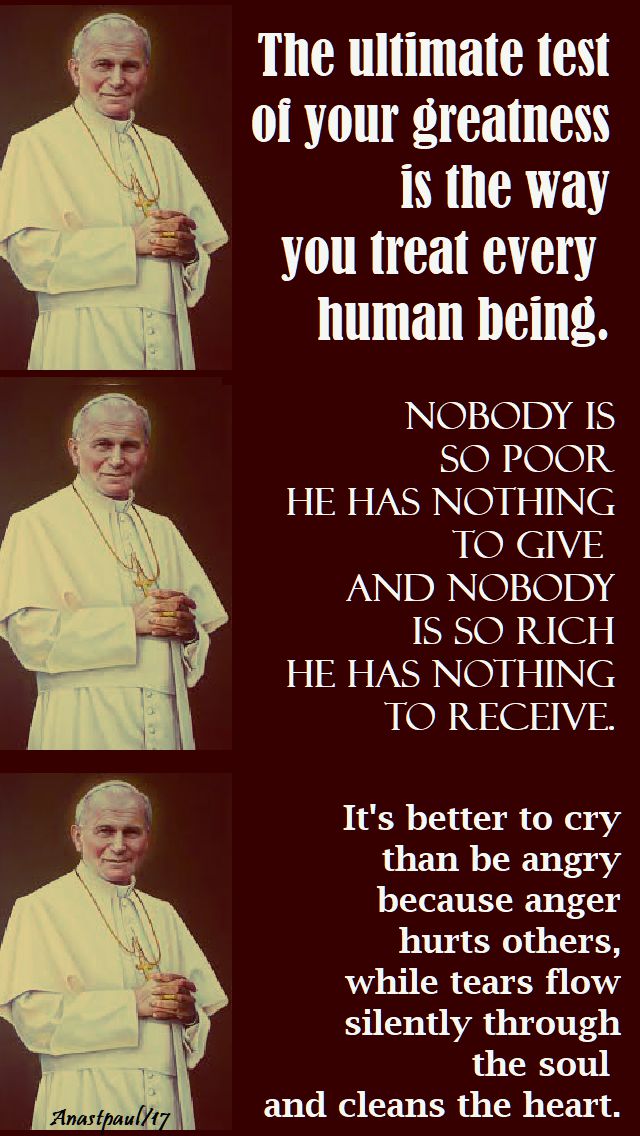
“The ultimate test of your greatness is the way you treat every human being.”
“Nobody is so poor he has nothing to give and nobody is so rich he has nothing to receive.”
“It’s better to cry than be angry because anger hurts others, while tears flow silently through the soul and cleans the heart.”
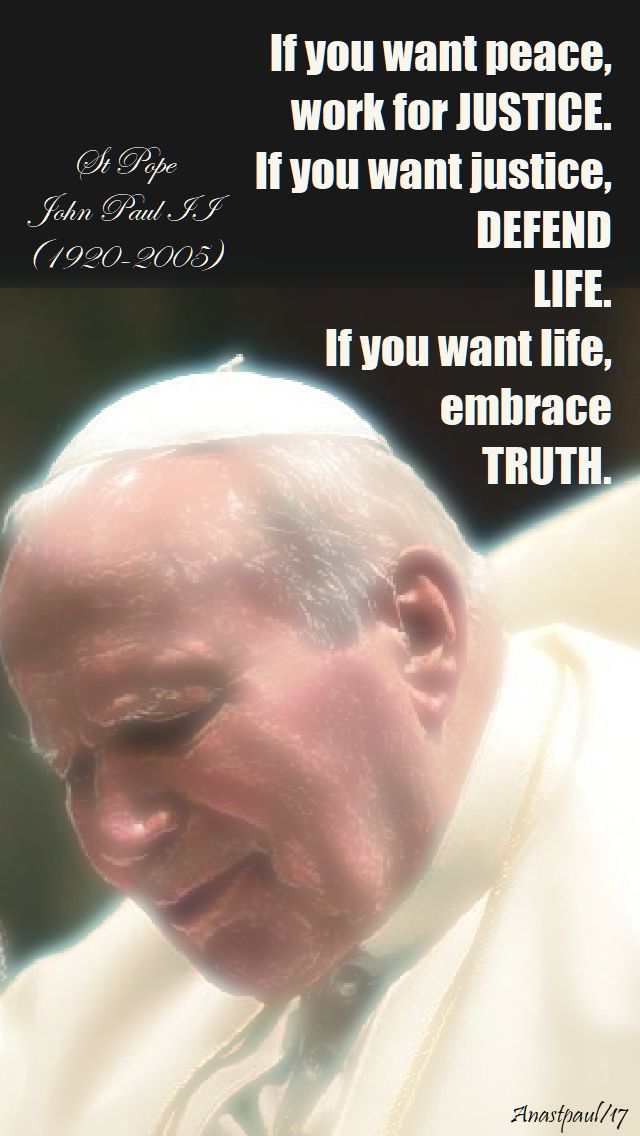
“If you want peace, work for justice. If you want justice, defend life. If you want life, embrace truth.”
“Darkness can only be scattered by light, hatred can only be conquered by love.”
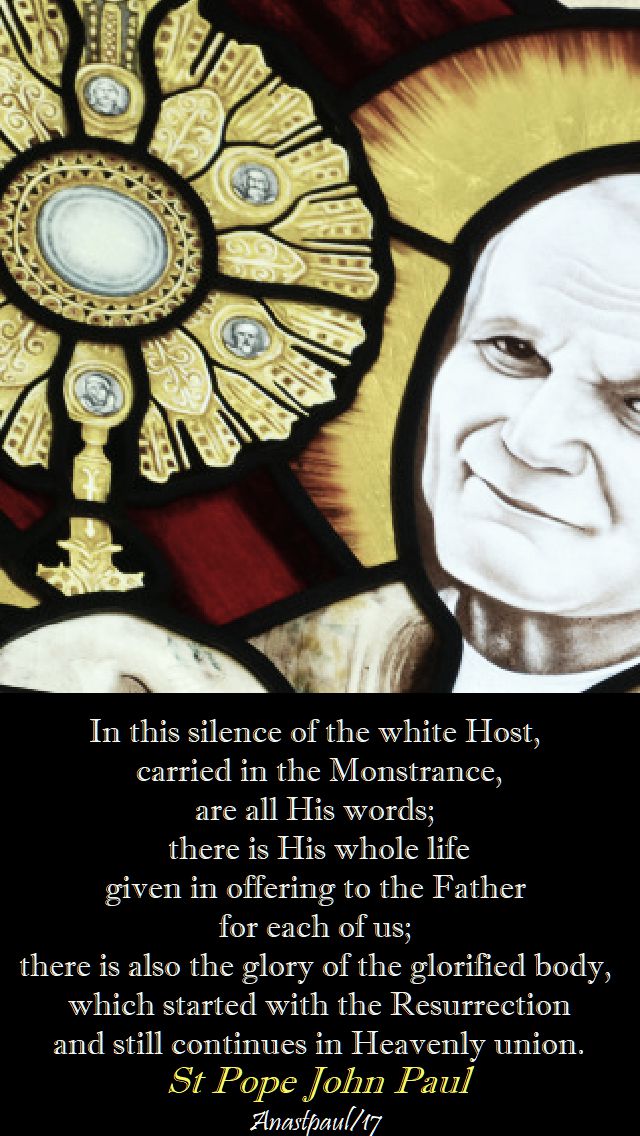
“In this silence of the white Host, carried in the Monstrance, are all His words; there is His whole life given in offering to the Father for each of us; there is also the glory of the glorified body, which started with the Resurrection and still continues in Heavenly union.”
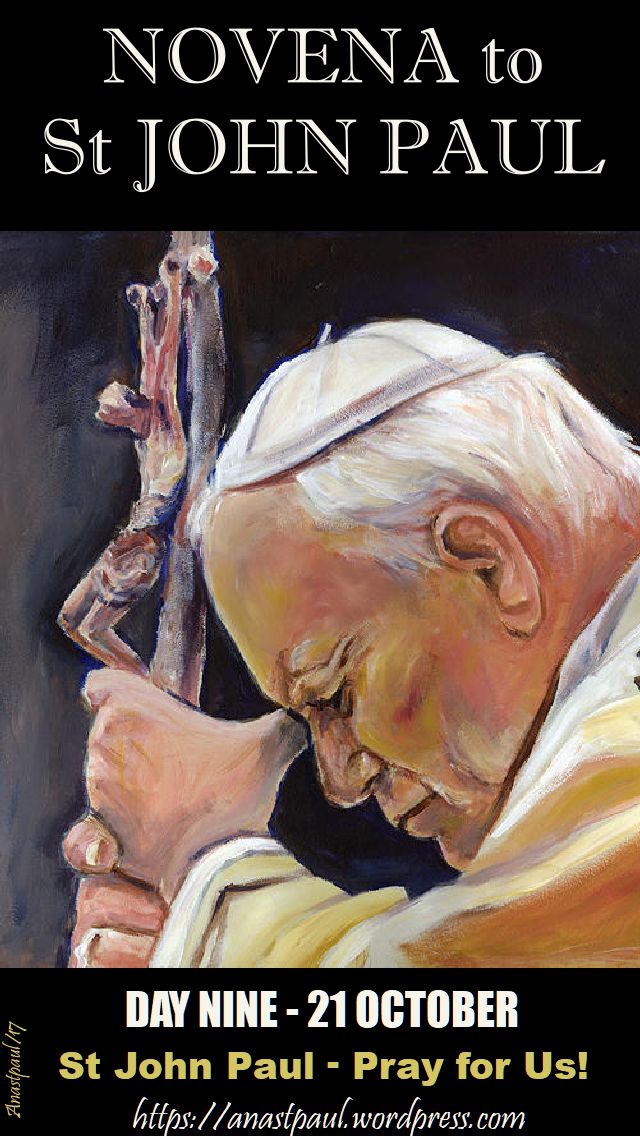
NOVENA to St John Paul the Great: DAY NINE – 21 OCTOBER
Little Known Fact #9: While visiting the United States in 1976, Cardinal Karol Wojtyla spent a few days in Pomfret, Vermont with philosopher Anna-Teresa Tymieniecka and her family. His main purpose was to work on the English translation of Osobo I Czyn (The Acting Person) but he also used it as a time to relax and enjoy nature. For example, he was often late for lunch because he had been swimming in the neighbour’s pond. Additionally, he didn’t want to be treated like a guest but instead insisted that he cut the grass and help bale hay. He was truly in his element in Vermont and remarked that it reminded him of the Tatras in Poland. Wojtyla spent most of his time outdoors, working on the English translation while sitting on the trunk of a tree that had fallen.
REFLECTION: “This was his message: man is the way of the Church and Christ is the way of man. With this message, which is the great legacy of the Second Vatican Council and of its “helmsman”, the Servant of God Pope Paul VI, John Paul II led the People of God across the threshold of the Third Millennium, which thanks to Christ he was able to call “the threshold of hope”. Throughout the long journey of preparation for the great Jubilee he directed Christianity once again to the future, the future of God, which transcends history while nonetheless directly affecting it. He rightly reclaimed for Christianity that impulse of hope which had in some sense faltered before Marxism and the ideology of progress. He restored to Christianity its true face as a religion of hope, to be lived in history in an “Advent” spirit, in a personal and communitarian existence directed to Christ, the fullness of humanity and the fulfillment of all our longings for justice and peace.” Pope Benedict XVI at the Beatification Ceremony
Let us Pray:
O Holy Trinity, we thank You for having given to the Church Pope John Paul II and for having made him shine with Your fatherly tenderness, the glory of the Cross of Christand the splendour of the Spirit of love.
He, trusting completely in Your infinite mercy and in the maternal intercession of Mary, has shown himself in the likeness of Jesus the Good Shepherd and has pointed out to us the way of holiness as the path to reach eternal communion with You Grant us, through his intercession, according to Your will, the grace that we implore,
………………….. [state your intention here].
Continue, beloved St John Paul, we implore you, to sustain from heaven the faith of God’s people. We praise and thank You Father that St John Paul has been numbered among Your saints and make our prayer through our Lord Jesus Christ with the Holy Spirit, one God forever.
Totus Tuus, Amen.
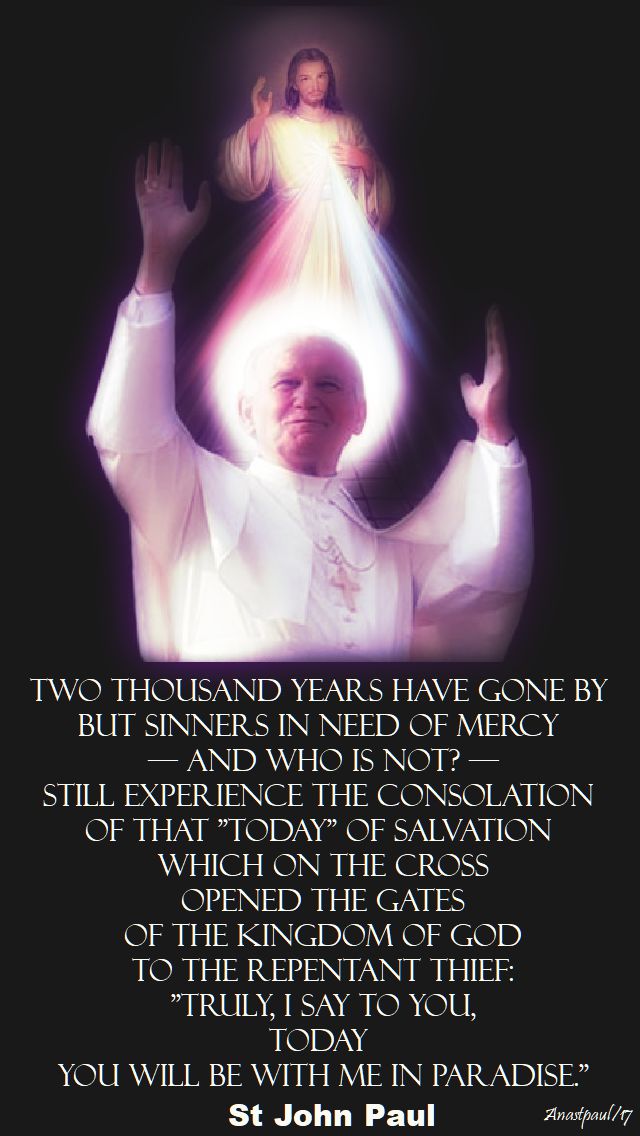
Quote Day 9: “Two thousand years have gone by but sinners in need of mercy — and who is not? — still experience the consolation of that “today” of salvation which on the Cross opened the gates of the Kingdom of God to the repentant thief: “Truly, I say to you, today you will be with me in Paradise” (Lk 23:43).” St John Paul
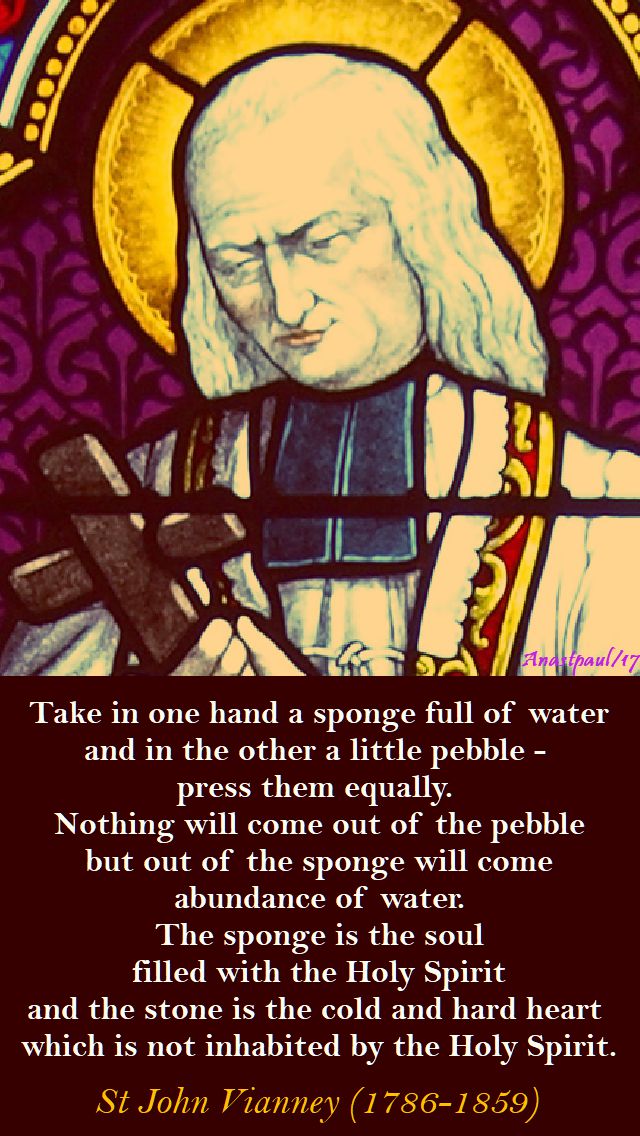
“Take in one hand a sponge full of water and in the other a little pebble – press them equally. Nothing will come out of the pebble but out of the sponge will come abundance of water. The sponge is the soul filled with the Holy Spirit and the stone is the cold and hard heart which is not inhabited by the Holy Spirit.”
St John Vianney (1786-1859)
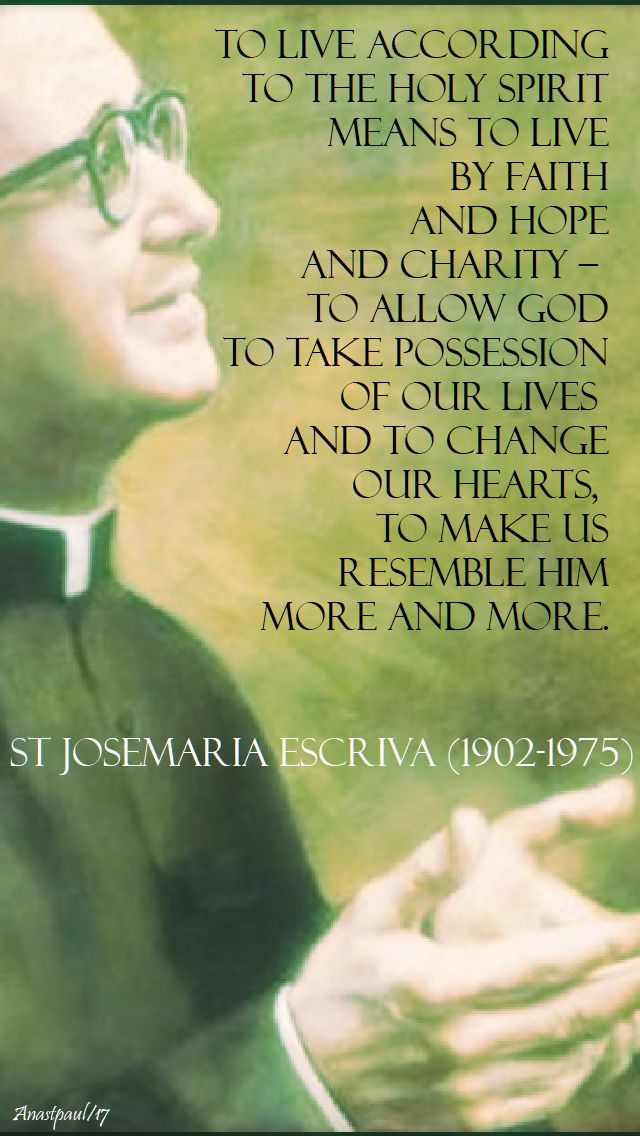
“To live according to the Holy Spirit means to live by faith and hope and charity – to allow God to take possession of our lives and to change our hearts, to make us resemble him more and more.”
St Josemaria Escriva (1902-1975)
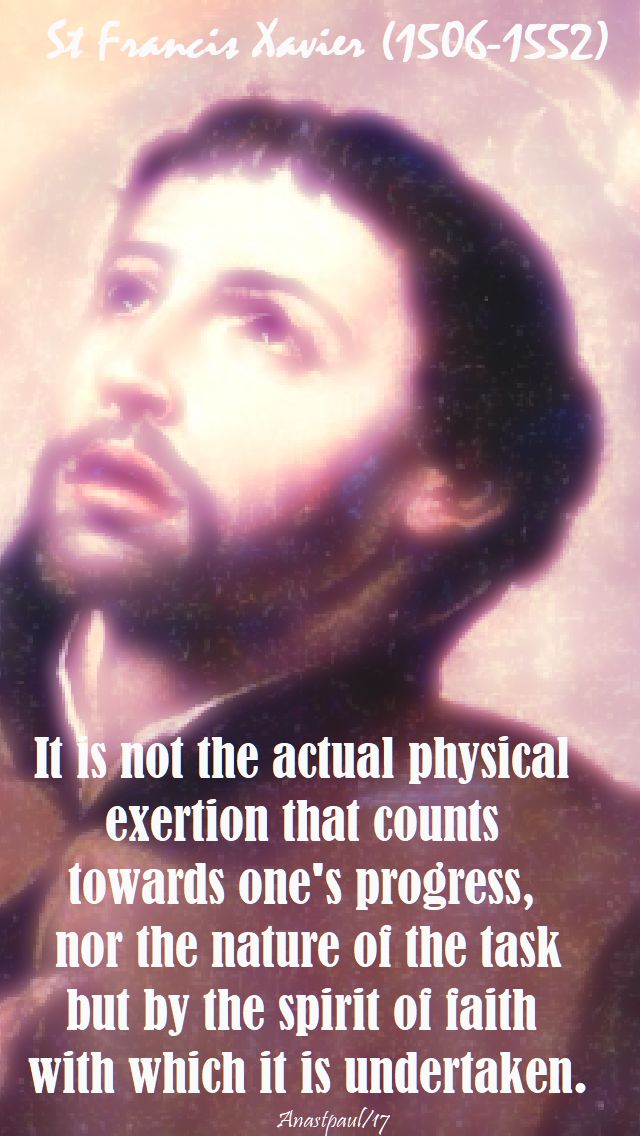
“It is not the actual physical exertion that counts towards one’s progress, nor the nature of the task but by the spirit of faith with which it is undertaken.”
One Minute Reflection – 21 October – The Memorial of St Hilarion of Gaza (c 291-371)
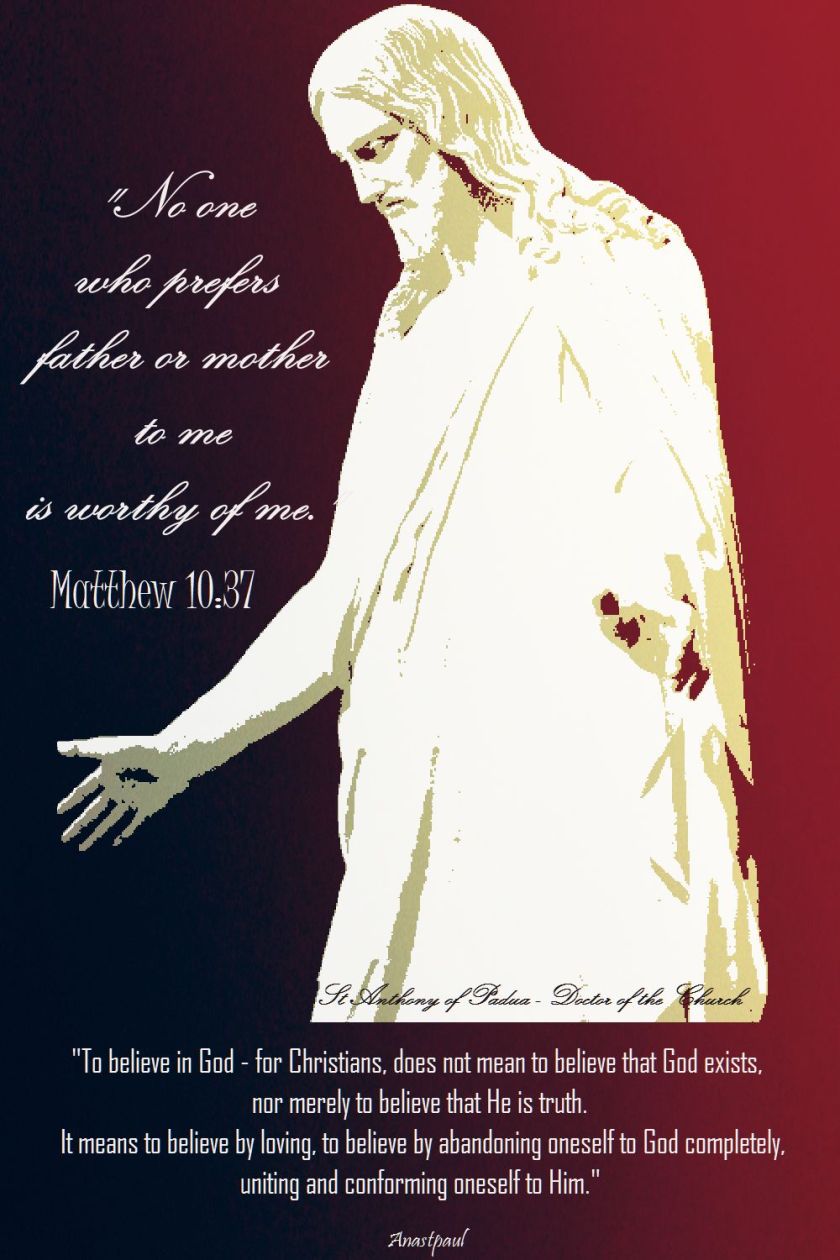
Jesus said to his disciples: “No one who prefers father or mother to me is worthy of me.”…Matthew 10:37
REFLECTION – To believe in God – for Christians, does not simply mean to believe that God exists, nor merely to believe that He is true.
It means to believe by loving, to believe by abandoning oneself to God, uniting and conforming oneself to Him.”… St Anthony of Padua (1195-1231) Doctor of the Church
PRAYER – Holy Father, grant me an operative faith, a faith that will move mountains. Englighten my soul with Your Light, Goodness, Power and Wisdom. Let my faith be an image of You by lively deeds and love and by conforming myself to Your Will in all things. St Hilarion from such a young age you searched for complete closeness and abandonment to God, please pray that we may manifest such a true faith, amen.
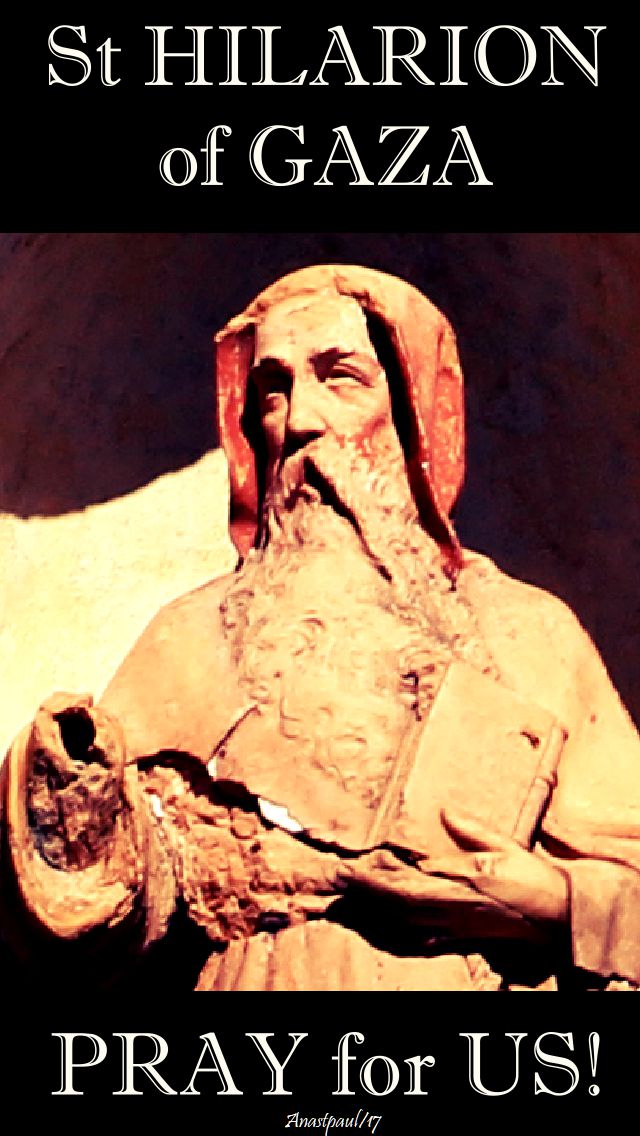
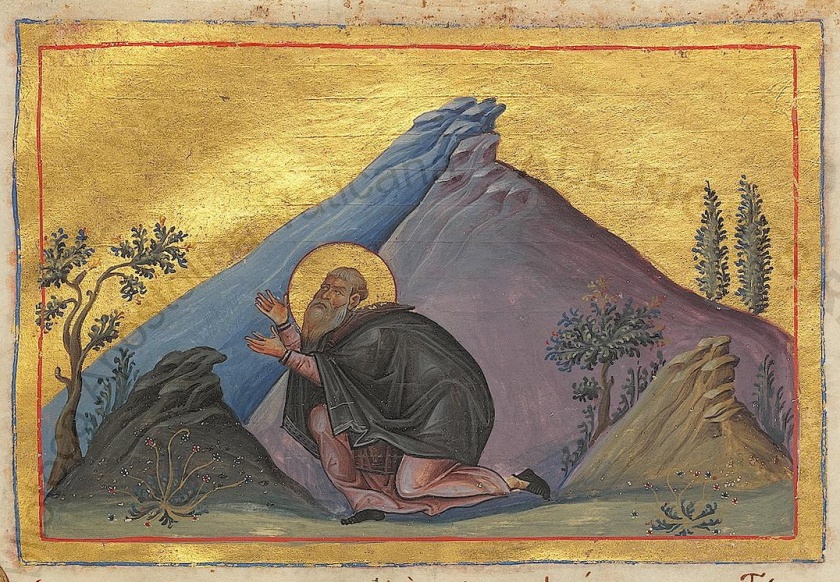
Saint of the Day – 21 October – St Hilarion of Gaza (c 291-371) Hermit and Miracle-Worker.
St Hilarion spent most of his life in the desert according to the example of Anthony the Great.
Shortly after St Hilarion’s death, St Jerome wrote about the life of this hermit who had introduced monasticism into Palestine. Jerome told of Hilarion’s lifelong pursuit of solitude, where he could encounter God in prayer.
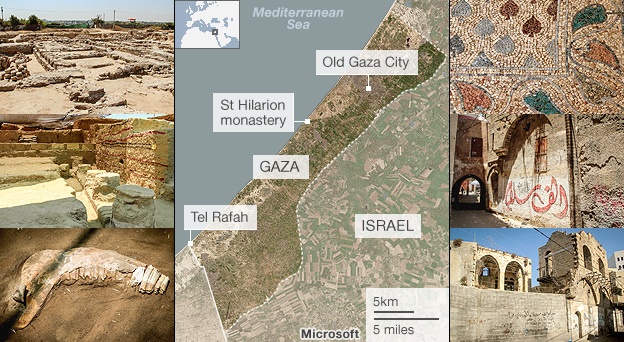
Hilarion was born in Thabatha, south of Gaza in Syria Palaestina of pagan parents. He successfully studied rhetoric with a Grammarian in Alexandria. It seems that he was converted to Christianity in Alexandria. After that, he shunned the pleasures of his day—theatre, circus and arena—and spent his time attending church. According to St Jerome, he was a thin and delicate youth of fragile health.
After hearing of Saint Anthony, whose name (according to St.erome), “was in the mouth of all the races of Egypt” Hilarion, at the age of fifteen, went to live with him in the desert for two months. As Anthony’s hermitage was busy with visitors seeking cures for diseases or demonic affliction, Hilarion returned home along with some monks. At Thabatha, his parents having died in the meantime, he gave his inheritance to his brothers and the poor and left for the wilderness.
St Jerome wrote about the divine irony of the fame that denied it to him because his miracles attracted so many people. In this brief excerpt, Jerome describes Hilarion’s faith and a typical miracle:
Once . . . when he was eighteen years old, brigands tried to find him at night. Either they believed that he had something to steal or they thought he would scorn them if they didn’t intimidate him. . . . From evening till dawn, they hunted in every direction but couldn’t find him. In the broad daylight, however, they came upon him and apparently as a joke asked him: “What would you do if robbers attacked you?” He answered: “A naked person does not fear robbers.” “You could be killed.” “I could,” he said. “But I am not afraid of robbers because I am ready to die.” Admiring his faith, they confessed their folly of the night before and their blindness and promised to reform their lives…
A woman of Eleutheropolis, despised by her husband of fifteen years because of her sterility, . . . was the first who dared to intrude upon blessed Hilarion’s solitude. While he was still unaware of her approach, she suddenly threw herself at his knees saying: “Forgive my boldness. . . ., he asked her why she had come and why she was weeping. When he learned the cause of her grief, raising his eyes to heaven, he commanded her to have faith and to believe. He followed her departure with tears. When a year had gone by, he saw her with her son.
Like Anthony, Hilarion took only a little food once a day at sunset. When tempted sexually, he ate even less. “I’ll see to it, you jackass,” he said, “that you shall not kick.” He never bathed nor changed his tunic until it wore out. He said, “It is idle to expect cleanliness in a hair shirt.” Jerome relates that even though Hilarion suffered extreme dryness of spirit, he persevered in prayer and cured many people of sickness and demon possession. The parade of petitioners and would-be disciples drove Hilarion to retire to more remote locations. But they followed him everywhere. First he visited Anthony’s retreat in Egypt. Then he withdrew to Sicily, later to Dalmatia and finally to Cyprus. He died there in 371.
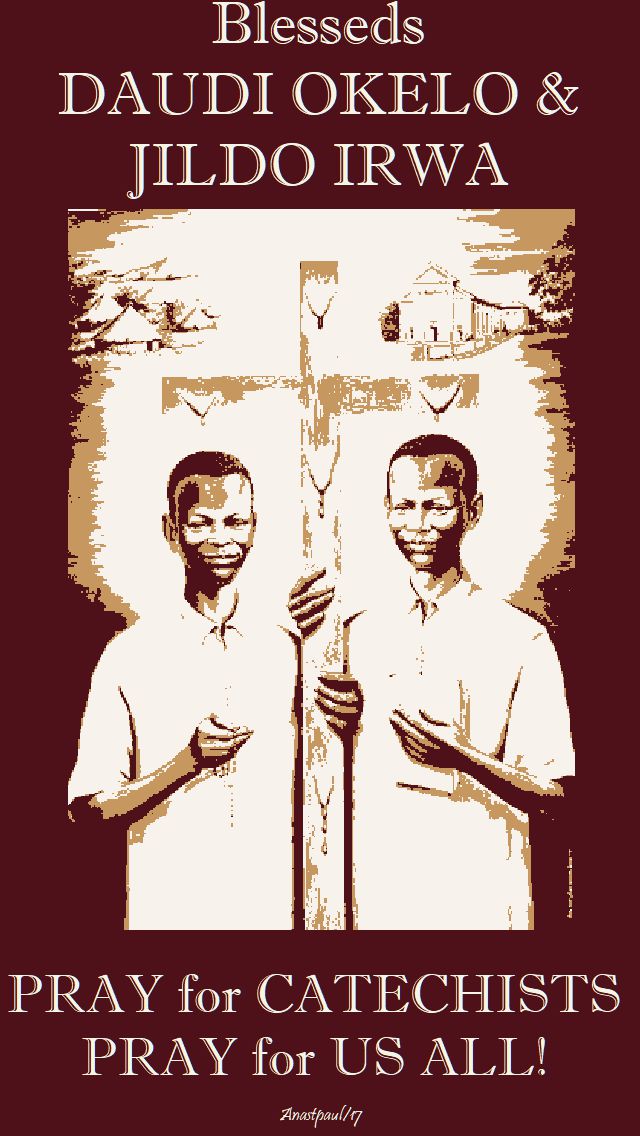
Thought for the Day – 20 October – The Memorial of Blesseds Daudi Okelo and Jildo Irwa – Ugandan Martyrs
“My thoughts turn first of all to the two young catechists from Uganda, Daudi Okelo and Jildo Irwa. These two courageous witnesses were no more than boys when, with simplicity and faith, they shed their blood for Christ and his Church. With youthful enthusiasm for their mission of teaching the faith to their fellow countrymen, they set out in 1918 for northern Uganda. It was there, as evangelisation was just beginning in that region, that they chose to embrace death rather than abandon the area and forsake their duties as catechists. Truly, in their lives and witness we can see that they were “beloved by God and chosen by him” (cf. I Thes 1,4).
Daudi and Jildo are today raised to the glory of the altar. They are given to the entire Christian community as examples of holiness and virtue and as models and intercessors for catechists throughout the world, especially in those places where catechists still suffer for the faith, sometimes facing social marginalisation and even personal danger. May the life and witness of these two dedicated servants of the Gospel inspire many men and women – in Uganda, in Africa and elsewhere – to answer with generosity the call to be a catechist, bringing knowledge of Christ to others and strengthening the faith of those communities that have recently received the Gospel of salvation.”
(Pope John Paul II on World Mission Sunday 20 October 2002)
“These two young catechists are a shining example of fidelity to Christ, commitment to Christian living and selfless dedication to the service of neighbour. With their hope firmly set on God and with a deep faith in Jesus’ promise to be with them always, they set out to bring the Good News of salvation to their fellow countrymen, fully accepting the difficulties and dangers that they knew awaited them. May their witness serve to strengthen you as you seek to bear true Christian witness in every aspect of your lives. Through their intercession may the Church be an ever more effective instrument of goodness and peace in Africa and in the world. God bless Uganda.”
(Pope John Paul II to Ugandan visitors – 21 October 2002)
Blesseds Daudi Okelo and Jildo Irwa, Pray for Catechists, pray for us all!
A Prayer for Catechists
Loving God, Creator of all things,
You call us to be in relationship with You and others.
Thank You for calling me to be a catechist,
for the opportunity to share with others
what You have given to me.
May all those with whom I share the gift of faith
discover how You are present in all things.
May they come to know You, the one true God,
and Jesus Christ, whom Uou have sent.
May the grace of the Holy Spirit guide my heart and lips,
so that I may remain constant in loving and praising You.
May I be a witness to the Gospel and a minister of Your truth.
May all my words and actions reflect Your love.
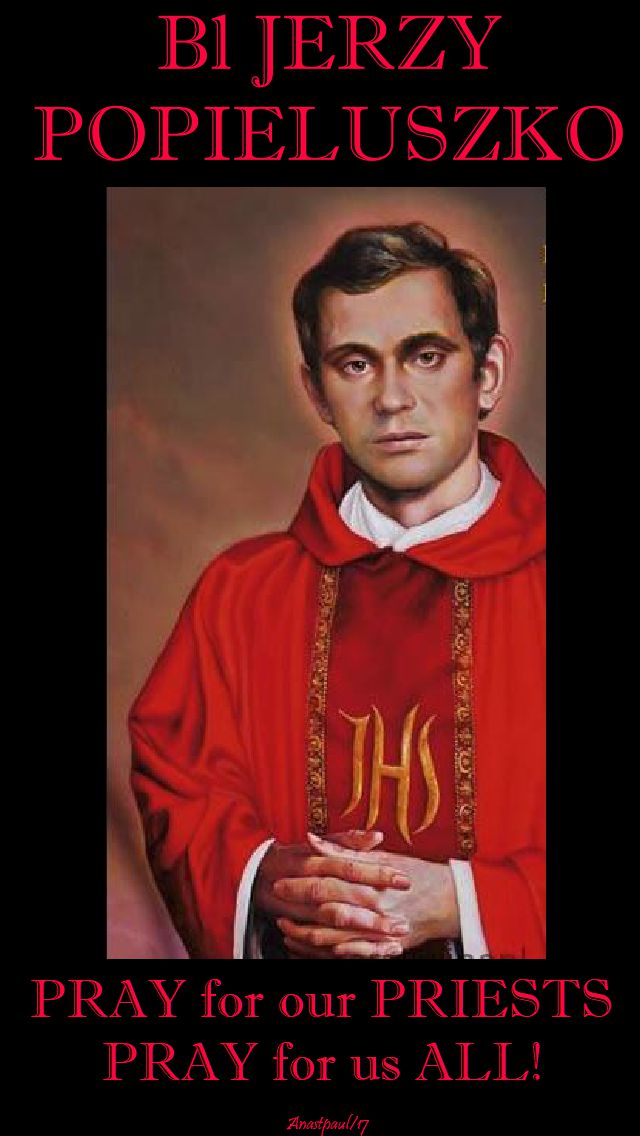
Thought for the Day – 19 October – The Memorial of Blessed Jerzy Popiełuszko (1947-1984)
Fr Jerzy Popiełuszko, a priest and martyr,….exercised his generous and courageous ministry beside all those who were working for freedom, for the defence of life and for its dignity. His work at the service of goodness and truth was a sign of contradiction for the regime governing Poland at the time. Love of the Heart of Christ led him to give his life and his witness was the seed of a new springtime in the Church and in society.
If we look at history, we can note how many pages of authentic spiritual and social renewal were written with the crucial contribution of Catholic priests, motivated solely by passion for the Gospel and for human beings and for their true freedom, both religious and civil.
How many initiatives of integral human promotion have been born from the intuition of a priestly heart! (13 June 2010, Pope Benedict XVI)
And so, let us pray for all our priests:
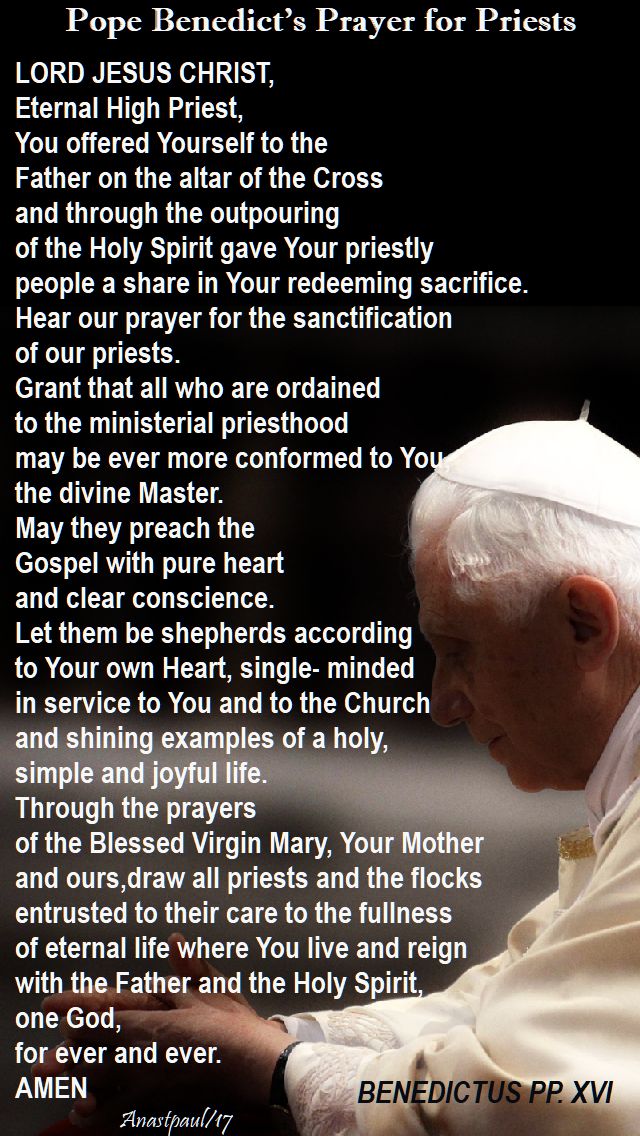
Pope Benedict’s Prayer for Priests
LORD JESUS CHRIST,
Eternal High Priest, You offered Yourself to the
Father on the altar of the Cross and through the
outpouring of the Holy Spirit gave Your priestly
people a share in Your redeeming sacrifice.
Hear our prayer for the sanctification of our priests.
Grant that all who are ordained to the ministerial
priesthood may be ever more conformed to You,
the divine Master.
May they preach the
Gospel with pure heart and clear conscience.
Let them be shepherds according to Your own Heart,
single- minded in service to You and to the Church
and shining examples of a holy,simple and joyful life.
Through the prayers of the Blessed Virgin Mary,
Your Mother and ours,draw all priests and the flocks
entrusted to their care to the fullness of eternal life where
You live and reign with the Father and the Holy Spirit,
one God, for ever and ever.
AMEN
BENEDICTUS PP. XVI
Blessed Jerzy Popiełuszko, Pray for our Priests, pray for us all!
Quote/s of the Day – 19 October
The Memorials of St Paul of the Cross and Blessed Jerzy Popiełuszko
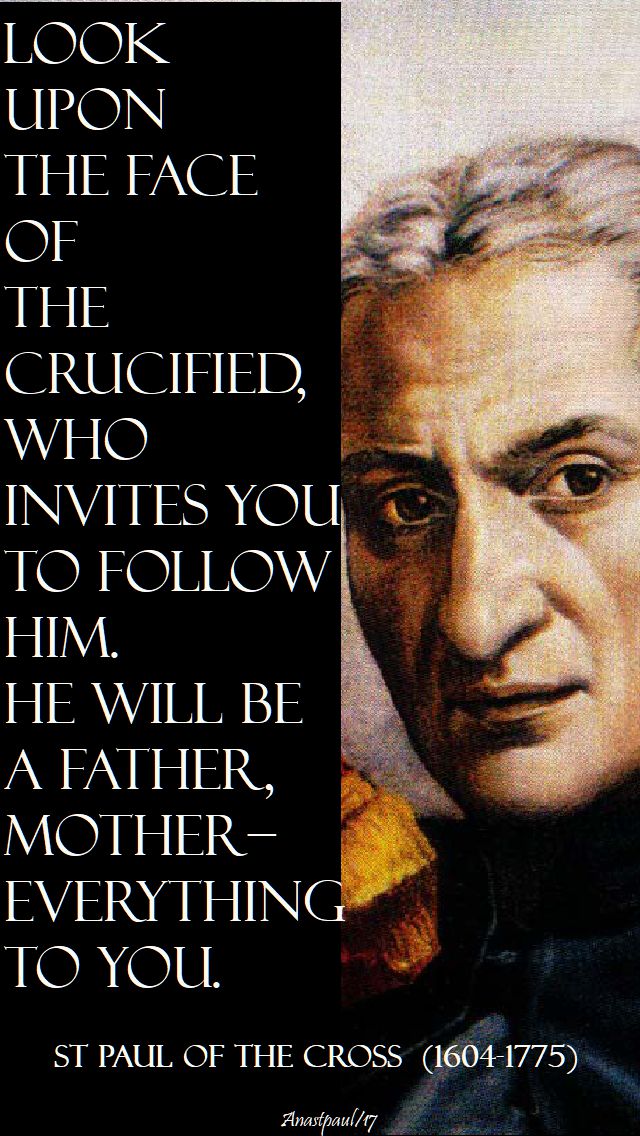
“Look upon the face of the Crucified, who invites you to follow Him. He will be a Father, Mother–everything to you.”
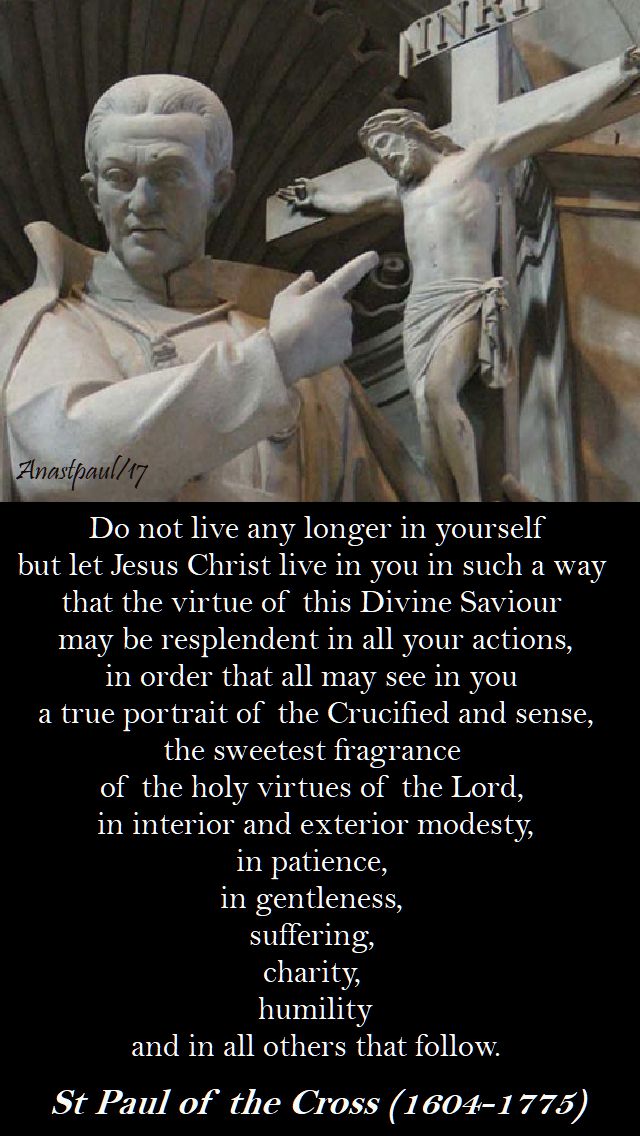
“Do not live any longer in yourself but let Jesus Christ live in you in such a way that the virtue of this Divine Saviour may be resplendent in all your actions, in order that all may see in you a true portrait of the Crucified and sense, the sweetest fragrance of the holy virtues of the Lord, in interior and exterior modesty, in patience, in gentleness, suffering, charity, humility and in all others that follow.”
St Paul of the Cross (1604-1775)
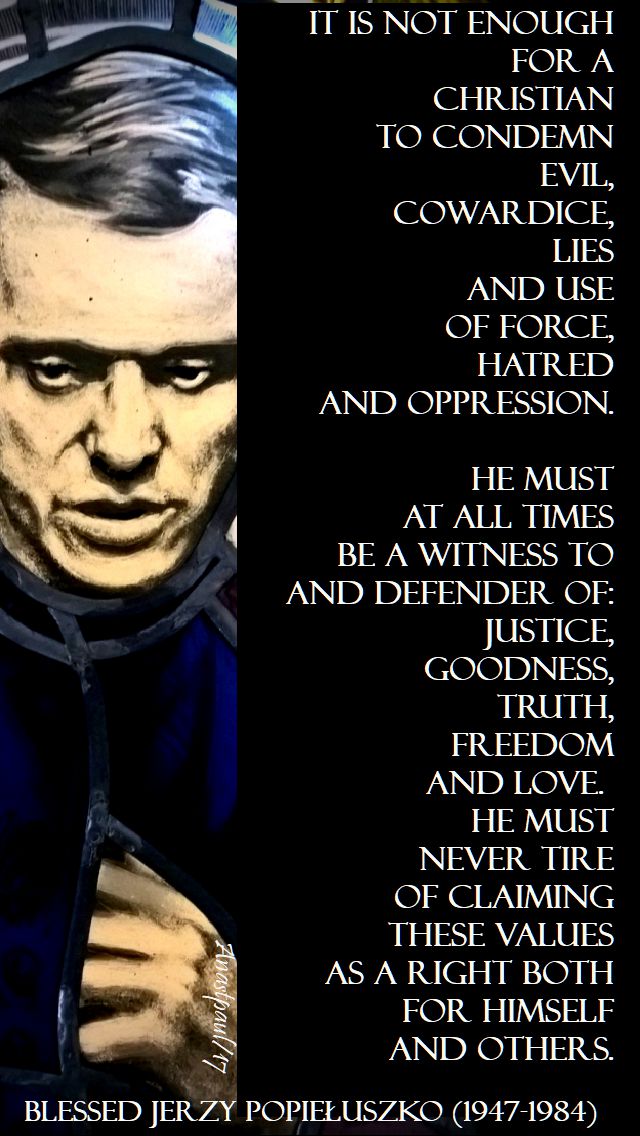
“It is not enough for a Christian to condemn evil, cowardice, lies and use of force, hatred and oppression. He must at all times be a witness to and defender of justice, goodness, truth, freedom and love. He must never tire of claiming these values as a right both for himself and others.”
One Minute Reflection – 19 October – The Memorial of Saints John de Brébeuf and Isaac Jogues, Priests and Companions, Martyrs
Do not grow lazy but imitate those who through faith and patience, are inheriting the promise .…Hebrews 6:12
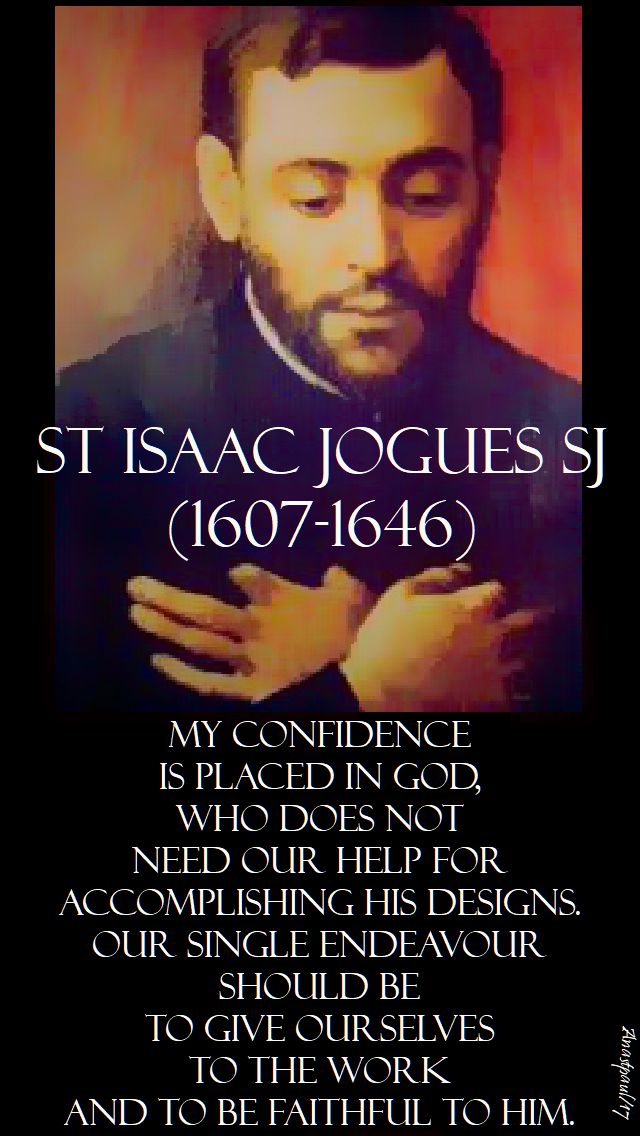
REFLECTION – “My confidence is placed in God, who does not need our help for accomplishing His designs.
Our single endeavour should be to give ourselvs to the work and to be faithful to Him.”…..St Isaac Jogues SJ (1607-1646)
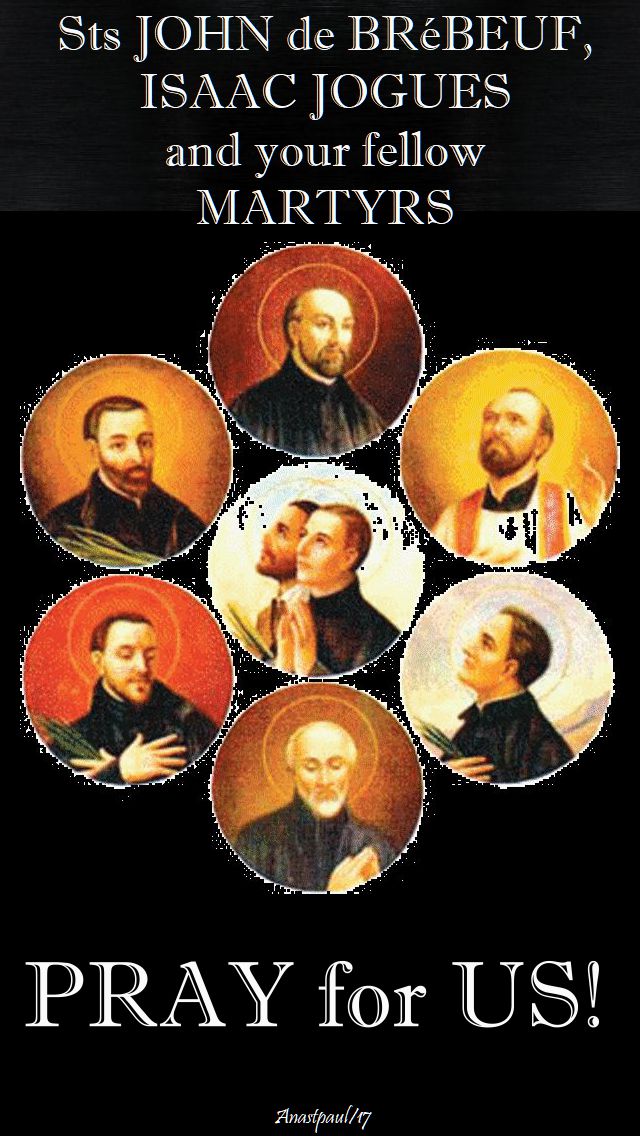
PRAYER – My Lord and patient God, help me to practice patience in doing good. No matter what may occur, allow me to face each day with quiet courage and without complaint, knowing You are always at my side and that all is part of Your divine plan. I pray for total abandonment to Your Will. Sts John de Brébeuf, Isaac Jogues and your fellow Martyrs, please pray for us all, amen.
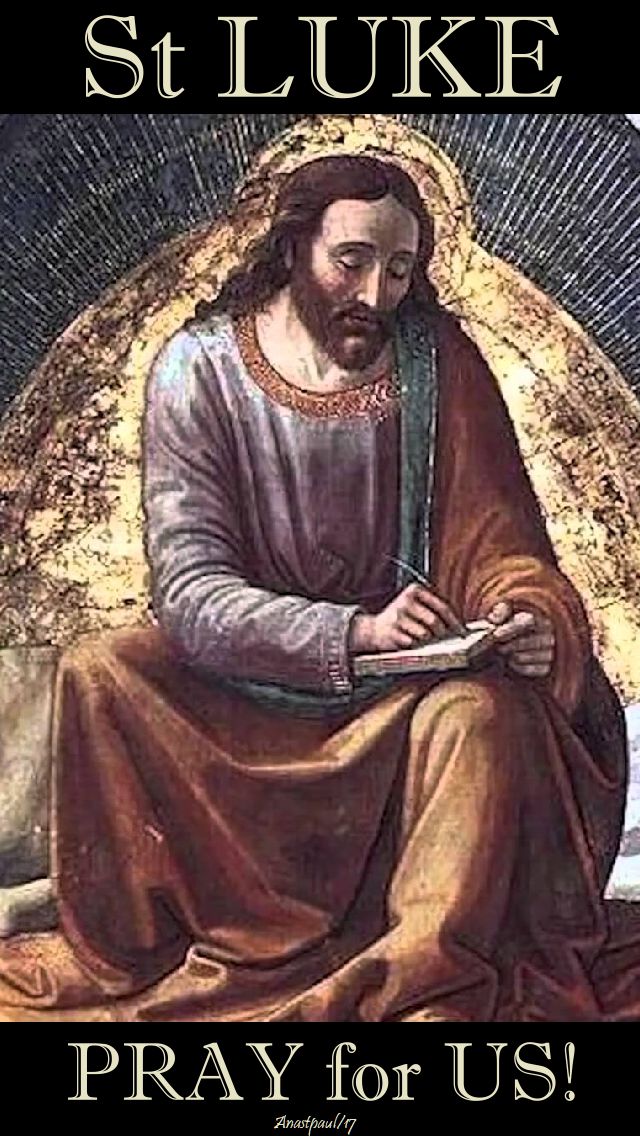
Thought for the Day – 18 October – The Feast of St Luke the Evangelist
According to a pious tradition, Luke is thought to have painted the image of Mary, the Virgin Mother. But the real portrait that Luke draws of Jesus’ Mother is the one that emerges from the pages of his work: in scenes that have become familiar to the People of God, he draws an eloquent image of the Virgin. The Annunciation, the Visitation, the Nativity, the Presentation in the Temple, life in the home of Nazareth, Jesus’ discussion with the doctors and his being lost and Pentecost have provided abundant material down the centuries for the ever new creations of painters, sculptors, poets and musicians.
What is most important however is to discover that, through pictures of Marian life, Luke introduces us to Mary’s interior life, helping us at the same time to understand her unique role in salvation history.
Mary is the one who says fiat, a personal and total “yes” to God’s invitation, calling herself the “handmaid of the Lord” (Lk 1: 38). This attitude of total assent to God and unconditional acceptance of his Word represents the highest model of faith, the anticipation of the Church as the community of believers.
The life of faith grows and develops in Mary through sapiential meditation on the words and events of Christ’s life (cf. Lk 2: 19, 51). She “ponders in her heart” to understand the deep meaning of his words, in order to assimilate it and share it with others.
The Magnificat hymn (cf. Lk 1: 46-55) shows another important aspect of Mary’s “spirituality”: she embodies the figure of the poor person, capable of putting all her trust in God, who casts down the mighty from their thrones and raises up the lowly.
Luke also describes the figure of Mary in the early Church, showing that she is present in the Upper Room as they await the Holy Spirit: “All these [the 11 Apostles] with one accord devoted themselves to prayer, together with the women and Mary the mother of Jesus, and with his brethren” (Acts 1: 14).
The group gathered in the Upper Room forms the original nucleus of the Church. Within it Mary carries out a double role: on the one hand, she intercedes for the birth of the Church through the Holy Spirit; on the other, she shares her experience of Jesus with the newborn Church. (St John Paul on the Feast of St Luke, Padua 2000 at the Shrine of St Luke)
Luke wrote as a Gentile for Gentile Christians. His Gospel and Acts of the Apostles reveal his expertise in classic Greek style as well as his knowledge of Jewish sources. There is a warmth to Luke’s writing that sets it apart from that of the other synoptic Gospels and yet it beautifully complements those works. The treasure of the Scriptures is a true gift of the Holy Spirit to the Church and the Marian writings of St Luke are a great treasure to us all!
St Luke, pray for us.
Holy Mother of God, pray for us.
St John Paul, pray for us.
Quote/s of the Day – 18 October – The Feast of St Luke the Evangelist
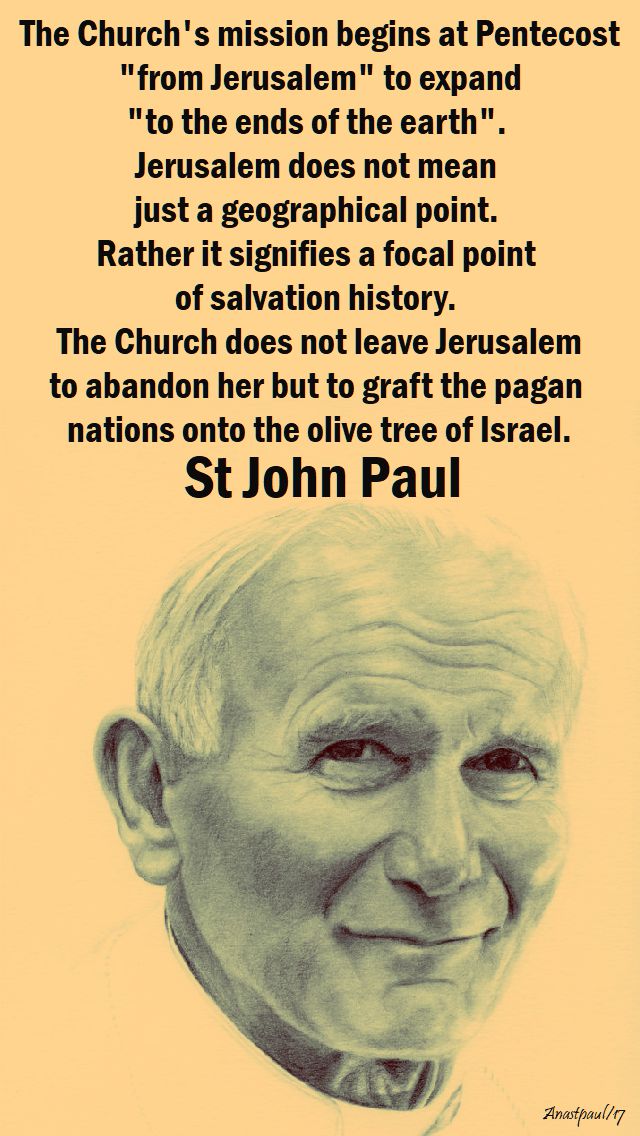
“The Church’s mission begins at Pentecost “from Jerusalem” to expand “to the ends of the earth”. Jerusalem does not mean just a geographical point. Rather it signifies a focal point of salvation history. The Church does not leave Jerusalem to abandon her but to graft the pagan nations onto the olive tree of Israel.”
“We must abandon ourselves to the power of the Spirit, who is able to infuse light and especially love for Christ; we must open ourselves to the inner fascination that Jesus works in the hearts of those who aspire to authenticity, while fleeing from half measures.”
St John Paul on the Feast of St Luke, Padua 2000 at the Shrine of St Luke
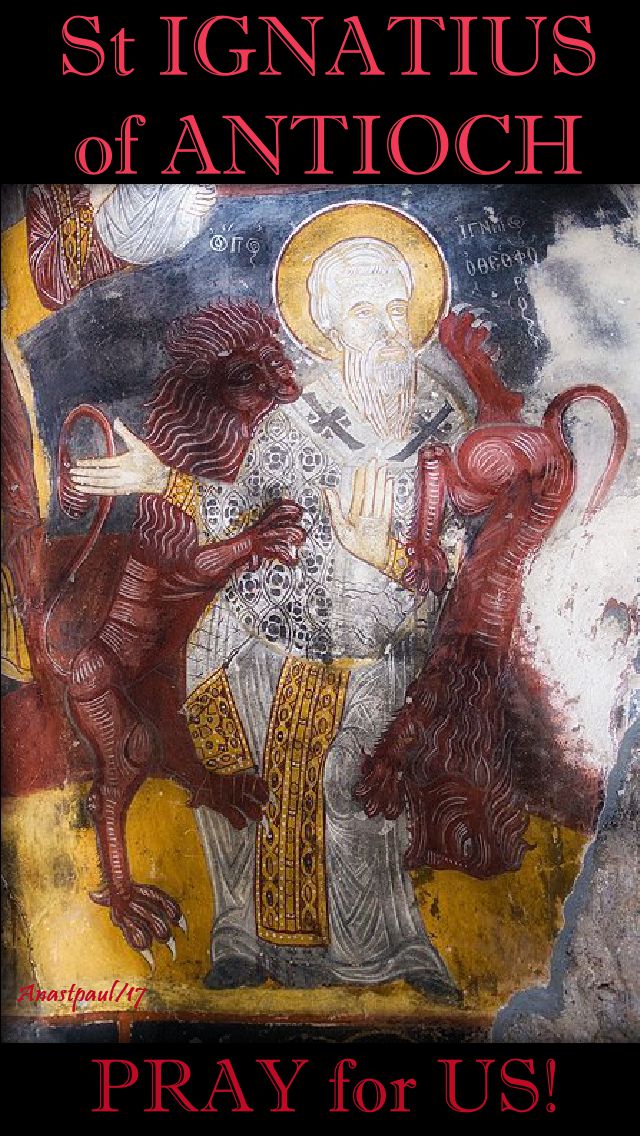
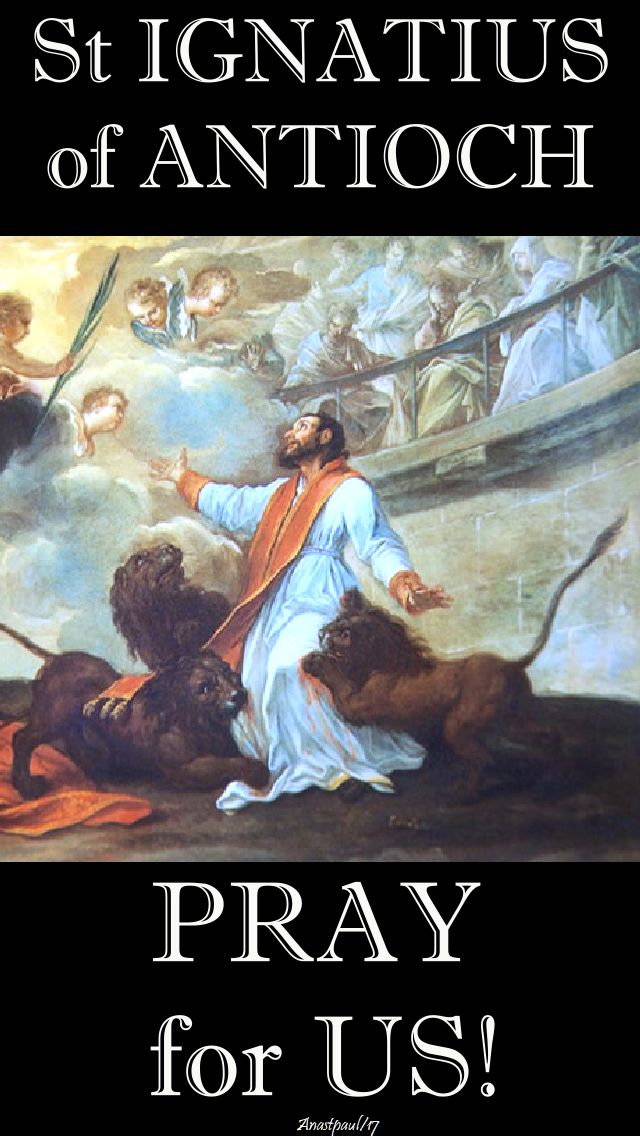
Thought of the Day- 17 October – The Memorial of St Ignatius of Antioch (c35-c108) Father of the Church
Ignatius’s great concern was for the unity and order of the Church.
Even greater was his willingness to suffer martyrdom rather than deny his Lord Jesus Christ.
He did not draw attention to his own suffering but to the love of God which strengthened him.
He knew the price of commitment and would not deny Christ, even to save his own life.
“Ask for me this only in your prayers, that strength may be given me of the Lord that I may not be called but proved to be a Christian. Then shall I be seen to be faithful when the world no longer sees me. For nothing that appeareth is eternal. For the things which are perceived are temporal but the things which are not seen are eternal. I write to the Churches and charge you all that willingly I die for Christ, if you prevent me not. I ask of you that your love for me be not untimely; allow me to be devoured of wild beasts, through whom I may attain unto God. I am the grain of God ground between the teeth of wild beasts, that I may be found to be the pure bread of Christ. Then indeed shall I be the true disciple of Christ when the world shall no longer behold my body. Beseech Christ on my behalf that through these means I may be found a perfect sacrifice. Not as Peter and Paul do I command you. They were apostles, I am the least of them; they were free but I am a slave even unto this day but, if you wish, I shall be the freedman of Jesus Christ and in Him I shall rise again and be free. Amen.”- from a letter to the Romans from Saint Ignatius of Antioch
Keep St Ignatius before your eyes always and ask him to Pray for us all, to Pray for his beloved Holy Mother, the Church!
Quote/s of the Day – 17 October – The Memorial of St Ignatius of Antioch (c 35-c 107) Father of the Church
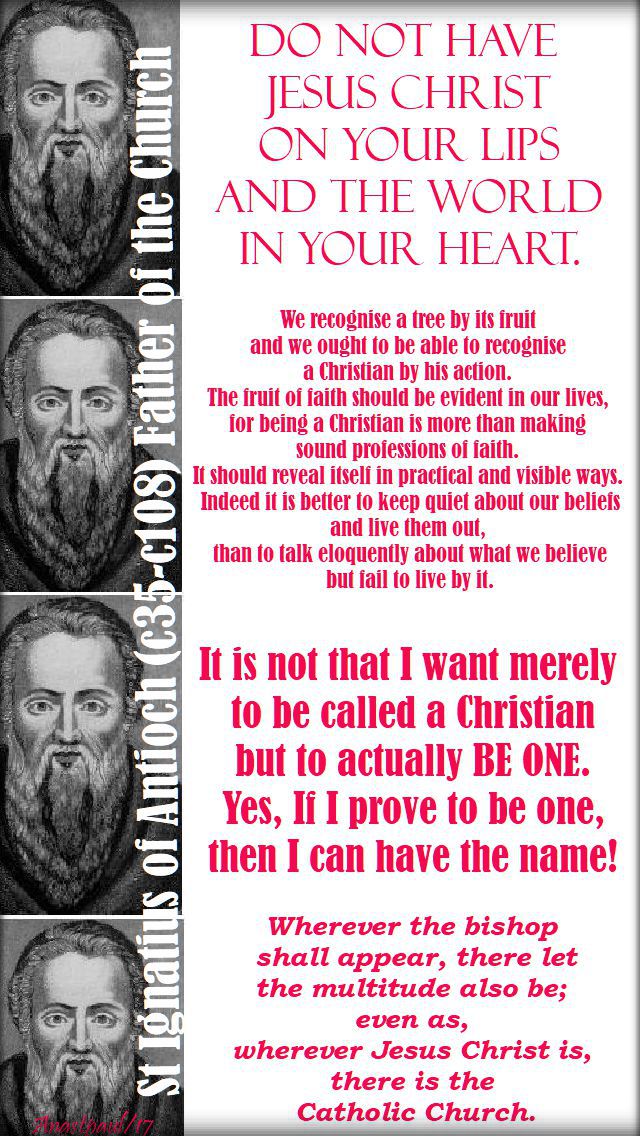
“Do not have Jesus Christ on your lips and the world in your heart.”
“We recognise a tree by its fruit and we ought to be able to recognise a Christian by his action. The fruit of faith should be evident in our lives, for being a Christian is more than making sound professions of faith. It should reveal itself in practical and visible ways. Indeed it is better to keep quiet about our beliefs and live them out, than to talk eloquently about what we believe but fail to live by it.”
“It is not that I want merely to be called a Christian but to actually BE ONE. Yes, If I prove to be one, then I can have the name!”
“Wherever the bishop shall appear,
there let the multitude also be;
even as, wherever Jesus Christ is,
there is the Catholic Church.”
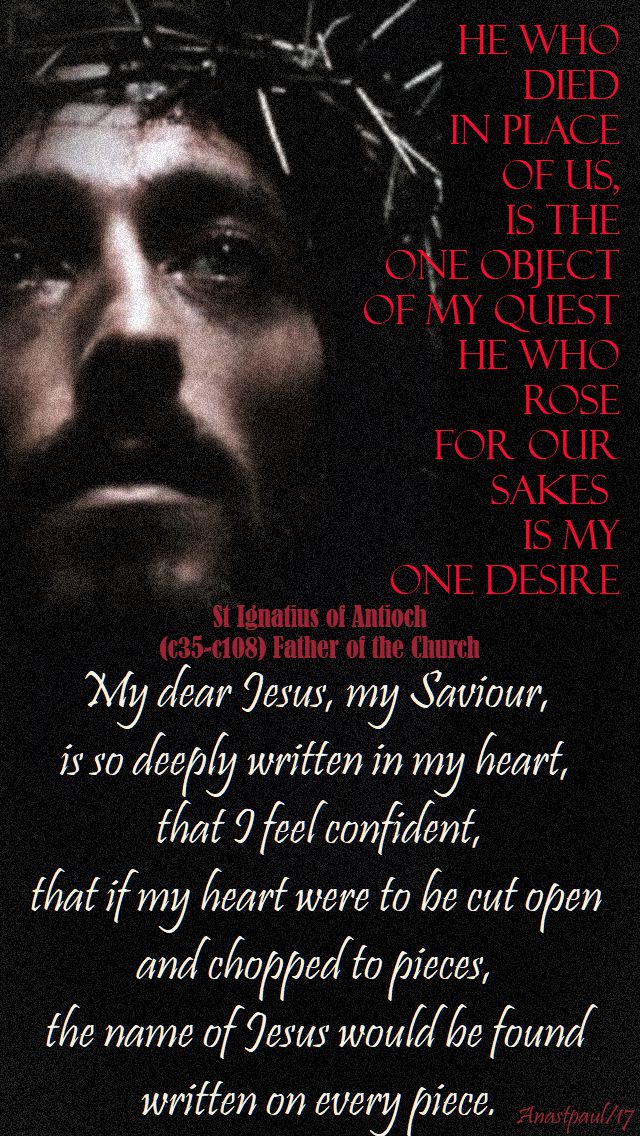
“He who died in place of us, is the one object of my quest. He who rose for our sakes is my one desire.”
“My dear Jesus, my Saviour, is so deeply written in my heart, that I feel confident, that if my heart were to be cut open and chopped to pieces, the name of Jesus would be found written on every piece.”
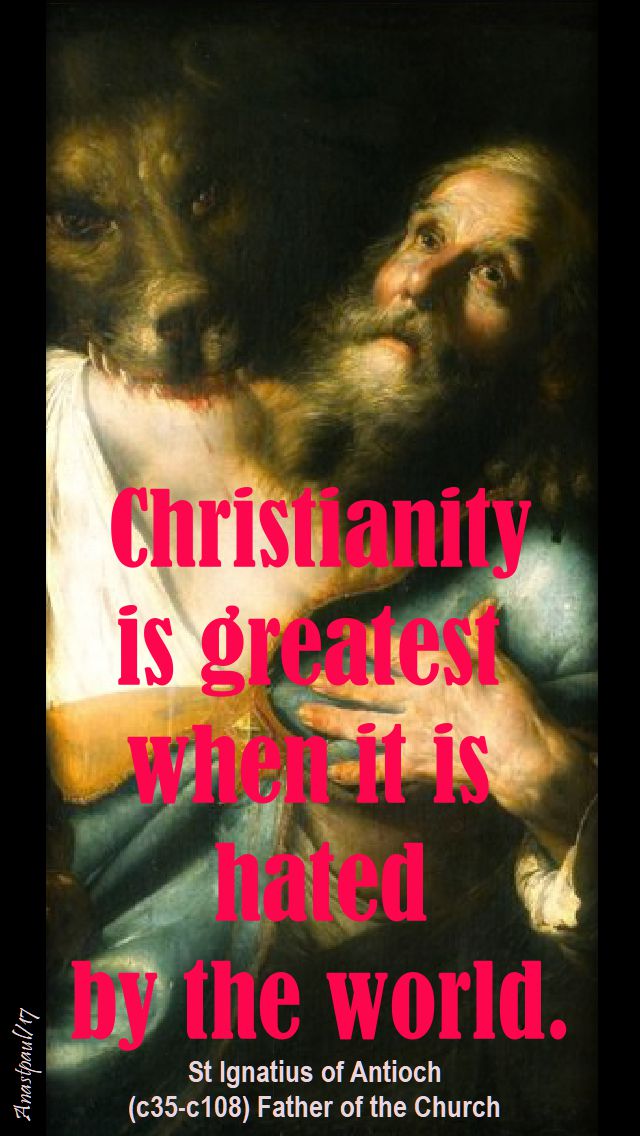
“Christianity is greatest when it is hated by the world.”
St Ignatius of Antioch (c35-c108) Father of the Church
NOVENA to St John Paul the Great: DAY FIVE – 17 OCTOBER
Little Known Fact #5: Father Karol Wojtyla was only 38 when he was made a Bishop. It did not change his lifestyle at all. True, instead of walking everywhere he had a bicylce and even a rather ancient car and chauffeur to get around the diocese and in order not to waste time, he had a table and a light fixed into the car, to allow him to read and work on necessary journeys.
REFLECTION:” ………reflecting on the assassination attempt, he said: “In sacrificing himself for us all, Christ gave a new meaning to suffering, opening up a new dimension, a new order: the order of love … It is this suffering which burns and consumes evil with the flame of love and draws forth even from sin a great flowering of good” (pp. 189-190). Impelled by this vision, the Pope suffered and loved in communion with Christ and that is why the message of his suffering and his silence proved so eloquent and so fruitful.” – Pope Benedict at St John Paul’s Funeral
Let us Pray:
O Holy Trinity, we thank You for having given to the Church Pope John Paul II and for having made him shine with Your fatherly tenderness, the glory of the Cross of Christand the splendour of the Spirit of love.
He, trusting completely in Your infinite mercy and in the maternal intercession of Mary, has shown himself in the likeness of Jesus the Good Shepherd and has pointed out to us the way of holiness as the path to reach eternal communion with You Grant us, through his intercession, according to Your will, the grace that we implore,
………………….. [state your intention here].
Continue, beloved St John Paul, we implore you, to sustain from heaven the faith of God’s people. We praise and thank You Father that St John Paul has been numbered among Your saints and make our prayer through our Lord Jesus Christ with the Holy Spirit, one God forever.
Totus Tuus, Amen.
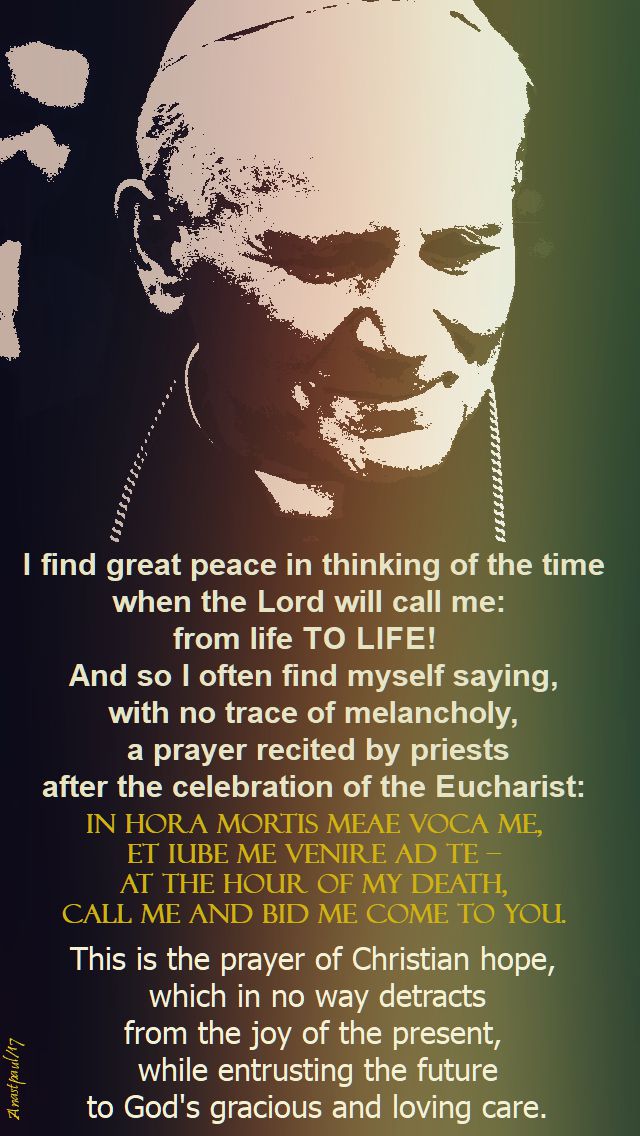
Quote Day Five: “I find great peace in thinking of the time when the Lord will call me: from life to life! And so I often find myself saying, with no trace of melancholy, a prayer recited by priests after the celebration of the Eucharist: In hora mortis meae voca me, et iube me venire ad te – at the hour of my death, call me and bid me come to you. This is the prayer of Christian hope, which in no way detracts from the joy of the present, while entrusting the future to God’s gracious and loving care.”
One Minute Reflection – 17 October – The Memorial of St Ignatius of Antioch (c35-c108) Father of the Church
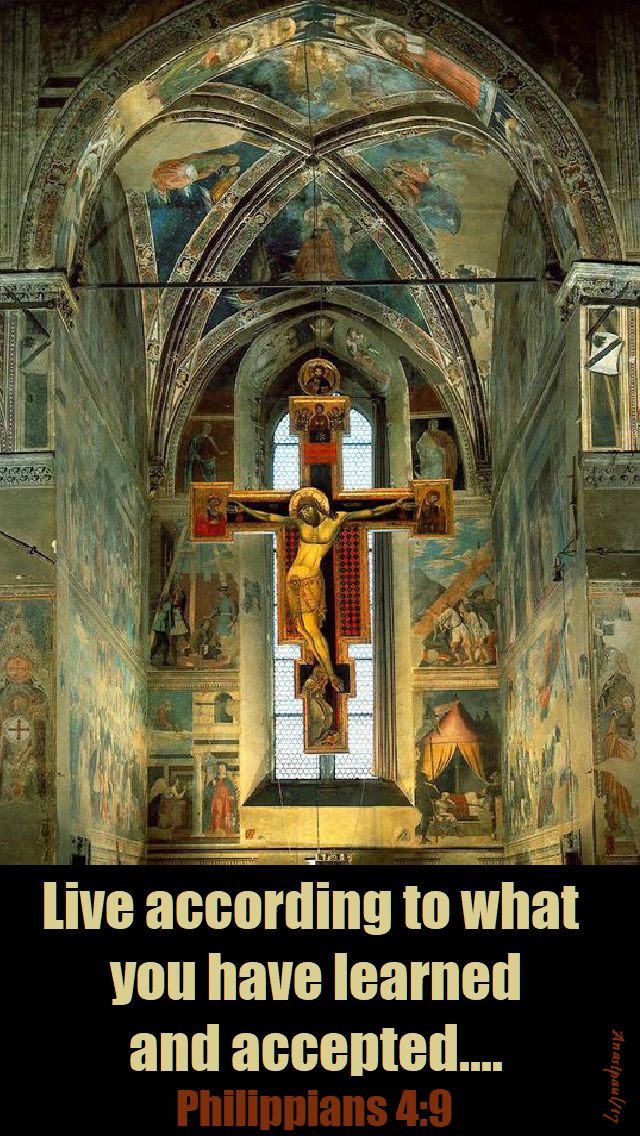
Live according to what you have learned and accepted…. Philippians 4:9
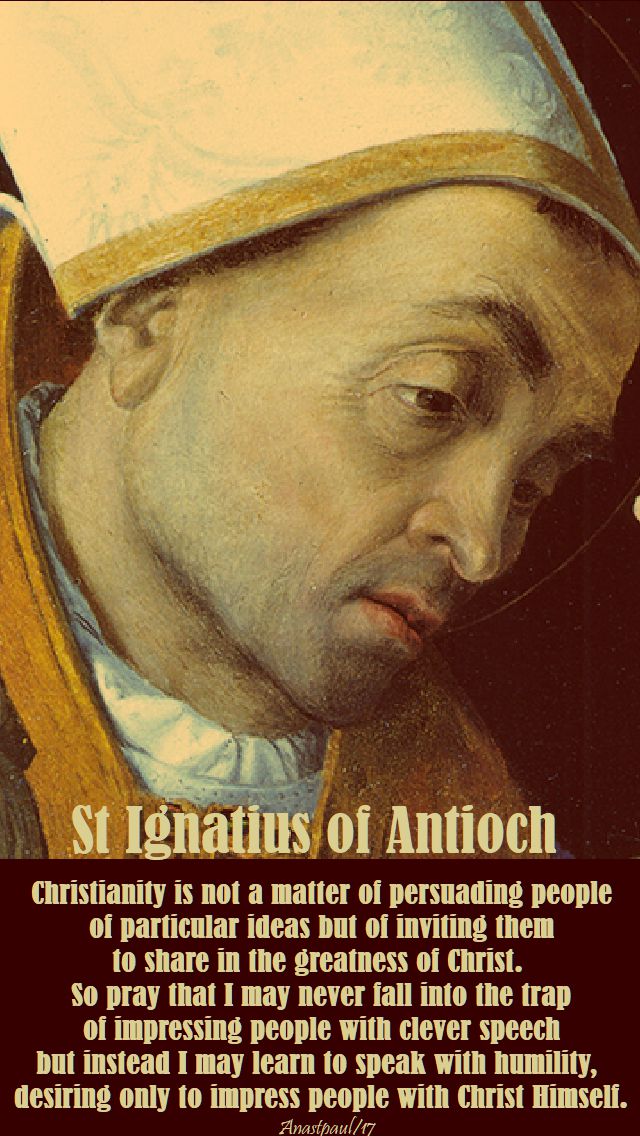
REFLECTION – “Christianity is not a matter of persuading people of particular ideas but of inviting them to share in the greatness of Christ. So pray that I may never fall into the trap of impressing people with clever speech but instead I may learn to speak with humility, desiring only to impress people with Christ Himself.”…St Ignatius of Antioch
PRAYER – Heavenly Father, grant that I may believe what I have learned, never presuming to know better than the teachings of Holy Mother Church and that I may put into practice what I believe. Let my commitment be like unto the Martyr, St Ignatius of Antioch, who went with joy to his horrific death, for the faith in Christ, Your Son, one God with You and the Holy Spirit. St Ignatius, pray for us, amen.
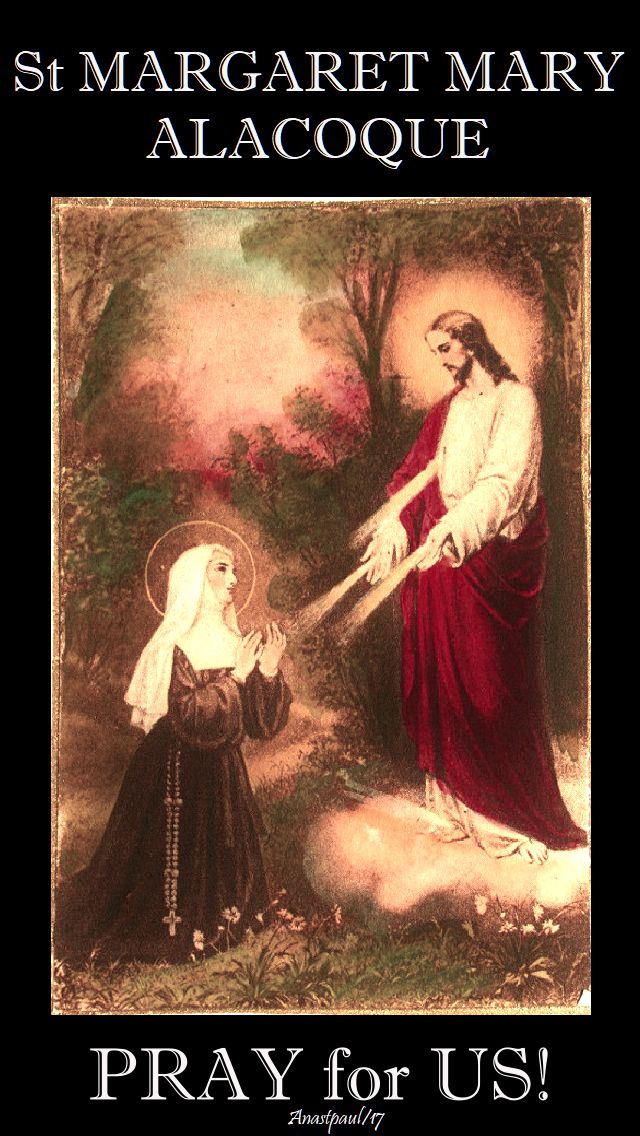
Thought for the Day – 16 October – The Memorial of St Margaret Mary Alacoque (1647-1690)
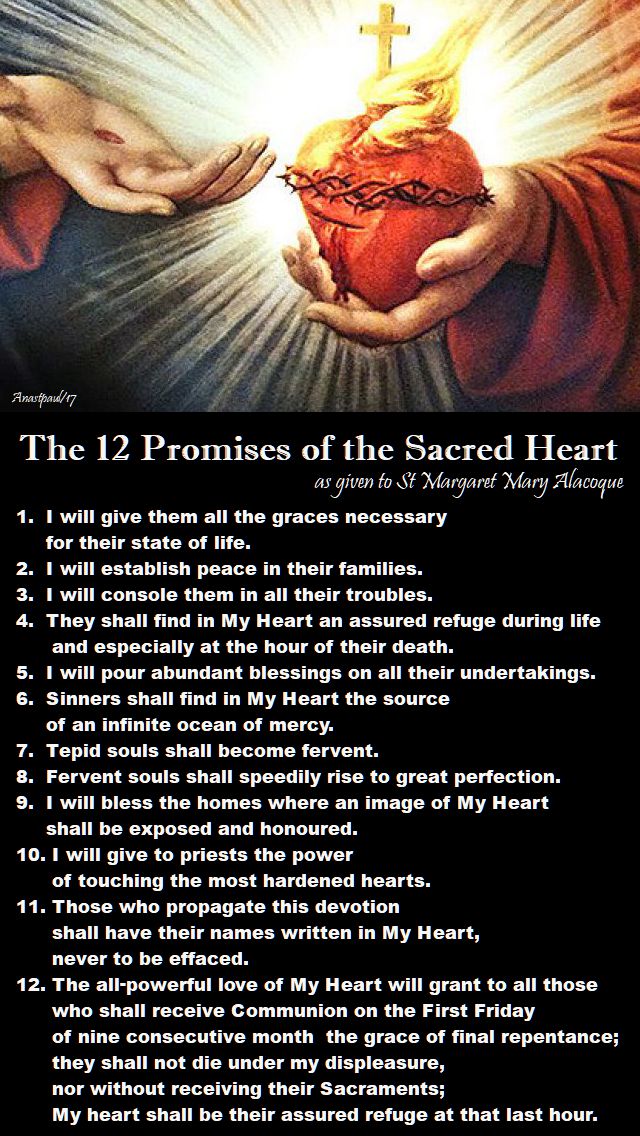
The Twelve Promises of Jesus to Saint Margaret Mary
or those Devoted to His Sacred Heart:
1. I will give them all the graces necessary for their state of life.
2. I will establish peace in their families.
3. I will console them in all their troubles.
4. They shall find in My Heart an assured refuge during life
and especially at the hour of their death.
5. I will pour abundant blessings on all their undertakings.
6. Sinners shall find in My Heart the source of an infinite ocean of mercy.
7. Tepid souls shall become fervent.
8. Fervent souls shall speedily rise to great perfection.
9. I will bless the homes where an image of My Heart
shall be exposed and honoured.
10. I will give to priests the power of touching the most hardened hearts.
11. Those who propagate this devotion shall have their names
written in My Heart, never to be effaced.
12. The all-powerful love of My Heart will grant to all those
who shall receive Communion on the First Friday of nine consecutive months
the grace of final repentance;
they shall not die under my displeasure, nor without receiving their Sacraments;
My heart shall be their assured refuge at that last hour.
From Saint Margaret Mary Alacoque’s Vision of Jesus
Our scientific-materialistic age cannot “prove” private revelations. Theologians, if pressed, admit that we do not have to believe in them. But it is impossible to deny the message Margaret Mary heralded: that God loves us with a passionate love. Her insistence on reparation and prayer and the reminder of final judgment should be sufficient to ward off superstition and superficiality in devotion to the Sacred Heart while preserving its deep Christian meaning.
Quote/s of the Day – 16 October – The Memorials of St Margaret Mary Alacoque (1647-1690) and St Gerard Majella (1725-1755)
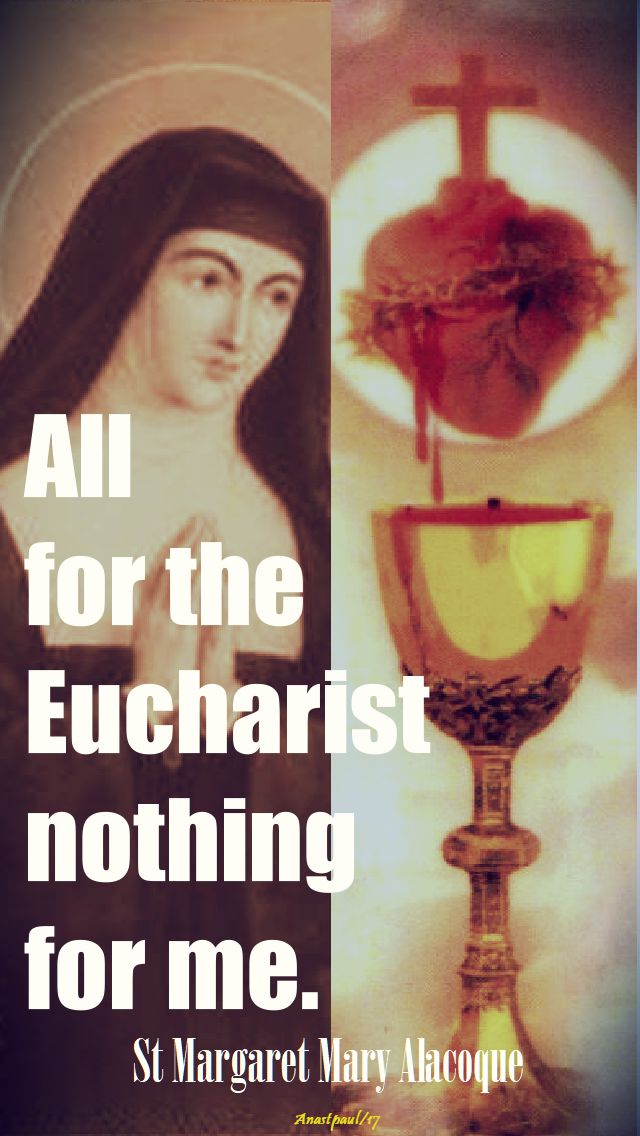
“All for the Eucharist nothing for me.”
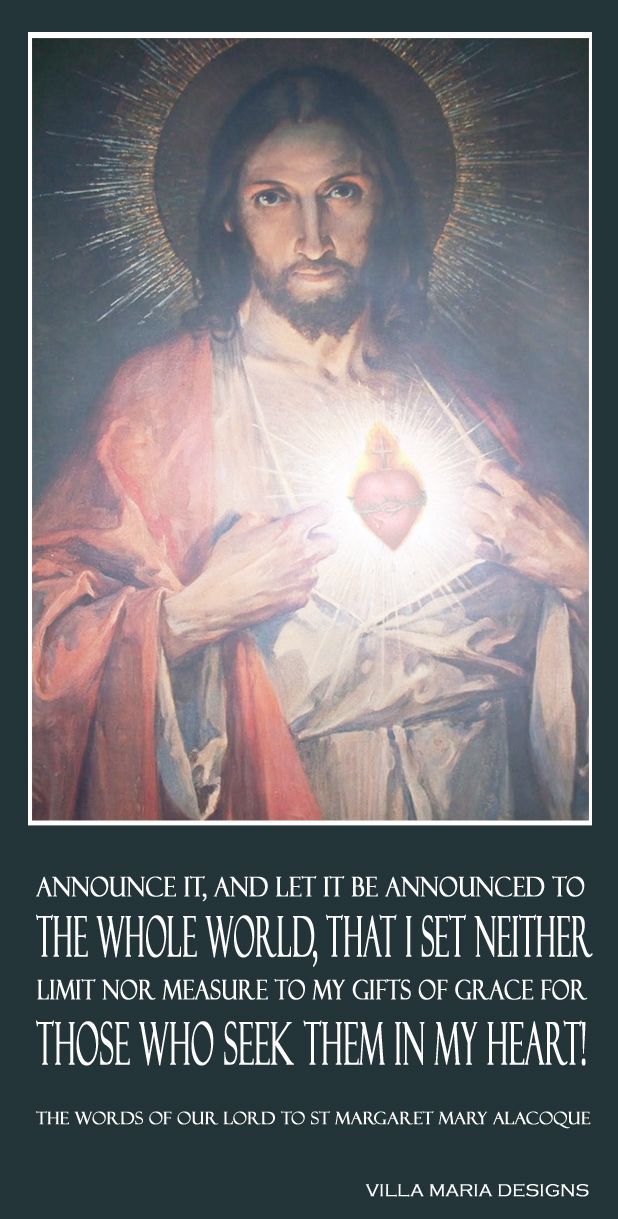
“Announce it and let it be announced to the whole world, that I set neither limit nor measure to my gifts of grace, for those who seek them in my Heart.” Revelations of Our Lord to St Margaret Mary Alacoque
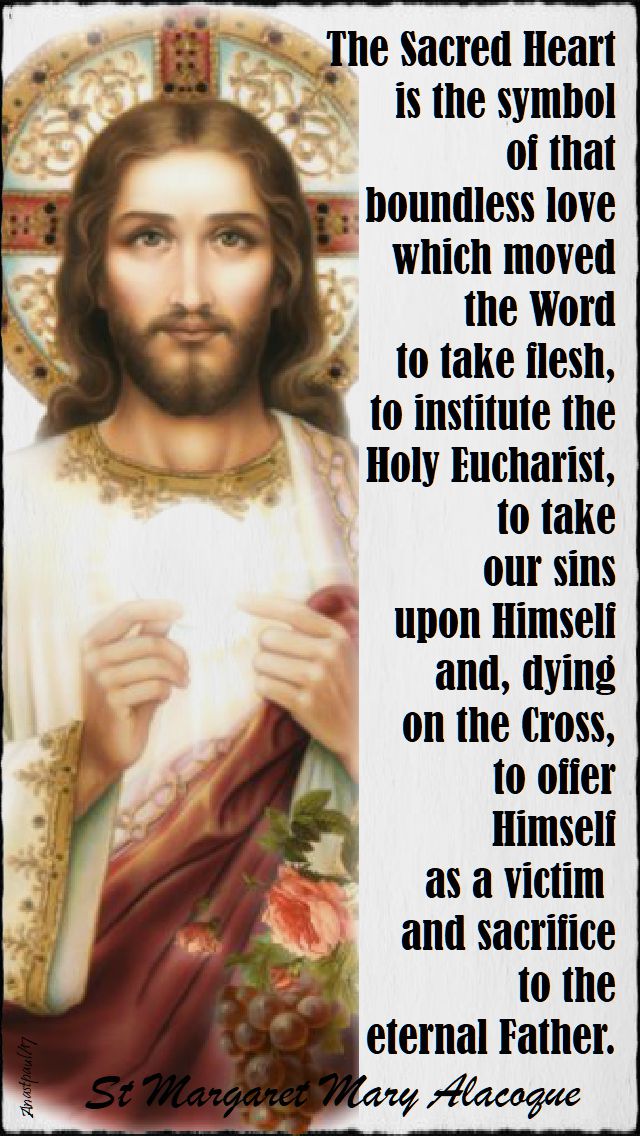
“The Sacred Heart is the symbol of that boundless love which moved the Word to take flesh, to institute the Holy Eucharist, to take our sins upon Himself and, dying on the Cross, to offer Himself as a victim and sacrifice to the eternal Father.”
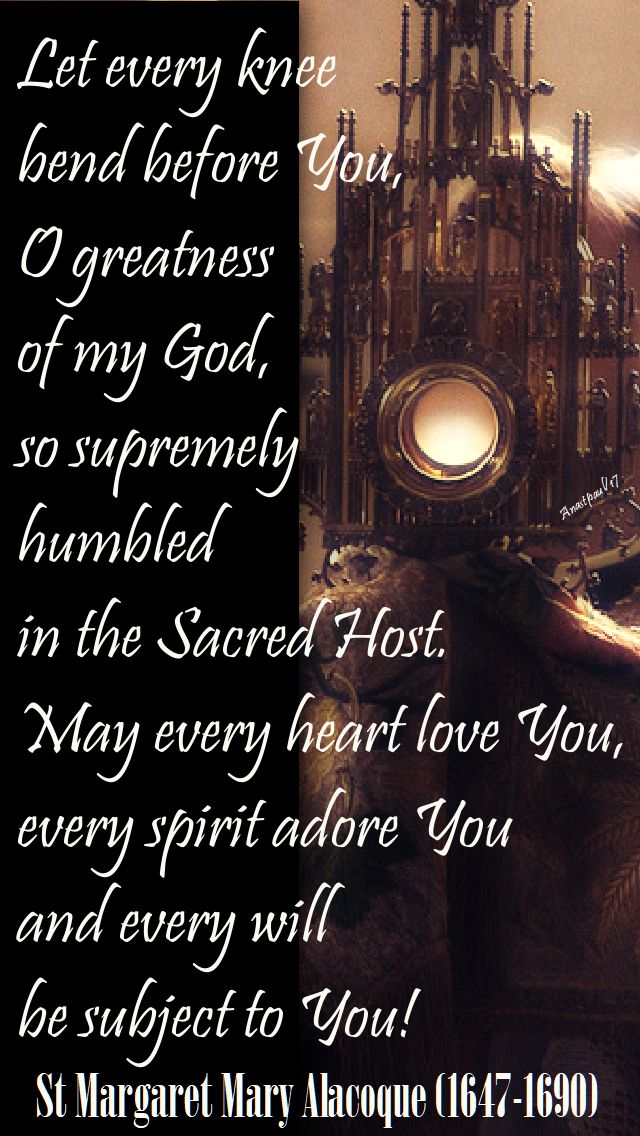
“Let every knee bend before You, O greatness of my God, so supremely humbled in the Sacred Host. May every heart love You, every spirit adore You and every will be subject to You!
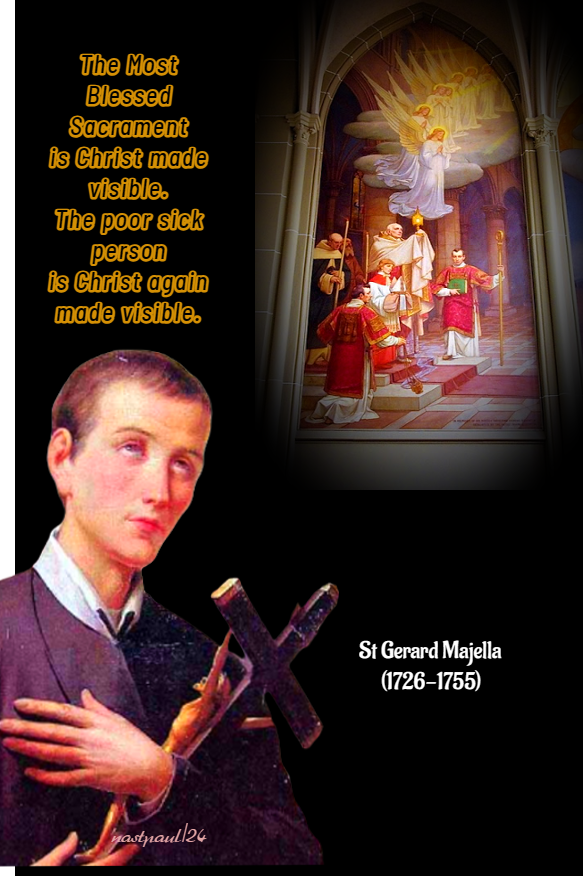
“The Most Blessed Sacrament is Christ made visible. The poor sick person is Christ again made visible.”
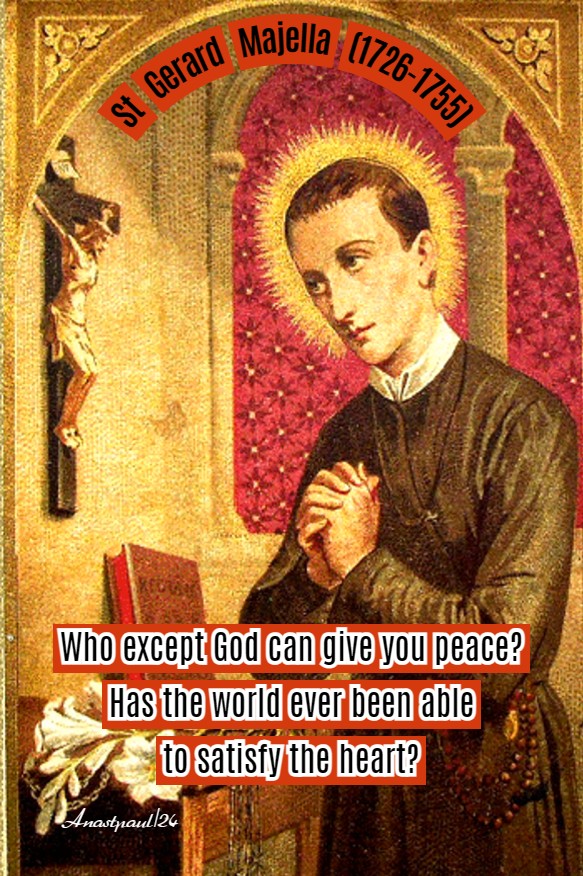
“Who except God can give you peace? Has the world ever been able to satisfy the heart?”
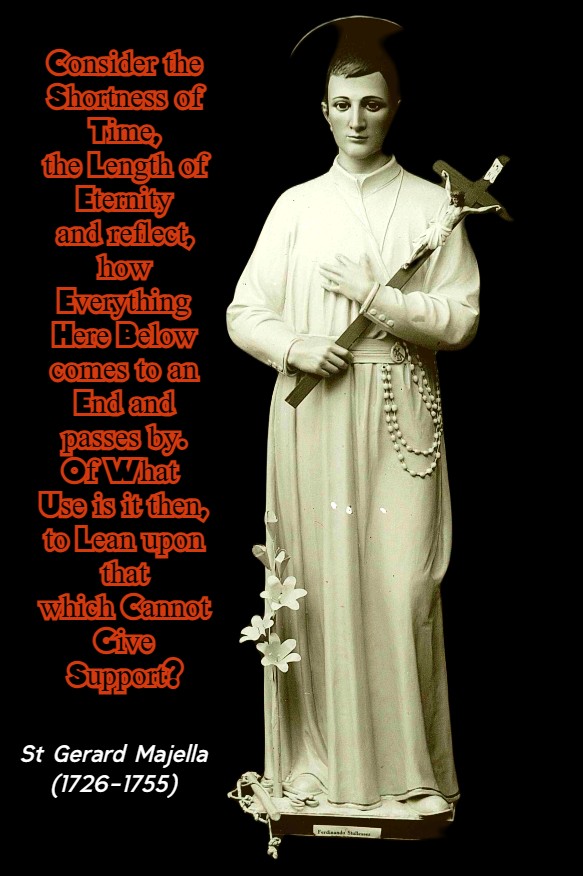
“Consider the shortness of time, the length of eternity and reflect how everything here below comes to an end and passes by. Of what use is it to lean upon that, which cannot give support? “
One Minute Reflection – 16 October – The Memorial of St Margaret Mary Alacoque (1647-1690)
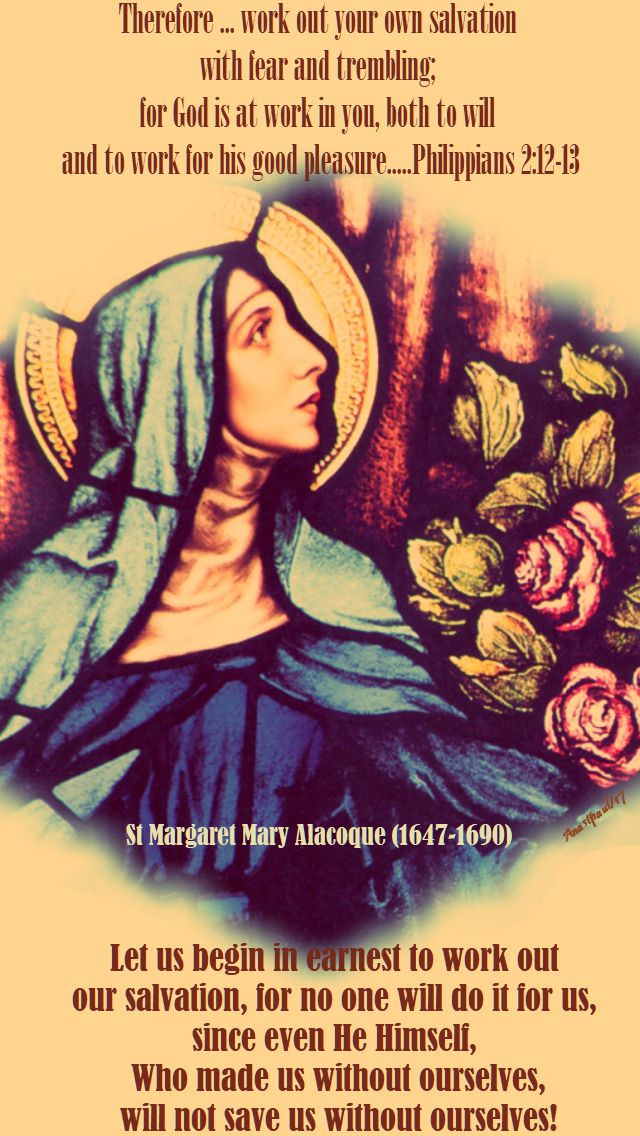
Therefore, my beloved, as you have always obeyed, so now, not only as in my presence but much more in my absence, work out your own salvation with fear and trembling; for God is at work in you, both to will and to work for his good pleasure.….Philippians 2:12-13
REFLECTION – “Let us begin in earnest to work out our salvation, for no one will do it for us, since even He Himself, Who made us without ourselves, will not save us without ourselves!”…..St Margaret Mary Alacoque
PRAYER – Lord Jesus Christ, You wondrously revealed all of the deep treasures of Your Heart to St Margaret Mary. May her merits and example win us the grace to love You above all things and in all things so that we may make our abode in Your own Sacred Heart. St Margaret Mary, pray for us that we may live in the Sacred Heart of Christ our Lord. Through You, Lord Jesus, who live and reign forever, in union with God our Father and the Holy Spirit, one God, amen.
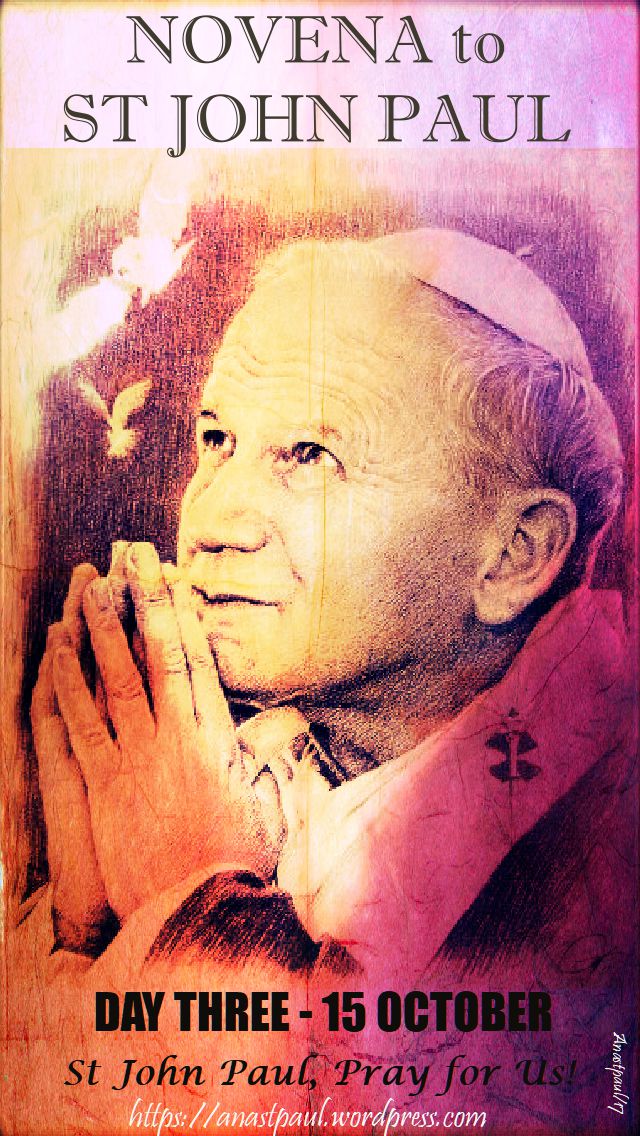
NOVENA to St John Paul the Great: DAY THREE – 15 OCTOBER
Little Known Fact #3: During his fourth year of Theological studies, Karol Wojtyla felt an increasing call to enter a Carmelite monastery. In the same year, one of his good friends, Br Leonard Kowalowka, was appointed Novice Master at a Carmelite monastery. This appointment of his friend prompted Wojtyla to pursue his desire to be a Carmelite. Wojtyla applied to enter the monastery at Czerna but transferring from the Diocesesan seminary to a religious monastery needed the approval of the bishop. Cardinal Sapieha did not give his approval and instead told Wojtyla to “finish what he started.” Wojtyla did exactly that and stayed the path of a Diocesesan priest.
REFLECTION DAY THREE: “In October 1978 Cardinal Wojtyla once again heard the voice of the Lord. Once more there took place that dialogue with Peter reported in the Gospel of this Mass: “Simon, son of John, do you love me? Feed my sheep!” To the Lord’s question, “Karol, do you love me?,” the Archbishop of Krakow answered from the depths of his heart: “Lord you know everything; you know that I love you.” The love of Christ was the dominant force in the life of our beloved Holy Father. Anyone who ever saw him pray, who ever heard him preach, knows that. Thanks to his being profoundly rooted in Christ, he was able to bear a burden which transcends merely human abilities: that of being the shepherd of Christ’s flock, his universal Church.”……..Pope Benedict
Let us Pray:
O Holy Trinity, we thank You for having given to the Church Pope John Paul II and for having made him shine with Your fatherly tenderness, the glory of the Cross of Christand the splendour of the Spirit of love.
He, trusting completely in Your infinite mercy and in the maternal intercession of Mary, has shown himself in the likeness of Jesus the Good Shepherd and has pointed out to us the way of holiness as the path to reach eternal communion with You Grant us, through his intercession, according to Your will, the grace that we implore,
………………….. [state your intention here].
Continue, beloved St John Paul, we implore you, to sustain from heaven the faith of God’s people. We praise and thank You Father that St John Paul has been numbered among Your saints and make our prayer through our Lord Jesus Christ with the Holy Spirit, one God forever. Totus Tuus, Amen.
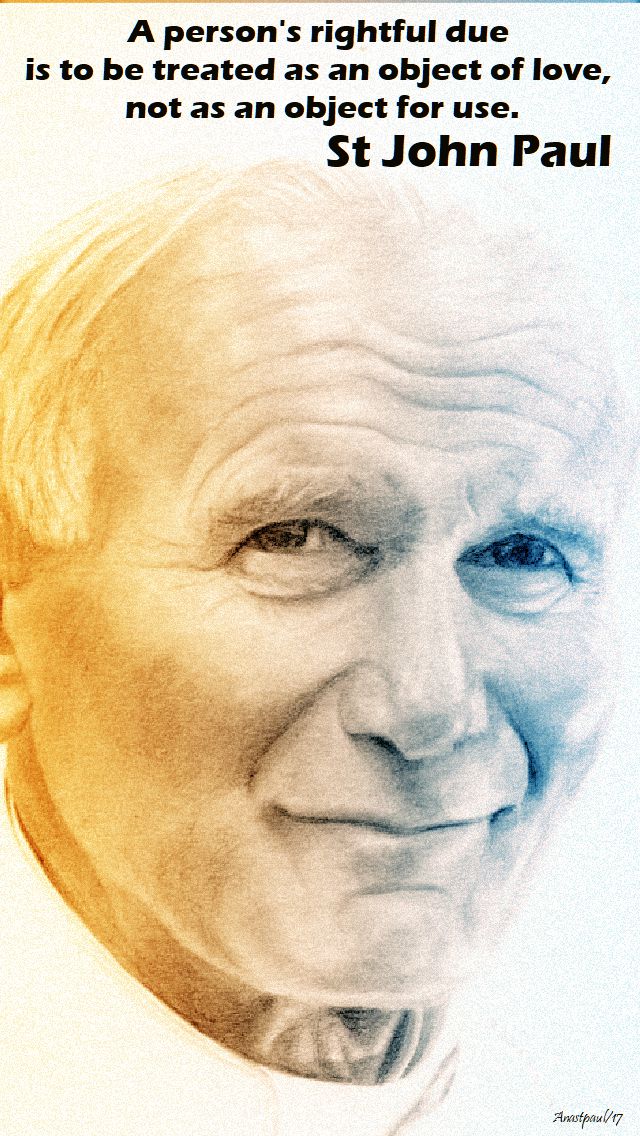
Quote Day Three: “A person’s rightful due is to be treated as an object of love, not as an object for use.”
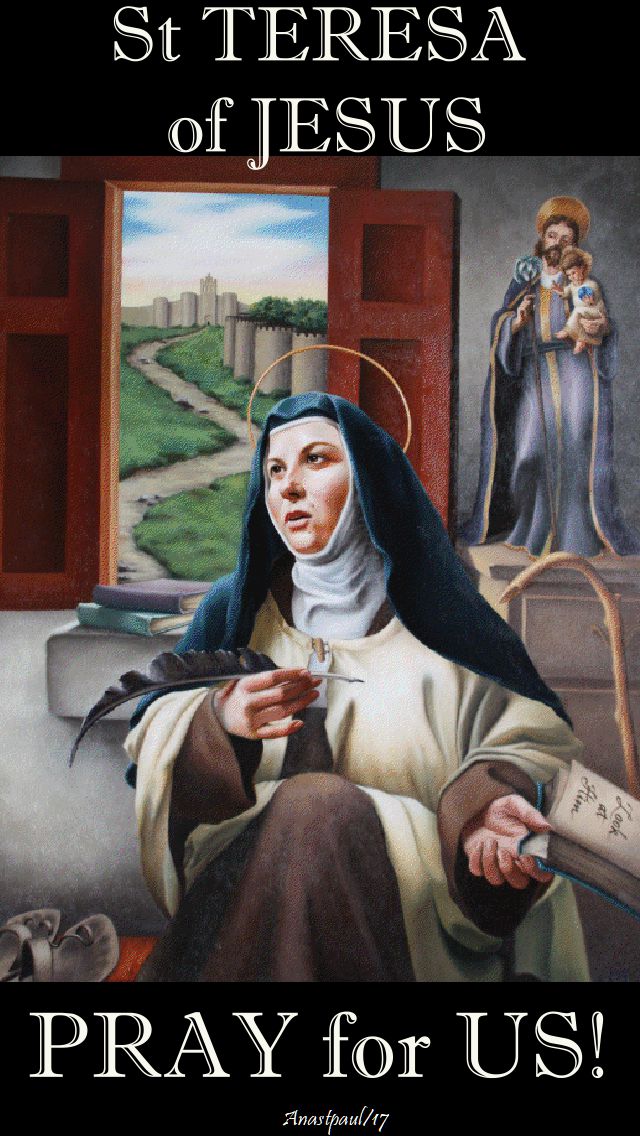
Thought for the Day – – 15 October – The Memorial of St Teresa of Jesus/Avila (1515-1582) Doctor of the Church
Since her encounter with Jesus, St Teresa lived “another life”; she become a tireless communicator of the Gospel (cf. Life, 23, 1). Eager to serve the Church and in the face of serious problems of her time, she did not limit herself to being a spectator of the reality around her. In her position as a woman and with her health difficulties, she decided, she said, “to do what little depended on me … that is to follow the evangelical counsels as perfectly as possible and to ensure that these few nuns who are here do the same” (The Way, 1, 2). Thus began the Teresian reform, in which she asked her sisters not to lose time negotiating with God “interests of little importance,” while “the world is in flames” (ibid., 1, 5). This missionary and ecclesial dimension has always marked the Carmelites and Discalced Carmelites.
As she did then, even today the saint opens new horizons for us, she calls us to a great undertaking, to see the world with the eyes of Christ, to seek what He seeks and to love what He loves. (Pope Francis in a letter to to Carmelite Father Xavier Cannistrà)
Ours is a time of turmoil, a time of reform, and a time of liberation. Modern women have in Teresa a challenging example. Promoters of renewal, promoters of prayer, all have in Teresa a woman to reckon with, one whom they can admire and imitate.
Quotes of the Day – 15 October – The Memorial of St Teresa of Jesus/Avila (1515-1582) Doctor of the Church
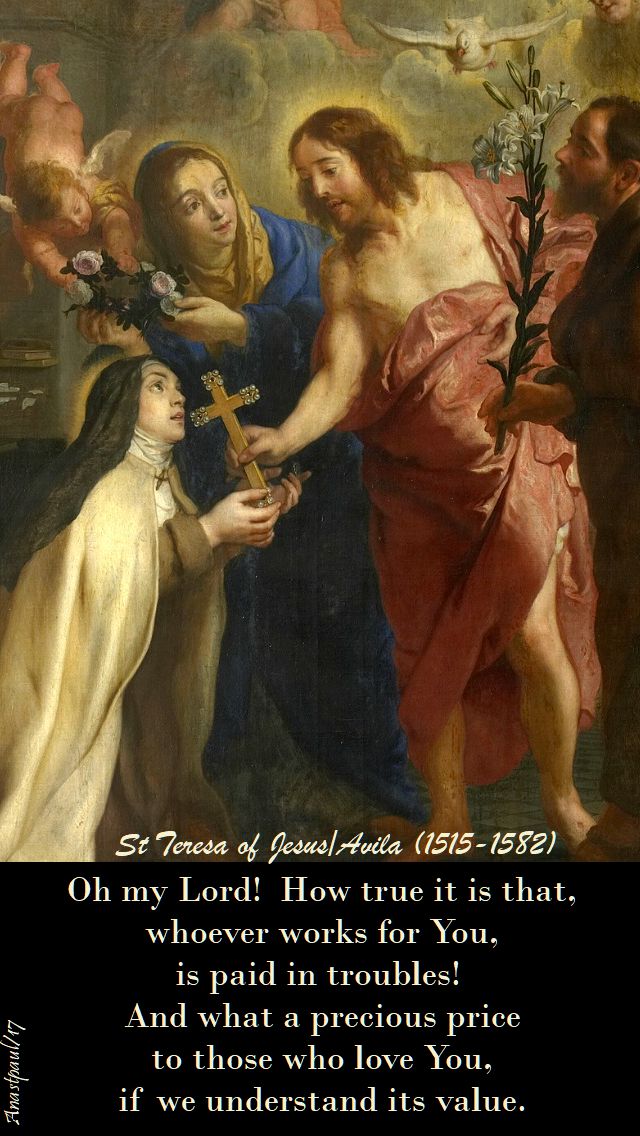
“Oh my Lord! How true it is that, whoever works for You, is paid in troubles! And what a precious price to those who love You, if we understand its value.”
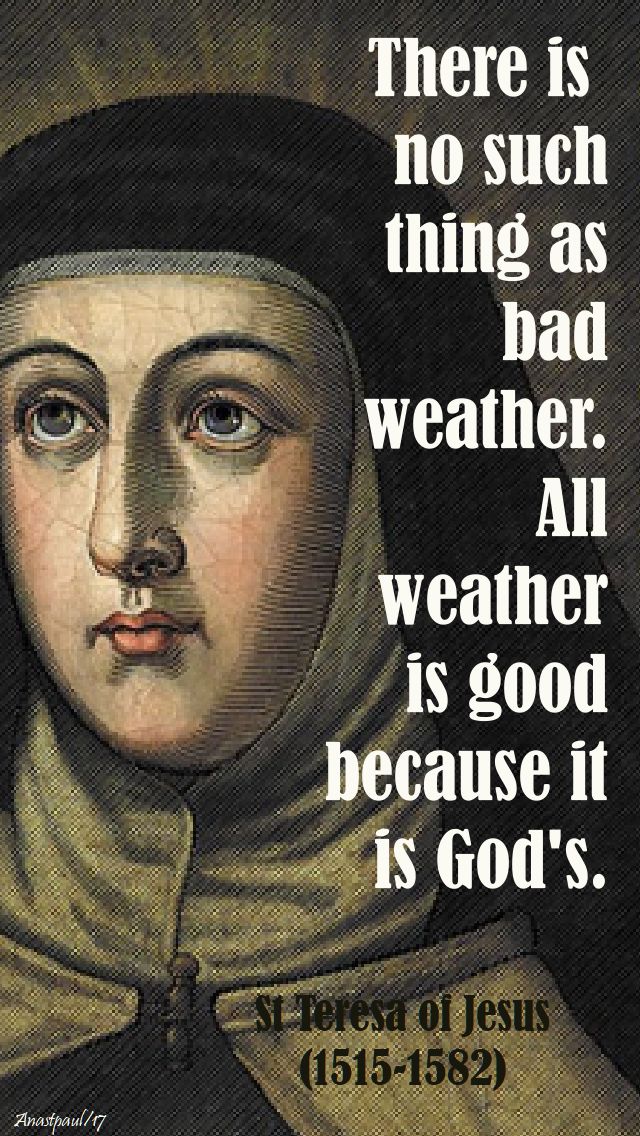
“There is no such thing as bad weather. All weather is good because it is God’s.”
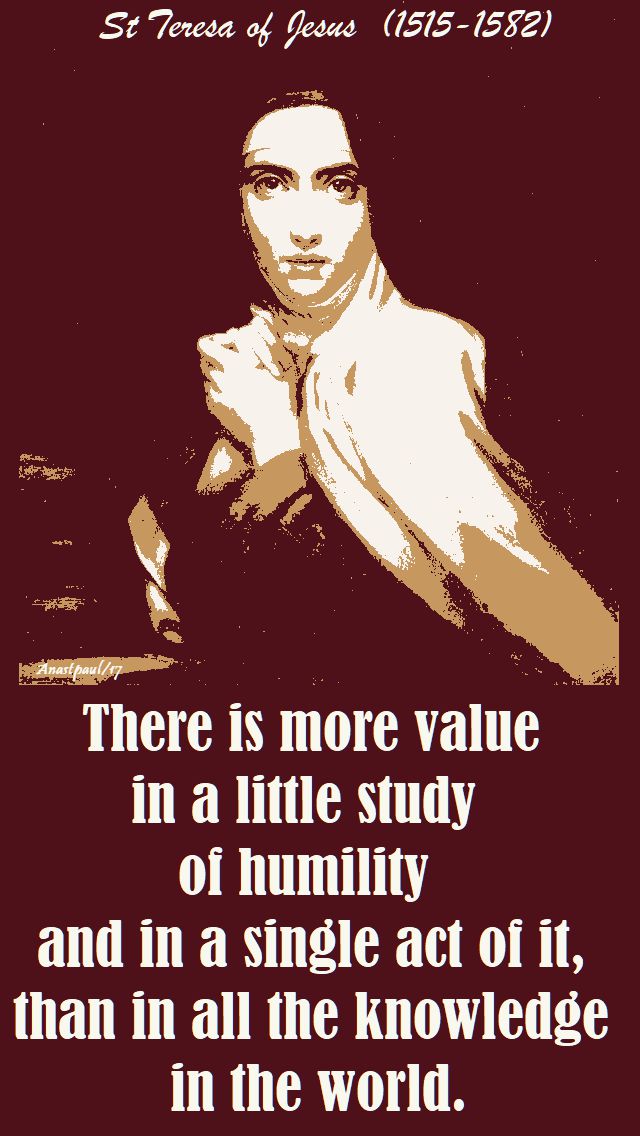
“There is more value in a little study of humility and in a single act of it, than in all the knowledge in the world.”
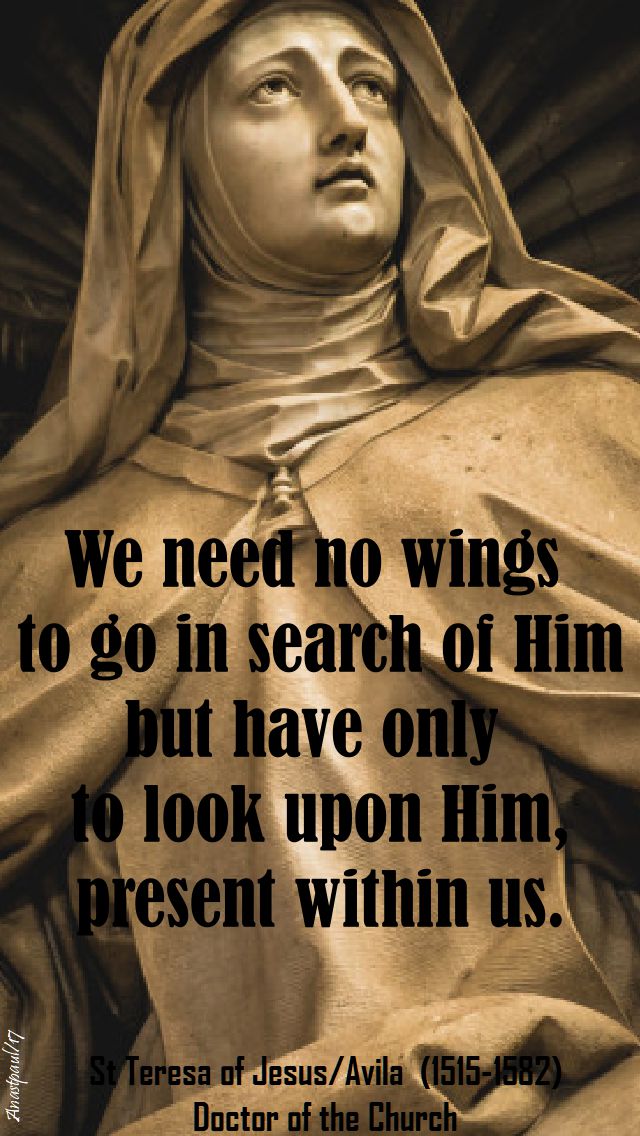
“We need no wings to go in search of Him but have only to look upon Him, present within us.”
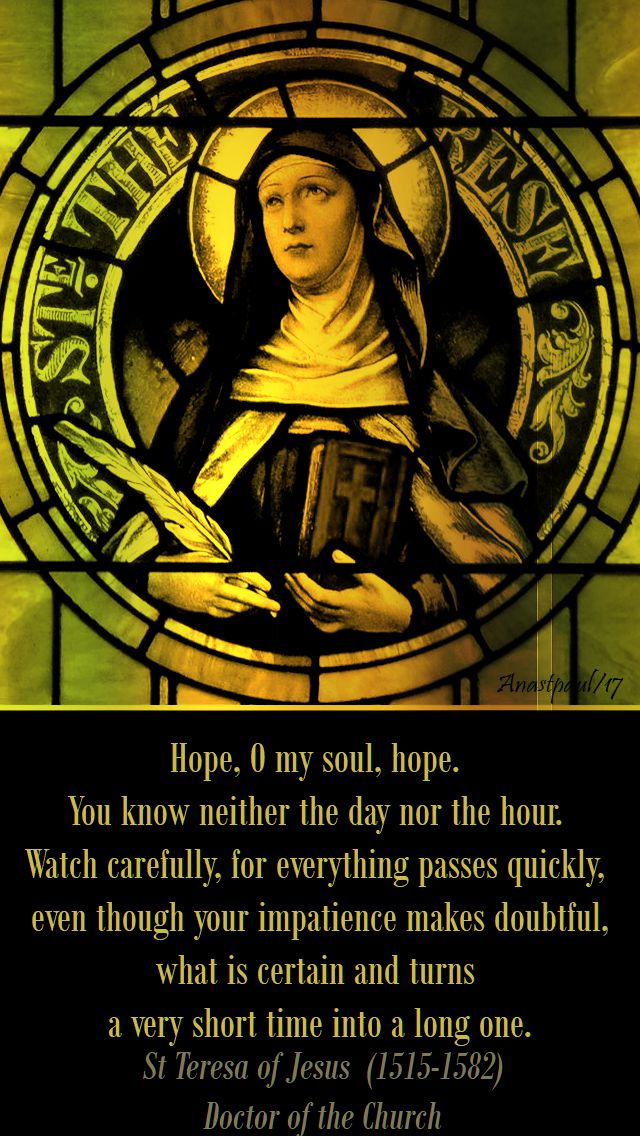
“Hope, O my soul, hope. You know neither the day nor the hour. Watch carefully, for everything passes quickly, even though your impatience makes doubtful, what is certain and turns a very short time into a long one.”
One Minute Reflection – 15 October – The Memorial of St Teresa of Jesus/Avila (1515-1582) Doctor of the Church
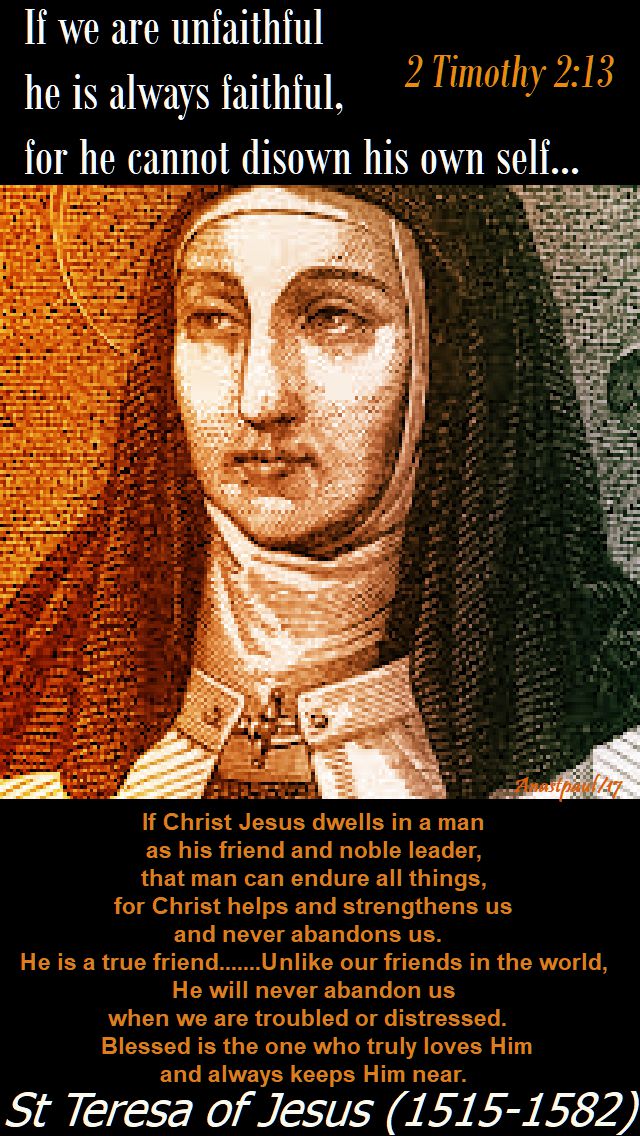
If we have died with him we shall also live with him; if we persevere we shall also reign with him. But if we deny him he will deny us. If we are unfaithful he is always faithful, for he cannot disown his own self..…2 Timothy 2:11-13
REFLECTION – “If Christ Jesus dwells in a man as his friend and noble leader, that man can endure all things, for Christ helps and strengthens us and never abandons us. He is a true friend. And I clearly see that is we expect to please Him and receive an abundance of His graces, God desires that these graces must come to us from the hands of Christ, through His most sacred humanity, in which God takes delight. All blessings come to us through our Lord. He will teach us, for in beholding His life we find that He is the best example. What more do we desire from such a good friend at our side? Unlike our friends in the world, He will never abandon us when we are troubled or distressed. Blessed is the one who truly loves Him and always keeps Him near. Whenever we think of Christ we should recall the love that led Him to bestow on us so many graces and favours and also the great love God showed in giving us in Christ a pledge of His love; for love calls for love in return. Let us strive to keep this always before our eyes and to rouse ourselves to love Him. For if at some time the Lord should grant us the grace of impressing His love on our hearts, all will become easy for us and we shall accomplish great things quickly and without effort.” – Saint Teresa of Jesus
PRAYER – Almighty God, our Father, You sent St Teresa of Jesus to be a witness in the Church to the way of perfection. Sustain us by her spiritual doctrine and kindle in us, the longing for true holiness. Through Christ, our Lord, in union with the Holy Spirit. St Teresa pray for us, amen
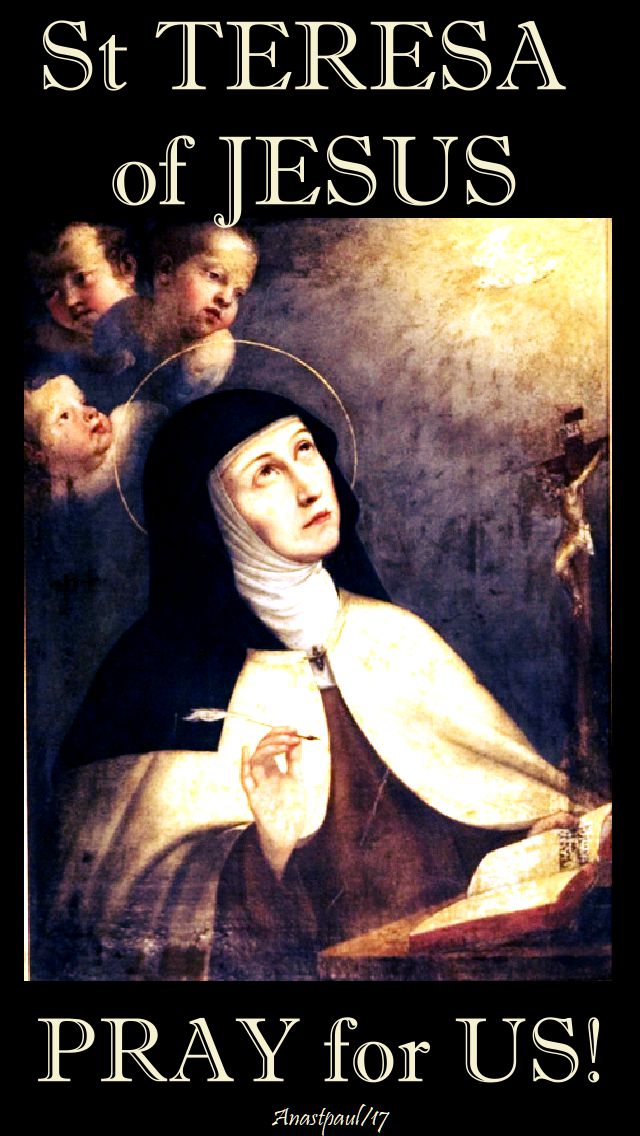
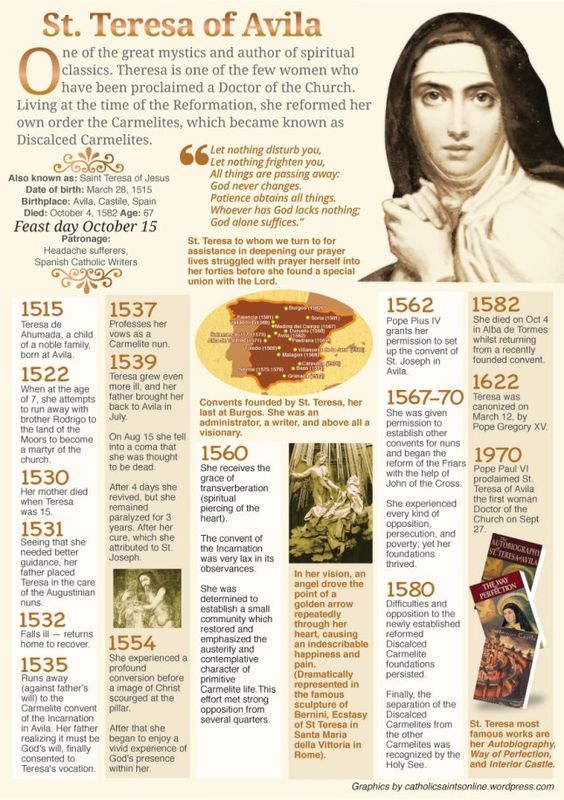
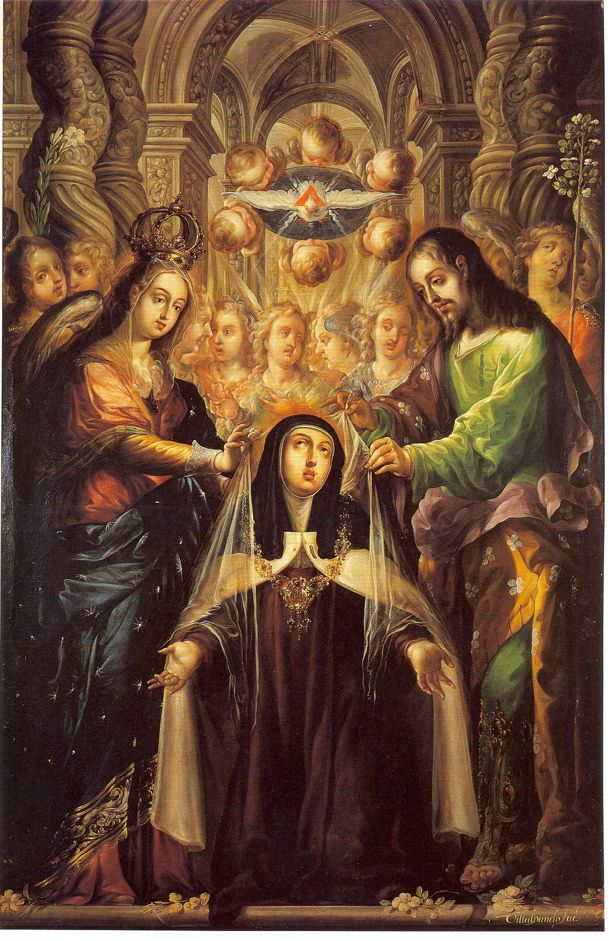
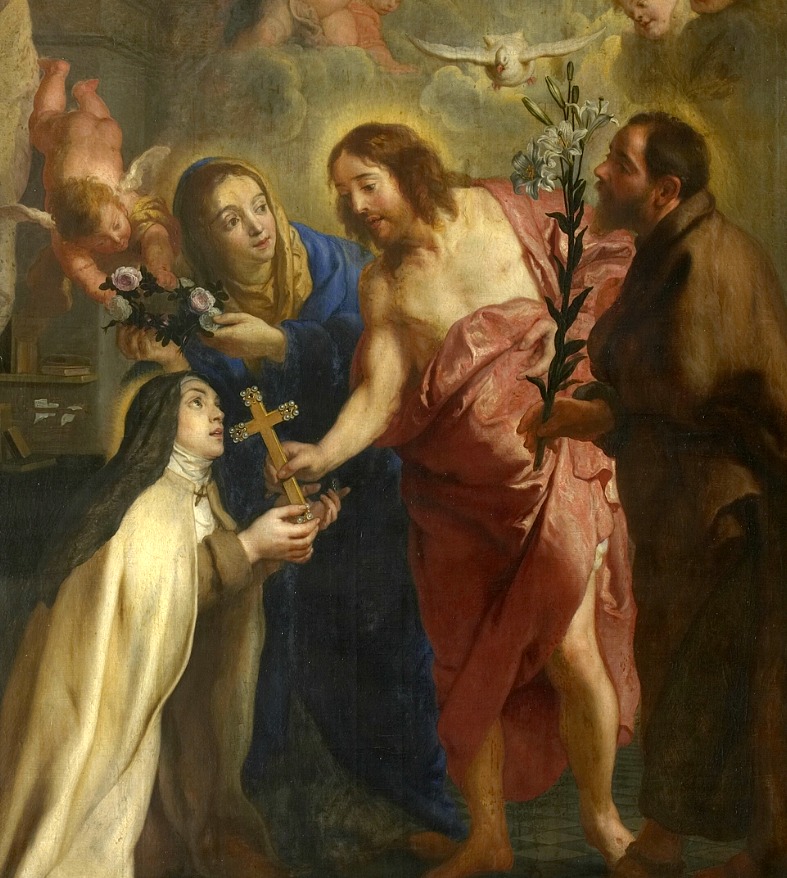
Saint of the Day – 15 October – St Teresa of Jesus/of Avila (1515-1582) Virgin, Mystic, Ecstatic, Reformer, Apostle of Prayer, Writer, Doctor of the Church. Born as Teresa Sanchez Cepeda Davila y Ahumada at Avila, Old Castile, on 28 March 1515 – died at Alba de Tormes, 4 October 1582 of natural causes in the arms of her secretary and close friend Blessed Anne of Saint Bartholomew. Her relics are preserved at Alba – her heart shows signs of Transverberation (piercing of the heart), and is displayed, too. Her Body is incorrupt. Patronages: • sick people; against bodily ills or sickness • against headaches • against the death of parents • lace makers or lace workers • people in need of grace • people in religious orders • people ridiculed for their piety • World Youth Day 2011 • Amos, Canada, diocese of • Avellaneda-Lanús, Argentina, diocese of • Berzano di Tortona, Italy • Pozega, Croatia • Spain. Attributes – Habit of the Discalced Carmelites, Book and Quill, arrow-pierced heart. St Teresa was Beatified on 24 April 1614 by Pope Paul V and Canonised on 12 March 1622, only forty years after her death, by Pope Gregory XV. Tradition associate Saint Teresa with the Infant Jesus of Prague with claims of former ownership and devotion. On 27 September 1970 St Teresa, was named a Doctor of the Church by Pope Paul VI. Her books, which include her autobiography (The Life of Teresa of Jesus) and her seminal work El Castillo Interior (trans.: The Interior Castle), are an integral part of Spanish Renaissance literature as well as Christian mysticism and Christian meditation practices. She also wrote Camino de Perfección (trans.: The Way of Perfection).
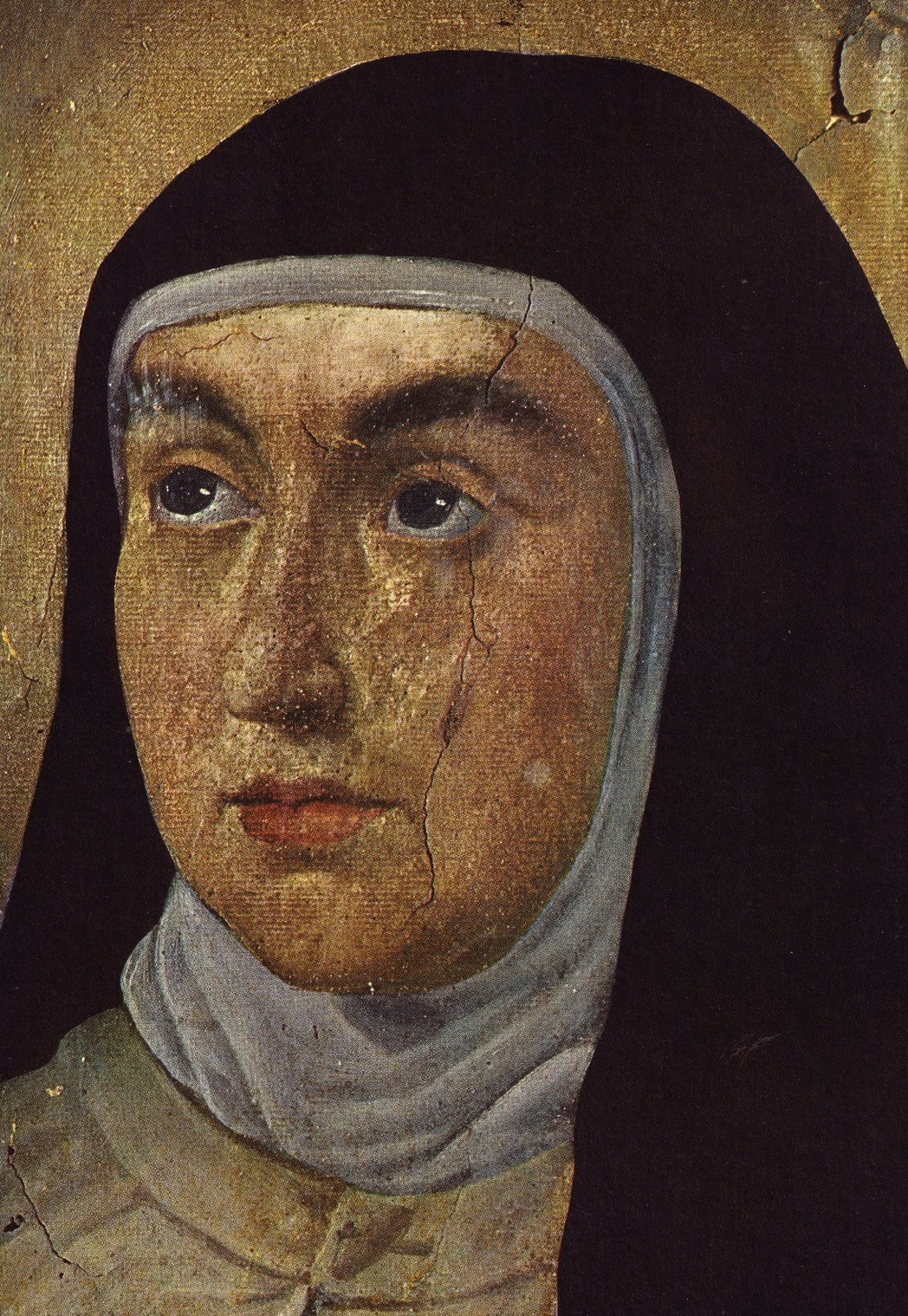
Original Portrait by Frei Jual de la Miseria in 1576
The third child of Don Alonso Sanchez de Cepeda by his second wife, Doña Beatriz Davila y Ahumada, who died when the Teresa was in her fourteenth year, Teresa was brought up by her saintly father, a lover of serious books and a tender and pious mother. After her death and the marriage of her eldest sister, Teresa was sent for her to the Augustinian nuns at Avila but owing to illness she left at the end of eighteen months and for some years remained with her father and occasionally with other relatives, notably an uncle who made her acquainted with the Letters of St Jerome, which determined her to adopt the religious life, not so much through any attraction towards it, as through a desire of choosing the safest course. Unable to obtain her father’s consent she left his house unknown to him to enter the Carmelite Convent of the Incarnation at Avila, which then counted 140 nuns. The wrench from her family caused her a pain which she ever afterwards compared to that of death. However, her father at once yielded and Teresa took the habit.
Teresa lived in an age of exploration as well as political, social and religious upheaval. It was the 16th century, a time of turmoil and reform. She was born before the Protestant Reformation and died almost 20 years after the closing of the Council of Trent.
The gift of God to Teresa in and through which she became holy and left her mark on the Church and the world is threefold: she was a woman; she was a contemplative; she was an active reformer.
As a woman, Teresa stood on her own two feet, even in the man’s world of her time. She was “her own woman,” entering the Carmelites despite strong opposition from her father. She is a person wrapped not so much in silence as in mystery. Beautiful, talented, outgoing, adaptable, affectionate, courageous, enthusiastic, she was totally human. Like Jesus, she was a mystery of paradoxes: wise, yet practical; intelligent, yet much in tune with her experience; a mystic, yet an energetic reformer; a holy woman, a womanly woman.
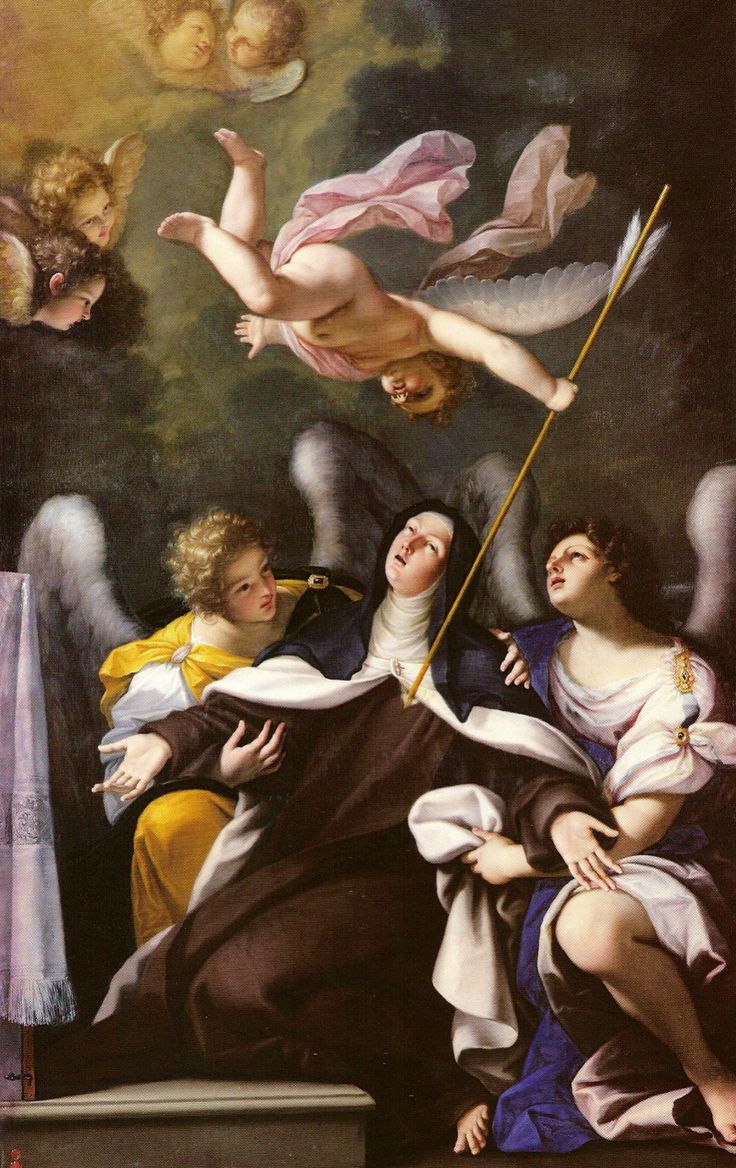
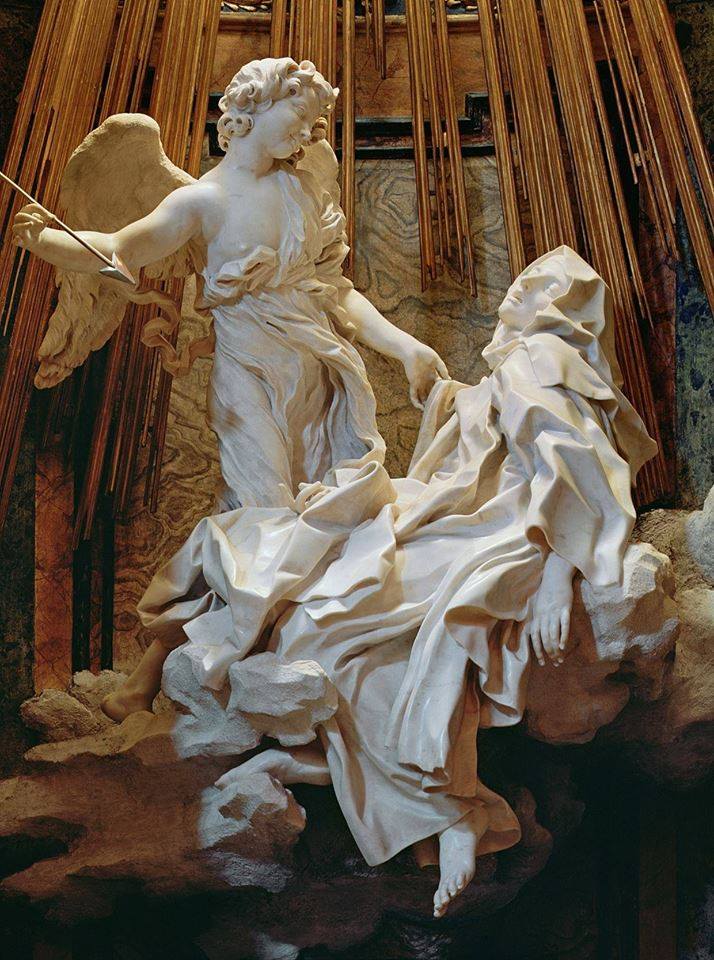
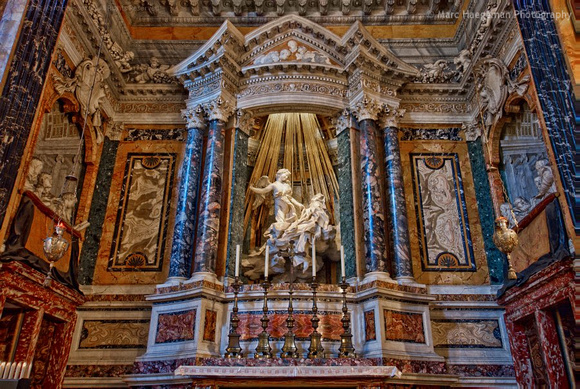
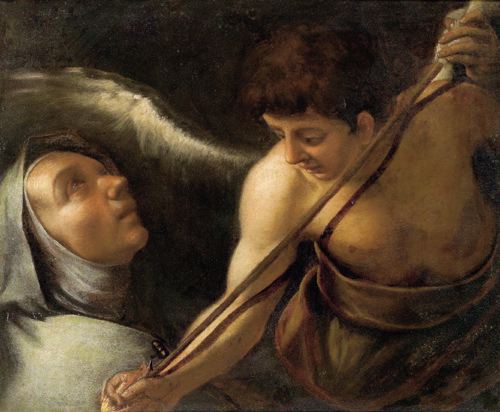
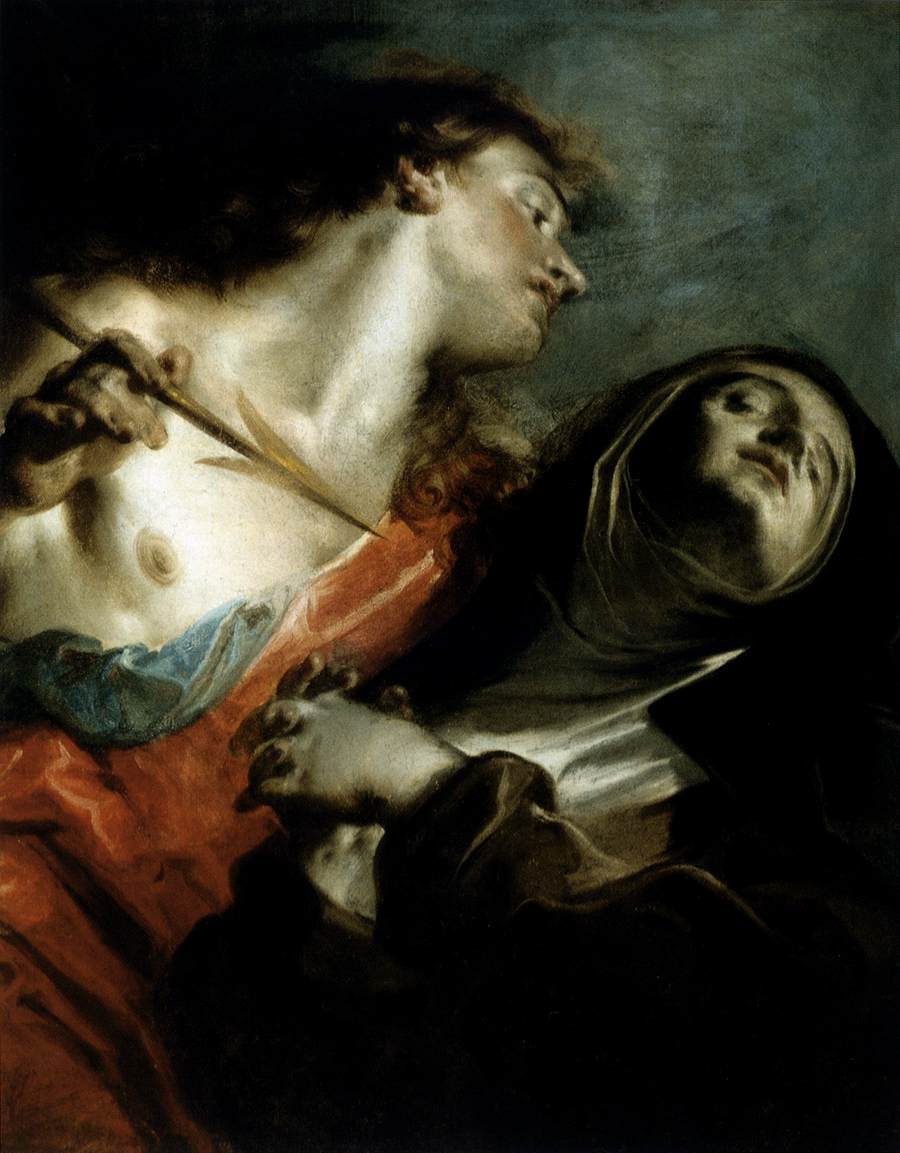
On St Peter’s Day in 1559, Teresa became firmly convinced that Jesus Christ presented Himself to her in bodily form, though invisible. These visions lasted almost uninterrupted for more than two years. In another vision, a seraph drove the fiery point of a golden lance repeatedly through her heart, causing an ineffable spiritual-bodily pain.
I saw in his hand a long spear of gold and at the point there seemed to be a little fire. He appeared to me to be thrusting it at times into my heart and to pierce my very entrails; when he drew it out, he seemed to draw them out also and to leave me all on fire with a great love of God. The pain was so great, that it made me moan; and yet so surpassing was the sweetness of this excessive pain, that I could not wish to be rid of it…
This vision was the inspiration for one of Bernini’s most famous works, the Ecstasy of Saint Teresa at Santa Maria della Vittoria in Rome.
The memory of this episode served as an inspiration throughout the rest of her life and motivated her lifelong imitation of the life and suffering of Jesus, epitomised in the motto usually associated with her: Lord, either let me suffer or let me die.
Teresa was a woman “for God,” a woman of prayer, discipline and compassion. Her heart belonged to God. Her ongoing conversion was an arduous lifelong struggle, involving ongoing purification and suffering. She was misunderstood, misjudged and opposed in her efforts at reform. Yet she struggled on, courageous and faithful; she struggled with her own mediocrity, her illness, her opposition. And in the midst of all this she clung to God in life and in prayer. Her writings on prayer and contemplation are drawn from her experience: powerful, practical and graceful. She was a woman of prayer; a woman for God.
Teresa was a woman “for others.” Though a contemplative, she spent much of her time and energy seeking to reform herself and the Carmelites, to lead them back to the full observance of the primitive Rule. She founded over a half-dozen new monasteries. She traveled, wrote, fought—always to renew, to reform. In her self, in her prayer, in her life, in her efforts to reform, in all the people she touched, she was a woman for others, a woman who inspired and gave life.
Her final illness overtook her on one of her journeys from Burgos to Alba de Tormes. She died in 1582, just as Catholic nations were making the switch from the Julian to the Gregorian calendar, which required the removal of 5–14 October from the calendar. She died either before midnight of 4 October or early in the morning of 15 October which is celebrated as her feast day. Her last words were: “My Lord, it is time to move on. Well then, may your will be done. O my Lord and my Spouse, the hour that I have longed for has come. It is time to meet one another.”
Her writings, especially the Way of Perfection and The Interior Castle, have helped generations of believers. She and St Catherine of Siena were the first women so honoured as Doctors of the Church.
Interesting fact – her Spiritual Director was St Francis Borgia whose Feast Day we celebrated on 10 October.
NOVENA to St John Paul the Great DAY TWO – 14 OCTOBER
Little Known Fact #2: While working in a factory during the Nazi Occupation of Poland, Karol Wojtyla heard that one of his co-workers was expecting a child. The man worked the night shift and found out that his wife gave birth to their child. After a full day of work during the day, Karol told his co-worker to go home to be with his family. Karol then worked the entire night shift in place of the new father. He continued to work the night shift after his own shift until his co-worker’s wife regained her strength and he could return to work.
REFLECTION: ”Follow me! In July 1958 the young priest Karol Wojtyla began a new stage in his journey with the Lord and in the footsteps of the Lord. Follow me – Karol Wojtyla accepted the appointment, for he heard in the Church’s call the voice of Christ. And then he realised how true are the Lord’s words: “Those who try to make their life secure will lose it but those who lose their life will keep it” (Lk 17:33). Our Pope – and we all know this – never wanted to make his own life secure, to keep it for himself; he wanted to give of himself unreservedly, to the very last moment, for Christ and thus also for us. And thus he came to experience how everything which he had given over into the Lord’s hands came back to him in a new way. His love of words, of poetry, of literature, became an essential part of his pastoral mission and gave new vitality, new urgency, new attractiveness to the preaching of the Gospel, even when it is a sign of contradiction.”…Pope Benedict
Let us Pray:
O Holy Trinity, we thank You for having given to the Church Pope John Paul II and for having made him shine with Your fatherly tenderness, the glory of the Cross of Christand the splendour of the Spirit of love.
He, trusting completely in Your infinite mercy and in the maternal intercession of Mary, has shown himself in the likeness of Jesus the Good Shepherd and has pointed out to us the way of holiness as the path to reach eternal communion with You Grant us, through his intercession, according to Your will, the grace that we implore,
………………….. [state your intention here].
Continue, beloved St John Paul, we implore you, to sustain from heaven the faith of God’s people. We praise and thank You Father that St John Paul has been numbered among Your saints and make our prayer through our Lord Jesus Christ with the Holy Spirit, one God forever.
Totus Tuus, Amen.
Quote Day Two: “Mary is ‘the Mother of the Son of God.
As a result she is also the favourite daughter of the Father
and the temple of the Holy Spirit.
Because of this gift of sublime grace,
she far surpasses all other creatures,
both in heaven and on earth.”
(REDEMPTORIS MATER – 1987)
“Mary’s grace has given: glory to heaven: a God to earth: and faith to the nations. She has conferred: death on vices; order to life; and a rule on morals.”
St Peter Chrysologus (406-450)
“Love for Christ pierced Mary’s heart in such a way that no part of it was left unkindled. Mary thus fulfilled the first commandment of love in all its fulness and without the slightest imperfection.”
St Bernard (1090-1153)
“She is flower of the field from whom bloomed the precious lily of the valley.”

















 AnaStpaul
You must be logged in to post a comment.