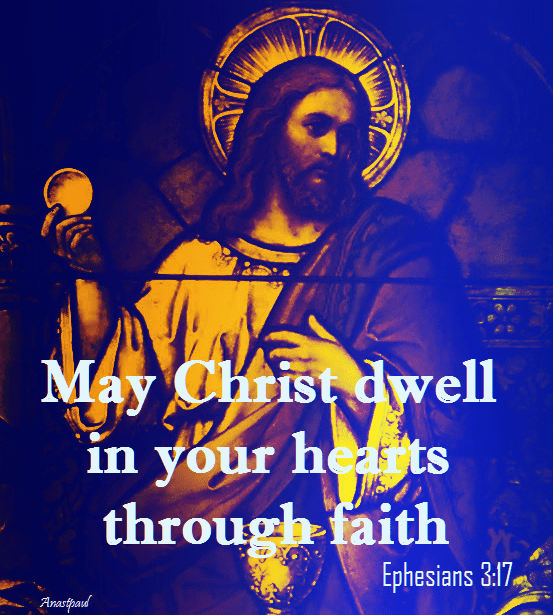
May Christ dwell in your hearts through faith……Ephesians 3:17
REFLECTION – “Bear Christ in heart, mind and will.
Bear Him in your mind by His teaching.
Bear Him in your will by your observance of the Law.
Bear Him in your heart by the Holy Eucharist.”…………Venerable Servant of God Pope Pius XII
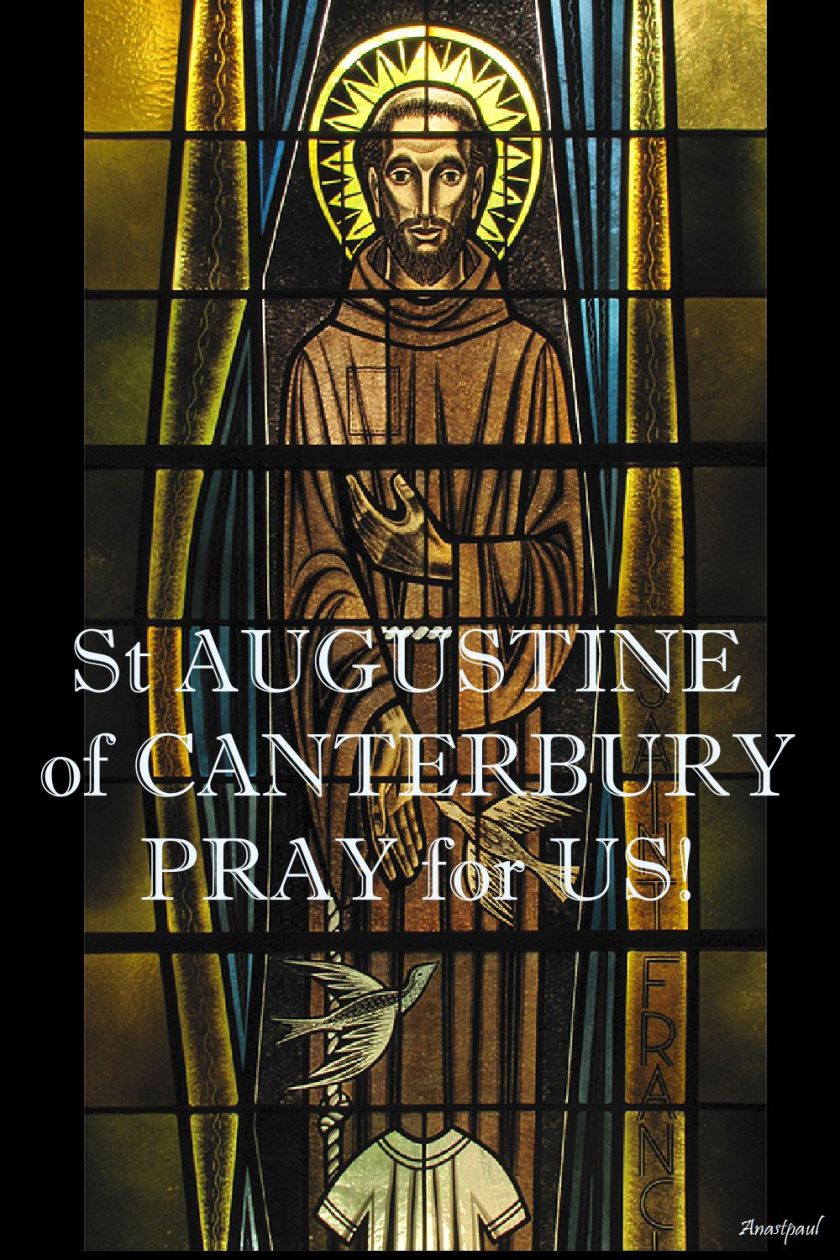
PRAYER – Heavenly Father, let me be true bearer of Christ, Your Son, by doing always the things that are in imitation of and pleasing to Him. Help me to bear witness to Him in the world, one just as pagan as that approached by St Augustine of Canterbury in trepidation. But in Your light and by Your Holy Spirit, he succeeded and pleased You, help me too I beg, to work for the salvation of souls. St Augustine of Canterbury, pray for us all, amen.
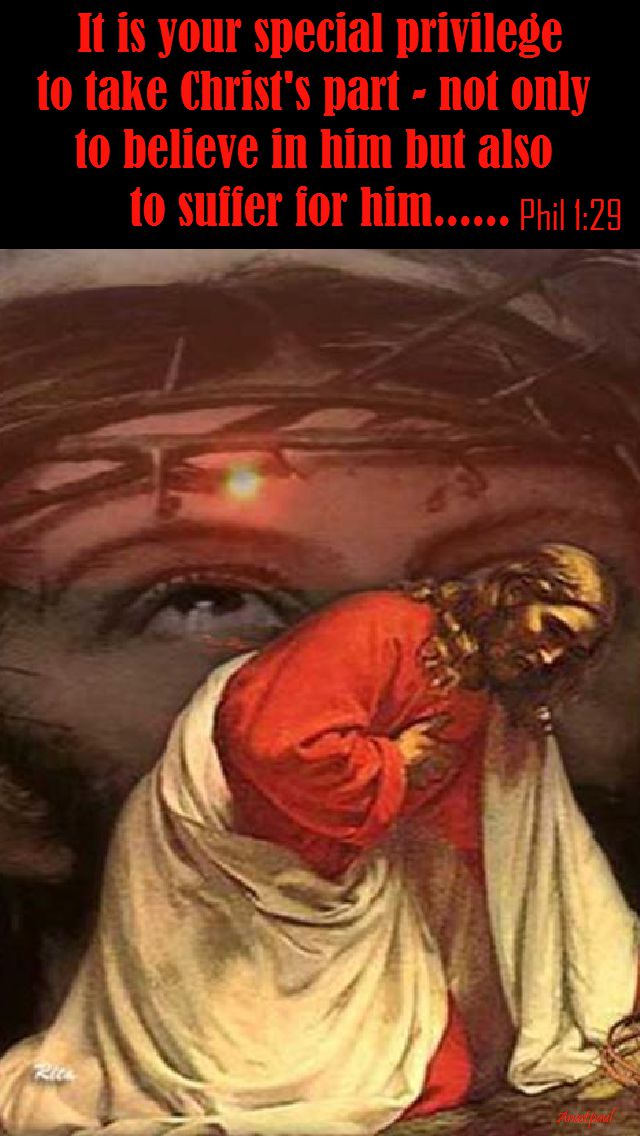
It is your special privilege to take Christ’s part – not only to believe in him but also to suffer for him……..Phil 1:29
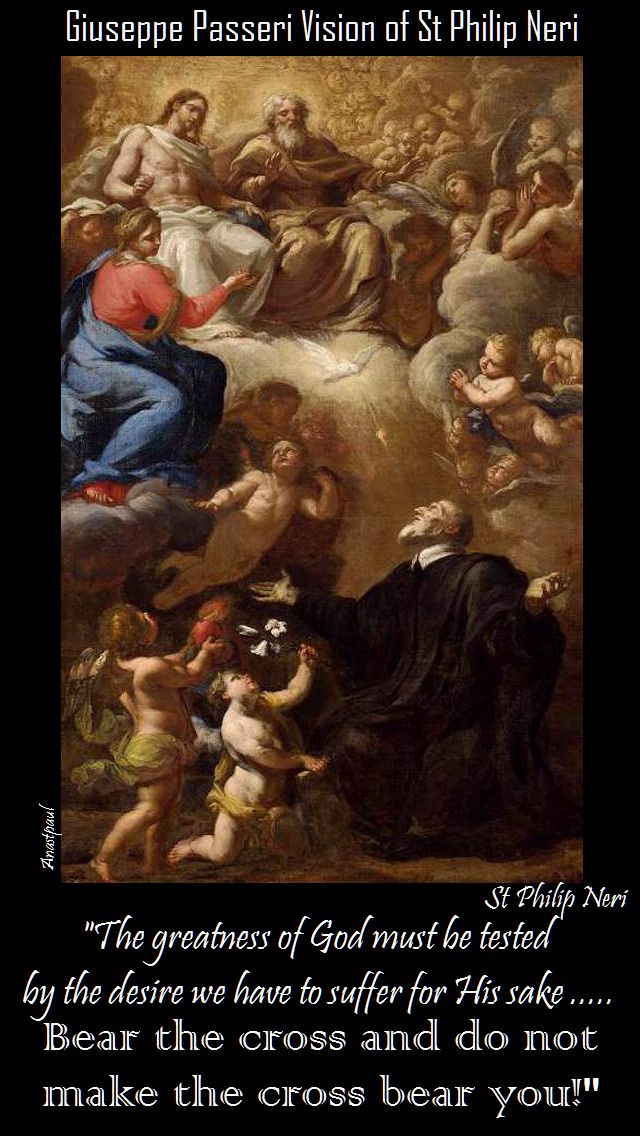
REFLECTION – “The greatness of God must be tested by the desire we have to suffer for His sake …..
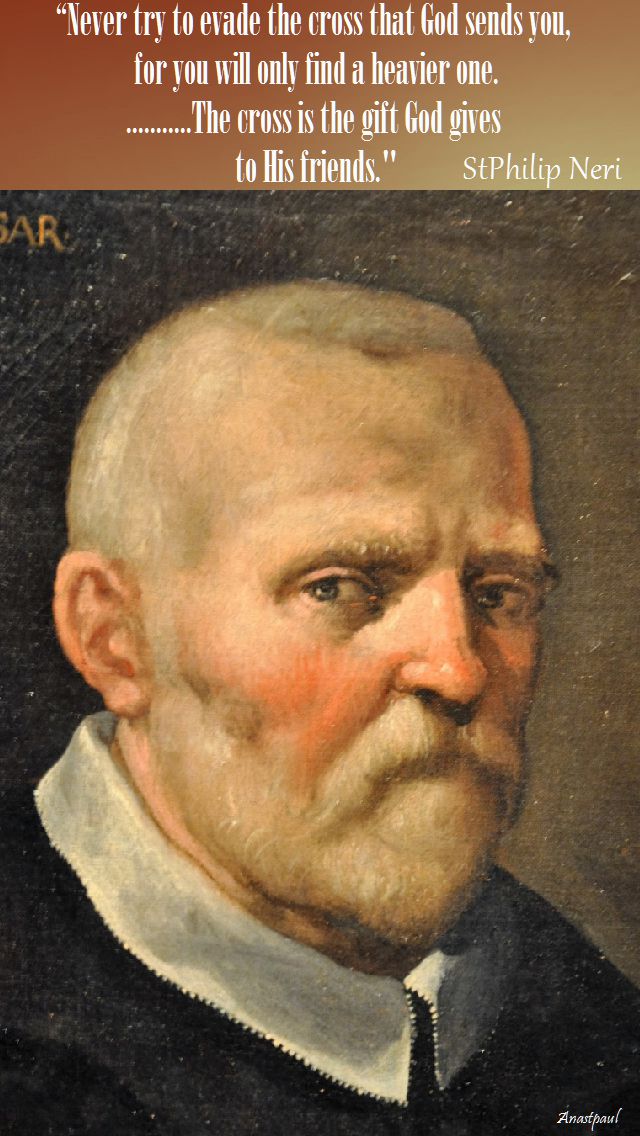
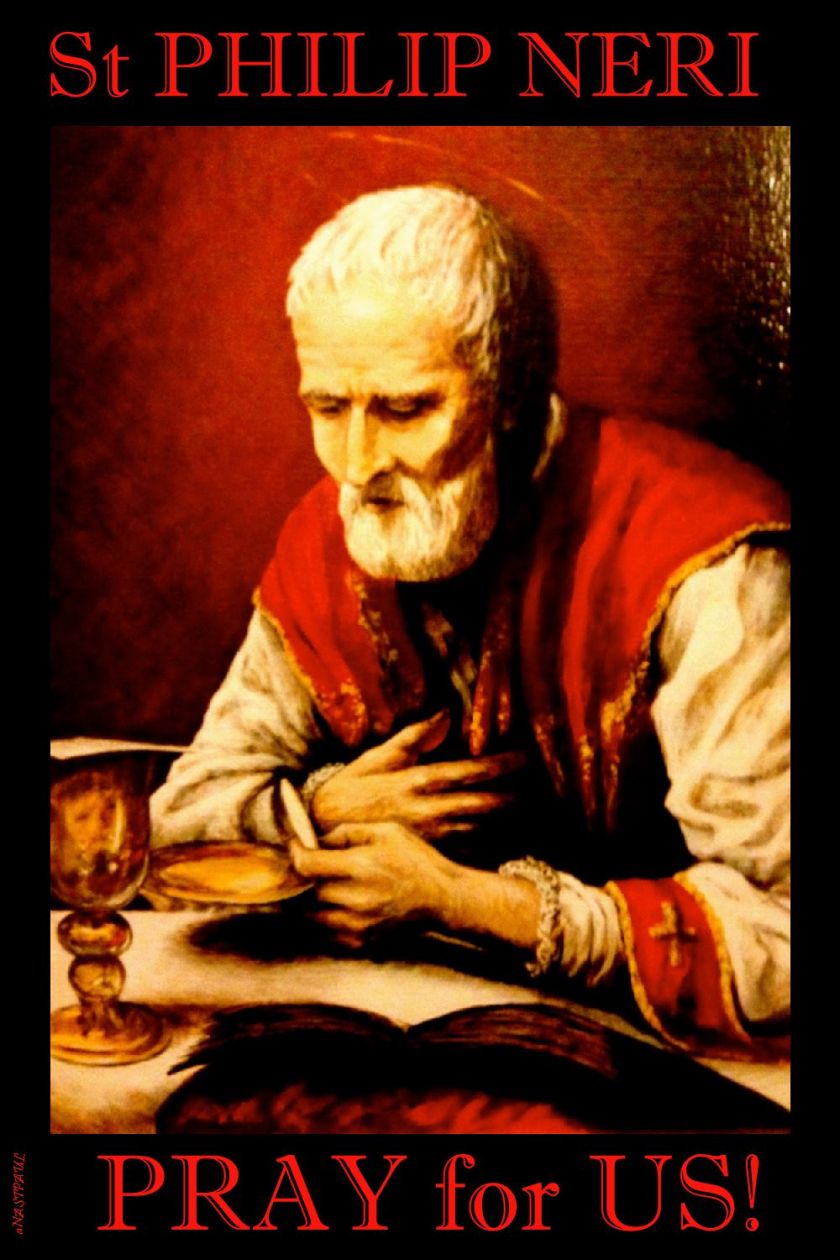
Bear the cross and do not make the cross bear you!”……………………..St Philip Neri
PRAYER – Lord Jesus Christ, let me be closely united with You in all things. Grant that I may carry my cross willingly and seek to carry Yours! Because of You and in union with You. St Philip Neri, pray for us all, amen.
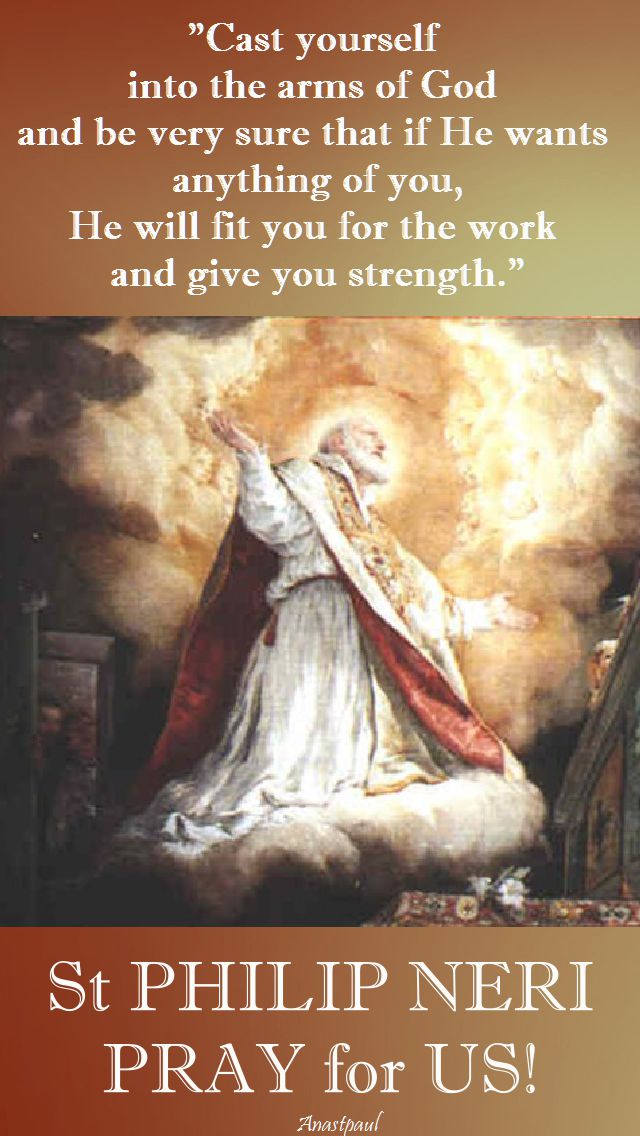
Saint of the Day – 26 May – St Philip Neri Cong. Orat. Priest and Founder, Mystic, Missionary of Charity, also known as: “The Third Apostle of Rome,” after Saints Peter and Paul, Philip Romolo Neri. Born on 22 July 1515 at Florence, Italy -and died on 27 May 1595 at the Church of San Maria in Vallicella, Italy of natural causes). Canonised: 12 March 1622 by Pope Gregory XV . Patronages – of Gravina, Italy, Rome, Italy, laughter, humour, Archdiocese of Manfredonia-Vieste-San Giovanni Rotondo, Italy, United States Army Special Forces. When summoned to hear confessions or to see someone who had called, Neri came down instantly with the words “We must leave Christ for Christ”. Philip was a mystic of the highest order, a man of ecstasies and visions, whose greatest happiness was to be alone with God. Yet at the call of charity he gave up the delight of prayer and, instead, sought God by helping his neighbour. His whole life is that of the contemplative in action.
He was the son of Francesco di Neri, a lawyer and his wife Lucrezia da Mosciano, whose family were nobility in the service of the Italian state. He was carefully brought up and received his early teaching from the friars at San Marco, the famous Dominican monastery in Florence. He was accustomed in later life to ascribe most of his progress to the teaching of two of them, Zenobio de’ Medici and Servanzio Mini. At the age of 18, Philip was sent to his uncle, Romolo, a wealthy merchant at San Germano, a Neapolitan town near the base of Monte Cassino, to assist him in his business and with the hope that he might inherit his uncle’s fortune. He gained Romolo’s confidence and affection but soon after coming to San Germano Philip had a religious conversion – he no longer cared for things of the world and chose to relocate to Rome in 1533.
After arriving in Rome, Neri became a tutor in the house of a Florentine aristocrat named Galeotto Caccia. After two years he began to pursue his own studies (for a period of three years) under the guidance of the Augustinians. Following this, he began those labours amongst the sick and poor which, in later life, gained him the title of “Apostle of Rome”. He also ministered to the prostitutes of the city. In 1538 he entered into the home mission work for which he became famous; traveling throughout the city, seeking opportunities of entering into conversation with people and of leading them to consider the topics he set before them. For seventeen years Philip lived as a layman in Rome, probably without thinking of becoming a priest. Around 1544, he made the acquaintance of Ignatius of Loyola. Many of Neri’s disciples found their vocations in the infant Society of Jesus.
In 1548, together with his confessor, Persiano Rossa, Neri founded the Confraternity of the Most Holy Trinity of Pilgrims and Convalescents whose primary object was to minister to the needs of the thousands of poor pilgrims who flocked to Rome, especially in jubilee years and also to relieve the patients discharged from hospitals but who were still too weak for labour. Members met for prayer at the church of San Salvatore in Campo where the devotion of the Forty Hours of Exposition of the Blessed Sacrament was first introduced into Rome
In 1551 Neri received all the minor orders and was ordained deacon and finally priest (on 23 May). He thought of going to India as a missionary but was dissuaded by his friends who saw that there was abundant work to be done in Rome. Accordingly, he settled down, with some companions, at the Hospital of San Girolamo della Carità, and while there tentatively began, in 1556, the institute with which his name is more especially connected, that of the Oratory. The scheme at first was no more than a series of evening meetings in a hall (the Oratory), at which there were prayers, hymns, and readings from Scripture, the church fathers and the Martyrology, followed by a lecture, or by discussion of some religious question proposed for consideration. The musical selections (settings of scenes from sacred history) were called oratorios. Giovanni Palestrina was one of Philip’s followers and composed music for the services. The scheme was developed and the members of the society undertook various kinds of mission work throughout Rome, notably the preaching of sermons in different churches every evening, a completely new idea at that time. He also spent much of his time hearing confessions, and effected many conversions in this way. Neri sometimes led “excursions” to other churches, often with music and a picnic on the way.
St Philip Neri Hearing Confessions
In 1564 the Florentines requested that Neri leave San Girolamo to oversee their newly built church in Rome, San Giovanni dei Fiorentini. He was at first reluctant but by consent of Pope Pius IV he accepted, while remaining in charge of San Girolamo, where the exercises of the Oratory were kept up. At this time the new society included among its members Caesar Baronius, the ecclesiastical historian, Francesco Maria Tarugi, afterwards Archbishop of Avignon and Ottavio Paravicini, all three of whom were subsequently cardinals, and also Gallonius (Antonio Gallonio), author of a well-known work on the Sufferings of the Martyrs, Ancina, Bordoni, and other men of ability and distinction. In 1574, the Florentines built a large oratory or mission-room for the society, next to San Giovanni, in order to save them the fatigue of the daily journey to and from San Girolamo and to provide a more convenient place of assembly and the headquarters were transferred there.
San Giovanni dei Fiorentini Rome – the home of the First Oratory
As the community grew and its mission work extended, the need for a church entirely its own made itself felt and the offer of the small parish church of Santa Maria in Vallicella, conveniently situated in the middle of Rome, was made and accepted. The building, however, not large enough for their purpose, was pulled down and a splendid church erected on the site. It was immediately after taking possession of their new quarters that Neri formally organized, under permission of a papal bull dated 15 July 1575, a community of secular priests, called the Congregation of the Oratory. The new church was consecrated early in 1577 and the clergy of the new society at once resigned the charge of San Giovanni dei Fiorentini; Neri himself did not leave San Girolamo until 1583 and then only by virtue of an injunction of the pope that he, as the superior, should reside at the chief house of his congregation. He was at first elected for a term of three years (as is usual in modern societies) but in 1587 was nominated superior for life. He was, however, entirely free from personal ambition and had no desire to be superior general over a number of dependent houses, so he desired that all congregations formed on his model outside Rome should be autonomous, governing themselves and without endeavouring for Neri to retain control over any new colonies they might themselves send out—a regulation afterwards formally confirmed by a brief of Gregory XV in 1622.
Santa Maria in Vallicella after being rebuilt for the Oratory
Philip Neri embodied a number of contradictions, combining popular venerations with intensely individual piety. He became embedded in the church hierarchy while seeking to reform a corrupt Rome and an uninterested clergy. He possessed a playful humour, combined with a shrewd wit. He considered a cheerful temper to be more Christian than a melancholy one and carried this spirit into his whole life: “A joyful heart is more easily made perfect than a downcast one.” This was the secret of Neri’s popularity and of his place in the folklore of the Roman poor. Many miracles were attributed to him. When his body was autopsied it was found that two of his ribs had been broken, an event attributed to the expansion of his heart while fervently praying in the catacombs about the year 1545. ] Benedict XIV, who reorganised the rules for canonisation, decided that Philip’s enlarged heart was caused by an aneurism. Ponnelle and Bordet, in their 1932 biography St. Philip Neri and the Roman Society of His Times (1515-1595), conclude that it was partly natural and partly supernatural. What is certain is that Philip himself and his penitents associated it with divine love.
“Practical commonplaceness,” says Frederick William Faber in his panegyric of Neri, “was the special mark which distinguishes his form of ascetic piety from the types accredited before his day. He looked like other men … he was emphatically a modern gentleman, of scrupulous courtesy, sportive gaiety, acquainted with what was going on in the world, taking a real interest in it, giving and getting information, very neatly dressed, with a shrewd common sense always alive about him, in a modern room with modern furniture, plain, it is true but with no marks of poverty about it—In a word, with all the ease, the gracefulness, the polish of a modern gentleman of good birth, considerable accomplishments, and a very various information.”
Accordingly, Neri was ready to meet the needs of his day to an extent and in a manner which even the versatile Jesuits, who much desired to enlist him in their company, did not rival; and, though an Italian priest and head of a new religious order, his genius was entirely unmonastic and unmedieval, frequent and popular preaching, unconventional prayer and unsystematized, albeit fervent, private devotion.
Neri prayed, “Let me get through today and I shall not fear tomorrow.”
When summoned to hear confessions or to see someone who had called, Neri came down instantly with the words “We must leave Christ for Christ”. Philip was a mystic of the highest order, a man of ecstasies and visions, whose greatest happiness was to be alone with God. Yet at the call of charity he gave up the delight of prayer and, instead, sought God by helping his neighbour. His whole life is that of the contemplative in action.
Neri died around the end of the day on 25 May 1595, the Feast of Corpus Christi that year, after having spent the day hearing confessions and receiving visitors. ] About midnight he began hemorrhaging and Baronius read the commendatory prayers over him. Baronius asked that he would bless his spiritual sons before dying and though he could no longer speak, he blessed them with the sign of the cross and died.
Neri was beatified by Paul V in 1615, and canonized by Pope Gregory XV in 1622. His memorial is celebrated on 26 May. His body is in the Chiesa Nuova (“New Church”) in Rome.
Neri is one of the influential figures of the Counter-Reformation, mainly for converting to personal holiness many of the influential people within the Church itself.
A modern image of St. Philip Neri by Salvo Russo is one of 550 color images in a new book, “The Catholic Priest — Image of Christ through Fifteen Centuries of Art.” In gratitude to God for his conversion to Catholicism, Danish author Steen Heidemann spent seven years traveling the world to collect images for the book. (CNS photo/courtesy of Edizioni Cantagalli, publisher) (March 23, 2010) See PRIESTHOOD-ART March 23, 2010.
Oratory
The congregation Neri founded is of the least conventional nature, rather resembling a residential clerical club than a monastery of the older type and its rules (never written by Neri, but approved by Pope Paul V in 1612) would have appeared incredibly lax. In fact its religious character would seem almost doubtful to men such as Bruno, Stephen Harding, Francis of Assisi or Saint Dominic. It admits only priests aged at least 36, or seminarians who have completed their studies and are ready for ordination, supported by lay brothers. The members live in community and each pays his own expenses, having the usufruct of his private means—a startling innovation on the monastic vow of poverty. They have indeed a common table but it is kept up precisely as a regimental mess, by monthly payments from each member. Nothing is provided by the society except the bare lodging and the fees of a visiting physician. Everything else—clothing, books, furniture, medicines—must be defrayed at the private charges of each member. There are no vows and every member of the society is at liberty to withdraw when he pleases and to take his property with him. The government, strikingly unlike the Jesuit autocracy, is of a republican form; and the superior, though first in honour, has to take his turn in discharging all the duties which come to each priest of the society in the order of his seniority, including that of waiting at table, which is not entrusted in the Oratory to lay brothers, according to the practice in most other communities. Four deputies assist the superior in the government and all public acts are decided by a majority of votes of the whole congregation, in which the superior has no casting voice. To be chosen superior, 15 years of membership are requisite as a qualification, and the office is tenable, as all the others, for but 3 years at a time. No one can vote until he has been three years in the society; the deliberative voice is not obtained before the eleventh year.
There are thus three classes of members: novices, triennials and decennials. Each house can call its superior to account, can depose and can restore him, without appeal to any external authority, although the bishop of the diocese in which any house of the Oratory is established is its ordinary and immediate superior, though without power to interfere with the rule. Their churches are non-parochial and they can perform such rites as baptisms, marriages, etc., only by permission of the parish priest, who is entitled to receive all fees due in respect of these ministrations.
The Oratory chiefly spread in Italy and in France, where in 1760 there were 58 houses all under the government of a superior-general. Nicolas Malebranche, Louis Thomassin, Jules Mascaron and Jean Baptiste Massillon were members of the famous branch established in Paris in 1611 by Bérulle (later cardinal), which had a great success and a distinguished history. It fell in the crash of the French Revolution but was revived by Père Pététot, curé of St Roch, in 1852, as the “Oratory of Jesus and the Immaculate Mary”; the Church of the Oratory near the Louvre belongs to the Reformed Church.
Neri encouraged the singing of the lauda spirituale (laude) in his oratory services. The prominent composers Tomás Luis de Victoria and Giovanni Pierluigi da Palestrina probably participated in this music. His unique and varied aesthetic experience has been highlighted in a study by the Italian historian Francesco Danieli.
This St Bede, this is a life of total self-giving in love!
It sounds to our ears to be a boring, closed, narrow existence –
ever occupied with learning, writing and teaching.
Almost from the time of his entry to study in the monastery as a young child,
until he died, he managed to remain in his own monastery,
although eagerly sought by kings and other notables, even Pope Sergius
Only once did he leave for a few months in order to teach in the school
of the Archbishop of York.
And amazingly, here was a saint who worked no miracles,
saw no visions and found no new way to God BUT
he is one of the few saints honoured as such even during his lifetime.
His writings were filled with such faith and learning
that even while he was still alive, a Church council
ordered them to be read publicly in the churches.
And he said of his life, “I have spent the whole of my life . . . devoting all of my pains to the study of the Scriptures and amid the observances of monastic discipline and the daily task of singing in church, it has ever been my delight to learn or teach or write.”
St Bede died in 735 praying his favourite prayer: “Glory be to the Father and to the Son and to the Holy Spirit. As in the beginning, so now, and forever.”
We remember and honour him as a Doctor of the Church,
so many centuries have gone by, the world in which we live is such a different place and still he teaches us from his eternal monastery in heaven!
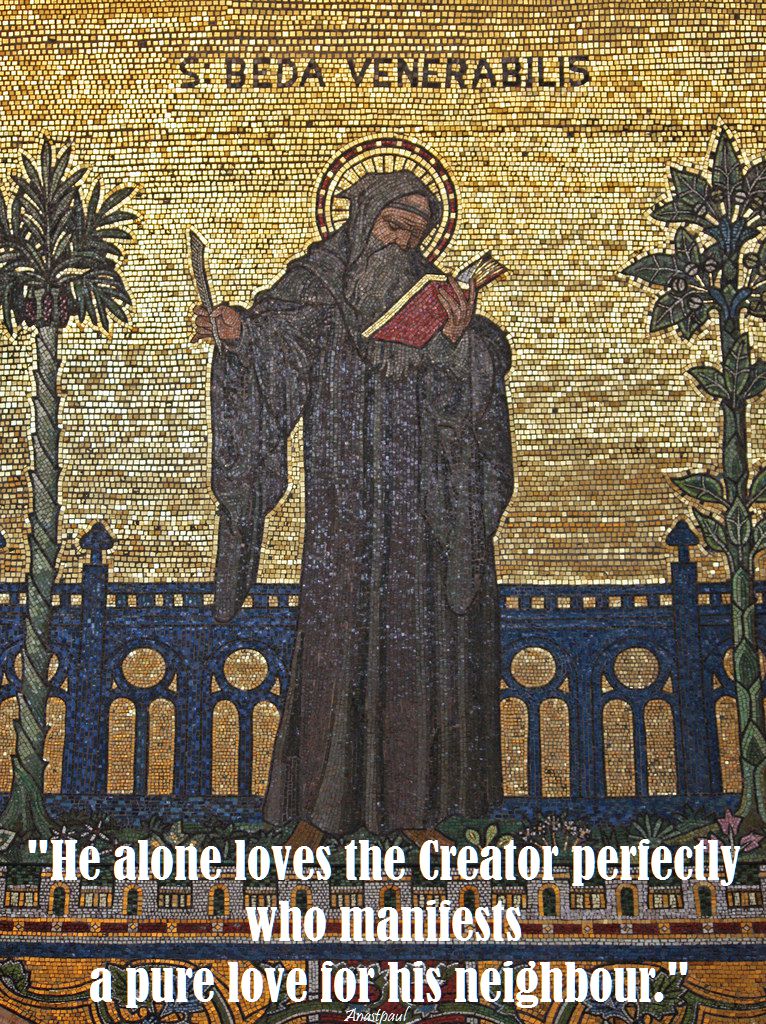
“He alone loves the Creator perfectly who manifests a pure love for his neighbour.”
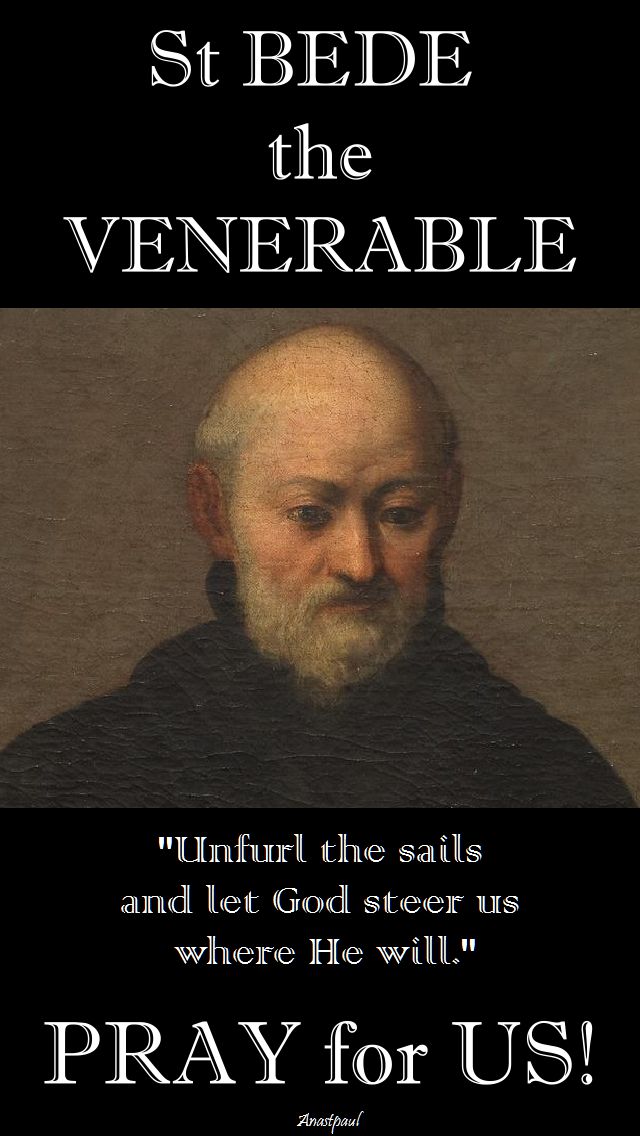
“Unfurl the sails and let God steer us where He will.”
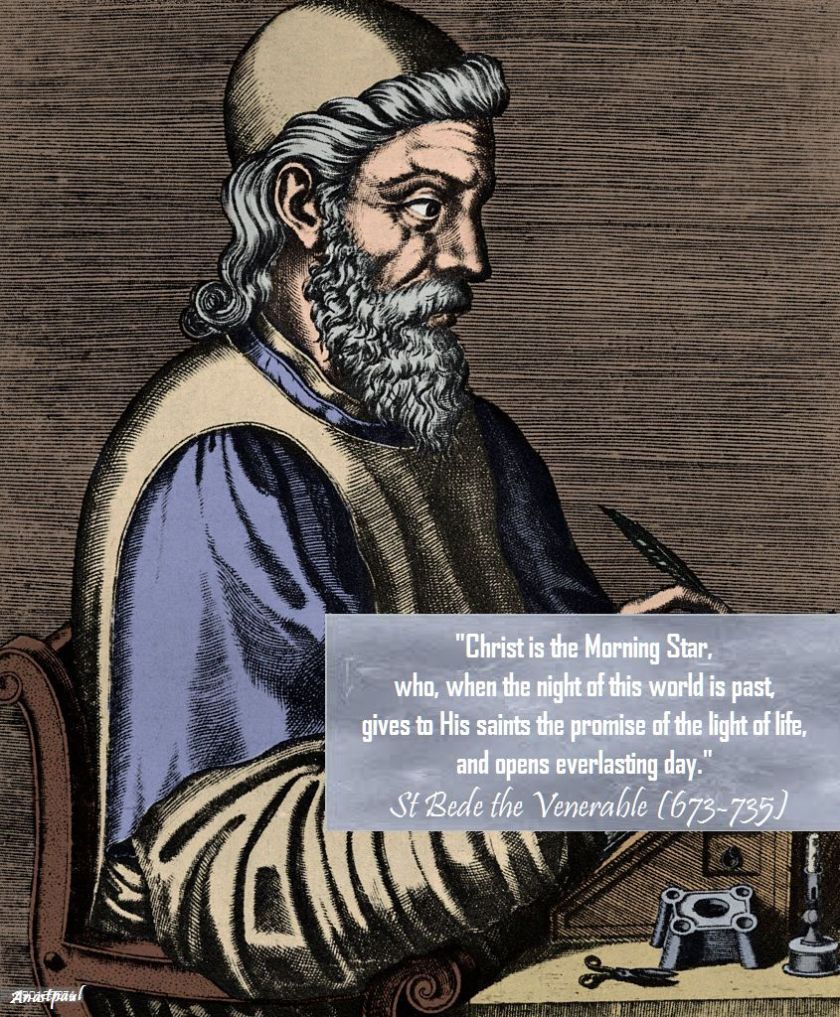
“Christ is the Morning Star, who, when the night of this world is past, gives to his saints the promise of the light of life, and opens everlasting day.”
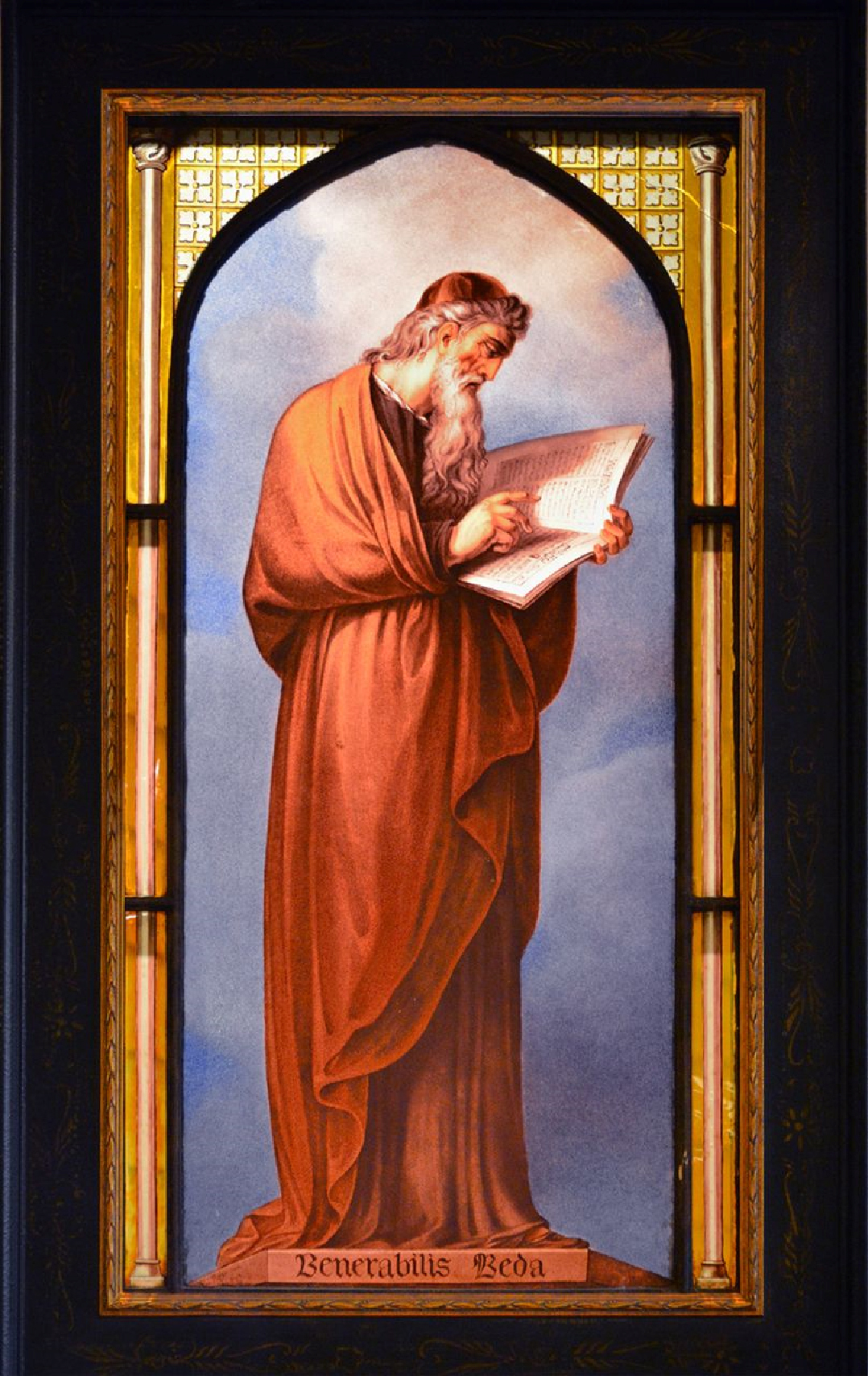
St Bede the Venerable (673-735) Doctor of the Church
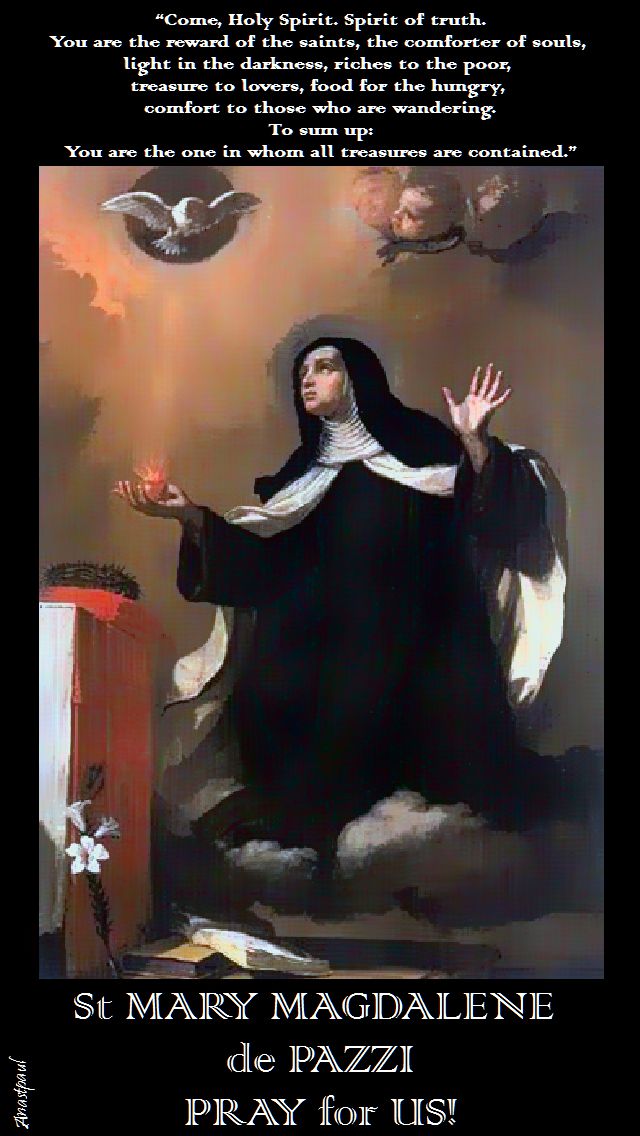
“Come, Holy Spirit. Spirit of truth, You are the reward of the saints, the comforter of souls, light in the darkness, riches to the poor, treasure to lovers, food for the hungry, comfort to those who are wandering. To sum up: You are the one in whom all treasures are contained.”
St Mary Magdalene de Pazzi – Memorial today 25 May
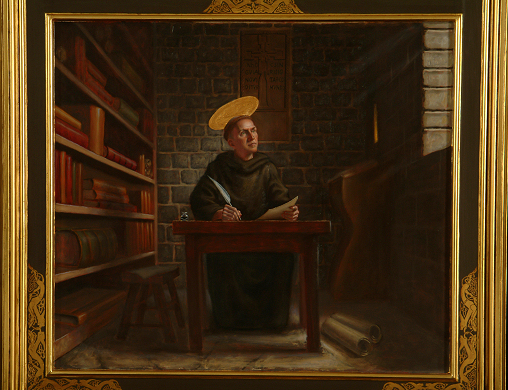
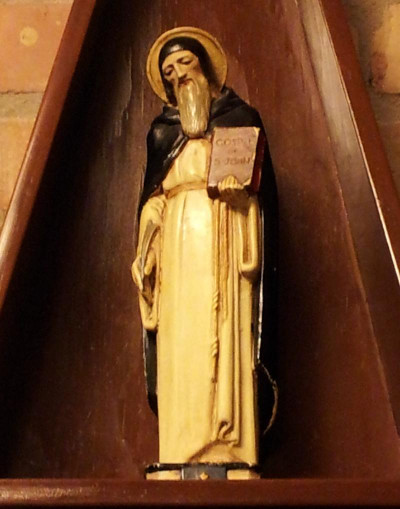
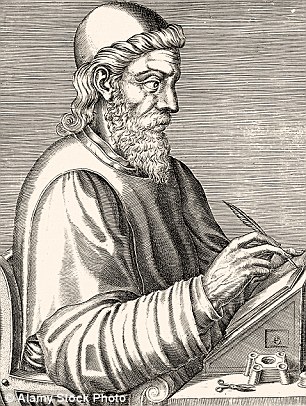
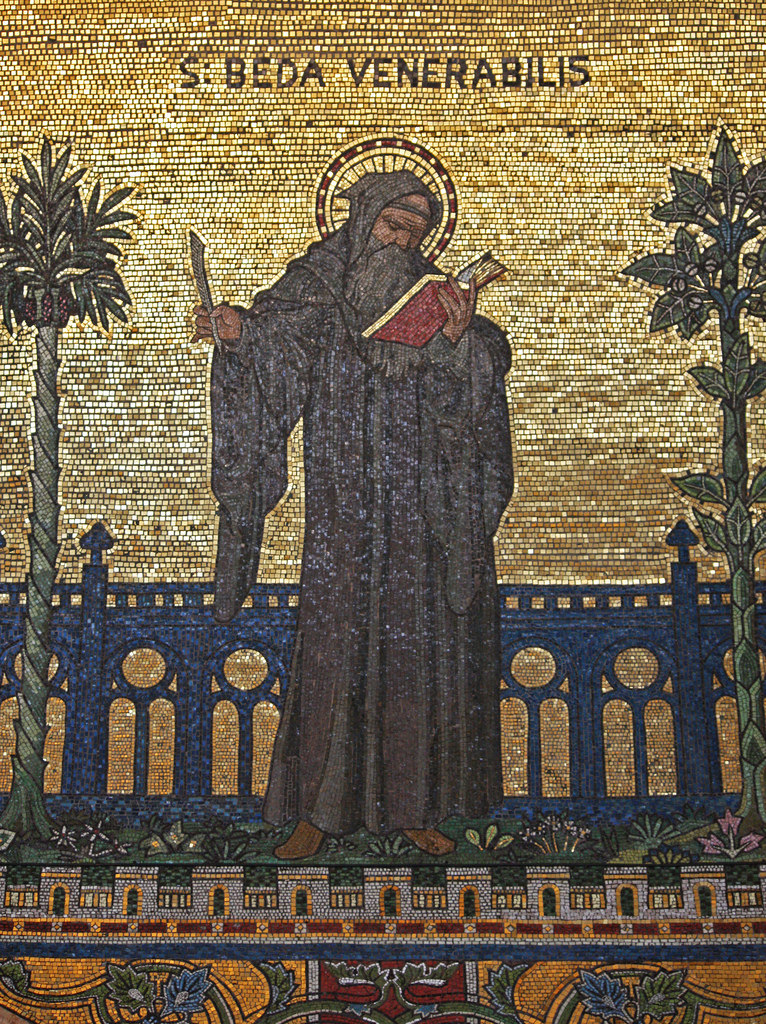
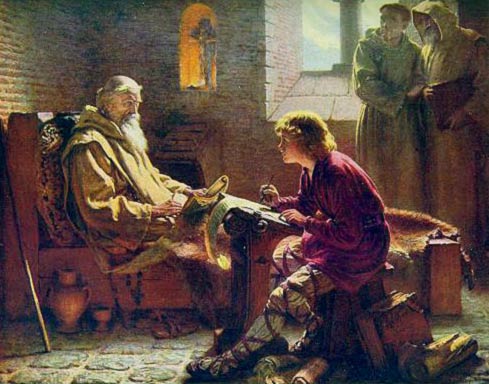
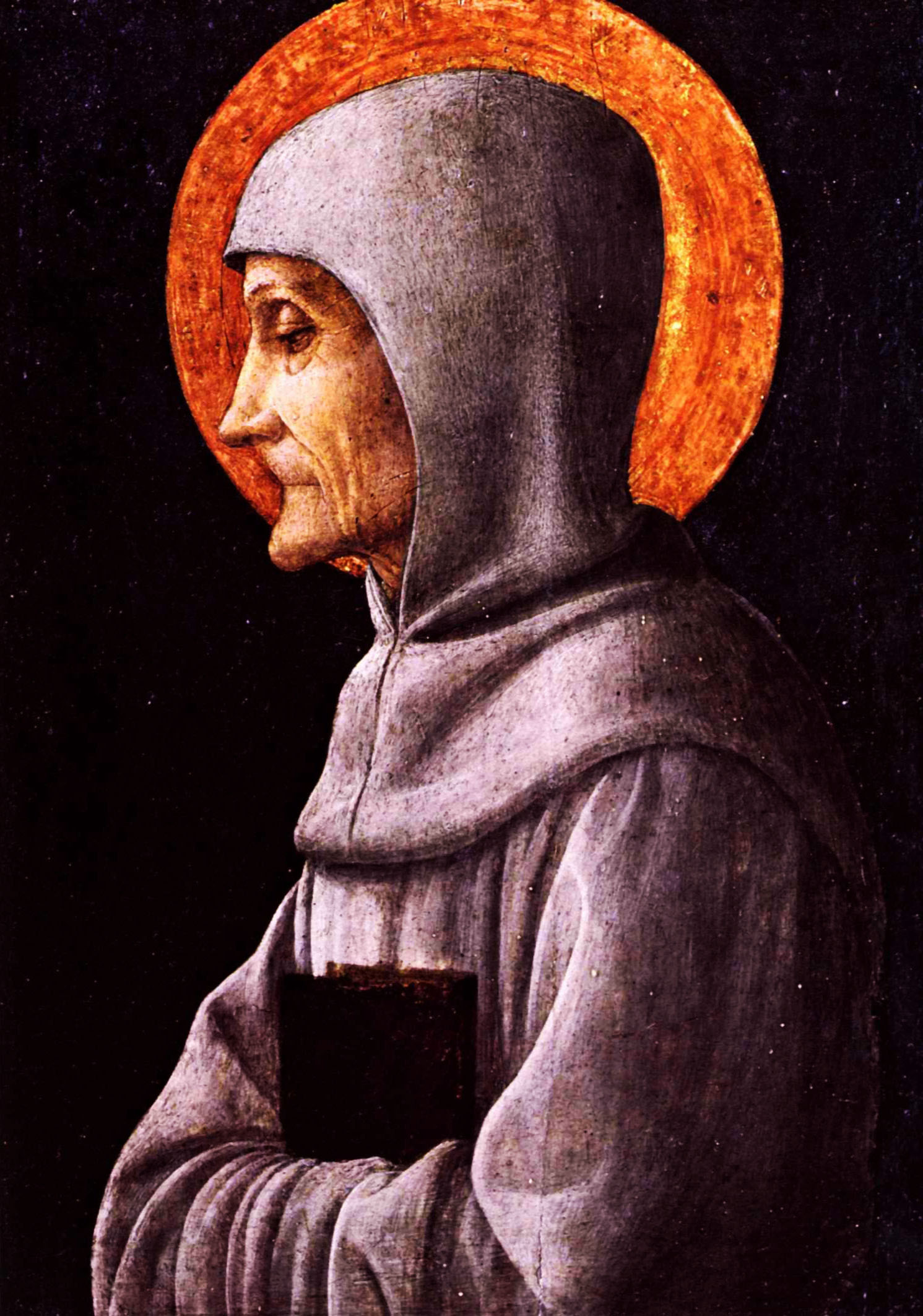
Saint of the Day – 25 May – St Bede the Venerable OSB (673-735) – Confessor, Priest, Monk, Father and Doctor of the Church, Linguist, Translator, Historian – also known as Venerable Bede, Father of English History. Patronages – of Lectors, English writers and historians; Jarrow, Tyne and Wear, England. In 1899, Pope Leo XIII declared him a Doctor of the Church; he is the only native of Great Britain to achieve this designation; Anselm of Canterbury, also a Doctor of the Church, was born in Italy. St Bede was moreover a skilled linguist and translator and his work made the Latin and Greek writings of the early Church Fathers much more accessible to his fellow English, which contributed significantly to English Christianity.
St Bede was born in Wearmoth-Jarrow, England, and at age seven was sent to the nearby monastery of St Peter and St Paul to be educated by the monks. From his writings, it appears that his family was wealthy and noble. Given his name, Bede—a derivative of the English bedtime prayer, it is likely that his parents had planned a religious life for him from birth. Under the holy tutelage of the monks, the natural intellect and spiritual zeal of St Bede magnified into one of the finest minds of his time. He studied all the known sciences: natural philosophy, the philosophical principles of Aristotle, astronomy, arithmetic, grammar, ecclesiastical history, the lives of the saints and, especially, Holy Scripture. St Bede spent his days in scholarly pursuits, prayer and contemplation. St Bede was ordained a deacon at the young age of nineteen and ordained a priest at 30.
He spent his days subsequent to ordination teaching, writing and studying. A prolific writer, he composed 45 texts on varied subjects, including science, literature, philosophy, and spirituality. “Through all the observance of monastic discipline,” Bede wrote, “it has ever been my delight to learn and teach and write.” His best known text, the Ecclesiastical History of the English People, is widely regarded as a decisive historical text which inspired the recording of written history. This text described the history of the English Church, and is a primary source of English history. Thirty of his manuscripts focused on Biblical commentary and theology. Aside from those he wrote, St Bede copied many texts by hand, translating a significant number of them into Latin to aid in teaching those of other languages.
Saint Bede remained in the monastery his entire life, leaving few times, including a brief visit to teach in a school in York and a visit to the monastery at Lindisfarne, where he began correspondence with St Cuthbert. Despite this, his counsel and teaching was sought by royalty and the Pope. His writings and homilies were read throughout the Church.
In his own words, from the Ecclesiastical History of the English People:
“Thus much concerning the ecclesiastical history of Britain and especially of the race of the English, I, Baeda, a servant of Christ and a priest of the monastery of the blessed apostles Saint Peter and Saint Paul, which is at Wearmouth and at Jarrow (in Northumberland), have with the Lord’s help composed so far as I could gather it either from ancient documents or from the traditions of the elders, or from my own knowledge. I was born in the territory of the said monastery and at the age of seven I was, by the care of my relations, given to the most reverend Abbot Benedict and afterwards to Ceolfrid, to be educated. From that time I have spent the whole of my life within that monastery, devoting all my pains to the study of the Scriptures and amid the observance of monastic discipline and the daily charge of singing in the Church, it has been ever my delight to learn or teach or write. In my nineteenth year I was admitted to the deaconate, in my thirtieth to the priesthood, both by the hands of the most reverend Bishop John and at the bidding of Abbot Ceolfrid. From the time of my admission to the priesthood to my present fifty-ninth year, I have endeavoured for my own use and that of my brethren, to make brief notes upon the holy Scripture, either out of the works of the venerable Fathers or in conformity with their meaning and interpretation.”
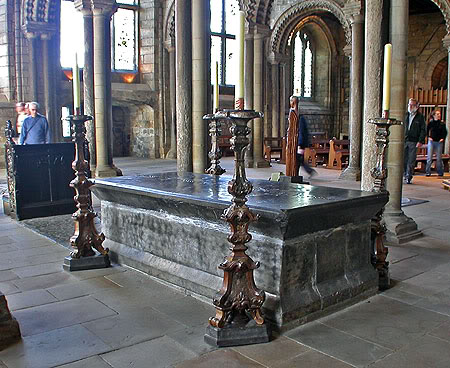
“The Father of English History,” Saint Bede died peacefully at the monastery in Jarrow in 735. He was buried at Jarrow, though his remains now rest in Durham Cathedral.
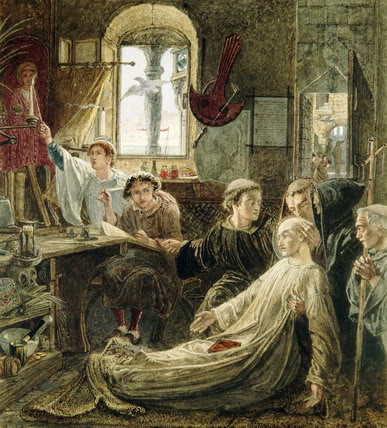
Saint Cuthbert recorded his final hours, indicating the words of Saint Bede: “If it be the will of my Maker, the time has come when I shall be freed from the body and return to Him Who created me out of nothing when I had no being. I have had a long life, and the merciful Judge has ordered it graciously. The time of my departure is at hand, and my soul longs to see Christ my King in His beauty.”He further wrote of Bede’s life and death, citing a poem that Saint Bede had written in preparation for meeting his Maker: “And he used to repeat that sentence from St Paul, “It is a fearful thing to fall into the hands of the living God,” and many other verses of Scripture, urging us thereby to awake from the slumber of the soul by thinking in good time of our last hour. And in our own language,—for he was familiar with English poetry,—speaking of the soul’s dread departure from the body:
More prudent than he has good call to be, If he consider, before his going hence, What for his spirit of good or of evil After his day of death shall be determined.”
The conclusion of his Ecclesiastical History records his piety, humility, and wisdom: “And I pray thee, loving Jesus, that as Thou hast graciously given me to drink in with delight the words of Thy knowledge, so Thou wouldst mercifully grant me to attain one day to Thee, the fountain of all wisdom and to appear forever before Thy face.”
The life of Saint Bede is highly regarded as instrumental in the recording of written history and the translation of Biblical texts from ancient languages into modern languages. His commentary and theological writings—the goal to explain the teachings of the Church Fathers to all—are highly regarded, like those of Saint Augustine and Saint Ambrose. More than that, the simple monastic life of Saint Bede demonstrates the call of the Lord and the gifts of the Holy Spirit to those who listen and obey.
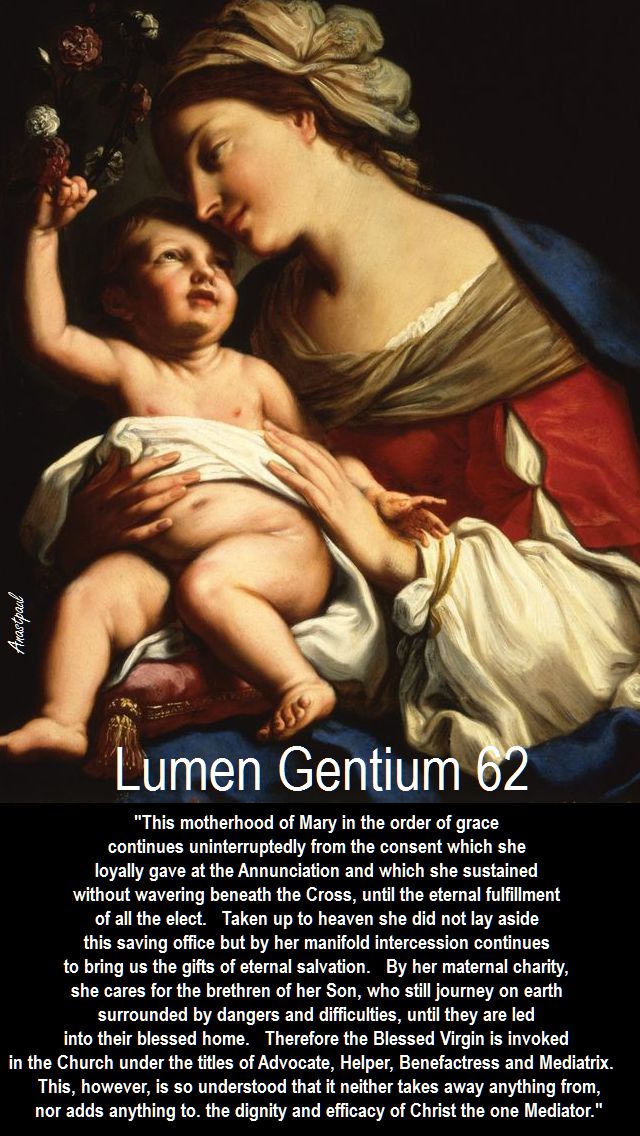
“This motherhood of Mary in the order of grace, continues uninterruptedly from the consent which she loyally gave at the Annunciation and which she sustained without wavering beneath the Cross, until the eternal fulfillment of all the elect. Taken up to heaven she did not lay aside this saving office but by her manifold intercession continues to bring us the gifts of eternal salvation. By her maternal charity, she cares for the brethren of her Son, who still journey on earth surrounded by dangers and difficulties, until they are led into their blessed home. Therefore the Blessed Virgin is invoked in the Church under the titles of Advocate, Helper, Benefactress and Mediatrix. This, however, is so understood, that it neither takes away anything from, nor adds anything to, the dignity and efficacy of Christ the one Mediator.”
Our Lady became the helper of the human race for the first time when her prayers were heard and God sent His Son to rescue the world from the empire of sin. She is the great woman predicted in the Proto-evangelium of Genesis, who will crush the head of the devil (Genesis 3:15). She is also portrayed in the Apocalypse as the Woman clothed with the sun, (Revelation 12:1). Then the dragon was angry with the woman and went off to make war on the rest of her children, those who keep the commandments of God (Christians) and hold the testimony of Jesus (Revelation 12:17).
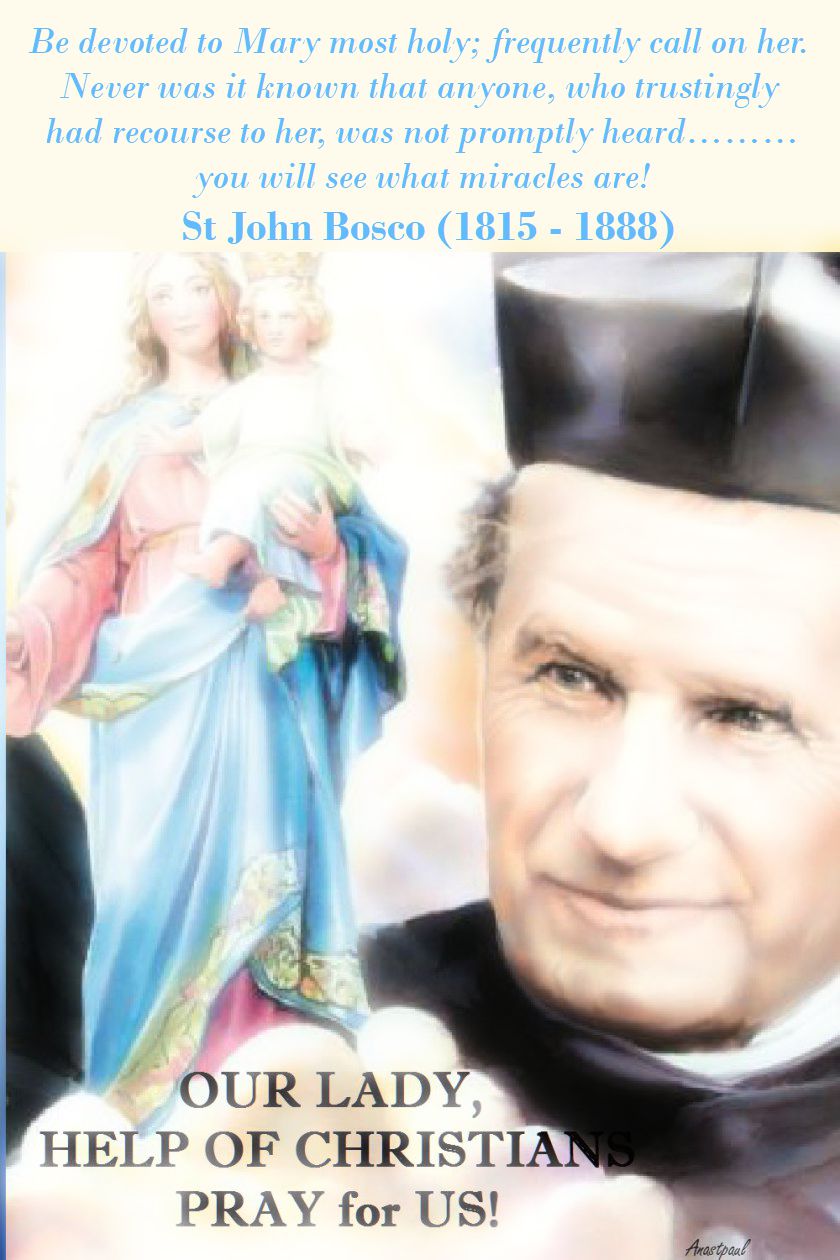
REFLECTION – “Be devoted to Mary most holy; frequently call on her. Never was it known that anyone who trustingly had recourse to her was not promptly heard………you will see what miracles are!”-……..St John Bosco
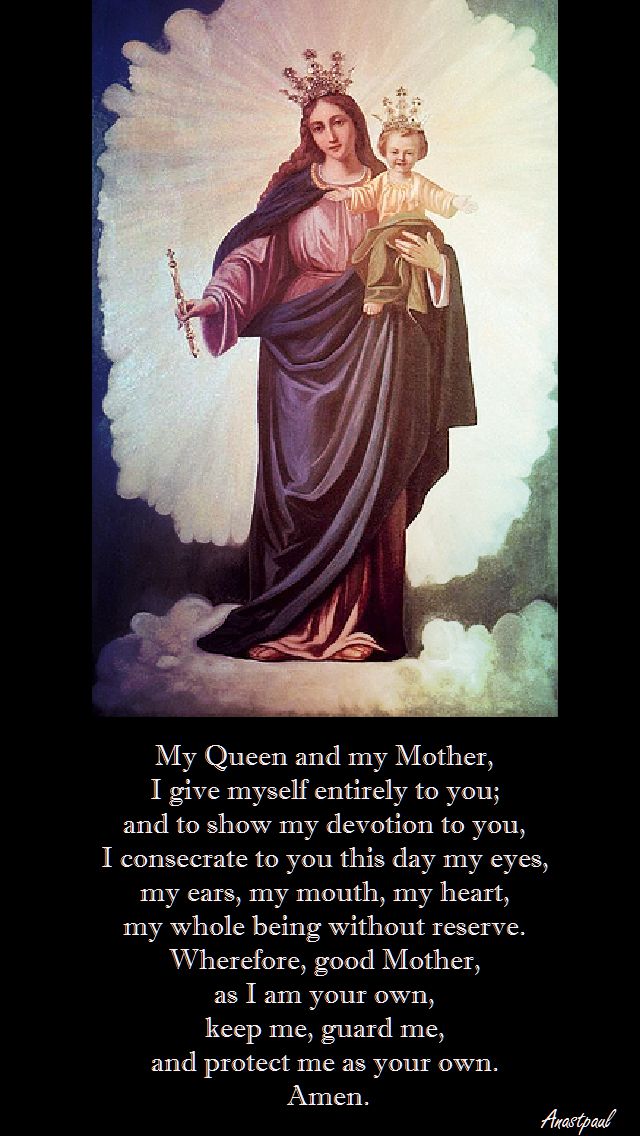
PRAYER – My Queen and my Mother,
I give myself entirely to you;
and to show my devotion to you,
I consecrate to you this day my eyes,
my ears, my mouth, my heart,
my whole being without reserve.
Wherefore, good Mother,
as I am your own,
keep me, guard me,
as your property and possession.
Amen.
Our Lady, Help of Christians pray for the Church and for us all!
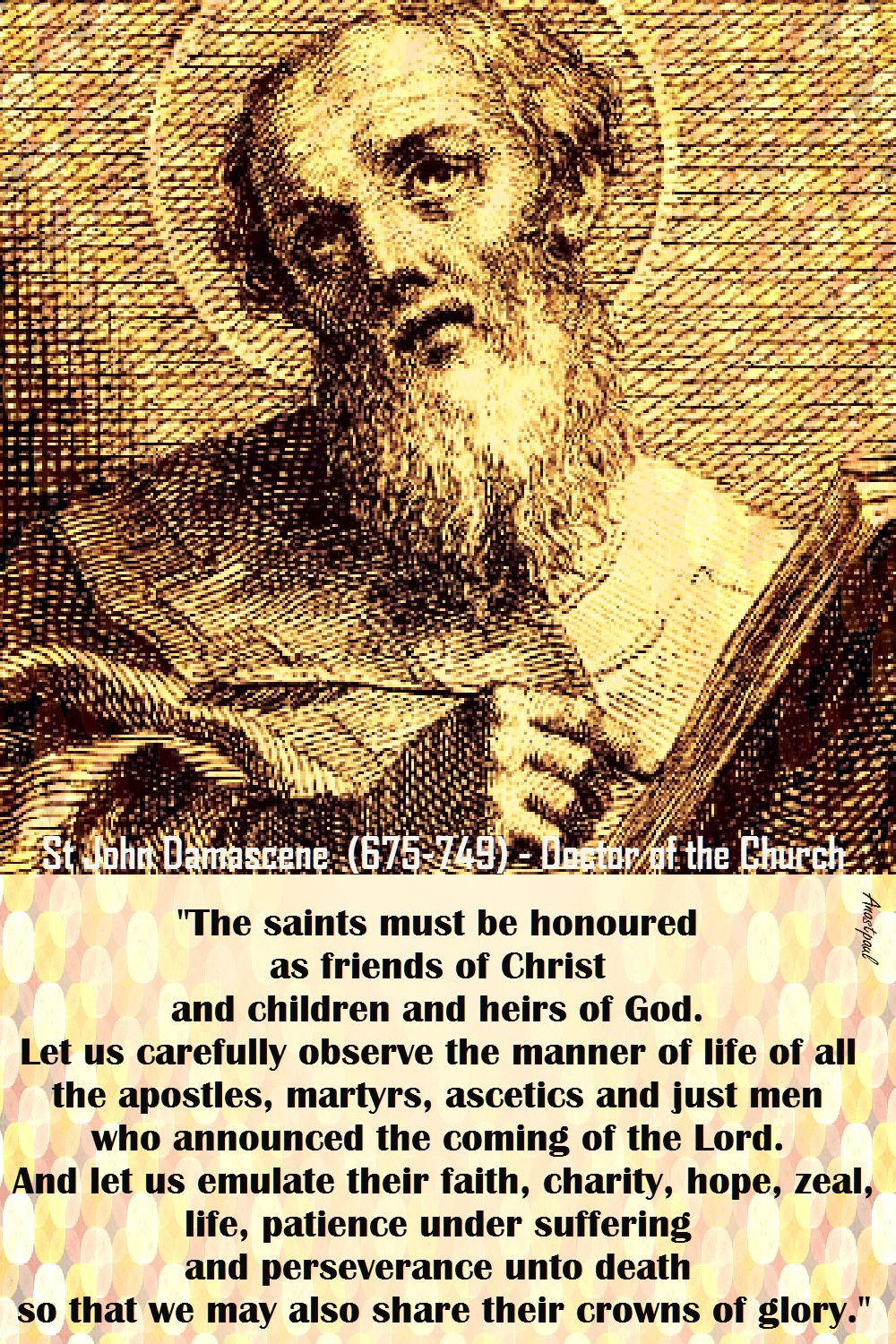
“The saints must be honoured as friends of Christ
and children and heirs of God.
Let us carefully observe the manner of life of all
the apostles, martyrs, ascetics and just men
who announced the coming of the Lord.
And let us emulate their faith, charity, hope, zeal,
life, patience under suffering and perseverance unto death
so that we may also share their crowns of glory.”
St John Damascene (675-749) – Doctor of the Church
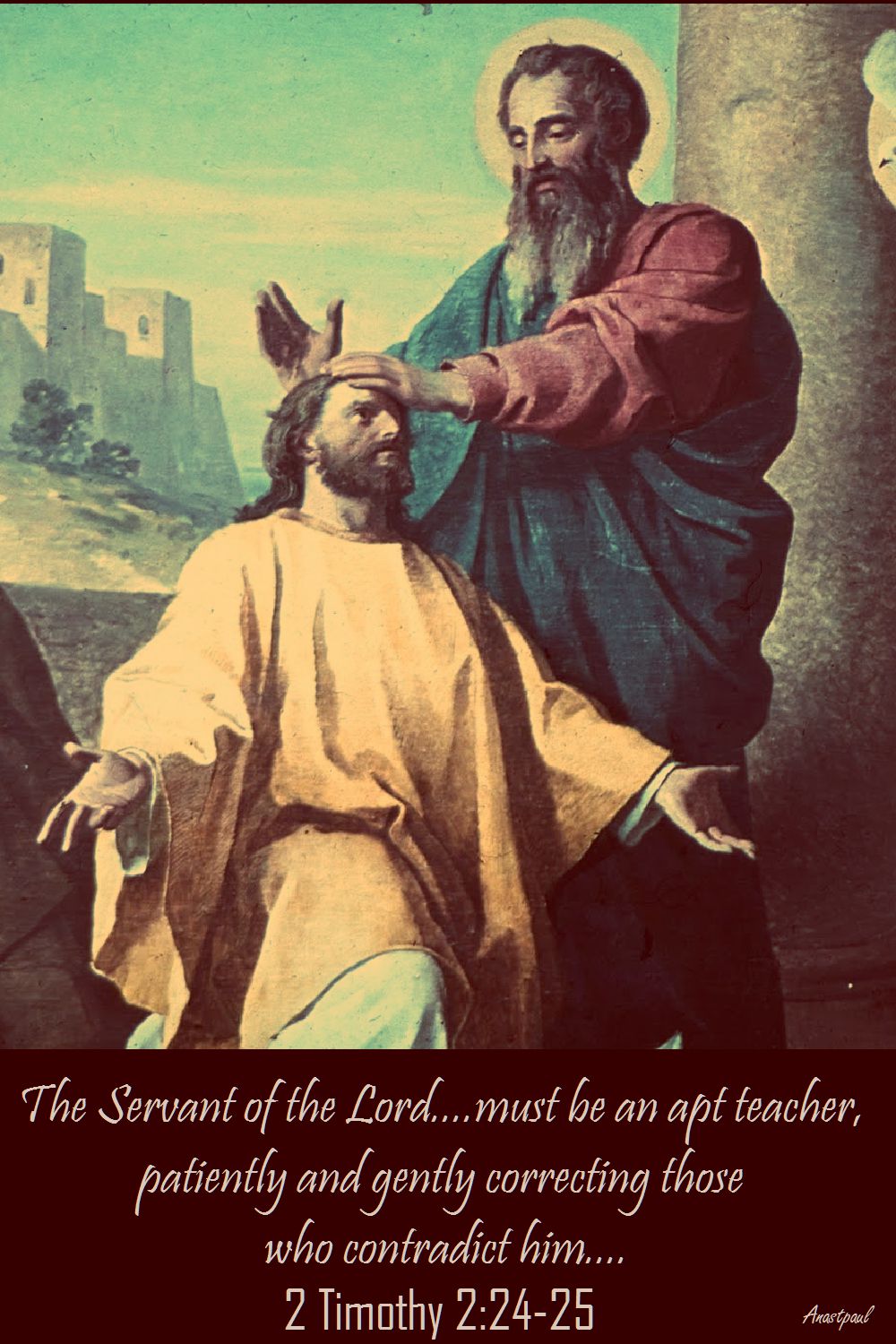
The Servant of the Lord….must be an apt teacher, patiently and gently correcting those who contradict him…..2 Tm 2:24-25
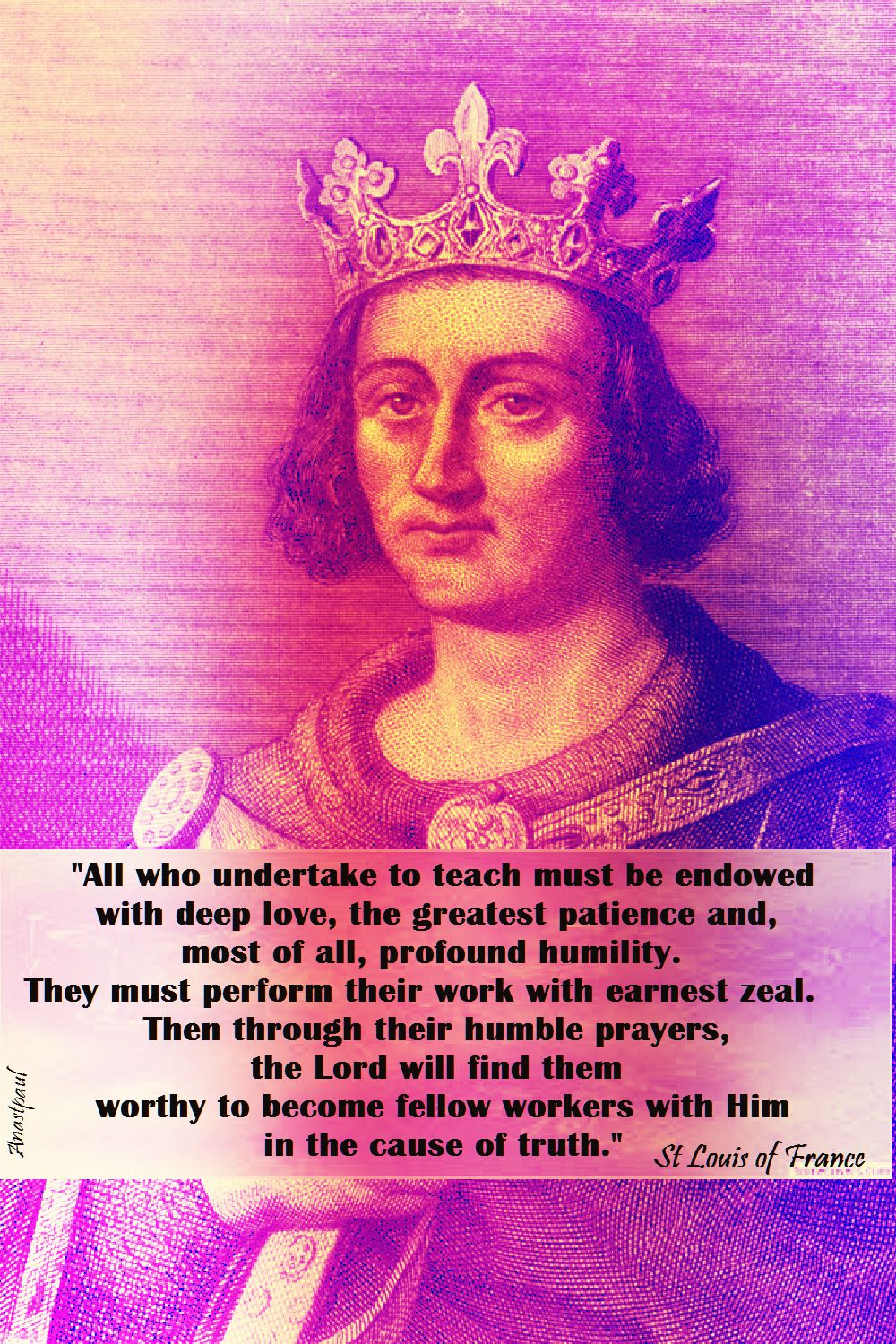
REFLECTION – “All who undertake to teach must be endowed with deep love, the greatest patience and, most of all, profound humility. They must perform their work with earnest zeal. Then through their humble prayers, the Lord will find them worthy to become fellow workers with Him in the cause of truth.”………….St Louis
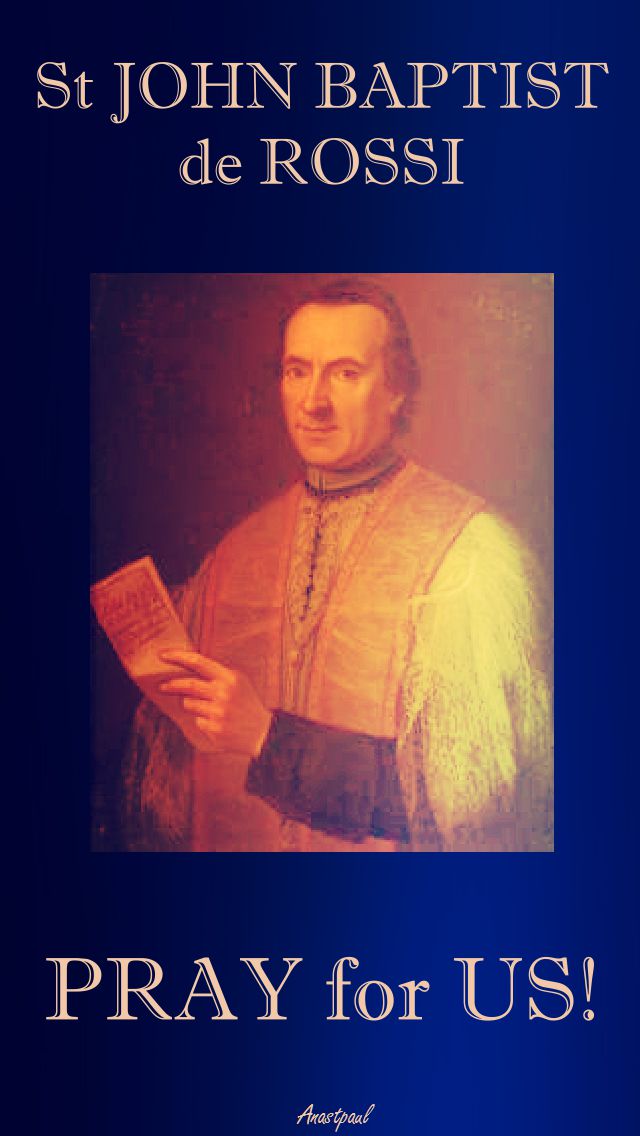
PRAYER – Dear Lord, help me to teach others about You by my example as well as my words. Grant that I may spread Your love and Your truth and Your light wherever I go. St John Baptist de Rossi, you always showed the way by your example, your love for the poor and helpless and by your teachings to seminarians, priests and all the people, please pray for us, amen,
I heard the voice of the Lord saying, ‘Whom shalll I send?….”Here I am.” I said, “send me!”……………Isaiah 6:8
REFLECTION – “You ask what you might offer to God?
Offer yourself!
What does God expect from you – except yourself?”
PRAYER – Help me to discern through prayer and meditation what You truly want of me.
The enable me to offer it to You and indeed, to offer myself and all I have and all I am, to You.
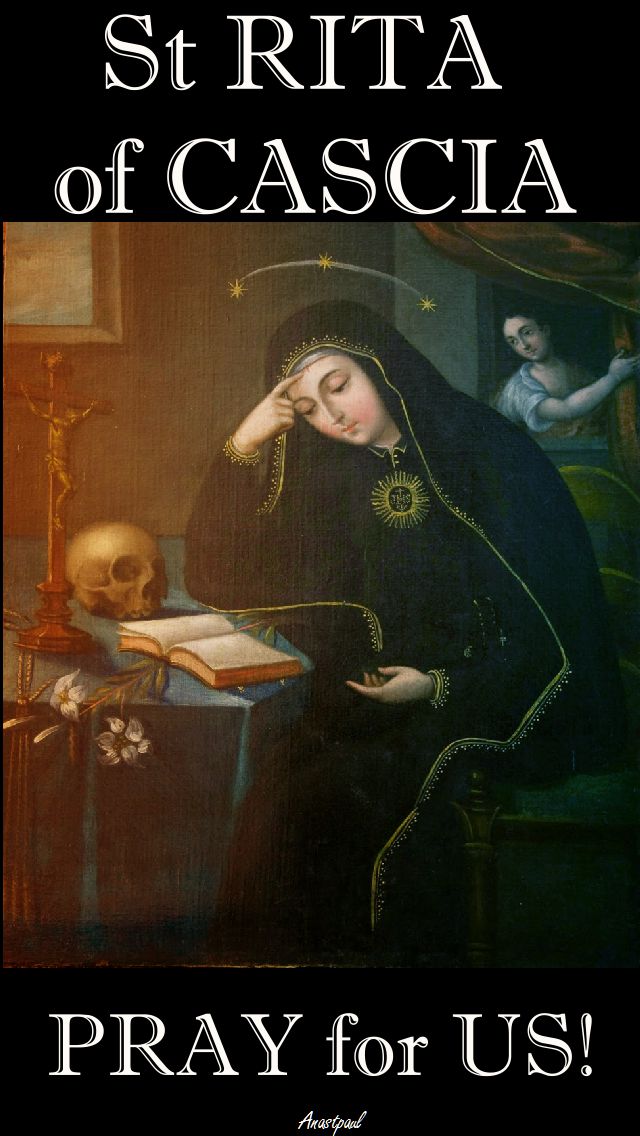
St Rita of Cascia, you prayed so earnestly to give yourself totally to the Lord and suffer for Him, please pray for us, amen.
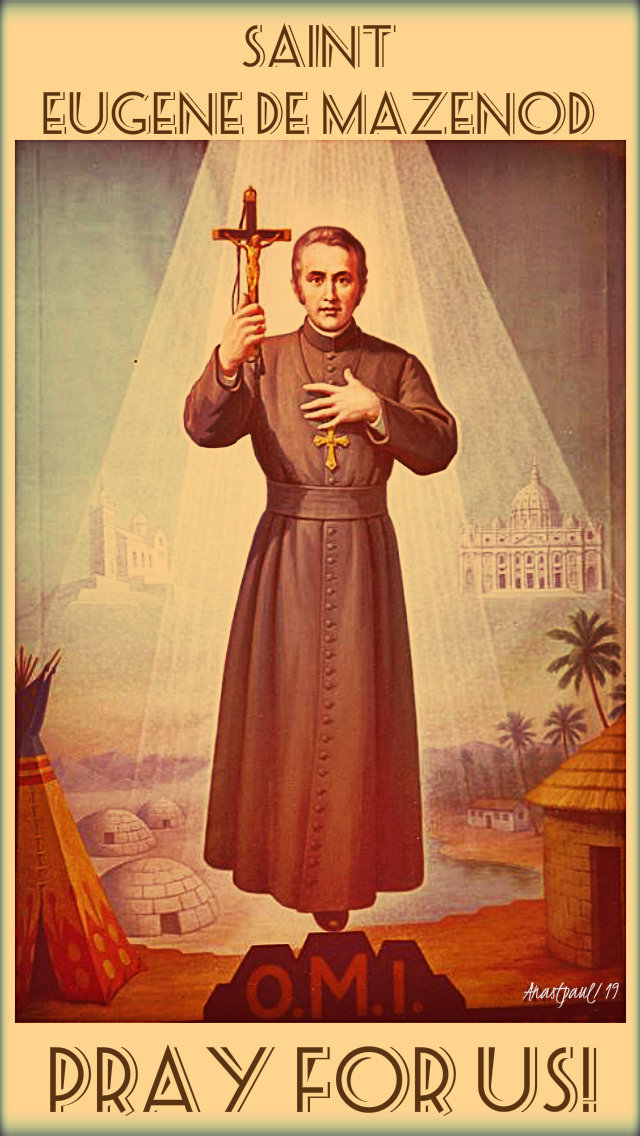
“I have a sensitive and excessive heart”
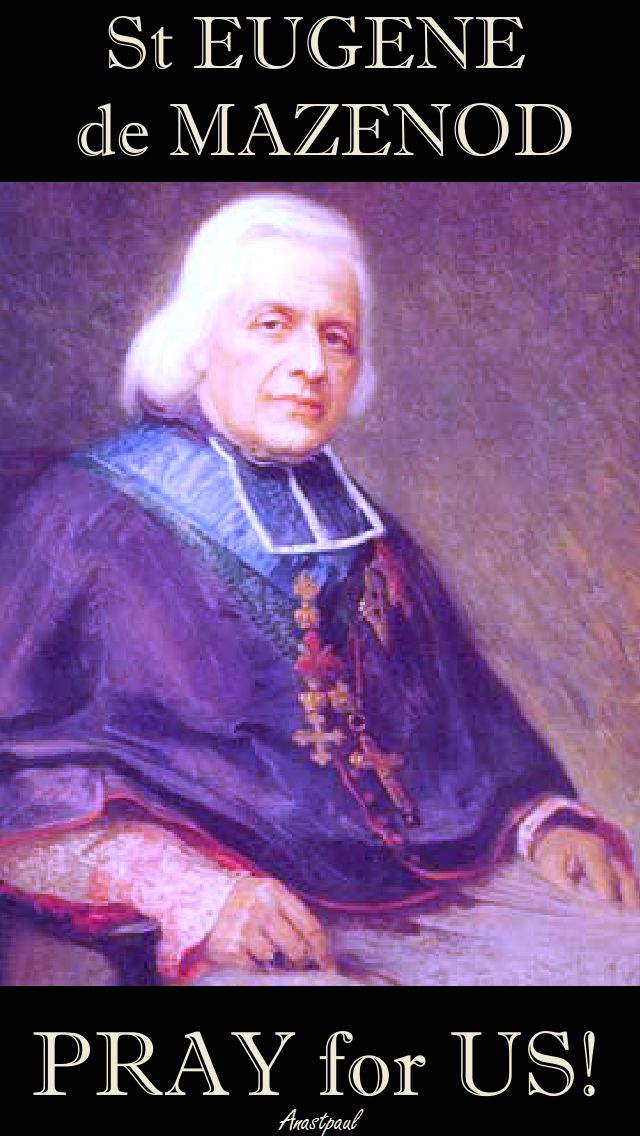
In the personal view that he presented to his spiritual director, on entering the major seminary in 1808, this characteristic was a very good reflection of his personality. Eugene was a “man of heart”. He loved passionately, as he himself admitted. He loved his family. “I am an idolater of my family… I would allow myself to be beaten with an axe for certain of its individuals… I would give my life for them without hesitation” he once wrote. This tendency of love for his family was equally manifested in behalf of the children of his religious family, the Oblates of Mary Immaculate. His most ardent desire was to see them love one another as brothers. This intent was so profound within him that he inscribed it in his spiritual testament. On his deathbed, May 21, 1861, to a few Oblates by his side awaiting a parting instruction from their venerated father, Bishop de Mazenod repeated three times, as if to be well understood: “Charity, charity, charity”.
This great capacity for love allowed St Eugene to open that loving heart to the grace of God which bore rich fruit in his life. That required a certain amount of flexibility as well as courage to face the problems every growing group encounters. We look to saints like Eugene not to borrow their love, courage and zeal but, with God’s grace, to discover our own, always seeking first God’s kingdom (see Matthew 6:33). And a thought that fills us with hope, our passionate love, may just be the impetus and grace of God which forces us to rush headlong into His work and to convert that love into charity too!
“I had looked for happiness outside of God but outside of Him I had found only affliction and disappointment.”
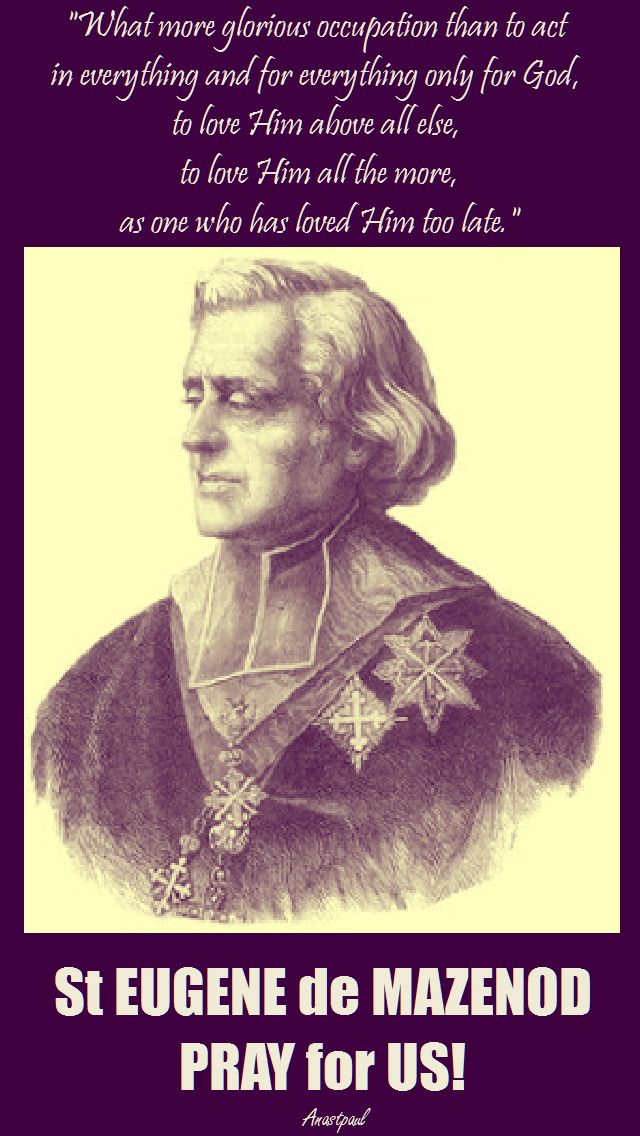
“What more glorious occupation than to act in everything and for everything only for God, to love Him above all else, to love Him all the more, as one who has loved Him too late.”
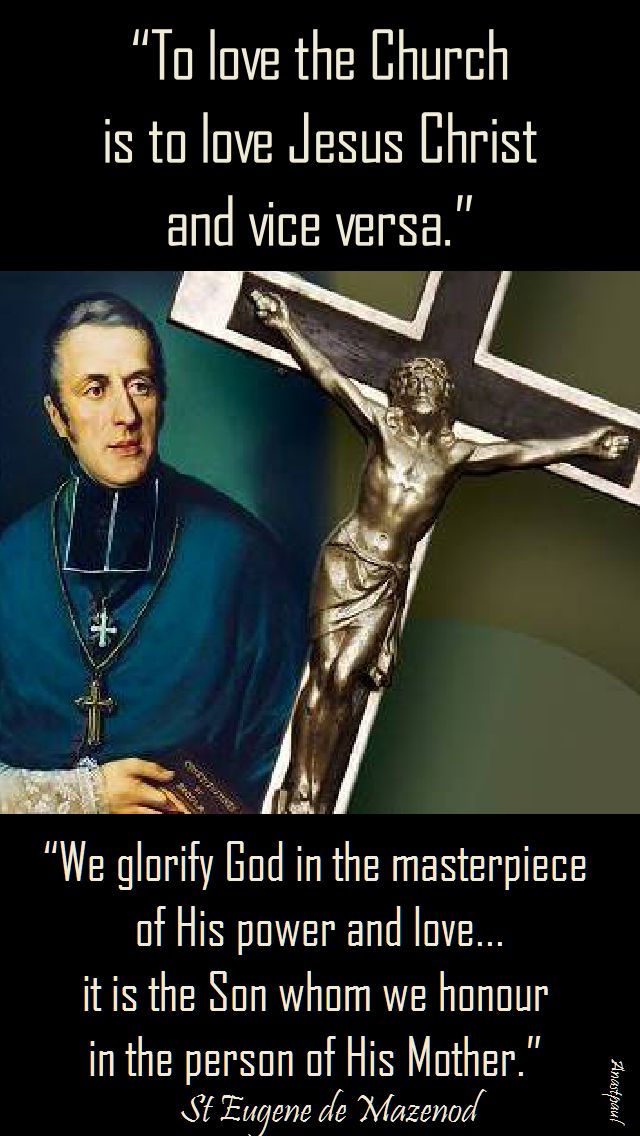
“To love the Church is to love Jesus Christ and vice versa.”
“We glorify God in the masterpiece of His power and love… it is the Son whom we honour in the person of His Mother.”
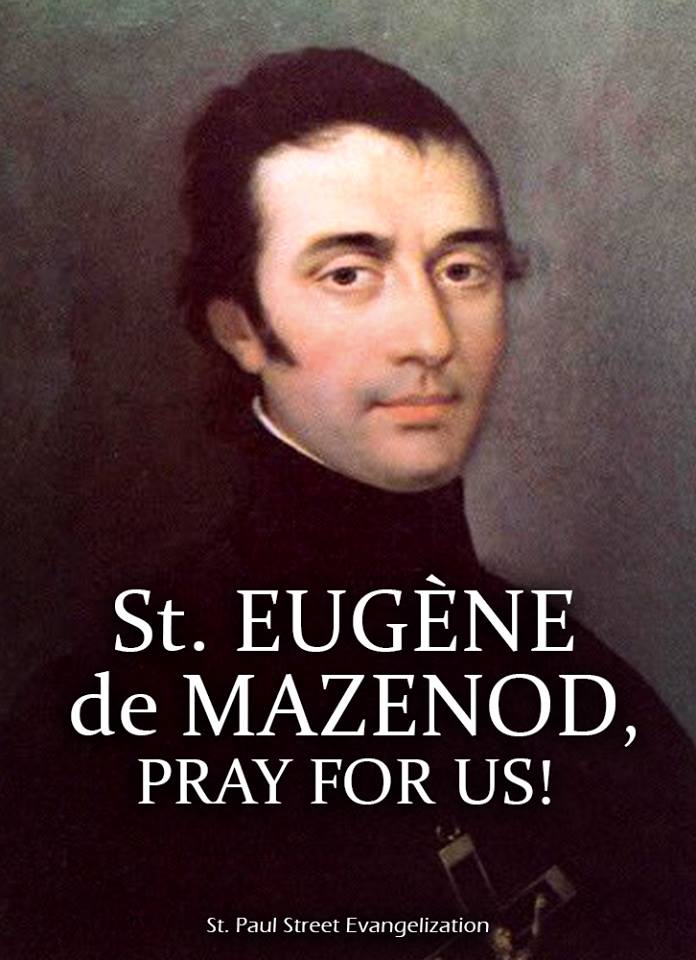
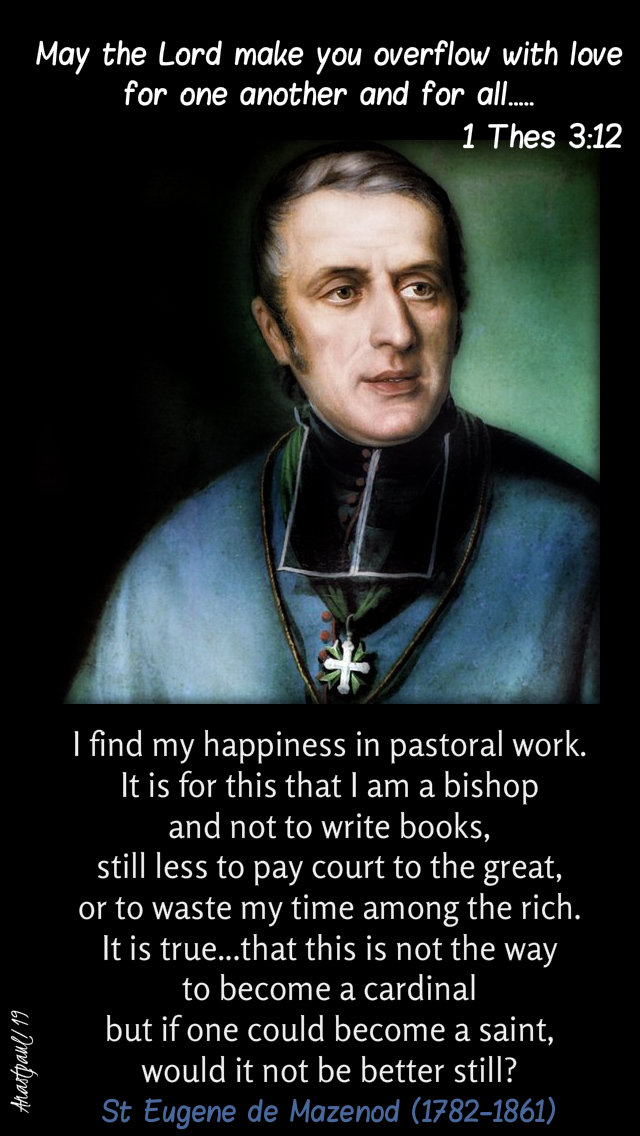
One Minute Reflection – 21 May – The Memorial of St Eugene de Mazenod (1782-1861)
May the Lord make you overflow with love for one another and for all………….1 Thes 3:12
REFLECTION – “I find my happiness in pastoral work. It is for this that I am a bishop and not to write books, still less to pay court to the great, or to waste my time among the rich. It is true…that this is not the way to become a cardinal but if one could become a saint, would it not be better still?”…St Eugene de Mazenod (1782-1861)
PRAYER – Loving Father, grant me the grace to strive after perfect love. Help me to bring forth frequents acts of love so that I may grow in this greatest of virtues. St Eugene you overflowed with love, they said your heart was as big as the world, please pray for us all, amen.
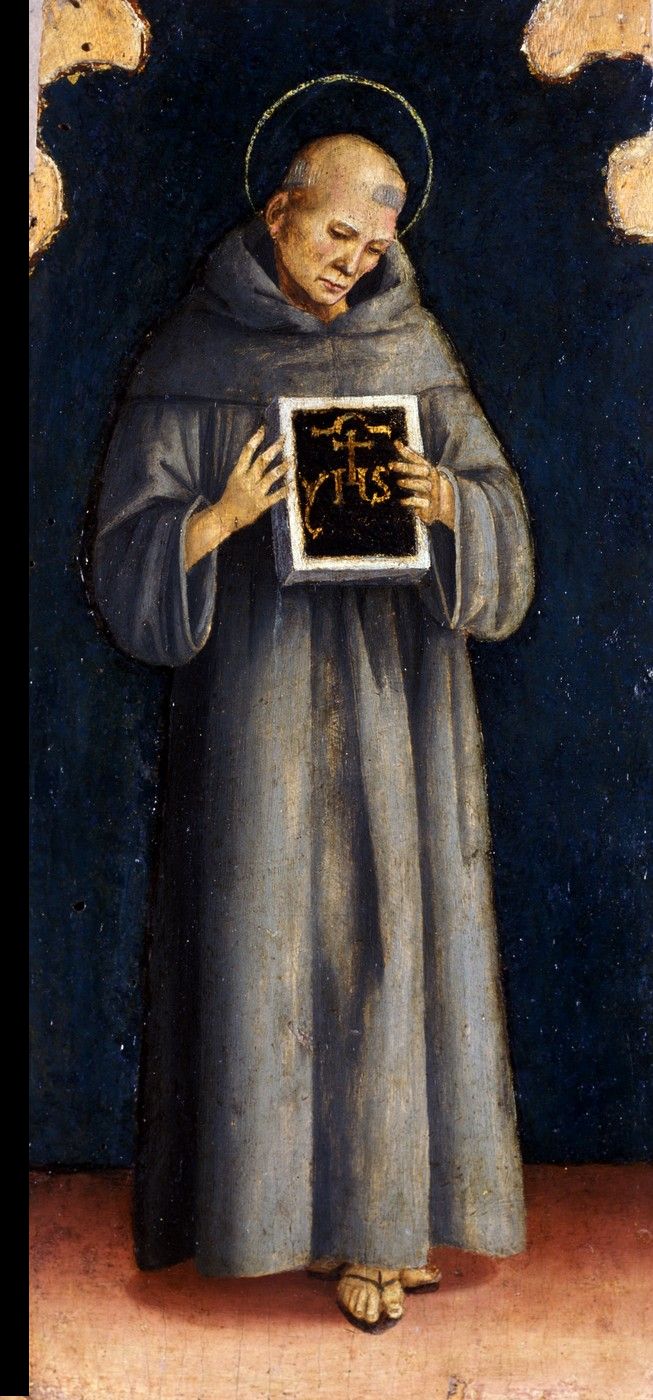
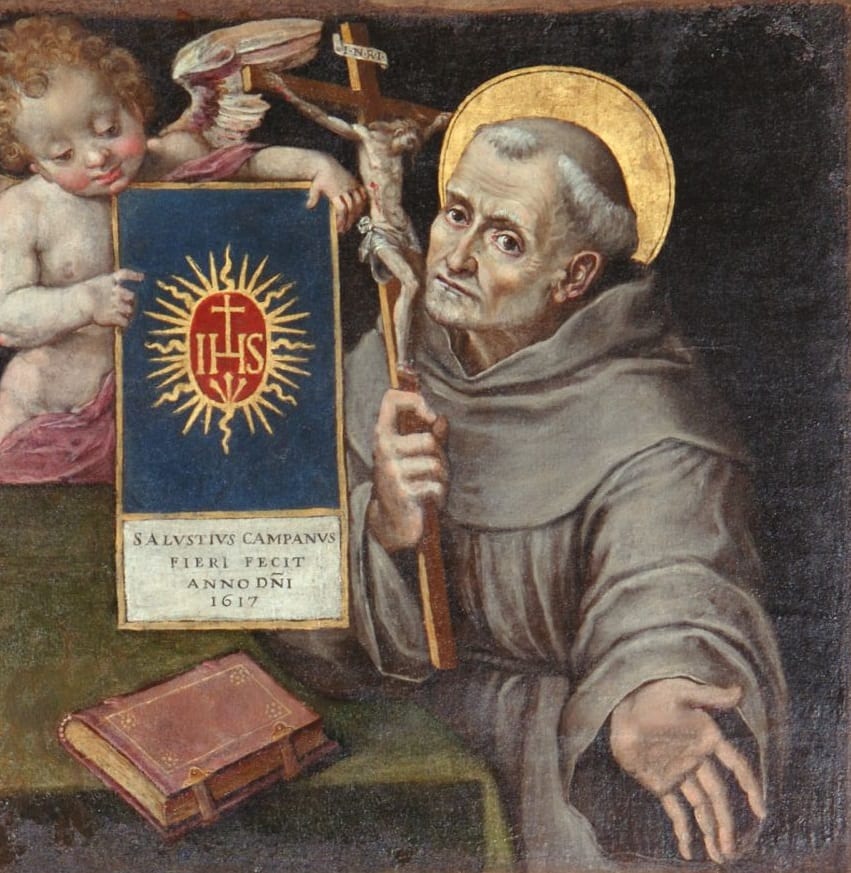
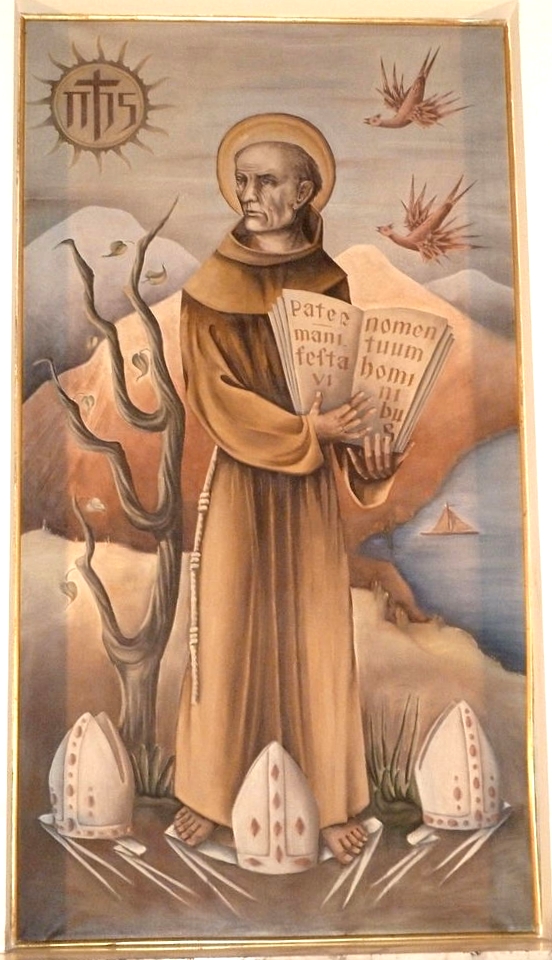
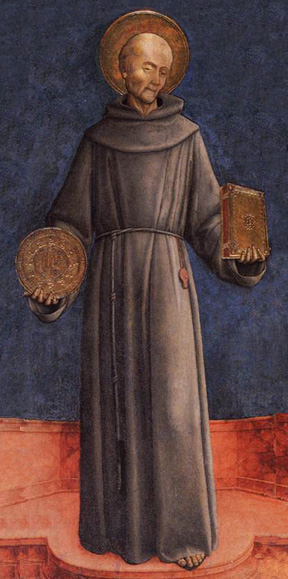
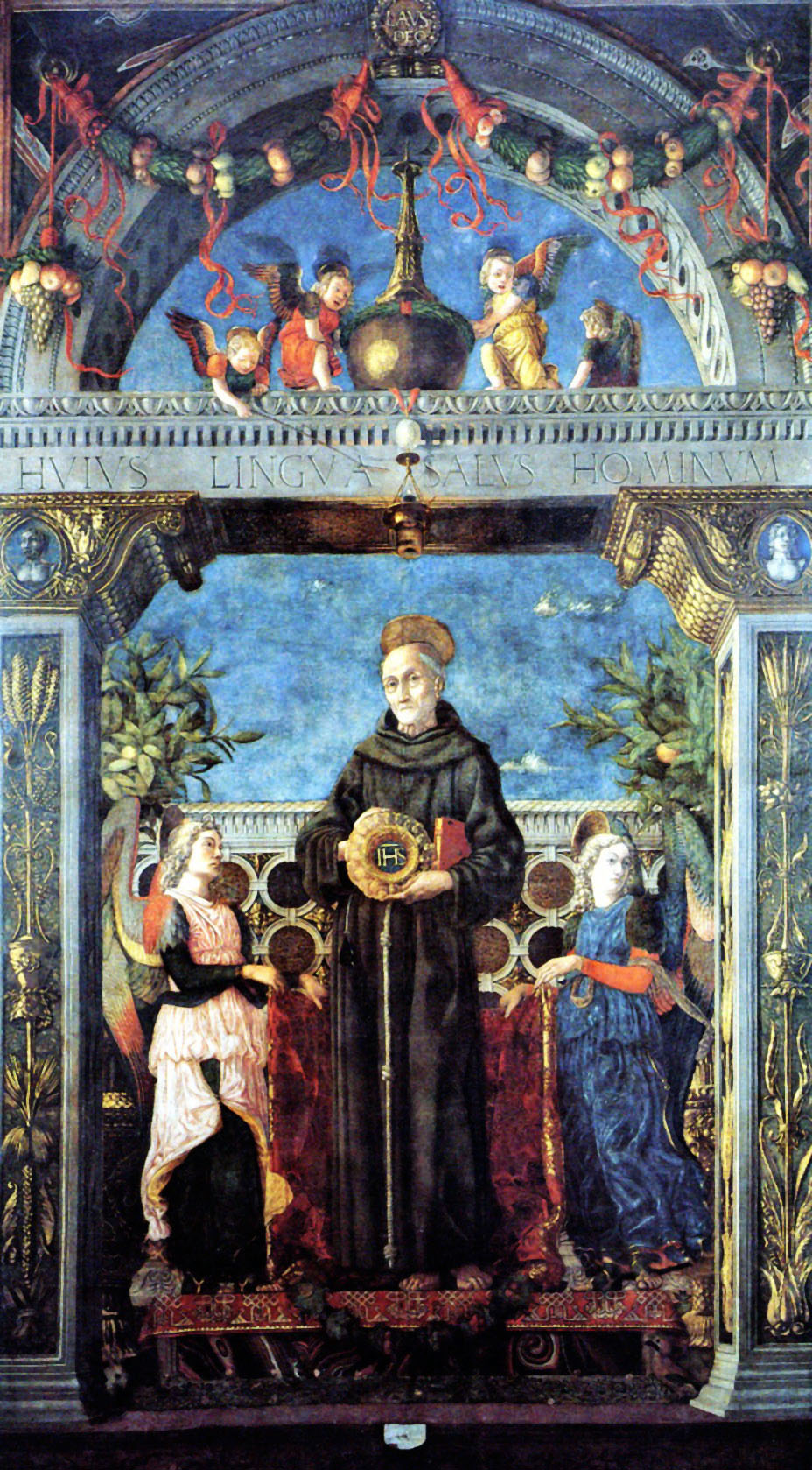
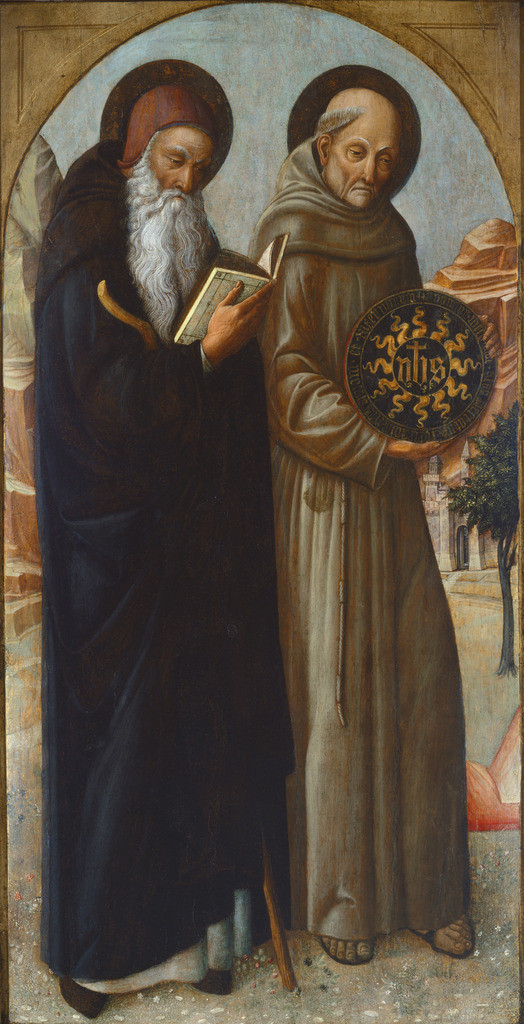
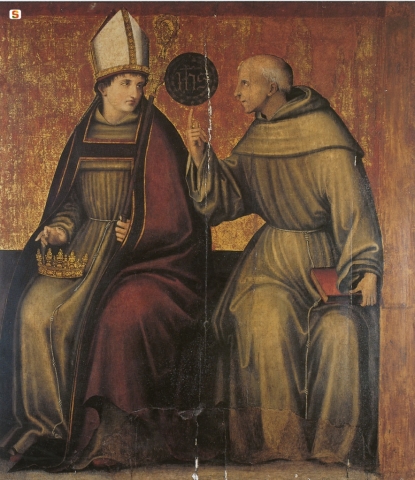
Especially known for his devotion to the Holy Name of Jesus, Bernardine devised a symbol—IHS, the first three letters of the name of Jesus in Greek–in Gothic letters on a blazing sun. This was to displace the superstitious symbols of the day, as well as the insignia of factions: for example, Guelphs and Ghibellines. The devotion spread and the symbol began to appear in churches, homes and public buildings.
The provenance of this item indicates that the prayer book belonged to Franciscan communities in Tuscany during the lifetime of Saint Bernardine of Siena.
“The name of Jesus is the glory of preachers because the shining splendour of that Name causes His word to be proclaimed and heard. And how do you think such an immense, sudden and dazzling light of faith came into the world, if not because Jesus was preached? Was it not through the brilliance and sweet savour of this Name that God called us into His marvelous light? When we have been enlightened and in that same light behold the light of heaven, rightly may the apostle Paul say to us: ‘Once you were darkness but now you are light in the Lord; walk as children of light.’ “
And coming to her, he said, “Hail, favoured one! The Lord is with you.”………..Luke 1:28
REFLECTION -“You must know that when you ‘hail’ Mary, she immediately greets you! Don’t think that she is one of those rude women of whom there are so many — on the contrary, she is utterly courteous and pleasant. If you greet her, she will answer you right away and converse with you!”……..St Bernardine of Siena
PRAYER – Lord God, You sent your angel to Mary and Your divine Son became man when she gave her consent to the angel’s announcement. Help me to give a perpetual consent to all that You will for me and a perpetual refusal to all that only I, in my pride, wish. Help me to see and understand and pray unceasingly to discern Your will. Holy Mary, Mother of God and our Mother, help us all. St Bernardine of Siena, please pray for us, amen.
Saint of the Day – 20 May – St Bernardine of Siena OFM (1380 at Massa di Carrara, Italy to 1444 at Aquila, Italy of natural causes) “Apostle of the Most Holy Name of Jesus,” Priest, Missionary, Preacher, known as the “Apostle of Italy,” the “Star of Tuscany,” and the “Second Paul.” Saint Bernadine is one of the most renowned Franciscan preachers and reformers, a prolific writer who graced the Church with countless sermons and writings and is largely responsible for increasing the popular devotion to the Holy Name of Jesus. St Bernadine is also remembered for his ardent devotion to Our Blessed Mother and the Holy Family. His numerous Patronages include – against chest and lung problems, respiratory illnesses, of Advertising and Communications and Public Relations workers, against gambling and gambling addictions, of Italy, Diocese of San Bernardino, California, of the Diocese of Capri, Italy, of the Italian Cities of Altavilla Irpina, Aquila, Camaiore, Carpi, Castelspina, Alessandria, Montecchio, Trevignano Romano Venice.
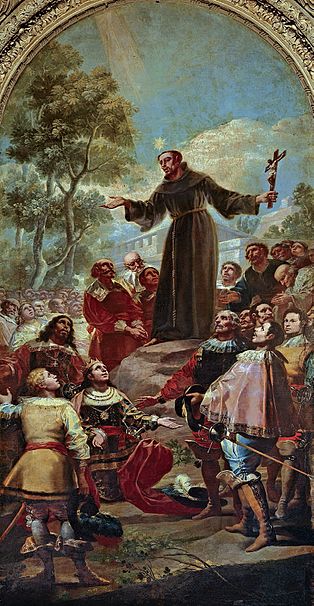
Saint Bernadine was the greatest preacher of his time, journeying across Italy, bringing peace to areas ridden with strife, attacking the paganism he found rampant. When he preached, he would attract large crowds of nearly 30,000 listeners, converting many on the spot. Above all, he followed St. Francis’s admonition to preach about “vice and virtue, punishment and glory.” Saint Antoninus described him as “a new star in the midst of the murky darkness of the earth; to shine with the brightness of Divine gifts; to beam far and wide the bright rays of his glorious life and teachings; to lead in the fear of God, by the holiness of his example, a people whose blindness had removed it from the straight path of the heavenly Homeland.”
He was born on the Feast of the Nativity of Mary in Siena, Italy. StBernadine entered the world in nobility, the son of a governor. At age six, he lost both his parents and thus orphaned, was raised by a pious aunt who attended to both his physical and spiritual needs. Bernadine excelled at school, demonstrating both intelligence and diligence, holiness and piety, and was well-liked and popular. At age 17, he entered a Marian confraternity at the La Scala hospital, beginning a secluded religious life devoted to prayer and meditation. At that time, the plague raged throughout Europe and Bernadine left seclusion to aid the sick, placing himself at great risk and assuming administration of the hospital. While he never contracted the plague, he fell ill from exhaustion and was confined to bed for several months. While he never fully recovered, his voice—hoarse and weak from his sickness- was fully restored through his devotion to Our blessed Mother, allowing him to develop profound preaching skills. Following his own sickness, his aunt fell ill and he nursed her until her death, never leaving her side. Upon her death, Saint Bernadine turned to fasting and prayer, spending his days seeking the will of the Lord in his life.
One day while he was kneeling at the foot of his crucifix, praying for guidance, Bernadine heard the voice of Jesus say to him: “My son Bernardine, you see Me hanging on the Cross, in a state of total denudation. If you love Me and want to walk in My footsteps, fasten yourself also to the cross, divested of everything.” Following this divine message, Bernadine joined the Franciscan Order, distinguishing himself through obedience, which he considered the virtue of highest import.
Bernadine was assigned to preaching, having a natural gift given by the Holy Spirit. Over the next decade of his life, he traveled throughout Italy, preaching in major cities, a natural successor to Saint Vincent Ferrer. The Adorable Name of Jesus was the usual theme of his sermons, stemming from his aunt’s instruction as a child. Wherever he traveled, he carried a tablet on which the Holy Name of Jesus (IHS) was written, adopting it as his standard and his “sole weapon.” He firmly held only in this Name could man be saved, as Saint Peter had instructed the elders in the Synagogue.
One of Bernadine’s listeners in Siena was to become Pope Pius II. In his notes, the Pope tells of one of Bernardine’s addresses: “One day, as he was preaching in the square in Siena, a thick cloud formed and threatened rain. Everyone wanted to run off. ‘Friends, remain in peace,’ exclaimed the orator. He knelt down and prayed, ordering the cloud, by virtue of the Name of Jesus, to go away. Scarcely had he spoken when the cloud scattered without a drop of rain, and the weather turned as fair as it had been before.”
Bernardine was a preacher of inspired eloquence. He has been called the Doctor of the Heart of Mary due to his writings on Mary’s heart. He wrote, “from her heart, as from a furnace of Divine Love, the Blessed Virgin spoke the words of the most ardent love.” He was also a distinguished master in the science of all things sacred, as is proved by the writings he has left us.
Bernadine’s watchword, like Saint Francis, was peace. He preached peace wherever he went, balancing the social climate of the day with the teachings of the Church. Mass reconciliations were reported as he celebrated Mass, given his encouragement of the kiss of peace between attendees.
Numerous miraculous occurrences were reported in his presence. One day, preaching in praise of the Blessed Virgin, he applied to Her the verse of the Apocalypse: “A great sign appeared in heaven, a Woman clothed with the sun…” At once a brilliant star appeared over his head. On other occasions, Bernadine was understood by all present when he spoke in Italian—even by those who didn’t speak Italian! He obtained miraculous conversions and reformed the greater part of Italy by his burning words and by the power of the Holy Name of Jesus.
Bernardine was appointed Vicar General of his Order in 1438, an office he held for five years. After five years, he began preaching again until, worn out from his missionary labors, he died on the Eve of the Ascension. At his death, his brothers surrounded him, chanting, “Father, I have manifested Thy Name to men.” Saint Bernadine was buried at Aquila in the Abruzzi. The miracles reported at his tomb encouraged Pope Nicholas V to canonise him only six years later.
“All our perfection consists in being conformed,
united and consecrated to Jesus Christ;
and therefore the most perfect of all devotions is,
without any doubt, that which the most perfectly
conforms, unites and consecrates us to Jesus Christ.
Now Mary being the most conformed of all creatures to Jesus Christ,
it follows that, of all devotions that which most consecrates
and conforms the soul to Our Lord is devotion to His holy Mother
and the more a soul is consecrated to Mary,
the more it is consecrated to Jesus.
Hence it comes to pass that the most perfect consecration
to Jesus Christ is nothing else than a perfect and entire
consecration of ourselves to the Blessed Virgin.”
“You are the glory of Jerusalem!
You are the great pride of Israel!
You are the great boast of our nation!……Judith 15:9
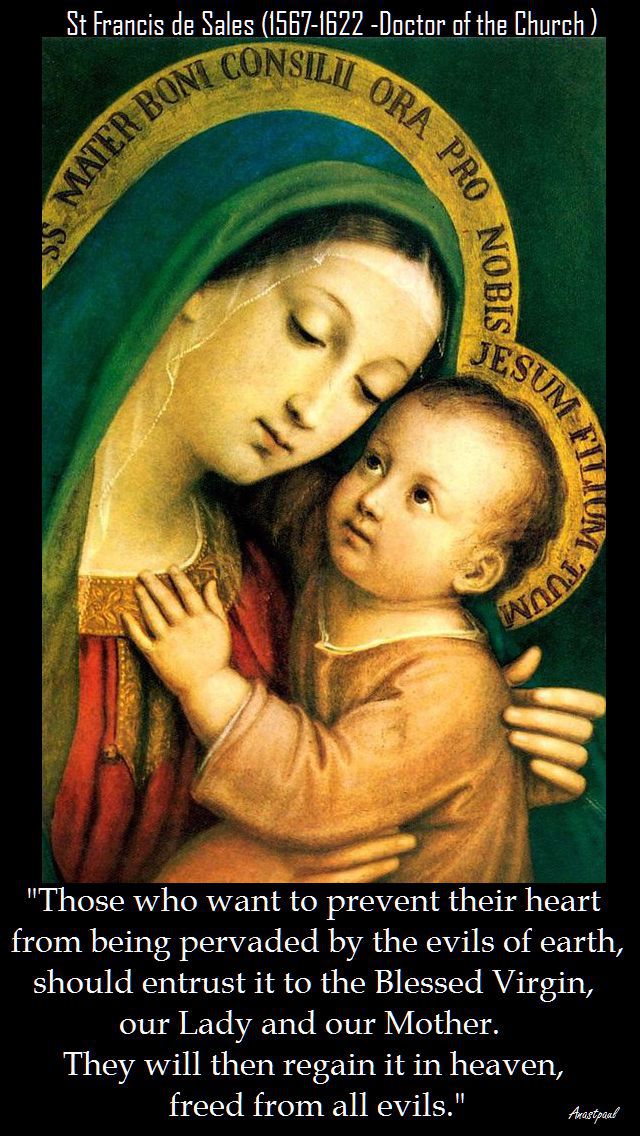
REFLECTION – “Those who want to prevent their heart from being pervaded by the evils of earth, should entrust it to the Blessed Virgin, our Lady and our Mother. They will then regain it in heaven, freed from all evils.”……………St Francis de Sales
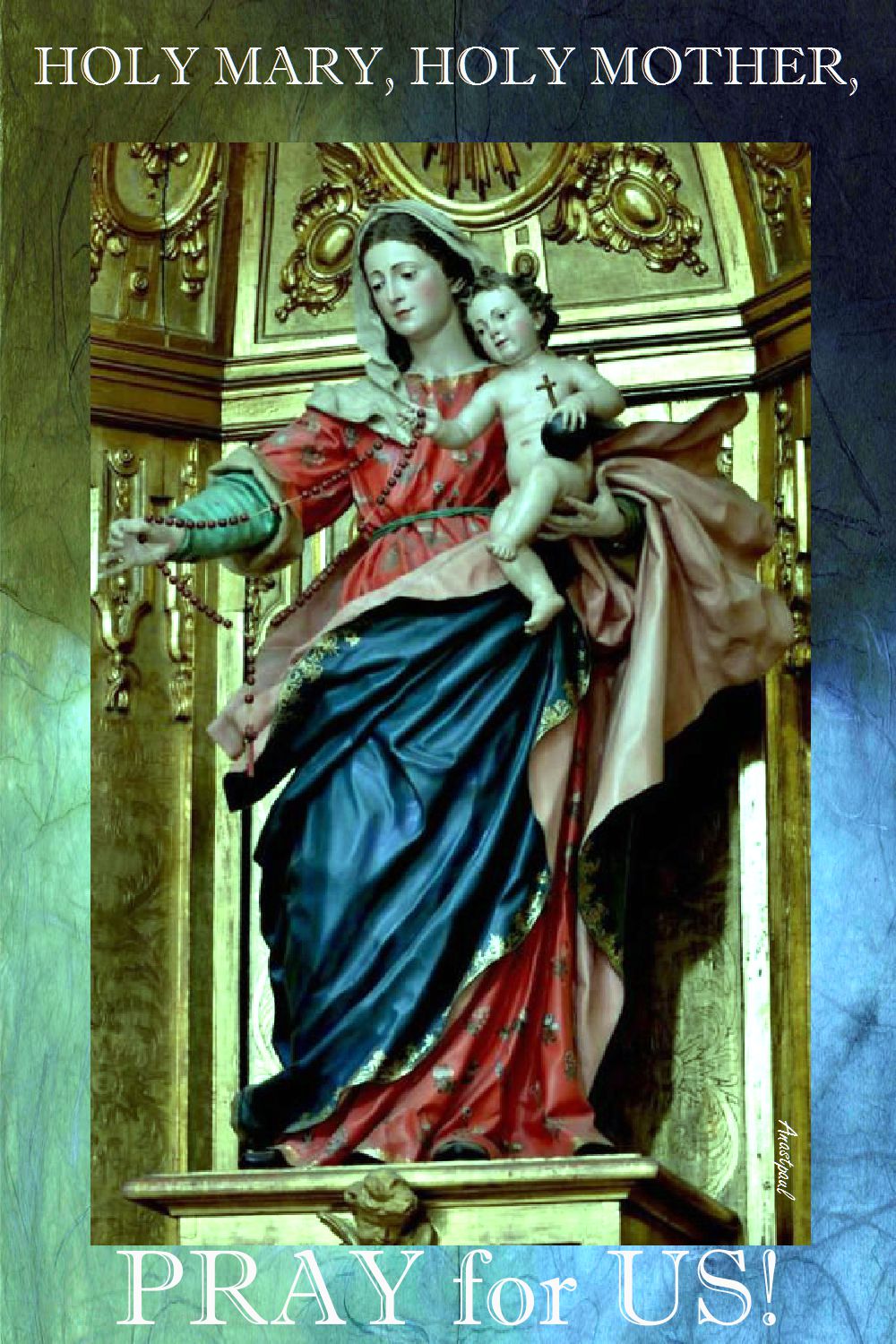
PRAYER – Lord Jesus, move me to entrust my heart and my affections to Your Holy Mother. Grant that her prayers may keep me from all evil and firmly attached to You forever. Holy Mary, Holy Mother, pray for us, amen.
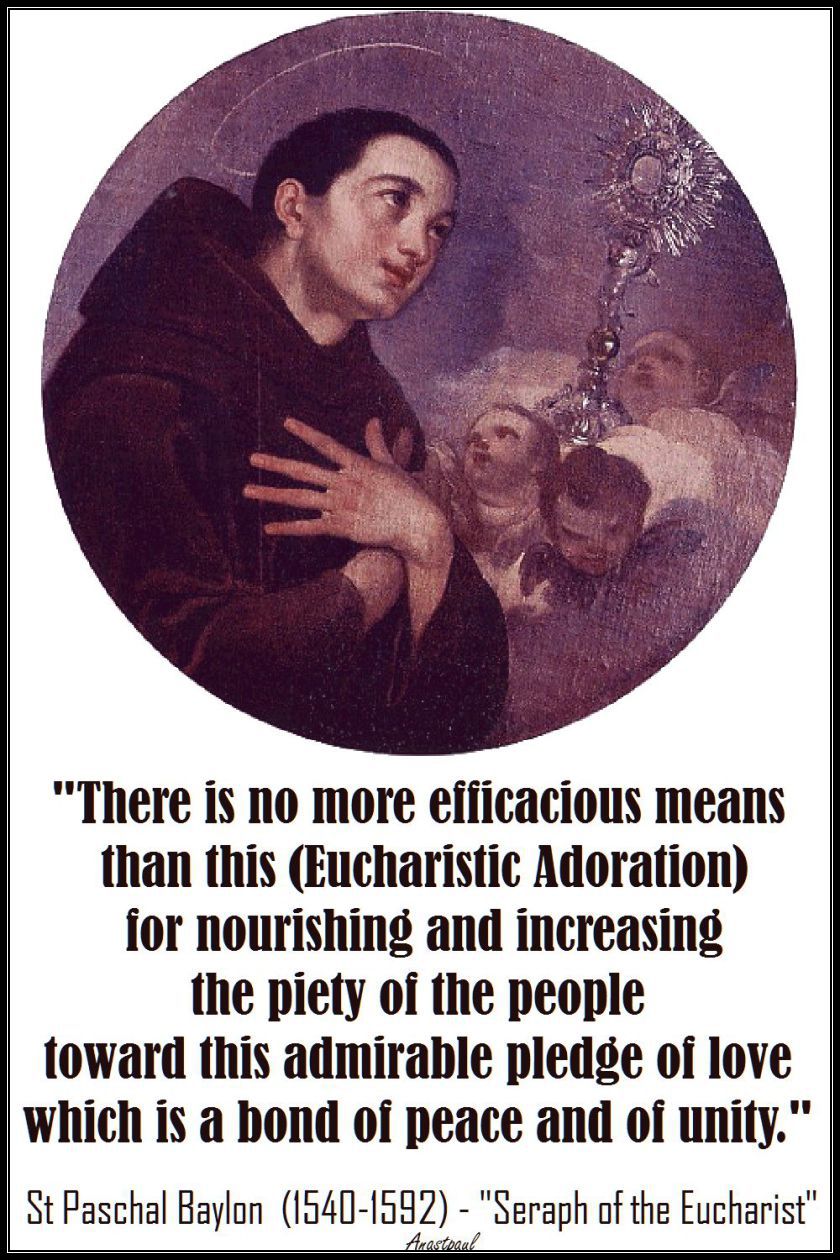
“There is no more efficacious means than this (Eucharistic Adoration)
for nourishing and increasing the piety of the people
toward this admirable pledge of love
which is a bond of peace and of unity.”
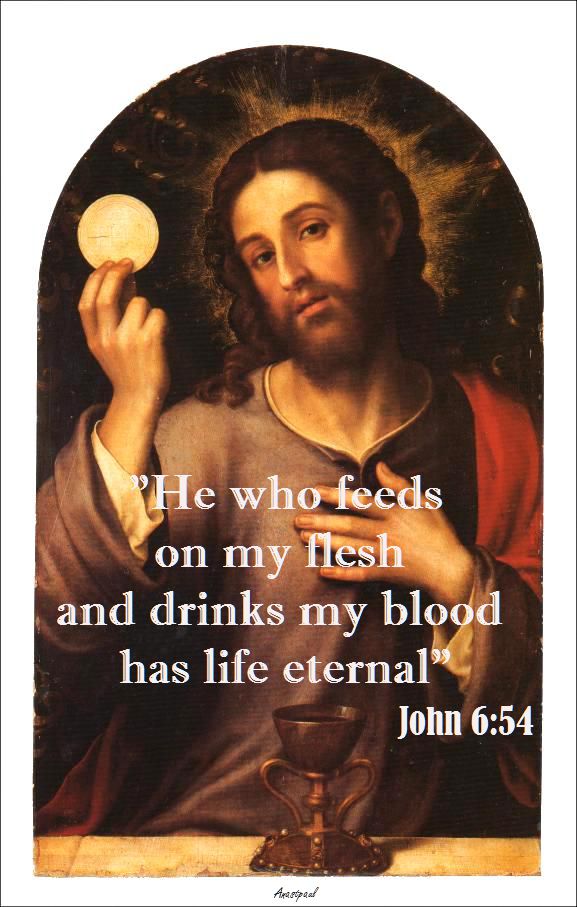
“He who feeds on my flesh and drinks my blood has life eternal”……………….John 6:54
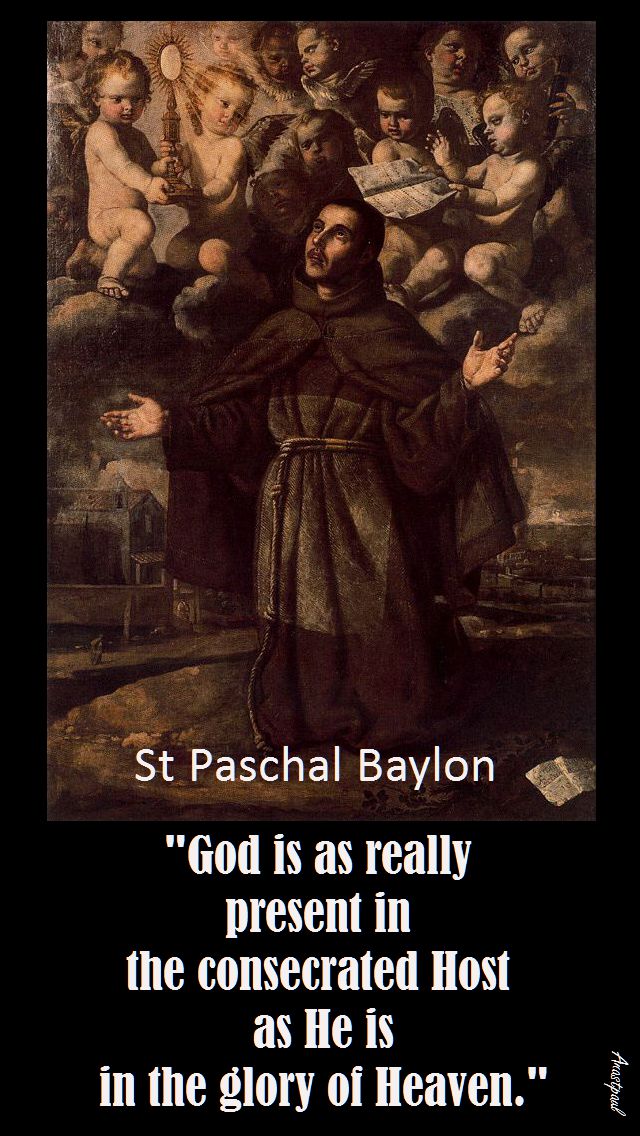
REFLECTION – “God is as really present in the consecrated Host as He is in the glory of Heaven”…..St Paschal Baylon
PRAYER – Lord Jesus Christ, never let me abstain from receiving You in Holy Communion and let me always find the time to visit You in the Tabernacle. Lord teach enlighten my mind with a fuller love and understanding of Your Eucharistic Heart. St Paschal Baylon, Seraph of the Eucharist, pray for us all! Amen
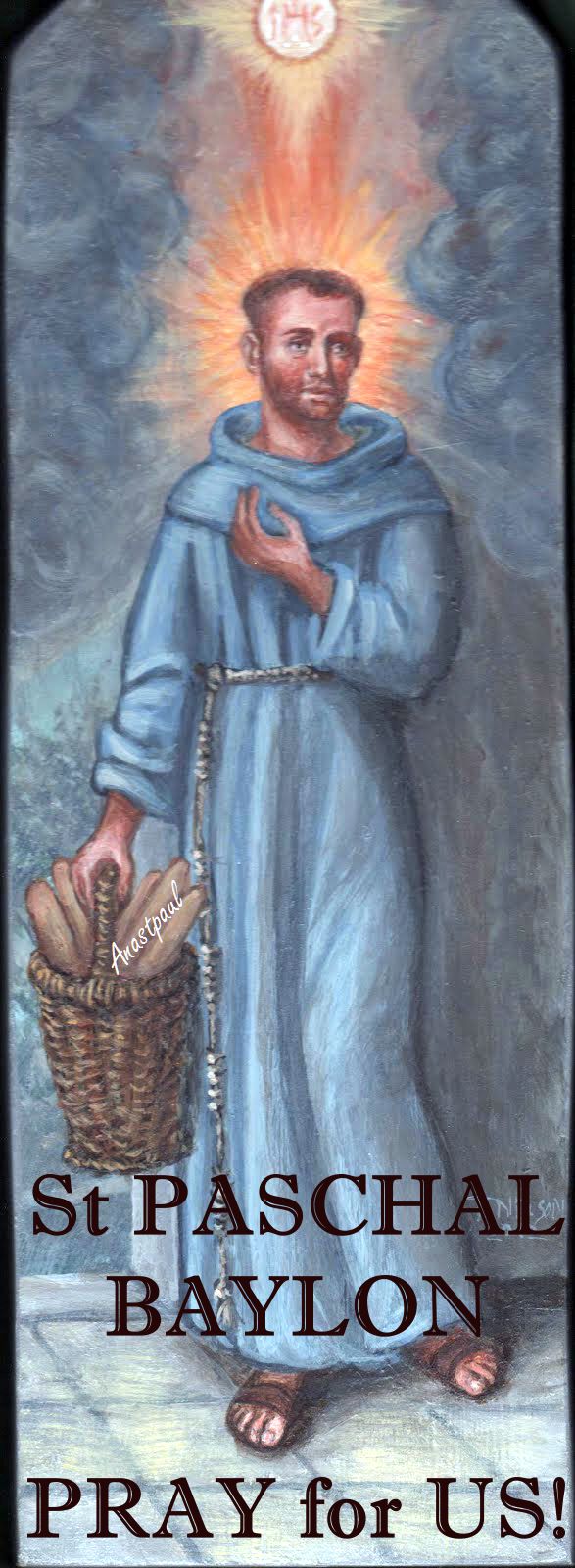
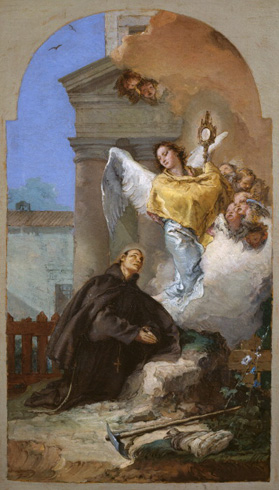
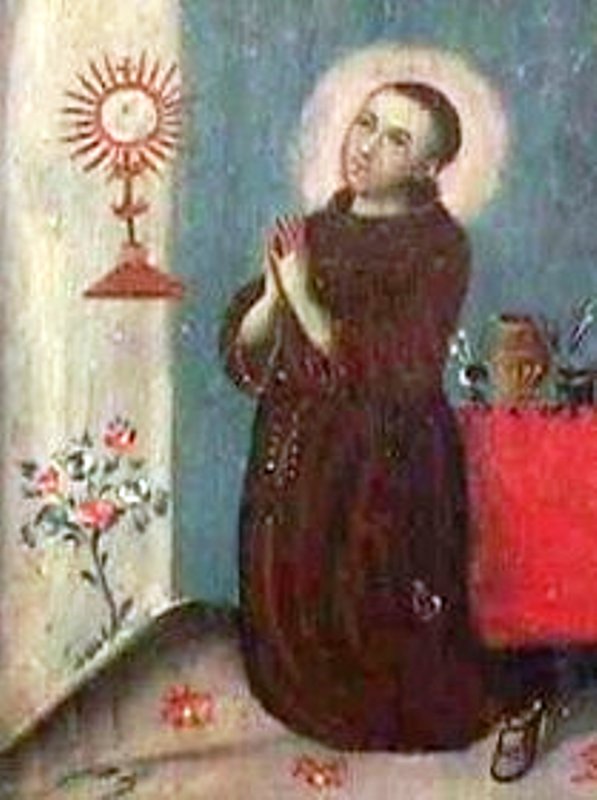
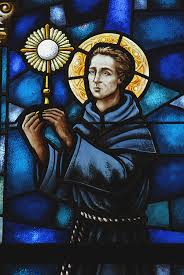
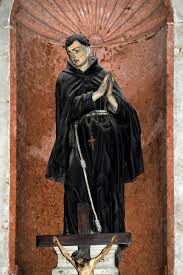
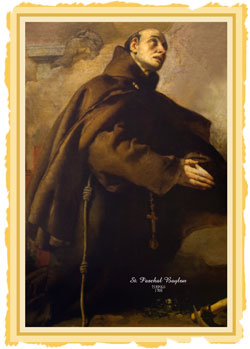
Saint of the Day – 17 May – St Paschal Baylon (1540 (feast of Pentecost) at Torre Hermosa, Aragon, (modern Spain) – 15 May 1592 (feast of Pentecost) at Villa Reale, Spain of natural causes) Franciscan lay brother, Mystic, Contemplate, known as the “Seraph of the Eucharist,” “Saint of the Blessed Sacrament,” “Servant of the Eucharist.”Patron of cooks, shepherds, Eucharistic congresses and organisations (proclaimed by Pope Leo XIII on 28 November 1897), Diocese of Segorbe-Castellón de la Plana, Spain, Obado, Bulacan, Philippines. Attributes – The Eucharist, Monstrance, Franciscan habit.
Today, 17 May marks the Feast Day of Saint Paschal Baylon, mystic, known for his profound devotion to the Blessed Sacrament. While Saint Paschal never became a priest, he is the saint most often thought of in relation to the Holy Eucharist and Pope Leo XIII declared him the patron saint of Eucharistic congresses and associations. He wrote, “There is no more efficacious means than this for nourishing and increasing the piety of the people toward this admirable pledge of love, which is a bond of peace and of unity.” Among all those most devoted to the Eucharist, Paschal Baylon seemed to the Pope to be “the greatest.”
As a youth, Paschal Baylon tended his family’s sheep. He taught himself to read so that he could pray the Little Office of the Blessed Virgin, the popular prayer book of his day. Paschal disciplined himself to endure the harshness and loneliness of a shepherd’s work. And when his sheep trod on others’ vines, he scrupulously paid for the damage out of his own meager resources.
At twenty-one, St Paschal joined the reformed Franciscans of St. Peter of Alcántara at Loreto. As a lay brother, Paschal for many years served as porter and guestmaster with patience and good humor. John Ximenes, his biographer, reports that he was a model friar, always the first at prayer and never once behaving badly in a relationship. “In no single case,” said Ximenes, “do I remember to have noted even the least fault in him, though I lived with him in several of our houses and was his companion on two long journeys.”
Like other saintly doorkeepers Brother André and Solanus Casey, Paschal gained a reputation for miracles.
For example, Martin Crespo once told how the saint freed him from his determination to take vengeance on his father’s murderers:
“One Good Friday there was a lifelike representation of the descent from the cross. Along with everyone else in town, I followed the crucifix borne in triumph through the streets. In a last ditch effort to get me to repent, my friends boxed me in and forced me to endure the preacher’s address. He concluded his eloquent speech in a pathetic peroration, urging me to forgiveness in memory of our Saviour’s passion. His fine discourse left me unmoved and cold.
“Quit tormenting me,” I exclaimed angrily. “It’s no use. I will not forgive them.” Brother Paschal, whom I had not noticed before, stepped forward. He took me by the arm and drew me aside. “My son,” he said, “have you not just now seen a representation of our Lord’s passion?” Then with a glance that penetrated my soul he said: “For the love of Jesus Crucified, my son, forgive them.”
“Yes, Father,” I replied, hanging my head and weeping. “For the love of God I forgive them with all my heart.” I no longer felt the same person. The crowd anxiously awaited the outcome of our mysterious conference. When Paschal announced that I had forgiven my enemies, they burst into applause.”
We remember Paschal Baylon most as the “Saint of the Blessed Sacrament.” Typically he spent as many hours a day as he could worshiping before the Tabernacle. Because of his faithful devotion, the Church has named him Patron of Eucharistic Congresses and conferences. He died in 1592 at the age of fifty-two.
Saint Paschal exhibited an ardent love for Christ and was especially devoted to the Eucharistic Mystery. He traveled from church to church, always on foot, visiting and praying before the Blessed Sacrament, referring to his encounters with “the real presence of Jesus” in these moments. During his prayers, he would often levitate above the floor, so much was his love and zeal for Christ.
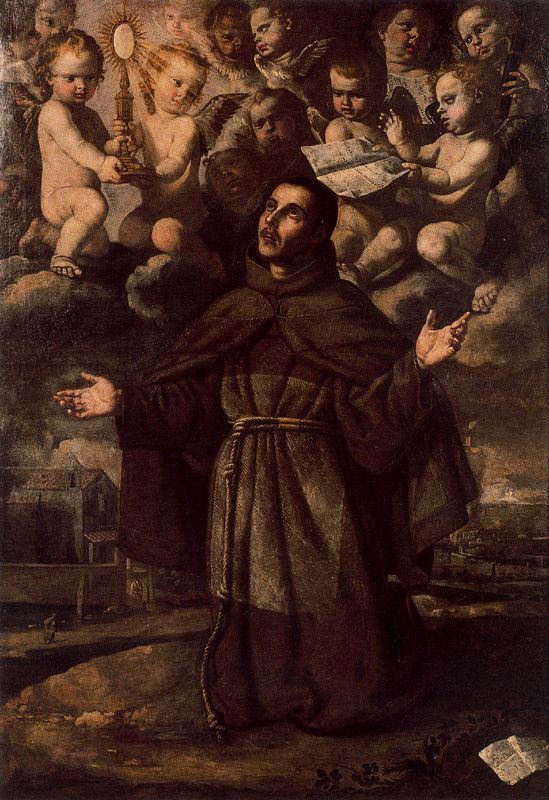
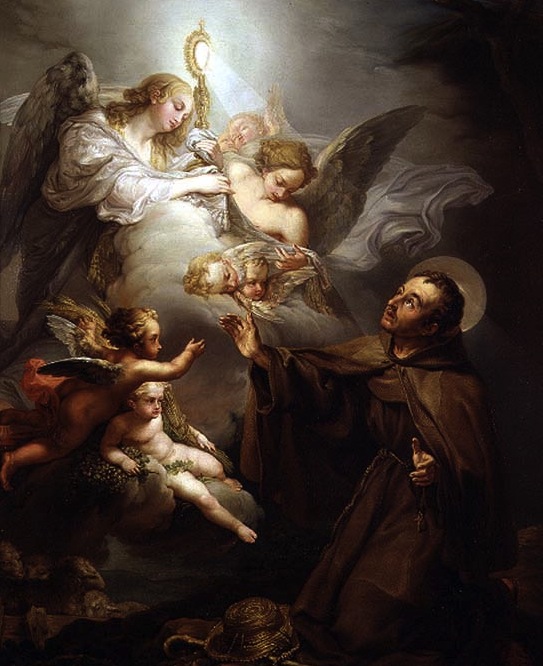
Many miracles are attributed to Saint Paschal, including creating fresh-flowing streams by striking the ground, healing, and miraculous charity. Saint Paschal also experienced mystical visions. On one such occasion, while he was out in the fields with his sheep and unable to go to Mass at the nearby monastery, Paschal was waiting for the sound of the Consecration Bell which he always observed in prayer. In his longing to be present at the Holy sacrifice of the Mass, he cried out, “My Master, My adorable Master, Oh that I might see Thee!” Suddenly before him he saw Angels bowed down before a Chalice, with the Blessed Sacrament floating above it. In the Divine Presence of Our Lord, Paschal fell flat on his face and adored God. Then taking courage he gazed upon the beautiful vision.
The “Servant of the Eucharist,” as he was commonly called, died on 17 May Pentecost Sunday, in 1592. His tomb at the Royal Chapel in Villareal, Valencia, Spain immediately became the object of innumerable pilgrimages, even by the king and the nobles of Spain. At his funeral Mass, Saint Paschal’s eyes miraculously opened during the Consecration, adoring the Blessed Sacrament even in death. Since his death, strange occurrences have continued to be reported, known as the “Knocks of St. Paschal.” At first, the knocks came from Paschal’s tomb. Later they came from relics and pictures of the saint. The knocking sound is believed to come as a kind of warning, to let people know that a terrible event was about to take place. It is also said that in Spain and Italy, those who are devoted to Saint Paschal, are warned about their death, days before, so that they may have a chance to receive the Last Sacraments. Beatified by Pope Paul V in 1618, he was Canonised by Pope Alexander VIII on 16 October 1690.
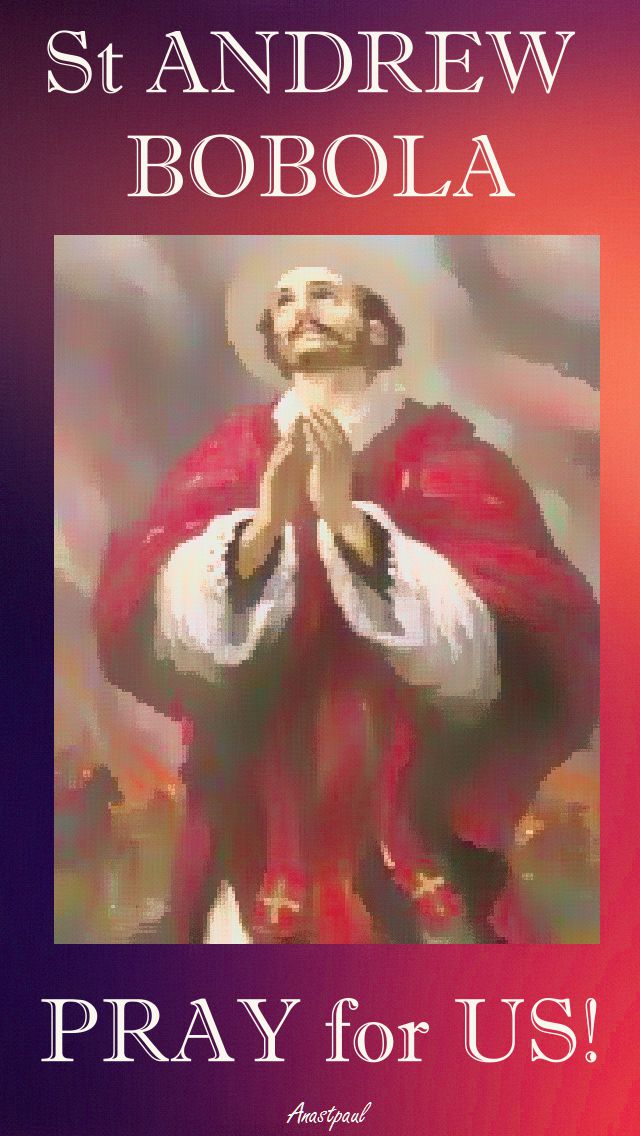
…..”the Polish Martyr rose to the heights of the noblest triumphs which the Church commemorates. Andrew was asked if he were a priest of the Latin rite, and he replied:
‘I am a Catholic priest. I was born in the Catholic faith. In that faith I wish to die. My faith is true; it leads to salvation. Do you rather repent; give place to sorrow for sin, else you will be unable, in your errors, to win salvation. By embracing my faith, you will acknowledge the true God and will save your souls’.
St Andrew Bobola SJ
At these words, those wicked men, utterly devoid of humanity, were roused to a fiendish barbarity and reached such a degree of cruelty that they inflicted still more horrible sufferings on the soldier of Christ. Once again, “he was scourged, a crown like that of Jesus Christ was bound about his head, he was struck heavy blows and lay wounded by a scimitar. Next, his right eye was gouged out, strips of skin were torn off, his wounds were savagely scorched and rubbed with prickly bundles of straw. Nor was that enough: his ears, nose and lips were cut off, his tongue torn out by the root and finally, a weapon plunged into his heart. And, at long last, the valiant athlete, three hours after midday, displaying a truly marvelous example of fortitude, was pierced by a sword and achieved the glory of martyrdom.” ……………….Venerable Pope Pius XII – INVICTI ATHLETAE (On St. Andrew Bobola) Encyclical Promulgated on 16 May 1957
Blessed are you when they insult you and persecute you and utter every kind of evil against you [falsely] because of me. Rejoice and be glad, for your reward will be great in heaven…………..Matthew 5:11-12
REFLECTION – “The mind shudders as it recalls all the tortures which the athlete of Jesus Christ endured with unconquerable fortitude and a faith resolute and unbroken……..We do not think this filled him with fear but rather with a heavenly joy. For We know that he had always prayed for martyrdom and had often recalled these words of the Divine Redeemer..”………Venerable Pope Pius XII
PRAYER – Gracious Lord, help me too to be an apostle of zeal and a ‘hunter of souls’. For I know that is through Your grace and by that grace manifest in my life that I may reach out and help all those around me. Grant me Lord, the courage and zeal of St Andrew Bobola, who I now request for his intercessionary prayers, on behalf of all Your Holy Church. Amen
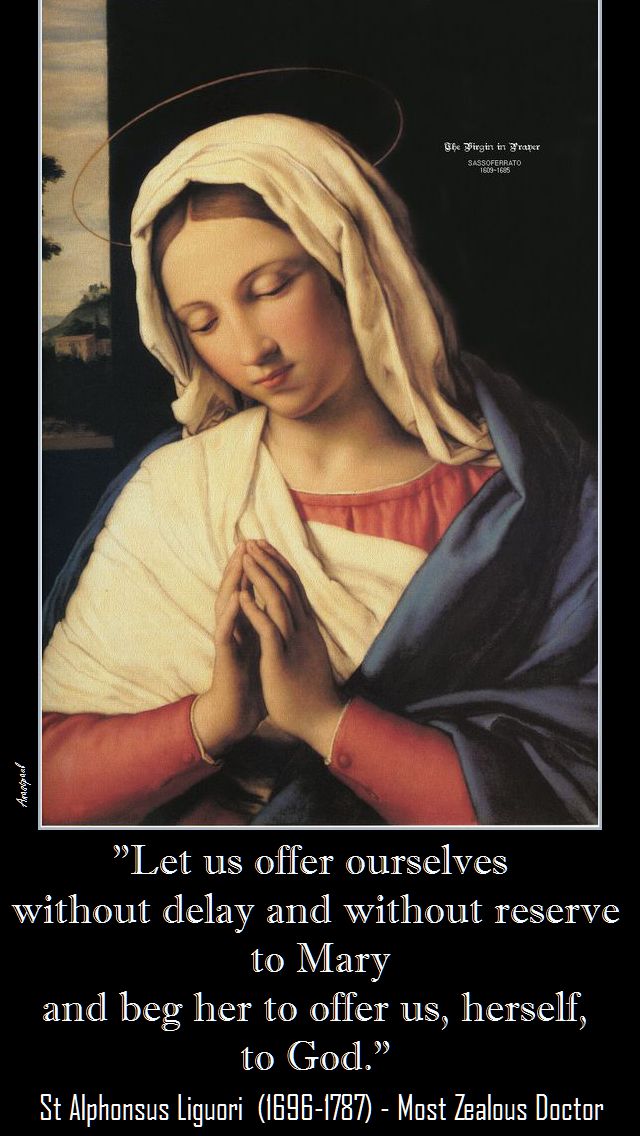
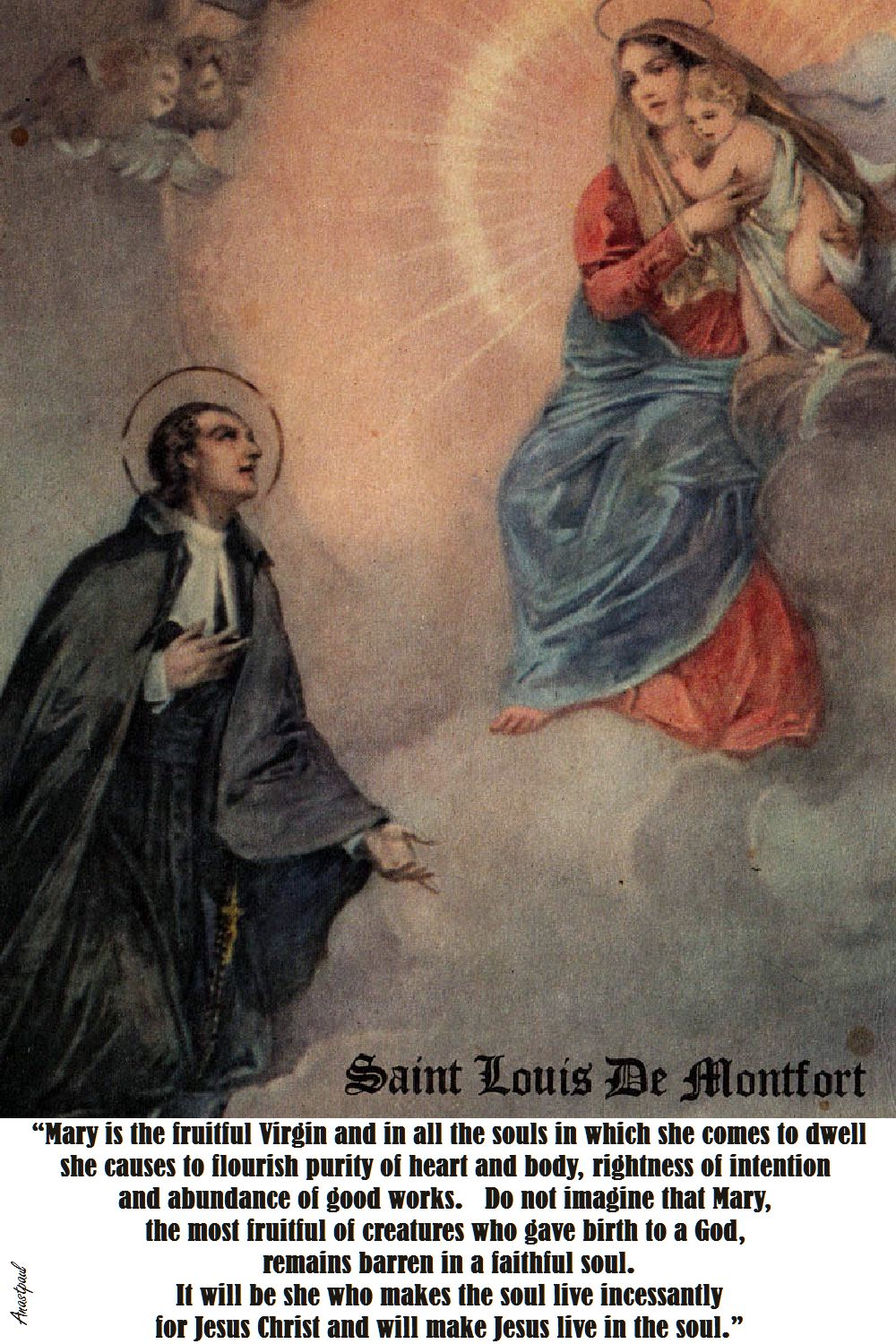
“Mary is the fruitful Virgin and in all the souls in which she comes to dwell she causes to flourish purity of heart and body, rightness of intention and abundance of good works. Do not imagine that Mary, the most fruitful of creatures who gave birth to a God, remains barren in a faithful soul. It will be she, who makes the soul live incessantly for Jesus Christ and will make Jesus live in the soul.”
When Jesus saw his mother and the disciple there whom he loved, he said to his mother, “Woman, behold, your son.”
Then he said to the disciple, “Behold, your mother.” And from that hour the disciple took her into his home…………….John 19:26-27
REFLECTION – “The Blessed Virgin directs to us, all the acts that every mother lavishes on her children.
She loves us, watches over us, protects us and intercedes for us.”……..St John XXIII
PRAYER – As we are now halfway through this beautiful Marian Month of May Lord Jesus, let me have constant recourse to Your holy Mother Mary. Grant that I may be devoted to her who loves me and takes care of me, just as my earthly mother does. Blessed Virgin, Mother of God, Pray for us, amen
Adoration of the Blessed Sacrament is one of the best ways to spend time with Jesus. There is so much noise around us these days. Spending a quiet hour with Jesus in humble adoration will bring many graces and blessings to you. Things that you have never even considered before will now be made present to you. Bad things that would have happened to you will now not happen. Here are some thoughts about what Jesus is asking you during this time. As He told Peter, “Could you not spend one hour with me?”St. Peter Julian Eymard tells us all how to spend an hour in Adoration!
“MY CHILD, you need not know much in order to please Me; only love Me dearly. Speak to Me as you would talk to your mother, if she had taken you in her arms. Have you no one to recommend to Me? Tell Me the names of your relations, of your friends; after each name add what you wish Me to do for them. Ask a great deal: I love generous hearts that forget themselves for others.
TELL ME about the poor whom you want to help, the sick whom you have seen suffer, the sinner whom you would convert, the persons who are alienated from you and whose affections you wish to win back. For all recite a fervent prayer. Remind Me that I have promised to grant every prayer that comes from the heart; and surely the prayers are heartfelt which we say for those whom we love and who love us.
HAVE YOU no favours to ask for yourself’? Write, if you like, a long list of all your wishes of all the needs of your soul–and come and read it to Me. Tell Me simply how self-indulgent you are, how proud, how touchy, how selfish, how cowardly, how idle; ask Me to help you to improve. Poor child! Do not blush! There are in heaven many saints who had the same faults as you; they prayed to Me, and, little by little, they were cured.
DO NOT hesitate to ask for the goods of body and mind–for health, for memory, for success. I can give everything and I always give when the gifts would make souls more holy. What do you want today, My child? Oh, if you knew how I longed to do you good!
HAVE YOU no plans to interest you? Tell Me about them. Do they concern your vocation? What do you think of? What would you like? Are you planning some pleasure for your mother, for your family, for your guardian? What do you wish to do for them?
AND HAVE you no thoughts of zeal for Me? Are you not anxious to do a little good for the souls of your friends, for those whom you love and who, perhaps, forget Me? Tell Me who interests you, what motives urge you, what means you wish to take.
CONFIDE TO Me your failures; I will show you the cause. Whom do you wish to see interested in your work? I am the Master of all hearts, My child and I lead them gently where I please. I will place about you those who are necessary to you; never fear!
HAVE YOU nothing to annoy you? My child, tell Me your annoyances, with every detail. Who has pained you? Who as wounded your self-love? Who has treated you contemptuously? Tell Me all and then say that you forgive and forget; and I will give you My blessing.
DO YOU dread something painful? Is there in your soul a vague fear which seems unreasonable and yet torments you? Trust fully in My providence. I am here, I see everything; I will not leave you.
ARE THERE about you friends who seem less kind than formerly, who neglect you through indifference or forgetfulness, without your having consciously done anything to wound them? Pray for them, and I will restore them to you, if there companionship is good for you.
HAVE YOU no joys to tell Me? Why not confide to Me your pleasures? Tell Me what has happened since yesterday to console you, to make you look happy, to give you joy. An unexpected visit has done you good; a fear has been suddenly dispelled; you have met with unlooked for success; you have received some mark of affection in a letter, a present; some trial has left you stronger than you supposed. All these things, My child, I obtained for you. Why are you not grateful? Why do you not say, “I thank you?” Gratitude draws benefits and the benefactor loves to be reminded of His bounty.
HAVE YOU no promises to make Me? You know I read the very bottom of your heart. Men are deceived but not God; be frank.
ARE YOU resolved to avoid that occasion of sin, to give up the object which leads you astray–not to read that book which excites your imagination; to withdraw your friendship from that person who is irreligious and whose presence disturbs the peace of your soul? Will you go at once and be kind to that companion who annoyed you?
WELL, MY child, go now and resume your daily work. Be silent, be honest, be patient, be charitable, love very much the Blessed Mother of Jesus; and tomorrow bring Me a heart even more devoted and loving. Tomorrow I shall have new favours for you.”
With Ecclesiastical Approval
“I love You Lord Jesus, my love above all things. I repent with my whole heart for having offended You. Never permit me to separate myself from You again, grant that I may love You always and then do with me what You will!”
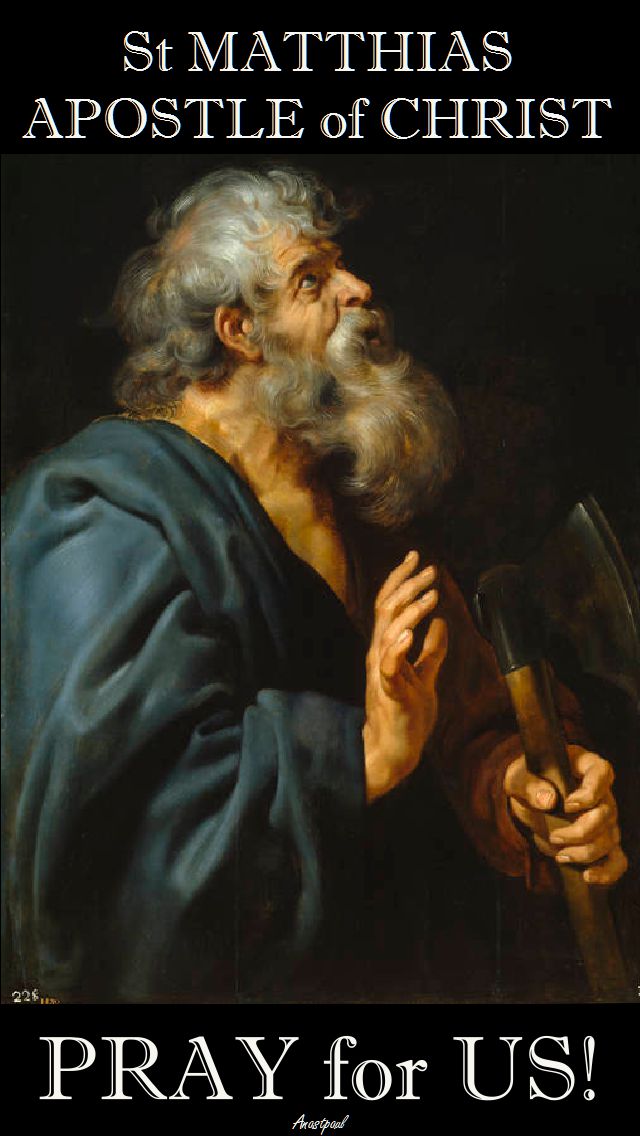
Then they prayed, “You, Lord, who know the hearts of all, show which one of these two you have chosen to take the place in this apostolic ministry from which Judas turned away to go to his own place.” Then they gave lots to them and the lot fell upon Matthias, and he was counted with the Eleven Apostles……. Acts 1:24-26
REFLECTION – “”In those days, Peter stood up in the midst of the disciples and said…” As the fiery spirit to whom the flock was entrusted by Christ and as the leader in the band of the apostles, Peter always took the initiative in speaking: “My brothers, we must choose from among our number.” He left the decision to the whole body, at once augmenting the honour of those elected and avoiding any suspicion of partiality.
Did not Peter then have the right to make the choice himself? Certainly he had the right but he did not want to give the appearance of showing special favour to anyone. “And they nominated two,” we read, “Joseph, who was called Barsabbas and surnamed Justus, and Matthias.” He himself did not nominate them; all present did. But it was he who brought the issue forward, pointing out that it was not his own idea but had been suggested to him by a scriptural prophecy.
And they all prayed together, saying: “You, Lord, know the hearts of men; make your choice known to us. You, not we.” Appropriately they said that he knew the hearts of men, because the choice was to be made by him, not by others.
They spoke with such confidence, because someone had to be appointed. They did not say “choose” but “make known to us” the chosen one; “the one you choose,” they said, fully aware that everything was being preordained by God.”…………… from a homily on the Acts of the Apostles by Saint John Chrysostom
PRAYER – Almighty God, who into the place of the traitor Judas chose thy faithful servant Matthias to be of the number of the twelve Apostles; grant that Thy Church, being always preserved from false Apostles, may be ordered and guided by faithful and true pastors; through Jesus Christ our Lord. Amen. – collect from the feast of Saint Matthias – St Matthias Pray for us!
















 AnaStpaul
You must be logged in to post a comment.