Our Morning Offering – 7 January – The Second Day within the Octave of Epiphany
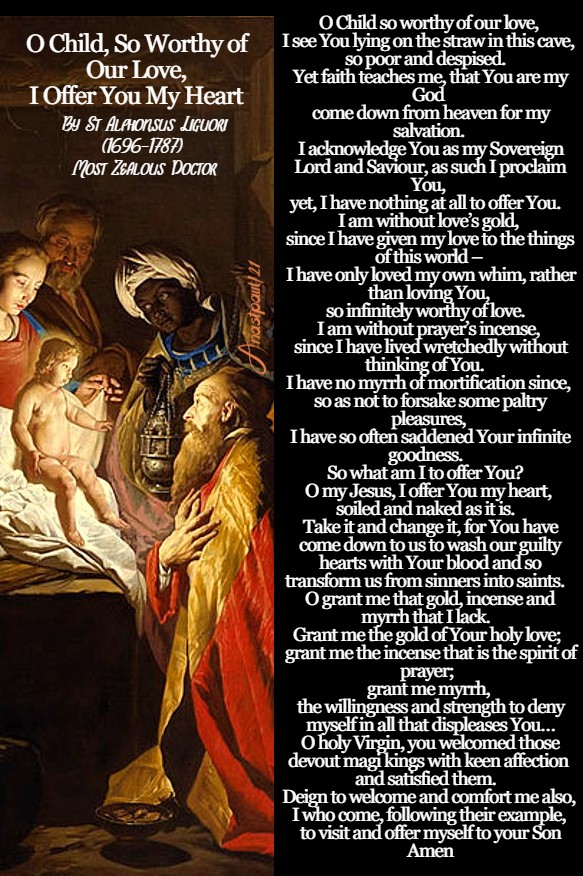
O Child, So Worthy of Our Love, I Offer You My Heart By St Alphonsus Liguori (1696-1787) Most Zealous Doctor
O Child so worthy of our love, I see You lying on the straw in this cave, so poor and despised. Yet faith teaches me, that You are my God come down from heaven for my salvation. I acknowledge You as my Sovereign Lord and Saviour, as such I proclaim You, yet, I have nothing at all to offer You. I am without love’s gold, since I have given my love to the things of this world – I have only loved my own whim, rather than loving You, so infinitely worthy of love. I am without prayer’s incense, since I have lived wretchedly without thinking of You. I have no myrrh of mortification since, so as not to forsake some paltry pleasures, I have so often saddened Your infinite goodness. So what am I to offer You? O my Jesus, I offer You my heart, soiled and naked as it is. Take it and change it, for You have come down to us to wash our guilty hearts with Your blood and so transform us from sinners into saints. O grant me that gold, incense and myrrh that I lack. Grant me the gold of Your holy love; grant me the incense that is the spirit of prayer; grant me myrrh, the willingness and strength to deny myself in all that displeases You… O holy Virgin, you welcomed those devout magi kings with keen affection and satisfied them. Deign to welcome and comfort me also, I who come, following their example, to visit and offer myself to your Son Amen
Quote/s of the Day – 6 January – The Solemnity of the Epiphany of the Lord
In Your Light, we see light!
“If the Magi had come in search of an earthly King, they would have been disconcerted at finding that they had taken the trouble to come such a long way for nothing. Consequently they would have neither adored nor offered gifts. But since they sought a heavenly King, though they found in Him no signs of royal pre-eminence, yet, content with the testimony of the star alone, they adored – for they saw a man and they acknowledged God.”
St John Chrysostom (347-407) Father and Doctor of the Church
“Today the Magi gaze in deep wonder at what they see – heaven on earth, earth in heaven, man in God, God in man, One whom the whole universe cannot contain, now enclosed in a tiny body. As they look, they believe and do not question, as their symbolic gifts bear witness – incense for God, gold for a King, myrrh for One who is to die.”
St Peter Chrysologus (c 400-450) Father and Doctor of Homilies
“What are you doing, O Magi? Do you adore a little Babe, in a wretched hovel, wrapped in miserable rags? Can this Child be truly God? … Are you become foolish, O Wise Men … Yes, these Wise Men have become fools that they may be wise.”
St Bernard of Clairvaux (1090-1153) Doctor of Light
“… They fell down and worshipped him. Then, opening their treasures, they offered him gifts, gold and frankincense and myrrh.” … Matthew 2:11
REFLECTION – “But if, with careful thought, we wish to see how their threefold kind of gift, is also offered by all who come to Christ, with the foot of faith — is not the same offering repeated in the hearts of true believers? For he who acknowledges ,Christ the King of the universe brings Gold from the treasure of his heart, he who believes the Only-begotten of God to have united man’s true nature to Himself, offers Myrrh and he who confesses Him, in no wise, inferior to the Father’s Majesty, worships Him in a manner, with Incense.” … St Pope Leo the Great (400-461) Father and Doctor of the Church
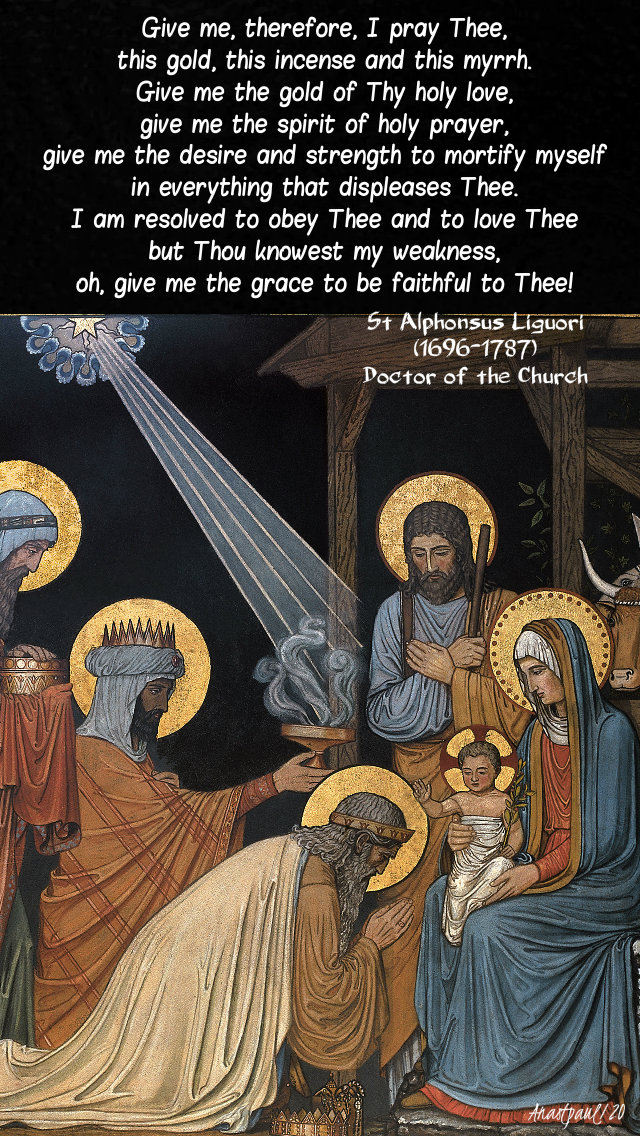
PRAYER – “Give me, therefore, I pray Thee, this gold, this incense and this myrrh. Give me the gold of Thy holy love, give me the spirit of holy prayer, give me the desire and strength to mortify myself in everything that displeases Thee. I am resolved to obey Thee and to love Thee but Thou knowest my weakness, oh, give me the grace to be faithful to Thee!” … St Alphonsus Liguori (1696-1787) Doctor of the Church
Our Morning Offering – 6 January – The Solemnity of the Epiphany of the Lord
Songs of Thankfulness We Raise By Christopher Wordsworth (1807-1885) (1862)
Songs of thankfulness we raise, Jesu, Lord, to Thee we raise manifested by the star to the sages from afar, Branch of royal David’s stem in Thy birth at Bethlehem. Anthems be to Thee addressed, God in man made manifest.
Manifest at Jordan’s stream, Prophet, Priest and King supreme, and at Cana wedding-guest in Thy Godhead manifest, manifest in power divine, changing water into wine. Anthems be to Thee addressed, God in man made manifest.
Grant us grace to see Thee, Lord, Mirrored in Thy holy Word. May we imitate Thee now And be pure, as pure art Thou, That we like to Thee may be, At Thy great Epiphany And may praise Thee, ever blessed, God in flesh made manifest. Anthems be to Thee addressed, God in man made manifest.
Sun and moon shall darkened be, stars shall fall, the heavens shall flee. Christ will then like lightning shine. All will see His glorious sign. All will see the Judge appear, all will then the trumpet hear, Thou by all wilt be confessed, God in man made manifest. Anthems be to Thee addressed, God in man made manifest
Christopher Wordsworth (b. Lambeth, London, England, 1807; d. Harewood, Yorkshire, England, 1885), nephew of the great Romantic poet William Wordsworth, wrote this hymn in five stanzas.
One Minute Reflection – 4 January – Christmas Weekday, Readings: 1 John 3:7-10, Psalm 98:1, 7-9, John 1:35-42
He said to them, “Come and see.” They came and saw where he was staying and they stayed with him that day … John 1:39
REFLECTION – “John was there and two of his disciples with him.” John was such “a friend of the Bridegroom” that he did not seek his own glory, he simply bore witness to the truth (Jn 3:29.26). Did he dream of keeping back his disciples and preventing them from following the Lord? Not in the least. He himself showed them the one they were to follow … He declared: “Why cling to me? I am not the Lamb of God. Behold the Lamb of God ……)Behold him who takes away the sins of the world.”
At these words the two disciples who were with John, followed Jesus. “Jesus turned and saw that they were following him and said to them: ‘What are you looking for?’ They said to him: ‘Rabbi, where are you staying?” As yet they were not following Him definitively, as we know, they joined themselves to Him, when He called them to leave their boat …, when He said to them: “Come after me and I will make you fishers of men” (Mt 4:19). That was the moment they joined Him definitively, no longer to leave Him. But for now they wanted to see where Jesus was living and put into practice the words of Scripture: “If you see an intelligent man, seek him out at daybreak; let your feet wear away his doorstep! Learn from him the precepts of the Lord” (cf. Sir 6:36f.). So Jesus showed them where He was living, they went and stayed with Him. What a happy day they spent! What a blessed night! Who can say what it was they heard from the Lord’s mouth? Let us, too, build a dwelling in our hearts, construct a house where Christ can come to teach and converse with us.” … St Augustine (354-430) Bishop of Hippo, Father & Doctor of the Church – Sermons on Saint John’s Gospel, no 7
PRAYER – Heavenly Father, thank You for making me a child of eternity. Help me to live each day in such a way that I may deserve to be a child of Yours forever. Grant that by the prayers of the Blessed Virgin Mary, all Your Angels and Martyrs and Saints, we may strive always to keep our eyes fixed on Your Son, our entry to You, our Shepherd and our Saviour who will lead us to our eternal home. May we never waiver from Your commandments. Amen
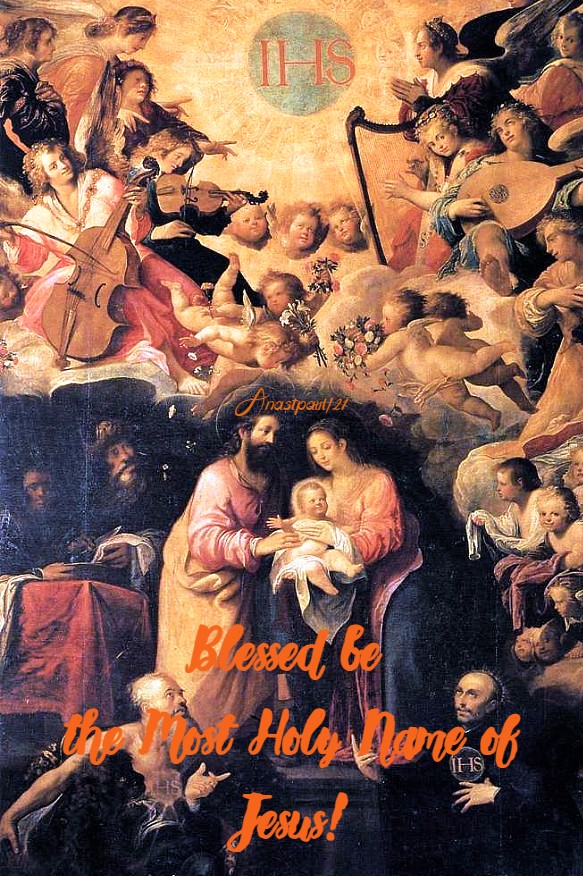
One Minute Reflection – 3 January – Feast of the Most Holy Name of Jesus, Readings: Epistle Acts 4:8-12, Psalm 105:47, Isa 63:16, Ps 144:21, Gospel Luke 2:21-24
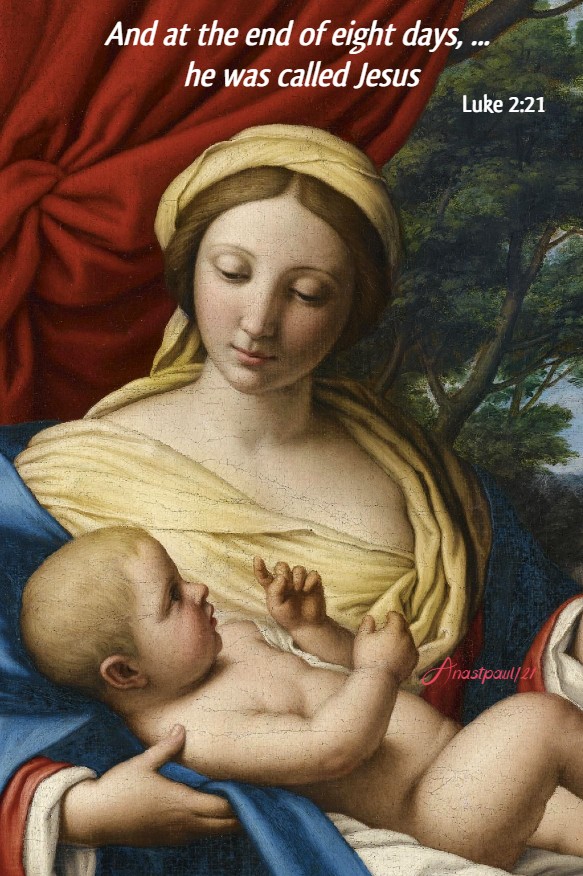
“And at the end of eight days, when he was circumcised, he was called Jesus”…Luke 2:21
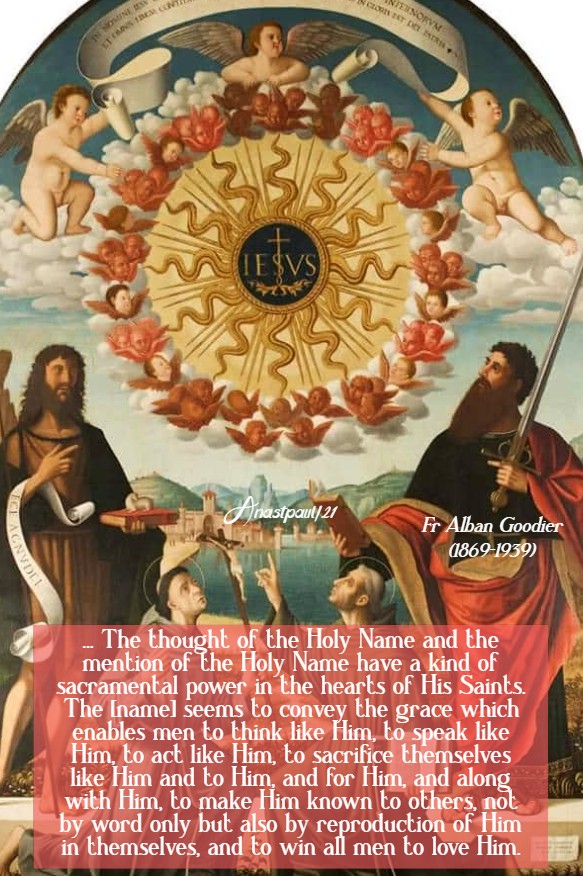
REFLECTION – “The Name stands as a complete summary and description of our Lord’s character and office and it is under this aspect that it has been regarded by thousands of Saints, whose hearts have melted at its mere sound. To them Jesus is their God, Jesus is their King, Jesus is their Redeemer, Jesus is their Mediator, Jesus is their Saviour, Jesus is their great Priest, Jesus is their Intercessor, Jesus is the Captain under Whom they fight, Jesus is the Leader Whom they follow, Jesus is their Teacher, Jesus is the Giver of their law, Jesus is the Spouse and Shepherd of their souls, Jesus is their Light, Jesus is their Life, Jesus is the Judge before Whom they rejoice to think, that they must one day stand, Jesus is their final and eternal Reward, for which alone they live.
But He is also to them the Mirror of all the most glorious and winning virtues. He is, and His Name tells them that He is, unbounded Charity, infinite Mercy, extremest Kindness, deepest Humility, most devoted Piety, transparent Simplicity, uttermost Poverty, Chastity without a stain. It is the prerogative of love to transform those who love into the likeness of Him Whom they love and as the mere name of one who is loved cannot sound in the ear or be thought of in the mind, without adding to the love which is already there, so the thought of the Holy Name and the mention of the Holy Name have a kind of sacramental power in the hearts of His Saints. The [name] seems to convey the grace which enables men to think like Him, to speak like Him, to act like Him, to sacrifice themselves like Him and to Him, and for Him, and along with Him, to make Him known to others, not by word only but also by reproduction of Him in themselves, and to win all men to love Him.” – Fr Alban Goodier SJ (1869-1939) Archbishop – Excerpted from The Prince of Peace
PRAYER – O God, who founded the salvation of the human race on the Incarnation of Your Word, give Your people the mercy they implore, so that all may know there is no other Name to be invoked but the Name of Your Only Begotten Son. Who lives and reigns with You in the unity of the Holy Spirit, one God, forever and ever. Amen
Our Morning Offering – 3 January – Month and Feast of the Most Holy Name of Jesus
O Sweet Name of Jesus By Thomas à Kempis (1380-1471)
O sweet Name of Jesus, holy above all names in heaven and on earth and to which every knee, both of men and of angels in heaven, on earth and in hell bends. You are the Way of the just, the Glory of the saints, the Hope of those in need, the Balm of the sick, the Love of the devout and the Consolation of those that suffer. O, Jesus be to me a help and a protector so that Your Name may be blessed for all times. Amen
St Pope Antherus (Died 235) Martyr Bl Arnold Wala St Athanasius of Cilicia St Bertilia of Mareuil St Bertille of Thuringia St Blitmund of Bobbio St Constant of Gap St Cyrinus of Cyzicus St Daniel Himmerod the Younger Bl Daniel of Padua St Eustadius St Finlugh St Fintan of Doon St Florentius of Vienne St Florentius of Vienne the Martyr St Genevieve (c 419-c 502) Biography: https://anastpaul.com/2020/01/03/saint-of-the-day-3-january-saint-genevieve-c-419-c-502/
Bl Gerard Cagnoli St Gordius of Cappadocia St Imbenia St Kuriakose Elias Chavara St Lucian of Lentini St Melorius St Peter of Palestine St Primus of Cyzicus St Salvator of Belluno St Theogenes of Cyzicus St Theonas St Theopemptus of Nicomedia St Wenog Bl Bl William Vives St Zosimus of Cilicia — Martyrs of Africa – 12 saints: A group of Christians martyred together in Africa, date unknown, exact location unknown. We know nothing more than their names – Acuta, Candidus, Constantius, Eugenia, Firmus, Hilarinus, Lucida, Martial, Poenica, Possessor, Rogatianus and Statutianus.
Martyrs of Tomi – 7 saints: A group of Christians martyred together, date unknown. We know nothing more than their names – Claudon, Diogenius, Eugene, Eugentus, Pinna, Rhodes and Rhodo. They were martyred at Tomi, Exinius Pontus, Moesia (modern Constanta, Romania).
Our Morning Offering – 1 January – The Solemnity of Mary, Mother of God and the Octave Day of the Nativity of the Lord
HailO Mary, Mother of God By St Cyril of Alexander (376-444) Doctor of the Incarnation Known as ‘The Pillar of Faith”
Hail, O Mary, Mother of God, Virgin and Mother! Morning Star, perfect vessel. Hail, O Mary, Mother of God, Holy Temple in which god Himself was conceived. Hail, O Mary, Mother of God, Chaste and pure dove. Hail, O Mary, Mother of God, Who enclosed the One who cannot be encompassed in your sacred womb. Hail, O Mary, Mother of God, From you flowed the true light, Jesus Christ, our Lord. Hail, O Mary, Mother of God, Through you the Conqueror and triumphant Vanquisher of hell came to us. Hail, O Mary, Mother of God, Through you, the glory of the Resurrection blossoms. Hail, O Mary, Mother of God, You have saved every faithful Christian. Hail, O Mary, Mother of God, Pray for us sinners now and at the hour of our death. Amen
Christ has been born for us, come, let us adore Him.
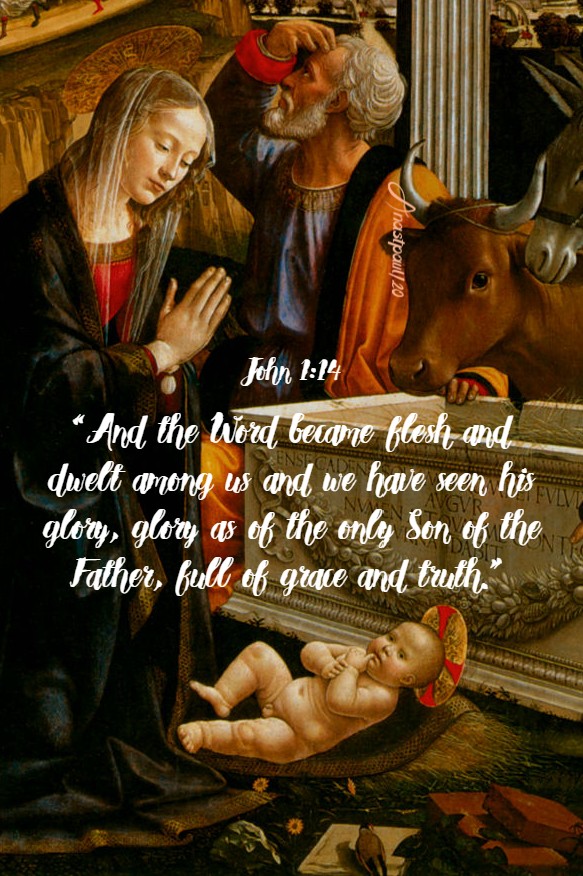
“And the Word became flesh and dwelt among us and we have seen his glory, glory as of the only Son of the Father, full of grace and truth.” – John 1:14
REFLECTION – “God, who gave being to all that is, at the same time united all things together in His providence.
Being master, He became a servant (cf, Phil 2:6-7) and so revealed to the world, the depth of His providence.
God the Word, in becoming incarnate while remaining unchanged, was united through His flesh with the whole of creation.
There is a new wonder in heaven and on earth – God is on earth and man is in heaven.
He united men and angels, so as to bestow deification on all creation.
The knowledge of the holy and co-essential Trinity is the sanctification and deification of men and angels. …
When, in His compassion for man, the Word became flesh (cf. Jn 1:14), He changed, neither what He was, nor what He became.” – Thalassios the Syrian (5th Century) Priest, Hermit and Abbot in Syria – Centuries on Love I
PRAYER – All-powerful, ever-living God, we thank You for the human birth of Your Son, which is the source and perfection of our Christian life and worship. Number us among His people, for the salvation of all mankind is found in Him, for the Word became flesh who lives and reigns with You and the Holy Spirit, God, forever and ever, amen.
Thalassius of Syria undertook the call of God to life as a hermit in the fifth century. Thalassius is recorded to have entered into solitude at a young age near a village named Targala in Byzantine Syria. He is said to have dwelt there, living the ascetic life with no shelter for nearly forty years. Thalassius’ was a soul filled with humbleness, simplicity and a gentle nature. God manifested in him, the gifts of powerful intercession and healing for which he gained considerable renown. In time, many came to join Thalassius in the eremitic life and he welcomed them as he would welcome Christ, building them cells with his own hands. BlessedThalassius, Hermit of Syria is said to have died peacefully.
Quote/s of the Day – 30 December – The Sixth Day in the Christmas Octave
“Christmas”
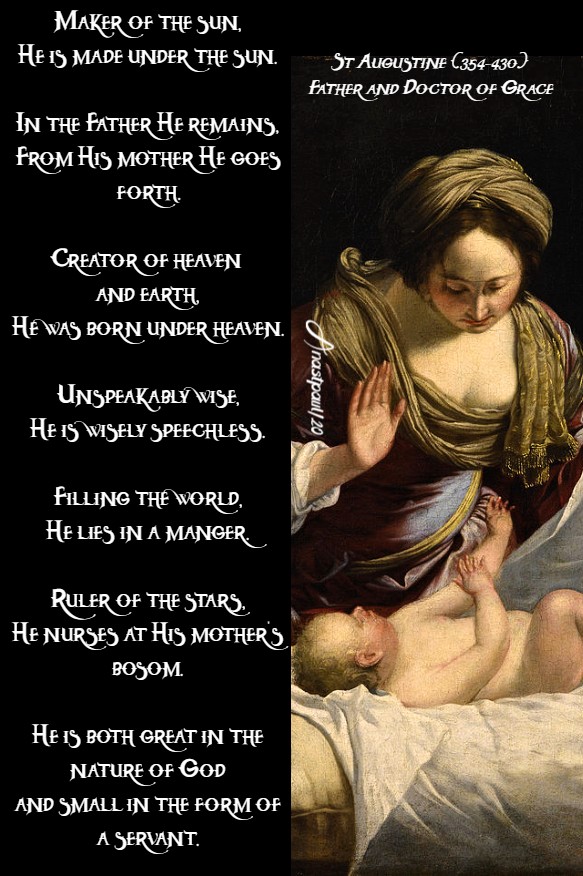
“Maker of the sun, He is made under the sun.
In the Father He remains, From His mother He goes forth.
Creator of heaven and earth, He was born under heaven.
Unspeakably wise, He is wisely speechless.
Filling the world, He lies in a manger.
Ruler of the stars, He nurses at His mother’s bosom.
He is both great in the nature of God and small in the form of a servant.”
St Augustine (354-430) Father and Doctor of Grace
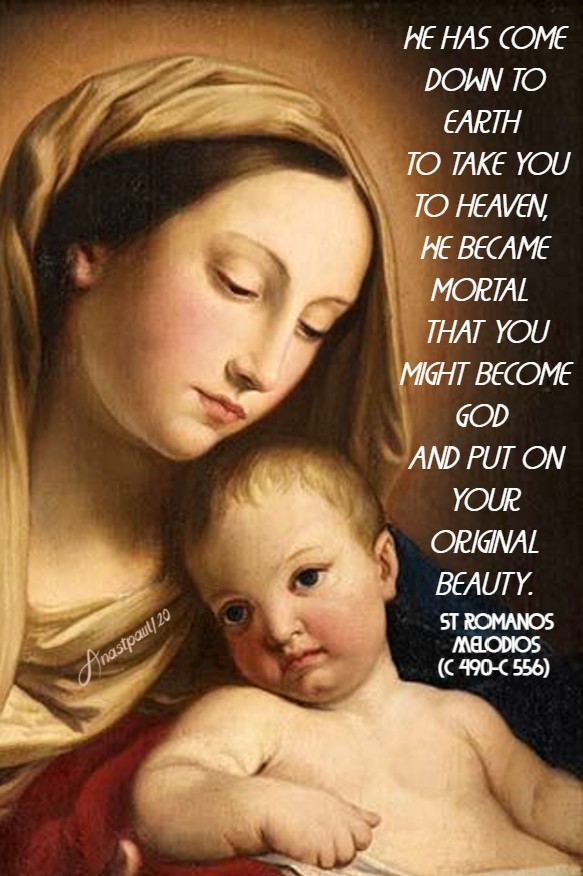
“He has come down to earth to take you to heaven, He became mortal that you might become God and put on your original beauty.”
St Romanos Melodios (c 490-c 556) Monk, Composer of Hymns, Poet
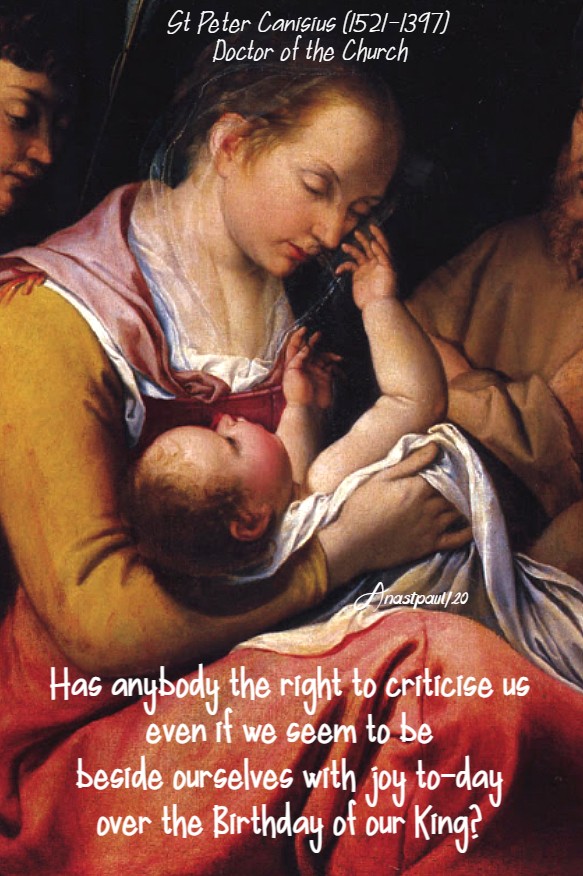
“Has anybody the right to criticise us even if we seem to be beside ourselves with joy to-day over the Birthday of our King?”
St Peter Canisius (1521-1397) Doctor of the Church
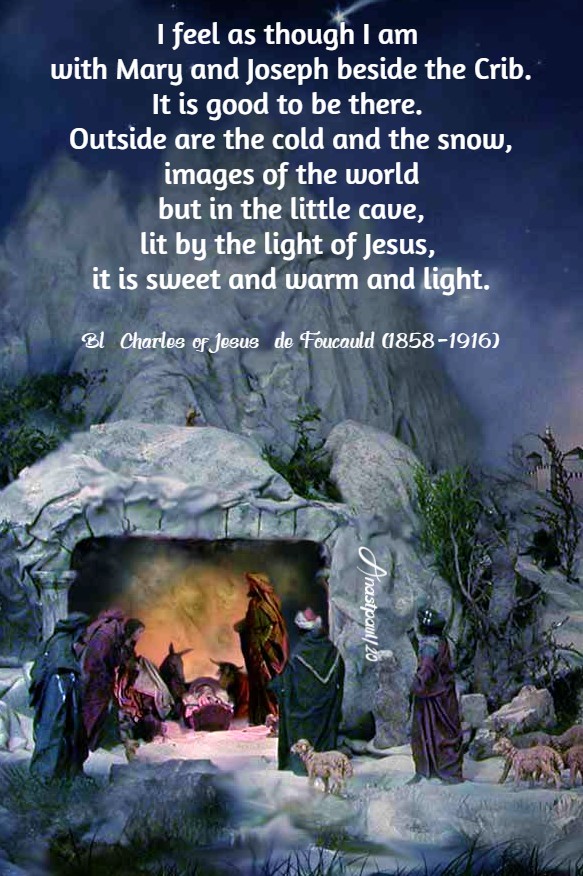
“I feel as though I am with Mary and Joseph beside the Crib. It is good to be there. Outside are the cold and the snow, images of the world but in the little cave, lit by the light of Jesus, it is sweet and warm and light.”
One Minute Reflection – 30 December – The Sixth Day in the Christmas Octave, Readings: 1 John 2:12-17, Psalm 96:7-10, Luke 2:36-40
“She spoke about the child to all who were awaiting the redemption of Jerusalem” … Luke 2:38
REFLECTION – “O Root of Jesse, who stand as a sign to the peoples” (Is 11: 10), “how many kings and prophets wanted to see you and did not” (Lk 10:24)? Simeon is the happiest of them all because by God’s mercy he was still bearing fruit in old age. For he rejoiced to think that he would see the sign so long desired. He saw it and was glad (Lk 8:56). When he had received the kiss of peace, he departed in peace but first, he proclaimed aloud that Jesus was born, a sign that would be rejected (Lk 2:25-34). And so it was. The sign of peace arose and was rejected, by those who hate peace (Ps 119:7). For what is peace to men of goodwill (Lk 2:14) is a stone to make men stumble, a rock for the wicked to fall over (l Pt 2:8). “Herod was troubled and all Jerusalem with him” (Mt 2:3). He came to His own and His own did not receive Him (Jn 1:11). Happy those shepherds keeping watch at night who were found worthy to be shown the sign of this vision! (Lk 23:8)
For even at that time He was hiding Himself from the wise and prudent and revealing Himself to the simple (Mt 11:25; Lk 10:21). … The angel said to the shepherds, “This is a sign for you” (Lk 2: 12), you who are humble, you who are obedient, you who are not haughty (Rom 12: 16), you who are keeping vigil and meditating on God’s law day and night (Ps 1:2). “This is a sign for you,” he said. What is this sign? The sign the angels promised, the sign the people asked for, the sign the prophets foretold, the Lord Jesus has now made and He shows it to you. …
This is your sign. What is it a sign of? Indulgence, grace, peace, “the peace which will have no end” (Is 9:7). It is this sign: “You will find a baby wrapped in swaddling clothes and lying in a manger” (Lk 2: 12). But this baby is God Himself, reconciling the world to Himself in Him (2 Cor 5: 19). … He is the Kiss of God, the Mediator between God and men, the man Christ Jesus (1Tm 2:5), who with the Father and the Holy Spirit lives and reigns world without end.” … St Bernard (1091-1153) Doctor of the Church
PRAYER – Almighty God and Father, the human birth of Your Only-begotten Son, was the beginning of new life. May He set us free from the tyranny of sin. We make our prayer through Christ, our Lord with the Holy Spirit, God forever and ever, amen.
Our Morning Offering – 30 December – The Sixth Day of the Octave of Christmas
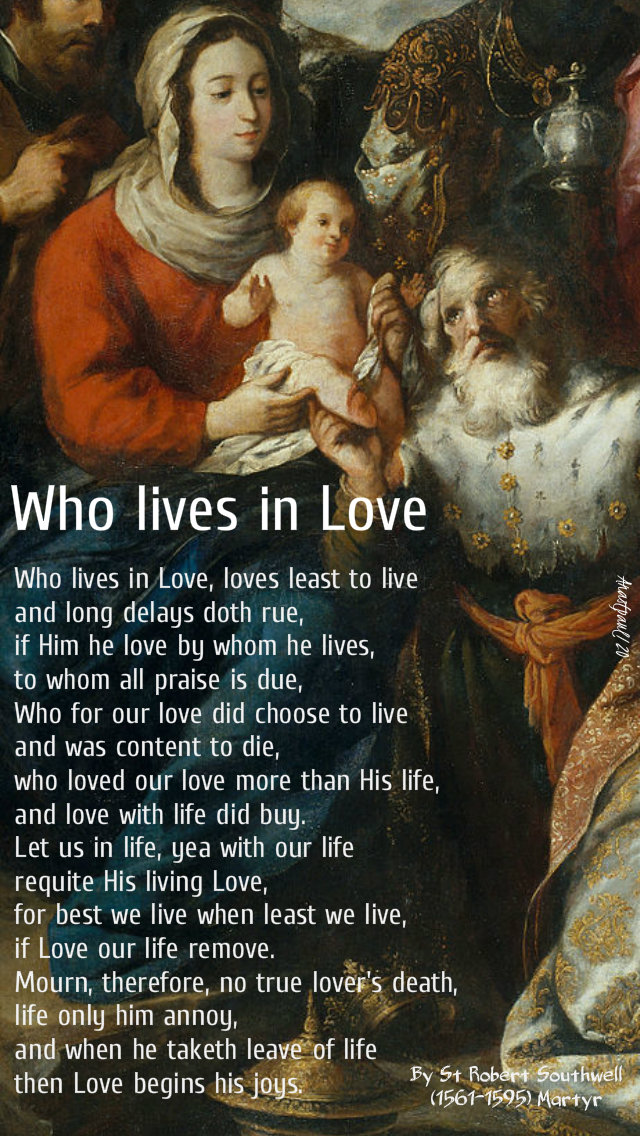
Who lives in Love By St Robert Southwell SJ (1561-1595) Martyr
Who lives in Love, loves least to live and long delays doth rue, if Him he love by whom he lives, to whom all praise is due, Who for our love did choose to live and was content to die, who loved our love more than His life, and love with life did buy. Let us in life, yea with our life requite His living love, for best we live when least we live, if Love our life remove. Mourn, therefore, no true lover’s death, life only him annoy, and when he taketh leave of life then Love begins his joys.
St Aileran of Clonard St Albert of Gambron St Aproniano de Felipe González St David the King St Ebrulf of Ouche St Enrique Juan Requena St Florent of Bourges Bl Francis Ruiz St Girald of Fontenelle St Jacinto Gutiérrez Terciado Bl José Aparicio Sanz Bl José Perpiñá Nácher St Juan Bautista Ferreres Boluda St Libosus of Vaga St Marcellus the Righteous St Martinian of Milan Bl Paul Mary Bl Peter the Venerable St Quartillosa of Carthage St Thaddeus of Scythia St Trophimus of Arles St Trophimus of Ephesus Blessed William Howard (1614–1680) Martyr, Layman — Martyrs of North Africa – (8 saints): A group of Christians executed together for their faith. The only details to survive are eight names – Crescentius, Dominic, Honoratus, Lybosus, Primian, Saturninus, Secundus and Victor.
Martyrs of Rome – (3 saints): A group of Christians executed together for their faith. The only details to survive are three names – Boniface, Callistus and Felix.
Martyrs of Seoul – (7 saints): Additional Memorial – 20 September as part of the Martyrs of Korea. A group of seven lay woman in the apostolic vicariate of Korea who were martyred together. • Barbara Cho Chung-I • Barbara Ko Sun-I • Benedicta Hyong Kyong-Nyon • Elisabeth Chong Chong-Hye • Magdalena Han Yong-I • Magdalena Yi Yong-Dok • Petrus Ch’oe Ch’ang-Hub They were born in South Korea and were martyred by beheading on 29 December 1839 at the Small West Gate, Seoul, South Korea. They were Canonised on 6 May 1984 by St Pope John Paul II.
Martyred in the Spanish Civil War: Thousands of people were murdered in the anti-Catholic persecutions of the Spanish Civil War from 1934 to 1939. • Blessed Aproniano de Felipe González • Blessed Enrique Juan Requena • Blessed Jacinto Gutiérrez Terciado • Blessed Juan Bautista Ferreres Boluda
Our Morning Offering – 28 December – The Feast of the Holy Innocents – The Fourth Day of the Christmas Octave.
O Dearest Infant By St Alphonsus Liguori (1696-1787) Most Zealous Doctor
O dearest Infant, tell me what You came on earth to do. Tell me whom You are seeking. Ah, yes, I now understand… You have come to die for me, a lost sheep, in order that I may no more hide from You but love You. O Jesus, my treasure, my life, my love, my all, if I do not love You, then whom shall I love? Where can I find a mother or father, a friend, or a spouse more loving than You? And who has ever loved me more than You have? I am sorry that I have lived so many years in this world and yet still love You so little, even having offended You and sometimes forgotten You. Amen
BL Claudia Weinhardt St Conindrus St Domitian the Deacon St Domnio of Rome St Eutychius St Gowan of Wales Bl Gregory of Cahors Bl Hryhorii Khomyshyn St Iolande of Rome Bl Johannes Riedgasser Blessed Matthia de Nazzarei OSC (1253-1319) Virgin, Nun Bl Nicolas Mello Bl Otto of Heidelberg St Romulus St Simon the Myroblite St Theonas of Alexandria St Theodore of Tabenna St Troadius of Pontus — 20,000 Martyrs of Nicomedia: 20,000 Christians who were murdered during in 303 in Nicomedia, Bithynia (modern Izmit, Turkey) during the persecutions of Diocletian. Many of them were killed en masse when they were ordered, during Christmas Mass, to sacrifice to idols; when they refused, they were locked in the churches and the buildings burned around them. We know some details of a few of them, but most are known only to God. The names we have are – Agape, Anthimos, Domna, Domna, Dorotheus, Esmaragdus, Eugene, Euthymius, Glykerios, Gorgonius, Hilary, Indes, Mardonius, Mardonius, Maximus, Migdonius, Migdonus, Peter, Peter, Theophila, Theophilus and Zeno. 303 in Nicomedia, Bithynia (modern Izmit, Turkey).
Martyrs of Africa – (3 saints): Three Christians murdered together in Africa for their faith. The only details to survive are their names – Castor, Rogatian and Victor.
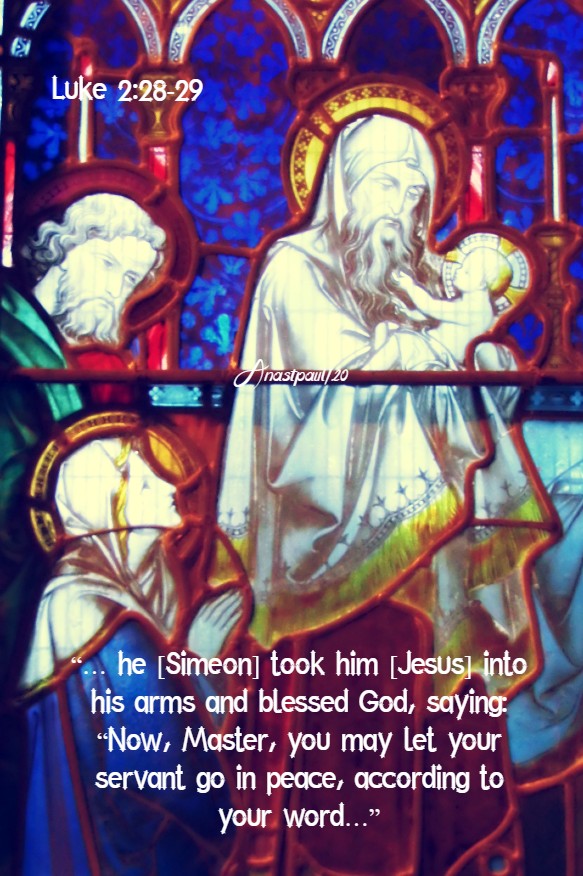
“… he [Simeon] took him [Jesus] into his arms and blessed God, saying: “Now, Master, you may let your servant go in peace, according to your word…” – Luke 2:28-29
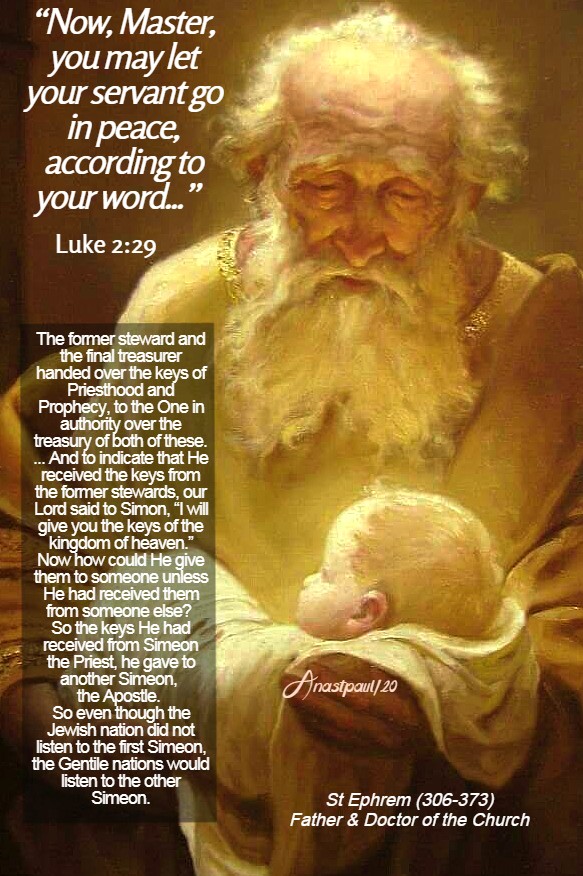
REFLECTION – “The Son came to the servant not to be presented by the servant but so that, through the Son, the servant might present to his Lord, the priesthood and prophecy that had been entrusted to his keeping. Prophecy and priesthood, which had been given through Moses, were both passed down and came to rest on Simeon. He was a pure vessel who consecrated himself, so that, like Moses, he too could contain them both. These were feeble vessels that accommodated great gifts — gifts that one might contain because of their goodness but that many cannot accept because of their greatness. Simeon presented our Lord and in Him he presented the two gifts he had, so that what had been given Moses in the desert, was passed on by Simeon, in the temple. Because our Lord is the vessel in which all fullness dwells, when Simeon presented Him to God, He poured out both of these upon him – the priesthood from his hands and prophecy from his lips. The priesthood had always been on Simeon’s hands, because of ritual purifications. Prophecy, in fact, dwelt on his lips because of revelations. When both of these saw the Lord of both of these, they were combined and were poured into the Vessel that could accommodate them both, in order to contain Priesthood, Kingship and Prophecy. That Infant who was wrapped in swaddling clothes by virtue of His goodness, was also dressed in Priesthood and Prophecy by virtue of His Majesty. Simeon dressed Him in these and presented Him to the One who had dressed Him in swaddling clothes. Then, as the old man returned Him to his mother, he returned the Priesthood with Him. And when he prophesied to her about Him: “This child is destined for the downfall and rising,” he gave her Prophecy with him as well. So Mary took her firstborn and left. Although He was visibly wrapped in swaddling clothes, He was invisibly clothed with Prophecy and Priesthood. Thus, what Moses had been given, was received from Simeon and it remained and continued with the Lord of these two gifts. The former steward and the final treasurer handed over the keys of Priesthood and Prophecy, to the One in authority over the treasury of both of these. This is why His Father gave Him the Spirit without measure because all measures of the Spirit are under His hand. And to indicate that He received the keys from the former stewards, our Lord said to Simon, “I will give you the keys of the kingdom of heaven.” Now how could He give them to someone unless He had received them from someone else? So the keys He had received from Simeon the Priest, he gave to another Simeon, the Apostle. So even though the Jewish nation did not listen to the first Simeon, the Gentile nations would listen to the other Simeon.” – St Ephrem (306-373) Father and Doctor of the Church –Homily on Our Lord, 53
PRAYER – God, our Father, in the Holy Family of Nazareth, You have given us the true model of a Christian home. Grant, that by following Jesus, Mary and Joseph in their love for each other and in the example of their family life, we may come to Your home of peace and joy. We make our prayer through our Lord Jesus Christ, Your Son Who lives and reigns with You and the Holy Spirit, God, now and forever, amen.
Saint of the Day – 27 December – St John the Apostle and Evangelist. Patronages – • against burns; burn victims• against epilepsy• against foot problems• against hailstorms• against poisoning• art dealers• authors, writers• basket makers• bookbinders• booksellers• butchers• compositors• editors• engravers• friendships• glaziers• government officials• harvests• lithographers• notaries• painters• papermakers• publishers• saddle makers• scholars• sculptors• tanners• theologians• typesetters• vintners• Asia Minor (proclaimed on 26 October 1914 by Pope Benedict XV)• 6 Diocese• 7 Cities.
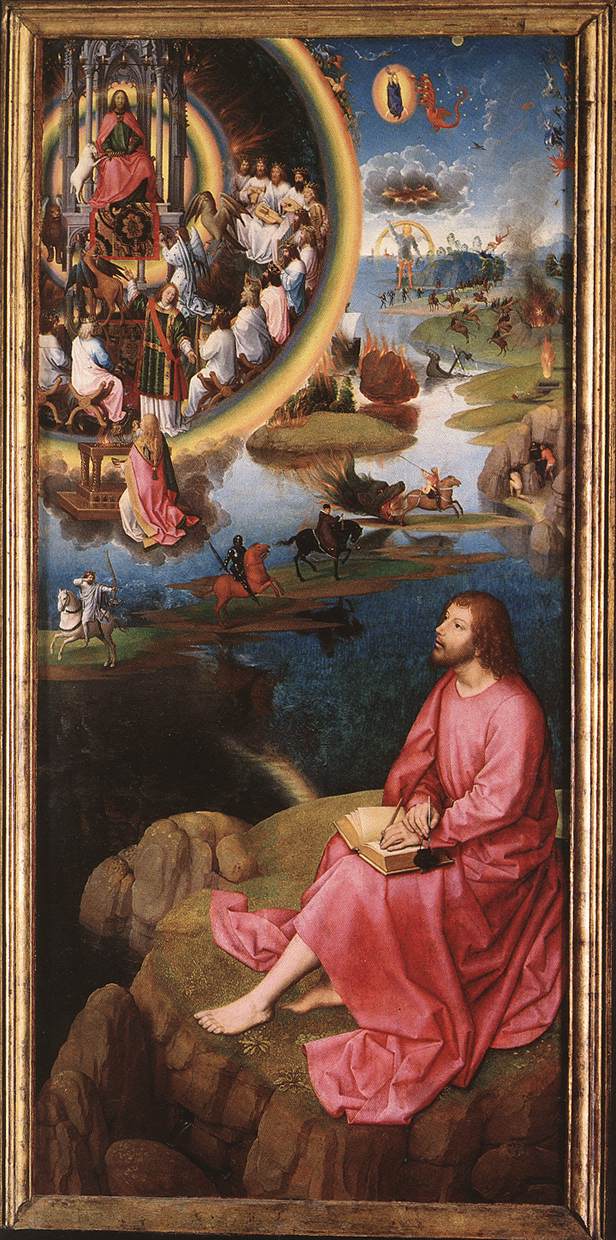
The days following Christmas are full of symbolic meaning, as on 26 December we honour the first Martyr, St Stephen, who shed his blood for Jesus. 27 December, honours St John the Evangelist, the Disciple of Jesus who wrote the Gospel of John and the book of Revelation. Interestingly enough, he is the only Gospel writer to omit a narrative of Jesus’ birth. Based on this fact alone, it seems strange to include him during the Octave of Christmas. What is the Church’s reason behind this choice? Servant of God, Dom Prosper Guéranger in his Liturgical Year, points to St John’s pure chastity and his focus on the Divinity of Christ, as the reasons why he is honoured now at the Crib of Christ.
Dom Prosper Guéranger OSB (1805-1875)
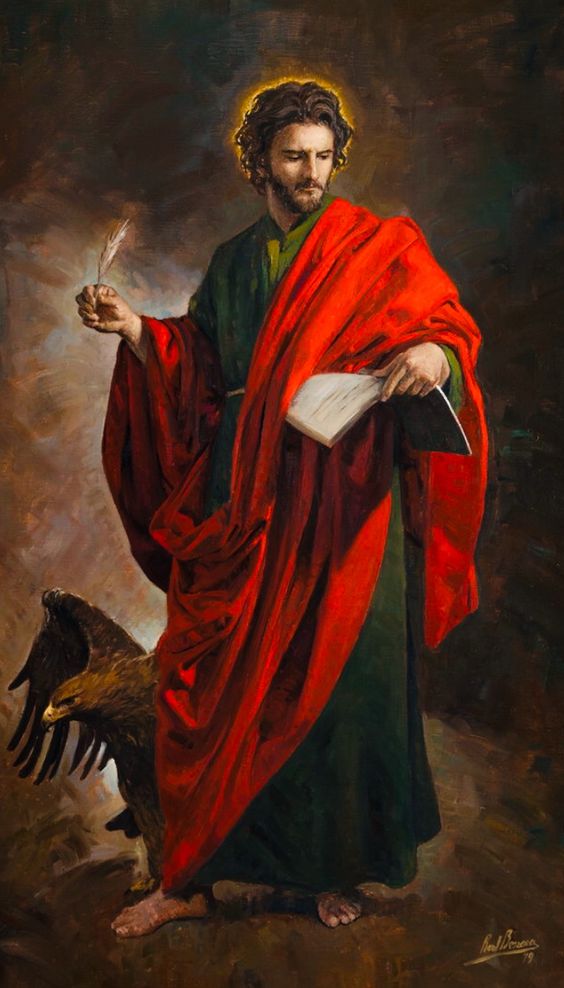
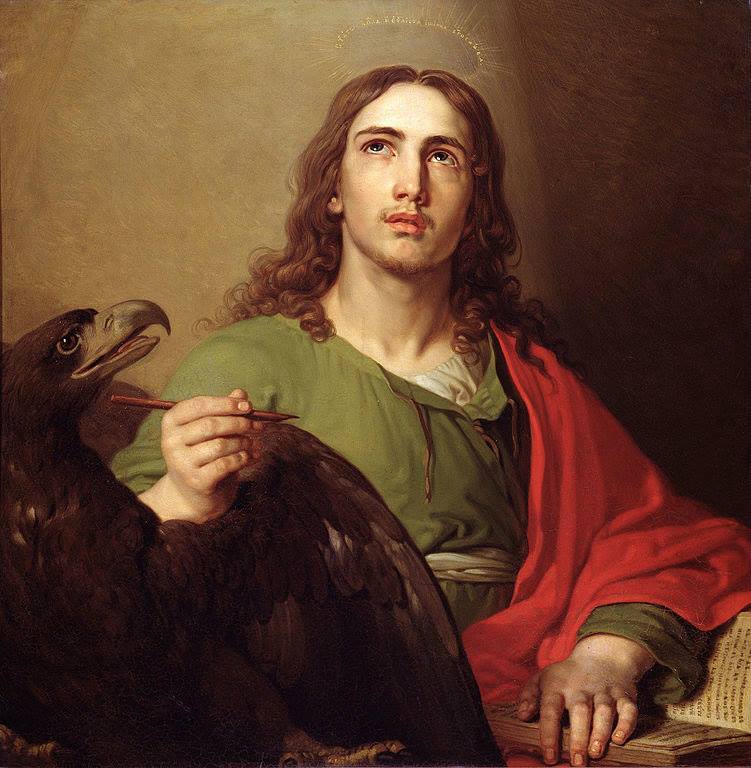
The Disciple Whom Jesus Loved, the Eagle
“Nearest to Jesus’ Crib, after Stephen, stands John, the Apostle and Evangelist. It was only right, that the first place should be assigned to him, who so loved his God, that he shed his blood in his service; for, as this God Himself declares, greater love than this hath no man, that he lay down his life for his friends [1 John, 15:13] and Martyrdom has ever been counted, by the Church, as the greatest act of love and as having, consequently, the power of remitting sins, like a second Baptism. But, next to the sacrifice of Blood, the noblest, the bravest and, which most wins the heart of Him, who is the Spouse of souls, is the sacrifice of Virginity. Now, just as St Stephen is looked upon as the type of Martyrs, St John is honoured as the Prince of Virgins. Martyrdom won for Stephen the Crown and palm; Virginity merited for John most singular prerogatives, which, while they show how dear to God, is holy Chastity, put this Disciple among those, who, by their dignity and influence, are above the rest of men.
St. John was of the family of David, as was our Blessed Lady. He was, consequently, a relation of Jesus. This same honour belonged to St James the Greater, his Brother; as also to St James the Less and St Jude, both Sons of Alpheus. When our Saint was in the prime of his youth, he left, not only his boat and nets, not only has lather Zebedee but, even his betrothed, when everything was prepared for the marriage. He followed Jesus and never once looked back. Hence, the special love which our Lord bore him. Others were Disciples or Apostles, John was the Friend, of Jesus. The cause of this our Lord’s partiality, was, as the Church tells us in the Liturgy, that John had offered his Virginity to the Man-God. Let us, on this his Feast, enumerate the graces and privileges that came to St John from his being The Disciple whom Jesus loved.
This very expression of the Gospel, which the Evangelist repeats several times — The Disciple whom Jesus loved [John, 13:23, 19:26, 21:7, 21:20] — says more than any commentary could do. St Peter, it is true, was chosen by our Divine Lord, to be the Head of the Apostolic College and the Rock whereon the Church was to be built – he, then, was honoured most but St John was loved most. Peter was bid to love more than the rest loved and he was able to say, in answer to Jesus’ thrice repeated question, that he did love Him in this highest way and yet, notwithstanding, John was more loved by Jesus than was Peter himself, because his Virginity deserved this special mark of honour.
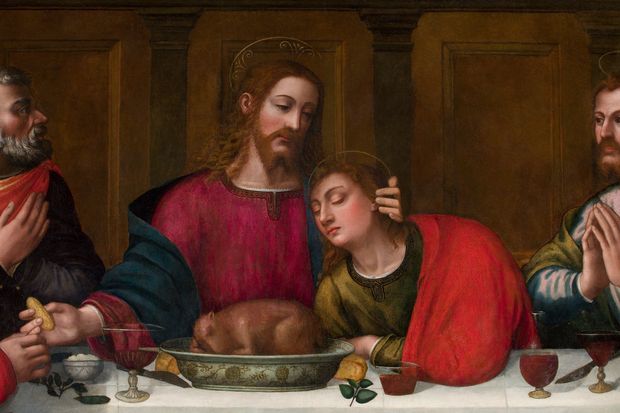
Chastity of soul and body brings him, who possesses i,t into a sacred nearness and intimacy with God. Hence it was, that at the Last Supper – that Supper, which was to be renewed on our Altars, to the end of the world, in order to cure our spiritual infirmities and give life to our souls – John was placed near to Jesus, nay, was permitted, as the tenderly loved Disciple, to lean his head upon the Breast of the Man-God. Then it was, that he was filled and from their very Fountain, with Light and Love, it was both a recompense and a favour and became the source of two signal graces, which make St John an object of special reverence to the whole Church.
Divine wisdom, wishing to make known to the world, the Mystery of the Word and commit to Scripture, those profound secrets, which, so far, no pen of mortal had been permitted to write — the task was put upon John. Peter had been crucified, Paul had been beheaded and the rest of the Apostles had laid down their lives in testimony of the Truths they had been sent to preach to the world; John was the only one left in the Church. Heresy had already begun its blasphemies against the Apostolic Teachings; it refused to admit the Incarnate Word as the Son of God, Consubstantial to the Father. John was asked by the Churches to speak and he did so in language heavenly above measure. His Divine Master had reserved to this, his Virgin-Disciple, the honour of writing those sublime Mysteries, which the other Apostles had been commissioned only to teach — THE WORD WAS GOD, and this WORD WAS MADE FLESH for the salvation of mankind.
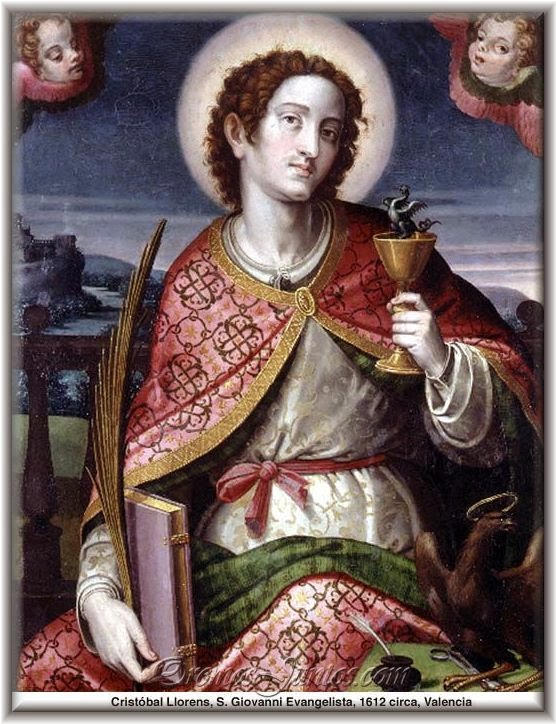
Thus did our Evangelist soar, like the Eagle, up to the Divine Sun and gaze upon Him with undazzled eye, because his heart and senses were pure and, therefore, fitted for such vision of the uncreated Light. If Moses, after having conversed with God in the cloud, came from the divine interview with rays of miraculous light encircling his head – how radiant must have been the face of St John, which had rested on the very Heart of Jesus, in whom are hid all the treasures of wisdom and knowledge! [Col. 2:3] how sublime his writings! how divine his teaching! Hence, the symbol of the Eagle, shown to the Prophet Ezechiel, [Ezechiel 1:10, 10:14] and to St John himself in his Revelations, [Apoc. 4:7] has been assigned to him by the Church and, to this title of The Eagle has been added, by universal tradition, the other beautiful name of Theologian. This was the first recompense given by Jesus to his Beloved John, a profound penetration into divine Mysteries. The second was the imparting to him a most ardent charity, which was equally a grace consequent upon his angelic purity, for purity unburdens the soul from grovelling egotistic affections and raises it to a chaste and generous love. John had treasured up in his heart the Discourses of his Master, he made them known to the Church and, especially, that divine one of the Last Supper, wherein Jesus had poured forth His whole Soul to His own, whom he had always tenderly loved but most so, at the end [John, 13:1]. He wrote his Epistles and Charity is his subject – God is Charity — he that loveth not, knoweth not God — perfect Charity casteth out fear — and so on throughout, always on Love. During the rest of his life, even when so enfeebled by old age as not to be able to walk, he was forever insisting upon all men loving each other, after the example of God, who had loved them and so loved them! Thus, he that had announced more clearly than the rest of the Apostles the divinity of the Incarnate Word, was by excellence, the Apostle of that divine Charity, which Jesus came to enkindle upon the earth.
But, our Lord had a further gift to bestow and it was sweetly appropriate to the Virgin-Disciple. When dying on His cross, Jesus left Mary upon this earth. Joseph had been dead now some years. Who, then, shall watch over His Mother? who is there worthy of the charge? Will Jesus send His Angels to protect and console her? — for, surely, what man could ever merit to be to her as a second Joseph? Looking down, he sees the Virgin-Disciple standing at the foot of the Cross – we know the rest, John is to be Mary’s Son — Mary is to be John’s Mother. Oh! wonderful Chastity, that wins from Jesus such an inheritance as this! Peter, says St Peter Damian, shall have left to him the Church, the Mother of men; but John, shall receive Mary, the Mother of God, whom he will love as his own dearest Treasure and to whom, he will stand in Jesus’ stead; whilst Mary will tenderly love John, her Jesus’ Friend, as her Son.
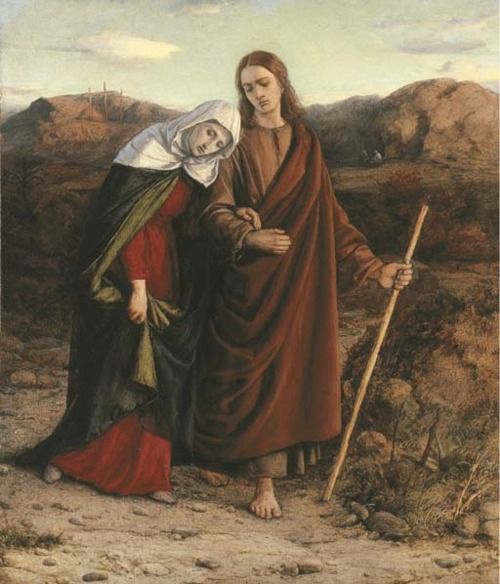
The Blessed Virgin in the House of St John by Dante Gabriel Rossetti, 1859
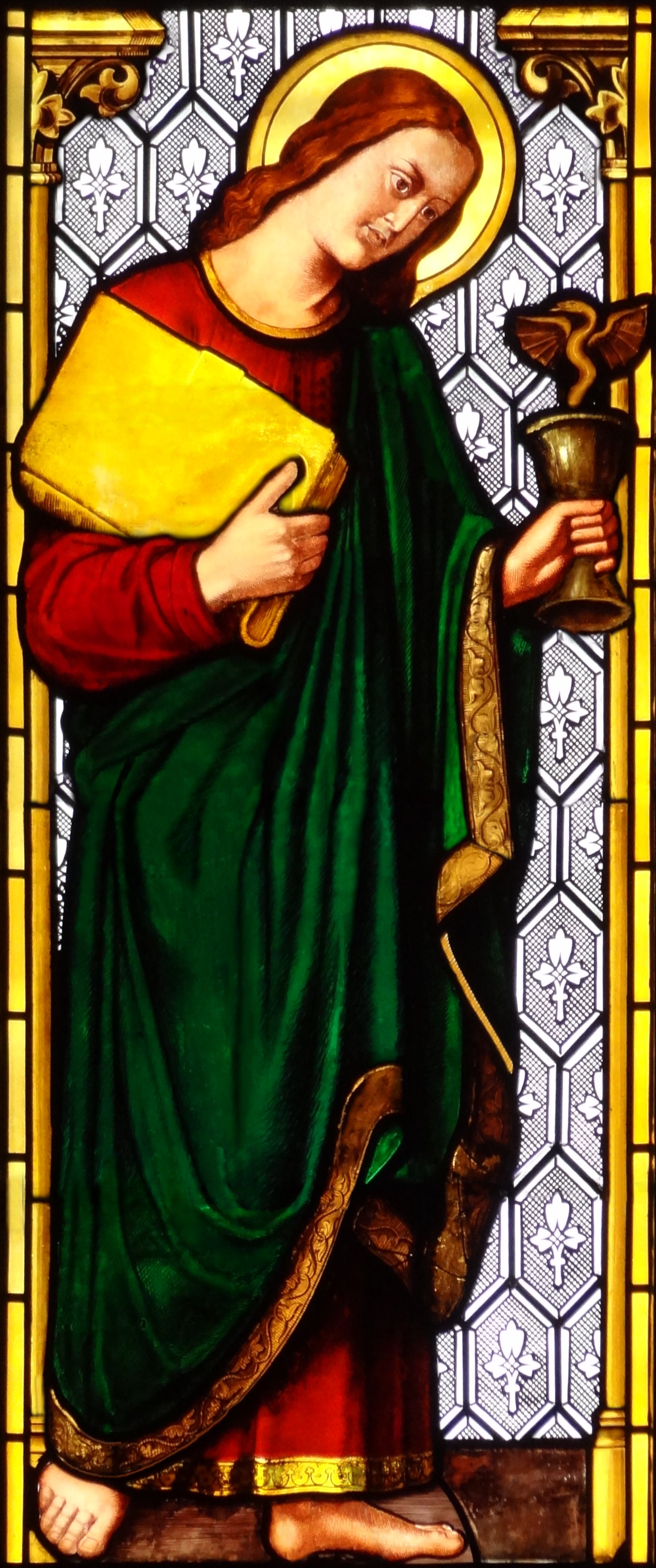
Can we be surprised after this, that St John is looked upon by the Church as one of her greatest glories? He is a Relative of Jesus in the flesh; he is an Apostle, a Virgin, the Friend of the Divine Spouse, the Eagle, the Theologian, the Son of Mary; he is an Evangelist, by the history he has given of the Life of his Divine Master and Friend; he is a Sacred Writer, by the three Epistles he wrote under the inspiration of the Holy Ghost; he is a Prophet, by his mysterious Apocalypse, wherein are treasured the secrets of time and eternity. But, is he a Martyr? Yes, for if he did not complete his sacrifice, he drank the Chalice of Jesus [Matt. 20:22], when, after being cruelly scourged, he was thrown into a caldron of boiling oil, before the Latin Gate, at Rome. He was, therefore, a Martyr in desire and intention, though not in fact. If our Lord, wishing to prolong a life so dear to the Church, as well as to show how he loves and honours Virginity, — miraculously stayed the effects of the frightful punishment, St John had, on his part, unreservedly accepted Martyrdom.
Such is the companion of Stephen at the Crib, wherein lies our Infant Jesus. If the Protomartyr dazzles us with the robes he wears of the bright scarlet of his own blood — is not the virginal whiteness of John’s vestment fairer than the untrod snow? The spotless beauty of the Lilies of Mary’s adopted Son and the bright vermilion of Stephen’s Roses — what is there more lovely than their union? Glory, then, be to our New-Born King, whose court is tapestried with such heaven-made colours as these! Yes, Bethlehem’s Stable is a very heaven on earth and we have seen its transformation. First, we saw Mary and Joseph alone there — they were adoring Jesus in his Crib; then, immediately, there descended a heavenly host of Angels singing the wonderful Hymn; the Shepherds soon followed, the humble simple-hearted Shepherds; after these, entered Stephen the Crowned and John the Beloved Disciple; and, even before there enters the pageant of the devout Magi, we shall have others coming in and there will be, each day, grander glory in the Cave and gladder joy in our hearts. Oh! this Birth of our Jesus! Humble as it seems, yet, how divine! What King or Emperor ever received, in his gilded cradle, honours like these shown to the Babe of Bethlehem? Let us unite our homage with that given him by these the favoured inmates of his court. Yesterday, the sight of the Palm in Stephen’s hand animated us and we offered to our Jesus the promise of a stronger Faith: to-day, the Wreath, that decks the brow of the Beloved Disciple, breathes upon the Church the heavenly fragrance of Virginity — an intenser love of Purity must be our resolution and our tribute to the Lamb.
Feast of the Holy Family+2020: Today’s Feast is held on the Sunday between Christmas and New Year’s Day. If both are Sundays, the Feast is celebrated on 30 December.
Today is the Feast day of the Holy Family but also every family’s feast day, since the Holy Family is the Patron and model of all Christian families. Today should be a huge family feast, since it is devoted entirely to the Holy Family as a model for the Christian family life. As Rev. Edward Sutfin states:
Our Morning Offering – 26 December – Feast of St Stephen the ProtoMartyr and The Second Day in the Christmas Octave
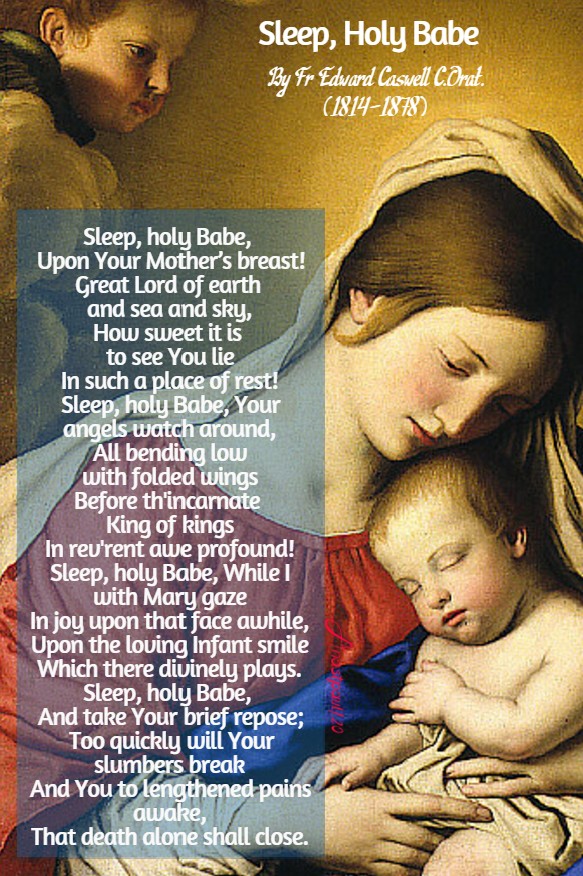
Sleep, Holy Babe By Fr Edward Caswell C.Orat. (1814-1878)
Sleep, holy Babe, Upon Your Mother’s breast! Great Lord of earth and sea and sky, How sweet it is to see You lie In such a place of rest! Sleep, holy Babe, Your angels watch around, All bending low with folded wings Before th’incarnate King of kings In rev’rent awe profound! Sleep, holy Babe, While I with Mary gaze In joy upon that face awhile, Upon the loving Infant smile Which there divinely plays. Sleep, holy Babe, And take Your brief repose; Too quickly will Your slumbers break And You to lengthened pains awake, That death alone shall close.
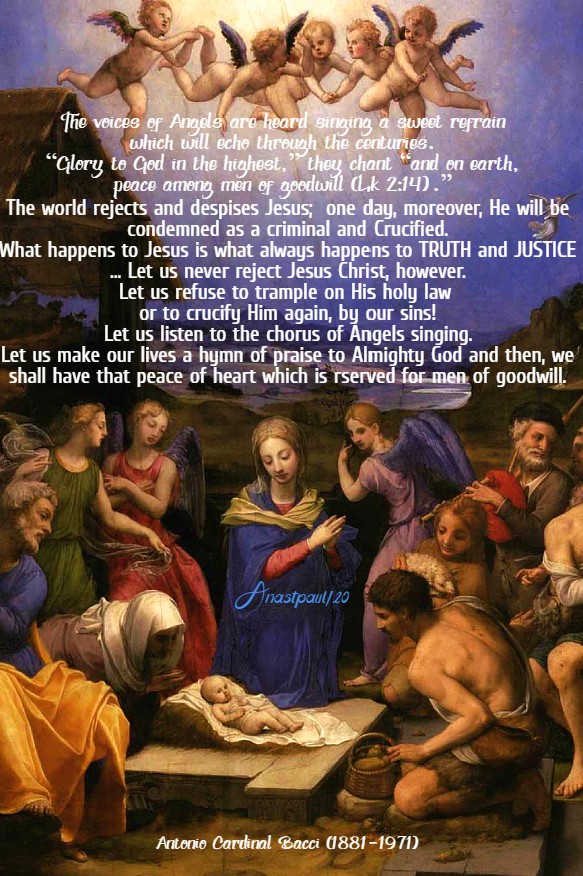
Thought for the Day – 25 December – Meditations with Antonio Cardinal Bacci (1881-1971)
The Feast of the Nativity
“While the earth, plunged in darkness, ignores the birth of Jesus, the sky brightens above the lowly barn in which the Infant is lying. The voices of Angels are heard singing a sweet refrain which will echo through the centuries. “Glory to God in the highest,” they chant “and on earth, peace among men of goodwill (Lk 2:14).”
The world rejects and despises Jesus; one day, moreover, He will be condemned as a criminal and Crucified. What happens to Jesus is what always happens to TRUTH and JUSTICE, which are often spurned by men but are always victorious in the end. For a time, truth and justice may seem to have been defeated once and for all but then, they triumph in an extraordinary manner. The example of Christ is enough to convince us of this.
Let us never reject Jesus Christ, however. Let us refuse to trample on His holy law or to crucify Him again, by our sins! Let us listen to the chorus of Angels singing. Let us make our lives a hymn of praise to Almighty God and then, we shall have that peace of heart which is rserved for men of goodwill.”
Quote/s of the Day – 25 December – The Solemnity of the Nativity of Our Lord, Jesus Christ and remembering Blessed Jacopone da Todi OFM (1230-1306)
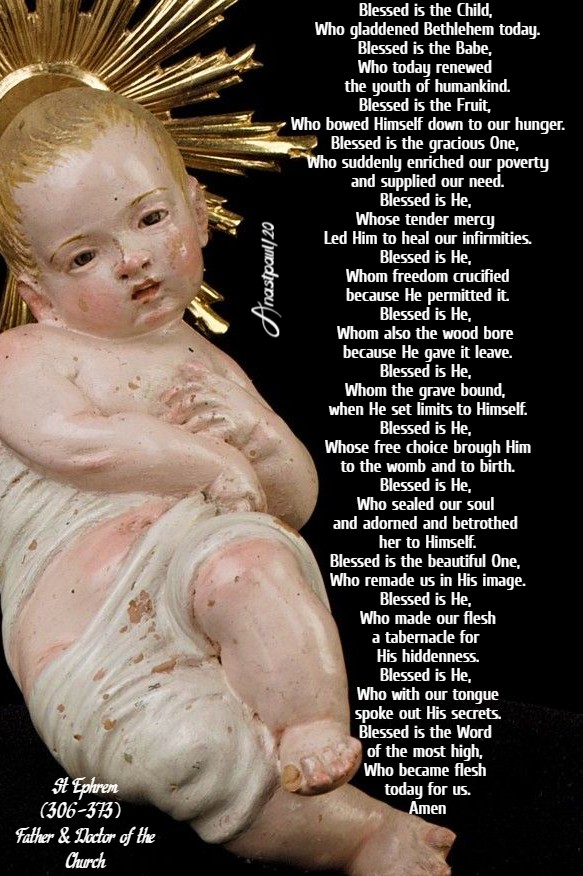
“Blessed is the Child, Who gladdened Bethlehem today. Blessed is the Babe, Who today renewed the youth of humankind. Blessed is the Fruit, Who bowed Himself down to our hunger. Blessed is the gracious One, Who suddenly enriched our poverty and supplied our need. Blessed is He, Whose tender mercy Led Him to heal our infirmities. Blessed is He, Whom freedom crucified because He permitted it. Blessed is He, Whom also the wood bore because He gave it leave. Blessed is He, Whom the grave bound, when He set limits to Himself. Blessed is He, Whose free choice brough Him to the womb and to birth. Blessed is He, Who sealed our soul and adorned and betrothed her to Himself. Blessed is the beautiful One, Who remade us in His image. Blessed is He, Who made our flesh a tabernacle for His hiddenness. Blessed is He, Who with our tongue spoke out His secrets. Blessed is the Word of the most high, Who became flesh today for us. Amen”
St Ephrem (306-373) Father & Doctor of the Church
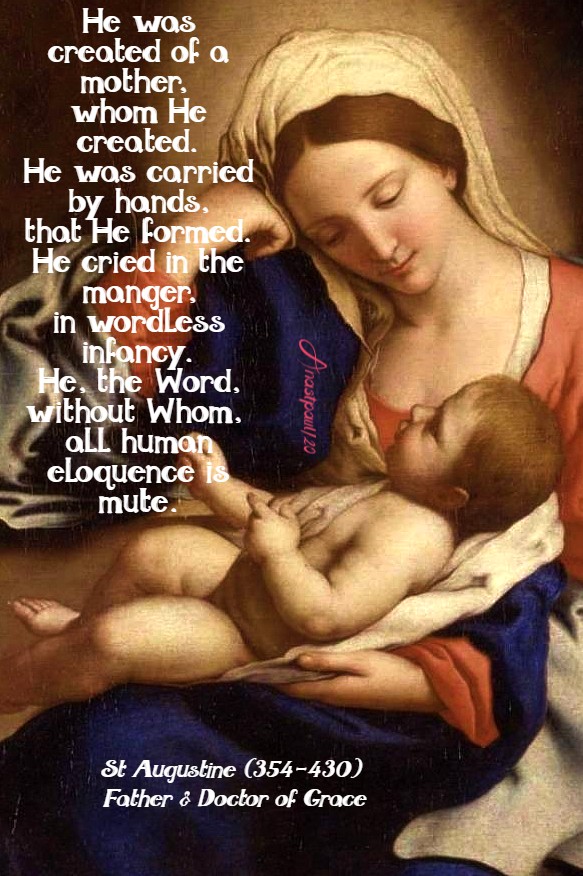
“He was created of a mother, whom He created. He was carried by hands, that He formed. He cried in the manger, in wordless infancy. He, the Word, without Whom, all human eloquence is mute.”
St Augustine (354-430) Father & Doctor of Grace
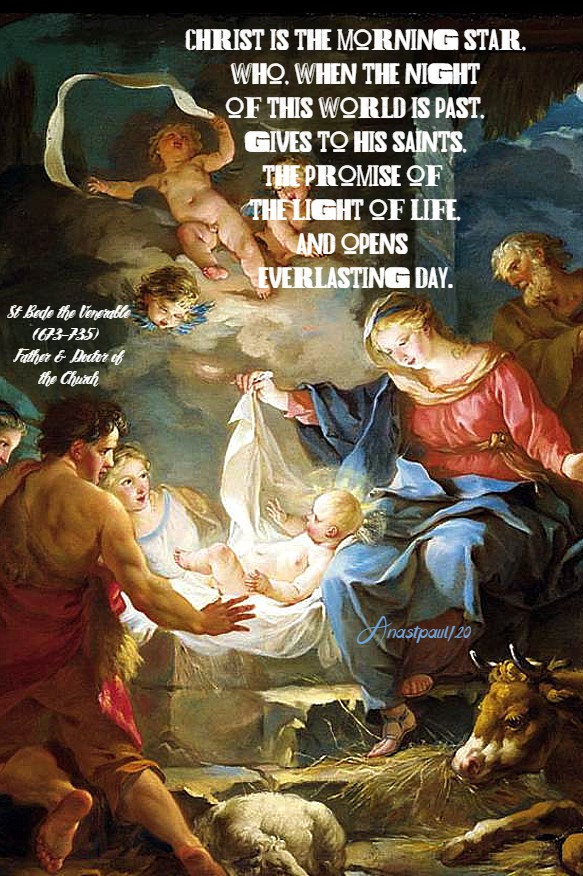
“Christ is the Morning Star, Who, when the night of this world is past, gives to His saints, the promise of the light of life, and opens everlasting day.”
St Bede the Venerable (673-735) Father & Doctor of the Church
“He came from His royal throne, the stern Conqueror of error and the gentle Apostle of love.”
William of Saint Thierry (c 1075-1148)
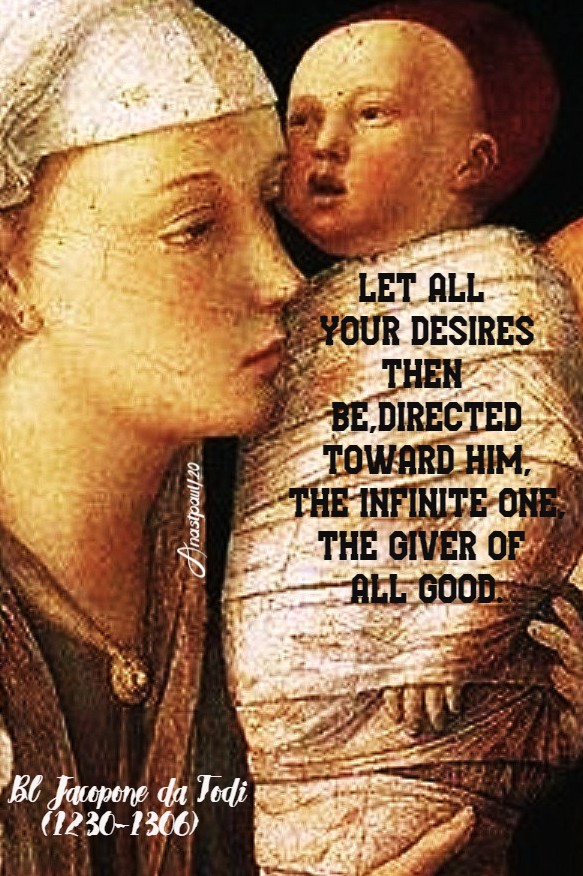
“Let all your desires then be, directed toward Him, the Infinite One, the Giver of all Good.”
Bl Jacopone da Todi (1230-1306)
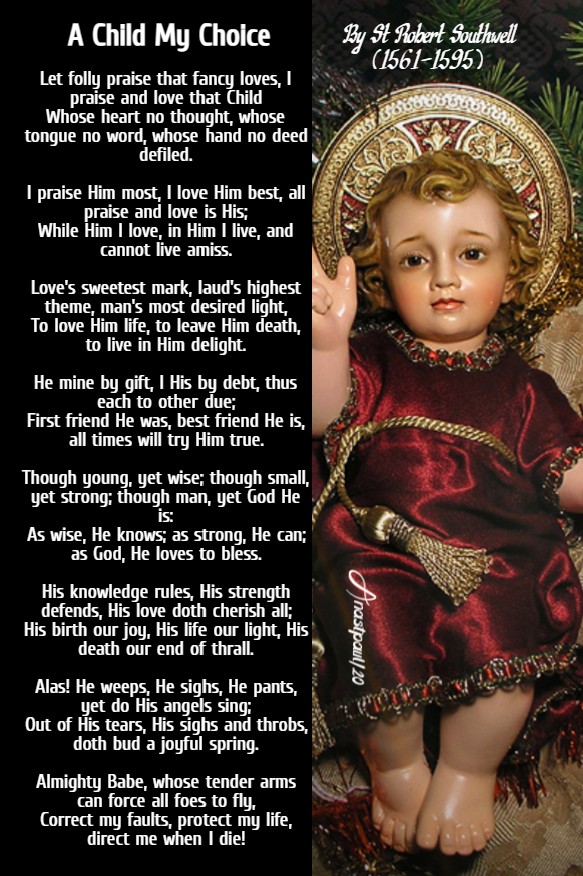
A Child My Choice By St Robert Southwell (1561-1595) Martyr
Let folly praise that fancy loves, I praise and love that Child Whose heart no thought, whose tongue no word, whose hand no deed defiled.
I praise Him most, I love Him best, all praise and love is His; While Him I love, in Him I live, and cannot live amiss.
Love’s sweetest mark, laud’s highest theme, man’s most desired light, To love Him life, to leave Him death, to live in Him delight.
He mine by gift, I His by debt, thus each to other due; First friend He was, best friend He is, all times will try Him true.
Though young, yet wise; though small, yet strong; though man, yet God He is: As wise, He knows; as strong, He can; as God, He loves to bless.
His knowledge rules, His strength defends, His love doth cherish all; His birth our joy, His life our light, His death our end of thrall.
Alas! He weeps, He sighs, He pants, yet do His angels sing; Out of His tears, His sighs and throbs, doth bud a joyful spring.
Almighty Babe, whose tender arms can force all foes to fly, Correct my faults, protect my life, direct me when I die!
Christ has been born for us, come, let us adore Him!
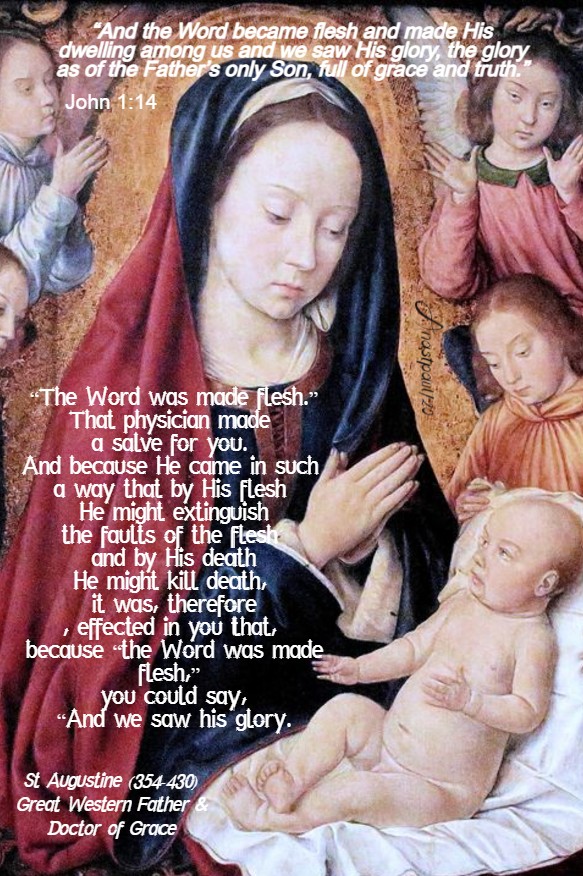
“And the Word became flesh and made His dwelling among us and we saw His glory, the glory as of the Father’s only Son, full of grace and truth.” – John 1:14
REFLECTION – “His glory no-one could see unless he was healed by the lowliness of His flesh. Why could we not see? Concentrate, my beloved people and see what I am saying. Dust, so to speak, had forcibly entered humanity’s eye; earth had entered it, had injured the eye and it could not see the light. That injured eye is anointed; it was injured by earth and earth is put there that it may be healed. For all salves and medicines are nothing but [compounds] of the earth. You have been blinded by dust, you are healed by dust; thus the flesh has blinded you, flesh heals you. For the soul had become carnal by assenting to carnal passions; from that the eye of the heart had been blinded. “The Word was made flesh.” That physician made a salve for you. And because He came in such a way that by His flesh He might extinguish the faults of the flesh and by His death He might kill death, it was, therefore, effected in you that, because “the Word was made flesh,” you could say, “And we saw his glory.” – St Augustine (354-430) Great Western Father & Doctor of Grace –Tractates on the Gospel of John, 2
PRAYER – Almighty God, Your incarnate Word fills us with the new light He brought to men. Let the light of faith in our hearts, shine through all that we do and say. We make our prayer through Jesus Christ, our Lord, with the Holy Spirit, God forever, amen.
The Word was God in the beginning and before all time, today, He is born to us, the Saviour of the world.
Our Morning Offering – 25 December – The Solemnity of the Nativity of Our Lord, Jesus Christ
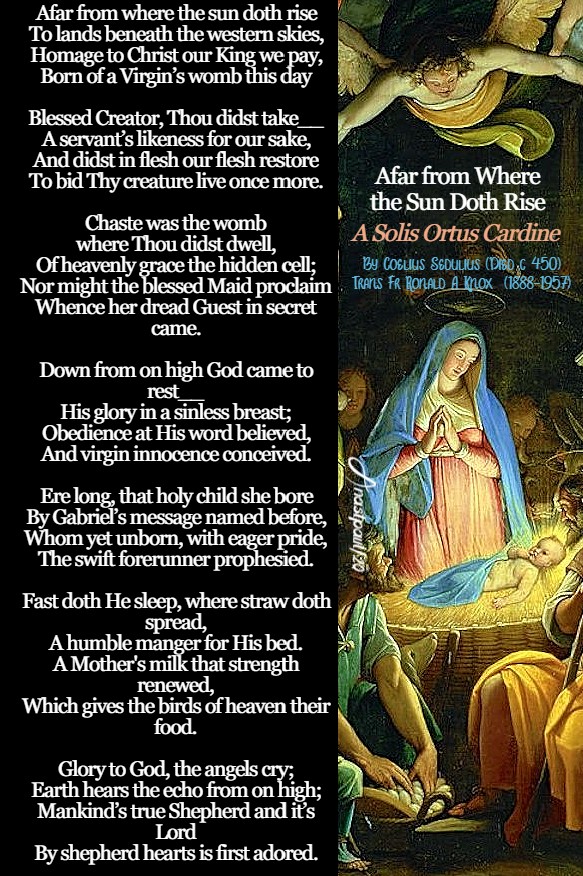
Afar from Where the Sun Doth Rise A Solis Ortus Cardine By Coelius Sedulius (Died c 450) Trans Fr Ronald A Knox (1888-1957)
Afar from where the sun doth rise To lands beneath the western skies, Homage to Christ our King we pay, Born of a Virgin’s womb this day
Blessed Creator, Thou didst take__ A servant’s likeness for our sake, And didst in flesh our flesh restore To bid Thy creature live once more.
Chaste was the womb where Thou didst dwell, Of heavenly grace the hidden cell; Nor might the blessed Maid proclaim Whence her dread Guest in secret came.
Down from on high God came to rest__ His glory in a sinless breast; Obedience at His word believed, And virgin innocence conceived.
Ere long, that holy child she bore By Gabriel’s message named before, Whom yet unborn, with eager pride, The swift forerunner prophesied.
Fast doth He sleep, where straw doth spread, A humble manger for His bed. A Mother’s milk that strength renewed, Which gives the birds of heaven their food.
Glory to God, the angels cry; Earth hears the echo from on high; Mankind’s true Shepherd and it’s Lord By shepherd hearts is first adored.
“A Solis Ortus Cardine…” (Latin for “From the Pivot of the Sun’s Rising”) is a poem by Christian Poet, Coelius Sedulius (Died c 450), recounting Christ’s life from His birth to His resurrection. Its 23 verses each begin with a consecutive letter of the Latin alphabet, making the poem an abecedarius. It is one of the oldest parts of the Roman Catholic liturgy, with two hymns formed from the first seven and four later verses. There have been monastic translations into Anglo-Saxon and later translations into other languages..
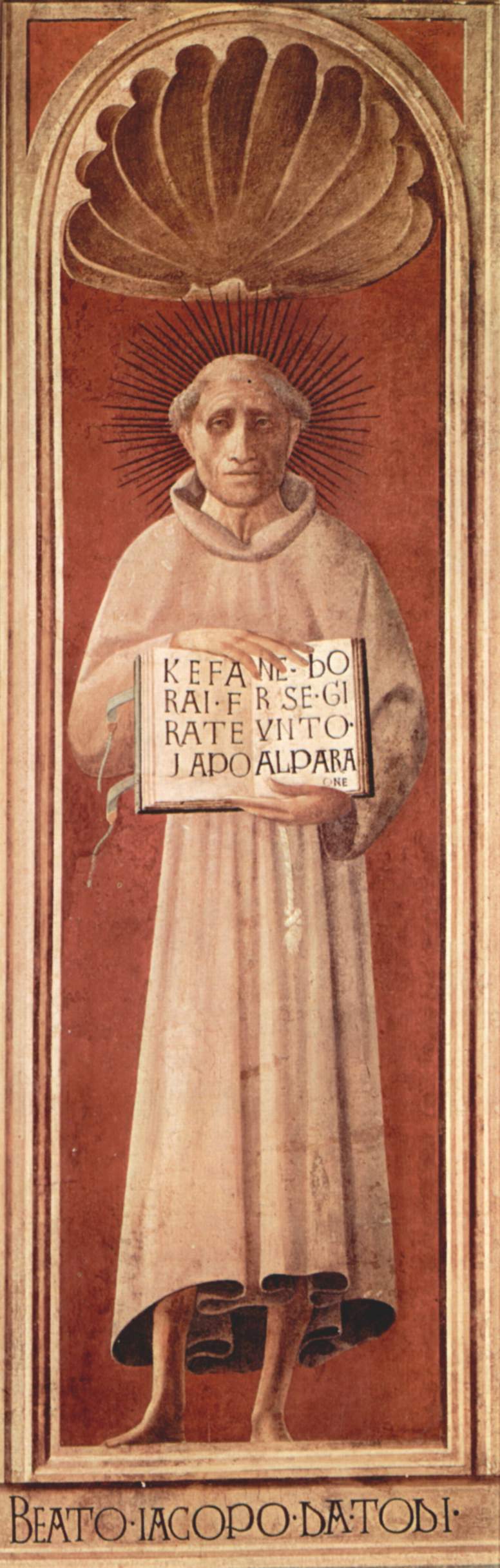
Saint of the Day – 25 December – Blessed Jacopone da Todi OFM (1230-1306) Franciscan Friar, Confessor, Hymnist, Poet, Mystic, Lawyer, – an Italian from Umbria in the 13th century. He wrote several laude (songs in praise of the Lord) in the local vernacular. He was an early pioneer in Italian theatre, being one of the earliest scholars who dramatised Gospel subjects. Born in c 1230 at Todi, Italy as Jacopo Benedetti and died on 25 December 1306 at Collazzone, Italy of natural causes, as the Priest intoned the Gloria from midnight Mass. He is also known as Jacomo da Todi, Jacopo Benedetti, Jacopo Benedicti, Jacopone Benedetti da Todi, Jacopone of Todi, James da Todi.
Jacomo, was born a noble member of the Benedetti family in the northern Italian city of Todi. He became a successful lawyer and married a pious, generous lady named Vanna.
His young wife took it upon herself to do penance for the worldly excesses of her husband. One day Vanna, at the insistence of Jacomo, attended a public tournament. She was sitting in the stands with the other noble ladies when the stands collapsed. Vanna was killed. Her shaken husband was even more disturbed when he realised that the penitential girdle she wore was for his sinfulness. On the spot, he vowed to radically change his life.
Jacomo divided his possessions among the poor and entered the Secular Franciscan Order. Often dressed in penitential rags, he was mocked as a fool and called Jacopone, or “Crazy Jim,” by his former associates. The name became dear to him.
After 10 years of such humiliation, Jacopone asked to be received into the Order of Friars Minor. Because of his reputation, his request was initially refused. He composed a beautiful poem on the vanities of the world, an act that eventually led to his admission into the Order in 1278. He continued to lead a life of strict penance, declining to be ordained a priest. Meanwhile, he was writing popular hymns in the vernacular.
Jacopone suddenly found himself a leader in a disturbing religious movement among the Franciscans. The Spirituals, as they were called, wanted a return to the strict poverty of Francis. They had on their side two cardinals of the Church and Pope Celestine V. These two cardinals though, opposed Celestine’s successor, Boniface VIII. At the age of 68, Jacopone was excommunicated and imprisoned. Although he acknowledged his mistake, Jacopone was not absolved and released until Benedict XI became Pope five years later. He had accepted his imprisonment as penance. He spent the final three years of his life more spiritual than ever, weeping “because Love is not loved.”During this time he wrote the famous Latin hymn, Stabat Mater.
On Christmas Eve in 1306 Jacopone felt that his end was near. He was in a convent of the Poor Clares with his friend, Blessed John of La Verna. Like Francis, Jacopone welcomed “Sister Death” with one of his favorite songs. It is said that he finished the song and died as the Priest intoned the “Gloria” from the midnight Mass at Christmas. From the time of his death, Brother Jacopone has been venerated as a saint, both within and outside of the Franciscan Order, although never formally Canonised.
Here lie the bones of Blessed Jacopone dei Benedetti da Todi, Friar Minor, who, having gone mad with love of Christ, by a new artifice deceived the world and took Heaven by violence. – from the tomb of Blessed Jacopone
Stabat Mater Dolorosa is a fine example of religious lyric in the Franciscan tradition. It was inserted into the Roman Missal and Breviary in 1727 for the Feast of the Seven Sorrows of the Blessed Virgin Mary, celebrated on the Friday before Good Friday. Following changes by Pope Pius XII, it now appears on the Feast of Our Lady’s Sorrows celebrated on 15 September. Many composers have set it to music
His contemporaries called Jacopone, “Crazy Jim.” We might well echo their taunt, for what else can you say about a man who broke into song in the midst of all his troubles? We still sing Jacopone’s saddest song, the Stabat Mater, but we Christians claim another song as our own, even when the daily headlines resound with discordant notes. Jacopone’s whole life rang out our song: “Alleluia!” May he inspire us to keep singing.
The Nativity of the Lord, Jesus Christ (Solemnity) Celebration of the anniversary of the birth of Our Lord. In the earliest days of the Church there was no such feast, the Saviour’s birth was commemorated with the Epiphany by the Greek and other Eastern Churches. First mention of the feast, then kept on 20 May, was made by Clement of Alexandria c 200. The Latin Church began c 300 to observe it on 25 December, though there is no certainty that Our Lord was born on that day. Priests have the privilege of saying three Masses, at midnight, daybreak and morning. This was originally reserved to the Holy Father alone – beginning about the 4th century he celebrated a midnight Mass in the Lateran Basilica (in which according to tradition, the manger of Bethlehem is preserved), a second in the church of Saint Anastasia, whose feast comes on 25 December and a third at the Vatican Basilica. Many peculiar customs of the day are the outcome of the pagan celebrations of the January calender. The Christmas tree, of which the first known mention was made in 1605 at Strasbourg, was introduced into France and England in 1840. The feast is a holy day of obligation, preceded by the preparatory season of Advent and by a special vigil – should it fall on a Friday it abrogates the law of abstinence. Today’s Gospel is the prologue of John.
St Adalsindis of Hamay St Alburga of Wilton St Anastasia of Sirmium Bl Artale St Basilée of the Via Latina Bl Bentivoglio de Bonis Bl Diego de Aro St Eugenia of Rome St Fulk of Toulouse Blessed Jacopone da Todi OFM (1230-1306) Franciscan Friar, Author of the “Stabat Mater” St Jovin of the Via Latina Bl Maria Therese von Wüllenweber Bl Matthew of Albano Bl Michael Nakashima Saburoemon Bl Nera St Romulus of Berry — Martyrs of Nicomedia: 20,000 Christians martyred by order of Diocletian. They were reported to have all been in the single basilica to celebrate Christmas. While there unquestionably was an endless series of martyrs under Diocletian, it’s likely the ancient sources exaggerated the numbers of this incident. And as the Christmas holy day was not celebrated in the East in 303, they were probably gathered for another feast. They were burned alive in 303 in the basilica of Nicomedia.
I offer today, special Prayers for you ALL and for all my extended family on WordPress. Most especially, my heart’s deepest thanksgiving for those most generous and loving Donors, who, in their generosity have constantly contributed to the upkeep of this site. For Rosemary, Hugh, Melanie who have sent Christmas gifts –
Thank you!
“Enter his gates with thanksgiving and his courts with praise, give thanks to him and praise his name.” Psalm 100:4
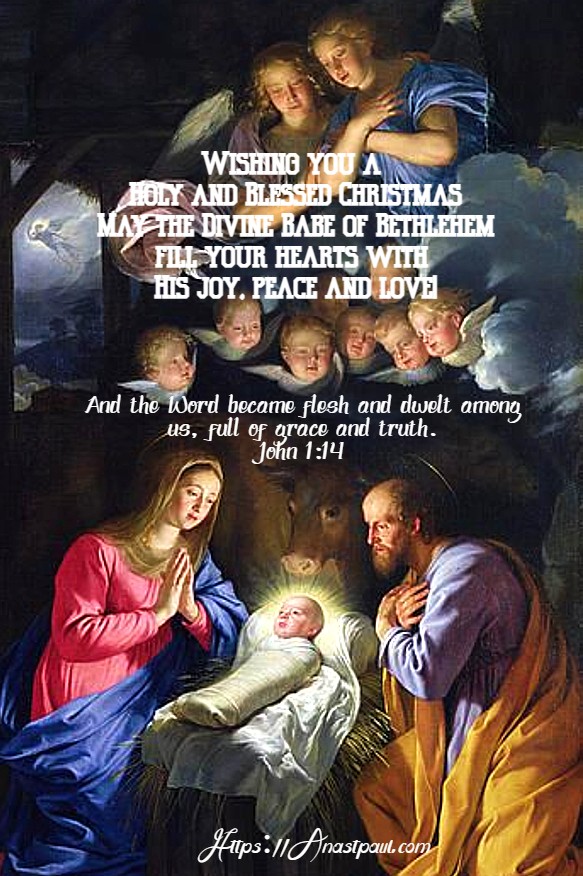
And my wishes for a most Holy and Blessed Christmas May the Divine Babe of Bethlehem fill your hearts with His joy, peace and love! Love Ana
And the Word became flesh and dwelt among us, full of grace and truth; we have beheld his glory, glory as of the only Son from the Father.
Thought for the Day – 24 December – Meditations with Antonio Cardinal Bacci (1881-1971)
The Holy Family – Jesus
“We have in the Holy Family, the highest possible models of perfection – Jesus, Mary and Joseph. As God, Jesus is essentially holy. By means of the Hypostatic Union, this sanctity is transmitted also to His human nature. The holiness of Jesus was only gradually revealed as He grew older because He wished to be like us in everything, save in sin. As the Gospel says, He “advanced in wisdom and age and grace before God and men” (Lk 2:52). Jesus gave us an example of holiness which we should find easier to imitate because it was eternally increasing all the time. He offered us, as an example, the kind of sanctity which has its beginning and foundation in utter humility and detachment from worldly goods. “Learn from me, for I am meek and humble of heart” (Mt 11:29).
Socrates advised his followers to have few desires and to desire these as little as possible, in order to remain content, for the man who is full of desires is always uneasy and restless. This human counsel is very true but, it is incomplete. It recommends detachment from earthly things but fails to tech the ardent and practical desire for supernatural things. Jesus Christ teaches us both. After He has urged us to become gentle and humble like Himself, after He has told us not to worry about the future and not to fret about what to wear and what to eat, He points out the way in which Providence clothes the lilies of the filed and feeds the birds of the air. Then He adds: “Seek the kingdom of God and all these things shall be given you besides” (Cf Lk. 12:22-31).
We must limit and moderate our desire for earthly goods, therefore but, should ardently yearn to love God, to serve and obey Him in this life and to enjoy Him forever in Heaven. This is what the Infant Jesus wishes to teach us.”
Quote/s of the Day – 24 December – The Nativity of the Lord, Mass at Midnight
… Let us keep the Feast, not after the manner of a heathen festival but after a godly sort; not after the way of the world but in a fashion above the world; not as our own but as belonging to Him who is ours, or rather as our Master’s; not as of weakness but as of healing; not as of creation but of re-creation.”
St Gregory of Nazianzen (330-390) Archbishop of Constantinople Father and Doctor of the Church
“Jesus Christ, the God-Man, was born in a manger and is spiritually reborn on the altar. He suffered on Calvary and continues to offer Himself on the altar. In His earthly life, He spread His teaching and worked miracles among the crowds. In the Eucharist, He spans the centuries and communicates Himself to all.”
St John Chrysostom (347-407) Father & Doctor of the Church
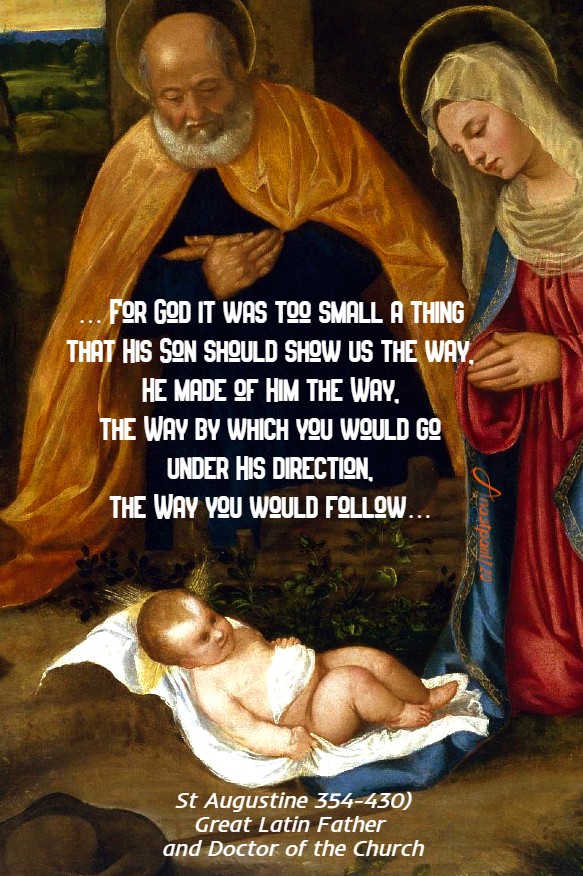
“… For God it was too small a thing that His Son should show us the way, He made of Him the Way (cf Jn 14:6), the Way by which you would go under His direction, the Way you would follow…”
“Awake, mankind! For your sake God has become man. Awake, you who sleep, rise up from the dead and Christ will enlighten you. I tell you again, for your sake, God became man.”
St Augustine 354-430) Great Latin Father and Doctor of the Church
Know today that the Lord will come – in the morning you will see His glory.
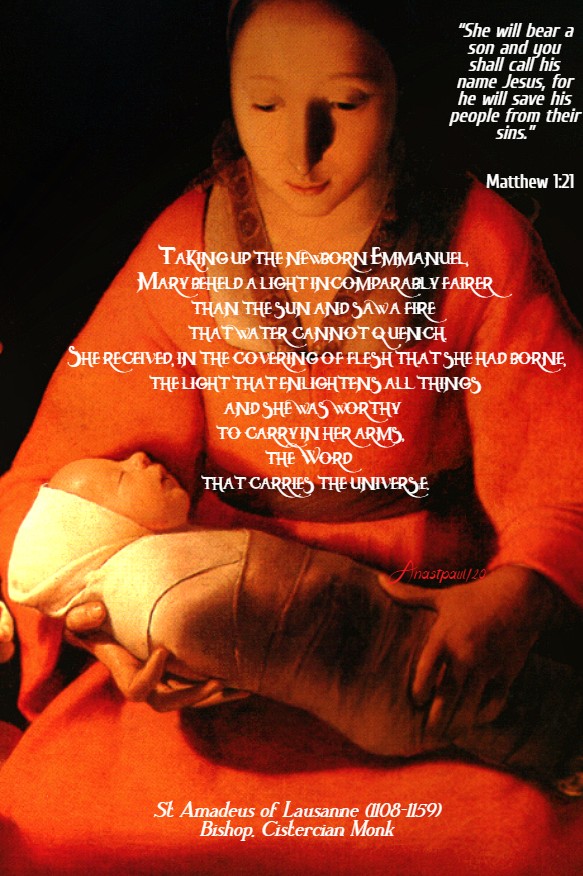
“She will bear a son and you shall call his name Jesus, for he will save his people from their sins.” … Matthew 1:21
REFLECTION – “The heavens were glad, earth exulted when Mary gave birth and hell was troubled and aghast. The heavens in their joy produced a shining star and a glorious army of angels, uttering praise and saying: “Glory to God in the highest and on earth peace to people of good will.” (Lk 2:14) The earth, exulting, brought shepherds giving glory and magi adoring and offering gifts, gold, frankincense and myrrh. … Reflect how that night poured forth light in the darkness and instead of blackness, it offered radiance. It gave light before the sun arose and a brightness which, from its exceeding brilliance, obscured the splendour of the sun. Concerning this night the psalmist says: “Night is my light in my delights” and turning to the Lord he says: “The darkness will not be dark for you and the night will be as bright as the day, for the darkness is as light for him” (cf Ps 38[139]:11-12 LXX). … Taking up the newborn Emmanuel, Mary beheld a Light incomparably fairer than the sun and saw a Fire that water cannot quench. She received, in the covering of flesh Whom she had borne, the Light Who enlightens all things and she was worthy, to carry in her arms, the Word Who carries the universe!– St Amadeus of Lausanne (1108-1159) Bishop, Cistercian Monk – Homilies in praise of the Blessed Virgin Mary, IV, SC 72
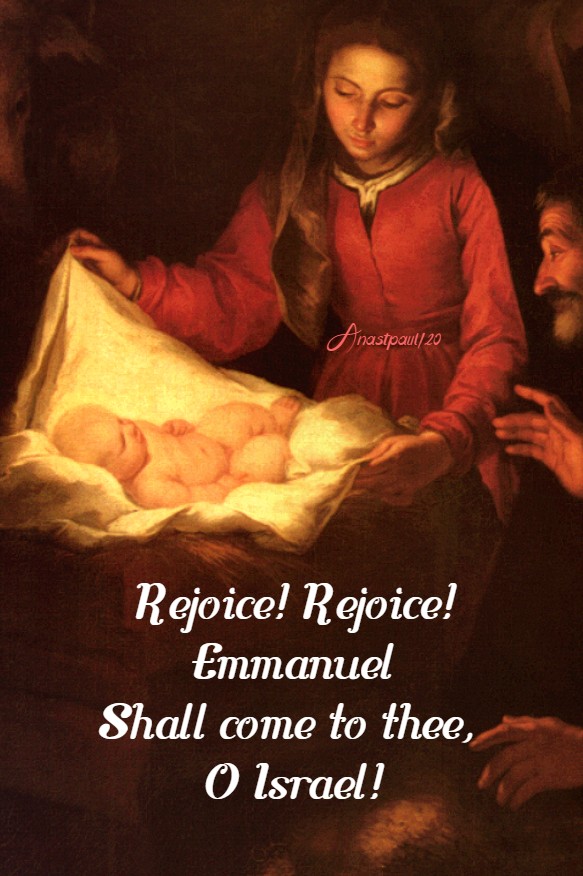
PRAYER – Rejoice! Rejoice! Emmanuel Shall come to thee, O Israel! May the Lord bless us, protect us from all evil and bring us to everlasting life. Amen





















 AnaStpaul
You must be logged in to post a comment.