“Awake, mankind! For your sake God has become man. Awake, you who sleep, rise up from the dead and Christ will enlighten you. I tell you again – for your sake, God became man.”
“Let us then joyfully celebrate the coming of our salvation and redemption. Let us celebrate the festive day on which He who is the great and the eternal day came from the great and endless day of eternity into our own short day of time.”
“Ask if this were merited; ask for its reason, for its justification and see whether you will find, any other answer but sheer grace.”
St Augustine (354-430) Father & Doctor of the Church
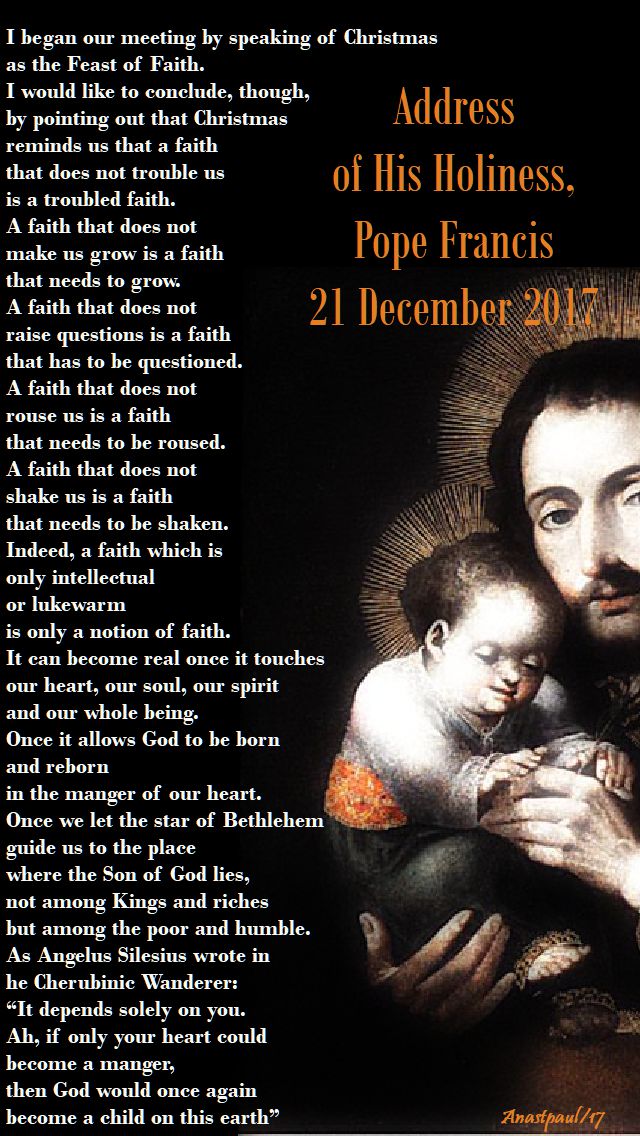
“I began our meeting by speaking of Christmas as the Feast of Faith. I would like to conclude, though, by pointing out that Christmas reminds us that a faith that does not trouble us is a troubled faith. A faith that does not make us grow is a faith that needs to grow. A faith that does not raise questions is a faith that has to be questioned. A faith that does not rouse us is a faith that needs to be roused. A faith that does not shake us is a faith that needs to be shaken. Indeed, a faith which is only intellectual or lukewarm is only a notion of faith. It can become real once it touches our heart, our soul, our spirit and our whole being. Once it allows God to be born and reborn in the manger of our heart. Once we let the star of Bethlehem guide us to the place where the Son of God lies, not among Kings and riches but among the poor and humble. As Angelus Silesius wrote in The Cherubinic Wanderer: “It depends solely on you. Ah, if only your heart could become a manger, then God would once again become a child on this earth”
Address of His Holiness, Pope Francis to the Curia
Advent and Christmas Wisdom with St Alphonsus Liguori (1696-1787) – Today’s Gospel: Luke 2:1–14 (Midnight Mass)
24 December
Saint Joseph goes to Bethlehem with his holy spouse
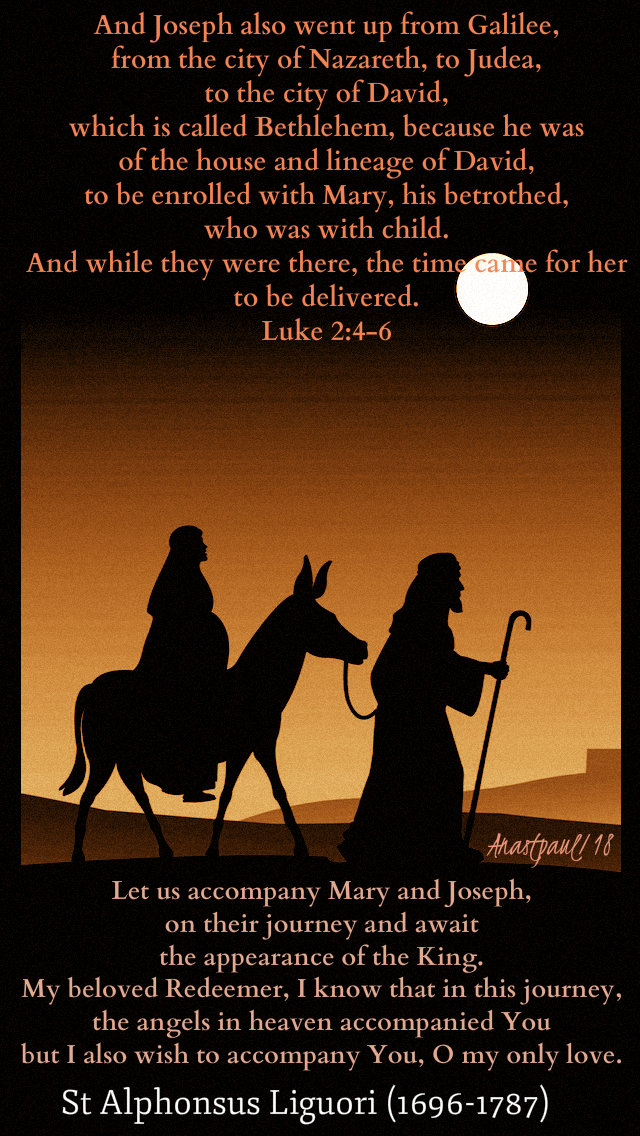
“Consider that God had decreed that His Son be born, not in Joseph’s house but in a cavern and stable of beasts, in the poorest and most painful way a child can be born. For this reason, God caused Caesar to publish an edict, by which people were commanded to go and register each member of their family, in their place of origin. When Joseph heard this order, he was agitated and unsure whether or not the Virgin Mother should take the trip with him. But Mary, knowing of his dilemma and being well versed in the prophet, Micheas, responded, “Do not fear, I will go with you and the Lord will assist us.” She then gathered together the swaddling clothese and the other miserable garments already prepared for the journey and departed with Joseph. Let us accompany Mary and Joseph, on their journey and await the appearance of the King. My beloved Redeemer, I know that in this journey, the angels in heaven accompanied You but I also wish to accompany You, O my only love. My soul has become filled with love for You, O my amiable Infant God. Unite and bind me to Yourself.”
Scripture
And Joseph also went up from Galilee, from the city of Nazareth, to Judea, to the city of David, which is called Bethlehem, because he was of the house and lineage of David, to be enrolled with Mary, his betrothed, who was with child. And while they were there, the time came for her to be delivered. Luke 2:4-6
Prayer
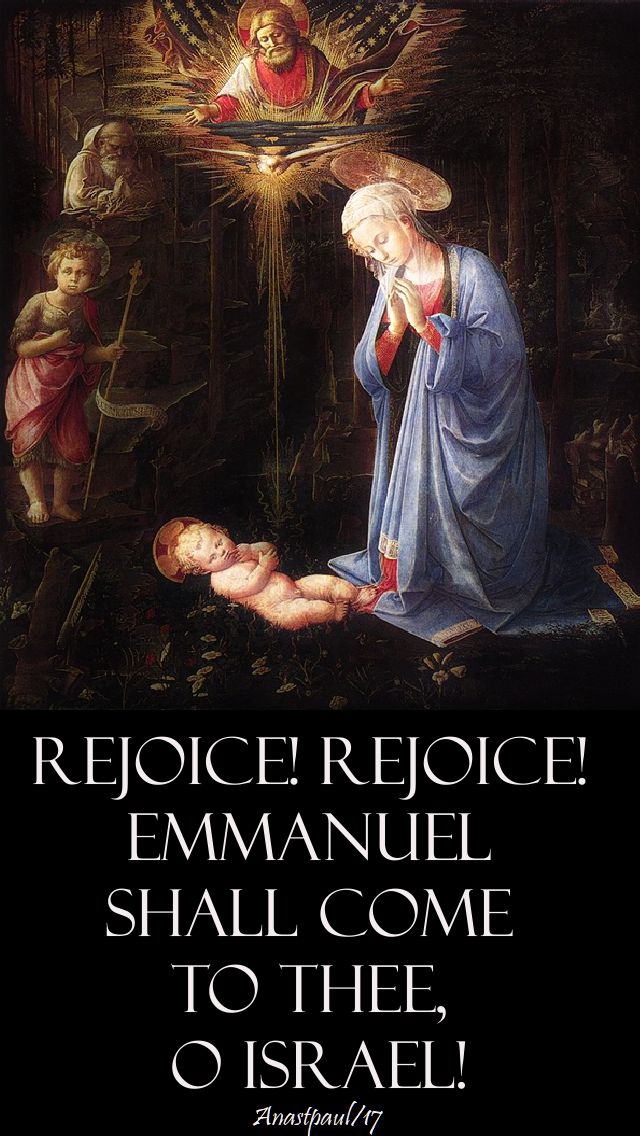
Rejoice! Rejoice! Emmanuel
Shall come to thee, O Israel!
May the Lord bless us,
protect us from all evil
and bring us to everlasting life.
Amen
Advent Action
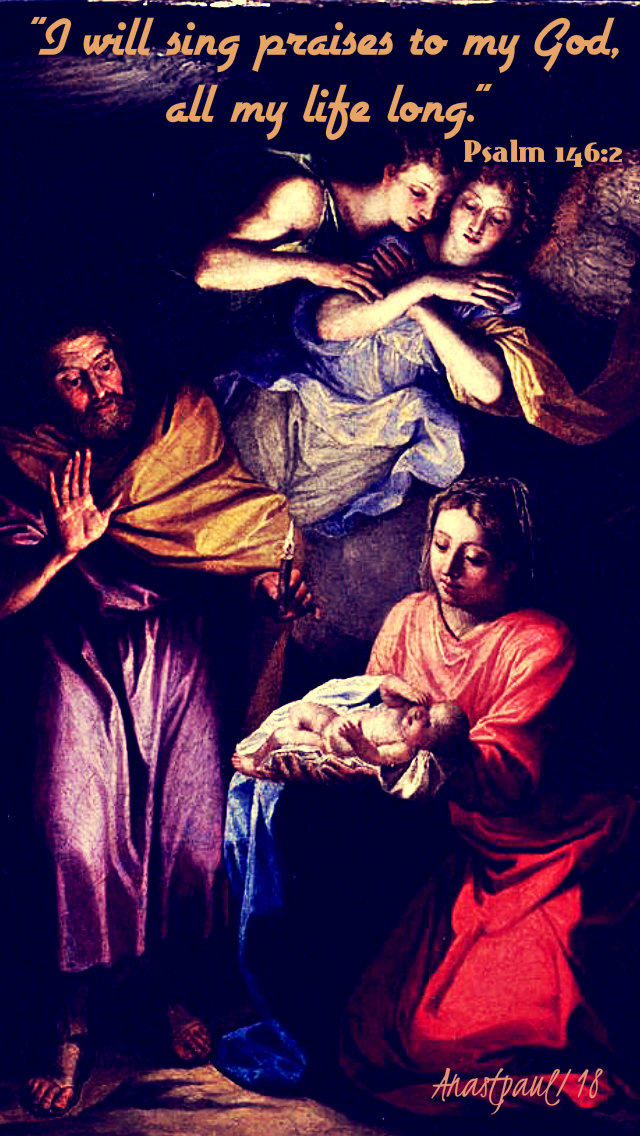
Today we are also pregnant with the fullness of the Advent season. It is almost time for us to participate in the birthing of the Lord. We ponder, like Mary, in our hearts, what this will mean for our lives. We listen more intently to Scripture to hear the advice and directions that God is giving to us. This day is the change we have been waiting for – this is the day promised us – this is the day which will alter our lives – everything, forever! Lord, grant me the grace to introduce You to the world in the place and time that You have assigned to me. “I will sing praises to my God, all my life long.” (Psalm 146:2)
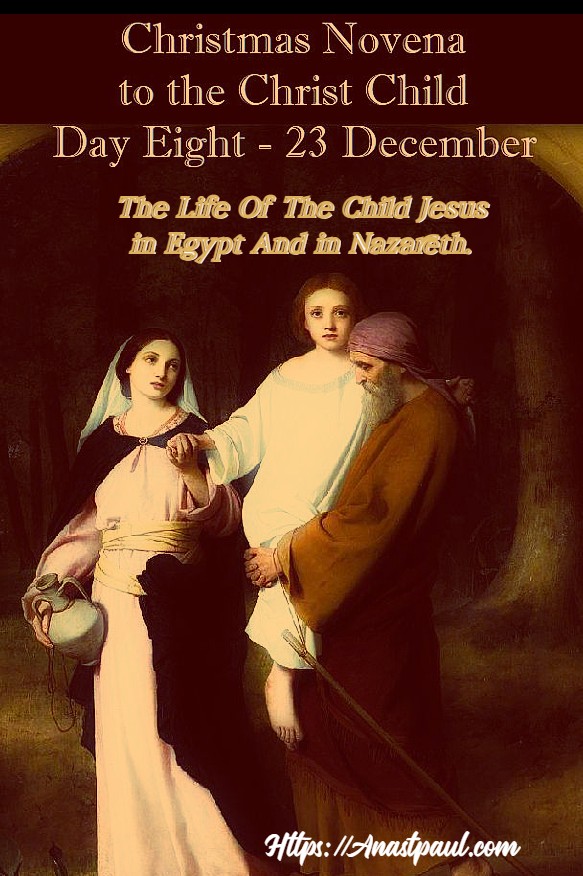
Day Eight The Life Of The Child Jesus In Egypt And In Nazareth.
Reflection: Our Blessed Redeemer spent the first part of His childhood in Egypt, leading there for several years, a life of poverty and humiliation. In that land Joseph and Mary were foreigners and strangers, having there neither relatives nor friends. Only with difficulty could they earn their daily bread by the labour of their hands. Their home was poor, their bed was poor, their food was poor. Here Mary weaned Jesus, dipping a piece of bread in water, she would put it in the sacred mouth of her Son. Here she made His first little garments and clothed Him with them. Here the Child Jesus took His first steps, stumbling and falling as other children first do. Here too He spoke His first words but stammeringly. O wonder of wonders! To what has not God lowered Himself for love of us! A God stumbling and falling as He walks! A God stammering in His speech!
Not unlike this was the poor and humble life that Jesus led in Nazareth after His return from Egypt. There, until He was thirty years old, He lived as a simple servant or workman in a carpenter shop, taking orders form Joseph and Mary. “And He was subject to them.” Jesus went to fetch the water, He opened and closed the shop, He swept the house, gathered the fragments of wood for the fire and toiled all day long, helping Joseph in his work. Yet who is this? God Himself, serving as a apprentice! The omnipotent God, who with less than a flick of His finger created the whole universe, here sweating at the task of planing a piece of work! Should not the mere thought of this move us to love Him?
Prayer: O Jesus, my Saviour! When I consider how, for love of me, You didst spend thirty years of Your life hidden and unknown in a poor workshop, how can I desire the pleasures and honours and riches of the world? Gladly do I renounce all these things, since I wish to be Your companion on this earth, poor as you were, mortified and humble as You were, so that I may hope to be able one day to enjoy Your companionship in heaven. What are all the treasures and kingdoms of this world? You, O Jesus, are my only treasure, my only Good! I keenly regret the many times in the past when I spurned Your friendship in order to satisfy my foolish whims. I am sorry for them with all my heart. For the future I would rather lose my life a thousand times than lose Your grace by sin. I wish never to offend You again but always to love You. Help me to remain faithful to You until death. O Mary, you are the refuge of sinners, you are my hope. Amen
Thought for the Day – 23 December – The Fourth Sunday of Advent – Today’s Gospel: Luke 1:39-45
In those days, Mary arose and went with haste into the hill country, to a city of Judah and she entered the house of Zechariah and greeted Elizabeth.
Luke 1:39-40
“When the Holy Spirit touches a heart, He puts to flight all tepidity. He loves diligence and promptitude and is the enemy of procrastination and delays in the performance of the divine will… “Mary set out in haste”…
What graces and favours must have descended upon Zechariah’s house when the Virgin entered it? If Abraham received so many graces for having given hospitality to three angels in his tent… what graces and how many heavenly blessings must have descended upon the house of Zechariah into which entered the Angel of the Great Counsel (Is 9:5, Septuagint), that true Jacob and Divine Prophet, the true Ark of the Covenant, Our Lord enclosed within the womb of Mary! Indeed, the whole house was overcome with joy; the infant leapt with joy, the father recovered his speech, the mother was filled with the Holy Spirit and received the gift of prophecy, for on seeing this blessed Lady enter her house she exclaimed: “Who am I that the Mother of my Lord should come to visit me?”… And Mary, hearing what her kinswoman, Elizabeth, said in her praise, humbled herself and referred all the glory to God. Then declaring that all her happiness came from the fact that God had looked upon His servant in her lowliness, she intoned that beautiful and wonderful canticle, the Magnificat.
Oh, how overwhelmed with joy we should be when visited by this divine Saviour in the most Blessed Sacrament of the altar and by the interior graces we receive daily through the many inspirations and words He speaks to our hearts!”…St Francis de Sales (1567-1622) Doctor of the Church
Quote of the Day – 23 December – The Fourth Sunday of Advent
“Jesus Christ, the God-Man, was born in a manger and is spiritually reborn on the altar. He suffered on Calvary and continues to offer Himself on the altar. In His earthly life, He spread His teaching and worked miracles among the crowds. In the Eucharist, He spans the centuries and communicates Himself to all.”
St John Chrysostom (347-407) Father & Doctor of the Church
Advent and Christmas Wisdom with St Alphonsus Liguori (1696-1787) Today’s Gospel: Luke 1:39-45
23 December
God’s love is demonstrated by the birth of Jesus
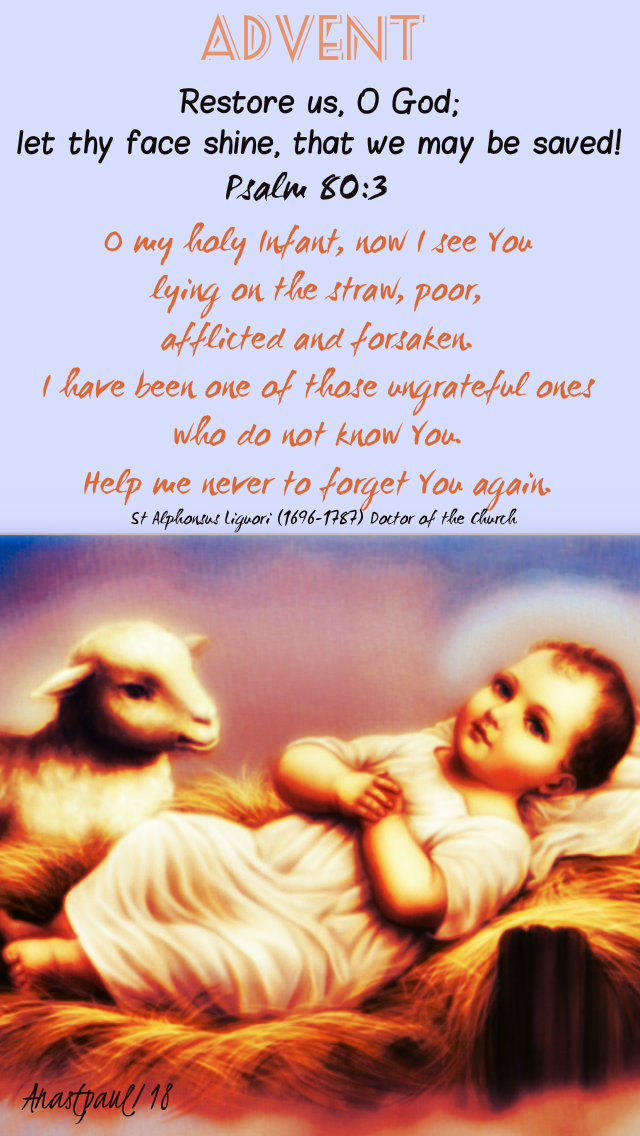
“Consider the love of God. It was always present but did not always appear. It was first promised in many prophecies and foreshadowed by many figures but, at the birth of our Redeemer, this divine love did indeed appear. But despite the birth of Jesus, why is it that so many people have not known God’s love and so many people seem ignorant of His love? This is the reason – “The light of the world has come into the world and humanity loves darkness rather than the light.” They have not known Him and they do not know Him because they do not wish to know Him, loving rather the darkness of sin than the light of grace. Let each one determine this day not to be numbered among those unhappy souls who prefer the darkness.
O my holy Infant, now I see You lying on the straw, poor, afflicted and forsaken. I have been one of those ungrateful ones who do not know You. Help me never to forget You again.”
Scripture
Restore us, O God; let thy face shine, that we may be saved!
Psalm 80:3
Prayer
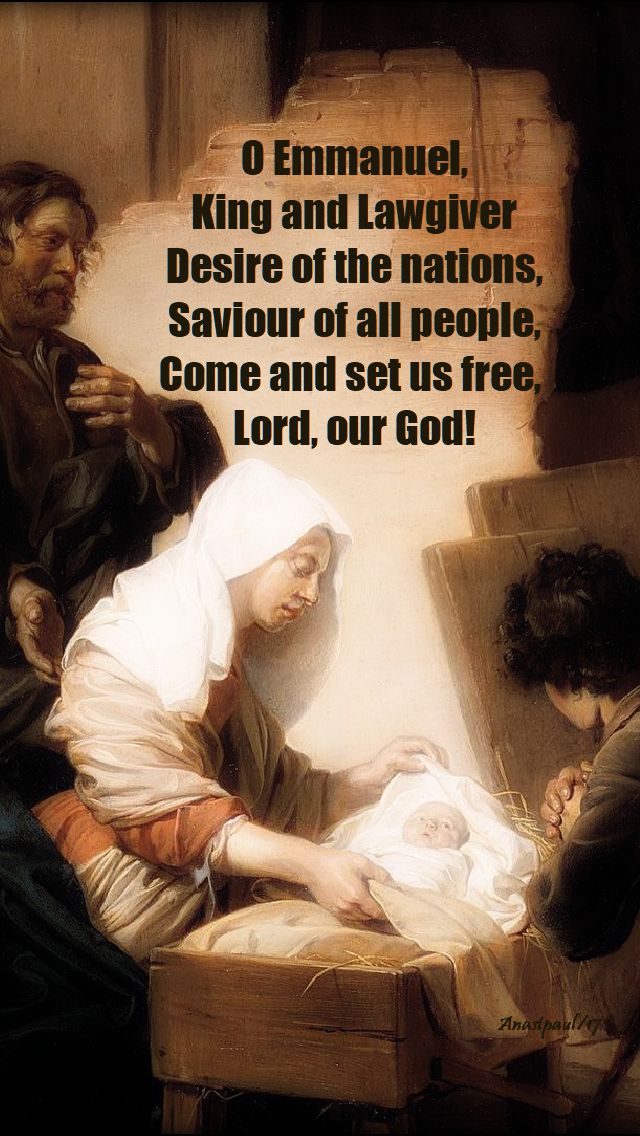
O Emmanuel,
King and Lawgiver
Desire of the nations,
Saviour of all people,
Come and set us free,
Lord, our God!
Advent Action
Carrying You in her womb, Your mother rushes to meet Elizabeth. What an awesome moment that meeting turns out to be! You are already on duty as our Redeemer, sanctifying John in his mother’s womb. In fact, the child in Elizabeth’s womb, responds to Your presence, as the mother, filled with the Holy Spirit, bears witness to it.
As these final days of this preparatory Season draw to a close, there is still time to allow body, mind and heart to be attuned to the transforming intervention of Jesus, God-in-the-flesh. There is still time to permit body, mind and heart to see “the plan” already at work in life, especially in those dark and difficult moments of life. There is still time for body, mind and heart to cry out to the Holy Spirit for a zealous and determined connection with the Person Jesus, who pours His abundant joy into every aspect of our lives.
Lord, grant me the grace, to bring Your joy to all I meet along the path of life. May Your presence in my heart, as in Mary’s womb, bring salvation to all! “Being awake for God and for other people – that is the kind of ‘waking’ that Advent has in mind, the wakefulness which discovers the light and brightens the world!”(Pope Benedict XVI – The Light of a new humanity p 19)
Advent and Christmas Wisdom with St Alphonsus Liguori (1696-1787))
22 December
The sorrow that the ingratitude of humankind has caused Jesus
“Consider that Saint Francis of Assisi, during the days of the holy Nativity, went about the highways and woods with sighs and tears and inconsolable lamentations. When asked the reason, he responded, “Why should I not weep when I see that love is not loved! I see a God who became human for the love of humanity and humanity that is ungrateful to this God.” Now, if this ingratitude caused so much sorrow in the heart of St Francis, consider how much more it must have afflicted the heart of Jesus Christ. The loving infant does not deserve this response. He came from heaven to suffer and die for us, so that we might love Him. How can we remain ungrateful?
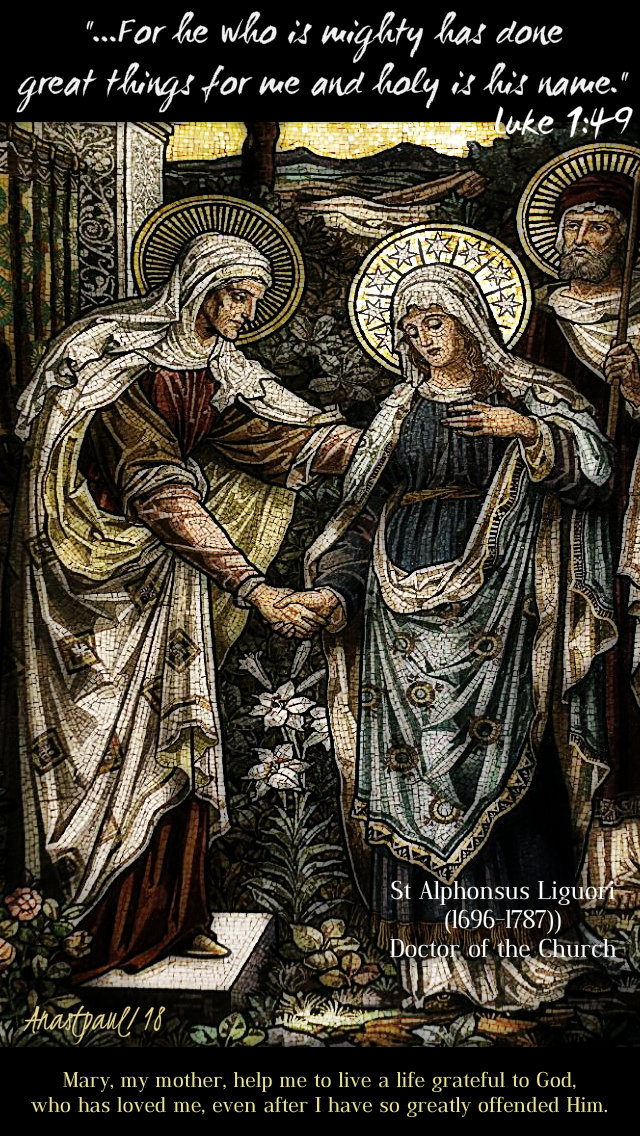
O my Jesus, I love You and will always love You. Inflame my heart every day with the memory of Your love for me. Mary, my mother, help me to live a life grateful to God, who has loved me, even after I have so greatly offended Him.”
Scripture
“…For he who is mighty has done great things for me and holy is his name.”…Luke 1:49
Prayer
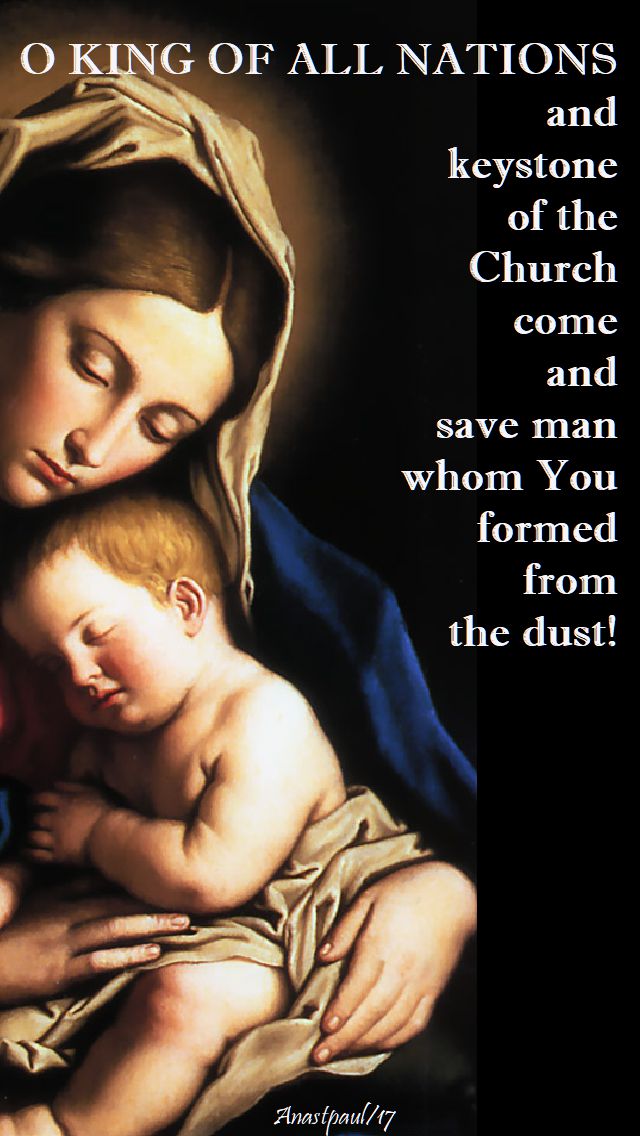
O KING OF ALL NATIONS
and keystone of the Church
come and save man,
whom You formed from the dust!
Advent Action
“The Almighty has done great things for me, and holy is his name.” Mary looks back to the beginning of her song, where she said: My soul proclaims the greatness of the Lord. Only that soul for whom the Lord in His love does great things can proclaim His greatness with fitting praise and encourage those who share her desire and purpose, saying – ‘join with me in proclaiming the greatness of the Lord, let us extol His name together.'”…St Bede the Venerable (673-735) – Father & Doctor
Have you ever been overcome by the goodness of God? Today’s Scripture presents the images of Hannah and Mary, who are both overcome by God’s goodness. Lord, today, I too want to join Your mother in her hymn of thanksgiving. On the threshold of Christmas, this is the best prayer that we humans can raise to the Almighty God. Let us make this song our own – our continual song of gratitude! Together with Mary, let us rejoice for the fulfilment of the promise of which You, already in her womb, are the fruit and proof. Lord, make us too partners in the revolution that You begin, with Your incarnation – the revolution that pulls down the mighty and exalts the poor and the powerless.
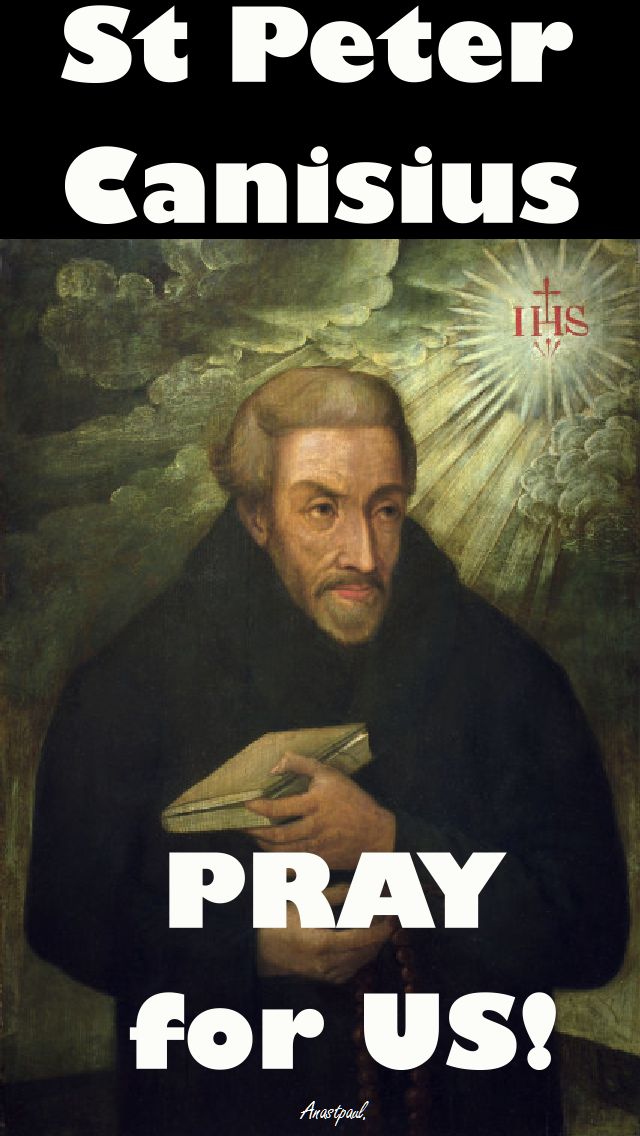
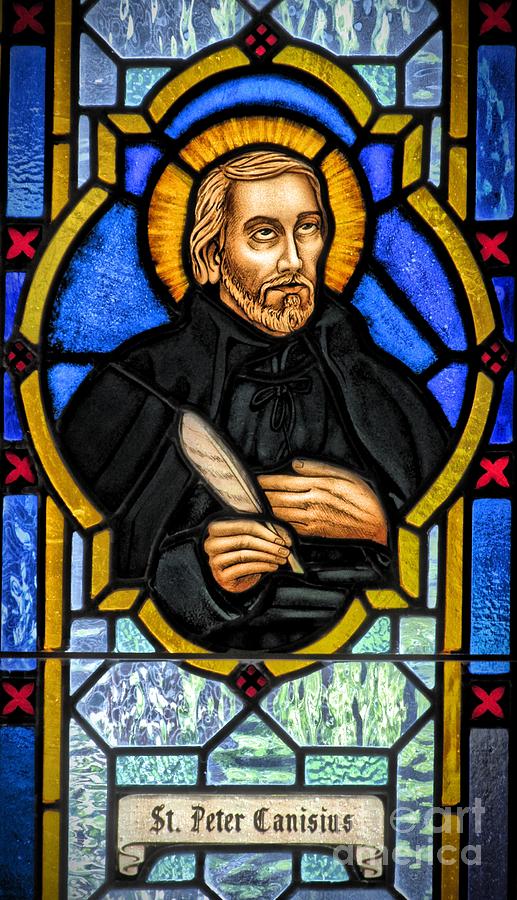
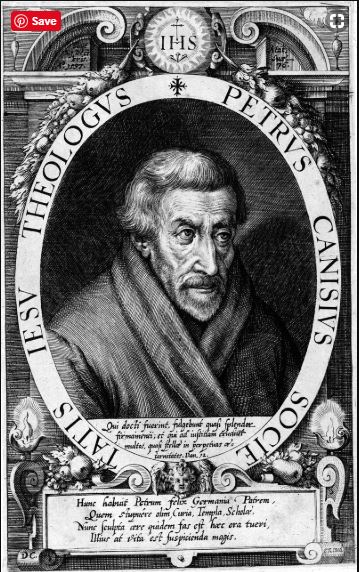
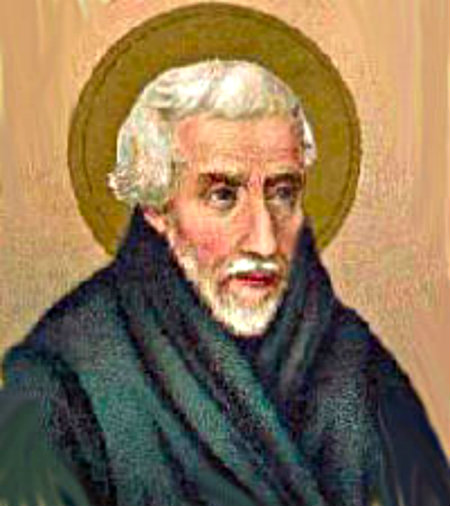
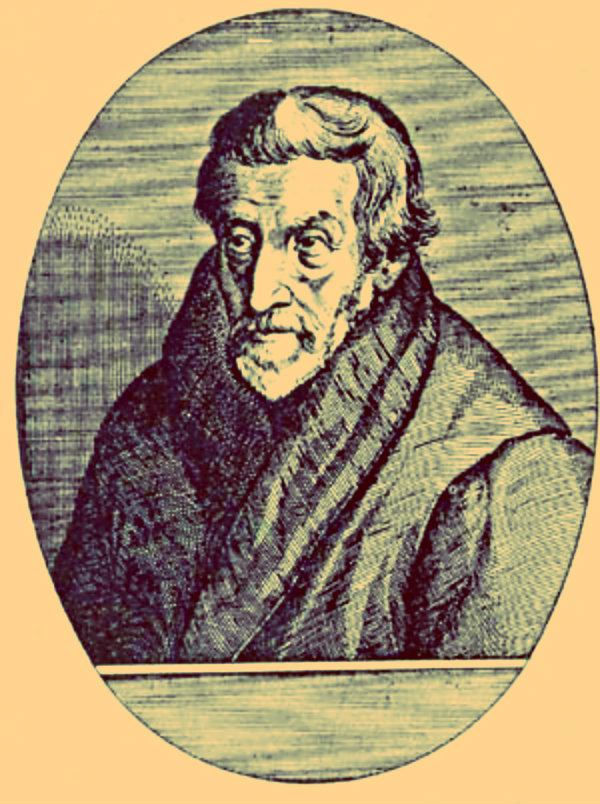
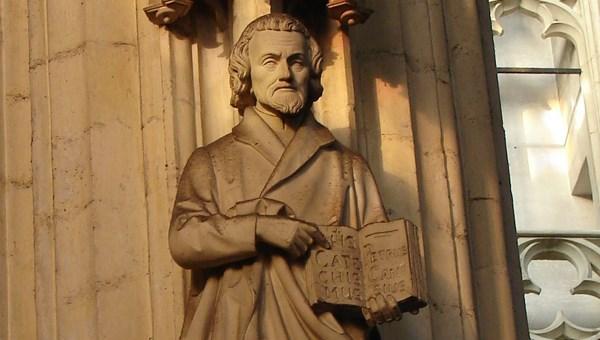
Thought for the day – 21 December – The Memorial of St Peter Canisius S.J. (1521-1597) Doctor of the Church
St Peter Canisius and the Hail Mary
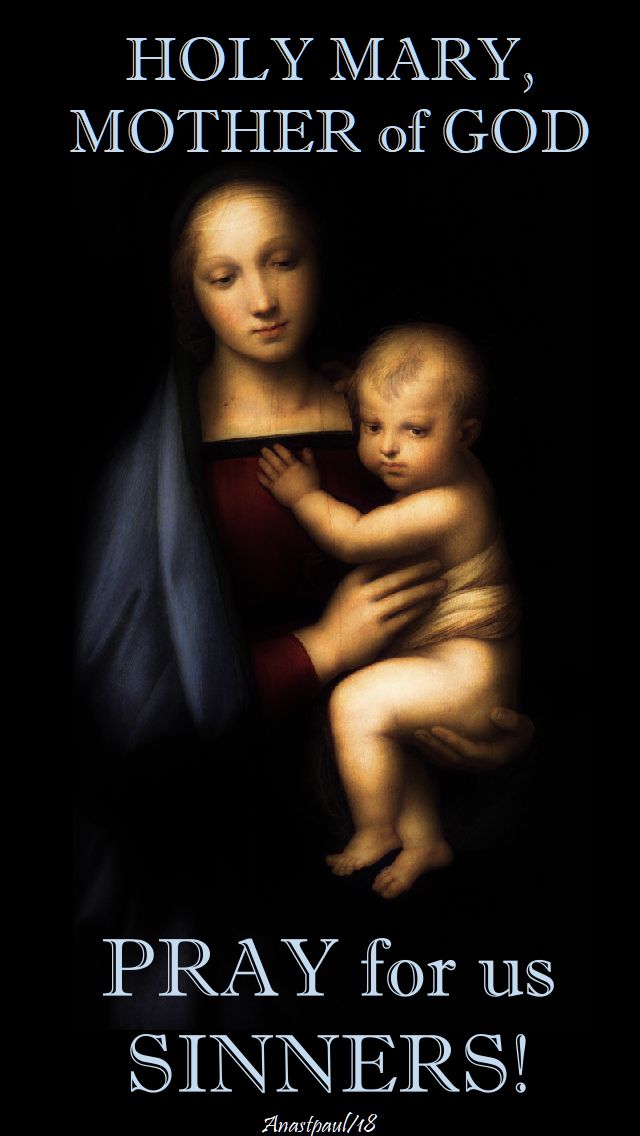
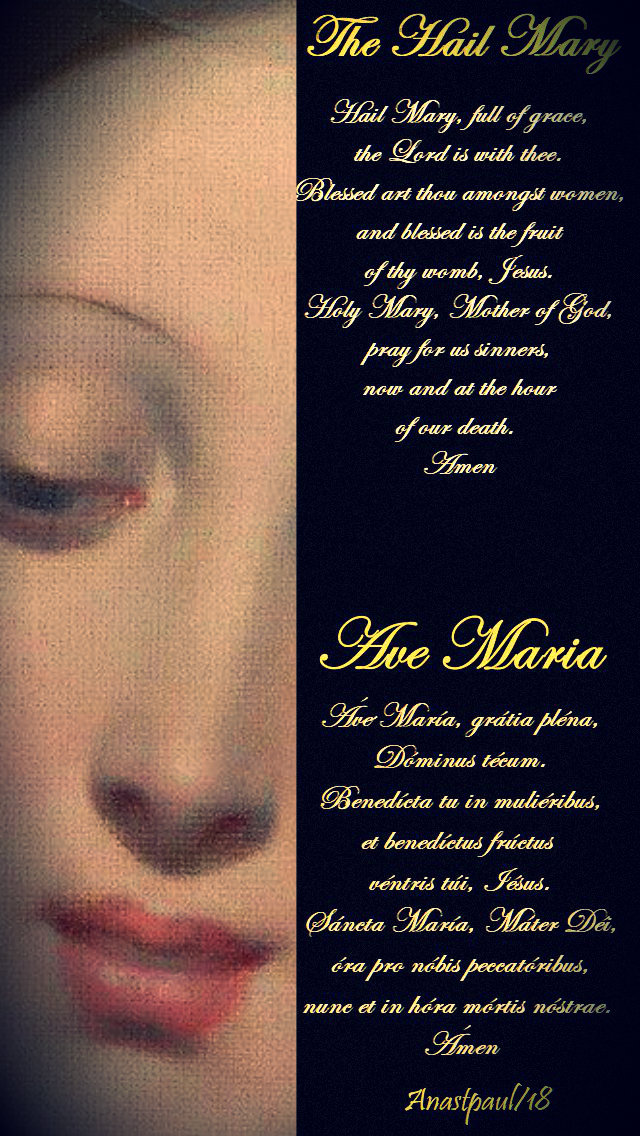
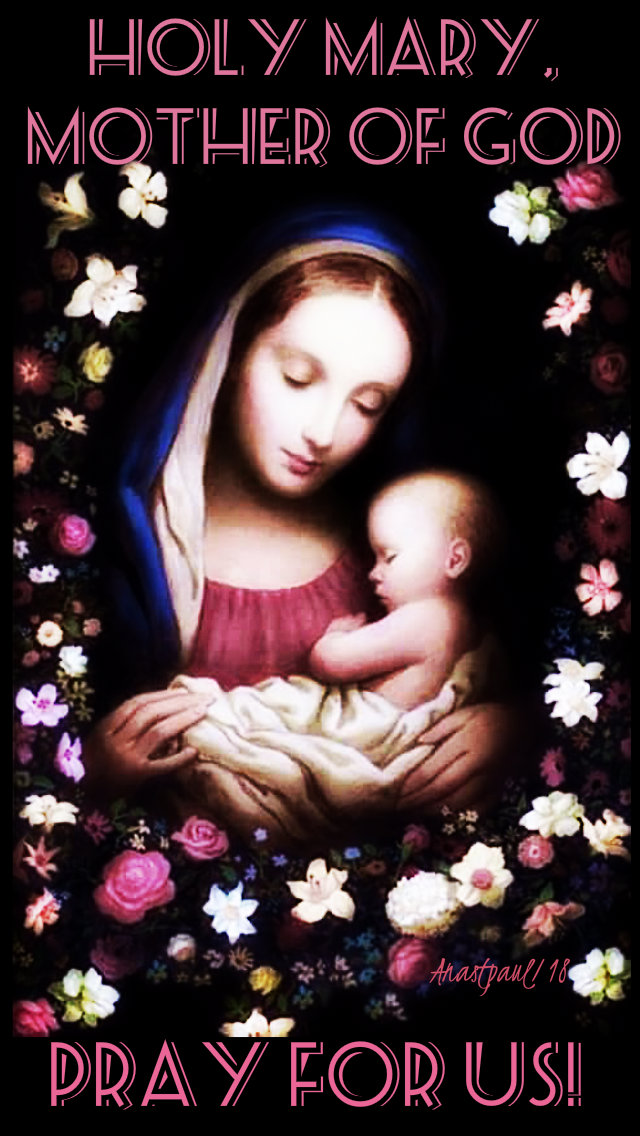
“Holy Mary Mother of God pray for us sinners now and at the hour of our death”
On today’s feast of St Peter Canisius S. J., Catholics may wish to thank this Doctor of the Church for giving us the second half of the Hail Mary prayer.
This 16th-century saint, known as the second Apostle of Germany, followed in the giant footsteps of St Boniface, who evangelised Germany a thousand years earlier. He was also quite active at the Council of Trent and wrote much on the Blessed Virgin Mary.
The first half of the Hail Mary, of course, comes from Scripture. What many Catholics don’t know is that the second half of this Catholic prayer is due to the intervention of St Peter Canisius at the Council of Trent. St Peter began adding on to the scriptural part of the Hail Mary the second half of this familiar prayer, “Holy Mary Mother of God pray for us sinners, now, and at the hour of our death.” It was Trent that officially accepted the prayer and included it in their famous Catechism of the Council of Trent in 1566.
This learned saint was declared a Doctor of the Church by Pope Pius XI in 1925. He was a holy and learned Jesuit, who wrote catechisms based on Trent’s Roman Catechism, which he helped generate. He also wrote a breviary and many works on Mary.
Saint Peter’s main mission was to counter the Protestant revolt in Germany. He was providentially born just four years after Martin Luther penned his 95 theses. To withstand the errors of the Protestant deformers, St Peter wrote his catechism in 1555, which was called a Summary of Christian Doctrine. This catechism basically enshrined what came to be known as the Counter-Reformation.
Quote/s of the Day – 21 December – The Memorial of St Peter Canisius (1521-1597) Doctor of the Church
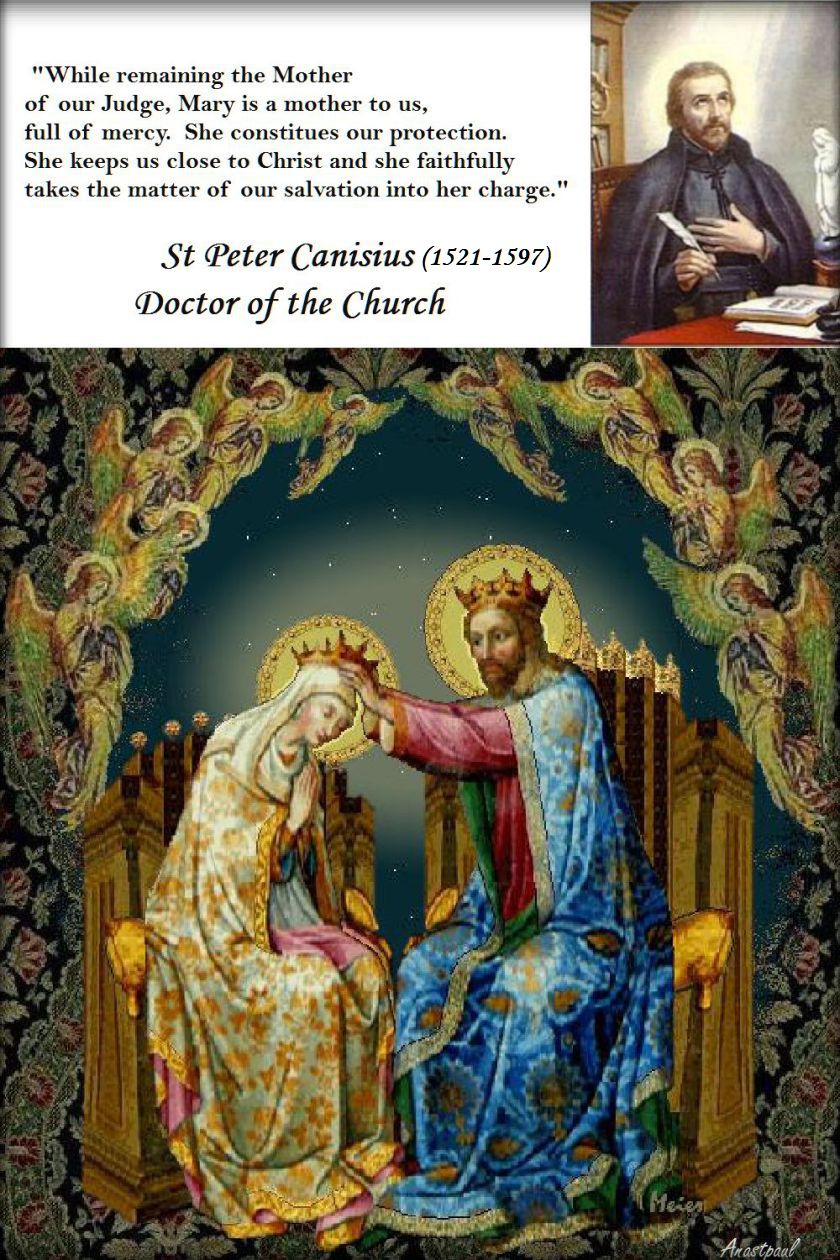
“While remaining the Mother of our Judge, Mary is a mother to us, full of mercy. She constitutes our protection. She keeps us close to Christ and she faithfully takes the matter of our salvation into her charge.”
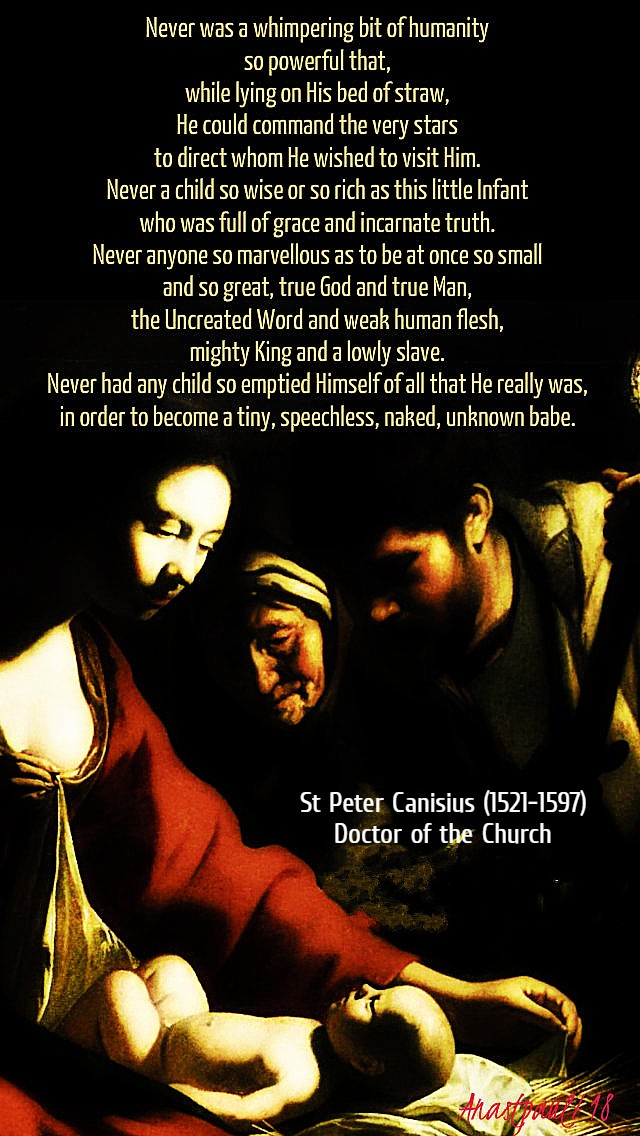
“Never was a whimpering bit of humanity so powerful that, while lying on His bed of straw, He could command the very stars to direct whom He wished to visit Him. Never a child so wise or so rich as this little Infant who was full of grace and incarnate truth. Never anyone so marvellous as to be at once so small and so great, true God and true Man, the Uncreated Word and weak human flesh, mighty King and a lowly slave. Never had any child so emptied Himself of all that He really was, in order to become a tiny, speechless, naked, unknown babe.”
St Peter Canisius (1521-1397) Doctor of the Church
Advent and Christmas Wisdom with St Alphonsus Liguori (1696-1787))
21 December
Jesus is a prisoner in the womb of Mary
“Consider the painful life that Jesus Christ led in the womb of His mother and the long-confined and dark imprisonment that He suffered there for nine months. He had His senses but He could not use them. A tongue but He could not speak. Eyes but he could not see. Hands but He could not stretch them out. Feet but He could not walk. For nine months, He had to remain the womb of Mary, a voluntary prison but also a prison of love. He was innocent but He had offered Himself to make payment for our debts and our crimes.
What gratitude and love we should demonstrate for our Lord in return for the love and goodness that He has given us. He has put Himself into chains, in order to deliver us from the chains of evil.
O my Jesus, You are the innocent one. I implore You to bind my poor soul to Your feet by Your holy love, so that it may never again be separated from You.”
Scripture
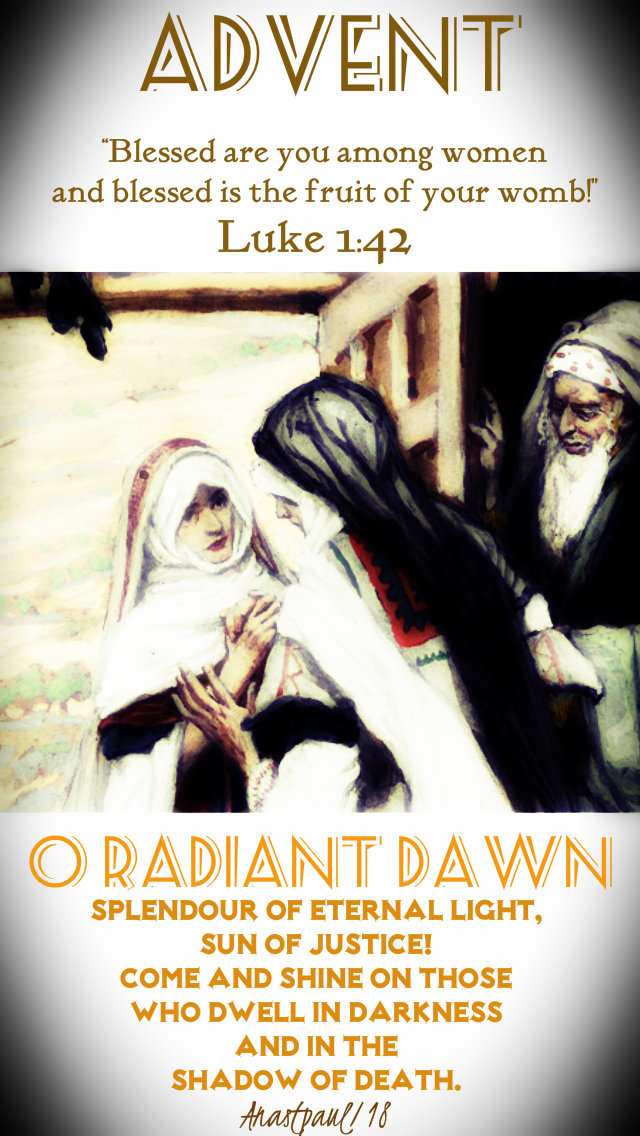
“Blessed are you among women and blessed is the fruit of your womb!”
Luke 1:42
Prayer
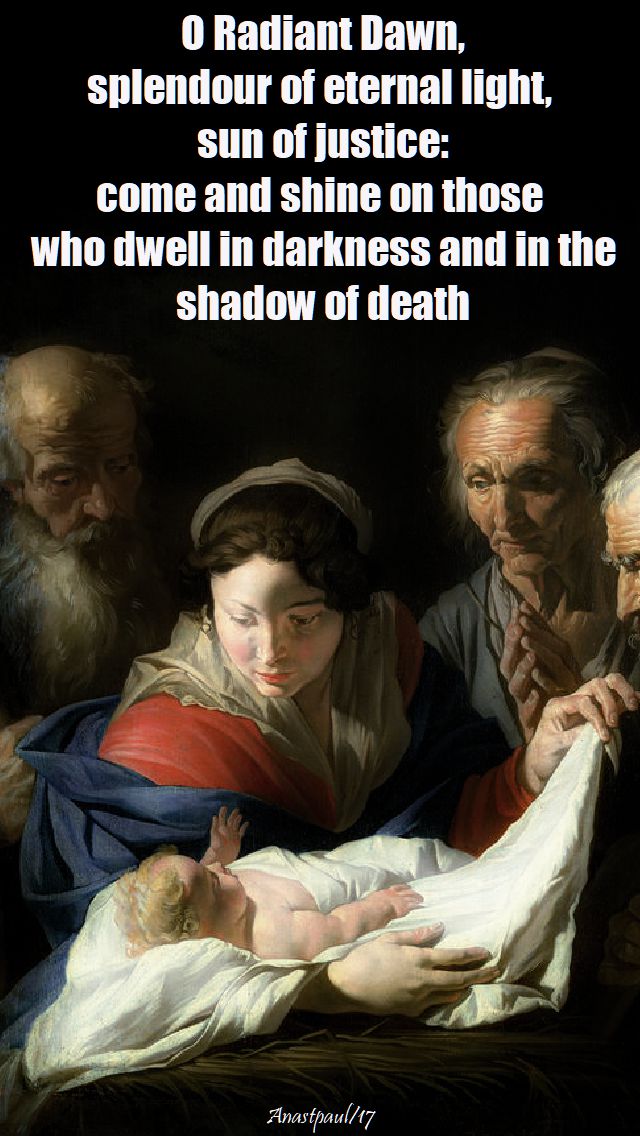
O Radiant Dawn,
splendour of eternal light, sun of justice!
Come and shine on those
who dwell in darkness and in the
shadow of death.
Advent Action
Dawn never happens quickly. Long before dawn, while it is quite dark, the birds start their sounds of joy. Slowly the night changes from dark, to charcoal, to haze, to light. Today’s Scripture presents to us the image of waiting. In the Gospel, Mary and Elizabeth, wait and wonder together and the Lord waits, St John the Baptist waits. Oftentimes, we are called to wait. We must believe that in our waiting, the dawning also exists. We know that the Lord will always draw us from darkness into His cleansing light. Patience is a virture – displayed so wonderfully and painfully by the Lord. How can we give into our impatience? Rest in Me, remember me in the womb of My mother Mary and learn patience!
Our Morning Offering – 21 December – Pope Benedict’s Favourite Prayer – The Memorial of St Peter Canisius (1521-1397) Doctor of the Church
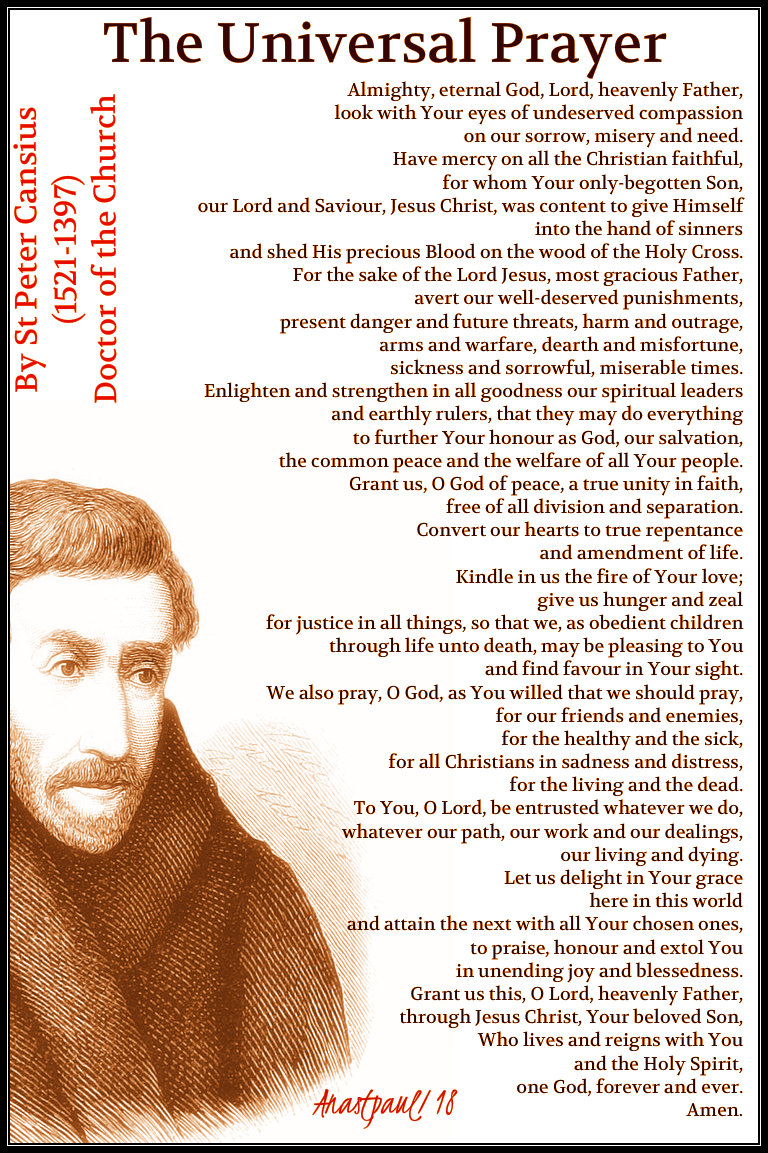
The Universal Prayer By Saint Peter Canisius
Almighty, eternal God, Lord, heavenly Father,
look with Your eyes of undeserved compassion
on our sorrow, misery and need.
Have mercy on all the Christian faithful,
for whom Your only-begotten Son,
our Lord and Saviour, Jesus Christ, was content to give Himself
into the hand of sinners
and shed His precious Blood on the wood of the Holy Cross.
For the sake of the Lord Jesus, most gracious Father,
avert our well-deserved punishments,
present danger and future threats, harm and outrage,
arms and warfare, dearth and misfortune,
sickness and sorrowful, miserable times.
Enlighten and strengthen in all goodness our spiritual leaders
and earthly rulers, that they may do everything
to further Your honour as God, our salvation,
the common peace and the welfare of all Your people.
Grant us, O God of peace, a true unity in faith,
free of all division and separation.
Convert our hearts to true repentance and amendment of life.
Kindle in us the fire of Your love; give us hunger and zeal
for justice in all things, so that we, as obedient children
through life unto death, may be pleasing to You
and find favour in Your sight.
We also pray, O God, as You willed that we should pray,
for our friends and enemies, for the healthy and the sick,
for all Christians in sadness and distress,
for the living and the dead.
To You, O Lord, be entrusted whatever we do,
whatever our path, our work and our dealings,
our living and dying.
Let us delight in Your grace here in this world
and attain the next with all Your chosen ones,
to praise, honour and extol You in unending joy and blessedness.
Grant us this, O Lord, heavenly Father,
through Jesus Christ, Your beloved Son,
Who lives and reigns with You and the Holy Spirit,
one God, forever and ever.
Amen.
“The [prayer] I like most…the ‘General Prayer’ by Peter Canisius from the sixteenth century. It remains unchangingly pertinent and beautiful.” From Pope Benedict, Last Testament, New York, Bloomsbury, 2016, 8.
Saint of the Day – 21 December – St Peter Canisius SJ. (1521-1597) The “Second Apostle of Germany” – Doctor of the Church
Catechesis of Pope Benedict XVI – 9 February 2011
He was born on 8 May 1521 in Wijmegen, Holland. His father was Burgomaster of the town. While he was a student at the University of Cologne he regularly visited the Carthusian monks of St Barbara, a driving force of Catholic life and other devout men who cultivated the spirituality of the so-called devotio moderna [modern devotion].
He entered the Society of Jesus on 8 May 1543 in Mainz (Rhineland — Palatinate), after taking a course of spiritual exercises under the guidance of Bl (now Saint) Pierre Favre, Petrus [Peter] Faber, one of St Ignatius of Loyola’s first companions. He was ordained a priest in Cologne. Already the following year, in June 1546, he attended the Council of Trent, as the theologian of Cardinal Otto Truchsess von Waldburg, Bishop of Augsberg, where he worked with two confreres, Diego Laínez and Alfonso Salmerón. In 1548, St Ignatius had him complete his spiritual formation in Rome and then sent him to the College of Messina to carry out humble domestic duties.
He earned a doctorate in theology at Bologna on 4 October 1549 and St Ignatius assigned him to carry out the apostolate in Germany. On 2 September of that same year he visited Pope Paul III at Castel Gandolfo and then went to St Peter’s Basilica to pray. Here he implored the great Holy Apostles Peter and Paul for help to make the Apostolic Blessing permanently effective for the future of his important new mission. He noted several words of this prayer in his spiritual journal.
He said: “There I felt that a great consolation and the presence of grace had been granted to me through these intercessors [Peter and Paul]. They confirmed my mission in Germany and seemed to transmit to me, as an apostle of Germany, the support of their benevolence. You know, Lord, in how many ways and how often on that same day you entrusted Germany to me, which I was later to continue to be concerned about and for which I would have liked to live and die”.
We must bear in mind that we are dealing with the time of the Lutheran Reformation, at the moment when the Catholic faith in the German-speaking countries seemed to be dying out in the face of the fascination of the Reformation. The task of Canisius — charged with revitalising or renewing the Catholic faith in the Germanic countries — was almost impossible. It was possible only by virtue of prayer. It was possible only from the centre, namely, a profound personal friendship with Jesus Christ, a friendship with Christ in His Body, the Church, which must be nourished by the Eucharist, His Real Presence.
In obedience to the mission received from Ignatius and from Pope Paul III, Canisius left for Germany. He went first to the Duchy of Bavaria, which for several years was the place where he exercised his ministry. As dean, rector and vice chancellor of the University of Ingolstadt, he supervised the academic life of the Institute and the religious and moral reform of the people. In Vienna, where for a brief time he was diocesan administrator, he carried out his pastoral ministry in hospitals and prisons, both in the city and in the countryside and prepared the publication of his Catechism. In 1556 he founded the College of Prague and, until 1569, was the first superior of the Jesuit Province of Upper Germany. In this office he established a dense network of communities of his Order in the Germanic countries, especially colleges, that were starting points for the Catholic Reformation, for the renewal of the Catholic faith.
At that time he also took part in the Colloquy of Worms with Protestant divines, including Philip Melanchthon (1557); He served as Papal Nuncio in Poland (1558); he took part in the two Diets of Augsberg (1559 and 1565); he accompanied Cardinal Stanislaw Hozjusz, Legate of Pope Pius IV, to Emperor Ferdinand (1560); and he took part in the last session of the Council of Trent where he spoke on the issue of Communion under both Species and on the Index of Prohibited Books (1562).
In 1580 he withdrew to Fribourg, Switzerland, where he devoted himself entirely to preaching and writing. He died there on 21 December 1597. Bl Pius IX Beatified him in 1864 and in 1897 Pope Leo XIII proclaimed him the “Second Apostle of Germany”. Pope Pius XI Canonised him and proclaimed him a Doctor of the Church in 1925.
St Peter Canisius spent a large part of his life in touch with the most important people of his time and exercised a special influence with his writings. He edited the complete works of Cyril of Alexandria and of St Leo the Great, the Letters of St Jerome and the Orations of St Nicholas of Flüe. He published devotional books in various languages, biographies of several Swiss Saints and numerous homiletic texts.
However, his most widely disseminated writings were the three Catechisms he compiled between 1555 and 1558. The first Catechism was addressed to students who could grasp the elementary notions of theology; the second, to young people of the populace for an initial religious instruction; the third, to youth with a scholastic formation of middle and high school levels. He explained Catholic doctrine with questions and answers, concisely, in biblical terms, with great clarity and with no polemical overtones.
There were at least 200 editions of this Catechism in his lifetime alone! And hundreds of editions succeeded one another until the 20th century. So it was, that still in my father’s generation people in Germany were calling the Catechism simply “the Canisius”. He really was the Catechist of Germany for centuries, he formed people’s faith for centuries. This was a characteristic of St Peter Canisius – his ability to combine harmoniously fidelity to dogmatic principles with the respect that is due to every person. St Canisius distinguished between a conscious, blameworthy apostosy from faith and a blameless loss of faith through circumstances.
Moreover, he declared to Rome that the majority of Germans who switched to Protestantism were blameless. In a historical period of strong confessional differences, Canisius avoided — and this is something quite extraordinary — the harshness and rhetoric of anger — something rare, as I said, in the discussions between Christians in those times — and aimed only at presenting the spiritual roots and at reviving the faith in the Church. His vast and penetrating knowledge of Sacred Scripture and of the Fathers of the Church served this cause, the same knowledge that supported his personal relationship with God and the austere spirituality that he derived from the Devotio Moderna and Rhenish mysticism.
Characteristic of St Canisius’ spirituality was his profound personal friendship with Jesus. For example, on 4 September 1549 he wrote in his journal, speaking with the Lord: “In the end, as if You were opening to me the heart of the Most Sacred Body, which it seemed to me I saw before me, You commanded me to drink from that source, inviting me, as it were, to draw the waters of my salvation from Your founts, O my Saviour”.
Then he saw that the Saviour was giving him a garment with three pieces that were called peace, love and perseverance. And with this garment, made up of peace, love and perseverance, Canisius carried out his work of renewing Catholicism. His friendship with Jesus — which was the core of his personality — nourished by love of the Bible, by love of the Blessed Sacrament and by love of the Fathers, this friendship was clearly united with the awareness of being a perpetuator of the Apostles’ mission in the Church. And this reminds us that every genuine evangeliser is always an instrument united with Jesus and with His Church and is fruitful for this very reason.
Friendship with Jesus had been inculcated in St Peter Canisius in the spiritual environment of the Charterhouse of Cologne, in which he had been in close contact with two Carthusian mystics – Johannes Lansperger, whose name has been Latinized as “Lanspergius” and Nikolaus van Esche, Latinized as “Eschius”.
He subsequently deepened the experience of this friendship, familiaritas stupenda nimis, through contemplation of the mysteries of Jesus’ life, which form a large part of St Ignatius’ Spiritual Exercises. This is the foundation of his intense devotion to the Heart of the Lord, which culminated in his consecration to the apostolic ministry in the Vatican Basilica.
The Christocentric spirituality of St Peter Canisius is rooted in a profound conviction – no soul anxious for perfection fails to practice prayer daily, mental prayer, an ordinary means that enables the disciple of Jesus to live in intimacy with the divine Teacher.
For this reason in his writings for the spiritual education of the people, our Saint insists on the importance of the Liturgy with his comments on the Gospels, on Feasts, on the Rite of Holy Mass and on the sacraments; yet, at the same time, he is careful to show the faithful the need for and beauty of personal daily prayer, which should accompany and permeate participation in the public worship of the Church. This exhortation and method have kept their value intact, especially after being authoritatively proposed anew by the Second Vatican Council in the Constitution Sacrosanctum Concilium, Christian life does not develop unless it is nourished by participation in the Liturgy — particularly at Sunday Mass — and by personal daily prayer, by personal contact with God.
Among the thousands of activities and multiple distractions that surround us, we must find moments for recollection before the Lord every day, in order to listen to Him and speak with Him.
At the same time, the example that St Peter Canisius has bequeathed to us, not only in his works but especially with his life, is ever timely and of lasting value. He teaches clearly that the apostolic ministry is effective and produces fruits of salvation in hearts only if the preacher is a personal witness of Jesus and an instrument at His disposal, bound to Him closely by faith in His Gospel and in His Church, by a morally consistent life and by prayer as ceaseless as love. And this is true for every Christian who wishes to live his adherence to Christ with commitment and fidelity.
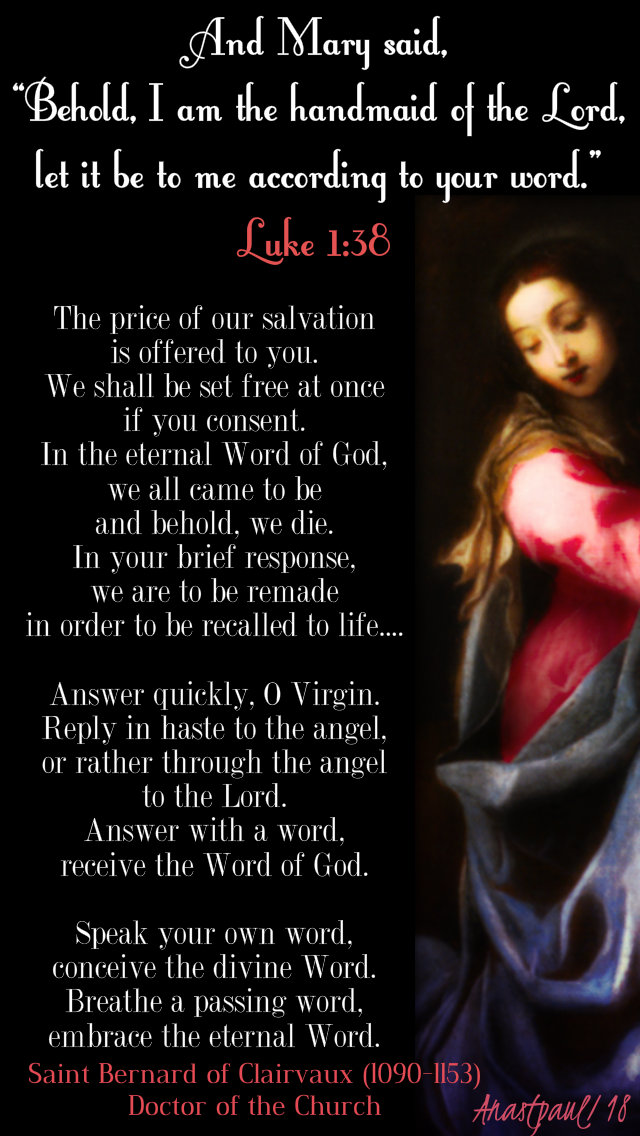
Thought for the Day – 20 December – “And behold, you will conceive in your womb and bear a son and you shall call his name Jesus.” – Today’s Gospel Luke 1:26-38
Saint Bernard of Clairvaux (1090-1153) Abbot and Doctor of the Church
An excerpt from Homily 4
” In the sixth month, the angel Gabriel was sent from God to a city of Galilee named Nazareth, to a virgin betrothed to a man whose name was Joseph, of the house of David; and the virgin’s name was Mary. And he came to her and said, “Hail, full of grace, the Lord is with you!” But she was greatly troubled at the saying and considered in her mind what sort of greeting this might be. And the angel said to her, “Do not be afraid, Mary, for you have found favour with God. And behold, you will conceive in your womb and bear a son, and you shall call his name Jesus.”…Luke1:26-31
You have heard, O Virgin, that you will conceive and bear a son – you have heard that it will not be by man but by the Holy Spirit. The angel awaits an answer – it is time for him to return to God who sent him. We too are waiting, O Lady, for your word of compassion, the sentence of condemnation weighs heavily upon us.
The price of our salvation is offered to you. We shall be set free at once if you consent. In the eternal Word of God we all came to be and behold, we die. In your brief response we are to be remade in order to be recalled to life.
Tearful Adam with his sorrowing family begs this of you, O loving Virgin, in their exile from Paradise. Abraham begs it, David begs it. All the other holy patriarchs, your ancestors, ask it of you, as they dwell in the country of the shadow of death. This is what the whole earth waits for, prostrate at your feet. It is right in doing so, for on your word depends comfort for the wretched, ransom for the captive, freedom for the condemned, indeed, salvation for all the sons of Adam, the whole of your race.
Answer quickly, O Virgin. Reply in haste to the angel, or rather through the angel to the Lord. Answer with a word, receive the Word of God. Speak your own word, conceive the divine Word. Breathe a passing word, embrace the eternal Word.
Why do you delay, why are you afraid? Believe, give praise and receive. Let humility be bold, let modesty be confident. This is no time for virginal simplicity to forget prudence. In this matter alone, O prudent Virgin, do not fear to be presumptuous. Though modest silence is pleasing, dutiful speech is now more necessary. Open your heart to faith, O blessed Virgin, your lips to praise, your womb to the Creator. See, the desired of all nations is at your door, knocking to enter. If He should pass by because of your delay, in sorrow, you would begin to seek Him afresh, the One whom your soul loves. Arise, hasten, open. Arise in faith, hasten in devotion, open in praise and thanksgiving.
Behold the handmaid of the Lord, she says, be it done to me according to your word.
Advent and Christmas Wisdom with St Alphonsus Liguori (1696-1787))
20 December
Jesus offered Himself for our salvation from the beginning
“Consider that the divine Word knew that all the sacrifices of goats and bulls offered to the Father in times past had not been able to satisfy for the sins of humankind but that it required a divine person to pay the price of redemption. “My Father” said Jesus, “all the victims previously offered to You have not paid the debt, nor could they have paid the debt, necessary to satisfy Your justice. You have given me my humanity, in order that by shedding my blood, I might please You and save humanity. Behold I come. Here I am. I am ready. I accept everything and I submit myself in everything, to Your will.”
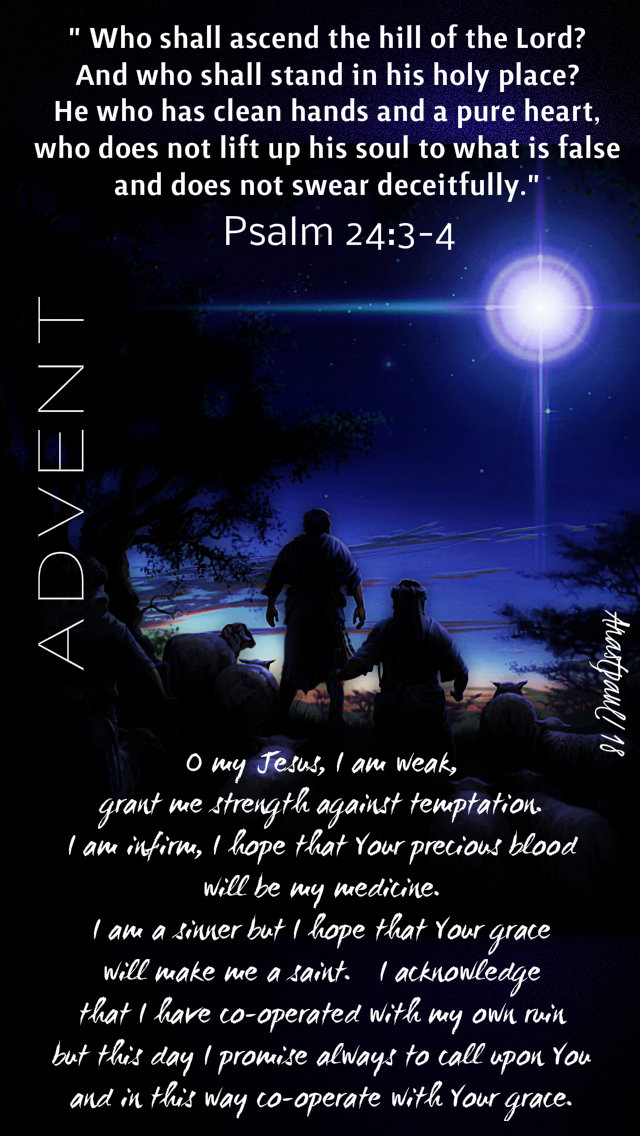
O my Jesus, I am weak, grant me strength against temptation. I am infirm, I hope that Your precious blood will be my medicine. I am a sinner but I hope that Your grace will make me a saint. I acknowledge that I have co-operated with my own ruin but this day, I promise always, to call upon You and in this way co-operate with Your grace.”
Scripture ” Who shall ascend the hill of the Lord? And who shall stand in his holy place? He who has clean hands and a pure heart, who does not lift up his soul to what is false and does not swear deceitfully.”
Psalm 24:3-4
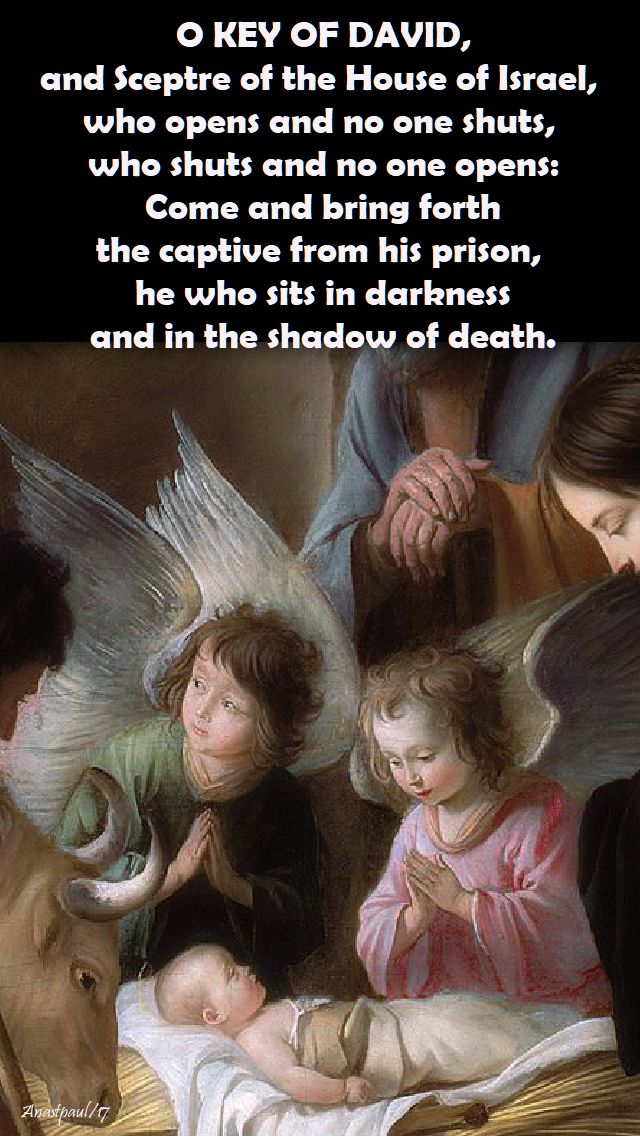
Prayer O KEY OF DAVID, and Sceptre of the House of Israel, who opens and no-one shuts, who shuts and no-one opens: Come and bring forth the captive from his prison, he who sits in darkness and in the shadow of death.
Advent Action
The Pharisees, dressed in fine robes and living in palaces, are rejected. Advent is the time to ask Jesus to change us. He is coming, He invades the world, He changes everything, forevermore – He will change us if we ask – “Lord, come to me this day. Change me. Restore me to Your kingdom.” “If we would please this Divine Infant, we too must become children, simple and humble; we must carry to Him flowers of virtue, of meekness, of mortification, of charity; we must clasp Him in the arms of our love.”…St Alphonsus
Advent and Christmas Wisdom with St Alphonsus Liguori (1696-1787)
19 December
The passion of Jesus lasted throughout His whole life
“Consider that when Abraham was leading his son Isaac to death, that he did not give him notice of it beforehand, even during the short time that was necessary for them to arrive at the mount. But the eternal Father chose that His incarnate Son, whom He had destined to be the victim for the atonement of our sins, should know the sorrow He was to endure from the very first moment that He was in His mother’s womb. The whole life, then, of our blessed Redeemer and all the years that He spent, was a life of pain and tears. His divine heart never passed one moment free from suffering. The martyrs have suffered but assisted by grace, they suffered with you and fervour. Jesus Christ suffered but He suffered with a heart full of weariness and sorrow and He accepted all, for our love.
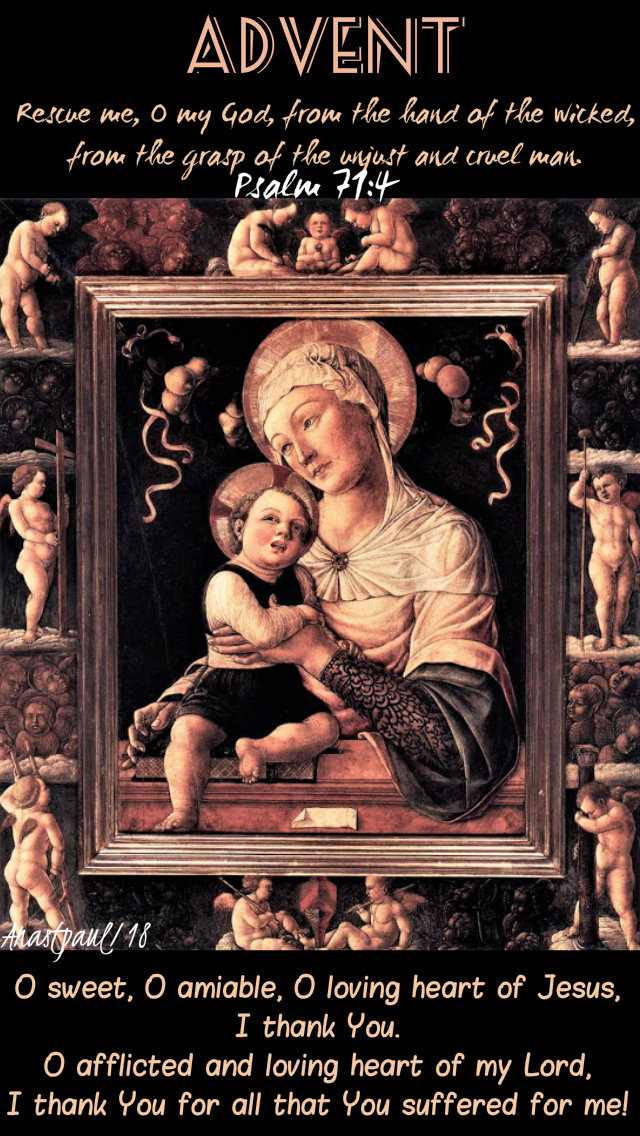
O sweet, O amiable, O loving heart of Jesus, I thank You. O afflicted and loving heart of my Lord, I thank You for all that You suffered for me!”
Scripture
Rescue me, O my God, from the hand of the wicked, from the grasp of the unjust and cruel man.
Psalm 71:4
Prayer
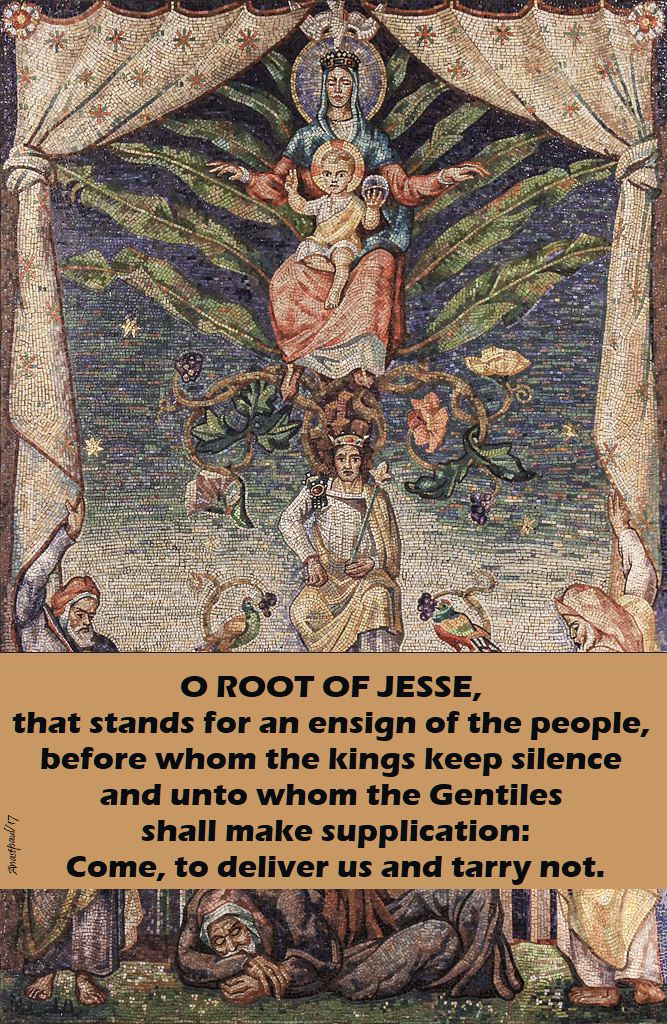
O ROOT OF JESSE, that stands for an ensign of the people, before whom the kings keep silence and unto whom the Gentiles shall make supplication, come, to deliver us and tarry not.
Advent Action
Speechless I stand before You, contemplating the Father’s mysterious design for our salvation. I revere the elaborate preparations the Father puts in place for Your coming into our midst as one of us. First, He prepares a mother for You, preserving her from sin right from conception and filling her with grace. Then, in the fullness of time, He approaches her announcing His plan and the role she has to play in it. Then, He takes care of her heart-broken husband, Joseph, announcing to him the mystery of Your incarnation. And finally, the Father raises one more prophet to prepare the field for Your mission and to introduce You to our world.
Today, Your Word invites me to reflect on the role of the Baptist in Your redemptive work and challenges me to make space for You to be born in our world and in my heart.
Lord, let my life be a pointer to You as John’s was…I beg You!
Advent and Christmas Wisdom with St Alphonsus Liguori (1696-1787))
18 December
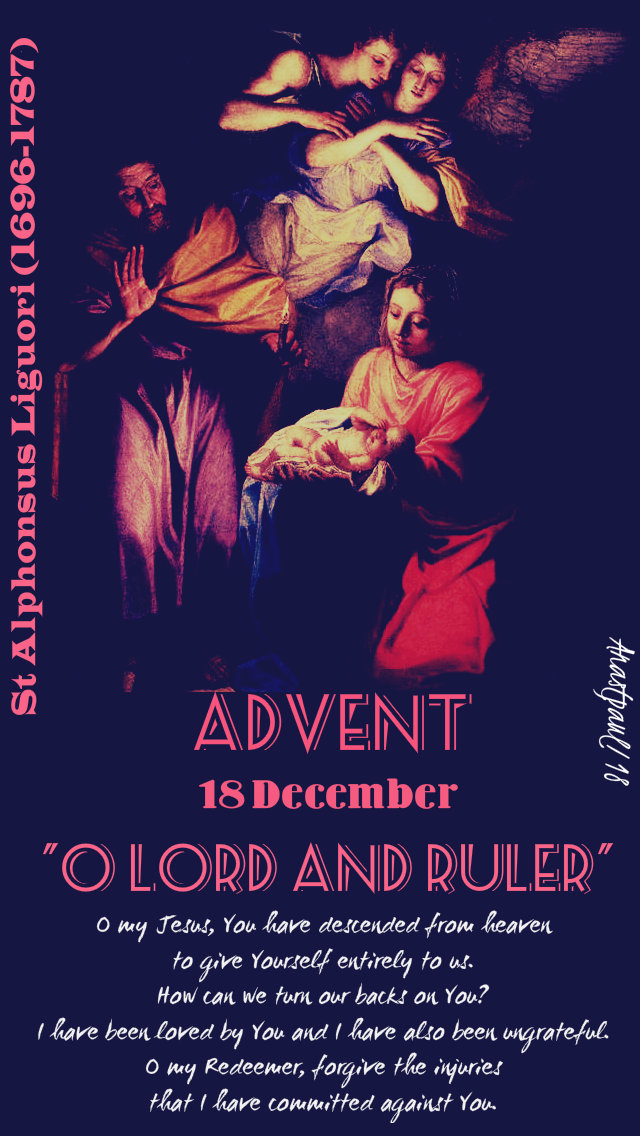
Jesus made Himself a child to gain our confidence and our love.
“Consider that the Son of God has made Himself little in order to make us great. He has given Himself to us, that we might give ourselves to Him. He has come to show us His love, that we may respond to it by giving Him ours. Let us, therefore, receive Him with affection, let us love Him and call upon Him with all our needs.
“A child gives easily” says St Bernard. Children readily give whatever is asked of them. Jesus came into the world as a child to demonstrate that He was ready and willing to give all. If we wish for light, Jesus has come to enlighten us. If we desire strength, He will strengthen us. If we wish for pardon, He has come to pardon us. In short, He has come to give us all that we need.
O my Jesus, You have descended from heaven to give Yourself entirely to us. How can we turn our backs on You? I have been loved by You and I have also been ungrateful. O my Redeemer, forgive the injuries that I have committed against You.”
Scripture
“It is now the hour for you to wake from sleep….Let us cast off deeds of darkness and put on the armour of light.”
Romans 13:11,12
Prayer
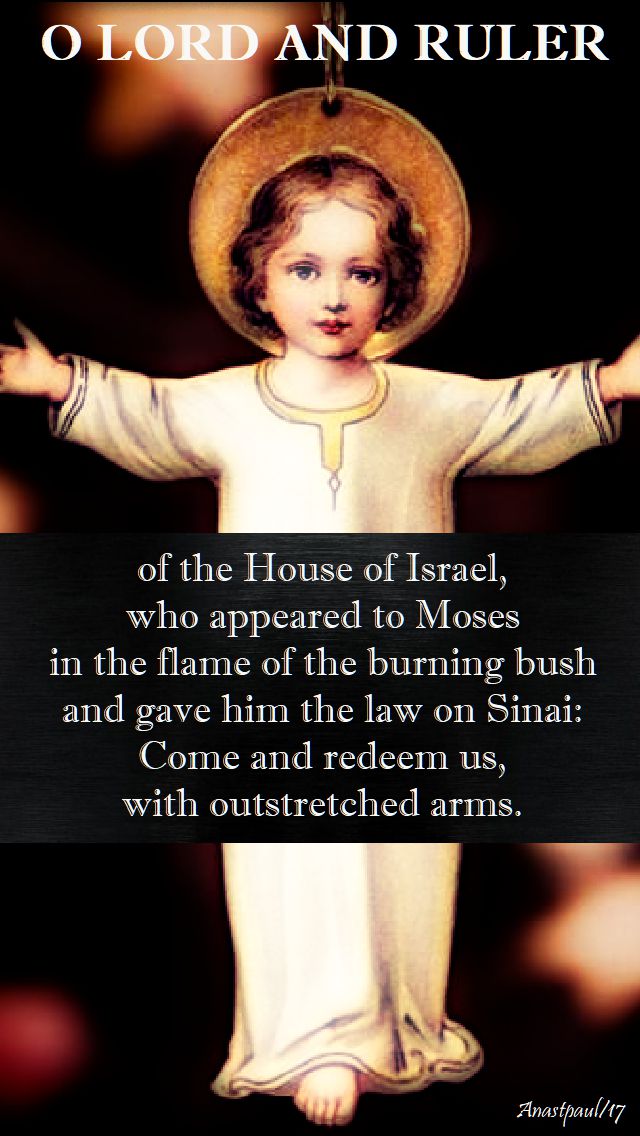
O LORD AND RULER of the House of Israel, who appeared to Moses in the flame of the burning bush and gave him the law on Sinai: Come and redeem us with outstretched arms.
Advent Action
Are we in the core group of Christians who embody and live the purest form of the Gospel? Or do we find ourselves among the masses that acknowledge Jesus, enjoy being Christian but don’t pursue it at any deep level? The two requirements in the Gospel are that we repent and believe. If we repent, we do no wrong and speak no lies. If we believe with all our hearts, we follow the Star to the Manger. Let these last few days be a time when we begin the journey to the Christmas core – to the Christ Child. “Let us make ourselves ready to celebrate Christmas by contemplating Mary and Joseph- Mary, the woman full of grace who had the courage to entrust herself totally to the Word of God; Joseph, the faithful and just man who chose to believe the Lord rather than listen to the voices of doubt and human pride. With them, let us walk together toward Bethlehem.” ...Pope Francis – Angelus, 22 December 2013
Advent and Christmas Wisdom with St Alphonsus Liguori (1696-1787))
17 December
The Heart of Jesus in the womb of His Mother
“Consider that whatever Jesus suffered in His life and in His Passion was all placed before Him while He was in the womb of Mary. He accepted everything that was proposed to Him with delight but in accepting all things and in overcoming the natural repugnance of sense, O my God, what anguish and oppression did the innocent heart of Jesus suffer. Our Redeemer accepted each moment even though He continually had before His eyes that confusion which He would one day feel at seeing Himself stripped naked, scourged and suspended by three iron nails, ending His life in the midst of insults and curses. And for what? To save us miserable and ungrateful sinners.
My beloved Redeemer, how much did it cost You to raise me from the ruin, which I brought on myself through my sins? What can I do without Your grace? I can do nothing but pray that You will help me but even this prayer comes from the merits of Your suffering and death! O my Jesus, help me!”
Scripture
The book of the genealogy of Jesus Christ, the son of David, the son of Abraham.
Matthew 1:1
Prayer
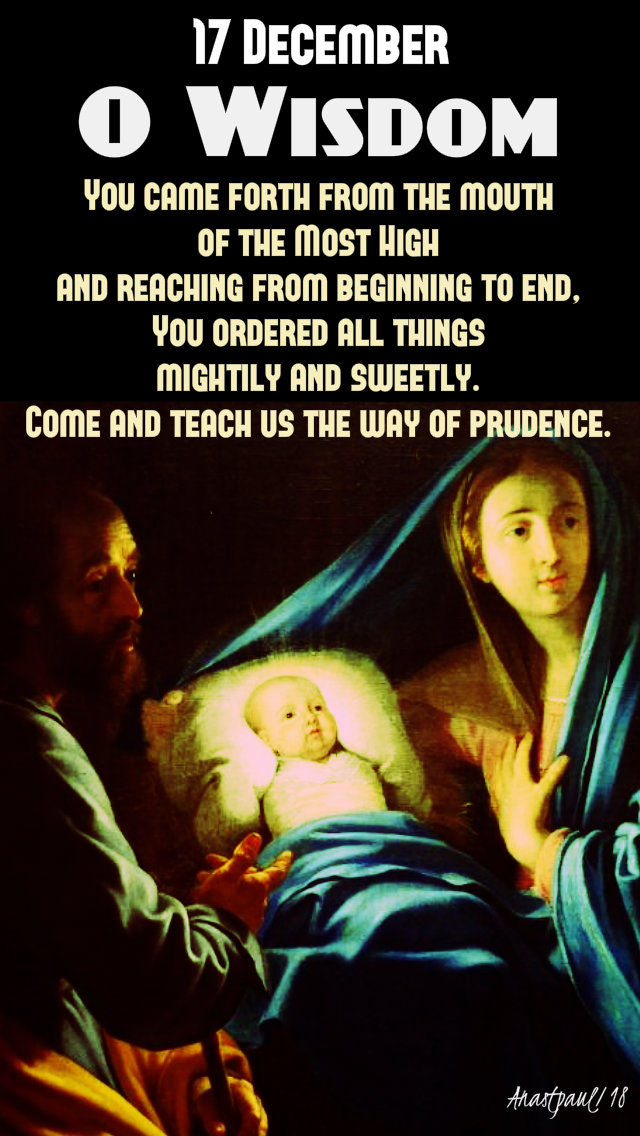
O WISDOM You came forth from the mouth of the Most High and reaching from beginning to end, You ordered all things mightily and sweetly. Come and teach us the way of prudence
Advent Action
Time is fast approaching for Eternity to break into time. And today we begin our special preparations to celebrate Your birthday. Your Evangelist, Matthew, begins his Gospel by tracing Your origin as a human being. You did not come to us as bolt from the blue. You fully belong to our human stock. Matthew’s list of Your genealogy is disturbing, if not shocking. Of course, Your ancestors include great patriarchs of the chosen people. But it also includes some of ill repute! It begins with Abraham begetting Isaac. Ishmael, the first son of Abraham, is not in the picture. The story continues with Isaac begetting Jacob and not the elder son Esau. Again, Jacob begets Judah, ignoring Joseph who was obviously the best of the brothers. With these unreasonable choices, Matthew seems to impress on us that often God does not choose the best or the noblest or the saintly. Thank You, Lord, for it is only Your unpredictable graciousness that made You choose me and employ me in Your service! Only by my prayer, ‘O my Jesus, help me’ can I live up to this choice. And so I increase my prayer this week. (Fr Joseph Thena SSP)
Thought for the Day – 16 December 2018 – The Third ‘Gaudete’ Sunday of Advent
Saint Augustine (354-430)
Bishop and Great Western Father and Doctor of the Church
An excerpt from his Sermon 293
John is the voice but the Lord is the Word who was in the beginning. John is the voice that lasts for a time, from the beginning, Christ is the Word who lives forever.
Take away the word, the meaning and what is the voice? Where there is no understanding, there is only a meaningless sound. The voice without the word strikes the ear but does not build up the heart.
However, let us observe what happens when we first seek to build up our hearts. When I think about what I am going to say, the word or message is already in my heart. When I want to speak to you, I look for a way to share with your heart what is already in mine.
In my search for a way to let this message reach you, so that the word already in my heart may find a place also in yours, I use my voice to speak to you. The sound of my voice brings the meaning of the word to you and then passes away. The word which the sound has brought to you is now in your heart and yet it is still also in mine.
When the word has been conveyed to you, does not the sound seem to say – the word ought to grow and I should diminish? The sound of the voice has made itself heard in the service of the word and has gone away, as though it were saying – my joy is complete. Let us hold on to the word; we must not lose the word conceived inwardly in our hearts.
Do you need proof that the voice passes away but the divine Word remains? Where is John’s baptism today? It served its purpose and it went away. Now it is Christ’s baptism that we celebrate. It is in Christ that we all believe, we hope for salvation in Him. This is the message the voice cried out.
Because it is hard to distinguish word from voice, even John himself was thought to be the Christ. The voice was thought to be the word. But the voice acknowledged what it was, anxious not to give offence to the word. I am not the Christ, he said, nor Elijah, nor the prophet. And the question came: Who are you, then? He replied: I am the voice of one crying in the wilderness – Prepare the way for the Lord!
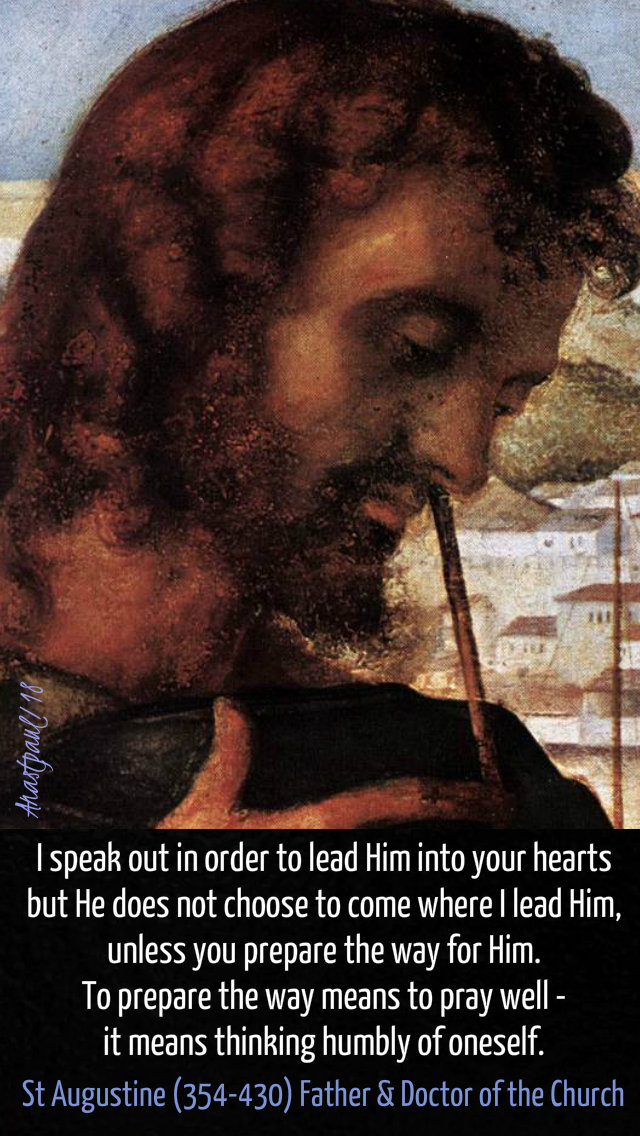
The voice of one crying in the wilderness is the voice of one breaking the silence. Prepare the way for the Lord, he says, as though he were saying: “I speak out in order to lead Him into your hearts but He does not choose to come where I lead Him, unless you prepare the way for Him.”
To prepare the way means to pray well – it means thinking humbly of oneself. We should take our lesson from John the Baptist. He is thought to be the Christ, he declares he is not what they think. He does not take advantage of their mistake to further his own glory.
If he had said, “I am the Christ,” you can imagine how readily he would have been believed, since they believed he was the Christ even before he spoke. But he did not say it, he acknowledged what he was. He pointed out clearly who he was; he humbled himself.
He saw where his salvation lay. He understood that he was a lamp and his fear was that it might be blown out, by the wind of pride.”
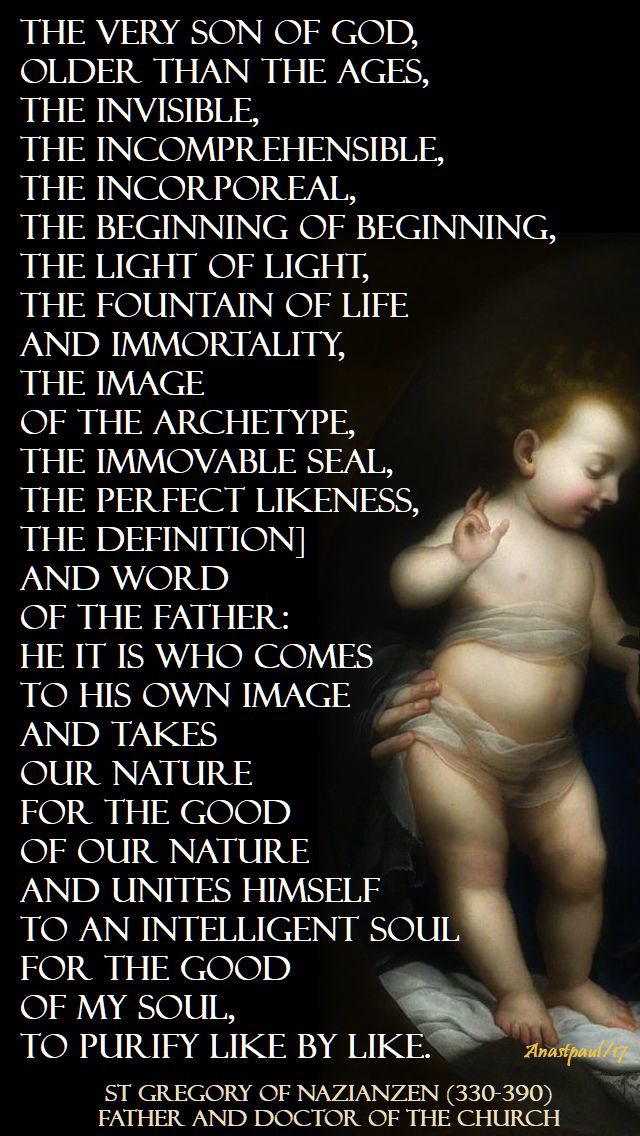
“The very Son of God, older than the ages, the invisible, the incomprehensible, the incorporeal, the beginning of beginning, the light of light, the fountain of life and immortality, the image of the archetype, the immovable seal, the perfect likeness, the definition and word of the Father: He it is who comes to His own image and takes our nature for the good of our nature and unites Himself to an intelligent soul for the good of my soul, to purify like by like.”
St Gregory of Nazianzen (330-390) Father and Doctor of the Church
Advent and Christmas Wisdom with St Alphonsus Liguori (1696-1787)
16 December – Gaudete Sunday
God has given His only Son to save us
“Consider, that the eternal Father has given His Son to the world, for the light and life of all people, in order that He might win salvation. Consider also, that the Father, in sending His Son to be our Redeemer and Mediator has, in a certain sense, bound Himself to forgive us and love us. On the other hand, the divien Word, having accepted the invitation of His Father, has also bound Himself to love us – not for our own merits but rather, to fulfil the merciful will of His Father.”
Scripture
Have no anxiety about anything but in everything, by prayer and supplication, with thanksgiving, let your requests be made known to God.
Philippians 4:6
Prayer (St Alphonsus)
O infinite God
and only love of my soul,
I thank You,
for having given me Your Son.
For the sake of this same Son,
accept me
and bind me with chains of love
to my Redeemer.
Amen
Advent Action
We begin this third week of Advent asking to feel the joy that comes from knowing our Lord’s coming to us is near.
In these precious days ahead, we are praying, longing, hoping in the background of our everyday lives.
His mission is to the poor, the brokenhearted, prisoners and captives. His mission is for us. It is “good news,” full of healing, liberty and release. We can smile today as we imagine the freedom He has won for us and how liberating it will be to live it, with Him, for others.
It is right to give our God thanks and praise and to follow His mission in our lives.
Jesus will come again, very soon!
Thought for the Day – 15 December – Saturday of the Second week of Advent
The Word of the Lord will come to us – The Threefold Coming of the Lord
St Bernard Clairvaux (1090-1153) Doctor of the Church
We know that the coming of the Lord is threefold – the third coming is between the other two and it is not visible in the way they are. At His first coming the Lord was seen on earth and lived among men, who saw Him and hated Him. At His last coming All flesh shall see the salvation of our God and They shall look on Him whom they have pierced. In the middle, the hidden coming, only the chosen see Him and they see Him within themselves and so their souls are saved. The first coming was in flesh and weakness, the middle coming is in spirit and power and the final coming will be in glory and majesty.
This middle coming is like a road that leads from the first coming to the last. At the first, Christ was our redemption, at the last, He will become manifest as our life but in this middle way He is our rest and our consolation.
If you think that I am inventing what I am saying about the middle coming, listen to the Lord Himself: “If anyone loves me, he will keep my words and the Father will love him and we shall come to him.” Elsewhere I have read: Whoever fears the Lord does good things – but I think that what was said about whoever loves Him was more important, that whoever loves Him will keep His words. Where are these words to be kept? In the heart certainly, as the Prophet says I have hidden your sayings in my heart so that I do not sin against you. Keep the word of God in that way – Blessed are those who keep it. Let it penetrate deep into the core of your soul and then flow out again in your feelings and the way you behave, because if you feed your soul well it will grow and rejoice. Do not forget to eat your bread, or your heart will dry up. Remember and your soul will grow fat and sleek.
If you keep God’s word like this, there is no doubt that it will keep you, for the Son will come to you with the Father, the great Prophet will come, who will renew Jerusalem and He is the one who makes all things new. For this is what this coming will do, just as we have been shaped in the earthly image, so will we be shaped in the heavenly image. Just as the old Adam was poured into the whole man and took possession of him, so in turn will our whole humanity be taken over by Christ, who created all things, has redeemed all things and will glorify all things.
Advent and Christmas Wisdom with St Alphonsus Liguori
15 December – Saturday of the Second week of Advent
The greatest sorrow of Jesus
“Consider Jesus, who revealed to the Venerable Agatha of the Cross, that which afflicted Him more than any other sorrow was hardness of the hearts of humanity. This sorrow, was the bitter chalice that Jesus begged the Father to remove from Him, saying, “Let this chalice pass from me. ” What chalice? The contempt with which His love was treated. Our Lord revealed to St Catherine of Siena that this was the reason that He exclaimed from the cross, “My God, my God, why have You forsaken me?”
Knowing this sorrow, let us change our will, repent of our sins and resolve to love God. In this way, we shall then find peace, that is, the divine friendship that we seek. We beg the Lord for the necessary grace to execute what we propose. We call upon our Blessed Lady and ask that she not cease to pray until we are changed and made into what God wishes us to be.”
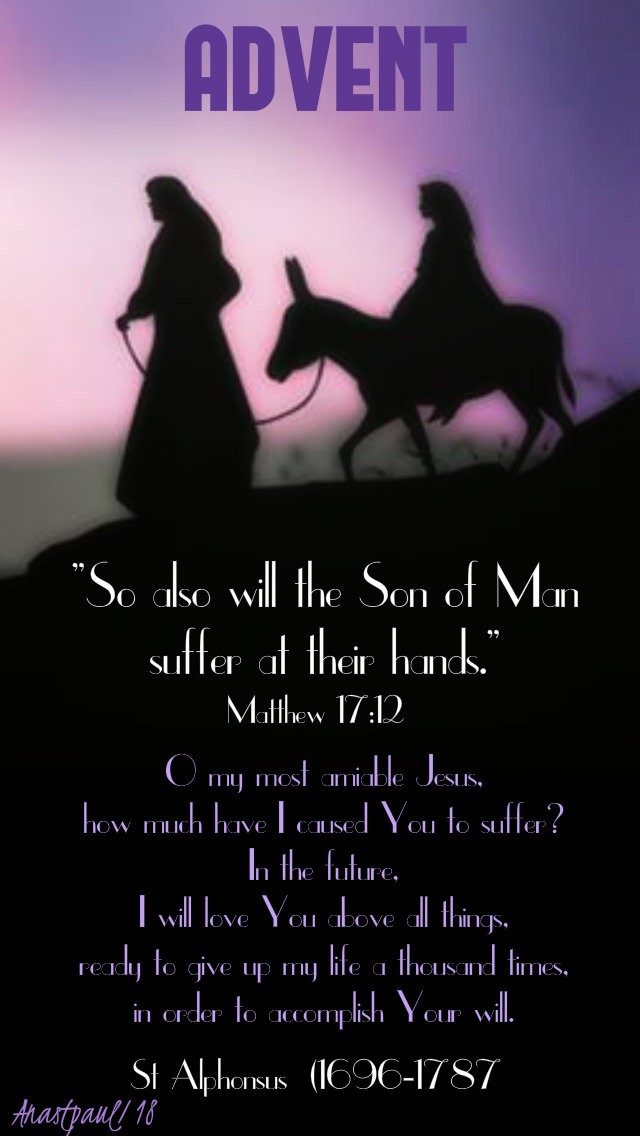
Scripture “So also will the Son of Man suffer at their hands.”
Matthew 17:12b
Prayer (St Alphonsus)
“O my most amiable Jesus,
how much have I caused You to suffer?
In the future,
I will love You above all things,
ready to give up my life a thousand times,
in order to accomplish Your will.
Mary Holy Mother,
I beg your prayer and loving care.
Please help us all.
Amen”
Advent Action
Today’s Scriptures encourage us to look for the signs of Jesus, who will restore life to us. “Lord, help me see the signs of Your coming. Let me not be blinded by the glare of business or the millions of lights in malls and on trees. Rather, let me look for You in the small things of the day, with my heart longing for You. “Christ dwelt for nine months in the tabernacle of Mary’s womb. He dwells until the end of the ages in the tabernacle of the Church’s faith. He will dwell forever, in the knowledge and love of each faithful soul.” [Blessed Isaac of Stella (c 1100-1170) Cistercian Monk] Amen!”
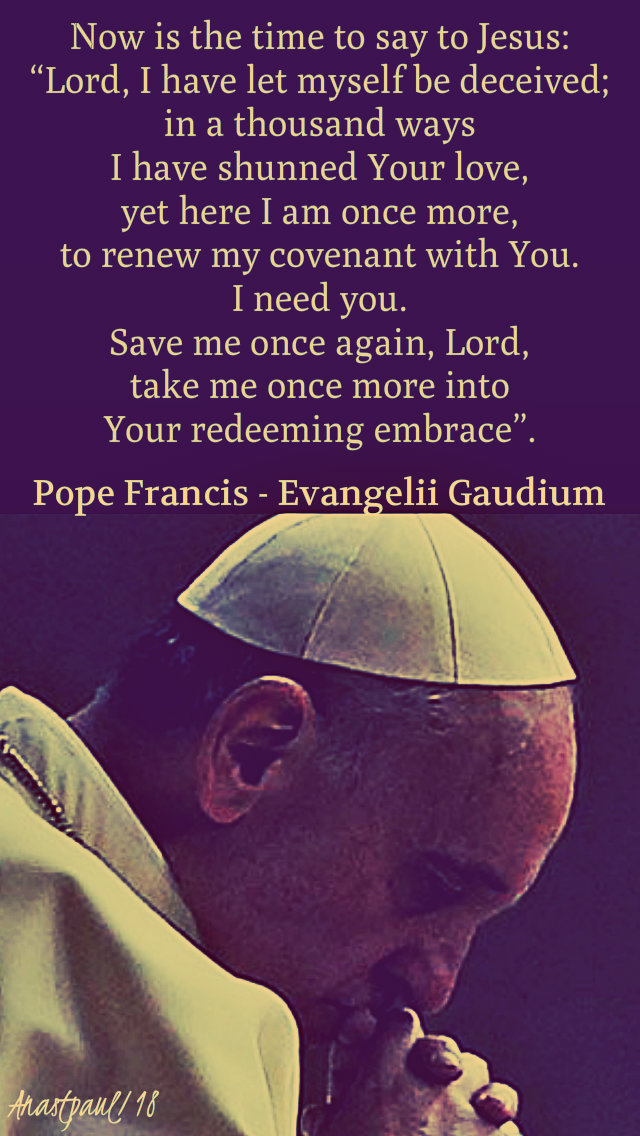
“Now is the time to say to Jesus: “Lord, I have let myself be deceived; in a thousand ways I have shunned Your love, yet here I am once more, to renew my covenant with You. I need you. Save me once again, Lord, take me once more into Your redeeming embrace”.
Our Morning Offering – 15 December – Saturday of the Second week of Advent
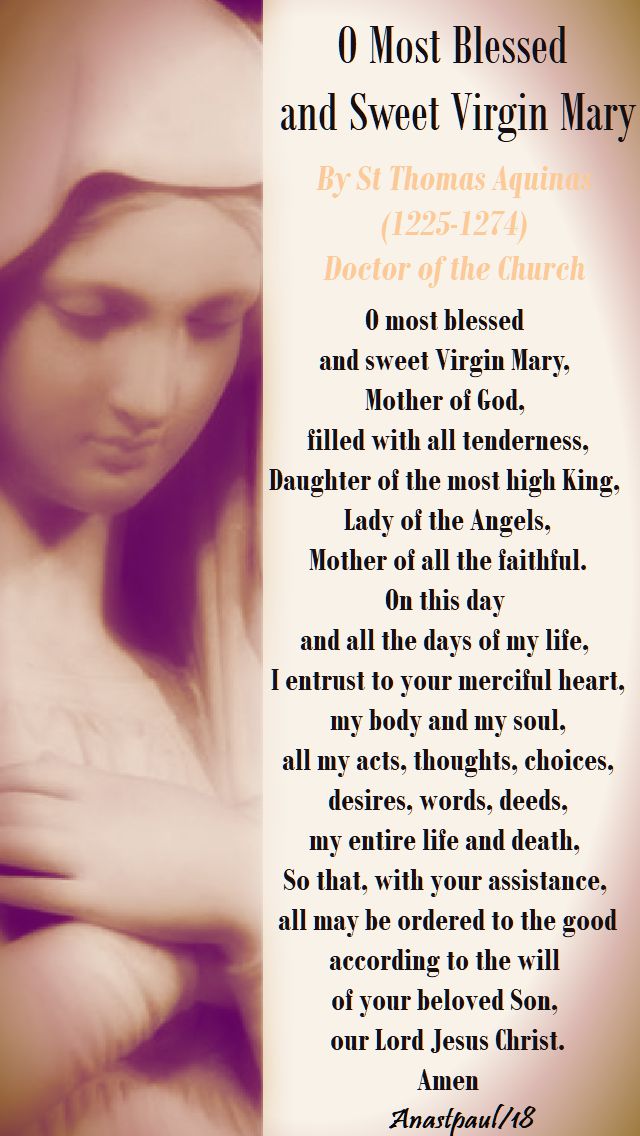
O Most Blessed and Sweet Virgin Mary By St Thomas Aquinas (1225-1274) Doctor of the Church
0 most blessed and sweet Virgin Mary,
Mother of God, filled with all tenderness,
Daughter of the most high King,
Lady of the Angels,
Mother of all the faithful,
On this day and all the days of my life,
I entrust to your merciful heart,
my body and my soul,
all my acts, thoughts, choices,
desires, words, deeds,
my entire life and death,
So that, with your assistance,
all may be ordered to the good
according to the will of your beloved Son,
our Lord Jesus Christ.
Amen
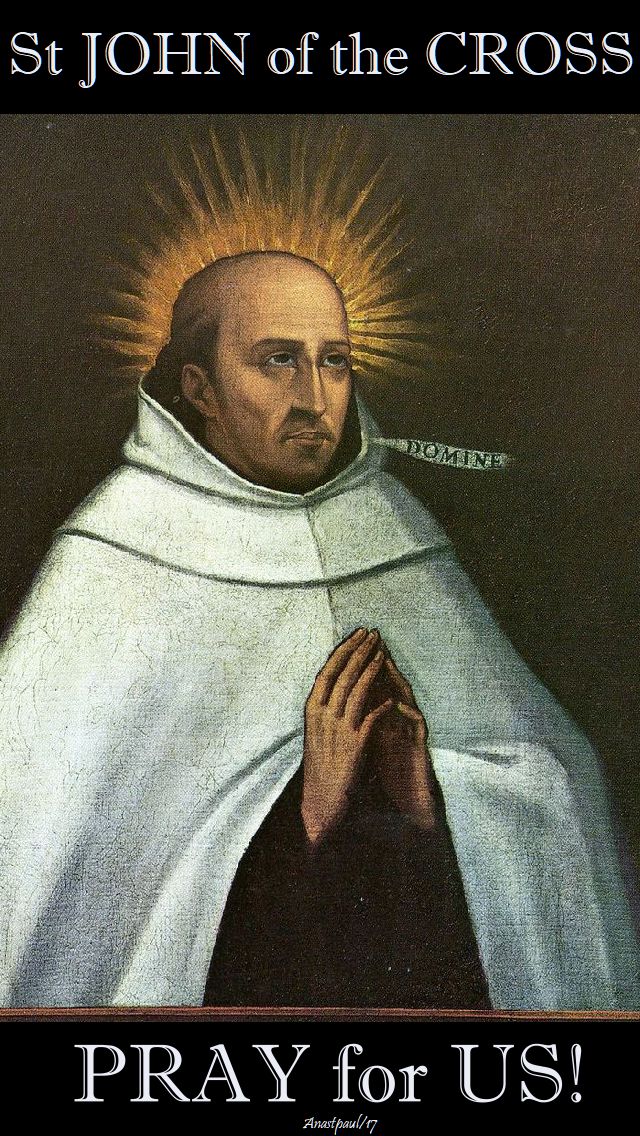
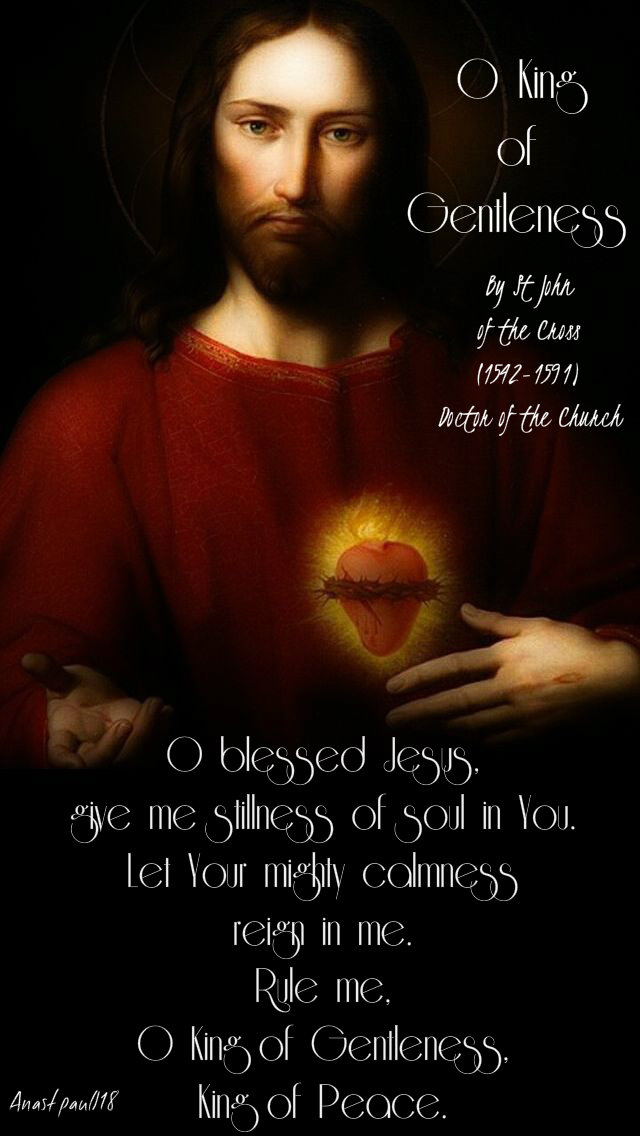
Thought for the Day – 14 December – The Memorial of St John of the Cross (1542-1591) Doctor of the Church
Traces of the Divine Beauty in Creation From The Spiritual Canticle by Saint John of the Cross
“Created things in themselves, as Saint Augustine declares, give testimony to God’s grandeur and excellence. For God created all things with remarkable ease and brevity and in them He left some trace of who He is, not only in giving all things being from nothing but even by endowing them, with innumerable graces and qualities, making them beautiful in a wonderful order and unfailing dependence on one another. All of this He did through His own wisdom, the Word, His only begotten Son by whom He created them.
Saint Paul says: The Son of God is the splendour of His glory and the image of His substance. It should be known that only with this figure, His Son, did God look at all things, that is, He communicated to them their natural being and many natural graces and gifts and made them complete and perfect, as is said in Genesis: God looked at all things that He made, and they were very good. To look and behold that they were very good, was to make them very good in the Word, his Son.
Not only by looking at them did He communicate natural being and graces, as we said but also with this image of His Son alone, He clothed them in beauty by imparting to them supernatural being. This He did when He became man and elevated human nature in the beauty of God and consequently all creatures, since in human nature He was united with them all.
Accordingly, the Son of God proclaimed: If I be lifted up from the earth, I will elevate all things to me. And in this elevation of all things through the incarnation of His Son and through the glory of His resurrection according to the flesh, the Father did not merely beautify creatures partially but rather, we can say, clothed them wholly in beauty and dignity.”
“Lord I am not worthy but only say the word and I shall be healed.”
Quotes of the Day – 14 December – The Memorial of St John of the Cross (1542-1591) Doctor of the Church
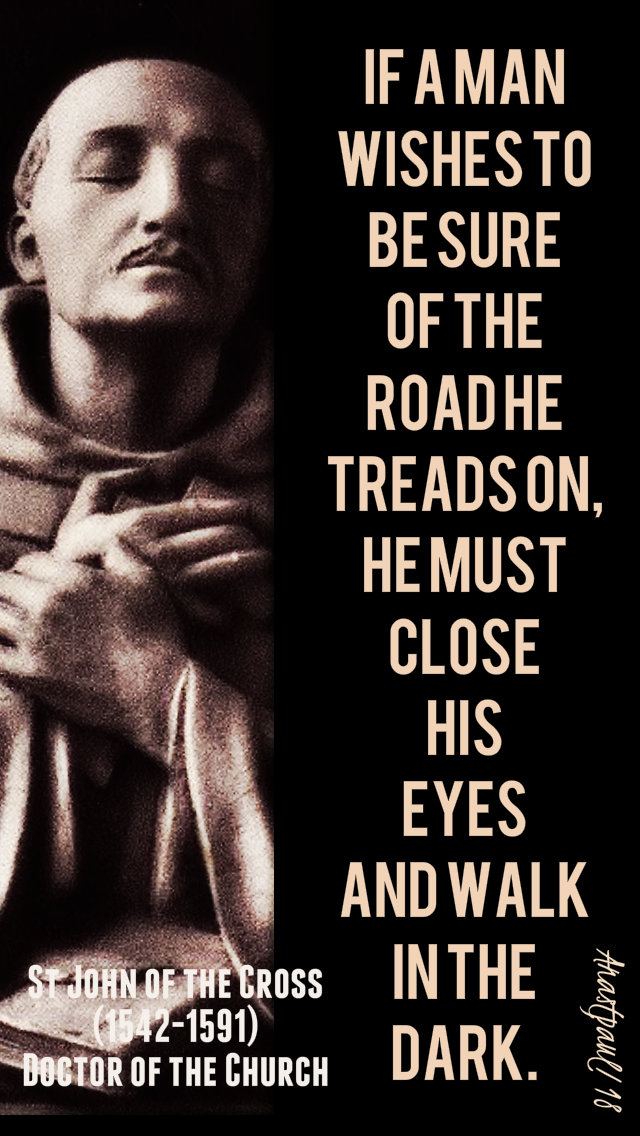
“If a man wishes to be sure of the road he treads on, he must close his eyes and walk in the dark.”
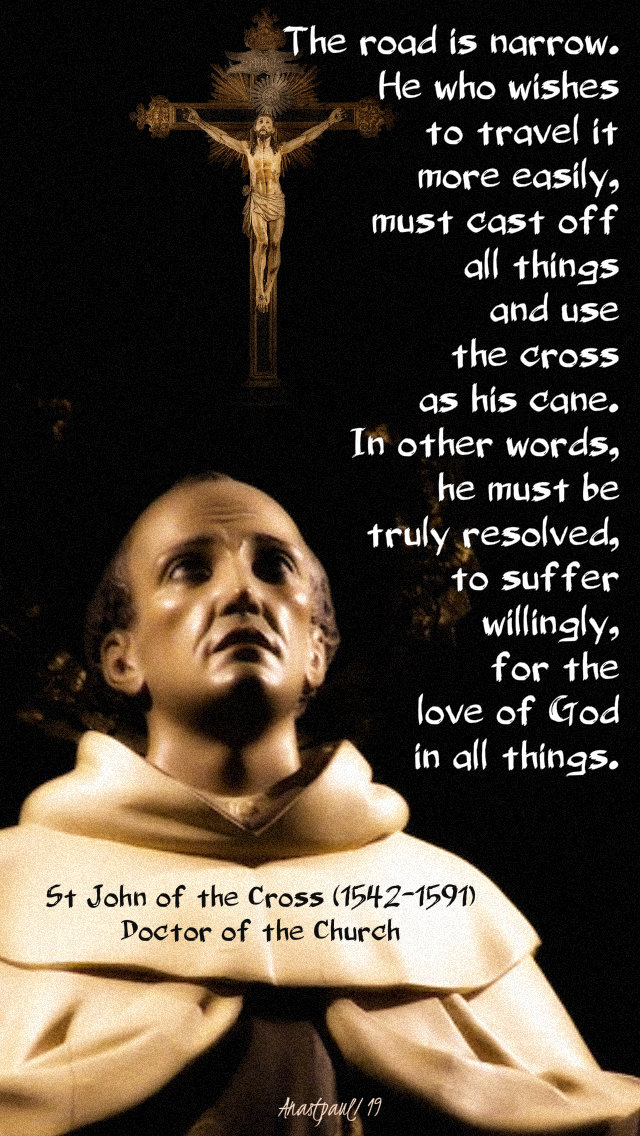
“The road is narrow. He who wishes to travel it more easily must cast off all things and use the cross as his cane. In other words, he must be truly resolved to suffer willingly for the love of God in all things.”
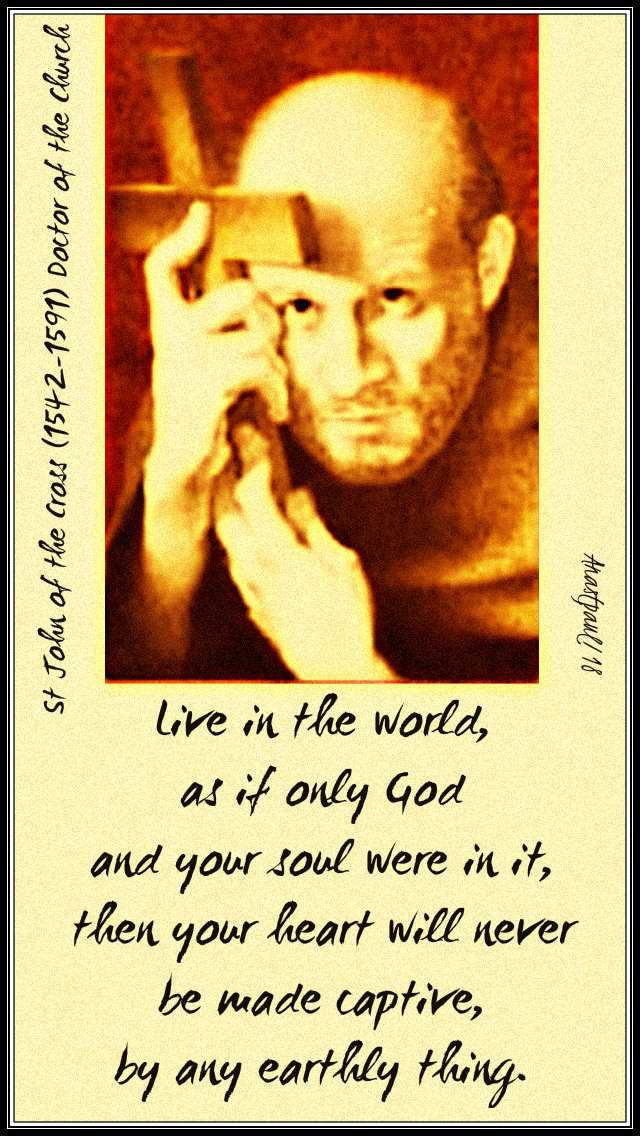
“Live in the world, as if only God and your soul were in it, then your heart will never be made captive, by any earthly thing.”
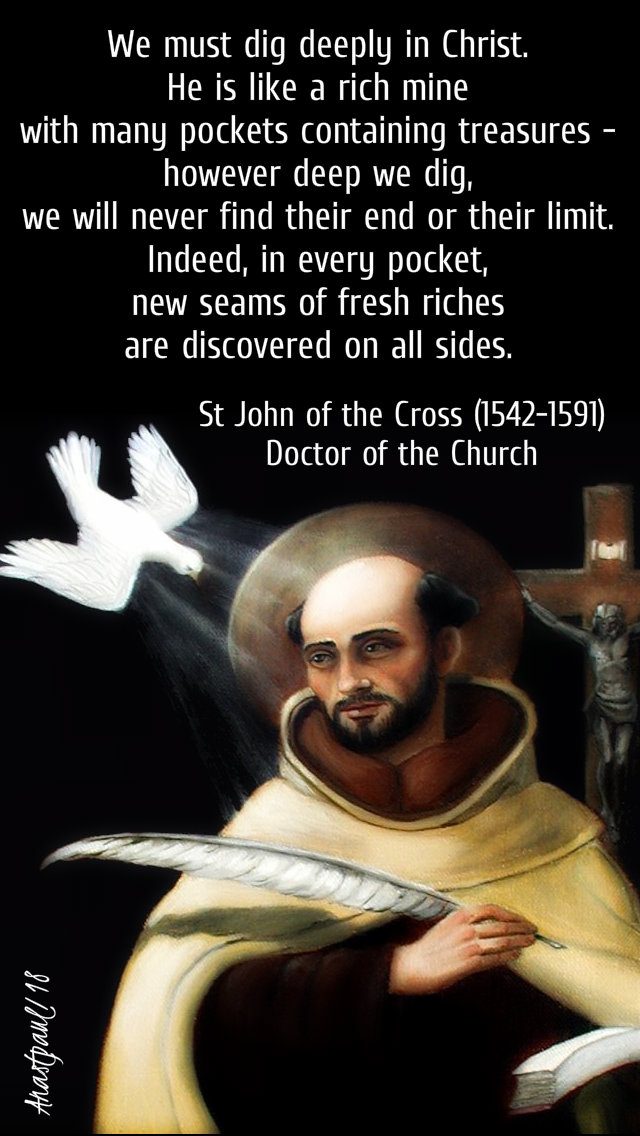
“We must dig deeply in Christ. He is like a rich mine with many pockets containing treasures – however deep we dig, we will never find their end or their limit. Indeed, in every pocket new seams of fresh riches are discovered on all sides.”
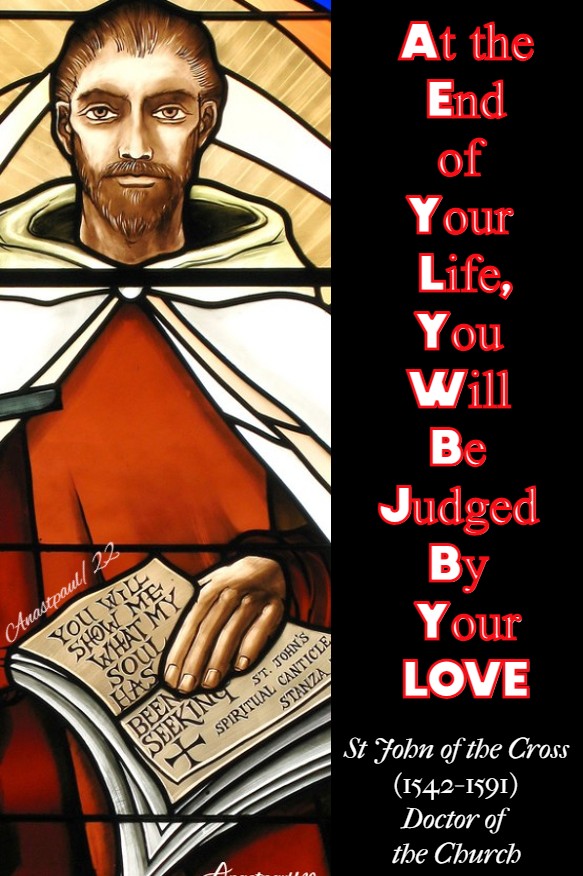
“At the end of your life, you will be judged by your love.”
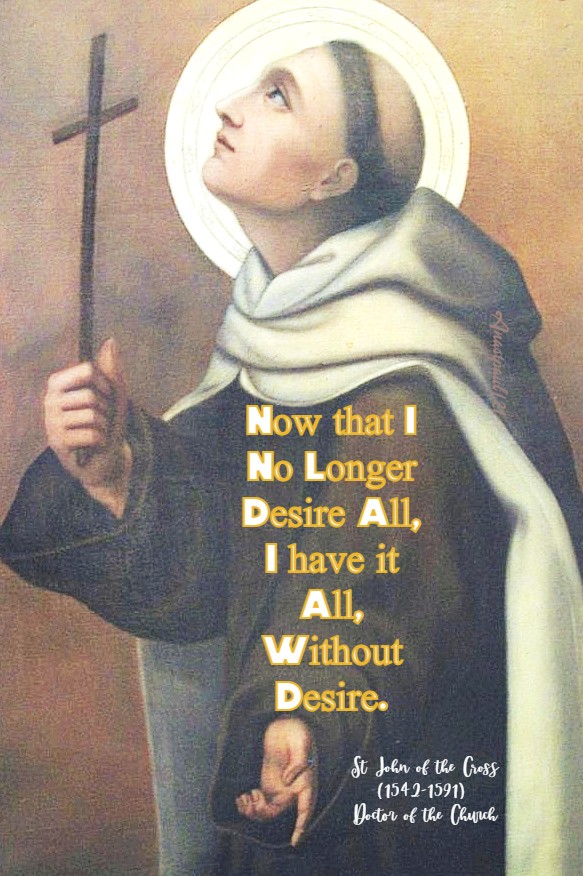
“Now that I no longer desire all, I have it all, without desire.”
St John of the Cross (1542-1591) Doctor of the Church
Advent and Christmas Wisdom with St Alphonsus Liguori
14 December – Friday of the Second week of Advent
Jesus suffers so much in order to gain our hearts
“Consider that Jesus suffered for our love. During His entire life, He had no other purpose than the glory of God and our salvation. Even though He could have saved us without suffering, He chose to embrace a life of suffering. He was poor, despised and deprived of every comfort, with a death that was more desolate and bitter than any death ever endured by a martyr or penitent. All of this, was done for the sole purpose of helping us understand the greatness of His love for us.
Saint Bonaventure exclaims, ‘It is a wonder to see a God endure such sufferings, shedding tears in a stable, poor in a workshop, languishing on a cross, in short afflicted and troubled His whole life, all because of His love for sinful humanity.'”
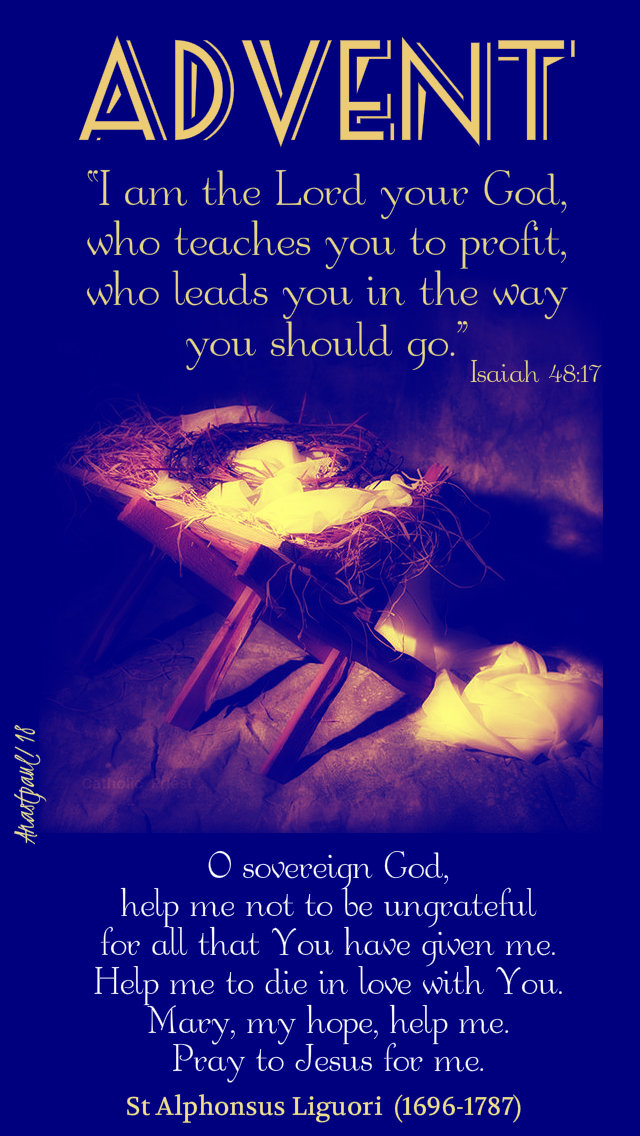
Scripture “I am the Lord your God, who teaches you to profit, who leads you in the way you should go.”
Isaiah 48:17
Prayer (St Alphonsus)
“O sovereign God,
help me not to be ungrateful
for all that You have given me.
Help me to die in love with You.
Mary, my hope, help me.
Pray to Jesus for me.”
Advent Action
“O my Lord Jesus, whose love for me has been so great as to bring You down from heaven to save me, teach me, dear Lord, my sin—teach me its heinousness—teach me truly to repent of it—and pardon it in Your great mercy! I beg You, O my dear Saviour, to recover me! Your grace alone can do it. I cannot save myself. I cannot recover my lost ground. I cannot turn to You, I cannot please You, or save my soul without You. I shall go from bad to worse, I shall fall from You entirely, I shall quite harden myself against my neglect of duty, if I rely on my own strength. I shall make myself my centre instead of making it in You. I shall worship some idol of my own framing instead of You, the only true God and my Maker, unless You hinder it by Your grace. O my dear Lord, hear me! I have lived long enough in this undecided, wavering, unsatisfactory state. I wish to be Your good servant. I wish to sin no more. Be gracious to me and enable me to be what I know I ought to be.”…Blessed John Henry Newman (1801-1890)
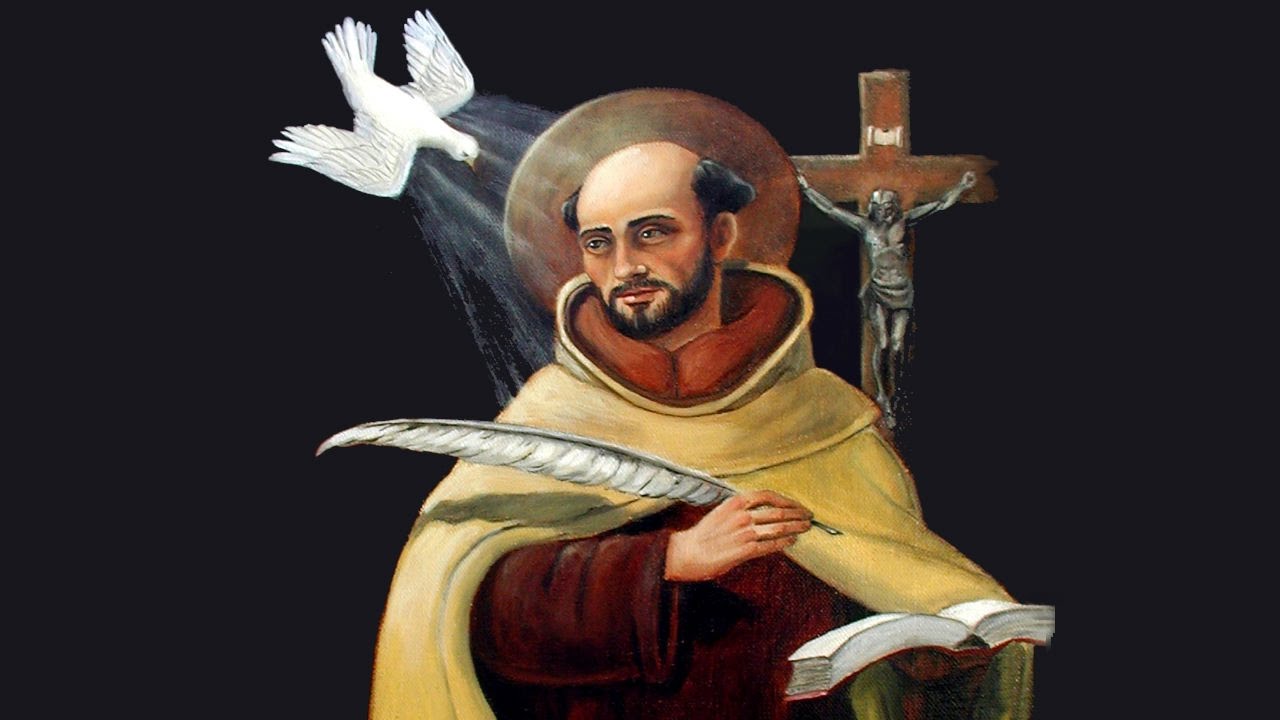
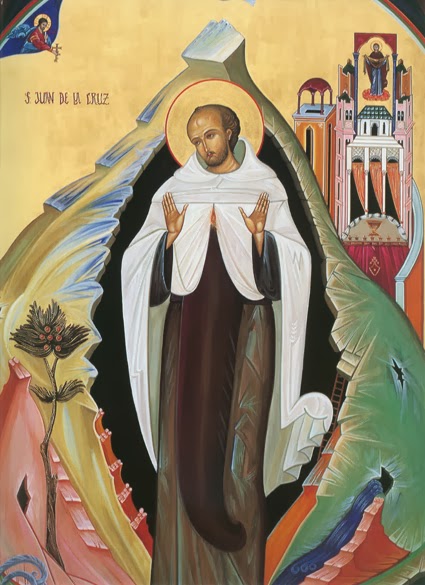
Saint of the Day – 14 December – St John of the Cross OCD (1542-1591) Confessor, Doctor of the Church, Priest, Reformer of the Carmelite Order, Mystic, Poet, Theologian, Writer. Born as Juan de Yepes y Álvarez on 24 June 1542 at Fontiveros, Ávila, Crown of Castile, Spanish Monarchy and died on 14 December 1591 (age 49) at Úbeda, Crown of Castile, Spanish Monarchy. John was mentored by and corresponded with, the older Carmelite, St Teresa of Ávila. Both his poetry and his studies on the development of the soul, are considered the summit of mystical Spanish literature and among the greatest works of all Spanish literature. He was Canonised by Pope Benedict XIII in 1726. In 1926, he was declared a Doctor of the Church by Pope Pius XI and is commonly known as the “Mystical Doctor.” Patronages – Contemplative life, contemplatives, Mystical Theology, Mystics, Spanish poets.
John’s life was a heroic effort to live up to his name: “of the Cross.” The folly of the Cross came to full realisation in time. “Whoever wishes to come after me must deny himself, take up his cross, and follow me” (Mark 8:34b) is the story of John’s life. The Paschal Mystery—through death to life—strongly marks John as rRformer, Mystic-poet and Theologian-priest.
Ordained a Carmelite Priest in 1567 at age 25, John met Teresa of Avila and like her, vowed himself to the primitive Rule of the Carmelites. As partner with Teresa and in his own right, John engaged in the work of reform and came to experience the price of reform – increasing opposition, misunderstanding, persecution, imprisonment. He came to know the cross acutely—to experience the dying of Jesus—as he sat month after month in his dark, damp, narrow cell with only his God.
Yet, the paradox! In this dying of imprisonment John came to life, uttering poetry. In the darkness of the dungeon, John’s spirit came into the Light. There are many mystics, many poets – John is unique as mystic-poet, expressing in his prison-cross the ecstasy of mystical union with God in the Spiritual Canticle.
But as agony leads to ecstasy, so John had his Ascent to Mount Carmel, as he named it in his prose masterpiece. As man-Christian-Carmelite, he experienced in himself this purifying ascent; as spiritual director, he sensed it in others; as psychologist-theologian, he described and analysed it in his prose writings. His prose works are outstanding in underscoring the cost of discipleship, the path of union with God – rigorous discipline, abandonment, purification. Uniquely and strongly John underlines the gospel paradox: the cross leads to resurrection, agony to ecstasy, darkness to light, abandonment to possession, denial to self to union with God. If you want to save your life, you must lose it. John is truly “of the Cross.” He died at 49—a life short, but full.
Advent and Christmas Wisdom with St Alphonsus Liguori
13 December – Thursday of the Second week of Advent
Jesus suffers during His whole life
“Consider that all the sufferings that Jesus endured in His life and death were all present to Him from the first moment of His life. Consider that even from His childhood, He began to offer them to fulfil His role as our Redeemer. What martyrdom did the loving heart of Jesus constantly endure in beholding all sins of humankind! Saint Thomas says that the sorrow which Jesus felt, at the knowledge of the injury dome to His Father and of the evil that sin would cause to the souls that He loved, surpassed the sorrow of all contrite sinners that ever existed.
St Margaret of Cortona, never ceased to shed tears for her sins. One day her confessor said to her, “no more tears, Margaret, it is enough, our Lord has already forgiven you,” “What”, answered the saint, “how can my tears and my sorrows suffice for the sins which my Jesus was afflicted all His life long?”
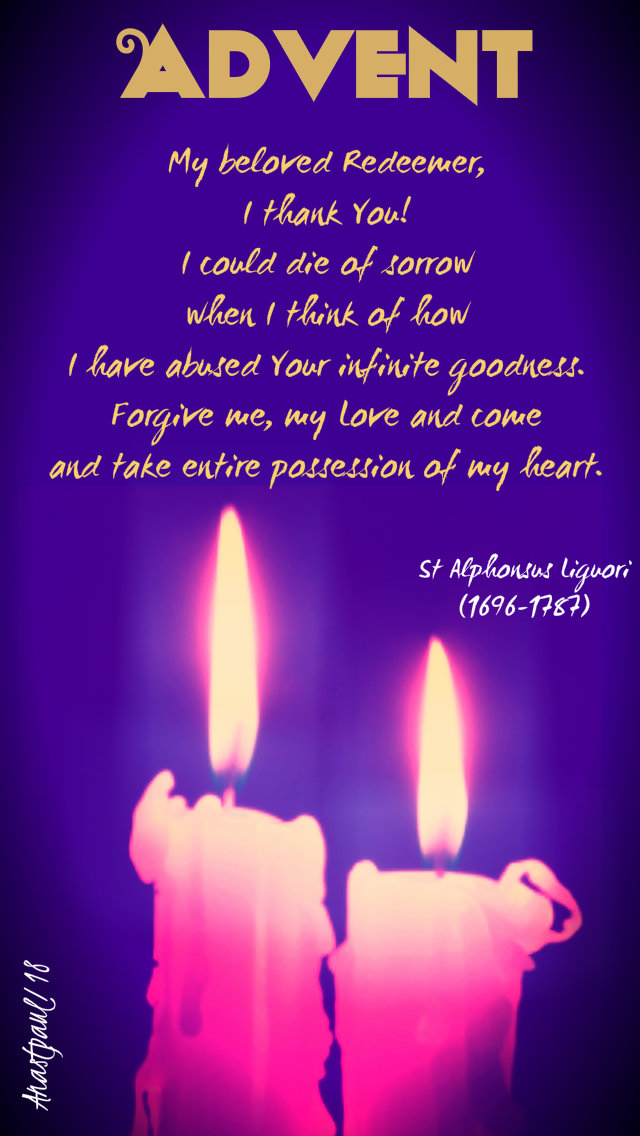
My beloved Redeemer, I thank You! I could die of sorrow when I think of how I have abused Your infinite goodness. Forgive me, my Love and come and take entire possession of my heart.”
Scripture “From the days of John the Baptist until now, the kingdom of heaven has suffered violence and men of violence, take it by force.”
Matthew 11:12
Prayer
Lord God,
true Light and Creator of Light,
empty us today
of the many worldly distractions
that lead us from You.
The darkness of our heart
is our enemy and we are beleaguered.
Help us Lord, that faithfully
seeking all that is holy,
and begging Your grace,
we may ever live in the
splendour of Your presence.
Amen
Advent Action
“Saint Paul teaches: “Our struggle is not with flesh and blood but with the unseen powers, with the world rulers of this present darkness, with the evil spirits in the heavens,” (Eph 6:12). Like Joshua, let us set out to war, attacking the greatest city in the world, namely wickedness and let us throw down the arrogant walls of sin. Would you look around for which path to take, which battlefield to choose? No doubt you will find my words extraordinary; nevertheless, they are true – limit your quest to yourself alone. In you lies the combat you are going to engage, within yourself the structure of evil and sin to pull down, your enemy emerges from the depths of your heart. It is not I who say this but Christ. Listen to him: “From the heart come evil thoughts, murder, adultery, unchastity, theft, false witness, blasphemy” (Mt 15:19). Do you realise the power of this enemy force that advances against you from the depths of your heart? Those are our real enemies.”…Origen (c.185-253)
Advent and Christmas Wisdom with St Alphonsus Liguori
12 December – Wednesday of the Second week of Advent
Jesus is charged with the sins of the whole world
“Consider that the divine Word, in taking on the human form, chose not only to take the form of a sinner but also, to bear the sins of all humanity. What must have been the anguish of the heart of the infant Jesus when He discovered that divine justice insisted that He make full satisfaction for each sin! Our Lord once showed to St Catherine of Siena, the hideousness of single venial sin and such was the dread and sorrow of the saint, that she fell senseless to the gound! What then, must have been the suffering of the infant Jesus when He saw before Him, the immense array of all the crimes of history?
My beloved Jesus, I who offended You am not worthy of Your favours. Help me, O Lord, to make that act of contrition, which I now intend to do. You do not deserve to be offended, my Jesus but rather, to be loved. My blessed Redeemer, help me.”
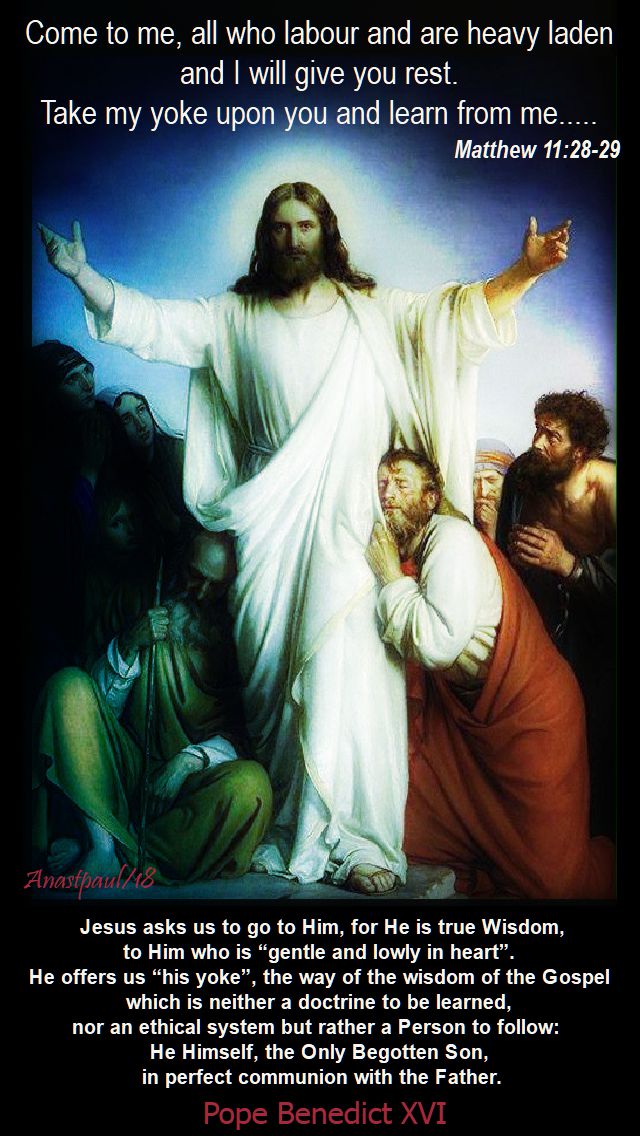
Scripture “Take my yoke upon you and learn from me, for I am gentle and lowly in heart and you will find rest for your souls.” Matthew 11:29
Prayer
O Lord,
we come to You.
We are burdened and struggling.
Our sins afflict and wound You
and ourselves.
We love You Lord Jesus,
our love above all things.
We repent with our whole hearts.
Never permit us to separate
ourselves from You again.
Grant that we may always love You
and sin no more.
O Jesus, our holy Saviour,
in Your gracious kindness,
supply what is wanting in us.
Lift us up on Your wings, O Lord.
Amen
Advent Action
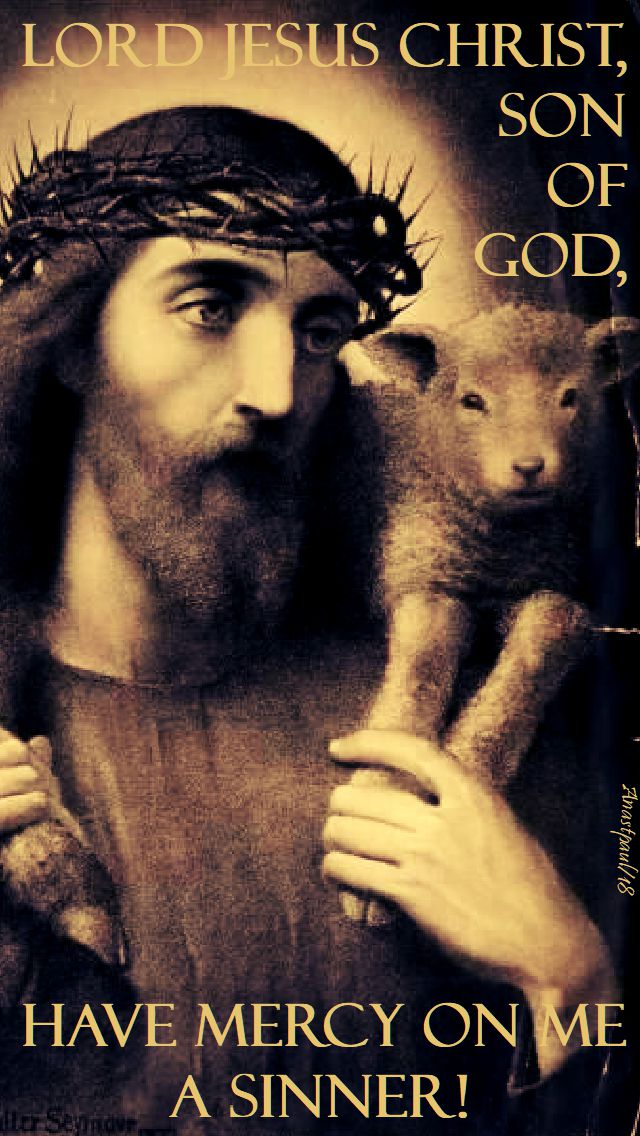
Our Scripture presents us with the anchor that never rusts, the eagle that always carries us, the lamb that lifts our burdens. In the midst of the Advent rush, let us rely on the Lord to renew our strength and to carry our burdens. Let us take a break to turn our hearts each day to Him, to stop and rest and pray, “Lord Jesus Christ, Son of God, have mercy on me, a sinner.”
Advent and Christmas Wisdom with St Alphonsus Liguori
11 December – Tuesday of the Second week of Advent
Jesus, suffering servant, in the womb of His mother
“Consider, as the prophet Isaiah once proclaimed, that Jesus is the ‘suffering servant’ and from His infancy began to endure the greatest sorrows. Even from the womb of Mary, Jesus Christ accepted obediently, the will of His Father. He foresaw the scourges, the thorns, the blows, the nails and the cross on which He offered His life. He suffered a continual martyrdom and He offered every moment for us, to His eternal Father. But what afflicted Him more than any other suffering, was the malice of every sin, when He saw the immense number that would be committed.
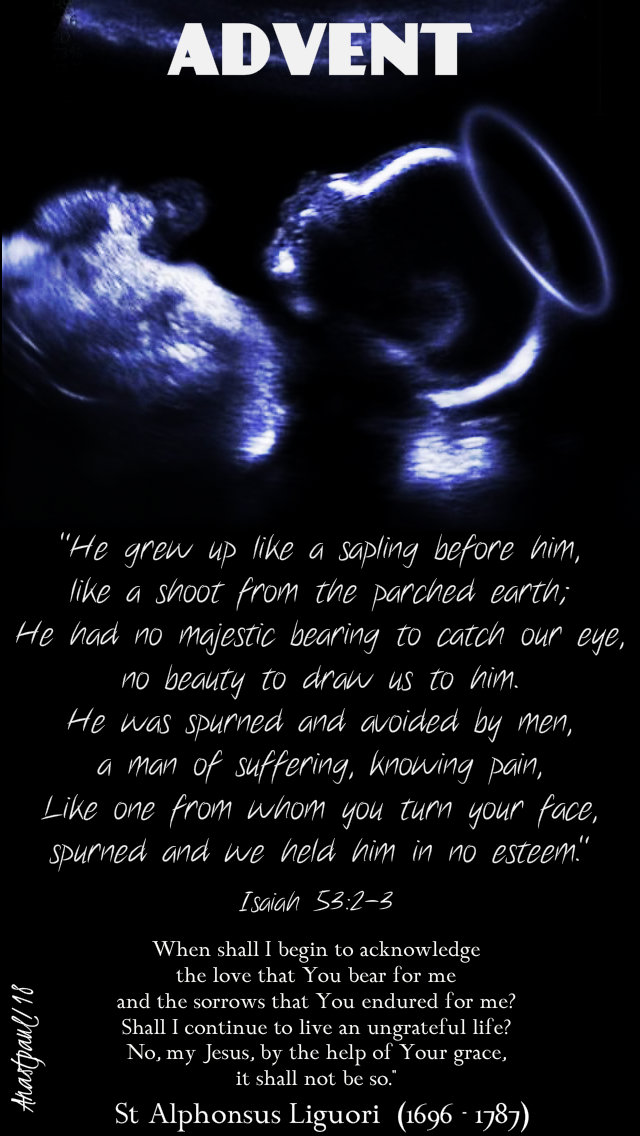
My sweetest Redeemer, when shall I begin to be grateful to You for Your infinite goodness? When shall I begin to acknowledge the love that You bear for me and the sorrows that You endured for me? Shall I continue to live an ungrateful life? No, my Jesus, by the help of Your grace, it shall not be so.”
Scripture
“He grew up like a sapling before him, like a shoot from the parched earth; He had no majestic bearing to catch our eye, no beauty to draw us to him. He was spurned and avoided by men, a man of suffering, knowing pain, Like one from whom you turn your face, spurned and we held him in no esteem.”
Isaiah 53:2-3
Prayer
Thank You, my Lord, for looking for me.
Thank You, my Lord, for finding me.
Thank You, my Lord, for telling me
“it is never the will of my Father,
that one of these little ones should perish.”
This explains why
You assumed our human nature
and suffered so much for us.
Thank You, my Lord,
for Your reckless love.
Thank You, my Lord,
for saving me!
Amen
Advent Action
Our Scripture today, overflows with hope. In the Gospel, Jesus proclaims that He, personally, will rescue us. Even if we are the only one lost, He will come after us. “So it is not the will of my Father, who is in heaven, that one of these little ones should perish.” Are we in trouble, lost, confused and overwhelmed? Tell Jesus! He fulfils His promise to rescue us.








You must be logged in to post a comment.