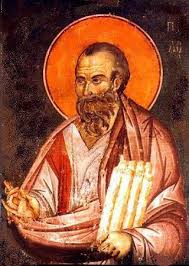
One Minute Reflection – 25 January – Feast of the Conversion of St Paul the Apostle
I have appeared to you for this purpose, to appoint you as a servant and witness of what you have seen and what you will be shown. I shall deliver you from this people and from the Gentiles to whom I send you,to open their eyes that they may turn from darkness to light and from the power of Satan to God, so that they may obtain forgiveness of sins and an inheritance among those who have been consecrated by faith in me…Acts 26:16-18
REFLECTION – “Paul, more than anyone else, has shown us what man really is and in what our nobility consists and of what virtue this particular animal is capable. Each day he aimed ever higher; each day he rose up with greater ardour and faced with new eagerness the dangers that threatened him. He summed up his attitude in the words: “I forget what is behind me and push on to what lies ahead”…The most important thing of all to him, however, was that he knew himself to be loved by Christ. Enjoying this love, he considered himself happier than anyone else”…….St John Chrysostom
PRAYER – Today Lord, we celebrate the conversion of St Paul, Your chosen vessel for carrying Your name to the whole world. Help us to make our way towards You by following in his footsteps and by being Your disciples before the men and women of our day. Grant that by the prayers of St Paul, we too may say, “Yet I live, no longer I, but Christ lives in me; insofar as I now live in the flesh, I live by faith in the Son of God who has loved me and given himself up for me.” (Galatians 2:20) Through Jesus Christ, our Lord, in union with the Holy Spirit, one God forever and ever, amen.
Thought for the Day – 22 January – The Memorial of St Vincent of Saragossa (Died 304) – Deacon and Martyr – The Protomartyr of Spain
From a sermon by Saint Augustine (354-430)
Father & Doctor of the Church
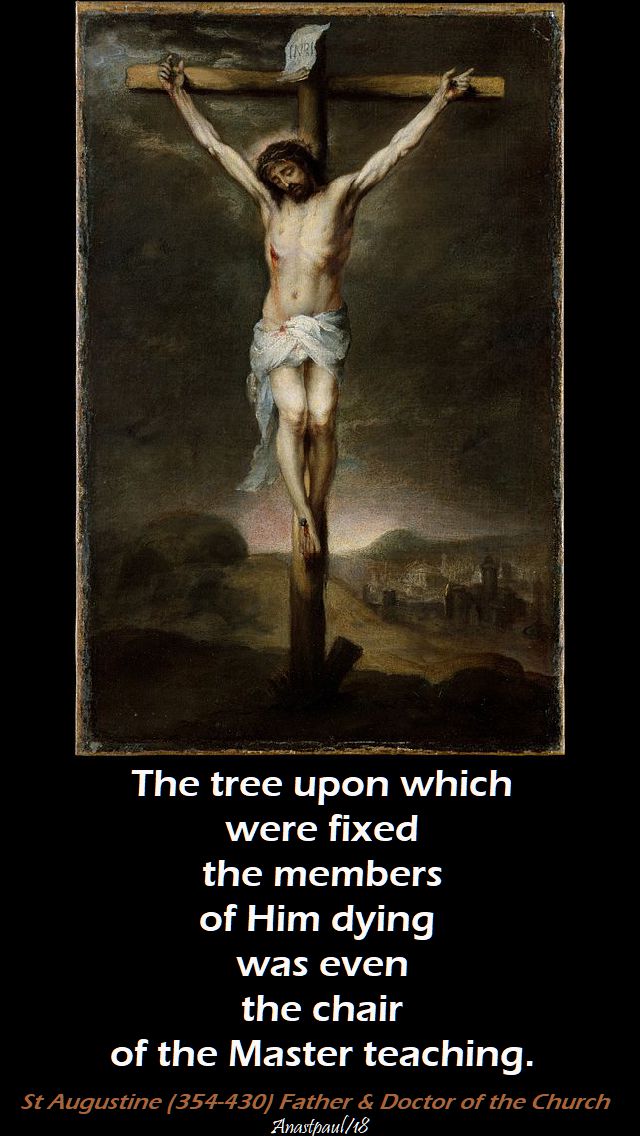
“To you has been granted in Christ’s behalf not only that you should believe in Him but also that you should suffer for Him. Vincent had received both these gifts and held them as his own. For how could he have them if he had not received them? And he displayed his faith in what he said, his endurance in what he suffered. No one ought to be confident in his own strength when he undergoes temptation. For whenever we endure evils courageously, our long-suffering comes from Him,Christ. He once said to His disciples: “In this world you will suffer persecution,” and then, to allay their fears, He added, “but rest assured, I have conquered the world.”
There is no need to wonder then, my dearly beloved brothers, that Vincent conquered in Him who conquered the world. It offers temptation to lead us astray; it strikes terror into us to break out spirit. Hence if our personal pleasures do not hold us captive and if we are not frightened by brutality, then the world is overcome. At both of these approaches Christ rushes to our aid and the Christian is not conquered.”
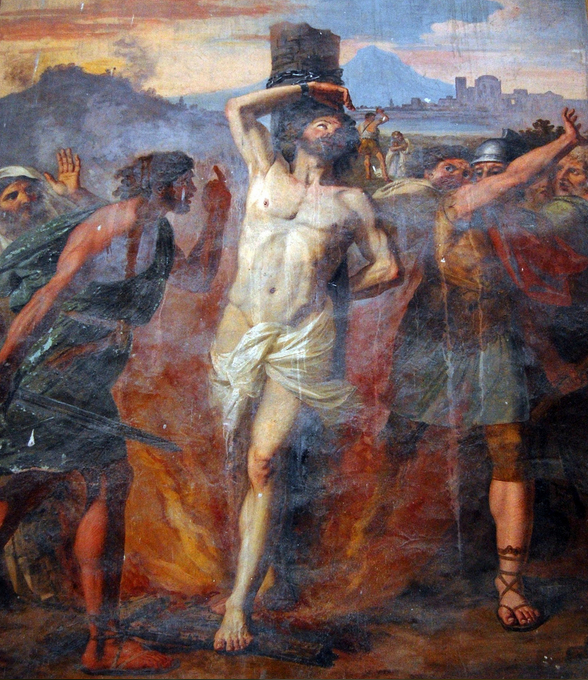
St Vincent of Saragossa, pray for us!
Prayer of St Vincent of Saragossa (Died 304)
Everlasting God, to whom all hidden things are revealed, who sent into the world Your Only Begotten Son, our Lord Jesus Christ, conceived through the Holy Spirit, born of the Virgin Mary, that He might take on Himself the punishment of our sins and by His resurrection, snatch us from the gates of hell, grant to our hearts such steadfastness of faith that confessing Christ, Your Son, we may not perish but may be joined to Him in the confession of Your Holy Name. Amen.
One Minute Reflection – 21 January – The Memorial of St Agnes (c 291- c 304) Virgin and Martyr
“For as we share abundantly in Christ’s sufferings, so through Christ we share abundantly in consolation too. If we are afflicted, it is for your consolation and salvation; and if we are comforted, it is for your comfort, which you experience when you patiently endure the same sufferings that we suffer. Our hope for you is unshaken; for we know that as you share in our sufferings, you will also share in his great consolation.”…2 Corinthians 1:3-5
REFLECTION – “Today is the birthday of a virgin; let us imitate her purity. It is the birthday of a martyr; let us offer ourselves in sacrifice. It is the birthday of Saint Agnes, who is said to have suffered martyrdom at the age of twelve. There was little or no room in that small body for a wound. Yet she shows no fear of the blood-stained hands of her executioners. She offers her whole body to be put to the sword by fierce soldiers. She is too young to know of death, yet is ready to face it. Dragged against her will to the altars, she stretches out her hands to the Lord int he midst of the flames, making the triumphant sign of Christ the victor on the altars of sacrilege. She puts her neck and hands in iron chains but no chain can hold fast her tiny limbs. In the midst of tears, she sheds no tears herself. She stood still, she prayed, she offered her neck. You could see fear in the eyes of the executioner, as if he were the one condemned. His right hand trembled, his face grew pale as he saw the girl’s peril, while she had no fear for herself. One victim but a twin martyrdom, to modesty and religion; Agnes preserved her virginity and gained a martyr’s crown. – from an essay On Virgins by Saint Ambrose of Milan (340-397) Doctor of the Church
PRAYER – Almighty, ever-living God, You choose what is weak in the world to shame what is strong. Grant that, as we celebrate the martyrdom of St Agnes, we may follow her example of steadfastness and trust in faith. We pray that through her intercession, we may grow in holiness. Through our Lord Jesus Christ, with the Holy Spirit, one God forever, amen
Our Morning Offering – 21 January – 3rd Sunday in Ordinary Time Year B
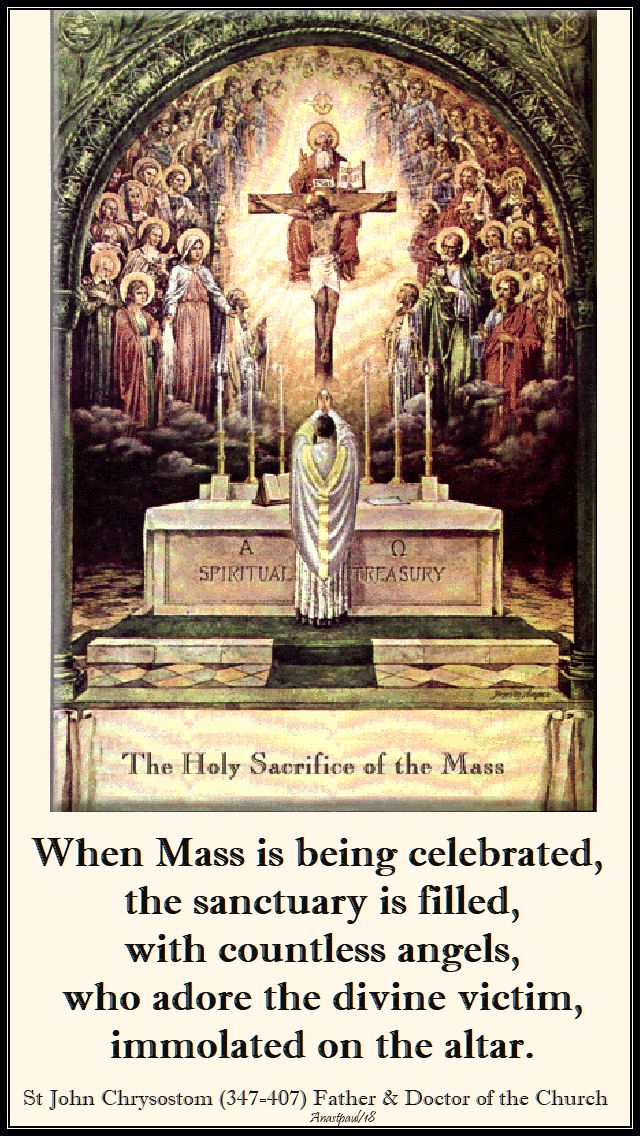
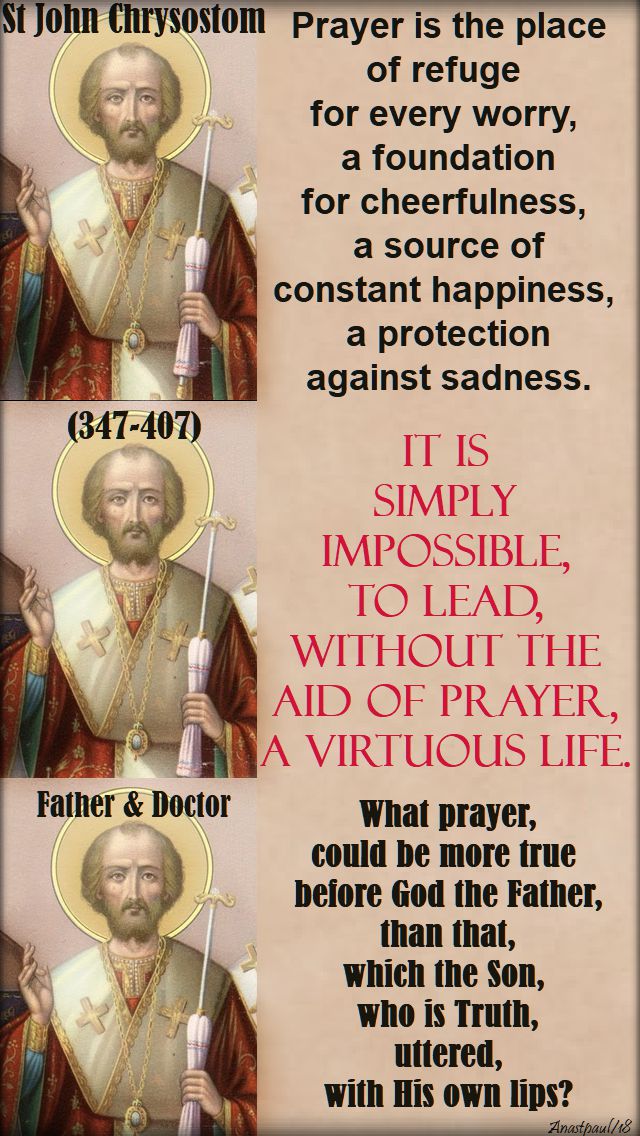
Prayer before Holy Mass By St John Chrysostom (347-407) Father & Doctor of the Church
O God, loose, remit and forgive
my sins against You.
Whether in word, or in deed, or in thought,
willingly or unwillingly,
knowingly or unknowingly committed,
forgive them all;
for You are good and love mankind.
And through the prayers of Your most holy Mother,
of Your heavenly servants and holy powers
and of all the saints
who have found favour in Your sight,
enable me to receive without condemnation
Your holy and immaculate body
and Your precious blood,
to the healing of my soul and body
and to the driving away of all evil imaginations,
for Yours is the kingdom, the power and the glory,
Father, Son and Holy Spirit,
now and forever and to ages of ages. Amen
Quote/s of the Day – 18 January – “Speaking of the Holy Eucharist/Holy Mass“
“Let us return from that Table, like lions breathing out fire, terrifying to the devil!”
St John Chrysostom (347-407) Father & Doctor of the Church
“O Sacrament of Love! O sign of Unity! O bond of Charity! He who would have Life finds here indeed a Life to live in and a Life to live by.”
St Augustine (354-430) Father & Doctor of the Church
“What does the poor man do at the rich man’s door, the sick man in the presence of his physician, the thirsty man at a limpid stream? What they do, I do before the Eucharistic God. I pray. I adore. I love.”
St Francis of Assisi
“Put all the good works in the world against one Holy Mass; they will be as a grain of sand beside a mountain.”
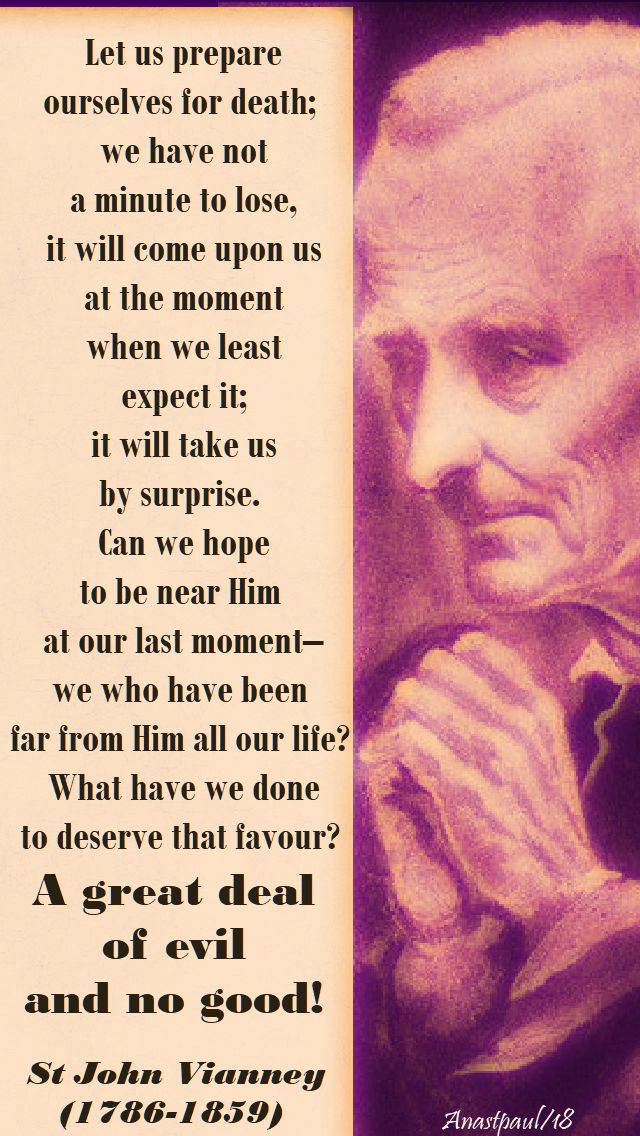
St John Marie Baptiste Vianney (1786-1859)
“When you look at the crucifix, you understand how much Jesus loved you then. When you look at the Sacred Host, you understand how much Jesus loves you now.”
“Unless we believe and see Jesus in the appearance of bread on the altar, we will not be able to see Him in the distressing disguise of the poor.”
Thought for the Day – 17 January – The Memorial of St Anthony Abbot (251-356)
In an age that smiles and jeers at the notion of devils and angels, a person known for having power over evil spirits must at least make us pause. And in a day when people speak of life as a “rat race,” one who devotes a whole life to solitude and prayer points to an essential of the Christian life in all ages. Anthony’s hermit life reminds us of the absoluteness of our break with sin and the totality of our commitment to Christ. Even in God’s good world, there is another world whose false values constantly tempt us.
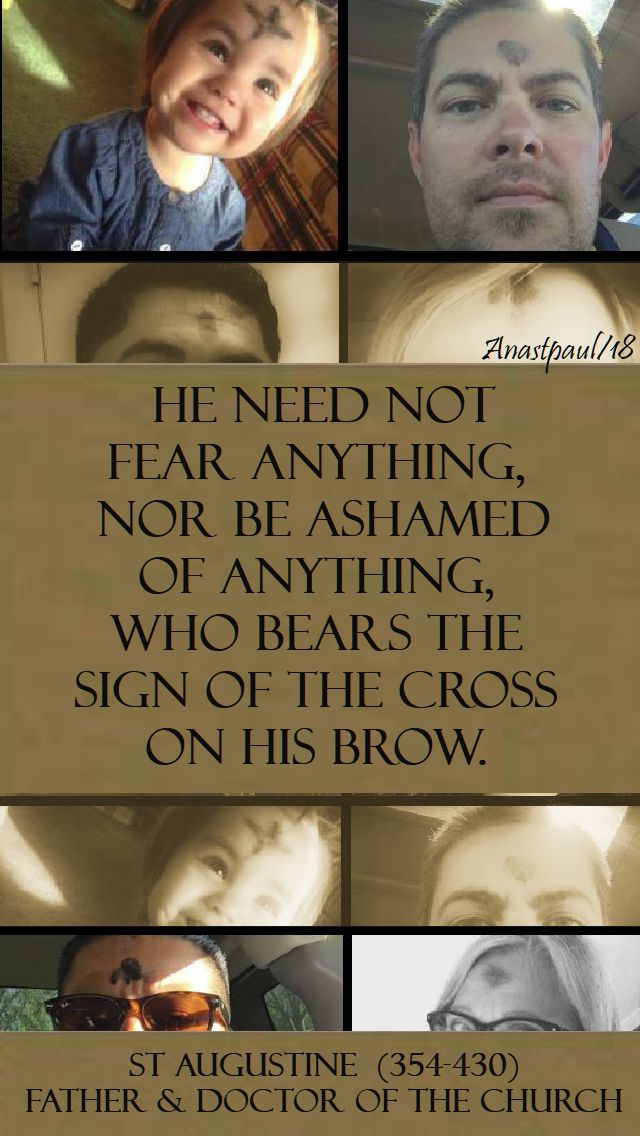
Our most powerful protection IS the Sign of the Cross:
“Let us not then be ashamed to confess the Crucified. BE THE CROSS OUR SEAL, made with boldness by our fingers, on our brow and in everything, over the bread we eat and the cups we drink, in our comings in and goings out, before our sleep, when we lie down and when we awake, when we are in the way and when we are still. Great is that preservative, it is without price, for the poor’s sake, without toil, for the sick, since also its’ grace is from God. It is the Sign of the faithful and the dread of evils – for He has triumphed over them in it, having made a shew of them openly – for when they see the Cross, they are reminded of the Crucified; they are afraid of Him, Who hath bruised the head of the dragon. Despise not the Seal because of the freeness of the Gift but for this, rather honour thy Benefactor!”
St Cyril of Jerusalem (315-387)
Father & Doctor of the Church
“The Sign of the Cross is the most terrible weapon against the devil. Thus the Church wishes not only, that we have it continually in front of our minds, to recall to us just what our souls are worth and what they cost Jesus Christ but also that we should make it at every juncture ourselves: when we go to bed, when we awaken during the night, when we get up, when we begin any action, and, above all, when we are tempted.”
Quote/s of the Day – 16 January – The memorial of St Joseph Vaz (1651-1711) Apostle of Sri Lanka – “Speaking of Charity”
“Help one another with the generosity of the Lord and despise no one. When you have the opportunity to do good, do not let it go by.”
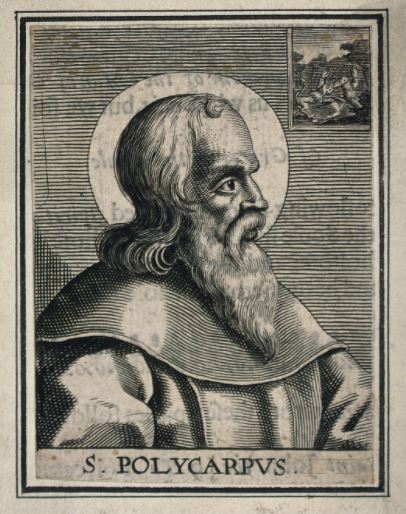
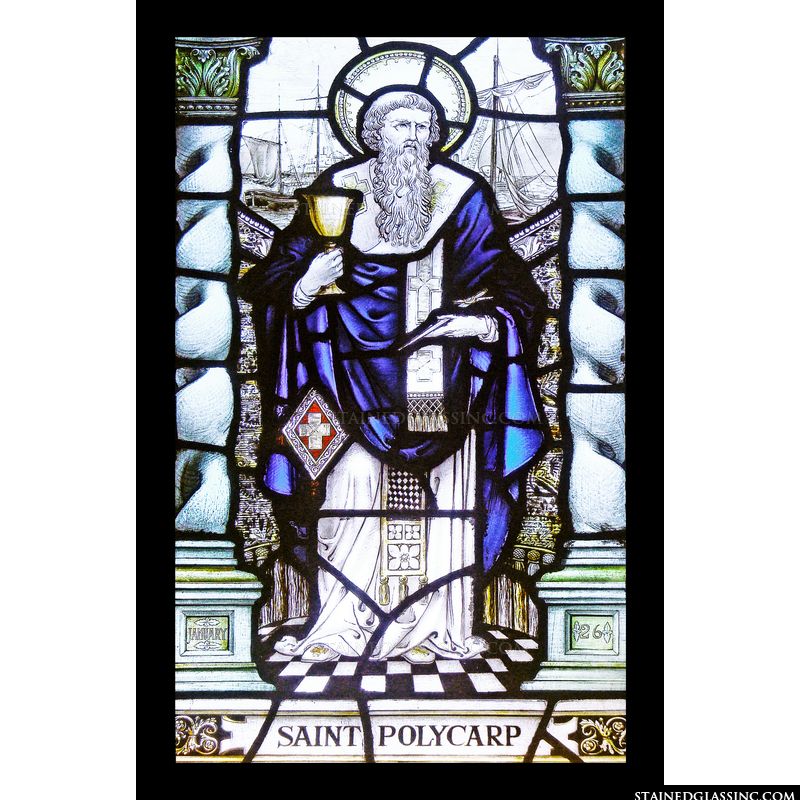
St Polycarp of Smyrna (69-155) Father of the Church
“No one has ever been accused for not providing ornaments …Do not, therefore, adorn the church and ignore your afflicted brother, for he is the most precious temple of all.”
St John Chrysostom (347-407) Father & Doctor of the Church
“Beauty grows in you to the extent that love grows because charity itself is the soul’s beauty.”
“You cannot attain to charity except through humility.”
St Augustine (354-430) Father & Doctor of the Church
“It is by the path of love, which is charity, that God draws near to man and man to God. But where charity is not found, God cannot dwell. If, then, we possess charity, we possess God, for “God is Charity”
St Albert the Great (1200-1280) Doctor of the Church
“If you want God to hear your prayers, hear the voice of the poor. If you wish God to anticipate your wants, provide those of the needy without waiting for them to ask you. Especially anticipate the needs of those who are ashamed to beg. To make them ask for alms is to make them buy it.”
St Thomas of Villanova (1486-1555)
“No man discovers anything big if he does not make himself small.”
“Show me your hands. Do they have scars from giving? Show me your feet. Are they wounded in service? Show me your heart. Have you left a place for divine love?”
Quote/s of the Day – 14 January -Speaking of the Holy Eucharist from the Fathers of the Church
“Calling her children about her, she [the Church] nourishes them with holy milk, that is, with the Infant Word… The Word is everything to a child – both Father and Mother, both Instructor and Nurse. “EAT MY FLESH,” He says, “AND DRINK MY BLOOD.” The Lord supplies us with these intimate nutriments. He delivers over His Flesh and pours out His Blood and nothing is lacking for the growth of His children. O incredible mystery!” (Instructor of Children 1:6:42,1,3)
St Clement of Alexandria (c 150-216) Church Father
“The flesh feeds on THE BODY AND BLOOD OF CHRIST, so that the SOUL TOO may fatten on God.” (Resurrection of the Dead 8:3)
“The Sacrament of the Eucharist, which the Lord commanded to be taken at meal times and by all, we take even before daybreak in congregations… … We take anxious care lest something of our Cup or Bread should fall upon the ground…” (The Crown 3:3-4)
Tertullian (c 155-250) Church Father
“You see how the ALTARS are no longer sprinkled with the blood of oxen but consecrated BY THE PRECIOUS BLOOD OF CHRIST.” (Homilies on Joshua 2:1)
“You are accustomed to take part in the divine mysteries, so you know how, when you have received THE BODY OF THE LORD, you reverently exercise every care lest a particle of it fall and lest anything of the consecrated gift perish…. how is it that you think neglecting the word of God a lesser crime than neglecting HIS BODY?” (Homilies on Exodus 13:3)
Origen (c 185-254) Church Father
“If Christ Jesus, our Lord and God, is Himself the High Priest of God the Father; and if He offered HIMSELF as a SACRIFICE to the Father and if He commanded that this be done in commemoration of Himself – then certainly the priest, who imitates that which Christ did, TRULY FUNCTIONS IN PLACE OF CHRIST.” (Letters 63:14)
Our Morning Offering – 14 January – 2nd Sunday in Ordinary Time Year B
Prayer before Mass By St Ambrose (340-397) Father & Doctor of the Church
Lord Jesus Christ,
We approach Your banquet table
as saints and sinners
and dare not rely on our own worth,
but only on Your goodness and mercy.
Gracious God of majesty and awe,
We seek Your protection,
We look for Your healing.
We appeal to You, the fountain of all mercy.
Lord Jesus Christ, eternal king,
crucified for us, look upon us with mercy
and hear our prayer, for we trust in You.
Merciful Father, purify us in body and soul
and make us worthy to taste the Holy of Holies.
May Your body and blood,
which we intend to receive,
unworthy as we are,
be for us the remission of our sins,
the washing away of our guilt,
the end of our evil thoughts
and the rebirth of our better instincts.
May it incite us to do the works pleasing to You
and profitable to our health in body and soul
and may it deliver us from evil. Amen
Thought for the Day – 13 January – The Memorial of St Hilary of Poitiers (315-368) Father & Doctor of the Church
It was in reading the Holy Scriptures that St Hilary discovered the greatness of God and the sublimity of the Church and Christian teachings. The Scriptures is not just a revered book to be placed on our shelves in a place of honour it is to be read, to be studied and reflected upon. It leads not only to faith and holiness of life but also to the Kingdom of God itself. So we learn that Christ said His coming would bring not peace but a sword (see Matthew 10:34). The Gospels offer no support for us if we fantasise about a sunlit holiness that knows no problems. Christ did not escape at the last moment, though He did live happily ever after—after a life of controversy, problems, pain and frustration. Hilary, like all saints, simply had more of the same.
All-powerful God, as Saint Hilary defended the divinity of Christ Your Son, give us a deeper understanding of this mystery and help us to profess it in all truth.
Quote/s of the Day – 13 January – The Memorial of St Hilary of Poitiers (315-368) Father & Doctor of the Church
“The privilege of our Church is such that it is never stronger than when it is attacked, never better known than when it is accused, never more powerful than when it appears forsaken.” (Treatise on the Trinity)
“The Church is the Ship outside which it is impossible to understand the Divine Word, for Jesus spoke from the boat to the people gathered on the shore.”
“No matter how sinful one may have been, if he has devotion to Mary, it is impossible that he be lost.”
“I am well aware, almighty God and Father, that in my life, I owe you a most particular duty. It is to make my every thought and word speak of You.”
“It is the Father from whom everything that exists has been formed. He is in Christ and through Christ the source of all things. Moreover, His being is in Himself and He does not derive what He is from anywhere else, but possesses what He is from Himself and in Himself. He is infinite because He Himself is not in anything and all things are within Him, He is always outside of space because He is not restricted; He is always before time because time comes from Him…. But, God is also present everywhere and is present in His entirety wherever He is. Thus, He transcends the realm of understanding, outside of whom nothing exists and of whom eternal being is always characteristic. This is the true nature of the mystery of God; this is the name of the impenetrable nature in the Father.” (Treatise on the Trinity)
St Hilary of Poitiers (315-368) Father & Doctor of the Church
One Minute Reflection – 13 January – The Memorial of St Hilary of Poitiers (315-368) Father & Doctor of the Church
Then he said, ‘In truth I tell you, unless you change and become like little children you will never enter the kingdom of Heaven…Matthew 18:3
REFLECTION – “Little children follow and obey their father. They love their mother. They know nothing of covetousness, ill-will, bad temper, arrogance and lying. This state of mind opens the road to heaven. To imitate our Lord’s own humility, we must return to the simplicity of God’s little ones. – St Hilary
PRAYER – Give us the grace, almighty God, to become as innocent and obedient to You as little children. Teach us neither to question, nor fear, for it is our total trust of You that we will reach our heavenly home. Grant that the intercession of St Hilary we may achieve such innocence, through Christ our Lord, in union with the Holy Spirit, one God forever and ever, amen.
Our Morning Offering – 13 January – The Memorial of St Hilary of Poitiers (315-368) Father & Doctor of the Church
O Holy Trinity! For Perseverance In the One True Faith By St Hilary of Poitiers
Father, keep us from vain strife of words.
Grant to us constant profession of the Truth!
Preserve us in a true and undefiled faith
so that we may hold fast to that
which we professed when we were baptised
in the Name of the Father, Son and Holy Spirit,
that we may have You for our Father,
that we may abide in Your Son
and in the fellowship of the Holy Spirit.
Through Jesus Christ, Our Lord.
Amen
Saint of the Day – 13 January – St Hilary of Poitiers (315-368) Father & Doctor of the Church, Bishop, Confessor, Writer, Philosopher, Theologian, Preacher, Defender of the Faith. He was sometimes referred to as the “Hammer of the Arians” and the “Athanasius of the West.” His name comes from the Latin word for happy or cheerful. St Hilary was born in 315 at Poitiers, France and he died in 368 of natural causes. Patronages – against rheumatism, against snakes, against snake bites, backward children, children learning to walk, mothers, the sick/the infirm, 4 Cities.
Hilary was born to pagan parents of Poitiers, France, in 315. After training in the classics and philosophy, Hilary married. He and his wife had one daughter, Afra. All who knew Hilary said he was a friendly, charitable, gentle man. Hilary’s studies led him to read Scripture. He became convinced that there was only one God, whose Son became man and died and rose to save all people. This led him to be baptised along with his wife and daughter.
This gentle and courteous man, became a staunch defender of the divinity of Christ. He was devoted to writing some of the greatest theology on the Trinity and was, like his Master, in being labeled a “disturber of the peace.” In a very troubled period in the Church, his holiness was lived out in both scholarship and controversy.
The people of Poitiers chose Hilary to be their bishop in 353. As Bishop, he was soon taken up with battling what became the scourge of the fourth century, Arianism, which denied the divinity of Christ.
The heresy spread rapidly. Saint Jerome said “The world groaned and marvelled to find that it was Arian.” When Emperor Constantius ordered all the bishops of the West to sign a condemnation of Athanasius, the great defender of the faith in the East, Hilary refused and was banished from France to far off Phrygia. There, too, his pastoral solicitude led him to work tirelessly for the re-establishment of the Church’s unity, based on the correct faith, as formulated by the Council of Nicea. To this end, he began writing his most important and most famous dogmatic work: “De Trinitatae” (On the Trinity). Eventually he was called the “Athanasius of the West” and the “Hammer of the Arians.”
Fearing Hilary’s arguments, Arian’s followers begged the emperor to send Hilary home. The emperor, believing Hilary was also undermining his authority, recalled him. Hilary’s writings show that he could be fierce in defending the faith but in dealing with the bishops who had given in to the Arian heresy, he was charitable. He showed them their errors and helped them to defend their faith. Though the emperor called Hilary “disturber of the peace,” Saints Jerome and Augustine praised him as “teacher of the churches.”
During the last years of his life, he wrote “Treatises on the Psalms,” a commentary on 58 psalms, interpreted according to the principle highlighted in the introduction to the work: “There is no doubt that all the things said in the Psalms must be understood according to the Gospel proclamation, so that, independently of the voice with which the prophetic spirit has spoken, everything refers to the knowledge of the coming of our Lord Jesus Christ, incarnation, passion and kingdom and the glory and power of our resurrection”(“Instructio Psalmorum” 5).
In all of the Psalms, he sees this transparency of Christ’s mystery and of His body, which is the Church. On various occasions, Hilary met with St Martin, the future bishop of Tours who founded a monastery near Poitiers, which still exists today.
St Hilary confers minor Orders on St Martin of Tours
Hilary died in 367. His feast day is celebrated today throughout the universal Church. In 1851, Blessed Pius IX proclaimed him a doctor of the Church.
“Virtues are formed by prayer. Prayer preserves temperance. Prayer suppresses anger. Prayer prevents emotions of pride and envy. Prayer draws into the soul the Holy Spirit and raises man to Heaven.”
St Ephrem of Syria (306-373) Father & Doctor of the Church
“When we pray, the voice of the heart must be heard more than proceedings from the mouth.”
St Bonaventure (1217-1274) Doctor of the Church
“We do not have to talk very much in order to pray well. We know that God is there, in His holy tabernacle; let us open our hearts to Him; let us rejoice in His Presence – this is the best prayer.”
St John Marie Baptiste Vianney (1786-1859) Patron of Priests
“Without Prayer nothing good is done. God’s works are done with our hands joined and on our knees. Even when we run, we must remain spiritually kneeling before Him.”
Blessed Luigi Orione (1872-1940)
“You go to pray; to become a bonfire, a living flame, giving light and heat.”
“You don’t know how to pray? Put yourself in the presence of God and as soon as you have said, ‘Lord, I don’t know how to pray!’ you can be sure you have already begun.”
Quote/s of the Day – 9 January – “Speaking of Conversion”
“Do not have Jesus Christ on your lips and the world in your heart.”
“We recognise a tree by its fruit and we ought to be able to recognise a Christian by his action. The fruit of faith should be evident in our lives, for being a Christian is more than making sound professions of faith. It should reveal itself in practical and visible ways. Indeed it is better to keep quiet about our beliefs and live them out, than to talk eloquently about what we believe but fail to live by it.”
“It is not that I want merely to be called a Christian but to actually BE ONE. Yes, If I prove to be one, then I can have the name!”
“Wherever the bishop shall appear, there let the multitude also be; even as, wherever Jesus Christ is, there is the Catholic Church.”
St Ignatius of Antioch (37-105) Bishop & Martyr
“God loves each of us as if there were only one of us.”
St Augustine (354-430) Father & Doctor of the Church
“Without the Way, there is no going, Without the Truth, there is no knowing, Without the Life, there is no living.”
Thomas à Kempis (1380-1471) The Imitation of Christ
“Belief is a wise wager. Granted that faith cannot be proved, what harm will come to you if you gamble on its truth and it proves false? If you gain, you gain all; if you lose, you lose nothing. Wager, then, without hesitation, that He exists.“
Blaise Pascal (1623-1662)
French mathematician, physicist, inventor, writer and Catholic theologian
“The Catholic Church is the only thing which saves a man from the degrading slavery of being a child of his age”
“To become a Catholic is not to leave off thinking but to learn how to think.”
G K Chesterton (1874-1936)
“Holiness cannot be bought. Neither can it be earned by human strength. No, “the simple holiness of all Christians, ours – the kind we are called to every day, can only be attained with the help of four essential elements: courage, hope, grace and conversion.”
Quote/s of the Day – 8 January – The Feast of the Baptism of the Lord
“Dearly Beloved, each word and deed of Our Saviour Jesus Christ is for us a lesson in virtue and piety. For this end also did He assumed our nature, so that every man and every woman, contemplating as in a picture the practice of all virtue and piety, might strive with all their hearts to imitate His example. For this He bore our body, so that as far as we could, we might repeat within us, the manner of His life. And so, therefore, when you hear mention of some word or deed of His, take care not to receive it simply as something that incidentally happened but raise your mind upwards towards the sublimity of what He is teaching and strive to see what has been mystically handed down to us”
St Basil the Great (329-379) Father & Doctor of the Church
“Today let us do honour to Christ’s baptism and celebrate this feast in holiness. Be cleansed entirely and continue to be cleansed. Nothing gives such pleasure to God as the conversion and salvation of men, for whom His every word and every revelation exist. He wants you to become a living force for all mankind, lights shining in the world. You are to be radiant lights as you stand beside Christ, the great light, bathed in the glory of Him who is the light of heaven. You are to enjoy more and more, the pure and dazzling light of the Trinity, as now you have received – though not in its fullness – a ray of its splendour, proceeding from the one God, in Christ Jesus our Lord, to whom be glory and power for ever and ever. Amen”
St Gregory of Nazianzen (330-390)
Father & Doctor of the Church – from a sermon on the Feast of the Baptism of the Lord
“O Lord, wishing to fulfill all things that You ordained before the ages, You received the servants of Your mystery, from among the Angels, Gabriel, from among Men, the Virgin, from among the Heavens, the Star and from among the Waters, the Jordan, in which You washed away the sin of the world, O our Saviour, glory to You.”
Quote/s of the Day – 7 January – The Solemnity of the Epiphany of Our Lord Jesus Christ
“If we approach with faith, we too will see Jesus….; for the Eucharistic table takes the place of the crib. Here the Body of the Lord is present, wrapped not in swaddling clothes but in the rays of the Holy Spirit.”
St John Chrysostom (347-407) Father & Doctor of the Church
“Truth, by which the world is held together, has sprung from the earth, in order to be carried in a woman’s arms.”
St Augustine (354-430) Father & Doctor of the Church
“Today the Magi gaze in deep wonder at what they see: heaven on earth, earth in heaven, man in God, God in man, one whom the whole universe cannot contain now enclosed in a tiny body. As they look, they believe and do not question, as their symbolic gifts bear witness: incense for God, gold for a king, myrrh for one who is to die.”
St Peter Chrysologus (406-450) Doctor of the Church
“What are you doing, O Magi? Do you adore a little Babe, in a wretched hovel, wrapped in miserable rags? Can this Child be truly God? … Are you become foolish, O Wise Men … Yes, these Wise Men have become fools that they may be wise!”
St Bernard of Clairvaux (1090-1153) Doctor of the Church
“It is no magic formula He brings because He knows that the salvation He offers must pass through human hearts. What does He first do? He laughs and cries and sleeps defenceless, as a baby, though He is God incarnate. And He does this, so that we may fall in love with Him, so that we may learn to take Him in our arms….”
“As you kneel at the feet of the child Jesus on the day of His Epiphany and see Him a king bearing none of the outward signs of royalty, you can tell Him: “Lord, take away my pride; crush my self-love, my desire to affirm myself and impose myself on others. Make the foundation of my personality my identification with you.”
St Josemaria Escriva (1902-1975)
Christ is passing by, 31
“As pilgrims of faith, the Wise Men themselves became stars shining in the firmament of history and they show us the way. The saints are God’s true constellations, which light up the nights of this world, serving as our guides. Saint Paul, in his Letter to the Philippians, told his faithful that they must shine like stars in the world.”
Extract from the Homily of His Holiness Benedict XVI
Vatican Basilica, Sunday, 6 January 2013
One Minute Reflection – 7 January – The Solemnity of the Epiphany of Our Lord Jesus Christ
…..and on entering the house they saw the child with Mary his mother. They prostrated themselves and did him homage... Matthew 2:11
REFLECTION – “For by gold the power of a king is signified, by frankincense the honour of God, by myrrh the burial of the body and accordingly they offer Him, gold as King, frankincense as God, myrrh as Man.”…St John Chrysostom (347-407) Father & Doctor of the Church
PRAYER – Lord, God, teach us to see the living presence of Your Divine Son in the Eucharist. Make our faith so vivid that we will gladly come to encounter Jesus in every Mass. May we follow in faith and trust, Your bright Light, which shines forever on our paths. Holy Christ Child, intercede for us, amen.
Thought for the Day – 2 January – The Memorial of St Basil the Great (329-379) and St Gregory of Nazianzen (330-390) Fathers & Doctors of the Church – On Friendship “We seemed to be two bodies with a single spirit.”
St Gregory of Nazianzen
On 2 January the Roman Catholic Church honours the memory of two friends from an area of what is now Turkey that was called Cappadocia. These men began their friendship while away at school and later became bishops who were the backbone of Catholic Orthodoxy during a period of doctrinal struggle and confusion. Gregory presided over the 2nd ecumenical council, held at Constantinople, whose great achievement was the completion of the Nicene-Constantinopolitan Creed that the Catholic Church recites each Sunday and the definition of the divinity of the Holy Spirit. These Cappadocian Fathers, both Fathers and Doctors of the Church, proved to be some of the most influential Christian teachers of all time, honoured by both East and West, Eastern Orthodox and Roman Catholic. Gregory here shares some memories of their friendship.
“Basil and I were both in Athens. We had come, like streams of a river, from the same source in our native land, had separated from each other in pursuit of learning and were now united again as if by plan, for God so arranged it.
I was not alone at that time in my regard for my friend, the great Basil. I knew his irreproachable conduct and the maturity and wisdom of his conversation. I sought to persuade others, to whom he was less well known, to have the same regard for him. Many fell immediately under his spell, for they had already heard of him by reputation and hearsay.
What was the outcome? Almost alone of those who had come to Athens to study he was exempted from the customary ceremonies of initiation for he was held in higher honour than his status as a first-year student seemed to warrant.
Such was the prelude to our friendship, the kindling of that flame that was to bind us together. In this way we began to feel affection for each other. When, in the course of time, we acknowledged our friendship and recognised that our ambition was a life of true wisdom, we became everything to each other: we shared the same lodging, the same table, the same desires the same goal. Our love for each other grew daily warmer and deeper.
The same hope inspired us – the pursuit of learning. This is an ambition especially subject to envy. Yet between us there was no envy. On the contrary, we made capital out of our rivalry. Our rivalry consisted, not in seeking the first place for oneself but in yielding it to the other, for we each looked on the other’s success as his own.
We seemed to be two bodies with a single spirit. Though we cannot believe those who claim that everything is contained in everything, yet you must believe that in our case each of us was in the other and with the other.
Our single object and ambition was virtue and a life of hope in the blessings that are to come; we wanted to withdraw from this world before we departed from it. With this end in view we ordered our lives and all our actions. We followed the guidance of God’s law and spurred each other on to virtue. If it is not too boastful to say, we found in each other a standard and rule for discerning right from wrong.
Different men have different names, which they owe to their parents or to themselves, that is, to their own pursuits and achievements. But our great pursuit, the great name we wanted, was to be Christians, to be called Christians.”
Learning of these two great Doctors of the Church, St Basil the Great and St Gregory of Nazianzen and their lifelong friendship, their collaboration, most especially against the battle against Arianism, cannot help but call to our minds a similar and immensely brilliant collaboration and personal friendship, which yielded endless fruit for the life of the Church.
Sts Basil and Gregory Pray for us! St John Paul, Pray for us! Beloved Papa Benedict continue to keep us all in your prayers. Pray that our friendships may be as Godly as yours was!
Quote/s of the Day – 2 January – The Memorial of St Basil the Great (329-379) and St Gregory of Nazianzen (330-390) Fathers & Doctors of the Church
“The bread which you use is the bread of the hungry; the garment hanging in your wardrobe is the garment of him who is naked; the shoes you do NOT wear, are the shoes of the one who is barefoot; the acts of charity that you do NOT perform, are so many INJUSTICES that you commit.”
“A tree is known by its fruit; a man by his deeds. A good deed is never lost; he who sows courtesy reaps friendship and he who plants kindness gathers love.”
St Basil the Great (329-379) Father & Doctor of the Church
“Give something, however small, to the one in need. For it is not small to one who has nothing. Neither is it small to God, if we have given what we could.”
“If anyone does not believe that Holy Mary is the Mother of God, such a one is a stranger to the Godhead.”
“God accepts our desires as though they were of great value. He longs ardently for us to desire to and love Him. He accepts our petitions for benefits, as though we were doing Him a favour. His joy in giving, is greater than ours in receiving. So let us not be apathetic in our asking, nor set too narrow bounds to our requests; nor ask for frivolous things unworthy of God’s greatness.”
St Gregory Nazianzen (330-390) Father & Doctor of the Church
One Minute Reflection – 2 January – The Memorial of St Basil the Great (329-379) and St Gregory of Nazianzen (330-390) Fathers & Doctors of the Church
Two are better than one: they get a good wage for their toil. If the one falls, the other will help the fallen one. But woe to the solitary person! If that one should fall, there is no other to help…Ecclesiastes 4:9-10
REFLECTION – “Different men have different names, which they owe to their parents or to themselves, that is, to their own pursuits and achievements. But our great pursuit, the great name we wanted, was to be Christians, to be called Christians.”…St Gregory of Nazianzen (330-390) (from his writings on his friendship with St Basil).
PRAYER – God our Father, You enriched Your Church and gave examples for us to follow in the life and teachings of Sts Basil and Gregory. Grant that, learning Your truth with humility, we may practise it in faith and love. Sts Basil and Gregory, pray for our beloved Church, pray for all Catholic Christians, amen.
Our Morning Offering – 2 January – The Memorial of St Basil the Great (329-379) and St Gregory of Nazianzen (330-390)
Prayer of St Basil the Great (329-379)
O Lord our God,
we beseech You,
and ask for the gifts we need.
Steer the ship of our life to Yourself,
the quiet harbour of all storm-stressed souls.
Show us the course which we are to take.
Renew in us the spirit of docility.
Let Your Spirit curb our fickleness;
guide and strengthen us to perform
what is for our own good,
to keep your commandments
and ever to rejoice in Your glorious
and vivifying presence.
Yours is the glory and praise for all eternity.
Amen
Saint/s of the Day – 2 January – St Basil the Great (329-379) and St Gregory of Nazianzen (330-390) Fathers and Doctors of the Church – two bodies one spirit!
L to R: St. Basil, St. Gregory of Nazianzus, St. John Chrysostom, Painting (Icon) by Viktor Vasnetsov
St Basil was born in 329 at Caesarea, Asia Minor (modern Turkey) and he died on 1 January 379 at Caesarea, Asia Minor (modern Turkey) of natural causes. He is known as the Father of Eastern Monasticism, was a Monk, Bishop, Confessor, Theologian, Reformer, Apostle of Charity, Lawyer, Teacher, Writer and Doctor of the Church. Patronages – Russia, Cappadocia, Hospital administrators, Reformers, Monks, Education, Exorcism, Liturgists.
St Gregory was born in 330 at Arianzus, Cappadocia, Asia Minor and he died on 25 January 390 of natural causes. He is known as “The Theologian” was a Monk, Bishop, Confessor, Theologian (because of his outstanding teaching and eloquence), Orator, Rhetorician, Philosopher, Writer, Poet, Reformer and Doctor of the Church. Patronages – • for harvests• poets.
St Basil the Great, was born of a noble Christian family at Caesarea in Cappadocia in 330. His was a pious family – his mother, father and four of his nine siblings were canonised, including Saint Gregory of Nyssa. He was the Grandson of Saint Macrina the Elder. As a youth Basil was noted for organising famine relief and for working in the kitchens himself, quite unusual for a young noble. He studied in Constantinople and Athens with his friend Saint Gregory Nazianus. He then ran a school of oratory and law in Caesarea. Basil was so successful, so sought after as a speaker, that he was tempted by pride. His life changed radically after he encountered Eustathius of Sebaste, a charismatic bishop and ascetic. Abandoning his legal and teaching career, Basil devoted his life to God. A letter described his spiritual awakening: “I had wasted much time on follies and spent nearly all of my youth in vain labors, and devotion to the teachings of a wisdom that God had made foolish. Suddenly, I awoke as out of a deep sleep. I beheld the wonderful light of the Gospel truth and I recognised the nothingness of the wisdom of the princes of this world.”
He sold all that he had, gave away the money and became a priest and monk together with his best friend St Gregory of Nazianzen.
He founded monasteries and drew up rules for monks living in the desert; he is considered as key to the founding of eastern monasticism as Saint Benedict of Nursia was to the west. He became the Bishop and Archbishop of Caesarea. Conducted Mass and preached to the crowds twice each day. He fought Arianism and assisted St Gregory at the council of Constantinople, which completed the Nicene Creed. He is considered a Father of the Church and is one of the original four Doctors of the Eastern Church.
[#Beginning of Shooting Data Section]Nikon D2002009/12/18 16:07:37.9JPEG (8-bit) NormalImage Size: Large (2592 x 3872)ColorLens: 55-200mm F/4-5.6 GFocal Length: 155mmExposure Mode: Aperture PriorityMetering Mode: Multi-Pattern1/3 sec – F/14Exposure Comp.: +1.3 EVSensitivity: ISO 160Optimize Image: NormalWhite Balance: Direct sunlightAF Mode: AF-CFlash Sync Mode: Flash Mode: Auto Flash Comp: Color Mode: Mode I (sRGB)Tone Comp.: AutoHue Adjustment: 0°Saturation: AutoSharpening: AutoImage Comment: Long Exposure NR: OffHigh ISO NR: Off[#End of Shooting Data Section]
St Gregory of Nazianzen was the best friend of St Basil the Great. After studying together in Athens, they returned to their native Cappadocia (now Eastern Turkey) to serve the Lord. It was during the time of the Arian heresy which contested the full divinity of Christ and orthodox bishops were sorely needed who could teach the true doctrine of the Church with clarity and depth. Gregory, who admirably met these requirements, was made the bishop of the small town of Nazianzen but later was elevated to the highest ecclesiastical see after Rome, becoming the Patriarch of Constantinople. As such, he presided over the First Ecumenical Council of Constantinople in 381 which completed the creed that we commonly call the Nicene Creed, recited in Sunday worship by Catholics and Orthodox Christians.
St Gregory’s teaching was so profound and accurate that he is one of the few teachers in the history of the Church known as “the theologian.”
Basil and Gregory were defining figures as the early Church which sought to figure out just how to describe Jesus as fully human and fully divine. They helped the Church articulate this mystery and refute persistent strains of thought that would emphasise one aspect of Jesus’ nature over another. Both were largely responsible for safeguarding the faith that has guided the Church for thousands of years. Their doctrinal contributions are codified in the Nicene Creed we recite at Mass.
Both Basil and Gregory were declared doctors of the Church, a title given to 36 saints who are known for elucidating the faith by their words or example. Their relics rest in the reliquary chapel in the Basilica, and their images are captured in stained glass windows there.
Sts. Basil the Great and Gregory Nazianzen, friends and scholars who defended the faith, pray for us!
Quote/s of the Day – 1 January 2018 – The Solemnity of Mary, Mother of God and the Octave Day of the Nativity of Our Lord
“It becomes you to be mindful of us, as you stand near Him Who granted you all graces, for you are the Mother of God and our Queen. Help us for the sake of the King, the Lord God Master Who was born of you. For this reason you are called ‘full of Grace’…”
St Athanasius (297-373) Father & Doctor of the Church
“If anyone does not believe that Holy Mary is the Mother of God, he is severed from the Godhead. If anyone should assert that He passed through the Virgin as through a channel and was not at once divinely and humanly formed in her (divinely, because without the intervention of a man; humanly, because in accordance with the laws of gestation), he is in like manner godless.”
St Gregory Nazianzen (330-390) Father & Doctor of the Church
“What the Catholic faith believes about Mary is based on what it believes about Christ and what it teaches about Mary, illumines in turn, its faith in Christ”
Quote of the Day – 31 December – Feast of the Holy Family and the Seventh Day of the Octave
“God, to Whom Angels submit themselves and Who Principalities and Powers obey, was subject to Mary; and not only to Mary but Joseph too, for Mary’s sake [….]. God obeyed a human creature; this is humility without precedent. A human creature commands God! it is sublime beyond measure.“
Our Morning Offering – 30 December – The Feast of the Holy Family and the Sixth Day of the Christmas Octave
Prayer to the Holy Family By Pope Francis from Amoris Laetitia
Jesus, Mary and Joseph,
in you we contemplate
the splendour of true love;
to you we turn with trust.
Holy Family of Nazareth,
grant that our families too
may be places of communion and prayer,
authentic schools of the Gospel
and small domestic churches.
Holy Family of Nazareth,
may families never again experience
violence, rejection and division;
may all who have been hurt or scandalised
find ready comfort and healing.
Holy Family of Nazareth,
make us once more mindful
of the sacredness
and inviolability of the family,
and its beauty in God’s plan.
Jesus, Mary and Joseph,
Graciously hear our prayer.
Amen
Apologies folks, no new posts today except this morning prayer – the posts for the Holy Family for last year are here https://anastpaul.wordpress.com/2016/12/30/
Quote of the Day – 28 December – The Feast of the Holy Innocents – The 4th Octave Day of Christmas
”The precious death of any martyr deserves high praise because of his heroic confession; the death of these children is precious in the sight of God because of the beatitude they gained so quickly. For already, at the beginning of their lives, they pass on. The end of the present life is for them the beginning of glory.”
St Augustine (354-430) Father & Doctor of the Church
One Minute Reflection – 28 December – The Feast of the Holy Innocents – The 4th Octave Day of Christmas
We praise you, O God, we acclaim you as Lord; the white-robed army of martyrs praise you. (from the Te Deum)
REFLECTION – “These then, whom Herod’s cruelty tore as sucklings from their mothers’ bosom, are justly hailed as “infant martyr flowers”; they were the Church’s first blossoms, matured by the frost of persecution during the cold winter of unbelief.”… St Augustine (354-430) Father & Doctor of the Church
PRAYER – O God, whom the Holy Innocents confessed and proclaimed on this day, not by speaking but by dying, grant, we pray, that the faith in You which we confess with our lips may also speak through our manner of life. Through our Lord Jesus Christ, your Son, who lives and reigns with you in the unity of the Holy Spirit, one God, for ever and ever. Holy Innocents Pray for us! amen
One Minute Reflection – 27 December – the Feast of St John the Apostle and Evangelist “The Disciple whom Jesus Loved” and the 3rd Octave Day
Beloved: What was from the beginning, what we have heard, what we have seen with our eyes, what we looked upon and touched with our hands concerns the Word of life (for the life was made visible; we have seen it and testify to it and proclaim to you the eternal life that was with the Father and was made visible to us.…1 John 1:1-2
REFLECTION – “Life itself was therefore revealed in the flesh. In this way what was visible to the heart alone could become visible also to the eye and so heal men’s hearts. For the Word is visible to the heart alone, while flesh is visible to bodily eyes as well. We already possessed the means to see the flesh but we had no means of seeing the Word. The Word was made flesh so that we could see it, to heal the part of us, by which we could see the Word…”…St Augustine (354-430) – Father & Doctor of the Church
PRAYER – Almighty God, who through Your Apostle John, unlocked for us the hidden treasures of Your Word, grant that we may grasp with fuller understanding, the message he so admirably proclaimed. Through our Lord Jesus Christ, in union with the Holy Spirit, one God forever and ever, amen.
You must be logged in to post a comment.