Posted in DOCTORS of the Church, FATHERS of the Church, MORNING Prayers, QUOTES of the SAINTS, SAINT of the DAY

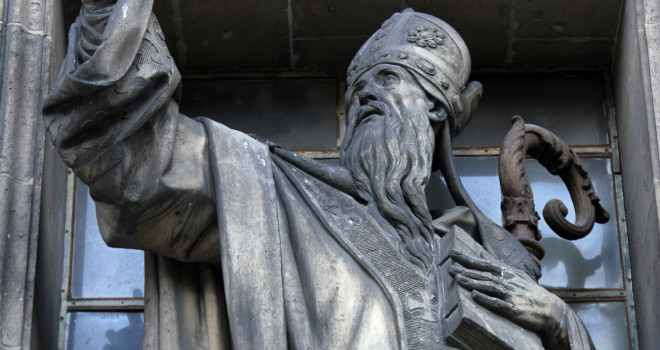
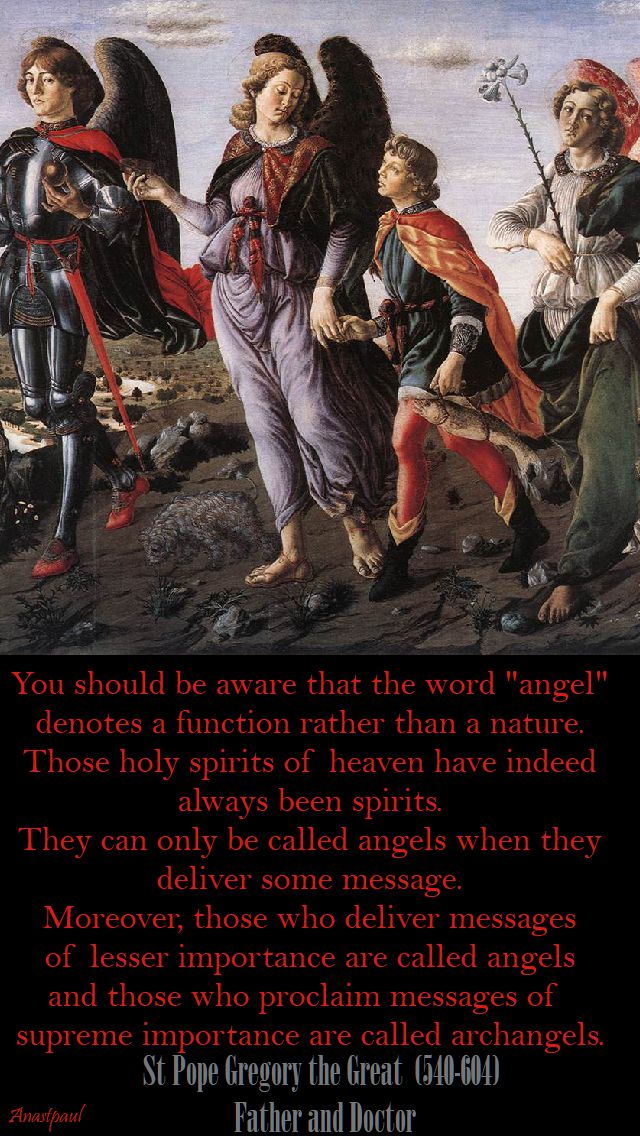
Quote/s of the Day – 3 September – The Memorial of St Pope Gregory the Great (540-604) – Father & Doctor of the Church

Quote/s of the Day – 3 September – The Memorial of St Pope Gregory the Great (540-604) – Father & Doctor of the Church

“If we knew at what time we were to depart from this world,
we would be able to select a season for pleasure
and another for repentance.
But God, who has promised pardon to every repentant sinner,
has not promised us tomorrow.
Therefore we must always dread the final day,
which we can never foresee.
This VERY DAY is a day of truce, a day for conversion.
And yet we refuse to cry over the evil we have done!
Not only do we not weep for the sins we have committed,
we even add to them…”if we knew at what time we were - st gregory the great

“Don’t be anxious about what you have,
but about what you are!”dont be anxious-st pope gregory the great

“When we attend to the needs of those in want,
we give them what is theirs, not ours.
More than performing works of mercy,
we are paying a debt of justice.”when we attend - st gregory the great

“The Emperor of heaven, the Lord of men and of angels,
has sent you His epistles for your life’s advantage—
and yet you neglect to read them eagerly.
Study them, I beg you and meditate daily on the words
of your Creator. Learn the heart of God in the words of God,
that you may sigh more eagerly for things eternal,
that your soul may be kindled
with greater longings for heavenly joy.”he emperor of heaven - st gregory the great

St Pope Gregory the Great (540-604) – Father & Doctor of the Church


Posted in DOCTORS of the Church, FATHERS of the Church, QUOTES of the SAINTS, SAINT of the DAY, The WORD

One Minute Reflection –3 September – The Memorial of St Pope Gregory the Great (540-604) – Father & Doctor of the Church

One Minute Reflection –3 September – The Memorial of St Pope Gregory the Great (540-604) – Father & Doctor of the Church

Since the Creation of the world….God’s eternal power and divinity have become visible, recognised through the things he has made..Romans 1:20

REFLECTION – “God is within all things but not included;  outside all things but not excluded.   God is above all things but not beyond their reach.”….St Pope Gregory the Greatgod is within all things - st gregory the great

PRAYER – Lord of creation, grant me the grace to see You in all things and in all places on earth.   Help me to seek and reach You in all the events I experience and all the persons I encounter every day of my life.   St Pope Gregory the Great, Pray for us! Amenst pope gregory the great pray for us

Posted in Against EPIDEMICS, All THEOLOGIANS, Moral Theologians, DOCTORS of the Church, FATHERS of the Church, GOUT, KNEE PROBLEMS, ARTHRITIS, etc, Of Catholic Education, Students, Schools, Colleges etc, Of MUSICIANS, Choristors, Of POPES and the PAPACY, PATRONAGE - WRITERS, PRINTERS, PUBLISHERS, EDITORS, etc, SAINT of the DAY, TEACHERS, LECTURERS, INSTRUCTORS, The HOLY EUCHARIST / The HOLY MASS

Saint of the Day – 3 September – St Pope Gregory the Great (540-604) – Father & Doctor of the Church

Saint of the Day – 3 September – St Pope Gregory the Great (540-604) – Father & Doctor of the Church.   Also known as “Father of the Fathers” (c 540 at Rome, Italy – Papal Ascension:  3 September 590 – 12 March 604 at Rome, Italy of natural causes).   Pope, Prefect of Rome, Monk, Abbot, Writer, Theologian, Teacher, Liturgist.   Patronages – • against gout • against plague/epidemics,• choir boys,• teachers• stone masons, stonecutters, • students, school children,• Popes, the Papacy,• musicians,• singers,• England, • West Indies,• Legazpi, Philippines, Diocese of,• Order of Knights of Saint Gregory, • Kercem, Malta,• Montone, Italy,• San Gregorio nelle Alpi, Italy.   Attributes – • crozier
• dove,• pope working on sheet music,• pope writing,• tiara.

4 ORIGINAL LATIN FATHERS - JEROME, AMBROSE, GREGORY & AUGUSTINE
4 Original Latin Fathers – Jerome, Gregory, Ambrose, Augustine

Pope St. Gregory was born in Rome, the son of a wealthy Roman Senator.   His mother was St. Sylvia.   He followed the career of public service that was usual for the son of an aristocratic family, becoming Prefect of the City of Rome but resigned within a year to pursue monastic life.

He founded with the help of his vast financial holdings seven monasteries, of which six were on family estates in Sicily. A seventh, which he placed under the patronage of St. Andrew and which he himself joined, was erected on the Clivus Scauri in Rome. For several years, he lived as a good and holy Benedictine monk.

Then Pope Pelagius made him one of the seven deacons of Rome.   For six years, he served as permanent ambassador to the Court of Byzantium.   In the year 586, he was recalled to Rome and with great joy returned to St Andrew’s Monastery.   He became abbot soon afterwards and the monastery grew famous under his energetic rule.   When the Pope died, Gregory was unanimously elected to take his place because of his great piety and wisdom.   However, Gregory did not want that honour, so he disguised himself and hid in a cave but was found and made Pope anyway.

He was elected Pope on 3 September 590, the first monk to be elected to this office.   For fourteen years he ruled the Church.   Even though he was always sick, Gregory was one of the greatest popes the Church has ever had.   He reformed the administration of the Church’s estates and devoted the resulting surplus to the assistance of the poor and the ransoming of prisoners.   He negotiated treaties with the Lombard tribes who were ravaging northern Italy and by cultivating good relations with these and other barbarians he was able to keep the Church’s position secure in areas where Roman rule had broken down.

His works for the propagation of the faith include the sending of St Augustine of Canterbury and his monks as missionaries to England in 596, providing them with continuing advice and support and (in 601) sending reinforcements.   He wrote extensively on pastoral care, spirituality and morals and designated himself “servant of the servants of God”, a title which all Popes have used since that time.

He never rested and wore himself down to almost a skeleton.   Even as he lay dying, he directed the affairs of the Church and continued his spiritual writing.

He codified the rules for selecting deacons to make these offices more spiritual.   Prior to this, deacons were selected on their ability to sing the liturgy and chosen if they had good voices.

Because he loved the solemn celebration of the Eucharist, St. Grergory devoted himself to compiling the Antiphonary, which contains the chants of the Church used during the liturgy (the Gregorian Chant).   He also set up the Schola Cantorum, Roman’s famous training school for chorusters.

St Gregory died on March 12, 604 and was buried in St Peter’s Church.   He is designated as the fourth Doctor of the Latin Church.   His feast is celebrated on the date of his election as Pope.

The Eucharistic Miracle of St Pope Gregory

St Gregory the Great is perhaps especially remembered by many for the Eucharistic Miracle that occurred in 595 during the Holy Sacrifice.   This famous incident was related by Paul the Deacon in his 8th century biography of the holy pope, Vita Beati Gregorii Papae.

Pope Gregory was distributing Holy Communion during a Sunday Mass and noticed amongst those in line a woman who had helped make the hosts was laughing.   This disturbed him greatly and so he inquired what was the cause of her unusual behaviour. The woman replied that she could not believe how the hosts she had prepared could become the Body and Blood of Christ just by the words of consecration.

Hearing this disbelief, St. Gregory refused to give her Communion and prayed that God would enlighten her with the truth.   Just after making this plea to God, the pope witnessed some consecrated Hosts (which appeared as bread) change Their appearance into actual flesh and blood.   Showing this miracle to the woman, she was moved to repentance for her disbelief and knelt weeping.   Today, two of these miraculous Hosts can still be venerated at Andechs Abbey in Germany (with a third miraculous Host from Pope Leo IX [11th century], thus the Feast of the Three Hosts of Andechs [Dreihostienfest]).

During the Middle Ages, the event of the Miraculous Mass of St. Gregory was gradually stylised in several ways.   First the doubting woman was often replaced by a deacon, while the crowd was often comprised of the papal court of cardinals and other retinue. Another important feature was the pious representation of the Man of Sorrows rising from a sarcophagus and surrounded by the Arma Christi, or the victorious display of the various instruments of the Passion.

The artistic representation of this Eucharistic Miracle became especially prominent in Europe during the Protestant Reformation in reaction to the heretical denial of the doctrine of the Real Presence.

Posted in DOCTORS of the Church, FATHERS of the Church, MORNING Prayers, PRAYERS of the SAINTS

Our Morning Offering – 3 September – The Memorial of St Pope Gregory the Great – Father & Doctor

Our Morning Offering – 3 September – The Memorial of St Pope Gregory the Great – Father & Doctor

St Gregory’s Prayer of Praise

It is only right,
with all the powers of our heart and mind,
to praise You Father
and Your Only-Begotten Son,
Our Lord Jesus Christ.
Dear Father,
by Your wondrous condescension
of loving-kindness toward us, Your servants,
You gave up Your Son.
Dear Jesus,
You paid the debt of Adam for us
to the Eternal Father by Your Blood
poured forth in loving-kindness.
You cleared away the darkness of sin
by Your magnificent and radiant Resurrection.
You broke the bonds of death
and rose from the grave as a Conqueror.
You reconciled heaven and earth.
Our life had no hope of eternal happiness
before You redeemed us.
Your Resurrection has washed away our sins,
restored our innocence and brought us joy.
How inestimable is the tenderness
of Your Love!
Amenst gregory's prayer of praise.2

Posted in DOCTORS of the Church, FATHERS of the Church, MORNING Prayers, QUOTES of the SAINTS, SAINT of the DAY

Thought for the Day – 30 August

Thought for the Day – 30 August

Since he had no children, St Pammachius made the poor his heirs and became known in Rome as the benefactor of the blind, the poor and the handicapped.   Since he was one of the first Romans of senatorial rank to become a Christian and live the faith to its fullest in love and charity, his works and deeds of extending his hand to all in need, were remembered for centuries and perhaps, even more importantly, he is became a powerful example of the effect of Christian teaching upon a person of rank and power.
For a wealthy man, there are so many opportunities to help others and St Pammachius looked upon his works of charity as an obligation of his Christian conscience.   His best friend, St Jerome, Father and one of the original four doctors of the Latin Church, said “instead of speaking saintly words, we must act them” and that is precisely what St Pammachius did – for he lived the words of Our Lord, he lived the Beatitudes!

St Pammachius, pray for us!st pammachius pray for us.2

Posted in DOCTORS of the Church, FATHERS of the Church, MORNING Prayers, QUOTES of the SAINTS

Quote of the Day – 30 August

Quote of the Day – 30 August

“Instead of speaking saintly words, we must act them.”

St Jerome (343-420) Father and One of the original Four Doctors of the Latin Churchinstead of speaking - st jerome

Posted in DOCTORS of the Church, FATHERS of the Church, MORNING Prayers, QUOTES of the SAINTS, SAINT of the DAY, The WORD

One Minute Reflection – 30 August

One Minute Reflection – 30 August

“Do to no-one what you would not want done to you.
Give your bread to those who are hungry
and your clothes to those who are naked.”… Tobit 4:16-17tobit 4 16 - 17

REFLECTION – “The bread that is in your box belongs to the hungry;
the coat in your closet belongs to the naked;
the shoes you do not wear belong to the barefoot;
the money in your vault belongs to the destitute.”…..St Basil the Great (329-379) – Doctor of the Churchthe bread that is in your box - st basil the great

PRAYER – God our Saviour, through the grace of Baptism you made us children of light. Hear our prayer, that we may always walk in that light and work for truth, love and charity, as Your witnesses before men. St Pammachius, you lived a life of total charity to those most in need, please pray for us, amen.st pammachius pray for us

Posted in DOCTORS of the Church, FATHERS of the Church, MORNING Prayers, PRAYERS of the SAINTS

Our Morning Offering – 30 August

Our Morning Offering – 30 August

O Lord, the house of my soul is narrow
By St Augustine (354-430) Father & Doctor

O God, the Light of the heart that sees You,
The Life of the soul that loves You,
The Strength of the mind that seeks You:
May I ever continue
to be steadfast in Your love.
Be the joy of my heart;
Take all of me to Yourself and abide therein.
The house of my soul is,
I confess, too narrow for You.
Enlarge it that You may enter.
It is ruinous but do repair it.
It has within it what must offend Your eyes;
I confess and know it,
but whose help shall I seek
in cleansing it but Yours alone?
To You, O God, I cry urgently.
Cleanse me from secret faults.
Keep me from false pride and sensuality
That they not get dominion over me.
AmenO LORD, THE HOUSE OF MY SOUL IS NARROW - full prayer -ST AUGUSTINE

Posted in DOCTORS of the Church, FATHERS of the Church, MORNING Prayers, QUOTES of the SAINTS, SAINT of the DAY

One Minute Reflection – 29 August – The Beheading of St John the Baptist

One Minute Reflection – 29 August – The Beheading of St John the Baptist

She went out and said to her mother, “What shall I ask for?” She replied, “The head of John the Baptist.”…Mark 6:24mark 6 24

REFLECTION – “O great and admirable mystery! He must increase, but I must decrease, said John, said the voice which personified all the voices that had gone before announcing the Father’s Word Incarnate in His Christ….   But He is said to grow in us, when we grow in Him.   To him, then, who draws near to Christ, to him who makes progress in the contemplation of wisdom, words are of little use; of necessity they tend to fail altogether.   Thus the ministry of the voice falls short in proportion as the soul progresses towards the Word;  it is thus that Christ must increase and John decrease.   The same is indicated by the beheading of John and the exaltation of Christ upon the Cross;  as it had already been shown by their birthdays:  for, from the birth of John the days begin to shorten and from the birth of Our Lord they begin to grow longer.”….St Augustine (354-420)thus the ministry of th voice falls short - st augustine

PRAYER – God our Father, You appointed St John The Baptist to be the herald of the birth and death of Christ Your Son. Grant that as he died a martyr for justice and truth, so we may also courageously bear witness to Your Word. St John the Baptist, pray for us, amen.st john the baptist pray for us

Posted in DOCTORS of the Church, FATHERS of the Church, MORNING Prayers, SAINT of the DAY, The WORD

Thought for the Day – 28 August – The Memorial of St Augustine (354-430) Father & Doctor of Grace

Thought for the Day – 28 August – The Memorial of St Augustine (354-430) Father & Doctor of Grace

A Christian at 33, a priest at 36, a bishop at 41:  Many people are familiar with the biographical sketch of Augustine of Hippo, sinner turned saint.   But really to get to know the man is a rewarding experience.

There quickly surfaces the intensity with which he lived his life, whether his path led away from or toward God.   The tears of his mother, the instructions of Ambrose and, most of all, God himself speaking to him in the Scriptures, redirected Augustine’s love of life to a life of love.

Having been so deeply immersed in creature-pride of life in his early days and having drunk deeply of its bitter dregs, it is not surprising that Augustine should have turned, with a holy fierceness, against the many demon-thrusts rampant in his day.   His times were truly decadent:  politically, socially, morally.   He was both feared and loved, like the Master.   The perennial criticism leveled against him:  a fundamental rigorism.

In his day, Augustine providentially fulfilled the office of prophet.   Like Jeremiah and other greats, he was hard-pressed but could not keep quiet.  “I say to myself, I will not mention him,/I will speak in his name no more./But then it becomes like fire burning in my heart,/imprisoned in my bones;/I grow weary holding it in,/I cannot endure it” (Jeremiah 20:9).

Augustine is still acclaimed (and condemned) in our day.  He is a prophet for today, trumpeting the need to scrap escapisms and stand face-to-face with personal responsibility and dignity. (Fr Don Miller OFM – Saint of the Day)

St Augustine, our Father in Faith, pray for us now and at the hour of our death!st augustine pray for us 2


Posted in DOCTORS of the Church, FATHERS of the Church, MORNING Prayers, SAINT of the DAY, The MOST HOLY & BLESSED TRINITY

St Augustine, the Holy Trinity, the Child and the SeaShell

Today, 28 August – the Memorial of St Augustine, I am reposting this legend of St Augustine, the Holy Trinity, the Child and the Seashell.

AnaStpaul's avatarAnaStpaul

St Augustine, the Holy Trinity, the Child and the SeaShell

Today, 11 June 2017, on the Solemnity of the Holy Trinity, we remember the legend of St Augustine and the Seashell.

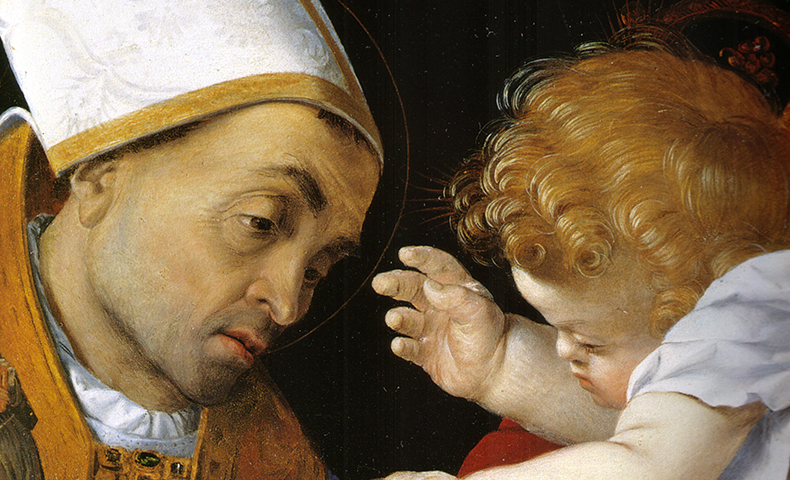
Abraham Willaerts – Saint Augustine and the child Abraham Willaerts – St Augustine and the Child

The great Doctor of the Church St. Augustine of Hippo spent over 30 years working on his treatise De Trinitate [about the Holy Trinity], endeavouring to conceive an intelligible explanation for the mystery of the Trinity.

He was walking by the seashore one day contemplating and trying to understand the mystery of the Holy Trinity when he saw a small boy running back and forth from the water to a spot on the seashore.   The boy was using a sea shell to carry the water from the ocean and place it into a small hole in the sand.

The Bishop of Hippo approached him and asked, “My boy, what are…

View original post 163 more words

Posted in DOCTORS of the Church, FATHERS of the Church, MORNING Prayers, QUOTES of the SAINTS, SAINT of the DAY

Quote/s of the Day – 28 August – The Memorial of St Augustine

Quote/s of the Day – 28 August – The Memorial of St Augustine

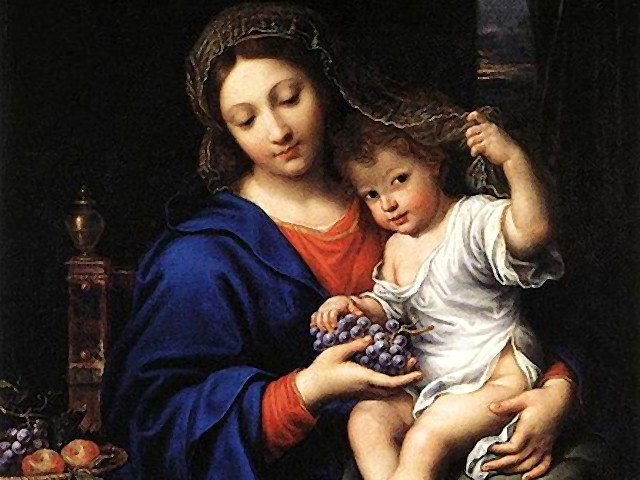
“To fall in love with God is the greatest romance;
to seek Him the greatest adventure;
to find Him the greatest human achievement.”
to fall in love with god - st augustine

“You ask what you might offer to God?
Offer yourself!
What does God expect from you, except yourself?”

you ask what you might offer to god - st augustine

“One of the holiest works,
one of the best exercises of piety
which we can practice in this world,
is to offer sacrifices, alms and prayer for the dead.”one of the holiest works - st augustine

“Conquer yourself and the world lies at your feet.”conquer yourself-st augustine

“God has no need of your money
but the poor have.
You give it to the poor and God receives it.”
“Our life and our death are with our neighbour.”god has no need and our life and our death-st augustine

“Do you wish to RISE?
Begin by DESCENDING.
You plan a tower that will pierce the CLOUDS?
Lay first the foundation of HUMILITY”you wish to rise begin by descending - st augustine

“I will suggest a means whereby
you can praise God all day long, if you wish.
Whatever you do, do it well and you have praised God.”i will suggest a means - st augustine

“God in his omnipotence could not give more,
in His wisdom: He knew not how to give more,
in His riches: He had not more to give,
than the EUCHARIST!”

god in his omnipotence - st augustine

“God does not command impossibilities
but by commanding, admonishes you do what you can
and to PRAY for what you cannot
and AIDS you that you may be able.”god does not comman - st augustine

St Augustine (354-430)  Father & Doctor of Grace

Posted in DOCTORS of the Church, FATHERS of the Church, MORNING Prayers, QUOTES of the SAINTS, The WORD

One Minute Reflection – 28 August – The Memorial of St Augustine (354-430) – Doctor of Grace

One Minute Reflection – 28 August – The Memorial of St Augustine (354-430) – Doctor of Grace

Therefore, whosoever hears these words of mine and does them, I will liken him unto a wise man, who built his house upon a rock: and the rain descended and the floods came and the winds blew and beat upon that house; and it fell not: for it was founded upon a rock.…” Matthew 7:24matthew 7 24

REFLECTION – “If any one will piously and soberly consider the sermon which our Lord Jesus spoke on the mount, as we read it in the Gospel according to Matthew, I think that he will find in it, so far as regards the highest morals, a perfect standard of the Christian life:  and this we do not rashly venture to promise but gather it from the very words of the Lord Himself.
For the sermon itself is brought to a close in such a way, that it is clear there are in it all the precepts which go to mould the life. … He has sufficiently indicated, as I think, that these sayings which He uttered on the mount so perfectly guide the life of those who may be willing to live according to them, that they may justly be compared to one building upon a rock.”...St Augustine (On the Sermon on the Mount)he has sufficiently indicated - st augustine

PRAYER – Lord God, renew Your Church with he Spirit of wisdom and love which You gave to St Augustine. Lead us by that same Spirit, to seek You, the only fountain of true wisdom and the source of everlasting love.   Through our Lord Jesus Christ, Your Son, in union with the Spirit, one God, forever and ever, St Augustine, pray for the Church and for us all, amen.st augustine pray for us

Posted in DEVOTIO, FATHERS of the Church, MORNING Prayers, PRAYERS of the SAINTS, SAINT of the DAY, Uncategorized

Our Morning Offering – August 28 – The Memorial of St Augustine (354-430) – Doctor of Grace

Our Morning Offering – August 28 – The Memorial of St Augustine (354-430) – Doctor of Grace

Only You!
By ST AUGUSTINE

Lord Jesus, let me know myself and know You
and desire nothing save only You.
Let me hate myself and love You.
Let me do everything for the sake of You.
Let me humble myself and exalt You.
Let me think of nothing except You.
Let me die to myself and live in You.
Let me accept whatever happens as from You.
Let me banish self and follow You
and ever desire to follow You.
Let me fly from myself and take refuge in You,
That I may deserve to be defended by You.
Let me fear for myself.
Let me fear You
and let me be among those who are chosen by You.
Let me distrust myself and put my trust in You.
Let me be willing to obey for the sake of You.
Let me cling to nothing save only to You,
And let me be poor because of You.
Look upon me, that I may love You.
Call me that I may see You and for ever enjoy You.
Amen

lord jesus, lt me know myself and know you - st augustine

Posted in All THEOLOGIANS, Moral Theologians, AUGUSTINIANS OSA, BREWERS, DOCTORS of the Church, EYES - Diseases, of the BLIND, FATHERS of the Church, PATRONAGE - WRITERS, PRINTERS, PUBLISHERS, EDITORS, etc, SAINT of the DAY

Saint of the Day – 28 August – St Augustine (354-430) – Doctor of Grace and one of the original Four Fathers & Doctors of the Latin Church

Saint of the Day – 28 August – St Augustine (354-430) born  Augustinus Aurelius (13 November 354 at Tagaste, Numidia, North Africa (Souk-Ahras, Algeria) – 28 August 430 at Hippo, North Africa) – Doctor of Grace and one of the original Four Fathers & Doctors of the Latin Church – Bishop, Theologian, Philosopher, Rhetorician, Writer, Preacher, Teacher, Advisor, Reformer, Confessor, Apologist, Apostle of Charity.    PATRONAGES – of theologians, brewers, printers, 7 Diocese, 7 Cities, against sore eyes, eye diseases, against vermin.   Attributes – Child; dove; pen; shell, pierced heart, holding book with a small church, bishop’s staff, mitre, flaming heart, an allusion to a passage in his Confessions.

Augustine was born in the year on 13 November in 354 AD in the municipium of Thagaste (now Souk Ahras, Algeria) in Roman Africa.   His mother, Monica, was a devout Christian;  his father Patricius was a Pagan who converted to Christianity on his deathbed.   Scholars generally agree that Augustine and his family were Berbers, an ethnic group indigenous to North Africa but that they were heavily Romanized, speaking only Latin at home as a matter of pride and dignity.   In his writings, Augustine leaves some information as to the consciousness of his African heritage.   For example, he refers to Apuleius as “the most notorious of us Africans,” to Ponticianus as “a country man of ours, insofar as being African”and to Faustus of Mileve as “an African Gentleman.”
Augustine’s family name, Aurelius, suggests that his father’s ancestors were freedmen of the gens Aurelia given full Roman citizenship by the Edict of Caracalla in 212. Augustine’s family had been Roman, from a legal standpoint, for at least a century when he was born.   It is assumed that his mother, Monica, was of Berber origin, on the basis of her name but as his family were an upper class of citizens known as honorable men, Augustine’s first language is likely to have been Latin.

Augustine Aurelius still unbaptised and burning for knowledge, he came under the influence of the Manicheans, which caused his mother intense sorrow. He left Africa for Rome, deceiving his mother, who was ever anxious to be near him.   She prayed and wept.   A bishop consoled her by observing that a son of so many tears would never be lost.   Yet the evil spirit drove him constantly deeper into moral degeneracy, capitalising on his leaning toward pride and stubbornness.   Grace was playing a waiting game;  there still was time and the greater the depths into which the evil spirit plunged its fledgling, the stronger would be the reaction.

Augustine recognised this vacuum;  he saw how the human heart is created with a great abyss;  the earthly satisfactions that can be thrown into it are no more than a handful of stones that hardly cover the bottom.   And in that moment grace was able to break through:  Restless is the heart until it rests in God.   The tears of his mother, the sanctity of Milan’s Bishop Ambrose, the book of St Anthony the hermit and the sacred Scriptures wrought his conversion, which was sealed by baptism on Easter night 387.   Augustine’s mother went to Milan with joy and witnessed her son’s baptism.   It was what it should have been, the greatest event of his life, his conversion — metanoia.   Grace had conquered.   Augustine accompanied his mother to Ostia, where she died.   She was eager to die, for now she had given birth to her son for the second time.

Conversion-of-St-Augustine-by-Fra-Angelico
baptism of augustine - van rosen
augustine and ambrose
St Augustine and St Ambrose

In 388 he returned to Tagaste, where he lived a common life of prayer and solitude with his friends.   In 391 he was ordained priest at Hippo, in 394 made coadjutor to bishop Valerius and then from 396 to 430 bishop of Hippo.

Augustine, numbered among the four great Doctors of the Western Church, possessed one of the most penetrating minds of ancient Christendom.   He was the most important Platonist of patristic times, the Church’s most influential theologian, especially with regard to clarifying the dogmas of the Trinity, grace and the Church.   He was a great speaker, a prolific writer, a saint with an inexhaustible spirituality.   His Confessions, a book appreciated in every age, describes a notable portion of his life (until 400), his errors, his battles, his profound religious observations.   Famous too is his work The City of God, a worthy memorial to his genius, a philosophy of history.   Most edifying are his homilies, especially those on the psalms and on the Gospel of St. John.

Augustine’s episcopal life was filled with mighty battles against heretics, over all of whom he triumphed.   His most illustrious victory was that over Pelagius, who denied the necessity of grace;  from this encounter he earned the surname “Doctor of grace.”   As an emblem Christian art accords him a burning heart to symbolise the ardent love of God which permeates all his writings.   He is the founder of canonical life in common;  therefore Augustinian monks and the Hermits of St. Augustine honour him as their spiritual father.
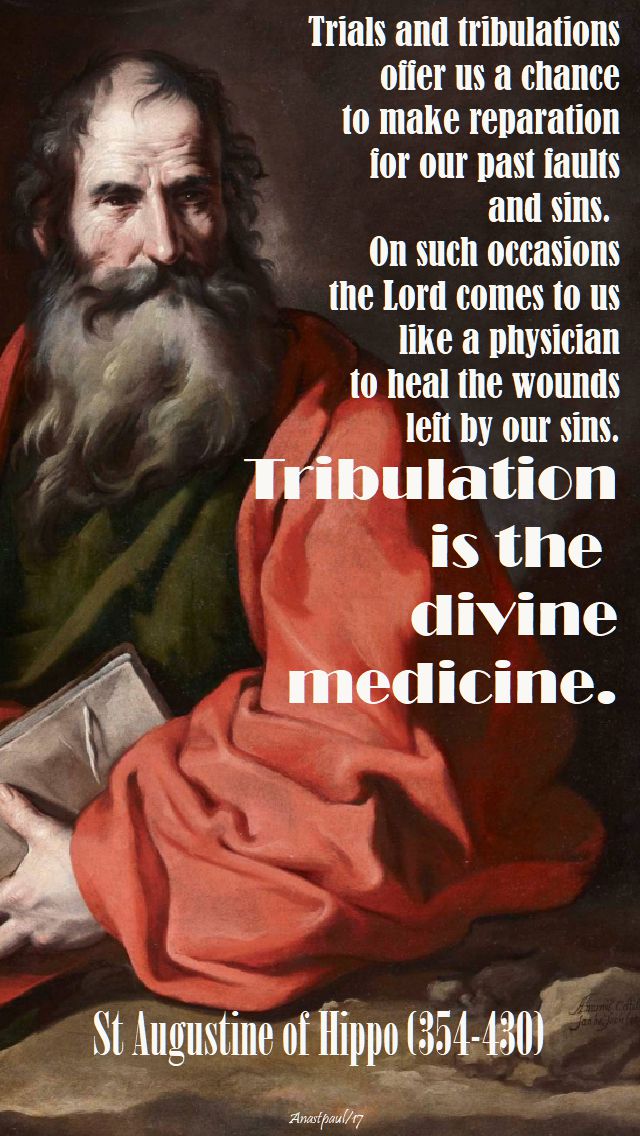
As bishop, Augustine worked tirelessly for his people.   He fought false religious teachings, protected the people from corrupt officials and invaders and cared for the sick, the poor and those in prison.   His many sermons, letters and books reflect the ever-deepening love he felt for God.   He wisely observed:  “You have made us, O God, for yourself, and our hearts shall find no rest until they rest in you.”

He wrote and advised bishops, popes and councils.   His influence on the Church and his fight against heresy were exceptional.   He was loved by many, for he had struggled much and could help others who were struggling.

st-augustine-and-four-states-of-a-fraternity.jpgBlog
386px-Sandro_Botticelli_-_St_Augustin_dans_son_cabinet_de_travail
Seghers, Gerard, 1591-1651; The Four Doctors of the Western Church: Saint Augustine of Hippo (354-430)

In 430 Vandals invaded the province.   For three months Augustine inspired Christian hope in his people.   According to Possidius, Augustine spent his final days in prayer and repentance, requesting that the penitential Psalms of David be hung on his walls so that he could read them.  vv He directed that the library of the church in Hippo and all the books therein should be carefully preserved.   He died on 28 August 430.   Shortly after his death, the Vandals lifted the siege of Hippo but they returned not long thereafter and burned the city.   They destroyed all of it but Augustine’s cathedral and library, which they left untouched.

St Bede’s True Martyrology, recounts that Augustine’s body was later translated or moved to Cagliari, Sardinia, by the Catholic bishops expelled from North Africa by Huneric.   Around 720, his remains were transported again by Peter, bishop of Pavia and uncle of the Lombard king Liutprand, to the church of San Pietro in Ciel d’Oro in Pavia, in order to save them from frequent coastal raids by Muslims.   In January 1327, Pope John XXII issued the papal bull Veneranda Santorum Patrum, in which he appointed the Augustinians guardians of the tomb of Augustine (called Arca), which was remade in 1362 and elaborately carved with bas-reliefs of scenes from Augustine’s life.

OLYMPUS DIGITAL CAMERA
St Augustine’s Relics in Hippo
tomb of st augustine
St Augustine’s Shrine at San Pietro
Posted in DOCTORS of the Church, FATHERS of the Church, MORNING Prayers, QUOTES of the SAINTS, SAINT of the DAY

Thought for the day – 27 August – The Memorial of St Monica

Thought for the day – 27 August – The Memorial of St Monica

Today we celebrate the memorial of St Monica, the mother of St Augustine, whose memorial we will celebrate tomorrow.
We celebrate this memorial not simply because St Monica was the mother of a great saint.

The opening prayer for Mass goes like this and it is worthwhile to take note: ‘God of mercy, comfort of those in sorrow, the tears of St Monica moved you to convert her son, St Augustine to the faith of Christ.’
All in all, she prayed for something like 30 years before she finally had the joy of seeing St Augustine baptised.

St Monica enfleshed the words which we hear in the 1st reading: ‘May our Lord Jesus Christ and God our Father, who has given us His love and through His grace, such inexhaustible comfort and such sure hope, comfort you and strengthen you.’
The consolation, experienced by St Monica and her total abandonment to God can also be ours today when we persevere in patience and in trust – this is Monica’s lesson – keep on praying good folk, for God hears you!

St Monica, pray for us!

“The day was now approaching when my mother Monica would depart from this life;  You know that day, Lord, though we did not.   She and I happened to be standing by ourselves at a window that overlooked the garden in the courtyard of the house.   At the time we were in Ostia on the Tiber.   And so the two of us, all alone, were enjoying a very pleasant conversation, “forgetting the past and pushing on to what is ahead..”   We were asking one another in the presence of the Truth – for You are the Truth – what it would be like to share the eternal life enjoyed by the saints, which “eye has not seen, nor ear heard, which has not even entered into the heart of man.”   We desired with all our hearts to drink from the streams of your heavenly fountain, the fountain of life.   That was the substance of our talk, though not the exact words.   But You know, O Lord, that in the course of our conversation that day, the world and its pleasures lost all their attraction for us.   My mother said, “Son, as far as I am concerned, nothing in this life now gives me any pleasure. I do not know why I am still here, since I have no further hopes in this world. I did have one reason for wanting to live a little longer:  to see you become a Catholic Christian before I died. God has lavished His gifts on me in that respect, for I know that you have even renounced earthly happiness to be his servant.   So what am I doing here?”   I do not really remember how I answered her.    Shortly, within five days or thereabouts, she fell sick with a fever. Then one day during the course of her illness she became unconscious and for a while she was unaware of her surroundings.   My brother and I rushed to her side but she regained consciousness quickly.   She looked at us as we stood there and asked in a puzzled voice: “Where was I?”   We were overwhelmed with grief, but she held her gave steadily upon us, and spoke further:  “Here you shall bury your mother.”   I remained silent as I held back my tears.   However, my brother haltingly expressed his hope that she might not die in a strange country but in her own land, since her end would be happier there.   When she heard this, her face was filled with anxiety and she reproached him with a glance because he had entertained such earthly thoughts.   Then she looked at me and spoke:  “Look what he is saying.”   Thereupon she said to both of us, “Bury my body wherever you will; let not care of it cause you any concern.   One thing only I ask you, that you remember me at the altar of the Lord wherever you may be.”   Once our mother had expressed this desire as best she could, she fell silent as the pain of her illness increased.”  – from the Confessions of Saint Augustine

st monica pray for us.2

Posted in DOCTORS of the Church, FATHERS of the Church, MORNING Prayers, QUOTES of the SAINTS, SAINT of the DAY

Quote of the Day – 27 August – The Memorial of St Monica

Quote of the Day – 27 August – The Memorial of St Monica

“Son, nothing in this world now affords me delight.
I do not know what there is now for me to do
or why I am still here,
all my hopes in this world being now fulfilled.”

Saint Monica, on the conversion of Augustine

son, nothing in this world - st monica

Posted in DOCTORS of the Church, FATHERS of the Church, MORNING Prayers, PRAYERS of the SAINTS, SAINT of the DAY

Our Morning Offering – 27 August – The Memorial of St Monica

Our Morning Offering – 27 August – The Memorial of St Monica

LATE HAVE I LOVED YOU
By St Augustine

Late have I loved You,
Beauty so ancient and so new,
late have I loved You!
Lo, you were within,
but I outside, seeking there for You,
and upon the shapely things You have made
I rushed headlong – I, misshapen.
You were with me but I was not with You.
They held me back far from You,
those things which would have no being,
were they not in You.
You called, shouted, broke through my deafness.
You flared, blazed, banished my blindness.
You lavished Your fragrance, I gasped
and now I pant for You;
I tasted You and now I hunger and thirst;
You touched me and I burned for Your peace.

late have i loved you - st augustine

Posted in DOCTORS of the Church, FATHERS of the Church, QUOTES of the SAINTS, SAINT of the DAY

Saint of the Day – 27 August – St Monica (322-387)

Saint of the Day – 27 August – St Monica (322-387) – Mother of St Augustine (354-430) Great Father and Doctor of the Churcg,, Widow, Religious Lay Woman – born in 322 at Tagaste,Souk Ahrus), Roman North Africa (modern Algeria) and died in 387 at Ostia, Italy).  Patronages –  conversion of relatives, alcoholics, alcoholism, difficult marriages, disappointing children, homemakers, housewives, married women, wives, mothers, victims of adultery or unfaithfulness, victims of verbal abuse, widows, Archconfraternity of Christian Mothers, Bevilacqua, Italy, Mabini, Bohol, Philippines, various cities across the world.   Attributes –  cincture, girdle, tears, religious habit, in prayer.

st monica info

Because of her name and place of birth, Monica is assumed to have been born in Thagaste (present-day Souk Ahras, Algeria).   She is believed to have been a Berber on the basis of her name.   She was married early in life to Patricius, a Roman pagan, who held an official position in Tagaste.   Patricius had a violent temper and appears to have been of dissolute habits; apparently his mother was the same way.  Monica’s alms, deeds and prayer habits annoyed Patricius but it is said that he always held her in respect.

st monica - young
st monica and augustine

Monica had three children who survived infancy:  sons Augustine and Navigius and daughter Perpetua.   Unable to secure baptism for them, she grieved heavily when Augustine fell ill.   In her distress she asked Patricius to allow Augustine to be baptised; he agreed, then withdrew this consent when the boy recovered. But Monica’s joy and relief at Augustine’s recovery turned to anxiety as he misspent his renewed life being wayward and, as he himself tells us, lazy.   He was finally sent to school at Madauros.   He was 17 and studying rhetoric in Carthage when Patricius died.

Augustine had become a Manichaean at Carthage;  when upon his return home he shared his views regarding Manichaeism, Monica drove him away from her table. However, she is said to have experienced a vision that convinced her to reconcile with him.   At this time she visited a certain (unnamed) holy bishop who consoled her with the now famous words, “the child of those tears shall never perish.”   Monica followed her wayward son to Rome, where he had gone secretly;  when she arrived he had already gone to Milan but she followed him.   Here she found Ambrose and through him she ultimately had the joy of seeing Augustine convert to Christianity after 17 years of resistance.

st monica
Santo Agostinho e Santa Mônica
8ad4f32cb0350c4a9a4efe1a6014b2e8--st-monica-church-windows

In his book Confessions, Augustine wrote of a peculiar practice of his mother in which she “brought to certain oratories, erected in the memory of the saints, offerings of porridge, bread, water and wine.” When she moved to Milan, the bishop Ambrose forbade her to use the offering of wine, since “it might be an occasion of gluttony for those who were already given to drink”.   So, Augustine wrote of her:

“In place of a basket filled with fruits of the earth, she had learned to bring to the oratories of the martyrs a heart full of purer petitions and to give all that she could to the poor–so that the communion of the Lord’s body might be rightly celebrated in those places where, after the example of His passion, the martyrs had been sacrificed and crowned.” — Confessions 6.2.2

Mother and son spent 6 months of true peace at Rus Cassiciacum (present-day Cassago Brianza) after which Augustine was baptised in the church of St John the Baptist at Milan.

baptism of st augustine - my edit

Africa claimed them, however, and Augustine and the members of his family now set out for their return to Tagaste.   At the port of Ostia, Monica fell ill.   She knew that her work had been accomplished and that life would soon be over.   Her exaltation of spirit was such that her sons were unaware of the approach of death.   As Monica’s strength failed, she said to Augustine:  “I do not know what there is left for me to do or why I am still here, all my hopes in this world being now fulfilled. All I wished for was that I might see you a Catholic and a child of Heaven. God granted me even more than this in making you despise earthly felicity and consecrate yourself to His service.”   Shortly afterwards they asked her if she did not fear to die so far from home, for she had earlier expressed a desire to be buried beside her husband in Tagaste.   Now, with beautiful simplicity, she replied, “Nothing is far from God” and indicated that she was content to be buried where she died.   Monica’s death plunged her children into the deepest grief and Augustine, “the son of so many tears,” in the Confessions implores his readers’ prayers for his parents. It is the prayers of Monica herself that have been invoked by generations of the faithful who honour her as a special patroness of married women and as an example for Christian motherhood.   Her relics are alleged to have been transferred from Ostia to Rome, to rest in the church of San Agostino.

death of st monica 2
the-death-of-st-monica-st-augustine-christine-till

St Monica’s death and Augustine’s grief inspired the finest pages of his Confessions.

Posted in DOCTORS of the Church, FATHERS of the Church, MORNING Prayers, PRAYERS of the SAINTS, SAINT of the DAY, The BLESSED VIRGIN MARY

The Memorare by St Bernard of Clairvaux “Doctor of Light”

On the Feast Day of St Bernard, August 20, can we do better than call on our Mother

The Memorare by St Bernard of Clairvaux

REMEMBER, O most gracious Virgin Mary,
that never was it known that anyone who fled
to thy protection, implored thy help, or sought
thy intercession was left unaided. Inspired by
this confidence, I fly unto thee, O Virgin of virgins,
my Mother; to thee do I come; before thee I stand,
sinful and sorrowful. O Mother of the Word Incarnate,
despise not my petitions, but in thy mercy
hear and answer me. Amen.

(The Express Novena you will recall, is 9 times the Memorare)

THE MEMORARE - ST BERNARDst bernard - doctor of light

Posted in DOCTORS of the Church, FATHERS of the Church, MORNING Prayers, SAINT of the DAY, The BLESSED VIRGIN MARY

Thought for the Day – 20 August – The Memorial of St Bernard of Clairvaux

Thought for the Day – 20 August – The Memorial of St Bernard of Clairvaux

Man of the century!   Woman of the century!   You see such terms applied to so many today—“golfer of the century,” “composer of the century,” “right tackle of the century”—that the line no longer has any punch.   But Western Europe’s “man of the twelfth century,” without doubt or controversy, had to be Bernard of Clairvaux. Adviser of popes, preacher of the Second Crusade, defender of the faith, healer of a schism, reformer of a monastic Order, Scripture scholar, theologian, and eloquent preacher: any one of these titles would distinguish an ordinary man.   Yet Bernard was all of these—and he still retained a burning desire to return to the hidden monastic life of his younger days.
His ability as arbitrator and counsellor became widely known.   More and more he was lured away from the monastery to settle long-standing disputes.   On several of these occasions, he apparently stepped on some sensitive toes in Rome.   Bernard was completely dedicated to the primacy of the Roman See.   But to a letter of warning from Rome, he replied that the good fathers in Rome had enough to do to keep the Church in one piece.   If any matters arose that warranted their interest, he would be the first to let them know.

Shortly thereafter it was Bernard who intervened in a full-blown schism and settled it in favour of the Roman pontiff against the antipope.

Bernard felt responsible in some way for the degenerative effects of the crusade.   This heavy burden possibly hastened his death, which came August 20, 1153.

death of st bernard prado (1)
Juan Correa de Vivar (1510 – 16 April 1566)
Death of St Bernard – 1545

Bernard’s life in the Church was more active than we can imagine possible today.  His efforts produced far-reaching results.   But he knew that they would have availed little without the many hours of prayer and contemplation that brought him strength and heavenly direction.   His life was characterised by a deep devotion to the Blessed Mother. His sermons and books about Mary are still the standard of Marian theology….Fr Don Miller OFM

St Bernard Pray for us!

st bernard pray for us 2

Posted in DOCTORS of the Church, FATHERS of the Church, MORNING Prayers, SAINT of the DAY

Quote/s of the Day – The Memorial of St Bernard of Clairvaux

Quote/s of the Day – The Memorial of St Bernard of Clairvaux

“Are you troubled?
Think but of Jesus – speak but the name of Jesus,
the clouds disperse
and peace descends anew from heaven.
Have you fallen into sin? So that you fear death?
..invoke the name of Jesus
and you will soon feel life returning.
No obduracy of the soul, no weakness,
no coldness of heart can resist this holy name –
there is no heart which will not soften
and open in tears at this holy name.”are you troubled - st bernard

“The measure of love is love without measure.”the measure of love - st bernard

“Jesus, what made You so small?
LOVE!”

jesus what made you so small - LOVE - st bernard

“There are those who seek knowledge
for the sake of knowledge – that is curiosity.
There are those who seek knowledge
to be known by others – that is vanity.
There are those who seek knowledge
in order to serve – that is Love.”there are those who seek knowledge - st bernard

“The three most important virtues are:
humility,
humility
and humility.”the 3 most important virtues are - st bernard

“Let us not imagine that we obscure
the glory of the Son by the great praise
we lavish on the Mother –
for the more she is honoured,
the greater is the glory of her Son.
There can be no doubt that whatever we say
in praise of the Mother gives equal praise to the Son.”LET US NOT IMAGINE-ST BERNARD

“Love for Christ pierced Mary’s heart
in such a way that no part of it
was left unkindled.
Mary thus fulfilled
the first commandment of love
in all its fulness
and without the slightest imperfection.”QUOTE ST BERNARD

“Action and contemplation are very close companions;
they live together in one house on equal terms.
Martha and Mary are sisters.”

action and contemplation - st bernard

St Bernard of Clairvaux (1090-1153) Doctor of the Church

Posted in DOCTORS of the Church, FATHERS of the Church, MORNING Prayers, QUOTES of the SAINTS, SAINT of the DAY, The WORD

One Minute Reflection – 20 August – – The Memorial of St Bernard of Clairvaux

One Minute Reflection – 20 August – – The Memorial of St Bernard of Clairvaux

Hold fast to …. a good conscience. Some men, by rejecting the guidance of conscience, have made shipwreck of their faith…1 Timothy 1:191 timothy 1 19

REFLECTION – “A good conscience is a treasury of riches.
Indeed, what greater riches can there be – or what can be sweeter – than a good conscience?….St Bernarda good conscience - st bernard

PRAYER – All-knowing God, let me be able to stand in Your presence with a good conscience.
Help me to avoid anything that would sully my conscience and do all I can to remain united with You.
St Bernard, pray for us, amen.st bernard pray for us

Posted in DOCTORS of the Church, FATHERS of the Church, MORNING Prayers, PRAYERS of the SAINTS, SAINT of the DAY

Our Morning Offering – 20 August – The Memorial of St Bernard of Clairvaux

Our Morning Offering – 20 August – The Memorial of St Bernard of Clairvaux

Morning Prayer of St Bernard

High and holy God
Give me this day
a word of truth
to silence the lies
that would devour my soul
and kind encouragements
to strengthen me when I fall.
Gracious One
I come quietly to Your door
needing to receive
from Your hands
the nourishment
that gives life.
Amen and Amen.

MORNING PRAYER OF ST BERNARD.2

Posted in DOCTORS of the Church, FATHERS of the Church, SAINT of the DAY

Saint of the Day – 20 August – St Bernard of Clairvaux (1090-1153) – Abbot, Confessor Doctor of the Church – “Doctor Mellifluus” and the Last Father of the Church, “The Bard of Mary”

Saint of the Day – 20 August – St Bernard of Clairvaux (1090-1153) – Abbot Confessor Doctor of the Church and the Last Father of the Church, “The Bard of Mary“- “Doctor Mellifluus”, Theologian, Reformer, Writer, Mystic, Preacher, Mariologist, Advisor, Mediator, Poet.   Born in1090 at Fontaines-les-Dijon, Burgundy, France -and died on 20 August 1153 at Clairvaux Abbey, Ville-sous-la-Ferté, Aube, France).   He was Canonised in 1170, only 17 years after his death, by Pope Alexander III.   Patronages – Cistercians, beekeepers, bees, Burgundy and France, candlemakers, chandlers, Gibraltar,  Knights Templar, Queens College, Cambridge, England, Speyer Cathedral, wax-melters, wax refiners.   Attributes – White Cistercian habit, devil on a chain, white dog.  St Bernard, the Founding Abbot of Clairvaux Abbey in Burgundy, was one of the most commanding Church leaders in the first half of the twelfth century, as well as, one of the greatest spiritual masters of all time and the most powerful propagator of the Cistercian reform.

bernard - info

St-Bernard-cropped

St Bernard’s parents were Tescelin de Fontaine, Lord of Fontaine-lès-Dijon and Alèthe de Montbard, both members of the highest nobility of Burgundy. Bernard was the third of seven children, six of whom were sons.   At the age of nine years, he was sent to a school at Châtillon-sur-Seine run by the secular canons of Saint-Vorles.   Bernard had a great taste for literature and devoted himself for some time to poetry.   His success in his studies won the admiration of his teachers.   He wanted to excel in literature in order to take up the study of the Bible.   He had a special devotion to the Virgin Mary and he would later write several works about the Queen of Heaven, hence his wonderful title “The Bard of Mary.”.

St Bernard would expand upon Anselm of Canterbury’s role in transmuting the sacramentally ritual Christianity of the Early Middle Ages into a new, more personally held faith, with the life of Christ as a model and a new emphasis on the Virgin Mary.   In opposition to the rational approach to divine understanding that the scholastics adopted, Bernard would preach an immediate faith, in which the intercessor was the Virgin Mary.

Bernard was only nineteen years of age when his mother died.   During his youth, he did not escape trying temptations and around this time he thought of retiring from the world and living a life of solitude and prayer.

In 1098 Saint Robert of Molesme had founded Cîteaux Abbey, near Dijon, with the purpose of restoring the Rule of St Benedict in all its rigour.   Returning to Molesme, he left the government of the new Abbey to Saint Alberic of Cîteaux, who died in the year 1109.   At the age of 22, while Bernard was at prayer in a Church, he felt the calling of God to enter the Cistercian Monks of Cîteaux.    In 1113 Saint Stephen Harding had just succeeded Saint Alberic as third Abbot of Cîteaux when Bernard and thirty other young noblemen of Burgundy sought admission into the Cistercian order.   Bernard’s testimony was so irresistible that 30 of his friends, brothers and relatives followed him into the monastic life.

20Ago_Bernardo_Claraval

St.-Bernard

In 1115, St Bernard was sent to begin a new monastery near Aube- Clairvaux, the Valley of Light.    As a young Abbot he published a series of sermons on the Annunciation.   These marked him not only as a most gifted spiritual writer but also as the “cithara of Mary,” especially noted for his development of Mary’s mediatorial role.

The Peacemaker
St Bernard’s spiritual writing as well as his extraordinary personal magnetism began to attract many to Clairvaux and the other Cistercian Monasteries, leading to many new foundations.   He was drawn into the controversy developing between the new monastic movement which he pre-eminently represented and the established Cluniac order, a branch of the Benedictines.  This led to one of his most controversial and most popular works, his Apologia.   Bernard’s dynamism soon reached far beyond monastic circles.   He was sought as an advisor and mediator by the ruling powers of his age.   More than any other he helped to bring about the healing of the Papal schism which arose in 1130 with the election of the antipope Anacletus II.   It cost Bernard eight years of laborious travel and skillful mediation.   At the same time he laboured for peace and reconciliation between England and France and among many lesser nobles.   His influence mounted when his spiritual son was elected Pope in 1145.   At Eugene III’s command he preached the Second Crusade and sent vast armies on the road toward Jerusalem.   In his last years he rose from his sickbed and went into the Rhineland to defend the Jews against a savage persecution.StBernard

The Writer
Although he suffered from constant physical debility and had to govern a Monastery that soon housed several hundred Monks and was sending forth groups regularly to begin new Monasteries (he personally saw to the establishment of sixty-five of the three hundred Cistercian Monasteries founded during his thirty-eight years as Abbot), he yet found time to compose many and varied spiritual works that still speak to us today.   He laid out a solid foundation for the spiritual life in his works on grace and free will, humility and love.   His gifts as a theologian were called upon to respond to the dangerous teachings of the scintillating Peter Abelard, of Gilbert de la Porree and of Arnold of Brescia.   His masterpiece, his Sermons on the Song of Songs, was begun in 1136 and was still in composition at the time of his death.   With great simplicity and poetic grace Bernard writes of the deepest experiences of the mystical life in ways that became normative for all succeeding writers.   For Pope Eugene he wrote Five Books on Consideration, the bedside reading of Pope John XXIII and many other Pontiffs through the centuries.

Final Years
The death of his contemporaries served as a warning to Bernard of his own approaching end.   The first to die was Suger in 1152, of whom Bernard wrote to Eugene III, “If there is any precious vase adorning the palace of the King of Kings it is the soul of the venerable Suger”.   Conrad III and his son Henry died the same year.   From the beginning of the year 1153, Bernard felt his death approaching.   The passing of Pope EugenE had struck the fatal blow by taking from him one whom he considered his greatest friend and consoler.   Bernard died at age sixty-three on 20 August 1153, after forty years spent in the cloister.   He was buried at the Clairvaux Abbey but after its dissolution in 1792 by the French revolutionary government, his remains were transferred to Troyes Cathedral.

Doctor of the Church
Bernard was Canonised by Pope Alexander III on 18 January 1174.   Pope Pius VII declared him a Doctor of the Church in 1830.   At the 800th anniversary of his death, Pope Pius XII issued an encyclical on Bernard, Doctor Mellifluus, in which he labeled him “The Last of the Fathers.”   Bernard did not reject human philosophy which is genuine philosophy, which leads to God;  he differentiates between different kinds of knowledge, the highest being theological.   The central elements of Bernard’s Mariology are how he explained the virginity of Mary, the “Star of the Sea” and her role as Mediatrix.

Legacy
St Bernard was instrumental in re-emphasising the importance of Lectio Divina and contemplation on Scripture within the Cistercian order.    Bernard had observed that when Lectio Divina was neglected monasticism suffered.   He considered Lectio Divina and contemplation guided by the Holy Spirit the keys to nourishing Christian spirituality.

He “noted centuries ago:  the people who are their own spiritual directors have fools for disciples.”   Bernard’s theology and Mariology continue to be of major importance, particularly within the Cistercian and Trappist orders.   Bernard led to the foundation of 163 Monasteries in different parts of Europe.  At his death, they numbered 343.   His influence led Alexander III to launch reforms that would lead to the establishment of canon law.  He was the first Cistercian Monk placed on the calendar of Saints.   He is labelled the “Mellifluous Doctor” for his eloquence.   Cistercians honour him as the Founder of the Order because of the widespread activity which he gave to the Order.

Saint Bernard’s “Prayer to the Shoulder Wound of Jesus, ”  the “Jesu Dulcis Memoria” and the Memorare are probably his most famous prayers.

Bernard is Dante Alighieri’s last guide, in Divine Comedy, as he travels through the Empyrean.   Dante’s choice appears to be based on Bernard’s contemplative mysticism, his devotion to Mary and his reputation for eloquence.   He is also the Author of the Poems often translated in English hymnals as “O Sacred Head, Now Wounded” and “Jesus the Very Thought of Thee“.

The Couvent et Basilique Saint-Bernard, a collection of buildings dating from the 12th, 17th and 19th centuries, is dedicated to Bernard and stands in his birthplace of Fontaine-lès-Dijon.ST BERNARD.3

St Bernard of Clairvaux BY GOYA - Copy

f42f94e04f9e0dc3510140d5a8ced100--bernard-of-clairvaux-st-bernards

Posted in DOCTORS of the Church, DOMINICAN OP, FATHERS of the Church, MORNING Prayers, SAINT of the DAY, The BLESSED VIRGIN MARY

Quote/s of the Day – 17 August

Quote/s of the Day – 17 August

As it is the Memorial of St Hyacinth O.P. of the great Marian Miracle,
I am posting Quotations on Mary from some of our great Dominican Saints.
Enjoy!

“Mary is the Divine Page
on which the Father wrote
the Word of God, His Son.”

St Albert the Great O.P. (1200-1280) Doctor of the Church

mary is the divine page - st albert the great

“As mariners are guided into port
by the shining of a star,
so Christians are guided to heaven
by Mary.”

St Thomas Aquinas O.P. (1225-1274) Doctor of the Church

as mariners are guided into port - st thomas aquinas

“Mary is the most sweet bait,
chosen,
prepared
and ordained by God,
to catch the hearts of men.”

St Catherine of Siena T.O.S.D. (1347-1380) Doctor of the Churchmary is the most sweet bait - st catherine of siena

“To ask favours
without interposing Mary,
is to attempt to fly without wings.”

St Antoninus O.P. Bishop of Florence (1389-1459)

to ask favours without interposing mary - st antoninus of florence

Posted in DOCTORS of the Church, FATHERS of the Church, MORNING Prayers, QUOTES of the SAINTS, SAINT of the DAY, The BLESSED VIRGIN MARY, The WORD

One Minute Reflection – 17 August – The Memorial of St Hyacinth of Poland

One Minute Reflection – 17 August – The Memorial of St Hyacinth of Poland

Come, blessed of my Father, possess the kingdom prepared for you from the foundation of the world…Matthew 25:34

REFLECTION – “Mary, the Mother of our Lord, accompanied by the choirs of Angels, will come to meet you. What a day of joy that will be for you!”….St Jerome (343-420) Doctor of the Church

mnary the moher of our lord - st jerome

PRAYER – O Mary, Mother of God and my mother, watch over me at every moment and keep me free from sin. Then upon my death, come to meet me and lead me to my eternal home in heaven. As you, St Hyacinth, took Mary with you and she made smooth your path, pray that we too may always ‘take Mary with us’ to lead us safely home to her son, who is our Lord, amen.

st hyacinth of poland pray for us

Posted in DOCTORS of the Church, FATHERS of the Church, MORNING Prayers, QUOTES of the SAINTS, SAINT of the DAY

Thought for the Day – The Memorial of St Simplician – 15 August

Thought for the Day – The Memorial of St Simplician – 15 August

“Augustine and Simplician, sons of Milan, followers of Christ”

“Another great name enters Milan’s rich story in 384, that of the man who became St Augustine.   In 384 he was not yet a saint.   But he was a man who was searching, probing and asking questions, testing the spirits that drove him.   First he found Ambrose, who “welcomed me as a father would and like a good bishop approved of my journeying,” according to his Confessions.   Still, he was not ready to accept the Christian faith and way of life.   But Ambrose could not be the spiritual director he needed.

Augustine had gotten through his doctrinal doubts and he “liked the Way, which was our Saviour, though the tight and narrow parts of that way” annoyed him.   So God put it in his mind to go to Simplician, “whom I considered to be your good servant and your grace shone in him.   I heard that since his youth he lived most devoted to you.”   Now he had grown old and to Augustine he seemed to have become a great expert in studying God’s ways.   “And so he was! So I wanted to share with him my inner turmoil so he might teach me how best I, as I was, could walk in your ways.”

That is quite an endorsement!   From one saint-to-be about a wise and holy mentor, guide, companion on the road.   One intently searching, the other guiding that search.   We all need help from time as we make our authentic way.   Maybe it can sound trite, an easy image, our life as a journey or pilgrimage, our walking the camino to a holy goal. But it speaks a deep truth.“…(Fr Edward W Schmidt S.J.)

St Simplician, Sts Augustine & Ambrose, pray for us!

st simplician pray for us 2sts augustine and ambrose pray for us

Posted in DOCTORS of the Church, FATHERS of the Church, MORNING Prayers, QUOTES of the SAINTS

Quote/s of the Day – 15 August – The Memorial of St Simplicain, Friend and Teacher of St Ambrose and the “spiritual father of my soul” of St Augustine, both Fathers and Doctors of the Church

Quote/s of the Day – 15 August – The Memorial of St Simplicain, Friend and Teacher of St Ambrose and the “spiritual father of my soul” of St Augustine, both Fathers and Doctors of the Church

“Only the “new” person can sing a new song to the Lord:
the person restored from a fallen condition through the grace of God.
Let us sing a new song –
not with our lips
but with our lives!”

St Augustine (354-430) Father and Doctor of the Church

only the new person NO 2 - st augustine


“All the children of the Church are priests.
At Baptism, they received the anointing
that gives them a share in the priesthood.
The sacrifice which they must offer to God
is completely spiritual – it is THEMSELVES!”

St Ambrose (340-397) Father and Doctor of the Church

ALL THE CHILDREN OF THE CHURCH - NO 2 - ST AMBROSE

Posted in CONFESSION/PENANCE, DOCTORS of the Church, FATHERS of the Church, MORNING Prayers, PRAYERS of the SAINTS, QUOTES of the SAINTS, SAINT of the DAY, The WORD

One Minute Reflection – 15 August

One Minute Reflection – 15 August

The Confessions – Book VIII – St Augustine’s Conversion to Christ.   Augustine is deeply impressed by Simplicianus’ story of the conversion to Christ of the famous orator and philosopher, Marius Victorinus.   He is stirred to emulate him but finds himself still enchained by his incontinence and preoccupation with worldly affairs.   He is then visited by a court official, Ponticianus, who tells him and Alypius the stories of the conversion of Anthony and also of two imperial “secret service agents.”   These stories throw him into a violent turmoil, in which his divided will struggles against himself.   He almost succeeds in making the decision for continence but is still held back.   Finally, a child’s song, overheard by chance, sends him to the Bible;  a text from Paul resolves the crisis;  the conversion is a fact.   Alypius also makes his decision and the two inform the rejoicing Monica.

“For I am the LORD, your God,
who grasp your right hand;
It is I who say to you, Do not fear,
I will help you.”….Isaiah 41:13

Isaiah 41 13

REFLECTION – “And Thou didst put it into my mind and it seemed good in my own sight, to go to Simplicianus, who appeared to me a faithful servant of Thine and Thy grace shone forth in him.   I had also been told that from his youth up he had lived in entire devotion to Thee.   He was already an old man and because of his great age, which he had passed in such a zealous discipleship in Thy way, he appeared to me likely to have gained much wisdom–and, indeed, he had.   From all his experience, I desired him to tell me–setting before him all my agitations–which would be the most fitting way for one who felt as I did to walk in thy way.”…St Augustine (From the Confessions – Book VIII – Chapter 1)

st simplician - pray for us

PRAYER – “Go on, O Lord and act: stir us up and call us back;  inflame us and draw us to Thee;  stir us up and grow sweet to us;  let us now love Thee, let us run to Thee.   Are there not many men … who, out of a deeper pit of darkess,.. return to Thee–who draw near to Thee and are illuminated by that light which gives those who receive it power from Thee to become Thy sons? “… (St Augustine – From the Confessions Book VIII – Chapter IV)  St Simplician, pray for us, Amen.