Posted in DOCTORS of the Church, FATHERS of the Church, MORNING Prayers, QUOTES of the SAINTS, The MOST HOLY & BLESSED TRINITY, The WORD

One Minute Reflection – 10 June

One Minute Reflection – 10 June

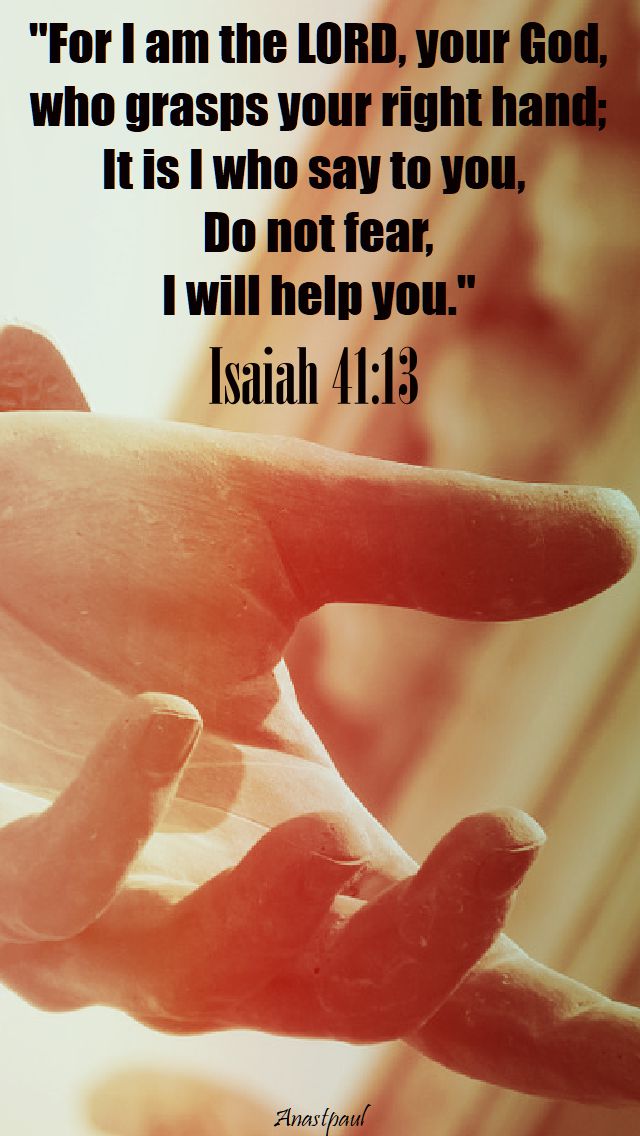
The Spirit himself bears witness with our spirit
that we are children of God
and if children, then heirs,
heirs of God and joint heirs with Christ,
if only we suffer with him,
so that we may also be glorified with him. …. Romans 8:14-17

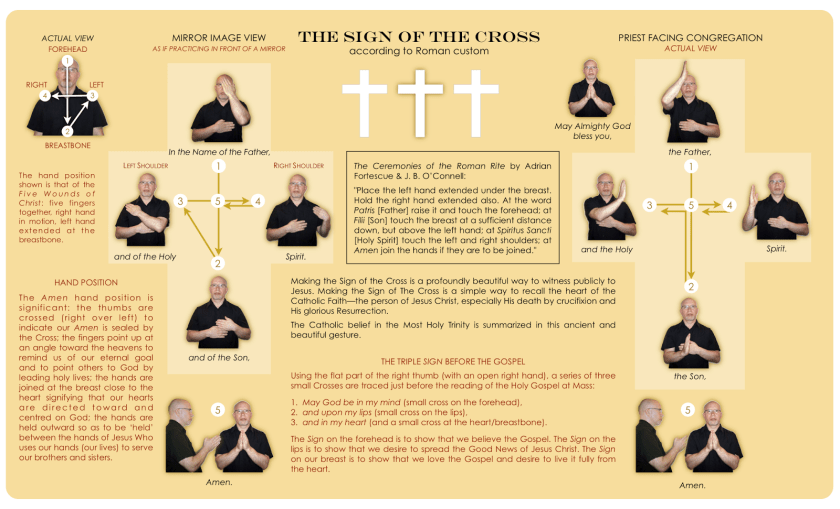
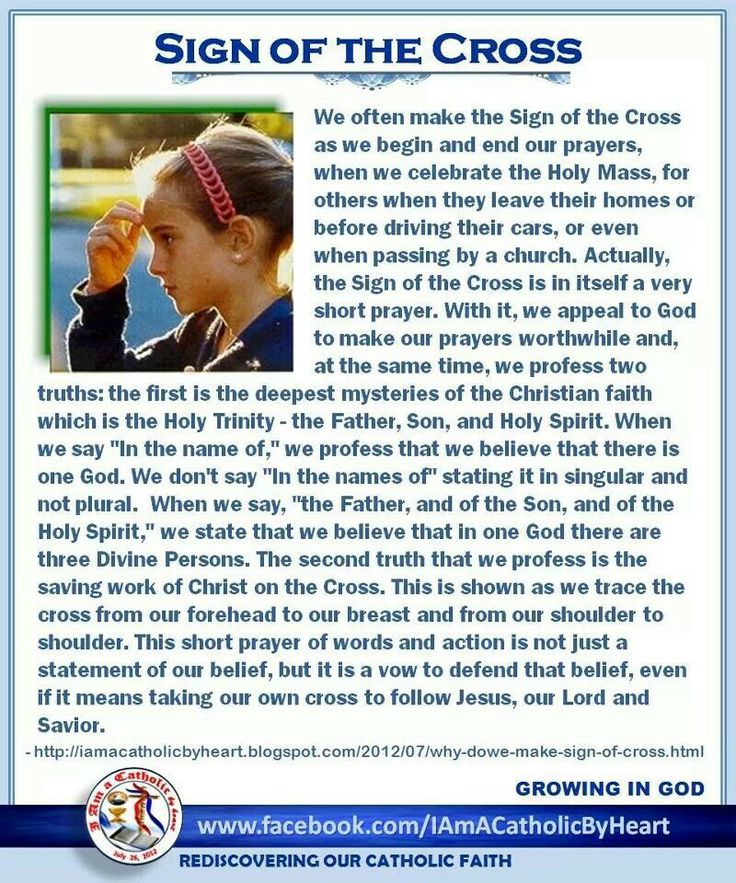
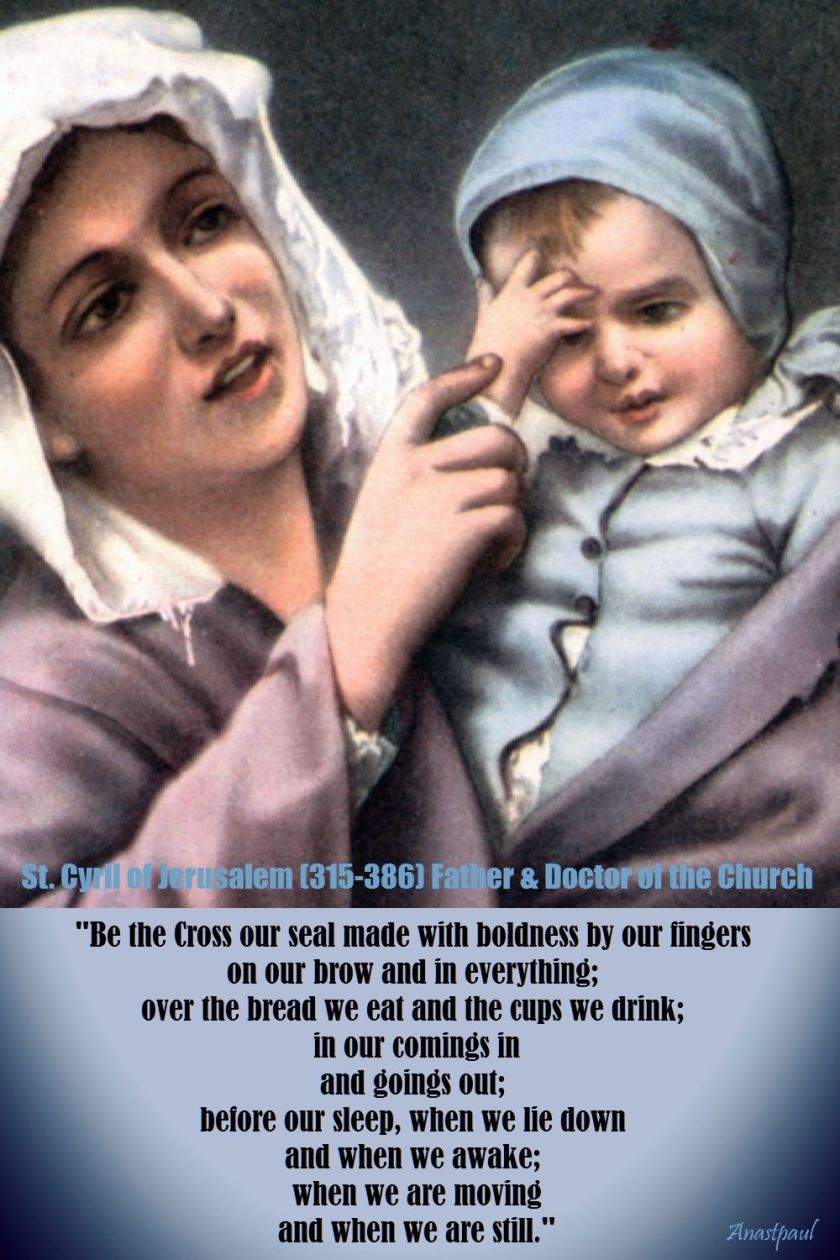
REFLECTION – “The making of the sign of the cross, which professes faith both in the redemption of Christ and in the Trinity, was practised from the earliest centuries.”………….. St Augustine (354-430) Father and Doctor of the Churchthe making of the sign of the cross - st augustine


PRAYER – God our Father, who by sending into the world the Word of truth and the Spirit of sanctification made known to the human race your wondrous mystery, grant us, we pray, that in professing the true faith, we may acknowledge the Trinity of eternal glory and adore your Unity, powerful in majesty.   Through our Lord Jesus Christ, your Son, who lives and reigns with you in the unity of the Holy Spirit, one God, for ever and ever. Amen


Posted in DOCTORS of the Church, FATHERS of the Church, MORNING Prayers, QUOTES of the SAINTS, SAINT of the DAY

Thought for the Day – 9 June

Thought for the Day – 9 June

The writings of Saint Ephrem speak volumes about his passion for the truth of the Gospel and his zeal for spreading the Word of God.   We are blessed to have poems, hymns, prayers and writings today, penned nearly 2 centuries ago, reminding us not only of the constancy of the love of the Lord but of the long-standing traditions and teachings of the Church.   As we read the writings of Saint Ephrem, we pray for his zeal for the Lord and the future of His Church on earth.
Before his death, Saint Ephrem reflected on his life, writing in his testament:  “There grew a vine-shoot on my tongue:  and increased and reached unto heaven.   And it yielded fruit without measure:  leaves likewise without number.   It spread, it stretched wide, it bore fruit:  all creation drew near.   And the more they were that gathered,the more its clusters abounded.   These clusters were the Homilies and these leaves the Hymns.   God was the giver of them, glory to Him for His grace!   For He gave to me of His good pleasure, from the storehouse of His treasures.”

St Ephrem, pray for us that we too may grow a vine-shoot on our tongues by the grace of God!

st ephrem pray for us 2

Posted in DOCTORS of the Church, FATHERS of the Church, MORNING Prayers, SAINT of the DAY

Quote/s of the Day – 9 June

Quote/s of the Day – 9 June

“Forget not the Holy Spirit
at the moment of your enlightenment;  
He is ready to mark your soul with His seal….
He will give you the heavenly and divine seal
which makes the devil tremble;  
He will arm you for the fight;
He will give you strength.”

FORGET NOT THE HOLY SPIRIT-ST EPHREM

“Glory be to Him,
Who received from us,
that He might give to us;
that through that which is ours,
we might more abundantly receive
of that which is His!”

glory be to him, who received from us-st ephrem

“Virtues are formed by PRAYER.
PRAYER preserves temperance.
PRAYER suppresses anger.
PRAYER prevents emotions of pride and envy.
PRAYER draws into the soul the Holy Spirit
and raises man to Heaven.”

virtures are formed by prayer-st ephrem

“When you begin to read or listen
to the Holy Scriptures, pray to God thus:
“Lord Jesus Christ, open the ears and eyes
of my heart so that I may hear Your words
and understand them
and may fulfill Your will.”
Always pray to God like this,
that He might illumine your mind
and open to you the power of His words.
Many, having trusted in their own reason,
have turned away into deception.”

St Ephrem of Syria

when you begin to read or listen to the Holy Scriptures-st ephrem

Posted in DOCTORS of the Church, FATHERS of the Church, MORNING Prayers, QUOTES of the SAINTS, SAINT of the DAY, The WORD

One Minute Reflection – 9 June

One Minute Reflection – 9 June

Be on Guard and pray that you may not undergo the test…………….Matthew 26:41

MATTHEW 26-41

REFLECTION – “Jesus, who feared nothing, experienced fear and asked to be freed from death – although He knew it was impossible.
How much more must we persevere in prayer before temptation assails us – so that we may be freed when the test has come!”…St Ephrem

jesus who feared nothing - st ephrem


PRAYER – Heavenly Father, help me to work out my salvation in fear and trembling.  Let me pray daily that I may withstand temptation and carry out Your will in all things.   St Ephrem, please pray for us, that we may withstand the evils which surround us! Amen

st ephrem pray for us

Posted in DOCTORS of the Church, FATHERS of the Church, MORNING Prayers, PRAYERS of the SAINTS, SAINT of the DAY

Our Morning Offering – 9 June

Our Morning Offering – 9 June

O Lord and Master of my life
By St Ephrem of Syria (306-373) Doctor of the Church

O Lord and Master of my life,
grant not unto me a spirit of idleness,
of discouragement,
of lust for power
and of vain speaking.
But bestow upon me, Your servant,
the spirit of chastity,
of meekness,
of patience
and of love.
Yea, O Lord and King,
grant that I may perceive
my own transgressions
and judge not my brother,
for blessed are You unto ages of ages. Amen

o lord and master of my life - prayer by st ephrem of syria

Posted in DOCTORS of the Church, FATHERS of the Church, SAINT of the DAY

Saint of the Day – 9 June – St Ephrem of Syria (306-373) – Father and Doctor of the Church

Saint of the Day – 9 June – St Ephrem of Syria (306-373) – Father & Doctor of the Church – Also known as:  Ephrem of Edessa, Ephrem the Syrian, Ephraem, Ephraim, Ephraem Syrus, Deacon of Edessa, Harp of the Holy Spirit, Jefrem Sirin, Sun of the Syrians/Venerable Father.  Deacon and Confessor, Exegesist, Writer, Poet, Hymnographer, Theologian, Teacher, Orator, Defender of the Faith – declared Doctor of the Church in 1920 by Pope Benedict XV.    Born – c 306 at Nisibis, Mesopotamia (in modern Syria) – Died on 9 June 373 at Edessa (in modern Iraq) of natural causes.   His tomb is in an Armenian monastery, Der Serkis, west of Edessa.   Patron of Spiritual directors and spiritual leaders.   Attributes –  hermit sitting on a column, deacon’s vestments and thurible, man composing hymns with a lyre, man in a cave with a book, man with a cross on his brow, pointing upwards, vine and scroll.

st ephrem 3

Born in Nisibis, Mesopotamia, he was baptised as a young man and became famous as a teacher in his native city.   When the Christian emperor had to cede Nisibis to the Persians, Ephrem fled as a refugee to Edessa, along with many other Christians.   He is credited with attracting great glory to the biblical school there.   He was ordained a deacon but declined becoming a priest as he felt he was unworthy.

He had a prolific pen and his writings best illumine his holiness.   Although he was not a man of great scholarship, his works reflect deep insight and knowledge of the Scriptures.   In writing about the mysteries of humanity’s redemption, Ephrem reveals a realistic and humanly sympathetic spirit and a great devotion to the humanity of Jesus.   It is said that his poetic account of the Last Judgment inspired Dante.

Over four hundred hymns composed by Ephrem still exist.   Granted that some have been lost, Ephrem’s productivity is not in doubt.   Church historians credit Ephrem with having written over three million lines.ephrem_the_syrian_mosaic_in_nea_moni

The most important of his works are his lyric, teaching hymns.   These hymns are full of rich, poetic imagery drawn from biblical sources, folk tradition and other religions and philosophies.
Particularly influential were his Hymns Against Heresies.   Ephrem used these to warn his flock of the heresies that threatened to divide the early church.   He lamented that the faithful were “tossed to and fro and carried around with every wind of doctrine, by the cunning of men, by their craftiness and deceitful wiles.”   He devised hymns laden with doctrinal details to inoculate right-thinking Christians against heresies such as docetism.   The Hymns Against Heresies employ colourful metaphors to describe the Incarnation of Christ as fully human and divine.   Ephrem asserts that Christ’s unity of humanity and divinity represents peace, perfection and salvation;  in contrast, docetism and other heresies sought to divide or reduce Christ’s nature and, in doing so, rend and devalue Christ’s followers with their false teachings.

Ephrem is popularly believed to have taken legendary journeys.    In one of these he visits St Basil of Caesarea.   This links the Syrian Ephrem with the Cappadocian Fathers and is an important theological bridge between the spiritual view of the two, who held much in common.   Ephrem is also supposed to have visited Saint Pishoy in the monasteries of Scetes in Egypt.    As with the legendary visit with Basil, this visit is a theological bridge between the origins of monasticism and its spread throughout the church.

St Ephrem eventually settled in Edessa (modern Şanlıurfa) in 363.   He was in his late fifties then and in Edessa he applied himself to ministry in his new church and seems to have continued his work as a teacher, perhaps in the School of Edessa.   Edessa had always been at the heart of the Syriac-speaking world and the city was full of rival philosophies and religions.   Ephrem comments that orthodox Nicene Christians were simply called “Palutians” in Edessa, after a former bishop. Arians, Marcionites, Manichees, Bardaisanites and various gnostic sects proclaimed themselves as the true church.   In this confusion, Ephrem wrote a great number of homilies and hymns defending Nicene orthodoxy.   After a ten-year residency in Edessa, in his sixties, Ephrem succumbed to the plague as he ministered to its victims.   The most reliable date for his death is 9 June 373.

John of Damascus, Ephrem the Syrian
With St John Damascne – left
Posted in FATHERS of the Church, QUOTES of the SAINTS, SAINT of the DAY

Saint of the Day – 5 June – St Boniface -Martyr

Saint of the Day – 5 June – St Boniface – Martyr, Bishop, the “The Apostle of Germany” –  born Winfrid, Wynfrith, or Wynfryth – (c 673-680 at Crediton, Devonshire, England – martyred 5 June 754 at Dokkum, Freisland (modern Nederlands) – relics interred at Monastery at Fulda, Germany).  Bishop/Archbishop, Martyr, Missionary and Evangelist, Teacher, Writer, Preacher, Theologian, Founder of Schools, Convents, Monasteries and Churches – known as “The Apostle of Germany”.   Patron of brewers, file cutters, tailors, Germany, archdiocese of Saint-Boniface, Manitoba, Canada, diocese of Fulda, Germany.   Attributes book, fountain, fox, oak tree, raven, scourge, spring of water, sword, with axe in hand at the foot of an oak tree, book stabbed with a sword, cutting down a tree.

St.-Boniface-cutting-down-tree-of-Thor-1200x450

St Boniface was killed in Frisia in 754, along with 52 others.   His remains were returned to Fulda, where they rest in a sarcophagus which became a site of pilgrimage. Facts about Boniface’s life and death as well as his work became widely known, since there is a wealth of material available—a number of vitae, especially the near-contemporary Vita Bonifatii auctore Willibaldi and legal documents, possibly some sermons, and above all his correspondence.

Norman F. Cantor (Historian) notes the three roles Boniface played that made him “one of the truly outstanding creators of the first Europe, as the apostle of Germania, the reformer of the Frankish church and the chief fomentor of the alliance between the papacy and the Carolingian family.”   Through his efforts to reorganise and regulate the church of the Franks, he helped shape Western Christianity and many of the dioceses he proposed remain today.   After his martyrdom, he was quickly hailed as a saint in Fulda and other areas in Germania and in England.   His cult is still notably strong today.   Boniface is celebrated as a missionary;  he is regarded as a unifier of Europe and he is seen by Catholics as a Germanic national figure.

Born and named Winfrith in Devonshire, England, Boniface grew up in a noble family of some wealth.   As a boy Boniface begged his parents to allow him to enter the nearby monastery at Exeter following a visit by some local monks.  So impressed with their life, Boniface joined the community, learning all he could and proving himself to be an apt and scholarly student. After a short time, he transferred to a larger monastery, in Nursling and there became a well-respected teacher.

He spent the next ten years teaching and was so well respected that students traveled great distances to attend his lectures, circulating their notes throughout the whole of England.   At age thirty, Boniface was ordained a priest and began preaching, as well as teaching, with great impact.   His life, while diligent and obedient, was comfortable and he was assured continued success in the English church.   However, Winfrith felt called to missionary work.   He petitioned his abbot several times, until was finally granted leave to travel to modern-day Netherlands, to assist a missionary there, Willibrord, struggling to bring the Gospel to those there who continued to practice paganism.   Upon arriving in Friesland, Winfrith discovered that the ruler of those parts, Duke Radbold, had virtually declared war on Christianity and without support, their mission would not succeed.   Prudently, Winfrith returned to England where his community welcomed him back, attempting to elect him abbot.   He refused and instead traveled to Rome for a personal audience with the pope, hoping to secure a Papal Commission to return to Friesland.

Hess_Boniface_leaves_England_1 cropped

Pope Gregory II welcomed the adventurous and obedient servant that Winfrith had become, renaming him Boniface and providing him with a general Papal Commission to bring the Word of God “to the heathen.”   Saint Boniface set off with zeal, traveling through modern-day Germany and Bavaria, locating and working with the missionary Willibrord (who by this time was well advanced in years).   Willibrord wished for Boniface to assume his work but Boniface felt called to continue traveling deeper into non-Christian territories, asserting that his commission led him not just to one dioceses, but to all “the heathen.”

St Boniface had amazing success, converting two local chieftains who became zealous Christians, leading to the conversion of their tribes.   He was granted a plot of land, upon which he founded the monastery at Amoeneburg.   His preaching style was direct and easy to understand and he took care to incorporate local traditions—whenever possible—into his teachings.   For example, there was a local game in which they sticks called kegels were thrown at smaller sticks called heides.   Boniface bought religion to the game, having the heides represent demons and knocking them down showing purity of spirit.   However, Saint Boniface was also extremely orthodox in his teaching and would quickly point out any discrepant or pagan practices that crept into the worship of the people.   Such was his success that he was summoned by Pope Gregory II back to Rome. There, Boniface was consecrated a bishop and granted general jurisdiction over “the races in the parts of Germany and east of the Rhine who live in error, in the shadow of death.”   Gregory II also provided Boniface with a Papal Letter to Charles Martel, the duke who ruled Bavaria and had earned himself the nickname “Hammer” due to his swift and authoritarian rule and retribution.   Boniface delivered the letter on his return trip to, and was granted civil protection.   Between the commission of the pope and the support of the duke, Boniface was free to increase his efforts. He decided to drive the pagan beliefs from the region by attacking their source.

st_boniface

Many in the area continued to worship Norse gods, including Thor, who were believed to reside in the forms of large stately trees.   After announcing his intentions to the tribes, who watched, awaiting the retribution of Thor, Boniface walked up to the tree, removed his shirt, took up an axe and without a word he hacked down the six foot wide wooden god.   The tree fell, splintering into four parts, upon one of which Boniface climbed, addressing the crowd that had gathered. “How stands your mighty god? My God is stronger than he.”   From his perspective, the saint could see that the fallen tree landed in the shape of the cross.   Also, the only tree spared in the area was a small fir tree, which many consider the origin of the Christmas tree.   The crowd’s reaction was amazement and confusion and conversions began.   Using the oak wood from the tree, Boniface had a chapel built on the spot, dedicated to Saint Peter.

Lempertz-1040-1540-Fine-Art-Johann-Michael-Wittmer-Saint-Boniface-Felling-DoSt.-Boniface-cutting-down-tree-of-Thor-1200x450bonifacest_bonifatius

Boniface continued his mission across Bavaria, Germany, and Holland, encountered previous missionaries who had not remained true to the teachings of the Church.   He undertook significant Church reform, instructing the missionaries, priests, and brothers, and re-establishing obedience to the authority of the Church.   In many cases, Boniface worked with the individuals in question, not to defrock them and remove them from service—citing the increased damage that would do to the faithful—but to reform, renew and reconsecrate them to the Lord.   He was both practical and obedient, seeking the will of the Lord, the counsel of respected bishops, and the success of the growth of the one, true Church.   Following successful re-establishment of discipline and communication between these misguided missions and the Church, as well as establishing several new monastic communities, was consecrated Archbishop of the entire region.   Nearing seventy years old but no less zealous in his desire for conversion, Boniface returned to Friesland—the first place of his work in Bavaria—to minister to his first congregation who were slipping back into paganism.   He gave up his archbishopric, dressed again in the simple robes of the monk and carried with him only what he needed, including the text written by Saint Ambrose, “The Advantage of Death”.

Upon arrival at Friesland, he arranged for a group of recent converts to join him, that he might teach and Confirm them.   While waiting in his tent, reading the Bible, a group of pagans appeared in the encampment with intent to harm Boniface and his companions. His companions would have opposed them but he said, “My children, cease your resistance; Spill no useless blood.  The long-expected day is come at last.   Scripture forbids us to resist evil with evil.  Let us put our hope in God:  He will save our souls.”   He and 52 of his followers were killed.   In the moment of his death, Saint Boniface raised the Bible he was reading above his head.   The sword of his slayer passed through the Book before cleaving the blessed saint.

Following the departure of the pagan barbarians, a small group of Christians came to the campsite.   They carried the relics and body of Saint Boniface to the cathedral at Fulda for burial, where it remains today.   The Bible that Boniface was reading can also be found at the cathedral at Fulda.

Posted in CATHOLIC DEVOTIONS of the Month, DOCTORS of the Church, FATHERS of the Church, MORNING Prayers, PRAYERS of the SAINTS, The BLESSED VIRGIN MARY

Our Morning Offering – 29 May

Our Morning Offering – 29 May

Mary, Full of Grace!
By St ATHANASIUS (c296-373) Doctor of the Church

It is becoming for you, O Mary,
to be mindful of us,
as you stand near Him
who bestowed upon you all graces,
for you are the Mother of God and our Queen.
Come to our aid for the sake of the King,
the Lord God and Master who was born of you.
For this reason you are called “full of grace.”
Be mindful of us, most holy Virgin,
and bestow on us gifts
from the riches of your graces,
O Virgin full of grace. Amen

mary full of grace - st athanasius

Posted in DOCTORS of the Church, FATHERS of the Church, FEASTS and SOLEMNITIES, QUOTES of the SAINTS, The WORD

One Minute Reflection – 28 May

One Minute Reflection – 28 May

When he had said this, as they were looking on,
he was lifted up and a cloud took him from their sight……….Acts 1:9

acts 1-9

REFLECTION – “Today our Lord Jesus Christ ascended into heaven; let our hearts ascend with Him.
Listen to the words of the Apostle:  If you have risen with Christ, set your hearts on the things that are above where Christ is, seated at the right hand of God;  seek the things that are above, not the things that are on earth.   For just as He remained with us even after His ascension, so we too are already in heaven with Him, even though what is promised us has not yet been fulfilled in our bodies.” ………………………St. Augustine
When we went down into the Font of Baptism we were incorporated into Jesus Christ, made members of His Body, the Church.   Therefore, as Augustine also wrote,  “Where the Head is, there is the Body, where I am, there is my Church, we too are one; the Church is in me and I in her and we two are your Beloved and your Lover.”   In other words, we have ascended with the Lord!

where the head is-st augustine

PRAYER – Holy Father, teach me and help me to ‘abide’ in Your Son, who by ascending to You, took me too with Him.   For He is my root and my foundation and I live only in Him! My Saviour and Redeemer, Jesus Christ my Lord, be with me always and intercede for us all with our Father. Amen

Posted in CATHOLIC-PRAYERS OF THE CHURCH, DOCTORS of the Church, FATHERS of the Church, MORNING Prayers, QUOTES of the SAINTS, SAINT of the DAY

Thought for the Day – 25 May

Thought for the Day – 25 May

This St Bede, this is a life of total self-giving in love!
It sounds to our ears to be a boring, closed, narrow existence –
ever occupied with learning, writing and teaching.
Almost from the time of his entry to study in the monastery as a young child,
until he died, he managed to remain in his own monastery,
although eagerly sought by kings and other notables, even Pope Sergius
Only once did he leave for a few months in order to teach in the school
of the Archbishop of York.
And amazingly, here was a saint who worked no miracles,
saw no visions and found no new way to God BUT
he is one of the few saints honoured as such even during his lifetime.
His writings were filled with such faith and learning
that even while he was still alive, a Church council
ordered them to be read publicly in the churches.
And he said of his life,
“I have spent the whole of my life . . . devoting all of my pains to the study of the Scriptures and amid the observances of monastic discipline and the daily task of singing in church, it has ever been my delight to learn or teach or write.”
St Bede died in 735 praying his favourite prayer:
“Glory be to the Father and to the Son
and to the Holy Spirit. As in the beginning, so now, and forever.”
We remember and honour him as a Doctor of the Church,
so many centuries have gone by, the world in which we live is such a different place and still he teaches us from his eternal monastery in heaven!

St Bede the Venerable, please pray for us!

st bede pray for us 2

Posted in DOCTORS of the Church, FATHERS of the Church, MORNING Prayers, QUOTES of the SAINTS, SAINT of the DAY

Quote/s of the Day – 25 May

Quote/s of the Day – 25 May

“He alone loves the Creator perfectly
who manifests a pure love for his neighbour.”

he alone loves the creator-st bede

“Unfurl the sails and let God steer us where He will.”

unfurl the sails-st bede

“Christ is the Morning Star,
who, when the night of this world is past,
gives to his saints the promise of the light of life,
and opens everlasting day.”

christ is the morning star-st bede

St Bede the Venerable
(673-735) Doctor of the Church

“Come, Holy Spirit. Spirit of truth,
You are the reward of the saints,
the comforter of souls,
light in the darkness,
riches to the poor,
treasure to lovers,
food for the hungry,
comfort to those who are wandering.
To sum up:
You are the one in whom all treasures are contained.”

come holy spirit-st mary magdalene de pazzi

St Mary Magdalene de Pazzi – Memorial today 25 May

Posted in DOCTORS of the Church, FATHERS of the Church, MORNING Prayers, SAINT of the DAY, The WORD

One Minute Reflection – 25 May

One Minute Reflection – 25 May

Jesus said to them, “You are badly misled because you fail to understand the Scriptures…….”….Matthew 22:29

REFLECTION – “The whole series of the Divine Scriptures is interpreted in a fourfold way.
We should ascertain what everlasting truths are intimated therein,
what deeds are narrated, what future events are foretold and what commands or counsels are … therein.” …St Bede the Venerable (673-735) Doctor of the Church

matthew 22-29-st bede the venerable -the whole series of the

PRAYER – Heavenly Father, teach me how to read Your wonderful words in the Scriptures with true understanding.   Let me adhere always to the interpretations given by Your Holy Church. Come O Holy Spirit and guide my mind. Lord Jesus Christ,
stand beside me and bless my footsteps. Holy St Bede, intercede for us and pray for us all, amen.

st bede the venerable pray for us

Posted in CATHOLIC DEVOTIONS of the Month, DOCTORS of the Church, FATHERS of the Church, MORNING Prayers, PRAYERS of the SAINTS, SAINT of the DAY, The BLESSED VIRGIN MARY

Our Morning Offering – 25 May

Our Morning Offering – 25 May

O Christ, our Morning Star
By St Bede the Venerable (673-735) Doctor of the Church

O Christ, our Morning Star,
Splendour of Light Eternal,
shining with the glory of the rainbow,
come and waken us
from the greyness of our apathy,
and renew in us Your gift of hope.
Amen

o christ our morning star - st bede

And, as May is still with us, let us greet our Mother!

A Salutation to Mary (adaped)
By St John Eudes

Hail Mary, Daughter of God the Father;
Hail Mary, Mother of God the Son;
Hail Mary, Spouse of the Holy Spirit;
Hail Mary, Temple of the Most Holy Trinity.
Hail Mary, white Lilly of the resplendent and ever
unchanging Trinity.
Hail Mary, red Rose of Paradise.
Hail Mary, Virgin full of sweetness and humility,
from whom the King of Heaven willed to be
born and to suckle at the breast.
Hail Mary, Virgin of virgins.
Hail Mary, Queen of martyrs, who spent
Thy life for Heaven while on this earth.
Hail Mary, Queen of my heart, my sweetness,
my life and my entire hope.
Hail Mary, Mother most amiable.
Hail Mary, Mother most admirable.
Hail Mary, Mother of fair love.
Hail Mary, Mother of mercy.
Hail Mary, conceived without sin.
Thou art full of grace,
the Lord is with Thee;
blessed art Thou among all women,
and blessed is the fruit of Thy womb, Jesus.
Blessed be the Eternal Father who elected Thee.
Blessed be Thy Son, who has loved Thee.
Blessed be the Holy Spirit, who has espoused Thee.
And blessed forever be those who love Thee and bless Thee.
O Blessed Virgin, bless us all, in the Name of Thy dear Son.\
Amen

a salutation to mary by st john eudes

Posted in DOCTORS of the Church, FATHERS of the Church, PATRONAGE - WRITERS, PRINTERS, PUBLISHERS, EDITORS, etc, QUOTES of the SAINTS, SAINT of the DAY

Saint of the Day – 25 May – St Bede the Venerable (673-735)

Saint of the Day – 25 May – St Bede the Venerable OSB (673-735) – Confessor, Priest, Monk, Father and Doctor of the Church, Linguist, Translator, Historian – also known as Venerable Bede,  Father of English History. Patronages – of Lectors, English writers and historians; Jarrow, Tyne and Wear, England.   In 1899, Pope Leo XIII declared him a Doctor of the Church;  he is the only native of Great Britain to achieve this designation;  Anselm of Canterbury, also a Doctor of the Church, was born in Italy.   St Bede was moreover a skilled linguist and translator and his work made the Latin and Greek writings of the early Church Fathers much more accessible to his fellow English, which contributed significantly to English Christianity.

St Bede was born in Wearmoth-Jarrow, England, and at age seven was sent to the nearby monastery of St Peter and St Paul to be educated by the monks.   From his writings, it appears that his family was wealthy and noble.   Given his name, Bede—a derivative of the English bedtime prayer, it is likely that his parents had planned a religious life for him from birth.   Under the holy tutelage of the monks, the natural intellect and spiritual zeal of St Bede magnified into one of the finest minds of his time.   He studied all the known sciences: natural philosophy, the philosophical principles of Aristotle, astronomy, arithmetic, grammar, ecclesiastical history, the lives of the saints and, especially, Holy Scripture.   St Bede spent his days in scholarly pursuits, prayer and contemplation.
St Bede was ordained a deacon at the young age of nineteen and ordained a priest at 30.

He spent his days subsequent to ordination teaching, writing and studying.   A prolific writer, he composed 45 texts on varied subjects, including science, literature, philosophy, and spirituality.   “Through all the observance of monastic discipline,” Bede wrote, “it has ever been my delight to learn and teach and write.”    His best known text, the Ecclesiastical History of the English People, is widely regarded as a decisive historical text which inspired the recording of written history.   This text described the history of the English Church, and is a primary source of English history.   Thirty of his manuscripts focused on Biblical commentary and theology.   Aside from those he wrote, St Bede copied many texts by hand, translating a significant number of them into Latin to aid in teaching those of other languages.

Opera_Bedae_Venerabilis.tif

Saint Bede remained in the monastery his entire life, leaving few times, including a brief visit to teach in a school in York and a visit to the monastery at Lindisfarne, where he began correspondence with St Cuthbert.   Despite this, his counsel and teaching was sought by royalty and the Pope.   His writings and homilies were read throughout the Church.

In his own words, from the Ecclesiastical History of the English People:

“Thus much concerning the ecclesiastical history of Britain and especially of the race of the English, I, Baeda, a servant of Christ and a priest of the monastery of the blessed apostles Saint Peter and Saint Paul, which is at Wearmouth and at Jarrow (in Northumberland), have with the Lord’s help composed so far as I could gather it either from ancient documents or from the traditions of the elders, or from my own knowledge.   I was born in the territory of the said monastery and at the age of seven I was, by the care of my relations, given to the most reverend Abbot Benedict and afterwards to Ceolfrid, to be educated.   From that time I have spent the whole of my life within that monastery, devoting all my pains to the study of the Scriptures and amid the observance of monastic discipline and the daily charge of singing in the Church, it has been ever my delight to learn or teach or write.   In my nineteenth year I was admitted to the deaconate, in my thirtieth to the priesthood, both by the hands of the most reverend Bishop John and at the bidding of Abbot Ceolfrid.   From the time of my admission to the priesthood to my present fifty-ninth year, I have endeavoured for my own use and that of my brethren, to make brief notes upon the holy Scripture, either out of the works of the venerable Fathers or in conformity with their meaning and interpretation.”

“The Father of English History,” Saint Bede died peacefully at the monastery in Jarrow in 735.   He was buried at Jarrow, though his remains now rest in Durham Cathedral.

525bede9tomb

Saint Cuthbert recorded his final hours, indicating the words of Saint Bede:   “If it be the will of my Maker, the time has come when I shall be freed from the body and return to Him Who created me out of nothing when I had no being. I have had a long life, and the merciful Judge has ordered it graciously.  The time of my departure is at hand, and my soul longs to see Christ my King in His beauty.”   He further wrote of Bede’s life and death, citing a poem that Saint Bede had written in preparation for meeting his Maker:  “And he used to repeat that sentence from St Paul,  “It is a fearful thing to fall into the hands of the living God,” and many other verses of Scripture, urging us thereby to awake from the slumber of the soul by thinking in good time of our last hour.   And in our own language,—for he was familiar with English poetry,—speaking of the soul’s dread departure from the body:

More prudent than he has good call to be,
If he consider, before his going hence,
What for his spirit of good or of evil
After his day of death shall be determined.”

The conclusion of his Ecclesiastical History records his piety, humility, and wisdom: “And I pray thee, loving Jesus, that as Thou hast graciously given me to drink in with delight the words of Thy knowledge, so Thou wouldst mercifully grant me to attain one day to Thee, the fountain of all wisdom and to appear forever before Thy face.”

525bede14

The life of Saint Bede is highly regarded as instrumental in the recording of written history and the translation of Biblical texts from ancient languages into modern languages.   His commentary and theological writings—the goal to explain the teachings of the Church Fathers to all—are highly regarded, like those of Saint Augustine and Saint Ambrose.   More than that, the simple monastic life of Saint Bede demonstrates the call of the Lord and the gifts of the Holy Spirit to those who listen and obey.

Posted in DOCTORS of the Church, FATHERS of the Church, MORNING Prayers

Quote of the Day – 22 May

Quote of the Day – 22 May

“What does love look like? It has the hands to help others. It has the feet to hasten to the poor and needy. It has eyes to see misery and want. It has the ears to hear the sighs and sorrows of men. That is what love looks like.”

St Augustine  (354-430) – Doctor of Grace

WHAT DOES LOVE LOOK LIKE - ST AUGUSTINE NO 2

Posted in DOCTORS of the Church, FATHERS of the Church, MORNING Prayers, QUOTES of the SAINTS, SAINT of the DAY, The WORD

One Minute Reflection – 22 May

One Minute Reflection – 22 May

I heard the voice of the Lord saying, ‘Whom shalll I send?….”Here I am.” I said, “send me!”……………Isaiah 6:8

REFLECTION – “You ask what you might offer to God?
Offer yourself!
What does God expect from you – except yourself?”

you ask what you might offer to god - st augustine

PRAYER – Help me to discern through prayer and meditation what You truly want of me.
The enable me to offer it to You and indeed, to offer myself and all I have and all I am, to You.
St Rita of Cascia, you prayed so earnestly to give yourself totally to the Lord and suffer for Him, please pray for us, amen.

st rita pray for us

Posted in CATHOLIC DEVOTIONS of the Month, DOCTORS of the Church, FATHERS of the Church, MORNING Prayers, The BLESSED VIRGIN MARY, The WORD

One Minute Reflection – 19 May

One Minute Reflection – 19 May

Those who love me I also love and those who seek me find me…….Proverbs 8:17

REFLECTION – “Blessed are those who abandon themselves into Our Lady’s hands. Their names are written in the Book of Life.”………………St Bonaventure (1217-74) Doctor seraphicus (Seraphic Doctor)

blessed are those who abandon-st bonaventure

PRAYER – Heavenly Father, make a devoted client of Your beloved Daughter, Mary.   Let me entrust myself always into her hands so that she may protect me as she took cate of Your Son, Our Lord Jesus Christ, in His infancy, childhood and throughout His life.   Make me unto her, Lord my God!   Mary, my beloved Mother, give me your spirit and pray for us all amen!

mary beloved mother-pray for us all

Posted in CATHOLIC DEVOTIONS of the Month, DOCTORS of the Church, FATHERS of the Church, MORNING Prayers, PRAYERS of the SAINTS, The BLESSED VIRGIN MARY

Our Morning Offering – 18 May

Our Morning Offering – 18 May

Blessed Virgin Mary, Holy Mary
Excerpt from a prayer by St Augustine (354-430)
Doctor gratiae (Doctor of Grace)

Holy Mary, help those who are miserable,
strengthen those who are discouraged,
comfort those who are sorrowful,
pray for your people,
plead for the clergy,
intercede for all women consecrated to God.
May all who venerate you
experience your assistance and protection.
Be ready to aid us when we pray,
and bring back to us the answers to our prayers.
Make it your continual concern
to pray for the People of God,
for you were blessed by God
and were made worthy
to bear the Redeemer of the world,
who lives and reigns forever.
Amen.
blessed virgin mary, holy mary - st augustine

Posted in CATHOLIC DEVOTIONS of the Month, DOCTORS of the Church, FATHERS of the Church, MORNING Prayers, QUOTES of the SAINTS, The BLESSED VIRGIN MARY

Quote/s of the Day – 12 May

Quote/s of the Day – 12 May

“Whoever consistently looks at God and themselves
through this attractive mirror (Mary), will sooner or later
turn into another Mary.”

Servant of God, Fr Joseph Kentenich (1885-1968) – Founder of Schoenstatt

WHOEVER-FR JOSEPH KENTENICH - SCHOENSTATT

“If the Church shows respect and veneration for everything
that came in contact with the Saviour’s Body: the Cross,
the Nails, the Thorns, the Winding Sheet of His Sepuchre,
the Swathing-bands of His infancy and similar things – what
honour must be due to this venerable body of the
Blessed Virgin from which the Body of the Redeemer was formed!”

St John Eudes

IF THE CHURCH-ST JOHN EUDES

“The flesh of Christ is the flesh of Mary
and although it was raised to great glory
in His Resurrection, yet it still remained
the same that was taken from Mary.”

St Augustine (354-430) – Fathe & Doctor gratiae (Doctor of Grace)

the-flesh-of-christ-st-augustine.2017

Posted in DOCTORS of the Church, FATHERS of the Church, MORNING Prayers, QUOTES of the SAINTS, SAINT of the DAY, The WORD

One Minute Reflection – 12 May

One Minute Reflection – 12 May

Blessed be the God and Father of our Lord Jesus Christ,
who in his great mercy gave us a new birth to a living hope
through the resurrection of Jesus Christ from the dead,
to an inheritance that is imperishable, undefiled and unfading,
kept in heaven for you………1 Peter 1:3-4

1 PETER 1-3,4

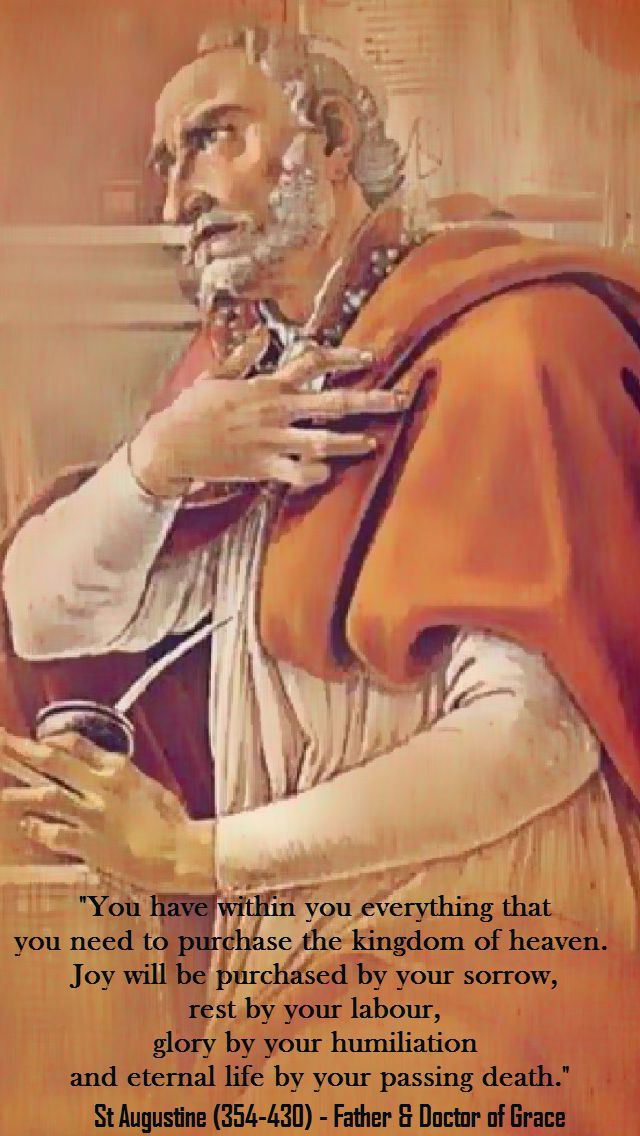
REFLECTION – “You have within you everything that
you need to purchase the kingdom of heaven.
Joy will be purchased by your sorrow,
rest by your labour,
glory by your humiliation
and eternal life by your passing death.”……St Augustine, Father and Doctor of the Church (354-430) Doctor gratiae (Doctor of Grace)

YOU HAVE WITHIN YOU - ST AUGUSTINE

PRAYER – Loving Father, teach me how to make very event on earth lay up treasures for me in heaven.   Help me to endure my sorrows, labours, humiliations and death willingly so as to attain heaven.   Holy Martyrs Sts Nereus, Achilleus and Pancras, Pray for us, amen!

sts nereus, achilleus and pancras pray for us

Posted in CATHOLIC DEVOTIONS of the Month, DOCTORS of the Church, FATHERS of the Church, MORNING Prayers, PRAYERS of the SAINTS, The BLESSED VIRGIN MARY

Our Morning Offering – 5 May

Our Morning Offering – 5 May

PRAYER TO OUR LADY OF MERCY
By St. Augustine

Blessed Virgin Mary,
who can worthily repay you with praise
and thanks for having rescued a fallen world
by your generous consent!
Receive our gratitude,
and by your prayers obtain the pardon of our sins.
Take our prayers into the sanctuary of heaven
and enable them to make our peace with God.
Holy Mary, help the miserable,
strengthen the discouraged,
comfort the sorrowful,
pray for your people,
plead for the clergy,
intercede for all women consecrated to God.
May all who venerate you
feel now your help and protection.
Be ready to help us when we pray,
and bring back to us the answers to our prayers.
Make it your continual concern
to pray for the people of God,
for you were blessed by God
and were made worthy to bear the Redeemer of the world,
who lives and reigns forever.
Amen

PRAYER TO OUR LADY OF MERCY-ST AUGUSTINE

Posted in CATHOLIC-PRAYERS OF THE CHURCH, DOCTORS of the Church, FATHERS of the Church, MORNING Prayers, PRAYERS of the SAINTS, SAINT of the DAY

The Athanasian Creed

The Athanasian Creed, also known as Pseudo-Athanasian Creed or Quicunque Vult (also Quicumque Vult), is a Christian statement of belief focused on Trinitarian doctrine and Christology.    The Latin name of the creed, Quicunque vult, is taken from the opening words, “Whosoever wishes”.    The creed has been used by Christian churches since the sixth century.    It is the first creed in which the equality of the three persons of the Trinity is explicitly stated.    It differs from the Nicene-Constantinopolitan and Apostles’ Creeds in the inclusion of anathemas, or condemnations of those who disagree with the creed (like the original Nicene Creed).

Widely accepted among Western Christians, including the Roman Catholic Church and some Anglican churches, Lutheran churches (it is considered part of Lutheran confessions in the Book of Concord) and ancient, liturgical churches generally, the Athanasian Creed has been used in public worship less and less frequently.

It was designed to distinguish Nicene Christianity from the heresy of Arianism. Liturgically, this Creed was recited at the Sunday Office of Prime in the Western Church; it is not in common use in the Eastern Church.    The creed has never gained acceptance in liturgy among Eastern Christians since it was considered as one of many unorthodox fabrications that contained the Filioque clause.    Today, the Athanasian Creed is rarely used even in the Western Church.    When used, one common practice is to use it once a year on Trinity Sunday.

onetwo

Posted in DOCTORS of the Church, FATHERS of the Church, MORNING Prayers, SAINT of the DAY

Thought for the Day – 2 May

Thought for the Day – 2 May

At certain periods in Church history, it is one man who saves the Church for orthodoxy, one human instrument that Goduses to further His work.   Athanasius suffered many trials while he was bishop of Alexandria.    He was given the grace to remain strong against what probably seemed at times to be insurmountable opposition.    Athanasius lived his office as bishop completely.    He defended the true faith for his flock, regardless of the cost to himself.    In today’s world we are experiencing this same call to remain true to our faith, no matter what.   We should all realise how important we are to the good of others and that, without us, certain people would never hear of God or come to a knowledge of Jesus Christ.   Upon our orthodoxy and fidelity may well depend the growth in faith of many others – what a thought!   Therefore, we need to learn and know the truth as St Athanasius said “You will not see anyone who is really striving after his advancement who is not given to spiritual reading. And as to him who neglects it, the fact will soon be observed by his progress.”

St Athanasius, pray for us!

ST ATHANASIUS PRAY FOR US 2.jpg

Posted in DOCTORS of the Church, FATHERS of the Church, MORNING Prayers, QUOTES of the SAINTS, SAINT of the DAY

Quote/s of the Day – 2 May

Quote/s of the Day – 2 May

“The Word who became all things for us, is close to us, our Lord Jesus Christ who promises to remain with us always.    He cries out, saying:  See, I am with you all the days of this age.    He is himself the shepherd, the high priest, the way and the door and has become all things at once for us.”

THE WORD HAS BECOME-ST ATHANASIUS

“Christians, instead of arming themselves with swords, extend their hands in prayer.”

“Let us remember the poor and not forget kindness to strangers;  above all, let us love God with all our soul and might and strength and our neighbour as ourselves.”

CHRISTIANS, INSTEAD OF - St Athanasius

“But what is also to the point, let us note that the very tradition, teaching and faith of the Catholic Church from the beginning was preached by the Apostles and preserved by the Fathers.    On this the Church was founded – and if anyone departs from this, he neither is, nor any longer ought to be called, a Christian.”

BUR WHAT IS ALSO TO THE POINT-ST ATHANASIUS

St Athanasius  (297-373) Father & Doctor of the Church


Posted in DOCTORS of the Church, FATHERS of the Church, MORNING Prayers, QUOTES of the SAINTS, The WORD

One Minute Reflection – 2 May

One Minute Reflection – 2 May

Christ….will give a new form to this lowly body of ours and remake it according to the pattern of his glorified body…………Phil 3:21

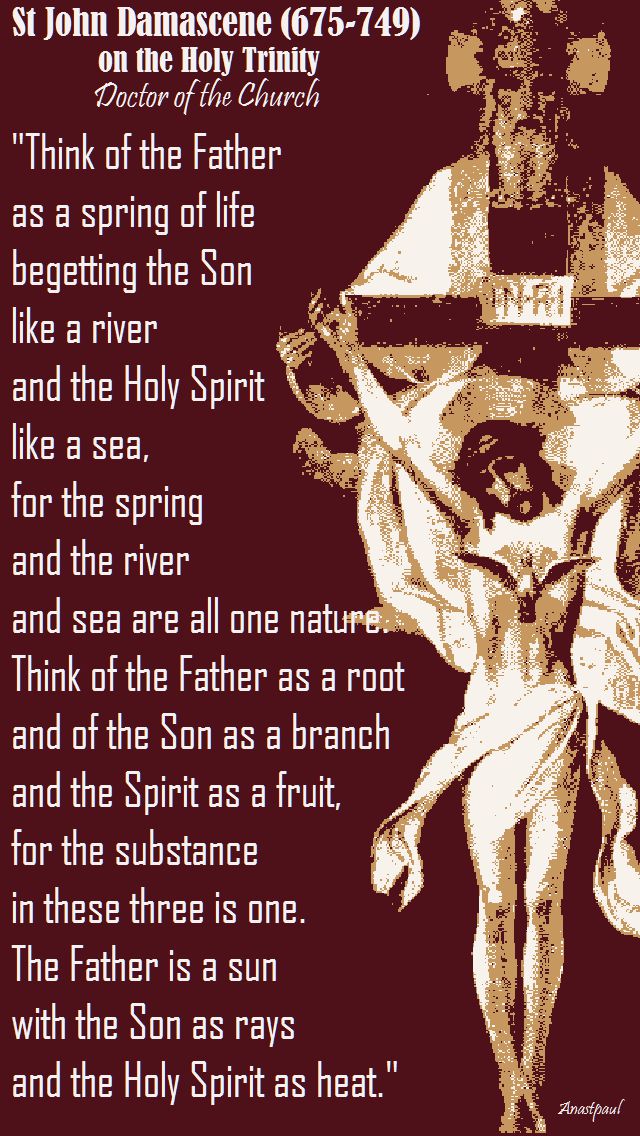
REFLECTION – Our human body has acquired something great through its communication with the Word.    From being mortal it has been made immortal; though it was a living body it has become a spiritual one…………St Athanasius (297-373) Father and Doctor of the Church

PRAYER – Heavenly Father, help me to respect my body and not subject it to sin.   Let me keep it ready to receive the fullness of the new form given by Your Son, in heaven.    St Athanasius, you taught the world the truth of Christ, please pray for us, amen.
PHILIPPIANS 3-21OUR HUMAN BODY-ST ATHANASIUSst athanasius pray for us

Posted in DOCTORS of the Church, FATHERS of the Church, MORNING Prayers, SAINT of the DAY, The BLESSED VIRGIN MARY

Our Morning Offering – 2 May

Our Morning Offering – 2 May

PRAYER TO MARY, MOTHER OF GRACE
By St Athanasius (297-373)

It is becoming for you, O Mary,
to be mindful of us,
as you stand near Him who bestowed upon you all graces,
for you are the Mother of God and our Queen.
Come to our aid for the sake of the King,
the Lord God and Master who was born of you.
For this reason you are called “full of grace.”
Be mindful of us, most holy Virgin and bestow on us gifts
from the riches of your graces, O Virgin full of grace.
Amen

PRAYER TO MARY MOTHER OF GRACE-ST ATHANASIUS

Posted in DOCTORS of the Church, FATHERS of the Church, SAINT of the DAY

Saint of the Day – 2 May – St Athanasius

Saint of the Day – 2 May – St Athanasius (c295-373) – Father and Doctor of the Church Bishop, Confessor, known as “Father of Orthodoxy” and Athanasius of Alexandria, Athanasius of Egypt, Athanasius the Great, Champion of Christ’s Divinity, Champion of Orthodoxy, Greek Doctor of the Church, Holy Hierarch, Pillar of the Church – Attributes:  Bishop arguing with a pagan; bishop holding an open book; bishop standing over a defeated heretic.

Athanasius was born of Christian parents in Alexandria, Egypt, about 295. As a young man, he spent four years in prayer and solitude in the desert.    There he met Anthony the hermit, who influenced him.    After he left the desert, Athanasius became a priest and was appointed secretary to Alexander, bishop of Alexandria.

Meanwhile, Arius had begun preaching that Jesus was not truly God.    At a church council at Nicaea in 325, Arius and his ideas were condemned and the bishops composed the Nicene Creed.

Conflict with Arius and Arianism as well as successive Roman emperors shaped Athanasius’ career.    In 325, at the age of 27, Athanasius began his leading role against the Arians as a deacon and assistant to Bishop Alexander of Alexandria during the First Council of Nicaea.    Roman emperor Constantine the Great had convened the council in May–August 325 to address the Arian position that the Son of God, Jesus of Nazareth, is of a distinct substance from the Father.    Three years after that council, Athanasius succeeded his mentor as archbishop of Alexandria.    In addition to the conflict with the Arians (including powerful and influential Arian churchmen led by Eusebius of Nicomedia), he struggled against the Emperors Constantine, Constantius II, Julian the Apostate and Valens.    He was known as “Athanasius Contra Mundum” (Latin for Athanasius Against the World).

ST ATHANASIUS 4

Nonetheless, within a few years after his death, Gregory of Nazianzus called him the “Pillar of the Church”.    His writings were well regarded by all Church fathers who followed, in both the West and the East, who noted their rich devotion to the Word-become-man, great pastoral concern and profound interest in monasticism.    Athanasius is counted as one of the four great Eastern Doctors of the Church in the Roman Catholic Church – he is labeled as the “Father of Orthodoxy”.

Bl. John Henry Newman described him as a “principal instrument, after the Apostles, by which the sacred truths of Christianity have been conveyed and secured to the world”. [Letters..]

Historian Cornelius Clifford says: “His career almost personifies a crisis in the history of Christianity;  and he may be said rather to have shaped the events in which he took part than to have been shaped by them.” 

The greater majority of Church leaders and the emperors fell into support for Arianism, so much so that Jerome, 340–420, wrote of the period:  “The whole world groaned and was amazed to find itself Arian”.    He, Athanasius, even suffered an unjust excommunication from Pope Liberius (325–366) who was exiled and leant towards the Arians, until he was allowed back to the See of Rome. Athanasius stood virtually alone against the world.


Posted in DOCTORS of the Church, FATHERS of the Church, MORNING Prayers, QUOTES of the SAINTS, SAINT of the DAY

One Minute Reflection – 30 April

One Minute Reflection – 30 April

Blest are they who have not seen and yet have believed……….John 20:29

john 20-29

REFLECTION – “This Gospel text certainly applies to us – but only if we confirm our faith by our works!
Those truly believe who carry out in practice what they believe.”………..St Gregory the Great

ST GREGORY THE GREAT - THIS GOSPEL TEXT

PRAYER – Jesus my Lord and my God, help me to believe in You with all my might. And let me translate that belief into practice by obeying Your commands each moment of each day. St Marie Guyart of the Incarnation you were truly a shining example to us all of how to confim our faith by our works! Please pray for us, amen.
ST MARIE GUYART OF THE INCARNATION - PRAY FOR US

Posted in DOCTORS of the Church, FATHERS of the Church, MORNING Prayers, QUOTES of the SAINTS

Quote of the Day – 26 April

Quote of the Day – 26 April

“Enter into the Church
and wash away your sins,
For there is a hospital for sinners
and not a court of law.”

St John Chrysostom (347-407)
Father and Doctor of the Church

ENTER INTO THE CHURCH-STJOHNCHRYSOSTUM

Posted in DOCTORS of the Church, EASTER, FATHERS of the Church, MORNING Prayers, PRAYERS of the SAINTS

Our Morning Offering – 20 April

Our Morning Offering – 20 April

Prayer of St Ambrose

I beg of you, O Lord,
by this most holy mystery of Your Body and Blood,
with which You daily nourish us in Your Church,
that we may be cleansed and sanctified
and made sharers in Your divinity.
Grant to me Your holy virtues, which will enable
me to approach Your altar with a clean conscience,
so that this heavenly Sacrament may be a means
of salvation and life to me, for You Yourself have said:
“I am the living bread that has come down from heaven.
If anyone eat of this bread, he shall live forever
and the bread that I will give is my flesh for the life of the world.”
Most Sweet Bread, heal my heart, that I may taste the sweetness
of Your love. Heal it from all weakness, that I may enjoy
no sweetness but You. Most pure Bread, containing
every delight which ever refreshes us, may my heart
consume You and may my soul be filled with Your sweetness.
Holy Bread, living Bread, perfect Bread, that has come down
from heaven to give life to the world,
come into my heart and cleanse me from every stain of body
and soul. Enter into my soul; heal and cleanse me completely.
Be the constant safeguard and salvation of my soul and body.
Guard me from the enemies who lie in wait.
May they flee from the protecting presence
of Your power, so that, armed in soul
and body by You, I may safely reach
Your Kingdom.
There we shall see You, not as now
as in mysteries, but face to face,
when You will deliver the Kingdom to God
the Father and will reign as God over all.
Then You, who with the same God the Father
and the Holy Spirit, live and reign forever,
will satisfy the hunger of my soul perfectly
with Yourself, so that I shall neither hunger
nor thirst again. Amen

PRAYER BEFORE MASS - ST AMBROSE