Quote/s of the Day – 18 August – “The Month of the Immaculate Heart of Mary” – Within the Octave of the Assumption
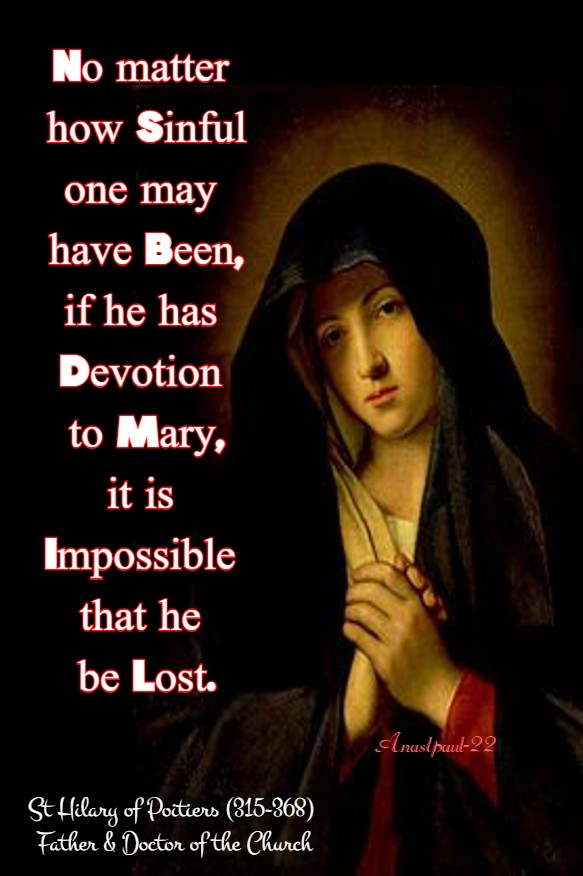
“No matter how sinful one may have been, if he has devotion to Mary, it is impossible that he be lost.”
St Hilary of Poitiers (315-368) Father & Doctor of the Church
“The very fact that God has elected her, proves, that none was ever holier than Mary; if any stain had disfigured her soul, if any other virgin had been purer and holier, God would have selected her and rejected Mary.”
St Jacob of Sarug (c 451-521) Bishop, Theologian, Poet, Writer
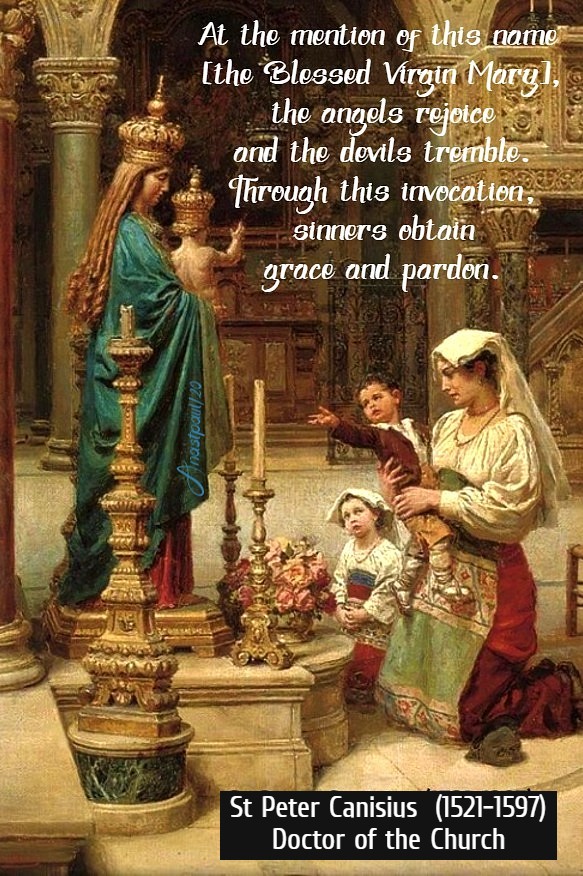
“At the mention of this name [the Blessed Virgin Mary], the Angels rejoice and the devils tremble. Through this invocation, sinners obtain grace and pardon.”
St Peter Canisius SJ (1521-1397) Doctor of the Church
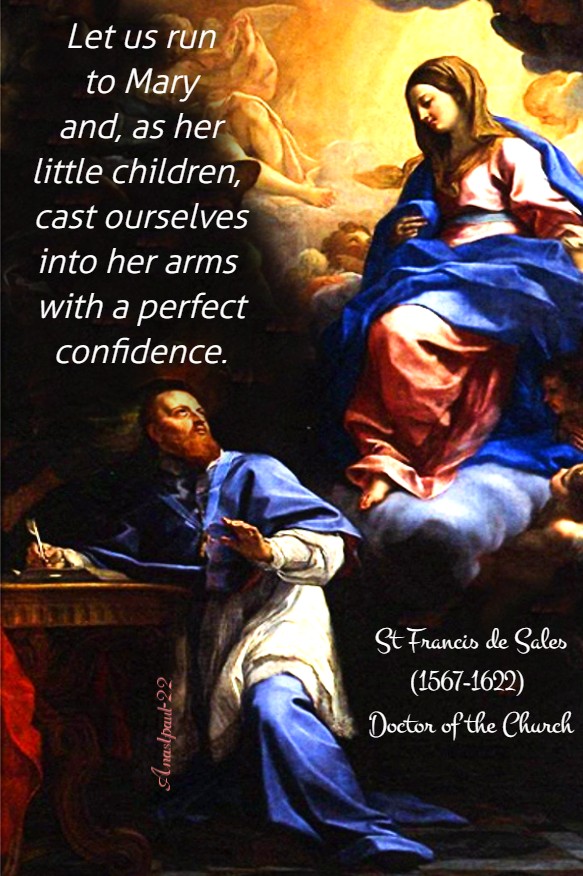
“Let us run to Mary and, as her little children, cast ourselves into her arms with a perfect confidence.”
St Francis de Sales (1567-1622) Doctor of the Church
Our Morning Offering – 3 August – “The Month of the Immaculate Heart of Mary”
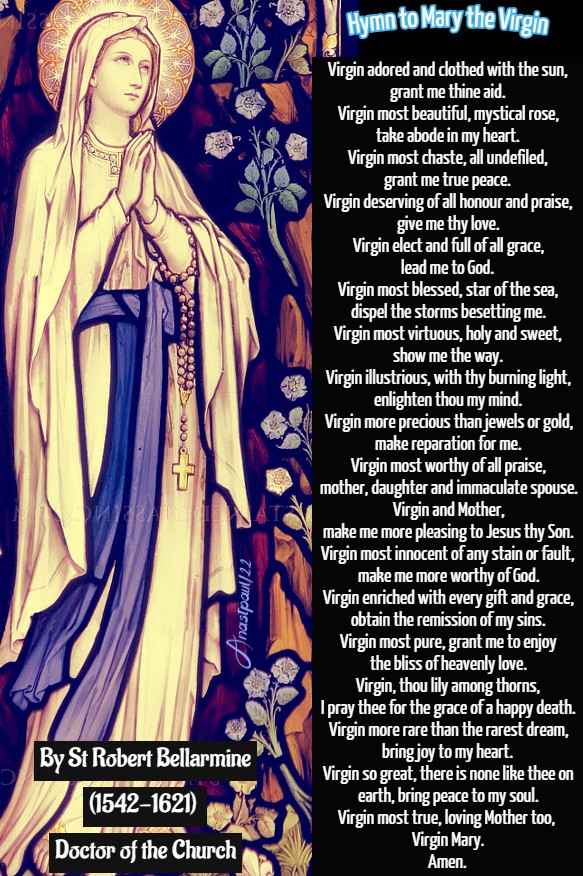
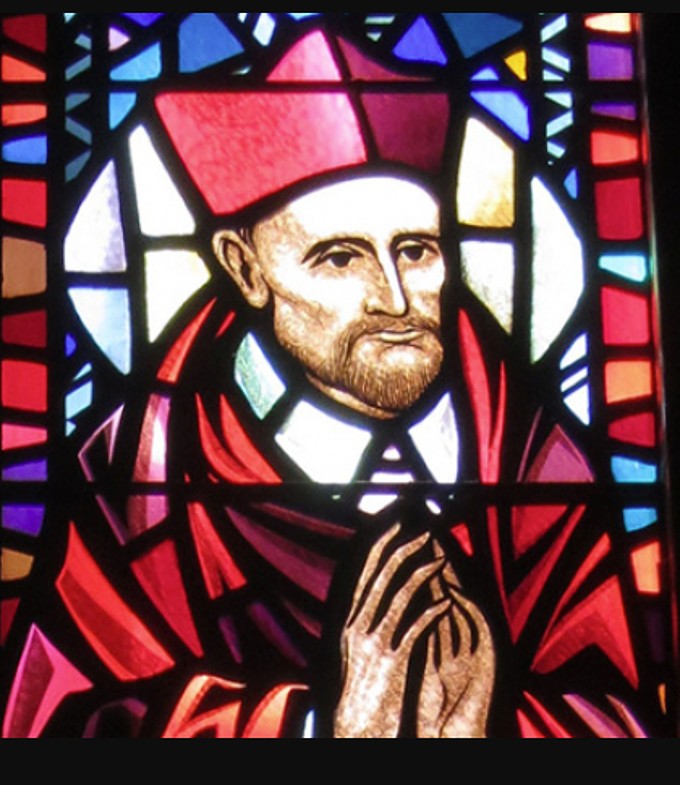
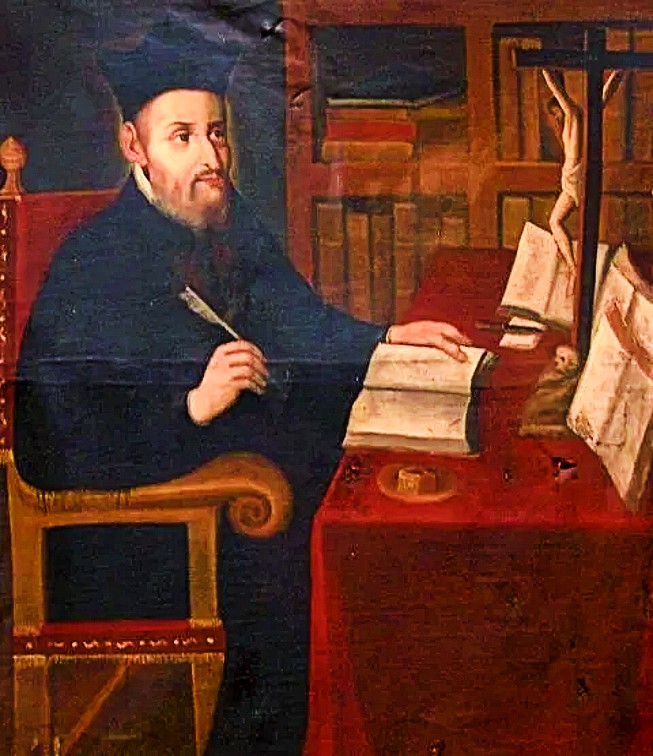
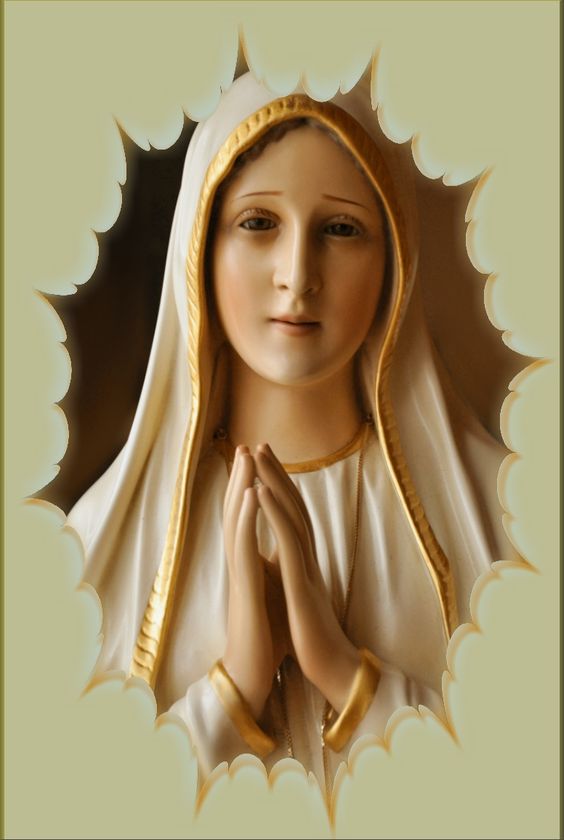
Hymn to Mary the Virgin By St Robert Bellarmine (1542-1621) Doctor of the Church.
Virgin adored and clothed with the sun, grant me thine aid. Virgin most beautiful, mystical rose, take abode in my heart. Virgin most chaste, all undefiled, grant me true peace. Virgin deserving of all honour and praise, give me thy love. Virgin elect and full of all grace, lead me to God. Virgin most blessed, star of the sea, dispel the storms besetting me. Virgin most virtuous, holy and sweet, show me the way. Virgin illustrious, with thy burning light, enlighten thou my mind. Virgin more precious than jewels or gold, make reparation for me. Virgin most worthy of all praise, mother, daughter and immaculate spouse. Virgin and Mother, make me more pleasing to Jesus thy Son. Virgin most innocent of any stain or fault, make me more worthy of God. Virgin enriched with every gift and grace, obtain the remission of my sins. Virgin most pure, grant me to enjoy the bliss of heavenly love. Virgin, thou lily among thorns, I pray thee for the grace of a happy death. Virgin more rare than the rarest dream, bring joy to my heart. Virgin so great, there is none like thee on earth, bring peace to my soul. Virgin most true, loving Mother too, Virgin Mary. Amen.
St Robert Bellarmine’s Hymn to Mary the Virgin: Among St Robert’s extant writing, there is a short poem of twenty stanzas which he composed in the nature of a Litany to the Blessed Virgin. The text was first published in Italian some fifty years ago and to the best of the writer’s knowledge, has never been translated into English. Each verse-line begins with the name “Virgin,” joined to a title and petition to Our Lady, starting with the letter “A” and going down the Italian alphabet to “V.” Thus the first seven verses begin with the invocation: “Vergine adorna … Vergine Bella …Vergine casta … Vergine degna … Vergine eletta … Vergine felice … Vergine gradita …”
A translation to this tribute to the Virgin Mother reads as follows: – Servant of God Fr John A Hardon SJ (1914-2000).
Quote/s of the Day – 31 July – The Memorial of St Ignatius Loyola (1491-1556) Confessor
The Dying Words of today’s Saint of the Day, Blessed Everard Hanse (Died 1581) Priest Martyr at the hands of of Queen Elizabeth I in the English persecutions, led me to contemplate and collate some of these scattered around Breathin Catholic. I will collect them as I go on searches everywhere in the Catholic world, adding to them here from time to time, when appropriate. 🙏🧡
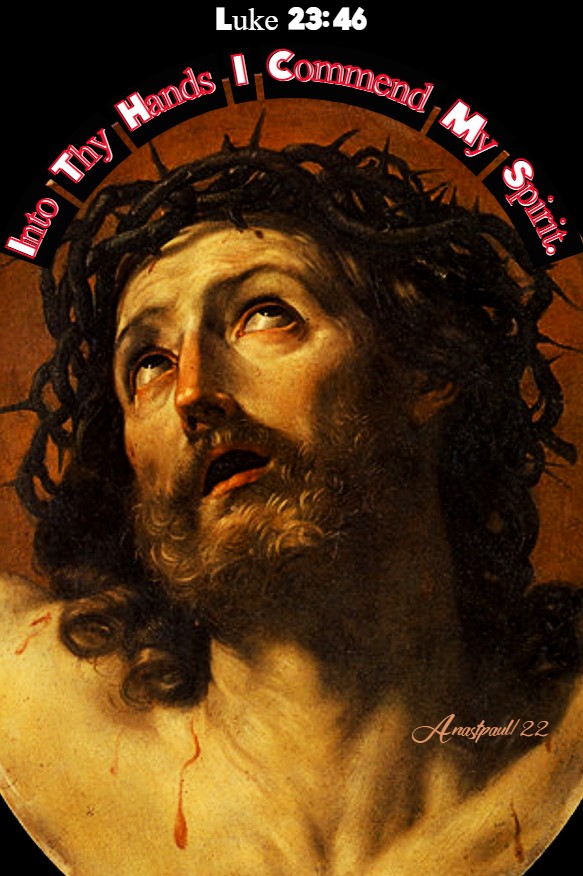
“Into Thy hands I commend My spirit.”
Luke 23:46
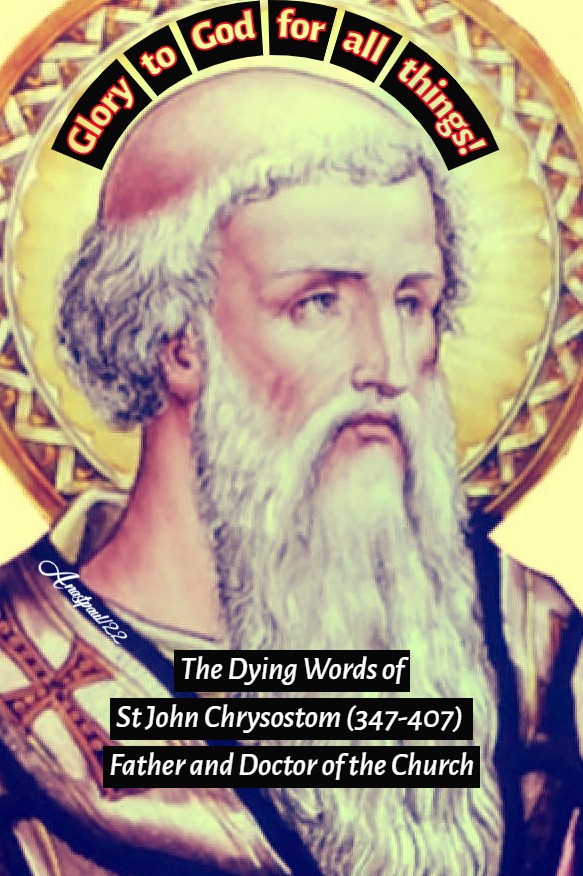
“Glory to God for all things!”
St John Chrysostom (347-407) Father and Doctor of the Church
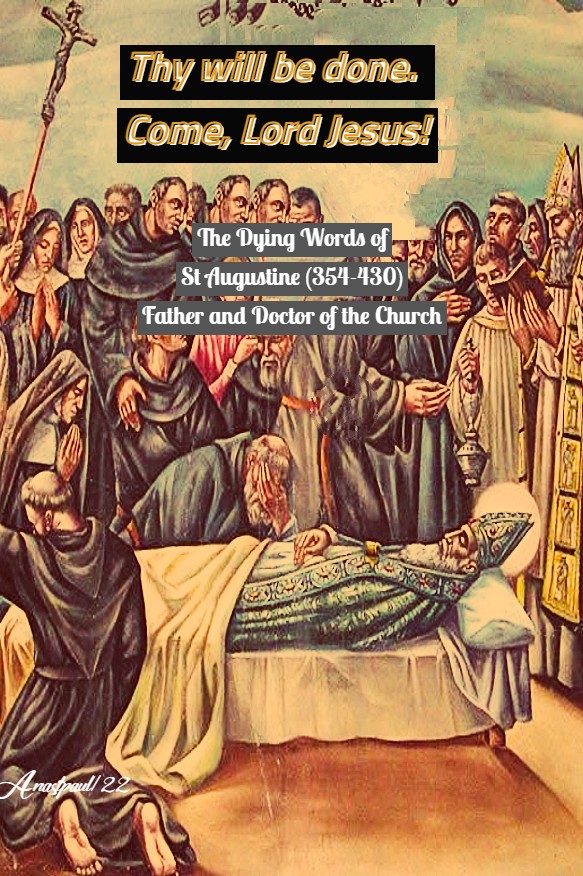
“Thy will be done. Come, Lord Jesus!”
St Augustine (354-430) Father and Doctor of the Church
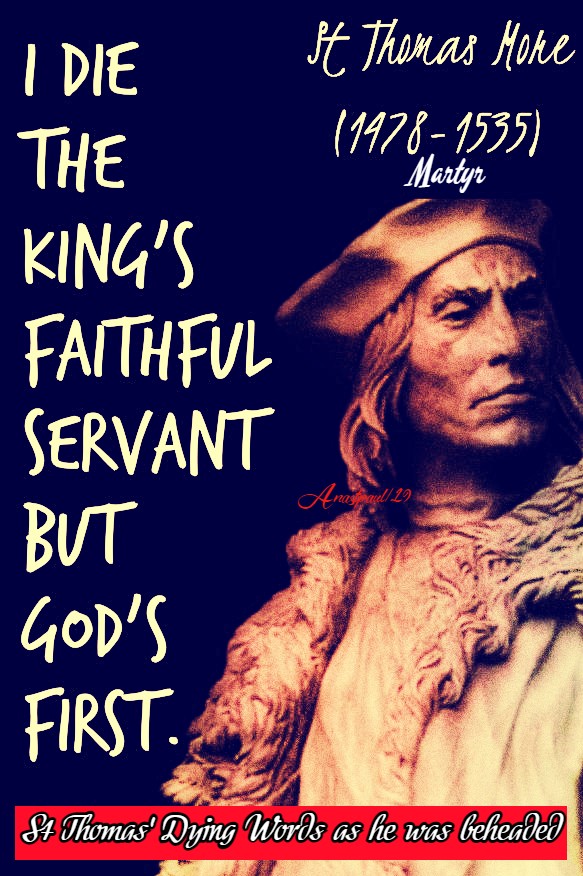
“I die the King’s faithful servant but God’s first.”
St Thomas More (1478-1535) Martyr
“O, my God!”
St Ignatius Loyola (1491-1556)
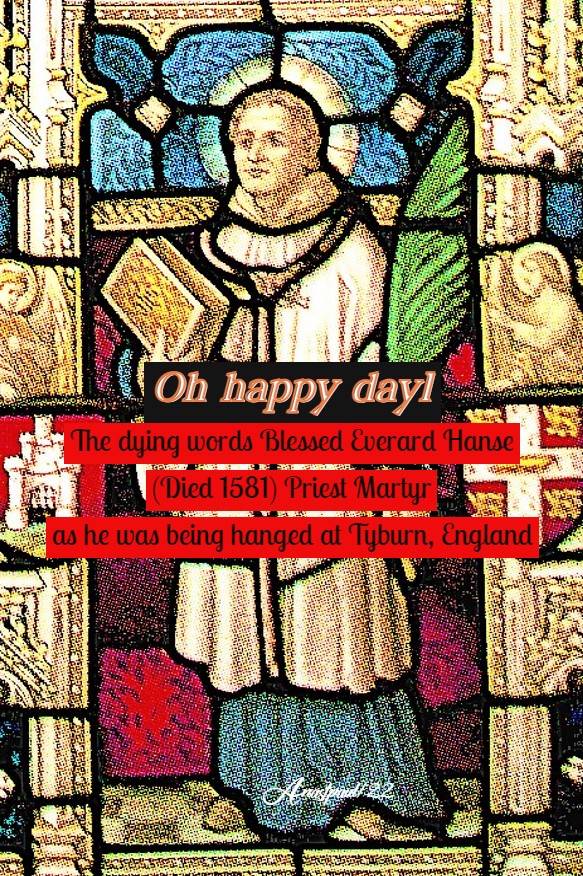
“Oh happy day!”
The dying words of today’s Saint of the Day as he was being hanged at Tyburn, England Blessed Everard Hanse (Died 1581) Priest Martyr
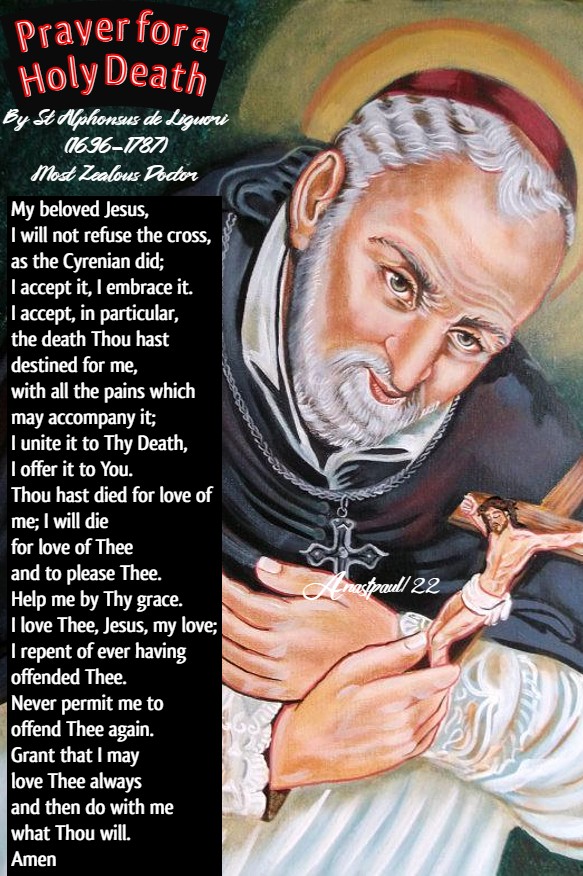
Prayer for a Holy Death By St Alphonsus de Liguori Most Zealous Doctor
“My beloved Jesus, I will not refuse the cross, as the Cyrenian did; I accept it, I embrace it. I accept, in particular, the death Thou hast destined for me, with all the pains which may accompany it; I unite it to Thy Death, I offer it to You. Thou hast died for love of me; I will die for love of Thee and to please Thee. Help me by Thy grace. I love Thee, Jesus, my love; I repent of ever having offended Thee. Never permit me to offend Thee again. Grant that I may love Thee always and then do with me what Thou will.Amen”
Our Morning Offering – 31 July – The Eight Sunday after Pentecost – “Month of the Most Precious Blood” and the Memorial of St Ignatius Loyola (1491-1556) Confessor
Anima Christi
Soul of Christ, sanctify me Body of Christ, save me Blood of Christ, inebriate me Water from the side of Christ, wash me Passion of Christ, strengthen me Good Jesus, hear me Within Your wounds, shelter me from turning away, keep me From the evil one, protect me At the hour of my death, call me Into Your presence lead me to praise You with all Your saints Forever and ever, Amen
For many years the Anima Christi was popularly believed to have been composed by Saint Ignatius Loyola (1491-1556) , as he puts it at the beginning of his Spiritual Exercises and often refers to it. In the first edition of the Spiritual Exercises Ignatius merely mentions it, evidently supposing that the reader would know it. In later editions, it was printed in full. It was by assuming that everything in the book was written by Ignatius that it came to be looked upon as his composition. On this account the prayer is sometimes referred to as the Aspirations of St. Ignatius Loyola and so my image shows St Ignatius at prayer.
However, the prayer actually dates to the early fourteenth century and was possibly written by Pope John XXII but its authorship remains uncertain. It has been found in a number of prayer books printed during the youth of Ignatius and is in manuscripts which were written a hundred years before his birth. The English hymnologist James Mearns found it in a manuscript of the British Museum which dates to about 1370. In the library of Avignon there is preserved a prayer book of Cardinal Pierre de Luxembourg (died 1387), which contains the prayer in practically the same form as we have it today. It has also been found inscribed on one of the gates of the Alcázar of Seville, which dates to the time of Pedro the Cruel (1350–1369).
The invocations in the prayer have rich associations with Catholic concepts that relate to the Eucharist (Body and Blood of Christ), Baptism (water) and the Passion of Jesus (Precious Blood and Holy Wounds).And yes – that is St Ignatius in my image.
Blessed Giovanni Colombini (1300-1367) Confessor, Layman, Husband and Father, Founder of the Apostolic Clerics of Saint Jerome (the Jesuati), Apostle of the poor and the sick, Penitent, Missionary, Miracle-worker. After many miracles had occurred at his tomb, Pope Gregory XIII inserted Giovanni Colombini’s name in the Roman Martyrology, fixing 31 July for the celebration of his feast His Life https://anastpaul.com/2021/07/31/saint-of-the-day-31-july-blessed-giovanni-colombini-1300-1367/
St Helen of Skofde St Neot
Martyrs of Syria – 350 Saints: 350 monks massacred by heretics for their adherence to orthodox Christianity and the decrees of the Council of Chalcedon. 517 in Syria.
Martyrs of Synnada: 3 Saints Democritus Dionysius the Martyr Secundus
“For this cause I bow my knees to the Father, that you may be able to comprehend with all the saints what is the breadth and length and height and depth of this Mystery.” – Ephesians 3:14,18.
“To me, the least of all the saints, is given this grace to preach among the Gentiles and to enlighten all men, what is the dispensation of the Mystery which hath been hidden from eternity in God, Who created all things. For this cause I bow my knees to the Father of our Lord Jesus Christ, of Whom all paternity in heaven and earth is named, That He would grant you the grace to be strengthened by the power of His Spirit, unto the inward man. That Christ may dwell by faith in your hearts, that being rooted and founded in charity, you may be able to comprehend, with all the saints, what is the breadth and length and height and depth of this mystery. To know also, the charity of Christ, which surpasseth all human knowledge.”
“With these words to the Ephesians and similar assurance,s in many passages of the Epistles, which St Paul wrote – not only for the faithful of his own day but for those of all future time – the Apostle of Nations exhorts us, in the most expressive manner, to advance in the knowledge of Christ. And, if we wish to comprehend the total height and depth, the entire breadth and length, of the Love of Jesus, we can only do so, by looking into the depths of His Sacred Heart and to make this clear, will be the object of my words today. O Mary, Mother of the Divine Heart, obtain for us the grace to enter into the full knowledge of Christ’s Love for us, that we may meet it with faithful reciprocal love! I speak in the Holy Name of Jesus, for the greater honour and glory of God!
To contemplate in its entire extent the Love of Jesus Christ and to open our hearts, in true reciprocal love to the Lord, that He may dwell therein, we must go to the Sacred Heart and look into its depths. There, ah! there, we can behold, in all its immensity, a Love so mighty, that it drew Him away from the Throne of His Glory in Heaven to earth and urged Him, not only to assume human nature but, by so doing, as St Paul assures us, to annihilate Himself and take the form of a slave. For, appearing as a Man among men, He concealed His Divinity before them and, although He wrought miracles, other men, with the Divine assistance, performed wonders still greater – Moses, for instance, at the departure of the children of Israel from Egypt.
Men, in general, acknowledged Him so little as God, that they threatened to stone Him when He declared that He was! They persecuted ,at every occasion, this meek Lamb of God and at last nailed Him to the Cross. And what brought to such depths of humility, the King of kings and Lord of lords? Because He chose not to appear as a powerful monarch, as a ruler over the whole universe, before whom all nations would tremble but ,as a slave, for He entered this world as the subject of an emperor, who governed only the Romans as free men, while those nations he had conquered, were held in subjection. And, therefore, Christ suffered the Death of the slave – Crucifixion.
Why did He humble Himself so deeply? One glance into the Divine Heart will tell us that it was His Merciful Love to us. Great God! what misery overwhelmed the human race and, what would have become of us, if the Arm of Thy infinite Justice had not been stayed! But Christ the Son of God, equal in essence and nature to His eternal Father, wished, through Love, to celebrate the triumph of His Infinite Mercy and this Love, urged Him,not only to grant pardon to penitent sinners but to make satisfaction for them and take upon Himself, the justification for sin.
Not only, beloved in Christ, did He mean to pardon this or that sin, to forgive this or that sinner but for every sin, that would ever be committed and, for every sinner, if he were truly contrite, a gracious pardon would be found. Christ requires but one thing of the sinner – that he avails himself of those efficacious means of salvation, to be found in the True Church and takes refuge in His Sacred Heart.
Dearly beloved Catholic souls, redeemed by the Blood of God, reflect upon this precious truth and, that you may realise the depth of His Love for you, look at the Sacred Heart – look into Its Bleeding Wound. The Almighty, the Omnipotent God, the gracious and merciful Saviour, comes from the Heaven of His glory to afford us a certain refuge therein – to save us from that pit, which the malice of sin, has prepared for us in hell.
The Deluge prefigured the spiritual ruin which overwhelmed the whole human race. Now, Holy Scripture testifies, that the waters thereof rose to the height of fifteen cubits above the loftiest mountains. This indicates the degree of malice which characterised the wickedness of mankind, it being greater than that of the fallen angels. Their sin was that pride, which led them to wish to be like God; while man, on the contrary, committed Deicide, as St.Peter, in his first sermon, called the Crucifixion, when he said: “The Author of life you have killed.“
This reproach applies, not only to those Jews who personally laid hands on Christ but, to all men as sinners; for St Paul asserts: “Whosoever sins, Crucifies God in his heart, tramples His Precious Blood under foot.” And yet God forgives on account of the merits of Christ! Whom? – The greatest sinner, if he but repent! And what means does He choose for this? Let us adore and wonder, for the commission of the greatest possible si – attempted Deicide – became for us, the source of every grace. What a triumph of Infinite Mercy!
Glance at the Heart of Jesus, opened after His Death: – by this, He opened His Arms to every soul, with the loving words: “I have loved thee unto death and presented the last drop of My Heart’s Blood for thee to draw thee from the abyss of destruction, which thy sins prepared for thee in hell.” Oh, what a depth and, at the same time, what a height of Love! The work of Redemption as consummated by this Love, made fast the gates of hell and rescued us from that fiery pit but, not content with this, our loving Saviour would open the portals of a Heaven, more beautiful, than the one which would have been our portion had Adam never sinned.
And now, as brothers of the Son of God, we may enter that region of bliss,and become, as precious stones, set in the celestial crown of the world of Angels. We may, by our zeal, in the exercise of good works and their union with the Merits of Christ, ascend higher and higher, through new and more brilliant merits, to an immeasurable degree of glory! Look at Mary, whose throne is next to that of Jesus: she was, like us, a child of man and her glory, by far outshines that of the brightest Angel. We, as her children, may hope to attain a place in Heaven, near that of our gracious Queen – for from the Heart of Jesus, came forth the cry: “To him that shall overcome, I will grant to sit with Me on My Throne.”
And how shall we learn the breadth of this love? I answer: By contemplating the generosity which marked Its course and so animated the Sacred Heart in the Breast of the Infant Saviour, in the crib and of the Redeemer, on the Cross. Even now, it beats for us in the Most Holy Sacrament over the whole globe. Think of the generosity of that Love, by which Jesus has communicated to us, the whole Merit of His Life, Passion, and Death.
The words of St Augustine, refer to this in the explanation and answer, given by him, of the words of Christ: “What price could man give for his soul?” “Remember,” exclaims St Augustine, “the price which Christ paid for you through the work of Redemption; you have been purchased by the Life, Passion and Death of Christ, the Son of God.” What He gave for you, He did not give even for the Angels. Oh, how sweetly are we reminded of all this by one loving glance at the Sacred Heart of Jesus! It beats indeed today on earth, for each one of us. Go before the Tabernacle and ask what is that which Jesus confers upon you in every Holy Communion. It is Himself.
And the length of this enduring Love, may be discerned by the unwearied forbearance He shows to man. From the first moment of your conception, Christian soul, He has loved you with an everlasting Love. He has thought of you and longed to bless you for all eternity. And it will be your own fault, if He does not remain, until your very latest breath, the same faithful, loving Jesus, Who will assist you in that last dread passage where time is merged into eternity.
Yes, it is an Article of Faith, that when the greatest sinner turns, with a repentant heart to Jesus, even in his dying hour, he will still be saved through Him. And is this really so? Christian, look at the wounded Heart in the Breast of your Redeemer. It has ceased to beat – it is dead! Yet, from the Wound came Blood and Water, the symbol of the Church, to which Christ gave power to pardon the dying sinner whose heart cries out for mercy – for forgiveness through the Merits of Christ.
Dearly beloved, who have listened to my words today, reflect upon what I have told you of the Most Sacred Heart of Jesus – of the height, depth, breadth and length of the Love of Christ. Consider it daily and the wish of St Paul, of which I have already spoken to you, will certainly be fulfilled in you. You will become so strengthened in the love of God, through the Spirit of Christ, that He will abide in your heart and, finding therein, so firm a faith, earnest a hope and ardent a love, will there take up His abode forever. Amen! – Fr Francis Xavier Weninger SJ (1805-1888) (Excerpt -The Feast of the Sacred Heart).
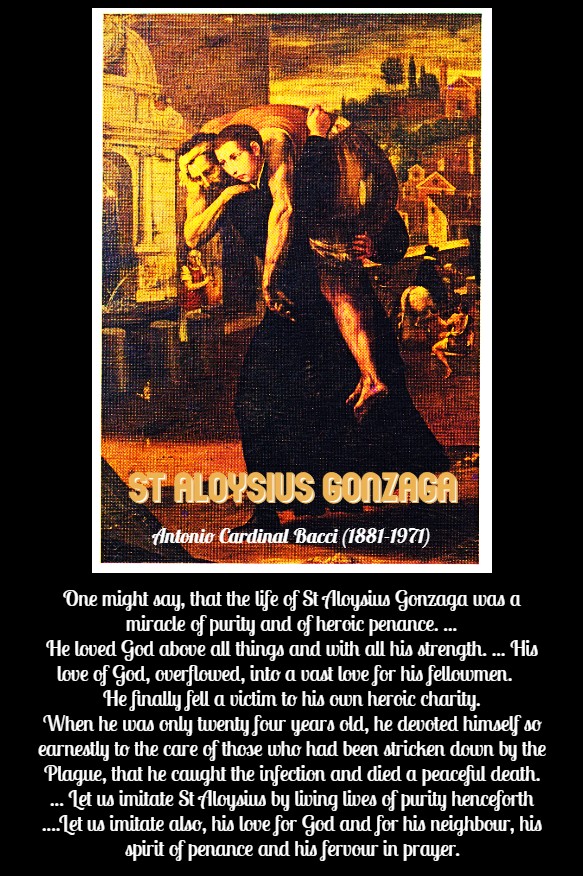
Thought for the Day – 21 June – Meditations with Antonio Cardinal Bacci (1881-1971)
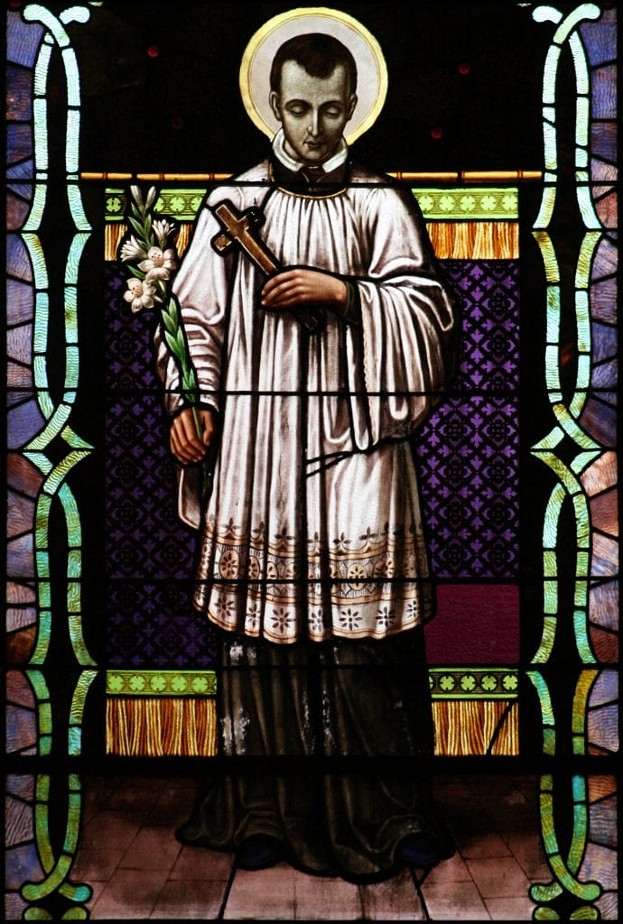
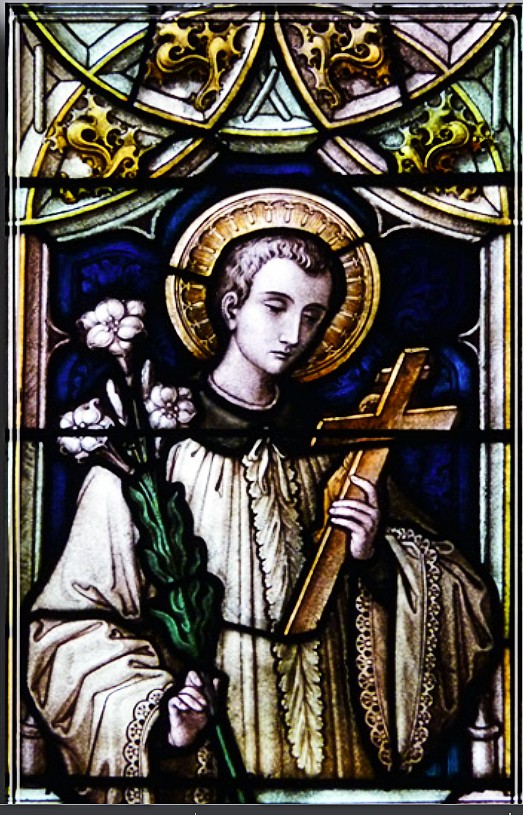
St Aloysius Gonzaga
“One might say, that the life of St Aloysius Gonzaga was a miracle of purity and of heroic penance. The source of his sanctity was the ardent love of God which he cherished from his childhood days. He loved God above all things and with all his strength. Therefore, long hours of prayer were a joy to him, the service of God in the Society of Jesus was his main desire and, mortification, was a loving offering, which he made in expiation of the sins of men.
The heart of St Aloysius, was not closed to men because of its supreme love of God. His love of God, overflowed, into a vast love for his fellowmen. He finally fell a victim to his own heroic charity. When he was only twenty four years old, he devoted himself so earnestly to the care of those who had been stricken down by the Plague, that he caught the infection and died a peaceful death. In his final moments, he smiled and announced that he was happy to be leaving the world.
Do we desire to merit as peaceful and holy a death as this? Let us imitate St Aloysius by living lives of purity henceforth, even if we have not always been as faithful as he was in this regard. Let us imitate also, his love for God and for his neighbour, his spirit of penance and his fervour in prayer.”
Quote of the Day – 21 June – The Memorial of St Aloysius de Gonzaga SJ (1568-1591) “The Angel of Purity”
“Recommend yourself to your Angel Guardian three times a day – in the morning. by the prayer “Angele Dei” in the evening, by the same prayer and during the day, when you visit the Altars in Churches. Remember that you are to be guided by your Angel, like a blind man who cannot see the dangers of the streets and trusts entirely. to the person who leads him.”
St Aloysius de Gonzaga (1568-1591)
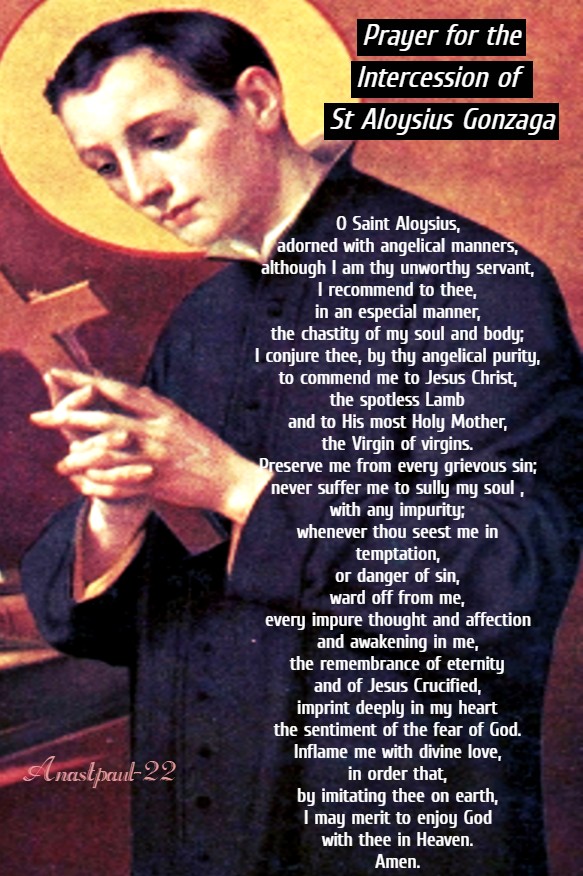
Prayer for the Intercession of St Aloysius Gonzaga, (Can be Prayed as a Novena for Nine Consecutive Days)
O Saint Aloysius, adorned with angelical manners, although I am thy unworthy servant, I recommend to thee, in an especial manner, the chastity of my soul and body; I conjure thee, by thy angelical purity, to commend me to Jesus Christ, the spotless Lamb and to His most Holy Mother, the Virgin of virgins. Preserve me from every grievous sin; never suffer me to sully my soul , with any impurity; whenever thou seest me in temptation, or danger of sin, ward off from me, every impure thought and affection and awakening in me, the remembrance of eternity and of Jesus Crucified, imprint deeply in my heart the sentiment of the fear of God. Inflame me with divine love, in order that, by imitating thee on earth, I may merit to enjoy God with thee in Heaven. Amen. Our Father, Hail Mary
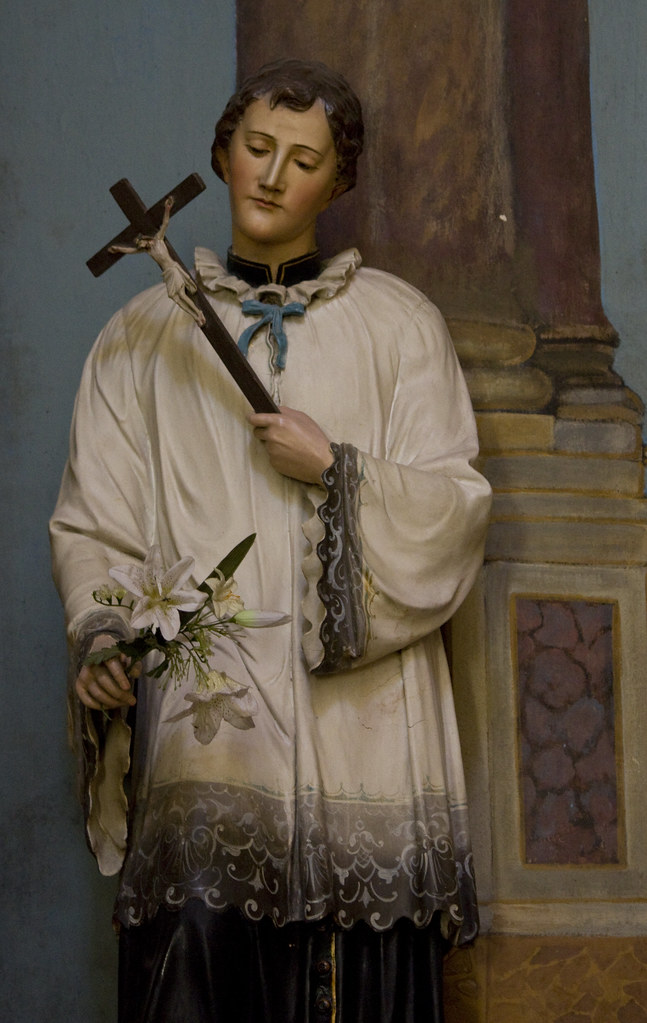
Saint of the Day – 21 June – St Aloysius Gonzaga SJ (1568-1591) Confessor, Seminarian of the Society of Jesus, Mystic, Marian devotee, born of a noble family as Prince Luigi. Known as “The Angel of Purity.” Patronages – Catholic youth, Jesuit scholastics, the blind, eye ailments, AIDS patients, care-givers, Jesuit students, for relief from pestilence, young people, Castiglione delle Stiviere, Italy, Valmonte, Italy.
The Roman Martyrology reads: “At Rome, St Aloysius de Gonzaga, of the Society of Jesus, most renowned for his contempt of his Princely dignity and the innocence of his life.”
St Aloysius de Gonzaga (Excerpt) By Fr Virgilio Cepari SJ (1564-1631)
St Aloysius, unlike so many of his illustrious family, has not left behind him, the glory of a great Captain, or of a man of letters, or of a ruler or statesman. Perhaps we may gather from this brief life, that thanks to the laws of inheritance, or to the gifts specially bestowed upon him, had longer years and occasion been given to him, he would have made his mark in the world. Talents he had and they were very notable whenever circumstances called them into play. Father Budrioli, a contemporary of our Saint, records in his Memoirs of St Aloysius ,that it was the conviction of all the Fathers in the Roman College and, there were men of European fame amongst them, that young Gonzaga had been given to the Society of Jesus, by a special Providence, to be one day its General, a post for which his prudence, sound judgement and extraordinary ability in matters of business, seemed even then, to have marked him out.
But St Aloysius had a heart too great to be contented with earthly grandeur. Nothing seemed of value to him, except what is prized by God and what, like Him, is everlasting To our Saint, the highest science was the science of Saints, to conquer oneself, the greatest victory, to serve God was to reign.! His motto was: Quid hoc ad aeternitatem? What is this to eternity? Guided by this thought, the young Prince, though living in the midst of a profligate world, with its charms and seductions on every side, took in hand the difficult task of making himself a Saint. And in the short space that he lived, he reached such a height of sanctity, that Holy Church, not content with raising him to her Altars, honoured him with the title of “The Angel of Purity”and gave him as model and Patron to the youth of the future.
What commemoration more fitting or more profitable than, by the faithful picture of his life, to reproduce him, whose whole being, whose every word and deed, whose each joy and sorrow, every aspiration and success were a constant forward march towards that ideal of perfection, which attracted him from childhood!
Fr Virgilio Cepar was a contemporary of the Saint, an ocular witness of most of the facts he narrates; he was his fellow-student and lived with him for several years, during which time, he met him everyday and was honoured with his most entire confidence. And what Cepari himself had not seen and heard, he learned from the lips of those who had witnessed all that he narrates, the mother and brother of St Aloysius, his tutors, servants, his relatives and acquaintances, his masters, superiors in religion, his Confessor. Fr Cepari visited every place, except those in Spain, where the Saint had stayed for any length of time and took down on the spot, the most exact information, as can be learnt from the statements of the sworn witnesses. No other writer of the life of St Aloysius has done the same.
To download “The Life of St Aloysius Gonzaga”, click on the link below.
St Raymond of Barbastro St Rufinus of Syracuse St Suibhne the Sage St Terence St Ursicenus of Pavia
Martyrs of Taw – 3+ Saints: Three Christians of different backgrounds who were martyred together – Moses, Paphnutius, Thomas. They were beheaded in Taw, Egypt, date unknown.
Quote/s of the Day – 28 April – “The Month of the Blessed Virgin Mary” – Saturday within the Octave of the Ascension
“There are two ways of keeping God’s word, namely, one, whereby we store in our memory what we hear and the other, whereby we put into practice, what we have heard (and none will deny that the latter is more commendable, inasmuch, as it is better to sow grain, than to store it in the barn).”
Blessed Jordan of Saxony (1190-1237)
“Those who risk all for God, will find. that they have both lost all and gained all.”
St Teresa of Jesus of Ávila (1515-1582) Doctor of Prayer of the Church
“Our business is to love what we have. He wills our vocation as it is. Let us love that and not trifle away our time hankering after other people’s vocations.”
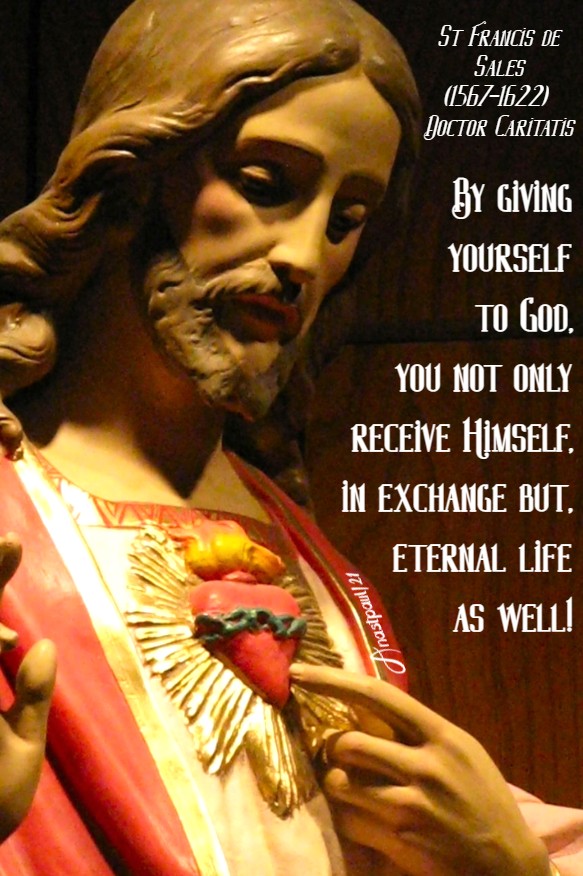
“By giving yourself to God, you not only receive Himself in exchange but, eternal life as well!”
St Francis de Sales (1567-1622) Doctor Caritatis
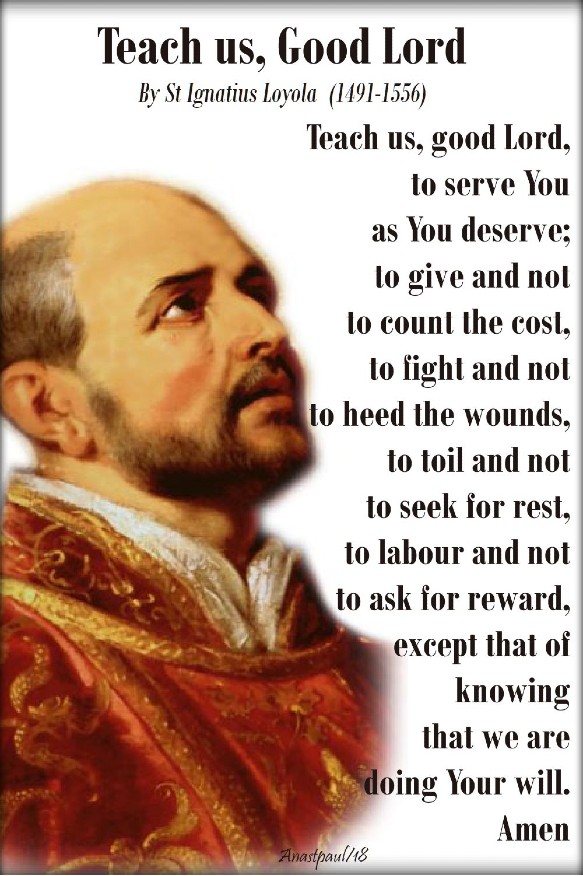
“Teach Us Good Lord” By St Ignatius Loyola (1491-1556)
Teach us, good Lord, to serve You as You deserve; to give and not to count the cost, to fight and not to heed the wounds, to toil and not to seek for rest, to labour and not to ask for reward, except that of knowing that we are doing Your will. Amen
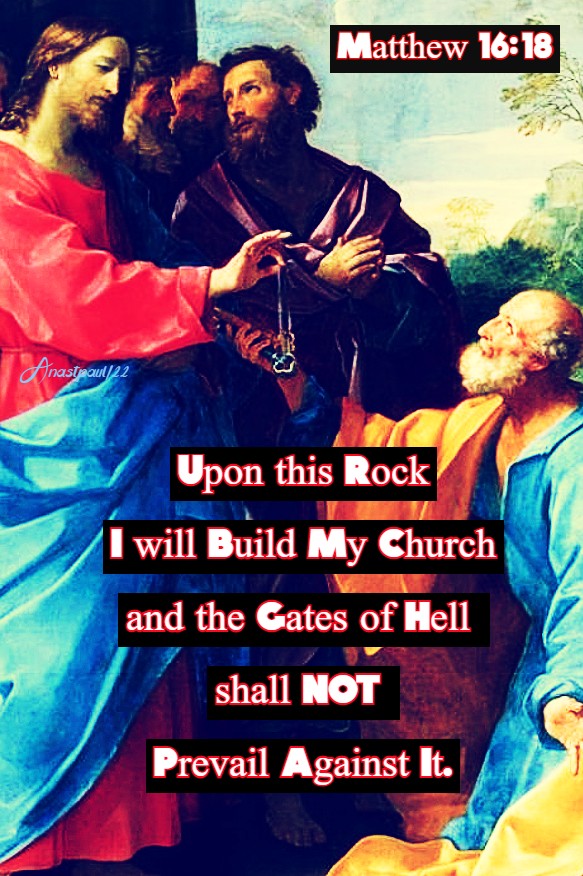
Quote/s of the Day – 19 May – The Memorial of St Peter Celestine (1210-1296) Pope and Confessor – 1 Peter 5:1-4; 5:10-11, Matthew 16:13-19
“Upon this rock I will build My Church and the gates of hell shall not prevail against it.”
Matthew 16:18
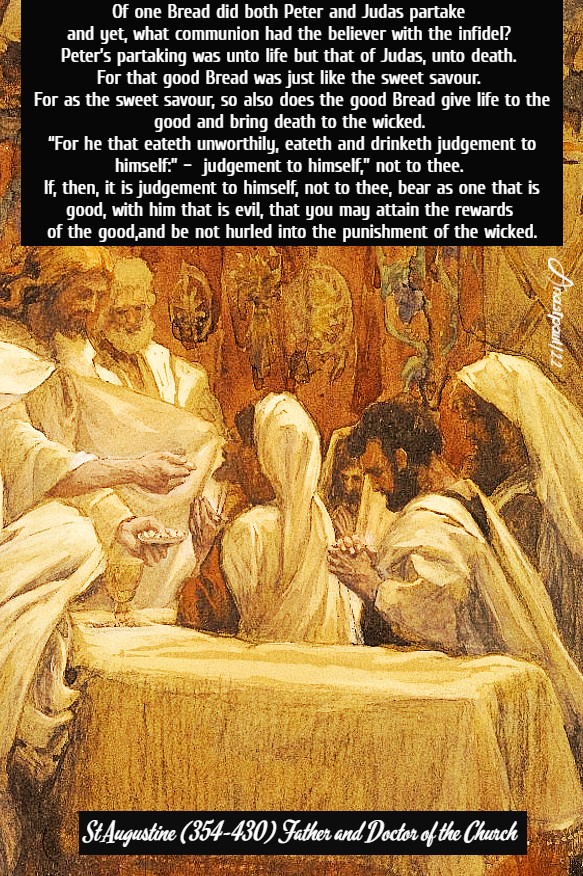
“Of one Bread did both Peter and Judas partake and yet, what communion had the believer with the infidel? Peter’s partaking was unto life but that of Judas, unto death. For that good Bread was just like the sweet savour. For as the sweet savour, so also does the good Bread give life to the good and bring death to the wicked. “For he that eateth unworthily, eateth and drinketh judgement to himself:” – judgement to himself,” not to thee. If, then, it is judgement to himself, not to thee, bear as one that is good, with him that is evil, that you may attain the rewards of the good,and be not hurled into the punishment of the wicked.”
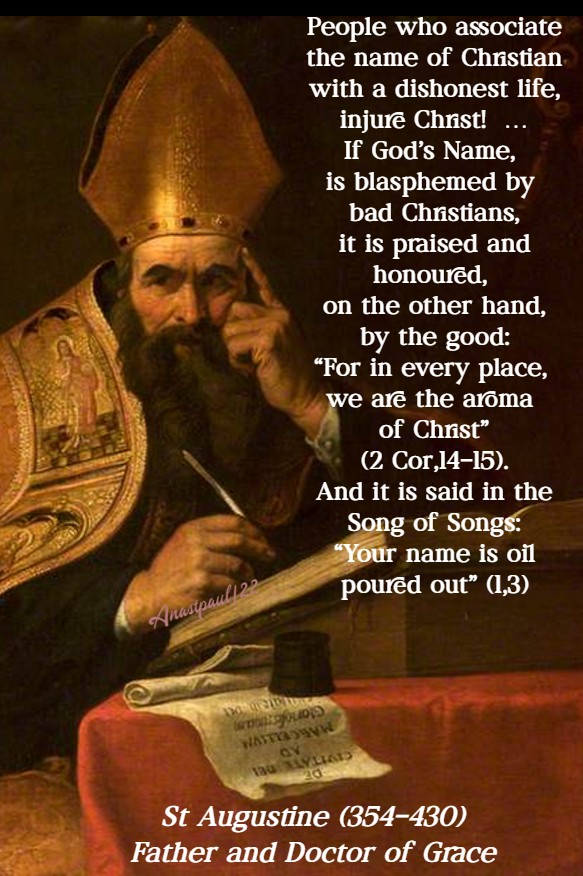
“People who associate the name of Christian with a dishonest life, injure Christ! … If God’s Name, is blasphemed by bad Christians, it is praised and honoured, on the other hand, by the good: “For in every place, we are the aroma of Christ” (2 Cor,14-15). And it is said in the Song of Songs: “Your name is oil poured out” (1,3).”
St Augustine (354-430) Father and Doctor of the Church
(On John 12:1-9 Monday of Holy Week).
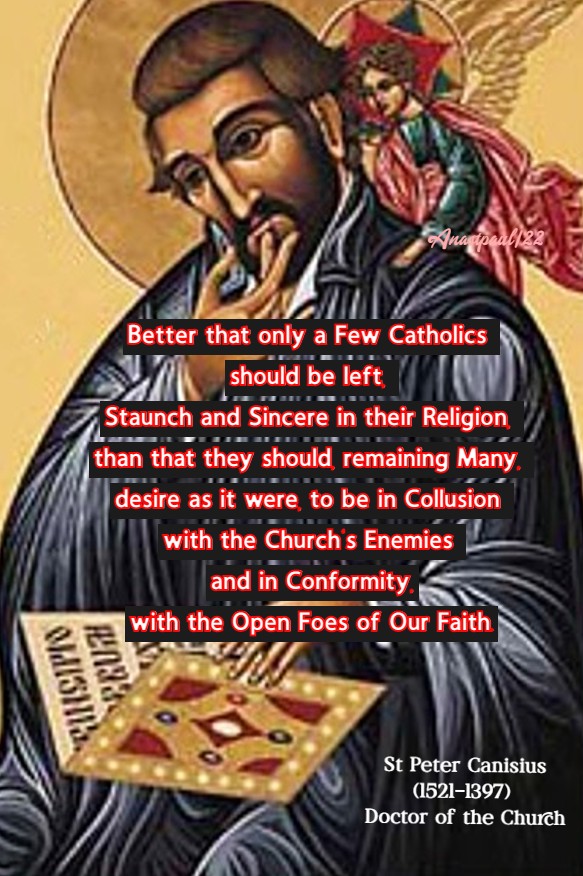
“Better that only a few Catholics should be left, staunch and sincere in their religion, than that they should, remaining many, desire as it were, to be in collusion with the Church’s enemies and in conformity with the open foes of our faith.”
St Peter Canisius (1521-1397) Doctor of the Church
“The path to Heaven is narrow, rough and full of wearisome and trying ascents, nor can it be trodden without great toil and, therefore, wrong is their way, gross their error and assured their ruin, who, after the testimony of so many thousands of Saints, will not learn where to settle their footing!”
St Robert Southwell SJ (1561-1595) Priest and Martyr
St Carantac St Carantoc St Diocletian of Osimo St Felix of Uzalis St Fidolus of Aumont St Fiorenzo of Osimo St Fort of Bordeaux St Francoveus St Gennadius of Uzalis St Germerius of Toulouse St Hilary of Pavia
St Ubaldus Baldassini St Victorian of Isauria Bl Valdimir Ghika
Martyrs of Saint Sabas: A group of Monks, whose names have not come down to us, who were massacred by Moors at the monastery of Saint Sabas in Palestine.
Martyrs of Caramasi Albertin-Marie Maisonade Ignace-Alexandre-Joseph Cardon Jan Chrysostom Zavrel Maturin-Marie Pitri Modeste-Marie Burgen Zosimo Maria Brambat
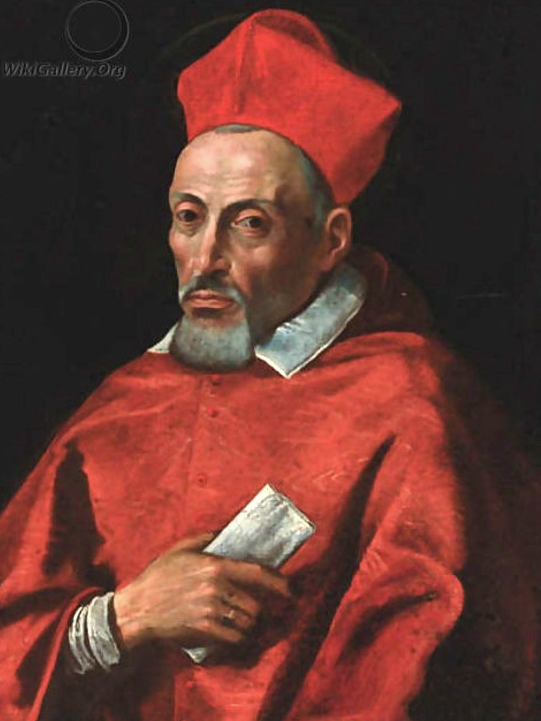
Second Thought for the Day – 13 May – The Memorial of St Robert Bellarmine SJ (1542-1621) Bishop, Confessor, Doctor of the Church
“The Month of the Blessed Virgin Mary” St Robert’s Personal Devotion to the Mother of God
“St Robert was devoted to the Blessed Virgin from his earliest years. According to his schoolmate, later Canon Vincent Patiuchelli, as a young boy Bellarmine used to recite daily the Office of the Blessed Virgin, often in company with Vincent as the two of them walked slowly along the road. Bellarmine retained this custom of reciting the Office of Our Lady throughout life. In the same way. he kept the custom into his old age. of daily saying the Rosary. Alexander Jacobelli, who was the Cardinal’s Almoner for twenty years, testified at the Beatification process that, “He never omitted saying the Office and the Rosary of the Blessed Virgin Mary, during which he was often found melted in tears.”
However, Robert was not satisfied with only a single recitation of the Rosary. The beads were literally his constant companion. In the words of his chaplain, “when fatigued with study, Bellarmine would find recreation in reciting the beads with uncovered head.” And again, “his relaxation was to say the Rosary of Our Lady.” On his frequent journeys as Archbishop of Capua, attendants noticed that he always followed the same ritual – celebrate Mass, say the Itinerarium and, Rosary in hand, enter the carriage for the journey.
Juan de Serayz, a close friend of Robert, left some interesting details on how Bellarmine would say the Rosary. It was 14 June 1618, the Feast of Corpus Christi, when Robert and Juan were returning from a procession at St Peter’s Basilica. “As we got into the carriage,” relates Juan, “he told me that he was able to say the third part of the Rosary exactly three times, from the time the procession left the Sistine Chapel to where it finally ended at the Altar of Exposition in St Peter’s. Which I asked him, out of curiosity, how he said the Rosary, he told me that he separated the decades of the Angelic Salutation with an Our Father, adding to each decade a short prayer corresponding to the different mysteries and preceding with emphasis, he said that he recited the Hail Mary’s slowly, slowly. When I observed that this did not leave much time for keeping his partner company, he answered that during the whole procession, he did not say a single word to his Cardinal companion.”
We understand, therefore, how painful were the doctor’s orders during Robert’s last illness, when he was forbidden, not only to say the Breviary but also, the Rosary. For, as his brother explained, the doctor knew with what ardour and devotion he applied himself to these prayers. Finally, the doctor was moved by the dying man’s pleas and mitigated the orders first given to the servant, allowing the sick man “a moderate use of the Rosary,” although everyone knew that, “his intense application to this prayer would be a great strain upon him.”
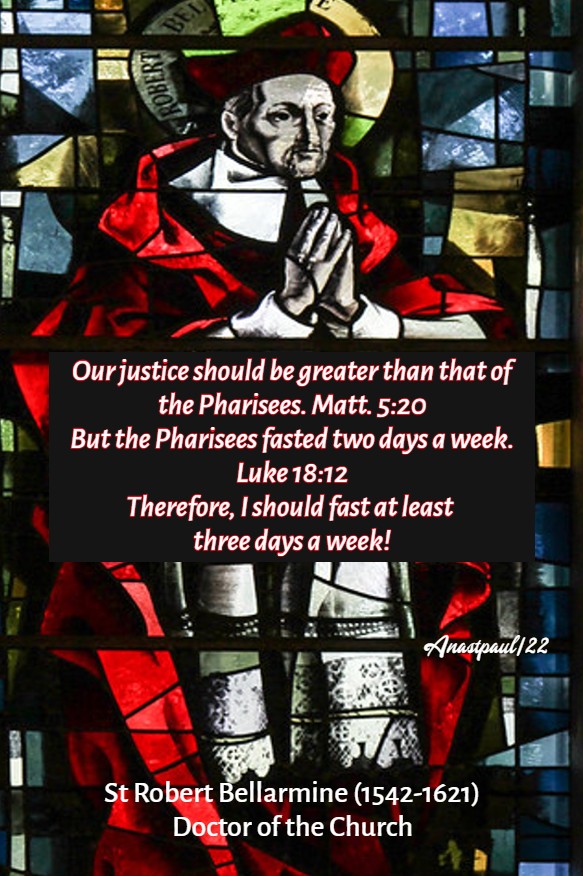
To the Office and the Rosary, Bellarmine added the Saturday fast in Mary’s honour. He fasted three days a week with the same rigour that he kept the Lenten fast, that is, most strictly. According to a syllogism which he wrote on the subject, he argued in this way:
“Our justice should be greater than that of the Pharisees. Matt. 5/20 But the Pharisees fasted two days a week. Luke 18/12 Therefore, I should fast at least three days a week!” So, besides the fasts for the vigils and the Lenten fast and besides the whole of Advent, he kept a sacred fast on Wednesday, Friday and Saturday of each week. That he kept the Saturday fast in honour of Our Lady is clear from the sermon which he gave on one occasion for the Feast of the Immaculate Conception, when he said that among the practices most pleasing to the Blessed Virgin and her Divine Son and most useful to growing in their love and friendship, is the daily recitation of the Rosary and the Saturday fast in Mary’s honour. It was only under express orders from his Confessor to fast only twice a week, that in his old age Bellarmine relinquished the Saturday fast.” [Excerpt by Servant of God Fr John A Hardon SJ (1914-2000)]
Our Morning Offering – 13 May – “The Month of the Blessed Virgin Mary” and the Memorial of St Robert Bellarmine SJ (1542-1621) Bishop, Confessor, Doctor of the Church.
St Robert Bellarmine’s Hymn to Mary the Virgin: Among St Robert’s extant writing, there is a short poem of twenty stanzas which he composed in the nature of a Litany to the Blessed Virgin. The text was first published in Italian some fifty years ago and to the best of the writer’s knowledge, has never been translated into English. Each verse-line begins with the name “Virgin,” joined to a title and petition to Our Lady, starting with the letter “A” and going down the Italian alphabet to “V.” Thus the first seven verses begin with the invocation: “Vergine adorna … Vergine Bella …Vergine casta … Vergine degna … Vergine eletta … Vergine felice … Vergine gradita …”
A translation to this tribute to the Virgin Mother reads as follows: – Servant of God Fr John A Hardon SJ (1914-2000).
Hymn to Mary the Virgin By St Robert Bellarmine (1542-1621) Doctor of the Church.
Virgin adored and clothed with the sun, grant me thine aid. Virgin most beautiful, mystical rose, take abode in my heart. Virgin most chaste, all undefiled, grant me true peace. Virgin deserving of all honour and praise, give me thy love. Virgin elect and full of all grace, lead me to God. Virgin most blessed, star of the sea, dispel the storms besetting me. Virgin most virtuous, holy and sweet, show me the way. Virgin illustrious, with thy burning light, enlighten thou my mind. Virgin more precious than jewels or gold, make reparation for me. Virgin most worthy of all praise, mother, daughter and immaculate spouse. Virgin and Mother, make me more pleasing to Jesus thy Son. Virgin most innocent of any stain or fault, make me more worthy of God. Virgin enriched with every gift and grace, obtain the remission of my sins. Virgin most pure, grant me to enjoy the bliss of heavenly love. Virgin, thou lily among thorns, I pray thee for the grace of a happy death. Virgin more rare than the rarest dream, bring joy to my heart. Virgin so great, there is none like thee on earth, bring peace to my soul. Virgin most true, loving Mother too, Virgin Mary. Amen.
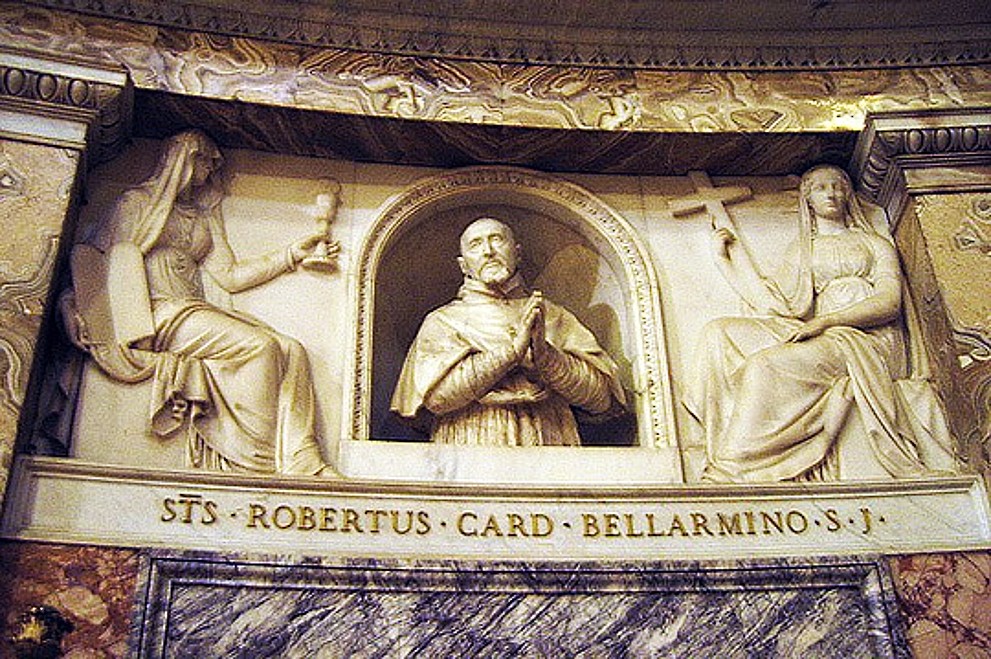
Saint of the Day – 13 May – St Robert Bellarmine SJ (1542-1621) Archbishop of Capua, Italy, Rector of the Roman College, Confessor, Cardinal, Doctor of the Church, Theologian, Professor, Writer, Preacher, Mediator. Known as – “The Father of the Poor,” “The Hammer of Heretics,” “The Model of Promoters and Defenders of the Catholic religion.”
St Robert Bellarmine From the Roman Breviary
Robert, a native of Montepulciano, Italy and of the noble family of Bellarmine, had for his mother, the most pious Cynthia Cervini, sister of Pope Marcellus II. From the first, he was conspicuous for exemplary piety and most chaste manners, earnestly desiring this one thing, to please God alone and to win souls to Christ.
He attended the college of the Society of Jesus in his native town where he was highly commended for his intelligence and modesty. At the age of eighteen, he entered the same Society at Rome and was a model of all religious virtues. Having passed through the course of philosophy at the Roman College, he was sent firstly to Florence, then to Monreale, later to Padua to teach Sacred Theology and afterwards, to Louvain where, not yet a Priest, he ably discharged the office of preacher. After Ordination at Louvain, he taught Theology with such success, that he brought back many heretics to the unity of the Church and was regarded throughout Europe, as a most brilliant Theologian, so much so, that St Charles, Bishop of Milan and others, keenly sought after him.
Recalled to Rome at the wish of Pope Gregory XIII, he taught the science of controversial Theology at the Roman College and there, as Spiritual Director, he guided the angelic youth St Aloysius in the paths of holiness. He governed the Roman College and then the Neapolitan Province of the Society of Jesus, in accordance with the spirit of St Ignatius.
Again summoned to Rome, he was employed by Clement VIII in the most important affairs of the Church, with the greatest advantage to the Christian state. Then, against his will and in spite of opposition, he was admitted among the number of the Cardinals because, as the Pontiff publicly declared, he did not have his equal among Theologians in the Church of God, at the time. He was Consecrated Bishop by the same Pope and administered the Archdiocese of Capua in a most saintly manner for three years. Having resigned this office, he lived in Rome until his death, as a most impartial and trusty Counsellor to the Supreme Pontiff. He wrote much and in an admirable manner.
His principal merit lies in his complete victory in the struggle against the new errors, during which he distinguished himself as a strenuous and outstanding vindicator of Catholic tradition and the rights of the Roman See. He gained this victory by following St Thomas as his guide and teacher, by a prudent consideration of the needs of his times, by his irrefragable teaching and by a most abundant wealth of testimony, well-chosen from the Sacred Writings and from the very rich fountain of the Fathers of the Church. He is eminently noted for very numerous short works, for fostering piety and especially for that golden Catechism, winch he never failed to explain to the young and ignorant, both at Capua and at Rome, although preoccupied with other very important affairs.
A contemporary Cardinal declared, that Robert was sent by God for the instruction of Catholics, for the guidance of the good and for the confusion of heretics. St Francis de Sales regarded him as a fountain of learning; the Supreme Pontiff Benedict XIV called him the Hammer of Heretics and Benedict XV proclaimed him the Model of Promoters and Defenders of the Catholic religion.
He was most zealous in the religious life and he maintained that manner of life after having been chosen as one of the empurpled Cardinals. He did not want any wealth beyond what was necessary; he was satisfied with a moderate household and scanty fare and clothing. He did not strive to enrich his relatives and he could scarcely be induced to relieve their poverty, even occasionally. He had the lowest opinion of himself and was of wonderful simplicity of soul. He had an extraordinary love for the Mother of God; he spent many hours daily in prayer. He ate very sparingly and fasted three times a week. Uniformly austere with himself, he burned with charity towards his neighbour and was often called the Father of the poor. He earnestly strove that he might not stain his baptismal innocence by even the slightest fault.
Almost eighty years old, he fell into his last illness at St Andrew’s on the Quirinal hill and in it, he showed his usual radiant virtue. Pope Gregory XV and many Cardinals visited him on his deathbed, lamenting the loss of such a great pillar of the Church. He fell asleep in the Lord in the year 1621, on the day of the Sacred Stigmata of St Francis, the memory of which, he had been instrumental in having celebrated everywhere. The whole City mourned his death, unanimously proclaiming him a Saint. The Supreme Pontiff Pius XI inscribed his name, firstly, in the number of the Blessed, and then in that of the Saints and shortly afterwards, by a Decree of the Sacred Congregation of Rites, he declared him a Doctor of the Universal Church.
His body is honoured with pious veneration at Rome in the Church of St Ignatius, near the tomb of St Aloysius, as he himself had desired. Blessed be God in His Holy Saints! Amen.
St Anno of Verona St Argentea of Cordoba St Euthymius the Illuminator Bl Fortis Gabrielli Bl Gerard of Villamagna Bl Gemma of Goriano St Glyceria of Trajanopolis
St Lucius of Constantinople St Mael of Bardsey Bl Magdalen Albrizzi St Merewenna of Rumsey St Mucius of Byzantium St Natalis of Milan St Onesimus of Soissons St Servatus of Tongres St Valerian of Auxerre
Martyrs of Alexandria: A group of Christians Martyred in the Church of Theonas, Alexandria, Egypt by order of the Arian Emperor Valens. Their names have not come down to us. 372 in Alexandria, Egypt.
St Anastasius of Lérida St Anthimus of Rome St Bassus of Sabina St Bertilla St Criotan of MacReddin Bl Diego of Saldaña St Evellius of Pisa St Fabius of Sabina St Francesco Maria da Camporosso OFM Cap (1804-1866) Friar of the Friars Minor Capuchin Branch St Francesco de Girolamo SJ St Fremund of Dunstable St Gengulphus of Burgundy
Bl Illuminatus St Illuminatus of San Severino Bl James Walworth Bl John Rochester St Maiulo of Hadrumetum
St Mamertus (Died c 477) Archbishop of Vienne in Gaul – present day France, Theologian, Writer, Founder of the introduction of the praying of Litanies prior to Ascension Day, called “Rogation Days.” Rogation days are days of prayer and fasting in the Church. They are observed with processions and the praying of the Litany of the Saints. The major Rogation is held on 25 April, the minor Rogations are held on Monday to Wednesday, preceding Ascension Thursday. The word Rogation comes from the Latin verb rogare, meaning “to ask,” which reflects the beseeching of God, for the appeasement of His anger and for protection from calamities. His Life: https://anastpaul.com/2019/05/11/saint-of-the-day-11-may-st-mamertus-died-c-475/
St Mozio of Constantinople St Possessor of Verdun St Principia of Rome St Tudy St Vincent L’Hénoret Bl Vivaldus St Walbert of Hainault
Martyrs of Camerino: An imperial Roman official, his wife, their children and servants, all of whom were converts and martyrs: Anastasius, Aradius, Callisto, Eufemia, Evodius, Felice, Primitiva, Theopista.
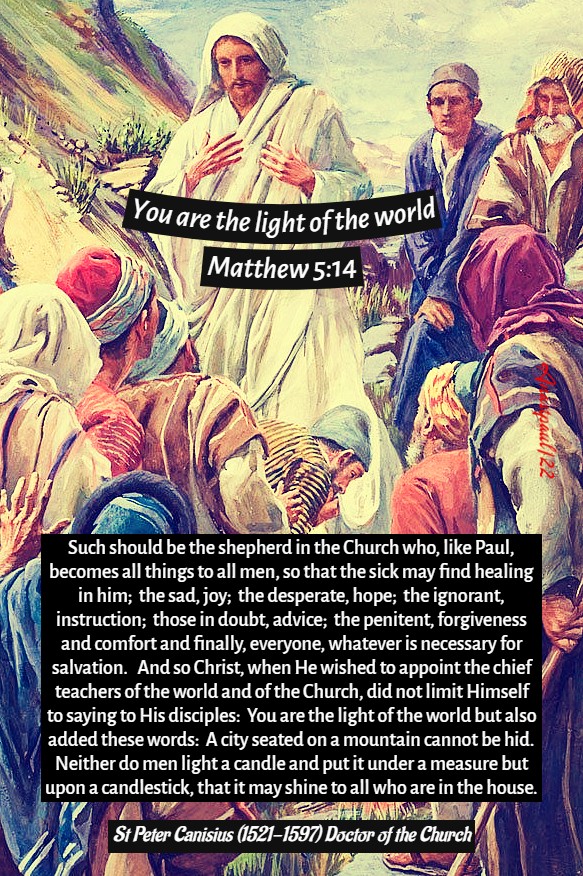
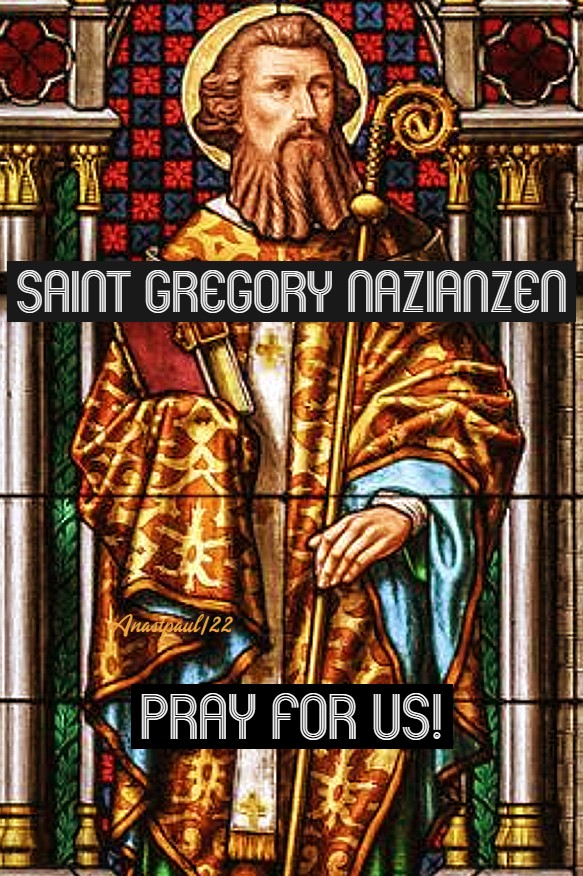
One Minute Reflection – 9 May – The Memorial of St Gregory Nazianzen (330-390) Bishop, Confessor, Father and Doctor of the Church – Sirach 39:6-14, Matthew 5:13-19
“You are the light of the world.” – Matthew 5:14
REFLECTION – “I shall always love and reverence the Apostles sent by Christ and their successors, in sowing the seed of the Gospel, those zealous and tireless co-operators in propagating the Word, who may justly say of themselves: Let a man so account of us as the ministers of Christ and the dispensers of the mysteries of God. For Christ, like a most watchful and most faithful householder, wished that the Gospel lamp should be lighted by such ministers and delegates, with fire sent down from Heaven and once lighted, should not be put under a measure but set upon a candlestick, so that it may spread its brightness far and wide and put to flight, all darkness and error, rife among both Jews and Gentiles.
Now it is not enough for the Gospel teacher to be a brilliant speaker in the eyes of the people; he must also be as a voice crying in the desert and endeavour, by his eloquence, to help many to lead good lives, lest, if he omit his duty of speaking, he be called the dumb dog that is not able to bark, spoken of by the prophet. Yes, he should also burn, in such a way, that, equipped with good works and love, he may adorn his evangelical office and follow the leadership of Paul. He indeed was not satisfied with bidding the Bishop of the Ephesians: This command and teach: conduct thyself in work as a good soldier of Christ Jesus but he unflaggingly preached the Gospel to friend and foe alike and, said with a good conscience to the Bishops gathered at Ephesus: You know how I have kept back nothing that was for your good but have declared it to you and taught you in public and from house to house, urging Jews and Gentiles to turn to God in repentance and to believe in our Lord Jesus Christ.
Such should be the shepherd in the Church who, like Paul, becomes all things to all men, so that the sick may find healing in him; the sad, joy; the desperate, hope; the ignorant, instruction; those in doubt, advice; the penitent, forgiveness and comfort and finally, everyone, whatever is necessary for salvation. And so Christ, when He wished to appoint the chief teachers of the world and of the Church, did not limit Himself to saying to His disciples: You are the light of the world but also added these words: A city seated on a mountain cannot be hid. Neither do men light a candle and put it under a measure but upon a candlestick, that it may shine to all who are in the house. Those churchmen err, who imagine that it is by brilliant preaching, rather than by holiness of and all-embracing love, they fulfil their office.” – St Peter Canisius SJ (1521-1597) Doctor of the Church (Sermon excerpt).
PRAYER – O God, Who gave to Your people, blessed Gregory, as a minister of salvation, grant, we beseech You, that we, who cherished him on earth as a teacher of life, may be found worthy to have him as an intercessor in Heaven. Through Jesus Christ, Thy Son our Lord, Who lives and reigns with Thee, in the unity of the Holy Ghost, God, world without end. Amen (Collect).
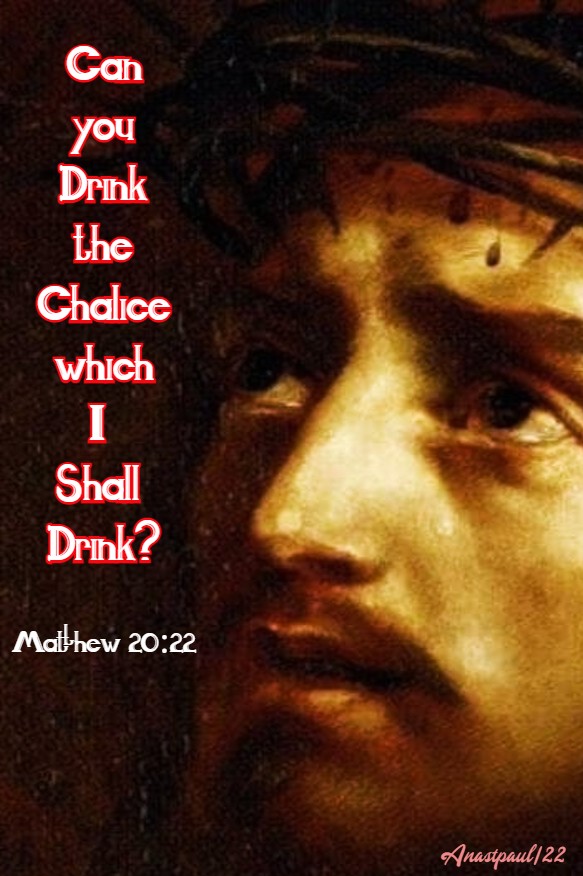
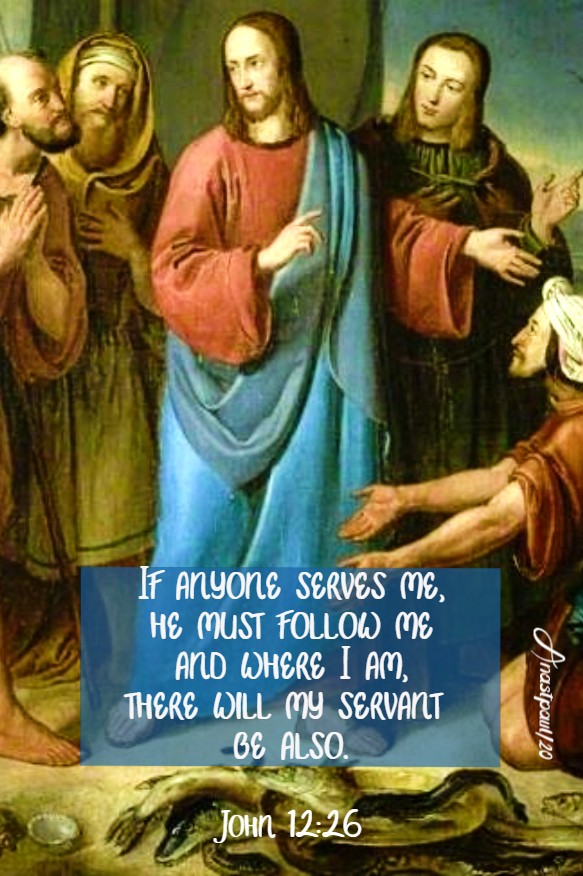
Quote/s of the Day – 6 May – Tthe Feast of St John Before the Latin Gate – Wisdom 5:1-5, Matthew 20:20-23
“Can you Drink the Chalice which I Shall Drink?”
Matthew 20:22
“If anyone serves me, he must follow me and where I am, there will my servant be also.”
John 12:26
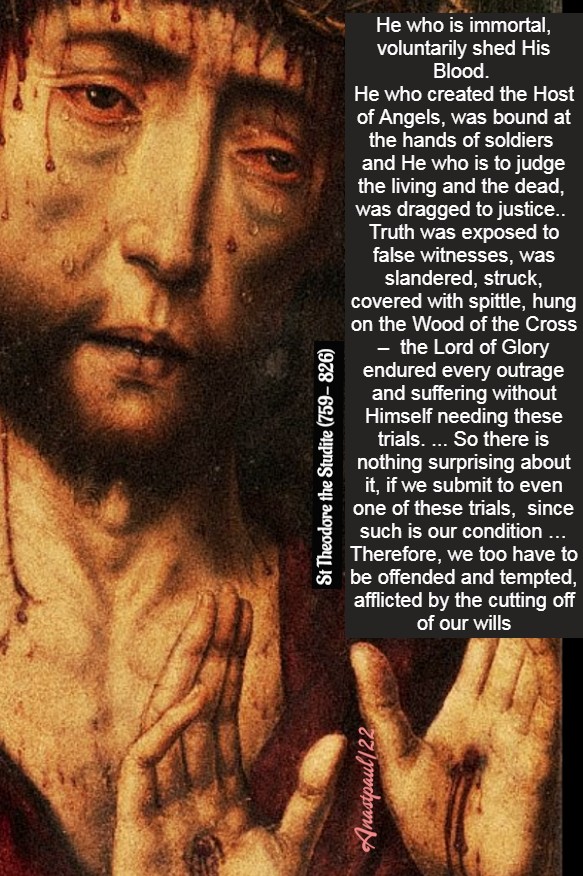
“He who is immortal, voluntarily shed His Blood. He who created the Host of Angels, was bound at the hands of soldiers and He who is to judge the living and the dead, was dragged to justice (cf. Acts 10:42; 2 Tm 4:1). Truth was exposed to false witnesses, was slandered, struck, covered with spittle, hung on the Wood of the Cross – the Lord of Glory (cf. 1 Cor 2:8) endured every outrage and suffering without Himself needing these trials. …
So there is nothing surprising about it, if we submit to even one of these trials, since such is our condition … Therefore, we too have to be offended and tempted, afflicted by the cutting off of our wills.”
St Theodore the Studite (759- 826) Monk at Constantinople, Father (Catecheses 1)
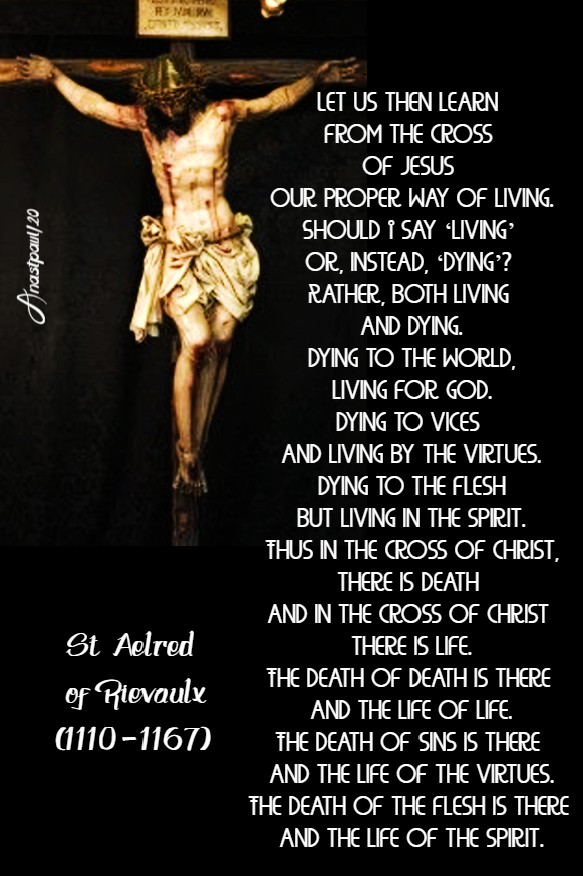
“Let us then learn from the Cross of Jesus our proper way of living. Should I say ‘living’ or, instead, ‘dying’? Rather, both living and dying. Dying to the world, living for God. Dying to vices and living by the virtues. Dying to the flesh, but living in the spirit. Thu,s in the Cross of Christ, there is death and in the Cross of Christ, there is life. The death of death is there and the life of life. The death of sins is there and the life of the virtues. The death of the flesh is there and the life of the spirit.”
St Aelred of Rievaulx (1110-1167)
“God’s love calls us to move beyond fear. We ask God for the courage to abandon ourselves unreservedly, so that we might be moulded by God’s grace, even as we cannot see where that path may lead us.”
The Solemnity of Saint Joseph – 4 May: Between 1870 and 1955, an additional Feast was celebrated in honour of Saint Joseph as Spouse of the Blessed Virgin Mary and Patron of the Universal Church, the latter title having been given to him by Pope Pius IX. Originally celebrated on the third Sunday after Easter with an octave, after Divino Afflatu of Saint Pius X (see Reform of the Roman Breviary by Pope Pius X), it was moved to the preceding Wednesday (because Wednesday is the day of the week specifically dedicated to St Joseph, St John the Baptist and local Patrons). The Feast was also retitled The Solemnity of Saint Joseph. This celebration and its accompanying Octave were abolished during the modernisation of rubrics under Pope Pius XII in 1955.
St Albian of Albée Bl Angela Bartolomea dei Ranzi Bl Angela Isabella dei Ranzi St Antonia of Constantinople St Antonina of Nicaea St Antonia of Nicomedia St Antonius of Rocher St Arbeo of Freising St Augustine Webster St Cunegund of Regensburg St Curcodomus of Auxerre St Cyriacus of Ancona St Enéour St Ethelred of Bardney St Florian of Lorch Bl Hilsindis
Blessed Jean-Martin Moyë (1730-1793) French Priest, Missionary to China, Founder of the Sisters of the Congregation of Divine Providence – the first expression of consecrated life among the women of China. Writer, Teacher, Innovator, Evangelist. Beatified on 21 November 1954 by Pope Pius XII. Biography: https://anastpaul.wordpress.com/2018/05/04/saint-of-the-day-4-may-blessed-jean-martin-moye-1730-1793/
Blessed Ladislas of Gielniów OFM Cap (c 1440-1505) “The Apostle of Lithuania,” Priest of the Order of Friars Minor Capuchin, zealous and tireless Evangelist, renowned Preacher, Poet and Hymnist, disciple of St Bernardine of Siena and his Apostolate of the Most Holy Name of Jesus and a devotee of the Passio of Christ. Ladislas served his Order in various capacities which included both a Doorkeeper and as its Provincial! He travelled across Poland to evangelise and was a noted preacher. About Blessed Ladislas: https://anastpaul.com/2021/05/04/saint-of-the-day-4-may-blessed-ladislas-of-gielniow-ofm-cap-c-1440-1505/
St Luca da Toro
Bl Marco Ongaro of Conegliano OFM Bl Margareta Kratz Bl Michal Giedroyc St Nepotian of Altino Bl Paolino Bigazzini St Paulinus of Cologne St Paulinus of Senigallia St Pelagia of Tarsus St Porphyrius of Camerino Rino St Richard Reynolds OSsS (c 1492-1535) Martyr, Monk of the Bridgettine Order (the Order of the Most Holy Saviour (Ordo Sanctissimi Salvatoris; abbreviated OSsS).
Carthusian Martyrs of England: A group of Carthusian Monks who were hanged, drawn and quartered between 19 June 1535 and 20 September 1537 for refusing to acknowledge the English royalty as head of the Church: • Blessed Humphrey Middlemore • Blessed James Walworth • Blessed John Davy • Blessed John Rochester • Blessed Richard Bere • Blessed Robert Salt • Blessed Sebastian Newdigate • Blessed Thomas Green • Blessed Thomas Johnson • Blessed Thomas Redyng • Blessed Thomas Scryven • Blessed Walter Pierson • Blessed William Exmew • Blessed William Greenwood • Blessed William Horne • Saint Augustine Webster • Saint John Houghton • Saint Robert Lawrence
Martyrs of Cirta: Also known as • Martyrs of Cirtha • Martyrs of Tzirta A group of clergy and laity Martyred together in Cirta, Numidia (in modern Tunisia) in the persecutions of Valerian. They were – Agapius, Antonia, Emilian, Secundinus and Tertula, along with a woman and her twin children whose names have not come down to us.
Martyrs of England: 85 English, Scottish and Welsh Catholics who were Martyred during the persecutions by Protestants in the 16th and 17th centuries. They are commemorated together on 22 November. • Blessed Alexander Blake • Blessed Alexander Crow • Blessed Antony Page • Blessed Arthur Bell • Blessed Charles Meehan • Blessed Christopher Robinson • Blessed Christopher Wharton • Blessed Edmund Duke • Blessed Edmund Sykes • Blessed Edward Bamber • Blessed Edward Burden • Blessed Edward Osbaldeston • Blessed Edward Thwing • Blessed Francis Ingleby • Blessed George Beesley • Blessed George Douglas • Blessed George Errington • Blessed George Haydock • Blessed George Nichols • Blessed Henry Heath • Blessed Henry Webley • Blessed Hugh Taylor • Blessed Humphrey Pritchard • Blessed John Adams • Blessed John Bretton • Blessed John Fingley • Blessed John Hambley • Blessed John Hogg • Blessed John Lowe • Blessed John Norton • Blessed John Sandys • Blessed John Sugar • Blessed John Talbot • Blessed John Thules • Blessed John Woodcock • Blessed Joseph Lambton • Blessed Marmaduke Bowes • Blessed Matthew Flathers • Blessed Montfort Scott • Blessed Nicholas Garlick • Blessed Nicholas Horner • Blessed Nicholas Postgate • Blessed Nicholas Woodfen • Blessed Peter Snow • Blessed Ralph Grimston • Blessed Richard Flower • Blessed Richard Hill • Blessed Richard Holiday • Blessed Richard Sergeant • Blessed Richard Simpson • Blessed Richard Yaxley • Blessed Robert Bickerdike • Blessed Robert Dibdale • Blessed Robert Drury • Blessed Robert Grissold • Blessed Robert Hardesty • Blessed Robert Ludlam • Blessed Robert Middleton • Blessed Robert Nutter • Blessed Robert Sutton • Blessed Robert Sutton • Blessed Robert Thorpe • Blessed Roger Cadwallador • Blessed Roger Filcock • Blessed Roger Wrenno • Blessed Stephen Rowsham • Blessed Thomas Atkinson • Blessed Thomas Belson • Blessed Thomas Bullaker • Blessed Thomas Hunt • Blessed Thomas Palaser • Blessed Thomas Pilcher • Blessed Thomas Pormort • Blessed Thomas Sprott • Blessed Thomas Watkinson • Blessed Thomas Whitaker • Blessed Thurstan Hunt • Blessed William Carter • Blessed William Davies • Blessed William Gibson • Blessed William Knight • Blessed William Lampley • Blessed William Pike • Blessed William Southerne • Blessed William Spenser • Blessed William Thomson • They were Beatified on 22 November 1987 by Pope John Paul II.
Martyrs of Novellara: A Bishop and several his flock who were Martyred together in the persecutions of Diocletian and whose relics were kept and enshrined together. We know nothing else about them but the names – Apollo, Bono, Cassiano, Castoro, Damiano, Dionisio, Leonida, Lucilla, Poliano, Tecla, Teodora and Vespasiano. They were Martyred on 26 March 303. Their relics were enshrined in the parish of Saint Stephen in Novellara, Italy in 1603.
Quote/s of the Day – 27 April – The Memorial of St Peter Canisius SJ (1521-1597) Doctor of the Church
“Better that only a few Catholics should be left, staunch and sincere in their religion, than that they should, remaining many, desire as it were, to be in collusion with the Church’s enemies and in conformity with the open foes of our faith.”
Prayer of a Catechist to Jesus, Lover of Children
O Jesus, Friend of children, Who from Thy most tender years did grow visibly in wisdom and in grace before God and men. Who at the age of twelve, was seated in the Temple, in the midst of the doctors, listening to them attentively, humbly asking them questions and exciting their admiration by the prudence and wisdom of Thy discourse. Who didst receive, so willingly, the children, blessing them and saying to Thy disciples: Let them come to Me, for of such is the Kingdom of Heaven. Inspire me as Thou did inspire the blessed Peter Canisius, model and guide of the perfect Catechist, with a profound respect and a holy affection for childhood, a taste and a marked devotion for instructing them in Christian doctrine, a special aptitude, in making them understand its mysteries and love its beauties. I ask this of Thee, through the intercession of the Blessed Virgin Mary and Saint Peter Canisius. Amen.
St Peter Canisius (1521-1397) Doctor of the Church
St Pollio of Cybalae St Simeon of Jerusalem St Stephen of Tarsus St Tertullian of Bologna St Theophilus of Brescia St Winewald of Beverley
St Zita of Lucca (1212-1272) Virgin, Laywoman, Apostle of the Poor. – Her reputation was such that Dante in the Inferno referred to the City of Luccam, her birthplace and home, as “Santa Zita.” P atronages – housewives, butlers, housemaid, domestic servants (proclaimed by Pope Pius XII), housemaid, lost keys, maids, manservants, people ridiculed for their piety, rape victims, servants, servers, single laywomen, waiters, Lucca, Italy. Her body is incorrupt. Biography:. https://anastpaul.wordpress.com/2017/04/27/saint-of-the-day-27-april-st-zita-of-lucca/
Martyrs of Nicomedia: A group of Christians murdered together for their faith. In most cases all we have are their names – Dioscurus, Evanthia, Felicia, Felix, Germana, Germelina, Johannes, Julius, Laetissima, Nikeforus, Papias, Serapion and Victorinus. They died at Nicomedia, Bithynia, Asia Minor (modern Izmit, Turkey).
Quote/s of the Day – 7 April – Thursday in Passion Week, the Fifth Week of Lent
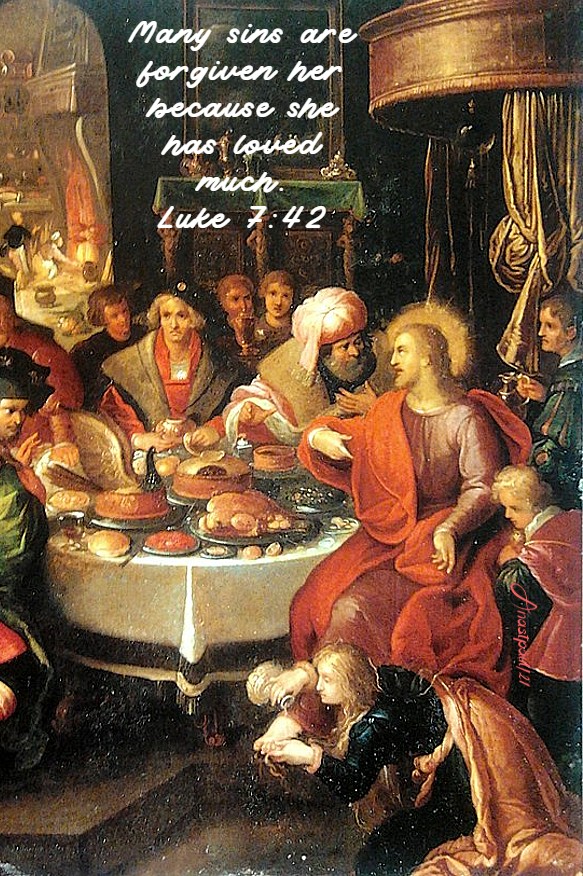
“Many sins are forgiven her because she has loved much.”
Luke 7:42
“The men of Nineveh will rise up at the judgement with this generation and condemn it, for they repented …”
Matthew 12:41
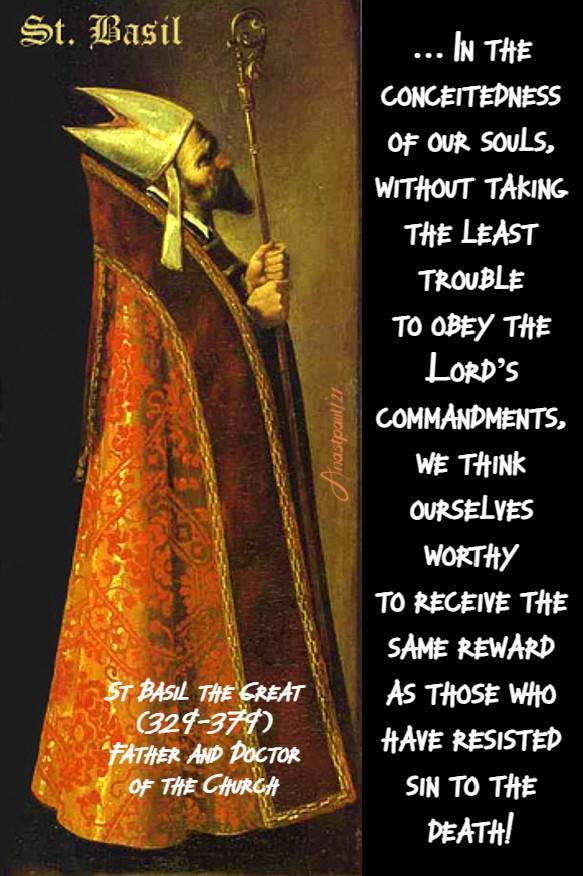
“… In the conceitedness of our souls, without taking the least trouble to obey the Lord’s commandments, we think ourselves worthy to receive the same reward as those who have resisted sin to the death!”
St Basil the Great (329-379) Father and Doctor of the Church
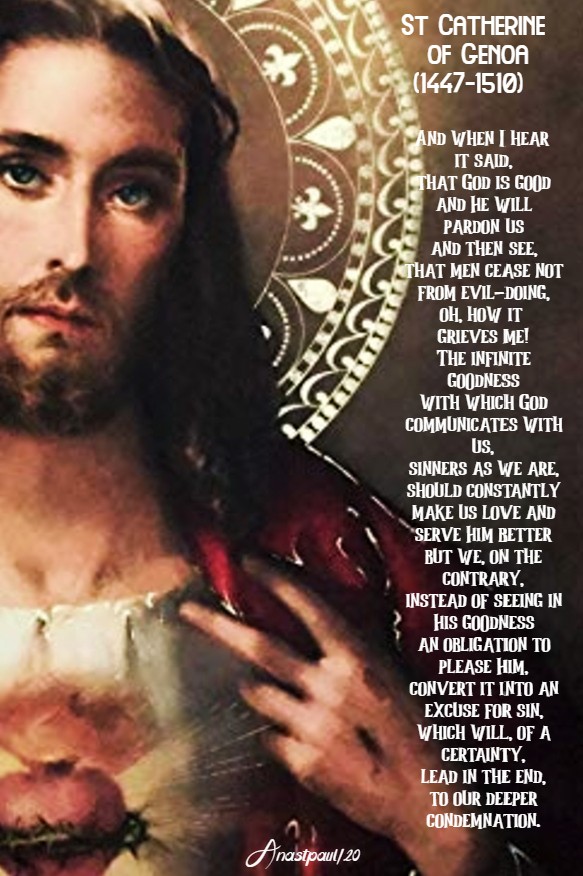
“And when I hear it said, that God is good and He will pardon us and then see, that men cease not from evil-doing, oh, how it grieves me! The infinite goodness with which God communicates with us, sinners as we are, should constantly make us love and serve Him better but we, on the contrary, instead of seeing in His goodness an obligation to please Him, convert it into an excuse for sin, which will, of a certainty, lead in the end, to our deeper condemnation.”
St Catherine of Genoa (1447-1510)
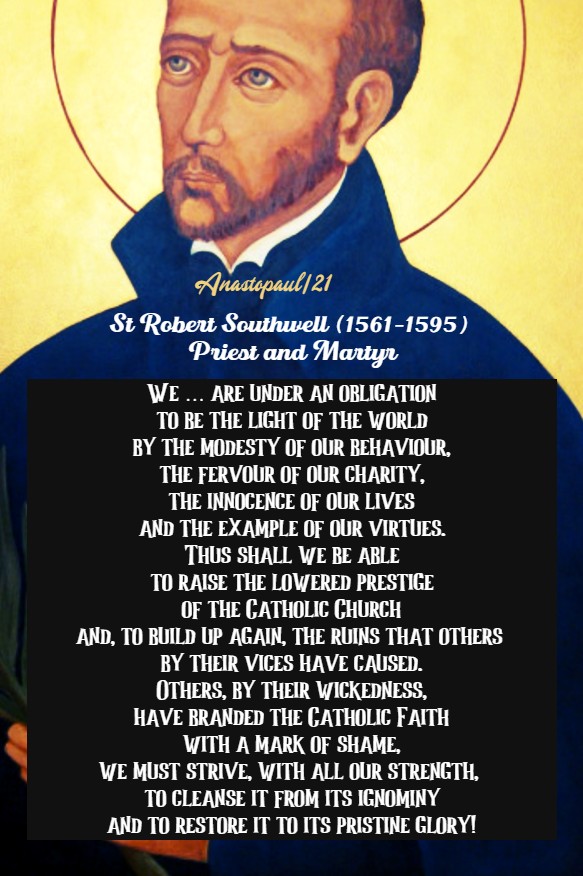
“We … are under an obligation to be the light of the world by the modesty of our behaviour, the fervour of our charity, the innocence of our lives and the example of our virtues. Thus shall we be able to raise the lowered prestige of the Catholic Church and, to build up again, the ruins that others by their vices have caused. Others, by their wickedness, have branded the Catholic Faith with a mark of shame, we must strive, with all our strength, to cleanse it from its ignominy and to restore it to its pristine glory!”
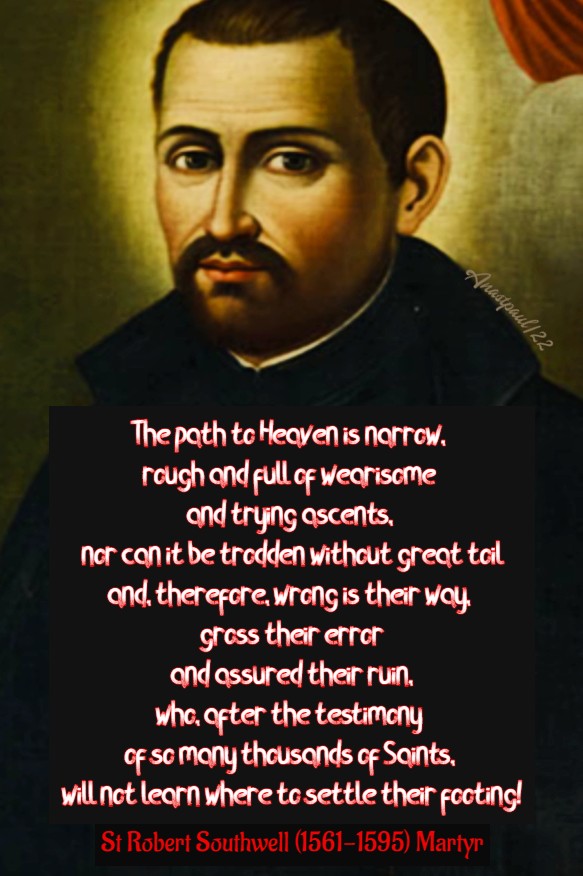
“The path to Heaven is narrow, rough and full of wearisome and trying ascents, nor can it be trodden without great toil and, therefore, wrong is their way, gross their error and assured their ruin, who, after the testimony of so many thousands of Saints, will not learn where to settle their footing!”
St Robert Southwell SJ (1561-1595) Priest and Martyr
Saint of the Day – 7 April – Saint Henry Walpole SJ (1558–1595) Priest of the Society of Jesus, Martyr, Confessor, Poet, Lawyer. Born at Docking, Norfolk, in 1558 and died on 7 April 1595, aged 37, at York for refusing to take the Oath of Supremacy, by being hung, drawn and quatered.
Twenty-three-year-old Henry Walpole had attended the debates which St Edmund Campion held with the Anglican hierarchy and was among the bystanders at the execution of Fr Edmund Campion, when drops of the latter’s blood sprinkled his clothes. This moved Henry so deeply, his heart and soul were rent in suffering with St Edmund and he felt convinced that God was calling him to follow in St Edmund’s footsteps.
Henry was born at Docking, near Sandringham, Norfolk, the eldest son of Christopher Walpole, by Margery, heiress of Richard Beckham of Narford. He studied at the Norwich grammar school and later at Peterhouse, Cambridge, before moving to study law at Gray’s Inn, London.
But he was so inspired by Fr Campion’s Martyrdom, that he decided to give up law to become a Priest. At this time, Henry wrote a little book of poetry, honouring St Edmund Campion which was secretly printed and circulated in London. The authorities sought to discover the parties involved. The Printer, Henry’s friend, named Valenger, was fined and suffered the loss of his ears but did not betray Walpole, who was, nonetheless, under suspicion. Walpole fled London for his father’s home in Norfolk and from there, escaped to France.
He entered the English College at Rheims, in France in July, 1582 before going to the English College in Rome and entered the Society of Jesus on 4 February 1584. He completed his studies at Scots College at Pont-a-Mousson, France and was Ordained in Paris on 17 December 1588. He took up his first assignment as Chaplain to the English Catholic refugees serving in the Spanish army in the Low Countries.
Henry was imprisoned for a year in 1589 after he was captured by the Calvinists and then worked at the English Seminary in Valladolid, Spain. In 1593, he travelled to see King Philip II of Spain to obtain permission to found St Omers, now Stonyhurst College in Lancashire, England and thus leave his duties in Spain.
As England’s southern ports were closed because of plague, Fr Walpole, together with his youngest brother, Thomas and an English soldier secured passage on a French vessel going to Scotland and then travelled to Yorkshire where the group separated. While resting at an inn that night, Fr Walpole was unexpectedly arrested on suspicion of being a Priest, being betrayed by a Scottish prisoner who who was paid for denouncing Henry. Fr Walpole’s capture was sorely felt by the Jesuits in England for they had hoped he could continue St Robert Southwell’s work after the latter had been imprisoned.
During his first interrogation Henry only admitted that he was a Jesuit Priest and that he had come to convert the English. He was transferred to York Castle and for three months, he was permitted to leave prison to discuss theology with Protestant visitors before he was transferred to the Salt Tower in the infamous Tower of London into the hands of the notorious Priest-Torturer Richard Topcliffe , who was hoping to extract information from him. regarding hiding Priests and Recusant Catholics.
Fr Walpole remained faithful and did not reveal anything despite being tortured brutally on the rack and was suspended by his wrists for hours over a period of one year to prevent premature death.
In the spring of 1595 he was sent back to York for trial, where he was joined by Blessed Alexander Rawlins, who was also awaiting trial. Both were tried on 3 April on the charge of being Catholic Priests. Henry, as a former lawyer, argued that the law only applied to Priests who had not given themselves up to officials within three days of arrival. He, himself, had been arrested less than a day after landing in England, therefore, he argued that he had not violated the law. The judges demanded that he take the Oath of Supremacy, acknowledging the Queen Elizabeth’s complete authority in religion. He refused to do so and was convicted of high treason. Both he and bL Rawlins were found guilty and condemned and on 7 April 1595 they were hanged, drawn and quartered. bL Rawlins died first; Walpole was allowed to hang until he was dead.
Henry was Beatified on 15 December 1929 by Pope Pius XI and Canonised in 1970, as one of the Forty Martyrs of England and Wales, who are celebrated collectively on 4 May.
While incarcerated in the Salt Tower, Fr Henry Walpole carved his name in the plaster along with those of Saints Peter, Paul, Jerome,
Today, the gruesome Tower of London, is a UNESCO World Heritage Site and a tourist destination. However, its name for most, especially for Catholics, denotes imprisonment, horrific torture and the most crueldeaths. That was not its initial purpose. It was built to show the wealth and power of William the Conquerer. In actuality, few met their deaths within its walls but it did serve as a prison and a very dark torture chamber for many. Among those imprisoned and tortured in the Tower was our Saint today, St Henry Walpole.
The gruesome Tower of London
On the second floor of the Salt Tower’s walls, are many carvings done by these Martyred men. In fact, St Henry carved his name in the wall as seen above. But another carving by one of our Martyrs, is extremely moving. This carving is an outline of a foot with a wound — a Foot of Jesus Christ pierced by iron nails to suspend Him on the Cross for our salvation. This image was common among these Priests. It was a source of courage and consolation as they awaited their own deaths in imitation of their Lord, their Saviour and their God. This image is regarded as a type of relic and those who visit sense its sorrowful holiness and pray before it in veneration.
Drawing on a wall of the Salt Tower, representing the Wound in Christ’s Foot
St Albert of Tournai Bl Alexander Rawlins St Brenach of Carn-Engyle St Calliopus of Pompeiopolis Bl Cristoforo Amerio St Cyriaca of Nicomedia St Donatus of North Africa
St Epiphanius the Martyr St Finian of Kinnitty St George the Younger St Gibardus of Luxeuil St Goran St Guainerth St Hegesippus of Jerusalem St Henry Walpole SJ (1558–1595) Priest Martyr
St Peleusius of Alexandria St Peter Nguyen Van Luu Bl Ralph Ashley St Rufinus the Martyr St Saturninus of Verona Bl Ursuline of Parma
Martyrs of Pentapolis – 4 Saints: A Bishop, Deacon and two Lectors at Pentapolis, Lybia who for their faith were tortured, had their tongues cut out, and were left for dead. They survived and each died years later of natural causes; however, because they were willing to die and because there were attempts to kill them, they are considered martyrs. We know little else except their names – Ammonius, Irenaeus, Serapion and Theodore c 310 at Pentapolis, Lybia.
Martyrs of Sinope – 200 Saints: 200 Christian soldiers Martyred together for their faith. We don’t even have their names. They were martyred in Sinope, Pontus, Asia Minor (in modern Turkey).
Quote/s of the Day – 1 April – Friday of the Fourth Week of Lent – 3 Kings 17:17-24, John 11:1-45
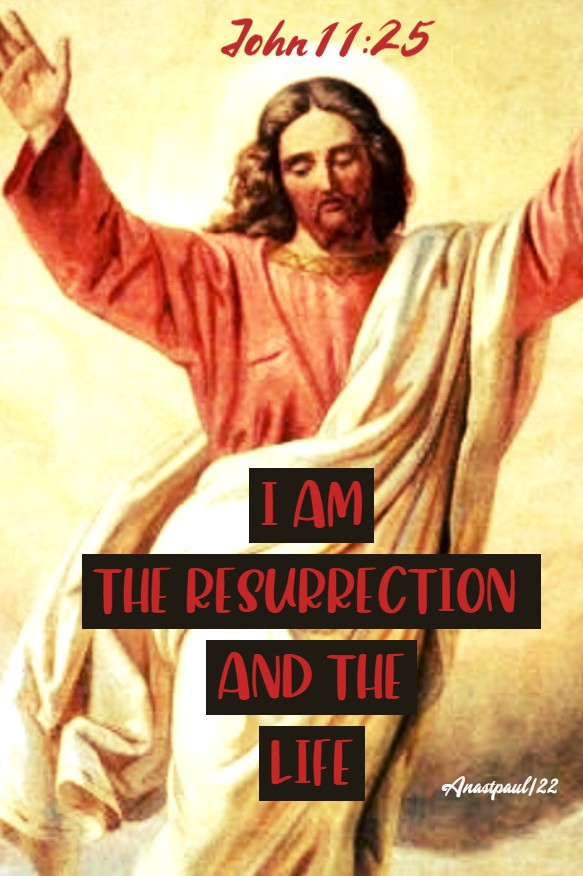
“I Am the Resurrection and the Life”
John 11:25
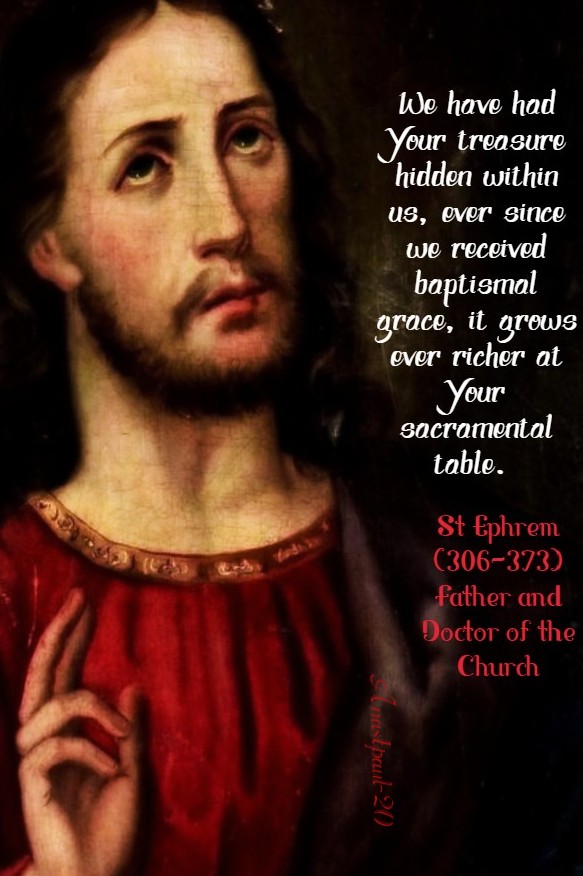
“We have had Your treasure hidden within us, ever since we received baptismal grace, it grows ever richer at Your sacramental table.”
St Ephrem (306-373) Father and Doctor of the Church
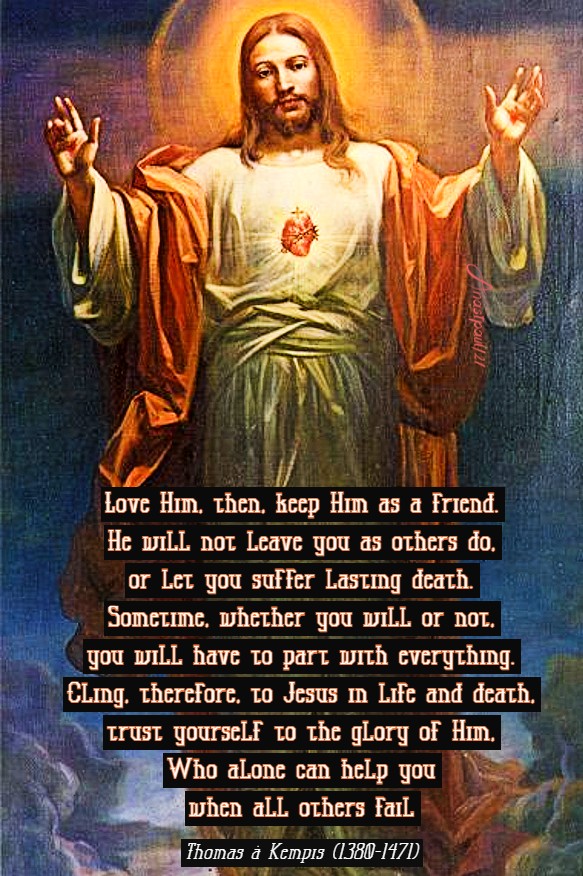
“Love Him, then, keep Him as a friend. He will not leave you as others do, or let you suffer lasting death. Sometime, whether you will or not, you will have to part with everything. Cling, therefore, to Jesus in life and death, trust yourself to the glory of Him, Who alone can help you when all others fail.“
Thomas à Kempis (1380-1471)
“This death … has already levelled his bow to strike me. Is it not prudent to prevent its stroke, by dying now to the world, that at my death, I may live to God?”
Our Morning Offering – 1 April – Friday of the Fourth Week of Lent
My God, I Love Thee By St Francis Xavier (1506-1552) (Attri) Transr: Fr Edward Caswall CO (1814-1878)
My God, I love Thee, not because I hope for heav’n thereby, nor yet for fear, that loving not, I might forever die but for that Thou didst all mankind upon the Cross embrace; for us didst bear the nails and spear and manifold disgrace.
And griefs and torments numberless and sweat of agony; e’en death itself and all for man, who was Thine enemy. Then why, most loving Jesus Christ, should I not love Thee well? Not for the sake of winning heav’n, nor any fear of hell.
Not with the hope of gaining aught, nor seeking a reward but as Thyself hast loved me, O ever loving Lord! E’en so I love Thee and will love and in Thy praise will sing, solely because Thou art my God and my eternal King! Amen
Blessed Clemens August von Galen (1878-1946) Martyr Boshop, known as “The Lion of Munster,” “The Bishop Who Roared Against The Nazis,” “The Bishop Who Took On the Führer.” Blessed Clemens had a great love for the Blessed Virgin, often leading pilgrimages, or going on his own, to Marian Shrines. He was too, a great lover of the Holy Eucharist and a fervent apostle of charity. Patronage – Munster. The Lion of Munster! https://anastpaul.com/2019/03/22/saint-of-the-day-22-march-blessed-clemens-august-count-von-galen-1878-1946/
St Darerca of Ireland St Deghitche St Epaphroditus of Terracina (1st Century) Bishop St Failbhe of Iona Bl François-Louis Chartier St Harlindis of Arland Bl Hugolinus Zefferini St Lea of Rome Bl Marian Górecki


































 AnaStpaul
You must be logged in to post a comment.