St Leudomer St Maria Antonina Kratochwil St Modesto of Sardinia St Saturius of Soria St Theophilus of Bulgaria
St Thomas de Cantilupe of Hereford (c 1218-1282) Bishop of Hereford, Confessor, learned Scholar, known for his care of the poor and his protection of them against feaudal landlords, miracle-worker, Chancellor of Oxford University, Lord Chancellor of England. Thomas de Cantilupe was the last Englishman Canonised before the Reformation. An amazing Life and in death, a wondrous Miracle-worker: https://anastpaul.com/2021/10/02/saint-of-the-day-2-october-saint-thomas-de-cantilupe-of-hereford-c-1218-1282/
St Ursicinus II
Martyred in Nagasaki, Japan: A husband, wife and two sons, who were all martyred together in the persecutions in Japan. They were beheaded on 2 October 1622 in Nagasaki, Japan and Beatified by Pope Pius IX on 7 May 1867. • Blessed Andreas Yakichi • Blessed Franciscus Yakichi • Blessed Lucia Yakichi • Blessed Ludovicus Yakichi
Bl Cecilia Eusepi Blessed Christopher Buxton (1562–1588) Priest and Martyr St Crescens of Tomi St Dodo Bl Dominic of Villanova Bl Edward James St Evagrius of Tomi St Fidharleus Bl Gaspar Fisogiro St Gregory the Illuminator St John Kukuzelis Bl John Robinson St Maxima of Lisbon Bl Nikita Budka St Piaton of Tournai St Priscus of Tomi Bl Ralph Crockett Bl Robert Widmerpool Bl Robert Wilcox
St Romanos the Melodist (c 490-c 556) Deacon, Hymnographer, Poet, Writer. He is said to have composed more than 1,000 hymns celebrating various festivals of the ecclesiastical year, the lives of the saints and other sacred subjects, some 60 to 80 of which survive. Wonderful Saint Romanos! https://anastpaul.com/2020/10/01/saint-of-the-day-1-october-st-romanos-the-melodios-c-490-c-556/
St Sazan of Abyssinia St Verissimus of Lisbon St Virila St Wasnulf
St Antoninus of Piacenza St Castus of Piacenza St Colman of Clontibret Blessed Conrad of Urach O.Cist (c 1180-1227) Priest, Prior, Abbot, General of the Cistercians, Cardinal and Bishop, Papal legate to France from 1220 to 1223. St Desiderius of Piacenza St Enghenedl of Anglesey St Eusebia of Marseilles Bl Felicia Meda Bl Frederick Albert
St Ismidone of Die Bl Jean-Nicolas Cordier Blessed Conrad of Urach St Laurus St Leopardus the Slave Bl Ludwik Gietyngier St Midan of Anglesey St Simon of Crépy St Ursus the Theban St Victor the Theban
Martyrs of Valsery Abbey: An unknown number of Premonstratensian Monks at the Abbey of Notre-Dame de Valsery, Picardie, France who were Martyred by Calvinists. They were martyred in 1567 at Valsery, Pircardy, France.
THIS festival has been kept with great solemnity on the 29th of September ever since the Fifth Century and was certainly initially celebrated in Apulia in 493. The Dedication of the famous Church of St Michael on Mount Gargano, in Italy, gave occasion to the institution of this Feast in the West, which is hence called in the Martyrologies of St Jerome, St Bede and others, ‘The Dedication of St Michael.’ About the Apparition of St Michael at Mount Gargano in 492: https://anastpaul.com/2018/05/08/saint-of-the-day-8-may-apparition-of-michael-the-archangel-at-monte-gargano-italy-492/
Bl Aaron of Auxerre St Alodius of Auxerre St Annemond of Lyons St Bardomianus
Blessed Bernardine of Feltre OFM (1439-1494) Franciscan Priest and Friar, Missionary Preacher, Poet, peace-maker, Civil protestor against the practice of usury, defender of the poor. He was a true ‘child prodigy’ – by the time he was 12 he was fluent in Latin and at the age of 15 he composed a poem and read it in the Town Square to celebrate a local peace treaty. He is remembered most especially, in connection with the “Monti di Pietà” “Mount of Piety” of which he was the reorganiser and, in a certain sense, the Founder, together with the Blessed Michele Carcano. On 13 April 1654, Pope Innocent X confirmed the cultus of Blessed Bernardine and he was formally Beatified in 1728 by Pope Benedict XIII. Biography: https://anastpaul.com/2020/09/28/saint-of-the-day-28-september-blessed-bernardine-of-feltre-ofm-1439-1494/
St Chariton of Palestine Bl Christian Franco St Conval of Strathclyde St Eucarpus St Eustochium St Exuperius of Toulouse (Died 411) Bishop St Faustus of Riez
Blessed Francesco Piani of Caldarola OFM (1424-1507) Francisan Friar, renowned Preacher and Peacemaker, a collaborator in the fight against usury by the institution of the “Mount of Piety,” (a type of pawn shop), social activist and protector of the struggling rural communities. He was Beatified by Pope Urban VII in 1634 – his cult was reaffirmed on 1 September 1843 by Pope Gregory XVI. His Amazing Life: https://anastpaul.com/2021/09/28/saint-of-the-day-28-september-blessed-francesco-piani-of-caldarola-ofm-1424-1507/
St John of Dukla St Laurence of North Africa St Lioba of Bischofsheim St Machan St Martial of North Africa St Martin of Moyenmoutier St Paternus of Auch St Privatus of Rome St Salonius of Geneva St Silvinus of Brescia
St Solomon of Genoa St Stacteus St Tetta of Wimborne Bl Thiemo St Willigod of Moyenmoutier St Zama of Bologna
Augustinian Martyrs of Japan: The first Augustinian Missionaries arrived in Japan in 1602 and met with immediate success; many were brought to the faith; many of them became Augustinians and many of them were Martyred in the periodic persecutions of Christians. This memorial commemorates all of them, whether they have a sanctioned Cause for Canonisation or not. They include: • Blessed Bartolomé Gutiérrez Rodríguez • Blessed Ferdinand Ayala • Blessed Francisco Terrero de Ortega Pérez • Blessed Ioannes Mukuno Chozaburo • Blessed Laurentius Kaida Hachizo • Blessed Mancius Yukimoto Ichizaemon • Blessed Martín Lumbreras Peralta • Blessed Melchor Sánchez Pérez • Blessed Michaël Ichinose Sukezaemon • Blessed Pedro de Zúñiga • Blessed Petrus Sawaguchi Kuhyoe • Blessed Thomas Jihyoe of Saint Augustine • Blessed Thomas Terai Kahyoe • Blessed Vicente Simões de Carvalho • Saint Magdalena of Nagasaki
Martyrs of Antioch – 37 Saints: A group of 30 soldiers and 7 civilians who were murdered together for their faith. The names that have come down to us are – Alexander, Alphinus, Heliodorus, Mark, Neon, Nicon and Zosumus. c 303 at Antioch, Pisidia (in modern Turkey).
Blessed Herman of Reichenau/the Cripple (1013–1054) Benedictine Monk, Confessor, Scholar, Scientist, Writer, Hymnist, Poet, Musical Composer, Teacher. In his own day, the heroic cripple who achieved learning and holiness was called ‘The Wonder of His Age.’. Composer of the “Salve Regina” Hail Holy Queen, “Veni Sancte Spiritus” Come Holy Spirit and “Alma Redemptoris Mater” amongst many others. His Amazing Life and Works: https://anastpaul.com/2019/09/25/saint-of-the-day-blessed-herman-of-reichenau-the-cripple-osb-1013-1054-the-wonder-of-his-age/
St Fymbert Bl Marco Criado St Mewrog St Neomisia of Mecerata St Paphnutius of Alexandria St Principius of Soissons St Sergius of Moscow St Solemnis of Chartres
Martyrs of Damascus: A Christian family of six who were tortured to death in a persecution by Roman authorities. They were: Eugenia, Maximus, Paul, Rufus, Sabinian and Tatta. They were tortured to death in Damascus, Syria, date unknown.
The Holy Bishops of Milan: Imagine being part of a Diocese in which 36 of your past Bishops are Saints and some are also Doctors of the Church and Popes (and others being considered for Sainthood)! Today, the Church in Milan commemorates these holy Bishops. They are: • Blessed Alfredo Ildefonso Schuster • Blessed Andrea Carlo Ferrari • Pope Pius XI • Saint Ambrose of Milan • Saint Ampelius of Milan • Saint Anathalon of Milan • Saint Antoninus of Milan • Saint Auxanus of Milan • Saint Benedict Crispus of Milan • Saint Benignus of Milan • Saint Calimerius of Milan • Saint Castritian of Milan • Saint Charles Borromeo • Saint Datius of Milan • Saint Dionysius of Milan • Saint Eugene of Milan • Saint Eusebius of Milan • Saint Eustorgius II of Milan • Saint Eustorgius of Milan • Saint Gaius of Milan • Saint Galdinus of Milan • Saint Geruntius of Milan • Saint Glycerius of Milan • Saint Honoratus of Milan • Saint John Camillus the Good • Saint Lazarus of Milan • Saint Magnus of Milan • Saint Mansuetus of Milan • Saint Marolus of Milan • Saint Martinian of Milan • Saint Mirocles of Milan • Saint Mona of Milan • Saint Natalis of Milan • Saint Protasius of Milan • Saint Senator of Milan • Saint Simplician of Milan • Saint Venerius of Milan
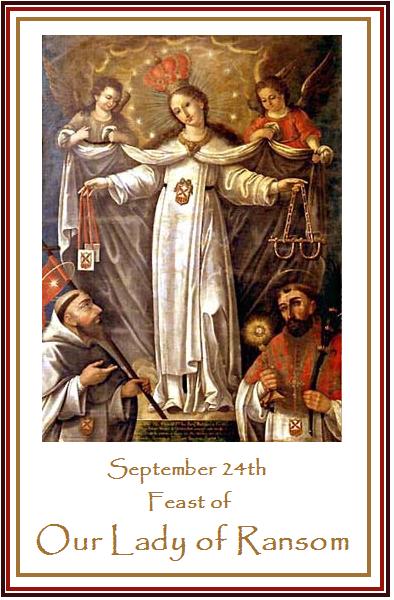
Quote/s of the Day – 24 September – Our Lady of Ransom
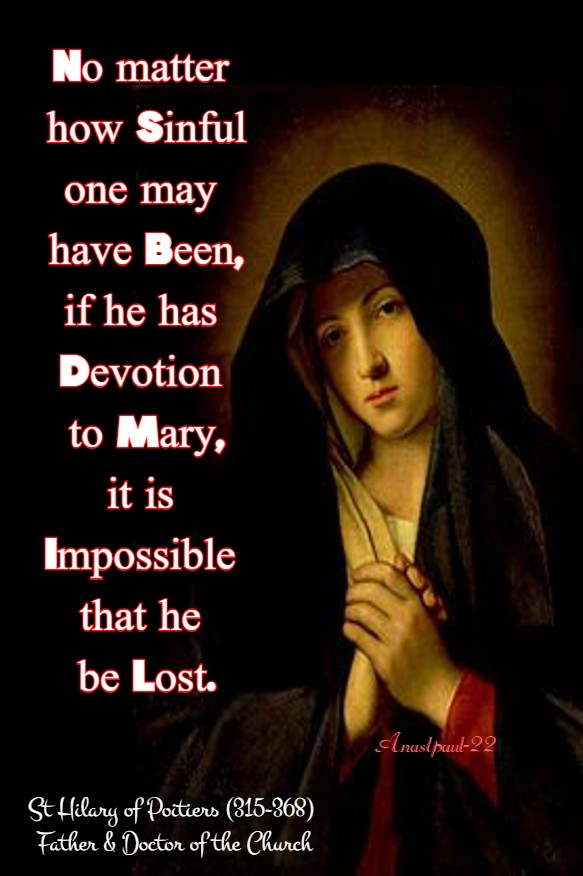
“No matter how sinful one may have been, if he has devotion to Mary, it is impossible that he be lost.”
St Hilary of Poitiers (315-368) Father & Doctor of the Church
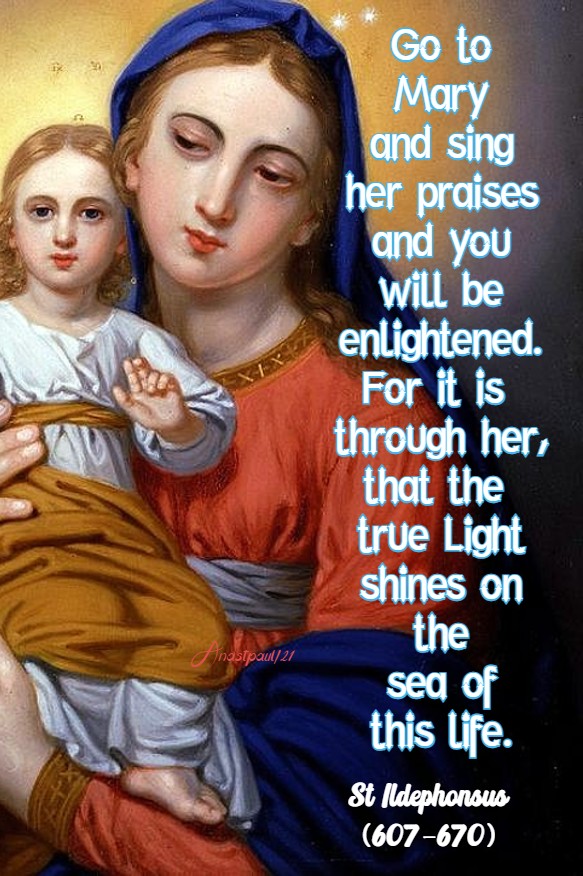
“Go to Mary and sing her praises and you will be enlightened. For it is through her, that the true Light shines on the sea of this life.”
St Ildephonsus (607-670)
“O great, O gentle, O most lovable Mary, thy Holy Name cannot be spoken without inflaming the heart. To those who love thee, it is unspeakable consolation and joy even to think of thee; thou art a sweet memory to those who honour thee.”
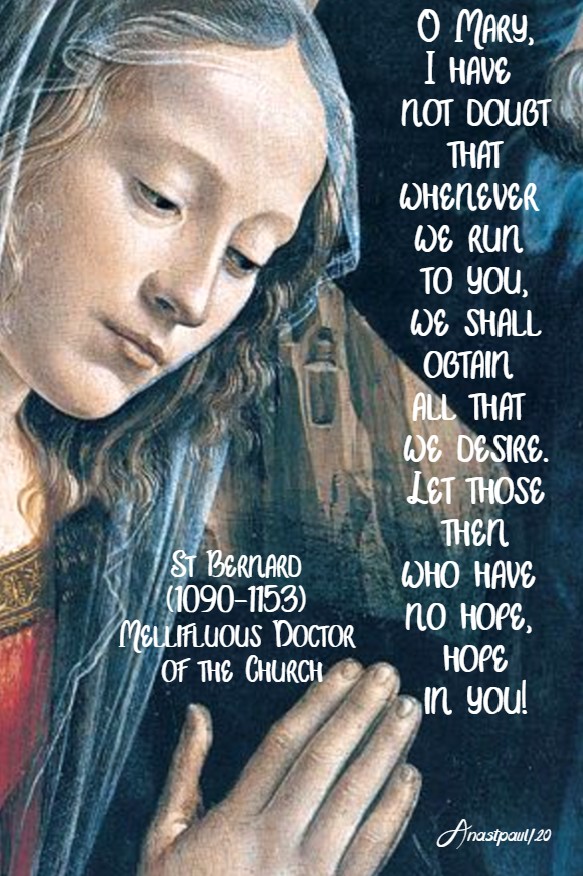
“O Mary, I have not doubt that whenever we run to you, we shall obtain all that we desire. Let those then who have no hope, hope in you!”
St Bernard (1090-1153) Mellifluous Doctor of the Church
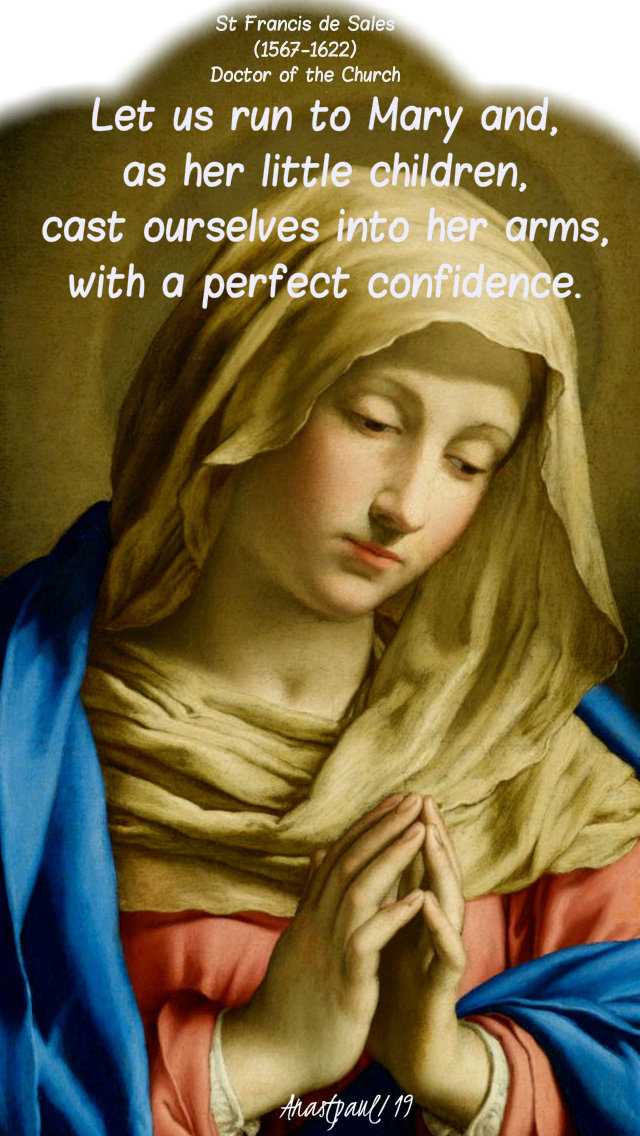
“Let us run to Mary and, as her little children, cast ourselves into her arms with a perfect confidence.”
St Francis de Sales (1567-1622) Doctor of the Church
“No-one who shall invoke this Mother of Grace, with devotion and perseverance, can possibly perish forever.”
St John Eudes (1601-1680) “The Apostle of Two Hearts”
“Truly we are passing through disastrous times, when we may well make our own, the lamentation of the Prophet: “There is no truth and there is no mercy and there is no knowledge of God in the land” (Hosea 4:1). Yet in the midst of this tide of evil, the Virgin Most Merciful rises before our eyes like a rainbow, as the arbiter of peace between God and man.”
St Pope Pius X (1835-1914)
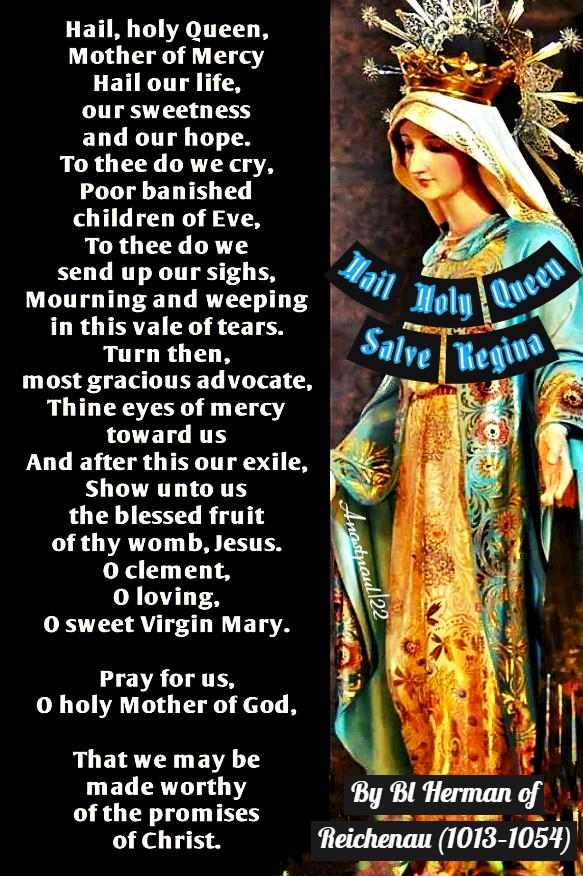
Salve Regina Hail Holy Queen By Blessed Herman of Reichenau (1013–1054)
Hail, holy Queen, Mother of Mercy, Hail our life, our sweetness and our hope. To thee do we cry, Poor banished children of Eve; To thee do we send up our sighs, Mourning and weeping in this valley of tears. Turn then, most gracious advocate, Thine eyes of mercy toward us; And after this our exile, Show unto us the blessed fruit of thy womb, Jesus.
This line, below, by St Bernard of Clairvaux (1090-1153) Doctor of the Church
O clement, O loving, O sweet Virgin Mary.
℣ Pray for us, O holy Mother of God, ℟ that we may be made worthy of the promises of Christ.
One Minute Reflection – 24 September – “The Month of the Seven Sorrows of the Blessed Virgin Mary and the Holy Cross” – Our Lady of Ransom – Sirach 24:14-16, Luke 11:27-28
“Blessed is the womb that bore you” – Luke 11:27
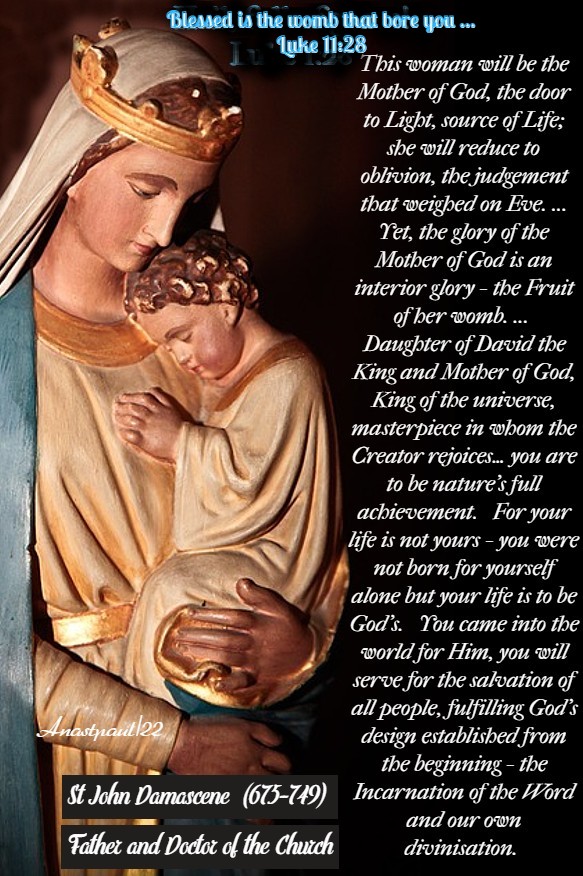
REFLECTION – “This woman will be the Mother of God, the door to Light, source of Life; she will reduce to oblivion the judgement that weighed on Eve. “The rich among the people seek the face” of this woman, “the kings of the nations shall pay her homage” they shall “ offer gifts”…, yet the glory of the Mother of God is an interior glory: the fruit of her womb.
O woman, so worthy of love, thrice happy, “blessed are you among women and blessed is the fruit of your womb.” Daughter of David the king and Mother of God, King of the universe, masterpiece in whom the Creator rejoices…: you are to be nature’s full achievement. For you, life is not yours; you were not born for yourself alone but your life is to be God’s. You came into the world for Him, you will serve for the salvation of all people, fulfilling God’s design established from the beginning: the Incarnation of the Word and our own divinisation. Your whole desire is to feed on the words of God, to be strengthened by their sap, like “a green olive tree in the house of God,” “like a tree planted by running water,” you are the “tree of life” who “yielded its fruit in due season”…
He Who is Infinite, Limitless, came to dwell in your womb; God, the Child Jesus, was nourished by your milk. You are the ever virginal Doorway of God; your hands hold your God; your lap is a throne raised up above the Cherubim… You are the wedding chamber of the Spirit, the “city of the living God, gladdened by the runlets of the stream”, that is to say, the waves of the Spirit’s gifts. You are “all fair, the Beloved” of God.” – St John Damascene (675-749) Monk, Theologian, Father and Doctor of the Church (Homily on the Nativity of the Virgin, # 9 ; SC 80) [ ( Biblical references : Ps 44[45],13; 71[72],11.10; Mt 2,11; Lk 1,42; Is 62,5; Ps 51[52],10; 1,3; cf Gn 2,9, Rv 22,2; cf Ez 44,2; Ps 79[80],2; cf Sg 1,4; Ps 45[46],5; Sg 4,7]. Link to searchable Sacred Scripture here: https://www.drbo.org/
PRAYER – O God, Who for the deliverance of Christians from the power of the pagans, graciously willed to enrich Thy Church by a new religious offspring through the most glorious Mother of Thy Son; grant, we beseech Thee, that by the merits and intercession of her, whom we piously venerate, as the founder of so great a work, we may be delivered from all our sins and from the captivity of the devil. Through Jesus Christ, Thy Son our Lord, Who lives and reigns with Thee, in the unity of the Holy Ghost, God, world without end. Amen (Collect).
Martyrs of Chalcedon – (49 Saints): Forty-nine Christian choir singers of the Church in Chalcedon in Asia Minor who were Martyred together in their persecutions of Diocletian in 304.
St Pope Linus (c 10 – c 76) Successor to St Peter. Papacy lasted from c 67 to his death. Among those to have held the position of pope, Peter, Linus and Clement are specifically mentioned in the New Testament. Linus is mentioned in the closing greeting of the Second Epistle to Timothy as being with Paul in Rome near the end of Paul’s life. About St Pope Linus: https://anastpaul.com/2018/09/23/saint-of-the-day-23-september-st-pope-linus-c-10-c-76-successor-to-st-peter/
St Cissa of Northumbria St Constantius of Ancona Bl Francisco de Paula Victor Bl Guy of Durnes Bl Helen Duglioli St Peter Acontanto St Polyxena St Sosius (275-305) Confessor, Deacon and Martyr Bl William Way St Xantippa
Martyrs of Syracuse – (4 Saints): Group of Christians deported from Syracuse, Sicily by invading Saracens and sent to North Africa where they were tortured and executed for their faith. Martyrs. The names that have survived are Andrew, Antony, John and Peter. c900
St Thomas of Villanueva/Villanova OSA (1488-1555) Archbishop, Confessor, Religious Priest of the Order of St Augustine,Writer, Preacher, Teacher, Apostle of Charity, Mystic, Miracle-Worker often called “the Almsgiver” and “the Father of the Poor“, Reformer. Canonised on 1 November 1658 by Pope Alexander VII. About St Thomas here: https://anastpaul.com/2017/09/22/saint-of-the-day-22-september-st-thomas-of-villanova-o-s-a/
St Irais St Jonas St Lauto of Coutances St Lindru of Partois Bl Otto of Freising St Sadalberga St Sanctinus of Meaux St Septimius of Jesi (Died c 307) Bishop, Confessor, Martyr St Sigfrid of Wearmouth St Silvanus of Levroux St Symphorian
Martyrs of the Theban Legion: + Martyrs (c 287) A Roman imperial legion of 6,600 soldiers, all of whom were Christians; they had been recruited from the area around Thebes in Upper Egypt, were led by Saint Maurice and served under Emperor Maximian Herculeus. Around the year 287, Maximian led the army across the Alps to Agaunum, an area in modern Switzerland, in order to suppress a revolt by the Bagandre in Gaul. In connection with battle, the army offered public sacrifices to the Roman gods; the Theban Legion refused to participate. For refusing orders, the Legion was decimated – one tenth of them were executed. When the remainder refused to sacrifice to the gods, they were decimated again. When the survivors still refused to sacrifice, Maximinian ordered them all killed. Martyrs. Known members of the Legion include: Alexander of Bergamo Candidus the Theban Chiaffredo of Saluzzo Exuperius Fortunato Innocent of Agaunum Maurice Secundus the Theban Ursus the Theban Victor of Agaunum Victor of Xanten Victor the Theban Vitalis of Agaunum Other profiled Saints associated with the Legion include: Antoninus of Piacenza (martyred soldier; associated by later story tellers) Adventor of Turin (not a member; associated by later story tellers) Cassius (may have been a member) Florentius the Martyr (may have been a member) George of San Giorio (not a member; associated by later story tellers) Gereon (not a member, but another soldier who was martyred for refusing to make a sacrifice to Roman gods) Octavius of Turin (not a member; associated by later story tellers) Pons of Pradleves (escaped the massacre to become an evangelists in northern Italy) Secundus of Asti (not a member but linked due to art work) Solutor of Turin (not a member; associated by later story tellers) Tiberio of Pinerolo (may have been a member) Verena (wife of a member of the Legion) They were Martyred c 287 in Agaunum (modern Saint-Maurice-en-Valais, Switzerland. A Basilica was built in Agaunum to enshrine the relics of the Legion. The full story: https://anastpaul.com/2018/09/22/saints-of-the-day-22-september-st-maurice-and-the-martyrs-of-the-theban-legion-martyrs-c
St Alexander of the Via Claudia Bl Diego Hompanera París St Eusebius of Phoenicia St Francisco Pastor Garrido St Gerulph St Herminio García Pampliega St Iphigenia St Isaac of Cyprus Bl Jacinto Martínez Ayuela St Jonah the Prophet Bl José María Azurmendi Mugarza Bl Josep Vila Barri St Landelino of Ettenheim Bl Manuel Torró García
St Maura of Troyes St Meletius of Cyprus Bl Nicolás de Mier Francisco St Pamphilus of Rome Bl Vicente Galbis Gironés Bl Vicente Pelufo Orts
Martyrs of Gaza – 3 Saints: Three brothers, Eusebius, Nestulus and Zeno, who were seized, dragged through the street, beaten and murdered by a pagan mob celebrating the renunciation of Christianity by Julian the Apostate. They were burned to death in 362 on a village garbage heap in Gaza, Palestine.
Our Morning Offering – 27 August – “The Month of the Immaculate Heart of Mary” and Feast of Our Lady Health of the Sick and Mary’s Day
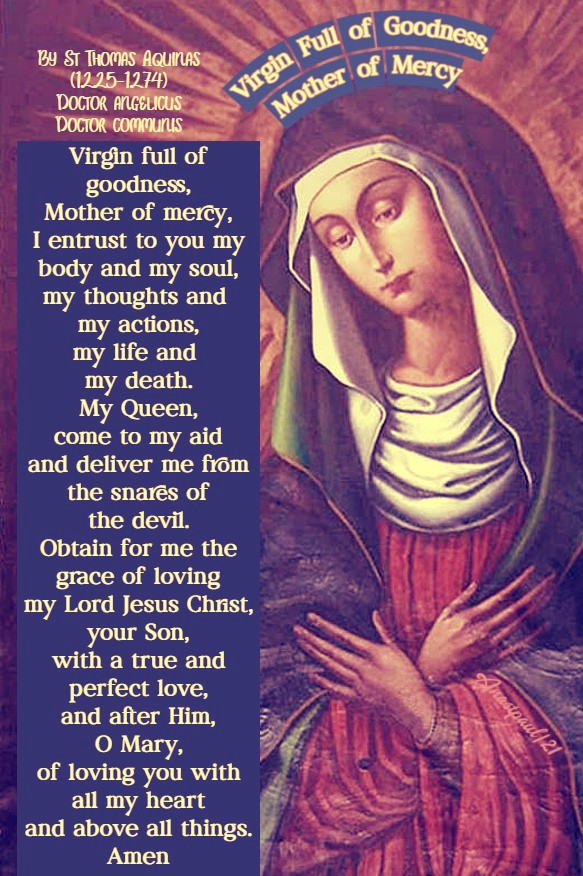
Virgin Full of Goodness, Mother of Mercy By St Thomas Aquinas (1225-1274) Doctor angelicus Doctor communis
Virgin full of goodness, Mother of mercy, I entrust to you my body and my soul, my thoughts and my actions, my life and my death. My Queen, come to my aid and deliver me from the snares of the devil. Obtain for me the grace of loving my Lord Jesus Christ, your Son, with a true and perfect love, and after Him, O Mary, of loving you with all my heart and above all things. Amen.
St Carpophorus St David Lewis St Decuman St Ebbo of Sens St Etherius of Lyons St Euthalia of Leontini St Fortunatus of Potenza Bl Gabriel Mary St Gebhard of Constance St Giovanni of Pavia St Honoratus of Potenza St John of Pavia St Licerius of Couserans St Malrubius of Merns St Narnus of Bergamo St Phanurius St Poemen Bl Roger Cadwallador St Rufus of Capua St Sabinian of Potenza St Syagrius of Autun
Martyrs of Tomi – 5 Saints: A group of 17 Christians imprisoned and excuted for their faith during the persecutions of Diocletian. They miraculously were unburned by fire and untouched by wild animals. We know the names and a few details on five of them – John, Mannea, Marcellinus, Peter and Serapion. They were tied to stakes and burned alive; they emerged unharmed – thrown to wild animals in the amphitheatre; the animals ignored them; they were beheaded in 304 in Tomi, Mesia (modern Costanza, Romania).
Martyrs of Nagasaki – 14 Beati: A group of fourteen missionaries and Japanese native Christians, who were Martyred together for their faith. They died on 16 August 1627 in Nagasaki, Japan and were Beatified on 7 May 1867 by Pope Pius IX. • Blessed Antonius of Saint Francis • Blessed Bartolomé Díaz Laurel • Blessed Caius Akashi Jiemon • Blessed Francisca Pinzokere • Blessed Francisco of Saint Mary • Blessed Franciscus Kuhyoe • Blessed Leo Kurobyoe Nakamura • Blessed Lucas Tsuji Kyuemon • Blessed Ludovicus Matsuo Soyemon • Blessed Magdalena Kiyota • Blessed Maria Shobyoe • Blessed Michaël Koga Kizayemon • Blessed Thomas Sato Shin’emon • Blessed Tsuji Shobyoe
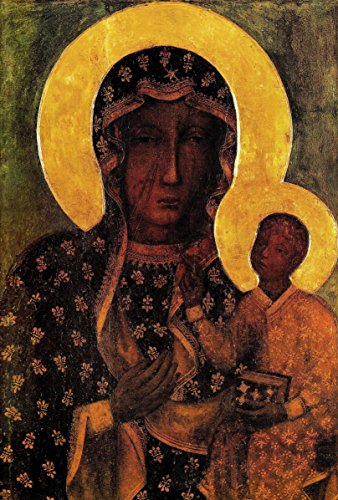
Our Lady of Czestochowa, Queen of Poland – Our Lady of Czestochowa is a revered icon of the Virgin Mary housed at the Jasna Góra Monastery in Częstochowa, Poland. Several Pontiffs have recognised the venerated icon, beginning with Pope Clement XI who issued a Canonical Coronation to the image on 8 September 1717 via the Vatican Chapter. Patron of Poland. According to tradition, the Icon of Jasna Góra (Bright Mountain) was painted by St Luke the Evangelist on a tabletop built by Jesus Himself and the Icon was discovered by St Helen, mother of Emperor Constantine and collector of Christian Relics, in the Holy Land. Visit our Mother here: https://anastpaul.wordpress.com/2017/08/26/blessed-feast-of-our-lady-of-czestochowa-queen-of-poland-26-august/
St Abundius the Martyr St Alexander of Bergamo (Died c 287) Martyr, Imperial Roman Centurion St Anastasius the Fuller St Bregwin of Canterbury St Elias of Syracuse St Eleutherius of Auxerre St Felix of Pistoia Bl Herluin Bl Ioachim Watanabe Jirozaemon St Irenaeus of Rome
St Jeanne Elisabeth des Bichier des Anges FC (1773-1838) (commonly referred to as St Elisabeth Bichier) and known as “the Good Sister” – Religious and co-Founder with Saint André Hubert Fournet (whom we celebrate on 13 May – https://anastpaul.com/2020/05/13/saint-of-the-day-13-may-saint-andre-hubert-fournet-1752-1834-the-good-father/) of the Sisters of the Cross, Sisters of St Andrew, a religious congregation which was established for the care of the poor and the instruction of rural children in the Diocese of Poitiers in 1807. She also helped to inspire the founding of a community of Priests dedicated to Missionary service, the St Elisabeth died in 1838, at which time there were about 600 Daughters of the Cross serving in some 100 communities. She was Beatified by Pope Pius XI in 1934 and Canonised by Pope Pius XII in 1947. Biography: https://anastpaul.com/2020/08/26/saint-of-the-day-26-august-saint-jeanne-elisabeth-des-bichier-des-anges-fc-1773-1838/
Bl Jean Bassano Bl Jean of Caramola Bl Juan Urgel Bl Margaret of Faenza St Maximilian of Rome St Melchizedek the Patriarch St Orontius of Lecce St Pandwyna St Rufinus of Capua St Secundus the Theban St Victor of Caesarea St Victor the Martyr St Vyevain of York
Martyrs of Celano – 3 Saints: Three Christians, Constantius, Simplicius and Victorinus, Martyred in the same area at roughly the same time. They were Martyred in c 159 in the Marsica region of Italy. At some point their relics were interred under the main Altar of the San Giovanni Vecchio Church in the Collegiata di Celano and were authenticated in 1057 by Pope Stephen IX. The city was depopulated in 1222; when it was re-built, the relics were re-enshrined in the Churc
St Philip Benizi OSM (1233-1285) Confessor, Co-Founder (one of the Seven Holy Founders of the Order of Servants of Mary) OSM, Servite Priest Genera\Superior, Reformer, Preacher, Medical Doctor. St Philip was Beatified on 8 October 1645 by Pope Innocent X and Canonised on 12 April 1671 by Pope Clement X – he was first Servite to be Canonised. Biograph: https://anastpaul.wordpress.com/2017/08/23/saint-of-the-day-23-august-st-philip-benezi/
Notre-Dame de la Victoire de Valois / Our Lady of Victory of Valois, France (1328) – 23 August:
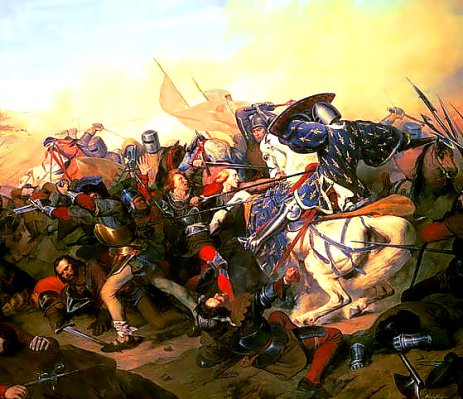
The Feast of Our Lady of Victory of Valois concerns Our Lady’s intercession in the Battle of Cassel, which was fought between the French, under Philip of Valois and the Flemish near Mount Cassel on 23 August in the year 1328. Philip of Valois, or King Philip VI, “Philip the Fortunate,” was the King of France beginning that year until his death in 1350.
Philip led his army against the band of Flemish rebels under Nicolas Zannekin, who were seeking independence from French rule. Having refused to pay what they considered to be excessive taxes to the Count of Flanders, they eventually imprisoned the King’s representative and captured several French towns. The Pope asked Philip to do what he could with the rebels but after having restored the Flemish aristocracy, the Flemish rebels had turned even on them, killing many of them. Philip was certain of victory, taking 2,500 knights and 12,000 infantry and archers with him into battle. Not knowing where he would attack, the Flemish rebels would have to divide their forces to protect their territory. Even so, the Flemish under Zannekin brought 15,000 soldiers into the field at Cassel.
For three days the two armies did nothing but taunt each other, although the Flemish commenced a direct attack on the French on the third day. Apparently, the French were caught off-guard, for many of them had taken off their armour because of the extreme heat that day. Fleeing in panic, the knights left the field, while much of the French nobility, who stood their ground were wounded. The Duke of Lorraine was slain and the situation appeared desperate.
It is recorded that Philip of Valois, being surrounded by Flemish soldiers as the flower of his nobility fell, had recourse to the Blessed Virgin, who immediately delivered him from that danger. The Dauphin of Vienne, Guigues VIII de la Tour-du-Pin, had been given the command of Philip’s 7th Corps. He led a counter attack which shattered the Flemish assault, while the knights regrouped and attacked the Flemish from the rear. The Flemish were defeated and victory assured by Our Lady of Victory of Valois.
Our of gratitude for this favour, when he made his entry into Paris, Philip went straight to Notre Dame Cathedral. Going into the Church on horseback, he proceeded the whole length of the nave to the Crucifix and there, laid down his arms. The picture of this Monarch on horseback, was, for a long time, to be seen in that Church, to which Philip gave a revenue of 100 livres, to be levied on his domain of Gatinais.
St Abbondius of Rome St Altigianus St Apollinaris of Rheims St Archelaus of Ostia St Asterius of Aegea St Claudius of Aegea St Domnina of Aegea St Eleazar of Lyons St Eonagh St Flavian of Autun Bl Franciszek Dachtera Bl Giacomo Bianconi of Mevania St Hilarinus St Ireneus of Rome Bl Jean Bourdon St Lupo of Novi St Luppus St Maximus of Ostia St Minervius of Lyons St Neon of Aegea St Quiriacus of Ostia St Theonilla of Aegea St Timothy of Rheims
Martyrs of Agea – 4 Saints: A group of Christian brothers, Asterius, Claudius and Neon, denounced by their step-mother who were then tortured and Martyred in the persecutions of Pro-consul Lysias. They were crucified in 285 outside the walls of Aegea, Cilicia (in Asia Minor) and their bodies left for scavengers.
Quote/s of the Day – 22 August – Month and Feast of the Immaculate Heart of Mary (Octave Day of the Assumption)
“In the end, my Immaculate Heart will triumph.”
Our Lady of Fátima 1917
“Let us decide to become one, with all the faithful, in offering the prayers and actions and sufferings of each day to the Sacred Heart of Jesus, through the Immaculate Heart of His Mother Mary. We shall certainly receive showers of graces, both for ourselves and for the salvation of the souls of our neighbours.”
Antonio Cardinal Bacci (1881-1971)
Prayer to the Two Holy Hearts of Jesus and Mary
O Heart of Jesus pierced for our sins and giving us Your Mother on Calvary! O Heart of Mary pierced by sorrow and sharing in the sufferings of your divine Son for our redemption! O sacred union of these Two Hearts! Praised be the God of Love who united them together! May we unite our hearts and every heart so that all hearts may live in unity and in imitation of that sacred unity which exists in these Two Hearts. Triumph, O Sorrowful and Immaculate Heart of Mary! Reign, O Most Sacred Heart of Jesus! – in our hearts, in our homes and families, in the hearts of those who as yet do not know You and in all nations of the world. Establish in the hearts of all mankind the sovereign triumph and reign of your Two Hearts so that the earth may resound from pole to pole with one cry: Blessed forever be the Most Sacred Heart of Jesus and the Sorrowful and Immaculate Heart of Mary! Obtain for me a greater purity of heart and a fervent love of the spiritual life. May all my actions be done for the greater glory of God in unions with the divine heart of Jesus and the Immaculate Heart of Mary. Hear and answer our prayers and intentions according to Your most merciful will. Amen
Our Morning Offering – 22 August – Month and Feast of the Immaculate Heart of Mary (Octave Day of the Assumption)
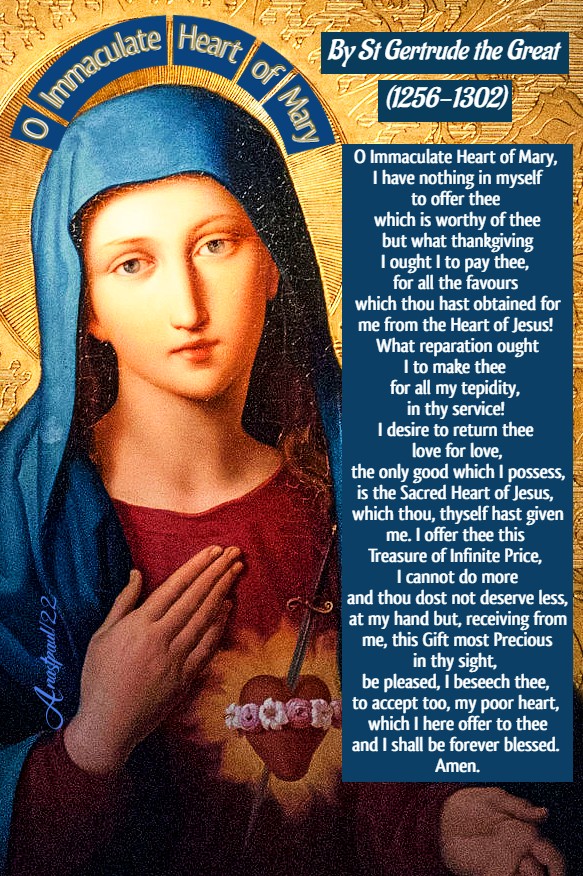
O Immaculate Heart of Mary By St Gertrude the Great (1256-1302)
O Immaculate Heart of Mary, I have nothing in myself to offer thee which is worthy of thee but what thankgiving I ought I to pay thee, for all the favours which thou hast obtained for me from the Heart of Jesus! What reparation ought I to make thee for all my tepidity, in thy service! I desire to return thee love for love, the only good which I possess, is the Sacred Heart of Jesus, which thou, thyself hast given me. I offer thee this Treasure of Infinite Price, I cannot do more and thou dost not deserve less, at my hand but, receiving from me, this Gift most Precious in thy sight, be pleased, I beseech thee, to accept too, my poor heart, which I here offer to thee and I shall be forever blessed. Amen.
St Andrew of Fiesole St Anthusa of Seleucia St Antoninus of Rome St Arnulf of Eynesbury St Athanasius of Tarsus Bl Bernard Perani St Dalmau Llebaría Torné St Epictetus of Ostia St Ethelgitha of Northumbria St Fabrician of Toledo St Felix of Ostia
St John Kemble (1599 – 1679) Martyr, Priest. Ordained in 1625, he returned to Monmouthshire and served more than 50 years as an itinerant Priest, winning admirers even among Protestants. After being dragged on a hurdle to Widemarsh Common, Kemble declared on the scaffold that he died for the religion that had made this country Christian and that he forgave all his enemies. He was then obliged to encourage the executioner, who had no stomach for his task. Biography: https://anastpaul.com/2018/08/22/saint-of-the-day-22-august-st-john-kemble-1599-1679-martyr/
St John Wall St Josep Roselló Sans St Julio Melgar Salgado St Maprilis of Ostia St Martial of Ostia St Maurus of Rheims St Narciso de Esténaga y Echevarría St Philibert of Toledo Bl Richard Kirkman St Saturninus of Ostia Bl Simeon Lukach St Sigfrid of Wearmouth St Symphorian of Autun
The 11th Sunday after Pentecost Sunday within the Octave of the Assumption
Our Lady of Knock, Ireland (1879) – 21 August:
The Apparition in County Mayo in Ireland of Our Lady of Knock is reported to have occurred on the evening of 21 August 1879, the Vigil of the Octave of the Feast of the Assumption. Those who witnessed the miracle, ranged in age from five years old to seventy five.
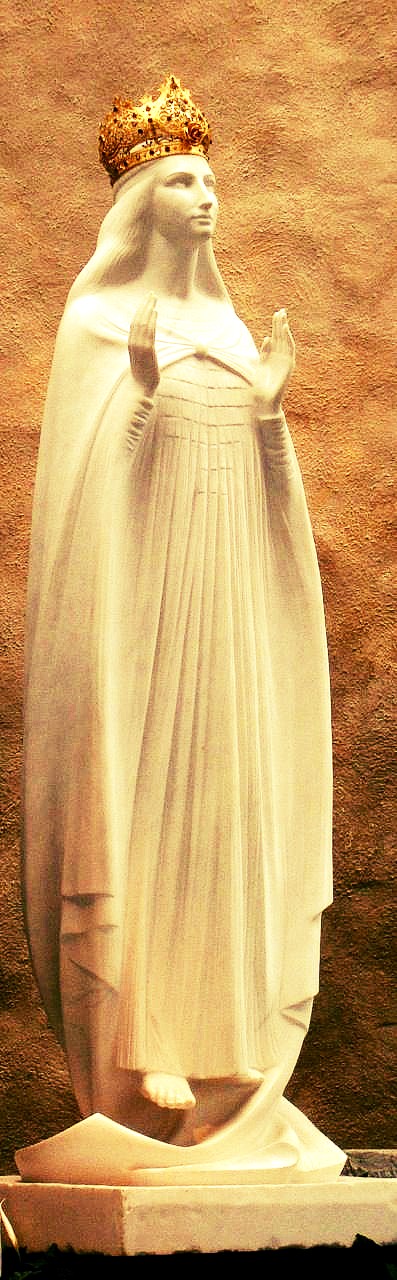
The Apparition was described as follows: “Our Lady was wearing a large, brilliant crown and clothed in white garments. On her right was Saint Joseph, his head inclined toward her and on her left Saint John the Evangelist. To the left of Saint John was an Altar on which stood a Crucifix and a lamb.” Standing only a few feet off the ground, the Blessed Virgin wore a white cloak and was described by witnesses as being incredibly beautiful. She wore a bright golden crown and appeared to be praying with her eyes looking toward Heaven with her arms bend in front of her with her palms facing inward.”
Fifteen parishioners stood, before the Apparition, for two hours as they recited the Rosary. Although it was daylight when the Apparition began, the weather changed and it began to rain heavily. The area around the Apparition appeared unaffected, however, as the ground remained dry, as long as the vision lasted. Our Lady did not speak but the gable of the Church where the Apparition occured was covered with a cloud of light.
Saint Joseph, also wore white robes and stood on the Virgin’s right. He inclined his head respectfully toward the Blessed Virgin. Saint John the Evangelist wore a miter and appeared to be preaching as he held a book in his left hand.
Since then thousands of people have made pilgrimages to Knock to pray to Our Lady. Their prayerful, penitential and reverential spirit, has been commended again and again by visitors from other lands. No sign of commercialism detracts from the purely religious atmosphere of that hallowed spot. People from all walks of life kneel in humble supplication before the Shrine of Our Lady, fully confident that she has sanctified that spot by her appearance there. Organised pilgrimages from various Diocese are conducted frequently to the Shrine The Holy Rosary comprises the main portion of the devotion – the Shrine is, therefore, appropriately called the Rosary Shrine. The “Knock Shrine Annual” relates many wonderful accounts of cures and conversions effected at the Shrine.
St Agapius of Edessa St Agathonicus of Constantinople St Anastasius Cornicularius St Aria of Rome St Avitus I of Clermont St Bassa of Edessa Bl Beatrice de Roelas St Bernhard of Lérida St Bernard de Alziva St Bonosus St Camerinus of Sardinia St Cameron St Cisellus of Sardinia St Cyriaca St Euprepius of Verona St Fidelis of Edessa Bl Gilbert of Valenciennes St Gracia of Lérida St Hardulph St Joseph Nien Vien Bl Ladislaus Findysz St Leontius the Elder St Luxorius of Sardinia St Maria of Lérida St Maximianus the Soldier St Maximilian of Antioch St Natale of Casale Monferrato St Paternus of Fondi St Privatus of Mende St Quadratus of Utica
One Minute Reflection – 18 August – “The Month of the Immaculate Heart of Mary” – Within the Octave of the Assumption – Judith 13:22-25; 13:15; 13:10, Luke 1:41-50
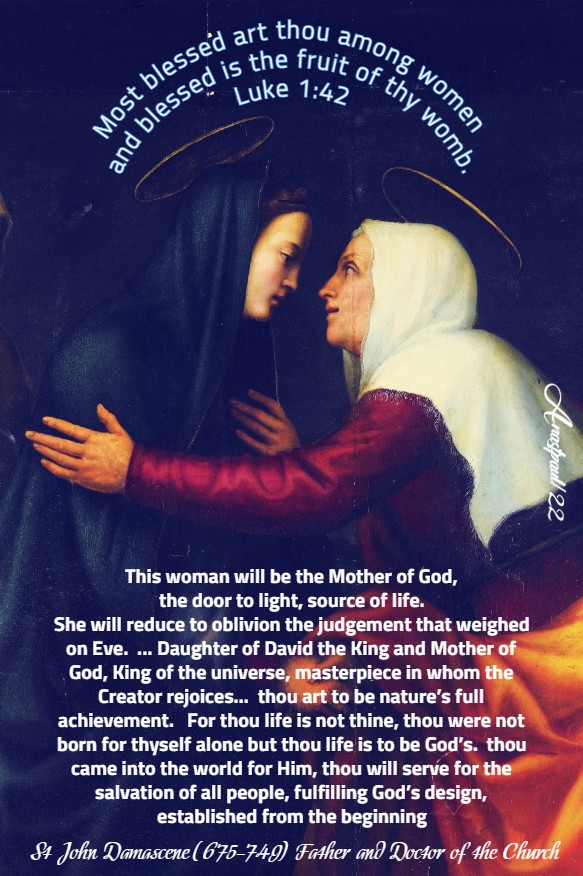
“Most blessed art thou among women and blessed is the fruit of thy womb.” – Luke 1:42
REFLECTION – “This woman will be the Mother of God, the door to light, source of life. She will reduce to oblivion the judgement that weighed on Eve. “The rich among the people seek the face” of this woman, “the kings of the nations shall pay her homage”, they shall “offer gifts”…, yet the glory of the Mother of God is an interior glory: the fruit of her womb.
O woman, so worthy of love, thrice happy, “blessed are thou among women and blessed is the fruit of thy womb.” Daughter of David the king and Mother of God, King of the universe, masterpiece in whom the Creator rejoices… thou art to be nature’s full achievement. For thou life is not thine, thou were not born for thyself alone but thou life is to be God’s. thou came into the world for Him, thou will serve for the salvation of all people, fulfilling God’s design, established from the beginning: the Incarnation of the Word and our own divinisation.Thy whole desire is to feed on the words of God, to be strengthened by their sap, like “a green olive tree in the house of God,” “like a tree planted by running water” thou ary the “tree of life” who “yielded its fruit in due season”…
He who is infinite, limitless, came to dwell in thy womb; God, the child Jesus, was nourished by thy milk. Thou art the ever-virginal doorway of God; thou hands hold thy God; thou lap is a throne raised up above the cherubim… Thou art the wedding chamber of the Spirit, the “city of the living God, gladdened by the runlets of the stream” that is to say, the waves of the Spirit’s gifts. Thou art “all fair, the Beloved” of God.” – St John Damascene (675-749) Monk, Theologian, Father and Doctor of the Church (Sermon on the Nativity of the Virgin 9 ).
PRAYER – O Lord, we beseech Thee, forgive the transgressions of Thy servant, and, forasmuch as by our own deeds we cannot please Thee, may we find safety through the prayers of, the Mother of Thy Son and our Lord.Through the same Jesus Christ, Thy Son our Lord, Who lives and reigns with Thee, in the unity of the Holy Ghost, God, world without end. Amen (Collect).
Our Morning Offering – 17 August – “The Month of the Immaculate Heart of Mary”
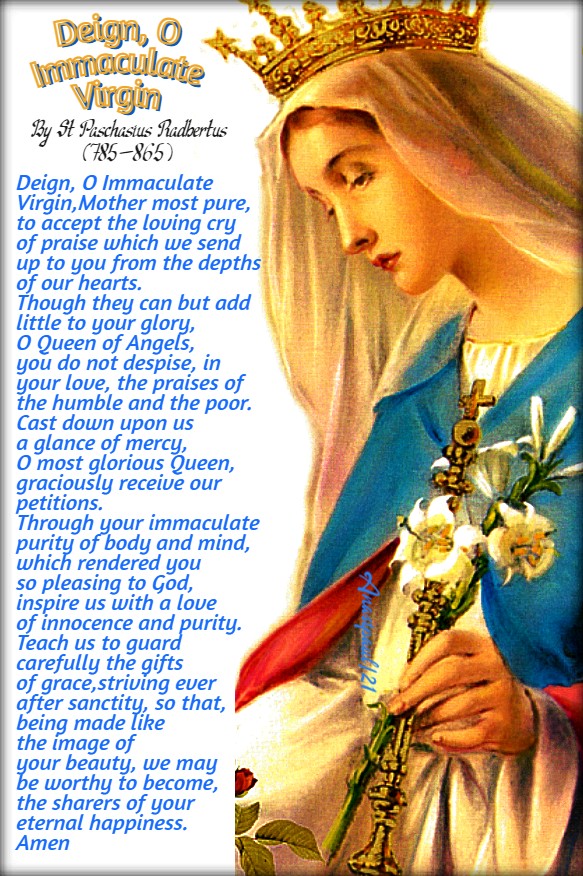
Deign, O Immaculate Virgin By St Paschasius Radbertus (785–865)
Deign, O Immaculate Virgin, Mother most pure, to accept the loving cry of praise which we send up to you from the depths of our hearts. Though they can but add little to your glory, O Queen of Angels, you do not despise, in your love, the praises of the humble and the poor. Cast down upon us a glance of mercy, O most glorious Queen, graciously receive our petitions. Through your immaculate purity of body and mind, which rendered you so pleasing to God, inspire us with a love of innocence and purity. Teach us to guard carefully the gifts of grace, striving ever after sanctity, so that, being made like the image of your beauty, we may be worthy to become, the sharers of your eternal happiness. Amen
St Amor of Amorbach St Anastasius of Terni St Benedicta of Lorraine St Carloman St Cecilia of Lorraine
St Clare of the Cross of Montefalco (c 1269-1308) Augustinian Nun and Abbess, before becoming a nun, St Clare was a member of the Third Order of St Francis (Secular), Mystic, Penitent, Spiritual adviser. Beatified by Pope Clement XII. On 8 December 1881, the Feast of the Immaculate Conception, Pope Leo XIII Canonised Clare. Her Life: https://anastpaul.com/2019/08/17/saint-of-the-day-17-august-saint-clare-of-the-cross-of-montefalco-c-1269-1308/
St Donatus of Ripacandida St Drithelm St Elias the Younger St Eusebius of Sicily St James the Deacon St Jeroen of Noordwijk St Juliana of Ptolemais St Mamas St Myron of Cyzicus
St Nicolò Politi (1117-1167) Basilian Monk and Hermit. He was known for his miracles even during his childhood and was Venerated as a saint even before his death. St Nicolò was Canonised on 7SJune 1507, at Saint Peter’s Basilica, Rome, by Pope Julius II. About St Nicolò: https://anastpaul.com/2020/08/17/saint-of-the-day-17-august-st-nicolo-politi-1117-1167/
Quote/s of the Day – 16 August – “The Month of the Immaculate Heart of Mary”
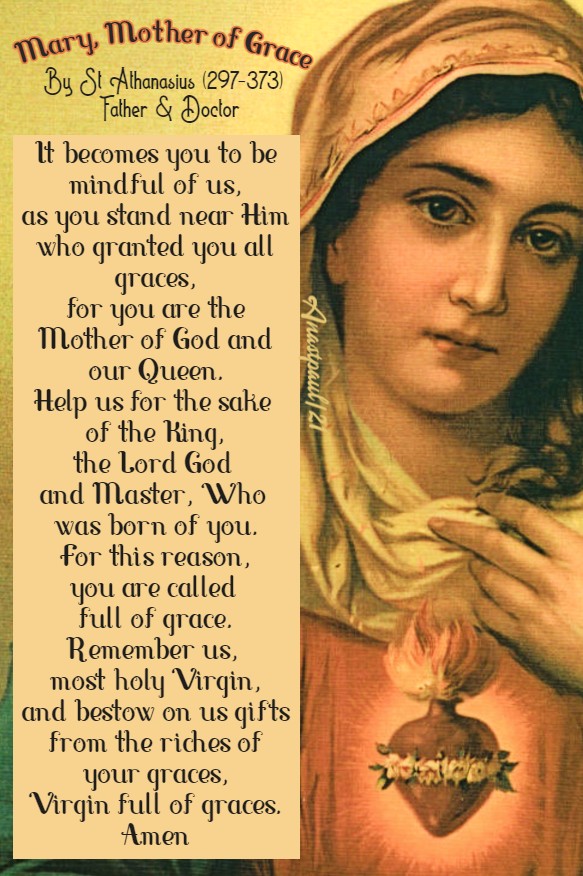
Mary, Mother of Grace St Athanasius (297-373) Father & Doctor of the Church
It becomes you to be mindful of us, as you stand near Him who granted you all graces, for you are the Mother of God and our Queen. Help us for the sake of the King, the Lord God and Master, Who was born of you. For this reason, you are called full of grace. Remember us, most holy Virgin, and bestow on us gifts from the riches of your graces, Virgin full of graces. Amen
“Go to Mary and sing her praises and you will be enlightened. For it is through her, that the true Light shines on the sea of this life.”
St Ildephonsus (607-670)
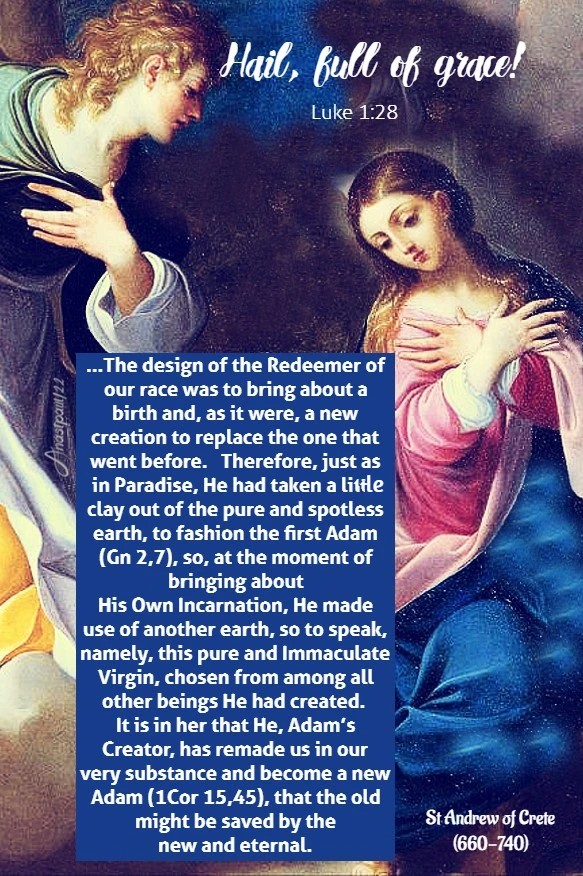
“… The design of the Redeemer of our race was to bring about a birth and, as it were, a new creation to replace the one that went before. Therefore, just as in Paradise, He had taken a little clay out of the pure and spotless earth, to fashion the first Adam (Gn 2,7), so, at the moment of bringing about His Own Incarnation, He made use of another earth, so to speak, namely, this Pure and Immaculate Virgin, chosen from among all other beings He had created. It is in her that He, Adam’s Creator, has remade us in our very substance and become a new Adam (1Cor 15,45) that the old might be saved by the new and eternal.”
Blessed Angelo Agostini Mazzinghi O.Carm. (1385-1438) was an Italian Priest and a professed member of the Carmelite Order. He was a noted Preacher, Prior and Reformer, Teacher of theology and was known for his pious devotion to the Holy Eucharist, the Blessed Virgin Mary and the Carmelite Rule of Life and to the profession of the Gospel. His Life: https://anastpaul.com/2019/08/16/saint-of-the-day-16-august-blessed-angelo-agostini-mazzinghi-o-carm-1385-1438/
St Arsacius of Nicomedia St Frambaldo Bl Iacobus Bunzo Gengoro Bl Jean-Baptiste Menestrel Bl John of Saint Martha Bl Laurence Loricatus Bl Magdalena Kiyota Bokusai Bl Maria Gengoro Bl Ralph de la Futaye St Serena Bl Simon Kiyota Bokusai Bl Thomas Gengoro St Titus the Deacon
St Ugolina of Vercelli (c 1239-c 1300) Anchorite, Recluse, Penitent, Spiritual advisor. The very strange story that of this Blessed Ugolina who shut herself in a hermitage, representing herself as a man and remained there for forty-seven years! The aim of her subterfuge was to escape the aims of her father, who wished her to marry. In order not to reveal her secret, she called herself Ugo without revealing her identity to anyone. for nearly fifty years Her Life: https://anastpaul.com/2021/08/16/saint-of-the-day-16-august-saint-ugolina-of-vercelli-c-1239-c-1300/
Martyrs of Palestine – 33 Saints: Thirty-three Christians Martyred in Palestine; they are commemorated in old martyrologies but the date and exact location have been lost.
Our Morning Offering – 15 August – The Assumption of the Blessed Virgin Mary
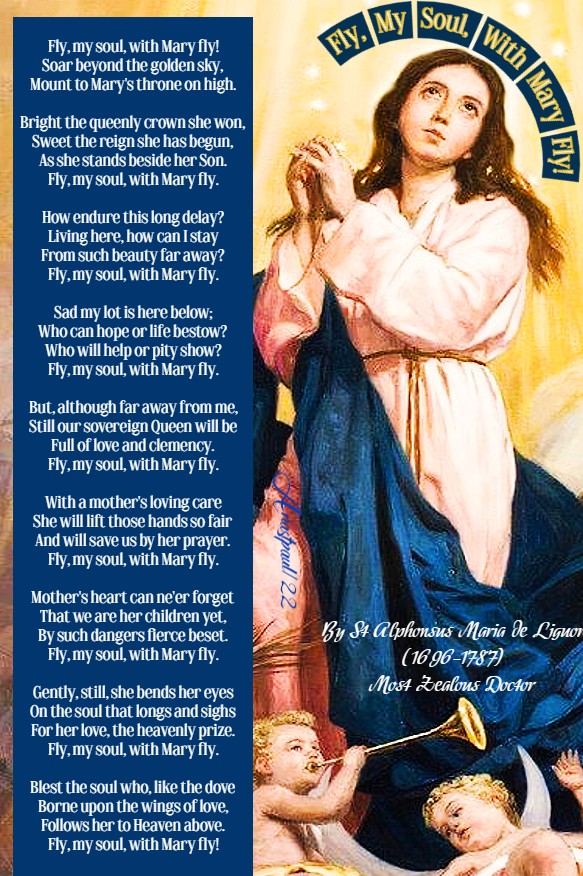
Fly, My Soul, with Mary Fly! By St Alphonsus Maria de Liguori (1696-1787) Most Zealous Doctor (From “The Glories of Mary” Trans. Redemptoris Fathers, 1931)
Fly, my soul, with Mary fly! Soar beyond the golden sky, Mount to Mary’s throne on high.
Bright the queenly crown she won, Sweet the reign she has begun, As she stands beside her Son. Fly, my soul, with Mary fly.
How endure this long delay? Living here, how can I stay From such beauty far away? Fly, my soul, with Mary fly.
Sad my lot is here below; Who can hope or life bestow? Who will help or pity show? Fly, my soul, with Mary fly.
But, although far away from me, Still our sovereign Queen will be Full of love and clemency. Fly, my soul, with Mary fly.
With a mother’s loving care She will lift those hands so fair And will save us by her prayer. Fly, my soul, with Mary fly.
Mother’s heart can ne’er forget That we are her children yet, By such dangers fierce beset. Fly, my soul, with Mary fly.
Gently, still, she bends her eyes On the soul that longs and sighs For her love, the heavenly prize. Fly, my soul, with Mary fly.
Blest the soul who, like the dove Borne upon the wings of love, Follows her to Heaven above. Fly, my soul, with Mary fly!
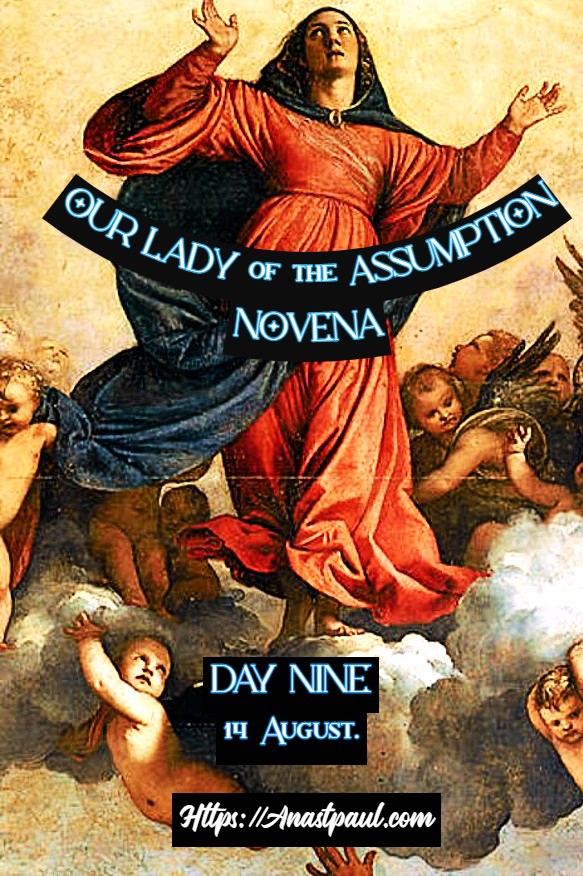
The Ninth Day: Mary in Heaven, the Help of Christians on Earth
Preparatory Prayer by St Alphonsus Maria de Liguori (1696-1787) Most Zealous Doctor of the Church
O Mary, Virgin most Blessed and Mother of Our Lord and Redeemer Jesus Christ, through thy mercy I beseech thee, to come to my aid and to inspire me with such confidence in thy power that I may have recourse to thee, pray to thee and implore thy aid, in all needs of soul and body. Amen
Meditation: Mary’s succour as Mother of mercy is not confined to individuals. She is the protectress and helper of the whole Church. All over the earth, wherever we cast our glance, in the records of the history of times, long past and those of recent occurrence, we find testimony of the graces and benefits, obtained through her intercession. The feasts celebrated by the Church, throughout the year, what are they but evidences of gratitude, offered to the Queen of Heaven for the oftentimes, miraculous delivery from war, pestilence and other great afflictions? Hence she is rightly invoked as the “Help of Christians.”
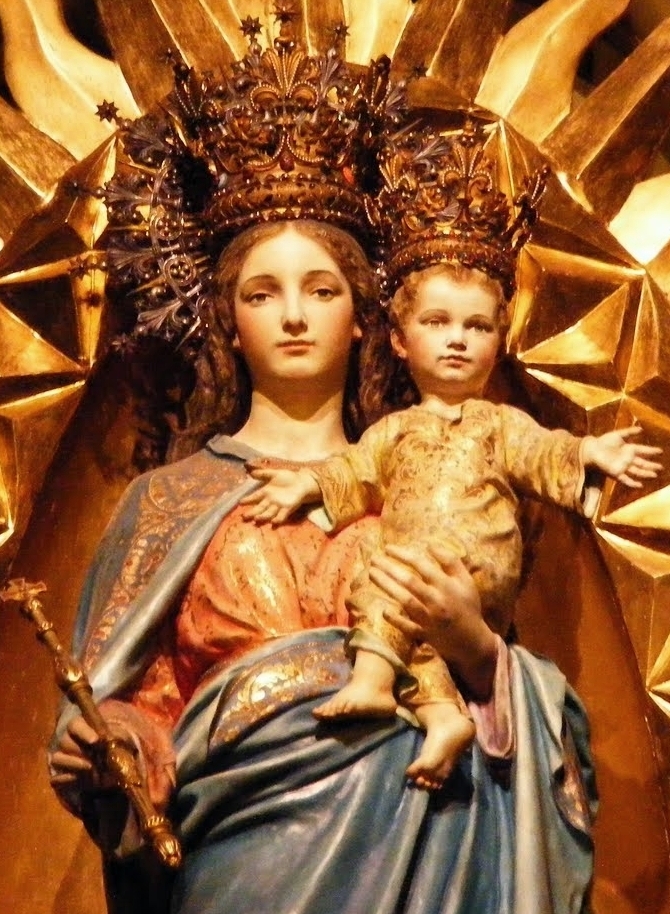
The processional Statue of St John Bosco’s Our Lady Help of Christians in Turin
Practice: In our days, too, storms and dangers threaten the Church. Let us, therefore, by calling on Mary for help, do our part toward shortening the days of visitation and trial. Let us not confine our petitions, to her, within the narrow limits, of our own personal needs but let us join in the cry for assistance ascending to the Mother of mercy, throughout all Christendom. Let us daily, for Holy Church, send up our petition to Mary’s heavenly throne: “Help of Christians, pray for us!”
Prayer of the Church: We beseech Thee, O Lord, pardon the shortcomings of Thy servants that we who, by our own works, are not able to please Thee, may be saved by the intercession of the Mother of Thy Son, Our Lord Jesus Christ. Amen.
Novena Prayer: Day Nine
Glorious Virgin and Mother of God, Mary, Queen of Heaven! Forget us not! Thou art the help of Christians; lighten our tribulations and help us with motherly intercession at the throne of thy Divine Son. With Holy Church, I join in the petition to thee: “Holy Mary, aid the miserable, assist the desponding, strengthen the weak, pray for thy people, plead for the clergy, intercede for the devout mothers, woman and consecrated woman. Let all who have recourse to thee experience the efficacy of thy succour!” And my holy Mother and Queen, forget not, my special petition …………….
Hail Mary …….
Ejaculation: Sweet heart of Mary be my salvation!
Indulgence. (1) 100 days, every time. (2) A Plenary Indulgence, once a month, on any day, to all who shall have said it everyday for a month, under the usual conditions.
St Eusebius of Rome (Died 357) Priest, Confessor. “At Rome, the birthday of the blessed Priest Eusebius, who for the defence of the Catholic Faith, was shut up in a room of his own house by the Arian Emperor, Constantius, where constantly persevering in prayer for seven months, he rested in peace. His body was removed by the Priests, Gregory and Orosius and buried in the cemetery of Cllistus on the Appian Way.” – Roman Martyrology. His Life: https://anastpaul.com/2020/08/14/saint-of-the-day-14-august-saint-eusebius-of-rome-died-357-priest-confessor/
St Athanasia of Timia St Callistus of Todi St Demetrius of Africa St Eberhard of Einsiedeln St Eusebius of Palestine St Fachanan of Ross Blessed Giuliana Puricelli (1427-1504) Nun, Co-Foundress. St Marcellus of Apamea Bl Sanctes Brancasino St Ursicius of Nicomedia
Preparatory Prayer by St Alphonsus Maria de Liguori (1696-1787) Most Zealous Doctor of the Church
O Mary, Virgin most Blessed and Mother of Our Lord and Redeemer Jesus Christ, through thy mercy I beseech thee, to come to my aid and to inspire me with such confidence in thy power that I may have recourse to thee, pray to thee and implore thy aid, in all needs of soul and body. Amen
Meditation: Mary is, then, a Queen and what a consolation to know it!– a Queen always mild and gentle, always willing to confer benefits upon us. Hence the Church teaches us, to call her the Mother of mercy. The pious and learned Poet and Writer, Jean Charlier de Gerson (1363-1429) says: “God’s dominion comprises Justice and mMrcy. He divided it, retaining the administration of Justice for Himself and relinquishing, in a certain sense, the dispensation of mercy to Mary, by conferring through her hands, all graces He grants to mankind.” H,ow consoling, then, the assurance that our merciful Mother is so mighty and so loving a queen!
Practice: So great is the tenderness of Mary’s maternal heart: “that never was it known that anyone who fled to her protection, implored her help and sought her intercession, was left unaided. How many prayers, petitions and thanksgivings, ascend daily to the throne of this our exalted and merciful protectress! There is not a cry of an afflicted, struggling and suffering soul that she does not graciously hear. Join, therefore, confidently in the prayer of Holy Church, “Hail, holy Queen, Mother of mercy.” Approach her with filial trust. Neglect not to honour her yourself and do all in your power, to lead others to do her honour.
Prayer of the Church: We beseech Thee, O Lord, pardon the shortcomings of Thy servants that we who, by our own works, are not able to please Thee, may be saved by the intercession of the Mother of Thy Son, Our Lord Jesus Christ. Amen.
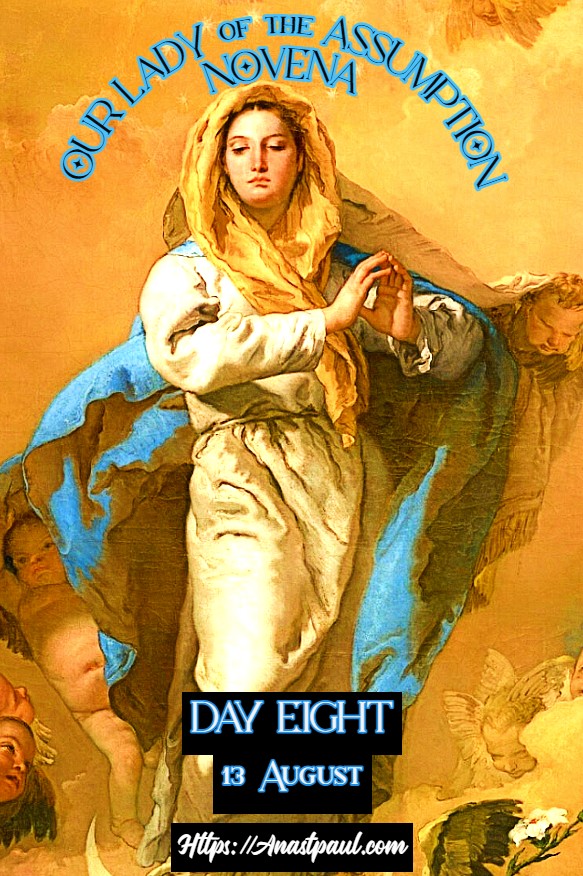
Novena Prayer: Day Eight
Glorious Virgin and Mother of God, Mary! Holy Church teaches me that despite the glory to which thou wast exalted, thou didst not forget thy miserable clients and that, in Heaven, thy mercy is still greater than it was during thy life on earth. Therefore, I come to thee and trustingly lay at thy feet, all my needs, miseries and petitions. My Queen, my Mother, turn not thy gracious eyes from me. Remember me to thy Divine Son; cease not to pray for me and take me under thy protection, so that I may finally have the happiness to see and praise thee in thy glory forever and ever. And once more, at thy feet, I beg thee to hear and grant, my special petition …………………….
Hail Mary …….
Ejaculation: Sweet heart of Mary be my salvation!
Indulgence. (1) 100 days, every time. (2) A Plenary Indulgence, once a month, on any day, to all who shall have said it everyday for a month, under the usual conditions.






















You must be logged in to post a comment.