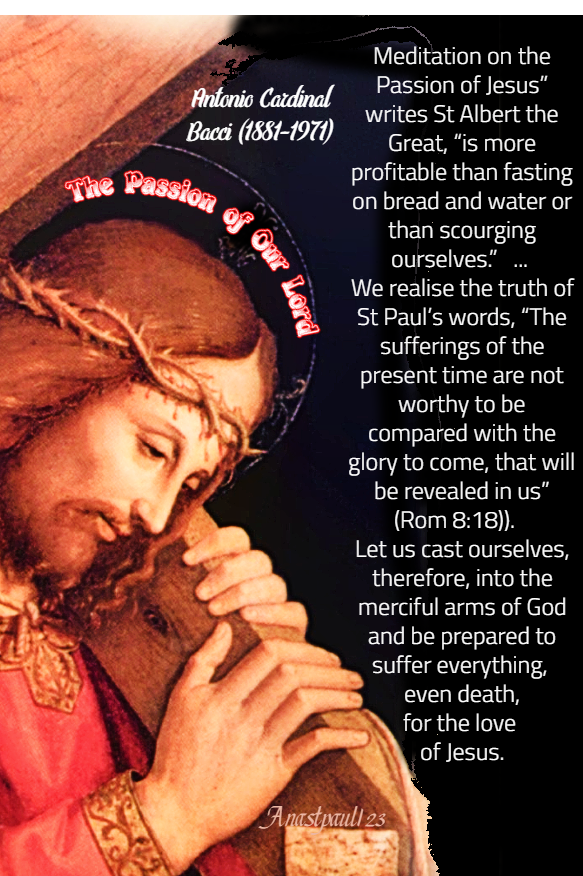
Thought for the Day – 13 March – Meditations with Antonio Cardinal Bacci (1881-1971)
PRAYER
“The Saints had their failings and temptations like everyone else. Some experienced continual spiritual aridity. Others, like St Anthony and St Benedict, were often tempted against purity, while St Francis de Sales, was strongly inclined towards impatience. Others, like St Therese of the Child Jesus, were even tempted to despair. But, they all conquered, by means of prauer.
If we wish to conquer in the same way, we must pray too. Let us never tire of prayer. Sooner or later, the Father of Goodness and Mercy, will answer us.”
Thought for the Day – 12 March – Meditations with Antonio Cardinal Bacci (1881-1971)
Detachment from the World
“This is not the same as saying that we should have no interest in worldly affairs. Far from it. It is our duty to think about them and make provision for the future. We cannot and should not look for miracles from God. We must have obligations to ourselves, or to our family, or to our position in life. We are in this world to work, not to surrender to apathy or inactivity. We must engage in worldly activity insofar as our circumstances demand it.
Nevertheless, our hearts should not be engrossed in earthly things, for they belong to God. In the midst of our other preoccupations, we should adore, love and thank God, the Giver of every good, our Creator and our Redeemer.”
Thought for the Day – 11 March – Meditations with Antonio Cardinal Bacci (1881-1971)
The Growth of Jesus
“Like Jesus, we must advance in goodness before men, as well as before God. Our external behaviour should be the candid mirror of our inner sanctity. The external appearance of courtesy, good manners and holiness, should not be mere ostentation. It should be a vital expression of interior goodness which, naturally, tends to show itself outwardly, so that all “may see your good works and give glory to your Father in Heaven” (Mt 5:16). If it is no more than a display, Jesus will say that “they have received their reward” (Cf Mt 6:1,5). If it is pure hyprocrisy, Jesus will drive away the culprits from Himself because, they are “like whited sepulchres” (Cf Mt 23:27).
Let us make Jesus our constant model, therefore. Let our outward demeanour always reflect our interior goodness and holiness.”
Thought for the Day – 10 March – Meditations with Antonio Cardinal Bacci (1881-1971)
The Hidden Life of Jesus
“There are many who complain that their work is degrading or heavy or unsatisfying. This is an indication that they are working for themselves, rather than for God.
We should sanctify our work by prayer. We should meditate on the example of Jesus and remeber that there are many sins for which we must make reparation. If we offer our work to God, it will not only become meritorious but, much easier to bear.
To work purely for profit is avarice, to work for the good opinion and praise of others, is vanity and to work in order to pass the time – is a waste of time! The perfect Christian approach, is to work in order to do our duty, to please God, to atone for our sins and to gain Heaven.”
Thought for the Day – 9 March – Meditations with Antonio Cardinal Bacci (1881-1971)
The Human Soul
“Remember that every mortal sin means death to the soul, for it robs it of the supernatural life of grace, making it incapable of every good action and deserving of hell. If you committed one mortal sin, God could tire of you, as if you were an unproductive tree and put an end to your life, without giving you time to repent! Then, you would be lost for all eternity. This thought should never leave your mind, particularly in time of temptation. At such a time, turn to God with confidence, tell Him that you love Him and do not wish to offend Him at any price. Face death rather than sin.”
Our Lenten Journey with St Francis de Sales – 9 March – Thursday in the Second Week of Lent – Proverbs 31:10-31, Matthew 13:44-52 – Scripture search here: https://www.drbo.org/
“Thou hast loved justice and hated iniquity; therefore God, thy God, hath anointed thee with the oil of gladness, above thy fellows.” Psalm 44:8
“So shall it be at the end of the world. The Angels shall go out and shall separate the wicked from among the just. And shall cast them into the furnace of fire: there shall be weeping and gnashing of teeth.” Matthew 13:49-50
HEAVEN or HELL? St Francis de Sales (1567-1622) Doctor Caritas
“CONSIDER THAT THE CHOICE you make in this life will last forever in the next! Consider too, that while both are open to receive you, according to your choice, yet God, Who is prepared to give the one by reason of His Justice, the other by reason of His Mercy, all the while desires, unspeakably that you should select Paradise. offering you countless graces on God’s part, countless assistance to attain to it. Consider that Jesus Christ, enthroned in Heaven, looks down upon you in loving invitation – ‘O beloved one, come unto Me and joy forever in the eternal blessedness of My Love!’ Behold His mother yearning over you with maternal tenderness, ‘Courage, my child, do not despise the Goodness of my Son, or my earnest prayers for thy salvation.‘ …
O Hell, I abhor thee now and forever; I abhor thy griefs and torments, thine endless misery, the unceasing blasphemies and maledictions which thou pourest out upon my God and turning to thee, O blessed Paradise, eternal glory, unfading happiness, I choose thee forever as my abode, thy glorious mansions, thy precious and abiding tabernacles.
O my God, I bless Thy Mercy which gives me the power to choose, O Jesus, Saviour, I accept Thine Eternal Love and praise Thee for the promise Thou hast given me, of a place prepared for me, in that blessed New Jerusalem, where I shall love and bless Thee forever. ” (Excerpt – ‘Introduction to the Devout Life’ 9th Meditation).
Thought for the Day – 8 March – Meditations with Antonio Cardinal Bacci (1881-1971)
Knowledge and Goodness
“St Paul wrote: “Let no-one rate himself more than he ought but, let him rate himself according to moderation and according as God has apportioned to each one, the measure of faith” (Rom 12:31). “Knowledge puffs up,” he said “but charity edifies” (1 Cor 8:11).
“The humble knowledge of oneself,” The Imitation of Christ tells us, “is a surer way to God, than deep researches after science. Knowledge is not to be blamed… but a good conscience and a virtuous life, are always to be preferred. But because many take more pains to be learned than to lead good lives, therefore, they often go astray” (Bk 2 ch 3).
So let us learn everything which our position in life requires of us and, as much besides as we are able. But above all, let us learn to be good and holy. If we fail in this, the rest is useless and dangerous!”
Thought for the Day – 7 March – Meditations with Antonio Cardinal Bacci (1881-1971)
ST THOMAS AQUINAS
“Thomas of Aquin was a wealthy nobleman of great intelligence. A brilliant future seemed to lie before him. But, he answered the inspiration which called him to a life of Christian perfection, in the Order of St Dominic. This divine vocation encountered serious obstacles. His mother and brothers opposed it. The latter went as far as capturing him and imprisoning him in a castle, where they put him beside a woman who tempted him to sin against holy purity. But it was all useless. He chased the temptress away with a blazing torch. Then he knelt before a cross, outlined upon the wall and, as he was praying fervently, he experienced such wonderful peace that it seemed a foretaste of Heaven. From that day, he was never again tried by temptation of the flesh. He was like an Angel in human form.
Do you wish to share, even a little in these rewards? Let us listen to the good inspiration which God gives u. Like St Thomas Aquinas, let us be ready to make any sacrifice, rather than offend God. Let us be prepared to work earnestly to acquire the virtues proper to our state in life.”
Thought for the Day – 6 March – Meditations with Antonio Cardinal Bacci (1881-1971)
CONSCIENCE
“There are some people who have a right conscience, a conscient, in other words, which is based on the principles of the Gospel, on the precepts of the Church and on the sound advice of a good confessor.
Nevertheless, these must remember St Paul’s warning: “Let him who thinks he stands, take heed, lest he fall” (1 Cor 10:12). They must not grow proud, like the Pharisee who prayed in front of the altar but, must be humble, like the poor publican, who knew that without God’s direction and grace, he would fall into serious sin.
They should remember too that it is not enough to have a right conscience but, its dictates must be put into practice with the help of fervent prayer and frequent reception of the Sacraments.”
Thought for the Day – 5 March – Meditations with Antonio Cardinal Bacci (1881-1971)
Mortification and Penance
“In Christian teaching, death is the beginning of life. “Unless the grain of wheat falls into the ground and dies,” Jesus said, “it remains alone. But if it dies, it brings forth much fruit. He who loves his life, loses it and he, who hates his life in this world, keeps it unto life everlasting” (Jn 12:24-25). This paradox of dying to this life in order to live in Heaven, was enacted in a wonderful way in the lives of Jesus and of the Saints. It must be put into effect in our lives also, if we are to be genuine Christians. Jesus shed His precious blood for us and His death was the beginning of His triumph. The Apostles, Martyrs and Saints, gave their lives for Christ and received, as their reward, the happy and eternal life of Heaven. By dying to our own ego and to our passions, we shall find the true life of Christ. We must die to ourselves, so that Christ may live in us, as He lived in St Paul. We must die to pride, so that Christian humility may live in us; we must die to anger, so that patience may live in us; we must die to lust, so that purity and innocence may live in us and, we must die to selfishness, so that charity may live in us.”
Thought for the Day – 4 March – Meditations with Antonio Cardinal Bacci (1881-1971)
The Imitation of the Saints
“Sacred Scripture says of Jesus, that He “did and taught” (Acts 1:11). We should reflect on these words. Very often we come across thinkers, who teach but do nothing. Sometimes they even act contrary to their own precepts and then their work is futile and harmful! Many unfortunate young people are the victims of the false ideas and bad example of their teachers. It was not so with Jesus, nor was it so with the Saints, His faithful followers.
We can learn much from their writings and still more from their example. For this reason we should read about their lives. People read so many books and articles which teach them nothing and many others which arouse their lower instincts and smother their high ideals. A good Christian should read the Lives of the Saints, as well as those books which it is his duty to know. The highest and most useful school of learning for a sincere Christian, is the reading of the Gospel and The Lives of the Saints.”
Our Lenten Journey with St Francis de Sales – 4 March – The Memorial of St Casimir (1458-1484) Confessor, Prince – Saturday of Ember Week in Lent – Ecclesiasticus Sirach 31:8-11,Luke 12:35-40 – Scripture search here: https://www.drbo.org/
“The just shall flourish like the palm tree, he shall grow up, like the cedar of Lebanon.” Psalm 91:13
“Stay dressed for action and keep your lamps burning … ” Luke 12:35-36
VIGILANT FAITH AND CHARITY St Francis de Sales (1567-1622) Doctor Caritas
“IT WORKS THE SAME WAY with faith as with charity. We know by the works which charity performs, whether faith is dead or dying. When it produces no good works, we conclude that it is dead and when they are few and sluggish, that, it is dying. But just as there is a dead faith, there must also be a living one which is its opposite. It is excellent. Joined and United with charity and vivified by it, it is strong, firm and Constant. It performs many great and good works which deserve the praise: “Oh, how great is your faith!Let all that you desire be done.” …
It is great because of the good works it performs and also because of the many virtues which accompany it and which it governs. … So charity united to faith is not only followed by all the virtues but, as a queen, she commands them and all obey and fight for her and, according to her will. From this, results the multitude of good works, of a living faith.
There is a vigilant faith which, again, depends on its union with charity. But there is also one which is sluggish, dull and apathetic and, it is the opposite of vigilant faith. It is lax in applying itself to the consideration of the Mysteries of our Religion. It is completely torpid and, for this reason, it does not penetrate revealed Truths at all. It sees them, to be sure and knows them, because its eyes are not altogether closed. It is not asleep but it is drowsy or dozing. It resembles weary people who, although their eyes are open, see almost nothing and although they hear talking, they neither know nor understand what is said. Why? Because they are quite overcome with sleepiness. …
But vigilant faith not only performs good works, like living faith, it also penetrates and understands revealed Truths quickly and with great depth and subtlety of perception. It is active and diligent, in seeking and embracing those things which can increase and strengthen it. It watches and perceives from afar, all its enemies. It is always on the alert to discover the good and to avoid evil. It guards itself against anything which could ruin it. Vigilant, it walks firmly and easily keeps from falling over precipices.
This vigilant faith is accompanied by the Four Cardinal Virtues: Fortitude, Prudence, Justice and Temperance. It uses them as an Armoured Breastplate to put its enemies to flight, or to remain among them firm, invincible and unshaken. So great is its strength that it fears nothing because, not only is it strong but also, it is aware of its strength and by Whom it is supported—Truth itself!” (Sermon for Thursday after the First Sunday of Lent, 17 February 1622).
Thought for the Day – 3 March – Meditations with Antonio Cardinal Bacci (1881-1971)
The Shortness of Time
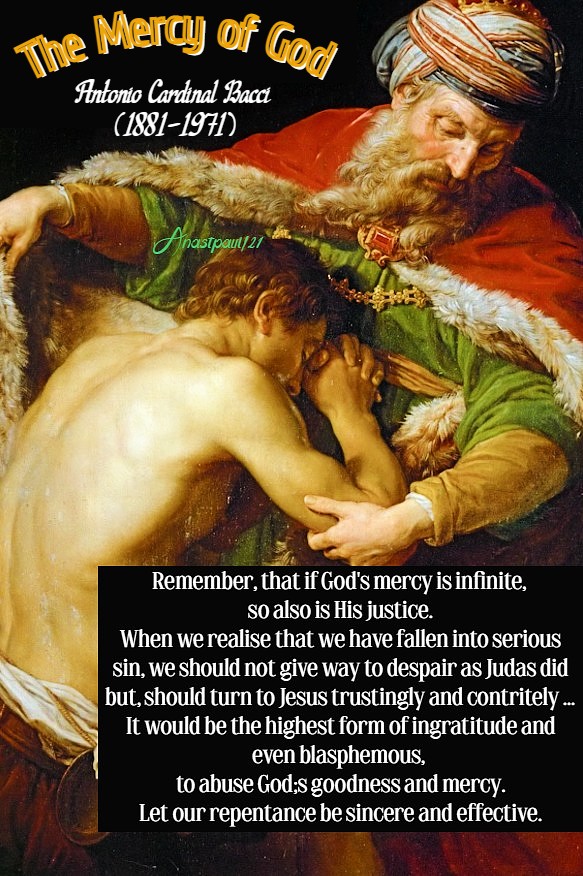
“Another vision will confront us also in that final hour. Our frightened minds will see again all those hours which we have misused in sin. The devil will try by every means in his power, to repaint them in our troubled imagination. He will do his best to lead us into despair, even as he tempted Judas and many other sinners before us.
We know well that the mercy of God is infinite and that it remains infinite at the hour of death. But, we know too that His justice, is no less infinite. Since God has granted us so much time in which He called us to repentance and to a life of virtue, it could happen that at the point of death, He will put an end to the mercy and to the favours which He has shown us and which we have disregarded. What will become of us then? Remember that only one of the two thieves was converted. The other died unrepentant on his cross, even though he was hanging by the side of Jesus!
Reflect and make provision while there is still time. While we have time.,let us do good (Gal 6:10). We shall be unable to do anything about it afterwards.”
Quote/s of the Day – 3 March – Ember Friday, First Week of Lent – Ezekiel 18:20-28, John 5:1-15 – Scripture search here: https://www.drbo.org/
“Do you wish to be made whole?”
John 5:6
“”
“O Heavenly Father, have compassion for my cry as Thou did for the prodigal son, for I, too, am throwing myself at Thy feet and crying aloud as he cried: “Father, I have sinned!” Do not reject me, Thy unworthy child, O my Saviour but cause Thy Angels to rejoice too, on my behalf, O God of goodness Thou, Who desires that all should be saved.”
St Romanos Melodios (c 490-c 556) Monk, Composer of hymns, Poet
“Each day then, we ought to renew our resolutions and arouse ourselves to fervour, as though it were the first day of our turning back to God. We ought to say: “Help me, O Lord God, in my good resolution and in Your holy service. Grant me now, this very day, to begin perfectly, for thus far I have done nothing.” … Just men depend on the grace of God rather than on their own wisdom in keeping their resolutions. In Him they confide every undertaking …”
Thought for the Day – 2 March – Meditations with Antonio Cardinal Bacci (1881-1971)
Prayer as a Necessary Means of Salvation
“We should appreciate how necessary it is to pray with special fervour and perseverance, in times of great temptation and suffering. If we neglect to do so when temptation assails us, we shall be on our own and shall certainly fall. When we encounter suffering and everything seems to be crumbling around us, let us remember that God sees us and pities us. Let us turn to Him. Who alone is able and eager to help us in our misfortunes. When we pray, our tears are precious in His sight. God’s love for us is infinite. If we have recourse to Him, He will certainly answer us in the manner which He knows is best for us. He has promised this, “If he cries out to me, I will hear him, for I am compassionate” (Ex 22:26).”
Thought for the Day – 1 March – Meditations with Antonio Cardinal Bacci (1881-1971)
The Five Tribunals of Justice
“In regard to the civil authority, however, one thing should be made quite clear. We are only obliged to obey it when it does not infringe on the rights of God or of the Church. If it should run counter to these, we should answer in the words of St Peter and the other Apostles, when thy were called before the Sanhedrin. “We must obey God rather than men” (Acts 5:29).
If we had to suffer anything as a result, in the cause of God and of the Church, we should count that as our good fortune. Like the Apostles, we should be able to rejoice that we have been found worthy to suffer indignity and ill-treatment for the sake of Jesus’ Name (Acts 5:41).”
Quote/s of the Day – 1 March – Ember Wednesday – 3 Kings. 19:3-8, Matthew 12:38-50 – Scripture search here: https://www.drbo.org/
“The men of Nineveh will rise up at the judgement with this generation and condemn it, for they repented …”
Matthew 12:41
“The sign of Jonah”
Matthew 12:39
“It was, too, to lead the Ninevites to firm repentance and to convert them to Him, Who would deliver them from death, amazed as they were by the sign accomplished in Jonah … In the same way, God permitted man to be swallowed by that great monster, the author of disobedience, not so that he should altogether vanish away and die but because God, had prepared beforehand, the salvation fulfilled by His Word by means of the “sign of Jonah.”
St Irenaeus (130-208) Bishop of Lyons, Martyr and Father
“… In the conceitedness of our souls, without taking the least trouble to obey the Lord’s Commandments, we think ourselves worthy to receive the same reward as those who have resisted sin to the death!”
St Basil the Great (329-379) Father and Doctor of the Church
“To do penance is to bewail the evil we have done and to do no evil to bewail.”
“But He still follows behind us and counsels us, that we have despised Him but He still does not cease to call us. We turn our backs on His face, so to speak, when we reject His Words, when we trample His Commandments underfoot but He, Who sees that we reject Him, still calls out to us by His Commandments and waits for us by His patience, stands behind us and calls us back when we have turned away.”
St Pope Gregory the Great (540-604) Father & Doctor of the Church
“What are we doing? If we really love the Sacred Heart of Jesus, we should offer penance and sacrifices in order to make reparation for our sins and the sins of others and, to propitiate this adorable Heart, Which ardently desires to bestow new favours upon us.”
Our Lenten Journey with St Francis de Sales – 1 March – Ember Wednesday
“The troubles of my heart are multiplied, deliver me from my necessities. See my abjection and my labour and forgive me all my sins.” Psalm 24:17-18
“The men of Nineveh will rise up in the judgement with this generation and will condemn it; for they repented at the preaching of Jonah and behold, One greater than Jonah is here.” Matthew 12:41
REPENTANCE St Francis de Sales (1567-1622) Doctor Caritatis
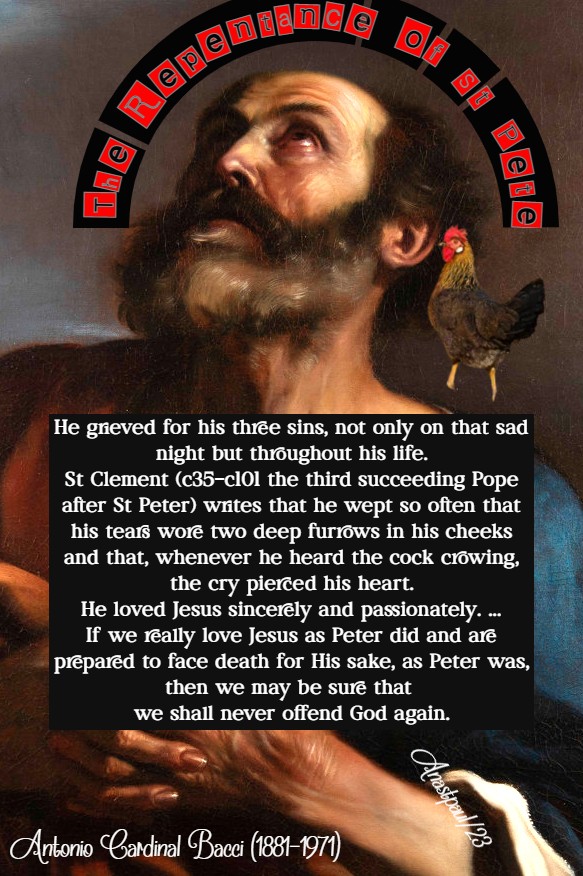
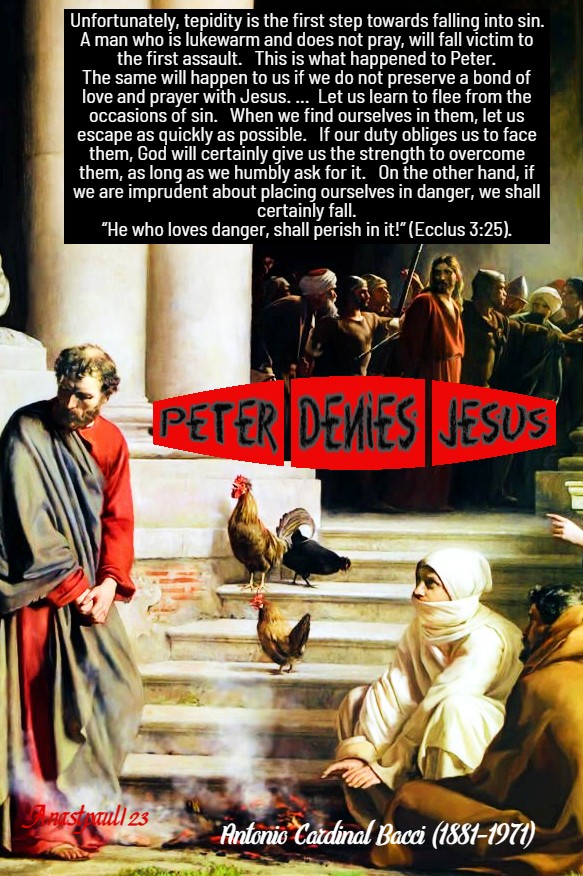
“LET ANYONE WHO IS STANDING BE FEARFUL lest he fall, says the Apostle [1 Cor 10:12]; let no-one glory in finding himself expressly called by God, to a place where there seems nothing to fear. Let no-one presume on his good works and think he has nothing more to fear. St Peter, who had received so many graces, who had promised to accompany Our Lord to prison and even to death itself [Lk 22:33], denied Him, nevertheless, at the whimpering taunt of a chambermaid! Judas sold Him for such a small sum of money!
These falls were both very great but there was this difference. One acknowledged his guilt; the other despaired. Yet, our Saviour had inspired in the heart of both, the same Peccavi [admission of guilt] (“I have sinned”) that same Peccavi that God inspired in David’s heart. [2 Kgs (2 Sm.) 12:13]. Yes, He inspired it in both Apostles but one rejected it and the other accepted it. Hearing the cock crow, St Peter remembered what he had done and the word his good Master had spoken to him. Then, acknowledging his sin, he went out and wept so bitterly [Matt 26:74-75; Lk 22:61-62] that he received what we today call a Plenary Indulgence and full remission of all his sins. O happy St Peter! By such contrition for your sins you received a full pardon for such great disloyalty!
From this time on, St Peter never ceased weeping, principally when he heard the cock crow at night and morning, for he remembered this crowing as the signal for his conversion. It is also reported that he shed so many tears that they hollowed his cheeks into two furrows. With these tears he, who had been a great sinner became a great saint. “O glorious St Peter, how happy you are to have done such great penance for such great disloyalty. By it you were reinstated in grace. You, who deserved eternal death became worthy of eternal life.” Not only that but St Peter received here below, special favours and privileges and was lavished with blessings on earth and in Heaven.
On the other hand, although Judas received the same inspiration for the same Peccavi, he rejected it and despaired. I know that efficacious and sufficient grace differ, as theologians say but I am not here to prove and dispute, whether Judas’ inspiration … was as efficacious as David’s, or only sufficient. It was certainly sufficient. This Peccavi, sent to the heart of Judas, was truly like that formerly sent to David. Why then was Judas not converted?
O miserable man! He saw the gravity of his crime and despaired. Truly, he confessed his sin, for in returning to the chief priests the thirty pieces of silver for which he had sold his good Master, he acknowledged aloud that he had sold innocent blood. [Matt. 27:3-5]. But these priests would give him no absolution. Alas, did not this unhappy man know that Our Lord alone could give it to him, that He was the Saviour and held Redemption in His hands? Had he not seen this truth clearly in those whose sins Jesus had remitted? Certainly, he knew it but he did not wish, nor dare to ask pardon. To make him despair, the devil showed him the enormity and hideousness of his crime and, perhaps, made him fear that if he asked his Master’s pardon, He might impose too great a penance. Perhaps, for fear of such penance, he was unwilling to ask for forgiveness. Thus, despairing, he hanged himself and his body burst wide open, all his entrails spilling out [Acts 1:18] and he was buried in the deepest of Hells.” – Sermon for Good Friday 25 March 1622.
Thought for the Day – 28 February – Meditations with Antonio Cardinal Bacci (1881-1971)
The Examination of Conscience
“Pope St Pius X holds great authority for a Christian. In his Exhortatio ad Clerum, he strongly recommends the Examination of Conscience, especially at the close of the day. This Examination, he says, is necessary for Priests but it is no less necessary for the laity. He recalls the apt words of St Augustine: “Judge your own conscience. Demand an account from it. Dig deep and rend it apart. Discover all the evil thoughts and intentions of the day … and punish yourself for them!” (Expos in Ps 4 n 8). He also quotes the equally relevant works of St Bermard: “Be a searching inquirer into your own integrity of life; examine your conduct everyday. See how much you have advanced, or, how much you have fallen back … Learn to know yourself. … Place all your faults before your eyes. Stand before yourself, as if it were before someone else and you will find reason to weep over yourself!” (Meditat Cap 5 de quotidiano sui ipsius examine).
The Saintly Pontiff concludes his inspiring address as follows: “Experience has proven that anyone who makes a strict examination of his thoughts, words and actions, is more firmly resolved to hate and avoid what is evil and wholeheartedly to love what is good” (Acta Pii X, IV p257).”
Thought for the Day – 27 February – Meditations with Antonio Cardinal Bacci (1881-1971)
Fervour and Tepidity
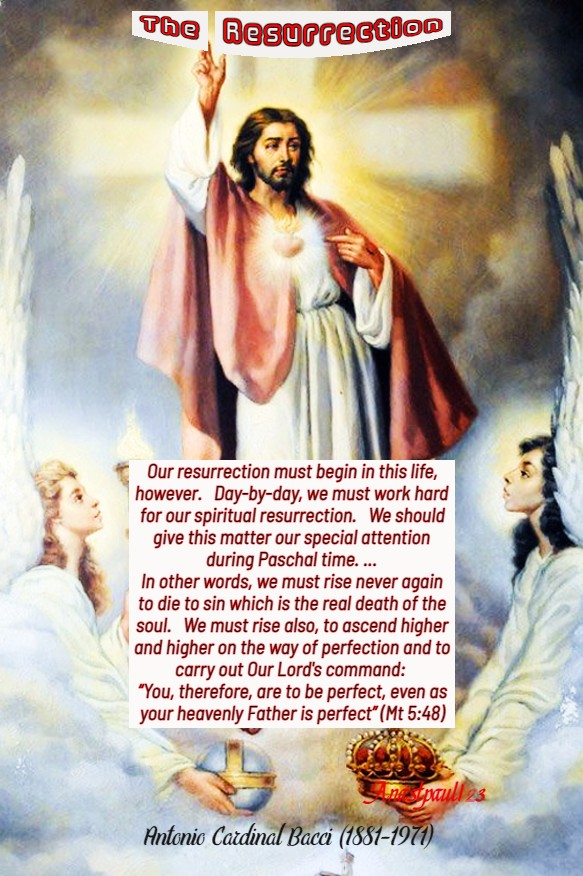
“Our Lord does not command us to be merely virtuous. He commands us to be perfect. “You, therefore, are to be perfect, even as your heavenly Father is perfect” (Mt 5:48). He tells us to love Him with our whole heart and our whole soul. “Thou shalt love the Lord th God, with thy whole heart and with thy whole soul” (Mt 22:37). He orders us to renounce everything rather than offend Him, (Lk 14:33) even to pluck out an eye or cut off a hand or foot, if it should present an obstacle to our eternal salvation (Mt 18:81).
How can we remain unmoved and inactive in the face of these exhortations? The grace of perfection to which Our Lord calls us, cannot be reached without His grace which we can only obtain by fervent and unceasing prayer. Fervour is the animating principle of the spiritual life. It wins God’s gifts for us and makes us almost immune from sin.”
Thought for the Day – 26 February – Meditations with Antonio Cardinal Bacci (1881-1971)
Interior Silence
“It is much easier to recollect ourselves in the Church in front of the Altar. For this reason, one could not sufficiently recommend a visit to Jesus in the Blessed Sacrament every morning before going to work and every evening, before going to bed.
The ideal is always daily Mass and Holy Communion. This will be tiring and maybe, inconvenient. But God is infinitely good and will handsomely reward us for anything we do out of love for Him or, for our own spiritual welfare.”
Quote/s of the Day – 26 February – The First Sunday of Lent – 2 Corinthians 6:1-10, Matthew 4:1-11
“Begone, Satan! for it is written: The Lord thy God shalt thou adore and Him only shalt thou serve.”
Matthew 4:10
“Do not, therefore, lose your confidence, which has a great reward. For you have need of patience that, doing the will of God, you may receive the promise. For yet a very little while and He Who is to come, will come and will not delay.”
Hebrews 10:35-37
“Expect temptation to your last breath.”
St Anthony Abbot (251-356)
“The demons that wage war on us, through our shortcomings in virtue, are those which teach — impurity, drunkenness, avarice and envy. Those that wage war on us, through our excessive zeal for virtue, teach — conceit, self-esteem and pride. They [the demons] secretly pervert, what is commendable, into what is reprehensible!”
St Maximus the Confessor (c 580-662) Father of the Church
“It might even be said that we are fortunate to have temptations, for these are the times of spiritual harvest when we gather up for Heaven. … If we were thoroughly saturated with God’s Holy Presence, it would be easy for us to resist the enemy. With the thought ‘God sees you!’ we would never sin!
There was a saint who complained to our Lord after being tempted and said to Him: “Where were Thou, my most loveable Jesus, during that awful storm?” Our Lord answered: “I was in the centre of thou heart…”
St John-Marie Baptiste Vianney (1786-1859) The Curé of Ars
“When tempted, turn immediately to your Guardian Angel and ask him, with all your heart, “My Guardian Angel help me now. Do not let me offend my God!”
St John Bosco (1815-1888)
“Why, we may ask, does God permit us to be tempted? He wishes us to realise, that only with His help, can we aspire to the supernatural life and triumph over our enemies. Apart from Him, we shall be lost but close to Him, we shall be invincible!”
Thought for the Day – 25 February – Meditations with Antonio Cardinal Bacci (1881-1971)
The Sacrament of Penance
“St Charles Borromeo had the habit of going to Confession everyday. This was not the result of scruples on his p[art, it was simply that he was supernaturally enlightened so as to perceive, even his smallest faults and he was anxious to remove, from his soul, the slightest trace of sin.
We do not have to follow his example but, weekly or fortnightly Confession is strongly recommended by spiritual writers. It is a great loss to neglect Confession for too long a period. We are deprived of the graces of this Sacrament, our fervour grows cold and we slip easily from venial into mortal sin.
Let us decide to make a good Confession every week whenever we find it possilbe.”
Thought for the Day – 24 February – Meditations with Antonio Cardinal Bacci (1881-1971)
The Duties of Our State
“Let us be content, or at least, resigned in the position in which Providence has placed us. Let us pay special attention to those things which we are obliged to do. Anything which is not necessary should be left until later, even if it is more pleasant or seems more worthwhile in itself. Let us never become involved in business which is incompatible with our state or dangerous to our eternal welfare. Let us not make light of minor offences against the duties of our state. Smaller transgressions gradually become greater. Above all, let us try to sanctify our calling. It is one thing to work conscientiously, another to work in a spirit of holiness., Even pagans can do their duty earnestly. Doing our duty is only a help to our eternal salvation if it is done with God’s grace for the purpose of serving Him, for His love and glory. This should be our manner of behaviour. If it is, we can claim to have sanctified our state in life and to have made our work holy.”
Our Lenten Journey with St Francis de Sales – 24 February – Friday after Ash Wednesday, Feast of St Matthias, Apostle
“ Lord, Thou hast proved me and known me: Thou hast known my sitting down and my rising up.” Psalm 138:1-2
“Take My yoke upon you and learn from Me, for I Am meek and humble of heart and you will find rest for yourselves. For My yoke is easy and My burden light.” Matthew 11:29-30
ON FASTING 3 St Francis de Sales (1567-1622) Doctor Caritas
“THE THIRD CONDITION NECESSARY for fasting well, is to look to God and to do everything to please Him, withdrawing within ourselves in imitation of a great Saint, St Gregory the Great, who, withdrew into a secret and out-of-the-way place, where he remained for some time without anyone knowing where he was, being content that the Lord and His Angels knew it.
This is what Cassian, that great Father of the spiritual life, teaches us so well in the book of his admirable Conferences. (Many Saints held it in such esteem that they never went to bed without reading a chapter from it to recollect their mind to God.) He says: “What will it profit you to do what you are doing for the eyes of creatures? Nothing but vanity and complacency which are good for Hell alone. But if you keep your fast and do all your works to please God alone, you will labour for eternity, without delighting in yourself or caring whether you are seen by others or not, since what you do is not done for them, nor do you await your recompense from them. We must keep our fast with humility and truth and not with lying and hyocrisy – that is, we must fast for God and to please Him alone.” …
This is all I wish to tell you regarding fasting and what must be observed in order to fast well. The first thing is that your fast should be entire and universal – that is that you should make all the members of your body and the powers of your soul fast – keeping your eyes lowered … mortifying the hearing and the tongue, so that you will no longer hear or speak of anything vain or useless; … the memory, in filling it with the remembrance of bitter and sorrowful things and avoiding joyous and gracious thoughts; keeping your will in check and your spirit at the foot of the Crucifix, with some holy and sorrowful thought. If you do this, your fast will be universal, interior and exterior, for you will mortify both your body and your spirit. The second condition is that you do not observe your fast or perform your works, for the eyes of others and the third, is that you do all your actions and consequently, your fasting, to please God alone, to Whom be honour and glory forever and ever. Amen.” – (Excerpt from the Sermon given for Ash Wednesday on 9 February 1622).
Thought for the Day – 23 February – Meditations with Antonio Cardinal Bacci (1881-1971)
The Order of the Day
“Once we have decided on our manner of behaviour towards God, it is necessary to determine how we shall act in regard to our neighbour. We can have quite a number of unexpected matters to which we must attend during the day but normally, we have a good idea what kind of people we shall be dealing with.
There will be people who are an occasiuon of sin. We must try to avoid these but, if that is not possible, we must be on our guard and rely on the weapons of divine grace to protect us. There will be troublesome and annoying people with whom we must be patient and restrained. There will be people who are in want, either materally or spiritually, whom we must enlighten and assist. We shall meet difficulies and complicated problems to deal with which we must ask God for insight and prudence.
If we live in intimate union with Our Lord, we shall be competent to deal with all the business of the day, especially with the unexpected and even the shocking.”
Our Lenten Journey with St Francis de Sales – 23 February – Ash Thursday
“Blessed is the man who feareth the Lord, he shall delight exceedingly in His Commandments.” Psalm 111:1
“But you, when you fast, anoint your head and wash your face, so that you may not be seen fasting by men …” Matthew 6:17-18.
ON FASTING 2 St Francis de Sales (1567-1622) Doctor Caritas
“THE SECOND CONDITION is never to fast through vanity but always through humility. If our fast is not performed with humility, it will not be pleasing to God. All our ancient Fathers have declared it so but particularly, St Thomas, St Anbrose and the great St Augustine. St Paul, in the epistle which he wrote to the Corinthians (1 Cor 3) … declares the conditions necessary for disposing ourselves to fast well during Lent. He says this to us: “Lent is approaching. Prepare yourselves to fast with charity, for if your fast is performed without it, it will be vain and useless, since fasting, like all other good works, is not pleasing to God unless it is done in charity and through charity. When you disciopline yourself, when you say long prayers, if you have not charity, all that is nothing. Even though you should work miracles, if you have not charity, they will not profit you at all. Indeed, even if you should suffer martyrdom, without charity, your martyrdom is worth nothing and would not be meritorious in the eys of the Divine Master. For all works, small or great, however good they may be in themselves, are of no value and profit us nothing, if they are not done in charity and through charity,”
I say the same now – if your fast is without humility it is worth nothing and cannot be pleasing to the Lord! … Now, according to the Apostle, all that is done without charity is not pleasing to God, so I say, in the same way with this great Saint, that if you fast without humility, your fast is of no value. For if you have not humility you have not charity and if you are without charity, you are also without humility. It is almost impossible to have charity without being humble and to be humble withou having charity. These two virtues have such an affinity with one another that the one can never be without the other!
But what is this fast through humility? It is never to fast through vanity. Now how can one fast through vanity? … To fast through vanity is to fast through self-will, since this self-will is not without vanity or, at least, not without a temptation to vanity. And what does it mean to fast through self-will. It is to fast as one wishes and not as others wish – to fast in the manner which pleases us and not as we are ordered or counselled.
Let each one of us examine our consciences and we will find that all that comes from ourselves, from our own judgement, choice and election, is esteemed and loved far better, than that which comes from another!” – (Excerpt from the Sermon given for Ash Wednesday on 9 February 1622).
Thought for the Day – 22 February – Meditations with Antonio Cardinal Bacci (1881-1971)
The Early Hours of the Day
“If possible, it is desirable to begin the day by visiting Jesus. He is always in the Tabernacle, waiting patiently and lovingly for us to visit Him. Why could we not spend at least one half-hour with Him? There are twenty four hours in the day. Must we spend them in sleep, work, amusements and conversation without ever pausing to speak with Jesus?
What about Mass and Holy Communion? It is true that we are not obliged to go to Mass on weekdays, nor have we a strict obligation to receive Holy Communion, except during the Paschal period. But a genuine Catholic should not be satisfied with doing only what is commanded under pain of mortal sin. He should love Jesus so much that he will experience an urgent need of communication with Him. He should be ready to sacrifice a little of his early morning sleep, for the purpose of receiving Jesus in Holy Communion – if he is so blessed as to be near an early morning Mass. Never forget (and pray for them) that there are thousands, perhaps millions who are deprived of this great grace of living near a Church! There is no surer way of being able to resist the temptations of the day and of acquiring peace of spirit. The practice of daily Communion can transform a man’s life.”
Thought for the Day – 21 February – Meditations with Antonio Cardinal Bacci (1881-1971)
Lord, That I May See!
“The restlessness and intensity of living, make us see things as differently from what they really are. But one day, the veil of the temple will be rent asunder before our frightened eyes and eternal Light will break upon us. Then, we shall be blind no longer but, we shall see everything in the Light of eternity.
Let us place ourselves now, in the state in which we should like to find ourselves at that moment. Let us consider ourselves and everything else, in the Light of eternity. Then our blindness will disappear. Since we shall see everything in God’s way, we shall direct all our thoughts and actions toward Him alone!”
Thought for the Day – 12 February – Meditations with Antonio Cardinal Bacci (1881-1971)
The Causes of Discontent
“There is only one reason for our dissatisfaction. It is given by St Augustine, profound observer that he was of the human heart: “You have made us for Yourself alone, O God and our hearts will always be restless, until they rest in You” (Confessions 1, 1:11). If anyone rushes in all directions looking for happiness, he will never find it. The created things of the world cannot satisfy our hearts which are on a far higher plane than these worldly things are. Worse still, a man may look for happiness in pleasure or in sin but he will find only bitterness and disgust.
Let us look to God alone. If we do everything for Him, a gleam of eternal happiness will brighten up our earthly pilgrimage!
You must be logged in to post a comment.